
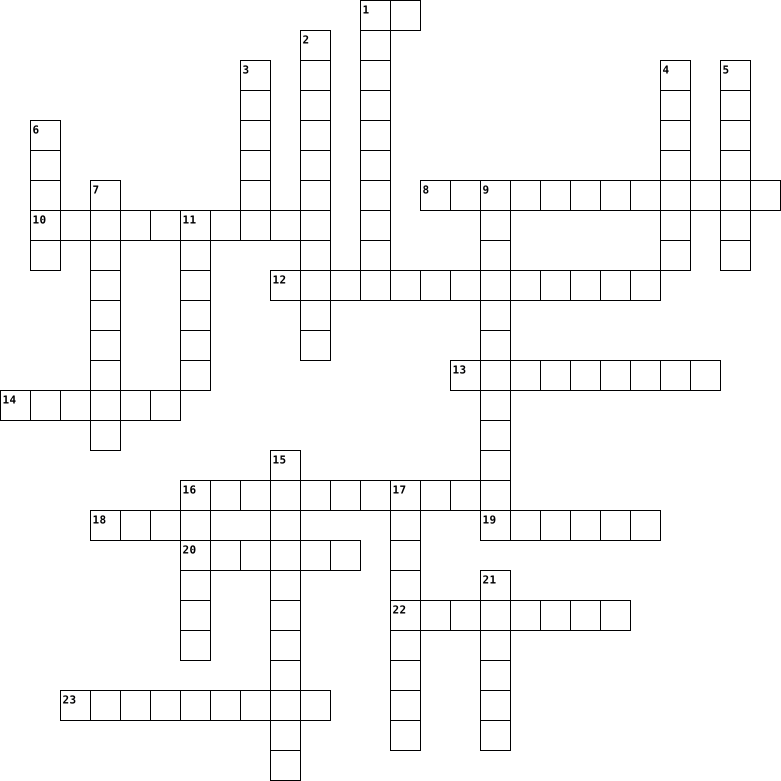
periodic%20table Crossword Puzzles
Chemistry Terms 2020-04-21

Across
- A verticle row on the periodic table
- A combination of two or more substances
- A particle found around all atoms with a negative charge
- The ability to dissolve in a substance
- The result of a chemical reaction
Down
- A horizontal row on the periodic table
- When liquid state turns into the state of gas
- Anything that has mass and takes up space
- A substance that changes during a reaction
- A change where a substance is exposed to oxygen
- A state of matter with a fixed volume and stable shape
- The measure of how acidic or basic a solution is
12 Clues: The result of a chemical reaction • A verticle row on the periodic table • A horizontal row on the periodic table • The ability to dissolve in a substance • A combination of two or more substances • Anything that has mass and takes up space • A substance that changes during a reaction • When liquid state turns into the state of gas • ...
the chemistry crossword 2012-12-18

Across
- what does an atom make
- the number of protons plus neutrons
- this has no charge
- it is made up of diffrent elements
Down
- the very small and dense part of an atom
- the number of protons which equals the number of electrons
- this is the smallest part of an element
- all the elements in each collum in the periodic table
- is a posotive charge
- this is an atom that has the same number of protons but diffrent number of neutrons
- the rows that go across in the periodic table
- it is a negative charge
12 Clues: this has no charge • is a posotive charge • what does an atom make • it is a negative charge • it is made up of diffrent elements • the number of protons plus neutrons • this is the smallest part of an element • the very small and dense part of an atom • the rows that go across in the periodic table • all the elements in each collum in the periodic table • ...
The History of the Atom and the Periodic Table 2016-07-04

Across
- What did Mendeleev use to predict properties of other elements
- Who put forward the idea of using the atomic number instead of the atomic mass as the organising factor on the Periodic Table
- Who discovered the proton
- The positive part of an atom
- One of the scientists who discovered the nucleus
- One of the scientists who discovered the nucleus
- The negative part of the atom
Down
- What Dalton believed an Atom looked like
- Who discovered the electron
- Who published the Periodic Table in 1869
- What metal was used during the experiment to find the nucleus of the Atom
- The neutral part of an atom
- Who discovered the neutron
13 Clues: Who discovered the proton • Who discovered the neutron • Who discovered the electron • The neutral part of an atom • The positive part of an atom • The negative part of the atom • What Dalton believed an Atom looked like • Who published the Periodic Table in 1869 • One of the scientists who discovered the nucleus • One of the scientists who discovered the nucleus • ...
Functions Terminology 2023-01-12

Across
- the line an exponential function can't cross
- the centre line of a periodic function
- 2+5+8+11+14 is a type of
- the sequence 1,3,9,27 is
- The inputs of a function is called the
Down
- The highest y-value of a parabola is called its
- A function that repeats at regular interval
- The reciprocal of sine is
- A relation is not a function if it fails the
- the range of a function becomes the domain of its
- The length of one cycle
- The point where a parabola crosses the x-axis is a
12 Clues: The length of one cycle • 2+5+8+11+14 is a type of • the sequence 1,3,9,27 is • The reciprocal of sine is • the centre line of a periodic function • The inputs of a function is called the • A function that repeats at regular interval • the line an exponential function can't cross • A relation is not a function if it fails the • The highest y-value of a parabola is called its • ...
Atomic Structure & Periodic Table 2025-11-12

Across
- subatomic particle that has negative charge
- the sum of number of protons and neutrons in an atom
- a horizontal row of elements in the periodic table
- an atom’s central region made of protons and neutrons
- a vertical column of elements in the periodic table
- subatomic particle that is neutral in charge
- the number of protons in an atom
Down
- a region around the nucleus where electrons are located
- electrons in the outermost orbital
- subatomic particle that has positive charge
- atoms with same number of protons but different number of neutrons
- a charged atom by losing or gaining electrons
12 Clues: the number of protons in an atom • electrons in the outermost orbital • subatomic particle that has negative charge • subatomic particle that has positive charge • subatomic particle that is neutral in charge • a charged atom by losing or gaining electrons • a horizontal row of elements in the periodic table • a vertical column of elements in the periodic table • ...
Layers of the Earth 2025-12-09

Across
- name for nickel on the periodic table
- Crust primarily made of basalt
- Crust primarily made of granite
- Layer responsible for the movement of tectonic plates; partially molten
- Seismic waves that cannot travel through liquids
- Least dense, thinnest layer of the earth
Down
- Densest layer of the earth. Solid Fe/Ni
- Responsible for the different Layers of the Earth
- The parts of the Earth that move during earthquakes
- Layer of the Earth made of liquid Fe/Ni
- Seismic waves that can travel through all layers of earth
- name for iron on the periodic table
12 Clues: Crust primarily made of basalt • Crust primarily made of granite • name for iron on the periodic table • name for nickel on the periodic table • Densest layer of the earth. Solid Fe/Ni • Layer of the Earth made of liquid Fe/Ni • Least dense, thinnest layer of the earth • Seismic waves that cannot travel through liquids • Responsible for the different Layers of the Earth • ...
PERIODIC CROSSWORD 2019-09-16

Across
- ELEMENTS ARE ARRANGED BY THE _________TABLE
- MOVING LEFT TO RIGHT ACROSS THE PERIODIC TABLE, THE NUMBER OF ELECTRONS IN ATOMS _______
- NUMBER OF PROTONS AND NEUTRONS IN AN ATOM (2WORDS)
Down
- NUMBER OF PROTONS IN AN ATOM (2 WORDS)
- SMALLEST PARTICLE OF AN ELEMENT.
- MOVING LEFT TO RIGHT ACROSS THE PERIODIC TABLE, ATOMIC RADIUS ______.
- ATOMS HAVE THE SAME NUMBER OF PROTONS AND _______.
7 Clues: SMALLEST PARTICLE OF AN ELEMENT. • NUMBER OF PROTONS IN AN ATOM (2 WORDS) • ELEMENTS ARE ARRANGED BY THE _________TABLE • ATOMS HAVE THE SAME NUMBER OF PROTONS AND _______. • NUMBER OF PROTONS AND NEUTRONS IN AN ATOM (2WORDS) • MOVING LEFT TO RIGHT ACROSS THE PERIODIC TABLE, ATOMIC RADIUS ______. • ...
Periodic Table Crossword 2024-11-25

Across
- Metals have a ______ melting point
- Calcium is
- recognized that atomic number, not atomic mass, is the basis of the organization of the periodic table
- developed the first type of periodic table but wasn't finished due to incompleteness
Down
- Metalloids ______ can be easy or hard to change
- published the first periodic table
- Nonmetals are _____ conductors of heat and electricity
7 Clues: Calcium is • Metals have a ______ melting point • published the first periodic table • Metalloids ______ can be easy or hard to change • Nonmetals are _____ conductors of heat and electricity • developed the first type of periodic table but wasn't finished due to incompleteness • ...
Metals, Nonmetals and Metalloids Crossword 2020-03-30

Across
- ,is considered a metal but lies along the zigzag line
- , element that has no metallic properties
- ,luster and do not reflect much light, not metallic looking
- ,the ability of a substance to conduct electricity
- ,can be drawn into wire, but some more ductile than others
- found along the zigzag line on the periodic table
- ,when they are solid
- , are shared by metals and nonmetals
- ,the ability of a substance to be hammered into sheets without breaking
- ,generally shiny is easily pulled into wires or hammered into thin sheets
Down
- ,the ability of a substance to be pulled into a thin wire
- ,has the properties of both metals and nonmetals
- , conductors of electricity and heat
- ,at room temperature, except for mercury, which is a liquid
- found to the right of the zigzag line on periodic table
- ,look with a shiny luster
- ,liquid or gas at room temperature
- ,the ability of a substance to reflect light
- ,conductors of electricity and heat
- ,can be hammered into sheets without breaking
20 Clues: ,when they are solid • ,look with a shiny luster • ,liquid or gas at room temperature • ,conductors of electricity and heat • , conductors of electricity and heat • , are shared by metals and nonmetals • , element that has no metallic properties • ,the ability of a substance to reflect light • ,can be hammered into sheets without breaking • ...
Elements of the periodic table Alice R 2012-09-05

Across
- This makes up 25.7% of the earths crust by weight
- This smells like rotten eggs and comes from the ground
- This makes up 78% of the atmosphere by volume
- This is black and semi metallic
- Lots of drink cans are made of this
- This is the lightest element
- This is the 3rd element on the periodic table
- This mineral is found in milk, grains and protein rich foods
- We must breath this to survive
- Diamond is made of this
Down
- We need this mineral to make our bones healthy and strong
- This is never found free in nature
- This is a colourless, odourless gas
- The symbol for this element is Be
- This is the 9th element on the periodic table
- The symbol for this element is Ne
- When burned this glows bright white
- This is put in swimming pools to kill bacteria
- The symbol for this element is Ne
- This make your voice go funny and high when inhaled
20 Clues: Diamond is made of this • This is the lightest element • We must breath this to survive • This is black and semi metallic • The symbol for this element is Be • The symbol for this element is Ne • The symbol for this element is Ne • This is never found free in nature • This is a colourless, odourless gas • Lots of drink cans are made of this • When burned this glows bright white • ...
Chemical Formulas & Periodic Table 2015-10-27

Across
- substances formed in a chemical reaction
- matter is neither created or destroyed in ordinary chemical and physical changes
- group 17 liquid with mass number 79.9
- law that states energy cannot be created or destroyed
- expression that shows starting substances and those produced by a chemical reaction
- an interaction that holds atoms together
- a reaction that requires an input of energy
- elements that dull and brittle and poor conductors
Down
- symbols and numbers that represent a substance
- that participate in a chemical reaction
- elements that have properties of metals and nonmetals
- a reaction that releases energy
- a substance that changes the rate of a reaction without being used up
- horizontal rows on the periodic table
- vertical columns on the period table, like Noble Gasses
- electrons in outer shell of atom
- Scientist that developed the current periodic table
- a charged atom having more or less electrons than protons
- elements that are shiny and good conductors
19 Clues: a reaction that releases energy • electrons in outer shell of atom • horizontal rows on the periodic table • group 17 liquid with mass number 79.9 • that participate in a chemical reaction • substances formed in a chemical reaction • an interaction that holds atoms together • a reaction that requires an input of energy • elements that are shiny and good conductors • ...
Science Review Crossword Puzzle 2022-10-26

Across
- A substance that enters into a chemical reaction.
- Negatively charged particle the surrounds the nucleus of an atom.
- Positively charged particle in the nucleus of an atom.
- The rate at which one form of energy is transferred into another.
- A Change in which substances combine or break apart to form new substances.
- A push or pull on an object.
- A measure of how much matter is in an object.
- Energy of movement.
- Basic unit of matter.
- Elements listed horizontally on the Periodic Table.
Down
- A pure substance that cannot be broken into other substances.
- Energy that has the potential to happen.
- The ability to do work or cause change.
- The amount of space that matter occupies
- Neutral particle in the nucleus of an atom.
- A change in the form of a material but not substance.
- The measure of how much mass is contained in a given volume.
- Anything that has mass and takes up space.
- Elements listed vertically on the Periodic Table.
19 Clues: Energy of movement. • Basic unit of matter. • A push or pull on an object. • The ability to do work or cause change. • Energy that has the potential to happen. • The amount of space that matter occupies • Anything that has mass and takes up space. • Neutral particle in the nucleus of an atom. • A measure of how much matter is in an object. • ...
Chemistry 1 2023-09-01

Across
- the first element on the periodic table
- description of bonded atoms
- Which is larger, a decimeter or a millimeter
- A type of mixture with all components NOT equally distributed
- the measurement taken by dividing the mass by the volume
- A system used to help shorten very large or very small numbers
- The study of matter and its properties
- the chemicals that are formed during a reaction
Down
- a solid that forms from mixing two liquids
- 10^3 meters
- the amount of centigrams in a gram
- fundamental materials of the universe organized in the periodic table
- A type of mixture with all components equally distributed
- a product seen from bubbles forming
- the chemicals that start a chemical reaction
- the law of ______________ of mass
- Description of bonded atoms composed of at least two different elements
- the amount of space taken up by an object or a sample
- the amount of "stuff" in an object
19 Clues: 10^3 meters • description of bonded atoms • the law of ______________ of mass • the amount of centigrams in a gram • the amount of "stuff" in an object • a product seen from bubbles forming • The study of matter and its properties • the first element on the periodic table • a solid that forms from mixing two liquids • Which is larger, a decimeter or a millimeter • ...
Enriched crossword 2025-10-29

Across
- energy required to remove an electron
- a particle found in the nucleus that has no charge
- the addition of kinetic and potential energy
- periodic table patterns which repeat themselves
- element with the strongest ionization energy
- a chemical reaction that releases energy usually in the form of heat
- has a specific heat of 4.19 J/g·°C
- elements that have the same number of protons, but different number of neutrons
Down
- energy of motion
- the most reactive metal found on the periodic table
- when a force is applied to an object and the object moves in the direction of the force
- mass, the mass of one mole of a substance (2words)
- has a molar mass of 12.01 g/mol
- unit of work
- the only element that can be found with no neutrons
- a unit of measurement measuring 6.02x10²³
- the type of bond where electrons are shared
- measures the quantity of matter in an object
- the type of radiation that has a negative charge
19 Clues: unit of work • energy of motion • has a molar mass of 12.01 g/mol • has a specific heat of 4.19 J/g·°C • energy required to remove an electron • a unit of measurement measuring 6.02x10²³ • the type of bond where electrons are shared • the addition of kinetic and potential energy • element with the strongest ionization energy • measures the quantity of matter in an object • ...
Mixtures 2022-02-14

Across
- physical property
- made up of two or more elements, not on periodic table
- smallest particle
- when something changes from one thing to another and does NOT remain the same compound
- different throughout
Down
- when something changes from one thing to another but does remain the same compound, phase change
- chemical property
- physical property
- found on the periodic table
- chemical property
- physical property
- same through out
12 Clues: same through out • chemical property • physical property • physical property • chemical property • smallest particle • physical property • different throughout • found on the periodic table • made up of two or more elements, not on periodic table • when something changes from one thing to another and does NOT remain the same compound • ...
Scientific Crossword 2013-04-19

Across
- discovered in 1898 chemical symbol
- its atomic number is 10 it is a noble gas
- the element under hydrogen
- has 8 valence electrons
- has the secound smallest atomic number
Down
- atomic symbol is B and its atomic number is 5
- is the very first element of the periodic table
- has 1 valence elctron
- horizonal on the periodic table
9 Clues: has 1 valence elctron • has 8 valence electrons • the element under hydrogen • horizonal on the periodic table • discovered in 1898 chemical symbol • has the secound smallest atomic number • its atomic number is 10 it is a noble gas • atomic symbol is B and its atomic number is 5 • is the very first element of the periodic table
My crossword ♦♣♠♥→Chimin 2015-06-14

Across
- all substances made by this small particles
- First element in periodic table
- The substances produced when two or more elements combine in chemical reaction
- Element that name like Albert Einstein
Down
- Symbol is Fe
- Compound of Hydrogen and oxygen
- First element in the periodic table
- Symbol of Gold
- Second element in periodic table
- One way to make chemical reaction that use heat
10 Clues: Symbol is Fe • Symbol of Gold • Compound of Hydrogen and oxygen • First element in periodic table • Second element in periodic table • First element in the periodic table • Element that name like Albert Einstein • all substances made by this small particles • One way to make chemical reaction that use heat • ...
Atoms and elements 2025-04-01

Across
- The central part of the atom
- Positively charged sub-atomic particle
- Formed when a liquid evaporates
- Substance made up of only one type of atom
- Noble gas with a relative atomic mass of 40
- Least reactive metal in group 1
- A list of elements in order of how much they react is called the _________ series
- Neutral sub-atomic particle found in the nucleus
Down
- Rows on the periodic table
- Type of reaction where the more reactive element takes the place of the less reactive element in the compound
- Type of element found on the left of the periodic table
- Metal with 12 electrons
- Element in group 2, period 5
- Metal with 29 protons
- Negatively charged sub-atomic particle found in shells
- Smallest particle of an element that can exist
16 Clues: Metal with 29 protons • Metal with 12 electrons • Rows on the periodic table • The central part of the atom • Element in group 2, period 5 • Formed when a liquid evaporates • Least reactive metal in group 1 • Positively charged sub-atomic particle • Substance made up of only one type of atom • Noble gas with a relative atomic mass of 40 • ...
Module 2 2025-08-18

Across
- of vaporization
- pool
- Table
- cycle
- molecule
- reaction
- formula
- tension
- bond
Down
- symbol
- reaction
- reaction
- heat
13 Clues: pool • heat • bond • Table • cycle • symbol • formula • tension • reaction • reaction • molecule • reaction • of vaporization
History of the Periodic Table 2020-03-30

Across
- one of the elements Mendeleev predicted the properties of
- refers to trends or recurring variations in element properties with increasing atomic number
- law of octaves
- first periodic law arranged elements according to this
- left spaces for elements not yet discovered
Down
- discovered the noble gases
- law of triads
- modern periodic law arranges elements according to this
- discovered atomic number
9 Clues: law of triads • law of octaves • discovered atomic number • discovered the noble gases • left spaces for elements not yet discovered • first periodic law arranged elements according to this • modern periodic law arranges elements according to this • one of the elements Mendeleev predicted the properties of • ...
Periodic Table Structure 2022-11-15

Across
- tell you atomic + mass number and symbol
- 20th element on periodic table
- tells you the number of protons and electrons equal to number of protons when neutral
- element with no neutrons
Down
- 4th element down on the 8th column
- element with 6 electrons
- provides the number of protons
- element with 8 protons
- 17th element on periodic table
9 Clues: element with 8 protons • element with 6 electrons • element with no neutrons • provides the number of protons • 20th element on periodic table • 17th element on periodic table • 4th element down on the 8th column • tell you atomic + mass number and symbol • tells you the number of protons and electrons equal to number of protons when neutral
SCIENCE 2016-01-17

Across
- The breaking down of rocks on the earth's surface is _____
- If fish are caught faster than they can breed, what will happen to the population?
- Which term refers to the number of protons in an atom and helps to place elements on the Periodic Table?
- The study of interactions between organisms and their environment is called_____
- Which subatomic particle has a positive charge?
- Which body system pumps and transports the blood to all parts of the body as well as supply oxygen and remove waste products from body tissues?
- Which subatomic particle is NOT found in the nucleus of an atom?
- On the Periodic Table, elements that are in the same vertical column are considered to be in the same_____
- Which of the following nutrients is used to build and repair cells?
Down
- Which organelle contains nearly all of a eukaryotic cell's DNA?
- In addition to food, what else does a mitochondrion need to release energy?
- What is the hormone responsible for causing sudden emotional changes and sexual feelings that occur in males during puberty?
- Which area of Earth science includes the study of stars?
- This structure, found in cells, assembles proteins.
- A species in danger of becoming extinct in the near future is referred to as a(an)_____ species.
- On the Periodic Table, all elements that are in the same horizontal rows are considered to be in the same ______
16 Clues: Which subatomic particle has a positive charge? • This structure, found in cells, assembles proteins. • Which area of Earth science includes the study of stars? • The breaking down of rocks on the earth's surface is _____ • Which organelle contains nearly all of a eukaryotic cell's DNA? • Which subatomic particle is NOT found in the nucleus of an atom? • ...
Matter & Periodic Table 2024-04-14

Across
- Subatomic particle with a negative (-)charge located outside the nucleus.
- mixture which is not uniform throughout, the component substances can be visibly distinguished.
- the basic building block of matter.
- physical combinations of two or more different substances.
- the number of protons in the nucleus of an atom, which determines the chemical properties of an element and its place in the periodic table.
- a column in the periodic table of the chemical elements
- the mass of an atom of a chemical element expressed in atomic mass units. It is approximately equivalent to the number of protons and neutrons in the atom
- Subatomic particle with a positive (+) charge located in the nucleus (center) of an atom.
- the horizontal rows on the periodic table
Down
- electrons in the outermost shell of an atom, and that can participate in the formation of a chemical bond
- Pure substance that is made up of two or more types of atoms/elements that are chemically bonded together
- Pure substances, made of one type of atom, that cannot be changed into simpler substances.
- abbreviations used in chemistry, mainly for chemical elements
- mixture which is uniform throughout, the substances are evenly mixed and cannot be visibly distinguished.
- Subatomic particle with no charge (neutral charge) located in the nucleus of an atom.
- anything that has mass and takes up space.
16 Clues: the basic building block of matter. • the horizontal rows on the periodic table • anything that has mass and takes up space. • a column in the periodic table of the chemical elements • physical combinations of two or more different substances. • abbreviations used in chemistry, mainly for chemical elements • ...
Periodic family 2020-10-08

Across
- conductors of electricity
- conductors of electricity
- up of elements that have similar chemical and physical properties.
- of bottom two rows taken out of Periodic Table
- to combine most often with Group 7
Down
- shiny something is a substance's ability reflect light
- 7
- of bottom two rows taken out of Periodic Table
- columns on the Periodic Table
- substance made up of only 1 type of atom
- of both metals and non-metals
11 Clues: 7 • conductors of electricity • conductors of electricity • columns on the Periodic Table • of both metals and non-metals • to combine most often with Group 7 • substance made up of only 1 type of atom • of bottom two rows taken out of Periodic Table • of bottom two rows taken out of Periodic Table • shiny something is a substance's ability reflect light • ...
Scientific Crossword 2013-04-19

Across
- the element under hydrogen
- discovered in 1898 chemical symbol
- has 8 valence electrons
Down
- has the secound smallest atomic number
- horizonal on the periodic table
- is the very first element of the periodic table
- has 1 valence elctron
- atomic symbol is B and its atomic number is 5
- its atomic number is 10 it is a noble gas
9 Clues: has 1 valence elctron • has 8 valence electrons • the element under hydrogen • horizonal on the periodic table • discovered in 1898 chemical symbol • has the secound smallest atomic number • its atomic number is 10 it is a noble gas • atomic symbol is B and its atomic number is 5 • is the very first element of the periodic table
Scientific Crossword 2013-04-19

Across
- discovered in 1898 chemical symbol
- has 8 valence electrons
- atomic symbol is B and its atomic number is 5
- the element under hydrogen
- has the secound smallest atomic number
Down
- horizonal on the periodic table
- is the very first element of the periodic table
- has 1 valence elctron
- its atomic number is 10 it is a noble gas
9 Clues: has 1 valence elctron • has 8 valence electrons • the element under hydrogen • horizonal on the periodic table • discovered in 1898 chemical symbol • has the secound smallest atomic number • its atomic number is 10 it is a noble gas • atomic symbol is B and its atomic number is 5 • is the very first element of the periodic table
Periodic table 2020-12-07

Across
- the columns on the periodic table
- the element with the symbol Au
- the umber of neutrons in silver is____
- the element with the atomic mass of 70/69.723
Down
- the rows on the periodic table are called____
- Sodium's atomic symbol is___
- the element with the atomic number Cu
- the number of protons in sulfur is____
- the element with the atomic number 2
- the element with the atomic number 27
10 Clues: Sodium's atomic symbol is___ • the element with the symbol Au • the columns on the periodic table • the element with the atomic number 2 • the element with the atomic number Cu • the element with the atomic number 27 • the number of protons in sulfur is____ • the umber of neutrons in silver is____ • the rows on the periodic table are called____ • ...
Unit 6 Crossword 2022-04-07

Across
- The amount of energy required to remove an electron from an isolated atom or molecule
- The measure of an atom's ability to attract the shared electrons of a covalent bond to itself
- Most reactive group of nonmetals
- Electrons in outermost energy level
Down
- Unreactive group of elements
- Have both metallic and nonmetallic properties
- Most reactive group of metals
- Lack metallic properties
- Horizontal row on periodic table
- Vertical column on periodic table
10 Clues: Lack metallic properties • Unreactive group of elements • Most reactive group of metals • Horizontal row on periodic table • Most reactive group of nonmetals • Vertical column on periodic table • Electrons in outermost energy level • Have both metallic and nonmetallic properties • The amount of energy required to remove an electron from an isolated atom or molecule • ...
Earth and Space 2019-09-25

Across
- Horizontal row of elements on the periodic table
- Neutrally charged particles
- The number of protons and neutrons added up in the nucleus
- The outer areas where electrons are
- group of atoms held together by a chemical bond
Down
- Vertical column on the periodic table
- Positively charge particles
- Negatively charged particles
- The number of protons in the nucleus of an atom
- Smallest particle an element can be divided and still be that element
10 Clues: Positively charge particles • Neutrally charged particles • Negatively charged particles • The outer areas where electrons are • Vertical column on the periodic table • The number of protons in the nucleus of an atom • group of atoms held together by a chemical bond • Horizontal row of elements on the periodic table • ...
Chemistry Puzzle 2024-01-05

Across
- Not shiny, does not reflect light.
- Ability to be hammered.
- Can bend.
- The measurement of the size of an atom (includes the nucleus and electron cloud).
- A row on the periodic table reads from left to right horizontally.Also known as a family family.
Down
- Can be stretched into wires.
- The ease of undergoing a chemical reaction.
- Breaks or shatters easily.
- Column on the periodic table located in a vertical position.
- Shine, shiny- reflects light.
10 Clues: Can bend. • Ability to be hammered. • Breaks or shatters easily. • Can be stretched into wires. • Shine, shiny- reflects light. • Not shiny, does not reflect light. • The ease of undergoing a chemical reaction. • Column on the periodic table located in a vertical position. • The measurement of the size of an atom (includes the nucleus and electron cloud). • ...
Elements and Compounds 2024-05-10

Across
- A substance made up of only one type of atom.
- Easily broken.
- A repeating arrangement of atoms in a solid
- The columns on the periodic table.
Down
- A shiny element that conducts heat and electricity
- Able to be hammered or pressed into shape without breaking
- A row in the periodic table
- A group of atoms bonded together.
- The smallest particle of an element.
- A substance made of two or more types of atoms.
10 Clues: Easily broken. • A row in the periodic table • A group of atoms bonded together. • The columns on the periodic table. • The smallest particle of an element. • A repeating arrangement of atoms in a solid • A substance made up of only one type of atom. • A substance made of two or more types of atoms. • A shiny element that conducts heat and electricity • ...
Science 2023-04-14

Across
- the 98 element of the periodic table
- have a negative charge and a mass of zero
- A substance that consists of atoms that have the same number of protons
- the 54 element of the periodic table
- ability to burn or ignite
Down
- A substance composed of two or more elements
- ability to be hammered into thin sheets
- Smallest unit of matter
- ability to dissolve or be dissolved
- center of the atom
10 Clues: center of the atom • Smallest unit of matter • ability to burn or ignite • ability to dissolve or be dissolved • the 98 element of the periodic table • the 54 element of the periodic table • ability to be hammered into thin sheets • have a negative charge and a mass of zero • A substance composed of two or more elements • ...
Periodic Table Crossword 2013-08-10

Across
- METALS Any of the group of univalent metals including potassium, sodium, lithium, rubidium, cesium and francium, whose hydroxides are alkalis.
- A light, ductile, silver-white, metallic elements that burns with a dazzling white light.
- Chloride + __________ = salt.
- An elementary particle with no charge.
- A heavy, silver-white , highly, toxic metallic element, the only that is liquid at room temperature.
- A precious yellow metallic element, highly malleable and ductile.
- GASES Any of the chemically inert gaseous elements including helium, neon, argon, krypton, xenon and radium.
- SHELL A grouping of electrons surrounding the nucleus of an atom.
Down
- Used in pool water.
- Has an atomic number of three.
- One of two elements that are radioactive.
- An element when put in food products, makes bones and teeth strong.
- An element that does not belong to any group of the Periodic Table.
- An elementary particle with a positive charge.
- The result of the combination of two oxygen atoms.
- TEMPERATURE A comfortable temperature range indoors, usually considered to be 20-25 Degrees Celsius.
- A malleable, ductile, metallic element that is a reddish-brown colour
- The positively charged mass within an atom, made up of neutrons and protons.
18 Clues: Used in pool water. • Chloride + __________ = salt. • Has an atomic number of three. • An elementary particle with no charge. • One of two elements that are radioactive. • An elementary particle with a positive charge. • The result of the combination of two oxygen atoms. • A precious yellow metallic element, highly malleable and ductile. • ...
The Periodic Table 2014-03-15

Across
- A small particle that makes up elements.
- A group of metals that change the amount of electrons in its outer shell.
- A gas that goes around in pairs in the air.
- One of the eight vertical columns in the periodic table
- A substance with more than one type of atom joined together.
- A substance that cannot be broken down into anything simpler.
- A metal that is made with specific properties of other metals
- A metal that can be magnetized.
- A sub-atomic particle with a positive charge and a relative mass of one.
Down
- Group one metal.
- A substance where the particles are free to move.
- A member of group seven.
- A group of atoms joined together.
- A material/substance that contains more than one substance.
- Charged particles.
- A material that is usually solid and shiny, some are magnetic.
- One of the seven horizontal rows in the periodic table
- An element named after a planet.
18 Clues: Group one metal. • Charged particles. • A member of group seven. • A metal that can be magnetized. • An element named after a planet. • A group of atoms joined together. • A small particle that makes up elements. • A gas that goes around in pairs in the air. • A substance where the particles are free to move. • One of the seven horizontal rows in the periodic table • ...
periodic table elements 2022-11-13

Across
- Ar
- B
- Li
- Cl
- He
- S
- Ne
- O
- Be
Down
- Al
- Mg
- N
- P
- H
- C
- Si
- Na
- F
18 Clues: N • P • B • H • C • S • F • O • Al • Mg • Ar • Li • Cl • Si • He • Na • Ne • Be
Periodic Table Vocab 2024-03-11

Across
- the process of adding or removing electrons from an atom or molecule, which gives the atom or molecule a net charge
- one of the elements of Group 17
- one of the elements of Group 1 of the periodic table
- an element in the s-block or p-block of the periodic table
- an atom, radical, or molecule that has gained or lost one or more electrons and has a negative or positive charge
- a member of the rare earth series of elements that range from 58 to 71
- the energy required to remove an electron from an atom or ion
Down
- an ion that has a positive charge
- an arrangement of elements in order of their atomic number
- the energy needed to remove an electron from a negative ion to form a neutral atom or molecule
- one of the elements of Group 2 of the periodic table
- one of the metals that can use the inner shell before using the outer shell to bond
- an electron that is found in the outermost shell of an atom and that determine the atom’s chemical properties
- a measure of the ability of an atom in a chemical compound to attract electrons
- one-half of the distance between the center of identical atoms that are not bonded together
- any of the series of heavy radioactive elements that range from 90 to 103
- the law that states the repeating chemical and physical properties of element change.
- an ion that has a negative charge
18 Clues: one of the elements of Group 17 • an ion that has a positive charge • an ion that has a negative charge • one of the elements of Group 2 of the periodic table • one of the elements of Group 1 of the periodic table • an arrangement of elements in order of their atomic number • an element in the s-block or p-block of the periodic table • ...
Periodic Table Facts 2022-12-16

Across
- Period 2 element found in all living organisms
- transition metal so important to toolmaking that an Age is named for it.
- transition metal used in coins, pipes, and wiring
- The ion form of this alkali metal powers your smartphone
- most elements exist in this phase on Earth
- noble gas used in balloons
- noble gas in the second period
- smelly non-metal found in the oxygen group
- poisonous halogen used as a chemical warfare agent in WWI
- highly flammable alkaline earth metal
Down
- Period 3 metal holding your favorite soda
- only Group 1 element that isn't a metal
- Bananas are rich in this alkali metal
- a liquid halogen
- transition metal used in hip implants and body piercings
- Superman's noble gas?
- metalloid found in computer chips that has similar reactivity to carbon
- highly reactive halogen found as an ion in toothpaste
18 Clues: a liquid halogen • Superman's noble gas? • noble gas used in balloons • noble gas in the second period • Bananas are rich in this alkali metal • highly flammable alkaline earth metal • only Group 1 element that isn't a metal • Period 3 metal holding your favorite soda • most elements exist in this phase on Earth • smelly non-metal found in the oxygen group • ...
Periodic Table Crossword 2024-11-12

Across
- has a mass of 14.045✕ 2
- has one valence electron in row one
- 8 valence electrons in row three
- first discovered in space before being found on Earth, has 2 fewer protons than beryllium, has the highest ionization energy
- has 6 neutrons, and has higher electron negativity than Helium, in the carbon group
- Nobel gas with an atomic number of ten
- Nonmetal With 17 electrons
- has 3 more electrons than Hydrogen
Down
- mass of 24.31 in period 2
- has 3 valence electrons, has a smaller atomic radius than Sodium
- 13 neutrons and protons and is infinitely recyclable
- group one with the largest atomic radius, alaki metal thats lighter then water.
- has seven protons and neutrons and makes up about 78.1% of the Earth's atmosphere
- nonmetal with nine protons
- charge of -3
- commonly found in batteries, element is a cation with a neutral parent atom with ionic radium that is smaller.
- six valence electrons in period two
- ends on 3p4
18 Clues: ends on 3p4 • charge of -3 • has a mass of 14.045✕ 2 • mass of 24.31 in period 2 • nonmetal with nine protons • Nonmetal With 17 electrons • 8 valence electrons in row three • has 3 more electrons than Hydrogen • has one valence electron in row one • six valence electrons in period two • Nobel gas with an atomic number of ten • 13 neutrons and protons and is infinitely recyclable • ...
Periodic table crossword 2024-11-13

Across
- halogen with 17 protons and high electronegativity
- has the smallest atomic radius and highest ionization energy
- metal, +1 charge, is combined with chlorine to make salt
- 5 valence electrons, non-metal, -3 charge, 7n
- has the highest electronegativity
- 4 valence electrons, mass of approximately 27 amu
- -3 charge located in the 3rd energy level, large ionic radius
Down
- atomic mass of 32 amu (non-metal)
- this element has a full shell of valence electrons and has 22n
- can be used for highspeed aircraft, has 4 protons
- a metal, greyish type color, has 3 protons
- has only 1 valence electron and has +1 charge
- +2 charge, metal, 3rd energy level
- metalloid found in foil located in the 3rd energy level
- found on most super cars, has +4/-4 charge, is located in the 2nd energy level
- 0 charge, is dright colors
- used in rockets and fireworks, has 5 protons
- -2 charge, 6 valence electrons, 8n
18 Clues: 0 charge, is dright colors • atomic mass of 32 amu (non-metal) • has the highest electronegativity • +2 charge, metal, 3rd energy level • -2 charge, 6 valence electrons, 8n • a metal, greyish type color, has 3 protons • used in rockets and fireworks, has 5 protons • has only 1 valence electron and has +1 charge • 5 valence electrons, non-metal, -3 charge, 7n • ...
The Periodic Table 2025-03-09

Across
- has 125 neutrons and a mass of 209
- has a mass of 10
- has a mass of 73 and 41 neutrons
- the first element on the periodic table
- has 36 electrons
- has an atomic number of 118
- has 32 neutrons and a mass of 59
Down
- has a mass of 14
- has 42 electrons
- has 100 protons
- has an atomic number of 8
- has 26 protons
- has the symbol W
- has the symbol Rn
- has the symbol Sn
- has the symbol Au
- has 14 protons and 14 neutrons
- has a mass of 209 and 126 neutrons
18 Clues: has 26 protons • has 100 protons • has a mass of 14 • has 42 electrons • has a mass of 10 • has the symbol W • has 36 electrons • has the symbol Rn • has the symbol Sn • has the symbol Au • has an atomic number of 8 • has an atomic number of 118 • has 14 protons and 14 neutrons • has a mass of 73 and 41 neutrons • has 32 neutrons and a mass of 59 • has 125 neutrons and a mass of 209 • ...
Science study guide 2022-01-13

Across
- An area in an atom where electrons could possibly be found
- A column of elements in the periodic table of the chemical elements
- Happens when there are more protons than electrons in an atom
- Property of metals and non metals
- The emission of ionizing radiation or particles caused by the spontaneous disintegration of atomic nuclei
- Any of a group of rare gases that include helium, neon, argon, krypton, xenon, and usually radon and that exhibit great stability and extremely low reaction rates
- Can be solid, gas or liquid, cant conduct heat or electricity
- Usually rigid, are good conductors of electricity and heat, form cations by loss of electrons, and yield basic oxides
- Formed when an atom gains or loses electrons
- The amount of protons in an element
- Center of an aton containing protons and neutrons
- Horizontal rows of the periodic table
- Happens when there are more electrons than protons in an atom
Down
- Positively charged particle that is part of an atom
- Process by which an unstable atomic nucleus loses energy by radiation
- Negatively charged particle that is part of an atom
- Series of 15 consecutive chemical elements in the periodic table
- Have superior abilities to conduct heat
- Any of the chemical elements fluorine, chlorine, bromine, iodine, and astatine. They are all monovalent and readily form negative ions
- No charge or neutral charged particle that is part of an atom
- Two or more forms of the same element that contain equal numbers of protons but different numbers of neutrons
- Unit to measure weight of atoms
- Earth metals are six chemical elements in group 2 of the table
- Elements including sodium, potassium, lithium,rubidium, cesium, and francium
- Any of the series of fifteen metallic elements
25 Clues: Unit to measure weight of atoms • Property of metals and non metals • The amount of protons in an element • Horizontal rows of the periodic table • Have superior abilities to conduct heat • Formed when an atom gains or loses electrons • Any of the series of fifteen metallic elements • Center of an aton containing protons and neutrons • ...
Science study guide 2022-01-13

Across
- An area in an atom where electrons could possibly be found
- A column of elements in the periodic table of the chemical elements
- Happens when there are more protons than electrons in an atom
- Property of metals and non metals
- The emission of ionizing radiation or particles caused by the spontaneous disintegration of atomic nucleus
- Any of a group of rare gases that include helium, neon, argon, krypton, xenon, and usually radon and that exhibit great stability and extremely low reaction rates
- Can be solid, gas or liquid, cant conduct heat or electricity
- Usually rigid, are good conductors of electricity and heat, form cations by loss of electrons, and yield basic oxides
- Formed when an atom gains or loses electrons
- The amount of protons in an element
- Center of an aton containing protons and neutrons
- Horizontal rows of the periodic table
- Happens when there are more electrons than protons in an atom
Down
- Positively charged particle that is part of an atom
- Process by which an unstable atomic nucleus loses energy by radiation
- Negatively charged particle that is part of an atom
- Series of 15 consecutive chemical elements in the periodic table
- Have superior abilities to conduct heat
- Any of the chemical elements fluorine, chlorine, bromine, iodine, and astatine. They are all monovalent and readily form negative ions
- No charge or neutral charged particle that is part of an atom
- Two or more forms of the same element that contain equal numbers of protons but different numbers of neutrons
- Unit to measure weight of atoms
- Earth metals are six chemical elements in group 2 of the table
- Elements including sodium, potassium, lithium,rubidium, cesium, and francium
- Any of the series of fifteen metallic elements
25 Clues: Unit to measure weight of atoms • Property of metals and non metals • The amount of protons in an element • Horizontal rows of the periodic table • Have superior abilities to conduct heat • Formed when an atom gains or loses electrons • Any of the series of fifteen metallic elements • Center of an aton containing protons and neutrons • ...
Chemistry Crossword Puzzle 2012-08-31

Across
- A column in the periodic table
- Joining of two atoms in a stable arrangementmolecule/Discrete group of atoms that share electrons
- Consists of only one kind of atom
- A measure of the pull of gravity of the earth in a body
- Salt-formers
- Atoms of the same element having a different number of neutrons
- The weighted average of the mass of the naturally occurring isotopes of a particular element reported in atomic mass units
- Building blocks of nucleon
- has a constant composition, regardless of sample size and origin of sample
- Assigning an unambiguous name to each compound is called ____________
- All matter is composed of the same building blocks called?
- discrete group of atoms
- Periodic table can be divided into four regions called?
- Amount or quantity of matter in a body
- Negatively charged ions
Down
- The lowest energy arrangement of electrons is called the ________ state
- A row in the periodic table
- A physical property that relates the mass of a substance to its volume
- Dense core that contains the protons and neutrons
- Every atom of a given type of element always has the same number of protons in the nucleus, a value called the ________ number
- Smallest region of space where the probability of finding the electron is great
- Ability or tendency of atoms to attract electrons from adjacent atoms
- When particles and anti-particles meet
- Nuclear glue
- Black deposit
- Ionic _________ are composed of cations and anions
- Highly ionized particles of gases
- Have properties intermediate between metals and nonmetals
- Positively charged ions
- Disturbance set as a particle
30 Clues: Nuclear glue • Salt-formers • Black deposit • Positively charged ions • discrete group of atoms • Negatively charged ions • Building blocks of nucleon • A row in the periodic table • Disturbance set as a particle • A column in the periodic table • Consists of only one kind of atom • Highly ionized particles of gases • When particles and anti-particles meet • ...
Mathematics Project 2012-11-05
Across
- The ratio of the circumference of a circle to its diameter.
- Used when to angles and any side are known.
- A device for measuring angles.
- Vertical translation of a periodic function.
- An equation, graph, or data that can be modeled by a degree 2 polynomial.
- The inverse function of tan.
- The bottom part of a fraction.
- The additive identity. The number that when you add it to a number, n, you will get n as a result.
- The reciprocal of the cosine.
- A table of numbers arranged in rows and columns.
- (-1,0,1,2,3) these numbers called
- A straight line that is a close approximation to a curve as the curve goes off to infinity.
Down
- Horizontal translation of a periodic function.
- The value of x at the point where a curve crosses the x-axis.
- To cut something in half.
- A line can be used to help draw vertical translation horizontal of each cycle.
- A fraction in which the denominator is assumed to be 100.
- The ratio of the change in y-coordinates to the change in x-coordinates.
- The conjugate of a complex number is formed by reversing the sign on the imaginary part of the number. The conjugate of a + bi is a - bi.
- (0,1,2,3,4,5,6 ) these numbers are
- The inverse function of sin.
- A set of numbers that identifies the location of a point.
- The set of all possible values of the argument of a function.
- Half the difference between the largest and smallest function value of a periodic function.
- The measure of how often a function repeats its same values.
25 Clues: To cut something in half. • The inverse function of sin. • The inverse function of tan. • The reciprocal of the cosine. • A device for measuring angles. • The bottom part of a fraction. • (-1,0,1,2,3) these numbers called • (0,1,2,3,4,5,6 ) these numbers are • Used when to angles and any side are known. • Vertical translation of a periodic function. • ...
The Periodic Table Challenge Crossword Puzzle 2013-03-26

Across
- What is the number assigned to an element based on the number of protons in the nucleas called
- I am an element on the periodic table, my element symbol is Cl, and my atomic number is 17
- What is a fundamental substance that cannot be broken into simpler substances by chemical or physical processess called
- What is the characteristics of a substance that can be observed without changing it chemically, such as size, shape, density, and phase called
- What is the smallest part of an element called
- I am an element on the periodic table, my element symbol is H, and my atomic number is 1
- What is a form of matter that is different from everyday matter called
- What is the decreasing of volume called
- What is the temperature at which the substance changes from a solid to a liquid called
- I am an element on the periodic table, my element symbol is Na, and my atomic number is 11
Down
- What is the reducing of volume as a result of applied pressure called
- What is the temperature at which a liquid freezes called
- I am energy in motion What am is my name
- What is the smallest piece of a substance called
- What is the easy to remember commonly used, and seen in everyday world called
- What is something that takes up space called
- I Display fundamental substances called elements what am I called
- What is the increasing of volume called
- What is a phase of matter that has definite shape and volume called
- What is a phase of matter that has no definite shape or volume called
20 Clues: What is the increasing of volume called • What is the decreasing of volume called • I am energy in motion What am is my name • What is something that takes up space called • What is the smallest part of an element called • What is the smallest piece of a substance called • What is the temperature at which a liquid freezes called • ...
science crossword carter hubbard 2014-11-13

Across
- number 11 on the peridoic table
- a possible form of a gene
- the force of atrraction between masses
- compound that dissolves in water to form a solution with a pH lower than 7
- the genetic properties or features of an organism, characteristic, etc
- number 6 on the periodic table
- break down by water
- any of the elements fluorine, chlorine, bromine, iodine, and astatine, occupying group VIIA (17) of the periodic table. They are reactive nonmetallic elements that form strongly acidic compounds with hydrogen, from which simple salts can be made
- no longer in existence on the planet
- a stable subatomic particle with a charge of negative electricity, found in all atoms and acting as the primary carrier of electricity in solids
- mechanism that makes electrical contact with the moving commutator in a motor
- a thing that is composed of two or more separate elements; a mixture
- compounds that contain only carbon and hydrogen atoms
- periodic table is made of..
Down
- the unit of electrical current
- a set of cells connected together to form energy for electronics
- organic matter, such as food or agricultural waste, used as an energy source
- change of state from a gas to a solid
- school subject
- change of state to a gas from a liquid
- a structure of nucleic acids and protein found in the nucleus of most living cells, carrying genetic information in the form of genes
- a part of the stamen that produces pollen and stores it
- ability to do work
- the basic unit of a chemical element.
- a substance produced by a living organism that acts as a catalyst to bring about a specific biochemical reaction.
25 Clues: school subject • ability to do work • break down by water • a possible form of a gene • periodic table is made of.. • the unit of electrical current • number 6 on the periodic table • number 11 on the peridoic table • no longer in existence on the planet • change of state from a gas to a solid • the basic unit of a chemical element. • the force of atrraction between masses • ...
Science Crosswords 2015-11-17

Across
- description of a substance that can be pounded or rolled into sheets
- principle that matter is not created or destroyed in a chemical reaction
- chemical reaction that releases heat
- Vertical columns in the periodic table
- chemical reaction that absorbs energy
- element that has both metallic and non-metallic properties
- the smallest part of an element that is representative of that element
- property that describe the physical appearance of a substance
- Comes from the Arabic word "alkimiya", meaning "the chemist"
Down
- an experiment in which all reactants and all products of a chemical reaction are accounted for
- the temperature in which a solid will melt
- pure substance that cannot be broken down into other substances
- group 17 elements in the periodic table; most reactive non-metals
- change that results when two or more substances react to create a different substance
- measure of atomic mass
- an experiment in which one or more products of a chemical reaction can escape
- pure substance formed when non-metals combine
- atom that has become electrically charged because it has lost or gained electrons
- Anything that has mass and occupies space
- description of a solid that can be stretched into a long wire
- chemical reaction that occurs when oxygen reacts with a substance to form a new substance and give off energy
- slow chemical change that occurs when oxygen in the air reacts with metal
- substance that reacts with other substances in a chemical reaction to create new substances with different properties
- new substance produced in a chemical reaction between reactants
- Horizontal row in the periodic table
25 Clues: measure of atomic mass • chemical reaction that releases heat • Horizontal row in the periodic table • chemical reaction that absorbs energy • Vertical columns in the periodic table • Anything that has mass and occupies space • the temperature in which a solid will melt • pure substance formed when non-metals combine • ...
Science Crosswords 2015-11-17

Across
- pure substance that cannot be broken down into other substances
- an experiment in which one or more products of a chemical reaction can escape
- the smallest part of an element that is representative of that element
- principle that matter is not created or destroyed in a chemical reaction
- Vertical columns in the periodic table
- change that results when two or more substances react to create a different substance
- property that describe the physical appearance of a substance
- group 17 elements in the periodic table; most reactive non-metals
- element that has both metallic and non-metallic properties
- measure of atomic mass
- description of a solid that can be stretched into a long wire
Down
- an experiment in which all reactants and all products of a chemical reaction are accounted for
- the temperature in which a solid will melt
- chemical reaction that absorbs energy
- new substance produced in a chemical reaction between reactants
- pure substance formed when non-metals combine
- Comes from the Arabic word "alkimiya", meaning "the chemist"
- chemical reaction that releases heat
- slow chemical change that occurs when oxygen in the air reacts with metal
- description of a substance that can be pounded or rolled into sheets
- atom that has become electrically charged because it has lost or gained electrons
- Horizontal row in the periodic table
- substance that reacts with other substances in a chemical reaction to create new substances with different properties
- Anything that has mass and occupies space
- chemical reaction that occurs when oxygen reacts with a substance to form a new substance and give off energy
25 Clues: measure of atomic mass • chemical reaction that releases heat • Horizontal row in the periodic table • chemical reaction that absorbs energy • Vertical columns in the periodic table • Anything that has mass and occupies space • the temperature in which a solid will melt • pure substance formed when non-metals combine • ...
vocabulary 2014-10-07

Across
- number: the total number of protons and neutrons in an atom.
- mechanical model: modern description of the electrons in atoms.
- exclusion principle: atomic orbital may describe at most two electrons.
- wavelengths of the visible light that are separated when a beam of light passes though a prism.
- the distance between the crests.
- vertical column of the periodic table.
- mass: a weighted average mass of the atoms in a naturally occuring sample of the element.
- light quanta
- configuration: ways in which electrons are arranged in various orbitals around the nuclei of atoms.
- SI unit of cycles per second.
- state: the electron has its lowest possible energy.
Down
- rules: states that electrons occupy orbitals of the same energy in a way that makes the number of electrons with the same spin direction as large as possible.
- principle: electrons occupy the orbitals of lowest energy first.
- atoms that have the same number of protons but different numbers of neutrons.
- defines as one of the mass of a carbon atom.
- the waves height from zero to the crest.
- table: an arrangement of elements in which the elements are separated into groups based on a set of repeating properties.
- amount of energy requires to move an electron from one energy level to another.
- the number of eave cycles to pass a given point per unit of time.
- uncertainty principle: states that it is impossible to know exactly both the velocity and the position of a particle at the same time.
- horizontal row of the periodic table.
- emission spectrum: the pattern formed when light passes through a prism or diffraction grating the separate it into the different frequencies of light it contains.
- levels: fixed energrys an electron can have.
- magnetic radiation: radio waves. xrays. and gamma rays.
24 Clues: light quanta • SI unit of cycles per second. • the distance between the crests. • horizontal row of the periodic table. • vertical column of the periodic table. • the waves height from zero to the crest. • defines as one of the mass of a carbon atom. • levels: fixed energrys an electron can have. • state: the electron has its lowest possible energy. • ...
Chemistry 2016-02-11

Across
- elements odorless, colorless, and have little chemical reactivity.
- regions of space outside nucleus where electrons may exist.
- atomic particle that moves around nucleus, carrying negative charge.
- atomic particle found in nucleus with a positive charge.
- atomic particle found in nucleus with a neutral charge.
- number on periodic table that represents number of electrons in one atom of an element.
- electrons in outer most orbital.
- a reaction that occurs when a layer of metal is bonded to surface of another substance.
- familly or column of elements on periodic table that share similar properties.
- came up with law of Octaves to predict new elements.
- substance you get after a reaction.
- average mass of an atom of an element
- substance you use to combine to make a reaction.
- the smallest unit of an element, can exist alone or combined with others.
- a combination of atoms bonded together. (Little lump)
Down
- matter can change form to form, mixtures separated or made, pure substances decomposed, but total amount of mass remains constant.
- energy released.
- positively charged center of atom.
- elements that partially conduct electricity, and have properties between both metals and non-metals.
- elements not malleable, not ductile, poor conductors, and are brittle.
- row of elements on periodic table, atomic number increases left to right.
- pure substance made of 2 or more different kinds of atoms bonded together, with new properties.
- energy absorbed.
- a pure substance that has only one kind of atom in it.
- capital letter followed by one or more lowercase letters to represent an element.
- elements that are usually solid, shiny, good electricity and heat conductors, malleable, and ductile.
26 Clues: energy released. • energy absorbed. • electrons in outer most orbital. • positively charged center of atom. • substance you get after a reaction. • average mass of an atom of an element • substance you use to combine to make a reaction. • came up with law of Octaves to predict new elements. • a combination of atoms bonded together. (Little lump) • ...
Chapter 10 Modern Atomic Theory And The Periodic Table 2016-01-10

Across
- distance between two peaks or trough inside a wave
- what is white light?
- all the Group IIIB to Group IIB (3-12) elements
- When a gas emits light shown through a prism, the beaming colored lines are part of a _____
- 2nd sublevel
- 1st sublevel
- the energy level expressed by the principal quantum number n
- this method of arranging electrons uses arrows and boxes
- this atom's orbital configuration is 1s² 2s²2p⁶ 3s²3p⁶
- Who said this: “electrons revolve in specific regions at various distances from the nucleus called energy levels”
- outermost electron shell
- this atom's orbital configuration is 1s² 2s²2p⁶ 3s²3p⁶ 4s²3d¹⁰
- as stated by this principle, an orbital cannot contain more than 2 electrons
- this method of arranging electrons uses numbers, letters, and superscripts
- energy is emitted in tiny distinct packets called _____
- neon’s orbital configuration
Down
- in a given atom, no 2 electrons may have the same set of 4 quantum numbers therefore an orbital must have electrons with opposite spins ↓↑
- Which rule is this: electrons will occupy separate orbitals of the same energy before pairing of electrons occur
- Every principle energy level is divided into _____
- all the Group A’s elements in the Periodic Table
- columns in the periodic table
- region in space around a nucleus with a high probability of finding an electron
- this atom's orbital configuration is 1s² 2s²2p⁶ 3s²3p⁶ 4s²
- small packets of energy in streams of light
- electrons on the outermost energy level
- 4th sublevel
- 3rd sublevel
- rows in the periodic table
- Group VIIA Elements
- lowest energy level
30 Clues: 2nd sublevel • 1st sublevel • 4th sublevel • 3rd sublevel • Group VIIA Elements • lowest energy level • what is white light? • outermost electron shell • rows in the periodic table • neon’s orbital configuration • columns in the periodic table • electrons on the outermost energy level • small packets of energy in streams of light • all the Group IIIB to Group IIB (3-12) elements • ...
Back to Science Class Crossword (8th Grade) 2023-01-02

Across
- This root word means together or with.
- This root word means many.
- The law of ________________ of mass states that matter is neither created nor destroyed.
- Verticle columns on the periodic table.
- In science class, you can lose a _________ piece by leaving the room or not having the needed supplies by the time class starts.
- The smallest building block of matter.
- Because many science vocabulary words contain these, we learn 5 new ones almost weekly. (2 words, no spaces)
- If you miss school, you don't have to answer the question of the day. (true/false)
- The subatomic particle in an atomic's nucleus that is neutral.
- The starting materials in a chemical reaction.
- How many total passes do you get all day?
- In these types of bonds, atoms nonmetals share electrons.
- If you are absent from school, whose responsibility is it to figure out what you missed?
- When you hear this, you should stop what you are doing and find your teacher. (2 words, no spaces)
- The daily agenda can be found on __________ on the home page.
Down
- The atomic number is the number of __________ in an atom.
- This root word means under
- How many times can you use the restroom in science class each quarter?
- Horizontal columns on the periodic table.
- If your class completes its entire puzzle by the end of the week, you can choose seats for a day OR choose your ________________. (2 words no spaces)
- This root word means earth.
- This root word means heat
- Your pencils should be sharpened _________ class starts.
- This root word means inside
- The outermost electrons in an atom.
- This root word means instrument
- The name of group 17 on the periodic table.
27 Clues: This root word means heat • This root word means under • This root word means many. • This root word means earth. • This root word means inside • This root word means instrument • The outermost electrons in an atom. • This root word means together or with. • The smallest building block of matter. • Verticle columns on the periodic table. • ...
Chemistry and the Periodic Table 2023-02-21

Across
- The earliest known concept of the atom came from which Greek philosopher…
- Who used John Dalton's concepts to create the first periodic table?
- Atoms are MOST stable when the level of valence electron seats is…
- Subatomic particle with almost no mass
- _____, air, fire and water were thought to be the first known elements
- Scientists have learned how to study atoms. They study atoms by studying how matter…
- The “splitting” of the atom is the basis for … energy
- The outermost electrons on an atom control which atoms bond…
- Electrons are found in different … or levels surrounding the nucleus
- What English chemist re-introduced the concept of the atom in the early 1800s (1808)?
- Dmitri Mendeleev organized the periodic table by the element's ...
- Electrons fill the levels … to the nucleus first.
- Protons have a ... charge
- The protons (+) and electrons (-) in an atom … each other out for the atom has a neutral charge
- Chemistry is the study of…
Down
- The ... of one element are different from the ... of any other element
- The nucleus has an overall … charge
- Neutrons are…(remember my jingle😀)
- An atom has the same number of protons and electrons then it has … overall charge
- The … electrons are the outermost electrons of an atom
- The atomic number is equal to the number of …
- Mendeleev’s periodic table left spaces for elements that were yet to be…
- What two subatomic particles make up the nucleus of the atom? protons and…
- Electrons have a ... charge
- Atoms are composed of 3 … particles
- A new level of ‘electron seats’ is not available until … the seats in the previous row have been filled.
- The building block of all matter is the…
- The number of protons in an atom helps to ... what element it is.
28 Clues: Protons have a ... charge • Chemistry is the study of… • Electrons have a ... charge • Neutrons are…(remember my jingle😀) • The nucleus has an overall … charge • Atoms are composed of 3 … particles • Subatomic particle with almost no mass • The building block of all matter is the… • The atomic number is equal to the number of … • ...
Pre-Cal Vocab 2021-10-07

Across
- a function which takes zero or more input values to a well-defined output value.
- a variable in an expression that depends on the value of another variable.
- the horizontal length of one cycle for a periodic or repeating function.
- four specific ways to manipulate the shape and/or position of a point, a line, or figure.
- a relation from a set of inputs to a set of possible outputs where each input is related to exactly one output
- the set of possible output values, which are shown on the y-axis.
- a variable that does not depend on any other variable for its value.
- y=mx+b
- one complete pattern of y-values for a periodic function.
Down
- between two sets is a collection of ordered pairs containing one object from each set.
- the exponent or power to which a base must be raised to yield a given number
- the set of possible input values, which consists of all the input values shown on the x-axis.
- to determine the value of the expression for a given value of each variable in the expression.
- a function that repeats a pattern of y-values itself over and over again at regular intervals
- cycle, is the horizontal center line about which the function oscillates above and below.
- type of problem that deals with a variable multiplied by itself — using an operation known as squaring.
- two sets that contain all the elements contained in either set (or both sets).
- a function is one which is defined not by a single equation, but by two or more.
- form, ax+by=c
- pairs of mathematical manipulations in which one operation undoes the action of the other.
20 Clues: y=mx+b • form, ax+by=c • one complete pattern of y-values for a periodic function. • the set of possible output values, which are shown on the y-axis. • a variable that does not depend on any other variable for its value. • the horizontal length of one cycle for a periodic or repeating function. • ...
Intro to Chemistry 2022-05-05

Across
- A change of one substance to another.
- Particles in the nucleus with an electric charge of 1+
- Any characteristic of a material that you can observe without changing the identity of the substance.
- Table where elements are arranged by increasing atomic number, and periodic changes in physical and chemical properties.
- The vertical columns in the periodic table.
- The process of separating substances, such as salt and water, in a mixture by evaporating a liquid and recondensing its vapor.
- Any characteristic of a material that you can observe that produces one or more new substances.
- The sum of the number of protons and the number of neutrons in the nucleus of an atom.
Down
- The mass of all substances that are present before a chemical change, known as the reactants, equals the mass of all of the substances that remains after the change, which are called the products.
- Uses the chemical symbol of an element surrounded by dots to represent the number of electrons in the outermost energy level.
- The number of protons in an atoms's nucleus.
- The horizontal rows of elements in the periodic table.
- An element is matter that is composed of only one type of atom.
- Particles with an electric charge of 1-
- A change in size, shape, or state of matter in which the identity of the substance remains the same.
- The small, positively charge center of he atom.
- Atoms of the same element that have different numbers of neutrons.
- Smaller particles that make up protons and neutrons.
- The area around the nucleus of an atom where electrons are most likely to be found.
- The weighted average mass of all naturally occurring isotopes of an element, measured in atomic mass units, according to their natural abundances.
20 Clues: A change of one substance to another. • Particles with an electric charge of 1- • The vertical columns in the periodic table. • The number of protons in an atoms's nucleus. • The small, positively charge center of he atom. • Smaller particles that make up protons and neutrons. • The horizontal rows of elements in the periodic table. • ...
SPS1 Periodic Table Vocab. 2022-05-17

Across
- Atoms of the same element with varying number of neutrons.
- This is a column on the periodic table of elements.
- This is a substance that cannot be broken down further by chemical means.
- The weighted average of all of the isotopes of an element.
- A subatomic particle with no charge
- Building block of all matter.
- These are the reactive elements located in Group 2 of the periodic table.
- Area outside the atomic nucleus
- These are the highly reactive elements located in Group 1
- The central part of an atom that comprises nearly all of the atomic mass and that consists of protons and neutrons.
- An electron in the highest occupied energy level of an atom
Down
- This is a group of elements that have properties intermediate to metals and nonmetals.
- This is a very unreactive element in Group 18 with full valence shell.
- This is a type of element or substance that is not a metal.
- An arrangement of elements into rows and columns according to similarities in their properties.
- A subatomic particle with a positive charge
- A horizontal row of elements in the periodic table.
- This is a group of elements with few valence electrons that conducts heat and electricity.
- The number of protons and neutrons in the nucleus of any atom.
- A number of an element that is the number of protons in the nucleus of each atom of that element.
- These elements have 7 electrons in their outer energy level
- A reaction that causes atoms to bond and form new substances.
- A subatomic particle with a negative charge
23 Clues: Building block of all matter. • Area outside the atomic nucleus • A subatomic particle with no charge • A subatomic particle with a positive charge • A subatomic particle with a negative charge • This is a column on the periodic table of elements. • A horizontal row of elements in the periodic table. • These are the highly reactive elements located in Group 1 • ...
Unit B Crossword 2017-11-11

Across
- shiny,malleable,ductile element that conducts electricity
- amount of mass in a given volume of a substance
- change of state from a solid to a liquid
- cloudy mixture in which tiny particles of one substance are held within another and particles cannot be separated out from the other substance
- description of a substance that can be pounded or rolled into sheets
- ability of a substance to conduct electricity or heat
- chemical reaction that occurs when oxygen reacts with a substance to form a new substance and give off energy
- vertical columns of elements in the periodic table
- neutral particle in the nucleus of an atom
- change of state from a gas to a solid
- vertical column of elements in the periodic table;also called a family
- change of state from a liquid to a solid
Down
- the smallest part of an element that is representative of that element
- anything that has mass and occupies space
- substance that helps a chemical reaction to proceed more quickly
- group 17 in the periodic table;the most reactive non-metals
- description of a solid that can be stretched into a long wire
- atom that became electrically charged because it lost or gained electrons
- change of state from a gas to a liquid
- element that has both metallic and non-metallic properties
- change of state from a liquid to a gas
- chemical combination of two or more elements in a specific ratio
- catalyst involved in chemical reactions in living things
- slow chemical change that occurs when oxygen in the air reacts with a metal
- pure substance that cannot be broken down into other substances;substance made up of only one type of atom
25 Clues: change of state from a gas to a solid • change of state from a gas to a liquid • change of state from a liquid to a gas • change of state from a solid to a liquid • change of state from a liquid to a solid • anything that has mass and occupies space • neutral particle in the nucleus of an atom • amount of mass in a given volume of a substance • ...
Matter and the Periodic Table Puzzle 2018-02-07

Across
- I am made up of hydrogen and oxygen atoms and you need me to live.
- I am negatively charged and barely contribute to the mass of the atom.
- Another name for a row of the periodic table.
- I can be either heterogeneous or homogeneous.
- A combination of two or more atoms held together in a specific shape by attractive forces.
- These types of elements are malleable, ductile and conduct electricity.
- My atomic number is 7.
- Arsenic is an example of this type of element.
- I am the positively charged center of an atom.
- I am the heaviest alkaline earth metal.
- Two forms of the same element that contain same number of protons but different number of neutrons.
- I am one of the noble gases.
- I am a transition metal with 47 electrons used to make photographic film.
Down
- Electrons furthest from the nucleus that are responsible for interactions of atoms with one another also referred to as _________ electrons.
- I take the shape of the container I am in.
- Substance that contains more than one element.
- Members of Group 17 (or VIIA) are called _______.
- The number of _______ gives the identity of an element.
- Protons, neutrons and electrons are classified as ________ particles.
- I have no charge and you can find me at the center of an atom.
- Elemental symbol for tin.
- If phosphorus gains 1 proton it turns into this element.
- Another name for a column of the periodic table.
- My atomic mass is 63.546 amu.
- An atom that has gained or lost one or more electrons.
- I have definite shape and volume.
- You can find me in Group 1 of the periodic table and in table salt.
27 Clues: My atomic number is 7. • Elemental symbol for tin. • I am one of the noble gases. • My atomic mass is 63.546 amu. • I have definite shape and volume. • I am the heaviest alkaline earth metal. • I take the shape of the container I am in. • Another name for a row of the periodic table. • I can be either heterogeneous or homogeneous. • ...
Matter and the Periodic Table Puzzle 2018-02-07

Across
- Protons, neutrons and electrons are classified as ________ particles.
- I have definite shape and volume.
- Another name for a row of the periodic table.
- A combination of two or more atoms held together in a specific shape by attractive forces.
- I can be either heterogeneous or homogeneous.
- My atomic number is 7.
- If phosphorus gains 1 proton it turns into this element.
- The number of _______ gives the identity of an element.
- These types of elements are malleable, ductile and conduct electricity.
- I am made up of hydrogen and oxygen atoms and you need me to live.
- I am the heaviest alkaline earth metal.
- Elemental symbol for tin.
- Another name for a column of the periodic table.
Down
- Arsenic is an example of this type of element.
- Two forms of the same element that contain same number of protons but different number of neutrons.
- Substance that contains more than one element.
- I am negatively charged and barely contribute to the mass of the atom.
- Members of Group 17 (or VIIA) are called _______.
- I have no charge and you can find me at the center of an atom.
- I am the positively charged center of an atom.
- I am a transition metal with 47 electrons used to make photographic film.
- I take the shape of the container I am in.
- My atomic mass is 63.546 amu.
- An atom that has gained or lost one or more electrons.
- Electrons furthest from the nucleus that are responsible for interactions of atoms with one another also referred to as _________ electrons.
- You can find me in Group 1 of the periodic table and in table salt.
- I am one of the noble gases.
27 Clues: My atomic number is 7. • Elemental symbol for tin. • I am one of the noble gases. • My atomic mass is 63.546 amu. • I have definite shape and volume. • I am the heaviest alkaline earth metal. • I take the shape of the container I am in. • Another name for a row of the periodic table. • I can be either heterogeneous or homogeneous. • ...
Matter and the Periodic Table Puzzle 2018-02-07

Across
- I can be either heterogeneous or homogeneous.
- I am the heaviest alkaline earth metal.
- Electrons furthest from the nucleus that are responsible for interactions of atoms with one another also referred to as _________ electrons.
- Substance that contains more than one element.
- I am one of the noble gases.
- Arsenic is an example of this type of element.
- Members of Group 17 (or VIIA) are called _______.
- A combination of two or more atoms held together in a specific shape by attractive forces.
- Two forms of the same element that contain same number of protons but different number of neutrons.
- The number of _______ gives the identity of an element.
- You can find me in Group 1 of the periodic table and in table salt.
- I am a transition metal with 47 electrons used to make photographic film.
- These types of elements are malleable, ductile and conduct electricity.
- I have definite shape and volume.
- Another name for a column of the periodic table.
Down
- I am negatively charged and barely contribute to the mass of the atom.
- I take the shape of the container I am in.
- My atomic mass is 63.546 amu.
- My atomic number is 7.
- Protons, neutrons and electrons are classified as ________ particles.
- I am the positively charged center of an atom.
- If phosphorus gains 1 proton it turns into this element.
- I am made up of hydrogen and oxygen atoms and you need me to live.
- An atom that has gained or lost one or more electrons.
- Another name for a row of the periodic table.
- Elemental symbol for tin.
- I have no charge and you can find me at the center of an atom.
27 Clues: My atomic number is 7. • Elemental symbol for tin. • I am one of the noble gases. • My atomic mass is 63.546 amu. • I have definite shape and volume. • I am the heaviest alkaline earth metal. • I take the shape of the container I am in. • I can be either heterogeneous or homogeneous. • Another name for a row of the periodic table. • ...
physical science 2023-12-11

Across
- to quickly refer to information about an element, like atomic mass and chemical symbol
- releases heat in chemical reaction
- the material involved in the change is structurally the same before and after the change.
- a substance that takes part in and undergoes change during a reaction
- a subatomic particle with a positive electrical charge
- on the left side on the periodic table
- a negatively charged subatomic particle that can be either bound to an atom or free
- a chemical process in which a substance reacts rapidly with oxygen and gives off heat.
- bond when pairs of electrons are shared by atoms.
- absorbs heat in chemical reaction
Down
- the process of equating one thing with another.
- a chemical reaction where two reactant ionic compounds exchange
- the complete transfer of valence electron(s) between atoms.
- the state or process of rotting decay.
- a change of materials into another, new materials with different properties and one or more than one new substances are formed
- the production of chemical compounds by reaction from simpler materials.
- a reaction in which one element replaces a similar element in a compound.
- a thing or person that is the result of an action or process.
- subatomic particles found inside the nucleus of every atom.
- the state or power of being reactive or the degree to which a thing is reactive.
- degree of consistency measured by the quantity of mass per unit volume
- an atom or molecule with a net electric charge due to the loss or gain of one or more electrons.
- one of two or more species of atoms of a chemical element with the same atomic number and position in the periodic table
23 Clues: absorbs heat in chemical reaction • releases heat in chemical reaction • the state or process of rotting decay. • on the left side on the periodic table • the process of equating one thing with another. • bond when pairs of electrons are shared by atoms. • a subatomic particle with a positive electrical charge • ...
Atomic Structure and Trend Review CrossWord 2023-09-27

Across
- Atomic radius _________ as you move down a group.
- A _____ covalent bond exists when electrons are shared unequally.
- The number of electrons in the outermost energy level.
- This element has 6 valence electrons and 2 energy levels.
- The higher the ionization energy, the _____ electronegativity an atom has.
- Which group on the periodic table has a full set of valence electrons?
- An electronegativity difference larger than 1.8 indicates a _______ bond.
- Tells us how many energy levels are in an atom.
- This element has 5 energy levels and located in group 1.
- The ability to remove a valence electron from an atom.
- A particle that belongs in the nucleus with protons.
- The number of electrons in the third energy level.
- Ionization energy _______ as you move up a group and across a period.
- The largest atomic radius on the periodic table.
- metals Which group has the lowest ionization energy?
- The number of neutrons in a Scandium element.
- The more _____ _____ in an atom the easier it is to remove a valence electron.
- Which group has the highest electronegativities?
- The distance from the center of the nucleus to the outermost electrons.
Down
- Follows the same trend as ionization energy on the periodic table.
- The tendency to attract valence electrons.
- The identity of an atom is determined by this.
- The ____________ in electronegativity indicates the type of bond that exists.
- Atomic Radius __________ as you move across a group.
- The smaller the radius the _______ it is to remove a valence electron.
- More ________ in the nucleus as you move across a group strengthens the pull on the outermost electrons.
- An element that contains 61 neutrons, 47 protons, and 47 electrons.
- Ionization energy is _____ when atomic radius is large.
- This indicates the number of valence electrons in an atom.
- An element with 10 electrons in its stable form.
30 Clues: The tendency to attract valence electrons. • The number of neutrons in a Scandium element. • The identity of an atom is determined by this. • Tells us how many energy levels are in an atom. • The largest atomic radius on the periodic table. • Which group has the highest electronegativities? • An element with 10 electrons in its stable form. • ...
Atomic Mass - Choice Activity 2025-01-21

Across
- A unit of mass equal to 1.66 x (-24)10 grams.
- A row of the periodic table.
- a substance formed from the combination of two or more metals.
- Elements in the group containing Florine, chlorine, and bromine, among others.
- Atoms of the same element that have different numbers of neutrons in the nucleus.
- A fundamental property of matter that can be either positive or negative.
- Elements that are typically shiny and good conductors of heat and electricity.
- A particle found in the nucleus with mass similar to the proton but with zero electric charge.
- A column of the periodic table.
- One of the discrete allowed energies for electrons in an atom.
- The average mass of all the known isotopes of an element, expressed in amu.
Down
- The number of protons in the nucleus of an atom; the atomic number determines what element the atom represents.
- Elements in the first two groups of the periodic table.
- The electrons in the highest, unfilled energy level of an atom.
- A chart that organizes the elements by their chemical proporties and increasing atomic number.
- A nucleus is stable if it stays together.
- A nucleus is radioactive if it spontaneously breaks up, emitting particles or energy in the procces.
- The number of protons plus the number of neutrons in the nucleus.
- Elements that are poor conductors of heat and electricity.
- A particle found in the nucleus with a positive charge exactly equal and opposite of the electron.
- The tiny core at the center of an atom containing most of the atoms mass and all of its positive charge.
- A partical with an electric charge
22 Clues: A row of the periodic table. • A column of the periodic table. • A partical with an electric charge • A nucleus is stable if it stays together. • A unit of mass equal to 1.66 x (-24)10 grams. • Elements in the first two groups of the periodic table. • Elements that are poor conductors of heat and electricity. • ...
Mathematics Project 2012-11-04
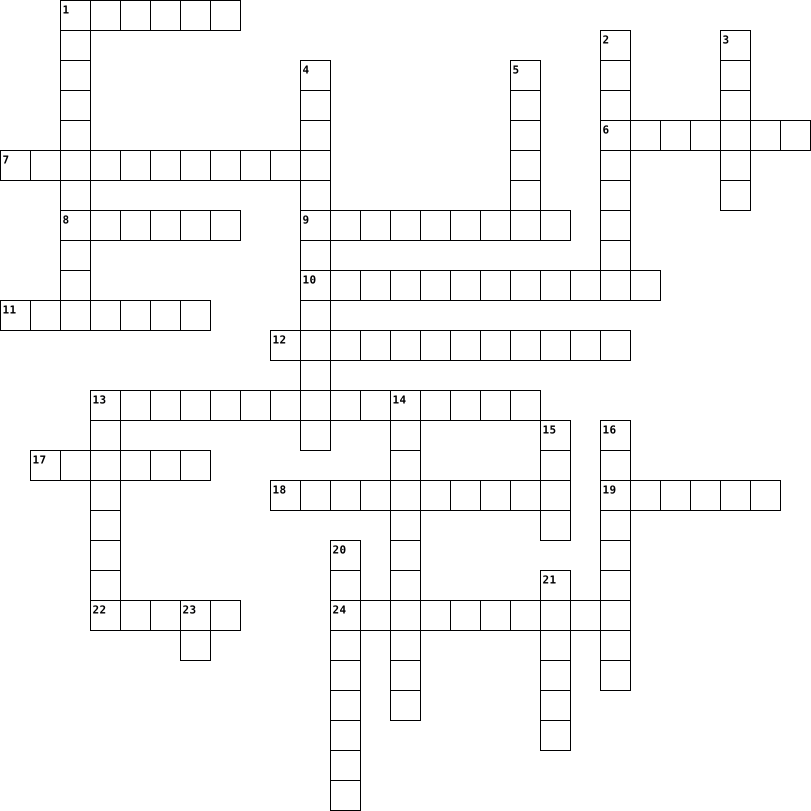
Across
- The set of all possible values of the argument of a function.
- A line can be used to help draw vertical translation horizontal of each cycle.
- The value of x at the point where a curve crosses the x-axis.
- The inverse function of sin
- The conjugate of a complex number is formed by reversing the sign on the imaginary part of the number. The conjugate of a + bi is a - bi.
- Used when to angles and any side are known.
- A fraction in which the denominator is assumed to be 100.
- (0,1,2,3,4,5,6 ) these numbers are
- The function obtained by switching the x- and y-variables.
- A table of numbers arranged in rows and columns.
- A device for measuring angles.
- The inverse function of tan
- the ratio of the change in y-coordinates to the change in x-coordinates
- Horizontal translation of a periodic function.
Down
- The bottom part of a fraction.
- A straight line that is a close approximation to a curve as the curve goes off to infinity.
- The measure of how often a function repeats its same values.
- Vertical translation of a periodic function.
- The reciprocal of the cosine.
- (-1,0,1,2,3) these numbers called.
- A set of numbers that identifies the location of a point.
- The additive identity. The number that when you add it to a number, n, you will get n as a result.
- An equation, graph, or data that can be modeled by a degree 2 polynomial.
- Half the difference between the largest and smallest function value of a periodic function.
- To cut something in half.
- The ratio of the circumference of a circle to its diameter.
26 Clues: To cut something in half. • The inverse function of sin • The inverse function of tan • The reciprocal of the cosine. • The bottom part of a fraction. • A device for measuring angles. • (0,1,2,3,4,5,6 ) these numbers are • (-1,0,1,2,3) these numbers called. • Used when to angles and any side are known. • Vertical translation of a periodic function. • ...
vocabulary 2014-10-07

Across
- magnetic radiation: radio waves. xrays. and gamma rays.
- mechanical model: modern description of the electrons in atoms.
- emission spectrum: the pattern formed when light passes through a prism or diffraction grating the separate it into the different frequencies of light it contains.
- number: the total number of protons and neutrons in an atom.
- wavelengths of the visible light that are separated when a beam of light passes though a prism.
- principle: electrons occupy the orbitals of lowest energy first.
- the distance between the crests.
- exclusion principle: atomic orbital may describe at most two electrons.
- configuration: ways in which electrons are arranged in various orbitals around the nuclei of atoms.
- the number of eave cycles to pass a given point per unit of time.
- atoms that have the same number of protons but different numbers of neutrons.
- SI unit of cycles per second.
- rules: states that electrons occupy orbitals of the same energy in a way that makes the number of electrons with the same spin direction as large as possible.
Down
- table: an arrangement of elements in which the elements are separated into groups based on a set of repeating properties.
- amount of energy requires to move an electron from one energy level to another.
- levels: fixed energrys an electron can have.
- the waves height from zero to the crest.
- vertical column of the periodic table.
- uncertainty principle: states that it is impossible to know exactly both the velocity and the position of a particle at the same time.
- light quanta
- horizontal row of the periodic table.
- defines as one of the mass of a carbon atom.
- state: the electron has its lowest possible energy.
23 Clues: light quanta • SI unit of cycles per second. • the distance between the crests. • horizontal row of the periodic table. • vertical column of the periodic table. • the waves height from zero to the crest. • levels: fixed energrys an electron can have. • defines as one of the mass of a carbon atom. • state: the electron has its lowest possible energy. • ...
Chapter 10 Modern Atomic Theory And The Periodic Table 2016-01-10

Across
- distance between two peaks or trough inside a wave
- lowest energy level
- columns in the periodic table
- in a given atom, no 2 electrons may have the same set of 4 quantum numbers therefore an orbital must have electrons with opposite spins ↓↑
- this method of arranging electrons uses numbers, letters, and superscripts
- what is white light?
- neon’s orbital configuration
- When a gas emits light shown through a prism, the beaming colored lines are part of a _____
- Group VIIA Elements
- all the Group IIIB to Group IIB (3-12) elements
- electrons on the outermost energy level
- energy is emitted in tiny distinct packets called _____
- this method of arranging electrons uses arrows and boxes
- Who said this: “electrons revolve in specific regions at various distances from the nucleus called energy levels”
- this atom's orbital configuration is 1s² 2s²2p⁶ 3s²3p⁶ 4s²
- the energy level expressed by the principal quantum number n
- Every principle energy level is divided into _____
Down
- Which rule is this: electrons will occupy separate orbitals of the same energy before pairing of electrons occur
- outermost electron shell
- 4th sublevel
- 3rd sublevel
- this atom's orbital configuration is 1s² 2s²2p⁶ 3s²3p⁶ 4s²3d¹⁰
- as stated by this principle, an orbital cannot contain more than 2 electrons
- all the Group A’s elements in the Periodic Table
- small packets of energy in streams of light
- region in space around a nucleus with a high probability of finding an electron
- rows in the periodic table
- 1st sublevel
- this atom's orbital configuration is 1s² 2s²2p⁶ 3s²3p⁶
- 2nd sublevel
30 Clues: 4th sublevel • 3rd sublevel • 1st sublevel • 2nd sublevel • lowest energy level • Group VIIA Elements • what is white light? • outermost electron shell • rows in the periodic table • neon’s orbital configuration • columns in the periodic table • electrons on the outermost energy level • small packets of energy in streams of light • all the Group IIIB to Group IIB (3-12) elements • ...
Chapter 10 Modern Atomic Theory And The Periodic Table 2016-01-11

Across
- distance between two peaks or trough inside a wave
- Who said this: “electrons revolve in specific regions at various distances from the nucleuscalled energy levels”(2)
- this atom's orbital configuration is 1s² 2s²2p⁶ 3s²3p⁶ 4s²3d¹⁰
- Every principle energy level is divided into _____
- this method of arranging electrons uses numbers, letters, and superscripts(2)
- all the Group A’s elements in the Periodic Table(2)
- columns in the periodic table
- rows in the periodic table
- 2nd sublevel
- this atom's orbital configuration is 1s² 2s²2p⁶ 3s²3p⁶ 4s²
- small packets of energy in streams of light
- 4th sublevel
- German physicist who was best known for his quantum mechanics work(2)
- Which rule is this: electrons will occupy separate orbitals of the same energy before pairing of electrons occur(2)
- electrons on the outermost energy level (2)
Down
- as stated by this principle, an orbital cannot contain more than 2 electrons(3)
- the energy level expressed by the principal quantum number n(3)
- what is white light?(2)
- 1st sublevel
- lowest energy level(2)
- energy is emitted in tiny distinct packets called _____
- this atom's orbital configuration is 1s² 2s²2p⁶ 3s²3p⁶
- Group VIIA Elements
- this method of arranging electrons uses arrows and boxes(2)
- When a gas emits light shown through a prism, the beaming colored lines are part of a _____(2)
- all the Group IIIB to Group IIB (3-12) elements(2)
- 3rd sublevel
- neon’s orbital configuration
- outermost electron shell(2)
- region in space around a nucleus with a high probability of finding an electron
30 Clues: 1st sublevel • 3rd sublevel • 2nd sublevel • 4th sublevel • Group VIIA Elements • lowest energy level(2) • what is white light?(2) • rows in the periodic table • outermost electron shell(2) • neon’s orbital configuration • columns in the periodic table • small packets of energy in streams of light • electrons on the outermost energy level (2) • ...
Crossword 2020-01-13

Across
- Positive charge
- No charge.
- Any of the series of fifteen metallic elements from lanthanum to lutetium in the periodic table.
- Element that doesn't have the characteristics of metal.
- An electrically charged atom or group of atoms formed by the loss or gain of one or more electrons.
- The number of protons in the nucleus of an atom.
- Properties are intermediate between those of metals and solid nonmetals or semiconductors.
- Any of the set of metallic elements occupying a central block.
- Region of negative charge surrounding an atomic nucleus that is associated with an atomic orbital
- An electrically charged atom or group of atoms formed by the loss or gain of one or more electrons.
- Negative charge.
Down
- A horizontal row in the periodic table of the elements (has varying properties).
- Each of two or more forms of the same element that contain equal numbers of protons but different numbers of neutrons in their nucleus.
- Any of the elements fluorine, chlorine, bromine, iodine, and astatine, occupying group
- Any of the elements found in Group.
- Spontaneous emission of radiation in the form of particles or high energy photons resulting from a nuclear reaction.
- Atom or molecule that has gained or lost one or more of its valence electrons.
- A vertical column in the periodic table of the elements.
- Loss of elementary particles from an unstable nucleus, ultimately changing the unstable element into another more stable element.
- Average of the proton rest mass and the neutron rest mass.
- Any chemical element that is an effective conductor of electricity and heat.
- These elements, together with the lanthanides, are called internal transition elements.
- Very reactive, electropositive, monovalent metals forming strongly alkaline hydroxides.
- Group of chemical elements with very similar properties
- Positively charged center of the atom consisting of protons and neutrons.
25 Clues: No charge. • Positive charge • Negative charge. • Any of the elements found in Group. • The number of protons in the nucleus of an atom. • Element that doesn't have the characteristics of metal. • Group of chemical elements with very similar properties • A vertical column in the periodic table of the elements. • Average of the proton rest mass and the neutron rest mass. • ...
Chemistry Crossword 2020-09-02

Across
- electron, The electrons in the outside shell of atoms. They are the furthest from the center and have the most energy
- The property of unstable atoms that emit to nuclear radiation
- Change, A change in which does not change the original substance
- State, When an electron temporarily occupies an energy state greater than its ground state
- Atoms with the same number of protons, but different numbers of neutrons
- Change, A change in which a substance is changed into a different one
- Used to make the same amount of atoms on either side of the arrow to make the equation balanced.
- Indicates the charge of an ion.
- Vertical on the periodic table, the ___________ number indicates the number of valence electrons
- The number of atoms chemically bonded together.
- The ability to be drawn out into long, thin wires
- Made up of 2 or more atoms
- Made up of a single atom
- Atoms that lose or gain electrons to have a full valence shell, therefore giving the atoms a positive or negative charge
Down
- Mass, The average mass of atoms of an element
- What makes a chemical reaction happen?
- State, The state of lowest energy for that electron
- What the matter is made of
- Orbits the nucleus
- Horizontal on the periodic table and indicates the number of shells occupied
- Metals, Groups 3-12 on the periodic table
- Bonding, Chemical bonding that rises from electrostatic force between conduction electrons and positively charged metal ions
- The state that the matter is in (for example: (l), (s), (g), (aq).)
- Symbolic representation of a chemical reaction
- Contains two or more pure substances.
- What does a chemical reaction produce?
- Number, Number of protons in the nucleus of an atom
- How the matter is put together
- The amount of mass packed into matter
29 Clues: Orbits the nucleus • Made up of a single atom • What the matter is made of • Made up of 2 or more atoms • How the matter is put together • Indicates the charge of an ion. • Contains two or more pure substances. • The amount of mass packed into matter • What makes a chemical reaction happen? • What does a chemical reaction produce? • Metals, Groups 3-12 on the periodic table • ...
CHEMISTRY UNIT VOCAB REVIEW 2017-02-12

Across
- 1 or 2 letters that abbreviate an element
- The temperature increases
- A substance that is formed when two or more chemicals react
- A period is one of the horizontal rows in the periodic table, all of whose elements have the same number of electron shells
- A Russian man who created the periodic table
- A substance that takes part in and undergoes change during a reaction
- Electrons in the outermost energy shell(Level/Orbital)
- Solid, shiny, ductile, malleable, and good conductor of heat and electricity
- A form of matter that may not be broken further down
- A group of atoms bonded together
- The mass of an atom of a chemical element expressed in atomic mass units
- The central and most important part of an object
- Atomic particles found in the the nucleus of an atom and carries a positive charge
Down
- Atomic particles that move around the nucleus of an atom and carries a negative charge
- Is a column of elements in the periodic table of the chemical elements
- The temperature decreases
- Brittle, not malleable or ductile, poor conductor of heat and electricity
- The number of atoms on both sides of the equation must be the same
- The number of Protons or Electrons in an atom
- Share properties of both metals and non-metals
- Regions of space outside the nucleus of an atom
- Atomic particles found in the nucleus of an atom and carries no electrical charge
- A rare gas that is usually radon, show great stability and have extremely low reaction rates
- A thing that is composed of two or more separate elements
- A substance that is made up of one type of atom
25 Clues: The temperature increases • The temperature decreases • A group of atoms bonded together • 1 or 2 letters that abbreviate an element • A Russian man who created the periodic table • The number of Protons or Electrons in an atom • Share properties of both metals and non-metals • Regions of space outside the nucleus of an atom • ...
Unit B Crossword 2017-11-11

Across
- vertical columns of elements in the periodic table
- description of a substance that can be pounded or rolled into sheets
- cloudy mixture in which tiny particles of one substance are held within another and particles cannot be separated out from the other substance
- change of state from a liquid to a gas
- vertical column of elements in the periodic table;also called a family
- description of a solid that can be stretched into a long wire
- neutral particle in the nucleus of an atom
- change of state from a gas to a liquid
- anything that has mass and occupies space
- change of state from a solid to a liquid
- substance that helps a chemical reaction to proceed more quickly
- atom that became electrically charged because it lost or gained electrons
- slow chemical change that occurs when oxygen in the air reacts with a metal
Down
- the smallest part of an element that is representative of that element
- change of state from a liquid to a solid
- shiny,malleable,ductile element that conducts electricity
- change of state from a gas to a solid
- ability of a substance to conduct electricity or heat
- group 17 in the periodic table;the most reactive non-metals
- catalyst involved in chemical reactions in living things
- chemical reaction that occurs when oxygen reacts with a substance to form a new substance and give off energy
- element that has both metallic and non-metallic properties
- pure substance that cannot be broken down into other substances;substance made up of only one type of atom
- amount of mass in a given volume of a substance
- chemical combination of two or more elements in a specific ratio
25 Clues: change of state from a gas to a solid • change of state from a liquid to a gas • change of state from a gas to a liquid • change of state from a liquid to a solid • change of state from a solid to a liquid • anything that has mass and occupies space • neutral particle in the nucleus of an atom • amount of mass in a given volume of a substance • ...
PS.4 Vocabulary 2023-10-02

Across
- he man-made or laboratory made elements on the periodic table.
- The positively charged subatomic particles in the nucleus of an atom.
- A change of materials into another, new materials with different properties and one or more than one new substances are formed.
- Organizes all discovered elements into rows (periods) and columns (groups) according to increasing atomic number.
- A process that involves rearrangement of the molecular or ionic structure of a substance.
- amount of protons in an element
- Metals have a shiny appearance, are good conductors of heat and electricity, can be melted, are malleable and ductile.
- Electron in the outer shell of an atom.
- The horizontal rows on the periodic table. There are 7.
- smallest unit of matter
- The material involved in the change is structurally the same before and after the change.
Down
- An element whose properties are between those of metals and solid nonmetals or semiconductors.
- The center of an atom that includes protons and neutrons.
- Forms of the same element that contain equal numbers of protons but different numbers of neutrons in the nucleus.
- made up of one atom
- An atom or molecule with a net charge due to the loss or gain of one or more electrons.
- An expression that shows the elements in a compound and the proportions of those elements.
- The averaged number of protons and neutrons in an element.
- The neutrally (no charge) subatomic particle in the nucleus of an atom.
- A type of chemical element that lacks the characteristics of a metal.
- The vertical columns on the periodic table. There are 18.
21 Clues: made up of one atom • smallest unit of matter • amount of protons in an element • Electron in the outer shell of an atom. • The horizontal rows on the periodic table. There are 7. • The center of an atom that includes protons and neutrons. • The averaged number of protons and neutrons in an element. • The vertical columns on the periodic table. There are 18. • ...
End of year 8 2023-06-20

Across
- Absorb light from sun
- A ________ gas causes global warming
- How heat is transferred in a fluid
- Name given to group 1 in the periodic table
- Type of reproduction in which only 1 parent is involved
- A type of respiration that takes place without oxygen
- A type of wave that is transferred by radiation
- An offspring made from two different species
- The smallest unit of an organism
- A metal with an other element mixed in
- Contains the cell's DNA
- A microscopic organism without a nucleus
- Tests for the presence of sugars in food
- When a substance moves from an area of low concentration to an area of high concentration
- Sac of cell sap found in plant cell
- A microscopic fungus
- These increase the surface area of the small intestines
- Chemical used to test for the presence of protein
- How heat is transferred in a solid
Down
- When a fuel reacts with oxygen
- Process where light appears to bend when it enters a new substance
- Name given to group 7 in the periodic table
- An alloy of iron and carbon
- On the left of the periodic table
- When oxygen is added to a substance
- A force that acts against the motion of an object
- A force that pushes up
- A microscopic, unicellular organism with a nucleus
- Sexual and asexual are examples of this
- The new species made from reproduction
- The _______ point tells us the temperature at which a substance changes from solid to liquid
- Process where light rebounds off a surface at the same angle that it hit it
- Amount of matter in a certain volume
- A type of respiration that takes place in the presence of oxygen
34 Clues: A microscopic fungus • Absorb light from sun • A force that pushes up • Contains the cell's DNA • An alloy of iron and carbon • When a fuel reacts with oxygen • The smallest unit of an organism • On the left of the periodic table • How heat is transferred in a fluid • How heat is transferred in a solid • When oxygen is added to a substance • Sac of cell sap found in plant cell • ...
Unit 2 words 2021-09-14

Across
- small, dense region consisting of protons and neutrons.
- earth metals They are reactive, electropositive, divalent metals, and form basic oxides which react with water to form comparatively insoluble hydroxides.
- electrons an electron in the outer shell associated with an atom.
- metals a group of metals in the middle of the periodic table that have some similar properties with one another.
- basic unit of a chemical element.
- exist outside of and surrounding the atom nucleus.
- subatomic particle with a positive charge.
- in contact with air, water or other common substances, vigorously or violently give off heat, energy or toxic gases or vapors.
- is a column of elements in the periodic table of the chemical elements.
- a chemical element that forms a salt when it reacts with metal.
- a molecule with a positive or negative charge.
Down
- metal are very reactive, electropositive, monovalent metals forming strongly alkaline hydroxides.
- a type of subatomic particle with no charge.
- chemical element which has a preponderance of properties in between, or that are a mixture of, those of metals and nonmetals.
- a row of chemical elements.
- atoms that have the same atomic number and position in the periodic table.
- shows a lustrous appearance, and conducts electricity and heat relatively well.
- charge cations
- radius the total distance from an atom's nucleus to the outermost orbital of electron.
- gasses a class of chemical elements with similar properties; under standard conditions, they are all odorless.
- group of atoms that bears one or more positive or negative electrical charges.
- negatively charged ion
- model a system consisting of a small, dense nucleus surrounded by orbiting electrons
- metals substance that is not a metal.
24 Clues: charge cations • negatively charged ion • a row of chemical elements. • basic unit of a chemical element. • metals substance that is not a metal. • subatomic particle with a positive charge. • a type of subatomic particle with no charge. • a molecule with a positive or negative charge. • exist outside of and surrounding the atom nucleus. • ...
CP Chemical Naming 2021-10-25

Across
- bonds that result from shared electrons between nonmetals
- used in ionic naming to indicate the oxidation number of the transition metal in the compound
- prefix for two
- the ending of a polyatomic ion name that is changed to ous for the ternary acid name
- metals found in the middle of the periodic table that can have more than one oxidation number
- prefix for five
- the overall charge of any ionic compound
- prefix for ten
- the element at the beginning of any acid formula
- bonds that result from the transfer of electrons to form ions
- tells how many of an element in a chemical formula
- an ion with more than one element covalently bonded together, these participate in ionic bonding
- prefix for nine
- prefix for four
Down
- atoms on the right side of the periodic table that form ionic bonds with metals and covalent bonds with nonmetals
- prefix for three
- atoms on the left side of the periodic table that form ionic bonds with nonmetals and have positive oxidation numbers
- prefix for one
- the ending of a polyatomic ion name that is changed to ic for the ternary acid name
- prefix for six
- the one or two letter representation for an element
- the ending of the second element for all ionic and covalent names
- the prefix found in binary acid names
- the charge of an ion
- the ending found in all binary acid names and some ternary acid names
- prefix for seven
- prefix for eight
- word part at the beginning of a covalent compound name to indicate how many of an element is present
28 Clues: prefix for one • prefix for two • prefix for six • prefix for ten • prefix for five • prefix for nine • prefix for four • prefix for three • prefix for seven • prefix for eight • the charge of an ion • the prefix found in binary acid names • the overall charge of any ionic compound • the element at the beginning of any acid formula • tells how many of an element in a chemical formula • ...
Chemistry is Awesome!!! 2022-05-26

Across
- the strongest base has a pH of what?
- protons + neutrons give what number to an atom?
- what element is in period 4, group 2 of the periodic table?
- atoms with the same atomic number but have different mass numbers are called what?
- when an acid and base are added together it is called a what type of reaction?
- how many electrons can fit in the first electron shell?
- which subatomic particle has no charge at all?
- on a pH scale 7 is neutral, when it is below 7, what is it called?
- what small group sits between metals and non-metals on the periodic table?
- when an acid and base react they generally produce water and a ?
- combustion and oxidisation reactions involve which element?
- what element has the atomic number 105?
- the atomic number tells you how many protons are in an atom, this is also equal to the number of what?
Down
- all matter is made up of?
- electrons are found outside the nucleus in orbitals or?
- the number of protons in an atom gives what number?
- which subatomic particle is found in the nucleus of an atom with neutrons?
- electrons have this kind of charge
- a periodic table is organised in periods and?
- helium and neon are non-reactive and are in what 'gas' group?
- which element has the symbol H?
- pure substances that cannot be broken down into any other substance are called?
- what element has the symbol Ga?
- in a chemical reaction you need reactants to form a what?
- covalent and ionic are both forms of chemical what?
25 Clues: all matter is made up of? • which element has the symbol H? • what element has the symbol Ga? • electrons have this kind of charge • the strongest base has a pH of what? • what element has the atomic number 105? • a periodic table is organised in periods and? • which subatomic particle has no charge at all? • protons + neutrons give what number to an atom? • ...
Science 8 crossword 2022-06-01

Across
- First name of the person who created newtons laws
- Has the atomic number 8
- Amount of times a wave passes a point in a certain amount of time
- Negative interference of two sound waves
- Has a negative charge
- Distance from crest to crest
- The 2nd shortest wave length
- Heat transfer by touch
- The top of a wave
- Amount of tenets of nature
- The 3rd lowest frequency on the EM spectrum
- The tenet which stated science knowledge was tentative
- Distance from crest to trough
- Energy in a moving object
- The bottom of a wave
- Force=mass times acceleration
Down
- The degree of compactness of a substance.
- Energy that is not Kinetic
- Has the atomic number 1
- Every action has an equal and opposite reaction
- The middle of the EM spectrum
- When two sound waves meet
- The 2nd lowest frequency on the EM spectrum
- Positive interference of two sound waves
- The 3rd highest frequency
- What equals mass times acceleration? radiowave The lowest frequency on the EM spectrum
- The 18th group on the periodic table
- Substance that results from a combination of two or more different chemical elements
- Energy stored in the bonds of atoms and molecules
- Amount of groups in the periodic table
- Has a positive charge
- Every object will remain at rest or in uniform motion in a straight line unless compelled to change its state by the action of an external force.
- There are 118 of these on the periodic table.
- Orders each type of wave from lowest frequency to highest
- Has a neutral charge
- The highest frequency and shortest wavelength
36 Clues: The top of a wave • Has a neutral charge • The bottom of a wave • Has a negative charge • Has a positive charge • Heat transfer by touch • Has the atomic number 1 • Has the atomic number 8 • When two sound waves meet • The 3rd highest frequency • Energy in a moving object • Energy that is not Kinetic • Amount of tenets of nature • Distance from crest to crest • The 2nd shortest wave length • ...
SPS1 Periodic Table Vocab. 2022-05-17

Across
- Building block of all matter.
- A reaction that causes atoms to bond and form new substances.
- An arrangement of elements into rows and columns according to similarities in their properties.
- This is a very unreactive element in Group 18 with full valence shell.
- A subatomic particle with a positive charge
- This is a substance that cannot be broken down further by chemical means.
- This is a type of element or substance that is not a metal.
- This is a column on the periodic table of elements.
- This is a group of elements with few valence electrons that conducts heat and electricity.
- Area outside the atomic nucleus
- A subatomic particle with a negative charge
- The number of protons and neutrons in the nucleus of any atom.
Down
- These are the highly reactive elements located in Group 1
- A horizontal row of elements in the periodic table.
- These are the reactive elements located in Group 2 of the periodic table.
- These elements have 7 electrons in their outer energy level
- A subatomic particle with no charge
- Atoms of the same element with varying number of neutrons.
- The weighted average of all of the isotopes of an element.
- The central part of an atom that comprises nearly all of the atomic mass and that consists of protons and neutrons.
- This is a group of elements that have properties intermediate to metals and nonmetals.
- A number of an element that is the number of protons in the nucleus of each atom of that element.
- An electron in the highest occupied energy level of an atom
23 Clues: Building block of all matter. • Area outside the atomic nucleus • A subatomic particle with no charge • A subatomic particle with a positive charge • A subatomic particle with a negative charge • A horizontal row of elements in the periodic table. • This is a column on the periodic table of elements. • These are the highly reactive elements located in Group 1 • ...
STAAR Review 2021-04-29

Across
- valence electrons determine how _________ an element is
- the distance an object travels in a certain amount of time
- this element has a full electron shell and is in period 2
- speed with direction
- element in group 1 period 3
- a change in speed or direction
- the columns in the periodic table are called this
- this type of force is when the object is moving at a constant speed or at rest
- the horizontal rows in the periodic table
Down
- a push or a pull
- positive charge subatomic particle inside the nucleus
- an objects resistance to change in motion; how "lazy" an object is
- newton's second law says that force = _____ x acceleration
- contains the protons and neutron; center of the atom
- for every action there is an __________ and opposite reaction
15 Clues: a push or a pull • speed with direction • element in group 1 period 3 • a change in speed or direction • the horizontal rows in the periodic table • the columns in the periodic table are called this • contains the protons and neutron; center of the atom • positive charge subatomic particle inside the nucleus • valence electrons determine how _________ an element is • ...
Unit 7: Lesson 3- vocab 2016-10-18

Across
- FILL IN DEFINITION
- an arrangement of the elements in order of their atomic numbers such that elements with similar properties fall into the same column, or group.
- a one-, two-, or three-letter abbreviation of the name of an element
- in chemistry, a horizontal row of elements in the periodic table.
- DEFINITION 1
Down
- an element that conducts heat and electricity poorly
- DEFINITION 3
- the weighted average of the masses of all naturally occurring isotopes of an element.
- DEFINITION 4
- an element that is shiny and that conducts heat and electricity well.
- an element that has properties of both metals and nonmetals.
- DEFINITION 2
- point DEFINITION 6
- point DEFINITION 5
- a vertical column of elements in the periodic table; elements in a group share chemical properties.
15 Clues: DEFINITION 3 • DEFINITION 4 • DEFINITION 2 • DEFINITION 1 • FILL IN DEFINITION • point DEFINITION 6 • point DEFINITION 5 • an element that conducts heat and electricity poorly • an element that has properties of both metals and nonmetals. • in chemistry, a horizontal row of elements in the periodic table. • a one-, two-, or three-letter abbreviation of the name of an element • ...
Year 9 Science Crossword December 2023-12-13

Across
- The force which causes electron transfer in static electricity.
- A negatively charged particle found in atoms.
- Reactions that release energy.
- A characteristic an animal has which helps it to survive
- The first element in group one of the periodic table.
- An organism in a food chain which eats other organisms
- Reactions that absorb energy.
- The name for dead, organic material.
Down
- When opposite charges are brought together they...
- Potassium reacts with water to make hydrogen and potassium...
- When objects with like charges are brought together they...
- An organism which feeds off dead material.
- The first element in group seven of the periodic table.
- An organism in a food chain which photosynthesises to get energy.
- The turning effect on an object caused by a force.
15 Clues: Reactions that absorb energy. • Reactions that release energy. • The name for dead, organic material. • An organism which feeds off dead material. • A negatively charged particle found in atoms. • When opposite charges are brought together they... • The turning effect on an object caused by a force. • The first element in group one of the periodic table. • ...
The Periodic Table and its Trends 2024-05-02

Across
- a negative charge
- do not form bonds in group 8 and have 8 valence electrons
- an element that have some property of metal and nonmetal combined
- group 2 and have 2 valence electrons
- horizontal row in a periodic table
- the number of protons in one atoms
- located in group 7 contain nonmetal and have 7 valence electrons
- A bond formed between two non metal elements
Down
- A bond formed between two metal element
- A positive charge
- elements that does not conduct electricity and gas at a room temperature
- the electrons in the outer most shell
- elements or substance that very good in conduct electricity
- group 1, 1 valence electrons in outer level and very reactive, shiny,silver
- vertical column in the periodic table
15 Clues: A positive charge • a negative charge • horizontal row in a periodic table • the number of protons in one atoms • group 2 and have 2 valence electrons • the electrons in the outer most shell • vertical column in the periodic table • A bond formed between two metal element • A bond formed between two non metal elements • ...
Chemistry Crossword 2023-04-12

Across
- Table of all of the elements
- the vertical rows in the periodic table
- the arrow between the reactants and the products in a chemical equation
- Negatively charged ion
- A catalyst is a substance that lowers the activation energy of a reaction
- any atom or group of atoms that bears one or more positive or negative electrical charges
- The amount of matter in a substance
Down
- A compound yielding two elements
- A family is a group of elements sharing similar properties
- the horizontal rows in the periodic table
- An energy level is a possible value of energy that an electron can have in an atom
- elements on the left side of the arrow
- elements on the right side of the arrow
- positively charged ion
- Two elements yielding one compound
15 Clues: Negatively charged ion • positively charged ion • Table of all of the elements • A compound yielding two elements • Two elements yielding one compound • The amount of matter in a substance • elements on the left side of the arrow • the vertical rows in the periodic table • elements on the right side of the arrow • the horizontal rows in the periodic table • ...
Science Vocabulary Terms 2023-05-03

Across
- pressure caused by the weight of air above an area
- showers and thunderstorms
- number of energy levels/shells is determined by
- organisms whose cells lack a nucleus and other organelles
- a table of chemical elements
- subatomic particle with a negative charge
Down
- tells us the number of atoms
- the process in which different types of living organisms are thought to have developed or diversified
- a biological community of interacting organisms and their physical environment
- group 18 on periodic table
- organisms whose cells contain a nucleus and membrane-bound organelles
- a diagram which shows the flow of energy through many organisms
- subatomic particle with positive charge
- the study of living organisms
- smallest living unit that makes up all living organisms
15 Clues: showers and thunderstorms • group 18 on periodic table • tells us the number of atoms • a table of chemical elements • the study of living organisms • subatomic particle with positive charge • subatomic particle with a negative charge • number of energy levels/shells is determined by • pressure caused by the weight of air above an area • ...
Integrated Ch 2 Vocabulary 2025-02-10

Across
- average value based on the abundance of isotopes
- pattern of frequencies of electromagnetic radiation emitted by the atoms of an element
- dense, positively charged center of every atom
- negatively charged subatomic particle found in a cloud outside the nucleus
- neutral subatomic particle in the nucleus
- A horizontal row in the periodic table
- the same number of protons but different numbers of neutrons
- fundamental unit of matter
Down
- total number of protons and neutrons in the nucleus
- number of protons in the atomic nucleus
- A small packet of light energy
- symbol abbreviation for an element or atom
- vertical column in the periodic table
- A positively charged subatomic particle in the nucleus
- any material that is made up of only one type of atom
15 Clues: fundamental unit of matter • A small packet of light energy • vertical column in the periodic table • A horizontal row in the periodic table • number of protons in the atomic nucleus • neutral subatomic particle in the nucleus • symbol abbreviation for an element or atom • dense, positively charged center of every atom • average value based on the abundance of isotopes • ...
Periodic Table and Atom Worksheet 2025-05-20

Across
- The Neutral Charge of an Atom
- The Negative Charge of an Atom
- An atom that either gains or loses electrons
- Elements that move up and down on the Periodic table
- Something that has the same kind of atoms
- Atoms of the same element that have different numbers of neutrons
- A Line that moves left to right
Down
- A line that moves up and down
- When an atom GAINS Electrons, it becomes a ___________ Ion
- How many Protons an Atom has is the Atomic __________
- The Positive Charge of an Atom
- The Center of the Atom
- When an atom LOSES Electrons, it becomes a ___________ Ion
- Elements that move left and right on the Periodic table
- A word that refers to something to do with Atoms
15 Clues: The Center of the Atom • A line that moves up and down • The Neutral Charge of an Atom • The Negative Charge of an Atom • The Positive Charge of an Atom • A Line that moves left to right • Something that has the same kind of atoms • An atom that either gains or loses electrons • A word that refers to something to do with Atoms • ...
ATOMS FAMILY 2022-07-26

Across
- Name of the First group on the Periodic Table (two words)
- Number of protons in an atom (two words)
- Element with 11 protons
Down
- Name given to the last group in the Periodic Table (two words)
- Name of the rows in the Periodic table (two words)
- Name of Russian scientist who created the first proper periodic table
6 Clues: Element with 11 protons • Number of protons in an atom (two words) • Name of the rows in the Periodic table (two words) • Name of the First group on the Periodic Table (two words) • Name given to the last group in the Periodic Table (two words) • Name of Russian scientist who created the first proper periodic table
Periodic Table of Elements 2013-04-16

Across
- Has 2 protons and a full outer shell.
- A noble gas used in brightly coloured advertising signs.
- A non-metal with 5 protons.
- Has 15 electrons.
- Makes up 78% of the Earth's air and is found above P in the periodic table.
- The smallest halogen.
- An alkali earth metal found in the second period.
- A halogen that is found in the third period.
- Located directly below Oxygen on the periodic table.
- Combines with Chlorine to form salt.
Down
- The smallest atom.
- Can create diamonds when joined together.
- Has 4 electrons, 2 in the inner shell and 2 in the outer shell.
- Combines with 2 hydrogen atoms to make water.
- A metal used to make soft drink cans.
- A highly reactive alkali metal that is used in long life batteries.
- A noble gas that has 18 electrons.
17 Clues: Has 15 electrons. • The smallest atom. • The smallest halogen. • A non-metal with 5 protons. • A noble gas that has 18 electrons. • Combines with Chlorine to form salt. • Has 2 protons and a full outer shell. • A metal used to make soft drink cans. • Can create diamonds when joined together. • A halogen that is found in the third period. • ...
Extreme Chemistry Crossword 2015-12-13

Across
- An ion made up of more than one atom that behaves as a single particle.
- Positively charged particles
- It is a colorless, Odorless, and it is a gas
- They react with halogens
- A diagram that represents the arrangement of electrons
- Candle wax melts. What type of change is this?
- They orbit the nucleus
- Metals, Shiny silvery metals
- They hold tightly in the nucleus and cannot be added or removed
- Tells us the # of valence electrons in each element
- Horizontal row on Periodic Table
Down
- A structured arrangement of elements
- If a flaming split at the mouth of the test tube pops this caused it.
- The boiling point of water is 100 degrees Celsius. What type of property is this?
- They do not form compounds because they are stable
- They have 7 valence electrons in outer orbit
- A particle that atoms join by covalent bonds
17 Clues: They orbit the nucleus • They react with halogens • Positively charged particles • Metals, Shiny silvery metals • Horizontal row on Periodic Table • A structured arrangement of elements • It is a colorless, Odorless, and it is a gas • They have 7 valence electrons in outer orbit • A particle that atoms join by covalent bonds • Candle wax melts. What type of change is this? • ...
Periodic table crossword 2021-10-16

Across
- Which element is in period 4, group 0?
- The smallest particle of an element that can exist.
- Is lithium or calcium an alkali metal?
- Shows all the elements arranged in rows and columns.
- Rows in the periodic table
- Two to thousands of atoms joined together. Most non-metals exist either as small or giant molecules.
- the chemical symbol for sodium
- Features of a substance that can be observed
- the chemical symbol for calcuim
Down
- Pure substances made up of two or more elements strongly joined together.
- What element does K represent
- what all substances are made up of, and which contain only one type of atom.
- The name of the elements in group 7
- Is chlorine or helium a halogen?
- Columns in the periodic table
- The name of the elements in group 1
- The name for the elements in group 0
17 Clues: Rows in the periodic table • What element does K represent • Columns in the periodic table • the chemical symbol for sodium • the chemical symbol for calcuim • Is chlorine or helium a halogen? • The name of the elements in group 7 • The name of the elements in group 1 • The name for the elements in group 0 • Which element is in period 4, group 0? • ...
The periodic table 2025-11-17

Across
- - meta six chemical elements that make up Group
- -a soft, silvery-golden alkali metal with the chemical symbol Cs and atomic number 55
- - table also known as the organizes all cover
- - elements in group 17
- - Depending on the length
- -a colorless, odorless, and tasteless noble gas with the atomic number 54
- - Earth metal beryllium (Be), magnesium (Mg), calcium
Down
- - a misunderstanding of metals and metalloids
- - metallic elements in the periodic table
- -nonmetallic element that exists as a hard, black
- - the time it takes for one complete cycle
- - a chemical element that exhibits some metal
- - a law in chemistry
- - transition element the lanthanide and actin
- element- a metal found in groups 3–11
- - an element that lacks the physical and chemical
- - gas helium, neon, argon, krypton
17 Clues: - a law in chemistry • - elements in group 17 • - Depending on the length • - gas helium, neon, argon, krypton • element- a metal found in groups 3–11 • - metallic elements in the periodic table • - the time it takes for one complete cycle • - a chemical element that exhibits some metal • - table also known as the organizes all cover • ...
Science Crossword 2015-01-30

Across
- vertical columns of elements on the periodic table
- positively charged center of an atom containing protons and neutrons
- pure substance that cannot be broken down into any other substance; one atom
- neutral particles in the nucleus of an atom.
- a table in which the elements are organized by their physical and chemical property
- positively charged particles in the nucleus of an atom.
- anything that has mass and occupies space
- invisible negatively charged particles that orbits the nucleus of an atom
- the smallest part of an element
- change of state from solid to liquid.
- horizontal row of elements on the periodic table
Down
- change of state from solid to gas or gas to solid.
- change of state from gas to liquid.
- change of state from liquid to gas.
- chemical combination of two or more elements in a specific ratio
- change of state from liquid to solid.
- solid,liquid, and gas.
17 Clues: solid,liquid, and gas. • the smallest part of an element • change of state from gas to liquid. • change of state from liquid to gas. • change of state from liquid to solid. • change of state from solid to liquid. • anything that has mass and occupies space • neutral particles in the nucleus of an atom. • horizontal row of elements on the periodic table • ...
Rate of Reaction 2019-03-19

Across
- The vertical columns of the periodic table
- The kind of change that does not form new products
- The chemical that are mixed together
- A factor that can change rate of reaction
- A molecule made up of more than one element
- The new chemicals that are formed in a reaction
- Particles speed up which increases collision rate
- When a gas becomes a liquid
- When a solid becomes a liquid
Down
- The horizontal rows of the periodic table
- An example of a slow chemical change that affects metals
- The kind of change that forms new products
- This must occur for a reaction to take place
- A substance made up of only one kind of atom
- More particles are available to collide and react
- An example of a new substance that can form
- Something that is added to increase reaction rate
17 Clues: When a gas becomes a liquid • When a solid becomes a liquid • The chemical that are mixed together • The horizontal rows of the periodic table • A factor that can change rate of reaction • The vertical columns of the periodic table • The kind of change that forms new products • An example of a new substance that can form • A molecule made up of more than one element • ...
Unit 1 Review 2023-10-05

Across
- Number of electron energy levels that Magnesium has.
- Type of bond where electrons are transferred between a metal and a nonmetal.
- The element with the largest atomic radius.
- Analyzing the colors a planet or star gives off to see what elements it contains.
- Horizontal row on the periodic table.
- Subatomic particle with a positive charge, that tells us what element it is.
- Type of bond where electrons are shared between two nonmetals.
- Subatomic particle with a negative charge.
- When an atom has an equal number of protons and electrons.
Down
- The element with the highest ionization energy.
- Atom with a charge.
- Element in group 2, period 4.
- When a molecule like water has a positive and negative end.
- Element with 6 protons, 6 neutrons and 6 electrons.
- Subatomic particle with no charge.
- Electron in the outermost energy level.
- Vertical column on the periodic table.
17 Clues: Atom with a charge. • Element in group 2, period 4. • Subatomic particle with no charge. • Horizontal row on the periodic table. • Vertical column on the periodic table. • Electron in the outermost energy level. • Subatomic particle with a negative charge. • The element with the largest atomic radius. • The element with the highest ionization energy. • ...
Everyday Chemistry 2022-04-11

Across
- Nuclear particle with no charge
- Negatively charged ions
- _____ rule states when several orbitals are available in a subshell, each orbital gets one electron before the electrons pair up
- useful in batteries since it will release
- Vertical columns in the periodic table, where elements contain similar chemical properties
- electron configuration for this element is
- a _______ table is a table of the chemical elements arranged in order of atomic number
Down
- Made of 2 or more elements that are chemically combines
- Ni
- The study ofthe behavior of matter and its charges and how it interacts with other matter and energy
- Positively charged particles
- _______ is a strong acid that is used in car batteries
- Ti
- Fe
- ______ Curie first discovered the radioactive elements polonium and radium
- Smallest particle of an element
- The fundamental states of matter are: Liquid, solid, and _____
17 Clues: Ni • Ti • Fe • Negatively charged ions • Positively charged particles • Nuclear particle with no charge • Smallest particle of an element • useful in batteries since it will release • electron configuration for this element is • _______ is a strong acid that is used in car batteries • Made of 2 or more elements that are chemically combines • ...
Chemical Interactions - Inv. 1 & 2 2023-10-31

Across
- The number of protons and electrons equals an atoms ______.
- The smallest piece of an element.
- How many electrons does an oxygen atom have?
- An interaction during which starting substances change into new substances.
- Positively charged particles of an atom.
- An organized table of the elements.
- How many neutrons does a lithium atom have?
Down
- Mendeleyev arranged elements on the periodic table according to their ______.
- This scientist created the first periodic table.
- One way that a substance can be described.
- A type of matter defined by a unique particle.
- How many protons does an atom of aluminum have?
- Negatively charges particles of an atom.
- Particles in an atom with no charge.
- The element that is represented by the substance Mg.
- The part of an atom containing protons and neutrons.
- One way you know a chemical reaction has occurred.
17 Clues: The smallest piece of an element. • An organized table of the elements. • Particles in an atom with no charge. • Negatively charges particles of an atom. • Positively charged particles of an atom. • One way that a substance can be described. • How many neutrons does a lithium atom have? • How many electrons does an oxygen atom have? • ...
Chemistry Basics 2023-10-31

Across
- a charged atomic particle create by the donation or acceptance of an electron
- type of bonding in which atoms are shared
- positively charged subatomic particle
- compound created by covalent bonding
- subatomic particle with no charge
- Atoms will share, donate, and accept electrons to increase _________.
- substances made of more than one element
Down
- elements with the same number of protons and electrons but differing numbers of neutrons
- negatively charged subatomic particle
- the outer shell of an atom; it wants to be full
- vertical columns on the periodic table, have similar properties
- smallest unit of matter
- The ________ model shows the layout of electrons in an atom.
- horizontal row on the periodic table
- center of an atom, made of protons and neutrons
- pure substance that cannot be broken down into other substances by chemical means
- the first orbital of an atom can hold ____ electrons.
17 Clues: smallest unit of matter • subatomic particle with no charge • horizontal row on the periodic table • compound created by covalent bonding • negatively charged subatomic particle • positively charged subatomic particle • substances made of more than one element • type of bonding in which atoms are shared • the outer shell of an atom; it wants to be full • ...
chemistry 2025-11-12

Across
- what do elements do with their electrons in covalent bonding?
- positively charged particle is a..
- What does the melting point of alkali metals do as you go down the group?
- can be used to seperate a mixture of liquids using their boiling point.
- how many gases are there in the periodic table?
- pudding what model of the atom did JJ Thompson make?
- who discovered the neutron?
- an oxygen atom and a sodium atom would bond to form a..
- Who left gaps in their version of the periodic table?
Down
- group 7 elements are known as the..
- the mobile phase in chromatography is..
- Iron, Cobalt and Nickel are all..
- layers of graphite are..
- negatively charged particles is an..
- metal + non metal bonding is..
- How many atoms are there in the first shell of fluorine?
- What does the symbol Ni stand for?
17 Clues: layers of graphite are.. • who discovered the neutron? • metal + non metal bonding is.. • Iron, Cobalt and Nickel are all.. • positively charged particle is a.. • What does the symbol Ni stand for? • group 7 elements are known as the.. • negatively charged particles is an.. • the mobile phase in chromatography is.. • how many gases are there in the periodic table? • ...
Crossword 2020-01-13

Across
- Positive charge
- Negative charge.
- Very reactive, electropositive, monovalent metals forming strongly alkaline hydroxides.
- Element that doesn't have the characteristics of metal.
- Average of the proton rest mass and the neutron rest mass.
- Group of chemical elements with very similar properties
- Loss of elementary particles from an unstable nucleus, ultimately changing the unstable element into another more stable element.
- Positively charged center of the atom consisting of protons and neutrons.
- Any of the series of fifteen metallic elements from lanthanum to lutetium in the periodic table.
- Atom or molecule that has gained or lost one or more of its valence electrons.
- Any of the elements fluorine, chlorine, bromine, iodine, and astatine, occupying group
- Each of two or more forms of the same element that contain equal numbers of protons but different numbers of neutrons in their nucleus.
- An electrically charged atom or group of atoms formed by the loss or gain of one or more electrons.
- The number of protons in the nucleus of an atom.
- Region of negative charge surrounding an atomic nucleus that is associated with an atomic orbital
Down
- A vertical column in the periodic table of the elements.
- No charge.
- Any of the set of metallic elements occupying a central block.
- Any chemical element that is an effective conductor of electricity and heat.
- Spontaneous emission of radiation in the form of particles or high energy photons resulting from a nuclear reaction.
- Any of the elements found in Group.
- Properties are intermediate between those of metals and solid nonmetals or semiconductors.
- These elements, together with the lanthanides, are called internal transition elements.
- An electrically charged atom or group of atoms formed by the loss or gain of one or more electrons.
- A horizontal row in the periodic table of the elements (has varying properties).
25 Clues: No charge. • Positive charge • Negative charge. • Any of the elements found in Group. • The number of protons in the nucleus of an atom. • Element that doesn't have the characteristics of metal. • Group of chemical elements with very similar properties • A vertical column in the periodic table of the elements. • Average of the proton rest mass and the neutron rest mass. • ...
Periodic Table and Atom Review 2014-10-14

Across
- Which family name correctly represents the elements in Group 1 on the Periodic Table?
- Atoms of the same element may have________________________ mass numbers.
- The best explanation for the organization of Mendeleev's Periodic Table by atomic mass rather than atomic number is that Mendeleev organized the table prior to the discovery of the atomic __________________.
- Sulfur-34 would have _________________ neutrons.
- Noble gases are generally ______________.
- The atomic radius increases from__________ to bottom in a group.
- This element has a density of 2.26
- Nickel-59 has has 28 electrons and 28 ____________________.
- The alpha particles in Rutherford’s experiments were used to bombard sheets of _____________.
- This scientist provided a basis for ordering elements in the modern PeriodicTable.
- Isotopes of the same element have different _______________.
- The number of valence electrons in Group 2 elements is _________.
Down
- Which element would be hardest to remove an electron from (sodium, aluminum, sulfur, or chlorine)?
- Atoms are considered electrically ________________ when the number of electrons equal the number of protons.
- As the atomic number increases within a group of elements, the atomic radius usually _________________.
- Which model of the atom showed electrons in specific, fixed orbits?
- As the __________ number on the Periodic Table increases so does the number of electrons.
- Thomson, Rutherford and Bohr modeled their experiments and their theories after this scientist's model of the atom.
- The ___________ occurring isotopes used to calculate the average atomic mass of an element?
- The cathode ray experiments led to what discovery?
- Elements which have similar properties are in the same _____________.
- Which of the following atoms would have the largest ionic radius (lithium, sodium, potassium, or cesium)?
- A mercury isotope with 80 protons and 120 neutrons has a _____________ number of 200.
- The physical property Group 18 elements have in common is their _________ at room temperature.
24 Clues: This element has a density of 2.26 • Noble gases are generally ______________. • Sulfur-34 would have _________________ neutrons. • The cathode ray experiments led to what discovery? • Nickel-59 has has 28 electrons and 28 ____________________. • Isotopes of the same element have different _______________. • ...