physics Crossword Puzzles
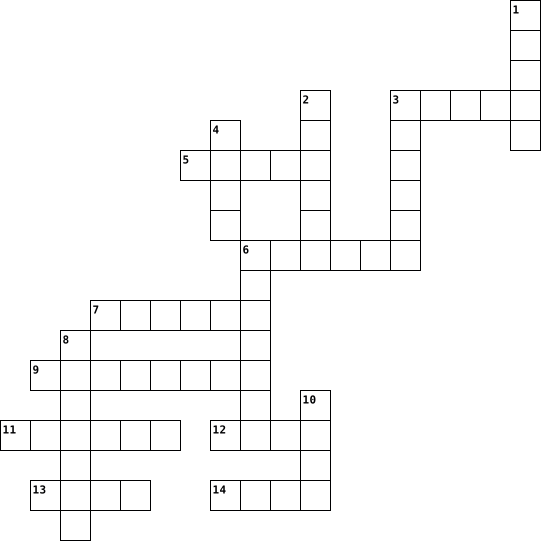
Physics Vocabulary 2021-11-04
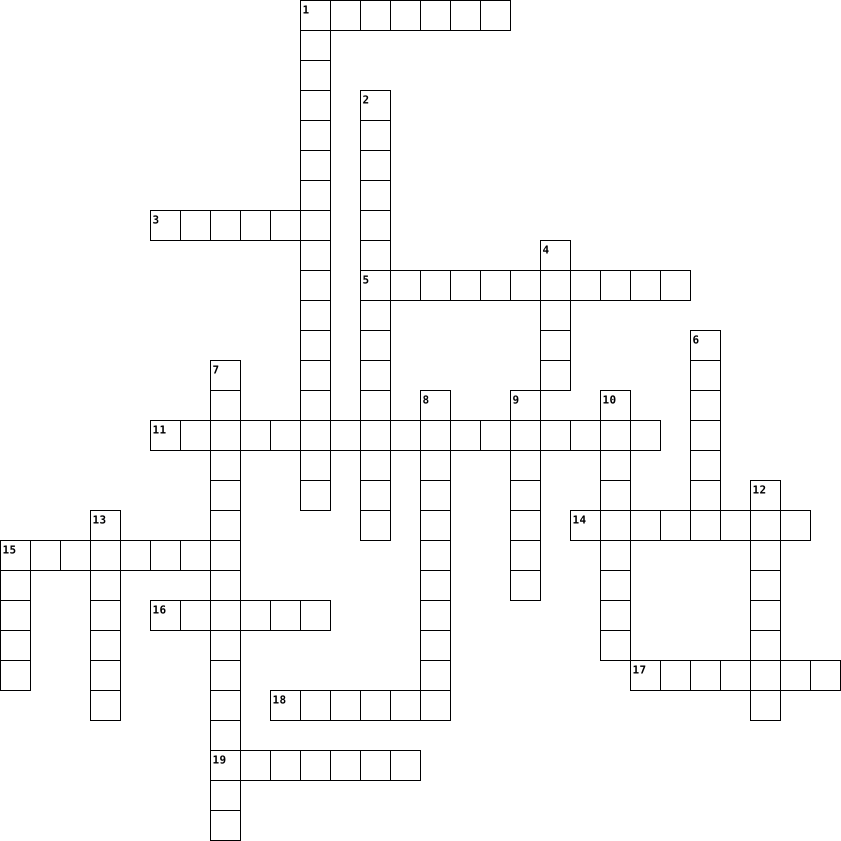
Across
- British scientist, Sir Isaac Newton (1624—1727) was able to state rules that described the effects of forces on the motion of objects. These rules are known as Newton's laws of motion.
- For every action force there is an equal and opposite reaction force.
- An object's resistance to a change in its motion. The greater the mass, the more it will resist a change in motion. More mass = more inertia.
- The energy released during nuclear fission or fusion, especially when use to generate electricity.
- The change in position over time.
- An object in motion will stay in motion while an object at rest will stay at rest unless acted upon by an unbalanced force.
- Applying a force to an object.
- Energy that is produced through sound vibrations.
- A course along which someone or something moves such as north, south, east, or west.
- the ability to cause change
- Energy that is stored or released through chemical bonds
- The distance an object travels in a certain amount of time in a certain direction. (Speed with direction)
- Force = Mass times Acceleration (F=ma)
- Sum of potential and kinetic energy in a system. Energy of motion.
- Energy that travels in the form of electricity.
- Unit of Force
Down
- Forces on an object that are equal in size and opposite in direction. Results in a net force equal to 0N.
- Energy that is released through heat.
- Light energy given off by the Sun.
- A change in speed or direction
- The sum of two or more forces on an object that are pushing or pulling in the same or opposite direction.
- The energy of a moving object has because of the motion.
- Forces on an object that do NOT result in a net force equal to zero newtons.
- A push or pull in a certain direction.
- Stored Energy
- The force applied to an object depends on the mass of that object and the acceleration that the object is moving at. F=MA
- The distance an object travels in a certain amount of time.
27 Clues: Stored Energy • Unit of Force • the ability to cause change • A change in speed or direction • Applying a force to an object. • The change in position over time. • Light energy given off by the Sun. • Energy that is released through heat. • A push or pull in a certain direction. • Force = Mass times Acceleration (F=ma) • Energy that travels in the form of electricity. • ...
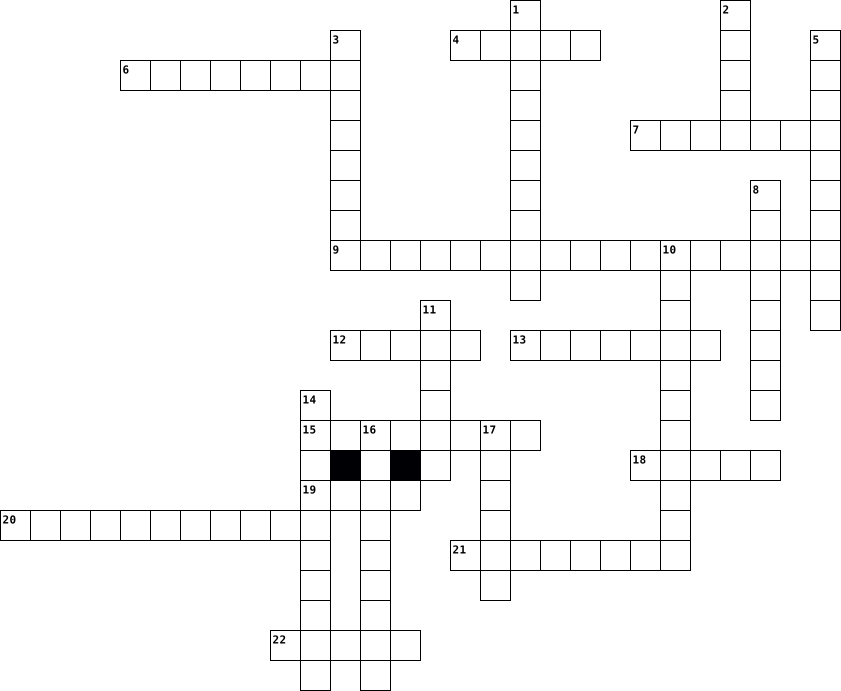
Physics Review 2022-03-28
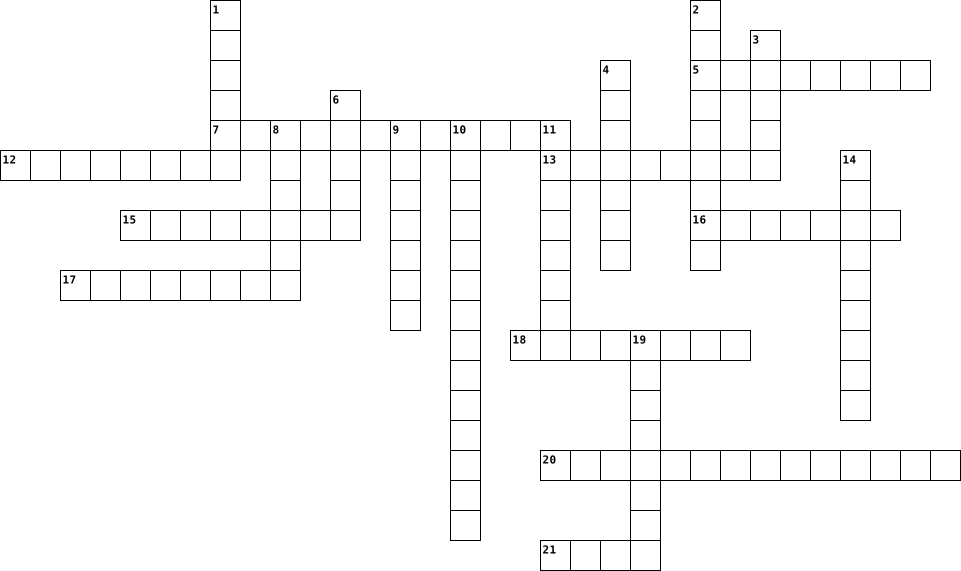
Across
- Test Your Hypothesis by Doing an Experiment is which step (number) of the scientific method?
- measures time, SI Symbol S
- Equal forces acting on an object in opposite directions.
- v=gt and d=(1/2)gt2
- kinetic energy + potential energy =
- velocity X mass
- mass x acceleration
- work/time
- Force X Distance
Down
- P.E=mgh where g=acceleration due to gravity is the formula for
- A place or object used for comparison to determine if an object is in motion.
- Balance; steadiness
- force that opposes motion of an object when two surfaces are in contact
- in the formula g=9.8 m/s2 on earth g represents
- A person hikes 2120 meters east in 25mins, takes a break for lunch for half hour, and hikes back 1640m west in 20 mins. 3760m represents the persons____.
- 1/2mv^2 is the formula for
- An object's change in position relative to a reference point
- distance/time
- the tendency of a body to maintain is state of rest or uniform motion unless acted upon by an external force
- A measure of the amount of matter in an object.
- Force x Distance
- ask a question is which step of the scientific method? (number)
22 Clues: work/time • distance/time • velocity X mass • Force x Distance • Force X Distance • Balance; steadiness • v=gt and d=(1/2)gt2 • mass x acceleration • measures time, SI Symbol S • 1/2mv^2 is the formula for • kinetic energy + potential energy = • in the formula g=9.8 m/s2 on earth g represents • A measure of the amount of matter in an object. • ...
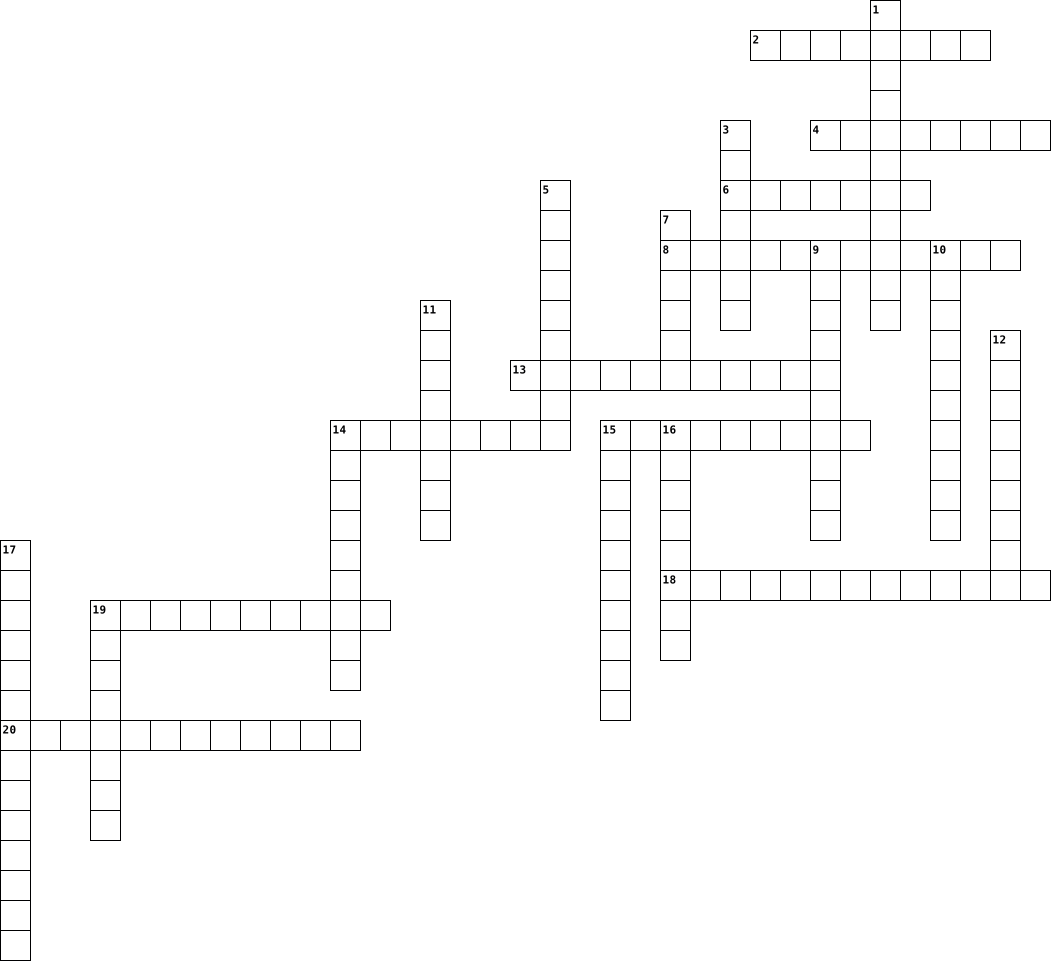
Physics Revision 2021-11-20
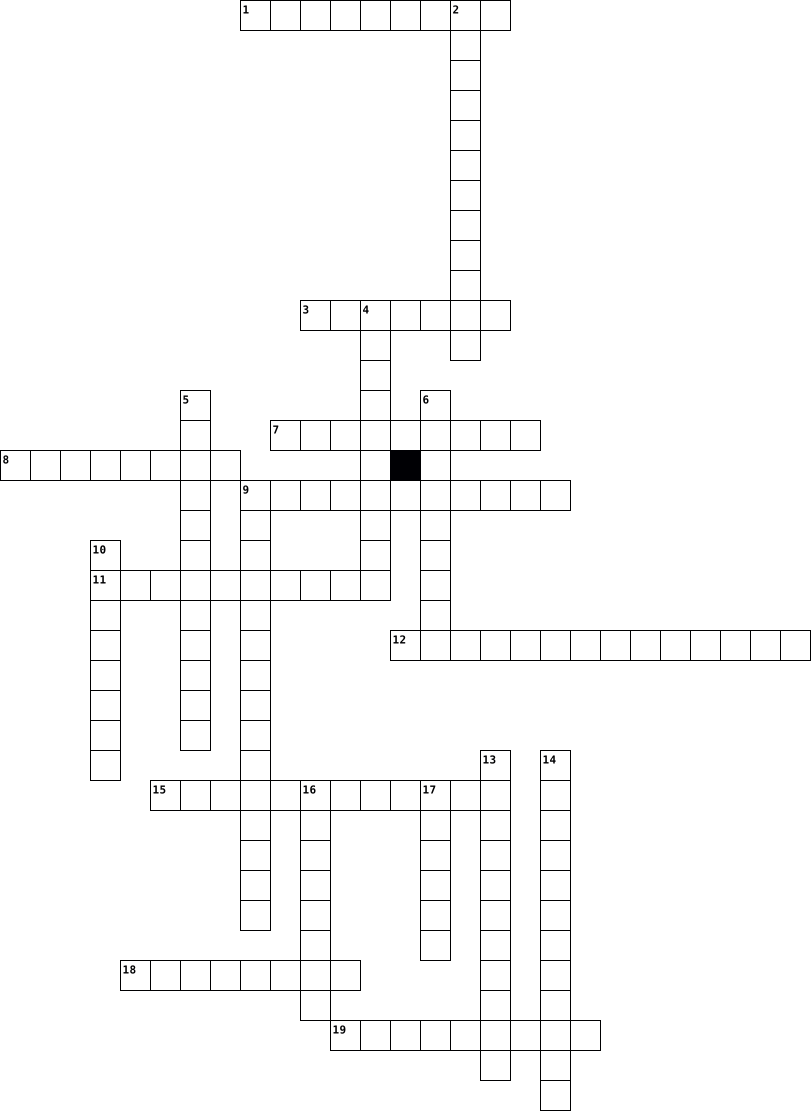
Across
- A circuit made of multiple branches
- Measured in amps
- When a gas becomes a liquid
- The colour of the neutral wire
- When a liquid becomes a solid
- Particles are in a fixed position in this state
- The wire that is green/yellow
- The colour of the live wire
- A energy stored found in batteries
- The energy required to heat 1kg of substance by 1 degrees Celsius
- A type of circuit made of one continuous loop
- The state with the highest internal energy
- Energy is measured in..
Down
- When a solid turns straight into a gas
- When a solid becomes a liquid
- Measured in ohms
- Anything moving has this energy store
- The energy store that increases as an object is lifted up
- Changes resistance due to changes in temperature
- Current is the flow of...
- Is calculated by dividing mass by volume
- When a liquid becomes a gas
- A resource that can be replaced as quickly as it is used
- Measured in watts
- Measured in kg
25 Clues: Measured in kg • Measured in ohms • Measured in amps • Measured in watts • Energy is measured in.. • Current is the flow of... • When a gas becomes a liquid • When a liquid becomes a gas • The colour of the live wire • When a solid becomes a liquid • When a liquid becomes a solid • The wire that is green/yellow • The colour of the neutral wire • A energy stored found in batteries • ...
Physics crossword 2022-03-06
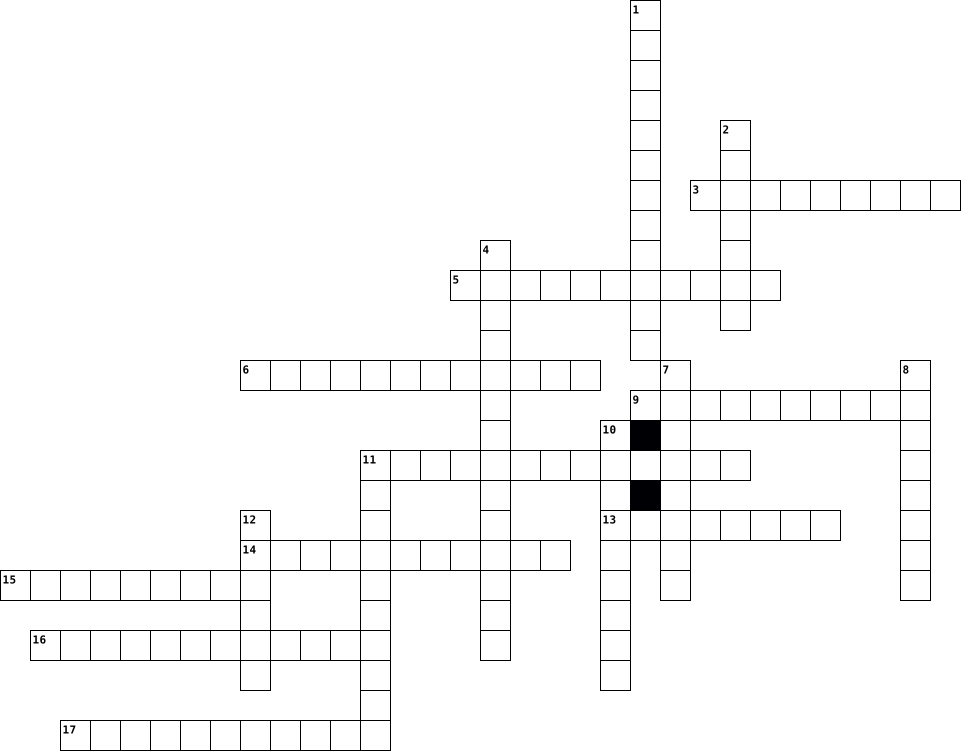
Across
- The increase in length of a spring when a load is attached
- A force that causes a spring to extend
- Quantity fully described by both a magnitude and direction
- Change in position
- A quantity used as a standard of measurement
- The rate of change of an object's velocity
- The point beyond which the extension of an object is no longer proportional to the load producing it
- The space occupied by an object
- The distance travelled by an object in unit time
- The SI unit of energy or work
- A single force which has the same effect as two or more forces acting together
- of mass The point at which the mass of an object can be considered to be concentrated
- Ability of an object to do work
Down
- Quantity fully described by magnitude
- The force acting per unit area
- When no net force and no net moment act on a body
- The frictional force on an object moving through air
- Energy stored in chemical substances and which can be released in a chemical reaction
- The energy of a moving object
- Change in displacement per unit time
- The product of force and the for which it acts
- Quantity that represents turning effect
- The fixed point in a lever
- The ratio of mass to volume for a substance
- Either a push or pull movement that acts on an object
- Amount of matter on an object
26 Clues: Change in position • The fixed point in a lever • The energy of a moving object • The SI unit of energy or work • Amount of matter on an object • The force acting per unit area • The space occupied by an object • Ability of an object to do work • Change in displacement per unit time • Quantity fully described by magnitude • A force that causes a spring to extend • ...
physics crossword 2022-01-05
Across
- the emission of energy as electromagnetic waves or as moving subatomic particles, especially high-energy particles which cause ionization
- the lowest temperature theoretically attainable, at which the particles constituting matter would be in the lowest energy states available
- the spreading of something more widely.
- the degree of compactness of a substance.
- corresponding in size or amount to something else.
- continuous physical force exerted on or against an object by something in contact with it.
- the movement caused within a fluid by the tendency of hotter and therefore less dense material to rise, and colder, denser material to sink under the influence of gravity, which consequently results in transfer of heat
- the degree or intensity of heat present in a substance or object, especially as expressed according to a comparative scale and shown by a thermometer or perceived by touch.
- energy contained within a system that is responsible for its temperature
- the energy transferred as a result of a difference in temperature
- the amount of space that a substance or object occupies
- the pressure exerted by the weight of the atmosphere, which at sea level has a mean value of 101,325 pascals (roughly 14.6959 pounds per square inch).Also called barometric pressure.
- an instrument measuring atmospheric pressure, used especially in forecasting the weather and determining altitude.
- the ability to be predicted.
- able to be noticed or perceived; discernible.
- A research question is the methodological point of departure of scholarly research
- the scale of temperature in which water freezes at 0° and boils at 100° under standard conditions.
- Of two quantities: such that one increases in proportion to a decrease in the other
- matter can be neither created nor destroyed
Down
- the process by which heat or electricity is directly transmitted through a substance when there is a difference of temperature or of electrical potential between adjoining regions, without movement of the material
- hesitancy
- the quality or state of being natural.
- a supposition or proposed explanation made on the basis of limited evidence as a starting point for further investigation
- one which the researcher holds constant (controls) during an experiment
- the available body of facts or information indicating whether a belief or proposition is true or valid.
- the action of thinking about something in a logical, sensible way.
- a substance or device which does not readily conduct heat or electricity
- state or assert that something is the case, typically without providing evidence or proof.
- a usually miniature representation of something a pattern of something to be made
- a coherent, typically large body of matter with no definite shape
30 Clues: hesitancy • the ability to be predicted. • the quality or state of being natural. • the spreading of something more widely. • the degree of compactness of a substance. • matter can be neither created nor destroyed • able to be noticed or perceived; discernible. • corresponding in size or amount to something else. • the amount of space that a substance or object occupies • ...
LH Physics 2022-01-04
Across
- for any system closed to all transfers of matter and energy, the mass of the system must remain constant over time, as the system's mass cannot change, so quantity can neither be added nor be removed.
- the space that a substance (solid, liquid, gas, or plasma) or 3D shape occupies or contains.
- the quality or state of being natural.
- a relationship between two quantities where they increase or decrease at the same rate.
- energy the energy contained within a system that is responsible for its temperature.
- Low Conductivity And High Resistivity.
- a system or thing used as an example to follow or imitate
- A research question is a specific inquiry which the research seeks to provide a response to
- the available body of facts or information indicating whether a belief or proposition is true or valid.
- quantitative measure of inertia
- proportional the relationship between two variables when their product is equal to a constant value.
- unchanging in nature, standard, or effect over time
- not certain or fixed; provisional
- constant variable is a variable that does not change during an experiment
- a measurement of the force per unit area
- able to be noticed or perceived; discernible
Down
- the force per unit area exerted by the weight of the atmosphere.
- a proposition made as a basis for reasoning, without any assumption of its truth
- the process of heat transfer in fluids by the actual motion of matter.
- an assertion of the truth of something, typically one that is disputed or in doubt.
- zero defined as the point where no more heat can be removed from a system,
- particles physically transferring heat energy as they come into physical contact with neighboring particles.
- a scientific instrument that measures atmospheric pressure
- the ability to be predicted.
- the transfer of energy through waves
- mass per unit volume
- The degree of heat of a living body
- the movement of particles (atoms, ions or molecules) from a region in which they are in higher concentration to regions of lower concentration
- the action of thinking about something in a logical, sensible way.
- is a temperature scale based on 0 o for the freezing point of water and 100 o for the boiling point of water.
- defined as the flow of energy between two systems by means of kinetic energy. This can take the form of transferring energy from a warm object to a cooler object.
31 Clues: mass per unit volume • the ability to be predicted. • quantitative measure of inertia • not certain or fixed; provisional • The degree of heat of a living body • the transfer of energy through waves • the quality or state of being natural. • Low Conductivity And High Resistivity. • a measurement of the force per unit area • able to be noticed or perceived; discernible • ...
Physics Crossword 2022-01-04
Across
- the transfer of air in cells of rising and falling air
- a phenomenon is more credible the more natural it seems
- The amount of matter an object contains
- the ability to be observed by different humans at different times
- When x rises, y falls
- A temperature measurement unit based on the freezing and boiling point of water
- The transfer of heat by the contact of two or more objects
- The pressure excreted by the weight of one atmosphere (14.695 pounds-per-square inch)
- The constant ratio between variables
- A change from a high concentration to a low concentration
- Data used to back up a scientific claim
- The mass of an object multiplied by its volume
- The transfer of heat by way of waves
- the law that states that particles are neither destroyed or created
Down
- Variables left unchanged during an experiment
- A scientific question around which an experiment/research project is based
- the ability to be observed by human senses or a tool repeated times
- A tool used to measure atmospheric pressure
- A measure of heat
- /an answer belived to be a true answer to a scientific query
- The amount of space an object/substance takes up
- A substance that deters the transfer of heat
- a theory predicting the outcome of an experiment
- A measure of particle speed within the mass of an object
- /a visual scale representation that helps explain,understand, and predict an outcome or phenomenon.
- The amount of force excerpted on an object/substance by particle collisions
- The amount of energy present in a substance
- The temperature at which all particle movements cease
- chemical reaction
- the explanation (Why) of why a claim is the answer to a scientific question
- /the knowledge that a belief is not certain, it can be modified, adapted, or scrapped by new evidence.
- / a belief in something based on prior observations and patterns, or how predictable it seems
32 Clues: A measure of heat • chemical reaction • When x rises, y falls • The constant ratio between variables • The transfer of heat by way of waves • The amount of matter an object contains • Data used to back up a scientific claim • A tool used to measure atmospheric pressure • The amount of energy present in a substance • A substance that deters the transfer of heat • ...
Physics Terms 2022-04-21
Across
- The part of the circuit by which current flows.
- A object that completely blocks the flow of electricity.
- The unit of measurement for resistance.
- The force that resists the flow of electricity.
- The unit of measurement for Voltage.
- The electric force constant
- Was Studied by Benjamin Franklin.
- An encloser used to block magnetic fields.
- The redistribution of charges based on nearby charges.
- A object that conducts electricity.
- Energy need to move a charge aginst a magnetic field.
Down
- When an atom has a equal number of protons and electrons.
- A componet of a circuit that makes it harder for current to flow.
- A visual aid used to show interactions between magnetic fields.
- A branch of Physics that studies charges at rest.
- The unit of measurement for current.
- A scientific instrument used to detect charge.
- A circuit that only has one path for electricity to flow.
- The property of matter at causes particles to experience change when in a magnetic field.
- The attractive force between charged particles.
- The series of equations that helps find Amps, Volts, or Ohms.
- A series of equations used to find the force between two charged objects.
- The empty space between two charged particles.
- The part of the circuit that provides electric current(Battery)
- The force that pushes current through a wire.
- A circuit that has multiple paths for electricity to flow.
- The part of the circuit that does work using the electricity provided by the load.
- The rate of current flow in a circuit.
- current that flows in one direction.
- a stream of charged particles.
30 Clues: The electric force constant • a stream of charged particles. • Was Studied by Benjamin Franklin. • A object that conducts electricity. • The unit of measurement for current. • The unit of measurement for Voltage. • current that flows in one direction. • The rate of current flow in a circuit. • The unit of measurement for resistance. • ...
Medical Physics 2017-03-15
Across
- decrease in intensity of radiation passing through matter
- process producing photons in a PET scan
- effect of a frequency change of a wave from a moving object
- computerised ___ ____ uses X-rays for 3-D imaging
- electrons emitted by photon absorption
- improves visibility of X-rays
- radioisotope combined with other elements
- detects radiation from injected radioisotopes
- converts a photon into an electrical pulse
- reversible effect in crystals converting strain into an emf
- needed to 'see' X-rays
Down
- converts gamma photons into light photons
- describes a temporary high energy state radioisotope
- Technetium-99m and Fluorine-18 are one of these
- absorbs X-rays
- when 2 materials have similar impedance values
- product of density times speed of sound in a material
- a cathode producing electrons
- you are put in this for a CAT scan
- Compton scattering is one of these
- emits pulses of high frequency sound
- sound above 20 kHz
- doesn't absorb X-rays much
23 Clues: absorbs X-rays • sound above 20 kHz • needed to 'see' X-rays • doesn't absorb X-rays much • a cathode producing electrons • improves visibility of X-rays • you are put in this for a CAT scan • Compton scattering is one of these • emits pulses of high frequency sound • electrons emitted by photon absorption • process producing photons in a PET scan • ...
Radiation Physics 2018-04-16
Across
- After absorbing the neutron the nucleus splits into two nuclei of lower Z as well as giving off additional neutrons
- the amount of energy present per unit of time per unit of area perpendicular to the beam direction
- Low mass nuclei combine to form one nucleusmass released since the mass of the product particles is less than the mass of reactants
- the difference between the actual weight and the sum of the constituent parts. (Two words)
- ____ dose describes the quantity of radiation for all types of ionizing radiation, including charged and uncharged particles, all materials, and all energies
- A type of scatter when an electromagnetic wave, passes near an electron and causes it to oscillate and the oscillating electron then re-irradiates the energy at the same frequency, and wavelength, as the incident e.m. wave
- The time required for either that activity or the number of radioactive atoms to decay to half the initial value (two words)
- treatment criteria for the plan optimization are given by the planner and the computer will determine what the correct leaf sequence is needed is considered _____ planning
- The law in which the voltage across the total circuit or any portion of the circuit is equal to the current times the resistance.
- affects the low energy portion of the spectrum by absorbing the low energy photons and hardens the beam
- This type of therapy treats in the 50 to 150kV range and treats to a depth of 5mm or less
- the scattering of photons away from the original point source
- atoms having nuclei with the same number of Neutrons but different number of protons
- a single fraction treatment for intracranial lesions using a combination of a specialized immobilization and narrow multiple beams delivered through Non-coplanar isocentric arcs (acronym)
- technique in which a nonuniform fluence is delivered to the patient from any given position of the treatment beam to optimize composite dose distribution (acronym)
- Elementary particle with a positive electric charge equal to that of an electron and a mass approximately to that of a neutron. found within the nucleus of the atom
- Electron interacts with atom and ejects an orbital electron an outer shell orbital wants to fill that vacancy and the excess energy is given off as this type of x-ray
- "type of radiotherapy wave maximizes reflecting waves at both ends as to give rise to stationary waves by combining forward and reverse traveling waves.
- ratio of dose at a depth in a phantom to dose in free space at the same distance (acronym)
- Elementary particle with one negative charge that surrounds the positively charged nucleus and determines the chemical properties of the atom
- A material that in some conditions behaves as a conductor but behaves like an insulator in other conditions
- a type of phantom that uses materials to simulate body parts
- A type of decay where the mass number is reduced by 4 and the atomic number is reduced by 2
- Vacancy in orbital shell is filled by another electron and the transition energy is given off as characteristic x-ray (two words)
- energy transferred from photons to electrons
- type of radiotherapy wave that requires a terminating load to absorb the residual power at the end of the structure- to prevent backward reflecting wave
- atoms having nuclei with the same number of Protons but different number of neutrons
Down
- An insulator is any material that does not allow electron flow
- same number of nucleons but different number of protons (different element)
- the principle that energy absorbed in a medium from radiation appears ultimately as heat energy while a small amount may appear in the form of a chemical change
- the region at the edge of a radiation beam over which the dose rate changes rapidly as a function of distance from the beam axis
- measure of ionization produced in air by photons
- uncharged elementary particle, with a mass slightly greater than that of a proton, that is found in the nucleus of every atom heavier than hydrogen
- Radioactive decay accompanied by the ejection of a positive or negative electron from the nucleus
- Thickness of a specified material that when introduced into the path of the beam, reduces the exposure rate by one half (acronym)
- the incident particle does not have sufficient energy to eject an electron from the atom- so it raises the electrons to higher energy levels
- "a dosimetry device used determine the optical density of the film which is a measure of the degree of blackening of the film
- when an x-ray passes near an orbital electron of an atom and passes enough energy to the electron to remove it from the atom
- same number of protons as well as neutrons- same elements but differ in the nuclear energy states… the last example has an isomer
- this type of therapy treat 500 to 1000 kV and uses a transmission target
- “Breaking” Radiation– electronic collision in which the electron passes near a nucleus and the columbic forces causing an ACCELERATION in which the electron MUST release energy
- energy emitted and transferred through space
- The Law in which the electrostatic force is directly proportional to the product of the electrostatic charges and inversely proportional to the SQUARE of the distance between them
- "A law that states that the intensity of radiation at a location is inversely proportional to the square of its distance from the source of radiation. (two words)
- the RATIO of the daughter activity to the parent activity remains constant over time.
- component to the linac that includes pulse forming network and thyratron- high voltage pulses are flat topped DV pulses of few microseconds in duration. These pulses are delivered to either the magnetron or klystron and simultaneously to the electron gun
- Electron produced outside the collection region, which enter the ion-collecting region, is equal to the electron produced inside the collection region , which deposit their energy outside the region. (acronym)
- the energy of the electron orbit, but with the opposite sign./The energy required to dissociate a structure. (two words)
- this type of therapy treats in the 200 to 400 kV with the 90% isodose line at a depth of 2cm
- A conductor is a substance through which electrons flow easily
- component to the linac that Produces microwaves of several microseconds duration and a rep rate of several hundred pulses per second and Has cathode and anode in which electrons are generated by heating a filament within the cathode
- a dosimetric device of tissue equivalence used to predict dose distribution in an actual patient
- percentage of the absorbed dose at any depth d to the absorbed dose at a fixed reference depth along central axis (acronym)
53 Clues: energy emitted and transferred through space • energy transferred from photons to electrons • measure of ionization produced in air by photons • a type of phantom that uses materials to simulate body parts • the scattering of photons away from the original point source • An insulator is any material that does not allow electron flow • ...
Nuclear Physics 2017-11-25
Across
- If you had a rock that was 1/8 U-235 and 7/8 Fe, then the rock is _____ years old.
- A form a hydrogen that has one neutron.
- My teacher calls himself _____.
- What is a beta particle?
- How many protons can share an energy level?
- Protons and neutrons are _____.
- What is radioactive debris (extra neutrons) called?
- How many nucleons can their be in a nucleus?
- What is the half-life of Beryllium-7?
- Small atoms release energy in _____ reactions.
Down
- A form of hydrogen that has two neutrons.
- What radioactive element was used to show that continental drift was real?
- What unit is used to measure radiation?
- Each radioactive isotope has a different _____.
- What is the half-life of a neutron?
- Different forms of elements that have a different number of neutrons but the same number of protons.
- What radioactive element would you look for if you were determining the age of a fossil?
- This force is strong and short ranged.
- What is the decay product of He-5?
- Large atoms release energy in _____ reactions.
20 Clues: What is a beta particle? • My teacher calls himself _____. • Protons and neutrons are _____. • What is the decay product of He-5? • What is the half-life of a neutron? • What is the half-life of Beryllium-7? • This force is strong and short ranged. • What unit is used to measure radiation? • A form a hydrogen that has one neutron. • A form of hydrogen that has two neutrons. • ...
Nuclear Physics 2017-11-26
Across
- This force is strong and short ranged.
- What is radioactive debris (extra neutrons) called?
- Different forms of elements that have different amounts of neutrons are _____.
- What radioactive element was used to show that continental drift is real?
- What is a beta particle?
- A form of hydrogen that has two neutrons.
- Each radioactive isotope has a different _____.
- Large atoms release energy in _____ reactions.
- What is the decay product of He-5?
- What is the half-life of a neutron?
- My teacher calls himself _____.
Down
- What is the half-life of Beryllium-7?
- Protons and neutrons are _____.
- If you had a rock that was 1/8 U-235 and 7/8 Pb, then the age of the rock would be _____.
- A form of hydrogen that has one neutron.
- What unit is used to measure radiation?
- What radioactive element would you look for in a fossil?
- How many nucleons can there be in a nucleus?
- How many protons can share an energy level?
- Small atoms release energy is _____ reactions.
20 Clues: What is a beta particle? • Protons and neutrons are _____. • My teacher calls himself _____. • What is the decay product of He-5? • What is the half-life of a neutron? • What is the half-life of Beryllium-7? • This force is strong and short ranged. • What unit is used to measure radiation? • A form of hydrogen that has one neutron. • A form of hydrogen that has two neutrons. • ...
Physics Terms 2016-09-02
Across
- Proton in the nucleus
- Holds a nucleus together
- Force between protons and neutrons
- Two neutrons and protons being ejected from a radioactive atom
- Subatomic particle, fractional charge
- Rise to forces of other particles
- Conversion of radiation quantum into an electron or positron
- Atom with specific number of protons and neutrons
- No part in strong interaction
- Weight less than sum of nucleons
Down
- Time for HALF the isotope to disappear
- Emitting an electron
- Losing energy unstably
- Protons and neutrons in atom
- Mass of an atom
- Fission, fusion, or radioactive-decay
- Force between leptons
- Spread of a reaction
- Dividing into two or more parts
- Mathematical description of elementary particles
- Condition for things to happen
- A proton or neutron
- Stream of high energy protons
- Joining two or more things
24 Clues: Mass of an atom • A proton or neutron • Emitting an electron • Spread of a reaction • Force between leptons • Proton in the nucleus • Losing energy unstably • Holds a nucleus together • Joining two or more things • Protons and neutrons in atom • Stream of high energy protons • No part in strong interaction • Condition for things to happen • Dividing into two or more parts • ...
physics definitions 2020-01-23
Across
- 60 minute time span
- distance travelled per unit of time
- when two object excert force on eachother
- a push or pull in a direction
- how fast the motion or action is
- capacity or power to do work
- mass in motion
- the difference in where it started to where it ended
- force due to gravity
- a object returns to a original shape
- 60 second time span
Down
- the stored any or position possesed by a object
- force that pulls 2 object together
- a form of distance not to big
- a change in velocity
- energy obtained by an object
- total amount travelled
- a form of weight not to big
- amount of matter
- change of momentum in a object
- short interval of time
- measure of energy transfer
- a measurable period
23 Clues: mass in motion • amount of matter • 60 minute time span • 60 second time span • a measurable period • a change in velocity • force due to gravity • total amount travelled • short interval of time • measure of energy transfer • a form of weight not to big • energy obtained by an object • capacity or power to do work • a form of distance not to big • a push or pull in a direction • ...
Physics Crossword 2013-01-17
Across
- When some light is reflected and some are refracted
- Reproduction of an object through the use of light
- Incoming ray
- Where all the light rays meet
- Light internally reflects throughout pure glass and exits the other end
- When the angle of incidence is greater than the critical angle, creating refraction on the inside
- The direction and straight path that light travels
- The image that does not actually arrive of come at the image location
- Perpendicular to the surface
Down
- Light from a source that strikes an object
- When an object transmits some of the light striking, it absorbs or reflects the rest
- Right angle to surface
- Between normal and reflection
- Rough surface where each light ray is reflected in a different direction and no clear reflected image is seen
- Horizontal line going through the center of mirror
- Animals producing light through special tissues
- The angle of incidence that results in a refraction of 90 degrees
- Almost all light passes through, objects can be see through
- Between incident and normal
- Center of circle if mirror was made into a circle
20 Clues: Incoming ray • Right angle to surface • Between incident and normal • Perpendicular to the surface • Between normal and reflection • Where all the light rays meet • Light from a source that strikes an object • Animals producing light through special tissues • Center of circle if mirror was made into a circle • Reproduction of an object through the use of light • ...
Physics crossword 2013-06-10
Across
- a force exerted by magnets
- created by gas particles moving and hitting things
- a magnet with increased strength
- the ray of light that strikes the surface before reflection
- the current stays the same around this type of circuit
- when the light source is small this is the area behind the object
- Thomas Edison found this
- two magnets with different poles do this
- measured in amps
Down
- gives off light
- a solution which conducts electricity
- measured in volts
- the voltage of the cell is the same in each branch of this circuit
- what a magnet is made up of
- melts if the current through a circuit is too high
- magnets and the earth have this in common
- the light surrounding the umbra
- pushing down on me pushing down on you
- worked out when you multiply pressure by area
- the angle used to compare the angle of incidence and reflection
- light rays reflected in the same direction
- two magnets with the same poles do this
- composed of individual electronic components
23 Clues: gives off light • measured in amps • measured in volts • Thomas Edison found this • a force exerted by magnets • what a magnet is made up of • the light surrounding the umbra • a magnet with increased strength • a solution which conducts electricity • pushing down on me pushing down on you • two magnets with the same poles do this • two magnets with different poles do this • ...
Physics crossword 2013-09-29
Across
- A magnet mono__________ doesnot exist.
- His main discoveries include those of electromagnetic induction, diamagnetism and electrolysis.
- A ball thrown into the air. A bullet fired from a gun. A ball shot from a cannon.
- Why is the sky blue?
- First Indian pico-satellite (weighing less than 1 kg). Developed by a team from seven engineering colleges from Karnataka and Andhra Pradesh.
- Capacity of a system to perform work.
- Human Camera.
- Energy delivered/Energy supplied.
- It has six flavors: up, down, strange, charm, bottom, and top.
- <1, subsonic. >1, supersonic.
- Variable resistor.
- CGS unit of "capacity of a system to perform work".
- Number 8 and Its name derives from the Greek roots which means "Acid Producer".
- Without this we wouldn't have radio, television, music, or swings on playgrounds, but occasionally causes a bridge to collapse, a helicopter to fly apart, or other inconveniences.
- This term was coined by Paul Dirac to commemorate the contribution of Satyendra Nath Bose.
Down
- A systematic enterprise that builds and organises knowledge in the form of testable explanations and predictions about the universe.
- The greatness of magnitude.
- Electrically neutral medium of positive and negative particles.
- At atmospheric pressure, Water boils at 212 degree ____________.
- Equals mg.
- A Blackhole slows down ___________.
- A material that spontaneously emits radiations.
- To move (something) to a higher place or position from a lower one.
- Chunks of rock floating in space.
- "The crown seems lighter under water".
- Cycles per second.
- Without these in your eye there would'nt be any rainbow.
- A California-based company that designs, manufactures and sells electric cars and electric vehicle powertrain components is named after this physicist.
- Named after the Roman goddess of dawn, Coloured light in the night sky.
- Last letter of the Greek alphabet.
30 Clues: Equals mg. • Human Camera. • Variable resistor. • Cycles per second. • Why is the sky blue? • The greatness of magnitude. • <1, subsonic. >1, supersonic. • Energy delivered/Energy supplied. • Chunks of rock floating in space. • Last letter of the Greek alphabet. • A Blackhole slows down ___________. • Capacity of a system to perform work. • A magnet mono__________ doesnot exist. • ...
PHYSICS CROSSWORD 2013-12-04
Across
- use your left hand
- subatomic particle made of 3 quarks
- unit of sound intensity
- attraction between different substances
- moving part of an electric motor
- name of a number
- rate of change of velocity
- two waves together
- for measuring air pressure
- overtone
- heat is taken in
- positive terminal of a cell
- spreading out of waves
- unit of luminosity
- balanced forces
- it has similar atoms
- it does not change
- flow of charge
- depends on the square of the amplitude
- suspension of particles of liquid in a gas
- science of sound
- ten to the nine
Down
- kelvin minus 273
- unit of radioactivity
- detects small electric currents
- liquid to gas below the boiling point
- unit of charge
- splitting of an atom
- causes objects to float
- instrument to measure height
- towards the centre
- base units
- breakdown through radioactivity
- output to input
- stores electric charge
- number of waves per second
- 745.7 watts
- force times time
- electromotive force
- ask Newton
- an isotope of hydrogen
- the ability to do work
- a charged atom
- without an echo
44 Clues: overtone • base units • ask Newton • 745.7 watts • unit of charge • flow of charge • a charged atom • output to input • balanced forces • without an echo • ten to the nine • kelvin minus 273 • name of a number • heat is taken in • force times time • science of sound • use your left hand • towards the centre • two waves together • unit of luminosity • it does not change • electromotive force • splitting of an atom • ...
PHYSICS CROSSWORD 2013-12-04
Across
- unit of sound intensity
- heat is taken in
- splitting of an atom
- subatomic particle made of 3 quarks
- an isotope of hydrogen
- electromotive force
- unit of radioactivity
- detects small electric currents
- instrument to measure height
- it has similar atoms
- depends on the square of the amplitude
- towards the centre
- it does not change
- attraction between different substances
- causes objects to float
- kelvin minus 273
- name of a number
- output to input
- moving part of an electric motor
- unit of luminosity
- science of sound
- the ability to do work
- ten to the nine
Down
- 745.7 watts
- for measuring air pressure
- spreading out of waves
- suspension of particles of liquid in a gas
- stores electric charge
- rate of change of velocity
- two waves together
- base units
- balanced forces
- without an echo
- liquid to gas below the boiling point
- overtone
- use your left hand
- flow of charge
- breakdown through radioactivity
- number of waves per second
- ask Newton
- a charged atom
- force times time
- positive terminal of a cell
- unit of charge
44 Clues: overtone • base units • ask Newton • 745.7 watts • flow of charge • a charged atom • unit of charge • balanced forces • without an echo • output to input • ten to the nine • heat is taken in • kelvin minus 273 • name of a number • force times time • science of sound • two waves together • towards the centre • it does not change • use your left hand • unit of luminosity • electromotive force • splitting of an atom • ...
Physics Review 2013-11-26
Across
- A positron was the first example of ________.
- If each fission causes one additional fission you have a ________.
- If a machine is 90% efficient where does the missing 10 % go?
- The distance light travels in a year.
- A ________ consists of everything observable.
- Difficulty on passing current is called ________.
- Heavy nuclei produce energy by ________.
- If it is comfortable to live on it’s a ________.
- Magnetic field affect ________.
- Electrons/sec = ________.
Down
- Currently the objects that we hope are the smallest components of matter are called ________.
- AMA accounts for ________.
- The simplest (most fundamental) object obtainable by chemical means (pounding, acids, freezing, etc.) is ________.
- A generator worked backward would probably act like a ________.
- A group of a minimum number of atoms in the same ratio as in the bulk material is a ________.
- There are about a hundred different types of ________.
- A fuse should be in ________ with the thing it is to protect.
- These have a very regular organized structure.
- Energy/electron = ________.
- If it has 1000000000000 stars it is a ________.
20 Clues: Electrons/sec = ________. • AMA accounts for ________. • Energy/electron = ________. • Magnetic field affect ________. • The distance light travels in a year. • Heavy nuclei produce energy by ________. • A positron was the first example of ________. • A ________ consists of everything observable. • These have a very regular organized structure. • ...
Physics Crossword 2014-02-26
Across
- Energy that is transmitted in the form of electromagnetic radiation
- Stored potential energy, ex: a coiled spring
- The part of energy in a substance that can be released by a chemical reaction
- The rate at which work is done
- Energy that results in the system temperature
- There must be a change in ( ) or speed in order for work to be done
- Energy associated with the gravitational field
- The energy units
- Work Energy Theorem: When work is done there will be an ( ) change in energy
Down
- The power units
- In order for work to be done, a ( ) must be applied
- The energy released during nuclear fission or fusion, especially when used to generate electricity
- Energy that is absorbed or delivered by an electrical circuit
- the ability to do work
- Energy that a body possesses by virtue of its position relative to others
- How an object gains/loses energy
- Energy that a body possesses by virtue of being in motion
- Object must move in the direction of the ( ) force in order for work to be done
- Law of Conservation of Energy: ( ) energy doesn't change but the specific form will
- Form of energy associated with the vibration or disturbance of matter
20 Clues: The power units • The energy units • the ability to do work • The rate at which work is done • How an object gains/loses energy • Stored potential energy, ex: a coiled spring • Energy that results in the system temperature • Energy associated with the gravitational field • In order for work to be done, a ( ) must be applied • ...
Physics Homework 2014-02-25
Across
- an example of gravitational energy, where the dam "piles" up water from a river into a reservoir.
- stored energy
- a type of radiant energy.
- energy delivered by tiny charged particles called electrons.
- Nuclear power plants split the nuclei of uranium atoms in a process called
- the energy that holds the nucleus together
- In motion, energy is released when an object ____
- typically, the energy in _____ is far less than other forms of energy.
Down
- energy is energy stored in an object's height.
- Compressed springs and stretched rubber bands are examples of stored _____ energy.
- The higher and _____ the object, the more gravitational energy is stored.
- Stored energy.
- the sun combines the nuclei of hydrogen atoms in a process called
- can you paint with all the colors of the motion energy
- the vibration and movement of the atoms and molecules within substances
- This type of energy is converted to thermal energy when we burn wood in a fireplace or burn gasoline in a car's engine
- electromagnetic energy that travels in transverse waves.
- the faster objects move the more _____ energy is stored
- Energy is neither ____ or destroyed
- energy is the ability to do ____
20 Clues: stored energy • Stored energy. • a type of radiant energy. • energy is the ability to do ____ • Energy is neither ____ or destroyed • the energy that holds the nucleus together • energy is energy stored in an object's height. • In motion, energy is released when an object ____ • can you paint with all the colors of the motion energy • ...
Physics Conundrum 2015-04-10
Across
- negatively charged
- german theoretical physicist
- divide speed of wave by wavelength
- mass divided by volume
- body of matter with no shape
- product of mass and velocity
- has an atomic number
- power by physical or chemical resources
- resistance
- electromagnetic radiation seen by human eye
- attraction towards the center of the earth
- SI unit of of electric current
Down
- ice is an example of this state of water
- rate of change of velocity of an object
- resistance to change in state of motion
- force per unit area
- disturbance or oscillation
- speed in a given direction
- heaviness of a person or thing
- smallest unit of matter
20 Clues: resistance • negatively charged • force per unit area • has an atomic number • mass divided by volume • smallest unit of matter • disturbance or oscillation • speed in a given direction • german theoretical physicist • body of matter with no shape • product of mass and velocity • heaviness of a person or thing • SI unit of of electric current • divide speed of wave by wavelength • ...
Nuclear Physics 2015-04-30
Across
- nuclei with small masses combined into one big nucleus and energy is released
- the positively charged dense center of an atom
- radioactive decay where alpha particles are emitted from the nucleus
- model of an atom that shows electrons in circular orbits around the nucleus
- the distance between 2 consecutive peaks or troughs of a wave.
- radioactive decay where there's redistribution of energy in the nucleus without change in atom's mass or charg
- is an apparatus to measure a spectrum.
- A collection of waves with a range of frequencies.
- a substance made up of two or more elements bonded together
- number of decays per second in a radioactive substance
- an element whose atoms have different numbers of neutrons than protons
- neutrally charged
Down
- time required for half of the atoms to decay
- negatively charged
- particle one of three basic particles that make up an atom
- materials that undergo radioactive decay and emit penetrating rays
- radioactive decay where a neutron is changed into a proton in nucleus and beta particle and antineutrino are emitted
- smallest particle of an element, and the basic unit of matter
- the number of protons in an atom and its order on the Periodic Table
- When an electron is in a state of lowest possible energy
- positively charged
- a nucleus is divided in two or more fragments, neutrons and energy are released
22 Clues: neutrally charged • negatively charged • positively charged • is an apparatus to measure a spectrum. • time required for half of the atoms to decay • the positively charged dense center of an atom • A collection of waves with a range of frequencies. • number of decays per second in a radioactive substance • When an electron is in a state of lowest possible energy • ...
Physics crosswords 2015-08-10
Across
- The unit to measure electrical resistance
- Derived from electrical potential energy and used to power many electrical devices
- The unit to measure electrical current
- The capability for doing work
- An object that can store energy because of its position
- Energy from radiant light and heat from the sun and solar panels are used to convert it to electricity
- The person who discovered gravity and the laws of physics
- Production of electricity from gravitational energy of flowing water
- Is a potential energy stored as a result of deformation of an elastic object
- The tendency to do nothing or remain at rest from other forces
- The speed of something in a given direction
Down
- A Unit of measurement for energy
- The unit to measure electrical potential energy, made from Alessandro
- Rate of change in velocity per unit of time
- Energy that an object possess because of its position in a gravitational view
- An energy that possess objects that allows it to move
- A form of energy that we can actually see and it can be converted into other forms of energy
- A goal to reduce the amount of energy required to provide products and services
- Unit for rate of energy conversion
- The movement of atoms or molecules, changes the temperature of an object, can be transferred
- A force acting on the body, there is a displacement in the direction of force.
21 Clues: The capability for doing work • A Unit of measurement for energy • Unit for rate of energy conversion • The unit to measure electrical current • The unit to measure electrical resistance • Rate of change in velocity per unit of time • The speed of something in a given direction • An energy that possess objects that allows it to move • ...
PHYSICS REVISION 2015-10-18
Across
- a substance that flows freely but is of constant volume
- measure of heat loss
- Evaporation is defined as the process of a liquid changing into a gas
- the particles that carry charge through wires in a circuit are mobile electrons
- move from a lower position to a higher one
- the movement caused within a fluid by the tendency of hotter and therefore less dense material to rise
- the quantity of mass per unit volume of a substance
- of a smooth surface reflecting light
- the emission of energy as electromagnetic waves or as moving subatomic particles
- the amount of space that a substance or object occupies
Down
- the action of insulating something.
- firm and stable in shape
- an air-like fluid substance which expands freely to fill any space available
- a stable subatomic particle with a charge of negative electricity
- the process by which heat or electricity is directly transmitted through the material
- move continuously and rapidly to and fro.
- the degree or intensity of heat present in a substance or object
- a material or device that conducts or transmits heat or electricity
- produce and discharge
- take in or soak up
- dull and flat
21 Clues: dull and flat • take in or soak up • measure of heat loss • produce and discharge • firm and stable in shape • the action of insulating something. • of a smooth surface reflecting light • move continuously and rapidly to and fro. • move from a lower position to a higher one • the quantity of mass per unit volume of a substance • ...
Physics crossword 2014-07-20
Across
- used to show direction or position; a pointer.
- the rate at which someone or something is able to move or operate.
- the branch of science concerned with the nature and properties of matter and energy. The subject matter of physics, distinguished from that of chemistry and biology, includes mechanics, heat, light and other radiation, sound, electricity, magnetism, and the structure of atoms.
- the size, length, or amount of something, as established by measuring.
- Motion: a form of motion in which an object or particle is thrown near the earth's surface, and it moves along a curved path under the action of gravity only.
- the path followed by a projectile flying or an object moving under the action of given forces.
- the moving of something from its place or position.
- a form of energy that causes a difference in temperature, or the perception of warmth.
- the use of science in industry, engineering, etc., to invent useful things or to solve problems
- a vector measurement of the rate and direction of motion or, in other terms, the rate and direction of the change in the position of an object.
- a physical phenomenon produced by the motion of electric charge, resulting in attractive and repulsive forces between objects.
- A quantity, such as mass, length, or speed, that is completely specified by its magnitude and has no direction.
- vibration that propagates as a typically audible mechanical wave of pressure and displacement, through a medium such as air, and water.
- technoloy comes from the greek word
- the process of moving something from one place to another.
- Frame: A basis of a four-dimensional coordinate system in which the first coordinate is understood as a time coordinate, while the other three coordinates represent spatial dimensions.
- The branch of mechanics that studies the motion of a body or a system of bodies without consideration given to its mass or the forces acting on it.
Down
- the scientific study of sight and the behavior of light, or the properties of transmission and deflection of other forms of radiation.
- scalar comes from the latin word
- the branch of applied mathematics dealing with motion and forces producing motion.
- the rate of change of velocity per unit of time.
- the branch of physical science concerned with the interrelationship and interconversion of different forms of energy and the behaviour of macroscopic systems in terms of certain basic quantities, such as pressure, temperature, etc.
- the branch of mechanics concerned with the motion of bodies under the action of forces.
- is the set of physical phenomena associated with the presence and flow of electric charge.
- occurring or produced as a result or consequence of something.
- physics comes from geek word
- Quantities: Described by their magnitudes and appropriate units, and directions.
- the full length of a race.
- Figures: Digits that show the number of units in a measurement expressed in decimal notation.
- The act or process of changing position or place.
30 Clues: the full length of a race. • physics comes from geek word • scalar comes from the latin word • technoloy comes from the greek word • used to show direction or position; a pointer. • the rate of change of velocity per unit of time. • The act or process of changing position or place. • the moving of something from its place or position. • ...
Physics Vocabulary 2016-03-28
Across
- the physical property of matter that causes it to experience a force when placed in an electromagnetic field.
- is a measuring instrument used to measure the current in a circuit.
- an imbalance of electric charges within or on the surface of a material.
- the difference of electrical potential between two points.
- a force between electric currents: two parallel currents in the same direction attract, in oposite directions repel.
- a flow of electric charge. In electric circuits this charge is often carried by moving electrons in a wire. It can also be carried by ions in an electrolyte, or by both ions and electrons such as in a plasma.
- station is an industrial facility for the generation of electric power.
- circuit that has two or more paths for current to flow through.
- subatomic particle, symbol p or p+, with a positive electric charge of +1e elementary charge and mass slightly less than that of a neutron.
- electromotive force or potential difference expressed in volts
- change the voltage of (an electric current).
- states the current through a conductor between two points is directly proportional to the potential difference across the two points.
- a propety of objects which can be transferred to other objects or converted into different forms.
- an object or type of material that allow the flow of electrical current in one or more directions.
Down
- complete electrical network with a closed loop giving a return path for current.
- symbol e− or β−, with a negative elementary electric charge
- the magnetic effect of electric currents and magnetic materials.
- the current through each of the components is the same, and the voltage across the circuit is the sum of the voltages across each component.
- one of the most powerful, fundamental forces in the universe.
- a material of such low conductivity that the flow of current through it is negligible.
- an instrument used for measuring electrical potential difference between two points in an electric circuit.
- an instrument designed to measure electric current, voltage, and usually resistance, typically over several ranges of value.
- atom or a molecule in which the total number of electrons is not equal to the total number of protons, giving the atom or molecule a net positive or negative electrical charge.
- a measurement of the difficulty encountered by a power source in forcing electric current through an electrical circuit, and hence the amount of power dissipated in the circuit.
- is a passive two-terminal electrical component that implements electrical resistance as a circuit element.
25 Clues: change the voltage of (an electric current). • the difference of electrical potential between two points. • symbol e− or β−, with a negative elementary electric charge • one of the most powerful, fundamental forces in the universe. • electromotive force or potential difference expressed in volts • circuit that has two or more paths for current to flow through. • ...
Science- Physics 2024-01-09
Across
- the energy tenaferred when a force moves an object
- energy from the sun
- a way of transferring energy through wires
- a machine consisting of a wheel that can turn on an axis with a rope running around it.
- a name used to describe energy when it is stored in stretched or squashed things that can change back to their original shapes
- the turning effect of a force
- a way of transferring energy by waves (can travel throught transparent materials)
- spread out
- a name used to describe energy when it is stored in hot objects
- the amount of force with which gravity pulls something towards the earth
- a lever or other machine where the load moves further than the effort
- change shape
- a gas or liquid
- the steepness of a line on a graph
- to change speed
- a way of transferring energy from hot substances to cooler ones
Down
- a force between two objects that are touching
- a lever or lother machine where the load is bigger than the effort
- a sloping surface
- the total distance something travels divided by the total time taken
- how fast something is moving
- a name used to describe energy when itis stored inside materials
- another name for pivot
- a force that slows things down that are moving through air
- a point about which something turns
- a device, such as lever or ramp
- balanced
- the weight or force on something
- a way of saying how much energy something wastes
- the force put on something, especially a lever
- A force that pushes things up in liquids and gases
- another name for air or water resistance
- an energy resource that will never run out
33 Clues: balanced • spread out • change shape • a gas or liquid • to change speed • a sloping surface • energy from the sun • another name for pivot • how fast something is moving • the turning effect of a force • a device, such as lever or ramp • the weight or force on something • the steepness of a line on a graph • a point about which something turns • another name for air or water resistance • ...
Physics Revision 2024-01-09
Across
- - A force that pushes things up in liquids and gases.
- - A name used to describe energy when it is stores in hot objects
- - A point about which something turns, another name for a pivot.
- - A lever or other machine where the load is bigger than the effort.
- - A name used to describe energy when it is stored in stretched or squashed things that can change back to their original shapes.
- - A point about which something turns
- - A simple machine that consists of long bar and a pivot.
- - The speed of one object compared to another
- - A force that slows things down that are moving through air.
- - A fuel formed from the dead remains or organisms over millions of years.
- - A name used to describe energy when it is stored in chemicals.
- - The difference between forces in two opposite directions
- - The turning effect of a force, it is calculated by multiplying the force by its perpendicular distance of the force from the pivot
Down
- - Spread out
- - A lever or other machine where load moves further than the effort.
- - A sloping surface.
- - A force between two objects that are touching. It usually acts to slow things down or prevent movement
- - A name used to describe energy when stored in moving things.
- - A way of transferring energy by waves.
- - Another name for air resistance or water resistance
- - How fast something is moving.
- - A way of saying how much energy something wastes.
- - The amount of force with which gravity pulls something towards the Earth.
- - The total distance something travels divided by the total time taken.
- - Energy from the Sun.
25 Clues: - Spread out • - A sloping surface. • - Energy from the Sun. • - How fast something is moving. • - A point about which something turns • - A way of transferring energy by waves. • - The speed of one object compared to another • - A way of saying how much energy something wastes. • - A force that pushes things up in liquids and gases. • ...
Y9 Physics 2024-01-09
Across
- Energy from the Sun.
- Energy transferred via electrons moving.
- Unit of speed where the time is in hours and the distance is in kilometers
- A point about which something turns.
- A machine where the load is bigger than the effort.
- An energy resource that will not run out on a human timescale (e.g. solar power.)
- Balance.
- How fast something moves.
- Unit representing the strength of a force.
- Energy stored in moving things.
- Fuels formed from decomposed organic material over millions of years.
- An upward force in fluids; also called buoyancy.
Down
- The ratio of wasted to used energy.
- A device that generates electricity when exposed to light.
- The conversion of kinetic energy to heat between two objects in contact
- Energy stored in e.g. food, fuel, batteries
- A form of drag in an atmosphere.
- Change speed.
- A type of wave involving moving particles in a fluid.
- Slows things down in a fluid.
- Unit of speed where the time is in seconds and the distance is in metres.
- A form of energy transfer via waves. Usually refers to its visible frequency range (420 THz to 750 THz).
- Unit used to represent the moment of a force.
23 Clues: Balance. • Change speed. • Energy from the Sun. • How fast something moves. • Slows things down in a fluid. • Energy stored in moving things. • A form of drag in an atmosphere. • The ratio of wasted to used energy. • A point about which something turns. • Energy transferred via electrons moving. • Unit representing the strength of a force. • ...
IB Physics 2023-12-12
Across
- Having had the proportion of the isotope U-235 it contains increased in order to make it suitable for use in a nuclear reactor or weapon.
- Solar water heating systems use panels or tubes, called solar collectors, to gather solar energy. The solar collectors convert the infra-red portion of visible light into heat. They are filled with a mix of water and glycol. This fluid is pumped round a circuit, which passes through the hot water cylinder.
- A moderator is a material that slows the speed of neutrons. It is also known as a neutron moderator. Using a moderator changes fast neutrons into thermal neutrons. Thermal neutrons increase the likelihood of interaction with another nucleus to initiate fission.
- A sankey diagram is a visualization used to depict a flow from one set of values to another. The things being connected are called nodes and the connections are called links.
- Put simply, a heat exchanger is a device which transfers heat from one medium to another.
- Thermal neutrons are a class of Neutron which are said to be in 'thermodynamic equilibrium' which means they are moving with the same kinetic energy as their surroundings.
- A rod, plate, or tube containing a material such as hafnium, boron, etc., used to control the power of a nuclear reactor. By absorbing neutrons, a control rod prevents the neutrons from causing further fissions.
- Degraded energy is thermal energy that is released into the surrounding environment after any process. Once released into the surroundings, this heat energy is completely useless for energy production and is considered 'dead' or 'degraded energy'.
- Nonrenewable energy comes from sources that will run out or will not be replenished in our lifetimes—or even in many, many lifetimes.
- Energy in the form that it is first accounted for in a statistical energy balance, before any transformation to secondary or tertiary forms of energy.
- The electricity that we use is a secondary energy source because it is produced by converting primary sources of energy such as coal, natural gas, nuclear energy, solar energy, and wind energy into electrical power.
Down
- Pumped storage hydropower (PSH) is a type of hydroelectric energy storage. It is a configuration of two water reservoirs at different elevations that can generate power as water moves down from one to the other (discharge), passing through a turbine.
- Thermal conduction is the diffusion of thermal energy (heat) within one material or between materials in contact. The higher temperature object has molecules with more kinetic energy; collisions between molecules distributions this kinetic energy until an object has the same thermal energy throughout.
- Specific energy or massic energy is energy per unit mass. It is also sometimes called gravimetric energy density, which is not to be confused with energy density, which is defined as energy per unit volume.
- The minimum amount of electric power delivered or required over a given period of time at a steady rate. Base load capacity: The generating equipment normally operated to serve loads on an around-the-clock basis.
- A thermal power station is a type of power station in which heat energy is converted to electrical energy.
- Renewable energy is energy from renewable resources that are naturally replenished on a human timescale.
- In physics, energy density is the amount of energy stored in a given system or region of space per unit volume.
- A photovoltaic (PV) cell, commonly called a solar cell, is a nonmechanical device that converts sunlight directly into electricity. Some PV cells can convert artificial light into electricity. Sunlight is composed of photons, or particles of solar energy.
- Fossil fuels are made from decomposing plants and animals. These fuels are found in Earth's crust and contain carbon and hydrogen, which can be burned for energy.
20 Clues: Put simply, a heat exchanger is a device which transfers heat from one medium to another. • Renewable energy is energy from renewable resources that are naturally replenished on a human timescale. • A thermal power station is a type of power station in which heat energy is converted to electrical energy. • ...
Physics - Forces 2024-01-30
Across
- The resistive force as an object moves through a fluid
- 3rd law For every action there is an equal and opposite reaction
- The object does not return to its origional shape
- The object returns to its origional shape
- The turning effect of a force
- The force in a stretched rope
- force The objects to not need to be touching
- Quantity containing a size
- The upwards force on an object as it moves through air
- 1st law An stationary object stays stationary, an object in motion stays in motion
- Quantity containing a magnitude and direction
- The force that occurs when two surfaces rub
Down
- of moment Sum of moments clockwise = sum of moments anticlockwise
- The force on a wing when air or a fluid flows over it
- The force due to gravity acting on an object
- Measure of the amount of substance (matter) measured in Kg
- of mass The point where the weight is thought to act
- The unit for force
- law Force is directly proportional to the extension of a spring
- A push or a pull between two objects
- A mechanical push
- force The objects must be touching
- resitiance The resistive force is an object moves through air
- The force that is 90 degrees from a surface
24 Clues: A mechanical push • The unit for force • Quantity containing a size • The turning effect of a force • The force in a stretched rope • force The objects must be touching • A push or a pull between two objects • The object returns to its origional shape • The force that is 90 degrees from a surface • The force that occurs when two surfaces rub • ...
Physics crossword 2023-11-30
Across
- the rate of change of position of an object in any direction
- The quantity of motion of a moving body
- The first name of the man who made laws on motion
- A type of collision that stays together
- A mutual action between objects
- A force that is known to be the sum of all forces acting on an object
- Known as the Si unit of pressure
- Pull and Push action on an object with mass causing its velocity to change
- measure of inertia, a fundamental property of all matter
- Unit of force represented as N
- One of the pair of forces described in newtons third law (______ Force)
Down
- The name of the diagram that shows all the forces acting on an object
- The measure of force of gravity acting on the body.
- Force applied to surface
- A type of collision that goes in the opposite direction
- The every action Force there is always a equal but opposite ____ Force
- The name of a force that is known of an everyday force
- Has the same number of protons but different number of neutrons.
- Base unit of mass international system of units known as Kg
- Anything that flows (another word for liquid)
- Two objects rubbing against one another
- The tendency of objects in motion to stay in motion
22 Clues: Force applied to surface • Unit of force represented as N • A mutual action between objects • Known as the Si unit of pressure • The quantity of motion of a moving body • A type of collision that stays together • Two objects rubbing against one another • Anything that flows (another word for liquid) • The first name of the man who made laws on motion • ...
Basic Physics 2023-12-14
Across
- wave that vibrates perpendicularly to its direction of motion
- force that acts on a unit of area
- one of the four states of matter
- a change in velocity
- the transfer of physical heat by direct contact
- peak of a wave
- what the h stands for in mgh
- the speed of an object in a specific direction
Down
- friction between non-moving surfaces
- the merging of two atoms
- force times distance
- when an atom splits
- SI unit of force
- the SI unit of pressure
- energy in motion
- Newtons ___ law of motion: objects at rest tend to stay at rest
- the tendency of an object to resist and change in its state of motion
- anything which occupies space and has mass
- SI unit of energy
- the transfer of heat by means of movement of a heated gas or liquid
20 Clues: peak of a wave • SI unit of force • energy in motion • SI unit of energy • when an atom splits • force times distance • a change in velocity • the SI unit of pressure • the merging of two atoms • what the h stands for in mgh • one of the four states of matter • force that acts on a unit of area • friction between non-moving surfaces • anything which occupies space and has mass • ...
Physics crossword 2023-03-28
Across
- Froce can be push or ....
- When the speed become slower it is ...
- Light can move 299 792 458 m .....
- speed can be increasing or ....
- Unit of speed
- Strength or energy as an attribute of physical action or movement.
- ....the quality of being accurate
- .... is very important when we measure
- The most fastest object
- a long distance using..
Down
- Runners ussualy run at .... speed
- When the speed changes it is ...
- We see the distance changes by .....
- force that attract is...
- What is the unit of newton?
- another term for bar graph
- an amount space
- a force that make a body follow a curved
- We see what is the speed by
- Force created an....
20 Clues: Unit of speed • an amount space • Force created an.... • The most fastest object • a long distance using.. • force that attract is... • Froce can be push or .... • another term for bar graph • What is the unit of newton? • We see what is the speed by • speed can be increasing or .... • When the speed changes it is ... • Runners ussualy run at .... speed • ...
Physics Vocabulary 2023-03-16
Across
- Any region in which a physical force has an effect.
- A coil of wire with an electric current in it.
- The tendency of an object to resist a change in motion unless an outside force acts on the object.
- The force that resists the start of sliding motion between two surfaces that are in contact and at rest.
- A force parallel to the velocity of the flow; it opposes the direction of an aircraft and, in combination with thrust, determines the speed of the aircraft.
- A device that converts mechanical energy into electrical energy.
- The process of creating a current in a circuit by changing a magnetic field.
- The path that a body follows as it travels around another body in space.
- The energy that an object has because of the position, condition, or chemical composition of the object.
- The force that opposes the movement of two surfaces that are in contact and are moving over each other.
- The sum of an object’s energy and potential energy due to the gravity or elastic deformation; does not include chemical energy or nuclear energy.
- A region where a magnetic force can be detected.
- A material in which charges can move freely.
- The energy of an object to that is due to the object’s motion.
- A device that converts energy into mechanical energy.
- An element or compound that conducts electric current better than an insulator does but not as well as a conductor does.
- A push or pull exerted on an object in order to change the motion of an object; force has size and direction.
Down
- A coil that has a soft iron core and that acts as a magnet when an electric current is in the coil.
- The combination of all of the forces acting on an object.
- The interaction between electricity and magnetism.
- A fundamental property that leads to the electromagnetic interactions among particles that make up matter.
- The force of attraction or repulsion generated by moving or spinning electric charges.
- A force of attraction between objects that is due to their masses.
- A device that increases or decreases the voltage of alternating current.
- Electric charge at rest; generally produced by friction or induction.
- A material in which charges cannot move freely.
- Any material that attracts iron or materials containing iron.
- One of two points, such as the ends of a magnet, that have opposing magnetic qualities.
28 Clues: A material in which charges can move freely. • A coil of wire with an electric current in it. • A material in which charges cannot move freely. • A region where a magnetic force can be detected. • The interaction between electricity and magnetism. • Any region in which a physical force has an effect. • A device that converts energy into mechanical energy. • ...
Physics Vocab 2023-03-17
Across
- Stored energy that depends upon the relative position of various parts of a system.
- A trait or property that comes from electromagnetic forces and fields.
- Materials with high resistivity
- A device that transfers electrical energy from one alternating-current circuit to one or more other circuits, either increasing or reducing the voltage.
- Attraction or repulsion arises between electrically charged particles because of their motion.
- The physical interaction among electric charges, magnetic moments, and the electromagnetic field.
- A long thin loop of wire often wrapped around a metallic core, which produces a magnetic field when an electric current is passed through it.
- The motion of a body when only the force of gravity is acting on the body.
- A device used to convert electricity into mechanical energy.
- The combination of all of the forces acting on an object.
- Friction The force that opposes the movement of two surfaces that are in contact and are moving over each other.
- The result of an imbalance between negative and positive charges in an object.
- A force parallel to the velocity of the flow; it opposes the direction of an aircraft and, in combination with thrust, determines the speed of the aircraft.
- A force of attraction between objects that is due to their masses
- A regular repeating path that one object in space takes around another ones.
- A substance or material that allows electricity to flow through it.
- Any machine that converts mechanical energy to electricity for transmission and distribution over power lines to domestic, commercial, and industrial customers.
Down
- The creation of an electromotive force by way of a moving magnetic field around an electric conductor.
- Region at each end of a magnet where the external magnetic field is strongest.
- The energy of either an object in motion or the energy that is stored in objects by their position.
- Any material capable of attracting iron and producing iron and producing a magnetic field outside itself.
- A type of physical interaction that occurs between electrically charged particles.
- Any region in which physical force has an effect.
- Friction The force that resists the start of sliding motion between two surfaces that are in contact and at rest.
- A push or a pull is exerted on an object in order to change the motion of the object; force has size and direction.
- Materials have a conductivity between conductors and nonconductors or insulators.
- The tendency of an object to resist a change in motion unless an outside force acts on the object.
- The energy an object has because of its motion
- The region around a magnetic material or a moving electric charge within which the force of magnetism acts.
29 Clues: Materials with high resistivity • The energy an object has because of its motion • Any region in which physical force has an effect. • The combination of all of the forces acting on an object. • A device used to convert electricity into mechanical energy. • A force of attraction between objects that is due to their masses • ...
Physics Terms 2023-03-10
Across
- ability of a system to do work. It can exist in different forms, such as kinetic energy, potential energy, and thermal energy.
- motion of an object relative to another object.
- energy an object possesses due to its motion.
- product of the force applied to an object and the distance over which the force is applied.
- rate at which an object covers a distance. It is a scalar quantity that only includes magnitude.
- motion of an object that moves along a horizontal path.
- twisting force that causes rotational motion in an object.
- ratio of the output work produced by a machine to the input work supplied to the machine.
- interactions between objects that involve a transfer of momentum and energy.
- force of attraction between two objects due to their masses and the distance between them.
- acceleration experienced by an object moving in a circular path.
- change in momentum of an object caused by a force applied over a period of time.
Down
- rate of change of displacement with respect to time. It is a vector quantity that includes both magnitude and direction.
- force that keeps an object moving in a circular path.
- push or pull on an object that can cause it to accelerate.
- energy stored in an object due to its position or configuration.
- ratio of the output force produced by a machine to the input force applied to the machine.
- motion of an object that is projected into the air and then moves under the influence of gravity.
- product of an object's mass and velocity. It is a measure of an object's motion.
- rate at which work is done, or the rate at which energy is transferred.
- force that opposes the motion of an object when it is in contact with a surface.
- rate of change of velocity with respect to time.
- acceleration experienced by an object due to the gravitational force of the Earth.
23 Clues: energy an object possesses due to its motion. • motion of an object relative to another object. • rate of change of velocity with respect to time. • force that keeps an object moving in a circular path. • motion of an object that moves along a horizontal path. • push or pull on an object that can cause it to accelerate. • ...
GCSE Physics 2023-03-30
Across
- This does not change on the moon
- used to turn off an electric circuit.
- The energy store inside the nucleus of atoms.
- when the forces acting on an object cancel out.
- A quantity that has a direction and a size.
- change in velocity/time =
- The type of circuit where the current is the same in all parts.
- The force that pulls things down to the ground.
- force/mass =
- A device that transfers energy by light radiation in an electric circuit.
- used to measure potential difference
- Its resistance decreases with temperature
- distance/time =
- Voltage/current =
- This is made from a number of cells joined together.
- a type of radiation energy transfer.
- Speed with a direction
- It has a higher resistance in the dark.
- The force that slows things down
- The area under the line of a velocity vs time graph
Down
- The unit of electric current.
- The energy store that moving things have
- Unit of energy.
- The force that pushes objects up in a fluid.
- On a velocity vs time graph the gradient of the line gives the ...
- the final energy store where all energy goes to.
- The unit of power
- An ammeter measures this.
- The final speed that a falling object gets to.
- the unit of force
- the negative particle that moves in a wire
- slowing down is also called...
- The energy store of objects that are lifted up.
- The number of wires in a plug in the UK
- Energy/time =
- The unit of resistance.
- A circuit component that only lets current go in one direction.
- When the current gets too big this thing breaks.
- The type of circuit where there is more than one loop.
- mass x g =
- On a distance vs time graph the gradient of the line gives the...
41 Clues: mass x g = • force/mass = • Energy/time = • Unit of energy. • distance/time = • The unit of power • the unit of force • Voltage/current = • Speed with a direction • The unit of resistance. • An ammeter measures this. • change in velocity/time = • The unit of electric current. • slowing down is also called... • This does not change on the moon • The force that slows things down • ...
Physics Puzzle 2023-03-30
Across
- "Committing crime with direction and magnitude ________ "
- Mr. Thomas' favorite color
- A Joule per second
- The measure of an object's inertia
- The topic of our second year of the school year.
- The science class each of you will take as a senior
- Our lab with red and blue cars explored the conservation of this.
- These always point away from a positive object
- The law that says force quadruples when the distance between the two objects is cut in half
- Keep this thing above your support base if you don't want to fall over.
- ______ Sam
- The name of the Giant Metal Ball generator that shocked a lot of us
- A pretty cool Physics dude
- When I lift a bowling ball, what kind of potential energy does the ball gain?
- The pasta dish mentioned in the legacy of Sam and Pete: Mr. Thomas' World Famous __________
- The number of centimeters in a meter
- A Joule per coulomb
- The name of the talented tight-roping bear from class
Down
- What film should have won the Oscar for Best Animated Film this year?
- The type of current you get from a generator
- The horizontal acceleration a projectile has when thrown off a cliff.
- A Coulomb per second
- Not a vector, but a ....
- The distance between someone sitting and the pivot point on a see-saw.
- This measures how quickly someone's speed is changing
- "Energy is neither created nor _____ "
- Which Physics teacher would likely win a high stakes roller-skating competition
- Power companies charge you based on how many of these you use
- The vertical velocity of an object when it is at the top of its arc
- The moon doesn't crash into Earth because it has a very high ________ velocity.
- The time it takes for a pendulum to swing back and forth once
- Distance over time
32 Clues: ______ Sam • A Joule per second • Distance over time • A Joule per coulomb • A Coulomb per second • Not a vector, but a .... • Mr. Thomas' favorite color • A pretty cool Physics dude • The measure of an object's inertia • The number of centimeters in a meter • "Energy is neither created nor _____ " • The type of current you get from a generator • ...
IGCSE Physics 2024-08-21
Across
- maximum displacement of wave from equilibrium position
- region in a longitudinal wave where the particles are apart from each other
- force per unit area
- mass x velocity
- mass per unit volume
- wave with direction of vibration perpendicular to the direction of travel of the wave
- wave with direction of vibration of particles of the transmitting medium parallel to the direction of travel of the wave
- an image which can be formed on a screen
- flow of thermal energy through a fluid from places of higher temperature to lower temperature by movement of the fluid
- bending of light when changing medium
Down
- highest point of a wave
- distance between successive crests of a wave
- an image which cannot be formed on a real screen
- flow of thermal energy through matter from places of higher temperature to places of lower temperature without movement of the matter as a whole
- number of complete waves generated per second
- region in a longitudinal wave where the particles are closest together
- angle of incidence which produces an angle of refraction of 90°
- when light bounces back off a surface
- lowest point of a wave
- transfer of thermal energy from one place to another by electromagnetic waves
20 Clues: mass x velocity • force per unit area • mass per unit volume • lowest point of a wave • highest point of a wave • when light bounces back off a surface • bending of light when changing medium • an image which can be formed on a screen • distance between successive crests of a wave • number of complete waves generated per second • an image which cannot be formed on a real screen • ...
PHYSICS CROSSWORD 2023-04-25
Across
- Device that converts chemical energy to electric energy.
- It is the unit of resistance in the MKS system of unit.
- Opens and closes a circuit.
- The bounding back of wave as it hits a barrier.
- Define as the rate of charge of displacement.
- Unit of electric current.
- It is the bending of wave fronts as the pass through slit and obstacle.
- The Sl unit of potential difference.
- the time required for one complete cycle of vibration to pass a given point.
- The device that measures current in a circuit.
- A metal that has magnet properties.
- Unit of power.
- The bending of waves due to a change of 20m/s in speed as it passes through one medium to another medium of difference density.
Down
- The number of occurrences of a repeating event per unit of line.
- It is the electricity in motion.
- Magnets should be stored away from____?
- Materials that allows electric current pass through it.
- The ends of a magnet.
- It is a form of energy that is obtained from other form of energy such as chemical energy, nuclear energy, heat energy, and solar energy.
- Many loops of wire placed one on top of another.
- To push away.
- A negatively charged subatomic particle that can be either bound to an atom or free (not bound).
- The highest point in the wave train.
- a block of material, typically glass or ceramic, enclosing a wire carrying an electric current where it crosses a support.
- It is a disturbance that travels in a medium.
- The distance between identical points in the adjacent cycle of a waveform signal propagated in space or along wire.
- It is a reflected sound.
- Electrical device that resist the flow of current in a circuit.
- It is the electricity at rest.
- A device that charges electricity into motion using magnet.
30 Clues: To push away. • Unit of power. • The ends of a magnet. • It is a reflected sound. • Unit of electric current. • Opens and closes a circuit. • It is the electricity at rest. • It is the electricity in motion. • A metal that has magnet properties. • The highest point in the wave train. • The Sl unit of potential difference. • Magnets should be stored away from____? • ...
physics crossword ! 2023-01-11
Across
- a quantity with direction
- which energy cannot be created or destroyed
- how much space an object takes up
- measure of the amount of matter in an object
- when forces are this word, the object moves
- change in velocity over time
Down
- how far an object or thing travels
- the resistance of an object when moving over another
- an upward force
- a quantity without direction
- a diagram showing information
- attraction between object keeps pulling to the center earth
- force moves on an object in direction of the force enegry is transferred from one object to another
- the distance between start and finish, with direction
- the second law of newtons laws
- the symbol change in the object, originally from greek
- the unit for enegry
- how quickly a object changes position
- the energy it possesses due to movement
- the action or process of movement
- a way to visualize forces on an object
21 Clues: an upward force • the unit for enegry • a quantity with direction • a quantity without direction • change in velocity over time • a diagram showing information • the second law of newtons laws • how much space an object takes up • the action or process of movement • how far an object or thing travels • how quickly a object changes position • a way to visualize forces on an object • ...
Spooky Physics 2022-10-31
Across
- change in velocity per second
- a push or a pull
- force through a string, cable, etc.
- distance per unit time with no direction
- unit for force
- Newton's law: for every action
- a force by a person or thing
- x-axis variable
- force due to gravity
Down
- unit for mass
- mass and acceleration proportionality
- Newton's law: an object at rest
- speed with direction
- remaining force
- y-axis variable
- falling under only the influence of gravity
- the unit for distance
- to resist change in motion
- Newton's law: acceleration, force, & mass
- force and acceleration proportionality
20 Clues: unit for mass • unit for force • remaining force • y-axis variable • x-axis variable • a push or a pull • speed with direction • force due to gravity • the unit for distance • to resist change in motion • a force by a person or thing • change in velocity per second • Newton's law: for every action • Newton's law: an object at rest • force through a string, cable, etc. • ...
P4 physics 2022-11-09
Across
- what element nucleus is an alpha particle the same as
- this is the charge on an alpha particle
- beta particles have a medium penetration power and a range of about 1m. it is also more ionising than gamma but less than alpha. it can be stopped by using a thin sheet of which metal.
- Rutherford revised the plum pudding model and proposed a nucleus. He saw three key things in his gold foil experiment. Most particles passed through, very few rebounded, and what happened to the others.
- scientific findings are shared in scientific papers, so they can be checked by other scientists for their validity. what term describes this sharing of information
- this can stop alpha radiation
- in Rutherford's experiments, as most alpha particles passed through the gold foil without really changing direction he suggested most of the atom was what
- this is the metal that lines the boxes that store radioactive material
- elements with the same number of protons but different numbers of neutrons are defined as this
- the locations of electrons can be described as electron shells, energy levels or what other term
- an mass of cells formed by the uncontrolled division of cells
- true of false. Alpha decay only changes the atomic number of an element.
- what term describes a charged atom
- type of radiation is the most ionising
- cancerous tumours that can spread, when cells break off and are carried in the blood
- a beta particle is this
- three key types of radioactive decay are alpha, beta and what other type
Down
- which model of the atom is a ball of positive charge with electrons scattered throughout it
- The time it takes for the number of radioactive nuclei of an isotope to halve.
- changes in DNA caused by ionisation due to exposure to radiation
- what word describes the result of bringing like charges close to each other
- atoms are neutral because the numbers of electrons and protons are
- Alpha radiation is comprised of protons and neutrons. Beta radiation is an electron. what is gamma radiation?
- this is a commercial/everday use of alpha radiation
- an alpha particle is made up of this and protons
- these are located in the nucleus, have a relative mass of 1 and no charge
- which type of radiation is used for aluminium sheet production. It helps regulate the thickness
- which type of radiation is the most penetrating
28 Clues: a beta particle is this • this can stop alpha radiation • what term describes a charged atom • type of radiation is the most ionising • this is the charge on an alpha particle • which type of radiation is the most penetrating • an alpha particle is made up of this and protons • this is a commercial/everday use of alpha radiation • ...
Physics Vocabulary 2023-02-03
Across
- occurs when a forceacts on an object to move it some distance
- refers to an object's overall change in position
- the standard unit of measure for power
- the ability to do work
- a measurement of the rate at which energy is used
- the standard unit of measure for force
- a measurement of mass in motion
- states that any object in motion will continue to move in the same direction and speed unless acted on my an external force
- the tendency for an object to do nothing or remain unchanged
- the measurement of the change of an object's velocity
Down
- the energy stored by an object due to its state for position
- a measurement of how much matter is in an object
- states that the greater the mass of an object, the more force it will take to accelerate the object
- a force caused when the mass of physical bodies attract each other
- states that for every action, there is an equal and opposite reaction
- the measurement of how fast an object moves relative to a reference point
- the measurement of a push or pull on an object
- a quantity that has both a magnitude and a direction
- occurs when any two objects bump into each other
- the standard unit of measure for energy and work
- the resistance of motion when one object rubs against another object
- the energy an object has due to its motion
- the force of gravity on an object
- a measurement that only measures the magnitude
- the rate of change in an object's position
25 Clues: the ability to do work • a measurement of mass in motion • the force of gravity on an object • the standard unit of measure for power • the standard unit of measure for force • the energy an object has due to its motion • the rate of change in an object's position • the measurement of a push or pull on an object • a measurement that only measures the magnitude • ...
Physics Crossword 2023-02-07
Across
- A change in Energy
- Energy Associated with movement
- Name of smuggler in B128
- Watts measure
- Speed, Distance, Time, are all known as ______ quantities
- This study of physics deals with constant acceleration
- a push or pull
- v is the variable for this
- Standard unit of mass
- Energy associated with springs
- Another name for y-max in two dimensional motion
- Displacement, Velocity, Acceleration are known as ____ quantities
- term used for a non-change in Energy/Momentum
- mass x gravity
- Name of Bounty Hunter in B128
- a is the variable for this
- "Sticky" collisions
- standard unit of length
- When an object has a Net Force of zero, it is known to be in _____
- PCN Mascot
- objects that move in two dimensions
- Unit to measure force
- standard unit of energy
Down
- Type of projection where things fall/roll off cliffs
- Typical shape of two dimensional motion
- 1st Law of forces is better known as the Law of __
- This specific type of collision is the only one that conserves both Energy and momentum
- Force from a surface (typically against gravity)
- x is the variable for this
- Mr. Raupe's Youngest
- 9.81m/s^2
- Energy associated with a separation from Earth
- Mr. Raupe's Name
- The force that is against motion
- Mr. Raupe's Middle Child
- p is the variable for this
- force associated with strings/cords
- type of collision that acts opposite of an inelastic collision
- The standard unit of time
- Scientist who developed 3 laws for forces
- A change in momentum is known as
- Mr. Raupe's Oldest
42 Clues: 9.81m/s^2 • PCN Mascot • Watts measure • a push or pull • mass x gravity • Mr. Raupe's Name • A change in Energy • Mr. Raupe's Oldest • "Sticky" collisions • Mr. Raupe's Youngest • Standard unit of mass • Unit to measure force • standard unit of length • standard unit of energy • Name of smuggler in B128 • Mr. Raupe's Middle Child • The standard unit of time • x is the variable for this • ...
Physics Waves 2022-04-29
Across
- Cycles per second.
- Sound levels.
- Orientations of the oscillations. Magnets.
- The speed and sensation of a frequency.
- A change in a wavefront's direction to return to its origin. Think mirrors.
- A change in wave direction caused by a change in speed.
- A decrease in density. Hint: If something is not common, then it is...
- The lowest point between crests
- A wave that can be either transversal or longitudinal.
- The highest upward point in a wave.
- The climax (maximum point) of an oscillation/vibration.
Down
- The number of waves that pass in a set amount of time.
- The spreading of waves around obstacles. Think detours.
- Increased amplitude near its natural frequency. If you're familiar with the synthwave genre, one of my favorite songs shares the same name.
- The time it takes to complete a vibrational cycle.
- frequency going up and down with distance. Think how loud or quiet something gets when it passes by.
- The distance that a point has moved.
- Balance between opposing forces. A middle ground.
- Distance traveled by a given point on the wave.
- A wave with a repititive pattern, determines wavelength and frequency.
- The lowest point of a wave
21 Clues: Sound levels. • Cycles per second. • The lowest point of a wave • The lowest point between crests • The highest upward point in a wave. • The distance that a point has moved. • The speed and sensation of a frequency. • Orientations of the oscillations. Magnets. • Distance traveled by a given point on the wave. • Balance between opposing forces. A middle ground. • ...
Physics 1 2022-08-31
Across
- type of potential energy that depends on height
- approximate magnitude of gravitational field strength of Earth
- work done per unit of time
- gradient in speed-time graph
- speed in certain direction
- force that opposes motion due to the contact between two surfaces
- SI unit of time
Down
- SI unit of mass
- area below speed-time graph
- amount of matter
- the product between mass and acceleration
- type of force that among certain range obeys Hooke's law
- quantity that has magnitude and direction
- SI unit of energy
- form of energy related to movement
- SI unit of weight
- gravitational force
- useful work done over total energy input
- energy transferred
- capacity of doing work
20 Clues: SI unit of mass • SI unit of time • amount of matter • SI unit of energy • SI unit of weight • energy transferred • gravitational force • capacity of doing work • work done per unit of time • speed in certain direction • area below speed-time graph • gradient in speed-time graph • form of energy related to movement • useful work done over total energy input • ...
Physics DYOE 2022-08-31
Across
- the last name of a 9th grade teacher who was Taube's student
- these should be removed from cells below the column headers
- the finger that is approximately 1 cm wide
- a research question should be testable and _________
- the tool to measure mass
- the celebrity that approves of #flawlessprocedures
- Taube's new official title
- ___________ headers should include the variable and units in parentheses
- the digit in the hundredth place of this value: 1.31
- another way to describe the independent variable
- the SI unit of distance
- the month Weston Taube was born
Down
- the IV should be labeled with units on the x ______ of a scatter plot graph
- the last calculation step when you average trials
- an appropriate unit of measurement for the mass of a strawcket
- the minimum number of trials for each IV for a controlled experiment
- the variable that appears last in a research question
- the last name of the DVS principal
- these are present in every experiment and are analyzed in the conclusion
- you do not want to _________ the dots on a scatter plot graph
- period 4 starts at 10:____ on Wednesdays
- control variables do _____ change between trials
- if you have a timer that measures 2.5 s, 3.8 s, and 5.2 s, the average time should be rounded to the ________ place
- an abbreviation for a day where students don't come to school, but staff members meet and collaborate on campus
24 Clues: the SI unit of distance • the tool to measure mass • Taube's new official title • the month Weston Taube was born • the last name of the DVS principal • period 4 starts at 10:____ on Wednesdays • the finger that is approximately 1 cm wide • control variables do _____ change between trials • another way to describe the independent variable • ...
physics project 2022-05-10
Across
- Interference is when one wave comes into contact with another wave.
- The measure of the displacement of the wave from its rest position. The higher the amplitude of a wave, the higher its energy.
- A light wave is a special type of electromagnetic wave that has a frequency in the visible spectrum.
- A wave is a traveling disturbance that moves through space and matter. Waves transfer energy from one place to another, but not matter.
- Reflection occurs when a wave bounces off a boundary, changing direction but remaining in the same medium.
- Absorption is when some of the wave's energy is taken away when a wave encounters a medium.
- The frequency of a wave is the number of times per second that a wave cycles. The frequency is the inverse of the period.
- The period of a wave is the time between wave crests. It is the inverse of the frequency.
- The medium is the matter that a wave travels through.
- A mechanical wave is a wave that must travel through some sort of matter called a medium. Mechanical waves cannot travel through a vacuum like outer space.
- The trough is the lowest part of the wave. The opposite of the trough is the crest.
Down
- The wavelength of a wave is the distance between two corresponding points on back-to-back cycles of a wave. For example, between two crests of a wave.
- A longitudinal wave is a wave where the disturbance travels in the same direction as the wave. Sound waves are longitudinal.
- The change in direction and wavelength when a wave moves from one medium to another.
- The crest is the highest point of a wave. The opposite of the crest is the trough.
- - A transverse wave is a wave where the disturbance moves perpendicular to the direction of the wave.
- A measurement of the strength of a sound wave that is equal to the power divided by the area.
- Electromagnetic waves are waves that can travel through a vacuum. They do not need a medium. Light is a type of electromagnetic wave.
- The speed of a wave is a measure of how fast the disturbance of the wave is moving. The speed can be dependent on the type of medium that a wave is moving through.
- wave Sound waves are mechanical waves that are caused by a vibration. Sound waves can be heard by our ears.
20 Clues: The medium is the matter that a wave travels through. • Interference is when one wave comes into contact with another wave. • The crest is the highest point of a wave. The opposite of the crest is the trough. • The trough is the lowest part of the wave. The opposite of the trough is the crest. • ...
Physics Crossword 2023-10-09
Across
- Speed (4)
- Charged particle (3)
- Resistive force (8)
- Launch (6)
- Not mechanical (8)
- Fastest speed is of (5)
- Flame (5)
- Comprised of 7 (7)
Down
- Incendiary (9)
- The one before the dwarf (7)
- Move to and fro (7)
- Used in making batteries (7)
- Used to change direction of a ship (6)
- Imitate (6)
- Extinguish (6)
- The control room of a plane (7)
- Opposite of clear (6)
- Used to prevent wear and tear (9)
- Force of attraction (7)
- Smallest particle (4)
20 Clues: Speed (4) • Flame (5) • Launch (6) • Imitate (6) • Incendiary (9) • Extinguish (6) • Not mechanical (8) • Comprised of 7 (7) • Move to and fro (7) • Resistive force (8) • Charged particle (3) • Opposite of clear (6) • Smallest particle (4) • Force of attraction (7) • Fastest speed is of (5) • The one before the dwarf (7) • Used in making batteries (7) • The control room of a plane (7) • ...
College Physics 2025-02-11
Across
- A measure of disorder in a system
- The time it takes to complete one wave cycle
- A circuit component that limits electric current
- A device that converts mechanical energy into electrical energy
- The unit of electrical resistance
- A device that stores electric charge
- The rate of change of velocity
- The property of returning to an original shape after deformation
- The rate of doing work
- A region where a charged object experiences a force
- The SI unit of electric charge
- The separation of white light into different colors
- The force that pulls opposite charges together
- The spreading of waves when passing through an opening
- The SI unit of force
- The flow of electric charge
- A force acting perpendicular to a surface
- The force that pulls objects toward the Earth
- The type of charge carried by an electron
- The SI unit of work or energy
- The force that resists motion through a medium
- The speed at which a wave travels through a medium
- A type of circuit with a single path for current
- The force resisting motion between two objects in contact
- A phenomenon where charges exert force on each other
Down
- A material that does not easily conduct electricity
- The SI unit of electric potential
- The force applied per unit area
- The opposition to electric current flow
- A positively charged subatomic particle
- The natural frequency at which an object vibrates
- The study of motion and its causes
- A unit of frequency
- The force opposing motion in a fluid
- The SI unit of power
- The highest point of a wave
- The emission of energy as electromagnetic waves
- The point where light converges in an optical system
- The maximum displacement of a wave from its rest position
- The bending of light as it passes through different media
- A material that allows electricity to flow easily
- A type of wave where oscillations are perpendicular to direction of travel
- The tendency of an object to resist changes in motion
- The capacity to do work
- The ability to do work
- The number of wave cycles per second
- A law that relates electric flux to enclosed charge
- A state of balance between opposing forces
- The total energy of motion and position of an object
- A fundamental law describing the force between two charges
50 Clues: A unit of frequency • The SI unit of power • The SI unit of force • The rate of doing work • The ability to do work • The capacity to do work • The highest point of a wave • The flow of electric charge • The SI unit of work or energy • The rate of change of velocity • The SI unit of electric charge • The force applied per unit area • The SI unit of electric potential • ...
Physics Vocabulary 2025-04-08
Across
- of or relating to or used in the production of electricity by waterpower
- the tendency of something to stay in rest or motion
- a form of energy transferred by a difference in temperature
- the inward force on a body moving in a curved path around another body
- energy stored by a body or system by virtue of its position
- distance between successive crests of a periodic disturbance
- the rate of doing work
- a manifestation of energy
- the force of attraction between all masses in the universe
- influence that results in motion, stress, etc. when applied
- the rate of change of momentum is proportional to the imposed force and goes in the direction of the force
- the principle that the total linear momentum in a closed system is constant and is not affected by processes occurring inside the system
- a brief event in which two or more particles come together
- electric current is directly proportional to voltage and inversely proportional to resistance; I = E/R
- transfer of heat caused by molecular motion in liquid or gas
- an apparatus in which an object is mounted to swing freely
- a movement up and down or back and forth
- potential energy that is stored when a body is deformed
- a twisting force
- a magnet in the form of a bar with magnetic poles at each end
- the product of a body's mass and its velocity
- the fundamental principle of physics that the total energy of an isolated system is constant despite internal changes
- the maximum displacement of a periodic wave
- hoist so arranged that a rope unwinding from a wheel is wound onto a cylindrical drum or shaft coaxial with the wheel
- action and reaction are equal and opposite
- the act of moving something from one form to another
- the number of occurrences within a given time period
Down
- energy transmitted in the form of rays or waves or particles
- the fundamental principle of physics that the total energy of an isolated system is constant despite internal changes
- a rate of increase of velocity
- the principle that (within the elastic limit) the stress applied to a solid is proportional to the strain produced
- motion that recurs over and over and the period of time required for each recurrence remains the same
- a quantity that has magnitude and direction
- an engine that causes a bladed rotor to rotate
- serve as the medium for sending something
- first law a body remains at rest or in motion with a constant velocity unless acted upon by an external force
- the fundamental principle of physics that the total energy of an isolated system is constant despite internal changes
- the constant maximum velocity reached by a body falling through the atmosphere under the attraction of gravity
- the mechanical energy that a body has by virtue of motion
- distance traveled per unit time in one direction
- a simple machine giving a mechanical advantage on a fulcrum
- the ideal motion of something subject only to gravity
- a wheel with a groove in which a rope can run
- the property of matter and electromagnetic radiation that is characterized by the fact that some properties can be explained best by wave theory and others by particle theory
- something solid that can be pushed between two things
- the vertical force exerted by a mass as a result of gravity
- the resistance when a body is moved in contact with another
- concerned with heat and other forms of energy
- change in the apparent frequency of a wave as observer and source move toward or away from each other
- a group of independent elements comprising a unified whole
50 Clues: a twisting force • the rate of doing work • a manifestation of energy • a rate of increase of velocity • a movement up and down or back and forth • serve as the medium for sending something • action and reaction are equal and opposite • a quantity that has magnitude and direction • the maximum displacement of a periodic wave • a wheel with a groove in which a rope can run • ...
Physics Crossword 2025-04-25
Across
- Very important for walking and driving
- E.g. the wall pushes back
- Constant (as in acceleration)
- A Newton-metre
- Perpendicular to
- _______ forces for constant velocity
- Very low for Teflon
- Magnitude only
- Often balanced by normal
- Just waiting to be transformed
- Change in
- Unit of force
- Moves parabolically
- Often in your shoulder muscles when you're stress studying for physics
- Instantaneously like this at the peak of a vertical jump
- A pointy quantity
- Sum
Down
- Not leading zeroes
- Energy due to motion
- Vibrational
- S.I. unit of time
- S.I. unit of mass
- Directed speed
- Change of speed or direction
- Path length
- The Joule kind, not the money earning kind
- Not moving
- Straight line from A to B
- Never created or destroyed, but transferred
- "Near, far, wherever you are"
- S.I. unit of distance
- Gave us the laws of motion
- Force diagram
33 Clues: Sum • Change in • Not moving • Vibrational • Path length • Unit of force • Force diagram • A Newton-metre • Directed speed • Magnitude only • Perpendicular to • S.I. unit of time • S.I. unit of mass • A pointy quantity • Not leading zeroes • Very low for Teflon • Moves parabolically • Energy due to motion • S.I. unit of distance • Often balanced by normal • E.g. the wall pushes back • Straight line from A to B • ...
Nuclear Physics 2025-06-07
Across
- A series of fission reactions triggered by released neutrons
- Process of removing or adding electrons to an atom
- Joining of two light nuclei to form a heavier nucleus
- Negatively charged particle orbiting the nucleus
- Material used to absorb radiation in reactors
- Natural radiation present in the environment
- Instrument used to detect radiation
- A type of radiation consisting of 2 protons and 2 neutrons
Down
- Splitting of a heavy nucleus into lighter nuclei
- Spontaneous emission of radiation from unstable nuclei
- Emission of energy as particles or waves
- Exposure to radiation without physical contact
- A high-speed electron emitted during radioactive decay
- Change of an unstable nucleus into a more stable one
- Unwanted presence of radioactive material
- The dense central part of an atom
- A device used to control nuclear fission
- Neutral particle found in the nucleus
- Atoms of the same element with different numbers of neutrons
- Positively charged particle in the nucleus
- life Time taken for half the radioactive nuclei to decay
- High-energy electromagnetic wave emitted from a nucleus
22 Clues: The dense central part of an atom • Instrument used to detect radiation • Neutral particle found in the nucleus • Emission of energy as particles or waves • A device used to control nuclear fission • Unwanted presence of radioactive material • Positively charged particle in the nucleus • Natural radiation present in the environment • ...
Physics - Zach 2025-07-31
Across
- A description of temperature and a type of energy.
- An energy generator.
- A thing used to do things.
- Limited.
- A wave used in radiotherapy.
- A type of energy revolving around gases.
- Electro Magnetic Spectrum.
- A type of power plant that isn't used in NZ.
- A type of power plant that uses wind.
- A type of energy that could be used.
Down
- Radioactive berry. (ITS NOT A FRUIT, DON'T ARGUE WITH SCIENCE!)
- A vegetable that can, for some reason, power stuff.
- A major part of power plants.
- How we see.
- A type of power plant that uses water.
- A form of energy used in many everyday items.
- How sound and light move.
- Can be easily and consistently replaced.
- The type of energy in moving things.
- Things we hear.
20 Clues: Limited. • How we see. • Things we hear. • An energy generator. • How sound and light move. • A thing used to do things. • Electro Magnetic Spectrum. • A wave used in radiotherapy. • A major part of power plants. • The type of energy in moving things. • A type of energy that could be used. • A type of power plant that uses wind. • A type of power plant that uses water. • ...
Physics puzzle 2025-07-02
Across
- What is the name of the first satellite launched into space
- Name of Newton's first law of motion
- Force that opposes motion
- Which device converts sound energy into electrical signals
- Principle that explains why ship floats
- Who discovered electrons
- The name of the galaxy we in live in?
- What is the force that keeps satellites in orbit
- What protects Earth from harmful solar radiation
- Who invented electric bulb
- Energy possessed by a body due to its motion
Down
- Who invented the first telescope
- Who is the first Indian to go to space?
- The path followed by a projectile
- Rate of change of velocity
- Name the closest star to Earth
- Physical quantity measured in joules
- What is the theory that explains the origin of the universe
- lens Lens that converges light rays
- What is the name of the launch site for ISRO in Andhra Pradesh
20 Clues: Who discovered electrons • Force that opposes motion • Rate of change of velocity • Who invented electric bulb • Name the closest star to Earth • Who invented the first telescope • The path followed by a projectile • lens Lens that converges light rays • Name of Newton's first law of motion • Physical quantity measured in joules • The name of the galaxy we in live in? • ...
physics crossword 2025-01-06
Across
- by air.
- the force that keeps an object afloat.
- FORCE a force that turns an object about a
- (by pulling with 10 Newtons per kilogram
- FORCE the force between two magnets.
- a force that tries to stop objects moving.
- etc.)
- RESISTANCE (DRAG) a force similar to friction but
- it is pushed against.
- the force that an object is moved forward
Down
- of the earth.
- the force that a surface pushes back with
- the force that pulls objects towards the
- the force that keeps an object flying (sometimes
- a pulling force in threads ropes and cables.
- upthrust as well.)
- its mass.)
- a squashing force.
- the force that gravity causes an object to
- (provided by an engine, rush of air,
20 Clues: etc.) • by air. • its mass.) • of the earth. • upthrust as well.) • a squashing force. • it is pushed against. • FORCE the force between two magnets. • (provided by an engine, rush of air, • the force that keeps an object afloat. • the force that pulls objects towards the • (by pulling with 10 Newtons per kilogram • the force that a surface pushes back with • ...
Nuclear Physics 2025-08-27
Across
- defect – The “missing” mass when a nucleus forms, converted into binding energy.
- – The collective name for protons and neutrons in the nucleus.
- – Atoms of the same element with different numbers of neutrons.
- – Radiation involving an electron or positron being emitted from the nucleus.
- – Dense core of the atom, containing protons and neutrons.
- number – The number of protons in the nucleus of an atom.
- – The fundamental force responsible for beta decay.
- – The process by which an unstable nucleus breaks down and emits radiation.
- particle – A particle that cannot be divided into smaller components (e.g., quarks, electrons).
- – The antimatter particle of the electron, with a positive charge.
- – Type of radiation that has enough energy to remove electrons from atoms.
- – High-energy electromagnetic radiation emitted from the nucleus.
Down
- – Describes a substance that spontaneously emits radiation.
- – The fundamental force that binds protons and neutrons together in the nucleus.
- – Distinct kinds of atoms defined by their numbers of protons and neutrons.
- – First name of the scientist linked to the radiation counter that clicks when detecting particles.
- – Positively charged particle in the nucleus.
- – Type of radiation made of two protons and two neutrons.
- – Describes the four basic forces of nature.
- – Negatively charged particle orbiting the nucleus.
- – Neutral particle found in the nucleus of an atom.
- – Refers to the processes and forces that occur inside the atomic nucleus.
22 Clues: – Describes the four basic forces of nature. • – Positively charged particle in the nucleus. • – The fundamental force responsible for beta decay. • – Negatively charged particle orbiting the nucleus. • – Neutral particle found in the nucleus of an atom. • – Type of radiation made of two protons and two neutrons. • ...
Fun Physics 2025-08-25
Across
- I am a necessary evil
- I am measured in dynes by some and pounds by others
- Defining quality of an object that does not let light pass through it
- Measured using mercury column in a capillary tube
- Simply suspended bob on a thread
- Phenomenon of biological bodies emanating light
- I am a region of total darkness
- Used to weigh objects
Down
- In a simple pendulum, potential energy is converted to _________ energy and vice versa
- The distance from a person's nose to the stretched thumb of a sideways stretched arm
- Simplest possible camera consisting of a tiny orifice in a box
- I occupy space and have mass
- This physical quantity increases with ocean depth
- A spiral inclined plane
- I am the smallest unit of a compound substance
- I have both magnitude and direction
- Ferrosoferric oxide has this property
- Ancient mechanism to tell time during the day
- A fixed point or an axis about which a machine turns in doing mechanical work
- There are 604800 of these in a week
20 Clues: I am a necessary evil • Used to weigh objects • A spiral inclined plane • I occupy space and have mass • I am a region of total darkness • Simply suspended bob on a thread • I have both magnitude and direction • There are 604800 of these in a week • Ferrosoferric oxide has this property • Ancient mechanism to tell time during the day • ...
Physics Termionology 2025-09-07
Across
- appears not as bright as the surrounding tissues
- is used to describe a bright appearance on an ultrasound
- what frequency has lower penetration
- what array is shown rectangular and pulses are travelling in the same directions
- equal echogenicity
- internal echoes
- appearing brighter than surrounding tissues
- echo free space
- organ appearing as equal intensity
Down
- what is the acronym for left ventrical end diastolic pressure
- what term describes converting energy by applying pressure to a crystal that is on transducer
- what array orginate form different starting points and slightly different directions
- organ appearing as non-uniform or varied textures
- what frequency has higher penetration
- the device that sends and receives ultrasound waves
- a mechanical energy that is transmitted through a medium by the forces acting on molecules
- what array is shown as a pie shape and pulses go in slightly different directions
- what techniques is produced by transducer
- what technique is produced at organ boundaries and within tissues
- structure's ability to reflect and refract ultrasound waves
20 Clues: internal echoes • echo free space • equal echogenicity • organ appearing as equal intensity • what frequency has lower penetration • what frequency has higher penetration • what techniques is produced by transducer • appearing brighter than surrounding tissues • appears not as bright as the surrounding tissues • organ appearing as non-uniform or varied textures • ...
Physics Vocab 2025-10-24
Across
- Unit of measurement for force.
- Rate of change in position (or distance traveled) with respect to time.
- The measure of the amount of matter an object has.
- Objects that affect one another.
- A change in motion; increasing or decreasing speed, or a change in direction.
- A particle with either a negative or a positive charge.
- To strike or hit something with any amount of force.
- A force that attracts or repels objects from each other, caused by an electric current or electrical charge.
- The size or quantity of something.
- An object with an unequal number of protons and electrons.
Down
- A system that uses coordinates or background objects to establish a position.
- A straight path that an object moves along.
- The area around a magnet.
- A tool that measures a pulling force by the tension on a spring.
- A force that attracts or repels objects from each other, caused by the electrons in a substance.
- Having the tendency to pull other objects toward itself.
- A push or pull on an object.
- The sum of all the forces acting on an object.
- Having the tendency to push other objects away from itself.
- The flow of electrical charge through an object.
- A change in an objects position.
- Attractive or repulsive interaction between any two charged objects.
22 Clues: The area around a magnet. • A push or pull on an object. • Unit of measurement for force. • Objects that affect one another. • A change in an objects position. • The size or quantity of something. • A straight path that an object moves along. • The sum of all the forces acting on an object. • The flow of electrical charge through an object. • ...
Physics 2013-06-06
Across
- the measurement energy is measured in
- it contains protons and neutrons
- the movement force
- something passed on through e.g microwaves and lights
- the speed/time it takes half an radioactive material to decay
- 1'000'000
Down
- same element with different numbers of neutrons
- heat transfer in solids
- particles tightly packedtogeather
- the rate how fast something is
- unit in current
- elements that have unstable atoms
12 Clues: 1'000'000 • unit in current • the movement force • heat transfer in solids • the rate how fast something is • it contains protons and neutrons • particles tightly packedtogeather • elements that have unstable atoms • the measurement energy is measured in • same element with different numbers of neutrons • something passed on through e.g microwaves and lights • ...
physics (: 2013-06-06
Across
- amount of whole waves pass one point in a second
- same element diffrent number of neutrons
- weak ionising power
- energy that comes from motion
- current multiplied by time
- amount of time radioactive material takes to decay
Down
- unit for energy
- makes it hard for charges to pass through
- caused by moving charges
- f multiplied by d
- distance between two simlar points close to eachother
- distance divided by time
12 Clues: unit for energy • f multiplied by d • weak ionising power • caused by moving charges • distance divided by time • current multiplied by time • energy that comes from motion • same element diffrent number of neutrons • makes it hard for charges to pass through • amount of whole waves pass one point in a second • amount of time radioactive material takes to decay • ...
Physics 2013-06-06
Across
- a type of energy involving moving
- a subject in sience with lots of formulas
- a material used for making instruments in the orchestra
- caused by moving charges
- distance between when the waves end and start
- used to power things e.g a lightbulb
- how fast something is going
Down
- makes it hard for the charge to pass through
- heat transfer between liquid and gasses
- the process of gas turning into a liquid
- strong ionizing power
- an invention by Thomas Edison
12 Clues: strong ionizing power • caused by moving charges • how fast something is going • an invention by Thomas Edison • a type of energy involving moving • used to power things e.g a lightbulb • heat transfer between liquid and gasses • the process of gas turning into a liquid • a subject in sience with lots of formulas • makes it hard for the charge to pass through • ...
Physics 2013-02-28
Across
- sound over 20000 hertz
- ____ charges repel
- force over area
- gravitational ______ strength
- the state a neutral object is in when a charged object is brought close to it
- a type of barometer that does not use liquid
Down
- used to find the atmospheric pressure
- measures amplitude and wavelength
- ________ charges attract
- the measure of force
- used to compare pressures
- mass over volume
12 Clues: force over area • mass over volume • ____ charges repel • the measure of force • sound over 20000 hertz • ________ charges attract • used to compare pressures • gravitational ______ strength • measures amplitude and wavelength • used to find the atmospheric pressure • a type of barometer that does not use liquid • ...
physics 2015-10-02
Across
- increase in rate of speed or something
- set of criteria in relation to which measurements or judgments can be mad
- the moving of something from its place or position
- amount of space between 2 things
- diagram representing a system of connections
- existing or measure at a particular instant
- quantity possessing only magnitude
Down
- acceleration of a falling body in earths gravitational field
- rate at which something or someone is able to move
- downward movement under the force of gravity
- total distance covered/total time taken
- quantity possessing both magnitude and direction
12 Clues: amount of space between 2 things • quantity possessing only magnitude • increase in rate of speed or something • total distance covered/total time taken • existing or measure at a particular instant • downward movement under the force of gravity • diagram representing a system of connections • quantity possessing both magnitude and direction • ...
physics 2020-11-30
Across
- ....produced by burning fussel fuels
- long term change in average eather
- planet we live in
- another word for climate change
- ...fuels
- The Sun together with the eight planets
- physical quantity that expresses hot and cold
Down
- natural process that warms the Earth's surface
- energy that comes from natural sources
- the process through which plants use water and carbon dioxide to create their food, grow and release excess oxygen into the air
- brown-ish black rock
- most common element on Earth
12 Clues: ...fuels • planet we live in • brown-ish black rock • most common element on Earth • another word for climate change • long term change in average eather • ....produced by burning fussel fuels • energy that comes from natural sources • The Sun together with the eight planets • physical quantity that expresses hot and cold • natural process that warms the Earth's surface • ...
Physics 2021-03-31
12 Clues: slowing down • SI unit of speed • change in velocity • change in position • SI unit of distance • SI unit of acceleration • Representational of date • vertical line on a graph • Horizontal line on a graph • study of motion and energy • measure of distance over time • measure of how far a object traveled
Physics 2023-05-08
Across
- stored energy
- a simple machine that is a rope with a wheel
- an electrical device that resists the flow of electrical circut
- an electrical circut with a single path
- inclined plane wrapped around a cylinder
- force exerted on an object that causes it to move
- a device for making, breaking, or changing the connections in a electrical circut
Down
- a flat sloped surface
- the force exerted on an object by a machine
- two different sized circular objects that are attached and turns as one
- a circut that contains more than one path fo
- a path for an electrical current to flow around
12 Clues: stored energy • a flat sloped surface • an electrical circut with a single path • inclined plane wrapped around a cylinder • the force exerted on an object by a machine • a circut that contains more than one path fo • a simple machine that is a rope with a wheel • a path for an electrical current to flow around • force exerted on an object that causes it to move • ...
Physics 2021-09-29
Across
- known as angular frequency vector
- resisting the relative motion of solid surface
- a net force that acts on an object to keep it moving along a circular path
- a fundamental property of all matter
- existing state of rest or uniform motion
- any force that requires contact to occur
Down
- neither its state of motion nor its internal energy
- equal and opposite reaction
- a strained state
- which an object changes its position over time
- half the diameter
- a unit or system of units
12 Clues: a strained state • half the diameter • a unit or system of units • equal and opposite reaction • known as angular frequency vector • a fundamental property of all matter • existing state of rest or uniform motion • any force that requires contact to occur • resisting the relative motion of solid surface • which an object changes its position over time • ...
Physics 2024-10-22
Across
- - attraction force between objects, bodies, and masses in the universe
- - when two objects collide
- - the push or pull measurement of an object
- - change in momentum
- - how change in velocity is measured
Down
- - the change in an object’s position
- - how mass in motion is measured
- - rate or measurement at which work is done
- - a body's tendency to resist motion
- - motion resistance from objects rubbing against each other
- - force pushing on an object
- - how force is measured
12 Clues: - change in momentum • - how force is measured • - when two objects collide • - force pushing on an object • - how mass in motion is measured • - the change in an object’s position • - a body's tendency to resist motion • - how change in velocity is measured • - rate or measurement at which work is done • - the push or pull measurement of an object • ...
Physics 2024-10-22
Across
- A force that resists the sliding or rolling of an object over another
- Measure of how fast an object is moving
- Forces are equal
- An attractive force that exists between all objects that have mass
- The SI units for force
- Forces are not equal
- Sum of all forces acting on an object
- The speed of an object is changing
Down
- How fast an object is moving at a given moment in time
- When the position of an object changes, relative to another object
- Amount of "stuff" in an object
- A push or pull on an object
12 Clues: Forces are equal • Forces are not equal • The SI units for force • A push or pull on an object • Amount of "stuff" in an object • The speed of an object is changing • Sum of all forces acting on an object • Measure of how fast an object is moving • How fast an object is moving at a given moment in time • When the position of an object changes, relative to another object • ...
Physics 2024-12-01
Across
- The unit used to measure the force of Santa’s sleigh accelerating
- The force that keeps Santa's sleigh on the ground when it's not flying.
- The type of energy stored in a Christmas cracker before it pops
- What happens when a snowflake turns to water
- The kind of waves that carry heat from a fire to warm your hands
- Unit to measure how much energy your Christmas lights consume
- The flow of ___ makes Christmas lights work
Down
- A common metal used in electrical wires for Christmas lights
- The measure of how hot or cold Christmas pudding is
- The reflection of light from shiny Christmas ornaments forms this
- The vibration of bells creates this type of wave
- The form of energy used in LED Christmas lights
12 Clues: The flow of ___ makes Christmas lights work • What happens when a snowflake turns to water • The form of energy used in LED Christmas lights • The vibration of bells creates this type of wave • The measure of how hot or cold Christmas pudding is • A common metal used in electrical wires for Christmas lights • ...
Physics 2024-04-05
Across
- the time rate of doing work
- the acceleration that does not vary with time; the rate of change of velocity remains constant
- the rate of change in time of the displacement.
- A physical quantity that can affect the motion of an object.
- a physical quantity expressing the amount of matter in a body
- number of cycles per second in hertz (Hz)
- the straight-line distance between two points along an object
Down
- a change in position of an object
- mass per unit volume
- force per unit area
- total displacement divided by elapsed time
- quantities that are fully described by a magnitude alone
12 Clues: force per unit area • mass per unit volume • the time rate of doing work • a change in position of an object • number of cycles per second in hertz (Hz) • total displacement divided by elapsed time • the rate of change in time of the displacement. • quantities that are fully described by a magnitude alone • A physical quantity that can affect the motion of an object. • ...
Physics 2021-08-30
Across
- is defined as the rate of change of velocity, or the change in velocity per unit time.
- of an object is the the rate of change of its position with time or the magnitude of the change of its position per unit of time
- describes objects moving in straight lines
- is a scalar quantity that refers to "how much ground an object has covered" during its motion.
- in physics is a quantity that has both magnitude and direction
- is a vector whose length is the shortest distance from the initial to the final position of a point undergoing motion
Down
- consists of an abstract coordinate system whose origin, orientation, and scale are specified by a set of reference points
- The quantity that tells us how fast an object is moving anywhere along its path
- is defined as the change in position or displacement divided by the time intervals in which the displacement occurs.
- are quantities that are described only by a magnitude
- generally refers to the quantity or distance. In relation to the movement
- is a continuous function of time and gives the acceleration at any specific time during the motion.
12 Clues: describes objects moving in straight lines • are quantities that are described only by a magnitude • in physics is a quantity that has both magnitude and direction • generally refers to the quantity or distance. In relation to the movement • The quantity that tells us how fast an object is moving anywhere along its path • ...
Physics 2021-08-30
Across
- amount if space between two thing or how far or close
- change in velocity
- how long it takes to travel a distance
- amount and direction
- a number
Down
- the rate which an object changes it’s position instantly
- change of speed at a given time
- when something moves from its first position
- measurement of quantity or distance of a specific object
- the change in position or displacement
- things or objects moving in a straight line
- the different ways you can look to see if an object is moving
12 Clues: a number • change in velocity • amount and direction • change of speed at a given time • the change in position or displacement • how long it takes to travel a distance • things or objects moving in a straight line • when something moves from its first position • amount if space between two thing or how far or close • the rate which an object changes it’s position instantly • ...
Physics 2022-10-05
Across
- how fast an object is moving relative to the time traveled in a certain distance
- adds up to 90 degrees
- velocity in a single instance of time
- requires only magnitude
Down
- change in the object's position
- the sum of two or more vectors
- motion occurring with only gravity acting on it
- rate at which velocity changes with time (Rate of a rate)
- requires magnitude and distance
- another force acting on an object as it falls
- an object that has the ability to continue their motion with their inertia
- Straight line
12 Clues: Straight line • adds up to 90 degrees • requires only magnitude • the sum of two or more vectors • change in the object's position • requires magnitude and distance • velocity in a single instance of time • another force acting on an object as it falls • motion occurring with only gravity acting on it • rate at which velocity changes with time (Rate of a rate) • ...
physics 2022-01-07
Across
- never changing momentum, stays the same
- What dierection velocity changes
- rubbing or touching an object
- overall weight of something
- speed with direction
- change of momentum
Down
- hitting an object and bounceing off
- moved from starting position
- motion of force
- hitting an object and sticking together
- push or pull
- measured in seconds
12 Clues: push or pull • motion of force • change of momentum • measured in seconds • speed with direction • overall weight of something • moved from starting position • rubbing or touching an object • What dierection velocity changes • hitting an object and bounceing off • hitting an object and sticking together • never changing momentum, stays the same
Physics 2022-01-07
12 Clues: clock • Weight • push/pull • going faster • Change of momentum • stick to eachother • bounce off eachother • Product of mass and velocity • system that remains constant • when you rub two things together • object's overall change in position • the rate at which the position changes
Physics 2022-01-10
Across
- Distance over speed
- How much matter an object contains
- The distance between two points
- Bounces off another object
- No loss or gain of momentum
Down
- Mass times Velocity
- Sticks to the other object
- Rate at which the velocity of an object changes
- Change in momentum
- Displacement over time; rate of change in position
- Push or a pull
- Resistance between two objects
12 Clues: Push or a pull • Change in momentum • Mass times Velocity • Distance over speed • Sticks to the other object • Bounces off another object • No loss or gain of momentum • Resistance between two objects • The distance between two points • How much matter an object contains • Rate at which the velocity of an object changes • Displacement over time; rate of change in position
Physics 2022-12-21
Across
- forces when two forces are unequal but in opposite directions
- friction when two surfaces slide past each other
- friction when an object travels though a fluid
- resistance the force which acts on objects travelling though the air
- friction when two surfaces roll against each other
- the amount of matter in an object
Down
- the unit of force
- forces when two forces are equal is size but in opposite directions
- the force which occurs when two objects rub against each other
- force the force which prevents us from sinking
- resistance the force which slows down objects travelling in water
- universal force
12 Clues: universal force • the unit of force • the amount of matter in an object • friction when an object travels though a fluid • force the force which prevents us from sinking • friction when two surfaces slide past each other • friction when two surfaces roll against each other • forces when two forces are unequal but in opposite directions • ...
Physics 2023-01-30
Across
- Unit of electric current
- Unit of Power
- A device that converts electrical energy to mechanical energy
- Device used to measure voltage
- Electricity Imbalance negative and positive charges
Down
- The device that measures current in a circuit
- Smallest unit of matter
- Device that converts chemical energy to electrical energy
- The unit that measures energy
- Material that allows electric current to pass through it
- Elementary particle with a negative charge
- An elementary particles that is identical to the nucleus of the hydrogen atom
12 Clues: Unit of Power • Smallest unit of matter • Unit of electric current • The unit that measures energy • Device used to measure voltage • Elementary particle with a negative charge • The device that measures current in a circuit • Electricity Imbalance negative and positive charges • Material that allows electric current to pass through it • ...
PHYSICS 2023-02-09
Across
- SI unit of power
- Converging lens
- Diverging lens
- The opposite of real
- Study of matter and its relation to energy
- Short sightedness
- Change of state from liquid to solid
Down
- Anything that occupies space and has mass
- An image that is larger than the object
- Branch that deals with transfer of heat to and from other forms of energy
- long sightedness
- Force per unit area
12 Clues: Diverging lens • Converging lens • SI unit of power • long sightedness • Short sightedness • Force per unit area • The opposite of real • Change of state from liquid to solid • An image that is larger than the object • Anything that occupies space and has mass • Study of matter and its relation to energy • Branch that deals with transfer of heat to and from other forms of energy
Physics 2025-05-22
Across
- Resistance to movment.
- Show bones and density.
- For every action there is a equal & opposite reaction.
- Air pushing back.
Down
- Force where objects don't touch.
- Causes sun burn.
- Object in motion stays in motion.
- How many laws does newton have?
- Pulls thing down.
- Can travel through most things.
- Law of momentum.
- Force where things touch.
12 Clues: Causes sun burn. • Law of momentum. • Pulls thing down. • Air pushing back. • Resistance to movment. • Show bones and density. • Force where things touch. • How many laws does newton have? • Can travel through most things. • Force where objects don't touch. • Object in motion stays in motion. • For every action there is a equal & opposite reaction.
PHYSICS 2025-09-07
12 Clues: moving energy • a stopping force • Attractive force • number of protons • natural satellite • amount of a matter • missilean of India • Newton's first law • photons are in form • velocity to the time taken • measure of mass with gravity • measure of the distance to the time taken
Physics 2025-10-10
Across
- It is the process where a substance, typically a liquid, transforms into a gas or vapor at its surface.
- It is the act of protecting and carefully maintaining resources for future use.
- It is a measure of how much mass is contained in a given volume.
- It is the thermal or electrical energy transfer through matter by direct contact between atoms or particles.
- It is defined as the “ability to do work, which is the ability to exert a force causing displacement of an object.”
- It is the degree of hotness or coldness of an object.
Down
- It is emission or transmission of energy on the form of waves or particles through space or a material medium.
- It is the conversion of a vapour or gas to a liquid.
- It is total energy stored in vibrating particles.
- It relates to the amount of thermal energy transferred from one substance to another.
- It is a visualization used to depict a flow from one set of values to another.
- It is a way for heat to move, also referred to as a heat transfer mechanism.
12 Clues: It is total energy stored in vibrating particles. • It is the conversion of a vapour or gas to a liquid. • It is the degree of hotness or coldness of an object. • It is a measure of how much mass is contained in a given volume. • It is a way for heat to move, also referred to as a heat transfer mechanism. • ...
Physics 2025-11-13
Across
- A quantity that has magnitude only, no direction
- A collision in which momentum and KE are conserved
- The tendency of moving objects to keep moving
- A quantity that has magnitude and direction
- A type of collision in whcih momentum is conserved but KE is not
- The product of an object's mass and velocity
Down
- The rate of change of displacement over a period of time
- The rate of change of velocity over a period of time
- The amount of matter contained in an object
- The type of energy of an object due to its motion
- Type of energy that's stored due to an object's position
- A short force that causes a change in momentum
12 Clues: The amount of matter contained in an object • A quantity that has magnitude and direction • The product of an object's mass and velocity • The tendency of moving objects to keep moving • A short force that causes a change in momentum • A quantity that has magnitude only, no direction • The type of energy of an object due to its motion • ...
PHYSICS 2025-10-31
Across
- – The upward force exerted by a fluid, like water, on an object.
- – The process of an object changing its position.
- – The pulling force transmitted through a rope, string, or similar object.
- – The rate at which an object's velocity changes.
Down
- – The force that pulls objects toward the center of the Earth.
- – The amount of matter in an object.
- – Forces when two forces are not equal and opposite, causing an object to move.
- – A force that opposes motion when two surfaces rub together.
- – The resistance of an object to any change in its state of motion.
- – Forces when two forces are equal and opposite, and the object doesn’t move.
- – A push or a pull.
- – The distance an object travels over a period of time.
12 Clues: – A push or a pull. • – The amount of matter in an object. • – The process of an object changing its position. • – The rate at which an object's velocity changes. • – The distance an object travels over a period of time. • – A force that opposes motion when two surfaces rub together. • – The force that pulls objects toward the center of the Earth. • ...
Mein Lieblingsfach 2020-03-30
24 Clues: Art • P.E. • easy • R.E. • D.T. • Music • Drama • Maths • French • German • useful • useless • Science • English • Biology • Spanish • Physics • History • difficult • Geography • Chemistry • complicated • fascinating • interesting
Education 2020-05-18
20 Clues: ocena • czytać • chemia • fizyka • przerwa • piórnik • spinacz • korytarz • stołówka • biologia • historia • geografia • zakreślacz • kalkulator • plac zabaw • kolega z klasy • charakter pisma • język angielski • robienie notatek • uczyć się języka angielskiego
classes and school supplies 2021-04-15
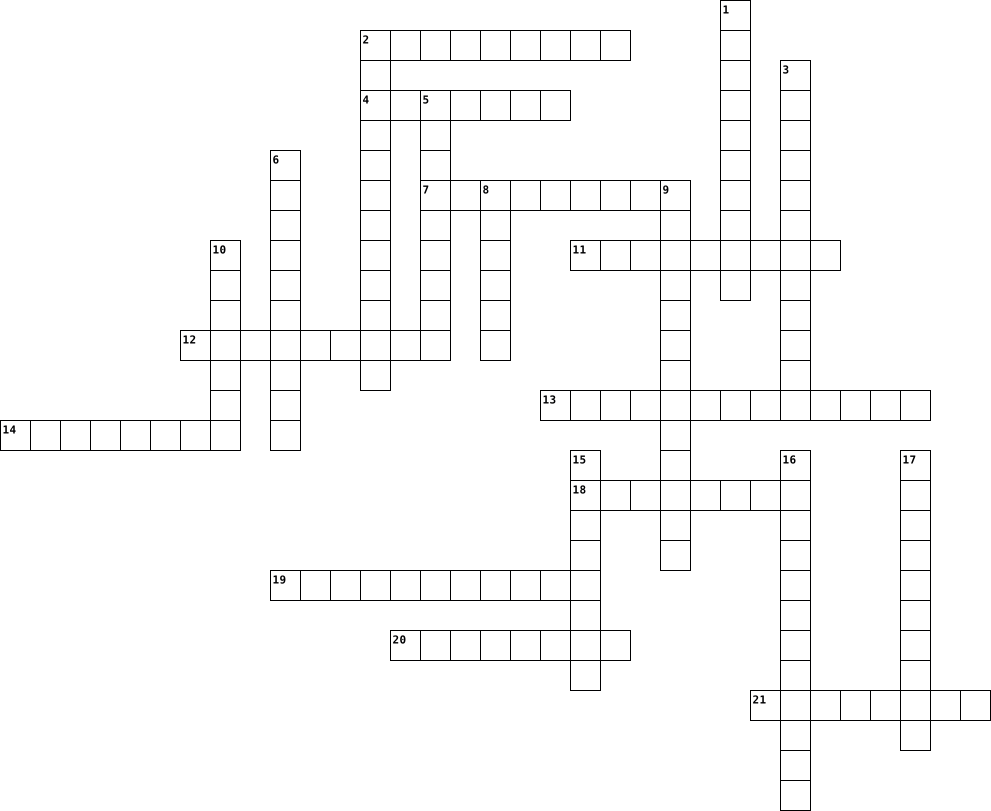
23 Clues: art • test • book • quiz • math • desk • music • window • library • history • stadium • science • spanish • student • english • biology • physics • schedule • homework • backpack • male teacher • female teacher • computer science
Spanish 2020-10-14
22 Clues: fun • car • who • age • fat • come • open • beard • chair • to be • wants • Friday • little • boring • to have • physics • there is • Saturday • mustache • trashcan • yesterday • brother in law
Abc 2021-09-05
Las Asignaturas 2017-10-27
21 Clues: art • hour • math • lunch • class • music • French • science • writing • history • physics • Spanish • biology • English • religion • schedule • chemistry • technology • computer class • school subjects • gym class/physicial education (no spaces)
HOBBIES AND FAVOURITE STUFF 2018-10-18
22 Clues: BD • EPS • SVT • FILM • LIRE • NAGER • JOUER • COURIR • DANSER • ECOUTER • MATIERE • CHANTER • HISTOIRE • ESPAGNOL • BATTERIE • DESSINER • ALLEMAND • CUISINER • EQUITATION • DESSIN ANIME • REGARDER LA TELE • SCIENCES PHYSIQUES
La escuela 2023-03-19
21 Clues: book • exam • paper • pencil • physics • reading • biology • algebra • geometry • backpack • notebook • classroom • chemistry • professor • auditorium • language lab • male teacher • computer room • primary school • female teacher • secondary school
Level up 7 W&P 2 2023-09-30
Across
- headmaster
- home _________ (kotitalous)
- upper __________ school (yläkoulu)
- kemia
- student ________ (OPO)
- kuvaamataito
- ______ teacher (luokanohjaaja)
- käsityö
- historia
Down
- biologia
- fysiikka
- ruotsi
- uskonto
- school _______ (todistus)
- liikunta
- maantieto
- matematiikka
- välitunti
- ________ school (alakoulu)
- _____ education (terveystieto)
20 Clues: kemia • ruotsi • uskonto • käsityö • biologia • fysiikka • liikunta • historia • maantieto • välitunti • headmaster • matematiikka • kuvaamataito • student ________ (OPO) • school _______ (todistus) • ________ school (alakoulu) • home _________ (kotitalous) • _____ education (terveystieto) • ______ teacher (luokanohjaaja) • upper __________ school (yläkoulu)