
planets Crossword Puzzles
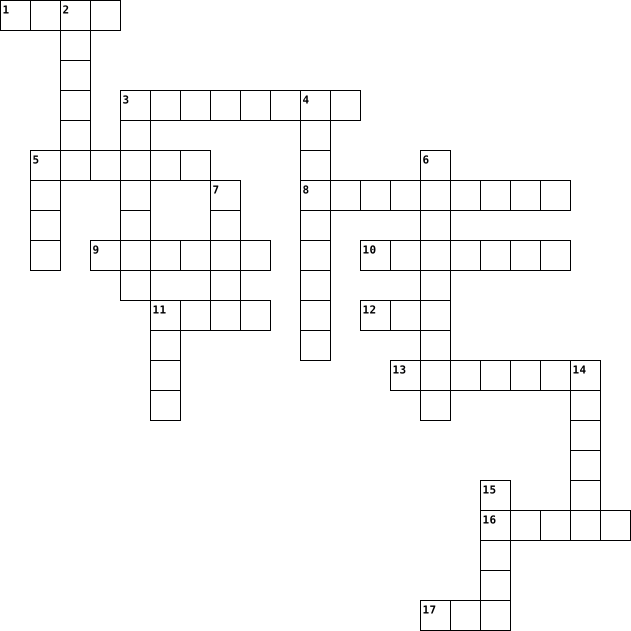
Crossword puzzle science 2022-08-24

Across
- Closest planet to the sun
- third closest planet to the sun
- terrestrial planets closest to the sun
- an object that orbits a planet
- a celestial object that orbits a planet
- a celestial body moving in an elliptical orbit around a star.
Down
- second closest planet to the sun
- the four inner planets
- the layer of gasses around a planet
- fourth closest planet to the sun
10 Clues: the four inner planets • Closest planet to the sun • an object that orbits a planet • third closest planet to the sun • second closest planet to the sun • fourth closest planet to the sun • the layer of gasses around a planet • terrestrial planets closest to the sun • a celestial object that orbits a planet • a celestial body moving in an elliptical orbit around a star.
Assyrian Innovations 2022-09-30

Across
- NASA gave Assyrians credit for discovering___
- They created___to get around faster in wars
- They invented these to store their writings
- They pioneered using___to make stronger weapons
- The___were able to follow stars and planets
Down
- They made several___advancments due to wars
- The Assyrians used this to make pottery.
- an important siege weapon
- They made the first system of writing called_
- The Assyrians divided time by___
10 Clues: an important siege weapon • The Assyrians divided time by___ • The Assyrians used this to make pottery. • They made several___advancments due to wars • They created___to get around faster in wars • They invented these to store their writings • The___were able to follow stars and planets • NASA gave Assyrians credit for discovering___ • ...
OMG IT'S VENUS 2023-09-04

Across
- tools used to do something
- the very cold area around the North Pole
- containing poison
- someone who has written a book
- someone who teaches a sport or practical skill
Down
- a special suit that astronauts wear in space
- a glass building for growing plants in
- how hot or cold something is
- relating to planets
- a vehicle for exploring the surface of other planets
10 Clues: containing poison • relating to planets • tools used to do something • how hot or cold something is • someone who has written a book • a glass building for growing plants in • the very cold area around the North Pole • a special suit that astronauts wear in space • someone who teaches a sport or practical skill • a vehicle for exploring the surface of other planets
space 2025-04-21

Across
- A person who travels in space
- The planet we live on
- Known as the Red Planet
- Icy rock that flies through space with a tail
Down
- A huge group of stars and planets
- Used to travel into space
- The biggest planet in our solar system
- Tool to look at stars and planets
- Orbits around the Earth
- The star at the center of our solar system
10 Clues: The planet we live on • Known as the Red Planet • Orbits around the Earth • Used to travel into space • A person who travels in space • A huge group of stars and planets • Tool to look at stars and planets • The biggest planet in our solar system • The star at the center of our solar system • Icy rock that flies through space with a tail
Solar System 2025-04-30

Across
- - 4th planet from the sun
- - The farthest planet from the sun
- - The closest planet from the sun
Down
- - This thing pulls objects back down
- - A planet that rotates/orbits on its side
- - A planet that got turned into a dwarf planet
- - Parts of the year(4)
- - The only planet that can stabilize life
- - The big star that planets orbit around
- - Most planets have these
10 Clues: - Parts of the year(4) • - 4th planet from the sun • - Most planets have these • - The closest planet from the sun • - The farthest planet from the sun • - This thing pulls objects back down • - The big star that planets orbit around • - The only planet that can stabilize life • - A planet that rotates/orbits on its side • - A planet that got turned into a dwarf planet
PLANET WORD BANK 2025-09-23

Across
- Most ringed planet
- Fifth planet from the Sun and the largest in the Solar System
- Only living planet.
- Hottest planet,Earth’s twin in size.
- Red planet
- It is the smallest and nearest planet to the sun.
Down
- Rocky planets
- The eighth and farthest-known Solar planet from the Sun.
- Seventh planet from the Sun. It is a planet that rotates on its side.
- Gas planets
10 Clues: Red planet • Gas planets • Rocky planets • Most ringed planet • Only living planet. • Hottest planet,Earth’s twin in size. • It is the smallest and nearest planet to the sun. • The eighth and farthest-known Solar planet from the Sun. • Fifth planet from the Sun and the largest in the Solar System • Seventh planet from the Sun. It is a planet that rotates on its side.
Astronomony Crossword. 2025-09-08

Across
- Only planet with one moon.
- Rotates the opposite way than other planets.
- Known as the Moon Champion.
- A galaxy containing 100-400 billion stars.
- A star at least 4.6 billion years old.
Down
- Rains diamonds on the planet.
- Two moons called Phobos and Deimos.
- Has at least a sunrise every 180 days.
- Orbits diagonally to other planets.
- Has rings that are hard to see.
10 Clues: Only planet with one moon. • Known as the Moon Champion. • Rains diamonds on the planet. • Has rings that are hard to see. • Two moons called Phobos and Deimos. • Orbits diagonally to other planets. • Has at least a sunrise every 180 days. • A star at least 4.6 billion years old. • A galaxy containing 100-400 billion stars. • Rotates the opposite way than other planets.
space puzzle 2026-05-19

Across
- a giant ball of hot gas that gives off light
- the force that keeps planets in orbit
- the red planet
- massive system of stars planets and dust
- the first human to walk on the moon
- vehicle used to explore space
- the galaxy that contains earth
Down
- a group of stars forming something
- rocky objects found in space
- cloud of gas and cosmic dust
10 Clues: the red planet • rocky objects found in space • cloud of gas and cosmic dust • vehicle used to explore space • the galaxy that contains earth • a group of stars forming something • the first human to walk on the moon • the force that keeps planets in orbit • massive system of stars planets and dust • a giant ball of hot gas that gives off light
Space terms 2012-11-02

Across
- this happens to stars that can no longer produce enough energy.
- There are ________ planets in the solar system.
- What is the theory scientists came up with for how the universe started?
- very small objects in space.
- Galaxy with a disk like shape.
- the theory that states the universe will expand to maximum then contract.
- Name for spread out cloud of dust and gas .
- the study of the origin and changes of the universe.
- Which planet is similar in size to Earth?
Down
- asteroids, meteors, and comets are examples.
- What separates Mars and Jupiter?
- Supernovas are basically ________.
- New stars are often bright blue or_________in colour.
- how many years does a medium-mass star live?
- Black holes are______.
- a ________ is a name of a neutron star.
- All living organisms are made of _______ and other molecules.
- The outer planets are made of_______.
18 Clues: Black holes are______. • very small objects in space. • Galaxy with a disk like shape. • What separates Mars and Jupiter? • Supernovas are basically ________. • The outer planets are made of_______. • a ________ is a name of a neutron star. • Which planet is similar in size to Earth? • Name for spread out cloud of dust and gas . • asteroids, meteors, and comets are examples. • ...
SPACED OUT 2013-12-03

Across
- The planet between Mercury and Earth
- What all the planets revolve around
- The number of planets in our solar system
- The name of a gaseous planet
- The name of the phase when the entire side of the moon is lit
- Number of hours it takes for Earth to complete one rotation
- The planet that is closest to the sun
Down
- This planet is also called 'The Red' planet
- The only planet known to support life
- When the moon is more than half lit (Starts with G)
- The name of the phase when the entire side of the moon is in shadow
- The name of a dwarf planet
- The largest planet in our solar system
- The name of our galaxy
- What rocks that float around in space are called
- The number of different seasons in a year
- The change in water levels on Earth
- The Earth's natural satellite
18 Clues: The name of our galaxy • The name of a dwarf planet • The name of a gaseous planet • The Earth's natural satellite • What all the planets revolve around • The change in water levels on Earth • The planet between Mercury and Earth • The only planet known to support life • The planet that is closest to the sun • The largest planet in our solar system • ...
Super cool space thingy 2023-03-02

Across
- the force that is keeping us on Earth
- a rock that falls from space
- the path that a planet takes around the sun
- way a candy bar was named after it,we are in it
- super cool swallows anything in its path huge
- this has nothing to do with space and it is used in mashed potatos
- a big star
- A robot in space that helps us have WiFi
- we find it the opposite of the sun
- an example is the sun
Down
- floating balls in space,We live on one.
- someone who explores space
- We live here,is the only planet(that we know of) that is far enough from the sun and close enough from the sun to have life
- people use this to explore space
- a group of stars forming a picture
- Creatures that we have not found yet
- the biggest planet
- a robot that explores planets
18 Clues: a big star • the biggest planet • an example is the sun • someone who explores space • a rock that falls from space • a robot that explores planets • people use this to explore space • a group of stars forming a picture • we find it the opposite of the sun • Creatures that we have not found yet • the force that is keeping us on Earth • floating balls in space,We live on one. • ...
Room 31 Crossword by Jonathan Mao 2021-06-29

Across
- a small screen with a keyboard
- very lucky
- the middle of a planet
- the only island state in Australia
- the upper layer of a planet
- a big fish with massive teeth
- a planet that is filled with volcanoes
- a big rock that is usually high up
- fruit ready for harvest
- a blue planet 4.4354 billion km from earth
- it is used to look at planets from earth
Down
- where bees live
- a part of earth where rocks are crushed into lava
- metal ____ when left out to long
- where every planet and star exists
- a type of math method were you need to split apart a number to get the answer
- a complicated series of wires that make something work
- a sea that has so much salt you can float
- our heat and light producer
- a person that defends you if you go to court
- a dark abyss where planets float
21 Clues: very lucky • where bees live • the middle of a planet • fruit ready for harvest • the upper layer of a planet • our heat and light producer • a big fish with massive teeth • a small screen with a keyboard • metal ____ when left out to long • a dark abyss where planets float • where every planet and star exists • the only island state in Australia • a big rock that is usually high up • ...
Astronomy Crossword - Charlie Goode - 7Q 2017-03-29

Across
- How many planets are in our solar system?
- The only dwarf planet in the Solar System.
- Something used to see into outer space from Earth.
- Famously known for it's rings.
- What is the planet known as "The Blue Planet"?
- The system that Earth and our other planets that we know of are in.
- What is the famous organization that explores space?
- Something bright and extremely hot that can be seen from Earth.
- The name of the meat feast pizza from Domino's takeaway.
Down
- What is known as "Ice and Dust"?
- What is the farthest planet from the sun?
- Who was the first person to observe Jupiter?
- Who said "Houston, we have a problem"?
- The 5th planet from the sun.
- The 7th planet from the sun.
- A solid piece of debris from an object.
- A type of chocolate bar (HINT:IT ISN'T MARS)
- The 2nd planet from the sun.
- A chemical with the same name as a planet.
- What is known as "The Red Planet"?
20 Clues: The 5th planet from the sun. • The 7th planet from the sun. • The 2nd planet from the sun. • Famously known for it's rings. • What is known as "Ice and Dust"? • What is known as "The Red Planet"? • Who said "Houston, we have a problem"? • A solid piece of debris from an object. • What is the farthest planet from the sun? • How many planets are in our solar system? • ...
Solar System 2020-08-30

Across
- the star closest to the earth
- to turn on an axis
- large planet known for the Great Red Spot
- third planet from the sun; only planet people have walked on
- number of planets in our solar system
- Saturn, Jupiter, Uranus, and Neptune have _______ around them
- planet with the brightest rings
- the red planet; humans have sent robots here
- furthest planet from the sun
- number of stars in our solar system
- Neil Armstrong was the first person to walk on the...
- our sun and the objects that orbit around it
Down
- place where astronauts live and work in space
- an American space traveler
- warmest planet; cloudy planet
- it takes Earth 365 days to ______ the sun
- the force that pulls you towards the center of a planet or star
- planet that rotates on its side
- instrument used for seeing stars and planets clearly
- dwarf planet with two moons
- planet closest to the sun
21 Clues: to turn on an axis • planet closest to the sun • an American space traveler • dwarf planet with two moons • furthest planet from the sun • the star closest to the earth • warmest planet; cloudy planet • planet with the brightest rings • planet that rotates on its side • number of stars in our solar system • number of planets in our solar system • ...
Solar System Crossword 2021-03-20

Across
- third planet from the sun; only planet humans have walked on
- place where astronauts live and work in space
- dwarf planet with two moons
- planet closest to the sun
- Saturn, Jupiter, Uranus, and Neptune have ____ around them
- the red planet; humans have sent robots here
- planet that rotates on its side
- number of planets in our solar system
- planet with the brightest rings
- instrument used for seeing stars and planets clearly
- Neil Armstrong was the first person to walk on the _____.
Down
- the force that pulls you to the center of a planet or star
- warmest planet; cloudy planet
- large planet known for the Great Red Spot
- our sun and the objects that orbit around it
- furthest planet from the sun
- to turn on an axis
- the star closest to Earth
- an American space traveler
- it takes Earth 365 days to ____ the sun
- number of stars in our solar system
21 Clues: to turn on an axis • planet closest to the sun • the star closest to Earth • an American space traveler • dwarf planet with two moons • furthest planet from the sun • warmest planet; cloudy planet • planet that rotates on its side • planet with the brightest rings • number of stars in our solar system • number of planets in our solar system • ...
science chapter 6 2023-03-07

Across
- Moon reflects light of this
- The tilt of the Earth gives us our _____
- Hole on surface of the moon or other planet
- The phrase for the sun & bodies that orbit it
- The only planet that is habitable
- Group of stars that make a picture
- The smallest planet
- The planet tipped on it's side
- The sun is at the ___ of our solar system
- Planet that takes longest to orbit the sun
- Planets orbit the sun because of the sun's ___
Down
- station scientists in space can live and work in this
- The ____ is a natural satellite of Earth
- Means suitable for life
- Name of our Galaxy
- The red planet
- A continual path around the sun
- The four planets farthest from the sun are ___planets
- Moon's gravity affects the ocean's ______
- The brightest planet; Earth's twin
- When N.America is tilted toward sun,it's ___ season
- The planet with rings
- The Earth continuously spins or rotates on it's ___
- The star closest to Earth
- The largest planet; has a Great Red spot
25 Clues: The red planet • Name of our Galaxy • The smallest planet • The planet with rings • Means suitable for life • The star closest to Earth • Moon reflects light of this • The planet tipped on it's side • A continual path around the sun • The only planet that is habitable • The brightest planet; Earth's twin • Group of stars that make a picture • The ____ is a natural satellite of Earth • ...
Like if you miss Pangea😢 2023-05-22

Across
- Force that is pushed toward the center of an object.
- The line between younger and older rock that is marked by erosion.
- What turns into sedimentary rocks.
- Separates an irregular older rock unit from younger sedimentary layers.
- Forces that slide past each other.
- Has some but not all properties of a mineral.
- Age compared to other rocks.
- The study of position and relation to strata (layers).
- Planets with gassy surfaces.
- Rocks formed when magma cools and hardens.
Down
- rocks formed from sediment.
- A part of strata that eroded away.
- Processes were the same billions of years ago.
- Planets with rocky surfaces.
- Age of a rock in years.
- The force by which a planet or other body draws objects toward it's center.
- Force that pulls away from the center of an object.
- rocks formed when other rocks are altered by heat/pressure.
- naturally occurring solid mass.
- A giant cloud in space.
20 Clues: Age of a rock in years. • A giant cloud in space. • rocks formed from sediment. • Planets with rocky surfaces. • Age compared to other rocks. • Planets with gassy surfaces. • naturally occurring solid mass. • A part of strata that eroded away. • What turns into sedimentary rocks. • Forces that slide past each other. • Rocks formed when magma cools and hardens. • ...
univers crossword puzzle 2013-09-15

Across
- explained heliocentric first
- a planet that has a core a mantel and a crust
- second planet from the sun
- eighth planet from the son
- third planet from the sun
- is when the sun is at the center of the solar system
- forth planet from the son
- is when the earth is at the center of the solar system
- supported heliocentric with gravity
Down
- is the force that pulls to earth’s surface
- fifth planet from the sun
- is a gas that is poisonous to humans and is found on other planets
- explained that the planets orbit around the sun in an ellipse
- sixth planet from the sun
- dwarf planet
- seventh planet from the sun
- objects in space that is more then ten meters that are found in between mars and Jupiter
- is when the further something is from something the faster it will move away
- first planet from the sun
- supported heliocentric by looking at the moons of Jupiter
20 Clues: dwarf planet • fifth planet from the sun • sixth planet from the sun • third planet from the sun • first planet from the sun • forth planet from the son • second planet from the sun • eighth planet from the son • seventh planet from the sun • explained heliocentric first • supported heliocentric with gravity • is the force that pulls to earth’s surface • ...
IN THE SHADOW OF THE MOON 2013-08-30

Across
- the sixth planet from the sun
- we come in......
- someone who travels in space
- this takes astronauts to space
- to revolve or move around an object
- these allow you to see things very far away
- all the gasses which surround a star or a planet
- the second planet from the sun
- a big ball of dirty ice and snow in space
- sometimes these crash to earth
- our galaxy is called this
Down
- this planet has a moon called triton
- people can live on these for months
- people say the moon is made of this
- in here there are the planets, the sun and much more
- a space shuttle takes off from one of these
- the seventh planet from the sun
- this planet is so big that all the other planets could fit inside it
- a rocky space object of varying size
- the third planet from the sun
- the fourth planet from the sun
21 Clues: we come in...... • our galaxy is called this • someone who travels in space • the sixth planet from the sun • the third planet from the sun • this takes astronauts to space • the second planet from the sun • sometimes these crash to earth • the fourth planet from the sun • the seventh planet from the sun • people can live on these for months • people say the moon is made of this • ...
Planets and Space Crossword 2014-10-25

Across
- Yellow star in the middle of our Solar System
- This planet takes 365 days to orbit the sun
- Planet has rings you can see with a telescope
- How many moons does the Earth have?
- Color of Uranus and Neptune
- Moon controls these on Earth
- Metal body that orbits the Earth
- Man discovered that gravity keep the planets in orbit around the Sun
- Closest planet to the Sun
- Planet that is no longer a part of our Solar System
- Color of the spot on Jupiter
Down
- This planet is known as the 'Red Planet'
- Hottest planet in our solar system
- This planet spins on its side
- Last planet in our Solar System
- Largest planet in our Solar system
- Abbreviation for the American space company
- Way Our Solar System is part of this Galaxy
- How many planets are there in our Solar System?
- The Earth takes 365 days to do this around the sun
20 Clues: Closest planet to the Sun • Color of Uranus and Neptune • Moon controls these on Earth • Color of the spot on Jupiter • This planet spins on its side • Last planet in our Solar System • Metal body that orbits the Earth • Hottest planet in our solar system • Largest planet in our Solar system • How many moons does the Earth have? • This planet is known as the 'Red Planet' • ...
Planet Party 2017-02-04

Across
- An imaginary line about which a body rotates
- Astronomers who write the rules for being a planet (abbreviated)
- Wandering star
- The jewel of the Solar System
- A planet that orbits a star outside our solar system
- The windiest planet
- The red planet
- Circle of animals
- The closest planet to the Sun
Down
- The measurement of how much a light a planet reflects
- A controversial dwarf planet
- Known for its Great Red Spot
- Has no known natural satellite
- The only object in the Universe known to harbor life
- The curved path of a celestial object or spacecraft around a star, planet, or moon
- The path of the Sun and the plane of the Solar System. The planets never stray far
- This planet spins on its side
- A tool that increases the size and details of the planets
- A number greater than any countable number
- The name early astronomers gave to the distance between the Sun and Earth (abbreviated)
20 Clues: Wandering star • The red planet • Circle of animals • The windiest planet • A controversial dwarf planet • Known for its Great Red Spot • This planet spins on its side • The jewel of the Solar System • The closest planet to the Sun • Has no known natural satellite • A number greater than any countable number • An imaginary line about which a body rotates • ...
Galileo Crossword 2018-10-05

Across
- Galileo's prison.
- Father's wish for Galileo.
- Space and all that is contained.
- Motion of a moving body.
- To revolve or move around.
- One of the planets Galileo studied.
- Galileo's telescope was ____ stronger.
- Moons of Jupiter.
- To carefully study for facts.
- A celestial body.
- It orbits Earth.
- Celestial bodies seen at night.
- Another planet Galileo studied.
- Star around which other planets orbit.
Down
- City where Galileo was born.
- Science concerned with matter and energy.
- Galileo's early school.
- of Pisa One of Galileo's tallest labs.
- The study of the universe.
- Galileo discovered the sun's:
- Science concerned with the design and building.
- Galileo was called a:
- Country where Galileo lived.
- Galileo improved this.
- A body that attracts other metal.
- recant Galileo's response to the Inquisition. (two words)
- Swinging study of Galileo.
- Galileo believed Aristotle was:
- Galileo invention.
- Galileo defended this.
- Our planet.
31 Clues: Our planet. • It orbits Earth. • Galileo's prison. • Moons of Jupiter. • A celestial body. • Galileo invention. • Galileo was called a: • Galileo improved this. • Galileo defended this. • Galileo's early school. • Motion of a moving body. • Father's wish for Galileo. • The study of the universe. • To revolve or move around. • Swinging study of Galileo. • City where Galileo was born. • ...
science crossword 2022-02-10

Across
- a region of spacetime where gravity is so strong that nothing
- chemical element with the symbol H
- a plasma of hydrogen and helium
- the Sun and the objects that orbit it
- an atmospheric phenomenon
- a vehicle or machine designed to fly in outer space
- a small planetary-mass object
- a person who is trained to travel in a spacecraft.
- also known as a minor planet
Down
- the distance that light travels
- a gravitational bound system
- Earth's only natural satellite
- chemical element with a symbol he and atomic number of 2
- the galaxy that includes our Solar System
- an astronomical object
- 4.5 billion-year-old star
- a path planets take around the sun
- Mercury, Venus, Earth, Mars, Jupiter, Saturn, Uranus, Neptune
- stars that have burned up all of the hydrogen they once used as nuclear fuel
- a dying star in the final stages of stellar evolution
- controls and regulates the activities of the cell
21 Clues: an astronomical object • 4.5 billion-year-old star • an atmospheric phenomenon • a gravitational bound system • also known as a minor planet • a small planetary-mass object • Earth's only natural satellite • the distance that light travels • a plasma of hydrogen and helium • chemical element with the symbol H • a path planets take around the sun • ...
Unit 9 Terms 2024-02-01

Across
- the process of objectively establishing facts through testing and experimentation
- Social Contract
- separation of church and state
- Class ranking in the middle of high and low
- humans have no moral compass unless there are predetermined rules
- Meeting at which the major European powers negotiated and formalized claims to territory in Africa
- authority comes directly from God
- Law of Gravity
- separation of powers
- government + people
Down
- a region over which a specific ruling group, institution, or country exerts military, cultural, or economic power
- Someone who has their own line of work
- inventor whose improvements in the steam engine led to its wide use in industry
- the process of making an area more urban.
- Main factor for industrial revolution
- an arrangement of workers and machines in a factory
- astronomical model in which the Earth and planets revolve around the Sun
- when a country extends its power into other territories for economic or political gain
- natural rights
- all planets revolved around the Sun
20 Clues: natural rights • Law of Gravity • Social Contract • government + people • separation of powers • separation of church and state • authority comes directly from God • all planets revolved around the Sun • Main factor for industrial revolution • Someone who has their own line of work • the process of making an area more urban. • Class ranking in the middle of high and low • ...
Earth and Space KS3 Science 2025-06-05

Across
- a force that pulls all matter.
- suggested that the earth and the other planet moved around the sun.
- the earth has a north and south.......
- solar particles that come in contact with the earth magnetic field.
- it is hotter in summer becuase the sun's rays are more........
- one of Jupiter's moons.
- the distance light travelled in 1 year.
- an instrument used to find direction.
- the name of our solar system.
- in known as the center of our galaxy
- the SI unit for a force.
Down
- this happens when the sun moves across the sky.
- anything that orbits a planet is called a ........
- a squashed circle.
- these are the paths planets and moons take around the sun.
- The are only .............. planets in our solar system.
- a pattern of stars.
- .......... Centauri is our nearste star
- The first space probe to reach the moon.
- until 500yrs ago people believed it was flat.
20 Clues: a squashed circle. • a pattern of stars. • one of Jupiter's moons. • the SI unit for a force. • the name of our solar system. • a force that pulls all matter. • in known as the center of our galaxy • an instrument used to find direction. • the earth has a north and south....... • .......... Centauri is our nearste star • the distance light travelled in 1 year. • ...
English 2025-02-14

Across
- - what kind of planet is Saturn?
- - who study the sky with a telescope he built?
- - the moon ____ or moves around the Earth
- - satellite and telescope are what?
- - who has crater in them in the solar system?
- - what subject pronoun uses we and they.
- - what planet has rings in it.
- - what pronoun takes the place of nouns in the subject of a sentence
- - what subject pronoun uses he,she, and it.
- - what telescope did we learn about?
- - to look at, study, or travel to a place to learn more about it
- - what is the name of the planet we live in?
Down
- - what is the study of space
- - how many planets in our solar system?
- system - a star and the planets in orbit around the sar
- - what text informs readers by giving information about a specific topic.
- - can take the place of nouns
- - Earth and its _____
- - to watch or follow someone or something
- - the measure of how hot or cold something is
20 Clues: - Earth and its _____ • - what is the study of space • - can take the place of nouns • - what planet has rings in it. • - what kind of planet is Saturn? • - satellite and telescope are what? • - what telescope did we learn about? • - how many planets in our solar system? • - what subject pronoun uses we and they. • - the moon ____ or moves around the Earth • ...
Careers in Astronomy 2025-05-09

Across
- creates and maintains telescope systems and imaging equipment
- develops educational materials and publications
- studies the formation, structure, and evolution of planets and their moons
- develops specialized equipment, like computer systems, for space missions
- writer creates documentation for space missions and equipment
- educates students about space science and astronomy
- studies weather patterns and atmospheric conditions
- works with propulsion systems and space materials
- conducts space missions, performs experiments in space, and operates spacecraft
- develops microscopic technologies for space applications
Down
- coordinates day-to-day activities at space-related facilities
- processes large datasets from space missions and observations
- manages facilities and creates educational programs
- studies physical properties of celestial objects, including stars, planets, and galaxies
- studies celestial objects through radio wave emissions
- analyzes atmospheric composition and climate patterns
- engineer designs aircraft and spacecraft
- supports scientific teams in data collection and analysis
- investigates the origin, structure, and evolution of the universe
- observes and analyzes celestial phenomena using advanced telescopes and instruments
20 Clues: engineer designs aircraft and spacecraft • develops educational materials and publications • works with propulsion systems and space materials • manages facilities and creates educational programs • educates students about space science and astronomy • studies weather patterns and atmospheric conditions • analyzes atmospheric composition and climate patterns • ...
Solar System 2025-11-27

Across
- The closest to the sun
- The planet of love
- The planet that spins on its side
- Human-made machines launched into orbit
- Substance that makes up most of giant planets like Jupiter and Saturn
- Distant dwarf planet whose discovery led to Pluto’s reclassification.
- Largest moon of Saturn, known for its thick atmosphere.
- Where we live
- What orbits around the planets of our solar system
- The farthest from the sun
- The star at the center of our solar system
Down
- The biggest planet in our solar system
- Icy bodies that develop glowing tails when near the Sun.
- Tiny particles floating in space, often forming clouds between stars.
- The red planet
- Dwarf planet in the Kuiper Belt, named after a Rapa Nui god.
- Small rocky body orbiting the sun
- Egg-shaped dwarf planet in the Kuiper Belt, known for its rapid rotation.
- The ringed planet
- Largest object in the asteroid belt, classified as a dwarf planet.
- Was one known as the ninth planet
21 Clues: Where we live • The red planet • The ringed planet • The planet of love • The closest to the sun • The farthest from the sun • The planet that spins on its side • Small rocky body orbiting the sun • Was one known as the ninth planet • The biggest planet in our solar system • Human-made machines launched into orbit • The star at the center of our solar system • ...
Space 2026-05-13

Across
- Planets and stars in space rotate around a bigger object called____
- The object is for travel into space.
- The temperature of the surface on the sun is_______
- The planet where we live.
- It's a place for astronauts to live and work.
- It's smaller than asteroids or comets.
- The planet with more than fifty moons.
Down
- The second person to walk on the moon is_____
- The object we use to watch closer the planets.
- The moon turn around the Earth in______ days
- This time, we can see the sun.
- One star is extremely important.
- The type of the planets:Mercury, Venus, Earth and Mars.
- The shape of The Milky Way.
- One planet with rings.
- The rings of Jupiter is made of _____
- It's large chunks of metal and rock that float around all in space.
- It's similar to asteroids but made up of ice.
- The type Of composition Uranus.
- This is to go outside spacecraft.
20 Clues: One planet with rings. • The planet where we live. • The shape of The Milky Way. • This time, we can see the sun. • The type Of composition Uranus. • One star is extremely important. • This is to go outside spacecraft. • The object is for travel into space. • The rings of Jupiter is made of _____ • It's smaller than asteroids or comets. • The planet with more than fifty moons. • ...
The Monday Crossword 2026-05-18

Across
- "Hold on"
- The more you take away the bigger it gets
- "Under the weather"
- A person who studies stars and planets
- One-of-a-kind
- Smallest country in the world
- Country represented in the blue and yellow flag found in the classroom
- Greek sandwich commonly made with pita bread
- A shaking of the ground (taiwan has a lot)
- Rock formed from cooled lava
- You can catch it but you can't throw it
- To make something less confusing
Down
- Sport where love means zero
- I'm not alive, but I grow. I don't have lungs but I need air
- American sport or name for soccer in England
- Comparison using "like" or "as"
- Force that keeps planets orbiting the sun
- I have a cast, but I'm not broken or injured
- Largest country in the world
- Korean fermented cabbage dish
- Antonym to a synonym
- "Break a leg"
- "Piece of cake"
- Largest ocean in the world
- It has keys but no locks
25 Clues: "Hold on" • One-of-a-kind • "Break a leg" • "Piece of cake" • "Under the weather" • Antonym to a synonym • It has keys but no locks • Largest ocean in the world • Sport where love means zero • Largest country in the world • Rock formed from cooled lava • Korean fermented cabbage dish • Smallest country in the world • Comparison using "like" or "as" • To make something less confusing • ...
Astronomical Terms 2014-11-13

Across
- Caused by the bombardment of our atmosphere.
- The belif that our lives are influenced by stars.
- The study of stars, planets and space.
- The layers of gases that surround many planets and other bodies.
Down
- A description of direction.
- A measurement of time.
- Sometimes referred to as Planetoids.
- A collection of a billion stars
- Also known as the snowballs of the solar system.
- A group of stars which appear to form a pattern.
- A person who travels and works in space.
- This holds us to earth.
12 Clues: A measurement of time. • This holds us to earth. • A description of direction. • A collection of a billion stars • Sometimes referred to as Planetoids. • The study of stars, planets and space. • A person who travels and works in space. • Caused by the bombardment of our atmosphere. • Also known as the snowballs of the solar system. • ...
Scientific Revolution 2022-10-18

Across
- planets revolve around the earth
- system of thought found by Rene Descartes that reason is the chief source of knowledge
- a person who seeks wisdom or enlightenment
- First person to use a telescope to record observations about the sky
- gave Europeans a new way to view humankind’s place in the world
- Polish astronomer in 1500's
- created the scientific method
Down
- a systematic procedure for collecting and analyzing evidence
- the father of modern rationalism
- spread new ideas quickly
- planets revolve around the sun
- encouraged new ways of thinking
12 Clues: spread new ideas quickly • Polish astronomer in 1500's • created the scientific method • planets revolve around the sun • encouraged new ways of thinking • planets revolve around the earth • the father of modern rationalism • a person who seeks wisdom or enlightenment • a systematic procedure for collecting and analyzing evidence • ...
space - intermediate 2025-07-16

Across
- A person who travels in space
- A rock that flies through space
- A planet with big rings around it
- You use this to look at stars from Earth
- It lights up the night and orbits the Earth
- What astronauts wear to stay safe in space
Down
- It launches astronauts into space
- The force that keeps us on the ground
- Known as the red planet
- A space rock with a glowing tail
- The path planets take around the sun
- A big group of stars and planets
12 Clues: Known as the red planet • A person who travels in space • A rock that flies through space • A space rock with a glowing tail • A big group of stars and planets • It launches astronauts into space • A planet with big rings around it • The path planets take around the sun • The force that keeps us on the ground • You use this to look at stars from Earth • ...
Life of Stars 2022-05-02

Across
- a star that has not begun fusion
- material clumping together to become larger
- stars cannot fuse this element
- when this happens in the core the star heats up
- theory where a collision forms moon
- a large cloud of gas and dust where stars are born
- fuel source of red giants
Down
- type of star after a small main sequence
- energy radiating from a star per second
- the area around a star where ice can condense
- these types of planets exist closest to a star
- the fuel source of a main sequence star
- baby planets less than 1km in diameter
- what a white dwarf is made of
- a dense star where protons and electrons fuse
- a disk around a star where moons may form
16 Clues: fuel source of red giants • what a white dwarf is made of • stars cannot fuse this element • a star that has not begun fusion • theory where a collision forms moon • baby planets less than 1km in diameter • energy radiating from a star per second • the fuel source of a main sequence star • type of star after a small main sequence • a disk around a star where moons may form • ...
Scientific Revolution by Tyler Metscher 2018-04-12

Across
- Danish nobleman who observed and mapped the stars
- Physicist found that only part of the air is used in respiration and is helped discover oxygen
- A series of steps followed to solve problems including collecting data, formulating a hypothesis, testing the hypothesis, and stating conclusions
- Study of stars on human behavior
- Study of metals through purification
Down
- Term used to state that earth is simply one of several planets to orbit around the sun
- He believed Earth was in the center of the universe and that the planets moved around Earth in a circular movement
- Created the idea of universal gravitation
- Writer of "On the Motion of Animals" and studied mechanics of bodies
- Creator of Laws of Planetary Motion: (Planets move elliptical, not uniformly)
10 Clues: Study of stars on human behavior • Study of metals through purification • Created the idea of universal gravitation • Danish nobleman who observed and mapped the stars • Writer of "On the Motion of Animals" and studied mechanics of bodies • Creator of Laws of Planetary Motion: (Planets move elliptical, not uniformly) • ...
The Universe 2018-05-04

Across
- it is also known as red planet
- All planets revolve around it
- it is farthest from the sun
- it has composition of hydrogen and helium
- belt it is located between mars and jupiter
- when it comes near the sun it produces tail
- in this planet only life can exists
Down
- it takes about 27.3 days to revolve around earth
- it rotates opposite Directions to most other planets
- these are millions billions in the night sky
- it is a dwarf planet in the kuiper belt
- it is a gaint Planet with a maas 1000of the sun
- it is a huge balls which comes and falls on the earth surface
- closest to the Sun
- it has 3 wide rings
- way it contains our solar systems
16 Clues: closest to the Sun • it has 3 wide rings • it is farthest from the sun • All planets revolve around it • it is also known as red planet • way it contains our solar systems • in this planet only life can exists • it is a dwarf planet in the kuiper belt • it has composition of hydrogen and helium • belt it is located between mars and jupiter • ...
SPACE 2016-10-17

Across
- Known as the red planet
- The third planet from the sun
- Recently no longer classed as a planet
- This planet rotates on it's side.
- The closest planet to the sun
- All the gasses that surround a planet or the sun
- Famous for it's beautiful rings
- The number of planets discovered in our Solar System
- A planet often referred to as the 'evening star'
Down
- The path followed by an object in space as it goes around another object
- The seventh planet from the sun
- Some planets are made of rock others are made of ...
- The star that gives us light
- A rocky object of varying size
- Neil .... was the first man to walk on the moon.
- A big ball of dirty ice and snow in outer space
16 Clues: Known as the red planet • The star that gives us light • The third planet from the sun • The closest planet to the sun • A rocky object of varying size • The seventh planet from the sun • Famous for it's beautiful rings • This planet rotates on it's side. • Recently no longer classed as a planet • A big ball of dirty ice and snow in outer space • ...
Q1 Crossword Puzzle Review 2024-10-24

Across
- the coldest season
- the eclipse where the moon is between Earth and the Sun
- the time it takes to do a full lunar cycle
- this is what the inner planets are made of
- this law says that the deeper the layer is, the older it is
- Earth going around the Sun
- the moon phase with the whole moon visible
- there has to be this for fossils to form
- outer planets are made of this
Down
- he discovered gravity
- Earth turning on it's axis
- gravity is pulling you in this direction
- layers of rock
- the moon's orbit does this, so we don't have eclipses every month
- when the U.S. is in winter, Australia is having this season
- fossils are remains of this
16 Clues: layers of rock • the coldest season • he discovered gravity • Earth turning on it's axis • Earth going around the Sun • fossils are remains of this • outer planets are made of this • gravity is pulling you in this direction • there has to be this for fossils to form • the time it takes to do a full lunar cycle • this is what the inner planets are made of • ...
The Universe Crossword 2024-11-07

Across
- the type of force that keeps the Earth and all the planets intact
- the half of a celestial sphere
- the path travelled by the planets and the moon
- the star at the centre of the solar system
- the largest planet in the solar system
- when day and night length are equal
- the alternate rising and falling of the sea
- type of eclipse when the moon passes between the Earth and the Sun
Down
- our home planet
- a technology used to make discoveries about the universe
- Earth's natural satellite
- the planet closest to the Sun
- the planet famous for its rings
- what earth spins on
- the type of moon when you cannot see it in the sky
- an Italian physicist and astronomer
16 Clues: our home planet • what earth spins on • Earth's natural satellite • the planet closest to the Sun • the half of a celestial sphere • the planet famous for its rings • when day and night length are equal • an Italian physicist and astronomer • the largest planet in the solar system • the star at the centre of the solar system • the alternate rising and falling of the sea • ...
La bienvenida 2017-06-06

Across
- to choreograph
- to write
- to construct
- to dress up
- to plan
- to arrive
- to wear
- to throw
- to yell
Down
- to vote
- to present
- to participate
- to argue
- to dance
- to win
15 Clues: to win • to vote • to plan • to wear • to yell • to write • to argue • to dance • to throw • to arrive • to present • to dress up • to construct • to participate • to choreograph
Planets 2023-01-03

Across
- Earth has one, Mars has two
- Our home planet
- The biggest star in our solar system
Down
- The red planet
- The closest planet to the sun
- The hottest planet
6 Clues: The red planet • Our home planet • The hottest planet • Earth has one, Mars has two • The closest planet to the sun • The biggest star in our solar system
planets. 2020-01-23

Across
- It is also called as the morning and evening star.
- It is the hottest planet.
- We live on it.
Down
- It is the hotest planet.
- It is the seventh planet from the sun.
- It is the biggest planet.
6 Clues: We live on it. • It is the hotest planet. • It is the biggest planet. • It is the hottest planet. • It is the seventh planet from the sun. • It is also called as the morning and evening star.
Planets 2020-09-03

Across
- Has faint rings made of dust
- Earths satellite
- Gives light and heat
Down
- Coldest planet
- Dwarf planet
- Biggest moon of saturn
6 Clues: Dwarf planet • Coldest planet • Earths satellite • Gives light and heat • Biggest moon of saturn • Has faint rings made of dust
Planets 2021-01-20

Across
- Smalest planet
- Hottest planet
- 3rd planet from Sun
Down
- Farthest planet
- Largest planet
- Red planet
6 Clues: Red planet • Largest planet • Smalest planet • Hottest planet • Farthest planet • 3rd planet from Sun
Planets 2021-10-08

Across
- the largest planet
- the father of Jupiter
- the only planet with life
Down
- the red planet
- the farthest from the sun
- the smallest planet
6 Clues: the red planet • the largest planet • the smallest planet • the father of Jupiter • the farthest from the sun • the only planet with life
planets 2021-05-06

Across
- why is mars red in color?
- what dwarf planet was considered a planet till 2006?
Down
- why does the earth appear green from the sky?
- what is the red dot on Jupiter?
- how many rings are there around Uranus?
- what is the hottest planet?
6 Clues: why is mars red in color? • what is the hottest planet? • what is the red dot on Jupiter? • how many rings are there around Uranus? • why does the earth appear green from the sky? • what dwarf planet was considered a planet till 2006?
Planets 2016-04-28

Across
- very very small goes around people planet
- gas giant
- not a planet
Down
- Mrs Berry bad joke
- extremely hot
- living things live there
6 Clues: gas giant • not a planet • extremely hot • Mrs Berry bad joke • living things live there • very very small goes around people planet
Planets 2017-09-06

Across
- Planetwithlive
- LargestPlanet
- beforeEarth
Down
- FirstPlanet
- rhymeswithanus
- Abletohavelive
6 Clues: FirstPlanet • beforeEarth • LargestPlanet • Planetwithlive • rhymeswithanus • Abletohavelive
planets 2022-02-14

Across
- found gravity
- emty
- is how heavy
- pulls things down
Down
- describes gravty
- how much space it takes
6 Clues: emty • is how heavy • found gravity • describes gravty • pulls things down • how much space it takes
Planets 2025-12-18

Across
- a
- g
- h
Down
- l
- p
- s
6 Clues: a • l • p • s • g • h
Planets 2025-10-11

Across
- The center of our solar system.
- The planet with beautiful rings around it.
- Scientists study their surfaces, atmospheres, and movements.
Down
- The huge planet far from the sun, discovered in 1845.
- The red planet with largest mountain, Olympus Mons.
- The second planet from the sun; it is very hot and called Earth’s twin.
6 Clues: The center of our solar system. • The planet with beautiful rings around it. • The red planet with largest mountain, Olympus Mons. • The huge planet far from the sun, discovered in 1845. • Scientists study their surfaces, atmospheres, and movements. • The second planet from the sun; it is very hot and called Earth’s twin.
Planets 2025-09-09

Across
- Planet with big rings around it
- Smallest planet, closest to the Sun
Down
- Bright planet, second from the Sun
- Largest planet in our solar system
- The planet we live on
- Red planet, fourth from the Sun
6 Clues: The planet we live on • Planet with big rings around it • Red planet, fourth from the Sun • Bright planet, second from the Sun • Largest planet in our solar system • Smallest planet, closest to the Sun
planets 2025-11-19

Across
- is the second to last
- is the second planet
- where we live
Down
- has rings
- is red
- is next to Saturn
6 Clues: is red • has rings • where we live • is next to Saturn • is the second planet • is the second to last
planets 2026-05-01

Across
- meat topping on pizza
- soft cheese from italy
- the death of a star
Down
- body of matter in space
- dish originating from Naples, Italy
- the red planet
6 Clues: the red planet • the death of a star • meat topping on pizza • soft cheese from italy • body of matter in space • dish originating from Naples, Italy
Earth and the Universe 2013-05-20

Across
- This is very attractive.
- Ours is called the Milkyway.
- Biggest Planet
- The group of planets and the star Earth is part of.
- This kind of eclipse occurs when the moon is in between the Earth and the Sun.
- Closest planet to the Sun
Down
- Distances in space are measured in these
- Some planets are made of rock while others of this.
- A theory which explains the start of the Universe.
- The time it takes for one planet to complete one orbit.
- This kind of eclipse occurs when the Earth is situated in between the Sun and the moon.
- No longer a planet.
- An instrument used to observe the sky.
- This star gives us light.
- A natural satellite.
15 Clues: Biggest Planet • No longer a planet. • A natural satellite. • This is very attractive. • This star gives us light. • Closest planet to the Sun • Ours is called the Milkyway. • An instrument used to observe the sky. • Distances in space are measured in these • A theory which explains the start of the Universe. • Some planets are made of rock while others of this. • ...
The 1,000q crossword 2021-02-03

Across
- the made by a group of planets form a (...)
- tnt explosive=0
- someone that has maners and respects
- An explenation that has been shortend to be easier to understand
- a person that looks after him self
- Putting to things together and then transforming to somthing different
- Something that you plan for then to do them every day
Down
- a book that talks you about the theme you choose
- the oposite of free
- in hawai the beaches are still (...) and lovely
- a light ... and off
- the one thing i prefer
- in Big Bang theory Rajesh job is to find new planets and stars
- Telling something or somebody how they look like
- something that you do that helps you practice
15 Clues: tnt explosive=0 • the oposite of free • a light ... and off • the one thing i prefer • a person that looks after him self • someone that has maners and respects • the made by a group of planets form a (...) • something that you do that helps you practice • in hawai the beaches are still (...) and lovely • a book that talks you about the theme you choose • ...
ashleigh astronomy 2016-11-21

Across
- clouds of gas and dust form a fuzzy outer layer
- rocky objects which are too small to be a dwarf planet
- rock and ice formed small bodies
- the inner planets
- loose collections of ice
- stretches out more than 1000 times the distance between the sun and neptune
Down
- extends to about 100 times earths distance from the sun
- a region of the solar system between mars and jupiter
- a streak of light
- trapping heat by the atmosphere
- pass through the atmosphere and found on earth
- 4 big planets are called
- solid inner core of a comet
- chunks of rock and dust smaller than asteroids
- a thin disk of small particles of ice and rock
15 Clues: a streak of light • the inner planets • 4 big planets are called • loose collections of ice • solid inner core of a comet • trapping heat by the atmosphere • rock and ice formed small bodies • pass through the atmosphere and found on earth • chunks of rock and dust smaller than asteroids • a thin disk of small particles of ice and rock • ...
Topic 10.5 2023-05-31

Across
- Medical improvements during the 1500s included artificial ______.
- Anton van Leeuwnhoek perfected the single lens _________.
- Sentenced Galilei to life under house arrest.
- Explains how gravity moves the planets.
- A Greek astronomer who viewed the Earth at the center of the universe.
- Formed a theory as to why the planets move as they do.
- Studied the moon with a telescope.
- Medieval physicians relied on the works of this Greek physician.
Down
- Method of observations and experiments justified by mathematical calculations.
- Offered a new theory that the universe was heliocentric.
- Sun centered
- Holds the universe together, as found by Newton.
- Found the orbits revolving around the sun are oval shaped.
- Scientists would propose a logical _______.
- Chemistry was known as this in medieval times.
15 Clues: Sun centered • Studied the moon with a telescope. • Explains how gravity moves the planets. • Scientists would propose a logical _______. • Sentenced Galilei to life under house arrest. • Chemistry was known as this in medieval times. • Holds the universe together, as found by Newton. • Formed a theory as to why the planets move as they do. • ...
Europe after medival times 2023-05-31

Across
- A place where the foundation of a community sets in
- First name of Scientist who invented the telescope
- First name of the artist that painted the Mona Lisa
- When a country takes land from another country
- Italian sculptor born in Florence
- Asia, Europe, Africa
- When planets go around the sun
Down
- Last name of the scientist who made a theory about gravity
- What caused the apple to fall on Isac Newton's head
- period of time when people started questioning the power of church
- Last name of the person who created the Baconian method
- When the planets go around the Earth
- Someone who studies life and nature
- Rebirth of art
- The name Europeans gave Americans
15 Clues: Rebirth of art • Asia, Europe, Africa • When planets go around the sun • Italian sculptor born in Florence • The name Europeans gave Americans • Someone who studies life and nature • When the planets go around the Earth • When a country takes land from another country • First name of Scientist who invented the telescope • What caused the apple to fall on Isac Newton's head • ...
Solar System Crosswords 2022-06-07

Across
- The sun is a ____.
- Saturn, Jupiter, Uranus, and Neptune have _____ around them.
- Now called a dwarf planet.
- Our solar system is part of this galaxy.
- Planet furthest from the sun; also named after the Roman god of the sea.
- Planet closest to the sun.
- The force that keeps a planet moving in orbit.
- The number of planets in our solar system.
Down
- Largest planet in our solar system.
- Planet named after the Roman goddess of love and beauty.
- A person who travels to space is an _________.
- The ‘Red Planet’; humans have sent robots there.
- Neil Armstrong was the first person to walk on the _____.
- The instrument used to see stars and planets clearly.
- Our planet.
15 Clues: Our planet. • The sun is a ____. • Now called a dwarf planet. • Planet closest to the sun. • Largest planet in our solar system. • Our solar system is part of this galaxy. • The number of planets in our solar system. • A person who travels to space is an _________. • The force that keeps a planet moving in orbit. • The ‘Red Planet’; humans have sent robots there. • ...
Galaxy, Universe and Astronomy 2023-11-07

Across
- The study of life in space.
- The path a planet takes around the stars.
- A thing in space that goes around a planet or moon.
- About the whole universe.
- A tool that helps us see things far away in space.
- A place in space where nothing can escape.
Down
- A big ball in space that goes around a star, like earth.
- A small rock from space.
- A person who goes to space.
- A special suit for astronauts to wear in space.
- The force that pulls everything down to the ground.
- A group of countless stars and planets held togheter in space.
- The study of stars, planets and space
- A vehicle for traveling in space.
- A space snowball with a bright tail.
15 Clues: A small rock from space. • About the whole universe. • A person who goes to space. • The study of life in space. • A vehicle for traveling in space. • A space snowball with a bright tail. • The study of stars, planets and space • The path a planet takes around the stars. • A place in space where nothing can escape. • A special suit for astronauts to wear in space. • ...
READING 1A: A MYSTERIOUS VISITOR 2025-07-05

Across
- To have become greater in size, amount, or degree
- Unusual or difficult to understand
- The rate at which something moves
- Unexpected or causing a feeling of wonder
- To strike a surface, like a door, to get attention
- Scientists who study stars, planets, and the universe
Down
- The path that a moving object follows
- Something that is difficult or impossible to understand or explain
- A word that means "perhaps" or "possibly"
- The Sun and all the planets that move around it
- Not the same as other
- Going by or moving past a location
- Occuring or situated between the stars
- To travel through a place to learn about it
- Not thick; having a small distance between two opposite sides
15 Clues: Not the same as other • The rate at which something moves • Going by or moving past a location • Unusual or difficult to understand • The path that a moving object follows • Occuring or situated between the stars • A word that means "perhaps" or "possibly" • Unexpected or causing a feeling of wonder • To travel through a place to learn about it • ...
Photosythesis 2026-02-09

Across
- a reactant of photosynthesis
- Organism that eat both Meat and plants
- the primary energy carrier molecule in all living cells
- Pigment that absorbs sunlight
- Organisms who only feeds from plants ( primary consumer)
- The organelle where photosynthesis takes place
- diagram that shows the flow of energy
- animals at the very top of the food chain that have no natural predators of their own
Down
- Organisms that create their own energy
- What is needed in a chemical equation
- Organelle where cellular respiration occurs
- sugar produced as food for planets
- the process where cells break down glucose (sugar) using oxygen to produce usable energy (ATP)
- the process in which planets make food
- Organism that consumes other organisms for energy
15 Clues: a reactant of photosynthesis • Pigment that absorbs sunlight • sugar produced as food for planets • What is needed in a chemical equation • diagram that shows the flow of energy • Organisms that create their own energy • Organism that eat both Meat and plants • the process in which planets make food • Organelle where cellular respiration occurs • ...
Lesson 1&2 Vocabulary 2023-03-16

Across
- a streak of light in the sky made by the burning of a meteoroid in Earth's atmosphere
- a model of the universe in which Earth and the other planets revolve around the sun
- an oval shape, which may be elongated or nearly circular; the shape of the planets’ orbits.
- the scientific law that states that every object in the universe attracts every other object.
- a loose collection of ice and dust that orbits the sun
- the tendency of an object to resist a change in motion
- the path of an object as it revolves around another object in space
Down
- either of the two days of the year on which the sun reaches its greatest distance north or south of the equator
- a pattern of stars that people imagine to represent a figure or object
- The spinning motion of a planet on its axis.
- a model of the universe in which Earth is at the center of the revolving planets and stars
- an object that orbits a planet
- the movement of an object around another object.
- either of the two days of the year on which neither hemisphere is titled toward or away from the sun.
- an object that orbits a star; Earth
- the attractive force between objects; the force that moves objects downhill
- a ball of hot gas that undergoes nuclear fusion; the sun
- an imaginary line that passes through a planet’s center and its north and south poles, about which the planet rotates.
18 Clues: an object that orbits a planet • an object that orbits a star; Earth • The spinning motion of a planet on its axis. • the movement of an object around another object. • a loose collection of ice and dust that orbits the sun • the tendency of an object to resist a change in motion • a ball of hot gas that undergoes nuclear fusion; the sun • ...
Outer Space 2014-01-16

Across
- The planet with 63 moons is _________.
- This is a former planet.
- Jupiter has a big red ___________.
- This refers to any vehicle in space.
- This planet has very visible rings.
- The galaxy our universe is in.
- The planet farthest away from the sun.
- The space shuttle lifts off from the ________ pad.
- People usually laugh at this planets name.
- What is at the center of our universe?
- The third planet is called _______.
Down
- The earth takes 365 days to _______ the sun.
- No life is found in _______ __________
- What is the second planet in the Solar System?
- ____________ is near zero gravity.
- A huge ball of burning gas held together by its own gravity.
- Someone who travels in space.
- The planet, which shares a name with a chocolate bar.
- What is Saturn's largest moon's name?
- The first planet in the solar system.
- There are 8 _________ in space.
- used to describe anything related to the moon.
- Uranus is on a 90 degree _________.
23 Clues: This is a former planet. • Someone who travels in space. • The galaxy our universe is in. • There are 8 _________ in space. • ____________ is near zero gravity. • Jupiter has a big red ___________. • This planet has very visible rings. • The third planet is called _______. • Uranus is on a 90 degree _________. • This refers to any vehicle in space. • ...
solar system 2013-09-01
Across
- A tinkling shine dot in the sky
- Name of a chocolate and a bunch of stars
- Belt In the middle of a gas giant and a normal plant and lots floating rocks
- an object the makes the distances further and closer.
- The 2rd last planet from the sun
- Newton I’ve discovered gravity!
- A man has been on this object
- What do the planets orbit ?
- The largest plant also a gas giant.
- We can live on this planet
- Giants More outer space and not made of rock.
Down
- Not a real creatures it may be real
- The first planet from the sun and is the smallest planet ?
- Big ball of fire and rocks coming to earth
- What is the invisible line though the planets called ?
- A person going into space with a suite on
- Not really a planet a dwarf planet
- Also a chocolate and the 4th planet from the sun
- What fly into space?
- Earth sister planet
20 Clues: Earth sister planet • What fly into space? • We can live on this planet • What do the planets orbit ? • A man has been on this object • A tinkling shine dot in the sky • Newton I’ve discovered gravity! • The 2rd last planet from the sun • Not really a planet a dwarf planet • Not a real creatures it may be real • The largest plant also a gas giant. • ...
Space 2020-05-12

Across
- Luna is the name of the Earth's ____
- a region behind the orbit of Neptune
- the _____ ______ consists of all eight planets
- the largest ____ in the solar system is the sun
- you can find millions or billions of stars in the ______
- all existing matter and space considered as a whole
- pluto is considered a _____ ______
- the distance that light travels in one year
- all the planets _____ around the sun
- I looked through the _________ to see the stars
Down
- most widely used civil calendar internationally
- a _____ has a tail that is pointed away from the sun
- the total amount of matter in an object
- an object that orbits another object in space
- the earth rotates on its ____
- the Earth is an example of a ______
- some think the ___ ____ ______ is how it all started
- the space between the orbits of Mars and Jupiter
- the branch of science that studies space
- a vast collection of icy bodies called the ____ _____
20 Clues: the earth rotates on its ____ • pluto is considered a _____ ______ • the Earth is an example of a ______ • Luna is the name of the Earth's ____ • a region behind the orbit of Neptune • all the planets _____ around the sun • the total amount of matter in an object • the branch of science that studies space • the distance that light travels in one year • ...
Galileo Crossword 2018-10-05

Across
- A body that attracts other metal.
- The study of the universe.
- Country where Galileo lived.
- Another planet Galileo studied.
- Galileo discovered the sun's:
- Science concerned with matter and energy.
- recant Galileo's response to the Inquisition. (two words)
- Science concerned with the design and building.
- Celestial bodies seen at night.
- Star around which other planets orbit.
- Galileo believed Aristotle was:
- Galileo invention.
- of Pisa One of Galileo's tallest labs.
- Moons of Jupiter.
- To carefully study for facts.
Down
- It orbits Earth.
- Father's wish for Galileo.
- Motion of a moving body.
- Galileo's prison.
- Galileo was called a:
- Galileo's early school.
- City where Galileo was born.
- Galileo improved this.
- Galileo's telescope was ____ stronger.
- Space and all that is contained.
- Swinging study of Galileo.
- One of the planets Galileo studied.
- Galileo defended this.
- To revolve or move around.
- A celestial body.
- Our planet.
31 Clues: Our planet. • It orbits Earth. • Galileo's prison. • A celestial body. • Moons of Jupiter. • Galileo invention. • Galileo was called a: • Galileo improved this. • Galileo defended this. • Galileo's early school. • Motion of a moving body. • Father's wish for Galileo. • The study of the universe. • Swinging study of Galileo. • To revolve or move around. • City where Galileo was born. • ...
The Enlightenment 2020-10-30

Across
- believed in life liberty and property
- social gatherings where attendees gathered to discuss enlightenment ideas
- intellectuals from the 18th century
- invented the laws of motion
- wrote the social contract
- wrote Leviathan
- the resurrection of scientific thinking
- discovered Boyle's law
- theory that planets revolve around the earth
- emphasized individual dignity in the justice system
Down
- first to invent the telescope
- worked with Descartes in popularizing the scientific method
- an instrument used to see distant objects, mostly in space
- theory that planets revolve around the sun
- advocated for the separation of church and state
- believed strongly in checks and balances
- made the first vaccine
- first discoverer of the heliocentric theory
- wanted to better women's status
- a theory that concerns the legitimacy of states authority over the people
- an instrument used to see objects you cannot see with the naked eye
- proved Copernicus' theory with math
- made the Cartesian coordinate system
23 Clues: wrote Leviathan • made the first vaccine • discovered Boyle's law • wrote the social contract • invented the laws of motion • first to invent the telescope • wanted to better women's status • intellectuals from the 18th century • proved Copernicus' theory with math • made the Cartesian coordinate system • believed in life liberty and property • ...
Zodiac Crossword 2023-09-18

Across
- The planet of energy and action.
- The apparent path of the sun through the zodiac.
- The planet of discipline and responsibility.
- The planet of dreams and imagination.
- The planet of love and beauty.
- A map of the celestial positions at one's birth.
- The planet associated with communication and intellect.
- A planetary motion where it appears to move backward.
- A group of stars forming a recognizable pattern.
Down
- The angles formed between planets in a chart.
- One of four (earth, air, fire, water) in astrology.
- The zodiac sign rising on the eastern horizon at birth.
- The movement of a planet through a particular sign.
- The planet of innovation and unpredictability.
- Celestial bodies with astrological significance.
- A daily, weekly, or monthly astrological forecast.
- The planet of expansion and abundance.
- The planet of transformation and rebirth.
- The study of celestial influences on human behavior.
- Twelve divisions in a natal chart, each with a specific meaning.
20 Clues: The planet of love and beauty. • The planet of energy and action. • The planet of dreams and imagination. • The planet of expansion and abundance. • The planet of transformation and rebirth. • The planet of discipline and responsibility. • The angles formed between planets in a chart. • The planet of innovation and unpredictability. • ...
science chapter 6 2023-03-07

Across
- Planets orbit the sun because of the sun's ___
- Hole on surface of the moon or other planet
- The red planet
- The tilt of the Earth gives us our _____
- Planet that takes longest to orbit the sun
- The phrase for the sun & bodies that orbit it
- Moon's gravity affects the ocean's ______
- The smallest planet
- A continual path around the sun
- When N.America is tilted toward sun,it's ___ season
- The four planets farthest from the sun are ___planets
- The Earth continuously spins or rotates on it's ___
Down
- The largest planet; has a Great Red spot
- The brightest planet; Earth's twin
- The sun is at the ___ of our solar system
- The planet tipped on it's side
- The only planet that is habitable
- Group of stars that make a picture
- Moon reflects light of this
- station scientists in space can live and work in this
- Means suitable for life
- The planet with rings
- Name of our Galaxy
- The star closest to Earth
- The ____ is a natural satellite of Earth
25 Clues: The red planet • Name of our Galaxy • The smallest planet • The planet with rings • Means suitable for life • The star closest to Earth • Moon reflects light of this • The planet tipped on it's side • A continual path around the sun • The only planet that is habitable • The brightest planet; Earth's twin • Group of stars that make a picture • The largest planet; has a Great Red spot • ...
Geoscience Review 2023-05-24

Across
- extrusive
- force by which a planet or other body draws objects toward its center
- which pulls away from the center
- igneous rocks_Cools quickly on the Earth's surface
- planets_ inner planets aka
- that shoots out of a volcano during an explosive eruption
- cloud in space, made of dust, hydrogen and ionized particles
- too fast for crystals to form
- rock
- Igneous rocks_cools slowly beneath Earth's surface
- Contain bones, teeth, shells and other organic matter
Down
- main types of rocks
- and Cementation
- and Pressure
- most widely accepted model explaining the formation and evolution of the Solar System
- light rock, formed from lava full of gas
- classification_classified by minerals and chemicals they are made of, texture, and processes that form them
- pushes toward the center of an object
- aka Outer planets
- forces that past by each other in opposite directions
- and Erosion
- not have all properties of a mineral
22 Clues: rock • extrusive • and Erosion • and Pressure • and Cementation • aka Outer planets • main types of rocks • planets_ inner planets aka • too fast for crystals to form • which pulls away from the center • not have all properties of a mineral • pushes toward the center of an object • light rock, formed from lava full of gas • igneous rocks_Cools quickly on the Earth's surface • ...
Unit 9 Terms 2024-02-01

Across
- the process of objectively establishing facts through testing and experimentation
- Social Contract
- separation of church and state
- Class ranking in the middle of high and low
- humans have no moral compass unless there are predetermined rules
- Meeting at which the major European powers negotiated and formalized claims to territory in Africa
- authority comes directly from God
- Law of Gravity
- separation of powers
- government + people
Down
- a region over which a specific ruling group, institution, or country exerts military, cultural, or economic power
- Someone who has their own line of work
- inventor whose improvements in the steam engine led to its wide use in industry
- the process of making an area more urban.
- Main factor for industrial revolution
- an arrangement of workers and machines in a factory
- astronomical model in which the Earth and planets revolve around the Sun
- when a country extends its power into other territories for economic or political gain
- natural rights
- all planets revolved around the Sun
20 Clues: natural rights • Law of Gravity • Social Contract • government + people • separation of powers • separation of church and state • authority comes directly from God • all planets revolved around the Sun • Main factor for industrial revolution • Someone who has their own line of work • the process of making an area more urban. • Class ranking in the middle of high and low • ...
The Sun 2024-12-05

Across
- An icy body that releases gas when close to the sun.
- Known as the Red Planet.
- A massive ball of gas emitting light and heat.
- The movement of a planet around the sun.
- A system of stars, planets, and other celestial objects.
- What the sun radiates to warm the Earth.
- A celestial body orbiting a star.
- The spinning of a planet on its axis.
Down
- The path a planet takes around the sun.
- The closest planet to the sun.
- Relating to the sun.
- When one celestial body moves into the shadow of another.
- The hottest planet in our solar system.
- A natural satellite of a planet.
- What the sun provides to Earth.
- The force that keeps planets in orbit.
- The star at the center of our solar system.
- A rocky body orbiting the sun.
- A sudden burst of energy from the sun.
- A cooler, darker region on the sun's surface.
- The third planet from the sun.
21 Clues: Relating to the sun. • Known as the Red Planet. • The closest planet to the sun. • A rocky body orbiting the sun. • The third planet from the sun. • What the sun provides to Earth. • A natural satellite of a planet. • A celestial body orbiting a star. • The spinning of a planet on its axis. • The force that keeps planets in orbit. • A sudden burst of energy from the sun. • ...
The Sun and Solar System 2025-09-04

Across
- A small planet-like body such as Pluto
- The planet with the most famous ring system
- The amount of matter in an object
- A giant ball of gas producing light and heat by fusion
- The farthest planet from the Sun
- The largest planet in the Solar System
- The name for the small rocky planets close to the sun
- A natural satellite that orbits a planet
- The force that keeps planets in orbit.
- An inward force in circular motion
Down
- The name for the gas and ice giants
- The planet that rotates on its side
- The path a planet takes around the sun
- The closest planet to the Sun
- A famous dwarf planet, once classed as the ninth planet
- The third planet from the Sun
- The region where most asteroids are found
- Known as the red planet
- A large body that orbits a star
- A rocky body found between Mars and Jupiter
20 Clues: Known as the red planet • The closest planet to the Sun • The third planet from the Sun • A large body that orbits a star • The farthest planet from the Sun • The amount of matter in an object • An inward force in circular motion • The name for the gas and ice giants • The planet that rotates on its side • A small planet-like body such as Pluto • ...
Space Crossword 2026-05-20

Across
- energy moves by radiation
- discovered elliptical orbits
- visible layer of Sun
- meteor reaching Earth
- charged particles from Sun
- glowing loop of gas
- center of the Sun
- outer Sun atmosphere layer
- region between Mars and Jupiter
- planet with famous rings
- Sun at center model
- shape of planet orbits
- Earth's sister planet
- fuzzy cloud around comet
- rock traveling in space
- largest planet
- rocky object orbiting Sun
- developed geocentric model
- dark cooler spots on Sun
- farthest major planet
Down
- used telescope for evidence
- proposed heliocentric model
- energy moves by convection
- only planet with liquid water
- red planet
- middle Sun atmosphere layer
- outer planet with methane
- collected planet observations
- rocky inner planets
- closest planet to Sun
- Earth at center model
- icy object with long orbit
- shooting star
- eruption of hot gas
- process powering the Sun
- large outer planets
36 Clues: red planet • shooting star • largest planet • center of the Sun • glowing loop of gas • rocky inner planets • Sun at center model • eruption of hot gas • large outer planets • visible layer of Sun • meteor reaching Earth • closest planet to Sun • Earth at center model • Earth's sister planet • farthest major planet • shape of planet orbits • rock traveling in space • planet with famous rings • ...
EARTH AND SPACE SCIENCE 2026-09-08

Across
- number of planets in our solar system
- warmest planet; cloudy planet
- large planet known for the Great Red Spot
- the star closest to Earth
- the force that pulls you towards the center of a planet or star
- third planet from the sun; only planet people have walked on
- the red planet; humans have sent robots here
- number of stars in our solar system
- planet with the brightest rings
- dwarf planet with two moons
- place where astronauts live and work in space
- it takes Earth 365 days to ___ the sun
Down
- furthest planet from the sun
- our sun and the objects that orbit around it
- an American space traveler
- instrument used for seeing stars and planets clearly
- planet that rotates on its side
- Saturn, Jupiter, Uranus and Neptune have ___ around them
- planet closest to the sun
- to turn on an axis
- Neil Armstrong was the first person to walk on the...
21 Clues: to turn on an axis • the star closest to Earth • planet closest to the sun • an American space traveler • dwarf planet with two moons • furthest planet from the sun • warmest planet; cloudy planet • planet that rotates on its side • planet with the brightest rings • number of stars in our solar system • number of planets in our solar system • it takes Earth 365 days to ___ the sun • ...
3rd grade Unit 3 Week 3 Vocabulary 2021-11-03

Across
- how much there is of something
- how hot or cold something is
- the outside layer of something
- to provide what someone needs
- the world
Down
- when you feel the heat from something like the sun
- the Earth and all planets around the sun
- to move or turn in a circle
- the study of the stars and planets
- the area outside the Earth
10 Clues: the world • the area outside the Earth • to move or turn in a circle • how hot or cold something is • to provide what someone needs • how much there is of something • the outside layer of something • the study of the stars and planets • the Earth and all planets around the sun • when you feel the heat from something like the sun
galan matei 2021-01-21

Across
- when it hasn't rained for a few weeks
- the thing that helps you see stars clearly
- the man who visits the planets
- the man who studies the stars
- the star that heats the earth
Down
- when it rained very often
- synonymous with fever
- the huge spheres of the solar system
- exercises that help with well-being
- when you cough and have a fever
10 Clues: synonymous with fever • when it rained very often • the star that heats the earth • the man who visits the planets • the man who studies the stars • when you cough and have a fever • exercises that help with well-being • the huge spheres of the solar system • when it hasn't rained for a few weeks • the thing that helps you see stars clearly
Planets crossword puzzle 2022-05-13

Across
- They are like the Earth in some ways
- A celestial object that orbits a planet
- The planet closest to the sun.
- Layers of gases around a planet.
Down
- moved repeatedly around
- The four inner planets, and four outer planets are separated by..?
- Known as the red planet.
- Mercury, Mars, Earth, and Venus are...?
- Jupiter, saturn, uranus, and Neptune are..?
- The planet known as Earth's sister planet
10 Clues: moved repeatedly around • Known as the red planet. • The planet closest to the sun. • Layers of gases around a planet. • They are like the Earth in some ways • Mercury, Mars, Earth, and Venus are...? • A celestial object that orbits a planet • The planet known as Earth's sister planet • Jupiter, saturn, uranus, and Neptune are..? • ...
CLIL CROSSWORD EMILIA SALMON 2022-06-28

Across
- ARE THE CHANGES OF THE SPECIES
- IS THE CENTER OF THE SOLAR SYSTEM
- THEY ARE MADEOF ROCK, GASES AND ICE
- IS THE ONLY PLANET THAT HAS LIFE
- WHERE IS THE SOLAR SYSTEM LOCATED
Down
- IS THE FURTHEST PLANET
- SELECTION IT IS BASED ON THE SURVIVAL OF THE STRONGEST
- SYSTEM IT HAS 8 PLANETS
- SELECTION IT IS GUIED BY A BREEDER
- HE BELIVED THAT SPECIES DON'T EXTINCT
10 Clues: IS THE FURTHEST PLANET • SYSTEM IT HAS 8 PLANETS • ARE THE CHANGES OF THE SPECIES • IS THE ONLY PLANET THAT HAS LIFE • IS THE CENTER OF THE SOLAR SYSTEM • WHERE IS THE SOLAR SYSTEM LOCATED • SELECTION IT IS GUIED BY A BREEDER • THEY ARE MADEOF ROCK, GASES AND ICE • HE BELIVED THAT SPECIES DON'T EXTINCT • SELECTION IT IS BASED ON THE SURVIVAL OF THE STRONGEST
Space Exploration 2023-11-30

Across
- a rocky sphere
- the planet we live on
- an old piece of art
- system planets, sun and moon are located here
- energy you can see; moving
Down
- something that stores, captures and transfers energy
- energy you cannot see
- a group of parts that work together
- something similar happening over and over again
- a person who studies the sun, stars, planets and solar system.
10 Clues: a rocky sphere • an old piece of art • energy you cannot see • the planet we live on • energy you can see; moving • a group of parts that work together • system planets, sun and moon are located here • something similar happening over and over again • something that stores, captures and transfers energy • a person who studies the sun, stars, planets and solar system.
8th grade astronomy project 2024-12-04

Across
- a phase of the moon
- a large amount of rocks that orbit the sun
- a vehicle that allows astronauts to enter space
- a blast of magnetic energy that shoots out of the sun
- a surviving piece of a meteor
Down
- collects information from a planets surface
- orbits earth
- collects information from planets from the atmosphere
- the study of space
- the closest visible star
10 Clues: orbits earth • the study of space • a phase of the moon • the closest visible star • a surviving piece of a meteor • a large amount of rocks that orbit the sun • collects information from a planets surface • a vehicle that allows astronauts to enter space • collects information from planets from the atmosphere • a blast of magnetic energy that shoots out of the sun
Isaac Newton 2025-01-02

Across
- Force applied over a distance
- A way to test scientific ideas
- Where you can observe stars and planets
- Speed in a given direction
- Newton developed a famous one about gravity
Down
- Force responsible for keeping planets in orbit
- Distance traveled per unit of time
- The path a planet follows
- A large object that orbits a star
- Newton was a famous one of these
10 Clues: The path a planet follows • Speed in a given direction • Force applied over a distance • A way to test scientific ideas • Newton was a famous one of these • A large object that orbits a star • Distance traveled per unit of time • Where you can observe stars and planets • Newton developed a famous one about gravity • Force responsible for keeping planets in orbit
Astronomy 2023-05-07

Across
- The law of ellipses which describes that the actual path followed by the planets was _______, not circular, with the Sun at one focus of the ellipse.
- It is also called a satellite.
- The Law of ________ describes that the square of a planet's orbital period, T2 is proportional to the cube of a planet's average distance from the Sun R³.
- Motion Apparent yearly movement of the stars as observed from Earth as a direct effect of the Earth's revolution around the sun.
- Sun revolves 360° a year around a path on the celestial sphere called ______.
- This axis intersects the celestial sphere at a point in the northern sky and is presently lose to the northern star.
- circle It is the circular path that the celestial bodies take to complete the diurnal motion.
- They have discovered that Mercury, Venus, Mars, Jupiter, and Saturn are planets.
- Pythagoras, an ancient Greek philosopher and his pupils were the first to propose that the earth is _____.
- Kepler postulated that there must be a ______ from the Sun that moves the planets.
- of Equal Areas It is states that when an imaginary line is drawn from the center of the Sun to the center of a planet, the line will sweep out an equal area of space in equal time intervals.
Down
- In 500 to 430 BC, he further supported Pytagoras' proposal through his observations of the shadows that the Earth cast on the moon during a lunar eclipse.
- of Ellipses Kepler's first law of Planetary Motion.
- Brahe He was a Danish astronomer and nobleman who made accurate observations of the movement of celestial bodies in an observatory built for him by King Frederick II of Denmark in 1576.
- Around 240 BC, he attempted to measure the circumference of the Earth.
- He postulated that there must be a force from the Sun that moves the planets.
- equinox A type of equinox that is only Happens in every 20th of march
- Around 340 BC, he listed several arguments for a spherical earth that included the position of the North star, the shape of the moon and the sun, and the disappearance of the ships when they sail over the horizon.
- Tables This table was the most accurate table that is known to the astronomical world.
19 Clues: It is also called a satellite. • of Ellipses Kepler's first law of Planetary Motion. • Around 240 BC, he attempted to measure the circumference of the Earth. • equinox A type of equinox that is only Happens in every 20th of march • He postulated that there must be a force from the Sun that moves the planets. • ...
Earth and Space 2026-05-07

Across
- The second lightest element, created alongside hydrogen in the first few minutes of the universe.
- A giant interstellar cloud of gas and dust from which our solar system was born.
- The invention that allowed 17th-century scientists to finally disprove the Geocentric model.CMB – (Abbreviation) The "Cosmic Microwave Background" radiation that serves as evidence for the Big Bang.
- Ancient philosopher who argued the Earth was a sphere but wrongly believed it was stationary.BRAHE – The Danish nobleman who made the most accurate naked-eye observations of the stars before the telescope.
- The flat, spinning disk of gas and dust surrounding the young Sun where planets began to form.
- The "building blocks" of planets; small objects formed from the collision of dust and rock.
- Observation that light from distant galaxies is stretched to longer wavelengths, proving the universe is expanding.
- The "middle" layer of the atmosphere where most meteors burn up upon entry
- The hypothesis that explains how our solar system formed from a spinning cloud of gas and dust.
Down
- The first to use a telescope to observe the moons of Jupiter, proving not everything revolves around Earth.
- The ancient model (championed by Ptolemy) that placed the Earth at the center of the universe.
- The modern model that places the Sun at the center of the solar system.PTOLEMY – The Greek-Egyptian astronomer who refined the Earth-centered model using "epicycles."
- He used Tycho Brahe’s data to calculate the three laws of planetary motion.
- The theoretical starting point of the Big Bang: an infinitely hot and dense point.OZONE – A molecule (O3O 3) in the upper atmosphere that protects life on Earth by absorbing harmful UV radiation.
- Johannes Kepler discovered that planetary orbits were not perfect circles, but this elongated shape.
- The Polish astronomer who first proposed a mathematically detailed Heliocentric model.
- The apparent "backward" motion of planets in the sky that confused early astronomers.NEWTON – He explained why planets stay in orbit by identifying the law of universal gravitation.
- The astronomer who used redshift to prove the universe is expanding and exists beyond our galaxy.
18 Clues: The "middle" layer of the atmosphere where most meteors burn up upon entry • He used Tycho Brahe’s data to calculate the three laws of planetary motion. • A giant interstellar cloud of gas and dust from which our solar system was born. • The Polish astronomer who first proposed a mathematically detailed Heliocentric model. • ...
Formation of the Galaxy 2021-12-06

Across
- the most widely accepted theory to explain the creation of the universe
- matter with an indefinite shape and volume
- the shape of the illuminated portion of the sun
- forge pulling objects toward one another
- tiny particles of matter floating in space
- happens when the moon passes into Earth's shadow
- more shadow than light
- about half of the moon is shaded
Down
- more light than shadow
- large mass of stars
- the sun and the group of planets that revolve around it
- light of the moon is on the left; light fades
- occurs when the moon covers part or all of the sun
- light of the moon is on the right; light grows
- Mercury, Venus, Earth, and Mars are ___ planets
- a self-luminous celestial body
- The ___ of the earth causes seasons
17 Clues: large mass of stars • more light than shadow • more shadow than light • a self-luminous celestial body • about half of the moon is shaded • The ___ of the earth causes seasons • forge pulling objects toward one another • matter with an indefinite shape and volume • tiny particles of matter floating in space • light of the moon is on the left; light fades • ...
Space 2023-08-22

Across
- The planet farthest from the sun in the solar system
- The coldest planet in the solar system
- Huge glowing balls of gases
- The largest planet in the solar system
- Vehicle that takes people into space
- Large natural objects that orbit around Sun in space
- The hottest and the brightest planet in the solar system
Down
- Someone who travels in space
- The planet closest to the sun in the solar system
- Instrument that allows people to see distant objects
- A group of planets and other bodies that revolve around the Sun
- A group of stars
- The planet with the nickname "Red Planet"
- The closest star to Earth
- The only known planet to support life
- The sixth planet from the sun in the solar system
- A dwarf planet in the solar system
17 Clues: A group of stars • The closest star to Earth • Huge glowing balls of gases • Someone who travels in space • A dwarf planet in the solar system • Vehicle that takes people into space • The only known planet to support life • The coldest planet in the solar system • The largest planet in the solar system • The planet with the nickname "Red Planet" • ...
Science Test 8 2025-02-23

Across
- The phase of the moon displaying the most light
- The two points inside an ellipse
- Name means the "wanderers"
- Sun-centered universe
- Three laws of planetary motion
- ...and Mercury are the only planets with no moons.
- The tide that occurs when the moon is in line with the earth and sun
- 365 1/4 days
- The law of universal gravitation
- The amount of time it takes for a comet to complete its orbit
Down
- Made up of the sun and all the heavenly bodies that orbit it.
- A band of comet-like objects located beyond the orbit of Neptune
- The force of attraction that exists between any two objects
- The earth completes one ... in 24 hours
- Symmetrically shaped oval
- An asteroid-sized chunk of rock, dust, and ice that develops a huge, bright "tail" as it approaches the sun.
- Earth-centered universe
- Distance between the earth and the sun
18 Clues: 365 1/4 days • Sun-centered universe • Earth-centered universe • Symmetrically shaped oval • Name means the "wanderers" • Three laws of planetary motion • The two points inside an ellipse • The law of universal gravitation • Distance between the earth and the sun • The earth completes one ... in 24 hours • The phase of the moon displaying the most light • ...
Space 2023-06-22

Across
- The star at the center of our solar system that provides light and heat to the planets.
- A celestial object composed of ice, dust, and rock that orbits around the Sun, often displaying a visible tail.
- A scientist who studies celestial objects such as stars, planets, galaxies, and other phenomena in the universe.
- A vehicle designed for travel or operation in outer space, used for exploring and conducting scientific experiments.
- An object that orbits around a planet or a star, used for communication, weather observation, and other purposes.
- system The collection of planets, moons, asteroids, comets, and other celestial bodies that orbit around the Sun.
- A person who is trained to travel and work in space, often on spacecraft or the International Space Station (ISS).
- The force of attraction that pulls objects toward each other, keeping planets in orbit around the Sun and feet on Earth.
- A small body of matter that enters the Earth's atmosphere from outer space, producing a streak of light as it burns up.
Down
- The natural satellite of Earth that orbits around it and reflects the light of the Sun.
- A luminous celestial body consisting of a mass of gas held together by its own gravity, emitting light and heat.
- A vehicle designed to propel itself by expelling exhaust gases from one end, used to launch spacecraft into space.
- An instrument used to observe distant objects in space by collecting and magnifying light.
- A large system of stars, gas, and dust held together by gravity, such as the Milky Way.
- A celestial body that orbits around a star, has sufficient mass for its gravity to shape it into a spherical shape.
- The third planet from the Sun in our solar system, known as the "Blue Planet" and the home of human beings.
16 Clues: The natural satellite of Earth that orbits around it and reflects the light of the Sun. • The star at the center of our solar system that provides light and heat to the planets. • A large system of stars, gas, and dust held together by gravity, such as the Milky Way. • ...
The Solar System 2020-05-03

Across
- the seventh planet from the sun
- The planet we live on
- the name for people that go to space
- the fourth planet from the sun
- the study of outer space
- the fifth planet from the sun
- The big yellowy ball of gas that the planets orbit
- The round natural satellite that cause tides on Earth
Down
- the vehicle astronauts use to go to space
- The first planet from the Sun
- the force that keeps us on the ground in Earth
- the sixth planet from the sun
- the eight planet from the sun
- these twinkle at night and are very far away
- the second planet from the sun
- The dwarf planet that isn't included in the planets of our solar system anymore
16 Clues: The planet we live on • the study of outer space • The first planet from the Sun • the sixth planet from the sun • the eight planet from the sun • the fifth planet from the sun • the fourth planet from the sun • the second planet from the sun • the seventh planet from the sun • the name for people that go to space • the vehicle astronauts use to go to space • ...
Q1 Study giude 2024-10-25

Across
- the earth spinning on its axis
- The effect of gravities pull
- The name of the inner planets in our solar system
- fifth moon phase when the earth is just past the halfway mark
- The sun comes first, then the earth, then the moon
- Where fossils are discovered
- earths journey around the sun
Down
- The sun comes first, then the moon, then the earth
- Shows different periods in earths history underground
- When the earth is tilted away from the sun
- the name of the outer planets in our solar system
- Second moon phase
- Gravity's pull on earth which causes things to ______
- May be caused by the shift of tectonic plates
- What is left of a fossilized animal
- when the earth is tilted towards the sun
16 Clues: Second moon phase • The effect of gravities pull • Where fossils are discovered • earths journey around the sun • the earth spinning on its axis • What is left of a fossilized animal • when the earth is tilted towards the sun • When the earth is tilted away from the sun • May be caused by the shift of tectonic plates • the name of the outer planets in our solar system • ...
space 2025-05-16

Across
- the structure which the rockets are launched from
- when the planets orbit around earth
- A electric signal that orbits around the earth moon or other planets to gather information.
- a group of satellites
- the cargo carried by the rocket
- the stars and the universes that are beyond the cosmos
- station where the rocket ship rests before its sent to orbit
Down
- a person who travels space
- craft a vehicle designed for space travel
- space junk or fragments left in orbit
- the system that moves the spacecraft during flight
- a specific goal that will be successful
- control the team that monitors and controls the spaceships
- a instrument used to observe distant objects in space.
- the force that attracts objects with mass
- data sent back from space craft
16 Clues: a group of satellites • a person who travels space • the cargo carried by the rocket • data sent back from space craft • when the planets orbit around earth • space junk or fragments left in orbit • a specific goal that will be successful • craft a vehicle designed for space travel • the force that attracts objects with mass • ...
Chapter 8 science crossword 2025-11-07

Across
- oval shaped.
- a complete orbit of the sun.
- large planets e.g. Jupiter
- relating to the sky or to space.
- when the moon blocks the sunlight from reaching Earth.
- different shapes of the Moon as seen from Earth.
- the galaxy in which our solar system is located.
Down
- sun is in the center.
- meteor big enough to hit the ground.
- a ball of ice, dust and rocks that orbits the Sun.
- the total or particles obscuring of one celestial body by another.
- full, dark shadow of eclipse.
- the time it takes for a planet to rotate once completely on its axis.
- a scientist who studies stars, planets and other celestial objects.
- imaginary line that runs from the north pole to the south.
15 Clues: oval shaped. • sun is in the center. • large planets e.g. Jupiter • a complete orbit of the sun. • full, dark shadow of eclipse. • relating to the sky or to space. • meteor big enough to hit the ground. • different shapes of the Moon as seen from Earth. • the galaxy in which our solar system is located. • a ball of ice, dust and rocks that orbits the Sun. • ...
Planet Party 2017-02-04

Across
- A controversial dwarf planet
- The name early astronomers gave to the distance between the Sun and Earth (abbreviated)
- The red planet
- The closest planet to the Sun
- A tool that increases the size and details of the planets
- The windiest planet
- The measurement of how much a light a planet reflects
- A number greater than any countable number
- Has no known natural satellite
- The only object in the Universe known to harbor life
- Astronomers who write the rules for being a planet (abbreviated)
Down
- Circle of animals
- The jewel of the Solar System
- Known for its Great Red Spot
- The curved path of a celestial object or spacecraft around a star, planet, or moon
- The path of the Sun and the plane of the Solar System. The planets never stray far
- A planet that orbits a star outside our solar system
- Wandering star
- This planet spins on its side
- An imaginary line about which a body rotates
20 Clues: The red planet • Wandering star • Circle of animals • The windiest planet • A controversial dwarf planet • Known for its Great Red Spot • The jewel of the Solar System • The closest planet to the Sun • This planet spins on its side • Has no known natural satellite • A number greater than any countable number • An imaginary line about which a body rotates • ...
THE SOLAR SYSTEM 2017-07-20

Across
- ''The water planet''
- Shape of the planet's orbits
- The number of planets in the Solar System
- A group of stars that form a recognizable pattern
- in space
- The largest dwarf planet
- Closest planet to the Sun
- A luminous sphere of plasma
- Way The name of the galaxy we live in
- The closest star to the Earth
Down
- The gravitationally curved path of an object around a
- The planet with the shortest day
- A celestial body moving in an elliptical orbit around a star
- When the Sun or the Moon passes through a shadow of another heavenly body
- The largest moon in the Solar System
- The second largest planet in the Solar System
- The force that keeps all of the planets in orbit around the Sun
- The coldest planet in the Solar System
- The planet named after the Roman God of War
- The hottest planet in the Solar System
- The natural satellite of a planet
21 Clues: in space • ''The water planet'' • The largest dwarf planet • Closest planet to the Sun • A luminous sphere of plasma • Shape of the planet's orbits • The closest star to the Earth • The planet with the shortest day • The natural satellite of a planet • The largest moon in the Solar System • Way The name of the galaxy we live in • The coldest planet in the Solar System • ...
Finals Review of all chapter Physics 2015-04-27

Across
- More useful than weight
- Rays that are produced in a nuclear event
- Does not have a motor and you have to work on it
- Distance/Time
- is measured in Ohms, upper case omega
- Most convenient energy unit for atoms and visible light
- Rocks in order like planets
- electrons that come from the nucleus when a neutron changes into a proton
- Joule / Coulomb
- Magnets come with two opposite ______ North and South.
- Contains a sun and planets
- Size of the Wave
Down
- Waves that are produced by "radio" and astronomical events
- Held together by gluons
- The distance between one peak to another
- Rays that are a combination of two protons and two neutrons
- Moment when waves cancel each other out
- tells you a lot about the number of n and p in elements.
- The change in frequency with relative velocity refers to as
- Efficiency has to deal with
- Electrical circuits are designed to take energy from a
- Accounts for AMA
- Velocity/Time
23 Clues: Distance/Time • Velocity/Time • Joule / Coulomb • Accounts for AMA • Size of the Wave • More useful than weight • Held together by gluons • Contains a sun and planets • Efficiency has to deal with • Rocks in order like planets • is measured in Ohms, upper case omega • Moment when waves cancel each other out • The distance between one peak to another • ...
Science sentences! 2022-05-25

Across
- ___ are surrounded by land.
- An ___ is a landform surrounded by water.
- One trip around the Sun is one ___.
- Much of the freshwater on earth is ____ and we pump it with wells.
- You can drink ___, not saltwater.
- ___ is the closest planet to the Sun.
- ___ tectonics collide and build up as mountains.
- Water ____ causes land to wash away over millions of years.
- The ___ planets are closer together.
- Mount Everest is the tallest ___ in the world.
Down
- The Earth is the ___ planet in the Solar System.
- There is no ____ in space.
- The ___ is our closest star to Earth.
- ___ is the biggest planet in our Solar System.
- ____ is the smallest planet in the Solar System.
- Most of the water on Earth is Saltwater.
- Part of the Earth is nighttime, while the other part is ____.
- ___ are large balls of fire.
- The ___ star to Earth is the Sun.
- ___ carry water downhill.
- The ___ spins but you can't feel it.
- The Earth orbits the ___ every year.
- There are ___ different planets in the Solar System.
- There is no ___ in space.
24 Clues: ___ carry water downhill. • There is no ___ in space. • There is no ____ in space. • ___ are surrounded by land. • ___ are large balls of fire. • The ___ star to Earth is the Sun. • You can drink ___, not saltwater. • One trip around the Sun is one ___. • The ___ spins but you can't feel it. • The Earth orbits the ___ every year. • The ___ planets are closer together. • ...
Space 2021-07-20

Across
- Planet with fastest rotation (7)
- Colour of Mar's sunset (4)
- Famous astronomer (7)
- Vesta is which type of celestial body (8)
- Brightest planet in the night sky (5)
- Name of the Sun's outermost atmosphere (6)
- A highly magnetised rotating neutron star (6)
- There are 181 of these in our solar system (5)
- Protects Earth from radiation (10)
- Smallest planet in our solar system (7)
- How many stars make up the Big Dipper (5)
- Only planet not named after Greek gods (5)
Down
- Phenomena that keeps planets in orbit around Sun (7)
- The moon Titan orbits this planet (6)
- The path travelled by a celestial body in space (5)
- Planet with the most moons (6)
- 27 percent of the universe is composed of this (4,6)
- First man to walk on moon (4,9)
- Study of the stars, planets and galaxies (9)
- Constellation that represents a hunter and weapons (5)
- Large group of stars, dust and gas (6)
- Famous asteroid (5)
- Planet with supersonic winds (7)
23 Clues: Famous asteroid (5) • Famous astronomer (7) • Colour of Mar's sunset (4) • Planet with the most moons (6) • First man to walk on moon (4,9) • Planet with fastest rotation (7) • Planet with supersonic winds (7) • Protects Earth from radiation (10) • The moon Titan orbits this planet (6) • Brightest planet in the night sky (5) • Large group of stars, dust and gas (6) • ...
THE SOLAR SYSTEM CROSSWORD 2021-06-25

Across
- Warmest planet; cloudy,
- To turn on an axis,
- Dwarf planet with two moons
- Planet that rotates on its side
- Furthest planet from the sun
- Third planet from the sun; only planet people have walked on
- Our sun and the objects that orbit around it
- Neil Armstrong was the first person to walk on the …
- The force that pulls you towards the center of a planet or star
Down
- It takes Earth 365 days to __ the sun.
- Place where astronauts live and work in space
- Planet closest to the sun
- Planet with the brightest rings
- Large planet known for the Great Red Spot
- The red planet; humans have sent robots here
- Number of stars in our solar system
- Number of planets in our solar system
- An American space traveler
- The star closest to Earth
- Saturn, Jupiter, Uranus and Neptune have ___ around them.
- Instrument used for seeing stars and planets clearly.
21 Clues: To turn on an axis, • Warmest planet; cloudy, • Planet closest to the sun • The star closest to Earth • An American space traveler • Dwarf planet with two moons • Furthest planet from the sun • Planet with the brightest rings • Planet that rotates on its side • Number of stars in our solar system • Number of planets in our solar system • It takes Earth 365 days to __ the sun. • ...