
plate tectonics Crossword Puzzles
Chapter 9 Nail Growth/structure 2016-02-09

Across
- tissue that adheres directly to the natural nail plate and can be removed with gentle scraping
- take nine to twelve months to be fully replaced
- has a water content between 15 & 25%
- relatively porous and will allow water to pass through it (2 words)
- ________ _______ ________ can reflect the general health of the body (3 words)
- _______ ______do not shed periodically (2 words)
- the part of the nail plate that extends over the tip of the finger or toe (2 words)
- the living skin at the base of the natural nail plate covering the matrix area
- a tough band of fibrous tissue that connects bones or holds an organ in place
- thicker than fingernails because the matrix is longer
Down
- are allowed to gently push back the eponychium
- the fold of skin overlapping the side of the nail
- __________ of a natural fingernail takes about 4-6 months
- designed for the eponychium, lateral sidewalks and hyponychium (2 words)
- _____ _______ thin layer of tissue that attaches the nail plate and nail bed (2 words)
- ______ _______ _______ on the thumb is typically the slowest (3 words)
- ______ _____ is an appendage of the skin (2words)
- if the nail surface is shiny and smooth then it is ____________
- the whitish half moon shape underneath the base of the nail
- slightly thickened layer of skin under the nail that lies between the fingertip and the free edge of the nail plate
- _____ ______ dead colorless tissue attached to the natural nail plate (2 words)
- the area where the nail plate cells are formed
- the portion of the living skin that supports the nail plate as it grows toward the free edge (2 words)
23 Clues: has a water content between 15 & 25% • are allowed to gently push back the eponychium • the area where the nail plate cells are formed • take nine to twelve months to be fully replaced • _______ ______do not shed periodically (2 words) • the fold of skin overlapping the side of the nail • ______ _____ is an appendage of the skin (2words) • ...
Plate cross 2025-11-05

Across
- the geological process in which a continent moves across the earth in a matter of centimeters per year
- the type of plate boundary where soft solid rock comes up from the mantle to fill a gap between plates
- the outer layer of the earth about 22 miles deep under the continental crust and 6 miles deep under the oceans crust
- the type of plate boundary where one plate slides by another plate
- how often or fast something happens
- the central portion of the earth which is believed to be composed mainly of molten iron and molten nickel
- to examine in detail for a purpose
- the type of plate boundary where one plate goes under the other
- one of the very large sections of solid rock that make up earths outer layer
- the forces or conditions within the earth that cause movements of earths plates
- one of the main landmasses of the globe
Down
- the crust and upper mantle of the earth
- the transfer of heat by the circulation or movement of the heated parts of a liquid or gas
- something we observe to happen over and over
- the process by which collision of the earths plates results in one plates being drawn down or overridden by another
- a mountain or hill usually having a cuplike crater at the summit in which expels ash and lava
- a type of valley thats formed by plate motion
- a series of vibrations induced in the earth's crust by the abrupt rupture of rocks in which strain had slowly accumulated
- the landmass that existed when all continents were joined from about 300 to 200 million years ago
- the layer of soft solid rock under the crust
20 Clues: to examine in detail for a purpose • how often or fast something happens • the crust and upper mantle of the earth • one of the main landmasses of the globe • something we observe to happen over and over • the layer of soft solid rock under the crust • a type of valley thats formed by plate motion • the type of plate boundary where one plate goes under the other • ...
Ch. 9: Nail Disorders and Diseases 2022-03-31

Across
- a condition in which a blood clot forms under the nail plate, forming a dark purplish spot.
- a condition caused by injury or disease of the nail unit.
- a bacterial inflammation of the tissues surrounding the nail.
- a fungal infection of the nail plate.
- also known as ingrown nails, can affect either the fingers or toes.
- figuratively means "folded nail"
- caused by physical trauma or injury to the nail bed that damages the capillaries and allows small amounts of blood flow.
- visible depressions running across the width of the natural nail plate.
- a condition in which the living skin around the nail plate splits and tears.
- the darkening of the fingernail or toenails.
- nail plates with a deep or sharp curvature at the free edge have this shape because of the matrix.
Down
- are a whitish discoloration found inside the nail plate, usually caused by injury to the matrix.
- the separation and falling off of a nail plate from the nail bed.
- split or brittle nails that have a series of lengthwise ridges, giving a rough appearance to the surface of the nail plate.
- an abnormal condition that occurs when the skin is stretched by the nail plate.
- bitten nails.
- nails are noticeably thin, white nail plates that are much more flexible than normal.
17 Clues: bitten nails. • figuratively means "folded nail" • a fungal infection of the nail plate. • the darkening of the fingernail or toenails. • a condition caused by injury or disease of the nail unit. • a bacterial inflammation of the tissues surrounding the nail. • the separation and falling off of a nail plate from the nail bed. • ...
science 2023-01-18

Across
- point on the surface of the Earth that is directly above the underground point (called the focus) where fault rupture commences, producing an earthquake.
- WAVE 2ND TYPE OF BODYWAVE (SWAVE). SLOWER THAN PRIMARY WAVES AND CAN ONLY MOVE THROUGH SOLID, NOT THROUGH ANY LIQUID MEDIUM.
- TECTONICS a scientific theory that explains how major landforms are created as a result of Earth's subterranean movements.
- THE STUDY OF EARTHQUAKES AND SEISMIC WAVES THAT MOVE THROUGH AND AROUND THE EARTH
Down
- WAVES THE WAVES OF ENERGY CAUSED BY AN EXPLOSION OF THE SUDDEN BREAKING OF ROCK WITHIN THE EARTH
- a fracture or zone of fractures between two blocks of rock.
- a sudden motion or trembling in the earth caused by the abrupt release of slowly accumulated energy
- WAVE FIRST KIND OF BODY WAVE (PWAVE), FASTEST KIND OF SEISMIC WAVES
- WAVES THAT TRAVEK THROUGH THE INTERIOR OF THE EARTH
- the place inside Earth's crust where an earthquake originates
10 Clues: WAVES THAT TRAVEK THROUGH THE INTERIOR OF THE EARTH • a fracture or zone of fractures between two blocks of rock. • the place inside Earth's crust where an earthquake originates • WAVE FIRST KIND OF BODY WAVE (PWAVE), FASTEST KIND OF SEISMIC WAVES • THE STUDY OF EARTHQUAKES AND SEISMIC WAVES THAT MOVE THROUGH AND AROUND THE EARTH • ...
Grade 7: Landform Creation 2025-09-22

Across
- Molten rock once it has erupted onto the Earth's surface.
- A crack in the Earth's crust where rock has moved.
- the process of wearing or being worn by long exposure to the atmosphere.
- A mountain or hill, typically conical, having a crater or vent through which lava and ash are or have been erupted.
- The process of moving weathered rock and soil by wind, water, or ice.
- The circular movement of heat in the mantle, thought to be the driving force behind plate tectonics.
Down
- A type of boundary where two tectonic plates move apart from each other, creating new crust. (← →)
- The upper layer of the Earth's mantle, just below the lithosphere, on which the plates float.
- A deep valley with steep sides, often carved by a river over millions of years.
- A type of boundary where two tectonic plates collide, often forming mountains or volcanoes. (→ ←)
10 Clues: A crack in the Earth's crust where rock has moved. • Molten rock once it has erupted onto the Earth's surface. • The process of moving weathered rock and soil by wind, water, or ice. • the process of wearing or being worn by long exposure to the atmosphere. • A deep valley with steep sides, often carved by a river over millions of years. • ...
Natural Hazards Revision Crossword 2019-10-22

Across
- The movement of the world’s plates is explained with Continental _____.
- The plate around which is the Ring of Fire.
- A plate boundary where crust is being destroyed.
- A type of plate which is made of thinner, denser crust.
- The scale which measures the size of an earthquake.
- The name of the volcano that erupted in Iceland in 2010.
- The name for molten rock before it reaches the surface.
- A type of plate which is made of thicker, less dense crust.
- The second layer of the earth, mainly made of molten rock.
Down
- A zone where one plate slides beneath another.
- A plate boundary where the plates slide past each other. Also the name of a UK political party.
- The Caribbean country which suffered a devastating earthquake in 2010.
- These types of effects include the damage to infrastructure, spread of disease and the collapse of buildings.
- A plate boundary where new crust is being made.
- These types effects include the ground shaking, lava flows and emission of ash clouds.
- ___ clouds are emitted
- The name for molten rock when it reaches the surface.
17 Clues: ___ clouds are emitted • The plate around which is the Ring of Fire. • A zone where one plate slides beneath another. • A plate boundary where new crust is being made. • A plate boundary where crust is being destroyed. • The scale which measures the size of an earthquake. • The name for molten rock when it reaches the surface. • ...
Fit to Get Fit 2025-12-16

Across
- bench
- block
- yogamat
- resistanceband
- towel
- medicineball
- treadmill
- kettlebell
- barre
Down
- vest
- shoes
- bosuball
- bike
- stairmaster
- rower
- elliptical
- watch
- plate
- dumbbell
19 Clues: vest • bike • shoes • bench • block • rower • watch • plate • towel • barre • yogamat • bosuball • dumbbell • treadmill • elliptical • kettlebell • stairmaster • medicineball • resistanceband
Chapter 9 Nail Growth/structure 2016-02-09

Across
- tissue that adheres directly to the natural nail plate and can be removed with gentle scraping
- __________ of a natural fingernail takes about 4-6 months
- _____ ______ dead colorless tissue attached to the natural nail plate (2 words)
- a tough band of fibrous tissue that connects bones or holds an organ in place
- thicker than fingernails because the matrix is longer
- ______ _____ is an appendage of the skin (2words)
- designed for the eponychium, lateral sidewalks and hyponychium (2 words)
- the portion of the living skin that supports the nail plate as it grows toward the free edge (2 words)
- the whitish half moon shape underneath the base of the nail
- the living skin at the base of the natural nail plate covering the matrix area
Down
- the area where the nail plate cells are formed
- the fold of skin overlapping the side of the nail
- the part of the nail plate that extends over the tip of the finger or toe (2 words)
- ________ _______ ________ can reflect the general health of the body (3 words)
- contains nerves, lympth and blood vessels
- if the nail surface is shiny and smooth then it is ____________
- ______ _______ _______ on the thumb is typically the slowest (3 words)
- _____ _______ thin layer of tissue that attaches the nail plate and nail bed (2 words)
- _______ ______do not shed periodically (2 words)
- take nine to twelve months to be fully replaced
- slightly thickened layer of skin under the nail that lies between the fingertip and the free edge of the nail plate
- are allowed to gently push back the eponychium
- relatively porous and will allow water to pass through it (2 words)
- has a water content between 15 & 25%
24 Clues: has a water content between 15 & 25% • contains nerves, lympth and blood vessels • the area where the nail plate cells are formed • are allowed to gently push back the eponychium • take nine to twelve months to be fully replaced • _______ ______do not shed periodically (2 words) • the fold of skin overlapping the side of the nail • ...
tectonics 2021-09-28

Across
- liquid layer of earth
- a rumbling in the ground
- upper mantle
- plates that slide push
- a fault line in california
- when the tectonic plates crash into each other
Down
- a solid ball of metal
- the crust and upper mantle
- the creater of this crossword puzzle
- forms a subduction zones
- creater of continentil drift theory
- when a tectonic plates slide past each other
12 Clues: upper mantle • a solid ball of metal • liquid layer of earth • plates that slide push • forms a subduction zones • a rumbling in the ground • the crust and upper mantle • a fault line in california • creater of continentil drift theory • the creater of this crossword puzzle • when a tectonic plates slide past each other • when the tectonic plates crash into each other
tectonics 2021-09-28

Across
- liquid layer of earth
- a solid ball of metal
- upper mantle
- forms a subduction zones
- a rumbling in the ground
- creater of continentil drift theory
- when a tectonic plates slide past each other
Down
- when the tectonic plates crash into each other
- plates that slide push
- the creater of this crossword puzzle
- the crust and upper mantle
- a fault line in california
12 Clues: upper mantle • liquid layer of earth • a solid ball of metal • plates that slide push • forms a subduction zones • a rumbling in the ground • the crust and upper mantle • a fault line in california • creater of continentil drift theory • the creater of this crossword puzzle • when a tectonic plates slide past each other • when the tectonic plates crash into each other
Tectonics 2024-09-11

Across
- Where two continental plates collide together
- A part of the mantle, below the lithosphere
- A mass movement of rock and soil down a steep slope
- A physical geographical hazard
- Where two plates move in opposite directions
- A fault created on a large scale when two plates slide past each
- The point on the Earth’s surface above the focus of an earthquake
Down
- The solid layer made from the crust and upper mantle
- Where two points meet and move alongside each other
- Points within the middle of a tectonic plate where magma erupts
- Earthquakes which occur far from plate margins
- Hot liquid magma currents moving in the asthenosphere
12 Clues: A physical geographical hazard • A part of the mantle, below the lithosphere • Where two plates move in opposite directions • Where two continental plates collide together • Earthquakes which occur far from plate margins • Where two points meet and move alongside each other • A mass movement of rock and soil down a steep slope • ...
U3 L2 2024-01-23

Across
- reversal When magma rises to the Earth's surface at a mid-ocean ridge, it flows out onto both sides of the ridge, gradually cooled by the seawater
- current any movement of matter that results from differences in density may be vertical, ciccular, or cyclical
Down
- the process by which one lithosphere plate moves beneath another plates as a result of tectonic forces
- spreading the formation of new areas of oceanic crust, which occurs through the upwelling of magma at midocean ridges and its subsequent outward movement on either side.
- tectonics a theory explaining the structure of the earth's crust and many associated phenomena as resulting from the interaction of rigid lithospheric plates which move slowly over the underlying mantle.
- drift the gradual movement of the continents across the earth's surface through geological time.
6 Clues: the process by which one lithosphere plate moves beneath another plates as a result of tectonic forces • drift the gradual movement of the continents across the earth's surface through geological time. • current any movement of matter that results from differences in density may be vertical, ciccular, or cyclical • ...
ap2 2016-04-11

Across
- AU
- Oar
- Flute
- Blog
- Nightmare
- Labor
- Fools
- Grill
- Cup
Down
- Bowl
- Fast
- Vlog
- Plate
- UN
- Easter
- Passport
- Keys
- Alarm
- Lock
19 Clues: AU • UN • Oar • Cup • Bowl • Fast • Vlog • Blog • Keys • Lock • Plate • Flute • Labor • Alarm • Fools • Grill • Easter • Passport • Nightmare
Ch. 9: Nail Disorders and Diseases 2022-03-31

Across
- a condition in which a blood clot forms under the nail plate, forming a dark purplish spot.
- a condition caused by injury or disease of the nail unit.
- a bacterial inflammation of the tissues surrounding the nail.
- a fungal infection of the nail plate.
- also known as ingrown nails, can affect either the fingers or toes.
- figuratively means "folded nail"
- caused by physical trauma or injury to the nail bed that damages the capillaries and allows small amounts of blood flow.
- visible depressions running across the width of the natural nail plate.
- a condition in which the living skin around the nail plate splits and tears.
- the darkening of the fingernail or toenails.
- nail plates with a deep or sharp curvature at the free edge have this shape because of the matrix.
Down
- are a whitish discoloration found inside the nail plate, usually caused by injury to the matrix.
- the separation and falling off of a nail plate from the nail bed.
- split or brittle nails that have a series of lengthwise ridges, giving a rough appearance to the surface of the nail plate.
- an abnormal condition that occurs when the skin is stretched by the nail plate.
- bitten nails.
- nail are noticeably thin, white nail plates that are much more flexible than normal.
17 Clues: bitten nails. • figuratively means "folded nail" • a fungal infection of the nail plate. • the darkening of the fingernail or toenails. • a condition caused by injury or disease of the nail unit. • a bacterial inflammation of the tissues surrounding the nail. • the separation and falling off of a nail plate from the nail bed. • ...
Ch. 9: Nail Disorders and Diseases 2022-03-31

Across
- caused by physical trauma or injury to the nail bed that damages the capillaries and allows small amounts of blood flow.
- the darkening of the fingernail or toenails.
- a condition in which a blood clot forms under the nail plate, forming a dark purplish spot.
- the separation and falling off of a nail plate from the nail bed.
- bitten nails.
- also known as ingrown nails, can affect either the fingers or toes.
- a fungal infection of the nail plate.
Down
- figuratively means "folded nail"
- nail plates with a deep or sharp curvature at the free edge have this shape because of the matrix.
- a bacterial inflammation of the tissues surrounding the nail.
- a condition caused by injury or disease of the nail unit.
- nails are noticeably thin, white nail plates that are much more flexible than normal.
- an abnormal condition that occurs when the skin is stretched by the nail plate.
- visible depressions running across the width of the natural nail plate.
- a condition in which the living skin around the nail plate splits and tears.
- split or brittle nails that have a series of lengthwise ridges, giving a rough appearance to the surface of the nail plate.
- are a whitish discoloration found inside the nail plate, usually caused by injury to the matrix.
17 Clues: bitten nails. • figuratively means "folded nail" • a fungal infection of the nail plate. • the darkening of the fingernail or toenails. • a condition caused by injury or disease of the nail unit. • a bacterial inflammation of the tissues surrounding the nail. • the separation and falling off of a nail plate from the nail bed. • ...
Disorders and diseases of the Nail 2025-02-17

Across
- Separation and falling off of the nail plate from the bed
- Bacterial infection of the tissues around the nail plate
- Nail plate fungal infection
- Whitish discolored spots on the nail
- Bitten nails
- matrix inflammation and nail shedding
- Separation of the nail plate and bed
Down
- Ingrown nail
- Damaged skin around the nail plate that becomes torn or split
- Nail darkening caused by increased pigment cells
- Medicl term for fungal infections of the feet
- AKA folded nail
- AKA trumpet nail
- Irregular split or brittle nails appearing as nail plate surface roughness
14 Clues: Ingrown nail • Bitten nails • AKA folded nail • AKA trumpet nail • Nail plate fungal infection • Whitish discolored spots on the nail • Separation of the nail plate and bed • matrix inflammation and nail shedding • Medicl term for fungal infections of the feet • Nail darkening caused by increased pigment cells • Bacterial infection of the tissues around the nail plate • ...
What is Earth Science? 2025-04-03

Across
- Resource/A resource that can be replaced naturally in a short time (e.g., sunlight, wind).
- Hazard/A serious event in nature, like a flood, hurricane, or earthquake, that can cause damage.
- study of the ocean, including currents, tides, and marine life.
- Resource/A resource that takes millions of years to form and cannot be replaced quickly (e.g., coal, oil).
- on Earth, including oceans, lakes, rivers, and glaciers.
- hard outer shell of Earth, including the crust and uppermost mantle.
- study of planets, stars, and space beyond Earth.
- part of Earth where life exists, including land, water, and air.
Down
- soft, plastic-like part of the mantle that tectonic plates float on.
- study of the solid Earth, including rocks and the processes that shape it.
- Tectonics/The theory that Earth's outer shell is divided into plates that move over the mantle.
- the land and rock making up Earth, including crust, mantle, and core.
- Science/The scientific study of Earth and its place in space, including its systems.
- thin layer of gases that surrounds Earth.
- study of the atmosphere and weather.
15 Clues: study of the atmosphere and weather. • thin layer of gases that surrounds Earth. • study of planets, stars, and space beyond Earth. • on Earth, including oceans, lakes, rivers, and glaciers. • study of the ocean, including currents, tides, and marine life. • part of Earth where life exists, including land, water, and air. • ...
Phonics Final Review 2021-06-10

Across
- flag
- drum
- clock
- cake
- smile
- tube
- pipe
- bike
- cave
- rose
Down
- lime
- rake
- mole
- crane
- pine
- tape
- cube
- plate
- wave
19 Clues: flag • lime • drum • rake • mole • cake • pine • tube • tape • cube • pipe • wave • bike • cave • rose • clock • crane • smile • plate
Nail Diseases and Disorders 2025-05-08

Across
- Separation of the nail plate and bed, often due to injury or allergic reactions
- Separation and falling off a nail plate from the nail bed; caused by infection, matrix injury, systemic illness, or medical procedure
- An unhealthy nail condition that is hereditary or caused by injury or disease of the nail unit
- Bacterial inflammation of the tissues surrounding the nail; redness, pus, and swelling are usually present
- Significant darkening of the fingernails or toenails caused by increased pigment cells (melanocytes); may be seen as a black band under or within the nail plate, extending from the base to the free edge
- Also known as athlete's foot; medical term for fungal infection of the feet; often seen as red patches or scaling of the skin on the bottom of feet and/or between the toe
- Rapidly growing and contagious bacteria that can cause infection; seen in early stages as a yellow-green spot that becomes darker in its advanced stage, changing from yellow to green to brown to black.
- Vertical lines running the length of the natural nail plate, usually the result of aging
- Inflammation of the nail matrix followed by shedding of the natural nail caused by infection or injury
- Nail plate fungal infection, consisting of whitish patches that can be scraped off the nail's surface or long whitish or pale yellowish streaks within the nail plate
- Nail that has turned a variety of colors; may indicate surface staining, a systemic disorder, or poor blood circulation
- Any deformity or disease of the natural nails
- Also known as subungual melanoma; a rare and serious type of skin cancer that begins in the nail matrix. It is more prevalent in the nails of your thumbs and big toes and usually affects one nail at a time. Sometimes it can look like other conditions that affect the nail bed, such as a bruise. If untreated it can metastasize or spread to other parts of your body.
Down
- Damage to the capillaries under the nail, giving the appearance of a lengthwise small splinter underneath the nail plate; caused by physical trauma or nail bed injury
- Irregular split or brittle nails appearing as nail plate surface roughness; potentially caused by excessive exposure to cuticle removers, harsh cleaning agents, or aggressive filing techniques
- Also known as ingrown nail; nail grows into the living tissue around the nail
- Whitish discoloration found inside the nail plate, usually caused by injury to the nail matrix
- Nail surface pitting, roughness, onycholysis, and bed discolorations randomly or evenly spaced; nail plate may appear as if it has been filled with a coarse abrasive, or the free edge may be ragged, or both
- Noticeably thin, white nail plate that is more flexible than usual; usually caused by diet, heredity, internal disease, medication, or overfiling with an abrasive
- Finger with visible redness, pain, swelling, broken skin, or pus
- Damaged skin around the nail plate (often on the eponychium) becomes split or torn
- Also known as folded nail; a type of highly curved nail plate usually caused by injury to the matrix, but may be inherited
- Severe inflammation of the nail in which a lump of red tissue grows up from the nail bed to the nail plate
- Also known as trumpet nail; a form of dramatically increased nail curvature of the free edge, whereby the nail can curl in upon itself or may be deformed only on one sidewall
- Irregular stretching of the eponychium or hyponychium around the nail plate; usually from serious injury of an allergic skin reaction
- Also known as bitten nails; result of a habit of chewing the nail or chewing the hardened skin surrounding the nail plate
26 Clues: Any deformity or disease of the natural nails • Finger with visible redness, pain, swelling, broken skin, or pus • Also known as ingrown nail; nail grows into the living tissue around the nail • Separation of the nail plate and bed, often due to injury or allergic reactions • Damaged skin around the nail plate (often on the eponychium) becomes split or torn • ...
Earth Science 2017-06-13

Across
- the location where the earthquake actually originates.
- a type of plate boundary where two plates move away from each other.
- refers to the extent of ancient glaciers and rock markings left behind.
- the area from the crust to the upper portion of the upper mantle.
- the location of a earthquake on the surface directly above the focus.
- a type of body wave that is second to arrive. the ground motion is perpendicular to the direction of the wave travel through solids.
- a surface wave that is the slowest to arrive. since it travels along the Earth's surface, the ground motion is a rolling action like ripples in a pond.
Down
- the act in which the heavier plate goes under the lighter plate. usually occurs when a oceanic plate is present.
- the shaking of the Earth's surface resulting from the release of accumulated energy caused by the movement of tectonic plates.
- core: layer made up of a mixture of iron and nickel. This layer is liquid unlike the other layers.
- formations that are created when a oceanic plate subducts under a continental plate or when a oceanic plate subducts under another oceanic plate.
- spot: an area where molten rock rises to the Earth's surface.
- a type of plate boundary where two plates come together.
- the Earth's thickest layer. It is mostly solid and makes up 70% of Earth's mass.
- the type of plate boundary in which the plates move along each other.
- core: mostly made up of solid iron, at 5000 degrees to 6000 degrees. Is located at the center of the Earth.
- a body wave that arrives the fastest. the ground squeezes and stretches in the direction of the travel through solids, liquids and gases.
17 Clues: the location where the earthquake actually originates. • a type of plate boundary where two plates come together. • spot: an area where molten rock rises to the Earth's surface. • the area from the crust to the upper portion of the upper mantle. • a type of plate boundary where two plates move away from each other. • ...
Earth Science 2017-06-13

Across
- a surface wave that is the slowest to arrive. since it travels along the Earth's surface, the ground motion is a rolling action like ripples in a pond.
- mostly made up of solid iron, at 5000 degrees to 6000 degrees. Is located at the center of the Earth.
- the type of plate boundary in which the plates move along each other.
- the area from the crust to the upper portion of the upper mantle.
- the shaking of the Earth's surface resulting from the release of accumulated energy caused by the movement of tectonic plates.
- the act in which the heavier plate goes under the lighter plate. usually occurs when a oceanic plate is present.
- a type of plate boundary where two plates move away from each other.
- a type of plate boundary where two plates come together.
- an area where molten rock rises to the Earth's surface.
- the location where the earthquake actually originates.
Down
- layer made up of a mixture of iron and nickel. This layer is liquid unlike the other layers.
- the location of a earthquake on the surface directly above the focus.
- a body wave that arrives the fastest. the ground squeezes and stretches in the direction of the travel through solids, liquids and gases.
- a type of body wave that is second to arrive. the ground motion is perpendicular to the direction of the wave travel through solids.
- the Earth's thickest layer. It is mostly solid and makes up 70% of Earth's mass.
- refers to the extent of ancient glaciers and rock markings left behind.
- formations that are created when a oceanic plate subducts under a continental plate or when a oceanic plate subducts under another oceanic plate.
17 Clues: the location where the earthquake actually originates. • an area where molten rock rises to the Earth's surface. • a type of plate boundary where two plates come together. • the area from the crust to the upper portion of the upper mantle. • a type of plate boundary where two plates move away from each other. • ...
Nail Structure Pivot 2026-02-03

Across
- Furrow on each side of the nail.
- Portion of the living skin that supports the nail plate as it grows towards the free edge.
- Dead, colorless tissue attached to the natural nail plate.
- Living skin at the base of the natural nail plate that covers that matrix area.
- (PNF) entire flap of skin covering the matrix. extending from the edge of the visible nail plate to the first joint of the finger or toe
- Visible part of the matrix that extends from underneath the living skin; it is the whitish, half-moon shape at the base of the nail.
- The area where the PNF meets the nail plate, this skin has been keratinized, and creates a barrier against harmful bacteria and chemicals. THIS PORTION IS LIVING TISSUE AND CANNOT BE CLICKED
- Greek word which means fingernails or claws.
- Band of fibrous tissue that attaches the nail bed and matrix to the underlying bone.
Down
- Thin layer of tissue that attaches the nail plate to the nail bed.
- Part of the nail plate that extends over the tip of the finger or toe.
- Glassy, grayish band at the point where the nail plate meets the hyponichium
- Area composed of cells that produce the nail plate.
- Hardened keratin structure that sits on and covers the natural nail bed. Functional part of the nail.
- Perionychium. The tissue bordering the root and sides of a fingernail or toenail. AKA Sidewalls, AKA Perionychium
- Slightly thickened layer of skin under the nail that lies between the fingertip and the free edge of the natural nail plate.
- The study of nails
17 Clues: The study of nails • Furrow on each side of the nail. • Greek word which means fingernails or claws. • Area composed of cells that produce the nail plate. • Dead, colorless tissue attached to the natural nail plate. • Thin layer of tissue that attaches the nail plate to the nail bed. • Part of the nail plate that extends over the tip of the finger or toe. • ...
5-1B How US Got Shape (no spaces) 2024-08-31

Across
- ____ mountains are where the Rio Grande and the Colorado River begin.
- Appalachians were formed when tectonic plates within the Earth’s crust collided and ___ ___ .
- When one plate’s greater density makes it sink beneath another plate it is called ____ .
- The St. ___ ___ connects the Atlantic Ocean with the Great Lakes by using canals.
- ____ divide determines the direction of river flow in the U.S., flowing either east or west.
- When ___ ___ filled with water, they formed the Great Lakes: Superior, Erie, Ontario, Michigan.
- ____ lies between Atlantic Coastal Plains and Appalachians & is a fertile plateau .
- Pangea was formed when the African plate ____ with the Laurentian plate.
- Colorado Plateaus were formed when ___ ___ seeped up through cracks in the Earth’s crust.
Down
- ____ is where the mighty Mississippi River begins, the Gulf of Mexico is where it ends.
- Grand Canyon was sculpted into existence by the ____ ____ .
- Farallon Plate compresses North America , ____ ____ mountain ranges like the Rockies.
- When the Piedmont drops to the Atlantic Coastal Plain, this is called the ___ ___ .
- Pressure between tectonic plates formed the Appalachians by ____ up rock.
- ___ national park has a volcano beneath its surface, magma from the mantle
- North American landscape emerged hundreds of millions of years ago on the continent ____ .
- ___ exposed the deep granite of Yosemite in the west, in the Range and Basin area.
- ___ ___ allows magma to erupt from the seafloor, forming the Hawaiian Islands.
- Farallon Plate converges with North American plate & its density makes it ___ ___ North America.
- Geography of the planet was created as continents ricocheted around the globe on ____ ____ .
- ___ ___ fault was formed when the Pacific plate converged with the North American plate.
21 Clues: Grand Canyon was sculpted into existence by the ____ ____ . • ____ mountains are where the Rio Grande and the Colorado River begin. • Pangea was formed when the African plate ____ with the Laurentian plate. • Pressure between tectonic plates formed the Appalachians by ____ up rock. • ___ national park has a volcano beneath its surface, magma from the mantle • ...
tectonics 2021-09-28

Across
- liquid layer of earth
- a rumbling in the ground
- upper mantle
- plates that slide push
- a fault line in california
- when the tectonic plates crash into each other
Down
- a solid ball of metal
- the crust and upper mantle
- the creater of this crossword puzzle
- forms a subduction zones
- creater of continentil drift theory
- when a tectonic plates slide past each other
12 Clues: upper mantle • a solid ball of metal • liquid layer of earth • plates that slide push • forms a subduction zones • a rumbling in the ground • the crust and upper mantle • a fault line in california • creater of continentil drift theory • the creater of this crossword puzzle • when a tectonic plates slide past each other • when the tectonic plates crash into each other
tectonics 2021-09-28

Across
- when a tectonic plates slide past each other
- liquid layer of earth
- creater of continentil drift theory
- a solid ball of metal
- the creater of this crossword puzzle
- plates that slide push
Down
- when the tectonic plates crash into each other
- forms a subduction zones
- a rumbling in the ground
- upper mantle
- a fault line in california
- the crust and upper mantle
12 Clues: upper mantle • liquid layer of earth • a solid ball of metal • plates that slide push • forms a subduction zones • a rumbling in the ground • a fault line in california • the crust and upper mantle • creater of continentil drift theory • the creater of this crossword puzzle • when a tectonic plates slide past each other • when the tectonic plates crash into each other
tectonics 2021-09-28

Across
- when a tectonic plates slide past each other
- liquid layer of earth
- creater of continentil drift theory
- a solid ball of metal
- the creater of this crossword puzzle
- plates that slide push
Down
- when the tectonic plates crash into each other
- forms a subduction zones
- a rumbling in the ground
- upper mantle
- a fault line in california
- the crust and upper mantle
12 Clues: upper mantle • liquid layer of earth • a solid ball of metal • plates that slide push • forms a subduction zones • a rumbling in the ground • a fault line in california • the crust and upper mantle • creater of continentil drift theory • the creater of this crossword puzzle • when a tectonic plates slide past each other • when the tectonic plates crash into each other
Plate Tectonics Choice Board Crossword 2022-03-07

Across
- a mountain located in the UK
- When two plates push against each other
- mountain located in France
Down
- Mountain in New Hampshire United States
- a mountain located in India
- The mountain that starts with an A and is located in Canada and the United
- When two plates pull apart
- An area of special agriculture
- WHat the continents are made of
- crust that is under oceans
10 Clues: When two plates pull apart • crust that is under oceans • mountain located in France • a mountain located in India • a mountain located in the UK • An area of special agriculture • WHat the continents are made of • Mountain in New Hampshire United States • When two plates push against each other • The mountain that starts with an A and is located in Canada and the United
The Erath and Plate Tectonics 2025-09-03

Across
- Currents Circular movements of magma that drag the plates across Earth’s surface.
- Plate. Plates that form Earth’s land masses.
- Boundary A boundary where plates move apart and new land is formed.
- The supercontinent that existed about 200 million years ago.
- Plates. Plates that make up the ocean floor.
Down
- Boundary A boundary where an oceanic and continental plate collide, destroying crust.
- The layer beneath the crust, made of semi-molten rock called magma.
- Drift. Theory that continents slowly move across Earth over millions of years.
- The outer layer of earth
- Boundary. A boundary where two plates slide past each other, often causing earthquakes.
- The central part of Earth, divided into two layers.
11 Clues: The outer layer of earth • Plate. Plates that form Earth’s land masses. • Plates. Plates that make up the ocean floor. • The central part of Earth, divided into two layers. • The supercontinent that existed about 200 million years ago. • The layer beneath the crust, made of semi-molten rock called magma. • ...
Plate Tectonics in the Philippines 2026-03-29

Across
- Caused or led to something happening.
- Making certain that something will happen or be done.
- The physical features of a place, including its mountains, valleys, and landforms.
- The coming together or meeting of two or more things, such as tectonic plates.
- Giving off or releasing something, such as gas, heat, or light.
Down
- A clear sign or evidence of something, especially something that is happening.
- Events or occurrences that can be observed, especially natural events like earthquakes or volcanic eruptions.
- A disturbance or interruption that affects the normal process or condition.
- Functions or works in a particular way.
- The state of being real or present.
10 Clues: The state of being real or present. • Caused or led to something happening. • Functions or works in a particular way. • Making certain that something will happen or be done. • Giving off or releasing something, such as gas, heat, or light. • A disturbance or interruption that affects the normal process or condition. • ...
Phonics Final Review 2021-06-10

Across
- flag
- drum
- clock
- cake
- smile
- tube
- pipe
- bike
- cave
- rose
Down
- lime
- rake
- mole
- crane
- pine
- tape
- cube
- plate
- wave
19 Clues: flag • lime • drum • rake • mole • cake • pine • tube • tape • cube • pipe • wave • bike • cave • rose • clock • crane • smile • plate
Inside the Earth 2021-04-28

Across
- this tectonic plate included the entire country of India
- this tectonic plate is found under the ocean and has nearly equal parts on both sides of the equator
- the country of Ethiopia is found on this tectonic plate
- this tiny tectonic plate is found to the west of Central America
- the soft layer of the mantle on which the tectonic plates move
- the solid, outer layer of the Earth that consists of the crust and rigid upper part of the mantle.
- this part of the crust is mainly made of the elements oxygen, silicon, and aluminum
- pieces of the lithosphere that move around on top of the asthenosphere
- the top layer of the Earth that makes up less than 1% of the Earth's mass
Down
- this part of the crust, found under oceans, is made of more iron, calcium, and magnesium than the continental crust
- this small tectonic plate is found between the larger Pacific and South American plates
- this main tectonic plate includes the continent of Australia and some of the surrounding ocean
- this tectonic plate is the southern most plate on Earth
- this middle layer of the earth has more magnesium than the crust and makes up about 67% of the mass of the Earth
- this innermost layer of the earth is made mainly of iron and nickel
- the strong, lower part of the mantle
- the United States of America is found on this tectonic plate
17 Clues: the strong, lower part of the mantle • this tectonic plate is the southern most plate on Earth • the country of Ethiopia is found on this tectonic plate • this tectonic plate included the entire country of India • the United States of America is found on this tectonic plate • the soft layer of the mantle on which the tectonic plates move • ...
Oceans Geography 2025-04-28

Across
- A point of high land that juts out into the sea and is often subject to intense erosion.
- A pillar of rock isolated from the coast by erosion of an arch.
- An international agreement defining nations' rights and responsibilities regarding the use of the world's oceans.
- A narrow strip of sand or shingle that extends from the coast into the sea, formed by longshore drift.
- The increase in ocean volume due to the warming of water.
Down
- Areas of the ocean beyond national jurisdiction, governed by international law.
- Solid barriers built along the coast to protect land from a wave attack.
- Global change in sea level due to changes in the amount of water in the oceans.(e.g., melting glaciers)
- Underwater mountain range formed by plate tectonics where new oceanic crust is created.
- An area of coastal water extending 200 nautical miles from a country's shore where it has exclusive rights to resources.
10 Clues: The increase in ocean volume due to the warming of water. • A pillar of rock isolated from the coast by erosion of an arch. • Solid barriers built along the coast to protect land from a wave attack. • Areas of the ocean beyond national jurisdiction, governed by international law. • ...
Plate Tectonics and Earth's Structure Crossword Puzzle 2017-02-20

Across
- theory that earth's outer shell is divided into several plates that glide over the mantle,the rocky inner layer above the core.The plates act like a hard and rigid shell compared to Earth's mantle.This strong outer layer is called lithosphere.
- plates are dividing
- layer that surrounds the core and is made mainly of silicon,oxygen,iron,and magnesium
- sliding and lithosphere is neither formed nor destroyed
- the man who came up with the theory of Continental Drift
- transform boundary in United States
- spreading new land/crust is being generated
- Drift theory first proposed by scientist Alfred Wegener in 1912.
- super continent that incorporated almost all the landmasses on Earth.
Down
- two continental plates involved
- hot,dense metals that sank, due to gravity, after the earth formed
- movement that can occur along plate boundaries
- currents in the mantle cause the plates to move
- plates are sliding past one another
- formation convergent and lithosphere is destroyed
- thin,outermost layer that covers the planet and floats on the plastic mantle
- United States mountain range created by collision of two continental plates
- movement that can occur along plate boundaries
- divergent and lithosphere is formed
- movement that can occur along plate boundaries
20 Clues: plates are dividing • two continental plates involved • plates are sliding past one another • transform boundary in United States • divergent and lithosphere is formed • spreading new land/crust is being generated • movement that can occur along plate boundaries • movement that can occur along plate boundaries • movement that can occur along plate boundaries • ...
tectonics 2021-09-28

Across
- when a tectonic plates slide past each other
- liquid layer of earth
- creater of continentil drift theory
- a solid ball of metal
- the creater of this crossword puzzle
- plates that slide push
Down
- when the tectonic plates crash into each other
- forms a subduction zones
- a rumbling in the ground
- upper mantle
- a fault line in california
- the crust and upper mantle
12 Clues: upper mantle • liquid layer of earth • a solid ball of metal • plates that slide push • forms a subduction zones • a rumbling in the ground • a fault line in california • the crust and upper mantle • creater of continentil drift theory • the creater of this crossword puzzle • when a tectonic plates slide past each other • when the tectonic plates crash into each other
Tectonics 2023-02-15

Across
- mass to size.
- a theory without the "Why".
- he didn't know why they were moving.
- what causes seafloor spreading.
- a stage in convection when it changes from going out to going down.
Down
- a rodent James likes.
- a vegetable sold in a jar.
- coming together.
- there are around 20 of these.
- changing form.
- going opposite directions.
- a food that is sold by Subway.
12 Clues: mass to size. • changing form. • coming together. • a rodent James likes. • a vegetable sold in a jar. • going opposite directions. • a theory without the "Why". • there are around 20 of these. • a food that is sold by Subway. • what causes seafloor spreading. • he didn't know why they were moving. • a stage in convection when it changes from going out to going down.
Chapter 9: Nail Structures and Growth 2023-07-11

Across
- 15%-25% of the natural nail
- Living skin just behind the cuticle
- dead skin that seals the space between nail plate and living skin
- Skin between the fingertip and free edge
- Living skin that supports the nail plate
- Living skin bordering the root and sides of the fingernail or toenail
- Part of the nail plate that extends past the fingertip
- Fingernail that grows the fastest
Down
- Furrows on each side of the nail
- layers of nail cells in the nail plate
- White half moon shape at the base of nail
- fibrous tissue that connects bones and holds organs in place
- hardened keratin plate that covers the nail bed
- Where nail plate cells are formed
- fingernail that grows the slowest
- Natural nail
16 Clues: Natural nail • 15%-25% of the natural nail • Furrows on each side of the nail • Where nail plate cells are formed • fingernail that grows the slowest • Fingernail that grows the fastest • Living skin just behind the cuticle • layers of nail cells in the nail plate • Skin between the fingertip and free edge • Living skin that supports the nail plate • ...
Printmaking Terms 2026-01-15

Across
- a three-dimensional construct having length, width, and depth
- a set of nearly identical prints made from the same printing plate, where slight differences occur
- the noticeable difference between two things; such as dark and light, or rough and smooth
- a tool that will hold your printing plate so you may carve it safely
- (of design)explain how the bits and pieces of art are arranged/organized
- the lightness and/or darkness of color; aka shading
- a rotating cylindrical tool used for applying ink to a printing plate
- a one-dimensional construct having only length, also the shortest distance between two points; also, the path of a point moved through space
- a set of identical prints from the same printing plate
- a tool for applying pressure to transfer ink from the printing plate to paper
Down
- (of art) are the bits and pieces that cause art to exist; the building blocks of visual art
- a piece of art created by transferring an image from a plate to a piece of paper
- a truthful analysis of art
- is a phenomenon of reflected light; it describes the difference between powdered pigments
- is the most important element of art; it is where art exists; it is also around art
- a description of how something feels when touched; also how something looks like it would feel
- a carving tool used to remove printing plate material
- a two-dimensional construct having length and width
- the block that is carved to create a "stamp" for printing
19 Clues: a truthful analysis of art • a two-dimensional construct having length and width • the lightness and/or darkness of color; aka shading • a carving tool used to remove printing plate material • a set of identical prints from the same printing plate • the block that is carved to create a "stamp" for printing • ...
Earthquake crossword 2014-03-28

Across
- plate Plate with an ocean on the surface
- A natural elevation of the earth's surface
- An instrument used to measure the shaking of the earth
- An opening in the earth's crust through which molten lava, ash, and gases are ejected.
- Melting
- Molten rock inside the earth
- The surface of the earth
- The point on the earth surface above where an earthquake starts
- mantle A layer of molten rock underneath the crust.
Down
- Molten rock on the earth's surf
- plate Plate with land on the surface
- A graph that shows the information of an earthquake
- melted
- The act when the Volcano erupts
- An overflowing of water onto land that is normally dry
- Two plates moving apart
- boundary The boundary between two plates.
- Water heated up underground rises to the surface under enormous pressure
- Shaking caused by an earthquake
19 Clues: melted • Melting • Two plates moving apart • The surface of the earth • Molten rock inside the earth • Molten rock on the earth's surf • The act when the Volcano erupts • Shaking caused by an earthquake • plate Plate with land on the surface • plate Plate with an ocean on the surface • A natural elevation of the earth's surface • boundary The boundary between two plates. • ...
phonics review 2021-05-27

Across
- flag
- cane
- tape
- bike
- slide
- lime
- cave
- mole
- bone
- pine
- kite
- plate
Down
- hole
- line
- cube
- hose
- pole
- waver
- clock
- mute
- rose
- hike
22 Clues: hole • flag • line • cane • cube • hose • tape • pole • bike • lime • cave • mole • mute • rose • bone • hike • pine • kite • slide • waver • clock • plate
At Home 2026-04-03

Across
- bowl
- fork
- chairs
- tooth
- plate
- napkin
- bottle
- attic
- pillow
- sofa
- knife
Down
- shower
- milk
- feet
- armchair
- apron
- bathroom
- teapot
- cooker
- vegetables
- fridge
- garden
22 Clues: milk • bowl • fork • feet • sofa • apron • tooth • plate • attic • knife • shower • chairs • teapot • cooker • napkin • bottle • fridge • pillow • garden • armchair • bathroom • vegetables
Coach Langthorp's East Asia Crossword Name_______________ 2023-04-17

Across
- Tallest mountain in Japan, still considered an active volcano
- Ancient trade route between Asia and Europe
- East Asian country that is landlocked (no access to the ocean)
- Baseball is very popular in Japan and the US. What is the term for this spread of culture?
- Country with the Capital city of Seoul. Has democracy unlike it's neighbor on the peninsula
- Country that gave us anime, sushi, nintendo, pokemon, sony and so much more
- The name for a chain of islands (typically formed by plate tectonics)
- River that travels though Shanghai and is home to the 3 Gorges Dam
- Coach ___________is the coolest, funniest, smartest Coach in the world
Down
- Japanese warrior class, weapon of choice is the katana
- Boundary that divides North and South Korea along the 38th parallel
- Mongol warrior and leader who conquered and controlled land all over Asia
- When people move to the cities from the countryside in large numbers
- Government in which resources and power are held in the hands of the State (ex: China, North Korea)
- Country that was founded after the Chinese Civil War and Nationalists (democracy) fled to the island
- A family or group that rules for a long time
- Country with the highest population
17 Clues: Country with the highest population • Ancient trade route between Asia and Europe • A family or group that rules for a long time • Japanese warrior class, weapon of choice is the katana • Tallest mountain in Japan, still considered an active volcano • East Asian country that is landlocked (no access to the ocean) • ...
What is Earth science? 2025-04-03

Across
- The study of the solid Earth, including rocks and the processes that shape it.
- Resource, A resource that takes millions of years to form and cannot be replaced quickly (e.g., coal, oil).
- Hazard, A serious event in nature, like a flood, hurricane, or earthquake, that can cause damage.
- Science, The scientific study of Earth and its place in space, including its systems.
- Tectonics, The theory that Earth's outer shell is divided into plates that move over the mantle.
- The study of the atmosphere and weather.
- The part of Earth where life exists, including land, water, and air.
- Water on Earth, including oceans, lakes, rivers, and glaciers.
- The hard outer shell of Earth, including the crust and uppermost mantle.
Down
- Resource, A resource that can be replaced naturally in a short time (e.g., sunlight, wind).
- All the land and rock making up Earth, including crust, mantle, and core.
- The soft, plastic-like part of the mantle that tectonic plates float on.
- The study of the ocean, including currents, tides, and marine life.
- A thin layer of gases that surrounds Earth.
- The study of planets, stars, and space beyond Earth.
15 Clues: The study of the atmosphere and weather. • A thin layer of gases that surrounds Earth. • The study of planets, stars, and space beyond Earth. • Water on Earth, including oceans, lakes, rivers, and glaciers. • The study of the ocean, including currents, tides, and marine life. • The part of Earth where life exists, including land, water, and air. • ...
Ch. 2 2013-02-11

Across
- All material in the universe that has mass and occupies space
- a solution in which the concentration of hydrogen (H+) ions is greater than the concentration of hydroxide (OH-) ions
- The process by which Earth's surface is shaped by the extremely slow movement of sections of crust.
- The capacity to change the position, physical composition, or temperature of matter; a force that can accomplish work.
- A combination of two or more atoms
Down
- The smallest component of an element that maintains the chemical properties of that element
- Sunlight powers a series of chemical reactions that convert carbon dioxide and water into sugar (glucose), thus transforming low-quality energy from the sun into high-quality energy the organism can use.
- One of several forms of an element having differing numbers of neutrons in the nucleus of its atoms.
- Formed from cooling magma. Granite and basalt are examples of this kind of rock.
- Renewable energy that is generated deep within Earth.
- An electrically charged atom
- A macromolecule that directs the production of proteins
- A molecule whose atoms are composed of two or more elements.
13 Clues: An electrically charged atom • A combination of two or more atoms • Renewable energy that is generated deep within Earth. • A macromolecule that directs the production of proteins • A molecule whose atoms are composed of two or more elements. • All material in the universe that has mass and occupies space • ...
Exploration Plate Tectonics Crossword Puzzle 2023-09-08

Across
- rises up and creates a new crust for the earth
- a convergent boundary does what?
- when a tectonic plates move away from each other
- where Earth's tectonic plates dive back into the mantle,
- create shallow earthquakes, a landscape that consists of long ridges which are separated by narrow valleys
Down
- When the tectonic plates come together
- both divergent and convergent can make a what?
- a convergent boundary makes
- a geological feature that can be created by a divergnet boundary
- what is created when the plates move away from each other
10 Clues: a convergent boundary makes • a convergent boundary does what? • When the tectonic plates come together • both divergent and convergent can make a what? • rises up and creates a new crust for the earth • when a tectonic plates move away from each other • where Earth's tectonic plates dive back into the mantle, • what is created when the plates move away from each other • ...
Geoscience Vocab terms 2022-11-17

Across
- the branch of science concerned with earthquakes and related phenomena.
- tectonics a theory explaining the structure of the earth's crust and many associated phenomena as resulting from the interaction of rigid lithospheric plates which move slowly over the underlying mantle.
- relating to, involving, or requiring an absence of free oxygen.
- each of two or more forms of the same element that contain equal numbers of protons but different numbers of neutrons in their nuclei
- physical rather than biological; not derived from living organisms.
Down
- the time taken for the radioactivity of a specified isotope to fall to half its original value.
- a large stable block of the earth's crust forming the nucleus of a continent.
- relating to or resulting from living things, especially in their ecological relations.
- a meteor that survives its passage through the earth's atmosphere such that part of it strikes the ground.
- relating to, involving, or requiring free oxygen.
10 Clues: relating to, involving, or requiring free oxygen. • relating to, involving, or requiring an absence of free oxygen. • physical rather than biological; not derived from living organisms. • the branch of science concerned with earthquakes and related phenomena. • a large stable block of the earth's crust forming the nucleus of a continent. • ...
tectonics 2021-09-28

Across
- plates that slide push
- forms a subduction zones
- when the tectonic plates crash into each other
- a fault line in california
- a rumbling in the ground
- liquid layer of earth
Down
- upper mantle
- the creater of this crossword puzzle
- a solid ball of metal
- when a tectonic plates slide past each other
- the crust and upper mantle
- creater of continentil drift theory
12 Clues: upper mantle • a solid ball of metal • liquid layer of earth • plates that slide push • forms a subduction zones • a rumbling in the ground • the crust and upper mantle • a fault line in california • creater of continentil drift theory • the creater of this crossword puzzle • when a tectonic plates slide past each other • when the tectonic plates crash into each other
Tectonics 2021-03-08

Across
- of fire area in the pacific where lots of tectonic activity takes place
- centre of the earth
- Rock particles and fragments that are thrown from a volcano during an eruption. Large pieces are called volcanic bombs.
- liquid rock
- caused my an earthquake out at sea
- streams of molten rock that pour from a volcano.
- A mudflow made up of water and volcanic material. This flow has the substance of wet concrete and in steep areas can flow up to 120mph
Down
- A fast moving cloud of hot gas and ash that can travel at speeds of up to 450 mph. The gasses can reach temperatures of about 1000ºC.
- this is created when two plates stick
- when two plates stick and pressure builds up
- solid part of the earth that we live on
- A large cloud of smoke and debris that forms over a volcano after it erupts. They can reach over 100,000km into the sky and have global impacts.
12 Clues: liquid rock • centre of the earth • caused my an earthquake out at sea • this is created when two plates stick • solid part of the earth that we live on • when two plates stick and pressure builds up • streams of molten rock that pour from a volcano. • of fire area in the pacific where lots of tectonic activity takes place • ...
CLUTCH CROSSWORD 2023-12-13

Across
- A clutch plate which is indexed into the clutch basket (outer hub) by tabs. Drive plate has friction material bonded to its surface. When clutch is engaged, drive plate transfers power to driven plate.
- Part of clutch assembly containing drive plates. Primary drive gear engages teeth on the outside of the clutch basket.
- clutch inner hub.
- A clutch assembly that does not run in an oil bath.
- Clutch engaged by centrifugal force as engine speeds up.
- Uses a diaphragm or conical spring instead of coil springs to produce adequate pressure required for keeping the clutch in the engaged position.
- A type of clutch that will transmit rotary motion in one direction only.
- Round dish shaped piece of flat spring steel, used to force pressure plate against clutch disc in some clutches.
- A metal housing that surrounds the flywheel and clutch assembly.
- A clutch plate which is indexed onto the clutch inner hub by tabs or splines around its inside diameter. Driven plate is usually a plain plate (no friction material) and drives gearbox input shaft
- Clutch utilizing cone shaped member that is forced into a cone shaped depression in the flywheel, or the other driving unit.
Down
- Part of a clutch assembly providing pressure against the clutch disc or clutch plates.
- A multiple plate clutch which runs in an oil bath (primary drive).
- a Y shaped member into which is assembled the throw-out bearing.
- Device used to connect and disconnect engine power to gearbox input shaft.
- Part of the clutch assembly splined to transmission clutch or input shaft, faced with friction material.
- Bearing operated by the clutch linkage used to disengage the clutch.
- a mechanical device for transmitting torque between two shafts.
- That part of the clutch which exerts pressure against the friction disc, it is mounted on and rotates with the flywheel.
19 Clues: clutch inner hub. • A clutch assembly that does not run in an oil bath. • Clutch engaged by centrifugal force as engine speeds up. • a mechanical device for transmitting torque between two shafts. • a Y shaped member into which is assembled the throw-out bearing. • A metal housing that surrounds the flywheel and clutch assembly. • ...
Recipes (vocabulary 4D) 2016-03-10

Across
- mísa
- lžíce
- uvařit (ve vodě)
- strouhat
- loupat
- umýt
- servírovat
- škrabka
- pánev
- smažit
- dát
Down
- zamíchat
- sekat
- nůž
- miska
- kastrol
- plate
- trouba
- pokrýt, obalit
- vidlička
- nalit
21 Clues: nůž • dát • mísa • umýt • sekat • lžíce • miska • plate • pánev • nalit • loupat • trouba • smažit • kastrol • škrabka • zamíchat • strouhat • vidlička • servírovat • pokrýt, obalit • uvařit (ve vodě)
Ecosystems 2025-03-21

Across
- a precipitation event characterized by the failing of hail, which are balls of ice.
- an overflow of water onto land that is normally dry.
- which the living organisms and nonliving components in the enviorment
- are caused by plate tectonics movements along faults and results in violent shaking of the ground.
- severe winter storms with strong winds, low temperatures, and heavy snowfall.
Down
- are destructive vortexes winds and are measured by the type and severity of damage that the tornado can produce.
- Eruptions, the release of lava, ash, and gases from a volcano.
- uncontrolled fires that spread rapidly through vegetation, often caused by natural or human factors.
- a series of extremely large ocean waves caused by earthquakes, volcanic eruptions, or landslides under the sea.
- are storms that form over warm water and create violent, circular winds and can cause significant damage to the ecosystem
10 Clues: an overflow of water onto land that is normally dry. • Eruptions, the release of lava, ash, and gases from a volcano. • which the living organisms and nonliving components in the enviorment • severe winter storms with strong winds, low temperatures, and heavy snowfall. • a precipitation event characterized by the failing of hail, which are balls of ice. • ...
REYKA QUIZZYQUIZ 2020-03-23

Across
- fault line betwixt tectonics
- we put a bar on one...
- smelly & fermented
- golden waterfall
- geothermal fruit
- copper still
- pillaging adventurers
- signature serve
- Reyka in Icelandic
- filtration
Down
- Bartender competition
- Reyka, cranberry, peach
- why mums/everyone goes to Iceland
- volcano power
- blue
- viking story
- elves & trolls
- Eyjafjallajokull.. what is?
- Clown of the sea
- non-existent bug in Iceland
20 Clues: blue • filtration • viking story • copper still • volcano power • elves & trolls • signature serve • golden waterfall • geothermal fruit • Clown of the sea • smelly & fermented • Reyka in Icelandic • Bartender competition • pillaging adventurers • we put a bar on one... • Reyka, cranberry, peach • Eyjafjallajokull.. what is? • non-existent bug in Iceland • fault line betwixt tectonics • ...
Tectonic Plates 2024-04-01

Across
- a tectonic plate that includes the continental crust of South America and the oceanic crust extending to the Mid-Atlantic Ridge
- the process in which a denser plate is pushed downward beneath a less dense plate when plates converge
- a depression of Earth's surface in which an ocean lies
- the place where two different plates have contact
- a tectonic plate division of the lithosphere that is composed entirely of oceanic crust and lies beneath the Pacific Ocean
- a place where two tectonic plates move away from each other
- a tectonic plate division of the lithosphere that includes the continental crust of Antarctica and the surrounding oceanic crust
Down
- huge piece of crust that slowly moves on the upper, ductile part of the mantle
- a place where two tectonic plates slide past each other
- a tectonic plate division of the lithosphere that includes the continental crust of Greenland, North America, and Siberia and the surrounding oceanic crust
- event in which molten rock spews out from the mantle to the surface of Earth as ash, lava, and gases
- major geological event that occurs when continental plates of equal density converge, resulting in mountain chains
- a tectonic plate division of the lithosphere including the continental crust of India and Australia and the surrounding oceanic crust
- a place where two tectonic plates move toward each other and collide
- a tectonic plate division of the lithosphere including most of the landmasses of Europe and Asia
- a tectonic plate division of the lithosphere that includes the continental crust of Africa and the surrounding oceanic crust
- major geological event that occurs when plates shift suddenly and release stored energy
- ridges formed from new crustal material at diverging oceanic boundaries
18 Clues: the place where two different plates have contact • a depression of Earth's surface in which an ocean lies • a place where two tectonic plates slide past each other • a place where two tectonic plates move away from each other • a place where two tectonic plates move toward each other and collide • ...
The Techtonic Plates 2023-12-05

Across
- the person who created the pangea theory
- spreading- when the plate boundary splits apart, causing new seafloor
- the crust below the ocean
- when all the continents separated
- ridge an underwater mountain chain
- where heat rises and cold air descends
- when one plate boundary slides under another
- convergent boundaries slide together causing a __________
- the upper mantle and crust
Down
- a ring of volcanos
- the crust that makes up the land
- where 2 plate boundaries separate and a fault is formed
- when two plate boundaries slide against each other and cause an earthquake
- the boundary between two tectonic plates
- lots of earthquakes happen here
- the solid\liquid stuff that the outer core is made of
- the theory that all continents drifted apart
- when two plate boundaries slide together and form mountains
- the remains of an animal that was alive millions of years ago
19 Clues: a ring of volcanos • the crust below the ocean • the upper mantle and crust • lots of earthquakes happen here • the crust that makes up the land • when all the continents separated • ridge an underwater mountain chain • where heat rises and cold air descends • the person who created the pangea theory • the boundary between two tectonic plates • ...
xw 2024-01-20

Across
- Large landmasses comprising the continents of the northern hemisphere
- Type of force acting at a conservative plate margin
- melting Process by which andesite can be generated from the mantle at a convergent oceanic-oceanic plate margin
- wegener German meteorologist who was right all along so to speak!
- Type of plate margin where two plates are sliding past each other
- Discovered on the sea floor by Frederick Vine and Drummond Matthews
- Outer layer of the Earth comprising the crust and upper mantle which is solid and rigid
- Type of plate margin where two plates are moving towards each other
- Feature formed at a convergent continental-continental plate margin
Down
- Process by which oceans grow progressively larger
- Volcanic rock that is most commonly associated with divergent plate margins
- Type of plate margin where two plates are moving away from each other
- Type of force acting at a convergent plate margin
- Rock type formed at depth by the melting of continental lithosphere at convergent continental-continental plate margins
14 Clues: Process by which oceans grow progressively larger • Type of force acting at a convergent plate margin • Type of force acting at a conservative plate margin • wegener German meteorologist who was right all along so to speak! • Type of plate margin where two plates are sliding past each other • Discovered on the sea floor by Frederick Vine and Drummond Matthews • ...
Geomorphic patterns and processes 2012-09-24

Across
- TRANSFORM PLATE MARGINS FORM PATTERNS OF CRUSTAL _______ AND RIDGES
- THE MOVEMENT OF CONTINENTAL PLATES IS A PROCESS OF PUSH AND PULL DUE TO THE CONVECTIONAL CURRENTS WITHIN THE ________
- THE LIGHTER CONTINENTAL CRUST LIES ________ THE DENSER OCEANIC CRUST
- THESE WERE FORMED WHEN THE SUBCONTINENT OF INDIA COLLIDED WITH THE ASIAN CONTINENT
- WHAT MOVES THE HEAT FROM THE NEAR OUTER CORE TO THE CRUST
- AS THE OCEANIC PLATE SLIDES BENEATH THE CONTINENTAL PLATE IN SUBDUCTION IT FORMS A DEEP SEA ....
- THIS TYPE OF CRUST IS MUCH DENSER THAN THE CONTINENTAL CRUST
- THIS MOVEMENT OF PLATES IS WHEN PLATES MOVE AWAY FROM EACH OTHER
- WHEN OCEANIC PLATES _____ ONE IS FORCED BENEATH ANOTHER
- THIS PLAYS A MAJOR ROLL IN PLATE MOVEMENTS G________
- THIS HAZARD OFTEN OCCURS ON TRANSFORM PLATE MARGINS
Down
- AN EXAMPLE OF TRANSFORM PLATE MARGINS
- TECTONIC ACTIVITY IS CLOSELY ASSOCIATED WITH THE EARTHS....
- THIS PLATE MARGIN IS WHEN PLATES SLIDE AGAINST EACH OTHER
- AS HEAT ENERGY IS RELEASED THE MANTLE ROCK SLOWLY SINKS BACK, DRAGGING ALONG WITH IT SOME OF THE CRUSTAL ROCK IN A PROCESS CALLED...
- THE STRUCTURE OF THE EARTH CONSISTS OF THE INNER CORE, OUTER CORE, LOWER MANTLE, ____________ (UPPER MANTLE) AND LITHOSPHERE (CRUST)
- IS EVIDENCE OF CONTINENTAL AND CONTINENTAL PLATES SEPARATING
- THIS IS CARRIED ALONG IN THE MOLTEN MANTLE AND MOVES THE CRUSTAL PLATES THAT SIT ABOVE IT
- NOT AN OCEANIC CRUST BUT A _________ CRUST
- TRENCH WHEN CONTINENTAL TO OCEANIC CONVERGENCE OCCURS THIS IS CREATED
- DIVERGENT PLATES PRODUCE THIS
21 Clues: DIVERGENT PLATES PRODUCE THIS • AN EXAMPLE OF TRANSFORM PLATE MARGINS • NOT AN OCEANIC CRUST BUT A _________ CRUST • THIS HAZARD OFTEN OCCURS ON TRANSFORM PLATE MARGINS • THIS PLAYS A MAJOR ROLL IN PLATE MOVEMENTS G________ • WHEN OCEANIC PLATES _____ ONE IS FORCED BENEATH ANOTHER • THIS PLATE MARGIN IS WHEN PLATES SLIDE AGAINST EACH OTHER • ...
Marc abuya 2024-03-19

Across
- heat and pressure inside earth melt and squeeze minerals in rocks this changes the minerals themselves or their grain sizes
- weathering breaks apart existing rocks forming sediment.erosion moves sediment to new locations
- petrified remains of animal dung
- loose but rich soil
- most pieces or weathered rock
- moving pieces of ice (also a Fortnite reference)
- converget plate boundaries move over a large amount of time and “eat another plate”
- rich in minerals and contains humus and clay
- Impressions of parts of organisms left in soil or sediment before it hardens
Down
- plants rooots can grow in cracks of rocks as roots grow they break apart the rock
- when mineral replaces bone or shell.
- this version of a plate is very unusual it with its 1 side go north 1 side go south. The only transform plate is in California
- hot temps deep inside earth melts rock forming magma
- the underlying force of erosion and deposition
- moving water and air That can carry sand and small particles
- decaying leaves twigs animal waste and bodies
- pressure compacts sediment together water between particles evaporates leaving minerals that cement sediment
- magma that rises from deep inside the earth cools as it reaches the surface hardening into rock magma also cools beneath the surface
- changes the chemical makeup of rocks and minerals, also known as rust
- this plate moves away from another plate and goes the opposite of another plate.
20 Clues: loose but rich soil • most pieces or weathered rock • petrified remains of animal dung • when mineral replaces bone or shell. • rich in minerals and contains humus and clay • decaying leaves twigs animal waste and bodies • the underlying force of erosion and deposition • moving pieces of ice (also a Fortnite reference) • ...
Plate Boundaries 2021-06-04

Across
- ______ is when one plate is pulled under another.
- Plates move because of forces in the _____.
- At _____ boundaries, neighbouring plates are sliding past one another or locked in place as they are trying to slide past one another.
- Where a continental plate converges with an oceanic plate, the thinner, denser _______ plate subducts beneath the thicker, more rigid ________ plate.
- In a subduction zone, the subducted _____ becomes molten and forms magma.
- Movements in the crust often result in _____.
- A continental rift, often referred to as a rift valley, forms where continental plates ______.
- At _____ boundaries, neighbouring plates are moving away from one another.
- If magma reaches the surface without cooling and solidifying, it can break through in the form of ______ eruptions.
- Earthquakes send out ______ waves when there is movement along transform boundaries.
Down
- Where plates ______ earthquakes occur and volcanoes and mountain forms.
- At convergent boundaries, neighbouring plates are moving ______ one another.
- The rifting of plates allows _____ to move to the surface.
- Subduction creates a _____ between the plates and a subduction zone below.
- Where plates move apart, ______ form.
- The edges of tectonic plates are called _____.
- Oceanic plates are pulled ______ continental plates.
- During subduction, magma that is less _____ than the rest of the mantle rises to the surface.
- At ______ boundaries neighbouring plates are moving toward one another.
- An ______ rift, often referred to as a rift valley, forms where oceanic plates diverge.
- Where oceanic plates converge, the ______, denser plate subducts under the less dense plate.
- When magma cools in a rift, it creates more _____ in the gap between the plates.
22 Clues: Where plates move apart, ______ form. • Plates move because of forces in the _____. • Movements in the crust often result in _____. • The edges of tectonic plates are called _____. • ______ is when one plate is pulled under another. • Oceanic plates are pulled ______ continental plates. • The rifting of plates allows _____ to move to the surface. • ...
The Planet Earth 2022-10-20

Across
- The energy from the core of the Earth that causes the magma to flow in the mantle.
- The smallest tectonic plate.
- The temperature of this layer is approximately 4500 degrees Celcius.
- The geological change when where two or more of Earth's tectonic plates are pushed together.
- The second name of the geologist who introduced the continental drift theory.
- The heat transfer process in fluids.
- The condition of volcanoes that have not erupted in a long time but are expected to erupt again in the future
- Hot molten or semifluid rock in the mantle of Earth.
- This plate lies between North American plate and South American plate.
- A funnel-shaped depression that usually lies directly above the vent from which volcanic material is ejected.
Down
- Two tectonic plates sliding past each other.
- In this layer iron (Fe) and nickel (Ni) are in the phase of liquid (molten).
- The combination of Earth's crust and upper mantle.
- The modern idea to replace the theory of continental drift.
- Energy or particles from a source that travel through space or other mediums.
- The Himalayan mountain range was formed due to the interaction between this plate and Eurasian plate.
- The tectonic plate beneath the ocean.
- A geological process in which the oceanic lithosphere is recycled into the Earth's mantle at convergent boundaries.
- The most common non metal element in Earth's crust.
- When magma flows or erupts onto Earth's surface.
20 Clues: The smallest tectonic plate. • The heat transfer process in fluids. • The tectonic plate beneath the ocean. • Two tectonic plates sliding past each other. • When magma flows or erupts onto Earth's surface. • The combination of Earth's crust and upper mantle. • The most common non metal element in Earth's crust. • Hot molten or semifluid rock in the mantle of Earth. • ...
nails 2024-11-14

Across
- slits or grooves on the sides of the nail that allow growth
- folds of normal skin that surround the natural nail plate
- portion of the skin that the nail plate rests upon as it grows out
- technical term for nails
- thin layer of skin cells between the nail bed and the nail plate
- dark purplish discoloration under the nail caused by trauma
- also known as the Lateral Nail Fold, is the piece of skin that overlaps onto the side of the nail
- skin between the free edge and fingertip of the natural nail
- living skin at the base of the nail plate that partially overlaps the lunula
- whitish, half-moon shape at the base of the nail
Down
- part of the nail bed that extends below the nail root and helps to produce the nail plate
- noticeably thin, white nail plate that is more flexible than normal
- also known as Hangnail, is the split cuticle around the nail
- part of the nail plate that extends beyond the fingertip
- the small portion of non-living epidermis extending around the base of the nail
- additional or excessive skin that overlaps onto the sides of the nail plate
- translucent portion of the nail, extending from the nail root to the free edge; sometimes referred to as the nail body
- cosmetic service for care of the hands, which includes skin and nail care, cosmetic treatments and procedures, polishing techniques and artificial nail applications
18 Clues: technical term for nails • whitish, half-moon shape at the base of the nail • part of the nail plate that extends beyond the fingertip • folds of normal skin that surround the natural nail plate • slits or grooves on the sides of the nail that allow growth • dark purplish discoloration under the nail caused by trauma • ...
Reviewer 2022-10-25

Across
- One of the evidence that proves the continental drift theory.
- Plates sliding by.
- It is the violent shaking of the ground.
- It's a process where an old plate sinks and new plate rides on.
- It means all lands.
- It is the method scientists used to determine where the earthquake was.
- Plates colliding.
- It is found in India, Antarctica and Africa.
- Known as a sliding plate force.
- It means all sea.
- There is no subduction happening in this types of convergent boundary.
Down
- It is found under the ocean floor.
- This is where seafloor spreading happens.
- Other term for convergent.
- The edge of the continents is described as
- It is found under land masses.
- It drags the rest of the plate along with it causing tectonic plate movement.
- The hot, soft rock rises, cools, and sinks, then is heated and rises again.
- It was proposed by Harry Hess and Robert Dietz.
- The outermost layer of the earth.
20 Clues: Plates colliding. • It means all sea. • Plates sliding by. • It means all lands. • Other term for convergent. • It is found under land masses. • Known as a sliding plate force. • The outermost layer of the earth. • It is found under the ocean floor. • It is the violent shaking of the ground. • This is where seafloor spreading happens. • The edge of the continents is described as • ...
Geosphere - Unit 6 Review 2025-11-12

Across
- smallest soil particle size
- the movement of sediment and soil
- The ability of a mineral to resist scratching
- Where most of Earth’s volcanoes and earthquakes occur
- the least reliable way to identify a mineral
- forms in layers through compaction and lithification
- One tectonic plate being pulled below another plate
- A layer of soil that is dry and void of nutrients
- this is type of plate boundary is most likely to cause earthquakes
- Mountains form at this plate boundary
Down
- ________ won ore is found in the ocean
- Heat from the core of the earth causes the mantle to move with _____________ currents
- the inner core of the earth is __________
- breaking rock into smaller pieces
- Rift Valleys form at these plate boundaries
- The point inside the Earth where an earthquake originates
- The location an earthquake occurs on the crust of the Earth
- cooled magma creates this rock
- formed through intense heat and pressure
- _________ won ore is found underground
20 Clues: smallest soil particle size • cooled magma creates this rock • the movement of sediment and soil • breaking rock into smaller pieces • Mountains form at this plate boundary • ________ won ore is found in the ocean • _________ won ore is found underground • formed through intense heat and pressure • the inner core of the earth is __________ • ...
Parts Of The Nail 2022-10-21

Across
- Area where the nail plate cells are formed; this area is composed of matrix cells that produce the nail plate.
- Part of the nail plate that extends over the tip of the finger or toe.
- Dead, colorless tissue attached to the natural nail plate.
- Slits or furrows on the sides of the sidewall.
- Hardened keratin plate that sits on the covers the natural nail bed. It is the most visible and functional part of the natural nail unit.
- Portion of the living skin that supports the nail plate as it grows toward the free edge.
- Slightly thickened layer of skin that lies between the fingertip and free edge of the natural nail plate.
- Visible part of the matrix that extends from underneath the living skin; it is the whitish, half-moon shape at the base of the nail.
- Tough band of fibrous tissue that connects bones or holds an organ in place.
- Also known as onyx; the hard protective plate is composed mainly of keratin, the same fibrous protein found in skin and hair. the keratin in natural nails is harder than the keratin in skin or hair.
Down
- Also known as lateral nail fold; the fold of skin overlapping the side of the nail.
- Living skin at the base of the natural nail plate that covers the matrix area.
- Folds of normal skin that surround the natural nail plate.
- Thin layer of tissue that attaches the nail plate and the nail.
- Composed of several major parts of the fingernail including the nail plate, nail bed, matrix, cuticle, eponychium, hyponychium, hyponychium, specialized ligaments, and nail fold. Together, all of these parts form the nail unit.
15 Clues: Slits or furrows on the sides of the sidewall. • Dead, colorless tissue attached to the natural nail plate. • Folds of normal skin that surround the natural nail plate. • Thin layer of tissue that attaches the nail plate and the nail. • Part of the nail plate that extends over the tip of the finger or toe. • ...
Earth's Layers 2025-04-14

Across
- Circular movement of molten rock in the mantle that causes tectonic activity.
- Tectonics The theory that Earth's outer shell is divided into plates that move.
- A measure of how much mass is contained in a given volume.
- The thick layer of Earth between the crust and the core, composed of solid and semi-solid rock.
- The thin, outermost layer of the Earth.
- The innermost layer of the Earth, consisting of the outer core and inner core.
- The rigid outer layer of the Earth, made up of the crust and uppermost mantle.
- The force applied over a surface area, increases with depth inside Earth.
- The thick, less dense crust that makes up Earth's continents.
- The semi-solid, flowing layer of the upper mantle beneath the lithosphere.
Down
- The boundary between the crust and the mantle.
- The solid, dense center of the Earth made mostly of iron and nickel.
- The rate at which temperature increases with depth into the Earth.
- Vibrations that travel through Earth, used to study its internal structure.
- The thinner, denser crust beneath Earth's oceans.
- (Primary Waves) The fastest seismic waves that travel through solids, liquids, and gases.
- The liquid layer of the Earth's core, responsible for Earth's magnetic field.
- (Secondary Waves) Slower seismic waves that only move through solids.
- The solid part of the Earth, including the crust, mantle, and core.
19 Clues: The thin, outermost layer of the Earth. • The boundary between the crust and the mantle. • The thinner, denser crust beneath Earth's oceans. • A measure of how much mass is contained in a given volume. • The thick, less dense crust that makes up Earth's continents. • The rate at which temperature increases with depth into the Earth. • ...
Tectonic Plates 2017-11-28

Across
- molten rock in Earth's crust
- a _________ plate is a rigid layer of the Earth's crust that is believed to drift slowly
- a geological process in which one edge of a crustal plate is forced sideways and downward into the mantle below another plate
- a pulling force
- result of shifting plates
- a squeezing force
- soft layer of the mantle
- outermost layer of the Earth
- ___________ boundary is between two plates moving away from each other
- the bending of rock layers
Down
- a break in the Earth's crust
- ___________ boundary is between two plates that are sliding past each other
- layer between the crust and the core
- continental _______ is a theory that continents drift apart
- __________ boundary is between two colliding plates
- caused by an earthquake or Earth vibration
- outermost, rigid layer of the Earth
- _________ plate is a piece of the lithosphere that moves on the asthenosphere
- the innermost layer of the earth
- sea-floor _________ is how a new lithosphere is created
- minor plate shift
21 Clues: a pulling force • a squeezing force • minor plate shift • soft layer of the mantle • result of shifting plates • the bending of rock layers • a break in the Earth's crust • molten rock in Earth's crust • outermost layer of the Earth • the innermost layer of the earth • outermost, rigid layer of the Earth • layer between the crust and the core • ...
Goelolgy 2025-03-28

Across
- What something is made of
- The external core
- A plate boundary where the plates slide past each other
- The hard exterior of the earth
- The center of the earth
- The theory that Earth's surface is made up of tectonic plates that move and interact
- The biggest section of the earth
- The biggest part of the earth
- Cracks in the Earth's lithosphere
- A plate boundary where the plates are colliding
- The section under the crust
- When something is being pressed continusly
Down
- How a rock reacts to pressure
- Big pieces of land that make up the earth
- A zone where one oceanic plate subducts under a continental plate.
- The theory that the plates are moving
- A plate boundary where the plates move apart
- When tectonic plates move apart underwater and magma rises to create new land
- A small outer layer of the earth
- A solid ball of metal inside the earth
20 Clues: The external core • The center of the earth • What something is made of • The section under the crust • How a rock reacts to pressure • The biggest part of the earth • The hard exterior of the earth • The biggest section of the earth • A small outer layer of the earth • Cracks in the Earth's lithosphere • The theory that the plates are moving • ...
Earth's Structure 2022-02-17

Across
- When one plate moves down underneath another plate
- Melted rock under the Earth
- Plate boundaries that are moving toward each other
- The core is made mostly of this metal
- The supercontinent that was one landmass
- Rock that is changed by heat and pressure
- The core that is liquid
- Layer under the crust is the______
- Plate boundaries that are sliding past each other
- Movement on the ocean floor
- Magma that reaches the Earth's surface
- Rock that is formed from layers of sediment
- Scientist that developed the theory of continental drift
Down
- Plate boundaries that are moving away from each other
- The transfer of warm and cool liquids in a circular current
- The bending or folding of rock
- Crust is divided into sections called_______
- Seismographs detect this movement
- The core that is solid
- Naturally formed inorganic solid with crystal structure
- Outer layer of the Earth is the_____
- Igneous rock cooled inside the Earth
- Igneous rock cooled quickly outside the Earth
23 Clues: The core that is solid • The core that is liquid • Melted rock under the Earth • Movement on the ocean floor • The bending or folding of rock • Seismographs detect this movement • Layer under the crust is the______ • Outer layer of the Earth is the_____ • Igneous rock cooled inside the Earth • The core is made mostly of this metal • Magma that reaches the Earth's surface • ...
Nail Disorders and Diseases 2019-03-08

Across
- fingernails / named for the nail bed color, is usually caused by a lack of circulating oxygen in red blood cells.
- / (bitten nails) chewed nails or chewed hardened skin surrounding the nail plate.
- / split, brittle nails that have a series of lengthwise ridges giving rough appearance to surface.
- spots (white spots) / whitish discolorations of the nail usually caused by minor injury to the nail matrix. Not related to body's health/vitamin deficiencies.
- / living skin around the nail plate (often the eponychium) that becomes split or torn.
- granuloma / severe inflammation of the nail in which a lump of red tissue grows up from the nail bed to the nail plate
- nails / noticeably thin, white nail plates that are more flexible than normal and can curve over the free edge. Usually caused by improper diet, hereditary factors, internal disease, or medication.
- / fungal infection of a natural nail plate
- pedis / (athlete's foot) red or itchy rash on the skin of the bottom of feet and between to toes, usually between fourth or fifth toe.
- / thickening of fingernails or toenails.
- aeruginosa / common bacteria that can lead to bacterial infection that appears as a green , yellow, or black discoloration.
- nail beds / condition in which a blood clot forms under the nail plate, causing a dark purplish spot. These discolorations are usually due to small injuries to the nail bed.
- / vertical lines running the length of the natural nail that are caused by uneven growth of nails or normal aging.
Down
- / darkening of the fingernails/toenails; may be seen as a black band within the nail plate extending from base to fee edge.
- / inflammation of the nail matrix followed by shedding of nail.
- / separation and falling off of a nail plate from the nail bed; can affect fingernails and toenails
- (spoon nail) / inverted or concave nails.
- ram's horn, claw nails) / an enlargement of the fingernails or toenails accompanied by increased thickening and curvature.
- pterygium / abnormal stretching of the skin around the nail plate; usually caused by serious injury, such as burns, or an adverse skin reaction to chemical nail enhancement products or an allergic skin reaction.
- / (ingrown nails) nail grows into the sides of the tissue around nail.
- lines / visible depressions running across the width of the natural nail plate, usually a result of major illness or injury that has traumatized the body.
- / lifting of the nail plate from the nail bed without shedding usually beginning at the free edge & continuing at the lunula
- hemorrhage / physical trauma, injury to the nail bed that damages the capillaries & allows a small amount of blood flow.
- nail(folded nail) / highly curved nail plate usually caused by injury to matrix, but may be inherited.
- / bacterial inflammation of the tissue surrounding the nail.redness, pus, and swelling are seen in skin fold adjacent to the nail plate
- nails / nails turn a variety of colors, may indicate surface staining, a systematic disorder or poor blood circulation.
- nails / increased crosswise curvature throughout the nail plate caused by an increased curvature of the matrix; edges of nail plate may curl around to form the shape of a trumpet, sharp cone at the free edge.
27 Clues: / thickening of fingernails or toenails. • / fungal infection of a natural nail plate • (spoon nail) / inverted or concave nails. • / inflammation of the nail matrix followed by shedding of nail. • / (ingrown nails) nail grows into the sides of the tissue around nail. • / (bitten nails) chewed nails or chewed hardened skin surrounding the nail plate. • ...
The Biosphere & Tectonic Plates 2014-09-25

Across
- What are tectonic plates made of?
- The tundra, the rainforest, and the desert are all examples of what?
- Tecttonic plates can raise what?
- Tectonic plates can alter what?
- What is the theory that sugests there used to be one large supercontinent that separated over time?
- What do you call the plate boundary where new crust is formed as the plates pull away from each other?
- How often do they move?
- What is special about the Earth's surface?
Down
- Tectonic plates can create what?
- What do we call this proposed supercontinent?
- Tectonic plates fit together like a what?
- What kind of planet is Earth?
- What do you call a plate on land?
- What do you call the plate boundary where crust is destroyed as one plate slips under the other?
- What do you call a plate submerged in water?
- Who first proposed the Continental Drift Theory?
- How do we measure earthquakes?
- What does "subduct" mean?
- What is the biopshere?
- How do they move?
20 Clues: How do they move? • What is the biopshere? • How often do they move? • What does "subduct" mean? • What kind of planet is Earth? • How do we measure earthquakes? • Tectonic plates can alter what? • Tectonic plates can create what? • Tecttonic plates can raise what? • What are tectonic plates made of? • What do you call a plate on land? • Tectonic plates fit together like a what? • ...
Plate Tectonics-Keaton Tsepas Bucciero Pick a Project 2016-01-22

Across
- Convection in the __________ (what layer) causes the plates to move around.
- A well known island arc in the Pacific Ocean.
- Form from colliding ocean plate boundaries.
- The layer below the lithosphere.
- The ocean where most subduction zones are found.
- Mid-Atlantic
- Well known example of a fault at the California coast
- Currents located in the mantle that drive plate movement.
- Gravity pulls a plate under another
- When two continental plates collide, these form.
Down
- type of plate that pushes together
- Where sea-floor spreading occurs.
- Areas where the crust/lithosphere feeds back into the mantle at ocean trenches.
- type of reptile fossil have they found in different places; helps to support Continental drift
- type of plate that moves apart
- type of plates that move horizontally past each other
- An area where large numbers of earthquakes and volcanic eruptions occur in the basin of the Pacific Ocean.
- layer that contains plates
- Heat transfer through fluids in a circular motion.
- Often form along a subducted slab.
20 Clues: Mid-Atlantic • layer that contains plates • type of plate that moves apart • The layer below the lithosphere. • Where sea-floor spreading occurs. • type of plate that pushes together • Often form along a subducted slab. • Gravity pulls a plate under another • Form from colliding ocean plate boundaries. • A well known island arc in the Pacific Ocean. • ...
Reviewer 2022-10-25

Across
- This is where seafloor spreading happens.
- It means all sea.
- Plates colliding.
- It means all lands.
- One of the evidence that proves the continental drift theory.
- It is the violent shaking of the ground.
- It is found in India, Antarctica and Africa.
- There is no subduction happening in this types of convergent boundary.
- It is the method scientists used to determine where the earthquake was.
- It is found under the ocean floor.
- Known as a sliding plate force.
- It is found under land masses.
- The hot, soft rock rises, cools, and sinks, then is heated and rises again.
Down
- The edge of the continents is described as
- Other term for convergent.
- It was proposed by Harry Hess and Robert Dietz.
- Plates sliding by.
- The outermost layer of the earth.
- It's a process where an old plate sinks and new plate rides on.
- It drags the rest of the plate along with it causing tectonic plate movement.
20 Clues: It means all sea. • Plates colliding. • Plates sliding by. • It means all lands. • Other term for convergent. • It is found under land masses. • Known as a sliding plate force. • The outermost layer of the earth. • It is found under the ocean floor. • It is the violent shaking of the ground. • This is where seafloor spreading happens. • The edge of the continents is described as • ...
Reviewer 2022-10-25

Across
- It's a process where an old plate sinks and new plate rides on.
- It is the method scientists used to determine where the earthquake was.
- The hot, soft rock rises, cools, and sinks, then is heated and rises again.
- It is found under the ocean floor.
- It was proposed by Harry Hess and Robert Dietz.
- It is found under land masses.
- One of the evidence that proves the continental drift theory.
- It means all sea.
- Other term for convergent.
- There is no subduction happening in this types of convergent boundary.
- The edge of the continents is described as
Down
- It is found in India, Antarctica and Africa.
- It means all lands.
- This is where seafloor spreading happens.
- The outermost layer of the earth.
- Plates sliding by.
- Known as a sliding plate force.
- It drags the rest of the plate along with it causing tectonic plate movement.
- Plates colliding.
- It is the violent shaking of the ground.
20 Clues: Plates colliding. • It means all sea. • Plates sliding by. • It means all lands. • Other term for convergent. • It is found under land masses. • Known as a sliding plate force. • The outermost layer of the earth. • It is found under the ocean floor. • It is the violent shaking of the ground. • This is where seafloor spreading happens. • The edge of the continents is described as • ...
All about Plate Tectonics - NO CAPS 2025-03-28

Across
- Occurs when a continental-oceanic convergent boundary happens.
- What type of boundary is an ocean convergent boundary.
- Mechanical layer (Consists of the middle of the mantle)
- True/False The Mid-Atlantic Ridge is a destructive boundary.
- The New Zealand Alpine Fault is what type of boundary
- Mechanical layer (Consists of the upper mantle and the crust.)
- Alfred Wegener came up with this theory.
Down
- What type of boundary is a transform boundary.
- Harry Hess came up with this theory.
- What causes tectonic plates to move?
- What type of boundary occurs when two plates move together.
- True/False Japan is NOT a destructive boundary.
- True/False The Himalayas is a conservative boundary.
- What type of boundary occurs when two plates move apart
14 Clues: Harry Hess came up with this theory. • What causes tectonic plates to move? • Alfred Wegener came up with this theory. • What type of boundary is a transform boundary. • True/False Japan is NOT a destructive boundary. • True/False The Himalayas is a conservative boundary. • What type of boundary is an ocean convergent boundary. • ...
Tectonics Mid-Unit Test 2024-11-17

Across
- The upper layer of the Earth’s mantle
- margin Boundary that occurs when plates move apart
- The point inside the Earth’s crust where an earthquake occurs
- margin Boundary that occurs when two continental plates collide
- When plates under the ocean collide and displace a large volume of water
- push When new, less dense crust rises to form ocean ridges
- margin Where two or more plates meet
- currents Movement within the Earth’s mantle caused by the heat of the core
- When the pressure at plate margins causes violent shaking on the surface
- currents Circular movements of magma within the Earth’s mantle
Down
- The semi-molten layer if the Earth which is about 3,000 km thick
- margin Boundary that occurs when an oceanic and a continental plate move towards each other
- The point on the ground surface directly above the focus of an earthquake
- The more rigid outer part of the Earth
- pull When a denser plate subducts under a lighter one
- core A liquid layer of the Earth that is 2,000km thick
- core The solid inner layer of the Earth which reaches temperatures of 5,200° Celsius
- margin Boundary that occurs where plates slide past each other in opposite directions
- When an oceanic plate is pushed under a continental plate at a destructive plate margin
- The thin rocky outer layer of the Earth approximately 5 to 70 km thick
20 Clues: margin Where two or more plates meet • The upper layer of the Earth’s mantle • The more rigid outer part of the Earth • margin Boundary that occurs when plates move apart • pull When a denser plate subducts under a lighter one • core A liquid layer of the Earth that is 2,000km thick • push When new, less dense crust rises to form ocean ridges • ...
Nail Disorders and Diseases 2021-11-09

Across
- finger, redness, pain, swelling or pus: must be referred to physician.
- inflammation of the matrix and shedding of the nail.
- fungal infection of the natural nail plate.
- spots, whitish discoloration of the nails.
- nails, dark purplish spots, usually due to physical jury.
- Bitten nails.
- bacterial inflammation of the issues around the nail plate, causing pus, swelling and redness.
- psoriasis, nail surface pitting, roughness, onycholsis and bed discolorations.
Down
- nails, nails turn a variety of colors, may indicate surface staining, a systemic disorder or poor blood circulation.
- nails, a form of dramatically increased nail curvature.
- separation of the nail plate and bed, often due to physical injury or allergic reactions.
- separation and falling off of a nail from the nail bed.
- ingrown nails
- pedis, red itchy patches of skin on the bottom of feet and\or in between the toes.
- lines, depressions running across the width of the nail plate.
- nails, noticeably thin, white plate, more flexible than normal, usually caused by improper diet, hereditary factors, internal disease.
- granuloma, serve inflammation of the nail, in which a lump of red tissues grows up from the nail bed to the nail plate.
- damaged skin attached to the living skin around the nail plate (often on the eponychium) becomes split or torn.
- significant darkening of the fingernails or toenails.
19 Clues: ingrown nails • Bitten nails. • spots, whitish discoloration of the nails. • fungal infection of the natural nail plate. • inflammation of the matrix and shedding of the nail. • significant darkening of the fingernails or toenails. • nails, a form of dramatically increased nail curvature. • separation and falling off of a nail from the nail bed. • ...
Earthquakes 2021-12-03

Across
- a very high, large wave in the ocean that is usually caused by an earthquake under the sea and that can cause great destruction when it reaches land
- a large mass of rocks and earth that suddenly and quickly moves down the side of a mountain or hill
- broken pieces of stone, brick, etc., from walls or buildings that have fallen
- a device that measures and records the movement of the earth during an earthquake
- tectonics a scientific theory that the Earth's surface is made of very large sections that move very slowly
Down
- A hard layer on the surface of the earth
- a number that shows the power of an earthquake
- scale a system of measurement used for showing the strength of an earthquake
8 Clues: A hard layer on the surface of the earth • a number that shows the power of an earthquake • broken pieces of stone, brick, etc., from walls or buildings that have fallen • scale a system of measurement used for showing the strength of an earthquake • a device that measures and records the movement of the earth during an earthquake • ...
tectonics 2021-09-28

Across
- plates that slide push
- forms a subduction zones
- when the tectonic plates crash into each other
- a fault line in california
- a rumbling in the ground
- liquid layer of earth
Down
- upper mantle
- the creater of this crossword puzzle
- a solid ball of metal
- when a tectonic plates slide past each other
- the crust and upper mantle
- creater of continentil drift theory
12 Clues: upper mantle • a solid ball of metal • liquid layer of earth • plates that slide push • forms a subduction zones • a rumbling in the ground • the crust and upper mantle • a fault line in california • creater of continentil drift theory • the creater of this crossword puzzle • when a tectonic plates slide past each other • when the tectonic plates crash into each other
tectonics 2021-09-28

Across
- plates that slide push
- forms a subduction zones
- when the tectonic plates crash into each other
- a fault line in california
- a rumbling in the ground
- liquid layer of earth
Down
- upper mantle
- the creater of this crossword puzzle
- a solid ball of metal
- when a tectonic plates slide past each other
- the crust and upper mantle
- creater of continentil drift theory
12 Clues: upper mantle • a solid ball of metal • liquid layer of earth • plates that slide push • forms a subduction zones • a rumbling in the ground • the crust and upper mantle • a fault line in california • creater of continentil drift theory • the creater of this crossword puzzle • when a tectonic plates slide past each other • when the tectonic plates crash into each other
Reviewer 2022-10-25

Across
- One of the evidence that proves the continental drift theory.
- Plates sliding by.
- It is the violent shaking of the ground.
- It's a process where an old plate sinks and new plate rides on.
- It means all lands.
- It is the method scientists used to determine where the earthquake was.
- Plates colliding.
- It is found in India, Antarctica and Africa.
- Known as a sliding plate force.
- It means all sea.
- There is no subduction happening in this types of convergent boundary.
Down
- It is found under the ocean floor.
- This is where seafloor spreading happens.
- Other term for convergent.
- The edge of the continents is described as
- It is found under land masses.
- It drags the rest of the plate along with it causing tectonic plate movement.
- The hot, soft rock rises, cools, and sinks, then is heated and rises again.
- It was proposed by Harry Hess and Robert Dietz.
- The outermost layer of the earth.
20 Clues: Plates colliding. • It means all sea. • Plates sliding by. • It means all lands. • Other term for convergent. • It is found under land masses. • Known as a sliding plate force. • The outermost layer of the earth. • It is found under the ocean floor. • It is the violent shaking of the ground. • This is where seafloor spreading happens. • The edge of the continents is described as • ...
TPC 2025-11-19

Across
- nutrisi tempat mikroorganisme tumbuh (Inggris/Indo).
- umum untuk piring laboratorium tempat media padat diletakkan. — PETRIDISH
- mikroba yang tumbuh tanpa oksigen. — ANAEROB
- pengurangan konsentrasi mikroorganisme sebelum plating.
- Inggris yang juga dipakai untuk menyebut "piring" yang dipakai pada TPC (kata 5 huruf). — PLATE
- datar tempat tumbuh koloni mikroba.
- penting dalam media yang mendukung pertumbuhan mikroba — nutrisi atau ___. — NUTRIEN
- untuk jumlah koloni yang terbentuk (singkatan).
- padat gelatin untuk media tumbuh.
- menghitung jumlah koloni pada plate.
Down
- bebas mikroba / dilakukan untuk alat sebelum digunakan.
- (→)
- mikroorganisme yang tumbuh pada medium.
- yang diambil dari makanan/produk untuk dianalisis. — SAMPEL
- singkatan salah satu media umum untuk menghitung jumlah bakteri (Plate Count Agar). — PCA
- tumbuh berupa titik/benjolan pada medium — disebut ___. — KOLONI
- untuk memindahkan volume kecil cairan (alat laboratorium).
- menaruh piring dan menunggu perkembangan mikroba pada suhu tertentu.
- (↓)
- mikroba yang membutuhkan oksigen untuk tumbuh. — AEROB
- sterilisasi dengan tekanan dan uap panas. — AUTOKLAF
- metode yang menghitung total koloni pada plate. — TPC
22 Clues: (→) • (↓) • padat gelatin untuk media tumbuh. • datar tempat tumbuh koloni mikroba. • menghitung jumlah koloni pada plate. • mikroorganisme yang tumbuh pada medium. • mikroba yang tumbuh tanpa oksigen. — ANAEROB • untuk jumlah koloni yang terbentuk (singkatan). • nutrisi tempat mikroorganisme tumbuh (Inggris/Indo). • sterilisasi dengan tekanan dan uap panas. — AUTOKLAF • ...
Vulkane en aardbewings graad 7 bl. 34-46 2026-05-03

Across
- Magma wat op die aardoppervlakte uitvloei word ____ genoem
- Die wetenskap van bewegende tektoniese plate
- Tektoniese plate wat breek veroorsaak ____
- Aardbewings en vulkane kom veral langs die ____ van tektoniese plate voor
- Ons onderskei tussen ____ streke in die bou van die aarde
- Hitte wat beweging in die mantel veroorsaak
- Die _____ kern is vloeibaar
- Die middelste deel van die aarde
- Tektoniese plate dryf op ____ in die mantel
- Die energie wat vrygestel word tydens aardbewings wat in trillings deur die aardkors beweeg, word ___ golwe genoem
- Die los nate waar tektoniese plate aan mekaar raak
Down
- ___ is 'n voorbeeld van minerale wat deur vulkaniese uitbarstings in die rotse vorm
- Voorbeeld van rampe binne die aardkors
- Tsunami's is 'n ___ gevaar van vulkane
- Vulkane wat wel nog kan uitbars en rook uitblaas
- Rampe as gevolg van prosesse bo-op die aardkors
- Studie van aardbewings en hul uitwerkings
- Kontinente en die odeaanvloer vorm die _____
- Na elke groot aardbewing is daar 'n aantal ___
- Die gedeelte word kortweg NiFe genoem
20 Clues: Die _____ kern is vloeibaar • Die middelste deel van die aarde • Die gedeelte word kortweg NiFe genoem • Voorbeeld van rampe binne die aardkors • Tsunami's is 'n ___ gevaar van vulkane • Studie van aardbewings en hul uitwerkings • Tektoniese plate wat breek veroorsaak ____ • Hitte wat beweging in die mantel veroorsaak • Tektoniese plate dryf op ____ in die mantel • ...
crossword 1 2023-10-11

Across
- wind
- tower
- candle
- cup
- gate
- horse
- sun
- armor
- knight
- aquarium
- balloons
- plate
- castle
Down
- queen
- present
- flag
- igloo
- stadium
- church
- snacks
- streamers
- arrow
- fork
23 Clues: cup • sun • flag • wind • gate • fork • queen • igloo • tower • horse • armor • arrow • plate • candle • church • snacks • knight • castle • present • stadium • aquarium • balloons • streamers
Oceangraphy - Julian 2025-09-30

Across
- Vent An opening in the sea floor out of which heated mineral-rich water flows.
- Plain A flat, almost level area of the deep-ocean basin.
- Zone The deep ocean layer, where no sunlight reaches.
- Slope The steep slope where the continental shelf drops to the deep ocean floor.
- Reef A diverse underwater ecosystem held together by calcium carbonate structures secreted by corals.
- Zone The uppermost layer of the ocean, where sunlight penetrates.
- A layer in a body of water where the temperature changes rapidly with depth.
- A deep, narrow depression in the ocean floor, often caused by tectonic activity.
- An underwater mountain rising from the ocean floor that does not reach the surface.
Down
- Zone The deepest layer of the ocean, found in ocean trenches.
- The rising of cold, nutrient-rich water from deep in the ocean to the surface.
- Zone The layer of the ocean at depths between 4,000 and 6,000 meters.
- Aquatic animals that can swim and move independently of water currents.
- The concentration of salts in water.
- Small and microscopic organisms drifting or floating in the sea.
- A series of ocean waves with extremely long wavelengths caused by large-scale disturbances.
- Zone The middle layer of the ocean, receiving very little light.
- Shelf The extended perimeter of each continent, which lies submerged under relatively shallow seas.
- Ridge An underwater mountain range formed by plate tectonics.
- Organisms that live on, in, or near the seabed.
20 Clues: The concentration of salts in water. • Organisms that live on, in, or near the seabed. • Zone The deep ocean layer, where no sunlight reaches. • Plain A flat, almost level area of the deep-ocean basin. • Zone The deepest layer of the ocean, found in ocean trenches. • Ridge An underwater mountain range formed by plate tectonics. • ...
jayden umstead crossword 2025-04-29

Across
- destruction by wind,water and other natural agents
- lies between earth dense ,super-heated core and its thin outer layer
- core,a hot dense ball of mostly iron in the center of the earth
- an opening in a planet or moon's crust through which molten rock,hot gases and other materials
- molten, rock ejected by valconas in a form of liquad
- a sudden and violent shacking of the ground
- being worm by long exposure to the atmosphere
- the outermost shell of a planet
- features on the earth surface that make-up the terrain
Down
- flow,a dense fast moving flow of solidified lava pieces volcanis ash and hot gases
- core, surround the inner core of the earth mostly composed of liquid iron and nickel
- million years ago Antarctica was joined to South America Africa,Indiana and Australia
- a molten rock that is in the earth
- tectonics,large slaps of rock that divide earth crust
- very large land and masses
- ancient continental mass in the northern hemisphere that included north America Europe and Asia
- boundaries,the edges where two plates meet
- drift, the gradual movement of the contentel across the earth surface through geological time
- a hot and cold mixture of water and rock fragments that flow quickly down the slopes of a valcona
- continents existed as one super continents
20 Clues: very large land and masses • the outermost shell of a planet • a molten rock that is in the earth • boundaries,the edges where two plates meet • continents existed as one super continents • a sudden and violent shacking of the ground • being worm by long exposure to the atmosphere • destruction by wind,water and other natural agents • ...
plate tectonic 2023-02-14

Across
- boundaries plate slide along
- different directions
- boundaries edges of tectonic plate
- boundaries move toward each other
- supercontinent
- one plate going under another plate
Down
- plate lie beneath landmasses
- a split break
- plate thin plates that form the ocean floor
- plate north american south america
- tectonics a theory
- wegener german scientist
12 Clues: a split break • supercontinent • tectonics a theory • different directions • wegener german scientist • plate lie beneath landmasses • boundaries plate slide along • boundaries move toward each other • boundaries edges of tectonic plate • one plate going under another plate • plate north american south america • plate thin plates that form the ocean floor
wouter verboven 2016-12-14

Across
- boundaries a plate were tectonic plate pull away from each adder
- two tectonic plates sliding past each adder
- island with vulcanos
- were one plate moves beneath another plate
- the midle of the earth
- form the deepest part of the earth
Down
- are in the vulcano
- a boundary were one plate slides past another tectonic plate
- the chamber of magma
- are out the vulcano
- the midle of the earthquake
- its de biggest pipe where magma is in
- odder ways out of the vulcano
- the upper part of the volcano where magma is from
14 Clues: are in the vulcano • are out the vulcano • the chamber of magma • island with vulcanos • the midle of the earth • the midle of the earthquake • odder ways out of the vulcano • form the deepest part of the earth • its de biggest pipe where magma is in • were one plate moves beneath another plate • two tectonic plates sliding past each adder • ...
Alyssa 2021-05-17

Across
- swing foot forward
- step shuffle step toe
- the toe and heel both hit the floor with weight change
- striking the floor with the toe plate
- landing on the toe plate with both feet at the same time
- brush step
- sequence of steps and movements in dance
- shuffle hop step
- tap
- bush spank
Down
- swing the foot backward
- toe toe heel heel
- the toe and heel hit the floor
- step shuffle shuffle
- dig spank toe toe heel
- landing on the toe plate
- what is the teacher's name
- striking the floor with the heel plate
- counting___
- lift the heels and slide on your toe plates then drop heels at the same time
20 Clues: tap • brush step • bush spank • counting___ • shuffle hop step • toe toe heel heel • swing foot forward • step shuffle shuffle • step shuffle step toe • dig spank toe toe heel • swing the foot backward • landing on the toe plate • what is the teacher's name • the toe and heel hit the floor • striking the floor with the toe plate • striking the floor with the heel plate • ...
SNOW-WHITE 2023-04-24

Across
- mirror
- clean
- knife
- sevendwarfs
- bed
- oldwoman
- hunter
- fork
- eat
Down
- fire
- table
- plate
- comb
- snowwhite
- queen
- spoon
- door
- prince
18 Clues: bed • eat • fire • comb • door • fork • table • plate • clean • queen • knife • spoon • mirror • prince • hunter • oldwoman • snowwhite • sevendwarfs
Mahlzeiten, Geschirr + Besteck 2016-05-04

Across
- glass
- cutlery
- supper
- breakfast
- cup
- soup plate
- spoon
- wine glass
- fork
- plate
Down
- starter
- meal
- coffee spoon
- lunch
- main dish
- dessert
- table spoon
- beer glass
- crockery
- knife
20 Clues: cup • meal • fork • glass • lunch • spoon • knife • plate • supper • starter • cutlery • dessert • crockery • main dish • breakfast • soup plate • beer glass • wine glass • table spoon • coffee spoon
Subduction 2015-07-28

Across
- the hot liquid rock underneath the crust, the second layer down into the earth
- the volcanoes in this place in new zealand are caused by subduction
- how many plates new zealand sits on top of
- occur slightly away from subduction boundaries, over where the plate is melting
- when one plate moves under another - the cause of taupo and rotorua volcanoes
- what the crust of the earth is broken up into
- the type of boundary when plates move apart
- the name of the hot rock and gas bubbles when they're inside the crust
Down
- the name of the hot rock and gas bubbles when they've burst out on top of the crust
- what happens to a plate when it is pushed far enough into the mantle under another plate
- the cause of auckland volcanoes
- what happens once hot rock and gas bubbles push out through the crust
- the type of boundary when plates crash together
- the plate that is to the left of new zealand
- the shaky evidence of where tectonic plates meet
- the ring around the pacific plate where there are LOT of volcanoes
- the plate that is to the right of new zealand
- the outer layer of the earth
18 Clues: the outer layer of the earth • the cause of auckland volcanoes • how many plates new zealand sits on top of • the type of boundary when plates move apart • the plate that is to the left of new zealand • what the crust of the earth is broken up into • the plate that is to the right of new zealand • the type of boundary when plates crash together • ...
Tectonic Plates & Continental Drift 2021-11-17

Across
- A mid ocean _____ forms when two oceanic plates pull away from each other.
- Alfred Wegener first observed that South America and Africa seemed to fit together like _______ pieces.
- A plate boundary where two plates move away from each other.
- A geology professor who studied the ocean floor.
- Where two or more tectonic plates meet.
- ______ evidence was later found of similar animals on different continents.
- The process by which one plate goes underneath another less dense plate.
- A plate boundary where two plates collide.
- At a mid ocean ridge ______ rises to the surface and then eventually forms new ocean crust or rock.
- A super continent that existed 335 million years ago.
- A break or fracture in Earth's crust that are typically found along transform boundaries.
Down
- Volcanic _________ form when an oceanic and continental plate converge.
- Rocks on the seafloor show that the magnetic ______ have changed overtime.
- ______________ in the mantle of the Earth are the driving force for tectonic plate movement.
- A plate boundary where plates slide past one another.
- A meteorologist who proposed continental drift theory.
- Wegener's theory was first _______ by other scientists until after Harry Hess's findings which supported Wegener's theory.
- The type of rock that makes up the ocean floor and oceanic plates.
18 Clues: Where two or more tectonic plates meet. • A plate boundary where two plates collide. • A geology professor who studied the ocean floor. • A plate boundary where plates slide past one another. • A super continent that existed 335 million years ago. • A meteorologist who proposed continental drift theory. • A plate boundary where two plates move away from each other. • ...
Tectonic Plates by Sean 2021-09-22

Across
- it erupts
- plate under the pacific ocean
- older tectonic plate
- got separated from Gondwana
- the layer under the outer core
- newer tectonic plate
- eastern of Pacific Ocean basin
- supercontinent
- the layer under the mantle
- surrounds the ocean floor
- when plates slide
- the layer under the crust
Down
- when plates collide
- East African Rift
- earth surface
- plates move together
- when it cools it creates stone
- plates move apart
- makes plates move
- when plates move
20 Clues: it erupts • earth surface • supercontinent • when plates move • East African Rift • plates move apart • makes plates move • when plates slide • when plates collide • plates move together • older tectonic plate • newer tectonic plate • surrounds the ocean floor • the layer under the crust • the layer under the mantle • got separated from Gondwana • plate under the pacific ocean • ...
kitchen 2012-09-11

Across
- saucer
- cup
- bowl
- pot
- knife
- napkin
- microwave
- glass
- fridge
Down
- stove
- spoon
- pan
- kettle
- dishrack
- toaster
- sink
- plate
- fork
18 Clues: cup • pan • pot • bowl • sink • fork • stove • spoon • knife • plate • glass • saucer • kettle • napkin • fridge • toaster • dishrack • microwave
Bilingual Glossary 2017-01-26

Across
- Account Fee
- Missing Payment
- Charges on Bill
- License Plate
- Transponder Fasteners
- Collection
- Heavy Flat Toll Charge
- Pre-Authorized Debit
- Notice of Plate Denial
- Notice of Failure to Pay
- Enforcement Fee
- Video Toll Charge
- Bankruptcy
- Bill
Down
- Duplicate Billing
- Cash Payment
- Transponder did not beep
- Transponder Lease Fee
- Misread Plate
- Paperless Billing
- Pre-Authorized Credit Card
- Consolidation
- Bank Payment
- Free Kilometers
- ETR Rewards
- Cheque Payment
- Business
- Toll
28 Clues: Toll • Bill • Business • Collection • Bankruptcy • Account Fee • ETR Rewards • Cash Payment • Bank Payment • License Plate • Misread Plate • Consolidation • Cheque Payment • Missing Payment • Charges on Bill • Free Kilometers • Enforcement Fee • Duplicate Billing • Paperless Billing • Video Toll Charge • Pre-Authorized Debit • Transponder Lease Fee • Transponder Fasteners • Heavy Flat Toll Charge • ...
Weathering Erosion Deposition 2023-12-06

Across
- the thin outer layer of Earth
- the strength of an earthquake
- the layer of Earth extending from Earth’s center to the bottom of the mantle (Metallic)
- the liquid rock below Earth’s crust
- a place where hot gases, smoke, and melted rock come out of the ground onto Earth’s surface
- the dropping of weathered rock by wind or moving water
- the process of rock breaking apart
- thick layer of Earth beneath the crust
- the boundary between two tectonic plates that are COLLIDING with each other Divergent the boundary between two tectonic plates moving AWAY from each other
- a break in the Earth’s crust where rock on one side moves in relation to rock on the other side
- measures the magnitude of an earthquake on a scale of 1-10
Down
- natural land shape or feature Sediment very small pieces of rock Plate Tectonics the theory that Earth’s crust is divided into plates that are always moving
- the boundary between tectonic plates that are sliding past each other horizontally
- scientist that studies earthquakes
- is the molten rock that erupts from the volcano along with ash and hot gases
- the process of moving weathered rock from one place to another
- the point on Earth’s surface directly above the focus of an earthquake
- scientist that studies volcanoes
- a shaking of Earth’s surface that can cause land to rise and fall
19 Clues: the thin outer layer of Earth • the strength of an earthquake • scientist that studies volcanoes • scientist that studies earthquakes • the process of rock breaking apart • the liquid rock below Earth’s crust • thick layer of Earth beneath the crust • the dropping of weathered rock by wind or moving water • measures the magnitude of an earthquake on a scale of 1-10 • ...
Oceonagraphy 2025-10-01

Across
- Zone: The uppermost layer of the ocean, where sunlight penetrates.
- Aquatic animals that can swim and move independently of water currents.
- An underwater mountain rising from the ocean floor that does not reach the surface.
- A layer in a body of water where the temperature changes rapidly with depth.
- Plain: A flat, almost level area of the deep-ocean basin.
- Zone: The deepest layer of the ocean, found in ocean trenches.
- A series of ocean waves with extremely long wavelengths caused by large-scale disturbances.
- Zone: The layer of the ocean at depths between 4,000 and 6,000 meters.
- Ridge: An underwater mountain range formed by plate tectonics.
- The concentration of salts in water.
- Vent: An opening in the sea floor out of which heated mineral-rich water flows.
Down
- Slope: The steep slope where the continental shelf drops to the deep ocean floor.
- The rising of cold, nutrient-rich water from deep in the ocean to the surface.
- Shelf: The extended perimeter of each continent, which lies submerged under relatively shallow seas.
- Organisms that live on, in, or near the seabed.
- Zone: The middle layer of the ocean, receiving very little light.
- Zone: The deep ocean layer, where no sunlight reaches.
- Reef: A diverse underwater ecosystem held together by calcium carbonate structures secreted by corals.
- Small and microscopic organisms drifting or floating in the sea.
- A deep, narrow depression in the ocean floor, often caused by tectonic activity.
20 Clues: The concentration of salts in water. • Organisms that live on, in, or near the seabed. • Zone: The deep ocean layer, where no sunlight reaches. • Plain: A flat, almost level area of the deep-ocean basin. • Zone: The deepest layer of the ocean, found in ocean trenches. • Ridge: An underwater mountain range formed by plate tectonics. • ...
Carrying Plates 2024-02-22

Across
- upward. What is the position of the hand when carrying two plates from above
- hand. Which hand carries the fourth plate when carrying four plates.
- against the body. What should be avoided when holding a stack of plates.
- and little finger. What is the basis for placing the third plate when carrying four plates?
- fingers from beneath.How is the second plate supported when carrying two plates from below.
- the lower rim. Where should the thumb be placed when holding the first plate when carrying two plates from below?
- the index finger. Where is the second plate placed when carrying two plates from below?
- the rim plate. In which direction should the thumb be pointing when holding one plate?
Down
- plate What is the plate used for when carrying three plates?
- What finger is used to balance the second plate when carrying two plates from above?
- towel. What is placed around the plates to avoid touching them with bare hands.
- forearm and the ball of the thumb. How is the second plate supported when carrying two plates from above?
- How many methods are there for carrying plates.
- hands How should a stack of plates be carried.
- towel Where should you avoid holding plates when carrying a stack?
- the thumb and forefinger. How should you hold one.
- your body. Where should you avoid holding plates when carrying a stack.
17 Clues: How many methods are there for carrying plates. • hands How should a stack of plates be carried. • the thumb and forefinger. How should you hold one. • plate What is the plate used for when carrying three plates? • hand. Which hand carries the fourth plate when carrying four plates. • towel Where should you avoid holding plates when carrying a stack? • ...
Pangaea 2025-10-07

Across
- largest plate in the lithosphere
- boundary when two plates move away from each other
- single super-continent
- theory combining the ideas of continental drift and seafloor spreading
- forms by convergent plate boundary between the Eurasian plate and the Indian plate
- boundary when two plates slide past each other
Down
- thick and less dense crust layer
- the outer solid part of the earth, including the crust and uppermost mantle
- found in California, a transform boundary between the North American plate and the Pacific plate
- huge rock slabs that form Earth's crust
- an area where one plate is forced beneath another
- solid, plastice layer of mantle beneathe the lithosphere
- thin and dense crust layer
- boundary when two plates crash into each other
14 Clues: single super-continent • thin and dense crust layer • thick and less dense crust layer • largest plate in the lithosphere • huge rock slabs that form Earth's crust • boundary when two plates crash into each other • boundary when two plates slide past each other • an area where one plate is forced beneath another • boundary when two plates move away from each other • ...
My Kitchen 2022-03-06
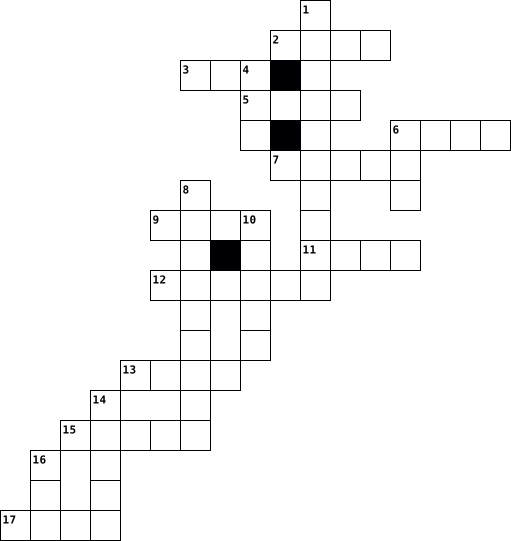
Across
- peel
- cup
- oven
- pour
- pasta
- sink
- eggs
- fruits
- heat
- plate
- stir
Down
- vegetables
- pot
- pan
- microwave
- knife
- flour
- cut
18 Clues: cup • pot • pan • cut • peel • oven • pour • sink • eggs • heat • stir • pasta • knife • flour • plate • fruits • microwave • vegetables
In the kitchen 2024-10-24

Across
- cookingspoon
- spoon
- whisk
- glass
- plate
- beaker
- cuttingboard
Down
- fork
- pan
- knife
- salt
- pepper
- pot
- spatula
- jug
- sieve
- bowl
- cup
18 Clues: pan • pot • jug • cup • fork • salt • bowl • knife • spoon • whisk • glass • plate • sieve • pepper • beaker • spatula • cookingspoon • cuttingboard
Science Crossword Puzzle 2021-11-20

Across
- When a curtain matter reaches a high heat and changes form
- The cambrian explosion happened and life evolved to vertebrae organisms
- Continues force on a object which changes its appearance
- A rock that was formed from the cooling go magma overtime ex: basalt and granite
- Formed by sediments like sandstone
- Hot liquid formed when rock partially or completely melts
- Relates to the type of way mountains are formed
- Ginormous slabs of rock that have formed the geography of the earth
- Layers or a layer of rock in the ground
Down
- Formed from heat and pressure overtime ex: quarts
- Known as the fireball earth because it wasn't solid
- Where the earths geography is effected by natural elements like glaciers or rivers
- It was the start of a new type of life, photosynthetic bacteria which lead to a mass extinction called the great dying and the beginning of eukaryotic life
- The center of the earth, the earth's core is supper hot and very dense it is in the shape of a sphere
- A combination of eroded rock and organic materials
- The layer of the earth between the core and the crust
- The remains of a ancient being
- Week points in the earths crust
- It marks the beginning of plate tectonics and life on earth, simple single celled organisms that changed the world
19 Clues: The remains of a ancient being • Week points in the earths crust • Formed by sediments like sandstone • Layers or a layer of rock in the ground • Relates to the type of way mountains are formed • Formed from heat and pressure overtime ex: quarts • A combination of eroded rock and organic materials • Known as the fireball earth because it wasn't solid • ...