
solar sy… Crossword Puzzles
ES Final Exam Review 2021-05-19

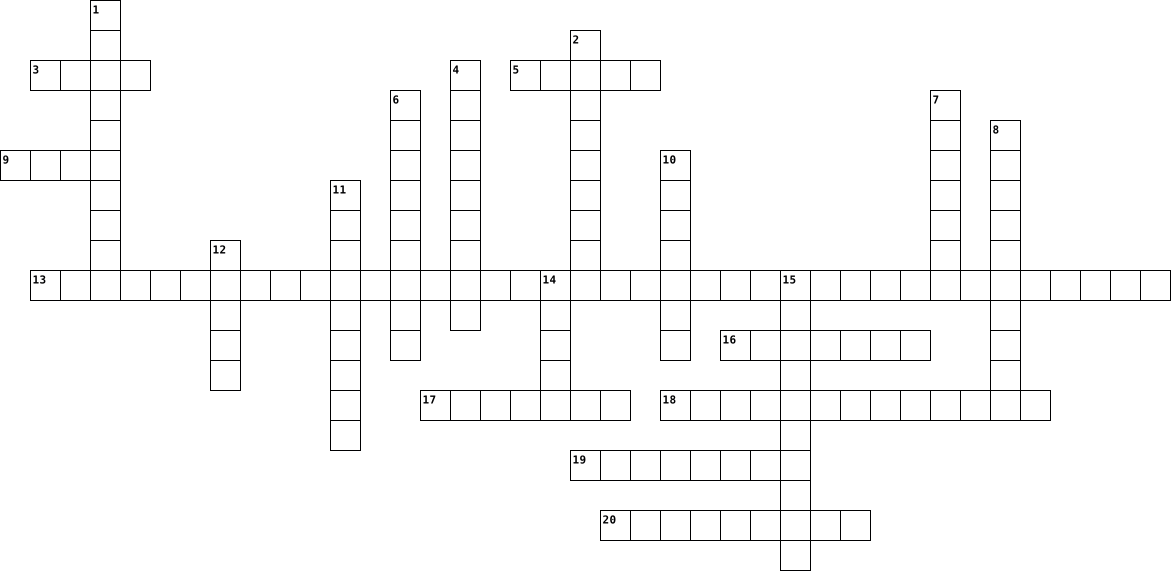
Across
- planet outside of our solar system
- region of solar system beyond Neptune
- a scientist that studies the universe
- Earth's twin; similar size and density
- closed curve whose shape is determined by 2 focii
- type of em radiation visible to humans
- volcanic process that created atmosphere
- group of stars organized into a pattern
- trench-like valleys on the moon
- a collection of stars, gas, dust bound by gravity
- smaller bodies that orbit planets
Down
- when Earth is closest to the sun
- a ring of debris between inner/outer planets
- path a body follows as it travels around another
- planet made of rock; iron core
- blue-green color likely due to methane
- when Earth is farthest from the sun
- largest planet in our solar system
- closest planet to sun
- galaxy containing Earth
- planet with a complex ring system
- planet with massive volcanoes, canyons; has seasons
22 Clues: closest planet to sun • galaxy containing Earth • planet made of rock; iron core • trench-like valleys on the moon • when Earth is closest to the sun • planet with a complex ring system • smaller bodies that orbit planets • planet outside of our solar system • largest planet in our solar system • when Earth is farthest from the sun • region of solar system beyond Neptune • ...
Space 2022-03-02

Across
- all celestial bodies exist in this
- second planet from the sun
- planet closest to the sun
- passes by Earth every 75 years
- nothing but light can escape
- center of our solar system
- large rocky body in outer space
- many solar systems grouped together
- this planet is furthest from our sun
- group of planets and their sun
- our home
- this planet is tilted on its side
Down
- this planet has spectacular rings around it
- any planet beyond our solar system
- small rocky body in outer space
- celestial body made of ice
- space probe launched in 1977
- orbits the earth
- this planet has a large red spot
- once a planet, now classified as a planetoid
- the red planet
- a sun that is very far away
- search for extraterrestrial intelligence
- unidentified flying object
24 Clues: our home • the red planet • orbits the earth • planet closest to the sun • second planet from the sun • celestial body made of ice • center of our solar system • unidentified flying object • a sun that is very far away • nothing but light can escape • space probe launched in 1977 • passes by Earth every 75 years • group of planets and their sun • small rocky body in outer space • ...
section 2 vocab words 2022-11-18

Across
- planets with a dence rocky surface
- white halo around the sun
- earth is the center of the solar system
- dark places on the sun
- middle of the sun
- donut shaped ring around the solar system
- outer layer of the sun
- clouds of gas
- small chunk of rock
- loose conection of space particles
- meteroid enter earth
- reddish loops of gas on the sun
- elongated circle
Down
- inner layer of the suns atmosphere
- hydrogen atoms join together
- sudden eruption of magnetic energy
- heat trapped in an atmosphere
- center part of a comet
- middle layer of the suns atmosphere
- sun at the center
- rocky space rocks too small too be a planet
- the middle layer of the sun
- big circle that surronds the solar
- strikes earth surface
- outer planets
- particles around planets
26 Clues: clouds of gas • outer planets • elongated circle • middle of the sun • sun at the center • small chunk of rock • meteroid enter earth • strikes earth surface • center part of a comet • dark places on the sun • outer layer of the sun • particles around planets • white halo around the sun • the middle layer of the sun • hydrogen atoms join together • heat trapped in an atmosphere • ...
Crucigrama 2019-09-25

Across
- é a relación entre a distancia real e a súa representación no mapa
- é unha aclaración dos símbolos do mapa
- explosión que formou o universo
- planeta azul
- estrela do sistema solar
- única estrela atopada polos científicos diferente do sol
- sinala os puntos cardinais
- obxeto rochoso ou metálico menor que un planeta
- planeta máis pequeno do sistema solar
- satélite máis grande do sistema solar
Down
- corpo celeste composto de rochas, xeo e po
- é a galaxia da Terra
- corpos formados por gases
- é unha esfera que representa a Terra a menor escala
- circunferencias paralelas ao ecuador
- liñas semicirculares trazadas de polo a polo
- sinalan a latitude dos raios solares que inciden de forma oblícua
- planeta menor marron
- atópanse na latitude e coninciden de forma perpendicular sobre a superficie da Terra
- fragmento de rocha de menor tamaño
20 Clues: planeta azul • é a galaxia da Terra • planeta menor marron • estrela do sistema solar • corpos formados por gases • sinala os puntos cardinais • explosión que formou o universo • fragmento de rocha de menor tamaño • circunferencias paralelas ao ecuador • planeta máis pequeno do sistema solar • satélite máis grande do sistema solar • é unha aclaración dos símbolos do mapa • ...
Astronomy 2020-10-01

Across
- Spinning on an axis
- Where we live
- Has different phases depending on where it is around the Earth.
- What revolves around the sun
- The idea the earth is the center of everything
- The inner planets
- Too many and too small to be a planet
- Has different phases depending on where it is in space
- The ball of rock and ice flying though the solar system
- The outer planets
Down
- The idea the sun is the center of the solar system
- The force that pulls objects to the ground
- What everything is in
- Where the sun, planets, and smaller rocks are.
- When one object blocks out another.
- A group of stars
- When one object moves around another.
- An idea to explain the universe's creation
- What the sun is
- The center of the solar system
20 Clues: Where we live • What the sun is • A group of stars • The inner planets • The outer planets • Spinning on an axis • What everything is in • What revolves around the sun • The center of the solar system • When one object blocks out another. • When one object moves around another. • Too many and too small to be a planet • The force that pulls objects to the ground • ...
AoPS Times Crossword #5 2024-05-11

Across
- Named after an Oceanian god
- Has methane lakes
- May have a sea under the ice
- An object orbiting a planet
- Largest moon of pluto
- Tidally Locked Planet
- Largest rings in the Solar System
- Most distant dwarf planet
- Named after a shakespeare character
- No longer a planet
- Surface area smaller than Manhattan
- Largest planet
Down
- Only PLANET with lakes
- God of the Sea
- Hottest Planet
- Planet The classification pluto belongs to
- Largest moon of the farthest planet
- One of Artemis’s hunters
- Third Dwarf Planet from the sun
- There are 8 of them
- Largest moon
- Where Curiosity is
- Gas giant with less gravity than Earth
- Hottest place in the solar system
- Largest thing in the asteroid belt
- Fancy name for earth’s moon
- God of Fear
- Most volcanically active object in the Solar System
28 Clues: God of Fear • Largest moon • God of the Sea • Hottest Planet • Largest planet • Has methane lakes • Where Curiosity is • No longer a planet • There are 8 of them • Largest moon of pluto • Tidally Locked Planet • Only PLANET with lakes • One of Artemis’s hunters • Most distant dwarf planet • Named after an Oceanian god • An object orbiting a planet • Fancy name for earth’s moon • ...
The sky and the planets 2024-12-30

Across
- A visible mass of condensed water vapor floating in the atmosphere
- Frozen water falling from the sky
- The space above the Earth
- Water falling from the sky
- The hottest planet
- The sound produced by lightning
- A piece of rock or metal that enters the Earth's atmosphere
- A planet that rotates on its side
- A flash of light produced by an electrical discharge
- A celestial object consisting of ice and dust
Down
- A celestial body that orbits a star
- The smallest planet in our solar system
- The farthest planet from the Sun
- The star at the center of our solar system
- The planet we live on
- A celestial body that emits light
- The planet with rings
- The Earth's natural satellite
- The Red Planet
- The largest planet in our solar system
- The movement of air
21 Clues: The Red Planet • The hottest planet • The movement of air • The planet we live on • The planet with rings • The space above the Earth • Water falling from the sky • The Earth's natural satellite • The sound produced by lightning • The farthest planet from the Sun • Frozen water falling from the sky • A celestial body that emits light • A planet that rotates on its side • ...
Space 2025-12-10

Across
- Powerful burst of energy from the sun's surface
- A Black hole in the center of the milkyway
- Previous planet that was demoted to dwarf planet
- An object orbiting a celestial body
- Planets made up of mostly hydrogen and helium
- Thing believed to have killed the dinosaurs
- The planet within the solar system containing life
- Giant cloud of interstellar dust and gas
- Phase of the moon when it is completely dark
- First country to send anything to space
- Number of dwarf planets in the solar system
Down
- Fifth planet from the sun
- The study of celestial objects
- Planet in the solar system orbiting on its side
- Measurement of distance in space
- A song named after a celestial body that doesn't emit light
- One of Saturn's moons containing water
- Death of a star
- Spaceflight that landed on the moon
- continuous stream of charged particles from the sun's superheated outer atmosphere
20 Clues: Death of a star • Fifth planet from the sun • The study of celestial objects • Measurement of distance in space • An object orbiting a celestial body • Spaceflight that landed on the moon • One of Saturn's moons containing water • First country to send anything to space • Giant cloud of interstellar dust and gas • A Black hole in the center of the milkyway • ...
Space and machines 2020-06-05

Across
- one of the strangest thing we know in the universe
- planet with most moons in the solar system
- largest planet in the solar system
- the machine that was lounch to spacein 1977
- the first car brand in space
- first hungarian in space
- our sun is a ...
- short name of international space staion
Down
- closest solar system
- the oprogram that first to send humans to the moon
- first satellite in space
- first counrty that send people to space
- first name of the first man in space
- short name of single stage to orbit
- our home planet
15 Clues: our home planet • our sun is a ... • closest solar system • first satellite in space • first hungarian in space • the first car brand in space • largest planet in the solar system • short name of single stage to orbit • first name of the first man in space • first counrty that send people to space • short name of international space staion • ...
Chemistry - Energy Vocabulary 2022-09-27

Across
- This energy is found/stored in the nucleus of an atom
- This type of resource can be replaced/can not be used up
- travels as waves through matter and empty space
- This type of energy is know for powering wind turbines
- Energy source made up of materials from living things
- This resource can not be replaced at the same rate it is getting used up
- The energy of moving objects (car moving, ball rolling, fish swimming, etc)
Down
- The energy we get from water (specifically moving water)
- Energy which is caused by moving electric charges
- Conversion of energy (one form of energy into another)
- Has the ability to change the temperature of different forms of matter
- Management of resources
- Storage for the electrical energy made from solar cells
- The energy we get from the sun
- Formed millions of years ago from decayed remains
- Has the ability to change light energy into electricity
- Comes from within the earths crust
- Reflects/concentrates the sunlight onto a fluid filled pipe (one of the steps used to turn a turbine)
- Energy stored in atoms/molecules (food, fuels, and batteries store this type of energy)
- The ability to move or change
20 Clues: Management of resources • The ability to move or change • The energy we get from the sun • Comes from within the earths crust • travels as waves through matter and empty space • Energy which is caused by moving electric charges • Formed millions of years ago from decayed remains • This energy is found/stored in the nucleus of an atom • ...
space 2021-03-29

Across
- planet closest to the sun
- planet that is tilted on it's side
- one trip around the sun is called a ____
- used to measure distance in space
- humans that go into space
- government agency that studies space
- name of the star in our galaxy
- the "Great Red Spot" is a ____ on Jupiter
- a group of stars that create a shape
- a star with orbiting planets
- invisible force that keeps humans on earth
- humans live here
- ball of rock that orbits a planet
Down
- also called the "red planet"
- travel through space and send information back to Earth
- astronauts use these to go to space
- name of our galaxy
- a supernova is the ____ of a star
- life forms from other planets
- biggest planet in the solar system
- dwarf planet in our solar system
- hottest planet in the solar system
- has rings around it
- balls of frozen gas/rock that orbit the Sun
- planets ___ the sun
- light shows in the sky by south/north poles
- big balls of gas that create light and heat
- number of planets in our solar system
- study of the universe
- planet farthest from the sun
30 Clues: humans live here • name of our galaxy • has rings around it • planets ___ the sun • study of the universe • planet closest to the sun • humans that go into space • also called the "red planet" • a star with orbiting planets • planet farthest from the sun • life forms from other planets • name of the star in our galaxy • dwarf planet in our solar system • ...
Solar System Extra Credit 2023-02-10

Across
- elevated areas, lighter spots on moon
- Inner planets are considered ________ (rocky surface)
- Robot that collects samples from other planets
- Aristotle supported which model of the solar system?
- the distance between two foci
- the force that draws objects toward its center
- moon sized objects, formed during Nebular Theory
- __________ Space Station
- the widest point of an ellipse
- cloud of dust and gas
- One foci is the sun the other is _________ space
- Planetesimals are formed by ____________ of dust
- phase moon is in during a solar eclipse
- When the eccentricity is closer to 0 the shape is more _______.
- spins around a central object
- influences the pull of gravity
Down
- the shape of an orbit
- The theory of how the solar system was formed
- spins around a central axis
- the shape of the ellipse
- number of high and low tides
- Outer planets are considered ___________ (gas giants)
- an object that orbits around a bigger object
- the correct model of the solar system
- natural satellite of Earth
- asteroid sized objects, formed during Nebular Theory
- layers of gases that surrounds a planet
- during a lunar eclipse, the moon is in ________'s shadow
- the planet with the weakest gravitational pull from the sun
29 Clues: the shape of an orbit • cloud of dust and gas • the shape of the ellipse • __________ Space Station • natural satellite of Earth • spins around a central axis • number of high and low tides • the distance between two foci • spins around a central object • the widest point of an ellipse • influences the pull of gravity • elevated areas, lighter spots on moon • ...
Space 2013-06-08

Across
- Minor Planets that are not comets
- A small particle from a comet or asteroid
- An area in the Earth's upper atmosphere which absorbs many of the lethal radiations coming from space
- Second planet closest to the sun
- When our view of one object in the sky is blocked by either another object or the Earth's shadow
- The distance which a ray of light would travel in one year. This is about 6,000,000,000,000 (6 trillion) miles.
- The star that it is in the centre of the solar system
- Second biggest planet, also a gas giant and is surrounded with icy rings
- A group of stars, gas and dust held together by gravity
- Described as the "Red Planet", named after the Roman God of war
Down
- A cloud of gas and dust
- Negative particle which orbits an atom
- Biggest planet and is a gas giant
- Scientists that study about space and astronomy
- Smallest and closest planet to the Sun
- The planet that can sustain living creatures
- Icy small Solar System Body
- A special kind of elongated circle. The orbits of the solar system planets form ellipses.
- A dwarf planet that used to be a part of the solar system
- Seventh planet from the sun
20 Clues: A cloud of gas and dust • Icy small Solar System Body • Seventh planet from the sun • Second planet closest to the sun • Biggest planet and is a gas giant • Minor Planets that are not comets • Negative particle which orbits an atom • Smallest and closest planet to the Sun • A small particle from a comet or asteroid • The planet that can sustain living creatures • ...
The Solar System 2014-10-30

Across
- Known as the "Red Planet"
- Causes the tides on Earth
- Scientific theory of the origin of the universe
- Furthest planet from the Sun
- Another name for the Inner Planets - eg Mercury, Venus, Earth & Mars
- Often called a shooting star
- A region of spacetime from which gravity prevents anything, including light, from escaping
- An explosion that marks the end of a star's life
- What makes Earth have its seasons
- Remains of a meteroid that survives the fall to Earth and hits the ground
- Only life sustaining planet in our solar system
- Piece of solid rocky and/or metallic debris that travels in outer space
- Hottest Planet
- The Milky Way is one
Down
- Only star in our solar system
- Largest planet in our solar system
- Coldest planet in our solar system
- A group of stars that form a pattern in the night sky
- The _____ Planets - Jupiter, Saturn, Uranus & Neptune
- The total sum of all matter and energy ie everything within and between all galaxies
- Lightest planet
- The belt that extends far outwards from Neptune
- Its tail always pointing away from the Sun
- The Main ________ Belt lies between Mars and Jupiter
- A large ball of hot gas
- Fastest moving planet
26 Clues: Hottest Planet • Lightest planet • The Milky Way is one • Fastest moving planet • A large ball of hot gas • Known as the "Red Planet" • Causes the tides on Earth • Furthest planet from the Sun • Often called a shooting star • Only star in our solar system • What makes Earth have its seasons • Largest planet in our solar system • Coldest planet in our solar system • ...
The Solar System 2015-11-19

Across
- A cloud of dust and gas in space.
- Eclipse: Occurs when the moon passes though earths shadow.
- The scientific study of the universe.
- Colliding matter formed small, irregularly shaped bodies.
- planets: Relatively small and rocky like Mercury, Venus, Earth and Mars.
- The concept of an earth-centered theory.
- The fuzzy, gaseous component of a comet’s head.
- Small solid particle that travels though space.
- Tails: Dust set free from vaporizing ice in the comet, carried away from the comet by the sun’s radiation pressure.
- The depression that is produced by a meteorite.
- Trails: When stars and planets seem to rise and appear to circle polaris.
- Tail: ionzed gos pushed away from the comet by solar wind.
- Small rocky bodies that orbit the sun.
Down
- Theory: A theory on how the solar systems formed.
- Describes the view that the sun is at the center of the solar system.
- The motion of one body about another.
- Pieces of rocky and metal materials held together by frozen water, ammonia, methane, carbon dioxide and carbon monoxide.
- Eclipse: Occurs when the moon moves in line directly between earth and the sun.
- planets: Huge gas giants like Jupiter, Saturn, Uranus and Neptune.
- Planet: A round object that orbits the sun but has not cleared the neighborhood around its orbit.
20 Clues: A cloud of dust and gas in space. • The scientific study of the universe. • The motion of one body about another. • Small rocky bodies that orbit the sun. • The concept of an earth-centered theory. • Small solid particle that travels though space. • The depression that is produced by a meteorite. • The fuzzy, gaseous component of a comet’s head. • ...
Planets 2021-11-02

Across
- our galaxy
- farthest planet from the sun
- the red planet
- largest planet in the solar system
- Titan is the largest moon of ______
- small rocks that orbit the sun
Down
- Earth's only satellite
- distance traveled by light in a vacuum in one tropical year
- Evening star
- the blue planet
- seventh planet from the sun
- smallest planet in the solar system
- the star at the center of the solar system
13 Clues: our galaxy • Evening star • the red planet • the blue planet • Earth's only satellite • seventh planet from the sun • farthest planet from the sun • small rocks that orbit the sun • largest planet in the solar system • smallest planet in the solar system • Titan is the largest moon of ______ • the star at the center of the solar system • ...
Syslöjd expertord 2024-02-29

Across
- när man ska ta mått på kroppen eller tyg
- ett stretchigt tyg
- en sorts maskin man syr kläder på
- används för fyllning av olika saker
- en nål med hatt
- en del av symaskinen som startar den
- papperet där man ritar sina planeringar
- när man ritar på tyg med hjälp av en penna
- en varm platta som används för och göra kläder raka
- nål med ett litet öga
Down
- nål med ett stort öga
- en del av symaskinen som håller ihop tyget när man ska sy
- undertråden på symaskinen
- verktyg som hjälper dig trä tråden i nålen
- ett verktyg som man använder när man har sytt fel
- tråden som används för symaskinen ovan på
16 Clues: en nål med hatt • ett stretchigt tyg • nål med ett stort öga • nål med ett litet öga • undertråden på symaskinen • en sorts maskin man syr kläder på • används för fyllning av olika saker • en del av symaskinen som startar den • papperet där man ritar sina planeringar • när man ska ta mått på kroppen eller tyg • tråden som används för symaskinen ovan på • ...
Chapter 21 Lesson 1-2 Crossword Puzzle 2017-04-19

Across
- The largest object in the solar system
- Planets that involve earth
- Only planet with water
- Made of gas,dust, and ice
Down
- Hottest planet in solar system
- Objects that orbit the solar system
- Millions of small rocks
- The smallest planet
- Planets that not in the solar system
- A planet we can probably live on
10 Clues: The smallest planet • Only planet with water • Millions of small rocks • Made of gas,dust, and ice • Planets that involve earth • Hottest planet in solar system • A planet we can probably live on • Objects that orbit the solar system • Planets that not in the solar system • The largest object in the solar system
Solar System 2023-01-30

Across
- Natural Satellite of Earth
- Smallest planet in the solar system
- Biggest Planet in the solar system
- Planet with invisible Rings
Down
- Planet with large visible rings
- No. of planets in solar system
- The path in which the planets revolve around sun
- Farthest planet from the Sun
- Red Planet
- Brightest planet in the solar system
10 Clues: Red Planet • Natural Satellite of Earth • Planet with invisible Rings • Farthest planet from the Sun • No. of planets in solar system • Planet with large visible rings • Biggest Planet in the solar system • Smallest planet in the solar system • Brightest planet in the solar system • The path in which the planets revolve around sun
ENERGÍAS ALTERNATIVAS 2024-11-13

Across
- Efecto de emitir fotoelectrones
- Desventaja de una presa hidráulica
- solar Conjunto de celdas solares
- Energía generada por radiación electromagnética
- Energía que genera un fluido
Down
- Energía que proviene del interior de la tierra
- Capacidad de los cuerpos para realizar trabajo
- planta hidroeléctrica
- solar Convierte energía solar en eléctrica
- Infraestructura de obra civil
10 Clues: planta hidroeléctrica • Energía que genera un fluido • Infraestructura de obra civil • Efecto de emitir fotoelectrones • Desventaja de una presa hidráulica • solar Conjunto de celdas solares • solar Convierte energía solar en eléctrica • Energía que proviene del interior de la tierra • Capacidad de los cuerpos para realizar trabajo • ...
Space Puzzle 2022-04-13

Across
- - to shine light on an object and make it visible
- Pull - the force that pulls two objects together due to their mass
- System - the sun, the planets that orbit the sun, and other objects that orbit the sun
- (Cosmos) - all of space and its contents
- - the four parts of the year where weather, ecology, and number of daylight hours change as a result of Earth’s orbit around the sun
- Phase - the shape of the illuminated part of the Moon as it appears from Earth
- - the border between light and dark on the Moon
- - a moon outside our solar system
- Eclipse - when the moon is completely dark
- Moon - a moon phase where the Moon is not visible from the Earth
- - the force by which all things with mass or energy (including planets, stars, galaxies, and light) are brought towards one another
- Eclipse - The moment that the moon orbits directly between the sun and the Earth
Down
- - the tendency of an object to remain at rest or unchanged
- Moon - a moon phase that looks like a full circle from Earth
- Moon - a moon phase that looks like more than a half circle from Earth
- - the relative size of things
- Moon - a moon phase that looks like less than half a circle from Earth
- Moon - a moon phase that looks like half a circle from Earth
- - the star that is the main source of light at the center of our solar system
- - something we observe to be similar over and over again
- - the nearly circular path a smaller object (like the Moon) travels around a larger object like Earth)
- - a rocky sphere that travels around a planet
- - a planet outside our solar system
- - the circular movement of an object around its center (like a top spinning)
- - a collection of gas, dust, stars, and solar systems that are held together by gravity
25 Clues: - the relative size of things • - a moon outside our solar system • - a planet outside our solar system • (Cosmos) - all of space and its contents • Eclipse - when the moon is completely dark • - a rocky sphere that travels around a planet • - the border between light and dark on the Moon • - to shine light on an object and make it visible • ...
Astronomy 2023-03-19

Across
- Most famous dwarf planet.
- a hypothetical structure connecting disparate points in spacetime, and is based on a special solution of the Einstein field equations.
- an interstellar object of planetary mass which is not gravitationally bound to any star or brown dwarf.
- The hottest planet in the solar system
- They result from the supernova explosion of a massive star, combined with gravitational collapse, that compresses the core past white dwarf star density to that of atomic nuclei.
- the second biggest planet in the solar system.
- a fundamental interaction which causes mutual attraction between all things with mass.
- a layer of gas or layers of gases that envelop a planet.
- a physical theory that describes how the universe expanded from an initial state of high density and temperature.
- a star of relatively small size and low luminosity.
- hypothetical form of matter thought to account for approximately 85% of the matter in the universe.
- The largest planet in the solar system
- any planet beyond our solar system.
Down
- A place in space where gravity pulls so much that even light can not get out.
- a powerful and luminous explosion of a star.
- The biggest black holes in the universe.
- a giant cloud of dust and gas in space.
- a stream of charged particles released from the upper atmosphere of the Sun called the corona.
- The galaxy which will colide with the Milky Way
- The closes planet to the sun.
- a path of a body revolving around an attracting centre of mass, as a planet around the Sun or a satellite around a planet.
21 Clues: Most famous dwarf planet. • The closes planet to the sun. • any planet beyond our solar system. • The hottest planet in the solar system • The largest planet in the solar system • a giant cloud of dust and gas in space. • The biggest black holes in the universe. • a powerful and luminous explosion of a star. • the second biggest planet in the solar system. • ...
Unit 11 Vocab - Solar System 2025-04-19

Across
- - Kepler's 1st Law says planets orbit the sun in this shape.
- - a type of planet with a rocky surface and thin atmosphere
- - a spherical body which orbits the sun and has cleared its neighborhood.
- - a region past Neptune where four dwarf planets live.
- - an icy and rocky body which orbits the sun and has a distinct "tail."
- - a piece of space debris on the surface of a planet.
- - the "father" of heliocentrism
- - This force, along with inertia, keeps planets in orbit around the sun.
- - A model of the universe with Earth at the center.
- - discoverer of Venus' phases and four moons of Jupiter.
- - The four largest moons of Jupiter are called this
- - A model of the solar system with the sun at the center.
- - When planets appear to move backward in their orbit
- - a piece of space debris approaching a planet
- - Uranus and Neptune are this type of planet
- - the largest volcano in the solar system on Mars
Down
- - Aristotle's model of the solar system with rotating concentric spheres around Earth
- - a region found between Jupiter and Mars
- - A moon
- - The publisher of the theory of universal gravitation
- - the largest storm in the solar system
- - a spherical body which orbits the sun but has not cleared its neighborhood.
- - The simplest explanation is often the best.
- - a piece of space debris in the atmosphere of a planet
- - a rocky body which orbits the sun in a belt but is not spherical
- - a type of planet with a small core and giant atmosphere
- - the outermost region of the solar system
- - Kepler's 2nd law says planets move _______ when closer to the sun.
- - Jupiter and Saturn are this type of planet
29 Clues: - A moon • - the "father" of heliocentrism • - the largest storm in the solar system • - a region found between Jupiter and Mars • - the outermost region of the solar system • - Jupiter and Saturn are this type of planet • - Uranus and Neptune are this type of planet • - The simplest explanation is often the best. • - a piece of space debris approaching a planet • ...
Our Place in Space 2023-04-03

Across
- The name given to the first four planets in the Solar System is the ____ planets.
- The closest planet to the Sun.
- Giants The nickname given to the planets Jupiter, Saturn, Uranus and Neptune.
- The only planet known to have life.
- The largest planet in the Solar System.
- The name of the American agency that explores and researches outer space.
Down
- A solid piece of debris flying through space known as a shooting star.
- The dwarf planet that is no longer a part of the Solar System.
- The planet known as ‘The Red Planet’ that is close to Earth.
- It takes the Earth a full ____ to rotate around the Sun.
- A planet in our Solar System with rings.
- The source of Earth’s light that all planets in the Solar System orbit.
12 Clues: The closest planet to the Sun. • The only planet known to have life. • The largest planet in the Solar System. • A planet in our Solar System with rings. • It takes the Earth a full ____ to rotate around the Sun. • The planet known as ‘The Red Planet’ that is close to Earth. • The dwarf planet that is no longer a part of the Solar System. • ...
SCIENTIFIC ROBUST VOCAB!! 2018-05-14

Across
- The most famous dwarf planet in our solar system.
- Our closest natural satellite
- This keeps us "down to earth"
- Meteors that hit the earths surface
- The other force that help keep things in orbit.
- Where we get energy
- One of the main ways black holes are formed.
- The part of space we can see.
- The fastest thing ever
- The largest planet in our solar system.
- Moons gravitational pull cause these.
Down
- What is the hottest planet in our solar system
- These thing leave something behind made of dust and ice
- These rocky objects orbit the sun in 2 sections
- The closest cluster of asteroids
- A cloud of dust and gas in space.
- The reason we see the same side of the moon
- These are caused by meteors
- Its what rotating planets spin on
- Cause moons crater
20 Clues: Cause moons crater • Where we get energy • The fastest thing ever • These are caused by meteors • Our closest natural satellite • This keeps us "down to earth" • The part of space we can see. • The closest cluster of asteroids • A cloud of dust and gas in space. • Its what rotating planets spin on • Meteors that hit the earths surface • Moons gravitational pull cause these. • ...
Maglione's crossword 2020-05-28

Across
- if you are lucky you find it
- if it was closer there would be too much radiation
- the name of our solar sistem
- if you go out you have to get it
- if you look up during teh night you see them
- it is infinite
- under your feet
- the movement of the earth on its axis
- he does experiments
Down
- the first chimical element of the periodic table
- if you don't have friends you feel like this
- if you want to swim you can go there
- if you want to go out you wear it
- if the sun explodes it becomes this
- if it was smaller and gravity was weaker it wouldn't hold our oceans
- blocks harmful solar radiation
- it covers 70% of the Earth
- at the center of the solar sistem
- it is made of rock and metal
- if the temperature is cold water becames it
20 Clues: it is infinite • under your feet • he does experiments • it covers 70% of the Earth • if you are lucky you find it • the name of our solar sistem • it is made of rock and metal • blocks harmful solar radiation • if you go out you have to get it • if you want to go out you wear it • at the center of the solar sistem • if the sun explodes it becomes this • ...
Space 2020-03-24
Across
- ________ is the debris of in Asteroid
- ________ is a dwarf planet in our solar system
- Our sun is a _______
- What NASA stands for
- What keeps you on the ground
- ________ is the planet the moon Dia belongs to
- A person who went to the moon in 1969
- How long does it takes for Pluto to orbit the sun
- The movement of heat through
Down
- ________the outer rim of our solar system
- Changes in the DNA
- People who go into space
- A planet that exists beyond our system
- A process in which water molecules pass through a membrane leaving dissolved particles
- ___________ spacecraft that went to Pluto
- ____________ how long it takes to get to Mars
- The study of the star
- The third planet in our solar system
- A piece of ice in space
- Ten letter word for oval - shaped
20 Clues: Changes in the DNA • Our sun is a _______ • What NASA stands for • The study of the star • A piece of ice in space • People who go into space • What keeps you on the ground • The movement of heat through • Ten letter word for oval - shaped • The third planet in our solar system • ________ is the debris of in Asteroid • A person who went to the moon in 1969 • ...
SPACE 2023-05-31

Across
- A piece of space rock that burns up in Earth's atmosphere
- A huge grouping of stars
- A vehicle designed for travel in space
- Has rings made of ice and dust
- The largest planet in our solar system
- The path an object takes around another
- The seventh planet from the sun
- An instrument used to observe distant objects in space
- A person who travels in space
Down
- A celestial object with a tail
- The Red Planet
- A group of stars that form a pattern
- An object that orbits a planet
- The center of our solar system
- Earth's natural satellite
- A cloud of gas and dust in space
- An explosion that occurs when a star runs out of fuel
- hole An object with such strong gravity that nothing can escape it
- A space telescope named after astronomer Edwin Hubble
- The hottest planet in our solar system
20 Clues: The Red Planet • A huge grouping of stars • Earth's natural satellite • A person who travels in space • A celestial object with a tail • An object that orbits a planet • The center of our solar system • Has rings made of ice and dust • The seventh planet from the sun • A cloud of gas and dust in space • A group of stars that form a pattern • A vehicle designed for travel in space • ...
Planets 2025-12-19

Across
- A tool used to see distant planets
- A huge system of stars and planets
- The path of a planet around the sun
- The far blue planet
- The hottest planet in the solar system
- The planet with famous rings
- A person who travels into space
- The planet we live on
- A ball of ice and dust with a long tail
- The famous dwarf planet
- A streak of light caused by a space rock falling
Down
- The force that pulls objects toward each other
- The largest planet in the solar system
- The natural satellite of Earth
- The cold planet that rotates on its side
- Everything that exists in space
- The closest planet to the Sun
- The red planet
- A small rocky body orbiting the sun
- A vehicle used to launch into space
- A glowing ball of gas in space
- The star at the center of our solar system
22 Clues: The red planet • The far blue planet • The planet we live on • The famous dwarf planet • The closest planet to the Sun • The planet with famous rings • A glowing ball of gas in space • Everything that exists in space • A person who travels into space • The natural satellite of Earth • A tool used to see distant planets • The path of a planet around the sun • ...
Planets Crossword 2014-10-26

Across
- The only planet in the Solar System that has life
- Everything that exists including planets, stars, galaxies and all forms of matter and energy
- The smallest planet in the Solar System, which has now become a dwarf planet
- The galaxy of where our Solar System belongs
- A planet that is surrounded by rings and is the second biggest planet
- A planet that is too small to be considered a regular planet
- A huge bright ball of burning gas held together by gravity. The sun is one
- The biggest planet,300 times the mass of Earth
- A small object that is part of the solar system, it orbits the sun and is made up of ice, dust and small rocky particles
- The number of planets in our Solar System
- One of the four gas only planets, it is the second last planet away from the Sun and appears blue in colour
- Known as the red planet and sits next to Earth and also has similar time to Earth
Down
- The planet that is closest to the Sun
- The first person to step foot on the Moon in 1969
- The seventh planet from the Sun and cannot be seen from Earth without a telescope
- The study of objects and matter outside the Earth's surface
- A person trained to be a member of a spacecraft, a space travel professional
- The star that gives life to Earth and which all planets orbit around
- The planet that is second closest to the Sun and sits in between Mercury and Earth
- Orbits the Earth and is made up of craters. Can be seen from the Earth during the day and night
20 Clues: The planet that is closest to the Sun • The number of planets in our Solar System • The galaxy of where our Solar System belongs • The biggest planet,300 times the mass of Earth • The only planet in the Solar System that has life • The first person to step foot on the Moon in 1969 • The study of objects and matter outside the Earth's surface • ...
Space history and Solar bodies 2022-05-12

Across
- What the universe started with
- electrons attached to this
- this type of planet is giant and has no solid surface
- One of the biggest planets in our solar system with a ring
- One of the smallest planets in our solar system and the closest to the sun
- what end up turning into planets after gaining mass
- This forms from dust gas and ice because of gravity
Down
- creates a large amount of energy and makes new elements
- the catalyst for nearly everything in space
- the debris that doesnt turn into a planet
- has the longest orbit in our solar system
- these form after gas clouds condense and gravitate too each other
- electrons attached to this
- Has the shortest day in earth hours in the solar system
- E = ?c^2
15 Clues: E = ?c^2 • electrons attached to this • electrons attached to this • What the universe started with • the debris that doesnt turn into a planet • has the longest orbit in our solar system • the catalyst for nearly everything in space • what end up turning into planets after gaining mass • This forms from dust gas and ice because of gravity • ...
Space 2022-01-14

Across
- The planet that we live on
- A ball of matter in space that emits light
- The name of the moon that orbits the Earth
- Icy chunks that travel through the solar system
- ~1m pieces of rock that orbit the Sun
- Pieces of rock that orbit the Sun
- Millions of stars and their solar systems
Down
- The surface and soil of the world we live on
- An large object that orbits the Sun
- Small pieces of meteors that land on Earth
- The name of the star in the solar system we live vacuum A place that has no particles in it
- planet Planets that have a solid surface
- A natural body (usually rock) that orbits a planet
- system The celestial bodies that surround a star
- Way The galaxy that we live in
- planet A planet without a solid surface
16 Clues: The planet that we live on • Way The galaxy that we live in • Pieces of rock that orbit the Sun • An large object that orbits the Sun • ~1m pieces of rock that orbit the Sun • planet A planet without a solid surface • planet Planets that have a solid surface • Millions of stars and their solar systems • Small pieces of meteors that land on Earth • ...
solar system 2013-06-04

Across
- This gas giant is famous for its beautiful rings as well as being the second biggest planet
- It's tough being the little guy and no one knows
- smallest planet
- fourth planet from the sun
- we are asleep
- furthest planet from the sun
- Keen to stand out from the crowd
Down
- twin of earth in terms of size and mass
- earth we all live on it
- Patterns in the sky created by stars
- nocturnal animals are asleep at this time
- largest planet
- it comes out at night
- this makes you feel hot
14 Clues: we are asleep • largest planet • smallest planet • it comes out at night • earth we all live on it • this makes you feel hot • fourth planet from the sun • furthest planet from the sun • Keen to stand out from the crowd • Patterns in the sky created by stars • twin of earth in terms of size and mass • nocturnal animals are asleep at this time • ...
Solar System 2022-04-13

Across
- small, irregularly shaped, rocky object that orbits the sun
- measure of the force of gravity on an object
- measure of the amount of matter in an object
- bright streak of light
- object in space moves around the Sun, it has a certain amount of forward momentum
- consider a dwarf planet now
- Our planet is in
Down
- controls the tides
- We live here
- we can't feel out in space
- most important thing to have for life on earth
- provides oxygen
- small body of ice, rock, and dust that elliptically orbits around the sun
- is our star of the solar system
14 Clues: We live here • provides oxygen • Our planet is in • controls the tides • bright streak of light • we can't feel out in space • consider a dwarf planet now • is our star of the solar system • measure of the force of gravity on an object • measure of the amount of matter in an object • most important thing to have for life on earth • ...
Solar System 2022-04-27

Across
- "Planet" means "______________" in Greek.
- The planet closest to the Sun
- Earth's only natural satellite is the _________.
- Saturn is also called the "______ planet."
- Hailey's ________ can be seen once every 76 years.
- Neptune is the ___________ planet from the Sun.
- the largest planet in the solar system
- Earth's moon is also called ___________.
Down
- Earth is the ____________ planet from the Sun.
- The Sun is a huge ________.
- a dwarf planet
- Venus rotates around the Sun in the opposite or ____________ direction.
- The two types of satellites are natural or ____________ (or man-made).
- A satellite is a heavenly body that ______ around a planet.
14 Clues: a dwarf planet • The Sun is a huge ________. • The planet closest to the Sun • the largest planet in the solar system • Earth's moon is also called ___________. • "Planet" means "______________" in Greek. • Saturn is also called the "______ planet." • Earth is the ____________ planet from the Sun. • Neptune is the ___________ planet from the Sun. • ...
solar energy 2022-01-19

Across
- on the roof to make power
- outer space
- machines that make power
- something simuler to sun its like shiny and vidimine D
- is something tech
- hot planet
- type of energy
Down
- something that hot and makes you sweaty
- energy from the sun
- bay area
- something that when you find a temperature
- is when you connect metel with metel
- source used to make power
- some thing that sometime pushes you
14 Clues: bay area • hot planet • outer space • type of energy • is something tech • energy from the sun • machines that make power • on the roof to make power • source used to make power • some thing that sometime pushes you • is when you connect metel with metel • something that hot and makes you sweaty • something that when you find a temperature • ...
solar enegy 2022-01-19

Across
- energy that comes from the sun
- something that is created when air is pushed at high speeds
- a type of energy
- something that maybe on your roof
- also used to tell if there strong
- something in a outlet
- something in every thing
- something that gets rid of darkness
- something that that radiates from the sun
Down
- something that gives off vitamin D
- something that keeps humans alive
- a word that is close to something used in wars
- something in are air that can be polluted
- something that can be hot or cold
14 Clues: a type of energy • something in a outlet • something in every thing • energy that comes from the sun • something that keeps humans alive • also used to tell if there strong • something that can be hot or cold • something that gives off vitamin D • something that maybe on your roof • something that gets rid of darkness • something in are air that can be polluted • ...
Solar Crossword 2024-02-14

Across
- north star
- hottest planet
- moons revolution around earth
- planet discovered mathematically
- halfway through luna cycle
- third planet from the sun
- red planet
Down
- force that pulls toward earth
- natural satellite
- dwarf planet
- coldest planet
- chocolate bar galaxy
- average distance from earth to sun
- planets in our solar system
14 Clues: north star • red planet • dwarf planet • hottest planet • coldest planet • natural satellite • chocolate bar galaxy • third planet from the sun • halfway through luna cycle • planets in our solar system • force that pulls toward earth • moons revolution around earth • planet discovered mathematically • average distance from earth to sun
Solar System 2024-01-29

Across
- Nebular Theory : the theory that the solar system developed from a cloud of gas and dust, aka the solar nebula.
- dissociation : the breaking apart of a molecule via intense radiation
- : planet planet that is shaped like a sphere
- velocity : the velocity of a body along the line of
- : the passage of a celestial body such as a planet across the face of a larger body such as a star.
- planet : a planet orbiting the inner part of the solar system
- meteoroid : a meteorite containing small spherical grains called chondrules.
- : a cloud of gas and dust between the sun
Down
- : pieces of rock that falls to Earth
- : a planet not orbiting the sun
- planet: A planet orbiting the outer part of the solar system. Said planets are Jupiter, Saturn, Uranus, and Neptune.
- planet : a rocky planet similar to Earth in size and structure. These planets are Mercury, Venus, Earth, and Mars.
- : cliffs formed where the crust has shifted that run for hundreds of kilometers across a planet’s or moon’s surface.
- : the bright trail of light created by small solid particles entering Earth’s atmosphere and burning up. A “shooting star.”
14 Clues: : a planet not orbiting the sun • : pieces of rock that falls to Earth • : a cloud of gas and dust between the sun • : planet planet that is shaped like a sphere • velocity : the velocity of a body along the line of • planet : a planet orbiting the inner part of the solar system • dissociation : the breaking apart of a molecule via intense radiation • ...
SOLAR SYSTEM 2016-06-29

Across
- the star at the centre of the solar system
- earth's only natural star
- smaller bodies in the orbit around the sun
- saturn's natural satellite
- the comet that is seen every 76 years
- the planet found at last
- this planet found 716 planets
Down
- morning star
- it is a dwarf planet in the solar system
- the largest planet in the solar system
- this was formed 4.6 billion years ago
- the distance traveled by light in a vaccum in one tropical year
- mission pluto's space shuttle was launched this many years ago
- the blue planet
14 Clues: morning star • the blue planet • the planet found at last • earth's only natural star • saturn's natural satellite • this planet found 716 planets • this was formed 4.6 billion years ago • the comet that is seen every 76 years • the largest planet in the solar system • it is a dwarf planet in the solar system • the star at the centre of the solar system • ...
SOLAR SYSTEM 2020-03-28

Across
- gas giant planets
- meteor that makes it to earth without burning up
- huge chunks of irregularly shaped rocks
- small pieces of rock and dust
- once considered the ninth planet
- has methane in its atmosphere
Down
- has most extreme temperature ranges
- dirty snowballs
- four planets closest to the sun
- farthest planet from the sun
- meteoroids that enter earth's atmosphere and burn
- second largest planet
- looks red because of iron oxide
- smallest of the planets
14 Clues: dirty snowballs • gas giant planets • second largest planet • smallest of the planets • farthest planet from the sun • small pieces of rock and dust • has methane in its atmosphere • four planets closest to the sun • looks red because of iron oxide • once considered the ninth planet • has most extreme temperature ranges • huge chunks of irregularly shaped rocks • ...
Solar Eclipse 2024-03-26

Across
- one way to safely observe the eclipse
- amount of space between two objects
- location in the Earth where a total eclipse can be observed
- observing the eclipse without looking directly at the sun
- sun's atmosphere
- when the moon passes between the earth and the sun
- eclipse where the sun is partly covered by the moon
Down
- eclipse when the moon is farther from the sun
- point in moon's orbit closest to the Earth
- eclipse where the sun is completely covered by the moon
- shadow where the eclipse is partial
- shadow where the eclipse is total
- oval shape of the moon's orbit
- point in the moon's orbit farthest from Earth
14 Clues: sun's atmosphere • oval shape of the moon's orbit • shadow where the eclipse is total • shadow where the eclipse is partial • amount of space between two objects • one way to safely observe the eclipse • point in moon's orbit closest to the Earth • eclipse when the moon is farther from the sun • point in the moon's orbit farthest from Earth • ...
Solar systems 2023-01-18

Across
- satellite is something that orbits something else
- a bunch of matter that entered the atmosphere
- a tube-shaped object that thrusts itself into the air
- man-made satellite
- a tool to look at the planets or stars
- is a rock that orbits the sun
- a drone/machine that gathers information
Down
- a similar thing to a rocket but orbits the earth and then returns
- the space station in space
- millions and billions of stars
- when one rotation happens
- a celestial thing that is made up of ice and dust
- spinning on an axis
- systems the eight planets and their moons
14 Clues: man-made satellite • spinning on an axis • when one rotation happens • the space station in space • is a rock that orbits the sun • millions and billions of stars • a tool to look at the planets or stars • a drone/machine that gathers information • systems the eight planets and their moons • a bunch of matter that entered the atmosphere • ...
Solar System 2025-02-27

Across
- one complete trip if a planet around the Sun
- a small, rocky object that orbits the Sun
- a small piece of matter from outer space that becomes a streak of light when burned up
- the average distance from Earth to the Sun--- around 150 million kilometers
- an object that orbits a star and is nearly spherical in shape but isn't classified as a satellite
- a small, dusty, icy object that orbits the Sun
- an object that orbits a star that is large enough to be nearly spherical & that has no other larger object in its path
Down
- in a region of space located past Neptune
- the spinning motion of the Earth on its axis, which runs from the North to the South
- the distance from a star at which liquid water could exist on orbiting planet surfaces
- most distant region of our Solar System
- force by which a planet or other body draws object toward its center
- a natural satellite of a planet
- the star in the center of our solar system around which the planets revolve & receive light
14 Clues: a natural satellite of a planet • most distant region of our Solar System • in a region of space located past Neptune • a small, rocky object that orbits the Sun • one complete trip if a planet around the Sun • a small, dusty, icy object that orbits the Sun • force by which a planet or other body draws object toward its center • ...
Solar System 2024-11-13

Across
- Rings
- Spins on its side
- The planet we’re on
- A force that pulls
- blue grinch
- Center of our whole solar system
- Smallest planet
Down
- system of stars
- Inhabited by robots
- Our “space neighborhood”
- Big red spot
- Coldest planet
- Hottest planet
- Everything
14 Clues: Rings • Everything • blue grinch • Big red spot • Coldest planet • Hottest planet • system of stars • Smallest planet • Spins on its side • A force that pulls • Inhabited by robots • The planet we’re on • Our “space neighborhood” • Center of our whole solar system
Vocabulary 2023-11-18

Across
- vor der Küste gelegen
- Schaden, Beschädigung
- Windpark
- erneuerbar
- Sonnen-, Solar-,
- (be)schützen
- (hier:) Industrie
- Anteil
Down
- international
- generieren, erzeugen
- Verschmutzung
- (hier:) Zukunft
12 Clues: Anteil • Windpark • erneuerbar • (be)schützen • international • Verschmutzung • (hier:) Zukunft • Sonnen-, Solar-, • (hier:) Industrie • generieren, erzeugen • vor der Küste gelegen • Schaden, Beschädigung
Siepje Troue 2016-02-25

Across
- Die bruidegom plant dit op sy lande, nie sonneblom nie.
- Die bruid se bynaam van kleutertyd.
- Die bruidspaar het mekaar oneindig baie
Down
- Die bruid se nooiensvan
- Werner se hoof strooijonker se naam is.
- Die bruidegom se ma se naam.
- Die bruid se gunsteling styl ( moderne of antiek)
7 Clues: Die bruid se nooiensvan • Die bruidegom se ma se naam. • Die bruid se bynaam van kleutertyd. • Werner se hoof strooijonker se naam is. • Die bruidspaar het mekaar oneindig baie • Die bruid se gunsteling styl ( moderne of antiek) • Die bruidegom plant dit op sy lande, nie sonneblom nie.
solar system 2022-01-26

Across
- the star around which the earth orbits
- a chunk of frozen gasses, rock and dust that revolves around the sun
- belt the between the orbits of mars and Jupiter in which asteroids are found
- an imaginary line that divides earth in half
- the path of one object in space around another object
- a small body of matter from outer space that enters the earths atmosphere
- something that orbits the sun
- a chunk of rock or iron less than 1,000 km
Down
- all matter and space that exists
- any one of the objects in space that are made of burning gas and that look like pints of light n the night sky
- a meteor that survives its passage through the earths atmosphere such that part of it strikes the ground
- a small body moving in the solar system
- the force of attraction between objects
- the natural resource satellite of the earth visible
- a cluster of stars,dust ,gas,and matter
15 Clues: something that orbits the sun • all matter and space that exists • the star around which the earth orbits • a small body moving in the solar system • the force of attraction between objects • a cluster of stars,dust ,gas,and matter • a chunk of rock or iron less than 1,000 km • an imaginary line that divides earth in half • ...
solar system 2022-02-23

Across
- Pianeta più lontano dal Sole
- Evento durante il quale si nasconde il Sole
- Il più grande satellite dei pianeti rocciosi
- Nome della forma geometrica della Terra
- Pianeta con gli anelli
- Punto dell'orbita più vicino al Sole
- Pianeta con un tempo di rotazione di 24 ore
Down
- Pianeta con la presenza di tracce di acqua
- Formulò3 leggi sul moto dei pianeti
- Il più piccolo pianeta roccioso
- bang Teoria che spiega la nascite dell'Universo
- Pianeta roccioso con la rotazione retrograda
- Innalzamento o abbassamento del livello del mare
- Unico satellite naturale della Terra
14 Clues: Pianeta con gli anelli • Pianeta più lontano dal Sole • Il più piccolo pianeta roccioso • Formulò3 leggi sul moto dei pianeti • Punto dell'orbita più vicino al Sole • Unico satellite naturale della Terra • Nome della forma geometrica della Terra • Pianeta con la presenza di tracce di acqua • Evento durante il quale si nasconde il Sole • ...
Solar System 2014-04-09

Across
- what's in the sky
- Roman goddess of love
- Roman god of time and agriculture
- What planet do you live on?
- another word for space
- The blue planet
- the red planet
- belt What separates us.
- Roman god of messengers
Down
- U.S.S.R
- Russian word for astronaut
- Roman god of heaven
- I'm the biggest planet
- 1 First Seattleite in space
14 Clues: U.S.S.R • the red planet • The blue planet • what's in the sky • Roman god of heaven • Roman goddess of love • another word for space • I'm the biggest planet • belt What separates us. • Roman god of messengers • Russian word for astronaut • What planet do you live on? • 1 First Seattleite in space • Roman god of time and agriculture
Solar System, 2014-06-23

Across
- Natural satelite.
- Why we can see satelites.
- Milky way is our
- where light cannot reach.
- station Artificial satelite.
- direction the sun goes down
- direction earth spins
Down
- Non-luminous body in space
- System of our sun and 8 planets
- What telescopes do
- when the moon blocks light from the sun.
- Luminous body in space
- path around a planet or star
- Where the sun appears at midday
14 Clues: Milky way is our • Natural satelite. • What telescopes do • direction earth spins • Luminous body in space • Why we can see satelites. • where light cannot reach. • Non-luminous body in space • direction the sun goes down • path around a planet or star • station Artificial satelite. • System of our sun and 8 planets • Where the sun appears at midday • ...
SOLAR SYSTEM 2016-06-29

Across
- smaller bodies in the orbit around the sun
- the blue planet
- it is a dwarf planet in the solar system
- this was formed 4.6 billion years ago
- the largest planet in the solar system
- the planet found at last
- earth's only natural star
- the star at the centre of the solar system
Down
- the comet that is seen every 76 years
- morning star
- saturn's natural satellite
- the distance traveled by light in a vaccum in one tropical year
- mission pluto's space shuttle was launched this many years ago
- this planet found 716 planets
14 Clues: morning star • the blue planet • the planet found at last • earth's only natural star • saturn's natural satellite • this planet found 716 planets • the comet that is seen every 76 years • this was formed 4.6 billion years ago • the largest planet in the solar system • it is a dwarf planet in the solar system • smaller bodies in the orbit around the sun • ...
Solar System 2023-01-30

Across
- It takes Earth 365 days to __ the sun
- the force that pulls you towards the center of a planet or star
- our sun and the objects that orbit around it
- Saturn, Jupiter, Uranus and Neptune have ___ around them
- large planet known for the Great Red Spot
- the red planet or humans have sent robots here
- to turn on an axis
- the star closest to earth
Down
- planet closest to the sun
- warmest planet or cloudy planet
- instrument used for seeing stars and planets clearly
- an American space traveler
- third planet from the sun; only planet people have walked on
- furthest planet from the sun
14 Clues: to turn on an axis • planet closest to the sun • the star closest to earth • an American space traveler • furthest planet from the sun • warmest planet or cloudy planet • It takes Earth 365 days to __ the sun • large planet known for the Great Red Spot • our sun and the objects that orbit around it • the red planet or humans have sent robots here • ...
SISTEMA SOLAR 2023-04-02

Across
- INSTRUMENTO DE NAVEGAÇÃO
- MOVIMENTO QUE A TERRA FAZ EM TORNO DO SOL
- FASE DA LUA
- SATÉLITE NATURAL DO PLANETA TERRA
- CONJUNTO DE ESTRELAS
- FASE DA LUA
- ESTAÇÃO DO CALOR INTENSO
- FASE DA LUA
- PLANETA MAIS PRÓXIMO DO SOL
Down
- ESTAÇÃO DO FRIO
- ESTAÇÃO DAS FLORES
- MOVIMENTO QUE A TERRA FAZ EM TORNO DE SI MESMA
- ESTAÇÃO DE QUEDA DAS FOLHAS
- FASE DA LUA
- É A MAIOR ESTRELA DO SISTEMA SOLAR
- ONDE O SOL NASCE
- ONDE O SOL SE PÕE
17 Clues: FASE DA LUA • FASE DA LUA • FASE DA LUA • FASE DA LUA • ESTAÇÃO DO FRIO • ONDE O SOL NASCE • ONDE O SOL SE PÕE • ESTAÇÃO DAS FLORES • CONJUNTO DE ESTRELAS • INSTRUMENTO DE NAVEGAÇÃO • ESTAÇÃO DO CALOR INTENSO • ESTAÇÃO DE QUEDA DAS FOLHAS • PLANETA MAIS PRÓXIMO DO SOL • SATÉLITE NATURAL DO PLANETA TERRA • É A MAIOR ESTRELA DO SISTEMA SOLAR • MOVIMENTO QUE A TERRA FAZ EM TORNO DO SOL • ...
Solar System 2020-04-02

Across
- planet known for its rings
- dwarf planet past the kuiper belt
- Earth's "twin"
- first dwarf planet everyone thinks of
- clump of comets, asteroids and ice beyond the orbit of neptune
- Roman god of war
- planet closest to the Sun
- farthest real planet from the Sun
Down
- dwarf planet in the asteroid belt
- KBO with a name
- largest planet
- clump of asteroids in between Mars and Jupiter
- planet known for being sideways
- only planet with life
14 Clues: largest planet • Earth's "twin" • KBO with a name • Roman god of war • only planet with life • planet closest to the Sun • planet known for its rings • planet known for being sideways • dwarf planet in the asteroid belt • dwarf planet past the kuiper belt • farthest real planet from the Sun • first dwarf planet everyone thinks of • clump of asteroids in between Mars and Jupiter • ...
Radiação Solar 2021-02-22

Across
- Fração de radiação refletida em relação à radiação incidente.
- Gás que se concentra entre os 20 e 50 Km.
- Camada atmosfera em contacto com a superfície terrestre.
- Função da atmosfera em relação às temperaturas.
- Radiação de curto comprimento de onda.
- Radiação de longo comprimento de onda.
- Principal gás que constitui a atmosfera.
Down
- Gás com efeito de estufa.
- Processo interativo contínuo responsável pelo equilíbrio térmico da Terra.
- Camada gasosa que envolve e protege a Terra.
- Superfície em que a fração de radiação refletida em relação à radiação incidente é muito baixa.
- Tipo de radiação libertada e devolvida à atmosfera pela superfície terrestre.
- Processo de propagação da radiação solar.
- Superfície em que a fração de radiação refletida em relação à radiação incidente é muito elevada.
14 Clues: Gás com efeito de estufa. • Radiação de curto comprimento de onda. • Radiação de longo comprimento de onda. • Principal gás que constitui a atmosfera. • Processo de propagação da radiação solar. • Gás que se concentra entre os 20 e 50 Km. • Camada gasosa que envolve e protege a Terra. • Função da atmosfera em relação às temperaturas. • ...
Solar System 2022-07-18

Across
- closest star to Earth
- covers 70& of the Earth's surface
- a star and the planets orbiting around it
- Force that keeps a planet moving in orbit
- layer of gas that surrounds a planet
Down
- planet named after the Roman goddess of love&beauty
- Planet closest to the sun
- third largest planet in our solar system
- Nicknamed "the red planet"
- Now called a dwarf planet
- planet named after the Roman god of Agriculture
- our solar system is part of this galaxy
- planet furthest from the sun
- Largest planet in our solar system
14 Clues: closest star to Earth • Planet closest to the sun • Now called a dwarf planet • Nicknamed "the red planet" • planet furthest from the sun • covers 70& of the Earth's surface • Largest planet in our solar system • layer of gas that surrounds a planet • our solar system is part of this galaxy • third largest planet in our solar system • a star and the planets orbiting around it • ...
Solar System 2022-10-14

Across
- Gas giants don't have a ______ surface.
- In 1610 ________ were discovered around Saturn.
- There used to be a 9th planet called ______.
- The Moon is Earth's natural _________.
- Rings are made of rock, ice, and _______.
- Stars are huge, glowing balls of _____.
Down
- Mercury is the closest planet to the _____.
- The Earth _______ the Sun.
- About 70% of the Earth's surface is _______.
- The largest planet in our solar system
- Jupiter may have as many as 79 ________.
- The Sun is actually a ______.
- Gases on Uranus make it appear _______.
- Water exists on Mars in the form of _____.
14 Clues: The Earth _______ the Sun. • The Sun is actually a ______. • The largest planet in our solar system • The Moon is Earth's natural _________. • Gas giants don't have a ______ surface. • Gases on Uranus make it appear _______. • Stars are huge, glowing balls of _____. • Jupiter may have as many as 79 ________. • Rings are made of rock, ice, and _______. • ...
Solar System 2018-10-26

Across
- At some point was considered a planet and is now a dwarf planet
- There are around 1,886 of them orbiting Earth
- A luminous spheroid that holds itself together by its own gravity
- Third planet from the sun
- This planet is 1.784 billion miles away from the sun
- There are currently 181 of these in our solar system
- Named after the roman goddess of love and beuaty
Down
- Largest planet in the solar system
- A celestial object with a nucleus made of ice and dust
- Smallest planet in the Solar System
- Its orbital period is 165 years
- One day is 10h and 42m on this planet
- Second smallest planet and has two moons
- A perfect sphere of hot plasma
14 Clues: Third planet from the sun • A perfect sphere of hot plasma • Its orbital period is 165 years • Largest planet in the solar system • Smallest planet in the Solar System • One day is 10h and 42m on this planet • Second smallest planet and has two moons • There are around 1,886 of them orbiting Earth • Named after the roman goddess of love and beuaty • ...
Solar System 2023-05-04

Across
- tennis player
- killed dinosours
- can have moons
- mars
- pluto
- has methane gas
- scary big thing that always tries to get on earth
Down
- discovered in 1846
- Red
- can float in water
- 97 precent of water
- saturn
- biggest planet
- Spins oppisite direction of earth
- Thin atmosphere
15 Clues: Red • mars • pluto • saturn • tennis player • can have moons • biggest planet • has methane gas • Thin atmosphere • killed dinosours • discovered in 1846 • can float in water • 97 precent of water • Spins oppisite direction of earth • scary big thing that always tries to get on earth
SOLAR SYSTEM 2023-06-18

Across
- Which planet has the most visible rings?
- The third planet from the Sun and the only known planet to support life
- What is the process by which the sun produces energy?
- What is the name of the largest moon in the solar system, which orbits Jupiter?
- The dwarf planet that was previously classified as the ninth planet in our Solar System
Down
- Which planet is famous for its giant swirling storm known as the Great Red Spot?
- It is the only moon in our Solar System with an atmosphere
- What is the term used to describe small, rocky debris that orbits the sun between Mars and Jupiter?
- The closest planet to the Sun
- What is the name of the innermost and hottest layer of the sun?
- Which planet is known as the red planet?
- The largest planet in our Solar System
- What is the name of the second layer of the sun where energy is transported through convection?
- What is the name of the spacecraft that has visited all four giant gas planets in the solar system?
- A dwarf planet located in the asteroid belt
15 Clues: The closest planet to the Sun • The largest planet in our Solar System • Which planet has the most visible rings? • Which planet is known as the red planet? • A dwarf planet located in the asteroid belt • What is the process by which the sun produces energy? • It is the only moon in our Solar System with an atmosphere • ...
Solar System 2024-01-29

Across
- Nebular Theory : the theory that the solar system developed from a cloud of gas and dust, aka the solar nebula.
- dissociation : the breaking apart of a molecule via intense radiation
- : planet planet that is shaped like a sphere
- velocity : the velocity of a body along the line of
- : the passage of a celestial body such as a planet across the face of a larger body such as a star.
- planet : a planet orbiting the inner part of the solar system
- meteoroid : a meteorite containing small spherical grains called chondrules.
- : a cloud of gas and dust between the sun
Down
- : pieces of rock that falls to Earth
- : a planet not orbiting the sun
- planet: A planet orbiting the outer part of the solar system. Said planets are Jupiter, Saturn, Uranus, and Neptune.
- planet : a rocky planet similar to Earth in size and structure. These planets are Mercury, Venus, Earth, and Mars.
- : cliffs formed where the crust has shifted that run for hundreds of kilometers across a planet’s or moon’s surface.
- : the bright trail of light created by small solid particles entering Earth’s atmosphere and burning up. A “shooting star.”
14 Clues: : a planet not orbiting the sun • : pieces of rock that falls to Earth • : a cloud of gas and dust between the sun • : planet planet that is shaped like a sphere • velocity : the velocity of a body along the line of • planet : a planet orbiting the inner part of the solar system • dissociation : the breaking apart of a molecule via intense radiation • ...
Solar System 2024-03-15

Across
- the hottest and most dangerous planet
- the coldest gas giant belt
- the ring of asteroids that falls between Mars and Jupiter
- a dwarf planet that used to be a true planet
- the planet that spins on its side
- when a planet goes once around the sun, is called a year
Down
- the star at the center of our solar system
- the only planet with life on it
- the name of the galaxy that our solar system is in
- the smallest and fastest planet
- largest planet
- the planet with beautiful rings
- when a planet spins around once, causes night and day
- the red planet
14 Clues: largest planet • the red planet • the coldest gas giant belt • the only planet with life on it • the smallest and fastest planet • the planet with beautiful rings • the planet that spins on its side • the hottest and most dangerous planet • the star at the center of our solar system • a dwarf planet that used to be a true planet • ...
Solar System 2024-05-04

Across
- I have a thick atmosphere with acidic clouds.
- In 2006 I was reclassified as a dwarf planet.
- This is another name for inner planets.
- I really love Earth. My entire existence is to orbit Earth!
- I am the third planet from the sun and I have one moon.
- I am the center of the solar system.
Down
- This is another name for the outer planets.
- This belt separates the inner and outer planets.
- I am an outer planet and I rotate faster than any planet.
- I have 9 rings, 13 moons, and I am very cold!
- It takes 88 Earth days for me to orbit the sun.
- I am a ringed planet with 60 known moons.
- My moons are Phobos and Deimos.
- I am very tilted, basically sideways. Don't laugh at my name!
14 Clues: My moons are Phobos and Deimos. • I am the center of the solar system. • This is another name for inner planets. • I am a ringed planet with 60 known moons. • This is another name for the outer planets. • I have a thick atmosphere with acidic clouds. • I have 9 rings, 13 moons, and I am very cold! • In 2006 I was reclassified as a dwarf planet. • ...
SOLAR SYSTEM 2024-11-13

Across
- Humanity’s current residence.
- This celestial body is not suitable for life as we know it, and is named after the Greek god of the sky.
- This planet has an array of rings.
- This celestial body has 146 moons.
- Named after the Ancient Greek god of thunder, storms are very common on this planet.
- One of the three planets inside the Habitable Zone.
- The fifth largest planet in our solar system.
- Named after the Ancient Greek goddess of love, Aphrodite.
Down
- What keeps Saturn’s rings together.
- The source of all life as we know it.
- This dwarf planet is covered in ice.
- The source of everything as we know it.
- One year on this celestial body is only 88 days on Earth.
- This object is the largest observed body in the Asteroid Belt.
14 Clues: Humanity’s current residence. • This planet has an array of rings. • This celestial body has 146 moons. • What keeps Saturn’s rings together. • This dwarf planet is covered in ice. • The source of all life as we know it. • The source of everything as we know it. • The fifth largest planet in our solar system. • One of the three planets inside the Habitable Zone. • ...
Solar System 2024-11-13

Across
- Everything, has tons of galaxies.
- A planet famous for tilting on its side.
- The Milky Way, with 100-400 billion stars.
- The only planet that withstands life.
- The hottest planet in the solar system.
- The smallest planet with no moons
- The planet with the most moons in the solar system.
- The main part of the neighbor hood, everything orbits around it.
Down
- Our “Space Neighborhood”
- Would be a planet, but it wasn’t officially a planet anymore
- A force that only pulls, and everything has one.
- A planet that is famous for its rings.
- The coldest planet in our solar system, has the largest orbit.
- A planet that could have possible have had life.
14 Clues: Our “Space Neighborhood” • Everything, has tons of galaxies. • The smallest planet with no moons • The only planet that withstands life. • A planet that is famous for its rings. • The hottest planet in the solar system. • A planet famous for tilting on its side. • The Milky Way, with 100-400 billion stars. • A force that only pulls, and everything has one. • ...
Solar System 2025-03-04

Across
- When an object spins on its axis.
- A smaller object that moves around a planet.
- The sun and everything that moves around it.
- A bright ball of hot gases in space.
- The path an object takes around a star or planet.
- A large round object that moves around a star.
Down
- A huge group of stars, planets, and gas in space.
- A rocky object that moves around the sun.
- An invisible line that an object spins around a planet.
- The movement of one object around another.
- A space object with a bright tail made of ice and dust.
- A person who travels to space.
- The star at the center of our solar system
- The force that pulls things towards a planet.
14 Clues: A person who travels to space. • When an object spins on its axis. • A bright ball of hot gases in space. • A rocky object that moves around the sun. • The movement of one object around another. • The star at the center of our solar system • A smaller object that moves around a planet. • The sun and everything that moves around it. • ...
Solar System 2025-11-27

Across
- Known as the "red planet"
- The plantet closest to the sun.
- The main source of light for all the planets.
- Where we live.
- The hottest planet.
- Classed as one of the gas gients.
- a massive, luminous ball of hot gas, primarily hydrogen and helium, that shines due to nuclear fusion in its core
Down
- a system of millions or billions of stars, together with gas and dust, held together by gravitational attraction.
- Has rings around it.
- has been expanding since its creation in the Big Bang about 13 billion years ago.
- The largest planet in our Solar System.
- The seventh planet from the sun.
- It orbits around us.
- A physical expance beoynd Earth.
14 Clues: Where we live. • The hottest planet. • Has rings around it. • It orbits around us. • Known as the "red planet" • The plantet closest to the sun. • The seventh planet from the sun. • A physical expance beoynd Earth. • Classed as one of the gas gients. • The largest planet in our Solar System. • The main source of light for all the planets. • ...
Space & Astronomy 2025-03-08

Across
- A rapidly spinning neutron star
- A bright energetic galaxy core
- A Russian space traveler
- A device to observe distant objects
- Related to the Sun
- A person trained for space travel
- The galaxy that contains our solar system
- A distant cloud of icy objects
- A space rock burning in Earth's atmosphere
- The dense remnant of a collapsed star
- A region where gravity is too strong for light to escape
- The largest planet in the solar system
- Part of the name of the space station
- A famous space telescope
- A neutron star with an extremely strong magnetic field
- A force that pulls objects together
- A dwarf planet in the Kuiper Belt
- The path of a celestial body
- A massive star's explosive death
- Relating to Earth's moon
- Existing between the stars
- The hottest planet in the solar system
- An icy body with a glowing tail
- A private space company founded by Elon Musk
- The nearest major galaxy to the Milky Way
- A ripple in spacetime caused by massive objects
Down
- U S space agency
- A planet that rotates on its side
- A planet outside our solar system
- A massive system of stars and planets
- A celestial body orbiting a star
- A region beyond Neptune with icy bodies
- A planet famous for its rings
- Earth’s only natural satellite
- A mysterious substance that makes up most of the universe’s mass
- The farthest planet from the Sun
- A luminous sphere of gas held by gravity
- Known as the Red Planet
- A cloud of gas and dust in space
- The distance light travels in a year
- When one celestial body blocks another
- A small rocky body in space
- The event that started the universe
- A body that orbits a planet
- The four dimensional continuum of space and time
- A vehicle designed for space travel
- A vehicle that propels itself into space
- The center of our solar system
- The universe as a whole
- The point of no return around a black hole
50 Clues: U S space agency • Related to the Sun • Known as the Red Planet • The universe as a whole • A Russian space traveler • A famous space telescope • Relating to Earth's moon • Existing between the stars • A small rocky body in space • A body that orbits a planet • The path of a celestial body • A planet famous for its rings • A bright energetic galaxy core • Earth’s only natural satellite • ...
Space & Astronomy 2025-03-08

Across
- The point of no return around a black hole
- The nearest major galaxy to the Milky Way
- A region where gravity is too strong for light to escape
- A massive system of stars and planets
- A bright energetic galaxy core
- When one celestial body blocks another
- The distance light travels in a year
- The center of our solar system
- A Russian space traveler
- A neutron star with an extremely strong magnetic field
- A space rock burning in Earth's atmosphere
- A planet famous for its rings
- The universe as a whole
- Related to the Sun
- A vehicle that propels itself into space
- A person trained for space travel
- A vehicle designed for space travel
- Known as the Red Planet
- A rapidly spinning neutron star
- Part of the name of the space station
- A famous space telescope
- The farthest planet from the Sun
- A body that orbits a planet
Down
- A region beyond Neptune with icy bodies
- A device to observe distant objects
- A small rocky body in space
- A planet that rotates on its side
- U S space agency
- The path of a celestial body
- The galaxy that contains our solar system
- A ripple in spacetime caused by massive objects
- A celestial body orbiting a star
- A cloud of gas and dust in space
- A force that pulls objects together
- Existing between the stars
- A massive star's explosive death
- The hottest planet in the solar system
- Earth’s only natural satellite
- An icy body with a glowing tail
- A mysterious substance that makes up most of the universe’s mass
- The largest planet in the solar system
- A private space company founded by Elon Musk
- A distant cloud of icy objects
- A planet outside our solar system
- A luminous sphere of gas held by gravity
- The event that started the universe
- A dwarf planet in the Kuiper Belt
- The dense remnant of a collapsed star
- Relating to Earth's moon
- The four dimensional continuum of space and time
50 Clues: U S space agency • Related to the Sun • The universe as a whole • Known as the Red Planet • A Russian space traveler • Relating to Earth's moon • A famous space telescope • Existing between the stars • A small rocky body in space • A body that orbits a planet • The path of a celestial body • A planet famous for its rings • A bright energetic galaxy core • The center of our solar system • ...
Earth, Moon, Sun crossword puzzle 2025-03-11

Across
- a moon outside solar system
- the fire ball in the sky
- the size of things
- to shine light on an object
- eclipse when the moon is completely dark
- moon moon phase in which is not visible
- a planet outside our solar system
- border between light and dark
- moon the phase of half of a moon
Down
- moon less then half of a moon
- rocky sphere in the sky
- moon a moon phase that looks like a full
- an object or diagram
- system the sun and planets in the sky
- moon a moon phase less than half
- something that happens over and over again
- phase the shape of the illuminated part of of the moon
- nearly circular path that goes around a smaller object
- the amount of time it takes for a full cycle to happen
19 Clues: the size of things • an object or diagram • rocky sphere in the sky • the fire ball in the sky • a moon outside solar system • to shine light on an object • border between light and dark • moon less then half of a moon • moon the phase of half of a moon • moon a moon phase less than half • a planet outside our solar system • system the sun and planets in the sky • ...
Planets 2018-06-04

Across
- A meteoroid that has entered the Earth's atmosphere is called
- Third planet from the sun.
- A giant ball of hot gas and plasma that generates huge amounts of energy through nuclear fusion.
- A person who is specially trained to travel into outer space.
- The galaxy that contains the Solar System.
- the third largest planet in the Solar System and seventh planet from the Sun.
- A huge explosion caused when a star collapses on itself.
- The largest planet in our solar system.
Down
- The path a celestial object takes around a star or planet.
- Closest planet to the sun.
- The hotest planet in the solar system.
- A large group of stars, dust, gas and dark matter held together by gravity.
- An envelope of gases that surround a planet.
- An instrument used to view objects in outer space.
- a natural satellite which orbits the Earth or any other planet.
15 Clues: Closest planet to the sun. • Third planet from the sun. • The hotest planet in the solar system. • The largest planet in our solar system. • The galaxy that contains the Solar System. • An envelope of gases that surround a planet. • An instrument used to view objects in outer space. • A huge explosion caused when a star collapses on itself. • ...
Solar system crossword puzzle. 2024-04-21

Across
- This planet is the color blue because of the methane in the atmosphere.
- Has 8 phases and rotates around the Earth.
- Saturn's larger moon.
- The farthest planet from the Sun.
- The first and smallest planet in our solar system.
- Has a huge storm, which is a big red spot on the planet.
Down
- This planet has 146 moons.
- Once one of the main planets, but later became a dwarf planet.
- This planet once had water, oceans, lakes, and rivers.
- The only planet in our solar system that has life.
- Belt, The section which separates the inner and outer planets.
- system, Has eight main planets and a star in the center that all the planets go around.
- The second planet from the sun.
- The star at the center of our solar system.
- Way, The galaxy the we live in.
15 Clues: Saturn's larger moon. • This planet has 146 moons. • The second planet from the sun. • Way, The galaxy the we live in. • The farthest planet from the Sun. • Has 8 phases and rotates around the Earth. • The star at the center of our solar system. • The only planet in our solar system that has life. • The first and smallest planet in our solar system. • ...
Unidentified Flying Planet Crossword Puzzle 2025-12-03

Across
- The border between the Terrestrials and the Jovians
- Earth only has one, yet Venus has none.
- Tool that Galileo used to discover the four largest moons of Jupiter
- A diagram of this is on the front of your bifold.
- First name of a very annoying Pluto hater
- The gases that surround a planet
- A bus-sized probe that visited Saturn
- Planet named for the Roman god of the sea.
- The largest single body in our solar system.
- The part of a terrestrial planet that we see from the outside
- The planet that revolves around the Sun faster than any other.
- One complete spin, a.k.a. a day
- Number of planets in the solar system (just don't ask Stink!)
- Important matter found at the poles of Mars
- The Planet Comparison is this kind of diagram
Down
- The command on top of your Planet Composition
- Favorite meal for a Fat Man from Space
- The identity of Pluto, Ceres, Eris, etc.
- Where people can quickly see the most important information about your planet
- The hottest planet in the solar system.
- This layer of terrestrial players has magma on Earth
- The center of a planet
- A red planet named for the Roman god of war.
- The coldest planet in the solar system
- Part of the body that helped William hear the Fat Men from Space
- The planet that is the "mostest closest" to the Earth at any given time
- A sudden change, or one trip around the sun.
- The surfaces of Mercury and the Moon are covered in these large holes
- What something is made out of, like your planet.
- Pieces of jewelry, or things found on every Jovian planet in our solar system.
30 Clues: The center of a planet • One complete spin, a.k.a. a day • The gases that surround a planet • A bus-sized probe that visited Saturn • Favorite meal for a Fat Man from Space • The coldest planet in the solar system • Earth only has one, yet Venus has none. • The hottest planet in the solar system. • The identity of Pluto, Ceres, Eris, etc. • ...
Space history and Solar bodies 2022-05-12

Across
- What the universe started with
- electrons attached to this
- this type of planet is giant and has no solid surface
- One of the biggest planets in our solar system with a ring
- One of the smallest planets in our solar system and the closest to the sun
- what end up turning into planets after gaining mass
- This forms from dust gas and ice because of gravity
Down
- creates a large amount of energy and makes new elements
- the catalyst for nearly everything in space
- the debris that doesnt turn into a planet
- has the longest orbit in our solar system
- these form after gas clouds condense and gravitate too each other
- electrons attached to this
- Has the shortest day in earth hours in the solar system
- E = ?c^2
15 Clues: E = ?c^2 • electrons attached to this • electrons attached to this • What the universe started with • the debris that doesnt turn into a planet • has the longest orbit in our solar system • the catalyst for nearly everything in space • what end up turning into planets after gaining mass • This forms from dust gas and ice because of gravity • ...
Space history and Solar bodies 2022-05-12

Across
- What the universe started with
- electrons attached to this
- this type of planet is giant and has no solid surface
- One of the biggest planets in our solar system with a ring
- One of the smallest planets in our solar system and the closest to the sun
- what end up turning into planets after gaining mass
- This forms from dust gas and ice because of gravity
Down
- creates a large amount of energy and makes new elements
- the catalyst for nearly everything in space
- the debris that doesnt turn into a planet
- has the longest orbit in our solar system
- these form after gas clouds condense and gravitate too each other
- electrons attached to this
- Has the shortest day in earth hours in the solar system
- E = ?c^2
15 Clues: E = ?c^2 • electrons attached to this • electrons attached to this • What the universe started with • the debris that doesnt turn into a planet • has the longest orbit in our solar system • the catalyst for nearly everything in space • what end up turning into planets after gaining mass • This forms from dust gas and ice because of gravity • ...
Vocabulary 2023-11-18

Across
- vor der Küste gelegen
- Schaden, Beschädigung
- Windpark
- erneuerbar
- Sonnen-, Solar-,
- (be)schützen
- (hier:) Industrie
- Anteil
Down
- international
- generieren, erzeugen
- Verschmutzung
- (hier:) Zukunft
12 Clues: Anteil • Windpark • erneuerbar • (be)schützen • international • Verschmutzung • (hier:) Zukunft • Sonnen-, Solar-, • (hier:) Industrie • generieren, erzeugen • vor der Küste gelegen • Schaden, Beschädigung
Extension of vocabulary 29.1 2021-08-31

Across
- The splitting of heavy atomic nuclei into lighter and smaller nuclei
- A gas that is ejected from the chromosphere
- A visible surface of the sun
- Plasma that flows outward from the corona at high speed
- Takes the sun 22 years to complete
Down
- Violent eruptions of particles and radiation from the surface of the son.
- The combination of lightweight atomic nuclei into heavier nuclei
- Outside the photosphere. Is only visible during a solar eclipse.
- Disturbs the solar atmosphere periodically and causes new features to appear
- The outermost layer of the suns atmosphere
- Dark spots on the surface of the sun
11 Clues: A visible surface of the sun • Takes the sun 22 years to complete • Dark spots on the surface of the sun • The outermost layer of the suns atmosphere • A gas that is ejected from the chromosphere • Plasma that flows outward from the corona at high speed • The combination of lightweight atomic nuclei into heavier nuclei • ...
The Solar System 2012-08-18

Across
- the sixth planet from the sun, surrounded by a sytem of broad flat rings
- the universe outside the Earth's atmosphere
- relatively small size eg dwarf planet
- shares a resemblance
- natural satellite orbiting a planet
- scientists who study space
- the largest planet in the Solar System
- the path a body follows around a star or planet
- related to the sun,eg solar radiation
Down
- external form or outline of something
- move, make a journey
- to find
- moves in a circular or elliptical path
- the planet closest to the Sun
- large rock fragments in a band orbiting the sun
15 Clues: to find • move, make a journey • shares a resemblance • scientists who study space • the planet closest to the Sun • natural satellite orbiting a planet • external form or outline of something • relatively small size eg dwarf planet • related to the sun,eg solar radiation • moves in a circular or elliptical path • the largest planet in the Solar System • ...
astronomia 2019-04-04

Across
- nube de gas
- Capa gaseosa que envuelve un astro; especialmente, la que rodea la Tierra.
- nuestro planeta
- La única estrella de nuestro sistema solar
- Cuerpo celeste que emite luz propia
- primer hombre en pisar la Luna
- planeta más grande de nuestro sistema solar
Down
- Final de una estrella masiva.
- debe orbitar alrededor de una estrella,debe tener el tamaño suficiente,etc.
- cuerpo celeste
- planeta rojo
- satélite natural de la Tierra
- la teoría del origen del universo, por los científicos
- La vía láctea y… Andrómeda son...
- el 2 planeta más grande de nuestro sistema solar
15 Clues: nube de gas • planeta rojo • cuerpo celeste • nuestro planeta • Final de una estrella masiva. • satélite natural de la Tierra • primer hombre en pisar la Luna • La vía láctea y… Andrómeda son... • Cuerpo celeste que emite luz propia • La única estrella de nuestro sistema solar • planeta más grande de nuestro sistema solar • el 2 planeta más grande de nuestro sistema solar • ...
Space 2020-12-02

Across
- named after the Roman god of war
- the planet farthest away from the sun
- the center of attention
- small glowing balls of gas
- people who experience the flight through the atmosphere
- earth’s closest neighbour in the solar system
- the only planet with visible rings
- a gas giant
Down
- dusty snowballs which orbit the sun
- the coldest planet in the solar system
- the only planet with water and land
- a revolutionary machine which can send people into space
- it lights up the night sky
- small rocky objects which orbit the sun
- the smallest planet in the solar system
15 Clues: a gas giant • the center of attention • it lights up the night sky • small glowing balls of gas • named after the Roman god of war • the only planet with visible rings • dusty snowballs which orbit the sun • the only planet with water and land • the planet farthest away from the sun • the coldest planet in the solar system • small rocky objects which orbit the sun • ...
Space 2023-04-25

Across
- number of planets in our solar system
- biggest star in solar system
- speed in km/h to brak through gravity
- first dog in space
- year of the first succesfull rocket in space
- thing we call "Sternschnuppe"
- the thing that's not in space
Down
- how many rockets have been in space
- first man on the moon
- thing that keeps us on earth
- the thing rockets do before they fly into space
- dollars a rocket costs
- first man in space
- biggest planet in solar system
- which animal has not been in space yet: dogs,rabbits, cats
15 Clues: first dog in space • first man in space • first man on the moon • dollars a rocket costs • biggest star in solar system • thing that keeps us on earth • thing we call "Sternschnuppe" • the thing that's not in space • biggest planet in solar system • how many rockets have been in space • number of planets in our solar system • speed in km/h to brak through gravity • ...
CROSSWORD 2025-07-18

Across
- The star at the center of our solar system
- Earth's natural satellite
- Has beautiful rings around it
- The planet we live on
- Known as the red planet
- The hottest planet in our solar system
- Icy body with a glowing tail
- A huge group of stars and planets
Down
- The largest planet in our solar system
- Rotates on its side
- Burns brightly when it enters Earth’s sky
- Farthest planet from the Sun
- A small rocky body orbiting the Sun
- The closest planet to the Sun
- Hole A space object with gravity so strong, nothing escapes
15 Clues: Rotates on its side • The planet we live on • Known as the red planet • Earth's natural satellite • Farthest planet from the Sun • Icy body with a glowing tail • Has beautiful rings around it • The closest planet to the Sun • A huge group of stars and planets • A small rocky body orbiting the Sun • The largest planet in our solar system • The hottest planet in our solar system • ...
Planetary Moons 2024-12-10

Across
- moon of Saturn with erupting geysers
- heavily cratered moon of Jupiter
- has the most active volcanoes in the solar system
- larger of Mars' 2 moons
- moon of Saturn with an atmosphere
- spacecraft that discovered Jupiter's rings
- moon of Uranus with interesting geologic activity
- common balance point
Down
- discovered the 4 main moons of Jupiter
- ice-covered moon with possible water underneath
- smaller of Mars' 2 moons
- only moon in the solar system with retrograde motion
- Pluto's largest moon
- spacecraft that studied Saturn and its moons
- the largest moon in the solar system
15 Clues: Pluto's largest moon • common balance point • larger of Mars' 2 moons • smaller of Mars' 2 moons • heavily cratered moon of Jupiter • moon of Saturn with an atmosphere • moon of Saturn with erupting geysers • the largest moon in the solar system • discovered the 4 main moons of Jupiter • spacecraft that discovered Jupiter's rings • spacecraft that studied Saturn and its moons • ...
Space 2013-06-08

Across
- Second biggest planet, also a gas giant and is surrounded with icy rings
- The planet that can sustain living creatures
- Scientists that study about space and astronomy
- The distance which a ray of light would travel in one year. This is about 6,000,000,000,000 (6 trillion) miles.
- A special kind of elongated circle. The orbits of the solar system planets form ellipses.
- The star that it is in the centre of the solar system
- A small particle from a comet or asteroid
- Seventh planet from the sun
Down
- Icy small Solar System Body
- Biggest planet and is a gas giant
- Second planet closest to the sun
- A group of stars, gas and dust held together by gravity
- Minor Planets that are not comets
- Described as the "Red Planet", named after the Roman God of war
- When our view of one object in the sky is blocked by either another object or the Earth's shadow
- An area in the Earth's upper atmosphere which absorbs many of the lethal radiations coming from space
- Negative particle which orbits an atom
- A dwarf planet that used to be a part of the solar system
- Smallest and closest planet to the Sun
- A cloud of gas and dust
20 Clues: A cloud of gas and dust • Icy small Solar System Body • Seventh planet from the sun • Second planet closest to the sun • Biggest planet and is a gas giant • Minor Planets that are not comets • Negative particle which orbits an atom • Smallest and closest planet to the Sun • A small particle from a comet or asteroid • The planet that can sustain living creatures • ...
What do you know about Space? 2021-08-23

Across
- Earth has ___ moon.
- This is the largest planet in the solar system
- only one ____ of the earth can face the sun at any time
- The planet famous for having visible rings is called:
- An _____ is a path that one object in space takes around another one.
- The sun provides light, warmth and ____ to earth.
- It takes earth about 365 _____ to orbit the sun
- Everything that is bound to the sun by gravity is known as being in the _______ system
- The sun is roughly one _____ times the size of earth
- The second planet from the sun
- This planet is closest to the sun
Down
- It takes earth approximately 24 ____ to rotate around itself.
- This is the eighth planet from the sun
- Earth is the _____ planet from the sun.
- This is a huge ball of glowing, hot gas
- A scientist who studies space is called an:
- An object in orbit is called a _______.
- This is the hottest planet in the solar system
- The four closest planets to the sun are known as the _____ planets.
- The four furthest planets from the sun are known as ____ planets and you could fall right through them!
- Even though this is the seventh planet, it is the coldest
- This is the largest object in the solar system.
22 Clues: Earth has ___ moon. • The second planet from the sun • This planet is closest to the sun • This is the eighth planet from the sun • Earth is the _____ planet from the sun. • This is a huge ball of glowing, hot gas • An object in orbit is called a _______. • A scientist who studies space is called an: • This is the largest planet in the solar system • ...
Exploring the Solar System 2021-11-20

Across
- icy rock that lets off dust and flies through space
- Station, manned artificial satellite able to support humans for an extended period of time
- a natural object that orbits around a larger object
- Cloud a shell around our solar system in the shape of a sphere
- small or large rocks that float in space
- Belt region between Mars and Jupiter
- Spectrum all the different lights and energies found in the universe
- a celestial body that orbits around a star
- Eclipse when Earth interrupts light shining on the moon
- Probe an object sent into space at far distances for long periods of time to gather information about space
- a person who is trained and equipped for space missions
- a word that describes something, not from Earth
Down
- name for a meteoroid that has landed on a planet's surface
- another name for a space explorer
- System set of space objects that include stars and everything that orbits around it
- an object placed in space intentionally to provide communication, information and navigation
- shining ball of gas that is held by its own gravity
- the star at the center of our solar system
- Planets the name used for planets located beyond the asteroid belt
- bright explosion of a star
- the largest planet in our solar system
- Planets the name used for the four planets closest to the Sun
- a planet that we inhabit
23 Clues: a planet that we inhabit • bright explosion of a star • another name for a space explorer • Belt region between Mars and Jupiter • the largest planet in our solar system • small or large rocks that float in space • the star at the center of our solar system • a celestial body that orbits around a star • a word that describes something, not from Earth • ...
Lily's Crossword 10 Solar System 2020-04-20

Across
- the only star in our solar system
- the round object that moves around the earth
- that can be done or might happan
- a planet which is the farthest away from the sun
- that cannot exist or to be done ,not possible
- the smallest planet in the solar system and closest to the sun
- the area outside the earth's atmosphere where all the other planets and stars are
- any of the large systems of stars etc. in outer space
- the second biggest planet with rings
Down
- to be the first person to become aware that a place or thing exists,to find out sth. new
- the whole space and everything in it
- the planet between Earth and Jupiter
- the second planet in order of distance from the sun
- the biggest planet in the solar system, with a big red spot
- a large ball of burning gas in space that we see as a point of light in the sky at night
- of or connected with the sun
- a group of things that are connected or work together
- a large round object in space that moves around the sun
- the planet we live on
- a gas planet which rotates differently
20 Clues: the planet we live on • of or connected with the sun • that can be done or might happan • the only star in our solar system • the whole space and everything in it • the planet between Earth and Jupiter • the second biggest planet with rings • a gas planet which rotates differently • the round object that moves around the earth • that cannot exist or to be done ,not possible • ...
O Universo, o Sistema Solar e a Terra 2020-04-25

Across
- Cuarto no que a cara iluminada da Lúa debuxa un D
- Ocultación total ou parcial do Sol pola Lúa ou a Terra
- Círculo imaxinario que describe Urano ao redor do Sol
- Movemento polo que a Terra xira sobre si mesma
- Día no que hai o mesmo número de horas de luz que de escuridade
- Modelo que propuña que a Terra era o centro do Universo
- Movemento dun planeta ao redor do Sol
- Ciencia que estuda o Universo
Down
- Planeta do Sistema Solar coa superficie a maior temperatura
- Día no que a diferenza entre o número de horas de luz e de escuridade é máxima
- Modelo que propuña que o Sol era o centro do Universo
- Planeta do Sistema Solar máis próximo ao Sol
- Plano imaxinario que corta o Sol pola metade e no que se sitúa a órbita da Terra
- Fragmentos rochosos que forman un cinto entre Marte e Xúpiter
- Cuarto no que a cara iluminada da Lúa debuxa un C
- Segundo maior planeta do Sistema Solar
- Hemisferio no que en febreiro é inverno
- Planeta do Sistema Solar con dous satélites
- Planeta que ten o eixo de rotación tumbado
- Movemento da auga dos océanos pola influencia da gravidade da Lúa
20 Clues: Ciencia que estuda o Universo • Movemento dun planeta ao redor do Sol • Segundo maior planeta do Sistema Solar • Hemisferio no que en febreiro é inverno • Planeta que ten o eixo de rotación tumbado • Planeta do Sistema Solar con dous satélites • Planeta do Sistema Solar máis próximo ao Sol • Movemento polo que a Terra xira sobre si mesma • ...
star crossword 2024-05-02

Across
- a telescope that takes pictures of different stars and solar system
- the first unmanned spaceship sent to moon
- hole big object in space that absorbs anything near it
- brightest star of constellation of Auriga
- one of 2 elements the sun is made out of
- orbits our earth and takes pictures and other things
- objects resistance to change
- brightest star in the night sky
- lots of rocks in our solar system that make a ring
- similar to weight
- thing that keeps us on ground
- how long it takes international space station to go all the way around earth
- dust and gas in large amount in space
- constellation visible only in the north hemisphere
- what all solar systems are in
- 4th brightest star in n hemisphere
- planet we live on
Down
- closest solar system to us
- how far light travels in a year
- a bright object you see in the night in the sky
- a station that people live on that orbits earth
- group of stars that make some shape
- northstar
- object going around planet
- band of light that stretches out in space
- brightest star in the s hemisphere
- earth Venus and other ones
- brightest star of constellation of lyrae
28 Clues: northstar • similar to weight • planet we live on • closest solar system to us • object going around planet • earth Venus and other ones • objects resistance to change • thing that keeps us on ground • what all solar systems are in • how far light travels in a year • brightest star in the night sky • brightest star in the s hemisphere • 4th brightest star in n hemisphere • ...
SR ESE Space 2024-11-27

Across
- The planet closest to Earth in size, named after the goddess of love
- Small ice body with a bright tail
- Objects sent into space to orbit Earth
- Vehicle for sending people and equipment into space, SRE mascot
- Planet known for its rings
- The only planet known to have life on it
- solar _______, When the moon is in between the sun and Earth
- Closest planet to the sun
- The red planet
- Unit of time for when Earth completes one rotation around the Sun
- BONUS: Name of the NASA program to land a person on the moon
Down
- Blue planet furthest from the sun
- Name for a spacecraft crew member, like Armstrong or Aldrin
- Largest planet in the solar system
- Unit of time for when Earth completes one axis rotation
- Strong gravitational object named because no light escapes it
- U.S. government space organization
- The galaxy of the solar system
- Like the Milky Way; collection of stars that are rotating around an axis
- Potential reason for the extinction of the dinosaurs, space rock that hits Earth
- Dwarf planet
- Bright sphere of plasma like Sirius, Polaris, or Canopus
- Third-largest planet, with an odd axial tilt
- What astronauts landed on in 1969
- The star of the solar system
25 Clues: Dwarf planet • The red planet • Closest planet to the sun • Planet known for its rings • The star of the solar system • The galaxy of the solar system • Blue planet furthest from the sun • Small ice body with a bright tail • What astronauts landed on in 1969 • Largest planet in the solar system • U.S. government space organization • Objects sent into space to orbit Earth • ...
RiSa Astronomy Crossword 2024-11-29

Across
- The third planet from the Sun
- Earth's natural satellite
- A star that suddenly increases in brightness
- Planet famous for its rings
- Once considered the ninth planet
- The largest planet in our solar system
- A tool for observing distant objects in space
- A cloud of gas and dust in space
Down
- The hottest planet in the solar system
- The curved path of a planet around a star
- Known as the Red Planet
- A depression caused by an impact
- The star at the center of our solar system
- A "dirty snowball" that orbits the Sun
- When one celestial body blocks another
- A massive system of stars, gas, and dust
- A highly luminous object powered by a black hole
- A small rocky body orbiting the Sun
18 Clues: Known as the Red Planet • Earth's natural satellite • Planet famous for its rings • The third planet from the Sun • A depression caused by an impact • Once considered the ninth planet • A cloud of gas and dust in space • A small rocky body orbiting the Sun • The hottest planet in the solar system • A "dirty snowball" that orbits the Sun • The largest planet in our solar system • ...
Astronomy Review 2022-10-02

Across
- chemical reaction in the sun's core to create photons
- the movement of one object around another
- layer of the sun light comes from
- similar to mass but affected by gravity
- center of our solar system; most mass so most gravity
- a force that slows a falling object
- the direction the earth revolves the sun
- sun centered solar system
- cooler dark patches on the surface of the sun
Down
- if distance increases then gravity _____
- man who first studied gravity
- an invisible pull between two objects
- how much matter is in an object
- an inverse factor of gravity
- earth centered solar system
- the outside of an area affected by air
- if mass increases then gravity _____
- layer of the sun where the color comes from
18 Clues: sun centered solar system • earth centered solar system • an inverse factor of gravity • man who first studied gravity • how much matter is in an object • layer of the sun light comes from • a force that slows a falling object • if mass increases then gravity _____ • an invisible pull between two objects • the outside of an area affected by air • ...
Krzyżówka po angielsku Michała Szylko 2021-05-11

Across
- Space heaters that are freestanding or attached to a wall and work with electricity. They are...
- What for in solar thermal system solar energy is used for?
- Linked collection of photovoltaic panels - solar...
- The exchange of indoor air with outdoor air.
- Keeping something for future use.
- It's a war vehicle used in wars or storage for liquids.
- Removes heat from outdoor air, ground, surface water or the earth. Electric heat....
- What is used in spot ventilation?
Down
- Where does solar panels are installed?
- Something that carries away used water and wastes.
- A conventional ... can be used to make the water hotter.
- InstalIed in floors, ceilings or walls - ... ceiling.
- What is needed to generate energy from the sun?
- The presence in or introduction into the environment of a substance which has harmful or poisonous effects.
- Something that is often seen.
15 Clues: Something that is often seen. • Keeping something for future use. • What is used in spot ventilation? • Where does solar panels are installed? • The exchange of indoor air with outdoor air. • What is needed to generate energy from the sun? • Something that carries away used water and wastes. • Linked collection of photovoltaic panels - solar... • ...
Solar system crossword puzzle. 2024-04-21

Across
- This planet is the color blue because of the methane in the atmosphere.
- Has 8 phases and rotates around the Earth.
- Saturn's larger moon.
- The farthest planet from the Sun.
- The first and smallest planet in our solar system.
- Has a huge storm, which is a big red spot on the planet.
Down
- This planet has 146 moons.
- Once one of the main planets, but later became a dwarf planet.
- This planet once had water, oceans, lakes, and rivers.
- The only planet in our solar system that has life.
- Belt, The section which separates the inner and outer planets.
- system, Has eight main planets and a star in the center that all the planets go around.
- The second planet from the sun.
- The star at the center of our solar system.
- Way, The galaxy the we live in.
15 Clues: Saturn's larger moon. • This planet has 146 moons. • The second planet from the sun. • Way, The galaxy the we live in. • The farthest planet from the Sun. • Has 8 phases and rotates around the Earth. • The star at the center of our solar system. • The only planet in our solar system that has life. • The first and smallest planet in our solar system. • ...
Vocabulary 2023-11-18

Across
- vor der Küste gelegen
- Schaden, Beschädigung
- Windpark
- erneuerbar
- Sonnen-, Solar-,
- (be)schützen
- (hier:) Industrie
- Anteil
Down
- international
- generieren, erzeugen
- Verschmutzung
- (hier:) Zukunft
12 Clues: Anteil • Windpark • erneuerbar • (be)schützen • international • Verschmutzung • (hier:) Zukunft • Sonnen-, Solar-, • (hier:) Industrie • generieren, erzeugen • vor der Küste gelegen • Schaden, Beschädigung
GOING GREEN 8 2024-04-30

Across
- pauta
- combustíveis fósseis
- políticas
- efeito estufa
- desperdício, lixo
Down
- energia solar
- carvão mineral
- ciclovia
- reutilizar
- sustentável
- reduzir
- reciclar
12 Clues: pauta • reduzir • ciclovia • reciclar • políticas • reutilizar • sustentável • energia solar • efeito estufa • carvão mineral • desperdício, lixo • combustíveis fósseis
Space! 2023-06-07

Across
- moon phase where none of the moon is in shadow.
- solar eclipse where some of the Sun is covered.
- a cloud of gas and dust that makes stars.
- caused by the revolution of the Earth.
- spinning on an axis.
- moon phase where the entire moon is in shadow.
- the star at the center of our solar system.
- a region in space with a star and orbiting objects.
- tool used to observe objects in space.
- planet with the most moons and largest rings.
- movement around another object.
- solar eclipse where only a ring of the Sun is visible.
- planet with life and liquid water.
- solar eclipse in which the entire Sun is covered.
- imaginary line that goes through a planet.
- used to be considered a planet until 2006.
- point in space where gravity pulls everything, including light.
- all of space and time, including all the galaxies and everything in them.
- small asteroid or piece of one.
- space rock that has entered Earth's atmosphere.
- the path a planet or moon takes as it revolves.
- the closest planet to the Sun.
- celestial body that does not clear its orbit and orbits a star.
- coldest planet that rotates on its side.
- the hottest planet in out solar system.
- tells you the temperature of a star.
- shapes and appearance of the moon at different times.
Down
- largest planet in the solar system.
- a group or pattern of stars.
- distance light travels in one year.
- an explosion at the end of star's lfie.
- celestial body that orbits a planet.
- huge system of stars, dust, and gas held together by gravity.
- space rock that has hit Earth's surface.
- eclipse in which the Earth blockes the Moon from the Sun.
- a ball of burning gases.
- moon phase where most of the moon is in shadow.
- moon phase where half of the moon is in shadow.
- caused by the rotation of the Earth.
- rocky object usually found in belts.
- moon phase where a small part of the moon is in shadow.
- dark and cool region on the Sun's surface.
- the furthest planet from the Sun.
- reaction in the core of a star that creates energy.
- red planet that is fourth from the Sun.
- celestial body that orbits a star and clears its neighborhood.
- eclipse in which the moon blocks the Sun.
- a frozen object made of ice and dust.
48 Clues: spinning on an axis. • a ball of burning gases. • a group or pattern of stars. • the closest planet to the Sun. • movement around another object. • small asteroid or piece of one. • the furthest planet from the Sun. • planet with life and liquid water. • largest planet in the solar system. • distance light travels in one year. • celestial body that orbits a planet. • ...
6th grade Solar System 2022-05-09

Across
- these usually come from asteroids or comets, they travel in space without an orbit
- the sun is ¼ made of this gas
- the outer layer of the sun’s atmosphere is called this, it is very visible during a solar eclipse
- he was to first to come up with the geocentric concept of the universe
- this planet’s rings are made mostly of ice and rock
- the solar system was formed from a giant ____
- he discovered the orbits of the planets are ellipses
- gases/heat that erupt into space
- huge loops of gases
- Was able to work out the arrangement of the known planets around the sun
- he thought that the planets moved in small circles carried along bigger circles
- the ___ ___ consists of the sun, 8 planets, their moons and several other smaller objects
- Mars’ atmosphere is made mostly of this gas ___ ___
- most comets are found here, way out beyond Neptune
- the sun is ¾ made of this gas
- he discovered Jupiter’s largest 4 moons
- a piece of meteor that has made it to the surface of the planet
- Earth and ___ are much alike in their size and density
- the largest dwarf planet
- the Inner atmosphere of the sun is called the
- this is the chemical reaction that is happening in the sun, it releases enormous amounts of heat and light
- this object accounts for 99.85% of the mass of our solar system
Down
- the Middle layer of the sun’s atmosphere is called this
- the smallest terrestrial planet
- Jupiter’s big red spot is a ___
- Pluto was designated this in 2006
- model that shows Earth at the center of the solar system
- distance in space is measured in these units
- aside from earth, which inner planet once had liquid water on its surface
- found between Mars and Jupiter- is filled with rocky objects
- areas on the sun that are cooler
- a large chunk of rock that has entered Earth’s atmosphere and is burning up
- they think that the sun will burn out in 5 ___ years
- earth’s solar system is part of the ___ ___ galaxy
- from Earth to the sun is ___AU
- the gas giants are mostly made of this gas
- wind electrical particles coming off the sun
- this area is beyond Neptune’s orbit but before the Oort Cloud
- model that shows the sun at the center of the solar system
- a large chuck of rock smaller than an asteroid floating in space
- means “sun”
- this planet rotates on its side
42 Clues: means “sun” • huge loops of gases • the largest dwarf planet • the sun is ¼ made of this gas • the sun is ¾ made of this gas • from Earth to the sun is ___AU • the smallest terrestrial planet • Jupiter’s big red spot is a ___ • this planet rotates on its side • gases/heat that erupt into space • areas on the sun that are cooler • Pluto was designated this in 2006 • ...
Unit C: Heat and Temperature Vocabulary Review 2025-02-24

Across
- Coal and oil are examples of this type of resource
- The transfer of heat by the movement of gas or liquid particles
- A term to describe how easy it is for heat to pass through a material
- The flow of thermal energy from a hot object to a cold object
- A material that makes it difficult for heat to pass through
- Particles are spread apart and move around quickly
- The measurement of the average amount of kinetic energy
- The transfer of heat from waves of energy moving particles
- A type of heat transfer that occurs when two objects or substances are in contact
- The total amount of kinetic energy
- A type of heating system that only heats up one room or small space
- The energy of movement
- A type of solar heating that doesn't require machinery, but instead uses techniques that keep heat in a home
- Water, air, and solar are examples of this type of resource
Down
- The circular pattern that particles move in during convection
- A type of solar heating that uses machines and devices
- A type of central heating system that distributes heated air through a building use convection currents
- A material that allows heat to easily pass through
- One of the components of active solar heating. An example of this would be a solar panel.
- A type of central heating system that uses water that is heated by a boiler that passes through radiators that heat the air in rooms
- Using resources in a way that they can continue to be used in the future
- A type of heating system that uses vents and pipes to distribute heat to a whole building
- A measurement to describe the thermal conductivity of insulation
- Particles are close together but move around easier than a solid
- A type of energy that uses the sun
- Makes up everything we see around us
- Particles are very close together and can't move much
27 Clues: The energy of movement • A type of energy that uses the sun • The total amount of kinetic energy • Makes up everything we see around us • Coal and oil are examples of this type of resource • A material that allows heat to easily pass through • Particles are spread apart and move around quickly • Particles are very close together and can't move much • ...