
solar system Crossword Puzzles
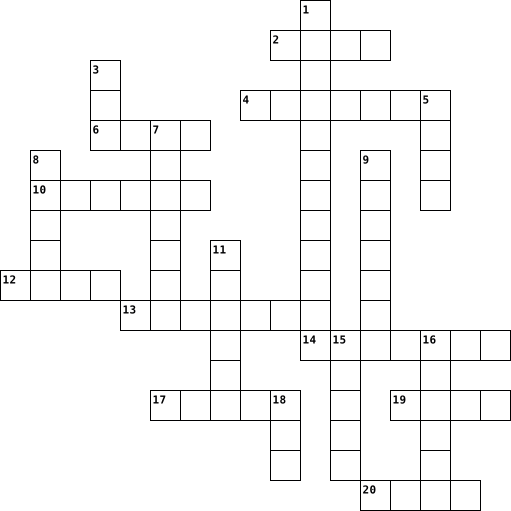
Outer-Space Crossword Puzzle: By Arjun 2022-08-16

Across
- The study of space
- large rocks that travel through space
- Life outside Earth
- Largest planet in our solar system
- Sent into space by humans
- A space explorer
- A planet with rings (in the solar system)
- A dwarf planet in our solar system (farthest away from the sun)
Down
- Famous space agency in the US
- Appears in the night sky when the sun is down
- Shines bright in the night sky
- Used to view space from earth
- The planet we live on
- You can see it during the day; provides heat and light
14 Clues: A space explorer • The study of space • Life outside Earth • The planet we live on • Sent into space by humans • Famous space agency in the US • Used to view space from earth • Shines bright in the night sky • Largest planet in our solar system • large rocks that travel through space • A planet with rings (in the solar system) • Appears in the night sky when the sun is down • ...
Nate space crossword 2020-11-04

Across
- the smallest super cluster
- The biggest super cluster
- the Scientific name of earths moon
- The scientific name for the sun
- the biggest dwarf planet in the solar system
- the sun's surface is ... million Degrees
Down
- the biggest planet in the solar system
- the approximate amount of other galaxies
- how many light years long is the universe
- the amount of light years long the largest super cluster is
- the largest star in the universe
- the smallest dwarf planet in the solar system
- earth has ... moon
- is Jupiter a failed star true or false
14 Clues: earth has ... moon • The biggest super cluster • the smallest super cluster • The scientific name for the sun • the largest star in the universe • the Scientific name of earths moon • the biggest planet in the solar system • is Jupiter a failed star true or false • the approximate amount of other galaxies • the sun's surface is ... million Degrees • ...
Happy Earth Day! 2021-04-07

Across
- Planet furthest from the sun
- Force that keeps a planet moving in orbit
- A star and the planets orbiting around it
- Planet closest to the sun
- Planet named after Roman goddess of love and war
- Layer of gas that surrounds a planet
Down
- Largest planet in our solar system
- Now called a dwarf planet
- Covers 70 percent of the Earth's surface
- Closest star to Earth
- Planet named after Roman god of agriculture
- Our solar system is part of this galaxy
- Third largest planet in our solar system
- Nicknamed "The Red Planet"
14 Clues: Closest star to Earth • Now called a dwarf planet • Planet closest to the sun • Nicknamed "The Red Planet" • Planet furthest from the sun • Largest planet in our solar system • Layer of gas that surrounds a planet • Our solar system is part of this galaxy • Covers 70 percent of the Earth's surface • Third largest planet in our solar system • ...
planets 2021-12-05

Across
- the planet farthest away from the sun
- the closest planet to the sun
- earths place in closeness to the sun
- the biggest planet in our solar system
- the coldest planet in our solar system
Down
- the 6th closest planet to the sun
- the biggest star in our solar system
- the smallest planet in our solar system
- the first man to walk on the moon
- the hottest planet in our solar system
10 Clues: the closest planet to the sun • the 6th closest planet to the sun • the first man to walk on the moon • the biggest star in our solar system • earths place in closeness to the sun • the planet farthest away from the sun • the hottest planet in our solar system • the biggest planet in our solar system • the coldest planet in our solar system • ...
Chapter 4 Gods Great Universe pg. 205-214 Edwin 6th Grade 2021-01-18

Across
- Copernicus
- Mercury
- planets
- System
- Earth
- Law
- Centered
- Moons
- Uranus
- Law of Universal Gravitación
Down
- Mars
- Sun
- Kepler
- Thrird law
- Sun Centered System
- Isaac Newton
- Asteroid Belt
- Foci
- Astronomical Unit
- Johannes Kepler
20 Clues: Sun • Law • Mars • Foci • Earth • Moons • Kepler • System • Uranus • Mercury • planets • Centered • Copernicus • Thrird law • Isaac Newton • Asteroid Belt • Johannes Kepler • Astronomical Unit • Sun Centered System • Law of Universal Gravitación
Science Vocab 2024-03-10

Across
- moon phase when the Moon looks like a little less than a full circle
- to separate into smaller parts or groups
- a number that you get when you add up a set of numbers and then divide by how many numbers there are in that set
- describes when there is not a lot of visible light; the opposite of bright
- the second planet from the Sun in our solar system
- circling another object, like the Earth around Sun
- an imaginary line that goes through the North Pole and South Pole of the Earth
- the sixth planet from the Sun in our solar system
- the fifth planet from the Sun in our solar system
- a large, round object in outer space that orbits the Sun
- moon moon phase when the Moon looks like a circle
- phase the part of the Moon that we can see on a particular night
- moon moon phase when the Moon looks like a sliver
- a group of stars in the night sky that form a pattern
- an image that helps you understand information
- describes when there is a lot of visible light; the opposite of dim
- moon moon phase when the Moon looks like half of a circle
- the eighth planet from Sun in the solar system
- something that happens again and again and again in a way that can be predicted
- the seventh planet from the Sun in our solar system
- one of four main directions; if you facing north, it is to the left
- the amount of matter an object has
Down
- a rocky object in outer space
- a push or a pull
- one of four main directions; if you are facing north, it is to the right
- the first planet from the Sun in our solar system
- an invisible force that pulls any object down, toward the center of a planet, moon or other object
- the amount of space between two things
- one of four main directions; if you are facing north, it is the direction behind you
- a large, round object in outer space that orbits a star
- the distance around a circle
- to add a number to itself a certain number of times
- a pretend version of something that scientists use when the real thing is too big, small, or complicated to work with
- a tool that tells time by using the changing direction of shadows caused by the Sun’s movement across the sky
- to spin or turn around a central point, like the Earth around its axis
- one of four main directions; when you face north, west is to the left and east is to the right
- the third planet from the Sun in our solar system
- a set of events that repeats in the same order over and over
- the fourth planet from the Sun in our solar system
- moon moon phase when the Moon looks completely dark
- a time of year with specific weather that repeats every year
41 Clues: a push or a pull • the distance around a circle • a rocky object in outer space • the amount of matter an object has • the amount of space between two things • to separate into smaller parts or groups • an image that helps you understand information • the eighth planet from Sun in the solar system • the first planet from the Sun in our solar system • ...
The planets 2025-03-12

Across
- the red planet
- sixth planet of solar system
- our planet
- second planet of solar system
Down
- first planet of solar system
- seventh planet od solar system
- fifth planet of solar system
- last blue planet
8 Clues: our planet • the red planet • last blue planet • first planet of solar system • fifth planet of solar system • sixth planet of solar system • seventh planet od solar system • second planet of solar system
Vanda2 M3A 2021-03-03

Across
- A planet that have the ring around it
- Earth’s companion
- The largest planet in the solar system
- The hottest planet in the solar system
- The smallest planet in the solar system
- This planet can float on water
Down
- The sun and their 8 planets that revolves around it
- The planet that human exist in
- The only star in the solar system
- A big light blue planet made out of gas that spin on its side
- This planet’s color is due to iron oxide in the soil
- A dwarf planet occupying an orbit that crosses the orbit of Neptune
12 Clues: Earth’s companion • The planet that human exist in • This planet can float on water • The only star in the solar system • A planet that have the ring around it • The largest planet in the solar system • The hottest planet in the solar system • The smallest planet in the solar system • The sun and their 8 planets that revolves around it • ...
space crossword easy 2026-02-20

Across
- how many planets are there in our solar system
- what was the first country in space
- what was the dogs name?
- what is the closest planet to the sun
- what is the biggest space company in the world
- what is the biggest planet in our solar system
Down
- what is the smallest planet in our solar system
- who was the first man in space
- which planet is known as the red planet
- what is the hottest planet in our solar system
- what was the first animal in space
- this planet is known for its rings
- what is te closest planet to earth
13 Clues: what was the dogs name? • who was the first man in space • what was the first animal in space • this planet is known for its rings • what is te closest planet to earth • what was the first country in space • what is the closest planet to the sun • which planet is known as the red planet • how many planets are there in our solar system • ...
planets 2021-12-05

Across
- the planet farthest away from the sun
- the closest planet to the sun
- earths place in closeness to the sun
- the biggest planet in our solar system
- the coldest planet in our solar system
Down
- the 6th closest planet to the sun
- the biggest star in our solar system
- the smallest planet in our solar system
- the first man to walk on the moon
- the hottest planet in our solar system
10 Clues: the closest planet to the sun • the 6th closest planet to the sun • the first man to walk on the moon • the biggest star in our solar system • earths place in closeness to the sun • the planet farthest away from the sun • the hottest planet in our solar system • the biggest planet in our solar system • the coldest planet in our solar system • ...
Space and Gravity 2023-01-06

Across
- Closest planet to the Sun
- A famous scientist that first began discussing gravity
- Gravity is affected by this main factor
- Has the biggest rings in our solar system
Down
- The planet we live on
- Strongest gravitational force by a planet in our solar system
- Is measured on how much matter the object is made of
- A force that pulls objects towards each other
- The hottest planet in our solar system
- Is measured on how much gravitational pull on that object
- All the planets in our solar system orbits around this thing
11 Clues: The planet we live on • Closest planet to the Sun • The hottest planet in our solar system • Gravity is affected by this main factor • Has the biggest rings in our solar system • A force that pulls objects towards each other • Is measured on how much matter the object is made of • A famous scientist that first began discussing gravity • ...
Our solar system 2022-12-29

Across
- Largest planet in our solar system.
- Planet named after the roman god of agriculture.
- Covers 70 percent of the Earth’s surface.
- Layer of gas that surrounds a planet.
- A star and the planets orbiting around it.
- Force that keeps a planet moving in orbit
Down
- Our solar system is part of this galaxy.
- Closest star to Earth.
- Planet furthest from the sun.
- Third largest planet in our solar system.
- Nicknamed “the red planet”
- Now called a dwarf planet.
- Planet closest to the sun.
- Planet named after the Roman goddess of love and beauty.
14 Clues: Closest star to Earth. • Nicknamed “the red planet” • Now called a dwarf planet. • Planet closest to the sun. • Planet furthest from the sun. • Largest planet in our solar system. • Layer of gas that surrounds a planet. • Our solar system is part of this galaxy. • Third largest planet in our solar system. • Covers 70 percent of the Earth’s surface. • ...
Solar System 2025-10-18

Across
- The name of the tallest volcano in the solar system
- The name of the star that all planets in our system orbit
- The farthest planet from the Sun
- The hottest planet in the solar system
- Closest planet to the Sun
- The planet that has a storm so big even Earth can fit inside of it
Down
- The planet with the largest rings in our solar system
- The second planet in the solar system to have rings, which is not Saturn!
- The only moon in the solar system with an atmosphere and bodies of water
- A moon that is named after a continent and has a frozen ocean
10 Clues: Closest planet to the Sun • The farthest planet from the Sun • The hottest planet in the solar system • The name of the tallest volcano in the solar system • The planet with the largest rings in our solar system • The name of the star that all planets in our system orbit • A moon that is named after a continent and has a frozen ocean • ...
The Solar System 2014-03-24

Across
- This planet has such a dense, dangerous atmosphere that is makes it hard for us to see any surface features.
- The area near the sun where life can exist.
- A huge hurricane that has been raging for centuries on Jupiter.
- Planets that are gaseous in composition.
- The largest volcano on Mars
- This planet's atmosphere is mostly methane which gives is a blue appearance.
- The planet has the lowest density, even given its large size.
- Planets that are rocky in composition.
Down
- This planet appears to be rotating on its side because its axis is tilted parallel to its orbital plane.
- Spacecraft that left earth in 1977 to explore the outer planets.
- This planet has the most moons revolving around it.
- The trapping of solar radiation due to gas.
- The spacecraft launched in 1997 whose mission was to explore Saturn.
- This planet appears to have one side always facing the sun.
- The scientist who discovered Uranus in 1781.
- This planet has surface features that suggest that water once existed.
- Third planet from the sun.
17 Clues: Third planet from the sun. • The largest volcano on Mars • Planets that are rocky in composition. • Planets that are gaseous in composition. • The area near the sun where life can exist. • The trapping of solar radiation due to gas. • The scientist who discovered Uranus in 1781. • This planet has the most moons revolving around it. • ...
Solar System Formation 2017-11-17

Across
- Smaller bodies collide and stick together, forming larger bodies in a process called _______.
- ______% of the material in the solar nebula became the sun.
- process in which objects are broken apart
- When a nebula reaches a certain size and mass, it is more likely to ___________.
- the direction of rotation & revolution for most objects in the solar system
- the large shock wave sent out when the sun began nuclear fusion
- small rocky material ended up here
- Anything that has _______ has gravity.
- A planetesimal becomes a __________ when it has swept its orbit clean.
Down
- the force that holds massive objects/systems together
- a process in which particles come out of the gas phase and form small pieces of solid or liquid
- objects in the Kuiper Belt are mostly made of this
- "little planets"
- The _____________ of an object largely determined where it ended up in the solar system.
- anytime two or more objects hit each other
- the nebula became a _______ when it started to collapse and spin
- a large cloud of gas and dust in space
17 Clues: "little planets" • small rocky material ended up here • a large cloud of gas and dust in space • Anything that has _______ has gravity. • process in which objects are broken apart • anytime two or more objects hit each other • objects in the Kuiper Belt are mostly made of this • the force that holds massive objects/systems together • ...
Solar System Bodies 2025-04-18

Across
- Event that possibly brought the essential amino acids for life on Earth
- Object that burns up in Earth's atmosphere
- Meteor after colliding with Earth's surface
- Objects past Neptune
- A comet that orbits the Sun every 76 years
- When numerous meteors enter Earth's atmosphere
- Collection of objects and debris located 50000 AU from the Sun
Down
- What Pluto, Makemake, and Ceres are
- Comets have a dust and gas one
- Collection of objects located between Mars and Jupiter
- Most famous dwarf planet that was once classified as a planet
- Collection of early solar system debris located past Neptune
- Meteor before entering Earth's atmosphere
- Center of a comet
- Located in a belt between Mars and Jupiter
- Most visible part of a comet
- "Dirty snowball"
17 Clues: "Dirty snowball" • Center of a comet • Objects past Neptune • Most visible part of a comet • Comets have a dust and gas one • What Pluto, Makemake, and Ceres are • Meteor before entering Earth's atmosphere • Object that burns up in Earth's atmosphere • Located in a belt between Mars and Jupiter • A comet that orbits the Sun every 76 years • ...
PLANET PUZZLE 2024-04-10

Across
- I'm the red planet
- I'm the second planet from the sun
- I'm the BIGGEST planet in the solar system
- I'm the last planet in the solar system
- I'm where we live!
- I'm the largest star in the solar system, all the planets float around me
Down
- I'm the rock floating around the Earth
- I have a lot of rings
- I'm an ice giant second farthest from the end of the solar system
- I'm not really a planet, I'm a dwarf planet
- I'm the closest planet to the sun
11 Clues: I'm the red planet • I'm where we live! • I have a lot of rings • I'm the closest planet to the sun • I'm the second planet from the sun • I'm the rock floating around the Earth • I'm the last planet in the solar system • I'm the BIGGEST planet in the solar system • I'm not really a planet, I'm a dwarf planet • ...
Science Review 2025-09-25

Across
- Blocking of light
- the direction your shadow faces when it is the shortest
- the only star in our solar system
- The Red planet
- The planet closest to the Sun
- a dwarf planet that used to be the ninth planet
- Earth orbiting the Sun
- the gravity on the moon causes this on Earth
Down
- The direction objects in motion want to travel
- the group of asteroids between Mars and Jupiter
- the time of day your shadow is the shortest
- the hottest planet in our solar system
- the force that keeps Earth orbiting the Sun
- The planet most famous for having rings
- The largest planet in our solar system
- the invisible line from the North to the South Pole
16 Clues: The Red planet • Blocking of light • Earth orbiting the Sun • The planet closest to the Sun • the only star in our solar system • the hottest planet in our solar system • The largest planet in our solar system • The planet most famous for having rings • the time of day your shadow is the shortest • the force that keeps Earth orbiting the Sun • ...
Earth Science 2026-05-18

Across
- Celestial body located at the center of our solar system
- All living things on Earth
- Celestial body that orbits a planet
- Rock made from the cooling of magma or lava
- This planet is known for its rings
- All the water on Earth
- Mission that launched April 1,2026
- Any falling water in the form of rain, snow or hail
Down
- Largest planet in our solar system
- Massive wave a water normally caused by an Earthquake
- Hottest planet in our solar system
- Celestial body that orbits the sun and has cleared its orbital path
- Number of astronauts on the Artemis 2 mission
- All the gases that surround Earth
- Solid part of the Earth
- A massive explosion of a star
16 Clues: All the water on Earth • Solid part of the Earth • All living things on Earth • A massive explosion of a star • All the gases that surround Earth • Largest planet in our solar system • Hottest planet in our solar system • This planet is known for its rings • Mission that launched April 1,2026 • Celestial body that orbits a planet • Rock made from the cooling of magma or lava • ...
The Geocentric Model 2021-12-15

Across
- Largest planet in the Solar System
- Earth at the center of the Universe
- Meaning 'wanderer' in Greek
- a small circle whose center moves around the circumference of a larger one
- Orbiting the Earth
- situation that is observed to exist or happen
- Smallest planet in the solar system
- The Red Planet
Down
- Geometric shape resembling a ball
- A backward motion
- Second planet from the Sun
- Person who thought material world consisted of four elements (earth, water, air and fire).
- relating to the Greek astronomer Ptolemy
- The star at the center of our Solar System
- the large circular orbit followed by the center of the small epicycle in which a planet was thought to move.
- Direction or Rotation that is counterclockwise
16 Clues: The Red Planet • A backward motion • Orbiting the Earth • Second planet from the Sun • Meaning 'wanderer' in Greek • Geometric shape resembling a ball • Largest planet in the Solar System • Earth at the center of the Universe • Smallest planet in the solar system • relating to the Greek astronomer Ptolemy • The star at the center of our Solar System • ...
Beyond earth 2026-02-17

Across
- The brightest star in the night sky.
- The star that shows North direction.
- The faint band of light seen across the night sky.
- Small rocky bodies mostly found between Mars and Jupiter.
- The largest planet in the Solar System.
- A device used to see distant objects in space.
- Earth’s natural satellite.
- The movement of Earth on its axis.
- The brightest planet seen at dawn or dusk.
Down
- The little dipper contains this star.
- Objects with long tails that appear near the Sun.
- The movement of Earth around the Sun.
- A group of seven stars known in India as Saptarishi.
- Major The constellation that contains Sirius.
- A large object that revolves around the Sun.
- The star at the centre of our Solar System.
- The hunter-shaped constellation.
- The hottest planet in the Solar System.
18 Clues: Earth’s natural satellite. • The hunter-shaped constellation. • The movement of Earth on its axis. • The brightest star in the night sky. • The star that shows North direction. • The little dipper contains this star. • The movement of Earth around the Sun. • The largest planet in the Solar System. • The hottest planet in the Solar System. • ...
Space 2023-01-31

Across
- The location of most asteroids in our solar system.
- The unit used to measure distances in space.
- The name of the galaxy we live in.
- The star that all planets in out solar system orbit.
- The spinning of the earth on its axis.
- Another word for revolution.
Down
- The movement of one object around another object.
- The planets closest to the sun that are rocky.
- The large planets furthest from the sun.
- The largest planet in our Solar System.
- The smallest planet in our Solar System.
11 Clues: Another word for revolution. • The name of the galaxy we live in. • The spinning of the earth on its axis. • The largest planet in our Solar System. • The large planets furthest from the sun. • The smallest planet in our Solar System. • The unit used to measure distances in space. • The planets closest to the sun that are rocky. • ...
46 2023-06-06

Across
- - Dwarf planet located in the asteroid belt between Mars and Jupiter
- - Sixth planet from the Sun, known for its prominent ring system
- - Dwarf planet in the outer regions of the Solar System, also in the Kuiper Belt
- - Dwarf planet located beyond Neptune in the Kuiper Belt
- - Seventh planet from the Sun, characterized by its tilted axis of rotation
- - Fifth planet from the Sun, the largest planet in our solar system
Down
- - Dwarf planet located in the scattered disc region of the Solar System
- - Eighth planet from the Sun, the farthest known planet in our solar system
- - Third planet from the Sun, home to diverse life forms including humans
- - Second planet from the Sun, known for its thick atmosphere and bright appearance
- - Fourth planet from the Sun, often referred to as the "Red Planet"
- - Closest planet to the Sun, named after the Roman messenger god
- - Second-largest asteroid in the asteroid belt, also considered a protoplanet
- - Former ninth planet from the Sun, now considered a dwarf planet
14 Clues: - Dwarf planet located beyond Neptune in the Kuiper Belt • - Sixth planet from the Sun, known for its prominent ring system • - Closest planet to the Sun, named after the Roman messenger god • - Former ninth planet from the Sun, now considered a dwarf planet • - Fourth planet from the Sun, often referred to as the "Red Planet" • ...
Space Exploration 2024-02-23

Across
- Eighth and farthest planet from the Sun in our solar system?
- Former ninth planet from the Sun, reclassified as a dwarf planet in 2006?
- Fourth planet from the Sun, often referred to as the "Red Planet"?
- Region of space with gravitational pull so strong that nothing, not even light, can escape?
- Star at the center of our solar system, providing light and heat to planets?
- Second planet from the Sun, often called Earth's "sister planet"?
- Person trained to travel and work in space, often aboard spacecraft or space stations?
Down
- Earth's only natural satellite, responsible for ocean tides and lunar phases?
- Largest planet in our solar system, known for its giant storm called the Great Red Spot?
- Sixth planet from the Sun, famous for its spectacular ring system?
- Closest planet to the Sun in our solar system?
- Third planet from the Sun and the only known planet to support life?
- Seventh planet from the Sun, known for its unique sideways rotation?
- Vast system of stars, gas, dust, and dark matter held together by gravity?
- Celestial object made of ice, dust, and gas that orbits the Sun in a highly elliptical orbit?
15 Clues: Closest planet to the Sun in our solar system? • Eighth and farthest planet from the Sun in our solar system? • Second planet from the Sun, often called Earth's "sister planet"? • Sixth planet from the Sun, famous for its spectacular ring system? • Fourth planet from the Sun, often referred to as the "Red Planet"? • ...
Facts About The Solar System 2025-01-30

Across
- ___ Hole A dying star that has collapsed into a dense object with strong gravity.
- ___ Way The galaxy that contains our Solar System.
- The name for a natural or artificial body in space that orbits a planet.
- A path that a celestial body follows as it orbits another body.
- The hottest planet in our Solar System.
- The largest planet in our Solar System.
- A system of millions or billions of stars held together by gravity.
- This planet is known as the “Red Planet.”
Down
- ___ Belt A rocky body that orbits the Sun, mostly found between Mars and Jupiter.
- ___ Belt The region of space beyond Neptune, believed to contain icy bodies.
- The second-largest planet, known for its rings.
- ___ Eclipse This phenomenon occurs when the Moon blocks the Sun’s light.
- A celestial body that orbits a planet.
- The closest star to Earth.
14 Clues: The closest star to Earth. • A celestial body that orbits a planet. • The hottest planet in our Solar System. • The largest planet in our Solar System. • This planet is known as the “Red Planet.” • The second-largest planet, known for its rings. • ___ Way The galaxy that contains our Solar System. • A path that a celestial body follows as it orbits another body. • ...
space 2018-06-04

Across
- the closest planet to the Sun.
- a mass of rock that moves around in space.
- second largest planet in our solar system.
- a spiral galaxy where our Solar System and Earth are located.
- second closest planet to the Sun.
- a shooting star.
- eighth planet from the Sun.
- the planet on which we live.
Down
- largest planet in our solar system.
- an object that goes round another planet.
- a person who is specially trained to travel into outer space.
- an area so strong that light and everything else around it is pulled into it
- small bright light in the sky at night.
- a very small star that does not shine brightly.
- object that moves around the Sun.
- or the 'Red Planet'.
16 Clues: a shooting star. • or the 'Red Planet'. • eighth planet from the Sun. • the planet on which we live. • the closest planet to the Sun. • second closest planet to the Sun. • object that moves around the Sun. • largest planet in our solar system. • small bright light in the sky at night. • an object that goes round another planet. • a mass of rock that moves around in space. • ...
The Solar System 2021-01-14

Across
- The closest planet to the sun.
- Our sun is this type of star.
- The path a planet takes around the sun.
- This was changed to a dwarf planet in 2006.
- The farthest planet from the sun in our solar system.
- The hottest planet in our solar system.
- A body of ice, dust, and bits of rock that passes through space, leaving a tail behind it.
- The four planets farthest from the sun are classified as this type of planet.
Down
- The force that holds us on the ground. It also keeps planets in their orbit around the sun.
- / The star at the center of our solar system.
- The length of time it takes a planet to orbit the sun.
- This "belt" is an area of space beyond the orbit of Neptune where a group of minor planets and other objects orbit the sun.
- The four planets closest to the sun are this type of planet.
- A smaller object orbiting a planet.
- The largest planet in our solar system.
15 Clues: Our sun is this type of star. • The closest planet to the sun. • A smaller object orbiting a planet. • The largest planet in our solar system. • The path a planet takes around the sun. • The hottest planet in our solar system. • This was changed to a dwarf planet in 2006. • / The star at the center of our solar system. • ...
The Solar System & Normal and Active Galaxies 2023-06-13

Across
- The only dwarf planet in the Solar System.
- The process of a star collapsing under its own gravity, leading to an extremely dense object.
- A cloud of gas and dust in space from which stars are formed.
- The spiral galaxy in which our Solar System resides.
- The region of space around a black hole from which nothing can escape.
- The scientific study of the universe beyond the Earth's atmosphere.
- The hottest planet in the Solar System.
- The star at the center of our Solar System.
- The name of the mission that landed the first humans on the Moon.
Down
- The phenomenon in which a star explodes, briefly outshining an entire galaxy.
- The largest moon of Neptune.
- A massive celestial object that emits a large amount of energy.
- The region between Mars and Jupiter where numerous asteroids are found.
- The galaxy that is the largest member of the Local Group.
- The planet known for its iconic rings.
15 Clues: The largest moon of Neptune. • The planet known for its iconic rings. • The hottest planet in the Solar System. • The only dwarf planet in the Solar System. • The star at the center of our Solar System. • The spiral galaxy in which our Solar System resides. • The galaxy that is the largest member of the Local Group. • ...
Formation of the Solar System Grade 8 2025-10-06

Across
- Jupiter, Saturn, Neptune, and Uranus are all composed of ____.
- The is the smallest planet in the solar system, with a very thin atmosphere.
- This section of the sun spins the fastest.
- A flaten ________ disk began to spin with hotter matter near the center.
- This is the hottest planet due to its' thick atmosphere.
- A giant cloud of gas and dust in space is called a _____.
- The Spinning in space is due to this.
- The first four planets are Terrestrial planets, or with a ______ surface.
- Nuclear _______ is the process that powers the Sun
Down
- This model has thes sun in the center of the solar system.
- This model has the Earth in the center of the Solar System.
- This planet is known for its Giant red spot that is believed to be a hurricane.
- The orbits of the solar system are shaped like an _______ NOT A CIRCLE.
- This planet is known for its rocky rings that go around the planet.
- First there was a giant cloud of gas and ______.
15 Clues: The Spinning in space is due to this. • This section of the sun spins the fastest. • First there was a giant cloud of gas and ______. • Nuclear _______ is the process that powers the Sun • This is the hottest planet due to its' thick atmosphere. • A giant cloud of gas and dust in space is called a _____. • This model has thes sun in the center of the solar system. • ...
ASTRONOMY 2026-02-09

Across
- sundial
- earth is the center of the solar system
- when the moon covers the Earth
- suggest the moons shines by reflected sunlight
- argued for stationary spherical earth
- action of moving
- sun is the center of the solar system
Down
- velocity changes time
- tendency of an object to resist motion
- an event where celestial body aligned
- when the Earth's shadow the moon
- calculated the earths circumference
- planet with rings
- a push or pull
14 Clues: sundial • a push or pull • action of moving • planet with rings • velocity changes time • when the moon covers the Earth • when the Earth's shadow the moon • calculated the earths circumference • an event where celestial body aligned • argued for stationary spherical earth • sun is the center of the solar system • tendency of an object to resist motion • ...
Alternative Energy Crossword 2013-04-09

Across
- Solar Systems-direct gain, indirect gain, and isolated gain
- system modules that convert sunlight into electricity and store energy until needed
- or does not have factory matched components
- geothermal systems-these systems generally use ground sources and return the processed water as surface water.
- energy
- abandoned-a tower installed for a small wind energy conversion
- thermal power-consists of multiple solar modules
- mast, pole, monopole, guyed tower, lattice tower or freestanding tower, or other structure designed and used to support a small wind energy conversion system
- any zone district, provided they generate less than 40 kW
Down
- and field-means a fuel cell power system that is no
- systems- include but are not limited to outdoor wood burning furnaces, corn burning stoves, wood and wood pellet or other pelletized fuels suitable for residential use.
- that has been unused for this purpose for a period of one year.
- chemical energy of reactants
- cell power system-by an electrochemical process to electric
- Systems-use solar panels to convert sunlight into electricity.
- energy sources and systems
- Fuel Cells-Hydrogen fuel cells for home or business use shall be permitted
- turbines-small turbinedriven generators having a rated capacity of 100 kW or less, powered by a variety of fuels to produce electricity with a byproduct of hot
18 Clues: energy • energy sources and systems • chemical energy of reactants • or does not have factory matched components • thermal power-consists of multiple solar modules • and field-means a fuel cell power system that is no • any zone district, provided they generate less than 40 kW • Solar Systems-direct gain, indirect gain, and isolated gain • ...
Space 2021-09-03

Across
- is the smallest planet in the Solar System and the closest to the Sun. Its orbit around the Sun takes 87.97 Earth days, the shortest of all the Sun's planets.
- is the sixth planet from the Sun and the second-largest in the Solar System, after Jupiter. It is a gas giant with an average radius of about nine and a half times that of Earth. It only has one-eighth the average density of Earth; however, with its larger volume, Saturn is over 95 times more massive.
- is a modular space station in low Earth orbit. It is a multinational collaborative project involving five participating space agencies: NASA, Roscosmos, JAXA, ESA, and CSA.
- is Earth's only natural satellite. At about one-quarter the diameter of Earth, it is the largest natural satellite in the Solar System relative to the size of its planet, the fifth largest satellite in the Solar System overall, and is larger than any known dwarf planet.
- is the seventh planet from the Sun. Its name is a reference to the Greek god of the sky, Uranus, who, according to Greek mythology, was the great-grandfather of Ares, grandfather of Zeus and father of Cronus. It has the third-largest planetary radius and fourth-largest planetary mass in the Solar System.
- is the gravitationally bound system of the Sun and the objects that orbit it, either directly or indirectly. Of the objects that orbit the Sun directly, the largest are the eight planets, with the remainder being smaller objects, the dwarf planets and small Solar System bodies.
- is a person trained, equipped, and deployed by a human spaceflight program to serve as a commander or crew member aboard a spacecraft.
Down
- is the European Space Agency's ground based observatory at the Teide Observatory on Tenerife, Spain, built for the observation of space debris. OGS is part of the Artemis experiment and is operated by the IAC and Ataman Science S.L.U.
- is the innermost geologic layer of the planet Earth. It is primarily a solid ball with a radius of about 1,220 km, which is about 20% of Earth's radius or 70% of the Moon's radius. There are no samples of Earth's core accessible for direct measurement, as there are for Earth's mantle
- is the fifth planet from the Sun and the largest in the Solar System. It is a gas giant with a mass more than two and a half times that of all the other planets in the Solar System combined, but slightly less than one-thousandth the mass of the Sun.
- is a robotic space probe mission to Mars launched by NASA on November 26, 2011, which successfully landed Curiosity, a Mars rover, in Gale Crater on August 6, 2012.
- is the second planet from the Sun. It is named after the Roman goddess of love and beauty. As the brightest natural object in Earth's night sky after the Moon, Venus can cast shadows and can be, on rare occasions, visible to the naked eye in broad daylight.
- is the third planet from the Sun and the only astronomical object known to harbor and support life. About 29.2% of Earth's surface is land consisting of continents and islands. And the planet we live in
- was a partially reusable low Earth orbital spacecraft system operated from 1981 to 2011 by the U.S. National Aeronautics and Space Administration as part of the Space Shuttle program.
- is the star at the center of the Solar System. It is a nearly perfect sphere of hot plasma, heated to incandescence by nuclear fusion reactions in its core, radiating the energy mainly as visible light, ultraviolet light, and infrared radiation.
- is an object that has been intentionally placed into orbit. These objects are called artificial satellites to distinguish them from natural satellites such as Earth's Moon. On 4 October 1957, the Soviet Union launched the world's first artificial satellite, Sputnik 1.
- is a dwarf planet in the Kuiper belt, a ring of bodies beyond the orbit of Neptune. It was the first and the largest Kuiper belt object to be discovered. After Pluto was discovered in 1930, it was declared to be the ninth planet from the Sun.
- is the eighth and farthest known Solar planet from the Sun. In the Solar System, it is the fourth-largest planet by diameter, the third-most-massive planet, and the densest giant planet. It is 17 times the mass of Earth, slightly more massive than its near-twin Uranus.
18 Clues: is a person trained, equipped, and deployed by a human spaceflight program to serve as a commander or crew member aboard a spacecraft. • is the smallest planet in the Solar System and the closest to the Sun. Its orbit around the Sun takes 87.97 Earth days, the shortest of all the Sun's planets. • ...
Space and the Planets 2015-04-11

Across
- This is by far the largest object in the solar system. The _______.
- The third planet from the Sun.
- NASA launches their space shuttles from here.
- The brightest star in Earth's night sky.
- The first man to walk on the moon. Neil ____________.
- Ten, nine, eight, seven, six, five, four, three, two, one....
- Which planet is the hottest in our solar system.
Down
- This planet is sometimes referred to as a 'dwarf' planet.
- This planet is so massive that, by itself, it accounts for more than 70% of the mass of all the planets in the solar system. It is the largest planet.
- The huge system of stars that contains our solar system. The ________ Way Galaxy.
- Which planet is sometimes referred to as the "Red Planet"?
- These are in orbit around the Earth to collect information or for communication.
- The sun is the brightest object in the sky. The second brightest object is the _____________.
- This planet is easily identified by its rings.
14 Clues: The third planet from the Sun. • The brightest star in Earth's night sky. • NASA launches their space shuttles from here. • This planet is easily identified by its rings. • Which planet is the hottest in our solar system. • The first man to walk on the moon. Neil ____________. • This planet is sometimes referred to as a 'dwarf' planet. • ...
Cosmos Crossword 2021-09-08

Across
- Our planet
- An alien spaceship
- It can be solar or lunar
- An object in orbit around a planet
- Closest planet to the Sun
- A person who travels into space
- The first black woman to travel into space
- The telescope launched into space in 1990
- The red planet
Down
- First dog in space
- Largest planet in our solar system
- Our galaxy
- A hole in space-time from which nothing can escape
- An attractive force
- The star at the centre of our solar system
- A cloud of dust and gas in space
16 Clues: Our planet • Our galaxy • The red planet • First dog in space • An alien spaceship • An attractive force • It can be solar or lunar • Closest planet to the Sun • A person who travels into space • A cloud of dust and gas in space • Largest planet in our solar system • An object in orbit around a planet • The telescope launched into space in 1990 • ...
Space 2026-02-25

Across
- closest planet to the sun
- the home of l…
- in a orbit position around earth's gravity
- biggest planet
- the … planet
Down
- … planet in the solar system
- made out of hydrogen and…
- 2 cd … planet in the solar system
- hottest planet in the solar system
- used to be a planet
- the planet that spins sideways
11 Clues: the … planet • the home of l… • biggest planet • used to be a planet • made out of hydrogen and… • closest planet to the sun • … planet in the solar system • the planet that spins sideways • 2 cd … planet in the solar system • hottest planet in the solar system • in a orbit position around earth's gravity
Crossword 2021-05-17

Across
- is the second smallest planet and people are trying to make it livable
- Planets, Earth-like planets made up of rocks or metals with a hard surface
- planets, are Mercury, Venus, Earth and Mars in the order from the sun
- is the hottest planet
- the largest planet in solar system and is made up of mostly gas
- planets, the four planets on the other side of the asteroid belt(Jupiter, Saturn, Uranus, Neptune)
- giants, are planets that are composed mainly of hydrogen and helium
- is the smallest planet in the solar system
- are chunks of rock and ice that never clumped together to form a planet
Down
- is almost at a 90 degree axis
- belt, is a torus-shaped region in the Solar System, located roughly between the orbits of the planets Jupiter and Mars
- the only planet in the solar system that has life on it
- is named after the greek god Poseidon
- are mixtures of rock, ice and dust
- is the second biggest planet behind Jupiter
15 Clues: is the hottest planet • is almost at a 90 degree axis • are mixtures of rock, ice and dust • is named after the greek god Poseidon • is the smallest planet in the solar system • is the second biggest planet behind Jupiter • the only planet in the solar system that has life on it • the largest planet in solar system and is made up of mostly gas • ...
Solar System Puzzle 2025-07-17

Across
- Term for the burning light streak across the sky
- Larger fragment of a meteor that survives impact with Earth
- A dust tail of a comet always points in this direction relative to the Sun
- A small, icy body that grows a tail when near the Sun
- Chunk of rock or metal that orbits the Sun, smaller than an asteroid
- This force shapes the orbits of comets and asteroids
- Bright trail seen when a meteoroid burns up in Earth's atmosphere
- Small rocky bodies that sometimes fall to Earth
Down
- Missions that study small solar system bodies up close
- The area of the solar system beyond Neptune full of icy bodies
- Where most asteroids are located
- Leftover frozen material found in the outer solar system
- Rocky object smaller than a planet, mostly found between Mars and Jupiter
- Famous comet that appears every 76 years
- Cloud The cloud theorized to surround the solar system with icy objects
15 Clues: Where most asteroids are located • Famous comet that appears every 76 years • Small rocky bodies that sometimes fall to Earth • Term for the burning light streak across the sky • This force shapes the orbits of comets and asteroids • A small, icy body that grows a tail when near the Sun • Missions that study small solar system bodies up close • ...
Vocab choice 5 2022-02-16

Across
- Moon a moon phase where the Moon is not visible from the Earth
- Moon a moon phase that looks like more than a half circle from Earth
- the nearly circular path a smaller object (like the Moon) travels around a larger object like Earth)
- System the sun, the planets that orbit the sun, and other objects that orbit the sun
- Eclipse when the moon is completely dark
- a moon outside our solar system
- a rocky sphere that travels around a planet
- Eclipse The moment that the moon orbits directly between the sun and the Earth
- the star that is the main source of light at the center of our solar system
- a planet outside our solar system
- Pull the force that pulls two objects together due to their mass
Down
- something we observe to be similar over and over again
- a collection of gas, dust, stars, and solar systems that are held together by gravity
- Phase the shape of the illuminated part of the Moon as it appears from Earth
- Moon a moon phase that looks like a full circle from Earth
- the relative size of things
- Moon a moon phase that looks like less than half a circle from Earth
- the circular movement of an object around its center (like a top spinning)
- to shine light on an object and make it visible
- Moon a moon phase that looks like half a circle from Earth
- the four parts of the year where weather, ecology, and number of daylight hours change as a result of Earth’s orbit around the sun
- the tendency of an object to remain at rest or unchanged
- the force by which all things with mass or energy (including planets, stars, galaxies, and light) are brought towards one another
23 Clues: the relative size of things • a moon outside our solar system • a planet outside our solar system • Eclipse when the moon is completely dark • a rocky sphere that travels around a planet • to shine light on an object and make it visible • something we observe to be similar over and over again • the tendency of an object to remain at rest or unchanged • ...
Origin of the Universe 2024-01-19

Across
- The point nearest Earth's center in the orbit of the Moon or an artificial satellite
- Earth period of time extending from about 4.6 billion years ago
- a regular oval shape
- a huge collection of gas, dust, and billions of stars and their solar systems
- the slow change in the direction of Earth's rotational axis.
- Eclipse happens when the Moon passes between the Sun and Earth, casting a shadow on Earth that either fully or partially blocks the Sun's light in some areas
- The motion of an object around a point, especially around another object or a center of mass
- having or representing the earth as the center, as in former astronomical systems.
Down
- The point farthest from Earth's center in the orbit of the Moon or an artificial satellite.
- that the universe began as just a single point, then expanded and stretched to grow as large as it is right now—and it is still stretching!
- having or representing the sun as the center, as in the accepted astronomical model of the solar system.
- the branch of science that deals with celestial objects, space, and the physical universe as a whole
- of the Moon
- Hypothesis idea that a spinning cloud of dust made of mostly light elements, called a nebula, flattened into a protoplanetary disk, and became a solar system consisting of a star with orbiting planets
- the action of rotating around an axis or center.
- rocky, airless remnants left over from the early formation of our solar system about 4.6 billion years ago
- frozen leftovers from the formation of the solar system composed of dust, rock, and ices
- Eclipse occurs when the Sun, Earth, and Moon align so that the Moon passes into Earth's shadow
- Waves a mechanical wave of acoustic energy that travels through the Earth or another planetary body
- he curved path of a celestial object or spacecraft around a star, planet, or moon,
20 Clues: of the Moon • a regular oval shape • the action of rotating around an axis or center. • the slow change in the direction of Earth's rotational axis. • Earth period of time extending from about 4.6 billion years ago • a huge collection of gas, dust, and billions of stars and their solar systems • ...
Space Crossword! 2012-11-13

Across
- Some are natural, maybe even moons?
- An organization that find out all about space
- We used this to get to the moon in '69
- Flying objects that aren't dentified
- Star Some people make wishes on them
- Some creature out of this world
- Something heading to Earth, but leaves a mark
- A big ball of gas and fire! Keeps us alive
- We have a big one in the centre of our Solar System
- A big dusty tail and look awesome at night,very old
Down
- The biggest planet in our Solar System
- Asteroids between Mars and Jupiter
- Something heading to Earth burning
- Spots on the sun that isn't good for communications
- Earth has one.. Saturn has 60
- We have 8 in our Solar system
- Big rocks that have a famous "belt"
- A big part of the whole world, some say it never ends
- Nova A Nova, nope! But bigger
- A planet with 7 billion living organisms
20 Clues: Earth has one.. Saturn has 60 • We have 8 in our Solar system • Nova A Nova, nope! But bigger • Some creature out of this world • Asteroids between Mars and Jupiter • Something heading to Earth burning • Some are natural, maybe even moons? • Big rocks that have a famous "belt" • Flying objects that aren't dentified • Star Some people make wishes on them • ...
Earth and Space 2014-10-24

Across
- No longer classed as a planet, I am now a Dwarf Planet.
- Earth has one _ _ _ _. Mars has two.
- I take 165 years to orbit the sun
- I am known as the red planet.
- Our planet.
- The planets _ _ _ _ _ around the sun.
- I am the closest planet to the sun.
- I discovered that there were four moons orbiting Jupiter.
- Saturn has these.
- I am a planet known for my rings.
- The Earth orbits around the _ _ _.
Down
- NASA describes me as a ‘cosmic snowball’.
- There are eight _ _ _ _ _ _ _ in our solar system.
- I am the largest planet in the solar system.
- I am more commonly known as a ‘shooting star’
- You would see millions of these in the sky at night.
- I was the first planet to be discovered by a telescope in 1781.
- The galaxy that contains our solar system.
- I am 108,200,000km away from the sun.
- I am an American organisation that deals with all things space.
20 Clues: Our planet. • Saturn has these. • I am known as the red planet. • I take 165 years to orbit the sun • I am a planet known for my rings. • The Earth orbits around the _ _ _. • I am the closest planet to the sun. • Earth has one _ _ _ _. Mars has two. • The planets _ _ _ _ _ around the sun. • I am 108,200,000km away from the sun. • NASA describes me as a ‘cosmic snowball’. • ...
Other Members of the Solar System 2023-02-02

Across
- A name for the four outer, gaseous planets
- A celestial body that orbits a star or stellar remnant
- Nearest planet to the sun
- A natural satellite in orbit around a larger celestial body
- 16 down before it enters the Earth's atmosphere
- Fifth-largest planet
- The name for the four planets closest to the sun
- An area of space beyond the orbit of Neptune
- A sphere of gas and plasma held together by gravity
Down
- known as dirty snowballs
- Milky-Way, e.g.
- The star at the center of our solar system
- Largest moon in our solar system
- Planet discovered by William Herschell in 1781
- Dwarf planet that used to be classified as a planet
- Small celestial body composed of rock and metal
- a small, rocky object from space that is heated up as it enters the Earth’s atmosphere.
- A cloud of icy planetesimals
- Known as the red planet
- Second largest planet in our solar system
- Largest planet
- “Evening Star”
22 Clues: Largest planet • “Evening Star” • Milky-Way, e.g. • Fifth-largest planet • Known as the red planet • known as dirty snowballs • Nearest planet to the sun • A cloud of icy planetesimals • Largest moon in our solar system • Second largest planet in our solar system • The star at the center of our solar system • A name for the four outer, gaseous planets • ...
Interstellar Traveler 2024-12-27

Across
- - A spacecraft exploring beyond the solar system.
- - Related to the Moon.
- - Related to stars.
- - A small rocky body orbiting the Sun, mostly in a belt between Mars and Jupiter.
- Hole - A region in space with gravity so strong that not even light can escape.
- - An object that orbits a planet or other body in space.
- - A cloud of gas and dust in space, often a star nursery.
- - Related to the Sun.
- - A vehicle designed to travel into space.
- Way - The galaxy that contains our solar system.
Down
- - Occurring between the stars.
- - The path one object takes around another in space.
- - A person trained to travel in space.
- - A hypothetical passage through space-time.
- - A celestial body orbiting a star.
- - A celestial object with a glowing tail that orbits the Sun.
- - A vast system of stars, gas, and dust held together by gravity.
- - The universe seen as a well-ordered whole.
- - A protective suit for astronauts in space.
- - The distance light travels in one year.
20 Clues: - Related to stars. • - Related to the Sun. • - Related to the Moon. • - Occurring between the stars. • - A celestial body orbiting a star. • - A person trained to travel in space. • - The distance light travels in one year. • - A vehicle designed to travel into space. • - A hypothetical passage through space-time. • - The universe seen as a well-ordered whole. • ...
Science study guide (1) 2023-10-17

Across
- Seventh planet from the sun
- closest planet to the sun
- Farthest planet from the sun
- space rock that orbits the sun
- believed in sun centered solar system
- what causes seasons
- What our planets our in
- only planet that we know that has life
- caused by the gravitational pull of the moon and sun
- hottest planet in our solar system
Down
- Fourth planet from the sun
- Fifth planet from the sun
- when the earth goes around the sun
- a planet that is made of gas
- large bodies of water on earth
- rocky planets
- what makes gravity stronger/weaker
- challenged the idea of earth center solar system
- keeps the planets in motion around the sun
- a dwarf planet
- has a tail that points away from the sun
- what causes day and night
- Sixth planet from the sun
- a giant star that provide earth with energy
- sometimes called a shooting star
25 Clues: rocky planets • a dwarf planet • what causes seasons • What our planets our in • Fifth planet from the sun • closest planet to the sun • what causes day and night • Sixth planet from the sun • Fourth planet from the sun • Seventh planet from the sun • a planet that is made of gas • Farthest planet from the sun • large bodies of water on earth • space rock that orbits the sun • ...
The Sun 2024-12-05

Across
- An icy body that releases gas when close to the sun.
- Known as the Red Planet.
- A massive ball of gas emitting light and heat.
- The movement of a planet around the sun.
- A system of stars, planets, and other celestial objects.
- What the sun radiates to warm the Earth.
- A celestial body orbiting a star.
- The spinning of a planet on its axis.
Down
- The path a planet takes around the sun.
- The closest planet to the sun.
- Relating to the sun.
- When one celestial body moves into the shadow of another.
- The hottest planet in our solar system.
- A natural satellite of a planet.
- What the sun provides to Earth.
- The force that keeps planets in orbit.
- The star at the center of our solar system.
- A rocky body orbiting the sun.
- A sudden burst of energy from the sun.
- A cooler, darker region on the sun's surface.
- The third planet from the sun.
21 Clues: Relating to the sun. • Known as the Red Planet. • The closest planet to the sun. • A rocky body orbiting the sun. • The third planet from the sun. • What the sun provides to Earth. • A natural satellite of a planet. • A celestial body orbiting a star. • The spinning of a planet on its axis. • The force that keeps planets in orbit. • A sudden burst of energy from the sun. • ...
Earth and Life Puzzle 2022-12-11

Across
- A process where Earth materials are pressure and heated
- plate move towards each other
- The third planet from the sun in the Solar system
- Analysation of flourine absorbed by the material dating
- A force due to tension and compression that causes fracture
- Tracking of age of a certain material, event, or phenomena
- A geomorphic process inside the Earth's surface
- numbers of planets in the solar system
- Analysis of strata
- measuring the exact time that the event happens
- Center of the Solar System
Down
- plate moves away to each other
- the explosion of a star
- The shaking of the ground
- When two forces push rock layers to bend
- A method based on sediment deposits
- relating the event to a certain event that have been recorded
- An analysis of biological patterns
- A phenomenon where molten Earth materials are erupted
- The use of radioactive elements
- Chronological ways of assumption from cultural evidences
- plates moves sideways
- giant cloud of gas in space
23 Clues: Analysis of strata • plates moves sideways • the explosion of a star • The shaking of the ground • Center of the Solar System • giant cloud of gas in space • plate move towards each other • plate moves away to each other • The use of radioactive elements • An analysis of biological patterns • A method based on sediment deposits • numbers of planets in the solar system • ...
The planets 2014-10-30
Across
- The only other place besides Earth that man has walked on.
- There are eight of these in the solar system.
- Earth takes this long to orbit the Sun.
- Astronauts ride in these to space.
- The sun is a yellow one of these.
- The furthest planet from the Sun.
- The closest planet to the Sun.
- The second closest planet to the Sun.
- The fourth planet from the Sun after Earth.
- Planets close to the sun spin at this speed.
Down
- It is made up of eight planets.
- Takes Earth this long to spin completely around on its axis.
- Planets furthest from the sun spin at this speed.
- The sun is a star this size.
- Planets rotate around the sun.
- The largest planet.
- The sixth planet from the Sun after Jupiter.
- Third closest planet to the Sun that humans live on.
- The planet second furthest from the Sun.
- The star that is the center of the solar system.
20 Clues: The largest planet. • The sun is a star this size. • Planets rotate around the sun. • The closest planet to the Sun. • It is made up of eight planets. • The sun is a yellow one of these. • The furthest planet from the Sun. • Astronauts ride in these to space. • The second closest planet to the Sun. • Earth takes this long to orbit the Sun. • ...
Touring the Solar System 2023-01-17

Across
- Moon of Pluto
- Largest impact crater in the SS
- Windiest Planet in the Solar System
- forces How distant moons with possible sub-surface oceans are thought to be heated
- Large moon with retrograde motion & cry-volcanoes
- Largest Moon in our Solar System
- Rocky region between Mars and Jupiter (2)
- Largest canyon in the solar system (2)
- Nasa Mission that landed on an asteroid and redirected it
- Its day is longer than its year
- Largest mountain and volcano in the SS(2)
Down
- A martian natural satellite
- Most volcanically active place in the SS
- Object that struck earth and formed out moon
- Only place besides earth with lakes
- a likely spot for life outside earth
- Rotates backwards and is on its side
- Giant Hurricane that has been raging for centuries (3)
- Home of the Caloris Basin
- roughly a quarter of a million miles from earth
- 93 million miles from earth
21 Clues: Moon of Pluto • Home of the Caloris Basin • A martian natural satellite • 93 million miles from earth • Largest impact crater in the SS • Its day is longer than its year • Largest Moon in our Solar System • Windiest Planet in the Solar System • Only place besides earth with lakes • a likely spot for life outside earth • Rotates backwards and is on its side • ...
OUTER SPACE 2023-07-12

Across
- COLDEST PLANET IN OUR SOLAR SYSTEM
- FIRST ARTIFICIAL EARTH SATELLITE
- DEMOTED TO "DWARF PLANET" IN 2006
- THE "RED PLANET"
- BIG ________, CONSTELLATION WITH 7 BRIGHT STARS
- ASTEROID _____ ORBITING BETWEEN MARS AND JUPITER
- NEIL ______
- POLARIS, ALSO KNOWN AS "THE ____ STAR"
- "HEY DIDDLE DIDDLE, THE CAT AND THE _____, THE COW JUMPED OVER THE MOON"
- PERSON TRAINED TO TRAVEL IN SPACE
- FIRST PLANET FROM THE SUN
- ICE AND DUST PARTICLES ORBIT THE SUN, HAS A "TAIL"
- LARGEST PLANET IN OUR SOLAR SYSTEM
Down
- PLANET WHO SHARES NAME WITH ROMAN GOD OF THE SEA
- U.S. GOVERNMENT AGENCY IN CHARGE OF SPACE SCIENCE AND TRAVEL
- SPACE CRAFT DESIGNED TO PROPEL INTO THE AIR
- HOTTEST PLANET IN OUR SOLAR SYSTEM
- LAYERS OF GAS THAT ENVELOP A PLANET
- THIS SPACE SHUTTLE EXPLODED JANUARY 28TH, 1986
- CONTROLS THE OCEAN TIDES
- COLD WAR RIVALRY TO REACH THE MOON FIRST
- PLANET FAMOUS FOR ITS RINGS
- SMALL ROCKY OBJECT THAT ORBITS THE SUN
- WHERE WE LIVE
- _____ ALDRIN
25 Clues: NEIL ______ • _____ ALDRIN • WHERE WE LIVE • THE "RED PLANET" • CONTROLS THE OCEAN TIDES • FIRST PLANET FROM THE SUN • PLANET FAMOUS FOR ITS RINGS • FIRST ARTIFICIAL EARTH SATELLITE • DEMOTED TO "DWARF PLANET" IN 2006 • PERSON TRAINED TO TRAVEL IN SPACE • COLDEST PLANET IN OUR SOLAR SYSTEM • HOTTEST PLANET IN OUR SOLAR SYSTEM • LARGEST PLANET IN OUR SOLAR SYSTEM • ...
angel's space crossword 2025-12-23

Across
- first element in the universe
- third zone of our solar system
- rover that landed on mars in 2021
- planet that transited the sun last in 2012
- nebula with the coldest naturally occurring temperature in the universe (1 K)
- largest moon in the solar system
- planet with the highest gravity in our solar system
- pluto's smallest moon
- smallest moon of mars
- tenth planet demoted by the IAU
- lunar phase shifting toward the new moon
- considered the other blue planet
- first game played on the moon
Down
- meteor that touches the earth surface
- first galaxy to be discovered besides The Milky Way
- one of saturn’s two moons that shepherd the f ring
- first canadian's satellite
- name of apollo 11's lunar module
- first mission to land a probe on a comet
- first planet discovered by a telescope
- displacement of spectral lines toward longer wavelenghts
- when a star collapses on itself
22 Clues: pluto's smallest moon • smallest moon of mars • first canadian's satellite • first element in the universe • first game played on the moon • third zone of our solar system • when a star collapses on itself • tenth planet demoted by the IAU • name of apollo 11's lunar module • largest moon in the solar system • considered the other blue planet • rover that landed on mars in 2021 • ...
5th Grade Science 2025-04-11

Across
- Planet with the Most Distinct Rings
- Hunts other Animals
- Farthest Planet Away From The Sun
- Light Bounces Off A Surface
- Closest Inner Planet To The Asteroid Belt
- Eats Plants And Meat
- Turns Into Meteoroid When It Enters Earth's Atmosphere
- Only Planet That Rotates On Its Side
- The Animal being Hunted
- One Benefits/One Harmed
- Process Plants Use For Growth
- Only Eats Plants
- Planets Orbiting The Sun
- Made From Ice And Dust/Have Tails
- Pluto
- Planet We Live On
Down
- Only Eats Meat
- All light Passes Through
- Rocky Metallic Bodies too Small To Be Planets
- Only Star In Our Solar System
- Both Benefit
- Biggest Planet In Our Solar System
- One Benefits/One Unaffected
- Light Slows Down And Bends
- Some Light Passes Through
- The Path Planets Take Around The Sun
- Distance Divided By Time
- Hottest Planet In The Solar System
- Earth Spinning On Its Axis
- Planet Closest To The Sun
- No Light Passes Through
31 Clues: Pluto • Both Benefit • Only Eats Meat • Only Eats Plants • Planet We Live On • Hunts other Animals • Eats Plants And Meat • The Animal being Hunted • One Benefits/One Harmed • No Light Passes Through • All light Passes Through • Distance Divided By Time • Planets Orbiting The Sun • Some Light Passes Through • Planet Closest To The Sun • Light Slows Down And Bends • Earth Spinning On Its Axis • ...
Space crosswords 2026-05-08

Across
- The last name of the first man on the moon.
- Astronauts travel in the space with it.
- The furthest planet away from the sun.
- Huge chunks of metal and rocks that floats in the space.
- People that go in space.
- A massive ball of gas that gives us light.
- The closest planet to the sun.
- We use it to look in the space.
Down
- The planet with more than 55 moons.
- The name of our galaxy.
- The word to say something spin around the sun.
- The coldest planet in our solar system.
- The hottest planet in our solar system.
- The planet known as the blue planet, where we live.
- Has a tail of gas and dust, made up of ice.
- we call them shooting stars.
- The most important star of our solar system.
- The planet known for its rings.
- Its so gigantic that we can't see it all.
- The red planet.
20 Clues: The red planet. • The name of our galaxy. • People that go in space. • we call them shooting stars. • The closest planet to the sun. • The planet known for its rings. • We use it to look in the space. • The planet with more than 55 moons. • The furthest planet away from the sun. • The coldest planet in our solar system. • The hottest planet in our solar system. • ...
Moons of our solar system 2022-10-18

Across
- what is the name of earth's natural satellite?
- the only moon known to have its own magnetic field
- the most heavily cratered moon in the solar system
- which moon of Saturn also called as yin yang moon?
- the second-largest natural satellite in the Solar System
Down
- The only moon with rings?
- the most reflective moon in the solar system
- the only moon that orbits in the opposite direction of its planet's rotation
- the largest known satellite relative to its parent body in our solar system.
- the most volcanically active world in the solar system
10 Clues: The only moon with rings? • what is the name of earth's natural satellite? • the most reflective moon in the solar system • the only moon known to have its own magnetic field • which moon of Saturn also called as yin yang moon? • the most volcanically active world in the solar system • the most heavily cratered moon in the solar system • ...
Our Solar System: Planets and the Sun 2023-03-26

Across
- largest star in our galaxy.
- 4th rocky planet from the sun. This planet has two moons.
- The force that keeps our planets rotating around the sun.
- Idea that the sun is the center of our galaxy.
- 8th planet from the sun. It is the darkest and windiest planet. Very blue in color.
- 7th planet from the sun. Known as an ice giant, the coldest planet and the only planet that rotates on its side.
Down
- 5th planet from the sun. It is a gas giant planet and the largest in our solar system. Has a great red spot.
- 3rd rocky planet from the sun. The only known planet with life. Takes 365 days to orbit the Sun.
- 6th planet from the sun. Gas giant planet known for its large bright rings.
- Rocky planet closest to the sun. The smallest planet in our solar system.
- 2nd rocky planet from the sun. Known as the hottest planet in our solar system.
- Name of the galaxy where our solar system is located.
- Number of planets in our solar system.
- Was considered a planet until 2006. Reclassified as a dwarf planet.
14 Clues: largest star in our galaxy. • Number of planets in our solar system. • Idea that the sun is the center of our galaxy. • Name of the galaxy where our solar system is located. • 4th rocky planet from the sun. This planet has two moons. • The force that keeps our planets rotating around the sun. • Was considered a planet until 2006. Reclassified as a dwarf planet. • ...
Solar system by Amir 2020-09-09

Across
- the smallest planet in out solar system
- only planet that isnt visible to the naked eye
- the closest planet to the sun
- the star in out solar system
- the new found planet in our solar system
Down
- has cool rings surrounding it
- the largest planet in out solar system
- the planet where living on
- the planet we're hoping to reach soon
- people refer to this as our glutious maximus
10 Clues: the planet where living on • the star in out solar system • has cool rings surrounding it • the closest planet to the sun • the planet we're hoping to reach soon • the largest planet in out solar system • the smallest planet in out solar system • the new found planet in our solar system • people refer to this as our glutious maximus • ...
Moons of our solar system 2022-10-18

Across
- the largest known satellite relative to its parent body in our solar system.
- the most reflective moon in the solar system
- which moon of Saturn also called as yin yang moon?
- the second-largest natural satellite in the Solar System
- the most volcanically active world in the solar system
Down
- the only moon known to have its own magnetic field
- The only moon with rings?
- the most heavily cratered moon in the solar system
- the only moon that orbits in the opposite direction of its planet's rotation
- what is the name of earth's natural satellite?
10 Clues: The only moon with rings? • what is the name of earth's natural satellite? • the most reflective moon in the solar system • the only moon known to have its own magnetic field • which moon of Saturn also called as yin yang moon? • the most volcanically active world in the solar system • the most heavily cratered moon in the solar system • ...
science 2014-03-05

Across
- morning and evening star
- largest volcano in the solar system
- minor planet
- largest planet in the solar system
- the blue marble
Down
- ringed planet
- largest moon in the solar system
- dirty snowball
- it is declared as dwarf planet
- red planet
10 Clues: red planet • minor planet • ringed planet • dirty snowball • the blue marble • morning and evening star • it is declared as dwarf planet • largest moon in the solar system • largest planet in the solar system • largest volcano in the solar system
The Enlightenment 2021-09-23

Across
- natural rights, life, liberty, property
- a person who rules with absolute power
- experimental method, encourages the use of the scientific method
- vaccine for smallpox
- abolishment of torture
- parties where people met to discuss new ideas
- separation of powers
- the people who presented new ways of thinking during the enlightenment
- he believed the sun was the center of the solar system
- a style of art characterized by dull colors and strong lines, often battle scenes
- social contract theory
- Mathematical laws for planetary motion
Down
- theory that the earth is the center of the solar system
- theory that the sun is the center of the solar system
- theory that there is an agreement between the governing and the governed
- freedom of speech and religion
- scientific method
- father of modern chemistry
- he protected the telescope
- laws of motion and gravity
- observes bacteria through a microscope
- individual freedom
- Descartes discovery
- woman's equality
- a style of art characterized by soft lines and colors
25 Clues: woman's equality • scientific method • individual freedom • Descartes discovery • vaccine for smallpox • separation of powers • abolishment of torture • social contract theory • father of modern chemistry • he protected the telescope • laws of motion and gravity • freedom of speech and religion • a person who rules with absolute power • observes bacteria through a microscope • ...
The Planets 2014-10-29

Across
- Known as the dwarf planet
- There is lots of it floating around in outer space
- Made up of water, ice, rock, dust and organic compounds
- The second largest planet in the Solar System
- Can vary from extremely hot to extremely cold on the planets
- Jupiter is commonly known for its _____
- The largest planet
- the collection of eight planets and their moons
- The smallest and fastest moving planet
- helps us receive information about the planets and the Solar System
Down
- Comes out during the night
- The only planet that spins on its side
- The hottest planet
- The people that fly in outer space
- Small, rocky, metallic matter found all over the Solar System
- Gives us light during the day
- There is a chocolate named after this T__ M____ W__
- Referred to as the Red Planet
- The planet we live on
- The machine that enables astronauts to go into space
- Helps keep the moon moving around the sun and helps us in everyday life
21 Clues: The hottest planet • The largest planet • The planet we live on • Known as the dwarf planet • Comes out during the night • Gives us light during the day • Referred to as the Red Planet • The people that fly in outer space • The only planet that spins on its side • The smallest and fastest moving planet • Jupiter is commonly known for its _____ • ...
Planet Party 2017-02-04

Across
- An imaginary line about which a body rotates
- Astronomers who write the rules for being a planet (abbreviated)
- Wandering star
- The jewel of the Solar System
- A planet that orbits a star outside our solar system
- The windiest planet
- The red planet
- Circle of animals
- The closest planet to the Sun
Down
- The measurement of how much a light a planet reflects
- A controversial dwarf planet
- Known for its Great Red Spot
- Has no known natural satellite
- The only object in the Universe known to harbor life
- The curved path of a celestial object or spacecraft around a star, planet, or moon
- The path of the Sun and the plane of the Solar System. The planets never stray far
- This planet spins on its side
- A tool that increases the size and details of the planets
- A number greater than any countable number
- The name early astronomers gave to the distance between the Sun and Earth (abbreviated)
20 Clues: Wandering star • The red planet • Circle of animals • The windiest planet • A controversial dwarf planet • Known for its Great Red Spot • This planet spins on its side • The jewel of the Solar System • The closest planet to the Sun • Has no known natural satellite • A number greater than any countable number • An imaginary line about which a body rotates • ...
English 2025-02-14

Across
- - what kind of planet is Saturn?
- - who study the sky with a telescope he built?
- - the moon ____ or moves around the Earth
- - satellite and telescope are what?
- - who has crater in them in the solar system?
- - what subject pronoun uses we and they.
- - what planet has rings in it.
- - what pronoun takes the place of nouns in the subject of a sentence
- - what subject pronoun uses he,she, and it.
- - what telescope did we learn about?
- - to look at, study, or travel to a place to learn more about it
- - what is the name of the planet we live in?
Down
- - what is the study of space
- - how many planets in our solar system?
- system - a star and the planets in orbit around the sar
- - what text informs readers by giving information about a specific topic.
- - can take the place of nouns
- - Earth and its _____
- - to watch or follow someone or something
- - the measure of how hot or cold something is
20 Clues: - Earth and its _____ • - what is the study of space • - can take the place of nouns • - what planet has rings in it. • - what kind of planet is Saturn? • - satellite and telescope are what? • - what telescope did we learn about? • - how many planets in our solar system? • - what subject pronoun uses we and they. • - the moon ____ or moves around the Earth • ...
Solar System Crossword Puzzle 2023-10-05

Across
- It gives heat to earth
- There are 8 of these in our solar system
- The coldest planet in our solar system
- The smallest planet in our solar system
- It keeps us on the earth
Down
- This thing was created by the Sun's radiation
- The biggest planet in our solar system
- It provides tide to earth
- The sun is one of these
- This is the planet that we live on
10 Clues: It gives heat to earth • The sun is one of these • It keeps us on the earth • It provides tide to earth • This is the planet that we live on • The biggest planet in our solar system • The coldest planet in our solar system • The smallest planet in our solar system • There are 8 of these in our solar system • This thing was created by the Sun's radiation
Solar System Crossword Puzzle 2023-09-23

Across
- The only natural satellite of the Earth
- Windiest planet in the solar system
- Has the "Great Red Spot" on its surface
- This planet has the most moons of any other planet
- The object all planets orbit around
- The coldest planet in the solar system
Down
- Hottest planet in our solar system
- Smallest planet in our solar system
- Has the nickname "The Red Planet"
- The only planet that contains life
10 Clues: Has the nickname "The Red Planet" • Hottest planet in our solar system • The only planet that contains life • Smallest planet in our solar system • Windiest planet in the solar system • The object all planets orbit around • The coldest planet in the solar system • The only natural satellite of the Earth • Has the "Great Red Spot" on its surface • ...
Planet Party 2017-02-04

Across
- A controversial dwarf planet
- The name early astronomers gave to the distance between the Sun and Earth (abbreviated)
- The red planet
- The closest planet to the Sun
- A tool that increases the size and details of the planets
- The windiest planet
- The measurement of how much a light a planet reflects
- A number greater than any countable number
- Has no known natural satellite
- The only object in the Universe known to harbor life
- Astronomers who write the rules for being a planet (abbreviated)
Down
- Circle of animals
- The jewel of the Solar System
- Known for its Great Red Spot
- The curved path of a celestial object or spacecraft around a star, planet, or moon
- The path of the Sun and the plane of the Solar System. The planets never stray far
- A planet that orbits a star outside our solar system
- Wandering star
- This planet spins on its side
- An imaginary line about which a body rotates
20 Clues: The red planet • Wandering star • Circle of animals • The windiest planet • A controversial dwarf planet • Known for its Great Red Spot • The jewel of the Solar System • The closest planet to the Sun • This planet spins on its side • Has no known natural satellite • A number greater than any countable number • An imaginary line about which a body rotates • ...
SPACE 2019-09-19

Across
- The path of a planet around a star
- This star gives us light
- The nationality of the first man in space
- The first animal in space was one of these
- Vehicle to transport people into space
- Our planet
- The number of planets that have been discovered in our Solar System
- The red planet
- Neil... The first man to walk on the moon
- No longer a planet
Down
- Largest planet in the Solar System
- The group of planets and star that Earth is part of
- A natural satellite
- The hottest planet in the Solar System
- Some planets are made of rock and some are made of ...
- Planet closest to the Sun
- One of the gases that is found in the Sun
- This is found in between Mars and Jupiter
- The time it takes for a planet to complete an orbit
- This was left on the moon
- the force that makes any two objects that have mass move towards each other
21 Clues: Our planet • The red planet • No longer a planet • A natural satellite • This star gives us light • Planet closest to the Sun • This was left on the moon • Largest planet in the Solar System • The path of a planet around a star • The hottest planet in the Solar System • Vehicle to transport people into space • The nationality of the first man in space • ...
Science and the Enlightenment 2023-04-13

Across
- Flemish cartographer who made accurate maps
- Branch of government that makes laws
- Italian astronomer arrested for his scientific theories; recanted
- Scottish economist that wanted the government to keep their "hands off"
- Believed God created a rational universe
- Scientific technology to view far away spaces
- Theory that the sun is the center of the solar system
- Philosopher who promoted natural rights (life liberty property)
- German mathematician who proved planets revolved around the sun
- Philosopher who promoted popular sovereignty and voting
- Published an Encyclopedia of Enlightenment writings
Down
- The founder of modern feminism
- English doctor who studied the heart
- Branch of government that interprets and applies laws
- Flemish scientist who pioneered the study of anatomy
- English mathematician who explained gravity
- French philosopher that fought religious intolerance
- Theory that the earth is the center of the solar system
- Scientific technology that measures temperature
- Branch of government that enacts laws
- Polish astronomer who said the sun was the center of the solar system
21 Clues: The founder of modern feminism • English doctor who studied the heart • Branch of government that makes laws • Branch of government that enacts laws • Believed God created a rational universe • Flemish cartographer who made accurate maps • English mathematician who explained gravity • Scientific technology to view far away spaces • ...
Space 2017-05-31

Across
- The blue planet
- The Roman name for Ares
- The closest planet to the Sun
- The ringed planet
- Earth's only natural orbit
Down
- The hottest planet in the Solar System
- The largest planet int he Solar System
- Human haven
- The coldest planet in the Solar System
- No longer called a planet
- The closest star to Earth
11 Clues: Human haven • The blue planet • The ringed planet • The Roman name for Ares • No longer called a planet • The closest star to Earth • Earth's only natural orbit • The closest planet to the Sun • The hottest planet in the Solar System • The largest planet int he Solar System • The coldest planet in the Solar System
Planets 2018-06-12

Across
- Small ball circling planet Earth
- Planet with a Ring
- first planet from the sun
- largest planet in our solar system
- The Centre start of the Solar System
Down
- Falling stars in outer space
- The Blood Red colored Desert
- Funny named planet
- Barrier between Jupiter and Mars
- Smallest Planet in our solar system
- Planet between Earth and Mercury
11 Clues: Funny named planet • Planet with a Ring • first planet from the sun • Falling stars in outer space • The Blood Red colored Desert • Small ball circling planet Earth • Barrier between Jupiter and Mars • Planet between Earth and Mercury • largest planet in our solar system • Smallest Planet in our solar system • The Centre start of the Solar System
Moons of our solar system 2022-10-18

Across
- the second-largest natural satellite in the Solar System
- the most heavily cratered moon in the solar system
- the largest known satellite relative to its parent body in our solar system.
- the only moon known to have its own magnetic field
- which moon of Saturn also called as yin yang moon?
Down
- the only moon that orbits in the opposite direction of its planet's rotation
- the most reflective moon in the solar system
- what is the name of earth's natural satellite?
- the most volcanically active world in the solar system
- The only moon with rings?
10 Clues: The only moon with rings? • what is the name of earth's natural satellite? • the most reflective moon in the solar system • the only moon known to have its own magnetic field • the most volcanically active world in the solar system • which moon of Saturn also called as yin yang moon? • the second-largest natural satellite in the Solar System • ...
Moons of our solar system 2022-10-18

Across
- the second-largest natural satellite in the Solar System
- the most heavily cratered moon in the solar system
- the largest known satellite relative to its parent body in our solar system.
- the only moon known to have its own magnetic field
- which moon of Saturn also called as yin yang moon?
Down
- the only moon that orbits in the opposite direction of its planet's rotation
- the most reflective moon in the solar system
- what is the name of earth's natural satellite?
- the most volcanically active world in the solar system
- The only moon with rings?
10 Clues: The only moon with rings? • what is the name of earth's natural satellite? • the most reflective moon in the solar system • the only moon known to have its own magnetic field • the most volcanically active world in the solar system • which moon of Saturn also called as yin yang moon? • the second-largest natural satellite in the Solar System • ...
Planets 2023-11-12

Across
- It is the only planet people can live on. It has a satellite named "moon".
- The closest planet to the Sun. It has ice in its craters and on its surface.
- The central star in our solar system.
- This planet has a ring around it.
- A dwarf planet
- The hottest planet in our solar system. There are many volcanoes on it.
Down
- This planet is also called "the red planet". It has two moons named "Phobos and Deimos".
- The largest planet in our solar system.
- A blue planet in our solar system.
- The farthest planet from the Sun in our solar system.
10 Clues: A dwarf planet • This planet has a ring around it. • A blue planet in our solar system. • The central star in our solar system. • The largest planet in our solar system. • The farthest planet from the Sun in our solar system. • The hottest planet in our solar system. There are many volcanoes on it. • ...
Felipe Castro 2022-06-28

Across
- It's the only planet that has life
- It's the biggest planet that has life
- It's the closest galaxy from the Milky Way
- It's the hottest planet of the Solar System
Down
- He belive in natural selection
- It's the last planet of the Solar System
- It's the smallest planet of the Solar System
- It's the coldest planet of the Solar System
- It has rings
- It the galaxy where we live
10 Clues: It has rings • It the galaxy where we live • He belive in natural selection • It's the only planet that has life • It's the biggest planet that has life • It's the last planet of the Solar System • It's the closest galaxy from the Milky Way • It's the coldest planet of the Solar System • It's the hottest planet of the Solar System • ...
Galaxy crosswords 2021-04-23

Across
- is a yellow dwarf star, a hot ball of glowing gases.
- an astronomical object consisting of a luminous spheroid of plasma held together by its own gravity.
- is the fourth planet from the Sun.
- This can happen when a star is dying. Because no light can get out, people can't see them.
- is the planet we live on.
- a powerful explosion that happens when the star is on the last stage.
- a celestial body that makes an orbit around a planet.
- is a huge collection of gas, dust, and billions of stars.
Down
- the biggest planet in our solar system.
- A tiny speck of space debris burning up as it enters the earth atmosphere.
- rocky, airless remnants left over from the early formation of our solar system.
- Is the galaxy that contains our Solar System.
- a theory which tells how the universe was created.
- when one object in space blocks another from view.
- The sixth planet in our solar system.
- One is named Fobos and the other is named Deimos.
16 Clues: is the planet we live on. • is the fourth planet from the Sun. • The sixth planet in our solar system. • the biggest planet in our solar system. • Is the galaxy that contains our Solar System. • One is named Fobos and the other is named Deimos. • a theory which tells how the universe was created. • when one object in space blocks another from view. • ...
Space Crossword Puzzle 2022-05-13

Across
- The Earth was formed 4.5 ______ years ago.
- One of the first two elements created after the Big Bang was...
- A body that can come together to make a planet
- Who created the formula E=Mc²
- What force makes things spin faster as something is pulled closer to the center
- What star do the planets revolve around
- What causes the nebula particles and gases to stick together?
- The Solar nebula is formed from dust, ice and _____.
Down
- energy is slowed down and transformed into...
- Which planet in our solar system is the farthest away from the sun
- once the center of a solar nebula gains so much mass it forms a ____.
- The universe continues to...
- What is considered the start of our universe?
- Which planet in our solar system is the smallest
- What planet is in between Earth and Mercury
- The solar nebula forms the shape of a _______ disk.
16 Clues: The universe continues to... • Who created the formula E=Mc² • What star do the planets revolve around • The Earth was formed 4.5 ______ years ago. • What planet is in between Earth and Mercury • energy is slowed down and transformed into... • What is considered the start of our universe? • A body that can come together to make a planet • ...
planets 2024-03-13

Across
- the smallest planet in solar system excluding dwarf planets
- the star that is a name of a movie
- the most faumous dwarf planet
- the hottest planet in the solar system
- flipped to its side
Down
- Elon Musk is trying to go here
- biggest planet in solar system
- the only planet that isn't visible to the naked eye
- it has thousands of rings
- the only planet known with life
- all the planets revolve it in the solar syetem
11 Clues: flipped to its side • it has thousands of rings • the most faumous dwarf planet • Elon Musk is trying to go here • biggest planet in solar system • the only planet known with life • the star that is a name of a movie • the hottest planet in the solar system • all the planets revolve it in the solar syetem • the only planet that isn't visible to the naked eye • ...
The Solar System 2025-03-23

Across
- The planet known at "The Ice Giant"
- The farthest planet from the sun
- The only known planet in our solar system to have life
- The largest planet in our solar system
- The planet with the nickname "The Red Planet"
Down
- The least dense planet in our solar system
- The hottest planet in our solar system
- How many planets are in our solar system?
- The closest planet to the sun
9 Clues: The closest planet to the sun • The farthest planet from the sun • The planet known at "The Ice Giant" • The hottest planet in our solar system • The largest planet in our solar system • How many planets are in our solar system? • The least dense planet in our solar system • The planet with the nickname "The Red Planet" • ...
Eric's epic crossword 2023-12-14

Across
- what started the universe
- the smallest planet in our solar system
- the hottest from the sun
- coldest planet in our solar system
- spins on its side
- a rock that orbits around us
- you can live on this planet
Down
- 2 biggest planet
- a big hot star in the middle of our solar system
- a dwarf planet planet
- 70% of it is water
- a big red dot in it
- red rust known as the red planet
13 Clues: 2 biggest planet • spins on its side • 70% of it is water • a big red dot in it • a dwarf planet planet • the hottest from the sun • what started the universe • you can live on this planet • a rock that orbits around us • red rust known as the red planet • coldest planet in our solar system • the smallest planet in our solar system • a big hot star in the middle of our solar system
homework of crossword 2025-10-07

Across
- Odin gave up his eye for something
- A day named after Tyr
- The farthest planet of the solar system
- The closest planet of the solar system
- The wife of Odin
- A day named after the Sun
Down
- A planet with rings
- A day named after the Moon
- The weapon of Thor
- The study of the origins words
- The biggest planet of the solar system
- From Sunrise at noon, it the..
12 Clues: The wife of Odin • A planet with rings • The weapon of Thor • A day named after Tyr • A day named after the Sun • A day named after the Moon • The study of the origins words • From Sunrise at noon, it the.. • Odin gave up his eye for something • The biggest planet of the solar system • The closest planet of the solar system • The farthest planet of the solar system
Planets and Solar system 2023-01-30

Across
- Galaxy we live in.
- the path an object takes as it revolves arount another object in the space.
- Planet is no longer part of solar system.
- This is called red planet.
- Astronomer likely to use.
Down
- It has 12 moons.
- The natural objects revolve arount the planets.
- fastest planet in the solar system.
- The model of the earth.
- celestial body nearest to Earth.
- center of solar system
- Planet covered largerly with water.
12 Clues: It has 12 moons. • Galaxy we live in. • center of solar system • The model of the earth. • Astronomer likely to use. • This is called red planet. • celestial body nearest to Earth. • fastest planet in the solar system. • Planet covered largerly with water. • Planet is no longer part of solar system. • The natural objects revolve arount the planets. • ...
Caleb Miller Science Crossword 2024-11-05

Across
- Final Stage of the Sun Life Cyclecle (2 Words)
- Hottest planet in our solar system
- First stage of the sun life cycle (2 words)
- Very cold, has wind, and has faint rings
- Largest planet in our solar system
Down
- Farthest planet from the sun
- A physical combination of substances
- A system of measurement that expresses how acidic or basic a substance is
- Only planet that has known life
- The smallest planet that is closest to the sun
- Second Largest planet in our solar system
- Any compound that increases the number of hydroxide ions when dissolved in water
- Any compound that that increases the number of hydronium ions when dissolved in acid
- The planet possibly habitable by humans
- A homogenous mixture of two or more substances that are uniformly dispersed.
15 Clues: Farthest planet from the sun • Only planet that has known life • Hottest planet in our solar system • Largest planet in our solar system • A physical combination of substances • The planet possibly habitable by humans • Very cold, has wind, and has faint rings • Second Largest planet in our solar system • First stage of the sun life cycle (2 words) • ...
space 2024-11-11

Across
- the_______ is seen as an orderly, harmonious whole
- The death of stars is the main reason for the formation of ________
- Earth's natural planet
- The star at the center of the solar system
- is the closest planet to the sun
- takes about 365 days to orbit the sun
- The ________ is a system of planets bound by the gravity of the Sun
- is second only to Jupiter in size
Down
- is the largest planet
- a dwarf planet
- is known as the coldest planet in the solar system
- is the farthest planet from the sun
- ______ are small celestial bodies left over from the early days of the solar system.
- is known as the "red planet
- is the closest planet to the earth and is almost the same size as the earth
15 Clues: a dwarf planet • is the largest planet • Earth's natural planet • is known as the "red planet • is the closest planet to the sun • is second only to Jupiter in size • is the farthest planet from the sun • takes about 365 days to orbit the sun • The star at the center of the solar system • is known as the coldest planet in the solar system • ...
Stars and the Universe 2023-05-18

Across
- Take me to your leader.
- Not visible to the unaided eye.
- This planet has the most craters out of any in the solar system.
- This celestial body possesses 99.9% of the solar system's mass.
- One day here is longer than one Earth year.
- Predicted this celestial body's appearance saved Christopher Columbus' life.
- The closest planet to our solar system.
- Albert Einstein rejected the idea that these existed.
Down
- Toilet Humor
- The most distant from Earth human spacecraft ever made.
- Cronus
- Comprises 85% of all mass in the universe.
- Supposedly makes up 72% of the universe's energy.
- Disk-shaped "leftovers" from the solar system's creation.
- A day here is only 10 hours.
- The most unique planet.
- Has a heart shaped glacier the size of Texas and Oklahoma.
- There are more of these on Earth than stars in the Milky Way.
18 Clues: Cronus • Toilet Humor • Take me to your leader. • The most unique planet. • A day here is only 10 hours. • Not visible to the unaided eye. • The closest planet to our solar system. • Comprises 85% of all mass in the universe. • One day here is longer than one Earth year. • Supposedly makes up 72% of the universe's energy. • Albert Einstein rejected the idea that these existed. • ...
Eric's epic crossword 2023-12-14

Across
- what started the universe
- the smallest planet in our solar system
- the hottest from the sun
- coldest planet in our solar system
- spins on its side
- a rock that orbits around us
- you can live on this planet
Down
- 2 biggest planet
- a big hot star in the middle of our solar system
- a dwarf planet planet
- 70% of it is water
- a big red dot in it
- red rust known as the red planet
13 Clues: 2 biggest planet • spins on its side • 70% of it is water • a big red dot in it • a dwarf planet planet • the hottest from the sun • what started the universe • you can live on this planet • a rock that orbits around us • red rust known as the red planet • coldest planet in our solar system • the smallest planet in our solar system • a big hot star in the middle of our solar system
Solar System 2021-04-26

Across
- number of dwarf planets in our solar system
- earth is also called the
- which planet takes 88 days to revolve around the Sun
- moon of the Earth is the fifth largest moom in our solar system true8 or false
Down
- between Mars and Jupiter lies
- largest planet in our solar system
- there are 9 planets in our solar system true8 or false
- hottest planet in our solar system
- moon takes 28 days to revolve around the Earth true8 or false
- coldest planet in ous solar system
10 Clues: earth is also called the • between Mars and Jupiter lies • largest planet in our solar system • hottest planet in our solar system • coldest planet in ous solar system • number of dwarf planets in our solar system • which planet takes 88 days to revolve around the Sun • there are 9 planets in our solar system true8 or false • ...
Planet Facts 2023-05-30

Across
- The only planet that spins on its side.
- The largest volcano in our solar system, located on Mars.
- The largest planet in our solar system.
Down
- The only planet known to support life.
- The outermost known planet in our solar system.
- The hottest planet in our solar system.
- The planet known for its beautiful rings.
- The second smallest planet in our solar system.
- The planet closest to the Sun.
9 Clues: The planet closest to the Sun. • The only planet known to support life. • The only planet that spins on its side. • The hottest planet in our solar system. • The largest planet in our solar system. • The planet known for its beautiful rings. • The outermost known planet in our solar system. • The second smallest planet in our solar system. • ...
Solar System Crossword 2024-02-11

Across
- This planet is sometimes called the "Red Planet."
- This planet's rings are composed primarily of ice particles.
- The only planet in our solar system known to sustain life.
- The largest moon in our solar system.
Down
- The hottest planet in our solar system
- The only planet in our solar system that rotates on its side.
- This planet has the highest number of moons in our solar system
- The largest planet in our solar system
- The smallest planet in our solar system.
9 Clues: The largest moon in our solar system. • The hottest planet in our solar system • The largest planet in our solar system • The smallest planet in our solar system. • This planet is sometimes called the "Red Planet." • The only planet in our solar system known to sustain life. • This planet's rings are composed primarily of ice particles. • ...
Planets 2024-02-06

Across
- the farthest planet in the solar system
- the forth planet in the solar system
- the coldest planet in the solar system
- the biggest planet in the solar system
Down
- the smallest planet in the solar system
- the hottest planet in the solar system
- the planet which has a ring
- the place we live
8 Clues: the place we live • the planet which has a ring • the forth planet in the solar system • the hottest planet in the solar system • the coldest planet in the solar system • the biggest planet in the solar system • the smallest planet in the solar system • the farthest planet in the solar system
Space & Astronomy – Planets, stars, and cosmic wonders. 2025-03-10

Across
- A planet that rotates on its side
- A planet outside our solar system
- Known as the Red Planet
- A force that pulls objects together
- Existing between the stars
- A massive system of stars and planets
- A private space company founded by Elon Musk
- A Russian space traveler
- The farthest planet from the Sun
- The center of our solar system
- Part of the name of the space station
- A dark, cooler area on the Sun's surface
- A body that orbits a planet
- A rapidly spinning neutron star
- A planet famous for its rings
- A dwarf planet in the Kuiper Belt
- A mysterious substance that makes up most of the universe’s mass
- An icy body with a glowing tail
- The dense remnant of a collapsed star
- The galaxy that contains our solar system
- A famous space telescope
- A luminous sphere of gas held by gravity
- The four-dimensional continuum of space and time
- A vehicle that propels itself into space
- A region where gravity is too strong for light to escape
- The point of no return around a black hole
Down
- The event that started the universe
- The universe as a whole
- A bright, energetic galaxy core
- A space rock burning in Earth's atmosphere
- U.S. space agency
- A distant cloud of icy objects
- A vehicle designed for space travel
- A device to observe distant objects
- The largest planet in the solar system
- A force that keeps planets in orbit
- A neutron star with an extremely strong magnetic field
- A celestial body orbiting a star
- A region beyond Neptune with icy bodies
- When one celestial body blocks another
- A cloud of gas and dust in space
- The distance light travels in a year
- A person trained for space travel
- The nearest major galaxy to the Milky Way
- The hottest planet in the solar system
- The path of a celestial body
- Related to the Sun
- A massive star's explosive death
- A small rocky body in space
- Relating to Earth's moon
- Earth’s only natural satellite
51 Clues: U.S. space agency • Related to the Sun • The universe as a whole • Known as the Red Planet • A Russian space traveler • A famous space telescope • Relating to Earth's moon • Existing between the stars • A body that orbits a planet • A small rocky body in space • The path of a celestial body • A planet famous for its rings • A distant cloud of icy objects • The center of our solar system • ...
Space & Astronomy – Planets, stars, and cosmic wonders. 2025-03-10

Across
- A body that orbits a planet
- A Russian space traveler
- The path of a celestial body
- A force that pulls objects together
- Part of the name of the space station
- A dwarf planet in the Kuiper Belt
- The four-dimensional continuum of space and time
- A distant cloud of icy objects
- Relating to Earth's moon
- The dense remnant of a collapsed star
- Existing between the stars
- A small rocky body in space
- A planet that rotates on its side
- A famous space telescope
- A cloud of gas and dust in space
- A luminous sphere of gas held by gravity
- A space rock burning in Earth's atmosphere
- The center of our solar system
- The hottest planet in the solar system
- A force that keeps planets in orbit
- The universe as a whole
- A vehicle that propels itself into space
- A private space company founded by Elon Musk
- A planet famous for its rings
- An icy body with a glowing tail
- A mysterious substance that makes up most of the universe’s mass
- Related to the Sun
Down
- A region beyond Neptune with icy bodies
- A person trained for space travel
- The galaxy that contains our solar system
- A region where gravity is too strong for light to escape
- Earth’s only natural satellite
- A rapidly spinning neutron star
- A massive system of stars and planets
- A bright, energetic galaxy core
- When one celestial body blocks another
- Known as the Red Planet
- The nearest major galaxy to the Milky Way
- U.S. space agency
- A neutron star with an extremely strong magnetic field
- The farthest planet from the Sun
- The event that started the universe
- A celestial body orbiting a star
- A device to observe distant objects
- A massive star's explosive death
- A dark, cooler area on the Sun's surface
- The distance light travels in a year
- A planet outside our solar system
- The point of no return around a black hole
- A vehicle designed for space travel
- The largest planet in the solar system
51 Clues: U.S. space agency • Related to the Sun • Known as the Red Planet • The universe as a whole • A Russian space traveler • Relating to Earth's moon • A famous space telescope • Existing between the stars • A body that orbits a planet • A small rocky body in space • The path of a celestial body • A planet famous for its rings • Earth’s only natural satellite • A distant cloud of icy objects • ...
Super Fun Easy Crossword 2025-11-20

Across
- Burns down stuff and creates smoke
- Creator of the Geocentric Theory
- A food that can last indefinitely if stored properly
- America's national bird
- A three-pronged spear used for fishing in the past
- Popular citrus fruit
- The dwarf planet of the solar system
- Spear used for sports
- Country where the Rosetta stone was found
- Wrote the epic "The Divine Comedy"
- 40% of this country's people are under the poverty line (from Source 4 of our Capitalism debate)
- Country with the freest market
- Sacred animal in Hinduism
- "Cut one head off, two more shall grow in its place"
- One of the founders of the X-men; well known for his ability to shoot out lasers from his eyes
- A noise making device primarily used by police cars, ambulance, and/or firetrucks
- A horn that overflows infinite amounts of produce, flowers, and more
- The hottest planet in the solar system
- Strong bovine animal that is well known to plow fields
- The mentor of Alexander the Great
- Saturn's largest moon
- Central star of the solar system
- Popular Greek Sandwich (tastes VERY good)
Down
- Result of the release of static electricity built up in clouds
- Popular morning drink
- The eighth planet in the solar system; very blue
- "Extra Virgin"
- Largest planet in the solar system
- A place where a fireplace is currently kept for heating and cooking
- Needs a "diamond pickaxe" to be broken and collected
- Newton's first law of motion
- The movement of a specific large group of people (Jews, Chinese, Irish, etc.)
- Name of a Roman sword
- What Dr. Oldham called the prosecution side of the Capitalism Debate
- Heavy, silvery, liquid metal known as Hg on the periodic table
- Animal that is the mascot of "Hooters"
- Famous constellation in duet with "Orion"
- Animal used as messengers in World War I
- The largest ocean
- What people in the past called the stars
- Animal that Logan masterfully drew
- Taboo food item in Islamic Culture
- Second largest planet in the solar system
- The "King" of the Jungle
- A type of wave represented by the Greek Character(γ)
45 Clues: "Extra Virgin" • The largest ocean • Popular citrus fruit • Popular morning drink • Spear used for sports • Name of a Roman sword • Saturn's largest moon • America's national bird • The "King" of the Jungle • Sacred animal in Hinduism • Newton's first law of motion • Country with the freest market • Creator of the Geocentric Theory • Central star of the solar system • ...
Big bang theory 2025-04-23

Across
- it’s not a polar system it’s a ____ System!
- a another word for a explosion sound
- half of 2 million
- something growing
- we live in a ____
- the Big Bang theory happened ___
- A bomb does this
- something that doesn’t take up much space
Down
- rhymes with comic
- there are eight ___ In our solar system
- the opposite of last is ___
- another word for compact
- large space rocks
- a large area
- scientific word for a idea
15 Clues: a large area • A bomb does this • rhymes with comic • large space rocks • half of 2 million • something growing • we live in a ____ • another word for compact • scientific word for a idea • the opposite of last is ___ • the Big Bang theory happened ___ • a another word for a explosion sound • there are eight ___ In our solar system • something that doesn’t take up much space • ...
Space 2015-06-04

Across
- Vast, Dark,
- Atar in the center of the solar system
- Visitors from space
- 8 of them
- Force that keeps us on earth
- Big red Spot on the planet
- The red planet
Down
- Rings around the planet
- Name come from Greek mythology
- thrid planet in the solar system
- Brght, millions of them,
- Only way to travel to space
- Closest planet to the sun
- Coldest planet
- Second planet in the solor system
15 Clues: 8 of them • Vast, Dark, • Coldest planet • The red planet • Visitors from space • Rings around the planet • Brght, millions of them, • Closest planet to the sun • Big red Spot on the planet • Only way to travel to space • Force that keeps us on earth • Name come from Greek mythology • thrid planet in the solar system • Second planet in the solor system • ...
The solar system 2020-10-22

Across
- The planet which we all live on
- A big bright ball of fire
- The second largest planet in the solar system
- Coldest planet in the solar system
Down
- Hottest planet in the solar system
- Largest planet in the solar system
- first planet in the solar system
- The last planet in the solar system
8 Clues: A big bright ball of fire • The planet which we all live on • first planet in the solar system • Hottest planet in the solar system • Largest planet in the solar system • Coldest planet in the solar system • The last planet in the solar system • The second largest planet in the solar system
The solar system 2020-10-22

Across
- The planet which we all live on
- The second largest planet in the solar system
- Largest planet in the solar system
- The last planet in the solar system
Down
- Coldest planet in the solar system
- first planet in the solar system
- Hottest planet in the solar system
- A big bright ball of fire
8 Clues: A big bright ball of fire • The planet which we all live on • first planet in the solar system • Coldest planet in the solar system • Largest planet in the solar system • Hottest planet in the solar system • The last planet in the solar system • The second largest planet in the solar system
space crosswords 2 stars 2026-02-24

Across
- what does the planet we live on name
- what shines in the dark and look like small cirkels on distance
- wich humans is traveling in the space
- what does the things that get shut out in space whit humans in it
- wich planet is the coldest in our solar system
- wich planet is the hottest in our galaxy
Down
- what thing can not even light go through
- how many planets is there in our solar system
- what planet is the biggest in our solar system
- wich planet has life on it
- witch planet is called the red planet
- wich number is earth in our solar system
- what is the biggest star called in our galaxy
13 Clues: wich planet has life on it • what does the planet we live on name • wich humans is traveling in the space • witch planet is called the red planet • what thing can not even light go through • wich number is earth in our solar system • wich planet is the hottest in our galaxy • how many planets is there in our solar system • what is the biggest star called in our galaxy • ...
solar system crossword 2023-03-31

Across
- is the most explored planet in our solar system
- smallest planet in the solar system
- by far the largest planet in the solar system
- first planet found with a telescope
- only planet not visible to the naked eye
- one of the 4 rocket planets also often called the earths twin cause it’s similar in size
- only planet to have rings made out of chunks of ice and rocks
Down
- a circular disc with rocks around it
- it appears blue and green from space
- belt it has several dwarf planets around it
- is the star at the center of the solar system
- was once a planet and now is known as a dwarf planet
12 Clues: smallest planet in the solar system • first planet found with a telescope • a circular disc with rocks around it • it appears blue and green from space • only planet not visible to the naked eye • belt it has several dwarf planets around it • by far the largest planet in the solar system • is the star at the center of the solar system • ...
Solar system crossword puzzle 2024-04-22

Across
- System: The solar system consists of the Sun and all the celestial objects, including planets, moons, asteroids, comets, and dwarf planets, that orbit around it due to its gravitational pull.
- Pluto is a dwarf planet located in the Kuiper Belt, a region of icy bodies beyond the orbit of Neptune. It was once considered the ninth planet in the solar system but was reclassified as a dwarf planet by the International Astronomical Union in 2006.
- Belt: The Kuiper Belt is a region of space beyond the orbit of Neptune that contains numerous small icy bodies, including dwarf planets, comets, and other trans-Neptunian objects. It is considered to be the source of short-period comets.
- Neptune is the eighth and farthest planet from the Sun. It is similar in composition to Uranus and is known for its deep blue coloration due to the presence of methane in its atmosphere. Neptune has a system of faint rings and a large moon named Triton.
- The Sun is the star at the center of our solar system, around which all the planets and other celestial objects orbit. It is a massive, luminous sphere of hot plasma, primarily composed of hydrogen and helium.
- Meteorites are solid objects, typically fragments of asteroids or other celestial bodies, that survive entry through Earth's atmosphere and strike the surface of the planet. They provide valuable information about the composition and history of the solar system.
- Venus is the second planet from the Sun and is similar in size and composition to Earth. It has a thick atmosphere composed mainly of carbon dioxide and is known for its extreme surface temperatures and dense cloud cover.
- The Moon is Earth's only natural satellite, orbiting around it at a relatively close distance. It is the fifth-largest satellite in the solar system and plays a significant role in influencing Earth's tides and stabilizing its axial tilt.
- Eris is a dwarf planet located in the scattered disc, a region of space beyond the Kuiper Belt. It is one of the largest known dwarf planets and was discovered in 2005.
- Gravity is the force of attraction between objects with mass. In the context of the solar system, gravity plays a central role in determining the orbits of planets around the Sun, the motion of moons around planets, and the formation and stability of celestial bodies.
Down
- Earth is the third planet from the Sun and the only known planet to support life. It has a diverse range of environments, including oceans, continents, and an atmosphere that sustains a rich diversity of organisms.
- Saturn is the sixth planet from the Sun and is known for its distinctive ring system, composed mainly of ice particles and rocky debris. It is a gas giant with a lower density than water, meaning it would float if placed in a giant bathtub.
- Uranus is the seventh planet from the Sun and is unique among the planets in the solar system for its tilted axis of rotation, which causes it to appear to roll on its side as it orbits the Sun. It is composed mainly of hydrogen, helium, and methane.
- Planets are celestial bodies that orbit stars and do not produce their own light but instead reflect light from the star they orbit. In our solar system, there are eight recognized planets: Mercury, Venus, Earth, Mars, Jupiter, Saturn, Uranus, and Neptune.
- Mercury is the smallest and innermost planet in the solar system, orbiting closest to the Sun. It is a rocky planet with a heavily cratered surface and extreme temperature variations between its day and night sides.
- Jupiter is the largest planet in the solar system and is primarily composed of hydrogen and helium. It is known for its massive size, strong magnetic field, and iconic Great Red Spot—a giant storm system in its atmosphere.
- Belt: The asteroid belt is a region of space between the orbits of Mars and Jupiter that contains numerous irregularly shaped rocky objects called asteroids. These asteroids range in size from small boulders to large bodies several hundred kilometers in diameter.
- Ceres is the largest object in the asteroid belt between Mars and Jupiter and is classified as a dwarf planet. It is composed mainly of rock and ice and was the first dwarf planet to be visited by a spacecraft, NASA's Dawn mission.
- A satellite is a celestial body that orbits around a planet or other larger body. Satellites can be natural, like moons, or artificial, like human-made spacecraft placed into orbit around planets for various purposes such as communication, navigation, and scientific research.
- Mars is the fourth planet from the Sun and is often called the "Red Planet" due to its reddish appearance caused by iron oxide on its surface. It has a thin atmosphere and surface features such as canyons, volcanoes, and polar ice caps.
20 Clues: Eris is a dwarf planet located in the scattered disc, a region of space beyond the Kuiper Belt. It is one of the largest known dwarf planets and was discovered in 2005. • ...
Space Puzzle 2022-04-13

Across
- - to shine light on an object and make it visible
- Pull - the force that pulls two objects together due to their mass
- System - the sun, the planets that orbit the sun, and other objects that orbit the sun
- (Cosmos) - all of space and its contents
- - the four parts of the year where weather, ecology, and number of daylight hours change as a result of Earth’s orbit around the sun
- Phase - the shape of the illuminated part of the Moon as it appears from Earth
- - the border between light and dark on the Moon
- - a moon outside our solar system
- Eclipse - when the moon is completely dark
- Moon - a moon phase where the Moon is not visible from the Earth
- - the force by which all things with mass or energy (including planets, stars, galaxies, and light) are brought towards one another
- Eclipse - The moment that the moon orbits directly between the sun and the Earth
Down
- - the tendency of an object to remain at rest or unchanged
- Moon - a moon phase that looks like a full circle from Earth
- Moon - a moon phase that looks like more than a half circle from Earth
- - the relative size of things
- Moon - a moon phase that looks like less than half a circle from Earth
- Moon - a moon phase that looks like half a circle from Earth
- - the star that is the main source of light at the center of our solar system
- - something we observe to be similar over and over again
- - the nearly circular path a smaller object (like the Moon) travels around a larger object like Earth)
- - a rocky sphere that travels around a planet
- - a planet outside our solar system
- - the circular movement of an object around its center (like a top spinning)
- - a collection of gas, dust, stars, and solar systems that are held together by gravity
25 Clues: - the relative size of things • - a moon outside our solar system • - a planet outside our solar system • (Cosmos) - all of space and its contents • Eclipse - when the moon is completely dark • - a rocky sphere that travels around a planet • - the border between light and dark on the Moon • - to shine light on an object and make it visible • ...
Astronomy 2023-03-19

Across
- Most famous dwarf planet.
- a hypothetical structure connecting disparate points in spacetime, and is based on a special solution of the Einstein field equations.
- an interstellar object of planetary mass which is not gravitationally bound to any star or brown dwarf.
- The hottest planet in the solar system
- They result from the supernova explosion of a massive star, combined with gravitational collapse, that compresses the core past white dwarf star density to that of atomic nuclei.
- the second biggest planet in the solar system.
- a fundamental interaction which causes mutual attraction between all things with mass.
- a layer of gas or layers of gases that envelop a planet.
- a physical theory that describes how the universe expanded from an initial state of high density and temperature.
- a star of relatively small size and low luminosity.
- hypothetical form of matter thought to account for approximately 85% of the matter in the universe.
- The largest planet in the solar system
- any planet beyond our solar system.
Down
- A place in space where gravity pulls so much that even light can not get out.
- a powerful and luminous explosion of a star.
- The biggest black holes in the universe.
- a giant cloud of dust and gas in space.
- a stream of charged particles released from the upper atmosphere of the Sun called the corona.
- The galaxy which will colide with the Milky Way
- The closes planet to the sun.
- a path of a body revolving around an attracting centre of mass, as a planet around the Sun or a satellite around a planet.
21 Clues: Most famous dwarf planet. • The closes planet to the sun. • any planet beyond our solar system. • The hottest planet in the solar system • The largest planet in the solar system • a giant cloud of dust and gas in space. • The biggest black holes in the universe. • a powerful and luminous explosion of a star. • the second biggest planet in the solar system. • ...
Planets 2025-01-21

Across
- (True or False) Saturn is the only planet with rings.
- Known as the "Red Planet".
- The largest "inner" planet.
- Pluto is now classified as a _______ planet.
- Venus has an extreme form of the ______ _______ (2 words).
- Planet tipped on its side.
- Jupiter has the _____ _____ _____, a huge hurricane (3 words).
- Sixth planet from the Sun.
Down
- Mercury is the ________ planet in the solar system.
- A field of these lies between Mars and Jupiter.
- Mercury, Venus, Earth and Mars are known as the ____ ____ (2 words).
- Jupiter is the ___________ planet in the solar system.
- The planet with the extremely hot dayside and cold nightside.
- Mercury and Venus are the only planets with no ______.
- Neptune has the Great ________ Spot.
- Mars is reddish in color because it's covered with this.
- Number of planets in our solar system. (spell out number).
- Venus's ________ is longer than its year.
18 Clues: Known as the "Red Planet". • Planet tipped on its side. • Sixth planet from the Sun. • The largest "inner" planet. • Neptune has the Great ________ Spot. • Venus's ________ is longer than its year. • Pluto is now classified as a _______ planet. • A field of these lies between Mars and Jupiter. • Mercury is the ________ planet in the solar system. • ...