
solar Crossword Puzzles
Space 2022-05-04

Across
- – the sixth planet from the Sun
- – small piece of rock, before entering Earth’s atmosphere
- – orbit around the sun takes 365 days
- – where Chris Hadfield lived in space
- – the closest planet to the Sun
- – the North Star
- – first planet discovered with a telescope
- – when an asteroid enters Earth’s atmosphere, also known as a shooting star
Down
- – the largest planet
- – has a tail as it gets closer to the Sun
- – a meteor that touches the Earth’s surface
- – number of planets in our solar system
- – large piece of rock that orbits the Sun
- – when the moon passes in front of the Sun
- – takes one month to orbit the Earth
- – our galaxy
- – divides inner and outer planets
- – center of the solar system
- – person trained to be on a spacecraft
- – the hottest planet
20 Clues: – our galaxy • – the North Star • – the largest planet • – the hottest planet • – center of the solar system • – the sixth planet from the Sun • – the closest planet to the Sun • – divides inner and outer planets • – takes one month to orbit the Earth • – orbit around the sun takes 365 days • – where Chris Hadfield lived in space • – number of planets in our solar system • ...
Space exploration 2025-03-10

Across
- The telescope that orbits Earth
- A massive explosion that occurs when a star dies
- First person to walk on the moon
- The boundary where Earth's atmosphere meets space
- The closest star to Earth
- The first satellite launched into space
- The first human in space
- Known as the Red Planet
- The largest planet in our solar system
- The first reusable space shuttle
- The force that keeps planets in orbit
- A vehicle used to explore space
Down
- A bright streak of light caused by a meteoroid
- An astronaut's home in space
- The natural satellite of Earth
- The study of space and celestial bodies
- The time toward which space missions are planned
- A scientist who studies space
- The galaxy that contains our solar system
- The path a planet follows around the Sun
20 Clues: Known as the Red Planet • The first human in space • The closest star to Earth • An astronaut's home in space • A scientist who studies space • The natural satellite of Earth • The telescope that orbits Earth • A vehicle used to explore space • First person to walk on the moon • The first reusable space shuttle • The force that keeps planets in orbit • ...
SPACE 2025-04-10

Across
- THE PLANET THAT GETS TEASED
- THE BEINGS BELIEVED TO INHABIT THE PLANETS OTHER THAN EARTH
- THE PIECE OF DEBRIS THAT HAS A FIREY TAIL
- THE SECOND CLOSEST PLANET
- OUR PLANET
- THE NAME OF SOMEONE IN SPACE
- THE HOTTEST PLANET
- THE SECOND FURTHEST PLANET
Down
- THE BALL THAT COVERS THE SUN CREATING A SOLAR ECLIPSE
- THE TINY SHINY THINGS YOU SEE AT NIGHT
- THE BIGGEST PLANET
- WHICH NATIONS FLAG IS ON THE MOON
- THE VEHICLE USED TO TRAVEL THROUGH SPACE
- THE PIECE OF DEBRIS THAT FLOATS THROUGH SPACE
- THE DWARF PLANET
- THE RED PLANET
- THE HOLE THAT SUCKS STUFF INTO IT
- THE PLANET KNOWN FOR ITS RINGS
- WHAT IS THE BIGGEST STAR IN THE SOLAR SYSTEM
- WHAT IS THE FIRST NAME OF THE FIRST HUMAN ON THE MOON
20 Clues: OUR PLANET • THE RED PLANET • THE DWARF PLANET • THE BIGGEST PLANET • THE HOTTEST PLANET • THE SECOND CLOSEST PLANET • THE SECOND FURTHEST PLANET • THE PLANET THAT GETS TEASED • THE NAME OF SOMEONE IN SPACE • THE PLANET KNOWN FOR ITS RINGS • WHICH NATIONS FLAG IS ON THE MOON • THE HOLE THAT SUCKS STUFF INTO IT • THE TINY SHINY THINGS YOU SEE AT NIGHT • ...
Planet 2025-05-14

Across
- Like the planet Saturn:
- what is the name of the planet where humans live:
- Word planets located in the Kuiper belt:
- 1b* The youngest planet:
- A trans Neptunian object:
- Famous for its rings:
- The largest planet in the solar system:
- Planets beyond Neptune:
- Often called the twin planet:
- A system of dust gas and dark matter stars:
- Located in the Kuiper belt outside the orbit:
Down
- Eating their own light and not reached:
- Dwarf planets like eggs:
- Dwarf planets located in the outer part of the solar system:
- The farthest planet from the sun:
- The closest planet to the sun:
- Called the angry planet:
- Planet whose status was downgraded to a dwarf planet:
- Planet with rings and satellites:
- The closest planets are located in asteroids:
20 Clues: Famous for its rings: • Like the planet Saturn: • Planets beyond Neptune: • Dwarf planets like eggs: • Called the angry planet: • 1b* The youngest planet: • A trans Neptunian object: • Often called the twin planet: • The closest planet to the sun: • The farthest planet from the sun: • Planet with rings and satellites: • Eating their own light and not reached: • ...
Forces crossword 2024-11-02

Across
- Vehicle that travels to space.
- Forces that cause movement.
- Light travels over this to reach Earth from the Sun.
- Amount of matter in an object.
- The farthest planet from the Sun.
- A force that opposes motion.
- Planet orbiting a star outside our Solar System.
- Closest planet to the sun.
- Known for its rings and strong gravity.
- Takes 8 minutes to reach Earth from the sun.
- Stretches with added weight.
Down
- Push or pull on an object.
- Unit of force.
- Planet with similar gravity to Earth.
- Device for measuring weight.
- The star at the center of our Solar System.
- Mass affected by gravity.
- Type of forces with no movement.
- Study of celestial objects.
- A system of stars.
- Our home planet.
- Force that pulls objects down.
22 Clues: Unit of force. • Our home planet. • A system of stars. • Mass affected by gravity. • Push or pull on an object. • Closest planet to the sun. • Forces that cause movement. • Study of celestial objects. • Device for measuring weight. • A force that opposes motion. • Stretches with added weight. • Vehicle that travels to space. • Amount of matter in an object. • ...
energy 2025-01-11

Across
- type of bond, shares electrons unequally
- type of bond, shares electrons equally
- bond, transfer of electrons, give or take
- electrons occupying the outer shell of an atom
- tendency of an atom to bond with others
- unit of energy, represented by J
- energy from radioactive materials
- energy from air currents, via wind turbines
- energy produced by the sun, harvested via solar panels
Down
- type of reaction that emits heat, feels warm
- negatively charged subatomic particle
- positively charged subatomic particle
- energy sourced directly from the earth
- result of force acting upon something, producing motion
- type of reaction that absorbs heat, feels cold
- energy required for a valence electron to jump from one ion to another
- active energy, currently used
- the ability to do work
- neutrally charged subatomic particle
- possible energy, "saved for later"
20 Clues: the ability to do work • active energy, currently used • unit of energy, represented by J • energy from radioactive materials • possible energy, "saved for later" • neutrally charged subatomic particle • negatively charged subatomic particle • positively charged subatomic particle • energy sourced directly from the earth • type of bond, shares electrons equally • ...
Enlightenment Crossword 2026-02-20

Across
- What object is closest to earth in the three solar system theories.
- The supreme court is consisted of ______ people.
- How many articles are in the constitution.
- Father of modern chemistry, created _____ Law.
- Believers of science and god.
- Disproved Galileo's discoveries on the Heliocentric Theory.
- What object is furthest from the center in the three solar system beliefs.
- The ruler of absolute power.
- Promoted equality for women.
- New way of thinkers.
- The belief the center of the universe is the earth.
Down
- Who has the right to create a new government if the old government fails?
- To know something previously unknown.
- Discovered the Heliocentric theory.
- The belief the center of the universe is the sun.
- Created the Social Contract Theory.
- Discovered ellipses orbit pattern.
- The place Philosophes gather.
- Father of physics.
- Invented vaccines.
20 Clues: Father of physics. • Invented vaccines. • New way of thinkers. • The ruler of absolute power. • Promoted equality for women. • The place Philosophes gather. • Believers of science and god. • Discovered ellipses orbit pattern. • Discovered the Heliocentric theory. • Created the Social Contract Theory. • To know something previously unknown. • ...
French 3 Choice Board Semester 2 2022-03-10

Across
- Light Bulb
- Major
- Rarely
- Overuse
- To waste
- Renewable/reusable
- To recycle
- Organization
- Environment
- Sometimes
- Author
Down
- Never
- Past tense
- Greenhouse effect
- To protect
- Imperfect tense
- To have to do something
- Solar panels
- Resources
- To conserve
20 Clues: Never • Major • Rarely • Author • Overuse • To waste • Resources • Sometimes • Light Bulb • Past tense • To protect • To recycle • To conserve • Environment • Solar panels • Organization • Imperfect tense • Greenhouse effect • Renewable/reusable • To have to do something
moi 2025-01-28

Across
- organization hyväntekeväisyysjärjestö
- to jonkun ansiosta
- luotettava
- pienituloinen
- effort pyrkimys
- tarjota
- leipäjono
- heilahdella
- tasaisesti
- power vesivoima
Down
- lahjoittaa
- avun-tarpeessa
- ulkomailla
- crisis, crises kriisi, kriisit
- power aurinkovoima
- uusiutuva
- edullinen
- kehittynyt
- electrical grid sähköverkko
- sähkö
- pääsy
21 Clues: sähkö • pääsy • tarjota • uusiutuva • edullinen • leipäjono • lahjoittaa • ulkomailla • luotettava • kehittynyt • tasaisesti • heilahdella • pienituloinen • avun-tarpeessa • effort pyrkimys • power vesivoima • to jonkun ansiosta • power aurinkovoima • electrical grid sähköverkko • crisis, crises kriisi, kriisit • organization hyväntekeväisyysjärjestö
Outer planets 2023-03-24

Across
- The planets will have a soft or thick layer that can cause weight change what is it?
- The 7th planet in are solar system has a blue color very far from the sun
- All the planets past the asteroid belt
- of the planets have 1 or more they cause day and night what are they?
Down
- The 5th planet in are solar system has the biggest moons
- The 8th planet in are solar system has the longest rotation around the sun
- the outer planets the gas giants have a liquid center on the inside called the?
- the great ring of rocks blocking the innar from the outer planets
- All the planes take a large amount to get called
- The 6th planet in are solar system has big rings around it made from ice and rock
10 Clues: All the planets past the asteroid belt • All the planes take a large amount to get called • The 5th planet in are solar system has the biggest moons • the great ring of rocks blocking the innar from the outer planets • of the planets have 1 or more they cause day and night what are they? • The 7th planet in are solar system has a blue color very far from the sun • ...
bobbee space asijfol 2023-04-21

Across
- the distance light travels in one year
- which triple solar system thats in constillation
- what is the big dipper
- what was launched by NASA into space in 1977
- the giant colorful clouds of dust and gas
- what do we live on
- what are constellations made of?
Down
- whats in our solar system
- your real weight
- a huge collection of stars, planets, and dust
- what keeps us on earth
- what is so strong nothing can escape it
- what does earth do around the sun
13 Clues: your real weight • what do we live on • what keeps us on earth • what is the big dipper • whats in our solar system • what are constellations made of? • what does earth do around the sun • the distance light travels in one year • what is so strong nothing can escape it • the giant colorful clouds of dust and gas • what was launched by NASA into space in 1977 • ...
Jobs 2025-05-27

Across
- : Large self-service store selling food and goods.
- : Technician for heating, ventilation, and air conditioning.
- : Designs and tests machines or systems.
- : Operates computer-controlled machine tools.
- : Installs and maintains electrical systems.
- : Technician who installs and maintains solar panels.
Down
- : Joins metal parts together using heat.
- : Specialist in installing and repairing heating systems.
- : Repairs engines and mechanical systems.
- : Assembles and installs electrical panels.
- : Installs and repairs water pipes and fixtures.
- : A place where goods are manufactured.
- : A place to buy or repair technical equipment.
13 Clues: : A place where goods are manufactured. • : Joins metal parts together using heat. • : Designs and tests machines or systems. • : Repairs engines and mechanical systems. • : Assembles and installs electrical panels. • : Installs and maintains electrical systems. • : Operates computer-controlled machine tools. • : A place to buy or repair technical equipment. • ...
Week 1 Review 2023-01-27

Across
- easily replenished by natural processes
- type of power used at dams
- sun power
- spins to create electricity
- finite and not easily replenished
Down
- the power used to spin turbines
- generates electricity
- moves electricity to grid
- element used in solar panels
- element used in nuclear fission
10 Clues: sun power • generates electricity • moves electricity to grid • type of power used at dams • spins to create electricity • element used in solar panels • the power used to spin turbines • element used in nuclear fission • finite and not easily replenished • easily replenished by natural processes
Science 2022-11-28

Across
- Circle repeatedly
- the planet we live on
- like Earth
- A ____ orbits planets
- the hottest planet
- the closest planet to the sun
Down
- The first 4 planets in the solar system
- The last 4 planets in the solar system
- A planets range
- last of the inner planets
10 Clues: like Earth • A planets range • Circle repeatedly • the hottest planet • the planet we live on • A ____ orbits planets • last of the inner planets • the closest planet to the sun • The last 4 planets in the solar system • The first 4 planets in the solar system
Science 2022-11-28

Across
- Circle repeatedly
- the planet we live on
- like Earth
- A ____ orbits planets
- the hottest planet
- the closest planet to the sun
Down
- The first 4 planets in the solar system
- The last 4 planets in the solar system
- A planets range
- last of the inner planets
10 Clues: like Earth • A planets range • Circle repeatedly • the hottest planet • the planet we live on • A ____ orbits planets • last of the inner planets • the closest planet to the sun • The last 4 planets in the solar system • The first 4 planets in the solar system
renewable energy 2024-01-12

Across
- the thing used for solar energy
- uses flowing water
- uses moving air
- uses heat from the earth
- uses light from the sun
Down
- will run out
- the ting used for wind energy
- the things used for hydroelectricity
- will not run out
- uses waste from farms
10 Clues: will run out • uses moving air • will not run out • uses flowing water • uses waste from farms • uses light from the sun • uses heat from the earth • the ting used for wind energy • the thing used for solar energy • the things used for hydroelectricity
astronomy 2013-06-02

Across
- oval shape, shape of earth's orbit
- a type of galaxy that has arms
- planet that can float in water
- planets______ around the sun
- planet with longest period of revolution
- name for the first four planets
- sun centered model of the solar system
- name of our galaxy
Down
- earth centered model of the solar system
- experiment that explains earth's rotation
- another name for the gas giant planets
- planet with the most eccentric orbit
- Theory of how the universe began
- red Doppler shift gives evidence that the universe is _____
- planet with the largest diameter
- what stage is the sun in, in its life
- Earth___ on its axis
- the condition of brightness
- a planets path around the sun its called_____
- creator of the three laws of planetary motion
20 Clues: name of our galaxy • Earth___ on its axis • the condition of brightness • planets______ around the sun • a type of galaxy that has arms • planet that can float in water • name for the first four planets • Theory of how the universe began • planet with the largest diameter • oval shape, shape of earth's orbit • planet with the most eccentric orbit • ...
bEeP bOp bOoP 2023-04-06

Across
- high wispy clouds
- is the closest planet to the sun
- is the Heater for earth and other planets
- is where planes fly around
- is the fluffy tall cloud
- most visible rings
- is water sticks to other objects
- is the planet we live on
- measures the temperature of something
- is the hottest planet in the solar system
Down
- is the storm or thunder cloud
- largest planet in the solar system
- gauge measure how much water there is
- going around something
- is water sticks to water
- a guess
- is what holding you down on earth
- tension is item float on the water
- a low cloud with white and gray color
- is the water planet
- is the 3rd layer of the atmosphere
- vanes measures the direction of the wind
22 Clues: a guess • high wispy clouds • most visible rings • is the water planet • going around something • is water sticks to water • is the fluffy tall cloud • is the planet we live on • is where planes fly around • is the storm or thunder cloud • is the closest planet to the sun • is water sticks to other objects • is what holding you down on earth • largest planet in the solar system • ...
Física 2023-04-05

Across
- Equilíbrio térmico é representado pela Lei [?].
- Unidade de medida de energia no SI.
- Distância dividido pelo tempo.
- cientista polonesa-francesa, nascida em 1867.
- Planeta com maior temperatura do Sistema Solar.
- Definiu a lei da gravitação universal.
- Número de planetas do Sistema Solar.
- Um ano de Marte equivale a quantos anos terrestres?
- Medida de resistência elétrica.
- tempo no SI.
- N/m²
Down
- fenômeno físico quando uma onda passa de um meio para outro.
- unidade de medida de carga elétrica.
- Teoria onde a Terra se encontra no centro do Universo.
- Nasceu em Ulm, Alemanha em 1879.
- prefixo de 10ˉ³.
- aceleração ___ nos prende à Terra
- Calor responsável pela mudança de fase de uma substância.
- Força no SI.
- Primeira Lei de Newton.
- Ciência que estuda a Natureza.
- distância no SI.
22 Clues: N/m² • Força no SI. • tempo no SI. • prefixo de 10ˉ³. • distância no SI. • Primeira Lei de Newton. • Distância dividido pelo tempo. • Ciência que estuda a Natureza. • Medida de resistência elétrica. • Nasceu em Ulm, Alemanha em 1879. • aceleração ___ nos prende à Terra • Unidade de medida de energia no SI. • unidade de medida de carga elétrica. • Número de planetas do Sistema Solar. • ...
pmg1973@gmail.com 2023-05-09

Across
- Distância dividido pelo tempo.
- aceleração ___ nos prende à Terra
- Variação de velocidade
- tempo no SI.
- distância no SI.
- prefixo de 10ˉ³.
- Medida de resistência elétrica.
- cientista polonesa-francesa, nascida em 1867.
- Equilíbrio térmico é representado pela Lei [?].
- unidade de medida de carga elétrica.
- Nasceu em Ulm, Alemanha em 1879.
- fenômeno físico quando uma onda passa de um meio para outro.
- N/m²
Down
- Teoria onde a Terra se encontra no centro do Universo.
- Um ano de Marte equivale a quantos anos terrestres?
- Número de planetas do Sistema Solar.
- Primeira Lei de Newton.
- Definiu a lei da gravitação universal.
- Planeta com maior temperatura do Sistema Solar.
- Calor responsável pela mudança de fase de uma substância.
- Ciência que estuda a Natureza.
- Unidade de medida de energia no SI.
- Força no SI.
23 Clues: N/m² • tempo no SI. • Força no SI. • distância no SI. • prefixo de 10ˉ³. • Variação de velocidade • Primeira Lei de Newton. • Distância dividido pelo tempo. • Ciência que estuda a Natureza. • Medida de resistência elétrica. • Nasceu em Ulm, Alemanha em 1879. • aceleração ___ nos prende à Terra • Unidade de medida de energia no SI. • Número de planetas do Sistema Solar. • ...
pmg1973@gmail.com 2023-06-05

Across
- cientista polonesa-francesa, nascida em 1867.
- fenômeno físico quando uma onda passa de um meio para outro.
- Número de planetas do Sistema Solar.
- Nasceu em Ulm, Alemanha em 1879.
- Equilíbrio térmico é representado pela Lei [?].
- Primeira Lei de Newton.
- distância no SI.
- N/m²
- Distância dividido pelo tempo.
- Definiu a lei da gravitação universal.
- Unidade de medida de energia no SI.
- tempo no SI.
- Medida de resistência elétrica.
Down
- aceleração ___ nos prende à Terra
- Variação de velocidade
- Calor responsável pela mudança de fase de uma substância.
- unidade de medida de carga elétrica.
- Planeta com maior temperatura do Sistema Solar.
- Ciência que estuda a Natureza.
- prefixo de 10ˉ³.
- Teoria onde a Terra se encontra no centro do Universo.
- Um ano de Marte equivale a quantos anos terrestres?
- Força no SI.
23 Clues: N/m² • Força no SI. • tempo no SI. • prefixo de 10ˉ³. • distância no SI. • Variação de velocidade • Primeira Lei de Newton. • Ciência que estuda a Natureza. • Distância dividido pelo tempo. • Medida de resistência elétrica. • Nasceu em Ulm, Alemanha em 1879. • aceleração ___ nos prende à Terra • Unidade de medida de energia no SI. • unidade de medida de carga elétrica. • ...
Space Exploration 2023-05-15

Across
- chunk of ice and rock coming from the outer solar system
- a rock in orbit between Mars & Jupiter
- force of attraction between objects that is due to their mass
- a small meteoroid
- huge collection of gas, dust and billions of starts & solar systems
- where stars are born
- space rock that enters Earth's atmosphere and burns up
- gas needed for humans to survive
- natural objects that orbit a planet
- area where life is able to exist
- shape of our galaxy
- International Space Station
Down
- name of our galaxy
- ball of gas and dust
- small amount of gravity
- energy in the form of waves
- an object orbiting a star that is large
- characteristics necessary for life
- keeps the atmosphere on the planet
- protects us from harmful radiation
- everything that exists - all matter & energy
- Earth is ideal distance from
22 Clues: a small meteoroid • name of our galaxy • shape of our galaxy • ball of gas and dust • where stars are born • small amount of gravity • energy in the form of waves • International Space Station • Earth is ideal distance from • gas needed for humans to survive • area where life is able to exist • characteristics necessary for life • keeps the atmosphere on the planet • ...
History crossword 2022-02-23

Across
- Called the sun king
- developed analytical geometry and supported the scientific method
- proposed the heliocentric theory
- study of suns position led to
- oberseved bacteria in microscope
- invented the telescope
- invented the microscope
- sun is the center of the solar system
- advanced scientific theory
Down
- theory that there is an agreement between the governing and the governed
- Earth is the center of the solar system
- system in which multiple groups share decisions making power
- a person who rules with absolute power
- discovered gravity
- the people who presented new ways of thinking during the enlightenment
- invented Boyle's law
- told us how the planets move
- parties where people set to discuss new ideas
- art characterized by soft lines and colors
- to know something one did not know before
20 Clues: discovered gravity • Called the sun king • invented Boyle's law • invented the telescope • invented the microscope • advanced scientific theory • told us how the planets move • study of suns position led to • proposed the heliocentric theory • oberseved bacteria in microscope • sun is the center of the solar system • a person who rules with absolute power • ...
Space Exploration 2025-03-10

Across
- The telescope that orbits Earth
- A massive explosion that occurs when a star dies
- First person to walk on the moon
- The boundary where Earth's atmosphere meets space
- The closest star to Earth
- The first satellite launched into space
- The first human in space
- Known as the Red Planet
- The largest planet in our solar system
- The first reusable space shuttle
- The force that keeps planets in orbit
- A vehicle used to explore space
Down
- A bright streak of light caused by a meteoroid
- An astronaut's home in space
- The natural satellite of Earth
- The study of space and celestial bodies
- The time toward which space missions are planned
- A scientist who studies space
- The galaxy that contains our solar system
- The path a planet follows around the Sun
20 Clues: Known as the Red Planet • The first human in space • The closest star to Earth • An astronaut's home in space • A scientist who studies space • The natural satellite of Earth • The telescope that orbits Earth • A vehicle used to explore space • First person to walk on the moon • The first reusable space shuttle • The force that keeps planets in orbit • ...
Greenhouse effect 2025-06-18

Across
- Produced by combustion of fossil fuels
- Absorbs ultraviolet radiation
- CO2 dissolves in water to form _____ acid
- Potent greenhouse gas from livestock
- Natural reserves that absorb carbon _____ _____
- The most potent greenhouse gas
- Ocean _____ helps distribute heat around the globe
- Daily atmospheric conditions
- Coal, oil, and natural gas
- Surface reflectivity that affects climate
- Acronym for reporting atmospheric GHG concentration
- ____ sink: natural absorber of carbon (like forests)
- Long term average of atmospheric conditions
Down
- Large, slow-moving river of ice
- Sun’s energy reaching Earth
- Earth's _____ is determined by energy balance
- A natural part of the carbon cycle
- The _____ _____ effect is the process of retaining heat in the atmosphere
- The 11 year cycle of solar activity
- Solar radiation that is absorbed and reradiated
- ______ circulation, or the oceanic conveyor belt
21 Clues: Coal, oil, and natural gas • Sun’s energy reaching Earth • Daily atmospheric conditions • Absorbs ultraviolet radiation • The most potent greenhouse gas • Large, slow-moving river of ice • A natural part of the carbon cycle • The 11 year cycle of solar activity • Potent greenhouse gas from livestock • Produced by combustion of fossil fuels • ...
wacky chat associations 2025-04-18

Across
- Bep
- Dez
- Max
- Wacky
- Hoo
Down
- Dread
- Solar
- Chu
- RKS
- Droopy
- Snivy
- Hydro
- Every
13 Clues: Bep • Chu • RKS • Dez • Max • Hoo • Dread • Solar • Snivy • Hydro • Every • Wacky • Droopy
electricity and energy 2020-11-29

Across
- stored energy
- allows electricity to pass through
- powers devices
- something that goes in a loop to make
- a type of energy that comes from the sun
- it is used in solar panels to make
Down
- makes electricity from the force of spinning
- the force of moving
- keeps electricity in the wires
- types
- type of energy that is not OK for the environment
- type of energy source that is sustainable
- a form of energy from motion of water
13 Clues: types • stored energy • powers devices • the force of moving • keeps electricity in the wires • allows electricity to pass through • it is used in solar panels to make • something that goes in a loop to make • a form of energy from motion of water • a type of energy that comes from the sun • type of energy source that is sustainable • makes electricity from the force of spinning • ...
planet crossword puzzle 2022-02-10

Across
- light that comes from the sun
- huge planet with a ring
- the planet closet to the sun
- only visible during an eclipse
- where people live
- it's very hot
Down
- large amounts of energy from the sun hitting earth
- blue planet with no ring
- the smallest planet in the solar system
- a planet where people might live one day
- the outer most layer of the sun
- blue planet with a ring
- the second planet in our solar system
13 Clues: it's very hot • where people live • huge planet with a ring • blue planet with a ring • blue planet with no ring • the planet closet to the sun • light that comes from the sun • only visible during an eclipse • the outer most layer of the sun • the second planet in our solar system • the smallest planet in the solar system • a planet where people might live one day • ...
Space & Astronomy 2024-11-26

Across
- A small or medium star becomes this when it dies
- These stars burn cooler and live longer
- These stars burn hotter and die sooner
- The Dark Heart of a Galaxy
- Solar system with three stars
Down
- Low-spin galaxies where stars churn
- When a White Dwarf cools
- "The engine of creation"
- Stars fuse this into Helium
- Galaxies with a fast enough spin form
- All stars begin in a
- Solar system with two stars
- Stars arranged from smallest to biggest
13 Clues: All stars begin in a • When a White Dwarf cools • "The engine of creation" • The Dark Heart of a Galaxy • Stars fuse this into Helium • Solar system with two stars • Solar system with three stars • Low-spin galaxies where stars churn • Galaxies with a fast enough spin form • These stars burn hotter and die sooner • These stars burn cooler and live longer • ...
Crossword... IN SPACE! 2021-06-28

Across
- orbits a galactic center
- a celestial body once it has crashed into the ground
- the largest planet in our solar system
- the closest planet to our Sun
- the planet with the most famous rings
- the elliptical movement of one celestial body around another
- has a toxic atmosphere and extreme surface temperature
- what happens when a massive star finally dies
- ___________ space station
Down
- gravity is so strong here that light cannot escape
- a celestial body before it hits the atmosphere
- the process powering a star
- a moon orbiting Jupiter, a future potential home
- the largest asteroid in our solar system
- a star nursery
- orbits a star
- orbits a planet
- a collection of hundreds of thousands of stars
- known as the red planet
- orbits a star, has a long tail
20 Clues: orbits a star • a star nursery • orbits a planet • known as the red planet • orbits a galactic center • ___________ space station • the process powering a star • the closest planet to our Sun • orbits a star, has a long tail • the planet with the most famous rings • the largest planet in our solar system • the largest asteroid in our solar system • ...
Fisica 2023-04-03

Across
- prefixo de 10ˉ³.
- Teoria onde a Terra se encontra no centro do Universo.
- Planeta com maior temperatura do Sistema Solar.
- Ciência que estuda a Natureza.
- N/m²
- Calor responsável pela mudança de fase de uma substância.
- Força no SI.
- Equilíbrio térmico é representado pela Lei [?].
- aceleração ___ nos prende à Terra
- unidade de medida de carga elétrica.
- Definiu a lei da gravitação universal.
Down
- cientista polonesa-francesa, nascida em 1867.
- Nasceu em Ulm, Alemanha em 1879.
- tempo no SI.
- Um ano de Marte equivale a quantos anos terrestres?
- fenômeno físico quando uma onda passa de um meio para outro.
- Distância dividido pelo tempo.
- Primeira Lei de Newton.
- Unidade de medida de energia no SI.
- distância no SI.
- Medida de resistência elétrica.
- Número de planetas do Sistema Solar.
22 Clues: N/m² • tempo no SI. • Força no SI. • prefixo de 10ˉ³. • distância no SI. • Primeira Lei de Newton. • Ciência que estuda a Natureza. • Distância dividido pelo tempo. • Medida de resistência elétrica. • Nasceu em Ulm, Alemanha em 1879. • aceleração ___ nos prende à Terra • Unidade de medida de energia no SI. • unidade de medida de carga elétrica. • Número de planetas do Sistema Solar. • ...
pmg1973@gmail.com 2023-05-09

Across
- cientista polonesa-francesa, nascida em 1867.
- fenômeno físico quando uma onda passa de um meio para outro.
- Número de planetas do Sistema Solar.
- Nasceu em Ulm, Alemanha em 1879.
- Equilíbrio térmico é representado pela Lei [?].
- Primeira Lei de Newton.
- distância no SI.
- N/m²
- Distância dividido pelo tempo.
- Definiu a lei da gravitação universal.
- Unidade de medida de energia no SI.
- tempo no SI.
- Medida de resistência elétrica.
Down
- aceleração ___ nos prende à Terra
- Variação de velocidade
- Calor responsável pela mudança de fase de uma substância.
- unidade de medida de carga elétrica.
- Planeta com maior temperatura do Sistema Solar.
- Ciência que estuda a Natureza.
- prefixo de 10ˉ³.
- Teoria onde a Terra se encontra no centro do Universo.
- Um ano de Marte equivale a quantos anos terrestres?
- Força no SI.
23 Clues: N/m² • Força no SI. • tempo no SI. • prefixo de 10ˉ³. • distância no SI. • Variação de velocidade • Primeira Lei de Newton. • Ciência que estuda a Natureza. • Distância dividido pelo tempo. • Medida de resistência elétrica. • Nasceu em Ulm, Alemanha em 1879. • aceleração ___ nos prende à Terra • Unidade de medida de energia no SI. • unidade de medida de carga elétrica. • ...
pmg1973@gmail.com 2023-05-11

Across
- cientista polonesa-francesa, nascida em 1867.
- fenômeno físico quando uma onda passa de um meio para outro.
- Número de planetas do Sistema Solar.
- Nasceu em Ulm, Alemanha em 1879.
- Equilíbrio térmico é representado pela Lei [?].
- Primeira Lei de Newton.
- distância no SI.
- N/m²
- Distância dividido pelo tempo.
- Definiu a lei da gravitação universal.
- Unidade de medida de energia no SI.
- tempo no SI.
- Medida de resistência elétrica.
Down
- aceleração ___ nos prende à Terra
- Variação de velocidade
- Calor responsável pela mudança de fase de uma substância.
- unidade de medida de carga elétrica.
- Planeta com maior temperatura do Sistema Solar.
- Ciência que estuda a Natureza.
- prefixo de 10ˉ³.
- Teoria onde a Terra se encontra no centro do Universo.
- Um ano de Marte equivale a quantos anos terrestres?
- Força no SI.
23 Clues: N/m² • Força no SI. • tempo no SI. • prefixo de 10ˉ³. • distância no SI. • Variação de velocidade • Primeira Lei de Newton. • Ciência que estuda a Natureza. • Distância dividido pelo tempo. • Medida de resistência elétrica. • Nasceu em Ulm, Alemanha em 1879. • aceleração ___ nos prende à Terra • Unidade de medida de energia no SI. • unidade de medida de carga elétrica. • ...
pmg1973@gmail.com 2023-06-07

Across
- Calor responsável pela mudança de fase de uma substância.
- cientista polonesa-francesa, nascida em 1867.
- Número de planetas do Sistema Solar.
- Primeira Lei de Newton.
- Unidade de medida de energia no SI.
- Teoria onde a Terra se encontra no centro do Universo.
- Planeta com maior temperatura do Sistema Solar.
- Variação de velocidade
- distância no SI.
- unidade de medida de carga elétrica.
Down
- aceleração ___ nos prende à Terra
- Definiu a lei da gravitação universal.
- Distância dividido pelo tempo.
- Equilíbrio térmico é representado pela Lei [?].
- Ciência que estuda a Natureza.
- Nasceu em Ulm, Alemanha em 1879.
- Força no SI.
- tempo no SI.
- N/m²
- Um ano de Marte equivale a quantos anos terrestres?
- fenômeno físico quando uma onda passa de um meio para outro.
- Medida de resistência elétrica.
- prefixo de 10ˉ³.
23 Clues: N/m² • Força no SI. • tempo no SI. • distância no SI. • prefixo de 10ˉ³. • Variação de velocidade • Primeira Lei de Newton. • Distância dividido pelo tempo. • Ciência que estuda a Natureza. • Medida de resistência elétrica. • Nasceu em Ulm, Alemanha em 1879. • aceleração ___ nos prende à Terra • Unidade de medida de energia no SI. • Número de planetas do Sistema Solar. • ...
Space 2014-03-31
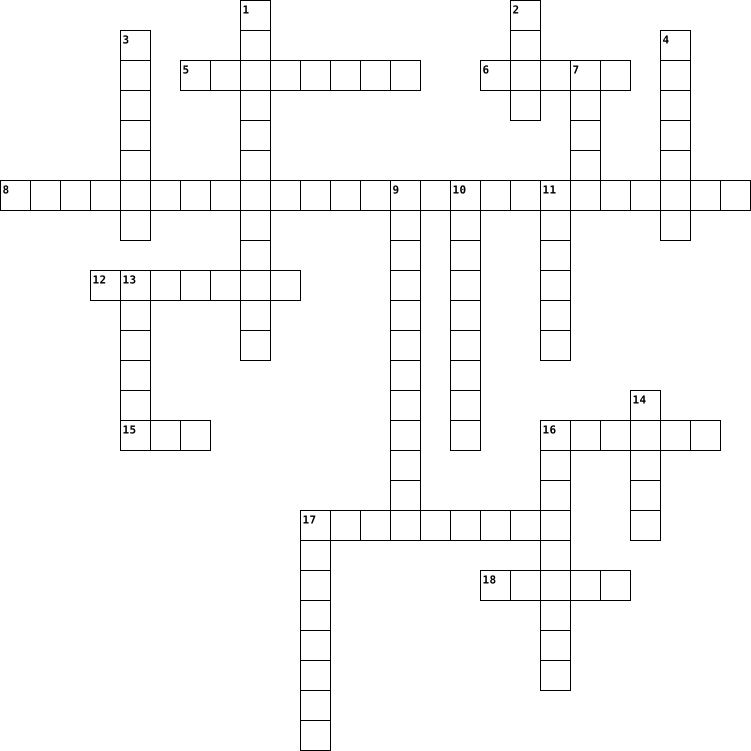
Across
- – large piece of rock that orbits the Sun
- – has a tail as it gets closer to the Sun
- – where Chris Hadfield lived in space
- – the largest planet
- – center of the solar system
- – when an asteroid enters Earth’s atmosphere, also known as a shooting star
- – a meteor that touches the Earth’s surface
- – orbit around the sun takes 365 days
Down
- – divides inner and outer planets
- – takes one month to orbit the Earth
- – the closest planet to the Sun
- – the North Star
- – number of planets in our solar system
- – when the moon passes in front of the Sun
- – person trained to be on a spacecraft
- – the sixth planet from the Sun
- – first planet discovered with a telescope
- – the hottest planet
- – small piece of rock, before entering Earth’s atmosphere
- – our galaxy
20 Clues: – our galaxy • – the North Star • – the largest planet • – the hottest planet • – center of the solar system • – the closest planet to the Sun • – the sixth planet from the Sun • – divides inner and outer planets • – takes one month to orbit the Earth • – where Chris Hadfield lived in space • – orbit around the sun takes 365 days • – number of planets in our solar system • ...
The Planets 2014-10-07

Across
- Second planet from the sun
- The Red Planet
- Name of our galaxy
- The planet with the rings
- Largest planet in our Solar System
- A large group of stars, gas and dust
- Mercury, Venus, Earth and Mars are ____________ planets
- Saturn, Jupiter, Uranus and Neptune have ____ around them
- Made up of water ice, rock, dust and organic compounds
Down
- The centre of our Solar System
- Our planet
- Planet that spins on its side
- Planet closest to the sun
- A piece of rocky and/or metallic debris that travels in outer space
- Pluto is called a ______ planet
- Named after a Roman god of the sea
- We are held on earth by...
- Jupiter and Saturn are ____ giants
- Uranus and Neptune are ____ giants
- Neil Armstrong was the first person to walk on the...
20 Clues: Our planet • The Red Planet • Name of our galaxy • Planet closest to the sun • The planet with the rings • Second planet from the sun • We are held on earth by... • Planet that spins on its side • The centre of our Solar System • Pluto is called a ______ planet • Largest planet in our Solar System • Named after a Roman god of the sea • Jupiter and Saturn are ____ giants • ...
Planets Crossword Puzzle 2014-10-18

Across
- TWO THIRDS OF THE EARTH'S SURFACE IS COVERED BY THIS
- A LARGE GROUP OF STARS, DUST, GAS AND DARK MATTER
- THE NEAREST STAR TO EARTH
- NAME GIVEN TO AN EXPLODING STAR
- THE GALAXY IN WHICH EARTH IS LOCATED - THE ----- WAY
- SEVENTH PLANET FROM THE SUN
- FARTHEST PLANET FROM THE SUN
- A STREAK OF LIGHT IN THE NIGHT SKY
- CONSIDERED A DWARF PLANET SINCE 2006
Down
- A SHINING BALL OF GAS
- THE RED PLANET
- THE NUMBER OF PLANETS IN THE SOLAR SYSTEM
- PLANET WITH RINGS AROUND IT
- THE LARGEST PLANET
- THE HOTTEST PLANET
- A SOLAR ------- OCCURS WHEN THE MOON IS BETWEEN THE SUN AND THE EARTH
- THE CLOSEST PLANET TO EARTH
- OUR HOME PLANET
- A NATURAL SATELLITE WHICH ORBITS THE EARTH
- NUMBER OF MOONS MARS HAS
20 Clues: THE RED PLANET • OUR HOME PLANET • THE LARGEST PLANET • THE HOTTEST PLANET • A SHINING BALL OF GAS • NUMBER OF MOONS MARS HAS • THE NEAREST STAR TO EARTH • PLANET WITH RINGS AROUND IT • THE CLOSEST PLANET TO EARTH • SEVENTH PLANET FROM THE SUN • FARTHEST PLANET FROM THE SUN • NAME GIVEN TO AN EXPLODING STAR • A STREAK OF LIGHT IN THE NIGHT SKY • CONSIDERED A DWARF PLANET SINCE 2006 • ...
Tio Paulo 2023-11-27

Across
- Medida da velocidade no S.I.
- Movimento Retilíneo Uniforme (Sigla).
- Movimento _____ (aproximando) da origem das posições.
- Um ano de Marte equivale a quantos anos terrestres?
- Distância em linha reta da posição inicial até a posição final.
- Número de planetas do Sistema Solar.
- Nome da letra grega que simboliza "variação".
- velocidade dividido pelo tempo é
- 3600 segundos é o mesmo que ____ hora.
Down
- Transformar m/s em km/h.
- Medida de distância no S.I.
- Planeta com maior temperatura do Sistema Solar.
- Mudança de posição.
- espaço dividido pelo tempo é
- Movimento _____ (afastando) da origem das posições.
- Redução da velocidade é o mesmo que movimento _____.
- Velocidade sempre igual.
- Velocidade nula.
- Ramo da Física que estuda o movimento.
- Caminho percorrido ou ____ .
- Teoria onde a Terra se encontra no centro do Universo.
- Ciência que estuda a Natureza.
- Medida do tempo no S.I.
- Satélite natural da Terra.
24 Clues: Velocidade nula. • Mudança de posição. • Medida do tempo no S.I. • Transformar m/s em km/h. • Velocidade sempre igual. • Satélite natural da Terra. • Medida de distância no S.I. • espaço dividido pelo tempo é • Medida da velocidade no S.I. • Caminho percorrido ou ____ . • Ciência que estuda a Natureza. • velocidade dividido pelo tempo é • Número de planetas do Sistema Solar. • ...
The Grid 2024-04-24

Across
- steam ______________ produce around 80% of electrical energy in the US.
- flow of electrons
- remove sulfur from coal to prevent acid rain
- A device that increases or decreases the voltage
- current that flows in one direction
- units for current
- large rotating magnet(s) and copper wires
- non-renewable that is NOT a fossil fuel ___________ uranium
- power _____ and big appliances use AC
- _____________for power is P = IV
- ____________ current that changes direction
- _____________ power uses... water (dams)
- ___________ & units for volts V (Volts)
Down
- for current I
- units for power
- Indiana's favorite RENEWABLE
- ____________ fuels: coal, petroleum, natural gas (NON-RENEWABLES)
- ___________ panels produce DC
- Anything with a ______________with a uses DC.
- rate of doing work
- rate at which negative charge flows
- ability to do work
- the force that drives current
- solar, wind, geothermal, hydroelectric, biomass
24 Clues: for current I • units for power • flow of electrons • units for current • rate of doing work • ability to do work • Indiana's favorite RENEWABLE • ___________ panels produce DC • the force that drives current • _____________for power is P = IV • current that flows in one direction • rate at which negative charge flows • power _____ and big appliances use AC • ...
EOY Review Semester 2 2025-05-06

Across
- Earth's axis is leaning along the orbit
- What rock forms when lava cools?
- highest tides produced
- includes all frozen water on Earth
- What rock forms under heat and pressure?
- thick, not very dense crust
- lighter part of shadow
- lowest high tides
- eclipse when the Sun is blocked by the Moon
Down
- day when Earth's axis is most towards or away from the Sun
- the degree of compactness of an object
- darker, central part of a shadow
- only phase of the Moon for a solar eclipse to occur
- when compacted, forms sedimentary rock
- includes all living organisms on Earth
- the inner core spins __________than the outer
- one phase when a spring tide can occur
- thin, very dense crust
- dark, flat areas on the moon
- eclipse when the moon rotates in to Earth's shadow
20 Clues: lowest high tides • highest tides produced • thin, very dense crust • lighter part of shadow • thick, not very dense crust • dark, flat areas on the moon • darker, central part of a shadow • What rock forms when lava cools? • includes all frozen water on Earth • the degree of compactness of an object • when compacted, forms sedimentary rock • includes all living organisms on Earth • ...
Planet 2025-05-14

Across
- Often called the twin planet:
- Dwarf planets located in the outer part of the solar system:
- Planet with rings and satellites:
- A trans Neptunian object:
- A system of dust gas and dark matter stars:
- Planets beyond Neptune:
- Eating their own light and not reached:
- The largest planet in the solar system:
- The closest planets are located in asteroids:
- what is the name of the planet where humans live:
Down
- Word planets located in the Kuiper belt:
- Dwarf planets like eggs:
- The closest planet to the sun:
- Planet whose status was downgraded to a dwarf planet:
- Famous for its rings:
- Like the planet Saturn:
- Called the angry planet:
- The farthest planet from the sun:
- Located in the Kuiper belt outside the orbit:
- 1b* The youngest planet:
20 Clues: Famous for its rings: • Like the planet Saturn: • Planets beyond Neptune: • Dwarf planets like eggs: • Called the angry planet: • 1b* The youngest planet: • A trans Neptunian object: • Often called the twin planet: • The closest planet to the sun: • Planet with rings and satellites: • The farthest planet from the sun: • Eating their own light and not reached: • ...
Space 2026-02-04

Across
- – small piece of rock, before entering Earth’s atmosphere
- – the closest planet to the Sun
- – our galaxy
- – takes one month to orbit the Earth
- – where Chris Hadfield lived in space
- – the hottest planet
- – the sixth planet from the Sun
- – the North Star
- – the largest planet
- – when an asteroid enters Earth’s atmosphere, also known as a shooting star
Down
- – divides inner and outer planets
- – a meteor that touches the Earth’s surface
- – has a tail as it gets closer to the Sun
- – first planet discovered with a telescope
- – person trained to be on a spacecraft
- – number of planets in our solar system
- – large piece of rock that orbits the Sun
- – when the moon passes in front of the Sun
- – center of the solar system
- – orbit around the sun takes 365 days
20 Clues: – our galaxy • – the North Star • – the hottest planet • – the largest planet • – center of the solar system • – the closest planet to the Sun • – the sixth planet from the Sun • – divides inner and outer planets • – takes one month to orbit the Earth • – where Chris Hadfield lived in space • – orbit around the sun takes 365 days • – person trained to be on a spacecraft • ...
Spanish Space Words Crossword (no articles 2026-02-27

Across
- EVERYTHING is a part of this
- A smaller asteroid
- Rovers land here
- A white dwarf
- The sun is a ___
- It created everything
- Closest to the sun
- all the planets in the solar system revolve around this
- It has a big red dot on the side
- Drawings in the stars
- Has a funny name
- A larger comet
Down
- Moons orbit this
- Earth is a part of the ___
- We live here
- In between Earth and Mercury
- Also the name of a candy
- A king in Spongebob
- Orbits the earth
- Big space hole
- An exploded star becomes this
- Technically not a planet
- a star exploding is a ___
- A black dwarf
- A planet outside of our solar system
- It has rings
- It keeps you on the ground
27 Clues: We live here • It has rings • A white dwarf • A black dwarf • Big space hole • A larger comet • Moons orbit this • Rovers land here • Orbits the earth • The sun is a ___ • Has a funny name • A smaller asteroid • Closest to the sun • A king in Spongebob • It created everything • Drawings in the stars • Also the name of a candy • Technically not a planet • a star exploding is a ___ • ...
L'Energie 2020-09-14

Across
- the heating
- to exhaust
- renewable
- the consumption
- powerstation
- hydro electric power
- solar
Down
- biodegradable
- to switch off
- to be sufficient
- tidal
- insulation
- resources
- windmill
- to switch on
- gas
- geothermal
- carbon
- petrol
- heating fuel
- dam
21 Clues: gas • dam • tidal • solar • carbon • petrol • windmill • resources • renewable • insulation • to exhaust • geothermal • the heating • to switch on • powerstation • heating fuel • biodegradable • to switch off • the consumption • to be sufficient • hydro electric power
AZTEC AND AFRICAN CIVILIZATION 2024-03-31

Across
- founded Aztecs
- dams
- craft of metal works
- necessity
- Aztec lived
- prominent
- Three
- this country
- was led by
- Create floating
- Macehualli
Down
- some knowledge
- Pipiltin
- small island
- oldest documented
- famous
- calendar
- they lived
- colonized Africa
- lake
20 Clues: dams • lake • Three • famous • Pipiltin • calendar • necessity • prominent • they lived • was led by • Macehualli • Aztec lived • small island • this country • founded Aztecs • some knowledge • Create floating • colonized Africa • oldest documented • craft of metal works
AZTEC AND AFRICAN CIVILIZATION 2024-03-31

Across
- they lived
- calendar
- Aztec lived
- oldest documented
- prominent
- craft of metal works
- some knowledge
- lake
- small island
Down
- dams
- Pipiltin
- founded Aztecs
- necessity
- Three
- colonized Africa
- famous
- Create floating
- Macehualli
- was led by
- this country
20 Clues: dams • lake • Three • famous • Pipiltin • calendar • necessity • prominent • they lived • Macehualli • was led by • Aztec lived • this country • small island • founded Aztecs • some knowledge • Create floating • colonized Africa • oldest documented • craft of metal works
26-45 2022-04-06

Across
- cloud
- it rains
- midnight
- its cloudy
- the cheese
- clock
- vent
- noon
- it drizzles
Down
- spring
- winter
- it never snows
- lighting
- calor-ioes
- frozen
- ice
- hot in the summer
- whats the weather like
- fall
- solar power
20 Clues: ice • fall • vent • noon • cloud • clock • spring • winter • frozen • lighting • it rains • midnight • calor-ioes • its cloudy • the cheese • solar power • it drizzles • it never snows • hot in the summer • whats the weather like
Solar System 2022-09-17

Across
- is the smallest planet in the Solar System and the closest to the Sun. Its orbit around the Sun takes 87.97 Earth days, the shortest of all the Sun's planets.
- is the third planet from the Sun and the only astronomical object known to harbor life.
- is the sixth planet from the Sun and the second-largest in the Solar System, after Jupiter.
- is the seventh planet from the Sun. Its name is a reference to the Greek god of the sky.
Down
- is the eighth planet from the Sun and the farthest known solar planet. In the Solar System, it is the fourth-largest planet by diameter.
- is the fourth planet from the Sun and the second-smallest planet in the Solar System.
- is the second planet from the Sun and Earth's closest planetary neighbor.
- is the star at the center of the Solar System, It is a nearly perfect ball of hot plasma.
8 Clues: is the second planet from the Sun and Earth's closest planetary neighbor. • is the fourth planet from the Sun and the second-smallest planet in the Solar System. • is the third planet from the Sun and the only astronomical object known to harbor life. • is the seventh planet from the Sun. Its name is a reference to the Greek god of the sky. • ...
Unit 7 - Vocabulary 2021-05-09

Across
- PATATAS FRITAS
- ZUMO
- GUÍA DE VIAJE
- CEREZAS
- MOCHILA
- TELÉFONO MÓVIL
- MAPA
- GALLETAS
Down
- BOTELLA DE AGUA
- UVAS
- LUPA
- LIBRETA
- NARANJA
- CREMA SOLAR
- GORRA
- ABRIGO
16 Clues: UVAS • LUPA • ZUMO • MAPA • GORRA • ABRIGO • LIBRETA • NARANJA • CEREZAS • MOCHILA • GALLETAS • CREMA SOLAR • GUÍA DE VIAJE • PATATAS FRITAS • TELÉFONO MÓVIL • BOTELLA DE AGUA
Energie 2020-09-14

Across
- deposit
- waves
- windmill
- solar panel
- dam
- tidal
- petrol
- heating
Down
- to exhaust
- to switch off
- renewable
- coal
- hydro-electric power
- short term
- heating fuel
- to be sufficient
- wind power
- North Sea
- fall-out
- to stock
20 Clues: dam • coal • waves • tidal • petrol • deposit • heating • windmill • fall-out • to stock • renewable • North Sea • to exhaust • short term • wind power • solar panel • heating fuel • to switch off • to be sufficient • hydro-electric power
L'Energie 2020-09-14

Across
- the heating
- to exhaust
- renewable
- the consumption
- powerstation
- hydro electric power
- solar
Down
- biodegradable
- to switch off
- to be sufficient
- tidal
- insulation
- resources
- windmill
- to switch on
- gas
- geothermal
- carbon
- petrol
- heating fuel
- dam
21 Clues: gas • dam • tidal • solar • carbon • petrol • windmill • resources • renewable • insulation • to exhaust • geothermal • the heating • to switch on • powerstation • heating fuel • biodegradable • to switch off • the consumption • to be sufficient • hydro electric power
Sanaristikko unit 2 2026-01-27

Across
- check
- ullakko
- delicious
- alue
- (koulu)aine
- suosittu
- vaatekaappi
- grillata
- own
- liesi
- ruuhkainen
- began
- rakennus
Down
- chose
- imagine
- muuttua
- edullinen,halpa
- kylpyhuone
- panel aurinkopaneli
- event
- smoked
- broke
- sähkö
- joku, jotku
- stood
25 Clues: own • alue • chose • check • event • broke • sähkö • liesi • began • stood • smoked • imagine • muuttua • ullakko • suosittu • grillata • rakennus • delicious • kylpyhuone • ruuhkainen • (koulu)aine • vaatekaappi • joku, jotku • edullinen,halpa • panel aurinkopaneli
Solar System Crossword 2022-12-06

Across
- A small piece of asteroid or a comet, could be smaller or larger, and often created from a collision.
- Sometimes called minor planets, are rocky, airless remnants left over from the early formation of our solar system about 4.6 billion years ago.
- any minor planet in the Solar System that orbits the Sun at a greater average distance than Neptune.
- A celestial body that is in orbit around the Sun and has sufficient mass for its self-gravity to overcome rigid body forces so that it keeps a nearly round shape.
- made of dust from the disintegrating nucleus on a comet.
- The large round object that circles the Earth and that shines at night by reflecting light from the sun.
- A dwarf planet in the asteroid belt between the orbits of Mars and Jupiter. It was the first asteroid discovered, on 1 January 1801, by Giuseppe Piazzi.
Down
- The most visible part of a comet; encompasses the streams of dust and gas.
- How many dwarf planets are there?
- How many planets are there in our solar system?
- Which objects lies mostly in a belt between Mars and Jupiter.
- A celestial body resembling a small planet but lacking certain technical criteria that are required for it to be classed as such.
- a small piece of matter that falls from space with great speed, producing a bright light as it enters the earth's atmosphere.
- The largest asteroid known to date. Roughly as big as Alaska and rotates around the sun once every 1,678 Earth days.
- What Dwarf planet is located in the Kuiper belt and used to be a regular planet.
- Frozen leftovers from the formation of the solar system composed of dust, rock, and ices.
- Located in the center of a comet, composed of rock, dust, ice, and frozen gases.
17 Clues: How many dwarf planets are there? • How many planets are there in our solar system? • made of dust from the disintegrating nucleus on a comet. • Which objects lies mostly in a belt between Mars and Jupiter. • The most visible part of a comet; encompasses the streams of dust and gas. • ...
The Solar System 2022-11-21

Across
- when several meteors enter the Earth's atmosphere at one time
- when an asteroid travels and crashes into another solar object
- once the meteor has made its way to the Earth's surface and collided, it is a..
- wide, curved and consists of gas and dust
- most visible part of a comet
- small, rocky object from space before it enters Earth's atmosphere
Down
- center of a comet
- passes Earth's orbit every 76 years
- an area of space beyond the orbit of Neptune
- a cloud of icy planetesimals surrounding the sun
- small, rocky object from space that is heated up as it enters the Earth's atmosphere
- thin, blue and linear (the result of ultraviolet radiation ejecting electrons off particles)
- most famous dwarf planet
- lies in the asteroid belt between Mars and Jupiter
- referred to as "dirty snowballs"
15 Clues: center of a comet • most famous dwarf planet • most visible part of a comet • referred to as "dirty snowballs" • passes Earth's orbit every 76 years • wide, curved and consists of gas and dust • an area of space beyond the orbit of Neptune • a cloud of icy planetesimals surrounding the sun • lies in the asteroid belt between Mars and Jupiter • ...
Our Solar System 2019-08-06

Across
- The line from north to south pole
- The force that keeps the planets and moons in orbit
- The hottest of all the planets
- When the sun does down at night
- Another name for our galaxy
- The biggest star in the solar system
- Orbits some planets
- When the sun comes up in the morning
- The season with the longest days
Down
- The season with the shortest days
- Another word for orbit
- The line in the middle of Earth
- There are four ________ in the year
- The oldest of the planets
- The planet with Rings of ice and rock
15 Clues: Orbits some planets • Another word for orbit • The oldest of the planets • Another name for our galaxy • The hottest of all the planets • The line in the middle of Earth • When the sun does down at night • The season with the longest days • The season with the shortest days • The line from north to south pole • There are four ________ in the year • ...
The Solar System 2020-07-03

Across
- Planet named after the Roman Sea God
- Known as the red planet
- An icy rock that has a bright tail when it comes closer to the Sun
- Planet closest to the Sun
- Our galaxy
- The farthest planet from the Sun
- Planet known as the evening star
- The largest planet in the solar system
- The path that a planet takes around the Sun
Down
- Star at the centre of our solar system
- Our Sun is this
- Our planet
- The many rocks in a belt between Mars and Jupiter
- Planet famous for its rings
- Earth's sister planet
- An instrument used to observe outer space
- Planet between Saturn and Neptune
17 Clues: Our planet • Our galaxy • Our Sun is this • Earth's sister planet • Known as the red planet • Planet closest to the Sun • Planet famous for its rings • The farthest planet from the Sun • Planet known as the evening star • Planet between Saturn and Neptune • Planet named after the Roman Sea God • Star at the centre of our solar system • The largest planet in the solar system • ...
THE SOLAR SYSTEM 2023-02-27

Across
- The Red Planet
- The satellite of the Earth
- The movement of the planet by spinning on its axis
- Streak of light seen when meteoroids heat up in the atmospher
- The rocky body is smaller than the planet and orbits the Sun
- The hottest planet
Down
- imaginary line about which an object rotates
- The movement of the planet to move around the Sun
- Outer part of a shadow
- Icy object that releases gasses
- The name of the dwarf planet that reclassified in 2006
- The Closest planet to the Sun
- The furthest planet from the Sun
- way name of Our galaxy
- Heat and light source of the Earth
15 Clues: The Red Planet • The hottest planet • Outer part of a shadow • way name of Our galaxy • The satellite of the Earth • The Closest planet to the Sun • Icy object that releases gasses • The furthest planet from the Sun • Heat and light source of the Earth • imaginary line about which an object rotates • The movement of the planet to move around the Sun • ...
Our solar system 2023-03-03

Across
- A person who invented the telescope 1608.
- A thing which is a known candidate for another dwarf planet.
- A person who the theory that the earth wasn't the center of the universe.
- A thing which is unknown objects from space, the abbreviation.
- A thing which isn't a planet since 2006.
- A person who is from space and isn't from the earth.
- A person was the first people in the universe.
Down
- A thing which is the biggest planet in our solar system.
- A thing which is a galaxy and we live in.
- A person who was the first person at the moon.
- A thing which with the astronauts flying in the universe.
- A thing that revolves around our earth.
- A person who deals with the universe.
- A thing which is the begin of our live.
- A thing which is a planet between venus and mars.
15 Clues: A person who deals with the universe. • A thing that revolves around our earth. • A thing which is the begin of our live. • A thing which isn't a planet since 2006. • A thing which is a galaxy and we live in. • A person who invented the telescope 1608. • A person who was the first person at the moon. • A person was the first people in the universe. • ...
Solar System's Crossword 2012-02-14

Across
- a star that suddenly becomes very much brighter
- movement of heavenly body across the face of another. the sun moon and the earth takes place
- a hole made when a rocky lump from outer space hits the surface
- someone who travels in space
- layer of gases around the earth and the other planets
- a small star that is very dense
- small object made of rock and metal that orbits in the solar system between Mars and Jupiter
Down
- a timy member of the solar system which starts to shine when it draws near the sun
- a region is space that has such an enormous gravity that not even light rays can escape it
- to do with the moon
- a great star "island" in space
- the pattern a group of bright stars make in the sky
- a large body that orbits around the sun. there are 8 of them
- distance the light travels in a year
- the joining together of two spacecraft in space
15 Clues: to do with the moon • someone who travels in space • a great star "island" in space • a small star that is very dense • distance the light travels in a year • a star that suddenly becomes very much brighter • the joining together of two spacecraft in space • the pattern a group of bright stars make in the sky • layer of gases around the earth and the other planets • ...
El sistema solar 2014-04-02

Across
- Earth
- Star
- Alien
- Moon
- Galaxy
- Sun
Down
- Jupiter
- Pluto
- Space ship
- Planet
- Mars
- Saturn
- Mercury
- Venus
- Uranus
15 Clues: Sun • Star • Mars • Moon • Earth • Pluto • Venus • Alien • Planet • Saturn • Uranus • Galaxy • Jupiter • Mercury • Space ship
the solar system 2014-05-12

Across
- we live on it
- the entire celestial cosmos.
- has micro organisms
- large ball of gas
- hottest planet
- the smallest planet
- way the galaxy we live in.
Down
- gas planet
- many of these in the universe
- the study of all physical object beyond earth.
- rotates on its side
- the biggest planet
- has a ring
- system 8 planets in our galaxy are called this.
- natural satellite the revolves around larger bodies.
15 Clues: gas planet • has a ring • we live on it • hottest planet • large ball of gas • the biggest planet • rotates on its side • has micro organisms • the smallest planet • way the galaxy we live in. • the entire celestial cosmos. • many of these in the universe • the study of all physical object beyond earth. • system 8 planets in our galaxy are called this. • ...
Solar Energy II 2015-06-12

Across
- a person who purchases goods and services for personal use.
- supply with mechanical or electrical energy.
- someone who satisfies a bill for products and services received.
- an evaluation of the nature, quality or ability of someone or something.
- the basis or foundation for an organization.
- to reach the highest point of a specified value or time.
- reducing the high voltage of electrical power transmission suitable for consumers.
Down
- request of consumers or producers for a particular commodity or service.
- to produce energy.
- a plan of action or policy designed to achieve a major goal.
- relating to the production of electric current at the junction of two substances exposed to light.
- consistently good in quality or performance, able to be trusted.
- a person, company or country that makes, grows or supplies goods or commodities for sale.
- an installation where electrical power is generated for distribution.
- a developing technology will produce electricity for the same cost to rate payers as traditional technologies.
15 Clues: to produce energy. • supply with mechanical or electrical energy. • the basis or foundation for an organization. • to reach the highest point of a specified value or time. • a person who purchases goods and services for personal use. • a plan of action or policy designed to achieve a major goal. • someone who satisfies a bill for products and services received. • ...
Marcos's Solar System 2022-01-26

Across
- debris that orbits the sun, has a tail, and is made of ice, snow, and rock.
- the planet farthest from the sun
- large pieces of debris that orbit the sun
- large planets that are far away from the sun and made mostly of gas
- the largest planet
- the second largest planet that also has Rings
- the hottest planet and Earth's sister
- the only planet with life
Down
- a group of planets close to the sun that are made of rock
- all of the planets, dwarf planets, and the Sun
- the planet closest to the sun
- a large ball of flaming gas that holds our Solar system together
- the red planet
- matter from outer space that enters earth's atmosphere
- the coldest planet
15 Clues: the red planet • the coldest planet • the largest planet • the only planet with life • the planet closest to the sun • the planet farthest from the sun • the hottest planet and Earth's sister • large pieces of debris that orbit the sun • the second largest planet that also has Rings • all of the planets, dwarf planets, and the Sun • ...
Solar System Exploration 2023-08-07

Across
- A journey or voyage undertaken for a specific purpose, often in space exploration.
- A vehicle designed for travel or operation in outer space.
- A robotic spacecraft designed to explore the surface of a planet or moon.
- An unmanned spacecraft designed to explore distant planets or celestial bodies.
- A specific task or operation, often related to space exploration.
- The United States' space agency responsible for space exploration.
- A garment designed to protect astronauts in the vacuum of space.
- A person trained to travel and work in space.
- A spacecraft that lands on the surface of a planet or moon.
Down
- An optical instrument used to observe distant objects in space.
- Relating to travel or exploration between planets.
- An artificial object that orbits a celestial body, often used for communication or observation.
- A spacecraft that orbits a celestial body, gathering data and images.
- Relating to or located in space or the universe.
- The act of sending a spacecraft into space.
15 Clues: The act of sending a spacecraft into space. • A person trained to travel and work in space. • Relating to or located in space or the universe. • Relating to travel or exploration between planets. • A vehicle designed for travel or operation in outer space. • A spacecraft that lands on the surface of a planet or moon. • ...
Solar system Crossword 2023-08-29

Across
- the sun and all of the planets, asteroids, comets, etc. that move around it
- A streak of light in the sky produced by the burning of a meteroid in earths atmosphere
- the blocking of sunlight to earth that occurs when the moon is directly between the sun and the earth
- the movement of an object around another object
- the part of the shadow surrounding the darkest part
- a natural object that revolves around another object in space
- getting larger, stronger,fuller,etc.
- a chunk of rock or dust in space
Down
- the two days of the year on which the noon sun is directly overhead at either 23.5 degrees south or 23.5 degrees north
- the daily rise and fall of earths water on shore
- the darkest part of a shadow
- a meteoroid that has hit earths surface
- an unmanned spacecraft sent out to investigate planets and other objects in outer space
- the spinning motion of a planet around its axis
- getting smaller, weaker, dimmer, etc.
15 Clues: the darkest part of a shadow • a chunk of rock or dust in space • getting larger, stronger,fuller,etc. • getting smaller, weaker, dimmer, etc. • a meteoroid that has hit earths surface • the movement of an object around another object • the spinning motion of a planet around its axis • the daily rise and fall of earths water on shore • ...
science solar system 2023-10-19

Across
- an imaginary line through an object
- the galaxy in which the solar system is located
- where one objects block another one from view
- orbits the planets and stars
- an attraction forces between any 2 objects
- a group of millions and billions of stars
- the hottest season
- the phrase when the sunlit side is facing away from the earth
Down
- a ball of gas that releases light and heat
- regular rising and falling of the sea
- the coldest season
- it takes 365 day to orbit the sun
- an imaginary line between the north and south pole
- a planet made of mostly ice
- the time it takes for aa planet to rotate once
15 Clues: the coldest season • the hottest season • a planet made of mostly ice • orbits the planets and stars • it takes 365 day to orbit the sun • an imaginary line through an object • regular rising and falling of the sea • a group of millions and billions of stars • a ball of gas that releases light and heat • an attraction forces between any 2 objects • ...
Our Solar System 2023-11-18

Across
- How many dwarf planets are there?
- Made up of dust from the disintegrating nucleus on a comet.
- Leftovers from the formation of the solar system composed of dust, rock, and ice.
- The most visible part of a comet; encompasses the streams of dust and gas.
- A dwarf planet in the asteroid belt between the orbits of Mars and Jupiter. It was the first asteroid discovered, on 1 January 1801, by Giuseppe Piazzi.
- A small piece of asteroid or a comet, could be smaller or larger, and often created from a collision.
- A celestial body resembling a small planet but lacking certain technical criteria that are required for it to be classed as such.
- Located in the center of a comet, composed of rock, dust, ice, and frozen gases.
- Some minor planets in the Solar System that orbits the Sun at a larger average distance than Neptune.
Down
- How many planets are there in our solar system?
- The large round object that circles the Earth and that shines at night by reflecting light from the sun.
- Are called minor planets and are rocky,
- Which objects lies mostly in a belt between Mars and Jupiter.
- The largest asteroid known to date. Roughly as big as Alaska and rotates around the sun once every 1,678 Earth days.
- A small piece of matter that falls from space with q
- A celestial body that is in orbit around the Sun and has sufficient mass for its self-gravity to overcome rigid body forces so that it keeps a nearly round shape.
- What Dwarf planet is located in the Kuiper belt and used to be a regular planet.
17 Clues: How many dwarf planets are there? • Are called minor planets and are rocky, • How many planets are there in our solar system? • A small piece of matter that falls from space with q • Made up of dust from the disintegrating nucleus on a comet. • Which objects lies mostly in a belt between Mars and Jupiter. • ...
Solar System crossoword 2023-10-30

Across
- Is the future mission to Saturn (specifically Titan)
- A Galilean moon
- Kepler's second law associates equal time with equal.
- This spacecraft is shaped like a fidget spinner
- Humans mostly emit.
- Plumes of water were found on this moon of Saturn
- This is the most volcanically active object in the solar system
- This moon has a very thick atmosphere of mostly nitrogen
Down
- Uranus was almost named as.
- Is more energetic than visible light
- Is more energetic than x-rays.
- Has lakes and rivers of methane
- Rotates on the side
- Newton's first law is also called the law of.
- Is the least dense planet
- This moon of jupiter is covered in ice and has blood red lines running through the ice
16 Clues: A Galilean moon • Rotates on the side • Humans mostly emit. • Is the least dense planet • Uranus was almost named as. • Is more energetic than x-rays. • Has lakes and rivers of methane • Is more energetic than visible light • Newton's first law is also called the law of. • This spacecraft is shaped like a fidget spinner • Plumes of water were found on this moon of Saturn • ...
Our solar system 2024-09-25

Across
- It is natural satellites for planets
- tiny little particles
- what does my very educated mother stand for ?
- what is the outer planets called ?
- What is the planet we live on ?
- it is the center of our solar system ?
Down
- it is know as a dirty snowball ?
- piece of rock that's becomes a metoir ?
- What is the biggest planet in our solar system ?
- objects of rock , ice , and metal
- what is the planet with the most visible rings ?
- This the main dwarf planet we know
- What is the farthest planetv from the sun ?
- What is the closets planet to the sun ?
- What is the inner planets called ?
15 Clues: tiny little particles • What is the planet we live on ? • it is know as a dirty snowball ? • objects of rock , ice , and metal • This the main dwarf planet we know • What is the inner planets called ? • what is the outer planets called ? • It is natural satellites for planets • it is the center of our solar system ? • piece of rock that's becomes a metoir ? • ...
Solar system vocabulary 2024-05-17

Across
- Big gas star
- total blocking of light of one celestial object
- closest planet to sun
- Small frozen mass that travels around sun
- gas giant planet
- Blue planet
Down
- system of stars, dust and gas
- Famous for its rings
- system made up of our star and everything bound around it by gravity
- second planet closest to sun
- Smallest planet but no longer a planet
- spins on its side
- Orbits earth 27 days
- takes aproxx 365 days to rotate around sun
- orange red planet
15 Clues: Blue planet • Big gas star • gas giant planet • spins on its side • orange red planet • Famous for its rings • Orbits earth 27 days • closest planet to sun • second planet closest to sun • system of stars, dust and gas • Smallest planet but no longer a planet • Small frozen mass that travels around sun • takes aproxx 365 days to rotate around sun • ...
Solar System Crossword 2024-04-26

Across
- Our only star
- The "Red Planet"
- belt divides outer planets and inner planets
- Biggest planet
- Closest planet to the sun
- Dwarf planet
- Blue "Gas Giant"
Down
- Very icy and gassy
- Second closest to sun
- The force of weight
- Earth's natural satellite
- Where we live
- The average distance from the Earth to sun.
- The chemicals in a planets air
- Planet with rings
15 Clues: Dwarf planet • Our only star • Where we live • Biggest planet • The "Red Planet" • Blue "Gas Giant" • Planet with rings • Very icy and gassy • The force of weight • Second closest to sun • Earth's natural satellite • Closest planet to the sun • The chemicals in a planets air • The average distance from the Earth to sun. • belt divides outer planets and inner planets
Solar System Review 2024-04-18

Across
- rotates on a different tilt
- biggest planet
- center of the solar system
- a planet's journey around the sun
- Earth's slightly smaller twin
- caused by the moon
- causes day and night
- half the diameter of Earth
- used to be a planet
Down
- a dwarf planet
- second biggest planet
- shape of Earth's orbit
- coldest planet
- smallest planet
- causes seasons
15 Clues: a dwarf planet • biggest planet • coldest planet • causes seasons • smallest planet • caused by the moon • used to be a planet • causes day and night • second biggest planet • shape of Earth's orbit • center of the solar system • half the diameter of Earth • rotates on a different tilt • Earth's slightly smaller twin • a planet's journey around the sun
The Solar System 2024-12-19

Across
- Known as the red planet, its dry surface is rusty due to iron in the rocks that make up its crust. The fourth planet from the Sun.
- The largest planet in our solar system, about 1000 earths could fit inside this planet. There's a large storm on this planet, known as the great red spot that has been observed for hundreds of years.
- The last planet in our solar system, beyond this planet are the Kuiper belt objects like Pluto and other dwarf planets. Its blue color is due to trace amounts of methane in the atmosphere.
- The name we give the 4 planets closest to the Sun. These planets are rocky, have solid surfaces, are generally small, have few to no moons, and no rings.
- A light blue planet named for the god of the sky. This planet rotates on its side because its axis is tilted at a 90 degree angle from its orbit. The seventh planet from the Sun.
- A gas giant with an immense ring system, sixth planet from the Sun.
Down
- The hottest planet in our solar system, but not the planet closest to the Sun. It's hot because of its dense atmosphere made mostly of carbon dioxide which holds lots of heat from the Sun.
- An object that orbits the Sun, is spherical due to its high mass and strong gravity, and has cleared its orbit of other similar objects.
- The name we give the 4 planets furthest from the Sun. They are mostly gas with no solid surface, are generally large, have many moons, and all have rings.
- The only planet we know to have life, the third planet from the Sun.
- A dwarf planet in the Kuiper belt, it has a very elliptical orbit that can occasionally bring it closer to the Sun than Neptune.
- The closest planet to the Sun, with very hot days and very cold nights, due to its lack of atmosphere.
- The invisible force keeping all of the objects in the solar system bound to each other.
- The only star in our solar system, around which everything orbits.
- The _________ belt can be found between Mars and Jupiter. This band of rocks and ice orbiting the Sun are thought to be remnant pieces of a planet that never formed.
15 Clues: The only star in our solar system, around which everything orbits. • A gas giant with an immense ring system, sixth planet from the Sun. • The only planet we know to have life, the third planet from the Sun. • The invisible force keeping all of the objects in the solar system bound to each other. • ...
El medioambiente 2023-03-31

Across
- energia del viento
- ...global
- environment
- deforestation
- ...de gases
- recycle
- glacier
- ... energia del sol
Down
- efecto...
- nature
- extinction
- trash
- cambio...
- jungle
- sea
15 Clues: sea • trash • nature • jungle • recycle • glacier • efecto... • ...global • cambio... • extinction • environment • ...de gases • deforestation • energia del viento • ... energia del sol
9.unite science 2025-04-24

Across
- patlamak
- araştırmak
- hücre
- aşı
- yıldız
- iskelet
- deney
- tarih
Down
- system güneş sistemi
- keşfetmek
- tıp
- keşif
- bilim adamı
- tube deney tüpü
- laboratuvar
15 Clues: tıp • aşı • hücre • keşif • deney • tarih • yıldız • iskelet • patlamak • keşfetmek • araştırmak • bilim adamı • laboratuvar • tube deney tüpü • system güneş sistemi
9.unite science 2025-04-24

Across
- patlamak
- araştırmak
- hücre
- aşı
- yıldız
- iskelet
- deney
- tarih
Down
- system güneş sistemi
- keşfetmek
- tıp
- keşif
- bilim adamı
- tube deney tüpü
- laboratuvar
15 Clues: tıp • aşı • hücre • keşif • deney • tarih • yıldız • iskelet • patlamak • keşfetmek • araştırmak • bilim adamı • laboratuvar • tube deney tüpü • system güneş sistemi
L´été et les vacances 2025-05-21

Across
- calor
- crema solar
- barbacoa
- gafas de sol
- verano
- sol
Down
- broncearse
- playa
- vacaciones
- arena
- sombrilla
- traje de baño
- viajar
- helado
- mar
15 Clues: mar • sol • playa • arena • calor • viajar • helado • verano • barbacoa • sombrilla • broncearse • vacaciones • crema solar • gafas de sol • traje de baño
Energy and our world 2023-02-20

Across
- _____ currently is the largest source of renewable energy in the electricity sector
- _____ energy has been used for millennia
- The carbon in fossil fuels has been sequestered, or stored, underground for _____ of years
- Generating renewable energy creates far lower ______ than burning fossil fuels
- Solar technologies convert sunlight into ____ energy either through photovoltaic panels or through mirrors that concentrate solar radiation
- Bioenergy is produced from a variety of organic materials, called _____ , such as wood, charcoal, dung and other manures for heat and power production, and agricultural crops for liquid biofuels
- The theoretical potential for _____ energy easily exceeds present human energy requirements
- ____ energy is energy derived from natural sources that are replenished at a higher rate than they are consumed
Down
- _______ energy utilizes the accessible thermal energy from the Earth’s interior
- _______ fuels - coal, oil and gas are non-renewable resources that take hundreds of millions of years to form
- ______ is a liquid fossil fuel. It is also called oil or crude oil
- According to the Central Intelligence Agency, the world generates more than 66% of its electricity from fossil fuels, and another 8% from ______ energy
- Solar panels have a lifespan of roughly 30 ____
- _____ is the main element in fossil fuels. For this reason, the time period that fossil fuels formed (about 360-300 million years ago) is called the Carboniferous Period
- ____ gas is another fossil fuel that is trapped underground in reservoirs. It is mostly made up of methane
- ____created by burning biomass creates greenhouse gas emissions, but at lower levels than burning fossil fuels like coal, oil or gas
- The rate at which ____ energy is intercepted by the Earth is about 10,000 times greater than the rate at which humankind consumes energy
17 Clues: _____ energy has been used for millennia • Solar panels have a lifespan of roughly 30 ____ • ______ is a liquid fossil fuel. It is also called oil or crude oil • Generating renewable energy creates far lower ______ than burning fossil fuels • _______ energy utilizes the accessible thermal energy from the Earth’s interior • ...
The Solar System 2022-06-06

Across
- the smallest planet in our solar system
- a streak of light in the sky
- a natural satellite of any planet
- a big ball of burning gas
- the name of the star that is at the center of our solar system
Down
- a small rocky body orbiting the sun
- the hottest planet in our solar system
- the planet that humans live on
- the planet that looks red because of its dust and dirt
9 Clues: a big ball of burning gas • a streak of light in the sky • the planet that humans live on • a natural satellite of any planet • a small rocky body orbiting the sun • the hottest planet in our solar system • the smallest planet in our solar system • the planet that looks red because of its dust and dirt • the name of the star that is at the center of our solar system
THE SOLAR SYSTEM 2023-02-06

Across
- I'm the hottest planet in the solar system.
- I'm tilted and I have a blue-green color.
- I'm the closest planet to the sun.
- People also call me the "Red Planet".
- I'm the furthest planet from the sun.
Down
- I'm a star! I'm huge, hot and luminous.
- I'm made of gas and I have many rings.
- I'm the largest planet in the solar system.
- I'm the only habitable planet in the solar system.
9 Clues: I'm the closest planet to the sun. • People also call me the "Red Planet". • I'm the furthest planet from the sun. • I'm made of gas and I have many rings. • I'm a star! I'm huge, hot and luminous. • I'm tilted and I have a blue-green color. • I'm the hottest planet in the solar system. • I'm the largest planet in the solar system. • ...
Week 9 spelling words 2021-06-15

Across
- belt, a region of the solar system beyond the orbit of Neptune, believed to contain many comets, asteroids, and other small bodies made largely of ice.
- a clockwork model of the solar system, or of just the sun, earth, and moon.
- a caterpillar to butterfly.
- a thing predicted; a forecast.
- a supposition or proposed explanation made on the basis of limited evidence as a starting point for further investigation.
- a substance which does not readily allow the passage of heat or sound.
- a small body moving in the solar system that would become a meteor if it entered the earth's atmosphere.
Down
- an expert in or student of astronomy.
- involving mutual assistance in working towards a common goal.
- willing to take risks or to try out new methods, ideas, or experiences.
- a small, slender tree-dwelling ape with long powerful arms and loud hooting calls, native to the forests of South-East Asia.
- (of a person) making others work hard or meet high standards; not easily satisfied.
- a great circle on the celestial sphere representing the sun's apparent path during the year, so called because lunar and solar eclipses can only occur when the moon crosses it.
- a group of stars forming a recognizable pattern that is traditionally named after its apparent form or identified with a mythological figure.
14 Clues: a caterpillar to butterfly. • a thing predicted; a forecast. • an expert in or student of astronomy. • involving mutual assistance in working towards a common goal. • a substance which does not readily allow the passage of heat or sound. • willing to take risks or to try out new methods, ideas, or experiences. • ...
Week 9 spelling words 2021-06-15

Across
- belt, a region of the solar system beyond the orbit of Neptune, believed to contain many comets, asteroids, and other small bodies made largely of ice.
- a clockwork model of the solar system, or of just the sun, earth, and moon.
- a caterpillar to butterfly.
- a thing predicted; a forecast.
- a supposition or proposed explanation made on the basis of limited evidence as a starting point for further investigation.
- a substance which does not readily allow the passage of heat or sound.
- a small body moving in the solar system that would become a meteor if it entered the earth's atmosphere.
Down
- an expert in or student of astronomy.
- involving mutual assistance in working towards a common goal.
- willing to take risks or to try out new methods, ideas, or experiences.
- a small, slender tree-dwelling ape with long powerful arms and loud hooting calls, native to the forests of South-East Asia.
- (of a person) making others work hard or meet high standards; not easily satisfied.
- a great circle on the celestial sphere representing the sun's apparent path during the year, so called because lunar and solar eclipses can only occur when the moon crosses it.
- a group of stars forming a recognizable pattern that is traditionally named after its apparent form or identified with a mythological figure.
14 Clues: a caterpillar to butterfly. • a thing predicted; a forecast. • an expert in or student of astronomy. • involving mutual assistance in working towards a common goal. • a substance which does not readily allow the passage of heat or sound. • willing to take risks or to try out new methods, ideas, or experiences. • ...
Week 9 spelling words 2021-06-15

Across
- belt, a region of the solar system beyond the orbit of Neptune, believed to contain many comets, asteroids, and other small bodies made largely of ice.
- a clockwork model of the solar system, or of just the sun, earth, and moon.
- a caterpillar to butterfly.
- a thing predicted; a forecast.
- a supposition or proposed explanation made on the basis of limited evidence as a starting point for further investigation.
- a substance which does not readily allow the passage of heat or sound.
- a small body moving in the solar system that would become a meteor if it entered the earth's atmosphere.
Down
- an expert in or student of astronomy.
- involving mutual assistance in working towards a common goal.
- willing to take risks or to try out new methods, ideas, or experiences.
- a small, slender tree-dwelling ape with long powerful arms and loud hooting calls, native to the forests of South-East Asia.
- (of a person) making others work hard or meet high standards; not easily satisfied.
- a great circle on the celestial sphere representing the sun's apparent path during the year, so called because lunar and solar eclipses can only occur when the moon crosses it.
- a group of stars forming a recognizable pattern that is traditionally named after its apparent form or identified with a mythological figure.
14 Clues: a caterpillar to butterfly. • a thing predicted; a forecast. • an expert in or student of astronomy. • involving mutual assistance in working towards a common goal. • a substance which does not readily allow the passage of heat or sound. • willing to take risks or to try out new methods, ideas, or experiences. • ...
El profesional, el entorno, memoria y economía 2022-09-24

Across
- un proyecto que no logra cumplir una función emocional y física no es considerado...
- Desarrolló la arquitectura egipcia tradicional de ladrillo de barro prensado.
- Ejemplo de edificio económico
- Inventor de la técnica de dibujar pequeñas perspectivas aéreas que recogían, a la vez, la planta y el volumen de los edificios.
- Periodo de intensa investigación intelectual, revisión de la literatura, el arte y la arquitectura clásicos.
- Una forma de reducir drásticamente la ganancia de calor es evitar que el sol incida sobre la...
- En términos psicológicos, la arquitectura es considerada una memoria...
- Sistema de calefacción solar, en el que se disponen masas térmicas expuestas al sol, como pavimentos de ladrillo o muros de albañilería, para absorber el calor solar hacía el interior de un edificio.
- Inventor del aire acondicionado.
Down
- A diferencia de la pintura o poesía; sólo puede ejercitarse cuando existe un cliente o un mecenas que la encarga.
- Sistema de calefacción solar, usando paneles colectores para absorber la radiación solar, un fluido que circule en tubos a través de los paneles para recoger este calor, etc.
- consideraba que los edificios públicos debían ser bellos y elegantes.
- Describió el trazado de la elipse mediante una cuerda enlazada alrededor de dos clavijas.
- Arquitecto que introdujo la construcción en piedra en Egipto e inventó la pirámide.
- Es esencial para la buena arquitectura, sugiriendo que es el resultado de un buen emplazamiento, del uso de buenos materiales y de un juicioso control de los gastos.
15 Clues: Ejemplo de edificio económico • Inventor del aire acondicionado. • consideraba que los edificios públicos debían ser bellos y elegantes. • En términos psicológicos, la arquitectura es considerada una memoria... • Desarrolló la arquitectura egipcia tradicional de ladrillo de barro prensado. • ...
Chapter 6 Vocab 2017-10-23

Across
- the coming together and cohesion of matter under the influence of gravitation to form larger bodies.
- Momentum, the quantity of rotation of a body, which is the product of its moment of inertia and its angular velocity.
- Planets, a planet that is composed primarily of silicate rocks or metals.
- the process or state of breaking or being broken into small or separate parts.
- a large body of matter in orbit around the sun or a star and thought to be developing into a planet.
Down
- protostar; especially the gaseous cloud that underwent gravitational collapse to form the sun.
- the degree of compactness of a substance.
- matter, Material found between the planets of our Solar System.
- theory, Our solar system formed about 4.6 billion years ago.
- Planetology, a branch of space science and planetary science in which different natural processes and systems are studied by their effects
- a minute planet; a body that could or did come together with many others under gravitation to form a planet.
- Accretion Theory, In this model rocky core forms through the coagulation of planetesimals until it is sufficiently massive to accrete a gaseous envelope.
- Nebula, describes the formation of our solar system from a nebula cloud made from a collection of dust and gas.
- Planets, sometimes known as gas giants. However, many astronomers apply the latter term only to Jupiter and Saturn
14 Clues: the degree of compactness of a substance. • theory, Our solar system formed about 4.6 billion years ago. • matter, Material found between the planets of our Solar System. • Planets, a planet that is composed primarily of silicate rocks or metals. • the process or state of breaking or being broken into small or separate parts. • ...
Week 9 spelling words 2021-06-15

Across
- belt, a region of the solar system beyond the orbit of Neptune, believed to contain many comets, asteroids, and other small bodies made largely of ice.
- a clockwork model of the solar system, or of just the sun, earth, and moon.
- a caterpillar to butterfly.
- a thing predicted; a forecast.
- a supposition or proposed explanation made on the basis of limited evidence as a starting point for further investigation.
- a substance which does not readily allow the passage of heat or sound.
- a small body moving in the solar system that would become a meteor if it entered the earth's atmosphere.
Down
- an expert in or student of astronomy.
- involving mutual assistance in working towards a common goal.
- willing to take risks or to try out new methods, ideas, or experiences.
- a small, slender tree-dwelling ape with long powerful arms and loud hooting calls, native to the forests of South-East Asia.
- (of a person) making others work hard or meet high standards; not easily satisfied.
- a great circle on the celestial sphere representing the sun's apparent path during the year, so called because lunar and solar eclipses can only occur when the moon crosses it.
- a group of stars forming a recognizable pattern that is traditionally named after its apparent form or identified with a mythological figure.
14 Clues: a caterpillar to butterfly. • a thing predicted; a forecast. • an expert in or student of astronomy. • involving mutual assistance in working towards a common goal. • a substance which does not readily allow the passage of heat or sound. • willing to take risks or to try out new methods, ideas, or experiences. • ...
Crossword Session 2017-12-28

Across
- A building in which people are legally held as a punishment for a crime they have committed or while awaiting trial
- National Aeronautics and Space Administration
- A cold dish of various mixtures of raw or cooked vegetables, usually seasoned with oil, vinegar
- A small planetary body orbiting the sun, Now officially scientist decide it's not planet anymore
- The sweet course eaten at the end of a meal
- A mountainous island of Indonesia, to the east of Java; chief city, Denpasar
- A small dish of food or a drink taken before a meal or the main course of a meal to stimulate one's appetite
- High-quality beef taken from the hindquarters of the animal, typically cut into thick slices that are cooked by grilling or frying
- A small planet that is the closest to the sun in the solar system
- The planet on which we live; the world
- The activity or condition of striving to gain or win something by defeating or establishing superiority over others
- A person who has surpassed all rivals in a sporting contest or other competition
- relating to the central part or main business and commercial area of a town or city
- A weapon with a long metal blade and a hilt with a hand guard, used for thrusting or striking
- A person who has committed a crime
- The sweet and fleshy product of a tree or other plant that contains seed and can be eaten as food
- A person who sings, especially professionally
- A group of players forming one side in a competitive game or sport
Down
- A small reddish planet which is the fourth in order from the sun
- An instrument composed of a blade fixed into a handle, used for cutting or as a weapon
- The sixth planet from the sun in the solar system, circled by a system of broad flat rings
- A large boat for transporting people or goods by sea
- An item of food consisting of two pieces of bread with a filling between them
- The natural satellite of the earth
- A person who is proficient in sports and other forms of physical exercise
- The largest planet in the solar system
- A powered flying vehicle with fixed wings
- An official who carries out a sentence of death on a condemned person
- The unlawful use of violence and intimidation, especially against civilians, in the pursuit of political aims.
- A distant planet of the solar system, eighth in order from the sun
- A distant planet of the solar system, seventh in order from the sun, discovered by William Herschel in 1781
- The policy or practice of acquiring full or partial political control over another country
- A person or thing that wins something
- A long-handled gardening tool with a thin metal blade, used mainly for weeding
- A large town
- The second planet from the sun in the solar system, frequently appearing in the twilight sky as the evening or morning star
- A tool used for chopping wood
37 Clues: A large town • A tool used for chopping wood • The natural satellite of the earth • A person who has committed a crime • A person or thing that wins something • The largest planet in the solar system • The planet on which we live; the world • A powered flying vehicle with fixed wings • The sweet course eaten at the end of a meal • ...
Week 9 spelling words 2021-06-15

Across
- belt, a region of the solar system beyond the orbit of Neptune, believed to contain many comets, asteroids, and other small bodies made largely of ice.
- a clockwork model of the solar system, or of just the sun, earth, and moon.
- a caterpillar to butterfly.
- a thing predicted; a forecast.
- a supposition or proposed explanation made on the basis of limited evidence as a starting point for further investigation.
- a substance which does not readily allow the passage of heat or sound.
- a small body moving in the solar system that would become a meteor if it entered the earth's atmosphere.
Down
- an expert in or student of astronomy.
- involving mutual assistance in working towards a common goal.
- willing to take risks or to try out new methods, ideas, or experiences.
- a small, slender tree-dwelling ape with long powerful arms and loud hooting calls, native to the forests of South-East Asia.
- (of a person) making others work hard or meet high standards; not easily satisfied.
- a great circle on the celestial sphere representing the sun's apparent path during the year, so called because lunar and solar eclipses can only occur when the moon crosses it.
- a group of stars forming a recognizable pattern that is traditionally named after its apparent form or identified with a mythological figure.
14 Clues: a caterpillar to butterfly. • a thing predicted; a forecast. • an expert in or student of astronomy. • involving mutual assistance in working towards a common goal. • a substance which does not readily allow the passage of heat or sound. • willing to take risks or to try out new methods, ideas, or experiences. • ...
comparatives and superlatives 2021-04-09

Across
- Elephants are _________ than ants
- winds on Jupiter are ___________ than Earth
- Giraffes are ________ than dogs
- Venus is _________ to the sun than Earth
- Earth is _________ from the sun than Venus
- a day on earth is ________ than a day on Venus
- The sun is the ___________ object in our solar system
Down
- Jupiter is the ___________ planet in the solar system
- cars are _____ _________ than phones
- Mercury is _________ than Uranus
- A day on Mercury is _________ than a day on Uranus
- Uranus is _________ than Mercury
- Venus is ________ than earth
13 Clues: Venus is ________ than earth • Giraffes are ________ than dogs • Mercury is _________ than Uranus • Uranus is _________ than Mercury • Elephants are _________ than ants • cars are _____ _________ than phones • Venus is _________ to the sun than Earth • Earth is _________ from the sun than Venus • winds on Jupiter are ___________ than Earth • ...
Grade 6 Crossword 2020-04-26

Across
- Process by which plants take in food
- Layer that protects the earth from UV radiations
- another name for hurricane
- Kalahari desert is in this country
- I found out sun is in the center of the solar system
- solar cell receives energy from this
- SI Unit of Distance
Down
- 2nd most abundant element in the universe
- Sun's lower atmosphere
- top crust of the earth
- center of an atom
- Coronavirus originated from this country
- 7th planet from the sun
13 Clues: center of an atom • SI Unit of Distance • Sun's lower atmosphere • top crust of the earth • 7th planet from the sun • another name for hurricane • Kalahari desert is in this country • Process by which plants take in food • solar cell receives energy from this • Coronavirus originated from this country • 2nd most abundant element in the universe • ...
SOCIAL SCIENCE - SOLAR SYSTEM 2020-11-25

Across
- Red planet
- Planet which lost its status in 2006
- The rolling planet in the Solar System
- The scientist who announced that Sun is the centre of the Solar System
- Planet with beautiful rings
- The planet which has the most number of satellites
- Give the name of an asteroid
- Time taken for Earth's revolution
Down
- Time taken for Earth's rotation
- Second biggest planet
- The scientist who discovered four satellites of Jupiter
- The natural satellite of the Earth
- The planet which is nearer to the Sun
- The farthest planet
- The biggest planet
15 Clues: Red planet • The biggest planet • The farthest planet • Second biggest planet • Planet with beautiful rings • Give the name of an asteroid • Time taken for Earth's rotation • Time taken for Earth's revolution • The natural satellite of the Earth • Planet which lost its status in 2006 • The planet which is nearer to the Sun • The rolling planet in the Solar System • ...
electricity and energy 2020-11-29

Across
- stored energy
- allows electricity to pass through
- powers devices
- something that goes in a loop to make
- a type of energy that comes from the sun
- it is used in solar panels to make
Down
- makes electricity from the force of spinning
- the force of moving
- keeps electricity in the wires
- types
- type of energy that is not OK for the environment
- type of energy source that is sustainable
- a form of energy from motion of water
13 Clues: types • stored energy • powers devices • the force of moving • keeps electricity in the wires • allows electricity to pass through • it is used in solar panels to make • something that goes in a loop to make • a form of energy from motion of water • a type of energy that comes from the sun • type of energy source that is sustainable • makes electricity from the force of spinning • ...
Planets Crossword 2023-05-03

Across
- Spins in its side Hint: has a funny name
- planets that are similar to earth
- Rocky space debris that goes around a planet
- A shield like barrier that is around some planets
- Biggest planet in our solar system
Down
- Farthest planet in our solar system
- The only planet to inhabit life
- One object moving around another
- Closest planet to the sun
- Known as "The rust planet"
- An object that is spinning
- known for its rings
- Earth's twin
13 Clues: Earth's twin • known for its rings • Closest planet to the sun • Known as "The rust planet" • An object that is spinning • The only planet to inhabit life • One object moving around another • planets that are similar to earth • Biggest planet in our solar system • Farthest planet in our solar system • Spins in its side Hint: has a funny name • ...
Science Project 2025-03-19

Across
- band of light as in a rainbow
- system 7 planets
- can see planets through this
- unit distance between earth and sun
- loose balls of ice and rock, have narrow orbits
- radiation energy which travels in waves
Down
- rocky bodies, orbits around mars
- smaller than asteroids, chunk of rock
- biggest thing in the solar system
- has many phases, one is a waxing cresent
- distance between crest of one wave and other wave
- round, orbits sun
- light is the light you can see
13 Clues: round, orbits sun • system 7 planets • can see planets through this • band of light as in a rainbow • light is the light you can see • rocky bodies, orbits around mars • biggest thing in the solar system • smaller than asteroids, chunk of rock • has many phases, one is a waxing cresent • unit distance between earth and sun • radiation energy which travels in waves • ...
Parempi kun jessen Sanaristikko 2019-02-19

Across
- tuijottaa
- base
- planty
- mukava
- löytää
- buggy
Down
- avaruusolento
- astronautti
- solar panel
- kierrättää
- purkaa
- energia
- siirtokunta
- Country under sicily
14 Clues: base • buggy • planty • purkaa • mukava • löytää • energia • tuijottaa • kierrättää • astronautti • solar panel • siirtokunta • avaruusolento • Country under sicily
Latin 3 Crossword Puzzle 2013-05-01

Across
- to wet
- site of double envelopment
- number of planets in the solar system
- maybe i'll do it then
- She asks
- bought an army when he was 19
- inflexible like Wolverine's claws
- Champion of oratory
- early riser
- the old ball and chain
- ____ planking
- tallest mountain in the solar system is located here
- C
Down
- Genitive singular of the word from which we derive colleague
- Probably your father
- we all ____ flexibility is derived from it
- calculators make _____
- Bane of Thisbe?
- time, not Zeus' father
- He has a nice belt
- Just kidding it's Commodus
- Verb: The kingdoms were ruled by kings
- I am
- not an emperor
- C and Ti
- temporary resident of Capri
- near
- this neuter
- let us love
- he talks
30 Clues: C • I am • near • to wet • She asks • C and Ti • he talks • this neuter • early riser • let us love • ____ planking • not an emperor • Bane of Thisbe? • He has a nice belt • Champion of oratory • Probably your father • maybe i'll do it then • calculators make _____ • time, not Zeus' father • the old ball and chain • site of double envelopment • Just kidding it's Commodus • temporary resident of Capri • ...
photosynthesis 2012-10-02

Across
- cell layer in plants that contain chloroplasts
- where Calvin cycle occurs
- conversion of solar energy in to chemical energy
- photosynthesis used by desert plants
- energy molecule made during the light reaction
- green pigment in plants
- coenzyme made during the light reaction
- organisms that make their own food
- aka consumers
- product of CO2Fixation phase in Calvin cycle
Down
- energy used by plants
- site of light absorption and electron excitation
- where light reaction occurs
- reaction that converts CO2 in to carbohydrate (6,5)
- organelle that conducts photosynthesis
- hole in the leaf that lets oxygen diffuse out and CO2 in
- molecule that is split during light reaction
- pumps H+ ions in to thylakoid as electrons move along
- reaction of oxidation and reduction combined
- 5 carbon molecule
- product of CO2 Reduction phase in Calvin cycle
21 Clues: aka consumers • 5 carbon molecule • energy used by plants • green pigment in plants • where Calvin cycle occurs • where light reaction occurs • organisms that make their own food • photosynthesis used by desert plants • organelle that conducts photosynthesis • coenzyme made during the light reaction • molecule that is split during light reaction • ...
Space Crossword 2014-08-31

Across
- has many rings around it made of ice and dust
- spacemen
- We live on it
- the smallest planet in the solar system
- a rocky space object
- the huge space which contains all matter and energy in existence
- a big ball of dirty ice and snow in outer space
- a planet so big that all the other planets could fit inside it
- to revolve around something
- the closest planet to earth
- relates to the sun
Down
- relates to the moon
- Very very hot
- an object that moves around a larger object
- all the gasses that surround a planet or star
- has a moon called tritan
- to turn around a center point
- Comes up in the sky at night time
- not a planet anymore
- iron in its soil gives it its red texture
20 Clues: spacemen • Very very hot • We live on it • relates to the sun • relates to the moon • a rocky space object • not a planet anymore • has a moon called tritan • to revolve around something • the closest planet to earth • to turn around a center point • Comes up in the sky at night time • the smallest planet in the solar system • iron in its soil gives it its red texture • ...
Engineers 2021-11-17

Across
- Engineer that studies communication tech
- Engineer that makes space ships.
- Engineer that makes bluetooth
- Engineer that creates tools
- Engineer that makes packages
- Engineer that studies ultrasound
- Engineer that tests quality
- Engineer that makes different lights
- Engineer that studies electricity
- Engineer that studies lasers and sight
- Engineer that studies solar energy
Down
- Engineer that tests chemicals
- Engineer that studies energy
- Engineer that studies force and motion
- Engineer that creates mechanical tools
- Engineer that studies geology
- Engineer that studies x-ray tech
- Engineer that creates ventilation systems
- Engineer that makes backyard products
- Engineer that studies traffic
- Engineer that studies biochemicals
- Engineer that tests different technologies
- Engineer that studies radioactive materials
- Engineer that makes many different devices
- Engineer that makes parts for factories
- Engineer that studies animals
26 Clues: Engineer that creates tools • Engineer that tests quality • Engineer that studies energy • Engineer that makes packages • Engineer that tests chemicals • Engineer that studies geology • Engineer that makes bluetooth • Engineer that studies traffic • Engineer that studies animals • Engineer that makes space ships. • Engineer that studies x-ray tech • ...
Dimensión Geográfica del Cambio Climático Global 2024-09-09

Across
- Masa de hielo en regiones frías.
- Relacionado con el mar y océanos.
- Desgaste de la superficie terrestre.
- Lugar natural de una especie.
- Aumento de las temperaturas globales.
- Área sin luz solar directa.
- Elemento en gases de efecto invernadero.
- Reutilización de materiales usados.
- Elementos naturales como agua y aire.
- Efecto de gases que atrapan el calor.
- Variedad de vida en un ecosistema.
- Escasez prolongada de agua.
Down
- Liberación de gases contaminantes.
- Cambios para enfrentar el cambio climático.
- Conjunto de organismos y su entorno.
- Tormenta tropical intensa.
- Plantación de árboles en áreas deforestadas.
- Medida del calor en el ambiente.
- Sustancias dañinas en el ambiente.
- Energías que se reponen rápidamente.
- Gas de efecto invernadero (CO₂).
- Derretimiento de glaciares.
- Disminución de gases contaminantes.
- Energía obtenida del sol.
24 Clues: Energía obtenida del sol. • Tormenta tropical intensa. • Área sin luz solar directa. • Derretimiento de glaciares. • Escasez prolongada de agua. • Lugar natural de una especie. • Masa de hielo en regiones frías. • Medida del calor en el ambiente. • Gas de efecto invernadero (CO₂). • Relacionado con el mar y océanos. • Liberación de gases contaminantes. • ...