
states Crossword Puzzles
The Civil War 2013-06-02

Across
- A large group of soldiers usually led by a brigadier general.
- New soldiers.
- Term for a Northerner who opposed the war effort.
- Freedom from slavery.
- Paper currency.
- States The states of Maryland, Delaware, Kentucky, and Missouri.
- African Americans were owned by whites and forced to do hard work.
- A soldier who was wounded, killed, or missing in action.
Down
- To rush towards the enemy.
- Cannon or other large firearms.
- The effort by the North to keep ships from entering or leaving Southern ports.
- Resisting or protecting against attack from someone.
- Loyal to the Confederacy.
- Someone who wishes to abolish or get rid of slavery.
- Also called the South.
- A place where weapons and other military supplies are manufactured.
- Round container used to carry water.
- A ship protected by iron armor.
- short sword, that could be attached to the end of a musket.
- Also called the North or the United States.
20 Clues: New soldiers. • Paper currency. • Freedom from slavery. • Also called the South. • Loyal to the Confederacy. • To rush towards the enemy. • Cannon or other large firearms. • A ship protected by iron armor. • Round container used to carry water. • Also called the North or the United States. • Term for a Northerner who opposed the war effort. • ...
CAP Project Political Crossword 2022-05-10

Across
- Powers given to both federal and state governments
- Theory of democracy where many groups work together in government
- Highest court in the United States
- Activities that aim to influence public officials and the policies they support
- System of gov. where states have more power than the federal gov.
- Legal right to vote
- Written defamation
- Clause of the first amendment where gov. cannot make laws establishing a religion
- Measures demographics of a population
- Persuades other people in Congress to vote a certain way
- Presidential check on the legislative
Down
- Governmental organizations where positions are appointed
- Someone already holding office
- Courts that review decisions of lower courts
- A type of grant where federal money is given to states for a specific purpose
- Written document explaining judicial decision
- Unconstitutional censorship of an unpublished document
- Supported the ratification of the Constitution
- Redrawing districts to benefit a certain party
- How to describe a two-house legislative body
20 Clues: Written defamation • Legal right to vote • Someone already holding office • Highest court in the United States • Measures demographics of a population • Presidential check on the legislative • Courts that review decisions of lower courts • How to describe a two-house legislative body • Written document explaining judicial decision • ...
Hector's History Puzzle 2021-12-03

Across
- wanted to open trade with Japan
- yellow journalist
- Declared the United States at war against Spain
- Supported expanding the U.S. military strength
- economic and political domination of a strong nation over weaker nations
- saw the unknown value of Alaska
- A nation's purpose is to spread oversees
- Created an administration based on "moral diplomacy"
- Suggested the Open door policy
- the U.S. and Latin America should work together
- opposed the annexation of Hawaii
- was a rough rider
- Searched to resolve turmoil in China
Down
- keeps cuba tied to the U.S.
- powerful senator who pushed for the construction of a navy
- Created the policy named dollar diplomacy
- attitude of aggressive nationalism
- authors exaggerate the story to attracte attention
- declared philippine independent
- rebelled against the united states
- Surrenders the throne for the United States
- worked for Cuban independence
- overthrew the queen of Hawaii
- imperial power protects a country while the leader stays the same
24 Clues: yellow journalist • was a rough rider • keeps cuba tied to the U.S. • worked for Cuban independence • overthrew the queen of Hawaii • Suggested the Open door policy • wanted to open trade with Japan • declared philippine independent • saw the unknown value of Alaska • opposed the annexation of Hawaii • attitude of aggressive nationalism • rebelled against the united states • ...
Texas History Vocab 2021-05-04

Across
- The Northern States during the Civil War.
- There are 4 regions in Texas.
- A time when people are making money and have jobs.
- Anna Mexican Dictator.
- Friends who support each other when there are wars.
- He made the first map of Texas.
- Tax on Imported Goods.
- Number one Cash Crop in the south during the 1800s.
- To leave a place.
- People moving from small towns to larger cities.
- People use their power by choosing representatives.
- Houston He was a President.
Down
- Rights Act Prohibits racial discrimination in voting.
- Right to vote.
- The Southern States that left the United States in 1861.
- Teach native Americans how to be Spanish citizens.
- Prejudice, discrimination, or antagonism directed against someone of a different race based on the belief that one’s own race is superior.
- Power is divided between national and state government.
- First Battle of the Texas Revolution.
- A time when people are not making money and don’t have as many jobs.
20 Clues: Right to vote. • To leave a place. • Anna Mexican Dictator. • Tax on Imported Goods. • Houston He was a President. • There are 4 regions in Texas. • He made the first map of Texas. • First Battle of the Texas Revolution. • The Northern States during the Civil War. • People moving from small towns to larger cities. • Teach native Americans how to be Spanish citizens. • ...
Chapter 2: Project 2024-01-02

Across
- Presidential power to reject law from congress
- Amendment that establishes right to bear arms.
- Wrote the first draft of the constitution.
- Collection of essays from citizens.
- The first ten amendments added to the constitution.
- Alliance of sovereign states held by weak govt.
- Amendment that states that powers belong to the state of the people.
- A wealthy member of society that approves of ratification.
Down
- Amendment that doesn't allow citizens from testifying themselves in court.
- Amendment that grants citizens right to trial by duty.
- Amendment that granted women the ability to vote.
- Amendment that outlawed slavery.
- Amendment that protects from cruel and unusual punishment.
- Established to separate branches with different responsibilities.
- Amendment that grants citizens rights not mentioned in the constitution.
- Amendment that grants fair and speedy trial.
- Amendment that protects from unreasonable searches.
- Fraction of states needed to ratify amendment.
- Amendment that enacts quartering of soldiers.
- Amendment that establishes freedom of speech.
20 Clues: Amendment that outlawed slavery. • Collection of essays from citizens. • Wrote the first draft of the constitution. • Amendment that grants fair and speedy trial. • Amendment that enacts quartering of soldiers. • Amendment that establishes freedom of speech. • Presidential power to reject law from congress • Amendment that establishes right to bear arms. • ...
reconstruction 2023-10-10

Across
- extreme
- single crop for big farm
- was the first African American Senator
- in which an angry mob killed a person by hanging
- northers who moved to the south
- the kkk
- this amendment abolished slavery
- was a new industry in the south
- the reorganization and rebuilding of the former confederate states after the Civil War
- killed Lincoln
- was impeached president
- this amendment granted full citizenship to people born in the United sates
- was a Radical Republican
Down
- southerns who moved to the north
- congress did this to president Johnson's veto
- was a black senator
- southern states were divided into ______districts under commanders
- this amendment gave all male citizens the right to vote
- was civil rights leader
- Ulysses S ______
- southern states passed this to control African Americans
- this act restricted the power of the president
- was the editor of the Atlanta Constitution
- was Secretary of War
- This act restored full rights to people of south and supported by Democrats
25 Clues: extreme • the kkk • killed Lincoln • Ulysses S ______ • was a black senator • was Secretary of War • was civil rights leader • was impeached president • single crop for big farm • was a Radical Republican • northers who moved to the south • was a new industry in the south • southerns who moved to the north • this amendment abolished slavery • was the first African American Senator • ...
Olivier Kisielewski Articles X-Word 2024-02-09

Across
- The malitia marched across western ______.
- What was the only branch
- The legislature realized it was ______
- _____ Shay's led the Rebelion.
- What did they write at the Independence Hall.
- In the ______ of 1786.
- People went to Springfield to seize _____
Down
- Wealthy Merchant in Boston agreed to raise an army of over ______ militia
- Congress cannot regulate _____
- The ____ Government had no money for new troops.
- Alexander _______ hated Congress because they didn't share his vision
- In Massachusetts The _____ Rebelion started
- Where did they meet?
- Massachusetts started to offer tax and debt _____
- The _______ that was passed in the revolution made the States to stong.
- To get something through you needed a _______ vote.
- The _____ became worse because the Articles are flawed.
- States started putting ______ on each other
- Articles are flawed because the Congress couldn't _____
- The people in the Rebelion/Protest used ____ to keep debtors out of prison.
- The revolutionary war put the United States in ____.
21 Clues: Where did they meet? • In the ______ of 1786. • What was the only branch • Congress cannot regulate _____ • _____ Shay's led the Rebelion. • The legislature realized it was ______ • People went to Springfield to seize _____ • The malitia marched across western ______. • In Massachusetts The _____ Rebelion started • States started putting ______ on each other • ...
Civil War - Makaila Merritt 2019-12-02

Across
- President of the Confederacy.
- creator of the 'Anaconda' plan
- Lincoln's killer
- president of the Union.
- slaves in enemy states were declared free
- Law that owners of 20 or more slaves were exempt from draft
- Withdrawal of states from the union
- River the Union tried to capture to establish a block-aid.
- Commanded the army of Northern Virginia
- bloodiest battle of the war
Down
- Notorious prisoner-of-War camp
- City that Sherman burned in his 'March to the Sea'
- conflict between the Union and Confederacy.
- Battle where "Stonewall" Jackson was killed
- Slave states that remained loyal to the Union
- Technical draw, but strategically a Northern victory
- Confederates launched the first attack of the war here.
- Sight of the treaty that ended the Civil War
- The goal of the Confederacy was to preserve this.
- Humiliating defeat of Union troops
- Region where most fighting of the Civil War occurred.
- Commander of Union forces that defeated Lee
22 Clues: Lincoln's killer • president of the Union. • bloodiest battle of the war • President of the Confederacy. • Notorious prisoner-of-War camp • creator of the 'Anaconda' plan • Humiliating defeat of Union troops • Withdrawal of states from the union • Commanded the army of Northern Virginia • slaves in enemy states were declared free • conflict between the Union and Confederacy. • ...
Civil War - Sophia Choudhri 2019-12-02

Across
- general that led the confederacy and was defeated by Grant
- had the advantage of size, population, and industry
- first battle of the Civil War
- eleven states seceded to form the
- bloodiest-single day of fighting in the war
- they enlisted in the Union Army after 1862
- conflict between the Union and the Confederacy
- general that led the March to the Sea
- created Army of the Potomac
- mistakenly killed at Chancellorsville May 1863
- bloodiest 3 day engagement of the Civil War
- medical care often involved
- the president of the Confederacy
- general that defeats Robert E. Lee and won the Civil War
Down
- cotton exports were an advantage to this area
- slave states that remained loyal to the Union
- men 20-45 were eligible for draft
- Lincoln was shot by
- freed slaves in states against the union
- Lee surrendered at this court house on April 9, 1865
- president of the Union
- after this war the Union controlled the Mississippi River
22 Clues: Lincoln was shot by • president of the Union • created Army of the Potomac • medical care often involved • first battle of the Civil War • the president of the Confederacy • men 20-45 were eligible for draft • eleven states seceded to form the • general that led the March to the Sea • freed slaves in states against the union • they enlisted in the Union Army after 1862 • ...
Jeffersonian era 2024-03-19

Across
- an agreement to balance free and slave states
- ended the war of 1812
- group that John C. Calhoun and Henry Clay were a part of
- stated America was for Americans
- the devotion to the culture and interest of ones own country
- invented by Eli Whitney
- made up of the presidents Jefferson, Monroe, and Madison
- allowed merchants to trade only with countries other than France and England
- explored the Louisiana purchase
Down
- standardized parts that could be used in place of one another
- the third president of the united states
- invented in 1807 by Robert Fulton
- famous Indian guide who helped Lewis and Clark
- the forcible seizure of sailors into the royal navy
- stretched from Georgia to Illinois
- doubled the size of the united states in 1803
- an agreement to cease fire
- a tax on incoming of goods
- was a supreme court justice for over 30 years
- the sinking of this boat lead to the battle of 1812
20 Clues: ended the war of 1812 • invented by Eli Whitney • an agreement to cease fire • a tax on incoming of goods • explored the Louisiana purchase • stated America was for Americans • invented in 1807 by Robert Fulton • stretched from Georgia to Illinois • the third president of the united states • an agreement to balance free and slave states • ...
Commonwealth Crossword Puzzle 2023-02-10

Across
- Queen and former Head of the Commonwealth
- Continent comprising 21 Commonwealth Member States
- Number of Commonwealth Values and Principles
- City hosted the 2022 Commonwealth Games
- Popular Sports discipline at the Commonwealth Games
- Countries where the monarch of the United Kingdom is Head of State
- Acronym for the Commonwealth Heads of Government Meeting
- Place in the United Kingdom and Last name of the current Commonwealth Secretary General
- 60% of the Commonwealth's population, will be celebrated throughout 2023
- Number of Years between Commonwealth Heads of Government Meeting
- Next host of the Commonwealth Heads of Government Meeting
Down
- Country host of the 2023 Commonwealth Youth Games
- Commonwealth country in Africa, 52nd Country to join the Commonwealth
- Number of Years between Commonwealth Games
- Number of Commonwealth Member States
- King and Head of the Commonwealth
- First Day of the Week Commonwealth Day
- Commonwealth Document containing values and principles, signed in 2013
- Headquarters of the Commonwealth Secretariat
- Ambassadors, Appellation for Heads of Diplomatic Missions of Commonwealth States
20 Clues: King and Head of the Commonwealth • Number of Commonwealth Member States • First Day of the Week Commonwealth Day • City hosted the 2022 Commonwealth Games • Queen and former Head of the Commonwealth • Number of Years between Commonwealth Games • Number of Commonwealth Values and Principles • Headquarters of the Commonwealth Secretariat • ...
Articles of Confederation 2024-12-19

Across
- Congress could print ______ under the Articles.
- The ______ Ordinance of 1787 set rules for new states.
- The ______ branch was missing under the Articles.
- A rebellion by farmers in 1786.
- The Articles created a weak ______ government.
- The country that recognized U.S. independence in 1783.
- The ______ of Paris ended the Revolutionary War.
- The Articles created a "league of ______."
- Each state had ______ vote in Congress.
- The Articles were ________ in 1781.
Down
- The Articles were replaced by the U.S. ______.
- The Articles required ______ states to approve major decisions.
- Maryland delayed ratification due to disputes over ______ lands.
- The Articles were drafted by the ______ Continental Congress.
- The Articles were written during the ______ War.
- Under the Articles, the U.S. faced trouble with ______ over Mississippi River access.
- Congress had no power to collect ______.
- Congress had no power to regulate ______ trade.
- The United States lacked ______ with foreign nations under the Articles.
- Congress could declare ______ but had no power to raise an army.
20 Clues: A rebellion by farmers in 1786. • The Articles were ________ in 1781. • Each state had ______ vote in Congress. • Congress had no power to collect ______. • The Articles created a "league of ______." • The Articles were replaced by the U.S. ______. • The Articles created a weak ______ government. • Congress could print ______ under the Articles. • ...
US Government 2025-02-05

Across
- freedom of ______ that protects peoples rights to gather in public
- intro to the constitution
- document that lays out the laws of the United States
- the first president of the United States
- first ten amendments of the United States Constitution
- freedom of ______ that protects people from being punished for their words
- freedom of ______ that protects against discrimination of peoples faith
- the number of amendments in the Constitution
- House of __________
- the Supreme Court ______ the law, instead of declaring guilt or innocence
- process that ensures no branch of government is more powerful than the other
- branch of government that hears constitutional cases
- branch of government that makes laws
Down
- branch of government that can make agreements with other nations
- original government that was declared too weak
- the number of Justices on the Supreme Court
- the right to bear _______
- numbered powers listed by the constitution
- the second house in Congress
- process in which the Supreme Court interprets the law
- small number of privileged people use their power
21 Clues: House of __________ • intro to the constitution • the right to bear _______ • the second house in Congress • branch of government that makes laws • the first president of the United States • numbered powers listed by the constitution • the number of Justices on the Supreme Court • the number of amendments in the Constitution • original government that was declared too weak • ...
1950s 2025-03-07

Across
- an organization that sent Americans to provide humanitarian ser-vices in less-developed nations.
- Published on the road in 1957
- established a school breakfast program
- a new form of music
- programs for your health
- popular in homes in the 1950s
- a legislative agenda
- Known for his strong conservatism,
Down
- improved federal,state, and local coordination and created training stan-dards for emergency medical technicians.
- first satellite
- the States draw up political districts based on changes in population
- the law may not treat individuals unfairly
- was one of the earliest of the mass-producced suburbs \
- conspiracy to kill the president
- 65 million children were born in the United States
- governor of California
- stood as a visible symbol of Cold War divisions
- (Volunteers in Serviceto America),
- Claiming the United States lagged behind the soviets weapons
- became known as the king of rock'n'roll
20 Clues: first satellite • a new form of music • a legislative agenda • governor of California • programs for your health • Published on the road in 1957 • popular in homes in the 1950s • conspiracy to kill the president • (Volunteers in Serviceto America), • Known for his strong conservatism, • established a school breakfast program • became known as the king of rock'n'roll • ...
Ancient Greece CYOA 2023-03-29

Across
- Rule by the people
- Highly military-focused Greek city-state
- This form of government takes power through conquest
- This form of Government made harsh laws and severely punished those who disobeyed
- Spartan word for slaves
- This battle involved tricking the Persians into a trap
- Government ruled by a king or monarch
- Greece was at war with this large empire
- In this battle, Spartans fought bravely until their deathbed
- Athenian navy leader
- This battle saw the end of the Persian wars
- the city-states of Athens and Sparta are here
Down
- During this, the Ionian people protested Persian rule
- This battle started when Greeks refused to had over earth and water
- Persia was this
- Athens and sparta were called this
- King of Persia during the battle of Salamis
- This city-state founded Democracy
- the wars between Persia and the greek city-states
- The country where this all took place
20 Clues: Persia was this • Rule by the people • Athenian navy leader • Spartan word for slaves • This city-state founded Democracy • Athens and sparta were called this • Government ruled by a king or monarch • The country where this all took place • Highly military-focused Greek city-state • Greece was at war with this large empire • King of Persia during the battle of Salamis • ...
Foundations of Government 2024-10-22

Across
- Consent of the governed; Government gets its power from THE people
- Rule of Law; NO one is above the law
- Powers shared between the national and state governments
- The government is divided into three branches
- This branch makes laws; Congress
- This branch enforces laws; President
- National and state governments share power
- Would not ratify the U.S. Constitution without a Bill of Rights
- Powers of the state
- Supported by LARGE states
Down
- For every 5 slaves, 3 are counted as free people for taxation and representation
- Representation based on population
- Supported by small states
- Each branch has the power to check the other branches
- This group supported a strong government
- We get this legislature from the Great Compromise
- Based on equal representation
- Powers of the federal government
- Protects your individual rights
- THE people elect representatives to run the government
- This branch interprets laws; Supreme Court
- This compromise settles issued between large and small states
22 Clues: Powers of the state • Supported by small states • Supported by LARGE states • Based on equal representation • Protects your individual rights • Powers of the federal government • This branch makes laws; Congress • Representation based on population • Rule of Law; NO one is above the law • This branch enforces laws; President • This group supported a strong government • ...
FAI CIE UNIT-IV CROSSWORD 2026-04-27

Across
- Function combining cost and heuristic
- Expanding the earliest generated node first
- Search that uses extra domain knowledge
- Problem without a fixed solution method
- Memory usage in DFS
- Steps taken from start to goal
- Exploring alternative paths after failure
- Exploration deep into a branch before backtracking
- Node waiting to be expanded
- Strategy choosing best immediate option
- Final solution obtained
- Structure used in BFS
- Collection of all reachable states
- Search guided by heuristic information
- Process of visiting nodes systematically
Down
- Search without prior knowledge
- Set of explored nodes
- Node with no children
- Selecting node with least cost
- Problems involving uncertainty
- Traversal method visiting level by level
- Principle followed in DFS
- Structure used in uniform cost search
- Algorithm based on path cost
- Repeated execution of steps
- A vertex in a graph
- Representation of all possible problem states
- Entity that performs actions independently
- Structure used in depth-first search
- Cost assigned to each move
30 Clues: Memory usage in DFS • A vertex in a graph • Set of explored nodes • Node with no children • Structure used in BFS • Final solution obtained • Principle followed in DFS • Cost assigned to each move • Repeated execution of steps • Node waiting to be expanded • Algorithm based on path cost • Search without prior knowledge • Selecting node with least cost • Problems involving uncertainty • ...
Spelling Lesson 8 One Consonant or Two? 2025-10-26

Across
- (adj) coming at once
- (n)- a piece of glass that reflects images
- (n)- an open branching form of a cauliflower that bears young green flowering shoots used as a vegetable
- (n)- the place in which ones mail is directed
- (v)- succeed in completing
- (v)- give an order
- (adv)- in agreement with
- (n)- one of the south central states in the United States
- (n)- time during which work stops
- (v)- break in upon
Down
- (n) any barrier or obstruction
- (v)- to give public or formal notice
- (v)- manage to give spare or have
- (n) - large river in the United States, a state in the Deep South on the gulf of Mexico
- (n)- a sum of money given or set aside
- (n)- group of people appointed or elected
- (v)- bring or come together
- (n)- school of higher learning that gives degrees or diplomas
- (v) - join one thing to another
- (v) have as belonging to one
20 Clues: (v)- give an order • (v)- break in upon • (adj) coming at once • (adv)- in agreement with • (v)- succeed in completing • (v)- bring or come together • (v) have as belonging to one • (n) any barrier or obstruction • (v) - join one thing to another • (v)- manage to give spare or have • (n)- time during which work stops • (v)- to give public or formal notice • ...
"How Well Do You Know the USA? — Easy & Hard 2026-06-05

Across
- Which famous waterfall is on the US Canada border
- Which Nevada city is famous for casinos
- Which US agency is responsible for space exploration
- Which famous natural wonder is in Arizona
- Which US state is made up of islands
- Which is the largest state in the continental US
- Which Philadelphia hall is where the Declaration was signed
- What is the national bird of the United States
- What is the capital city of the United States
- Which US state is the largest overall
- Which president is on the penny
- Which city is the capital of Colorado
Down
- Which president served from 2009 to 2017
- Which is the longest river in the United States
- Which New York borough is known for its skyline
- Which famous New York landmark is a gift from France
- Which national park has famous geysers
- Which California city is famous for movies
- Which US state is known as the Sunshine State
- Which US city is known as the Big Apple
20 Clues: Which president is on the penny • Which US state is made up of islands • Which US state is the largest overall • Which city is the capital of Colorado • Which national park has famous geysers • Which Nevada city is famous for casinos • Which US city is known as the Big Apple • Which president served from 2009 to 2017 • Which famous natural wonder is in Arizona • ...
Articles/Constitution 2025-09-16

Across
- The senate and the house make up our _________
- The method of resolving disagreements at the Convention
- The __________ Plan favored small states
- Alexander __________ argued for a strong central government
- James __________ is often called the “Father of the Constitution”
- First government in the USA
- System dividing power between state and national governments
- _________ rebellion proved that the Articles were too weak
- Branch that interprets laws
- The federalists called for a ________ federal government
Down
- To approve the Constitution was to __________ it
- The __________ Plan favored large states
- Group of people who needed a Bill of Rights to ratify the Constitution
- Because of the New Jersey plan, each state has two of these
- The __________ Compromise created a two-house legislature
- Branch that makes laws
- Branch that enforces laws
- The __________ Compromise counted enslaved people partially for representation
- The Articles were replaced by this
- What were the farmers involved in Shays Rebellion protesting?
- The Northwest __________ established rules for new states
21 Clues: Branch that makes laws • Branch that enforces laws • First government in the USA • Branch that interprets laws • The Articles were replaced by this • The __________ Plan favored large states • The __________ Plan favored small states • The senate and the house make up our _________ • To approve the Constitution was to __________ it • ...
Civil War Crossword 2017-04-06

Across
- fought 5 separate times in the summer of 1862
- had a path of destruction to completely destroy both civilian and military resources
- the general of the Union Army
- states that were against secession, but allowed slavery; with the Union
- Union general who created the military's strategy
- 1st major battle that happened in July 1861
- states that separated after Lincoln took office
- battle that decided who had greater control of the Mississippi River Valley
- a short, moving speech delivered on November 19, 1863
- Lee's forces pushed the Union out of Virginia
Down
- wanted high taxes
- bloodiest single day battle in U.S. history; Union victory
- freed all slaves in the Confederacy on January 1, 1863
- warship created by the Confederacy
- battle that started the Civil War on April 12, 1861
- 16th President
- President of the Confederate States
- nickname for Thomas Jackson
- the general of the Confederate Army
- North made one on the Mississippi and cut off the South's trading
20 Clues: 16th President • wanted high taxes • nickname for Thomas Jackson • the general of the Union Army • warship created by the Confederacy • President of the Confederate States • the general of the Confederate Army • 1st major battle that happened in July 1861 • fought 5 separate times in the summer of 1862 • Lee's forces pushed the Union out of Virginia • ...
Stats Chapter 9 Testing a Claim 2022-04-12

Across
- probability of type II error
- Multiplier that makes the interval wide enough to have the stated capture rate.
- An alternative hypothesis that states that a parameter is larger than the null hypothesis value or that states that the parameter is smaller than the null value
- statistic that provides an estimate of a population parameter
- standard deviation
- mu
- np>=10
- Specific value of a point estimator from a sample.
Down
- A characteristic of a sample drawn from a population
- probability of type I error
- Ha
- 10n<=N
- must be stated before the statistic
- C% Multiplier that makes the interval wide enough to have the stated capture rate.
- n=(p(1-p))/(ME/z*)²
- an interval, calculated from a sample, which contains the value of a certain population parameter with a specified probability
- The alternative hypothesis is two-sided if it states that the parameter is different from the null value
- p
- (critical value) x (standard deviation of statistic)
- Ho
20 Clues: p • Ha • mu • Ho • 10n<=N • np>=10 • standard deviation • n=(p(1-p))/(ME/z*)² • probability of type I error • probability of type II error • must be stated before the statistic • Specific value of a point estimator from a sample. • A characteristic of a sample drawn from a population • (critical value) x (standard deviation of statistic) • ...
Civil War 2022-04-11

Across
- The bloodiest battle of the Civil War.
- a public or official announcement
- The bloodiest day of the war.
- Southern economic system during The Civil War
- commander of the Union at the end of the war.
- Largest southern jail that help Union soldiers.
- President of the United States during The Civil War.
- the south was for this while the north was not.
- Amendment that abolished slavery.
Down
- Northern soldier, W.T Sherman, spread his army around the south and destroyed land and supplies.
- Northern economic system during the Civil War
- States where slavery is illegal.
- People opposed to slavery
- where the slaves worked, big farm
- The southern group whose leader was Jefferson Davis.
- Largest cause of the Civil War. Union believed the south should not enslave people, while the south thought otherwise.
- States where slavery is legal.
- Northern group. This group was lead by Abraham Lincoln.
- General of the Confederacy
- Battle that started the war.
20 Clues: People opposed to slavery • General of the Confederacy • Battle that started the war. • The bloodiest day of the war. • States where slavery is legal. • States where slavery is illegal. • a public or official announcement • where the slaves worked, big farm • Amendment that abolished slavery. • The bloodiest battle of the Civil War. • ...
The AJ Puzzle 2023-02-14

Across
- / An American politician and lawyer who served as fourth chief justice
- / Political parties giving public office to supporters
- / The right to vote in political elections
- / A Native American polymath of the Cherokee nation
- / Lands that signify their control by Native nations
- / Andrew Jackson's beloved wife
- / A party Andrew Jackson created
- / Andrew Jackson's nickname
- / Three events in American political history
- / people that are sent/authorized to represent others
- / A derogatory term for state banks
- / A political party in contrast with the Democratic party
Down
- / the action of a formal withdraw
- / The rights and powers held by individual U.S states
- / States can invalidate laws and judicial decisions
- / To protect northern/western products from competition with foreign imports
- / A journey of the Cherokee to Indian Territory
- / The second federally authorized national bank
- / American financier who served as third and last president of the Second Bank of the US
- / Conservative political party alongside the Democrats
- / A financial crisis in the United States
21 Clues: / Andrew Jackson's nickname • / Andrew Jackson's beloved wife • / A party Andrew Jackson created • / the action of a formal withdraw • / A derogatory term for state banks • / A financial crisis in the United States • / The right to vote in political elections • / Three events in American political history • / A journey of the Cherokee to Indian Territory • ...
Civil War Crossword (Preston Gilmer) 2023-02-22

Across
- The deadliest single day battle in AMerican history
- To withdraw from a country
- The first battle in the war with actual combat
- States that allowed slavery but were still in the Union
- Another word for the North during the civil war
- Winner of the 1860 election
- A plan created by Union General Winfield Scott that planned to surround the south
- First Battle of the Civil War
- The bloodiest battle in the Civil War
- The act of setting free (proclamation)
Down
- previously enslaved people
- Famous speech given by Abe Lincoln after the battle of Gettysburg
- The amount of Confederate states
- The average height of a civil war soldier (____foot_____)
- The Union general who forced Robert Lee to surrender
- First state to leave the union
- The confederate general who surrendered at Appotomax
- Discrimination based off of someone's race
- The amount of states in the Union
- He lead the march to capture Atlanta destroying everything in his path
20 Clues: previously enslaved people • To withdraw from a country • Winner of the 1860 election • First Battle of the Civil War • First state to leave the union • The amount of Confederate states • The amount of states in the Union • The bloodiest battle in the Civil War • The act of setting free (proclamation) • Discrimination based off of someone's race • ...
Civil War Crossword puzzle 2023-02-22

Across
- The first state to seceded from union.
- Was a border state
- President that passed the Emancipation Proclamation.
- An opinion not based on facts or evidence.
- A huge turning point in the war (largest).
- One of the most devastating blows to the South in the Civil War.
- A temporary act.
- To break away from.
- Ones who argued secession was too dangerous.
- One who rebelled away from the US and form a new "country."
Down
- Before the war.
- A plan by General Scott, of the Union, to conquer the South.
- A major war fought between the Union and confederate states of America.
- States that were slave states but were part of the Union.
- One who sneaks past blockades.
- The first battle in civil war,(Charleston).
- American side that were more focused on defense/surviving.
- Something the Union had as an advantage over the confederacy.
- American side that had more advantages in war.
- Deadliest SINGLE DAY in american war history.
20 Clues: Before the war. • A temporary act. • Was a border state • To break away from. • One who sneaks past blockades. • The first state to seceded from union. • An opinion not based on facts or evidence. • A huge turning point in the war (largest). • The first battle in civil war,(Charleston). • Ones who argued secession was too dangerous. • ...
Theme 2 - Power vocab 2020-11-17

Across
- states that bounce back and forth between parties
- an elector that goes against their sates popular vote.
- Limits the power of each branch of goverment
- Last minute appointments John Adams makes before he is out of office.
- ran every 10 years to decide the number of electoral votes in each state
- Washingtons Treasurer and a Federalist
- Political system where
- lawmaking body made up of one house
- article 1 section 8, congress can make laws if they are necessary and proper
- Small states plan
- Large states plan
- Number needed to win electoral college
Down
- father of the constitution
- power of the supreme court to decide if laws are unconstitutional or not
- State that votes for the same party
- protest when Hamilton puts a tax on whiskey, farmers were not happy
- Law making body made up of two houses
- Allowed to arrest and deport illegal citizens
- Delegated, reserved, concurrent
- moves the capital for Madison so the gov. can take on the state debt.
20 Clues: Small states plan • Large states plan • Political system where • father of the constitution • Delegated, reserved, concurrent • State that votes for the same party • lawmaking body made up of one house • Law making body made up of two houses • Washingtons Treasurer and a Federalist • Number needed to win electoral college • Limits the power of each branch of goverment • ...
Texas History Vocab 2021-05-04

Across
- The Northern States during the Civil War.
- There are 4 regions in Texas.
- A time when people are making money and have jobs.
- Anna Mexican Dictator.
- Friends who support each other when there are wars.
- He made the first map of Texas.
- Tax on Imported Goods.
- Number one Cash Crop in the south during the 1800s.
- To leave a place.
- People moving from small towns to larger cities.
- People use their power by choosing representatives.
- Houston He was a President.
Down
- Rights Act Prohibits racial discrimination in voting.
- Right to vote.
- The Southern States that left the United States in 1861.
- Teach native Americans how to be Spanish citizens.
- Prejudice, discrimination, or antagonism directed against someone of a different race based on the belief that one’s own race is superior.
- Power is divided between national and state government.
- First Battle of the Texas Revolution.
- A time when people are not making money and don’t have as many jobs.
20 Clues: Right to vote. • To leave a place. • Anna Mexican Dictator. • Tax on Imported Goods. • Houston He was a President. • There are 4 regions in Texas. • He made the first map of Texas. • First Battle of the Texas Revolution. • The Northern States during the Civil War. • People moving from small towns to larger cities. • Teach native Americans how to be Spanish citizens. • ...
Topic # 4 Extra Credit 2022-11-02

Across
- 85 papers supporting the constitution
- this treaty had an extreme outcome and was organized with Spain
- this plan supported the large states in the articles of confederation
- this plan supported the small states in the articles of confederation
- the first president of the United States
- Chief Justice
- an act set by John Adams overpowering freedom of speech.
- type of power that is saved for the state such as establishing speed limits
- the vice president to George Washington
Down
- secretary of treasury
- speaker of the house
- Secretary of State
- married a governor's daughter to become a US citizen
- CHAOS
- type of power that can be done by both state and national governments
- part of the constitution that can grant/give power
- an apology from the US to France that ended up declaring war
- the first ten amendments in the constitution
- people who oppose the constitution
- a tax on whiskey that caused farmers to strike and Washington to send people to end it
20 Clues: CHAOS • Chief Justice • Secretary of State • speaker of the house • secretary of treasury • people who oppose the constitution • 85 papers supporting the constitution • the vice president to George Washington • the first president of the United States • the first ten amendments in the constitution • part of the constitution that can grant/give power • ...
Hottest & Coldest States in America 2018-10-21

Across
- We really should be apart of Canadian but the USA stole us
- Home of Popeye Chicken
- Elvis Presleys birth place
- Highest Point of this Mt. Washington
- There is more cattle in this state than people
- is the only state in the United States whose name has one syllable
- Capital city is Columbia
- If you know where the Grand Canyon is you know where I am
- Only active diamond mined in The United states
- Famous for Ben & Jerry's Ice cream
Down
- Its the Lone star State
- Sweet Home...
- Home of the Sooners that cannot seen to beat Texas
- This states university mascot is a badger
- Just a little Peachy state
- Nothing better than the sunshine state
- Fresno State football beat this schools team 27-3 To help us add to a four game winning streak
- If you have small soda cans what do you call me
- I Have the Best Potatoes
- dəkoʊtə Im like south Dakota
20 Clues: Sweet Home... • Home of Popeye Chicken • Its the Lone star State • Capital city is Columbia • I Have the Best Potatoes • Just a little Peachy state • Elvis Presleys birth place • dəkoʊtə Im like south Dakota • Famous for Ben & Jerry's Ice cream • Highest Point of this Mt. Washington • Nothing better than the sunshine state • This states university mascot is a badger • ...
Hottest & Coldest States in America 2018-10-21

Across
- Home of Popeye Chicken
- We really should be apart of Canadian but the USA stole us
- Capital city is Columbia
- There is more cattle in this state than people
- If you know where the Grand Canyon is you know where I am
- Only active diamond mined in The United states
- Sweet Home...
- Highest Point of this Mt. Washington
- Fresno State football beat this schools team 27-3 To help us add to a four game winning streak
- is the only state in the United States whose name has one syllable
Down
- Its the Lone star State
- Nothing better than the sunshine state
- If you have small soda cans what do you call me
- This states university mascot is a badger
- Home of the Sooners that cannot seen to beat Texas
- Famous for Ben & Jerry's Ice cream
- Just a little Peachy state
- Im like south Dakota
- Elvis Presleys birth place
- I Have the Best Potatoes
20 Clues: Sweet Home... • Im like south Dakota • Home of Popeye Chicken • Its the Lone star State • Capital city is Columbia • I Have the Best Potatoes • Just a little Peachy state • Elvis Presleys birth place • Famous for Ben & Jerry's Ice cream • Highest Point of this Mt. Washington • Nothing better than the sunshine state • This states university mascot is a badger • ...
U.S History 2023-11-28

Across
- A deal that made all states equal in congress.
- Process that makes something valid by confirmation.
- 1st court case that declared something unconstitutional.
- A collection of 85 articles.
- A girl who helped in the Lewis and Clark expedition.
- An agreement to add states to the union.
- A rebellion in Western Massachusetts.
- Where the Battle of Baltimore took place.
- Bunch of land the U.S bought from France.
Down
- Papers that established the governments functions.
- A meeting to address the problems of the government.
- People who didn't want to change the US Constitution.
- Determines if something is constitutional.
- The national anthem of the United States.
- Convincing people with words to rebel against authority.
- Big fight that took place on January 8,1815.
- War for 3 years between the U.S and Great Britain.
- Forcing someone to serve in the military.
- The ten amendments of the U.S.
- Wars fought between the French and other nations.
20 Clues: A collection of 85 articles. • The ten amendments of the U.S. • A rebellion in Western Massachusetts. • An agreement to add states to the union. • The national anthem of the United States. • Forcing someone to serve in the military. • Where the Battle of Baltimore took place. • Bunch of land the U.S bought from France. • Determines if something is constitutional. • ...
chapter 16/17 word study 2024-01-23

Across
- a force that opposes or slows motion
- promissory notes (made with green ink) issued during the Civil War
- concepts that laws should be made by each state and not by the federal government
- the act of separating or withdrawing
- Lincoln’s order that freed slaves in all the rebelling states
- a person who is illegally running away
- war fought among citizens of the same county
- state slave-owning states that stayed in the u.s
- serious injury or death
Down
- to formally withdraw
- to strengthen or make stronger
- to firmly establish
- a place where weapons are kept
- to provide evidence or reasons for
- a well thought out plan of action
- a payment made (often by authorities) as a reward
- someone who will die for their beliefs
- to enroll in a group such as the military
- war strategy of destroying the enemy’s means of survival
- stream flowing into a large body of water
20 Clues: to firmly establish • to formally withdraw • serious injury or death • to strengthen or make stronger • a place where weapons are kept • a well thought out plan of action • to provide evidence or reasons for • a force that opposes or slows motion • the act of separating or withdrawing • someone who will die for their beliefs • a person who is illegally running away • ...
Reconstruction 2023-12-07

Across
- the month the Congressional plan went into effect
- terror group that formed in Pulaski, Tennessee during reconstruction
- confederate state not in a military district
- the year the first states finished reconstruction
- the states had to ___ the 13th and 14th amendments
- the president during the war
- organization that helped freed slaves
- the number of confederate states to be reconstructed
- amendment that gave anyone born in the US citizenship
- first state to finish reconstruction
- the year the Johnson plan went into effect
- the vice president during the war
Down
- the year the Congressional plan went into effect
- the time after the war's end
- Johnson's political party
- number of reconstruction plans
- Johnson issued over 13,000 of these
- the political party that was antislavery
- the plan with military watched districts
- the amendment that outlawed slavery
- gave black men the right to vote
- number of military watched districts
- the year of Lincoln's reelection
- the war that was fought between 1861-65
24 Clues: Johnson's political party • the time after the war's end • the president during the war • number of reconstruction plans • gave black men the right to vote • the year of Lincoln's reelection • the vice president during the war • Johnson issued over 13,000 of these • the amendment that outlawed slavery • number of military watched districts • first state to finish reconstruction • ...
7th grade vocab crossword 2024-04-09

Across
- gross domestic project shorthand
- the way people use resources to meet their needs
- single super contienent
- the movement of people
- an imaginary line that divides the earth into North and South Hemispheres
- the southern most continent
- give up control of government
- Rule by one - typically passed down through families
- country north of the United States
- scientist from Poland to discovered radium and polonium
- first president of the United States
- Viking who led the invasion of Novgorod in Russia
Down
- a governing system where the people elect their leader - majority rule
- Ocean on the United States west coast
- continental _________ the movement of continental plates
- all the businesses that make one kind of product or provide one kind of service
- inventor of movable type
- country that took responsbility for ww1
- country shaped like a boot
- __________ directions - NESW
- magma that has broken through the Earths Crust
- a cold, treeless plain where the ground is permanently frozen
22 Clues: the movement of people • single super contienent • inventor of movable type • country shaped like a boot • the southern most continent • __________ directions - NESW • give up control of government • gross domestic project shorthand • country north of the United States • first president of the United States • Ocean on the United States west coast • ...
Unit 3 Crossword 2024-11-22

Across
- Formal change to a legal document.
- Group who wanted power to remain in the states.
- Agreement between Virginia and New Jersey.
- Branch that enforces the law.
- The idea that every individual should be protected equally.
- Document containing the first 10 amendments.
- "Father of the Constitution".
- The act of signing a treaty or agreement.
- Rights guaranteed in the 1st amendment.
- Branch that evaluates the law.
Down
- Group of presidential electors, decided every 4years.
- Economic depression from 1783 to 1789.
- Federalist who said, "Give me liberty or give me death".
- Rebellion that caused Americans to look at a stronger central government.
- Federalist who pushed to create a national bank.
- Plan for all size states to have equal representation.
- Plan for large population states to have more power in government.
- Process for people who weren't born in the US to become a citizen.
- Group who wanted a stronger national government.
- Branch that creates the laws.
20 Clues: Branch that enforces the law. • Branch that creates the laws. • "Father of the Constitution". • Branch that evaluates the law. • Formal change to a legal document. • Economic depression from 1783 to 1789. • Rights guaranteed in the 1st amendment. • The act of signing a treaty or agreement. • Agreement between Virginia and New Jersey. • ...
Cit Crossword 2024-12-18

Across
- basic support structures that serve geographic area
- Appellate judges look for when they review a case
- people or business pay on land and buildings
- State Power with County Service
- Trial Court level
- Something that goes against the Constitution
- Reviews the trial court for errors
- Group of judges
- Next Smallest Unit of government below a state
- People or things that can prove someone's side
- Items sold inside the country
Down
- Form in which government gives states money
- states lawmaking body
- Number of court systems in the U.S.
- citizens vote on a law already passed by state legislatures
- “Law of the Land”
- Reviews the appeals court for errors
- Head of states executive branch
- Number of Supreme Justices
- Hears case for first time - decides who is right
- process that allows citizens to draft laws
- mandated but not funded demands
- Country Power with County Service
- Services within the country
- legislative is in two chambers
25 Clues: Group of judges • “Law of the Land” • Trial Court level • states lawmaking body • Number of Supreme Justices • Services within the country • Items sold inside the country • legislative is in two chambers • Head of states executive branch • State Power with County Service • mandated but not funded demands • Country Power with County Service • Reviews the trial court for errors • ...
Cit Crossword 2024-12-18

Across
- Number of Supreme Justices
- Group of judges
- “Law of the Land”
- mandated but not funded demands
- Form in which government gives states money
- citizens vote on a law already passed by state legislatures
- Services within the country
- Head of states executive branch
- Number of court systems in the U.S.
- states lawmaking body
- Reviews the appeals court for errors
- people or business pay on land and buildings
- Items sold inside the country
- process that allows citizens to draft laws
- legislative is in two chambers
- Hears case for first time - decides who is right
Down
- basic support structures that serve geographic area
- Reviews the trial court for errors
- Trial Court level
- State Power with County Service
- People or things that can prove someone's side
- Country Power with County Service
- Next Smallest Unit of government below a state
- Something that goes against the Constitution
- Appellate judges look for when they review a case
25 Clues: Group of judges • “Law of the Land” • Trial Court level • states lawmaking body • Number of Supreme Justices • Services within the country • Items sold inside the country • legislative is in two chambers • mandated but not funded demands • State Power with County Service • Head of states executive branch • Country Power with County Service • Reviews the trial court for errors • ...
WEEK 11 2026-05-21

Across
- Extreme heat alerts were issued
- United States and Iran discussed nuclear agreements
- Police responded to a school shooting incident
- Hackers targeted major computer systems
- Heavy rain caused flooding in Texas
- Congress voted on government spending
- Thousands lost electricity after storms
- New job numbers were released
- Dry conditions increased wildfire danger
- Workers walked off the job demanding better pay
- Flights were delayed because of weather
- States held important election voting
Down
- Students protested on college campuses
- Weather experts tracked tropical storms
- World leaders met to discuss war
- Fuel prices increased across the country
- Violence broke out during a public parade
- Stocks fell after economic concerns increased
- Politicians argued about immigration policy
- SpaceX launched another rocket mission
- Officials warned people after earthquake activity
- Severe storms hit several states this week
- Judges announced important legal rulings
- Leaders discussed stopping fighting in Gaza
- Countries argued over trade policies
25 Clues: New job numbers were released • Extreme heat alerts were issued • World leaders met to discuss war • Heavy rain caused flooding in Texas • Countries argued over trade policies • Congress voted on government spending • States held important election voting • Students protested on college campuses • SpaceX launched another rocket mission • ...
Civil War Crossword Puzzle 2021-04-16

Across
- President of the United States during Civil War
- battle in which Gen. Lee's plan to end the war through Confederate victory failed, causing the most casualties of any battle during the civil war
- location of first battle during Civil War
- a person who has views against slavery
- states that supported slavery; opposite of northern states
- president of the Confederate States
- one of the main confederate generals who led attack on Fort Sumter
Down
- opposing belligerent to Union
- supporting slavery
- law stating that any state above- Missouri is a free state
- one of the main causes of civil war; the act of keeping people for labor with no pay under extremely poor and cruel conditions
- opposing belligerent to Confederacy
- main confederate general, who surrendered to Union Army to end Civil War
13 Clues: supporting slavery • opposing belligerent to Union • opposing belligerent to Confederacy • president of the Confederate States • a person who has views against slavery • location of first battle during Civil War • President of the United States during Civil War • law stating that any state above- Missouri is a free state • ...
vocabulary 2 2021-12-07

Across
- an American multinational financial services corporation.
- officially as a permanent resident card.
- Fidelity is the quality of faithfulness or loyalty.
- The Constitution of the United States is the supreme law of the United States of America.
- loyalty or commitment.
- amendment is a formal or official change made to a law.
Down
- he crime of betraying one's country, especially.
- those that drive people away from a place and draw people to a new location.
- the admittance of a foreigner to the citizenship of a country.
- A city charter or town.
- a piece of legislation enacted by a municipal authority.
- of Rights The United States Bill of Rights comprises the first ten amendments to the United States Constitution.
- v. responsibilities Rights are freedoms we have that are protected by our laws.
13 Clues: loyalty or commitment. • A city charter or town. • officially as a permanent resident card. • he crime of betraying one's country, especially. • Fidelity is the quality of faithfulness or loyalty. • amendment is a formal or official change made to a law. • a piece of legislation enacted by a municipal authority. • ...
Civil War Crossword 2024-04-16

Across
- - ________ was a general officer in the Confederate States Army during the American Civil War. He played a prominent role in nearly all military engagements in the Eastern theater of the war until his death.
- Run - ___ ____ was the first major battle of the American Civil War. It was also called the Battle of First Manassas by Confederate forces. The battle was fought in Prince William County, Virginia, just north of the city of Manassas and about thirty miles west-southwest of Washington, D.C
- - _______ was a major strategic city for the Confederacy that served as a railroad terminus, supply depot, and manufacturing hub.
- - ______ was an American general in the Union Army during the American Civil War and one of the principal commanders in the Western Theater.
- - _______ was a career United States Army officer who became a major general in the Confederate States Army during the American Civil War. He was also known for leading one of the worst war decisions in the Battle of Gettysburg.
- - ___________ was the largest and most famous of 150 military prisons of the Civil War, Camp Sumter, commonly known as Andersonville, was the deadliest landscape of the Civil War. Of the 45,000 Union soldiers imprisoned here, nearly 13,000 died.
- - _______ was an American Civil War general for the Union, chiefly remembered for his decisive defeat by Confederate General Robert E. Lee at the Battle of Chancellorsville in 1863.
- - ______ was an American military officer, politician, and the 18th president of the United States, who served from 1869 to 1877. He led the Union Army to victory in the American Civil War in 1865 and briefly served as U.S. Secretary of War
- - ________ was an American college professor from Maine who volunteered during the American Civil War to join the Union Army. He became a highly respected and decorated Union officer, reaching the rank of brigadier general.
- - __________ was one of the Confederate generals of the American Civil War and the principal subordinate to General Robert E. Lee, who called him his "Old War Horse".
- - _______ was a flag officer of the United States Navy during the American Civil War. He was the first rear admiral, vice admiral, and admiral in the United States Navy.
- Proclamation - The ________ _________ was issued by Abraham Lincoln on January 1, 1863, as the nation approached its third year of bloody civil war. The proclamation declared "that all persons held as slaves" within the rebellious states "are, and henceforward shall be free."
- - _______ was an American army officer and politician who became a senior Union general in the Civil War and three-time Governor of Rhode Island, as well as being a successful inventor and industrialist.
- - _______ or the Battle of Sharpsburg, took place during the American Civil War on September 17, 1862, between Confederate General Robert E. Lee's Army of Northern Virginia and Union Major General George B. McClellan's Army of the Potomac near Sharpsburg, Maryland, and Antietam Creek.
- - _______ was the final major military action in the Vicksburg campaign of the American Civil War.
- - _____ was a Cherokee chief who signed the treaty forcing tribal removal of the Cherokees from Georgia and who later served as brigadier general in the Confederate Army during the U.S. Civil War.
Down
- - ________ graduated from West Point and served in the Mexican War. He also led the Peninsular campaign during the Civil War. He served as govenor of New Jersery from 1878 to 1881
- Sumter - ____ ______ was bombarded near Charleston, South Carolina by the South Carolina militia. It ended with its surrender by the United States Army, beginning the American Civil War.
- - _____, also known as the Battle of Pittsburg Landing, was a major battle in the American Civil War. The fighting took place in southwestern Tennessee, which was part of the war's Western Theater
- - ________ was a three-day battle in the American Civil War fought between Union and Confederate forces, in and around Gettysburg, Pennsylvania.
- - _____ was an American politician, lawyer, and US Army officer. In his political career, he served in the U.S. House of Representatives from Illinois and later as a U.S. Senator from Oregon.
- - _________was one of the last battles of the American Civil War. It was the final engagement of Confederate General in Chief Robert E. Lee and his Army of Northern Virginia before they surrendered to the Union Army of the Potomac under the Commanding General Ulysses S. Grant.
- - ______ was a Confederate States Army general during the American Civil War. He was a cavalry commander known for his mastery of reconnaissance.
- - _________ was an American lawyer, politician, and statesman, who served as the 16th president of the United States, from 1861 until his assassination in 1865
- - _______ was an American soldier, businessman, educator, and author. He served as a general in the Union Army during the American Civil War, achieving recognition for his command of military strategy as well as criticism for the harshness against his troops.
- - ____ was a Confederate general during the American Civil War, toward the end of which he was appointed the overall commander of the Confederate States Army
- Plan - The ______ ____ was a military strategy proposed by Union General Winfield Scott early in the American Civil War. The plan was to cut off supplies to Confederate forces and divide and conquer their fighting force. Lastly, the end goal was to ambush and surround the Confederacy, leading to a Union victory.
- - The ________ was an ironclad warship built for the United States Navy during the American Civil War and completed in early 1862, the first such ship commissioned by the Navy.
- - ______ was the president of the Confederated States of America. He represented Mississippi in the United States Senate and the House of Representatives as a member of the Democratic Party before the American Civil War.
- - _______ was a career United States Army officer and a Union general in the American Civil War. He also has a poem written about him.
- - The _________ was a steam frigate, best known as the hull upon which the ironclad warship CSS Virginia was constructed during the American Civil War. The CSS Virginia then took part in the Battle of Hampton Roads in the first engagement between ironclad warships.
31 Clues: - _______ was the final major military action in the Vicksburg campaign of the American Civil War. • - _______ was a major strategic city for the Confederacy that served as a railroad terminus, supply depot, and manufacturing hub. • ...
14 Principles of Management 2023-08-05

Across
- ____ of work. Based on the theory that if an employee is given a specific task to do, they will become more efficient and skilled in it
- It states that a manager needs to have this in order to ensure that his instructions are carried out by the employees.
- Taking suggestions from employees regarding their specific department is an exmple of this.
- This is required for any organization to run effectively and is built upon a culture of mutual respect.
- ____ chain. It refers to a clear chain of communication between employees and their superiors.
- Stability of _____. This principle states that an organization should work to minimize staff turnover and maximize efficiency.
- refers to the concentration of power in the hands of the authority and following a top-bottom approach to management.
- This principle states that that should be a clear chain of command in the organization.
Down
- It is a combination of kindness and justice.
- This states that the work to be done should be organized in such a way that employees work in harmony owards the same objective, using one plan, under the direction of one manager.
- It means team spirit.
- ______interest over individual interest.This principle states that the overall interest of the team should take precedence over personal ones.
- It states that employees should be paid fair wages for the work that they carry out.
- This ensures the proper use of resources in a structured fashion.
14 Clues: It means team spirit. • It is a combination of kindness and justice. • This ensures the proper use of resources in a structured fashion. • It states that employees should be paid fair wages for the work that they carry out. • This principle states that that should be a clear chain of command in the organization. • ...
test 2020-08-05

Across
- Nuclear weapons are used as...
- one of the important criteria of legalization which means a country have to obey the law
- This type of realism was founded by Kenneth N. Waltz
- ______ clauses indicate institutional flexibility?
- armered combat within the boundaries of a recognized sovereign entity between parties (two words but NO space in-between due to the format)
- in anticipation of a negative power shift, the more powerful state attacks an adversary while it still has an advantage
- States take calculated risks to achieve regional hegemony
- principle of environmental law
- conditions of self-help, survival, problem of other minds.
- weak prospects for war, i.e. lower tension.
- the right to make a legal decision
- States would rather negotiate a settlement based on expected gains and losses than fight a war
- anarchy, absolute power, security, repeated prisoner's dilemma
- Explains outbreak of civil war, but not duration or recurrence
- Constructivist conception of power
- Studying a Congressional bill would be this level of analysis.
- states have this type of dilemma because they cannot distinguish between offensive and defensive capabilities.
- ideas about heroic masculinity are used to attract recruits and teach soldiers how to fight
- In Liberalism, states represent the demands of the ______________
Down
- Secured second strike capability is ... deterrence
- IOs act are intended to act as a _____ party in international conflict resolution.
- special prohibition against the first use of nuclear weapons
- security, self-interested, anarchy, cooperation
- The range of the mutually accepted negotiations
- motivation for civil war,(“the resource curse”, e.g. later years of Columbianconflict/FARC)
- Type of government with second strongest audience cost
- the Lockian level of anarchy believes that all states are...
- Self-help, survival, and problem of other minds are conditions of _______.
- _________ are better at signalling its intent and commitment to war
- Commitment problems explains what aspect of war besides duration
- In addition to "independence", what is one aspect of IOs that encourages states to act through IOs?
- An institution that is key in forming international advocacy networks, acronym
- Gender hierarchies consider war an example this an example of this gender characteristic.
- The logic of constructivism
- a school of thought that states send a signal that they want to comply with the international law
- kind of power when one country's increase in power means everyone else is worse off
- According to realists, IOs are functionally _____ to international affairs
- Risking war, but making it less likely is nuclear ...
- Willingness to use nuclear weapons is known as ... deterrence
- Concept that ideas are shared between people and become institutionalized
- "shallow cooperation"
41 Clues: "shallow cooperation" • The logic of constructivism • Nuclear weapons are used as... • principle of environmental law • the right to make a legal decision • Constructivist conception of power • weak prospects for war, i.e. lower tension. • security, self-interested, anarchy, cooperation • The range of the mutually accepted negotiations • ...
Cold War Vocabulary 2016-03-22

Across
- the North Atlantic Treaty Organization, is a military alliance of European and North American democracies founded after World War II to strengthen international ties between member states, especially the United States and Europe, and to serve as a counter-balance to the Soviet Union and the Warsaw Pact
- a Chinese Communist revolutionary and the founding father of the People's Republic of China, which he governed as Chairman of the Communist Party of China from its establishment in 1949 until his death in 1976
- A military operation in the late 1940s that brought food and other needed goods into West Berlin by air after the government of East Germany, which at that time surrounded West Berlin had cut off its supply routes
- a war in which the weapons used, the nations or territory involved, or the objectives pursued are restricted in some way, in particular one in which the use of nuclear weapons is avoided
- the agency of the United States Federal Government responsible for the civilian space program as well as aeronautics and aerospace research
- A military alliance of communist nations in eastern Europe
- The House Un-American Activities Committee, an investigative committee of the United States House of Representatives
- a competition between nations for superiority in the development and accumulation of weapons, especially between the US and the former Soviet Union during the Cold War
- an independent agency of the United States government responsible for collecting and coordinating intelligence and counterintelligence activities abroad in the national interest; headed by the Director of Central Intelligence under the supervision of the President and National Security Council
- the basis of later prosecutions of members of the Communist and Socialist Workers parties
- a foreign policy pronouncement by President Dwight D. Eisenhower promising military or economic aid to any Middle Eastern country needing help in resisting communist aggression
Down
- a state of political and military tension after World War II between powers in the United States and the Soviet Union.
- a military doctrine and nuclear strategy in which a state commits itself to retaliate in much greater force in the event of an attack.
- a United States policy using numerous strategies to prevent the spread of communism abroad
- transfer from private to state ownership or control
- the promotion of fear of a potential rise of communism or radical leftism
- a politician who led the Soviet Union during part of the Cold War
- The principle that the US should give support to countries or peoples threatened by Soviet forces or communist insurrection
- A physical boundary separating west Europe from east Europe.
- the practice of making accusations of subversion or treason without proper regard for evidence
20 Clues: transfer from private to state ownership or control • A military alliance of communist nations in eastern Europe • A physical boundary separating west Europe from east Europe. • a politician who led the Soviet Union during part of the Cold War • the promotion of fear of a potential rise of communism or radical leftism • ...
CH 10 SHAY PATEL ARHAM 2022-04-11

Across
- Where did the Shawnee tribe live before the 1800s?
- One of the most famous explorers in American history
- One of the most famous explorers in American history
- Who wrote the Star Spangled Banner?
- When was the Battle of North Point?
- One of Tecumseh's allies.
- Was the Prophet seen as a good military strategist after the Battle of Tippecanoe?
- Did believers in Manifest Destiny think Native Americans got in the way?
- How many were killed on American lines during the Battle of New Orleans?
- The United States needed a _______ route for transportation and for shipping goods (one of the reasons US bought Louisiana)
- When was the siege of Baltimore lifted?
- Accidents, weather, disease are all what (dangers)
- Jefferson Feared that France’s ownership of the ________ Territory would interfere with trade.
- What was the most famous route pioneers followed?
- end of the Lewis and Clark expedition
- How did encounters with Native American tribes go with Lewis and Clark?
- Who burned down Washington D.C during the war of 1812?
- What would happen to you if you were a Native American tribe leader and didn't want to move from the land even though the soldiers said so?
- How many British soldiers died during the Battle of New Orleans?
- To whom did Spain give Louisiana to?
- What are they: United States Doubled in size for a bargain, United States realized the dream on Manifest Destiny, The New Territory Would Motivate Americans to go west for Land, Opportunity and Freedom.
- What was the most common way to travel on the Oregon Trail?
Down
- he United States wanted the port city of ______ _______ at the mouth of the Mississippi River?
- When did the United States buy Louisiana from France?
- Result of Prophetstown after the Battle of Tippecanoe.
- How many Americans were there existing by the 1850s?
- They traveled ______ miles, from the mouth of the Missouri River to the Pacific Ocean and back!
- How much money did the United States pay for Louisiana?
- When did Jackson die?
- What did William Clark mostly create during the exploration?
- Whom did the California Gold Rush of 1849 attract?
- Who was Tecumseh?
- What were the roles of Sacagawea and Charbonneau?
- How did the United States get the land which Lewis and Clark explored?
- Prophet's attitude regarding American settlers.
- When did the Battle of New Orleans take place?
- True or false, Tecumseh's reasoning regarding the treaties William Henry signed being meaningless is that the land belonged to all tribes not just one.
- How did presidents before Jackson differ when it comes to decision making?
- What is a word that describes Andrew Jackson's personality?
- Beginning of the Lewis and Clark expedition
- How did Andrew Jackson’s critics feel about him?
- What was Jackson's nickname during the War of 1812?
42 Clues: Who was Tecumseh? • When did Jackson die? • One of Tecumseh's allies. • Who wrote the Star Spangled Banner? • When was the Battle of North Point? • To whom did Spain give Louisiana to? • end of the Lewis and Clark expedition • When was the siege of Baltimore lifted? • Beginning of the Lewis and Clark expedition • When did the Battle of New Orleans take place? • ...
Social studies Tramaine 2024-03-01

Across
- gathered an army of 900 to strike Santa Anna
- In 1818, both the united states and Great Britain could settle in this area because Adam worked out an agreement with Britain.
- There were about 3,000 of these people born in texas
- American settlers and Tajanos finally declared what on March 2, in 1836
- It was an idea for the American’s to spread the territory all the way to the Pacific
- James K Polk slogan
- Laws that offered new settlers large tracts of land for low prices
- Andrew Jackson didn’t want to add Texas to United states because of this?
- This is were Texans and Mexicans held a battle with there white flag
- It extended the boundaries of the United states to the pacific ocean.
- He was a priest in Texas
- “The leader of texas” recruited 300 americans families to settle along the Brazos River and the Colorado River of Texas.
- Sam houston ordered troops from this town to abandon their position to prevent oher forts from being overturned by the Mexicans.
- The main reason to move west to California.
- A president who played a big role in purchasing the louisiana territory
Down
- Santa anna army found a small texan force barricaded inside a nearby mission called?
- The United states insisted that this would form a border around mexico
- This lead settlers to the pacific northwest in 1840’s
- While people were searching for gold in california these men were violent and lonely.
- People that searched for gold in california in 1849
- When people went to search for gold they built new communities called?
- The latitude line that the United states wanted to use as a border but Britain refused
- Thomas jefferson purchased land/ territory from France
- People that gave the land to Americans because the Spanish wanted to promote the growth of Texas were called?
- When Houston became a president, he sent a delegation to Washington D.C, asking the United Stated to take control of Texas.
- The first attack against american troops
- A president for the United States that supported american claims from oregon
- The first 300 american families in Texas
- A boy president in mexico in 1833
- alamo Mexican troops tries to seize a cannon held by Texans at this town.
- A general that polk ordered soldiers to the borders and set up fort so they could report any problems and issues
- Many fur traders moved to oregon for economic opportunities
- The country that shared a peaceful joint occupation with the United states over oregon territory
33 Clues: James K Polk slogan • He was a priest in Texas • A boy president in mexico in 1833 • The first attack against american troops • The first 300 american families in Texas • The main reason to move west to California. • gathered an army of 900 to strike Santa Anna • People that searched for gold in california in 1849 • There were about 3,000 of these people born in texas • ...
Social studies Tramaine 2024-03-01

Across
- gathered an army of 900 to strike Santa Anna
- In 1818, both the united states and Great Britain could settle in this area because Adam worked out an agreement with Britain.
- There were about 3,000 of these people born in texas
- American settlers and Tajanos finally declared what on March 2, in 1836
- It was an idea for the American’s to spread the territory all the way to the Pacific
- James K Polk slogan
- Laws that offered new settlers large tracts of land for low prices
- Andrew Jackson didn’t want to add Texas to United states because of this?
- This is were Texans and Mexicans held a battle with there white flag
- It extended the boundaries of the United states to the pacific ocean.
- He was a priest in Texas
- “The leader of texas” recruited 300 americans families to settle along the Brazos River and the Colorado River of Texas.
- Sam houston ordered troops from this town to abandon their position to prevent oher forts from being overturned by the Mexicans.
- The main reason to move west to California.
- A president who played a big role in purchasing the louisiana territory
Down
- Santa anna army found a small texan force barricaded inside a nearby mission called?
- The United states insisted that this would form a border around mexico
- This lead settlers to the pacific northwest in 1840’s
- While people were searching for gold in california these men were violent and lonely.
- People that searched for gold in california in 1849
- When people went to search for gold they built new communities called?
- The latitude line that the United states wanted to use as a border but Britain refused
- Thomas jefferson purchased land/ territory from France
- People that gave the land to Americans because the Spanish wanted to promote the growth of Texas were called?
- When Houston became a president, he sent a delegation to Washington D.C, asking the United Stated to take control of Texas.
- The first attack against american troops
- A president for the United States that supported american claims from oregon
- The first 300 american families in Texas
- A boy president in mexico in 1833
- alamo Mexican troops tries to seize a cannon held by Texans at this town.
- A general that polk ordered soldiers to the borders and set up fort so they could report any problems and issues
- Many fur traders moved to oregon for economic opportunities
- The country that shared a peaceful joint occupation with the United states over oregon territory
33 Clues: James K Polk slogan • He was a priest in Texas • A boy president in mexico in 1833 • The first attack against american troops • The first 300 american families in Texas • The main reason to move west to California. • gathered an army of 900 to strike Santa Anna • People that searched for gold in california in 1849 • There were about 3,000 of these people born in texas • ...
2nd Semester Test Bonus Puzzle 2026-05-20

Across
- Southern side in the Civil War
- Organized group sharing similar beliefs about government
- Current number of Supreme Court justices
- Agreement that maintained the balance between free and slave states in 1820
- Group of officials who advise the President
- Belief that government gets its power from the people
- Method used to officially elect the President of the United States
- Number of years in a presidential term
- War fought between the Union and Confederacy from 1861–1865
- Jefferson-era law that stopped American trade with foreign nations
- Length of a Supreme Court justice’s term
- Main job of the Executive Branch related to laws
- Inventor whose machine revolutionized cotton farming
- War with no clear winner that helped the U.S. earn greater respect worldwide
- Supreme Court case that ruled Congress could not ban slavery in territories
- Policy of avoiding alliances and involvement in foreign conflicts
- War with no clear winner that helped the U.S. earn greater respect worldwide
- First major federally funded highway in the United States
- Method by which Supreme Court justices are chosen by the President
- Waterway connecting the Great Lakes region to the Atlantic coast
- Law requiring escaped enslaved people to be returned to enslavers
- Early political party that supported a powerful central government
- Congressional chamber where every state has two members
Down
- Belief that Americans were meant to spread across the continent from coast to coast
- Forced march of the Cherokee to lands west of the Mississippi River
- Presidential election that led several Southern states to secede
- Describes a legislature with two separate chambers
- Congressional chamber with representation based on population
- Jefferson’s political party that favored states’ rights
- Harriet Beecher Stowe novel that increased anti-slavery feelings in the North
- Highest court in the United States judicial system
- Fraction of Congress needed to override a veto
- Lincoln’s order freeing enslaved people in Confederate states
- Large Southern farm that often relied on enslaved labor
- Branch of government responsible for the nation’s courts
- Principle that prevents one branch of government from becoming too powerful
- Northern side in the Civil War
- Constitutional system that shares power between national and state governments
- Machine that greatly increased cotton production in the South
- Nickname for the violent conflict over slavery in Kansas Territory
- Early 1800s incident in which French agents demanded bribes from American diplomats
- Power of the Supreme Court to review laws and government actions for constitutionality
- Turning-point battle of the Civil War that became one of the deadliest in U.S. history
- Abolitionist who attacked a federal arsenal at Harper’s Ferry
44 Clues: Southern side in the Civil War • Northern side in the Civil War • Number of years in a presidential term • Current number of Supreme Court justices • Length of a Supreme Court justice’s term • Group of officials who advise the President • Fraction of Congress needed to override a veto • Main job of the Executive Branch related to laws • ...
Unit 10 Vocabulary Words (CE.13) 2024-03-26

Across
- Central bank of the United States.
- Amendment to the U.S. Constitution that gives the government the power to collect an income tax on individuals and businesses.
- Income received.
- (FEC)An independent agency of the United States federal government that regulates communications by radio, television, wire, satellite, and cable across the United States.
- (FTC)An independent agency of the United States government whose principal mission is the enforcement of civil U.S. antitrust law and the promotion of consumer protection.
- Tax base on individual or family income.
Down
- Paper money and coins used in a particular country.
- (SEC)An independent agency of the United States federal government, created in the aftermath of the Wall Street Crash of 1929. The primary purpose of the SEC is to enforce the law against market manipulation
- Goods and services provided by the government, including public schools, parks, police and fire service, 911, national defense, etc.
- The growing world-wide markets and trade in goods and services.
- Agencies of the government that make sure businesses are operating properly.
- Laws designed to prevent the formation of monopolies in business.
- General rise in price levels.
- A situation where one business controls all or almost all of the sales of a product.
14 Clues: Income received. • General rise in price levels. • Central bank of the United States. • Tax base on individual or family income. • Paper money and coins used in a particular country. • The growing world-wide markets and trade in goods and services. • Laws designed to prevent the formation of monopolies in business. • ...
Citizenship vocabulary 2021-12-08

Across
- is the crime of betraying one's country, especially by attempting to kill the sovereign or overthrow the government.
- is the admittance of a foreigner to the citizenship of a country.
- allows a non-U.S. citizen to gain permanent residence in the United States.
- give up allegiance to any other nation or sovereign and renounce hereditary or noble titles
- an addition or alteration made to a constitution, statute, or legislative bill or resolution.
- loyalty or commitment of a subordinate to a superior or of an individual to a group or cause.
- The United States Bill of Rights comprises the first ten amendments to the United States Constitution.
Down
- Pull factors “pull” people to a new home and include things like better opportunities.
- The Constitution of the United States is the supreme law of the United States of America
- responsibilities are duties or things that we should do
- is the basic document that defines the organization, powers, functions, and essential procedures of the city government
- faithfulness to a person, cause, or belief, demonstrated by continuing loyalty and support.
- a piece of legislation enacted by a municipal authority
- an endorsement made on a passport by
14 Clues: an endorsement made on a passport by • responsibilities are duties or things that we should do • a piece of legislation enacted by a municipal authority • is the admittance of a foreigner to the citizenship of a country. • allows a non-U.S. citizen to gain permanent residence in the United States. • ...
Manifest Destiny 2021-11-17

Across
- the u.s. would acquire this territory after a treaty divided land between the u.s. and the british
- mexican aggression towards this state would initiate the u.s.-mexican war
- the treat of guadalupe-hidlago allowed the u.s. to acquire several territories in the mexican cession in 184____ (number)
- this territory was purchased from spain in 1819
- mountains that could be avoided by traveling through the gadsden purchase
- manifest destiny resulted in _____ expansion where settlers would look for a new way of life
- texas was annexed into the united states in the year 184___ (number)
- this territory was purhcased in 1853, giving settlers an easier path to california
Down
- another term for "added" ex. "texas was annexed into the united states"
- state that was known for the gold rush in 1849
- many people immigrated to the united states from this country with the hope of finding gold
- last name of the president who would represent the democratic party and continue manifest destiny policies
- in 1803, the louisiana purchase would _____ the size of the united states
- in 1783, the northwest ordinance would set the precedent on how to _____ new states that would be admitted into the union
14 Clues: state that was known for the gold rush in 1849 • this territory was purchased from spain in 1819 • texas was annexed into the united states in the year 184___ (number) • another term for "added" ex. "texas was annexed into the united states" • mexican aggression towards this state would initiate the u.s.-mexican war • ...
Reconstruction Unit Vocab. 2021-10-17

Across
- the unfair or prejudicial treatment of people and groups based on characteristics
- period in American history following the American Civil War
- the systematic separation of people into racial or other ethnic groups in daily life.
- former enslaved people—and guaranteed all citizens “equal protection of the laws.
- “Neither slavery nor involuntary servitude, except as a punishment for crime whereof the party shall have been duly convicted, shall exist within the United States
- an American sociologist, socialist, historian, civil rights activist, Pan-Africanist, author, writer and editor.
Down
- declared all persons born in the United States to be citizens
- informal, unwritten deal that settled the disputed 1876 U.S. Presidential election
- an American social reformer, abolitionist, orator, writer, and statesman.
- protects the voting rights of all citizens regardless of race or the color of their skin.
- opportunistic Northerners who came to the Southern states after the American Civil War, who were perceived to be exploiting the local populace for their own financial, political, and/or social gain.
- The presidential election of 1876 led to the end of Reconstruction.
- local laws that enforced racial segregation in the Southern United States.
- an American educator, author, orator, and adviser to several presidents of the United States.
14 Clues: period in American history following the American Civil War • declared all persons born in the United States to be citizens • The presidential election of 1876 led to the end of Reconstruction. • an American social reformer, abolitionist, orator, writer, and statesman. • local laws that enforced racial segregation in the Southern United States. • ...
asvasvadvda 2024-03-25

Across
- federated
- policies
- states
- constitution
- elections
- monarch
Down
- freedom
- legislature
- republic
- presidential
10 Clues: states • freedom • monarch • republic • policies • federated • elections • legislature • presidential • constitution
Wild West Crossword 2017-06-06

Across
- A man who works in a ranch and who goes about most of his work on horseback
- Some Europeans emigrated to the United States of America in search of freedom of ...
- the act of travelling from one place to another for a long period
- Second longest river in the United States of America
- Wheeled vehicule that is pushed by a person
- Old fashioned name for a bar in the Old West
- Native American women who helped Lewis and Clark during their expedition
- Name given to the uninhabited and uncultivated western territory in North America
Down
- Cone-shaped tent used by indigenous people to provide warmth
- A large farm for raising horses, beef cattle, or sheep
- Major mountain range in western North America, home to indigenous people
- Large territory bought by the United States of America in 1803
- Fight with deadly weapons by two people in order to settle a quarrel
- Person who migrated to a region and who wants to colonize it
- Native American tribes are headed by a ...
- traditional small social group of people, before the creation of states
16 Clues: Native American tribes are headed by a ... • Wheeled vehicule that is pushed by a person • Old fashioned name for a bar in the Old West • Second longest river in the United States of America • A large farm for raising horses, beef cattle, or sheep • Cone-shaped tent used by indigenous people to provide warmth • ...
U.S History Final Exam Crossword - Part 1 2025-05-29

Across
- 1963 demonstration in which more than 200,000 people rallied for economic equality and civil rights
- Leader of Germany during WWII
- Fear that communists were working to destroy the American way of life
- 1961 failed invasion of Cuba by a CIA-led force of Cuban exiles
- Protest where activists rode buses through southern states to test their compliance with the ban on segregation
- 1962 conflict between the U.S and the Soviet Union resulting from the Soviet installation of nucelar missiles in Cuba
- Leader of the Soviet Union during WWII
Down
- Negative catchword for extreme, reckless charges of disloyalty
- Increase in births between 1945 and 1964
- Leader of Italy during WWII
- Describes the border between Soviet satelite states and Western Europe
- Policy of granting concessions in order to keep the peace
- Policy of keeping communism contained within its existing border
- Alliance of Germany, Italy and Japan during WWII
- Alliance of countries who fought with the United States during WWII
- Name given to the region of states in the South and Southwest
16 Clues: Leader of Italy during WWII • Leader of Germany during WWII • Leader of the Soviet Union during WWII • Increase in births between 1945 and 1964 • Alliance of Germany, Italy and Japan during WWII • Policy of granting concessions in order to keep the peace • Name given to the region of states in the South and Southwest • ...
S.S Study Guide 2026-09-16

Across
- societal conditions, changing judicial interpretations, and political practices over time.
- We the People of the United States, in Order to form a more perfect Union, establish Justice, insure domestic Tranquility, provide for the common defence, promote the general Welfare, and secure the Blessings of Liberty to ourselves and our Posterity, do ordain and establish this Constitution for the United States of America.
- First branch of Government
- Amount of articles in the constitution
- Second branch of Government
- Territorial governments in western lands.
- Powers shared simultaneously by national and state governments.
- 3/4 or 38 what
Down
- A governor (executive branch), a legislature (lawmaking branch), and a court system (judicial branch)
- Slavery in the Northwest Territory.
- Third branch of Government
- Specific powers directly granted to the federal government by the Constitution.
- A clear process for admitting new states to the Union.
- Powers kept exclusively by state governments.
- Delegates agreed that every 5 enslaved individuals would count as 3 free people for calculating state population and federal taxation
- Congress lacked the power to collect_______
16 Clues: 3/4 or 38 what • Third branch of Government • First branch of Government • Second branch of Government • Slavery in the Northwest Territory. • Amount of articles in the constitution • Territorial governments in western lands. • Congress lacked the power to collect_______ • Powers kept exclusively by state governments. • A clear process for admitting new states to the Union. • ...
The United States of America 2016-04-05

Across
- largest river?
- the monument in Washington, D.C. With a statue of its president?
- Who was the first United States president?
- first dark skinned president?
- capitalize
Down
- longest river in United States?
- how many stars does the American flag have?
- Longest mountain range?
- largest mountain range?
- Largest Lake in the United States?
- State with longest coastline?
11 Clues: capitalize • largest river? • Longest mountain range? • largest mountain range? • first dark skinned president? • State with longest coastline? • longest river in United States? • Largest Lake in the United States? • Who was the first United States president? • how many stars does the American flag have? • the monument in Washington, D.C. With a statue of its president?
civil war crossword 2023-05-03

Across
- The war of northern ____
- Controversial ownership of another person
- Lincoln's vice president
- Famous abolitionist who freed some 300 slaves
- confederate to get north to stop fighting
Down
- States rights versus ______ rights
- United states failed plan for the war
- _____ jackson
- reason for war, involving money
- The president of the confederacy
- President of the united states
11 Clues: _____ jackson • The war of northern ____ • Lincoln's vice president • President of the united states • reason for war, involving money • The president of the confederacy • States rights versus ______ rights • United states failed plan for the war • Controversial ownership of another person • confederate to get north to stop fighting • ...
Crossword- Gaby 5E 2022-10-27

Across
- smallest molecule in matter
- anything that takes up space
- charecteristic of matter
- ice cube melting
- how something reacts
- thick small thin
- mentos in coke
Down
- no fixed shape or size
- blue, red, orange
- in all the states of matter
- parts of matter,liquid,solid,gas
- something that takes weight of matter
- soft, bumpy
- definite size but not definite shape
- rosy, fresh, rotten
- cheesy salty sour sweet
- rectange, triangle
- matter that has a definite size
18 Clues: soft, bumpy • mentos in coke • ice cube melting • thick small thin • blue, red, orange • rectange, triangle • rosy, fresh, rotten • how something reacts • no fixed shape or size • cheesy salty sour sweet • charecteristic of matter • smallest molecule in matter • in all the states of matter • anything that takes up space • matter that has a definite size • parts of matter,liquid,solid,gas • ...
Social Study Crossword 2022-11-28

Across
- A event that acts like a guide
- decide laws
- compromise, all states represented equally
- of representives, Pass laws
- jersey plan, Equil voting for all states
- expresive style
- to revive
- united
- A set of laws
- plan, 3 branches of government
Down
- The branch of our government that makes laws
- occuring among people
- branch, made up of the house and senate
- introduction statement
- branch, decides constitutionality of laws
- coming into begining
- of rights, Guaranteed rights
- branch, enforces laws
18 Clues: united • to revive • decide laws • A set of laws • expresive style • coming into begining • occuring among people • branch, enforces laws • introduction statement • of representives, Pass laws • of rights, Guaranteed rights • A event that acts like a guide • plan, 3 branches of government • branch, made up of the house and senate • jersey plan, Equil voting for all states • ...
Acronyms 2025-07-14

Across
- Joint Commission on the Accreditation of Healthcare
- Medical Expense and Performance Reporting System
- Area of Responisibility
- End of Fiscal Year
- Bottom Line up Front
- Real Property Unique Identifier
- Military Construction
- Facility Systems Inventory
- Database Sustainment Specialist
- Common Access Card
Down
- Department of Health Administration
- Health Insurance Privacy & Accountability Act
- General Services Administration
- Outside the Continental United States
- Facilities Requirements & Operations Info Database
- Defense Medical Logistics Standard Support
- Continental United States
- National Fire Protection Association
18 Clues: End of Fiscal Year • Common Access Card • Bottom Line up Front • Military Construction • Area of Responisibility • Continental United States • Facility Systems Inventory • General Services Administration • Real Property Unique Identifier • Database Sustainment Specialist • Department of Health Administration • National Fire Protection Association • ...
Science and Social Studeies 2022-06-13

Across
- makes laws and runs a country
- Invasive fish in the Gulf of Maine
- person who makes something new
- official language of the United States
- Newtons Laws of Motion
- country north of the United States
- poked these in a bag of water
- made a balance with these
- person who discovers something
- force that pulls objects to Earth
- the higher the ramp the ___ the car.
- orbits the Earth
- ocean that borders California
Down
- where we went on a field trip
- Portland baseball team
- down a ramp
- cause lyme disease
- crustacean in the Gulf of Maine
- ocean that borders Maine
- filled in the countries
- large animal with horns
- Country to the south of the United States
- habitat of plants and animals
- ticks cause this disease
- County you live in
- which came first the ___ or the egg
- The sun is a ____
- Northern most county in Maine
28 Clues: down a ramp • orbits the Earth • The sun is a ____ • cause lyme disease • County you live in • Portland baseball team • Newtons Laws of Motion • filled in the countries • large animal with horns • ocean that borders Maine • ticks cause this disease • made a balance with these • where we went on a field trip • makes laws and runs a country • poked these in a bag of water • ...
Chapters 6 & 7 Crossword 2020-10-30

Across
- a famous Indian guide who helped Lewis and Clark
- Standardized parts that could be used in place of another were called
- was made up of Presidencies of Jefferson/Madison/Monroe
- invented by Robert Fulton in 1807
- the 3rd president of the United States
- John C. Calhoun and Henry Clay were known as
- an 1803 purchase which doubled the size of the United States
- The sinking of the this led to the war of 1812
- allowed merchants to trade only with countries other than France and England
- devotion to a countries culture and interests
- ended the war of 1812
- invented by Eli Whitney
Down
- A supreme court justice for over 30 years
- a tax on incoming goods
- the forcible seizure of American sailors into the Royal Navy
- was an agreement to balance free and slave states
- an agreement to cease fire
- explored the Louisiana Purchase
- Doctrine A document that stated America was for Americans
- stretched from Georgia to Illinois
20 Clues: ended the war of 1812 • a tax on incoming goods • invented by Eli Whitney • an agreement to cease fire • explored the Louisiana Purchase • invented by Robert Fulton in 1807 • stretched from Georgia to Illinois • the 3rd president of the United States • A supreme court justice for over 30 years • John C. Calhoun and Henry Clay were known as • ...
Science crossword 2020-05-04

Across
- where a liquid changes to a solid
- the amount of space that a substance or object occupies
- explanation of some aspect of the natural world
- it becomes lower as the pressure is reduced
- Property of matter to resist changes of the state of motion
- changes from gas to liquid
- the temperature that a solid melts at
- transition from ice to gas skipping the liquid stage
- 1 of the 3 states of matter which is the hardest
- 1 of the 3 states of matter which isn’t solid nor liquid
- net movement of molecules or atoms
Down
- a substance that has all the same number of protons
- energy of a moving physical body
- smallest indivisible unit of a chemical substance
- 1 of the 3 states of matter which is runny
- attribute of a physical system or body
- becomes evident during or after chemical react
- a Liquid that occurs from its surface
- becoming liquified by heat
- substance that has rest mass and volume
20 Clues: changes from gas to liquid • becoming liquified by heat • energy of a moving physical body • where a liquid changes to a solid • net movement of molecules or atoms • a Liquid that occurs from its surface • the temperature that a solid melts at • attribute of a physical system or body • substance that has rest mass and volume • 1 of the 3 states of matter which is runny • ...
consitution crossword puzzle by tracy 2021-01-29

Across
- crimes are tried in the __________ where they are committed
- each year, the President delivers a State of the ________ Message (Article II, Section 3)
- has 100 members--2 per state
- must be at least 30 and 9 years a citizen
- __________ of religion
- Article VI says the U.S. will pay its _________
- public ______ by jury (Amendment 6)
- no state may deny a person __________ protection of the laws (Amendment 14)
- people can _________ peacefully (Amendment 1)
- must be 35 or older, a natural-born citizen, and a U.S. resident for 14 years
Down
- _________ III discusses the judicial branch
- powerful court in the Judicial Department
- the 15th Amendment enabled blacks to _________
- a national ____ must be obeyed when in conflict with a state law
- the United States Constitution replaced the Articles of ______________
- "We the _________ of the United States..."
- includes the Senate and House of Representatives
- taken by government officials
- the 13th Amendment forbid owning one
- Amendment 21 _________ Amendment 18
- people have the _________ to a speedy trial
21 Clues: __________ of religion • has 100 members--2 per state • taken by government officials • public ______ by jury (Amendment 6) • Amendment 21 _________ Amendment 18 • the 13th Amendment forbid owning one • powerful court in the Judicial Department • must be at least 30 and 9 years a citizen • "We the _________ of the United States..." • ...
Civil War 2021-09-23

Across
- President of the Confederate States
- Number of states in the Confederacy during the Civil War
- Confederate Capital
- Month in which the Civil War began AND ended.
- The name of the general who led the "March to the sea"
- Number of states in the Union during the civil war
- The European island country that almost joined the war in the South's favor
- What the Civil War became about, ending this practice:
- Nickname for the Confederate COUNTRY flag
- The "North"
- Town where the cease fire to end the Civil War was signed
- The "South"
Down
- Most widely used musket of the Civil War, Often shortened to this:
- Name of the fort that was attacked to start the Civil War
- Turning point of the war
- Site where the deadliest day of the civil war was fought
- Last name of the overall commander of the Confederate army
- Winner of the 1860 Presidental Election
- Country that started the slave trade
- What the civil war was originally fought over
20 Clues: The "North" • The "South" • Confederate Capital • Turning point of the war • President of the Confederate States • Country that started the slave trade • Winner of the 1860 Presidental Election • Nickname for the Confederate COUNTRY flag • Month in which the Civil War began AND ended. • What the civil war was originally fought over • ...
Unit I Growth of America Review 2021-09-19

Across
- President who negotiated Louisiana Purchase.
- River followed by Lewis and Clark expedition.
- Became president of the Confedrate States.
- States north of 36th parallel, according to MO Comp
- Decision ruled Missouri Comp unconstitional.
- Created to address slavery in LA.
- Series of "stations" freed slaves.
- Territory purchased from France in 1803.
- Party opposed to further extension of slavery.
- It's completion save shipper's money.
- Published Uncle Tom's Cabin which made north aware
- Allowed states to decide on slavery.
- Most famous "conductor" on Underground RR
Down
- Speech given by Lincoln.
- Philosophy that drove westward expansion
- Would have outlawed slavery in Southwest.
- Invention separated cotton fiber from seeds.
- William Lloyd Garrsion's abolitionist newspaper
- Nickname for Kansas after violence erupted
- South Carolina became the first state to do this.
- Part of the Compromise of 1850.
- An escaped slave who became and abolitionist
- Became a U.S. State in 1845, cause slave debate.
- Raided Harper's Ferry, hoped to start revolt
- Elected president in 1860.
- Proposed the idea of popular sovereignty.
26 Clues: Speech given by Lincoln. • Elected president in 1860. • Part of the Compromise of 1850. • Created to address slavery in LA. • Series of "stations" freed slaves. • Allowed states to decide on slavery. • It's completion save shipper's money. • Philosophy that drove westward expansion • Territory purchased from France in 1803. • Would have outlawed slavery in Southwest. • ...
Ch. 2-13 Crossword- Michael Miller 2013-12-16

Across
- people who supported the Constitution
- fort built by Spanish
- an Elijah Whitney invention
- people who opposed a central government
- compromise that admitted Missouri as slave state and Maine as free
- gives rights to the inventor on their invention
- amendment that said all US citizens had the right to vote
- town abandoned overnight due to lack of economic activity
- to approve
- plan of government that describes the different parts of the United States
Down
- amendment that said all persons born or naturalized in the United States are citizens of the United States and of the State wherein they reside
- the first ten amendments to the Constitution
- tax on imports
- an important cash crop in Jamestown
- July 4, 1776
- factory where employees work long hours at low wages
- drafted Declaration of Independence
- lost-cost apartment building designed to house as many people as possible; poor conditions
- amendment that ended slavery
- theory of exporting more good than its imports
20 Clues: to approve • July 4, 1776 • tax on imports • fort built by Spanish • an Elijah Whitney invention • amendment that ended slavery • an important cash crop in Jamestown • drafted Declaration of Independence • people who supported the Constitution • people who opposed a central government • the first ten amendments to the Constitution • theory of exporting more good than its imports • ...
Civil War Crossward Puzzle 2017-11-30

Across
- Major general and commander of the Union army
- Where the Confederate states held Union soldiers as prisoners
- Called, "Old war Horse"
- Where the Battle of _____ began on July 1, 1863
- 16th president of the United States
- Where the Battle of _______ began on April 30, 1863
- Where the Battle of _____ occurred on September 17, 1862
- Known for his brilliant tactics
- Site where the first shots of the Civil War occurred
Down
- The Confederate states capital
- A city in South Carolina where Fort Sumter is also located
- Author of Uncle Tom's Cabin
- Where one of the first battles occurred when the Union retreated and Confederates won
- White colonel in the 54th Massachusetts Infantry
- The Union capital
- Commander in Chief of Union Army
- Where the Battle of ____ began on April 6, 1862
- General of the Union army in the East
- Best general in the Civil War
- 1st and only president of the Confederates
20 Clues: The Union capital • Called, "Old war Horse" • Author of Uncle Tom's Cabin • Best general in the Civil War • The Confederate states capital • Known for his brilliant tactics • Commander in Chief of Union Army • 16th president of the United States • General of the Union army in the East • 1st and only president of the Confederates • Major general and commander of the Union army • ...
Civil War & Reconstruction 2021-12-13

Across
- used by the north to cut off confederacy from trade
- abolitionist who helped organize underground railroad
- new, more accurate type of bullet
- first battle of u.s. civil war
- supreme court decision that african americans were not considered u.s. citizens
- rebuilding u.s.a. after the war
- another name for the southern states that seceded
- sherman's strategy to decimate the south
- instant communication
- term for ending slavery
Down
- elected u.s. president in 1860
- newly formed political party led by lincoln
- another name for northern states that remained loyal to the u.s.a.
- factories; foundation of northern economy
- one of the main cash crops in the south
- farming; foundation of the southern economy
- low income jobs offered to many freedmen during reconstruction
- the absolute main cause of the u.s. civil war
- agreement that two states (one free & one slave) would be added in order to keep balance
- new technology that allowed americans to see what was happening in the war
20 Clues: instant communication • term for ending slavery • elected u.s. president in 1860 • first battle of u.s. civil war • rebuilding u.s.a. after the war • new, more accurate type of bullet • one of the main cash crops in the south • sherman's strategy to decimate the south • factories; foundation of northern economy • newly formed political party led by lincoln • ...
Kaitlyn (Texas History) 2022-04-22

Across
- destiny The idea that the United States is destined by God
- Soldiers African American soldiers who helped rebuild things from war
- occupying a space, refusing to leave until their demands are met
- Government ruled by a person with unlimited power
- Formal meetings with a specific purpose
- Migration migrating within a country or state
- Southern states that left the united States
- to stop separating groups based on their gender, ethnicity, etc.
- telegram British found a telegram from Germany saying thanks to Mexico for joining them
- increasing the percentage of people living in urban settlements
Down
- A tax on imported goods
- Carries out laws
- Writes the laws
- Served as a fort for spanish soldiers
- Houston People elected him to be the first Texas president
- Parker He was the young chief of the Comanches
- Made the first map of Texas
- Mission System Spain wanted to control and colonize Texas
- Hurricane A huge hurricane came and destroyed the whole coast of Galveston
- Native american tribe
20 Clues: Writes the laws • Carries out laws • Native american tribe • A tax on imported goods • Made the first map of Texas • Served as a fort for spanish soldiers • Formal meetings with a specific purpose • Southern states that left the united States • Parker He was the young chief of the Comanches • Migration migrating within a country or state • ...
Week 12: Issue of Slavery 2024-02-15

Across
- Southern Senator who opposed the Compromise of 1850
- Senator who got Compromise of 1850 passed
- Someone who opposed slavery
- ________ Sovereignty
- formal withdrawal from the union
- The ______ Proviso failed to ban slavery in new territories
- cite of violent proslavery raid
- Northern Senator who supported Compromise of 1850
- 13th president of the United States
- “border _________” illegally vote in Kansas
- Slave Act that allowed harsh treatment for escaped slaves and those who helped them
Down
- ________ of 1850
- Region that supported the expansion of slavery
- Secret Network of people who hid fugitive slaves who went north to freedom, Part II
- Kansas-_________ Act
- Region that opposed the expansion of slavery
- Secret Network of people who hid fugitive slaves who went north to freedom, Part I
- wrote Uncle Tom’s Cabin
- Abolitionist known for violent raids in Kansas
- _______ Kansas
- California entered the United States as a ____ state
- ____________ Compromise of 1820 drew an imaginary line to divide slave and free states
- famous conductor & runaway slave
23 Clues: _______ Kansas • ________ of 1850 • Kansas-_________ Act • ________ Sovereignty • wrote Uncle Tom’s Cabin • Someone who opposed slavery • cite of violent proslavery raid • formal withdrawal from the union • famous conductor & runaway slave • 13th president of the United States • Senator who got Compromise of 1850 passed • “border _________” illegally vote in Kansas • ...
Civics Midterm Review 2023-12-19

Across
- Jury in civil cases
- The study of how politics and governance work
- Reasonable bail and fines
- Miranda rights; remain silent, due process
- Right to bear arms
- The Senate uses this to check the President
- A check on the President by the House
- States have all power not given to the federal government
- No quartering of soldiers in homes
- Manipulating district boundaries to confer an advantage
- Speedy & fair trial, right to an attorney, public trial before a jury
Down
- No unlawful searches or seizures
- The ability of senators to "talk a bill to death"
- This clause gives Congress authority to make necessary laws
- This clause states that the federal government is above the states
- Five freedoms: speech, press, religion, assembly, & petition
- The President does this to choose political officers
- Powers explicitly given to Congress (ex. Coining money, declaring war)
- The broad category of US government (specifically direct ____)
- Rights extend beyond what's written down
20 Clues: Right to bear arms • Jury in civil cases • Reasonable bail and fines • No unlawful searches or seizures • No quartering of soldiers in homes • A check on the President by the House • Rights extend beyond what's written down • Miranda rights; remain silent, due process • The Senate uses this to check the President • The study of how politics and governance work • ...
the cold war 2024-01-12

Across
- First artificial satellite
- Industry members that refused to testify to an anti-communist committee hearing
- Period of intense anti-Communist
- United States provide economic assistance
- A confrontation that brought the United States and the Soviet Union close to war over the presence of Soviet nuclear-armed
- Political and economic cooperation among its member countries
- Food and fuel to Berlin
- A literary subculture movement started by a group of authors whose work explored and influenced American culture
- North vs South Korea
- A defined music style
- Provided for a 65,000-km national system of interstate
- Foreign policy pursued by the United States during the Cold War to prevent the spread of communism
Down
- Most babies being born during this period
- Provide collective security against the Soviet Union
- Instead of being owned by individuals
- Created on July 26, 1908
- Levin wrote
- Decided by the people
- JFK promised to put the first man on the moon
- Provided World War II veterans with funds
20 Clues: Levin wrote • North vs South Korea • Decided by the people • A defined music style • Food and fuel to Berlin • Created on July 26, 1908 • First artificial satellite • Period of intense anti-Communist • Instead of being owned by individuals • Most babies being born during this period • United States provide economic assistance • Provided World War II veterans with funds • ...
Civil war 2024-01-19

Across
- a well thought out plan of action
- a person who is illegally running away
- to formally withdraw
- serious injury or death
- war strategy of destroying the enemy's means of survival
- to strengthen or make stronger
- to firmly establish
- Lincoln's order that freed slaves in all the rebelling states
- to enroll in a group such as the military
Down
- stream flowing into a larger body of water
- a force that opposes or slows motion
- to provide evidence or reasons for
- rights concept that laws should be made by each state and not by the federal government
- war war fought among citizens of the same country
- someone who will die for their beliefs
- promissory notes (made with green ink) issued during the Civil War
- a place where weapons are kept
- a payment made (often by authorities) as a reward
- the act of separating or withdrawing
- State slave-owning states that stayed in the U.S.
20 Clues: to firmly establish • to formally withdraw • serious injury or death • a place where weapons are kept • to strengthen or make stronger • a well thought out plan of action • to provide evidence or reasons for • a force that opposes or slows motion • the act of separating or withdrawing • a person who is illegally running away • someone who will die for their beliefs • ...
History Terms and People 2024-01-09

Across
- Battle tactic that consisted of fighting underground.
- Austria- Hungary and Germany formed an alliance.
- Russia's communist leader who led the revolt against the Czar.
- A Russian wizard who befriended the royal family.
- The assasin who killed Franz Ferdinand in Austrian territory.
- The prime minister of France.
- The king of Italy.
- United States, Great Britain, and the Soviet Union make an agreement.
- A secret coded message sent to Mexico by Germany.
- The leader of the Soviet Union after the first World War.
- An agreement promising unconditional support.
Down
- The United States, Great Britain, France, and Italy's Leaders.
- Austrian Royalty who was killed which started WW1.
- The United States president during WW1.
- The king of Russia.
- One of the greatest tanks of the time period.
- The final agreement that marked the end of WW1.
- When this ship was sunk it marked the beginning of WW1.
- A group of many nations focusing on the goal of keeping peace in the world.
- The king of the German empire.
20 Clues: The king of Italy. • The king of Russia. • The prime minister of France. • The king of the German empire. • The United States president during WW1. • One of the greatest tanks of the time period. • An agreement promising unconditional support. • The final agreement that marked the end of WW1. • Austria- Hungary and Germany formed an alliance. • ...
Do you know the SMAEC Team? 2025-03-03

Across
- Collects vinyl records.
- She really enjoys gardening and one of her favorite things to grow is cucamelons.
- Travels and investigates haunted locations.
- She won a speed stacking competition in the 5th grade.
- Once got ejected from a softball game for physically hitting a player on the opposing team.
- She was once an all American cheerleader.
- She has lived in 5 states and visited 32 states.
- He has visited 5 of the 7 continents.
- His favorite movie is Robots.
Down
- Had a horse named Faith.
- Was in the top five females in the state for trap shooting.
- He can type at 39 wpm.
- Had a hairless guinea pig as a kid.
- Hates PT cruisers with a fiery passion.
- Can twirl a baton.
- Kiwis make her gums itch.
- State champion in hockey twice growing up in Colorado.
- Attended 7 different grade schools.
- Worked PT at SMAEC from 2007-2011.
- Has lived in 5 different states and once lived overseas.
- She can type at 45 wpm.
21 Clues: Can twirl a baton. • He can type at 39 wpm. • Collects vinyl records. • She can type at 45 wpm. • Had a horse named Faith. • Kiwis make her gums itch. • His favorite movie is Robots. • Worked PT at SMAEC from 2007-2011. • Had a hairless guinea pig as a kid. • Attended 7 different grade schools. • He has visited 5 of the 7 continents. • Hates PT cruisers with a fiery passion. • ...
Constitutional Convention 2025-01-17

Across
- Plan for government that favored smaller states. Created by William Patterson.
- Delegate at the convention, the "money man"
- Father of the Constitution
- The compromise that dictated how Southern States would factor the enslaved into their population
- The city that the delegates met in
- Not present at the convention. The ambassador to France
- Plan for government that favored the larger states. Created by Edmund Randolph.
- The governing document of a country
- President of the convention
- The number of branches of government created
- Have of the delegates at the convention were this
Down
- Made people realize that a strong federal government was reuqired
- State that was not present at the convention
- Compromise between the two parties advocating for the New Jersey and Virginia plans
- Presented the Great Compromise to Congress
- To approve of or adopt
- One houses
- Two houses
- Oldest delegate at the convention
- Delegate at the convention, the "legal mind"
20 Clues: One houses • Two houses • To approve of or adopt • Father of the Constitution • President of the convention • Oldest delegate at the convention • The city that the delegates met in • The governing document of a country • Presented the Great Compromise to Congress • Delegate at the convention, the "money man" • State that was not present at the convention • ...
Chapter 9 Key Terms & People 2025-10-20

Across
- The _______ of Tears forced Native Americans west.
- The _______ of 1837 was a major economic depression.
- The “______ system” gave jobs to loyal supporters.
- The “______ of Abominations” angered the South.
- Idea that a state can ignore a federal law
- The Missouri _______ kept the balance between slave and free states.
- became president as a reulsto the corrupt bargain
- Jackson vetoed the Second _______ of the United States.
- Mary _______; early women’s rights advocate.
Down
- French term meaning “let it be”; government should stay out of the economy.
- Internal _______ meant building roads and canals.
- Political party that opposed Andrew Jackson.
- A founder of the democrats and Jackson’s ally.
- John _______; became president after Harrison’s death.
- The American _______ promoted roads, canals, and tariffs.
- The _______ Removal Act moved tribes west of the Mississippi.
- The right to vote in elections.
- President known for the “spoils system” and the Indian Removal Act
- known for the “American System.”
- supported states’ rights and nullification.
20 Clues: The right to vote in elections. • known for the “American System.” • Idea that a state can ignore a federal law • supported states’ rights and nullification. • Political party that opposed Andrew Jackson. • Mary _______; early women’s rights advocate. • A founder of the democrats and Jackson’s ally. • The “______ of Abominations” angered the South. • ...
The Constitution 2024-11-21

Across
- Economic rights shown in Bill of Rights
- Large state plan that proposed representation based on population
- When state government approves the Constitution
- Argued that states' rights should remain powerful
- Laws reserved for the states
- Foreign citizen becoming a citizen of a new country
- Distribution of power between the federal government and the states
- Showed that stronger form of government was needed
- Powers shared by the federal and state government
- Known for his saying, "Give me liberty or give me death"
Down
- Does not allow any one branch of government to overpower
- Father of the Constitution
- Elected representatives serving at the will of the people
- The first 10 amendments of the U.S. Constitution
- An Economic Depression
- Significant Federalist leader during the founding of the U.S.
- Prosecution of a person twice for the same offense
- Served as a delegate from Virginia at a constitutional convention
- A formal revision or addition to the Constitution
- Powers to the Federal Government
20 Clues: An Economic Depression • Father of the Constitution • Laws reserved for the states • Powers to the Federal Government • Economic rights shown in Bill of Rights • When state government approves the Constitution • The first 10 amendments of the U.S. Constitution • Argued that states' rights should remain powerful • A formal revision or addition to the Constitution • ...
Civics Review 61-70 2025-10-14

Across
- The army that stayed in colonists' **houses** (quartering)
- One of the **13 original** states
- Wrote the **Declaration of Independence**
- One of the 13 original **states**
- Another writer of The **Federalist Papers**
- YORK One of the original **middle** colonies
- One of the first **southern** colonies
- One of the writers of The **Federalist Papers**
- The day in July the Declaration of Independence was adopted
- The month the Declaration of Independence was **adopted**
- The colonists fought the British because they lacked this
- Where the **Constitution** was written in 1787
Down
- Another of the 13 original states
- Benjamin Franklin was the first one of this **General**
- The year the **Constitution** was written (number)
- Famous for being a U.S. **diplomat** and starting libraries
- Benjamin Franklin was this for "Poor Richard's Almanac"
- Main reason colonists fought the British: without **representation**
- The "**Father of Our Country**" and first President
- Document adopted on July 4, 1776
- Famous publication written by **Benjamin Franklin**
- Name of the essays supporting the **U.S. Constitution**
22 Clues: Document adopted on July 4, 1776 • Another of the 13 original states • One of the **13 original** states • One of the 13 original **states** • One of the first **southern** colonies • Wrote the **Declaration of Independence** • Another writer of The **Federalist Papers** • YORK One of the original **middle** colonies • Where the **Constitution** was written in 1787 • ...
Fall Final U.S. History Honors 2025-12-11

Across
- Codes, laws created to limit free black individuals in the South
- B. Wells, activist, teacher, and author, who spoke against lynching and Jim Crow
- Proclamation, an order to free enslaved people in the Confederate States
- Railroad, intricate organization to help enslaved people run away
- Separate Car Act, legalized segregation
- Amendment, abolished slavery
- a violent act to intimidate people of color
- Supremacy, the belief that white people are the superior race
- Haitian Revolution, the only successful black revolution
Down
- era of radical black excellence
- Crow, Southern laws to uphold segregation
- Tubman, abolitionist, conductor and spy
- Douglass, famous orator and abolitionist
- Amendment, granted voting rights to black men
- Tests, a method to assess a black person's ability to vote
- the northern region of the U.S.
- Rebellion, a violent resistance inspired by the Haitian Revolution
- Turner, self-proclaimed prophet
- Klux Klan, a white supremacist terrorist organization
- southern states fighting for slavert
- Amendment, grants citizenship to anyone born in the United States
- War, the fight over slavery
22 Clues: War, the fight over slavery • Amendment, abolished slavery • era of radical black excellence • the northern region of the U.S. • Turner, self-proclaimed prophet • southern states fighting for slavert • Tubman, abolitionist, conductor and spy • Separate Car Act, legalized segregation • Douglass, famous orator and abolitionist • Crow, Southern laws to uphold segregation • ...
The Age of Jackson 2026-03-20

Across
- Senator who defended the Union against nullification
- Conflict between South Carolina and federal government over tariffs
- Political party founded by Andrew Jackson
- Informal group of advisors to Jackson
- Vice president who supported states’ rights and nullification
- Law forcing Native Americans to move west
- Political party formed to oppose Jackson
- Cherokee leader who created a written language
- Land set aside for relocated Native Americans
- Economic depression that began in 1837
- Seminole leader who resisted removal in Florida
- 8th President, Jackson’s trusted advisor and political organizer
- Practice of giving government jobs to supporters
Down
- Tax on imports that angered the South
- President elected in 1840 who died shortly after taking office
- Supreme Court case supporting Cherokee rights
- Government agency managing Native American affairs
- Supreme Court case strengthening federal power over states
- Native American leader who resisted removal in Illinois/Wisconsin
- Forced march of Native Americans westward
- Idea that states can reject federal laws
- Political movement expanding democracy during Andrew Jackson’s era
22 Clues: Tax on imports that angered the South • Informal group of advisors to Jackson • Economic depression that began in 1837 • Idea that states can reject federal laws • Political party formed to oppose Jackson • Political party founded by Andrew Jackson • Forced march of Native Americans westward • Law forcing Native Americans to move west • ...
Problem Solving And Search 2026-04-19

Across
- function : Measures cost of solution
- : Entity that perceives and acts
- search : Search using heuristics
- : Surroundings of an agent
- : FIFO structure used in BFS
- : Estimate to reach goal faster
- solving : Finding solutions using AI techniques
- : Rules for moving between states
- state : Starting point of a problem
- : Possible moves an agent can take
- search : Chooses best immediate option
- : Returning to previous state in search
- cost : Cost to reach the goal
- problem : Minor issue that can be ignored
Down
- problem : Problem that can be fixed
- space : All possible states in a problem
- model : Result of applying an action
- first search : Level-wise search using queue
- : Search using g plus h function
- solution : Best possible solution
- : Exploring possible actions to reach a goal
- state : Desired final outcome
- search : Search without extra knowledge
- problem : Problem that cannot be fixed
- : Sequence of states to goal
- : LIFO structure used in DFS
- first search : Deep search using stack
- test : Checks if goal is reached
- cost search : Expands lowest cost path first
29 Clues: : Surroundings of an agent • : FIFO structure used in BFS • : Sequence of states to goal • : LIFO structure used in DFS • state : Desired final outcome • cost : Cost to reach the goal • : Estimate to reach goal faster • : Entity that perceives and acts • : Search using g plus h function • search : Search using heuristics • test : Checks if goal is reached • ...
Unit 7 Vocab 2022-01-10

Across
- rights Governmental rights granted to individual states in a country by a federal constitution
- States of America the souther states that seceded
- tax
- a large farm that grows crops to sell (cash crops)
Down
- the state of being owned by another person
- to withdraw, including the withdrawal of states from the Union
- concern for regional needs and interests
- the United States or northern states during the Civlil War
8 Clues: tax • concern for regional needs and interests • the state of being owned by another person • States of America the souther states that seceded • a large farm that grows crops to sell (cash crops) • the United States or northern states during the Civlil War • to withdraw, including the withdrawal of states from the Union • ...
Truman Doctrine, Containment, NATO, Warsaw Pact 2021-03-11

Across
- This country supported communism and tried to spread it.
- Says that the United States would help any country oppose communism.
- The Soviet Union's reaction to NATO
- The United Sates did not approve of this form of government
- The country that received the most money from the United States through the Marshall Plan.
- The United States offered Western Europe money to rebuild.
Down
- Ten democratic Western _________ joined Canada and The United States to defend each other from communism.
- The United States tried using this policy to stop the expansion of communism.
- North Atlantic Treaty Organization
- The division between Western and Eastern Europe
10 Clues: North Atlantic Treaty Organization • The Soviet Union's reaction to NATO • The division between Western and Eastern Europe • This country supported communism and tried to spread it. • The United States offered Western Europe money to rebuild. • The United Sates did not approve of this form of government • ...
Causes of the civil war 2023-11-01

Across
- Maine is a free state and Missouri is a slave state
- many people did not like this president because he disagreed with slavery
- the Supreme Court decided slavery was a good thing
Down
- a book that told the bad things about slavery, this creates conflict
- allowed popular sovereignty, repealed the Missouri compromise
- made some states free states and other states slave states
- ten people were killed in a raid
- the southern states trying to change the laws they disagreed with
- a set of resolutions accepting the compromise of 1850
- a conflict between South Carolina and the federal government
10 Clues: ten people were killed in a raid • the Supreme Court decided slavery was a good thing • Maine is a free state and Missouri is a slave state • a set of resolutions accepting the compromise of 1850 • made some states free states and other states slave states • a conflict between South Carolina and the federal government • ...
Western Expansion & Civil War 2019-02-03

Across
- Abolished Slavery in United States
- Election in which Abraham Lincoln was declared President
- Occured as a result of the United States' annexation of Texas
- Debate over the legalization of slavery in Kansas; led to series of violent confrontations
- Followed the secession of the southern states; caused by conflict concerning slavery & western expansion
- Replaced Missouri Compromise
Down
- Executive order that declared the freedom of all slaves in the Confederate States
- Responsible for assassination of President Lincoln
- Provided United States with landed needed for southern transcontinental railroad
- Founder of the Red Cross; served as a nurse in Civil War
10 Clues: Replaced Missouri Compromise • Abolished Slavery in United States • Responsible for assassination of President Lincoln • Election in which Abraham Lincoln was declared President • Founder of the Red Cross; served as a nurse in Civil War • Occured as a result of the United States' annexation of Texas • ...
american revolution 2021-04-12

Across
- The government depended on the states to
- there was no
- another weakness in the article_
- the national government had no power to__
- agreement made between 13 states
- each state had _ vote
Down
- the Articles established a ___and a “firm league of friendship” between 13 sovereign states.
- article of
- Because of their past problems with the British king and his__
- States began to compete and charge each other
10 Clues: article of • there was no • each state had _ vote • another weakness in the article_ • agreement made between 13 states • The government depended on the states to • the national government had no power to__ • States began to compete and charge each other • Because of their past problems with the British king and his__ • ...
Unit #3 Vocab 2023-10-04

Across
- A legal doctrine that makes courts side with existing rulings if their case is deemed similar to past cases.
- Powers granted to the United States government that aren't explicitly stated in the constitution.
- The upper chamber of the United States Congress.
- The act of purposefully delaying the vote or decision on something.
- The spokesperson for their party in the Senate and the House.
- The separation of power which makes sure no branch is too powerful.
- The act of redistricting states to benefit one political party.
Down
- A trial conducted by the judge with no jury.
- The doctrine that states that The Supreme Court has the power to deem bills or laws unconstitutional.
- An earlier example of somethings that is happening in current times.
- The advisory body to the president of the United States.
- Courts used for civil, criminal, juevenile, and magistrate cases. They also have the ability of a trial by jury.
- The right of the president to reject a bill or law that is in the process of being passed.
- The case in which the Supreme Court ruled that the right to an abortion is a protected right.
14 Clues: A trial conducted by the judge with no jury. • The upper chamber of the United States Congress. • The advisory body to the president of the United States. • The spokesperson for their party in the Senate and the House. • The act of redistricting states to benefit one political party. • The act of purposefully delaying the vote or decision on something. • ...
Civil War 2023-01-30

Across
- Type of shoe popular during the Civil War.
- First battle of the Civil War.
- 16th president of the United States. Made slavery illegal.
- The job that most boys enlisted as.
- What the Southern states considered themselves.
Down
- First state to secede the Union.
- What soldiers had to wear on a daily basis.
- Battle with the greatest amount of casualties.
- When Southern states left the Union.
- The Northern states formed the ___.
10 Clues: First battle of the Civil War. • First state to secede the Union. • The job that most boys enlisted as. • The Northern states formed the ___. • When Southern states left the Union. • Type of shoe popular during the Civil War. • What soldiers had to wear on a daily basis. • Battle with the greatest amount of casualties. • What the Southern states considered themselves. • ...
civil war 2018-05-24

Across
- only president of the confederate states of america.
- law that provided harsh treatment for escaped slaves and the people that helped them.
- people hold the final authority in all matters of government (they can vote)
- each state would use popularity to decide what to do with slavery.
- general of confederate states
- an abolitionist who attempted to lead a slave revolt by capturing armories in southern territories.
- the first real battle of the civil war.
- isolates somearea of importance to the enemy.
- in 1852 she wrote a novel called uncle toms cabin
Down
- the southern states that suceeded from the united states
- to break away
- slave who sued his slave owner for making ahim a slave where having slaves was iligal.
- anti slavery novel
13 Clues: to break away • anti slavery novel • general of confederate states • the first real battle of the civil war. • isolates somearea of importance to the enemy. • in 1852 she wrote a novel called uncle toms cabin • only president of the confederate states of america. • the southern states that suceeded from the united states • ...
Multiplication and Division Vocabulary 2016-10-03
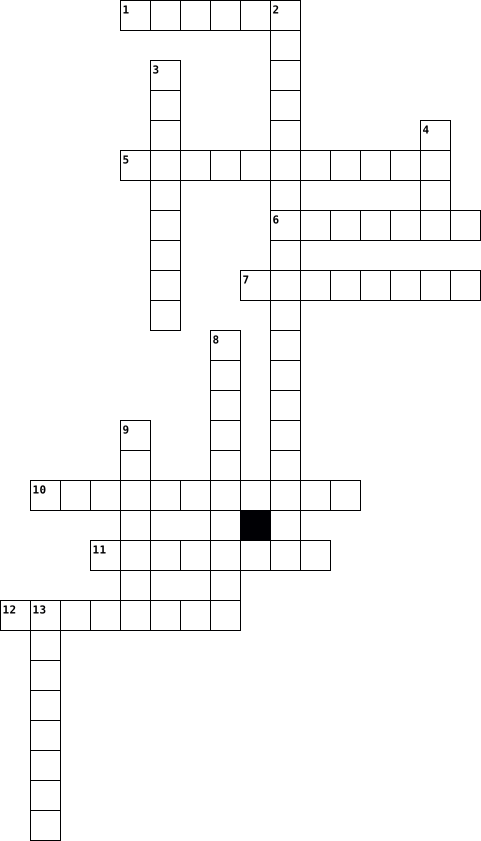
Across
- a number multiplied by another number
- the property of multiplication that states the order of the factors does not change the product
- the number divided into the dividend
- the product of a given number and any whole number
- the property of multiplication that states that changing the way the factors are grouped does not change the product
- the answer to a division problem
- the property of multiplication that states any number multiplied by one is itself
Down
- a strategy used to help divide
- a way to break down a number into its factors
- the property of multiplication that states any number multiplied by 0 is 0
- a group of related facts using the same numbers
- the answer to a multiplication problem
- a number being divided
13 Clues: a number being divided • a strategy used to help divide • the answer to a division problem • the number divided into the dividend • a number multiplied by another number • the answer to a multiplication problem • a way to break down a number into its factors • a group of related facts using the same numbers • the product of a given number and any whole number • ...
Impact of Civil War on Georgia 2018-11-12

Across
- states where slavery was not legal.
- Supreme Court ruling that declared slaves were not citizens of the United States.
- the act of making legally null and void
- Union victory; this one day battle allowed Union forces to inch closer to the city in the Atlanta Campaign; was not the battle that allowed Union Troops to occupy the city.
- compromise that brought Missouri into the Union as a slave state and Maine as a free state; in addition, Congress banned slavery north of the 36˚20' line of latitude.
- position supported by several prominent Georgia politicians who supported the Compromise of 1850.
- act that required runaway slaves to be returned to their masters if caught anywhere in the United States.
- the act of separating from a nation or state and becoming independent; the withdrawal of eleven southern states from the Union in 1860, leading to the Civil War.
- Confederate victory; largest battle fought in Georgia; led to the battle of Chattanooga.
- infamous Civil War prisoner-of-war camp in Macon County, Georgia. Over 13,000 Union soldiers died in the camp.
Down
- involuntary servitude of African-Americans or Blacks in the United States from 1619-1865.
- all of the assets that are used or can be used by the enemy are targeted, such as food sources, transportation, communications, industrial resources, and even the people in the area; Sherman employed this policy during his March to the Sea campaign.
- election where Abraham Lincoln defeated three opponents to win the presidency; upon Lincoln's election Southern states seceded from the Union.
- Union strategy during the Civil War which incorporated a plan to blockade Southern ports and capture the Mississippi River. It was called the Anaconda Plan as the strategy resembled an anaconda squeezing its prey to death.
- a series of battles fought in the Western Theater of the American Civil War throughout northwest Georgia and the area around Atlanta during the summer of 1864; a Union military campaign led by William T. Sherman from May 1864-September 1864 with the Atlanta as the ultimate objective; Sherman's army marched from Chattanooga to Atlanta. Included the battles of Dalton (Union victory), Resaca (Union victory), and Kennesaw Mountain (Confederate victory; only Union loss during the campaign).
- compromise between the North and South that allowed California to enter the union in exchange for the passage of the Fugitive Slave Act.
- Union military campaign led by William T. Sherman from November 15-December 25, 1864 with Savannah being the ultimate objective; more importantly Sherman used a "scorched earth" policy to end the South's will to fight.
- The 16th president of the United States, Lincoln preserved the Union during the U.S. Civil War and brought about the emancipation of slaves.
- document that declared all slaves in the rebellious states would be freed if the South did not return to the Union by January 1, 1863.
- the belief that a state's sovereignty is more important than that of the national government.
20 Clues: states where slavery was not legal. • the act of making legally null and void • Supreme Court ruling that declared slaves were not citizens of the United States. • Confederate victory; largest battle fought in Georgia; led to the battle of Chattanooga. • involuntary servitude of African-Americans or Blacks in the United States from 1619-1865. • ...
Unit One Escape Room (8th) 2022-09-21

Across
- Wanted larger states to have more representation in government
- Made slaves 3/5th of a person towards taxation, votes, and population
- To approve or agree formally
- This was the original document of the United States government that eventually failed.
- The greatest teacher of all time. #GOAT
- Wanted every state to have equal representation to ensure one state doesn't become to powerful
- Wanted a strong central government and weak state governments
Down
- James Madison, Alexander Hamilton, and John Jay wrote these papers to convince states to ratify the Constitution.
- Wanted a weak central government and strong state governments
- Someone who helped write the Constitution
- This separate body of people decides who becomes President
- Combined the New Jersey and Virginia Plans to create Congress
- This person wrote the Virginia Plan, Bill of Rights, and Federalist Papers. He also took detailed notes and proposed many ideas.
- This had to be added to the Constitution in order for some states to approve it
- The city that the Constitutional Convention took place
- The best class everrrrrrr. Duhhhhhh!
16 Clues: To approve or agree formally • The best class everrrrrrr. Duhhhhhh! • The greatest teacher of all time. #GOAT • Someone who helped write the Constitution • The city that the Constitutional Convention took place • This separate body of people decides who becomes President • Wanted a weak central government and strong state governments • ...
TheGreat depression 2021-01-29

Across
- known for her Depression-era work for the Farm Security Administration.
- The niece of Theodore Roosevelt.
- the purchase of an asset with the hope that it will become more valuable in the near future.
- a group of 43,000 demonstrators – made up of 17,000 U.S. World War I veterans, together with their families and affiliated groups.
- American physician who was best known for his revolving old-age pension proposal.
- The 32nd president of the united states.
- this guaranteed payment incase of loss of damage occurs.
Down
- Constitution of the United States of America 1789(rev 1992).
- Extremely dangerous storms caused by poor farming and weather.
- Was a government corporation administered by the U.S. federal government between 1932 and 1957.
- implemented protectionist trade policies in the United states.
- American author and the 1962 Nobel Prize in Literature winner.
- came to prominence in early 20th-century European states after WW1.
- many poor families and homeless people lived in these.
- the form of buying securities on borrowed money.
- An 1928 international agreements to not solve problems or disputes with war.
16 Clues: The niece of Theodore Roosevelt. • The 32nd president of the united states. • the form of buying securities on borrowed money. • many poor families and homeless people lived in these. • this guaranteed payment incase of loss of damage occurs. • Constitution of the United States of America 1789(rev 1992). • ...
crossword puzzle chapter 3 2012-09-20

Across
- powers assigns certain powers to the national government and states
- made for health care, social services or welfare
- powers that the constitution does not grant to the natl. gov.
- system of government in which a written constitution divides the powers of government
- agreements among themselves & with foreign states
- belongs to the national government it's gov. of sovereign state in world community
- made for some specific closely defined purpose
- an act creating in the new state
- to make all laws into foregoing powers & all other powers vested by the constitution
- are delegated to it in the constitution & national gov.
- powers granted to the constitution
Down
- grants made to states, localities, and sometimes private agencies that apply for them
- not stated in constitution but are suggested implied
- grants of federal money or other resources to the states and/or their cities, countries, & other local units
- legal processes by which a fugitive from justice in one state can be returned to that state
- can be exercised by Natl. Gov. alone
16 Clues: an act creating in the new state • powers granted to the constitution • can be exercised by Natl. Gov. alone • made for some specific closely defined purpose • made for health care, social services or welfare • agreements among themselves & with foreign states • not stated in constitution but are suggested implied • ...
Amendments 2024-02-06

Across
- ____ Amendment protects against cruel and unusual punishment
- Amendments are passed with a _____ quarters of the vote from both houses
- _______ Amendment states that citizens have five freedoms: speech, religion, petition, assembly , press
- The process in which a proposed amendment is passed and added to the constitution
- Part of the house representatives from each state
- ________ Amendment states that citizens have the right to bear arms
- ________ Amendment states that the powers not listed to the federal government are reserved fFederalismtes
- The Fourth Amendment protects against unlawful
Down
- The government system in which powers are shared between the national and state govenrments
- The total number of Amendments Constitutionthe US Consituion
- _____ Amendment protects against forced housing of soldiers
- Amendments are also passed with three-quarters of the vote from _____ state conventions
- Amendments are proposed by _____/thirds of the vote of both houses
- ______ Amendment that states the rights not listed in the Bill of Rights are reserved for the people.
- The _______ created by the founding founders, is considered the backbone of the American Government
- The first ten amendments
16 Clues: The first ten amendments • The Fourth Amendment protects against unlawful • Part of the house representatives from each state • _____ Amendment protects against forced housing of soldiers • The total number of Amendments Constitutionthe US Consituion • ____ Amendment protects against cruel and unusual punishment • ...
Vocab #5 2026-01-15

Across
- The process in which immigrants are absorbed into the dominant culture.
- A tenant farmer who gives a part of each crop as rent.
- A dwelling with walls made from strips of grassbound bricks.
- Areas of land managed by federal recognized tribes.
- A community that experienced rapid growth due to economic opportunity.
- A set of laws enacted by Southern States.
- A vast grassland region in central North America.
- A tax imposed on every adult
- A person from the northern states who went to south after civil war.
- The 19th century belief that the United States was meant to expand across North America.
Down
- Us law passed in 1862 that granted 160 acres of land to citizens who agreed to live on it.
- A contigous railway that connects Atlantic and Pacific coasts of a continent.
- The unjust treatment of different categories of people.
- An examination designed to assess literacy abilities.
- Enforced separation of people usually by race.
- State and local law that were enacted in the South States that enforced segregation.
16 Clues: A tax imposed on every adult • A set of laws enacted by Southern States. • Enforced separation of people usually by race. • A vast grassland region in central North America. • Areas of land managed by federal recognized tribes. • An examination designed to assess literacy abilities. • A tenant farmer who gives a part of each crop as rent. • ...