
the earth Crossword Puzzles
Solar Eclipse 2024-01-24

Across
- eclipse - happens when moon passes directly between Sun and Earth
- - these are the units of mass
- - force on an object because of gravity
- - when the earth is facing away from the sun
- solar eclipse - only part of Sun is covered by the Moon
- - amount of matter objects are made up of
- - outer part of the Moon's shadow
- - when the Earth is facing the sun
Down
- - force that pulls objects together
- - another word for move around
- solar eclipse - Moon completely covers the Sun
- - these are the units of weight
- - star the earth orbits around
- - darkest part of the Moon's shadow
- - planet that we live on
15 Clues: - planet that we live on • - these are the units of mass • - another word for move around • - star the earth orbits around • - these are the units of weight • - outer part of the Moon's shadow • - when the Earth is facing the sun • - force that pulls objects together • - darkest part of the Moon's shadow • - force on an object because of gravity • ...
Earth and Space Sciences Crossword 2023-11-13

Across
- growing
- March, April, May
- rise and fall of water
- southern-most point
- tilted on
- to turn
- light from the sun on the Earth
- shrinking
- Earth's natural sattelite
- longest/shortest day of the year
- one orbit around the sun
- 0 degree longitude mark
- coldest season
- force that keeps us on the ground
Down
- time in different places
- when the sun is not visible
- when the sun is visible
- lit up
- hottest season
- four of them in a year
- up and down across the Earth
- large number (starts with b)
- left and right across the Earth
- absense of light
- half of a sphere
- September, October, November
- the movement of water around the world
- northern-most point
- celestial object made of hydrogen
- our planet
- higher than low, lower than high
31 Clues: lit up • growing • to turn • tilted on • shrinking • our planet • hottest season • coldest season • absense of light • half of a sphere • March, April, May • southern-most point • northern-most point • rise and fall of water • four of them in a year • when the sun is visible • 0 degree longitude mark • time in different places • one orbit around the sun • Earth's natural sattelite • ...
Earth, Moon, and Sun 2024-04-30

Across
- This type of model shows the real sizes and distances of things in relation to others.
- The whole moon is visible from Earth.
- The circular path a smaller object takes around a larger object.
- The sun and all the planets and objects that orbit around it.
- The size of things relative to others in measurement.
- The moon is not visible from Earth because the dark side is facing Earth.
- Bowl-shaped holes or depressions in the surface of the moon.
- The time it takes for the Earth to revolve completely around the sun.
- This much of the moon is always visible from the top.
- Something that repeats again and again in the same way.
- Half of the moon is lighted on the left during the third week of the moon cycle.
- Less than half of the moon is visible with the light on the right side.
- More than half of the moon is visible with the light on the right side.
- An object, diagram or computer program which makes something simpler and easier to understand.
- A rocky planet that travels around the Earth.
Down
- The bread/pastry named after a moon phase.
- Half of the moon is lighted on the right side.
- To shine light on something to make it visible.
- This happens when the moon is between Earth and the sun.
- Most of our solar system is made up of this.
- The largest celestial body in our solar system.
- The time it takes for the moon to revolve completely around Earth.
- More than half of the moon is visible with the light on the left side.
- Less than half of the moon is visible with the light on the left side.
- The border between light and darkness on the moon.
25 Clues: The whole moon is visible from Earth. • The bread/pastry named after a moon phase. • Most of our solar system is made up of this. • A rocky planet that travels around the Earth. • Half of the moon is lighted on the right side. • To shine light on something to make it visible. • The largest celestial body in our solar system. • ...
Ecilpes 2025-11-16

Across
- The path objects travel in space
- Eclipse Earth blocks the Sun’s light from the Moon
- When Sun, Moon and Earth line up
- Eclipse Moon blocks the Sun
- Star at the centre of our Solar System
- Different shapes of the Moon we see
- Caused when light is blocked
- Moon Moon phase when lunar eclipses can happen
- Planet where we live, can block sunlight
Down
- Movement around another object (like the Moon around Earth)
- Eclipse Sun or Moon is fully covered
- Eclipse Sun or Moon is partly covered
- Force that keeps Moon in orbit
- Darkest part of the shadow
- Eclipse Ring of sunlight around the Moon
- Moon Moon phase when solar eclipses can happen
- Lighter outer shadow
- Where eclipses occur
- Earth’s natural satellite
19 Clues: Lighter outer shadow • Where eclipses occur • Earth’s natural satellite • Darkest part of the shadow • Caused when light is blocked • Force that keeps Moon in orbit • Eclipse Moon blocks the Sun • The path objects travel in space • When Sun, Moon and Earth line up • Different shapes of the Moon we see • Star at the centre of our Solar System • ...
Janine's Water Cycle Crossword 2024-09-19

Across
- Water stored underground
- Protective bubble in which we live in
- Rain
- Permeable rock that contains and transmits water
- All of Earth's water
- Solid--> Gas
- Star that is the center of our universe
- Continuous movement of water on, above, and below Earth
- Layer of Earth in which plants grow on
- When condensation occurs ______ form
- Water falling down from the clouds
Down
- Evaporation through plants.
- Gas--> Liquid
- Artificial lake used for storage
- When water turns into a gas it is called...?
- Liquid--> Gas
- Frozen lake
- Water soaks into the ground
- Vapor is a type of...?
- Ice falling down onto Earth
- Water that travels downhill and causes erosion
- White flakes falling down onto Earth
- Biggest body of water on Earth
- A state of matter that is firm and stable
- State of matter/ A fluid
25 Clues: Rain • Frozen lake • Solid--> Gas • Gas--> Liquid • Liquid--> Gas • All of Earth's water • Vapor is a type of...? • Water stored underground • State of matter/ A fluid • Evaporation through plants. • Water soaks into the ground • Ice falling down onto Earth • Biggest body of water on Earth • Artificial lake used for storage • Water falling down from the clouds • ...
Outside our World 2020-11-01

Across
- Rotates on its side, coldest temperature recorded
- Known as the red planet
- Made of rock, metals and other elements.
- A celestial body orbiting around a planet or star
- Time it takes for the moon to orbit the earth
- The closest planet to the sun and also the smallest
- The part of the planet facing the sun
- The planet known as the goldilocks planet
- The part of the planet not facing the sun
- The hottest planet, similar size and mass to earth
- Planets with temperatures not to hot or cold to allow for liquid water
- A grouping of stars that make an imaginary picture in the sky.
Down
- The line passing through the middle of the earth from the North Pole to the South Pole, 23.5 degrees
- Largest planet in our solar system
- Time it takes for Earth to spin on its axis
- Time it takes for Earth to orbit the sun
- A small particle from a comet or asteroid orbiting the Sun.
- The light phenomena which results when a meteoroid enters the Earth's atmosphere and vaporizes; a shooting star.
- Positioned in or relating to the sky, or outer space as observed in astronomy.
- Has the strongest winds in the solar system, furthest away from the sun
- A meteoroid that survives its passage through the Earth's atmosphere and lands upon the Earth's surface
- The person who landed on the moon
- The planet with the most distinct rings
- The collapsed core of a massive star.
- Cosmic snowballs of frozen gases, rock and dust that orbit the Sun.
25 Clues: Known as the red planet • The person who landed on the moon • Largest planet in our solar system • The part of the planet facing the sun • The collapsed core of a massive star. • The planet with the most distinct rings • Time it takes for Earth to orbit the sun • Made of rock, metals and other elements. • The planet known as the goldilocks planet • ...
Isaiah's prophetic view of Last Days 2012-08-21

Across
- land shall be utterly Isaiah 24;3
- we must listen to these D&C 1;14
- we must pay this or will be burned D&C 64;23
- what have they done to the laws 24;5
- this is where we need to stand D&C 45;32
- what have they done to these covenants 24;5
- the Earth ..... and fadeth away 24;4
- these people of the Earth do languish 24;4
- Heavenly Father will not suffer these to destroy righteous 1Nep 22;v16
- how many men left 24;6
Down
- these he will save and they will rejoice Isaiah 25;9
- everyone who dwells therein is this 24;6
- inhabitants of world will learn righteousness cuz of these 26;9
- if we don't listen to these we will be cut off D&C 1;14
- the Earth is defiled because of these 24;5
- the Lord will punish the Earth for this 26;21
- he gives us everlasting strength Isaiah 26;4
- this happens to these inhabitants 24;6
- what has devoured the Earth 24;6
19 Clues: how many men left 24;6 • we must listen to these D&C 1;14 • what has devoured the Earth 24;6 • land shall be utterly Isaiah 24;3 • what have they done to the laws 24;5 • the Earth ..... and fadeth away 24;4 • this happens to these inhabitants 24;6 • everyone who dwells therein is this 24;6 • this is where we need to stand D&C 45;32 • ...
Isaiah's prophetic view of Last Days 2012-08-21

Across
- this happens to these inhabitants 24;6
- what have they done to these covenants 24;5
- the Earth ..... and fadeth away 24;4
- what have they done to the laws 24;5
- if we don't listen to these we will be cut off D&C 1;14
- this is where we need to stand D&C 45;32
- inhabitants of world will learn righteousness cuz of these 26;9
- the Lord will punish the Earth for this 26;21
Down
- he gives us everlasting strength Isaiah 26;4
- how many men left 24;6
- Heavenly Father will not suffer these to destroy righteous 1Nep 22;v16
- the Earth is defiled because of these 24;5
- what has devoured the Earth 24;6
- these he will save and they will rejoice Isaiah 25;9
- we must listen to these D&C 1;14
- land shall be utterly Isaiah 24;3
- everyone who dwells therein is this 24;6
- these people of the Earth do languish 24;4
- we must pay this or will be burned D&C 64;23
19 Clues: how many men left 24;6 • what has devoured the Earth 24;6 • we must listen to these D&C 1;14 • land shall be utterly Isaiah 24;3 • the Earth ..... and fadeth away 24;4 • what have they done to the laws 24;5 • this happens to these inhabitants 24;6 • everyone who dwells therein is this 24;6 • this is where we need to stand D&C 45;32 • ...
Lunar Cycle 2022-05-06

Across
- Light in Left side of the Moon, decreasing in amount of light, also, coincidentally, a rapper
- The highest point on shore that the ocean reaches (occurs when the sun and moon are in line)
- Sun, new moon, Earth, Full Moon (TOOL used)
- the light is DECREASING from the LEFT; growing smaller, shrinking
- Less than half of the moon is visible from Earth. Light is increasing on the right; first appears like a very thin crescent which thickens over time.
- New Moon, First Quarter, Full Moon, Last Quarter. Major phases of the lunar cycle (TOOL used)
- Half of the moon is visible from Earth; the Moon appears half lit on the left.
- More than half of the moon is visible from Earth. The Moon appears more than half lit on the left; light is decreasing.
- Less than half of the moon is visible from Earth. The light is decreasing on the left; looks like a thick crescent that thins over time.
- a tide just after a new or full moon, when there is the greatest difference between high and low water.
Down
- 7 days after waning crescent, you will find this lunar phase
- Starting phase of the lunar cycle. No reflected light from the Sun is visible; the Moon appears unlit from Earth and it is between the Earth and Sun.
- the lowest point on shore that the ocean reaches (occurs when the sun and moon are not in line)
- More than half of the moon is visible from Earth; the Moon appears more than half lit on the right; shaped like a football or "humped" half circle.
- two weeks after a full moon, you will find this lunar phase
- Half of the moon is visible from Earth; the Moon appears half lit on the right.
- Fully visible (100% illuminated); the Moon appears fully lit and it is between the Earth and Sun.
- a tide just after the first or third quarters of the moon when there is the least difference between high and low water.
- On march 10th we experienced a waning crescent, 14 days later we'll experience this lunar phase
19 Clues: Sun, new moon, Earth, Full Moon (TOOL used) • two weeks after a full moon, you will find this lunar phase • 7 days after waning crescent, you will find this lunar phase • the light is DECREASING from the LEFT; growing smaller, shrinking • Half of the moon is visible from Earth; the Moon appears half lit on the left. • ...
Unit 6 2021-02-20

Across
- The process by which a liquid changes into a gas.
- examples are bogs, marshes and swamps
- low spots on land that fill with water
- largest and deepest ocean
- The mixture of gases that surround a planet.
- body of water that begins at a source
- The process by which a gas changes into a liquid.
- The solid portion of Earth.
- makes up 97% of water on earth
- makes up 3% of water on earth
Down
- Water that falls from the air to Earth’s surface.
- area where ocean meets land
- contain frozen freshwater
- large bodies of saltwater
- The process in which water continuously moves from Earth’s surface into the atmosphere and back again.
- All of the living things on earth
- The place at which land masses meet the ocean.
- smallest and shallowest ocean
- the name for a small lake
- All of Earth’s water, taken together in all states of matter.
20 Clues: contain frozen freshwater • large bodies of saltwater • largest and deepest ocean • the name for a small lake • area where ocean meets land • The solid portion of Earth. • smallest and shallowest ocean • makes up 3% of water on earth • makes up 97% of water on earth • All of the living things on earth • examples are bogs, marshes and swamps • body of water that begins at a source • ...
Map Skills 2023-10-04

Across
- A map that shows specialized information
- Measured in degrees E and W
- Shows the borders of states and countries
- A round shape like a ball
- Shows a big location
- How much above or below sea level a place is
- Divides the world into the eastern and western hemispheres
- Shows natural features found on land
- To change from one thing to another
- The relationship between distance on a map and distance in real life
Down
- To change something so that it is no longer accurate
- There are seven of these on Earth
- The feature on a map that shows directions
- Divides the world into the northern and southern hemispheres
- Measured in degrees N and S
- The study of Earth, its people, and environments
- Half of the earth
- There are five of these on Earth
- The feature on a map that explains the symbols and colors
- Shows a small location
20 Clues: Half of the earth • Shows a big location • Shows a small location • A round shape like a ball • Measured in degrees E and W • Measured in degrees N and S • There are five of these on Earth • There are seven of these on Earth • To change from one thing to another • Shows natural features found on land • A map that shows specialized information • ...
3rd Grade Comprehensive Review 2025-09-26

Across
- made up of atoms to make all matter
- the earth traveling around the sun
- energy of position
- the largest star we studied
- how a plant will respond to gravity
- acts as a warm blanket around the Earth
- attract pollinators to spread pollen
- objects will stay at rest unless acted upon by another force
- allow us to see far away in space
- reflects the light of the sun
- the earth spinning over 24 hours
- the act of plants using sunlight to make food
Down
- all for easy flow of electricity
- organisms that feed off of decaying matter
- thermal energy moving in a vacuum
- a push or pull on an object
- energy of motion
- a force that pulls us down towards the earth
- the seeds of ferns and moss
- opposite magnetic poles will _________
- the ability to do work
21 Clues: energy of motion • energy of position • the ability to do work • the largest star we studied • a push or pull on an object • the seeds of ferns and moss • reflects the light of the sun • all for easy flow of electricity • the earth spinning over 24 hours • thermal energy moving in a vacuum • allow us to see far away in space • the earth traveling around the sun • ...
Discover Øf Mad Science 2013-05-21

Across
- the point where earthquake energy is released
- The earth uppermost and outermost layer
- A sudden movement of earth 's crust usually along crack in the crust know as the faults
- energy waves,caused by earthquake,that spread out all directions form the epicenter.
- the largest thickness layer inside the earth,below the crust
- a force that pushes on rocks from opposites directions
- the solid center layer of earth
- the opening in the volcano where magma flows out
Down
- the ongoing from minerals precipitated from a solution or left behind by evaporation
- liquid rock from the mantle that rise to earth 's surface
- an instrument used to defect and measure seismic waves
- a mountain built of cooled lava,volcano ash,cinders,and rock
- minerals that are mined because they contain useful metals or commercials
- that pull rocks apart
- Rocks rock formed by the cooling and hardening of molten material
- the point on earth 's surface directly above the original of an earthquake
16 Clues: that pull rocks apart • the solid center layer of earth • The earth uppermost and outermost layer • the point where earthquake energy is released • the opening in the volcano where magma flows out • an instrument used to defect and measure seismic waves • a force that pushes on rocks from opposites directions • liquid rock from the mantle that rise to earth 's surface • ...
Planetary Motion 2021-06-01

Across
- center of our solar system
- three laws for planetary motion
- sun is the center of our solar system
- closes to the sun
- natural objects that rotate around the sun
- Mars rover
- name of our galaxy
- earth is the center of our solar system
Down
- man made objects that rotate around the earth and beyond
- flatness of an ellipse
- universal law of gravitation and planetary motion
- shape of the planetary orbit
- elliptical orbits have two ___
- natural object that rotates around the earth
- our planet
- farthest away from the sun
16 Clues: our planet • Mars rover • closes to the sun • name of our galaxy • flatness of an ellipse • center of our solar system • farthest away from the sun • shape of the planetary orbit • elliptical orbits have two ___ • three laws for planetary motion • sun is the center of our solar system • earth is the center of our solar system • natural objects that rotate around the sun • ...
Geography puzzle 2025-09-22

Across
- main directions (N, S, E, W)
- half of the earth
- smallest continent
- an exact location
- in between directions (NE, NW, SE, SW)
- line that divides the earth into the northern and southern hemispheres
- county Chittenango is located within
Down
- line that divides the earth into the eastern and western hemispheres
- number of hemispheres
- largest continent
- anything from nature that is useful
- largest ocean
- Continent the USA is located within
- can be reused
- ocean to the east of New York
- study of the earth
16 Clues: largest ocean • can be reused • largest continent • half of the earth • an exact location • smallest continent • study of the earth • number of hemispheres • main directions (N, S, E, W) • ocean to the east of New York • anything from nature that is useful • Continent the USA is located within • county Chittenango is located within • in between directions (NE, NW, SE, SW) • ...
Earth, Moon, and Sun Vocabulary 2023-03-28

Across
- the border between light and dark on the Moon
- the shape of the illuminated part of the Moon as it appears from Earth
- a moon phase that looks like a full circle from Earth
- to shine light on an object and make it visible
- or easier to see
- a moon phase in which the Moon is not visible from Earth
- the nearly circular path a smaller object (like the Moon) travels around a larger object (like Earth)
- a moon phase that looks like more than half a circle from Earth
- a moon phase that looks like less than half a circle from Earth
Down
- when the Moon is completely dark
- the relative size of things
- an object, diagram, or computer program that helps us understand something by making it
- a moon phase that looks like a half-circle from Earth
- the star that is the main source of light at the center of our solar system
- a rocky sphere that travels around a planet
15 Clues: or easier to see • the relative size of things • when the Moon is completely dark • a rocky sphere that travels around a planet • the border between light and dark on the Moon • to shine light on an object and make it visible • a moon phase that looks like a half-circle from Earth • a moon phase that looks like a full circle from Earth • ...
UOI-5 Quiz-1 2020-12-17

Across
- blue planet
- biggest planet with biggest moon
- rocky planet
- Earth takes one year to complete one _________
- _____________ is same size as of planet Earth.
- planets rotate around the sun in an __________
- natural satellite of earth.
- earth is at __________position in solar system
Down
- blanket of air around Earth
- condition of the air of a place is called
- _____________ bodies are group of starts, planets etc.
- weather remains same for many days.
- sun is a
- day and night are caused by ___________ of Earth
14 Clues: sun is a • blue planet • rocky planet • blanket of air around Earth • natural satellite of earth. • biggest planet with biggest moon • weather remains same for many days. • condition of the air of a place is called • Earth takes one year to complete one _________ • _____________ is same size as of planet Earth. • planets rotate around the sun in an __________ • ...
Solar System 2024-04-11
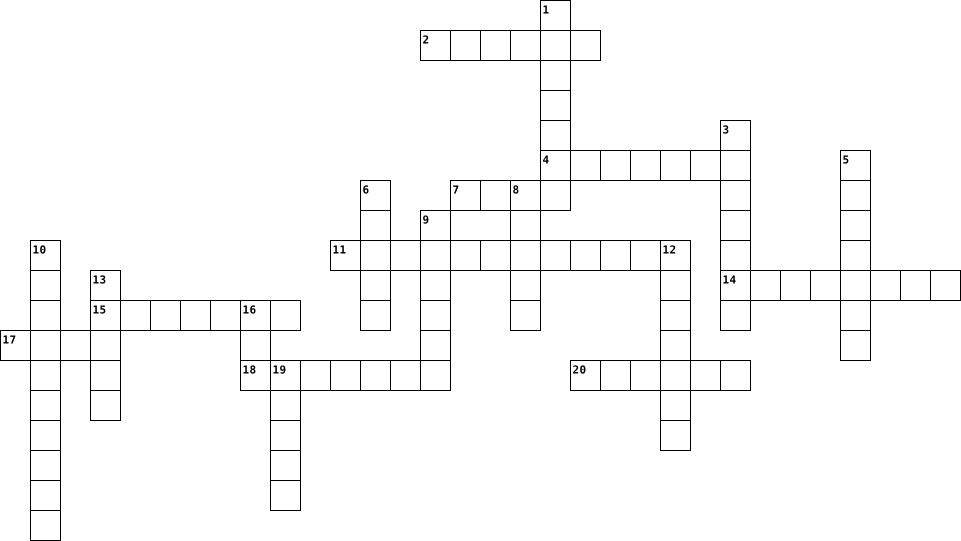
Across
- The outer planets are this.
- This planet has dark-colored storms, and many moons, and is the eighth/farthest planet from the sun.
- This planet has iron oxide, and polar ice caps, and is the fourth planet from the sun.
- This is when the Moon moves completely into Earth's umbra.
- This is the turning of Earth on its axis.
- This is the basic shape of every planet’s orbit.
- This is what causes the Earth's tides.
- Moon phase in which none of the lighted surfaces of the Moon can be seen from Earth is called this.
- This planet is the seventh planet from the sun.
Down
- These are caused by the direction Earth’s rotational axis is pointed with respect to the Sun.
- This planet has no atmosphere and is also the first planet from the sun.
- This planet is the largest planet and the fifth planet from the sun.
- This used to be a planet but now is a dwarf planet.
- The inner planets are this.
- This planet has the most complex ring system and is the sixth planet from the sun.
- The yearly orbit of Earth around the Sun is called this.
- This is when the Sun's rays strike Earth directly at the equator.
- This planet is the second planet from the sun.
- The basic astronomical unit is the distance Earth, the planet the scientists live on is from this place.
- Moon phases are the changing appearances of the Moon from this place and this is the third planet from the sun.
20 Clues: The outer planets are this. • The inner planets are this. • This is what causes the Earth's tides. • This is the turning of Earth on its axis. • This planet is the second planet from the sun. • This planet is the seventh planet from the sun. • This is the basic shape of every planet’s orbit. • This used to be a planet but now is a dwarf planet. • ...
Earth Day 2021-04-20

Across
- an animal that eats only plants
- turn these off to save electricity
- a place where animals, plants and humans live
- having a wide ranges of animals and plants in a habitat
- an animal that eats plants and meat
- the colour you think of on earth day
- our planet
- trash thrown on the ground
Down
- the weather and the climate changing
- to turn waste materials into new materials
- the earth getting hotter
- harmful chemicals and materials in the air
- to not waste energy
- the month in which we celebrate Earth Day
- to use something again
- when a species dies out
- to use less
- these give us oxygen
18 Clues: our planet • to use less • to not waste energy • these give us oxygen • to use something again • when a species dies out • the earth getting hotter • trash thrown on the ground • an animal that eats only plants • turn these off to save electricity • an animal that eats plants and meat • the weather and the climate changing • the colour you think of on earth day • ...
plate tectonics 2022-03-28
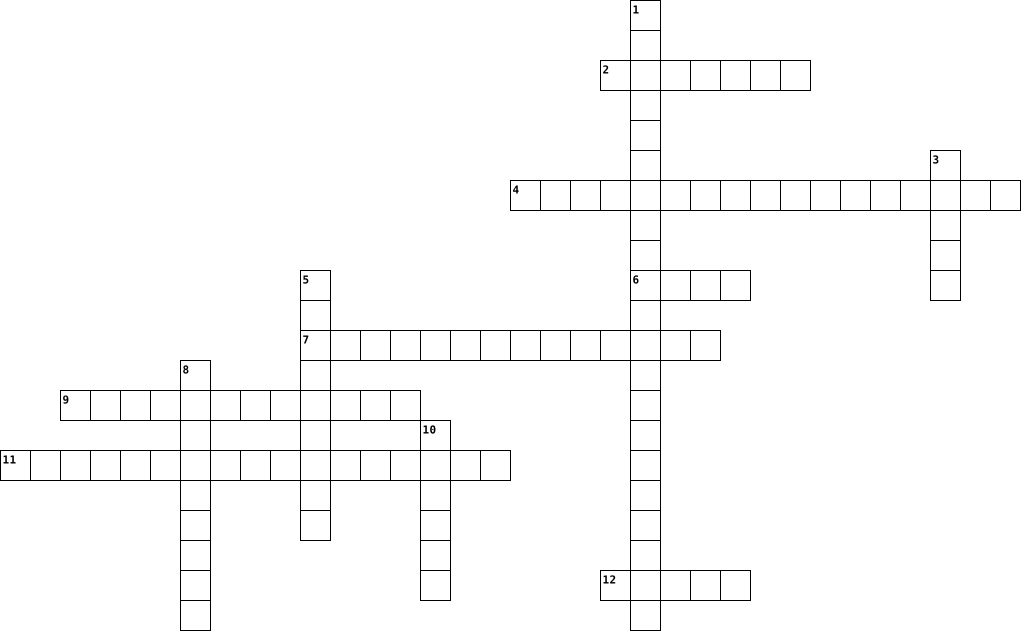
Across
- supercontinent
- plates that moved closer together
- magma outside the earth
- the topic of this crossword
- the plates under the ocean
- plates that move farther apart
- first layer of the earth
Down
- plates moving past each other horizontally
- lava inside the earth
- the third layer of the earth
- the fourth layer of the earth
- the second layer of the earth
12 Clues: supercontinent • lava inside the earth • magma outside the earth • first layer of the earth • the plates under the ocean • the topic of this crossword • the third layer of the earth • the fourth layer of the earth • the second layer of the earth • plates that move farther apart • plates that moved closer together • plates moving past each other horizontally
Ecology Human Impact 2022-12-15

Across
- Earth system that consists of plants.
- The extraction or removal of minerals or other geological materials from the Earth.
- The financial effects of an action.
- The processes of natural systems that directly or indirectly benefit humans.
- Earth system that consists of the land.
- When one organism or event effects another organism or event.
- Processes that make ecosystems clean, sustainable, functional, and resilient to change
- An organism that causes ecological or economic harm in a new environment where it is not native
- Earth system that consists of the air.
- Additional consequences that can occur after a direct impact
- The Earth´s interacting physical, chemical, and biological processes.
- A natural substance that is not replenished with the speed at which it is consumed
- Impacts that affect peoples health, safety, or feelings.
- Earth system that consists of the water.
Down
- The flow of chemical elements between living organisms and the physical environment
- The non-material benefits people obtain from nature.
- Services that are necessary for the production of all other ecosystem services
- Nature's way of reusing carbon atoms, which travel from the atmosphere into organisms in the Earth and then back into the atmosphere over and over again.
- Limiting or controlling certain factors
- The practice of preparing soil for planting, producing crops, and raising livestock
- The process of breaking down an organic material or substance into smaller parts, especially by the action of decomposers
- The condition in which all acting influences are balanced or canceled by equal opposing forces, resulting in a stable and balanced system.
- Decrease in the population of people living in farming communities and the increase of people living in cities
- Any type of benefit to people that can be extracted from nature.
- Resources can be used repeatedly and do not run out because it is naturally replaced in a relatively short amount of time
- Changes have consequences that impact the environment.
- The geological process in which earth materials are worn away and transported by natural forces such as wind or water.
27 Clues: The financial effects of an action. • Earth system that consists of plants. • Earth system that consists of the air. • Limiting or controlling certain factors • Earth system that consists of the land. • Earth system that consists of the water. • The non-material benefits people obtain from nature. • Changes have consequences that impact the environment. • ...
Outside our World Revision 2020-11-01

Across
- Time it takes for Earth to spin on its axis
- The light phenomena which results when a meteoroid enters the Earth's atmosphere and vaporizes; a shooting star.
- made of rock, metals and other elements.
- The planet with the most distinct rings
- Planets with temperatures not to hot or cold to allow for liquid water
- positioned in or relating to the sky, or outer space as observed in astronomy.
- Time it takes for the moon to orbit the earth
- The hottest planet, similar size and mass to earth
- A small particle from a comet or asteroid orbiting the Sun.
- cosmic snowballs of frozen gases, rock and dust that orbit the Sun.
- Time it takes for Earth to orbit the sun
- The part of the planet not facing the sun
- Has the strongest winds in the solar system, furthest away from the sun
Down
- A celestial body orbiting around a planet or star
- A grouping of stars that make an imaginary picture in the sky.
- Known as the red planet
- A meteoroid that survives its passage through the Earth's atmosphere and lands upon the Earth's surface
- Largest planet in our solar system
- Rotates on its side, coldest temperature recorded
- The planet known as the goldilocks planet
- line passing through the middle of the earth from the North Pole to the South Pole, 23.5 degrees
- The part of the planet facing the sun
- The closest planet to the sun and also the smallest
- The collapsed core of a massive star.
- The person who landed on the moon
25 Clues: Known as the red planet • The person who landed on the moon • Largest planet in our solar system • The part of the planet facing the sun • The collapsed core of a massive star. • The planet with the most distinct rings • made of rock, metals and other elements. • Time it takes for Earth to orbit the sun • The planet known as the goldilocks planet • ...
Seasons 2023-10-27

Across
- Starts March 21-23
- Gives off heat
- Revolves around the earth
- When the sun's beams hit the earth in a not direct place
- Near the axis on the bottom
- Changes the type of weather
- The day the season changes
- Starts December 21-22
- When the sun's beams hit the earth hard
Down
- Starts September 21-23
- Starts June 21-22
- Near the axis on the top
- Revolves around the sun
- Known as the North Star
- Points towards Polaris
15 Clues: Gives off heat • Starts June 21-22 • Starts March 21-23 • Starts December 21-22 • Starts September 21-23 • Points towards Polaris • Revolves around the sun • Known as the North Star • Near the axis on the top • Revolves around the earth • The day the season changes • Near the axis on the bottom • Changes the type of weather • When the sun's beams hit the earth hard • ...
Earth,Moon,Sun 2021-02-02

Across
- moon phase that looks like a full circle from Earth gibbous
- star that is the main source of light at the center of our solar system
- the Moon is completely dark
- moon phase that looks like a half-circle from Earth
- shape of the illuminated part of the Moon as it appears from Earth
- moon phase in which the Moon is not visible from Earth
- moon phase that looks like more than half a circle from Earth
- border between light and dark on the Moon
- moon outside our solar system
- planet outside our solar system
Down
- we observe to be similar over and over again
- object, diagram, or computer program that helps us understand something by making it simpler or easier to see
- amount of time it takes for a planet to complete one orbit around a star or stars
- shine light on an object and make it visible
- nearly circular path a smaller object (like the Moon) travels around a larger object (like Earth).
- moon phase that looks like less than half a circle from Earth
- rocky sphere that travels around a planet moon
- sun, the planets that orbit the sun, and other objects that orbit the sun
- relative size of things
19 Clues: relative size of things • the Moon is completely dark • moon outside our solar system • planet outside our solar system • border between light and dark on the Moon • we observe to be similar over and over again • shine light on an object and make it visible • rocky sphere that travels around a planet moon • moon phase that looks like a half-circle from Earth • ...
cité de l'espace 2023-02-20

Across
- name of the meteorite found in Namibia
- qualifying the Moon side we never see
- one of the 2 objects used by Apollo 15 to perform an experiment
- a vegetable (grown in the ISS lab)that the astronauts ate in 2015
- sport played by one of the Apollo14 members on the Moon
- international space station
- particularity of the toothpaste used in the ISS
- quantity that is the same on the Moon and on the Earth
- chemical element responsible for the color of Mars
- method used to grow plants without soil
- name of the dust on the Moon
Down
- result of the gravity on the Earth divided by the one on the Moon
- the farthest planet from the Sun
- Pluto is part of this category of planetes
- the closest planet to the Sun
- fragments of asteroids that reach the Earth
- one of the 2 objects used by Apollo 15 to perform an experiment
- quantity that is not the same on the Moon and on the Earth
- chemical element on the helmets protecting astronauts
- name of the planet that collided with the Earth resulting in the creation of the Moon
- the biggest planet in the solar system
- the best pole to live on the Moon
- where we can find water on the Moon
23 Clues: international space station • name of the dust on the Moon • the closest planet to the Sun • the farthest planet from the Sun • the best pole to live on the Moon • where we can find water on the Moon • name of the meteorite found in Namibia • qualifying the Moon side we never see • the biggest planet in the solar system • method used to grow plants without soil • ...
tectonic plats crossword 2023-03-29

Across
- heart driven cycles
- a structural trap formed by the folding of rock strata into an arch-like shape
- a huge wave that is the result of a earthquake
- a device that measure severity of earthquakes
- hot inner layer of the earth
- mountains that have lava in it
- a trough or fold of stratified rock in which the strata slope upwards from the axis.
- a fracture or zone of fractures between two blocks of rock.
- the second most inner layer of the earth
- A type of volcano
Down
- southern super continent
- the outermost layer of the earth
- mountains under the sea
- How land moves
- supercontinent
- molten rock
- the old measurement of earthquakes
- thing being pulled to the center to the earth
- molten rock
- the results of tectonic plates colliding
20 Clues: molten rock • molten rock • How land moves • supercontinent • A type of volcano • heart driven cycles • mountains under the sea • southern super continent • hot inner layer of the earth • mountains that have lava in it • the outermost layer of the earth • the old measurement of earthquakes • the second most inner layer of the earth • the results of tectonic plates colliding • ...
Sarah Avery's Crossword 2012-08-10

Across
- The weather conditions of a region
- Europe, Asia, America, Africa, Oceania and Antarctica are all _________
- The line that goes aroung the whole of earth and the weather gets warmer the closer you get to it
- A large group or chain of islands
- Half of the earth, north and south ________
- The production of crops and livestock
- The line going east to west around earth
- Detailed mapping of a small area
Down
- The mapping of a region
- The line going north to south from the equator on earth.
- An area on earth where it is warm in summer, cold in winter and moderate in spring and autumn
- The earth spins on its _______
- A geographical dictionary
- The production of maps is ________
- A country that has no access to the sea is a ________ country
15 Clues: The mapping of a region • A geographical dictionary • The earth spins on its _______ • Detailed mapping of a small area • A large group or chain of islands • The weather conditions of a region • The production of maps is ________ • The production of crops and livestock • The line going east to west around earth • Half of the earth, north and south ________ • ...
Moon Phases and Eclipses 2024-11-08

Across
- The number of phases in the lunar cycle.
- The moon is halfway lit. The light is on the left.
- The act of the Earth spinning on its axis.
- This is a lighter type of shadow.
- In a ____ moon, we cannot see it because the light is on the back side.
- In a waxing _______ moon, more than half of the moon is illuminated on the right.
- This means "getting smaller" or "decreasing"
Down
- The moon is halfway lit. The light is on the right.
- The moon's orbit is _______ 5 degrees.
- In a____ moon, the entire side is illuminated.
- In a waning ________ moon, less than half of the moon is illuminated on the left.
- In a ______ eclipse, the Earth's shadow falls on the moon.
- This is the point where the moon is closest to the Earth.
- In a ______ eclipse, the moon's shadow falls on the Earth
- This is the dark center of the moon's shadow.
- This is the point where the moon is farthest from the Earth.
- The pathway the Earth follows around the sun.
- This means "growing" or "increasing"
- The light from the ____ is reflected onto the moon.
19 Clues: This is a lighter type of shadow. • This means "growing" or "increasing" • The moon's orbit is _______ 5 degrees. • The number of phases in the lunar cycle. • The act of the Earth spinning on its axis. • This means "getting smaller" or "decreasing" • This is the dark center of the moon's shadow. • The pathway the Earth follows around the sun. • ...
Social Studies Review 2020-11-06

Across
- a source made many years after the time period
- the city we live in
- continent east of North America
- also can be known as provinces
- an abbreviation: how humans modify/adapt to the landscape
- place on Rd. 88 that's empty right now
- continent in the very south of the Earth
- synonym of town, pueblo, burg
- absolute and relative
- measurement of location on Earth: West and East
- how goods, services, and people get around the country
Down
- continent with the biggest desert
- land with its own government (smaller than continent, but bigger than a city).
- one of the 5 themes: physical features and climate
- a source created during the time period
- the state we live in
- American continent with the biggest rain forest
- There are 7 of them on Earth
- measurement of location on Earth: North and South
- parts of land grouped together by certain characteristics
20 Clues: the city we live in • the state we live in • absolute and relative • There are 7 of them on Earth • synonym of town, pueblo, burg • also can be known as provinces • continent east of North America • continent with the biggest desert • place on Rd. 88 that's empty right now • a source created during the time period • continent in the very south of the Earth • ...
EARTHQUAKE 2021-12-20

Across
- why there is no movement right away
- shaking of the earth
- when 2 plates are moving apart
- outside layer of the earth
- Philippine Institute of Volcanology and Seismology
- ___from inside the earth makes the ground move
- ___ fault forms when tensional stress pulls rock apart
- ___waves are vibration from the focus
- every time the fault slips, the earth ___
- a big wave
- fault that has moved before and is possible to move again
- when too much ___ occurs, the rocks snaps
Down
- ___ fault forms under compression stress
- degree of shaking caused by an earthquake
- a break in the earth's crust
- made up of rocks or ice
- flat surface between 2 pieces
- Philippines is located along a Ring of ___
- origin of the earthquake
- spot directly above the focus
- rocks suddenly ___, generating earthquake
- uses Hindu Arabic numerals
22 Clues: a big wave • shaking of the earth • made up of rocks or ice • origin of the earthquake • outside layer of the earth • uses Hindu Arabic numerals • a break in the earth's crust • flat surface between 2 pieces • spot directly above the focus • when 2 plates are moving apart • why there is no movement right away • ___waves are vibration from the focus • ...
Space 2024-04-04

Across
- A natural satellite that orbits the Earth
- the star Earth orbits
- A gravitational field so strong that not even light can escape
- An enormous cloud of dust and gas occupying the space between stars and acting as a nursery for new stars
- All of space and everything in it including stars, planets, galaxies, etc
- A young star are in the early stages of formation
- The cycle the moon goes through
- A star that is among the most massive and brightest of all stars
- The planet we live on
- A diagram to classify stars
- 90% of stars are in this stage of their life cycle
Down
- The galaxy the Earth is located in
- Where the moon is between the Earth and sun
- A extremely bright explosion of a star
- A star that has exhausted all of its nuclear fuel; plant size and very dense
- A celestial body that orbits stars
- A system of stars and all the objects that orbit it
- A dead star that no longer gives off light or heat
- The path of a celestial body in its revolution about another
- A star that is larger and brighter than a main sequence star
20 Clues: the star Earth orbits • The planet we live on • A diagram to classify stars • The cycle the moon goes through • The galaxy the Earth is located in • A celestial body that orbits stars • A extremely bright explosion of a star • A natural satellite that orbits the Earth • Where the moon is between the Earth and sun • A young star are in the early stages of formation • ...
Galactic Guidebook 2025-05-24

Across
- Orbits the Earth
- The sun is our closest ____
- Its brightness is why we only see stars at night
- Use constellations to know what season it is for planting crops
- The distance light travels in one year
- This star is at the end of Ursa Minor and points north
- This constellation cannot be seen in summer.(hint: Greek hunter)
- Shadows are ________ when the sun is at its lowest point in the sky
- Nights are always longer during _______
Down
- A group of stars that form a pattern
- They can use the stars to navigate their way around the Earth
- Days are always longer during _______
- Orbits the sun
- Shadows are ________ when the sun is at its highest point in the sky
- Pulls us toward the center of the Earth
- An imaginary line that the Earth rotates on
- A repeating path one object is space takes around another one
17 Clues: Orbits the sun • Orbits the Earth • The sun is our closest ____ • A group of stars that form a pattern • Days are always longer during _______ • The distance light travels in one year • Pulls us toward the center of the Earth • Nights are always longer during _______ • An imaginary line that the Earth rotates on • Its brightness is why we only see stars at night • ...
Space 2024-06-23

Across
- The planet we live on
- Our galaxy
- The biggest planet in our solar system
- How we observe the galaxy for a long time
- When planets orbit a star
- The vessel we use to reach space
- The planet closest to the sun
- The closest star to earth
Down
- The furthest planet from the sun
- The coldest planet in our solar system
- When the moon blocks the sun
- What makes air stay on earth
- It orbits earth
- The people who go to space
- What holds the galaxy together
- The red planet
16 Clues: Our galaxy • The red planet • It orbits earth • The planet we live on • When planets orbit a star • The closest star to earth • The people who go to space • When the moon blocks the sun • What makes air stay on earth • The planet closest to the sun • What holds the galaxy together • The furthest planet from the sun • The vessel we use to reach space • ...
EARTH 2023-11-20

Across
- Form from cooling and freezing of magma/lava
- and changes the earth’s surface
- Earth Main layers
- Harder than its original rocks
- caused by forces from within the earth
Down
- Water zone (river, lake, sea)
- Air zone covering the Earth’s surface
- Little or no light
- Water is very shallow
- Form by compression of deposited material
- Occur on Earth’s surface
- Earth Main layers
12 Clues: Earth Main layers • Earth Main layers • Little or no light • Water is very shallow • Occur on Earth’s surface • Water zone (river, lake, sea) • Harder than its original rocks • and changes the earth’s surface • Air zone covering the Earth’s surface • caused by forces from within the earth • Form by compression of deposited material • Form from cooling and freezing of magma/lava
Earth 2023-03-06

Across
- a large natural elevation of the earth's surface rising abruptly from the surrounding level; a large steep hill.
- path along the Pacific Ocean characterized by active volcanoes
- tending to be different or develop in different directions.
- coming closer together, especially in characteristics or ideas.
- A continent
- locations where two plates slide past one another
Down
- line that marks the limits of an area; a dividing line.
- A continent
- massive, irregularly shaped slab of solid rock,
- The bottom of a sea or ocean
- a mountain or hill, typically conical, having a crater or vent through which lava,
- a planet with life
12 Clues: A continent • A continent • a planet with life • The bottom of a sea or ocean • massive, irregularly shaped slab of solid rock, • locations where two plates slide past one another • line that marks the limits of an area; a dividing line. • tending to be different or develop in different directions. • path along the Pacific Ocean characterized by active volcanoes • ...
Earth 2023-03-06

Across
- a large natural elevation of the earth's surface rising abruptly from the surrounding level; a large steep hill.
- path along the Pacific Ocean characterized by active volcanoes
- tending to be different or develop in different directions.
- coming closer together, especially in characteristics or ideas.
- A continent
- locations where two plates slide past one another
Down
- line that marks the limits of an area; a dividing line.
- A continent
- massive, irregularly shaped slab of solid rock,
- The bottom of a sea or ocean
- a mountain or hill, typically conical, having a crater or vent through which lava,
- a planet with life
12 Clues: A continent • A continent • a planet with life • The bottom of a sea or ocean • massive, irregularly shaped slab of solid rock, • locations where two plates slide past one another • line that marks the limits of an area; a dividing line. • tending to be different or develop in different directions. • path along the Pacific Ocean characterized by active volcanoes • ...
Earth 2023-04-18

Across
- an organism that makes their own food
- the planet that we live on
- an organism that breaks down dead consumers and producers
- a natural fuel like coal
- a species/family that is no longer alive/in existence
- an object that orbits a planet or something else that is not a star
Down
- a species/family that is on the verge of extinction
- the act of clearing a wide are of trees
- an organism that eats other organisms
- a substance that is harmful to the environment
- the star that we circle
11 Clues: the star that we circle • a natural fuel like coal • the planet that we live on • an organism that makes their own food • an organism that eats other organisms • the act of clearing a wide are of trees • a substance that is harmful to the environment • a species/family that is on the verge of extinction • a species/family that is no longer alive/in existence • ...
Earth 2021-11-01

Across
- a boundary where plates move towards each other and collide
- The mostly-solid layer of Earth's interior
- the study of volcanoes
- where two plates move away from each other
Down
- The transfer of heat by the circulation or movement of heat in a liquid or gas
- a boundary where the plates slide horizontally past each other
- the outermost shell of the planet
- topographic depressions of the seafloor, relatively narrow in width, but very long
- theory explaining the structure of the earth's crust
- fluid layer about 2,400 km (1,500 mi) thick and composed of mostly iron and nickel
- Where to plates meet
11 Clues: Where to plates meet • the study of volcanoes • the outermost shell of the planet • The mostly-solid layer of Earth's interior • where two plates move away from each other • theory explaining the structure of the earth's crust • a boundary where plates move towards each other and collide • a boundary where the plates slide horizontally past each other • ...
Earth 2023-11-09

Across
- Made up like a puzzle underneath Earth's crust.
- Plate boundaries pass each other and break.
- water sets, similar to a swamp.
- The base of a building or a house.
Down
- Usually the bedrock is broke and a bad place to build on top of.
- The OG of dance moves
- Pull to the Center of the Earth.
- A sudden event that destroys houses/property.
- Determines the layers of the Earth.
- The edge of tectonic plates.
- Solid rock underneath the soil. Also home of the Flintstones.
11 Clues: The OG of dance moves • The edge of tectonic plates. • water sets, similar to a swamp. • Pull to the Center of the Earth. • The base of a building or a house. • Determines the layers of the Earth. • Plate boundaries pass each other and break. • A sudden event that destroys houses/property. • Made up like a puzzle underneath Earth's crust. • ...
Earth 2023-11-10

Across
- the name for rain, sun, storms, wind
- another name for rain
- the layer that has all the water
- the layer of earth that is thinnest
- the layer that has all the land
- the layer that holds earth magnetic field
- the layer around the earth that allows us to live on earth
Down
- what the sun does to water
- the layer where all the weather happens
- this is solid and located at the center of earth
- when water vapor turns to clouds
11 Clues: another name for rain • what the sun does to water • the layer that has all the land • the layer that has all the water • when water vapor turns to clouds • the layer of earth that is thinnest • the name for rain, sun, storms, wind • the layer where all the weather happens • the layer that holds earth magnetic field • this is solid and located at the center of earth • ...
Earth 2022-01-04

Across
- Crust
- Transform
- Core
- Valcano
- Convergent
- Trench
Down
- Divergent
- Subtonic
- Mountain
- Earthquake
- Mantle
11 Clues: Core • Crust • Mantle • Trench • Valcano • Subtonic • Mountain • Divergent • Transform • Earthquake • Convergent
Earth 2022-02-02
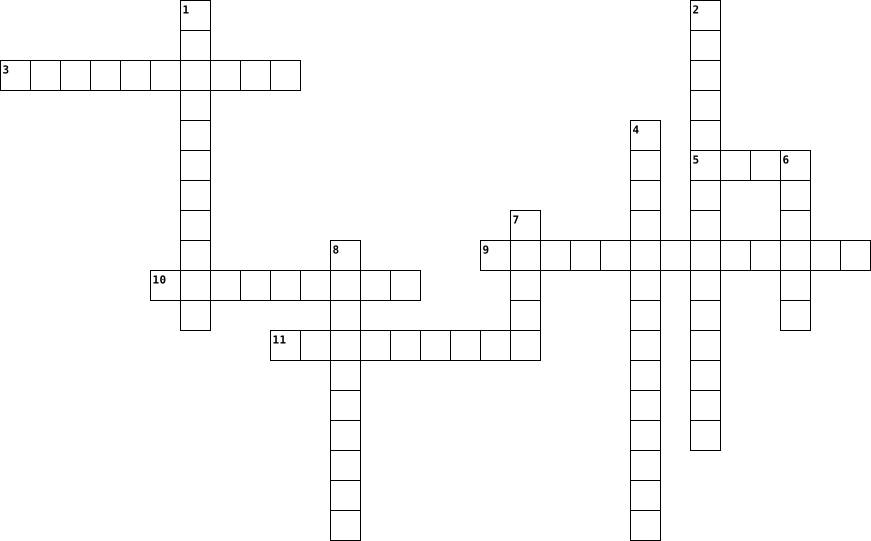
Across
- plate slides under another
- lowland region where plate tectonics
- trench in western pacific ocean
- slide
- divorce
Down
- upper layer of mantle
- rift in africa
- fault in san andres
- valley in ocean
- zero fractures between plate tectonics
- Collide
11 Clues: slide • Collide • divorce • rift in africa • valley in ocean • fault in san andres • upper layer of mantle • plate slides under another • trench in western pacific ocean • lowland region where plate tectonics • zero fractures between plate tectonics
Earth 2026-05-11

Across
- third planet from Earth
- fire exploding out of Earth
- Invisible line through Earth
- average tempurature
- big white rock and natural satelite of Earth
- underground, brown, has different organisms
Down
- Earth's oceans spinning and creating rotation in water
- Center of Earth
- what people breathe in
- Waterlandform
- Main source of energy
11 Clues: Waterlandform • Center of Earth • average tempurature • Main source of energy • what people breathe in • third planet from Earth • fire exploding out of Earth • Invisible line through Earth • underground, brown, has different organisms • big white rock and natural satelite of Earth • Earth's oceans spinning and creating rotation in water
Earth Structure 2019-11-06

Across
- Earth's shape as a plane or disk.
- Layer of the Earth: made up mainly of iron and nickel.
- Discovered the inner core.
- The study of physical structure of the earth and the processes which act on them.
- Type of sediment transportation: dropping of sediment in a new place.
Down
- One oceanic plate slides under the continental crust.
- Proposes that the planet Earth is entirely hollow.
- Layer of the Earth: different types of rocks.
- Layer of the Earth: it is solid but can flow very slowly.
- Type of sediment transportation: movement of sediment from broken rock.
- Type of sediment transportation: breaking down of rock because of weathering agents.
- Layer of the Earth: solid center of the Earth.
- The study of the land, inhabitants and the phenomena of Earth.
13 Clues: Discovered the inner core. • Earth's shape as a plane or disk. • Layer of the Earth: different types of rocks. • Layer of the Earth: solid center of the Earth. • Proposes that the planet Earth is entirely hollow. • One oceanic plate slides under the continental crust. • Layer of the Earth: made up mainly of iron and nickel. • ...
Science 10 Unit D Words 2025-03-10

Across
- Tranfer of thermal energy without direct contact
- Air, part of the biosphere
- Long-term weather that has been recorded for over 30 years
- Made up of three parts, what we live in
- Land, part of the biosphere
- The transfer of water throughout the Earth
- The convection currents all across the Earth
- When an animal changes to fit its environment
Down
- When warm air rises and cool air takes its place
- A graph showing the heat input and the temperature of a substance
- Water, part of the biosphere
- The angle the Earth sits
- The different species that live on Earth
- The angle the Sun hits a spot on the Earth
- Transfer of thermal energy through direct contact
- Every day temperatures that we record for later years of research
16 Clues: The angle the Earth sits • Air, part of the biosphere • Land, part of the biosphere • Water, part of the biosphere • Made up of three parts, what we live in • The different species that live on Earth • The transfer of water throughout the Earth • The angle the Sun hits a spot on the Earth • The convection currents all across the Earth • ...
a;lsfja;sj ea;fa 2025-05-16

Across
- The imaginary line Earth spins around.
- A dark shape made when something blocks light.
- The direction Earth rotates; not like a clock.
- phase The shape of the Moon we see from Earth.
- When Earth goes around the Sun once
- When Earth spins once around its axis
Down
- If you can see something, it is __.
- Pole The very top point of the Earth.
- Spring, summer, fall, and winter
- Completely different.
- moon The moon phase when the whole Moon is bright and round.
- moon The moon phase when we can’t see the Moon at all.
- Earth is not straight; it has a small __ on its axis.
13 Clues: Completely different. • Spring, summer, fall, and winter • If you can see something, it is __. • When Earth goes around the Sun once • Pole The very top point of the Earth. • When Earth spins once around its axis • The imaginary line Earth spins around. • A dark shape made when something blocks light. • The direction Earth rotates; not like a clock. • ...
space by chanel 2012-06-18

Across
- noone has ever been on marshot the sun is verry hot
- jupiter has sixeen moons
- uranus is the farthest from the sun
- the earth is the third planet from the sun
- the earth rotates slowly
- the sun can blined you
- mercury had 18 moons
Down
- giant jupiter is called a gas giant
- earth is the safest place for humans
- mecury is the closest to the sun
- the sun is a star
- a meteoroid goes 25km per second
- earth has a high gravity level
- the most visiable rings
14 Clues: the sun is a star • mercury had 18 moons • the sun can blined you • the most visiable rings • jupiter has sixeen moons • the earth rotates slowly • earth has a high gravity level • mecury is the closest to the sun • a meteoroid goes 25km per second • giant jupiter is called a gas giant • uranus is the farthest from the sun • earth is the safest place for humans • ...
Climate change crossword 2024-03-15

Across
- shape of orbit around the sun, tilt of earth axis, wobbling of earth axis
- when Carbon dioxide levels are the highest
- the earth was mostly carbon dioxide and nitrogen
- glaciers growing and advancing
- very dry and less dense than the troposphere
- under water current fueled by the mixing of warm and cold salt water
- located on land
- when carbon dioxide levels are the lowest
- located in the ocean
- increasing due to melting ice
- when a hemisphere is facing the sun half of the incoming solar radiation passes through the atmosphere
Down
- water expands as it warms
- contains the air we breathe and every aspect of what we call weather
- thin layer of gas that surrounds the earth
- proxy that is used to measure the past atmosphere of earth
- releases sulfur dioxide and particulates that scatter solar radiation
- surface temperature is lowered so glaciers form
17 Clues: located on land • located in the ocean • water expands as it warms • increasing due to melting ice • glaciers growing and advancing • when carbon dioxide levels are the lowest • when Carbon dioxide levels are the highest • thin layer of gas that surrounds the earth • very dry and less dense than the troposphere • surface temperature is lowered so glaciers form • ...
SOLAR ECLIPSE 2024-04-09

Across
- hot star that the Earth revolves around
- ours is called the Milky Way
- a flaming hot mass in the solar system
- When the sun goes down
- Dealing with the moon
- when the moon goes between the sun and Earth
- rotates around Earth
- the planet we live on
- where astronauts go
Down
- facing the sun
- Dealing with the sun
- when the sun comes up
- a large rock revolving around the sun
- to go around something
- not facing the sun
15 Clues: facing the sun • not facing the sun • where astronauts go • Dealing with the sun • rotates around Earth • when the sun comes up • Dealing with the moon • the planet we live on • When the sun goes down • to go around something • ours is called the Milky Way • a large rock revolving around the sun • a flaming hot mass in the solar system • hot star that the Earth revolves around • ...
Isaiah's prophetic view of Last Days 2012-08-21

Across
- if we don't listen to these we will be cut off D&C 1;14
- what have they done to these covenants 24;5
- the Earth ..... and fadeth away 24;4
- what have they done to the laws 24;5
- Heavenly Father will not suffer these to destroy righteous 1Nep 22;v16
- this happens to these inhabitants 24;6
- we must pay this or will be burned D&C 64;23
- this is where we need to stand D&C 45;32
Down
- we must listen to these D&C 1;14
- the Lord will punish the Earth for this 26;21
- how many men left 24;6
- these he will save and they will rejoice Isaiah 25;9
- inhabitants of world will learn righteousness cuz of these 26;9
- land shall be utterly Isaiah 24;3
- everyone who dwells therein is this 24;6
- the Earth is defiled because of these 24;5
- he gives us everlasting strength Isaiah 26;4
- what has devoured the Earth 24;6
- these people of the Earth do languish 24;4
19 Clues: how many men left 24;6 • we must listen to these D&C 1;14 • what has devoured the Earth 24;6 • land shall be utterly Isaiah 24;3 • the Earth ..... and fadeth away 24;4 • what have they done to the laws 24;5 • this happens to these inhabitants 24;6 • everyone who dwells therein is this 24;6 • this is where we need to stand D&C 45;32 • ...
Lithosphere, Geologic Events/Processes, and Mass Extinctions 2022-03-08

Across
- The natural loss of species through evolution is called ____________ extinction.
- The second compositional layer of Earth.
- The outermost compositional layer of Earth.
- Scientists believe humans may be causing a ________ mass extinction.
- An earthquake is an example of a geologic _______.
- The deepest, center layer of the earth.
- The Earth's Layers classified by what elements are in each layer.
- The outermost mechanical layer of Earth.
- This plays a role in mass extinctions because it is closely tied to climate change.
Down
- Weathering is an example of a geologic ________.
- The term for the movement of the lithosphere on top of the asthenosphere. This process is a cause for many geologic events.
- The third mechanical layer of Earth.
- The second mechanical layer of Earth.
- Too much CO2 in the atmosphere can cause the ____________ to rise.
- This type of event is what happens when 75% or more species are lost in a short period of time.
- The Earth's Layers classified by how seismic waves travel through each layer.
16 Clues: The third mechanical layer of Earth. • The second mechanical layer of Earth. • The deepest, center layer of the earth. • The second compositional layer of Earth. • The outermost mechanical layer of Earth. • The outermost compositional layer of Earth. • Weathering is an example of a geologic ________. • An earthquake is an example of a geologic _______. • ...
Test 2020-10-28

Across
- made
- Pole the center point at the top of Earth
- natural substances that are commonly found in the earth
- and nickel hard, heavy metals that are common on Earth
- beautiful, impressive
- change from a solid to a liquid
- tall rocks with steep sides
- something that covers a surface or area
- the material on the ground in which plants grow; earth
- firm and stable in shape, hard; a substance with these properties
- the central part of something
- continuing for a long period of time
- the top layer
- a substance that flows freely but has constant volume
- a distinctive part or aspect of something
- the upper layer of an area of land
- movement; change
- on the outside of something
Down
- the way something is made and the way its parts fit together
- difficult to believe
- an educational speech to an audience
- a place where something is
- Pole the center point at the bottom of Earth
- very big
- liked by a lot of people
- flat, with no bumps or rough parts
- to find the size, length, or amount
- relating to energy that moves through Earth like water moves in the ocean
- away from something
- the force or weight of one thing on another thing
- the different parts that together make up one thing
- disappear or wear away because of wind or water
- separated into two or more parts
- on the inside of something
34 Clues: made • very big • the top layer • movement; change • away from something • difficult to believe • beautiful, impressive • liked by a lot of people • a place where something is • on the inside of something • tall rocks with steep sides • on the outside of something • the central part of something • change from a solid to a liquid • separated into two or more parts • ...
Landforms 2025-04-08

Across
- bending of deeply buried rocks that are heated and compressed over a long period.
- hot liquid rock that comes out of the earth through a volcano.
- Elevated landforms that rise prominently above their surroundings.
- Smaller than mountains, they are elevated areas of land.
- igneous rock formed on the surface of the Earth.
- vast sections of Earth’s crust.
- most common rocks exposed on Earth’s surface formed from pre-existing rocks or pieces of once-living organisms.
- the rigid outer part of the earth, consisting of the crust and upper mantle.
- shape of a region or land
- a layer or a series of layers of rock in the ground.
- an opening in the earth’s crust through which lava, volcanic ash, and gases escape.
- thick outer shell of rock less than one percent of the earth's radius and volume.
- igneous rock formed inside the Earth.
Down
- gases surrounding the earth.
- rock formed through the cooling and solidification of magma or lava.
- the regions of the earth occupied by living organisms.
- hot fluid rock below the earth's crust from which igneous rock is formed on cooling.
- the decay and disintegration of rocks over time.
- mountains, hills, plains, plateaus
- cycle or pattern where rocks are forming and being destroyed (movement of plates)
- rocks Formed from igneous or sedimentary rocks altered due to high heat & pressure.
- cracks in the Earth’s crust
- Flat, broad areas of land with few changes in elevation.
23 Clues: shape of a region or land • cracks in the Earth’s crust • gases surrounding the earth. • vast sections of Earth’s crust. • mountains, hills, plains, plateaus • igneous rock formed inside the Earth. • the decay and disintegration of rocks over time. • igneous rock formed on the surface of the Earth. • a layer or a series of layers of rock in the ground. • ...
Yahya Puzzle 2025-01-29

Across
- 8th planet closest to the sun
- The breaking down of rock
- the wavelength of the light is stretched, so the light is seen as 'shifted' towards the blue part of the spectrum
- 7th planet closest to the sun
- 5th planet closest to the sun
- The solid, hottest part of the Earth, also primarily made of iron and nickel.
- 4th planet closest to the sun
- The star of our Solar System
- The largest layer of the Earth, a semi-solid material that is much hotter than the crust.
Down
- A theory that describes how the universe expanded from an initial state of high density and temperature
- The wavelength of the light is stretched, so the light is seen as 'shifted' towards the red part of the spectrum
- The dropping off of rock, usually forming new land
- The rigid outer layer of the Earth, including the crust and the upper part of the mantle.
- 2nd planet closest to the sun
- The thin outer layer of the Earth where we live, composed of solid rock.
- A liquid layer of iron and nickel that generates the Earth's magnetic field.
- 6th planet closest to the sun
- 3rd planet closest to the sun
- The movement of rock
- 1st planet closest to the sun
20 Clues: The movement of rock • The breaking down of rock • The star of our Solar System • 8th planet closest to the sun • 2nd planet closest to the sun • 6th planet closest to the sun • 7th planet closest to the sun • 5th planet closest to the sun • 3rd planet closest to the sun • 4th planet closest to the sun • 1st planet closest to the sun • ...
Astronomy Crossword 2020-10-08

Across
- The luminous bodies that appear in the sky at night.
- A celestial body that orbits a star.
- The great, unlimited area in which all material objects are located.
- A fiery streak in the sky that passes through the earth’s atmosphere.
- The moon, or relating to the moon.
- The force that attracts a body towards the center of the earth, or other bodies that have mass.
- A mass of stone and metal that has successfully reached the earth from outer space.
- Of, or relating to the sun.
- The obscuration of the light of a satellite when it is blocked by a planet between it and the sun.
- The universe as a whole.
- The gaseous envelope surrounding the earth and other planets.
Down
- A celestial body moving around the sun in orbit, consisting of a nucleus, a coma and a tail.
- An instrument used to see distant objects appear nearer, often used to look at planets and stars outside of earth.
- A small rocky body that orbits the sun. There are many found between the orbits of Jupiter and Mars.
- A cloud of gas and dust in outer space, seen in the night sky.
- All existing matter and space considered as a whole. It contains many galaxies.
- The star that is the central body of the solar system, that the planets revolve around. The earth, as well as the other planets, receive our light and heat from it.
- To move around an axis.
- A natural satellite that revolves around the earth monthly. It accompanies the earth for its yearly revolution around the sun.
- A hollow mark formed by a meteorite on impact.
- The two times in the year when the sun reaches the highest or lowest point in the sky, marking the longest and shortest days of the year.
21 Clues: To move around an axis. • The universe as a whole. • Of, or relating to the sun. • The moon, or relating to the moon. • A celestial body that orbits a star. • A hollow mark formed by a meteorite on impact. • The luminous bodies that appear in the sky at night. • The gaseous envelope surrounding the earth and other planets. • ...
Earthquake Crossword 2021-12-10

Across
- The second earthquake wave, causes significant damage.
- The first earthquake wave to come through, causes barely any damage.
- A fault when the plates only move horizontally and rub against each other.
- A type of fault that is the most common, when one plate moves under another plate.
- a type of earthquake activity when the plates fold pointing downward.
- Core The inner most layer of the earth
- A type of fault when two plates compress against each other and create a trench.
- The layer under the crust of the earth.
- a type of earthquake stress when the ground moves in two opposite directions and rubs against eachother.
- the outer rigid layer of the earth.
- the upper layer of the mantle, highly viscous, and mechanically weak.
- The third layer of the atmosphere.
- the stress of something being pulled apart, also takes place in earthquakes.
- a cause for internal heat inside of the earth by breaking down of particles.
Down
- Core The layer that comes after the inner layer of the earth.
- the name of earthquake waves that we can measure with different type of scales.
- The area right above the focus of the earthquake.
- Where the earthquake starts under the surface.
- The shaking of the ground causing damage to the crust.
- a type of earthquake activity when the plates fold pointing upwards.
- a type of earthquake stress that acts like an accordion.
- The outer most layer of the earth.
- The last wave to come through, it is slow and causes the most damage.
23 Clues: The outer most layer of the earth. • The third layer of the atmosphere. • the outer rigid layer of the earth. • Core The inner most layer of the earth • The layer under the crust of the earth. • Where the earthquake starts under the surface. • The area right above the focus of the earthquake. • The second earthquake wave, causes significant damage. • ...
ESumner Crossword 2023-02-03

Across
- two plates slide past each other horizontally
- Crustal rocks
- rocks produced by high temperature or pressure
- two or more plates moving away from each other
- rocks formed by the cooling of volcanic lava
- rocks that have cooled from a molten state
- charged particles from the sun
- largest part of the solid earth
Down
- the motion of plates of the outer layer
- two or more plates collide
- movement caused by colder denser material sinking
- the metallic center of the earth
- earth’s magnetic field
- a place of significant activity or danger
- study of the earth
- a vibration that travels through the earth
- rocks made of fragments of igneous or shells
- the sideways and downward movement of the edge of plates
18 Clues: Crustal rocks • study of the earth • earth’s magnetic field • two or more plates collide • charged particles from the sun • largest part of the solid earth • the metallic center of the earth • the motion of plates of the outer layer • a place of significant activity or danger • a vibration that travels through the earth • rocks that have cooled from a molten state • ...
Geology Words 2025-11-07

Across
- as you go deeper into the Earth, the layers become ___.
- state of matter of all layers besides the outer core
- top of the mantle and bottom of the crust
- scientists who use waves to study the Earth
- state of matter of the outer core
Down
- metal that composes most of the outer and inner core
- the minerals that most of the Earth's crust is made of
- study of the inside of the Earth
- Earth's ____ field is caused by spinning iron in the outer core
- type of waves used to study the inside of the Earth
- outside layer of the Earth
- center of the Earth
- thickest layer of the Earth
13 Clues: center of the Earth • outside layer of the Earth • thickest layer of the Earth • study of the inside of the Earth • state of matter of the outer core • top of the mantle and bottom of the crust • scientists who use waves to study the Earth • type of waves used to study the inside of the Earth • metal that composes most of the outer and inner core • ...
science 2026-02-15

Across
- condition of the body
- water vapor in the sky
- dirty air from burning
- too much water covering land
- the planet we live on
- air-like substance
- strong wind and heavy rain
- common viral sickness
- large body of salt water
- becoming hotter
- tiny dust from a volcano
- water that falls from clouds
- to change from solid to liquid
- insect that bites and spreads disease
- burning heat and flame
- a gas layer that protects earth from sun rays
- tall plant with trunk and leaves
- an opening where lava comes out
- a bright ball of gas in space
- flowing water on land
- moving air
- when air suddenly comes out of the throat
- time when it is dark
Down
- hole on top of a volcano
- low temperature
- moving water in the sea
- long time without rain
- soil or ground
- melted rock under the earth
- sickness spread by mosquitoes
- hard natural material from earth
- a mountain that erupts lava
- the space above the earth
- the star that gives earth light and heat
- the area beyond earth
- hot melted rock on the surface
- high temperature
- frozen water
- large area with many trees
- what we breathe
- earth’s natural satellite
- a group of stars shaped like a lion
- high body temperature when sick
- a circular shape
- a group of stars shaped like a hunter
- colorful arc in the sky after rain
- not healthy
- time when the sun is up
- small insect
- high temperature
50 Clues: moving air • not healthy • frozen water • small insect • soil or ground • low temperature • becoming hotter • what we breathe • high temperature • a circular shape • high temperature • air-like substance • time when it is dark • condition of the body • the planet we live on • common viral sickness • the area beyond earth • flowing water on land • water vapor in the sky • long time without rain • ...
Earth Day 2014-04-12

Across
- Chlorofluorocarbons
- Desctruction of forest and trees
- The Earth Day promotes ___ Cities
- The part of the earth’s atmosphere that repels the sun’s ultraviolet rays. (2 words)
- H2O
- Agent that spreads disease
- What to do with leftover food
- The most abundant energy source capable of being harnessed by humans. (2 words)
- Sharing arrangement with vehicle
- When we talk about the 3R's the middle R is _________
Down
- A kind of vehicle
- Disease from polluted water
- The name given to gasses that trap heat and cause global warming.
- Economic and careful use of natural resources
- A layer of earth's atmosphere
- The study of relationship between plants of animals and their surroundings
- Global warming causes melting of _______
- A Comination of smoke and fog that pollutes atmosphere
- Use an item again
19 Clues: H2O • A kind of vehicle • Use an item again • Chlorofluorocarbons • Agent that spreads disease • Disease from polluted water • A layer of earth's atmosphere • What to do with leftover food • Desctruction of forest and trees • Sharing arrangement with vehicle • The Earth Day promotes ___ Cities • Global warming causes melting of _______ • Economic and careful use of natural resources • ...
Earth Science 2024-05-23

Across
- Cycle The continuous movement of water on, above, or below the surface of the Earth
- The amount of mass in a given volume
- A term that describes a substance that has a pH of 8-14
- Water molecules stick together
- The evidence of past life preserved in sedimentary rock
- Water that is safe to drink
- A small portion of land that drains into a nearby body of water
- Runoff Pollution traveling in water from farms. It includes fertilizer, pesticides, and animal waste.
- Ecosystem An ecosystem in the ocean (saltwater).
- The measure of clarity in the water. High Turbidity means the water is dark and murky.
Down
- An area - An area of vegetation that surrounds a body of water and protects the water quality
- Age The actual age of a rock or fossil in exact years
- All of the water on Earth
- The amount of salt dissolved in water
- Source Pollution - The specific source of pollution can be identified
- The responsibility of conserving and restoring the Earth's resources for future generations.
- Runoff Pollution traveling in water from cities and suburban areas
- Bloom Rapid Increase or accumulation in the population of algae in a water system
- Pollution Addition of any substance that has a negative effect on the water or living things in the water
- A term that describes a substance that has a pH of 1-6.
20 Clues: All of the water on Earth • Water that is safe to drink • Water molecules stick together • The amount of mass in a given volume • The amount of salt dissolved in water • Ecosystem An ecosystem in the ocean (saltwater). • Age The actual age of a rock or fossil in exact years • A term that describes a substance that has a pH of 8-14 • ...
Earth Day! 2024-04-25

Across
- relating to or determined by the sun.
- a place to dispose of refuse and other waste material by burying it and covering it over with soil,
- able to be maintained at a certain rate or level.
- the envelope of gases surrounding the earth or another planet.
- (of a species, family, or other group of animals or plants) having no living members; no longer in existence.
- convert (waste) into reusable material.
- the surroundings or conditions in which a person, animal, or plant lives or operates.
- the branch of biology that deals with the relations of organisms to one another and to their physical surroundings.
- reuse (discarded objects or material) in such a way as to create a product of higher quality or value than the original.
Down
- the natural home or environment of an animal, plant, or other organism.
- contaminate (water, air, or a place) with harmful or poisonous substances.
- (of a natural resource or source of energy) not depleted when used.
- protect (something, especially an environmentally or culturally important place or thing) from harm or destruction.
- the production and discharge of something, especially gas or radiation.
- a colorless unstable toxic gas with a pungent odor and powerful oxidizing properties, formed from oxygen by electrical discharges or ultraviolet light. It differs from normal oxygen (O2) in having three atoms in its molecule (O3).
- a biological community of interacting organisms and their physical environment.
- trash, such as paper, cans, and bottles, that is left lying in an open or public place.
- decayed organic material used as a plant fertilizer.
- relating to or derived from living matter.
19 Clues: relating to or determined by the sun. • convert (waste) into reusable material. • relating to or derived from living matter. • able to be maintained at a certain rate or level. • decayed organic material used as a plant fertilizer. • the envelope of gases surrounding the earth or another planet. • (of a natural resource or source of energy) not depleted when used. • ...
Earth Day 2023-04-21

Across
- to contaminate (water, air, or a place) with harmful or poisonous substances
- to protect
- to use again
- to make smaller
- a woody, perennial plant with an elongated stem, or trunk, usually supporting branches
- young trees, vines, shrubs, or herbs planted or suitable for planting
- a very large expanse of sea
- convert into reusable material
- free from dirt, marks, or stains
- our planet
Down
- metal containers
- what you use in class to write on
- beautiful, colorful part of plants
- the color of grass
- the strength and vitality required for sustained physical or mental activity
- many bottles are made up of this
- this month
- it is used to make windows, drinking containers, and other articles.
- what we breathe
19 Clues: to protect • this month • our planet • to use again • to make smaller • what we breathe • metal containers • the color of grass • a very large expanse of sea • convert into reusable material • many bottles are made up of this • free from dirt, marks, or stains • what you use in class to write on • beautiful, colorful part of plants • ...
Earth Science 2025-02-04

Across
- valleys, canyons, river deltas, sand dunes
- groundwater, lakes, ponds and oceans
- what is created when weathering breaks down rock into small pieces such as sand
- (2 words)the deposition of sediment on a location at the mouth of a river
- water vapor changes from a gas to a liquid and canform clouds
- oil, natural gas, coal
- (2 words)a pattern in nature that includes evaporation, precipitation and condensation
- wind, water, solar and biomass
- (2 words)U shaped valley
- heat from the Sun provides energy to change water form a liquid to a gas
- the depositing or leaving of sediment in one spot
- Landform created by a river over millions of years
Down
- rain, snow, sleet or hail
- (2 words)natural gas, coal and oil formed from ancient plants and animals
- (2 words)V shaped valley
- (2 words)rivers and streams
- (2 words) rock formed through deposition, compaction and cementation
- process where rocks are broken down into sediment
- the movement of sediment by wind, water or ice
19 Clues: oil, natural gas, coal • (2 words)V shaped valley • (2 words)U shaped valley • rain, snow, sleet or hail • (2 words)rivers and streams • wind, water, solar and biomass • groundwater, lakes, ponds and oceans • valleys, canyons, river deltas, sand dunes • the movement of sediment by wind, water or ice • process where rocks are broken down into sediment • ...
Earth Sci 2023-10-16

Across
- x
- y
- h
- w
- t
- d
- o
- q
- u
Down
- r
- s
- j
- s
- i
- g
- m
- e
- f
- p
- b
20 Clues: r • s • j • x • s • i • g • m • y • h • e • w • t • d • o • f • p • q • b • u
earth science 2024-12-05

Across
- the ground under the sea
- a place where 2 tectonic plates move away from each other
- sections of earth that stay connected and move together
- a place where 2 tectonic plates move towards each other
- high areas made when Continental plates converge
- Where 2 tectonic plates move in opposite directions parallel with each other
- rock made from cooled lava
- rock layers made of pieces of rock ceented by minerals dissolved in water
- the area around the Pacific plate where there is a high level of volcanic activity
- high areas made when Continental plates converge
- a deeper valley in the ocean floor where subduction is taking place
Down
- the ground on land
- a place where a Continental plates moves towards an oceanic plate move towards each other pushing the oceanic plate under the Continental plate
- rock changed by heat and pressure
- remains of living things trapped in layers of rock and mineralized
- top layer of mantle where movement takes place convection cell the movement of hot lava in a circular motion as it moves
- the rapid movement of the earth's crust
- movement of the top layer of mantle in a circular motion from heating and cooling
- Where 2 continental plates diverge
- Small volcanic rock hill between the Atlantic and Eurasian plates
20 Clues: the ground on land • the ground under the sea • rock made from cooled lava • rock changed by heat and pressure • Where 2 continental plates diverge • the rapid movement of the earth's crust • high areas made when Continental plates converge • high areas made when Continental plates converge • sections of earth that stay connected and move together • ...
Earth Day 2025-04-01

Across
- Day April 22 is known as ___
- The type of bags that harm marine animals
- When we buy fewer new things, we ___ our waste
- A material that can take hundreds of years to decompose
- The protective layer around Earth that absorbs UV rays
- The colour most associated with helping the planet
- Leftover food scraps can be turned into this to help plants grow
- The process of making something new from old materials
- Harmful gases released into the air
- The natural home of plants and animals
- Energy from the sun
Down
- The world’s largest tropical rainforest
- A type of gas that traps heat in Earth’s atmosphere
- When you turn off water while brushing, you ___ it
- An alternative energy source that uses wind
- What trees absorb from the air
- The three Rs: Reduce, Reuse, and ___
- A reusable container for carrying water
- A place where garbage is buried
- ___ change is caused by pollution and greenhouse gases
20 Clues: Energy from the sun • Day April 22 is known as ___ • What trees absorb from the air • A place where garbage is buried • Harmful gases released into the air • The three Rs: Reduce, Reuse, and ___ • The natural home of plants and animals • The world’s largest tropical rainforest • A reusable container for carrying water • The type of bags that harm marine animals • ...
restless earth 2025-04-07

Across
- convection
- convergent
- mesosphere
- metamorphic
- divergent
- pangaea
- population
- faults
- mountain
- atmosphere
- seismographs
Down
- lithosphere
- tectonicplate
- sedimentary
- igneous
- sea-floor
- rapid
- gradual
- volcanoes
19 Clues: rapid • faults • igneous • gradual • pangaea • mountain • divergent • sea-floor • volcanoes • convection • convergent • mesosphere • population • atmosphere • lithosphere • sedimentary • metamorphic • seismographs • tectonicplate
Earth Science 2022-03-24

Across
- crust made of mostly basalt, very thin but more dense
- Areas where tectonic plates collide
- Divergent boundary where plates separate allowing new ocean floor to be made.
- Breaking down of rock overtime.
- Landform made about and around subduction zones
- Third layer of the earth, liquid iron and nickel
- The deeper the layer of rock, the older it is.
- Heat transfer that causes movement of tectonic plates
- Plates move together
- Scientist who came up with the theory of continental drift
- Event caused when tectonic plates suddenly slip
Down
- Four layer of the earth, solid iron and nickel
- Large pieces of earths crust and mantle that "float" on the asthenosphere
- Plates move apart
- second layer of the earth
- Convergent boundary where one plate is sucked beneath another.
- First layer of the earth, Oceanic or Continental
- Plates slide past each other
- crust made of mostly granite, thicker but less dense
19 Clues: Plates move apart • Plates move together • second layer of the earth • Plates slide past each other • Breaking down of rock overtime. • Areas where tectonic plates collide • Four layer of the earth, solid iron and nickel • The deeper the layer of rock, the older it is. • Landform made about and around subduction zones • Event caused when tectonic plates suddenly slip • ...
dymanic earth 2025-08-05

Across
- sea wave ,a series of large ocean waves generated by a significant disturbance of the sea floor, most often an earthquake.
- molten rock that has erupted onto the Earth's surface from a volcano.
- Any opening at the Earth's surface through which magma erupts or volcanic gases are emitted.
- a great sea wave produced especially by an earthquake or volcanic eruption under the sea
- a slight earthquake
- volcano, have a recent history of eruptions; they are likely to erupt again
- a smaller earthquake following the main shock of a large earthquake.
- an earthquake
- a fine particulate material, resembling flour, produced during explosive volcanic eruptions
- move up and down or from side to side with rapid, forceful, jerky movements.
Down
- forms when magma rises to the Earth's surface through a rift, which is a linear fissure or fracture in the crust.
- eruption, a violent and energetic event where magma and gas are forcefully expelled from a vent, often resulting in the formation of ash clouds, pyroclastic flows, and the dispersal of volcanic debris.
- ,a violent shaking or disturbance of the earth
- a volcano that forms over a stationary area of unusually hot magma deep within the Earth's mantle, called a mantle plume
- a violent or sudden change or disruption to something.
- wave ,a series of powerful ocean waves (or waves in any large body of water) caused by the displacement of a large volume of water.
- a sudden violent shaking of the ground, typically causing great destruction, as a result of movements within the earth's crust or volcanic action.
- a bowl-shaped depression, often found at the summit of a volcano, formed by volcanic activity
- wave, an exceptionally large ocean wave, especially one caused by an underwater earthquake or volcanic eruption.
19 Clues: an earthquake • a slight earthquake • ,a violent shaking or disturbance of the earth • a violent or sudden change or disruption to something. • a smaller earthquake following the main shock of a large earthquake. • molten rock that has erupted onto the Earth's surface from a volcano. • volcano, have a recent history of eruptions; they are likely to erupt again • ...
EARTH DAY 2022-04-26

Across
- to reuse trash
- trash in public
- the production and discharge of something
- able to be maintained at a certain rate
- dead organic things for plant fertilizer environment surroundings or conditions animals live in
- no longer in existence
- a colorless unstable toxic gas
- relating to or derived from living matter
- relating to or determined by the sun
- capable of being renewed
- gases surrounding the earth
- a biological community
Down
- contaminate with harmful substances
- maintain in its original or existing state
- branch of biology relations of organisms
- make reuse trash to make it worth more
- protect from harm or destruction
- putting trash and waste under ground
- the natural home of animals and plants
19 Clues: to reuse trash • trash in public • no longer in existence • a biological community • capable of being renewed • gases surrounding the earth • a colorless unstable toxic gas • protect from harm or destruction • contaminate with harmful substances • putting trash and waste under ground • relating to or determined by the sun • make reuse trash to make it worth more • ...
Tectonics/Earth 2026-02-09

Across
- A giant wave/waves that can result after an earthquake, like the Japan video clip.
- The crust under the oceans, it is more dense than the continental crust and is mostly made from basalt.
- A liquid layer of the Earth made of nickel and iron.
- A horseshoe shaped area in the Pacific that his home to 75% of active volcanoes and roughly 90% of earthquakes.
- When magma pools in places under the crust and then it erupts you get this.
- The thickest layer of the Earth that the crust floats upon.
- The thinnest outer most layer of the Earth.
- When one part of the crust is denser than another and it goes beneath the less dense one.
- When two plate boundaries move apart from one another.
Down
- When two plate boundaries slide past each other.
- The crust under the land, it is less dense than oceanic crust and is made mostly of granite.
- The theory that explains how the different areas/plates of the Earth move.
- This occurs between divergent boundaries of oceanic crust as the crust is ripped apart and new floor is made.
- When two plate boundaries move towards each other.
- When two pieces of continental crust move towards each other they push up the land and create?
- What magma is called when it is on the surface.
- Energy being released from tectonic activity causing the ground to shake.
- When all of the continents were connected to one another it was know as this "P" word?
- The densest layer of the Earth, believed to be solid iron and nickel.
19 Clues: The thinnest outer most layer of the Earth. • What magma is called when it is on the surface. • When two plate boundaries slide past each other. • When two plate boundaries move towards each other. • A liquid layer of the Earth made of nickel and iron. • When two plate boundaries move apart from one another. • ...
easy 2024-05-21

Across
- opposite of small
- young man
- sweet treat
- something found at birthdays
- opposite of big
- 3x4=
- appliance used to heat food
- opposite of old
- what we read
- opposite of skinny
- opposite of fat
- opposite of dirty
- young woman
- 2+5=
- water, earth,____, Air (it burns)
- most common house pet
- water, ____,fire, air (the planet)
- Opposite of girl
Down
- used to tell time
- green and grows on the ground
- color of the sky
- opposite of old
- color of the sun
- small cat
- the thing you're doing right now
- color of dirt
- used to write
- water, earth, fire, ___ (we breathe it)
- keeps food cold
- color of your chair
- opposite of young
- ____, earth, fire, air (we drink it)
- opposite of fast
- what we eat
34 Clues: 3x4= • 2+5= • young man • small cat • sweet treat • young woman • what we eat • what we read • color of dirt • used to write • opposite of old • opposite of big • opposite of old • keeps food cold • opposite of fat • color of the sky • color of the sun • opposite of fast • Opposite of girl • used to tell time • opposite of small • opposite of dirty • opposite of young • opposite of skinny • color of your chair • ...
Earth Science 2021-09-17

Across
- List of map symbols and their meanings
- Study of the earth’s ocean.
- one of the seven major land areas of the earth.
- Part of a map that shows the major compass directions.
- Known amount used for measuring
- Study of the solid parts of the earth
- System System of measurement used by scientists
Down
- Study of the earth’s air and weather
- Map that show the shape and elevation of the land surface.
- Point farthest north on the earth
- Study of the earth’s land,water, air,outer space.
- Short line that points toward the center of a depression on a topographic map.
- Study of outer space and objects in it.
- Spinning of the earth.
- Point farthest south on the earth.
- Small underwater research vessel.
16 Clues: Spinning of the earth. • Study of the earth’s ocean. • Known amount used for measuring • Point farthest north on the earth • Small underwater research vessel. • Point farthest south on the earth. • Study of the earth’s air and weather • Study of the solid parts of the earth • List of map symbols and their meanings • Study of outer space and objects in it. • ...
4th Grade Crossword 2024-08-28

Across
- A map that shows a two-dimensional representation of an area’s physical features
- This is historical information passed down by word of mouth.
- Features created by people
- The study of how people use resources to meet their needs
- feature Features formed by nature
- A member of a country, state, city, or town
- A way of life
- A representation of an area of land in the form of a diagram
Down
- The study of the earth and all the people who live in it
- An imaginary line that runs north to south and divides the earth into two equal halves - the western hemisphere and the eastern hemisphere
- A record of an event written by someone who was not there at the time
- A human group
- Imaginary lines that go horizontally east and west around the earth
- A map that shows political divisions such states in a country or countries in a continent
- A record made by people who saw or took part in an event
- The study of past events, particularly in human affairs
- A map that shows a past event, time, or geographical situation
- Imaginary lines that run vertically north and south around the earth
- The way people use resources to meet their needs
- An imaginary line that runs horizontally around the middle of the earth dividing it into two equal halves - the northern hemisphere and the southern hemisphere
- An area of earth in which many features are similar
21 Clues: A human group • A way of life • Features created by people • feature Features formed by nature • A member of a country, state, city, or town • The way people use resources to meet their needs • An area of earth in which many features are similar • The study of past events, particularly in human affairs • The study of the earth and all the people who live in it • ...
Sun Quiz Review 2015-03-27

Across
- The Sun is made up of 27% __________.
- During Copernicus's time, most people believed that _____ was at the center of the Universe.
- Albert Einstein called __________ the Father of Modern Physics, which is the study of why objects behave the way they do.
- The idea that Earth is at the center of the Universe was based on the writings of the Egyptian astronomer __________.
- After observing a swinging chandelier, Galileo began to conduct experiments related to a force we now call __________.
- The Sun is at the center of our _____ system.
- Nicholas __________ is called the Father of Astronomy, because he was the first to explain the movement of the planets and the stars in a way that made sense.
- The Sun is the closest _____ to Earth.
- The sun is our primary source of _____ and light.
- Astronomers believe the Sun is 4.7 __________ years old.
- According to Copernicus's new theory, the planets (including Earth) all revolve around the _____.
Down
- When Galileo was in school, his teachers nicknamed him "the __________."
- The Sun's energy is generated by __________ fusion. This reaction releases an enormous amount of energy.
- Without the Sun, _____ could not exist on Earth.
- _____is the latin word for Sun.
- In both Greek and Roman mythology, __________ is the god of the Sun.
- We consider Galileo to be one of the first modern scientists, because he tested his ideas by performing __________.
- Astronomers believe that the Sun began to form 9 billion years after the _____ _____.
- The Sun is made up of about 71% __________.
- Galileo spent much of his time trying to figure out how things _____.
- The sun is about 93 __________ miles from Earth.
- Our word "Sun" comes from the Old English word _____.
- Traveling at the speed of _____ (186,000 miles per second), light takes 8 minutes and 19 seconds to travel from the Sun to Earth.
23 Clues: _____is the latin word for Sun. • The Sun is made up of 27% __________. • The Sun is the closest _____ to Earth. • The Sun is made up of about 71% __________. • The Sun is at the center of our _____ system. • Without the Sun, _____ could not exist on Earth. • The sun is about 93 __________ miles from Earth. • The sun is our primary source of _____ and light. • ...
earth - moon - sun system 2025-10-21

Across
- light spots on the moon that indicate a high surface on the moon.
- imaginary vertical line that cuts through the center of Earth around which the Earth spins.
- spinning of Earth on its imaginary axis
- change in appearance of the Moon as viewed from the Earth.
- the side of the moon that we can see from Earth.
- the partial or total blocking of light of one celestial object by another.
- moon phase that occurs when the Moon is between Earth and the Sun
Down
- describes phase that occur when the angle between sun, earth and moon is 90 degrees.
- occurs when Earth's shadow falls on the Moon.
- the force that stops the object from changing its state of motion.
- phase that occurs when all of the Moon's surface faces Earth and reflects light.
- occurs when the Moon pauses directly between the Sun and Earth and casts a shadow over part of the Earth
- twice-yearly time-each spring and fall-when the Sun is directly over the equator and the number of daylight and nighttime hours are equal worldwide.
13 Clues: spinning of Earth on its imaginary axis • occurs when Earth's shadow falls on the Moon. • the side of the moon that we can see from Earth. • change in appearance of the Moon as viewed from the Earth. • light spots on the moon that indicate a high surface on the moon. • moon phase that occurs when the Moon is between Earth and the Sun • ...
Weather and climate 2023-12-20

Across
- between the thermosphere and the stratosphere.
- Pole:the southernmost point on Earth
- Hemisphere: the half of Earth that is north of the Equator.
- : model of the mid-latitude segment of Earth's wind circulation
- Polethe northernmost point on the earth's axis, at a latitude of 90°N
- Contract : the purchase of Goods or Services that are an addition to an existing Contract with the same Supplier
- Cells: extend from between 60 and 70 degrees north and south, to the poles.
- Effect:the Earth rotates on its axis, circulating air is deflected toward the right in the Northern Hemisphere and toward the left in the Southern Hemisphere
- : a physical quantity that quantitatively expresses the attribute of hotness or coldness
- the lowest layer of the atmosphere of Earth. It contains 75% of the total mass of the planetary atmosphere and 99% of the total mass of water vapor and aerosols, and is where most weather phenomena occur.
- envelope of gasses surrounding the earth or another planet.
- Current :a current in a fluid that results from convection.
- the first layer to shield the Earth from meteors, asteroids, and cosmic rays.
- Tilt:The earth's spin axis is tilted with respect to its orbital plane.
- WesterliesThe westerlies, anti-trades, or prevailing westerlies, are prevailing winds from the west toward the east in the middle latitudes between 30 and 60 degrees latitude.
- Latitudessubtropical regions known for calm winds and little precipitation
- : the degree of compactness of a substance.
Down
- the layer of Earth's atmosphere immediately above the troposphere
- Hemisphere: the half of Earth that is south of the Equator.
- Jetstreams:belt of strong upper-level winds lying above regions of subtropical high pressure.
- : in the same direction as the way in which the hands of a clock move around.
- Winds:winds that reliably blow east to west just north and south of the equato
- : an imaginary line drawn around the earth equally distant from both poles
- Jetstreams:between the 50°-60° latitude lines in both the northern and southern hemispheres.
- Pressure: the force exerted on a surface by the air above it as gravity pulls it to Earth
- :in a direction opposite to that in which the hands of a clock rotate as viewed from in front.
- the atmospheric region from ∼85 to ∼500 km altitude, containing the ionosphere
- Easterlies:dry, cold prevailing winds that blow around the high-pressure areas of the polar highs at the North and South Poles.
- Cells :low-latitude overturning circulations that have air rising at the equator and air sinking at roughly 30° latitude
- Easterlies:dry, cold prevailing winds that blow around the high-pressure areas of the polar highs at the North and South Poles
- : a state or period of inactivity, stagnation, or depression.
31 Clues: Pole:the southernmost point on Earth • between the thermosphere and the stratosphere. • : the degree of compactness of a substance. • Hemisphere: the half of Earth that is south of the Equator. • Hemisphere: the half of Earth that is north of the Equator. • envelope of gasses surrounding the earth or another planet. • ...
Chapter 13 Crossword 2023-12-06

Across
- _____ rock form when rocks are subjected to high heat
- The outermost shell of Earth
- The study of the origin and evolution of topographic features
- _____ rock form from deposits of pre-existing rocks
- Minerals containing silicon and oxygen
- _____ processes are the forces that act on the surface of the earth
- The very center of the Earth
- Features on the Earth's surface
Down
- The study of the physical features of an area
- _____ rock form when hot, molten rock solidifies
- The third layer of the Earth
- Composed of mostly quartz and feldspar
- An extrusive igneous rock
- The layer between the crust and the core
- _____ processes are the continuous movements of the Earth
15 Clues: An extrusive igneous rock • The outermost shell of Earth • The third layer of the Earth • The very center of the Earth • Features on the Earth's surface • Composed of mostly quartz and feldspar • Minerals containing silicon and oxygen • The layer between the crust and the core • The study of the physical features of an area • _____ rock form when hot, molten rock solidifies • ...
Earth, Moon, and Sun 2024-09-27

Across
- the word to describe when the illuminated part of the moon is decreasing
- the Earth does this around itself every 24 hours
- a possible answer to a scientific question
- phase of the moon when less than half of the moon is illuminated
- the type of scientist that specializes in studying systems in space
- the Sun does this to the Moon
- the explanation of how evidence supports the proposed answer to a scientific question
- the border between light and dark on the moon
- the idea that the sun is the center of the solar system
Down
- the word to describe when the illuminated part of the moon is increasing
- when a place can sustain life
- the information used to support a proposed answer to a scientific question
- features what we can see on the moon, like craters
- the idea that the Earth is the center of the solar system
- smaller parts that work together to form a complex whole
- phase of the moon when more than half of the moon is illuminated
- a giant star that is the center of the solar system
- a rocky sphere that orbits the Earth
- a rocky planet that is habitable
- phases the different ways the moon can appear
- the moon does this around the Earth
21 Clues: when a place can sustain life • the Sun does this to the Moon • a rocky planet that is habitable • the moon does this around the Earth • a rocky sphere that orbits the Earth • a possible answer to a scientific question • the border between light and dark on the moon • phases the different ways the moon can appear • the Earth does this around itself every 24 hours • ...
Science Water and Weather Lesson 1-2 2023-03-16

Across
- system in which Earth’s water moves through the environment
- the part of the Earth in which living things are found
- a theory of how Earth's continents move over the surface
- process by which water turns into vapor
- a hot, soft rock from Earth's lower mantle
- the solid, rocky, outer layer of the Earth
- tall, narrow, steep, mostly made of ash
- layer of rock beneath Earth's crust
- thin outer layer of Earth
- made up of all the waters of the Earth; covers about ¾ of the Earth’s surface
Down
- any form of water that falls from clouds
- center of Earth; outer is molten iron, inner is solid iron
- occurs when water vapor changes back into liquid water
- the rigid blocks of crust and upper mantle rock
- broad, gentle slopes, made of lava
- lowest layer of the atmosphere
- small pieces of hardened lava
- a mountain formed by lava and ash
- magma that reaches Earth’s surface
- process by which plants give off water through their stomata
- wide, steep, made of lava and ash
- very little weather occurs in the ______ just above the troposphere
- almost all weather occurs in the lowest layer of air
23 Clues: thin outer layer of Earth • small pieces of hardened lava • lowest layer of the atmosphere • a mountain formed by lava and ash • wide, steep, made of lava and ash • broad, gentle slopes, made of lava • magma that reaches Earth’s surface • layer of rock beneath Earth's crust • process by which water turns into vapor • tall, narrow, steep, mostly made of ash • ...
Chapter 3 Crossword Puzzle 2024-01-05

Across
- moving water on Earth's surface
- the part of Earth that contains all the water
- the parts of Earth that contain living organisms
- a dark fine grained rock found in the crust
- a large groove in the soil that carries runoff after a rain storm
- the part of Earth that surrounds it in gases
- a light colored rock with coarse grains found in the crust
Down
- competing forces that build mountains and other landmasses
- the rocky outer layer of Earth
- a stream or river that flows into a larger river
- forces that destroy and wear away land
- a part of Earth with three main parts: the metal core, the solid middle layer, and a rocky outer layer
- the innermost layer of the Earth
- the layer of molten metal surrounding the inner core
- a dense ball of solid metal
15 Clues: a dense ball of solid metal • the rocky outer layer of Earth • moving water on Earth's surface • the innermost layer of the Earth • forces that destroy and wear away land • a dark fine grained rock found in the crust • the part of Earth that surrounds it in gases • the part of Earth that contains all the water • a stream or river that flows into a larger river • ...
UNIT 12 2026-05-18

Across
- there are 8 of them in our system
- people who go to space
- flying in the sky
- something unknown
- our home
- pulls us towards earth
- red planet
- biggest rings
- study of stars
- the sun and other nearby planets
Down
- find new things
- you can live there
- biggest planet
- furthest spaceship from earth
- going in a circle
- planet with diamonds
- the milky way
- planet that smells like farts
- number 1
- smallest planet
20 Clues: our home • number 1 • red planet • the milky way • biggest rings • biggest planet • study of stars • find new things • smallest planet • going in a circle • flying in the sky • something unknown • you can live there • planet with diamonds • people who go to space • pulls us towards earth • furthest spaceship from earth • planet that smells like farts • the sun and other nearby planets • ...
The Solar System 2024-10-29

Across
- Rotation or —— is when an object moves on its axis.
- The moon takes 28 days/1 —- to rotate on its axis.
- It takes the Earth 1 year to —- around the sun.
- Marks the beginning of summer and winter.
- Revolution or —— is when an object moves around another object.
- What is responsible for the orbit of planets around the sun?
- The —- is a natural satellite of the earth.
- The moon takes 28 —-/1 month to revolve around Earth.
Down
- The —- receives the most direct sunlight.
- The rotation of the Earth causes day and —-.
- The tilt of the Earths axis , relative to the Sun determine the Earths —-
- Tilt mostly toward/away from the Sun.
- 12 hour of day and 12 hours of night.
- The rotation of the Earth on its axis takes 24 —-/1 day.
- The revolution of the Earth around the sun takes 365 days/1—.
15 Clues: Tilt mostly toward/away from the Sun. • 12 hour of day and 12 hours of night. • The —- receives the most direct sunlight. • Marks the beginning of summer and winter. • The —- is a natural satellite of the earth. • The rotation of the Earth causes day and —-. • It takes the Earth 1 year to —- around the sun. • The moon takes 28 days/1 —- to rotate on its axis. • ...
Te Whenua - Multiple Intelligence 2025-08-19

Across
- Conditions of the atmosphere
- The Earth is spinning on its axis
- layer that protects Earth from UV radiation
- Waves of energy from an Earthquake
- Shaking of the Earth
- A Big wave that causes destruction
- The thin, outer layer of Earth
Down
- Tiny rock pieces blasted by a Volcano
- Movement of Earth's Plates
- The Layer of gases around Earth
- Type of crust under the Oceans
- Molten rock beneath Earth's surface
- Frozen balls of ice that fall during storms
- Colourful lights in the sky
14 Clues: Shaking of the Earth • Movement of Earth's Plates • Colourful lights in the sky • Conditions of the atmosphere • Type of crust under the Oceans • The thin, outer layer of Earth • The Layer of gases around Earth • The Earth is spinning on its axis • Waves of energy from an Earthquake • A Big wave that causes destruction • Molten rock beneath Earth's surface • ...
Zoe's Science crossword 2021-04-19

Across
- The outer part of the earth, consisting of the crust and upper mantle.
- Waves surface seismic waves that cause horizontal shifting of the Earth during an earthquake
- An opening in the earth’s crust through which molten magma and gases erupt.
- The supercontinent
- boundaries an area on Earth where two or more lithospheric plates collide.
- core The center of the earth
- Group of volcanic islands formed from ocean crust convergence
- ductile region of the upper mantle of Earth.
- Waves are pressure waves that travel faster than other waves
- Convergent Two ocean plates collide and one goes under the other.
- crust Makes up less than 1% of the total volume of the earth.
Down
- Waves A type of seismic body wave in which rock particles vibrate at right angles to the direction of wave travel.
- Spots Not part of a plate boundary but has continual volcanic geothermic activity.
- Plates - regions of Earth's crust and upper mantle that are fractured into plates that move across a deeper plasticine mantle
- Drift The gradual movement of the continents across the earth.
- Tectonics The earth’s crust and upper mantle are broken into sections called plates.
- Zone A complex area which little is known about.
- an area of relatively level high ground.
- Waves type of surface wave that travels near the surface of solids
- Mantle Lies between Earth's dense, super-heated core and its thin outer layer, the crust.
20 Clues: The supercontinent • an area of relatively level high ground. • ductile region of the upper mantle of Earth. • core The center of the earth • Zone A complex area which little is known about. • Group of volcanic islands formed from ocean crust convergence • Waves are pressure waves that travel faster than other waves • ...
Earth, Moon, And Sun Crossword Puzzle Glossary 2024-02-05

Across
- a planet outside our solar system.
- the amount of time it takes for a planet to complete one orbit around a star or stars.
- a Moon phase that looks like a half-circle from earth.
- a Moon phase that looks like more than half a circle from earth.
- to shine light on an object and make it visible.
- the relative size of things.
- something we observe to be similar over and over again.
- the nearly circular path a smaller object (like the moon). travels around a (larger object)
- a Moon phase that looks like a full circle from earth.
- when the Moon is completely dark.
- the shape of the illuminated part of the Moon as it appears from earth
- a rocky sphere that travels around a planet.
Down
- a Moon outside our solar system.
- the border between light and dark on the moon.
- the star that is the main source of light at the center of our solar system.
- a Moon phase that looks like less than half a circle from earth.
- an object, diagram, or computer program that helps us understand something by making it simpler or easier to use.
- the sun, the planet that orbit the sun, and other objects that orbit the sun.
- a Moon phase in which the Moon is not visible from earth.
19 Clues: the relative size of things. • a Moon outside our solar system. • when the Moon is completely dark. • a planet outside our solar system. • a rocky sphere that travels around a planet. • the border between light and dark on the moon. • to shine light on an object and make it visible. • a Moon phase that looks like a half-circle from earth. • ...
Test 2020-10-28

Across
- very big
- continuing for a long period of time
- beautiful, impressive
- the material on the ground in which plants grow; earth
- something that covers a surface or area
- the force or weight of one thing on another thing
- Pole the center point at the top of Earth
- the upper layer of an area of land
- change from a solid to a liquid
- an educational speech to an audience
- a place where something is
- liked by a lot of people
- tall rocks with steep sides
- the top layer
- relating to energy that moves through Earth like water moves in the ocean
- natural substances that are commonly found in the earth
- to find the size, length, or amount
- on the outside of something
Down
- Pole the center point at the bottom of Earth
- difficult to believe
- movement; change
- a distinctive part or aspect of something
- a substance that flows freely but has constant volume
- the central part of something
- on the inside of something
- the different parts that together make up one thing
- disappear or wear away because of wind or water
- and nickel hard, heavy metals that are common on Earth
- the way something is made and the way its parts fit together
- separated into two or more parts
- firm and stable in shape, hard; a substance with these properties
- made
- flat, with no bumps or rough parts
- away from something
34 Clues: made • very big • the top layer • movement; change • away from something • difficult to believe • beautiful, impressive • liked by a lot of people • on the inside of something • a place where something is • tall rocks with steep sides • on the outside of something • the central part of something • change from a solid to a liquid • separated into two or more parts • ...
Mitch's Rocky Puzzle 2014-03-30

Across
- prehistoric patterns animals or plants found in rock formations
- mountain that ejects molten rock
- transformation of one form of rock into another
- slow cooling of magma
- fast cooling of magma
- the area between earth and space
- the centre of the earth
- molten rock
- species that only eats meat
- a species or plant that no longer exists
- slow disappearance of land
Down
- species that eats both plant and meat
- the thin layer of the earth
- rock most fossils are found here
- Molten rock on the earths surface
- formed from pre existing rocks
- solid masses occurring naturally as part of our planet
- species that only eats plant material
- layer of the earth that can be described as fudge
- crystal lute solids that form directly from cooling magma
20 Clues: molten rock • slow cooling of magma • fast cooling of magma • the centre of the earth • slow disappearance of land • the thin layer of the earth • species that only eats meat • formed from pre existing rocks • mountain that ejects molten rock • rock most fossils are found here • the area between earth and space • Molten rock on the earths surface • ...
Water 2017-12-11

Across
- liquid water becoming a gas
- Water 97 percent of Earth is
- cycle water mover from the earth to the air and to the earth again
- runoff water that runs along the soil and goes into lades and rivers
- rain,snow,sleet or hail
Down
- Fresh Water 1 percent on Earth is
- water moving downward through opening around the soil
- water vapor becoming a liquid ora solid
- Water under the ground that supplies springs and wells
- Water a water source under the ground
- water
- Ice 2 percent on Earth is
- Water water that has been disabled
- 70 percent of the Earth is
14 Clues: water • rain,snow,sleet or hail • Ice 2 percent on Earth is • 70 percent of the Earth is • liquid water becoming a gas • Water 97 percent of Earth is • Fresh Water 1 percent on Earth is • Water water that has been disabled • Water a water source under the ground • water vapor becoming a liquid ora solid • water moving downward through opening around the soil • ...
Forces and Space 2015-01-06

Across
- An object which orbits a star
- An imaginary line which divides the Northern and Southern Hemispheres
- The law that says the extension of a spring is proportional the force applied to it
- The time taken for the Earth to rotate once on its axis
- The top or bottom half of the Earth
- A non-contact force which is always attractive
- The upward force in floating and submerged objects
- When the speed of an object increases
- The planet furthest from the Sun
- An object which orbits a planet
- Another thing which changes when a force acts on an object
- The planet with many rings
- The season in Sydney when the South Pole is tilted toward the Sun
- The closest planet to the Sun
- A minor planet
Down
- The season in London when the North Pole is tilted away from the Sun
- The time taken for the Moon to orbit once around the Earth
- Our home planet
- When forces in opposite directions are equal
- Equal to the mass (kg) x gravitational field strength (N/m) on Earth
- The opposite of negative
- A force between opposite charges
- The planet with an atmosphere of sulphuric acid
- A contact force when two surfaces rub against each other
- The Earth’s satellite
- A force between opposite poles
- The largest planet in the solar system
- Equal to mass (g) divided by volume (cm3)
- The opposite of South
- The fourth planet from the Sun
- The time taken for the Earth to orbit once around the Sun
31 Clues: A minor planet • Our home planet • The Earth’s satellite • The opposite of South • The opposite of negative • The planet with many rings • An object which orbits a star • The closest planet to the Sun • A force between opposite poles • The fourth planet from the Sun • An object which orbits a planet • A force between opposite charges • The planet furthest from the Sun • ...
Earthquake Crossword 2021-12-10

Across
- The second earthquake wave, causes significant damage.
- The first earthquake wave to come through, causes barely any damage.
- A fault when the plates only move horizontally and rub against each other.
- A type of fault that is the most common, when one plate moves under another plate.
- a type of earthquake activity when the plates fold pointing downward.
- Core The inner most layer of the earth
- A type of fault when two plates compress against each other and create a trench.
- The layer under the crust of the earth.
- a type of earthquake stress when the ground moves in two opposite directions and rubs against eachother.
- the outer rigid layer of the earth.
- the upper layer of the mantle, highly viscous, and mechanically weak.
- The third layer of the atmosphere.
- the stress of something being pulled apart, also takes place in earthquakes.
- a cause for internal heat inside of the earth by breaking down of particles.
Down
- Core The layer that comes after the inner layer of the earth.
- the name of earthquake waves that we can measure with different type of scales.
- The area right above the focus of the earthquake.
- Where the earthquake starts under the surface.
- The shaking of the ground causing damage to the crust.
- a type of earthquake activity when the plates fold pointing upwards.
- a type of earthquake stress that acts like an accordion.
- The outer most layer of the earth.
- The last wave to come through, it is slow and causes the most damage.
23 Clues: The outer most layer of the earth. • The third layer of the atmosphere. • the outer rigid layer of the earth. • Core The inner most layer of the earth • The layer under the crust of the earth. • Where the earthquake starts under the surface. • The area right above the focus of the earthquake. • The second earthquake wave, causes significant damage. • ...
Earth, Moon, and Sun Crossword 2025-03-11

Across
- eclipse: when the Moon is completely dark
- the boarder between light and dark on the Moon
- moon: a moon phase that looks like more than a circle from Earth
- the relative size of things
- an object, diagram, or computer program that helps us understand something by making it simpler or easier to see
- a rocky sphere that travels around a planet
- phase: the shape of the illuminated part of the Moon as It appears from Earth
- a planet outside our solar system
- moon: a moon phase that looks like a half-circle from Earth
- system: the sun, the planets the orbit Sun, and other objects that orbit the sun
Down
- the star that is the main source of light and dark on the Moon
- the nearly circular path a smaller object (like the Moon) travels around a larger object (like Earth)
- moon: a moon phase that looks like less than half a circle
- the amount of time it takes for a planet to complete one orbit around a star or stars
- moon: a moon phase in which the Moon is not visible from Earth
- to shine light on an object and make it visible
- a moon outside our solar system
- something we observe to be similar over and over again
- moon: a moon phase that looks like a full circle from Earth
19 Clues: the relative size of things • a moon outside our solar system • a planet outside our solar system • eclipse: when the Moon is completely dark • a rocky sphere that travels around a planet • the boarder between light and dark on the Moon • to shine light on an object and make it visible • something we observe to be similar over and over again • ...
Chapter 2 Book J 2021-04-14

Across
- Occurs when the Moon passes directly between the Sun and Earth and casts a shadow over part of Earth.
- Twice-yearly time- each spring and fall when the Sun is directly over the equator and the number of daylight and nighttime hours are equal worldwide.
- Phase that occurs when all of the Moon’s surface facing Earth reflects light.
- Imaginary vertical line that cuts through the center of Earth and around which Earth spins.
- Elongated, closed curve that describes Earth’s year long orbit around the Sun.
- A hollow left on the surface of the Moon caused by an object striking its surface.
- A round, three-dimensional object whose surface is the same distance from its center at all points; Earth is a sphere that bulges somewhat at the equator and is slightly flattened at the poles.
- Moon phase that occurs when the Moon is between Earth and the Sun, at which point the Moon cannot be seen because its lighted half is facing the sun and its dark side faces
Down
- Describes phases that occur after a full moon, as the visible lighted side of the Moon grows smaller.
- earth’s year long elliptical orbit around the Sun.
- Twice-yearly point at which the Sun reaches its greatest distance north and south of the equator.
- Occurs when Earth’s shadow falls on the Moon.
- Describes phases following a new moon, as more of the Moon’s lighted side becomes visible.
- Dark-colored, relatively flat regions of the Moon formed when ancient lava reached the surface and filled craters on the Moon’s surface.
- Change in appearance of the Moon as viewed from the Earth, due to the relative positions of the Moon, Earth, and the Sun.
- Spinning of Earth on its imaginary axis, which thales about 24 hours to complete and causes day and night to occur.
16 Clues: Occurs when Earth’s shadow falls on the Moon. • earth’s year long elliptical orbit around the Sun. • Phase that occurs when all of the Moon’s surface facing Earth reflects light. • Elongated, closed curve that describes Earth’s year long orbit around the Sun. • A hollow left on the surface of the Moon caused by an object striking its surface. • ...
Energy Transformations and Cycles 2022-09-29

Across
- Reactions that need oxygen to function
- Sphere of Earth, all the soil and rocks on Earth
- Pigment in chloroplasts, used to trap light energy during photosynthesis
- Organelle:Site of steps 2 and 3 of aerobic respiration
- Nutrient, used in the phosphates of nucleic acids and phospholipids of membranes, often limited
- Substances created during a chemical reaction, made from reactants
- Organisms that make their own food
- Nutrient, used in proteins and nucleic acids,must be 'fixed' for living things to use, often limited
- Second step of anaerobic respiration, 2 types include alcoholic and lactic acid
- Nutrient, forms the backbone for all macromolecules in living things
- Anything that has mass and takes up space, makes up everything
- First step of photosynthesis, uses sunlight to split H2O and make ATP and NADPH
- Type of organism that must eat other organisms to obtain energy
Down
- Type of organism that breaks down biotic compounds into abiotic compounds
- Second step of aerobic respiration, pyruvate is broken down while NADH and FADH2 are made
- Second step of photosynthesis, uses energy in ATP and NADPH to make glucose
- Sphere of Earth, all the water on Earth
- Reactions that don't need oxygen to function
- Adenosine Diphosphate
- Sphere of Earth, all of life on Earth
- Organelle: Site of photosynthesis
- Adenosine Triphosphate
- Process of breaking down glucose to make ATP
- Process of using light energy to make glucose
- Sphere of Earth, all the gases on Earth
- Substances at the beginning of a chemical reaction, changed into products
- Third step of aerobic respiration , NADH and FADH2 are used to make 32 units of ATP
- First step of aerobic respiration, breaks down glucose into pyruvate, makes some NADH
28 Clues: Adenosine Diphosphate • Adenosine Triphosphate • Organelle: Site of photosynthesis • Organisms that make their own food • Sphere of Earth, all of life on Earth • Reactions that need oxygen to function • Sphere of Earth, all the water on Earth • Sphere of Earth, all the gases on Earth • Reactions that don't need oxygen to function • ...
Weather and climate 2023-12-20

Across
- between the thermosphere and the stratosphere.
- Pole:the southernmost point on Earth
- Hemisphere: the half of Earth that is north of the Equator.
- : model of the mid-latitude segment of Earth's wind circulation
- Polethe northernmost point on the earth's axis, at a latitude of 90°N
- Contract : the purchase of Goods or Services that are an addition to an existing Contract with the same Supplier
- Cells: extend from between 60 and 70 degrees north and south, to the poles.
- Effect:the Earth rotates on its axis, circulating air is deflected toward the right in the Northern Hemisphere and toward the left in the Southern Hemisphere
- : a physical quantity that quantitatively expresses the attribute of hotness or coldness
- the lowest layer of the atmosphere of Earth. It contains 75% of the total mass of the planetary atmosphere and 99% of the total mass of water vapor and aerosols, and is where most weather phenomena occur.
- envelope of gasses surrounding the earth or another planet.
- Current :a current in a fluid that results from convection.
- the first layer to shield the Earth from meteors, asteroids, and cosmic rays.
- Tilt:The earth's spin axis is tilted with respect to its orbital plane.
- WesterliesThe westerlies, anti-trades, or prevailing westerlies, are prevailing winds from the west toward the east in the middle latitudes between 30 and 60 degrees latitude.
- Latitudessubtropical regions known for calm winds and little precipitation
- : the degree of compactness of a substance.
Down
- the layer of Earth's atmosphere immediately above the troposphere
- Hemisphere: the half of Earth that is south of the Equator.
- Jetstreams:belt of strong upper-level winds lying above regions of subtropical high pressure.
- : in the same direction as the way in which the hands of a clock move around.
- Winds:winds that reliably blow east to west just north and south of the equato
- : an imaginary line drawn around the earth equally distant from both poles
- Jetstreams:between the 50°-60° latitude lines in both the northern and southern hemispheres.
- Pressure: the force exerted on a surface by the air above it as gravity pulls it to Earth
- :in a direction opposite to that in which the hands of a clock rotate as viewed from in front.
- the atmospheric region from ∼85 to ∼500 km altitude, containing the ionosphere
- Easterlies:dry, cold prevailing winds that blow around the high-pressure areas of the polar highs at the North and South Poles.
- Cells :low-latitude overturning circulations that have air rising at the equator and air sinking at roughly 30° latitude
- Easterlies:dry, cold prevailing winds that blow around the high-pressure areas of the polar highs at the North and South Poles
- : a state or period of inactivity, stagnation, or depression.
31 Clues: Pole:the southernmost point on Earth • between the thermosphere and the stratosphere. • : the degree of compactness of a substance. • Hemisphere: the half of Earth that is south of the Equator. • Hemisphere: the half of Earth that is north of the Equator. • envelope of gasses surrounding the earth or another planet. • ...
Space 2021-01-20

Across
- solar ______ is the arm of the Sun after an explosion
- it takes a _____ to go around the sun
- the first planet
- Earth spinning on its axis
- a UFO
- to go around
- a star that gives heat and light
- a person trained to go to space
- a group of stars that make a picture
- orbits around the Earth
Down
- a rock or ice that flies fast
- winter, fall, spring, summer
- Earth going around the sun
- takes pictures and communicates with Earth
- a body that orbits around the Sun
- the line going from North to South
- the opposite of night
17 Clues: a UFO • to go around • the first planet • the opposite of night • orbits around the Earth • Earth going around the sun • Earth spinning on its axis • winter, fall, spring, summer • a rock or ice that flies fast • a person trained to go to space • a star that gives heat and light • a body that orbits around the Sun • the line going from North to South • ...
Plate Techtonics 2023-12-04

Across
- The point of origin of an earthquake
- A large wave of water often caused by earthquakes.
- Crust that is under the oceans.
- North and South on the equator
- the second layer of the Earth
- When tectonic plates move under the crust and cause the Earth to shake
- The name given to the super continent.
- The point on earth’s surface that is vertically above the focus of an earthquake.
Down
- where the oceanic and continental crust Collide.
- the outer shell of the Earths core
- where mountains formed under the ocean
- East and west on the equator
- outer most layer of the Earth
- A crack in the Earths crust
- the process where new ocean forms.
- the inner core of the Earths core
- molten rock beneath the Earths crust
- A flat plate under the Earth that shifts and moves
- A deep part of the ocean that is void of life.
19 Clues: A crack in the Earths crust • East and west on the equator • outer most layer of the Earth • the second layer of the Earth • North and South on the equator • Crust that is under the oceans. • the inner core of the Earths core • the outer shell of the Earths core • the process where new ocean forms. • The point of origin of an earthquake • molten rock beneath the Earths crust • ...
Plate Tectonics By: Mathew Rodriguez 2013-02-21

Across
- rock layers bend under stress
- when 2 plates collide
- the lithosphere divided into different parts
- Stress that pushes rock in a parallel position
- located between the core and the crust
- extends below the mantle to the center of the earth
- plates that move away from each other
- lower part of the mantle
- All the continents put together
- place within earth
- pulls rock apart
Down
- magnetic patterns of sea floor rock
- Liquid layer of earths crust
- Where 2 or more tectonic plates meet
- Any place where gas, ash, or melted rock come out of the ground.
- the outer most layer of earth
- a layer of weak or soft mantle
- describes large scale movements of earths lithosphere
- stress that squeezes or pushes rock together
- center of our planet
- 2 plates move suddenly releasing energy
21 Clues: pulls rock apart • place within earth • center of our planet • when 2 plates collide • lower part of the mantle • Liquid layer of earths crust • rock layers bend under stress • the outer most layer of earth • a layer of weak or soft mantle • All the continents put together • magnetic patterns of sea floor rock • Where 2 or more tectonic plates meet • ...
Geography- Plate Tectonics 2015-09-16

Across
- Rock type associated with terrestrial crust
- Separate sections of Earth which can move
- The force of pulling material apart
- The centre part of Earth
- Rocks do this when there is an earthquake
- Process where rocks are being squeezed
- Currents which move plates
- Top part of the mantle
- This is caused by plate movement
- Plates moving towards each other
- Point within the Earth where energy is released
- Plate on which the UK is located
Down
- Movement of rocks past each other
- Section of the Earth located below the crust
- Plates moving apart
- Used to describe consistency of the mantle
- Name given to land based crust
- Point at which plates meet
- Crust+top part of the mantle
- Type of rock associated with oceanic crust
- 10% flexible part of mantle
- Process of one plate moving beneath another
- Sudden release of energy
- The thinnest crust
24 Clues: The thinnest crust • Plates moving apart • Top part of the mantle • The centre part of Earth • Sudden release of energy • Point at which plates meet • Currents which move plates • 10% flexible part of mantle • Crust+top part of the mantle • Name given to land based crust • This is caused by plate movement • Plates moving towards each other • Plate on which the UK is located • ...