
the earth Crossword Puzzles
Learn space! 2023-10-27

Across
- The second planet from the Sun.
- The closest star to Earth.
- A small rocky body that orbits the Sun.
- The fifth planet from the Sun.
- A large, bright celestial object made of hot gas.
- A celestial event where the Moon partially or completely covers the Sun.
- The study of the universe as a whole.
- A spacecraft that orbits Earth.
Down
- The outermost planet in our solar system.
- The brightest star in the night sky.
- The study of celestial objects and phenomena.
- The red planet.
- Our home planet.
- A giant cloud of gas and dust in space.
- A celestial body composed mostly of ice and dust.
- A large natural satellite that orbits Earth.
- A celestial body that orbits a star.
17 Clues: The red planet. • Our home planet. • The closest star to Earth. • The fifth planet from the Sun. • The second planet from the Sun. • A spacecraft that orbits Earth. • The brightest star in the night sky. • A celestial body that orbits a star. • The study of the universe as a whole. • A small rocky body that orbits the Sun. • A giant cloud of gas and dust in space. • ...
Sun, Earth & Moon Systems 2024-01-30

Across
- when we experience a lunar eclipse
- describes the visible portion of the moon getting bigger
- when we experience a solar eclipse
- there is equal amounts of day and night
- this type of lunar eclipse occurs when the moon passes into Earth's partial shadow
- during the winter there is less daytime and more night time
- the visible portion of the moon shaped like the letter "C"
- this type of sunlight covers a small surface area and heat is concentrated
- when the whole moon is visible from Earth
- during the summer this hemisphere is pointed toward the sun
- the path a celestial object continuously follows as it travels around another object
- caused by the tilt of the Earth's axis and the orbit of Earth around the Sun
- this type of solar eclipse the moon blocks out the sun entirely
Down
- describes the visible portion of the moon getting smaller
- the moon's orbit is ____ causing us to not see an eclipse every month
- when the moon is more than half full and shaped like a football
- the more clouds or dust in this the redder the moon will appear during a lunar eclipse
- during this type of eclipse the moon casts a shadow on part of the Earth
- imaginary line on which an object rotates
- the passing of a celestial object into the shadow of another
- the spinning motion of an object on its axis
- during this type of eclipse the Earth casts a shadow on the moon
- this type of sunlight covers a large surface area and heat is spread out and its colder
- during a lunar eclipse, the Earth is between the Sun and this object
- when none of the moon is visible from Earth
25 Clues: when we experience a lunar eclipse • when we experience a solar eclipse • there is equal amounts of day and night • imaginary line on which an object rotates • when the whole moon is visible from Earth • when none of the moon is visible from Earth • the spinning motion of an object on its axis • describes the visible portion of the moon getting bigger • ...
Alicias crossword 2022-05-06

Across
- wind characterized by a flow from sea to land
- energy that comes from a source and travels through space at the speed of light
- bodys of water
- a hole in the ground formed by the earth
- a layer of the earth to have not as much heat in the earth
- a curved lake formed at a oxbow where the main stream of the river has a cut across it
- liquid on the outside of an object
- frozen
- caused by rain getting in the crease's to form new minerals
Down
- the long term pattern in a particular area
- the laying down of sediment to other areas
- process by which heat is transferred by movement of a heated fluid
- process that breaks down rocks without chemical composition
- band of westerly air currents circling the earth
- matter thats makes up earth and the atmosphere
- transports different things to different areas
- clouds on the ground
- deposition of a sediment that is carried by a river as a flow leaves the mouth
- day to day of the atmosphere changing to short term variations in minutes to weeks
19 Clues: frozen • bodys of water • clouds on the ground • liquid on the outside of an object • a hole in the ground formed by the earth • the long term pattern in a particular area • the laying down of sediment to other areas • wind characterized by a flow from sea to land • matter thats makes up earth and the atmosphere • transports different things to different areas • ...
Earth Science Chapter 22 2023-05-23

Across
- the nearest point of the moon’s orbit
- one full rotation of the earth, the time from one local noon to the next
- the apparent change in the shape of the moon
- the time it takes the moon to complete one orbit of the earth
- earth’s only natural satellite
- the earth revolves around the sun once a year in an elliptical orbit
- the amount of time it takes for the sun to complete one full cycle on the ecliptic
- when one celestial body cuts of the light from the sun to another body
- when the earth blocks the sun’s light that normally shines on the moon, making the moon appear a dull, coppery-red color
- the ever-changing outer atmosphere of the sun
- mounds of plasma rising from the surface of the sun
- the visible surface of the sun
- enormous pressure and density keeps particles from moving very much
- occur when the sun’s rays are perpendicular to the earth’s Equator
- occur when the earth’s axis leans directly toward to directly away from the sun
- pressure and density is lower, allowing for many convection currents, bringing the sun’s nuclear energy to its surface
- the largest mare on the surface of the moon
- anything having to do with astronomical objects
- cooler, small dark areas within the photosphere, typically have the same diameter of the earth
- millions of round, shallow depressions on the moon
- the lighted area of the moon is growing larger
- streams of plasma that rise in loops from the chromosphere into the corona and back again, a spectacular display of solar fireworks
Down
- referencing something to a star or constellation
- the sun, moon, planets, and stars appear to be moving through the heavens as result of observing them from our location here on a moving rotating earth
- the line between the light and dark sides of any astronomical body
- a thin layer of the suns atmosphere, just above the photosphere
- when the moon blocks some of the sun’s light from reaching the earth
- an American mathematician whose calculations as a NASA employee were critical to the success of the first and subsequent U.S. crewed spaceflight
- broad lowland plains of basaltic lava that ancient observers thought to be large lakes or seas
- the lighted area of the moon is growing smaller Time and seasons
- an extremely large mass of particles flowing out from the sun’s surface
- where nuclear fusion takes place
- a star, 109 times the diameter of Earth, largest source of energy for Earth
- the earth rotates around its axis every 24 hours
- the most distant point of the moon’s orbit
- a direct result of earth’s motion around the sun
- the line marking the apparent path of the sun against the background stars throughout the year as the earth moves around the sun
- a process in which the nuclei of hydrogen atoms combine under intense heat and pressure to form the nuclei of helium atoms
- a sudden energetic explosion of the sun’s matter that emits bursts of rays and particles
- the distance from the earth to the sun, 150 million km
- pointed masses of hot plasma
- a synodic event involves the alignment or meeting of several bodies, such as the sun and moon
- a flow of mostly protons, electrons, and small atomic nuclei from the sun
- any natural or artificial object that orbits a planet; natural satellites are called moons
44 Clues: pointed masses of hot plasma • earth’s only natural satellite • the visible surface of the sun • where nuclear fusion takes place • the nearest point of the moon’s orbit • the most distant point of the moon’s orbit • the largest mare on the surface of the moon • the apparent change in the shape of the moon • the ever-changing outer atmosphere of the sun • ...
Unit 5: Inside the Earth 2017-04-30

Across
- The thin, outermost layer of the Earth, or the uppermost part of the lithosphere.
- The central, spherical part of the Earth below the mantle.
- The boundary between two tectonic plates that are moving away from each other.
- The layer between the crust and the core.
- The transfer of thermal energy by the circulation or movement of a liquid or a gas.
- The boundary between two tectonic plates that are sliding past each other horizontally.
- Magma that flows onto the Earth's surface.
- An act, process or result of lifting up a part of the Earth's surface.
- The theory that the lithosphere is divided into tectonic plates that move around on top of the asthenosphere and mantle.
- A shaking or trembling of a portion of the Earth
- A mountain that forms when molten rock , called magma, is forced to the Earth's surface.
Down
- The region where an oceanic plat sinks down into the asthenosphere at a convergent boundary, usually between continental and oceanic plates.
- The boundary between two colliding tectonic plates.
- The theory that continents can drift apart from one another and have done so in the past.
- The make up of a rock; describes either the minerals or the elements presented in it.
- The hot liquid that forms when rock partially or completely melts; may include mineral crystals.
- The amount of matter in a given space; mass per unit volume.
- A breaking in the Earth's curst along which blocks of the crust slide relative to one another due to tectonic forces.
- The outermost, rigid layer that consists of the crust and the rigid upper part of the mantle.
19 Clues: The layer between the crust and the core. • Magma that flows onto the Earth's surface. • A shaking or trembling of a portion of the Earth • The boundary between two colliding tectonic plates. • The central, spherical part of the Earth below the mantle. • The amount of matter in a given space; mass per unit volume. • ...
Unit 7 Protect the Earth 2022-12-06

Across
- 木头,木材
- 保护
- 能源
- 节约
- 海报
- 再利用
- 煤炭
- 大部分
- 有用的
Down
- 其他的
- 浪费
- 石油
- 塑料
- 开车,驾驶
- 地球
- 课题
- 大门
- 玻璃
- 很多
19 Clues: 浪费 • 石油 • 保护 • 塑料 • 能源 • 节约 • 地球 • 海报 • 课题 • 大门 • 玻璃 • 煤炭 • 很多 • 其他的 • 再利用 • 大部分 • 有用的 • 木头,木材 • 开车,驾驶
Is the Earth Getting Warmer? 2020-10-28

Across
- A person that works on a laboratory
- Is like bothering something
- is a ..... explosion
- Were animals live
- Is like climate change in a general way
- Is something like air
- a set of things working together as parts of a mechanism or an interconnecting network
- Something that is hot
Down
- Making something cold
- This is when some actions happen in a specific order and make something.
- Is what is around the earth
- With no color
- This is when something boils.
- s a chemical compound composed of one carbon and two oxygen atoms.
- It measures the weather
- Is the planet in which we live
- To open more a space
- When climate changes unexpectedly
- when the temperature or something increases.
19 Clues: With no color • Were animals live • is a ..... explosion • To open more a space • Making something cold • Is something like air • Something that is hot • It measures the weather • Is what is around the earth • Is like bothering something • This is when something boils. • Is the planet in which we live • When climate changes unexpectedly • A person that works on a laboratory • ...
Earth and the solar system 2022-06-22

Across
- Number of continents
- Who created the world
- Smallest continent
- Hottest planet
- Planet closest to the sun
- producer of maple syrup
- Coldest planet
- Number of planets
- Coldest continent
- where we live on
Down
- Independence day
- planet farther from the sun
- Covers 71% of the earth
- torus-shaped region
- Largest planet
- Before continents broke apart
- A dwarf planet
- Largest continent
- Planets orbit around it
19 Clues: Hottest planet • Largest planet • A dwarf planet • Coldest planet • Independence day • where we live on • Largest continent • Number of planets • Coldest continent • Smallest continent • torus-shaped region • Number of continents • Who created the world • Covers 71% of the earth • producer of maple syrup • Planets orbit around it • Planet closest to the sun • planet farther from the sun • ...
The Sun-Earth-Moon System 2023-10-20

Across
- The point in its orbit where the Earth is farthest from the sun.
- The term that describes a planet or celestial body turning on its axis.
- Latin for "ring"
- The direction the Moon revolves around the Earth.
- The average number of hours between high and low tide.
- The phase of the moon when neap tides occur.
- Tides that have the least extreme difference between low and high.
- The Earth experiences different seasons, because it is tilted on its _____.
- When the moon is getting brighter on successive nights in the sky.
Down
- The sun is in the ______ during a total eclipse.
- Another word for counterclockwise.
- The term that describes the orbit of one celestial body around another.
- The phase the moon must be in to enable a lunar eclipse.
- The point in its orbit that the moon must be in order for an annular eclipse to occur.
- Before totality in a lunar eclipse, the moon is in the _____.
- When a shadow is cast on the moon or the sun due the perfect alignment of the sun-earth-moon system.
- The phases of the moon that occur between the full and new moons.
- Tides that occur at the new and full moon.
- The phase of the moon where moonrise and sunrise happen at the same time.
19 Clues: Latin for "ring" • Another word for counterclockwise. • Tides that occur at the new and full moon. • The phase of the moon when neap tides occur. • The sun is in the ______ during a total eclipse. • The direction the Moon revolves around the Earth. • The average number of hours between high and low tide. • The phase the moon must be in to enable a lunar eclipse. • ...
Earth, Moon, Sun 2022-10-13

Across
- light-colored, mountainous, heavily cratered areas of the Moon.
- depression on the lunar surface formed from space material impact.
- occurs when the Moon passes between Earth and the Sun and the Moon casts a shadow on Earth, blocking Earth's view of the sun.
- dark-colored, smooth plain on the Moon.
- layer of loose, ground-up rock on the lunar surface.
- farthest point in the Moon's orbit around Earth.
- closest point in the Moon's orbit around Earth.
- when Earth passes between the Sun and the Moon, and the Earth's shadow falls on the Moon.
- first day of winter; usually occurs on December 21st.
Down
- First day of fall; usually Sept. 21st
- the moon orbits the Earth in the same amount of time as it takes the Moon to spin once on its axis.
- plane that contains Earth's orbit around the Sun.
- first day of summer; usually occurs on June 21.
- First day of Spring; usually occurs on March 21st.
- amount of sunlight that is reflected by a surface
- mate rial that falls back to the lunar surface after being blasted out by the impact of a space object.
- alley-like structure that meanders across some of the Moon's maria; resembles dry riverbeds
- long trail of ejecta that radiates outward from a crater.
18 Clues: First day of fall; usually Sept. 21st • dark-colored, smooth plain on the Moon. • first day of summer; usually occurs on June 21. • closest point in the Moon's orbit around Earth. • farthest point in the Moon's orbit around Earth. • plane that contains Earth's orbit around the Sun. • amount of sunlight that is reflected by a surface • ...
The Moon 2022-05-26

Across
- the Moon takes 27.3 days to spin on its axis
- high tides are lower and low tides are higher
- phases in which less of the Moon’s near side is lit each night
- high tides are higher, low tides are lower
- When the Moon’s shadow appears on Earth’s surface
- when the Moon’s near side is completely lit
- phase of the Moon during a solar eclipse
- the central, darker part of the shadow where light is totally blocked
- the lighter part of a shadow where light is partially blocked
- shortly after Earth formed, an object about the size of the planet Mars crashed into Earth to form the Moon
- when the Moon’s near side is completely dark
- this solar eclipse is seen from the umbra
- causes the Moon to move in orbit around the Earth
Down
- occurs when the Moon moves into Earth’s shadow
- the Moon takes 27.3 days to orbit the Earth
- The light-colored areas on the Moon
- bulge happens because the strength of the Moon’s gravity is a little stronger on the side of Earth closer to the Moon
- phases in which more of the Moon’s near side is lit each night
- when the western half of the Moon is lit
- The daily rise and fall of sea level is called a tide
- this solar eclipse is seen from the penumbra
- when the easter half of the Moon is lit
- depressions formed when objects from space, such as large rocks, crashed into the Moon
- phase of the Moon during a lunar eclipse
- The lit part of the Moon or a planet that can be seen from Earth
- The large, dark, flat areas on the Moon
26 Clues: The light-colored areas on the Moon • when the easter half of the Moon is lit • The large, dark, flat areas on the Moon • when the western half of the Moon is lit • phase of the Moon during a lunar eclipse • phase of the Moon during a solar eclipse • this solar eclipse is seen from the umbra • high tides are higher, low tides are lower • ...
Lafoni 2020-05-27

Across
- what gives us our seasons?
- what is Leonard doing out?
- what would the oceans do if the Earth was closer to the sun?
- how long would one side of the Earth be cold if our planet didn't rotate?
- in Leonard's society, if it's your profession you're unemployed
- a person suffering from a serious mental illness
- the Milky Way is one of them
- what wouldn't the Earth hold if it was smaller?
- how does the voice from the car sound?
- if all the stars burn out, what will drop to zero?
- a television station
Down
- what will the sun do if it consumes all its supply of hydrogen?
- what wouldn't we be able to do if the Earth was bigger?
- what's the difference between Leonard's house and other houses?
- if it didn't exist, solar radiation would harm us
- what would our planet be covered with if it was further from the sun?
- what does the Earth rotate on?
- how many police cars are there in the city?
- featuring an imaginary place or state in which everything is extremely bad or unpleasant
- if there isn't crime, it's useless
- what's necessary to life?
- how does Leonard describe every person he sees in the houses?
22 Clues: a television station • what's necessary to life? • what gives us our seasons? • what is Leonard doing out? • the Milky Way is one of them • what does the Earth rotate on? • if there isn't crime, it's useless • how does the voice from the car sound? • how many police cars are there in the city? • what wouldn't the Earth hold if it was smaller? • ...
Astronomy Unit 2 2025-09-29

Across
- His laws describe planetary orbits
- Planets appear to go backward
- Force that pulls masses together
- Velocity needed to leave orbit
- Oval path of a planet
- Physics of motion and gravity
- Made of massive ancient stones
- Resistance to changing motion
- Greek who backed Earth-centered cosmos
- Native American sky-aligned stone circle
- Uses radio waves to find distances
- Sun-centered
- Study of the universe as a whole
- Space where gravity acts
- Earth-centered with epicycles
- Put the Sun at the center
- – Not held by gravity anymore
- Shift in position from a new viewpoint
- A push or a pull
- Gravity and motion laws guy
- How big something looks in the sky
- Ancient stones that track the Sun
Down
- Small orbit riding a larger orbit
- Long half of an ellipse
- Sun in the middle
- Strength fades with distance squared
- Saw moons of Jupiter through a telescope
- One of two points in an ellipse
- Earth-centered view of cosmos
- Speeding up or slowing down
- Earth-Sun distance measure
- Gold nose charted stars pre-telescope
- Makes the Moon look huge on horizon
- Epicycles master; refined Earth-based model
- Ancient heliocentric thinker
- Shift from Earth to Sun center
- Glowing gas clouds in space
- Orbits a planet or moon
- Large circular paths in old models
39 Clues: Sun-centered • A push or a pull • Sun in the middle • Oval path of a planet • Long half of an ellipse • Orbits a planet or moon • Space where gravity acts • Put the Sun at the center • Earth-Sun distance measure • Speeding up or slowing down • Glowing gas clouds in space • Gravity and motion laws guy • Ancient heliocentric thinker • Planets appear to go backward • ...
crossword puzzle 2025-10-22

Across
- Meridian- zero degrees longitude
- global grid lines that run vertically
- the study of earth, its physical and human system, and how they are organized and interact
- - the global grid lines that run horizontally
- of five themes, how people, stuff, and ideas get from one location to another
- Directions- north,east,west,south
- one of the five themes, the human and physical geography of a location
- the global positioning satellite system
Down
- on maps (objects stretched, squeezed, misshaped, too close, too apart,etc) caused by making 2 dimensional images of a 3 dimensional object (the earth)
- a map with known distortion
- tool on the map that relative size and distance
- - the shared beliefs, behaviors, customs, and traditions of a group
- Directions-northwest,southwest,northeast,southeast
- one of five themes, how similar areas are grouped/organized
- zero degrees latitude
- a dimensional map of the earth
- Environment Interaction-one of the five themes, how humans change the earth or humans adapt to the earth.
- Grid- the grid system made up of lines of longitude and latitude- allows absolute location to be identified anywhere on the planet.
- one of five themes, where something can be found
19 Clues: zero degrees latitude • a dimensional map of the earth • Meridian- zero degrees longitude • Directions- north,east,west,south • a map with known distortion • global grid lines that run vertically • the global positioning satellite system • - the global grid lines that run horizontally • tool on the map that relative size and distance • ...
Plate Tectonic Crossword Puzzle 2019-05-15

Across
- moving
- up and down
- space between
- trench
- drift
- coming up
- space and down
- of the plates
Down
- history
- ridge
- plates under earth
- plate
- caused by earthquakes
- earth shaking
- used to study shifting of plates
- move in
- of earth
- and right
18 Clues: ridge • plate • drift • moving • trench • history • move in • of earth • coming up • and right • up and down • earth shaking • space between • of the plates • space and down • plates under earth • caused by earthquakes • used to study shifting of plates
Science FSA Vocabulary #2 2023-03-26

Across
- The process of wearing something away a little at a time.
- Pertaining to electromagnetic radiation with waves longer than those of natural light.
- A large body in space that orbits a star and does not produce its own light source.
- A large group of stars.
- The closest star to Earth and the center of our solar system.
- The process of liquid changing to gas.
- A rock type that forms from molten or partly molten material that cools and hardens.
- All of the waters of the Earth.
- A rock type that is formed from layers of sediment thta overlay and squeeze together or are chemically combined.
- A rock type that forms from existing rock because of extreme changes caused by heat and pressure.
Down
- The part of the Earth where living things exist.
- The total sum of all matter and energy that exists.
- A natural satellite that orbits the Earth.
- The shaking of the ground caused by a sudden release of energy in Earth's crust.
- A wave of electromagnetic energy that is shorter than a radio wave and longer than a visible light wave.
- The force that draws objects to the Earth.
- The layers of gas that surround Earth, other planets or stars.
- The blocking of light from the sun.
- the process of changing from a gas (i.e., water vapor) to a liquid (i.e., dew); the act of making more dense or compact.
19 Clues: A large group of stars. • All of the waters of the Earth. • The blocking of light from the sun. • The process of liquid changing to gas. • A natural satellite that orbits the Earth. • The force that draws objects to the Earth. • The part of the Earth where living things exist. • The total sum of all matter and energy that exists. • ...
Mammals 2024-09-30

Across
- I am the biggest mammal on the earth.
- I am a mammal with the strongest jaw.
- I am a mammal that Jesus rode into Jerusalem.
- I am the tallest mammal on the earth.
- I am the slowest mammal on the earth.
- I am the only mammal that can fly.
- I am the loudest mammal.
- I am the fastest mammal on the earth.
Down
- I am the smallest mammal on the earth.
- I am the most poisonous animal on the earth.
- I am a mammal that represents the Christians.
- I am a mammal that God saved Daniel from.
- I am a mammal with the longest lifespan.
13 Clues: I am the loudest mammal. • I am the only mammal that can fly. • I am the biggest mammal on the earth. • I am a mammal with the strongest jaw. • I am the tallest mammal on the earth. • I am the slowest mammal on the earth. • I am the fastest mammal on the earth. • I am the smallest mammal on the earth. • I am a mammal with the longest lifespan. • ...
Plate Tectonics 2024-02-09

Across
- The strong, lower part of the mantle between the Asthenosphere and the outer core.
- The soft plastic-like layer of the mantle on which the tectonic plates move.
- Solid outer layer that consists of the crust and the rigid upper part of the mantle.
- A block of lithosphere that consists of the crust and the rigid, outermost part of the mantle.
- The nature of something ´ s ingredients or constituents
- The hypothesis that states the continents once formed a single landmass, broke up, and drifted to their present location.
- The center of the Earth, like a ball of hot metal and it is mostly iron and nickel.
- The middle layer of the Earth which is the largest layer.
- Tectonic plates move apart together and form depending on the types.
- Properties that involve a reaction to an applied load strength, ductility, hardness, impact resistance, and toughness.
Down
- The process by which new oceanic lithosphere forms as magma rises toward the surface and solidifies.
- The only liquid layer of the planet.
- The theory that explains how large pieces of the Earth ´ s crust move and change shape.
- Stress that occurs when the forces act to squeeze an object.
- The sinking of regions of the Earth ´ s crust to lower elevations.
- Tectonic plates slide past each other resulting in earthquakes.
- A break in a body of rock along which one block slides relative to another.
- The inner most layer of the Earth.
- The thin,solid, rigid outermost layer of the Earth.
- Tectonic plates collide together and from various land forms depending on the types that converge.
20 Clues: The inner most layer of the Earth. • The only liquid layer of the planet. • The thin,solid, rigid outermost layer of the Earth. • The nature of something ´ s ingredients or constituents • The middle layer of the Earth which is the largest layer. • Stress that occurs when the forces act to squeeze an object. • ...
Photosynthesis vs Respiration 2025-12-02

Across
- all of the air on earth
- a gas made of one carbon and two oxygen molecules
- does not require oxygen
- energy carrying molecule made in respiration
- something that is needed for a reaction to occur
- something that is created at the end of a reaction
- all of the water on earth
- the organelle that is the site of photosynthesis
- process where organic matter decays and releases carbon dioxide
- the source of energy for photosynthesis
Down
- requires oxygen
- the process where producers convert light energy to create food
- all of the life on earth
- the organelle that is the site of respiration
- all of the rocks on earth
- the green pigment that absorbs sunlight
- a simple sugar used for energy
- a gas that is released through photosynthesis
- a liquid made of two hydrogen and one oxygen molecules
19 Clues: requires oxygen • all of the air on earth • does not require oxygen • all of the life on earth • all of the rocks on earth • all of the water on earth • a simple sugar used for energy • the green pigment that absorbs sunlight • the source of energy for photosynthesis • energy carrying molecule made in respiration • the organelle that is the site of respiration • ...
Earth's Layers and Rock Cycle 2023-02-20

Across
- This rock type is formed through heat and pressure.
- When rock finds a resting place after being eroded.
- The process through which rocks change.
- Molten rock you can't see.
- When bits of rock are moved from their original position.
- The process of rocks sticking together.
- You would likely find fossils in this rock type.
- The hottest layer of the earth.
- The layer of earth that you live on.
- The layer of the earth that has convection currents.
Down
- Igenous rock that cools inside the earth's crust.
- They type of crust under water.
- Molten rock you can see.
- When rocks are broken apart by wind, rain, and snow.
- Igenous rock that cools outside the earth's crust
- The pressing together of sediments.
- The layer of the earth that makes the northern lights possible.
- You would likely find this rock type near a volcano.
- Small bits and particles of rock.
- The type of crust under land.
20 Clues: Molten rock you can see. • Molten rock you can't see. • The type of crust under land. • They type of crust under water. • The hottest layer of the earth. • Small bits and particles of rock. • The pressing together of sediments. • The layer of earth that you live on. • The process through which rocks change. • The process of rocks sticking together. • ...
Energy flow and succession 2023-03-29

Across
- the movement of Phosphorous throughout the Earth
- the movement of Nitrogen throughout the Earth
- organisms who make their own food
- Carbon based energy (oil, gas, coal)
- a plant that contains Nitrogen fixing bacteria
- sequestration is the capturing of ______ dioxide
- the movement of carbon throughout the Earth
- make up the hard part of bones and shells
- the ultimate source of energy for all life
- breakdown of old/dead plant/animal matter
- a bacteria that fixes atmospheric Nitrogen
Down
- how glucose is created with solar energy
- where the Nitrogen fixing bacteria live on the roots
- the burning of fossil fuels for energy
- one of the largest carbon reservoirs on Earth
- organisms that depend on other organisms for energy
- a relationship where both organisms benefit
- of conservation energy/matter is neither created nor destroyed
- how organisms use glucose for energy
- this type of gas absorbs heat and energy
- another way that Nitrogen is fixed in the AIR
21 Clues: organisms who make their own food • Carbon based energy (oil, gas, coal) • how organisms use glucose for energy • the burning of fossil fuels for energy • how glucose is created with solar energy • this type of gas absorbs heat and energy • make up the hard part of bones and shells • breakdown of old/dead plant/animal matter • the ultimate source of energy for all life • ...
Earth's Structure 2022-02-17

Across
- When one plate moves down underneath another plate
- Melted rock under the Earth
- Plate boundaries that are moving toward each other
- The core is made mostly of this metal
- The supercontinent that was one landmass
- Rock that is changed by heat and pressure
- The core that is liquid
- Layer under the crust is the______
- Plate boundaries that are sliding past each other
- Movement on the ocean floor
- Magma that reaches the Earth's surface
- Rock that is formed from layers of sediment
- Scientist that developed the theory of continental drift
Down
- Plate boundaries that are moving away from each other
- The transfer of warm and cool liquids in a circular current
- The bending or folding of rock
- Crust is divided into sections called_______
- Seismographs detect this movement
- The core that is solid
- Naturally formed inorganic solid with crystal structure
- Outer layer of the Earth is the_____
- Igneous rock cooled inside the Earth
- Igneous rock cooled quickly outside the Earth
23 Clues: The core that is solid • The core that is liquid • Melted rock under the Earth • Movement on the ocean floor • The bending or folding of rock • Seismographs detect this movement • Layer under the crust is the______ • Outer layer of the Earth is the_____ • Igneous rock cooled inside the Earth • The core is made mostly of this metal • Magma that reaches the Earth's surface • ...
Earth & Space Science 2026-06-01

Across
- The Earth's is currently 23.5 degrees
- Dirt, but better
- A living thing
- Surface processes that removes material from a location
- Changing conditions of the atmosphere
- The section of the Earth containing all water
- Distinct geographic location with specific climate and ecosystem
- Circular movement caused by the warming and cooling of liquid
- Independent/dependent _______
- What you shouldn't call soil
- Thousand years ago, abbrev.
- Air mass formed over the ocean
- Two-thirds of the Earth's surface
Down
- Incoming solar radiation
- Step in the water cycle that forms clouds
- The section of the Earth containing all organic life
- The section of the Earth containing all soil and rocks
- The section of the Earth containing all air and gasses
- Air mass formed over land
- Solid material made of loose particles
- Air mass with high humidity and temperature
- Total # of individuals in a group
- Path an astral body takes around another
- Air mass with low humidity and temperature
24 Clues: A living thing • Dirt, but better • Incoming solar radiation • Air mass formed over land • Thousand years ago, abbrev. • What you shouldn't call soil • Independent/dependent _______ • Air mass formed over the ocean • Total # of individuals in a group • Two-thirds of the Earth's surface • The Earth's is currently 23.5 degrees • Changing conditions of the atmosphere • ...
Moon Phase and Tides Vocab Review 2025-04-10

Across
- Tides with the greatest tidal range, occurs on a full and new moon.
- More of the illuminated (lighted by the sun) half of the moon can be seen each night, it seems to grow bigger.
- When the Earth is between the sun and moon and all of the moon’s surface facing Earth is illuminated.
- A moon phase where more than half, but not all, of the moon's surface is illuminated, appearing as a bulge or hump.
- When the ocean level is at it's lowest point, occurs twice per day.
- When the ocean level is at it's highest point, occurs twice per day.
- Periodic rise and fall of sea levels, primarily caused by the gravitational pull of the Moon.
- When an object spins on it's axis, gives Earth day and night which takes 24 hours.
- A lunar phase where half of the Moon's visible surface is illuminated, occurring roughly halfway between the new moon and full moon phases.
Down
- a raised area in the ocean caused by the gravitational pull of the moon
- The orbital motion of a planet or moon around another star or planet.
- Less of the illuminated side of the moon can be seen each night, seems to be shrinking.
- The moon is between the Earth & the sun, dark side faces Earth, we see the moon as a dark circle.
- The phase of the moon when less than half is visible, appearing as a thin, curved slice of light.
- Different forms that the moon takes in its appearance from earth.
- Tides with a smaller difference between high and low tides, occurs on the quarter moons.
- The difference in height between high and low tides.
- One complete revolution of the moon around Earth that take approximately 28-29 days.
18 Clues: The difference in height between high and low tides. • Different forms that the moon takes in its appearance from earth. • Tides with the greatest tidal range, occurs on a full and new moon. • When the ocean level is at it's lowest point, occurs twice per day. • When the ocean level is at it's highest point, occurs twice per day. • ...
Unit 7 & 8 Test Review Crossword 2019-01-28

Across
- North America includes the ..., Mexico, & Canada.
- 4.5% of the ... on Earth is covered in ice.
- The ... ocean is the smallest and coldest ocean.
- If you placed your ... in the water at the beach, you would be connected to all oceans in the world.
- The boundaries established by the UN were ... boundaries.
- Australia is the ... in size.
- The Prime Meridian passes through ..., England.
- Our galaxy is also known as the ...
- A ... is someone who draws and creates maps.
- All of the ocean ... are connected.
- The sun will become a ... in 5 billion years.
- North of Africa is the ... sea.
- The Earth formed 4.5-4.6 ... years ago.
- Ice covers 1/... of the Earth.
- 5.5% of the ... is covered in ice.
- Single continuous land mass that includes Europe and Asia is known as...
- The ... ocean is the second largest ocean and is a major shipping route.
- The first organisms on Earth were ...-like.
- ... steam caused the first clouds to form.
Down
- South America includes all countries south of...
- The ... ocean is the largest ocean on Earth.
- ... are used to measure speed while on a boat.
- The longitudinal line of reference is known as the ...
- The UN established major boundaries in...
- The ... ocean is the third largest and warmest ocean.
- Earth is suitable for living creatures because of its location to the sun and its large amount of ...
- The continent of the South Pole is known as...
- When a star "explodes" it is called a ...
- A collection of stars and dust are known as a ...
- The ... is the latitudinal line of reference.
30 Clues: Australia is the ... in size. • Ice covers 1/... of the Earth. • North of Africa is the ... sea. • 5.5% of the ... is covered in ice. • Our galaxy is also known as the ... • All of the ocean ... are connected. • The Earth formed 4.5-4.6 ... years ago. • The UN established major boundaries in... • When a star "explodes" it is called a ... • ...
The Solar System 2014-10-30

Across
- Known as the "Red Planet"
- Causes the tides on Earth
- Scientific theory of the origin of the universe
- Furthest planet from the Sun
- Another name for the Inner Planets - eg Mercury, Venus, Earth & Mars
- Often called a shooting star
- A region of spacetime from which gravity prevents anything, including light, from escaping
- An explosion that marks the end of a star's life
- What makes Earth have its seasons
- Remains of a meteroid that survives the fall to Earth and hits the ground
- Only life sustaining planet in our solar system
- Piece of solid rocky and/or metallic debris that travels in outer space
- Hottest Planet
- The Milky Way is one
Down
- Only star in our solar system
- Largest planet in our solar system
- Coldest planet in our solar system
- A group of stars that form a pattern in the night sky
- The _____ Planets - Jupiter, Saturn, Uranus & Neptune
- The total sum of all matter and energy ie everything within and between all galaxies
- Lightest planet
- The belt that extends far outwards from Neptune
- Its tail always pointing away from the Sun
- The Main ________ Belt lies between Mars and Jupiter
- A large ball of hot gas
- Fastest moving planet
26 Clues: Hottest Planet • Lightest planet • The Milky Way is one • Fastest moving planet • A large ball of hot gas • Known as the "Red Planet" • Causes the tides on Earth • Furthest planet from the Sun • Often called a shooting star • Only star in our solar system • What makes Earth have its seasons • Largest planet in our solar system • Coldest planet in our solar system • ...
science vocabulary 2022-01-03

Across
- an animal that hunts other animals
- the thing that causes condensation
- the living things on Earth
- the gas that surrounds Earth
- the thing that causes precipitation
- when a liquid is heated and turns to a gas
- when gas is cooled and turns to liquid
- the water on Earth
- the thing that causes evaporation
Down
- an organism that cannot make its own food
- where plants and animals live
- an organism that breaks down dead plants and animals
- evaporation, condensation, precipitation
- an organism that can make its own food
- water that falls from the sky
- animals that are hunted
- the rock, dirt and soil on Earth
17 Clues: the water on Earth • animals that are hunted • the living things on Earth • the gas that surrounds Earth • where plants and animals live • water that falls from the sky • the rock, dirt and soil on Earth • the thing that causes evaporation • an animal that hunts other animals • the thing that causes condensation • the thing that causes precipitation • ...
Earth Unit Crossword 2023-11-26

Across
- Beneath the crust is the __________, which is essentially solid rock that extends roughly halfway to the Earth's center.
- Earth's atmosphere is made mostly of this element's molecules.
- This planet, along with Saturn, rotates very rapidly and have very hot cores, making it have a very large magnetic field.
- This planet, along with Mars, rotates very slowly and are too small to have a large convecting core, making it have a very weak magnetic field.
- This type of seismic waves form as matter "jerks" adjacent material up and down or from side to side, like in a shaken rope.
- Above the troposphere is this region. This region is important to us because of the protective ozone layer located in this region.
- Due to infrared energy trapped in our atmosphere, the surface of Earth becomes warmer, causing the phenomenon known as the ________________ __________.
- Earth's magnetic field protects us from energetic particles called _______ _______ produced during violent cosmic events, such as the explosion of a dying star.
- The magnetic field of the Earth is generated by ________ _______ flowing in the Earth's molten iron core.
- Underneath the mantle is known as the liquid core, also known as the ______ _____. This is a region of dense, liquid material with a mixture of iron, nickel, and sulfure.
- Surface rocks of Earth shows some of the most common elements. Silicon and oxygen usually occur together as _________.
- When earthquakes shake and shatter rock within the Earth, they generate ________ ______ that travel outward from the location of the quake through the body of the Earth.
Down
- The separation of materials based off of their density is known as _______________.
- At the very center of Earth is the ____ ___, which is composed of solid iron and nickel.
- The lowest layer of the Earth is called the __________. This is the part of the atmosphere most familiar to us, where clouds and airplanes are generally found. Roughly three quarters of the mass of the atmosphere is found in this region.
- When __________ _____ occurs, radioactive elements release energy which generates heat.
- This is the surface layer of Earth composed of rocks that are mainly silicates and is about 20 to 70 kilometers thick.
- This quantity is a measure of how much material is packed into a given volume.
- This type of seismic waves form as matter in one place pushes against adjacent matter -whether solid or liquid- compressing it.
- This layer in our atmosphere is responsible for shielding us from harsh solar ultraviolet radiation.
- Earth's magnetic forces are communicated by it's ___________ ________ running from Earth's north pole to south pole.
- Surrounding the solid body of the Earth is a veil of gases that constitutes our ____________.
- Earth generates heat much as a nuclear reactor does. That's because rock contains trace amounts of naturally occurring _______ elements such as uranium.
23 Clues: Earth's atmosphere is made mostly of this element's molecules. • This quantity is a measure of how much material is packed into a given volume. • The separation of materials based off of their density is known as _______________. • When __________ _____ occurs, radioactive elements release energy which generates heat. • ...
Primary 6 2015-05-11

Across
- / A year with additional of one day in February
- / A planet that does not exists anymore
- / One _______ of the Earth takes about 24 hours
- / Are space rocks that orbit around the Sun in between Mars and Jupiter
- / The direction where the Sun rises
- / A cycle that happens when we say the Earth revolves around the Sun once a year
- / There are ______ phases of the Moon
Down
- / One _______ of the Moon takes about 28 days
- / A cycle that happens when the earth rotates or spins about its axis
- / It is our main source of heat and light energy
- / Large lumps of ice and dust that orbit the Sun
- / The hottest planet in the solar system
- / The imaginary line that exists in the solar system
- / The direction where the Sun sets
- / The curved path of the Earth round the Sun
- / It is a planet where human being lives
16 Clues: / The direction where the Sun sets • / The direction where the Sun rises • / There are ______ phases of the Moon • / A planet that does not exists anymore • / The hottest planet in the solar system • / It is a planet where human being lives • / The curved path of the Earth round the Sun • / One _______ of the Moon takes about 28 days • ...
Earth Science Crossword Puzzle 2024-10-04

Across
- Opening, or rupture, in a planet’s surface or crust, which allows hot, molten rock, ash, and gases to escape from below the surface
- Study of the waters of the earth
- Crack in the earth’s crust along which movement has occurred
- Involves the disintegration of rock mineral to the chemical and/or physical agents of an organism
- Occurs when a rock is broken down by chemical action resulting in a change in the composition of a rock.
- Study of climates
- Third planet from the Sun, fifth in mass and diameter, greatest density of all the planets
- The breakdown and alteration of rock minerals at or near the Earth’s surface
- Earth revolves around the Sun once every 365 days, 6 hours, 9 minutes, 9.54 seconds in a slightly elliptical orbit
- Sudden movement of the earth caused by the abrupt strain that has accumulated over a long period of time
- Occurs when rocks in plastic slate are subjected to compressive stress and deformation
- The Earth rotates on its axis every 23 hours, 56 minutes, 4.09 seconds in an eastward direction
- Happens to steep hillsides, occurring along distinct fracture zones, often within materials like clay that, once released, may move quite rapidly downhill.
- Science of map making
- Debris in the basal ice scrapes along the bed, polishing and gouging the underlying rocks, similar to sandpaper on wood
- Breaks in the rock mass with no relative movement of the rock on opposite sides of the break
- The layer of air covering the Earth
- Slow wobble of the Earth’s axis, it takes 26, 000years to complete one turn or wobble of the Earth’s axis
- All the waters of the Earth, including rivers, creeks, oceans, seas and others
- Study of earth, materials and processes
- The illuminated side of the moon is increasing which is less than half of the observable portion of the moon
- Weathering reaction that occurs when two surfaces of water and compounds meet.
Down
- Caused by waves launching sea load at the cliff.
- Takes place when air in a joint is suddenly compressed by a wave closing the entrance of the joint.
- Weathering
- Body of knowledge employing the scientific method
- Breakdown of mineral or rock material by entirely mechanical methods
- Sphere encompassing all living organisms
- Angle of inclination of one limb is greater than the other
- Between 0.3 AU and 3.5 AU, the Sun’s temperatures are low enough for rocks and metals to condense as solids but too high enough for hydrogen compounds
- Reaction that occurs between compounds and oxygen
- Study of the Earth’s atmosphere
- Zero-degree line of latitude that divides the Earth into the Northern and Southern Hemispheres
- Refers to the transportation of rock, soil, and mineral particles from one location to another
- Also "lithosphere," the solid sphere of the earth
- Earth’s nearest neighbor
- Geographic coordinate that specifies the north-south position of a point on the Earth's surface
- These are representations of the Earth's surface or parts of it.
- The slow movement of soil and rock debris by gravity which is usually not perceptible except through extended observation
- Hanging wall moves down with respect to the footwall(forms due to tensional stress)
- Three-dimensional, spherical model of the Earth or another celestial body. It provides a scaled and accurate representation of geographic features and spatial relationships
41 Clues: Weathering • Study of climates • Science of map making • Earth’s nearest neighbor • Study of the Earth’s atmosphere • Study of the waters of the earth • The layer of air covering the Earth • Study of earth, materials and processes • Sphere encompassing all living organisms • Caused by waves launching sea load at the cliff. • Body of knowledge employing the scientific method • ...
Solar System 2022-03-05

Across
- used to be a planet
- earth’s twin
- revolves around itself the fastest
- between mars and jupiter
- farthest planet
- it’s red when see from the earth
- such as jupiter saturn uranus neptune
- can float on water
Down
- consists of nucleus, come, and tail
- such as mercury venus earth mars
- center of the solar system
- ice planet with a faint ring
- 3/4 area is water
- closest to the sun
- orbit the earth
15 Clues: earth’s twin • farthest planet • orbit the earth • 3/4 area is water • closest to the sun • can float on water • used to be a planet • between mars and jupiter • center of the solar system • ice planet with a faint ring • such as mercury venus earth mars • it’s red when see from the earth • revolves around itself the fastest • consists of nucleus, come, and tail • ...
crossword 2023-12-15

Across
- line that goes around the earth
- stuff that pulls
- thing that happens when earth is at a differnt position
- moon that is empty
- earth does this every year
- big pice of rock
- cold season
- line that goes through the earth
Down
- earth does this every 24 hours
- thing that the moon causes
- hot season
- big ball of heat
- a bright moon
- when summer day is really long
14 Clues: hot season • cold season • a bright moon • stuff that pulls • big ball of heat • big pice of rock • moon that is empty • thing that the moon causes • earth does this every year • earth does this every 24 hours • when summer day is really long • line that goes around the earth • line that goes through the earth • thing that happens when earth is at a differnt position
Science 2023-05-18

Across
- Second most inner part of the earth
- Lava under the earth
- Remains of an organism
- Mantle
- Crust and upper mantle
- Formed by sediments cementing
- Upper mantle
- Outermost and thinnest layer of the earth
- Used for dating other fossils
- Ocean floor is created
Down
- Formed by heat and pressure
- Higher up younger it is
- Results from subduction
- Inner most part of the earth
- Formed by melting and cooling
15 Clues: Mantle • Upper mantle • Lava under the earth • Remains of an organism • Crust and upper mantle • Ocean floor is created • Higher up younger it is • Results from subduction • Formed by heat and pressure • Inner most part of the earth • Formed by sediments cementing • Used for dating other fossils • Formed by melting and cooling • Second most inner part of the earth • ...
Solar-System 2020-09-02

Across
- ................. dust is dust which exists in space.
- A ............ is a large rocky body orbiting the sun.
- The Earth has …………. moon.
- This dwarf planet was considered as a planet
- A celestial body that orbits the sun or a planet
- 24 hours make a ....... on the earth
- The solar-system is found in the …………. part of the Milky Way galaxy
- If half of the earth is day the other half would be …………
- The smallest planet in our solar-system and orbits the sun in 88 days
- Mercury, Venus, Earth and Mars are called the …………… planets because they have solid , rocky surfaces.
- A planet that is found between the orbit of Mercury and Earth
- An optical instrument with a lens for each eye, used for viewing distant objects.
- Our home planet is a called …………………………
- A rock that is floats in space is a .........
- Our solar system is the …………… one
- The sun is a …………..
- These fixed luminous points in the night sky are thought to be twinkling
- This planet is the sister ice giant to Uranus.
- This planet is known as the red planet.
- Puerto Rico has the largest .......... telescope.
- Uranus and Neptune are known as …… giants.
Down
- A planet rotates on its .........
- belt A disc-shaped belt found beyond the orbit of Neptune.
- A well-known dwarf planet is called C……….
- A device that is used observe celestial bodies
- A well-known asteroid is ………
- the ………………. is made up of billions of galaxies.
- belt A belt made up of asteroids ad is found between the orbit of Mars and Jupiter
- A fine powder consisting of tiny particles found in Space.
- A celestial body that can be found in the Kuiper belt and is made up of dust and ice.
- The 7th planet from the sun.
- He is thought to be the first man on the moon.
- How many planets are there in the solar system
- The closest celestial body to the earth.
- Jupiter and Saturn are known as ………. giants.
- The earth ……………. around the sun that’s why we have day and night.
- The Sun is made up of …………..(About 70%) and helium (about 28%)
- A planet with a ring
- The largest celestial body in our solar-system
- probe A ………………… travels through space and collects information (MAN MADE SATELLITE)
40 Clues: The sun is a ………….. • A planet with a ring • The Earth has …………. moon. • A well-known asteroid is ……… • The 7th planet from the sun. • A planet rotates on its ......... • Our solar system is the …………… one • 24 hours make a ....... on the earth • Our home planet is a called ………………………… • This planet is known as the red planet. • The closest celestial body to the earth. • ...
THE SUN, THE MOON, EARTH AND GRAVITY 2023-01-11

Across
- A __________ ECLIPSE IS WHEN THE EARTH IS BETWEEN THE SUN AND THE MOON.
- GRAVITY HOLDS ENTIRE ______________ TOGETHER.
- THERE ARE ABOUT 100 BILLION ____________ IN OUR GALAXY.
- GRAVITATIONAL FORCE ______________ WHEN THE MASS IS LARGER AND THE OBJECT IS CLOSER TO ANOTHER OBJECT.
- THE MOON DOES NOT __________ LIGHT.
- EARTH'S ___________ APPEARS VERY DARK ON THE SIDE OF THE MOON FACING EARTH.
- ANYTHING THAT HAS MASS ALSO HAS A _____________ PULL.
Down
- OUR SOLAR SYSTEM IS PART OF THE ___________ WAY GALAXY.
- GRAVITY IS ONE OF THE FUNDAMENTAL ___________ OF THE UNIVERSE.
- THE FORCE THAT DRAWS TWO OBJECTS TOWARD EACH OTHER.
- WHEN THE SUN OR MOON IS TEMPORARILY BLOCKED FROM VIEW.
- EARTH IS _____________ ON ITS AXIS.
- EARTH ORBITS THE __________.
- ___________ IS A FORCE CAUSED BY GRAVITY.
- __________ ECLIPSES HAPPEN WHEN THE MOON IS BETWEEN THE SUN AND EARTH.
- THE MORE _________ AN OBJECT HAS, THE STRONGER ITS GRAVITATIONAL PULL.
16 Clues: EARTH ORBITS THE __________. • EARTH IS _____________ ON ITS AXIS. • THE MOON DOES NOT __________ LIGHT. • ___________ IS A FORCE CAUSED BY GRAVITY. • GRAVITY HOLDS ENTIRE ______________ TOGETHER. • THE FORCE THAT DRAWS TWO OBJECTS TOWARD EACH OTHER. • ANYTHING THAT HAS MASS ALSO HAS A _____________ PULL. • WHEN THE SUN OR MOON IS TEMPORARILY BLOCKED FROM VIEW. • ...
Jonah 3rd period 2023-12-11

Across
- An earthquake that may or coild happen after a major earthquake and occur for days or man years after.
- hot semi liquid rock located under the earth.
- mountain has lava in it and oozes it out
- 2 plates dividing
- 2 plates sliding
- tectonic a section of the lithosphere that slowly moves over the astehensosphere carrying pieces
- steam lava coming out a volcano and its a action of an volcano
- core the 4th layer of the earth
- core 3rd layer of the earth
Down
- 2 plates colliding
- when 2 structure collide and make a crack
- The insides of a volcano chamber
- the 2nd layer of the earth
- An earthquake that can come before a major earthquake can occur for days or many years before.
- the 1st layer of the earth
- A state of being stretched or strained
16 Clues: 2 plates sliding • 2 plates dividing • 2 plates colliding • the 2nd layer of the earth • the 1st layer of the earth • core 3rd layer of the earth • core the 4th layer of the earth • The insides of a volcano chamber • A state of being stretched or strained • mountain has lava in it and oozes it out • when 2 structure collide and make a crack • ...
Jonah 3rd period 2023-12-11

Across
- 2 plates sliding
- the 4th layer of the earth
- mountain has lava in it and oozes it out
- the 1st layer of the earth
- The insides of a volcano chamber
- hot semi liquid rock located under the earth.
- a section of the lithosphere that slowly moves over the astehensosphere carrying pieces
- An earthquake that can come before a major earthquake can occur for days or many years before.
- An earthquake that may or coild happen after a major earthquake and occur for days or man years after.
Down
- steam lava coming out a volcano and its a action of an volcano
- the 2nd layer of the earth
- 2 plates colliding
- 2 plates dividing
- when 2 structure collide and make a crack
- A state of being stretched or strained
- 3rd layer of the earth
16 Clues: 2 plates sliding • 2 plates dividing • 2 plates colliding • 3rd layer of the earth • the 2nd layer of the earth • the 4th layer of the earth • the 1st layer of the earth • The insides of a volcano chamber • A state of being stretched or strained • mountain has lava in it and oozes it out • when 2 structure collide and make a crack • hot semi liquid rock located under the earth. • ...
Earth Structure 2017-04-04

Across
- Core: The outer layer of the Earth's core made of liquid metal
- Mountains: Mountains that form when one side of a fault is lifted above the other side
- A streak of light in the night sky that results when a small, solid object (a meteoroid) hits the Earth's atmosphere
- The rigid outer layer of the Earth, made of the crust and the solid, upper-most part of the mantle
- Crust: The parts of the Earth's crust that are under the ocean; these are the thinnest parts
- A meteor that is large enough to survive its passage through the Earth's atmosphere and hit the ground
- Liquid made by heat
- The ability to cause matter to move or change
- the parts, ingredients, or elements that form a whole
- A fracture (break or crack) through rock, along which the masses of rock on either side of the fracture move
Down
- Waves & Earthquake Waves: A general term for waves produced by earthquakes or artificially through explosions
- A region of the Earth's interior immediately below the lithosphere
- The mass quantity of a substance per unit volume
- A bend in rocks
- The study of earthquakes and the structure of the Earth, using information from seismic waves
- boundary: The area along the edges of the Earth's plates
- Crust: The parts of the Earth's crust that form the continents
- Core: The inner layer of the Earth's core that is believed to be made out of solid iron and nickel
18 Clues: A bend in rocks • Liquid made by heat • The ability to cause matter to move or change • The mass quantity of a substance per unit volume • the parts, ingredients, or elements that form a whole • boundary: The area along the edges of the Earth's plates • Crust: The parts of the Earth's crust that form the continents • ...
EARTH DAY 2024-06-09

Across
- FRUITS, VEGETABLE MATERIALS NEED OXYGEN TO __ PROPERLY
- USE REUSABLE SHOPPING ___
- USING PUBLIC __ HELPS REDUCE CARBON DIOXIDE EMISSIONS
- WHEN POSSIBLE, DO THIS IS INSTEAD OF DRIVING
- UNPLUGGING DEVICES THAT AREN'T BEING USED CAN HELP SAVE __
- EARTH DAY IS ON ___ 22nd
- TO HELP WITHOUT PAYMENT
- TURN OFF THE ___ WHEN LEAVING THE ROOM
Down
- WE CAN PROTCT THE ENVIRONMENT BY NOT USING TOXIC __
- RECYCLE CARDBOARD ___
- A SPECIS OF ANIMAL THAT NO LONGER EXISTS
- WE SHOULD RECYCLE USED __
- WE SHOULD PUT __ IN DUSTBIN
- ESSENTIAL POLLINATORS
- CAN BE USED AS FERTILIZER
- A RENEWABLE SOURCE OF ENERGY
- CARPOOLING HELPS REDUCE __ POLLUTION
- THE PLANET WE LIVE ON
18 Clues: RECYCLE CARDBOARD ___ • ESSENTIAL POLLINATORS • THE PLANET WE LIVE ON • TO HELP WITHOUT PAYMENT • EARTH DAY IS ON ___ 22nd • USE REUSABLE SHOPPING ___ • WE SHOULD RECYCLE USED __ • CAN BE USED AS FERTILIZER • WE SHOULD PUT __ IN DUSTBIN • A RENEWABLE SOURCE OF ENERGY • CARPOOLING HELPS REDUCE __ POLLUTION • TURN OFF THE ___ WHEN LEAVING THE ROOM • ...
Earth project 2022-12-07

Across
- rocks deposited to be somewhere for a while
- bits of rock
- Comes from Metamorphic being melted
- Made of iron and nickel and is solid
- Creates earthquakes when plates slide past
- Comes from sedimentary when it's heated
- Covers the earth and protects from magma
- Creates mountains when plates collide
- breaks down rocks
Down
- The place we live on
- moves sediment
- Made of iron and nickel and is liquidty
- A bit of bone or imprint in rock
- A type of fossil that is a imprint
- Creates volcanos when plate split
- When sediment is smooshed together
- The hottest part of the earth
- Bit of bone of a past animal in dirt
18 Clues: bits of rock • moves sediment • breaks down rocks • The place we live on • The hottest part of the earth • A bit of bone or imprint in rock • Creates volcanos when plate split • A type of fossil that is a imprint • When sediment is smooshed together • Comes from Metamorphic being melted • Made of iron and nickel and is solid • Bit of bone of a past animal in dirt • ...
Earth Month 2025-04-24

Across
- An example of pollution that we see every day.
- On hard surfaces, what happens to the water?
- Water goes down _____________ drains. (Can also be called stormwater drains.)
- Flooding can be ___________ to land, houses and even animals
- Animals that live in the ____________ can be damaged due to flooding.
- On Tuesday, April 22nd we celebrated
- On soft surfaces, what happens to the water?
- This is the process during the Watewhichcle that water is collected in bodies of water.
- If too much water accumulates, what can occur
- The water vapor cools and condenses and changes back to liquid to form clouds.
Down
- When water is released from clouds and falls down to the ground is _____________________________
- Water turns into water vapor and rises into the atmosphere.
- After the water goes down the sewer drain and through pipes it ends in local _______________________.
- Water that goes down sewer drains is not clean because of __________________.
- Rain gardens are gardens that help catch and _____________ rainwater.
- Buildings is an example of what type of surface?
- When precipitation falls in bodies of water, what happens to the water?
- Grassy areas are an example of what type of surface?
18 Clues: On Tuesday, April 22nd we celebrated • On hard surfaces, what happens to the water? • On soft surfaces, what happens to the water? • If too much water accumulates, what can occur • An example of pollution that we see every day. • Buildings is an example of what type of surface? • Grassy areas are an example of what type of surface? • ...
Earth Conservation 2025-05-23

Across
- Harmful substances in the air, water, or land.
- A resource we save by turning off taps when not in use.
- The variety of life in a particular ecosystem.
- A layer in the atmosphere that protects us from UV rays.
- The planet we are trying to protect.
- Cutting down too many trees in a forest.
- A material that takes hundreds of years to break down.
- To use less of something to help the planet.
Down
- A mix of decayed plants and food used to enrich soil.
- The natural home of a plant or animal.
- To use materials again instead of throwing them away.
- Power we get from fuel, wind, sun, or water.
- To use an item again instead of throwing it away.
- A system of living things and their environment.
- Type of energy that comes from the sun.
- Garbage left on the ground, not in a bin.
- Waste or garbage that can pollute land and water.
- A natural force used to generate clean electricity.
18 Clues: The planet we are trying to protect. • The natural home of a plant or animal. • Type of energy that comes from the sun. • Cutting down too many trees in a forest. • Garbage left on the ground, not in a bin. • Power we get from fuel, wind, sun, or water. • To use less of something to help the planet. • Harmful substances in the air, water, or land. • ...
earth systems 2023-04-04

Across
- Petroleum,natural gas,coal, and remains of plants and animals
- Water held underground in the soil in deep reservoirs
- The study of earth
- Below the lithosphere. hotter and more fluid part of the mantle
- Forms under extreme heat and pressure. appears twisted
- When heat, pressure, cooling, melting, and weathering cause rocks to change from one type to another over time
- Group of animals that occupy a certain area
- Still in existence, surviving species
- The study of earthquakes and related phenomena
- Compress or squeeze through solids and liquid. travel faster than S
Down
- The outer part of the earth, including the crust and upper mantle
- Move side to side through only solids. travel slower than P
- Forms when molten rock crystallizes and solidifies. appears glassy.
- Forms from pre-existing rock and fossils. appears layered
- No longer existence
- The movement caused within a fluid when the hotter, less dense material rises, and colder, dense material to sink
- A solid inorganic material found in nature
- The lower part of
18 Clues: The lower part of • The study of earth • No longer existence • Still in existence, surviving species • A solid inorganic material found in nature • Group of animals that occupy a certain area • The study of earthquakes and related phenomena • Water held underground in the soil in deep reservoirs • Forms under extreme heat and pressure. appears twisted • ...
Shane Rogers Space crossword 2023-04-21

Across
- the force that keeps us on the ground and keeps everything put together
- are sun is a giant ____
- the international space station travels around the earth this fast
- there are 8 of them in our solar system
- space prob launched by NASA in 1977
- a device put in orbit around the earth and moon
- a long time ago in a ___ far far away
- the part of the galaxy that we live in (a candy bar)
Down
- a group of stars the make a picture in the sky
- earth __ the sun and the moon __ the earth
- a synonym for weight
- a part in space that the gravitational pull is so much that nothing can escape it
- can either be a stellar or planetary of these
- the time light will travel in on year
- a gas that is highly flammable
- a triple star system in the southern constellation of Centaurus
- the planet we live on
17 Clues: a synonym for weight • the planet we live on • are sun is a giant ____ • a gas that is highly flammable • space prob launched by NASA in 1977 • the time light will travel in on year • a long time ago in a ___ far far away • there are 8 of them in our solar system • earth __ the sun and the moon __ the earth • can either be a stellar or planetary of these • ...
Julius 2022-03-22

Across
- Outer layer of Earth
- stores magma and caused by tectonic plates
- Under the crust and has hot rock
- hot liquid rock in the Earth
- a collision by tectonic plates
- made liquid by heat
- when plates slide towards each other
Down
- had all the continents connected
- movement of plates under each other
- The magma in the center of Earth
- when plates slide under each other
- this creates mountains, earthquakes by plate
- hot liquid rock on the Earth's crust
- powdery material that is black
- Layers of the Earth that constantly move
- big waves caused by collisions of plates
16 Clues: made liquid by heat • Outer layer of Earth • hot liquid rock in the Earth • powdery material that is black • a collision by tectonic plates • had all the continents connected • The magma in the center of Earth • Under the crust and has hot rock • when plates slide under each other • movement of plates under each other • hot liquid rock on the Earth's crust • ...
Unit 5 Vocab Crossword Puzzles 2019-01-16

Across
- The ability to do work
- All the water vapor in the air
- A huge star in the solar system
- The process of a substance in a liquid state changing to a state of gas due
- Make something denser
- All the frozen water on earth
- How hot or cold something is
- To keep heat in
- Rain, snow, sleet, or hail that falls to the ground
Down
- An astronomical body orbiting a star
- All the living things on earth
- All water on earth
- All of the gases surrounding earth
- The process by which water on the ground surface enters the soil
- the process of a liquid slowly passing through a filter
- The conversion of a vapor or gas to a liquid
- The movement of heat through two things that are not touching
- The temperature of something
18 Clues: To keep heat in • All water on earth • Make something denser • The ability to do work • The temperature of something • How hot or cold something is • All the frozen water on earth • All the living things on earth • All the water vapor in the air • A huge star in the solar system • All of the gases surrounding earth • An astronomical body orbiting a star • ...
Earth's Layers and Rock Cycle 2023-02-20

Across
- This rock type is formed through heat and pressure.
- When rock finds a resting place after being eroded.
- The process through which rocks change.
- Molten rock you can't see.
- When bits of rock are moved from their original position.
- The process of rocks sticking together.
- You would likely find fossils in this rock type.
- The hottest layer of the earth.
- The layer of earth that you live on.
- The layer of the earth that has convection currents.
Down
- Igenous rock that cools inside the earth's crust.
- They type of crust under water.
- Molten rock you can see.
- When rocks are broken apart by wind, rain, and snow.
- Igenous rock that cools outside the earth's crust
- The pressing together of sediments.
- The layer of the earth that makes the northern lights possible.
- You would likely find this rock type near a volcano.
- Small bits and particles of rock.
- The type of crust under land.
20 Clues: Molten rock you can see. • Molten rock you can't see. • The type of crust under land. • They type of crust under water. • The hottest layer of the earth. • Small bits and particles of rock. • The pressing together of sediments. • The layer of earth that you live on. • The process through which rocks change. • The process of rocks sticking together. • ...
Geography Tools and Terms 2026-01-25

Across
- Flat drawing of Earth’s surface
- Satellite system that shows exact location
- Physical and human features of a location
- Area with shared characteristics
- Map Map that shows land features and elevation
- Meridian Imaginary line dividing Earth into east and west
- Imaginary line dividing Earth into north and south
- Study of Earth and how people and places are connected
- Location Exact position of a place using coordinates
- Lines measuring distance north and south
- Computer mapping system
- Round model of the Earth
Down
- One half of the Earth
- Person who makes maps
- Flow of people, goods, and ideas
- Projection Way to show Earth on a flat surface
- Location Where a place is compared to other places
- Lines measuring distance east and west
- Map Map that shows one topic
- Interaction How people change and adapt to nature
20 Clues: One half of the Earth • Person who makes maps • Computer mapping system • Round model of the Earth • Map Map that shows one topic • Flat drawing of Earth’s surface • Flow of people, goods, and ideas • Area with shared characteristics • Lines measuring distance east and west • Lines measuring distance north and south • Physical and human features of a location • ...
Semester One 2017-06-28

Across
- Created earth.
- in a story in the Old Testament including a whale.
- Killed his own mother.
- it happened in Ghana.
- the day Jesus resurrected
- Son of God
- the first women on earth
- Betrayed Jesus
- the Sunday before good Friday.
- God gave him the 10 Commandments.
- wrote a gospel of the New Testament
Down
- he built the ark
- the day Jesus died.
- a country in west Africa.
- wrote a gospel of the New Testament
- wrote a gospel of the New Testament
- the start of lent.
- the first man on earth
- the leader of Rome.
- wrote a gospel of the New Testament
20 Clues: Son of God • Created earth. • Betrayed Jesus • he built the ark • the start of lent. • the day Jesus died. • the leader of Rome. • it happened in Ghana. • Killed his own mother. • the first man on earth • the first women on earth • a country in west Africa. • the day Jesus resurrected • the Sunday before good Friday. • God gave him the 10 Commandments. • wrote a gospel of the New Testament • ...
Seasons 2026-05-20

Across
- An imaginary line through Earth.
- Earth moving around the Sun.
- Half of the Earth.
- One part of the year: spring, summer, autumn, or winter.
- Animals moving to another place.
- To change to survive.
- The path Earth travels around the Sun.
Down
- A long sleep during winter.
- The green substance in leaves.
- Resting or sleeping.
- The line around the middle of Earth.
- Earth spinning on its axis.
12 Clues: Half of the Earth. • Resting or sleeping. • To change to survive. • A long sleep during winter. • Earth spinning on its axis. • Earth moving around the Sun. • The green substance in leaves. • An imaginary line through Earth. • Animals moving to another place. • The line around the middle of Earth. • The path Earth travels around the Sun. • ...
astronomy courtney 2016-10-27

Across
- imaginary line that passes through planets
- when earth finishes its whole year around the sun
- can be affected by the distance between two objects
- different shapes of the moon you see from earth
- when earth is directly between the moon and the sun
- what is the season when the earth is tilted towards the sun
- an object that orbits the planet
Down
- moves east to west
- what gives the moon light
- push or pull
- one of the first calender's created
- he stared his idea about inertia
- when and object comes between the sun and a third object that cast a shadow
- amount of matter in an object
- the tendency of an object to resist a change in motion
15 Clues: push or pull • moves east to west • what gives the moon light • amount of matter in an object • he stared his idea about inertia • an object that orbits the planet • one of the first calender's created • imaginary line that passes through planets • different shapes of the moon you see from earth • when earth finishes its whole year around the sun • ...
Earth’s LID Crossward Puzzle 2019-11-29

Across
- what is the second most common gas found in the air we breath?
- how much percent does water cover the earth?
- how long does it take earth to rotate?
- what is the smallest continent?
- what is the largest ocean on the earth?
- what is earths core made of?
- when is earth closest to the sun?
- how many meteor showers are there in a year?
Down
- what is earth tallest mountain?
- when can we see a lunar eclipse?
- how many continents are there?
- what is the smallest ocean in the world?
- how many lunar eclipses are there in a year?
- who was the first person on the moon?
- what is the second largest country in the world?
15 Clues: what is earths core made of? • how many continents are there? • what is earth tallest mountain? • what is the smallest continent? • when can we see a lunar eclipse? • when is earth closest to the sun? • who was the first person on the moon? • how long does it take earth to rotate? • what is the largest ocean on the earth? • what is the smallest ocean in the world? • ...
Plate Tectonics 2025-02-25

Across
- Where two plates slide past each other
- Soft-solid layer of the Earth
- The center of the Earth
- Supercontinent that formed in Earth's past
- The dinosaur that could not swim long distances
- Thinnest layer of the Earth
- The shaking of the Earth when two plates slide past one another
Down
- Where two plates split apart
- Is the mantle hot or cold?
- When lava bursts through holes in the crust
- Where two plates collide
- Scientist who developed the theory of plate tectonics
- Soft solid lava underneath the crust
- Earth's crust breaks into...
- The line where two plates meet
- Wegener's theory
16 Clues: Wegener's theory • The center of the Earth • Where two plates collide • Is the mantle hot or cold? • Thinnest layer of the Earth • Where two plates split apart • Earth's crust breaks into... • Soft-solid layer of the Earth • The line where two plates meet • Soft solid lava underneath the crust • Where two plates slide past each other • Supercontinent that formed in Earth's past • ...
Astronomy Cross World Puzzle of EARTH. 2023-02-13

Across
- Our current North Star.
- This type of heat transfer is found in the troposphere and the mantle.
- The Himalayan Mountains
- The time of day shown in the picture below. (warm rise cold sink)
- Giant wave caused by an earthquake.
- The regions of the magnetosphere surrounding Earth that capture high energy particles.
- This layer of the Earth’s atmosphere includes both the ionosphere and the exosphere.
- Subatomic particle found in the inner Van Allen Belt.
- The planet with the largest most visible rings
- Ignoring the Sun, the brightest star in the sky as seen from Earth.
Down
- Once considered a planet, this object is now a dwarf planet out in the Kuiper belt.
- Radioactive decay is the process in which a radioactive atom spontaneously gives off radiation in the form of energy or particles to reach a more stable state.
- The planet closest to the Sun
- The primary metals found in the core of Earth
- Layers This filters the Sun’s harmful ultraviolet light, stopping it from reaching Earth’s surface.
- The time of day shown in the picture below. (warm sink cold rise)
- The atmosphere of Earth is divided into layers based on this.
- stable subatomic particle with a charge of negative electricity, found in all atoms and acting as the primary carrier of electricity in solids.
- The Sun is directly over this point on Earth during an Equinox.
- The hottest planet in the solar system.
- The layer of Earth’s atmosphere that contains highly charged particles.
- Intense pressure causes this dense layer of Earth to be a solid even though it is the hottest layer
22 Clues: Our current North Star. • The Himalayan Mountains • The planet closest to the Sun • Giant wave caused by an earthquake. • The hottest planet in the solar system. • The primary metals found in the core of Earth • The planet with the largest most visible rings • Subatomic particle found in the inner Van Allen Belt. • ...
Plate Tectonics 2022-10-04

Across
- Knowledge on which to base belief
- The bottom of a sea or ocean
- Cause to change; make different
- Plates that pull apart
- Zones where mass of the crust is moving under another
- A single thickness of some substance or material
- The branch of geology studying the folding and faulting of the earth's crust
- Area of land that existed 245 million years ago
- A large continuous extent of land
- One of the large landmasses of the earth
Down
- a specialist in the history of the Earth recorded in rocks
- A scientist devoted to systematic investigation
- Crash together with violent impact
- Pertaining to the structure or movement of the earth's crust
- Long narrow depression on the sea floor
- Incapable of or resistant to bending
- Plates that push together
- Of or relating to or characteristic of the crust of the earth or moon
- Pushes magma up through a thin hole
- Caused by an earthquake or earth vibration
20 Clues: Plates that pull apart • Plates that push together • The bottom of a sea or ocean • Cause to change; make different • Knowledge on which to base belief • A large continuous extent of land • Crash together with violent impact • Pushes magma up through a thin hole • Incapable of or resistant to bending • Long narrow depression on the sea floor • ...
Globes and maps 2021-10-26

Across
- sinonim of atmosphere
- length of space
- study of the earth
- the terrain of earth's shape
- 2d model of earth
- scale model of earth
- the phenomena of the physical world collectively
- foolish person
Down
- a course were someone or something moves
- ratio between distance and a map
- channel at the outer edge of a deck
- person who draws maps
- a geographical area
- were we live in
- a region or part of something
15 Clues: foolish person • were we live in • length of space • 2d model of earth • study of the earth • a geographical area • scale model of earth • sinonim of atmosphere • person who draws maps • the terrain of earth's shape • a region or part of something • ratio between distance and a map • channel at the outer edge of a deck • a course were someone or something moves • ...
The solar system 2024-04-11

Across
- Burnt lava
- Moon of Mars
- Earth's movement on its axis
- Days takes for the Earth to make one complete movement around the sun
- Days taken for the Moon to make one complete movement around the earth
- Baby cones on the sides of volcanoes
- Island made up of layers of lava
- Number of planets
- model of the earth
Down
- Earth's movement around sun
- Places at risk of volcanic eruption
- When a vent widens
- direction in which the Earth spins in
- Hours taken for 1 rotation
- Volcanic materials flow up this
- Where are asteroids found
16 Clues: Burnt lava • Moon of Mars • Number of planets • When a vent widens • model of the earth • Where are asteroids found • Hours taken for 1 rotation • Earth's movement around sun • Earth's movement on its axis • Volcanic materials flow up this • Island made up of layers of lava • Places at risk of volcanic eruption • Baby cones on the sides of volcanoes • ...
Plate Tectonics by Tadhg 2020-06-01

Across
- the rigid outer part of the earth
- the point on the earth's surface vertically above the focus of an earthquake
- a mountain or hill in which lava or hot fragments of rock erupt from
- the force that attracts a body towards the centre of the earth
- another name for core
- the sideways and downward movement of the edge of a plate of the earth's crust into the mantle beneath another plate
- an instrument that measures and records details of earthquakes
- a thin layer of gases that surrounds the Earth
- the outermost shell of earth
- he solid mineral material forming part of the surface of the earth and other similar planets
- the upper layer of the earth's mantle, below the lithosphere
- the layer just beneath the crust
- the centre of the earth
- hot molten or semi-fluid rock erupted from a volcano or fissure
- the branch of physics that deals with the deformation and flow of matter
- relating to earthquakes or other vibrations of the earth and its crust
- a sudden violent shaking of the ground
- the branch of science concerned with earthquakes
- a line on a rock surface or the ground that traces a geological fault
- a volcano that will no longer erupt
Down
- the person who came up with the Pangea theory
- the science which deals with the physical structure and substance of the earth
- a smaller earthquake following the main shock of a large earthquake
- the great size or extent of something
- hot fluid or semi-fluid material below or within the earth's crust
- continuous physical force exerted on or against an object by something in contact with it
- a dark fine-grained volcanic rock that sometimes displays a columnar structure
- the outermost layer that we live on
- a slight earthquake
- the gradual movement of the continents across the earth's surface
- a volcano that hasn't erupted in a long time but is set to erupt in the future
- a large natural elevation of the earth's surface rising abruptly from the surrounding level
- large-scale processes affecting the structure of the earth's crust
- wave, an elastic wave in the earth produced by an earthquake or other means
- the planet we live on
- the hypothetical landmass that existed when all continents were joined
- the powdery residue left after the burning of a substance
- the region of the earth's interior between the crust and the core
- a sharp change of pressure in a narrow region travelling through a medium
- the mass of a substance per unit volume
40 Clues: a slight earthquake • another name for core • the planet we live on • the centre of the earth • the outermost shell of earth • the layer just beneath the crust • the rigid outer part of the earth • the outermost layer that we live on • a volcano that will no longer erupt • the great size or extent of something • a sudden violent shaking of the ground • ...
Elsewhere Glossary 2015-05-30

Across
- official term for the addiction of watching Earth from the Observation Decks
- an ___________________ appointment is an orientation all new residents of Elsewhere must attend on their first day of residency
- a person who is 16 or under who goes back to Earth before living out their full "life" in Elsewhere
- similar to an Earth DMV; mostly used to take away licenses when Elsewhere residents become too young to use them
- the stream of water which takes Elsewhere residents back to Earth
- the language of cats
- when a resident of Elsewhere is able to directly communicate with a resident of Earth
- the form of currency used in Elsewhere
Down
- the building where the Office of Acclimation is located
- the building where the Division of Domestic Animals is located
- a place located underwater where Elsewhere residents can make Contact with people still on Earth
- where Elsewhere residents go to be healed when they have been injured
- the act of leaving Elsewhere and returning to Earth
- a job; one that the employee truly enjoys doing
- the language of dogs
15 Clues: the language of cats • the language of dogs • the form of currency used in Elsewhere • a job; one that the employee truly enjoys doing • the act of leaving Elsewhere and returning to Earth • the building where the Office of Acclimation is located • the building where the Division of Domestic Animals is located • ...
Atmosphere 2022-12-05

Across
- Turning to the right
- In the troposphere winds can get blown to ether speed of 160 kilometers per hour. These winds are called _____.
- The area below the equator.
- Second layer of our atmosphere and most of the ozone on earth is in this layer.
- The north location on the surface of the earth.
- Fourth layer of the atmosphere; it’s air density is so low that most of the layer is thought off outer space.
- Turning to the left.
- The area above the equator.
- The gasses surrounding the earth or any other planet.
- An invisible line traveling across the middle of the earth.
- Also known as weight of air; High temperature means less of this and low air pressure means more of this.
- A sloping position or movement. (The earth has one)
- A circulation cell for weather in the atmosphere
Down
- Caused by the combination of air, water, and land working together; it varies by time of day, season, and year.
- Atmosphere circulation with warm air and cool air
- 75% of air is found in this layer of the atmosphere; also the lowest and desist layer.
- The 4 divisions of the year.
- Become smaller or decrease in number or range.
- A continuous change in the universe; become or make larger.
- Highest layer of the atmosphere. Made of hydrogen and helium.
- The south location on the surface of the earth.
- Third layer of out atmosphere and the top of the layer is the coldest part of earths atmosphere.
- Spacial differences in shape, structure, and function within a cell.
- Consistency measured by the amount of mass per unit volume.
24 Clues: Turning to the right • Turning to the left. • The area below the equator. • The area above the equator. • The 4 divisions of the year. • Become smaller or decrease in number or range. • The north location on the surface of the earth. • The south location on the surface of the earth. • A circulation cell for weather in the atmosphere • ...
earth and space 2025-05-08

Across
- The place where people get the source of electricity is called...
- ... are rocks that contain materials such as metals.
- This is the scientist who discovered gravity.
- Cars can run on fuels like...
- Gravity pulls objects towards the... of the earth.
- When sun moves in the spacetime, the spacetime will curve. This is called the spacetime... It tells other space objects to move around the sun and it feels like gravity.
- People get materials like coal and ore by...
- The scientist who proved that objects with different masses will fall at the same time onto the ground.
- This force keeps us pulled towards the earth.
- An orbit is a regular, repeating ... that one object takes around another object.
- The moon... around the earth.
- The sun and moon sets in the ...
- ... of the Moon is when its appearance change because of the sunlight.
Down
- The materials that we can find in nature is called natural...
- The shape of earth is... like the shape of a ball.
- As the moon orbits the earth, lights from the sun .... on different parts of the moon, so its appearance will change.
- We got .... for cooking by burning natural gas.
- Every 27-28 days the ... orbits around the earth.
- People extract natural gas and oil by .... into the ground.
- Some natural resources can be found in ... on the earth's surface, underground or underwater.
- oil, natural gas, and coal can be use to generate...
- Oil and... are found in underground rocks from plants and animals remains.
- Oil is used to make...
- The sun and moon rises from the ...
- The black pencil tip is made of ...
25 Clues: Oil is used to make... • Cars can run on fuels like... • The moon... around the earth. • The sun and moon sets in the ... • The sun and moon rises from the ... • The black pencil tip is made of ... • People get materials like coal and ore by... • This is the scientist who discovered gravity. • This force keeps us pulled towards the earth. • ...
Energy flow and succession 2023-03-08

Across
- breakdown of old/dead plant/animal matter
- make up the hard part of bones and shells
- the movement of Phosphorous throughout the Earth
- how organisms use glucose for energy
- the burning of fossil fuels for energy
- one of the largest carbon reservoirs on Earth
- a bacteria that fixes atmospheric Nitrogen
- the movement of Nitrogen throughout the Earth
- Carbon based energy (oil, gas, coal)
Down
- how glucose is created with solar energy
- the movement of carbon throughout the Earth
- where the Nitrogen fixing bacteria live on the roots
- organisms that depend on other organisms for energy
- a relationship where both organisms benefit
- sequestration is the capturing of ______ dioxide
- another way that Nitrogen is fixed in the AIR
- of conservation energy/matter is neither created nor destroyed
- the ultimate source of energy for all life
- a plant that contains Nitrogen fixing bacteria
- organisms who make their own food
- this type of gas absorbs heat and energy
21 Clues: organisms who make their own food • how organisms use glucose for energy • Carbon based energy (oil, gas, coal) • the burning of fossil fuels for energy • how glucose is created with solar energy • this type of gas absorbs heat and energy • breakdown of old/dead plant/animal matter • make up the hard part of bones and shells • the ultimate source of energy for all life • ...
"Celestial Conundrums" 2023-07-08

Across
- I control the ocean tides
- Betelgeues is about to do this
- The Earth does this around the sun
- I assist you in looking at stars and planets
- Also known as a star nursery, made up of gaseous clouds
- Earth is in the arm of the Andromeda
- There are 12 of these signs in Astrology
- Earth is considered one of these
- Plants need me to survive
- Also known as a "Shooting Star"
- The study of planets, stars,and the Zodaic Signs
- The sun and moon are considered this type of object
Down
- People watch the sun do this with special glasses
- The Moon's orbit around the Earth is called this
- Set of familiar stars, they were used by explorers to navigate
- There are millions of me in the night sky
- Famous book title, "Secrets of the. "
- Galileo Galilei is one of these
- If I appeared in the night sky it was considered an omen
- System Set of planets, and a sun, or suns
20 Clues: I control the ocean tides • Plants need me to survive • Betelgeues is about to do this • Galileo Galilei is one of these • Also known as a "Shooting Star" • Earth is considered one of these • The Earth does this around the sun • Earth is in the arm of the Andromeda • Famous book title, "Secrets of the. " • There are 12 of these signs in Astrology • ...
Earth and Carbon Cycle 2023-10-09

Across
- Fuel Carbon sink
- Atom found in all living things
- Process used by plants to convert carbon dioxide into glucose
- required for photosynthesis
- Where carbon is released from
- Organelle where photosynthesis takes place
- Part of Earth where life exists
- All of the water on Earth
Down
- All living things use this process to convert oxygen into usable energy
- Man made carbon sink
- Where carbon is stored for extended periods
- Process of burning
- Gaseous region of Earth
- By product of Photosynthesis
- Represents the movement of carbon on earth
- Earth needs more of these
- required for Photosynthesis to take place
17 Clues: Fuel Carbon sink • Process of burning • Man made carbon sink • Gaseous region of Earth • Earth needs more of these • All of the water on Earth • required for photosynthesis • By product of Photosynthesis • Where carbon is released from • Atom found in all living things • Part of Earth where life exists • required for Photosynthesis to take place • ...
Globe-The Model Of The Earth 2019-10-11

Across
- 7._________ is 0 degree.
- 16._______________ are shown in deep brown.
- 8._________ is tropicof cancer.
- 11.___________ is south pole.
- 6.________ has verticle and horizontal lines.
- 5._______ is the bottomost point on the axis of globe.
Down
- 13.________________ is called the greenwhich meridian.
- 2.__________ are shown in blue.
- 14.__________ help us to locate the position ofdiffrent placs in the map.
- 15.______________ is one half of the earth.
- are shown in diffrent colours.
- 10.___________ is north pole.
- 9.___________ is 66 and a half degree.
- 4._______ is the topmost point on the axis of globe.
- 12._______________ has semi-circular lines.
- 1. __________ is small ball-like the model of the earth.
16 Clues: 7._________ is 0 degree. • 10.___________ is north pole. • 11.___________ is south pole. • are shown in diffrent colours. • 2.__________ are shown in blue. • 8._________ is tropicof cancer. • 9.___________ is 66 and a half degree. • 16._______________ are shown in deep brown. • 15.______________ is one half of the earth. • 12._______________ has semi-circular lines. • ...
Science Chapter 9 2022-03-04

Across
- a crack in the Earth
- the thinnest layer of the Earth
- any plate movement can cause this
- a state of balance
- decayed plant/animal material in soil
- melted rock
- the top layer of soil
- the thickest layer of the Earth
Down
- rocks being broken down
- plates separating can create these
- the hottest layer of the Earth
- broken pieces of rocks being carried away
- the second layer of soil with less nutrients
- plates colliding can create these
- the lowest layer of the crust
15 Clues: melted rock • a state of balance • a crack in the Earth • the top layer of soil • rocks being broken down • the lowest layer of the crust • the hottest layer of the Earth • the thinnest layer of the Earth • the thickest layer of the Earth • any plate movement can cause this • plates colliding can create these • plates separating can create these • ...
Map Vocab Review 2025-08-25

Across
- A line that runs vertically around the Earth.
- A specific location on Earth using latitude and longitude.
- A line that runs horizontally around the Earth.
- It is an geographical element on Earth.
- Lines that run east-west and measures north-south.
- It is a horizontal line in the middle of the Earth.
Down
- The small icons on the map resembling the Earth's feature.
- Earth divided into four _________.
- The distance on the map and the distance on the ground.
- A symbol on the map that tells directions.
- Another name for longitude.
- It explains what the small icons are on the map.
- The precise position on Earth's surface.
13 Clues: Another name for longitude. • Earth divided into four _________. • It is an geographical element on Earth. • The precise position on Earth's surface. • A symbol on the map that tells directions. • A line that runs vertically around the Earth. • A line that runs horizontally around the Earth. • It explains what the small icons are on the map. • ...
Science 8 Crossword 2024-05-02

Across
- when we add the number of protons and neutrons in an atom we get the atomic ______
- tiny dots all around an atom that make proteins
- the basic unit of matter
- an if then statement
- What is created in a chemical reaction
- where photosynthesis occurs
- the hemisphere that we are in
- The attraction between Earth and this causes tides
- While Earth is revolving around the sun it is also ________.
- where electrons are in an atom
- negatively charged subatomic particles
Down
- when atoms are mixed but not bonded to each other such as salt water
- this type of cell is square/ a box and green
- when atoms combine with each other they form a _____
- the powerhouse of the cell
- what the Earth rotates around
- this part of the Earth always gets the same amount of sunlight
- Earth revolves around the sun at a _______.
- a model
- atoms that are chemically bonded are considered these
- What reacts in a chemical reaction
- the center of an atom where protons and neutrons are
- a positively charged particle in an atom
- the acronym that we used to describe a structure only plant cells have
- the basic unit of life
25 Clues: a model • an if then statement • the basic unit of life • the basic unit of matter • the powerhouse of the cell • where photosynthesis occurs • what the Earth rotates around • the hemisphere that we are in • where electrons are in an atom • What reacts in a chemical reaction • What is created in a chemical reaction • negatively charged subatomic particles • ...
Boven Choice Project 2025-10-23

Across
- When plates move apart.
- Plates sliding across from each other that can cause Earthquakes.
- A rigid outer layer that’s broken into different tectonic plates that floats on the Earth’s mantle.
- Any of the processes (Such as eruptions and flows)in which gas, lava, and ash are pushed out the surface of Earth.
- The layer of soft solid rock under Earth’s plates.
- A Long, Deep, indentation that’s formed when two plates move together.
- Africa, South America, North America, Asia, Europe, Oceania, and Antarctica.
- When all the plates were connected 250 million years ago.
- Forms underwater when plates move apart.
Down
- A place where 2 plates meet.
- Part of the upper mantle and below the crust of the Earth.
- The outermost layers of Earth on top of the asthenosphere.
- A hole in the Earth’s crust where ash, magma, and gas comes out.
- When plates come together.
- The Earth’s outer shell that’s always moving slowly.
- The innermost layer of the Earth that’s made of iron.
- A sudden shaking on Earth’s surface that can be dangerous and cause destruction if it’s powerful.
- Hills, valleys, and plains.
- Places where most volcanoes erupts and where earthquakes occur.
- A hard solid layer that makes up the outer layer of Earth.
20 Clues: When plates move apart. • When plates come together. • Hills, valleys, and plains. • A place where 2 plates meet. • Forms underwater when plates move apart. • The layer of soft solid rock under Earth’s plates. • The Earth’s outer shell that’s always moving slowly. • The innermost layer of the Earth that’s made of iron. • ...
Day 2 CD 2025-02-07

Across
- 1 half of the planet
- layer allowing tectonic plates to move
- point where earth is closest to the sun
- point where earth is furthest from the sun
- distance going East and West
- outermost layer of the Earth
- shortest day of the year
- distance going North and South
Down
- longest day of the year
- divides Earth into North and South
- layer including crust and upper mantle
- where day and night are equal (September)
- largest layer of Earth
- where day and night are equal (March)
14 Clues: 1 half of the planet • largest layer of Earth • longest day of the year • shortest day of the year • distance going East and West • outermost layer of the Earth • distance going North and South • divides Earth into North and South • where day and night are equal (March) • layer including crust and upper mantle • layer allowing tectonic plates to move • ...
Seasons 2018-10-02

Across
- A circular path.
- An imaginary straight line passing through the North Pole, the center of the Earth, and the South Pole.
- A dark area or shape produced by an object coming between a light source and a surface.
- The planet on which we live.
- The northern or southern half of the earth as divided by the equator.
- The direction in the sky where the sun rises.
- The time that a part of the earth does NOT experience light.
- A device that tells you the direction you are facing.
Down
- The act or process of moving or turning around a central point.
- The time that a part of the earth experiences light.
- Four different times during the year with different types of weather.
- The direction on the sky where the sun sets.
- To turn or roll round on an axis.
- A sloping position or movement.
- The light source which the Earth, and other planets, revolve around.
15 Clues: A circular path. • The planet on which we live. • A sloping position or movement. • To turn or roll round on an axis. • The direction on the sky where the sun sets. • The direction in the sky where the sun rises. • The time that a part of the earth experiences light. • A device that tells you the direction you are facing. • ...
Chapter 1 Study Guide 2023-08-16

Across
- step of the scientific method
- many big ideas guides earth scientists
- of earth science dealing with oceans
- that receives treatment during an experiment
- of earth science that deals with stars, glaxies
- of earth science that deals with the study of the environment
- that does not receive treatment during an experiment
- what is changing during an experiment
Down
- the experimenter measures
- ability to do work
- three of the scientific method
- six of the scientific method
- that helps shape Earth's surface by building mountains
- of knowledge about Earth and its place in the universe
- wears away mountains
15 Clues: ability to do work • wears away mountains • the experimenter measures • six of the scientific method • step of the scientific method • three of the scientific method • of earth science dealing with oceans • what is changing during an experiment • many big ideas guides earth scientists • that receives treatment during an experiment • ...
PES Unit Test Review 2023-11-12

Across
- Something we observe to be similar over and over again
- The sun is the ______ star in our solar system.
- The pull between Earth and other objects, which acts even without touching
- A huge object in space that gives off heat and light
- A scientist who studies stars, planets, and other objects in the universe.
- A description of how something works or why something happens
Down
- An arrangement of stars as seen from Earth
- If an object weighs more on Earth, that means the pull of gravity is ________ for that object.
- An attempt to find out something
- To make a picture in your mind using information from different sources
- The moon _______ around the Earth.
- Earth orbits the sun at the _________ time as it spins.
- Observations or measurements recorded in an investigation
- The Earth spins _______ each day.
- To move in a regular path around something
15 Clues: An attempt to find out something • The Earth spins _______ each day. • The moon _______ around the Earth. • An arrangement of stars as seen from Earth • To move in a regular path around something • The sun is the ______ star in our solar system. • A huge object in space that gives off heat and light • Something we observe to be similar over and over again • ...
Space Systems: Stars and our Solar System 2020-12-02

Across
- the Earth casts a shadow on the Moon.
- a group of stars that appear to form a pattern in the night sky.
- the apparent shapes of the moon in the sky.
- a hollow area or pit in the ground.
- the shape of Earth's orbit, a flattened circle.
- the lit side of the Moon cannot be seen from Earth.
- the name of the galaxy that Earth is located in.
- a sphere of hot gases that gives off light and heat.
- one complete trip around an object in a circular or nearly circular path.
- the complete spin of an object around its axis.
- the Sun and all the objects that travel around it.
- force of attraction between all objects.
- make faraway objects seem closer.
- the only planet known to support life.
- Earth's orbit around the Sun takes one full
- the path a revolving object takes.
Down
- the Moon casts a shadow on Earth.
- large chunks of rock or metal in space.
- the entire lit side of the Moon can be seen.
- when a meteor reaches Earth's surface.
- when a meteoroid enters Earth's atmosphere.
- an apparent change in the moon's shape.
- round object in space that are satellites of the Sun.
- a chunk of ice, rock and dust that moves around the sun.
- the distance that light travels in one year.
- four closest planets to the sun.
- the planet that is known for its large rings.
- the name of the galaxy Earth is in.
- the amount of hours it takes Earth to complete one rotation.
- the largest planet in the solar system.
- the closet planet to the Sun.
- real or imaginary line that an object spins around.
32 Clues: the closet planet to the Sun. • four closest planets to the sun. • the Moon casts a shadow on Earth. • make faraway objects seem closer. • the path a revolving object takes. • a hollow area or pit in the ground. • the name of the galaxy Earth is in. • the Earth casts a shadow on the Moon. • when a meteor reaches Earth's surface. • the only planet known to support life. • ...
Astronomy 2025-03-10

Across
- eclipse Occurs at a full moon when Earth is directly between the moon and the sun
- A large cloud of dust and gas in space
- the rigid outer part of the earth, consisting of the crust and upper mantle; another name for geosphere
- point in a planet's orbit that is farthest from the sun
- The mostly solid, rocky part of the Earth; extends from the center of the core to the surface of the crust.
- the point in the orbit of a planet, asteroid, or comet at which it is closest to the sun.
- The study of the moon, stars, and other objects in space
- eclipse Occurs when the Moon passes directly between the Sun and Earth and casts a shadow over part of Earth
- wind A stream of electrically charged particles produced by the sun's corona
Down
- All the water at and near the surface of the earth, 97% of which is in oceans
- A mixture of gases that surrounds a planet or moon.
- Based on the belief that the sun is the center of the universe
- part of Earth in which life exists including land, water, and air or atmosphere
- Earth centered
- an atmospheric phenomenon consisting of bands of light caused by charged solar particles following the earth's magnetic lines of force
- flare A sudden eruption of intense high-energy radiation from the sun's surface
16 Clues: Earth centered • A large cloud of dust and gas in space • A mixture of gases that surrounds a planet or moon. • point in a planet's orbit that is farthest from the sun • The study of the moon, stars, and other objects in space • Based on the belief that the sun is the center of the universe • ...
Chapter 9 Vocabularyi 2017-02-22

Across
- a elongated and closed curve
- occurs when the Moon is between the Earth and Sun
- Earth's yearly orbit around the Sun
- the spinning of Earth on it's axis
- when the Moon is between the Earth and Sun and casts a shadow on part of the Earth
- more of the illuminated Moon can be seen each night in this stage
- different forms that the Moon takes in it's appearance from Earth
- occurs when the sun is directly above the equator
Down
- a round three dimensional object
- dark flare regions that are formed by lava filling craters
- the day the Sun reaches the greatest distance north or south of the equator
- a depression left by a meteorite
- when all of the Moon's surface reflects light
- when Earth's shadow falls on the Moon
- when you see less of the illuminated Moon is seen each night
- a imaginary vertical line
16 Clues: a imaginary vertical line • a elongated and closed curve • a round three dimensional object • a depression left by a meteorite • the spinning of Earth on it's axis • Earth's yearly orbit around the Sun • when Earth's shadow falls on the Moon • when all of the Moon's surface reflects light • occurs when the Moon is between the Earth and Sun • ...
Plate Tectonics 2021-01-13

Across
- the type of stress that occurs when an object is squeezed
- The third layer of earth, under the mantle
- When oceanic crust sinks below continental crust
- the theory that the Earth's crust is split up into pieces that move around on top of the mantle
- When two tectonic plates move past each other.
- When two tectonic plates spread apart
- A fault in which the hanging wall moves down relative to the footwall.
- A fault in which the hanging wall moves up relative to the footwall
- the type of stress that occurs when forces act to stretch an object
- The part of the mantle which parts of the lithosphere move.
- The Core of earth, The fourth layer.
- the bending of rock layers due to stress in the Earth's crust
- When two tectonic plates collide.
Down
- The theory that continents can drift apart from one another and have in the past.
- The top layer of earth, where we live.
- The outermost, layer of the Earth that has the crust and also the upper part of the mantle.
- A break in the Earth's crust along which two blocks of the crust slide.
- The amount of force/pressure put on a certain material.
- The lower part of the mantle between the asthenosphere and the outer core.
- When two fault pieces move past eachother.
- The second layer of earth, under the crust
21 Clues: When two tectonic plates collide. • The Core of earth, The fourth layer. • When two tectonic plates spread apart • The top layer of earth, where we live. • The third layer of earth, under the mantle • When two fault pieces move past eachother. • The second layer of earth, under the crust • When two tectonic plates move past each other. • ...
Geosphere - Unit 6 Review 2025-11-12

Across
- smallest soil particle size
- the movement of sediment and soil
- The ability of a mineral to resist scratching
- Where most of Earth’s volcanoes and earthquakes occur
- the least reliable way to identify a mineral
- forms in layers through compaction and lithification
- One tectonic plate being pulled below another plate
- A layer of soil that is dry and void of nutrients
- this is type of plate boundary is most likely to cause earthquakes
- Mountains form at this plate boundary
Down
- ________ won ore is found in the ocean
- Heat from the core of the earth causes the mantle to move with _____________ currents
- the inner core of the earth is __________
- breaking rock into smaller pieces
- Rift Valleys form at these plate boundaries
- The point inside the Earth where an earthquake originates
- The location an earthquake occurs on the crust of the Earth
- cooled magma creates this rock
- formed through intense heat and pressure
- _________ won ore is found underground
20 Clues: smallest soil particle size • cooled magma creates this rock • the movement of sediment and soil • breaking rock into smaller pieces • Mountains form at this plate boundary • ________ won ore is found in the ocean • _________ won ore is found underground • formed through intense heat and pressure • the inner core of the earth is __________ • ...
4/20/26 2026-04-20

Across
- The process of burning wood leading to a increase in carbon levels.
- All of the living organisms on Earth
- Contains all the layers of gases on the Earth
- Molecules Produced from a process.
- The body system responsible for producing hormones.
- A protocol used in science class to analyze diagrams.
- Molecules needed for a process
- All the bodies of water on Earth
- Another way to say numbers
- one of the inputs needed for photosynthesis
Down
- The body system responsible for sending signals.
- The body system responsible for breaking down waste.
- All of the different organisms in an ecosystem
- Body System responsible for transporting blood nutrients and waste
- The process used by the biosphere to reduce carbon levels.
- One of the inputs needed for cellular respiration.
- A type of species that is not native to a particular area.
- All of the Rocks on Earth
- Living components of an ecosystem
- Non-Living components of an ecosystem
20 Clues: All of the Rocks on Earth • Another way to say numbers • Molecules needed for a process • All the bodies of water on Earth • Living components of an ecosystem • Molecules Produced from a process. • All of the living organisms on Earth • Non-Living components of an ecosystem • one of the inputs needed for photosynthesis • Contains all the layers of gases on the Earth • ...
8th Grade Benchmark 1 Review 2025-12-11

Across
- general shape of the planet's orbit
- burns up
- hangs out in space
- tide generates highest and lowest tides on earth
- carries electrically charged particles to earth
- top of a wave
- the law of motion that explains not wanting to change position (one, two or three)
- eclipse when the moon is between the earth and the sun
- bouncing off objects
- ain't right
- another word for longitudinal
- imaginary line that earth spins on
- icy space object
- number of waves in one second
- makes particles move parallel to wave direction
- the outermost part of the suns atmosphere
- two days a year that have equal day/night
- spinning on an axis
Down
- dark spots on the moon
- northern and southern lights
- distance light travels in one year
- a slowing or stopping force
- makes particles move perpendicular to wave direction
- an object's tendency to stay at rest
- equal to the distance from the sun to earth
- a disturbance that transfers energy
- eclipse when the earth is between the moon and the sun
- darker regions of the sun's surface
- loops of erupting gas on suns surface
- solid, liquid or gas that waves travel through
- height of a wave
- indentions on a planetary surface shaped like a bowl
- bottom of a wave
- longest and shortest day of the year
- going around an object (orbit)
- tide not too impressive tides
- "surface" of the sun, home to sunspots
37 Clues: burns up • ain't right • top of a wave • height of a wave • icy space object • bottom of a wave • hangs out in space • spinning on an axis • bouncing off objects • dark spots on the moon • a slowing or stopping force • northern and southern lights • another word for longitudinal • number of waves in one second • going around an object (orbit) • distance light travels in one year • ...
Earth’s LID Crossward Puzzle 2019-11-29

Across
- when can we see a lunar eclipse?
- what is the second largest country in the world?
- what is the smallest continent?
- what is the second most common gas found in the air we breath?
- what is earths core made of?
- how many continents are there?
- how much percent does water cover the earth?
- how long does it take earth to rotate?
Down
- when is earth closest to the sun?
- what is the largest ocean on the earth?
- who was the first person on the moon?
- what is the smallest ocean in the world?
- what is earth tallest mountain?
- how many meteor showers are there in a year?
- how many lunar eclipses are there in a year?
15 Clues: what is earths core made of? • how many continents are there? • what is the smallest continent? • what is earth tallest mountain? • when can we see a lunar eclipse? • when is earth closest to the sun? • who was the first person on the moon? • how long does it take earth to rotate? • what is the largest ocean on the earth? • what is the smallest ocean in the world? • ...
The Layers of the Earth 2021-09-27

Across
- intense heat that causes rocks to rise and fall
- formed from the rock cycle
- layer of mostly magma
- created by earthquakes
- burning hot magma
- all layers of the earth have..
Down
- earth has..
- outermost layer
- smallest layer
- burning hot substance in a volcano
- planet of living things
- H20
12 Clues: H20 • earth has.. • smallest layer • outermost layer • burning hot magma • layer of mostly magma • created by earthquakes • planet of living things • formed from the rock cycle • all layers of the earth have.. • burning hot substance in a volcano • intense heat that causes rocks to rise and fall
the forces of the earth 2017-05-25

Across
- moves things toward it
- pulls masses together
- another use of friction
- moves things away from it
- holds particles together
- related to all of the above
- forces create this
Down
- was come up with by Isaac Newton
- how matter and force interact
- came up with principia
- most forces result in this
- another use of traction
12 Clues: forces create this • pulls masses together • moves things toward it • came up with principia • another use of friction • another use of traction • holds particles together • moves things away from it • most forces result in this • related to all of the above • how matter and force interact • was come up with by Isaac Newton
Chapter 1 Crossword 2024-08-20

Across
- the height of a land surface above the level of the sea
- a map created by projecting an image of Earth onto a cone placed over part of an Earth model
- a map created by projecting an image of the Earth onto a geometric plane
- a map created by projecting Earth’s image onto a cylinder
- a region defined by popular feelings and images rather than by objective data
- location in relation to other places
- a map that emphasizes a single idea or a particular kind of information about an area
- a central place and the surrounding territory linked to it
- computer programs that process and organize details about places on Earth and integrate those details with satellite images and other pieces of information
Down
- a navigational system that can determine absolute location by using satellites and receivers on Earth
- a region defined by a common characteristic, such as production of a product
- an imaginary line that follows the curve of the Earth and represents the shortest distance between two points
- the exact position of a place on the Earth’s surface
- a way of looking at the human and physical patterns on Earth and their relationships to one another
- a mathematical formula used to represent the curved surface of the Earth on the flat surface of a map
15 Clues: location in relation to other places • the exact position of a place on the Earth’s surface • the height of a land surface above the level of the sea • a map created by projecting Earth’s image onto a cylinder • a central place and the surrounding territory linked to it • a map created by projecting an image of the Earth onto a geometric plane • ...
Space Crossword- Hannah Holt 2016-10-27

Across
- a streak of light produced when a small object hit earths atmosphere
- a body that orbits a planet
- giant ball of hot gas
- occurs when the moon passes directly between earth and the sun
- the spinning of earth on its axis
- earths path
- cold mixture of dust and ice
Down
- object that orbits the sun
- occurs at a full moon
- the measure of the force of gravity on an object
- amount of matter in an object
- the different shapes of the moon you see from earth
- the movement of one object around another
- the imaginary line that earth spins on
- pulls and object to the ground
- the very darkest part of the moons shadow
- a push or pull
17 Clues: earths path • a push or pull • occurs at a full moon • giant ball of hot gas • object that orbits the sun • a body that orbits a planet • cold mixture of dust and ice • amount of matter in an object • pulls and object to the ground • the spinning of earth on its axis • the imaginary line that earth spins on • the movement of one object around another • ...
Earth Science Crossword Puzzle 2024-10-04

Across
- Opening, or rupture, in a planet’s surface or crust, which allows hot, molten rock, ash, and gases to escape from below the surface
- Study of the waters of the earth
- Crack in the earth’s crust along which movement has occurred
- Involves the disintegration of rock mineral to the chemical and/or physical agents of an organism
- Occurs when a rock is broken down by chemical action resulting in a change in the composition of a rock.
- Study of climates
- Third planet from the Sun, fifth in mass and diameter, greatest density of all the planets
- The breakdown and alteration of rock minerals at or near the Earth’s surface
- Earth revolves around the Sun once every 365 days, 6 hours, 9 minutes, 9.54 seconds in a slightly elliptical orbit
- Sudden movement of the earth caused by the abrupt strain that has accumulated over a long period of time
- Occurs when rocks in plastic slate are subjected to compressive stress and deformation
- The Earth rotates on its axis every 23 hours, 56 minutes, 4.09 seconds in an eastward direction
- Happens to steep hillsides, occurring along distinct fracture zones, often within materials like clay that, once released, may move quite rapidly downhill.
- Science of map making
- Debris in the basal ice scrapes along the bed, polishing and gouging the underlying rocks, similar to sandpaper on wood
- Breaks in the rock mass with no relative movement of the rock on opposite sides of the break
- The layer of air covering the Earth
- Slow wobble of the Earth’s axis, it takes 26, 000years to complete one turn or wobble of the Earth’s axis
- All the waters of the Earth, including rivers, creeks, oceans, seas and others
- Study of earth, materials and processes
- The illuminated side of the moon is increasing which is less than half of the observable portion of the moon
- Weathering reaction that occurs when two surfaces of water and compounds meet.
Down
- Caused by waves launching sea load at the cliff.
- Takes place when air in a joint is suddenly compressed by a wave closing the entrance of the joint.
- Weathering
- Body of knowledge employing the scientific method
- Breakdown of mineral or rock material by entirely mechanical methods
- Sphere encompassing all living organisms
- Angle of inclination of one limb is greater than the other
- Between 0.3 AU and 3.5 AU, the Sun’s temperatures are low enough for rocks and metals to condense as solids but too high enough for hydrogen compounds
- Reaction that occurs between compounds and oxygen
- Study of the Earth’s atmosphere
- Zero-degree line of latitude that divides the Earth into the Northern and Southern Hemispheres
- Refers to the transportation of rock, soil, and mineral particles from one location to another
- Also "lithosphere," the solid sphere of the earth
- Earth’s nearest neighbor
- Geographic coordinate that specifies the north-south position of a point on the Earth's surface
- These are representations of the Earth's surface or parts of it.
- The slow movement of soil and rock debris by gravity which is usually not perceptible except through extended observation
- Hanging wall moves down with respect to the footwall(forms due to tensional stress)
- Three-dimensional, spherical model of the Earth or another celestial body. It provides a scaled and accurate representation of geographic features and spatial relationships
41 Clues: Weathering • Study of climates • Science of map making • Earth’s nearest neighbor • Study of the Earth’s atmosphere • Study of the waters of the earth • The layer of air covering the Earth • Study of earth, materials and processes • Sphere encompassing all living organisms • Caused by waves launching sea load at the cliff. • Body of knowledge employing the scientific method • ...
The changes of the earth 2020-04-09

Across
- The hot fluid or semi-fluid material below or within the earth's crust from which lava and other igneous rock is formed on cooling.
- The sudden movement of the Earth's tectonic plates, resulting in shaking of the ground.
- The waters on the earth's surface
- The regions of the surface and atmosphere of the earth or another planet occupied by living organisms
- The outermost layer of a planet
- The lower part of the crust
Down
- The intermidiat layer between the crust and the core of the earth
- The layer or a set of layers of gases surrounding a planet or other material body
- The the rigid outer part of the earth, consisting of the crust and upper mantle
- The point where the rocks start to fracture. It is the origin of the earthquake. The epicenter is the point on land directly above the focus.
- The opening on the surface of a planet or moon that allows material warmer than its surroundings to escape from its interior
- The outer most lighter part of the crust
12 Clues: The lower part of the crust • The outermost layer of a planet • The waters on the earth's surface • The outer most lighter part of the crust • The intermidiat layer between the crust and the core of the earth • The the rigid outer part of the earth, consisting of the crust and upper mantle • ...
Plate Tectonics 2017-06-07

Across
- / the name of the super continent 200 million years ago
- / occurs when continental and oceanic plates converge creating pressure and heat erupting on the surface
- / huge amounts of water displaced onto land due to movement of plates carrying debris onto land
- / the malleable layer of which tectonic plates can drift above it
- / the name of the active volcano located in Italy Naples famous for the destruction of Pompeii in 79 AD
- / the earth is layered according to ____________
- / the boundary in which two plates move away from each other
- / the point on the earth's surface vertically above the focus of an earthquake
- / the uppermost thinnest layer of the earth
- / the boundary in which earthquakes happen the most
Down
- / the name of the Californian fault line
- / the molten rock from beneath the surface of the earth within the asthenosphere
- / the number scale of how powerful or catastrophic an earthquake is
- / contains the crust and a part of the upper mantle
- / the boundary of which two tectonic plates move towards each other
- / the scientist who developed the theory of continental drift
- / the thickest layer of earth, contains the asthenosphere and part of the lithosphere
- / the process of the oceanic plate sliding under an continental plate
- / the very middle of the earth
- / _____________ waves measure the frequency of an earthquake
20 Clues: / the very middle of the earth • / the name of the Californian fault line • / the uppermost thinnest layer of the earth • / the earth is layered according to ____________ • / contains the crust and a part of the upper mantle • / the boundary in which earthquakes happen the most • / the name of the super continent 200 million years ago • ...
The Hitch-Hiker's Guide to the Galaxy 2021-04-28

Across
- the most useful tool for a hitchhiker
- an alien stuck on Earth for 15 years
- president of the galaxy
- the main character
- a depressed robot
- translates all languages
Down
- a computer designed to find the ultimate question of life
- destroyed Earth
- smartest beings on Earth
- human who left Earth years before its destruction
- home to the planet builders
- reason the Earth was destroyed
12 Clues: destroyed Earth • a depressed robot • the main character • president of the galaxy • smartest beings on Earth • translates all languages • home to the planet builders • reason the Earth was destroyed • an alien stuck on Earth for 15 years • the most useful tool for a hitchhiker • human who left Earth years before its destruction • ...
The Hitch-Hiker's Guide to the Galaxy 2021-04-28

Across
- the most useful tool for a hitchhiker
- an alien stuck on Earth for 15 years
- president of the galaxy
- the main character
- a depressed robot
- translates all languages
Down
- a computer designed to find the ultimate question of life
- destroyed Earth
- smartest beings on Earth
- human who left Earth years before its destruction
- home to the planet builders
- reason the Earth was destroyed
12 Clues: destroyed Earth • a depressed robot • the main character • president of the galaxy • smartest beings on Earth • translates all languages • home to the planet builders • reason the Earth was destroyed • an alien stuck on Earth for 15 years • the most useful tool for a hitchhiker • human who left Earth years before its destruction • ...
STRUCTURE OF EARTH PIC PAGE 92 2025-11-11

Across
- the top layer of Earth where plants grow
- the mixture of gases around the Earth
- one fourth part of something
- large bodies of salty water covering most of the Earth
- large bodies of freshwater surrounded by land
- the existence of living things
- surface the outer layer of the Earth we live on
Down
- a place that protects from weather or danger
- the place where something comes from
- frozen water
- substances that provide food or support growth
- large natural streams of flowing water
- water water that contains salt, like in the sea
- small flowing bodies of water
14 Clues: frozen water • small flowing bodies of water • one fourth part of something • the existence of living things • the place where something comes from • substances that provide food or support growth • large natural streams of flowing water • water water that contains salt, like in the sea • ...
Greek Roots 2023-11-08

Across
- study of ancient things
- study of the stars
- love of wisdom
- a person who writes about life
- a person who studies the mind
- study of the mind
- a person who loves wisdom
- a person who studies life
Down
- study of life
- study of humans
- writing about people
- writing about the earth
- a person who writes about people
- love of humans
- a person who studies humans
- a person who studies the stars
- a person who draws with light
- drawing with light
- star traveller
- a person who studies the earth
- study of the earth
- writing about a life
22 Clues: study of life • love of humans • love of wisdom • star traveller • study of humans • study of the mind • study of the stars • drawing with light • study of the earth • writing about people • writing about a life • study of ancient things • writing about the earth • a person who loves wisdom • a person who studies life • a person who studies humans • a person who draws with light • ...
Unit 2 Biology Crossword- Tymber Beal 2022-09-28

Across
- Changed into products
- reactions First step of photosynthesis
- reactions Second step of photosynthesis
- All the soil and rocks on the Earth
- Makes up everything
- respiration Process that breaks down glucose
- All the gases surrounding the Earth
- Used in phosphates, often limited
- Uses light energy to make glucose
Down
- Site of photosynthesis
- Pigment in chloroplasts
- Used in proteins, often limited
- Second step of anaerobic respiration
- First step of aerobic respiration
- A situation where oxygen is present
- Base of the food chain
- adenosine diphosphate
- All the water on the Earth
- Adenosine Triphosphate
- Made from reactants
20 Clues: Makes up everything • Made from reactants • Changed into products • adenosine diphosphate • Site of photosynthesis • Base of the food chain • Adenosine Triphosphate • Pigment in chloroplasts • All the water on the Earth • Used in proteins, often limited • First step of aerobic respiration • Used in phosphates, often limited • Uses light energy to make glucose • ...
Social Studies Map and Geography Skills Review 2023 2023-09-18

Across
- narrow channel of water joining two larger bodies of water
- type of map that shows cities, states, and countries
- how lines of latitude and longitude are labeled
- collection of maps
- imaginary line that divides the earth into the Northern and Southern Hemispheres
- narrow strip of land connecting two larger land areas
- firsthand document, photo, or film that was created during the time period of an even in history
- zones of the earth that have a milder climate
- the zones north of the Arctic Circle and South of the Antarctic Circle
Down
- zones of earth between the Tropic of Cancer and the Tropic of Capricorn
- description of an event written after the event has occurred
- divides the earth into the Eastern and Western Hemispheres
- alphabetical list of topics and page numbers in a textbook
- type of map that shows landforms, bodies of water, elevations, etc.
- one of four overlapping halves of the earth
- geographical dictionary
- group of chain of islands
- definitions and pronunciations of terms found in the textbook
18 Clues: collection of maps • geographical dictionary • group of chain of islands • one of four overlapping halves of the earth • zones of the earth that have a milder climate • how lines of latitude and longitude are labeled • type of map that shows cities, states, and countries • narrow strip of land connecting two larger land areas • ...
Chapter 8 Study Guide 2013-03-17

Across
- a rel or imaginary line through the center of a spinning object
- to move around another object
- the four planets farthest from the sun
- a hollow area in the ground
- a clear material that helps us see objects in more detail
- the coolest kind of star
- a ball of hot, glowing gasses
- a group of stars that seem to form a picture
- the time it takes Earth to make one complete turn
- a way to tell how hot a star is
- a machine that leaves Earth and travels through space
- beautiful rings made of ice and rock
- the number of phases of the moon
- a constellation that we see in the winter but not the summer
- the only star in our solar system
Down
- the different shapes that we see of the moon
- the movement of Earth when it spins
- a large body of rock or gas that revolves around a star
- only takes 88 days to travel its orbit around the sun
- the hottest kind of star
- the four planets closest to the sun
- a regular path Earth follows around the sun
- the phase of the moon when we see the entire lighted half
- the phase of the moon that happens just before and after a new moon
- the star and the objects that move around it
- similar to Jupiter but it has a Great Dark Spt
- the phase of the moon when the lighted half faces away from Earth
- a tool used to make faraway objects appear larger
- largest planet, has two red spots that are storms
- the time it takes Earth to make one complete trip around the Sun
- called sideways planet because it rotates on its side
31 Clues: the hottest kind of star • the coolest kind of star • a hollow area in the ground • to move around another object • a ball of hot, glowing gasses • a way to tell how hot a star is • the number of phases of the moon • the only star in our solar system • the movement of Earth when it spins • the four planets closest to the sun • beautiful rings made of ice and rock • ...
The Geographer's Tools 2022-10-31

Across
- a scale model of the Earth that depicts properties such as area, distance and direction
- the exact position of a place on the Earth’s surface
- computer programs that process and organize details about places on Earth and integrate those details with satellite images and other pieces of information
- Looking at every aspect of the Earth's systems.
- mark the shortest distance that an object can travel between two points
- location in relation to other places
- the science of obtaining information about an object or an area from a distance, typically from instruments in aircraft or satellites
- the height of a land surface above the level of the sea
Down
- A map created by projecting Earth’s image onto a cylinder
- a map the emphasizes a single idea or a particular kind of information about an area.
- the variation in elevation across an area of Earth’s land
- a map created by projecting an image of the Earth onto a geometric plane
- A mathematical formula used to represent the curved surface of the Earth on the flat surface of a map
- map makers
- a map created by projecting an image of Earth onto a cone placed over part of an Earth model
- a navigational system that can determine absolute location by using satellites and receivers on Earth
16 Clues: map makers • location in relation to other places • Looking at every aspect of the Earth's systems. • the exact position of a place on the Earth’s surface • the height of a land surface above the level of the sea • A map created by projecting Earth’s image onto a cylinder • the variation in elevation across an area of Earth’s land • ...
Plate Tectonics 2023-03-20

Across
- A powerful and often dramatic force of nature that changes the earth’s surface and atmosphere; includes earthquakes, volcanoes, and intense storms such as hurricanes and Volcano A landform, usually cone-shaped, produced by a collection of erupted material around a vent, or opening, on the surface of the earth and through which gas and erupted material pass.
- A wave generated by earthquake vibrations.
- The tendency to resist flowing; a property of liquids.
- A small (less than 400 meters high), cone-shaped volcano made of broken rocks or blobs of hardened lava, called “cinders,” that accumulate around the volcanic vent.
- Magma that has reached the surface of the earth.
- A solid earth material that forms when magma or lava cools and crystallizes on or below the earth’s surface.
- A theory that the lithosphere is broken into segments, or
- The cool, solid outer shell of the earth. It consists of the crust and the rigid uppermost part of the mantle and isbroken up into segments, or plates.
- A primary (compressional) earthquake wave that travels through the body of the earth; so named because it is the first wave to reach a seismograph station during an earthquake.
- A series of sea waves caused by underwater earthquakes or, more rarely, by volcanoes.
- The earth’s outer layer; the coolest and least dense layer of the earth.
- A mountain-like landform that develops when plates separate and new ocean lithosphere forms.
- The process by which earth materials transform from one rock type into another.
- that “float” on the asthenosphere, and that interactions among these plates are associated with earthquakes and volcanic activity and form mid-ocean ridges, trenches, mountains, and chains of volcanic
- An earthquake wave that travels on or near the surface of the earth
- A wide, broadly sloping volcano that forms from runny lava. It is the largest of volcanoes.
- Describes objects that bend, stretch, or flow when a force is applied to them.
- A zone of intense earthquake and volcanic activity that encircles the Pacific Ocean basin; also called the Circum-PacificBelt.
- A zone of intense earthquake and volcanic activity that runsdown the middle of the Atlantic Ocean floor.
- A deep, narrow depression in the seafloor.
- A place where pieces of the broken lithosphere meet. Boundary types include convergent, divergent, and
Down
- A circulating flow of air or water resulting from temperature differences; also called a convection current.
- A solid earth material that forms when any rock type is changed by the earth’s high temperature and pressure.
- A scientist who studies volcanoes and volcanic phenomena.
- The layer of the mantle that lies directly below the lithosphere and flows, like taffy.
- An instrument that detects, records, and measures the vibrations produced by an earthquake.
- The movement of a tectonic plate beneath another plate.
- Igneous rock that forms from magma cooling inside the earth.
- Vibrations in the earth caused by the sudden release of energy, usually as a result of the movement of rocks along a
- A physical feature of the earth’s surface, such as a mid-ocean ridge, a trench, or a mountain.
- An earthquake wave that travels on or near the surface of the earth.
- A volcano that forms from alternating eruptions of viscous lava and broken rock. It is steep near the summit and flat toward the base.
- The layer of the earth beneath the crust. It is about 2900 km thick, and it makes up about 83 percent of the earth’s
- A scientist who studies earthquakes.
- The time between the arrival of P-waves and S-waves at a location where an earthquake occurs.
- An earthquake wave that follows the main shock of an earthquake.
- The earth’s innermost layers, consisting of a liquid iron outer core and a solid iron-nickel inner core.
- A large, mobile segment of the earth’s lithosphere.
- The process by which heat moves efficiently through air or water.
- A localized zone of melting in the mantle that is fixed under a plate.
- A solid earth material composed of compacted and cemented sediments or of particles of various sizes.
- A fracture in bedrock, along which blocks of rock on opposite sides of the fracture move.
- A secondary earthquake wave; so named because it travels slower than a primary wave and is the second wave to reach the seismograph station after an earthquake. It travels through the body of the earth as a series of crests and troughs.
- A deep gorge formed on the ocean floor when an oceanic plate moves beneath a continental plate.
- Hot, molten rock inside the earth.
45 Clues: Hot, molten rock inside the earth. • A scientist who studies earthquakes. • A wave generated by earthquake vibrations. • A deep, narrow depression in the seafloor. • Magma that has reached the surface of the earth. • A large, mobile segment of the earth’s lithosphere. • The tendency to resist flowing; a property of liquids. • ...
solar system 2023-09-18
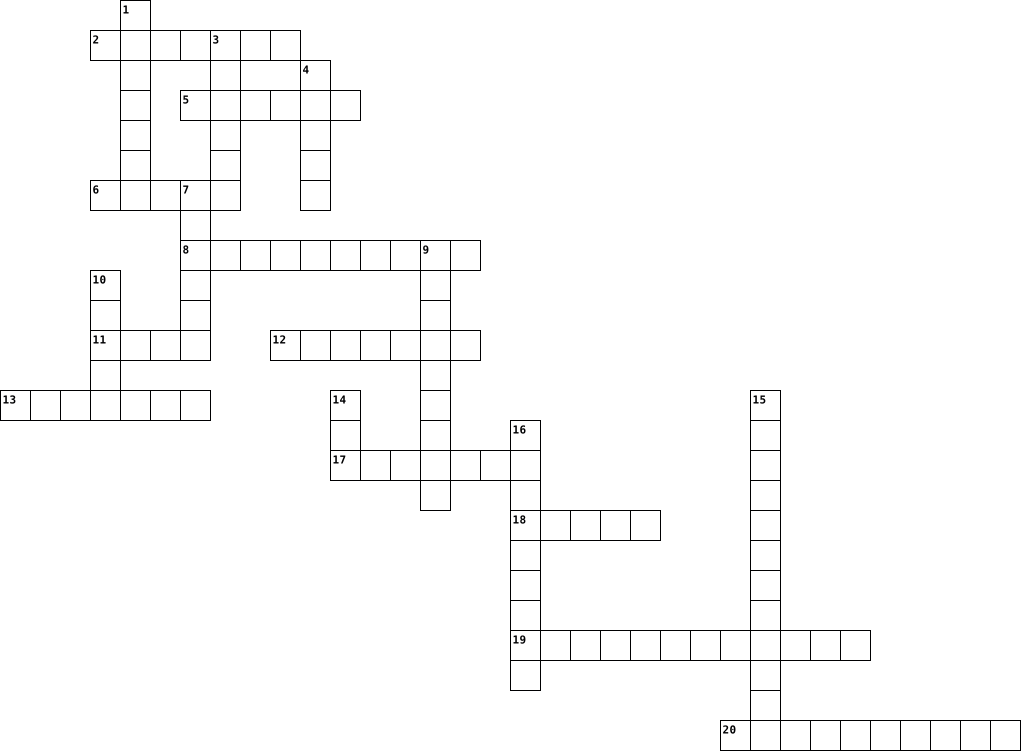
Across
- covered with crater marks and looks like earths moon
- has over 100 rings
- has greenhouse effect
- the study of the moon,stars,ect in space
- has tilted axes
- largest planet
- small dark spot
- the other blue planet
- only planet with life
- small rocky earth like terrestrial planets
- a scientest who studies the earth beyond the earth
Down
- what makes the planets blue
- rotates on its side
- the path of an object as it revolts around another object in space
- one blue planet
- a meteoroid that has hit earth's surface
- a ball of ice and dust whose orbit is usally a long narrow eclips
- nuculer fusion is happening inside
- called gas giants
- a chunk of rock or dust in space
20 Clues: largest planet • one blue planet • has tilted axes • small dark spot • called gas giants • has over 100 rings • rotates on its side • has greenhouse effect • the other blue planet • only planet with life • what makes the planets blue • a chunk of rock or dust in space • nuculer fusion is happening inside • the study of the moon,stars,ect in space • a meteoroid that has hit earth's surface • ...
Jonah 3rd period 2023-12-11

Across
- An earthquake that may or coild happen after a major earthquake and occur for days or man years after.
- hot semi liquid rock located under the earth.
- mountain has lava in it and oozes it out
- 2 plates dividing
- 2 plates sliding
- tectonic a section of the lithosphere that slowly moves over the astehensosphere carrying pieces
- steam lava coming out a volcano and its a action of an volcano
- core the 4th layer of the earth
- core 3rd layer of the earth
Down
- 2 plates colliding
- when 2 structure collide and make a crack
- The insides of a volcano chamber
- the 2nd layer of the earth
- An earthquake that can come before a major earthquake can occur for days or many years before.
- the 1st layer of the earth
- A state of being stretched or strained
16 Clues: 2 plates sliding • 2 plates dividing • 2 plates colliding • the 2nd layer of the earth • the 1st layer of the earth • core 3rd layer of the earth • core the 4th layer of the earth • The insides of a volcano chamber • A state of being stretched or strained • mountain has lava in it and oozes it out • when 2 structure collide and make a crack • ...
Science Crossword 2025-05-16

Across
- how long it takes for satellites to orbit the earth
- _________ telescope
- a constellation in the shape of a bull
- lion who got killed by Hercules had impenetrable hide
- one of the zodiac signs only mad up of 3 stars
- very famous hunter who is a constellation
- we have thousands of these in our universe.
- (star wars) a long time ago in a _______ far far away
- large space station that is orbiting earth for research purposes
- what keeps us on the ground
- launched in 1977 farthest man made object in space
- when a super red giant dies forms a ___________ that sucks all matter into it
- the moon _____ around earth
Down
- hazy band of stars in the sky
- man made devices that takes 90 min to orbit the earth
- light second, light hours, light day, light month,________
- closest star system to our solar system it lies in the constellation Centaurus
- also called the north star
- when a group of stars forms an image
- only planet that is inhabitable
- when a star dies and leaves a colorful aftershock
- property of matter that remains unchanged unless acted upon by and opposite force
- the simplest element
- a constellation who is a Greek hero who had to do 12 tasks
- large donut region beyond Neptune
- this includes earth and Mars and Venus ect
- amount of matter an object contains
- name of princess that thesus saved
28 Clues: _________ telescope • the simplest element • also called the north star • what keeps us on the ground • the moon _____ around earth • hazy band of stars in the sky • only planet that is inhabitable • large donut region beyond Neptune • name of princess that thesus saved • amount of matter an object contains • when a group of stars forms an image • ...