
the earth Crossword Puzzles
Science Vocabulary Words 2022-01-26

Across
- what is used to measure air pressure
- winds- blow only over short distances due to pressure distances
- pressure- the result of the weight of a column of air pushing on an area
- part of the lower thermosphere
- the outermost layer of the atmosphere
- the envelope of gases that surround our planet
- where satellites orbit
- heat that travels from a source
Down
- winds- convection from the unequal heating of the earth
- effect- the rotation of the earth causes winds to curve
- effect- the reflection of material either out back out to space or back onto earth’s surface
- used to measure the wind speed
- the horizontal movement of air from high pressure to low pressure
- the distance above sea level
- the layer which we live
- mass per unit volume
- transfer by movement of a fluid
- protects the earth from meteoroids
- contains the ozone layer
- energy- energy created by heat
20 Clues: mass per unit volume • where satellites orbit • the layer which we live • contains the ozone layer • the distance above sea level • used to measure the wind speed • part of the lower thermosphere • energy- energy created by heat • transfer by movement of a fluid • heat that travels from a source • protects the earth from meteoroids • what is used to measure air pressure • ...
Earthquakes and Volcanoes ULTIMATE CROSSWORD 2024-04-10

Across
- The name of the earth before the continents moved
- The centre of the earth
- When two tectonic plates hit each other, you get an __________.
- The lava ________ down the hill
- A massive wave caused by an earthquake
- ____________ plates move along the mantle
- A word that means "Very hot" rock
- Something that can hurt or kill you is ________.
- The volcano that erupted in 79AD.
- The ancient town that got covered by the volcano
- Where the earthquake is strongest
Down
- Earthquakes cause a lot of _________.
- The scale we use to measure earthquakes
- What liquid comes out of a volcano?
- The Volcano __________
- Two plates that move towards each other
- A cloud of _______ came out of the volcano
- A mountain that erupts with lava
- Two plates that move away from each other
- It was measured as a 7.5 _____________ earthquake
- The top layer of the earth
- Another word for Lava
22 Clues: Another word for Lava • The Volcano __________ • The centre of the earth • The top layer of the earth • The lava ________ down the hill • A mountain that erupts with lava • A word that means "Very hot" rock • The volcano that erupted in 79AD. • Where the earthquake is strongest • What liquid comes out of a volcano? • Earthquakes cause a lot of _________. • ...
Earth Science Puzzle 2015-05-06

Across
- study of water
- the thing that orbits Earth
- tool used to measure relative humidity
- the planet we live on
- rain,snow,hail,etc
- rock formed by heat and pressure
Down
- the process of a cloud forming
- volcanic rock
- tool used to measure temperature
- study of the earth
- water running off of the surface
- rock made of sediment
- water rising into the air
- study of space
- tool used to measure air pressure
15 Clues: volcanic rock • study of water • study of space • study of the earth • rain,snow,hail,etc • rock made of sediment • the planet we live on • water rising into the air • the thing that orbits Earth • the process of a cloud forming • tool used to measure temperature • water running off of the surface • rock formed by heat and pressure • tool used to measure air pressure • ...
Gravitational and Frictional Force 2021-04-04

Across
- Objects have ... because of the gravitational force acting between them and the Earth
- Gravitational force makes things stay in their places and not ... away
- The frictional force acting on objects as they move through air is called air ...
- There is greater frictional force between ... surfaces
- The amount of matter in an object is called ...
- Objects move faster on ... surfaces
- One of the problems that is caused by frictional force
- Gravitational force is the force of ... between things and the Earth
- The strength of gravitational force depends on the ... between the object and the Earth
- Frictional force can slow down and even ... moving objects
Down
- The closer an object to the Earth, the ... the gravitational force is
- Gravitational force pulls all objects ...
- One of the ways to reduce friction is by using ...
- Weight is a ...
- To reduce water resistance while moving through the water, dolphins and sharks have ... body shape
- Water resistance pushes ... a moving object and slows it down
- Frictional force is a force that ... motion
17 Clues: Weight is a ... • Objects move faster on ... surfaces • Gravitational force pulls all objects ... • Frictional force is a force that ... motion • The amount of matter in an object is called ... • One of the ways to reduce friction is by using ... • There is greater frictional force between ... surfaces • One of the problems that is caused by frictional force • ...
7th Science 2nd Quarter Review 2020-05-04

Across
- The least dense layer of the earth that contains all of the oxygen and other gases.
- Rock that is formed by heat and pressure.
- The earth's crust is broken into different ______ plates.
- When earth's plates were altogether in a supercontinent, what was it called?
- A preserved remain, impression, or trace of any once-living thing from the past.
- Cycle that shows how the three major rock types can transition into each other.
- A natural disaster happens when tectonic plates finally break away from each other after being stuck.
Down
- Rock that is formed by lots of compaction and cementation in layers.
- The layer of earth where life exists (thinnest layer--what we walk on).
- The layer of the earth that magma comes from. This layer contains convection currents.
- Rock that is formed by the cooling of magma.
- When a large amount of soil and rock suddenly falls down a slope.
- The most dense part of the earth (small ball in the center of earth made out of iron and nickel.
- A vent from which material from a magma chamber deep in the earth can erupt.
14 Clues: Rock that is formed by heat and pressure. • Rock that is formed by the cooling of magma. • The earth's crust is broken into different ______ plates. • When a large amount of soil and rock suddenly falls down a slope. • Rock that is formed by lots of compaction and cementation in layers. • The layer of earth where life exists (thinnest layer--what we walk on). • ...
geography 2023-09-20

Across
- tectonic The term scientists use to describe the activities of continental drift and magma flow which create many of earths physical features
- Uppermost layer of the earth that includes the crust, continents, and ocean basins
- The watery areas of earth, including oceans, lakes, rivers, and other bodies of water
- the envelope of gases surrounding the earth or another planet.
- Molten rock that is located below earths surface
- The movement of weathered rock and material by wind, glaciers, and moving water; the wearing away of soil
Down
- Thick middle layer of the earths interior structure consisting of hot rock that is dense but flexible
- Chemical or physical processes that break down rocks into smaller pieces
- drift The theory that the continents were once joined and then slowly drifted apart
- shelf Part of a continent that extends out underneath the ocean
- The part of earth where life exist
- Outer layer of the earth, hard rocky shell forming earths surface
- Innermost layer of earth made up of a super hot but solid inner core and super hot liquid outer core
- A crack or break in earths crust.
- A bend in layers of rock, sometimes, caused by plate movement
15 Clues: A crack or break in earths crust. • The part of earth where life exist • Molten rock that is located below earths surface • A bend in layers of rock, sometimes, caused by plate movement • the envelope of gases surrounding the earth or another planet. • shelf Part of a continent that extends out underneath the ocean • ...
Geo/Cycl Words 2026-03-08

Across
- A person who studies the Earth and its features
- A powerful rotating storm with strong winds
- A branch of maths that studies shapes and space
- A giant with one eye in Greek mythology
- Heat that comes from inside the Earth
- Something that happens again and again in a pattern
- A series of events that repeat in the same order
- Relating to the rocks and structure of the Earth
Down
- The natural recycling of materials within the Earth
- A large reference book with information on many topics
- A vehicle with two wheels powered by pedalling
- Relating to politics influenced by geography
- A scientist who studies rocks and the Earth’s history
- The study of the Earth’s lands, people, and environments
- To process used materials so they can be used again
- A person who rides a bicycle
16 Clues: A person who rides a bicycle • Heat that comes from inside the Earth • A giant with one eye in Greek mythology • A powerful rotating storm with strong winds • Relating to politics influenced by geography • A vehicle with two wheels powered by pedalling • A person who studies the Earth and its features • A branch of maths that studies shapes and space • ...
Weather crossword 2026-04-13

Across
- how hot or cold the weather is
- the lowest layer closest to earth
- some planes fly in this layer
- a place that is far away from the coast
- up in the air there is very _________
- the layer farthest from earth
- at ground level there is __________
Down
- long term weather conditions
- comets burn up in this layer
- all of the layers surrounding earth
- the northern lights are in this layer
- a tropical jungle
- there was a gust of _______
- day to day temperature and rain conditions
- very cold and desolate
- the air is _____ if it has no moisture
- how moist the air is
17 Clues: a tropical jungle • how moist the air is • very cold and desolate • there was a gust of _______ • long term weather conditions • comets burn up in this layer • some planes fly in this layer • the layer farthest from earth • how hot or cold the weather is • the lowest layer closest to earth • all of the layers surrounding earth • at ground level there is __________ • ...
Chapter 8 Crossword Puzzl 2019-01-25

Across
- Release of volatile substances and water vapor from the earth is called
- what is a sun
- Stratification responsible for the formation of earths gravitational field
- most abundant element after big bang theory
- first known type of organism on earth
- Stars twinkle because of elements being converted over to other elements which gives off
- how many years heavy rain it earth
- Explosion of a star
- Dominant scientific theory that occurred 15 billion years ago that formed the universe
- Earth was formed
Down
- where most bacteria probably originated
- what did Hubble discover
- Way our galaxy is known as
- building blocks of proteins
- in 6 billion years the sun will turn into
- a minute planet
- suggested that energy from thermal vents go into sea
17 Clues: what is a sun • a minute planet • Earth was formed • Explosion of a star • what did Hubble discover • Way our galaxy is known as • building blocks of proteins • how many years heavy rain it earth • first known type of organism on earth • where most bacteria probably originated • in 6 billion years the sun will turn into • most abundant element after big bang theory • ...
Intro to Geography 2025-09-10

Across
- A natural land shape or feature on the Earth's surface.
- A flat drawing of all or part of the Earth's surface.
- A place's location in relation to other places around it
- The imaginary line that divides the Earth into Northern and Southern Hemispheres
- A way of showing a round Earth on a flat surface.
- Imaginary vertical lines that measure distance east or west of the Prime Meridian
- The exact spot on Earth using latitude and longitude.
Down
- A large landmass; there are seven of these.
- Imaginary horizontal lines that measure distance north or south of the Equator.
- The study of the Earth, its features, and the people who live on it.
- A large body of salt water that covers most of the Earth.
- A tool used to find direction (North, South, East, West).
- An area with common features that set it apart from other areas.
- a nation with its own government, occupying a particular territory
- The direction opposite of north.
15 Clues: The direction opposite of north. • A large landmass; there are seven of these. • A way of showing a round Earth on a flat surface. • A flat drawing of all or part of the Earth's surface. • The exact spot on Earth using latitude and longitude. • A natural land shape or feature on the Earth's surface. • A place's location in relation to other places around it • ...
Crossword 2021-05-06

Across
- amount of time to turn 360 degrees
- bright shinning star
- amount of time to go around the sun
- natural object the orbits the earth
- what eats the prey
- where animals live
- the transfer of energy
Down
- when taking sediments to a different place
- dent in planet caused by meteor
- caused by glacier
- the longer transfer of energy
- what gets eaten
- what we live on
- planet in the wilkey way
- imaginary line that goes through the earth
15 Clues: what gets eaten • what we live on • caused by glacier • what eats the prey • where animals live • bright shinning star • the transfer of energy • planet in the wilkey way • the longer transfer of energy • dent in planet caused by meteor • amount of time to turn 360 degrees • amount of time to go around the sun • natural object the orbits the earth • ...
Geology 2022-04-12

Across
- Igneous rock before it cools
- Heat and Pressure =
- Sediment settling down
- Erosion and Weathering + Compaction =
- Sedimentary rock before it compacts
- where metamorphic rock is most likely to form
- small pieces of rock moving
- where igneous rock is most likely to form
Down
- The layer below the crust
- The study of the earth
- The outer layer of the Earth
- Deposits of minerals
- Small pieces of rocks breaking from a rock
- Cooled Magma =
- The middle of the Earth
15 Clues: Cooled Magma = • Heat and Pressure = • Deposits of minerals • The study of the earth • Sediment settling down • The middle of the Earth • The layer below the crust • small pieces of rock moving • Igneous rock before it cools • The outer layer of the Earth • Sedimentary rock before it compacts • Erosion and Weathering + Compaction = • where igneous rock is most likely to form • ...
the topic Supermoon 2023-12-06

Across
- - Forces influenced by a supermoon.
- - Enhanced during a supermoon.
- - The moon's path in the sky.
- - Appearance during a supermoon.
- - Distance to Earth during a supermoon.
- - Study of celestial phenomena.
- - Moon phase during a supermoon.
Down
- - Type of celestial body.
- - The moon appears larger than usual.
- - Occurs periodically.
- - Satellite of Earth.
- - Point in the moon's orbit nearest Earth.
- - Effect making the moon appear larger.
- - Ideal time to observe a supermoon.
- - Influences the moon's proximity.
15 Clues: - Satellite of Earth. • - Occurs periodically. • - Type of celestial body. • - The moon's path in the sky. • - Enhanced during a supermoon. • - Study of celestial phenomena. • - Appearance during a supermoon. • - Moon phase during a supermoon. • - Influences the moon's proximity. • - Forces influenced by a supermoon. • - Ideal time to observe a supermoon. • ...
2.1 vocab. 2022-09-07

Across
- the lines on a map that run East to West
- the study of earth an its peoples, places, and environment
- height above or below sea level
- the lines on a map that run North to South
- half of Earth
- a line of latitude that runs around the middle of Earth
- a map that shows themes or patterns such as climate, natural resources, or population
Down
- four main points of a compass: North, South,East,West
- area with similar characteristics that make it distinct from other areas
- the starting point for measuring longitude
- a map that shows land and water features
- a way of showing the round earth on a flat map
- the relationship between distances on the map and on the Earth
- a map that shows the names and borders of countries
14 Clues: half of Earth • height above or below sea level • the lines on a map that run East to West • a map that shows land and water features • the starting point for measuring longitude • the lines on a map that run North to South • a way of showing the round earth on a flat map • a map that shows the names and borders of countries • ...
Astronomy Crossword Puzzle 2024-01-22

Across
- - Any theory of the structure of the solar system (or the universe) in which earth is assumed to be at the center of it all.
- - An imaginary line through earth
- - It is the shape of the earth and some other planets. It's is like a sphere squashed from the top so the diameter from pole to pole is less than the diameter from equator to equator.
- - shrinking; describes the moon when the illuminated portion is descreasing.
- - Are three scientific laws describing the motion of planets around the Sun, by Johannes Kepler.
- - Earth’s path in space.
- - A moment when the sun's path in the sky is farthest south in the Northern Hemisphere or farthest north in the Southern Hemisphere.
- - An obscuring of the light from one celestial body by the passage of another between it and the observer or between it and its source of illumination
- - A Greek philosopher who computed the circumference of the earth and who gave the most accurate size during their time.
- - The perimeter of a circle or ellipse.
- - A representation of the sun-Earth-moon system.
- - The astronomical model in which the earth and planets revolve around the sun at the center of the solar system.
Down
- - His accurate measurements of Mars were his greatest contributions to astronomy.
- - The figure of the moon that appears as a curve with pointy ends.
- - Dark region of the Sun due to lower temperature.
- - A natural object that orbits a larger object.
- - The longest day of the year. In the Northern Hemisphere it is in June, while in the Southern Hemisphere it's in December.
- - Developed and formalized Galileo’s concept of inertia.
- - He was the greatest Italian scientist of the Renaissance. Due to the telescope, he was able to discover and observe important astronomical facts such as lunar craters, the phases of the Venus, the moon's of Jupiter, sun spots, and the sizes of the stars.
- - A student of Plato and considered as one of the great philosophers of his time; his earth-centered view dominated for almost 2,000 years.
- - a dark (real image) area where light from light source is blocked by an opaque object.
- - It claims that the planets moved in a complicated system of circles. This model also became known as the Ptolemic System.
- - It was believed to be in fixed position in the sky. However, when the Greeks traveled to places nearer the equator, like Egypt, they noticed that it is closer to the horizon.
- - Discovered by Galileo to look at the moon, discover the four satellites of Jupiter, observe supernova, and discover sunspot.
- - They are much noted for their contributions in different fields. They were not only great philosophers but great scientists and mathematicians as well.
- - growing; describes the moon when the illuminated portion is descreasing.
- - Earth does this around the sun once a year.
- - Developed a heliocentric system where in the orbits were elliptical rather than circular. This advanced the Sun-centered view.
- - Justified his Earth-centered model and explained retrograde motion through cycles and epicycles.
- - A displacement or difference in the apparent position of an object viewed along two different lines of sight, and is measured by the angle or semi-angle of inclination between those two lines.
30 Clues: - Earth’s path in space. • - An imaginary line through earth • - The perimeter of a circle or ellipse. • - Earth does this around the sun once a year. • - A natural object that orbits a larger object. • - A representation of the sun-Earth-moon system. • - Dark region of the Sun due to lower temperature. • - Developed and formalized Galileo’s concept of inertia. • ...
Space Crossword 2017-05-12

Across
- The galaxy our solar system is located
- A small body composed of rock and metal
- Often referred to as a 'Shooting Star'
- The hottest planet in the solar system
- Has the most beautiful rings
- The measurement for distance between planets
- The galaxy that is one of the closet to Earth
- Space contains millions and billions of these
Down
- Nothing escapes this, not even light
- Mercury Venus Earth and Mars are what sort of planets?
- Uranus and Neptune are given this name because they are the coldest planets
- A natural satelite for the Earth
- Takes approximately 365 days to orbit the sun
- Planets orbit around this star
- Jupiter and Saturn are a type of planet
15 Clues: Has the most beautiful rings • Planets orbit around this star • A natural satelite for the Earth • Nothing escapes this, not even light • The galaxy our solar system is located • Often referred to as a 'Shooting Star' • The hottest planet in the solar system • A small body composed of rock and metal • Jupiter and Saturn are a type of planet • ...
Astronomy Crossword Puzzle 2024-01-22

Across
- - growing; describes the moon when the illuminated portion is descreasing.
- - shrinking; describes the moon when the illuminated portion is descreasing.
- - A student of Plato and considered as one of the great philosophers of his time; his earth-centered view dominated for almost 2,000 years.
- - Discovered by Galileo to look at the moon, discover the four satellites of Jupiter, observe supernova, and discover sunspot.
- - Earth does this around the sun once a year.
- - The astronomical model in which the earth and planets revolve around the sun at the center of the solar system.
- - A natural object that orbits a larger object.
- - An imaginary line through earth
- - The figure of the moon that appears as a curve with pointy ends.
- - A Greek philosopher who computed the circumference of the earth and who gave the most accurate size during their time.
- - It claims that the planets moved in a complicated system of circles. This model also became known as the Ptolemic System.
- - Dark region of the Sun due to lower temperature.
- - A moment when the sun's path in the sky is farthest south in the Northern Hemisphere or farthest north in the Southern Hemisphere.
- - a dark (real image) area where light from light source is blocked by an opaque object.
Down
- - He was the greatest Italian scientist of the Renaissance. Due to the telescope, he was able to discover and observe important astronomical facts such as lunar craters, the phases of the Venus, the moon's of Jupiter, sun spots, and the sizes of the stars.
- - Developed and formalized Galileo’s concept of inertia.
- - Are three scientific laws describing the motion of planets around the Sun, by Johannes Kepler.
- - Any theory of the structure of the solar system (or the universe) in which earth is assumed to be at the center of it all.
- - A displacement or difference in the apparent position of an object viewed along two different lines of sight, and is measured by the angle or semi-angle of inclination between those two lines.
- - The perimeter of a circle or ellipse.
- - Justified his Earth-centered model and explained retrograde motion through cycles and epicycles.
- - His accurate measurements of Mars were his greatest contributions to astronomy.
- - The longest day of the year. In the Northern Hemisphere it is in June, while in the Southern Hemisphere it's in December.
- - Developed a heliocentric system where in the orbits were elliptical rather than circular. This advanced the Sun-centered view.
- - They are much noted for their contributions in different fields. They were not only great philosophers but great scientists and mathematicians as well.
- - An obscuring of the light from one celestial body by the passage of another between it and the observer or between it and its source of illumination.
- - It is the shape of the earth and some other planets. It's is like a sphere squashed from the top so the diameter from pole to pole is less than the diameter from equator to equator.
- - It was believed to be in fixed position in the sky. However, when the Greeks traveled to places nearer the equator, like Egypt, they noticed that it is closer to the horizon.
- - Earth’s path in space.
- - A representation of the sun-Earth-moon system.
30 Clues: - Earth’s path in space. • - An imaginary line through earth • - The perimeter of a circle or ellipse. • - Earth does this around the sun once a year. • - A natural object that orbits a larger object. • - A representation of the sun-Earth-moon system. • - Dark region of the Sun due to lower temperature. • - Developed and formalized Galileo’s concept of inertia. • ...
Jacee science 2024-11-06

Across
- is the process of the combination of two substances that ar physically combined
- the substance that dissolves in a solution
- a study of plan that includes a growth
- the part of earth where life exists
- is the second-smallest of solar system
- type of chemical bond formed between two atom
- the force applied to a particular area
- the planet we live on
Down
- are one of the building blocks of an atom
- the total amount of water on a plantthe
- a state of the atmosphere at a place and time regards of heat
- the envelope of gases surrounding the earth
- is the psychological interaction between two people
- the light or warmth receives from the earth's sun
- the force that attacks a body toward the center of the earth
15 Clues: the planet we live on • the part of earth where life exists • a study of plan that includes a growth • is the second-smallest of solar system • the force applied to a particular area • the total amount of water on a plantthe • are one of the building blocks of an atom • the substance that dissolves in a solution • the envelope of gases surrounding the earth • ...
Planet Earth 2015-05-23

Across
- what controls earthquakes?
- the earth orbits around the...
- this is earths only natural satellite
Down
- 1700km/hr is how fast the earth is...
- this was created because of earths connection to the sun
- earth is the ... planet away from the sun
- is a rocky planet
- earth has 21% of...
- the earth is the size of a type of fruit
- what helps earth stay protected?
10 Clues: is a rocky planet • earth has 21% of... • what controls earthquakes? • the earth orbits around the... • what helps earth stay protected? • 1700km/hr is how fast the earth is... • this is earths only natural satellite • the earth is the size of a type of fruit • earth is the ... planet away from the sun • this was created because of earths connection to the sun
Earth's Layers 2020-11-11

Across
- What happens to the temp and pressure as you move closer to the core?
- The lithosphere is made up of the upper mantle and ____?
- The shock waves produced by an earthquake
- Which part of the Earth is liquid?
- Which layer is of the Earth is 250km thick?
- What type of rock is oceanic crust made of?
- ____ field is caused by the movement of iron in the Earth's outer core
Down
- Uppermost part of the mantle
- What is the continental crust made of?
- Heat from the core causes what to happen?
- What direct evidence do scientists use to learn about the Earth?
- Why is the innner core solid?
- Soft layer of the mantle?
- What is the outer core made of?
- What is the middle layer of the Earth?
15 Clues: Soft layer of the mantle? • Uppermost part of the mantle • Why is the innner core solid? • What is the outer core made of? • Which part of the Earth is liquid? • What is the continental crust made of? • What is the middle layer of the Earth? • Heat from the core causes what to happen? • The shock waves produced by an earthquake • Which layer is of the Earth is 250km thick? • ...
Minor Gods 2023-12-07

Across
- the Earth or Mother of the Earth; wife of Uranus
- the female athlete; forced to marry by a trick with three golden apples
- ("afterthought"); husband of Pandora; brother of Prometheus
- the "gaping void" from which all things developed; birthed Gaia and Uranus
- spirits of the forest
- the youngest of the twelve Titans; son of Uranus and Gaia; married his sister, Rhea
- the God of the Sky; the first son and husband of Gaia
- the goddesses who controlled the destiny of everyone from birth until death
- the son of the Roman god, Jupiter, and a mortal, he is a demi-god
- the Sun-god who drives his chariot across the sky from east to west
- ("all gifts"); the first woman on earth; unleashed evil because of her curiosity
- the river that separates the world of the living from the world of the dead
Down
- it's as far below Earth as Earth is below heaven
- spirits of the springs and rivers
- Titan wife of Cronus, her brother; daughter of Uranus and Gaia
- the cruel, but fair, goddesses of vengeance who torment sinners
- spirits of nature; incarnate they are pretty girls who each reign over an aspect of nature
- the Goddess of All Things who desired to make order out of the Chaos
- in the beginning, born of Chaos as love without judgment
- Sky-home of the twelve main gods and goddesses
- ("forethought"); punished by Zeus for giving fire to humans; brother of Epimetheus
- condemned by Zeus to forever bear the heavens upon his shoulders
- the son of the Sun-god, Helios
23 Clues: spirits of the forest • the son of the Sun-god, Helios • spirits of the springs and rivers • Sky-home of the twelve main gods and goddesses • it's as far below Earth as Earth is below heaven • the Earth or Mother of the Earth; wife of Uranus • the God of the Sky; the first son and husband of Gaia • in the beginning, born of Chaos as love without judgment • ...
Map Skills Semester 1 Exam 2015-12-14

Across
- Montpelier is the capital of this New England state
- directions north (N), south (S), east (E) and west (W)
- The Tropic of Cancer is located in this hemisphere
- a graphic that compares the distance on a map to the actual distance it represents
- The state capital of New Mexico
- the latitude and longitude address of a place
- a map that shows human-made features and boundaries such as cities, highways, and countries
- imaginary lines on Earth that run between the North and South Poles
- a mapmaker
- a map that shows natural landforms and waterways
- Name the state with the abbreviation RI
- Hartford is the capital of this New England state
- a state that is not part of the contiguous United States
- a list that explains the symbols on a map
Down
- Name the state with the abbreviation WY
- the parallels and meridians appear as straight lines
- a smaller map set within the border between countries
- Name the state with the abbreviation CA
- an oval shaped projection of the Earth in which the shape and size of the continents near the equator are shown accurately, but the water and land near the poles are distorted to match the shape of the map.
- The state capital of UT
- an imaginary line that runs around the center of Earth halfway between the North and South Poles
- a directional arrow that shows cardinal and sometimes intermediate direction on a map
- units of latitude or longitude
- meridian an imaginary line that runs from the North Pole to the South Pole of Earth
- sharing an edge or boundary
- imaginary lines on Earth that run parallel to the equator
26 Clues: a mapmaker • The state capital of UT • sharing an edge or boundary • units of latitude or longitude • The state capital of New Mexico • Name the state with the abbreviation WY • Name the state with the abbreviation CA • Name the state with the abbreviation RI • a list that explains the symbols on a map • the latitude and longitude address of a place • ...
Map Skills Semester 1 Exam 2015-12-14

Across
- a graphic that compares the distance on a map to the actual distance it represents
- The state capital of UT
- a list that explains the symbols on a map
- Name the state with the abbreviation RI
- the parallels and meridians appear as straight lines
- a state that is not part of the contiguous United States
- meridian an imaginary line that runs from the North Pole to the South Pole of Earth
- a map that shows human-made features and boundaries such as cities, highways, and countries
- an oval shaped projection of the Earth in which the shape and size of the continents near the equator are shown accurately, but the water and land near the poles are distorted to match the shape of the map.
- Hartford is the capital of this New England state
- the latitude and longitude address of a place
- Name the state with the abbreviation CA
- a mapmaker
- a directional arrow that shows cardinal and sometimes intermediate direction on a map
- a map that shows natural landforms and waterways
- units of latitude or longitude
- imaginary lines on Earth that run parallel to the equator
Down
- a smaller map set within the border between countries
- The Tropic of Cancer is located in this hemisphere
- an imaginary line that runs around the center of Earth halfway between the North and South Poles
- sharing an edge or boundary
- directions north (N), south (S), east (E) and west (W)
- Montpelier is the capital of this New England state
- Name the state with the abbreviation WY
- The state capital of New Mexico
- imaginary lines on Earth that run between the North and South Poles
26 Clues: a mapmaker • The state capital of UT • sharing an edge or boundary • units of latitude or longitude • The state capital of New Mexico • Name the state with the abbreviation RI • Name the state with the abbreviation CA • Name the state with the abbreviation WY • a list that explains the symbols on a map • the latitude and longitude address of a place • ...
Map Skills Semester 1 Exam 2015-12-14

Across
- a mapmaker
- Name the state with the abbreviation CA
- Name the state with the abbreviation RI
- Name the state with the abbreviation WY
- The state capital of New Mexico
- an oval shaped projection of the Earth in which the shape and size of the continents near the equator are shown accurately, but the water and land near the poles are distorted to match the shape of the map.
- The state capital of UT
- a map that shows human-made features and boundaries such as cities, highways, and countries
- the parallels and meridians appear as straight lines
- the latitude and longitude address of a place
- imaginary lines on Earth that run parallel to the equator
- an imaginary line that runs around the center of Earth halfway between the North and South Poles
Down
- directions north (N), south (S), east (E) and west (W)
- Montpelier is the capital of this New England state
- meridian an imaginary line that runs from the North Pole to the South Pole of Earth
- a state that is not part of the contiguous United States
- The Tropic of Cancer is located in this hemisphere
- a graphic that compares the distance on a map to the actual distance it represents
- a map that shows natural landforms and waterways
- imaginary lines on Earth that run between the North and South Poles
- Hartford is the capital of this New England state
- a directional arrow that shows cardinal and sometimes intermediate direction on a map
- a smaller map set within the border between countries
- sharing an edge or boundary
- units of latitude or longitude
- a list that explains the symbols on a map
26 Clues: a mapmaker • The state capital of UT • sharing an edge or boundary • units of latitude or longitude • The state capital of New Mexico • Name the state with the abbreviation CA • Name the state with the abbreviation RI • Name the state with the abbreviation WY • a list that explains the symbols on a map • the latitude and longitude address of a place • ...
Map Skills Semester 1 Exam 2015-12-14

Across
- The state capital of New Mexico
- an oval shaped projection of the Earth in which the shape and size of the continents near the equator are shown accurately, but the water and land near the poles are distorted to match the shape of the map.
- a state that is not part of the contiguous United States
- Name the state with the abbreviation WY
- a mapmaker
- the parallels and meridians appear as straight lines
- a smaller map set within the border between countries
- units of latitude or longitude
- an imaginary line that runs around the center of Earth halfway between the North and South Poles
- imaginary lines on Earth that run between the North and South Poles
- a map that shows natural landforms and waterways
- meridian an imaginary line that runs from the North Pole to the South Pole of Earth
- Hartford is the capital of this New England state
- a list that explains the symbols on a map
- sharing an edge or boundary
- a graphic that compares the distance on a map to the actual distance it represents
Down
- The state capital of UT
- The Tropic of Cancer is located in this hemisphere
- Name the state with the abbreviation RI
- a directional arrow that shows cardinal and sometimes intermediate direction on a map
- the latitude and longitude address of a place
- directions north (N), south (S), east (E) and west (W)
- a map that shows human-made features and boundaries such as cities, highways, and countries
- Montpelier is the capital of this New England state
- imaginary lines on Earth that run parallel to the equator
- Name the state with the abbreviation CA
26 Clues: a mapmaker • The state capital of UT • sharing an edge or boundary • units of latitude or longitude • The state capital of New Mexico • Name the state with the abbreviation RI • Name the state with the abbreviation WY • Name the state with the abbreviation CA • a list that explains the symbols on a map • the latitude and longitude address of a place • ...
Changing Earth Revision 2025-09-23

Across
- Igneous rock formed from magma that cooled slowly beneath the Earth's surface.
- Molten rock that has erupted onto the Earth's surface from a volcano.
- The central part of the Earth, made of iron and nickel.
- Igneous rock formed from lava that cooled quickly on the Earth's surface.
- The thickest layer of the Earth, found just below the crust.
- The process by which magma or lava hardens into rock.
- The state of matter of the inner core.
- The process of 'gluing' sediments together with dissolved minerals.
- The force exerted on an area, which is essential for forming metamorphic rock.
- The preserved remains or traces of ancient organisms, often found in sedimentary rock.
- The state of matter of the outer core.
- Molten rock found beneath the Earth's surface.
- The continuous process by which rocks are created, changed, and destroyed.
- The chemical and physical breakdown of rocks into smaller pieces.
- The liquid layer of the Earth's core.
Down
- The process of dropping off or settling of sediments by wind, water, or ice.
- The process of sediments being squeezed together under pressure.
- This is required along with pressure to create metamorphic rocks.
- Rock formed from the cooling and solidification of molten rock.
- The solid, extremely hot, innermost part of the Earth.
- The process of a solid turning into a liquid due to heat.
- The study of the Earth, its structure, and the processes that shape it.
- Rock formed from the accumulation, compaction, and cementation of sediment.
- Rock formed when existing rocks are subjected to intense heat and pressure deep within the Earth.
- A large, moving section of the Earth's lithosphere.
- The thin, solid, outermost layer of the Earth.
- Small, solid pieces of material that come from the weathering of rocks.
- Earth's interior is arranged in these, such as the crust, mantle, and core.
- A naturally occurring, solid substance with a specific chemical composition that forms rocks.
- The transport of weathered rock fragments by wind, water, or ice.
30 Clues: The liquid layer of the Earth's core. • The state of matter of the inner core. • The state of matter of the outer core. • The thin, solid, outermost layer of the Earth. • Molten rock found beneath the Earth's surface. • A large, moving section of the Earth's lithosphere. • The process by which magma or lava hardens into rock. • ...
Doctor Who (series 1-6) 2023-04-04

Across
- the doctor’s tool
- you will be upgraded
- the last centurion
- hello sweetie
- the girl who waited
- the doctor’s home
- the doctor’s mortal enemy and former friend
- season 1+2 boyfriend
- the greatest war
Down
- companion who became half time lord
- time and relative dimensions in space
- exterminate
- season 1+2 mom
- captain
- the changing of a time lord
- stargazing grandpa
- the woman who walked the earth
- bad wolf
- titular character
- humanity’s first home
20 Clues: captain • bad wolf • exterminate • hello sweetie • season 1+2 mom • the greatest war • the doctor’s tool • the doctor’s home • titular character • stargazing grandpa • the last centurion • the girl who waited • you will be upgraded • season 1+2 boyfriend • humanity’s first home • the changing of a time lord • the woman who walked the earth • companion who became half time lord • ...
Astronomy Crossword Puzzle 2024-01-22

Across
- - It was believed to be in fixed position in the sky. However, when the Greeks traveled to places nearer the equator, like Egypt, they noticed that it is closer to the horizon.
- - He was the greatest Italian scientist of the Renaissance. Due to the telescope, he was able to discover and observe important astronomical facts such as lunar craters, the phases of the Venus, the moon's of Jupiter, sun spots, and the sizes of the stars.
- - Earth does this around the sun once a year.
- - They are much noted for their contributions in different fields. They were not only great philosophers but great scientists and mathematicians as well.
- - a dark (real image) area where light from light source is blocked by an opaque object.
- - Any theory of the structure of the solar system (or the universe) in which earth is assumed to be at the center of it all.
- - growing; describes the moon when the illuminated portion is descreasing.
- - The perimeter of a circle or ellipse.
- - An imaginary line through earth
- - His accurate measurements of Mars were his greatest contributions to astronomy.
- - A displacement or difference in the apparent position of an object viewed along two different lines of sight, and is measured by the angle or semi-angle of inclination between those two lines.
- - A natural object that orbits a larger object.
- - An obscuring of the light from one celestial body by the passage of another between it and the observer or between it and its source of illumination
- - The astronomical model in which the earth and planets revolve around the sun at the center of the solar system.
- - A moment when the sun's path in the sky is farthest south in the Northern Hemisphere or farthest north in the Southern Hemisphere.
- - The longest day of the year. In the Northern Hemisphere it is in June, while in the Southern Hemisphere it's in December.
- - Are three scientific laws describing the motion of planets around the Sun, by Johannes Kepler.
Down
- - A student of Plato and considered as one of the great philosophers of his time; his earth-centered view dominated for almost 2,000 years.
- - It is the shape of the earth and some other planets. It's is like a sphere squashed from the top so the diameter from pole to pole is less than the diameter from equator to equator.
- - It claims that the planets moved in a complicated system of circles. This model also became known as the Ptolemic System.
- - A representation of the sun-Earth-moon system.
- - Developed and formalized Galileo’s concept of inertia.
- - Earth’s path in space.
- - shrinking; describes the moon when the illuminated portion is descreasing.
- - A Greek philosopher who computed the circumference of the earth and who gave the most accurate size during their time.
- - Discovered by Galileo to look at the moon, discover the four satellites of Jupiter, observe supernova, and discover sunspot.
- - Dark region of the Sun due to lower temperature.
- - Developed a heliocentric system where in the orbits were elliptical rather than circular. This advanced the Sun-centered view.
- - Justified his Earth-centered model and explained retrograde motion through cycles and epicycles.
- - The figure of the moon that appears as a curve with pointy ends.
30 Clues: - Earth’s path in space. • - An imaginary line through earth • - The perimeter of a circle or ellipse. • - Earth does this around the sun once a year. • - A natural object that orbits a larger object. • - A representation of the sun-Earth-moon system. • - Dark region of the Sun due to lower temperature. • - Developed and formalized Galileo’s concept of inertia. • ...
Astronomy Crossword Puzzle 2024-01-22

Across
- - It was believed to be in fixed position in the sky. However, when the Greeks traveled to places nearer the equator, like Egypt, they noticed that it is closer to the horizon.
- - He was the greatest Italian scientist of the Renaissance. Due to the telescope, he was able to discover and observe important astronomical facts such as lunar craters, the phases of the Venus, the moon's of Jupiter, sun spots, and the sizes of the stars.
- - Earth does this around the sun once a year.
- - They are much noted for their contributions in different fields. They were not only great philosophers but great scientists and mathematicians as well.
- - a dark (real image) area where light from light source is blocked by an opaque object.
- - Any theory of the structure of the solar system (or the universe) in which earth is assumed to be at the center of it all.
- - growing; describes the moon when the illuminated portion is descreasing.
- - The perimeter of a circle or ellipse.
- - An imaginary line through earth
- - His accurate measurements of Mars were his greatest contributions to astronomy.
- - A displacement or difference in the apparent position of an object viewed along two different lines of sight, and is measured by the angle or semi-angle of inclination between those two lines.
- - A natural object that orbits a larger object.
- - An obscuring of the light from one celestial body by the passage of another between it and the observer or between it and its source of illumination
- - The astronomical model in which the earth and planets revolve around the sun at the center of the solar system.
- - A moment when the sun's path in the sky is farthest south in the Northern Hemisphere or farthest north in the Southern Hemisphere.
- - The longest day of the year. In the Northern Hemisphere it is in June, while in the Southern Hemisphere it's in December.
- - Are three scientific laws describing the motion of planets around the Sun, by Johannes Kepler.
Down
- - A student of Plato and considered as one of the great philosophers of his time; his earth-centered view dominated for almost 2,000 years.
- - It is the shape of the earth and some other planets. It's is like a sphere squashed from the top so the diameter from pole to pole is less than the diameter from equator to equator.
- - It claims that the planets moved in a complicated system of circles. This model also became known as the Ptolemic System.
- - A representation of the sun-Earth-moon system.
- - Developed and formalized Galileo’s concept of inertia.
- - Earth’s path in space.
- - shrinking; describes the moon when the illuminated portion is descreasing.
- - A Greek philosopher who computed the circumference of the earth and who gave the most accurate size during their time.
- - Discovered by Galileo to look at the moon, discover the four satellites of Jupiter, observe supernova, and discover sunspot.
- - Dark region of the Sun due to lower temperature.
- - Developed a heliocentric system where in the orbits were elliptical rather than circular. This advanced the Sun-centered view.
- - Justified his Earth-centered model and explained retrograde motion through cycles and epicycles.
- - The figure of the moon that appears as a curve with pointy ends.
30 Clues: - Earth’s path in space. • - An imaginary line through earth • - The perimeter of a circle or ellipse. • - Earth does this around the sun once a year. • - A natural object that orbits a larger object. • - A representation of the sun-Earth-moon system. • - Dark region of the Sun due to lower temperature. • - Developed and formalized Galileo’s concept of inertia. • ...
Chapter 7&8 Crossword 2019-01-28

Across
- A term of tradition and is not used consistently.
- The second largest ocean.
- Most accurate representation of the features of the earth.
- Smallest continent.
- The earth rotates daily around?
- The warmest ocean.
- The line drawn close to 180 degree meridian that separates neighbors by 24 hours.
- Single mass that includes Europe and Asia.
- One half of the earth.
- Meridian Longitude reference line.
- Map makers.
- Includes America, Mexico, and Canada.
- The smallest, coldest ocean.
Down
- Looks similar to wedges by dividing the area into equal sections.
- All countries south of Panama.
- The largest ocean.
- The continent of the South Pole.
- Distorts the continents as little as possible by not slicing into them.
- Most commonly used map used in the classroom.
- Bordered by the Indian, Atlantic Oceans and the Mediterranean Sea.
- Latitude reference line.
21 Clues: Map makers. • The largest ocean. • The warmest ocean. • Smallest continent. • One half of the earth. • Latitude reference line. • The second largest ocean. • The smallest, coldest ocean. • All countries south of Panama. • The earth rotates daily around? • The continent of the South Pole. • Meridian Longitude reference line. • Includes America, Mexico, and Canada. • ...
tectonic plate movements 2021-04-27

Across
- a natural disaster caused by transform
- the layer on the upper part of the mantle
- Two plates one oceanic and one continental collide together
- a natural event that leads to diaster
- liquid that falls out of the landform caused by transform
- the layer below the outercore
- the thickest part of the earth
- Two plates move away from eachother
- two
- a plate that is less dense than oceanic
- the reason that tectonic plates move
Down
- the layer below the mantle
- the second disaster that is caused by transform
- this is created due to subduction
- a type of plate that is more dense that contineal
- a natural feature of the earth
- one oceanic sinks under the continental plates
- this is caused by divergant
- The outer layer of the earth
- this forms because of Collison
20 Clues: two • the layer below the mantle • this is caused by divergant • The outer layer of the earth • the layer below the outercore • a natural feature of the earth • the thickest part of the earth • this forms because of Collison • this is created due to subduction • Two plates move away from eachother • the reason that tectonic plates move • a natural event that leads to diaster • ...
Chapter 7&8 Crossword 2019-01-28

Across
- The smallest, coldest ocean.
- The second largest ocean.
- Latitude reference line.
- Smallest continent.
- Includes America, Mexico, and Canada.
- Distorts the continents as little as possible by not slicing into them.
- All countries south of Panama.
- Most accurate representation of the features of the earth.
- The line drawn close to 180 degree meridian that separates neighbors by 24 hours.
- The warmest ocean.
- Bordered by the Indian, Atlantic Oceans and the Mediterranean Sea.
Down
- Most commonly used map used in the classroom.
- A term of tradition and is not used consistently.
- Map makers.
- The earth rotates daily around?
- The largest ocean.
- One half of the earth.
- Single mass that includes Europe and Asia.
- Meridian Longitude reference line.
- The continent of the South Pole.
- Looks similar to wedges by dividing the area into equal sections.
21 Clues: Map makers. • The largest ocean. • The warmest ocean. • Smallest continent. • One half of the earth. • Latitude reference line. • The second largest ocean. • The smallest, coldest ocean. • All countries south of Panama. • The earth rotates daily around? • The continent of the South Pole. • Meridian Longitude reference line. • Includes America, Mexico, and Canada. • ...
Space Science 2020-04-22

Across
- An uncrewed spacecraft.
- The hottest planet in our solar system.
- This spacecraft sends people to and from space.
- This planet has the weakest gravitational pull.
- This planet has the strongest gravitational pull.
- A research laboratory that orbits the Earth.
- A meteor that strikes the Earth.
- The first person to walk on the moon.
- National Aeronautics and Space Administration.
- The president who started the "space race."
- Small, rocky celestial body that orbits the Sun.
Down
- The first woman in space was from which country?
- The first American woman in space.
- Venus is about the same size as this planet.
- This celestial body has two moons.
- The first man in space.
- The first space shuttle that did not go to space.
- Frozen gas and dust that orbit the Sun.
- This planet rotates on its side.
- This spacecraft launches space shuttles to space.
20 Clues: An uncrewed spacecraft. • The first man in space. • This planet rotates on its side. • A meteor that strikes the Earth. • The first American woman in space. • This celestial body has two moons. • The first person to walk on the moon. • The hottest planet in our solar system. • Frozen gas and dust that orbit the Sun. • The president who started the "space race." • ...
Space 2012-09-13

Across
- earth is one
- the hot gas ball we orbit around
- a huge rock floating in space
- the shiny things in the sky at night
- a shooting star
Down
- the Earth does this to the sun
- a creature form a foreign planet
- the world outside Earth
- the Milky Way is one
- the world full of galaxies
- the thing we send into the sky
- the planet we live on
12 Clues: earth is one • a shooting star • the Milky Way is one • the planet we live on • the world outside Earth • the world full of galaxies • a huge rock floating in space • the Earth does this to the sun • the thing we send into the sky • a creature form a foreign planet • the hot gas ball we orbit around • the shiny things in the sky at night
Tectonic plates 2023-12-06

Across
- the movement or study of the movement of Earth's crust
- the branch of geology studying the folding and faulting of the earth's crust
- a celestial body that revolves around the sun
- relating to or occurring or living in or frequenting the open ocean
- movement of the edge of one tectonic plate under another
- molten rock in the earth's crust
- relating to ocean depths from 2000 to 5000 meters
- a property used to characterize materials in reactions that change their identity
- atom with same atomic number, different number of neutrons
Down
- the regions of the Earth where living organisms exist
- of or relating to the earliest known rocks formed during the Precambrian Eon
- the process of covering the earth with glaciers or masses of ice
- a large continuous extent of land
- a rigid layer of the Earth's crust that is believed to drift slowly
- the phenomena associated with volcanic activity
- the bottom of a sea or ocean
- science of the history of the earth as recorded in rocks
- the chemistry of the earth's crust
- a grey tetravalent metallic element that resembles zirconium chemically and is found in zirconium minerals; used in filaments for its ready emission of electrons
- a geologist who uses physical principles to study the properties of the earth
20 Clues: the bottom of a sea or ocean • molten rock in the earth's crust • a large continuous extent of land • the chemistry of the earth's crust • a celestial body that revolves around the sun • the phenomena associated with volcanic activity • relating to ocean depths from 2000 to 5000 meters • the regions of the Earth where living organisms exist • ...
moon 2026-04-21

Across
- Time when day and night are nearly equal in length
- locking When the Moon’s rotation period matches its orbit, showing one side to Earth
- solstice Longest day of the year in the Northern Hemisphere
- Mars-sized object that collided with early Earth to help form the Moon
- moon Phase when the Moon is between Earth and the Sun and not visible
- Tendency of an object or substance to resist changes in motion
Down
- moon Phase when the entire lit side of the Moon is visible from Earth
- day Time it takes Earth to rotate once relative to the stars (23 hours 56 minutes)
- tide Occurs when the Sun and Moon are aligned, producing stronger tides
- eclipse Event when the Moon blocks the Sun from view on Earth
- Tilted line Earth rotates on that causes seasons
- tide Occurs when the Sun and Moon are at right angles, producing weaker tides
12 Clues: Tilted line Earth rotates on that causes seasons • Time when day and night are nearly equal in length • solstice Longest day of the year in the Northern Hemisphere • eclipse Event when the Moon blocks the Sun from view on Earth • Tendency of an object or substance to resist changes in motion • moon Phase when the entire lit side of the Moon is visible from Earth • ...
Crossword Puzzle 2017-08-01

Across
- during this period Pangaea started to break into two smaller supercontinents
- waves that can only travel through the surface of the Earth
- mantle-core boundary
- the process in which the crust plunges back into earth
- where seismic waves are recorded
- Gondwanaland and ______ are the two smaller supercontinent
- the boundary that seperates the crust and the mantle
- a wave that cause the most damage to structures during an earthquake
- evidence where the rock formations in Africa line up with that in South America as if it was a mountain range
- a Greek word which means "All Earth"
- it is made up of solid iron and nickel
Down
- preserved remains or traces of organisms from the remote past
- branch of geology that deals with the that shaprs the Earth's crust
- destroyed at the subduction zone and melts in the mantle
- the outermost and thinnest layer of the Earth
- is the portion of motion of a tectonic plate that can be accounted for by its subduction
- is the force that drives the plates to move around
- the outermost rigid shell
- deposits evidence that leads to the idea that Antartica once experienced a tropical climate
- he proposed the Seafloor Spreading together with Dietz
20 Clues: mantle-core boundary • the outermost rigid shell • where seismic waves are recorded • a Greek word which means "All Earth" • it is made up of solid iron and nickel • the outermost and thinnest layer of the Earth • is the force that drives the plates to move around • the boundary that seperates the crust and the mantle • ...
Crossword Puzzle 2017-08-01

Across
- waves that can only travel through the surface of the Earth
- a wave that cause the most damage to structures during an earthquake
- deposits evidence that leads to the idea that Antartica once experienced a tropical climate
- the process in which the crust plunges back into earth
- a Greek word which means "All Earth"
- destroyed at the subduction zone and melts in the mantle
- is the force that drives the plates to move around
- he proposed the Seafloor Spreading together with Dietz
- it is made up of solid iron and nickel
- during this period Pangaea started to break into two smaller supercontinents
Down
- the outermost and thinnest layer of the Earth
- Gondwanaland and ______ are the two smaller supercontinent
- is the portion of motion of a tectonic plate that can be accounted for by its subduction
- mantle-core boundary
- the outermost rigid shell
- the boundary that seperates the crust and the mantle
- where seismic waves are recorded
- preserved remains or traces of organisms from the remote past
- branch of geology that deals with the that shaprs the Earth's crust
- evidence where the rock formations in Africa line up with that in South America as if it was a mountain range
20 Clues: mantle-core boundary • the outermost rigid shell • where seismic waves are recorded • a Greek word which means "All Earth" • it is made up of solid iron and nickel • the outermost and thinnest layer of the Earth • is the force that drives the plates to move around • the boundary that seperates the crust and the mantle • ...
7th Grade Final Exam Crossword 2015-04-30

Across
- a bright streak across the sky
- developed the Sun-centered theory of the universe
- large, dark plains of hardened lava on the moon
- Neptune and Uranus appear this color due to the methane in their atmosphere
- the 2nd planet from the Sun
- the phase right after the New Moon
- one probe sent to the Moon to measure conditions and gather mineral samples
- a meteoroid that strikes Earth
- Venus & Earth both experience a __________ effect due to their atmospheres
- this telescope uses clear lenses
- one of these equals 1 year
- the speed of _______ equals 300000 km/s
Down
- large planet colored with bands of brown, red, and tan
- the ______ telescope does not require light and looks like a large satellite dish
- the 4th planet from the Sun
- the _______________ spectrum is energy organized by wavelength
- ____________ dating measures radioactive isotopes to determine the age of a rock layer
- a disturbance in an established rock layer
- Neil _________ was the first man on the Moon
- ____________ dating compares rock layers to each other
- a ______ eclipse occurs when the Moon blocks the Sun's light from reaching Earth
- the season caused when part of Earth is tilted more toward the Sun
- the hard, frozen part of a comet
- this telescope uses curved mirrors
24 Clues: one of these equals 1 year • the 4th planet from the Sun • the 2nd planet from the Sun • a bright streak across the sky • a meteoroid that strikes Earth • the hard, frozen part of a comet • this telescope uses clear lenses • the phase right after the New Moon • this telescope uses curved mirrors • the speed of _______ equals 300000 km/s • ...
Crossword Puzzle 2017-08-01

Across
- mantle-core boundary
- deposits evidence that leads to the idea that Antartica once experienced a tropical climate
- Gondwanaland and ______ are the two smaller supercontinent
- is the force that drives the plates to move around
- destroyed at the subduction zone and melts in the mantle
- he proposed the Seafloor Spreading together with Dietz
- the process in which the crust plunges back into earth
- the outermost and thinnest layer of the Earth
- waves that can only travel through the surface of the Earth
Down
- a wave that cause the most damage to structures during an earthquake
- during this period Pangaea started to break into two smaller supercontinents
- is the portion of motion of a tectonic plate that can be accounted for by its subduction
- where seismic waves are recorded
- it is made up of solid iron and nickel
- branch of geology that deals with the that shaprs the Earth's crust
- a Greek word which means "All Earth"
- the boundary that seperates the crust and the mantle
- the outermost rigid shell
- preserved remains or traces of organisms from the remote past
- evidence where the rock formations in Africa line up with that in South America as if it was a mountain range
20 Clues: mantle-core boundary • the outermost rigid shell • where seismic waves are recorded • a Greek word which means "All Earth" • it is made up of solid iron and nickel • the outermost and thinnest layer of the Earth • is the force that drives the plates to move around • the boundary that seperates the crust and the mantle • ...
Plate Tectonics and Earth's Interior 2014-01-03

Across
- Outer layer of Earth composed of thin hard rock
- Thick dense layer of rock under the crust
- Earth's only liquid layer
- Created when one plate slides under another plate
- An example of a divergent boundary
- A supercontinent that existed millions of years ago that consisted of all present continents
- States that continents have moved slowly into their present locations
- The plastic-like layer of Earth below the lithosphere
- Plates below continents
- A German meteorologist who presented the theory of continental drift in 1912
Down
- An example of a subduction zone
- Made up of the crust and upper part of upper mantle
- Boundary between two plates that are sliding past each other
- Magma in the Earth rises when hot and sinks when cool
- Boundary between two plates that are moving towards each other
- Boundary between two plates that are moving away from each other
- An example of a convergent boundary
- An example of a transform boundary
- Plates below oceans
- Innermost layer of Earth composed of solid iron and nickel
20 Clues: Plates below oceans • Plates below continents • Earth's only liquid layer • An example of a subduction zone • An example of a divergent boundary • An example of a transform boundary • An example of a convergent boundary • Thick dense layer of rock under the crust • Outer layer of Earth composed of thin hard rock • Created when one plate slides under another plate • ...
Mouat Mind Madness Crossword 2016-04-12

Across
- Famous German Composer Born 1685
- God of War
- Pierre Trudeau's Son
- The Third Planet
- Luxembourg's Capital
- He said "Everything in life is luck"
- The "King"
- Co-Founder of Apple
- Coined the Term "Spaceship Earth"
Down
- Abbotsford's Mayor
- 2020
- Geordi La Forge
- Peace
- Nevermore
- Dunkin
- Grown Up Garçon
- Debris Around the World
- Born 1989
- Russian Secret Service
19 Clues: 2020 • Peace • Dunkin • Nevermore • Born 1989 • God of War • The "King" • Geordi La Forge • Grown Up Garçon • The Third Planet • Abbotsford's Mayor • Co-Founder of Apple • Pierre Trudeau's Son • Luxembourg's Capital • Russian Secret Service • Debris Around the World • Famous German Composer Born 1685 • Coined the Term "Spaceship Earth" • He said "Everything in life is luck"
vocab words-history 2014-10-02

Across
- tropical storm originated from the pacific ocean
- the rate of cooling as a result of the wind or air movement
- the shaking or trembling of the earth
- naturally occurring elements found on the earth
- tools and skills to make life easier
- shows the things found or produced in an area
- harmful substances found in the environment
- when water overflows too quickly and swallows the ground
- thin gs people use
- most destructive storm
Down
- change in climate due to elevation
- the creation of products
- tropical storm originated from the Atlantic ocean
- the warming of the earth caused by the burning of fossil fuels
- to stop the creation of waste
- when water overflows
- or dangerous
- solid liquid or gas that is poisonous
- build up or discharge of electricity from the ground to a cloud
- water shortage
20 Clues: or dangerous • water shortage • thin gs people use • when water overflows • most destructive storm • the creation of products • to stop the creation of waste • change in climate due to elevation • tools and skills to make life easier • the shaking or trembling of the earth • solid liquid or gas that is poisonous • harmful substances found in the environment • ...
A Level C8 P107-117 2023-03-13

Across
- What we see on the ground in daylight.
- Eight plants and moons with the sun make this.
- a – o _ n _ . fill in the letters to find the word.
- all of these complete the crossword.
- _ _ i n _ i n _. fill in the letters to find the word
- Uranus, Venus, Mars, Saturn, Jupiter, Earth, Mercury and Neptune
- The hot season.
- bitor unscramble this for the word.
- The time from morning to night.
- We can build a snowman in _______ .
Down
- 12 months
- There are four in a year.
- A 24 hour period.
- rttaioon unscramble this for the clue.
- rats unscramble this for the word.
- An obect in space made of burning gases.
- hasep unscramble this for the word.
- saix unscramble this for the word.
- A turn or a spin.
- A moon stage
- An imaginary line through Earth.
- Earth is one.
- When Earth faces away from the sun.
- Earth’s path around the Sun.
- _ o _ a _ . e fill in the letters to find the word.
25 Clues: 12 months • A moon stage • Earth is one. • The hot season. • A 24 hour period. • A turn or a spin. • There are four in a year. • Earth’s path around the Sun. • The time from morning to night. • An imaginary line through Earth. • rats unscramble this for the word. • saix unscramble this for the word. • hasep unscramble this for the word. • When Earth faces away from the sun. • ...
Unit 2 Extra Credit 2023-09-20

Across
- The innermost layer of earth made up of a super hot but solid inner core and super hot liquid outer core
- The movement of weathered rock and material by wind, glaciers, and moving water; the wearing away of soil
- Drift The theory that the continents were once joined and then slowly drifted apart
- Thick middle layer of the earths interior structure consisting of hot rock that is dense but flexable
- Outer layer of the earth, hard rocky shell forming earths suface
- Molten rock that is located below earths surface
- Uppermost layer of the earth that includes the crust, continents, and ocean basins
- The part of the earth where life exists.
- Tectonic The trem scientists use to describe the activities of continental drift and magma flow which create many of earths physical features
Down
- The watery areas of earth, including oceans, lakes, rivers, and other bodies of water
- Shelf Part of a continent that extends out underneath the ocean
- Chemical or physical processes that break down rocks into smaller pieces
- A thin layer of gases that surrounds the earth.
- A crack or break in earths crust.
- A bend in layers of rock, sometimes, caused by plate movement
15 Clues: A crack or break in earths crust. • The part of the earth where life exists. • A thin layer of gases that surrounds the earth. • Molten rock that is located below earths surface • A bend in layers of rock, sometimes, caused by plate movement • Shelf Part of a continent that extends out underneath the ocean • ...
Chapter 8 Crossword Puzzl 2019-01-25

Across
- Release of volatile substances and water vapor from the earth is called
- what is a sun
- Stratification responsible for the formation of earths gravitational field
- most abundant element after big bang theory
- first known type of organism on earth
- Stars twinkle because of elements being converted over to other elements which gives off
- how many years heavy rain it earth
- Explosion of a star
- Dominant scientific theory that occurred 15 billion years ago that formed the universe
- Earth was formed
Down
- where most bacteria probably originated
- what did Hubble discover
- Way our galaxy is known as
- building blocks of proteins
- in 6 billion years the sun will turn into
- a minute planet
- suggested that energy from thermal vents go into sea
17 Clues: what is a sun • a minute planet • Earth was formed • Explosion of a star • what did Hubble discover • Way our galaxy is known as • building blocks of proteins • how many years heavy rain it earth • first known type of organism on earth • where most bacteria probably originated • in 6 billion years the sun will turn into • most abundant element after big bang theory • ...
Patterns In the Night Sky 2024-05-10

Across
- A natural satellite that orbits a planet; some planets have none, some have 1 (Like Earth), and others have over 60.
- A push or pull that causes an object to move, stop, or change direction.
- A ball of gas in space that produces its own light and heat.
- Any of the large celestial bodies that revolve around the Sun in the solar system.
- The path one object takes as it revolves around another object in space.
- To use the senses to examine or inspect.
- The star at the center of the solar system.
- An imaginary line that the Earth rotates around
Down
- The southernmost point on Earth.
- The northernmost point on Earth.
- How far from one point to another.
- Making a complete spin on an axis.
- The third planet from the Sun and the only planet in the solar system where life exists.
- The force that causes objects with mass to attract each other.
14 Clues: The southernmost point on Earth. • The northernmost point on Earth. • How far from one point to another. • Making a complete spin on an axis. • To use the senses to examine or inspect. • The star at the center of the solar system. • An imaginary line that the Earth rotates around • A ball of gas in space that produces its own light and heat. • ...
Ecology 2024-05-13

Across
- warm areas that receive direct sunlight all year long
- an abundance of this is damaging the Ozone Layer
- the last mass extinction happened 65 ___ years ago
- event where multiple species go extinct
- level of Earth where all life exists
- molecule composed of 3 atoms of oxygen
- cold areas where the sun’s rays strike Earth at a low angle
- this man begun the field of ecology
Down
- Fuels coal,oil and natural gas
- burning Fossil Fuels releases this
- The Ozone Layer protects earth from _____ radiation from the sun
- year-after-year conditions of temperature
- study of interactions of organisms
- even a small amount of UV is harmful in the form of this
- Gases in the atmosphere that trap energy from the sun, heating up Earth
- day-to-day condition of the atmosphere
16 Clues: Fuels coal,oil and natural gas • burning Fossil Fuels releases this • study of interactions of organisms • this man begun the field of ecology • level of Earth where all life exists • molecule composed of 3 atoms of oxygen • day-to-day condition of the atmosphere • event where multiple species go extinct • year-after-year conditions of temperature • ...
Planets 2014-10-19
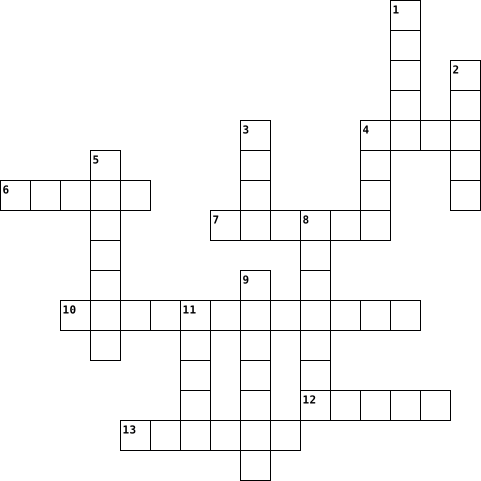
Across
- This orbits the earth.
- The planet referred to as the Evening Star.
- This is the seventh planet from the sun.
- The word used to describe the sun being at the centre.
- The only planet known to have life.
- Which planet is between Jupiter and Uranus?
Down
- Which planet has recently been made a dwarf planet?
- The time it takes for the moon to travel around the earth.
- How long does it take for the earth to orbit the sun?
- Which planet is often known as the red planet?
- Which is the largest planet.
- This planet is the furthest from the sun.
- This is the smallest planet.
- The path a planet follows around the sun.
14 Clues: This orbits the earth. • Which is the largest planet. • This is the smallest planet. • The only planet known to have life. • This is the seventh planet from the sun. • This planet is the furthest from the sun. • The path a planet follows around the sun. • The planet referred to as the Evening Star. • Which planet is between Jupiter and Uranus? • ...
Planets 2014-10-19

Across
- This orbits the earth.
- This is the seventh planet from the sun.
- The path a planet follows around the sun.
- The only planet known to have life.
- The word used to describe the sun being at the centre.
- Which is the largest planet.
- The time it takes for the moon to travel around the earth.
- How long does it take for the earth to orbit the sun?
Down
- The planet referred to as the Evening Star.
- Which planet has recently been made a dwarf planet?
- Which planet is between Jupiter and Uranus?
- This is the smallest planet.
- This planet is the furthest from the sun.
- Which planet is often known as the red planet?
14 Clues: This orbits the earth. • This is the smallest planet. • Which is the largest planet. • The only planet known to have life. • This is the seventh planet from the sun. • The path a planet follows around the sun. • This planet is the furthest from the sun. • The planet referred to as the Evening Star. • Which planet is between Jupiter and Uranus? • ...
atmosphere vocabulary crossword puzzle 2017-09-27

Across
- front the boundary of an advancing mass of warm air
- front the boundary of an advancing mass of cold air
- the movement caused within a fluid by the tendency of hotter and therefore less dense material to rise,
- the gaseous envelope surrounding the earth; the air.
- layer above the troposphere
- layer that contains a high concentration
- a colorless, odorless flammable gas that is the main constituent of natural gas.
- vapor can be produced from the evaporation or boiling of liquid water or from the sublimation of ice.
- layer between the stratosphere and the thermosphere
- humidity the amount of water vapor present in air
- the emission of energy as electromagnetic waves or as moving subatomic particles
- point the atmospheric temperature below which water droplets begin to condense
Down
- an artificial body placed in orbit around the earth or moon or another planet in order to collect information or for communication
- front a composite front produced by occlusion.
- storm types of hurricanes
- radar a radar tracking system
- the process by which heat or electricity is directly transmitted through a substance
- pressure a condition of the atmosphere in which the pressure is below average
- lowest layer of earth
- rain sleet snow hall anything that falls to earth
- front is a pair of air masses, neither of which is strong enough to replace the other
- the outer layer of the atmosphere
- the layer above the mesosphere
- pressure a condition of the atmosphere in which the pressure is above average
- heat, dryness, sunshine, wind, rain, etc.
- mass a body of air with horizontally uniform temperature, humidity, and pressure.
- absorbs most of the ultraviolet radiation reaching the earth from the sun.
27 Clues: lowest layer of earth • storm types of hurricanes • layer above the troposphere • radar a radar tracking system • the layer above the mesosphere • the outer layer of the atmosphere • layer that contains a high concentration • heat, dryness, sunshine, wind, rain, etc. • front a composite front produced by occlusion. • rain sleet snow hall anything that falls to earth • ...
atmosphere vocabulary crossword puzzle 2017-09-27

Across
- the emission of energy as electromagnetic waves or as moving subatomic particles
- an artificial body placed in orbit around the earth or moon or another planet in order to collect information or for communication
- a radar tracking system
- types of hurricanes
- the movement caused within a fluid by the tendency of hotter and therefore less dense material to rise,
- heat, dryness, sunshine, wind, rain, etc.
- the gaseous envelope surrounding the earth; the air.
- can be produced from the evaporation or boiling of liquid water or from the sublimation of ice.
- is a pair of air masses, neither of which is strong enough to replace the other
- the atmospheric temperature below which water droplets begin to condense
- a condition of the atmosphere in which the pressure is above average
- a body of air with horizontally uniform temperature, humidity, and pressure.
- layer that contains a high concentration
- a colorless, odorless flammable gas that is the main constituent of natural gas.
Down
- the boundary of an advancing mass of warm air
- the boundary of an advancing mass of cold air
- layer between the stratosphere and the thermosphere
- a composite front produced by occlusion.
- rain sleet snow hall anything that falls to earth
- absorbs most of the ultraviolet radiation reaching the earth from the sun.
- the amount of water vapor present in air
- layer above the troposphere
- lowest layer of earth
- the layer above the mesosphere
- a condition of the atmosphere in which the pressure is below average
- the process by which heat or electricity is directly transmitted through a substance
- the outer layer of the atmosphere
27 Clues: types of hurricanes • lowest layer of earth • a radar tracking system • layer above the troposphere • the layer above the mesosphere • the outer layer of the atmosphere • a composite front produced by occlusion. • the amount of water vapor present in air • layer that contains a high concentration • heat, dryness, sunshine, wind, rain, etc. • ...
Science Ch.3 2025-10-16

Across
- very small drops of water.
- To give off energy. What the earth does to the sun’s energy during the night.
- The weight all air has.
- A climate where the weather is very warm has a rainy season and a dry season.
- fall’s the most often in spring and summer falls during thunderstorms, frozen raindrops that bounce up and down in the air, continually picking up water.
- Any form of water that falls back down from a cloud to the Earth.
- A windstorm that builds up over the warm ocean.
- A weather scientist.
- The gas that makes up most of the atmosphere.
- electricity that jumps from one cloud to another or from a cloud to the Earth.
- The sound that lightning makes.
- To soak up energy. What the earth does to the sun’s energy during the day.
- What the Sun’s heat energy changes water into. Water is gas form.
- What occurs when rain falls through frozen air.
- when a large amount of water is in the air.
Down
- Forms when the molecule of water vapor begins to freeze or crystallize around tiny bits of dust.
- The condition of the air.
- What temperature is measured by.
- A wind storm that builds up over hot land.
- The layer of air that surrounds the earth.
- a climate where it’s always cold.
- when the sun has the water and the water goes up in the air as water vapor.
- The weather conditions and area receives overtime.
- Water changing from water vapor to liquid again.
- A climate we’re both warm and cold. Weather happens. Most temperate zones have four seasons.
- Moving air
- The 3 main ingredients that make up the weather.
27 Clues: Moving air • A weather scientist. • The weight all air has. • The condition of the air. • very small drops of water. • The sound that lightning makes. • What temperature is measured by. • a climate where it’s always cold. • A wind storm that builds up over hot land. • The layer of air that surrounds the earth. • when a large amount of water is in the air. • ...
Crossward 2021-05-06

Across
- amount of time to turn 360 degrees
- bright shinning star
- amount of time to go around the sun
- natural object the orbits the earth
- what eats the prey
- where animals live
- the transfer of energy
Down
- when taking sediments to a different place
- dent in planet caused by meteor
- caused by glacier
- the longer transfer of energy
- what gets eaten
- what we live on
- planet in the wilkey way
- imaginary line that goes through the earth
15 Clues: what gets eaten • what we live on • caused by glacier • what eats the prey • where animals live • bright shinning star • the transfer of energy • planet in the wilkey way • the longer transfer of energy • dent in planet caused by meteor • amount of time to turn 360 degrees • amount of time to go around the sun • natural object the orbits the earth • ...
Weather 2023-04-30

Across
- something that's similar over and over again
- Suspended water droplets
- Precipitation that falls to Earth as balls of ice
- A weight or force pushing down on something
- Layer of Earth's atmosphere where weather happens
- When water vapor changes into a liquid
- Precipitation that falls to Earth as liquid water.
- The measure of how much water vapor is in the air
- Conditions like wind, rain and thunderstorms
- The ability to move or change something
Down
- When water changes into a gas
- Outermost layer of Earth's atmosphere
- How hot or cold something is
- Precipitation that falls to Earth as flaky ice crystal.
- Rain, snow, sleet or hail
- Precipitation that falls to Earth as ice pellets
- Air moving in a particular direction
17 Clues: Suspended water droplets • Rain, snow, sleet or hail • How hot or cold something is • When water changes into a gas • Air moving in a particular direction • Outermost layer of Earth's atmosphere • When water vapor changes into a liquid • The ability to move or change something • A weight or force pushing down on something • something that's similar over and over again • ...
Earthquakes 2025-04-28

Across
- A vertical (or nearly vertical) fault where the blocks on either side move horizontally (slide past each other in opposite directions)
- fractures or zone of fractures between two blocks of rock
- A dip-slip fault in which the hanging wall (above the fault plane) moves up and over the footwall
- An instrument used to detect and record earthquakes
- The largest earthquake ever recorded happened in this country
- The area of the earth's surface that is directly above the origin of an earthquake
- waves that travel parallel to the Earth’s surface and these waves are the slowest and most damaging
- The large, thin, plates that move relative to one another on the crust of the Earth
- When the crust of the earth thrusts upward
- the result of a sudden release of energy in the Earth’s crust that creates seismic waves
Down
- A dip-slip fault in which the hanging wall has moved downward relative to the footwall
- Fault that makes California an area of high risk for earthquake
- waves that travel through the interior (body) of Earth as they leave the focus
- the scientific study of earthquakes and the propagation of elastic waves through the Earth
- An earthquake that occurs after a "mainshock" (or larger earthquake)
- The point within the earth where an earthquake rupture starts
- Waves from an earthquake are known as these
- Used to measure the strength of earthquake
- area where earthquakes tend to focus
- A smaller earthquake that precedes, a "mainshock"
- The zone of earthquakes and volcanoes surrounding the Pacific Ocean
- The process of an oceanic plate colliding with and descending underneath a continental plate
22 Clues: area where earthquakes tend to focus • Used to measure the strength of earthquake • When the crust of the earth thrusts upward • Waves from an earthquake are known as these • A smaller earthquake that precedes, a "mainshock" • An instrument used to detect and record earthquakes • fractures or zone of fractures between two blocks of rock • ...
Plate Tectonics Crossword 2014-10-28

Across
- the measures of earths energy released by an earthquake
- a vibration that travels through earth that is produced by earthquakes and volcanoes
- hot,fluid rock in the mantle
- the slow movement of the continents over cons
- only travels through solids
- the theory that earths surface is broken into pieces,or plates, that slide over the magma in the mantle
- the part of part of earth that has water
- travels through all material
- a central opening through which magma and gases erupt once reaching earths surface
- the solid portion of the earth
- flat lines that show locations north or south of the equator
Down
- the location on the surface directly above the focus of an earthquake
- a break or crack, in the rocks of the lithosphere along which movements can take place
- process where magma comes up between the plates and forces them apart
- has never shown activity or erupted
- smaller earthquakes that follow a major earthquake
- the point below the surface of earth where an earthquake begins
- has not shown activity in 200 year
- an instrument that detects ,measures,and records seismic energy from earthquakes
- the angular distance east or west on the earths surface
20 Clues: only travels through solids • hot,fluid rock in the mantle • travels through all material • the solid portion of the earth • has not shown activity in 200 year • has never shown activity or erupted • the part of part of earth that has water • the slow movement of the continents over cons • smaller earthquakes that follow a major earthquake • ...
Crossword Puzzle 2017-08-01

Across
- branch of geology that deals with the that shaprs the Earth's crust
- is the force that drives the plates to move around
- destroyed at the subduction zone and melts in the mantle
- the process in which the crust plunges back into earth
- preserved remains or traces of organisms from the remote past
- mantle-core boundary
- Gondwanaland and ______ are the two smaller supercontinent
- the outermost and thinnest layer of the Earth
- he proposed the Seafloor Spreading together with Dietz
- deposits evidence that leads to the idea that Antartica once experienced a tropical climate
- a Greek word which means "All Earth"
- evidence where the rock formations in Africa line up with that in South America as if it was a mountain range
- a wave that cause the most damage to structures during an earthquake
Down
- it is made up of solid iron and nickel
- where seismic waves are recorded
- the boundary that seperates the crust and the mantle
- waves that can only travel through the surface of the Earth
- the outermost rigid shell
- is the portion of motion of a tectonic plate that can be accounted for by its subduction
- during this period Pangaea started to break into two smaller supercontinents
20 Clues: mantle-core boundary • the outermost rigid shell • where seismic waves are recorded • a Greek word which means "All Earth" • it is made up of solid iron and nickel • the outermost and thinnest layer of the Earth • is the force that drives the plates to move around • the boundary that seperates the crust and the mantle • ...
Crossword Puzzle 2017-08-01

Across
- deposits evidence that leads to the idea that Antartica once experienced a tropical climate
- destroyed at the subduction zone and melts in the mantle
- waves that can only travel through the surface of the Earth
- where seismic waves are recorded
- the process in which the crust plunges back into earth
- preserved remains or traces of organisms from the remote past
- is the force that drives the plates to move around
- it is made up of solid iron and nickel
- he proposed the Seafloor Spreading together with Dietz
Down
- a Greek word which means "All Earth"
- is the portion of motion of a tectonic plate that can be accounted for by its subduction
- during this period Pangaea started to break into two smaller supercontinents
- mantle-core boundary
- the boundary that seperates the crust and the mantle
- the outermost and thinnest layer of the Earth
- the outermost rigid shell
- branch of geology that deals with the that shaprs the Earth's crust
- Gondwanaland and ______ are the two smaller supercontinent
- a wave that cause the most damage to structures during an earthquake
- evidence where the rock formations in Africa line up with that in South America as if it was a mountain range
20 Clues: mantle-core boundary • the outermost rigid shell • where seismic waves are recorded • a Greek word which means "All Earth" • it is made up of solid iron and nickel • the outermost and thinnest layer of the Earth • is the force that drives the plates to move around • the boundary that seperates the crust and the mantle • ...
7th Grade Final Exam Crossword 2015-04-30

Across
- the hard, frozen part of a comet
- Neil _________ was the first man on the Moon
- a disturbance in an established rock layer
- ____________ dating measures radioactive isotopes to determine the age of a rock layer
- a bright streak across the sky
- Neptune and Uranus appear this color due to the methane in their atmosphere
- one probe sent to the Moon to measure conditions and gather mineral samples
- ____________ dating compares rock layers to each other
- this telescope uses clear lenses
- the season caused when part of Earth is tilted more toward the Sun
- a meteoroid that strikes Earth
- Venus & Earth both experience a __________ effect due to their atmospheres
- this telescope uses curved mirrors
Down
- a ______ eclipse occurs when the Moon blocks the Sun's light from reaching Earth
- developed the Sun-centered theory of the universe
- the speed of _______ equals 300000 km/s
- the phase right after the New Moon
- large, dark plains of hardened lava on the moon
- the ______ telescope does not require light and looks like a large satellite dish
- the 2nd planet from the Sun
- the _______________ spectrum is energy organized by wavelength
- the 4th planet from the Sun
- one of these equals 1 year
- large planet colored with bands of brown, red, and tan
24 Clues: one of these equals 1 year • the 2nd planet from the Sun • the 4th planet from the Sun • a bright streak across the sky • a meteoroid that strikes Earth • the hard, frozen part of a comet • this telescope uses clear lenses • the phase right after the New Moon • this telescope uses curved mirrors • the speed of _______ equals 300000 km/s • ...
7th Grade Final Exam Crossword 2015-04-30

Across
- large planet colored with bands of brown, red, and tan
- the speed of _______ equals 300000 km/s
- one of these equals 1 year
- developed the Sun-centered theory of the universe
- the _______________ spectrum is energy organized by wavelength
- a meteoroid that strikes Earth
- Venus & Earth both experience a __________ effect due to their atmospheres
- this telescope uses clear lenses
- the season caused when part of Earth is tilted more toward the Sun
- a disturbance in an established rock layer
- ____________ dating measures radioactive isotopes to determine the age of a rock layer
- the ______ telescope does not require light and looks like a large satellite dish
Down
- the 2nd planet from the Sun
- ____________ dating compares rock layers to each other
- this telescope uses curved mirrors
- one probe sent to the Moon to measure conditions and gather mineral samples
- the hard, frozen part of a comet
- a ______ eclipse occurs when the Moon blocks the Sun's light from reaching Earth
- the phase right after the New Moon
- the 4th planet from the Sun
- large, dark plains of hardened lava on the moon
- Neptune and Uranus appear this color due to the methane in their atmosphere
- Neil _________ was the first man on the Moon
- a bright streak across the sky
24 Clues: one of these equals 1 year • the 2nd planet from the Sun • the 4th planet from the Sun • a meteoroid that strikes Earth • a bright streak across the sky • the hard, frozen part of a comet • this telescope uses clear lenses • this telescope uses curved mirrors • the phase right after the New Moon • the speed of _______ equals 300000 km/s • ...
et from qubit 2022-09-17

Across
- earth angels
- congealed
- beginnings
- beings
- Leviathan
- ignorance
- archons
- The adamah
Down
- fire water
- principalities
- he
- Elohim made
- spirits
- heaven angels
- she
- thing powers
- awareness
- The adam
18 Clues: he • she • beings • spirits • archons • The adam • congealed • Leviathan • awareness • ignorance • fire water • beginnings • The adamah • Elohim made • earth angels • thing powers • heaven angels • principalities
Space - Maiken 2025-03-27

Across
- Ball of hoy gas
- Astronauts live here.
- Stars that form a figure.
- She biggest star
- Send radio signals to earth
- there is water here
Down
- To small to be call a planet.
- To small to be round
- Looks like cheese.
- They live in space
- The biggest in the universe
- Is the second largest planet
- Is not a part of the solar system
- It has rings
- the neighbor to the earth
15 Clues: It has rings • Ball of hoy gas • She biggest star • Looks like cheese. • They live in space • there is water here • To small to be round • Astronauts live here. • Stars that form a figure. • the neighbor to the earth • The biggest in the universe • Send radio signals to earth • Is the second largest planet • To small to be call a planet. • Is not a part of the solar system
Science review Chapter 3 JOel 2024-12-09

Across
- Hottest layer of the atmosphere
- Contains all the air on earth
- Part of the atmosphere
- A liquid rock
- The side of a mountain that receives moist precipitation
- a form of water
- The side of a mountain that receives dry precipitation
- living things are in this sphere
- All the rock on earth
Down
- mainly about rocks
- Contains the satellites
- Water vapor released from plants
- Weather over a long period of time
- All the water on earth
- Materials must not be once alive
15 Clues: A liquid rock • a form of water • mainly about rocks • All the rock on earth • Part of the atmosphere • All the water on earth • Contains the satellites • Contains all the air on earth • Hottest layer of the atmosphere • Water vapor released from plants • Materials must not be once alive • living things are in this sphere • Weather over a long period of time • ...
ed@edwardgdavis.com 2021-01-11

Across
- movement of air to redistribute heat
- person who studies the atmosphere for weather predictions
- weight of air above you
- direction to the left of the earth
- amount of heat in the air
Down
- amount of water dissolved in the air
- direction from which the air moves
- direction to the bottom of the earth
- direction to the top of the earth
- narrow band of fast moving air
- moving air between two different air masses
- daily description of atmosphere in one area
- direction to the right of the earth
13 Clues: weight of air above you • amount of heat in the air • narrow band of fast moving air • direction to the top of the earth • direction from which the air moves • direction to the left of the earth • direction to the right of the earth • amount of water dissolved in the air • direction to the bottom of the earth • movement of air to redistribute heat • ...
Gravitational Force 2021-04-04

Across
- Objects have ... because of the gravitational force acting between them and the Earth
- Gravitational force makes things stay in their places and not ... away
- The frictional force acting on objects as they move through air is called air ...
- There is greater frictional force between ... surfaces
- The amount of matter in an object is called ...
- Objects move faster on ... surfaces
- One of the problems that is caused by frictional force
- Gravitational force is the force of ... between things and the Earth
- The strength of gravitational force depends on the ... between the object and the Earth
- Frictional force can slow down and even ... moving objects
Down
- The closer an object to the Earth, the ... the gravitational force is
- Gravitational force pulls all objects ...
- One of the ways to reduce friction is by using ...
- Weight is a ...
- To reduce water resistance while moving through the water, dolphins and sharks have ... body shape
- Water resistance pushes ... a moving object and slows it down
- Frictional force is a force that ... motion
17 Clues: Weight is a ... • Objects move faster on ... surfaces • Gravitational force pulls all objects ... • Frictional force is a force that ... motion • The amount of matter in an object is called ... • One of the ways to reduce friction is by using ... • There is greater frictional force between ... surfaces • One of the problems that is caused by frictional force • ...
geography 2023-09-20

Across
- tectonic The term scientists use to describe the activities of continental drift and magma flow which create many of earths physical features
- Uppermost layer of the earth that includes the crust, continents, and ocean basins
- The watery areas of earth, including oceans, lakes, rivers, and other bodies of water
- the envelope of gases surrounding the earth or another planet.
- Molten rock that is located below earths surface
- The movement of weathered rock and material by wind, glaciers, and moving water; the wearing away of soil
Down
- Thick middle layer of the earths interior structure consisting of hot rock that is dense but flexible
- Chemical or physical processes that break down rocks into smaller pieces
- drift The theory that the continents were once joined and then slowly drifted apart
- shelf Part of a continent that extends out underneath the ocean
- The part of earth where life exist
- Outer layer of the earth, hard rocky shell forming earths surface
- Innermost layer of earth made up of a super hot but solid inner core and super hot liquid outer core
- A crack or break in earths crust.
- A bend in layers of rock, sometimes, caused by plate movement
15 Clues: A crack or break in earths crust. • The part of earth where life exist • Molten rock that is located below earths surface • A bend in layers of rock, sometimes, caused by plate movement • the envelope of gases surrounding the earth or another planet. • shelf Part of a continent that extends out underneath the ocean • ...
Precipitation 2024-12-12

Across
- a circular movement of water, causing a small whirlpool.
- the relations of living organisms to one another and to their physical surroundings.
- water that falls to the ground in various forms.
- the effects of mountains on rainfall.
- amount of salt in water.
- gasses held around planet earth by gravity, filtering what is allowed in and out.
- the part of the land near the ocean; the edge of the land.
- a liquid in which other materials dissolve.
- distance of a place north or south of the earth's equator.
- outermost layer of the Earth's rocks and minerals.
Down
- the movement of the Earth around the Sun.
- the plants of a particular region.
- moisture condensed from the atmosphere that falls visibly in separate drops.
- part of Earth where life can exist.
- effect of temperatures fluctuating less where land is adjacent to larger bodies of water.
- incoming solar radiation.
- light energy radiated in the form of waves or particles.
- science dealing with the properties, distribution, and circulation of water.
- all of the animal life present in a particular region.
- effect due to the Earth’s rotation, a target moves away from the original point
- great circle of the earth that is everywhere equally distant from the two poles .
21 Clues: amount of salt in water. • incoming solar radiation. • the plants of a particular region. • part of Earth where life can exist. • the effects of mountains on rainfall. • the movement of the Earth around the Sun. • a liquid in which other materials dissolve. • water that falls to the ground in various forms. • outermost layer of the Earth's rocks and minerals. • ...
Tyler 2025-04-25

Across
- a sea lower mountain system formed by plate tectonics
- the liquid layer of the Earth's core
- the breaking down or dissolving of rocks and minerals on the surface of earth
- molten rock that issues from a volcano or form a fissure in the surface of a planet
- A large continuous mass of land conventionally regarded as a collective region
- sudden relate of strange energy in the Earth's crust
- having normal physical functions suspended
- the mostly solid bulk of Earth's interior
- hard surface layer
- surface
Down
- A hypothetical land mass in the northern hemisphere near the end of the Paleozoic era
- openings, or vents where lava erupts
- a mixture of molten and semi- molten rock found beneath the surface of the earth
- currents heat driven cycles that occur in the air ocean and mantle
- most layer of the earth and is located at the direct center of the Earth's below the outer core
- The wearing away of rocks and other deposits on the Earth's surface by the action of water,ice,and wind
- a scientific theory that explains how major land forms are created
- A recognizable naturally formed feature on the
- German meter ologist and graphologist
- A super continent that incorporated almost all the land masses on earth
20 Clues: surface • hard surface layer • openings, or vents where lava erupts • the liquid layer of the Earth's core • German meter ologist and graphologist • the mostly solid bulk of Earth's interior • having normal physical functions suspended • A recognizable naturally formed feature on the • sudden relate of strange energy in the Earth's crust • ...
Grace's big back express crossword puzzle 2025-05-16

Across
- a hole that sucks stuff in that's black
- we sent _____ into the sky for wifi
- astronomical year
- our sun is a medium size of this
- A space station
- The_____ space craft
- A space craft we sent into the sky in 1977
- the milker way is a _______
- measurement of an object
- earth _____ around the earth
- a constellation that starts with the letter p
Down
- stars make _________ in the sky
- planets like Pluto, Haumea, Makemake, and Orcus
- we live on a ______
- A triple star system
- a property of matter
- Not oxygen but _______
- 1.5 hours
- the name of a chocolate bar
- a cloud of gas
- A galaxy that starts with the letter a
- A ______ pull keeps us on the ground
- we live in a plant called ______
23 Clues: 1.5 hours • a cloud of gas • A space station • astronomical year • we live on a ______ • A triple star system • a property of matter • The_____ space craft • Not oxygen but _______ • measurement of an object • the name of a chocolate bar • the milker way is a _______ • earth _____ around the earth • stars make _________ in the sky • our sun is a medium size of this • ...
Semester One Science 2022-12-08

Across
- anchor the plant to the ground
- form when sediments compact and cemented together
- a major producer in the ocean
- the layer of the earth where metamorphic rocks form
- the plant part that collects the pollen
- a type of water resources in Virginia
- when it looks like there is no moon
- a break in the earth’s crust, where 2 plates meet
- this type of boundary is where mountains and volcanoes form
- the 3rd planet from the sun
- the hottest layer of the earth
- the closest planet to the sun
- the highest point of a wave
- plants that have roots and stems
- where most plants and animals in the ocean live
- the largest planet
- the process that producers use to make their own food
- an Earth ______ takes 24 hours
Down
- caused by a change in density due to temperature and salinity
- all 3 types of rock can go through weathering and erosion and turn into these
- one Earth _______ around the sun takes 365 days
- this type of boundary is where volcanoes and new crust forms
- the process of transferring pollen from the stamen to the stigma
- the coldest planet
- form when other rocks go through heat and pressure
- as you go deeper into the ocean, life, sunlight, and this decrease
- this causes surface currents and waves in the ocean
- these take up about 60% of Virginia’s land
- all the living and nonliving things in the same place at the same time
- these occur at transform boundaries
- eat only plants
- when we see the whole moon
- the deepest part of the ocean floor
- form when magma cools
- make their own food
35 Clues: eat only plants • the coldest planet • the largest planet • make their own food • form when magma cools • when we see the whole moon • the 3rd planet from the sun • the highest point of a wave • a major producer in the ocean • the closest planet to the sun • anchor the plant to the ground • the hottest layer of the earth • an Earth ______ takes 24 hours • ...
Hydrologic Cycle 2017-10-14

Across
- A place where groundwater bubbles or flows to the surface through cracks in the ground
- The water found in plants and animals
- The gravitational movement of water through the soil and bedrock
- An expansive groundwater reservoir
- Conversion of liquid water to water vapor, a process that requires energy from the sun
- The change from water vapor to liquid water accompanied by cooling temperatures
- The movement of groundwater to the surface of the Earth
- The release of water from plants through their stomata
- The Earth sphere where cloud formation occurs
- The process of water soaking into the soil surface
- The Earth sphere that contains all water
- The amount of water held in the atmosphere
- A visible mass of condensed water vapor floating in the atmosphere
Down
- The process of water uptake by plants
- The state change from ice directly to water vapor
- Permanently frozen water storage reservoirs usually found at high elevations
- Open reservoirs on land where liquid water pools and collects
- The transfer of water from animals through their pores as water vapor
- Flow of water over land
- Water frozen in soil year round
- The process of changing water from solid state to liquid state
- Water frozen in large expanses at the poles of Earth
- Rain, sleet, hail or snow falling from the atmosphere
- Water that fills the cracks and pores in underground soil and rock layers
- The Earth sphere containing all life
- The largest water storage reservoir
- Rapidly moving surface water that transports water in channels
- A water reservoir that is the top most layer of the Earth’s crust
- A low altitude form of condensed water droplets
- The movement of water vapor within the atmosphere
- Water condensed on plants
31 Clues: Flow of water over land • Water condensed on plants • Water frozen in soil year round • An expansive groundwater reservoir • The largest water storage reservoir • The Earth sphere containing all life • The process of water uptake by plants • The water found in plants and animals • The Earth sphere that contains all water • The amount of water held in the atmosphere • ...
Science Vocabulary by Joelle Robertson 2018-11-12

Across
- Solid copies of the shape of the organism.
- A place where magma sits on its way up from the upper mantle to Earth’s surface
- Evidence of organisms' activities such as footprints.
- The center of the Earth and also the hottest layer.
- When plates move closer together
- Provide evidence about the history of life and past environments on Earth.
- Scientists who study and collect fossils from sedimentary rocks.
- Fossils of widely distributed organisms who lived during one short period.
- Hollow areas formed in sediment in the shape of the organism.
- The outer layer of the Earth.
- In sedimentary rock layers, the oldest layer is at the bottom, youngest at the top.
- The flow that transfers heat within a fluid
- Fossils where minerals replaced all or part of the organism.
- A funnel-shaped pit at the top of a volcano
Down
- When plates move in opposite directions
- A scientist who studies the history of Earth
- The area directly below the focus
- A thin coating of carbon on rock.
- The only liquid layer of the Earth.
- A scientist who studies earthquakes
- When plates move apart
- The age of a rock given as the number of years since it was formed.
- A pushing force that decreases volume
- The layer that is underneath the crust. It is the thickest layer.
- Animals preserved with little or no change.
- The opening from which lava flows in a volcano
- Two opposing forces acting on the same point
- When rocks break under stress beneath Earth’s surface during and earthquake
- The age of a rock compared to the age of other rock layers.
- a pulling force that increases volume
30 Clues: When plates move apart • The outer layer of the Earth. • When plates move closer together • The area directly below the focus • A thin coating of carbon on rock. • The only liquid layer of the Earth. • A scientist who studies earthquakes • A pushing force that decreases volume • a pulling force that increases volume • When plates move in opposite directions • ...
space 2023-04-14

Across
- what the earth orbits around
- dwarf plant
- the biggest planet
- machine that goes on other planets
- the study space
- our home planet
- the closest planet to the sun
- a giant cloud of dust
- something that happens before a black hole
- science guy we use watch and love
Down
- is knowns for the rings
- crazy people who believe
- the red planet
- suck in everything including light
- what pulls us down to the earth
15 Clues: dwarf plant • the red planet • the study space • our home planet • the biggest planet • a giant cloud of dust • is knowns for the rings • crazy people who believe • what the earth orbits around • the closest planet to the sun • what pulls us down to the earth • science guy we use watch and love • machine that goes on other planets • suck in everything including light • ...
Quarter 2 Vocab Extra Credit 2023-11-14

Across
- A phase of the moon coming after a new moon and before a 1st quarter moon that is a lit up crescent on the right
- A phase of the moon that comes after a 1st quarter moon and before a full moon where almost all of the moon is lit up from the right to the left, except a small bit on the left.
- transverse waves consisting of changing electric fields and changing magnetic fields
- The point on the celestial sphere where the sun is farthest south; also, the time of year when the sun passes this point, about December 22, and winter begins in the Northern Hemisphere.
- The transfer of thermal energy by the circulation or movement of a liquid or gas
- Caused by the tilt of Earth on its axis as it revolves around the Sun
- the blocking of sunlight to the moon that occurs when Earth is directly between the sun and the moon
- transfer conduction, convection, radiation
- When the moon, Earth, and Sun are all in a straight line. It creates the biggest tidal range on Earth in a 24 hour period.
- In which eclipse do we see a small ring-like sliver of light from the sun. This is due to the moon being at its further point from the sun and in the antumbra.
- The direct transfer of heat from one substance to another substance that it is touching.
- A measure of the average energy of motion of the particles of a substance.
- comes from changes to the atom's nucleus: when the nucleus of an atom divides
Down
- the time or date (twice each year) at which the sun crosses the celestial equator, when day and night are of equal length (about September 22 and March 20).
- Occurs when the Moon passes directly between the Sun and Earth and casts a shadow over part of Earth
- When the moon and Earth are perpendicular (create a right angle) with the Sun. It creates the smallest tidal range on Earth in a 24 hour period.
- The moon is a quarter of the way around the Earth. You can see the right half of the moon.
- A phase of the moon that comes after a full moon and before a last quarter moon where all of the moon is lit up except for a small bit on the right side of the moon that we can see.
- conduction, convection, radiation
- the region around a magnet where the magnetic force is exerted
- The spinning motion of a planet on its axis
- the range of wavelengths or frequencies over which electromagnetic radiation extends.
- the periodic rise and fall of the water level in the oceans and other large bodies of water
- causes Earth's seasons. (23.5 degrees)
- a kind of radiation including visible light, radio waves,gamma rays, and X-rays, in which electric and magnetic fields vary simultaneously
- Particles such as electrons, protons, and atomic nuclei that zip through interstellar space at close to the speed of light.
- moon phase when the entire side facing Earth is illuminated.
- The process by which two or more small nuclei fuse to make a bigger nucleus
- The point on the ecliptic where the Sun is farthest north of the celestial equator. It is also used to refer to the date on which the Sun passes through this point. (about June 21st)
- Phase when the cresent light is on the left; occurs before a new moon
- that is radiated or transmitted in the form of rays or waves or particles
- The movement of an object around another object
32 Clues: conduction, convection, radiation • causes Earth's seasons. (23.5 degrees) • transfer conduction, convection, radiation • The spinning motion of a planet on its axis • The movement of an object around another object • moon phase when the entire side facing Earth is illuminated. • the region around a magnet where the magnetic force is exerted • ...
bio- & geo- 2024-11-24

Across
- to see a living thing
- is written about life/living things
- the study of life/living things
- someone who studies about the earth
- many different living things
Down
- the study of the earth
- able to be broken down by living things
- is written about the earth
- someone who studies about life/living things
- having the earth as the centre
- measurement of the earth
11 Clues: to see a living thing • the study of the earth • measurement of the earth • is written about the earth • many different living things • having the earth as the centre • the study of life/living things • is written about life/living things • someone who studies about the earth • able to be broken down by living things • someone who studies about life/living things
May Dance 2022-04-25

Across
- Scottish treat
- Pretty tops
- Mystery of the woods
- The begginings of ________
- _____ and Home
- Traditional meat
- Daisy (colour)
- Fire (colour)
- Around the fire activity
- Time for dancing!
- Dancer Her up!
Down
- Ritual blaze
- Tricksy creatures
- Magic dust
- For morning Maiden faces
- Belly fire
- Beribboned
- Light
- Fire sabbat
- Belled dancers
- Flower swags
- Food from the earth
- The Reason for the Season
- Blessed between two #1 Down
24 Clues: Light • Magic dust • Belly fire • Beribboned • Pretty tops • Fire sabbat • Ritual blaze • Flower swags • Fire (colour) • Scottish treat • _____ and Home • Daisy (colour) • Belled dancers • Dancer Her up! • Traditional meat • Tricksy creatures • Time for dancing! • Food from the earth • Mystery of the woods • For morning Maiden faces • Around the fire activity • The Reason for the Season • ...
Mackenzie Catron Science Crossword 2024-11-04

Across
- includes changes in the galaxies, stars, solar system, earth and life on earth. Biological evolution
- a homogenous mixture throughout which two or more substances are uniformly dispersed.
- the planet that we live on.
- a subatomic particle with a positive eclectic charge.
- a combination of two or more substances that are physically combined.
- a star around which the earth orbits.
- the 8th planet from the sun.
- the 2nd planet from the sun.
- the 5th planet from the sun.
- a change in hereditary characteristics of groups of organisms over the course of generations.
Down
- the 7th planet from the sun.
- a water molecule that had gained a hydrogen ion.
- a compound that can change color depending on conditions such as .
- the 6th planet from the sun.
- the 4th planet from the sun.
- A community of living organisms and their interrelated physical and chemical environment.
- the smallest planet is out solar system.
- A process of change that explains why what we see today is different from what existed in the past;
18 Clues: the planet that we live on. • the 7th planet from the sun. • the 6th planet from the sun. • the 4th planet from the sun. • the 8th planet from the sun. • the 2nd planet from the sun. • the 5th planet from the sun. • a star around which the earth orbits. • the smallest planet is out solar system. • a water molecule that had gained a hydrogen ion. • ...
6yh 2026-03-02

Across
- Top of a volcano
- Layer below crust
- Sea level rise and fall
- Solid Earth material
- Our solar star
- Imaginary Earth line
- Time Earth rotates once
- Water vapor in sky
- Overflowing water
- Molten rock on surface
- Molten rock below Earth
- Center of Earth
- Lean of Earth
- Fossil fuel
- Powder from eruption
- Large moving slab of Earth
- Preserved remains
- Ice from clouds
- Outer layer of Earth
- Water from clouds
- Valuable metal
- Air like substance
- Dirty air
- Earth satellite
- Ocean movement
Down
- Flowing water
- Volcano opening
- Small rock pieces
- Hard natural element
- Small ocean inlet
- Moving air
- Strong weather event
- Low cloud near ground
- Crack in Earths crust
- Large inland water
- Small island
- Fine soil material
- Hot ball in space
- Ocean rock formation
- Path around a star
- High temperature
- Liquid fossil fuel
- Mineral from sea
- Circle around a planet
- Top layer of ground
- Energy from earthquake
- UV blocking layer
- Air from burning
- Frozen rain
- Time Earth orbits sun
50 Clues: Dirty air • Moving air • Fossil fuel • Frozen rain • Small island • Flowing water • Lean of Earth • Our solar star • Valuable metal • Ocean movement • Volcano opening • Center of Earth • Ice from clouds • Earth satellite • Top of a volcano • High temperature • Mineral from sea • Air from burning • Small rock pieces • Layer below crust • Small ocean inlet • Overflowing water • Hot ball in space • Preserved remains • ...
Tectonic Plates 2022-06-20

Across
- Most geologist think that the movement of Earth's plates is caused by
- This type of boundary is found in the San Andreas Fault
- Evidence used by Wegener for continental drift
- Below the mantle and to the center of the Earth
- the zone below the lithosphere. It is more 'plastic'
- the section of the Earth below the earth
- When two plates are moving away from each other
Down
- the name of the supercontinent that existed millions of years ago
- a collision between two pieces of continental crust at a converging boundary produces a
- The outer part of the Earth
- Seafloor______
- Composed of the crust and mantle
- When two plates are moving toward each other
- Scientist who first proposed the theory that the continents drifted
- The Theory of Continental____
15 Clues: Seafloor______ • The outer part of the Earth • The Theory of Continental____ • Composed of the crust and mantle • the section of the Earth below the earth • When two plates are moving toward each other • Evidence used by Wegener for continental drift • Below the mantle and to the center of the Earth • When two plates are moving away from each other • ...
Science 2018-03-21

Across
- the color of the hottest stars
- one tectonic plate is pulled beneath another plate
- large moving pieces of Earth
- the planet with the most moons
- proposed the idea called continental drift
- the fault that runs though California
- the force that holds galaxies together
- tectonic plates collide
- molten rock beneath the Earth’s surface
Down
- the actual brightness of a star
- one large landmass
- the rigid solid layer of Earth made of rock
- closest star to Earth
- two plates move away from each other
- the bending, tilting, and breaking of rock
- a body composed of gas that emits light
- tectonic plates move past one another in opposite directions
- the birthplace of most stars
18 Clues: one large landmass • closest star to Earth • tectonic plates collide • large moving pieces of Earth • the birthplace of most stars • the color of the hottest stars • the planet with the most moons • the actual brightness of a star • two plates move away from each other • the fault that runs though California • the force that holds galaxies together • ...
Science 2018-03-21

Across
- the actual brightness of a star
- one large landmass
- the color of the hottest stars
- tectonic plates collide
- tectonic plates move past one another in opposite directions
- a body composed of gas that emits light
- the force that holds galaxies together
- two plates move away from each other
- large moving pieces of Earth
Down
- closest star to Earth
- one tectonic plate is pulled beneath another plate
- the planet with the most moons
- molten rock beneath the Earth’s surface
- the rigid solid layer of Earth made of rock
- the bending, tilting, and breaking of rock
- the birthplace of most stars
- the fault that runs though California
- proposed the idea called continental drift
18 Clues: one large landmass • closest star to Earth • tectonic plates collide • the birthplace of most stars • large moving pieces of Earth • the planet with the most moons • the color of the hottest stars • the actual brightness of a star • two plates move away from each other • the fault that runs though California • the force that holds galaxies together • ...
Science 2018-03-21

Across
- closest star to Earth
- the color of the hottest stars
- two plates move away from each other
- molten rock beneath the Earth’s surface
- the birthplace of most stars
- tectonic plates collide
- one large landmass
- the fault that runs though California
- the force that holds galaxies together
- large moving pieces of Earth
Down
- the planet with the most moons
- proposed the idea called continental drift
- one tectonic plate is pulled beneath another plate
- the rigid solid layer of Earth made of rock
- tectonic plates move past one another in opposite directions
- the actual brightness of a star
- the bending, tilting, and breaking of rock
- a body composed of gas that emits light
18 Clues: one large landmass • closest star to Earth • tectonic plates collide • the birthplace of most stars • large moving pieces of Earth • the planet with the most moons • the color of the hottest stars • the actual brightness of a star • two plates move away from each other • the fault that runs though California • the force that holds galaxies together • ...
Earth + Moon and Acids + Alkalis 2021-10-26

Across
- Caused by the Earth's revolution around the Sun
- The moon goes through _____ throughout the moon
- Water is an acid: True or false?
- A _____ moon looks like it is growing bigger
- A ___ moon is a circle
- A(n) ____ can turn litmus paper blue
- The force keeping us on the ground
- A ____ moon looks like it is growing smaller
- ____ taste sour
- Caused by an object blocking a light source
Down
- Salt is neutral: True or false?
- What the earth revolves on
- The direction the Earth rotates about its axis on, and around the sun
- Lemon is a base: True or false?
- A(n) _____ can turn litmus paper red
- The hottest planet
- The planet we live on
- A measure of matter
- _____ taste bitter
19 Clues: ____ taste sour • The hottest planet • _____ taste bitter • A measure of matter • The planet we live on • A ___ moon is a circle • What the earth revolves on • Salt is neutral: True or false? • Lemon is a base: True or false? • Water is an acid: True or false? • The force keeping us on the ground • A(n) ____ can turn litmus paper blue • A(n) _____ can turn litmus paper red • ...
Continental Drift Review 2024-10-21

Across
- continents fit together like _______ pieces
- the upper layer of the earth's mantle
- the layer of Earth where convection happens
- the theory states that the plates are always moving
- the scientist who came up with continental drift
- currents are found in the mantle and cause the plates to move
- the outmost layer of the Earth
- evidence of dead plants and animals
Down
- The rigid outer part of the earth consisting of the crust and upper mantle
- Wegner needed _________ to support his theory
- ___________ ranges lining up was a strong piece of evidence that supports Wegener's theory
- Wegner believed that all continents were once joined together but drifted apart over time
- the name of Wegner's supercontinent
- The Earth is made up of _______ ______ which are constantly moving along above the mantle
- this continent matches up with south America
- continental drift theory states that the continents move very _______ over long periods of time
16 Clues: the outmost layer of the Earth • the name of Wegner's supercontinent • evidence of dead plants and animals • the upper layer of the earth's mantle • continents fit together like _______ pieces • the layer of Earth where convection happens • this continent matches up with south America • Wegner needed _________ to support his theory • ...
science 2 2022-09-16

Across
- The location within earth along a fault at which the first motion of an earthquake occurs
- The process by which new oceanic lithosphere (sea floor) form when magma rises the earth's surface at mid-ocean ridges and solidifies as older existing seafloor moves away from ridge.
- The boundary between tectonic plates that are colliding
- The central part of earth below the mantle
- A break in a body of a rock along which one block moves relative to another
- The solid outer layer of earth that consists of the crust and the rigid upper part of the mantle
- the hypothesis that a single large landmass broke up into smaller land masses to form the continents which then drifted to their present locations the movement of continents.
- A movement or trembling of the ground that is cause by a sudden release of energy when rocks along a fault move.
- The layer of rock between the earth’s crust and core
- A block of lithosphere that consists of the crust and the rigid outermost part of the mantle
- The thin and solid outermost layer of earth above the mantle
- The edge between two or more plates classified as divergent convergent or transform by the movement taking place between the plates
- the soft layer of the mantle on which the tectonic plates move
Down
- The boundary between two tectonic plates that are moving away from each other.
- The edge between two or more plates classified as divergent convergent or transform by the movement taking place between the plates
- The bending tilting and breaking of earth crust the change in the shape of rock in response to stress
- The boundary between tectonic plates that are sliding
- The point of earth's surface directly above an earthquake starting point or focus
- The strong lower part of the mantle between the asthenosphere and the outer core
- The sudden return of elastically deformed rock to it undeformed shape
- The process by which one lithospheric plate moves beneath another plates as a result of tectonic forces
- Any movement of matter that results from difference in density may be vertical, circular, or cyclical
- A system of ideas that explains many related observations and is supported by a large body of evidence acquired through scientific investigation
- the theory that earth outer layer is made up off large moving pieces called tectonic plates the theory explains how plates interact and how those interactions relate to processes such as earthquakes and mountain building.
- reversal
- process by which earth's magnetic north pole and magnetic south pole switch positions periodically a change in the direction in which earth magnetic field points
26 Clues: reversal • The central part of earth below the mantle • The layer of rock between the earth’s crust and core • The boundary between tectonic plates that are sliding • The boundary between tectonic plates that are colliding • The thin and solid outermost layer of earth above the mantle • the soft layer of the mantle on which the tectonic plates move • ...
Unit 1: Physical Geography 2025-09-19

Across
- All the water on Earth’s surface, underground, and in the air, including oceans, rivers, lakes, glaciers, and groundwater.
- The long-term average weather patterns of a region, including temperature and precipitation.
- A type of map that uses contour lines to show elevation, landforms, and physical features in detail.
- Global Positioning System, a satellite-based tool that determines exact location on Earth.
- The process of breaking down rocks into smaller pieces by wind, water, ice, or plants.
- A type of map that shows general information like political boundaries, cities, and landforms.
- Large regions with specific climates, plants, and animals, such as deserts, forests, or grasslands.
- The movement of rock, soil, or sand from one place to another by wind, water, or ice.
Down
- Natural materials such as water, soil, forests, and minerals that people use to survive and develop.
- A type of map that shows specific information about one topic, such as climate, population, or trade.
- The solid outer layer of Earth, including rocks, mountains, and the crust where landforms develop.
- The imaginary horizontal lines that measure distance north or south of the Equator.
- The layer of gases surrounding Earth, including oxygen, carbon dioxide, and nitrogen, that supports life and weather.
- The imaginary vertical lines that measure distance east or west of the Prime Meridian.
- Plates Large pieces of Earth’s crust that move slowly, creating mountains, volcanoes, earthquakes, and trenches.
- The part of Earth where all living organisms exist, including plants, animals, and humans.
- Geographic Information System, a computer tool that analyzes and displays maps and data about locations on Earth.
- The regions of Earth near the Equator between the Tropic of Cancer and Tropic of Capricorn, known for warm climates.
18 Clues: The imaginary horizontal lines that measure distance north or south of the Equator. • The movement of rock, soil, or sand from one place to another by wind, water, or ice. • The imaginary vertical lines that measure distance east or west of the Prime Meridian. • The process of breaking down rocks into smaller pieces by wind, water, ice, or plants. • ...
The World on the turtles back 2024-11-06

Across
- - Represents the land that is created on the turtle's back.
- - What the Sky Woman brought down to plant
- - The creature that supports the earth.
- Woman - The central character who initiates the creation.
- - The harmony between land and water.
- - Surrounds the turtle and is significant in the myth.
- - Referring to the Sky Woman who falls to Earth.
Down
- - Reflects the theme of growth and care in the story.
- Spirit - Represents the divine influence in the myth.
- - The overarching theme of how the earth was formed.. Animals - The beings that assist in the creation of land.
- - Referring to the turtle's shell which holds the earth.
- - The realm where the Sky Woman comes from.
- - The concept that plays a role in the story's themes.
- - Represents the beginning of life and growth, relating to the seeds planted by the Sky Woman.
14 Clues: - The harmony between land and water. • - The creature that supports the earth. • - What the Sky Woman brought down to plant • - The realm where the Sky Woman comes from. • - Referring to the Sky Woman who falls to Earth. • - Reflects the theme of growth and care in the story. • Spirit - Represents the divine influence in the myth. • ...
Szymon Baranowski - Science Crossword 2015-06-21

Across
- What is the opposite of smaller?
- Different objects falls at a different?
- What do we swim in?
- You fill it when you are running?
- what flies in space?
- If an object has light then it is ....
- What is the opposite of thicker?
- What sparkles in the night?
Down
- A lamp post has it.
- when we rub our hands we make?
- We are ------- on earth.
- What is the opposite of bigger?
- If we want to time something we need a?
- What do we live on?
- What is a better word for bigger?
- You can find planets and stars in it.
- What keeps a boat on water?
- What shines in the day?
- What pulls us down to the earth?
- Meter. What do we mesure friction with?
20 Clues: A lamp post has it. • What do we live on? • What do we swim in? • what flies in space? • What shines in the day? • We are ------- on earth. • What keeps a boat on water? • What sparkles in the night? • when we rub our hands we make? • What is the opposite of bigger? • What is the opposite of smaller? • What pulls us down to the earth? • What is the opposite of thicker? • ...
Szymon Baranowski - Science Crossword 2015-06-21

Across
- You fill it when you are running?
- Different objects falls at a different?
- What do we live on?
- What keeps a boat on water?
- A lamp post has it.
- When we rub our hands we make?
- What sparkles in the night?
- What is a better word for bigger?
- What shines in the day?
Down
- What is the opposite of smaller?
- We are ------- on earth.
- What pulls us down to the earth?
- What is the opposite of bigger?
- If we want to time something we need a?
- What do we mesure friction with?
- You can find planets and stars in it.
- What is the opposite of thicker?
- If an object has light then it is ....
- What flies in space?
- What do we swim in?
20 Clues: What do we live on? • What do we swim in? • A lamp post has it. • What flies in space? • What shines in the day? • We are ------- on earth. • What keeps a boat on water? • What sparkles in the night? • When we rub our hands we make? • What is the opposite of bigger? • What is the opposite of smaller? • What pulls us down to the earth? • What is the opposite of thicker? • ...
Q4 Exam Review 2021-05-22

Across
- to blend in with your surroundings
- one year
- AA
- type of sunlight received in winter
- genetic constitution of an organism (Bb)
- season when the Earth tilts away from the sun
- percentage of DNA that siblings share
- a change in DNA
- object smaller than stars
- a diagram that shows how a trait is passed down
- type of sunlight received in summer
- first phase of the lunar cycle
- shape that represents a male
Down
- characteristics passed down from family members
- characteristics or traits of an organism
- light from sun reflected by the moon
- a close resemblance of another organism
- Aa
- shape that represents a female
- a day
- moon orbits Earth in this direction
- season when the Earth tilts towards the sun
- a star
23 Clues: AA • Aa • a day • a star • one year • a change in DNA • object smaller than stars • shape that represents a male • shape that represents a female • first phase of the lunar cycle • to blend in with your surroundings • type of sunlight received in winter • moon orbits Earth in this direction • type of sunlight received in summer • light from sun reflected by the moon • ...
4 Determination B 2022-06-07

Across
- Revolution of the earth causes
- Capital of Sikkim
- The magna when reaches at the surface of the earth is called
- Changing of matter from solid to gas state is called
- Currency of Jordan
- Currency of Japan
- A person who manufactures glass windows
- A person who sets steps of dance
- Capital of Haryana
- Capital of Arunachal Pradesh
- A person who writes plays and drama.
Down
- Capital of Tamil Nadu
- Currency of Myanmar
- The spinning of earth on its own axis is called
- A person who studies stars and heavenly bodies
- A person who tells your future with the help of stars
- Anything that has mass and occupies space is called
- Currency of Kenya
- Capital of Chhattisgar
- Currency of Malaysia
20 Clues: Capital of Sikkim • Currency of Japan • Currency of Kenya • Currency of Jordan • Capital of Haryana • Currency of Myanmar • Currency of Malaysia • Capital of Tamil Nadu • Capital of Chhattisgar • Capital of Arunachal Pradesh • Revolution of the earth causes • A person who sets steps of dance • A person who writes plays and drama. • A person who manufactures glass windows • ...
Volcano 2014-07-13

Across
- The of the Earth between the crust and the molten core
- Small fragments of lava
- A naturally occurring inorganic substance
- Hot substance found in a volcano
- The substance created when molten rock cools
- The movement of the Earths continents
- A volcano that is not likely to erupt again
- What the continents sit on
- Also known as the water cycle
- The scale sound is measured with
- A vent which volcanic gasses escape
- Also a protective weapon
- The study of rocks
- mountain that erupts
- An are in the Pacific Ocean with lots of volcanoes
- The southern super-continent formed when Pangaea broke apart
- The scientist that studies fossils
- A volcanic eruption on the side of a volcano
- The area of alignment between the north and south poles
- Most common lava type in shield volcanoes
- Solidified lava that is in tiny particles
- The outermost layer of the Earth
- scale The scale measuring the intensity of an earthquake
- A scientist who studies rocks
- Very old
- The study of oceans
- The northern super-continent the formed when Pangaea broke
- tube A tube-like tunnel formed by flowing lava
- A state of matter where the molecules are spread widely
- A huge waved cause by underwater earthquakes
Down
- A space rock that enters Earths atmosphere
- A circular depression in the top of a volcano
- The measurement of temperature
- Most dangerous volcano
- The unit in which and earthquake is measured with
- A time when the the Earth was very cold
- Imaginary circle around the earth
- The ocean floor
- Light-colored volcanic rock rich in silica
- An era lasting hundreds of millions of years
- The first main super-continent
- The period when dinosaurs flourished
- The angular distance east or west of the prime meridian
- A chemically pure substance composed of atoms of a single type
- Rocks compacted by pressure and heat from deep inside the Earth
- The innermost layer of the Earth
- When gas is cooled to a liquid state
- An underground cavity filled with magma
- The hot substance that runs down a volcano
- The valley between two faults
- The process of liquid turning to gas
- The third planet from the sun
- The study of fossils
- The angular distance north or south of the equator
- Outer part of Earth consisting of the crust and upper mantle
- A vast body of water
- An area when one plate is pushed under another
- Light-colored, course grained igneous rock
- Smallest volcano
- When a volcano that has not erupted for a while
- Half of a sphere
- A unit of weight
- A volcano in Indonesia
- Volcanic activity in which lava or gasses are released
- A crack caused when lava erupts
- Enormous chunks of rock floating atop the soft mantle
66 Clues: Very old • The ocean floor • Smallest volcano • Half of a sphere • A unit of weight • The study of rocks • The study of oceans • mountain that erupts • The study of fossils • A vast body of water • Most dangerous volcano • A volcano in Indonesia • Small fragments of lava • Also a protective weapon • What the continents sit on • Also known as the water cycle • The valley between two faults • ...
Szymon Baranowski - Science Crossword 2015-06-21

Across
- What is the opposite of smaller?
- When we rub our hands we make?
- What shines in the day?
- What is the opposite of bigger?
- If an object has light then it is ....
- What do we live on?
- What keeps a boat on water?
- You fill it when you are running?
- You can find planets and stars in it.
- What do we swim in?
Down
- If we want to time something we need a?
- What pulls us down to the earth?
- What is the opposite of thicker?
- What do we mesure friction with?
- What sparkles in the night?
- A lamp post has it.
- What is a better word for bigger?
- We are ------- on earth.
- What flies in space?
- Different objects falls at a different?
20 Clues: A lamp post has it. • What do we live on? • What do we swim in? • What flies in space? • What shines in the day? • We are ------- on earth. • What sparkles in the night? • What keeps a boat on water? • When we rub our hands we make? • What is the opposite of bigger? • What is the opposite of smaller? • What pulls us down to the earth? • What is the opposite of thicker? • ...
Amazing Places 2023-12-04

Across
- to find
- to give someone an idea
- a large body of land (Asia, Africa...)
- the natural shape of a section of land
- to picture something in your mind
- a group of things arranged in a certain order
- the salt water that covers most of the earth
- how high something is
- something you can see or touch
- a part of something
- an edge or outline
Down
- an imaginary line that divides the earth
- one half of the earth
- the top layer or cover of something
- an area of land
- a drawing of Earth's surface, or part of it
- a person who lives somewhere
- a ball with a map on it
- to carry something
- a nation with its land and people
20 Clues: to find • an area of land • to carry something • an edge or outline • a part of something • one half of the earth • how high something is • to give someone an idea • a ball with a map on it • a person who lives somewhere • something you can see or touch • to picture something in your mind • a nation with its land and people • the top layer or cover of something • ...
earth science 2024-02-14

Across
- what lies between Earth's dense, super-heated core and its thin outer layer, the crust
- The mineral make up of a rock
- the second most outer most layer of the earth
- minerals made of silicate groups that form rocks
- the thickest layer of the mantle
- last layer of the earth
- the outer most layer of the earth
- 2,900-5,150 km below the surface
Down
- When rocks disintegrate or break up without experiencing any change in their chemical composition
- high concentration of ozone that is found in the stratosphere
- the boundary zone between Earth's crust and the mantle
- the very hot very dense center of our planet
- hot magma sent though vents
- the speed that the silicate grows
- third planet closest to the sun
15 Clues: last layer of the earth • hot magma sent though vents • The mineral make up of a rock • third planet closest to the sun • the thickest layer of the mantle • 2,900-5,150 km below the surface • the speed that the silicate grows • the outer most layer of the earth • the very hot very dense center of our planet • the second most outer most layer of the earth • ...
Planets and their key features 2017-04-19

Across
- Uranus spins on its _
- The Earth is located within the _ Zone
- This planet looks like a blue and green colour
- On this planet 1 day equals 59 Earth days
- How many moons does Mars have
- Number of moons surrounding Jupiter
- This planet has an amazing ring system consisting of thousands of ringlets together
Down
- Large volcano located on Mars
- The only planet to have liquid water over its surface
- Neptune is a _
- The hottest planet
- Is half the size of Earth
- Largest planet in the Solar System
- This planet has 14 moons
14 Clues: Neptune is a _ • The hottest planet • Uranus spins on its _ • This planet has 14 moons • Is half the size of Earth • Large volcano located on Mars • How many moons does Mars have • Largest planet in the Solar System • Number of moons surrounding Jupiter • The Earth is located within the _ Zone • On this planet 1 day equals 59 Earth days • ...
Plate Tectonics 2023-03-15

Across
- Result of Tectonic plates pushing together
- Type of scientists that study the earth
- Form along the edge of Tectonic plates
- The Tectonic plate theory was developed
- Mountain Building Process
- The theory preceding the tectonic plate theory
- What does the slipping of tectonic plates cause?
- Plates of earth that move over the liquid layer
- Region on earth with a lot of tectonic activity, located around the Pacific Ocean
Down
- South America and Africa are a ___________
- What Tectonic Plate is Canada on?
- Two plates moving towards each other
- All the continents used to be a
- The ______ also has tectonic plates
- _______ found in the ground support the theory
- Layer under the tectonic plates
- Came up with the Theory of Continental Drift
- What is the zone between two tectonic plates called?
- Two plates moving away from each other
- Name of the supercontinent
20 Clues: Mountain Building Process • Name of the supercontinent • All the continents used to be a • Layer under the tectonic plates • What Tectonic Plate is Canada on? • The ______ also has tectonic plates • Two plates moving towards each other • Form along the edge of Tectonic plates • Two plates moving away from each other • Type of scientists that study the earth • ...
Plate tectonics 2013-04-06

Across
- theory that continents drift apart
- the sinking of regions of earth's crust to lower elevations
- solid dense center of the earth
- a squeezing force
- boundary between two plates that are sliding past each other
- new lithosphere is created here
- the rising of regions of earth's crust to higher elevations
- the strong lower part of the mantle between the asthenosphere and outer core
- piece of the lithosphere that moves on the asthenosphere
- a region where a an oceanic plate sinks down into the asthenosphere
- liquid layer of the earth's core
Down
- outermost,rigid layer of the earth
- a break in the earths crust
- boundary between two colliding plates
- the bending of rock layers
- a pulling force
- layer between the crust and core
- soft layer of the mantle
- boundary between two plates moving away from each other
- outermost layer of the earth
20 Clues: a pulling force • a squeezing force • soft layer of the mantle • the bending of rock layers • a break in the earths crust • outermost layer of the earth • solid dense center of the earth • new lithosphere is created here • layer between the crust and core • liquid layer of the earth's core • outermost,rigid layer of the earth • theory that continents drift apart • ...
astronomy puzzle 2025-03-13

Across
- the sister planet of earth
- the angle of which planets rotate
- A sandy red planet
- what gives Earth its ability to have breathable air
- the exact opposite of a black hole
- the galaxy we live in
- was a planet and now is reclassified as a dwarf planet
- dwarf planet in our solar system
- the most well known space telescope launched in 1990
- measurement of distance in space
Down
- when the moon covers the sun during the day
- the largest planet in our solar system
- A hole in the fabric of space that sucks everything in
- the smallest planet in our solar system
- a series of rocks floating in space
- the Hubbles predecessor
- full of craters and doesn't rotate
- what the planets revolve around
- what pulls objects to the ground
- the only planet with known life
20 Clues: A sandy red planet • the galaxy we live in • the Hubbles predecessor • the sister planet of earth • what the planets revolve around • the only planet with known life • what pulls objects to the ground • dwarf planet in our solar system • measurement of distance in space • the angle of which planets rotate • full of craters and doesn't rotate • the exact opposite of a black hole • ...