
us history Crossword Puzzles
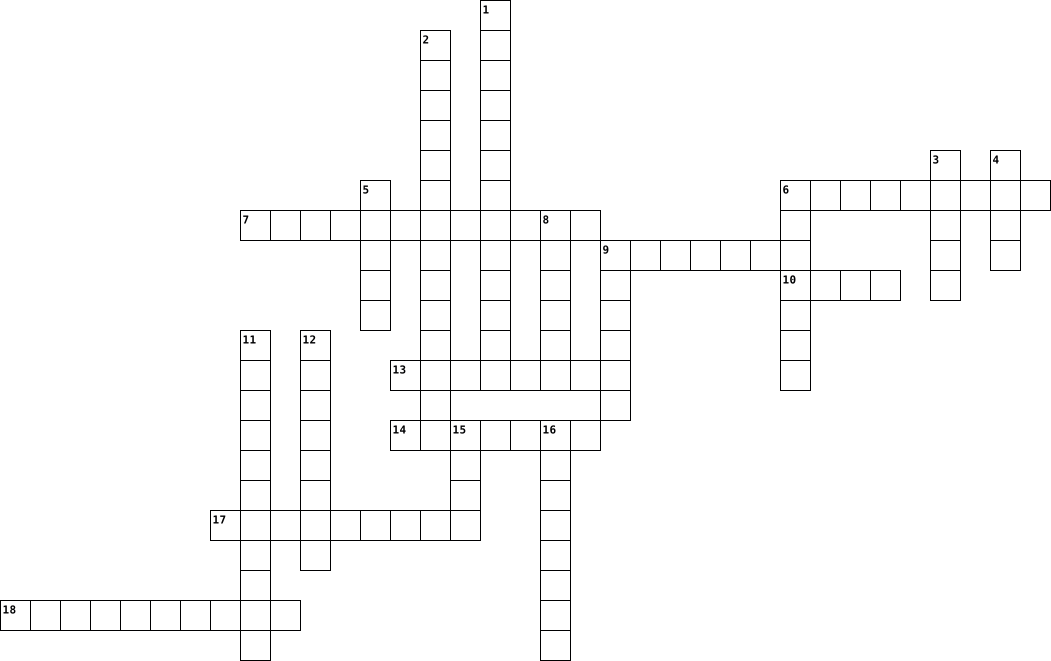
US History Module 4 Vocabulary 2024-11-25

Across
- Passed to punish colonists for the Boston Tea Party
- a meeting of delegates from 12 colonies in Philadelphia in May 1775Declarationofindependence
- a Prussian military officer who trained the Continental armyJohnpauljones
- the last major battle of the American RevolutionTreatyofparis1783
- American military officer
- an incident in which British soldiers fired into a crowd of colonists, killing five peopleBostonteaparty A protest against the Tea Act in which a group of colonists boarded British tea ships and dumped more than 340 chests of tea into Boston Harbor
- Leader who believed Parliament could not tax the colonists without their permission
- American colonists who chose to fight for independence
- author of Common Sense who wrote that citizens, not monarchs, should make lawsTomasJefferson
- a 47-page pamphlet that argued against British rule over America
- Naval officer who served in contential army
- the peace agreement in which Great Britain recognized the independence of the United States
- the main author of the Declaration of IndependenceMarquisdeLafayette
- Leader who commanded the Continental army and became the first president of the United States
- British soldiers who fought against the colonists in the American RevolutionSecondcontentalCongress
- an enslaved Black American who worked as a spy and provided information that gave the Continental army an advantage at YorktownBostonMassacrean Incident in which British soldiers fired into a crowd of colonists, killing five people
Down
- a battle in Boston that showed the colonists could fight well against the British armyCommonsense
- British army officer who surrendered at siege of yorktown
- the document that argued why the colonies should come together formally and that announced their break from Great BritainBattleoftrenton a battle won by the Patriots against Hessian mercenariesBattleofsaratoga
- a Frenchman who volunteered to serve in the Continental army without pay and used his money and influence to support the PatriotsFrancisMarion
20 Clues: American military officer • Naval officer who served in contential army • Passed to punish colonists for the Boston Tea Party • American colonists who chose to fight for independence • British army officer who surrendered at siege of yorktown • a 47-page pamphlet that argued against British rule over America • ...
Unit 3 &4- US History 2024-10-31

Across
- City of Brotherly Love
- The religion of William Penn
- Last name of the man that founded the Georgia Colony in 1733
- The group that founded the Massachusetts Bay Colony
- What historians call the revival of American churches in the mid 1700s
- Birthplace of William Penn
- Piece of land that juts into a lake, sea, or ocean
- Last name of the man with a peg leg who served as director general of New Netherland
- The colony that was founded to give Catholics a place where they could worship in freedom
- Large crowds came to hear this evangelist speak in Philadelphia (last name only)
- First name of William Penn's second wife
Down
- After Middle Plantation became the capital of the Virginia Colony, its name was changed to this
- The city that Roger Williams founded
- The first Wampanoag to become part of the church at Nunnepog on Martha's Vineyard
- The colony that began as a fishing colony at 1623
- Last name of Pilgrim elected governor of the Plymouth Colony 30 times
- The first capital of the Virginia Colony
- A native nation
- Taught Pilgrims how to plant corn, how to fish, hot to trap animals
- The last name of the family of ministers whose first names were Richard, Increase, and Cotton
20 Clues: A native nation • City of Brotherly Love • Birthplace of William Penn • The religion of William Penn • The city that Roger Williams founded • The first capital of the Virginia Colony • First name of William Penn's second wife • The colony that began as a fishing colony at 1623 • Piece of land that juts into a lake, sea, or ocean • ...
US History Final Exam Review 2025-05-19

Across
- This bill provided education and training for veterans, paid for by the federal government. The act also provided federal loan guarantees to veterans buying homes or farms or starting new businesses. Also known as the Servicemen’s Readjustment Act.
- This act had three major parts: old-age insurance for retirees 85 or older and their spouses, unemployment compensation system, aid to families with dependent children and the disabled
- Harnessed water power to generate electricity and to help prevent disastrous floods in the Tennessee Valley.
- The joint declaration of war aims in which both Roosevelt and Churchill pledged the following: collective security, disarmament, self-determination, economic cooperation, and freedom of the seas.
- The logic behind Roosevelt's decision to send lend-lease supplies to the Soviet Union when Hitler broke the agreement he had made in 1939 with Stalin not to go to war and invaded the Soviet Union.
- An unprovoked air raid by the Japanese on this US naval base killed 2,403 Americas and wounded 1,178 more, sunk or damaged 21 ships, and severely damaged or destroyed more than 300 aircrafts. This surprise raid led to the US declaring war against Japan and joining WWII.
- More than 7,600 Americans died and 110,000 Japanese died defending this city. The battle here was a chilling foretaste of what the Allies imaged the invasion of Japan’s home islands would be.
- Acronym for the association whose goal was to create as many jobs as possible - from construction jobs to positions in symphony orchestras. Headed by Harry Hopkins.
- The agency that supervised the stock market and eliminated dishonest practices; it monitors the stock market and enforces laws regarding the sale of stocks and bonds.
- Acronym for the agency designed to insure loans for building and repairing homes; created by the 1934 National Housing Act.
- The code name for the research work to develop an atomic bomb that extended across the country.
- Code name for the atomic bomb that was dropped on Nagasaki, leveling half the city.
- Acronym for the agency designed to regulate banking and investment activities; shored up the banking system by reassuring individual depositors that their savings are protected against loss in the event of a bank failure.
- One of FDR’s “Three R’s” - economic ___.
- One of FDR’s “Three R’s” - financial ___.
- The mutual defense treaty signed by the Axis Powers to keep the United States out of the War.
- An interracial organization whose goal was to confront urban segregation in the North.
Down
- Sought to raise crop prices by lowering production, which the government achieved by paying farmers to leave a certain amount of every acre of land unseeded.
- These informal talks made Americans feel as if the president were talking directly to them.
- The Jewish American scientist that directed the research for the development of the atomic bomb.
- A thermonuclear weapon even more destructive than the atomic bomb, with an estimated force of 1 million tons of TNT (67 times the power of the bomb dropped on Hiroshima).
- The 1941 act that Roosevelt compared to lending a garden hose to a neighbor whose house as on fire, asserting that this was the only sensible thing to do to prevent the fire from spreading to your own property.
- This plan involved two main stages: Operation Olympic, an assault on Kyushu in November 1945, and Operation Coronet, a landing on Honshu in March 1946.
- President Roosevelt’s team of carefully picked advisors - a select group of professors, lawyers, and journalists.
- President Roosevelt's order to the navy to shoot German submarines on sight after a German submarine fired on U.S. destroyer Greer in the Atlantic on September 4, 1941
- One of FDR’s “Three R’s” - ___ for the needy.
- This act defined unfair labor practices and established the National Labor Relations Board (NLRB) to settle disputes between employers and employees.
27 Clues: One of FDR’s “Three R’s” - economic ___. • One of FDR’s “Three R’s” - financial ___. • One of FDR’s “Three R’s” - ___ for the needy. • Code name for the atomic bomb that was dropped on Nagasaki, leveling half the city. • An interracial organization whose goal was to confront urban segregation in the North. • ...
US History II Midterm Review 2025-01-21

Across
- Extension of political and economic control to another country
- Caribbean island acquired by the U.S. after defeating Spain
- Island Immigration center located in New York
- Women who danced, wore short dresses, and challenged traditional norms
- “Black Tuesday” October 29th, 1929, the stock market lost millions
- Changed life, became a status symbol for many Americans
- Celebration of African American art, literature, music, and culture
- Take more presidential control over the makeup of the Supreme Court
- Mysteriously exploded shortly after the US went to war with Spain
- The pride and devotion to one’s country
Down
- Movement of African Americans from the South to the North escaping racial violence
- Two sides formed: England, France, and Russia vs. Germany and Austria-Hungary
- A telegram from Germany to Mexico proposing the join together against the U.S.
- Exaggerated news to make it more exciting to read
- Journalists who exposed corrupt business and government actions
- Fear over the spread of Communism in the United States
- Rough Rider leader and hero of the Spanish-American War
- Borrowing money to buy a stock
- Used to criticize businessmen for unethical practices
- Money was given to people who were in need
- Cruise ship with American passengers sunk by German U-boats
- The spark that caused World War I to begin
- The right to vote(women were fighting for it)
- When one company has complete control over an industry or product
- FDR’s plan to end the Great Depression -Relief, Recovery, Reform
- Increase in military spending
- Favoring the interests of native-born Americans
27 Clues: Increase in military spending • Borrowing money to buy a stock • The pride and devotion to one’s country • Money was given to people who were in need • The spark that caused World War I to begin • Island Immigration center located in New York • The right to vote(women were fighting for it) • Favoring the interests of native-born Americans • ...
EOC STAAR US History-- VVHS 2026-03-26

Across
- attitude leading to the passage of the Chinese Exclusion Act
- false accusations of communism without significant evidence
- first city to be targeted by an atomic bomb
- easing of tensions with communist nations like China and the Soviet Union
- increasing cultural and social division between parents and their teens
- event setting off the space race
- Assassinated Archduke whose death led to the prompting of WWI
- federal legislation requiring that equal funding exist for both female and male educational and extra-curricular activities
- massive population increase following WW2
- Theory that if Vietnam fell to communism then other nations would follow
- banned by the 24th amendment
- founder of the NAACP, an organization that worked for African American political rights
- Scandal involving a criminal coverup during Nixon's administration
- type of publications that exaggerated news and helped lead to the start of the Spanish American War
- amendment giving women suffrage
- Act giving land at no cost to settlers willing to move west
Down
- Progressive President who worked for conservation and trust busting (first initial and last name)
- hurricane that devastated New Orleans in 2005 with severe flooding
- amendment banning the manufacture and sale of alcohol in the US
- one of the 3 Axis Powers in WW2
- John F Kennedy's solution to the Cuban Missile Crisis
- Allied invasion into France, gives Allies access to defeating Germany
- developed the polio vaccine which stopped the spread of the disease
- Published book that initiated US imperialism
- insures depositor savings in banks
- to limit the use of consumer goods to set aside for soldier use
- Rockefeller and Carnegie controlled these type of corporations
- Great Society healthcare program designed to assist economically disadvantage people
- overall goal for Civil Rights movements
- a total stop on the import of oil from the Middle East leading to gas shortages
- Ford's original production car, affordable and reliable due to assembly line production
- Sandra ___-first female Supreme Court justice appointed by Reagan
- Couple found guilty during the Cold War of being Soviet spies
- Sandra ___--first Hispanic female Supreme Court justice
34 Clues: banned by the 24th amendment • one of the 3 Axis Powers in WW2 • amendment giving women suffrage • event setting off the space race • insures depositor savings in banks • overall goal for Civil Rights movements • massive population increase following WW2 • first city to be targeted by an atomic bomb • Published book that initiated US imperialism • ...
US History 1st Semester Review 2026-01-20

Across
- Illegal nightclub where alcohol was sold during Prohibition
- Major immigration processing center for Europeans entering the United States
- time period where alcohol was banned in the US
- Famous Chicago gangster associated with Prohibition-era organized crime
- A chronological sequence of historical events
- Journalist who exposed corruption and social problems during the Progressive Era
- Schools that Native American children were forced to attend to abandon traditional culture
- Reform movement of the early 1900s that sought to fix problems caused by industrialization
- Abandoned towns that declined after mining or economic booms ended
Down
- Process by which immigrants adopt the culture and customs of the dominant society
- Immigration station that primarily processed Asian immigrants on the West Coast
- Areas of land set aside by the U.S. government for Native American tribes
- Nez Perce leader who resisted U.S. expansion and forced removal
- Belief that anyone can achieve success through hard work in the United States
- Unfair treatment of individuals or groups based on race, ethnicity, or other characteristics
- Period of economic hardship, caused by overuse of credit and stock market crash
- Chance for economic advancement or social mobility
- Movement of people into a country, especially in search of jobs or freedom
- Period of economic growth, cultural change, and consumerism in the 1920s
- Rapid migration westward after the discovery of gold in California in 1848
20 Clues: A chronological sequence of historical events • time period where alcohol was banned in the US • Chance for economic advancement or social mobility • Illegal nightclub where alcohol was sold during Prohibition • Nez Perce leader who resisted U.S. expansion and forced removal • Abandoned towns that declined after mining or economic booms ended • ...
US History NDGD MRJ MB 2025-12-05

Across
- long lines of unemployed Americans waiting for free food
- Focused on job creation
- Relief Recovery Reform
- Kept the economy booming
- Cities of homeless were created from wood, crates, and tarps
- Prices and debt made it hard for farmers.
- Involved immediate government aid
- Banks cut ___ rates to stimulate economic growth
- First great superhero comic
- Drought in the great plains.
- Focused on fixing financial systems
Down
- First women to serve in the black cabinet
- Longest serving women of the United states
- Provided entertainment and information
- Collapse in business and employment
- Unofficial advisory group of African Americans.
- Changed to large scale programs
- Well known labor organizer
- Increased harvest fields Caused a ___
- reflected the public's distrust
20 Clues: Relief Recovery Reform • Focused on job creation • Kept the economy booming • Well known labor organizer • First great superhero comic • Drought in the great plains. • Changed to large scale programs • reflected the public's distrust • Involved immediate government aid • Collapse in business and employment • Focused on fixing financial systems • ...
US history 8 Quater 3 2026-02-03

Across
- The goal of killing a large amount or race of people
- the "Lost Colony" of 1587, an ill-fated English settlement on North Carolina's Roanoke Island that vanished mysteriously
- a form of government where a hereditary monarch acts as the head of state within the parameters of a written or unwritten constitution, sharing power with a constitutionally organized government
- a country or area under the full or partial political control of another country, typically a distant one, and occupied by settlers from that country.
- the first permanent English settlement in North America
- a policy of extending a country's power and influence through diplomacy or military force.
- an agreement to create a "civil body politick" to enact just and equal laws for the general good of the colony
- the arrangement of the natural and artificial physical features of an area.
- the policy or practice of acquiring full or partial political control over another country, occupying it with settlers, and exploiting it economically.
- the highest class in certain societies, especially those holding hereditary titles or offices.
- the first permanent English settlement in New England, established in present-day Massachusetts by Separatist Pilgrims fleeing religious persecution
Down
- a historically powerful, democratic alliance of six Indigenous nations—Mohawk, Oneida, Onondaga, Cayuga, Seneca, and Tuscarora
- the massive, post-1492 transfer of plants, animals, culture, human populations, technology, and diseases between the New World (Americas) and the Old World (Afro-Eurasia).
- an English-born Puritan minister, theologian, and colonial leader who founded the Colony of Rhode Island and Providence Plantations.
- the action or fact of treating someone unfairly in order to benefit from their work.
- a Native American who was born 8,500 to 9,000 years ago
- an English Quaker, writer, and founder of the Province of Pennsylvania
- a defined area of the Earth’s surface, ranging from local to global, characterized by shared, distinct physical (climate, landforms) or human (culture, economy, politics) characteristics.
- a distinctly shaped, fluted stone projectile point used by Paleo-Indians in North America roughly 13,000 to 13,500 years ago
- the king of the Indian settlement that attacked or was peaceful to early colonists
- a system of government by the whole population or all the eligible members of a state, typically through elected representatives.
- an English explorer, author, and soldier known for playing a critical role in establishing the Jamestown colony in 1607
- a person sent on a religious mission, especially one sent to promote Christianity in a foreign country.
- the arts and other manifestations of human intellectual achievement regarded collectively.
24 Clues: The goal of killing a large amount or race of people • a Native American who was born 8,500 to 9,000 years ago • the first permanent English settlement in North America • an English Quaker, writer, and founder of the Province of Pennsylvania • the arrangement of the natural and artificial physical features of an area. • ...
US History: 1970s to Present 2026-05-11

Across
- Increasing political division between parties and ideologies
- Court, Judicial branch institution that decides major constitutional cases
- Hostage Crisis, Event in which Americans were held captive in Iran for 444 days
- Act, Law passed after 9/11 expanding government surveillance powers
- A rise in prices that decreases purchasing power
- Economic policy focused on tax cuts and reduced government spending during the Reagan administration
- The use of violence to achieve political goals
- Political ideology generally supporting greater government involvement in social programs
- The easing of tensions between the United States and the Soviet Union during the 1970s
- Global pandemic that significantly impacted the United States beginning in 2020
- War, The long period of tension between the United States and Soviet Union that ended in 1991
- Intelligence, Rapidly developing technology affecting jobs, education, and politics
- Media, Modern communication platforms heavily influencing politics and elections
- The increasing connection of economies and cultures around the world
- Energy, Energy sources such as solar and wind power
Down
- Reduction Act, Recent federal law focused on energy, healthcare, and inflation
- Security, Current political issue involving immigration and the southern border
- The movement of jobs or production to other countries
- 11th, The 2001 terrorist attacks on the United States
- Constitutional process used to formally accuse government officials of misconduct
- False or misleading information spread online or through media
- Social media app frequently discussed in national security debates
- Care Act, Major healthcare reform law passed during Barack Obama’s presidency
- The political scandal that caused President Nixon to resign
- Security, Department created after 9/11 to protect the United States from threats
- Trade agreement between the United States, Canada, and Mexico
- College, System used to officially elect the president
- Political ideology favoring limited government and traditional values
- Change, Environmental issue frequently debated in modern politics
- Learning, Type of education widely used during the pandemic
30 Clues: The use of violence to achieve political goals • A rise in prices that decreases purchasing power • Energy, Energy sources such as solar and wind power • The movement of jobs or production to other countries • 11th, The 2001 terrorist attacks on the United States • College, System used to officially elect the president • ...
Unit 5 US History 2016-10-13

Across
- freedom from punishment
- power of government to take personal property
- greatest number of people make policies for society
- cancel
- cannot be tried again for the same crime
- vote to bring charges against President or Judge
Down
- return to country of origin
- request of the government
- formally accuse
- commands that have the power of law
- divided powers between the states and the federal govt.
- process of applying for citizenship
- require military service
- law must be fairly applied
14 Clues: cancel • formally accuse • freedom from punishment • require military service • request of the government • law must be fairly applied • return to country of origin • commands that have the power of law • process of applying for citizenship • cannot be tried again for the same crime • power of government to take personal property • vote to bring charges against President or Judge • ...
US History Unit 6 2017-10-26

Across
- Won by Continental Army; convinced the British that fighting a war with colonists was too costly
- Camp set up by General Washington in outside of Philadelphia – colonial army endured difficult winter – Washington seen as great leader
- left military without permission
- became allies of the Americans
- surprise attack
- Most powerful in the world
- Approved
Down
- prevented supplies and reinforcements from reaching the Continental Army
- hit and run technique, used to catch British off guard
- Privately owned merchant ships equipped with weapons
- hired soldier
- In America became equal for boys and girls
- Written by Thomas Paine, pamphlet that boosted American’s spirits
- meaning it takes more and more money to buy the same thing
14 Clues: Approved • hired soldier • surprise attack • Most powerful in the world • became allies of the Americans • left military without permission • In America became equal for boys and girls • Privately owned merchant ships equipped with weapons • hit and run technique, used to catch British off guard • meaning it takes more and more money to buy the same thing • ...
Us history vocab crossword 2023-09-09

Across
- man who makes money off of immoral practieces
- Very basic apartment complex
- company owns one part of an industry
- First billion dollar company
- No intervention
- natural selection for economy
Down
- Covered in gold
- profitier of good practices
- The richest man ever
- Did morally incorrect things for votes
- gave away all his money
- one man owns all in an insdustry
- Made massive houses
- company owns all stages of process
14 Clues: Covered in gold • No intervention • Made massive houses • The richest man ever • gave away all his money • profitier of good practices • Very basic apartment complex • First billion dollar company • natural selection for economy • one man owns all in an insdustry • company owns all stages of process • company owns one part of an industry • Did morally incorrect things for votes • ...
The History of Us 2025-03-08

Across
- We ate here the first time you met my parents
- day of the week you proposed
- first movie we watched together in the theater
- You met my whole family in this SoCal city
- All-Star Game
- He played beautiful guitar music at our wedding
- You are the love of my _______
Down
- We first talked here
- the street of our very first home
- where you were when we first talked on the phone
- where we first saw each other
- He sings a song you played for me in Rusty
- "Love and ___________"
- You made my dream come true by taking me here
14 Clues: All-Star Game • We first talked here • "Love and ___________" • day of the week you proposed • where we first saw each other • You are the love of my _______ • the street of our very first home • You met my whole family in this SoCal city • He sings a song you played for me in Rusty • We ate here the first time you met my parents • You made my dream come true by taking me here • ...
US History Timeline Crossword 2024-10-30

Across
- The president of the United States during the duration of World War 2
- The crash of the stock market that led to a worldwide economic breakdown from 1929-39
- The creation of the Atomic bomb
- A city in Japan that had gotten nuked by the United States
Down
- Chancellor of Germany from 1933-1945
- The peacekeeping organization created at the end of World War 2
- Pact that was broken when Hitler invaded the Soviet Union
- The genocide against the Jewish among others
- To be set free
- The nuke that was dropped on Hiroshima to force a quick surrender by the Japenese
- Where the appeasement conference was held
- Attack on US Naval Base in 1941
- Political ideology of dictators
- The normandy landings/invasion of Germany in 1944
14 Clues: To be set free • Attack on US Naval Base in 1941 • The creation of the Atomic bomb • Political ideology of dictators • Chancellor of Germany from 1933-1945 • Where the appeasement conference was held • The genocide against the Jewish among others • The normandy landings/invasion of Germany in 1944 • Pact that was broken when Hitler invaded the Soviet Union • ...
US History, 1st Quarter 2022-11-09

Across
- first governing document of the US
- fur, tobacco, cotton, lumber
- belived to be the oldest native American tribe
- war that resulted in heavy taxes due to the war debt
- number of British colonies
- where the Revolutionary war began
- declared the colonies free from Great Britain
Down
- take by military force
- Signed in 1783, ending the American Revolutionary War
- sought by many that moved to the New World
- another word for trade
- wrote the Declaration of Independence
- ancient bridge between Asia and Alaska
- The Continental Army defeats the British
14 Clues: take by military force • another word for trade • number of British colonies • fur, tobacco, cotton, lumber • where the Revolutionary war began • first governing document of the US • wrote the Declaration of Independence • ancient bridge between Asia and Alaska • The Continental Army defeats the British • sought by many that moved to the New World • ...
US History Period 1 2022-06-08

Across
- dual sport athlete; plays football and hockey
- tall student with the shortest name in the class
- Saw Batman in the theatre multiple times
- plays for the school basketball team
- The tallest member of the table of 4
- Signature style includes turtle-neck and a gold chain
- you may find him working on robotics or reading about Ghengis Khan
- syd and caitlyn's table is not complete until she arrives
Down
- a big class participator who is also a big fan of elden ring and other video games
- only boy in the class with an alliterative first/last name
- Will be very disappointed if there is no caramel in their iced coffee
- consistently the first person in class in the morning; Last of Us is their favorite video game
- You may see her photographing school events
- back corner by the window is her spot
14 Clues: plays for the school basketball team • The tallest member of the table of 4 • back corner by the window is her spot • Saw Batman in the theatre multiple times • You may see her photographing school events • dual sport athlete; plays football and hockey • tall student with the shortest name in the class • Signature style includes turtle-neck and a gold chain • ...
History and the branches 2021-10-28
Across
- ask questions of sources
- cultural history
- used by historians
- history is measured in
- information
- history is about
- branch about past government
- order
Down
- I dig for remains
- I look at past cultures
- language from which history came
- its gone
- historians tell this
- studying the past
- past men and women's history
- history of people
- buried remains
- history as a subject
- talking history
- history of the economy
20 Clues: order • its gone • information • buried remains • talking history • cultural history • history is about • I dig for remains • studying the past • history of people • used by historians • historians tell this • history as a subject • history is measured in • history of the economy • I look at past cultures • ask questions of sources • past men and women's history • branch about past government • ...
Civil War 2022-05-09

Across
- bloodiest battle of the Civil War
- site of Lee's surrender to Grant
- prison camp that was more deadly than most battlefields
- another name for Bull Run
- the Gettysburg Address was a speech given at the dedication of this
- Union general who refused to follow Lincoln's order to pursue Lee after the battle of Antietam
- featured speaker at dedication of Gettysburg Cemetery
- nickname given to Gen Thomas Jackson for the way he pushed back Union forces
- the Siege of Vicksburg was fought to control this river
- the Battle of Hampton Roads was the first battle between these type of ships
- state in which the first shots of the war were fired
Down
- this Proclamation didn't actually free any slaves
- the fort that saw the first shots of the Civil War
- Confederate General who led his forces into Gettysburg and had to retreat in defeat
- this general made his March to the Sea in late 1864
- another name for the single bloodiest day in US history
- crop the South used to purchase supplies from Europe
- both Grant and Lee graduated from here
- site of the bloodiest single day in US history
19 Clues: another name for Bull Run • site of Lee's surrender to Grant • bloodiest battle of the Civil War • both Grant and Lee graduated from here • site of the bloodiest single day in US history • this Proclamation didn't actually free any slaves • the fort that saw the first shots of the Civil War • this general made his March to the Sea in late 1864 • ...
Slay the EOC Crossword 2023-05-03

Across
- period after Reconstruction when race relations were at their worst
- speech delivered by William Jennings Bryan advocating the use of silver not just gold
- regulated railroads, particularly monopoly practices
- formally ended the Russo-Japansese War; negotiations led by Teddy Roosevelt
Down
- Italian immigrant anarchists who were accused and executed perhaps because of nativism
- educational institution with the best US History students
- political movement aiming to promote the voice of the common man
- a false promise by Germany to warn passenger ships
- My score on the US History EOC
- University where everyone wants to go but not everyone can
10 Clues: My score on the US History EOC • a false promise by Germany to warn passenger ships • regulated railroads, particularly monopoly practices • educational institution with the best US History students • University where everyone wants to go but not everyone can • political movement aiming to promote the voice of the common man • ...
teachers crossword 2021-05-07

Across
- the math teacher
- The Band teacher
- The other PE Teacher
- The science Teacher
- The counselor
- person who cleans the school
Down
- the history/civics teacher
- The ELA teacher
- the PE teacher
- the intro to vision tech teacher
- person who gives us you lunch
- the orchestra teacher
- The Principal
- The wrestling coach
- The Librarian
15 Clues: The Principal • The counselor • The Librarian • the PE teacher • The ELA teacher • the math teacher • The Band teacher • The science Teacher • The wrestling coach • The other PE Teacher • the orchestra teacher • the history/civics teacher • person who cleans the school • person who gives us you lunch • the intro to vision tech teacher
Unit 8: Early 20th Century Georgia crossword 2024-05-14

Across
- a time period in which a geographical area receives less than 2 inches of precipitation annually.
- act that allowed the US government to send billions of dollars in supplies and military equipment to allied countries in exchange for US rights in their military bases
- insect whose larvae food on cotton crops; decimated cotton production in the southeastern United States
- the most destructive war in human history; America entered the war in 1941 after the Japanese attack on pearl habor
- New Deal program that provided retirement and unemployment insurance for American taxpayers
- Goergia congressman who was an advocate for a strong US military; served 25 terms in the US house of Representatives, making him the longest serving congressman in US history
- a factor that led to the Great Depression; farmers continued to produce record numbers of crop yield though the demand for agricultural products was limited; this drove the cost of these products down.
Down
- Georgia governor and influential long term US senator
- American Naval base in Hawaii; a surprise attack on the base by Japanese forces on December 7, 1941 resulted in the US entering world war 2
- Goergia city that was home to Roosevelt's "little white house" site's warm water mineral springs were used as a rehabilitation center for polio victims.
- four time Georgia governor that fought against Roosevelt's New Deal policies.
- major war primarily between European powers; U.S. entered the war in 1917
- the New Deal program designed to build the capabilities to bring electricity to rural areas
- commonly known as FDR, was an AMerican statesman and political leader who served as the 32nd president of the United States from 1933 until his death at Warm springs,Georgia in 1945; visited Goergia more than 40 times for his treatment of polio at warm springs
- a New Deal program that paid farmers a stipend not to grow crops in order to increase the price of agricultural products
- name given to a series of federal programs spearhead by president Franklin Roosevelt in order to help the nation recover from the Great depression
- a New Deal program that hired unemployed young men to work on public works projects
17 Clues: Georgia governor and influential long term US senator • major war primarily between European powers; U.S. entered the war in 1917 • four time Georgia governor that fought against Roosevelt's New Deal policies. • a New Deal program that hired unemployed young men to work on public works projects • ...
US History II Great Block 2016-01-15

Across
- a woman of the 1920s who wore makeup, short skirts, short hair, and more jewelry
- biased communication designed to influence people's thoughts and actions
- acronym for the causes of WWI
- a camp of homeless people using scrap wood and metal to make shacks
- writer who exposes wrongdoing
- method used by Andrew Carnegie to grow his power in industry
- novel by Upton Sinclair that brought attention to the issues with meat packing
- making the sale or use of alcohol illegal
- organizations dedicated to helping people in need
- reporting that exaggerates the news to make it more exciting
- when strong countries take over smaller countries
- breakthrough of African American art and literature in the 20s
- giving government jobs to people who had helped a candidate get elected
Down
- the right to vote, major goal of women reformers
- transportation system designed to move large numbers of people along fixed routes
- plans where consumers could pay gradually over time for products
- where immigrants would pass through for inspection on arrival at the east coast
- multi family city dwellings
- date of the stock market crash (no dashes)
- the growth of cities
- the process of making iron ore into steel
- Deal FDR's plan to bring America out of the Great Depression
- where immigrants would pass through for inspection on arrival at the west coast
- illegal use of political influence for personal gain
- president during the stock market crash
- new type of music developed during the Harlem Renaissance
- payments made by the losing countries after war
- suspicion of foreign born people
- hidden saloons and nightclubs that illegally sold liquor
- economic system that supports government control to create equality
30 Clues: the growth of cities • multi family city dwellings • acronym for the causes of WWI • writer who exposes wrongdoing • suspicion of foreign born people • president during the stock market crash • the process of making iron ore into steel • making the sale or use of alcohol illegal • date of the stock market crash (no dashes) • payments made by the losing countries after war • ...
US History Final Exam Review 2014-06-05

Across
- steel company that owns the coal mines, limestone quarries, and iron ore fields it depends on is an example of this type of integration. [197]
- Brits and French realized appeasement failed when Hitler made demands for land in this neighboring nation. [462]
- militia group backed Mussolini in Italy. [454]
- project to build America’s first atomic weapon was named after this section of NY City. [523]
- man’s plan for reconstruction called for reconciling with the south rather than seeking punishment. [140]
- man refused to command Union troops because he would not fight against the South. (last name) [126]
- Agricultural Adjustment Act actually paid farmers to not grow these. [428]
- this resolution, Congress gave their war powers over to President Johnson. (3 words no spaces) [658]
- president started out as an actor in Hollywood. [746]
- to the Constitutional Convention chose this man as their presiding officer. (last name) [37]
- W. Bush tried to reform this system by allowing workers to put part of their income into investment accounts. (2 words no spaces) [822]
- was the idea that God intended the USA to expand all the way to the Pacific Ocean. (2 words no spaces) [104]
- McKinley sent this battleship to Havana to evacuate Americans. It exploded and sank. [270]
- WWII Americans purchased these as a way of lending the government money to pay for the war. [507]
- said his doctrine and the Marshall plan were essential for doing this to communism. [539]
- suggest Nixon ordered the cover-up in this White House scandal. [714]
- New Frontier was the name given to the policies of this 1960s president. [597]
- invaded this northern portion of China to get raw materials. [457]
- was an improvement over barges because it could actually travel upstream against the current. [90]
- is how did President McKinley died. [278]
- US government tried to outlaw this Lakota tribe ritual. (2 words no spaces) [174]
- case of Marbury v. Madison established this right of the Supreme Court. (2 words no spaces) [83]
- 1960s rock festival drew thousands of music fans. [685]
- the Great Depression, farmers lost their crops due to this natural catastrophe that dried out the soil. [407]
- first, ranches saw this new invention as a threat because it prevented their cattle from roaming freely. (2 words no spaces) [163]
- the space race, Kennedy wanted Americans to be the first humans to go to here. [604]
- was built in order to relieve congestion on city streets. [223]
- type of energy was produced by the Three Mile Island power plant. [733]
- French & Indian War began because both the French and Brits wanted this river valley. [22]
- colony offered a new chance for those who had been imprisoned in England. [12]
- the Homestead Act, pioneers could keep the land for free if they lived on it for this many years. [167]
Down
- laissez-faire economies allow the free market to regulate prices and __________. [186]
- nation financed Christopher Columbus's voyage in 1492. [6]
- used the Lend-Lease Act to get arms to this nation without them having to pay for it upfront. [476]
- were first used in WWI to observe enemy movements. [338]
- protest this Act, American colonists boycotted all goods made in Britain. [24]
- WWII, Hitler wanted to capture this city in order to destroy the Soviet economy. [499]
- the bombing of Pearl Harbor a presidential order gave the military the authority to round up and imprison Americans belonging to this race. [504]
- Economic depression and this peace treaty led to the rise of dictators after WWI. [454]
- The Union Pacific and ______ Pacific built the Transcontinental Railroad. [188]
- WWI, the Triple Entente included France, Britain, and this nation. [320]
- farm workers became an important part of the Southwest’s agricultural system as a result of this program. [502]
- went to California in 1849 in search of this valuable resource. [108]
- was given by the the government to railroad companies to encourage rapid construction of this railroad. [192]
- Proclamation freed all slaves in states at war with the Union. [135]
- Act was meant to help Native Americans by giving them land to farm.
- who have a great deal of money and use it to help others are following the Gospel of ________. [232]
- Roosevelt viewed the strike by this group of workers as an example people putting private interests above the interests of the nation. (2 words no spaces) [301]
- the Glorious Revolution in England, colonists ousted this governor-general. [19]
- T. Scopes was put on trial fro teaching this theory. [380]
- type of machine was used to harvest wheat. [168]
- order to improve the lives of farm workers, Cesar Chavez organized a successful boycott on this fruit. [697]
- convoy system was developed to protect merchant ships from this type of naval ship. [499]
- challenged Florida law because the hand-recount could not be completed by the deadline. [806]
54 Clues: is how did President McKinley died. [278] • militia group backed Mussolini in Italy. [454] • type of machine was used to harvest wheat. [168] • president started out as an actor in Hollywood. [746] • 1960s rock festival drew thousands of music fans. [685] • were first used in WWI to observe enemy movements. [338] • ...
US History Semester Portfolio Crossword 2021-05-20

Across
- An area under partial political control of another country
- A person who is riding a horse
- To withdraw from enemy forces
- A military force
- A city in eastern Kentucky
- To prevent someone from accomplishing something
- To experience something painful
- British troops
- Anger or annoyance provoked by what is perceived as unfair
- Mental or emotional strain
- A person who rises in opposition
Down
- The killing or wounding of people
- The person in control of something
- A permanent unit of an army
- To be stationed or lodged in a specified place
- Information used to promote a political cause
- An American that volunteered for service
- The intensity that must be exceeded for a certain reaction
- To give an authoritative order
- A sustained fight between large organized armed forces
20 Clues: British troops • A military force • A city in eastern Kentucky • Mental or emotional strain • A permanent unit of an army • To withdraw from enemy forces • A person who is riding a horse • To give an authoritative order • To experience something painful • A person who rises in opposition • The killing or wounding of people • The person in control of something • ...
US History Sem 1 Final 2021-12-13

Across
- sunk the HMS Lusitania
- Trustbuster and Square Deal President
- nickname for American WWI General
- sensationalist news stories; color
- insures bank deposits
- method for manufacturing Model Ts
- place of attack on "date which will live in infamy"
- exploded in Havana Harbor to start war
- FDR strategy to control the Supreme Court
- laws that kept US out of war 1930s
- veterans who marched outside White House
- alphabet soup agencies
- ship that is still underwater at Pearl Harbor
- malaria building project
- Germany, Italy, Japan in WWII
- nickname for American Expeditionary Force soldier
- regulates the banking system
- public works projects for maintaining nature
- hands-off economics
- "way of the warrior"
- type of nationalism in fascism
Down
- "lightning war"
- made trusts and monopolies illegal
- "living space"
- location of British evacuation
- jones industrial average
- people in the middle of the political spectrum
- assassinated to start WWI
- international organization for maintaining peace
- overthrown by US Marines
- "buy now, pay later"
- took photo called Migrant Mother
- opened Japan to trade
- Stalin character trait
- man who said all great nations have great navies
- day of stock market crash
- 1920s President during prosperity
- wanted to recreate Roman Empire
- style of warfare WWI
- first man to fly solo across Atlantic
- anarchists executed during Red Scare
41 Clues: "living space" • "lightning war" • hands-off economics • "buy now, pay later" • style of warfare WWI • "way of the warrior" • insures bank deposits • opened Japan to trade • sunk the HMS Lusitania • Stalin character trait • alphabet soup agencies • jones industrial average • overthrown by US Marines • malaria building project • assassinated to start WWI • day of stock market crash • ...
Chapter 10 Vocab US History 2022-02-28

Across
- Parts of a mechanism that can be substituted for one another.
- The buying and selling of slaves within the United States.
- An agreement that stated the people of Missouri could own slaves and be admitted to the Union along with Maine, a free state.
- The complete and exclusive control of an industry by one company.
- The transition from a pre-industrial economy to a market-oriented, capitalist economy.
- A work stoppage in order to force an employer to comply with demands.
- The cloth and clothing made from cotton and other raw materials.
- Lands governed by the federal government but not belonging to any state.
- Before the American Civil War.
- The idea that women should raise their children to be good citizens who participated in the government.
Down
- A nonviolent refusal to obey authority and laws.
- The act of putting an end to something, such as slavery.
- An era in which widespread production by machinery replaced goods made by hand.
- A boat outfitted with steam boiler engines to power the paddle wheels that propel it forward.
- A religious song based on scripture and biblical figures in the Bible, first sung by enslaved people in the South.
- The concept of loyalty and devotion to one’s nation.
- A loyalty to whichever section or region of the country one was from, rather than to the nation as a whole.
- An approach to foriegn policy that stated the American continents were no longer under European influence.
- Method of production in which large crews of people perform work in one location.
- A power not explicitly stated in the Constitution.
- A machine that cuts stalks of wheat or oats.
- Government funds for improvements or support of commerce.
- A machine that sends messages long distances by sending electrical pulses in code over electrical wires.
- Gin A machine that separates the cotton seeds and hulls from the cotton boll (tuft of cotton).
- System: A policy of promoting the US industrial system through the use of tariffs, federal subsidies to build roads and other public works, and a national bank to control currency.
25 Clues: Before the American Civil War. • A machine that cuts stalks of wheat or oats. • A nonviolent refusal to obey authority and laws. • A power not explicitly stated in the Constitution. • The concept of loyalty and devotion to one’s nation. • The act of putting an end to something, such as slavery. • Government funds for improvements or support of commerce. • ...
AP US History crossword puzzle 2022-05-16

Across
- US Attack Germany
- Supreme court judicial
- We out
- Machine
- Economic revolution
- Don't mess with the US
- No Food
- Germany contacting Mexico
- Transport system
- attempt at consitution
Down
- Nixon is Bad
- counting of slaves as part
- Terrible state of the US
- Transfer of Slaves
- separate unconstitutional
- war over slavery
- 1930s programs
- Worst US president ever
- Japanese attack on US
- Cool air
20 Clues: We out • Machine • No Food • Cool air • Nixon is Bad • 1930s programs • war over slavery • Transport system • US Attack Germany • Transfer of Slaves • Economic revolution • Japanese attack on US • Supreme court judicial • Don't mess with the US • attempt at consitution • Worst US president ever • Terrible state of the US • separate unconstitutional • Germany contacting Mexico • counting of slaves as part
AP US history crossword puzzle 2022-05-16

Across
- US Attack Germany
- Supreme court judicial
- We out
- Machine
- Economic revolution
- Don't mess with the US
- No Food
- Germany contacting Mexico
- Transport system
- attempt at consitution
Down
- Nixon is Bad
- counting of slaves as part
- Terrible state of the US
- Transfer of Slaves
- separate unconstitutional
- war over slavery
- 1930s programs
- Worst US president ever
- Japanese attack on US
- Cool air
20 Clues: We out • Machine • No Food • Cool air • Nixon is Bad • 1930s programs • war over slavery • Transport system • US Attack Germany • Transfer of Slaves • Economic revolution • Japanese attack on US • Supreme court judicial • Don't mess with the US • attempt at consitution • Worst US president ever • Terrible state of the US • separate unconstitutional • Germany contacting Mexico • counting of slaves as part
US Quiz - Politics, History, Geography 2021-07-07

Across
- manipulating the boundaries of voting districts to favour your own party
- the only place in the US where you cannot vote for the President (1 word + 2 letters)
- mainly responsible for conservative 80s politics
- what happened 1861-65 (2 words)
- the flat states of Kansas, the Dakotas and Nebraska are on the “Great ___”
- the US government is elected every ___ years
- the three largest cities in the US are New York City, Los Angeles and ___
- name of the US legislative
- which President “FDR” stands for
- first African American President
- the US rank on the international "Democracy Index"
- the era of no more alcohol in the US
- the US anthem is called The Star ___ Banner
- the first US President
- President during 9/11
- which President “LBJ” stands for
- the animals that is used as the party logo of the Republicans
- another word for local political activism (think of a lawn)
- the name of the separation of powers in the US: “Checks and ___”
- the President with the Lewinsky affair
- the lower chamber of the US Congress: House of ___ (CH: Nationalrat)
- highest US court (2 words)
- who is meant by the acronym POTUS
- with 9.8m km2, the US is the ___ biggest country in the world
- the first 10 Amendments to the US Constitution are the “___ of Rights”
- around ___ per cent of US Americans are ethnically white
- what "G.O.P." stands for when talking about Republicans (3 words)
- the most important US document from 1776 (3 words)
Down
- what defeated Nixon
- protest against it brought countless people into the streets in the late sixties: “___ War”
- the US rank on the "Corruption Perception Index"
- the number of original US colonies
- “Boston ___ Party” in 1773 and “___ Party Movement” during the Obama years
- the northeastern states of the US are called New ___
- the US population elects the President indirectly, through the “___ College”
- 1950s senator who carried out a witch hunt to discover alleged Communists in American society
- "O'er the land of the free and the home of the ___"
- the closest US territory, in the Caribbean (2 words)
- the ___ Mountains pass the US from New Mexico all the way through Montana and onwards to Canada
- the American Dream: “From ___ to Riches”
- the official language of the US is ___
- the current US Vice president (2 words)
- the current US president (2 words)
- if, as a politician, you keep on talking and talking to prevent a bill from passing
- Roosevelt's economic strategy against the Great Depression: “___ Deal”
- federal states that sometimes vote Democrat and sometimes Republican (2 words)
- helped free the slaves before he was shot while watching a theatre play
- with 330m inhabitants, the US is the ___ most populated country in the world
- the upper chamber of the US Congress (CH: Ständerat)
- the animal that is used as the party logo of the Democrats
- Illinois, Wisconsin, Michigan, Indiana and some other states are geographically in the “Great ___” area of the US
- after the Christians, the ___ community is the largest religious community in the US
- the ___ community is the biggest ethnic minority community in the US
- the only President ever to resign from the office
- he wrote "all men are created equal", but had slaves of his own
- the President shot in Dallas in 1963
- when the Japanese planes came to Hawai'i (2 words)
- the number of US federal states
- the US form of government: “___ republic”
- a US motto: "In ___ we trust"
60 Clues: what defeated Nixon • President during 9/11 • the first US President • name of the US legislative • highest US court (2 words) • a US motto: "In ___ we trust" • what happened 1861-65 (2 words) • the number of US federal states • which President “FDR” stands for • first African American President • which President “LBJ” stands for • who is meant by the acronym POTUS • ...
Unit 3 Crossword US HISTORY 2022-10-24

Across
- Many farmers were now deeply in debt from _____ needed to purchase large scale machinery required to increase yields
- would go to Coney Island amusement parks, and attend baseball games
- Taking away someone's right to vote
- Made up of thousands of acres that had been bought from sod busters
- A building with thin walls, no windows, and outside bathrooms. It developed into sometimes dangerous city streets, and unsafe conditions.
- When prices fall because there's not enough money in circulation.
- Farmers/Pioneers who went west
- The 1892 populist party presidential candidate
- The most famous farmer advocacy group
- When a mob of people would gather and murder someone (Usually a black person) because they thought they had violated a law or social custom, "Mob Justice"
- Custer-Led military attack on Black Hills, where the US army was beaten by the Sioux (Crazy horse and sitting bull)
- Towns that were bypassed by the railroad and later disbanded.
- Massacre caused by misfired rifle that led the US Army to kill nearly 150 unarmed men, women, and children.
Down
- __________ made prices fall.
- These farmers were competing with the farmers out west.
- Book written by Mark Twain that jokingly talked about rich people's greed and political corruption.
- Government gave 160 acres to settlers who lived on the land for five years
- If your grandpa had been able to to something/unable to do something, you should be able to do it/ unable to do it too.
- Became the capital of western commerce because of it's railroad, factories, meat-packing plants, etc.
- Growing crops on someone else's land, and owing them money and a share of your crops
- Government law that banned Chinese immigration for 10 years, and prohibited Chinese from becoming US citizens.
- Laws in southern states that mandated racial segregation in public facilities like schools, restaurants, and rail cars.
- First professional baseball team
- Land held by tribes was to be divided up among natives. They could not sell this land since the government owned it. After 25 years they would be given the deed to the land, and they would become American Citizens.
- In this case, the supreme court declared segregation laws constitutional, stating that as long as accommodations were "separate but equal" it was legal to separated facilities for blacks and whites.
- would go to Vaudeville houses, dancehalls, and saloons for fun.
- To bring about an experience in which natives would raise above the land, and the whites would be buried by new land. The buffalo would return and all natives, dead and living, would be reunited.
27 Clues: __________ made prices fall. • Farmers/Pioneers who went west • First professional baseball team • Taking away someone's right to vote • The most famous farmer advocacy group • The 1892 populist party presidential candidate • These farmers were competing with the farmers out west. • Towns that were bypassed by the railroad and later disbanded. • ...
US History Chapter 5 Review 2022-10-17

Across
- an animal that people caught to make oil
- to buy a product from another place and bring it where you are
- the colony started by Roger Williams and Anne Hutchinson.
- the colonies that had good rivers for transportation and a longer growing season
- the round mountains that run north and south in the eastern United States
- the time of year when it is warm enough for plants to grow
- a gathering where colonists voted on laws
- The ___ of New England is very cool and dry.
- someone who disagrees with their leaders
- to send a product to another place
- the colonies with a watery coast called the tidewater
- all the businesses that make one kind of product or provide one kind of service.
- Anne __ was a woman who was banished because her Puritan leaders did not want her teaching about religion.
- most of the first settlers in New England were ___
- an Indian leader, also known as King Philip, who fought against the colonists in New England.
Down
- the first college in the thirteen colonies
- the Atlantic Ocean between Africa and the Americas
- to send away from a community
- the group of Indians that fought a small war against the New England colonists.
- the part of the southern colonies higher in the mountains
- ___ carried away the good soil from New England and left rocks and sandy soil.
- The Great ___ was a time in the 1700s when people in New England began to make religion a more important part of their lives.
- when a community makes their own laws
- the imaginary line that divides the Appalachian Mountains from the tidewater
- the most important fish caught in New England
- the buying and selling of people
- The trade routes between Europe, North America, and Africa became known as the ___ Trade.
27 Clues: to send away from a community • the buying and selling of people • to send a product to another place • when a community makes their own laws • an animal that people caught to make oil • someone who disagrees with their leaders • a gathering where colonists voted on laws • the first college in the thirteen colonies • The ___ of New England is very cool and dry. • ...
US history 1st 9 week 2023-09-21

Across
- between 186-80, miles of railroad tripled, again in 1880-1920, created the time zones we use today
- Addition to the Monroe Doctrine asserting America's right to intervene in Latin American affairs
- Provided food, fuel, jobs to poor, Nicknamed "Boss"
- ship canal 40 miles long across the Isthmus of Panama built by the United States (1904-1914)
- a person working to destroy monopolies and trusts Roosevelt
- President Taft's policy of linking American business interests to diplomatic interests abroad
- Black, Mexican, White drove millions of cattle north from Texas, represented freedom of open range, stopped because people began putting up barbed wire fnences
- Prohibition of alcohol
- A policy of extending a country's power and influence through diplomacy or military force.
- Britain, France, Russia, later US and Italy
- Est. to eliminate practices that restricted free trade, monopolies/trusts, gave government idea to protect laborers/ and small buisness owners
- Volunteer regiment of US Cavalry led by Teddy Roosevelt during the Spanish American War
- U.S. increass it's strength as a world power
- WorldWar1 Militarism, Alliance Systems, Imperialism, Nationalism
- was a organized union including many races, types of people
- income tax
- gained by the Spanish American war Philippines, Guam and Puerto Rico
- dishonest or illegal actions
- Inegration Control of every aspect of production
- government's nonelected workers
- Monopoly on Oil Industry, VERY RICH, kept his workers from forming unions, used cutthroat business controls, Robber Baron
- Means by which all indians are dealt with, looked to remove indian influences especially through boarding schools, were not aloud to have ling hair, practice religion or native language
- Tax paid to the state, federal, and local governments approved by the 16th amendment
- Dominated the North, worked to remove greenback, repay national debt, supported high tariff
- an international organization formed in 1920 to promote cooperation and peace among nations
- a 1913 law that set up a system of federal banks and gave government the power to control the money supply
- "capitalism, free trade", natural forces will guide the economy and the gov. need not interfere
- Great inequality and was against Christian idea of brotherhood, protestant should go into city and provide for poor, Catholics had parallel movement but was smaller
- War Yellow journalism, imperialism, Spain brutality to the Cubans, explosion of the USS Maine.
- The social process of absorbing one cultural group into harmony with another (be coming American)
- This 1906 work by Upton Sinclair pointed out the abuses of the meat packing industry. The book led to the passage of the 1906 Meat Inspection Act.
- Gave women the right to vote
- strikers killed by Chicago police gathering for vigil, bomb thrown into crowd of police, killing one
- laws that enacted harsh punishments against anyone who opposed participation in the war
- JP Morgan controlled US Steel
- the right of women to vote 19th Amendment
Down
- Spain loses most of it's empire
- Granted tracts of land to individual families and auctioned much of what remained off to white farmers, Indians who adopted habits of civilized would become citizens
- Buying all other companies in business (Monopoly)
- Considered a cause of the Spanish-American War - letter from the Spanish ambassador criticizing President McKinley which was published in the Hearst newspaper. (1898)
- Invented the phonograph, light bulb, motion picture, system for generating and distributing electricity, became more reliable than water and steam power
- law requiring men to register for military service
- Protecting and preserving natural resources and the environment started by Theodore Roosevelt
- Diplomatic policy developed by T.R where the "big stick" symbolizes his power and readiness to use military force if necessary. It is a way of intimidating countries without actually harming them and was the basis of U.S. imperialistic foreign policy.
- Dominated the South, pulled a lot of catholic voters
- Designed to regulate what railroads could change from state to state to ensure fair prices
- points President Woodrow Wilson's plan for organizing post World War I Europe and for avoiding future wars.
- A telegram Germany Sent to Mexico to convince Mexico to attack the U.S.
- War In 1898, a conflict between the United States and Spain, in which the U.S. supported the Cubans' fight for independence
- President of the United States He was unable to persuade the U.S. Congress to ratify the Treaty of Versailles or join the League of Nations.
- allows the U.S. to intervene in Cuba
- time at the turn of the 20th century in which groups sought to reform America economically, socially, and politically
- a type of combat in which opposing troops fight from trenches facing each other.
- 50k became citizens by Dawes act, 100k by their place of territory (Oklahoma), 1919 natives who fought in WWI were made citizens, 1924 rest if natives declared citizens
- Abundant Resources, growing labor supply, expanding market for manufactured goods, capital investment, Federal gov. promoted it.
- journalism that is based upon sensationalism and crude exaggeration.
- Passed in 1883, an Act that created a federal civil service so that hiring and promotion would be based on merit rather than patronage.
- workers protested pay cut, Hayes said the strike would be put down by force
- Led a revolt of planter against Hawaii's Queen Liliuokalani in 1893
- Powers Austria-Hungary, Germany, Ottoman Empire
- a British luxury liner sunk by a German submarine in the North Atlantic on May 7, 1915
- Monopoly on Steel, "virtually integrated" control of every aspect of production, used Cutthroat business controls, workers worked everyday besides the 4th of July, Captain Industry
- offering accounts and photographs of the living conditions of poor working class Americans
- Theodore Roosevelt's promise of fair and equal treatment for all
- A deadlock in which neither side is able to defeat the other
- and Pulitzer Writers who used yellow journalism
- U.S. acquired the Philippines, Guam and Puerto Rico
- Archduke of Austria-Hungary assassinated by a Serbian nationalist. The immediate cause of for WWI.
- Direct election of senators
- Captain of the U.S. Navy who was for imperialism. He thought that a bigger navy was needed to protect American ships.
- American battleship that exploded and caused the Spanish American war
- a journalist who uncovers abuses and corruption in a society
72 Clues: income tax • Prohibition of alcohol • Direct election of senators • dishonest or illegal actions • Gave women the right to vote • JP Morgan controlled US Steel • Spain loses most of it's empire • government's nonelected workers • allows the U.S. to intervene in Cuba • the right of women to vote 19th Amendment • Britain, France, Russia, later US and Italy • ...
Unit 2 - Government (US History) 2023-10-13

Across
- first 10 Amendments to the Constitution
- head of the executive branch
- document that set up the first government for the United States
- part of Congress that is equal for every state
- Southern states wanted all of these individuals counted in their population
- soldiers from the American Revolution were upset when their farms were being taken away
- number of years in one term for the House of Representatives
- number of years in one term for president
- part of Congress that is based on population
- first president of the United States
Down
- branch that interprets laws
- location of the Continental Congress
- how long a Supreme Court Justice can serve for
- branch that makes laws
- number of years in one for for the Senate
- this deal helped create a bicameral legislature
- Congress had no power to collect these under the Articles of Confederation
- group that wanted to ratify the Constitution
- branch that enforces laws
- highest court in the United States
- a change to the Constitution
21 Clues: branch that makes laws • branch that enforces laws • branch that interprets laws • head of the executive branch • a change to the Constitution • highest court in the United States • location of the Continental Congress • first president of the United States • first 10 Amendments to the Constitution • number of years in one for for the Senate • ...
Us History Chapters 6-7 2023-10-26

Across
- an invention by eli whitney
- invented by robert fulton in 1807
- a road that stretched from georgia to illinois
- ended the war of 1812
- an agreement to balance slave and free states
- a purchase in 1803 that doubled the size of the US
- an indian guide who helped lewis and clark
- the forcible seizure of men in the US for war
- John C Calhoun and henry clay
Down
- Devotion to the culture and interests of ones country
- a man who was a supreme court justice for 30 years
- an era made up by the presidencies of jefferson, madison, and monroe
- people who explored the louisiana purchase
- stated america was for americans
- An american boat that was sunk leading to the war of 1812
- Standardized parts that could be used in place of another
- Allowed merchants to trade with countries other than england and france
- a tax on incoming goods
- an agreement to cease fire
- 3rd president of the USA
20 Clues: ended the war of 1812 • a tax on incoming goods • 3rd president of the USA • an agreement to cease fire • an invention by eli whitney • John C Calhoun and henry clay • stated america was for americans • invented by robert fulton in 1807 • people who explored the louisiana purchase • an indian guide who helped lewis and clark • an agreement to balance slave and free states • ...
Period 5 AP US History 2023-12-20

Across
- Reconstruction acts that separated the south into five districts which were run by generals
- An act that allowed the President to suspend the writ of habeas corpus to defeat the KKK
- The name of the president of the confederacy. Believed in white superiority
- A bill that decided half of the Confederate voting population must pledge loyalty to the Union before rejoining
- The name of the famed Confederate general who was responsible for nearly winning the war for the South
- A congressional power which allows the Legislative Branch to try and potential remove executive officials
- Notable senator who advocated for the abolition of slavery very early on
- Radical Republican politician who was a very strong proponent of Black freedom
- A mean term for northerners who moved south after the Civil war (often for personal gain)
- An institution which used forced labor to create products at cheap prices (predominantly in the South)
- The name of a new political party created at the start of the Civil war era
- A measure designed to limit the President's ability to remove officials without Senate consent
- The Reconstruction plan where Southern states could get a portion of their males to decide Congressional seats
- A series of three constitutional amendments that granted black americans progressively more rights
- The name of the town that hosted the "turning point" battle of the Civil War, where Lincoln delivered his famous address
- The name of a famous Union general turned president
- The name of a man who sued Abe Lincoln for suspending the writ of habeas corpus
- Lincoln's VP who became president after the untimely assassination
- An act that established two new states and allowed them to vote on if they were slave states or not
- An act that gave all persons born in the US citizenship "without distinction of race or color"
Down
- The name of the war of secession in the US
- Often considered "slavery part 2", restrictions on Black Americans after their emancipation
- A political party that wanted to restore the southern democrats and white supremacy
- A white southerner who (often for personal gain) supported reconstruction by the north
- The President during the Civil War who championed Black freedom
- The protection that guarantees a person will be sent to court (can't be arrested and held indefinitely)
- An act that guaranteed access to public facilities for all citizens regardless of race
- The name for a large land purchase that was originally viewed as extremely useless
- A court decision that ruled slaves couldn't sue as they weren't considered people
- A law passed by the south that allowed them to recapture escaped slaves
- A group established to help displaced black southerners and former slaves
- The name given to an event where the French put a new leader in Mexico who President Lincoln refused to acknowledge
32 Clues: The name of the war of secession in the US • The name of a famous Union general turned president • The President during the Civil War who championed Black freedom • Lincoln's VP who became president after the untimely assassination • A law passed by the south that allowed them to recapture escaped slaves • ...
Random US History Book Quest 2019-05-02

Across
- The first American colony for England was _________________.
- Mr. Hill's dog's name is ___________________.
- The Mexican ________________ of land was the result of Mexico's surrender to the US in 1848.
- The first US capitol was ___________________.
- In 1787, A new US Constitution was drafted and signed.
- The US Constitution has ______________ main parts.
- In 1819, Spain ____________ Florida to the US.
- The new United States had to defeat England in the Revolutionary War.
- _____________ established colonies on the east coast of North America.
- England settled _________________ colonies from 1607-1733.
- In 1845, ______________ became part of the US.
- The young United States government rules was the Articles of ___________________.
- European explorers were exploring to find a western water route to __________
- James ___________was the President during the Mexican American War.
Down
- ______________ was the first European empire to settle in the New World.
- On July 4th, 1776, the American Colonies declared _______________________ from England.
- George ___________________ served as the first US President.
- The US Constitution is the _______________ law of the US.
- Spanish ________________ conquered the civilizations in Central and South America.
- The US doubled in size after the ______________ Purchase of 1803.
- Christopher ______________ accidently discovered the New World.
- Andrew Jackson is on the ______________ dollar bill.
- The last American colony for England was _________________.
- Before Cortez conquered them, the _____________ controlled Mesoamerica.
- Hernan Cortez was the Conquistador who established ______________ City.
- In the 1830's, thousands of Americans began to move west on the ___________ Trail.
26 Clues: Mr. Hill's dog's name is ___________________. • The first US capitol was ___________________. • In 1819, Spain ____________ Florida to the US. • In 1845, ______________ became part of the US. • The US Constitution has ______________ main parts. • Andrew Jackson is on the ______________ dollar bill. • In 1787, A new US Constitution was drafted and signed. • ...
AP US History Period 4 2024-04-28

Across
- A canal completed in 1825 that connected the Great Lakes with the Hudson River
- The 11th President of the United States (1845-1849), known for his expansionist policies and for leading the country during the Mexican-American War
- The forced relocation of thousands of Native American tribes, particularly the Cherokee, from their ancestral lands in the southeastern United States to Indian Territory (present-day Oklahoma) in the 1830s
- A reformer and activist who advocated for the humane treatment of the mentally ill and lobbied for the establishment of state-funded mental hospitals and asylums in the mid-19th century.
- The transition from handcrafted to machine-manufactured goods and the shift from agrarian to industrial economies
- The peace treaty signed in 1814 that ended the War of 1812, restoring pre-war borders and status quo ante bellum.
- A historic east-west wagon route and emigrant trail in the United States that connected the Missouri River to the Oregon Territory
- The movement to end slavery, which gained momentum in the early 19th century and advocated for the immediate emancipation of enslaved people and the abolition of the institution of slavery.
- A series of legislative measures adopted by the United States Congress in the 1830s and 1840s to table, suppress, or prevent the discussion of antislavery petitions
- The belief prevalent in the 19th century that it was the divinely ordained mission of the United States to expand westward across the North American continent and spread democracy and civilization.
- An African American abolitionist and conductor of the Underground Railroad
Down
- The doctrine or theory that a state has the right to nullify, or invalidate, any federal law it deems unconstitutional
- The economic transformation in the United States during the early 19th century, characterized by the expansion of markets, transportation networks, and industrialization, leading to increased commercialization and interconnectedness
- The movement advocating for women's right to vote, which gained momentum in the 19th century and culminated in the ratification of the 19th Amendment in 1920
- A machine invented by Eli Whitney in 1793 that mechanized the process of separating cotton fibers from seeds
- A fraternal organization that emerged in the late 16th to early 17th century, emphasizing moral and ethical teachings, charitable work, and fellowship, with notable members including many Founding Fathers.
- A philosophical and literary movement of the early 19th century that emphasized the inherent goodness of people, the importance of intuition and individual conscience, and the spiritual connection between humanity and nature.
- An African American abolitionist and women's rights activist who escaped from slavery and became known for her powerful speeches and advocacy for abolition, women's suffrage, and social justice.
- A social reform movement in the 19th century aimed at reducing or eliminating the consumption of alcoholic beverages
- A policy articulated by President James Monroe in 1823, warning European powers against further colonization or interference in the Western Hemisphere
20 Clues: An African American abolitionist and conductor of the Underground Railroad • A canal completed in 1825 that connected the Great Lakes with the Hudson River • A machine invented by Eli Whitney in 1793 that mechanized the process of separating cotton fibers from seeds • ...
AP US History Period 6 2024-04-28

Across
- A business strategy employed by industrialists such as John D. Rockefeller, in which a company acquires or merges with its competitors to create a monopoly or dominant market position.
- Exclusive control or domination of a market or industry by a single company or group
- State and local laws enacted in the Southern United States after Reconstruction that enforced racial segregation and discrimination against African Americans,
- An economic philosophy advocating minimal government intervention in the economy, allowing free markets to operate without regulation or interference, which dominated American economic policy during the Gilded Age.
- An ideological and economic vision promoted by Southern leaders after the Civil War, advocating for industrialization, economic diversification, and reconciliation with the North.
- A movement within Protestant Christianity in the late 19th and early 20th centuries that sought to apply Christian principles to social problems such as poverty, inequality, and injustice
- A period in American history characterized by rapid economic growth, industrialization, and widespread corruption and inequality
- A device that produces light by passing electricity through a filament enclosed in a glass bulb, invented by Thomas Edison in 1879.
- A federal law passed in 1882 that prohibited Chinese immigration to the United States
- A political movement that emerged in the late 19th century, primarily among farmers and rural workers, advocating for economic reforms to address the challenges of industrialization and corporate power.
- A violent confrontation between police and labor demonstrators in Chicago's Haymarket Square in 1886
- Journalists and writers who exposed corruption, abuse, and social injustices during the Progressive Era
Down
- A railroad line that spanned the continent, connecting the eastern and western United States.
- A key battle fought during the Spanish-American War in 1898, in which American forces, including the Rough Riders led by Theodore Roosevelt, played a significant role in capturing strategic positions near Santiago, Cuba.
- Industrialists and businessmen who amassed enormous wealth and power during the Gilded Age through unethical or exploitative business practices
- A Hunkpapa Lakota Sioux chief and spiritual leader who led his people during years of resistance to United States government policies and military actions, including the Battle of Little Bighorn in 1876.
- Overcrowded and unsanitary apartment buildings
- Sensationalist and often exaggerated journalism, characterized by lurid headlines, exaggerated stories, and biased reporting
- The policy of extending a nation's power and influence through diplomacy, military force, or economic domination, often involving the acquisition of colonies or territories abroad.
- A federal law passed in 1887 that aimed to assimilate Native Americans into mainstream American society by allotting tribal land to individual Native Americans and encouraging them to adopt Western farming practices and customs.
20 Clues: Overcrowded and unsanitary apartment buildings • Exclusive control or domination of a market or industry by a single company or group • A federal law passed in 1882 that prohibited Chinese immigration to the United States • A railroad line that spanned the continent, connecting the eastern and western United States. • ...
US History Vocabulary Final 2024 2024-12-14

Across
- Government programs are designed to provide assistance and support to those in need, such as food aid and unemployment benefits.
- The state of not having a job despite wanting to work.
- A severe downturn in the economy where businesses fail, unemployment rises, and people lose savings.
- The state of being without a job while actively looking for work.
- Borrowing money to buy stocks, usually paying only a small percentage upfront
- The ability to depend on oneself for needs and support, rather than relying on others or the government.
- Laws or rules made by a government.
- A law aimed at boosting farm prices by reducing overproduction and helping farmers earn a better income.
- Work, especially physical work done by workers.
- A person who prefers to keep traditional values and is cautious about making changes, especially in government.
- Help or support given to those in need, especially during tough economic times.
- Money placed into a bank account.
- People who put money into stocks or businesses hoping to make a profit
- A political and economic system where the government controls the production and distribution of goods.
- When more goods are produced than people can afford to buy
- A government program that provides financial support to people who are retired, disabled, or unemployed.
- The Central Bank of the United States manages the money supply and interest rates.
- A tax on goods imported from other countries, making them more expensive.
- The interest rate at which banks can borrow money from the Federal Reserve.
- Informal radio addresses by President Franklin D. Roosevelt to communicate with the American people.
- A period when stock prices are rising steadily
- A long period of economic decline is characterized by high unemployment and low production.
- Government-funded projects to build infrastructure like roads, bridges, and dams.
- A physical or mental condition that limits a person's movements, senses, or activities.
- A form of energy that powers homes and businesses, often provided through power lines.
- When people are not buying enough goods, excess products are sold in the market.
- A term used to describe makeshift shantytowns built by homeless people during the Great Depression, named after President Herbert Hoover.
- When a bank cannot meet its obligations and has to close, causing depositors to lose their savings
- The process of getting back to a normal state after a difficult period, like an economic downturn.
Down
- A public work relief program that provided jobs for young men to work on environmental projects, like planting trees and maintaining parks.
- Trust or belief in something, such as the banking system.
- A person who believes in progress and the need for government action to improve society and help those in need.
- Changes made to improve a system or organization, often to make it fairer or more effective.
- The lowest amount of money that workers can be paid for their work, set by law.
- An organization of workers that comes together to protect their rights and improve working conditions.
- A government agency was created to provide loans to banks and businesses during the Great Depression to help stabilize the economy.
- A series of programs and policies designed to help the U.S. recover from the Great Depression.
- Government-funded projects that create infrastructure, such as roads, bridges, and buildings, provide jobs and services to the community.
- A financial protection plan that guarantees compensation for loss or damage.
- The practice of farming, including growing crops and raising animals.
- A legal status of a person or business that cannot repay debts.
- A situation where many banks fail or close, causing people to lose their savings.
- An organization or group that works for a specific purpose, often part of the government.
- The difference in wealth between the richest and the poorest people in society.
- An economic idea that suggests benefits for the wealthy will eventually help everyone else in society.
- A person who wants significant changes in society and may support extreme measures to achieve those changes.
- A state of equality, often referring to the price levels that give farmers fair purchasing power.
- An organization of workers that aims to protect their rights and improve working conditions.
- Initiatives designed to provide immediate assistance to those in need, especially during economic hardship.
- A place where shares of companies are bought and sold
- A period when stock prices are falling steadily.
- A speech given by a newly elected president to outline their goals and reassure the public.
- A sudden and severe downturn in the economy, leading to high unemployment and widespread poverty.
- Making risky investments with the hope of earning large profits quickly
- The process of improving the economy after a downturn or recession.
- A group of World War I veterans marched to Washington, D.C., in 1932 to demand early payment of a bonus they were promised.
- A place where legal cases are heard and decided by judges.
- A situation where many people withdraw their money from a bank at the same time due to fear of failure
- Borrowed money that people use to purchase goods and services.
- An official order or command, often referring to the authority to take action.
- A political leader who gains support by appealing to people's emotions and prejudices.
- People can buy a portfolio of a company to own a part of it
62 Clues: Money placed into a bank account. • Laws or rules made by a government. • A period when stock prices are rising steadily • Work, especially physical work done by workers. • A period when stock prices are falling steadily. • A place where shares of companies are bought and sold • The state of not having a job despite wanting to work. • ...
US HISTORY CROSS WORD PUZZLE 2024-11-21

Across
- First president of the United States, only put last name
- The first state to separate church and state and guaranteed to right to practice religion free from government intrusion
- Wrote the declaration of independence
- A change or addition to the terms of a contract or document.
- The federal government attempted a variety of treaties with Indian tribes to reduce conflict along the frontier
- 1874–1875 was developed by white Southern Democrats as part of the white insurgency during the Reconstruction
- Though the war had no clear winner, the treaty restored pre-war territorial boundaries, returned prisoners, and strengthened the United States as a nation.1812
- ____system,a group or network of institutions that provide financial services
- Turning point of the revolution
- "father of the constitution"
- Argued for a stronger national government
Down
- After the US Mexican war, conflict arose over land claims in California between former Mexican citizens and new settlers
- Whitch amendment allowed you to have freedom of religion,speech,press,assembly,petition
- This war between America and Britain established the US as a country with an identity when the new country defended its first "invasion".
- 1755-1804) was a Founding Father of the United States, soldier, lawyer, scholar, economist, congressman, and first U.S.Secretary of the Treasury.
- A plan in 1803 and establishment of judicial review
- A treaty that ended the War of the American Revolution.
- Political system where trade and industry are controlled by private owners for profit. Its core principles are accumulation, ownership, and profiting from capital.
- Issued in 1215, the first document to put into writing the principle that the king and his government was not above the law
- Was an American Founding Father who served as the second president of the United States
20 Clues: "father of the constitution" • Turning point of the revolution • Wrote the declaration of independence • Argued for a stronger national government • A plan in 1803 and establishment of judicial review • A treaty that ended the War of the American Revolution. • First president of the United States, only put last name • ...
US History Midterm Review Crossword 2025-04-10

Across
- Immigrants from Europe arrived in this city's Ellis Island, next to the Statue of Liberty, quickly answerin 29 questions to enter the USA. This city was also America's largest at the time and was among the first to urbanize. (3 letters, abbreviation)
- A city in America's West that experienced a large earthquake in 1906 and was the site of arrival for many Chinese immigrant in America before the 'Yellow Peril.'
- A canal project created by the US in a Central American country to expand and help America's capitalist empire in 1903-1914. Many people died to help create this canal.
- This city in Illinois was a center of transportation and raw resource industries like for beef, trains, and steel. The book called "The Jungle" by Upton Sinclair was set here in one of the meat factories.
- A political movement made to fight against the economic system that pursues profits at the expense of workers’ health, happiness, and freedom. The goal of this system is to return that power from companies to the workers.
- One of the reforms that people fought for in the early 1900s - it's goal was the end of sale and drinking of alcohol in the US. The Eighteenth Amendment achieved prohibition in the US in 1917/1919.
- A racist system of belief that emphasizes that the white people who immigrated to the US first are superior to others, including Blacks, Asians, and new White immigrants.
- People are separated according to their race. In the US South, Jim Crow laws forced black people to be separated from white people in most aspects of society, like schools and with public services.
- Transportation used in a city to carry a lot of people, developed in industrial times to take them to work more quickly in dense urbanized ciities. (Two Words).
- 16th president of the US, led the country through the Civil War but he was assassinated by John Wilkes Booth towards the end of the war. (Last Name)
- This is a self-feeding cycle by which new technology allows materials and goods to be produced faster and cheaper. Then, because more resources are available, more money can be spent on new technologies and factories. The cycle continues again. This system is a part of capitalism.
- A city in the US state of Michigan, famous for its car manufacturing.
- The process of increasing growth and density of cities after and because of the industrial revolution and increasing population.
- The coming of people from other countries to live in a foreign country.
Down
- One of the industry leaders in the development of cars in Detroit and the assembly line production process. (Two words)
- A system by which strong nations extend their political, military, and economic control over other weaker lands and nations.
- The US bought this land from Russia in the far north of North America in 1867 - it's another example of the USA's imperial growth to control more and more land around the world.
- An economic system that maximizes profits through the continuous expansion of industry and development of technology.
- The political movement to end slavery and free the slaves around the world.
- A place where Native Americans were forcibly settled after the US conquered North America.
- A system where people are forced to work while being owned by another person.
- 26th president of the US, he was a great leader in the progressive age because he helped pass many positive, progressive reforms. (Last Name)
- A route by which slaves escaped from the South to North or Canada. (Two Words)
- Mass-produced entertainment, art, and more, made for everyone, especially the working-poor – this product is easy to make and easy to spread with technology. Examples include arcades, radios, entertainment, amusement parks, and baseball
- 1 or more companies attempt to control the entire economy of an industry and it allows companies to control prices, supply, demand, etc. without any competition or outside forces.
25 Clues: A city in the US state of Michigan, famous for its car manufacturing. • The coming of people from other countries to live in a foreign country. • The political movement to end slavery and free the slaves around the world. • A system where people are forced to work while being owned by another person. • ...
VA/US History Important People 2025-05-09

Across
- First American killed during American Revolution
- Invented the airplane
- Founded electricity as a source of power
- Invented the telephone
- leader in oil industry
- President of Confederacy
- "VA Declaration of Rights"
- First president of United States
- Assembly line for manufacturing
Down
- "Declaration of Independence"
- Communist revolution in Cuba
- Steel process
- leader in steel industry
- Confederate General
- President during Civil War,16th
- anti-lynching laws
- "Uncle Tom's Cabin"
- "Truman Doctrine"
- "Father of the Constitution"
- "I have a dream"
20 Clues: Steel process • "I have a dream" • "Truman Doctrine" • anti-lynching laws • Confederate General • "Uncle Tom's Cabin" • Invented the airplane • Invented the telephone • leader in oil industry • leader in steel industry • President of Confederacy • "VA Declaration of Rights" • Communist revolution in Cuba • "Father of the Constitution" • "Declaration of Independence" • ...
vocabulary us history 219/223 2025-01-26

Across
- positioned in opposition
- hold back from doing something
- conforming to the status quo
- distribute something officially
- boldness or daring
- a secure room or space
- grow, expand, or develop rapidly
- burst out suddenly and violently
- more than
- consuming in large quantities with enthusiasm
- a raw material that can be bought and sold
Down
- temporarily stop doing something
- gain possession or control over something
- automatically, without thinking
- priced unreasonably high
- duty or commitment
- main, or important element of a diet
- exchange a voucher for good, services, or money
- unstable
- extremely angry
20 Clues: unstable • more than • extremely angry • duty or commitment • boldness or daring • a secure room or space • positioned in opposition • priced unreasonably high • conforming to the status quo • hold back from doing something • automatically, without thinking • distribute something officially • temporarily stop doing something • grow, expand, or develop rapidly • ...
US History Honors (7.7-7.13) 2025-03-01

Across
- center of African American cultural revival
- term for the first months of Roosevelt's presidency (two words)
- took many factory jobs during World War 2 (Rosie the Riviter)
- target of the "Nine Old Men"
- group sent to internment camps during World War 2
- term for woman of 1920s who challenged social norms
- ended with the 21st Amendment
- radio addresses from Roosevelt (two words)
- new form of communication developed in the 1920s
- first person to fly across the Atlantic Ocean
Down
- first Atomic Bomb dropped here in August 1945
- victory in Europe and civil rights (two words)
- president during the New Deal
- rate was 25% at height of Great Depression
- limits for immmigration set during 1920s
- first meeting of Stalin, Churchill, & Roosevelt
- occupation aided by the AAA
- shanty towns outside cities
- Dec. 7, 1941
- party that dominated the 1920s
- convicted of teaching evolution in Biology class
21 Clues: Dec. 7, 1941 • occupation aided by the AAA • shanty towns outside cities • target of the "Nine Old Men" • president during the New Deal • ended with the 21st Amendment • party that dominated the 1920s • limits for immmigration set during 1920s • rate was 25% at height of Great Depression • radio addresses from Roosevelt (two words) • center of African American cultural revival • ...
US History Module 4 Vocabulary 2024-11-25

Across
- a wealthy young French man
- a battle in New York that was the turning point of the revolutionary war
- the author of the book Common Sence
- a patriot naval hero
- an experienced military officer from pursia
- a local leader who agreed that you can't take any mans things or property
- a book by Thomas paine
- a famous conflice
- a important patriot victory because U.S soldiers took the British captive
- the last major battle of the revolutionary war
- colonists who chose to fight for great britian
- a Boston battle that showed the colonists could fight against O.R.
Down
- a meeting in Philadelphia with delegates from 12 colonies in may 1775
- a spy for the marquis de lafayette
- a large service of shootings
- a patriot that was there best a hit-and-run
- Jefferson the main writer of the declaration of independence
- the coercive acts in the spring of 1774
- first president of the United States
- December 16, 1773 when native Americans knocked a ship full of tea into the Boston harbor
- a two year making of peace agreements in G.B.
- a British general that was harassed by the continental army
22 Clues: a famous conflice • a patriot naval hero • a book by Thomas paine • a wealthy young French man • a large service of shootings • a spy for the marquis de lafayette • the author of the book Common Sence • first president of the United States • the coercive acts in the spring of 1774 • a patriot that was there best a hit-and-run • an experienced military officer from pursia • ...
US History Module 4 Vocabulary 2024-11-25

Across
- a british general that was harassed by the continental army
- a battle won by Patriots against hessias
- an incident in which British soldiers fired into a crowd of colonists killings people
- a battle that showed the colonists could fight well against the British arm
- officer who trained the continental army
- Patriot leader who commanded the continental army
- main author of declaration
- document that argued why the colonies should come together
- a 47 page phamplet that argued against British rule over america
Down
- French man who volunteered to serve in the continental army without pay
- a patriot and native hero
- protest against the tea act in which a group colonists borded British tea ships and dumped more that 340 chestts of tea into Boston harbor
- patriot that was the best hit+run
- laws passed to punish colonists for the Boston tea party
- enslaved black American who worked as a spy
- continental Congress A meeting of delegates from 12 colonies in Philadelphia in may 1775
- American colonists who chose to fight for independence
- the author of common sense
- a Boston leader who believed in parliament
- British soldiers who fought against the colonists in American revolution
20 Clues: a patriot and native hero • the author of common sense • main author of declaration • patriot that was the best hit+run • a battle won by Patriots against hessias • officer who trained the continental army • a Boston leader who believed in parliament • enslaved black American who worked as a spy • Patriot leader who commanded the continental army • ...
US History, Chapter 1 Review 2025-10-30

Across
- the man who discovered America
- funded Columbus's trip in 1492
- valued hard work and religious devotion, created schools so children could learn the gospel.
- founded to force the Dutch from the English colonies and remove them as a commercial rival
- one of the first tribes to encounter English settlers
- outfitted with triangular-shaped lateen sales, rudder on the side that allowed for quicker meneuvering
- belief that natural laws applied to social, political, and economic relationships
- founded for religious freedom,.
- restricted colonial trade to only importing/Exporting on English Ships.
- the belief that people could figure out these natural laws if they employed reason
- created empire by conquering neighboring cities and tribes
- based on the idea that the colonies duty was to make money and send it back to the homeland
- Led the first expedition to arrive in North America in 1497.
- believed to be the first people to develop civilization in Mesoamerica
Down
- a group of tribes that formed an alliance to stop the decline of the Iroquois population
- known for developing accurate calanders that we still use today.
- servants that could earn their freedom eventually
- refuge for persecuted peoples
- stresses an individual's piety (devoutness) and emotional relationship with God.
- a Wampanoag man that assisted pilgrims in growing corn and catching fish.
- Investors pool funds to raise large amounts of money for large projects
- a place to start new lives
- a land bridge exposed during the ice age
- large public meetings for preaching and prayer
- Invested in America to protect his fellow puritans from being persecuted in England
- a device that used the position of the sun to determine direction.
- founded in 1632 by George Calvert's son.
27 Clues: a place to start new lives • refuge for persecuted peoples • the man who discovered America • funded Columbus's trip in 1492 • founded for religious freedom,. • a land bridge exposed during the ice age • founded in 1632 by George Calvert's son. • large public meetings for preaching and prayer • servants that could earn their freedom eventually • ...
US History Nationalism and Sectionalism 2025-11-13

Across
- Jefferson, Madison, Monroe 24 years in Executive Branch
- Mex-Am War vet viewed conflict as unjustified
- Site of 1838 defense of black voting rights
- Proponent of states' rights
- Act that compelled northerners to capture and return escaped slaves
- Political compromise to maintain balance of free and slave states
- Author of Civil Disobedience
- System of government dividing power between national and state governments
- Site of 1834 protest on property restrictions
- weak national gov't
- US foreign policy doctrine 1823
- Jeffersonian metaphor - animal held by the ears
- President associated with Nullification Crisis
- Immigrant group working on canal
Down
- NY governor during canal construction
- Most divisive 19th c. American issue
- Movement that strengthened the nation after the War of 1812
- Political principle of self-government in territories
- Acquisition that doubled U.S. territory
- Canal from Hudson R to Buffalo
- 1828 Tariff
- Line est. at 36-30
- Internal improvements, high tariffs, nat'l bank
- Policy allowing a state to void a federal law
- Southern and Northern differences in economy and culture
- Secretary of State opposing Hamilton’s financial policies
- British traveler along the canal route
- Great Compromiser
- President claiming bloodshed on American soil in 1846
- Law forcing Native Americans from ancestral lands
30 Clues: 1828 Tariff • Great Compromiser • Line est. at 36-30 • weak national gov't • Proponent of states' rights • Author of Civil Disobedience • Canal from Hudson R to Buffalo • US foreign policy doctrine 1823 • Immigrant group working on canal • Most divisive 19th c. American issue • NY governor during canal construction • British traveler along the canal route • ...
US HISTORY Proj (2/7) 2025-12-02

Across
- – Hint: Crop central to early factories
- – Hint: What reformers wanted to improve
- – Hint: Fenced farmland → laborers pushed out
- – Hint: Hybrid textile machine
- – Hint: Word describing coast-to-coast railroad
- – Hint: Workers’ collective for rights
- – Hint: Key global shipping shortcut
- Inventor of the water frame
- – Hint: Pre-factory “cottage industry”
- – *Hint: Wrote Wealth of Nations
- – Hint: Misapplied theory used to justify inequality
- – Hint: Workers who smashed machines
- – Hint: Japan’s industrialization era
- – Hint: Central workplace of industry
- – Hint: Mass movement after famine
- – Hint: Growth of cities
- – Hint: 1851 London exhibition hall
- - Hint: Newcomen and Watt improved it
- – Hint: Pre-rail transportation system
Down
- – Hint: Made by Eli Whitney
- – Hint: Cheap steel method
- – Hint: Mechanized weaving device
- – Hint: Identical items for mass production
- – Hint: Step-by-step production system
- – Hint: Industry that industrialized first
- Power source for engines
- – Hint: European expansion for resources
- – Hint: Poor urban housing
- – Hint: Last word of a key spinning invention
- – Hint: Working class in Marxist theory
- – Hint: Making large quantities quickly
- – Hint: System based on private factories
- – Hint: Major reform issue in factories
- – Hint: Improved the steam engine
- – Hint: Big transportation revolution
- – Hint: New social group expanded
- – Hint: Main industrial-era energy source
- – Hint: Went under the Atlantic
- – Hint: Co-author of the Communist Manifesto
- – Hint: First instant communication tech
40 Clues: Power source for engines • – Hint: Growth of cities • – Hint: Cheap steel method • – Hint: Poor urban housing • – Hint: Made by Eli Whitney • Inventor of the water frame • – Hint: Hybrid textile machine • – Hint: Went under the Atlantic • – *Hint: Wrote Wealth of Nations • – Hint: Mechanized weaving device • – Hint: Improved the steam engine • – Hint: New social group expanded • ...
US History MB 1st Period 2026-03-03

Across
- Who asserted that African Americans would no longer accept second class citizenship?
- When did Japan surrender, ending old war II/
- who was hitters second in command?
- What as one example of an experiment done on prisoners in dachau?
- What did prisoners have for dinner?
- Government's lunched massive_______ campaigns to “sell” the war to the public
- what determined the autopsies of many prisoners?
- Who was commander of the allied forces in 1953?
- US force advance into Japanese controlled pacific in 2 groups.
Down
- What were the names of the 6 “killing centers”
- When did the US Drop the first atomic bomb?
- whose posters were sought to motivate women to take jobs in the defense industry?
- What was the purpose of the game “i Am a lady”
- what was considered a “death sentence” for prisoner’s?
- what was the system called, when citizens would lend money to the government in order to help fund the war?
- hen did th Nazis focus on annihilation of the Jews?
- what was is called when Food, rubber and gasoline used a point system?
- Japanese Americans were sent to these if deemed dangerous?
- Who was head of secretary branch?
- Japanese, African and Mexican Americans all received________
20 Clues: Who was head of secretary branch? • who was hitters second in command? • What did prisoners have for dinner? • When did the US Drop the first atomic bomb? • When did Japan surrender, ending old war II/ • What were the names of the 6 “killing centers” • What was the purpose of the game “i Am a lady” • Who was commander of the allied forces in 1953? • ...
US History (Exploration thru Reconstruction) 2026-04-27

Across
- fertile soil, warm climate, cash crops; Transatlantic Slave Trade provided slave labor for plantations
- Amendment that granted African American adult males suffrage
- land US acquired after the US-Mexican War in the Treaty of Guadalupe Hidalgo
- growth of cities as people left farms for work in factories
- took control after Lincoln's death; punished Confederate leaders and Southerners following Civil War
- Those who worked to end slavery
- New England Colony; Puritans/Pilgrims founded for religious freedom
- regions' geography impacted its economy; loyalty to ones' region over their country as a whole
- First Amendment- Religion, Assembly, Press, Petition, Speech
- claimed land in New World to profit from fur trading
- law prohibited colonists from moving west of the Appalachian Mountains
- Confederacy surrendered to Union in Virginia; ended Civil War
- rocky soil, cold climate, fishing, lumber, and shipbuilding
- protects individual liberties; inspired by the English Bill of Rights
- Established by Marbury v Madison
- claimed, Florida, Texas, California; built missions
- rich farmland, moderate climate, grew oats, wheat, grain and raised livestock
- British controlled colonial trade; colonies only purpose is to benefit the Mother Country
- California admitted as a Free State; Fugitive Slave Act
- sharing of power between the Federal government and the states
- No political parties; No permanent foreign alliances
Down
- after the Civil War, South in financial ruin and divided into 5 military districts
- invented by Eli Whitney; led to an increase in slavery
- to escape religious persecution, Roger Williams left Massachusetts and founded Rhode Island
- Did South Carolina have the right to overturn a federal law
- against Constitution, wanted more power given to the states
- Mayflower Compact, Virginia House of Burgesses, Fundamental Orders of Connecticut
- belief British should have colonists' permission to pass taxes
- man-made rivers; price of goods decreased
- Amendment that ended slavery
- founded for Catholics seeking religious freedom
- economy with little to no interference from the government
- first Secretary of Treasury; $10 Bill; Financial Plan
- Dorothea Dix helped to improve prison conditions for these people
- first anti-slavery group; lived in Pennsylvania
- Amendment that gave African Americans citizenship
- supported the Constitution, wanted strong central government
- Gave Union command of Mississippi River (Turning Point)
- agreements between differing sides
- rights all people have from birth
40 Clues: Amendment that ended slavery • Those who worked to end slavery • Established by Marbury v Madison • rights all people have from birth • agreements between differing sides • man-made rivers; price of goods decreased • founded for Catholics seeking religious freedom • first anti-slavery group; lived in Pennsylvania • Amendment that gave African Americans citizenship • ...
Dual Credit US History Crossword 2026-04-27

Across
- the inventor not credited in the invention of the lightbulb
- court case in which KKK individuals were arrested for the Colfax Massacre
- tests given to keep African Americans from voting
- the way to make steel with pig iron
- state in which Abraham Lincoln was chosen as the Republican candidate for the US Senate
- the author of "The Gilded Age"
- act that stated that a president could not fire his cabinet
- someone who is from the north and goes south after reconstruction
- if your grandfather could vote before Jan.1, 1867, you could vote too.
- cause of the Great Sioux War
- Secretary of war fired by Andrew Johnson
- money you have to pay in order to vote
- believed in the idea of "The Talented Tenth"
- event where KKK burns courthouse filled with African Americans
- organization that provides food, education, and clothes for freed slaves
- term coined by Henry Grady
- event in which Americans open fire on Sioux Natives in Gostance
Down
- first African American senate member
- the biggest battle in the Great Sioux War
- book by Andrew Carnegie about rich entrepreneurs
- the act that establishes 5 military districts that evenly divide the south
- civil rights reformer who created the Tuskegee Institute
- the banking guy
- invention of Alexander Graham Bell
- someone from the south who supports reconstruction
- first African American HoR member
- event in which rock oil was found in Titusville, PA
- court case in which grain elevator companies were suing the state of Illinois
- place that teaches Native children the ways of Americans
- party that wanted more paper money issued
30 Clues: the banking guy • term coined by Henry Grady • cause of the Great Sioux War • the author of "The Gilded Age" • first African American HoR member • invention of Alexander Graham Bell • the way to make steel with pig iron • first African American senate member • money you have to pay in order to vote • Secretary of war fired by Andrew Johnson • ...
AP US History Crossword (BP) 2026-04-28

Across
- a tract of land, usually about 50 acres, that was granted to colonists and potential settlers
- Provided allowance for educational and living expenses for returning soldiers and veterans
- Proposed an intercolonial government and a system for collecting taxes for the colonies' defense
- Hamilton convened the meeting -Only five delegates showed up
- Escalation of confrontations with Soviet Union towards war
- enabled women to obtain abortions in all 50 states within the first trimester
- notorious political boss who embezzled millions of dollars through corruption of Tammany Hall in New York City
- delivered famous sermon, "A Model of Christian Charity" urging colonists to be a "city upon a hill"
- English Prime Minister during the war, was supportive of the colonists and encouraged them to join the war effort
- restricts labor rights, gives government power to intervene in strikes
- Secretary of State under Nixon
- Flooded region with American troops, authorized massive bombing raids into North Vietnam
- believed that economic power was rooted in a favorable balance of trade and control of specie
Down
- called for new government based on principle of checks and balances
- Policy of mutual non-interference and America's right to intervene in its own hemisphere
- in which any property-holding, white male could vote
- United States would withdraw from overseas commitments, rely on local government alliances to check communism.
- Imposed an exorbitant tax upon the importation of sugar from the French West Indies
- policy of "openness" and cooperation among countries
- provided for military rule in former Confederate states and required 50% of the electorate to swear an oath of allegiance, but was pocket vetoed by Lincoln and later died
- sent $12 billion to Europe to help rebuild its economy and promote economic growth
- divided Vietnam at 17th parallel, temporarily
22 Clues: Secretary of State under Nixon • divided Vietnam at 17th parallel, temporarily • in which any property-holding, white male could vote • policy of "openness" and cooperation among countries • Escalation of confrontations with Soviet Union towards war • Hamilton convened the meeting -Only five delegates showed up • ...
US International History 1945-1950s 2026-05-28

Across
- Term to describe US vs. USSR competition after WW2 to 1990
- The main opponent of the USA after WW2 to 1990
- Once an enemy of the US in WW2, it joined NATO in 1949
- Sea located to the east of Great Britain
- US 1940s plan to rebuild Europe through economic aid
- US president at the end of the Korean War
- Site of both a blockade in 1948 & a wall in 1961
- Type of aid promised to Greece and Turkey via the Truman Doctrine
- The USA and the USSR were the only 2 of this in the world after WW2
- Soviet leader during and after WW2
- Alliance, or Pact, formed by Eastern European communist nations in 1955
- Nation divided into east and west after WW2
- A communist nation between Germany and the USSR
- US lead alliance of Western Europe formed in 1949
Down
- US policy to stop the spread of communism
- Peninsula in Asia split at the 38th Parallel after WW2
- A key NATO partner
- Sea located between Europe and Africa
- A key NATO partner
- One of two Japanese cities US used atomic bomb against in 1945
- President who led US at start of Korean War to stop communist aggression
- The "___" Telegram outlined the US policy of containment
- Ocean spanning from Europe to the USA
23 Clues: A key NATO partner • A key NATO partner • Soviet leader during and after WW2 • Sea located between Europe and Africa • Ocean spanning from Europe to the USA • Sea located to the east of Great Britain • US policy to stop the spread of communism • US president at the end of the Korean War • Nation divided into east and west after WW2 • ...
US History Spring Final Crossword 2026-05-19

Across
- Sandra Day O'Conner was the first of this group to serve on the Supreme Court
- terrorist group that attacked the United States on 9/11
- agreement between US, Canada, and Mexico that created a free trade zone
- the launch of this by the Soviet Union led the the Space Race
- $13 billion in aid to rebuild Western Europe
- US policy of containment applied in Asia
- Republican candidate won the presidential election over Al Gore as a result of the Supreme Court decision
- place were the Taliban government provided safe haven for Osama Bin Laden
- belief that if one country fell to communism, their neighbor would also
- President LBJ's set of programs were designed to eliminated this
- government welfare programcreated to provide health benefits for the elderly
Down
- Brown v. Board of Education overturned Plessy v. Ferguson and led to this
- war between USA and USSR that never got "hot"
- policy to stop the spread of communism
- in 1963, nuclear missil launch sites were detected here
- this happened to Bill Clinton because of charges of perjury and obstruction of justice
- the president that sent the 101st Airborne to help 9 students attend public school in Little Rock, Arkansas
- city were McVeigh exploded a bomb and killed 168 Americans
- scandal that led to the resignation of Nixon
- first African American president in the US
- the US supported this nation in the Yom Kippur War and as a result OPEC placed an embargo on the US
- the EPA was created to protect this and reduce pollution
- the counterculture movement included this group of people
23 Clues: policy to stop the spread of communism • US policy of containment applied in Asia • first African American president in the US • scandal that led to the resignation of Nixon • $13 billion in aid to rebuild Western Europe • war between USA and USSR that never got "hot" • in 1963, nuclear missil launch sites were detected here • ...
US History Unit 4 Keywords 2018-03-23

Across
- Trial of a president which can lead to them being removed from office
- Series of terrorist attacks on the World Trade Center and the Pentagon for which al-Qaeda claimed responsibility
- Peace agreement in Bosnia and Herzegovina ending Yugoslavian Wars
- Act making heath insurance mandatory and available to more Americans
- Use of violence to cause fear among a population in order to achieve a goal
- Banking crisis and depression that left many Americans with large amounts of debt
- Dictator of Iraq who invaded Kuwait
- Islamic groups that uses violence in attempt to create a society that models ancient Islam civilizations in Iraq and surrounding nations
- Computers and other machines and how they work and advancements made in this area
- Texas billionaire who ran as a third-party candidate in the 1992 presidential election
- The diversity of the human population in an area
- Education policy using set standards and goals to try to offer equal education to all children
- Massively destructive hurricane that revealed persisting racial inequalities
- Set of financial changes put in place to help the economy
- Military intervention to control and reduce terrorism
- Court case removing laws prohibiting disrespecting the American flag
Down
- Health care provided for senior citizens in America by the government
- War fought by the US and international forces against Iraq to protect important oil exporting nations of Kuwait and Saudi Arabia
- Act signed by George HW Bush to give more rights to Americans with disabilities
- Financial support for retired citizens in the US
- North America Free Trade Agreement which made trade among North American nations easier
- Prices of houses that suddenly collapsed in 2007
- Court case following the very tight 2000 election to determine which candidate would be president
- When people move to a new country without permission from the government
- George W Bush’s political policy that was a modified version of conservatism
- Leader of the al Qaeda terrorist organization
- Act giving the government more rights in order to combat terrorism in the US
- Policy of using military force against governments of nations regarded as a threat to the US
- General in Panama who the US sent military troops to remove from power
- Islamic terrorist group led by Osama bin Laden
30 Clues: Dictator of Iraq who invaded Kuwait • Leader of the al Qaeda terrorist organization • Islamic terrorist group led by Osama bin Laden • Financial support for retired citizens in the US • Prices of houses that suddenly collapsed in 2007 • The diversity of the human population in an area • Military intervention to control and reduce terrorism • ...
US History Vocab: Set 1 2022-01-31

Across
- a government tax on imports or exports,
- is an accommodation in which both sides make concessions
- the federal principle or system of government
- to leave out or exclude (someone or something), either intentionally or forgetfully
- approve and express assent, responsibility, or obligation
- is a more or less permanent union of countries with some or most political power vested in a central authority
- a war measure isolating an area of importance to the enemy
- something gained
- a body of fundamental principles or established precedents according to which a state or other organization is acknowledged to be governed
Down
- a LEGAL RIGHT to vote
- to cancel officially
- culpably involved
- a retaliatory action against an enemy
- a long and severe recession in an economy or market
- nonparticipation in a dispute or war,
- a written grant by a country's legislative or sovereign power, by which a body such as a company, college, or city is founded and its rights and privileges defined
- an authoritative order; a decree
- a general increase in prices and fall in the purchasing value of money
- someone who leaves one country to settle in another
- to give over
20 Clues: to give over • something gained • culpably involved • to cancel officially • a LEGAL RIGHT to vote • an authoritative order; a decree • a retaliatory action against an enemy • nonparticipation in a dispute or war, • a government tax on imports or exports, • the federal principle or system of government • a long and severe recession in an economy or market • ...
US History Review Extra Credit 2013-03-25

Across
- Political party that believed in an income tax, bank regulations, government ownership of railroads and telegraph companies, and unlimited coinage of silver.
- Allows citizens to vote on proposed or exiting laws.
- Lass passed by Southern states to keep the newly freed slaves inferior to whites and in a slave-like condition.
- A neighborhood center staffed by women for education, recreation, and social activities in poor areas. Often provided job training for immigrants; Jane Addams started the first one in the United States.
- White supremacist group that attacked African American politicians and leaders and white politicians who supported them.
- Hawaiian Queen who fought to put the Native Hawaiians back in charge of the islands before being forcefully removed from power.
- Writers that exposed the filth of society in popular magazines.
- Nickname for the Progressive Party that supported Theodore Roosevelt for President after Taft received the Republican Presidential nomination.
- This President fought to protect the consumer by passing the Meat Inspection Act and the Pure Food and Drug Act.
- Economic system in which private businesses run most industries, allowing competition to determine prices and wages.
- Founder of the American Red Cross.
- Type of mining that used water under high pressure to blast away dirt, exposing the minerals underneath.
- Abolished slavery specifically in the South during the Civil War.
- This amendment allowed voters to directly elect U.S. Senators.
- Effect of the transcontinental railroad; split the United States into four different time zones.
- This amendment enforced prohibition.
- Acronym for the group started by Susan B. Anthony that campaigned for a national amendment to give women the right to vote.
- Men who herded cattle from ranches to the railheads to ship them to meatpacking industries.
- President who got impeached for breaking the Tenure of Office Act.
- This amendment ended slavery.
- This act prohibited railroads from accepting rebates so all companies paid the same amount for shipping.
Down
- This amendment gave women the right to vote.
- Gave the Emancipation Proclamation.
- Assassinated Abraham Lincoln.
- First African American senator.
- Used by Joseph Pulitzer and William Hearst; used biased and scandalous stories and shocking illustrations to sell newspapers.
- Reform movement that addressed many of the social problems industrialization created.
- Fear of foreigners
- Ban on making, selling, and distributing alcohol.
- Union general and later president during Reconstruction.
- A trust with complete control over an industry, causing there to be no competition from other firms.
- Process of making immigrants more American; process requiring Native Americans to give up all aspects of the culture and instead adopting the white American culture.
- Battle where Sioux Indians defeated General Custer and his men.
- Wilson’s reform plan that called for tariff reductions, banking reform, and stronger anti-trust legislation.
- This President lost support of the Progressive Republicans because he allowed a high tariff to be passed and because of the Ballinger-Pinchot Affair.
- Policy proposed by the United States which aimed to give all nations equal trading rights in China.
- President of the Confederacy.
- This amendment allowed Congress to levy an income tax.
- This amendment gave all men citizenship regardless of race.
- This amendment gave all men the right to vote regardless of race.
40 Clues: Fear of foreigners • Assassinated Abraham Lincoln. • President of the Confederacy. • This amendment ended slavery. • First African American senator. • Founder of the American Red Cross. • Gave the Emancipation Proclamation. • This amendment enforced prohibition. • This amendment gave women the right to vote. • Ban on making, selling, and distributing alcohol. • ...
Chapter 5 Crossword (US History) 2014-12-04

Across
- Viewed the land as Sacred Grounds and used all the land
- Featured much diversity in this occupation
- Improved the treatment of the Native Americans
- Famous cattle trail
- Wildlife and other things that made the plains dangerous
- Was an important writer of this time
- A place where Native Americans were place after being driven out of their homelands
- A famous battle with the Native Americans
- Brought gold and a growth of economy to the West
- Government Act that provided free housing in the West
- Inspiration of the cowboys riding horses
- Replaced cowboys and ranchers in the open range
- Featured much variety due to the many immigrants and races
Down
- What this section is about
- Included the combined harvester
- The act that required Natives to be forced into white culture
- Allowed the building of railroads
- The Native Americans used every part of this animal
- A rail system
- Where sod is stored
- Immigrants that helped building the transcontinental railroad
21 Clues: A rail system • Famous cattle trail • Where sod is stored • What this section is about • Included the combined harvester • Allowed the building of railroads • Was an important writer of this time • Inspiration of the cowboys riding horses • A famous battle with the Native Americans • Featured much diversity in this occupation • Improved the treatment of the Native Americans • ...
AP US History: Chapter 1 2016-09-12

Across
- Indian religious leader that led an uprising, killed hundreds of Europeans, captured Santa Fe, and drove the Spanish temporarily out of the region.
- the birthplace of Columbus
- Movement removed land from cultivation and limited England's ability to feed it's population
- I the strong leader of the English that helped them develop a sense of nationalism and encouraged expansion
- people traced their heredity through, and inherited property from their mothers rather than their fathers
- Revolution In all regions of the United State, tribes were experiencing __ because they were developing new sources of food, clothing, and shelter
- Hudson had a river named after him, and his explorations led to a permanent Dutch presence in the New World
- the name in which societies of the Maya regions were superseded by other Meso-American tribes; a name that eventually described people from a number of different tribes
- de Bois Adventurous fur traders and trappers who also penetrated far in the wilderness and developed an extensive trade that became a small part of the French colonial economy
- this tribe created the largest empire in the Americas
- Magellan A Portuguese employed by the Spanish completed the first known circumnavigation of the globe
- Puritans who were determined to worship as they pleased in their own independent congregations
- The __ people were in America before Columbus, and was named after a town in New Mexico where archeologists first discovered evidence of their tools and weapons
- was written on a post after the "Lost Colony" was destroyed
- Henry dreamed of establishing a Christian Empire in Asia to aid his country's wars against the Moors
- Reformation this began more because of a political dispute between the king and the pope than as a result of the doctrinal revolts
Down
- Revolt launched efforts to suppress tribal rituals that Europeans considered incompatible with Christianity
- Calvin went even further than Luther in rejecting the Catholic belief and introduced the doctrine of predestination
- the belief that the Irish were wild, vicious, and ignorant "savages" led to the ___ of the Irish
- slave trade Africans began selling slaves to traders from the Mediterranean in the ___
- was when a white man married a native woman; was a form of labor recruitment
- the first English colony
- The __ period is the history of the humans in America during a period of 5000 years around 8000 B.C.
- Sir Richard Grenville established a colony here by the orders of Raleigh. Sir Francis Drake arrived here the spring after it was settled with supplies and reinforcements also known as the "Lost Colony"
24 Clues: the first English colony • the birthplace of Columbus • this tribe created the largest empire in the Americas • was written on a post after the "Lost Colony" was destroyed • was when a white man married a native woman; was a form of labor recruitment • slave trade Africans began selling slaves to traders from the Mediterranean in the ___ • ...
US History Vocab Maddy Baar 2016-11-16

Across
- People who raced for land in Oklahoma
- helped speed up of the processes of every day life and created new jobs for the US
- means "hands off" or non interference
- Federal land that was set aside for the Indians
- group of people who didn't feel that the 2 main political parties were doing enough to protect their interests and they decided to start their own party
- department of the government who was in charge of making sure that reservations had enough of al critical supplies so Native Americans would be taken care of
- when a company drives their competitors out of business and buy them out for a very low price, then raise prices to make up lost profits
- taxes put on imported goods that were meant to protect American made goods against cheaper or better made products coming in from other countries
- Industrialists that were praised for creating jobs and giving generously to charities
- proof that the US had taken it's place as one of the world powers when it came to hard work and inventiveness
- philosophy that suggested government ownership of businesses and the equal distribution of wealth
- People who cheated and left early for the best land
- a pull factor for most people, it was cheap, and it was most everyone life dream to own this
Down
- when a company is in complete control of a product or service and have eliminated all of their competition
- quit his job and became a full time inventor, worked on how to get an electric light to glow for a long time without overheating and burning up, and he invented the phonograph
- kept money supplies tight because it had to be backed by gold
- loose association of businesses who produce the same product. They limit production to drive up prices
- an attempt by the government to turn Native Americans into the rest of society
- philosophy that believes in the Survival of the Fittest. Government should take a laissez-faire approach
- Gaining control of the businesses that control the phases of a product's development
- a union during the post civil war, they only allowed membership to skilled workers. Lead by Samuel Gompers, they tried to obtain better wages, working hours and working conditions
- a new way of burning impurities out of iron thus producing a lighter, stronger, more flexible steel
- people who bought land cheap and sold it for profit
- connected the east and the west and employed immigrant workers
- land parcels were measured, registered, and deeded, this assured people that it was worth the risk to move out west and become land owners
- As production increases the cost of each item produced is lower
- first labor unions, lead by Terence Powderly, tried to organize all workers into unions, they accepted women, blacks and even unskilled workers, they worked towards reforms like equal pay for equal work, the 8 hour work day, and the end of child labor
- Signed by President Lincoln in 1862, they could buy 160 acres but only if they were 21 or the head of a family, they had to build a house on the land that had to be a certain size, live on the land for at least 6 months, and had to farm it for 5 years in a row
- Industrialists seen as stripping the world of its natural resources, competing ruthlessly to put others out of business and for treating their workers in a cruel and heartless way to increase their profits
- policemen that were called in for protests and strikes
30 Clues: People who raced for land in Oklahoma • means "hands off" or non interference • Federal land that was set aside for the Indians • people who bought land cheap and sold it for profit • People who cheated and left early for the best land • policemen that were called in for protests and strikes • kept money supplies tight because it had to be backed by gold • ...
US History Unit 2 Vocab 2022-09-29

Across
- The battle of ___ gave decisive victory to Americans over British in A.R
- Head of government in a country with a parliamentary political system
- The ____Act granted British East India Company a monopoly on tea sales in the American Colonies (1773)
- The ____________ Petition was a final appeal to King before formal war declared
- The battle of ___ was the last major battle of the A.R
- The _____Acts were a series of punitive laws passed by the British parliament after the Boston Tea Party (1774)
- The Albany Plan of ___ was a plan to place the British North American colonies under a more centralized government
- The Treaty of ___ (1783) ended the A.R and officially recognized the United States of America as independent nation
- A soldier hired to serve in a foreign army for a fee
- The ___Act enforced tax on sugar, molasses, and other products imported into the American colonies from non-British colonies (1764)
- Colonists who rejected British crown and wanted independence
- The ___Acts taxed imported goods and colonists saw act as abuse of power (1767)
- Loosely organized sometimes violent poilitical organization active in the 13 colonies founded to advance the rights of colonists and fight taxation without representation
- American colonists who stayed loyal to British Crown during American Revolution
- Forced accomodations for British troops on colonies
- The Second ________ was a meeting of delegates from 13 colonies united in the American Revolution (1775)
- Thomas Paine wrote 47 page pamphlet advocating independence from Britain with moral and political arguments called _____
- The___Act was a declaration by British parliament that accompanied the repeal of the Stamp Act (1766)
Down
- A ban that forbids cooperation with a policy or handling of good etc.
- ___ of 1763 was a British produced boundary marked in the Appalachian Mountains at the Eastern Continental Divide (KG3) transferred French territory to Britain
- The ___Act was a direct tax on paper products to help pay for British troops during French and Indian War (1765)
- The _____War was a French-British dispute over land/trade routes and British "won" happened 1754-1763 (7yrs War)
- Intellectual and philosophical movement emphasizing reason and individualism rather than tradition
- Confrontation in Boston where 9 British soldiers shot 5 unarmed colonists in a violent crowd(1770)
- Act of sealing off place to prevent people or goods from leaving
- The rights given to all humans, simply for being human
- The battle of ___ was the first victory for American troops
- Practice of making or seeking to make an excessive/unfair profit
- The Battles of ____ & _____ were the first military engagements of American Revolution (1775)
- The _____Continental Congress was a meeting of delegates from 12 of 13 colonies (1774)
- ____Revere was a Sons of Liberty member, patriot, founding father, went to Lexington to warn patriots hiding there of possible British attack
- The ___ of Paris (1763) was a treaty concluding conflicts of French and Indian War
- A military operation in which enemy forces surround a town and force it to surrender by cutting off essentials (food)
33 Clues: Forced accomodations for British troops on colonies • A soldier hired to serve in a foreign army for a fee • The rights given to all humans, simply for being human • The battle of ___ was the last major battle of the A.R • The battle of ___ was the first victory for American troops • Colonists who rejected British crown and wanted independence • ...
Us History Chapter 2 Vocabulary 2022-09-19

Across
- A 16th century religious movement rejecting some Catholic teachings and practices
- One of a series of expeditions Europeans made to regain control of Christian Holy sites.
- A large farm
- a point of land that sticks out into the water, much like a peninsula
- A reawakening of culture and intellectual curiosity in Europe
- a Muslim house of worship
- an instrument used to plan a course using the stars
- A religious community where farming was carried out and Native Americans were converted to Christianity
- A fleet of Warships
- Settler who pays rent or provides work to a landlord in exchange for the right to use the landowner's land
- To travel completely around something, usually by water
Down
- A fort
- A sea passage between Atlantic and Pacific along the North coast of North America
- A form of Christianity opposed to the Catholic Church
- an instrument that shows the direction of magnetic north
- the use of scientific knowledge for practical purposes
- Spanish explorer
- related to the culture of early Greece and Rome
- A town in the Spanish lands
- a journey to a holy place
- resistance, such as disease
21 Clues: A fort • A large farm • Spanish explorer • A fleet of Warships • a Muslim house of worship • a journey to a holy place • A town in the Spanish lands • resistance, such as disease • related to the culture of early Greece and Rome • an instrument used to plan a course using the stars • A form of Christianity opposed to the Catholic Church • ...
Unit 1 Vocab- US History 2022-08-31

Across
- crop, crop that is needed for a population (ex. corn, wheat, rice, cotton)
- neglect, Great Britain policy to not interfere with American policies and economy as long as they are benefited
- history, traditions passed down through spoken word
- Exchange, transfer of items (plants, animals, diseases) between Europe Africa and the Americas
- ancestral decent traced through maternal line instead of paternal
- a conquerer
- colony, colony granted to individual(s) with fullest prerogatives of government
- Awakening, religious revival that impacted colonies in America during 1730s-40s
- trade, trade of goods between Europe Africa and the Americas (Transatlantic Slave Trade)
- Passage, stage of Transatlantic Slave Trade in which millions of enslaved Africans were transported to Americas
- Compact, a set of rules for self-governance established by the English settlers who travelled to New World on the Mayflower
- of Burgesses, first form of local government and elected officials in Virginia
- member of the group of English Protestants who regarded the Reformation of the Church of England as incomplete and sought to simplify and regulate
- religious movement to reform Catholic Churches resulting in the creation of Protestant Churches
- large farms in colonies that used slaves to produce cash crops
Down
- company, company whose stock is jointly owned by share-holders therefore they split the profits and share the losses.
- a person who journeys to a sacred place for religious reasons
- crops, crops produced for commercial value and not for individual use
- social system existing in Medieval Europe where people worked and fought for nobles who would provide protection
- practice of trading good/services for other goods/services
- colony, colony directly governed by the crown
- servants, a person who is voluntarily bound to work for another for a specified time in return for payment in land
- without fixed habitation and regularly moving/wandering
- transitional period in Europe from Middle Ages to modernity
- the economic theory that trade generates wealth and is stimulated by the accumulation of profitable balances
- of Tordesillas, Line of Demarcation gives East to Portugal and West to Spain
26 Clues: a conquerer • colony, colony directly governed by the crown • history, traditions passed down through spoken word • without fixed habitation and regularly moving/wandering • practice of trading good/services for other goods/services • transitional period in Europe from Middle Ages to modernity • a person who journeys to a sacred place for religious reasons • ...
US History study guide crossword 2022-12-12

Across
- the use of a country's financial power to extend its international influence
- a form of diplomacy which uses intimidation to scare countries into submission
- group of American writers identified with pre-World War I reform and exposé writing.
- a union or association formed for mutual benefit, especially between countries
- illegal bars during the prohibition
- the promotion of a widespread fear of a potential rise of communism
- a four wheeled vehicle used for transportation
- the belief that a country should maintain a strong military capability and be prepared to use it aggressively
- An organised group of workers
- a truce; agreement from both sides to stop fighting
- a type of land warfare using occupied lines largely comprising military trenches
- the making of amends for a wrong one has done
Down
- an area of land that is controlled by no one between two countries at war
- national policy to avoid interactions with other countries
- protecting the interests of the "Native born"
- the state of not supporting or helping either side in a conflict
- the state or process of being international
- a policy of extending a country's power and influence through diplomacy or military force
- a place where many cultures and races mix in with each other
- to absorb, attach or add another thing or country
20 Clues: An organised group of workers • illegal bars during the prohibition • the state or process of being international • protecting the interests of the "Native born" • the making of amends for a wrong one has done • a four wheeled vehicle used for transportation • to absorb, attach or add another thing or country • a truce; agreement from both sides to stop fighting • ...
US History: The Early Republic 2023-01-25

Across
- Kidnapping sailors and forcing them to serve in a navy.
- The Alien and Sedition Act was passed by this president.
- Secret agents demanded a bribe to speak with the French ambassador.
- Farmers and southerners supported this party.
- This court case created Judicial Review.
- This Native American leader was killed during the Battle of the Thames.
- The ________ party believed in a strong central government.
- Treaty of _____ ended the War of 1812
- A person who favored going to war with Great Britain.
- This person sold the USA the Louisiana Purchase.
Down
- Pledge that the USA will defend any former colonies in the Americas against attack from Europe.
- Refusing to trade with a nation
- Farmers protested a tax on molasses in the ________
- States said they could ______ federal laws they disagreed with.
- Hamilton wanted to create a ________.
- This battle took place after the War of 1812 officially ended.
- The Election of 1796 was the first time candidates ran for a national _______.
- Dolly Madison saved this from the White House before it burned.
- Advisors to the president.
- France and the USA fought naval battles but never declared war in the _______.
20 Clues: Advisors to the president. • Refusing to trade with a nation • Hamilton wanted to create a ________. • Treaty of _____ ended the War of 1812 • This court case created Judicial Review. • Farmers and southerners supported this party. • This person sold the USA the Louisiana Purchase. • Farmers protested a tax on molasses in the ________ • ...
US Quiz - Politics, History, Geography 2020-05-11

Across
- with 325m inhabitants, the US is the ... most populated country in the world
- the name of the separation of powers in the US (3 words)
- the lower chamber of the US Congress: House of ...
- the US form of government (2 words)
- the three largest cities in the US are New York City, Los Angeles and ...
- first African American President
- Illinois, Wisconsin, Michigan, Indiana and some other states are called the Great ... States because of their location
- if, as a politician, you keep on talking and talking to prevent a bill from passing
- around ... per cent of US Americans are ethnically white
- the US population elects the President indirectly, through the ... (2 words)
- protest against it brought countless people into the streets in the late sixties (2 words)
- the ... Mountains pass the US from New Mexico all the way through Montana and onwards to Canada
- highest US court (2 words)
- the northeastern states of the US are called New ...
- the first US President
- the current US Vice president (2 words)
- the closest US territory, in the Caribbean: ... (2 words)
- the US rank on the "Corruption Perception Index"
- which President LBJ stands for
- manipulating the boundaries of voting districts to favour your own party
- a US motto: "E ... unum"
- the number of US federal states
- POTUS is an acronym for the ...
- the only President ever to resign from the office
- the one with Lewinsky
- what "G.O.P." stands for when talking about Republicans (3 words)
- mainly responsible for conservative 80s politics
- name of the US legislative
- what defeated Nixon
- with 9.8m km2, the US is the ... biggest country in the world
Down
- the most important US document from 1776 (3 words)
- the party logo of the Republicans
- helped free the slaves before he was shot while watching a play
- President Roosevelt's economic strategy against the Great Depression (2 words)
- 1950s senator who carried out a witch hunt to discover alleged Communists in American society
- the American Dream: from ... to riches
- which President FDR stands for
- 1861-65 (2 words)
- the number of original US colonies
- the upper chamber of the US Congress
- another word for local political activism
- when the Japanese planes came to Hawai'i (2 words)
- the first 10 Amendments to the US Constitution (3 words)
- he wrote "all men are created equal", but had slaves of his own
- the US rank on the international "Democracy Index" (2 words)
- shot in Dallas in 1963
- the flat states of Kansas, the Dakotas and Nebraska are on the Great ...
- the US anthem is called The Star ... Banner
- after the Christians, the ... community is the largest religious community in the US
- in 1773 a political protest in Boston, during the Obama years a conservative movement
- the era of no more alcohol in the US
- the US government is elected every ... years
- the only place in the US where you cannot vote for the President (2 words)
- a US motto: "In ... we trust"
- the party logo of the Democrats
- federal states that sometimes vote Democrat and sometimes Republican (2 words)
- the ... community is the biggest ethnic minority community in the US
- "O'er the land of the free and the home of the ..."
- the official language of the US is ...
- President during 9/11
60 Clues: 1861-65 (2 words) • what defeated Nixon • the one with Lewinsky • President during 9/11 • shot in Dallas in 1963 • the first US President • a US motto: "E ... unum" • highest US court (2 words) • name of the US legislative • a US motto: "In ... we trust" • which President FDR stands for • which President LBJ stands for • the party logo of the Democrats • the number of US federal states • ...
US History Module 4 Crossword 2020-11-05

Across
- a candidate that was for the Whig Party and was against Martin Van Buren
- a party that was a previous work of today’s Democratic party
- a House speaker that helped to promote the American System
- a canal that helped to link the Atlantic Ocean to the Great Lakes
- a Secretary of the State that authorized a foreign policy with the basis of nationalism the belief that national interests are more important than regional concerns as well as impact from other countries
- a situation where after the banks and credit system were closed, the people had a decrease of savings, lots of businesses were bankrupted, and lots of the population (more than a third) were unemployed
- the process of producing goods in mass amounts
- the plan to unify nations and their economical differences
- a party that was created by Henry Clay, John Quincy Adams, and Daniel Webster to go against Andrew Jackson
- an inventor that created the first musket of interchangeable parts
- an act where the federal government helped by funding treaties that would cause the Indians to be moved to the West
- a tariff that protected the North and made the South buy expensive goods from the North
- a bank that was formed and later had issues against it where there was a personal war/vendetta and they almost got recharted
- a vice president for William Henry Harrison and actually was opposed to the parts of the Whig program
Down
- a senator in Massachusetts that thrived in the Senate and was able to give one of the best speeches in American history
- a Vice President that began the Tariff of Abominations
- the new start to the world that impacted the world socially and economically with the rise of machines and factory production
- a case in which Maryland attempted to file a heavy tax on the Bank of the US
- a treaty where Spain gave US Florida and the Oregon Territory
- a system where the incoming officials can kick out the previous appointees and replace them with their friends
- a Vice-President that was chosen by the Democrats to be a candidate after Andrew Jackson’s leave
- an invention that was used to clean seeds from cotton and separate it
- the road that started at Cumberland, Maryland to Vandalia, Illinois
- a set of parts that are identical
- a chief political opponent to John Quincy Adams
- a set of principles that was based from the action of Spain and Portugal, Russia, and the US in the Western Hemisphere area
- a trail where the Native American tribe called the Cherokee buried their people who died on the journey of moving to the West.
- the plan to place a tariff on imported goods to help increase money
28 Clues: a set of parts that are identical • the process of producing goods in mass amounts • a chief political opponent to John Quincy Adams • a Vice President that began the Tariff of Abominations • a House speaker that helped to promote the American System • the plan to unify nations and their economical differences • ...
US History to 1865 Review 2022-05-15

Across
- These rights, mentioned in the Declaration of Independence, included life, liberty and the pursuit of happiness.
- Turning point of the Civil War in the east.
- This was settled by the Pilgrims.
- The abolitionist who conducted the Underground Railroad.
- Of or involving farming.
- A Mid-Atlantic colony established by the Quakers.
- The suffragist who was jailed for voting in an election.
- A large farm where cash crops are grown, located in the south.
- Author of the Declaration of Independence.
- Stated that slavery would end in the Confederate states;Jan. 1, 1863.
- James Monroe's policy of protecting lands in the Americas from European powers.
- This branch of government enforces the laws, and includes the office of the president.
- Famous Civil War nurse, who started the American Red Cross.
Down
- This was brought to America by the explorers, and brought death to Native Americans.
- The name of England's first attempt at a permanent settlement in the new world.
- This branch of government makes sure laws are in agreement with the US Constitution.
- The right to vote.
- This branch of government makes the laws.
- Another name for city life.
- The way a nation uses its resources, makes products, and distributes those products.
- Another name for country, farm life.
- This Native American tribe lived in igloos.
- Robert LaSalle explored and claimed this river and all of it's tributaries for France.
- A person whose passage to America was paid for in exchange for 7 years of labor.
- This trail was the northern route to the Pacific Ocean.
- A tax on imported goods.
- This explorer sought the Northwest Passage to Asia.
- This ocean borders the United States to the east.
- Enslaved African-American credited with the invention of the reaper.
- The nation created by southern states that seceded from the Union.
30 Clues: The right to vote. • Of or involving farming. • A tax on imported goods. • Another name for city life. • This was settled by the Pilgrims. • Another name for country, farm life. • This branch of government makes the laws. • Author of the Declaration of Independence. • Turning point of the Civil War in the east. • This Native American tribe lived in igloos. • ...
US History - Jefferson Era Puzzle 2022-10-19

Across
- invented by Eli Whitney
- A famous Indian guide who helped guide Lewis and Clark
- the devotion to the culture and interests of one's country
- an agreement to balance free and slave states
- Ended the war of 1812
- They explored the Louisiana Purchase
- allowed merchants to trade only with countries other than France and England
- Went from Georgia to Illinois
- A time made up of the presidencies of Jefferson/Madison/Monroe
Down
- Stated America was for Americans
- a land purchase in 1803, doubled the land of America
- Invented by Robert Fulton in 1807
- they called forcible seizure of American sailors into the royal navy this term
- An American boat that sank and thus led to the war of 1812
- A tax on incoming goods
- Standardize parts that could be used in place of one another
- An agreement to cease fire
- John C. Calhoun and Henry Clay were known as this
- The 3rd president of the US
- Was a Supreme Court justice for 30 years
20 Clues: Ended the war of 1812 • invented by Eli Whitney • A tax on incoming goods • An agreement to cease fire • The 3rd president of the US • Went from Georgia to Illinois • Stated America was for Americans • Invented by Robert Fulton in 1807 • They explored the Louisiana Purchase • Was a Supreme Court justice for 30 years • an agreement to balance free and slave states • ...
Unit 3 Crossword US HISTORY 2022-10-24

Across
- To bring about an experience in which natives would raise above the land, and the whites would be buried by new land. The buffalo would return and all natives, dead and living, would be reunited.
- Taking away someone's right to vote
- Government law that banned chinese immigration for 10 years, and prohibited chinese from becoming US citizens.
- When prices fall because there's not enough money in circulation.
- The 1892 populist party presidential candidate
- Massacre caused by misfired rifle that led the US Army to kill nearly 150 unarmed men, women, and children.
- Laws in southern states that mandated racial segregation in public facilities like schools, resturants, and rail cars.
- Towns that were bypassed by the railroad and later disbanded.
- Growing crops on someone else's land, and owing them money and a share of your crops
- Many farmers were now deeply in debt from _____ needed to purchase large scale machinery required to increase yields
Down
- __________ made prices fall.
- Book written by Mark Twain that jokingly talked about rich people's greed and political corruption.
- If your grandpa had been able to to something/unable to do something, you should be able to do it/ unable to do it too.
- First professional baseball team
- would go to Coney Island amusement parks, and attend baseball games
- Land held by tribes was to be divided up among natives. They could not sell this land since the government owned it. After 25 years they would be given the deed to the land, and they would become American Citizens.
- Made up of thousands of acres that had been bought from sod busters
- would go to Vaudeville houses, dancehalls, and saloons for fun.
- In this case, the supreme court declared segregationlaws constitutional, stating that as long as accomodations were "seperate but equal" it was legal to separated facilities for blacks and whites.
- Government gave 160 acres to settlers who lived on the land for five years
- A building with thin walls, no windows, and outside bathrooms. It developed into sometimes dangerous city streets, and unsafe conditions.
- Farmers/Pioneers who went west
- These farmers were competing with the farmers out west.
- When a mob of people would gather and murder someone (Usually a black person) because they thought they had violated a law or social custon, "Mob Justice"
- Custer-Led military attack on Black Hills, where the US army was beaten by the Sioux (Crazy horse and sitting bull)
- Became the capital of western commerce because of it's railroad, factories, meat-packing plants, etc.
- The most famous farmer advocacy group
27 Clues: __________ made prices fall. • Farmers/Pioneers who went west • First professional baseball team • Taking away someone's right to vote • The most famous farmer advocacy group • The 1892 populist party presidential candidate • These farmers were competing with the farmers out west. • Towns that were bypassed by the railroad and later disbanded. • ...
Unit 1 Vocab- US History 2022-09-01

Across
- member of the group of English Protestants who regarded the Reformation of the Church of England as incomplete and sought to simplify and regulate
- trade trade of goods between Europe Africa and the Americas (Transatlantic Slave Trade)
- of Tordesillas Line of Demarcation gives East to Portugal and West to Spain
- compact a set of rules for self-governance established by the English settlers who travelled to New World on the Mayflower
- neglect Great Britain policy to not interfere with American policies and economy as long as they are benefited
- history traditions passed down through spoken word
- religious movement to reform Catholic Churches resulting in the creation of Protestant Churches
- transitional period in Europe from Middle Ages to modernity
- a conquerer
- awakening religious revival that impacted colonies in America during 1730s-40s
- company company whose stock is jointly owned by share-holders therefore they split the profits and share the losses
- crop crop that is needed for a population (ex. corn, wheat, rice, cotton)
Down
- the economic theory that trade generates wealth and is stimulated by the accumulation of profitable balances
- servants a person who is voluntarily bound to work for another for a specified time in return for payment in land
- ancestral decent traced through maternal line instead of paternal
- exchange transfer of items (plants, animals, diseases) between Europe Africa and the Americas
- social system existing in Medieval Europe where people worked and fought for nobles who would provide protection
- practice of trading good/services for other goods/services
- passage stage of Transatlantic Slave Trade in which millions of enslaved Africans were transported to Americas
- colony colony granted to individual(s) with fullest prerogatives of government
- colony colony directly governed by the crown
- a person who journeys to a sacred place for religious reasons
- large farms in colonies that used slaves to produce cash crops
- crops crops produced for commercial value and not for individual use
- without fixed habitation and regularly moving/wandering
- of Burgesses first form of local government and elected officials in Virginia
26 Clues: a conquerer • colony colony directly governed by the crown • history traditions passed down through spoken word • without fixed habitation and regularly moving/wandering • practice of trading good/services for other goods/services • transitional period in Europe from Middle Ages to modernity • a person who journeys to a sacred place for religious reasons • ...
US History Unit 4 Keywords 2017-11-24

Across
- When people can vote on issues like people voted on slavery in Utah and New Mexico before the Civil War
- Vote that sought to replace Abraham Lincoln’s Vice President and successor with a different president in 1868 but failed by one vote in the Senate
- Period after the Civil War from 1865 to 1877 when the United States were reunited and issues from the war were confronted
- War between Kansas and Missouri over slavery and Missouri disrupting Kansas’ vote on whether to allow slavery
- The first African-American regiment to serve in the Civil War
- Declaration by the Supreme Court that African-Americans could never be citizens of the United States
- Breaking away from a country like southern States did before the civil war
- Supporter of slavery who assassinated Abraham Lincoln
- Political party that supported granting more rights to African-American and wanted to punish Southern states for leaving the Union
- Where the last battle of the Civil War took place and General Lee surrendered
- State laws in the South that placed many limitations on the freedom of African-Americans
- Robert E. Lee and Stonewall Jackson, good strategists and worked well together
Down
- Provisory president of the Confederacy made up of the seceded Southern states
- Series of debates between the candidates running for the Senate in Illinois in 1858
- Raid attempting to seize guns to give to slaves to help them obtain freedom that resulted in failure and the execution of the organizer
- Plan to cut the South off from supplies from the Atlantic and the Mississippi River.
- Compromise allowing California to enter the Union as a free state, Utah and New Mexico to vote on slavery, and ending slave trade in Washington DC
- Declaration by Abraham Lincoln freeing slaves in the states that had seceded from the Union
- Act making slaves who had escaped to Northern states be captured and returned to the South
- Act repealing the Missouri compromise and declaring that all states could choose to be slave states if they wanted
- Novel written by Harriet Beecher Stowe demonstrating the immorality of slavery
- Political party in the north of the United States that opposed slavery
- Association that provided freed slaves and other Southerners with resources such as food, medical care, schools and land
- Ulysses S. Grant and Sherman, not particularly good strategists
24 Clues: Supporter of slavery who assassinated Abraham Lincoln • The first African-American regiment to serve in the Civil War • Ulysses S. Grant and Sherman, not particularly good strategists • Political party in the north of the United States that opposed slavery • Breaking away from a country like southern States did before the civil war • ...
US History in Film Vocabulary 2018-08-06

Across
- The prosecution and execution of 20 men and women for witchcraft in Massachusetts in 1692
- A person who agrees to work for another person for a specific period of time, usually seven years, under a contract. in return for transportation, food, and shelter
- Any of several acts of parliament between 1651 and 1847 designed primarily to expand British trade and limit trade by British colonies with countries that were rivals to Great Britain
- Agreement in which settlers of Plymouth Colony agreed to obey their government's laws
- Revolt in 1676 by Virginia colonists against the royal governor
- Colony with a governor appointed by the King
- One leg of the the triangular trade, also used to refer to the forced transport of slaves
Down
- operated from the late 16th to early 19th centuries, carrying slaves, cash crops, and manufactured goods between West Africa, Caribbean or American colonies and the European colonial powers
- A city in south western New York
- a form of church membership among the Congregational churches of New England allowed by decisions in 1657 and 1662 and permitting baptized persons of moral life and orthodox faith to enjoy privileges of full membership except the partaking of the Lord's Supper
- War, beginning in 1675, between English colonist and Native Americans
- Economic theory that a country should acquire as much bullion, or gold and silver as possible by exporting more goods than imports
- refers collectively to two joint stock companies chartered under James I on 10 April 1606 with the goal of establishing settlements on the coast of North America.
- One of the early English settlers of North America, he was credited with the first cultivation of tobacco as an export crop in the colony of Virginia
- Virginia legislation formed in 1619
- A member of an American Indian people of eastern virginia
- Critic of puritan leadership of Massachusetts Bay colony; banished for her religious beliefs
- People who favored the purification of England's Anglican Church
- A Puritan religious leader of the seventeenth century, born in England. After he was expelled from Massachusetts for his tolerant religious views, Williams founded the colony of Rhode Island as a place of complete religious toleration.
- A Native American woman notable for her association with the colonial settlement at Jamestown
20 Clues: A city in south western New York • Virginia legislation formed in 1619 • Colony with a governor appointed by the King • A member of an American Indian people of eastern virginia • Revolt in 1676 by Virginia colonists against the royal governor • People who favored the purification of England's Anglican Church • ...
US History Unit 3 Vocabulary 2018-09-01

Across
- the fundamental law of the United States, drafted in Philadelphia in 1787, ratified in 1788 and put into effect in 1789. It establishes a strong central government in place of the Articles of Confederation
- a political leader of the late eighteenth and early nineteenth centuries; one of the Founding
- a riot in Boston arising from the resentment of Boston colonists toward British troops quartered inf the city, in which the troops fired on the mob and killed several persons.
- an agreement that large and small states reached during the constitutional convention of 1787.
- the formal statement written by Thomas Jefferson declaring the freedom of the thirteen American colonies from Great Britain
- an outline of the process for states to count slaves as part of the population to determine representation and taxation for the federal government
- an act of vesting the legislative, executive, and judicial powers of government in separate bodies
- a colonist of the American revolutionary period who supported the British cause
- a series of military engagements between Britain and France in North America between 1754 and 1763.
- an act of the British Parliament in 1765 that exacted revenue from the American colonies by imposing a stamp duty on newspapers and legal and commercial documents.
- a form of government in which elected individuals represent the citizen body and exercise power according to the rule of law under a constitution.
- people who supported the constitution
- the that persons’ moral and/or political obligations are dependent upon a contract or agreement among them to form the society in which they live.
Down
- a pamphlet written by Thomas Paine in 1775-76 advocating independence from Great Britain to the people in the Thirteen Colonies
- who did not support the constitution and were against it
- 1st president of the United States; commander-in-chief of the continental Army during the American Revolution
- the leader of the Democratic-Republican party, and the principal author of the Declaration of Independence and served as president from 1801 to 1809
- rights that people supposedly have under natural law
- a treaty that ended the French and Indian War between Great Britain and France, as well as their respective allies.
- the original constitution of the US, ratified in 1781, which was replaced by the US Constitution in 1789
- a treaty signed in Paris by representatives of King George III of Great Britain and representatives of the United States of America on September 3, 1783, ended the American Revolutionary War
- commander of the British forces in the American War of Independence
- a seventeenth-century English philosopher
- the first ten amendments to the constitution.
- an American revolutionary leader and pamphleteer who supported the American colonist’s fight for independence and supported the French Revolution
- a form of government in which the supreme power is vested in the people and exercised directly by them or by their elected agents under a free electoral system
26 Clues: people who supported the constitution • a seventeenth-century English philosopher • the first ten amendments to the constitution. • rights that people supposedly have under natural law • who did not support the constitution and were against it • commander of the British forces in the American War of Independence • ...
US History Chapter 4 & 5 2023-09-24

Across
- General of the British army
- Treaty that ended the French and Indian War in 1763
- Act that taxed legal documents
- University that was founded to train Native Americans as missionaries to their own people
- Act that stated that the colonies were subordinate to Britain
- The first professional musician and composer born in America
- What the French and Indian War was known as in Europe
- Along with political freedoms, what other freedoms did the Great Awakening help the colonists develop
- Preacher of America's most famous sermon, "Sinners in the Hands of an Angry God"
- Denomination that John and Charles Wesley helped organize
- What the Great Awakening was called in Britain
- Correctly predicted an eclipse
- Best-known missionary to the Indigenous tribes
- Idea that the colonies existed solely for the good of their mother country
- War that began in 1754
- Name given to the Congress that met in 1765
- Agreement that granted membership to unconverted descendants of church members
Down
- Young Irish member of Parliament who defended the colonies
- Helped introduce the smallpox inoculation
- German immigrants who demonstrated a zeal for missionary work
- British Prime Minister who canceled land grants and raised the taxes
- The most powerful voice of the Great Awakening
- Man who led the Virginia Rangers during the French and Indian War
- First poet of African descent in America
- Act that required colonists to give housing to British soldiers
- The Proclamation of 1763 canceled all of these
26 Clues: War that began in 1754 • General of the British army • Act that taxed legal documents • Correctly predicted an eclipse • First poet of African descent in America • Helped introduce the smallpox inoculation • Name given to the Congress that met in 1765 • The most powerful voice of the Great Awakening • What the Great Awakening was called in Britain • ...
US History Open Notebook Assignment 2024-08-21

Across
- The South had better military ___________ to lead their troops because it was part of their cultural upbringing to prepare for eventual war someday.
- Type of tax that benefited the North more than the South and mafe manufactured goods from England too expensive.
- In the South, the growth of "________ ________" and commercial farming let to a desire for more western lands.
- The North had a higher one and it was a big advantage.
- The Union war strategy was known as the ______________ Plan.
- Indians were forced to march along the Trail of ___________.
- Speech that freed the slaves.
- A Latin word used by historians to describe the period (or "Era") of time of time "before the war."
- Loyalty to a particular region of a country as opposed to the country itself.
- President of the C.S.A.
- South Carolina was the first state to do this (to leave the USA).
- The President who freed the slaves.
- Period of time describing the advancement from a subsistence lifestyle to one where more goods are grown and more opportunities for buying and selling exist than ever before.
Down
- When the will of the citizens get to determine the direction of their government.
- Doing everything possible to win battles, including breaking the "rules" of warfare.
- The south had fewer of these than the North, limiting its ability to manufacture things as quickly.
- Someone who wanted an immediate end to slavery.
- The state named for the Compromise of 1820.
- destiny Idea that Americans was meant to settled the entire continent to the Pacific Ocean.
- This state entered the Union as a result of the Compromise of 1850.
- The Oregon ____________
- The firing on Fort _________ was the official start of The Civil War.
- The _______________ Railroad.
- Slav states that did not secede from the Union were called ___________ states.
- This law forced all citizens to report and return any person who had escaped slavery in the south after 1850.
- Another name for the C.S.A.
26 Clues: The Oregon ____________ • President of the C.S.A. • Another name for the C.S.A. • The _______________ Railroad. • Speech that freed the slaves. • The President who freed the slaves. • The state named for the Compromise of 1820. • Someone who wanted an immediate end to slavery. • The North had a higher one and it was a big advantage. • ...
AP US History Period 1 2024-04-27

Across
- A disease caused by a deficiency of vitamin C, which affected many sailors during long sea voyages in the Age of Exploration.
- The chief of the Powhatan Confederacy, a group of Native American tribes in Virginia encountered by the Jamestown settlers.
- An economic system based on the theory that a nation's wealth and power depend on its ability to accumulate gold and silver by exporting more than it imports and establishing colonies as sources of raw materials and markets.
- A small, highly maneuverable sailing ship developed by the Portuguese in the 15th century, crucial for long-distance exploration.
- French Protestants who faced persecution in France and sought religious freedom, some of whom settled in the Americas, particularly in Florida and South Carolina.
- A Mesoamerican civilization that flourished in central Mexico in the 14th to 16th centuries until it was conquered by Hernán Cortés in 1521.
- The first permanent English settlement in North America, established in 1607 in present-day Virginia.
- A system of labor established by the Spanish in the Americas, where Spanish settlers were granted land and native laborers in exchange for converting them to Christianity.
- A French settlement founded by Samuel de Champlain in 1608, serving as the capital of New France and an important center of the fur trade.
- English Separatists who migrated to North America in 1620, seeking religious freedom and establishing Plymouth Colony.
- A Spanish conqueror or explorer, particularly those who sought to conquer the indigenous peoples of the Americas in the 16th century.
Down
- A Spanish conquistador who led the conquest of the Inca Empire in Peru in the 16th century.
- The practice of owning and exploiting individuals as property, which became a significant aspect of labor in the Americas, particularly in plantation economies.
- An ancient Native American city located near present-day St. Louis, Missouri, which was the largest urban center in the pre-Columbian Americas north of Mexico.
- A Native American woman belonging to the Powhatan tribe, known for her association with the Jamestown settlement and her role in facilitating relations between the Powhatan Confederacy and the English colonists.
- A group of indigenous peoples of the Caribbean encountered by Christopher Columbus during his voyages in the late 15th century.
- Large agricultural estates primarily producing cash crops such as tobacco, sugar, and cotton, often worked by enslaved laborers.
- An Italian explorer and navigator after whom America was named, who made several voyages to the Americas in the late 15th and early 16th centuries
- A type of corn that was one of the staple crops of Native American agriculture in the Americas, including present-day Mexico and the southwestern United States.
- An early English settlement in present-day North Carolina, often referred to as "The Lost Colony" due to its mysterious disappearance in the late 16th century.
- A treaty signed in 1494 between Spain and Portugal, dividing the newly discovered lands outside Europe between them along a meridian 370 leagues west of the Cape Verde islands (off the west coast of Africa.
21 Clues: A Spanish conquistador who led the conquest of the Inca Empire in Peru in the 16th century. • The first permanent English settlement in North America, established in 1607 in present-day Virginia. • English Separatists who migrated to North America in 1620, seeking religious freedom and establishing Plymouth Colony. • ...
US History Vocab 4&5 2026-02-13

Across
- Borrowing
- Crash
- on Margin Leverage
- Aid
- Spending Debt
- Neutrality
- Chat Radio
- Spending
- Payments
- Run Panic
Down
- Ban
- Packing Plan Expansion
- Loan
- Underground
- Jazz
- Tax
- Chaos
- Risk
- Production Quantity
- Line Factory
20 Clues: Ban • Aid • Tax • Loan • Jazz • Risk • Crash • Chaos • Spending • Payments • Borrowing • Run Panic • Neutrality • Chat Radio • Underground • Line Factory • Spending Debt • on Margin Leverage • Production Quantity • Packing Plan Expansion
US History 9 - Chapter 3 2024-12-04

Across
- Explorer knighted by Queen Elizabeth for attacking Spanish ships.
- Religious group seeking to leave the Church of England.
- Major city in Pennsylvania, planned by William Penn.
- Introduced tobacco cultivation to Virginia.
- Movement of Puritans to Massachusetts Bay Colony.
- Religious group seeking to reform the Church of England.
- Refuge for debtors, founded by James Oglethorpe.
- Religious dissenter who was banished from Massachusetts.
- Native American woman who married John Rolfe.
- Agreement signed by the Pilgrims to establish self-governance.
- Proprietary colony established as a refuge for Catholics.
- Religious group that settled Pennsylvania.
- Document granting rights to establish colonies in Virginia.
- Leader of the Massachusetts Bay Colony who envisioned a "city on a hill."
- First representative assembly in the American colonies.
Down
- Colony founded by Roger Williams for religious freedom.
- Naval fleet defeated by England, paving the way for colonization.
- Colony established as a "holy experiment" by William Penn.
- Colony originally settled by the Dutch and renamed by the English.
- Cash crop that helped Jamestown prosper.
- Boundary line separating Maryland and Pennsylvania.
- The first successful English colony in North America.
- Original Dutch name for New York.
- Colony founded by the Pilgrims in 1620.
- Leader who helped Jamestown survive through trade with Native Americans.
- Colony created as a buffer against Spanish Florida.
- Quaker leader who established Pennsylvania.
- Wealthy landowners in New Netherland who ruled large estates.
- Governor of Plymouth and author of "Of Plymouth Plantation."
- Founder of Connecticut who advocated for democratic principles.
- Rebellion led by a Virginia planter in 1676.
- Staple crop of South Carolina.
- Group of Separatists who established Plymouth.
33 Clues: Staple crop of South Carolina. • Original Dutch name for New York. • Colony founded by the Pilgrims in 1620. • Cash crop that helped Jamestown prosper. • Religious group that settled Pennsylvania. • Introduced tobacco cultivation to Virginia. • Quaker leader who established Pennsylvania. • Rebellion led by a Virginia planter in 1676. • ...
US History - Chapter 2 Vocab 2024-12-05

Across
- A specific group of Separatists who traveled to America on the Mayflower seeking religious freedom.
- An English soldier and explorer who played a significant role in the early days of the Jamestown colony in Virginia.
- A settlement established by religious groups to convert people to their religion, often including a church.
- company A business entity where different investors can buy shares and fund a project, like establishing a colony.
- An agreement made by the Pilgrims aboard the Mayflower to create a government for their new colony.
- The first legislative assembly of elected representatives in North America, established in Virginia.
- The title held by the founder of the Maryland colony, named Cecil Calvert, who promoted religious tolerance.
- A person appointed to govern a country or province on behalf of a king or queen.
- A colony ruled directly by the king or queen through appointed governors.
- Someone who tries to spread their religion to other people, often in different countries.
- People who wanted to separate from the Church of England to form their own independent congregations.
- A member of a religious group that believes in direct experience with God and equality for all people.
- A military fort built by the Spanish in the Americas to protect their settlements.
- A city in Canada, originally founded by the French.
- A Native American tribe in Virginia, also the name of their leader when English settlers arrived.
- A religious leader who founded Rhode Island for its policy of religious tolerance, separating church and state.
- A revolt in 1676 by Virginia settlers led by Nathaniel Bacon against the rule of Governor William Berkeley.
- The first governor of the Massachusetts Bay Colony, known for his vision of a "city upon a hill."
Down
- The founder of Pennsylvania, known for promoting religious freedom and treating Native Americans fairly.
- A conflict in the 1670s between Native Americans and English settlers in New England, named after the Wampanoag leader Metacom, also known as King Philip.
- The founder of the Georgia colony, who aimed to provide a place for debtors and the poor.
- A legal document that grants rights and privileges to a person or organization, often used to establish a colony.
- de bois French fur traders who traveled into Native American territories to trade for furs.
- The leader of the Wampanoag tribe during King Philip’s War, who resisted English colonization.
- A member of a religious group in England that sought to purify the Church of England and believed in strict religious discipline.
- A person of mixed European and Indigenous American ancestry.
- A colony granted by the king to a specific person or group, who has full governing rights.
- de Champlain A French explorer known as the "Father of New France" for his role in establishing Quebec and exploring parts of Canada.
- People of mixed Indigenous and French Canadian ancestry, historically linked to the fur trade.
- A Puritan woman who challenged the religious authorities in Massachusetts and was eventually banished.
- Passage A sea route through the Arctic that European explorers sought to find to connect Europe to Asia.
31 Clues: A city in Canada, originally founded by the French. • A person of mixed European and Indigenous American ancestry. • A colony ruled directly by the king or queen through appointed governors. • A person appointed to govern a country or province on behalf of a king or queen. • A military fort built by the Spanish in the Americas to protect their settlements. • ...
Chapter 5 US History Crossword 2024-11-26

Across
- to gather together
- a group of states joined together by a formal agreement
- a type of organization in which two related parts work together
- items in a legal document that state conditions or requirements
- a sense or belief a person has that a certain action is right or wrong
- relating to a system of government in which the national government shares power with other levels of government, such as the states; can also refer to national government
- entitlement that all people are born with and that cannot be taken away by the government
- to carefully discuss and consider issues
- a period from the late 1600s through the 1700s in which philosophers and intellectuals suggested that people should live by reason and intelligence rather than superstition and traditional beliefs
- to limit or take away some of the rights of others
Down
- having the power to carry out and enforce laws
- having to do with courts of law or decisions of right or wrong
- when each side in a disagreement gives up some of what they want to reach an agreement
- approval or agreement
- having the power to make laws
- to cancel or do away with something, such as a law
- the act of doing what is expected or what is ordered by law
- to change or add to a law or document
- the act of giving temporary lodging and meals to soldiers
- sign or give formal consent to a document or agreement
20 Clues: to gather together • approval or agreement • having the power to make laws • to change or add to a law or document • to carefully discuss and consider issues • having the power to carry out and enforce laws • to cancel or do away with something, such as a law • to limit or take away some of the rights of others • sign or give formal consent to a document or agreement • ...
US History Module 4 Vocabulary 2024-11-25

Across
- The Peace agreement in which Great Britain recognized the Independence of the U.S.
- Enslaved Black American who worked as a spy for the Continental Army and helped during the battle of Yorktown
- Last major battle of the American Revolution
- Boston leader who believed parliament could not tax the colonists without permission.
- Frenchman who volunteered to serve in the Continental Army without pay
- Main author of the Declaration of Independence
- Incident where British soldiers shot into a crowd killing five people.
- Document that argued why the colonies should come together formally and announced their break from Great Britian
- British Army officer who surrendered in the battle of Yorktown
- Author of the book Common Sense
- Laws passed to punish colonists for the Boston Tea Party
Down
- Incident where a lot of colonists dumped chests of tea into the Boston Harbor
- Battle won by the Patriots against Hessian Mercenaries
- Prussian military officer who trained the Continental Army
- American Naval Officer who served in the Continental Army
- British soldiers who fought colonists in the American Revolution
- A meeting of delegates from 12 colonies in Philadelphia in May 1775
- Victory for American forces in which British General John Burgoyne surrendered his entire army to American General Horatio Gates
- Patriot leader who commanded the Continental Army.
- A battle in Boston where colonists fought the British Army
- American colonists who chose to fight for Independence
- Military officer who served during the French and Indian war
- A 47 Page book that argued against British rule over America
23 Clues: Author of the book Common Sense • Last major battle of the American Revolution • Main author of the Declaration of Independence • Patriot leader who commanded the Continental Army. • Battle won by the Patriots against Hessian Mercenaries • American colonists who chose to fight for Independence • Laws passed to punish colonists for the Boston Tea Party • ...
Us History Module 4 Vocabulary 2024-11-25

Across
- An event where Americans sneaked onto the three tea filled ships and dumped are 340 tea chest into the ocean
- Local leader of Boston town who believed parliament could not tax colonists
- An important patriot victory
- an author that emigrated to the colonies from Great Britian
- A 47 page pamphlet that was distributed in Philadelphia in January 1776
- A Scottish born American naval officer who served in the continental navy
- British soilders
- A Virginian man who was sent to command the army
- A Frenchman who volunteered to serve the continental army without pay
- A peace agreement that officially ended the Revolutionary War
- A patriot who organized Marion's Brigade
Down
- A formal announcement that the colonists break free from Great Britian
- A gathering of people from the colonies who were troubled about the relationship between American and Great Britian
- served as a generd in the British army during the American war for independce
- A Persian military officer who trained the continental army
- a bunch of laws that had seven effects
- A conflict between the British and Americans which was launched from Breed's Hill
- A story giveing only one side in a argument against the British
- Last major battle of the American Revolution
- A turning point of revolutionary war greatest victory for American forces
- An enslaved African who worked as a spy for the marquis de Lafayette
- Colonists who chose to fight for independence from Great Britain
22 Clues: British soilders • An important patriot victory • a bunch of laws that had seven effects • A patriot who organized Marion's Brigade • Last major battle of the American Revolution • A Virginian man who was sent to command the army • an author that emigrated to the colonies from Great Britian • A Persian military officer who trained the continental army • ...
US History Ch 10 Vocab 2025-03-04

Across
- of 1837 – A financial crisis caused by Jackson’s economic policies, including the veto of the national bank and the Specie Circular.
- Banks – State banks where Jackson placed federal funds after dismantling the national bank.
- War – Jackson’s campaign to destroy the Second Bank of the United States, which he viewed as corrupt.
- Crisis – A confrontation between South Carolina and the federal government over the Tariff of 1828, leading to debates on states' rights.
- Removal Act (1830) – Law signed by Jackson that forced Native American tribes to relocate west of the Mississippi River.
- Circular – Jackson’s order that government land could only be bought with gold or silver, contributing to the economic downturn.
- v. Georgia (1832) – Supreme Court case ruling that Georgia had no authority over Cherokee lands; Jackson ignored the ruling.
- Rights Doctrine – The belief that states have the right to ignore federal laws they deem unconstitutional.
- Bill (1833) – Gave Jackson the power to use military force to enforce federal tariffs in response to the Nullification Crisis.
Down
- Tariff of 1833 – A tariff proposed by Henry Clay to ease tensions over the Tariff of Abominations.
- Democracy – A movement for more democratic participation in government, expanding voting rights to more white men.
- System – The practice of rewarding political supporters with government jobs.
- Van Buren – Jackson’s close ally and successor as the 8th President; dealt with the Panic of 1837.
- of Tears – The forced migration of Cherokee and other tribes to Indian Territory (present-day Oklahoma), resulting in thousands of deaths.
- C. Calhoun – Jackson’s Vice President who supported states' rights and nullification.
- of Abominations (1828) – A high tariff on imports that angered Southern states, especially South Carolina.
- Jackson – The 7th President of the United States (1829-1837); known for his populist policies and expansion of presidential power.
- Party – The political party founded by Jackson and his supporters, emphasizing states' rights and limited government.
- Clay – A political rival of Jackson who supported the American System and helped negotiate the Compromise Tariff of 1833.
- Party – A political party formed in opposition to Jackson, supporting a strong Congress and internal improvements.
20 Clues: System – The practice of rewarding political supporters with government jobs. • C. Calhoun – Jackson’s Vice President who supported states' rights and nullification. • Banks – State banks where Jackson placed federal funds after dismantling the national bank. • ...
Unit 1 US History Review 2025-08-29

Across
- the right to freedom of speech, press, religion, and assembly
- president who signed the Indian Removal Act of 1830
- General Washington crossed the Delaware River on Christmas night.
- a confrontation between soldiers and colonists in the streets of a major city leading to 5 colonists being killed
- warfare adopted by the Patriots as a new style of fighting
- president who didn't win the popular vote in 1832 but won the presidency because of the "Corrupt Bargain"
- alliance with the colonists and supported with their navy
- "Give me liberty, or give me death!"
- British issued a rule which forbade settlement west of this line - a borderline running along the spine of the Appalachian Mountains
- Paul Revere created a picture to distribute in newspapers showing the effects of the Boston Massacre to encourage colonists to fight for independence
- A colonist who supported the British Crown.
- The primary author of the Declaration of Independence.
- Branch of government responsible for making laws
- "No taxation without _____________!"
- A British tax on paper goods and legal documents.
- The final major battle of the war leading to the surrender of Cornwallis.
- A colonist who supported American independence.
- the first ten amendments to the US Constitution
Down
- largest navy in the world during the war
- A secret group of American colonists who protested British policies often through public demonstrations and sometimes violence.
- The Right to bear ______ is protected by the 2nd Amendment.
- The French and __________ War led to massive war debt for the British
- supportive of the US Constitution and a strong national government
- The French nobleman who became a major general in the Continental Army.
- The commander-in-chief of the Continental Army.
- a way for presidents to reward those loyal to them by providing them with government positions/jobs
- Patriot ally from Prussia who trained soldiers
- The King of Great Britain during the American Revolution.
- The battle that is considered the turning point of the war.
- The winter encampment of the Continental Army in 1777-1778 known for its harsh conditions.
- The amendment that grants citizens the right to a speedy and public trial
- The treaty that officially ended the American Revolution.
- The first battle of the Revolution known as the "shot heard 'round the world."
33 Clues: "Give me liberty, or give me death!" • "No taxation without _____________!" • largest navy in the world during the war • A colonist who supported the British Crown. • Patriot ally from Prussia who trained soldiers • The commander-in-chief of the Continental Army. • A colonist who supported American independence. • the first ten amendments to the US Constitution • ...
Open Doors US History B 2025-05-15

Across
- Nationwide ban on alcohol from 1920 to 1933.
- Popular music style that exploded in the 1920s.
- A severe, long-lasting economic downturn.
- The decade also called the Roaring ___.
- Women's right to vote, achieved in 1920.
- When many people withdrew money in fear of collapse.
- Car company that helped make automobiles affordable.
- A mild economic downturn.
- Nickname for the Roaring Twenties.
- Someone who illegally made or sold alcohol.
- State where the Scopes Trial took place.
- Secret bar during Prohibition.
- Type of line that revolutionized manufacturing.
- Shantytown named after the president blamed for the Depression.
- Criminal figure who thrived during Prohibition.
Down
- Young woman known for energetic freedom and fashion in the 1920s.
- Region hit by drought and dust storms in the 1930s.
- Day of the 1929 stock market crash.
- Teacher in a famous trial about teaching evolution.
- FDR’s plan to recover from the Great Depression.
- First radio station to broadcast news in 1920.
- Popular home entertainment and news source in the 1920s and 30s.
- Word often paired with Harlem to describe the 1920s cultural movement.
- President during most of the Great Depression.
- New Deal program that gave jobs to young men.
- New York neighborhood at the heart of a Black cultural revival.
- Affordable car introduced by Ford.
- Baseball legend of the 1920s.
- It crashed in 1929, starting the Great Depression.
- Infamous gangster who profited during Prohibition.
30 Clues: A mild economic downturn. • Baseball legend of the 1920s. • Secret bar during Prohibition. • Nickname for the Roaring Twenties. • Affordable car introduced by Ford. • Day of the 1929 stock market crash. • The decade also called the Roaring ___. • Women's right to vote, achieved in 1920. • State where the Scopes Trial took place. • A severe, long-lasting economic downturn. • ...
US History Unit 4 Quiz 2025-10-23

Across
- an economic philosophy that advocates for minimal government involvement in the economy
- Amendment Granted citizenship to all citizens and guaranteed all citizens equal protection of the laws
- Supremacy The belief that white people and culture is superior to all other cultures.
- a set of restrictive laws passed by Southern states after the Civil War to control the labor and behavior of Black people.
- the process of Immigrants assimilating to American culture.
- Amendment Prohibits the federal and state governments from denying a citizen the right to vote based on "race, color, or previous condition of servitude"
- an "add-on" to the Constitution
- The transformation of rural areas into urban areas.
- the process of transforming from an agricultural economy to a manufacturing economy.
- the exclusive possession or control of the supply of or trade in a commodity or service.
Down
- was originally promised to freed slaves as reparations.
- a Protestant white-supremacist hate group founded in 1865.
- a type of building shared by multiple dwellings, typically with flats or apartments on each floor and with shared entrance stairway access.
- favoring the interests of native-born people over foreign-born people.
- The merging of companies that make similar products.
- Amendment Abolished slavery and involuntary servitude in the United States, except as punishment for a crime
- a railroad line linking the Atlantic and Pacific coasts of the United States, completed in 1869.
- The period during which the United States began to rebuild after the Civil War. It lasted from 1865 to 1877.
- is the public killing of an individual who has not received any due process.
- a popular immigration processing center in New York City
- an American investigative journalist, and one of the founders of the National Association for the Advancement of Colored People.
21 Clues: an "add-on" to the Constitution • The transformation of rural areas into urban areas. • The merging of companies that make similar products. • was originally promised to freed slaves as reparations. • a popular immigration processing center in New York City • a Protestant white-supremacist hate group founded in 1865. • ...
US History Chapter 16 Drake 2026-02-10

Across
- Monopoly that Vanderbilt had
- How was President Garfield killed?
- Came up with the Sherman Antitrust Act
- The Panic of 1893 lasted this many years.
- Known for food production in the late 1800s
- Had a monopoly on oil
- The movement of the population to the city
- Invented the Light bulb
- Killed James Garfield
Down
- President during the Panic of 1893
- New invention in the time
- A country that immigrants came from during this time
- Had a monopoly on steel
- The person known for Finance and Banking in the late 1800s was JP_____
- Invention made by Alexander Graham Bell
- The Sherman Antitrust trust made these illegal.
- United Farmers
- Immigrants passed through _____ Island to come into America.
- President that balanced tariffs after Garfield was killed
- New source of power
20 Clues: United Farmers • New source of power • Had a monopoly on oil • Killed James Garfield • Had a monopoly on steel • Invented the Light bulb • New invention in the time • Monopoly that Vanderbilt had • President during the Panic of 1893 • How was President Garfield killed? • Came up with the Sherman Antitrust Act • Invention made by Alexander Graham Bell • ...
Period 4 us Ap history 2026-04-28

Across
- - A symbol of a country.
- - A land controlled by another country.
- - An agreement between countries.
- - A big boat used for travel and trade.
- - A place where people buy and sell things.
- - Someone who grows crops or raises animals.
- - A small watercraft.
- - The ruler of a country.
- - A drawing that shows places.
- - The edge of settled land.
- - A valuable yellow metal.
- - Fighting between groups or countries.
Down
- - A person who works on a ship.
- - A place where people go to worship.
- - A person forced to work without pay.
- - The country that started many American colonies.
- - The original people living in an area.
- - A small city or community.
- - Buying and selling goods.
- - Rules people must follow.
20 Clues: - A small watercraft. • - A symbol of a country. • - The ruler of a country. • - A valuable yellow metal. • - Buying and selling goods. • - The edge of settled land. • - Rules people must follow. • - A small city or community. • - A drawing that shows places. • - A person who works on a ship. • - An agreement between countries. • - A place where people go to worship. • ...
WHO IS KAMALA HARRIS? 2024-08-01

Across
- FIRST REASON WHY HARRIS ALREADY MADE HISTORY AS VICE PRESIDENT OF USA
- THE POLITICAL PARTY OF BIDEN AND HARRIS
- THE MONTH WHEN THE DEMOCRATIC CONVENTION WILL TAKE PLACE THIS YEAR
- SECOND REASON WHY HARRIS MADE HISTORY AS US VICE PRESIDENT
- CURRENT PRESIDENT OF THE USA
- CURRENT VICE PRESIDENT OF THE USA
Down
- THIRD REASON WHY HARRIS ALREADY MADE HISTORY
- A BIG POLITICAL MEETING
- ANYBODY WHO RUNS FOR ELECTION OR ELECTED OFFICE
- WHAT HARRIS WILL BREAK MORE WHEN SHE BECOMES THE PRESIDENT OF AMERICA
10 Clues: A BIG POLITICAL MEETING • CURRENT PRESIDENT OF THE USA • CURRENT VICE PRESIDENT OF THE USA • THE POLITICAL PARTY OF BIDEN AND HARRIS • THIRD REASON WHY HARRIS ALREADY MADE HISTORY • ANYBODY WHO RUNS FOR ELECTION OR ELECTED OFFICE • SECOND REASON WHY HARRIS MADE HISTORY AS US VICE PRESIDENT • THE MONTH WHEN THE DEMOCRATIC CONVENTION WILL TAKE PLACE THIS YEAR • ...
US HIstory Chpt 22-23 2014-04-08

Across
- made snow white
- Minor officer of the courts
- monetary standard in which one ounce of gold equals a set number of dollars
- Buying A stock by paying only a fraction of the stoc price and borrowing the rest
- Process where a neutal party hears arguements from two opposing sides
- A demand by a broker that investors pay back loans made for stocks
- Homeless and usually penniless wanderer
- Something that provides security against misfortune
- A board can that started in the 30's
- favored balancing the budget and cutting spending
- Government practice of spending borrowed money rather than raising taxes
- Method of boycotting work by sitting down at work
- Requires workers and employers to pay a tax
- a British economic
- Area of the southern great plains severely by droughts and dust storms
Down
- Economically depressed section of town
- projects built with government funds
- Act of buying stocks at great risk with the anticipation that the price will rise
- for buying and selling stocks in corporations
- period of rising stock prices
- led regionalist schools
- A swedish actress
- broadcasts made by fdr
- Role of government to work out conflicts among competing groups
- Buying an item on credit with a monthly plan to pay it off
- Roosevelt's first serious political mistake as president
- A serial drama on tv
- Take possession of a property from a mortgagor
- Nickname of shanytown
- the head of the PWA
- Aid for the needy
31 Clues: made snow white • A swedish actress • Aid for the needy • a British economic • the head of the PWA • A serial drama on tv • Nickname of shanytown • broadcasts made by fdr • led regionalist schools • Minor officer of the courts • period of rising stock prices • projects built with government funds • A board can that started in the 30's • Economically depressed section of town • ...
US History: Chapter 2 Vocabulary 2013-10-10

Across
- anti slavery party
- taxes on imported goods
- the act of bringing charges to an official to see if he-she be removed
- proposed that slavery be continued in south but not in Mexico
- act of peacefully disobeying laws
- won presidential election of 1828
- territory would decide whether or not to have slaves
- north strategy to starve the south into submission
- abolitionist speaker
- allowed Missouri to enter the Union
- bringing the south back into the Union
- president born in a log cabin
- led a small rebellions against slavery
Down
- something that God has intended to happen
- network of abolitionists to free slaves
- one of the nations finest military leaders
- price increases
- break away from the union
- guarantees than no one be held in prison without specific charges
- person who fights against slavery
20 Clues: price increases • anti slavery party • abolitionist speaker • taxes on imported goods • break away from the union • president born in a log cabin • act of peacefully disobeying laws • won presidential election of 1828 • person who fights against slavery • allowed Missouri to enter the Union • bringing the south back into the Union • led a small rebellions against slavery • ...
Final Exam Vocabulary US History 2016-04-28

Across
- to cancel a federal law
- a group of families that are related to one another
- an example to be followed by others in the future
- a person joined with another for a common purpose
- to give up
- an economic system in which people put money or capital into a business or project in order to make a profit
- conqueror who defeated the Indian civilizations of Mexico, Central America or Peru
- to impose a tax by law
- to travel all the way around the world
- shutting a port or roadway to prevent people or supplies from coming into or leaving an area
- a person who wanted to end slavery
- belief that there is only one God
- economic policy that held that a nation prospered by exporting more goods than importing
- practice of seizing sailors on American ships and forcing them to serve in the British army
- organized body of armed volunteers
- money used to make purchases
- government order that forbids foreign trade
Down
- an organized campaign to refuse to buy or use certain goods and services
- a system in which a ruler grants parts of his land to lords in exchange for military service
- to loose strength or power over a period of time
- having to do with home or household or a country's internal affairs
- total ban on the sale and consumption of alcohol
- basic public works needed for a society to function
- avoiding involvement in other countries' affairs
- a government pardon
- fighter who works as part of a small band making hit and run attacks
- the belief that one race is superior or inferior to another
- to set free
- story or legend
29 Clues: to give up • to set free • story or legend • a government pardon • to impose a tax by law • to cancel a federal law • money used to make purchases • belief that there is only one God • a person who wanted to end slavery • organized body of armed volunteers • to travel all the way around the world • government order that forbids foreign trade • ...
US History Units 5&6 2021-01-14

Across
- a young woman in the 1920s who dressed and behaved in a way that was considered very modern
- To protect something (i.e. banks) from bad things in the future
- Market a system for buying and selling stocks, or ownership shares in a company
- an official limit on the number or amount of people or things that are allowed
- a tax on goods coming into or leaving a country
- activity in which someone buys and sells stocks in the hope of making a large profit but with the risk of a large loss
- a system of strictly and literally following a set of rules and laws especially about religion
- Policy Government decisions about printing money and setting interest rates
- to make or sell (alcoholic liquor) illegally
Down
- A belief that older ways of doing or thinking about things are better than newer ways
- The emergence of Black cultural creativity from Harlem, NY in the 1920’s
- to return (someone) to his or her own country
- the state of not having a job
- System of supporting citizens who cannot afford to live on their own
- a way of organizing a society in which the government owns the things that are used to make and transport products (such as land, oil, factories, ships, etc.) and there is no privately owned property
- A movement in the early 20th century to adapt philosphy, religion, and art to the realities of the new urbanized, industrialized society
- Crime criminal activities that are planned and controlled by powerful groups and carried out on a large scale.
- the process or system by which goods and services are produced, sold, and bought in a country
- a belief that government and laws are not necessary
- forcing a non-citizen to leave a country
20 Clues: the state of not having a job • forcing a non-citizen to leave a country • to make or sell (alcoholic liquor) illegally • to return (someone) to his or her own country • a tax on goods coming into or leaving a country • a belief that government and laws are not necessary • To protect something (i.e. banks) from bad things in the future • ...
US History Unit 3 Keywords 2017-11-19

Across
- Woman who helped create asylums with better conditions for the inhabitants
- Transcendentalist who lived self sufficiently and isolated from society for two years and then wrote Civil Disobedience promoting peaceful activism
- American who led a group of people to live in Texas when it was part of Mexico
- Period during the early 1800s in which the importance of religion increased and the nature of religion changed
- Forceful relocation of Cherokee and other Indian tribes
- Cult that declared that women should stay at home and not participate in the market-economy
- Inventor of the cotton gin
- Canal connecting the Great Lakes to the Hudson River
- Document stating that the U.S. would not tolerate any more European colonization of the Western Hemisphere and would stay out of European affairs
- Agreement saying that Missouri could only become a slave state if Maine was created as a free state to maintain a balance
- Meeting to ask for more rights for women in the US
- Feeling of solidarity among people from the same country
- created to oppose the Jacksonian democrats and supported in the Northeast
- Stronger unity among regions than among a whole nation
- “The Great Compromiser” who suggested the Missouri Compromise and created the Whig party
- Bank destroyed by Andrew Jackson that loaned money to state banks
- Person who agrees with the idea that everybody can judge what is right or wrong based on their intuition
- American writer, author of The Legend of Sleepy Hollow
- Female writer who wrote a Uncle Tom's Cabin supporting the abolishment of slavery
- Railroad Network of houses and places where slaves could hide as they escaped from the south to the north
- that Jackson transferred money to from the 2nd Bank of the United States
Down
- Famous textile mills in Massachusetts worked in mainly by young women
- Path crossing from the east of the US to the west that many Americans migrated along
- Leader of The Transcendental Club that met in Boston
- Period when people rapidly migrated to California as a result of gold being found there
- Treaty ending the Mexican-American War and annexing several places including Texas and California
- Writer and poet who used a gothic style
- Education reformer who advocated for the creation of common schools
- Period during which there was only one major political party
- Belief that Americans had a mission to move westward and inhabit the whole country.
- Organizer of the first women's rights convention in Seneca Falls
- Writer of a magazine that supported the abolishment of slavery
- Deal in which Henry Clay helped John Quincy Adams become president and Adams appointed Clay as Secretary of State
- System in which supporters of a political party received government jobs for their loyalty
- Suggestion to ban slavery in the states acquired after the Mexican-American War that was refused
- Increased demonstrations of sectionalism between the North and the South during Jackson's presidency
- Former slave who strongly advocated for abolishing slavery
- Transaction of a portion of land on the Mexican border to the US in 1853
- Treaty handing Florida over to the U.S. from Spain
- Military fort where many Texans were killed in the Mexican-American War
40 Clues: Inventor of the cotton gin • Writer and poet who used a gothic style • Meeting to ask for more rights for women in the US • Treaty handing Florida over to the U.S. from Spain • Leader of The Transcendental Club that met in Boston • Canal connecting the Great Lakes to the Hudson River • Stronger unity among regions than among a whole nation • ...
US History Unit 3 Vocabulary 2018-09-01

Across
- rights that people supposedly have under natural law
- the leader of the Democratic-Republican party, and the principal author of the Declaration of Independence and served as president from 1801 to 1809
- a pamphlet written by Thomas Paine in 1775-76 advocating independence from Great Britain to the people in the Thirteen Colonies
- the first ten amendments to the constitution.
- an American revolutionary leader and pamphleteer who supported the American colonist’s fight for independence and supported the French Revolution
- the original constitution of the US, ratified in 1781, which was replaced by the US Constitution in 1789
- a treaty signed in Paris by representatives of King George III of Great Britain and representatives of the United States of America on September 3, 1783, ended the American Revolutionary War
- who did not support the constitution and were against it
- a riot in Boston arising from the resentment of Boston colonists toward British troops quartered inf the city, in which the troops fired on the mob and killed several persons.
- an outline of the process for states to count slaves as part of the population to determine representation and taxation for the federal government
- a series of military engagements between Britain and France in North America between 1754 and 1763.
- the that persons’ moral and/or political obligations are dependent upon a contract or agreement among them to form the society in which they live.
- a political leader of the late eighteenth and early nineteenth centuries; one of the Founding
- the fundamental law of the United States, drafted in Philadelphia in 1787, ratified in 1788 and put into effect in 1789. It establishes a strong central government in place of the Articles of Confederation
Down
- 1st president of the United States; commander-in-chief of the continental Army during the American Revolution
- an agreement that large and small states reached during the constitutional convention of 1787.
- a seventeenth-century English philosopher
- an act of the British Parliament in 1765 that exacted revenue from the American colonies by imposing a stamp duty on newspapers and legal and commercial documents.
- the formal statement written by Thomas Jefferson declaring the freedom of the thirteen American colonies from Great Britain
- a form of government in which elected individuals represent the citizen body and exercise power according to the rule of law under a constitution.
- people who supported the constitution
- an act of vesting the legislative, executive, and judicial powers of government in separate bodies
- a treaty that ended the French and Indian War between Great Britain and France, as well as their respective allies.
- commander of the British forces in the American War of Independence
- a form of government in which the supreme power is vested in the people and exercised directly by them or by their elected agents under a free electoral system
- a colonist of the American revolutionary period who supported the British cause
26 Clues: people who supported the constitution • a seventeenth-century English philosopher • the first ten amendments to the constitution. • rights that people supposedly have under natural law • who did not support the constitution and were against it • commander of the British forces in the American War of Independence • ...
AP US History Period 3 2024-04-28

Across
- A person of mixed African and European ancestry, often subject to discrimination and social stigma in colonial America.
- A series of essays written by Alexander Hamilton, James Madison, and John Jay in support of ratifying the United States Constitution
- The uncharted or sparsely settled regions beyond the established boundaries of civilization
- A tax imposed by the British Parliament in 1765 on all paper documents in the American colonies
- Colonists who remained loyal to the British Crown during the American Revolution, often facing persecution and exile by patriots.
- A political ideology that emphasizes the importance of civic virtue, popular sovereignty, and the common good
- A pamphlet written by Thomas Paine in 1776 that argued for American independence from British rule
- A violent uprising by western Pennsylvania farmers in 1794 in protest of a federal excise tax on whiskey
- also known as the Haudenosaunee, was a powerful alliance of Native American tribes in the northeastern United States
- Supporters of the ratification of the United States Constitution and advocates for a strong central government
- A clause in Article I, Section 8 of the United States Constitution granting Congress the authority to pass laws necessary and proper for carrying out its enumerated powers
Down
- A proclamation issued by President George Washington in 1793 declaring the United States neutral in the conflict between France and Great Britain
- The region west of the Appalachian Mountains, including the Ohio River Valley and the Great Lakes region
- A proposal presented by Virginia delegates at the Constitutional Convention in 1787 calling for a strong central government with a bicameral legislature and representation based on population.
- A violent confrontation between British soldiers and a mob of colonists in Boston on March 5, 1770
- A series of punitive measures imposed by the British Parliament in 1774 in response to the Boston Tea Party
- Colonists who supported the American Revolution and independence from British rule
- Conduct or speech inciting rebellion against the authority of a state or monarch, often used to suppress dissent or criticism of the government.
- A law passed by Congress in 1787 that established a system for governing the Northwest Territory
- The acquisition of the Louisiana Territory from France by the United States in 1803
20 Clues: Colonists who supported the American Revolution and independence from British rule • The acquisition of the Louisiana Territory from France by the United States in 1803 • The uncharted or sparsely settled regions beyond the established boundaries of civilization • ...
AP US History Period 5 2024-04-28

Across
- Social and cultural movements in the United States before the Civil War aimed at addressing various issues, including temperance, women's rights, education, and abolition.
- Laws passed by Southern states after the Civil War to restrict the rights and freedoms of African Americans
- The granting of voting rights, especially to marginalized or disenfranchised groups.
- A system of agricultural labor prevalent in the South after the Civil War, in which landless farmers, often African Americans, rented land and equipment from landowners in exchange for a share of the crop.
- The period of rebuilding and political reform in the former Confederate states after the Civil War
- The treaty signed in 1848 that ended the Mexican-American War
- The first African American to serve a full term in the U.S. Senate, representing Mississippi from 1875 to 1881 during the Reconstruction era.
- An amendment to the United States Constitution ratified in 1865 that abolished slavery throughout the country
- A proposed amendment to a congressional appropriations bill in 1846 that sought to prohibit slavery in any territory acquired from Mexico during the Mexican-American War
Down
- A law passed in 1862 that provided 160 acres of public land to settlers willing to live on and cultivate the land for five years, encouraging westward expansion and settlement.
- An abolitionist who led a raid on the federal arsenal at Harpers Ferry, Virginia (now West Virginia), in 1859 in an attempt to incite a slave rebellion
- Native American communities in the Southwestern United States, particularly in present-day New Mexico, who faced challenges and conflicts with Spanish colonizers and later American settlers.
- An underwater telegraph cable laid across the Atlantic Ocean, enabling telegraphic communication between North America and Europe.
- A crucial battle fought in July 1863 in Pennsylvania during the Civil War, resulting in a Union victory and serving as a turning point in the conflict.
- A period of violent conflict in Kansas Territory from 1854 to 1859 over the issue of slavery, as pro-slavery and anti-slavery settlers clashed in a struggle to influence the territory's future.
- During the Civil War President Lincoln suspended this legal principle that protects individuals from unlawful detention, requiring a person under arrest to be brought before a judge or into court
- A federal fort in Charleston Harbor, South Carolina, where the first shots of the Civil War were fired on April 12, 1861
- The withdrawal of Southern states from the Union in response to Abraham Lincoln's election as president in 1860 and the perceived threat to the institution of slavery
- A communication device that transmits messages over long distances using electrical signals.
- The mass migration of people to California in search of gold, which began in 1848 after the discovery of gold at Sutter's Mill, leading to rapid population growth and economic development in the region.
- Members of the Church of Jesus Christ of Latter-day Saints, who faced persecution and eventually migrated westward to settle in Utah under the leadership of Brigham Young.
21 Clues: The treaty signed in 1848 that ended the Mexican-American War • The granting of voting rights, especially to marginalized or disenfranchised groups. • A communication device that transmits messages over long distances using electrical signals. • The period of rebuilding and political reform in the former Confederate states after the Civil War • ...
US History Chapter 1-3 2023-09-06

Across
- Father of New France
- "City of Brotherly Love"
- Colony founded as a haven for Quakers
- Colony originally established for debtors
- Spanish leader of the expedition that explored the Mississippi
- Founder of Pennsylvania and Delaware
- Trade with the East was revived by the ___________.
- Spanish explorer who discovered the Pacific Ocean
- First governor of Plymouth
- The Ninety-five Thesis were written and posted on a door by __________.
- Leader of the expedition that discovered the Grand Canyon
- First governor of Massachusettes Bay
- New name for New Netherland
- Founder of the Hartford settlement
- Made the first Spanish landing on the mainland of North America
- Wrote the History of Plymouth Plantation
- First Englishman to sail around the world
- Explorer of the St. Lawrence River
Down
- Founded the colony of Rhode Island
- Colony founded as a haven for Catholics
- Invented by Gutenberg in 1440
- The one who gave individuals land for proprietary colonies
- Country that defeated the Spanish Armada in 1588
- Landed at Plymouth in 1620
- Worked among the Wampanoag on Martha's Vineyard
- Marquette and Joliet explored the Mississippi for this country
- First college established in 1636
- First permanent settlement in present-day US
- Translated the Bible into the Algonquian language
- Landed in the New World in 1492
- The House of Burgesses in ______________ set a precedent for representative governments
- Conquered the Aztecs
32 Clues: Father of New France • Conquered the Aztecs • "City of Brotherly Love" • Landed at Plymouth in 1620 • First governor of Plymouth • New name for New Netherland • Invented by Gutenberg in 1440 • Landed in the New World in 1492 • First college established in 1636 • Founded the colony of Rhode Island • Founder of the Hartford settlement • Explorer of the St. Lawrence River • ...