
world Crossword Puzzles
World War I 2024-10-28

Across
- Believed the war showed a willingness of sacrifice from Black Americans
- Led the U.S. Food Administration during the war
- This plan failed because Russians quickly mobilized
- President during the war
- Austria-Hungary, Germany, Italy
- Promised a "return to normalcy"
- Pandemic that killed 50 million worldwide
- Large ship sank by the Germans in 1915
- Bought to raise money for the war effort
- This protocol in 1925 prohibited chemical warfare
- Famous telegram sent from Germany to Mexico
- Russia, France, Britain
- U.S. Congress declared war on them in April 1917
- American stance when WWI started
- Thought its own people might rebel
- Wanted to weaken Germany to never threaten peace again
- Summer of shocking racial violence in cities
- This treaty was designed to punish Germany
- Location of a major race massacre in Oklahoma
Down
- Unwilling to accept a League of Nations
- Holiday of a truce from both sides
- Could not be officers in the war
- Support over one's own nation over the interest of other nations
- Former president that urged America to avoid foreign alliances
- Assassinated Franz Ferdinand
- Leader of the Bolsheviks
- New technologies and weapons made it the first _______ war
- Set up to prevent ships from getting goods to countries
- Trench warfare resulted in this as neither side could gain advantages
- Espionage and Sedition Act stifled this
- Longest battle of the war
- Declared war on Germany when they invaded Belgium
- Willing to accept Wilson's treaty with modifications
- Germany's chance for a quick victory failed at this battle
- Protected Serbia because it was a slavic country
35 Clues: Russia, France, Britain • Leader of the Bolsheviks • President during the war • Longest battle of the war • Assassinated Franz Ferdinand • Austria-Hungary, Germany, Italy • Promised a "return to normalcy" • Could not be officers in the war • American stance when WWI started • Holiday of a truce from both sides • Thought its own people might rebel • ...
AP World Crossoword 2024-11-22

Across
- India Company- a joint-stock company established by the English, the most powerful trading company that dominated trade in southern Asia in the 1600s
- James Cook- One of the most important Pacific explorers, came across Hawaii, and died in conflict with Hawaiian islanders
- Bering- Danish navigator who searched for a northeast passage to Asian ports and was commissioned by Russian officials
- Compass- Invention introduced by China, allowed European explorers to navigate maritime routes more easily
- Share involving spanish government keeping ⅕ of the silver production to itself and the rest going to profits for private investors
- prince of Portugal who conquered part of the moroccan
- Henry the Navigator- prince of Portugal who established an observatory and a school of navigation and financially and morally supported navigators
- company- Used by English and Dutch, maximized profit while limiting risk
- People born in America of Iberian descent
- Important instrument used by Greek and Persian astronomers to determine latitude by measuring the angle of the sun.
- Spanish conquerors/explorers of the New World
- Years War- A global conflict combined with political differences and commercial rivalries
Down
- Galleons- Heavily armed and fast ships that brought luxury goods from China to Mexico and brought silver from Mexico to China
- Present day Bolivia, the largest silver mine in New Spain
- Dias- The first explorer to round the Cape of Good Hope and enter the Indian Ocean
- Representatives of the Spanish monarch in Spain’s colonial empire
- Magellan- Portuguese navigator who was led the initial expiration fo the Pacific Ocean basin
- exchange- The exchange of plants, animals, diseases, and technologies between the Americas and the rest of the world after Clumbus’s voyages
- Iberian peoples born in Iberia of Iberian parents
- Advisory group to viceroys in Spanish America
- Columbus- Italian explorer who wanted to sail west to Asia, but ended up discovering the Americas
- do mar- A Portuguese sailing strategy that took advantage of the changing winds to return home, instead of going against them
- of Tordesillas- Agreement in 1493 that set boundaries of Portuguese and Spanish colonies in the Americas
- established in 1602 with advanced nautical technology and powerful military arsenal that helped them dominate the spice trade based in Indonesia
24 Clues: People born in America of Iberian descent • Advisory group to viceroys in Spanish America • Spanish conquerors/explorers of the New World • Iberian peoples born in Iberia of Iberian parents • prince of Portugal who conquered part of the moroccan • Present day Bolivia, the largest silver mine in New Spain • ...
WORLD WAR I 2024-11-18

Across
- **Mobilize** - To prepare and organize troops for active service.
- **Honor** - High respect or esteem; a sense of what is right.
- **Pacifist** - A person who believes that war and violence are wrong.
- **Motivation** - The reason why someone does something.
- **Courage** - The ability to face fear or danger.
- **Morale** - The confidence, enthusiasm, and discipline of a person or group, especially in difficult situations.
- **Influence** - The power to change or affect someone’s behavior or thinking.
- **Frontline** - The military line or part of an army that is closest to the enemy.
- **Encourage** - To give support or confidence to someone.
- **Sentiment** - A feeling or emotion, often related to patriotism or social norms.
Down
- **White Feather** - A symbol given to men as a sign of cowardice for not joining the army.
- **Expectation** - A belief that something will happen or that someone should act in a certain way.
- **Campaign** - A series of actions aimed at achieving a particular goal, often used in military or political contexts.
- **Recruit** - To get people to join the military.
- **Patriotic** - Showing love and support for one's country.
- **Conscription** - The requirement to join the military, also known as a draft.
- **Voluntarism** - The act of volunteering or the practice of relying on volunteers.
- **Shame** - A painful feeling of being embarrassed or guilty.
- **Patriotic Duty** - The belief that it is one's responsibility to serve their country.
- **Comradeship** - The feeling of friendship and trust among people in a group, especially soldiers.
20 Clues: **Recruit** - To get people to join the military. • **Courage** - The ability to face fear or danger. • **Motivation** - The reason why someone does something. • **Encourage** - To give support or confidence to someone. • **Patriotic** - Showing love and support for one's country. • **Honor** - High respect or esteem; a sense of what is right. • ...
World History Crossword 2024-11-10

Across
- A group of people who practiced an adaptation of Christianity
- An island in the Bahamas that the native people called...
- the exchange of goods, usually over long distances, facilitated through overland and maritime routes, that helped carry culture and religion
- compass important navigational device from China, and diffused during Indian Ocean basin trade
- Hunting and gathering who lived near Cape Town
- Part of the North of Mexico with an abundance of silver
- Cook a captain who lead 3 expeditions to the Pacific and died in a scuffle with indigenous people of Hawaii
- simplified Greek navigational instrument used to determine latitude by measuring the sun's placement
- trade Europeans traded fur with local peoples
- Moroccan port on the west coast of Africa
- Spanish government's reserve of silver, principle revenue the Spanish crown got from American possessions
- An epidemic disease in the Caribbean region
Down
- Full of frozen tundras and dense forests, located in northeastern Eurasia
- One of two important trading cities used by Sunni Ali to dominate the central Niger valley
- Earliest imperial state that ruled the savannahs of West Africa
- island hosting Barvia, an entrepot for VOC
- Dias Portugese explorer entering the Indian Ocean in 1488
- ... fill in the blank. People would do this so that hopefully after four to seven years they could become independent artisans or planters
- settlers harvested this in Virginia & Carolina to sell to Europe
- Fill in the blank. The passage enslaved people had to go over the Atlantic Ocean
- The most important American crop because of its high yield and the fact that it thrived in tropical soils
- One of the two brothers that was part of the ruling Inca house from (1502-1533)
- An island previously named Saint-Domingue
- Smallpox was a ... disease
24 Clues: Smallpox was a ... disease • An island previously named Saint-Domingue • Moroccan port on the west coast of Africa • island hosting Barvia, an entrepot for VOC • An epidemic disease in the Caribbean region • trade Europeans traded fur with local peoples • Hunting and gathering who lived near Cape Town • Part of the North of Mexico with an abundance of silver • ...
Color My World 2025-05-14

Across
- Main character in Hawthorne's The Scarlet Letter
- boy detective Encyclopedia ______
- Harold and the ______ Crayon
- Flagg's Fried Green ______
- The House in the ______ Sea
- a shade of yellow or a condiment
- Curious George's friend the Man in the ______ Hat
- result of King Midas's touch
- Spanish painter who went through a "blue" period
- pale family of colors
Down
- "the new black"
- Scott O'Dell's Island of the Blue ______
- Taylor Swift's "______ Haze"
- Wilson Rawls' Where the ______ Fern Grows
- a stick of colored wax
- Minneapolis's "The Purple One"
- Green _____ and Ham
- orange Seuss character
- color of London's fang or Fitch's oleander
- "Whiter Shade of ______"
- may precede bullet or lining
21 Clues: "the new black" • Green _____ and Ham • pale family of colors • a stick of colored wax • orange Seuss character • "Whiter Shade of ______" • Flagg's Fried Green ______ • The House in the ______ Sea • Taylor Swift's "______ Haze" • Harold and the ______ Crayon • result of King Midas's touch • may precede bullet or lining • Minneapolis's "The Purple One" • a shade of yellow or a condiment • ...
Exploring the world 2025-04-28

Across
- Island country south of India
- Capital of Egypt
- Country known for sushi
- Country famous for kangaroos
- Capital of Australia
- Country famous for tulips
- Country of the Great Wall
- Ice-covered continent
- Continent with the most countries
- Official language of Brazil
- Continent home to Amazon Rainforest
- Animal symbol of China
- Country shaped like a boot
- Country of Mount Fuji
- Tallest mountain in the world
- Capital of Italy
- Famous carnival city in Brazil
Down
- Country known for maple syrup
- Famous clock tower in London
- African country famous for safaris
- Famous waterfall between Canada and USA
- Sea that borders Jordan and Israel
- Largest desert in the world
- Famous ancient city in Jordan
- Native people of New Zealand
- Country famous for pyramids
- Famous tower in Italy that leans
- Land of the rising sun
- Largest ocean
- U.S. state with Grand Canyon
- Mountain range between Europe and Asia
- Capital of Japan
- Capital of France
- Longest river in the world
- World's largest coral reef (shortened name)
35 Clues: Largest ocean • Capital of Egypt • Capital of Japan • Capital of Italy • Capital of France • Capital of Australia • Ice-covered continent • Country of Mount Fuji • Land of the rising sun • Animal symbol of China • Country known for sushi • Country famous for tulips • Country of the Great Wall • Longest river in the world • Country shaped like a boot • Largest desert in the world • ...
about the world 2025-05-07

Across
- Country in Europe famous for windmills and tulips.
- Country in Southeast Asia with the capital Hanoi.
- Arabia Country in the Middle East which has the holy city of Mecca.
- The official language of the country is Spanish.
- The smallest continent in the world.
- Country in South America which is famous for tango dancing.
- Longest river in Europe.
- Strait connecting the Mediterranean Sea and the Atlantic Ocean.
- The second largest desert in the world located in Asia.
- Country in Central Asia that was once part of the Soviet Union and is famous for the Silk Road.
- Indonesia's neighboring country in the eastern part of Timor Island.
- Organization of oil producing countries.
Down
- States of America Country in North America famous for Hollywood.
- The official currency of Switzerland.
- The capital of Canada.
- Country in East Africa which is famous for Mount Kilimanjaro.
- The highest mountains in the world.
- Country in Northern Europe which is famous for saunas.
- Ocean located between the continents of America and Europe and Africa.
- An island nation in the Mediterranean known for its rich history.
20 Clues: The capital of Canada. • Longest river in Europe. • The highest mountains in the world. • The smallest continent in the world. • The official currency of Switzerland. • Organization of oil producing countries. • The official language of the country is Spanish. • Country in Southeast Asia with the capital Hanoi. • Country in Europe famous for windmills and tulips. • ...
World History Review 2025-05-05

Across
- A social system prevalent in the Middle Ages.
- The king who united much of Europe during the early Middle Ages.
- An artistic style characterized by dramatic expressions and grandeur.
- A style of architecture characterized by pointed arches and flying buttresses.
- Religious wars initiated by the Christian states of Europe.
- The practice of acquiring and exploiting territories.
- Norse explorers known for their raids and settlements in Europe.
- A cultural movement known for its revival of art and learning in Europe.
- A period of radical social and political change in France.
- An economic theory that emphasizes trade and accumulation of wealth.
- A theory in political philosophy regarding the origin of society.
Down
- An intellectual movement emphasizing reason and individualism.
- A period in European history from the fall of Rome to the Renaissance.
- A charter limiting the powers of the English king, signed in 1215.
- A period of church-led investigations into heresy.
- A religious movement that led to the establishment of Protestant churches.
- A period of major advancements in scientific thought.
- A devastating plague that swept through Europe in the 14th century.
- The medieval knightly system with its moral, social, and religious code.
- A branch of Christianity that arose from the Reformation.
- Territories established by Christian knights in the Holy Land.
- A French military leader who became Emperor and had a significant impact on Europe.
22 Clues: A social system prevalent in the Middle Ages. • A period of church-led investigations into heresy. • A period of major advancements in scientific thought. • The practice of acquiring and exploiting territories. • A branch of Christianity that arose from the Reformation. • A period of radical social and political change in France. • ...
World Delirium Day 2025-02-27

Across
- Multiple medications
- If treated, delirium can be ...
- Excrement
- Yellow liquid
- Suffering
- Non-pharmacological intervention strategy
- Visual tool that encourages engagement
Down
- Individual patient specials
- A state of delirium
- Type of delirium assessment
- Delirium is a medical ...
- Eating too much sugar can do this to you
- Constant changes in condition
- Persons with this diagnosis have 5x more chance of developing delirium
- Tool that aids intervention strategies
- 24 hour monitoring record
- Pain assessment in advanced dementia
- Information that provides social history and interests
- Green discharge found in wounds
- Acute onset of confusion
20 Clues: Excrement • Suffering • Yellow liquid • A state of delirium • Multiple medications • Acute onset of confusion • Delirium is a medical ... • 24 hour monitoring record • Individual patient specials • Type of delirium assessment • Constant changes in condition • If treated, delirium can be ... • Green discharge found in wounds • Pain assessment in advanced dementia • ...
World War 1 2025-01-29

Across
- a French statesman who served as Prime Minister of France from 1906 to 1909 and again from 1917 until 1920. A physician turned journalist, he played a central role in the politics of the Third Republic, particularly amid the end of the First World War.
- Guy who got killed, reason world War 1 started
- a union or association formed for mutual benefit, especially between countries or organizations.
- an agreement made by opposing sides in a war to stop fighting for a certain time; a truce.
- a statement of principles for peace that was to be used for peace negotiations in order to end World War I.
- a person or group that provides assistance and support in an ongoing effort, activity, or struggle. a political ally.
- agreement by the German government during World War I to stop the indiscriminate sinking of nonmilitary ships.
- identification with one's own nation and support for its interests, especially to the exclusion or detriment of the interests of other nations.
- an American fighter pilot in World War I and a Medal of Honor recipient.
- a group of ships sailing together for protection,
- a type of combat in which opposing troops fight from trenches facing each other.
Down
- an American army general who served as the commander of the American Expeditionary Forces during World War I
- information, especially of a biased or misleading nature, used to promote or publicize a particular political cause or point of view.
- a cold injury that occurs gradually over several days of exposure to cold, but not freezing, temperatures
- British passenger ship that was owned by the Cunard Line and was first launched in 1906.
- A coded note that was a cause of the US joining the US
- authorized the Federal Government to temporarily expand the military through conscription. The act eventually required all men between the ages of 21 to 45 to register for military service.
- a policy of extending a country's power and influence through diplomacy or military force.
- disputed ground between the front lines or trenches of two opposing armies.
- the belief or desire of a government or people that a country should maintain a strong military capability and be prepared to use it aggressively to defend or promote national interests.
- an American soldier who was one of the most decorated United States Army soldiers of World War I.
21 Clues: Guy who got killed, reason world War 1 started • a group of ships sailing together for protection, • A coded note that was a cause of the US joining the US • an American fighter pilot in World War I and a Medal of Honor recipient. • disputed ground between the front lines or trenches of two opposing armies. • ...
World War I 2024-12-11

Across
- Strait where Gallipoli landings took place.
- Individual who caused the death of this puzzle's subject.
- Country which joined WWI in 1917.
- Name for traumatic stress caused by 19.
- Group which killed this puzzle's subject.
- Triple ______ (alliance of Britain, France, and Russia).
- Cause of death of this puzzle's subject.
- New military technology first used in WWI.
- Country where this puzzle's subject died.
- Weapon which caused the most casualties during WWI.
Down
- Defensive structure used to keep soldiers safe from 17 and 19.
- Army corps of Australia's forces in WWI.
- Country Germany attempted to move through to attack France.
- Month in which the armistice was signed, and Remembrance Day is observed.
- This puzzle's subject.
- Type of military unit used early in WWI, later replaced with tanks.
- City where this puzzle's subject died.
- The nationality of this puzzle's subject.
- New type of weapon that favoured defensive tactics.
- Battle in which over one million soldiers died.
20 Clues: This puzzle's subject. • Country which joined WWI in 1917. • City where this puzzle's subject died. • Name for traumatic stress caused by 19. • Army corps of Australia's forces in WWI. • Cause of death of this puzzle's subject. • Group which killed this puzzle's subject. • The nationality of this puzzle's subject. • Country where this puzzle's subject died. • ...
World Wide Crossword 2025-01-02

Across
- A country Mentioned in the lyrics "Bermuda, _______, come on pretty mama"
- A country Leonardo Da Vinci called home
- A country whose king is named Charles
- A country best know for it's reggae music
- A Country Abba called home
- A country where you would find Oktoberfest celebrations
- A country where you would find the Taj Mahal
- A Country where a dragon is the national animal
- A country where the thistle is the national flower
- A country Justin Trudeau calls home
- A country whose capital is named Riga
Down
- A country known for its historic Great Wall
- A Country known for it's diverse states and iconic landmarks such as the Golden Gate Bridge
- A country known for its celebration of the dead
- A country known for its paella dish
- A Country where you can find Tarkwa Bay
- A country known for its excellent wine, cheeses, and breads
- A country that was the birthplace of Buddhism
- A country where you would find Bondi Beach
- A country known for its love of Cherry Blossoms
20 Clues: A Country Abba called home • A country known for its paella dish • A country Justin Trudeau calls home • A country whose king is named Charles • A country whose capital is named Riga • A country Leonardo Da Vinci called home • A Country where you can find Tarkwa Bay • A country best know for it's reggae music • A country where you would find Bondi Beach • ...
The Contemporary World 2025-05-21

Across
- Flying mammal
- PATRIOT Act
- Obama
- Large marsupial
- Ford
- W. Bush
- Likes to chase mice
- Man's best friend
- Has a trunk
- Scandal
- Nixon
- Carter
Down
- Hussein
- Team Six
- Policy
- Clinton
- Reagan
- Bush
- Bin Laden
- Gulf War
- David
21 Clues: Ford • Bush • Obama • Nixon • David • Policy • Reagan • Carter • Hussein • Clinton • W. Bush • Scandal • Team Six • Gulf War • Bin Laden • PATRIOT Act • Has a trunk • Flying mammal • Large marsupial • Man's best friend • Likes to chase mice
World War 1 2025-06-05

Across
- Word used to describe when two or more nations are 'friends' and will help each other
- Something that awaited men returning home with trench foot
- Word used for announcement of war
- Something young men thought they would return from war as
- A group of people who opposed conscription because their labour force would be taken away
- Name of the city where Franz Ferdinand was assassinated
- Word used to describe a situation where men are forced to fight for their country
- Name given to the vote in Australia in 1916 and 1917 regarding conscription
- Name given to Australian and New Zealand soldiers
- Punishment that could be given to men who disobeyed orders at the war front
- The country were most of the western front was located
- Name of a country that was part of the triple alliance
- Day where enemy soldiers exchanged gifts outside trenches
- creature that made lives miserable for those in the trenches
- Stretch of land between two enemy trenches
- Name of the country Germany invaded to reach France
- Type of food commonly eaten in the trenches
- Country that was part of the triple entente
Down
- Place Australian troops trained before going to Gallipoli
- Word that could sum up the outcome of the Gallipoli campaign
- Disease which could eat away at the feet of soldiers
- Another word for PTSD
- Word used to describe men who were too frightened to enlist
- Something often seen in no-man's land
- Nationality of the men involved in the assassination of Franz Ferdinand
- Name of the German plan to invade France through Belgium
- Reason young Australian men were keen to enlist for the war
- Another name for modern day Turkey
- Continent where most fighting in World War 1 occurred
- Name of the country Austria-Hungary blamed for the assassination of Franz Ferdinand
- Country Austria-Hungary was allied to
- Word used to describe a situation where a nation focuses on maintaining a powerful military
- Word that describes the hills at Gallipoli
- Age Australian men had to be to enlist for war
- Problem associated with trenches especially in winter
- Word used to describe a sense of pride and love of one's nation
- Only job women could do during World War 1
- Name of a country that was part of the triple entente
38 Clues: Another word for PTSD • Word used for announcement of war • Another name for modern day Turkey • Something often seen in no-man's land • Country Austria-Hungary was allied to • Word that describes the hills at Gallipoli • Only job women could do during World War 1 • Stretch of land between two enemy trenches • Type of food commonly eaten in the trenches • ...
World of Work 2025-07-15

Across
- Job
- Sent to a higher role
- How well an employee is doing at their job
- Given by a previous employer to help an application
- Extra money given aside from normal wages
- Teaching how to do the job
- What is worked when it is outside of usual hours
- Potential worker meets employer
- Coworker
- Position to be filled
- Terms and conditions of a job
- of work Career, profession (idiomatic)
- Date that a task must be done by
Down
- Finished working
- letter Longer and more detailed attachment to a resume
- Temporary work experience, usually for the inexperienced
- Jobless
- Whole team gets together to speak
- Someone who is not employed by a company but finds work on their own
- Boss
- Getting things done quickly and effectively, no time wasted
- Role
- E.g. Organisation, communication, teamwork
- Money earned
- Worker
- Sent to a lower role
- Meeting people to try and build professional connections
27 Clues: Job • Boss • Role • Worker • Jobless • Coworker • Money earned • Finished working • Sent to a lower role • Sent to a higher role • Position to be filled • Teaching how to do the job • Terms and conditions of a job • Potential worker meets employer • Date that a task must be done by • Whole team gets together to speak • of work Career, profession (idiomatic) • ...
World Brain day 2025-07-22

Across
- The junction between two neurons.
- The lobe at the back of the head, primarily responsible for vision
- A neurotransmitter involved in mood regulation.
- A structure at the base of the brain that controls vital functions.
- The control center of the body.
- The outer layer of the cerebrum.
- A structure at the back of the brain that coordinates movement
- The lobe located on the side of the head, involved in hearing and memory.
- A decline in mental ability severe enough to interfere with daily life
Down
- The part of a neuron that transmits signals.
- A structure in the temporal lobe important for memory formation.
- A fatty substance that insulates axons.
- Loss of memory.
- The ability to store and recall information.
- A neurotransmitter associated with pleasure and reward.
- The lobe located behind the frontal lobe, involved in sensory processing
- A nerve cell, the basic unit of the nervous system
- The largest part of the brain, responsible for higher-level functions
- A chemical that transmits signals across a synapse.
- The lobe located at the front of the head, involved in planning and decision-making
20 Clues: Loss of memory. • The control center of the body. • The outer layer of the cerebrum. • The junction between two neurons. • A fatty substance that insulates axons. • The part of a neuron that transmits signals. • The ability to store and recall information. • A neurotransmitter involved in mood regulation. • A nerve cell, the basic unit of the nervous system • ...
The Professional world 2025-01-09

Across
- LEAD MENER/DIRIGER
- CHEF D’equipe
- ENTREPRISE
- SALLE DE REUNION
- RESPONSABLE
- POSTULER
- SALAIRE
- ENERGIQUE
- TACHES/MISSIONS
- CANDIDAT
- GAGNER DE L’ARGENT
- COMMUNICATION
- CELUI QUI POSTULE
Down
- VOITURE DE FONCTIO ?
- INTERVIEW ENTRETIEN D’EMBAUCHE
- BUREAU(lieu)
- METIER
- EXPERIENCE
- TRAVAILLER
- SALAIRE ET AVANTAGES EN NATURE
- PASSIONE
- COMPETENCES
- BUREAU(MEUBLE)
- QUALITES
24 Clues: METIER • SALAIRE • POSTULER • PASSIONE • CANDIDAT • QUALITES • ENERGIQUE • ENTREPRISE • EXPERIENCE • TRAVAILLER • RESPONSABLE • COMPETENCES • BUREAU(lieu) • CHEF D’equipe • COMMUNICATION • BUREAU(MEUBLE) • TACHES/MISSIONS • SALLE DE REUNION • CELUI QUI POSTULE • LEAD MENER/DIRIGER • GAGNER DE L’ARGENT • VOITURE DE FONCTIO ? • INTERVIEW ENTRETIEN D’EMBAUCHE • SALAIRE ET AVANTAGES EN NATURE
World History Midterm 2025-01-10

Across
- Astronomer who first proposed the heliocentric theory. (10 letters)
- Device used for executions during the French Revolution. (9 letters)
- A form of government with total control by a ruler. (10 letters)
- Policy of extending a country's power through colonization. (11 letters)
- The first country to industrialize. (7 letters)
- Period emphasizing art, culture, and humanism. (10 letters)
- Scientific idea proposing the Sun is the center of the solar system. (12 letters)
- the expanded list of clues with ten additional terms and their respective hints:
- Assembly aiming to maintain peace in Europe after Napoleon. (8 letters)
- Movement emphasizing reason and individual rights. (13 letters)
- Prominent family of patrons during the Renaissance. (6 letters)
- Sector driving production and economic growth during the Industrial Revolution. (8 letters)
- Policy used by Bismarck to unify Germany. (9 letters)
- Enlightenment thinkers who applied reason to improve society. (10 letters)
- Movement unifying Germany through "blood and iron." (8 letters)
Down
- A sudden and significant change, often in political power. (10 letters)
- Leader of the Reign of Terror during the French Revolution. (11 letters)
- Wars led by Napoleon to expand French influence in Europe. (10 letters)
- Event marking the start of the French Revolution. (8 letters)
- Monarch known as the "Sun King." (5 letters)
- me know if you’d like additional words or further adjustments!
- Economic theory advocating minimal government interference. (12 letters)
- Social class in France made up of commoners before the Revolution. (11 letters)
- Meeting to restore balance in Europe after Napoleon's defeat. (6 letters)
- A French Revolution slogan symbolizing liberty and equality. (7 letters)
- French emperor exiled after Waterloo. (7 letters)
- Increased by the invention of the printing press. (8 letters)
- Enlightenment thinker who wrote "The Social Contract." (8 letters)
- He believed in natural rights: life, liberty, and property. (4 letters)
- A promise by the Third Estate to draft a new constitution. (14 letters)
- The belief in loyalty to shared culture and history. (11 letters)
- Inventor of the printing press that revolutionized communication. (9 letters)
32 Clues: Monarch known as the "Sun King." (5 letters) • The first country to industrialize. (7 letters) • French emperor exiled after Waterloo. (7 letters) • Policy used by Bismarck to unify Germany. (9 letters) • Period emphasizing art, culture, and humanism. (10 letters) • Event marking the start of the French Revolution. (8 letters) • ...
The Changing World 2024-12-12

Across
- the only island that the U.S. seized during this time that was not previously owned by Spain
- the explosion of the U.S.S ____ led the U.S. to declare war on Spain
- the sinking of the _________ is why the U.S. joined WWI
- contradicted American values and exploitation were reasons ______ imperialism
- treaty that ended WWI
- Open ___ Policy with China
- a nation's practice of spreading their power to create an empire using political, economic and military force
- ___-imperialists were not in favor of expanding the nation
- the name of the white supremacist group that hated minorities
Down
- ______ journalism is news based on exaggeration that sparks public interest
- The ________ Corollary was an extension added to the Monroe Doctrine
- the ______ Revolution led to the Red Scare
- the citizens at home (not at war)
- how WWI ended
- staying out of foreign affairs
- an increase in prices
- the Red Scare was the U.S. fear of _________
- ______ wrote the Zimmermann Telegram
- shell ____ aka PTSD were the effects of war
- civilizing people, more land and resources were reasons __ imperialism
- a decline in economic activity
21 Clues: how WWI ended • an increase in prices • treaty that ended WWI • Open ___ Policy with China • staying out of foreign affairs • a decline in economic activity • the citizens at home (not at war) • ______ wrote the Zimmermann Telegram • the ______ Revolution led to the Red Scare • shell ____ aka PTSD were the effects of war • the Red Scare was the U.S. fear of _________ • ...
The New World 2025-01-20

Across
- The group of people who were lost in the mountains and forced into cannibalism
- Who won the Seven Years War
- What parts of the body did Mohawk chiefs eat
- What country sponsored Christopher Columbuses voyage
- What type of gun is the Harquebus
- Who created the only fully developed writing system
- What forced relocation to reservation
- What pirate had the ship named the Queen Anns Revenge
- Where was the Mayan empire located
- Bullet that killed many and was made of molten lead
- Where was the Inca empire located
- What weapon helped Cortes defeat the Aztecs
- What weapon allowed increased range and accuracy
- What was the name of the British army
Down
- What was signed on July 4th, 1776
- What modern island was found by Columbus on October 11th, 1942
- What is obsidian made of
- What formed the Cumberland Gap
- What was a large part of the Native Warrior culture
- Who sailed the ocean blue in 1492
- What was made out of charcoal, saltpeter and sulphur
- Who was elected in 1860
- What was a crucial group durning the American Civil War
- What was the only country to break away from the British in war
24 Clues: Who was elected in 1860 • What is obsidian made of • Who won the Seven Years War • What formed the Cumberland Gap • What was signed on July 4th, 1776 • What type of gun is the Harquebus • Who sailed the ocean blue in 1492 • Where was the Inca empire located • Where was the Mayan empire located • What forced relocation to reservation • What was the name of the British army • ...
Bionicle World <3 2025-01-20

Across
- A pushy female Glatorian and friend of Ackar and Mata Nui
- A Jungle Tribe Agori who set up a trading post on Bota Magna; now deceased
- A retired Glatorian that once worked for the Ice Tribe
- Set 8586 can always be found in the waters around Ga-Koro, patrolling and keeping an eye out for danger.
- stone monster
- The first Toa and the leader of the Order of Mata Nui
- Set 8722 is the only Matoran who knows the deepest secrets of the island of Voya Nui!
- Set 8531 the Toa of stone, is respected by all for his sheer power. The strongest of the heroes, he can kick massive boulders out of his way, cause landslides, and much more.
- Set 1388 comes from the village of Po-Koro and wants to learn all he can from Toa Pohatu.
- Once a race of proud warriors, now a sub-species of beasts that dwell in the Bara Magna Wastelands
- Set 8537 are giant insect-like creatures. When wearing infected masks, they battle the Toa - but if the Toa are victorious, they can tame the Nui-Rama.
- Set 8592 His staff can create fear in an opponent, paralyzing him with terror or making him run away.
- final stage of the Matoran species' life. After achieving their destiny and sacrificing all of their power, a Toa will become...
- A legendary Rahi who follows the Three Virtues of Mata Nui and can counteract the effects of Hordika Venom. He changed the Toa Hordika back to Toa Metru after the Battle of Metru Nui.
- Set 1393 loves to climb steep mountains and slide down icy slopes, throwing his discs as he goes.
- A Great Being who was in the Matoran Universe for 100,000 years, posing as a Po-Matoran.
- A crippled warrior who once fought in the Core War on Spherus Magna.
- A prime Skakdi warlord.
- Set 8755 is the Toa Hordika's only hope of defeating the Visorak and being returned to normal!
- Set 1389 is incredibly strong for a Tohunga and can lift many times his weight.
- Set 8569 are the key to defeating the Bohrok!
- An Agori from the Ice Tribe who traveled with Tarduk and Crotesius on their expedition to find the Red Star
- An ambitious vehicle pilot from the Fire Tribe that desires to be leader of Vulcanus
- "stone," "rock," "brick," "iron," "jewel," or "rocky cape" in Rotuman.
- One of the Great Beings who worked on the baterra
- bird
- mask of Wisdom
- Set 8583 she has become a Koli ball champion for her village. Despite this, she is still very shy and quiet.
- Set 8584 is one of the most powerful Matoran in Po-Koro, and the all-time top koli scorer!
- Set 8623 His energy nets are strong enough to snare a Toa Metru and his shoulder-mounted Kanoka disk launcher makes sure they stay defeated. This Dark Hunter is a menace to everything that lives on Metru Nui!
- characters formed when two or more beings are joined together in body and spirit to form one, usually more powerful, being.
- Set 8595 With his best friend Jaller, he is searching the island of Mata Nui for the mysterious Toa of Light.
- Set 8533 the only female Toa, controls the waves themselves! When she’s angered, she can cause tidal waves and storms
- Set 8536 the Toa of ice, sends shivers through the Makuta. With a single swipe of his blade, he can create an avalanche or freeze anything in his path!
- primary protectors of the Matoran Universe, and guard various islands and populations from evil forces
- Set 8612 has always hoped one day to work in a Ko-Metru Knowledge Tower, studying the secrets of Metru Nui.
- A Fire Tribe Agori and the leader of Vulcanus
- giant crab
- Set 8580 These slug-like creatures are capable of infecting any Mask of Power they touch and making the wearer a servant of Makuta.
- Set 8725 can take any pile of discarded equipment and turn it into a device or weapon with ease!
- shark
- residents of the Matoran Universe
Down
- The law-enforcers on Metru Nui
- Set 8626 a monstrous creature drawn from their own nightmares!
- Set 1390 a female villager from Ga-Koro and an excellent swimmer.
- Set 8692 strikes fear into the hearts of even the other Brotherhood members. He's ready to crush the Toa Nuva with his Mask of Hunger, vicious hook claws, razor-sharp wing knives, and Tridax Pod with shadow leeches.
- Set 8535 the Toa of the air, loves to move quickly among the treetops of the jungle. His powerful hatchet arm slices through vines and plants so he can glide through the air!
- An intelligent plant made by Teridax that was later abandoned in favor of the Morbuzakh.
- Set 8585 is known throughout Po-Koro for his skill at carving stone. Even though he can sometimes get too wrapped up in his work, the other Po-Matoran all like and trust him.
- Set 8726 is the most skilled fighter in the Voya Nui resistance, and she's always ready for a fight!
- Set 7137 Allied with the evil Makuta, he challenges the might of the Glatorian in a final battle for the fate of Bara Magna.
- Set 8590 He will bring down the entire island of Mata Nui in his search for the Mask of Light, unless the Toa Nuva can stop him!
- Set 8695 is known throughout the universe for her raw power and violent rage. With four claw arms, Mask of Disruption and Nynrah ghost blaster, even other Makuta have reason to fear her might.
- Set 7135 challenges hordes of evil Rahkshi with his twin light staffs and powerful Mask of Light. If he falls, two universes are doomed!
- An ancient entity native to Spherus Magna who existed before the Great Beings and was responsible for the decimation of the Iron Tribe.
- A Glatorian who is considered a fair foe in the arena; winner of a thousand battles
- Set 8591 His staff can drain the energy of any foe -- and add it to the might of this Rahkshi! Not even the powerful Onua Nuva can stand against him.
- Set 1392 can move through the trees at astonishing speed and is among the most clever of the villagers.
- great hawk
- Set 7116 Transformed by the power of the Mask of Life, he must embark on a dangerous quest -- find the pieces of golden armor that will enable him to defeat the forces of evil Makuta!
- A Great Being who the Sisters of the Skrall believe can teach them to become more powerful
- Set 8611 knows all the hidden streets and alleys of Le-Metru. Now a secret he discovers will plunge into the middle of a plot that threatens all of Metru Nui!
- A warrior from the Iron Tribe who piloted the Skopio XV-1; now deceased.
- Set 8609 has worked in the Onu-Metru Archives for years, and dreams of finding a treasure that will bring him fame and fortune.
- Set 8532 has huge, clawed hands to dig tunnels in the ground and infrared vision to allow him to see in the dark.
- One of the most skilled Bone Hunters.
- Set 8622 Cunning, evil, and powerful, the Dark Hunter
- mask of Concealment
- The Toa Hagah, mutated by Roodaka
- A Water Tribe Agori who specializes in salvaging and repairing old equipment
- Set 1391 leads the Guard in the village of Ta-Koro.
- mask of Levitation
- An insane Skakdi, formerly a brief member of the Piraka
- Set 8581 is known throughout Ko-Koro for his skill at carving ice bridges in honour of Kopaka Nuva. He is also a champion of the Haui snowball sling.
- A mercenary Glatorian who is a dirty fighter in the arena, now exiled for attacking Ackar after conceding
- Set 8594 Captain of the Ta-Koro Guard, has never flown a Gukko bird before.
- Set 8733 wears the Kanohi Roden, the Great Mask of Truth, which can pierce any disguise and spot any deception. His enormous axe can cleave a mountain in half, and fires pure energy from its blade!
- Set 8696 uses his Mask of Duplication to draw earlier versions of himself from the past, creating a fierce army of time-traveling warriors! Combined with his spikes, blades and Nynrah ghost blaster, this makes him an unstoppable foe!
- main inhabitants of the Matoran Universe, who resided on various islands and landmasses inside the universe before its destruction
- The ruler of the legendary Matoran refuge that bears his name.
- Set 8582 one of the most important jobs of any Matoran -- he must interpret the stories told by Turaga Nuju so all can benefit from the village elder's wisdom.
- southern islets
- A Rock Tribe Agori who assists the Skrall
- Set 8991 is a massive warrior and master of the sword and spiked Thornax launcher.
84 Clues: bird • shark • great hawk • giant crab • stone monster • mask of Wisdom • southern islets • mask of Levitation • mask of Concealment • A prime Skakdi warlord. • The law-enforcers on Metru Nui • The Toa Hagah, mutated by Roodaka • residents of the Matoran Universe • One of the most skilled Bone Hunters. • A Rock Tribe Agori who assists the Skrall • Set 8569 are the key to defeating the Bohrok! • ...
World Between Wars 2025-01-08

Across
- German Prime Minister during the Weimar Republic (Post-WW1)
- large farms owned and operated by peasants as a group
- US president that argued the federal government had to take an active role in combating the Great Depression
- the central banking system of the United States
- Fiery nationalism leader who used Fascism to take over Italy in the 1920’s
- Tens of thousands of fascists swarmed the capital demanding changes within the government
- banned the manufacture and sale of alcoholic beverages
- jewish poet that was imprisoned, tortured, and exiled for composing satire about Stalin
- Communist International; promoted communism around the world causing the “Red Scare” of the 1920’s
- 3rd era of Germany (Holy Roman Empire as 1, Bismarck’s unification as 2)
- Fringe German politician that rose to power due to the depression in Germany
- Theory of relativity; measurements of space and time are not absolute
- set of Laws that deprived Jews of German citizenship and placed severe restrictions on them
- African American cultural awakening through art, writings, and music
- imposing Russian culture on the diverse Soviet empire
- factories and farms produced more goods than were being sold
- any centralized, authoritarian government that is not communist who’s policies glorify the state over the individual and are destructive to basic human rights
Down
- extremely rapid and sharp increases in prices
- Agreement signed by almost every independent nation that outlawed war
- one party dictatorship regulates every aspect of its citizens lives
- liberated young woman
- Hitler's secret police in black uniforms
- Author of Doctor Zhivago, didnt publish anything during the Stalin years
- discovered atoms of some particles (radium and uranium) release particles spontaneously
- reduction of armed forces and weapons
- the management of money matters, including circulation of money, loans, investments, and banking
- longest, most severe economic downturn that hit the entire world
- Mussolini supporters that were party militants that rejected democratic processes in favor of violent action
- FDR's massive package of economic and social programs
- First Woman Governor of Texas
- a system of brutal labor camps where many died
- government officials make all basic economic decisions
32 Clues: liberated young woman • First Woman Governor of Texas • reduction of armed forces and weapons • Hitler's secret police in black uniforms • extremely rapid and sharp increases in prices • a system of brutal labor camps where many died • the central banking system of the United States • large farms owned and operated by peasants as a group • ...
Dandy's World Toons 2024-12-20

Across
- Can heal other Toons for 100 tapes. Can also see the hearts of other Toons.
- Butterfly! Another great distractor, the only non-main that needs 100% of her research to buy.
- GAMBLING SUPREME!!!
- Goes invisible for 5 seconds upon activating her ability.
- Starter character 1. An all-rounder with passive extractor abilities.
- Looks after the 8 ball (probably), his passive gives him double Twisted research.
- Can grapple herself to another Toon's location, great for saving herself in a pinch.
- Helps other Toons extract much faster, also decent at extracting herself. Part one of the most shipped pair.
- Balloon man. Becomes faster every hit he takes.
- The worst character. Don't buy him unless you WANT to struggle.
- The best extractor in the game, her main ability lets her point out where the Twisteds are. Part two of the most shipped pair.
Down
- The Best distractor, can lower his own stealth with his active ability in case of emergencies.
- Get's faster every time a machine is completed for 10-ish seconds.
- Heals herself for 100 tapes. Does not work at full health.
- The twin masks. Switches between speed and extraction on even and odd floors respectively.
- Does well in blackouts, however her low stealth can affect distractors.
- Can use one of his hearts to heal another toon. Cannot occur when he's at 1 heart.
- Can bring other Toons to his location, saving them in a pinch! Also a good starter distractor.
- Child who also has an ability that buffs a random stat.
- The star of the show. The one behind the ichor operations. IT'S ALL HIS FAULT.
- The main used for regaining stamina. Also good at surviving for long runs due to his stealth.
- Can instant transmission himself to another Toon. Also a good extractor.
- Starter character 2. An all-rounder, great for anything.
- A great character for beginners, has a great ability for helping other Toons escape.
24 Clues: GAMBLING SUPREME!!! • Balloon man. Becomes faster every hit he takes. • Child who also has an ability that buffs a random stat. • Starter character 2. An all-rounder, great for anything. • Goes invisible for 5 seconds upon activating her ability. • Heals herself for 100 tapes. Does not work at full health. • ...
World Religion Day! 2024-12-24

Across
- This faith uses a nine-pointed star as their main symbol.
- Holy book in Judaism.
- Name of the founder of Sikhism.
- Algonquians gods represented with images in the form of men.
- Considered the founder of the Church of England, AKA the Anglican Church.
- Founder of the Latter-day Saints.
- The Father of Many Nations, according to Christian beliefs.
- Located in Cambodia, this is the largest religious monument in the world.
- Hindu festival of lights.
- Francis Current head of the Catholic church.
- Islamic holy month of fasting.
- Religion based on the teachings of Lao Tzu.
- Number of Sikh Gurus.
- Name of the founder of Sikhism.
Down
- “The art of True Light" is a practice from which organization?
- Practiced by some Haudenosaunee communities, a combination of traditional Haudenosaunee ceremonies with Christian messages.
- Number of Sikh Gurus.
- Oldest Christian Church in the world.
- Siddhartha Gautama is believed to be the founder of this religion.
- Hindu god responsible for the creation of the world and all living things?
- Anishinaabe word that means "Great Spirit" or "Great Mystery", used to describe the creator of the universe and the giver of life.
- Loving our neighbors as ourselves.
- Holiest city in Islam.
- Jewish place of worship.
24 Clues: Holy book in Judaism. • Number of Sikh Gurus. • Number of Sikh Gurus. • Holiest city in Islam. • Jewish place of worship. • Hindu festival of lights. • Islamic holy month of fasting. • Name of the founder of Sikhism. • Name of the founder of Sikhism. • Founder of the Latter-day Saints. • Loving our neighbors as ourselves. • Oldest Christian Church in the world. • ...
The Wizarding World 2024-12-03

Across
- Hogwarts Gamekeeper
- The core of Harry and Voldemorts wand?
- What distinguishable feature does Harry have?
- The place of Harry's birth and his parent's death
- His name before the name which must not be named
- How many holcrux are made?
- The patronas shared by father and son
- They fear the Basilisk
- A way for the Magical World to send their mail
- This House values patience, fair play, and hard work
- Harry's ginger friend
- What do they form in #5?
- The patronas shared by his mom and Snape
- What does Harry battle in the Chamber?
- He who shall not be named
Down
- What do The Beauxbaton's Pegusas drink?
- Harry didnt enter, but he has to compete anyway
- A hunter of Dark Wizards
- Snape's only happy memory
- Harry's owl
- The wizarding world's newspaper
- This house values Intelligence, knowledge, and planning ahead
- Brother of Albus
- UK's magical school of wizarding
- She's muggle born but smarter than most
- This house values ambition, cunningness, and heritage
- A brew to make you look like who(ever)(3wrds)
- The article of clothing that frees Dobby
- This house values bravery, chivalry, and helping others
- What moves constantly in the castle?
- The most powerful wand in the world
- Gifts from Death
- The headmaster's first name
- How many unforgivable curses are there?
34 Clues: Harry's owl • Brother of Albus • Gifts from Death • Hogwarts Gamekeeper • Harry's ginger friend • They fear the Basilisk • A hunter of Dark Wizards • What do they form in #5? • Snape's only happy memory • He who shall not be named • How many holcrux are made? • The headmaster's first name • The wizarding world's newspaper • UK's magical school of wizarding • ...
World War Two 2024-12-21

Across
- Attack that brought America into the war
- / Germany and Italy; _____ Powers
- / Emperor of Japan
- / Allied Commander-In-Chief of Italy
- / Island off the southern coast of Italy
- / Last name of the Italian dictator
- / German main tank
- / One form of assault on Sicily
- Cassino / Historic hilltop abbey
- / Views of the government of the Soviet Union
Down
- / Important port and airfield town
- / Views of Italian government up until September 1943
- / RAF mai German n fighter plane
- / Area where Operation Shingle took place
- / Believed in naval assaults
- / Italian government signed this with the allies on September 3, 1943
- / Views of most allied governments
- / Operation name for the invasion of Sicily
- / Capital of Italy
- / Invasion area on southwest coast of mainland Italy
20 Clues: / Emperor of Japan • / Capital of Italy • / German main tank • / Believed in naval assaults • / One form of assault on Sicily • / RAF mai German n fighter plane • Cassino / Historic hilltop abbey • / Germany and Italy; _____ Powers • / Important port and airfield town • / Views of most allied governments • / Last name of the Italian dictator • / Allied Commander-In-Chief of Italy • ...
FIRST WORLD WAR 2025-09-03

Across
- canadian fighter pilot
- no man's ____
- unrestricted use of these
- type of truce in 1914
- weapon introduced in the Battle of the Somme
- longest battle 302 day
- assassination city
- - author of In Flander's Fields
- , shell shock
- month US entered the war in 1917
- Competition between empires for colonial territory.
- the eastern and western battlegrounds
- unified force at Vimy
- The aggressive build-up of military forces.
Down
- assassinated
- Red Baron
- name of the serbian secret society
- plan to invade France quickly
- leader was Lenin
- location of the first battle for the canadians
- The complex network of military alliances that created a domino effect.
- month in 1918 that ended the war
- neutral country
- nicholas II
- city of the treaty
- role of plans in WWI at first
- name of the first world war
- Intense patriotism and rivalry between nations.
- motorized tansportant to the battle of the marne
- chlorine and mustard
30 Clues: Red Baron • nicholas II • assassinated • no man's ____ • , shell shock • neutral country • leader was Lenin • assassination city • city of the treaty • chlorine and mustard • type of truce in 1914 • unified force at Vimy • canadian fighter pilot • longest battle 302 day • unrestricted use of these • name of the first world war • plan to invade France quickly • role of plans in WWI at first • ...
Around the World 2025-09-12

Across
- — Location of “The Norwood Builder”
- — Named after real London street
- — Swiss waterfall of Holmes’ apparent death
- — Fictional London location in certain cases
- — Dutch city connected to a diamond theft case
- — University town Doyle references
- — Holmes’ residence (geographic anchor)
- — Paris station mentioned in “The Disappearance of Lady Frances Carfax”
- — Fictional London address clue
- — North London district in a case reference
- — French city Holmes retreats to after faked death
- — Town near Reichenbach Falls
- — Egyptian city referenced in Holmes’ cases
Down
- — London dockside setting in several stories
- — Setting of The Hound of the Baskervilles
- — Sussex town in “His Last Bow”
- — Region of “The Adventure of the Devil’s Foot”
- — Headquarters of London police
- — Holmes’ retirement beekeeping home
- — Colonial backdrop of The Sign of Four
- — Station used in several cases
- — Country of Holmes’ duel with Moriarty
- — French city mentioned in The Final Problem
- — Port city appearing in The Adventure of the Naval Treaty
- — Site of first murder in A Study in Scarlet
- — City tied to Doyle’s medical training (geographic context for Holmes’ creation)
- — Setting of The Adventure of the Priory School
- — County tied to Baskervilles
- — County in The Adventure of Wisteria Lodge
- — City Holmes mentions consulting with Freud in adaptations
30 Clues: — County tied to Baskervilles • — Town near Reichenbach Falls • — Sussex town in “His Last Bow” • — Headquarters of London police • — Station used in several cases • — Fictional London address clue • — Named after real London street • — University town Doyle references • — Location of “The Norwood Builder” • — Holmes’ retirement beekeeping home • ...
World Cup Mischief 2026-03-25

Across
- when something stands for or represents a bigger idea
- when a story or problem ends without a clear solution
- what the text is mostly about
- events in a story that build tension and lead to the climax
- when a story goes back to an earlier time to show something important
- the way a text is structured, like cuase and effect or sequence
- a character who is very different from another to highlight their traits
- when something happens that is the opposite of what you expect
- the person or voice telling the story
Down
- the big idea that guides a piece of writing
- the exact words someone said or wrote
- a story told in the order events happen, from beginning to end
- a smaller title under the main title that tells what the text is about
- a true story someone writes about their own life
- the main idea of an essay or argument
- a piece of writing that gives information
- the main idea or lesson the author wants to share
- the big idea or message in a story
- a story told out of order, using flashbacks, or jumps in time
- putting things in a way that makes sense
20 Clues: what the text is mostly about • the big idea or message in a story • the exact words someone said or wrote • the main idea of an essay or argument • the person or voice telling the story • putting things in a way that makes sense • a piece of writing that gives information • the big idea that guides a piece of writing • a true story someone writes about their own life • ...
Around the World 2026-03-06

Across
- (adj.) expensive or impressive
- (adj.) happening not long ago
- (n.) a group of similar things together
- (v.) to relax in the sunlight
- (adj.) very interesting because of being unusual
- (v.) to be on one side of something
- (n.) a group of trees
- (adj.) to lie comfortably
- (adv.) relaxed; in no rush
- (n.) tradition or history
- (adj.) not much of something
- (adj.) very tall
- (v.) to represent an exact idea
- (v.) to add something decorative
- (n.) something that adds interest
Down
- (adj.) relating to beauty
- (adj.) attractive and charming (of a place)
- (adj.) very old
- (adj.) with complicated decoration
- (adj.) with complicated decoration
- (adj.) not wide
- (n.) an activity you spend time doing
- (v.) to rest on top of something
- (v.) to greatly desire or want
- (adj.) looking like a perfect version
- (adj.) a large amount; covering a large area
- (adj.) important
27 Clues: (adj.) very old • (adj.) not wide • (adj.) important • (adj.) very tall • (n.) a group of trees • (adj.) relating to beauty • (adj.) to lie comfortably • (n.) tradition or history • (adv.) relaxed; in no rush • (adj.) not much of something • (adj.) happening not long ago • (v.) to relax in the sunlight • (adj.) expensive or impressive • (v.) to greatly desire or want • ...
Dandy's world Crossword 2026-03-16

Across
- The projector room is a variety of it(Medium)
- Gains the biggest boost from machine completion(Easy)
- The highest solo toon(Hard)
- Most expensive toon(Easy)
- Who? (Easy)
- Bassie's trinket(Medium)
- Sprout's Halloween skin(Hard)
- OA-01(Easy)
- Scrapped Vee skin(Hard)
- Best starter(Opinion)
- Toodles' rarity(Medium)
Down
- Twisted cooldown of twelve seconds(Hard)
- The fastest toon without boosts(Easy)
- An effect Glisten's ability gives(Easy)
- The most neglected stat(Opinion)
- The second side character(Hard)
- Vee's passive ability(Hard)
- The only main without a map(Easy)
- Arguably the best extractor(Medium)
- Gardenview Toon branded drinks(Easy)
20 Clues: Who? (Easy) • OA-01(Easy) • Best starter(Opinion) • Scrapped Vee skin(Hard) • Toodles' rarity(Medium) • Bassie's trinket(Medium) • Most expensive toon(Easy) • The highest solo toon(Hard) • Vee's passive ability(Hard) • Sprout's Halloween skin(Hard) • The second side character(Hard) • The most neglected stat(Opinion) • The only main without a map(Easy) • ...
AP world Crossword 2025-10-29

Across
- a massive temple in Cambodia, and was a Hindu temple turned Buddhist
- a Moroccan scholar and explorer of the 14th century, widely considered the greatest Muslim traveler in history
- traditional wooden sailing vessels used for centuries for trade and fishing with lateen sails
- a roadside inn or rest stop for travelers of the silk road
- groups of people who have moved from their original homeland and settled in other parts of the world, maintaining cultural, religious, and linguistic ties to their place of origin
- the largest and most influential pre-Columbian Native American city north of Mexico
- Major trading city in the regions of Mali, Songhay, and Ghana
- primarily used for positions where they would be perceived as loyal and powerless, such as guardians of the royal harem
- the third emperor of the Ming Dynasty who moved the capital to Beijing
- probably the most richest person that was alive, king of Mali
Down
- a sacred vessel used to collect food offerings from lay supporters during Buddhist monk daily alms rounds
- a school of Mahayana Buddhism that emphasizes meditation
- a type of ancient Chinese sailing vessel
- a strategic and pragmatic approach to diplomacy characterized by establishing alliances through kinship
- traditional West African storytellers
- a powerful Indianized Buddhist dynasty that ruled parts of Java and Sumatra
- a Mongol ruler who conquered much of Western Asia
- a 73-meter-high victory tower and the tallest minaret in India
- a Mongol-led imperial dynasty that ruled China from 1271 to 1368
- Chinese navigator and head of the imperial fleet
20 Clues: traditional West African storytellers • a type of ancient Chinese sailing vessel • Chinese navigator and head of the imperial fleet • a Mongol ruler who conquered much of Western Asia • a school of Mahayana Buddhism that emphasizes meditation • a roadside inn or rest stop for travelers of the silk road • Major trading city in the regions of Mali, Songhay, and Ghana • ...
AP World Crossword :) 2025-10-31

Across
- The plauge that originated in China and spread through Eurasia due to the rapid trade.
- A Great Chinese admiral who commanded a huge fleet of ships in a series of voyages in the Indian Ocean that began in 1405.
- Inns or guesthouses where merchants could rest, exchange goods with local people and other traders, and resupply their animals.
- Merchants who learned local languages, cultures, ad trading practices while also retaining links to their home societies.
- Ancient city in Mali which was vital for commerce and was a hub for Islamic scholarship and trade.
- The increase in food production, as well as to population growth , urbanization, and industrial development across the Islamic world.
- The dynasty that was established by Genghis Khan's grandson, Khubilai Khan in the second half of the thirteenth century.
- The ruler of Mali who took pilgrimage to the holy city of Mecca.
- Outlook that rejected the religious aspects of Buddhism and Daoism but appreciated the high moral standards of Buddhist teachings, while returning to classical texts of Confucianism.
- The largest religious structure built in the premodern world, this temple was built by the powerful Angkor kingdom in the twelfth century C.E. to express a Hindu understanding of the cosmos, later used by Buddhists also.
- Sped up communication across the Mongol Empire and also fostered trade.
Down
- One of the largest series of chiefdoms emerged in eastern woodlands which was located near modern St. Louis, which flourished around 1200 C.E.
- Used triangular sails and were. constructed without nails by sewing or stitching the boards of the hull together with fibers, cords, or thongs.
- Widely spoken in Easy Africa today, was grammatically an African tongue within the larger bantu family of languages, but was written in Arabic and has many Arabic loan words.
- An Arab scholar, merchants, and public official.
- A military strategy to capture fortified places by surrounding them to cut off supplies and force surrender.
- Grandson of Genghis Khan who because the first il-Khan (subordinate khan) of Persia.
- The development of a complex society in Chaco Canyon, New Mexico, from 860 to 1130 C.E.
- Introduced to North Africa and the Sahara in the early centuries of the Common Era, this animal made trans-Saharan commerce possible by 300 to 400 C.E.
- Vital West African oral histories, storytellers, and musicians who preserved and transmitted history, culture, and genealogies through spoken word and music.
20 Clues: An Arab scholar, merchants, and public official. • The ruler of Mali who took pilgrimage to the holy city of Mecca. • Sped up communication across the Mongol Empire and also fostered trade. • Grandson of Genghis Khan who because the first il-Khan (subordinate khan) of Persia. • ...
The Atlantic World 2025-10-27

Across
- private individuals or corporations own the means of production
- Aztec Emperor
- A grant by the Spanish Crown to a colonist in America
- belief in the benefits of profitable trading
- Inca emperor
- a highly contagious and potentially fatal viral disease
- Transfer between new and old world
- The first permanent English settlement
- Spanish conquistador who found the Incas
- Mixed European and Indigenous American
Down
- business where ownership is divided into shares
- Exchange of goods between the world
- Conflict between Great Britain and France
- Three part trade system
- Spanish conquistador
- Passage that transported slaves
- 12 million Africans were forcibly transported
- A Spanish conqueror
- Made 4 transatlantic voyages
- Area under control of another country
20 Clues: Inca emperor • Aztec Emperor • A Spanish conqueror • Spanish conquistador • Three part trade system • Made 4 transatlantic voyages • Passage that transported slaves • Transfer between new and old world • Exchange of goods between the world • Area under control of another country • The first permanent English settlement • Mixed European and Indigenous American • ...
Around the World 2025-10-23

Across
- Ancient curves visible from space
- Five-Seven-Five
- The turquoise torch holder
- "I don't know."
- Faded underwater legend
- Ancient city sealed by magma.
- Prehistoric circle
- The city of the merilion
- An eye for wisdom, patched for crows
Down
- Fermented vegetables
- The 50th star
- Towering Paris with an iron point
- The African sea of burning gold
- Sand-buried triangles
- Paper folding
- Philosophy of "the ways"
- Longest river
- Second most used currency
- The floating city of water
- Italian frozen treat
20 Clues: The 50th star • Paper folding • Longest river • Five-Seven-Five • "I don't know." • Prehistoric circle • Fermented vegetables • Italian frozen treat • Sand-buried triangles • Faded underwater legend • Philosophy of "the ways" • The city of the merilion • Second most used currency • The turquoise torch holder • The floating city of water • Ancient city sealed by magma. • ...
World Unit 2 2025-10-27

Across
- Southwestern cliff dwellers
- Capital was Tenochtitlan
- Incan city located high in the mountains
- Japanese rulers that forced Europeans out
- Regular payments made to the Aztecs
- "Rebirth"
- This European "discovered" the Americas
- The fall of this city created a need for new trade routes
- Created monopolies in the spice trade
- Built an extensive system of roads
Down
- Created the Mona Lisa
- Disease that killed many Native Americans
- Believing in more than one god
- Empire in India
- Word that means original people
- Examples include Cortes and Pizarro
- Name of the first European printing press
- Treaty that split the world between Spain and Portugal
- Last name of the German priest who wrote the 95 Theses
- Dynasty in China that turned to isolationism
20 Clues: "Rebirth" • Empire in India • Created the Mona Lisa • Capital was Tenochtitlan • Southwestern cliff dwellers • Believing in more than one god • Word that means original people • Built an extensive system of roads • Regular payments made to the Aztecs • Examples include Cortes and Pizarro • Created monopolies in the spice trade • This European "discovered" the Americas • ...
World War I 2025-11-14

Across
- A rapid-fire, automatic weapon
- The peace treaty signed in June 1919 that formally ended the war. It placed full blame for the war on Germany
- A British passenger liner sunk by a German U-boat in May 1915
- A formal agreement to stop fighting. It was signed between the Allies and Germany at 5:00 AM on November 11, 1918
- The Prime Minister of France (1917–1920)
- This telegram was a secret communication from Germany to Mexico proposing a military alliance
- The U.S. President during WWI
- The longest battle of WWI, fought between French and German forces. It resulted in over 700,000 casualties
- Intense pride in one's nation
- Second Battle here was The final major German offensive
- Large-caliber guns that used high-explosive shells, shrapnel, and new recoil systems to fire further and much faster than previous cannons
- The use of German submarines (U-boats) to sink any merchant ship in a designated war zone
- Germany's execution of the Schlieffen Plan required marching through this neutral country
Down
- The main form of combat on the Western Front
- An unsuccessful Allied campaign to seize the Dardanelles Strait
- Germany's pre-war operational plan to quickly defeat France
- The policy of extending a country's power and influence through colonization
- Woodrow Wilson's peace plan and the formation of the League of Nations
- The last Emperor of Russia.
- Battle infamous for the horrific casualties: on the first day alone, the British suffered 57,000 casualties
- Assassination of this Austrian Archduke led to start of WWI
- Following the assassination, Austria-Hungary issued a harsh set of demands to Serbia.
- The 1917 Russian Revolution led to the collapse of the Tsarist regime. The new Bolshevik government signed this treaty with the Central Powers
- The last German Emperor (Kaiser)
- A system of formal agreements between nations for mutual defense
- Manfred von Richthofen
- The policy of building up strong armed forces and aggressively preparing for war.
- This A critical early Allied victory where French and British forces stopped the German advance near Paris
28 Clues: Manfred von Richthofen • The last Emperor of Russia. • The U.S. President during WWI • Intense pride in one's nation • A rapid-fire, automatic weapon • The last German Emperor (Kaiser) • The Prime Minister of France (1917–1920) • The main form of combat on the Western Front • Second Battle here was The final major German offensive • ...
The New World 2025-11-17

Across
- Independent landowners allowed small-scale fur trading and encouraged to marry and start families.
- a period of renewed interest in art, literature, learning and exploration
- A hoped-for water route through or around North America to Asia; explorers searched for it but instead discovered and claimed new lands.
- A colony ruled directly by the Spanish king and queen who created laws to govern the territory.
- Wrote An account of travels to China that inspired later exploration.
- an imaginary line invented by the pope to resolve land claim disputes between Spain and Portugal
- Civilian towns allowed under Spanish law.
- empire that charged Heavy taxes on Asian goods passing through Constantinople, motivating Europeans to seek sea route
- Dutch explorer who claimed New York for the Netherlands.
- People of mixed Spanish and African ancestry working on farms, ranches, and trades.
- A royal governor in charge of half of Spain’s American empire.
- Nobles, merchants, or religious groups granted large pieces of land (fiefs) by the French crown.
- Tool measuring star positions to determine latitude.
- The long, dangerous voyage where enslaved Africans were packed tightly, mistreated, fed minimally, and often died.
- French explorer who discovered Cape Fear.
- Spanish laws that established a strong government for New Spain and Peru, organized how they would be ruled, and set social and settlement rules.
- Spaniards born in Spain holding top government and church positions and owning land and mines.
- An improved tool for measuring angles between stars and the horizon.
- People of mixed Spanish and Native American ancestry working on farms, ranches, and as craftsmen.
- Established a navigation school in Portugal and trained explorers to use navigational tools.
- Spread information widely and inspired more Europeans to read about exploration.
Down
- Lowest social class in New Spain, treated as conquered people and kept in poverty.
- guy who invented the printing press
- French fur traders who traveled to Native lands to exchange goods for beaver, moose, and caribou furs.
- French cartographer and explorer, founder of Quebec in 1608, known as the Father of New France.
- a Spanish soldier who conquered land for Spain in the New World
- an alteration of the line of demarcation that enabled Portugal to claim Brazil
- Type of Roman Catholic missionaries allowed by Champlain who came to Christianize Native Americans, sometimes causing conflict and disease spread.
- A large farm growing one crop—such as sugar or tobacco—for sale.
- Spanish military forts.
- A fast, sturdy ship that could sail against the wind.
- People born in the Americas to Spanish parents; wealthy and educated but blocked from top positions.
- The forced transport of 12–15 million Africans, mostly from West Africa, mainly to Brazil and the Caribbean.
- Allowed for cheaper printing of books like Marco Polo’s, increasing interest in travel.
- English explorer who discovered Newfoundland.
- System where Europeans traded manufactured goods for enslaved Africans who were then exchanged for raw materials in the Americas.
- Land grants to Peninsulares giving them the right to demand labor or taxes from Native Americans in exchange for protection and Christianity.
- Instrument showing direction for navigation.
- The city that originated from The settlement founded by Champlain at the top of a cliff; it became the center of New France.
- Catholic religious settlements used to convert Native Americans.
40 Clues: Spanish military forts. • guy who invented the printing press • Civilian towns allowed under Spanish law. • French explorer who discovered Cape Fear. • Instrument showing direction for navigation. • English explorer who discovered Newfoundland. • Tool measuring star positions to determine latitude. • A fast, sturdy ship that could sail against the wind. • ...
world war 1 2025-11-11

Across
- Country with capital berlin
- a note from Germany to mexico proposing an alliance against US
- celebration of the end of the war
- german painter who painted to cope after he fought
- happened to archduke Ferdinand and started war
- long narrow ditch used by soldiers for shelter
- the 28th President
- assembly of nations made to keep peace
- final agreement to end war
Down
- forbade spoken attacks on US government
- Country with lots of bread & wine
- a position of not taking sides during the war
- Country with bald eagle
- glorification of nations military
- bigest navel battle in world history-ends german control over seas
- persuasion from media to sway public's opinions
- nationalist who assassinated ferdinand
- the area between two opposing trenches
- ship that Germany sunk enraging America
- name for american soldiers fighting
20 Clues: the 28th President • Country with bald eagle • final agreement to end war • Country with capital berlin • Country with lots of bread & wine • glorification of nations military • celebration of the end of the war • name for american soldiers fighting • nationalist who assassinated ferdinand • the area between two opposing trenches • assembly of nations made to keep peace • ...
World War 1 2026-01-20

Across
- President of the United States in WW1
- Military commander for Germany
- Germanys submarine warfare
- Military commander for Germany
- Military commander of the United States
- Assasination of him injured the war
- Military commander for France
- Leader of Russia at the start of WW1
- Reason to russias withdraw
- Military commander for Britain
- Emperor of the German empire
- Tsar of Bulgaria autumn WW1
Down
- Military commander for Ottoman Empire
- Prime minister of Britain
- Sultan of the Ottoman Empire
- Military commander for Austria-Hungary
- Military commander for Austria-Hungary
- King of Britain during the war
- Ruler of Austria-Hungary
- Prime minister of France
- Military commander for France
- Military commander of Russia
- Jellicoe Military commander for Britain
- Military commander the the Ottoman Empire
- Military commander for russia
- Germany signed a treaty ending the fighting
26 Clues: Ruler of Austria-Hungary • Prime minister of France • Prime minister of Britain • Germanys submarine warfare • Reason to russias withdraw • Tsar of Bulgaria autumn WW1 • Sultan of the Ottoman Empire • Military commander of Russia • Emperor of the German empire • Military commander for France • Military commander for France • Military commander for russia • ...
LOVE OUR WORLD 2026-01-18

Across
- → sampah = trash
- → laut = ocean
- → sungai = river
- → banjir = flood
- → lingkungan = environment
- → hewan = animals
- → hutan = forest
- → mengurangi = reduce
- → menyelamatkan = save
- → peduli = care
- → bumi = earth
Down
- → gunung = mountain
- → dunia = world
- → asap = smoke
- → polusi = pollution
- → membersihkan = clean
- → mendaur ulang = recycle
- → tumbuhan = plants
- → melindungi = protect
- → limbah = waste
- → kotor = dirty
- → alam = nature
- → menggunakan kembali = reuse
23 Clues: → asap = smoke • → laut = ocean • → bumi = earth • → dunia = world • → kotor = dirty • → alam = nature • → peduli = care • → sampah = trash • → sungai = river • → banjir = flood • → limbah = waste • → hutan = forest • → hewan = animals • → gunung = mountain • → tumbuhan = plants • → polusi = pollution • → mengurangi = reduce • → membersihkan = clean • → melindungi = protect • → menyelamatkan = save • ...
Ap world Midterm 2026-01-08

Across
- economic idea that the market decides the prices and means of production are owned by individuals
- new class of people during the industrial revolution
- the right to vote
- Last name of the economist who introduced laissez-faire economics
- Shift from farm and domestic labor to factories and city life
- economic idea that goods are distributed based on need and means of production are owned by the state
- A revolution aimed freeing colonies from the rule of England
- Last name of the leader of the Haitian revolution
- This type of monarch uses the ideas of divine right to legitimize their rule
- Hands-off economics
Down
- This country attempted a Self Strengthening movement during the industrial revolution.
- word to describe Japan before the Meiji restoration
- contract between the people and their government that gives the people the power
- Last name of the leader of the Colombian and other South American Revolutions
- He development of a cotton textile industry in Egypt
- A revolution aimed freeing enslaved individuals and freeing them from the rule of France
- A new invention during the second industrial revolution that allowed people to have lights
- A revolution aimed to unite several countries in Latin America while also freeing them from the Spanish
- A revolution aimed at dethroning an absolute monarchy in hopes of creating more rights for their people which ended in a period called the Reign of Terror
- intellectual movement focused on creating better relationships between people and the government by giving people more rights
20 Clues: the right to vote • Hands-off economics • Last name of the leader of the Haitian revolution • word to describe Japan before the Meiji restoration • new class of people during the industrial revolution • He development of a cotton textile industry in Egypt • A revolution aimed freeing colonies from the rule of England • ...
World Geography Crossword 2026-01-21

Across
- Putting the interests of one’s own country above other countries beliefs
- Shows countries and states
- The rapid movement of people from rural areas to a city
- The real, tangible evidence of change in a city
- Shows changes in altitude by change of color
- Man-made bridges, or changes to borders because of religion or war
- Adjusting into a new environment
- A type of government that has citizens elect officials to represent their country
- A grassland with few trees and moderate rainfall
Down
- A positive connection to one’s homeland without thinking it’s better than other countries
- Places near the equator with high temperatures and heavy rainfall
- A cold, dry biome with permafrost
- A country where there is one person in charge with no national elections
- Changing the way you live for improvement
- The process of removing sediment, rocks, and debris from bodies of water
- A type of government where the people hold all the power
- Plates that grind against each other
- The non-physical networks used to make changes
- A forest biome that has cold, long winters and short summers
- Mountain ranges and oceans
20 Clues: Shows countries and states • Mountain ranges and oceans • Adjusting into a new environment • A cold, dry biome with permafrost • Plates that grind against each other • Changing the way you live for improvement • Shows changes in altitude by change of color • The non-physical networks used to make changes • The real, tangible evidence of change in a city • ...
World War 2 2025-12-16

Across
- Plan to train pilots and aircrew in Canada, away from the fighting.
- Women joined organizations like the Cross to help with war relief efforts.
- Goods like rubber, metal, and nylon were difficult to get due to this type of collection drive.
- The Allied invasion of the Italian mainland was known as the Campaign.
- The British Commonwealth's highest military decoration for bravery.
- The first Canadian awarded the Victoria Cross at Dieppe, he walked into captivity to minister to POWs.
- This type of vessel was used by the Canadian Navy to find and destroy German U-boats.
- A tactic used effectively by Canadians in the close-quarters fighting in Ortona.
- A limit placed on the amount of certain goods (like sugar and butter) that could be purchased.
- A key piece of legislation that led to late-war conscription for overseas service.
- The first Canadian soldier to die in the war was a stewardess on the torpedoed liner Athenia.
- On this date in 1939, Canada declared war on Germany, independently of Britain.
- Allied landing site in France on June 6, 1944; Canadians took Juno beach.
Down
- The Canadian general who commanded the First Canadian Army, including at Normandy.
- Canadians captured this town in a brutal house-to-house battle in Italy, known as "Little Stalingrad".
- Naval battle in which Canada's small navy played a crucial role protecting convoys.
- Fascist leader of Italy during WWII.
- Gardens grown at home to increase food supply and free up rations for troops overseas.
- Women working in factories produced things like ships, aircraft, and tanks.
- The failed large-scale raid on this French port in 1942 provided valuable lessons for D-Day.
- Canadian naval service for women.
- Certificates purchased by citizens to help fund the war effort.
- Canadian city where the BCATP was headquartered.
- German air force during WWII.
- Canadian Prime Minister during the start of the Great Depression, defeated by King.
- The Canadian 3rd Infantry Division landed on this beach on D-Day.
- Prime Minister of Canada for most of WWII.
- The Canadian Women's Army , one of the women's military branches.
- The deliberate mass murder of Jews and other groups by the Nazis.
- This city saw brutal, heavy fighting in the streets during the Italian Campaign.
30 Clues: German air force during WWII. • Canadian naval service for women. • Fascist leader of Italy during WWII. • Prime Minister of Canada for most of WWII. • Canadian city where the BCATP was headquartered. • Certificates purchased by citizens to help fund the war effort. • The Canadian 3rd Infantry Division landed on this beach on D-Day. • ...
World War II 2025-12-16

Across
- Put in place by the Canadian government to stop employers pay from increasing.
- Put in place by Canadian government to increase their revenue by taxing Canadian citizens.
- Set up after the attacks on Pearl Harbor to isolate Japanese Canadians.
- Longest lasting battle of World War II.
- Canada sold these to Canadian citizens to help pay for the war effort.
- Fast ship that if needed would go out and attack enemy ships or U-boats.
- Acronym for the Canadian navy.
- Same name as ohl team and was a popular plane in Canadian manufacturing.
- Goal of this battle was to raid German sites (get in and get out).
- Groups that came together and made little supply bags to make things easier and more comfortable for soldiers.
- First battle fought by Canadians in World War II.
- Canadas Prime Minister during World War II.
- acronym for Canadian women in the war industry.
- Where families grew their own vegetables in gardens instead of flowers.
- Canadian award given for bravery.
Down
- A plane with the same name as a natural disaster.
- Put in charge of production of Hurricanes and got the nickname "Queen of the Hurricanes".
- limits put on necessities by the Canadian government to conserve necessities for the war.
- Ships that carry merchandise in the convoy to aid allied soldiers overseas.
- Secret spy training site for allies, based in Canada.
- Put in place by Canadian government to stop inflation.
- The ship that led the convoy system and had lots of artillery aboard.
- Canadas minister of everything.
- A stylish but practical way to dress for women in World War II.
- The amount of days Canada declared war on Germany after Britain and France.
- Acronym for Canadian air force.
- Soldiers had to leave guns behind and were rescued by Britain ships and citizen boats.
- Acronym put before every Canadian battle ships name.
- Canadian ships travelled in this form to defend from attacking German U-boats.
- Flight training program for allies, based in Canada.
30 Clues: Acronym for the Canadian navy. • Canadas minister of everything. • Acronym for Canadian air force. • Canadian award given for bravery. • Longest lasting battle of World War II. • Canadas Prime Minister during World War II. • acronym for Canadian women in the war industry. • A plane with the same name as a natural disaster. • ...
The Working World 2025-12-17

Across
- Not anxious
- Office with walls
- The practice of working from home
- A set of rules specifying the type of clothing to be worn
- Without a job
- The condition of being alone, especially when this makes you feel unhappy
- Each of two or more recurring periods in which different groups of workers do the same jobs in relay
- A person's mental or physical condition
- The distinctive clothing worn by members of the same organization
- Not optional
- Amount of tasks
- Location where people work
- High Heels
- Something that takes a lot of your time
- Act of working at an extra job, especially without telling your main employer
- The state of being comfortable, healthy, or happy
Down
- balance Harmony between one's professional and personal life
- A controversial issue
- Sacked
- Position of a student or trainee who works in an organization to gain work experience
- Total loss of energy and interest experienced as a result of chronic overwork
- Working for oneself as a freelance or the owner of a business rather than an employer
- The sharing of an office or other working environments by people
- Work as a temporary employee
- To make the same journey regularly from home to work
25 Clues: Sacked • High Heels • Not anxious • Not optional • Without a job • Amount of tasks • Office with walls • A controversial issue • Location where people work • Work as a temporary employee • The practice of working from home • A person's mental or physical condition • Something that takes a lot of your time • The state of being comfortable, healthy, or happy • ...
The Physical World 2025-12-08

Across
- - the process by which rock is broken down into smaller pieces.
- cycle - is the movement of water from Earth’s surface to the atmosphere and back.
- deposition - a process in which rivers create floodplains by flooding their banks and deposit sediments along the banks.
- energy - energy from the sun.
- - regions close to the equator.
- Wegener - proposed the theory of continental drift. He suggested that Earth’s continents were once a single supercontinent called the Pangea.
- water - is water that is found in Earth’s stream, rivers, and lakes.
- - earth’s complete trip around the sun for 365¼ days.
- - are shapes on the planet’s surface, such as hills or mountains.
- tectonics - a theory that suggests Earth’s surface is divided into a dozen or so slow moving plates, or pieces or earth’s crust.
- - large areas of slow moving ice and in the ice of the Antarctic and Arctic regions.
- - a short-term change in the air for a given place and time.
- currents - large streams of surface seawater - move heat around Earth.
- - weather patterns resulting from the earth’s changing position with regard to the sun. The four seasons are winter, spring, summer, and fall.
- - is water that falls to Earth’s surface as rain, snow, sleet, or hail.
Down
- - are the sudden violent movements of Earth’s crust.
- - a region’s average weather conditions over a long period.
- vapor - water occurring in the air as an invisible gas.
- - a large landmass that is part of the Earth’s crust.
- - magma that reaches Earth’s surface.
- - one complete spin of earth on its axis.
- - the place where two air masses of different temperatures or moisture content meet.
- - water found below Earth’s surface.
- winds - are winds that blow in the same direction over large areas of Earth.
- - water without salt, makes up only about 3% of the total water supply.
- of Fire - is a region around the Pacific plate that circles the Pacific Ocean.
- - is the movement of sediment from one location to another.
27 Clues: energy - energy from the sun. • - regions close to the equator. • - water found below Earth’s surface. • - magma that reaches Earth’s surface. • - one complete spin of earth on its axis. • - are the sudden violent movements of Earth’s crust. • - a large landmass that is part of the Earth’s crust. • - earth’s complete trip around the sun for 365¼ days. • ...
Renaissance World History 2025-12-09

Across
- Inventor who introduced movable-type printing to Europe
- Period of rebirth in culture, learning, and the arts
- System in which wealthy families funded artists and scholars
- Religious movement partly fueled by Renaissance ideas
- Networks that helped transfer Islamic knowledge back to Europe
- Writing in everyday language instead of Latin
- Italian city-state widely viewed as the birthplace of the Renaissance
- Economic activity that helped Italian merchants gain wealth and power
- Movement emphasizing individual achievement and classical learning
- Book by Thomas More describing an ideal society
- Church practices criticized by early reformers
- Artist who sculpted David and painted the Sistine Chapel ceiling
- Artist known for The School of Athens
- Innovation that spread ideas rapidly across Europe
- Playwright whose works reflect humanist ideas
Down
- Artistic technique that gives the illusion of depth
- Disaster that weakened feudalism and helped spark social change
- Empire whose 1453 conquest of Constantinople pushed Greek scholars westward
- Venetian traveler whose writings increased European curiosity about Asia
- Period in England marked by cultural flowering under Queen Elizabeth I
- Renaissance figure known for art, science, and invention
- Focus on worldly subjects rather than the spiritual
- Author of The Prince, a realistic guide to ruling
- Revival of Greek and Roman ideas in art and learning
- Independent political units that helped spark the Renaissance
- Scholars who studied grammar, rhetoric, history, and poetry in the classical style
- Belief contrary to Church teachings, often punished
- Influential banking family who dominated Florence’s politics and culture
28 Clues: Artist known for The School of Athens • Writing in everyday language instead of Latin • Playwright whose works reflect humanist ideas • Church practices criticized by early reformers • Book by Thomas More describing an ideal society • Author of The Prince, a realistic guide to ruling • Innovation that spread ideas rapidly across Europe • ...
World War II 2025-12-05

Across
- Wartime tax used by the Canadian government to help the war effort
- Canadian and British plane named after a natural disaster
- Practical fashion for Women in Canada during WWII
- Canadian Airforce
- Series of battles in Italy
- Program in Canada that trained aircrew
- Volunteer groups that support soldiers by providing aid and making comfort items
- Queen of Hurricanes
- A temporary hold on increasing price of goods or services
- A program that trained spies, based in Canada
- Acronym for Canadian Navi
- The highest decoration in the Canadian decoration system
- A battleship that hunted u-boats and escorted convoys
- ships in the middle of a convoy that carry goods and supplies
- A temporary policy that stops wage increase during wartime
Down
- Plane Named after the nickname of Sir Robert Mclean’s daughter
- longest lasting battle during WWII
- Canadian government sold these to help
- Code name: Operation Overlord
- System put in place by the Canadian government to divide goods to citizens
- Camp that held all "enemy aliens”
- home or community gardens during wartime
- The acronym put before the name of every Canadian ship
- group of ships that travel together in a formation
- Coastal Escort vessel
- Longest serving Prime Minister in Canada
- Soldiers were rescued by battleships and British Citizens
- Bloodiest Day in Canadian Military history
- Minister of Everything
- The first battle Canada fought in During WWII
30 Clues: Canadian Airforce • Queen of Hurricanes • Coastal Escort vessel • Minister of Everything • Acronym for Canadian Navi • Series of battles in Italy • Code name: Operation Overlord • Camp that held all "enemy aliens” • longest lasting battle during WWII • Canadian government sold these to help • Program in Canada that trained aircrew • home or community gardens during wartime • ...
World History- Layla 2025-12-15

Across
- Idea that the earth orbits the sun
- Sickness, illness
- Idea that the earth is at the center of the universe
- church led by the pope
- System emphasizing supply, demand, and competition
- Came up with heliocentrism
- French ruler who built Versailles
- Catholic Church took these to pay for your sins
- The 10 amendments to the U.S. declaration of independence
- The catalyst for the protestant reformation
Down
- Paris prison stormed in 1789
- Science step-by-step process
- Time period during the 1350's where about 50% of Europe's population died to the bubonic plague
- The 3 G's
- Father of modern astronomy
- Machine that revolutionized commercial books
- Trade between Africa, Europe, and America
- Enlightenment thinker of liberty, life, and property
- Da Vinci's most famous painting
- The national razor
20 Clues: The 3 G's • Sickness, illness • The national razor • church led by the pope • Father of modern astronomy • Came up with heliocentrism • Paris prison stormed in 1789 • Science step-by-step process • Da Vinci's most famous painting • French ruler who built Versailles • Idea that the earth orbits the sun • Trade between Africa, Europe, and America • ...
World History Crossword 2025-12-15

Across
- was killed after her husband, death to the guillotine
- died after he was found of treason
- a new way of killing in the French Revolution
- A plague that happened between 1347 and 1351
- The three G's
- A popular painting by Leonardo da Vinci
- A trade between the old world and the new world
- a German monk whose critique of the Catholic Church
- French lawyer and statesman, widely recognize as one of the most influential figures of the French Revolution.
Down
- A place away from the motherland that works for the motherland
- economic system based on the private ownership of the means of production
- having or representing the sun as the center, as in the accepted astronomical model of the solar system.
- A popular poet who created romeo and Juliet
- A machine that enables the mass production of documents like books and newspapers
- a town or city, as opposed to the countryside
- A sculptor, painter, architect, and poet
- an English philosopher and physician, widely regarded as one of the most influential of the Enlightenment thinkers and commonly known as the "father of liberalism"
- A powerful, wealthy institution deeply involved in politics and art
- a pivotal figure bridging the Renaissance and the Scientific Revolution
- a prison in france
20 Clues: The three G's • a prison in france • died after he was found of treason • A popular painting by Leonardo da Vinci • A sculptor, painter, architect, and poet • A popular poet who created romeo and Juliet • A plague that happened between 1347 and 1351 • a town or city, as opposed to the countryside • a new way of killing in the French Revolution • ...
World War I 2026-02-05

Across
- a tie or deadlock
- Heir's assassination that sparked the war
- German "unterseeboot"
- country that is protected and controlled by another
- abstract art movement inspired by the horrors of WWI
- British passanger ship sunk by German navy
- German telegram urging Mexican invasion of US
- agreement to stop fighting
- extreme pride in your country/ culture
- false or exaggerated information
- Britain, France and Russia
- Serbian nationalist who assassinated Austrian Archduke
- prepare military for war
- Serbia's protector
- "the sun never sets on this empire"
- Germany's Kaiser during WWI
- nickname given to the Balkan region
- Wilson's plan for peace
- payment for war damages
- Germany, Italy and Austria-Hungary
Down
- "general association of nations"
- limiting the amount of something people are allowed to have
- stretched across Belgium and northern France
- right of people to choose their own government
- Wilson, Clemenceau, George, and Orlando
- area between enemy trenches
- R.R. that linked Europe and Asia
- key penninsula in Eastern part of present day Turkey
- country that attacks first, without being provoked
- not supporting either side in a dispute
- victims of genocide at hands of Ottomans
- treaty that ended WWI
- Germany's plan to defeat France before Russia could mobilize
- devoting all of a county's resources to winning a war
34 Clues: a tie or deadlock • Serbia's protector • German "unterseeboot" • treaty that ended WWI • Wilson's plan for peace • payment for war damages • prepare military for war • agreement to stop fighting • Britain, France and Russia • area between enemy trenches • Germany's Kaiser during WWI • "general association of nations" • R.R. that linked Europe and Asia • false or exaggerated information • ...
World War I 2026-02-11

Across
- Sophie was this
- tiny trench bugs
- had revolution
- caused competition
- backup buddies
- build up of arms
- sunk
- US plan in beginning of war
- German payments for losses
- date of remembrance
- Princip was this
- New weapon of death
- what main added up to
- site of assassination
- women worked there in war
- Monday savings
- WEdnesday savings
- wanted peace
Down
- German advantage
- Treaty and palace
- pride in country
- goin nowhere
- Shot to start war
- cause of much death at end of war
- place of hellfighters
- This terrorist group hated AUstrian Rule
- What the winning countries wanted to do
- senator against treaty
- Wilsons PLan
- group with France during War
- food of WWI
- was sent zimmerman note
- Land you dont wanna be in
- delivery birds
- causes of the war
- Fired the shot
- animals with many losses
- stop fighting agreement
- Bonds sold to make money
- died with hubby
- Walking in mud causes this
41 Clues: sunk • food of WWI • goin nowhere • Wilsons PLan • wanted peace • had revolution • backup buddies • delivery birds • Fired the shot • Monday savings • Sophie was this • died with hubby • German advantage • pride in country • tiny trench bugs • build up of arms • Princip was this • Treaty and palace • Shot to start war • causes of the war • WEdnesday savings • caused competition • date of remembrance • ...
Micro-World Crossword 2026-02-10

Across
- – The process of a cell splitting into two or more parts to create new life.
- – The process of breathing or the way cells produce energy from food.
- – Tiny, microscopic plants that drift in the ocean and form the base of the marine food web.
- – A type of single-celled organism that moves and eats by changing its shape.
- – Single-celled organisms that can be found everywhere; some are helpful, and some cause disease.
- – Too small to be seen without a microscope.
- – A colorless, odorless gas that makes up about 78% of Earth's atmosphere and is vital for plant growth.
- – A living thing that is too small to see with the naked eye.
- – The process by which green plants and some other organisms use sunlight to synthesize foods.
- – A kingdom of living things (like mushrooms and molds) that absorb nutrients from organic matter.
- – A bacterium, virus, or other microorganism that can cause disease.
- – Simple, plant-like organisms that grow in water and use sunlight to make food.
- – Relating to or consisting of two parts.
Down
- – A group of single-celled organisms that often live in water and eat bacteria or other tiny food particles.
- – The biological process by which new individual organisms are produced.
- – The process of eliminating or expelling waste matter.
- – A space or vesicle within the cytoplasm of a cell, enclosed by a membrane and typically containing fluid.
- – An organism that breaks down dead plant and animal matter into simpler parts.
- – Substances that provide nourishment essential for growth and the maintenance of life.
- – Temporary "false feet" that some cells use for moving and grabbing food.
20 Clues: – Relating to or consisting of two parts. • – Too small to be seen without a microscope. • – The process of eliminating or expelling waste matter. • – A living thing that is too small to see with the naked eye. • – A bacterium, virus, or other microorganism that can cause disease. • – The process of breathing or the way cells produce energy from food. • ...
World Imports/Exports 2026-01-27

Across
- The most common export in the world
- Their only export is Diamonds
- Besides Oil and Cars Canada's export
- It's next to France and one export is Meds
- Its exports are Cars, Computers, Technologys
- Ethiopia's Export
- They export Oil, Natural Gas and Gold
- The main export of Cambodia
- Near Columbia and exports Copper
- They export Tea and are in Africa
Down
- They export Water
- Indonesia's Export
- In South America - Soybeans, Iron Ore, Oil
- The only country that exports Vanilla
- They are next to Sweden and export Oil
- Switzerland is the only country to export this
- Austria's Export
- Sudan's Export
- Belize's Export
- In Africa and one export is Coco Beans
- The only country in Europe that exports Corn
21 Clues: Sudan's Export • Belize's Export • Austria's Export • They export Water • Ethiopia's Export • Indonesia's Export • The main export of Cambodia • Their only export is Diamonds • Near Columbia and exports Copper • They export Tea and are in Africa • The most common export in the world • Besides Oil and Cars Canada's export • The only country that exports Vanilla • ...
World War Two 2026-02-12

Across
- A reason why something happens.
- Importance of something.
- Germany, Italy, and Japan in WWII.
- Civilian life during wartime.
- Forced military service.
- Building up armed forces aggressively.
- Hitler’s political beliefs and system.
- A result of an action.
- Extending a country’s power over others.
- The act of fighting in war.
- Fighting between Allies and Japan.
Down
- Agreements between countries to support each other.
- A strict, controlling political system.
- Peace treaty ending World War I.
- Battle area in Western Europe.
- Australian and New Zealand Army Corps.
- A point of view.
- Warships that travel underwater.
- Information used to influence opinions.
- German bombing attacks on Britain.
- Strong pride in one’s country.
- A series of military battles.
- Fast, surprise German attack strategy.
- A powerful bomb using nuclear energy.
- Limiting supplies of food and goods.
- Voluntarily joining the military.
26 Clues: A point of view. • A result of an action. • Importance of something. • Forced military service. • The act of fighting in war. • Civilian life during wartime. • A series of military battles. • Battle area in Western Europe. • Strong pride in one’s country. • A reason why something happens. • Peace treaty ending World War I. • Warships that travel underwater. • ...
Around the World 2026-04-13

Across
- Featured artist on "DÁKITI" by Bad Bunny
- Jamaican singer who said he will not retire "till he's dead like a tyre"
- Where the X-Men live
- Autonomous region that speaks Catalan
- Movie that stars a tarantula named Barry
- Country in between Spain and France
- Creator of "Virtual Diva", "Ojitos Chiquitos", and "Danza Kuduro"
- Country you used to be able to rent for 70K a night up until the 2010s
- It gave us Sappho, Homer, and Democritus
- Daft Punk song that only has three words
Down
- Indonesia's capital until 2028
- The original mask for the villain in this movie was originally a Star Trek Mask bought for two dollars
- Thrift store + Elmer Fudd
- DiCaprio steals dreams
- Where Emory University is
- Famous trivia game that airs at 7pm ET that may be the inspiration for the wording of many of my clues?
- Belgian singer and rapper whose most famous song is "Alors on danse"
- Home country of baseball players such as "The Monster of the Reiwa Era" and "The Unicorn"
- Where I am from as well as Bad Bunny
- City where Game 7 of the World Series was won by the Dodgers
20 Clues: Where the X-Men live • DiCaprio steals dreams • Thrift store + Elmer Fudd • Where Emory University is • Indonesia's capital until 2028 • Country in between Spain and France • Where I am from as well as Bad Bunny • Autonomous region that speaks Catalan • Featured artist on "DÁKITI" by Bad Bunny • Movie that stars a tarantula named Barry • It gave us Sappho, Homer, and Democritus • ...
World War 1 2026-04-30

Across
- Soldiers killed or injured.
- Building up military strength aggressively.
- Information used to influence public opinion.
- Soldiers who fight on foot.
- Country where conflict began.
- Area where fighting takes place.
- Title of Franz Ferdinand before his death.
- Large-caliber guns used in warfare.
- Major Allied nation.
- Country that exited the war early.
- Part of Austria-Hungary empire.
- Agreement between countries for support.
- Treaty that officially ended the war.
- Armored vehicle introduced in WWI.
- Leading Central power.
- Sharp wire used for defense.
- Nations fighting together against a common enemy.
- Payments demanded from Germany after the war.
- A long, narrow ditch used for protection in battle.
- Large group of territories ruled by one state.
- Powers led by Germany and Austria-Hungary.
- Managing international relations.
- Long and brutal battle in France.
Down
- Title of Germany's emperor.
- Allied country with a strong navy.
- Pride in one's country, a cause of war.
- Not taking sides in the war.
- Chemical weapon used in trench warfare.
- Underwater warship used by Germany.
- Failed Allied campaign in the Ottoman Empire.
- Preparing troops and resources for war.
- Effort to cut off supplies to an enemy.
- Front located in Russia and Eastern Europe.
- City where the war began.
- German submarine.
- The killing that sparked the war.
- Winning side of the conflict.
- Agreement to stop fighting.
- Dangerous area between enemy trenches.
- Empire allied with Central Powers.
- Formal agreement between nations
- Partner in the Austro-Hungarian Empire.
- Psychological trauma for war.
- A deadly type of poison gas.
- Site of one of the deadliest battles.
- Front located in France and Belgium.
46 Clues: German submarine. • Major Allied nation. • Leading Central power. • City where the war began. • Title of Germany's emperor. • Soldiers killed or injured. • Soldiers who fight on foot. • Agreement to stop fighting. • Not taking sides in the war. • Sharp wire used for defense. • A deadly type of poison gas. • Country where conflict began. • Winning side of the conflict. • ...
AP world review 2026-05-05

Across
- Social system where men hold primary power.
- Religious way of life, often secluded (e.g., monks)
- Leader of the Haitian Revolution, the first successful slave revolt leading to statehood.
- Anti-apartheid revolutionary who became the first Black president of South Africa.
- Creole leader who drove the independence movement against Spanish rule in South America.
- System of institutionalized racial segregation in South Africa.
- Global transfer of plants, animals, and diseases between the Old and New Worlds.
- Appointed officials operating government functions.
- Dispersion of people from their homeland.
- Ideological conflict between the USA and USSR.
- Unified Spain, funded Columbus, and completed the Reconquista.
- Confucian virtue of respect for parents and ancestors.
- Venetian traveler whose accounts of China increased European interest in Asian trade.
- Intellectual movement emphasizing reason and individualism.
- "House of Islam," referring to lands under Islamic rule.
- Empires that used cannons/firearms to consolidate power (Ottoman, Safavid, Mughal).
- Founded the Mongol Empire, creating the largest contiguous land empire in history, which secured the Silk Road and allowed for massive cultural exchanges.
- Ruler of Mali whose pilgrimage to Mecca showcased the immense wealth of West African kingdoms.
- Moroccan scholar who traveled the Islamic world, documenting social and cultural life across Africa and Asia.
- Enlightenment philosopher whose ideas of natural rights influenced the Atlantic Revolutions.
- Shift from hand production to machine manufacturing.
- Led nonviolent resistance against British rule in India.
- Developed the idea of laissez-faire capitalism, influencing the economic shift during the Industrial Revolution.
- Transformed the USSR into an industrial superpower but conducted the Great Purge.
- Mughal emperor known for religious tolerance and centralizing administration in India.
- Engineered the unification of Germany through realpolitik.
- Businesses where investors pool money, sharing profits/losses (e.g., VOC, EIC).
- Judging other cultures by the standards of one's own.
Down
- The blending of different religions or cultures.
- Increasing interconnectedness of economies and cultures.
- Economic system with private ownership and free markets.
- A war instigated by a major power that does not itself become involved.
- Physical structures needed for society (roads, bridges).
- Ming Admiral who led massive voyages throughout the Indian Ocean to demonstrate Chinese power, fostering trade connections.
- His policies of glasnost and perestroika led to the end of the Cold War and the Soviet Union
- Led the Chinese Communist Party to victory and established the People's Republic of China.
- Intense loyalty to one's nation
- Ottoman system of taking Christian boys for government/military service.
- Leader of the 1917 Bolshevik Revolution and the first head of the USSR.
- Developed Marxism (scientific socialism), criticizing industrial capitalism and advocating for a worker revolution.
- Misapplication of "survival of the fittest" to human societies.
- Unified Spain, funded Columbus, and completed the Reconquista.
- Tsar who westernized Russia and built St. Petersburg, expanding the empire.
- The process of colonies gaining independence.
- Led Britain during WWII, popularizing the "Iron Curtain" term for the Cold War.
- Founder of the Safavid Empire, established Shi'a Islam as the state religion.
- Ottoman sultan who expanded the empire into Europe and enhanced its law and cultural influence.
- Economic policy focusing on accumulating gold by exporting more than importing.
- Spanish labor system in the Americas, forcing natives to work.
- system where peasants are tied to the land.
- War involving all of a nation's resources and population.
- Extending a country's power through diplomacy or military force.
52 Clues: Intense loyalty to one's nation • Dispersion of people from their homeland. • Social system where men hold primary power. • system where peasants are tied to the land. • The process of colonies gaining independence. • Ideological conflict between the USA and USSR. • The blending of different religions or cultures. • Religious way of life, often secluded (e.g., monks) • ...
Love Our World 2026-05-09

Across
- a water tap
- changes into air
- a big place for taking a bath
- water that comes out by mistake
- a container for carrying water
- a place where water goes out
- a box or container for water
- saving water and other things
- water that falls on your body
- a machine for washing dishes
- a little water
Down
- a long tube for water
- using too much
- the part of a toilet that sends water away
- how hot or cold something is
- use again
- pipes for dirty water
- a soft thing for cleaning
- a way to count water
- taking care of a yard or garden
20 Clues: use again • a water tap • using too much • a little water • changes into air • a way to count water • a long tube for water • pipes for dirty water • a soft thing for cleaning • how hot or cold something is • a place where water goes out • a box or container for water • a machine for washing dishes • a big place for taking a bath • saving water and other things • water that falls on your body • ...
See the World 2026-05-19

Across
- kuurort
- haagissuvila
- arhitektuur
- marsruut
- tee
- sammas
- reisijad
- vaatamisväärsustega tutvumine
- matkamine
- reis
- turistid
- valuuta
Down
- asukoht
- ettevalmistus
- seljakott
- rahvusköök
- reostus
- sihtkoht
- kruiis
- külastaja
20 Clues: tee • reis • sammas • kruiis • asukoht • kuurort • reostus • valuuta • marsruut • sihtkoht • reisijad • turistid • seljakott • külastaja • matkamine • rahvusköök • arhitektuur • haagissuvila • ettevalmistus • vaatamisväärsustega tutvumine
World History Crossword 2026-05-27

Across
- The type of government where one country manages a vast stretch of land
- The Birthplace of Democracy
- Continent with Germany, France, and Russia
- The type of government where every citizen votes
- First communist country
- The type of economy where someone can own private property and make money from it
- Richest man in history
- The type of government where people trust representatives to make laws
- The largest empire in Europe
- The word for populated areas with a shared culture
- Continent with Brazil, Venezuela, and Ecuador
Down
- Country we live in
- The country with the Pyramids
- The birthplace of civilization
- The type of economy where the peasants give most of what they grow to a lord
- The type of economy where there is no private property and wealth is distributed equally.
- Continent with Canada, America, and Mexico
- The most advanced civilization in ancient times
- The word used for when one people claim "unclaimed" land
- Continent with China, Japan, and India
- Explorer before Columbus
21 Clues: Country we live in • Richest man in history • First communist country • Explorer before Columbus • The Birthplace of Democracy • The largest empire in Europe • The country with the Pyramids • The birthplace of civilization • Continent with China, Japan, and India • Continent with Germany, France, and Russia • Continent with Canada, America, and Mexico • ...
AP World Crossword 2026-05-17

Across
- Colonial Spanish term for a person of mixed European and African descent
- The indigenous people of New Zealand
- Last name of the leader of the Haitian Revolution
- Process where non-Chinese peoples adopted Chinese culture and customs
- Confederacy of six Native American nations in northeastern North America
- Roadside inn where merchants and travelers rested along trade routes
- Last name of the founder of the Sikh religion and first of the ten Sikh Gurus
- Large Spanish colonial estate that used Indigenous and mestizo labor
- Ottoman system where Christian boys were taken and trained as soldiers
- Samurai code of honor that emphasized loyalty, courage, and discipline
Down
- Mystical branch of Islam that emphasizes spiritual devotion
- Last name of the South American revolutionary leader who liberated Venezuela, Colombia, Peru, and wrote the Jamaica Letter
- Working class people in Marxist theory
- Middle eastern navigation tool used by sailors to determine location using the stars
- Emperor __ / Ruler of Japan during WW2
- Wooden sailing vessel used for trade across the Indian Ocean
- Queen __ / Jamaican Maroon leader who resisted British colonial rule
- Nomadic people who conquered China and founded the Qing Dynasty (non-plural)
- System where subsistence farmers worked for feudal lords
- A West African religious practice that developed in the Atlantic Slave Trade characterized by its worship of the ancestors and animism
- South African system of laws that enforced the white minority rule
- Political movement that emphasizes nationalism and authoritarianism
- the third Mughal emperor who was famous for his religious tolerance and his expansion of the Mughal empire
- Landlords in India who collected taxes
- West African storytellers and oral historians who preserved cultural memory (plural)
25 Clues: The indigenous people of New Zealand • Working class people in Marxist theory • Emperor __ / Ruler of Japan during WW2 • Landlords in India who collected taxes • Last name of the leader of the Haitian Revolution • System where subsistence farmers worked for feudal lords • Mystical branch of Islam that emphasizes spiritual devotion • ...
World War 1 2026-05-18

Across
- Biased Information to manipulate public opinion
- A gas known as a blistering agent
- Practice of negotiating and building relationships
- Opposed the axis powers
- Deaths of civilians and troops
- The land in-between combat and trenches
- Neither side is winning or losing
- A form of combat in deep ditches
Down
- A blimp like aircraft
- A formal partnership between two countries
- A gas that is a toxic and yellow-green color
- Siberian terrorist group
- Historical communication system
- Practice of treating people equally
- Opposed the allied powers
- A military conflict that uses all of the nations resources
- A armored combat vehicle with treads
- Pledging loyalty to your country
- German submarines
- Leading member of the central powers
20 Clues: German submarines • A blimp like aircraft • Opposed the axis powers • Siberian terrorist group • Opposed the allied powers • Deaths of civilians and troops • Historical communication system • Pledging loyalty to your country • A form of combat in deep ditches • A gas known as a blistering agent • Neither side is winning or losing • Practice of treating people equally • ...
World War I 2026-06-02

Across
- Weapon that changed warfare.
- Nation that entered the war in 1917.
- Nickname for American soldiers.
- Alliance including Germany and Austria-Hungary.
- Major Allied nation.
- Nation opposed by the Allies.
- Nations including Britain, France, and later the United States.
- Honoring those who served.
- Agreement that ended the fighting.
- Battle line between opposing forces.
- Number of points proposed by Wilson.
- Wilson's plan for lasting peace.
- Armored vehicle first widely used in World War I.
- Large guns used in battle.
- Major international conflict involving many nations.
- International organization proposed by Wilson.
- Type of fighting common on the Western Front.
- Word completing League of ___.
- Flower associated with remembrance of the war.
- Event that helped trigger World War I.
- Treaty ending World War I.
- Underwater vessel used by Germany.
- Chemical weapon used during the conflict.
- Continent where much of the fighting occurred.
- German submarine.
- People who fought in the war.
Down
- Troops who fought on foot.
- Successful outcome for the Allies.
- First name of Wilson.
- Global conflict fought from 1914 to 1918.
- Subject in which World War I is studied.
- Passenger ship sunk by a German submarine.
- Assassinated heir whose death sparked the war.
- Central Power involved in the conflict.
- Allied nation that later left the war.
- Official agreement ending the war.
- Former military service members.
- Major Allied nation.
- Long defensive ditch used by soldiers.
- Lasting impact of the conflict.
- President of the United States during World War I.
- Preparation of military forces for war.
- Title held by Franz Ferdinand.
- Formal agreement between nations.
- Pride in one's country.
- Goal sought after years of conflict.
46 Clues: German submarine. • Major Allied nation. • Major Allied nation. • First name of Wilson. • Pride in one's country. • Troops who fought on foot. • Honoring those who served. • Large guns used in battle. • Treaty ending World War I. • Weapon that changed warfare. • Nation opposed by the Allies. • People who fought in the war. • Word completing League of ___. • ...
World History B 2026-06-07

Across
- ordinary Roman citizen
- powerful general who stood up to Caesar
- mythical founder of Rome
- modern-day France and conquered by Caesar
- leader given temporary absolute power
- period of peace for 200-years in Rome
- Roman historian
- lived alongside and influenced early Roman society
- a type of religion that had secret rituals
- center of commerce and politics in ancient Rome
- this "Great" was a Macedonian general
- elected to protect the plebians
- member of Rome's wealthy and powerful upper class
- famous naval battle where Octavian defeats Antony & Cleopatra
- "The Senate and People of Rome"
- he was stabbed for becoming too powerful
- the wars fought between Carthage and Rome
- Roman ruler known for virtue who gave up being dictator without a fight
- Rome's greatest rival
Down
- ancient Egyptian ruler who allied with Caesar and Antony
- famous Roman historian
- two cruel and excessive Roman emperors
- epic poem by Virgil
- adopted heir of Julius Caesar and first emperor
- the last Roman king
- Rome's first emperor
- god Romans prayed to before battle
- river that Caesar crossed to start Roman Civil War
- ruled alongside Octavian
- Lex _______ made decisions of plebian assembly official
- main river where Rome was founded
- military strength, family loyalty, and religion are three of these for Rome
- ruler whose time started the decline of the Pax Romana
- ruled by a king or queen
- carries water to farms
35 Clues: Roman historian • epic poem by Virgil • the last Roman king • Rome's first emperor • Rome's greatest rival • famous Roman historian • ordinary Roman citizen • carries water to farms • mythical founder of Rome • ruled alongside Octavian • ruled by a king or queen • elected to protect the plebians • "The Senate and People of Rome" • main river where Rome was founded • ...
World map - Review 2026-06-01

Across
- Victoria is a .... in Africa?
- Good Hope is a ... at the bottom of Africa?
- The largest continent is...?
- Hudson is a .... in North America?
- Iberian is a .... in Europe?
- Mexico as a water body is a .... by North America?
- New Zealand is an ..... of the coast of Australia?
- The Mediterranean sea is on the .... direction/side of Africa?
- Andes is a .... in South America?
- The Great Lakes is made up of ....lakes?
- One country on the Iberian peninsula is ....?
Down
- I am a group/chain of islands, Who Am I? ....?
- - The largest mass of land is called ...?
- Murray is a .... in Australia?
- The ...... is a famous mountain in Europe?
- - The Largest ocean is ...?
- There are .... (number) continents in the world.
- India is a .... in Asia?
- The Bering is a .... (water body) between North America and Asia?
- The largest body of salt water in the world.
20 Clues: India is a .... in Asia? • - The Largest ocean is ...? • The largest continent is...? • Iberian is a .... in Europe? • Victoria is a .... in Africa? • Murray is a .... in Australia? • Andes is a .... in South America? • Hudson is a .... in North America? • The Great Lakes is made up of ....lakes? • - The largest mass of land is called ...? • ...
Animal World Records 2026-06-08

Across
- Tallest at 19 feet
- Largest animal ever can reach weights up to 418,878 pounds and lengths of over 100 feet
- Longest jump of 42 feet
- Largest bird's nest 2.9 meters wide, 6 meters deep
- Fastest 100 meters in 5.95 seconds
- Largest in captivity, 10 feet 11 inches long and weighing 932 pounds
- Smallest measuring 22.36 inches tall
- Most arms, 96
- Largest wingspan of 6.5 feet
- Largest horn spread of 55.1 inches
Down
- Largest litter of 37 babies
- Oldest lived to be 194 years
- Largest collection containing 508 _____ themed items
- Fastest 34.8 miles per hour
- Wealthiest with 12.5 million dollars
- Fastest animal can reach speeds of 200 miles per hour
- Most venomous toxins can kill a human in mere minutes
- Most landmines found in 30 minutes, 109
- Largest display of origami ______ containing 204,000
- Deepest swimming 27,349 feet
- Fastest flying of 99.5 miles per hour
- Longest tongue of 7.31 inches
22 Clues: Most arms, 96 • Tallest at 19 feet • Longest jump of 42 feet • Largest litter of 37 babies • Fastest 34.8 miles per hour • Oldest lived to be 194 years • Deepest swimming 27,349 feet • Largest wingspan of 6.5 feet • Longest tongue of 7.31 inches • Fastest 100 meters in 5.95 seconds • Largest horn spread of 55.1 inches • Wealthiest with 12.5 million dollars • ...
World War 1 2026-06-10

Across
- ____ Shock
- A weapon capable of firing many bullets rapidly.
- A leading cause of death along with disease in the trenches.
- The Triple Entente of France, ____, and Russia before WWI.
- Sharp wire used to block enemy movement.
- Strong pride and loyalty to one's nation.
- A group of ships traveling together for protection.
- The average depth of a trench system was about one ___.
- A soldier killed, wounded, captured, or missing.
- Warfare Fighting from deep ditches dug into the ground.
- No ____ land
- The belief that a country should maintain a strong military and be prepared to use it.
- Austria-Hungary sent Serbia this.
- The peace treaty that officially ended the war with Germany.
- Refusing to take sides in a conflict.
- Protects the head and shoulders of soldiers
- Gathering information about enemy positions.
- The whole reason World War 1 started was because Francis Ferdinand was ___.
- Protects the soldiers' back
- Extending a trench system on one end
Down
- When war becomes a "numbers game"
- Sometimes causes of forest fires during WWI.
- A naval vessel that operates underwater.
- Preparing troops and military resources for war.
- A policy of extending a country's power through colonies or influence.
- ____ Telegram. A secret German message encouraging Mexico to ally against the United States.
- ____ Points; Peace proposals presented by Woodrow Wilson.
- Large guns used to fire shells over long distances.
- Digging straight into the ground
- Trench systems were built in this type of pattern.
- Soldiers who fight on horseback.
- The Triple Alliance of Germany, Austria-Hungary, and ___ before WWI.
- The _____ front; Main battlefront stretching across France and Belgium.
- An explosie that could be lobbed into a trench system
- A situation where neither side can gain an advantage.
- An agreement between countries to support each other.
- A British passenger ship sunk by a German U-Boat in 1915.
- Information used to influence public opinion.
- The most common type of gas the Germans used during WWI.
- A blade attached to the end of a rifle.
- Going over the ___.
- An armored vehicle first used extensively in WWI.
- Trench Warfare best symbolized this.
- Digging tunnels and then removing the top.
- A major 1916 battle known for enormous casualties.
- One of the longest battles of WWI, fought in 1916.
46 Clues: ____ Shock • No ____ land • Going over the ___. • Protects the soldiers' back • Digging straight into the ground • Soldiers who fight on horseback. • When war becomes a "numbers game" • Austria-Hungary sent Serbia this. • Trench Warfare best symbolized this. • Extending a trench system on one end • Refusing to take sides in a conflict. • A blade attached to the end of a rifle. • ...
FIFA World Cup 2026-06-10

Across
- African nation known as the Lions of Teranga
- European nation whose only World Cup title came in 1966.
- South American nation known as La Celeste
- A restart awarded after a foul in the penalty area
- Home of Cristiano Ronaldo
- Country known as La Roja and winner of the 2010 World Cup
- A player whose primary role is to score goals
- A scoreless result
- The line of players protecting their goal.
- African nation that reached the 2022 semifinals
- North American co-host whose largest city is Toronto
- Defending World Cup champions who defeated France in 2022.
Down
- The official who has final authority during a match.
- The championship match of a tournament
- European nation famous for Total Football
- A player positioned between defenders and forwards.
- The area where the goalkeeper may use their hands
- The decision that cancels a goal when an attacker gains an unfair positional advantag
- The act of legally taking the ball from an opponent
- A caution shown by the referee
- A kick taken from the corner arc after the ball crosses the goal line off a defender
- The governing body of world soccer
- Nation home to Kylian Mbappé
- Nation known as the Seleção and winner of five World Cups.
24 Clues: A scoreless result • Home of Cristiano Ronaldo • Nation home to Kylian Mbappé • A caution shown by the referee • The governing body of world soccer • The championship match of a tournament • European nation famous for Total Football • South American nation known as La Celeste • The line of players protecting their goal. • African nation known as the Lions of Teranga • ...
Fun Facts About Thailand 2022-10-12

Across
- World's largest snake
- in the past, nearly all of northern Thailand was covered in this
- Thailand has more of this than Europe and America combined!
- Regarded as most important part of the body
- The world famous energy drink is invented here!
- The most revered person in Thailand
- There are more than 5,000 of this huge mammal in Thailand
- Capital of Thailand
- There is an annual buffet held for this animal
- A Singlish word which is also the old name of
Down
- Thailand is home to this fish that can walk on land!
- Thailand means Land of the _______
- Largest fish in the world
- Thailand's national flower
- Smallest mammal in the world
- Crop Thailand exports the most
- Thailand has 1,430 of this
- longest poisonous snake in the world
18 Clues: Capital of Thailand • World's largest snake • Largest fish in the world • Thailand's national flower • Thailand has 1,430 of this • Smallest mammal in the world • Crop Thailand exports the most • Thailand means Land of the _______ • The most revered person in Thailand • longest poisonous snake in the world • Regarded as most important part of the body • ...
Countries (2023) 2023-11-08

Across
- this country will have 2 Queen Regnants in a row
- safest country in the world according to UN Crime Index
- this country joined Nato in April 4, 2023
- the future monarch is Leonor, Princess of Asturias
- hates the DPRK
- second largest country in the world by land mass
- King Harald V and Queen Sonja
- returned to China from Portugal in 1999
- claims Mt. Everest
- Buckingham Palace
Down
- returned to China from the UK in 1997
- the Prince or Princess of Orange is 889th in line to the British Throne
- the capital city is Brussels
- Eiffel Tower
- Tiananmen Square
- largest country in the world by land mass
- currently the only female monarch in the world following Queen Elizabeth II's death
- Emperor Naruhito and Empress Masako
18 Clues: Eiffel Tower • hates the DPRK • Tiananmen Square • Buckingham Palace • claims Mt. Everest • the capital city is Brussels • King Harald V and Queen Sonja • Emperor Naruhito and Empress Masako • returned to China from the UK in 1997 • returned to China from Portugal in 1999 • this country joined Nato in April 4, 2023 • largest country in the world by land mass • ...
South American Sport 2023-11-29

Across
- This capital city hosted the second edition of the Central American Games in 1930.
- First name of the greatest-ever Brazilian male player, who ended his career with New York Cosmos.
- The first name of the first South American male to win the golf Masters. He is currently jailed for domestic violence.
- Surname of the Cuban boxer Teofilo xxxxxxxxx, one of just three boxers to have won three Olympic gold medals.
- Host country of the first Olympic Games played in South America.
- The only country apart from Brazil that has won the Copa América Femenina.
- Surname of the Argentine driver Juan Manuel xxxxxx, who won five world championships.
- The second word of the South American equivalent of the Champions League.
- The second word of the NBA club with which Manu Ginóbili, who is arguably the best-ever South American NBA import, won four NBA titles.
- The first Latin American country to host the men’s World Cup.
- The first name of the Mexican tennis player xxxxxx Osuna who became the first South American Grand Slam winner in 1963 when he won the US Open.
- The stadium that hosted the 2014 World Cup final.
- Brazilian female tennis player who won 18 Grand Slam titles, including eight Wimbledon titles (three singles, five doubles).
- Nickname of the Brazilian national team.
- The first name of the Brazilian Formula One driver who was killed during the 1994 San Marino Grand Prix.
- Surname of the 1978 World Cup Golden Boot winner Mario xxxxx, who became only the second World Cup winner to top score at the same event.
- The South American with the poorest Olympic record (one bronze). They are also one of three South American teams playing under CONCACAF.
Down
- The beach that hosted the 2016 Olympic Beach Volleyball tournament. It is also the title of a 1978 pop song by Barry Manilow.
- The outcome the hosts Brazil needed in their final game at the 1950 World Cup finals against Uruguay to win their first title.
- The surname of Joao xxxxxxxxx, the Brazilian who presided over FIFA before Sepp Blatter.
- The mountain range in which members of a Uruguayan rugby team survived close to two months by engaging in cannibalism after a plane crash.
- one of the countries involved in the so-called Football War. The other country was El Salvador.
- Top Argentine tennis star Gabriela xxxxxxxx who won US Open singles and Wimbeldon doubles titles.
- Mexican female golfer Lorena xxxxxx, who was the first Mexican (male or female) to be ranked number one in the world.
- Diego Maradona famously claimed he received some help in scoring the first goal against England at the World Cup.
- The team that played in an iconic red and white jersey at the 1970 World Cup finals.
- The first word of the name of the Buenos Aires derby (Superclásico) between xxxxx Plate and Boca Juniors.
- Pele is the only male player to win the World Cup three times. How often did he play in a World Cup final.
- The name of the South American football confederation.
- The first name of the Brazilian who became the first person to win the World Cup as player and coach.
- This Latin American country won three Olympic gold medals in baseball - more than any other country.
- The first name of the first South American to win a swimming Olympic gold medal.
- Pele’s first club.
- Six time winner of the FIFA World Player of the Year/The Best FIFA Women's Player award.
34 Clues: Pele’s first club. • Nickname of the Brazilian national team. • The stadium that hosted the 2014 World Cup final. • The name of the South American football confederation. • The first Latin American country to host the men’s World Cup. • Host country of the first Olympic Games played in South America. • ...
TAG Teaser 228 - World Cup Trivia! 2022-11-22

Across
- "They think it's all over... it is ___!", the immortal words of Kenneth Wolstenholme, as Geoff Hurst put England 4-2 ahead in the momentous final of the 1966 World Cup (3)
- This Brazilian legend, full name Edson Arantes do Nascimento, is regarded as one of the greatest players of all time, being to this day the only player to have won THREE World Cups! (4)
- The World Cup is held every ____ years... this is an easy one; the answer's in the brackets! (4)
- Goal of the _______ - El Diego's amazing second goal against England in the 1986 quarter-finals, coming after the Hand of 3-DOWN, which proved he didn't have to cheat to win! (7)
- This loud, annoying plastic horn will FOREVER be associated with the 2010 World Cup in South Africa! (10)
- Diana ____, Motown legend and Supremes singer who famously missed the goal when performing the song at the 1994 Opening Ceremony in Chicago (4)
- This South American country - beginning with 'U' - both hosted and won the very first World Cup in 1930, and went on to win the trophy again in 1950 (7)
- This team absolutely annihilated hosts Brazil in the 2014 semis, trouncing them 7-1, and launching a national period of shame in Brazil known as the "Mineirazo" (7)
- Denis ___, Manchester United and Scotland player who holds the record for most goals scored for Scotland, 30 in all, in just 55 games! (3)
Down
- _______ Baggio, Italy captain whose amazing contribution to the national team in the 90s was overshadowed - unfairly - by a missed penalty against Brazil in the 1994 Final (7)
- The Hand of ___ - infamous Maradona goal in the quarter-finals of the 1986 World Cup (3)
- ______ Gemmill, Scotland legend who scored an incredible wonder goal against the Netherlands (Holland) in 1978 - regarded as one of the finest goals in World Cup history. [It didn't stop Scotland exiting the tournament, though!] (6)
- ____ Gascoigne, England legend whose tears after being booked in the 1990 semi-final against West 16-ACROSS became iconic (4)
- The Second World ___, fought between 1939 and 1945, meant that there was no World Cups between 1938 and 1950! (3)
- This is the biggest country on Earth, and it hosted the last World Cup, in 2018! (6)
- Zinedine ______, former captain of France, who notoriously ended his career in disgrace after headbutting Italy's Marco Materazzi in the chest in the 2006 Final (6)
- The next World Cup, in 2026, will be hosted by three countries in North America: Mexico, the United States and ______ (6)
17 Clues: This is the biggest country on Earth, and it hosted the last World Cup, in 2018! (6) • The Hand of ___ - infamous Maradona goal in the quarter-finals of the 1986 World Cup (3) • The World Cup is held every ____ years... this is an easy one; the answer's in the brackets! (4) • ...
World Cup 2022-11-20

Across
- The last game played in World Cup.
- Event where people get together to see who is the best at something
- Where is the World Cup this year?
- Countries colours are Red and White
- Fédération Internationale de Football Association
- First team to win a World Cup.
- This team won the World Cup the most times
- Group of people working together.
Down
- This many people watch the World Cup. (More than a million)
- Name of the game in World Cup.
- A nation with its own government
- Countries colours are Red white and blue.
12 Clues: Name of the game in World Cup. • First team to win a World Cup. • A nation with its own government • Where is the World Cup this year? • Group of people working together. • The last game played in World Cup. • Countries colours are Red and White • Countries colours are Red white and blue. • This team won the World Cup the most times • ...
10 largest cities in the world according to www.dzieckowpodrozy.pl 2020-12-17

Across
- the 7th largest city in the world is...
- the 6th largest city in the world is...
- the second largest city in the world is...
- the largest city in the world is...
- the 3rd largest city in the world is...
Down
- the 4th largest city in the world is...
- the 5th largest city in the world is...
- the 9th largest city in the world is...
- the 10th largest city in the world is...
- the 8th largest city in the world is...
10 Clues: the largest city in the world is... • the 7th largest city in the world is... • the 4th largest city in the world is... • the 5th largest city in the world is... • the 6th largest city in the world is... • the 9th largest city in the world is... • the 8th largest city in the world is... • the 3rd largest city in the world is... • the 10th largest city in the world is... • ...
WWII crossword 2026-04-29

Across
- the leader of Germany during World War II
- USA UK France and USSR alliance
- The province of Eastern China Japan invaded
- Japan, Italy, and Germany
- places where the people of London hid during bombing
- the leader of the UK during World War II
Down
- the leader of the USSR during World War II
- the country in Africa that was invaded by Italy
- party governing Germany during World War II
- the leader of Italy during World War II
- party governing the USSR during World War II
- the UK is Air Force
12 Clues: the UK is Air Force • Japan, Italy, and Germany • USA UK France and USSR alliance • the leader of Italy during World War II • the leader of the UK during World War II • the leader of Germany during World War II • the leader of the USSR during World War II • party governing Germany during World War II • The province of Eastern China Japan invaded • ...
asia 2025-03-03

Across
- voted prettiest country in Asia?
- most populated country in the world?
- what country has the most states?
- has the 3rd most amount of volcanos in the world?
- occupies 1/10 of the worlds land.
- known for its K-pop culture?
Down
- the biggest country in Asia by area?
- consists of 7641 islands that cover it geographically?
- what is the capital of Japan?
- what country was founded in 927 AD?
- one of the most secretive and tightly-controlled countries in the world?
- tallest mountain in Asia?
- where is safest country in the world?
- smallest country in the world.
- what is the hottest place in the world?
15 Clues: tallest mountain in Asia? • known for its K-pop culture? • what is the capital of Japan? • smallest country in the world. • voted prettiest country in Asia? • what country has the most states? • occupies 1/10 of the worlds land. • what country was founded in 927 AD? • the biggest country in Asia by area? • most populated country in the world? • ...
10 interesting facts about the continent of Asia 2022-03-24

Across
- Most populated country in the world.
- Very important feature of the Asian continent in terms of its flora and fauna.
- It is the second highest mountain in the world, it is on the Asian continent and is located between Pakistan and China.
- Asian country with the highest IQ in the world.
- people with a lot of money who live in Asia and there are more of them in China than in the United States.
- Food of which Asia is the largest producer and consumer in the world.
Down
- The tallest building in the world that is located on the Asian continent, in the city of Dubai, in the United Arab Emirates.
- Religion professed by more than 500 million Asians, although it is not the predominant religion on that continent.
- Most poisonous animals on the planet that live on the Asian continent.
- most populated city in the world.
- It is the highest mountain in the world, it is on the Asian continent and is located on the border between China and Nepal.
- The world's largest country located in Asia, which is the largest continent in the world.
- It is one of the tallest buildings in the world, located in Shanghai.
13 Clues: most populated city in the world. • Most populated country in the world. • Asian country with the highest IQ in the world. • It is one of the tallest buildings in the world, located in Shanghai. • Food of which Asia is the largest producer and consumer in the world. • Most poisonous animals on the planet that live on the Asian continent. • ...
World View Crossword 2014-02-02

Across
- a transcendent non-personal God
- humanity sees reality in two forms
- beings seen in perceived reality exist
- denial of philosophy so knowledge does not exist
- borrows from everyone else's philosophy
- passionate commitment to pursue truth
- what you believe to be true about the world
Down
- world of the mind
- world of the material
- reality is a hierarchy of appearances
- matter exists eternally and is all there is
- where language makes up reality
- being seen are projections of the mind
- a belief in a personal God
- mind makes up its own altered reality
- set of principles that explain the world
16 Clues: world of the mind • world of the material • a belief in a personal God • a transcendent non-personal God • where language makes up reality • humanity sees reality in two forms • reality is a hierarchy of appearances • mind makes up its own altered reality • passionate commitment to pursue truth • being seen are projections of the mind • beings seen in perceived reality exist • ...
Kyran's Krossword puzzle 2024-08-29

Across
- A statement to predict the answer to you question
- The study of life
- mandate Taking care of God's creation
- How someone understands the world
- A presentation of a object or belief
- The gather
- Technology that can help the function of life
- A scientific idea
- The study of the ethical state of biology
Down
- how someone sees the world
- of God The image humans are made in
- A person's belief on how the world functions
- rules by which each thing in creation abide
- taking care of the world around us
- method The base way to answer scientific questions
- the act of conserving
16 Clues: The gather • The study of life • A scientific idea • the act of conserving • how someone sees the world • How someone understands the world • taking care of the world around us • of God The image humans are made in • A presentation of a object or belief • mandate Taking care of God's creation • The study of the ethical state of biology • ...
Waterfalls 2024-03-19

Across
- Tallest waterfall in New Zealand
- Tiered waterfall along the Columbia Gorge, OR
- Largest waterfall in the world
- 2nd tallest waterfall in the world, South Africa
- Well-known tiered waterfalls in Norway
- Largest waterfall in China
- Tallest year-round waterfalls in Japan
Down
- Tourist attraction in a National Park, CA
- Tallest waterfalls in the world
- most powerful waterfall in North America
- 5th tallest waterfall in the world
- Waterfall on an Indian reservation, AR
- Waterfall flowing from a glacier in Iceland
- Cree Indian name for a waterfall in British Columbia
- 275 falls on the border of Brazil & Argentina
- Giant cascade in Norway, falling 2008 ft
16 Clues: Largest waterfall in China • Largest waterfall in the world • Tallest waterfalls in the world • Tallest waterfall in New Zealand • 5th tallest waterfall in the world • Waterfall on an Indian reservation, AR • Well-known tiered waterfalls in Norway • Tallest year-round waterfalls in Japan • most powerful waterfall in North America • Giant cascade in Norway, falling 2008 ft • ...
World War II 2023-01-11

Across
- The Status of The United States Until the Bombing Of Pearl Harbor
- Mass Genocide Conducted By Germany
- Event that Caused America to Join World War Two
- Chancellor of Germany That Wanted to Eliminate the "Impure"
- Most Famous Concentration Camp During the Holocaust
- The United States Hit This Country In Japan With An Atomic Bomb As Revenge for Bombing Pearl Harbor
- Abbreviation of The Name of The Air Force That Battled Germany in the Battle of Britain
- The Estimated Number of Deaths due to World War Two
- Also Known as the Battle of Normandy.
Down
- Aerial War Between Germany and The RAF of Great Britain
- The Country That Once Again Lost a World War
- The Formal Acceptance of Germany's Surrender at The End of World War Two
- German Air Force
- Germany Invaded This Country, This Event Was The Spark That Started World War 2
- Result Of The Interception Of a Japanese Code That Led to The Destruction of Hundreds of Japanese Forces
- The Conference that Caused The Separation of Germany at The End of World War Two
16 Clues: German Air Force • Mass Genocide Conducted By Germany • Also Known as the Battle of Normandy. • The Country That Once Again Lost a World War • Event that Caused America to Join World War Two • Most Famous Concentration Camp During the Holocaust • The Estimated Number of Deaths due to World War Two • Aerial War Between Germany and The RAF of Great Britain • ...
North American Explorers 2023-11-16

Across
- Present day country where Cabot and Norsemen explored first.
- Cash crop that helped Jamestown to succeed as the first English colony in the new world.
- Sailing for England, this Italian reached continental North America in 1497.
- This trade is how the French succeeded financially in the New World.
- Of the most devastating diseases to humanity, high fever with pustules all over body.
- This was the first country to explore the New World.
- The native americans had high fatality rates from European diseases because they lacked this.
- This English colony mysteriously disappeared in 1587.
Down
- Number of English Colonies in the New World.
- First permanent French Settlement in the New World, founded in 1607.
- Land claimed by LaSalle in the Miss. River Basin named after Louis XIV.
- Island where Columbus landed in 1492.
- This was a direct route to Asia through the New World.
- Religion that the natives were converted to by the French and Spanish.
- These people explored an area of North America they called Vinland around the year 1000.
- French explorer that first mapped the St. Lawrence River.
16 Clues: Island where Columbus landed in 1492. • Number of English Colonies in the New World. • This was the first country to explore the New World. • This English colony mysteriously disappeared in 1587. • This was a direct route to Asia through the New World. • French explorer that first mapped the St. Lawrence River. • ...
syds crossword 2021-10-20

Across
- my favorite male teacher
- this country had to give up 1,000,000 miles of land
- this kid is the most annoying kid in our class
- is my 6th period
- this treaty was signed ending world war 1 officially
- this country starts with A and was a central power
- this year was the year world war 1 ended
- this was started in 1914
Down
- this mans death started world war 1
- this man fought in world war 1 and started world war 2
- sits nect to me in class
- this country started as a neutral country then became a Allied country
- this year was the year world war 1 started
13 Clues: is my 6th period • my favorite male teacher • sits nect to me in class • this was started in 1914 • this mans death started world war 1 • this year was the year world war 1 ended • this year was the year world war 1 started • this kid is the most annoying kid in our class • this country starts with A and was a central power • ...
South America 2021-02-15

Across
- Capital of Brazil
- Driest Desert in the world
- temperate grassland of South America
- highest active volcano in the world
- southern most tip of South America
- where was the 2014 World Cup hosted
Down
- second highest freshwater lake in the world
- longest mountain range in the world
- Highest Mountain in South America
- highest waterfall in the world
- which country is the Manchu Picchu found
11 Clues: Capital of Brazil • Driest Desert in the world • highest waterfall in the world • Highest Mountain in South America • southern most tip of South America • longest mountain range in the world • highest active volcano in the world • where was the 2014 World Cup hosted • temperate grassland of South America • which country is the Manchu Picchu found • ...
South America 2021-02-15

Across
- Capital of Brazil
- Driest Desert in the world
- temperate grassland of South America
- highest active volcano in the world
- southern most tip of South America
- where was the 2014 World Cup hosted
Down
- second highest freshwater lake in the world
- longest mountain range in the world
- Highest Mountain peak in South America
- highest waterfall in the world
- which country is the Manchu Picchu found
11 Clues: Capital of Brazil • Driest Desert in the world • highest waterfall in the world • southern most tip of South America • longest mountain range in the world • highest active volcano in the world • where was the 2014 World Cup hosted • temperate grassland of South America • Highest Mountain peak in South America • which country is the Manchu Picchu found • ...
Alfonso's Crossword Puzzle of the New World 2021-04-22

Across
- A disease that was brought by the Europeans and killed many natives.
- A commonly used ship during the European expansion, there were 3 of them used when Columbus came to the Americas.
- A name for the Spanish explorers which claimed land from the 15-16th century.
- An old world animal that made travel easier and was faster than even the fastest Inca runners to deliver messages.
- A new world crop that is now a signature component in India's dishes.
- A journey to a distant land, normally lead by 1 person and was what people went on to discover and explore.
- Old world animal that is killed for pork and was used a lot in new world dishes.
Down
- Something you eat nearly every day, it comes from the new world, and it is quite... grainy.
- A disease brought by the Europeans to the new world that killed many people and created rashes on your whole body.
- A person that is owned by another person involuntarily.
- A sickness that was caused by lack of vitamin C.
- Old world animal that is killed for beef.
- People who are born/associated in a specific place by birth, there used to be a lot of these in the Americas before the expansion.
- A old world animal that produces wool.
- The discrimination of a race from another race.
15 Clues: A old world animal that produces wool. • Old world animal that is killed for beef. • The discrimination of a race from another race. • A sickness that was caused by lack of vitamin C. • A person that is owned by another person involuntarily. • A disease that was brought by the Europeans and killed many natives. • ...
Games 2024-11-18

Across
- the ultimate virtual universe that lets you create, share experiences with friends, and be anything you can imagine.
- is a team-based game with over 140 champions to make epic plays with.
- terrorist warfare in this wildly popular team-based game.
- a military first-person shooter video game series and media franchise published by Activision, starting in 2003.
- Race in over 500 cars across 27 world-famous tracks with cutting edge AI, advanced physics, tire and fuel strategy, and driver and safety ratings.
Down
- you build your village, raise a clan, and compete in epic Clan Wars!
- a battle royale that pits 100 players against each other. Outplay your opponents to become the lone survivor.
- online video game and game platform developed by Epic Games and released in 2017
- a vast open world game set in Los Santos, a sprawling sun-soaked metropolis struggling to stay afloat in an era of economic loss.
- a storydriven, open world RPG of the dark future from CD PROJEKT RED
- open world of building, crafting and survival
- a 5v5 character-based tactical FPS where precise gunplay meets unique agent abilities
- iconic zombie-horror companion story
- open-world adventure RPG. In the game, set forth on a journey across a fantasy world called Teyvat.
- a multiplayer open-world survival game set in a post-apocalyptic world
15 Clues: iconic zombie-horror companion story • open world of building, crafting and survival • terrorist warfare in this wildly popular team-based game. • you build your village, raise a clan, and compete in epic Clan Wars! • a storydriven, open world RPG of the dark future from CD PROJEKT RED • is a team-based game with over 140 champions to make epic plays with. • ...
El Verano Crossword 2014-09-01

Across
- bathing suit
- Beach
- enjoyment
- to eat
- hot
- world
- World Cup 2014
- lots of friends
Down
- sunny
- boat
- swim
- sunglasses
- vacation
- family
- baseball
- three months
- i love to _____ lemonade
17 Clues: hot • boat • swim • sunny • Beach • world • family • to eat • vacation • baseball • enjoyment • sunglasses • bathing suit • three months • World Cup 2014 • lots of friends • i love to _____ lemonade
Liana & James 2014-11-13

Across
- places
- listening
- an equal mass of something
- to put something in to catagories
- circles the world verticly
Down
- to make something stand out
- runs though the middle of the world
- doing something by yourself
- a certan quarter of the world
- circles the world horizontally
- to read over something
- a mention of something
- use it when writing
13 Clues: places • listening • use it when writing • to read over something • a mention of something • an equal mass of something • circles the world verticly • to make something stand out • doing something by yourself • a certan quarter of the world • circles the world horizontally • to put something in to catagories • runs though the middle of the world
WAGGGS World Centres 2021-01-07

Across
- The second chalet in Switzerland is called___
- Where in Mexico is Our Cabana?
- Our Cabana opened in 195_
- The African world centre is called _____
- Sangam's purpose is as a place of experiences and _______
- What month did Pax Lodge open?
Down
- The first world centre was______
- How many WAGGGS world centres are there?
- In what language does Sangam mean 'come together'
- Kusafiri is a _____ world centre as it moves
- Kusafiri means 'to _____' in Swahili
- Sangam was founded in 196_
- The Indian world centre is called ____
13 Clues: Our Cabana opened in 195_ • Sangam was founded in 196_ • Where in Mexico is Our Cabana? • What month did Pax Lodge open? • The first world centre was______ • Kusafiri means 'to _____' in Swahili • The Indian world centre is called ____ • How many WAGGGS world centres are there? • The African world centre is called _____ • Kusafiri is a _____ world centre as it moves • ...
Landmarks Of Asia 2025-07-01

Across
- The most populated desert in the world located in India
- A mountain range home to Mt Everest that stretches throughout Asia
- The Great Wall __ _____ (2,5)
- ______ Sea, the largest lake in the world
- Mt ______, the tallest mountain in the world
- _____ Jaya, the tallest mountain in Indonesia
Down
- The ____ Khalifa, the tallest building in the world
- An ancient city in Jordan
- The tallest mountain in Japan (2,4)
- The busiest river in the world
- The most visited tourist site in India (3,5)
- The tallest mountain in Vietnam
- The 2nd tallest mountain
13 Clues: The 2nd tallest mountain • An ancient city in Jordan • The Great Wall __ _____ (2,5) • The busiest river in the world • The tallest mountain in Vietnam • The tallest mountain in Japan (2,4) • ______ Sea, the largest lake in the world • The most visited tourist site in India (3,5) • Mt ______, the tallest mountain in the world • _____ Jaya, the tallest mountain in Indonesia • ...
FIFA TRIVIA 2022-12-19

Across
- Ballon d'Or winner 2022
- the nation with the most penalty shootout wins
- most games played at a world cup
- the first player to score in five different editions of the World Cup
- scored England's 100th world cup goal
Down
- Team which defeated the champions of the world cup
- first Canadian goal scorer at the World Cup
- all-time top scorer for the French national team
- The team which scored the most goals at Qatar World Cup 22
- youngest player at the Qatar World Cup
- EURO 2020 winners that did not play the world cup
11 Clues: Ballon d'Or winner 2022 • most games played at a world cup • scored England's 100th world cup goal • youngest player at the Qatar World Cup • first Canadian goal scorer at the World Cup • the nation with the most penalty shootout wins • all-time top scorer for the French national team • EURO 2020 winners that did not play the world cup • ...
Africa 2018-10-01

Across
- 1 billion live in Africa
- largest animal in the world
- built in Cairo, Egypt
- africa is the 2nd largest
- 54 of these make up the continent of Africa
- capital city of Egypt
- Madagascar is the 4th largest in the world
- tallest animal in the world
Down
- longest river in the world
- favourite sport in Africa
- deadliest animal in Africa
- more than 1500 spoken
- Sahara is the largest
- main language spoken in Africa
14 Clues: more than 1500 spoken • Sahara is the largest • built in Cairo, Egypt • capital city of Egypt • 1 billion live in Africa • favourite sport in Africa • africa is the 2nd largest • longest river in the world • deadliest animal in Africa • largest animal in the world • tallest animal in the world • main language spoken in Africa • Madagascar is the 4th largest in the world • ...
Animal 2021-07-22
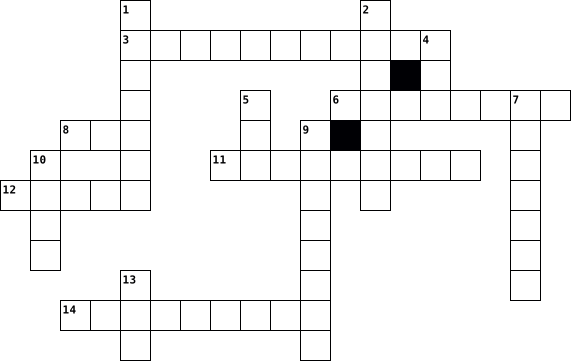
Across
- Animal that flaps faster
- Large marsupial
- Flying mammal
- The most poisonous animal in the world
- Slowest animal in the world)
- Animal capable of camouflaging itself in the environment
Down
- The fastest animal in the world
- Animal that makes no sound
- Man's best friend
- Animal capable of producing honey
- It has 8 tentacles
- It takes 22 months to have a baby
- whale The largest animal in the world
- Likes to chase mice
14 Clues: Flying mammal • Large marsupial • Man's best friend • It has 8 tentacles • Likes to chase mice • Animal that flaps faster • Animal that makes no sound • Slowest animal in the world) • The fastest animal in the world • Animal capable of producing honey • It takes 22 months to have a baby • whale The largest animal in the world • The most poisonous animal in the world • ...
Aladdin's A Whole New World 2013-08-25

Across
- I can ______ you the world
- Over, _____ and under
- A _____ new world
- Tell me, ______, now when did
- Or say we're only ______
- No one to _____ us no or where to go
- With new ______ to pursue
- On a _______ ride
- Every turn a _______
- I can't go _____
- I've _____ so far
- to where I _____ to be
Down
- Let me ______ this whole new world with you
- I can open your _____
- I am like a ______
- Take you ____ by wonder
- Every moment _______
- ______, shimmering, splendid
- You last let your _____ decide?
- A new ______ point of view
- I'll _____ them anywhere
- There's time to _____
22 Clues: I can't go _____ • A _____ new world • On a _______ ride • I've _____ so far • I am like a ______ • Every moment _______ • Every turn a _______ • I can open your _____ • Over, _____ and under • There's time to _____ • to where I _____ to be • Take you ____ by wonder • Or say we're only ______ • I'll _____ them anywhere • With new ______ to pursue • I can ______ you the world • ...
Harrison1 2020-04-14

Across
- cheryl's cat that's fun
- board game with houses and hotels
- cream I like to lick
- places with animals
- boston pizza "something"-and-cheese
- Zaidy's favorite color
- mama's mama
- hortons
- best aunt in the whole world
- play on Tuesday after school
- what Harrison does Sunday mornings
- best kid in Miss Bera's class
Down
- highest number in the world
- mama's dada
- man you can't see
- Mr. Incredible's daughter
- patrol with dogs that Harrison doesn't like anymore
- best sister in the whole world
- zaidy is always Mr. ...
- Harrison's gonna play ...
- favorite teacher from RoyalCrest Academy
21 Clues: hortons • mama's dada • mama's mama • man you can't see • places with animals • cream I like to lick • Zaidy's favorite color • cheryl's cat that's fun • zaidy is always Mr. ... • Mr. Incredible's daughter • Harrison's gonna play ... • highest number in the world • best aunt in the whole world • play on Tuesday after school • best kid in Miss Bera's class • best sister in the whole world • ...
Biblical Worldview Crossword 2024-04-30

Across
- let there be _____
- all ____ is breathed out by God
- in the
- do not believe every _____
- Preach the _____
- do not be conformed to this ____
- Book of Jesus
- _____ so loved the world
- I am
- and earth
- be prepared to make a _____ to anyone who asks you for reason for the hope that is in you
Down
- giving ____ to God the Father
- For God so loved the world that He gave his only _____
- life
- I was _____ and now I see
- fruit of the spirit starting with g
- False
- Christ the Lord
- God _____ forever
- set your mind on things ____
20 Clues: life • I am • False • in the • and earth • Book of Jesus • Christ the Lord • Preach the _____ • God _____ forever • let there be _____ • _____ so loved the world • I was _____ and now I see • do not believe every _____ • set your mind on things ____ • giving ____ to God the Father • all ____ is breathed out by God • do not be conformed to this ____ • fruit of the spirit starting with g • ...
Environment(23spcc020) 2023-07-06

Across
- solid part of earth
- world coordinating units
- 71% of earth surface
- hold by atmosphere
- very tall and have big grass
- father of science
- world largest mountain
- ______types of pollution
- study of natural world
- where the living beings live
Down
- mountain or hill with opening
- interaction between physical surrounding around us
- give o2
- ordinary routine of every living beings
- part of tress or plants
- national tree of india
- found in east
- greenhouse gas
- found in stratosphere
- creature have fifth sense
- harmful for environment
- lungs of the earth
- source of energy
- ______types of environment
24 Clues: give o2 • found in east • greenhouse gas • source of energy • father of science • hold by atmosphere • lungs of the earth • solid part of earth • 71% of earth surface • found in stratosphere • national tree of india • world largest mountain • study of natural world • part of tress or plants • harmful for environment • world coordinating units • ______types of pollution • creature have fifth sense • ...