
bill of rights Crossword Puzzles
Congress Vocabulary Part 2 2023-09-27

Across
- redrawing of congressional districts with the intent to create undue advantage for a political party
- are entitled
- combining several pieces of legislation into one bill to secure enough votes for passage
- government when one party controls the presidency and the other party controls at least one of the chambers of Congress
- a social insurance program funded by a payroll tax on current employers and employees to be redistributed to qualifying individuals for retirement...
- redistribution of congressional seats to the several states based on the U.S. Census
- a set of facilities, structures, and utilities developed, owned, operated, and maintained by the government ; includes highways, roads, railroads, bridges, ports, airports...
- a federal government-subsidized healthcare program for qualified elderly Americans
Down
- redrawing of congressional districts by state legislatures based on congressional reapportionment
- a federal government-subsidized healthcare program for qualified low-income households
- funding for a local project in a larger appropriation bill
- spending approved on an annual basis for defense spending, education, and infrastructure
- a tactic to prolong debate and delay or prevent a vote on a bill
- a procedure to end a debate
- spending required by law for entitlement programs
- committee meets when a bill passed by both chambers on the same topic has variation in its wording and attempt to reconcile those differences
- when political attitudes move toward ideological extremes
- a situation in which no congressional action on legislation can be taken due to a lack of consensus
- any government-provided or government-managed benefit or service to which some or all
- when members of Congress vote based on their political party affiliation
20 Clues: are entitled • a procedure to end a debate • spending required by law for entitlement programs • when political attitudes move toward ideological extremes • funding for a local project in a larger appropriation bill • a tactic to prolong debate and delay or prevent a vote on a bill • when members of Congress vote based on their political party affiliation • ...
Chapter 9 Crossword Puzzle 2022-10-19

Across
- basic rights of citizens
- Industrial farming
- voted against the Civil Rights Act
- loud advocate of white supremacy
- single largest income in Mississippi today
- elected governor in 1991
- elected governor in 1983
- law that allows workers to get and keep jobs without having to join a union
- elected governor in Mississippi after the Brown v. Board of Education
Down
- process of bringing different groups into society as equals
- soft wood used in making paper
- A sniper murdered him at the carport of his home
- Adapted the Confederate battle flag as the symbol of their resistance to civil rights
- illustrated black courage and persistence
- where people enter a public facility and refuse to leave
- placing the state's rights above those of the federal government
- integrated group that claimed to represent national Democratic values in the state
- benefited from the work done by the Freedom Democratic party
- published The Closed Society
- failed to work effectively with the legislature
20 Clues: Industrial farming • basic rights of citizens • elected governor in 1991 • elected governor in 1983 • published The Closed Society • soft wood used in making paper • loud advocate of white supremacy • voted against the Civil Rights Act • illustrated black courage and persistence • single largest income in Mississippi today • failed to work effectively with the legislature • ...
first 25 turning points in US history 2022-10-05

Across
- what did jackson do to the federal funds in 1832
- marbury vs. madison
- what happened on july 19 and 20, 1848
- what happened in 1814
- how many feet deep was the erie canal
- who drafted the bill of rights
- was scott a citizen?
- consequence for being a witch
- who starts the nullicication crisis
- first state to ratify in 1787
- how many men were not accused for murder boston massacre
- who was on the mayflower
Down
- where did james w. marshall discover gold?
- what did the native americans have to leave when the indian removal act was passed
- who surrenders at the Battle of Yorktown
- what the pilgrims and wampanoags ate together
- first chapter in the bible written on a telegraph
- how much money was spent on the purchase louisiana from napoleon
- who fired the first shot in 1775 concord
- columbus's ship
- where the first slaves landed
- what they named the jamestown after
- was shot to start the king philip war
- who george washingtion surprised attack in 1754
- the month that the continental congress adopts the declaration of independence
25 Clues: columbus's ship • marbury vs. madison • was scott a citizen? • what happened in 1814 • who was on the mayflower • where the first slaves landed • consequence for being a witch • first state to ratify in 1787 • who drafted the bill of rights • what they named the jamestown after • who starts the nullicication crisis • what happened on july 19 and 20, 1848 • ...
Government #2 2015-10-13

Across
- another name for queston period
- the Upper House of Parliaments made up of 105 Senators
- a meeting of the House within a session
- a rule for all Canadians
- a step in the passage of a bill when the report og the committee studied the bill
- a peson who speaks for you
- the political party with the most members elected to the House of Commons
- a Member of the Senate or House of Commons who does not belong to a political party
- made up by the Senate and the House, it has the power to make laws
- the periods into which a Parliament is divided
- the government of Canada that acts and speak for the whole country
- bills that are passed by Parliament
- the Member of Parliament or Senator in a political party who is responsible for keeping other party embers informed
- two chambers or rooms
- ro choose a representive in an election
Down
- another word for constituency or elecional district
- the political party the forms the Government
- period a daily period of time in the Senate and he Hose when parliament ask the governments important questions
- to change or improve something
- a person appointed to the Upper House of Parliament by the Governor General on the advice of Prinme Minister
- the last stage when a bill becomes a law
- one of Canada's 10 provinces and three territories that have the right to make laws for the people living there
- to place a document before the Senate, the House of Commons or a committee for consideration
- another name for the Senate
- a word used for the stags during which a bill is debated
- a change that is made to a bill
- an university student who carries and delivers messages or documents for the House
- a special title given to Senators and Cabinet Ministers for life and to the Speaker of the House of Commons as along as he or she is one
- process the steps by which bills are approved by Parliament and become laws
- official record of debates in the Senate and the House of Commons in English and French
30 Clues: two chambers or rooms • a rule for all Canadians • a peson who speaks for you • another name for the Senate • to change or improve something • another name for queston period • a change that is made to a bill • bills that are passed by Parliament • a meeting of the House within a session • ro choose a representive in an election • the last stage when a bill becomes a law • ...
1950s History 2025-03-10

Across
- when you wear a white shirt and tie to go to work
- to behave according to standards
- the biggest public work program within the U.S.
- the legislative branch of the U.S.
- when people do nothing about issues within society
- a policy that ended federal supervision over Indian tribes
- person who has abilities to create or change laws
- a period of time from 1945 to 1961
- plans to upgrade land in an urban area
- when an organization has different legal rights
Down
- when shop owners will only hire union members (a shop)
- making economic conservation equal to benefit the country
- an agreement between the U.S. and Mexico that they can work agriculture
- when a person runs and owns several business stores
- cooperation that expanded overseas
- another name for the Servicemen's Readjustment Act
- program with proposals to congress
- brought in a huge amount of Mexicans to the U.S. to work agriculture within the southwest
- - to leave something
- no one is forced to join a union
- new workers were forced to join unions (a shop)
21 Clues: - to leave something • to behave according to standards • no one is forced to join a union • the legislative branch of the U.S. • cooperation that expanded overseas • program with proposals to congress • a period of time from 1945 to 1961 • plans to upgrade land in an urban area • the biggest public work program within the U.S. • ...
Business Words 45 2019-04-16

Across
- Interest
- Allocation
- Bill-of-exchange
- Currency
- Tax
Down
- Branding
- Term-lone
- Margin
- Economic-policy
- Headquarters
10 Clues: Tax • Margin • Branding • Interest • Currency • Term-lone • Allocation • Headquarters • Economic-policy • Bill-of-exchange
Government Final Review 2025-12-04

Across
- Constitutional principle established by Marbury v. Madison
- Governmental body that reserves the power to declare war
- Senate tradition of unlimited debate/speech in the interest of stalling legislation
- American party that is more conservative in nature
- The system used to pick the President in the US
- Number of Justices required to HEAR a case
- Compromise made between NJ and VA Plans
- Number of Supreme Court Justices
- Highest court in US judicial system
- America's first government; very weak
- Formal forgiveness granted by the President
- Appoints judicial officers by confirming their nomination
- Philosopher who believed in democracy and natural rights
- First 10 amendments
- Term for a Supreme Court Justice
- Constitutional principle that keeps power with the people
- Government by one ruler
- Group of people in support of ratifying the Constitution
- What is delivered after a court makes their final decisions on a case
- A type of democracy where citizens elect officials to make decisions for them
- American party that is more liberal in nature
- Age required to vote in elections
- Supreme Law of the Land
Down
- Jurisdiction where a court has the power to hear a case FIRST
- Official leader of the Justices within the Supreme Court
- Private organizations that focus on one issue that they lobby for
- Heads of Executive departments that advise the President
- Political ideology that believes tradition matters
- Document written to break ties with Britain
- Breaks ties within the Senate
- Number of Senators
- Committees in the bill process that compromise differing versions of a bill
- Relationship between federal & state governments
- City where the Constitutional Convention was held
- Section of the Constitution that sets up Congress
- Minimum number of Justices required to DECIDE a case
- Political ideology that believes change is good
- Courts below the Supreme Court
- Years a Representative has in term
- Leader of the House of Representatives
- Years a Senator has in term
- A charge of misconduct against a public holder of office
- All money or revenue bills start here
- Nominates judicial officers
44 Clues: Number of Senators • First 10 amendments • Government by one ruler • Supreme Law of the Land • Years a Senator has in term • Nominates judicial officers • Breaks ties within the Senate • Courts below the Supreme Court • Number of Supreme Court Justices • Term for a Supreme Court Justice • Age required to vote in elections • Years a Representative has in term • ...
Unit 2 Review 2024-10-15

Across
- This type of government describes both the Canada and U.S.
- This branch makes the laws for our country.
- The U.S. government is a _____. We vote for leaders to represent us.
- This was how goods were made before the Industrial Revolution.
- This mountain range divides the Midwest and West regions of the U.S.
- The 1st Amendment in the Bill of Rights gives Americans the right to freedom of_____.
Down
- To make sure no branch of government becomes too powerful; we divide the government into _______.
- The U.S. river that runs from Minnesota to the Gulf of Mexico.
- This is how we choose our leaders in our govt.
- The most spoken language in America is _____. The second most spoken language is Spanish.
- Because we choose our leaders, our govt. is ruled by ______.
11 Clues: This branch makes the laws for our country. • This is how we choose our leaders in our govt. • This type of government describes both the Canada and U.S. • Because we choose our leaders, our govt. is ruled by ______. • The U.S. river that runs from Minnesota to the Gulf of Mexico. • This was how goods were made before the Industrial Revolution. • ...
US History A | Unit 5 Keywords 2024-01-20

Across
- Synonym for optimism.
- Victory and Achievement
- Rights The movement advocating for the rights and equality of all individuals.
- A crucial element in Baldwin's vision for a more inclusive and just society. Learning
- An organized effort and activism for social change and civil rights.
- Baldwin envisions a society marked by this synonym for togetherness, and unity.
- The pursuit of this ideal is a central theme in this nation and the fight for Civil rights.
- The freedom to voice one's thoughts and opinions.
- Despite challenges, Baldwin remains ______ about the potential for positive change.
- The book explores the complexities of discovering one’s own.
Down
- Challenges faced by individuals in the pursuit of civil rights.
- Maintaining motivation, and calm.
- A sense of unity and solidarity in the ongoing struggle for equality.
- Growth towards a goal of betterment.
- This trait of staying true to oneself.
- Baldwin's vision for a future where possibilities are unbounded, or ______.
16 Clues: Synonym for optimism. • Victory and Achievement • Maintaining motivation, and calm. • Growth towards a goal of betterment. • This trait of staying true to oneself. • The freedom to voice one's thoughts and opinions. • The book explores the complexities of discovering one’s own. • Challenges faced by individuals in the pursuit of civil rights. • ...
Legislative Branch 2025-03-24

Across
- A proposal approved by either or both Houses of Congress which, except for joint resolutions signed by the President, does not have the force of law.
- to draw the boundaries of a district so that one political party is probably going to win all the elections
- words) Powers not specifically mentioned in the Constitution but drawn from the expressed powers.
- the holder of an office or post
- Temporary joint committee created to resolve differences between House-passed and Senate-passed versions of a measure.
- words) the member of the majority party on a committee who has formal responsibility over the panel’s agenda and resources, presides at its meetings
- member of Congress who is responsible for gathering votes and checking party attendance.
- proposal to change what a bill says; can also change the Constitution if the states ratify it
- additional provision added to a bill or other measure under the consideration by a legislature, which may or may not have much, if any, connection with the subject matter of the bill.
- a smaller group of members within a larger committee, assigned to study and report on a specific area of the committee's jurisdiction, often conducting hearings and amending legislation before presenting it to the full committee
- words) presiding officer in the House of Representatives - assigns members to committees, schedules debates, breaks ties
- words) a metaphor for the appropriation of government spending for localized projects secured solely or primarily to direct expenditures to a representative's district
- a group or meeting of supporters or members of a specific political party or movement
- words) the party leader for the minority party in House and Senate; maintain party discipline on the floor
Down
- a person who is employed and receives payment, or who contracts for economic consideration, for the purpose of getting things done by government officials
- words) presides over the Senate when the vice president is absent; is third in line to succeed the president
- The House of Representatives accuses a government official of a crime, and the Senate holds the trial to determine whether or not to remove the official from office.
- Formally end a meeting of a chamber or committee.
- legislature) in a legislative body, having two houses (as in the House of Representatives and the Senate comprising the U.S. Congress).
- presidential disapproval of a bill or joint resolution presented to him for enactment into law
- formal and informal rules and norms according to which long-serving members possess more procedural privileges and control more resources than do their junior colleagues
- A procedural practice in the Senate whereby a senator refuses to relinquish the floor in order to delay proceedings and prevent a vote on a controversial issue.
- (2 words) authorizes the government to spend money on what was budgeted
- words) Powers of government specifically stated in the Constitution.
- words) the party leader for the majority party in House and Senate; maintains party discipline on the floor
- words) the party leaders; they maintain party discipline on the floor
- the people represented by an elected official.
- any member of the House, after a committee has had a bill for thirty days, may ask to have it brought to the floor. If a majority of the members agree, the bill will leave the committee. This was designed to prevent a committee from killing a bill by holding it for too long
28 Clues: the holder of an office or post • the people represented by an elected official. • Formally end a meeting of a chamber or committee. • words) Powers of government specifically stated in the Constitution. • words) the party leaders; they maintain party discipline on the floor • (2 words) authorizes the government to spend money on what was budgeted • ...
Immigrants and Reformers pgs. 388-393 2023-05-11

Across
- An action that makes something better.
- (3 words) The name of the women's convention where they demanded recognition of their rights.
- Controlling or cutting back on the drinking of alcohol.
- From 1840-1860 34% of people from this country immigrated to the United States.
- (2 words) Until the 1840s, mentally ill people were locked up in jails. Reform leaders worked to improve this ______________ ___________.
- (3 words) As president of the Woman's Christian Temperance Union, she worked for temeperance, women's rights, prison reform, and education reform.
- This time frame is how long people fought for their causes
- Some people disliked _________________ because of their unusual customs.
- ___________________ of Germans left Europe because of war and crop failures.
- (3 words) This woman was the leader of the Seneca Falls.
- Out of the the about 4 million Europeans who can to the United States, about half were thie nationality.
Down
- This was the main source of food for the poor in Ireland.
- (2 words) Led efforts to provide textbooks, increase pay and training for teachers, and build schoolhouses.
- _________ people left farms and workshops to find jobs in cities.
- (3 words) The widespread religious movement where thousands of people joined Christian churches.
- (2 words) This person led a movement to help mentally ill people.
- Unfair treatment that abuses a person's rights.
- (2 words) This antislavery leader who attend women's rights conventions to help encourage people to fight for all injustices.
- A widespread shortage of food.
- (2 words) The person who said this, "We'll have our rights... and you can't stop us from them."
- (2 words) In 1848, a group of women held a convention in this New York city to dicuss their rights.
- (3 words) This woman joined Stanton as a movement leader.
22 Clues: A widespread shortage of food. • An action that makes something better. • Unfair treatment that abuses a person's rights. • Controlling or cutting back on the drinking of alcohol. • (3 words) This woman was the leader of the Seneca Falls. • This was the main source of food for the poor in Ireland. • (3 words) This woman joined Stanton as a movement leader. • ...
Crossword Term 3 Tic Tac Toe Project 2024-03-28

Across
- American labour leader who was president of the United Mine Workers of America
- Martin Luther King Jr.'s chief partner in the civil rights movement
- black teenager who was brutally murdered in 1955 Mississippi who's death was a catalyst for civil rights
- woman who refused to give up her seat to a white man on a segregated bus who got arrested that started the bus boycott
- nine black students who enrolled in a formerly all-white Central High School to begin desegregation
- an event that focused on employment discrimination, civil rights abuses against African Americans, Latinos, other disenfranchised groups
- civil rights lawyer who used the courts to fight Jim Crow and dismantle segregation in the U.S.
- greatly contributed to the American civil rights movement in the 1960s, famous for his "I Have a Dream" speech
- aimed to overcome legal barriers at the state and local levels that prevented African Americans from exercising their right to vote
- process of ending the separation of different racial, religious, or cultural groups
- director of the Federal Bureau of Investigation (FBI)
Down
- a civil rights protest during which African Americans refused to ride the city buses in Montgomery Alabama to protest segregated seating
- court case where the Supreme Court decided that separating children in public schools on the basis of race was unconstitutional
- separating people into racial or ethnic groups
- a leader in the civil rights movement and supporter of Black nationalism
- the amendment that eliminated the poll taxes and abolished governments from imposing taxes on voters
- ending segregation and allowing whites, African Americans, and all races to be together
- organization created to work for the abolition of segregation and discrimination
- a series of political protests against segregation by Blacks and whites who rode buses together
- youngest president elected to office, shot in Dallas, Texas
20 Clues: separating people into racial or ethnic groups • director of the Federal Bureau of Investigation (FBI) • youngest president elected to office, shot in Dallas, Texas • Martin Luther King Jr.'s chief partner in the civil rights movement • a leader in the civil rights movement and supporter of Black nationalism • ...
Making the Constitution 2024-02-28

Across
- Branch of government led by the President that carries out the laws
- a settlement of a dispute byElectoral Collegeg up some demands
- body of electors that elects the president and vice president of the United States
- an application to a higher court for a decision to be reversed.
- Part of Congress with 2 representatives from each state who serve for six year terms
- of Representatives the lower house of a legislative body (as the U.S. Congress) currently has 435 members, based on the population of the state, who serve in two year terms
Down
- Branch of government that interprets the laws, courts and the court system, including the Supreme Court
- the usually explanatory introductory part of a constitution or statute
- Congress - the branch of government that makes the laws
- The division of power between the federal (national) government and the states
- Sovereignty The people have the right to alter (change) or abolish (get rid of) their government
- Supporters of the Constitution who favored a strong federal (national) government
- a proposed law
- People who opposed a strong federal government and favored states' rights
- vote each person gets one vote
- to change for the better
- to approve
- to refuse to admit or approve; to reject
18 Clues: to approve • a proposed law • to change for the better • vote each person gets one vote • to refuse to admit or approve; to reject • Congress - the branch of government that makes the laws • a settlement of a dispute byElectoral Collegeg up some demands • an application to a higher court for a decision to be reversed. • ...
American Revolution & Constitution 2025-12-15

Across
- The name for the first 10 amendments, guaranteeing rights like speech and religion.
- A major grievance of the colonists; representation was sought for this power.
- A person who sided with Great Britain during the war.
- The highest court in the Judicial Branch.
- The author of the Declaration of Independence.
- Commander of the Continental Army and the first U.S. President.
- The branch of government that enforces the laws; led by the President.
- The power of the President to reject a bill passed by Congress.
Down
- The group of advisors to the President, established by tradition, not the Constitution.
- The branch of government that interprets laws and includes the Supreme Court.
- The number of senators each state has.
- Often called the "Father of the Constitution" for his role in writing it.
- To formally approve a treaty, amendment, or appointment; the Senate does this for treaties.
- The branch of government that includes the House and the Senate.
- Opening statement of the Constitution that begins, "We the People..."
- The first and longest part of the Constitution, which creates the Legislative Branch.
- The king of Great Britain during the American Revolution.
17 Clues: The number of senators each state has. • The highest court in the Judicial Branch. • The author of the Declaration of Independence. • A person who sided with Great Britain during the war. • The king of Great Britain during the American Revolution. • Commander of the Continental Army and the first U.S. President. • ...
Australian Government Crossword Puzzle 2020-09-24

Across
- The type of government in Australian where citizens vote in government leaders.
- The British system of government Australia used when setting up Parliament.
- Which level of government is responsible for rubbish collection and parks?
- A change to a bill
- Which level of government is responsible for tax, defence and immigration?
- The Lower House (green) in WA's State Parliament is known as the Legislative ____________
- When the govern-general signs the bill, it is known as an _________ of Parliament.
- The lower house in Australia's Federal Parliament is known as the House of _______
- The House of Representatives is which colour?
- The leader of the state government is the _______.
- The Senate is which colour?
- The set of rules stating how Australia should be run is called the________.
Down
- In an election for a government job, the people who want the job are called the __________
- A proposed law
- The Upper House(red) in WA's State Parliament is known as the Legislative ____________
- Which level of government is responsible for schooling, hospitals and police?
- Which two countries influenced Australia's government system? Britain and ________.
- The governor-general signs bills on behalf of the ___________.
- The level of government that makes laws for the whole of Australia
- On election day, people usually go to a _________ place to vote
20 Clues: A proposed law • A change to a bill • The Senate is which colour? • The House of Representatives is which colour? • The leader of the state government is the _______. • The governor-general signs bills on behalf of the ___________. • On election day, people usually go to a _________ place to vote • The level of government that makes laws for the whole of Australia • ...
chapter 3 2024-03-19

Across
- of senate - the georgia's constitution gives the lieutenant governor the title of president of senate
- - the number of members who must be present present in order to conduct business
- - refers to a two house legislature
- income from taxes and fees
- a person in a legislators district
- a proposed law
- -to redraw the boundaries of voting districts to account for population changes
- a plan for receiving and spending money
- to set aside for a specific purpose
- a group of political party members
- - the official count of the population
Down
- the process of determining how many constituents are represented in each voting district
- to change or make an addition to
- year- the budgetary spending year; georgia's fiscal year begins july 1 and ends june 30
- the exclusive ownership or control of a product or an industry by one company or group
- item veto- allows the government to veto specific spending proposals that he or she considers to be wasteful without vetoing the entire appropriations bill
- to reject or refuse to sign a bill
- - a formal agreement between two or more nations
- of the house - the speaker of the house is chosen by the members in that chamber
19 Clues: a proposed law • income from taxes and fees • to change or make an addition to • a person in a legislators district • to reject or refuse to sign a bill • a group of political party members • - refers to a two house legislature • to set aside for a specific purpose • - the official count of the population • a plan for receiving and spending money • ...
chapter 3 2024-03-19

Across
- of senate - the georgia's constitution gives the lieutenant governor the title of president of senate
- - the number of members who must be present present in order to conduct business
- - refers to a two house legislature
- income from taxes and fees
- a person in a legislators district
- a proposed law
- -to redraw the boundaries of voting districts to account for population changes
- a plan for receiving and spending money
- to set aside for a specific purpose
- a group of political party members
- - the official count of the population
Down
- the process of determining how many constituents are represented in each voting district
- to change or make an addition to
- year- the budgetary spending year; georgia's fiscal year begins july 1 and ends june 30
- the exclusive ownership or control of a product or an industry by one company or group
- item veto- allows the government to veto specific spending proposals that he or she considers to be wasteful without vetoing the entire appropriations bill
- to reject or refuse to sign a bill
- - a formal agreement between two or more nations
- of the house - the speaker of the house is chosen by the members in that chamber
19 Clues: a proposed law • income from taxes and fees • to change or make an addition to • a person in a legislators district • to reject or refuse to sign a bill • a group of political party members • - refers to a two house legislature • to set aside for a specific purpose • - the official count of the population • a plan for receiving and spending money • ...
American vs British 2022-01-14

Across
- zip code
- flashlight
- rain boots
- truck
- eraser
- corn
- intersection
- line
- insane
- bill
- purse
- one-way
- check
- freeway
- zuccini
- elevator
Down
- shopping cart
- closet
- apartment
- fall
- gas
- cookie
- zipper
- sidewalk
- store
- allowance
- yard
- mailbox
- vacation
30 Clues: gas • fall • corn • line • mail • bill • yard • truck • store • purse • check • closet • eraser • cookie • zipper • insane • mailbox • one-way • freeway • zuccini • zip code • sidewalk • vacation • elevator • apartment • allowance • flashlight • rain boots • intersection • shopping cart
Civil Rights Movement Tic Tac Toe 2023-03-30

Across
- A movement for African American rights
- This happened to MLK Jr.
- To hate someone because of their race
- Protest group willing to use violence
- Civil Rights leader
- Nine African American children that were met with a white mob when trying to get into a white high school
- The refusal to go on the bus
- The people that were being discriminated against
- Bus girl that wouldn't get up
- The event where MLK Jr. spoke his "I Have a Dream" speach
- Was the president during the Civil Rights movement
- The separation of people based on race
Down
- Court case where segregation in schools was declared unconstitutional
- civil rights activists who rode buses into the segregated South
- Predominantly white neighborhood where every house was basically the same
- one or more people occupying an area for a protest
- Assassinated after he started to follow MLK Jr.
- A leading group in the civil rights movement that was violence free
- White people would sometimes do this to African Americans when they "Stepped out of line"
- FBI did this to MLK Jr.
20 Clues: Civil Rights leader • FBI did this to MLK Jr. • This happened to MLK Jr. • The refusal to go on the bus • Bus girl that wouldn't get up • To hate someone because of their race • Protest group willing to use violence • A movement for African American rights • The separation of people based on race • Assassinated after he started to follow MLK Jr. • ...
Constitution vocabulary 2023-12-08

Across
- the action or fact of joining or being joined, especially in a political context
- the state of being free within society from oppression restrictions imposed by authority on one's way of life, behavior, or political views
- a quality or state or being tranquil, calm
- just treatment or behavior
- future generations
Down
- to sign or give formal consent to, making it officially valid
- a national legislative body comprised of the Senate and the House of Representatives
- of rights the first ten amendments in the US Constitution
- and balances a system in which different parts of a government have powers that affect and control other parts so that no one branch can become too powerful.
- an article added to the constitution
10 Clues: future generations • just treatment or behavior • an article added to the constitution • a quality or state or being tranquil, calm • of rights the first ten amendments in the US Constitution • to sign or give formal consent to, making it officially valid • the action or fact of joining or being joined, especially in a political context • ...
L7.1 2025-03-24

Across
- John _________ was the first chief justice of the United States
- A person who risks money to make a profit was known as a ________________
- John __________ was the nation’s first vice president
- To help build a strong national economy, Hamilton asked Congress to create a national __________
- A _______________ is a tradition
Down
- Freedom of speech is is one of the _________ guaranteed in the Bill of Rights
- Thomas __________ was the first leader of the new Department of State
- Jefferson opposed Hamilton’s plan for paying off debts with taxes because he feared Hamilton was creating a powerful national government run by the _____________
- The Judiciary Act of 1789 established the federal ________ system
- Within the executive branch, the three department heads and the attorney general are known as the ________
10 Clues: A _______________ is a tradition • John __________ was the nation’s first vice president • John _________ was the first chief justice of the United States • The Judiciary Act of 1789 established the federal ________ system • Thomas __________ was the first leader of the new Department of State • ...
Crossword Puzzle 2023-04-11

Across
- not fully dressed
- amount
- confidence in a person's ability to repay money lent to them
- very tiring
- confusion
- serious
- ability to take care of something byoneself
- refers to the bill sponsored by Representative Wright Patman (and known as the “Bonus Bill”) that would pay veterans their bonus earlier than originally agreed upon
Down
- risking danger
- falling apart
- worn out
- how much an amount of money falle short of what is needed
- payment
- amount spent
- the strength to stand, continue to endure
- filled with somthing bad
- not ending
17 Clues: amount • payment • serious • worn out • confusion • not ending • very tiring • amount spent • falling apart • risking danger • not fully dressed • filled with somthing bad • the strength to stand, continue to endure • ability to take care of something byoneself • how much an amount of money falle short of what is needed • confidence in a person's ability to repay money lent to them • ...
Federal Constitution Review 2020-11-29

Across
- Chief officer of the U.S. House of Representatives
- Branch that interprets the laws
- Highest federal court
- Number of days the president has to consider a bill
- Branch that enforces the laws
- Third President of the United States
- When the president rejects a bill
- The stars on the flag represent these
Down
- Head of the executive branch
- Consists of 435 members
- Number of justices on the Supreme Court
- Branch that makes the laws
- Beginning of the Constitution
- Group of 15 that advises the president
- Consists of 100 members
- Term, in years, of a U.S. Representative
- There are 27 of these
- Has 50 stars and 13 stripes
- Term, in years, of a U.S. Senator
19 Clues: Highest federal court • There are 27 of these • Consists of 435 members • Consists of 100 members • Branch that makes the laws • Has 50 stars and 13 stripes • Head of the executive branch • Beginning of the Constitution • Branch that enforces the laws • Branch that interprets the laws • Term, in years, of a U.S. Senator • When the president rejects a bill • ...
Civil Rights Movement Crossword! 2017-03-22

Across
- Civil Rights group founded by James Farmer, its aim was to work for racial equality and even trained people on how to be nonviolent
- often known as most racist southern city in America that was home to unrest with Civil Rights Movement
- Nine black students enrolled here after desegregation
- The ___________ Act of 1965 outlawed discriminatory voting practices
- The ___________v. Board of Ed. declared segregated schools unconstitutional
- Bobby Seale and Huey Newton founded the ___________________ to fight for total equality
- the type of segregation by law or the justice system
- Martin Luther King Jr. gave his famous "I Have a Dream" Speech at the March on
- Leaders of this student group led sit-ins in Greensboro; shock - troops
- The practice of discriminating against and segregating Black people in the South
- This African American Civil Rights activist was a member of the Nation of Islam before breaking from it
- the movement of ending segregated facilities and accommodations
- the Civil Rights group that Martin Luther King Jr. was most heavily associated with that was very active in organizing demonstrations
- This president called for federal civil rights legislation before he was assassinated
- This young black teen was killed for whistling at a white woman in Mississippi
Down
- Usually associated with hanging, African Americans were subject to this in the deep south
- This leader popularized the term "Black Power"
- The __________ Act of 1964 outlawed discrimination
- Ratified in 1964, this amendment ended poll taxes
- Term for the keeping of races and ethnic groups apart
- name for group of demonstrators who rode busses into racist parts of the South
- a special type of test that assessed whether or not blacks were worthy enough to vote
- This national organization was founded in 1909 for racial equality
- brave educated white woman who convinced Mayor West to desecrate the counters in Nashville, Tennessee.
- This civil rights leader lead the Montgomery Bus Boycott and later won the Nobel Peace Prize in 1964
- This Civil Rights lawyer defended Brown
- She began the Montgomery Bus Boycott from refusing to move her seat
- Made "The Great Society" agenda to implement federal civil rights
- teacher who bravely taught elementary students about racism with eye color
- the type of segregation by behavior, habit or inherent racism
30 Clues: This Civil Rights lawyer defended Brown • This leader popularized the term "Black Power" • Ratified in 1964, this amendment ended poll taxes • The __________ Act of 1964 outlawed discrimination • the type of segregation by law or the justice system • Term for the keeping of races and ethnic groups apart • Nine black students enrolled here after desegregation • ...
Civil Rights Movement Crossword! 2017-03-22

Across
- Usually associated with hanging, African Americans were subject to this in the deep south
- This civil rights leader lead the Montgomery Bus Boycott and later won the Nobel Peace Prize in 1964
- This young black teen was killed for whistling at a white woman in Mississippi
- This leader popularized the term "Black Power"
- The ___________ Act of 1965 outlawed discriminatory voting practices
- The __________ Act of 1964 outlawed discrimination
- name for group of demonstrators who rode busses into racist parts of the South
- the type of segregation by law or the justice system
- Made "The Great Society" agenda to implement federal civil rights
- This president called for federal civil rights legislation before he was assassinated
- Bobby Seale and Huey Newton founded the ___________________ to fight for total equality
- the type of segregation by behavior, habit or inherent racism
- Martin Luther King Jr. gave his famous "I Have a Dream" Speech at the March on
- teacher who bravely taught elementary students about racism with eye color
- This Civil Rights lawyer defended Brown
Down
- The ___________v. Board of Ed. declared segregated schools unconstitutional
- the movement of ending segregated facilities and accommodations
- The practice of discriminating against and segregating Black people in the South
- Ratified in 1964, this amendment ended poll taxes
- Term for the keeping of races and ethnic groups apart
- Nine black students enrolled here after desegregation
- a special type of test that assessed whether or not blacks were worthy enough to vote
- She began the Montgomery Bus Boycott from refusing to move her seat
- Leaders of this student group led sit-ins in Greensboro; shock - troops
- This national organization was founded in 1909 for racial equality
- brave educated white woman who convinced Mayor West to desecrate the counters in Nashville, Tennessee.
- This African American Civil Rights activist was a member of the Nation of Islam before breaking from it
- often known as most racist southern city in America that was home to unrest with Civil Rights Movement
- Civil Rights group founded by James Farmer, its aim was to work for racial equality and even trained people on how to be nonviolent
- the Civil Rights group that Martin Luther King Jr. was most heavily associated with that was very active in organizing demonstrations
30 Clues: This Civil Rights lawyer defended Brown • This leader popularized the term "Black Power" • Ratified in 1964, this amendment ended poll taxes • The __________ Act of 1964 outlawed discrimination • the type of segregation by law or the justice system • Term for the keeping of races and ethnic groups apart • Nine black students enrolled here after desegregation • ...
Legislative Branch 2025-03-24

Across
- A proposal approved by either or both Houses of Congress which, except for joint resolutions signed by the President, does not have the force of law.
- to draw the boundaries of a district so that one political party is probably going to win all the elections
- words) Powers not specifically mentioned in the Constitution but drawn from the expressed powers.
- the holder of an office or post
- Temporary joint committee created to resolve differences between House-passed and Senate-passed versions of a measure.
- words) the member of the majority party on a committee who has formal responsibility over the panel’s agenda and resources, presides at its meetings
- member of Congress who is responsible for gathering votes and checking party attendance.
- proposal to change what a bill says; can also change the Constitution if the states ratify it
- additional provision added to a bill or other measure under the consideration by a legislature, which may or may not have much, if any, connection with the subject matter of the bill.
- a smaller group of members within a larger committee, assigned to study and report on a specific area of the committee's jurisdiction, often conducting hearings and amending legislation before presenting it to the full committee
- words) presiding officer in the House of Representatives - assigns members to committees, schedules debates, breaks ties
- words) a metaphor for the appropriation of government spending for localized projects secured solely or primarily to direct expenditures to a representative's district
- a group or meeting of supporters or members of a specific political party or movement
- words) the party leader for the minority party in House and Senate; maintain party discipline on the floor
Down
- a person who is employed and receives payment, or who contracts for economic consideration, for the purpose of getting things done by government officials
- words) presides over the Senate when the vice president is absent; is third in line to succeed the president
- The House of Representatives accuses a government official of a crime, and the Senate holds the trial to determine whether or not to remove the official from office.
- Formally end a meeting of a chamber or committee.
- legislature) in a legislative body, having two houses (as in the House of Representatives and the Senate comprising the U.S. Congress).
- presidential disapproval of a bill or joint resolution presented to him for enactment into law
- formal and informal rules and norms according to which long-serving members possess more procedural privileges and control more resources than do their junior colleagues
- A procedural practice in the Senate whereby a senator refuses to relinquish the floor in order to delay proceedings and prevent a vote on a controversial issue.
- (2 words) authorizes the government to spend money on what was budgeted
- words) Powers of government specifically stated in the Constitution.
- words) the party leader for the majority party in House and Senate; maintains party discipline on the floor
- words) the party leaders; they maintain party discipline on the floor
- the people represented by an elected official.
- any member of the House, after a committee has had a bill for thirty days, may ask to have it brought to the floor. If a majority of the members agree, the bill will leave the committee. This was designed to prevent a committee from killing a bill by holding it for too long
28 Clues: the holder of an office or post • the people represented by an elected official. • Formally end a meeting of a chamber or committee. • words) Powers of government specifically stated in the Constitution. • words) the party leaders; they maintain party discipline on the floor • (2 words) authorizes the government to spend money on what was budgeted • ...
Creation of the Constitution 2017-09-18

Across
- This group was in favor of the new Constitution.
- What were the delegates supposed to do to the Articles of Confederation?
- This is the name of the meeting where the Constitution was written.
- This English document was specifically written to limit the power of the King.
- This compromise said we would only tax imports, not exports.
- The only branch that existed under the Articles of Confederation.
- This group was against the new Constitution.
- The plan of government that created a bicameral legislature.
- How many states had to agree to change the Articles of Confederation?
Down
- The event that convinced the delegates that changes in the Articles of Confederation were needed.
- The plan of government favored by the large states.
- The name of the war in which the colonies freed themselves from British rule.
- This English document served as a model for the United States' Bill of Rights.
- John Locke's theory that government was established by the people voluntarily.
- Name of the meeting where the Declaration of Independence was written.
- Who had the most power under the Articles of Confederation?
- This compromise was over the importation of Africans to the states.
- This compromise settled the debate on how to count slaves.
- The plan of government favored by small states.
19 Clues: This group was against the new Constitution. • The plan of government favored by small states. • This group was in favor of the new Constitution. • The plan of government favored by the large states. • This compromise settled the debate on how to count slaves. • Who had the most power under the Articles of Confederation? • ...
Civic Vocabulary 2025-10-15

Across
- the right to vote in elections
- the act of listing or counting something, as in the population of a country
- a group of people who belong to the same political party
- the highest law of the land
- to bring a legal case in front of a higher court to review the decision of the lower court
- a lengthy speech undertaken to delay a vote on a bill
- the judicial branch of government
- a written argument that lays out main points, legal precedents, and evidence
Down
- the constitutional right to vote
- a system where citizens vote to make decisions
- the power of the president to refuse a bill passed by congress
- a hereditary form of government
- a small group of people who have control over a country
- the legislative branch, it consists of bicameral legislature
- the process of closing debate on a bill or other legislative action currently being delayed
15 Clues: the highest law of the land • the right to vote in elections • a hereditary form of government • the constitutional right to vote • the judicial branch of government • a system where citizens vote to make decisions • a lengthy speech undertaken to delay a vote on a bill • a small group of people who have control over a country • ...
Legislative Branch (Ch 6) 2022-03-08

Across
- power that the U.S. Congress has that is specifically listed in the Constitution
- a tactic for defeating a bill in the Senate by talking until the bill's sponsor withdraws it
- a procedure used in the Senate to limit debate on a bill
- to accuse government officials of misconduct in office
- an organization of people with some common interest who try to influence governnment decisions
- the lower house of Congress, consisting of a different number of representatives from each state, depending on population
- in both the House of Representatives and the Senate, the political party to which more than half the members belong
- clause in Article I, Section 8 of the Constitution that gives Congress the right to make all laws "necessary and proper" to carry out its expressed powers
- power that Congress has that is not stated explicitly in the Constitution
- a completely unrelated amendment added to a bill
- a resolution that is passed by both houses of Congress
Down
- another name for expressed power
- in both the House of Representatives and the Senate, the political party to which fewer than half the members belong
- a person from a legislator's district
- the upper house of Congress, consisting of two representatives from each state
- representative of an interest group who contacts lawmakers or other government officials directly to influence their policy making
- an oddly shaped election district designed to increase the voting strength of a particular group
- president's power to kill a bill, if Congress is not in session, by not signing it for 10 days
18 Clues: another name for expressed power • a person from a legislator's district • a completely unrelated amendment added to a bill • to accuse government officials of misconduct in office • a resolution that is passed by both houses of Congress • a procedure used in the Senate to limit debate on a bill • ...
Government Crossword 2016-04-19

Across
- Court the highest judicial court in a country or state.
- the elected executive head of a state of the US.
- having the power to put plans, actions, or laws into effect.
- of powers an act of vesting the legislative, executive, and judicial powers of government in separate bodies.
- A note issued by the goverment promising to repay the borowed money
- a minor change in a document.
- the judicial authorities of a country
- of Rights specifically listing individual freedoms
Down
- and balances counterbalancing influences by which an organization or system is regulated, typically those ensuring that political power is not concentrated in the hands of individuals or groups.
- powers a political power that a constitution reserves exclusively to the jurisdiction of a particular political authority
- of various legislative or governing bodies, in particular.
- of Representatives The lower house of the United States Congress
- A document the outlines fundamental laws and principles laws
- the federal principle or system of government.
- y Tejas was one of the constituent states of the newly established United Mexican States under its 1824 Constitution
15 Clues: a minor change in a document. • the judicial authorities of a country • the federal principle or system of government. • the elected executive head of a state of the US. • of Rights specifically listing individual freedoms • Court the highest judicial court in a country or state. • of various legislative or governing bodies, in particular. • ...
Lol 2016-05-10

Across
- This family and others went to court against the Board of Education.
- Homer Plessy was of _____ origin.
- Southern _______ Leadership Conference.
- Where did the famous 1960 sit-in take place?
- AS91004 (1.4) focuses on what?
- CORE stands for Congress of Racial _______.
- Student Nonviolent _______ Committee
- Civil rights group that focused on litigation
- Form of non-violent protest.
- Lays down rights of citizens.
- Was often at the centre of Black communities.
- Greensboro is in ____ Carolina.
- Black civil rights groups protested for ______.
- In what state is Albany located in?
- The Union fought _____ forces.
- Jo Ann _____ played a key role in the MBB.
- The _______ administration supported the Freedom Riders.
- CORE provided _____ sessions in non-violent action.
- This civil rights group gave young people a place in the civil rights movement.
- Little Rock was about the desegregation of a ______.
Down
- to abstain from buying or using.
- Pictures of an event, interviews with eyewitnesses, and video or audio of an event are what kind of sources to history?
- In 1863, Lincoln freed the _____.
- Martin _____ King Junior
- Rides that challenged interstate travel.
- Jim Crow laws enforced ______.
- Separate but _____.
- A sit in is a kind of ______ protest.
- Lincoln issued the _______ proclamation in 1863.
- Come on be a man, join!
- The Albany Movement created _______ between SNCC and SCLC.
- Little Rock ____.
- Freedom _____ were created to raise morale.
- Montgomery _______ Association.
- Segregation was a _____ of the Albany Movement.
- Peaceful police chief of Albany
- Punishment by an informal group.
- Demonstrators were released in Albany as not to gain the attention of the ____.
- Influenced civil rights leaders
- Jump, Jim!
40 Clues: Jump, Jim! • Little Rock ____. • Separate but _____. • Come on be a man, join! • Martin _____ King Junior • Form of non-violent protest. • Lays down rights of citizens. • Jim Crow laws enforced ______. • AS91004 (1.4) focuses on what? • The Union fought _____ forces. • Greensboro is in ____ Carolina. • Montgomery _______ Association. • Peaceful police chief of Albany • ...
US History Final 2024-09-24

Across
- Lowered the voting age to 18 years old for all elections, federal, state, and local.
- Applies the protections of the Bill of Rights to the states, ensuring that state governments cannot deprive people of life, liberty, or property without due process.
- Grants the residents of Washington, D.C. the right to vote in presidential elections.
- Prohibition on quartering soldiers
- Prohibits the use of poll taxes as a requirement for voting in federal elections.
- Rights of the accused in criminal prosecutions
- Prevents citizens from suing their own state in federal court without the state's consent.
- Guarantees the right to a jury trial in civil cases where the amount in controversy exceeds $20.
- Due process, self-incrimination, double jeopardy, eminent domain
- Grants women the right to vote in all elections.
- Reserves all powers not granted to the federal government to the states or the people.
- Provides for the direct election of U.S. Senators by the people, rather than by state legislatures.
- Prohibits the government from inflicting cruel and unusual punishments on people, such as torture or disproportionately harsh sentences.
Down
- Prohibited the manufacture, sale, and transportation of alcoholic beverages in the United States.
- Grants the federal government the power to levy an income tax.
- Right to bear arms
- Protections for religion, speech, press, assembly, and petition
- Establishes the process for electing the President and Vice President, including the use of the Electoral College.
- Limits the president to two elected terms in office.
- Establishes procedures for determining the president's ability to discharge the duties of the office, and for the vice president to become acting president.
- Shortens the time between a presidential election and the new president taking office, and sets the date for the beginning of the new Congress.
- Recognizes that people have additional rights beyond those specifically listed in the Constitution.
- Repeals the 18th Amendment, ending the nationwide prohibition of alcohol.
- Prohibits slavery and involuntary servitude throughout the United States.
- Prohibits any law that increases or decreases the salary of members of Congress from taking effect until after the next election of the House of Representatives.
- Prohibits the government from denying the right to vote based on a person's race, color, or previous condition of servitude.
- Protections against unreasonable search and seizure
27 Clues: Right to bear arms • Prohibition on quartering soldiers • Rights of the accused in criminal prosecutions • Grants women the right to vote in all elections. • Protections against unreasonable search and seizure • Limits the president to two elected terms in office. • Grants the federal government the power to levy an income tax. • ...
Early America Crossword 2024-10-30

Across
- Ohio, Indiana, Illinois, Michigan and (blank) were the next few states admitted to the Union.
- the trade route that involved collecting slaves from Africa and bringing them to the New World
- European countries came to the New World in search of God, gold and....
- an uprising of farmers that couldn't pay back their debts
- a period when business slows, prices/wages drop and unemployment rises.
- This word means "to give up"
- the name of Spanish explorers
- Document that sets out the basic laws, principles, organizations and processes of government
- Life, liberty and the pursuit of happiness
- Under the articles of confederation, this amount of states needed to agree before a bill became a law
Down
- the freedom of religion is part of our first amendment in the document known as...
- This person came up with the idea of freedom of religion
- the waterway through/around North America
- The enlightened thinker that developed natural rights.
- Settlement made up of people whose goal is to convert others to Christianity
- This thinker developed the idea of "Separation of Powers" (Thinker's last name only)
- another word for money
17 Clues: another word for money • This word means "to give up" • the name of Spanish explorers • the waterway through/around North America • Life, liberty and the pursuit of happiness • The enlightened thinker that developed natural rights. • This person came up with the idea of freedom of religion • an uprising of farmers that couldn't pay back their debts • ...
2016 Civil Rights Crossword 2016-09-22

Across
- Part of Title IX of the Education Amendments of 1972
- Outlines what you will do towards advancing Civil Rights goals (3 words)
- Don’t guess or use visual scans to quantify this data.
- Estimated by using county demographic data and knowledge about the population. (2 words)
- The completion of the Participant Race/Ethnicity and Gender for is ______ for participants.
- Part of Title VI of Civil Rights Act of 1964 (2 words)
- Providing the Participant Race/Ethnicity and Gender Form is NOT option for ___.
- Used to collect names and county of residence for program participants. (2 words)
- It is _______ for participants to provide race and gender information.
- MSU Extension programs are open to ________________.
- MSU Extension programs do NOT do this!
Down
- A program will be considered in compliance if it is 80% of __________.
- Data NOT to collect on the sign-in sheet.
- Where you find number for potential ag audience. (3 words)
- We are required for Civil Rights reasons to report program participants’ race and gender data. (2 words)
- Civil Rights participation data should be reported in _________ section of MiPRS.
- This system can collect demographic data as a part of registration (2 words)
- One way to promote inclusiveness in program participation.
- Written description of progress toward Diversity/Civil Rights will be reported in what part of MiPRS?
- Posters, flyers, specialized media to reach an audience are examples of this.
20 Clues: MSU Extension programs do NOT do this! • Data NOT to collect on the sign-in sheet. • Part of Title IX of the Education Amendments of 1972 • MSU Extension programs are open to ________________. • Don’t guess or use visual scans to quantify this data. • Part of Title VI of Civil Rights Act of 1964 (2 words) • Where you find number for potential ag audience. (3 words) • ...
Stokely Carmichael 2025-01-07

Across
- Opposition to colonialism, especially the belief in the right of colonized peoples to gain independence and self-rule.
- Rights: The rights of citizens to political and social freedom and equality.
- The right of a people to determine their own political status and pursue their economic, social, and cultural development.
- The act of campaigning for political or social change.
- A person who guides or directs a group, organization, or country.
- (Student Nonviolent Coordinating Committee): A group formed in 1960 to promote civil rights through nonviolent protests and sit-ins.
- Equality: The belief that all races should have equal rights and opportunities, without discrimination.
- Liberation: The movement to free Black people from oppression and to achieve freedom, equality, and justice.
- Change: Significant, often fundamental, changes to society, politics, or culture.
Down
- Leader: A well-known, influential leader whose actions and ideas have had a lasting impact on a movement or cause.
- Empowerment: The process of gaining the power and ability to influence political decisions and structures.
- A person who is aggressively active in supporting a cause, often involving direct action.
- A political and cultural movement that aims to unify all people of African descent.
- History: The study and recognition of the historical experiences, achievements, and struggles of African Americans.
- Ture: A prominent civil rights activist and leader known for his involvement in SNCC and the Black Panther Party. Formerly known as Stokely Carmichael.
- Someone who seeks or advocates for significant political or social change, often through radical means.
- Pride: The affirmation of self-worth and the celebration of Black culture and identity.
- Power: A movement that advocates for racial dignity, self-reliance, and equality for Black people.
- Justice: The pursuit of fairness and equality on a worldwide scale, focusing on human rights and economic equality.
- Justice: The concept of creating a society in which all people have equal rights and opportunities.
20 Clues: The act of campaigning for political or social change. • A person who guides or directs a group, organization, or country. • Rights: The rights of citizens to political and social freedom and equality. • Change: Significant, often fundamental, changes to society, politics, or culture. • ...
president what they have done 2021-04-08

Across
- washington helped publish the bill of rights
- james made a major contribution to the ratification of the Constitution by writing The Federalist Papers
- Jefferson bought Louisiana
Down
- Adams served as a diplomat in Europe and helped negotiate the Treaty of Paris
- James bought Florida
5 Clues: James bought Florida • Jefferson bought Louisiana • washington helped publish the bill of rights • Adams served as a diplomat in Europe and helped negotiate the Treaty of Paris • james made a major contribution to the ratification of the Constitution by writing The Federalist Papers
Ap Gov Final Exam 2021-01-14

Across
- An attempt to defeat the bill in the senate by talking indefinitely, making it so the senate cannot take action
- legislation that is lawmaking made up of 2 chambers
- type of district one by 55 percent or less of the vote
- Where bills get introduced to the House of Representatives
- type of district where incumbents win by 55 percent or more
- type of referral that is a congressional process where a bill may be referred to several committees
- a procedure that can be done to allow the senate to get on with other business while a filibuster is occurring
Down
- rule that sets a strict time limit on debate and forbids the introduction of any amendments from the floor, or forbids amendments except those offered by the sponsoring committee
- The minimum number of numbers who must be present
- a legislative bill that deals with private, personal, specific, or local matters
- type of petition by which any member of the house may, after being in a committee has seen for 30 days can then be brought to the floor
- Besides passing bills, Congress can also pass other actions called
- rule that permits amendments for the floor
- What represents House of Representatives
- type of bill that works with legislation of general concern
- the rule provided that debate be cut off if ⅔ of the senators present and voting agreed to a “cloture” motion
16 Clues: What represents House of Representatives • rule that permits amendments for the floor • The minimum number of numbers who must be present • legislation that is lawmaking made up of 2 chambers • type of district one by 55 percent or less of the vote • Where bills get introduced to the House of Representatives • ...
admendments 2024-12-13

Across
- suits against state
- Citizenship Rights, Equal Protection, Apportionment, Civil War Debt
- Excessive Fines, Cruel and Unusual Punishment
- rights reserved to state or people
- Presidential Term and Succession, Assembly of Congress
- right to speedy trial by jury,witness,counsel
- jury trial in civil lawsuits
- income tax
- quartering of soldiers
Down
- prohibition of liquor
- Non-Enumerated Rights Retained by People
- Freedom of Religion, Speech, Press, Assembly, and Petition2
- popular election of senators
- election of president and vice president
- Right to Vote Not Denied by Race
- search and seizure
- women's right to vote
- Grand Jury, Double Jeopardy, Self Incrimination, Due Process, Takings
- right to bear arms
- abolish slavery
20 Clues: income tax • abolish slavery • search and seizure • right to bear arms • suits against state • prohibition of liquor • women's right to vote • quartering of soldiers • popular election of senators • jury trial in civil lawsuits • Right to Vote Not Denied by Race • rights reserved to state or people • Non-Enumerated Rights Retained by People • election of president and vice president • ...
Constitution Review 2023-02-15

Across
- to put an elected official on trial or accuse of wrong doing
- the branch of government that interprets laws
- the branch of government that executes laws
- the number of years in the presidents term
- the term used to describe the senate and house of representatives
- the city where the federal government meets
- the first 10 amendments to the constitution
- an idea for a law
- what citizens do to elect person to a government position
- this term describes when 2/3 of congress votes to approve a bill
- there are 100 member and two from each state
Down
- the head of the executive branch
- this amendment gives citizens the right to remain silent when accused of a crime
- there are 435 members
- the building where the legislative branch meets
- this form of government allows citizens to vote for representatives
- when the president does not sign a bill into a law
- document which set up the government of the US
- the branch of government that makes laws
- the number of supreme court justices
- this amendment requires a search warrant
- this amendment gives citizens the right to own a fire arm
- the number of years in a senators term
- the umber of years in a representatives term
24 Clues: an idea for a law • there are 435 members • the head of the executive branch • the number of supreme court justices • the number of years in a senators term • the branch of government that makes laws • this amendment requires a search warrant • the number of years in the presidents term • the branch of government that executes laws • ...
Civil Rights Movement in Texas 2024-04-16

Across
- As president, passed the Civil Rights Act and Voting rights act
- a period of tension between the U.S. and the Soviet Union
- worked to secure the right for women to vote in Texas
- to refuse to buy from a company as a form of protest.
- separation of people based on race.
- A person directly taking action to support a cause.
- Promotes individual freedoms over traditions.
- The right to vote
Down
- Promotes the preservation of traditions and institutions.
- Lulu Belle ___________ _________, fought for voting rights for African Americans.
- The League of United Latin American Citizens
- Oveta Culp __________, fought for women's rights in the armed forces.
- When black citizens would ride a bus around the south to segregated bus stops.
- Fought for the rights of hispanic veterans and their families.
- Organized Freedom Rides to protest segregation
- legally sanctioned individual freedoms guaranteed to citizens
- When black citizens would sit in white-only business as a form of protest
17 Clues: The right to vote • separation of people based on race. • The League of United Latin American Citizens • Promotes individual freedoms over traditions. • Organized Freedom Rides to protest segregation • A person directly taking action to support a cause. • worked to secure the right for women to vote in Texas • to refuse to buy from a company as a form of protest. • ...
IB Civil Rights Movement Important Terms 2025-12-14

Across
- Strategy designed to force change without physical violence
- Law that attacked segregation in public and private spaces
- President who enforced desegregation despite personal hesitation
- Demonstration designed to influence civil rights legislation
- Figure whose ideas shifted from separatism toward a global struggle for Black liberation
- Political faction formed to resist federal civil rights reforms
- Case that established the constitutional basis for segregation
- Legislation that placed Southern elections under federal oversight
- Law passed in response to continued housing discrimination
- Protest demonstrating the power of sustained economic pressure
- Campaign exposing the gap between federal law and local practice
- Movement strategy centered on local leadership
- President who turned civil rights demands into sweeping federal laws
- Ideology prioritizing racial autonomy over integration
- Organization combining armed self-defense with community programs
- Leader whose civil rights stance evolved in response to public outrage
- Group that coordinated nonviolent campaigns across the South
- Group that used terror to maintain white supremacy
- Inequality enforced directly through law
- Chief Justice whose court expanded civil rights protections
- Protests whose repression accelerated voting rights reform
- Concept expressing racial pride and self-determination
- Movement rejecting integration in favor of racial and religious separatism
- Labor leader who used the threat of mass protest to pressure presidents
Down
- Individual act of resistance that triggered a year-long mass protest
- Deliberate lawbreaking used to expose injustice
- Policy aimed at addressing long-term structural inequality
- Urban uprising highlighting limits of legal civil rights victories
- Constitutional change that removed an economic barrier to voting
- Event that deepened divisions within the civil rights movement
- Legal strategist who dismantled segregation through the courts
- Confrontation that shifted national opinion through media exposure
- Event that tested the federal government’s authority over the states
- Organization that pursued equality primarily through legal challenges
- Supreme Court ruling that expanded civil rights beyond segregation
- Student protest that spread rapidly and energized youth activism
- Leader whose strategy aimed to expose injustice through moral confrontation rather than violence
- Supreme Court decision that overturned legalized school segregation
- Student organization that shifted from integration to militancy
- Civil rights group that used direct action to challenge segregation
- Effort revealing violent resistance to Black voter registration
- Separation maintained through social and economic conditions
- Leader whose rhetoric signaled a more militant phase of the movement
- Activist who tested whether federal desegregation rulings would be enforced
- Organizer who believed effective movements grow from the grassroots
45 Clues: Inequality enforced directly through law • Movement strategy centered on local leadership • Deliberate lawbreaking used to expose injustice • Group that used terror to maintain white supremacy • Ideology prioritizing racial autonomy over integration • Concept expressing racial pride and self-determination • Policy aimed at addressing long-term structural inequality • ...
Vocabulary Week 21 2023-05-08

Across
- of rights the first ten amendments to the Constitution, ratified in 1791
- anything a person owns, such as land, goods or money
- Forces the combined army, navy and air force of a nation
- the way people use resources to meet their needs
- safety, freedom from risk or danger
- of Government Legislative, Executive, Judicial
- a payment of money that citizens and businesses must make to help pay the cost of government
Down
- process of choosing by voting
- a government in which the people take part
- Service work done to benefit the community (usually on a volunteer basis) rather than to benefit the individual or a business.
- of Independence the document, written primarily by Thomas Jefferson, that announced the intent of the colonies to free themselves from Great Britain.
- a person born in a country or who chooses to become a member of that country by law
12 Clues: process of choosing by voting • safety, freedom from risk or danger • a government in which the people take part • of Government Legislative, Executive, Judicial • the way people use resources to meet their needs • anything a person owns, such as land, goods or money • Forces the combined army, navy and air force of a nation • ...
Chapter 12 Crossword puzzle 2023-12-07

Across
- A bill that guarantee to certain states whose governments have been usurped or overthrown a Republican form of government
- This had limited the rights of black people
- Northerners that moved to the south to make an effort to be rich
- This granted citizenship to all people that are born or naturalized in the United States
- White Southerners that had moved to the North during Reconstruction
- A system where the landowner/planter would need to give half of their crop to in exchange for land
Down
- The right of US citizens to vote on account of race, color, and or previous condition of servitude
- He became president after Abraham Lincoln
- This person was the first African American senator in 1870
- An organization that had assisted tens thousands of former slaves and poor whites
- To charge the president for misconduct in office
- This act had outlined the terms of readmission to representation of rebel states
12 Clues: He became president after Abraham Lincoln • This had limited the rights of black people • To charge the president for misconduct in office • This person was the first African American senator in 1870 • Northerners that moved to the south to make an effort to be rich • White Southerners that had moved to the North during Reconstruction • ...
History? Why? 2020-08-23

Across
- The United States' top law is the _______________.
- _______ is fairness. having the same laws for all is fair.
- When we read about the _______ people have made in the past, we can try not to make them ourselves.
- the first 10 amendments to The Constitution are called the Bill of ________.
- John F. ______ said, "History, after all, is the memory of a nation."
Down
- The _________ of Independence begins "We hold these truths to be self-evident..."
- Marcus Garvey said, "A man without history is like a tree without _____.
- ______ is the story of US. It tells us who we are and where we have been.
- Before we were a nation, we were ruled by _________.
9 Clues: The United States' top law is the _______________. • Before we were a nation, we were ruled by _________. • _______ is fairness. having the same laws for all is fair. • John F. ______ said, "History, after all, is the memory of a nation." • Marcus Garvey said, "A man without history is like a tree without _____. • ...
Unit 4 Vocab. 2022-02-27

Across
- A system in which power is divided between the national and state governments
- Powers: Powers directly stated in the constitution
- Opinion: Statement that presents the views of the majority of supreme court justices regarding a case
- Sovereignty: Rule by the people
- The basic principle that government and those who govern must obey the law
- Branch: Interprets the laws
- Powers: Powers claimed by a president that are not expressed in the Constitution but is inferred from it
- Powers: Powers are given to the state government alone
- Committee: A temporary committee made to work out differences between the House and Senate versions of a specific piece of legislation
- Committee: Permanent group to oversee bills that deal with certain issues
- Government: The idea that certain restrictions should be placed on the government to protect the natural rights of citizens.
- and Balances: System that allows each branch of government to limit the powers of the other branches in order to prevent abuse of power
- Change to the Constitution
- Not allowed under the constitution
Down
- Review: The power of the courts to declare laws unconstitutional
- to reject
- Numbered sections of a document
- Court: The highest federal court in the United States
- Branch: Enforces laws
- Branch: Makes laws
- Charges against a president approved by a majority of the House of Representatives
- of Law: Principle that the law applies to everyone, even those who govern (no one is above the law)
- A lengthy speech designed to delay or kill the vote on a bill; used only in the Senate
- Powers: Powers not specifically mentioned in the constitution
- of Powers: Constitutional division of powers in the branches of government
- Veto: President's power to kill a bill, if Congress is not in session, by not signing it for 10 days
- Powers: Powers shared by the national and state governments
- Introduction to the Constitution
- Opinion: A statement written by a justice who disagrees with the majority opinion, presenting his or her opinion
- Clause/Necessary and Proper Clause: The clause in Article I, Section 8, grants Congress the power to do whatever is necessary to execute its specifically delegated powers.
30 Clues: to reject • Branch: Makes laws • Branch: Enforces laws • Change to the Constitution • Branch: Interprets the laws • Numbered sections of a document • Sovereignty: Rule by the people • Introduction to the Constitution • Not allowed under the constitution • Powers: Powers directly stated in the constitution • Court: The highest federal court in the United States • ...
Prince Charles-synonymøvelse 2012-11-07

Across
- reject
- a bill that has not been introduced to Parliament yet
- a royal house in London
- a man who is extremely poor
- worry
- ask for
- approval
- try to influence someone or some people
Down
- insult
- break
- queen's accept or signature
- afskrækkelsesmiddel(oversættelse)
- power
- tell
- a law that has not been passed yet
15 Clues: tell • break • power • worry • insult • reject • ask for • approval • a royal house in London • queen's accept or signature • a man who is extremely poor • afskrækkelsesmiddel(oversættelse) • a law that has not been passed yet • try to influence someone or some people • a bill that has not been introduced to Parliament yet
Government Final- Paris Burk 2022-01-13

Across
- Branch of government that makes laws
- An interpretation of a law that is referred too in later trials
- Illegal scenarios including minors are against ________ law
- Who manages the armed forces and conducts wars overseas?
- Changes made to the Constitution
- No one is above the law. Not even governments.
- If you lose a case you can ______ to a higher court
- Act that allowed the government to search people's homes
- An idea for a law
Down
- Powers the states aren't allowed to have
- Amendment that gave women the right to vote
- People giving the government permission to let the government operate.
- The division of power between a central government and smaller local governments
- Liberty, competition, and cost are values of the __________ party
- Life, liberty, and property.
- Protect America and its citizens, support economic growth and human rights, increase support for American values
- One way to become a US Citizen
- Government spends less money than gained
- House of Congress where members represent their entire state
- Government everyone participates in.
- Feature of a state that can change through war, trade, or purchase.
- Role of government that includes maintaining police, highway patrol, FBI, etc.
- Necessary and proper powers not listed in the Constitution
- Our nation's first form of government
24 Clues: An idea for a law • Life, liberty, and property. • One way to become a US Citizen • Changes made to the Constitution • Branch of government that makes laws • Government everyone participates in. • Our nation's first form of government • Powers the states aren't allowed to have • Government spends less money than gained • Amendment that gave women the right to vote • ...
GROUP 1 2026-03-15

Across
- Artikulo ng Konstitusyon na kilala bilang Bill of Rights
- Samahan ng mga manggagawa upang ipaglaban ang kanilang benepisyo
- Artikulo ng Konstitusyon na tumatalakay sa mga probisyong transitory ng pamahalaan
- Mga kalayaang dapat igalang ng lahat ng tao
- Pagiging patas at pagbibigay ng karapatan sa lahat sa lipunan
- Artikulo ng Konstitusyon na tumutukoy sa kapangyarihan ng Pangulo o Ehekutibo
- Artikulo ng Konstitusyon na tumutukoy sa Hudikatura o kapangyarihan ng mga hukuman
- Mga Pilipinong nagtatrabaho sa ibang bansa
- Ahensya na tumutulong sa kaligtasan at oportunidad ng mga OFW
Down
- Mahalaga upang magkaroon ng magandang kinabukasan at hanapbuhay
- Ahensya ng pamahalaan na nagpoprotekta sa karapatan ng manggagawa sa Pilipinas
- Mga taong nagtatrabaho upang kumita ng kabuhayan
- Gawain ng isang tao upang kumita ng pera
- Artikulo ng Konstitusyon na tumatalakay sa pamilya bilang pundasyon ng bansa
- Bayad na tinatanggap ng manggagawa sa kanyang trabaho
15 Clues: Gawain ng isang tao upang kumita ng pera • Mga Pilipinong nagtatrabaho sa ibang bansa • Mga kalayaang dapat igalang ng lahat ng tao • Mga taong nagtatrabaho upang kumita ng kabuhayan • Bayad na tinatanggap ng manggagawa sa kanyang trabaho • Artikulo ng Konstitusyon na kilala bilang Bill of Rights • Pagiging patas at pagbibigay ng karapatan sa lahat sa lipunan • ...
Citizen Crossword 2020-08-19

Across
- The things that make a person who they are, the things that make us the same as or different from other people
- contributions to government revenue
- A committee who are responsible for setting government policy
- The things that a person is entitled to
Down
- A law that has been passed
- the formal system of voting
- A person from another country who comes to this country to live
- when two or more political parties join together to form a majority in Parliament
8 Clues: A law that has been passed • the formal system of voting • contributions to government revenue • The things that a person is entitled to • A committee who are responsible for setting government policy • A person from another country who comes to this country to live • when two or more political parties join together to form a majority in Parliament • ...
Unit 3 Key Terms 2025-10-24

Across
- Last monarch in Hawaii
- strong nation controlling a weak nation
- African-American rights through protest
- Leader of The Rough Riders
- This Ida B helped found the NAACP
- a prairie house made of mud and grass
- This Susan B. pushed for women's suffrage
- belief that stronger should rule the weak
- Spanish Cowboy
- preventing wasteful use of resources
- marking livestock
Down
- worked for the rights of the disabled
- Author of The Jungle
- editor of McClure's
- African-Americans gain rights through education
- pioneers who participated in a land race
- add to land
- Naval Officer who pushed colonization policy
- exaggerated news stories
- person who settled the west
- right to vote
21 Clues: add to land • right to vote • Spanish Cowboy • marking livestock • editor of McClure's • Author of The Jungle • Last monarch in Hawaii • exaggerated news stories • Leader of The Rough Riders • person who settled the west • This Ida B helped found the NAACP • preventing wasteful use of resources • worked for the rights of the disabled • a prairie house made of mud and grass • ...
Unit 1 2026-01-22

Across
- The first ten amendments protect freedoms like speech, religion, and due process. Ratified in 1791, it addressed Anti-Federalist concerns.
- This law created a system for surveying and selling land in the Northwest Territory. It raised money for government debt, funded schools, and encouraged westward expansion.
- French agents demanded bribes from U.S. diplomats (1797-1798), sparking outrage. It led to the Quasi-War and strengthened support for the Federalists.
- Jackson, 7th President, promoted democracy for white men and won fame at the Battle of New Orleans. His presidency included the Indian Removal Act and expanded executive power.
- The 1777 American victory at Saratoga was a turning point in the Revolutionary War. It convinced France to support the colonies with military aid and troops.
- It outlined governance for the Northwest Territory and statehood process. It banned slavery and protected rights like religion and jury trials.
- Anti-Federalists opposed the Constitution, fearing strong national power and loss of individual freedoms. They demanded a Bill of Rights to protect citizens and supported states' rights.
- Adams appointed judges before leaving office in 1801 to keep Federalist influence. This led to the Marbury v. Madison case and established judicial review.
- Eli Whitney's 1794 invention sped up cotton processing. It increased cotton profits, strengthened slavery, and shaped the Southern economy.
- Proposed in 1787, it called for a one-house legislature with equal representation for all states. It favored small states and influenced the Great Compromise.
- Passed in 1798, they restricted immigration and punished government criticism. They limited free speech and contributed to Federalist election losses.
- This 1787 agreement counted three out of five enslaved people for representation and taxation. It gave Southern states more political power despite enslaved people having no rights.
- Thoreau promoted simple living, self-reliance, and civil disobedience. His ideas influenced leaders like Gandhi and MLK Jr.
- Henry Clay's plan after the War of 1812 included tariffs, a national bank, and internal improvements. Its goal was national economic growth and independence from Europe.
- Jefferson sent them to explore the Louisiana Purchase, map land, and build Native American relations (1804-1806). Their expedition expanded U.S. knowledge and encouraged westward settlement.
Down
- Article I created Congress, with the House and Senate. It makes laws, controls spending, and checks other branches.
- The 1803 case established judicial review, allowing courts to declare laws unconstitutional. Chief Justice Marshall strengthened the Supreme Court's power.
- The 1819 treaty gave Florida to the U.S. and set western boundaries. In exchange, the U.S. gave up claims to Texas, expanding national territory.
- Nativism favored native-born Americans over immigrants. It fueled anti-immigrant movements and discriminatory laws like the Chinese Exclusion Act.
- Britain banned settlement west of the Appalachians after the French and Indian War. Colonists were angered, increasing tensions before the Revolution.
- Farmers protested a federal whiskey tax (1791-1794) as unfair. President Washington's response proved the new government could enforce its laws.
- Announced in 1823, it warned Europe against interfering in the Americas. It established U.S. dominance in the Western Hemisphere.
- Power is divided among legislative, executive, and judicial branches to prevent abuse. Each branch can limit the others through vetoes or judicial review.
- Tecumseh led a Native American confederacy resisting U.S. land expansion. He allied with the British during the War of 1812 and became a symbol of Native resistance.
- This 1830 law forced Native Americans from the Southeast to lands west of the Mississippi. It caused the Trail of Tears, killing thousands.
- Suffrage is the right to vote, originally limited to white men with property. It expanded through amendments, though discrimination persisted until 1965.
- Jefferson authored the Declaration of Independence and was the 3rd President. He completed the Louisiana Purchase but also owned slaves.
- Created by Article III, it interprets laws and decides if they are constitutional. It includes the Supreme Court and federal courts, balancing power with Congress and the President.
- Madison was a Founding Father, Constitution author, Bill of Rights writer, and 4th President. He shaped U.S. government and individual freedoms.
- Shays' Rebellion (1786-1787) was an armed protest by farmers in Massachusetts over taxes and debt. It showed the national government was too weak under the Articles of Confederation, prompting calls for a stronger federal government.
30 Clues: Article I created Congress, with the House and Senate. It makes laws, controls spending, and checks other branches. • Thoreau promoted simple living, self-reliance, and civil disobedience. His ideas influenced leaders like Gandhi and MLK Jr. • ...
Legislative Crossword 2026-01-28

Across
- proposed law
- to influence legislators to introduce a bill
- How long is a term in the House?
- How long is a term in the senate?
- temporary committees that were created for a special purpose
- What other career did Mark Kelly do for our country
Down
- a tactic to block or delay a vote by a prolonging debate
- chairman of the senate
- a committee that contains people from both the senate and the house
- a group in congress that works on a specific bill
- bill passed over a presidents veto
- Congressional body that's based on population
12 Clues: proposed law • chairman of the senate • How long is a term in the House? • How long is a term in the senate? • bill passed over a presidents veto • to influence legislators to introduce a bill • Congressional body that's based on population • a group in congress that works on a specific bill • What other career did Mark Kelly do for our country • ...
American Government 2014-11-24

Across
- a ____ starts out as a an idea and is sent to Congress for a hearing
- This branch makes the laws
- this body of government is the largest house of Congress
- All(blank) of Congress are kept in the Congressional Record
- is the amount of years these representatives are in office per term
- these are unlisted powers of Congress
- Are one kind of power which Congress holds, (These are general powers)
Down
- counts the total amount of people living in the state
- After a bill passes through Congress, it goes to this individual
- is in charge of the House of Reps.
- Congress can remove a member with a 2/3 vote
- is a power the House of Reps has
- Congress needs this in each body in order to pass along a bill
- this body of Congress has only 100 members
- House of Reps. favored supporters of the ____ plan
- 2 representatives per ____ are in the senate
16 Clues: This branch makes the laws • is a power the House of Reps has • is in charge of the House of Reps. • these are unlisted powers of Congress • this body of Congress has only 100 members • Congress can remove a member with a 2/3 vote • 2 representatives per ____ are in the senate • House of Reps. favored supporters of the ____ plan • ...
Crossword 2020-10-05

Across
- line
- billboard
- druggist
- ....account= checking account
- movie
- bill
- coatroom
- ....plan = hire purchase
- estate agent
Down
- ....account = savings account
- ....account = credit account
- interval
- movie theater
- shopping cart
- .... sale = rummage sale
- shop assistant
- check
- .....office = ticket office
18 Clues: line • bill • movie • check • interval • druggist • coatroom • billboard • estate agent • movie theater • shopping cart • shop assistant • .... sale = rummage sale • ....plan = hire purchase • .....office = ticket office • ....account = credit account • ....account = savings account • ....account= checking account
Missouri Constitution 2 2024-03-06

Across
- 21st what
- what must you register to vote
- prepares ballets
- exempt from vetoing bill
- required to vote
- what was applied in 1892
- general assembly power
- 2nd branch of gov
- governor may veto one or more parts of bill
- one restriction of voting
Down
- popular vote
- chief legal officer
- governor may reduce amount appropriated
- august 10,1821
- 3rd branch of gov
- 1st branch of gov
- judges chosen in missouri
- one place taxing is exempt
- can not vote
- most common
- cuts off at 21 years of age
- how many times is a law considered in bicameral
- voters submit proposed law
- chief financial advisor
- initiative
- people vote on existing law
26 Clues: 21st what • initiative • most common • popular vote • can not vote • august 10,1821 • prepares ballets • required to vote • 3rd branch of gov • 1st branch of gov • 2nd branch of gov • chief legal officer • general assembly power • chief financial advisor • exempt from vetoing bill • what was applied in 1892 • judges chosen in missouri • one restriction of voting • one place taxing is exempt • ...
Bill of Rights/Responsibilities Vocabulary 2025-04-14

Across
- The government must act fairly and in accord with established rules in all that it does.
- A power or privilege held by the general public as the result of a constitution, statute, regulation, judicial precedent or other type of law.
- A change in, or addition to, a construction or law
Down
- A statement (found in Article 6 of the Constitution) that specifies that the Constitution and all federal laws/treaties take priority over state laws.
- A court order authorizing, or making legal, some official action, such as a search warrant or an arrest warrant.
5 Clues: A change in, or addition to, a construction or law • The government must act fairly and in accord with established rules in all that it does. • A court order authorizing, or making legal, some official action, such as a search warrant or an arrest warrant. • ...
CONGRESS 2023-09-20

Across
- The chamber of Congress with 435 members.
- The right of the president to reject a bill.
- A maximum number of years that an elected official can serve.
- The accumulation of deficits over the years.
- A bill that establishes a program.
- An attempt by a minority of senators to delay action by talking in the Senate.
- Drawing oddly-shaped district lines of political advantage.
- The chamber of Congress that has the same number of members from each state.
- The process of determining how many congressmen each state has.
Down
- A bill that assigns funding to a program.
- The senate is considered the ____ house because it has fewer members & longer terms.
- The branch of government that makes the laws.
- To accuse of wrongdoing
- When the government spends more than it takes in during a given year.
- The session of Congress between an election and when the new Congress begins.
- A person that tries to influence laws & policies.
16 Clues: To accuse of wrongdoing • A bill that establishes a program. • A bill that assigns funding to a program. • The chamber of Congress with 435 members. • The right of the president to reject a bill. • The accumulation of deficits over the years. • The branch of government that makes the laws. • A person that tries to influence laws & policies. • ...
Politics and law crossword 2025-11-14

Across
- Responsibility to prove a case BeyondReasonableDoubt : Standard of proof in criminal cases BalanceOfProbabilities : Standard of proof in civil cases
- Duties citizens should follow
- Division of power between legislative, executive, and judicial branches
- A proposed law
- A geographic voting area
- Law made by judges
- The King’s representative in Australia
- A legal principle created by a court decision
- Australia’s federal voting system
- Legal requirement to vote in elections Rights : Freedoms that citizens are entitled to
- A law that has been passed by Parliament
- A system where people elect their leaders RuleOfLaw : The idea that everyone must follow the law Cabinet : Senior ministers who make key government decisions
- The upper house of federal Parliament
- Law dealing with disputes between individuals
- When both houses of Parliament are dissolved for an election
Down
- When Australia became one nation in 1901
- The lower house of federal Parliament
- A national vote required to change the Constitution
- Law made by Parliament CriminalLaw : Law dealing with offences against society
- The document that sets out how Australia is governed
- The model of government Australia is based on
- The power of a court to hear a case
- The law-making body in Australia
- The highest court in Australia
24 Clues: A proposed law • Law made by judges • A geographic voting area • Duties citizens should follow • The highest court in Australia • The law-making body in Australia • Australia’s federal voting system • The power of a court to hear a case • The lower house of federal Parliament • The upper house of federal Parliament • The King’s representative in Australia • ...
Foundations and Principles of the US Government and Constitution 2026-05-07

Across
- Power of courts to declare laws unconstitutional
- Powers specifically granted to the federal government
- Government power to take private property for public use
- Essays written to support the Constitution
- Powers kept strictly by the states
- Division of power between national and state governments
- The legal process of applying the Bill of Rights to the states
- Requirement for legal matters to be resolved fairly
- Early example of colonial self-government
- Division of government into three distinct branches
- System preventing any one branch from becoming too powerful
- Shifted power to Parliament and individuals
- Government power restricted by a constitution
Down
- Decisions based on what more than half the people want
- The first ten amendments protecting individual liberties
- Powers shared by both state and federal levels
- Official changes or additions to the Constitution
- Group that feared a strong central government
- The introductory statement of the Constitution's goals
- The first (weak) U.S. government framework
- Authority derived from the people's permission
- To formally approve a legal document
- 1215 document limiting the King's power
- The idea that political power resides with the people
- Concept that no one is above the law
- Actions that the government is forbidden from taking
- The supreme law of the land
27 Clues: The supreme law of the land • Powers kept strictly by the states • To formally approve a legal document • Concept that no one is above the law • 1215 document limiting the King's power • Early example of colonial self-government • The first (weak) U.S. government framework • Essays written to support the Constitution • Shifted power to Parliament and individuals • ...
First & Second Amendment 2024-01-27

Across
- Congress shall make no ______
- Who wanted a list of protections for the people?
- The word “abridging” in the phrase “Congress shall make no law abridging the freedom …” means:
Down
- Who determines whether a law is constitutional?
- Who introduced the first 12 amendments, 10 of which became the Bill of Rights?
- Newspapers, journalist can not be punished due to Freedom of the _____
6 Clues: Congress shall make no ______ • Who determines whether a law is constitutional? • Who wanted a list of protections for the people? • Newspapers, journalist can not be punished due to Freedom of the _____ • Who introduced the first 12 amendments, 10 of which became the Bill of Rights? • ...
Crucipalabras- Derechos Humanos 2013-07-23

Across
- Es el derecho que tiene los niños cuando nacen
- Es lo que deben tener los adultos para ganar dinero
- Es el derecho que nos dice de que país somos
- Es el derecho a que a todos nos traten de la misma manera
Down
- Es el derecho que tienen los niños de jugar, parecido a recreo
- Es el derecho que no tienen los presos
- Es el país donde se hizo el Bill of Rights
- Es el derecho que tenemos todos al tener un hogar
8 Clues: Es el derecho que no tienen los presos • Es el país donde se hizo el Bill of Rights • Es el derecho que nos dice de que país somos • Es el derecho que tiene los niños cuando nacen • Es el derecho que tenemos todos al tener un hogar • Es lo que deben tener los adultos para ganar dinero • Es el derecho a que a todos nos traten de la misma manera • ...
Government Final- Paris Burk 2022-01-13

Across
- Branch of government that makes laws
- An interpretation of a law that is referred too in later trials
- Illegal scenarios including minors are against ________ law
- Who manages the armed forces and conducts wars overseas?
- Changes made to the Constitution
- No one is above the law. Not even governments.
- If you lose a case you can ______ to a higher court
- Act that allowed the government to search people's homes
- An idea for a law
Down
- Powers the states aren't allowed to have
- Amendment that gave women the right to vote
- People giving the government permission to let the government operate.
- The division of power between a central government and smaller local governments
- Liberty, competition, and cost are values of the __________ party
- Life, liberty, and property.
- Protect America and its citizens, support economic growth and human rights, increase support for American values
- One way to become a US Citizen
- Government spends less money than gained
- House of Congress where members represent their entire state
- Government everyone participates in.
- Feature of a state that can change through war, trade, or purchase.
- Role of government that includes maintaining police, highway patrol, FBI, etc.
- Necessary and proper powers not listed in the Constitution
- Our nation's first form of government
24 Clues: An idea for a law • Life, liberty, and property. • One way to become a US Citizen • Changes made to the Constitution • Branch of government that makes laws • Government everyone participates in. • Our nation's first form of government • Powers the states aren't allowed to have • Government spends less money than gained • Amendment that gave women the right to vote • ...
History 2020-08-28
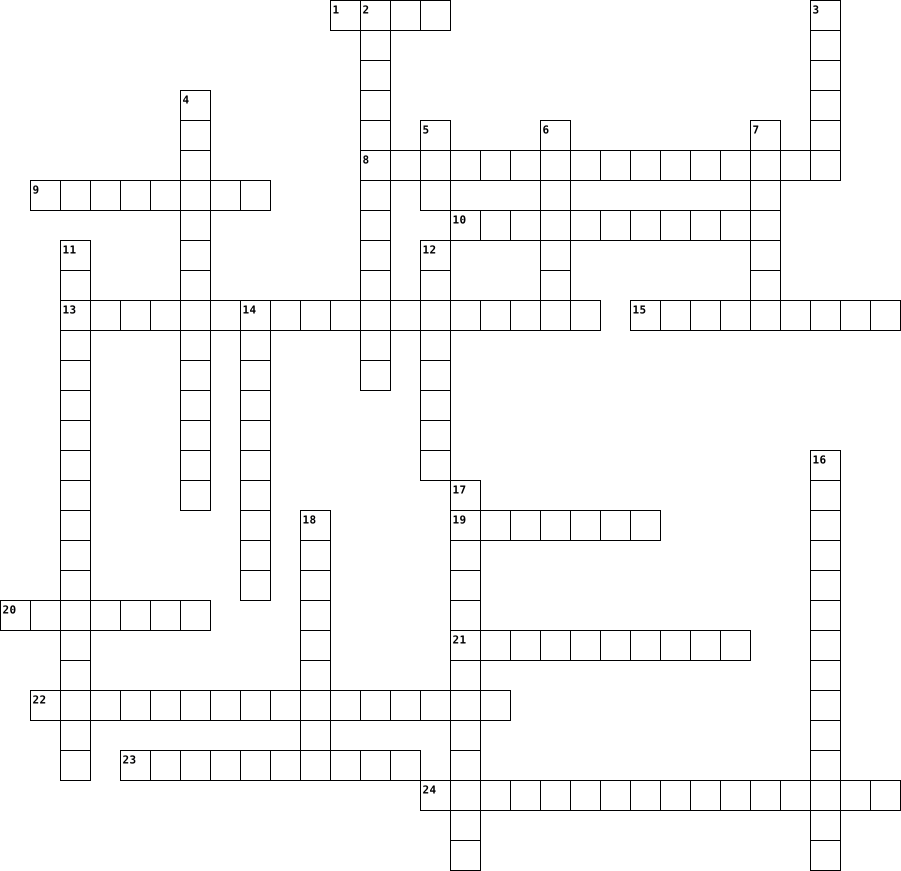
Across
- A proposed law
- Powers listed in the Constitution as belonging to the federal government.
- one of the three branches of government
- one of the three branches of government
- Authority of the People
- basic structure
- one of the seven main sections of the Constitution that describe the structure
- To bring formal charges against a federal official
- Political system in which power is divided between the national and state governments
- To obey the law, pay taxes, serve on jury duty and vote are your
- Changes to the Constitution
- Powers shared by the state and federal governments
Down
- Powers not specifically listed in the Constitution but claimed by the federal government
- these are basic freedoms, protections from unfair actions and equal treatment.
- The process by which the Supreme Court has the final authority to interpret the Constitution
- process Government must follow procedures established by law and guaranteed by the Constitution.
- A group of advisors to the president
- The total income produced from a given source
- Government principle in which power is divided among the different branches
- the introduction to important documents such as the declaration of independence and the US Constitution.
- Open and quick to take action
- Powers retained by the states
- these include freedom of speech, to assemble, and to religion
- one of the three branches of government
24 Clues: A proposed law • basic structure • Authority of the People • Changes to the Constitution • Open and quick to take action • Powers retained by the states • A group of advisors to the president • one of the three branches of government • one of the three branches of government • one of the three branches of government • The total income produced from a given source • ...
Milestone Study Guide 2023-05-04

Across
- Using money in hopes to earn more money later on
- Most populated region
- Politician who supported farmers and head of the Populist party
- Additional money to repay on top of money owed
- How are local governments funded
- A failed movement to end segregation in the pubic buses
- A juvenile hearing where a judge determines guilt or innocence
- Workers rent land,tools,animals,equipment,etc to grow crops in return for products/profit
- The General Assembly and the Lt. Governor can serve how many terms?
- Georgia's legislative branch
- Power of the governor to deny a bill
- Came to Atlanta in 1996 and boosted the economy
- Belief that equality of African Americans would take time and respect is earned
- Chairman of the SNCC
Down
- Father of the Two Ocean Navy
- Mayor council is a figure head with little power
- Large mountain chain that starts in Georgia
- 3 pillars in the Pledge. Wisdom, Justice, and ___
- To take voting rights away
- Region with the most rainfall
- the group that study and reviews the bills
- Mayor Council system form of government where the mayor has political power apart from the council
- Programs by FDR to help the US out of the Depression
23 Clues: Chairman of the SNCC • Most populated region • To take voting rights away • Father of the Two Ocean Navy • Georgia's legislative branch • Region with the most rainfall • How are local governments funded • Power of the governor to deny a bill • the group that study and reviews the bills • Large mountain chain that starts in Georgia • ...
Street Law Puzzle Ch. 1-2 2024-11-25

Across
- level of proof required to convict a person
- a county or city law
- division of power among the branches
- noncriminal lawsuit
- law that deals with private rights of individuals, groups, or businesses
- written laws enacted by legislatures
- what lawmakers meant when they wrote the law
- criminal offense punishable by a prinson sentence of 1+ year
- a pact between nations
- power of the supreme court to review laws
- the injured party in a civil case
- the first 10 amendments to the Constitution
- court decision on a legal matter that guides other decisions
- proposed law
- basic privileges a person has as a human being
- criminal offense punishable by less than one year
Down
- US laws are supreme to state/local laws
- standard of proof in a civil case
- ther person against who a claim is made
- the state or federal attorney
- asking a higher court to review a decision
- presidents power to refuse a law
- conflicting with a provision of the Constitution
- the ways branches hold one another accountable
- a court proceeding
- branch of law dealing with crimes and their punishments serious
- limits government powers to those provided by the people
- power is split between state and national government
28 Clues: proposed law • a court proceeding • noncriminal lawsuit • a county or city law • a pact between nations • the state or federal attorney • presidents power to refuse a law • standard of proof in a civil case • the injured party in a civil case • division of power among the branches • written laws enacted by legislatures • US laws are supreme to state/local laws • ...
Citizen Crossword 2020-08-19

Across
- The things that a person is entitled to
- A committee who are responsible for setting government policy
- when two or more political parties join together to form a majority in Parliament
- A person from another country who comes to this country to live
Down
- contributions to government revenue
- The things that make a person who they are, the things that make us the same as or different from other people
- the formal system of voting
- A law that has been passed
8 Clues: A law that has been passed • the formal system of voting • contributions to government revenue • The things that a person is entitled to • A committee who are responsible for setting government policy • A person from another country who comes to this country to live • when two or more political parties join together to form a majority in Parliament • ...
Australia's Parliamentary System 2018-08-23

Across
- When not following the law
- How a bill starts
- House of Representatives
- What made it hard to travel across colonies
- People who live in our country
- The very centre of any form of democracy
- The capital city of Australia
- The Crown
Down
- Upper house
- Leader of our country
- What all Citizens have to follow
- What Australia was once separated by
- The first of January 1901
- An idea which may become a law
- Represents State Territories
15 Clues: The Crown • Upper house • How a bill starts • Leader of our country • House of Representatives • The first of January 1901 • When not following the law • Represents State Territories • The capital city of Australia • An idea which may become a law • People who live in our country • What all Citizens have to follow • What Australia was once separated by • ...
Majority Leader 2021-10-26

Across
- two house legislature
- a paid representative of an interest group who contacts government officials on behalf of these interest groups
- rejection of a bill by the president
- schedules legislation to be considered on the House floor; organizes daily, weekly, and yearly legislative plans
- an official or executive ranking below and deputizing for a president.
- a temporary joint committee set up when the House and the Senate have passed different versions of the same bill
- when a political group tries to change a voting district to create a result that helps them or hurts the group who is against them.
- redistribution of seats in the U.S. House of Representatives based on changes in population.
- review pending legislation
- to make direct contact by lobbyists to persuade government officials to support the policies their interest groups favor
- a permanent committee in Congress that oversees bills that deal with certain kinds of issues
- to change, alter
- a body which uses various forms of advocacy in order to influence public opinion and/or policy.
- a situation in which no member present objects to a proposal.
- a method of defeating a bill in the Senate by stalling the legislative process and preventing a vote
- a proposed law
- a group within a standing committee that specializes in a subcategory of its standing committee’s responsibility
Down
- gives power to the government to withdraw funds from the Consolidated Fund of India for meeting the expenditure during the financial year.
- a person who holds a particular office or position
- considers all bills reported from policy and fiscal committees and determines whether, and in what order, to schedule their consideration on the floor of the House.
- a high-ranking senator of the majority party who presides over the US Senate in the absence of the vice president.
- a temporary committee formed to study one specific issue and to report its findings to the House or Senate
- a procedure that allows each senator to speak only one hour on a bill under debate
- a person who authorizes another to act in his or her behalf, as a voter in a district represented by an elected official.
- an official reprimand
- the way we change the districts that determine who represents us.
- a session at which a committee listens to testimony from people interested in the bill
- elected at the beginning of each Congress by members of their respective party conferences to represent them on the Senate floor, the majority and minority leaders serve as spokesmen for their parties' positions on the issues
- a formal discussion on a particular topic in a public meeting or legislative assembly, in which opposing arguments are put forward.
- the order in which government officials replace the president of the United States if the president leaves office before an elected successor is inaugurated.
- annual series of meetings that congress makes
- a motion placed on a bill in the Senate that alerts party leaders that if unanimous consent were to be sought, they would object
- a resolution passed in the same form by both houses
- a group of members of the United States Congress that meets to pursue common legislative objectives.
- of the House the House's presiding officer, party leader, and the institution's administrative head, among other duties.
- the minimum number of people needed to hold meetings or make decisions during certain company meetings
36 Clues: a proposed law • to change, alter • two house legislature • an official reprimand • review pending legislation • rejection of a bill by the president • annual series of meetings that congress makes • a person who holds a particular office or position • a resolution passed in the same form by both houses • a situation in which no member present objects to a proposal. • ...
The Government Crossword 2018-05-31

Across
- The area represented by one member of parliament
- The ruler rules over a country by themselves, usually by force
- There are no leaders, everyone has complete freedom
- An independent state or community, especially a democratic republic
- The ruler is from a royal family
- A system of government
- They introduce a proposed law
- A general vote by the electorate on a single political question which has been referred to them for a direct decision
- Relating or restricted to a particular area or one’s neighbourhood
- Having or relating to a system of government in which several states from a unity but remain independent in internal affairs
Down
- A proposed law
- A person who is professionally in politics
- The head of an elected government; the principal minister of a sovereign or state
- A rule for the country or continent
- Where they make laws
- The person signs and gives the Royal scent to make the bill a law
- Our current prime minister
- A group of people with the authority to govern a country or state; a particular ministry in office
- A nation or territory considered as an organised political community
- They decide if the bill should become a law
20 Clues: A proposed law • Where they make laws • A system of government • Our current prime minister • They introduce a proposed law • The ruler is from a royal family • A rule for the country or continent • A person who is professionally in politics • They decide if the bill should become a law • The area represented by one member of parliament • ...
Unit 5 AP Gov Vocab 2025-02-25

Across
- when Congress adjourns 10 day within submitting a bill
- program added to the Social Security system that provides health insurance
- excess of federal expenditures over federal revenues.
- what a law starts out as
- individuals who already hold office
- a hierarchical authority structure that uses task specialization, operates on the merit principle, and behaves with impersonality.
- jobs and promotions are awarded for political reasons rather than for merit or competence.
- resolution requiring POTUS to consult w Congress prior to using military force
- federal projects, grants and contracts available to state and local governments
- financial resources of the government
Down
- presidential "arrest"
- most important committee to be on, reviews bills
- policy document allocating burdens (taxes) and benefits (expenditures).
- group of presidential advisers
- used to stall discussion in the senate
- Prohibiting government employees from active participation in partisan politics while on duty.
- shares of individual wages and corporate revenues collected by the government
- hiring and promotion based on the merit principle and the desire to create a nonpartisan government service.
- presidential power of denying a bill
- use of governmental authority to control or change some practice in the private sector.
20 Clues: presidential "arrest" • what a law starts out as • group of presidential advisers • individuals who already hold office • presidential power of denying a bill • financial resources of the government • used to stall discussion in the senate • most important committee to be on, reviews bills • excess of federal expenditures over federal revenues. • ...
Constitutional Law Midterm Extra Credit 2025-03-01

Across
- The highest standard of judicial review used to evaluate laws affecting fundamental rights or suspect classifications.
- A separate opinion written by a justice who disagrees with the majority’s decision.
- An opinion that agrees with the majority outcome but offers different reasoning.
- Clause A provision in Article I, Section 8 of the Constitution granting Congress the power to regulate interstate commerce.
- The legal principle that determines whether a party has the right to bring a case to court.
- A philosophy emphasizing limited judicial intervention and deference to legislative decisions.
- A criterion for determining whether a court can review a case, focusing on whether the issue is ready for judicial resolution.
- A constitutional guarantee that no individual or group will be denied the same protection under the law as others.
- A philosophy where judges are more willing to interpret the Constitution broadly and overturn laws.
- A judicial decision that serves as a rule or guide for future cases with similar issues.
- A system of government where power is divided between national and state governments.
- A criterion used to dismiss cases that no longer require resolution.
- A constitutional guarantee of fair legal procedures before the government can deprive a person of life, liberty, or property.
- The principle that government authority is derived from and limited by a constitution.
- A "friend of the court" brief submitted by a non-party to provide additional information or arguments.
Down
- The doctrine of adhering to precedent in judicial decision-making.
- The lowest level of judicial scrutiny, where laws are upheld if they are reasonably related to a legitimate government interest.
- The power of courts to assess whether a law or government action is in compliance with the Constitution.
- An order issued by the Supreme Court to review a lower court’s decision.
- Clause A provision in the First Amendment prohibiting the government from establishing an official religion.
- A provision in the First Amendment protecting individuals’ rights to practice their religion freely.
- The process through which provisions of the Bill of Rights are applied to the states through the Fourteenth Amendment.
- The official decision of the court that reflects the views of the majority of justices.
- The division of governmental authority among the legislative, executive, and judicial branches.
24 Clues: The doctrine of adhering to precedent in judicial decision-making. • A criterion used to dismiss cases that no longer require resolution. • An order issued by the Supreme Court to review a lower court’s decision. • An opinion that agrees with the majority outcome but offers different reasoning. • ...
Topic 4 Lession 6 2018-04-04

Across
- a proposed law presented to a legislative body for consideration
- a procedure to limit or end floor debate, especially during a filibuster
- fewest number of members who must be present for a legislative body to conduct business; majority
- chief executive's power to reject a bill passed by a legislature; literally (Latin) "I forbid"
- a statement of position on an issue used by the House and Senate acting jointly; does not have the force of law and does not require the President's signature
- a proposal for action that has the force of law when passed; usually deals with special circumstances or temporary matters
- unpopular provision added to an important bill certain to pass so it will "ride" through the legislative process
Down
- enables members to force a bill that has remained in committee 30 days (7 for the Rules Committee) onto the floor for consideration
- a stalling tactic in which senators monopolize the Senate floor with talk and other delays so a bill cannot be brought to a vote
- type of veto a chief executive may use after a legislature has adjourned; when the chief executive does not sign or reject a bill within the time allowed to do so
- a bill printed in its final form
11 Clues: a bill printed in its final form • a proposed law presented to a legislative body for consideration • a procedure to limit or end floor debate, especially during a filibuster • chief executive's power to reject a bill passed by a legislature; literally (Latin) "I forbid" • ...
Civil Rights Movement Crossword! 2017-03-22

Across
- The practice of discriminating against and segregating Black people in the South
- This president called for federal civil rights legislation before he was assassinated
- This leader popularized the term "Black Power"
- She began the Montgomery Bus Boycott from refusing to move her seat
- This civil rights leader lead the Montgomery Bus Boycott and later won the Nobel Peace Prize in 1964
- This Civil Rights lawyer defended Brown
- The ___________ Act of 1965 outlawed discriminatory voting practices
- Usually associated with hanging, African Americans were subject to this in the deep south
- The ___________v. Board of Ed. declared segregated schools unconstitutional
- Ratified in 1964, this amendment ended poll taxes
- the Civil Rights group that Martin Luther King Jr. was most heavily associated with that was very active in organizing demonstrations
- Nine black students enrolled here after desegregation
- Leaders of this student group led sit-ins in Greensboro; shock - troops
- Civil Rights group founded by James Farmer, its aim was to work for racial equality and even trained people on how to be nonviolent
- teacher who bravely taught elementary students about racism with eye color
- Term for the keeping of races and ethnic groups apart
Down
- often known as most racist southern city in America that was home to unrest with Civil Rights Movement
- This young black teen was killed for whistling at a white woman in Mississippi
- the type of segregation by behavior, habit or inherent racism
- name for group of demonstrators who rode busses into racist parts of the South
- Martin Luther King Jr. gave his famous "I Have a Dream" Speech at the March on
- The __________ Act of 1964 outlawed discrimination
- Bobby Seale and Huey Newton founded the ___________________ to fight for total equality
- brave educated white woman who convinced Mayor West to desecrate the counters in Nashville, Tennessee.
- a special type of test that assessed whether or not blacks were worthy enough to vote
- the movement of ending segregated facilities and accommodations
- Made "The Great Society" agenda to implement federal civil rights
- This African American Civil Rights activist was a member of the Nation of Islam before breaking from it
- the type of segregation by law or the justice system
- This national organization was founded in 1909 for racial equality
30 Clues: This Civil Rights lawyer defended Brown • This leader popularized the term "Black Power" • Ratified in 1964, this amendment ended poll taxes • The __________ Act of 1964 outlawed discrimination • the type of segregation by law or the justice system • Nine black students enrolled here after desegregation • Term for the keeping of races and ethnic groups apart • ...
Civil Rights Movement Crossword! 2017-03-22

Across
- teacher who bravely taught elementary students about racism with eye color
- Nine black students enrolled here after desegregation
- Martin Luther King Jr. gave his famous "I Have a Dream" Speech at the March on
- Civil Rights group founded by James Farmer, its aim was to work for racial equality and even trained people on how to be nonviolent
- This president called for federal civil rights legislation before he was assassinated
- Usually associated with hanging, African Americans were subject to this in the deep south
- This Civil Rights lawyer defended Brown
- Ratified in 1964, this amendment ended poll taxes
- The ___________ Act of 1965 outlawed discriminatory voting practices
- The __________ Act of 1964 outlawed discrimination
- Leaders of this student group led sit-ins in Greensboro; shock - troops
- often known as most racist southern city in America that was home to unrest with Civil Rights Movement
- This African American Civil Rights activist was a member of the Nation of Islam before breaking from it
Down
- the type of segregation by behavior, habit or inherent racism
- name for group of demonstrators who rode busses into racist parts of the South
- brave educated white woman who convinced Mayor West to desecrate the counters in Nashville, Tennessee.
- the type of segregation by law or the justice system
- This civil rights leader lead the Montgomery Bus Boycott and later won the Nobel Peace Prize in 1964
- a special type of test that assessed whether or not blacks were worthy enough to vote
- Bobby Seale and Huey Newton founded the ___________________ to fight for total equality
- The ___________v. Board of Ed. declared segregated schools unconstitutional
- This leader popularized the term "Black Power"
- the movement of ending segregated facilities and accommodations
- This young black teen was killed for whistling at a white woman in Mississippi
- Term for the keeping of races and ethnic groups apart
- This national organization was founded in 1909 for racial equality
- Made "The Great Society" agenda to implement federal civil rights
- The practice of discriminating against and segregating Black people in the South
- She began the Montgomery Bus Boycott from refusing to move her seat
- the Civil Rights group that Martin Luther King Jr. was most heavily associated with that was very active in organizing demonstrations
30 Clues: This Civil Rights lawyer defended Brown • This leader popularized the term "Black Power" • Ratified in 1964, this amendment ended poll taxes • The __________ Act of 1964 outlawed discrimination • the type of segregation by law or the justice system • Nine black students enrolled here after desegregation • Term for the keeping of races and ethnic groups apart • ...
Civil Rights Movement Crossword! 2017-03-22

Across
- This civil rights leader lead the Montgomery Bus Boycott and later won the Nobel Peace Prize in 1964
- Bobby Seale and Huey Newton founded the ___________________ to fight for total equality
- The ___________v. Board of Ed. declared segregated schools unconstitutional
- the Civil Rights group that Martin Luther King Jr. was most heavily associated with that was very active in organizing demonstrations
- Made "The Great Society" agenda to implement federal civil rights
- a special type of test that assessed whether or not blacks were worthy enough to vote
- Leaders of this student group led sit-ins in Greensboro; shock - troops
- the type of segregation by law or the justice system
- the movement of ending segregated facilities and accommodations
- name for group of demonstrators who rode busses into racist parts of the South
- Usually associated with hanging, African Americans were subject to this in the deep south
- often known as most racist southern city in America that was home to unrest with Civil Rights Movement
- This African American Civil Rights activist was a member of the Nation of Islam before breaking from it
- The ___________ Act of 1965 outlawed discriminatory voting practices
- Martin Luther King Jr. gave his famous "I Have a Dream" Speech at the March on
- brave educated white woman who convinced Mayor West to desecrate the counters in Nashville, Tennessee.
Down
- Nine black students enrolled here after desegregation
- She began the Montgomery Bus Boycott from refusing to move her seat
- Ratified in 1964, this amendment ended poll taxes
- the type of segregation by behavior, habit or inherent racism
- teacher who bravely taught elementary students about racism with eye color
- This president called for federal civil rights legislation before he was assassinated
- Civil Rights group founded by James Farmer, its aim was to work for racial equality and even trained people on how to be nonviolent
- This Civil Rights lawyer defended Brown
- The practice of discriminating against and segregating Black people in the South
- This leader popularized the term "Black Power"
- Term for the keeping of races and ethnic groups apart
- The __________ Act of 1964 outlawed discrimination
- This young black teen was killed for whistling at a white woman in Mississippi
- This national organization was founded in 1909 for racial equality
30 Clues: This Civil Rights lawyer defended Brown • This leader popularized the term "Black Power" • Ratified in 1964, this amendment ended poll taxes • The __________ Act of 1964 outlawed discrimination • the type of segregation by law or the justice system • Nine black students enrolled here after desegregation • Term for the keeping of races and ethnic groups apart • ...
Civil Rights Movement Crossword! 2017-03-22

Across
- This national organization was founded in 1909 for racial equality
- often known as most racist southern city in America that was home to unrest with Civil Rights Movement
- The ___________ Act of 1965 outlawed discriminatory voting practices
- Bobby Seale and Huey Newton founded the ___________________ to fight for total equality
- Usually associated with hanging, African Americans were subject to this in the deep south
- This African American Civil Rights activist was a member of the Nation of Islam before breaking from it
- the movement of ending segregated facilities and accommodations
- The practice of discriminating against and segregating Black people in the South
- a special type of test that assessed whether or not blacks were worthy enough to vote
- This leader popularized the term "Black Power"
- the Civil Rights group that Martin Luther King Jr. was most heavily associated with that was very active in organizing demonstrations
- name for group of demonstrators who rode busses into racist parts of the South
- the type of segregation by behavior, habit or inherent racism
- Nine black students enrolled here after desegregation
- This president called for federal civil rights legislation before he was assassinated
- Civil Rights group founded by James Farmer, its aim was to work for racial equality and even trained people on how to be nonviolent
Down
- Martin Luther King Jr. gave his famous "I Have a Dream" Speech at the March on
- brave educated white woman who convinced Mayor West to desecrate the counters in Nashville, Tennessee.
- The ___________v. Board of Ed. declared segregated schools unconstitutional
- The __________ Act of 1964 outlawed discrimination
- Ratified in 1964, this amendment ended poll taxes
- This civil rights leader lead the Montgomery Bus Boycott and later won the Nobel Peace Prize in 1964
- This Civil Rights lawyer defended Brown
- This young black teen was killed for whistling at a white woman in Mississippi
- Leaders of this student group led sit-ins in Greensboro; shock - troops
- Term for the keeping of races and ethnic groups apart
- She began the Montgomery Bus Boycott from refusing to move her seat
- the type of segregation by law or the justice system
- Made "The Great Society" agenda to implement federal civil rights
- teacher who bravely taught elementary students about racism with eye color
30 Clues: This Civil Rights lawyer defended Brown • This leader popularized the term "Black Power" • Ratified in 1964, this amendment ended poll taxes • The __________ Act of 1964 outlawed discrimination • the type of segregation by law or the justice system • Term for the keeping of races and ethnic groups apart • Nine black students enrolled here after desegregation • ...
Topic 8: Protecting Civil Liberties 2025-10-29

Across
- – The right to join groups or organizations freely.
- – Illegally obtained evidence can’t be used in court.
- – A formal request to the government.
- – Actions that express ideas without words.
- – Law that punishes without a trial.
- – Standard for judging limits on freedom of speech.
- – Betraying one’s country by aiding its enemies.
- – Protesting outside a place to express a viewpoint.
- – The death penalty.
- – Formal charge issued by a grand jury.
- – Written false statements that harm someone’s reputation.
- – Encouraging rebellion against the government.
- – Government action stopping speech before it’s made.
- – Protects people’s right to practice their religion freely.
- – Group deciding if enough evidence exists to charge someone.
- – Standard to judge if a law violates the Establishment Clause.
- – Being tried twice for the same crime.
- – Forced labor without consent.
- – A court order to stop or require an action.
- – Trial with only a judge, no jury.
- – Protects reporters from revealing confidential sources.
- – French writer who studied American democracy.
- – Fair legal procedures and treatment.
- – Bans government from setting up a national religion.
Down
- – Peaceful refusal to obey unjust laws.
- – Holding an accused person to prevent them from fleeing or committing crimes.
- – Formal accusation by a grand jury on its own initiative.
- – The first ten amendments guaranteeing individual freedoms.
- – Court order allowing a search of property.
- – Protects against unfair treatment by the government.
- – Reasonable belief that a crime has been committed.
- – A person living in a country who is not a citizen.
- – State power to protect public safety and welfare.
- – Formal charge by a prosecutor without a grand jury.
- – Rights that ensure equal treatment under the law.
- – General search warrants used by British officials.
- – The methods used must be fair.
- – To gather peacefully for meetings or protests.
- – Court order requiring a prisoner to be brought before a judge.
- – Applying the Bill of Rights to the states through the 14th Amendment.
- – Money paid to ensure a person returns for trial.
- – Requires police to inform suspects of their rights.
- – Government power to take private property for public use with payment.
- – Basic rights that protect individuals from government actions.
- – Spoken false statements that harm someone’s reputation.
- – Related to a church or religious school.
- – Speech urging resistance to lawful authority.
- – The laws themselves must be fair.
- – Unfair treatment based on differences like race or gender.
- – Laws that apply to all speech regardless of message.
- – Law that punishes actions that were legal when done.
51 Clues: – The death penalty. • – Forced labor without consent. • – The methods used must be fair. • – The laws themselves must be fair. • – Trial with only a judge, no jury. • – Law that punishes without a trial. • – A formal request to the government. • – Fair legal procedures and treatment. • – Peaceful refusal to obey unjust laws. • – Formal charge issued by a grand jury. • ...
En 9 Amerikansk vs. Brittisk engelska 2024-10-11

Across
- petrol (BrE)
- note (BrE)
- chemist's (BrE)
- taxi (BrE)
- motorway (BrE)
- lift (BrE)
- autumn (BrE)
- biscuit (BrE)
- lorry (BrE)
- handbag (BrE)
- bill (BrE)
Down
- cinema (BrE)
- tap (BrE)
- sweets (BrE)
- underground/tube (BrE)
- queue (BrE)
- pavement (BrE)
- flat (BrE)
- chips (BrE)
- rucksack (BrE)
20 Clues: tap (BrE) • note (BrE) • taxi (BrE) • flat (BrE) • lift (BrE) • bill (BrE) • queue (BrE) • chips (BrE) • lorry (BrE) • cinema (BrE) • petrol (BrE) • sweets (BrE) • autumn (BrE) • biscuit (BrE) • handbag (BrE) • pavement (BrE) • motorway (BrE) • rucksack (BrE) • chemist's (BrE) • underground/tube (BrE)
Constitution and Bill of Rights 2022-05-20

Across
- a body of fundamental principles or established precedents according to which a state or other organization is acknowledged to be governed.
- a body of people (typically twelve in number) sworn to give a verdict in a legal case on the basis of evidence submitted to them in court.
Down
- the process of altering or amending a law or document (such as a constitution) by parliamentary or constitutional procedure rights that were granted by amendment of the Constitution.
- the first ten amendments to the US Constitution, ratified in 1791 and guaranteeing such rights as the freedoms of speech, assembly, and worship.
- the system or group of people governing an organized community, generally a state.
5 Clues: the system or group of people governing an organized community, generally a state. • a body of people (typically twelve in number) sworn to give a verdict in a legal case on the basis of evidence submitted to them in court. • ...
Bill of Rights/Responsibilities Voab 2025-04-14

Across
- The government must act fairly and in accord with established rules in all that it does.
- A power or privilege held by the general public as the result of a constitution, statute, regulation, judicial precedent or other type of law.
- A change in, or addition to, a construction or law.
Down
- A statement (found in Article 6 of the Constitution) that specifies that the Constitution and all federal laws/treaties take priority over state laws.
- A court order, or making legal, some official action, such as a search warrant or an arrest warrant.
5 Clues: A change in, or addition to, a construction or law. • The government must act fairly and in accord with established rules in all that it does. • A court order, or making legal, some official action, such as a search warrant or an arrest warrant. • ...
Government Crossword 2026-05-11

Across
- the other house of the United States Congress.,
- the official residence of the president of the United States.,
- a fair leader in a courtroom who makes decisions based on the law.,
- the founding document that announced the 13 American colonies were breaking away from Great Britain to form the United States.,
- a proposed idea for a new law that has been written down but not yet officially approved.,
- a list of the first ten amendments (changes or additions) to the U.S. Constitution that guarantees fundamental freedoms and protects individual rights from government interference.,
- the authority given to leaders to make rules (laws), keep people safe, and manage a country, state, or city.,
- an official change, addition, or improvement made to an important document, such as a law or the U.S. Constitution.,
Down
- when politicians draw weird-shaped voting district lines to help their political party win more elections, regardless of how people actually vote.,
- the highest set of rules for a country, acting as a guidebook for how the government works and protecting the rights of citizens.,
- a set of rules made by the government that everyone in a community, city, or country must follow to stay safe and treat each other fairly.,
- the part of government that enforces and carries out laws.,
- one of the two parts of the United States Congress .,
- the part of government that interprets laws, applies them to real-life situations, and decides if laws break the rules of the U.S. Constitution.,
- a special power that allows a leader to say "no" to a new rule or law, stopping it from happening.,
- the part of government that makes laws for the country.,
16 Clues: the other house of the United States Congress., • one of the two parts of the United States Congress ., • the part of government that makes laws for the country., • the part of government that enforces and carries out laws., • the official residence of the president of the United States., • a fair leader in a courtroom who makes decisions based on the law., • ...
The Enlightenment 2022-10-18

Across
- English philosopher
- basic principles of a place under government
- John Locke's idea on natural rights, government, and people
- sequence of events that led to the deposition of King James II
- belief in the existence of a supreme being that does not intervene with the universe
- French enlightenment writer
- rights you are born with, life, liberty, and property
- Female British writer and womans rights activist
Down
- an age of intellectual and philosophical movements in Europe
- English philosopher, known for his idea of Social Contract
- commitment to traditional ideas and unwillingness to accept newer ideas
- political and social philosophy
- advocacy of women's rights and equality among men and women
- a movement to help women gain rights to vote
- The idea/movement to end slavery
15 Clues: English philosopher • French enlightenment writer • political and social philosophy • The idea/movement to end slavery • basic principles of a place under government • a movement to help women gain rights to vote • Female British writer and womans rights activist • rights you are born with, life, liberty, and property • ...
Congress Crossword 2026-05-14

Across
- Most powerful leadership position in the Senate
- Leader of the House of Representatives
- Proposed law
- President of the Senate
- Senate process of approving many of the president’s judicial nominees
Down
- Small group where bills are studied and revised
- Power of courts to declare laws or government actions unconstitutional
- House ________ committee that controls debate and amendment rules for bills
- Presidential rejection of a bill
- Senate tactic used to delay or block a vote
- President ________, the senator who presides over the Senate in the VP’s absence
- ________ committee that resolves differences between House and Senate versions of a bill
12 Clues: Proposed law • President of the Senate • Presidential rejection of a bill • Leader of the House of Representatives • Senate tactic used to delay or block a vote • Small group where bills are studied and revised • Most powerful leadership position in the Senate • Senate process of approving many of the president’s judicial nominees • ...
GO ASK ALICE CROSSWORD 2023-03-28

Across
- "Ms. Ivanicki is a _________"
- Roger is going to what kind of school?
- what is the first drug Alice tries?
- What is Alice's fathers occupation?
- Beth is a __________ girl
- Who does Alice lose her virginity too?
- How many kids did Bill have over at his house?
- What beverage does Alice take drugs from?
- Who is Alice's first love?
- "Remember I told you I had a date with Bill? Well he introduced to ______ on Friday."
Down
- The boy Beth fixes Alice up with
- Page 49 "_________ are the greatest!"
- Who wrote this diary?
- What is Alice's brother's name?
- Alice's parents say she starts looking like a-
- "It finally happened diary, I finally got my ____"
- For Christmas Alice gives her mother...
17 Clues: Who wrote this diary? • Beth is a __________ girl • Who is Alice's first love? • "Ms. Ivanicki is a _________" • What is Alice's brother's name? • The boy Beth fixes Alice up with • what is the first drug Alice tries? • What is Alice's fathers occupation? • Page 49 "_________ are the greatest!" • Roger is going to what kind of school? • Who does Alice lose her virginity too? • ...
Legislative Branch Crossword 2025-02-27

Across
- Concentrating voters in a few districts to lower the amount of seats they gain.
- 435 members of one part of congress
- A group of congressmen that focus on one specific topic
- The two ____________ of congress
- A law before it becomes a law
- The president does this when he does not want to sign a bill
- Manipulating electoral districts to give one party an advantage over another
Down
- The process of removing a federal official
- The type of Congress we have
- The second part of congress that has only 100 members
- Ignoring a bill to kill it
- Congress sets the rules for citizenship, also known as:
- Spreading voters across multiple districts so they cannot gain a majority
- Smaller groups that focus on specific issues
14 Clues: Ignoring a bill to kill it • The type of Congress we have • A law before it becomes a law • The two ____________ of congress • 435 members of one part of congress • The process of removing a federal official • Smaller groups that focus on specific issues • The second part of congress that has only 100 members • Congress sets the rules for citizenship, also known as: • ...
Bill of Rights 2023-11-27

Across
- freedom of speech
Down
- biased jury
- housing citizens
3 Clues: biased jury • housing citizens • freedom of speech
Bill Of Rights 2023-05-27

Across
- tax
- jury
Down
- trial
3 Clues: tax • jury • trial
Bill of rights 2024-11-12

Across
- cause to be suffered by someone else
- known for something bad
Down
- The right of people to keep and bear arms shall not be infringed
3 Clues: known for something bad • cause to be suffered by someone else • The right of people to keep and bear arms shall not be infringed
Government Crossword 2024-07-30

Across
- Has an Upper Version
- American President Works Here
- TRUMP SUPPORTERS
- Made out of a bill
- Has a lower version
- Red place for government
- We _____ for a new PM
- We pick a new PM from an ___
- First word of the title
Down
- Petition for a new law
- A.C.T for short :3
- Selection of PM
- Runs a country
- A vote for something is a _______
- Building
15 Clues: Building • Runs a country • Selection of PM • TRUMP SUPPORTERS • A.C.T for short :3 • Made out of a bill • Has a lower version • Has an Upper Version • We _____ for a new PM • Petition for a new law • First word of the title • Red place for government • We pick a new PM from an ___ • American President Works Here • A vote for something is a _______
civics 2025-09-16

Across
- Rights: Rights of citizens.
- of Speech: The right to not be censored.
- of a Citizen: What a citizen should do to support the community.
- Equal treatment of citizens.
- of a Citizen: What a citizen must do to ensure the nation remains fair and just.
- A system of government by the whole population or all the eligible members of a state.
- Branch: Judges.
Down
- An institution formed to regulate the behaviors of its populace.
- Branch: Lawmakers.
- An oppressive government
- An introductory statement in a document that explains its purpose and underlying philosophy.
- of the Governed: All government decisions have to be approved by the citizens.
- Contract: The balance of power between government and governed.
- Unalienable liberties.
- Branch: Law enforcement.
- Someone born or naturalized in a nation.
- of Powers: Separation of government into equal branches.
- Process: fair treatment through the normal judicial system, especially as a citizen's entitlement.
- Liberties: Citizens' rights not to be oppressed by the government.
19 Clues: Branch: Judges. • Branch: Lawmakers. • Unalienable liberties. • An oppressive government • Branch: Law enforcement. • Rights: Rights of citizens. • Equal treatment of citizens. • of Speech: The right to not be censored. • Someone born or naturalized in a nation. • of Powers: Separation of government into equal branches. • ...
Government Vocab Crossword 2024-02-02

Across
- a group of presidential advisors not mentioned in the constitution, although every president has one
- a resolution binding congress to a total expenditure level, supposedly the bottom line of all federal spending for all programs
- a 1935 law intended to provide a minimal level of sustenance to older americans and thus save them from poverty
- a proposed law drafted in legal language
- ratified in 1951, this amendment limits the president to two terms of office
- congressional committees appointed for a specific purpose
- an excess of federal expenditures over federal revenues
- a strategy unique to the senate whereby opponents of a piece of legislation use their right to unlimited debate to prevent the senate from voting on a bill
- the political equivalent of an indictment in criminal law, presided by the constitution
Down
- a three member body appointed by the president to advise the president on economic policy
- those already holding office
- a policy document allocating burdens and benefits
- party leaders who work with the majority leader or minority leader to count votes beforehand and lean on waverers whose votes are crucial to a bill favored by the party
- a vote in congress to override a presidential decision
- the constitution's power of the president to send a bill back to congress with reasons for registering it
- government spending. major areas of federal spending are social services and national defense
- the principal leader of the minority party in the house of representatives or in the senate
17 Clues: those already holding office • a proposed law drafted in legal language • a policy document allocating burdens and benefits • a vote in congress to override a presidential decision • an excess of federal expenditures over federal revenues • congressional committees appointed for a specific purpose • ...
Stamped: Crossword Puzzle 2023-03-31

Across
- 3rd President of the United States and held 200 people as property.
- A person who only likes you if you're like them.
- 16th President of the United States.
- A campaign created by Martin Luther King to bring poor people to Washington D.C to make the government pass an economic bill of rights.
- A person who believes that everyone is equal, no matter their race.
- President of the Confederate States of America.
- A strategy where black people lived like white people to "deserve" their freedom.
Down
- Wrote Memorable Providences Relating to Witchcraft and possessions.
- An anti-racist activist who was a professor at the University of California, Santa Cruz.
- Someone who won't like you beacuse of your race, no matter what.
10 Clues: 16th President of the United States. • President of the Confederate States of America. • A person who only likes you if you're like them. • Someone who won't like you beacuse of your race, no matter what. • Wrote Memorable Providences Relating to Witchcraft and possessions. • 3rd President of the United States and held 200 people as property. • ...
Founding Fathers, No. 2 2024-10-24

Across
- first president to live in the white house, painted after it burned, famous doctrine
- this founding father started the Sons of liberty
- known as the Father of the Constitution and drafter of the Bill of Rights
- this founding father was the oldest delegate, ambassador to France
- served as a diplomat in France, Vice President to John Adams, 3rd President
- founder of the US Navy, 2nd President, only President to be a Federalist party member
Down
- commander-in-chief of the Continental Army, 1st President
- Wrote a pamphlet, Common Sense, supporting the opinion that America should be free
- served as the first US Secretary of the Treasury, killed in a duel by Aaron Burr
- famous for his, Give me Liberty or Give me Death speech
10 Clues: this founding father started the Sons of liberty • famous for his, Give me Liberty or Give me Death speech • commander-in-chief of the Continental Army, 1st President • this founding father was the oldest delegate, ambassador to France • known as the Father of the Constitution and drafter of the Bill of Rights • ...
Civil Rights Movement Crossword! 2017-03-22

Across
- the type of segregation by behavior, habit or inherent racism
- This Civil Rights lawyer defended Brown
- Usually associated with hanging, African Americans were subject to this in the deep south
- This young black teen was killed for whistling at a white woman in Mississippi
- Civil Rights group founded by James Farmer, its aim was to work for racial equality and even trained people on how to be nonviolent
- The practice of discriminating against and segregating Black people in the South
- Made "The Great Society" agenda to implement federal civil rights
- Martin Luther King Jr. gave his famous "I Have a Dream" Speech at the March on
- This civil rights leader lead the Montgomery Bus Boycott and later won the Nobel Peace Prize in 1964
- Ratified in 1964, this amendment ended poll taxes
- She began the Montgomery Bus Boycott from refusing to move her seat
- The __________ Act of 1964 outlawed discrimination
- Leaders of this student group led sit-ins in Greensboro; shock - troops
- Term for the keeping of races and ethnic groups apart
- This African American Civil Rights activist was a member of the Nation of Islam before breaking from it
Down
- This president called for federal civil rights legislation before he was assassinated
- the type of segregation by law or the justice system
- Bobby Seale and Huey Newton founded the ___________________ to fight for total equality
- name for group of demonstrators who rode busses into racist parts of the South
- The ___________ Act of 1965 outlawed discriminatory voting practices
- the movement of ending segregated facilities and accommodations
- Nine black students enrolled here after desegregation
- the Civil Rights group that Martin Luther King Jr. was most heavily associated with that was very active in organizing demonstrations
- a special type of test that assessed whether or not blacks were worthy enough to vote
- This leader popularized the term "Black Power"
- The ___________v. Board of Ed. declared segregated schools unconstitutional
- often known as most racist southern city in America that was home to unrest with Civil Rights Movement
- This national organization was founded in 1909 for racial equality
- brave educated white woman who convinced Mayor West to desecrate the counters in Nashville, Tennessee.
- teacher who bravely taught elementary students about racism with eye color
30 Clues: This Civil Rights lawyer defended Brown • This leader popularized the term "Black Power" • Ratified in 1964, this amendment ended poll taxes • The __________ Act of 1964 outlawed discrimination • the type of segregation by law or the justice system • Nine black students enrolled here after desegregation • Term for the keeping of races and ethnic groups apart • ...
Civil Rights Movement Crossword! 2017-03-22

Across
- The practice of discriminating against and segregating Black people in the South
- This African American Civil Rights activist was a member of the Nation of Islam before breaking from it
- This civil rights leader lead the Montgomery Bus Boycott and later won the Nobel Peace Prize in 1964
- Martin Luther King Jr. gave his famous "I Have a Dream" Speech at the March on
- the movement of ending segregated facilities and accommodations
- The ___________v. Board of Ed. declared segregated schools unconstitutional
- This Civil Rights lawyer defended Brown
- The ___________ Act of 1965 outlawed discriminatory voting practices
- This national organization was founded in 1909 for racial equality
- Bobby Seale and Huey Newton founded the ___________________ to fight for total equality
- Usually associated with hanging, African Americans were subject to this in the deep south
- Civil Rights group founded by James Farmer, its aim was to work for racial equality and even trained people on how to be nonviolent
- Term for the keeping of races and ethnic groups apart
- This president called for federal civil rights legislation before he was assassinated
Down
- often known as most racist southern city in America that was home to unrest with Civil Rights Movement
- She began the Montgomery Bus Boycott from refusing to move her seat
- Ratified in 1964, this amendment ended poll taxes
- Made "The Great Society" agenda to implement federal civil rights
- the type of segregation by law or the justice system
- name for group of demonstrators who rode busses into racist parts of the South
- brave educated white woman who convinced Mayor West to desecrate the counters in Nashville, Tennessee.
- a special type of test that assessed whether or not blacks were worthy enough to vote
- teacher who bravely taught elementary students about racism with eye color
- This young black teen was killed for whistling at a white woman in Mississippi
- Nine black students enrolled here after desegregation
- The __________ Act of 1964 outlawed discrimination
- Leaders of this student group led sit-ins in Greensboro; shock - troops
- the Civil Rights group that Martin Luther King Jr. was most heavily associated with that was very active in organizing demonstrations
- This leader popularized the term "Black Power"
- the type of segregation by behavior, habit or inherent racism
30 Clues: This Civil Rights lawyer defended Brown • This leader popularized the term "Black Power" • Ratified in 1964, this amendment ended poll taxes • The __________ Act of 1964 outlawed discrimination • the type of segregation by law or the justice system • Nine black students enrolled here after desegregation • Term for the keeping of races and ethnic groups apart • ...
Civil Rights Movement Crossword! 2017-03-22

Across
- the Civil Rights group that Martin Luther King Jr. was most heavily associated with that was very active in organizing demonstrations
- often known as most racist southern city in America that was home to unrest with Civil Rights Movement
- Civil Rights group founded by James Farmer, its aim was to work for racial equality and even trained people on how to be nonviolent
- This young black teen was killed for whistling at a white woman in Mississippi
- teacher who bravely taught elementary students about racism with eye color
- The ___________ Act of 1965 outlawed discriminatory voting practices
- the type of segregation by behavior, habit or inherent racism
- a special type of test that assessed whether or not blacks were worthy enough to vote
- Leaders of this student group led sit-ins in Greensboro; shock - troops
- The practice of discriminating against and segregating Black people in the South
- the movement of ending segregated facilities and accommodations
- This national organization was founded in 1909 for racial equality
- Bobby Seale and Huey Newton founded the ___________________ to fight for total equality
- brave educated white woman who convinced Mayor West to desecrate the counters in Nashville, Tennessee.
- This Civil Rights lawyer defended Brown
Down
- Term for the keeping of races and ethnic groups apart
- The __________ Act of 1964 outlawed discrimination
- The ___________v. Board of Ed. declared segregated schools unconstitutional
- Usually associated with hanging, African Americans were subject to this in the deep south
- Ratified in 1964, this amendment ended poll taxes
- Nine black students enrolled here after desegregation
- This African American Civil Rights activist was a member of the Nation of Islam before breaking from it
- name for group of demonstrators who rode busses into racist parts of the South
- Martin Luther King Jr. gave his famous "I Have a Dream" Speech at the March on
- the type of segregation by law or the justice system
- This president called for federal civil rights legislation before he was assassinated
- This leader popularized the term "Black Power"
- Made "The Great Society" agenda to implement federal civil rights
- This civil rights leader lead the Montgomery Bus Boycott and later won the Nobel Peace Prize in 1964
- She began the Montgomery Bus Boycott from refusing to move her seat
30 Clues: This Civil Rights lawyer defended Brown • This leader popularized the term "Black Power" • Ratified in 1964, this amendment ended poll taxes • The __________ Act of 1964 outlawed discrimination • the type of segregation by law or the justice system • Term for the keeping of races and ethnic groups apart • Nine black students enrolled here after desegregation • ...
Civil Rights Movement Crossword! 2017-03-22

Across
- This national organization was founded in 1909 for racial equality
- the Civil Rights group that Martin Luther King Jr. was most heavily associated with that was very active in organizing demonstrations
- The ___________v. Board of Ed. declared segregated schools unconstitutional
- often known as most racist southern city in America that was home to unrest with Civil Rights Movement
- Civil Rights group founded by James Farmer, its aim was to work for racial equality and even trained people on how to be nonviolent
- She began the Montgomery Bus Boycott from refusing to move her seat
- This president called for federal civil rights legislation before he was assassinated
- the movement of ending segregated facilities and accommodations
- Usually associated with hanging, African Americans were subject to this in the deep south
- Ratified in 1964, this amendment ended poll taxes
- This young black teen was killed for whistling at a white woman in Mississippi
- Leaders of this student group led sit-ins in Greensboro; shock - troops
- a special type of test that assessed whether or not blacks were worthy enough to vote
- brave educated white woman who convinced Mayor West to desecrate the counters in Nashville, Tennessee.
- the type of segregation by behavior, habit or inherent racism
- This Civil Rights lawyer defended Brown
- The practice of discriminating against and segregating Black people in the South
Down
- This civil rights leader lead the Montgomery Bus Boycott and later won the Nobel Peace Prize in 1964
- This African American Civil Rights activist was a member of the Nation of Islam before breaking from it
- name for group of demonstrators who rode busses into racist parts of the South
- Bobby Seale and Huey Newton founded the ___________________ to fight for total equality
- Martin Luther King Jr. gave his famous "I Have a Dream" Speech at the March on
- Made "The Great Society" agenda to implement federal civil rights
- The ___________ Act of 1965 outlawed discriminatory voting practices
- the type of segregation by law or the justice system
- Nine black students enrolled here after desegregation
- The __________ Act of 1964 outlawed discrimination
- teacher who bravely taught elementary students about racism with eye color
- Term for the keeping of races and ethnic groups apart
- This leader popularized the term "Black Power"
30 Clues: This Civil Rights lawyer defended Brown • This leader popularized the term "Black Power" • Ratified in 1964, this amendment ended poll taxes • The __________ Act of 1964 outlawed discrimination • the type of segregation by law or the justice system • Nine black students enrolled here after desegregation • Term for the keeping of races and ethnic groups apart • ...
cross word 2023-01-06

Across
- tells guidelines and responsibility for government and rights for rights for citizens.
- greater crimes
- the purpose of the articles
- vice governor
- the general assembly
- the legislative branch
- separation in the 3 branches so noone has more power than others
- list of liberties and rights
- focus on specific issues
Down
- Georgia supreme court and local courts
- reviews cases from court of appeals
- a system for other branches to check each others actions and powers
- freedoms protected by Georgia law
- the governor
- regular election of candidates
15 Clues: the governor • vice governor • greater crimes • the general assembly • the legislative branch • focus on specific issues • the purpose of the articles • list of liberties and rights • regular election of candidates • freedoms protected by Georgia law • reviews cases from court of appeals • Georgia supreme court and local courts • ...
The USA 2012-09-27

Across
- Name of one of the battles in the Civil War which occurred in 1863 and it is known as the turning point of events of the war.
- United State’s “Black gold.”
- Noun used for calling Native Americans who used red paint to decorate their bodies.
- Name of the city where British soldiers killed five people on 5 March, 1770 and it is known as the “…. Massacre.”
- Number of former states which declared USA an independent country.
Down
- One of the two main political parties of the US.
- First name of the man who wrote USA’s anthem.
- First name of the man who wrote USA’s Declaration of Independence.
- One of the main reasons that caused the Civil War.
- Animal that represents the Republican Party.
- Collective name of the first ten amendments to the United States Constitution; "...of Rights."
11 Clues: United State’s “Black gold.” • Animal that represents the Republican Party. • First name of the man who wrote USA’s anthem. • One of the two main political parties of the US. • One of the main reasons that caused the Civil War. • First name of the man who wrote USA’s Declaration of Independence. • Number of former states which declared USA an independent country. • ...
Unit 2 Study Guide 2023-10-10

Across
- Agreed with Copernicus and created the telescope
- people give up some individual rights in exchange for protection, law, and order by a government.
- Came up with the law of universal gravitation
- believed people had three natural rights: life, liberty and property
- created the ideas of checks and balances and separation of powers
- Earth is at the center of the universe
- supporter of women's rights
- civilization and luxury corrupts a person's natural goodness
Down
- hands off approach to the economy created by adam smith
- argued for tolerance, reason, freedom of religious belief, and freedom of speech.
- Sun is at the center of the universe
- power in the government should not be centralized to one person
- Created the Scientific Method
- Created the geocentric model
- Created the heliocentric model
- Believed Earth was stationary
- believed people had three natural rights: life, liberty, and pursuit of happiness
- believed in a strong centralized government
18 Clues: supporter of women's rights • Created the geocentric model • Created the Scientific Method • Believed Earth was stationary • Created the heliocentric model • Sun is at the center of the universe • Earth is at the center of the universe • believed in a strong centralized government • Came up with the law of universal gravitation • ...