
biology&title=crosswordlabs.com Crossword Puzzles
Invertabrates biology 2018-05-15

Across
- occurs in coeloblastula
- produced of early cleavage
- organism can be split along at least one plane
- plane that separates dorsal and ventral sides
- in stereo blastula with holoblastic cleavage
- without true tissues (sponges)
- cylindrical, body parts around one main axis
- ectoderm, endoderm and mesoderm
- with true tissues
- product of holoblastic cleavage
- cell fates determined early missed cells not replaceable
- important to define grades of complexity in organisms
- strictly longitudinal transverse division
- passes along axis of body, separates into left and right
- mesoderm forms solid mass of tissue and sometimes small cavities
- portions of the body specialized only 2 planes divide organism into perfectly similar halves
- Ectoderm and endoderm only outside and inside but no middle
- concentrated yolk, center
- complete cell division most common in isolecithal eggs
- occurs in coeloblastula, cells divide with cleavage planes
- multicellular
Down
- occurs in coeloblastula
- concentrated yolk, vegetal pole
- Sponges and polyps have _____ symmetry
- organism whose body lacks an axis have the form of a sphere
- no body axis or plane of symmetry
- without true tissues (placozoans)
- cell rates determined late
- product of holoblastic cleavage
- little yolk, uniform distribution
- partisl cell division common in telolcithal eggs
- ground plan or structural design, features shared by a group of organisms
- regular arrangement of body structures relative to axis of the body
- in discoblastula cells around disc edge divide rapidly
- fluid filled cavity between gut and body wall
- aggregation of cells with similar morphology and physiology that have a similar function
- body parts oriented about axis that makes an anterior and posterior
- any plane cutting across the main body perpendicular to the midsaggital plane
- adults develop from embryos
- fluid filled cavity between gut and body wall
- undivided mass of yolk
- embryonic tissue layers give rise to different cell types
- multilayered post-blastula form
- filled with non-cellular yolk
- unicellular
45 Clues: unicellular • multicellular • with true tissues • undivided mass of yolk • occurs in coeloblastula • occurs in coeloblastula • concentrated yolk, center • produced of early cleavage • cell rates determined late • adults develop from embryos • filled with non-cellular yolk • without true tissues (sponges) • concentrated yolk, vegetal pole • product of holoblastic cleavage • ...
Human Biology 2012-03-27

Across
- The stored food in egg cells that nourishes the embryo.
- The inner layer of the skin, beneath the epidermis
- An automatic reaction to a stimulus, mediated by the spinal cord or lower brain
- A ropelike bundle of neuron fibers (axons and dendrites) tightly wrapped in connective tissue.
- A substance that is dissolved in a solution.
- A very small arter
- The tendency of different kinds of molecules to stick together
- General term for cancers of the lymphoid tissues
- The branch of biology concerned with naming and classifying the diverse forms of life.
- A foreign macromolecule that does not belong to the host organism and that elicits an immune response
- The inner, as opposed to the outer, part of an organ, as in the adrenal gland.
- A heterotrophic mode of nutrition in which other organisms or detritus are eaten whole or in piece
- extends leg at knee
- Any method of increasing contact between the respiratory medium and the respiratory surface
- The major artery in blood-circulating systems; the aorta sends blood to the other body tissues.
- A protein that suppresses the transcription of a gene.
- acquired immunodeficiency syndrome
- The transparent anterior portion of the eyeball
- A noncoding, intervening sequence within a eukaryotic gene.
- The process of breaking down food into molecules small enough for the body to absorb.
- extends forarm at elbow
- extends humerus or adducts and rotates arm medially
- A member of the nonreproductive laboring caste of social insects
- solution Solutions of equal solute concentration
- Flexes forarm at elbow
- The study of the functioning body organs.
- A virus that parasitizes a bacterial cell
- Flexes wrist
- vascular system in plants that carries water and minerals from the roots to the rest of the plant.
- Dead organic matter
- Any minute, threadlike structure within a cell.
- Carpi Radialis Longus Extends leg at knee
- The formation of a gastrula from a blastula
- The movement of water and dissolved substances into a cell, tissue, or organism
- Extends and adducts arm and rotates humerus inwardly or pulls shoulder downward and posterially
- Femoris Dorsiflexion and inversion of foot
- Biologists who specialize in the study of fish behavior, anatomy, physiology, and evolution.
- Longus rotates forearm medially
- The steady-state physiological condition of the body
- Brachii Flexes leg, extends thigh
- The colorless fluid, derived from interstitial fluid, in the lymphatic system of vertebrate animals.
Down
- The diploid product of the union of haploid gametes in conception; a fertilized egg.
- are prokaryotic microorganisms responsible for many human diseases.
- Abducts, flexes, and rotates thigh medially
- The study of animals
- Major Adducts arm, extends and flexes humerus
- In genetics, the proportion of individuals with a particular genotype that show the phenotype ascribed to that genotype
- A biological compound consisting of three fatty acids linked to one glycerol molecule.
- Teres Rotates arm laterally
- Abducts and rotates thigh medially
- membrane The outer membrane of the cell; the plasma membrane.
- Semifluid mass consisting of partially digested food
- The science of biological structures.
- An organism that absorbs nutrients from the body fluids of living hosts
- Latae Flexes thigh
- Medius adducts, flexes and rotates thigh laterally
- Anterior Flexes thigh
- Carpi Radialis flexes and abducts wrist
- Voice box
- female whose function is to lay eggs
- A male gamete
- A sugary fluid that attracts insects to plants.
- A type of flexible connective tissue with an abundance of collagenous fibers embedded in chondrin
- Dorsi Flexes forarm at elbow and rotates hand laterally
- Pertaining to the stomach.
- A sugar
- Rodlike structure of tightly coiled chromatin
- Femoris rotates arm laterally
- A diploid organism that carries identical alleles at one or more genetic loci.
- Dorsiflexion and eversion of foot and extension of toes
- Flexes leg, extends thigh
- An organism that acts as a decomposer by absorbing nutrients from dead organic matter.
- Major Adducts thigh flexes and rotates lower limb medially
- The tubular excretory unit of the vertebrate kidney
- Longus extends wrist and abducts hand
- Pulls arm anteriorly and across chest rotates humerus or abducts arm
- One of two tubes that transport urine from the kidneys to the urinary bladder.
- A harmless variant or derivative of a pathogen that stimulates a host's immune system to mount defenses against the pathogen
- flexes and abducts wrist
- The protein shell that encloses the viral genome; rod-shaped, polyhedral, or more completely shaped.
- Disintegration of a cell by rupture of its plasma membrane
- Medialis extends fingers
- Major extends leg at knee
- malignant, invasive disease
- An enzyme in perspiration, tears, and saliva that attacks bacterial cell walls
- The study of how organisms interact with their envir
86 Clues: A sugar • Voice box • Flexes wrist • A male gamete • A very small arter • Latae Flexes thigh • extends leg at knee • Dead organic matter • The study of animals • Anterior Flexes thigh • Flexes forarm at elbow • extends forarm at elbow • flexes and abducts wrist • Medialis extends fingers • Flexes leg, extends thigh • Major extends leg at knee • Pertaining to the stomach. • ...
Biology Crossword 2013-01-14

Across
- Tissue System all plant tissues other than those that make up the dermal and vascular tissue systems
- the first stage of mitosis, in which the chromosomes become visible and the nuclear membrane dissolves
- Tissue System the tissues responsible for conducting materials within a plant
- the second stage of mitosis, in which the chromosomes line up in the middle of the cell
- Reproduction the process of producing offspring from only one parent; the production of offspring that are genetically identical to the parent
- a cell that contains a nucleus and other organelles, each surrounded by a thin membrane
- the stage of the cell cycle in which the DNA in the nucleus is divided; the first part of cell division
- a broad group of diseases that result in uncontrolled cell division
- the process of transplanting an organ or tissue from one species to another
- a structure composed of different tissues working together to perform a complex body function
- the material in the nucleus of a cell that contains all of the cell’s genetic information
- Cell one of two genetically identical, new cells that result from the division of one parent cell
- a thick-walled blood vessel that carries blood away from the heart
Down
- System the organ system that is made up of the brain, the spinal cord, and the peripheral nerves; the system that senses the environment and coordinates appropriate responses
- the third phase of mitosis, in which the sister chromatids separate into daughter chromosomes, and each moves toward opposite ends of the cells
- a structure in the cell nucleus made up of a portion of the cell’s DNA, condensed into a structure that is visible under a light microscope
- Cycle the three stages (interphase, mitosis, and cytokinesis) through which a cell passes as it grows and divides
- Cell a cell that can perform a specific function
- a cell structure that performs a specific function for the cell
- a tiny, thin-walled blood vessel that enables the exchange of gases, nutrients, and wastes between the blood and the body tissues
20 Clues: Cell a cell that can perform a specific function • a cell structure that performs a specific function for the cell • a thick-walled blood vessel that carries blood away from the heart • a broad group of diseases that result in uncontrolled cell division • the process of transplanting an organ or tissue from one species to another • ...
Biology Crossword 2013-03-10

Across
- A lung disease resulting from the inhalation of asbestos particles
- Lung inflammation caused by viral or fungal infection
- Feedback that reduces the output of a system
- Each of the functional units in the kidney
- The process of breathing
- A capsule-shaped membranous structure surrounding the glomerulus of each nephron in the kidneys
- Structure for breathing
- The sampling of amniotic fluid using a hollow needle inserted into the uterus, to screen for developmental abnormalities in a fetus
- Enzyme that breaks down carbohydrates
- Makes up the pleural cavity that surrounds the lungs
- Anti diuruetic hormone
- Each of a pair of organs in the abdominal cavity
- A small structure located just below the hypothalamus
- Used as a method of treatment for sufferers of asthma
- The process of a women menstruating monthly
- A steroid hormone released by the corpus luteum that stimulates the uterus to prepare for pregnancy
- The separation of particles in a liquid on the basis of differences in their ability to pass through a membrane
- A porous device for removing impurities or solid particles from a liquid or gas passed through it
- The process that starts with fertilisation and ends with conception
Down
- The release of eggs from the ovary
- A hereditary disorder affecting the exocrine glands. It causes the production of abnormally thick mucus
- The extent of a 2-dimensional surface enclosed within a boundary
- Inflammation of the mucous membrane in the bronchial tubes
- Used to send vital substances from the mother to the developing foetus
- Enzyme that breaks down proteins
- A gas used within respiration
- A disease caused by the formation of cancerous cells in the lugs
- A respiratory condition marked by spasms in the bronchi of the lungs
- A short, microscopic, hairlike vibrating structure (e.g: eyelash)
- The exchange of gases
- The process of sperm fertilising the eggs
- The muscle that separates the chest cavity from the abdomen
- Used to prevent conception taking place
- Formed in the ovary
- The thin layer of tissue forming the natural outer covering of the body of a person or animal
- The process of inhaling gases, oxygen in particular
- These are found within the lungs
- A substance produced by a living organism that acts as a catalyst to bring about a specific biochemical reaction
- A nitrogen-containing substance normally cleared from the blood by the kidney into the urine
- A bitter greenish-brown alkaline fluid that aids digestion and is secreted by the liver
- The passive movement of particles from an area of higher concentration to lower concentration
- A gas which is one of the products of exhalation
- Enzyme used to break down proteins
- Produce sperm in the male reproductive system
- Also known as the womb
- The process of releasing gases, carbon dioxide in particular
46 Clues: Formed in the ovary • The exchange of gases • Anti diuruetic hormone • Also known as the womb • Structure for breathing • The process of breathing • A gas used within respiration • Enzyme that breaks down proteins • These are found within the lungs • The release of eggs from the ovary • Enzyme used to break down proteins • Enzyme that breaks down carbohydrates • ...
Molecular Biology 2013-04-29

Across
- single stranded nucleic acid that helps DNA turn genetic info into proteins
- group of macromolecules that do the work of the cell
- respiration that does not require oxygen or mitochondria
- polysaccharide used to store glucose in animals
- polysaccharide used to store glucose in plants
- polysaccharide used for structure in plants
- positive result indicates a lipid
- type of lipid made up of four rings that send signals in the body
- a hydrophilic molecule that is a part of many lipids
- monomer of nucleic acids
- acid monomers of proteins
- long chains of carbon and hydrogen that are a part of many lipids
- polymer of carbohydrates
- group of macromolecules that are all hydrophobic
- macromolecules that store and transmit genetic information
- positive result indicates starch
Down
- efficient type of respiration that requires oxygen and mitochondria
- class of macromolecules that contain C, H, and O and used as energy source
- special class of proteins used to speed up chemical reactions
- repels water
- positive result indicates a protein
- the site on an enzyme where the substrate binds
- monosaccharide, major energy source for living things
- positive result indicates a simple sugar
- monomer of carbohydrates
- a type of lipid that makes up the cell membrane
- the "input" of an enzyme catalyzed reaction
- protein used to regulate glucose levels
- protein in red blood cells that carries oxygen
- double helix, nucleic acid that stores genetic information
30 Clues: repels water • monomer of carbohydrates • monomer of nucleic acids • polymer of carbohydrates • acid monomers of proteins • positive result indicates starch • positive result indicates a lipid • positive result indicates a protein • protein used to regulate glucose levels • positive result indicates a simple sugar • polysaccharide used for structure in plants • ...
Biology Crossword 2013-02-10

Across
- The adjustment of an organism, used for benefit
- Species that evolve in response to changes in eachother
- Distribution A bell curve that has no outliers and has not been affected in any way
- The gradual development of a species over time
- collection of alleles found in all of the individuals of a population
- When there is no gene flow between populations and new species evolve
- A mathematical theory that calculates the probability of possible phenotypes in an organism
- The remains or impression of a prehistoric organism that has been petrified
- A group of organisms similar in features, capable of reproduction
- A theory by Hutton. It states that the laying down of soil results from a slow process that happened over a long period of time
- The theory produced by Cuvier that states natural disasters that occur all throughout history, causes the extinction of an organism or species
- The process by which an organism ceases to exist
Down
- A group of organisms of a species located in an area
- The movement of alleles between populations
- The process by which better adapted organisms survive and reproduce
- The study of geographical distribution of plants and animals
- The study of fossils
- The ability to be passed from offspring to another
- A relative measure of success of an organism
- observable change in the allele frequencies of a population over generations
20 Clues: The study of fossils • The movement of alleles between populations • A relative measure of success of an organism • The gradual development of a species over time • The adjustment of an organism, used for benefit • The process by which an organism ceases to exist • The ability to be passed from offspring to another • A group of organisms of a species located in an area • ...
AP Biology 2012-11-26

Across
- chemical agent that speeds up a chemical reaction
- spontaneous chemical reaction in which there is a net release of free energy
- use of energy released from exergonic reaction to power endergonic reaction-energy _____
- energy available in molecules for release in chemical reaction
- temporary complex formed when a catalyst binds to substrate
- study of energy transformations that occur in a collection of matter
- energy amount of energy needed to begin reaction
- capacity to cause change
Down
- metabolic pathway that synthesizes complex molecules
- law of thermodynamics that states all energy in universe is conserved
- study of energy flow through organism
- series of chemical reactions that either builds or breaks down a complex molecule
- metabolic pathway that breaks down complex molecules
- type of energy that is a result of location or spatial arrangement
- the law of thermodynamics that states each chemical reaction increases entropy
- total amount of kinetic energy of molecules, also called thermal energy
- non spontaneous chemical reaction in which free energy is absorbed from surroundings
- totality of an organism's chemical reactions
- type of energy associated with motion
- macromolecule serving as a catalyst
20 Clues: capacity to cause change • macromolecule serving as a catalyst • study of energy flow through organism • type of energy associated with motion • totality of an organism's chemical reactions • energy amount of energy needed to begin reaction • chemical agent that speeds up a chemical reaction • metabolic pathway that synthesizes complex molecules • ...
Biology Crossword 2012-11-30

Across
- Platelets help this to clot
- Each protein molecule is built up from these acids
- This is what changes to genes are called
- Changing the shape of an active enzyme until eventually the reaction stops
- The process plants carry out
- An example of this type of protein would be collagen
- An example of the hormone protein
- The information contained in genes
- Enzymes react slow when this is low
- The tiny structures found in cells
- The capillary allow the exchange of these between blood and tissues
- Needed for growth and repair of bones
Down
- The structure of DNA
- The normal human will have 23 pairs of these
- The 'm' in 'mRNA'
- Where ribosomes are found
- An example of a catalyse chemical reaction in a living cell
- The blood is pumped at high pressure away from the heart into these
- What red blood cells transport
- The ______ and key mechanism of an enzyme
- The red protein that is found in red blood cells
- James _____ and Francis Crick worked out the structure of DNA
22 Clues: The 'm' in 'mRNA' • The structure of DNA • Where ribosomes are found • Platelets help this to clot • The process plants carry out • What red blood cells transport • An example of the hormone protein • The information contained in genes • The tiny structures found in cells • Enzymes react slow when this is low • Needed for growth and repair of bones • ...
Biology Vocab 2013-09-20

Across
- Water molecules are attracted to themselves.
- A type of protein that speeds up a reaction.
- Very small and are found in everything that has mass.
- The substance that gets broken down in a solution.
- Provides energy and structure for organisms.
- Negatively charged, found orbiting the outside of an atom.
- The outcome when an enzyme and substrate combine.
- Molecule When a molecule has a slight charge.
- A homogenous mixture.
- Result of two elements covalently bonded.
- Positively charged, found in the nucleus of an Atom.
- Site The special point where the substrate and enzyme combine to create a chemical reaction.
- Undergoes a change in a chemical reaction.
- Acid A macromolecule, it stores and sends genetic info.
Down
- A combination of two elements.
- Not charged, found in the nucleus.
- Water is known as the “Universal _ _ _ _ _ _ _”
- A substances that combines with an enzyme to be broken up or combined.
- When water molecules stick to other substances.
- Defends us from germs and stores amino acids.
- Waxes,fats, and steroids are all examples of this.
- Enzyme is an example of this.
- Found on the periodic table, cannot be broken down.
23 Clues: A homogenous mixture. • Enzyme is an example of this. • A combination of two elements. • Not charged, found in the nucleus. • Result of two elements covalently bonded. • Undergoes a change in a chemical reaction. • Water molecules are attracted to themselves. • A type of protein that speeds up a reaction. • Provides energy and structure for organisms. • ...
BIOLOGY VOCAB 2013-05-27

Across
- double stranded nucleic acid that contains genetic info. for cell growth and function
- group of organisms consisting of similar individuals capable of exchanging gens or interbreeding.
- electrically neutral group of 2 or more atoms held together by covalent chemical bonds.
- species at serious risk of extinction
- quantity of particular substance that can dissolve in a solvent
- producing intended result
- cell part. converts energy into forms usable by the cell. Site for cellular respiration.
- to undergo change or alter
- where a fresh water supply meets salt water (river and ocean)
- system hard structure of bones that provides the frame of the body
- acid complex organic substance present in cells
Down
- changing the structure of a gene, resulting in variant form
- indigenous to a place
- substance that can dissolve
- not easily convinced
- solution solution in water
- where all opposing forces are balanced
- number and variety of a species
- native not indigenous
- process where a cell separates chromosomes in the nucleus into 2 identical sets; in 2 separate nuclei.
20 Clues: not easily convinced • indigenous to a place • native not indigenous • producing intended result • solution solution in water • to undergo change or alter • substance that can dissolve • number and variety of a species • species at serious risk of extinction • where all opposing forces are balanced • acid complex organic substance present in cells • ...
Crossword Biology 2013-05-21

Across
- Carrot: A tapering orange-colored root eaten as a vegetable.
- Aquaculture: the raising of aquatic animals for human consumption.
- Green Revolution: Modern agricultural techniques that greatly increased the world’s food supply.
- Multilingual: Using or knowing more than one language.
- Pollutant: Is a harmful material that can enter the biosphere through the land, air, or water.
- Non Renewable Resources: Are resources that cannot regenerate naturally in a short period of time.
- Habitat Fragmentation: As habitats disappear, species that live there also disappear and development splits habitats into pieces.
- Sustainable Development: Using natural resources without depleting them.
- Ecosystem Variety: Includes the variety of habitats, communities, and ecological presences in the living world.
- Parallel Parking: The act or process of parking parallel to the curb contrasted with angle parking
- Species Diversity: Refers to the number of different species in the biosphere.
- Desertification: Human and natural activities that have turned productive soils into desert.
Down
- Monoculture: Farming in which large fields are planted with a single crop year after year.
- Biological Magnification: Is when concentrations of a harmful substance increase in organisms of higher trophic levels.
- Lepton: A subatomic particle, such as an electron, muon, or neutrino, that does not take part in the strong interaction.
- Agriculture: The practice of farming.
- Deforestation: Loss of forests.
- Smog: A mixture of chemicals that produce a grey/brown haze in the atmosphere.
- Renewable Resources: Are resources that can regenerate naturally over a short period of time.
- Crab Cake: A patty of chopped crab meat and various other ingredients such as breadcrumbs, milk, eggs, onions, and seasonings, which is fried or baked.
- Genetic Diversity: refers to the sum of all the different forms of genetic information carried by all organisms living on Earth today.
- Soil Erosion: The wearing away of surface soil by water and wind.
- Endangered Species: A species whose population is declining in a way that places it in danger of extinction.
- Extinction: When a species disappears from all or part of its habitat.
- Biodiversity: Is the sum of the genetically based variety of all organisms in the biosphere.
25 Clues: Deforestation: Loss of forests. • Agriculture: The practice of farming. • Multilingual: Using or knowing more than one language. • Carrot: A tapering orange-colored root eaten as a vegetable. • Soil Erosion: The wearing away of surface soil by water and wind. • Aquaculture: the raising of aquatic animals for human consumption. • ...
Biology Baffle 2014-03-04

Across
- zone that is hot year round
- zone where it is always cold
- assembling of populations
- condition of atmosphere at a certain time/place
- eat both plants and animals
- factor from something nonliving
- eat other organisms
- are made up from same species
- relationship between 2 close living organisms
- uses chemicals for carbohydrates
- tundra soil that is always frozen
- organisms purpose
- necessity of life
- produce their own food
- portions of earth where life exists
- groups of similar ecosystems
- zone that has seasons
- study of interactions among organisms
- organism's ability to live in unfavorable conditions
Down
- average yearly condition of temp./precipitation
- uses light for power in chemical reaction
- only eat animals
- break down matter
- decaying leaves and other organic matter on forest floor
- feed on dead matter
- small differing climate from surrounding climate
- interaction when one organism feeds on another
- factor from an organism
- only eat plants
- level in food web or chain
30 Clues: only eat plants • only eat animals • break down matter • organisms purpose • necessity of life • eat other organisms • feed on dead matter • zone that has seasons • produce their own food • factor from an organism • assembling of populations • level in food web or chain • zone that is hot year round • eat both plants and animals • zone where it is always cold • groups of similar ecosystems • ...
Biology Unit 2014-11-12

Across
- One of the four bases in RNA, and binds with Adenine
- A part inside of the cell.
- The control center of the cell.
- Binds with Adenine
- A location on a DNA strand that holds information for creating proteins.
- Proteins are created in this organelle.
- Chromosomes move to opposite poles of the cell
- The process where a cell divides into two.
- Stimulates the growth of sperm producing cells
- Male glands that create sperm and testosterone
- Chromosomes line up in the center
- Binds together with Guanine
- New plants grow from special roots and stems
- First stage of mitosis
- Breaks down unnecessary substances with enzymes.
- Ribonucleic acid
- A part of the organism breaks off due to injury and becomes a new organism.
- Two parents create a living being.
- An organelle found only in plant cells where photo synthesis occurs.
- Only one parent is required for reproduction.
- Two chromatids put together.
- They appear during cell division to pull the chromosomes apart.
- The last stage of mitosis
- A sperm cell embeds itself in an egg cell
- A cell with two sets of chromosomes (half from each parent cell).
- Two organisms are attracted to each other and create a new organism
- Holds two chromatids together to form a chromosome.
- A unicellular organism that for example, mushrooms release to reproduce.
- An organism grows on top of another one and can break off to form a new individual.
- Cell asexually reproduces by dividing in half
Down
- Binds with Cytosine
- The organelle which acts like a storage container.
- The transportation system of the cell.
- A center inside of the nucleus where DNA replication happens.
- Fertilization that occurs outside the female's body
- An organism with the exact same genetic information of it's parent
- Pairs of chromosomes that have genes in similar locations
- Male hormone controls secondary male sexual characteristics
- Interphase, mitosis, cytokinesis
- Two replicated chromatids
- One of the four base pairs in a DNA strand that binds with Thymine
- Fertilization that occurs inside the female's body
- The stage a cell will spend most of it's life in
- A cell used for sexual reproduction
- A parent cell divides into two daughter cells that have the same genetic information.
- Powder from plants that create sperm cells
- Long coiled tube that stores and transports sperm to the testes
- An organelle that packages proteins into vesicles.
- A cell that has the ability to become many different cells.
- The powerhouse of the cell.
- Pollen fertilizers a plant
- DNA strands.
- Tube that connects the testes with the urethra
- Stimulates cells to produce testosterone
- A cell with one set of chromosomes.
- A packaged protein.
- Two parent cells with half the chromosomes divide into four daughter diploid cells with different genetic information.
- Fertilized egg
- Deoxyribonucleic acid
59 Clues: DNA strands. • Fertilized egg • Ribonucleic acid • Binds with Adenine • Binds with Cytosine • A packaged protein. • Deoxyribonucleic acid • First stage of mitosis • Two replicated chromatids • The last stage of mitosis • A part inside of the cell. • Pollen fertilizers a plant • Binds together with Guanine • The powerhouse of the cell. • Two chromatids put together. • ...
Biology Review 2014-06-06

Across
- Bond formed by the sharing of electrons between atoms.
- One of the principal chemical compounds that living things use to store and release energy.
- The composition of nearly all cell membranes. (two words)
- The process in which cells develop in different ways to perform different tasks. (two words)
- Process by which plants and some other organisms use light energy to convert water and carbon dioxide into oxygen gas and high-energy carbohydrates such as sugars and starches.
- Electron carrier involved in glycolysis.
- Process by which some organisms use chemical energy to produce carbohydrates.
- The system that provides oxygen needed for cellular respiration and removes excess carbon dioxide from the body.
- The granular material you can see in the nucleus.
- Relationship in which two species live closely together.
- Carry high-energy electrons produced by light absorption in chlorophyll to chemical reactions elsewhere in the cell.
Down
- One of two tiny structures located in the cytoplasm of animal cells near the nuclear envelope.
- A protein that spans the membrane and allows H+ ions to pass through it. (two words)
- Conversion of nitrates into nitrogen gas.
- Process by which a cell releases large amounts of material.
- Specialized structure that performs important cellular functions within a eukaryotic cell.
- Large macromolecule formed from monosaccharides.
- Loss of water from a plant through its leaves.
- Process in which extensions or cytoplasm surround and engulf large particles and take them into the cell.
- Group of similar cells that perform a particular function.
- The reactants of enzyme-catalyzed reactions.
- Process by which organisms maintain a relatively stable internal environment.
- Weak acid or base that can react with strong acids or bases to help prevent sharp, sudden changes in pH.
- Single sugar molecules.
- Group of organs that work together to perform a specific function. (two words)
25 Clues: Single sugar molecules. • Electron carrier involved in glycolysis. • Conversion of nitrates into nitrogen gas. • The reactants of enzyme-catalyzed reactions. • Loss of water from a plant through its leaves. • Large macromolecule formed from monosaccharides. • The granular material you can see in the nucleus. • Bond formed by the sharing of electrons between atoms. • ...
Biology Homework 2014-11-21

Across
- / An inorganic substance
- / To prevent diseases
- / Gives quick release energy
- / A substance produced by a living organism
- / An infectious disease
- / Caused by a calcium deficiency
- / The rate of your chemical reactions
- / A disease that causes soft bones
- / A type of chemical in food
- / Covers the lining of the small intestine
Down
- / A mineral
- / Another word for the oesophagus
- / White blood cells make these
- / Caused by an unbalanced diet
- / A type of acid
- / Disease carried by mosquito's
- / A diet where you don't count calories
- / Needed for growth and repair
- / An incurable disease
- / Found in potatoes
20 Clues: / A mineral • / A type of acid • / Found in potatoes • / To prevent diseases • / An incurable disease • / An infectious disease • / An inorganic substance • / Gives quick release energy • / A type of chemical in food • / White blood cells make these • / Caused by an unbalanced diet • / Needed for growth and repair • / Disease carried by mosquito's • / Caused by a calcium deficiency • ...
Biology Crossword 2014-05-23

Across
- the strainer like opening to the water-vascular system.
- a condition in which two equal halves of a body mirror each other
- Layer of tissue that covers the body of many invertebrates.
- Top half
- An internal supporting skeleton
- Hard, external, supporting structure that develops from the ectoderm
- circulatory system Heart that circulates blood through that forms a closed loop
- asexual reproduction in which a part of the parent organism pinches off
- irregular in shape without symmetry
- Body cavity that contains internal organs.
- In arachnids the body part made up of the head and the thorax
- A cavity that serves both digestive and circulatory purposes in cnidarians.
- One organism feeds on and lives on or in another organism.
- Consists of water that is contained under pressure in a closed cavity.
- Mouth part in arthropods used to pierce and suck food.
Down
- the front end
- concentration of nerve tissue and sensory organs at the anterior of an organism
- Organism that has both make and female reproductive organs.
- A carbohydrate that forms part of the exoskeleton of arthropods and other organisms
- In aquatic animals, a respiratory structure that consists of many blood vessels
- a system of fluid filled, closed tubes that work together to enable echinoderms to move and get food
- Tail like structure on the back of a euglena
- Eye composed of many light detectors, separated by pigment cells.
- Appendage that some invertebrates use to move
- pincers that aid in catching food and in removing foreign materials from the skin
- respiration air enters the lungs of a spider
- Animal that does not have a backbone
- Stinging cells located on tentacles
28 Clues: Top half • the front end • An internal supporting skeleton • irregular in shape without symmetry • Stinging cells located on tentacles • Animal that does not have a backbone • Body cavity that contains internal organs. • Tail like structure on the back of a euglena • respiration air enters the lungs of a spider • Appendage that some invertebrates use to move • ...
BIOLOGY HONORS 2014-10-15

Across
- Respiration/the process that releases energy by breaking down food molecules in the presence of oxygen.
- process that molecules tend to from an area where they are more concentrated to an area where they are less concentrated.
- energy from food molecules in the absence of oxygen.
- of the principal chemical compounds that living things use to store energy.
- not require oxygen.
- energy from the foods they consume (animals).
- principle pigment.
- region out the thylakoid membranes.
- gather the suns energy with light-absorbing molecules.
- photosynthetic membranes.
Down
- first stage of cellular respiration.
- second stage of cellular respiration.
- Reactions/requires light.
- their own food (plants).
- water molecules to pass easily through most biological membranes.
- use the energy of sunlight to convert water and carbon dioxide into oxygen and high-energy carbohydrates.
- Calvin Cycle/uses ATP and NADPH from the light-dependent reactions to produce high-energy sugars.
- oxygen.
- Synthase/protein that membranes contain.
- Transport Chain/the third stage of cellular respiration.
20 Clues: oxygen. • principle pigment. • not require oxygen. • their own food (plants). • Reactions/requires light. • photosynthetic membranes. • region out the thylakoid membranes. • first stage of cellular respiration. • second stage of cellular respiration. • Synthase/protein that membranes contain. • energy from the foods they consume (animals). • ...
Biology Crossword 2014-05-10

Across
- This is the "Power House" of the cell.
- The movement of dissolved substances from an area of higher concentration to an area of lower concentration.
- This is the last stage of mitosis.
- The substance or object you put on your slide.
- The process of cell division.
- This kind of technology gives a black and white picture of foreign objects in your body.
- This is like the transportation system of the cell.
- This part of the microscope gives the distance needed between the eyepiece and objecvtive.
- This imaging technology gives you a 3-D photograph of the person.
- This type of egg begins to divide within 24 hours.
- These cells are controversial.
- When the magnification is 100 what is the objective lens.
- A group of 2 or more types of tissue that preform a specific task.
- You are given an injection before you are scanned in this imaging technology.
- These cells store energy as glycogen.
- This disease is caused by the circulatory system.
- This system takes in food, breaks it down then, takes away the remaining waste from the body.
- Using this doctors can tell the difference between cancerous tumors or just fluid filled cysts.
Down
- The cell wall is only included in this type of a cell.
- Levels of organization of increasing or decreasing complexity.
- This system is made up of the lungs, bronchi and trachea.
- This tissue allows the stomach to squeeze and churn food then, break it down.
- This system is made up of the heart, blood vessels and blood.
- This scanner is shaped like a doughnut and examines dense tissues.
- Chromosomes line up along the equator of the cell during this phase.
- This is cause by the respiratory system.
- Holds the slide in place.
- This is the most complex tissue in the body.
- This part assembles parts of the ribosomes.
- In this stage DNA duplicates.
- Removal of living tissue for diagnostic examination.
- This tissue supports and connects the bodies organs.
- Image of the breast produced by an x-ray.
- These cells can produce certain types of cells.
- These cells produce green pigment also known as, chlorophyll.
- This tissue is made up of tightly packed cells.
- The movement of water across a cell membrane towards an area where dissolved substances are at a higher concentration.
- Site of protein.
- A digestive system disease which causes difficulty swallowing.
- Something that is living.
40 Clues: Site of protein. • Holds the slide in place. • Something that is living. • The process of cell division. • In this stage DNA duplicates. • These cells are controversial. • This is the last stage of mitosis. • These cells store energy as glycogen. • This is the "Power House" of the cell. • This is cause by the respiratory system. • Image of the breast produced by an x-ray. • ...
Biology Crossword 2014-08-21

Across
- The organelle that synthesizes (manufactures) proteins
- Replaces Thymine in mRNA
- The process when the DNA code is read to produce mRNA in the nucleus
- This is a phosphate, sugar and nitrogenous base
- The messenger that takes the instructions from the DNA in the nucleus to the ribosome
- Many grouped loops of DNA and histones form a long thread cable called...
- The first step in DNA replication, when the DNA unzips
- The process where the Ribosome reads the mRNA to construct an amino acid chain
- The full name for DNA
- A chain of amino acids produced by a ribosome
- The complementary base of Thymine
- The third and final step in DNA replication, when the double helixes are rebound.
- A small section of the DNA chain that has instructions for making a single protein or trait
Down
- Type of acid that makes RNA
- A group of three nucleotides in mRNA which contains the code for a amino acid
- The full name for RNA
- The organelle that is the control centre of the atom
- The second step in DNA replication, when new bases (A,C, G, T) are linked in.
- Another name for the process where a cell divides
- The a building blocks of all proteins
- Has a single sugar ribose backbone and exposed bases
- The name of the double sugar-phosphate backbone of DNA
- The process when DNA duplicates itself before cell division (mitosis)
- Chromatin threads condense into these before a cell splits
- The name of the gel like substance in a cell
25 Clues: The full name for RNA • The full name for DNA • Replaces Thymine in mRNA • Type of acid that makes RNA • The complementary base of Thymine • The a building blocks of all proteins • The name of the gel like substance in a cell • A chain of amino acids produced by a ribosome • This is a phosphate, sugar and nitrogenous base • Another name for the process where a cell divides • ...
Biology Crossword 2014-09-07

Across
- Hormone responsible for the development of ovaries in females
- Hormone that controls metabolic rate
- Hormone responsible for the 'fight or flight' response
- A plants response to gravity
- The body's temperature control
- Hormone responsible for general growth
- Person who cannot control their blood sugar levels
- The plant hormone responsible for cell elongation
- Neuron that carries impulses from sense organs to spinal cord and brain
- Hormone released by the pancreas to control blood sugar levels
- Involuntary response to a stimuli that is processed in the spinal cord, not the brain
Down
- Chemicals released in the body that travel through the bloodstream and affect the activities of cells in other parts of the body
- The chemical communication system
- The reversing of a change in the internal environment
- Maintaining the internal environment despite external changes
- Neuron that connects sensory and motor neurons
- Hormone responsible for the maturation of sperm in males
- A plants response to light
- Neuron that carries impulses from the brain and spinal cord to muscles and glands
- Who is the best teacher?
20 Clues: Who is the best teacher? • A plants response to light • A plants response to gravity • The body's temperature control • The chemical communication system • Hormone that controls metabolic rate • Hormone responsible for general growth • Neuron that connects sensory and motor neurons • The plant hormone responsible for cell elongation • ...
Biology Vocab 2015-04-26

Across
- Eukaryotic organisms that can be unicellular, colonial, or multicellular.
- clock Model used to compare DNA sequences from two different species to estimate how long they have been evolving.
- Contains related orders.
- Branching diagram that represents the proposed phylogeny or evolutionary history of a species or group.
- Phylum, contains related classes.
- Division, contains related classes.
- Method that classifies organisms according to the order they diverged from a common ancestor.
- A discipline of biology concerned with identifying,naming, and classifying species based on natural relationships.
- Taxen composed of related phyla or divisions.
- Named group of organisms.
Down
- A group of species that are closely related and share a common ancestor.
- nomenclature Gives each species a specific name with two parts.
- Evolutionary history of a species.
- Thought to be more ancient than bacteria, yet more closely related to eukaryotic ancestors.
- Grouping objects or organisms based on a set of criteria.
- A similar, related genera.
- Broadest of all taxas, contains one or more kingdoms.
- Inherited features that vary among species.
- Contains related families.
- Unicellular or multicellular eukaryote that absorbs nutrients from organic material in its environment.
20 Clues: Contains related orders. • Named group of organisms. • A similar, related genera. • Contains related families. • Phylum, contains related classes. • Evolutionary history of a species. • Division, contains related classes. • Inherited features that vary among species. • Taxen composed of related phyla or divisions. • Broadest of all taxas, contains one or more kingdoms. • ...
Biology Vocabulary 2015-05-28

Across
- the posterior part of the body
- the stage in which an insect changes from larva to adult
- air enters and leave the tracheal tubes through here
- organs that contain silk glands
- the skin of echinoderms that is stretched over an internal skeleton
- how arthropods breath
- a mouthpart adapted for biting and grinding food
- part of the exoskeleton that covers the cephalothorax
- organs that have layers of respiratory tissue
Down
- the first pair of legs that bear large claws.
- groups of individuals each castes has a body form specialized for its role
- structures such as legs and antennae that extend from the body wall
- protein and carbohydrates are called this
- tough external covering
- lies just behind the head and houses most of the internal organs
- contains fangs and are used to stab and paralyze prey
- formed by fusion of the head with the thorax
- are used to grab prey
- flipperlike appendages used for swimming
- immature forms lack functional sexual organs
20 Clues: are used to grab prey • how arthropods breath • tough external covering • the posterior part of the body • organs that contain silk glands • flipperlike appendages used for swimming • protein and carbohydrates are called this • formed by fusion of the head with the thorax • immature forms lack functional sexual organs • the first pair of legs that bear large claws. • ...
PLANT BIOLOGY 2015-03-19

Across
- The main site of photosynthesis in a plant; typically consists of a flattened blade and a stalk (petiole) that joins it to the stem.
- Contains large amounts of starch, but no chlorophyll, specialized for storage.
- Hardens cell walls of some plant tissues.
- System of all the plant’s stems, leaves, and reproductive structures.
- Flowers contain spores and gametes.
- The part of a plant’s shoot system that supports the leaves and reproductive structures.
- The nonliving portion of a plant’s vascular system that provides support and conveys xylem sap from the roots to the rest of the plant.
- Tiny pores which allow exchange of CO2, and O2 between the surrounding air and the photosynthetic cells inside the leaf.
- A plant embryo packaged with a food supply within a protective covering.
- Tissues consisting of cells joined into tubes that transport water and nutrients throughout the plant body.
Down
- A chloroplast that develops in the absence of light.
- First leaf to grow from a seed.
- A flowering plant, which forms seeds inside a protective chamber called ovary.
- The portion of a plant’s vascular tissue system that transports sugars and other organic nutrients from leaves or storage tissues to other parts of the plant.
- A naked-seed plant.
- A functional unit connecting all of the plant’s organs.
- Contains red, orange, or yellow carotenoid pigments that are water insoluble, impart color to fruits, etc.
- A plant that lacks xylem and phloem; a seedless non-vascular plant.
- Contains chlorophyll, internal membranes organized as grana, specialized for photosynthesis.
- A waxy coating on the surface of stems and leaves that helps retain water.
20 Clues: A naked-seed plant. • First leaf to grow from a seed. • Flowers contain spores and gametes. • Hardens cell walls of some plant tissues. • A chloroplast that develops in the absence of light. • A functional unit connecting all of the plant’s organs. • A plant that lacks xylem and phloem; a seedless non-vascular plant. • ...
Biology Definitions 2015-06-11

Across
- A plant hormone that promotes the growth of new shoots, phototropic responses and development of plant parts.
- Large artery carrying blood from the left ventricle to the body of animals.
- A membrane-bound liquid-filled space within cells. Responsible for turgidity and storage in plants as well as Water balance and intercellular digestion in organisms.
- Extensions of the cell body that increases the surface area for receiving inputs from neurons or sensory receptors.
- ________ nervous system: A subdivision of the nervous system that regulates the internal environment.
- The orientation of a plants growth in response to gravity.
- arc/ A nerve pathway that produces an automatic and often rapid response to a stimulus; occurs without conscious thought.
- When substances are filtered through a specialised organ so nutrients can be reabsorbed by the body. (when blood is filtered in the glomerulus of the kidney).
- acid/ A complex nitrogenous compound that is produced by the breakdown of nucleic acids. Excreted by snails, reptiles, insects and birds
- __________ hormone: A hormone secreted by the hypothalamus that controls the secretion of some pituitary hormones.
- ________ artery: Arteries, arising from the aorta, which carries blood to the muscular walls of the ventricles.
- A region of rapidly dividing cells which produces secondary growth in woody plants.
- Fluid produced by the kidneys which contains nitrogenous waste products.
- A type of white blood cell responsible for immune responses.
- A sensory receptor that detects and responds to light.
- The organ of excretion in vertebrates, also has a role in water regulation.
- A chamber of the heart into which blood returns from the body or the lungs before passing into the ventricles.
- A blood vessel that carries blood towards the heart in animals with closed circulatory system.
- Oxygenated: High in oxygen.
- Stimulation of growth in some plants by exposure to a period of cold
- Specialised fluid, often containing cells, that is circulated to provide internal transport in animals.
- Blood _________ system: The blood transport system of the body.
- ________ neuron: One which conducts an impulse from the central nervous system to the effector.
- The top of the spinal cord extending into the middle of the brain.
- _____ acid: A growth inhibiting plant hormone.
- Transport of dissolved sugars and other organic materials through phloem sieve tubes, from the leaves to other parts of the plant.
- A chemical released from a neuron ending, in response to a nerve impulse that interacts specifically with receptors on a responding cell.
- _________ fluid: Extracellular fluid located in the spaces between cells in tissues.
- An intermitted wave of raised blood pressure passing rapidly along main arteries due to the left ventricle pumping blood into the aorta.
- Active release of specific substances from a cell or group of cells.
- The removal of waste products from metabolism.
- ______ nervous system (CNS): The brain and spinal cord of vertebrates.
- A highly muscular pumping chamber of the heart.
- pressure: Pressure in the main arteries due to the pumping action of the left ventricle.
- The outer layer of an organ such as the brain or kidney.
- A plant hormone associated with fruit development and ripening.
- A functional unit of the kidney; made up of Bowman’s capsule surrounding a glomerulus and a tubular region leading into a collecting tubule.
- _______ cortex: The surface of the brain that is concerned with higher functions (such as memory).
- ________ gland: An endocrine gland at the base of the hypothalamus which produces and secrets numerous hormones that regulated diverse body functions.
- ________ circulatory system: A circulation system in which specialized fluid carrying nutrients (e.g. blood) is circulated throughout the body in a closed system of vessels.
- __________ nervous system (PNS): Nerve pathways and neurons located outside the central nervous system of a vertebrate; includes spinal, sensory nerves and nerves supplying the internal organs.
- A blood vessel with thick, elastic walls, through which blood flows from the heart to other body parts
- The area of the brain that functions in the unconscious coordination of movement and balance.
- ______ blood cells (leucocyte): A nucleated blood cell involved in immune defence and responses. Including lymphocytes and phagocytes
- A muscular pumping organ that mover internal fluid (usually blood) in animals.
- A nerve cell, including its cell body, dendrites and axon, forming the fundamental unit of the nervous system in animals.
- ______ blood cell (erythrocyte): A small biconcave haemoglobin-containing blood cell involved in oxygen transport.
- A small vein
- The loss of liquid water from leaves as a result of root pressure.
- ____ of Henle: The U-shaped loop in a mammalian kidney between the proximal and distal convoluted tubules, dipping into the medulla.
- In the kidney, the process by which the primary kidney filtrate is taken back into the tissues, via the nephrons.
- The part of the nerve cell that conducts action potential away from the cell body and towards the next nerve cell.
Down
- A functional unit of nervous system; consists of many neurons and carries messages in the form of electrical signals.
- A smaller branch of an artery.
- ________ gland: in animals, a gland that typically releases its secretion (hormone) directly into the circulatory system
- _______ gland: In animals, a gland that typically releases its secretion via a duct directly to the site of action, or into the exterior of the body.
- The area of the brain immediately below the thalamus.
- __________ nervous system: A sub division of the nervous system involved with functions over which the body has voluntary control.
- Deoxygenated: Has _____ levels of oxygen
- A tube that carries urine from the bladder to the exterior.
- A pale yellow liquid that is the fluid portion of the blood.
- A muscle or gland that responds to a stimulus.
- ______ pressure gradient: A gradient that causes the bulk flow of water in the phloem. It arises in response to an osmotic gradient.
- ______ tissue: Specialised transport tissues of plants that are continuous throughout the plant. It includes Xylem and Phloem tissue.
- __________ fluid: Fluid contained within the cell membrane; fluid within the cytoplasm.
- _________ division: The division of the autonomic nervous system responsible for energy expenditure and preparing the body for action
- A type of white blood cell that is able to engulf and breakdown extracellular debris and invading microorganisms.
- Change in direction of plant growth in response to contact with a surface.
- A response of an organism to light (e.g. a change in direction of growth in a plant).
- __________ system: A system of vessels, emptying into veins near the heart, which returns interstitial fluid and proteins into the blood circulation.
- The maintenance of a stable internal environment in the face of changes in either the external or internal environment.
- ‘Wood’ material in plant cell walls.
- Fatty sheath containing nerves.
- A clump of capillaries from which plasma is filtered into the Bowman’s capsule in the first part of urine formation. Found in the outa cortex of the kidney
- An organ in vertebrates that secretes bile and stores glycogen.
- Membrane-bound vesicles, found in most animal cells, in which powerful enzymes break down debris and foreign microorganisms
- ___________ division: The division of the autonomic nervous system that generally enhances body activities to gain and conserve energy
- The fluid within the lymphatic system.
- A plant response in which the direction of the response is related to the direction from which the stimulus comes (maybe positive or negative).
- Having a charge across a surface (e.g. Positive and negative)
- Sensory receptor that detects and responds to a change in its shape.
- ________ feedback: A mechanism in homeostasis whereby a change in the physical condition triggers a response that re-establishes homeostasis.
- A tiny blood vessel across which exchange occurs between blood and tissues.
- _______ capsule: The initial region of a nephron into which filtered plasma flows from the glomerulus
- The external covering of an organism.
- Pulmonary ______: Arteries carrying deoxygenated blood from the right ventricles to the lungs.
- The reversal of polarity across the membrane of a cell.
- A specialised structure that can detect a specific stimulus and initiate an action potential.
- Sensory receptors that detect or respond to heat or cold
- _________ detector: A receptor that detects change in a factor of the internal environment that is being regulated.
- Evaporation of water from plant shoots, mainly through stomata in leaves, and due largely to heat from the sun; draws water up xylem vessels from roots.
- Pulmonary _____: Veins carrying oxygenated blood from the lungs to the left ventricle
- _________ detector: A receptor that detects a change in the internal of external environment
- _________ neuron: One which conducts an impulse from the receptor to the central nervous system
- A nerve cell found in the brain or spinal cord
- __________ vessel: A vessel involved in the distribution of the blood to and from the body tissues.
- Sensory receptors that detect and respond to specific chemical substances.
- Passive diffusion of free water molecules across a selectively permeable membrane from a solution in which there are more free water molecules (a dilute solution) to a solution in which there are fewer free water molecules (a concentrated solution).
- A plant hormone that stimulates the division of plant cells in the presence of an auxin.
- A tube carrying urine from the kidneys to the bladder.
- Small fragments of cells found in blood and involved in the blood clotting process.
- Naturally according hormones that accelerate plant growth by increasing stem elongation.
- / _________ fluid: Fluid located outside cell membranes: includes blood, plasma and interstitial fluid.
- A secretion produced by the bladder, acts as an emulsifying agent.
- The junction between a neuron and another cell, across which an impulse is transmitted; synaptic transmission usually involves the release of a chemical (neurotransmitter).
- __________ tubules: The excretory organs of insects that consists of blind-ending tubular glands that empty into the digestive tract. They remove nitrogenous waste from the blood.
- Plant tissue through which sugars and other organic compounds are distributed to different parts of the plant.
- ______ circulatory system: A system for fluid transportation in which there is no specialised transporting fluid (blood).
- A product of protein metabolism that is water soluble and removed by excretion
- A vertebrate storage organ for urine.
- Flaps of tissue that prevent the backflow of blood in the heart or Lymph in the lymphatic system.
- ______ potential: A reversal of the normal potential difference across a cell membrane, or between the inside and outside of a nerve fibre.
- The middle (for example the middle of the kidneys)
- Pulmonary ______: Blood vessels carrying blood towards or away from the lungs (via pulmonary arteries and pulmonary veins)
- Is the first nitrogenous waste to be formed in the breakdown of protein.
- Tissue responsible for the transport of water and minerals from soil to leaves in vascular land plants.
- ______ Pressure: Fluid pressure generated by the osmotic uptake of water, accompanying the active uptake of mineral salts into roots; contributes to the movement of water up the xylem in plants.
- cava/ Two large veins returning blood from the body and into the right atrium.
118 Clues: A small vein • Oxygenated: High in oxygen. • A smaller branch of an artery. • Fatty sheath containing nerves. • ‘Wood’ material in plant cell walls. • The external covering of an organism. • A vertebrate storage organ for urine. • The fluid within the lymphatic system. • Deoxygenated: Has _____ levels of oxygen • A muscle or gland that responds to a stimulus. • ...
Biology Vocab 2015-09-06

Across
- organic molecule used by living organisms
- polymer composed by amino acids
- sugar
- substance formed by chemical reaction
- molecule that makes up proteins
- molecule composed of carbon hydrogen and oxygen includes sugars and starches
- substance that decreases activation energy
- energy input needed for a chemical reaction
- polymer of nucleotides
- chemical reaction in which water is made
- reactants in a chemical reaction in which enzymes act
- large
- large carbon based molecule formed by monomers
- chemical reaction in which water is broken
- the substance dissolved in a given solution
- nonpolar molecules includes fats and oils
Down
- a substance that dissolves another to form a solution
- many
- carbohydrates monomer
- in which substances change into another
- attraction of atoms that makes up a chemical substance
- molecule subunit of a polymer
- protein that catalyzes chemical reactions
- substance that is changed by a chemical reaction
- monomer that forms DNA
- one
- enzyme
27 Clues: one • many • sugar • large • enzyme • carbohydrates monomer • polymer of nucleotides • monomer that forms DNA • molecule subunit of a polymer • polymer composed by amino acids • molecule that makes up proteins • substance formed by chemical reaction • in which substances change into another • chemical reaction in which water is made • organic molecule used by living organisms • ...
biology today 2015-02-10

Across
- chklkhdhuhsbdskdn
- wsjhdsjddnd
- dsffgyhgjgj
- dfsghh
- abcdghb
- vdfghhfjh
- ddbjhljfdfjdlmd
- hdjlkdsidhbhds
- vksdlsdjudjsd
- sndklklhhjnndd
- edfrfeejhsdgka
Down
- dcbkjgskbdlsd
- ssdfggfgfgg
- cdfghghjhj
- vjksdlksjd;ls
- cshgdsdlsd
- vjshdkjsdhldjlkd
- skagsl;dkjcn
- savsajsjskss
- vdhkjnlkml;
- bjwgdusgdihkl
- vskhdlhioenfcf;dk'd
- vfghhhhhhjfds
- bgjkdhklndkldhicnc
24 Clues: dfsghh • abcdghb • vdfghhfjh • cdfghghjhj • cshgdsdlsd • ssdfggfgfgg • wsjhdsjddnd • dsffgyhgjgj • vdhkjnlkml; • skagsl;dkjcn • savsajsjskss • dcbkjgskbdlsd • vjksdlksjd;ls • bjwgdusgdihkl • vksdlsdjudjsd • vfghhhhhhjfds • hdjlkdsidhbhds • sndklklhhjnndd • edfrfeejhsdgka • ddbjhljfdfjdlmd • vjshdkjsdhldjlkd • chklkhdhuhsbdskdn • bgjkdhklndkldhicnc • vskhdlhioenfcf;dk'd
Biology vocabulary 2015-04-13

Across
- organism who is harmed from parasitism
- occurs when a land has formerly been disturbed
- the first species who colonize a non disturbed land
- organism that eats a different type of organism
- symbiotic relationship where one organism benefits and the other is not affected
- an organisms position in a food chain or web
- symbiotic relationship where both organisms benefit
- symbiotic relationship where one organism benefits and the other is harmed
- competition between members of the same species
- a relationship where one organism eats a different type of organism
- the whole mass of that certain organism at a trophic level
Down
- a single pathway where energy and matter travel through an ecosystem
- competition between members of two different species
- organism who benefits from parasitism
- when competing species get different adaptations
- an organism that plays a very important role in its community
- the numbers and different types of species that live in a community change through time
- multiple pathways where energy and matter travel through an ecosystem
- final stable stage
- occurs when a land has never been colonized
- organism that is eaten by a different type of organism
21 Clues: final stable stage • organism who benefits from parasitism • organism who is harmed from parasitism • occurs when a land has never been colonized • an organisms position in a food chain or web • occurs when a land has formerly been disturbed • organism that eats a different type of organism • competition between members of the same species • ...
Biology Vocab 2015-04-13

Across
- the total mass of organisms at a trophic level
- the final step in decomposition, they feed on any remaining organic matter
- a combination of both herbivores and carnivores
- species type of species that first colonizes a disturbed area
- symbiotic relationship in which one species benefits while the other species is harmed
- species that consumes another in a predator-prey relationship
- the role of a species in its specific ecosystem
- species that is harmed in a parasitic relationship
- change in the numbers and types of species that live in a community that occurs in an area that has never before been colonized
- relationship between organisms of the same species that strive for the same resources in the same place
- consume the soft tissues of dead animals
- species that plays an especially important role in its community so that major changes in its numbers affect the populations of many other species in the community
- changes through time in the numbers and types of species that make up the community of an ecosystem
- change in the numbers and types of species that live in a community that occurs in an area that was previously colonized but has been disturbed
- type of symbiotic relationship in which both species benefit
- symbiotic relationship in which one species benefits while the other species is not affected
- competition relationship between organisms of different species that strive for the same resources in the same place
- organisms that use energy from sunlight to make food by photosynthesis, includes plants, algae and certain bacteria
- a major branch of biology that is the study of how living things interact with each other and their environment
- species that is consumed by another in a predator-prey relationship
- represents multiple pathways
- the dead leaves, animal fleeces, and other organic debris
Down
- living aspect of the environment
- break down the wastes and other remains of organisms
- use energy from chemical compounds to make food by chemosynthesis
- evolution of different adaptations in competing species, which allows them to live in the same area without competing
- When two species compete for the same food and other resources in the environment
- relationship in which members of one species consume members of another species
- the feeding positions in a food chain or food web
- final stable stage of ecological succession that may be reached in an undisturbed community
- organisms that consume detritus
- species that benefits in a parasitic relationship
- can sums animals, ex: lions, polar bears, and Hawks
- a single pathway through which energy and matter flow through a ecosystem
- factors of an environment that aren't living
- organisms consume producers such as plant or algae
- the physical environment to which a species and adapts and also lived
37 Clues: represents multiple pathways • organisms that consume detritus • living aspect of the environment • consume the soft tissues of dead animals • factors of an environment that aren't living • the total mass of organisms at a trophic level • a combination of both herbivores and carnivores • the role of a species in its specific ecosystem • ...
For Biology 2021-10-03

Across
- Composed of 1 glycerol and 3 fatty acids.
- Double bonds. (good)
- Large organic molecules.
- No double bonds. (bad)
- Two sugar unit.
- Also called "condensation reaction".
- Not soluble in water.
- Made up of small building block called "monomer".
- Amino acids bonded together by peptide bonds.
Down
- Composed of or more subunits.
- One sugar unit.
- Include phosphate group,pentose sugar and nitrogenous bases.
- Composed of long chains of nucleotides linked by dehydration synthesis.
- Many sugar units.
- Has two examples called alpha helix and beta pleated sheet.
- Small sugar molecules to large sugar molecules.
- Separates monomers by adding water.
- Has two kinds saturated and unsaturated.
- Has 4 electrons in outer shell.
- They are proteins.
20 Clues: One sugar unit. • Two sugar unit. • Many sugar units. • They are proteins. • Double bonds. (good) • Not soluble in water. • No double bonds. (bad) • Large organic molecules. • Composed of or more subunits. • Has 4 electrons in outer shell. • Separates monomers by adding water. • Also called "condensation reaction". • Has two kinds saturated and unsaturated. • ...
Biology-crossword 2021-09-21

Across
- organelle that is the site of ATP (energy) production, (converts glucose into ATP)
- An organelle found only in plant and algae cell, site of photosynthesis occurs
- organism that obtains energy by eating animals
- reactions of photosynthesis that use energy from light to produce ATP and NADPH, also produces O2
- Only 10% of the energy in one trophic level gets passed onto the next trophic level
- A flattened membrane sac inside the chloroplast, used to convert light energy into chemical energy, site of the light reactions
- uses the high-energy electrons from the Krebs cycle to convert ADP into ATP, takes place in the mitochondria, produces the most ATP of any of the processes (34 ATP)
- organism that obtains energy from the foods it consumes; also called a consumer
- electron carrier that provides high-energy electrons for photosynthesis
- the breakdown of glucose by enzymes, releasing energy and pyruvate, 1st step in cellular respiration, takes place in the cytoplasm
- The fluid of the chloroplast surrounding the thylakoid membrane; involved in the synthesis of organic molecules from carbon dioxide and water (Calvin/Dark reaction)
- main energy source that cells use for most of their work, made up of adenosine, ribose and 3 phosphates
- organism that eats dead organic matter
- stacks of thylakoids
- Organisms that make their own food
- organism that breaks down and obtains energy from dead organic matter
Down
- An organism that eats only plants
- process by which plants and some other organisms use light energy to convert water and carbon dioxide into oxygen and high-energy carbohydrates such as sugars and starches steps include: capture light, light dependent reactions, calvin cycle.
- An organism that eats other organisms
- one of the carrier molecules that transfers high-energy electrons from chlorophyll to other molecules
- Process that releases energy by breaking down glucose and other food molecules in the presence of oxygen, takes place in plants and animals, happens in 3 processes, steps include gylcolosis, krebs cycle and electron transport chain
- the passage of energy through the components of the ecosystem
- reactions of photosynthesis in which energy from ATP and NADPH is used to build high-energy compounds such as sugars, also called dark reaction, no light needed, creates NADP+ and ADP, takes place in the stroma
- a cluster composed of hundreds of chlorophyll molecules and accessory pigments used to harvest light molecules for photosynthesis
- green pigment in plants that absorbs light energy used to carry out photosynthesis, found in the thylakoid of the chloroplast
- An animal that eats both plants and animals
- a lower-energy molecule that can be converted into ATP by the addition of a phosphate group, made up of adenosine, ribose and 2 phosphates
27 Clues: stacks of thylakoids • An organism that eats only plants • Organisms that make their own food • An organism that eats other organisms • organism that eats dead organic matter • An animal that eats both plants and animals • organism that obtains energy by eating animals • the passage of energy through the components of the ecosystem • ...
Biology Vocabulary 2021-09-27

Across
- Positively Charged
- the weighted average mass of all the natural isotopes of that element
- gain or lose electrons
- same numbers of protons; different number of neutrons.
- made up of two or more atoms that are bonded together
- what gets dissolved
- Negatively Charged
- made of two hydrogen atoms and one oxygen atom that are held together by covalent bonds
- share electrons
- an atom with a charge
- substance made of two or more different elements bonded together
Down
- substance made of one type of atoms
- shows the location of all electrons in an atom
- sum of the protons and neutrons in the nucleus
- attracted
- No charge
- what does dissolving
- uniform mixture
- polar molecule
- other types of molecules
- Number The number of protons in the nucleus
21 Clues: attracted • No charge • polar molecule • uniform mixture • share electrons • Positively Charged • Negatively Charged • what gets dissolved • what does dissolving • an atom with a charge • gain or lose electrons • other types of molecules • substance made of one type of atoms • Number The number of protons in the nucleus • shows the location of all electrons in an atom • ...
Biology Vocab 2021-09-28

Across
- Autotrophs and heterotrophs are two types.
- Produces the most ATP of any of the processes of cellular respiration. Series of electron transporters.
- Absorption of light and water, and produces glucose (food) and oxygen. Only in plants.
- Releases energy by breaking down food molecules.
- Cycle that explains how a carbon is emitted and reused.
- Includes carnivores, herbivores, omnivores, detritivores, and decomposers.
- Process of joining smaller units together.
- The four spheres of the Earth, including the atmosphere, hydrosphere, biosphere, and the geosphere.
- Large units
Down
- Converts chemical energy stored in food into compounds that are more usable for the cell.
- Smaller units.
- Metabolic process that produces chemical changes in organic substrates through the action of enzymes.
- First step in the breakdown of glucose to extract energy for cellular metabolism. Takes place in the cytoplasm.
- Cycle that goes through condensation, transpiration, precipitation, evaporation, and percolation.
- Basic building blocks of all living things. Eukaryotes and prokaryotes are two types.
- This cycle shows how phosphorus is used and produced.
- This cycle shows how nitrogen moves through the earth and the atmosphere, and the different types of nitrogen and where they are found.
- One of the principal chemical compounds the cells use to store and release energy.
- Breaks down pyruvate into CO2. Takes place in the mitochondria.
- Organelle where photosynthesis takes place. Only found in plants.
20 Clues: Large units • Smaller units. • Autotrophs and heterotrophs are two types. • Process of joining smaller units together. • Releases energy by breaking down food molecules. • This cycle shows how phosphorus is used and produced. • Cycle that explains how a carbon is emitted and reused. • Breaks down pyruvate into CO2. Takes place in the mitochondria. • ...
Biology Vocabulary 2021-09-30

Across
- eats only plants
- eats dead matter
- captures energy from the sun and turns it into sugar for the plant
- stack of thylakoids
- breaks down organic matter
- eats plants and meats
- series of electron transporters
- doesn't need oxygen
- releases energy by breaking down food
- automatically make their own food using energy from the sun
Down
- power house of the cell
- uses light and creates oxygen for humans
- site of dark dependent reaction
- site of light dependent reactions
- Principle chemical compound that cells use to store and release energy
- eats only meat
- requires oxygen
- known as calvin cycle
- is in the cytoplasm
- produces 2 ATP and 6 NaDh
- the envelope of gases surrounding planets
21 Clues: eats only meat • requires oxygen • eats only plants • eats dead matter • stack of thylakoids • is in the cytoplasm • doesn't need oxygen • known as calvin cycle • eats plants and meats • power house of the cell • produces 2 ATP and 6 NaDh • breaks down organic matter • site of dark dependent reaction • series of electron transporters • site of light dependent reactions • ...
Biology Crossword 2021-09-29

Across
- substances which react with acids
- a group of organs that work together to perform one or more functions.
- the basic unit of a chemical element.
- a group of atoms bonded together, representing the smallest fundamental unit of a chemical compound that can take part in a chemical reaction.
- a part of an organism that is typically self-contained and has a specific vital function, such as the heart or liver in humans.
- a particle smaller than an atom (e.g., a neutron) or a cluster of such particles (e.g., an alpha particle).
- able to dissolve other substances.
- relating to or denoting compounds which are not organic (broadly, compounds not containing carbon).
- a chemical substance that neutralizes alkalis, dissolves some metals, and turns litmus red; typically, a corrosive or sour-tasting liquid of this kind.
- an individual animal, plant, or single-celled life form.
- The smallest structural and functional unit of an organism, typically microscopic and consisting of cytoplasm and a nucleus enclosed in a membrane.
Down
- all the inhabitants of a particular town, area, or country.
- the regions of the surface, atmosphere, and hydrosphere of the earth (or analogous parts of other planets) occupied by living organisms.
- a molecule containing a very large number of atoms, such as a protein, nucleic acid, or synthetic polymer.
- a biological community of interacting organisms and their physical environment.
- the action or process of adhering to a surface or object.
- the sticking together of particles of the same substance.
- a group of people living in the same place or having a particular characteristic in common.
- (of food or farming methods) produced or involving production without the use of chemical fertilizers, pesticides, or other artificial agents.
- A group of cells that have similar structure that function together as a unit.
20 Clues: substances which react with acids • able to dissolve other substances. • the basic unit of a chemical element. • an individual animal, plant, or single-celled life form. • the action or process of adhering to a surface or object. • the sticking together of particles of the same substance. • all the inhabitants of a particular town, area, or country. • ...
Advanced Biology 2021-09-14

Across
- packaging and shipping
- cell structure
- photosythesis+storage
- movement(+/-)
- Lipid factory
- forms centrosomes and cilia
- Phospholipid Bilayer
- Protein factory
- assembles ribosomes
- DNA
- storage of starch
Down
- detoxification
- Produces ATP
- prokaryote cell wall substance
- flattened sacs in the chloroplast
- stores H20+disolved substances
- photosythesis
- Protein synthesis
- digestive organelle+apoptosis
- made of cellulose
- reproduction(+/-)
- houses genetic material
22 Clues: DNA • Produces ATP • photosythesis • movement(+/-) • Lipid factory • detoxification • cell structure • Protein factory • Protein synthesis • made of cellulose • reproduction(+/-) • storage of starch • assembles ribosomes • Phospholipid Bilayer • photosythesis+storage • packaging and shipping • houses genetic material • forms centrosomes and cilia • digestive organelle+apoptosis • ...
Biology 1 2021-02-08

Across
- The process where a cell develops certain features so that it is specialised to carry out a certain function.
- The seventh stage of meiosis where the chromatids are pulled apart to opposite poles of the cell.
- The division of a cell to produce two genetically identical daughter cells.
- A type of epithelium which has many fine protrusions known as cilia and is specialised for sweeping dirt and debris out of the body.
- The fifth stage of meiosis where the nuclear envelope breaks down, the spindle fibres form and the chromosomes condense.
- The chromosomes produced by the crossing over and exchange of genes during metaphase 1.
- The production of genetically identical offspring from one parent through the process of mitosis.
- Cells with only one copy of each chromosome.
- A type of cell division used to produce gametes that produces four genetically different haploid daughter cells from one parent cell.
- A type of white blood cell with a multi-lobed nucleus which is specialised to engulf and destroy pathogens.
Down
- The third stage of meiosis where the chromosomes that make up the bivalent are pulled apart to the poles of the cell by the spindle fibres.
- The checkpoint occurring at the end of metaphase during mitosis which ensures all of the chromosomes have correctly attached to the spindle fibres and aligned at the metaphase plate.
- An organelle found in the head of sperm cells which is specialised to digest the outer coating of an egg cell during fertilisation.
- A type of plant tissue which contains stem cells and is usually found in the growing regions of the plant.
- The final stage of mitosis where new nuclear envelopes begin to form around the separated sets of chromosomes.
- A pair of homologous chromosomes.
- A type of cell usually found in pairs that is specialised to control the opening and closing of stomata.
- A type of cell found in the leaves of plants which contains many chloroplasts and is specialised to carry out photosynthesis.
- The division of the cytoplasm at the end of mitosis to produce two new daughter cells.
- A type of cell that is found in the roots of cells which has a large surface area and is specialised for the uptake of water and ions from the soil.
- The fourth stage of meiosis where the nuclear envelopes reform around the separated chromosomes and they uncoil.
- A tissue found in plants which is specialised for the transport of assimilates from their site of production to different parts of the plant where they are needed.
- A type of stem cell which has the ability to differentiate into any cell type within a certain tissue in the body.
23 Clues: A pair of homologous chromosomes. • Cells with only one copy of each chromosome. • The division of a cell to produce two genetically identical daughter cells. • The division of the cytoplasm at the end of mitosis to produce two new daughter cells. • The chromosomes produced by the crossing over and exchange of genes during metaphase 1. • ...
Biology 1 2021-02-08

Across
- Organelles found in plants and algae that are the site of photosynthesis.
- A structure found inside the nucleus that contains proteins and RNA and is involved in synthesizing new ribosomes.
- A membrane-bound organelle that is involved in the synthesis and packaging of proteins.
- Using multiple different stains to distinguish different parts of a specimen.
- The ability to distinguish two different points in a specimen.
- Structures found in the cytoplasm made of microtubules that produce the spindle
- Organelles found either free in the cytoplasm or membrane bound that are
- A mesh of protein fibres found in the cytoplasm of eukaryotic cells used for structural support and intracellular transport.
- How much bigger an image appears compared to the original object calculated using the following formula:
- A type of microscopy that uses lasers to scan a specimen point by point to produce an image.
- during mitosis.
- A type of cell that does not contain any membrane bound organelles or a nucleus.
- Membrane-bound vesicles found in the cytoplasm that contain a hydrolytic enzyme called lysozyme.
Down
- A semipermeable lipid bilayer studded with proteins that surrounds the cell and many organelles.
- A type of microscope that passes a beam of electrons through a sample to produce an image
- An organelle found in eukaryotic cells that is involved in the modification and packaging of proteins
- An organelle found in eukaryotic cells that is the site of aerobic respiration.
- in the synthesis of proteins.
- A type of microscope that passes a beam of electrons over the surface of a specimen to produce an image.
- A double membrane that surrounds the nucleus.
- Small hair-like structures that project from the surface of cells.
- A type of microscope that uses a series of lenses to magnify the visible light reflecting off a specimen.
- A membrane-bound organelle involved in lipid synthesis.
- A whip-like structure found on bacterial cells that is used for cell movement.
- An organelle found in eukaryotic cells that stores the genetic information of the cell as chromosomes and is surrounded by a membrane called the nuclear envelope.
- A type of cell that contains a nucleus along with membrane bound organelles.
26 Clues: during mitosis. • in the synthesis of proteins. • A double membrane that surrounds the nucleus. • A membrane-bound organelle involved in lipid synthesis. • The ability to distinguish two different points in a specimen. • Small hair-like structures that project from the surface of cells. • Organelles found either free in the cytoplasm or membrane bound that are • ...
biology crossword 2021-03-03

Across
- rod shaped.
- makes cell wall rigid.
- salt lover.
- recives energy for the sun.
- exchange between two joined cells.
- grows in the warmth.
- reddish pink color.
- contains spores.
- transfer of genetic material.
- allows bacterium to attach to others.
- grapelike clusters.
- grows in chains.
Down
- produces its own nutrients.
- produces methane gas.
- purple stain.
- gets energy from chemicals.
- no nucleus.
- has a fuzzy coat.
- spiral shaped.
- transfer of bacterial genes.
- resists harsh conditions.
- obtains organic food molecules.
- circular DNA molecule.
- inhibits growth of microorganisims.
- sphere shaped.
25 Clues: rod shaped. • salt lover. • no nucleus. • purple stain. • spiral shaped. • sphere shaped. • contains spores. • grows in chains. • has a fuzzy coat. • reddish pink color. • grapelike clusters. • grows in the warmth. • produces methane gas. • makes cell wall rigid. • circular DNA molecule. • resists harsh conditions. • produces its own nutrients. • gets energy from chemicals. • ...
CHRISTMAS BIOLOGY! 2020-12-16

Across
- amylase breaks down starch into this
- a festive jolly man!
- a green pigment found in the chloroplasts of plant cells
- band that wrote the song Last Christmas!
- Santa rides in this
- the process by which CO2 moves into a plant for photosynthesis and O2 moves out
- artery that carries oxygenated blood from the heart
- - use this solution to test for glucose
- White and falls from the sky!
- nutrient required for growth and repair
- part of a cell that contains genetic information
- transport the movement of molecules through a cell membrane against the concentration gradient
- an animal also known as a caribou
- the process by which plants make their own food!
- How many Santas do you see in the room?
- condition caused by a lack of vitamin D in the diet
- typical at Christmas - they bang when you pull them and normally contain a hat
- an eskimo's home
- fats are composed of fatty acids and ______?
- - These have a very specific shape.
- a group of similar cells that work together to perform a shared function
- santa comes down this!
- carbohydrates are made up of oxygen, hydrogen and which other element?
- the largest lizard in the world!
- Hedgehogs love playing chess with these little shelled creatures!
- - an organ of a plant
- tiny airsac in the lungs
- a flowering plant that has broad leaves and branches veins
- - term to describe a cell that has taken up water, so that the cell contents are pressing outwards onto the cell wall
- a famous monster lives here!
- a classic Christmas film starring macaulay culkin
- hangs above your fireplace at Christmas
- - Rudolph loves eating this orange snack
- a snow storm!
- circular cake typical in Spain at Christmas!
- these royal dudes bring presents on the 6th January
- you put these on Christmas trees
- DNA stands for this!
Down
- It's snowing! Let's build a_________!
- the largest animal to have ever lived on Earth!
- group of arthropods that include spiders and scorpions
- one of the raw materials of photosynthesis
- use this to test for starch
- if you have been good, you might get this on Christmas Day!
- this little person helps Santa
- found in a cell and makes protein
- a traditional Scottish dance typical on New Years Eve!
- a key used to identify species of organisms
- on the twelve days of Christmas three of these are given!
- part of the cell that controls what enters and exits
- a dog foot!
- - It's that time of year!
- these ions are needed by plants to make chlorophyll
- largest bone in your body
- when a cell loses water and the cell membrane pulls away from the cell wall, it is known as what? (adjective)
- plant cells have these but animal cells don't!
- a length of DNA that codes for a protein
- hair-like structures that push mucus up the trachea
- the very deepest part of all the oceans on Earth
- the base pairs of DNA (in alphabetical order!)
- where Santa lives!
- Canis Lupus is the binomial name for this mammal
- the name of the cable cars in the picture!
- gas needed for aerobic respiration
- the sound a pig makes!
- mineral ions needed to make protein
- if the substrate is the key, the enzyme is the_____?
- The movement of water through a cell membrane...
- protective outer part of an arthropod
- santa carries presents in this!
- plants need this gas for photosynthesis
- an element found in protein but not carbohydrates or fats
- - group of invertebrates that include insects.
- fishy mcfishface belongs to this family
74 Clues: a dog foot! • a snow storm! • an eskimo's home • where Santa lives! • Santa rides in this • a festive jolly man! • DNA stands for this! • - an organ of a plant • santa comes down this! • the sound a pig makes! • tiny airsac in the lungs • - It's that time of year! • largest bone in your body • use this to test for starch • a famous monster lives here! • White and falls from the sky! • ...
AS BIOLOGY 2020-12-17

Across
- Animal cells contain membrane bound organelles. These cells are also know as what?
- DNA bound to histone protein is called ____________.
- These bonds are individually very weak.
- This is a disaccharide consisting of fructose and glucose.
- This reagent is used to test for the presence of proteins.
- Non-competitive inhibitors bind to the ___________ site of an enzyme.
- In graphical analysis, the stage will show an increase in total cell count.
- The bonds formed by a condensation reaction between two amino acids.
- What group replaces one of the three fatty acids in a triglyceride, to make the molecule a phospholipid?
- What test would you perform to test for the presence of lipid?
- What is the colour of the precipitate formed for a positive reducing sugar test?
Down
- In which organelle, in the cell, does aerobic respiration occur?
- Tertiary structure proteins have hydrogen bonds, disulfide bridges and __________ bonds.
- Cancer is the result of _________________ cell division.
- What reaction is used in digestion. Resulting in the breaking down of large insoluble molecules into small soluble molecules?
- The centre of the cell is known as what?
- The enzyme found within HIV, which is important for its replication, is called reverse ______________.
- What group consists of an oxygen bonded to a hydrogen?
- When the a chemical bond involves the sharing of a pair of electrons. What is the bond called?
- Glucose is an example of a ___________ sugar.
- In mitosis, after DNA replication, chromosomes consist of two sister _________.
- A triplet within a stand of mRNA can be called a ______________.
- In the stage, chromosomes condense, the nuclear pore disintegrates.
- Mitosis results in two genetically ____________ daughter cells.
- To test for a non-reducing sugar you must first add hydrochloric acid to your sample and _______ .
25 Clues: These bonds are individually very weak. • The centre of the cell is known as what? • Glucose is an example of a ___________ sugar. • DNA bound to histone protein is called ____________. • What group consists of an oxygen bonded to a hydrogen? • Cancer is the result of _________________ cell division. • This is a disaccharide consisting of fructose and glucose. • ...
Molecular Biology 2021-03-22

Across
- v
- f
- d
- ae
- aa
- y
- ab
- ak
- j
- ad
- m
- ah
- k
- n
- b
- p
- q
- t
- ac
- r
- u
Down
- e
- s
- af
- a
- x
- h
- z
- aj
- g
- i
- ai
- al
- ag
- c
- o
- w
- l
38 Clues: e • v • s • f • a • d • x • h • z • y • g • j • i • m • k • n • b • c • p • q • t • r • o • u • w • l • af • ae • aa • aj • ab • ak • ai • ad • al • ah • ag • ac
Biology Terms 2021-03-20

Across
- Process in which pants make food
- Made of a solute and solvent
- When food is broken down
- A group of similar cells
- Any living thing
- Powerhouse of the cell
- Basic unit of life
- Instrument used to magnify
Down
- Required to make new cells
- A type of diffusion
- A catalyst
- A gas required for respiration
- Movement of molecules
- Multi-cellular organism
- Complex sugar
- When cells are no longer firm
- Enzyme in our saliva
- Controls what the cell does
- A single cell organism
- made up of different tissues
20 Clues: A catalyst • Complex sugar • Any living thing • Basic unit of life • A type of diffusion • Enzyme in our saliva • Movement of molecules • Powerhouse of the cell • A single cell organism • Multi-cellular organism • When food is broken down • A group of similar cells • Required to make new cells • Instrument used to magnify • Controls what the cell does • Made of a solute and solvent • ...
Biology crossword 2021-10-18

Across
- family tree or chart that shows relationship of traits in a family
- the process in which a cell divides into 2 new daughter cells
- production of eggs
- tumour that can invade surrounding cells
- chromatin condenses into chromosomes, centrioles separate, spindle fibers form, nuclear envelope breaks down
- causes genetic recombination
- tumor that can not invade surrounding cells
- process in which cells divide into new daughter cells
- cell division by which gametes are made with half the number of chromosomes
- division of cytoplasm
Down
- asexual reproduction that is used in bacteria
- asexual or sexual reproduction used in jellyfish
- sister chromatids separate into individual chromosomes and are moved apart
- in between period of growth, longest stage of the cell cycle
- difference in genetic makeup of individuals in a population
- chromosomes gather at opposite ends o the cell and lose their distinct shapes, 2 new nuclear envelopes form, nucleus becomes visible in each daughter cell
- process of making sperm
- pair of chromosomes (maternal and paternal) that are similar in shape and size
- chromosomes line up across the center, each chromosome is connected to a spindle fiber at the centromere
- fusion of a sperm cell and an egg cell to make a zygote
20 Clues: production of eggs • division of cytoplasm • process of making sperm • causes genetic recombination • tumour that can invade surrounding cells • tumor that can not invade surrounding cells • asexual reproduction that is used in bacteria • asexual or sexual reproduction used in jellyfish • process in which cells divide into new daughter cells • ...
Biology QS 2021-11-18

Across
- Drugs which help to prevent you from getting a disease are called...
- Chrosome mutation is caused by ......'s syndrome.
- What disease inherited both recessive alleles for defective hemoglobin?
- At certain points in the lymphatic vessels there are swellings called..
- Fats molecules containing 3 molecules of fatty acids and 1 large molecule of?
- What structure is made up of a group of tissues, and working together to perform a specific function?
- Movement of the ribcage and diaphragm results in volume and pressure changes in the thorax, leading to ……………… of the lungs
- A permanent increase in size is one of living organisms’ characteristics known as?
- Increase in temperature causing the diffusion rate to?
- Enzyme reactions that split large molecules into smaller ones are called ___________ reaction?
- The muscle fibres of the arterioles contract, they make the vessels narrower and restrict blood flow, what is this process called…
- true When all offspring have the same characteristics as the parents, this is called what kind of breeding?
- What gases bind permanently with hemoglobin in red blood cells that reduce the smoker’s ability to provide oxygen to respiring cells?
Down
- A thin layer of cytoplasm around the outside of the cell is called as?
- When a disease spreads globally, it is called?
- Butterflies have two pairs of wings, compound eyes, and three pairs of jointed legs, these characteristics are common in which class of arthropods?
- The fusion of gamete nuclei is called?
- A biological catalyst that is used to increase the rate of chemical reaction is a protein which is called as?
- A thread of DNA,made up of a string of genes, is called?
- The water travels up the xylem vessels in vascular bundles and this flow of water is called the...
- High doses of alcohol can cause the liver cells to form too many fat droplets, leading to a diseases called?
- An organism that gets its energy from dead or waste organic material is called?
- Tears contain an enzyme called...
- Active transport uses energy so that the particles can move through the cell membrane. Where does this energy come from?
- culture The two methods of artificial propagation are by taking cuttings and by…
- In trees, in long vertical columns of water in very thin tubes, the attractive forces between the water molecules will result in molecules sticking together which is also known as….
- To test whether starch is present, we use a solution called as?
27 Clues: Tears contain an enzyme called... • The fusion of gamete nuclei is called? • When a disease spreads globally, it is called? • Chrosome mutation is caused by ......'s syndrome. • Increase in temperature causing the diffusion rate to? • A thread of DNA,made up of a string of genes, is called? • To test whether starch is present, we use a solution called as? • ...
biology<3 2022-03-10

Across
- component of arthropods' exoskeletons and bodies of fungi
- the state of being joined together
- a process in which one substance permeates another
- breakdown in living organisms of more complex substances into simpler ones together with release of energy
- a threadlike strand of DNA that carries genes
- the readily stainable substance of a cell nucleus consisting of DNA and RNA and various proteins; during mitotic division it condenses into chromosomes
- the act of dispersing something
- the total amount of living matter in a given unit area
- the region of the body between the thorax and the pelvis
- any of green pigments found in photosynthetic organisms
- organisms interacting with their physical environment
- pathological breakdown of cells by the destruction of their outer membrane
- the branch of biology that studies plants
- marine or freshwater mollusks having a soft body with platelike gills enclosed within two shells hinged together
- any of the forms of a gene that can occupy the same locus
- a chamber connected to other chambers or passageways
- a microscopic network of actin filaments and microtubules in the cytoplasm of many living cells that gives the cell shape and coherence
- the substance inside a cell, not including the nucleus
Down
- the spatial property of being crowded together
- substance that initiates or accelerates a chemical reaction
- the outer granule-free layer of cytoplasm
- embryonic leaf in seed-bearing plants
- a specific sequence of three adjacent nucleotides on a strand of DNA or RNA that specifies the genetic code information for synthesizing a particular amino acid
- the synthesis in living organisms of more complex substances (e.g., living tissue) from simpler ones together with the storage of energy
- when one organism benefits from another without damaging it
- a major division of the vertebrate brain
- a substance used to kill microorganisms and cure infections
- anterior part of the brain consisting of two hemispheres
- the process by which the body breaks down food
- a polysaccharide that is the chief constituent of all plant tissues and fibers
- a digestive juice secreted by the liver
- the environment as it relates to living organisms
- organelle in which photosynthesis takes place
- the branch of biology that studies the structure and function of cells
- production of a chemical compound by a living organism
- the state of sticking together
- any substance that stimulates an immune response in the body
37 Clues: the state of sticking together • the act of dispersing something • the state of being joined together • embryonic leaf in seed-bearing plants • a digestive juice secreted by the liver • a major division of the vertebrate brain • the outer granule-free layer of cytoplasm • the branch of biology that studies plants • a threadlike strand of DNA that carries genes • ...
biology crossword 2022-03-10

Across
- any substance whose presence in the tissues or cells of animals or plants colors them.
- the process by which plants use sunlight, water, and carbon dioxide to create oxygen and energy in the form of sugar
- A group of compounds that pass electron from one to another via redox reactions
- A process in which glucose is partially broken down by cells in enzyme reactions that do not need oxygen
- the smallest unit that can live on its own and that makes up all living organisms and the tissues of the body
- the sum total of the physical and chemical processes in an organism
- living, active, or occurring only in the presence of oxygen
- plant cell organelles that convert light energy into relatively stable chemical energy via the photosynthetic process
- the main type of sugar in the blood and is the major source of energy for the body's cells
- a sequence of reactions in the living organism in which oxidation of acetic acid or acetyl equivalent provides energy for storage in phosphate bonds
- membrane-bound cell organelles
Down
- an organic compound such as sugar or starch, and is used to store energy
- the chemical reactions in the body's cells that change food into energy
- a molecule is the attachment of a phosphoryl group
- pertaining to, or resembling a cell
- living, active, occurring, or existing in the absence of free oxygen
- a nucleotide derived from ATP with the liberation
- energy molecule found in cells of all living things
- the gelatinous liquid that fills the inside of a cell
- an anaerobic process in which energy can be released from glucose even though oxygen is not available
20 Clues: membrane-bound cell organelles • pertaining to, or resembling a cell • a nucleotide derived from ATP with the liberation • a molecule is the attachment of a phosphoryl group • energy molecule found in cells of all living things • the gelatinous liquid that fills the inside of a cell • living, active, or occurring only in the presence of oxygen • ...
Cell Biology 2022-03-31

Across
- An organelle that makes proteins
- Holds water and juice in plant cells
- The organelle in the cell that holds DNA
- The jellylike materials inside the cell
- The first person to look at cork cells under microscope
- A folded membrane inside the cell with ribosomes on it
- A type of cell that contains a nucleus
- A type of cell without a nucleus
- The flexible boundary around all cells
- The energy source of photosynthesis
- A group of organs working together to perform a function
- Small functional structures inside the cells
- First person to look at small living organisms using a microscope
Down
- Lipid factory of the cell
- Six carbon compounds produced during photosynthesis
- Cell boundary found in plants cells only
- A group of tissues working together to perform a function
- A group of cells working together to perform a function
- Organisms that cannot make their own food
- The only type of sugar cells can use for energy
- A gas produced as a result of photosynthesis
- A pigment used by plants to absorb mostly red and violet wavelengths
- Fats, oils, and waxes
- A gas needed for photosynthesis to occur
- Organelles that with enzyme that destroy cell's garbage
- Organisms that make their own food
26 Clues: Fats, oils, and waxes • Lipid factory of the cell • An organelle that makes proteins • A type of cell without a nucleus • Organisms that make their own food • The energy source of photosynthesis • Holds water and juice in plant cells • A type of cell that contains a nucleus • The flexible boundary around all cells • The jellylike materials inside the cell • ...
Biology crossword 2022-04-12

Across
- this is the process by which the population of living organisms adapt and change depends on their environment.
- any living thing that is made up of one or more cells
- this is an animal behaviour usually in response to some type external stimulus in order to survive.
- this is known as the difference between two living organisms of a species.
- something that could be changed or controlled during an experiment
- it's how a new type of a living organism such as plants and animal species is created, this happens when groups in a species become isolated and diverge
- represents the incidence of a gene variation in a population.
- when a living thing developers and increases in physical shape and size
- when a DNA gene is damaged or it could be changed in any way to alter the genetic message thats carried by that gene
- tool thats allows the user to determine the identity of items in the natural world
- it's a procedure used to answer a scientific question.
- this is when different organisms each evolve similar traits to adapt similar necessities.
- is an explanation that is widely accepted because it is supported by evidence after finishing a scientific experiment
- when an ancient organism leaves traces of its shape of something or fossils can be the preserved remains.
- its a variable that you change or control during a scientific experiment
- when living organisms reproduce successfully and also reflects how well an organism is adapted to its environment
- its a variable that you don’t change or do anything to during scientific experiment
- a system of moral principles, this is how people make decisions and lead their behaviours
Down
- it’s the colour that animals have to blend in with their environment to help them survive from predators and to help them hunt for food.
- type of evolution in which organisms are thought to have similar traits to adapt similar necessities
- changes that happen at the molecular level in organisms over a period of time.
- it's the heritable condition of having more than two complete sets of chromosomes. This is more common among plants.
- the process when different life organisms change or grow from earlier forms or from past organisms.
- the evolved resemblance of a species acting as ——— to living organisms or non living model.
- its when individuals with traits on one side of the phenotypic range survive better or reproduce more than the the other ones on the the other side.
- is collection and recording data thats happening and could be during and experiment
- is something that you react to, such as your body reacting to a medicine that you took.
- it's something that is steady and the same, for example living things maintain body conditions like temp to be able to survive.
- its an educated guess and this guess is testable
- a chemical name for the molecule that Carrie’s genetic instructions in all living things
- factors of living things in their environment such as plants, fish and algae
- this is when two populations are separated by rivers, mountains, and bodies of water
- it's a condition in which a gene pool is constant, not changing in frequency from generation to generation.
- this is a successful transfer of genetic material from one population to another.
- its the information that is gathered during an experiment
- it’s a mechanism of evolution in which the change in the frequency of an existing gene variant in a population because of any chance
- is when species become dying, giving the opportunities for new species to emerge
- the study of organisms
- this is how much genetic diversity is found within a population of living organisms or species.
- the maxim view you see through a microscope
- basic physical and functional unit of heredity
41 Clues: the study of organisms • the maxim view you see through a microscope • basic physical and functional unit of heredity • its an educated guess and this guess is testable • any living thing that is made up of one or more cells • it's a procedure used to answer a scientific question. • its the information that is gathered during an experiment • ...
biology bonus 2022-01-03

Across
- What is the microscopic opening in the leaves of plants that allows for gas exchange and water loss?
- What is a disorder in which body cells lose the ability to control cell division?
- DNA makes up genes which make up...
- What happens during the G1 phase of the cell cycle?
- The way an organism looks or the trait the organism possesses?
- What are the cells that can become more than one type of cell?
- What makes up the sides of the DNA molecules?
- When all organisms have died?
- All living things are made of...
- what increases genetic variance when natural selection selects for tow more extreme phenotypes when each have specific advantages?
- What kind of cells does mitosis produces?
- What is it called when you group thing into levels based upon similarities?
Down
- What are the preserved remains or impression of an organism?
- What is the resulting cell called after fertilization?
- What controls all function of cells
- What occurs at the same time as telophase?
- When cancer cells spread to new parts of the body?
- The delivery of characteristics from parent to offspring?
- What type of mutation allow one or more bases to be inserted into a DNA sequence?
- When both alleles are expressed but neither one is dominant over the other?
20 Clues: When all organisms have died? • All living things are made of... • What controls all function of cells • DNA makes up genes which make up... • What kind of cells does mitosis produces? • What occurs at the same time as telophase? • What makes up the sides of the DNA molecules? • When cancer cells spread to new parts of the body? • ...
BIOLOGY TEST 2022-01-04

Across
- fluid that fills the spaces between the cells
- gland located in the loop of duodenum
- muscles that make the heart
- emergency hormone
- chemical substance secreted by endocrine gland
- hormone that regulates salt and water balance
- state of mental strain
- receiving chambers of the heart
- master gland
- female hormone
Down
- gland, like a cap over the kidneys
- valve inbetween the left auricle and left ventricle
- lower chambers of the heart
- hormone that regulates metabolic activities
- membrane covering the heart
- biological term for RBC
- hyposecretion of thyroxine in children
- natural pacemaker of the heart
- period between 10-19 yrs of age in one's life
- lowers the blood sugar
20 Clues: master gland • female hormone • emergency hormone • lowers the blood sugar • state of mental strain • biological term for RBC • lower chambers of the heart • membrane covering the heart • muscles that make the heart • natural pacemaker of the heart • receiving chambers of the heart • gland, like a cap over the kidneys • gland located in the loop of duodenum • ...
biology<3 2022-03-11

Across
- the branch of biology that studies plants
- anterior part of the brain consisting of two hemispheres
- when one organism benefits from another without damaging it
- the branch of biology that studies the structure and function of cells
- a major division of the vertebrate brain
- production of a chemical compound by a living organism
- pathological breakdown of cells by the destruction of their outer membrane
- a threadlike strand of DNA that carries genes
- the region of the body between the thorax and the pelvis
- the state of being joined together
- a microscopic network of actin filaments and microtubules in the cytoplasm of many living cells that gives the cell shape and coherence
- breakdown in living organisms of more complex substances into simpler ones together with release of energy
- marine or freshwater mollusks having a soft body with platelike gills enclosed within two shells hinged together
- component of arthropods' exoskeletons and bodies of fungi
- embryonic leaf in seed-bearing plants
- the substance inside a cell, not including the nucleus
- the process by which the body breaks down food
- the state of sticking together
Down
- organisms interacting with their physical environment
- the synthesis in living organisms of more complex substances (e.g., living tissue) from simpler ones together with the storage of energy
- any of green pigments found in photosynthetic organisms
- any of the forms of a gene that can occupy the same locus
- organelle in which photosynthesis takes place
- a polysaccharide that is the chief constituent of all plant tissues and fibers
- the act of dispersing something
- a specific sequence of three adjacent nucleotides on a strand of DNA or RNA that specifies the genetic code information for synthesizing a particular amino acid
- the environment as it relates to living organisms
- the spatial property of being crowded together
- a process in which one substance permeates another
- a substance used to kill microorganisms and cure infections
- the total amount of living matter in a given unit area
- substance that initiates or accelerates a chemical reaction
- the readily stainable substance of a cell nucleus consisting of DNA and RNA and various proteins; during mitotic division it condenses into chromosomes
- a digestive juice secreted by the liver
- a chamber connected to other chambers or passageways
- the outer granule-free layer of cytoplasm
- any substance that stimulates an immune response in the body
37 Clues: the state of sticking together • the act of dispersing something • the state of being joined together • embryonic leaf in seed-bearing plants • a digestive juice secreted by the liver • a major division of the vertebrate brain • the branch of biology that studies plants • the outer granule-free layer of cytoplasm • organelle in which photosynthesis takes place • ...
Biology Revision 2022-04-25

Across
- focuses light
- the two tubes that enter the lungs
- chambers that warm and filter air
- an animal that can regulate temperature internally
- coloured part of the eye that changes the size of the pupil
- white blood cell
- lymph is filtered here
- _______, malleus and incus
- afferent neurones carry impulses ________ the CNS
- organ that turns sound waves into nerve impulses
- _____ nerve sends signals from the eye to the brain
- the smallest tubes involved in gas exchange
- ___________ membrane also called the ear drum
- red blood cell
- fluid in the circulatory system
- the sheet of muscle that enables respiration
Down
- veins contains these to prevent backflow of blood
- animal that relies on its environment to regulate heat
- contains the rod and cone cells
- carries blood under pressure
- external part of the ear
- enables clotting
- neurones that carry impulses away from the CNS
- tiny air sacs in the lungs
- prevents food from entering the trachea
- organs of respiration
- neurones that cause muscles to activate
- tube that transports air from the larynx
- type of peripheral nerve
- transparent covering on the front of the eye
- transports lymphocytes
- bats and dolphins use this to find food
- blood vessels involved with gas exchange
33 Clues: focuses light • red blood cell • enables clotting • white blood cell • organs of respiration • lymph is filtered here • transports lymphocytes • external part of the ear • type of peripheral nerve • tiny air sacs in the lungs • _______, malleus and incus • carries blood under pressure • contains the rod and cone cells • fluid in the circulatory system • chambers that warm and filter air • ...
Molecular Biology 2022-07-10

Across
- A set of adjacent structural genes (prokaryotic) whose mRNA is synthesized in one piece, plus the adjacent regulatory signals that affect transcription of the structural genes. OpenReadingFrame A section of a sequenced piece of DNA that begins with a start codon and ends with a stop codon; it is presumed to be the coding sequence of a gene.
- A small, circular, extrachromosomal, self-replicating piece of DNA found in some bacteria.
- A closed, double-stranded DNA molecule that is twisted on itself.
- The portion of a gene that is actually translated into protein. [Eukaryotic genes only.]
- Due to physical shearing or exposure to endogenous or exogenously added nucleases, DNA and RNA can become hydrolyzed or degraded to the oligonucleotide or single-nucleotide level.
- A virus that infects bacteria
- The process of complementary base pairing between two single strands of DNA, DNA and RNA, or sense and anti-sense RNA.
- The process of generating a large number of identical DNA fragments, typically to produce a probe for a specific gene.
- A regulatory sequence that can elevate levels of transcription from an adjacent promoter.
- A short single-stranded DNA or RNA that can act as a start site for 3’ chain growth when bound to a single-stranded template.
- A mutation that alters a codon so that it encodes a different amino acid.
- The structural unit of nucleic acid consisting of phosphate, sugar and purine or pyrimidine base.
- A genetic code in which some amino acids may be encoded by more than one codon each.
- A term used to describe the opposite orientations of the two strands of a DNA double helix; the 5’ end of one strand aligns with the 3’ end of the other strand.
- A string of adenine nucleotides added to mRNA after transcription.
- The specific place on a chromosome where a gene is located.
- The enzymes(s) that catalyze formation of new phosphodiester bonds during replication.
- frame The codon sequence that is determined by reading nucleotides in groups of three from some specific start codon.
Down
- An enzyme that covalently joins two pieces of double stranded DNA.
- The specific binding of adenine to thymidine (or uracil in RNA) and cytosine to guanine on opposite strands of DNA or RNA.
- A nucleotide triplet in a tRNA molecule that aligns with a particular codon in mRNA under the influence of the ribosome so that the amino acid carried by the tRNA is inserted in a growing protein chain.
- One of two copies of a gene.
- The process of making double-stranded DNA single stranded.
- site The part of protein that must be maintained in a specific shape if the protein is to be functional.
- A sequence of three nucleotides that specifies a particular amino acid
- Increasing the number of copies of a desired DNA segment.
- A kind of mutation that results from the insertion or deletion of a nucleotide pair or pairs, causing a disruption of the translational reading frame.
- Spontaneous alignment of two single DNA strands to form a double helix.
- The complete set of hereditary factors of an organism, contained in the chromosome.
- A sequence of nucleotides that code for a product.
- A regulator region a short distance from the 5’ end (transcription start site) of a gene that acts as the binding site for RNA polymerase.
31 Clues: One of two copies of a gene. • A virus that infects bacteria • A sequence of nucleotides that code for a product. • Increasing the number of copies of a desired DNA segment. • The process of making double-stranded DNA single stranded. • The specific place on a chromosome where a gene is located. • A closed, double-stranded DNA molecule that is twisted on itself. • ...
Biology Review 2022-05-23

Across
- Percentage of human offspring likely to be female
- Bb is an example of this
- Scientist who created the theory of Evolution
- Number of daughter cells in meiosis
- Cell membrane pinches in to form 2 new cells
- Chromosomes swap homologous pairs
- Number of daughter cells in mitosis
- Haploid cells
- Nitrogen base found only in RNA
- Shape of DNA
Down
- They discovered the structure of DNA
- Number of chromosomes in a human cell
- Father of genetics
- Lack a true nucleus
- Sugar found only in RNA
- Organelles that make protein
- Type of cells that are diploid
- MRNA sequence that complements CTAGGT
- Site of transcription
- Chromosomes representing a female
20 Clues: Shape of DNA • Haploid cells • Father of genetics • Lack a true nucleus • Site of transcription • Sugar found only in RNA • Bb is an example of this • Organelles that make protein • Type of cells that are diploid • Nitrogen base found only in RNA • Chromosomes swap homologous pairs • Chromosomes representing a female • Number of daughter cells in meiosis • ...
Biology Introduction 2022-09-07

Across
- A particular type of living things that can reproduce by interbreeding among themselves
- The adaptation that occurs within a species
- All the chemical processes that build up or break down material
- An inherited trait that gives an advantage to individual organisms and is passed down to future generations
- Any individual living thing
- The maintenance of constant internal conditions in an organism
- The belief that living things were spoken into existence by God
- Using your senses and extensions of your senses to study the world
- A proposed answer for a scientific question
- The changing of one organism to another
- The study of all forms of life, or all types of organisms
Down
- Scientists study factors called independent and dependent variables to find cause-and-effect relationships
- All living things and all the places they are found on Earth
- Deoxyribonucleic Acid
- Qualitative and quantitative information
- A physical environment with different species that interact with one another and with nonliving things
- Provides an enlarged image of an object
- A proposed explanation for a wide range of observations and experimental results that is supported by a wide range of evidence
- An organized group of related parts that interact to form a whole
- Describes a truth that is valid everywhere in the universe
- Variety of life
- The conditions that do not change during the experiment
22 Clues: Variety of life • Deoxyribonucleic Acid • Any individual living thing • Provides an enlarged image of an object • The changing of one organism to another • Qualitative and quantitative information • The adaptation that occurs within a species • A proposed answer for a scientific question • The conditions that do not change during the experiment • ...
Biology SEA 2022-08-18

Across
- rod-shaped bacteria
- kingdom which consists of single-celled prokaryotic organisms
- organisms which obtain food from dead organic matter
- cell wall of fungi consists of this tough complex sugar
- locomotory organ of a paramecium
- false feet used for movement by Amoeba
- Who proposed 5 kingdom classification in 1969?
- root-like structures present on bryophytes
- spiral-shaped bacteria
- whip-like structures for movement on some protists
- reserve food material in fungi consists of this
- hair-like structures for movement on some protists
Down
- organisms with naked nucleus
- multicellular green autotrophs
- close partnership between an alga and fungus
- a relationship in which organisms surviving together benefits them
- organism on the borderline of living and non-living
- basic level of classification of organisms
- kingdom which consists of single-celled eukaryotes
- example of Kingdom Protista
- antibiotic used to fight diseases caused by bacteria
21 Clues: rod-shaped bacteria • spiral-shaped bacteria • example of Kingdom Protista • organisms with naked nucleus • multicellular green autotrophs • locomotory organ of a paramecium • false feet used for movement by Amoeba • basic level of classification of organisms • root-like structures present on bryophytes • close partnership between an alga and fungus • ...
Biology Crossword 2022-08-21

Across
- Bagian tumbuhan di atas tanah atau perkecambahan yang di tandai dengan bagian hipokotil terangkat ke permukaan tanah
- Hormon yang berfungsi untuk memperbesar ukuran buah
- Pelarut dan media untuk terjadinya reaksi metabolisme tubuh
- Tidak berkecambah atau gagal berkecambah. Biji tersebut sebenarnya hidup walaupun diletakan di tempat yang dianggap telah memenuhi persyaratan bagi suatu perkecambahan
- Pertumbuhan tanaman yang menuju arah datangnya cahaya
- Makanan atau mineral yang sangat diperlukan untuk pertumbuhan
- calon akar
- Hormon yang berfungsi untuk memperlambat gugurnya daun
- orang tua
- Suatu keadaan bertambah panjangnya suatu tanaman karena kekurangan cahaya dalam pertumbuhannya
Down
- Proses penyerapan air oleh biji sehingga beratnya bertambah
- Media tanam bagi tanaman dan menyediakan makanan, unsur hara dan garam mineral
- Pada kecambah yang batang dan akarnya tumbuh tinggi, dan terletak di sebelah bawah kotiledon
- Hormon yang berfungsi untuk menunda pengguguran daun, bunga dan buah
- Pucuk lembaga/calon batang
- Hormon yang berfungsi untuk meransang pembentukan bunga dan buah
- Hasil individu baru dari pembuahan gamet betina oleh gamet jantan dan mengalami pertumbuhan pada reproduksi seksual
- Faktor dalam atau internal yang mempengaruhi pertumbuhan dan perkembangan pada tumbuhan
- Daun biji/daun lembaga
- Tumbuhan
20 Clues: Tumbuhan • orang tua • calon akar • Daun biji/daun lembaga • Pucuk lembaga/calon batang • Hormon yang berfungsi untuk memperbesar ukuran buah • Pertumbuhan tanaman yang menuju arah datangnya cahaya • Hormon yang berfungsi untuk memperlambat gugurnya daun • Proses penyerapan air oleh biji sehingga beratnya bertambah • ...
Biology vocabulary 2022-09-20

Across
- The single factor that is changed in the experiment
- One of the two different types of cells, generally larger than prokaryotic cells, contains a variety of other organelles - nucleus
- Organs united by an overall function
- The six major subdivisions of the domains. (Eubacteria, Archaea, Protista, Fungi, Plantae, and Animalia)
- Many-celled**
- Small cells that don’t have a nucleus. Usually only 1-2 micrometers and don’t have membrane bound organelles
- Cells that combine become tissue in multicellular organisms and when tissue combine, organs are formed
- Structures, physiological processes, or behaviors that aid in survival or reproduction in a particular environment
- Name for the different groups organisms can be put into.
- Organisms of the same type that are capable of breeding with one another
- The diversity of species in a region and interactions that sustain them
- A substance that can neither be broken down nor converted to different substances by ordinary chemical means.
- An explanation that is thought out and produced by using the scientific method
- water, glucose, DNA
- The act of knowing or recording something using your senses.
- A single celled organism. Unlike a multicellular, they are only consisted of one singular cell
- Principle that implies that all events can be traced to natural causes that are potentially within our ability to comprehend
- The maintenance of fairly constant conditions within an organism’s body. This includes things like temperature and balance of fluids.
- Process that plants and some unicellular organisms use to store energy by capturing the energy of the sunlight directly and storing it in energy-rich molecules like sugars
- All the variables not being tested remain constant and are then compared with the experimental situation
- A thin casing around the cytoplasm of the cell
- A living thing made up of one or more cells and able to carry on the activities of life.
- Complex models that have a framework of carbon that has some hydrogen bond
- A statement based on experimental measurements and observations
- Organisms that cannot photosynthesize such as fungi or animals that acquire energy prepackaged into the molecules of other bodies of other organisms
- A procedure carried out under controlled conditions in order to discover an unknown effect or law, to test or establish a hypothesis
Down
- This theory states that the cell is the basic unit of life.
- A group of individuals of the same species living and interbreeding within a given area
- A group of six interrelated operations, observation, question, hypothesis, experiment, analysis and conclusion
- The ability to do work, such as carrying
- Something you say or write in order to ask or wonder something
- A system for naming species. Each organism is assigned a genus and a species. The genus is always capitalized but the species name is not
- Small structures specialized to carry out specific functions such as moving the cell, obtaining energy or synthesizing large molecules.
- A membrane-enclosed sac containing the cell’s genetic material and controls the activities of the cell
- Process by which organisms with specific traits that help them cope with the rigors of their environment reproduce more successfully than others that lack these traits
- Made from a hypothesis, typically expressed in an “If - then” format
- feeders)
- The process of generating hypotheses about how a specific experiment or observation will turn out based on a well supported generalization such as a new theory
- Structures made from the combination of similar cells in multicellular organism
- A combination of atoms. For example, water molecule is a combination of hydrogen and oxygen atoms.
- Units of heredity that are transferred from a parent to child and determines the physical characteristics of the offspring
- A supposition, based on previous observation, that is offered as an answer to the question and a natural explanation for the observed phenomenon.
- Is a DNA molecule, is inside every cell. It contains genetic material that is transferred from parent to its offspring
- The process of creating a generalization as a result of making many observations that support it, and none that contradict it
- The smallest unit of life. Makes up all living organisms and tissues
- The hereditary information of all known forms of life is contained within the type of molecule called DNA. The cell's genetic blueprint or molecular instruction manual, a guide to the construction and the operation of its body.
- a chemical reactions, growing leaves in the spring for contracting a muscle
- “Self feeders” (produces its own food)
- Mistakes that may occur when DNA is being copied or when damage is taken to the DNA
- The smallest possible particle of an element, which consists of a central nucleus(has neutrons and protons) and electrons outside the nucleus
- The organelles and the fluid surrounding them in the cell
- living thing composed of many cells)
- Theory that states that modern organisms descended and were modified from preexisting life forms
- Substances an organism needs for energy and building materials.
- Two or more populations of different species living and interacting in the same area,
55 Clues: feeders) • Many-celled** • water, glucose, DNA • Organs united by an overall function • living thing composed of many cells) • “Self feeders” (produces its own food) • The ability to do work, such as carrying • A thin casing around the cytoplasm of the cell • The single factor that is changed in the experiment • Name for the different groups organisms can be put into. • ...
Biology Review! 2021-11-23

Across
- the energy molecule that only has 2 phosphates
- If an algae was in an environment that had a surplus of water, would there be an increase or decrease in oxygen and glucose production?
- the process that comes after photosynthesis: cellular __________
- the organelle where cellular respiration occurs
- the organelle where photosynthesis occurs
- Ms. Link's favorite rapper: Childish _________
- the energy molecule that has three phosphate groups
- process of converting solar energy to chemical energy
- the chemical that has the formula of C6H12O6
- the sum of all chemical reactions in the body
Down
- plants need sunlight, carbon dioxide and this molecule in order to have photosynthesis
- the right side of a chemical equation
- the same thing as solar energy
- the less common pigment that gives plants a orange color
- the pigment that gives plants their green color
- the left side of the chemical equation
- building up molecules
- Ms. Link is from _______ Carolina
- breaking down molecules
- this speeds up chemical reactions
- this is one of the products of photosynthesis
21 Clues: building up molecules • breaking down molecules • the same thing as solar energy • Ms. Link is from _______ Carolina • this speeds up chemical reactions • the right side of a chemical equation • the left side of the chemical equation • the organelle where photosynthesis occurs • the chemical that has the formula of C6H12O6 • this is one of the products of photosynthesis • ...
Biology Puzzle 2021-12-01

Across
- Consists of all waters present in the Earth
- Homogeneous mixture of gases on Earth
- Highly poisonous gas with three atoms of oxygen
- Introduction of pollutants to environment
- Dark organic material in the soil
- Falling of water from clouds to Earth in liquid or solid state
- Example of bacteria in nitrogen-fixation
- Another word for burning; exothermic redox
- Organisms feeding on dead decaying matter
- Movement of air
- Gaseous envelope of a celestial body
- Release of water from leaves of plants
- Physical environment where organisms are inter-related
- Production of energy in living organisms typically with inhale of O2 and exhale of CO2
Down
- Uppermost soil layer with most organic matter
- Glass structure to grow tender plants to protect them from weather, mostly cold weather
- Change of state from liquid to gas
- Second layer of atmosphere as you go upward
- Breaking of dead matter into simpler form
- Clearing or thinning of forests by humans
- Process by which plants use sunlight, CO2 and water to make their food
- Variety of life on Earth
- Oxidation of ammonia to nitrites
- Organism causing disease(s); germ
- Fog intensified with smoke
25 Clues: Movement of air • Variety of life on Earth • Fog intensified with smoke • Oxidation of ammonia to nitrites • Dark organic material in the soil • Organism causing disease(s); germ • Change of state from liquid to gas • Gaseous envelope of a celestial body • Homogeneous mixture of gases on Earth • Release of water from leaves of plants • Example of bacteria in nitrogen-fixation • ...
Biology Bonus 2021-12-14

Across
- external changes to DNA that turn genes "on" or "off"
- shows intermediate stages of organisms with small changes occurring over time
- cell division that produces gametes
- contains a nucleus and membrane-bound structures
- the process by which cells become specialized
- only in animal cells, help in cell division
- controls all functions of the cell
- the scientific study of heredity
- what an organism's chromosomes look like
- converts sugar into energy for the cell
- makes protein
- when cancer cells spread to new parts of the body
Down
- no nucleus or any other structure with a membrane around them
- makes ribosomes
- changes in organisms which are significant enough that, over time, the newer organisms would be considered an entirely new species
- specific characteristics of an individual that are inherited
- the delivery of characteristics from parent to offspring
- when all organisms of a species have died
- only in plant cells, converts light, carbon dioxide, and water into sugar
- a permanent change in the nitrogen base sequence of a gene
20 Clues: makes protein • makes ribosomes • the scientific study of heredity • controls all functions of the cell • cell division that produces gametes • converts sugar into energy for the cell • what an organism's chromosomes look like • when all organisms of a species have died • only in animal cells, help in cell division • the process by which cells become specialized • ...
Biology Vocabulary 2021-12-17

Across
- region of the chromosome where the two sister chromatids attach.
- phase of mitosis in which the chromosomes separate and move to the opposite end of the cell.
- unspecialized cell that can give rise to one type or more specialized cells.
- A threadlike structure DNA and protein that contain genetic info.
- phase of mitosis in which the distinct individual chromosomes begin to spread out into a tangle of chromatin.
- substance found in eukaryotic chromosomes that consists DNA tightly coiled around histones
- cells that are able to develop into any type of cell found in the body
- process of programmed cell death.
- series of events in which a cell grows prepares for division and divides to a daughter cell.
- one of the two identical sister parts of a duplicated chromosome.
- process in which cells become specialized in structure and function.
- disorder in which some of the body's cells lose the ability to control growth.
- part of eukaryotic cell division during which the cell nucleus divides.
- phase of mitosis which the chromosomes line up across the center of the cell
- structure in an animal cell that helps organize the cell division.
Down
- one of a group of external regulatory proteins that stimulate growth and division of a cell.
- one of a family of proteins that regulates the cell cycle in eukaryotic cells.
- first and longest phase of mitosis in which the genetic material in the nucleus condenses and the chromosomes become visible.
- stage of early development in mammals that consists of a hollow ball of cell.
- type of reproduction in which cells from two parents unite to form the first cell of a new organism.
- period of the cell cycle between cell division
- mass of rapidly dividing cells that can damage surrounding tissue.
- division of the cytoplasm to form 2 separate daughter cells.
- process of reproduction involving a single parent that results in offspring that are genetically identical to the parent.
- process by which a cell divides into two new daughter cells.
- capable of giving rise to several different cell types.
- cell with limited potential to develop into many types of differentiated cells.
- developing stage of multicellular organisms.
28 Clues: process of programmed cell death. • developing stage of multicellular organisms. • period of the cell cycle between cell division • capable of giving rise to several different cell types. • division of the cytoplasm to form 2 separate daughter cells. • process by which a cell divides into two new daughter cells. • ...
Biology Crossword 2022-01-27

Across
- a plant growth regulator (plant hormone) that stimulates cell elongation
- an illness in which the pancreas does not make sufficient insulin, or where cells do not respond appropriately to insulin
- a lipid whose molecules are made up of a glycerol molecule and three fatty acids
- damage to the brain caused by bursting or blockage of an artery
- a device that uses a biological material such as an enzyme to measure the concentration of a chemical compound
- the net movement of molecules or ions from a region of higher concentration to a region of lower concentration down a gradient, as a result of the random movements of particles
- having two identical alleles of a gene
- a length of DNA that codes for a particular protein or polypeptide
- the loss of water vapour from a plant to its environment, by diffusion down a water potential gradient; most transpiration takes place through the stomata in the leaves
- a hormone secreted by the adrenal glands in times of stress or excitemen
Down
- a change in the environment that is detected by a receptor, and which may cause a response
- a nitrogenous excretory product produced in the liver from the deamination of amino acids
- a haploid cell specialised for fertilisation
- nitrogen-containing purine base found in DNA and RNA
- tissue containing sieve tubes and other types of cell, responsible for the translocation of assimilates such as sucrose through a plant
- the probability of an organism surviving and reproducing in the environment in which it is found
- enzymatic release of energy from organic compounds in living cells
- protection against infectious diseases, gained either actively or passively
- the variety of ecosystems and species in an area and the genetic diversity within species
- a tube that carries urine from a kidney to the bladder
- a green pigment responsible for light capture in photosynthesis in algae and plants
21 Clues: having two identical alleles of a gene • a haploid cell specialised for fertilisation • nitrogen-containing purine base found in DNA and RNA • a tube that carries urine from a kidney to the bladder • damage to the brain caused by bursting or blockage of an artery • enzymatic release of energy from organic compounds in living cells • ...
Biology Crossword 2022-01-27

Across
- the loss of water vapour from a plant to its environment, by diffusion down a water potential gradient; most transpiration takes place through the stomata in the leaves
- a plant growth regulator (plant hormone) that stimulates cell elongation
- the variety of ecosystems and species in an area and the genetic diversity within species
- an illness in which the pancreas does not make sufficient insulin, or where cells do not respond appropriately to insulin
- a hormone secreted by the adrenal glands in times of stress or excitemen
- a change in the environment that is detected by a receptor, and which may cause a response
- protection against infectious diseases, gained either actively or passively
- a device that uses a biological material such as an enzyme to measure the concentration of a chemical compound
- enzymatic release of energy from organic compounds in living cells
- a green pigment responsible for light capture in photosynthesis in algae and plants
- a haploid cell specialised for fertilisation
- the probability of an organism surviving and reproducing in the environment in which it is found
Down
- a lipid whose molecules are made up of a glycerol molecule and three fatty acids
- damage to the brain caused by bursting or blockage of an artery
- a nitrogenous excretory product produced in the liver from the deamination of amino acids
- a length of DNA that codes for a particular protein or polypeptide
- the net movement of molecules or ions from a region of higher concentration to a region of lower concentration down a gradient, as a result of the random movements of particles
- nitrogen-containing purine base found in DNA and RNA
- having two identical alleles of a gene
- tissue containing sieve tubes and other types of cell, responsible for the translocation of assimilates such as sucrose through a plant
20 Clues: having two identical alleles of a gene • a haploid cell specialised for fertilisation • nitrogen-containing purine base found in DNA and RNA • damage to the brain caused by bursting or blockage of an artery • a length of DNA that codes for a particular protein or polypeptide • enzymatic release of energy from organic compounds in living cells • ...
Biology glossary 2022-11-09

Across
- double stranded molecule that has a chain of nucleotides.
- molecule made up of amino acids.
- sugar molecules composed by carbon, oxygen and hydrogen.
- long DNA molecules with part or all genetic material of an organism.
- concentrations of gases in the atmosphere.
- the source of energy for use and storage at the cellular level.
- basic cells which can differentiate.
- synthesis of protein of protein from RNA because of an enzyme.
- totality of genetic information.
- requires energy of the movement of the molecule.
Down
- an embryo at the stage following the blastula, when it is a hollow cup-shaped structure having three layers of cells.
- organisms obtain their carbon compounds from other organisms.
- the process by which polymers are disassembled to monomers.
- group of individuals of common ancestry that closely resemble each other.
- metabolic pathways that break down molecules, releasing energy.
- carbon dioxide and water vapor.
- substance produced by a living organism which acts as a catalyst.
- group of individuals of the same specie within a community.
- the position of a gene on a particular chromosome.
- smallest structural and functional unit of an organism.
20 Clues: carbon dioxide and water vapor. • molecule made up of amino acids. • totality of genetic information. • basic cells which can differentiate. • concentrations of gases in the atmosphere. • requires energy of the movement of the molecule. • the position of a gene on a particular chromosome. • smallest structural and functional unit of an organism. • ...
Biology crossword 2022-11-22

Across
- allows comparison between extinct and present day organisms
- unit of inheritance (example eye color)
- mechanism of evolution due to a change in environment
- change in populations over time
- traits found in both ancestors and their descendants
- inherited characteristic that enhances fitness of an organism
- strength, able to survive
- was the first to build the theory of natural selection by studying organisms on Galapagos Islands
- structures with same anatomical layout but different functions; support common ancestry
Down
- prevent the attempt or act of mating
- structures that express similar features due to similar environments not common ancestry
- distribution of plants and animals
- traits found in a specific descendant but not its ancestor; specific to that descendant
- able to reproduce
- mechanism of evolution; random changes in genetical material
- version or type of gene (example blue eyes)
- adaptation that allows an organism to blend into its environment
- an adaptation that allows a harmless species to resemble a harmful species
- mechanisms of evolution; changes in allele frequencies due to CHANCE events; impacts smaller populations
- mechanism of evolution; movement of individuals into and/or out of a population; immigration and emigration are examples
20 Clues: able to reproduce • strength, able to survive • change in populations over time • distribution of plants and animals • prevent the attempt or act of mating • unit of inheritance (example eye color) • version or type of gene (example blue eyes) • traits found in both ancestors and their descendants • mechanism of evolution due to a change in environment • ...
moderm biology 2021-06-09

Across
- stain or stain with blood
- Nutritive substance to maintain vital functions
- Damage or misfortune that affects a large part of a population and causes serious damage
- Disease that attacks a large number of people in the same place and during the same period of time.
- act of feeding
- infectious virus particle
- That cannot be seen with the naked eye.
- lack of blood flow
- sciences that aim to study nature
- That hurts or is harmful
- generic name to designate each and every one of the individuals of the species
- common name that is attributed or means everything that concerns the human being
- essential quality of living beings
- used to produce a favorable change in diseases either to alleviate or heal them
- infant
- process by which identical copies of an organism are obtained asexually
- A microscopic animal or plant organism.
- desarrollo del embrión
- people who diagnose, treat and help prevent ailments
- pandemic spread of a new disease.
- Treatment used to alleviate a disease
- used to refer to microscopic bacteria, viruses, fungi, and protozoa that can cause disease
- branch of biology that studies plants
- Part of biology that studies the relationships of living beings with each other and with the environment in which they live
- organism that lives on or inside another species
- disease
- Mild or severe alteration of the normal functioning of an organism
Down
- prokaryotic microorganisms
- poor health
- living being and set of organs of a living being.
- repeat of a chromosome fragment following the original fragment
- produce sweat and regulate our body temperature.
- temporary increase in body temperature
- A person who works in pharmacy or is engaged in dispensing and preparing drugs in a pharmacy.
- What causes or produces disease
- Transmission of a disease by contact with the pathogen that causes it
- health science dedicated to the prevention and diagnosis of diseases
- rod-shaped bacteria genus
- ability to maintain a stable internal condition
- physical part of a being
- person
- outflow of a certain amount of blood
- Which is malignant and occurs with great intensity.
- be living
- Febrile state
- science that study living things
- system formed by natural and artificial elements
- That is stained or mixed with blood
- largest organ of the body
- pass away
- science that studies the composition, structure and properties of matter
51 Clues: infant • person • disease • be living • pass away • poor health • Febrile state • act of feeding • lack of blood flow • desarrollo del embrión • That hurts or is harmful • physical part of a being • stain or stain with blood • infectious virus particle • rod-shaped bacteria genus • largest organ of the body • prokaryotic microorganisms • What causes or produces disease • ...
moderm biology 2021-06-09

Across
- sistema formado por elementos naturales y artificiales
- aumento temporal en la temperatura del cuerpo
- individuo
- organismo que vive sobre otra especie o en su interior
- capacidad de mantener una condición interna estable
- microorganismos procariotas
- desarrollo del embrión
- ciencia que estudian los seres vivos
- producen el sudor y regulan la temperatura de nuestro cuerpo.
- Organismo microscópico animal o vegetal.
- Estado febril
- Persona que ejerce la farmacia o se dedica a expender y preparar medicamentos en una farmacia.
- se utiliza para referirse a bacterias, virus, hongos y protozoos microscópicos que pueden provocar enfermedades
- Tratamiento que se sirve para aliviar una enfermedad
- Daño o desgracia que afecta a gran parte de una población y que causa un perjuicio grave
- ciencia que estudia la composición, estructura y propiedades de la materia
- accion de alimentar
- Parte de la biología que estudia las relaciones de los seres vivos entre sí y con el medio en el que viven
- ser vivo y conjunto de órganos de un ser vivo.
- mal estado de salud
- parte física de un ser
- repetición de un fragmento de cromosoma a continuación del fragmento original
- utilizado para producir un cambio favorable en las enfermedades ya sea para aliviarlas o sanarla
- Transmisión de una enfermedad por contacto con el agente patógeno que la causa
Down
- ciencias que tienen por objeto el estudio de la naturaleza
- partícula vírica infecciosa
- manchar o teñir con sangre
- nombre genérico para designar a todos y cada uno de los individuos de la especie
- Enfermedad que ataca a un gran número de personas en un mismo lugar y durante un mismo período de tiempo.
- Que no puede verse a simple vista.
- propagación mundial de una nueva enfermedad.
- infante
- fallecer
- Alteración leve o grave del funcionamiento normal de un organismo
- género de bacterias en forma de bastón
- falta de flujo de sangre
- Que está manchado de sangre o mezclado con ella
- Sustancia nutritiva para mantener las funciones vitales
- Que causa o produce enfermedad
- personas que diagnostican, tratan y ayudan a prevenir dolencias
- Que es maligno y se presenta con una gran intensidad.
- cualidad esencial de los seres vivos
- órgano más grande del cuerpo
- enfermedad
- Que hace daño o es perjudicia
- ciencia de la salud dedicada a la prevención y diagnóstico de enfermedades
- nombre habitual que se atribuye o significa cuanto concierne al ser humano
- salida de determinada cantidad de sangre
- rama de la biología que estudia las plantas
- proceso por el que se consiguen, de forma asexual copias idénticas de un organismo
50 Clues: infante • fallecer • individuo • enfermedad • Estado febril • accion de alimentar • mal estado de salud • desarrollo del embrión • parte física de un ser • falta de flujo de sangre • manchar o teñir con sangre • partícula vírica infecciosa • microorganismos procariotas • órgano más grande del cuerpo • Que hace daño o es perjudicia • Que causa o produce enfermedad • ...
biology unit 2021-02-11

Across
- helps cells maintain their shape
- panda, cat, dog,
- vesicle mediates the vesicular transport
- single celled organism
- theory cell theory is the historic
- responsible for breathing
- many cells
- flower, rose, hostas
- helps the riobosomes make proteins
Down
- made of protein called actin
- multicellular organisms
- cellular structure
- unicellular organisms
- has the ability to alter it's shape
- theory
- one cell
- the heart is the main part of what
- material that makes up a chromosome
- contains enzymes
- membrane double membrane
- conveyor belts inside the cell
21 Clues: theory • one cell • many cells • panda, cat, dog, • contains enzymes • cellular structure • flower, rose, hostas • unicellular organisms • single celled organism • multicellular organisms • responsible for breathing • membrane double membrane • made of protein called actin • conveyor belts inside the cell • helps cells maintain their shape • the heart is the main part of what • ...
Biology Vocab 2022-10-06

Across
- Does the dissolving
- A bond formed between two atoms with a difference in electronegativities by sharing electrons
- Compound that forms H+ ions in a solution
- A homogenous mixture
- a type of chemical bond that is formed when electrons are shared equally between two atoms
- The chemical combination of 2 or more elements in definite proportions
- Any compound that forms OH- ions in a solution
- made when two or more substances are combined, but they are not combined chemically
- an atom or molecule with a net electric charge due to the loss or gain of one or more electrons.
Down
- The attraction between molecules of different substances
- Pure substances consisting of all the same type of atom
- A mixture of water and undissolved material
- Formed when electrons are shared between atoms
- Mixture Parts are unevenly mixed
- Parts of a mixture that are evenly mixed
- The basic unit of matter
- The attraction between atoms of the same substances
- Substance that is dissolved
- Formed when ions of opposite charges are attracted to one another
- Prevents sharp, sudden changes in pH
20 Clues: Does the dissolving • A homogenous mixture • The basic unit of matter • Substance that is dissolved • Mixture Parts are unevenly mixed • Prevents sharp, sudden changes in pH • Parts of a mixture that are evenly mixed • Compound that forms H+ ions in a solution • A mixture of water and undissolved material • Formed when electrons are shared between atoms • ...
Marine Biology 2023-12-13

Across
- Balances amount of algae on coral
- Largest of all living turtles
- are almost entirely nocturnal
- what coral has 6 tentacles
- shark Largest living fish
- what condition is necessary for a healthy and Stable coral reef
- how many species rely on reefs for survival
- wrasse Thick plushy lip with a large lump above it's eye
- most common seabird in the coral reef
- able to swim amongst the stinging tentacles without getting stung
- What reef sees alot of activity from crocodiles
Down
- what are corals considered
- how many animal phyla are there
- Comes to the beach to lay eggs
- Ray that does not have a barb
- what shark is known to migrate to coral reefs throughout the world
- Largest living bivalve mollusk
- Has venom-filled bristles can break off in human skin
- what type of coral is flexible
- what animal does the coral reef make a natural place for them to settle down
20 Clues: shark Largest living fish • what are corals considered • what coral has 6 tentacles • Largest of all living turtles • are almost entirely nocturnal • Ray that does not have a barb • Comes to the beach to lay eggs • Largest living bivalve mollusk • what type of coral is flexible • how many animal phyla are there • Balances amount of algae on coral • ...
Biology Crossword 2023-11-16

Across
- Genetic material that makes up chromosomes in the nucleus
- A part of the cell that surrounds the nucleus
- The power house of the cell
- Jell like material inside the nucleus
- A series of membranes to transport materials
- A part of only plant cells that provides the cell with structure
- Allows for the passage of material in the cell membrane
- A protein fiber that supports the cell and allows movement
- A part of a cell that controls what goes in and out of the cell
Down
- A cell without a nucleus
- A part of the cell that stores water, salt, and proteins
- A flattened sack of membranes that looks like a stack of pancakes
- Found inside the nucleus and makes RNA
- The part of the cell that performs photosynthesis
- A hair like structure used for movement
- A cell with a nucleus
- A part of the cell containing digestive enzymes
- The "brain" of a cell
- Tiny structures that make proteins and can be found on the rough ER
- A part of the cell that stores starch
20 Clues: A cell with a nucleus • The "brain" of a cell • A cell without a nucleus • The power house of the cell • Jell like material inside the nucleus • A part of the cell that stores starch • Found inside the nucleus and makes RNA • A hair like structure used for movement • A series of membranes to transport materials • A part of the cell that surrounds the nucleus • ...
Biology Crossword 2023-11-15

Across
- a protein fiber that gives structure to the cell and supports it
- enclosed sacs used for storing water
- a part of only plant cells that provides structure
- organelle found in cells used for respiration and energy
- a cell without a nucleus
- generic material that makes up chromosomes
- any class of small organelles
- organelle in cytoplasm containing enzymes enclosed in a membrane
- Tiny like structures that make up protein
- flattened sac of membranes
- allows for the passage of materials through the cell membrane
Down
- a part of the cell that controls what goes in and out of the cell and provides it protection
- the par of the cell where photosynthesis occurs
- a part of the cell that stores starch
- round control center of the cell
- proteins that help chromosomes move
- single tail-like structure used for movement
- hair-like structures used for movement
- Jelly-like material filling the cell
- "True Nucleus" a cell with a nucleus
20 Clues: a cell without a nucleus • flattened sac of membranes • any class of small organelles • round control center of the cell • proteins that help chromosomes move • Jelly-like material filling the cell • "True Nucleus" a cell with a nucleus • enclosed sacs used for storing water • a part of the cell that stores starch • hair-like structures used for movement • ...
Biology Puzzle 2023-12-12

Across
- C₆H₁₂O₆
- sugar molecules, commonly found in bread
- Does not require oxygen
- Process in which glucose is broken down to make energy
- Requires Oxygen
- Whats formed from a chemical reaction
- a nutrient your body needs to grow and repair cells
- proteins that act as catalysts
- Carries genetic information
Down
- A molecule produced by a living organism
- A large molecule made of smaller chemical structures
- A chemical the body produces when when cells break down carbohydrates
- Large biomolecules in all cells and viruses
- glucose + enzymes = carbon dioxide + ethanol/lactic acid
- Smallest unit of matter
- A lipid with a phosphate group
- Also known as the Citric Acid cycle
- What plants do to get energy from the sun
- Abbreviation for adenosine triphosphate
- help with moving and storing energy
20 Clues: C₆H₁₂O₆ • Requires Oxygen • Smallest unit of matter • Does not require oxygen • Carries genetic information • A lipid with a phosphate group • proteins that act as catalysts • Also known as the Citric Acid cycle • help with moving and storing energy • Whats formed from a chemical reaction • Abbreviation for adenosine triphosphate • A molecule produced by a living organism • ...
Biology Crossword 2023-09-06

Across
- separates the interior of the cell from the outside environment
- the specific region of an enzyme where a substrate binds and catalysis takes place
- dynamic structure that serves many roles in the cell
- an organic compound such as sugar or starch, and is used to store energy
- a biological catalyst and is almost always a protein.
- process in which relatively small molecules, called monomers, combine chemically
- the membrane-enclosed organelle within a cell that contains the chromosomes
- plant cell organelles that convert light energy into relatively stable chemical energy
- the study of living things
- naturally-occurring phenomenon and does not require the cell to exert any of its energy to accomplish the movement
Down
- movement of water molecules from a solution with a high concentration of water molecules to a solution with a lower concentration
- atoms or the membrane-enclosed organelle within a cell that contains the chromosomes small molecules that bond together to form more complex structures
- helps process and package proteins and lipid molecules
- fatty, waxy, or oily compounds that are soluble in organic solvents and insoluble in polar solvents such as water
- generate most of the chemical energy needed to power the cell's biochemical reactions
- the smallest part of a living thing that can carry out the activities needed for life
- a structural layer surrounding some types of cells, just outside the cell membrane
- a process that involves the movement of molecules
- large biomolecules that play essential roles in all cells and viruses
- membrane-enclosed organelles that contain an array of enzymes capable of breaking down all types of biological polymers
20 Clues: the study of living things • a process that involves the movement of molecules • dynamic structure that serves many roles in the cell • a biological catalyst and is almost always a protein. • helps process and package proteins and lipid molecules • separates the interior of the cell from the outside environment • ...
Biology Revision 2023-09-08

Across
- fusing of a male gamete with a female gamete
- a cell in the retina that detects different colours of light
- Part of the brain that controls balance, posture and fine muscle movements
- different versions of the same gene
- A substance that contains genetic information
- change in a factor that is detected by receptors
- a small area of undifferentiated cells in a plant, such as near the shoot tips and root tips
- a single strand of RNA produced in transcription
- The movement of particles across a cell membrane from a region of lower concentration to a region of higher concentration
- allele that will always affect the phenotype
- Large bundle of neurones (and blood vessels)
Down
- A bright blue chemical reagent that turns orange or red when warmed with a solution of reducing sugars
- the process of cells dividing to produce two daughter cells that are genetically identical to the parent
- Uncontrolled cell division
- Liquid found in the permanent vacuole in a plant cell
- A substance that can speed up some processes in living things
- insulating covering around the axons of many neurones
- Describes a cell that has two sets of chromosomes
- the process by which the genetic code in one strand of DNA molecules is used to make mrna
- a scan in which a radioactive marker is uses to pinpoint certain areas in the body, such as very active cells
- a set of three cases found in DNA and RNA.
- lump formed of cancer cells
22 Clues: Uncontrolled cell division • lump formed of cancer cells • different versions of the same gene • a set of three cases found in DNA and RNA. • fusing of a male gamete with a female gamete • allele that will always affect the phenotype • Large bundle of neurones (and blood vessels) • A substance that contains genetic information • ...
Biology Basic 2023-08-23

Across
- measure of how acidic or basic a solution is; the scale ranges from below 0 to above 14
- small, basic sub-units
- basic unit of life
- production of offspring by an organism
- organism’s regulation of its internal environment to maintain conditions suitable for survival
- water-fearing; having the tendency to repel water
- inherited characteristic of a species that develops over time in response to an environmental factor, enabling a species to survive
- larger more complex structures made of monomers
- anything that possesses all the characteristics of life
- attraction of molecules of one kind for molecules of a different kind
- any substance that forms hydrogen ions (H+) in water and has a pH below 7.
- substance dissolved in a solvent
- any substance that forms hydroxide ions (OH-) in water and has a pH above 7.
Down
- ability of like molecules to stick together
- water-loving; having an affinity for water
- changes in traits of a populations of a species over time
- process that results in mass being added to an organism; may include formation of new cells or new structures
- a homogenous mixture formed when a substance is dissolved in another substance
- changes an organism undergoes in its lifetime before reaching its adult form
- an organism reaction to a stimulus
- large organic molecules (carbon-containing) that make up all living things
- the study of life that seeks to provide an understanding of the natural world
- property of the surface of a liquid that allows it to resist an external force, due to the cohesive nature of its molecules.
- ability to cause change; organisms use energy to perform biological functions.
- substance in which another substance is dissolved
25 Clues: basic unit of life • small, basic sub-units • substance dissolved in a solvent • an organism reaction to a stimulus • production of offspring by an organism • water-loving; having an affinity for water • ability of like molecules to stick together • larger more complex structures made of monomers • water-fearing; having the tendency to repel water • ...
Molecular Biology 2023-11-21

Across
- producing cellular energy without energy
- organism that makes its own food
- makes protien for the cells
- used to repair tissues
- the second step of photosynthesis
- breaking down glucose and other food molecules in the presence of oxygen
- breaks down complex molecules for energy
- producing cellular energy with oxygen
- powerhouse of the cell
- makes repair energy from the sun to make the repair
- organism that cant make its own food
- made of carbon, hydrogen, and oxygen
- control center of a cell
Down
- process of which cells release energy in the abscence of oxygen
- 6CO2+6H2O----->C6H12O6+6O2
- the inital sage of photosynthesis
- process of which the body breaks down substances and gets energy from food
- basic unit of life
- carries energy to where it needs to be
- source of nourishment
- minimum amount of energy required
- chemical reaction with oxygen
- found in plant cells and other organisms that use photosynthesis
- examples are fat, oil, and wax
- simple sugar
- major storage of energy
26 Clues: simple sugar • basic unit of life • source of nourishment • used to repair tissues • powerhouse of the cell • major storage of energy • control center of a cell • 6CO2+6H2O----->C6H12O6+6O2 • makes protien for the cells • chemical reaction with oxygen • examples are fat, oil, and wax • organism that makes its own food • the inital sage of photosynthesis • ...
Biology Vocab 2023-09-13

Across
- organelle used for structure in plants
- decides what comes in and out of the cell
- site of photosynthesis
- a region on an enzyme that binds to a protein or other substance during a reaction.
- the study of living things
- protein that speeds up biological reactions
- made of amino acids
- modifies, sorts and, packages proteins
- basic unit of structure in living things
- passive transport process
- source of energy for living things
Down
- process of building monomer to polymers
- holds our DNA
- type of cellular transport that requires energy
- type of cellular transport that requires no eneregy
- makes proteins
- organelle used to store substances
- made of glycerol and fatty acids
- full of enzymes to break down substances
- used to build polymer
20 Clues: holds our DNA • makes proteins • made of amino acids • used to build polymer • site of photosynthesis • passive transport process • the study of living things • made of glycerol and fatty acids • organelle used to store substances • source of energy for living things • organelle used for structure in plants • modifies, sorts and, packages proteins • ...
Biology Terms 2023-09-13

Across
- Full of enzymes to break down substances
- Process of building monomers into polymers
- Made of amino acids, used for enzyme transport
- Powerhouse of the cell
- Basic unit of structure
- Made of glycerol and fatty acids. Energy storage and membranes
- Modifies, sorts and packages proteins into vesicles
- Place on an enzyme that bonds to a substance
- Type of cellular transport that requires energy
Down
- Study of living things
- Control center of the cell, holds DNA
- Boundary of a cell, decides in and out
- Used to store substances
- Causes water to move toward the hypertonic side of a membrane
- Site of photosynthesis
- Small sub-unit, used to build polymers
- Used for structure and support in some cells
- Made of nucleotides, stores genetic info
- Type of cellular transport that does not require energy
- Makes proteins
20 Clues: Makes proteins • Study of living things • Site of photosynthesis • Powerhouse of the cell • Basic unit of structure • Used to store substances • Control center of the cell, holds DNA • Boundary of a cell, decides in and out • Small sub-unit, used to build polymers • Full of enzymes to break down substances • Made of nucleotides, stores genetic info • ...
Biology terms 2023-09-11

Across
- any substance with a pH greater than 7
- RNA (2 words, no space)
- Whole Molecule folding (just the ordinal number)
- A bond in which atoms share electrons in their valence shells
- organized array of all the elements
- any electrically charged atom or molecule
- "single-sugar'
- the number of protons in the nucleus of an atom (2 words, no space)
- a chemical bond that is formed by joining the carboxyl group of one amino acid to the amino group of another (2 words, no space)
- More than one polypeptide chain bonded together (just the ordinal number)
- a pill or procedure that has no effect that is inroduced into and experiment to measure the psychological effects of a pill or medicine.
- Sequence of amino acids in a chain (just the ordinal number)
- Local folding (just the ordinal number)
- monomers of DNA
Down
- a collection of beliefs or practices mistakenly regarded as being based on scientific method.
- "Many sugars"
- the approximate number of protons and electrons in an atom (2 words,no space)
- to destroy the characteristic properties of a substance by changing temperature, pH, or salinity greatly
- solution that can resist pH change to maintain homeostasis
- "Water-fearing)
- competes with substrate for binding to an active site (2 words, no space)
- proteins, lipids, and carbohydrates are all this type of particle
- A special protein that works as a catalyst to bring about certain reactions
- "Water-loving"
- any substance with a pH less than 7
25 Clues: "Many sugars" • "single-sugar' • "Water-loving" • "Water-fearing) • monomers of DNA • RNA (2 words, no space) • organized array of all the elements • any substance with a pH less than 7 • any substance with a pH greater than 7 • Local folding (just the ordinal number) • any electrically charged atom or molecule • Whole Molecule folding (just the ordinal number) • ...
Biology Terms 2023-09-11

Across
- macromolecule, made of amino acids, used for enzymes, transports, and cell structures
- organelle, site of photosynthesis, creates glucose
- organelle boundary of the cell, decides what comes in and out
- macromolecule, made of glycerol and fatty acids, used for energy storage and membranes
- basic unit of structure and function in living things
- passive transport process, causes water to move toward the hypertonic side of a membrane
- place on an enzyme that binds to a substrate
- type of cellular transport that does not require energy, includes diffusion, facilitated diffusion and osmosis
- organelle control center of the cell, holds DNA
- organelle, creates proteins, created in the nucleus
- macromolecule made of monnosaccarides, source of energy for living things
- protein that speeds up a biological reaction by lowering the activation energy
- organ site of cellular respiration, creates ATP
- organelle, used for structure and support in some cells, plants, and fungi
Down
- organelle used to store substances, plants have one large, animals have many small
- process of building monomers into polymers
- organelle full of enzymes to break down substances
- the type of cellular transport that requires energy, includes solute pumping, endocytosis, and exocytosis
- the study of living things
- small subunit, used to build polymers
20 Clues: the study of living things • small subunit, used to build polymers • process of building monomers into polymers • place on an enzyme that binds to a substrate • organelle control center of the cell, holds DNA • organ site of cellular respiration, creates ATP • organelle, site of photosynthesis, creates glucose • organelle full of enzymes to break down substances • ...
Biology vocabulary 2023-10-24

Across
- Cell that can divide for long periods of time while remaining undifferentiated
- Pattern of growth, DNA replication, and cell division that occurs in a eukaryotic cell.
- Process by which offspring are produced from a single parent
- Last phase of mitosis when a complete set of identical chromosomes is positioned at each pole of the cell.
- Substance that produces or promotes the development of cancer
- Second phase of mitosis when spindle fibers align the chromosomes along the cell equator
- Common name for a class of disease characterized by uncontrolled cell division
- Process by washing the cell cytoplasm divides
- To spread by transferring a disease-causing agent from the disease to other parts of the body
- Programmed cell death
Down
- Process by which unspecialized cell develop into their mature form and function
- Long, continuous thread of DNA that consists of numerous genes and regulatory information
- Canoes tumor in which cells break away and spread to other parts of the body, causing harm to the organism’s health
- Region of condescended chromosome that looks pinched; where spindle fibers attach during meiosis and mitosis
- Loose combination of DNA and proteins that is present during interphase
- First phase of mitosis when chromatin condenses, the nuclear envelope breaks down, the nucleolus disappears, and the centrosomes and centrioles migrate to opposite sides of the cell
- Process by which a cell divides its nucleus and contents
- Repeating nucleotide at the ends of DNA molecules that do not form genes and help prevent the loss of genes
- A sexual reproduction in which a cell divides into two equal parts
- Third phase of mitosis during which chromatids separate and are pulled to opposite sides of the cell
- Protein that organizes chromosomes and around which DNA wraps
- One half of a duplicated chromosome
- Broad group of proteins that stimulate cell division
- Having no dangerous effect on health
24 Clues: Programmed cell death • One half of a duplicated chromosome • Having no dangerous effect on health • Process by washing the cell cytoplasm divides • Broad group of proteins that stimulate cell division • Process by which a cell divides its nucleus and contents • Process by which offspring are produced from a single parent • ...
Marine Biology 2023-10-17
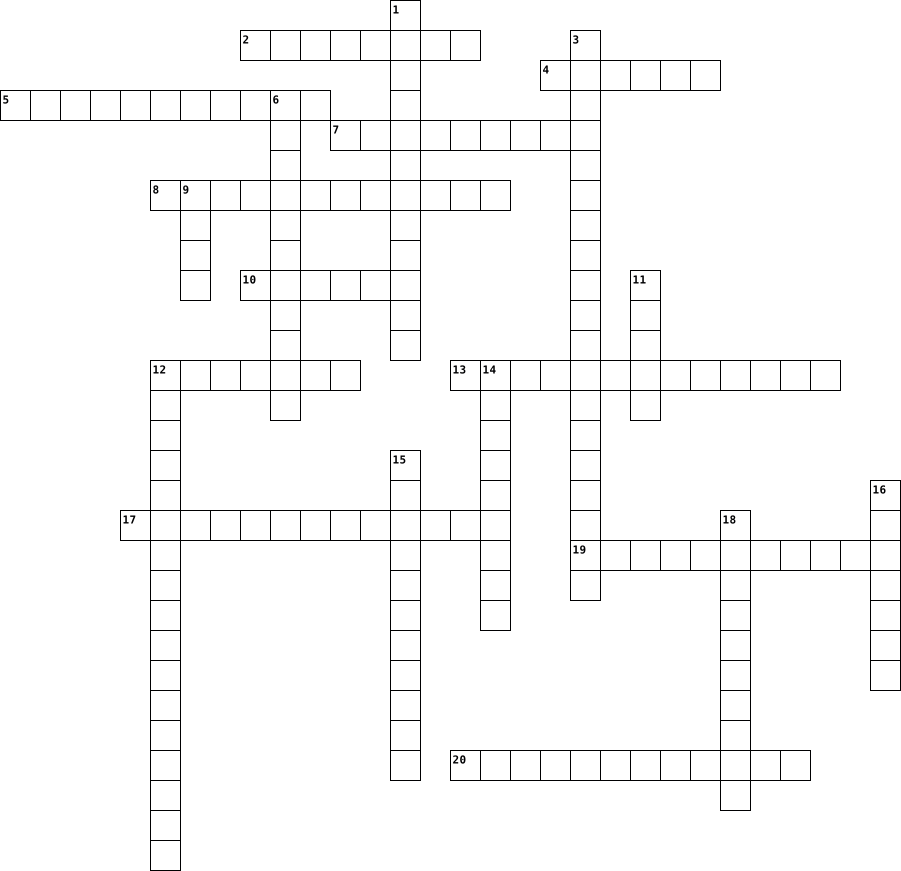
Across
- an organ that connects the developing fetus
- vertical
- derived from an outpocketing of the digestive tube.
- a non-vascular type of supporting connective tissue
- eggs that are encased by extra-embryonic
- body types
- asexual
- a highly evolved and specialized organ
- male and female
- is a hard covering that supports and protects the bodies of some types of animals.
- a skeleton that is on the inside of a body, like humans, dogs, or some fish
Down
- backbone
- a system of vessels in echinoderms
- cold blooded
- the shedding or casting off of an outer layer or covering and the formation of its replacement
- projecting growth
- opposite body types
- x equality
- warm blooded animals
- bottom of water
- deuterostomal animals
21 Clues: asexual • backbone • vertical • body types • x equality • cold blooded • bottom of water • male and female • projecting growth • opposite body types • warm blooded animals • deuterostomal animals • a system of vessels in echinoderms • a highly evolved and specialized organ • eggs that are encased by extra-embryonic • an organ that connects the developing fetus • ...
Biology crossword 2024-02-08

Across
- what means "a ball".
- What means "creeping thing".
- what translates to "earth pig".
- 85% of snakes are what.
- boas and pythons are what type of snakes.
- What is the largest living land animal.
- what is the name of all huffed animals.
- what translates to "the little armored one".
- What means "the lizard of the Nile".
- Lizard What does "El Legarto" mean
- what are limbless reptiles.
- What means "to roll".
- what are defined as large, tailless monkeys.
Down
- What is called "the spiny anteater".
- What are Alligators and crocodiles called.
- There are over 400 kinds of what type of snakes.
- what are wild, untamable, and bad-tempered beasts.
- What is sort of like a porcupine but with softer quills.
- what is the name of one of their four stomachs.
- what translates to "the pouched one".
- What are toothless reptiles in a shell.
- What are generally larger than rabbits.
- What is a Gila Monster.
- What means "flat foot".
- What translates to "to gnaw".
25 Clues: what means "a ball". • What means "to roll". • 85% of snakes are what. • What is a Gila Monster. • What means "flat foot". • what are limbless reptiles. • What means "creeping thing". • What translates to "to gnaw". • what translates to "earth pig". • What is called "the spiny anteater". • What means "the lizard of the Nile". • Lizard What does "El Legarto" mean • ...
Cell Biology 2023-10-17

Across
- - Powerhouse of the cell
- - Detoxification center
- - Digestive organelle
- - Cell eating
- - Cell's control center
- - Small sac for transport
- - Cell division
- - Cell's jelly-like substance
- - Genetic material
- - Cell membrane
- - Protein factory
- - Whip-like structure
- - No nucleus
- - Photosynthesis site
- - Nucleus present
Down
- - Enzyme-rich organelle
- - Rough or smooth
- - Tiny hair-like structures
- - Cell expelling contents
- - Protein packaging
- - Plant cell wall material
- - Storage organelle
- - Small DNA circle
- - Water movement
- - Surrounds the cell
- - Part of the cytoskeleton
- - Cell component
- - Cell's structural framework
28 Clues: - No nucleus • - Cell eating • - Cell division • - Cell membrane • - Water movement • - Cell component • - Rough or smooth • - Protein factory • - Nucleus present • - Small DNA circle • - Genetic material • - Protein packaging • - Storage organelle • - Surrounds the cell • - Digestive organelle • - Whip-like structure • - Photosynthesis site • - Enzyme-rich organelle • - Detoxification center • ...
Biology Crossword 2024-01-09

Across
- Where the arteries of the heart can't deliver enough oxygen-rich blood to the heart.
- A disease you get when your body is lacking of vitamin C.
- Your body uses this to make hemoglobin, a protein in red blood cells and myoglobin.
- A condition where you have uncomfortable or infrequent bowel movements.
- Breads, cereals and pasta contains ____
- A mineral your body needs to build and maintain strong bones.
- When your body lack of vitamin D or calcium.
- When your body mass index is over 30 it is...
- A stomach enzyme that helps to digest proteins found in ingested food.
- Good for building and maintaining healthy bones but is not calcium.
Down
- Elements on the earth and in foods that our bodies need to develop and function.
- A colorless, transparent liquid.
- They are composed of carbon, hydrogen and oxygen.
- A bone disease that develops when bone mineral density and bone mass decreases.
- Made up of one glycerol and three fatty acids.
- A long chains of amino acid.
- Amount of energy taken in is less then the amount of energy required to main an organism's life.
- Good for helping to protect cells and keeping them healthy.
- A condition where your body does not have enough.
- An enzyme that aids with digestion.
20 Clues: A long chains of amino acid. • A colorless, transparent liquid. • An enzyme that aids with digestion. • Breads, cereals and pasta contains ____ • When your body lack of vitamin D or calcium. • When your body mass index is over 30 it is... • Made up of one glycerol and three fatty acids. • They are composed of carbon, hydrogen and oxygen. • ...
Biology Crossword 2024-01-12

Across
- A complex carbohydrate composed of multiple sugar units.
- A branched form of starch composed of glucose units linked together.
- Pertaining to the linkage between sugar molecules.
- A linear arrangement of repeating units in a molecule.
- A chemical element with the symbol H; a key component in various biological molecules.
- A monosaccharide, commonly known as fruit sugar.
- The ability of a substance to dissolve in a solvent.
- A substance that triggers an immune response, often by producing antibodies.
- A polysaccharide found in plants, serving as a storage form of energy.
- The capacity to do work or produce heat, often derived from the metabolism of nutrients.
- A linear form of starch composed of glucose units linked in a straight chain.
- The simplest form of carbohydrates, consisting of a single sugar unit.
- A five-carbon monosaccharide, such as ribose.
- A sugar molecule that forms the backbone of RNA.
Down
- A polysaccharide that serves as a storage form of glucose in animals.
- The chemical breakdown of a compound due to reaction with water.
- A monosaccharide and a primary source of energy in living organisms.
- Relating to the arrangement and organization of parts in a biological or chemical system.
- The clumping together of particles or cells, typically due to the action of antibodies.
- A type of secondary protein structure, referring to a sheet-like arrangement of polypeptide chains.
- Long, thread-like structures, often referring to dietary components that promote digestive health.
- A polysaccharide found in plant cell walls, composed of glucose units linked in a linear fashion.
- A six-carbon monosaccharide, such as glucose.
- A protein molecule with attached carbohydrate chains.
- A type of secondary protein structure, referring to a helical arrangement of polypeptide chains.
- The accumulation and retention of substances for future use.
- A sugar molecule that forms the backbone of DNA.
- The presence of side chains or offshoots in a molecular structure.
28 Clues: A six-carbon monosaccharide, such as glucose. • A five-carbon monosaccharide, such as ribose. • A monosaccharide, commonly known as fruit sugar. • A sugar molecule that forms the backbone of DNA. • A sugar molecule that forms the backbone of RNA. • Pertaining to the linkage between sugar molecules. • The ability of a substance to dissolve in a solvent. • ...
Biology - General 2024-02-21

Across
- The small green discs in chloroplasts
- A human that relies mostly on photoreceptors
- The first step of cellular respiration
- "Stitch" adjacent cells together
- The tissue in plants that create dermal tissue
- The receptors that detect pain
- The cell "drinking" by engulfing liquids
- A limited nutrient explosion that causes rapid algae growth and causes dead zones
- A process used by cells that recycled damaged or faulty parts using Lysosomes
- Plant structural support that is inflexible
- The two nitrogen bases Adenine and Guamine (Structure)
- The spread of cancer cells from the origin site
- The randomness of the environment
Down
- Two of these functional groups react and form a cross-link that stabilize protein structure
- Molecules that are isomers in the way that horizontally mirrors another
- Release a very large amount of energy
- Plants do this when they have too much water
- Fungi that grow on a plant's roots to increase its surface area
- The thickest type of cytoskeleton
- The folds in mitochondria
- A process cells use to break apart molecules using water
- The thinnest type of cytoskeleton
- One gene affects many phenotypes
- Bridges between plant cells (Walls around the tunnels)
- The cork cambium makes this
25 Clues: The folds in mitochondria • The cork cambium makes this • The receptors that detect pain • "Stitch" adjacent cells together • One gene affects many phenotypes • The thickest type of cytoskeleton • The thinnest type of cytoskeleton • The randomness of the environment • The small green discs in chloroplasts • Release a very large amount of energy • ...
Biology Vocabulary 2016-04-06

Across
- first phase of cell division; DNA condenses, spindle fibers appear
- the study of living organisms
- organelle that makes proteins
- the theory that organisms change over time
- energy molecule used during cellular respiration
- macromolecule that provides the body with energy
- macromolecule responsible for the storage of genetic information (2 words, no space)
- the trait that is expressed in a phenotype
- monomer of lipids
- macromolecule responsible for long term energy storage, insulation, and cushioning
- the division of gametic cells
- chromosomes line up in the middle of the cell on spindle fibers
- the measure of how acidic or basic a substance is
- the trait that is often masked in a phenotype
Down
- macromolecule responsible for muscles, hormones, and chemical reactions
- molcule responsible for protein synthesis
- the genetic makeup of an individual
- biological molecules (proteins) that act as catalysts and help reactions occur everywhere in life
- genotype possess both dominant or both recessive alleles; RR or rr
- the site of photosynthesis
- monomer of carbohydrates
- monomer of proteins (2 words, no space)
- the site of cellular respiration
- genotype possesses a dominant and recessive alleles; Rr
- the scientific study of interactions between organisms and their environments, focusing on energy transfer
- monomer of nucleic acids
- the physical trait expression of an individual
- chromosomes become chromatin, cell begins to show signs of separation
- chromosomes split apart, sister chromatids move to opposite side of the cell
- the division of somatic cells
- site on transcription, the control center of the cell
31 Clues: monomer of lipids • monomer of carbohydrates • monomer of nucleic acids • the site of photosynthesis • the study of living organisms • organelle that makes proteins • the division of gametic cells • the division of somatic cells • the site of cellular respiration • the genetic makeup of an individual • monomer of proteins (2 words, no space) • ...
Biology Vocab. 2019-05-09

Across
- made of a single cell
- light energy into chemical energy
- cells in plants
- lives in pond water uses cilia to move
- controls what leaves and enters a cell
- System breaks down food
- senses sunlight
- System brings oxygen into body
- tiny cell carries functions in a cell
- uses pseudopods to move
- stores materials
- System removes waste from your body
- System group of organs working together
Down
- controls of the cell
- whip-like tail
- made of more than one cell
- group of small cells
- cells in animals
- powerhouse
- the outside of the cell
- round shape in packes
- System Heart, blood vessels, blood
- used for locomotion or engulfing food
- living thing
- bright green
- hairlike extends from the plasma membrane
26 Clues: powerhouse • living thing • bright green • whip-like tail • cells in plants • senses sunlight • cells in animals • stores materials • controls of the cell • group of small cells • made of a single cell • round shape in packes • System breaks down food • the outside of the cell • uses pseudopods to move • made of more than one cell • System brings oxygen into body • light energy into chemical energy • ...
Biology Vocab 2019-05-09

Across
- made up of cells that make up animals and plants
- plural: usually are sensory organelles
- a unicellular organism that can dangerously affect humans
- separates the interior of cells
- a unicellular organism that looks like a slipper
- the process of turning energy into food
- an organism with more than one cell (humans)
- acts like a filter for cells
- allows a cell to move around
- takes in oxygen and releases carbon dioxide
- replicates dna
- a life form
- helps to receive light
- usually found in plant cells
Down
- there are eleven contained in the body
- the powerhouse of the cell
- provide basic life in plants
- provide basic life in animals
- disposes of bodily waste
- an organism with only one cell
- converts food into energy
- structures within a cell
- contains the heart, blood, and blood vessels
- in the body usually with a specific purpose
- used to capture prey
- a type of algae with up 50,000 cells
- a unicellular organism that has over 800 species
27 Clues: a life form • replicates dna • used to capture prey • helps to receive light • disposes of bodily waste • structures within a cell • converts food into energy • the powerhouse of the cell • provide basic life in plants • acts like a filter for cells • allows a cell to move around • usually found in plant cells • provide basic life in animals • an organism with only one cell • ...
Biology Review 2019-05-08

Across
- Uses a flagellum
- Moves with cilia
- Lives in water or soil
- More than one cell organelle
- Collects waste and removes it from the body
- Only in a plant cell
- Has a cell membrane
- Takes in oxygen and gets rid of carbon dioxide
- Breaks down food
- Making food out of sunlight
- A group of tissues
- Living thing
- One- celled organelle
- Amoeba uses this to move
- Paramecium moves with this
Down
- Is in both animal and plant cell
- Example is amoeba and euglena
- Only has a cell wall
- Carries oxygen to the cells
- Like the boss in the cell
- Like a vacuum cleaner
- A group of cells
- Powerhouse of the cell
- collections of systems like brain and liver
- A group of algae
- Helps find the sunlight
- Euglena has one to move
27 Clues: Living thing • Uses a flagellum • Moves with cilia • A group of cells • Breaks down food • A group of algae • A group of tissues • Has a cell membrane • Only has a cell wall • Only in a plant cell • Like a vacuum cleaner • One- celled organelle • Lives in water or soil • Powerhouse of the cell • Helps find the sunlight • Euglena has one to move • Amoeba uses this to move • Like the boss in the cell • ...
Biology crossword 2019-05-06

Across
- an individual animal, plant, or single-celled life form.
- cell a cell in an animal
- a number of organized or specialized structures within a living cell.
- system a system of organs functioning in humans
- system the system that circulates blood and lymph through the body
- wall protects the cell and provides strength.
- system the system that removes waste from the body.
- any of the distinct types of material of which animals or plants are made
- cell a cell in a plant
- consisting of many cells
- single-celled animal
- the way and amoeba gets food
- system a group of organs that work together to perform one or more functions.
Down
- single-celled freshwater animal that has a characteristic slipper-like shape and is covered with cilia.
- system where food is digested
- light-sensitive pigmented spot
- produces energy.
- green single-celled freshwater organism with a flagellum
- sacs for storage digestion and waste removal
- consisting of a single cell
- slender threadlike structure
- short microscopic hairlike vibrating structure
- the process by which green plants and some other organisms use sunlight to make foods
- control center of the cell
- a single-celled aquatic organism
25 Clues: produces energy. • single-celled animal • cell a cell in a plant • consisting of many cells • cell a cell in an animal • control center of the cell • consisting of a single cell • slender threadlike structure • the way and amoeba gets food • light-sensitive pigmented spot • system where food is digested • a single-celled aquatic organism • ...
Biology II 2019-03-19

Across
- fish
- shape
- the concentration of particles in a fluid compared to the concentration of particles in the cytosol of a cell
- even
- passive movement of a substance from an area of high concentration to an area of low concentration
- process by which the body produces new cells for growth and replacement of worn out and damaged cells, the result is 2 new cells that are identical to the parent cell\
- cells that surround themselves with a nonliving extracellular matrix (2 words)
- cartilage
- cells with the ability to contract (2 words)
- the double set of chromosomes found in the cells of the body
- to eat
Down
- yeasts, molds and mushrooms
- the central point where two chromatids are joined
- stage of cell division where the cytoplasm pinches and divides
- joint
- double
- plants
- process in which the chromatids of homologous chromosomes exchange strands of DNA (2 words)
- "cell drinking" of liquids and dissolved substances
- movement of substances across a cell membrane that requires a carrier protein and ATP (2 words)
- animals
- process by which the body produces new cells for reproduction, the result is 4 new cells with half as many chromosomes as the parent cell
- uneven
- the clear, viscous fluid of the cell
24 Clues: fish • even • joint • shape • double • plants • uneven • to eat • animals • cartilage • yeasts, molds and mushrooms • the clear, viscous fluid of the cell • cells with the ability to contract (2 words) • the central point where two chromatids are joined • "cell drinking" of liquids and dissolved substances • the double set of chromosomes found in the cells of the body • ...
Biology I 2019-03-18

Across
- bacteria
- membrane bound sacs formed from other membranes
- whip-like appendages on the cell membrane
- life
- passive movement of a substance down a concentration gradient and across a membrane that requires a carrier protein (2 words)
- DNA in long, loose fibers
- foot
- digits
- cells that receive and transmit signals (2 words)
- a method of classifying organisms based upon their evolutionary relationships
- bone
Down
- flesh
- flat
- sheets of cells that cover or line other tissues (2 words)
- passive movement of water through a semi-permeable membrane from the dilute solution to more concentrated solution
- finger-like projections formed from the cell membrane
- algae and protozoans
- cell eating of large particles
- movement of fluids or particles out of the cell
- rabbit
- the site of protein synthesis
- the joining of the ovum and spermatozoon
- single set of chromosomes found in the gametes
- membrane bound sacs that contain hydrolytic enzymes
- the scientific study of living organisms
- worm
26 Clues: flat • life • foot • worm • bone • flesh • rabbit • digits • bacteria • algae and protozoans • DNA in long, loose fibers • the site of protein synthesis • cell eating of large particles • the joining of the ovum and spermatozoon • the scientific study of living organisms • whip-like appendages on the cell membrane • single set of chromosomes found in the gametes • ...
Biology Vocabulary 2019-01-03

Across
- a compound that releases a proton
- A jellylike fluid inside the cell in which the organelles are suspended
- a substance made of atoms of different elements bonded together in a certain ratio
- a mixture of substances that is the same through-out; a homogeneous mixture
- all of the chemical processes that build up or break down materials
- the maintenance of constant internal conditions in an organism
- the division of the cell nucleus and its contents
- the change in living things over time
- one particular type of atom that cannot be broken down into a simpler substance by ordinary chemical means
Down
- a substance that decreases the activation energy needed to start a chemical reaction. Speeds up a reaction
- infectious particle made of a strand of DNA or RNA surrounded by a protein coat
- the substances made by a chemical reaction. On the right side of equation
- catalysts for chemical reactions in living things.
- The powerhouse of the cell. Creates ATP by using chemical energy and oxygen.
- any individual living thing
- tool that provides an enlarged image of an object
- all organisms and the part of Earth where they exist
- the substances changed during a chemical reaction. On left side of equation
- the smallest basic unit of matter
- form of nuclear division that divides a diploid cell into a haploid cell; important in forming gametes for sexual reproduction.
20 Clues: any individual living thing • a compound that releases a proton • the smallest basic unit of matter • the change in living things over time • tool that provides an enlarged image of an object • the division of the cell nucleus and its contents • catalysts for chemical reactions in living things. • all organisms and the part of Earth where they exist • ...
Biology Vocabulary 2019-01-03

Across
- a substance made of atoms of different elements bonded together in a certain ratio
- one particular type of atom that cannot be broken down into a simpler substance by ordinary chemical means
- all organisms and the part of Earth where they exist
- a compound that releases a proton
- the maintenance of constant internal conditions in an organism
- the substances made by a chemical reaction. On the right side of equation
- all of the chemical processes that build up or break down materials
- the substances changed during a chemical reaction. On left side of equation
- a mixture of substances that is the same through-out; a homogeneous mixture
- infectious particle made of a strand of DNA or RNA surrounded by a protein coat
Down
- catalysts for chemical reactions in living things.
- A jellylike fluid inside the cell in which the organelles are suspended
- the smallest basic unit of matter
- The powerhouse of the cell. Creates ATP by using chemical energy and oxygen.
- any individual living thing
- tool that provides an enlarged image of an object
- a substance that decreases the activation energy needed to start a chemical reaction. Speeds up a reaction
- the change in living things over time
- form of nuclear division that divides a diploid cell into a haploid cell; important in forming gametes for sexual reproduction.
- the division of the cell nucleus and its contents
20 Clues: any individual living thing • the smallest basic unit of matter • a compound that releases a proton • the change in living things over time • tool that provides an enlarged image of an object • the division of the cell nucleus and its contents • catalysts for chemical reactions in living things. • all organisms and the part of Earth where they exist • ...
biology crossword 2019-10-26

Across
- to take air in and expel it out of the lungs.
- two bag-like organs that fill most of the chest. The lungs draw in air through the trachea and bronchi.
- a part of the respiratory system between the pharynx and the trachea. It houses the vocal cords.
- tiny blood vessels.
- a flap of tissue that prevents food from going down the trachea rather than the oesophagus.
- rate: the rate, or number of breaths per minute, at which we breathe.
- a large muscle below the ribs that helps a person breathe.
- a gas in air that humans and most living things need to live.
- cords: two folds of tissue in the larynx that vibrate when air passes over them and produce sound, including the basic sounds of speech.
- pair of tubes between the trachea and the lungs.
- the basic unit of any living thing. Some living things consist of only a single cell, while others are composed of trillions of cells
- breathe out.
Down
- one of the lung's smallest air passageways.
- the air passageway between the pharynx and the bronchi.
- tiny air sacs in the lungs.
- a sticky substance in the nose that traps dirt, dust and other particles.
- the tube that carries food from the back of the throat to the stomach.
- a breathing disorder in which the air passageways in the lungs constrict, causing shortness of breath.
- capacity: the volume of air that the lungs can hold.
- the movement of oxygen from the atmosphere to cells and carbon dioxide from cells to the atmosphere.
- hair-like structures found in the air passageways of the respiratory system.
- system: the group of organs that take in oxygen from the air and release carbon dioxide.
- a disease that damages the alveoli, making it difficult to get enough oxygen.
- dioxide: a gas that is a waste product of cells when they burn food.
- a cavity behind the nose and mouth that leads to the trachea and oesophagus.
- breathe in.
26 Clues: breathe in. • breathe out. • tiny blood vessels. • tiny air sacs in the lungs. • one of the lung's smallest air passageways. • to take air in and expel it out of the lungs. • pair of tubes between the trachea and the lungs. • capacity: the volume of air that the lungs can hold. • the air passageway between the pharynx and the bronchi. • ...
BIOLOGY 2 2019-07-09

Across
- Similar to vessels with narrower lumens and connected by pits.(rhsecdiat)
- Kinds of plants.(gopasnisemr)
- Provide strength because their walls are lignified.( irfesb)
- Allow molecules and substance to move back and forth as needed.( lpaomsedstmaa)
- Keep their body fluids isotonic to the eternal environment.( foesrmomnrocs)
- Cell with nucleus mitochondria, ribosomes, enzymes.( ponimcnoa lelc)
- vessels Consist of dead hallow cells.( mxlye slvsese)
- Closed system are said to be closed because they have vessels that contain the fluid.( SDCOLE ACLUIRCOTYR)
- Gas exchange by tiny forces.( mtosata)
- The balance inside the body of mammals.( ohsoemstasi)
- The widening of blood vessels.( tonidailsaov)
- Moderate water availability.(eosemthpys)
Down
- Transport blood to high pressure to the tissue away from the heart.( ertyra)
- Have nutrients and carbon dioxide reach cells in their body.(lnstap)
- They have a large number of stomata on their upper surface.(yhptsyedorh)
- Tubular cells that are connected end to end.( esiev uebt)
- Moves food substances from leaves to the rest of plants.( elhomp)
- Living in the severely dry terrestrial environment.(esepnxohty)
- The narrowing of blood vessels(itonvitrocsnasov)
- Living cells with thin cellulose walls.( myaerncpha)
- The animals which actively adjust their internal osmotic state according to external environment.(OSRTUALGOERMOS)
- Types of system is found in animals such as insects and some mollusk.( EONP OTYRURCICAL)
- Have nutrients and oxygen reach every cells in their body.(nmsalia)
- Xylem vessels and tracheids and phloem seive tubes.(LSIEDACIPES SUEBT)
- Blood pressure is low.( inev)
25 Clues: Kinds of plants.(gopasnisemr) • Blood pressure is low.( inev) • Gas exchange by tiny forces.( mtosata) • Moderate water availability.(eosemthpys) • The widening of blood vessels.( tonidailsaov) • The narrowing of blood vessels(itonvitrocsnasov) • Living cells with thin cellulose walls.( myaerncpha) • The balance inside the body of mammals.( ohsoemstasi) • ...