
cells Crossword Puzzles
Hematology/Oncology 2016-04-20

Across
- drug class MOA: inhibit microtubule disassembly
- immunotherapy CTL4 receptor
- pap tests = for ___ cancer
- ___ analogs MOA: Capecitabine, Fluorouracil - inhibit thymidylate synthetase and pyrimidine synthesis;
- ____ antimetabolites MOA: prevents DNA synthesis of purines
- immunotherapy HER-2/neu
- PSA is the historical test for ___ cancer
- ___ ___ genes: mutations inactivating these genes lead to increased growth
- fecal occult blood testing = test for ___ cancer
- drug class MOA: prevent microtubule assembly (one word)
- low-dose computed tomography (LDCT) for those who have a history of smoking = test for ___ cancer
- Cancer cells stimulate local ___
- test for ___ cancer = telling doctor when having weird looking spot on your skin
- immunotherapy VEGF-A
- Aromatase inhibitors inhibit aromatase which is necessary for the synthesis of ___ and estradiol
- immunotherapy EGFR
- Cancer cells proliferate ___
- Cancer cells are insensitive to ___ signals
- Topoisomerase II inhibitors: inhibit topoisomerase II and block ___ DNA
- signs/symptoms of ___ are unexplained weight loss of >10 lbs or more, fever, fatigue, pain, skin changes
- immunotherapy CD-20
Down
- Cytarabine, Gemcitabine MOA: inhibit DNA chain ___
- no evidence screening test improve mortality in ___ cancer
- drug class MOA: inhibit tyrosine kinases which are often involved with cellular growth and differentiation
- drug class MOA: cross-linked DNA preventing cell replication
- Cancer cells are self-sufficient in growth ___
- mammography & awareness teaching = test for ___ cancer
- used after diagnosis to track progress of therapy (two words)
- normal genes that when mutated, turn into oncogenes which promote cellular growth
- drug class MOA: intercalation of DNA, inhibit topoisomerase II, generate free radicals
- Proteasome inhibitors inhibit proteasome in cancer cells which are necessary for cell cycle ___
- angiogenesis --> blood vessels that ___ cancer cells
- Cancer cells invade local ___ and spread to other parts of the body
- drug class MOA: cross-links DNA resulting in apoptosis (one word)
- topoisomerase 1 inhibitors: inhibit top 1 which prevents DNA ____
- Cancer cells display loss of contact ___ in vitro
- Cancer cells evade ___
- drug class MOA: estrogen antagonists in some tissue (breast), and agonists in bone (less osteoporosis than aromatase inhibitors)
- Cancer cells display diminished ___ control
39 Clues: immunotherapy EGFR • immunotherapy CD-20 • immunotherapy VEGF-A • Cancer cells evade ___ • immunotherapy HER-2/neu • pap tests = for ___ cancer • immunotherapy CTL4 receptor • Cancer cells proliferate ___ • Cancer cells stimulate local ___ • PSA is the historical test for ___ cancer • Cancer cells are insensitive to ___ signals • Cancer cells display diminished ___ control • ...
Plants Moving On Up 2017-04-30

Across
- Outermost layer of bark
- Xylem cell type with slow water flow and air bubbles that only affect one cell
- (2 words) Hypothesis explaining why phloem sap always flows from source to sink
- Substrate with the highest water potential ~0
- (2 words) Elements that are basically a living straw supported by companion cells
- Innermost layer of wood
- (2 words) Xylem cell type with unobstructed water flow, but air bubbles affect the whole tube
- Type of xylem that makes up wood
- (adj) Cells that are filled with water so that their cell walls are under pressure from inside
- (2 words) Provides nuclei and organelles to support a sieve tube member
- Plant adapted to arid environments
- (2 words) Determines age of woody plants
- Secondary xylem
- (2 words) One-cell-thick layer of meristem cells for secondary growth
- Type of photosynthesis in which gas exchange occurs at night and PEP is replaced by crassulaic acid
- Water route that goes around root hair cells
- Water is _________ up a plant
- Lower the water potential of plant cells
- What a plant does when its tissues lose water
- Season when sugar reserves are mobilized to support new plant growth aboveground
Down
- Ions that control stomatal opening and closing
- Type of xylem formed at the apical meristem
- Strip of wax forcing water to enter a cell before it crosses the endoderm
- Type of bond responsible for adhesion
- (2 words) Theory of how water rises up a tree
- When the cell membrane pulls away from the cell wall
- (2 words) Large cells with thin walls formed when lots of resources are available
- Secondary xylem cells filled with resin
- How leaves lower their water potential
- Transports water and dissolved minerals through plant
- Where water transpires from
- Space between cork cells that allows for gas exchange from outside to living cells inside
- Water route that goes through root hair cells
- Transports sugars through plant
- (2 words) Substrate with the lowest water potential, ~ -100
35 Clues: Secondary xylem • Outermost layer of bark • Innermost layer of wood • Where water transpires from • Water is _________ up a plant • Transports sugars through plant • Type of xylem that makes up wood • Plant adapted to arid environments • Type of bond responsible for adhesion • How leaves lower their water potential • Secondary xylem cells filled with resin • ...
VCE Biology Orientation Terms 2018-01-26

Across
- Refers to a cell that contains 2 sets of chromosomes.
- A cellular organelle involved in cellular division
- Involved in the formation and transport of lipids and steroid hormones
- Any cells or organisms without a membrane-bound nucleus and other membrane-bound organelles.
- Stage of mitosis during which chromosomes align around the equator of a spindle
- A cell with a membrane-bound nucleus and membrane-bound organelles.
- cell Any cell of an organism apart from reproductive cells and that reproduces by mitosis.
- A period of cell growth and DNA synthesis during the mitotic cell cycle.
- A segment of DNA that codes for a particular protein
- The tight banding found in all chromosomes usually around the centre.
- A type of cell division which results in 4 daughter cells being produced.
Down
- cell Cells found in gonads and that reproduce by meiosis.
- wall A semi-rigid structure located outside of the plasma (cell) membrane in plant, fungal and bacterial cells.
- Refers to a cell that contains 1 set of chromosomes.
- Different forms of a particular gene.
- A visual representation of all the organisms found in an organism.
- Stage of mitosis in which new nuclear membranes form around the separated groups of chromosomes.
- A process of cell division undertaken by diploid cells, of which as a result 2 daughter cells are produced.
- An organelle that contains DNA and controls cellular activity.
- Stage of mitosis in which chromosomes contract and become visible.
- acid A substance found in chromosomes and that is responsible for storing the genetic information of a particular organism.
- A macromolecule that is made up of repeating amino acids and that is vital for the body to function properly.
- Twisted and long strands of DNA
- A specialized sub-unit of a cell that has a particular function.
- Fibre Clusters of microtubules that grow out from the centrioles at the opposite ends of a spindle.
- The cells produced after meiosis that form sperm or egg cells.
- The ability cells have to self-destruct.
- A complete set of genetic instructions for a given organism
28 Clues: Twisted and long strands of DNA • Different forms of a particular gene. • The ability cells have to self-destruct. • A cellular organelle involved in cellular division • Refers to a cell that contains 1 set of chromosomes. • A segment of DNA that codes for a particular protein • Refers to a cell that contains 2 sets of chromosomes. • ...
Cell Parts 2023-11-14

Across
- "True nucleus"
- All living things are composed of cells, cells are the basic units of structure and functions in living things, and all cells come from preexisting cells
- Jelly-like material inside the nucleus
- Series of membranes for transport of materials,ribosomes
- Found in plant cells
- Jelly-like material filling the cell
- Surrounds the nucleus
- Said all animals were made of cells
- Rigid carbohydrate cellulose structure, protects and supports the cell, found in plants, algae, and some bacteria
- Phospholipid bilayer regulating what enters and leaves the cell, protects and supports the cell, proteins and carbohydrates are also found
- Small membrane-enclosed sacs storing water, salts, proteins, etc.
- Proteins that help chromosomes move in animal cells
- Further developed compound microscope
- Inner folds
- Small membrane-enclosed sacs, contains digestive enzymes to digest materials, destroy bacteria, and breakdown old cell parts
- "Before nucleus"
- Tiny structures which proteins, may be found on rough ER or free in the cytoplasm
- Said all plants were made of cells
- Round control center of the cell
- Series of membranes for transport of materials, no ribosomes
Down
- Protein fibers that support the cell and allow movement
- In nucleus membrane, allows for passage of materials
- Single tail-like structure for movement
- Contains chlorophyll and conducts photosynthesis
- Developed first microscope
- Genetic material with proteins making up chromosomes in the nucleus
- Found in the nucleus, makes and stores RNA for ribosomes
- Has a cell wall, rectangular shape, has plastids, has a large central vacuole
- Identified a round body in the cell and called it a nucleus
- Has no cell wall, round shape, has centrioles, and has smaller vacuoles
- Said that all cells came from preexisting cells
- Contains red, yellow, and orange pigments
- Stores starch
- Flattened stack of membranes, looks like a pancake, responsible for modifying and packaging proteins for secretion out of the cell
- Double membrane-bound structures, contains enzymes which help to produce ATP(a high energy compound) from glucose, "the powerhouse of a cell"
- Center
- Many hair-like structures for movement
37 Clues: Center • Inner folds • Stores starch • "True nucleus" • "Before nucleus" • Found in plant cells • Surrounds the nucleus • Developed first microscope • Round control center of the cell • Said all plants were made of cells • Said all animals were made of cells • Jelly-like material filling the cell • Further developed compound microscope • Jelly-like material inside the nucleus • ...
Adaptive body defense and developmental aspect of lymphatic system and body defense 2019-12-08

Across
- organic nitrogenous compound that involved in local immune response
- In the ___________ the level of antibodies in the blood gradually rises and then rapidly decline
- system of immune responses of an organism against its own healthy cells and tissues
- systemic acute allergic responses
- type of antigen that produce an abnormally vigorous immune responses
- one of crucial cells of adaptive systems
- impairment of kidney function due to acute inflammation
- preparations of a single antibody type that useful in diagnosing various infection disorder
- Tropical disease in which the lymphatics become clogged with parasitic worms
- important aspect of adaptive defense that's not restricted to the initial infection site
- Antibody class that the most abundant antibody in blood plasma and the only one type that can cross the placenta barrier
- occur when antibodies bind to specific sites
- immature name for lymphocytes
- hormone that secreted by thymus that regulate the development and selection of an immune-competent repertoire of T cells
- most of the B cells clone members or descendants become ______________cells
- name of cross linking process that involves soluble antigenic molecules and resulting antigen antibody complexes are so large that they become insoluble and settle out of solution
Down
- protein that function as chemical messengers for regulating the adaptive immune systems.
- Antibodies have more than one __________ site.
- T cells T cells that recruiting other cells to fight the invaders
- name of condition where the production or function of immune cells or complement is abnormal
- others T cell population that suppress the activity of both T and B cells
- one of the toxic chemicals that released by cytotoxic T cells granules
- Toxic chemical secreted by bacteria
- ____________ is the chief antibody ammunition used against cellular antigens.
- abnormally vigorous immune responses
- tissue grafts transplanted from one site to another in the same person
- donated antibodies
- term for symptom of allergic that caused fluid loss
- serious allergic reaction that is rapid in onset
- type of hypersensitivities that take much longer to appear.
30 Clues: donated antibodies • immature name for lymphocytes • systemic acute allergic responses • Toxic chemical secreted by bacteria • abnormally vigorous immune responses • one of crucial cells of adaptive systems • occur when antibodies bind to specific sites • Antibodies have more than one __________ site. • serious allergic reaction that is rapid in onset • ...
Adaptive body defense and developmental aspect of lymphatic system and body defense 2019-12-08

Across
- Antibodies IgD and IgE have basic________
- most of the B cells clone members or descendants become ______________
- name of cross linking process that involves soluble antigenic molecules and resulting antigen antibody complexes are so large that they become insoluble and settle out of solution
- protein that function as chemical messengers for regulating the adaptive immune systems.
- one of the toxic chemicals that released by cytotoxic T cells granules
- type of antigen that produce an abnormally vigorous immune responses
- term for symptom of allergic that caused fluid loss
- abnormally vigorous immune responses
- ____________ is the chief antibody ammunition used against cellular antigens.
- Antibodies have more than one __________ site.
- systemic acute allergic responses
- presenting one of crucial cells of adaptive systems
- type of hypersensitivities that take much longer to appear.
- Toxic chemical secreted by bacteria
- others T cell population that suppress the activity of both T and B cells
Down
- tissue grafts transplanted from one site to another in the same person
- important aspect of adaptive defense that's not restricted to the initial infection site
- hormone that secreted by thymus that regulate the development and selection of an immune-competent repertoire of T cells
- name of condition where the production or function of immune cells or complement is abnormal
- preparations of a single antibody type that useful in diagnosing various infection disorder
- immature name for lymphocytes
- In the ___________ the level of antibodies in the blood gradually rises and then rapidly decline
- donated antibodies
- occur when antibodies bind to specific sites
- ______________disease is system of immune responses of an organism against its own healthy cells and tissues
- Tropical disease in which the lymphatics become clogged with parasitic worms
- organic nitrogenous compound that involved in local immune response
- serious allergic reaction that is rapid in onset
- T cells T cells that recruiting other cells to fight the invaders
- Antibody class that the most abundant antibody in blood plasma and the only one type that can cross the placenta barrier
30 Clues: donated antibodies • immature name for lymphocytes • systemic acute allergic responses • Toxic chemical secreted by bacteria • abnormally vigorous immune responses • Antibodies IgD and IgE have basic________ • occur when antibodies bind to specific sites • Antibodies have more than one __________ site. • serious allergic reaction that is rapid in onset • ...
NERVOUS TISSUE 2019-12-10

Across
- The medullary sheath is interrupted at intervals by the_______of Ranvier.
- Nervous tissue also includes cells that do not________impulses, but instead support the activities of the neurons.
- Dendrites are extensions, or processes, of the_________that carry impulses to the cell body.
- In the peripheral nervous system, Schwann cells are neuroglia cells that_______neuronal function by increasing the speed of impulse propagation.
- A typical neuron displays a distinctive_________.
- Supporting, or glia, cells bind neurons together and_______the neurons.
- The axons are responsible for transmitting impulses over_______distances from cell body.
- The main part of the cell, the part that carries on the_________functions, is the cell body.
- The axon is surrounded by a whitish, fatty layer called the_______sheath.
- The signal is transmitted across the synapse by chemical compounds known as_________.
- Neuroglia or glial cells, which have been characterized as having a________support role.
- _______are supporting cells that provide physical sport, remove debris, and provide electrical insulation.
- A typical neuron consists of dendrites, the cell body, and an_______.
- When a neuron is sufficiently stimulated, it generates an action________that propagates down the axon towards the synapse.
Down
- Nervous tissue contains_______categories of cells.
- If enough neurotransmitters are released at the synapse to_________the next neuron.
- The cell body is like a_______for the neuron.
- The Schwann cells are underlain by the_______sheath.
- _______are highly specialized nerve cells that generate and conduct nerve impulses.
- The________is the gap between nerve cells, or between a nerve cell and its target.
- Neurons categorized as________neurons have several dendrites and a single prominent axon.
- _________neurons possess a single dendrite and axon with the cell body.
- Dendrites are responsible for responding to_______.
- Unipolar neurons have only a single process_________out from the cell body.
- irritability and conductivity are their two major________characteristics.
- Integration and________are the two major functions of nervous tissue.
- Outside the myelin sheath there is a cellular layer called the________.
- It stimulates________contraction, creates an awareness of the environment, and plays a major role in emotions, memory, and reasoning.
- Nervous tissue responsible for coordinating and________many body activities.
- Dendrites, which receive input from other neurons,_______off the cell body and appear as thin extensions.
30 Clues: The cell body is like a_______for the neuron. • A typical neuron displays a distinctive_________. • Nervous tissue contains_______categories of cells. • Dendrites are responsible for responding to_______. • The Schwann cells are underlain by the_______sheath. • Integration and________are the two major functions of nervous tissue. • ...
CELLS 2016-05-22

Across
- It synthesize proteins
- found out cells
- They help in cell division
- They secrete enzymes in the cells
Down
- Number of chromosomes in a normal human cell
- These cells have well defined nucleas and nuclear membrane
- cytoplasm and nucleas together is called
- They contain genes
8 Clues: found out cells • They contain genes • It synthesize proteins • They help in cell division • They secrete enzymes in the cells • cytoplasm and nucleas together is called • Number of chromosomes in a normal human cell • These cells have well defined nucleas and nuclear membrane
CELLS 2017-09-13

Across
- The first cell was discovered by _____
- A means of reproduction in which the parent cell divides into two or more daughter cells.
- The equipment that helped in the discovery of cells
- Cell undergoing differention to carry a specific function.
- The technical field of using microscopes to view objects and areas of objects that cannot be seen with the naked eye
Down
- A scientist who specialises in research with the use of microscopes
- Discovered plants and animals made of one cell
- Smallest living part and building blocks of all plant or animals
8 Clues: The first cell was discovered by _____ • Discovered plants and animals made of one cell • The equipment that helped in the discovery of cells • Cell undergoing differention to carry a specific function. • Smallest living part and building blocks of all plant or animals • A scientist who specialises in research with the use of microscopes • ...
cells 2017-05-10

Across
- liquid in the nucleus
- that provides proteins
- it regulates cell division
- destroys the cell structure
Down
- jelly like substance that makes up most of the inside of a cell
- present in the nucleus are thread like structures
- scattered in the cytoplasm which are a small structure
- small rod like structures
8 Clues: liquid in the nucleus • that provides proteins • small rod like structures • it regulates cell division • destroys the cell structure • present in the nucleus are thread like structures • scattered in the cytoplasm which are a small structure • jelly like substance that makes up most of the inside of a cell
Cells 2017-07-31

Across
- Animal cells do not have a cell wall and __________.
- A root cell do not have chloroplast as they do not need to photosynthesise but they have a cell __________.
- The cell is a _________ unit of life.
Down
- The cell wall gives the plant cell a __________ shape.
- The cell __________ controls the movement of substances entering and leaving the cell.
- Cells do not increase in size. Instead, they undergo cell __________ and multiply in numbers.
- The part of the cell that controls all the activities in the cell.
- Cells of the same type comes together to form a __________.
8 Clues: The cell is a _________ unit of life. • Animal cells do not have a cell wall and __________. • The cell wall gives the plant cell a __________ shape. • Cells of the same type comes together to form a __________. • The part of the cell that controls all the activities in the cell. • ...
Cells 2017-04-10

Across
- The smallest functional and strucal unit of all living organisms
- a small body in a cell's cytoplasm that is specialized to perfrom a specific function
- A protective layer that covers a cell's surface and acts as a barries between the inside of a cell and the cell's envrionment
- Any living thing
- An organism made up of cells that contain their DNA in a nucelus
Down
- the region enclosed by the cell
- The DNA contained in a membrane-bound organelle
- A single-celled organism that does not have a nucleus or organelles
8 Clues: Any living thing • the region enclosed by the cell • The DNA contained in a membrane-bound organelle • The smallest functional and strucal unit of all living organisms • An organism made up of cells that contain their DNA in a nucelus • A single-celled organism that does not have a nucleus or organelles • ...
cells 2018-01-02

Across
- the heart of a cell
- exists in all living things
- tiny structure that carries out functions
- protective wall that controls anything coming or going in the cell
Down
- material in a living cell leaving out the nucleus
- an example of photosynthesis
- material that surrounds a cell
- rod-shaped structure produces most of the cells energy
8 Clues: the heart of a cell • exists in all living things • an example of photosynthesis • material that surrounds a cell • tiny structure that carries out functions • material in a living cell leaving out the nucleus • rod-shaped structure produces most of the cells energy • protective wall that controls anything coming or going in the cell
cells 2012-11-02

Across
- the control centre of the cell
- where you put the slide on a microscope
- part of a plant cell that traps light energy
- cell that has dendrites
Down
- type of cell that has cilia and produce mucus
- chemical in red blood cells that carries oxygen
- organ of the nervous system
- membrane/ controls what enters and leaves the cell
8 Clues: cell that has dendrites • organ of the nervous system • the control centre of the cell • where you put the slide on a microscope • part of a plant cell that traps light energy • type of cell that has cilia and produce mucus • chemical in red blood cells that carries oxygen • membrane/ controls what enters and leaves the cell
cells 2012-09-11

Across
- between the cell membrane and nucleus
- releases energy
- membrane covering that surrounds every cell
Down
- to small to be seen
- stores food,water,wastes
- inside nucleus
- living thing that maintains vital life processes
- direct all cells activities
8 Clues: inside nucleus • releases energy • to small to be seen • stores food,water,wastes • direct all cells activities • between the cell membrane and nucleus • membrane covering that surrounds every cell • living thing that maintains vital life processes
Cells 2013-07-21

Across
- Chemical factory of the cell
- control room of the cell
- contain several small vacuoles
- traps light energy
- large and filled with sap
Down
- supports the plant
- lines inner cell wall
- energy capsule that contain glucose and oxygen
8 Clues: supports the plant • traps light energy • lines inner cell wall • control room of the cell • large and filled with sap • Chemical factory of the cell • contain several small vacuoles • energy capsule that contain glucose and oxygen
Cells 2013-11-12

Across
- What is an organelle that the plant cells have that the animal cells do not have?
- What synthesizes and stores starch in plants?
- __________: A characteristic of living things where there is a constant internal environment.
- What color are chloroplasts?
Down
- What is an organelle that the animal cells have that the plant cells do not have?
- __________ cells are simple cells with no nucleus.
- What is the site of digestion in animal cells?
- _________ is an example of a prokaryotic cell.
8 Clues: What color are chloroplasts? • What synthesizes and stores starch in plants? • What is the site of digestion in animal cells? • _________ is an example of a prokaryotic cell. • __________ cells are simple cells with no nucleus. • What is an organelle that the animal cells have that the plant cells do not have? • ...
Cells 2014-06-25

Across
- Wall a rigid layer outside the cells of plants
- a network of membranous tubules within the cytoplasm of a eukaryotic cell
- composed of one or more long chains of amino acids
Down
- the semipermeable membrane surrounding the cytoplasm of a cell
- deoxyribonucleic acid
- the pattern of genetic makeup
- consisting of RNA and associated proteins
- an organelle found in large numbers in most cells
8 Clues: deoxyribonucleic acid • the pattern of genetic makeup • consisting of RNA and associated proteins • Wall a rigid layer outside the cells of plants • an organelle found in large numbers in most cells • composed of one or more long chains of amino acids • the semipermeable membrane surrounding the cytoplasm of a cell • ...
Cells 2015-09-19

Across
- Structures in the nucleus that contain an organism's genetic information and regulate the cells activities
- Plant tissue that carries water and nutrients from a plant roots to its leaves
- A stiff outer layer of cell that surrounds a plant,protects it
- A growth response of a plant toward or away from something in it's environment
Down
- The control center of a cell;it directs the cells activities
- Organelles, found only in plant cells,in which sugar is made during photosynthesis
- Tiny openings in the leaves of plants though which gases enter and exit
- A group of specialized cells with similar structures and functions
8 Clues: The control center of a cell;it directs the cells activities • A stiff outer layer of cell that surrounds a plant,protects it • A group of specialized cells with similar structures and functions • Tiny openings in the leaves of plants though which gases enter and exit • Plant tissue that carries water and nutrients from a plant roots to its leaves • ...
Cells 2021-09-16

Across
- a solution that fills a in cell
- cellulose structure
- site of protein synthesis
- contains chromosomes
Down
- stores food and water
- regulates access to the cell
- assists in photosynthesis
- generates power for the cell
8 Clues: cellulose structure • contains chromosomes • stores food and water • assists in photosynthesis • site of protein synthesis • regulates access to the cell • generates power for the cell • a solution that fills a in cell
Cells 2021-09-16

Across
- a solution that fills a in cell
- cellulose structure
- site of protein synthesis
- contains chromosomes
Down
- stores food and water
- regulates access to the cell
- assists in photosynthesis
- generates power for the cell
8 Clues: cellulose structure • contains chromosomes • stores food and water • assists in photosynthesis • site of protein synthesis • regulates access to the cell • generates power for the cell • a solution that fills a in cell
Cells 2021-09-13

Across
- Tiny structures where protein synthesis occurs.
- Contains genetic material, including DNA, which controls the cell’s activities.
- Filled with cell sap to help keep the cell turgid.
- Contains the green pigment, chlorophyll, which absorbs light energy for photosynthesis.
- It controls the movement of substances in and out of the cell.
Down
- Where most energy is released in respiration.
- It is where many of the chemical reactions happen
- Made from cellulose fibres and strengthens the cell and supports the plant.
8 Clues: Where most energy is released in respiration. • Tiny structures where protein synthesis occurs. • It is where many of the chemical reactions happen • Filled with cell sap to help keep the cell turgid. • It controls the movement of substances in and out of the cell. • Made from cellulose fibres and strengthens the cell and supports the plant. • ...
Cells 2021-09-29

Across
- What makes a plant green?
- What do animal cells do to eat?
- The number of vacuole(s) a plant cell has
- What kind of membrane does an animal cell have?
Down
- The process in which plants make food
- What type of shape does an animal cell have?
- How many vacuole(s) do animal cells have?
- What protects a plant's cell?
8 Clues: What makes a plant green? • What protects a plant's cell? • What do animal cells do to eat? • The process in which plants make food • How many vacuole(s) do animal cells have? • The number of vacuole(s) a plant cell has • What type of shape does an animal cell have? • What kind of membrane does an animal cell have?
CELLS 2021-01-27

Across
- =Cells that make Dna translation into protein
- = A cell that provides the chromosomes
- =The substance inside of a performing cell
- =A protection layer for a cells
- =A cell that contains air, liquids, food
Down
- = Provides chemical energy in a cell
- =cells that allow things to come & go.
- =A turned molecule that provides genes & traits
8 Clues: =A protection layer for a cells • = Provides chemical energy in a cell • =cells that allow things to come & go. • =A cell that contains air, liquids, food • =The substance inside of a performing cell • = A cell that provides the chromosomes • =Cells that make Dna translation into protein • =A turned molecule that provides genes & traits
cells 2021-11-29

Across
- get proteints from the rough er
- power house of the cell
- lets stuff in and out
- storge of the cell
Down
- makes protiens
- They are protiens
- cleans the cell
- jelly like substance
8 Clues: makes protiens • cleans the cell • They are protiens • storge of the cell • jelly like substance • lets stuff in and out • power house of the cell • get proteints from the rough er
Cells 2022-09-06

Across
- prokaryotic and eukaryotic cells both have this
- found in plant and animal cells
- both prokaryotic and eukaryotic cells
Down
- found in plant cells
- older type of cell
- found in plant and animal cells
- eukaryotic cells are-
- prokaryotic and eukaryotic cells both have this, along with all other cells
- organelles only found in eukaryotic cells
- found in plant and animal cells
10 Clues: older type of cell • found in plant cells • eukaryotic cells are- • found in plant and animal cells • found in plant and animal cells • found in plant and animal cells • both prokaryotic and eukaryotic cells • organelles only found in eukaryotic cells • prokaryotic and eukaryotic cells both have this • ...
Cells 2022-06-22

Across
- Small rod-shaped organelles
- Used to store water and dissolve substances
- Cytoplast + Organelles
- A structure found in a cell that is involved in making protein.
Down
- Thin boundary layer around the cell
- The control center of the cells
- Keeps the cell rigid and strong
- Small sphere, filled with green chlorophyll
8 Clues: Cytoplast + Organelles • Small rod-shaped organelles • The control center of the cells • Keeps the cell rigid and strong • Thin boundary layer around the cell • Used to store water and dissolve substances • Small sphere, filled with green chlorophyll • A structure found in a cell that is involved in making protein.
Cells 2022-06-24

Across
- Releases energy from food
- keeps the plant cell rigid and strong
- controls the cells
Down
- The cell that is only in animal cells
- Jelly-like substance
- Stores water and dissolved substances
- Makes food using energy from sun
- Keeps the cell together in its shape
8 Clues: controls the cells • Jelly-like substance • Releases energy from food • Makes food using energy from sun • Keeps the cell together in its shape • The cell that is only in animal cells • Stores water and dissolved substances • keeps the plant cell rigid and strong
Cells 2022-01-19

Across
- To make more organisms of their own kind
- A group of parts that work together
- The smallest part of a living thing
- Materials an organism cannot use
- The materials an organism needs
Down
- A living thing
- Organism made up of more than one cell
- Organism Made up of only one cell
8 Clues: A living thing • The materials an organism needs • Materials an organism cannot use • Organism Made up of only one cell • A group of parts that work together • The smallest part of a living thing • Organism made up of more than one cell • To make more organisms of their own kind
Cells 2022-02-17

Across
- Organelles where photosynthesis takes place.
- Green pigment that absorbs sunlight to power photosynthesis.
- Is the process by which plants or animal cell gets energy by using organism to break down sugar.
Down
- The process by which plants use energy from the sun, water absorbed by the roots, and carbon dioxide from the air to make food for the plant.
- Carry out specific functions inside the cell.
- Organisms that have a variety of cells.
- A rigid structure around the cell membrane.
- Large central vacuole to store water.
8 Clues: Large central vacuole to store water. • Organisms that have a variety of cells. • A rigid structure around the cell membrane. • Organelles where photosynthesis takes place. • Carry out specific functions inside the cell. • Green pigment that absorbs sunlight to power photosynthesis. • ...
Cells 2022-10-23

Across
- passageways that transport materials
- semi-permeable layer that regulates cell contents
- stores food, water,& waste
Down
- site of respiration; release energy
- makes proteins
- supports & gives shape to plant cells
- captures light to make food
- control center of the cell
8 Clues: makes proteins • control center of the cell • stores food, water,& waste • captures light to make food • site of respiration; release energy • passageways that transport materials • supports & gives shape to plant cells • semi-permeable layer that regulates cell contents
Cells 2023-12-14

Across
- where photosynthesis occurs
- protects and provides structure
- control center of the cell
- controls what gets in and out of the cell
Down
- it releases energy
- used for storage
- jelly like material that organelles float in
- used for storage
- contains digestive enzymes to break down worn out organelles
9 Clues: used for storage • used for storage • it releases energy • control center of the cell • where photosynthesis occurs • protects and provides structure • controls what gets in and out of the cell • jelly like material that organelles float in • contains digestive enzymes to break down worn out organelles
Cells 2019-03-25

Across
- breaks down larger molecules for the cell
- modifies and stores proteins
- make proteins
- helps plants with shape
Down
- plant and animal energy molecule makers
- converts sunlight into food
- makes pieces of ribosomes
- holds all the cells instructions
8 Clues: make proteins • helps plants with shape • makes pieces of ribosomes • converts sunlight into food • modifies and stores proteins • holds all the cells instructions • plant and animal energy molecule makers • breaks down larger molecules for the cell
Cells 2019-09-25

Across
- Microscopic study of tissue architecture, organization and function
- Tough form of cartilage, made of thick bundles of collagen fibers embedded in chondroitin sulfate ground substance
- Alignment of parallel actin and myosin filaments which form a banded pattern
Down
- The most abundant cell type in connective tissue
- Response of tissue to injury
- The enlargement of an organ or tissue caused by an increase in the reproduction rate of its cells
- Attaches muscles to bones
- Red blood cells
8 Clues: Red blood cells • Attaches muscles to bones • Response of tissue to injury • The most abundant cell type in connective tissue • Microscopic study of tissue architecture, organization and function • Alignment of parallel actin and myosin filaments which form a banded pattern • ...
CELLS 2019-09-10

Across
- feeding of a cell
- color and photosynthesis
- controls what enters and exists cell
Down
- holds information brain of cell
- gives plant shape and supports cell
- stores nutrition and waste products
- powerhouse
- dissolved in the cytoplasm for cell use
8 Clues: powerhouse • feeding of a cell • color and photosynthesis • holds information brain of cell • gives plant shape and supports cell • stores nutrition and waste products • controls what enters and exists cell • dissolved in the cytoplasm for cell use
Cells 2020-04-08

Across
- a similar groups of cells that work together
- absorb sunlight through photosynthesis and produce food
- controls the movement of substance into and out of the cell
- to store materials for the cell such as the water and waste
- to control and organize all of te cells activities
Down
- these manufacture make proteins
- to provide energy for the cell by breaking down all the nutrients
- to provide structure and support for the cell
8 Clues: these manufacture make proteins • a similar groups of cells that work together • to provide structure and support for the cell • to control and organize all of te cells activities • absorb sunlight through photosynthesis and produce food • controls the movement of substance into and out of the cell • to store materials for the cell such as the water and waste • ...
cells 2024-08-28

Across
- A basic unit of life found in plants, which has a cell wall and chloroplasts.
- A tool that makes small things look bigger.
- A type of cell that has a specific function in the body.
Down
- A basic unit of life found in animals, which has no cell wall.
- The jelly-like substance inside a cell where organelles are found.
- The part of a cell that produces energy.
- The control center of a cell that contains its DNA.
- The outer layer of a cell that controls what enters and leaves.
8 Clues: The part of a cell that produces energy. • A tool that makes small things look bigger. • The control center of a cell that contains its DNA. • A type of cell that has a specific function in the body. • A basic unit of life found in animals, which has no cell wall. • The outer layer of a cell that controls what enters and leaves. • ...
Cells 2024-10-02

Across
- - Instruments used to view cells.
- - A structure filled with cell sap.
- - The selectively permeable membrane of a cell.
- - The green parts in plant cells where photosynthesis takes place.
Down
- - Can be referred to as the brain of the cell.
- - Gives the cell support and shape.
- - A jelly-like liquid that holds all the other organelles.
- - Makes up all living things.
8 Clues: - Makes up all living things. • - Instruments used to view cells. • - Gives the cell support and shape. • - A structure filled with cell sap. • - Can be referred to as the brain of the cell. • - The selectively permeable membrane of a cell. • - A jelly-like liquid that holds all the other organelles. • - The green parts in plant cells where photosynthesis takes place.
Cells 2023-01-27

Across
- Single or multi cellular organisms that contain a nucleus
- Structures that work together to help cells perform life processes - "tiny organs"
- A layer around the outside of the cell that gives the cell shape and controls what moves in and out of the cell
- Breaks down food and turns it into energy for the cell to use
Down
- Organisms composed of only one cell that have no nucleus
- The smallest unit of a living thing that can carry out the basic processes of life
- A gel-like substance that supports all of the organelles
- Controls all of the activities in the cell
8 Clues: Controls all of the activities in the cell • Organisms composed of only one cell that have no nucleus • A gel-like substance that supports all of the organelles • Single or multi cellular organisms that contain a nucleus • Breaks down food and turns it into energy for the cell to use • ...
cells 2025-02-04

Across
- clue an organelle found in large numbers in most cells, in which the biochemical processes of respiration and energy production occur. It has a double membrane, the inner part being folded inwards to form layers (cristae).
- clue the semipermeable membrane surrounding the cytoplasm of a cell.
- clue layer outside membrane
- clue the gelatinous liquid that fills the inside of a cell
Down
- clue a minute particle consisting of RNA and associated proteins found in large numbers in the cytoplasm of living cells. They bind messenger RNA and transfer RNA to synthesize polypeptides and proteins.
- clue the central and most important part of an object, movement, or group, forming the basis for its activity and growth.
- clue a space or vesicle within the cytoplasm of a cell, enclosed by a membrane and typically containing fluid.
- clue a plastid in green plant cells which contains chlorophyll and in which photosynthesis takes place.
8 Clues: clue layer outside membrane • clue the gelatinous liquid that fills the inside of a cell • clue the semipermeable membrane surrounding the cytoplasm of a cell. • clue a plastid in green plant cells which contains chlorophyll and in which photosynthesis takes place. • ...
Cells 2025-05-05

Across
- An organism that can only be seen under a microscope.
- New cells are created from ______________ cells.
- Describes the properties of cells and their role in living things.
- Type of organism that is made up of more than one cell.
Down
- Type of organism that only has one cell.
- Nutrients and waste need to go through this part of the cell.
- All _____________ are composed of one or more cells.
- The building blocks of living things.
8 Clues: The building blocks of living things. • Type of organism that only has one cell. • New cells are created from ______________ cells. • All _____________ are composed of one or more cells. • An organism that can only be seen under a microscope. • Type of organism that is made up of more than one cell. • Nutrients and waste need to go through this part of the cell. • ...
Cells 2025-05-22

Across
- Vacuole Maintains the cell turgidity
- Does aerobic respiration to release energy
- membrane Controls substances going in and out of the cell
Down
- Contains green pigment called chlorophyll
- Site of chemical reactions
- light energy into chemical energy during photosynthesis
- Protein synthesis
- wall Maintains the structure of the cell
- Controls the cell's activity contains genetic information
9 Clues: Protein synthesis • Site of chemical reactions • Vacuole Maintains the cell turgidity • Contains green pigment called chlorophyll • wall Maintains the structure of the cell • Does aerobic respiration to release energy • light energy into chemical energy during photosynthesis • Controls the cell's activity contains genetic information • ...
cells 2022-12-02

Across
- the brain of the cell
- produce protein
- stores food water and waste
Down
- the jelly stuff that holds the organelles
- help the animal cell divide
- cleans up dead things
- formes and stores starch
- determines what goes in and out the cell
8 Clues: produce protein • cleans up dead things • the brain of the cell • formes and stores starch • help the animal cell divide • stores food water and waste • determines what goes in and out the cell • the jelly stuff that holds the organelles
Cells 2023-05-15

Across
- helps open wounds stop bleeding
- The boundary of the cell
- Jelly like substance in the middle of cell
- The smallest unit that can live on its own and that makes up all living organisms
Down
- look like they have spiders at the end
- a group of cells that work together to function
- Carries oxygen throughout body
- the membrane-enclosed organelle within a cell that contains the chromosomes
8 Clues: The boundary of the cell • Carries oxygen throughout body • helps open wounds stop bleeding • look like they have spiders at the end • Jelly like substance in the middle of cell • a group of cells that work together to function • the membrane-enclosed organelle within a cell that contains the chromosomes • ...
Cells 2024-10-19

Across
- a noncellular organism that infects people to reproduce
- the part of a plant cell that gives it its colour
- a type of cell without a cell wall
- a type of cell with tentacle-like arms
Down
- the study of living things
- the most important part in human reproduction
- a type of cell with chloroplasts
- used to fertilise eggs
8 Clues: used to fertilise eggs • the study of living things • a type of cell with chloroplasts • a type of cell without a cell wall • a type of cell with tentacle-like arms • the most important part in human reproduction • the part of a plant cell that gives it its colour • a noncellular organism that infects people to reproduce
'_ Cells _' 2026-01-23

Across
- a ____ is the layer around the outside of the cell that gives the cell shape and controls what gets into and out of the cell.
- the cell structure that works together to help cells perform life processes.
- this part of the cell makes energy for the cell to use
Down
- ___ is a gel like substance that supports organelles.
- things cells appear only in _____
- the average amount of cells in an adult body .
- a ____ is the smallest unit of a living thing that can carry out the basic processes of life.
- ____ controls all activities in a cell
8 Clues: things cells appear only in _____ • ____ controls all activities in a cell • the average amount of cells in an adult body . • ___ is a gel like substance that supports organelles. • this part of the cell makes energy for the cell to use • the cell structure that works together to help cells perform life processes. • ...
Cells 2025-09-12

Across
- site of photosynthesis
- store of cell sap
- wall provides support for a plant cell
- controls what enters and leaves a cell
- control the cells activities
Down
- piece of equipment used to look at cells
- green pigment in plants
- site of cells chemical reactions
8 Clues: store of cell sap • site of photosynthesis • green pigment in plants • control the cells activities • site of cells chemical reactions • controls what enters and leaves a cell • wall provides support for a plant cell • piece of equipment used to look at cells
CROSSWORD PUZZLE 2021-01-03

Across
- Walls of the guard cells that are thicker.
- Water only passes through the plants and evaporates, these are the ones that remain in plant tissues.
- In starch to malate, this occurs when protons are pumped out of guard cells in response to blue light.
- Found beneath the epidermis and is thick in the topmost part of the midrib.
- Stomatal opening and closing are under this control.
- Blue light helps plants to modify their activities at the ____ and molecular levels.
- Evaporation of water through the stomata or cuticle.
- Transpiration is responsible for the ____ movement of water from roots to leaves.
- Are necessary for guard cells to contain.
- A part of a leaf; this consists of parenchyma cells with large air spaces.
- The most familiar type of leaf which is large, flat and green. A leaf with two main parts, the lamina and the petiole.
- During the day, the concentration of _____ cation in the guard cells gradually decreases.
- Increases the rate of transpiration.
- Are hairs for protection and for reducing transpiration.
- A set of cells, which may be parenchyma, collenchyma or sclerenchyma,that surround vascular bundles.
Down
- Stomata is below the surface of the leaf.
- These are where the water enters which leads to the opening of the stomata.
- Yellow pigment absorbs ____ strongly.
- One of the factors which affect the transpiration rate.
- It is where the petiole joins the lamina to the stem.
- Is used up during photosynthesis.
- Many monocots, ferns, and cycads don't have ____ zone.
- These are epidermal cells that do not have chloroplasts.
- Cells that absorb the most sunlight in leaves that are held horizontally.
- The stomata must remain ____ to let in more carbon dioxide.
- one of the plants that have palisade mesophyll on upper and lower leaf surfaces.
- Guard cells become ____ and move apart when the water enters.
- Usually consists of a single layer of parenchyma cells.
- In sunflower, the ___ has many vascular bundles surrounded by mesophyll.
- Petiole joins the ____ to the stem at a node.
30 Clues: Is used up during photosynthesis. • Increases the rate of transpiration. • Yellow pigment absorbs ____ strongly. • Stomata is below the surface of the leaf. • Are necessary for guard cells to contain. • Walls of the guard cells that are thicker. • Petiole joins the ____ to the stem at a node. • Stomatal opening and closing are under this control. • ...
Genetics Crossword #1a (JFriesen) 2018-08-17

Across
- DNA replication occurs to double the amount in preparation for Mphases
- the complete set of each unique chromosome, one chromosome from each homologous pair
- a protein complex that hols sister chromatids together
- centromere placement close to the end
- centrioles reach the poles of the cell, chromosomes are clear structures with spindle fibres connect to the kinetichores
- a constricted region on the chromosome, a part that pinches in
- a pair of centrioles with spindle fibres that forms the spindle apparatus important to movement in mitosis and meiosis
- monitors cells size and DNA integrity
- centromere placement at the end
- between middle and end centromere placement
- sister chromatids reach the poles, karyokinesis complete, cleavage begins resulting in two daughter cells
- centromeres split and sister chromatids migrate to poles of cell being pulled by spindle fibres
- a protein complex in the dentromeric region that protects cohesin from being degraded b a separate enzyme
- a type of cytokinesis in animals cells where constriction occurs until two daughter cells are pinched off
- in plant cells, it is cytokinesis where a cell plate forms on the imaginary metaphase plate and grows into the cell wall, dividing the two daughter cells
Down
- a complex structure in animals cells and some plant cells
- chromosomes that have identical loci along their length, from biparental inheritance
- preparation for mitosis
- nuclear division, dividing the genetic material
- dividing the cytoplasm to two daughter cells, organelles are synthesized de novo
- if spindle assembly and the attachment to the kinetochores is wrong, mitosis stops
- when the organism has two sets of chromosomes (homologous pairs of chromosomes) one maternal and one paternal
- middle centromere placement
- shugoshin degrades and cohesin can be cleaved, letting sister chromatids pull apart
- chromosomes line up along an imaginary plates as they are pulled by spindle fibres
- checks for properly replicated DNA
- occurs post-division where cells grow to appropriate size, may enter G0 phase
- chromosomes coil and condense, centrioles divide and move apart
28 Clues: preparation for mitosis • middle centromere placement • centromere placement at the end • checks for properly replicated DNA • centromere placement close to the end • monitors cells size and DNA integrity • between middle and end centromere placement • nuclear division, dividing the genetic material • a protein complex that hols sister chromatids together • ...
Lymphatic and Immune System 2023-06-07

Across
- Protects the body from pathogens and foreign objects
- Terminate Antigens
- Disorder that causes pain, swelling and stiffness (Abbreviation)in joints
- Virus that can lay latent. Weakens immune system by destroying important cells
- Most common type of Phagocytic cells-attack bacteria
- Gene that can transform a healthy cell into a tumor
- Organs located behind the nasal cavity & roof of the mouth
- Burns Cancer from the body
- Immunity that is acquired
- Contain a small weakened amount of the disease allowing the body to male antibodies
- Develops into all types of blood cells
- Small memory against a virus
- Active Immunity through exposure
- Can be used to suppress or prevent immune response
- WBC that seek out and destroy harmful toxins
- Disorder that causes "Butterfly Rash" on face
- Immunity through a vaccine
- Stage that a small cancerous mass (Early-Stage)
- Cells that are the voice of reason
- Fluid containing the infection-fighting WBC from the tissues
- Immunity not permanent; natural or artificial (booster)
- Epstein-Barr Virus "kissing virus"
- Immunity that is passed from parent to children (breastfeeding)
- Fight inside the cell (receptor)
- Cells Primitive Cells
Down
- Small, Bean like. Throughout Lymphatic System
- Anti-Cancer fighting drugs
- Any substance capable of causing an allergic reaction
- Cells that divide without stopping and spread into surrounding tissues (4 Stages)
- Main organ of Lymphatic System that slowly shrinks with age
- Swelling that occurs in one or sometimes both arms or legs
- Final stage of HIV
- Caused by a severe allergic reaction
- Line of defense located in the back of the throat
- Develops when your own immune system attacks a healthy cell
- Attack outside the cell (develop antibodies)
- Disorder that causes extreme fatigue (Abbreviation)
- Stage that cancer spreads to distant lymph nodes
- Fighter Cells
- Blood filtering organ
- WBC that are capable of engulfing, absorbing bacteria and other small cells
- Stage that cancer spreads to regional lymph nodes
- System that is a group of plasma proteins that induce a inflammatory response
- Assist Cytotoxic Cells
- Stage that cancer metastasized but still attached to a specific region
45 Clues: Fighter Cells • Terminate Antigens • Final stage of HIV • Blood filtering organ • Cells Primitive Cells • Assist Cytotoxic Cells • Immunity that is acquired • Anti-Cancer fighting drugs • Burns Cancer from the body • Immunity through a vaccine • Small memory against a virus • Active Immunity through exposure • Fight inside the cell (receptor) • Cells that are the voice of reason • ...
Immunology Exam 1 2025-01-23

Across
- the basic structural unit for engulfing bacteria inside macrophages
- molecules that macrophages recognize as foreign
- proteins on antigen-presenting cells that help inform helper T cells
- a cell that engulf bacteria using phagocytosis
- the process of engulfing bacteria into a vesicle
- molecule presenting antigens to killer T cells
- the system that provides immediate defense against invaders
Down
- immune system molecules that help direct T cells responses by secreting cytokines
- cells in the bloodstream that mature into macrophages
- the process of fluid leaking into tissues causing swelling
- proteins that bind to antigens t neutralize them
- proteins secreted by immune cells to facilitate communication
- the cells from which all blood cells stem
- a type of immune system that adapts to specific invaders
14 Clues: the cells from which all blood cells stem • a cell that engulf bacteria using phagocytosis • molecule presenting antigens to killer T cells • molecules that macrophages recognize as foreign • proteins that bind to antigens t neutralize them • the process of engulfing bacteria into a vesicle • cells in the bloodstream that mature into macrophages • ...
Biology 2025-05-12

Across
- your body cant eat this ex. DNA and RNA
- your bodys first source of energy ex. pasta
- digests food in cells
- The study of life
- molecule flow easily through cell membrane
- Folded membranes around the nucleus
- all cells have this, controls movement of material into and out of the cell
- the basic unit of life
- makes proteins and contains genetic material
- where a reaction occurs
Down
- requires energy to move material through cell membarane
- only in plant cells, conducts photosynthesis
- the " fed ex truck", tranports material throughout cell
- a fatty acid ex. avacados
- water transporting throughout cell
- Only in plant cells, maintains cells shape
- powerhouse of the cell
- a reaction that speeds up or slows down
18 Clues: The study of life • digests food in cells • powerhouse of the cell • the basic unit of life • where a reaction occurs • a fatty acid ex. avacados • water transporting throughout cell • Folded membranes around the nucleus • your body cant eat this ex. DNA and RNA • a reaction that speeds up or slows down • Only in plant cells, maintains cells shape • ...
Immunology Exam 1 2025-01-23

Across
- the basic structural unit for engulfing bacteria inside macrophages
- molecules that macrophages recognize as foreign
- proteins on antigen-presenting cells that help inform helper T cells
- a cell that engulf bacteria using phagocytosis
- the process of engulfing bacteria into a vesicle
- molecule presenting antigens to killer T cells
- the system that provides immediate defense against invaders
Down
- immune system molecules that help direct T cells responses by secreting cytokines
- cells in the bloodstream that mature into macrophages
- the process of fluid leaking into tissues causing swelling
- proteins that bind to antigens t neutralize them
- proteins secreted by immune cells to facilitate communication
- the cells from which all blood cells stem
- a type of immune system that adapts to specific invaders
14 Clues: the cells from which all blood cells stem • a cell that engulf bacteria using phagocytosis • molecule presenting antigens to killer T cells • molecules that macrophages recognize as foreign • proteins that bind to antigens t neutralize them • the process of engulfing bacteria into a vesicle • cells in the bloodstream that mature into macrophages • ...
Structure of the Flowering Plant 2025-02-26

Across
- root which grows from the base of the stem
- region of cells capable of cell division
- leaves are attached to the stem by this
- in this zone, cells develop into different types of tissue cells
- long, narrow xylem cell tapered at both ends
- Here cells are stimulated to grow longer
Down
- an opening on the stem for gaseous exchange
- a function of roots
- This protects the root as it pushes and grows through the soil
- cells where photosynthesis occurs in the leaf
- system external structure above ground in the plant
- pore in leaf which allows efficient gaseous exchange
- points where leaves emerge from
- found at the tip of the stem
- function of the flower
- dead tissue which provides support for xylem cells
- this type of tissue transports materials through the plant
17 Clues: a function of roots • function of the flower • found at the tip of the stem • points where leaves emerge from • leaves are attached to the stem by this • region of cells capable of cell division • Here cells are stimulated to grow longer • root which grows from the base of the stem • an opening on the stem for gaseous exchange • long, narrow xylem cell tapered at both ends • ...
Cells Crossword - Arjan Griffin 2022-09-08

Across
- Small little storage places in animal cells,and big in plant cells
- the boss of the cell, holds the DNA, found in both animal and plant cells
- The instructions to the cell, found in both animal, and plant cells
- digests organelles/food that isnt needed or used by the rest the cell
- jelly that holds the organelles, found in both animal, and plant cells
- found in both types of cells,and produces proteins to help rebuild damaged parts of the cell
- found in both animal and plant cells, is the powerhouse of the cell
- Only found in plant cells, and uses photosynthesis to transform light energy into sugar
Down
- basic unit of life, comes in both animal, and plant forms
- tiny organ-like organs found in a cell, found in both animal and plant cells
- passageways that carry materials to other parts of the cell, found in both animal and plant cells
- Only found in plant cells, and keeps the cells shape
- packages and distributes materials to different parts of the cell, found in both animal and plant cells
13 Clues: Only found in plant cells, and keeps the cells shape • basic unit of life, comes in both animal, and plant forms • Small little storage places in animal cells,and big in plant cells • The instructions to the cell, found in both animal, and plant cells • found in both animal and plant cells, is the powerhouse of the cell • ...
8.1 and 8.2 Crossword Wood 2023-11-02

Across
- Internal membrane syste mfound in eukaryotic cells.
- The center of an atom which contains the protons and neutrons
- Flexible double-layered sheet that makes up the cell membrane
- Thin, flexible barrier that surrounds all cells, regulates what enters and leaves the cell
- Property of biological membranes that allows some substances to pass across it while others cannot
- Cell organelle that converts the chemical energy stored in food
- Basic unit of all forms of life
- ell organelle that breaks down lipids, carbohydrates, and proteins into small molecules that can be usedby thre rest of the cell.
- Unicellular organism that lcks a nucleus
- Cell organelle consisting of RNA and protein found throughout the cytoplasm in a cell
Down
- Organelle in cells that modifies,sorts, and packages protien and other material from the endoplasmic reticulum for storage in the cell.
- Strong, supporting layer around the cell membrane in some cells
- Network of protien filaments in a eukaryotic cell that gives the cell its shape and internal organization and is involved in movement
- Organelle found in cells of plants and some other organisms that captures the energy from sunlight
- Fundamental concept of biology that states that all living things are composed of cells
- Cell organelle that sotrea s materials such as water, salts,protein, and carbohydrates
- Specailized structure that performs important cellular functions iwhtin a cell
- Organism whose cells contain a nucleus
- In eukaryotic cells, all cellucal contents outside the nucleus
19 Clues: Basic unit of all forms of life • Organism whose cells contain a nucleus • Unicellular organism that lcks a nucleus • Internal membrane syste mfound in eukaryotic cells. • The center of an atom which contains the protons and neutrons • Flexible double-layered sheet that makes up the cell membrane • In eukaryotic cells, all cellucal contents outside the nucleus • ...
lymphatic system 2023-10-27

Across
- - create antibodies
- - tiny vessels in the tissues of most organs which absorb intestinal fluid and transport lymphatic fluid(lymph) to afferent lymphatic vessels
- -lymph nodes found in the groin region
- - small organ inside the ribcage just above the stomach
- - it is usuallys clear fluid that circulates in the lymphatic vessels, bathes the cells of the body, and consists of white blood cells and a liquid portion resembling blood plasma.
- - organ primarily responsible for the production and maturation of immune cells
- - Tiny, finger-like projections in the small intestine that absorb fats marrow: part of spongy bone, that produces blood cells (hematopoiesis)
- - a large phagocytic cell that is found in a stationary form in the tissues or as a mobile white blood cell, especially at sites of infection.
- - are small lumps of tissue that contain white blood cells, that fight against infection.
Down
- - Protein-rich fluid that leaks from blood vessels into surrounding tissues
- - produced by lymph nodes that contains white blood cells
- - a lymphatic tissue where B and T cells carry out immune responses
- - Specialized lymphatic vessels found in the small intestine
- - combat intracellular pathogens
- - White blood cells responsible for immune response
- - is the cancer of lymph tissue in lymph nodes
- - two round fleshy masses in the back of your throat (pharynx)
- - the condition in which an excessive amount of Interstitial fluid accumulates in the tissue spaces.
- - part of the lymphatic vessel which ensures a one-way flow of lymph.
19 Clues: - create antibodies • - combat intracellular pathogens • -lymph nodes found in the groin region • - is the cancer of lymph tissue in lymph nodes • - White blood cells responsible for immune response • - small organ inside the ribcage just above the stomach • - produced by lymph nodes that contains white blood cells • ...
Hematology Crossword 2020-09-29

Across
- the T division of these cells regulate immune function and the B type of these cells produce antibodies.
- hematologic cancer in which the body producing a high number of abnormal, immature white blood cells.
- a condition for which the direct cause cannot be discerned.
- a specialized white blood cell that protects against infection.
- a substance or medication that slows or inhibits the clotting process in blood (such as heparin).
- process that occurs in the bone marrow, liver, and spleen to produce red blood cells.
- a specialized type of iron within the liver required for hematopoesis.
- white blood cell which is responsible for mediation of allergic reactions.
- a small cell fragment which takes part in the clotting process (normal value is 150,000-400,000 per mcL).
- a congenital blood abnormality in whihc hemoglobin and red blood cells are not produced at normal volumes.
Down
- a disease affecting the blood in which a person does not have an adequate number of red blood cells or the red blood cells are not functioning properly.
- protein carried by red blood cells that binds to oxygen and is responsible for oxygen delivery to tissues and end organs.
- a protein that forms clots and is responsible for creating the foundational support structure for tissue regrowth at the site of an injury.
- blood or tissue transferred from elsewhere in a person's own body.
- system within the body that is responsible for protecting body from infection or disease.
- blood, stem cells, tissues, or bone marrow transplanted into one person from another.
- a disease in which a blood protein (factor) required for normal clotting is not produced at normal volume.
- scientific term for a red blood cell which carries hemoglobin and distributes oxygen throughout the body.
- proteins within the blood that are necessary for blood to clot properly.
- a protein that circulates in the blood which identifies and binds to foreign material within the body such as viruses and bacteria.
- the liquid portion of blood responsible for the flow of nutrients, waste, blood cells, and hormones throughout the body.
21 Clues: a condition for which the direct cause cannot be discerned. • a specialized white blood cell that protects against infection. • blood or tissue transferred from elsewhere in a person's own body. • a specialized type of iron within the liver required for hematopoesis. • proteins within the blood that are necessary for blood to clot properly. • ...
Unit 8/Life Science Test Review 2021-10-05

Across
- an organism that has two different alleles for a trait
- an organism that has two identical alleles for a trait
- Cell division that produces reproductive cells with a set of single chromosomes
- A complex molecule containing the genetic information that makes up the chromosomes.
- A cell structure that controls which substances can enter or leave both plant and animal cells
- a segment of DNA on a chromosome that codes for a specific trait
- idea that all living things are composed of cells, and that new cells are produced from existing cells
- A rigid layer of nonliving material that surrounds the cells of plants
- different forms of a physical characteristic
- describes a trait that covers over, or dominates, another form of that trait.
- how a trait appears based on the inherited combination of alleles
- a number that describes how likely it is that an event will occur, often expressed as a percentage
- product of reproduction, a new organism produced by one or more parents
- a chart that shows all the possible combinations of alleles that can result from a genetic cross
- different forms of a gene that codes for a trait
- A part of the cell containing DNA and responsible for growth and reproduction
Down
- a cell resulting from the fusion of two reproductive cells; a fertilized egg
- threadlike structures made of DNA molecules
- A reproductive process that involves two parents that combine their genetic material to produce a new organism, which differs from both parents
- the passing of traits from parents to offspring
- series of events that cells go through as they grow and divide
- A reproductive process that involves only one parent and produces offspring that are identical to the parent.
- trait of an organism that can be masked by the dominant form of a trait
- Process in sexual reproduction in which male and female reproductive cells join to form a new cell
- an organism's genetic makeup, or allele combination
- cell division which creates cells each containing the same number of chromosome pairs
- specialized cell involved in sexual reproduction
27 Clues: threadlike structures made of DNA molecules • different forms of a physical characteristic • the passing of traits from parents to offspring • specialized cell involved in sexual reproduction • different forms of a gene that codes for a trait • an organism's genetic makeup, or allele combination • an organism that has two different alleles for a trait • ...
VCE Biology Holiday HW 2018-01-28

Across
- Membrane bound organelle found in most cells which contains the cells genetic material
- Complete set of genetic material in an organism
- A small structure which undertakes the many processes within a cell
- The basic building block of life
- Small organelles made up of RNA and protiens
- Programmed cell death
- Cells found in the gonads who orginianally start as diploid but eventually become four cells that ae haploid and are all genetically different
- fibre Microtubules composed of the protien actin which pulls sister chromatids to the opposite poles of the spindle
- A small organelle located in animal cells which is involved in the development of spindle fibres
- Alternate forms of a gene
- Refers to all the cells in a living organism excluding the reproductive cells
- A visual representation of all the chromosomes found in an organism
- An organism or cell without a membrane bound nucleus and membrane bound organelles
- Built of hundreds or thousands of amino acids which are attached together in long chains
- Type of cell division which results in two daughter cells with the same number and kind of chromosomes as the parent nucleus
Down
- Inherited instruction that is located on a chromosome
- A mature egg or sperm cell
- An organism or cell with a membrane bound nucleus and membrane bound organelles
- A long strand of DNA which is found in the nucleus of most living cells
- A cell that contains two sets of chromosomes
- A cell that contains one sets of chromesomes
- Between anaphase and interphase
- Nucleic acid which forms the major component of chromosomes
- Stage of mitosis which chromosomes become attached to the spindle fibres
- The period of cell growth and DNA synthesis in mitosis
- The place in chromosomes where the chromatids are connected
- Type of cell division which results in four daughter cells with half the number of chromosomes as the parent cell
- A stage of mitosis where the chromosomes become visible and the nuclear membrane disintergrates
28 Clues: Programmed cell death • Alternate forms of a gene • A mature egg or sperm cell • Between anaphase and interphase • The basic building block of life • A cell that contains two sets of chromosomes • A cell that contains one sets of chromesomes • Small organelles made up of RNA and protiens • Complete set of genetic material in an organism • ...
Adaptive body defense and developmental aspect of lymphatic system and body defense 2019-12-08

Across
- donated antibodies
- impairment of kidney function due to acute inflammation
- systemic acute allergic responses
- Name of the resulting family of identical cells descended from the same ancestor cell
- tissue grafts transplanted from one site to another in the same person
- Toxic chemical secreted by bacteria
- most of the B cells clone members or descendants become ______________
- type of hypersensitivities that take much longer to appear.
- In the ___________response the level of antibodies in the blood gradually rises and then rapidly decline
- Tropical disease in which the lymphatics become clogged with parasitic worms
- preparations of a single antibody type that useful in diagnosing various infection disorder
- name of cross linking process that involves soluble antigenic molecules and resulting antigen antibody complexes are so large that they become insoluble and settle out of solution
- one of the toxic chemicals that released by cytotoxic T cells granules
- ____________ is the chief antibody ammunition used against cellular antigens.
- Antibodies have more than one __________ site.
Down
- T cells T cells that recruiting other cells to fight the invaders
- occur when antibodies bind to specific sites
- protein that function as chemical messengers for regulating the adaptive immune systems.
- name of condition where the production or function of immune cells or complement is abnormal
- organic nitrogenous compound that involved in local immune response
- hormone that secreted by thymus that regulate the development and selection of an immune-competent repertoire of T cells
- others T cell population that suppress the activity of both T and B cells
- system of immune responses of an organism against its own healthy cells and tissues
- serious allergic reaction that is rapid in onset
- abnormally vigorous immune responses
- term for symptom of allergic that caused fluid loss
- important aspect of adaptive defense that's not restricted to the initial infection site
- type of antigen that produce an abnormally vigorous immune responses
- immature name for lymphocytes
- Antibody class that the most abundant antibody in blood plasma and the only one type that can cross the placenta barrier
30 Clues: donated antibodies • immature name for lymphocytes • systemic acute allergic responses • Toxic chemical secreted by bacteria • abnormally vigorous immune responses • occur when antibodies bind to specific sites • Antibodies have more than one __________ site. • serious allergic reaction that is rapid in onset • term for symptom of allergic that caused fluid loss • ...
Adaptive body defense and developmental aspect of lymphatic system and body defense 2019-12-08

Across
- type of hypersensitivities that take much longer to appear.
- type of antigen that produce an abnormally vigorous immune responses
- immature name for lymphocytes
- organic nitrogenous compound that involved in local immune response
- protein that function as chemical messengers for regulating the adaptive immune systems.
- system of immune responses of an organism against its own healthy cells and tissues
- tissue grafts transplanted from one site to another in the same person
- impairment of kidney function due to acute inflammation
- most of the B cells clone members or descendants become ______________
- serious allergic reaction that is rapid in onset
- occur when antibodies bind to specific sites
- ____________ is the chief antibody ammunition used against cellular antigens.
- Tropical disease in which the lymphatics become clogged with parasitic worms
- Antibodies have more than one __________ site.
Down
- T cells T cells that recruiting other cells to fight the invaders
- hormone that secreted by thymus that regulate the development and selection of an immune-competent repertoire of T cells
- Toxic chemical secreted by bacteria
- one of the toxic chemicals that released by cytotoxic T cells granules
- In the ___________ responsesthe level of antibodies in the blood gradually rises and then rapidly decline
- abnormally vigorous immune responses
- name of cross linking process that involves soluble antigenic molecules and resulting antigen antibody complexes are so large that they become insoluble and settle out of solution
- preparations of a single antibody type that useful in diagnosing various infection disorder
- donated antibodies
- one of crucial cells of adaptive systems
- name of condition where the production or function of immune cells or complement is abnormal
- systemic acute allergic responses
- term for symptom of allergic that caused fluid loss
- Antibody class that the most abundant antibody in blood plasma and the only one type that can cross the placenta barrier
- others T cell population that suppress the activity of both T and B cells
- important aspect of adaptive defense that's not restricted to the initial infection site
30 Clues: donated antibodies • immature name for lymphocytes • systemic acute allergic responses • Toxic chemical secreted by bacteria • abnormally vigorous immune responses • one of crucial cells of adaptive systems • occur when antibodies bind to specific sites • Antibodies have more than one __________ site. • serious allergic reaction that is rapid in onset • ...
Nervous Tissue 2019-12-10

Across
- The cell body is like a_______for the neuron.
- Unipolar neurons have only a single process_________out from the cell body.
- The main part of the cell, the part that carries on the_________functions, is the cell body.
- Neurons categorized as________neurons have several dendrites and a single prominent axon.
- If enough neurotransmitters are released at the synapse to_________the next neuron.
- When a neuron is sufficiently stimulated, it generates an action________that propagates down the axon towards the synapse.
- The signal is transmitted across the synapse by chemical compounds known as_________.
- A typical neuron displays a distinctive_________.
- A typical neuron consists of dendrites, the cell body, and an_______.
- Nervous tissue also includes cells that do not________impulses, but instead support the activities of the neurons.
- In the peripheral nervous system, Schwann cells are neuroglia cells that_______neuronal function by increasing the speed of impulse propagation.
- _________neurons possess a single dendrite and axon with the cell body.
- Neuroglia or glial cells, which have been characterized as having a________support role.
- _______are highly specialized nerve cells that generate and conduct nerve impulses.
- The axons are responsible for transmitting impulses over_______distances from cell body.
Down
- The axon is surrounded by a whitish, fatty layer called the_______sheath.
- Dendrites are extensions, or processes, of the_________that carry impulses to the cell body.
- _______are supporting cells that provide physical sport, remove debris, and provide electrical insulation.
- Dendrites are responsible for responding to_______.
- Nervous tissue responsible for coordinating and________many body activities.
- The Schwann cells are underlain by the_______sheath.
- Integration and________are the two major functions of nervous tissue.
- Nervous tissue contains_______categories of cells.
- irritability and conductivity are their two major________characteristics.
- Outside the myelin sheath there is a cellular layer called the________.
- The________is the gap between nerve cells, or between a nerve cell and its target.
- Supporting, or glia, cells bind neurons together and_______the neurons.
- It stimulates________contraction, creates an awareness of the environment, and plays a major role in emotions, memory, and reasoning.
- There are_______types of neuroglia.
- The medullary sheath is interrupted at intervals by the_______of Ranvier.
30 Clues: There are_______types of neuroglia. • The cell body is like a_______for the neuron. • A typical neuron displays a distinctive_________. • Nervous tissue contains_______categories of cells. • Dendrites are responsible for responding to_______. • The Schwann cells are underlain by the_______sheath. • ...
Circulatory, Respiratory, and Immune Crossword 2025-04-13

Across
- the liquid that keeps blood moving
- cells whose main function is to transport nutrients to cells and remove waste from cells
- cardiac muscle that pumps blood throughout the body
- blood vessels where the oxygen and carbon dioxide exchange occurs
- The tiny branches in the lungs that have alveoli attached to the ends
- main function is to filter foreign substances from the blood such as cancer cells and infections
- cells whose main function is to fight off foreign pathogens
- blood vessels that carry oxygen from the lungs to the heart and then to the body
- part of the blood responsible for blood clotting
- main function is to mature T-cells
Down
- located in the center of the bone and it produces white blood cells
- The tube that oxygen travels through to get from the nose to the lungs and carbon dioxide travels through it to get from the lungs to the nose and out of the body
- blood vessels that carry carbon dioxide to the heart and then lungs
- Tiny, balloon-shaped air sacs located at the ends of the bronchioles where oxygen is put into the blood and carbon dioxide is removed from the blood
- system that is responsible for fighting off pathogens if they get into the body
- Muscle that is responsible for moving the lungs to expand and contract
- place where oxygen enters the body and carbon dioxide exits the body
- main function is to filter blood by removing dead or damaged blood cells
- the tubes that split from the trachea and into each lung
- system that is responsible for circulating the blood throughout the body
- the fluid in the body made up of red blood cells, white blood cells, plasma, and platelets
- system that is responsible for bringing oxygen into the blood and removing carbon dioxide from the blood and out of the body
- Two organs located in the chest whose primary function is to add oxygen and remove carbon dioxide in the blood
23 Clues: the liquid that keeps blood moving • main function is to mature T-cells • part of the blood responsible for blood clotting • cardiac muscle that pumps blood throughout the body • the tubes that split from the trachea and into each lung • cells whose main function is to fight off foreign pathogens • blood vessels where the oxygen and carbon dioxide exchange occurs • ...
Microbiology Unit 3 Crossword Review 2026-04-20

Across
- Protein coat that surrounds, protects, transports, and delivers genetic material
- Destruction or removal of vegetative (actively growing) pathogens, but not spores. Usually used only on inanimate objects
- Complete removal or destruction of all viable microorganisms (including spores). Used exclusively on inanimate objects
- Large glycoprotein molecules that serve as the antigen receptors of B cells
- Genetic instructions for making copies of new viruses
- Exaggerated immune response where the body reacts too strongly to something
- Attachment of antibodies to foreign cells and viruses
- Engulfing of pathogens by cells like macrophages, neutrophils, and dendritic cells; typically results in the destruction of the pathogen
- Lipid/protein outer shell found in some viruses; used to help it enter new host cells
- Increase in body temperature by the host in response to infection
- Reaction of the immune system against self antigens
- Small, active molecules released by cells in response to an antigen; can regulate, stimulate, suppress, and otherwise control aspects of cell development
- Molecules on the surfaces of cells and pathogens that are recognized by the immune system
Down
- Inability for the immune system to adequately react to foreign pathogens
- Proteins on the surface of the host cells that interact with glycoproteins and inadvertently aid in virus uptake
- Characteristic of cells of cells of the acquired immune system where each type of cell (e.g., B or T cell) responds/reacts only to a single antigen
- Ability for B and T cell lymphocytes to recall their first interaction with a pathogen, so it can react more quickly and more robustly the next time
- Swelling and redness in the host caused by dilation (increase in size) of blood vessels; attracts components of the immune system to the site of injury
- Proteins found on the outside of the virus; act as keys to interact with receptors on the host cell surface
- Destruction or inhibition of vegetative pathogens using chemicals applied to the body
- Mechanical removal of most microbes. Makes surfaces “reasonably free from microbes”, killing just enough to hopefully not cause disease
- Molecules that insert themselves into the cell membranes of microorganisms, increasing membrane permeability. Often found in soap and other detergents
22 Clues: Reaction of the immune system against self antigens • Genetic instructions for making copies of new viruses • Attachment of antibodies to foreign cells and viruses • Increase in body temperature by the host in response to infection • Inability for the immune system to adequately react to foreign pathogens • ...
Animal Kingdom Characteristics 2023-03-08

Across
- Embryonic cells that develop into outer layer of skin, nervous system, sense organs
- The ability of animals to be able to perform rapid, complex movement
- Series of repeating, similar units that make the bodies of some animals
- A group of cells working together to perform a specific function
- One plane symmetry
- Having cells that contain two copies of each chromosome
- The phylum that does not exhibit symmetry or tissue organisation
- Animals without a backbone
- Type of heterotrophic nutrition that involves internal processing of food particles
Down
- Embryonic cells that develop into organs
- Animals with no body cavity
- Made from more than one cell
- A hollow sphere of cells present in embryonic development
- Animals with a backbone
- Embryonic cells that develop into inner lining of organs
- Many planes of symmetry
- An internal body cavity
17 Clues: One plane symmetry • Animals with a backbone • Many planes of symmetry • An internal body cavity • Animals without a backbone • Animals with no body cavity • Made from more than one cell • Embryonic cells that develop into organs • Having cells that contain two copies of each chromosome • Embryonic cells that develop into inner lining of organs • ...
8.1 and 8.2 Crossword Wood 2023-11-02

Across
- Internal membrane syste mfound in eukaryotic cells.
- The center of an atom which contains the protons and neutrons
- Flexible double-layered sheet that makes up the cell membrane
- Thin, flexible barrier that surrounds all cells, regulates what enters and leaves the cell
- Property of biological membranes that allows some substances to pass across it while others cannot
- Cell organelle that converts the chemical energy stored in food
- Basic unit of all forms of life
- ell organelle that breaks down lipids, carbohydrates, and proteins into small molecules that can be usedby thre rest of the cell.
- Unicellular organism that lcks a nucleus
- Cell organelle consisting of RNA and protein found throughout the cytoplasm in a cell
Down
- Organelle in cells that modifies,sorts, and packages protien and other material from the endoplasmic reticulum for storage in the cell.
- Strong, supporting layer around the cell membrane in some cells
- Network of protien filaments in a eukaryotic cell that gives the cell its shape and internal organization and is involved in movement
- Organelle found in cells of plants and some other organisms that captures the energy from sunlight
- Fundamental concept of biology that states that all living things are composed of cells
- Cell organelle that sotrea s materials such as water, salts,protein, and carbohydrates
- Specailized structure that performs important cellular functions iwhtin a cell
- Organism whose cells contain a nucleus
- In eukaryotic cells, all cellucal contents outside the nucleus
19 Clues: Basic unit of all forms of life • Organism whose cells contain a nucleus • Unicellular organism that lcks a nucleus • Internal membrane syste mfound in eukaryotic cells. • The center of an atom which contains the protons and neutrons • Flexible double-layered sheet that makes up the cell membrane • In eukaryotic cells, all cellucal contents outside the nucleus • ...
8.1 and 8.2 Crossword Wood 2023-11-02

Across
- Internal membrane syste mfound in eukaryotic cells.
- The center of an atom which contains the protons and neutrons
- Flexible double-layered sheet that makes up the cell membrane
- Thin, flexible barrier that surrounds all cells, regulates what enters and leaves the cell
- Property of biological membranes that allows some substances to pass across it while others cannot
- Cell organelle that converts the chemical energy stored in food
- Basic unit of all forms of life
- ell organelle that breaks down lipids, carbohydrates, and proteins into small molecules that can be usedby thre rest of the cell.
- Unicellular organism that lcks a nucleus
- Cell organelle consisting of RNA and protein found throughout the cytoplasm in a cell
Down
- Organelle in cells that modifies,sorts, and packages protien and other material from the endoplasmic reticulum for storage in the cell.
- Strong, supporting layer around the cell membrane in some cells
- Network of protien filaments in a eukaryotic cell that gives the cell its shape and internal organization and is involved in movement
- Organelle found in cells of plants and some other organisms that captures the energy from sunlight
- Fundamental concept of biology that states that all living things are composed of cells
- Cell organelle that sotrea s materials such as water, salts,protein, and carbohydrates
- Specailized structure that performs important cellular functions iwhtin a cell
- Organism whose cells contain a nucleus
- In eukaryotic cells, all cellucal contents outside the nucleus
19 Clues: Basic unit of all forms of life • Organism whose cells contain a nucleus • Unicellular organism that lcks a nucleus • Internal membrane syste mfound in eukaryotic cells. • The center of an atom which contains the protons and neutrons • Flexible double-layered sheet that makes up the cell membrane • In eukaryotic cells, all cellucal contents outside the nucleus • ...
8.1 and 8.2 Crossword Wood 2023-11-02

Across
- Internal membrane syste mfound in eukaryotic cells.
- The center of an atom which contains the protons and neutrons
- Flexible double-layered sheet that makes up the cell membrane
- Thin, flexible barrier that surrounds all cells, regulates what enters and leaves the cell
- Property of biological membranes that allows some substances to pass across it while others cannot
- Cell organelle that converts the chemical energy stored in food
- Basic unit of all forms of life
- ell organelle that breaks down lipids, carbohydrates, and proteins into small molecules that can be usedby thre rest of the cell.
- Unicellular organism that lcks a nucleus
- Cell organelle consisting of RNA and protein found throughout the cytoplasm in a cell
Down
- Organelle in cells that modifies,sorts, and packages protien and other material from the endoplasmic reticulum for storage in the cell.
- Strong, supporting layer around the cell membrane in some cells
- Network of protien filaments in a eukaryotic cell that gives the cell its shape and internal organization and is involved in movement
- Organelle found in cells of plants and some other organisms that captures the energy from sunlight
- Fundamental concept of biology that states that all living things are composed of cells
- Cell organelle that sotrea s materials such as water, salts,protein, and carbohydrates
- Specailized structure that performs important cellular functions iwhtin a cell
- Organism whose cells contain a nucleus
- In eukaryotic cells, all cellucal contents outside the nucleus
19 Clues: Basic unit of all forms of life • Organism whose cells contain a nucleus • Unicellular organism that lcks a nucleus • Internal membrane syste mfound in eukaryotic cells. • The center of an atom which contains the protons and neutrons • Flexible double-layered sheet that makes up the cell membrane • In eukaryotic cells, all cellucal contents outside the nucleus • ...
Cells to Organisms Vocabulary 2026-01-04

Across
- The material that fills much of the inside of cells.
- A simple sugar that is small enough to cross the cell membrane and enter the body’s cells.
- An organism made up of one cell.
- A gas obtained from the air and used by animals in cellular respiration.
- The process by which plants convert water and carbon dioxide into sugars and oxygen.
- The structure that separates the cell from its external environment.
- The organelles that produce most of the energy that cells need.
- Cell structures that perform a specific function.
Down
- A series of chemical reactions in a cell that break down sugars and release energy.
- The parts of an object or system, including what they are made of, their shapes, and their arrangement.
- A waste produced from the breakdown of sugars during cellular respiration.
- An organism made up of many cells.
- The part of the cell that contains the genetic material.
- The outermost layer of certain cells that gives shape to the cell and protects it. Found in plant and bacterial cells.
- An individual animal, plant, or single-celled life form.
- An organelle that contains chlorophyll and in which photosynthesis occurs. Found in plant cells and other photosynthesizing cells.
- The smallest structural unit, enclosed by a membrane, that makes up all living organisms.
- Describes how the cell membrane allows some molecules to pass through while blocking others.
- The specialized activities performed by a system, organ, body part, object, or device.
19 Clues: An organism made up of one cell. • An organism made up of many cells. • Cell structures that perform a specific function. • The material that fills much of the inside of cells. • The part of the cell that contains the genetic material. • An individual animal, plant, or single-celled life form. • The organelles that produce most of the energy that cells need. • ...
cell 2024-03-21

Across
- How you can see cells
- Small vacoule
- what is inside the nucleus
- invented microscope and discovered cells
- Makes ATP in the cell
- what cells make up
- Makes protein
- has a cell wall, small vacuole
- Stores genetic info
- repelled by water
Down
- Bacteria
- What organisms are made up of
- 2 layers of phospholipid
- Plants, animals, etc
- stores waste and water in cells
- used for photosynthesis, only in plants
- attracted to water
17 Clues: Bacteria • Small vacoule • Makes protein • repelled by water • attracted to water • what cells make up • Stores genetic info • Plants, animals, etc • How you can see cells • Makes ATP in the cell • 2 layers of phospholipid • what is inside the nucleus • What organisms are made up of • has a cell wall, small vacuole • stores waste and water in cells • used for photosynthesis, only in plants • ...
Intro to Nursing Cancer 2023-01-24

Across
- reduced wbc's due to depression bone marrow
- removal of a small piece of tissue for exam
- loss of hair due to destruction of follicles
- reduces uncomfortable system, not a cure
- uncontrolled or abnormal growth of cells
- malignant growth of epithelial cells
- uncontrolled growth and spread of abnormal cells
- tumor cells spreading
Down
- reduction in platelets r/t bone marrow
- most like the parent tissue
- malignant tumor of connective tissue
- not malignant, favorable recovery
- process normal cells transform cancer cell
- substance that increase risk of cancer
- the study of cancer, sum of knowledge tumors
- profound state of ill health and malnutrition
- having its origin within an individual
- resistant to treatment, tending to spread
18 Clues: tumor cells spreading • most like the parent tissue • not malignant, favorable recovery • malignant tumor of connective tissue • malignant growth of epithelial cells • reduction in platelets r/t bone marrow • substance that increase risk of cancer • having its origin within an individual • reduces uncomfortable system, not a cure • uncontrolled or abnormal growth of cells • ...
All About Cells! 2023-05-17

Across
- The control center of the cell
- The cell is the most basic unit of life
- Semi-permeable barrier that controls what enters and exits the cell
- Able to absorb sunlight to produce energy
- The powerhouse of the cell that makes energy
- Packages proteins throughout the cell
- Produces proteins for the cell
- First to observe cells through cork
Down
- Has a nucleus
- First to observe bacteria through a single lens
- Transports materials throughout the cell
- All organisms are made of cells
- A barrier only found in plant cells
- Has enzymes that break down waste
- All existing cells are produced by other living cells
- Smallest unit of life
- Stores materials like water
- Does not have a nucleus
18 Clues: Has a nucleus • Smallest unit of life • Does not have a nucleus • Stores materials like water • The control center of the cell • Produces proteins for the cell • All organisms are made of cells • Has enzymes that break down waste • A barrier only found in plant cells • First to observe cells through cork • Packages proteins throughout the cell • ...
Science Vocabulary 2025-09-15

Across
- Only allows certain substances to pass.
- Storage for water, nutrients, and waste.
- The cell's power plant (produces energy).
- Site of photosynthesis (plant cells).
- Controls what enters and exits the cell.
- Binds to specific molecules to trigger a cellular response.
- Packages and modifies proteins and lipids.
Down
- Protein synthesis factories.
- Cell's internal support and transport system.
- The cell's control center, containing DNA.
- Provides support and protection (plant cells).
- Simple cell, no nucleus (e.g., bacteria).
- Complex cell, with a nucleus (e.g., animal and plant cells).
- A specialized structure within a cell.
- Involved in cell division (animal cells).
- The gel-like substance within the cell.
- Breaks down cellular waste.
- Cells are the basic unit of life.
18 Clues: Breaks down cellular waste. • Protein synthesis factories. • Cells are the basic unit of life. • Site of photosynthesis (plant cells). • A specialized structure within a cell. • Only allows certain substances to pass. • The gel-like substance within the cell. • Storage for water, nutrients, and waste. • Controls what enters and exits the cell. • ...
Nervous Tissue 2019-12-10

Across
- The________is the gap between nerve cells, or between a nerve cell and its target.
- There are______types of neuroglia.
- Neuroglia or glial cells, which have been characterized as having a________support role.
- Nervous tissue contains_______categories of cells.
- When a neuron is sufficiently stimulated, it generates an action________that propagates down the axon towards the synapse.
- If enough neurotransmitters are released at the synapse to_________the next neuron.
- The Schwann cells are underlain by the_______sheath.
- A typical neuron consists of dendrites, the cell body, and an_______.
- Dendrites, which receive input from other neurons,_______off the cell body and appear as thin extensions.
- The main part of the cell, the part that carries on the_________functions, is the cell body.
- irritability and conductivity are their two major________characteristics.
- Dendrites are responsible for responding to_______.
- Nervous tissue responsible for coordinating and________many body activities.
- The signal is transmitted across the synapse by chemical compounds known as_________.
- A typical neuron displays a distinctive_________.
- _______are supporting cells that provide physical sport, remove debris, and provide electrical insulation.
- _________neurons possess a single dendrite and axon with the cell body.
- The cell body is like a_______for the neuron.
Down
- The medullary sheath is interrupted at intervals by the_______of Ranvier.
- The axons are responsible for transmitting impulses over_______distances from cell body.
- It stimulates________contraction, creates an awareness of the environment, and plays a major role in emotions, memory, and reasoning.
- In the peripheral nervous system, Schwann cells are neuroglia cells that_______neuronal function by increasing the speed of impulse propagation.
- _______are highly specialized nerve cells that generate and conduct nerve impulses.
- Outside the myelin sheath there is a cellular layer called the________.
- Dendrites are extensions, or processes, of the_________that carry impulses to the cell body.
- Unipolar neurons have only a single process_________out from the cell body.
- The axon is surrounded by a whitish, fatty layer called the_______sheath.
- Integration and________are the two major functions of nervous tissue.
- Neurons categorized as________neurons have several dendrites and a single prominent axon.
- Nervous tissue also includes cells that do not________impulses, but instead support the activities of the neurons.
- Supporting, or glia, cells bind neurons together and_______the neurons.
31 Clues: There are______types of neuroglia. • The cell body is like a_______for the neuron. • A typical neuron displays a distinctive_________. • Nervous tissue contains_______categories of cells. • Dendrites are responsible for responding to_______. • The Schwann cells are underlain by the_______sheath. • A typical neuron consists of dendrites, the cell body, and an_______. • ...
NERVOUS TISSUE 2019-12-10

Across
- The________is the gap between nerve cells, or between a nerve cell and its target.
- There are________types of neuroglia.
- Neuroglia or glial cells, which have been characterized as having a________support role.
- Nervous tissue contains_______categories of cells.
- When a neuron is sufficiently stimulated, it generates an action________that propagates down the axon towards the synapse.
- If enough neurotransmitters are released at the synapse to_________the next neuron.
- The Schwann cells are underlain by the_______sheath.
- A typical neuron consists of dendrites, the cell body, and an_______.
- Dendrites, which receive input from other neurons,_______off the cell body and appear as thin extensions.
- The main part of the cell, the part that carries on the_________functions, is the cell body.
- irritability and conductivity are their two major________characteristics.
- Dendrites are responsible for responding to_______.
- Nervous tissue responsible for coordinating and________many body activities.
- The signal is transmitted across the synapse by chemical compounds known as_________.
- A typical neuron displays a distinctive_________.
- _______are supporting cells that provide physical sport, remove debris, and provide electrical insulation.
- _________neurons possess a single dendrite and axon with the cell body.
- The cell body is like a_______for the neuron.
Down
- The medullary sheath is interrupted at intervals by the_______of Ranvier.
- The axons are responsible for transmitting impulses over_______distances from cell body.
- It stimulates________contraction, creates an awareness of the environment, and plays a major role in emotions, memory, and reasoning.
- In the peripheral nervous system, Schwann cells are neuroglia cells that_______neuronal function by increasing the speed of impulse propagation.
- _______are highly specialized nerve cells that generate and conduct nerve impulses.
- Outside the myelin sheath there is a cellular layer called the________.
- Dendrites are extensions, or processes, of the_________that carry impulses to the cell body.
- Unipolar neurons have only a single process_________out from the cell body.
- The axon is surrounded by a whitish, fatty layer called the_______sheath.
- Integration and________are the two major functions of nervous tissue.
- Neurons categorized as________neurons have several dendrites and a single prominent axon.
- Nervous tissue also includes cells that do not________impulses, but instead support the activities of the neurons.
- Supporting, or glia, cells bind neurons together and_______the neurons.
31 Clues: There are________types of neuroglia. • The cell body is like a_______for the neuron. • A typical neuron displays a distinctive_________. • Nervous tissue contains_______categories of cells. • Dendrites are responsible for responding to_______. • The Schwann cells are underlain by the_______sheath. • ...
Adaptive body defense and developmental aspect of lymphatic system and body defense 2019-12-08

Across
- Antibody class that the most abundant antibody in blood plasma and the only one type that can cross the placenta barrier
- T cells T cells that recruiting other cells to fight the invaders
- hormone that secreted by thymus that regulate the development and selection of an immune-competent repertoire of T cells
- Tropical disease in which the lymphatics become clogged with parasitic worms
- type of antigen that produce an abnormally vigorous immune responses
- abnormally vigorous immune responses
- ____________ is the chief antibody ammunition used against cellular antigens.
- occur when antibodies bind to specific sites
- term for symptom of allergic that caused fluid loss
- one of the toxic chemicals that released by cytotoxic T cells granules
- Name of the resulting family of identical cells descended from the same ancestor cell
- immature name for lymphocytes
- protein that function as chemical messengers for regulating the adaptive immune systems.
- important aspect of adaptive defense that's not restricted to the initial infection site
Down
- impairment of kidney function due to acute inflammation
- name of condition where the production or function of immune cells or complement is abnormal
- others T cell population that suppress the activity of both T and B cells
- donated antibodies
- name of cross linking process that involves soluble antigenic molecules and resulting antigen antibody complexes are so large that they become insoluble and settle out of solution
- system of immune responses of an organism against its own healthy cells and tissues
- Toxic chemical secreted by bacteria
- most of the B cells clone members or descendants become ______________
- tissue grafts transplanted from one site to another in the same person
- organic nitrogenous compound that involved in local immune response
- systemic acute allergic responses
- In the ___________response the level of antibodies in the blood gradually rises and then rapidly decline
- preparations of a single antibody type that useful in diagnosing various infection disorder
- Antibodies have more than one __________ site.
- serious allergic reaction that is rapid in onset
- type of hypersensitivities that take much longer to appear.
30 Clues: donated antibodies • immature name for lymphocytes • systemic acute allergic responses • Toxic chemical secreted by bacteria • abnormally vigorous immune responses • occur when antibodies bind to specific sites • Antibodies have more than one __________ site. • serious allergic reaction that is rapid in onset • term for symptom of allergic that caused fluid loss • ...
LAMC Laboratory Week - Are you a blood bank Geek? 2016-03-14

Across
- Antibody to a high frequency antigen. Name the System
- The finding of exact similarities between a patient’s Blood and a donor’s Blood. This process involves careful and exacting laboratory tests
- Special treatment of Red Blood cells that prevents Graft-Versus-Host Disease
- Proteins that react with antigens on red Blood cells and may destroy transfused red Blood cells
- The non-cellular liquid component of unclotted Whole Blood
- The situation in which two different alleles for a trait are expressed unblended in the phenotype of heterozygous individuals
- A type of antibody directed against substances recognized as foreign to the host
- Antibody often seen in pregnancy. Name the System
- A condition brought about by disease or chemotherapy where the individual is highly susceptible to infection
- A substance on the surface of Red Blood Cells that elicits an immune response when transfused into a patient who lacks that antigen
- A blood bank solution comprised primarily of salt water
- The trade name for a solution containing sodium, dextrose, adenine and mannitol. Optisol supports red cell survival and extends the shelf life to 42 days
Down
- - Having the same allele at the same locus on both members of a pair of homologous chromosomes
- Weakness, fatigue, and paleness resulting from a deficiency of red Blood cells or insufficient amounts of hemoglobin molecules within the red cells
- The fluid which circulates throughout the body carrying nourishment and oxygen to the cells and tissue, and at the same time takes away waste matter and carbon dioxide
- A genotype consisting of two different alleles of a gene for a particular trait (Aa)
- Cytoplasmic fragments of megakaryocytes (bone marrow cells)
- - Replacing Blood or Blood components a body has lost in surgery, through an accident, or as a result of medical treatment such as chemotherapy
- The process of making antibodies against one’s self (one’s intrinsic antigens)
- A process characterized by the alternations in the red Blood cells' integrity resulting in the release of hemoglobin into the surrounding medium in which the cells are suspended
20 Clues: Antibody often seen in pregnancy. Name the System • Antibody to a high frequency antigen. Name the System • A blood bank solution comprised primarily of salt water • The non-cellular liquid component of unclotted Whole Blood • Cytoplasmic fragments of megakaryocytes (bone marrow cells) • Special treatment of Red Blood cells that prevents Graft-Versus-Host Disease • ...
Hematology/Oncology 2016-04-20

Across
- drug class MOA: inhibit microtubule disassembly
- immunotherapy CTL4 receptor
- pap tests = for ___ cancer
- ___ analogs MOA: Capecitabine, Fluorouracil - inhibit thymidylate synthetase and pyrimidine synthesis;
- ____ antimetabolites MOA: prevents DNA synthesis of purines
- immunotherapy HER-2/neu
- PSA is the historical test for ___ cancer
- ___ ___ genes: mutations inactivating these genes lead to increased growth
- fecal occult blood testing = test for ___ cancer
- drug class MOA: prevent microtubule assembly (one word)
- low-dose computed tomography (LDCT) for those who have a history of smoking = test for ___ cancer
- Cancer cells stimulate local ___
- test for ___ cancer = telling doctor when having weird looking spot on your skin
- immunotherapy VEGF-A
- Aromatase inhibitors inhibit aromatase which is necessary for the synthesis of ___ and estradiol
- immunotherapy EGFR
- Cancer cells proliferate ___
- Cancer cells are insensitive to ___ signals
- Topoisomerase II inhibitors: inhibit topoisomerase II and block ___ DNA
- signs/symptoms of ___ are unexplained weight loss of >10 lbs or more, fever, fatigue, pain, skin changes
- immunotherapy CD-20
Down
- Cytarabine, Gemcitabine MOA: inhibit DNA chain ___
- no evidence screening test improve mortality in ___ cancer
- drug class MOA: inhibit tyrosine kinases which are often involved with cellular growth and differentiation
- drug class MOA: cross-linked DNA preventing cell replication
- Cancer cells are self-sufficient in growth ___
- mammography & awareness teaching = test for ___ cancer
- used after diagnosis to track progress of therapy (two words)
- normal genes that when mutated, turn into oncogenes which promote cellular growth
- drug class MOA: intercalation of DNA, inhibit topoisomerase II, generate free radicals
- Proteasome inhibitors inhibit proteasome in cancer cells which are necessary for cell cycle ___
- angiogenesis --> blood vessels that ___ cancer cells
- Cancer cells invade local ___ and spread to other parts of the body
- drug class MOA: cross-links DNA resulting in apoptosis (one word)
- topoisomerase 1 inhibitors: inhibit top 1 which prevents DNA ____
- Cancer cells display loss of contact ___ in vitro
- Cancer cells evade ___
- drug class MOA: estrogen antagonists in some tissue (breast), and agonists in bone (less osteoporosis than aromatase inhibitors)
- Cancer cells display diminished ___ control
39 Clues: immunotherapy EGFR • immunotherapy CD-20 • immunotherapy VEGF-A • Cancer cells evade ___ • immunotherapy HER-2/neu • pap tests = for ___ cancer • immunotherapy CTL4 receptor • Cancer cells proliferate ___ • Cancer cells stimulate local ___ • PSA is the historical test for ___ cancer • Cancer cells are insensitive to ___ signals • Cancer cells display diminished ___ control • ...
Plants Moving On Up 2017-04-30

Across
- Outermost layer of bark
- Where water transpires from
- Type of bond responsible for adhesion
- (2 words) Hypothesis explaining why phloem sap always flows from source to sink
- When the cell membrane pulls away from the cell wall
- Plant adapted to arid environments
- Type of xylem formed at the apical meristem
- (2 words) Elements that are basically a living straw supported by companion cells
- (2 words) Theory of how water rises up a tree
- How leaves lower their water potential
- (2 words) Determines age of woody plants
- (2 words) Provides nuclei and organelles to support a sieve tube member
- Type of xylem that makes up wood
- Strip of wax forcing water to enter a cell before it crosses the endoderm
- Water route that goes through root hair cells
- Water is _________ up a plant
- (adj) Cells that are filled with water so that their cell walls are under pressure from inside
Down
- (2 words) Substrate with the lowest water potential, ~ -100
- Lower the water potential of plant cells
- Ions that control stomatal opening and closing
- (2 words) Large cells with thin walls formed when lots of resources are available
- Season when sugar reserves are mobilized to support new plant growth aboveground
- (2 words) Xylem cell type with unobstructed water flow, but air bubbles affect the whole tube
- Transports water and dissolved minerals through plant
- Transports sugars through plant
- (2 words) One-cell-thick layer of meristem cells for secondary growth
- Substrate with the highest water potential ~0
- Space between cork cells that allows for gas exchange from outside to living cells inside
- Secondary xylem cells filled with resin
- What a plant does when its tissues lose water
- Water route that goes around root hair cells
- Innermost layer of wood
- Type of photosynthesis in which gas exchange occurs at night and PEP is replaced by crassulaic acid
- Secondary xylem
- Xylem cell type with slow water flow and air bubbles that only affect one cell
35 Clues: Secondary xylem • Outermost layer of bark • Innermost layer of wood • Where water transpires from • Water is _________ up a plant • Transports sugars through plant • Type of xylem that makes up wood • Plant adapted to arid environments • Type of bond responsible for adhesion • How leaves lower their water potential • Secondary xylem cells filled with resin • ...
GMM Final 2026-05-08

Across
- The ribosomes make this
- Basic unit in an organism
- Number of cells resulting from Mitosis
- Brings the message to the Ribosomes
- Portion of DNA molecule that contains the genetic material
- Part of cell division where the chromosomes are being pulled apart
- When a new organism develops from parts of the parent
- Cell with a nucleus
- This provides the instructions to create the proteins
- Part of cell division where everything is doubles
- Organisms that have specialized cells
- When part of an organism gets removed from parent and continues to live
- Mitosis daughters have _____ the chromosomes from parent
- Number of cells resulting from Meiosis
- When a parent divides into 2 identical offspring
- Meiosis daughter cells have ______ the chromosomes from parent
- When an organism grows off a parent
- Part of cell division where you have new cells
Down
- Mitosis daughter cells are _____ to the parent cell
- Organisms that have a faster and less energetic reproduction
- Physical expression of the trait
- Cell division where the product is not identical to parent cell
- Inherited from parents and determined by genes
- Genetic makeup of for a trait
- Cell division where the product is identical to parent cell
- Part of cell division where the chromosomes are lined up in the middle
- Part of cell division where the cells are almost split into 2 new cells
- Trait only seen when both alleles are the same
- Reproduction that includes 1 parent
- Cell with no nucleus
- Allele pairing are the same
- Change in the protein in DNA
- A gene that will always be expressed if in the genotype
- One of the organelles only found in plant cells
- Allele pairing have different traits
- If the zygote has twenty chromosomes, the gametes have ____.
- How many nucleotides are needed for one amino acid
- Meiosis daughter cells are _____ to the parent cell
- Reproduction that includes 2 parents
- Main advantage of sexual reproduction
40 Clues: Cell with a nucleus • Cell with no nucleus • The ribosomes make this • Basic unit in an organism • Allele pairing are the same • Change in the protein in DNA • Genetic makeup of for a trait • Physical expression of the trait • Brings the message to the Ribosomes • Reproduction that includes 1 parent • When an organism grows off a parent • Allele pairing have different traits • ...
ATEAM Lymphatic System 2026-05-11

Across
- A type of lymphocyte that produces antibodies to fight infection.
- A small tube attached to the large intestine containing lymphatic tissue that contributes to immune function.
- General term for the lymphatic vessels and structures that transport lymph fluid throughout the body.
- Large lymphatic vessels formed by the merging of smaller lymphatic vessels; they drain major regions of the body.
- Specialized lymphatic capillaries in the small intestine that absorb dietary fats and transport chyle.
- Specialized tissue rich in lymphocytes that helps defend the body against infection.
- Clusters of lymphatic tissue in the small intestine that monitor intestinal bacteria and support immune defense.
- Small bean-shaped structures that filter lymph fluid and help destroy bacteria, viruses, and abnormal cells.
- The body’s largest lymphatic duct; it drains lymph from most of the body into the left subclavian vein.
Down
- A short duct that drains lymph from the right upper side of the body into the right subclavian vein.
- A large immune cell that engulfs and digests pathogens, debris, and dead cells.
- A type of lymphocyte that attacks infected or abnormal cells and regulates immune responses.
- Tiny, thin-walled vessels in body tissues that collect excess fluid, proteins, and waste products from the spaces between cells.
- White blood cells that play a major role in immune defense.
- The largest lymphatic vessels that return lymph fluid into the venous bloodstream.
- Masses of lymphatic tissue located in the throat that help trap and fight pathogens entering through the mouth and nose.
- A lymphatic organ located behind the sternum where T-cells mature.
- Tubelike pathways that carry lymph fluid from tissues toward the bloodstream.
- Milky lymph fluid rich in digested fats absorbed from the small intestine.
- Clear to pale-yellow fluid containing water, proteins, fats, waste products, and immune cells transported through lymphatic vessels.
- An organ in the upper left abdomen that filters blood, removes old blood cells, and supports immune responses.
- Lymphatic tissue found in mucous membranes lining the digestive, respiratory, and reproductive tracts.
22 Clues: White blood cells that play a major role in immune defense. • A type of lymphocyte that produces antibodies to fight infection. • A lymphatic organ located behind the sternum where T-cells mature. • Milky lymph fluid rich in digested fats absorbed from the small intestine. • Tubelike pathways that carry lymph fluid from tissues toward the bloodstream. • ...
Unit 9 Vocab 2020-03-03

Across
- cell that contains a single set of genes, reproductive cells are haploid.
- Spindle fibers attach to the centromere. Chromosomes line up the middle
- The cell splits
- any cell that isn’t a reproductive cell
- DNA is in chromatin form and it replicates
- Matching chromosomes line up
- DNA coils itself into visible chromosomes. Sister chromatids are connected by a centromere
- creates 4 haploid cells from a diploid
Down
- two haploids from the parent unite
- same as the first anaphase
- the two diploid cells are divided into 4 haploid cells
- diploid cell resulting from the fusion of 2 haploids
- Same as the first metaphase
- skipped interphase, repeat prophase
- Nuclear membranes form around the chromosomes. The cells begin to split
- mature sperm and egg cells
- Containing two complete sets of chromosomes, one from each parent
17 Clues: The cell splits • same as the first anaphase • mature sperm and egg cells • Same as the first metaphase • Matching chromosomes line up • two haploids from the parent unite • skipped interphase, repeat prophase • creates 4 haploid cells from a diploid • any cell that isn’t a reproductive cell • DNA is in chromatin form and it replicates • ...
Cell Division Review 2020-12-02

Across
- , DNA begins to come together
- , Type of cell division that ends with four daughter cells
- , one of the two halves that make up a chromosome
- , Each pair of chromosomes are separated into two identical chromosomes
- , that only have a single set of chromosomes
- , The nucleus dissolves
- , a mature haploid cell
- , pair of chromosomes one from the mother and one from the father
- , Two cells form and nuclei reappear
Down
- , Cell grows and DNA is duplicated
- , Type of cell division that ends with two daughter cells
- , The
- , cell made from the parent cell
- , the cell from which other cells are made from
- , cells that have a pair of chromosomes, one from each parent cell
- , Division of the cytoplasm making two cells
- , an event where the swapping of genetic material happens
17 Clues: , The • , The nucleus dissolves • , a mature haploid cell • , DNA begins to come together • , cell made from the parent cell • , Cell grows and DNA is duplicated • , Two cells form and nuclei reappear • , that only have a single set of chromosomes • , Division of the cytoplasm making two cells • , the cell from which other cells are made from • ...
Cell Division Review 2020-12-02

Across
- , cell made from the parent cell
- , Division of the cytoplasm making two cells
- , an event where the swapping of genetic material happens
- , the cell from which other cells are made from
- , Each pair of chromosomes are separated into two identical chromosomes
- , Cell grows and DNA is duplicated
- , Type of cell division that ends with two daughter cells
- , Two cells form and nuclei reappear
- , Type of cell division that ends with four daughter cells
Down
- , The nucleus dissolves
- , pair of chromosomes one from the mother and one from the father
- , DNA begins to come together
- , one of the two halves that make up a chromosome
- , The
- , that only have a single set of chromosomes
- , cells that have a pair of chromosomes, one from each parent cell
- , a mature haploid cell
17 Clues: , The • , The nucleus dissolves • , a mature haploid cell • , DNA begins to come together • , cell made from the parent cell • , Cell grows and DNA is duplicated • , Two cells form and nuclei reappear • , Division of the cytoplasm making two cells • , that only have a single set of chromosomes • , the cell from which other cells are made from • ...
Penny 15 2023-09-21

Across
- parts within a cell
- different parts do different jobs
- basic unit of living things
- gel inside the cell
- level one
- whole,living thing
- organelle where energy is made, stored, and released
- cells work together
- plant organelle where sunlight is turned into energy
- one celled
- level three
Down
- tool to see small
- level five
- many celled
- organs work together
- stores DNA(information for all cells)
- level four
- tough outer covering of plant cells
- level two
- outer covering
20 Clues: level one • level two • level five • level four • one celled • many celled • level three • outer covering • tool to see small • whole,living thing • parts within a cell • gel inside the cell • cells work together • organs work together • basic unit of living things • different parts do different jobs • tough outer covering of plant cells • stores DNA(information for all cells) • ...
BHS 316 Exam One 2022-01-18

Across
- This stage of readiness can be activated by Interferon gamma (or IFN-g); in this stage, macrophages are reasonably good killers against pathogens.
- The MHC molecules that inform helper T cells that there are problems outside a cell (the answer is two words).
- This stage of readiness of macrophages is induced by LPS or mannose from pathogens.
- This type of interferon's responsibility is to interfere with viral replication (the answer is two words).
- The type of T cell that is a potent weapon that can destroy virus-infected cells directly.
- The type of T cell that secrete chemical messages among immune cells to coordinate the immune response across the immune system.
- Solves the problem of "how does the immune system know which B cells to make more of?"(the answer is two words).
- This part of an antibody determines the class of immune system cells that it binds to and determines its function. This is also the "tail" of the antibody (the answer is two words).
- This is only expressed after neutrophils bind to selectin.
- The process of macrophages engulfing and ingesting larger bacterium.
- These cells have the unique capability of self-renewal (the answer is two words).
- These are designed to recognize "danger signals" from microbial attacks(the answer is three words).
- The producers of antibodies (the answer is one letter followed by one word).
Down
- This type of pathway is characterized by its spontaneous nature and follow no clear pattern.
- The first line of defense in the immune system; acts like a barrier against pathogens (includes mucus and skin) (the answer is two words).
- This occurs when the product of a reaction leads to an increase in the reaction, which makes a system move further away frim equilibrium (the answer is three words).
- The portion of an antibody that binds to an antigen. This is also the "hands" of the antibody (the answer is two words).
- In this stage of readiness, macrophages mostly do nothing but proliferate and serve as "garbage collectors" to dead cells.
- The type of T cell that helps restrain the immune system so it does not overreact.
- The MHC molecules that alert killer T cells when something is not right inside a cell (the answer is two words).
- If macrophages get overwhelmed by an infectious agents, they first recruit this kind of cell to help.
- Integrin on the surface of a neutrophil binds to this protein on the endothelial cells of blood vessels to stop a neutrophil from moving.
- This compound is found on the surface of cells of a broad array of pathogens but not the cells of humans.
- When the C3 complement protein is split, this will happen to the C3b fragment by a water molecule if it does not immediately run into a suitable chemical signal.
- This system builds membrane destroy invaders by building attack complexes, tag invaders for destruction by phagocytosis, and alert/direct cells to fight foreign material (the answer is two words).
- This is only expressed when IL-1 and TNF signal an invasion nearby
- These type of cells make the decision to destroy or not destroy a particular infected cell through activating and inhibitory receptors (the answer is two words).
- Proteins that are secreted by immune cells to communicate with other cells.
- This type of pathway is much more strategic than other pathways because it is targeted by mannose-binding lectins.
29 Clues: This is only expressed after neutrophils bind to selectin. • This is only expressed when IL-1 and TNF signal an invasion nearby • The process of macrophages engulfing and ingesting larger bacterium. • Proteins that are secreted by immune cells to communicate with other cells. • The producers of antibodies (the answer is one letter followed by one word). • ...
LAB STUDY 2021-11-10
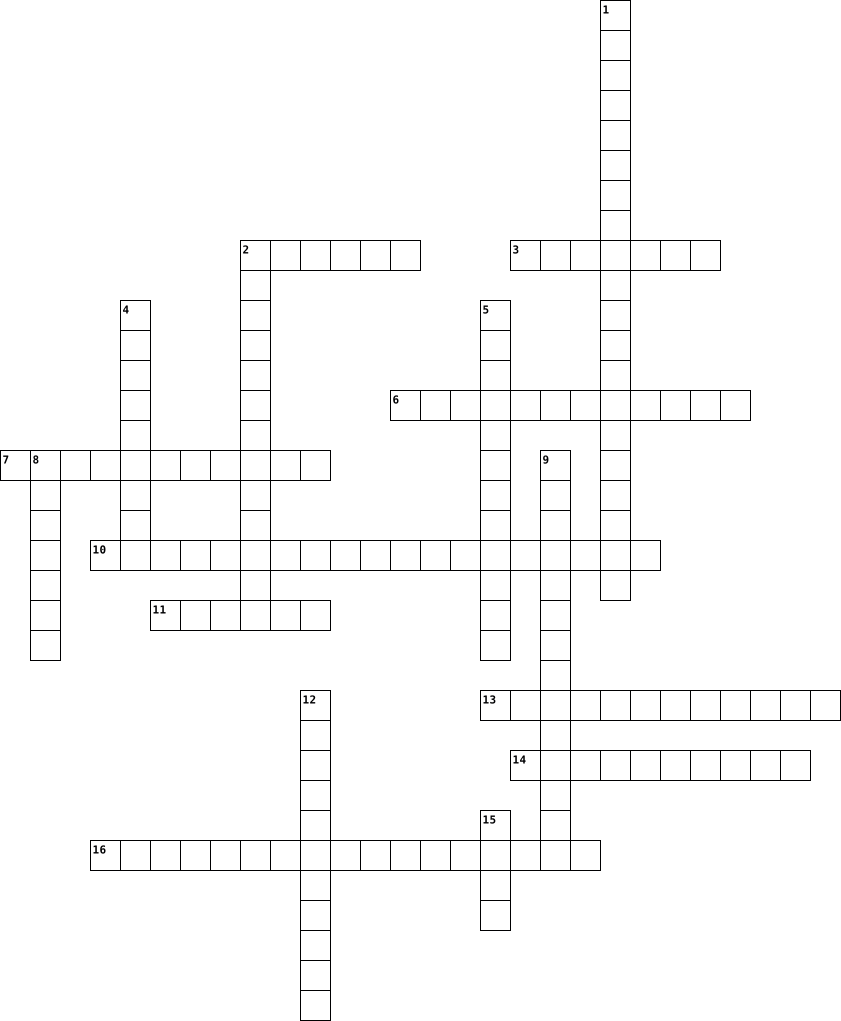
Across
- all things are made of
- division of cells
- Cells multiplying
- single celled
- makes glucose into energy
- uses to make something
- The PowerCenter
- A theory that all things are made of cells
- caused by becteria
Down
- The different levels of the ecosystem
- many cells
- does functions
- Controls what goes in/out
- Holds most data in the cell
- process where plants make food
- conducts photosynthesis
- Living Things are made of
17 Clues: many cells • single celled • does functions • The PowerCenter • division of cells • Cells multiplying • caused by becteria • all things are made of • uses to make something • conducts photosynthesis • Controls what goes in/out • makes glucose into energy • Living Things are made of • Holds most data in the cell • process where plants make food • The different levels of the ecosystem • ...
LAB STUDY 2021-11-10

Across
- all things are made of
- division of cells
- Cells multiplying
- single celled
- makes glucose into energy
- uses to make something
- The PowerCenter
- A theory that all things are made of cells
- caused by becteria
Down
- The different levels of the ecosystem
- many cells
- does functions
- Controls what goes in/out
- Holds most data in the cell
- process where plants make food
- conducts photosynthesis
- Living Things are made of
17 Clues: many cells • single celled • does functions • The PowerCenter • division of cells • Cells multiplying • caused by becteria • all things are made of • uses to make something • conducts photosynthesis • Controls what goes in/out • makes glucose into energy • Living Things are made of • Holds most data in the cell • process where plants make food • The different levels of the ecosystem • ...
Chapter 12 Lymphatic System 2024-03-06

Across
- weakened or killed antigen injected into a person for the purpose of stimulating a primary immune response; conveys artificial active immunity; results in immunological memory
- a physiological response of the body to tissue injury
- cell particularly abundant in lymphatic and connective tissue
- the lymphatic vessels and lymphoid tissues and organs, including lymph nodes
- white blood cells formed in the bone marrow that mature in the lymphoid tissue
- short-lived immunity resulting from the introduction of “ donated antibodies” obtained from an immune animal or human donor
- antigen-specific defenses mounted by activated lymphocytes
- the body system responsible for protecting the body from pathogens and foreign cells
- descendants of a single cell
- lymphocytes that oversee humoral immunity; their descendants differentiate into antibody-producing plasma cells
- natural defenses that protect against all foreign material
- the process by which a B cell or T cell becomes sensitized through biding contact with an antigen
- the type of T lymphocyte that orchestrates cellular immunity by direct contact with other immune cells and by releasing chemicals called cytokines
- a protein molecule, released by plasma cells, that mediates humoral immunity; an antibody
- a depressed area where vessels enter and leave an organ
- an endocrine gland active in the immune system
- unique lymphocytes that are part of the nonspecific defenses
- cells that display portions of foreign antigens to T cells; include dendritic cells, macrophages, and B lymphocytes
- second and subsequent responses of the humoral arm of the immune system to a previously met antigen
- the initial response of the humoral arm of the immune system to an antigen
Down
- defensive proteins that assist the innate defenses by attacking microbes directly or by preventing their reproduction
- pure preparations of identical antibodies that exhibit specificity for a single antigen
- an enzyme found in sweat, saliva, and tears that is capable of destroying certain kinds of bacteria
- disease-causing microorganisms
- resulting from the deficient production or function of immune cells or certain molecules
- including toxins, foreign proteins, or bacteria that, when introduced to the body, is recognized as foreign and activates them immune system
- organs in the lymphatic system, including lymph nodes, spleen, and tonsils
- immunity produced by an encounter with an antigen; provides immunological memory
- immunity conferred by lymphocytes called T cells
- allergies; overreaction of the immune system to a perceived threat, resulting in tissue damage
- member of T cell and B cell clones that provides for immunological memory
- branch of the immune system that targets specific antigen; involves B and T lymphocytes and antigen presenting cells
- member of a B cell clone; specialized to produce and release antibodies
- blockage of the harmful effects of bacterial exotoxins or viruses by the binding of antibodies to their functional sites
- a group of plasma proteins that normally circulate in inactive forms
- an agent or chemical substance that induces fever
- the passage of blood cells through intact vessel walls into the tissues
- an abnormal accumulation of fluid in body parts or tissues; causes swelling
- a substance that causes vasodilation and increased vascular permeability
- effector T cell that directly kills foreign cells
- type of T lymphocyte that slows or stops activity of B and T cells once the antigenic threat is ended
- immunity provided by antibodies released by sensitized B cells and their plasma cell progeny
42 Clues: descendants of a single cell • disease-causing microorganisms • an endocrine gland active in the immune system • immunity conferred by lymphocytes called T cells • an agent or chemical substance that induces fever • effector T cell that directly kills foreign cells • a physiological response of the body to tissue injury • ...
Chapter 12 Vocabulary 2025-03-07

Across
- unique lymphocytes that are part of the nonspecific defenses
- the initial response of the humoral arm of the immune system to an antigen
- branch of the immune system that targets specific antigen; involves B and T lymphocytes and antigen presenting cells
- a substance that causes vasodilation and increased vascular permeability
- descendants of a single cell
- the passage of blood cells through intact vessel walls into the tissues
- including toxins, foreign proteins, or bacteria that, when introduced to the body, is recognized as foreign and activates them immune system
- an endocrine gland active in the immune system
- a group of plasma proteins that normally circulate in inactive forms
- a protein molecule, released by plasma cells, that mediates humoral immunity; an antibody
- defensive proteins that assist the innate defenses by attacking microbes directly or by preventing their reproduction
- immunity produced by an encounter with an antigen; provides immunological memory
- blockage of the harmful effects of bacterial exotoxins or viruses by the binding of antibodies to their functional sites
- an enzyme found in sweat, saliva, and tears that is capable of destroying certain kinds of bacteria
- a depressed area where vessels enter and leave an organ
- member of T cell and B cell clones that provides for immunological memory
- natural defenses that protect against all foreign material
- the type of T lymphocyte that orchestrates cellular immunity by direct contact with other immune cells and by releasing chemicals called cytokines
- pure preparations of identical antibodies that exhibit specificity for a single antigen
- an agent or chemical substance that induces fever
- cells that display portions of foreign antigens to T cells; include dendritic cells, macrophages, and B lymphocytes
- immunity provided by antibodies released by sensitized B cells and their plasma cell progeny
Down
- allergies; overreaction of the immune system to a perceived threat, resulting in tissue damage
- type of T lymphocyte that slows or stops activity of B and T cells once the antigenic threat is ended
- short-lived immunity resulting from the introduction of “ donated antibodies” obtained from an immune animal or human donor
- white blood cells formed in the bone marrow that mature in the lymphoid tissue
- organs in the lymphatic system, including lymph nodes, spleen, and tonsils
- second and subsequent responses of the humoral arm of the immune system to a previously met antigen
- weakened or killed antigen injected into a person for the purpose of stimulating a primary immune response; conveys artificial active immunity; results in immunological memory
- the process by which a B cell or T cell becomes sensitized through biding contact with an antigen
- disease-causing microorganisms
- a physiological response of the body to tissue injury
- the lymphatic vessels and lymphoid tissues and organs, including lymph nodes
- effector T cell that directly kills foreign cells
- immunity conferred by lymphocytes called T cells
- cell particularly abundant in lymphatic and connective tissue
- resulting from the deficient production or function of immune cells or certain molecules
- member of a B cell clone; specialized to produce and release antibodies
- antigen-specific defenses mounted by activated lymphocytes
- the body system responsible for protecting the body from pathogens and foreign cells
- lymphocytes that oversee humoral immunity; their descendants differentiate into antibody-producing plasma cells
- an abnormal accumulation of fluid in body parts or tissues; causes swelling
42 Clues: descendants of a single cell • disease-causing microorganisms • an endocrine gland active in the immune system • immunity conferred by lymphocytes called T cells • effector T cell that directly kills foreign cells • an agent or chemical substance that induces fever • a physiological response of the body to tissue injury • ...
Language of Cytology 2016-01-24

Across
- Natural cell death.
- Matrix making up the nucleus of the cells.
- granulated round cell tumor of variable malignancy.
- Glandular epithelial malignancy occ. see acini formations ie., mammary tissue.
- One cell encroaching on another forming an indentation in the neighboring cell.
- Nucleoli of varying sizes and shapes.
- Malignant bone tumor/mesenchymal tissue.
- Type of inflammation occ. seen in cats mouth.
- Variation of nucleus sizes.
- Round cell tumor of primarily young dogs.
- Population of same type cells with different shapes.
- Sexually transmitted round cell tumor.
- Type of inflammation consisting mostly of macrophages. Chronic.
- Nuclei as large or larger than an rbc.
- A shape descriptor for some spindle cells.
- Angular squamous epithelial cells without nucleus typically seen in estrus.
- Formation of cells in a circle found in glandular epithelium.
- Border between epithelial cells where cells communicate.
- Type of inflammation consisting of >10% eosinophils indicating hypersensitivity or parasitic disease.
- Fine needle aspirate.
- Connective tissue cells.
- Malignant mesenchymal/spindle cell tumor.
Down
- Term used to describe stain uptake.
- Malignant epithelial cell tumor.
- Usually very prominent when cell is active. Brain of cell.
- Malignant round cell tumor.
- Type of inflammation consisting of mixed wbcs.
- Aseptic technique to remove fluid from a body cavity.
- Type of fluid with low protien and low cell numbers.
- Description of condition of neutrophils in an inflammatory lesion.
- Malignant mesenchymal tumor often assoc. with vaccines.
- Type of fluid associated with FIP.
- Often vary considerably in cancers.
- Appearance of dying neutrophils,condensed "cannon ball" nuclear material.
- Type of milky effusion assoc. with lymphatics.
- Term used to describe very immature cells.
- Variation of cell sizes.
- Term used to describe a uniform cell population.
- Product of abnormal mitosis.
- A tumor that can mimic round epithelial or spindle cell tumor, often containing granules.
- Round cell tumor of plasma cells.
- Typically indicate reactivity when seen in a lymph node aspirate.
- Type of fluid accumulation often associated with infectious agent.
43 Clues: Natural cell death. • Fine needle aspirate. • Variation of cell sizes. • Connective tissue cells. • Malignant round cell tumor. • Variation of nucleus sizes. • Product of abnormal mitosis. • Malignant epithelial cell tumor. • Round cell tumor of plasma cells. • Type of fluid associated with FIP. • Term used to describe stain uptake. • Often vary considerably in cancers. • ...
Nervous Tissue 2019-12-10

Across
- The cell body is like a_______for the neuron.
- Unipolar neurons have only a single process_________out from the cell body.
- The main part of the cell, the part that carries on the_________functions, is the cell body.
- Neurons categorized as________neurons have several dendrites and a single prominent axon.
- If enough neurotransmitters are released at the synapse to_________the next neuron.
- When a neuron is sufficiently stimulated, it generates an action________that propagates down the axon towards the synapse.
- The signal is transmitted across the synapse by chemical compounds known as_________.
- A typical neuron displays a distinctive_________.
- A typical neuron consists of dendrites, the cell body, and an_______.
- Nervous tissue also includes cells that do not________impulses, but instead support the activities of the neurons.
- In the peripheral nervous system, Schwann cells are neuroglia cells that_______neuronal function by increasing the speed of impulse propagation.
- _________neurons possess a single dendrite and axon with the cell body.
- Neuroglia or glial cells, which have been characterized as having a________support role.
- _______are highly specialized nerve cells that generate and conduct nerve impulses.
- The axons are responsible for transmitting impulses over_______distances from cell body.
Down
- The axon is surrounded by a whitish, fatty layer called the_______sheath.
- Dendrites are extensions, or processes, of the_________that carry impulses to the cell body.
- _______are supporting cells that provide physical sport, remove debris, and provide electrical insulation.
- Dendrites are responsible for responding to_______.
- Nervous tissue responsible for coordinating and________many body activities.
- The Schwann cells are underlain by the_______sheath.
- Integration and________are the two major functions of nervous tissue.
- Nervous tissue contains_______categories of cells.
- irritability and conductivity are their two major________characteristics.
- Outside the myelin sheath there is a cellular layer called the________.
- The________is the gap between nerve cells, or between a nerve cell and its target.
- Supporting, or glia, cells bind neurons together and_______the neurons.
- It stimulates________contraction, creates an awareness of the environment, and plays a major role in emotions, memory, and reasoning.
- There are_______types of neuroglia.
- The medullary sheath is interrupted at intervals by the_______of Ranvier.
30 Clues: There are_______types of neuroglia. • The cell body is like a_______for the neuron. • A typical neuron displays a distinctive_________. • Nervous tissue contains_______categories of cells. • Dendrites are responsible for responding to_______. • The Schwann cells are underlain by the_______sheath. • ...
Nervous Tissue 2019-12-10

Across
- The cell body is like a_______for the neuron.
- Unipolar neurons have only a single process_________out from the cell body.
- The main part of the cell, the part that carries on the_________functions, is the cell body.
- Neurons categorized as________neurons have several dendrites and a single prominent axon.
- If enough neurotransmitters are released at the synapse to_________the next neuron.
- When a neuron is sufficiently stimulated, it generates an action________that propagates down the axon towards the synapse.
- The signal is transmitted across the synapse by chemical compounds known as_________.
- A typical neuron displays a distinctive_________.
- A typical neuron consists of dendrites, the cell body, and an_______.
- Nervous tissue also includes cells that do not________impulses, but instead support the activities of the neurons.
- In the peripheral nervous system, Schwann cells are neuroglia cells that_______neuronal function by increasing the speed of impulse propagation.
- _________neurons possess a single dendrite and axon with the cell body.
- Neuroglia or glial cells, which have been characterized as having a________support role.
- _______are highly specialized nerve cells that generate and conduct nerve impulses.
- The axons are responsible for transmitting impulses over_______distances from cell body.
Down
- The axon is surrounded by a whitish, fatty layer called the_______sheath.
- Dendrites are extensions, or processes, of the_________that carry impulses to the cell body.
- _______are supporting cells that provide physical sport, remove debris, and provide electrical insulation.
- Dendrites are responsible for responding to_______.
- Nervous tissue responsible for coordinating and________many body activities.
- The Schwann cells are underlain by the_______sheath.
- Integration and________are the two major functions of nervous tissue.
- Nervous tissue contains_______categories of cells.
- irritability and conductivity are their two major________characteristics.
- Outside the myelin sheath there is a cellular layer called the________.
- The________is the gap between nerve cells, or between a nerve cell and its target.
- Supporting, or glia, cells bind neurons together and_______the neurons.
- It stimulates________contraction, creates an awareness of the environment, and plays a major role in emotions, memory, and reasoning.
- There are_______types of neuroglia.
- The medullary sheath is interrupted at intervals by the_______of Ranvier.
30 Clues: There are_______types of neuroglia. • The cell body is like a_______for the neuron. • A typical neuron displays a distinctive_________. • Nervous tissue contains_______categories of cells. • Dendrites are responsible for responding to_______. • The Schwann cells are underlain by the_______sheath. • ...
Nervous Tissue 2019-12-10

Across
- The cell body is like a_______for the neuron.
- Unipolar neurons have only a single process_________out from the cell body.
- The main part of the cell, the part that carries on the_________functions, is the cell body.
- Neurons categorized as________neurons have several dendrites and a single prominent axon.
- If enough neurotransmitters are released at the synapse to_________the next neuron.
- When a neuron is sufficiently stimulated, it generates an action________that propagates down the axon towards the synapse.
- The signal is transmitted across the synapse by chemical compounds known as_________.
- A typical neuron displays a distinctive_________.
- A typical neuron consists of dendrites, the cell body, and an_______.
- Nervous tissue also includes cells that do not________impulses, but instead support the activities of the neurons.
- In the peripheral nervous system, Schwann cells are neuroglia cells that_______neuronal function by increasing the speed of impulse propagation.
- _________neurons possess a single dendrite and axon with the cell body.
- Neuroglia or glial cells, which have been characterized as having a________support role.
- _______are highly specialized nerve cells that generate and conduct nerve impulses.
- The axons are responsible for transmitting impulses over_______distances from cell body.
Down
- The axon is surrounded by a whitish, fatty layer called the_______sheath.
- Dendrites are extensions, or processes, of the_________that carry impulses to the cell body.
- _______are supporting cells that provide physical sport, remove debris, and provide electrical insulation.
- Dendrites are responsible for responding to_______.
- Nervous tissue responsible for coordinating and________many body activities.
- The Schwann cells are underlain by the_______sheath.
- Integration and________are the two major functions of nervous tissue.
- Nervous tissue contains_______categories of cells.
- irritability and conductivity are their two major________characteristics.
- Outside the myelin sheath there is a cellular layer called the________.
- The________is the gap between nerve cells, or between a nerve cell and its target.
- Supporting, or glia, cells bind neurons together and_______the neurons.
- It stimulates________contraction, creates an awareness of the environment, and plays a major role in emotions, memory, and reasoning.
- There are______types of neuroglia.
- The medullary sheath is interrupted at intervals by the_______of Ranvier.
30 Clues: There are______types of neuroglia. • The cell body is like a_______for the neuron. • A typical neuron displays a distinctive_________. • Nervous tissue contains_______categories of cells. • Dendrites are responsible for responding to_______. • The Schwann cells are underlain by the_______sheath. • Integration and________are the two major functions of nervous tissue. • ...
Nervous Tissue 2019-12-10

Across
- The medullary sheath is interrupted at intervals by the_______of Ranvier.
- Nervous tissue also includes cells that do not________impulses, but instead support the activities of the neurons.
- Dendrites are extensions, or processes, of the_________that carry impulses to the cell body.
- In the peripheral nervous system, Schwann cells are neuroglia cells that_______neuronal function by increasing the speed of impulse propagation.
- A typical neuron displays a distinctive_________.
- Supporting, or glia, cells bind neurons together and_______the neurons.
- The axons are responsible for transmitting impulses over_______distances from cell body.
- The main part of the cell, the part that carries on the_________functions, is the cell body.
- The axon is surrounded by a whitish, fatty layer called the_______sheath.
- The signal is transmitted across the synapse by chemical compounds known as_________.
- Neuroglia or glial cells, which have been characterized as having a________support role.
- _______are supporting cells that provide physical sport, remove debris, and provide electrical insulation.
- A typical neuron consists of dendrites, the cell body, and an_______.
- When a neuron is sufficiently stimulated, it generates an action________that propagates down the axon towards the synapse.
Down
- Nervous tissue contains_______categories of cells.
- If enough neurotransmitters are released at the synapse to_________the next neuron.
- The cell body is like a_______for the neuron.
- The Schwann cells are underlain by the_______sheath.
- _______are highly specialized nerve cells that generate and conduct nerve impulses.
- The________is the gap between nerve cells, or between a nerve cell and its target.
- Neurons categorized as________neurons have several dendrites and a single prominent axon.
- _________neurons possess a single dendrite and axon with the cell body.
- Dendrites are responsible for responding to_______.
- Unipolar neurons have only a single process_________out from the cell body.
- irritability and conductivity are their two major________characteristics.
- Integration and________are the two major functions of nervous tissue.
- Outside the myelin sheath there is a cellular layer called the________.
- It stimulates________contraction, creates an awareness of the environment, and plays a major role in emotions, memory, and reasoning.
- Nervous tissue responsible for coordinating and________many body activities.
- Dendrites, which receive input from other neurons,_______off the cell body and appear as thin extensions.
30 Clues: The cell body is like a_______for the neuron. • A typical neuron displays a distinctive_________. • Nervous tissue contains_______categories of cells. • Dendrites are responsible for responding to_______. • The Schwann cells are underlain by the_______sheath. • Integration and________are the two major functions of nervous tissue. • ...
Nervous Tissue 2019-12-10

Across
- The________is the gap between nerve cells, or between a nerve cell and its target.
- There are______types of neuroglia.
- Neuroglia or glial cells, which have been characterized as having a________support role.
- Nervous tissue contains_______categories of cells.
- When a neuron is sufficiently stimulated, it generates an action________that propagates down the axon towards the synapse.
- If enough neurotransmitters are released at the synapse to_________the next neuron.
- The Schwann cells are underlain by the_______sheath.
- A typical neuron consists of dendrites, the cell body, and an_______.
- Dendrites, which receive input from other neurons,_______off the cell body and appear as thin extensions.
- The main part of the cell, the part that carries on the_________functions, is the cell body.
- irritability and conductivity are their two major________characteristics.
- Dendrites are responsible for responding to_______.
- Nervous tissue responsible for coordinating and________many body activities.
- The signal is transmitted across the synapse by chemical compounds known as_________.
- A typical neuron displays a distinctive_________.
- _______are supporting cells that provide physical sport, remove debris, and provide electrical insulation.
- _________neurons possess a single dendrite and axon with the cell body.
- The cell body is like a_______for the neuron.
Down
- The medullary sheath is interrupted at intervals by the_______of Ranvier.
- The axons are responsible for transmitting impulses over_______distances from cell body.
- It stimulates________contraction, creates an awareness of the environment, and plays a major role in emotions, memory, and reasoning.
- In the peripheral nervous system, Schwann cells are neuroglia cells that_______neuronal function by increasing the speed of impulse propagation.
- _______are highly specialized nerve cells that generate and conduct nerve impulses.
- Outside the myelin sheath there is a cellular layer called the________.
- Dendrites are extensions, or processes, of the_________that carry impulses to the cell body.
- Unipolar neurons have only a single process_________out from the cell body.
- The axon is surrounded by a whitish, fatty layer called the_______sheath.
- Integration and________are the two major functions of nervous tissue.
- Neurons categorized as________neurons have several dendrites and a single prominent axon.
- Nervous tissue also includes cells that do not________impulses, but instead support the activities of the neurons.
- Supporting, or glia, cells bind neurons together and_______the neurons.
31 Clues: There are______types of neuroglia. • The cell body is like a_______for the neuron. • A typical neuron displays a distinctive_________. • Nervous tissue contains_______categories of cells. • Dendrites are responsible for responding to_______. • The Schwann cells are underlain by the_______sheath. • A typical neuron consists of dendrites, the cell body, and an_______. • ...
NERVOUS TISSUE 2019-12-10

Across
- Dendrites, which receive input from other neurons,_______off the cell body and appear as thin extensions.
- Nervous tissue contains_______categories of cells.
- Unipolar neurons have only a single process_________out from the cell body.
- The cell body of a neuron, also called the soma, contains the________and mitochondria.
- The Schwann cells are underlain by the_______sheath.
- irritability and conductivity are their two major________characteristics.
- Neurons categorized as________neurons have several dendrites and a single prominent axon.
- Nervous tissue also includes cells that do not________impulses, but instead support the activities of the neurons.
- When a neuron is sufficiently stimulated, it generates an action________that propagates down the axon towards the synapse.
- There are________types of neuroglia.
- If enough neurotransmitters are released at the synapse to_________the next neuron.
- The cell body is like a_______for the neuron.
- Neuroglia or glial cells, which have been characterized as having a________support role.
- The main part of the cell, the part that carries on the_________functions, is the cell body.
Down
- A typical neuron consists of dendrites, the cell body, and an_______.
- Dendrites are extensions, or processes, of the_________that carry impulses to the cell body.
- Nervous tissue responsible for coordinating and________many body activities.
- Supporting, or glia, cells bind neurons together and_______the neurons.
- _______are supporting cells that provide physical sport, remove debris, and provide electrical insulation.
- The axon is surrounded by a whitish, fatty layer called the_______sheath.
- The axons are responsible for transmitting impulses over_______distances from cell body.
- Outside the myelin sheath there is a cellular layer called the________.
- _________neurons possess a single dendrite and axon with the cell body.
- It stimulates________contraction, creates an awareness of the environment, and plays a major role in emotions, memory, and reasoning.
- A typical neuron displays a distinctive_________.
- Dendrites are responsible for responding to_______.
- _______are highly specialized nerve cells that generate and conduct nerve impulses.
- The________is the gap between nerve cells, or between a nerve cell and its target.
- The medullary sheath is interrupted at intervals by the_______of Ranvier.
- In the peripheral nervous system, Schwann cells are neuroglia cells that_______neuronal function by increasing the speed of impulse propagation.
30 Clues: There are________types of neuroglia. • The cell body is like a_______for the neuron. • A typical neuron displays a distinctive_________. • Nervous tissue contains_______categories of cells. • Dendrites are responsible for responding to_______. • The Schwann cells are underlain by the_______sheath. • ...
Tissue Connections 2017-02-15

Across
- Nervous tissue cells are called ____ and communicate by electrical and chemical signals.
- Skeletal muscle is voluntary, while _____ and cardiac muscle are involuntary.
- Differentiation is when unspecialized embryo tissues become specialized mature tissue, and _______ is when one type of mature tissue changes to another.
- Merocrine is a mode of secretion which uses exocytosis (the cell throws up). What does the cell do in holocrine secretion?
- The types of connective tissues are fibrous connective tissue, ¬_____ connective tissue, adipose, supportive connective tissue, and fluid connective tissue.
- The ____ in tissues are holes that hold chondroblasts in cartilage and osteoblasts in bone.
- Leukocytes are white blood cells, while _______ are red blood cells.
- _____ are the rings of compact bone which surround the central canal.
- Embryonic stem cells are totipotent and pluripotent (able to become any cell), and adult stem cells are multipotent and ______ (limited to a few or one type of cell).
- Tight junctions prevent ____, while desmosomes prevent tearing, and gap junctions serve as tunnels.
Down
- _____ are specialized nervous cells that serve, protect, and support.
- Cancaliculi in compact bone are used by lacunae to _______.
- Secretions are ____ by the body (hormones), while excretions are expelled from the body (waste, eggs, sperm).
- Stratified squamous __________ cells provide waterproofing to skin.
- Exocrine is excreted, while endocrine is ______.
- Mucus, whole cells, and _____ fluid are all types of secretions.
- Hormones are secreted by glands made up of _____ tissue.
- Intercalated discs are found in _____ tissue.
- _______ membranes are found on the skin, while serous membranes are found in simple squamous epithelium (serous fluid), and mucous membranes lines passages leading outside the body.
- The _____ surface is touching the tissue underneath.
- Hyperplasia causes cell growth by increasing the number of cells through _______, while hypertrophy is an enlargement of cells, and neoplasia is tumor growth.
- The two types of osseous tissue are spongy bone and _____ bone.
- Hyaline cartilage is found in the ______.
- Regeneration is the regrowth and repair of normal tissues, while fibrosis is the formation of _____ tissue.
24 Clues: Hyaline cartilage is found in the ______. • Intercalated discs are found in _____ tissue. • Exocrine is excreted, while endocrine is ______. • The _____ surface is touching the tissue underneath. • Hormones are secreted by glands made up of _____ tissue. • Cancaliculi in compact bone are used by lacunae to _______. • ...
Tissue Connections 2017-02-15

Across
- Mucus, whole cells, and _____ fluid are all types of secretions.
- Hyperplasia causes cell growth by increasing the number of cells through _______, while hypertrophy is an enlargement of cells, and neoplasia is tumor growth.
- Skeletal muscle is voluntary, while _____ and cardiac muscle are involuntary.
- Cancaliculi in compact bone are used by lacunae to _______.
- Tight junctions prevent ____, while desmosomes prevent tearing, and gap junctions serve as tunnels.
- Stratified squamous __________ cells provide waterproofing to skin.
- Differentiation is when unspecialized embryo tissues become specialized mature tissue, and _______ is when one type of mature tissue changes to another.
- The types of connective tissues are fibrous connective tissue, ¬_____ connective tissue, adipose, supportive connective tissue, and fluid connective tissue.
- The _____ surface is touching the tissue underneath.
- _______ membranes are found on the skin, while serous membranes are found in simple squamous epithelium (serous fluid), and mucous membranes lines passages leading outside the body.
- Intercalated discs are found in _____ tissue.
- Embryonic stem cells are totipotent and pluripotent (able to become any cell), and adult stem cells are multipotent and ______ (limited to a few or one type of cell).
Down
- Nervous tissue cells are called ____ and communicate by electrical and chemical signals.
- Secretions are ____ by the body (hormones), while excretions are expelled from the body (waste, eggs, sperm).
- _____ are the rings of compact bone which surround the central canal.
- The two types of osseous tissue are spongy bone and _____ bone.
- Regeneration is the regrowth and repair of normal tissues, while fibrosis is the formation of _____ tissue.
- _____ are specialized nervous cells that serve, protect, and support.
- Merocrine is a mode of secretion which uses exocytosis (the cell throws up). What does the cell do in holocrine secretion?
- Exocrine is excreted, while endocrine is ______.
- Hormones are secreted by glands made up of _____ tissue.
- Leukocytes are white blood cells, while _______ are red blood cells.
- Hyaline cartilage is found in the ______.
- The ____ in tissues are holes that hold chondroblasts in cartilage and osteoblasts in bone.
24 Clues: Hyaline cartilage is found in the ______. • Intercalated discs are found in _____ tissue. • Exocrine is excreted, while endocrine is ______. • The _____ surface is touching the tissue underneath. • Hormones are secreted by glands made up of _____ tissue. • Cancaliculi in compact bone are used by lacunae to _______. • ...