
chemical reaction Crossword Puzzles
BioEnergy Crossword 2025-09-22

Across
- , The organelle in eukaryotic cells where aerobic respiration occurs and ATP is produced.
- , Energy stored in the bonds of molecules (like glucose) that can be used by cells.
- , A substance that starts a chemical reaction (used up during the reaction).
- cellular respiration that occurs without oxygen
- , A substance that is produced by a chemical reaction.
- The main energy currency of the cell, used to power biological processes.
- The diffusion of water molecules across a selectively permeable membrane.
- movement of molecules from an area of high concentration to low concentration until equilibrium is reached.
- process of converting light energy into chemical energy
- movement of molecules against their concentration gradient (low → high) using energy (ATP).
- reactant in respiration & waste product of photosynthesis
- The outer boundary of a cell that controls what enters and leaves, keeping the cell’s internal environment stable.
- A byproduct of anaerobic respiration in animal cells, produced when oxygen is low (e.g., during intense exercise).
Down
- , Energy from the sun that can be captured by chlorophyll to make chemical energy in photosynthesis.
- A type of feedback mechanism that amplifies a change, often moving the system further from its starting point (e.g., blood clotting).
- The ability of an organism or cell to maintain a stable internal environment despite changes in the external environment.
- A byproduct of anaerobic respiration (alcoholic fermentation) in yeast and some bacteria.
- A process in which the body or a cell responds to a change in order to maintain homeostasis.
- The movement of molecules without using energy, usually along the concentration gradient (high → low).
- dioxide, plants remove this gas from the atmosphere through photosynthesis
- A type of feedback mechanism that reverses a change to return the system to its normal state (e.g., shivering to raise body temperature).
- , An anaerobic process that allows cells to produce ATP without oxygen, producing lactic acid or ethanol as a byproduct.
- cellular respiration that occurs with oxygen making the maximum number of ATP
- plants perform photosynthesis to create this
- The green pigment in plants that absorbs light energy for photosynthesis.
- The reaction of a cell or organism to a stimulus.
- , A substance produced during a process that is not needed by the organism and is usually removed
- A substance that helps maintain a stable pH in a solution, resisting changes when acids or bases are added.
- The organelle in plant cells where photosynthesis occurs.
- Any change in the environment (internal or external) that causes a response from an organism or cell.
30 Clues: plants perform photosynthesis to create this • cellular respiration that occurs without oxygen • The reaction of a cell or organism to a stimulus. • , A substance that is produced by a chemical reaction. • process of converting light energy into chemical energy • The organelle in plant cells where photosynthesis occurs. • ...
Biology 2020-09-10

Across
- speed up chemical reactions
- a chemical that dissolves things
- things that are spread out
- substances which react inside the acids
- a group of atoms bound together
- all carbohydrates in a formula
- a substance that cannot be decomposed
- final result
- Lets you be able to work
- smallest unit, creates all things
Down
- the measure of the heat of something
- chemicals broken down
- consisting of multiple atoms
- makes up everything in the universe
- undergoes a change during a reaction
15 Clues: final result • chemicals broken down • Lets you be able to work • things that are spread out • speed up chemical reactions • consisting of multiple atoms • all carbohydrates in a formula • a group of atoms bound together • a chemical that dissolves things • smallest unit, creates all things • makes up everything in the universe • the measure of the heat of something • ...
Infection Control 2022-08-22

Across
- capable of destroying bacteria
- self movement
- an abnormal condition of all or part of the body
- chemical products that destroy all bacteria
- chemical germicides formulated for use on the skin
- showing no symptoms
- one-celled microorganisms
- virus that causes AIDS
Down
- short rod shaped bacteria
- determination of the nature of a disease based on its symptoms
- reaction due to extreme sensitivity
- the ability to produce an effect
- any organism of microscopic size
- microscopic plant parasites
- round shaped bacteria
15 Clues: self movement • showing no symptoms • round shaped bacteria • virus that causes AIDS • short rod shaped bacteria • one-celled microorganisms • microscopic plant parasites • capable of destroying bacteria • the ability to produce an effect • any organism of microscopic size • reaction due to extreme sensitivity • chemical products that destroy all bacteria • ...
Matter 2024-11-24

Across
- the atomic number is 5
- is when a gas becomes a liquid
- oxygen is usually the molecule
- is the most stable element
- change when two chemicals react to others
- change when the size or shape changes
Down
- the atomic number is 6
- it only has 1 atom
- 46% of the Earths weight is the answer
- it is the least dense
- particles never stop moving
- it is the smallest unit of matter
- reaction involves breaking chemical bound
- reaction involves breaking chemical bound
- floats on water
- can take up any container
- a hard object
17 Clues: a hard object • floats on water • it only has 1 atom • it is the least dense • the atomic number is 6 • the atomic number is 5 • can take up any container • is the most stable element • particles never stop moving • is when a gas becomes a liquid • oxygen is usually the molecule • it is the smallest unit of matter • change when the size or shape changes • ...
U8 Chemistry Properties of Matter 2026-02-12

Across
- the ability of a substance to burn or ignite in the presence of oxygen
- a state of matter with no definite shape or volume, where particles move freely
- the process by which a gas changes into a liquid
- A characteristic of a substance that describes its ability to undergo a chemical change
- a pure substance that cannot be broken down into simpler substances by chemical means
- the process by which a liquid changes to a gas at temperatures below the boiling point
- A mixture in which the components are not uniformly distributed and can often be seen with the naked eye, such as a salad
- a substance formed by the chemical combination of two or more elements
Down
- A process that produces one or more new substances with different properties
- the amount of heat energy required to change a liquid into a gas at its boiling point
- a method to separate solids from liquids or gases using a porous barrier
- the lowest possible temperature where particles have minimal kinetic energy
- a reaction or process that releases heat to the surroundings
- the smallest unit of an element that retains its chemical properties
- The temperature at which a liquid changes to a gas throughout the substance
- a mixture where particles are dispersed but not dissolved, such as fog or milk
- the ability of a material to allow the flow of heat or electricity
- a reaction or process that absorbs heat from the surroundings
18 Clues: the process by which a gas changes into a liquid • a reaction or process that releases heat to the surroundings • a reaction or process that absorbs heat from the surroundings • the ability of a material to allow the flow of heat or electricity • the smallest unit of an element that retains its chemical properties • ...
NUCLEAR ENERGY 2023-11-30

Across
- / each of two or more forms of the same element that contain equal numbers of protons but different numbers of neutrons in their nuclei, and hence differ in relative atomic mass but not in chemical properties; in particular, a radioactive form of an element.
- /a stable subatomic particle occurring in all atomic nuclei, with a positive electric charge equal magnitude to that of an electron, but of opposite sign.
- /an electron or positron that is thrown out from the nucleus of an atom during radioactive decay
- /the energy released during nuclear fission or fusion, especially when used to generate electricity.
- /a nuclear reaction in which a heavy nucleus splits spontaneously or on impact with another particle, with the release of energy.
- /the number of a chemical element in the periodic system and on the periodic table that equals the number of protons in the nucleus of the atom
Down
- /a nuclear reaction in which atomic nuclei of low atomic number fuse to form a heavier nucleus with the release of energy.
- /a chemical reaction or other process in which the products promote or spread the reaction, which may accelerate dramatically under certain conditions.
- /is a penetrating form of electromagnetic radiation arising from the radioactive decay of atomic nuclei.
- /the time required for one-half the atoms of a given amount of a radioactive substance to disintegrate
- / the emission of ionizing radiation or particles caused by the spontaneous disintegration of atomic nuclei.
- / a helium nucleus emitted by some radioactive substances, originally regarded as a ray.
- /The neutron is one of the three subatomic particles that make up an atom.
- /the number of protons and neutrons in a nucleus.
- /the positively charged central core of an atom, consisting of protons and neutrons and containing nearly all its mass.
15 Clues: /the number of protons and neutrons in a nucleus. • /The neutron is one of the three subatomic particles that make up an atom. • / a helium nucleus emitted by some radioactive substances, originally regarded as a ray. • /an electron or positron that is thrown out from the nucleus of an atom during radioactive decay • ...
Matter and Interactions- Vocabulary 2025-06-02

Across
- A solid formed as a result of a chemical reaction.
- Matter that can be broken down by a chemical reaction into its element parts.
- The process by which one or more substances undergo change to produce one or more different substances.
Down
- Techniques chemists use to purify atoms and molecules.
- Matter in which two or more substances (elements or compounds) are mixed together without breaking or making new bonds between atoms.
- A method of separating a liquid mixture through boiling and evaporation.
- A chemical reaction that uses electricity to break substances apart.
- A technique that is used to separate a single substance from a mixture of many different substances
- An atom that exists naturally in Earth that serves as a building block of all matter.
9 Clues: A solid formed as a result of a chemical reaction. • Techniques chemists use to purify atoms and molecules. • A chemical reaction that uses electricity to break substances apart. • A method of separating a liquid mixture through boiling and evaporation. • Matter that can be broken down by a chemical reaction into its element parts. • ...
C1.2 Respiration (HL) 2023-06-09

Across
- (Two words)Building Blocks of Lipids that can provide a substrate for respiration
- (Two words) the production of ATP through a series of oxidation and reduction reactions that results in the addition of a phosphate group to another molecule.
- (Two words)the movement of materials through a cell membrane using the energy provided by respiration
- energy storing reactions.
- the gain of electrons or gain of hydrogen.
- a metabolic pathway that breaks glucose down to pyruvate.
- (Two words)a nucleotide triphosphate that is a common source of energy in cells.
- An organelle found in large numbers in most cells, in which the biochemical processes of respiration and energy production occur.
- invaginations of the inner mitochondrial membrane.
- (Two words) a decarboxylation reaction that occurs in the mitochondrial matrix between the biochemical processes of glycolysis and the Krebs cycle.
- a compartment inside the inner membrane of the mitochondrion.
- a compound produced during the breakdown of glucose in anaerobic metabolism in animals and bacteria. (AKA Lactic acid)
- (Two words) a type of cellular chemical reaction where oxygen is consumed and energy is released from glucose.
- (Three words)Oxygen provides this role at the end of the ETC in aerobic respiration, where it is also combined with carbon to make CO2
Down
- (Three words) a group of proteins that accept and donate electrons in a series.
- a chemical reaction that involves the removal of CO2.
- the loss of electrons or loss of hydrogen.
- the end product of glycolysis.
- (Two words) The space between the inner and outer membrane of the mitochondria
- Breaking down complex molecules by the chemical addition of water
- (One word + 3 letters) the energy rich form of the hydrogen carrier.
- the formation of separate membrane-bound areas in a Mitochondrion (or chloroplast) that provides the benefit of creating specialised structures or areas for particular functions. E.g. the matrix of the mitochondrion contains the necessary enzymes for the Krebs cycle.
- a process for making ATP using the energy stored in an electrochemical gradient of hydrogen ions.
- (Two words) The second major stage of cellular respiration, in which pyruvic acid is broken down into carbon dioxide in a series of energy-extracting reactions
- A word to describe any chemical reaction that combines simple molecules to build more-complex molecules
- energy releasing reactions.
- splitting
- (Two words)an enzyme that utilizes the H+ electrochemical gradient to synthesize ATP.
28 Clues: splitting • energy storing reactions. • energy releasing reactions. • the end product of glycolysis. • the loss of electrons or loss of hydrogen. • the gain of electrons or gain of hydrogen. • invaginations of the inner mitochondrial membrane. • a chemical reaction that involves the removal of CO2. • a metabolic pathway that breaks glucose down to pyruvate. • ...
Ecology and Human Impact Vocabulary 2024-10-22

Across
- A model used to explain how enzymes and substrates interact.
- The conversation of water is the cycling of water through evaporation, condensation, precipitation, and infiltration in the environment.
- Energy cannot be created or destroyed.
- A type of membrane which allows certain particles to pass through, while other cannot.
- A homogeneous mixture of one or more solutes dissolved in a solvent.
- Series of metabolic processes for breaking down glucose to form energy.
- Basic unit of life that makes up all living organisms.
- Processes or organisms that require oxygen to function.
- The movement of water molecules from a solution with a high concentration of water molecules to a solution with a lower concentration of water molecules, through a cell's partially permeable membrane.
- Minimum amount of energy required for a chemical reaction to occur.
- Any chemical reaction that absorbs heat from its environment.
- Passive transport is the movement of substances across a cell membrane without using energy, relying on concentration gradients to move from high to low concentration.
- Two solutions of equal concentrations of solutes and water separated by a semipermeable membrane to allow water to move freely in and out of a cell.
- Sodium-potassium pump is a protein that moves sodium out and potassium into cells, maintaining balance and charge.
Down
- Movement of a substance up its concentration gradient, using energy input from the cell and requiring membrane protein channels.
- A dissolved substance.
- A type of passive transport that uses specialized proteins, such as channel proteins and carrier proteins, to help molecules move across a cell membrane.
- A chemical reaction that releases energy by light or heat.
- The process by which cells take in substances from outside of the cell by engulfing them in a vesicle.
- A solution or a muscle, having greater tonicity or level of tension than the other.
- The process by which plants use sunlight, water, and carbon dioxide to create oxygen and energy in the form of sugar.
- The movement of molecules from a region of higher concentration to a region of lower concentration down the concentration gradient.
- Induced fit is when an enzyme changes shape to fit a substrate better during their interaction.
- “Not requiring oxygen”
- the process of adding a catalyst to facilitate a reaction.
- Protein that acts as a catalyst to speed up chemical reactions in living organisms.
- The source of energy for use and storage at the cellular level.
27 Clues: A dissolved substance. • “Not requiring oxygen” • Energy cannot be created or destroyed. • Basic unit of life that makes up all living organisms. • Processes or organisms that require oxygen to function. • A chemical reaction that releases energy by light or heat. • the process of adding a catalyst to facilitate a reaction. • ...
Proteins Revision 2022-07-04

Across
- The -NH2 chemical group in an amino acid
- The variable side chain that is different for each amino acid (_-_ _ _ _ _)
- _____ interactions, the tendency of non-polar molecules/parts of molecules to clump together avoiding water.
- The bond between two amino acids.
- Proteins in the immune system that recognise different pathogens.
- A strong bond formed by two atoms sharing electrons.
- The protein that carries oxygen in red blood cells.
- The level of protein structure that means the overall 3D shape of the molecule.
- The monomer of a polypeptide.
- A polymer of amino acids.
Down
- The level of structure that means the sequence of amino acids in a protein.
- ____ acid, the -COOH chemical group in an amino acid.
- A polymer made of amino acids folded into a specific 3D shape.
- One form of secondary protein structure.
- Beta-pleated ____: another form of secondary protein structure.
- The opposite of hydrophobic.
- Something that can speed up a chemical reaction.
- The protein hormone that people with Type I diabetes cannot make.
- The level of protein structure found in some proteins such as haemoglobin that have multiple subunits and/or a prosthetic group.
- A molecule of this is produced when a peptide bond is formed between two amino acids.
- _____ bridge, a covalent bond between the sulfur atoms in two molecules of the amino acid cysteine.
- A protein that can catalyse a reaction.
22 Clues: A polymer of amino acids. • The opposite of hydrophobic. • The monomer of a polypeptide. • The bond between two amino acids. • A protein that can catalyse a reaction. • The -NH2 chemical group in an amino acid • One form of secondary protein structure. • Something that can speed up a chemical reaction. • The protein that carries oxygen in red blood cells. • ...
8th Science Lesson 2 2024-08-29

Across
- These types of metals are good conductors of heat and electricity
- The temperature at which a solid becomes a liquid is the ______ point
- A type of property that describes how a substance undergoes a reaction
- Most reactive nonmetal group
- If an element has a high likelihood to go through a chemical reaction, it is very ___
- A type of property that describes how a substance behaves without being changed chemically
- at extremely high temperatures, almost any element can be a ____
- If an elements' atoms are really compact (close together), they are ____
- Group 2: ___ earth metals
- Characteristics about elements that may be either chemical or physical
- Potassium, Rhodium, and lead are all examples of this
- Carbon, Iodine, and Argon are all examples of this
- Element with the simplest atoms
Down
- The kind of energy that may change a solid to a liquid or a liquid to a gas
- atomic mass is an ____ of the masses of all isotopes of that element
- Scientist that first started sorting the elements into a periodic table
- A repeated pattern
- A column in the periodic table may also be called this
- Most stable group
- A row in the periodic table may also be called this
- The most reactive group of metals
- Have similarities to both metals and nonmetals
22 Clues: Most stable group • A repeated pattern • Group 2: ___ earth metals • Most reactive nonmetal group • Element with the simplest atoms • The most reactive group of metals • Have similarities to both metals and nonmetals • Carbon, Iodine, and Argon are all examples of this • A row in the periodic table may also be called this • ...
Mixtures and Solutions Vocabulary 2024-04-27

Across
- any substance that goes through a chemical change
- to make a liquid thinner or weaker
- a insoluble solid separated from a liquid solution
- able to be dissolved
- amount of solid dissolved in water
- a substance gained through a chemical reaction
- an invisible force that pulls objects to each other
- when a material is no longer visible in a liquid
- a material or liquid you can see through
- matter with specific properties and composition
- when a liquid is turned into a gas
- a material that dissolves in a solution
- a thickness of some material covering another material
- containing the maximum amount of solute able to be dissolved
- a piece of steel or iron that attracts some objects
Down
- to take something apart
- reaction a process where atoms change into a new substance
- a liquid used to dissolve a solute
- mass per unit of volume
- to separate a solid from a solution
- the amount of matter in an object
- increasing saturation beyond saturated
- to separate a part from a mixture
- a distinctive or characteristic of a substance
- space within the boundaries occupied by a 3-D object
- a mixture formed when a material dissolves in H2O
- can not be dissolved
- a natural material arranged in regular repeating patterns
- a mixture of small stones and pebbles
29 Clues: able to be dissolved • can not be dissolved • to take something apart • mass per unit of volume • the amount of matter in an object • to separate a part from a mixture • to make a liquid thinner or weaker • a liquid used to dissolve a solute • amount of solid dissolved in water • when a liquid is turned into a gas • to separate a solid from a solution • ...
Acids and Bases 2024-06-25

Across
- Acids taste...
- A soluble base.
- Toothpaste is pH...
- What is the chemical symbol for calcium?
- A mixture containing a liquid with something else dissolved in it.
- _______ specs must be worn in a lab when we use chemicals
- The product name after the metal and the acid in a neutralisation reaction.
- A substance that changes colour depending on whether the conditions are acidic or alkaline, e.g. Universal...
- The salt produced by ethanoic acid.
- What happens to the pH if you add alkali to a solution?
- A substance that is neutralised by a base.
- Complete the equation: sodium + sulfuric acid → _________ + hydrogen
- A substance that can cause chemical burns is called...
Down
- The acid that produces sulfate salts.
- What is the chemical name of common table salt?
- A liquid that dissolves a solute.
- Alaklis taste...
- The gas produced when acid reacts with a metal.
- The mass of acid (solute) divided by the volume of water (solvent)
- A reaction where an acid and alkali cancel each other out
- A substance that neutralises an acid.
- The acid that produces chloride salts.
- A soluble substance.
- Complete the equation: lithium hydroxide + ________ acid → lithium nitrate + water
- What yellow fruit contains citric acid?
- A low concentration
- Vinegar is pH...
- What household cleaner contains alkali?
- The pH of a neutral substance
29 Clues: Acids taste... • A soluble base. • Alaklis taste... • Vinegar is pH... • Toothpaste is pH... • A low concentration • A soluble substance. • The pH of a neutral substance • A liquid that dissolves a solute. • The salt produced by ethanoic acid. • The acid that produces sulfate salts. • A substance that neutralises an acid. • The acid that produces chloride salts. • ...
Unit 2 2025-03-24

Across
- Hates/fears water
- When a protein loses its intended shape and function
- A cell membrane's ability to allow certain substances to pass through while also stopping others
- The specific location on an enzyme where a substrate binds
- A group of organs that work together to complete one or more certain actions
- The minimum amount of energy required to begin a chemical reaction
- Type of transport that does not require energy to move substances across a cell membrane
- An organized or specialized structure in a living cell
- The movement of water molecules from a solution with a high concentration to a solution with a lower concentration of water molecules
Down
- The substance that an enzyme acts upon
- Main structural component of cell membranes, hydrophilic head, two hydrophobic tails
- A protein that accelerates chemical reactions
- A group of similar cells that work together to complete a certain action
- Loves water
- The substance(s) formed as a result of a chemical reaction
- Smallest unit of measure in an element, building block of all matter
- Movement of molecules from a highly concentrated area to a lower concentrated area
- Type of transport that does require energy to move substances across a cell membrane
- A structure formed using different tissues that work together to complete a certain action
- A group of atoms bonded together
- Any living thing
- Basic building block of life
22 Clues: Loves water • Any living thing • Hates/fears water • Basic building block of life • A group of atoms bonded together • The substance that an enzyme acts upon • A protein that accelerates chemical reactions • When a protein loses its intended shape and function • An organized or specialized structure in a living cell • ...
Earth's InteriorS 2025-04-16

Across
- naturally occurring solid with a chemical composition from inorganic material
- forms from cooled magma or lava
- act of changing some material in the Earth by heat, pressure, or chemical reaction
- wave that is produced from an earthquake that travels through Earth
- small, solid pieces of material that is biotic or abiotic
- grains that make up the solid size, shape and pattern of the grain
- repeating pattern of a mineral's particles forming a solid
- layer of molten metal surrounding the inner core that is a liquid
- layer of dense ball of solid metal (iron and nickel) with extreme pressure
- what forms the solid or liquid by the chemicals atoms
- types of atoms that make up the crust of the Earth like oxygen and silicon
Down
- forms when rock is changed by heat or pressure or chemical reaction
- data or observations that support or disprove hypothesis
- the movement of material from cold to hot temperatures in a cycle
- process by which atoms are arranged to form a material that has a crystal
- hot layer of rock that is 3,000 kilometers thick in the Earth
- layer of solid rock that forms the outer layer of the Earth
- is when a living thing uses it's minerals and makes a solid
- how the rock was formed
- small particles of rocks or the remains of biotic materials are pressed and cemented
20 Clues: how the rock was formed • forms from cooled magma or lava • what forms the solid or liquid by the chemicals atoms • data or observations that support or disprove hypothesis • small, solid pieces of material that is biotic or abiotic • repeating pattern of a mineral's particles forming a solid • layer of solid rock that forms the outer layer of the Earth • ...
Key words 2024-12-08

Across
- Process in which red blood cells are clumped together by an antibody.
- Different versions of the same gene.
- Short lengths of RNA that combine with specific amino acids prior to protein synthesis.
- The whole of the genetic information of an organism or cell.
- Length of DNA that carries specific genes in a linear sequence.
- One of two types of chemical compound used to make nucleotides – cytosine, thymine and uracil.
- The particular position of a gene on homologous chromosomes.
- A covalent bond between monosaccharide residues in disaccharides and polysaccharides.
- Formed from a triacylglycerol in which one of the fatty acid groups is replaced by an ionized phosphate group.
Down
- Large organic molecule made up of repeating subunits (monomers).
- Heritable factor that consists of a length of DNA that codes for a protein.
- Chemical compounds of the same chemical formula but different structural formulae.
- An organic base combined with pentose sugar and phosphate.
- A group of four-ring hydrocarbons, of which cholesterol, oestradiol and testosterone are examples.
- Reaction where molecules are split into smaller molecules.
- Long carbohydrate molecules attached to membrane proteins and membrane lipids.
- Reaction that combines two molecules.
- Having hydrophobic and hydrophilic parts on the same molecule.
- The chemically active part of a member of a series of organic molecules.
- Three consecutive bases in DNA which specify an amino acid.
20 Clues: Different versions of the same gene. • Reaction that combines two molecules. • An organic base combined with pentose sugar and phosphate. • Reaction where molecules are split into smaller molecules. • Three consecutive bases in DNA which specify an amino acid. • The whole of the genetic information of an organism or cell. • ...
Unit 2: Matter 2025-08-27

Across
- A _____________ property can be observed or measured without changing the identity of the substance
- Anything that has mass and takes up space.
- a solid that forms and separates from a liquid mixture
- A blend of two or more kinds of matter, each of which retains its own identity and properties
- The substances that react or go in to a chemical reaction.
- has a definite volume but an indefinite shape
- A mixture where particles are large enough to settle out over time.
- A __________________ mixture is a mixture that is uniform in composition.
- A substance that is made from the atoms of two or more elements that are chemically bonded.
Down
- ______________ properties do NOT depend on the amount of matter.
- ___________ is a super-charged gas where atoms lose electrons.
- A ____________ is two or more atoms bonded together (can be the same or different kinds of atoms).
- The substances that are formed by a chemical reaction.
- A ____________ property is a substance’s ability to undergo changes that transform it into different substances
- The smallest unit of an element that maintains the properties of that element
- A mixture where particles are small, evenly dispersed, and don’t settle out.
- ______________ properties depend on the amount of matter.
- has definite volume and definite shape
- A _____________ mixture is a mixture that is not uniform throughout and can be separated.
- Neither definite volume nor definite shape.
20 Clues: has definite volume and definite shape • Anything that has mass and takes up space. • Neither definite volume nor definite shape. • has a definite volume but an indefinite shape • The substances that are formed by a chemical reaction. • a solid that forms and separates from a liquid mixture • ______________ properties depend on the amount of matter. • ...
Photosynthesis Cellular Respiration and ATP 2025-12-18

Across
- Enzyme that synthesizes ATP using a proton gradient.
- Protein–pigment complex in thylakoid membranes that absorbs light energy.
- Gain of electrons in a chemical reaction.
- Immediate energy currency of the cell.
- Organelle in plant cells where light-dependent and light-independent reactions of photosynthesis occur.
- Anaerobic pathway that regenerates NAD⁺ when oxygen is absent.
- Series of membrane proteins that transfer electrons to power ATP formation.
- A six-carbon sugar that stores chemical energy produced by photosynthesis.
- GRADIENT Difference in hydrogen ion concentration that drives ATP production.
Down
- Organelle that carries out aerobic cellular respiration and produces most ATP.
- High-energy electron carrier produced in the light reactions and used in the Calvin cycle.
- Stage of respiration in the mitochondrial matrix that releases CO₂ and loads electron carriers.
- Loss of electrons during a chemical reaction, important in energy transfer.
- Lower-energy molecule formed when ATP releases energy.
- Innermost space of the mitochondrion where the Krebs cycle occurs.
- First stage of cellular respiration that splits glucose in the cytoplasm without requiring oxygen.
- Gas released during photosynthesis and required for aerobic respiration.
- Light‑independent cycle that uses CO₂, ATP, and NADPH to build sugars.
- A negativelyvely charged particle transferred along carrier molecules in redox reactions.
- Flattened membrane sacs inside chloroplasts that contain chlorophyll and host the light reactions.
20 Clues: Immediate energy currency of the cell. • Gain of electrons in a chemical reaction. • Enzyme that synthesizes ATP using a proton gradient. • Lower-energy molecule formed when ATP releases energy. • Anaerobic pathway that regenerates NAD⁺ when oxygen is absent. • Innermost space of the mitochondrion where the Krebs cycle occurs. • ...
Energy in reactions 2021-02-08

Across
- The substance used up in a reaction
- Gas which reacts with hydrogen to make water
- A reaction which takes in energy
- Particles must do this to react
Down
- The substance made in a reaction
- The energy needed to start a reaction
- A reaction which releases energy
- A form of energy released in many chemical reactions
8 Clues: Particles must do this to react • The substance made in a reaction • A reaction which releases energy • A reaction which takes in energy • The substance used up in a reaction • The energy needed to start a reaction • Gas which reacts with hydrogen to make water • A form of energy released in many chemical reactions
Physical and Chemical change 2017-09-20

Across
- The new substances formed in a chemical reaction
- Reactions during which heat is released
- Reactions in which heat is absorbed
- A solid in which atoms are arranged in a regular pattern
- The process of depositing a layer of zinc on iron
Down
- The substance obtained from sea water by evaporation
- The process of obtaining salt from sea water
- The gas produced when calcium carbonate is heated
- The substances participating in a chemical reaction
- The reddish brown substance covered in iron gates and nail
10 Clues: Reactions in which heat is absorbed • Reactions during which heat is released • The process of obtaining salt from sea water • The new substances formed in a chemical reaction • The gas produced when calcium carbonate is heated • The process of depositing a layer of zinc on iron • The substances participating in a chemical reaction • ...
How Can I Make New Stuff From Old Stuff? 2018-01-29

Across
- when atoms do not enter or leave the system
- when two or more substances have an effect upon one another
- substance made by a chemical reaction
- rainwater that has certain substances mixed in as factories burn coal
- starting substance in a chemical reaction
Down
- the amount of space something takes up
- the amount of matter in a substance
- a test where only one variable is changed at a time
- the mass in a set volume of a substance
- an independent variable
10 Clues: an independent variable • the amount of matter in a substance • substance made by a chemical reaction • the amount of space something takes up • the mass in a set volume of a substance • starting substance in a chemical reaction • when atoms do not enter or leave the system • a test where only one variable is changed at a time • ...
redox (chapter 10) 2023-05-09

Across
- Gain of electrons or loss of oxygen
- substance reacts with oxygen (exothermic)
- A substance which oxidises another substance and is reduced.
- oxidised organic material (with a bad smell)
- substance that changes in a chemical reaction.
Down
- Only shows the atoms and ions that react together
- Loss of electrons or gain of oxygen
- one species is being oxidised, the other is being reduced
- Reduces another substance and is oxidised.
- substance that is present at the end of a chemical reaction
10 Clues: Loss of electrons or gain of oxygen • Gain of electrons or loss of oxygen • substance reacts with oxygen (exothermic) • Reduces another substance and is oxidised. • oxidised organic material (with a bad smell) • substance that changes in a chemical reaction. • Only shows the atoms and ions that react together • one species is being oxidised, the other is being reduced • ...
Balancing Equations Crossword- Zoey Pol 2023-10-10

Across
- When something is added to a chemical equation
- WHen something is taken away from the equation
- Substances produced after the reaction
- An equation is this when there is no mass created or destroyed
- What happens during the arrow or the rearranging of atoms
Down
- Anything that takes up space
- An equation is this when mass is created and or destroyed
- The substances present before a chemical reaction
- A law that states mass is never created or destroyed
- This represents the change
10 Clues: This represents the change • Anything that takes up space • Substances produced after the reaction • When something is added to a chemical equation • WHen something is taken away from the equation • The substances present before a chemical reaction • A law that states mass is never created or destroyed • An equation is this when mass is created and or destroyed • ...
No one will beat this without google 2024-01-31

Across
- The word that means things are kept the same
- of matter The form of atoms in a substance
- Anything that takes up space and has mass
- If the number of atoms on both sides of an equation are the same
- The scientist that made fruit rot
Down
- If there are not the same amount of atoms on both sides
- The stuff that comes out of a chemical reaction
- the amount of something
- The ingredients for a chemical reaction.
- The symbol showing change in an equation
10 Clues: the amount of something • The scientist that made fruit rot • The ingredients for a chemical reaction. • The symbol showing change in an equation • Anything that takes up space and has mass • of matter The form of atoms in a substance • The word that means things are kept the same • The stuff that comes out of a chemical reaction • ...
Chemical Reactions Crossword 2025-06-03

Across
- something that can be observed about a substance
- the tiny pieces that all matter is made of
- A process in which atoms rearrange into new substances
- a group of more than one atom bonded together
- The starting substances in a chemical reaction
Down
- Something that is made up of all the same atoms
- The ending substances in a chemical reaction
- To change the order or structure of something
- Something that makes it simpler to see/understand an idea
- The relative size of things
10 Clues: The relative size of things • the tiny pieces that all matter is made of • The ending substances in a chemical reaction • To change the order or structure of something • a group of more than one atom bonded together • The starting substances in a chemical reaction • Something that is made up of all the same atoms • something that can be observed about a substance • ...
Enzymes and Digestion 2017-02-10

Across
- protein that controls the rate of digestion in living organisms
- the chemical(s) that are made in the reaction
- the substrate for the lipase enzyme
- the shape of the active site compared to the substrate
- what enzyme and substrate must do before chemical reaction takes place
- the enzyme that digests starch
Down
- collisions occur at a faster rate when this is high.
- the temperature at which enzymes work fastest
- the molecule(s) that bind to the active site
- the product of starch digestion
10 Clues: the enzyme that digests starch • the product of starch digestion • the substrate for the lipase enzyme • the molecule(s) that bind to the active site • the temperature at which enzymes work fastest • the chemical(s) that are made in the reaction • collisions occur at a faster rate when this is high. • the shape of the active site compared to the substrate • ...
S3 1st term exam revision 2022-11-21

Across
- Removing metabolic wastes from an organism
- Chemical reactions in a living cell
- The energy barrier of a chemical reaction is called _________ energy
- Cell membrane is _________ permeable
- An organism's ability of responding to a stimulus
- A cell which contains true nucleus and membrane bound organelles
Down
- Reactants in an enzymatic reaction
- Breaking down food and releasing energy in a living cell
- Site of releasing energy in a cell
- An enzyme which speeds up the breakdown of hydrogen peroxide into water and oxygen
10 Clues: Reactants in an enzymatic reaction • Site of releasing energy in a cell • Chemical reactions in a living cell • Cell membrane is _________ permeable • Removing metabolic wastes from an organism • An organism's ability of responding to a stimulus • Breaking down food and releasing energy in a living cell • A cell which contains true nucleus and membrane bound organelles • ...
Laney_Bellow_answers 2020-09-17

Across
- first step in the scientific method
- the science that tries to understand how matter behaves by studying how molecules and atoms behave
- a substance made of two or more elements
- a singular substance that cannot be broken down into any simpler substances
Down
- a chemical reaction that releases energy
- the measurement of space within an object
- a chemical reaction that absorbs energy
- mass divided by volume
- the measurement of the quantity of matter within an object
- "model"; an explanation for laws and observations
10 Clues: mass divided by volume • first step in the scientific method • a chemical reaction that absorbs energy • a chemical reaction that releases energy • a substance made of two or more elements • the measurement of space within an object • "model"; an explanation for laws and observations • the measurement of the quantity of matter within an object • ...
Body Systems/ Enzymes 2025-04-10

Across
- Enzymes are a type of______ bio-molecules?
- A system that circulates blood and gasses throughout the body.
- A system that absorbs nutrients when consumed.
- To speed up a chemical reaction.
- A system that contracts to move the body.
- Stability within a cell and/or the body.
Down
- Bond to and enzyme and speed up a chemical reaction.
- A system that produces infection fighting antibodies.
- A system that removes waste from the body.
- The "first line of defense" in the body.
10 Clues: To speed up a chemical reaction. • The "first line of defense" in the body. • Stability within a cell and/or the body. • A system that contracts to move the body. • Enzymes are a type of______ bio-molecules? • A system that removes waste from the body. • A system that absorbs nutrients when consumed. • Bond to and enzyme and speed up a chemical reaction. • ...
redox (chapter 10) 2023-05-09

Across
- Gain of electrons or loss of oxygen
- substance reacts with oxygen (exothermic)
- A substance which oxidises another substance and is reduced.
- oxidised organic material (with a bad smell)
- substance that changes in a chemical reaction.
Down
- Only shows the atoms and ions that react together
- Loss of electrons or gain of oxygen
- one species is being oxidised, the other is being reduced
- Reduces another substance and is oxidised.
- substance that is present at the end of a chemical reaction
10 Clues: Loss of electrons or gain of oxygen • Gain of electrons or loss of oxygen • substance reacts with oxygen (exothermic) • Reduces another substance and is oxidised. • oxidised organic material (with a bad smell) • substance that changes in a chemical reaction. • Only shows the atoms and ions that react together • one species is being oxidised, the other is being reduced • ...
redox (chapter 10) 2023-05-09

Across
- Gain of electrons or loss of oxygen
- substance reacts with oxygen (exothermic)
- A substance which oxidises another substance and is reduced.
- oxidised organic material (with a bad smell)
- substance that changes in a chemical reaction.
Down
- Only shows the atoms and ions that react together
- Loss of electrons or gain of oxygen
- one species is being oxidised, the other is being reduced
- Reduces another substance and is oxidised.
- substance that is present at the end of a chemical reaction
10 Clues: Loss of electrons or gain of oxygen • Gain of electrons or loss of oxygen • substance reacts with oxygen (exothermic) • Reduces another substance and is oxidised. • oxidised organic material (with a bad smell) • substance that changes in a chemical reaction. • Only shows the atoms and ions that react together • one species is being oxidised, the other is being reduced • ...
year 7 chemistry 2025-02-16

Across
- - A negatively charged particle in an atom.
- - A combination of two or more substances not chemically combined.
- - A change where a new substance is formed.
- - The centre of an atom.
- - A substance that speeds up a chemical reaction.
- - The smallest unit of a chemical element.
Down
- - A homogeneous mixture of two or more substances.
- - A pure substance consisting of only one type of atom.
- - The state of matter with a definite shape and volume.
- - A substance made of two or more elements chemically combined.
10 Clues: - The centre of an atom. • - The smallest unit of a chemical element. • - A negatively charged particle in an atom. • - A change where a new substance is formed. • - A substance that speeds up a chemical reaction. • - A homogeneous mixture of two or more substances. • - A pure substance consisting of only one type of atom. • ...
Chemistry crossword :D 2026-02-09

Across
- the end result of the chemical reaction
- when two or more elements are physically combined
- when the equation has an uneven amount of atoms on either side
- the building blocks of everything
- the building blocks of matter
- when the equation has the same amount of atoms on both sides
Down
- you cannot destroy or create matter
- a chart of all of the elements based on their reactivity
- when two or more elements are chemically combined
- an element or compound before a chemical reaction
10 Clues: the building blocks of matter • the building blocks of everything • you cannot destroy or create matter • the end result of the chemical reaction • when two or more elements are physically combined • when two or more elements are chemically combined • an element or compound before a chemical reaction • a chart of all of the elements based on their reactivity • ...
Biology project 2025-12-05

Across
- A series of protein complexes in the inner mitochondrial membrane.
- A 3-carbon molecule produced at the end of glycolysis.
- The highly folded membrane inside mitochondria.
- The substances formed as a result of a chemical reaction.
- The main energy currency of the cell.
- The innermost compartment of the mitochondrion.
Down
- Flattened membrane sacs inside chloroplasts.
- The fluid-filled space inside a chloroplast, surrounding the thylakoids.
- The starting materials in a chemical reaction.
- A series of reactions in the mitochondrial matrix.
10 Clues: The main energy currency of the cell. • Flattened membrane sacs inside chloroplasts. • The starting materials in a chemical reaction. • The highly folded membrane inside mitochondria. • The innermost compartment of the mitochondrion. • A series of reactions in the mitochondrial matrix. • A 3-carbon molecule produced at the end of glycolysis. • ...
AP Chemistry Vocabulary 2024-03-25

Across
- The minimum amount of energy required to initiate a chemical reaction.
- The process of organizing or categorizing objects or phenomena based on shared characteristics or properties.
- The process of reducing the concentration of a solute in a solution.
- In constant motion or change, often used to describe systems in equilibrium.
- In chemistry, when a substance is present in large quantities or easily available, it's referred to as this.
- The ability of a substance to conduct electricity.
- The measure of the separation of charge in a molecule.
- When two quantities change in opposite directions, such that as one increases, the other decreases
- Allowing light to pass through freely, without significant interference.
- The amount of energy required to break a chemical bond.
- When two variables change together in a predictable way, they are said to be this.
- To recognize or differentiate between two or more objects or phenomena based on their distinct characteristics.
- Weak intermolecular forces between polar molecules.
- To determine or express the quantity or amount of something using numerical values or measurements.
- To propose a tentative explanation for an observed phenomenon based on available evidence.
- To watch or look at something attentively to gain information or insight.
- To handle or control something skillfully or deceptively
- A chemical reaction involving two reactant molecules.
- The distance between the nuclei of two bonded atoms.
- To suggest or put forward a plan, idea, or hypothesis for consideration.
- Chemical reactions where a compound breaks down into simpler substances.
- Chemical equations are considered this when the number of atoms of each element is the same on both sides.
- To release energy or particles into the surroundings.
- To foretell or estimate a future event or outcome based on past data or trends
- To change or alter in form, quality, or magnitude.
- To deduce or conclude something based on evidence or reasoning.
- A distinguishing trait or quality of a substance, often used for identification or classification purposes.
- The ability of a material to be drawn out into a thin wire.
- An equation that relates the rate of a reaction to the concentration of reactants.
- Different forms of the same element, having different molecular structures.
- A specific instance used to illustrate or explain a concept or principle.
- Having the quality of drawing objects together, often used to describe forces in chemistry.
- Remaining in one place without moving, often used to describe equilibrium states.
- A technique used to separate components of a mixture based on their differential affinities for a stationary phase.
- A substance that lacks a defined crystalline structure.
- The range of wavelengths of electromagnetic radiation emitted or absorbed by a substance.
- A theory that explains how chemical reactions occur by focusing on the collisions between reactant molecules.
- To assign a position or level to something based on its value or importance compared to others.
- To assess or judge the value or worth of something based on criteria or standards.
- When something consists of or is composed of certain elements or parts.
- The number of atoms or molecules in one mole of a substance.
- Substances formed when two or more elements chemically combine in fixed ratios.
- A substance that speeds up a chemical reaction without being consumed in the process.
- The principle that energy cannot be created or destroyed, only transformed from one form to another.
- Believable or reasonable based on available evidence or information
- Standards or rules used for evaluation or decision-making in scientific experiments or studies
- Electrons in the inner shells of an atom.
- A scientific law relating the concentration of a substance in a solution to its absorbance of light.
- Happening or occurring at the same time or instant.
- The process of releasing energy or particles, often in the form of light or heat.
- This process involves the uptake of a substance by another material, often seen in chemical reactions or physical phenomena.
- When one substance replaces another in a chemical reaction, it's known as this.
- A substance that can donate a proton in a chemical reaction.
- Proposed by John Dalton, it states that atoms are indivisible and indestructible building blocks of matter.
Down
- The measurement of heat changes in a chemical reaction.
- Intermolecular forces between a polar molecule and a nonpolar molecule.
- To become smaller or decrease in size, often seen in physical changes or reactions.
- The amount of product obtained from a reaction or process.
- A molecule with a separation of positive and negative charges.
- Having the ability to react as both an acid and a base.
- When two or more substances or components act on each other or have an effect on each other.
- A specific order or arrangement of elements or events.
- The movement of liquids through narrow spaces without the assistance of external forces.
- Data or measurements that are expressed as numerical values or quantities
- Numbers placed before chemical formulas to balance chemical equations
- A process in which one or more substances are converted into different substances with different properties.
- When one variable increases, the other variable also increases
- Pairs of acids and bases that differ by one proton.
- When drawing parallels between different chemical concepts or systems to aid understanding, scientists often use this method.
- To implement or utilize scientific principles or theories in practical situations or experiments.
- The spontaneous ionization of water molecules into hydronium and hydroxide ions.
- A substance that can accept a proton in a chemical reaction.
- To explain or understand the meaning or significance of something
- A number or symbol written below and to the right of a chemical symbol to indicate the number of atoms in a molecule.
- The distance from the center of an atom's nucleus to its outermost electron shell.
- To remove confusion or ambiguity by making something clearer or easier to understand.
- A technique used to separate components of a mixture based on differences in boiling points.
- The substance being analyzed or studied in a scientific experiment or process.
- To make an educated guess based on available information or data.
- Based on truth, fact, or logic, often used to describe arguments or conclusions.
- A solution that resists changes in pH when acids or bases are added.
- To suggest or hypothesize a theory or idea, often for consideration or further investigation
- Data or observations that are descriptive rather than numerical in nature
- A law describing the electrostatic interaction between charged particles.
- To move or convey something from one place to another.
- Chemists frequently break down data or substances into smaller parts to understand their nature or composition.
- A unit used to express the mass of atoms and molecules.
- In scientific research, scientists often compare data or phenomena to identify similarities and differences.
- The weighted average mass of atoms in a naturally occurring sample of an element.
- A repeating arrangement or sequence of elements or events
- The size or extent of something, often measured in terms of scale or degree
- The basic unit of matter, consisting of a nucleus surrounded by electrons.
- Chemical bonds formed by the sharing of electrons between atoms.
- Not moving or changing, often used to describe certain states in chemistry
- When exact values are not available, scientists often use this term to describe values that are close to the actual value.
- A continuous sequence or range of values, often used in scientific discussions about various properties.
- A series of steps followed in a particular order to achieve a specific result or goal.
- A general direction in which something tends to move or develop
98 Clues: Electrons in the inner shells of an atom. • The ability of a substance to conduct electricity. • To change or alter in form, quality, or magnitude. • Weak intermolecular forces between polar molecules. • Pairs of acids and bases that differ by one proton. • Happening or occurring at the same time or instant. • The distance between the nuclei of two bonded atoms. • ...
Unit 2 -Weathering and Erosion VOCAB 2023-11-16

Across
- average temperature and precipitation over a long period of time
- movement pulling of rock and sediment downhill by the force of gravity
- breakdown of rocks by the repeated freezing and thawing of water
- sediments coming to a rest
- a change in an object that does change the identity of the object
- the reaction of carbon dioxide and water to form an acid (carbonic acid)
- broken down pieces of rock
- movement of weathered sediments
Down
- change in the chemical composition of a substance, while being broken down
- sediment organized by size, shape & density; wind waves and running water cause these deposits
- scratches in rock, caused by glacier
- no organization of sediment; gravity and glaciers cause these deposits
- chemical reaction where materials react with oxygen in the atmosphere (rust)
- a change in an object that does not change the identity of the object
- the physical breakdown of material, without changing the chemical composition
- bumping together of rocks/sediment which causes the corners of rocks/pebbles to be rounded
- the breakdown of rocks on or near the Earth's surface, into smaller segments
- usually in mountain areas the rapid movement of rock or debris down a slope
- slow moving mass of ice and snow on mountains or near the Earth's poles
- weathered rock that also contains organic materials (biological activity) carries based on where you live
20 Clues: sediments coming to a rest • broken down pieces of rock • movement of weathered sediments • scratches in rock, caused by glacier • average temperature and precipitation over a long period of time • breakdown of rocks by the repeated freezing and thawing of water • a change in an object that does change the identity of the object • ...
Energy & Matter in an Ecosystem 2025-01-11

Across
- detritivore that breaks down dead organisms and waste products through chemical processes
- organism that consumes food to obtain energy
- factors that limit the growth of a population
- organism that consumes producers only
- model that shows trophic levels of an ecosystem
- organism that consumes dead organisms or organic waste
- substances that are produced in a chemical reaction
- organism that consumes animals only
- the living populations and non-living parts of a certain area
- process that producers use to change carbon dioxide and water into glucose and oxygen
- organism that produces food through the photosynthesis
- refers to water environments
- building block of matter
- elements and compounds are rearranged to form new elements and compounds
Down
- anything that has mass and volume
- living thing
- two or more elements that are bonded
- sugar that organisms use in the process of cellular respiration to make energy
- consumer that hunts other animals for food
- protecting natural resources
- model that shows the linear path of energy in an ecosystem
- refers to land environments
- substances that are changed in a chemical reaction
- animals that are hunted for food
- organism that consumes plants and animals
- model that shows multiple paths of energy in an ecosystem
- ability to do work
- protists that make their own food
28 Clues: living thing • ability to do work • building block of matter • refers to land environments • protecting natural resources • refers to water environments • animals that are hunted for food • anything that has mass and volume • protists that make their own food • organism that consumes animals only • two or more elements that are bonded • organism that consumes producers only • ...
Xavier Simpson 2022-03-08

Across
- a particle
- quantitative relationship between the amount of reactants used and the amount of products formed
- lowest whole number ratio within a compound
- (actual/theoretical) x 100
- the amount of product that was ACTUALLY produced
- the MAXIMUM amount of a reactant produced
Down
- mass of one mole of a substance
- the reactant that is used up in a chemical reaction
- multiple of an empirical formula
- a ratio between the umber of moles of any substances in a chemical reaction
10 Clues: a particle • (actual/theoretical) x 100 • mass of one mole of a substance • multiple of an empirical formula • the MAXIMUM amount of a reactant produced • lowest whole number ratio within a compound • the amount of product that was ACTUALLY produced • the reactant that is used up in a chemical reaction • ...
Xavier Simpson 2022-03-08

Across
- a particle
- quantitative relationship between the amount of reactants used and the amount of products formed
- lowest whole number ratio within a compound
- (actual/theoretical) x 100
- the amount of product that was ACTUALLY produced
- the MAXIMUM amount of a reactant produced
Down
- mass of one mole of a substance
- the reactant that is used up in a chemical reaction
- multiple of an empirical formula
- a ratio between the umber of moles of any substances in a chemical reaction
10 Clues: a particle • (actual/theoretical) x 100 • mass of one mole of a substance • multiple of an empirical formula • the MAXIMUM amount of a reactant produced • lowest whole number ratio within a compound • the amount of product that was ACTUALLY produced • the reactant that is used up in a chemical reaction • ...
Chemical Compounds- Chapter 7 2017-01-23

Across
- A negative ion
- A particle that can be negatively or positively charged
- When two non-metal atoms share electrons
- Two nitrogen joined together is an example
- H2O is an example
Down
- A positive ion
- Water (H2O) is an example of this
- A compound that consists of positively and negatively charged ions
- Two or more atoms that have joined together in a unit
- A substance that speeds up a chemical reaction but is not used up in the reaction
10 Clues: A positive ion • A negative ion • H2O is an example • Water (H2O) is an example of this • When two non-metal atoms share electrons • Two nitrogen joined together is an example • Two or more atoms that have joined together in a unit • A particle that can be negatively or positively charged • A compound that consists of positively and negatively charged ions • ...
Photosynthesis crossword 2021-10-20

Across
- low energy molecule
- is a fluid that surrounds the grana
- plants and other organisms use light energy to convert water and carbon dioxide into oxygen and sugars.
- reaction where something is is absorbed and turned into ATP and NADPH
Down
- has the components for photosynthesis
- it absorbs light and and is the pigment of plants
- reactions in a membrane that transfer electrons from one chemical to another across the thylakoid
- chemical reaction that makes glucose
- synthesizing ATP from organic chemicals instead of light
- high energy molecule
10 Clues: low energy molecule • high energy molecule • is a fluid that surrounds the grana • chemical reaction that makes glucose • has the components for photosynthesis • it absorbs light and and is the pigment of plants • synthesizing ATP from organic chemicals instead of light • reaction where something is is absorbed and turned into ATP and NADPH • ...
Chemistry Crossword 2 2024-01-31

Across
- creator of the law of conservation of mass
- the idea that matter cannot be created or destroyed, only transformed
- purest substance made of one type of atom
- substances present before a chemical reaction
- anything that has mass or takes up space
- neutrally charged part of an atom
- positively charged part of an atom
Down
- an equation where both sides have the same number of atoms
- negatively charged part of an atom
- substances created as a result of a chemical reaction
10 Clues: neutrally charged part of an atom • negatively charged part of an atom • positively charged part of an atom • anything that has mass or takes up space • purest substance made of one type of atom • creator of the law of conservation of mass • substances present before a chemical reaction • substances created as a result of a chemical reaction • ...
Balancing Equations Crossword- Zoey Pol 2023-10-10

Across
- When something is added to a chemical equation
- WHen something is taken away from the equation
- Substances produced after the reaction
- An equation is this when there is no mass created or destroyed
- What happens during the arrow or the rearranging of atoms
Down
- Anything that takes up space
- An equation is this when mass is created and or destroyed
- The substances present before a chemical reaction
- A law that states mass is never created or destroyed
- This represents the change
10 Clues: This represents the change • Anything that takes up space • Substances produced after the reaction • When something is added to a chemical equation • WHen something is taken away from the equation • The substances present before a chemical reaction • A law that states mass is never created or destroyed • An equation is this when mass is created and or destroyed • ...
Photosynthesis 2025-10-01

Across
- A green pigment that absorbs sunlight.
- Energy Something that comes from the sun.
- The part of a plant in the stem where sugar can travel.
- And organelle that contains chlorophyll.
- A process where plants can make their own food.
Down
- Leaf The factory where photosynthesis happens.
- A liquid that is crucial to plants for food.
- The sugar that plants make for their own food.
- Substances formed in a chemical reaction.
- The chemicals that are needed for a chemical reaction to take place.
10 Clues: A green pigment that absorbs sunlight. • And organelle that contains chlorophyll. • Substances formed in a chemical reaction. • A liquid that is crucial to plants for food. • Energy Something that comes from the sun. • The sugar that plants make for their own food. • A process where plants can make their own food. • Leaf The factory where photosynthesis happens. • ...
Photosynthesis and Cellular Respiration 2025-12-08

Across
- Plants use this to make food
- a substance or entity created by a biological process, like a chemical reaction, gene expression, or organismal function
- Powerhouse of the cell
- a crucial three-carbon molecule and the end product of glycolysis
- Energy
Down
- the metabolic process in living organisms by which oxygen is combined with carbon in a cell to form carbon dioxide and generate energy.
- Turns plants green
- where specialized structures are embedded
- The starting substances that are consumed and transformed by a chemical reaction
- water
10 Clues: water • Energy • Turns plants green • Powerhouse of the cell • Plants use this to make food • where specialized structures are embedded • a crucial three-carbon molecule and the end product of glycolysis • The starting substances that are consumed and transformed by a chemical reaction • ...
Enzyme Crossword Puzzle Assignment 2017-01-09

Across
- Enzyme function where substrate fits perfectly into enzyme's active site
- A catalyst made from protein that speed up reactions in substrates
- What happens to an enzyme when the temperature/PH is too high or low
- Non-protein part of catalyst; binds to catalyst and carries chemical groups or electrons Ex.Vitamins and Minerals
- Enzymatic function where enzyme has the ability to "curve" to fit substrates
- Material that breaks down with the help of enzymes to speed up the process
- When heavy mental bond with enzymes and denatures them
- Part of enzyme that substrates fit into in order to break down
- The final result of the reaction between enzymes and substrates
Down
- Hormone that speeds up metabolism
- Portion of catalyst that forms the SHAPE for the catalyst's ability to speed up one type of reaction
- Fits in the active site but does't react with anything
- Many reactions will not begin unless some ATP is added to it to help start the reaction
- All the chemical reactions in the cell; burns sugar into energy
- Releases hormones that control metabolism and body growth
- Type of coenzyme that are obtained by diet their function is to help enzymes (Coenzymes)
16 Clues: Hormone that speeds up metabolism • Fits in the active site but does't react with anything • When heavy mental bond with enzymes and denatures them • Releases hormones that control metabolism and body growth • Part of enzyme that substrates fit into in order to break down • All the chemical reactions in the cell; burns sugar into energy • ...
Chemical Reaction Vocabulary Words 2023-10-16

Across
- Change a change of shape or matter substance does not change
- chemical when two or more substances combine in ways that make new substances
- the ingredients that you start with
Down
- a solid formed by a change in a solution
- a substance or molecule that is formed in a chemical reaction
- of Conservation of Mass mass of an object, or collection of objects new changes, no matter how the parts are rearranged
- chemical symbols of the elements to indicate the amount of substance of each reactant and product
- chemical When two substances mix and create a new substance
8 Clues: the ingredients that you start with • a solid formed by a change in a solution • a substance or molecule that is formed in a chemical reaction • Change a change of shape or matter substance does not change • chemical When two substances mix and create a new substance • chemical when two or more substances combine in ways that make new substances • ...
Lesson 3.1 Key Terms: 2025-11-18

Across
- carbon steel Steel with a carbon content of about 0.6% to 2.1%; it can be hardened and is used for things like cutting tools.
- property A characteristic of a material that can be observed or measured without changing its chemical composition (e.g., density, color, conductivity).
- property A characteristic that describes how a substance reacts chemically, such as corrosion resistance.
- Metals and alloys composed primarily of iron (Fe).
- Resistance of a metal to plastic deformation, usually by indentation, scratching, or abrasion.
- A nonferrous metal often used in alloys like brass (with copper) and as a protective coating for steel (galvanizing).
- A pure substance made up of only one kind of atom; cannot be separated into simpler parts by chemical means.
- reaction A process that involves the rearrangement of the atoms of a substance to form a new substance (e.g., rust formation).
- expansion The tendency of matter to change in volume in response to a change in temperature (coefficient of linear thermal expansion).
- The electrode in an electrical device through which conventional current flows inward (electrons flow outward).
- A mixture of metals not bonded chemically; often stronger or harder than pure metals.
- The ability of a metal to be drawn or stretched into a wire or thread without breaking.
- A very lightweight metal with low density; used in aluminum alloys.
- A measure of the amount of matter in an object.
- A heat treatment process to increase the hardness and strength of a metal, often making it more brittle.
- The measure of a material's ability to conduct electricity or heat.
- The amount of space an object occupies.
- A substance (like a salt, acid, or base dissolved in water) that conducts electricity through the movement of ions.
- A group of atoms bonded together, the smallest fundamental unit of a chemical compound.
- A measure of how much mass is packed into a given volume.
- strength The ability of a metal to resist being pulled apart or stretched without breaking.
- A material property where it fractures with little to no plastic deformation when subjected to stress, often making a snapping sound.
- The opposition a material offers to the flow of electric current or heat.
Down
- The electrode from which conventional current leaves an electrical device (electrons flow into it).
- reaction An electrochemical process where one metal corrodes preferentially when in electrical contact with a different metal and an electrolyte.
- The deterioration of a metal due to a chemical reaction with its environment, such as rusting.
- property Characteristics of a material that describe how it behaves under a load or applied force (e.g., strength, hardness, ductility).
- The ability of a material to deform under stress and return to its original shape when the stress is removed (elasticity).
- An alloy composed primarily of iron and a small amount of carbon.
- replacement reaction A type of chemical reaction in which one element replaces another in a compound; exploited in galvanic cells.
- A substance formed from two or more elements chemically bonded in fixed proportions.
- A chemical reaction involving the loss of electrons, often resulting in corrosion (e.g., the formation of rust or an aluminum oxide layer).
- A physical property where a material produces a field that attracts or repels other magnetic materials (iron is magnetic, aluminum is not).
- conductivity A measure of a material's potential to conduct heat.
- The basic unit of an element.
- An atom or molecule that has a net electrical charge due to the loss or gain of one or more electrons.
- A lightweight, corrosion-resistant, highly malleable, and excellent conductor of heat and electricity; a nonferrous metal.
- carbon steel Steel with a carbon content below 0.3% (e.g., AISI 1020); relatively soft and easy to work with.
- A heat treatment process that involves heating and slow cooling to increase ductility and reduce hardness, making a material more workable.
- A soft, reddish-brown, highly malleable and ductile metal; an excellent conductor of electricity and heat.
- bond A chemical bond formed by the sharing of electron pairs between atoms.
- A common, inexpensive ferrous metal (Fe) that is the primary component of steel.
- A unit of electrical potential difference or electromotive force; generated by a galvanic reaction in a battery.
- steel An alloy of iron, carbon, and chromium (which provides a protective oxide layer) that resists rust and corrosion.
- The ability of a metal to be shaped or bent by hammering or rolling without shattering or breaking.
- Metals and alloys that do not contain iron as their primary constituent; typically have superior corrosion resistance (e.g., copper, aluminum).
- A material typically characterized by high electrical and thermal conductivity, luster, malleability, and ductility.
- A heat treatment process applied to hardened steel to reduce its brittleness and increase its toughness (often done after quenching).
48 Clues: The basic unit of an element. • The amount of space an object occupies. • A measure of the amount of matter in an object. • Metals and alloys composed primarily of iron (Fe). • A measure of how much mass is packed into a given volume. • An alloy composed primarily of iron and a small amount of carbon. • ...
Chapter 8 Biology 2021-03-02

Across
- Any nonprotein molecule or ion that is required for the proper functioning of an enzyme.
- non protein molecule that activated the enzyme, can be viatmins or made from vitamines
- respiration, the process by which cells use oxygen to produce energy from food
- Alcohol made by converting starches and sugars from plant material into alcohol and CO2.
- bonds, the attractive force that holds atoms or ions together
- a substance that causes or hastens a chemical reaction; any agent that causes change
- proteins that act as biological catalysts
- energy, Energy needed to get a reaction started
- molecules, non-carbon based molecules
- strength, energy required to break a bond
- An organelle found in plant and algae cells where photosynthesis occurs
- long linear chains of polypeptides
Down
- Conversion of light energy from the sun into chemical energy.
- involved in the synthesis of organic molecules from carbon dioxide and water.
- Cycle, energy from ATP and NADPH is used to build sugars
- respiration, the process by which cells use oxygen to produce energy from food
- energy, energy available to do work
- acid, product of fermentation in many types of cells, including human muscle cells
- respiration, Respiration that does not require oxygen
- lesser amount of hydrogen ion concentration, higher pH
- A substance that cannot be broken down into simpler substances
- respiration, Respiration that requires oxygen
- molecules, molecules that contain carbon
- greater amount of hydrogen ion concentration, lower pH
24 Clues: long linear chains of polypeptides • energy, energy available to do work • molecules, non-carbon based molecules • molecules, molecules that contain carbon • proteins that act as biological catalysts • strength, energy required to break a bond • respiration, Respiration that requires oxygen • energy, Energy needed to get a reaction started • ...
S3 Chemistry - Unit 2 2021-06-17

Across
- the type of fuels that biofuels are
- the process used to meet the demand for shorter chained, more useful hydrocarbons
- type of reaction involving burning
- the chemical used to test for starch
- what type of distillation separates crude oil into fractions
- type of combustion with a limited oxygen supply
- the process plants carry out to produce glucose and oxygen
- first member of the cycloalkanes
- a unsaturated family of hydrocarbons
Down
- a mixture of compounds with a similar boiling point
- a substance which is burned to release energy
- the production of carbon dioxide when burning fossil fuels has this effect on the global temperature
- the process where cells in the body use glucose to produce carbon dioxide and water
- type of reaction in which the temperature will increase
- type of compound made up of ONLY hydrogen and carbon
- the gas required for combustion to take place
- the type of resource coal, oil and gas are
- the chemical used to test for glucose
- a type of compound made up of only carbon, hydrogen and oxygen
- a family of compounds with the same general formula and similar chemical properties
- the process used to produce ethanol
- a type of fossil fuel made from the remains of dead plants
- a family of hydrocarbons with the general formula CnH2n+2
23 Clues: first member of the cycloalkanes • type of reaction involving burning • the type of fuels that biofuels are • the process used to produce ethanol • the chemical used to test for starch • a unsaturated family of hydrocarbons • the chemical used to test for glucose • the type of resource coal, oil and gas are • a substance which is burned to release energy • ...
chemistry unit crossword 2017-02-13

Across
- Atomic particles found in the nucleus of an atom and carry a positive charge
- a group of atoms bonded together
- properties characteristic of no more than two electrons
- Atomic particles that move around the nucleus of an atom and carry a negative charge
- of Conservation of Mass mass in an isolated system is neither created or destroyed by chemical reaction or physical transformation.
- the number of protons in the nucleus of an atom
- He formulated the Periodic Law
- brittle,not malleable or ductile,poor conductors of heat and electricity
- (on the P.T.) the horizontal lines on the periodic table
- Gas any of the most gaseous elements like helium,neon,krypton
- the central and most important part of an object
Down
- are the ingredients produced AFTER the reaction takes place
- is a substance formed when two or more chemical elements are chemically bonded together.
- (on the P.T.) columns on the periodic table
- that is associated with an atom
- Atomic particles found in the nucleus of atoms and carry NO electrical charge
- an extremely small amount of a thing or quality
- the mass of an atom of a chemical element expressed in atomic mass units
- Shares characteristics of both nonmetals and metals
- atoms having the same number of protons
- solid,shiny, good conductors of heat and electricity, ductile, and malleable
- abbreviation or the element
22 Clues: abbreviation or the element • He formulated the Periodic Law • that is associated with an atom • a group of atoms bonded together • atoms having the same number of protons • (on the P.T.) columns on the periodic table • an extremely small amount of a thing or quality • the number of protons in the nucleus of an atom • the central and most important part of an object • ...
science crossword 2023-11-22

Across
- a number placed in front of an element symbol or chemical formula in an equation
- stored energy (two words)
- the amount of matter in an object
- occurs when one substance reacts to another
- the mass per unit volume of a substance
- a charachteristic of matter that can be observed (two words)
- could be hot or cold
- more energy is released when the products form than is required (two words)
- energy due to motion (two words)
- occurs when substances react with oxidizing agents changing it to a new substance
- the amount of force per unit area applied to an objects surface
- the amount of space an item takes up
- more energy is required to break the bonds of the reactants (two words)
Down
- the ability to burn
- matter with a composition that is always the same
- from a liquid to a gas
- two or more atoms that are held together by convalent bonds
- when atoms form new bonds (two words)
- a starting substance in a chemical reaction
- the energy released when atoms form bonds (three words)
- the result of the motion of all the particles heating the substance up (two words)
- a substance produced by a chemical reaction
- a substance containing one or more different elements chemically bonded together
- smallest thing in the universe
- consists of only one type of atom
25 Clues: the ability to burn • could be hot or cold • from a liquid to a gas • stored energy (two words) • smallest thing in the universe • energy due to motion (two words) • the amount of matter in an object • consists of only one type of atom • the amount of space an item takes up • when atoms form new bonds (two words) • the mass per unit volume of a substance • ...
Soils Revision Crossword 2025-10-26

Across
- A chemical reaction occuring in the roots which requires oxygen
- Cultivation is preparing the soil to sow what?
- The result of heavy machinery and animals on wet soil
- Adding water to the soil
- Soils which warm slowly and do not drain well
- Removing excess water from the soil
- Plants need water from the soil so that this chemical reaction can occur
- A mixture of sand, silt and clay
- A type of irrigator
- The property to do with pH and nutrients
- The way the soil particles clump together
- Soil mineral with tiny particles
- The property to do with living things eg earthworms and organic matter
- Crumbly soil is said to be
- Showing care and respect to the soil and soil organisms
- Having 25% water and 25% air in the soil is known as field what?
Down
- N,P,K are examples of
- Soil mineral with large particles
- Fertiliser and lime can be applied using a what?
- Animal waste mixed with water and spread over fields
- Planting a new crop in the same space each season
- Plastic drainage pipes are called
- To bring the acidity of the soil down we add what?
- The way soil feels
- The property to do with temperature, aeration and drainage
- Soils which warm quickly and drain well
- The production system we're focussing on
- Looking after the soil for future generations
28 Clues: The way soil feels • A type of irrigator • N,P,K are examples of • Adding water to the soil • Crumbly soil is said to be • A mixture of sand, silt and clay • Soil mineral with tiny particles • Soil mineral with large particles • Plastic drainage pipes are called • Removing excess water from the soil • Soils which warm quickly and drain well • ...
brit is himmmmm 2026-02-09

Across
- absorbs light and gives off light thru a chemical reaction
- when chemical occur inside a organism and it makes lifeBurner on a stove and a heating lamp
- changing the shape of lens to adjust to a certain object
- The highest points of a wave.
- the new direction of light
- a substances that light passes right through
- High-energy, invisible sunlight.
- The lowest points of a wave.
- The line that is perpendicular to the reflecting surface where the incident ray strikes the surface
- is bending of light when it travels from one medium to another
- doesn't let all light pass through but lets some
- the light sensitive area in the back of your eye
- Model: way off thinking about light as rays
Down
- All forms of light and radiation.
- The ray that bounces off the surface
- no light through
- transferring of energy spreads out from a source
- light that results from the energy released from a chemical reaction
- cant see far
- light that continues to shine when you remove a light source
- heating something up so much that it glows
- cant see up close
- the process in which light strikes a surface and bounces back off that surface.
- The ray that comes from a light source and strikes the surface incident ray.
- the form of energy you can see
25 Clues: cant see far • no light through • cant see up close • the new direction of light • The lowest points of a wave. • The highest points of a wave. • the form of energy you can see • High-energy, invisible sunlight. • All forms of light and radiation. • The ray that bounces off the surface • heating something up so much that it glows • Model: way off thinking about light as rays • ...
FORMULAE, REACTIONS AND MASSES 2025-11-14

Across
- Amount of substance containing Avogadro’s number of particles.
- The isotope used as the standard for atomic mass. (6,6)
- A negatively charged ion.
- Compound formed when magnesium reacts with oxygen. (9,5)
- The fixed numerical relationship of atoms in a compound (e.g., KI is 1:1).
- What non-metal atoms do with electrons when they form covalent bonds.
- Chemical formula for magnesium oxide.
- The number of electrons an atom uses to bond.
- Symbol Mr; mass of a molecule compared to ¹²C/12. (8,9,4)
- Calculating reacting amounts using balanced equations.
- What Group 7 non-metals do to electrons to form negative ions.
- A positively charged ion.
- Substances you start with in a chemical reaction.
Down
- A substance made from two or more elements chemically joined.
- Principle stating matter cannot be created or destroyed.
- Mr for ionic compounds with no molecules. (8,7,4)
- The name fluorine takes when it becomes an ion or forms a compound.
- Subatomic particle that differs between isotopes.
- What (aq) means; dissolved in water. (7,8)
- Relative molecular mass of water (H₂O).
- (s), (l), (g), (aq) in chemical equations. (5,7)
- Symbol Ar; weighted average mass of an element’s atoms. (8,6,4)
- Atoms of the same element with different numbers of neutrons.
- What Group 2 metals do to 2 of their electrons when bonding.
- Substances formed at the end of a reaction.
25 Clues: A negatively charged ion. • A positively charged ion. • Chemical formula for magnesium oxide. • Relative molecular mass of water (H₂O). • What (aq) means; dissolved in water. (7,8) • Substances formed at the end of a reaction. • The number of electrons an atom uses to bond. • (s), (l), (g), (aq) in chemical equations. (5,7) • ...
Nuclear Energy 2023-11-05

Across
- - No particles release only high energy
- - A chemical chain reaction is like a domino effect, where one reaction triggers others, often releasing energy.
- - Total Number of protons and neutrons in the nucleus
- - Process in which the nucleus of an atom splits into two or more smaller nuclei
- - Process in which the nuclei of 2 atoms combine
- - An electron is emitted
- - The number of protons in the nucleus of the atom
Down
- - Atoms of the same chemical element with a different number of neutrons/atomic mass
- - The ability to emit mass and energy
- - Located in the Nucleus has no charge
- - Made up of protons and Neutrons
- - Half the amount of time a substance takes to decay
- - Located in the nucleus has a positive charge
- - A helium nucleus is released
14 Clues: - An electron is emitted • - A helium nucleus is released • - Made up of protons and Neutrons • - The ability to emit mass and energy • - Located in the Nucleus has no charge • - No particles release only high energy • - Located in the nucleus has a positive charge • - Process in which the nuclei of 2 atoms combine • - The number of protons in the nucleus of the atom • ...
Chemistry and more! 2025-07-03

Across
- chemical compound with the chemical formula CH4
- a unit of measurement that denotes an amount of substance
- an ancient branch of natural philosophy, a philosophical and protoscientific tradition
- The rarest natural occurring element
- pure chemical substance composed of more than one element
- the scientific study of life and living organisms
Down
- a discrete quantity of energy proportional in magnitude to the frequency of the radiation it represents.
- the smallest unit of matter
- said to have first made the atom theory
- process that leads to the chemical transformation of one set of chemical substances to another.
- a substance with a specific composition
11 Clues: the smallest unit of matter • The rarest natural occurring element • said to have first made the atom theory • a substance with a specific composition • chemical compound with the chemical formula CH4 • the scientific study of life and living organisms • a unit of measurement that denotes an amount of substance • ...
Organic Chemistry 2022-01-16

Across
- contains an OH group
- C4H8
- C4H10
- a chemical feedstock
- made of small repeating units
- a reaction that releases heat
- breaking up a hydrocarbon
- making petrol in cars
- a 3 carbon alcohol
- C2H5OH
Down
- contains double bonds
- produces ethanol
- for surfacing roads
- reacts with aqueous bromine
- C3H6
- simplest alkane
- a transition metal
- saturated hydrocarbon
18 Clues: C4H8 • C3H6 • C4H10 • C2H5OH • simplest alkane • produces ethanol • a transition metal • a 3 carbon alcohol • for surfacing roads • contains an OH group • a chemical feedstock • contains double bonds • making petrol in cars • saturated hydrocarbon • breaking up a hydrocarbon • reacts with aqueous bromine • made of small repeating units • a reaction that releases heat
Chemistry 2019-06-03

Across
- anything that takes up space and has mass
- electron in the highest energy level
- smallest type of matter
- positively charged ion
- respresents a chemical substance
- ending substance
Down
- respresents a chemical reaction
- starting substance
- charged atom
- negatively charged ion
10 Clues: charged atom • ending substance • starting substance • negatively charged ion • positively charged ion • smallest type of matter • respresents a chemical reaction • respresents a chemical substance • electron in the highest energy level • anything that takes up space and has mass
Photosynthesis and Cellular Respiration 2025-05-21

Across
- The "tubes" in a plant's roots that carry water up to the plant for (see number 1). Also where transpiration occurs.
- The process used by plants where they use sunlight, carbon dioxide, and water to make their own food. (Produces glucose and oxygen)
- The organelle where (see number 2) takes place.
- Cellular __________: the process where animals use glucose and oxygen, making ATP, carbon dioxide, and water.
- The parts of a chemical equation that are the end results of a chemical reaction.
Down
- The parts of a chemical equation that are the "ingredients" to a chemical reaction.
- The organelle where (see number 1) takes place.
- The disc-like structures in a (see number 4). These structures capture the sunlight needed for (see number 1).
- ______ energy that is converted to chemical energy during (see number 1).
- The "tubes" in a plant that carry and store glucose for the plant to carry out life processes.
- The microscopic holes in a plant's leaf where carbon dioxide enter and oxygen exit.
11 Clues: The organelle where (see number 1) takes place. • The organelle where (see number 2) takes place. • ______ energy that is converted to chemical energy during (see number 1). • The parts of a chemical equation that are the end results of a chemical reaction. • The parts of a chemical equation that are the "ingredients" to a chemical reaction. • ...
Vocab 6B, Hanna Oberoi, P4th 2017-03-20

Across
- Horizontal row of elements on the Periodic Table that have the same number of electrons.
- States that matter is neither created nor destroyed in ordinary chemical and physical changes.
- An interaction that holds atoms together.
- A chemical reaction in which heat is released and usually feels warm when the heat is released from the reaction.
Down
- A chemical reaction that requires an input of energy and usually feels cold when it absorbs heat in the reaction.
- Elements that have some properties of metals and non-metals and are found along the zigzag on the Periodic Table.
- electrons on the outermost ring in the shell and determines the reactivity of an atom.
- A vertical column on the Periodic Table that have similar properties.
8 Clues: An interaction that holds atoms together. • A vertical column on the Periodic Table that have similar properties. • electrons on the outermost ring in the shell and determines the reactivity of an atom. • Horizontal row of elements on the Periodic Table that have the same number of electrons. • ...
Chemistry Vocab 2023-11-28

Across
- a substance that takes part in and undergoes change during a reaction.
- a chemical reaction in which one reactant breaks down into two or more products.
- a reaction in which one element is substituted for another element in a compound.
Down
- a new material formed in a chemical reaction.
- Reaction a process that involves rearrangement of the molecular or ionic structure of a substance, as opposed to a change in physical form or a nuclear reaction.
- a type of reaction in which multiple reactants combine to form a single product
6 Clues: a new material formed in a chemical reaction. • a substance that takes part in and undergoes change during a reaction. • a type of reaction in which multiple reactants combine to form a single product • a chemical reaction in which one reactant breaks down into two or more products. • ...
TYPES OF CHEMICAL REACTIONS- DONE BY BILAL 2024-05-19

Across
- Oxygen combines with a compound to form carbon dioxide and water.These reactions are exothermic, meaning they give off heat
- One element takes place with another element in the compound.
- Two solutions of soluble salts are mixed resulting in an insoluble solid (precipitate) forming
- Two or more compounds combine to form one compound
Down
- in which two chemical substances react by exchanging ions to produce two new molecules
- The opposite of a combination reaction – a complex molecule breaks down to make simpler ones
- An acid and a base react with each other. Generally, the product of this reaction is salt and water
- a type of reaction in which multiple reactants combine to form a single product
- reaction in which a substance reacts with oxygen gas, releasing energy in the form of light and heat
- is a type of chemical reaction that occurs between an acid (H+) and a base (OH-). In this reaction, the acid and base react with each other to produce a salt and water
10 Clues: Two or more compounds combine to form one compound • One element takes place with another element in the compound. • a type of reaction in which multiple reactants combine to form a single product • in which two chemical substances react by exchanging ions to produce two new molecules • ...
Shivam Gurjar 2021-08-29

Across
- _is blueish and greenish in colour.
- the substances that have the ability to oxidize other substances.
- the reaction in which more reactive metal displaces less reactive.
- we need to balance the number of _ elements while balancing the chemical equation.
Down
- which compound formed by metals and nonmetals.
- substance that takes part in and undergoes change during a reaction.
- what happens when oxygen is added.
- the substances which are formed in a chemical reaction are called.
8 Clues: what happens when oxygen is added. • _is blueish and greenish in colour. • which compound formed by metals and nonmetals. • the substances that have the ability to oxidize other substances. • the reaction in which more reactive metal displaces less reactive. • the substances which are formed in a chemical reaction are called. • ...
Chemical Reactions 2024-02-26

Across
- Gas that turns limewater cloudy (6,7)
- Elements on the left hand side of the periodic table are all _______ (6)
- What you see in a chemical reaction when gas is made (7)
- Endothermic reactions take in _____ energy (4)
Down
- A substance that increases the rate of a reaction (8)
- The chemicals you start with in a reaction (9)
- Fires need fuel, heat and _________ to burn (6)
- Chemical being broken down by heat is called Thermal ___________ (13)
8 Clues: Gas that turns limewater cloudy (6,7) • The chemicals you start with in a reaction (9) • Endothermic reactions take in _____ energy (4) • Fires need fuel, heat and _________ to burn (6) • A substance that increases the rate of a reaction (8) • What you see in a chemical reaction when gas is made (7) • ...
Unit 3 Biochem Intro Crossword 2024-09-30

Across
- substance that lowers the activation energy needed
- elements can combine to form complex substances called
- element that all living have (organic)
- left side of the chemical equation
- minimum amount of energy needs for reactants to form products
- the reactant an enzyme binds to
- all of the chemical reactions in an organism
- special protein that speeds up a chemical reaction
- pure substance that cannot be broken down
Down
- building blocks of matter
- when temperature or pH change the shape of the active site so the enzyme can no longer work
- right side of the chemical equation
- force that holds elements together in a compound
- place where enzyme and substrate meet
14 Clues: building blocks of matter • the reactant an enzyme binds to • left side of the chemical equation • right side of the chemical equation • place where enzyme and substrate meet • element that all living have (organic) • pure substance that cannot be broken down • all of the chemical reactions in an organism • force that holds elements together in a compound • ...
IMPORTANCE OF ISOTOPES (AMELIA) 2021-06-01

Across
- a version of an element
- is a isotope of hydrogen tieh 2 neutrons and one proton
- it has 1 proton and 1 neutron, is another isotope of hydrogen
- a big star that is the center of our galaxy
Down
- an isotope of hydrogen with only one proton
- any basic substance that is used in or produced by a reaction involving changes to atoms or molecules
- it is the smallest part of matter
- also called chemical change or chemical phenomenon
- is an element that is used to inflate ballons that can go away
9 Clues: a version of an element • it is the smallest part of matter • an isotope of hydrogen with only one proton • a big star that is the center of our galaxy • also called chemical change or chemical phenomenon • is a isotope of hydrogen tieh 2 neutrons and one proton • it has 1 proton and 1 neutron, is another isotope of hydrogen • ...
Chemistry 2019-06-03

Across
- smallest type of matter
- respresents a chemical reaction
- anything that takes up space and has mass
- ending substance
- respresents a chemical substance
Down
- starting substance
- electron in the highest energy level
- positively charged ion
- charged atom
- negatively charged ion
10 Clues: charged atom • ending substance • starting substance • positively charged ion • negatively charged ion • smallest type of matter • respresents a chemical reaction • respresents a chemical substance • electron in the highest energy level • anything that takes up space and has mass
Chemical reactions 2018-05-23

Across
- Methane is a compound of carbon and ____________.
- A change that transfers energy to the surroundings.
- _________fuels, Petrol, diesel and coal are examples.
- A change where the surroundings transfer energy to substances.
- Another word for burning.
- variable described by words or by numbers that can only have certain values.
- A material that burns to transfer energy by heating
Down
- In a chemical reaction the substances on the left hand side of the equation
- A reaction where you can get the reactants back.
- In these reactions a compound breaks down into simpler compounds or elements
- _______decomposition; In these reactions a substance breaks down on heating.
- In these reactions substances react with oxygen.
- These speed up or slow reactions.
- In chemical reactions the total mass of the reactants_________the total mass of the products.
14 Clues: Another word for burning. • These speed up or slow reactions. • A reaction where you can get the reactants back. • In these reactions substances react with oxygen. • Methane is a compound of carbon and ____________. • A change that transfers energy to the surroundings. • A material that burns to transfer energy by heating • ...
The Periodic Puzzle 2025-09-14

Across
- A polyatomic anion that contains 1 atom of Phosphorus and 4 atoms of Oxygen
- The chemical name for Gold
- (Energy of activation) The minimum energy needed for a reaction to occur
- A reddish-brown coating formed on iron due to oxidation
- The combining power of an element
- Change of state from solid directly to gas
- A insoluble solid formed in a solution
- Describes metals that make a ringing sound when struck
- A reaction that releases heat
- Atoms of the same element with different numbers of neutrons
Down
- A flask with a wide base and narrow neck used in the lab
- A positivly charged ion
- Positivly charged ions are attracted to this electrode during electrolysis
- Atoms of the same element with different numbers of neutrons
- A type of chemical equation that does not follow the 'Law of Conservation of Mass'
15 Clues: A positivly charged ion • The chemical name for Gold • A reaction that releases heat • The combining power of an element • A insoluble solid formed in a solution • Change of state from solid directly to gas • Describes metals that make a ringing sound when struck • A reddish-brown coating formed on iron due to oxidation • ...
structure of matter 2018-05-19

Across
- subatnces that are made by the chemical combination of two or more atoms in fixed proportions
- smallest particle of element or compound that can mormally exist independently
- two or more elements or componds are mixed together and there is no chemical reaction between them
- used to represent elments
- combining capacity of an elment or group
Down
- number of atoms presnt in a molecule of an element
- used to represnt compound
- substance that is only made up of one kind of atom that cannot be broken into simpler substances by chemical methods
- smallest particle of element taht can take part in a chemical reaction that may or may not exist independently
9 Clues: used to represnt compound • used to represent elments • combining capacity of an elment or group • number of atoms presnt in a molecule of an element • smallest particle of element or compound that can mormally exist independently • subatnces that are made by the chemical combination of two or more atoms in fixed proportions • ...
Biology S2 FINAL 2023-05-26

Across
- reactions capture the energy directly from the light and convert it into chemical energy
- the process by which microbes create sugars (food) using the energy released from chemical reactions.
- The overall process by which sunlight chemically converts water and carbon dioxide into chemical energy stored in glucose.
Down
- produced at the end of the reaction are known as the products.
- Pancake-like stacks of thylakoid membrane
- Fluid-like substance that fills the space between the grana
- The substances that go into a chemical reaction are called
- reactions are reactions that use the energy to produce sugars, such as glucose.
- the natural compound present in green plants that gives them their color.
9 Clues: Pancake-like stacks of thylakoid membrane • The substances that go into a chemical reaction are called • Fluid-like substance that fills the space between the grana • produced at the end of the reaction are known as the products. • the natural compound present in green plants that gives them their color. • ...
Rocks 2023-11-28

Across
- Refers to the shape of sediment particles, specifically how rounded or angular they are, which can provide clues about the distance and intensity of their transportation.
- (as type of sedimentary rock): Sedimentary rock formed from the precipitation of minerals dissolved in water, often through processes like evaporation or chemical reactions.
- action: The mechanical weathering process where water seeps into cracks in rocks, freezes, expands, and causes the rock to break apart.
- A chemical reaction where a substance combines with oxygen, often leading to changes in the substance's properties or appearance.
- The chemical reaction of minerals with water, resulting in the breakdown of minerals and the formation of new substances.
- The chemical reaction of carbonate minerals with water containing carbon dioxide, resulting in the dissolution of minerals like limestone.
- Weathering: The breakdown of rocks into smaller pieces without altering their chemical composition, often caused by physical forces like temperature changes, ice formation, or pressure.
- The mechanical wearing away of rock surfaces by friction or impact during transportation by natural agents like water, wind, or ice.
- Weathering: The breakdown or alteration of rocks through chemical processes like dissolution, oxidation, or hydrolysis, changing the composition of the rocks.
- dome: A landform resulting from the weathering process, where curved layers of rock peel or flake off due to pressure release, often forming dome-like structures.
Down
- The separation of sediment particles by size, typically occurring during transportation by agents like water or wind, resulting in layers of sediments with similar particle sizes.
- The process in which sediments are squeezed and compacted by the weight of overlying materials, reducing pore space and solidifying sediment into rock.
- soil: Soil formed by the weathering of underlying bedrock in place, without being transported away.
- The process by which rocks and minerals are broken down or altered at or near the Earth's surface due to various physical, chemical, or biological processes.
- The process in which minerals precipitate in the pore spaces between sediment grains, binding them together to form a solid rock.
- soil: Soil that has been moved from its original location by natural agents like water, wind, or glaciers and deposited elsewhere.
- The movement of weathered materials (such as rocks, soil, and sediment) by natural agents like water, wind, ice, or gravity.
- (as type of sedimentary rock): Sedimentary rock composed of fragments of pre-existing rocks or minerals, called clasts, which are cemented together.
- sedimentary (as type of sedimentary rock): Sedimentary rock formed from the accumulation and lithification of organic materials, such as shells or plant debris.
- The process by which eroded materials are laid down or deposited in a new location by natural agents like water, wind, ice, or gravity.
20 Clues: soil: Soil formed by the weathering of underlying bedrock in place, without being transported away. • The chemical reaction of minerals with water, resulting in the breakdown of minerals and the formation of new substances. • The movement of weathered materials (such as rocks, soil, and sediment) by natural agents like water, wind, ice, or gravity. • ...
Communicable Diseases 2021-02-19

Across
- Immunodeficiency
- Caused by deer ticks
- Bacterial infections
- Reaction to tissue damage
- Neurodegenerative
- Physical barrier
- Viral infection
- Infections of the lungs
- Caused by birds
- Another airborne disease
Down
- Microorganism in dirty water
- Diseases of the lungs
- Fights off pathogens
- Caused by bacteria
- caused by mosquitos
- Becoming prominent
- Chemical barrier
- Caused by pigs
18 Clues: Caused by pigs • Viral infection • Caused by birds • Immunodeficiency • Physical barrier • Chemical barrier • Neurodegenerative • Caused by bacteria • Becoming prominent • caused by mosquitos • Fights off pathogens • Caused by deer ticks • Bacterial infections • Diseases of the lungs • Infections of the lungs • Another airborne disease • Reaction to tissue damage • Microorganism in dirty water
Energy... 2018-01-23

Across
- Substance reaction
- Sliding motion
- Most used at home
- Rotor movement
- Linked with temperature
- Ready to be used
- When water boils
- Atom power
Down
- From earth attraction
- Linked with machines
- From subsoil
- Linked with movement notion
- Compressed air
- From the sky
- Water power
- Sailing boat power
- Transform mass into a force
17 Clues: Atom power • Water power • From subsoil • From the sky • Compressed air • Sliding motion • Rotor movement • Ready to be used • When water boils • Most used at home • Substance reaction • Sailing boat power • Linked with machines • From earth attraction • Linked with temperature • Linked with movement notion • Transform mass into a force
Chemistry and more! 2025-07-03

Across
- chemical compound with the chemical formula CH4
- a unit of measurement that denotes an amount of substance
- an ancient branch of natural philosophy, a philosophical and protoscientific tradition
- The rarest natural occurring element
- pure chemical substance composed of more than one element
- the scientific study of life and living organisms
Down
- a discrete quantity of energy proportional in magnitude to the frequency of the radiation it represents.
- the smallest unit of matter
- said to have first made the atom theory
- process that leads to the chemical transformation of one set of chemical substances to another.
- a substance with a specific composition
11 Clues: the smallest unit of matter • The rarest natural occurring element • said to have first made the atom theory • a substance with a specific composition • chemical compound with the chemical formula CH4 • the scientific study of life and living organisms • a unit of measurement that denotes an amount of substance • ...
Unit 2 Vocabulary 2022-09-13

Across
- proteins that speed up chemical reactions
- best or most favorable
- reactant of an enzyme-catalyzed reaction
- molecules composed of many monomers; makes up macromolecules
- building blocks of protein
- a covalent bond formed between two amino acids
- process modifying the molecular structure of a protein
Down
- a simple compound whose molecules can join together to form polymers.
- energy-rich organic compounds, such as fats, oils, and waxes, that are made of carbon, hydrogen, and oxygen (CHO)
- the starches and sugars present in foods that get broken down to provide energy; contain carbon, hydrogen and oxygen (CHO)
- a substance that increases the rate of a chemical reaction without itself undergoing any permanent chemical change.
- chains of amino acids that the body uses to build and maintain its cells and tissues; contains carbon, hydrogen, oxygen, and nitrogen (CHON)
12 Clues: best or most favorable • building blocks of protein • reactant of an enzyme-catalyzed reaction • proteins that speed up chemical reactions • a covalent bond formed between two amino acids • process modifying the molecular structure of a protein • molecules composed of many monomers; makes up macromolecules • ...
7.Allergy 2022-09-23

Across
- Substance that cause allergies
- reaction to the foreign substances
- Inflammatory chemical
- walls of bronchioles contract
- Produce allergic reactions
Down
- allergic to sunlight
- Red bumps or patches on the skin
- reaction to pollen
- systemic allergic response
9 Clues: reaction to pollen • allergic to sunlight • Inflammatory chemical • systemic allergic response • Produce allergic reactions • walls of bronchioles contract • Substance that cause allergies • Red bumps or patches on the skin • reaction to the foreign substances
Choice Board Science 2020-12-14

Across
- reaction
- Two things mixed together and can be separated
- A kind of matter
Down
- solid, liquid,
- Two things that can't be separated
- has a chemical reaction with another substance
- A minute portion of matter
7 Clues: reaction • solid, liquid, • A kind of matter • A minute portion of matter • Two things that can't be separated • has a chemical reaction with another substance • Two things mixed together and can be separated
ARSON DEFINITIONS 2024-02-16

Across
- the ruins or rubble which results from the burningof materials.
- capable of burning with a flame.
- any substance that will burn, regardless of itsautoignition temperature, or whether it is a solid, liquid or
- change of a substance from the liquid phase to the gaseous or vapor phase
- chemical compound, metal, or mixture capableof producing intense heat.
- a process in which organic material is broken down into simpler molecular compounds by the effects of
Down
- rapid oxidation process, which is a chemical reaction resulting in the evolution of light and heat in varying
- breakable container filled with an ignitable liquid.
- readily evaporated into the vapor state.
- a symbol to describe the necessary requirements for fire to occur: fuel, heat, oxidizer, and anuninhibited chemical reaction
- alone; pyrolysis often precedes combustion.
- material that will maintain combustion under specified environmental conditions.
12 Clues: capable of burning with a flame. • readily evaporated into the vapor state. • alone; pyrolysis often precedes combustion. • breakable container filled with an ignitable liquid. • the ruins or rubble which results from the burningof materials. • chemical compound, metal, or mixture capableof producing intense heat. • ...
unit 4 2021-04-04

Across
- change
- f
- any thing that come from clouds
- hard as ice
- the process of turning gas to liquid
- involving or resulting from a reaction
- what you breathe
- air
- liquid
- f
- states of matter
- mixing
Down
- frozen water
- the process of turning liquid to gas
- water
- a headache
- bleeding
- on outside hurting
- answer
- gas,liquid, and solid
20 Clues: f • f • air • water • change • answer • liquid • mixing • bleeding • a headache • hard as ice • frozen water • what you breathe • states of matter • on outside hurting • gas,liquid, and solid • any thing that come from clouds • the process of turning liquid to gas • the process of turning gas to liquid • involving or resulting from a reaction
Environmental Science 2023-06-13

Across
- levels hierarchical of the food web
- a substance separate from solution
- cause by living organisms
- grows agricultural products
- plant eating animal
- an animal that only feeds on animal matter
- ecological community
- act of keeping busy
- feeds on meat and vegetables
Down
- single-celled photosynthetic bacteria
- the movement of air in and out of the lungs
- amount of living matter
- synthesis of chemical compounds
- an individual requiring complex compounds of nitrogen and carbon
- a change from liquid to vapor
- a chemical reaction involving union between molecules
- carbon dioxide organism
- community of organisms
- the capability of being active
19 Clues: plant eating animal • act of keeping busy • ecological community • community of organisms • amount of living matter • carbon dioxide organism • cause by living organisms • grows agricultural products • feeds on meat and vegetables • a change from liquid to vapor • the capability of being active • synthesis of chemical compounds • a substance separate from solution • ...
Chemistry 2022-05-05

Across
- Speeds up a chemical reaction.
- A group 7 metal that is most reactive.
- Group 7 elements include chlorine, bromine, and iodine.
- The speed at which the amount of reactants decreases or the amount of products increases.
- How electrons are arranged in shells in an atom.
- A symbol used in chemical equations to show if a substance is a solid, a liquid or a gas.
- Group 0 elements include helium, neon, argon, krypton, xenon and radon.
Down
- A chemical reaction in which a more reactive element replaces a less reactive one in its compound.
- When particles collide into each other.
- Its the minimum amount of energy needed for a successful collision to occur.
- In chemistry it can be used to refer to atoms, molecules, ions or subatomic particles, including protons, neutrons and electrons.
- Biological catalysts, usually consist of proteins.
12 Clues: Speeds up a chemical reaction. • A group 7 metal that is most reactive. • When particles collide into each other. • How electrons are arranged in shells in an atom. • Biological catalysts, usually consist of proteins. • Group 7 elements include chlorine, bromine, and iodine. • Group 0 elements include helium, neon, argon, krypton, xenon and radon. • ...
Alex's Science Quiz 2024-12-20

Across
- My pet and dinne-
- Something that only contains one atom
- It can contain more than 1 element.
- You need it for your bones.
- The sixth day of the week.
- The last word of the sixth clue.
- The colour if the PH is 1.
- Something I used to play with, they spin.
Down
- The chemical symbol for Sodium Chloride.
- The first word of chemical reaction.
- Two words, this product is created when hydrochloric acid and sodium hydroxide are mixed.
- The colour if the PH is 14
- You use it to dilute stuff.
- Not cartoons but something me and Mr Baptist like.
- The best class.
15 Clues: The best class. • My pet and dinne- • The colour if the PH is 14 • The sixth day of the week. • The colour if the PH is 1. • You need it for your bones. • You use it to dilute stuff. • The last word of the sixth clue. • It can contain more than 1 element. • The first word of chemical reaction. • Something that only contains one atom • The chemical symbol for Sodium Chloride. • ...
Chemistry 2026-04-01

Across
- Substance formed as a result of a chemical reaction (right side).
- a letter abbreviation of an element name; always starts with a capital letter.
- during a reaction a new substance is made when the atoms of the original substance are rearranged to make something new.(evidence: precipitate, energy change, gas, and sometimes color)
- The starting materials found in a chemical equation(left side) that will react together.
- mass stays the sames during reaction. The total mass of the reactants is equal to the total mass of the products (the type and number of atoms stays the same) because matter can not be created nor destroyed just rearranged.
Down
- a set of chemical symbols(letters)
- group of atoms bonded together composed of a single element or a single compound. ALl compounds are molecules but not all molecules are compounds.
- describes a chemical reaction by showing how atoms in the reactants are rearranged to form new substances in the products.
- The small number behind the element indicates the number of atoms for that element. For example, in the compound H2O there are two hydrogen atoms.
9 Clues: a set of chemical symbols(letters) • Substance formed as a result of a chemical reaction (right side). • a letter abbreviation of an element name; always starts with a capital letter. • The starting materials found in a chemical equation(left side) that will react together. • ...
chemistry 2020-04-30
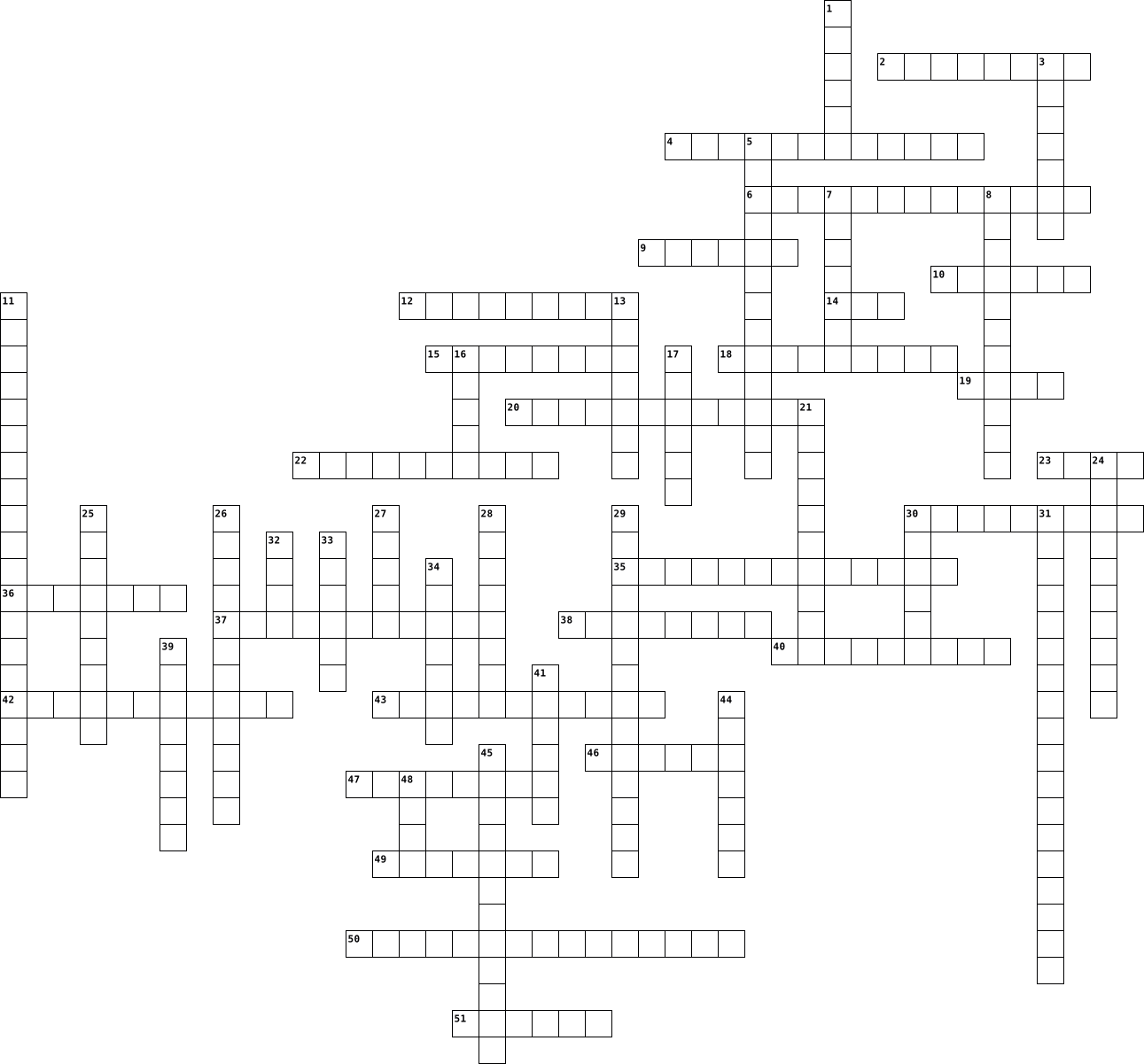
Across
- doesn't have the characteristics of metal
- rare earth element with symbol Pr and atomic number 59
- chemical reaction in which a radical removes a proton from a molecule
- the three-dimensional space occupied by a solid, liquid, or gas
- a separation of electrical or magnetic charges
- unable to dissolve in a solvent
- deoxyribonucleic acid
- electrically neutral group of two or more atoms held together by chemical bonds
- mediated by magnetic fields.
- fundamental piece of matter
- process of converting a material from a solid or gas phase into the liquid phase
- the action or process of filtering something
- unit of length in the imperial and United States customary systems of measurement
- branch of science that involves the study of the composition
- spontaneous emission of radiation as particles or photons from a nuclear reaction
- most prominent organelle in a cell
- mixture that has the same proportions of its components throughout any given sample
- results from a combination of two or more different chemical elements
- metalloid with element symbol Ge and atomic number 32
- phase transition from solid phase directly to vapor phase
- removing a liquid layer that is free of a precipitate, or the solids deposited from a solution
- positive electric charge
- an aqueous solution with a pH greater than 7
- phase transition from the liquid to gas state
- solidification of atoms or molecules into a highly structured form called a crystal
- substance that is dissolved in a chemical solution homogeneous mixture of two or more substances
Down
- nearly incompressible fluid
- a substance that contains an -OH group attached to a hydrocarbon
- process of settling or being deposited as a sediment
- matter remaining after evaporation or distillation
- measure of heat or cold
- superfluid phase formed by fermionic particles at low temperatures
- pure substance
- group of 8 valence electrons around an atom
- state of matter in which an ionized gaseous substance becomes highly electrically conductive
- organic molecule comprised of a nucleotide base, ribose or deoxyribose, and one or more phosphate groups
- thread-like structures located inside the nucleus
- able to be shaped or pounded with a hammer, usually applied to metals
- processes of living organisms
- radioactive gas with element symbol Rn and atomic number 86
- movement of gas through a pore or capillary into a vacuum or another gas
- separation by inner molecular attractions.
- ion with a positive electrical charge
- the number of digits in a value, often a measurement, that contribute to the degree of accuracy of the value
- unit of mass equal to the mass of one cubic centimeter of water at 4°C
- is the name for the element with atomic number 8 and is represented by the symbol O
- substance formed as a result of a chemical reaction
- starting material for a chemical reaction
- occupies physical space
- mass per unit volume
- action of purifying a liquid by a process of heating and cooling
- prefix meaning "one thousand"
52 Clues: pure substance • mass per unit volume • deoxyribonucleic acid • measure of heat or cold • occupies physical space • positive electric charge • nearly incompressible fluid • fundamental piece of matter • mediated by magnetic fields. • processes of living organisms • prefix meaning "one thousand" • unable to dissolve in a solvent • most prominent organelle in a cell • ...
Photosynthesis and Cellular Respiration 2026-03-25

Across
- The pores on the surface (usually the underside) of leaves that allow gases such as carbon dioxide, oxygen, and water vapor to enter and exit the cells of the plant
- The energy storage molecule produced during photosynthesis (it is also a reactant for cellular respiration)
- The gas that is a reactant of photosynthesis and a product of cellular respiration
- The energy storage molecule produced as a by-product of cellular respiration
- Producers obtain energy the energy that drives photosynthesis from ____________.
- A general term for the inputs or starting "ingredients" of a chemical reaction
Down
- The process by which producers convert light energy into stored chemical energy
- The process by which living things convert chemical energy from food (specifically glucose) into useable energy that powers life processes
- The gas that is a reactant of cellular respiration and a product of photosynthesis
- The green pigment that captures energy from sunlight to be used in photosynthesis
- The organelle (part of the cell) that performs photosynthesis
- A general term for the substances created during a chemical reaction
- The organelle (part of the cell) that performs cellular respiration
13 Clues: The organelle (part of the cell) that performs photosynthesis • The organelle (part of the cell) that performs cellular respiration • A general term for the substances created during a chemical reaction • The energy storage molecule produced as a by-product of cellular respiration • A general term for the inputs or starting "ingredients" of a chemical reaction • ...
Can you survive Chemistry? 2025-05-15

Across
- The change in heat content at constant pressure
- The amount of a substance present in a given volume of solution
- A system boundary in thermodynamics, distinguishing it from its surroundings
- Rate The rate at which a chemical reaction occurs
- A catalyst ____ the activation energy required for a reaction
- The substance that is dissolved by the solvent
- The substance that dissolves in another to form a solution
- Equilibrium The state of a system at equilibrium, where no net change occurs
- Chatelier’s Principle The principle that explains the shift in equilibrium when disturbed
- Free Energy The equation that determines if a process is spontaneous (ΔG = ΔH - TΔS)
Down
- A measure of disorder or randomness in a system
- Equilibrium A system where reactants and products are in dynamic balance
- The equilibrium constant expression includes concentrations of the products and reactants raised to their ____
- A reaction that absorbs heat from the surroundings
- A process where the forward and reverse reactions happen at equal rates
- A substance that increases the rate of a reaction without being consumed
16 Clues: The substance that is dissolved by the solvent • The change in heat content at constant pressure • A measure of disorder or randomness in a system • A reaction that absorbs heat from the surroundings • Rate The rate at which a chemical reaction occurs • The substance that dissolves in another to form a solution • ...
Chapter 13 Deven Mohr 2020-10-16

Across
- chemical that accepts a hydrogen ion.
- the minimum energy required to overcome the initial breaking of bonds in reactants.
- when there is a net release of energy.
Down
- when there is a net absorption of energy.
- what is it called when the reaction and its reverse act the same way.
- chemical that donates a hydrogen ion.
- a substance that lowers the activation energy of a chemical reaction.
- the measurement of the concentration of hydronium ions
- is how quickly the concentration of reactants decreases and how quickly the concentration of products increases.
9 Clues: chemical that accepts a hydrogen ion. • chemical that donates a hydrogen ion. • when there is a net release of energy. • when there is a net absorption of energy. • the measurement of the concentration of hydronium ions • what is it called when the reaction and its reverse act the same way. • a substance that lowers the activation energy of a chemical reaction. • ...
Unit 1 Vocab Words Crossword 1C 2023-09-07

Across
- All the chemical reactions an organism uses to build up an breakdown material
- Type of reproduction that requires there to be only on cell to produce offspring
- Chemical reaction process that organisms use to breakdown molecules
- An organisms ability to maintain a stable internal environment
- Any signal or factor that causes an organism to respond
Down
- Type of reproduction that requires 2 different cells to produce offspring
- Process that organism use to maintain homeostasis
- Chemical reaction process that organisms use to make molecules
- The ability to respond to a stimulus
9 Clues: The ability to respond to a stimulus • Process that organism use to maintain homeostasis • Any signal or factor that causes an organism to respond • Chemical reaction process that organisms use to make molecules • An organisms ability to maintain a stable internal environment • Chemical reaction process that organisms use to breakdown molecules • ...
redox reaction 2023-11-15

Across
- has the symbol Na
- a chemical reaction in which a substance reacts with oxygen - the reaction is exothermic
- The number of electrons gained or lost by an atom in a redox reaction
- a reaction involving both reduction and oxidation
- agent a substance that reduces another substance during a redox reaction and is itself oxidised during reaction
- a term used to describe oxidised organic material (food) - usually involving a bad smell
Down
- The opposite of oxidation
- If an element loses electrons in a reaction, is it oxidized or reduced?
- our chemistry teacher
- is a decrease in oxidation number of an atom or ion during reaction
10 Clues: has the symbol Na • our chemistry teacher • The opposite of oxidation • a reaction involving both reduction and oxidation • is a decrease in oxidation number of an atom or ion during reaction • The number of electrons gained or lost by an atom in a redox reaction • If an element loses electrons in a reaction, is it oxidized or reduced? • ...
cosmetology 2023-02-03

Across
- require stylists to base the client's entire scalp with a protective cream prior to the chemical relaxer application.
- a chemical reaction in which less energy is needed to break bonds in the reactants than is released when new bonds form in the products
- a colorless liquid with an unpleasant odor (like rotten eggs). It is used in making hair dressing solutions, pharmaceuticals and chemicals.
- link together these polypeptide chains.
- A substance that adds hydrogen to a chemical compound or subtracts oxygen from the compound.
- Permanent waves that have a 7.0 or neutral pH
- a combination of a thio relaxer, followed by a thio permanent wave that is wrapped. on large rods
- a functional group present in some proteins
Down
- used to straighten tightly curled hair.
- involves a change in physical properties
- problem solvers for stylists and clients in that they change the texture of the hair and can allow a person to wear just about any conceivable hair texture.
- Neutralization of a thio permanent or relaxer is an oxidation reaction that re- builds the disulfide bonds that were broken during processing
- the process of permanently rearranging the basic structure of overly curly hair into a straight form.
- a colorless crystalline salt NH4OOCH2SH used in setting cold waves
- pHs less than 7 are acidic while pHs greater than 7 are alkaline (basic).
- quantitative measure of the acidity or basicity of aqueous or other liquid solutions
- A solution of a soluble base with pH greater than 7
- occur when a substance combines with another to form a new substance, called chemical synthesis or, alternatively, chemical decomposition into two or more different substances.
18 Clues: used to straighten tightly curled hair. • link together these polypeptide chains. • involves a change in physical properties • a functional group present in some proteins • Permanent waves that have a 7.0 or neutral pH • A solution of a soluble base with pH greater than 7 • a colorless crystalline salt NH4OOCH2SH used in setting cold waves • ...
Science Revision 2012-03-20

Across
- An increase in size
- change from one state (gas, liquid, solid) to another.
- A change of state from gas to solid
- A change of state from liquid to a liquid gas
- A change of state from solid to gas
- change from one state (gas, liquid, solid) to another.
- The change of state from liquid to solid
Down
- The change of state where a liquid changes to a gas at the surface of the liquid
- a chemical reaction that releases heat
- A solid material precipitated from a solution
- When a substance changes from a solid to a liquid
- The change of state from liquid to solid
- A mixture in which particles of one or more substances are distributed throughout another substances
- a chemical reaction that absorbs heat
- A change of state where gas is cooled and formed to a liquid
- A decrease in size
16 Clues: A decrease in size • An increase in size • A change of state from gas to solid • A change of state from solid to gas • a chemical reaction that absorbs heat • a chemical reaction that releases heat • The change of state from liquid to solid • The change of state from liquid to solid • A solid material precipitated from a solution • ...
Justin's Puzzle 2022-03-21

Across
- a substance made by mixing other substances together
- make a liquid thinner or weaker by adding water or another solvent to it
- any substance that in water solution is slippery to the touch, tastes bitter, changes the color of indicators
- different throughout
- helps dissolve food in your stomach
- a group of atoms bonded together, representing the smallest fundamental unit
- able to dissolve other substances
- a substance that takes part in and undergoes change during a reaction
Down
- the same throughout
- to metals dissolve together
- mass the mass of an atom of a chemical element expressed in atomic mass units.
- high concentration of a large amount of solute
- the ability to dissolve
- a substance that is formed as a result of a chemical reaction
14 Clues: the same throughout • different throughout • the ability to dissolve • to metals dissolve together • able to dissolve other substances • helps dissolve food in your stomach • high concentration of a large amount of solute • a substance made by mixing other substances together • a substance that is formed as a result of a chemical reaction • ...
Chemical Reactions and equations 2015-02-13

Across
- ________ reaction is the opposite of combination reaction
- Addition of hydrogen or removal of oxygen is termed as _______ reaction.
- _________ reactions absorbs heat
Down
- A type of reaction where part of one reactant is replaced by another reactant to form a new compound
- The type of compound formed by combining an element with oxygen
- The chemical name of quick lime is _______ oxide.
- A chemical equation is balanced by changing or adding _____
7 Clues: _________ reactions absorbs heat • The chemical name of quick lime is _______ oxide. • ________ reaction is the opposite of combination reaction • A chemical equation is balanced by changing or adding _____ • The type of compound formed by combining an element with oxygen • Addition of hydrogen or removal of oxygen is termed as _______ reaction. • ...
Proteins: A Macromolecule 2016-03-01

Across
- group that gives each amino acid different characteristics
- process of monomers joining together to form a polymer
- monomer of a protein
- syn. for building block
- movement
- protein that is found in hair and nails
Down
- digestive enzymes use this reaction to break down food
- H2O
- Carbon, hydrogen, oxygen, nitrogen
- polymer for bonded amino acids
- moves substances in and out of cells
- group that contains the nitrogen atom
- controls the rate of a chemical reaction
- number of amino acids
14 Clues: H2O • movement • monomer of a protein • number of amino acids • syn. for building block • polymer for bonded amino acids • Carbon, hydrogen, oxygen, nitrogen • moves substances in and out of cells • group that contains the nitrogen atom • protein that is found in hair and nails • controls the rate of a chemical reaction • digestive enzymes use this reaction to break down food • ...
Carbohydrates project Nolan 2023-10-12

Across
- reaction between sugars and acids
- texture enhancer, thickener
- Sugars The chemical breakdown of a disaccharide into its two separate monosaccharides
- Food storage of plants
- Consist of two sugar molecules chemically bonded together
- Cell wall of plants
- The only simple carbohydrate
- Agent Maillard Reaction
Down
- Consist of 3 or more sugar molecules chemically bonded together
- The basic unit of carbohydrates
- Mainly produced by photosynthesis
- Food storage of animals
- reduce crystallization during freezing
- replacement used in place of substances such as milk fat
- made of Carbon, Hydrogen, Oxygen
15 Clues: Cell wall of plants • Food storage of plants • Food storage of animals • texture enhancer, thickener • Agent Maillard Reaction • The only simple carbohydrate • The basic unit of carbohydrates • made of Carbon, Hydrogen, Oxygen • reaction between sugars and acids • Mainly produced by photosynthesis • reduce crystallization during freezing • ...
Carbohydrates project Nolan 2023-10-12

Across
- reaction between sugars and acids
- texture enhancer, thickener
- Sugars The chemical breakdown of a disaccharide into its two separate monosaccharides
- Food storage of plants
- Consist of two sugar molecules chemically bonded together
- Cell wall of plants
- The only simple carbohydrate
- Agent Maillard Reaction
Down
- Consist of 3 or more sugar molecules chemically bonded together
- The basic unit of carbohydrates
- Mainly produced by photosynthesis
- Food storage of animals
- reduce crystallization during freezing
- replacement used in place of substances such as milk fat
- made of Carbon, Hydrogen, Oxygen
15 Clues: Cell wall of plants • Food storage of plants • Food storage of animals • texture enhancer, thickener • Agent Maillard Reaction • The only simple carbohydrate • The basic unit of carbohydrates • made of Carbon, Hydrogen, Oxygen • reaction between sugars and acids • Mainly produced by photosynthesis • reduce crystallization during freezing • ...
Carbohydrates project Nolan 2023-10-12

Across
- reaction between sugars and acids
- texture enhancer, thickener
- Sugars The chemical breakdown of a disaccharide into its two separate monosaccharides
- Food storage of plants
- Consist of two sugar molecules chemically bonded together
- Cell wall of plants
- The only simple carbohydrate
- Agent Maillard Reaction
Down
- Consist of 3 or more sugar molecules chemically bonded together
- The basic unit of carbohydrates
- Mainly produced by photosynthesis
- Food storage of animals
- reduce crystallization during freezing
- replacement used in place of substances such as milk fat
- made of Carbon, Hydrogen, Oxygen
15 Clues: Cell wall of plants • Food storage of plants • Food storage of animals • texture enhancer, thickener • Agent Maillard Reaction • The only simple carbohydrate • The basic unit of carbohydrates • made of Carbon, Hydrogen, Oxygen • reaction between sugars and acids • Mainly produced by photosynthesis • reduce crystallization during freezing • ...
Carbohydrates project Nolan 2023-10-12

Across
- reaction between sugars and acids
- texture enhancer, thickener
- Sugars The chemical breakdown of a disaccharide into its two separate monosaccharides
- Food storage of plants
- Consist of two sugar molecules chemically bonded together
- Cell wall of plants
- The only simple carbohydrate
- Agent Maillard Reaction
Down
- Consist of 3 or more sugar molecules chemically bonded together
- The basic unit of carbohydrates
- Mainly produced by photosynthesis
- Food storage of animals
- reduce crystallization during freezing
- replacement used in place of substances such as milk fat
- made of Carbon, Hydrogen, Oxygen
15 Clues: Cell wall of plants • Food storage of plants • Food storage of animals • texture enhancer, thickener • Agent Maillard Reaction • The only simple carbohydrate • The basic unit of carbohydrates • made of Carbon, Hydrogen, Oxygen • reaction between sugars and acids • Mainly produced by photosynthesis • reduce crystallization during freezing • ...
Previous Page 100 of 100