
chemical reaction Crossword Puzzles
Crossword 2024-04-27

Across
- The enthalpy change that occurs when one mole of a compound is produced from its standard state constituents is known as the ________.
- Measure of thermal energy in a system per unit temperature that cannot be used to perform beneficial work.
- An ________ reaction is characterized by a negative ∆U.
- ________ is the study of the energy changes that accompany all processes, whether chemical or physical.
- Chemical and physical changes that occur with the absorption of energy are ________ processes.
- It is the total heat absorbed in a process at constant pressure if only pressure-volume work is done.
- Hormone that moves glucose from the blood stream into the cells.
- Energy required to raise the temperature of one gram of a substance by one degree Celsius is known as its heat capacity.
- The setup used to determine energy change during a reaction.
Down
- ________ rate is dependent on several factors, namely, nature of reactants, temperature, and concentration.
- Substances that change the rate of a reaction without causing permanent changes.
- A substance's constant volume heat capacity is sometimes referred to as its ______ heat capacity.
- Time required to decrease the reactant concentration to one-half of the initial value.
- A ________ equation is a statement of the chemical change and the energy change that accompanies the change.
- A polysaccharide that does not provide the body with energy or nutrients.
- Increase in ________ increases reaction rates.
- Complex molecules made up of long chains of amino acids which are compounds of carbon, hydrogen, oxygen, and nitrogen.
- The study of energy changes that accompany chemical transformations in matter.
- The symbol w represents the ________ performed by the system or on the system.
- The change in enthalpy of the reaction is the heat of reaction at constant ________.
20 Clues: Increase in ________ increases reaction rates. • An ________ reaction is characterized by a negative ∆U. • The setup used to determine energy change during a reaction. • Hormone that moves glucose from the blood stream into the cells. • A polysaccharide that does not provide the body with energy or nutrients. • ...
Chemistry Final Crossword 2020-06-13

Across
- he action or process of observing something or someone carefully.
- a circumstance, fact, or influence that contributes to a result or outcome.
- a chemical reaction between a fuel and oxygen
- the amount of time occupied by something
- basic description of the variability of a distribution
- a course along which someone or something moves
- the action of departing from an established course
- a position on a real or imaginary scale of amount, quantity, extent, or quality.
- the action of predicting something
- quantitative observation of the size, extent or amount of an object.
- anything having mass and taking up space
- done in the same way over time, especially so as to be fair or accurate.
Down
- the rate at which someone or something is able to move
- standard reference experiment done under parallel or identical conditions.
- numbers with a contextual meaning
- how far something is
- useable power such as heat or electricity
- the basic unit of matter
- the area of variation between upper and lower limits on a particular scale.
- the substances that combine in a chemical reaction
- able to be changed or adapted
- start or set in motion
- a substance made from a chemical reaction
- rearrangement of atom into new substances
- Pure substance that cannot be broken down into simpler substances by a chemical reaction.
25 Clues: how far something is • start or set in motion • the basic unit of matter • able to be changed or adapted • numbers with a contextual meaning • the action of predicting something • the amount of time occupied by something • anything having mass and taking up space • useable power such as heat or electricity • a substance made from a chemical reaction • ...
photosynthesis and cellular respiration 2022-11-04

Across
- Co2
- input of the chemical reaction
- Cannot produce without its own food
- primary producer
- chemical energy
- sugar
- where cellular respiration happens
- output of the chemical reaction
Down
- Heat energy
- contains chlorophyll and in which photosynthesis takes place
- reactants and products
- how plants make food
- breaks down glucose
- green pigment that turns the plant green
- O2
- tiny, microscopic and critical for photosynthesis.
16 Clues: O2 • Co2 • sugar • Heat energy • chemical energy • primary producer • breaks down glucose • how plants make food • reactants and products • input of the chemical reaction • output of the chemical reaction • where cellular respiration happens • Cannot produce without its own food • green pigment that turns the plant green • tiny, microscopic and critical for photosynthesis. • ...
Matter and Energy 2023-05-10

Across
- eletriccharge
- families
- Atomic number
- atom
- electron
- base
- groups
- enzyme
- acid
- neutron
- period
- reduction
- alcohol
Down
- chemical formula
- Chemical reaction
- valence electron
- energy levels
- molecule
- cation
- proton
20 Clues: atom • base • acid • groups • enzyme • cation • period • proton • neutron • alcohol • families • electron • molecule • reduction • eletriccharge • Atomic number • energy levels • chemical formula • valence electron • Chemical reaction
Formative A review 2022-10-02

Across
- building blocks of polymers
- A substance produced in a chemical reaction
- data descriptive data
- acid Building blocks of protein
- data numerical data
- the starches and sugars present in foods
- A jellylike fluid inside the cell in which the organelles are suspended
- energy Energy needed to get a reaction started
- A cell that contains a nucleus and membrane bound organelles
- Chemical reaction ins which energy is absorbed
- apparatus stack of membranes in the cell that modifies, sorts, and packages proteins from the endoplasmic reticulum
- Control center of the cell
- The reactant on which an enzyme works.
- An organelle found in plant and algae cells where photosynthesis occurs
- A testable prediction; an educated guess
- variable variable that is manipulated
- Chemical Reaction in which energy is primarily given off in the form of heat
- A type of protein that speeds up a chemical reaction in a living thing
- A network of fibers that holds the cell together, helps the cell to keep its shape, and aids in movement
- wall A rigid layer of nonliving material that surrounds the cells of plants and some other organisms.
- bilayer double-layered sheet that forms the core of nearly all cell membranes
- An organic compound that is made of one or more chains of amino acids and that is a principal component of all cells
- theory idea that all living things are composed of cells, cells are the basic units of structure and function in living things, and new cells are produced from existing cells
- Makes proteins
- An organelle containing digestive enzymes
- A logical interpretation based on prior knowledge and experience.
- Basic unit of life
Down
- A chemical substance that is present at the start of a chemical reaction
- group the group that does not receive the experimental treatment.
- Basic units of DNA molecule, composed of a sugar, a phosphate, and one of 4 DNA bases
- substance that speeds up the rate of a chemical reaction
- Cell organelle that stores materials such as water, salts, proteins, and carbohydrates
- permeable a property of cell membranes that allows some substances to pass through, while others cannot
- Reticulum A system of membranes that is found in a cell's cytoplasm and that assists in the production, processing, and transport of proteins and in the production of lipids.
- Powerhouse of the cell
- reaction the process by which one or more substances change to produce one or more different substances
- A tiny cell structure that carries out a specific function within the cell
- large compound formed from combinations of many monomers
- variable The outcome factor; the variable that may change in response to manipulations of the independent variable.
- well-tested explanation that explains a broad range of observations
- A unicellular organism that lacks a nucleus and membrane bound organelles
- fats and oils
- membrane A cell structure that controls which substances can enter or leave the cell.
43 Clues: fats and oils • Makes proteins • Basic unit of life • data numerical data • data descriptive data • Powerhouse of the cell • Control center of the cell • building blocks of polymers • acid Building blocks of protein • variable variable that is manipulated • The reactant on which an enzyme works. • the starches and sugars present in foods • A testable prediction; an educated guess • ...
Conservation of mass and types of reactions 2023-06-08

Across
- substance made up of only one type of atom
- what is in the middle of an reaction
- on the right side of a reaction
- A+B -> AB
- H20
- AB -> A+B
Down
- chemical reaction need to be ________
- what is the __________ of mass
- number put in front of a molecule in a chemical reaction
- on the left side of a reaction
- the small numbers in a chemical equation
- an atom with a positive or negative charge
12 Clues: H20 • A+B -> AB • AB -> A+B • what is the __________ of mass • on the left side of a reaction • on the right side of a reaction • what is in the middle of an reaction • chemical reaction need to be ________ • the small numbers in a chemical equation • substance made up of only one type of atom • an atom with a positive or negative charge • ...
Module 4 IQ1 2021-08-13

Across
- what symbol is given in a chemical reaction of the enthalpy reactants
- when the total chemical energy of the products of a chemical reaction is greater than the total chemical energy of the reactants, energy is absorbed from the surrounding environment
- what unit is represented for energy
- usually regarded at everything else in a reaction
- the chemical energy of a substance is sometimes called it’s heat content or what
- what changes the activation energy of a reaction
Down
- when the total chemical energy of the products of a chemical reaction is less than the total chemical energy of the reactants, the excess energy is releases into the surroundings
- heat given off when one mole of substance is burnt completely in an excess of oxygen
- energy cannot be created or ______
- melting ice is an example ____ change
- stating that the heat absorbed/evolved in any chemical reaction is a fixed quantity
11 Clues: energy cannot be created or ______ • what unit is represented for energy • melting ice is an example ____ change • what changes the activation energy of a reaction • usually regarded at everything else in a reaction • what symbol is given in a chemical reaction of the enthalpy reactants • ...
Aqueous Reactions and Solution Stoichometry 2020-12-14

Across
- a material conducting electricity
- when water beats up ions and breaks them apart
- a solid that forms in an aqueous reaction
- few ions present and compound ionizes partially
- nice,orderly, repeating patterns
- exchange of positive ions between two ionic compounds
- is the amount of 3D space a substance or object occupies
- no ions present and substance is dissolved in water
- what is being dissolved
- a substance that takes part in and undergoes change during a reaction
Down
- process that involves rearrangement of the molecular or ionic structure of a substance
- molecular compounds breaking into their smallest parts called molecules
- substance produced during a chemical reaction
- formation of precipitate
- many ions present and compound ionizes entirely
- moles of solute/ liters of solution
- do not form precipitate
- Hydrogen is slightly positive, oxygen is slightly negative
- Homogeneous mixture
- what is doing the dissolving
20 Clues: Homogeneous mixture • do not form precipitate • what is being dissolved • formation of precipitate • what is doing the dissolving • nice,orderly, repeating patterns • a material conducting electricity • moles of solute/ liters of solution • a solid that forms in an aqueous reaction • substance produced during a chemical reaction • when water beats up ions and breaks them apart • ...
Chemistry Review 2017-02-10

Across
- Substance in simplest form
- Shiny, malleable, conductive
- Dull, brittle, not conductive
- Says that mass is not destroyed or gained in a reaction
- Row on periodic table
- Columns of Periodic table
- Carries negative charge
- Substance takes parts in chemical reaction
- Mass of an element
- Gases of Group 18, Outer shells are full
Down
- Energy level of atoms
- Basic unit of an element
- Electron in outermost orbital
- Inventor of first periodic table
- Abbreviation of element
- Center of an atom
- Number of protons and electrons in the element
- Reaction that gives of heat
- Substance with at least 2 elements chemically bonded together
- Carries Neutral Charge
- Reaction that produces cold substance
- Substance formed as a result of a chemical reaction
- Groups on atoms bonded together
- Carries Positive Charge
- Shares properties of both metals and metalloids
25 Clues: Center of an atom • Mass of an element • Energy level of atoms • Row on periodic table • Carries Neutral Charge • Abbreviation of element • Carries Positive Charge • Carries negative charge • Basic unit of an element • Columns of Periodic table • Substance in simplest form • Reaction that gives of heat • Shiny, malleable, conductive • Electron in outermost orbital • ...
Endothermic vs Exothermic Reactions 2025-11-24

Across
- more energy goes to the ___________________ in an endothermic reaction
- chemical connection between atoms
- what happens to energy when bonds are broken
- temperature goes ________ in endothermic reactions
- reaction that absorbs more energy than it releases
- what happens to energy when bonds are formed
- how the surroundings feel in an exothermic reaction
- substances formed after a chemical reaction
Down
- how the surroundings feel in an endothermic reaction
- more energy goes to the ___________________ in an exothermic reaction
- absorbing energy ___________ bonds
- reaction that releases more energy than it absorbs
- releasing energy ___________ bonds
- temperature goes _______ in exothermic reactions
14 Clues: chemical connection between atoms • absorbing energy ___________ bonds • releasing energy ___________ bonds • substances formed after a chemical reaction • what happens to energy when bonds are broken • what happens to energy when bonds are formed • temperature goes _______ in exothermic reactions • temperature goes ________ in endothermic reactions • ...
Crossword 2024-04-28

Across
- The symbol w represents the ________ performed by the system or on the system.
- ________ is the study of the energy changes that accompany all processes, whether chemical or physical.
- Substances that change the rate of a reaction without causing permanent changes.
- A substance's constant volume heat capacity is sometimes referred to as its ______ heat capacity.
- Complex molecules made up of long chains of amino acids which are compounds of carbon, hydrogen, oxygen, and nitrogen.
- The change in enthalpy of the reaction is the heat of reaction at constant ________.
- ________ is the enthalpy shift that takes place when one mole of a compound is created from its standard state constituents.
- It is the total heat absorbed in a process at constant pressure if only pressure-volume work is done.
- A polysaccharide that does not provide the body with energy or nutrients.
- The setup used to determine energy change during a reaction.
Down
- Increase in ________ increases reaction rates.
- The study of energy changes that accompany chemical transformations in matter.
- A ________ equation is a statement of the chemical change and the energy change that accompanies the change.
- An ________ reaction is characterized by a negative ∆U.
- Energy required to raise the temperature of one gram of a substance by one degree Celsius is known as its heat capacity.
- Hormone that moves glucose from the blood stream into the cells.
- Measure of thermal energy in a system per unit temperature that cannot be used to perform beneficial work.
- ________ rate is dependent on several factors, namely, nature of reactants, temperature, and concentration.
- Time required to decrease the reactant concentration to one-half of the initial value.
- Chemical and physical changes that occur with the absorption of energy are ________ processes.
20 Clues: Increase in ________ increases reaction rates. • An ________ reaction is characterized by a negative ∆U. • The setup used to determine energy change during a reaction. • Hormone that moves glucose from the blood stream into the cells. • A polysaccharide that does not provide the body with energy or nutrients. • ...
Cellular Respiration 2024-01-18

Across
- Pathways, the products of one reaction are the reactants for the next reaction.
- chemicals used in a reaction
- process, no oxygen
- chemical produced in the reaction
- alcohol, it’s produced along with carbon dioxide.
- specific form of stored energy
- process, oxygen
- simple sugar
- Transport Chain, Electrons are passed from protein to protein while slowly releasing their energy in steps.
- At times when your cells are without oxygen for a short period of time (heavy exercise) anaerobic fermentation follows glycolysis.
- Acid cycle, Chemical reactions similar to the Calvin cycle to break down glucose and produce ATP.
Down
- Oxidation, the connector reaction between glycolysis in the cellular cytoplasm and the Krebs cycle in the mitochondrial matrix.
- powerhouse of the cell
- fermentation, Fermentation used by yeast and bacteria to produce Carbon Dioxide and ethyl alcohol.
- a substance around the cell membrane bound organelles and nucleus
- acid, supplies energy when oxygen is scarce.
- Triphosphate, ATP
- reactions in the cytoplasm that break down glucose into molecules of pyruvic acid.
- Acid Fermentation, The lactic acid that builds up in muscle cells results in muscle fatigue.
- cycle, Chemical reactions similar to the Calvin cycle to break down glucose and produce ATP.
20 Clues: simple sugar • process, oxygen • Triphosphate, ATP • process, no oxygen • powerhouse of the cell • chemicals used in a reaction • specific form of stored energy • chemical produced in the reaction • acid, supplies energy when oxygen is scarce. • alcohol, it’s produced along with carbon dioxide. • a substance around the cell membrane bound organelles and nucleus • ...
Chemistry 2018-06-01

Across
- composition the percentage by mass of each element in a compound
- formula an expression which states the number and type of atoms present in a molecule of a substance.
- substance produced during a natural, chemical, or manufacturing process
- compound a chemical compound that contains exactly two different types of elements
- bond the covalent bonding between atoms in metals
- electrons one of two or more electrons in the outer shell of an atom
- reaction a reaction where two or more elements or compounds combine to form a single compound
- planer structure molecular geometry model with one atom at the center and three atoms at the corners
Down
- reaction type of chemical reaction where one reactant yields two or more products
- compound a chemical compound comprising ions held together
- replacement reaction a type of oxidation-reductionchemical reaction when an element or ion moves out of one compound and into another
- a substance that takes part in and undergoes change during a reaction
- formula a formula giving the proportions of the elements present in a compound but not the actual numbers or arrangement of atoms
- theory Valence shell electron pair repulsion
14 Clues: theory Valence shell electron pair repulsion • bond the covalent bonding between atoms in metals • compound a chemical compound comprising ions held together • composition the percentage by mass of each element in a compound • a substance that takes part in and undergoes change during a reaction • ...
Chemical Reactions 2023-02-23

Across
- proportion of reactants and products
- a substance or molecule that is part of a chemical reaction
- the reactant in reactions catalyzed by enzymes
- energy is absorbed
- state of balance
- energy is released to the surroundings
Down
- representation of a chemical reaction
- a substance that forms in a chemical reaction
- substance that changes the rate of a reaction
- two or more substances form a new compound
- heat is released
- a molecule, either protein or RNA
- a compound is broken into two or more substances
13 Clues: heat is released • state of balance • energy is absorbed • a molecule, either protein or RNA • proportion of reactants and products • representation of a chemical reaction • energy is released to the surroundings • two or more substances form a new compound • a substance that forms in a chemical reaction • substance that changes the rate of a reaction • ...
Unit 3 Vocabulary 2023-05-16

Across
- A green pigment, present in all green plants and in cyanobacteria, responsible for the absorption of light to provide energy for photosynthesis. Its molecule contains a magnesium atom held in a porphyrin ring.
- A catabolic process that makes a limited amount of ATP from glucose without an electron transport chain and that produces a characteristic end product, such as ethyl alcohol or lactic acid.
- They get energy from non-living sources most capture energy during photosynthesis to make simple sugars.
- The membrane of the mitochondria that is the site of electron transport and chemiosmosis.
- Requires oxygen
- Eat only meat example-polar bear
- Reactions that break down larger molecules into simpler compounds.
- (substrate) A substance that is changed during a chemical reaction
- (usually a protein) that speeds up a biochemical reaction by lowering its activation energy
- Process that releases energy by breaking down glucose and other food molecules in the presence of oxygen
- Pancake-like stacks of thylakoid membrane
- Eat dead materials example-vultures
- All of the chemical reactions that occur within an organism
- Non-living portion
- A reaction that overall releases more energy (in the form of heat or light than it absorbs.
Down
- The synthesis of organic compounds by bacteria or other living organisms using energy derived from reactions involving inorganic chemicals, typically in the absence of sunlight.
- When an enzyme's active site loses its specific shape, causing a loss in biological activity
- Reactions The breaking and forming of bonds between different substances during chemical changes
- The overall process by which sunlight (solar/light energy) chemically converts water and carbon dioxide into chemical energy stored in glucose (a sugar/carbohydrate) (this happens on the leaf of a plant)
- A substance that is made in a chemical reaction
- Get energy from living or non-living organisms. examples: animals, fungus, people.
- site Location on an enzyme where the substrate binds
- Substance that speeds up the rate of a chemical reaction without being permanently altered
- Is without oxygen; usually w/short-spurt, high-energy activities
- A reaction that overall absorbs more energy (in the form of heat or light) than it releases.
- energy Energy needed to get a chemical reaction started
- Eat only vegetation
- Fluid-like substance that fills the space between the grana
- Reactions that build larger molecules from smaller ones
- Eat meat and vegetation example-raccoons
- A substance present in all living cells that provides energy for many metabolic processes and is involved in making RNA.
31 Clues: Requires oxygen • Non-living portion • Eat only vegetation • Eat only meat example-polar bear • Eat dead materials example-vultures • Eat meat and vegetation example-raccoons • Pancake-like stacks of thylakoid membrane • A substance that is made in a chemical reaction • site Location on an enzyme where the substrate binds • ...
Chapter 16 2017-04-23

Across
- energy is taken in or absorbed
- mass the sum of the atomic masses of the atoms in a molecule
- insoluble substance that crystallizes out of solution
- one element displaces another from a compound
- a substance that slows down a chemical reaction
- a substance that undergoes a chemical change; substance to the left of a yield sign in an equation
- the number placed in front of a symbol or formula; used in balancing chemical equations
- reaction a chemical change in which two or more elements or compounds unite to form one compound
Down
- the positive part of one compound unites with the negative part of another compound
- an inhibitor; slows down the decay by retarding the processes that cause the decay
- a substance formed as a result of a chemical change; substance to the right of a yield sign in an equation
- a chemical change in which a substance breaks down or decomposes into other substances
- a shorthand description of a chemical reaction; tells the reactants and products and their ratios
- a substance that increases the rate of a chemical reaction without being permanently changed itself
- sum of the average atomic masses of the atoms or ions present in the formula of a compound
- energy is released or given off
16 Clues: energy is taken in or absorbed • energy is released or given off • one element displaces another from a compound • a substance that slows down a chemical reaction • insoluble substance that crystallizes out of solution • mass the sum of the atomic masses of the atoms in a molecule • an inhibitor; slows down the decay by retarding the processes that cause the decay • ...
PS Semester 1 Review 2021-12-04

Across
- Carbon dioxide and water are usually the products in this type of reaction
- one sign of a chemical reaction taking place
- the amount of time it takes for one half of a sample to decay
- electrons have this charge
- displacement AB + C → AC + B
- the bonding where electrons are shared
- these gases do not react because they are completely stable on their own
- anything that takes up space and has mass
- adding protons and neutrons
- when a chemical reaction takes in heat
- a charged particle
- neutrons have this charge
- this element radioactively decays into Lead
- protons have this charge
- adding this to a reaction can speed it up
- number of protons
- orbit the nucleus
Down
- AB → A + B
- A + B → AB
- number of electrons the 2nd energy level can hold
- another name for electron energy levels
- center of an atom
- displacement AB + CD → AD + BC
- happens in nuclear energy when one reaction sets off another and another
- the spontaneous process in which an atomic nucleus emits radiation
- the bonding where electrons are transferred
- father of the Periodic Table of Elements
- Column 1 of the periodic table are these types of metals
- the middle part of the periodic table, which we colored red, are these metals
- chemicals listed to the right of the arrow in a chemical reaction
- chemicals listed to the left of the arrow in a chemical reaction
- when a chemical reaction releases energy
- outer electrons can be called this
- the reason atoms combine with each other
- the conservation of ______ says that matter cannot be created or destroyed
- ability of an atom to attract electrons to itself
- number of electron energy levels and also the number of rows in the periodic table
- atoms with the same number of protons but different number of neutrons
- when an electron gains energy, it moves from a grounded state to this state
39 Clues: AB → A + B • A + B → AB • center of an atom • number of protons • orbit the nucleus • a charged particle • protons have this charge • neutrons have this charge • electrons have this charge • adding protons and neutrons • displacement AB + C → AC + B • displacement AB + CD → AD + BC • outer electrons can be called this • the bonding where electrons are shared • ...
Unit 5 Plants Vocabulary 2020-11-16

Across
- moves water from the roots to the leaves of a plant
- parts found inside an organism
- moves glucose from the plant to the roots
- a plants response to water
- A response a plant has to the environment
- a plants response to gravity
- sugar
- the chemicals that exist before a chemical reaction
Down
- a plant's response to light
- explains what happens in a chemical reaction using chemical formulas
- a chemical in the chloroplast that aids in photosynthesis
- A plant's response to touch
- a plants response to gravity
- Pressure inside a cell due to the water it holds
- the chemicals that are made during a chemical reaction
15 Clues: sugar • a plants response to water • a plant's response to light • A plant's response to touch • a plants response to gravity • a plants response to gravity • parts found inside an organism • moves glucose from the plant to the roots • A response a plant has to the environment • Pressure inside a cell due to the water it holds • ...
VOCABULARY IN CHEMISTRY 2023-04-25

Across
- Type of elements in the left side of the periodic table
- Unit to measure mass
- The conditions in which a gas occupies 22.7L at 25C and 1 atm.
- Last part of the chemical reaction
- Is the mass that appears in the periodic table.
- Negative particle of the atom
- Is the number of protons of an atom.
- Energy that needs to have a molecule to react
- Type of elements in the right side of the periodic table
- Chemical property that describes the tendency of an atom or a functional group to attract electrons toward itself.
- Type of element in the last group of the periodic table
Down
- Fist part of the chemical reaction
- Ion with positive charge
- Part of chemistry that studies changes in a chemical reaction
- Ion with negative charge
- Process that involves rearrangement of atoms
- An atom with charge is called...
- Positive particle of the atom
- Element with symbol K
- Unit for the amount of substance
- Neutral particle of the atom
21 Clues: Unit to measure mass • Element with symbol K • Ion with positive charge • Ion with negative charge • Neutral particle of the atom • Positive particle of the atom • Negative particle of the atom • An atom with charge is called... • Unit for the amount of substance • Fist part of the chemical reaction • Last part of the chemical reaction • Is the number of protons of an atom. • ...
Judah Brooks Unit 2 2025-03-24

Across
- what is put in the enzyme before the chemical reaction
- moving molecules across the membrane using energy
- diffusion with water
- the smallest level of organization
- basic unit of life
- the result of a chemical reaction
- where the substrate fits on an enzyme
- loves water
- when the active site on an enzyme changes shape and the substrate no longer fits
- a living thing
- multiple organs working together
- hates water
- multiple cells combine to form this
- multiple atoms bonded together
Down
- the energy needed to start a chemical reaction
- moving molecules across the membrane without using energy
- only certain things are allowed through
- what makes up the cell membrane
- a protein that lowers the activation energy needed for chemical reactions
- molecules moving from a place of high concentration to low concentration
- performs an action in the body/made of tissue
- multiple molecules combine to form this/perform action in a cell
22 Clues: loves water • hates water • a living thing • basic unit of life • diffusion with water • multiple atoms bonded together • what makes up the cell membrane • multiple organs working together • the result of a chemical reaction • the smallest level of organization • multiple cells combine to form this • where the substrate fits on an enzyme • only certain things are allowed through • ...
Physical Science Week 3: Changing Matter 2023-11-29

Across
- a chemical reaction where a compound is broken down into two or more simpler substances
- a chemical reaction during which heat is release
- a substance produced in a chemical reaction
- a chemical reaction during which heat is absorbed
Down
- a chemical reaction where a free element replaces another element in a compound
- a chemical reaction where an acid and a base form a salt
- the chemical process of burning
- a chemical reaction where two or more substances are joined to form a compound
- a substance that goes into a chemical reaction
9 Clues: the chemical process of burning • a substance produced in a chemical reaction • a substance that goes into a chemical reaction • a chemical reaction during which heat is release • a chemical reaction during which heat is absorbed • a chemical reaction where an acid and a base form a salt • ...
Chapter 13 - Kahlan Schuster 2016-10-12

Across
- donates a Hydrogen ion
- a substance that is the result of the chemical change
- accepts a Hydrogen ion
- how many clues are there to identify chemical reactions
- AB+oxygen -> oxides of A+B+H2O
- energy is transferred to reactants from surroundings; enters
- A+BC -> AC+B
- the energy stored in molecules that can be released during a reaction
Down
- must be added to break the bonds, setting the chemical reaction off
- AB -> A+B
- A+B -> AB
- AB+CD -> AD+CB
- energy transfers from reactants to surroundings; exits
- a substance that undergoes a chemical change
- when reaction and its reverse act at the same rate
15 Clues: AB -> A+B • A+B -> AB • A+BC -> AC+B • AB+CD -> AD+CB • donates a Hydrogen ion • accepts a Hydrogen ion • AB+oxygen -> oxides of A+B+H2O • a substance that undergoes a chemical change • when reaction and its reverse act at the same rate • a substance that is the result of the chemical change • energy transfers from reactants to surroundings; exits • ...
Enzyme Crossword 2021-08-27

Across
- Enzymes ______ the energy needed to start a chemical reaction.
- The energy required to start a chemical reaction.
- Substances that are created and come OUT of a chemical reaction.
- Where an enzyme and a substrate meet or connect.
- The substance the enzyme acts on.
Down
- Example of the enzyme that breaks downs lactose.
- Building block of proteins.
- Type of protein that speeds up a chemical reaction.
- Substance that goes IN a chemical reaction.
- Enzymes are an example of this type of macromolecule.
- ______ or pH can change the shape of the active site.
11 Clues: Building block of proteins. • The substance the enzyme acts on. • Substance that goes IN a chemical reaction. • Example of the enzyme that breaks downs lactose. • Where an enzyme and a substrate meet or connect. • The energy required to start a chemical reaction. • Type of protein that speeds up a chemical reaction. • ...
JH Burkholder Chapter 13 2017-10-10

Across
- a measure of the acidity of a solution
- the minimal amount of energy required for a chemical reaction to proceed
- The process by which a reactant loses one or more electrons
- The process in which a reactant gains one or more electrons
Down
- Chemical reaction where there is a net absorption of energy
- Chemical reaction where there is a net release of energy
- The substances that react in a chemical reaction
- Substance that takes hydrogen ions
- The new substances formed in a chemical reaction
- A rapid exothermic oxidation
- Substance that donates hydrogen ions
11 Clues: A rapid exothermic oxidation • Substance that takes hydrogen ions • Substance that donates hydrogen ions • a measure of the acidity of a solution • The substances that react in a chemical reaction • The new substances formed in a chemical reaction • Chemical reaction where there is a net release of energy • Chemical reaction where there is a net absorption of energy • ...
1.3 Chemical Reactions Activity 2025-09-04

Across
- A scale that measures acidity and can affect enzyme activity
- Substances that start a chemical reaction
- Another word for a substance that speeds up a chemical reaction
- Proteins that speed up chemical reactions in living things
- The molecule that an enzyme acts upon in a chemical reaction
Down
- Substances formed after a chemical reaction
- Graphs can show if this is absorbed or released in a reaction
- Used to interpret the effect of an enzyme on a reaction
- Type of energy required to start a chemical reaction
- One factor that affects enzyme activity, along with pH and substrate concentration
10 Clues: Substances that start a chemical reaction • Substances formed after a chemical reaction • Type of energy required to start a chemical reaction • Used to interpret the effect of an enzyme on a reaction • Proteins that speed up chemical reactions in living things • A scale that measures acidity and can affect enzyme activity • ...
Chemistry 2024-03-15

Across
- a chemical reaction in which a substance loses electrons.
- means more molecules in a given space, increasing the chance of collisions and speeding up reactions.
- reactions are common endothermic reactions.
- a chemical reaction in which a substance gains electrons.
- the process when energy is released to the surroundings
- is one or more forms of a chemical element that can exist in the same physical state.
- speed up reactions without getting used up themselves.
- reaction is a chemical reaction in which the product can react to produce the original reactant. It can move in both forward and backward directions.
Down
- the approximate percentage of argon in air
- means using electricity to coat one metal with another.
- generates electrons in the reaction and is oxidized. It reduces another substance by generating electrons.
- a chemical reaction that uses nitrogen gas and hydrogen gas to create the chemical compound ammonia.
12 Clues: the approximate percentage of argon in air • reactions are common endothermic reactions. • speed up reactions without getting used up themselves. • means using electricity to coat one metal with another. • the process when energy is released to the surroundings • a chemical reaction in which a substance loses electrons. • ...
Enzymes and Biochemical Reactions 2023-11-14

Across
- an organism
- The breaking and forming of bonds between different substances
- An example of an exothermic reaction (2 words)
- Absorbs energy in the form of light or heat
- Break down larger molecules into smaller compounds
Down
- An example of an endothermic reaction
- The amount of energy needed to make a chemical reaction start (2 words)
- Build larger molecules from smaller ones
- Substances that are changed during a chemical reaction
- All of the chemical reactions within each cell
- Releases energy in the form of light or heat
- Substances that are made by a chemical reaction
12 Clues: an organism • An example of an endothermic reaction • Build larger molecules from smaller ones • Absorbs energy in the form of light or heat • Releases energy in the form of light or heat • All of the chemical reactions within each cell • An example of an exothermic reaction (2 words) • Substances that are made by a chemical reaction • ...
Chemical and Physical reaction worksheet 2022-03-18

Across
- " A solid that form's from solution during a chemical reaction."
- of mass- "during a chemical reaction, matter is not created or destroyed
- "When the reaction is complete, you have new substances"
- "The study of matter and how matter changes"
- "is anything that has mass and takes up space."
- reaction- A change in matter that produces one or more new substances.
- property- A characteristic of a substance that can be observed without changing the substance into another substance.
Down
- property- a Characteristic of substance that describes its ability to change into other substances.
- reaction-"A reaction that releases energy in the form of heat"
- The substance you have at the beginning"
- "is a number placed in font of chemical formula in an equation."
- reaction- "is a reaction in which energy is absorbed
- system- " matter is not allowed to enter or leave."
- equation-"is a short, easy way to show a chemical reaction, using symbols instead of words."
- change- " is any change that alters the form or appearance of a substance but that does not make the substance into another substance.
- system- "matter can enter from or escape to the surrounding."
16 Clues: The substance you have at the beginning" • "The study of matter and how matter changes" • "is anything that has mass and takes up space." • system- " matter is not allowed to enter or leave." • reaction- "is a reaction in which energy is absorbed • "When the reaction is complete, you have new substances" • ...
Changes in Matter 2014-11-18

Across
- what the starting substances are in a reaction
- how particles move in a solid
- reaction that creates a new substance
- matter with particles fixed in position
- there have to be the same number of these on both sides of a chemical equation
- gas changing to a liquid
- liquid changing to a gas all at once
- reaction that releases heat
- liquid changing to gas one layer at a time
- reaction that absorbs heat
Down
- a measure of the kinetic energy of the particles in a substance
- solid changing to liquid
- reaction that makes the substance look different but it's identity remains the same
- the law that says matter cannot be created or destroyed
- matter with particles that are touching but can move around
- matter with particles very far apart and moving fast
- what the ending substances are in a reaction
- how particles move in a liquid
- liquid changing to solid
- an increase or decrease in this can cause a physical or chemical change
20 Clues: solid changing to liquid • gas changing to a liquid • liquid changing to solid • reaction that absorbs heat • reaction that releases heat • how particles move in a solid • how particles move in a liquid • liquid changing to a gas all at once • reaction that creates a new substance • matter with particles fixed in position • liquid changing to gas one layer at a time • ...
Chemical Reactions 2023-12-19

Across
- A type of combustion that produces carbon monoxide
- What a chemical reaction must be
- The liquid that turns cloudy when carbon dioxide is present
- The gas substances react with during oxidation reactions
- A change in which no new substances are made
- Needed for thermal decomposition
Down
- When atoms are rearranged, forming new substances
- The things we start a chemical reaction with
- A burning reaction that produces carbon dioxide and water
- The things we make from a chemical reaction
- The colour cobalt chloride paper turns in water
- The thing that is always conserved in a chemical reaction
12 Clues: What a chemical reaction must be • Needed for thermal decomposition • The things we make from a chemical reaction • The things we start a chemical reaction with • A change in which no new substances are made • The colour cobalt chloride paper turns in water • When atoms are rearranged, forming new substances • A type of combustion that produces carbon monoxide • ...
Chemistry Reactions and Equations 2024-10-09

Across
- chemical symbol of gold.
- 2 or more reactant's react to form one product.
- yellow precipitate formed by reaction of lead nitrate and potassium iodide.
- reaction in which energy is released in form of heat or light.
- chemical symbol of aluminum.
- valency of aluminum
- chemical symbol of magnesium.
- chemical symbol of zinc.
Down
- a substance breaks down into two or more products.
- reaction in which more reactive element displaces less reactive element from its solution.
- reaction in which exchange of ions takes place between 2 substances to form new products.
- reaction in which heat is absorbed.
12 Clues: valency of aluminum • chemical symbol of gold. • chemical symbol of zinc. • chemical symbol of aluminum. • chemical symbol of magnesium. • reaction in which heat is absorbed. • 2 or more reactant's react to form one product. • a substance breaks down into two or more products. • reaction in which energy is released in form of heat or light. • ...
Matters Interaction 2025-11-29

Across
- The Periodic Table of ____________
- Contains some kinetic energy (ex. water)
- More than one type of atom held together by chemical bonds (ex. DNA)
- Two or more molecules NOT chemically bonded (ex. salt and pepper)
- Breaking and reforming of bonds
- Two or more atoms held together by chemical bonds (ex. H2O)
- You _________
- Contains the most amount of kinetic energy (ex. farts)
- The result from a chemical reaction
- The relationship between mass and volume
Down
- Reactions that give off heat
- CH4
- LxWxH
- The amount of matter in an object
- Substances added together to cause a chemical reaction
- Every form of matter is made of this. A single cell has 100 trillion of these!
- Contains the least amount of kinetic energy (ex. apple)
17 Clues: CH4 • LxWxH • You _________ • Reactions that give off heat • Breaking and reforming of bonds • The amount of matter in an object • The Periodic Table of ____________ • The result from a chemical reaction • Contains some kinetic energy (ex. water) • The relationship between mass and volume • Substances added together to cause a chemical reaction • ...
VOCABULARY CROSSWORD 2023-08-18

Across
- data, information in the form of numbers and units
- what you think about will/could happen in the future
- reaction: A process by which two or more chemical substances interact and are chemically changed, producing different chemical substances.
- A chemical reaction during which plants convert radiant energy from the Sun to chemical energy; the reaction converts carbon dioxide and water into sugar (glucose).
- energy, Energy from the sun that reaches earth as visible light, and ultraviolet and infrared (heat) radiation.
- what you keep the same in an experiment to make sure that only the independent variable is being changed.
- The simplest unit of a chemical compound that can exist, formed when two or more atoms join together chemically.
Down
- Simple carbohydrates; produced by photosynthesis and used to store energy and build structural molecules.
- A substance that takes part in and undergoes change during a reaction.
- factors that can have an effect on the experiment
- A substance produced during a chemical reaction.
- a testable explanation that can be written as an “if/then” statement that uses a reason to explain an idea
- data, descriptive information collected using 5 senses
- The smallest particle of an element, made of electrons, protons, and neutrons.
- energy, Energy stored in chemical bonds and released through chemical reactions.
- What is used to COMPARE the results to.
16 Clues: What is used to COMPARE the results to. • A substance produced during a chemical reaction. • factors that can have an effect on the experiment • data, information in the form of numbers and units • what you think about will/could happen in the future • data, descriptive information collected using 5 senses • ...
Matter and Energy in Organisms: Part 1 2016-10-19

Across
- Refers to chemical reactions occurring in cells in which carbon atoms from organic molecules (e.g. glucose) are oxidized to release energy.
- Group of organic molecules composed of hydrogen, oxygen, nitrogen, carbon and phosphorus; examples include DNA, RNA and ATP.
- A simple molecular unit that may may react chemically with another molecule of the same type to form a larger molecule (e.g., amino acid, nucleotide).
- Important in creating polymers, this reaction typically produces water when two molecules forming a bond to create a larger molecule.
- Attraction between the nuclei of two nonmetallic atoms and at least two shared electrons.
- Chemical reaction associated with burning that involves the oxidation of carbon atoms from a hydrocarbon fuel to release energy.
- A substance that cannot be decomposed into simpler substances by chemical means; it is made up of atoms that all share an identical number of protons.
- Proteins are long, folded chains that are composed of these monomers.
Down
- The production of complex molecules within living organisms or cells (e.g. photosynthesis).
- Process (chemical reaction) that involves the breaking of chemical bonds by the addition of water.
- Neutral group of two or more atoms held together by chemical bonds.
- Chemical substances formed as a result of a chemical reaction.
- Group of organic molecules that are composed of carbon, hydrogen and oxygen and include sugars (e.g. glucose), starch, and cellulose.
- Group of fatty or waxy organic molecules made mostly from carbon and hydrogen atom; they include oils, cholesterol and triglycerides.
- A compound made up of several repeating units.
- Substance taking part in a chemical reaction
- Group of organic molecules that contain carbon, hydrogen, oxygen and nitrogen; examples include insulin and hemoglobin.
- Term that is used to describe any substance containing carbon-based compounds, especially those produced by or derived from living organisms.
18 Clues: Substance taking part in a chemical reaction • A compound made up of several repeating units. • Chemical substances formed as a result of a chemical reaction. • Neutral group of two or more atoms held together by chemical bonds. • Proteins are long, folded chains that are composed of these monomers. • ...
Chemical and Physical reaction worksheet 2022-03-18

Across
- " A solid that form's from solution during a chemical reaction."
- of mass- "during a chemical reaction, matter is not created or destroyed
- "When the reaction is complete, you have new substances"
- "The study of matter and how matter changes"
- "is anything that has mass and takes up space."
- reaction- A change in matter that produces one or more new substances.
- property- A characteristic of a substance that can be observed without changing the substance into another substance.
Down
- property- a Characteristic of substance that describes its ability to change into other substances.
- reaction-"A reaction that releases energy in the form of heat"
- The substance you have at the beginning"
- "is a number placed in font of chemical formula in an equation."
- reaction- "is a reaction in which energy is absorbed
- system- " matter is not allowed to enter or leave."
- equation-"is a short, easy way to show a chemical reaction, using symbols instead of words."
- change- " is any change that alters the form or appearance of a substance but that does not make the substance into another substance.
- system- "matter can enter from or escape to the surrounding."
16 Clues: The substance you have at the beginning" • "The study of matter and how matter changes" • "is anything that has mass and takes up space." • system- " matter is not allowed to enter or leave." • reaction- "is a reaction in which energy is absorbed • "When the reaction is complete, you have new substances" • ...
Macromolecules/Enzymes 2023-05-10

Across
- An organic compound that is made of one or more chains of amino acids and that is a principal component of all cells
- Energy-rich organic compounds, such as fats, oils, and waxes, that are made of carbon, hydrogen, and oxygen.
- A long molecule consisting of many similar or identical monomers linked together.
- reactions the process by which one or more substances change to produce one or more different substances
- energy Energy needed to get a reaction started
- substance that speeds up the rate of a chemical reaction
- A specific reactant acted upon by an enzyme
- acid a simple organic compound containing both a carboxyl (—COOH) and an amino (—NH2) group
Down
- A type of protein that speeds up a chemical reaction in a living thing
- A simple compound whose molecules can join together to form polymers
- A building block of DNA, consisting of a five-carbon sugar covalently bonded to a nitrogenous base and a phosphate group.
- A substance produced in a chemical reaction
- Broken down to glucose to provide energy.
- A chemical substance that is present at the start of a chemical reaction
- acid macromolecules containing hydrogen, oxygen, nitrogen, carbon, and phosphorus
15 Clues: Broken down to glucose to provide energy. • A substance produced in a chemical reaction • A specific reactant acted upon by an enzyme • energy Energy needed to get a reaction started • substance that speeds up the rate of a chemical reaction • A simple compound whose molecules can join together to form polymers • ...
Enzyme 2026-03-03

Across
- Reaction that absorbs energy.
- Sum of all chemical reactios that occur n the cell.
- The minimum amount of energy required to start a chemical reaction.
- A flexible active site that changes shape.
- Reaction that breaks down larger molecules into smaller ones, usually with net release of energy.
- Active site has a set shape.
Down
- Reaction that builds larger molecules from smaller ones using a net input of energy.
- Reaction that releases energy.
- A substrate in a catalase reaction.
- Organic cofactors.
- Substance or material formed after the chemical reaction.
- Reduce or stop the enzyme from functioning.
12 Clues: Organic cofactors. • Active site has a set shape. • Reaction that absorbs energy. • Reaction that releases energy. • A substrate in a catalase reaction. • A flexible active site that changes shape. • Reduce or stop the enzyme from functioning. • Sum of all chemical reactios that occur n the cell. • Substance or material formed after the chemical reaction. • ...
Angelica Ramilo 2022-03-08

Across
- Mass of one mole of a substance
- (actual/theoretical) * 100
- empirical formulas are the only correct expressions of ____ compounds
- A ratio between the number of moles of any two substances in a chemical reaction
- The mass of a mole is the atomic mass from the periodic table
- The maximum of product that could be produced based on the limiting reaction
- Study of ratios in a chemical reation
- What connects moles to particles
- The amount of product that was actually produced
Down
- The substance that will be used up first in a chemical reaction
- important unit that chemist use
- Lowest whole number ratio of elements
- The basic unit of a chemical reaction
- ratios from balanced equations form the conversion factor for changing moles of one substance to moles of another
- Given times want/cancel
- multiple of an empirical formula
16 Clues: Given times want/cancel • (actual/theoretical) * 100 • Mass of one mole of a substance • important unit that chemist use • What connects moles to particles • multiple of an empirical formula • Lowest whole number ratio of elements • The basic unit of a chemical reaction • Study of ratios in a chemical reation • The amount of product that was actually produced • ...
RATE OF REACTION FM 4 2026-01-12

Across
- an organic catalyst used in processes like the fermentation of glucose to produce ethanol
- A type of reaction that releases heat energy to the surroundings
- A chemical substance that alters the rate of reaction without undergoing any chemical change at the end of the reaction
- A substance whose quantity decreases over time during a chemical reaction
- factor that, when increased, increases the kinetic energy of reactant particles
- A factor representing the number of particles per unit volume in a solution
Down
- A factor that affects the rate of reaction specifically for reactions involving gases
- According to this theory, reactant particles must bump into one another for a reaction to occur
- The substance formed at the end of a chemical reaction, whose quantity increases over time
- When the size of a solid reactant is smaller, the total ____ area exposed to collisions increases
- The rate of reaction calculated over a particular time interval
- The minimum energy that reactant particles must acquire to break bonds and initiate a reaction
- The rate of reaction at a specific point in time, determined by the gradient of a tangent to a graph
13 Clues: The rate of reaction calculated over a particular time interval • A type of reaction that releases heat energy to the surroundings • A substance whose quantity decreases over time during a chemical reaction • A factor representing the number of particles per unit volume in a solution • ...
Chemistry Crossword 2015-11-19

Across
- A combination of pure substances.
- Shiny, malleable, ductile, conduct electricity.
- Negatively charged particles.
- The new materials produced by the reaction.
- Anything on the periodic table.
- A chemical reaction that releases heat energy.
- Liquid to solid.
- Most reactive non-metals.
- Positively charged particles.
- Characteristics that can be used to describe a substance.
- A cloudy mixture that cannot be separated.
- An element that we need to live.
Down
- Gas to solid.
- The materials at the start of a reaction.
- Have both metallic and non-metallic properties.
- Solid to gas.
- A catalyst found in the human body.
- A chemical reaction that absorbs heat energy.
- A substance that help a reaction proceed faster.
- Liquid to gas.
- Anything that has mass and occupies space.
- Solid to liquid.
- A cloudy mixture that can be separated.
- The horizontal rows on the periodic table.
- The vertical rows on the periodic table.
25 Clues: Gas to solid. • Solid to gas. • Liquid to gas. • Liquid to solid. • Solid to liquid. • Most reactive non-metals. • Negatively charged particles. • Positively charged particles. • Anything on the periodic table. • An element that we need to live. • A combination of pure substances. • A catalyst found in the human body. • A cloudy mixture that can be separated. • ...
Combustion and Chemical reactions 2026-02-11

Across
- Two or more atoms joined together.
- Tiny particles and gases released during burning.
- A new substance made in a reaction.
- A gas often produced during combustion.
- Energy that makes things warmer.
- The idea that mass is not created or destroyed.
- A rule in science that is always true.
- The smallest unit of an element.
- A gas needed for most burning reactions.
Down
- A chemical reaction that releases heat and light.
- The visible, glowing part of a fire.
- A gas that can form when something burns.
- A starting substance in a chemical reaction.
- A process where substances change into new substances.
- The ability to cause change.
- A substance that burns to release energy.
- A change that forms a new substance.
- Energy you can see, often produced during burning.
- The amount of matter in something.
- The process of starting a combustion reaction.
20 Clues: The ability to cause change. • Energy that makes things warmer. • The smallest unit of an element. • Two or more atoms joined together. • The amount of matter in something. • A new substance made in a reaction. • The visible, glowing part of a fire. • A change that forms a new substance. • A rule in science that is always true. • A gas often produced during combustion. • ...
CHEMISTRY BASICS 2024-11-25

Across
- A CHEMICAL REACTION
- A CHARACTERISTIC THAT CAN BE OBSERVED OR MEASURED WITHOUT CHANGING THE SAMPLE'S COMPOSITION
- ALTERS THE PHYSICAL PROPERTIES OF A SUBSTANCE WITHOUT CHANGING ITS COMPOSITION
- A PROPERTY THAT IS DEPENDENT ON THE AMOUNT OF SUBSTANCE PRESENT
- THE ONLY COMMON SUBSTANCE ON EARTH THT EXISTS NATURALLY AS A SOLID, A LIQUID, AND A GAS
- EXTERNAL ______ CAN AFFECT BOTH PHYSICAL AN CHEMICAL PROPERTIES
- A TYPE OF PROPERTY THAT IS NOT DEPENDENT ON THE AMOUNT OF SUBSTANCE PRESENT
- A BROWNISH-ORANGE POWDERY SUBSTANCE
- IN A CHEMICAL REACTION, PRODUCTS HAVE THE SAME ______ AS REACTANTS
- A STATE OF MATTER HAVING NEITHER A DEFINITE SHAPE OR VOLUME
Down
- THE PHYSICAL FORMS IN WHICH ALL MATTER IN NATURE EXISTS
- A LAW THAT STATES THAT MASS IS NEITHER CREATED NOR DESTROYED DURING A CHEMICAL REACTION; IT IS CONSERVED
- IN A CHEMICAL REACTION, REACTANTS FORM ______
- THE ABILITY OF A SUBSTANCE TO COMBINE WITH OR CHANGE INTO ONE OR MORE OTHER SUBSTANCES
- ANYTHING THAT MASS AND TAKES UP SPACE
- A TRANSITION OF MATTER FROM ONE STATE TO ANOTHER
- A STATE OF MATTER IN BETWEEN SOLID AND GAS
- A STATE OF MATTER THAT HAS A DEFINITE SHAPE AND VOLUME
- REFERS TO THE GASEOUS STATE OF A SUBSTANCE THAT IS A SOLID OR A LIQUID AT ROOM TEMPERATURE
19 Clues: A CHEMICAL REACTION • A BROWNISH-ORANGE POWDERY SUBSTANCE • ANYTHING THAT MASS AND TAKES UP SPACE • A STATE OF MATTER IN BETWEEN SOLID AND GAS • IN A CHEMICAL REACTION, REACTANTS FORM ______ • A TRANSITION OF MATTER FROM ONE STATE TO ANOTHER • A STATE OF MATTER THAT HAS A DEFINITE SHAPE AND VOLUME • THE PHYSICAL FORMS IN WHICH ALL MATTER IN NATURE EXISTS • ...
Intro to Energy 2013-03-01

Across
- The molecule that sunbathes and uses the energy it absorbs for photosynthesis.
- The use of released energy.
- The most importaint law for energy.
- A product that's rich...in energy!
- A chemical reaction, {using oxygen} that gets those lazy cells back to work!
- Some people have a fast one, and others a slow one.
- A chemical reaction that releases energy.
- An organism that uses organic carbon for growth.
- Plants that get eaten by vegetarians.
- The thing teenagers have plenty of, and what old people lack.
- A chemical reaction in which an element gains an electron, and becomes a severe debbie downer.
- The second most importaint law for energy.
Down
- The combo of a substance with oxygen.
- Motion caused by movement of all types.
- Spongebob's idea of having fun with Sandy before hybernation week.
- Another great form of energy!
- Potential energy in a chemical form.
- Only found in plants, they help with photosynthesis.
- Complete and utter randomness!
- The Los Angeles ____ basketball team...sucks.
20 Clues: The use of released energy. • Another great form of energy! • Complete and utter randomness! • A product that's rich...in energy! • The most importaint law for energy. • Potential energy in a chemical form. • The combo of a substance with oxygen. • Plants that get eaten by vegetarians. • Motion caused by movement of all types. • A chemical reaction that releases energy. • ...
Chemistry Crossword 2013-01-12

Across
- A compound that is 0-6 on the pH scale.
- When an acid and a base produce a salt and water.
- CH4
- Produces a solution that conducts electricity when dissolved in water.
- Compound made up of a non-metal and non-metal.
- Combustion that produces carbon, carbon monoxide, carbon dioxide and water.
- Lewis Dot Diagrams represents the number of ______ electron around an atom.
- Atomic number of 47.
- Colour, texture, density, viscosity, solubility are examples of _____ properties.
- CuO
- Hydrogen ion forming a bond with a polyatomic ion with an oxygen ion.
Down
- Naming chemical formulas.
- A compound formed by hydrogen and carbon.
- Columns on the periodic table
- Chemical reaction involving an element reacting with a compound.
- 18th family on periodic table
- A chemical present at the start of a chemical reaction and is used up during the reaction.
- Negatively charged ion.
- Elements that naturally exist in pairs, HOFBrINCl.
- Compound made up of a metal and non-metal.
20 Clues: CH4 • CuO • Atomic number of 47. • Negatively charged ion. • Naming chemical formulas. • Columns on the periodic table • 18th family on periodic table • A compound that is 0-6 on the pH scale. • A compound formed by hydrogen and carbon. • Compound made up of a metal and non-metal. • Compound made up of a non-metal and non-metal. • When an acid and a base produce a salt and water. • ...
Grade 9 - Chemistry worksheet 2024-05-18

Across
- A measure of the heat content in a system
- Horizontal rows in the periodic table
- Loss of electrons in a chemical reaction
- A substance that cannot be broken down into simpler substances
- Gain of electrons in a chemical reaction
- The negative electrode in electrolysis
- The mass of one mole of a substance
- Particles smaller than an atom, such as protons, neutrons, and electrons
- The process of using electricity to split compounds into elements
Down
- Electrons in the outermost shell of an atom
- Substances that start a chemical reaction
- Molecules composed of two atoms
- Elements in group 1 of the periodic table
- Atoms of the same element with different numbers of neutrons
- A negatively charged ion
- The central part of an atom containing protons and neutrons
- The tendency of a substance to undergo chemical reactions
- A substance made of two or more elements chemically combined
- Anything that has mass and takes up space
- A positively charged ion
20 Clues: A negatively charged ion • A positively charged ion • Molecules composed of two atoms • The mass of one mole of a substance • Horizontal rows in the periodic table • The negative electrode in electrolysis • Loss of electrons in a chemical reaction • Gain of electrons in a chemical reaction • Substances that start a chemical reaction • ...
chem 2023-03-27

Across
- a substance made by mixing other substances together
- a solute dissolved in a solvent
- a substance made from two or more different elements
- reaction where energy is released/lost/given out
- the amount of matter in a particle or object
- energy required to start a reaction (__ energy)
- a mixture consisting of substances remaining physically separate
- the chemical doing the dissolving (measured in liters)
- amount of substance in a space for a mixture
- the chemical being dissolved (measured in moles)
Down
- reaction where energy is absorbed/gained/taken in
- a mixture in which the composition is uniform throughout the mixture
- relationship between relative quantities of substances taking part in a reaction
- the chemicals in the reaction
- simplest/reduced ratio formula for a molecule (__ formula)
- anything that takes up space and can be weighed
- chemicals that react with each other
- chemicals produced from a reaction
- moles of solute per liters of solution (mol/L)
- a specific counting number (how many of something)
20 Clues: the chemicals in the reaction • a solute dissolved in a solvent • chemicals produced from a reaction • chemicals that react with each other • the amount of matter in a particle or object • amount of substance in a space for a mixture • moles of solute per liters of solution (mol/L) • anything that takes up space and can be weighed • ...
biochem crossword 2020-01-17

Across
- the outermost shell of an atom
- A substances added to a reaction that doesn’t react but instead helps speed up the rate of reaction
- when a single compound breaks down into two or more elements
- center of the cell
- when + charged ions bond with - charged ions
- an electron located on the outermost shell
- a positive charged particle in an atom
- a reaction that requires energy in order to break bonds
- the energy required to get a reaction started
- the production of chemical compounds by reaction from simpler material
Down
- a negative charged particle in an atom
- outermost shell of the atom
- a negatively charged ion
- a particle with the same mass a a proton with no electric charge
- __SiO2 + __ HF → __ SiF4 + __ H2O
- the measure of moles
- shares atoms equally
- a reaction that releases energy as bonds form
- a positively charged ion
- rapid chemical combination of a substance with oxygen, involving the production of heat and light.
20 Clues: center of the cell • the measure of moles • shares atoms equally • a negatively charged ion • a positively charged ion • outermost shell of the atom • the outermost shell of an atom • __SiO2 + __ HF → __ SiF4 + __ H2O • a negative charged particle in an atom • a positive charged particle in an atom • an electron located on the outermost shell • ...
Formative A review 2022-10-02

Across
- A cell that contains a nucleus and membrane bound organelles
- permeable a property of cell membranes that allows some substances to pass through, while others cannot
- group the group that does not receive the experimental treatment.
- well-tested explanation that explains a broad range of observations
- acid Building blocks of protein
- A logical interpretation based on prior knowledge and experience.
- A chemical substance that is present at the start of a chemical reaction
- data numerical data
- variable The outcome factor; the variable that may change in response to manipulations of the independent variable.
- fats and oils
- Basic unit of life
- large compound formed from combinations of many monomers
- The reactant on which an enzyme works.
- A network of fibers that holds the cell together, helps the cell to keep its shape, and aids in movement
- A unicellular organism that lacks a nucleus and membrane bound organelles
- bilayer double-layered sheet that forms the core of nearly all cell membranes
- building blocks of polymers
- A substance produced in a chemical reaction
- Powerhouse of the cell
- A tiny cell structure that carries out a specific function within the cell
- An organelle containing digestive enzymes
- Chemical reaction ins which energy is absorbed
Down
- Reticulum A system of membranes that is found in a cell's cytoplasm and that assists in the production, processing, and transport of proteins and in the production of lipids.
- Makes proteins
- membrane A cell structure that controls which substances can enter or leave the cell.
- theory idea that all living things are composed of cells, cells are the basic units of structure and function in living things, and new cells are produced from existing cells
- Chemical Reaction in which energy is primarily given off in the form of heat
- reaction the process by which one or more substances change to produce one or more different substances
- the starches and sugars present in foods
- Basic units of DNA molecule, composed of a sugar, a phosphate, and one of 4 DNA bases
- An organic compound that is made of one or more chains of amino acids and that is a principal component of all cells
- Control center of the cell
- variable variable that is manipulated
- Cell organelle that stores materials such as water, salts, proteins, and carbohydrates
- A jellylike fluid inside the cell in which the organelles are suspended
- apparatus stack of membranes in the cell that modifies, sorts, and packages proteins from the endoplasmic reticulum
- data descriptive data
- A testable prediction; an educated guess
- A type of protein that speeds up a chemical reaction in a living thing
- An organelle found in plant and algae cells where photosynthesis occurs
- energy Energy needed to get a reaction started
- substance that speeds up the rate of a chemical reaction
- wall A rigid layer of nonliving material that surrounds the cells of plants and some other organisms.
43 Clues: fats and oils • Makes proteins • Basic unit of life • data numerical data • data descriptive data • Powerhouse of the cell • Control center of the cell • building blocks of polymers • acid Building blocks of protein • variable variable that is manipulated • The reactant on which an enzyme works. • the starches and sugars present in foods • A testable prediction; an educated guess • ...
Physical Science Crosswords 2025-08-21

Across
- Large marsupial
- Reactions
- Equilibrium
- and Reduction
- Rate
- of Chemical Change
- Energy
- of Chemical Reactions
- vs. Irreversible Reactions
- and Respiration
- Area
- and Gases
- Reactions
- of Conservation of Mass
- Likes to chase mice
- vs. Chemical Change
- Chemical Equations
- in Reactions
Down
- (Acid-Base)
- vs. Endothermic
- as Catalysts
- Applications of Chemical Change
- Bonds Breaking/Forming
- Flying mammal
- Has a trunk
- and Corrosion
- Size
- Examples of Chemical Change
- Kinetics
- Theory
- Man's best friend
31 Clues: Rate • Size • Area • Energy • Theory • Kinetics • Reactions • and Gases • Reactions • (Acid-Base) • Equilibrium • Has a trunk • as Catalysts • in Reactions • and Reduction • Flying mammal • and Corrosion • Large marsupial • vs. Endothermic • and Respiration • Man's best friend • of Chemical Change • Chemical Equations • Likes to chase mice • vs. Chemical Change • of Chemical Reactions • Bonds Breaking/Forming • ...
IPC Test Extra Credit (20 points) 2024-04-12

Across
- mass divided by volume
- beginning substances in a chemical reaction
- when the appearance of a substance changes
- the atomic number of an element
- another sign of a chemical reaction
- mass divided by volume
- when the atoms rearrange to form a new substance
- the center of the atom
- symbols and formulas to describe a reaction
- discovered the nucleus has a positive charge
Down
- proposed the Plum Pudding model
- substances created in a chemical reaction
- proposed that the atom is indivisible
- has 10 electrons
- when the atoms rearrange to form a new substance
15 Clues: has 10 electrons • mass divided by volume • mass divided by volume • the center of the atom • proposed the Plum Pudding model • the atomic number of an element • another sign of a chemical reaction • proposed that the atom is indivisible • substances created in a chemical reaction • beginning substances in a chemical reaction • discovered the nucleus has a positive charge • ...
Atoms, Elements and Compounds 2021-11-07

Across
- Smallest particle which makes up an element.
- Chemical change which produces new materials
- Chemicals taking part in a reaction
- Chemicals formed during a reaction
- Type of element found on the left of the Periodic Table
- Negative particle found on the shells of an atom.
- System of letters and numbers used to represent a compound
- Centre of an atom
Down
- Place where chemical elements are listed
- Method of displaying reactions, using words or symbols
- Uncharged particle found in the nucleus of an atom.
- Law which says that total mass is unchanged during a reaction
- Positive particle found in the nucleus of an atom
- One or two letter code used to represent an element
- Neutral particle formed when a small group of atoms bond together
- Simplest chemicals - made of 1 type of atom
- Chemical formed when 2 or more elements bond together
- Path around the outside of an atom
18 Clues: Centre of an atom • Chemicals formed during a reaction • Path around the outside of an atom • Chemicals taking part in a reaction • Place where chemical elements are listed • Simplest chemicals - made of 1 type of atom • Smallest particle which makes up an element. • Chemical change which produces new materials • Positive particle found in the nucleus of an atom • ...
Chemistry Final Crossword 2020-06-13

Across
- numbers with a contextual meaning
- basic description of the variability of a distribution
- a circumstance, fact, or influence that contributes to a result or outcome.
- anything having mass and taking up space
- rearrangement of atom into new substances
- a substance made from a chemical reaction
- how far something is
- the area of variation between upper and lower limits on a particular scale.
- the amount of time occupied by something
- start or set in motion
- able to be changed or adapted
- done in the same way over time, especially so as to be fair or accurate.
- of the action or process of observing something or someone carefully.
- the rate at which someone or something is able to move
- standard reference experiment done under parallel or identical conditions.
- useable power such as heat or electricity
- the basic unit of matter
Down
- a course along which someone or something moves
- a chemical reaction between a fuel and oxygen
- the action of departing from an established course
- the amount of space
- the substances that combine in a chemical reaction
- quantitative observation of the size, extent or amount of an object.
- the action of predicting something
- a position on a real or imaginary scale of amount, quantity, extent, or quality.
- Pure substance that cannot be broken down into simpler substances by a chemical reaction.
26 Clues: the amount of space • how far something is • start or set in motion • the basic unit of matter • able to be changed or adapted • numbers with a contextual meaning • the action of predicting something • anything having mass and taking up space • the amount of time occupied by something • rearrangement of atom into new substances • a substance made from a chemical reaction • ...
Science Vocabulary Unit B Crossword 2015-11-17

Across
- An element with metallic and non-metallic qualities
- How fast a chemical reaction occurs
- Combination of symbols representing a compound
- Substance that helps the rate of reaction occur faster
- A law that states mass is neither create or destroyed in chemical reactions
- Most reactive non-metals, group 17 on the periodic table
- An Atom that has become electrically charged
- An experiment in which reactants and products can escape
- A row in the periodic table
- The smallest part of an element
- Organic catalyst
- A negatively charged particle in an element
Down
- An experiment in which no reactants or products can escape
- A Pure substance formed when 2 nonmetals combine
- A column in the periodic table
- Mass of one atom in an element
- Not as reactive, group 2 on periodic table
- A reaction which is irreversible, creates a new substance, etc.
- A section of elements on the periodic table that does not conduct electricity, is dull and brittle
- Number of protons in an atom
- A pure substance formed by a metal and non-metal
- The core of an element; contains Protons and Neutrons
- Most reactive metals, group 1 on periodic table
- A positively charged particle in an element core
- A neutral charge particle in an element core
25 Clues: Organic catalyst • A row in the periodic table • Number of protons in an atom • A column in the periodic table • Mass of one atom in an element • The smallest part of an element • How fast a chemical reaction occurs • Not as reactive, group 2 on periodic table • A negatively charged particle in an element • An Atom that has become electrically charged • ...
Chemistry 2018-03-13
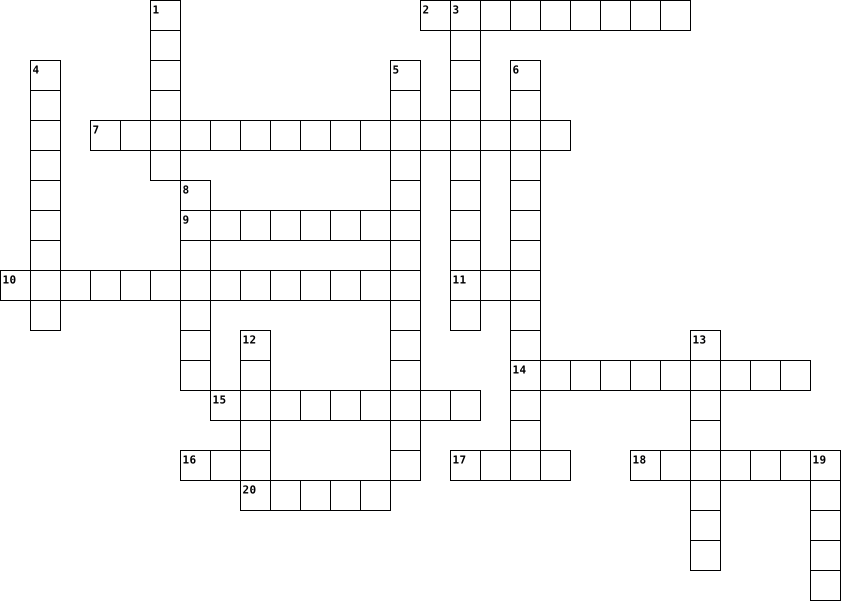
Across
- the chemicals required in order for a reaction to occur
- the reaction that produces energy in the cells of living organisms
- negatively charged sub-atomic particle in an atom
- the scientist who discovered the nucleus of an atom by shooting alpha particles through gold foil
- an atom that has gained or lost an electron
- the name given to a chemical reaction where heat is produced
- the atom with the atomic number 19 and the symbol K
- the number of electrons that can be held in the first shell of an atom
- number the name given to the number of protons plus the number of neutrons in an atom
- the non-gas reactant in cell respiration
- gases very unreactive group on the periodic table
Down
- earth metals the name given to group 2 metals on the periodic table
- the name given to a chemical reaction where heat is absorbed
- the scientist who came up with the plum pudding model of the atom
- the gas produced through cell respiration
- the name of the chemical process plants use to produce glucose
- the part of an atom that has no charge
- positively charged sub-atomic particle in an atom
- the chemicals produced in a chemical reaction
- the number of electrons that can be held in the 2nd shell of an atom
20 Clues: the part of an atom that has no charge • the non-gas reactant in cell respiration • the gas produced through cell respiration • an atom that has gained or lost an electron • the chemicals produced in a chemical reaction • negatively charged sub-atomic particle in an atom • positively charged sub-atomic particle in an atom • ...
Chapter 9-10 Crossword (Acid, Base, pH, Chem. Rxns) 2021-02-16

Across
- The number that indicates the relative strength of acids and bases in a substance.
- Type of reaction that releases heat
- The chemical reaction that occurs when burning something.
- Has a pH ranging from 11-14
- Has a pH ranging from 8-10
- A substance that is present at the start of a chemical reaction.
- An ion that has a positive charge.
- A change in a substance that does not change its identity
- Reactions that form water and salt upon mixing of an acid and a base.
- Has a pH ranging from 4-6
Down
- Matter is not created nor destroyed in any chemical or physical change.
- Occurs when two or more molecules interact and change into a new substance.
- A substance that releases hydrogen ions (H+). Has a sour taste and low pH.
- scale Ranges from the number 0-14. Used to measure how strong or weak an acid/base is.
- Has a pH of 7
- A substance that releases hydroxide ions (OH-). Has a bitter taste and high pH.
- A solid that forms from a solution during a chemical reaction.
- Has a pH ranging from 0-3
- Test strips that contain compounds; change color when in contact with a substance.
- An ion that has a negative charge.
- An atom that has a positive or negative charge.
- Type of reaction that absorbs heat
- When an acid and a base combine changing the pH to be neutral.
23 Clues: Has a pH of 7 • Has a pH ranging from 0-3 • Has a pH ranging from 4-6 • Has a pH ranging from 8-10 • Has a pH ranging from 11-14 • An ion that has a positive charge. • An ion that has a negative charge. • Type of reaction that absorbs heat • Type of reaction that releases heat • An atom that has a positive or negative charge. • ...
Chemistry crossword 2016-02-11

Across
- little pieces in the elements
- weight of atom
- small, simple atom with very few electrons
- metal like element that is liquid at room temperature
- neutral charged part of atom
- reaction that absorbs heat
- outermost electron
- reaction that releases heat
- positive charged piece in an atom
- Russian chemist
- one or two letters that are used to show an element
- outcome of chemical reaction
- track that electrons follow
- category of elements
Down
- shiny and conductive element
- a rule that states mass cannot be destroyed
- center part of an atom
- mixture of non chemically bound elements
- a chemical reaction that attaches a metal to the surface of an object
- metal non conductive ductile element
- number of protons in the nucleus
- negative charged part of atom
- has atoms in it
- solid that causes reaction
- pure substance
- single element
26 Clues: weight of atom • pure substance • single element • Russian chemist • has atoms in it • outermost electron • category of elements • center part of an atom • reaction that absorbs heat • solid that causes reaction • reaction that releases heat • track that electrons follow • shiny and conductive element • neutral charged part of atom • outcome of chemical reaction • ...
Bonding and Reactions 2024-11-25

Across
- a number that represents how many molecules are in the reaction
- the ability to attract an electron
- an intermolecular force created by polar or ionic bonds (medium strength)
- uneven sharing of electrons
- the outermost electron used in bonds
- forces that keep molecules together
- abbreviated (g)
- two or more atoms bonded together
- used to speed up the reaction
- abbreviated (s)
- the transfer of electrons
Down
- a negatively charged subatomic particle
- even sharing of electrons
- an intermolecular force created by nonpolar bonds (weak strength)
- the sharing of electrons in a bond
- before a chemical reaction occurs
- after a chemical reaction occurs
- abbreviated (aq)
- an intermolecular force created when H bonds with F, O, N
- an arrow used to show the result of the reaction
- two valence electrons that link atoms together
- abbreviated (l)
22 Clues: abbreviated (g) • abbreviated (s) • abbreviated (l) • abbreviated (aq) • even sharing of electrons • the transfer of electrons • uneven sharing of electrons • used to speed up the reaction • after a chemical reaction occurs • before a chemical reaction occurs • two or more atoms bonded together • the ability to attract an electron • the sharing of electrons in a bond • ...
Carbon and Life Part 1 2025-02-06

Across
- *********** reaction; reaction involving the removal of water
- the monomers of polysaccharides
- prefix for four
- tetravalent atom with six protons
- the building block; the subunit that serves as the building block of polymers
- ******** reaction; making and breaking of bonds
- prefix for seven
Down
- the monomer of nucleic acids
- compounds containing ONLY carbon and hydrogen
- prefix for one
- ********** reaction; reaction involving the addition of water
- ********** group; groups directly involved in chemical reactions
- a giant molecule formed by the joining of smaller molecules
- two words; the subunit of proteins
- ******* compounds; compounds containing carbon
- a long molecule consisting of many similar or identical subunits
16 Clues: prefix for one • prefix for four • prefix for seven • the monomer of nucleic acids • the monomers of polysaccharides • tetravalent atom with six protons • two words; the subunit of proteins • compounds containing ONLY carbon and hydrogen • ******* compounds; compounds containing carbon • ******** reaction; making and breaking of bonds • ...
PS Review Semester 1 - 2021 2021-12-08

Across
- Carbon dioxide and water are usually the products in this type of reaction
- one sign of a chemical reaction taking place
- the amount of time it takes for one half of a sample to decay
- electrons have this charge
- displacement AB + C → AC + B
- the bonding where electrons are shared
- these gases do not react because they are completely stable on their own
- anything that takes up space and has mass
- adding protons and neutrons
- when a chemical reaction takes in heat
- a charged particle
- neutrons have this charge
- this element radioactively decays into Lead
- protons have this charge
- adding this to a reaction can speed it up
- number of protons
- orbit the nucleus
Down
- AB → A + B
- A + B → AB
- number of electrons the 2nd energy level can hold
- another name for electron energy levels
- center of an atom
- displacement AB + CD → AD + BC
- happens in nuclear energy when one reaction sets off another and another
- the spontaneous process in which an atomic nucleus emits radiation
- the bonding where electrons are transferred
- father of the Periodic Table of Elements
- Column 1 of the periodic table are these types of metals
- the middle part of the periodic table, which we colored red, are these metals
- chemicals listed to the right of the arrow in a chemical reaction
- chemicals listed to the left of the arrow in a chemical reaction
- when a chemical reaction releases energy
- outer electrons can be called this
- the reason atoms combine with each other
- the conservation of ______ says that matter cannot be created or destroyed
- ability of an atom to attract electrons to itself
- number of electron energy levels and also the number of rows in the periodic table
- atoms with the same number of protons but different number of neutrons
- when an electron gains energy, it moves from a grounded state to this state
39 Clues: AB → A + B • A + B → AB • center of an atom • number of protons • orbit the nucleus • a charged particle • protons have this charge • neutrons have this charge • electrons have this charge • adding protons and neutrons • displacement AB + C → AC + B • displacement AB + CD → AD + BC • outer electrons can be called this • the bonding where electrons are shared • ...
Max' crossword puzzle 2024-05-23

Across
- Putting chemicals together
- The changes during a chemical reaction
- Something that takes up space
- A characteristic that can be seen, such as texture, color, order, boiling point, density, or measured
- A change you can see
- Something that increases the rate of a chemical reaction
- The starting materials that undergo to make a chemical change to make a product
- A pure substance that is formed when two or more different elements combine
Down
- The study of matter
- The average amount of kinetic energy in a system
- The substance that is made after a reaction
- A substance that can't be broken down
- The amount of matter in an object
- An amount of space an object takes up
- water sticking to things
- A process changing a substance into a new substance
- A attraction between atoms
- The smallest unit of matter
18 Clues: The study of matter • A change you can see • water sticking to things • Putting chemicals together • A attraction between atoms • The smallest unit of matter • Something that takes up space • The amount of matter in an object • A substance that can't be broken down • An amount of space an object takes up • The changes during a chemical reaction • ...
KO5 Chemical Reactions 2026-02-02

Across
- A reaction breaking down a substance into smaller parts using heat
- When an acid and base reaction to make salt and water
- A substance that is produced during a chemical reaction
- A substance which speeds up a reaction without itself being used up
- A substance that takes part in and undergoes change during a reaction
- A measurement reading of how acidic or alkaline something is
- A row in the periodic table
Down
- Substances with a pH more than 7
- A reaction where a substance bonds with oxygen
- Reaction where heat is given off
- An interaction between two or more substances that brings about a chemical change
- Substances with a pH less than 7
- Reaction where heat is absorbed
- Type of indicator used to test for pH
- A more reactive element take s the lace of a less reactive element in a compound
- A column in the periodic table
16 Clues: A row in the periodic table • A column in the periodic table • Reaction where heat is absorbed • Substances with a pH more than 7 • Reaction where heat is given off • Substances with a pH less than 7 • Type of indicator used to test for pH • A reaction where a substance bonds with oxygen • When an acid and base reaction to make salt and water • ...
Energy transfers crossword 2022-02-04

Across
- ___________ are found on the left hand side of a chemical equation
- A force that holds together atoms in a compound or molecule (must be broken and reformed for a chemical reaction to occur)
- substances formed from reactants in a chemical reaction
- Burning a fuel in the presence of oxygen
- The law of the conservation of _____: States that atoms are rearranged in a chemical reaction, not lost or found
- A type of reaction where energy is taken in from the surroundings, decreasing the surrounding temperature
- This gas makes limewater turn cloudy
- In a chemical equation, products are found on the ______ hand side
Down
- A substance that speeds up chemical reactions, but are not changed during the reaction
- Thermal ________, to breakdown a substance using heat
- A type of change where an object can be reshaped, but no new product is formed. Is often reversible
- A type of reaction where energy is given out, so the surrounding temperature increases
12 Clues: This gas makes limewater turn cloudy • Burning a fuel in the presence of oxygen • Thermal ________, to breakdown a substance using heat • substances formed from reactants in a chemical reaction • ___________ are found on the left hand side of a chemical equation • In a chemical equation, products are found on the ______ hand side • ...
Crescent/Dixie's Chemistry Crossword 2020-08-28

Across
- a state of matter consisting of particles that have neither a defined volume nor defined shape
- a property (as color, hardness, boiling point) of matter not involving in its manifestation a chemical change
- a usually irreversible chemical reaction involving the rearrangement of the atoms of one or more substances
- A statement or conclusion that answers the original question/problem
- chemically the simplest substances and hence cannot be broken down using chemical reactions
- any substance that has mass and takes up space by having volume
- the scientific word for burning
- an element (e.g. arsenic, antimony, or tin) whose properties are intermediate between those of metals and solid nonmetals or semiconductors
- the ability of a substance, usually a metal, to be deformed or molded into a different shape
- a substance formed when two or more chemical elements are chemically bonded together
- an equation for a chemical reaction in which the number of atoms for each element in the reaction and the total charge is the same for both the reactants and the products
- matter which has a specific composition and specific properties
- a group of atoms bonded together, representing the smallest fundamental unit of a chemical compound that can take part in a chemical reaction
- the form in which the number of atoms in a molecule is written
- a notation used by scientists to show the number and type of atoms present in a molecule, using the atomic symbols and numerical subscripts
- a substance that is formed as the result of a chemical reaction
- when subjected to stress, it breaks with little elastic deformation and without significant plastic deformation
- a substance that is present at the start of a chemical reaction
- A representation or simulation for device structure, process equipment, or a management system
- a substance that conducts heat, electricity, or sound only in very small degree
- notice or perceive (something) and register it as being significant
Down
- the sum of all solid and liquid particles suspended in air many of which are hazardous
- a process in which one or more substances, the reactants, are converted to one or more different substances, the products
- another word for element symbols
- a guess what might happen based on observation the active acquisition of information from a primary source
- a state of matter that has a definite volume but no definite shape
- a characteristic of a substance that is observed during a reaction
- a property that describes the ability of a material to stretch thin when tensile stress is applied
- smallest unit into which matter can be divided
- characteristics or behaviour of a sample which is large enough to see, handle, manipulate, weigh, etc
- a chemical element that mostly lacks the characteristics of a metal
- a lasting attraction between atoms, ions or molecules that enables the formation of chemical compounds
- the symbolic representation of a chemical reaction
- a state of matter characterized by particles arranged such that their shape and volume are relatively stable
- a usually reversible change in the physical properties of a substance, as size or shape
- a material which contains movable electric charges
- the way light interacts with the surface of a crystal, rock, or mineral
- that which tends to prove or disprove something
- a substance which is lustrous, sonorous, ductile, and is a good conductor of heat and electricity
39 Clues: the scientific word for burning • another word for element symbols • smallest unit into which matter can be divided • that which tends to prove or disprove something • the symbolic representation of a chemical reaction • a material which contains movable electric charges • the form in which the number of atoms in a molecule is written • ...
Chemistry 2024-03-15

Across
- a chemical reaction in which a substance loses electrons.
- means more molecules in a given space, increasing the chance of collisions and speeding up reactions.
- reactions are common endothermic reactions.
- a chemical reaction in which a substance gains electrons.
- the process when energy is released to the surroundings
- is one or more forms of a chemical element that can exist in the same physical state.
- speed up reactions without getting used up themselves.
- reaction is a chemical reaction in which the product can react to produce the original reactant. It can move in both forward and backward directions.
Down
- the approximate percentage of argon in air
- means using electricity to coat one metal with another.
- generates electrons in the reaction and is oxidized. It reduces another substance by generating electrons.
- a chemical reaction that uses nitrogen gas and hydrogen gas to create the chemical compound ammonia.
12 Clues: the approximate percentage of argon in air • reactions are common endothermic reactions. • speed up reactions without getting used up themselves. • means using electricity to coat one metal with another. • the process when energy is released to the surroundings • a chemical reaction in which a substance loses electrons. • ...
Modeling Conservation of Mass 2023-09-27

Across
- Law of ______________ of Matter - Scientific law stating that the mass of all reactants must equal the mass of all products; matter is neither created nor destroyed
- Chemical __________ - A shorthand notation that uses chemical symbols and numbers as subscripts to represent the type and number of atoms that are present in the smallest unit of a substance
- to prevent the loss of something
- A measure of how much matter is present in a substance
- a number written below and to the right of a chemical symbol that shows the number of specific type of atoms present
- Physical or chemical characteristics of matter used to describe or identify a substance
- the smallest particle of an element; made of electrons, protons, and neutrons
Down
- chemical ________ - is chemical formula and symbols written to represent a reaction
- the simplest unit of a chemical compound that can exist; formed when two or more atoms join together chemically
- a substance that takes part in and undergoes change during a chemical reaction
- Chemical _________ - The process by which one or more substances change to produce one or more different substances
- A number placed in front of a chemical symbol or formula that represents the number of molecules
- A substance produced during a chemical reaction
- Chemical _________ - Method or means of changing one or more chemicals or chemical compounds
14 Clues: to prevent the loss of something • A substance produced during a chemical reaction • A measure of how much matter is present in a substance • the smallest particle of an element; made of electrons, protons, and neutrons • a substance that takes part in and undergoes change during a chemical reaction • ...
Neutralisation 2021-02-10

Across
- used to raise the pH of an acid soil
- red vegetable used to make an indicator
- pH 7
- used in a chemical reaction
- ions produced by an alkali
- pH 8-14
- common "bench" acid
Down
- pH 1-6
- made in a chemical reaction
- a chemical that will neutralise an acid
- reaction where a base is added to an acid
- Made in neutralisation reactions
- hydrogen ion
- Colour of red cabbbage indicator in a strong alkali
14 Clues: pH 7 • pH 1-6 • pH 8-14 • hydrogen ion • common "bench" acid • ions produced by an alkali • made in a chemical reaction • used in a chemical reaction • Made in neutralisation reactions • used to raise the pH of an acid soil • a chemical that will neutralise an acid • red vegetable used to make an indicator • reaction where a base is added to an acid • ...
Unit 3 Vocabulary 2023-05-16

Across
- (usually a protein) that speeds up a biochemical reaction by lowering its activation energy
- Get energy from living or non-living organisms. examples: animals, fungus, people.
- Eat only meat example-polar bear
- A reaction that overall releases more energy (in the form of heat or light than it absorbs.
- Reactions that build larger molecules from smaller ones
- A catabolic process that makes a limited amount of ATP from glucose without an electron transport chain and that produces a characteristic end product, such as ethyl alcohol or lactic acid.
- (substrate) A substance that is changed during a chemical reaction
- The synthesis of organic compounds by bacteria or other living organisms using energy derived from reactions involving inorganic chemicals, typically in the absence of sunlight.
- energy Energy needed to get a chemical reaction started
- A green pigment, present in all green plants and in cyanobacteria, responsible for the absorption of light to provide energy for photosynthesis. Its molecule contains a magnesium atom held in a porphyrin ring.
- Process that releases energy by breaking down glucose and other food molecules in the presence of oxygen
- Substance that speeds up the rate of a chemical reaction without being permanently altered
- A reaction that overall absorbs more energy (in the form of heat or light) than it releases.
- Pancake-like stacks of thylakoid membrane
- A substance that is made in a chemical reaction
- Eat meat and vegetation example-raccoons
Down
- The membrane of the mitochondria that is the site of electron transport and chemiosmosis.
- Requires oxygen
- Eat only vegetation
- The overall process by which sunlight (solar/light energy) chemically converts water and carbon dioxide into chemical energy stored in glucose (a sugar/carbohydrate) (this happens on the leaf of a plant)
- Reactions The breaking and forming of bonds between different substances during chemical changes
- Is without oxygen; usually w/short-spurt, high-energy activities
- site Location on an enzyme where the substrate binds
- Non-living portion
- Reactions that break down larger molecules into simpler compounds.
- All of the chemical reactions that occur within an organism
- Eat dead materials example-vultures
- Fluid-like substance that fills the space between the grana
- They get energy from non-living sources most capture energy during photosynthesis to make simple sugars.
- A substance present in all living cells that provides energy for many metabolic processes and is involved in making RNA.
- When an enzyme's active site loses its specific shape, causing a loss in biological activity
31 Clues: Requires oxygen • Non-living portion • Eat only vegetation • Eat only meat example-polar bear • Eat dead materials example-vultures • Eat meat and vegetation example-raccoons • Pancake-like stacks of thylakoid membrane • A substance that is made in a chemical reaction • site Location on an enzyme where the substrate binds • ...
Periodic Compounds Key Terms 2024-07-28

Across
- a substance that is brittle, has a low melting and boiling point and is a poor conductor
- a table of chemical elements arranged according to atomic number
- a solid material that is usually hard, shiny, malleable, ductile and is a good conductor
- the ability of a substance to undergo a chemical reaction
- movement of energy from one place to another
- the intensity of heat in a substance
- type of bond that occurs between a metal and a non metal
Down
- the temperature at which a substance will melt
- anything that has mass and volume
- Russian chemist who developed the periodic table.
- process that leads to the chemical transformation of one set of chemical substances to another
- substances that take part in a chemical reaction
- substances produced in a chemical reaction
13 Clues: anything that has mass and volume • the intensity of heat in a substance • substances produced in a chemical reaction • movement of energy from one place to another • the temperature at which a substance will melt • substances that take part in a chemical reaction • Russian chemist who developed the periodic table. • ...
Chemical Reactions and Equations 2024-05-14

Across
- a magnesium ribbon burns in _____ colour
- corrosion and rancidity are _______ reactions
- substance that speeds up a chemical reaction
- 2Mg+O2 = 2MgO is a _______ reaction
- during a double displacement reaction, _____ are exchanged
- brown gas produced during the decomposition of lead nitrate
- gas evolved when an acid reacts with a metal
- a substance that undergoes a chemical change in a reaction
Down
- a substance which turns from green to white when heated
- reaction where light causes the breakdown of a subtance
- CaO + H20 is a ______ reaction (exothermic/endothermic)
- most reactive metal
- acid-metal reactions are ________ reactions
- common name of calcium hydroxide
- an insoluble solid formed during a double displacement reaction
15 Clues: most reactive metal • common name of calcium hydroxide • 2Mg+O2 = 2MgO is a _______ reaction • a magnesium ribbon burns in _____ colour • acid-metal reactions are ________ reactions • substance that speeds up a chemical reaction • gas evolved when an acid reacts with a metal • corrosion and rancidity are _______ reactions • ...
Cellular Energy Terms 2022-12-12

Across
- breakdown of substance by bacteria
- extracts energy from glucose
- substance that changes in a reaction
- sugar made from photosynthesis
- made from cellular respiration
- process that breaks down glucose
- controls the rate of gas exchange
- inner tissue of a leaf
- chemical element
- converts nutrients to glucose
- organism that is a primary producer
- relating to oxygen
Down
- an organelle found in cells
- 1 carbon atom, 2 carbon atoms
- cycle of chemical reactions
- citric acid cycle
- the result of a reaction
- an organelle containing chlorphyll
- process in which plants make food
- reaction using light energy
20 Clues: chemical element • citric acid cycle • relating to oxygen • inner tissue of a leaf • the result of a reaction • an organelle found in cells • cycle of chemical reactions • reaction using light energy • extracts energy from glucose • 1 carbon atom, 2 carbon atoms • converts nutrients to glucose • sugar made from photosynthesis • made from cellular respiration • ...
Chemical Changes Crossword Puzzle | Science Assignment | Ethan and Micah 2023-03-28

Across
- Stuff gets destroyed over time
- 2KI(aq)+Pb(NO3)2(aq)→2KNO3(aq)+PbI2(s)
- UR MOTHER
- The chemical after change
- UR DEDDY
- Changes in a chemical reaction
- Water ---> Gas
- The chemicals before change
- Metal gets red
- Fire/Water/Air/Earth
- Long years, materials become rusty
- Rain of Acid
Down
- Substance with pH under 7
- Zn(s)+2HCl(aq)→ZnCl2(aq)+H2(g)
- Reaction needed for chemicals to change
- Reaction when rain or snow falls
- Substance with pH over 7
- Neutral substance with pH 7
- O2, Co2, H2, N2.
- Fire eating
- Boom
- H2 + O = H20
22 Clues: Boom • UR DEDDY • UR MOTHER • Fire eating • H2 + O = H20 • Rain of Acid • Water ---> Gas • Metal gets red • O2, Co2, H2, N2. • Fire/Water/Air/Earth • Substance with pH over 7 • Substance with pH under 7 • The chemical after change • Neutral substance with pH 7 • The chemicals before change • Stuff gets destroyed over time • Zn(s)+2HCl(aq)→ZnCl2(aq)+H2(g) • Changes in a chemical reaction • ...
Chemical Reactions and Equations 2025-06-01

Across
- Process in which one or more substances are changed into new substances
- Chemical reaction in which two or more substances combine
- Reaction in which heat is evolved
- Substance that speeds up a chemical reaction without being consumed
- Substance that undergoes a chemical change
Down
- Reaction in which heat is absorbed
- Chemical equation in which the number of atoms of each element is equal on both sides
- Type of chemical reaction in which a single compound breaks down
- Representation of a chemical reaction using symbols and formulas
- Number that represents the number of atoms of an element in a molecule
10 Clues: Reaction in which heat is evolved • Reaction in which heat is absorbed • Substance that undergoes a chemical change • Chemical reaction in which two or more substances combine • Type of chemical reaction in which a single compound breaks down • Representation of a chemical reaction using symbols and formulas • ...
VOCABULARY IN CHEMISTRY 2023-05-15

Across
- Unit for the amount of substance
- Energy that needs to have a molecule to react
- Type of element in the last group of the periodic table
- Chemical property that describes the tendency of an atom or a functional group to attract electrons toward itself.
- Ion with positive charge
- Fist part of the chemical reaction
- Is the mass that appears in the periodic table.
- Negative particle of the atom
- Is the number of protons of an atom.
- Neutral particle of the atom
Down
- Last part of the chemical reaction
- The conditions in which a gas occupies 22.7L at 25C and 1 atm.
- An atom with charge is called...
- Ion with negative charge
- Part of chemistry that studies changes in a chemical reaction
- Type of elements in the right side of the periodic table
- Process that involves rearrangement of atoms
- Type of elements in the left side of the periodic table
- Positive particle of the atom
- Unit to measure mass
- Element with symbol Cd
21 Clues: Unit to measure mass • Element with symbol Cd • Ion with negative charge • Ion with positive charge • Neutral particle of the atom • Positive particle of the atom • Negative particle of the atom • Unit for the amount of substance • An atom with charge is called... • Last part of the chemical reaction • Fist part of the chemical reaction • Is the number of protons of an atom. • ...
Tatum G 4.1.3 2024-02-07

Across
- an enzyme that helps digest food
- after a chemical reaction occurs
- percentage of hydrogen ions in a solution
- if the enzymes shape changes significantly and can no longer function
- reaction energy lowered by enzymes
- a toxic chemical that is produced in many organisms
- the name of what an enyzme typically ends in
- lots of hydrogen
- can block active sites
- when the substrate is changed
- the substance the enzyme acts on
- something you breathe in everyday to stay alive
- molecule that's used by all living organisms
- shape of the enzyme fits the substrate
- an enzyme that is released by the cells of the stomach
Down
- very little hydrogen
- enzymes control this aspect of a chemical reaction
- adds water molecules
- large bio-molecules
- chemical reactions done by living organisms
- degree or intensity of heat present
- removes water molecules
- specifically shaped area of the enzyme
- breaks down lactose
- protein molecules that act as biological catalysts
25 Clues: lots of hydrogen • large bio-molecules • breaks down lactose • very little hydrogen • adds water molecules • can block active sites • removes water molecules • when the substrate is changed • an enzyme that helps digest food • after a chemical reaction occurs • the substance the enzyme acts on • reaction energy lowered by enzymes • degree or intensity of heat present • ...
Reni's Matter Crossword 2024-05-15

Across
- 2 or more atoms joined together.
- A combination of substances that can be physically separated
- The interaction between 2 or more elements.
- The substances present before a chemical reaction.
- CO2 is a definition of ______.
- A substance formed during a chemical reaction.
- The study of matter and everything in the universe.
- The amount of space an object takes up.
- The average amount of heat in an object.
Down
- Carbon, Hydrogen, & Oxygen are examples of an _______.
- The amount of matter in an object.
- The ability of molecules of the same substance to stick together.
- Everything in the universe is made of this.
- The attraction between 2 or more atoms.
- The transfer of thermal energy in an object .
- The smallest unit of matter.
- Material that speeds up the chemical reaction.
- The ability to do work and cause change is ______.
18 Clues: The smallest unit of matter. • CO2 is a definition of ______. • 2 or more atoms joined together. • The amount of matter in an object. • The attraction between 2 or more atoms. • The amount of space an object takes up. • The average amount of heat in an object. • Everything in the universe is made of this. • The interaction between 2 or more elements. • ...
Chemical reactions crossword 2013-12-19

Across
- substance that increases the rate of a chemical reaction without itself undergoing any permanent chemical change
- a chemical reaction accompanied by the absorption of heat
- a substance obtained from another substance through chemical change
- any of the substances participating in a chemical reaction
- a thing that inhibits someone or something
Down
- a chemical reaction accompanied by the evolution of heat
- the symbolic representation of a chemical reaction
- a process existing in or produced by nature (rather than by the intent of human beings)
- matter cannot be created or destroyed in an isolated system
- a substance produced by a living organism that acts as a catalyst to bring about a specific biochemical reaction
- a process that involves rearrangement of the molecular or ionic structure of a substance
11 Clues: a thing that inhibits someone or something • the symbolic representation of a chemical reaction • a chemical reaction accompanied by the evolution of heat • a chemical reaction accompanied by the absorption of heat • any of the substances participating in a chemical reaction • matter cannot be created or destroyed in an isolated system • ...
Chapter 8 2025-10-17

Across
- macromolecule that acts as a catalyst
- a measure of molecular disorder or randomness
- the reactant an enzyme acts on
- adenosine triphosphate the cell's main energy source
- pathway a series of chemical reactions occurring within a cell
- energy potential energy available for release in a chemical reaction
- an energy-releasing chemical reaction
- everything outside the system
- energy energy that matter possesses because of its location or structure
- an energy-requiring chemical reaction
- energy energy associated with the relative motion of objects
- Law of Thermodynamics every energy transfer or transformation increases the entropy of the universe
- energy kinetic energy associated with the random movement of atoms or molecules
- the acceleration of a chemical reaction by a catalyst
Down
- the equation used to calculate the change in free energy in a chemical reaction
- pathways metabolic pathways that construct complex molecules from simpler ones requiring energy
- inhibition a method of metabolic control where the end product of a metabolic pathway acts as an inhibitor of an enzyme within that pathway
- the matter under study in a particular case of thermodynamics
- site the region on the enzyme where the substrate binds
- regulation the binding of a regulatory molecule to a protein at one site that affects the function of the protein at a different site
- the absolute temperature scale used in scientific measurements
- the capacity to cause change
- energy a type of electromagnetic radiation which is visible to the human eye
- Law of Thermodynamics energy can be transferred and transformed but it cannot be created or destroyed
- a measure of the total heat content of a system
- process a process that can occur without an input of energy
- the study of energy transformations
- a force acting over a distance
- coupling the use of an exergonic process to drive an endergonic one
- pathways metabolic pathways that break down complex molecules into simpler ones releasing energy
30 Clues: the capacity to cause change • everything outside the system • the reactant an enzyme acts on • a force acting over a distance • the study of energy transformations • macromolecule that acts as a catalyst • an energy-releasing chemical reaction • an energy-requiring chemical reaction • a measure of molecular disorder or randomness • ...
Robert Pennington chapter 13 2020-10-19

Across
- having two atom switching partners.
- only having one individual joining a team.
- a substance that lowers the activation energy of a chemical reaction.
- the amount of energy to break the bonds.
- reaction there is a net release of energy.
- some compound combining with oxygen.
- no atom are gained or lost during any reaction.
Down
- how quickly the concetration of reactants decreases.
- chemical that accepts a hydrogen ion
- building reaction, combining the molecoles.
- when reactions and its reverse act the same rate.
- reaction there is a net absorption of energy.
- chemical that donates a hydrogen ion.
13 Clues: having two atom switching partners. • some compound combining with oxygen. • chemical that accepts a hydrogen ion • chemical that donates a hydrogen ion. • the amount of energy to break the bonds. • only having one individual joining a team. • reaction there is a net release of energy. • building reaction, combining the molecoles. • ...
9.1-9.2 Review 2025-03-12

Across
- a process where substances change into different substances
- symbols tell us the physical state of each substance
- means "yields" or "produces"
- symbolic representation of a chemical reaction
- red rust
- exist in nature as two-atom molecules
- Nonmetal + Nonmetal
Down
- a type of chemical reaction where two or more reactants combine to form a single product
- the starting substances in a reaction
- metal oxide + water
- metal + nonmeta
- the substances formed as a result of the reaction
- black rust
- yellow rust
- Metal + Oxygen
15 Clues: red rust • black rust • yellow rust • Metal + Oxygen • metal + nonmeta • metal oxide + water • Nonmetal + Nonmetal • means "yields" or "produces" • the starting substances in a reaction • exist in nature as two-atom molecules • symbolic representation of a chemical reaction • the substances formed as a result of the reaction • symbols tell us the physical state of each substance • ...
NSD -2025 2025-02-24

Across
- – A substance that increases the concentration of hydrogen ions (H⁺) in a solution.
- – The SI unit for the amount of substance, containing Avogadro’s number of particles.
- – A solution that contains more dissolved solute than it can normally hold at a given temperature.
- – Different structural forms of the same element in the same physical state.
- – An atom or molecule with a net electric charge due to the loss or gain of electrons.
- – The substance in which the solute dissolves to form a solution.
- – A group of two or more atoms chemically bonded together.
- – A technique used to determine the concentration of a solution by reacting it with a standard solution.
- – A substance that increases the concentration of hydroxide ions (OH⁻) in a solution.
- – The substance dissolved in a solution.
- – A state in which the forward and reverse reactions occur at the same rate.
- – An insoluble solid that forms in a solution during a chemical reaction.
- – A substance composed of two or more different elements chemically bonded together.
- – A solution that resists changes in pH when an acid or base is added.
- – An element with properties intermediate between metals and nonmetals.
- – The gain of electrons by an atom or molecule.
- Bond – A bond formed between oppositely charged ions due to electron transfer.
- – The total heat content of a system.
- – The smallest unit of an element that retains its chemical properties.
- – The mixing of atomic orbitals to form new hybrid orbitals.
- Free Energy – A thermodynamic quantity indicating the spontaneity of a reaction.
- – The calculation of reactants and products in a chemical reaction.
- – The concentration of a solution expressed as moles of solute per liter of solution.
Down
- – Properties of solutions that depend on the number of solute particles, such as boiling point elevation and freezing point depression.
- – A substance made of only one type of atom.
- – A substance formed as a result of a chemical reaction.
- – The loss of electrons by an atom or molecule.
- – A measure of the disorder or randomness in a system.
- Bond – A chemical bond formed by the sharing of electron pairs between atoms.
- – An element that is a good conductor of heat and electricity, malleable, and ductile.
- – Atoms of the same element with different numbers of neutrons.
- Reaction – A chemical reaction involving both oxidation and reduction.
- – The spontaneous emission of radiation by an unstable atomic nucleus.
- – The ability of an atom to attract electrons in a chemical bond.
- – An element that lacks metallic properties and is usually a poor conductor.
- – The time required for half of a radioactive substance to decay.
- – A substance that undergoes change in a chemical reaction.
- – A substance that speeds up a chemical reaction without being consumed.
- – A homogeneous mixture of solute and solvent.
39 Clues: – The total heat content of a system. • – The substance dissolved in a solution. • – A substance made of only one type of atom. • – A homogeneous mixture of solute and solvent. • – The loss of electrons by an atom or molecule. • – The gain of electrons by an atom or molecule. • – A measure of the disorder or randomness in a system. • ...
Chemical reactions 2023-04-06

Across
- All chemical reactions involve e_______ being transferred
- This type of reaction would show a temperature decrease
- This type of reaction would show a temperature increase
- Thermal _________________ reactions involve a single reactant being broken down
- The scientific name of the chemical reaction involving burning a fuel
- Fossil fuels are bad because they contribute to ___________ change
Down
- This liquid can be used to test for the presence of carbon dioxide
- The chemical(s) on the LEFT side of the arrow in a word equation
- In a chemical reaction, the ______ of the reactants = the mass of the products
- The chemical(s) on the RIGHT side of the arrow in a chemical reaction
- Fossil fuels are non-_____________ meaning we can't get more of them easily
- You need to wear these over your eyes when handling acids
12 Clues: This type of reaction would show a temperature decrease • This type of reaction would show a temperature increase • All chemical reactions involve e_______ being transferred • You need to wear these over your eyes when handling acids • The chemical(s) on the LEFT side of the arrow in a word equation • ...
Chemical Reactions and Equations. 2020-04-24

Across
- addition of electronegative ion
- occurs when barium chloride reacts with sodium sulphate
- agent causes reduction
- iodide
- reaction between an acid and a base
- reaction taking place when to elements for a single compound
- symbolic representation of a chemical reaction
Down
- chemical used in photography
- reaction when two compounds exchange their ions
- colour of fumes given out when lead nitrate is heated
- reaction taking place when calcium carbonate is heated
- common effect of aerial oxidation on metals
- colour of precipitate formed when lead nitrate reacts with
- this is what an equation should be
- causes oxidation
- addition of electropositive ion
16 Clues: iodide • causes oxidation • agent causes reduction • chemical used in photography • addition of electronegative ion • addition of electropositive ion • this is what an equation should be • reaction between an acid and a base • common effect of aerial oxidation on metals • symbolic representation of a chemical reaction • reaction when two compounds exchange their ions • ...
Carbon and Life 2025-02-06

Across
- *********** reaction; reaction involving the removal of water
- the monomers of polysaccharides
- prefix for four
- tetravalent atom with six protons
- the building block; the subunit that serves as the building block of polymers
- ******** reaction; making and breaking of bonds
- prefix for seven
Down
- the monomer of nucleic acids
- compounds containing ONLY carbon and hydrogen
- prefix for one
- ********** reaction; reaction involving the addition of water
- ********** group; groups directly involved in chemical reactions
- a giant molecule formed by the joining of smaller molecules
- two words; the subunit of proteins
- ******* compounds; compounds containing carbon
- a long molecule consisting of many similar or identical subunits
16 Clues: prefix for one • prefix for four • prefix for seven • the monomer of nucleic acids • the monomers of polysaccharides • tetravalent atom with six protons • two words; the subunit of proteins • compounds containing ONLY carbon and hydrogen • ******* compounds; compounds containing carbon • ******** reaction; making and breaking of bonds • ...
Chemistry Unit 5 Crossword 2023-05-01

Across
- A chemical reaction that occurs when one compound replaces one element with another.
- A subatomic particle found on the shell of an atom
- A chemical reaction between 2 or more elements that combine to create one product
- An atom that loses electrons and has a positive charge
- A bound between a positive metal element and a negative non-metal
- A chemical reaction when hydrocarbon reacts with oxygen in order to produce carbon dioxide and water
- A chemical reaction that occurs when two compounds replace one element with another.
Down
- A set of bonded elements that act as one element(typically an anion)
- An element that cannot stand by itself
- A chemical reaction that occurs when one reactant breaks down into 2 or more products
- A number at the end of an element/compound that indicates how many copies it has
- A number that stands in front of an element(s) and indicates the multiplicity
- A bonds that involve the sharing of electrons
- 2 or more chemically combined elements with no charge
- An atom that gains electrons and has a negative charge
15 Clues: An element that cannot stand by itself • A bonds that involve the sharing of electrons • A subatomic particle found on the shell of an atom • 2 or more chemically combined elements with no charge • An atom that gains electrons and has a negative charge • An atom that loses electrons and has a positive charge • ...
chemistry crossword puzzle 2025-04-24

Across
- bonded group of substances
- combining substance
- change
- average warmths
- something that takes up space
- smallest substance
- space,the amount
- stuff stored in substances
- energy between
Down
- chemically combined elements
- change different chemical transformation
- combination to form structures
- reaction materials
- the science of substance
- combination
- substance that cant be broken down
- chemicals formed
- large space, no shape
18 Clues: change • combination • energy between • average warmths • chemicals formed • space,the amount • reaction materials • smallest substance • combining substance • large space, no shape • the science of substance • bonded group of substances • stuff stored in substances • chemically combined elements • something that takes up space • combination to form structures • ...
Chemical Changes Crossword Puzzle | Science Assignment | Ethan and Micah 2023-03-28

Across
- Stuff gets destroyed over time
- 2KI(aq)+Pb(NO3)2(aq)→2KNO3(aq)+PbI2(s)
- UR MOTHER
- The chemical after change
- UR DEDDY
- Changes in a chemical reaction
- Water ---> Gas
- The chemicals before change
- Metal gets red
- Fire/Water/Air/Earth
- Long years, materials become rusty
- Rain of Acid
Down
- Substance with pH under 7
- Zn(s)+2HCl(aq)→ZnCl2(aq)+H2(g)
- Reaction needed for chemicals to change
- Reaction when rain or snow falls
- Substance with pH over 7
- Neutral substance with pH 7
- O2, Co2, H2, N2.
- Fire eating
- Boom
- H2 + O = H20
22 Clues: Boom • UR DEDDY • UR MOTHER • Fire eating • H2 + O = H20 • Rain of Acid • Water ---> Gas • Metal gets red • O2, Co2, H2, N2. • Fire/Water/Air/Earth • Substance with pH over 7 • Substance with pH under 7 • The chemical after change • Neutral substance with pH 7 • The chemicals before change • Stuff gets destroyed over time • Zn(s)+2HCl(aq)→ZnCl2(aq)+H2(g) • Changes in a chemical reaction • ...
Unit 2 2022-03-25

Across
- an organized structure
- hates water
- allows certain things to pass
- what comes from the reaction
- combination of cells
- molecules naturally move to lower density
- proteins that help your body function
- the diffusion of water
- moving molecules using energy
- combination of organ systems
- a group of atoms
- base of all life
Down
- where the chemical reaction takes place
- combination of many organs
- energy needed to cause a chemical reaction
- moving molecules without energy
- it fits into the active site
- loves water
- active site is changed
- basic unit of life
- cell membrane
- combination of tissue
22 Clues: hates water • loves water • cell membrane • a group of atoms • base of all life • basic unit of life • combination of cells • combination of tissue • an organized structure • active site is changed • the diffusion of water • combination of many organs • what comes from the reaction • it fits into the active site • combination of organ systems • allows certain things to pass • ...
Test Review 1 2017-09-25

Across
- changes that occur when a substance combines with another to form a new substance
- properties that can be observed or measured without changing the composition of matter
- the direction in which energy flows when two objects are in thermal contact
- a substance that cannot be separated or broken down into simpler substances by chemical means; a pure substance
- 1000 calories
- a principle stating that energy cannot be created or destroyed
- a unit of energy in the SI system
Down
- the amount of heat required to raise the temp. of one gram of water
- changes affecting the form of a chemical substance, but not its chemical composition
- anything that has mass and volume
- mixtures that are not uniform in composition
- a chemical reaction that takes in energy in the form of heat
- a chemical reaction that releases energy in the form of heat or light
- properties that may only be observed and measured by performing a chemical change or chemical reaction
- amount of heat per unit mass required to raise the temperature by one degree celsius
- a substance made up of atoms of 2 or more different elements joined by chemical bonds; a pure substance
- energy that flows between two samples of matter due to their difference in temperature
- process of measuring the heat of chemical reactions or physical changes as well as heat capacity
- 1000 joules
- mixtures that are uniform in compisition (also called heterogenous)
20 Clues: 1000 joules • 1000 calories • anything that has mass and volume • a unit of energy in the SI system • mixtures that are not uniform in composition • a chemical reaction that takes in energy in the form of heat • a principle stating that energy cannot be created or destroyed • the amount of heat required to raise the temp. of one gram of water • ...
Unit 3: Chemistry of Life 2022-12-15

Across
- a process that changes one set of chemicals into another set of chemicals
- site location on the substrate where the enzyme attaches
- Giant molecules that contain carbon and are the main components of organisms
- a substance that speeds up the rate of a chemical reaction
- the chemicals that come out of a reaction
- a type of reaction that results in a absorption of energy
- measures the concentration of H+ ions
- the collective chemical reactions that take place in an organism
- a type of reaction that results in a release of energy
- biological catalysts that speed up a reaction
- large compound formed from many monomers
Down
- made of a glycerol molecule and a fatty acid
- make up all organisms
- reactants of an enzyme-catalyzed reaction
- main source of energy in most organism
- small unit that can join with others to form a polymer
- acids transmit genetic information
- the chemicals that go into a reaction
- made of amino acids
- site location on the enzyme where the substrate attaches
20 Clues: made of amino acids • make up all organisms • acids transmit genetic information • the chemicals that go into a reaction • measures the concentration of H+ ions • main source of energy in most organism • large compound formed from many monomers • reactants of an enzyme-catalyzed reaction • the chemicals that come out of a reaction • ...
Science Unit 02 Vocabulary 2021-10-20

Across
- water which collects as droplets on a cold surface when humid air is in contact with it.
- the tiny number by the element that tells you how many atoms the element has
- a substance that increases the rate of a chemical reaction without itself undergoing any permanent chemical change.
- a reaction that causes a chemical change.
- the statement that says matter cannot be created or destroyed.
- the proccess of iron turning to rust.
- the minor compound in a solution.
- the gain of electrons by a substance.
- a change that affects the chemical properties of an element.
- absorbing thermal heat.
- a change in a substance that only affects physical properties.
- the elements on the left side of a chemical equation.
- the elements of the right side of a chemical equation.
- something that you can seperate.
Down
- when both sides of the chemical equation or balanced.
- an equation that has reactants and products.
- the ability of something to disolve.
- a mixture that its composition is spread evenly thoughout the mixture
- being able to disolve in other substances.
- the big number next to a chemical formula that tells how many molecules there are.
- release of thermal heat.
- a solid that forms after a chemical reaction.
- somthing that is made up of two or more different elements.
- a group of atoms bonded together.
- a mixture that its composition is spread evenly throughout the mixture.
25 Clues: absorbing thermal heat. • release of thermal heat. • something that you can seperate. • the minor compound in a solution. • a group of atoms bonded together. • the ability of something to disolve. • the proccess of iron turning to rust. • the gain of electrons by a substance. • a reaction that causes a chemical change. • being able to disolve in other substances. • ...
Chemical Changes Crossword Puzzle | Science Assignment | Ethan and Micah 2023-03-28

Across
- Stuff gets destroyed over time
- 2KI(aq)+Pb(NO3)2(aq)→2KNO3(aq)+PbI2(s)
- UR MOTHER
- The chemical after change
- UR DEDDY
- Changes in a chemical reaction
- Water ---> Gas
- The chemicals before change
- Metal gets red
- Fire/Water/Air/Earth
- Long years, materials become rusty
- Rain of Acid
Down
- Substance with pH under 7
- Zn(s)+2HCl(aq)→ZnCl2(aq)+H2(g)
- Reaction needed for chemicals to change
- Reaction when rain or snow falls
- Substance with pH over 7
- Neutral substance with pH 7
- O2, Co2, H2, N2.
- Fire eating
- Boom
- H2 + O = H20
22 Clues: Boom • UR DEDDY • UR MOTHER • Fire eating • H2 + O = H20 • Rain of Acid • Water ---> Gas • Metal gets red • O2, Co2, H2, N2. • Fire/Water/Air/Earth • Substance with pH over 7 • Substance with pH under 7 • The chemical after change • Neutral substance with pH 7 • The chemicals before change • Stuff gets destroyed over time • Zn(s)+2HCl(aq)→ZnCl2(aq)+H2(g) • Changes in a chemical reaction • ...
Unit 3 Vocabulary 2024-09-24

Across
- symbolic representation of a chemical reaction using symbols of the elements
- Allows particles to escape
- number of atoms or molecules that an element has, written immediately after
- solid particles that have been separated from a solution
- arrow pointing to the product in an chemical equation
- The number of molecules in a given substance, placed in front
- Does not allow particles to escape
- Substance that is part of a chemical reaction
Down
- Mass in an isolated system is neither created, nor destroyed
- number of atoms for each element in the reaction and the product are equal
- an ion composed of two or more atoms
- Result of a chemical reaction
- number of atoms for each element in the reaction and product are not the same
- basic unit of measurement for mass in the metric system
14 Clues: Allows particles to escape • Result of a chemical reaction • Does not allow particles to escape • an ion composed of two or more atoms • Substance that is part of a chemical reaction • arrow pointing to the product in an chemical equation • basic unit of measurement for mass in the metric system • solid particles that have been separated from a solution • ...
Chapter 10 Science Chemistry 2026-03-23

Across
- the energy given off by radioactive elements such as these
- uses letters and numbers to represent the amount of reactants and products involved in a chemical change
- are forces that hold atoms together
- elements gives off energy in the form of rays or particles
- made by people
- a substance present before a chemical change
- another way to release energy is to merge nuclei with smaller masses to form one nucleus with a greater mass
- the chemical building blocks of all living things
Down
- the process in which an acid and a base of equal strength and ion concentration are mixed, producing water and a salt
- describes the way a substance reacts with other substances
- reaction that release energy
- is a compound formed by a reaction between an acid and a base
- taste bitter and turn red litmus paper blue
- materials that change color in the presence of acids or a base
- taste sour and turn blue litmus paper pink or red
- the amount of time it takes for half of an isotypes in a sample of an element to decay by emitting radiation
- produce new substances with chemical properties that are different from those of the original substances
- reaction that absorbs energy
- is a molded material that can retain its shape
- a reaction nwhich the products keep the reaction going
- is splitting of a nucleus into two or more pieces when struck with a moving neutron
- a substance produced by a chemical change
22 Clues: made by people • reaction that release energy • reaction that absorbs energy • are forces that hold atoms together • a substance produced by a chemical change • taste bitter and turn red litmus paper blue • a substance present before a chemical change • is a molded material that can retain its shape • taste sour and turn blue litmus paper pink or red • ...
Types of Chemical Reaction 2025-05-01

Across
- A reaction involving both reduction and oxidation.
- Reaction involving the breaking of bonds using water.
- Reaction where atoms or groups are removed from a molecule, often forming a double bond.
- Reaction between an acid and a base to form water and a salt.
- Reaction that absorbs heat from its surroundings.
- A reaction in which a substance reacts rapidly with oxygen, producing heat and light.
- The process of losing electrons in a chemical reaction.
- A reaction in which a compound breaks down into simpler substances.
Down
- Type of displacement reaction where parts of two compounds swap places. (Clue word: think "___ replacement")
- Reaction where an insoluble solid forms from two solutions.
- Type of displacement reaction where one element replaces another in a compound. (Clue word: think "___ replacement")
- Reaction that releases heat to its surroundings.
- Reaction where atoms or groups are added to a molecule, often in organic chemistry.
- A reaction where two or more substances combine to form a more complex product.
- The process of gaining electrons in a chemical reaction.
15 Clues: Reaction that releases heat to its surroundings. • Reaction that absorbs heat from its surroundings. • A reaction involving both reduction and oxidation. • Reaction involving the breaking of bonds using water. • The process of losing electrons in a chemical reaction. • The process of gaining electrons in a chemical reaction. • ...
Unit 6 - Biology 2025-03-25

Across
- react during a chemical reaction
- Nutrient-absorbing fingers
- Molecule building block
- Digests food
- Genetic characteristic
- Digestion: Physical food breakdown
- Body-building molecules
- Moves food through digestive tract
- Body's filter
Down
- Sun-to-food process
- sugars
- made from a chemical reaction
- part of digestion
- Cell powerhouse
- Complex carbohydrates
- Large organic molecules
- Gland: Spit maker
- Gland that makes insulin
- Stored fat
- Repeating molecule chain
- Intestines: Nutrient absorber
21 Clues: sugars • Stored fat • Digests food • Body's filter • Cell powerhouse • part of digestion • Gland: Spit maker • Sun-to-food process • Complex carbohydrates • Genetic characteristic • Molecule building block • Large organic molecules • Body-building molecules • Gland that makes insulin • Repeating molecule chain • Nutrient-absorbing fingers • made from a chemical reaction • ...
Enzyme Crossword 2026-03-04

Across
- starting molecules in a chemical reaction that must collide in the correct orientation and with enough energy for the reaction to occur
- the energy required to start a chemical reaction by breaking existing bonds
- molecules that inhibit the activity of enzymes, reducing or stopping the enzyme from functioning
- active site of an enzyme has a fixed shape and the substrate fits perfectly into it like a key in a lock
- molecules formed after the chemical reaction takes place in an enzyme-catalysed reaction
- sum of all the chemical reactions occurring in that cell
- flexible active site that changes shape to fit the substrate as they bind together
Down
- chemical reaction that has a net release of free energy
- organic cofactors such as vitamins or NAD⁺ that assist enzymes in functioning properly
- reactions that break down large molecules into smaller ones
- reaction that absorbs free energy from the surroundings
- reactions that build large molecules from smaller ones
12 Clues: reactions that build large molecules from smaller ones • chemical reaction that has a net release of free energy • reaction that absorbs free energy from the surroundings • sum of all the chemical reactions occurring in that cell • reactions that break down large molecules into smaller ones • ...
Chemistry of Life Crossword 2025-11-27

Across
- a substance made of atoms of different elements
- two or more atoms bonded together
- substances formed by a chemical reaction
- attraction between different substances
- starting materials in a chemical reaction
- substances that accept hydrogen ions or release hydroxide ions
- energy needed to start a reaction
- proteins that speed up chemical reactions
- molecules made of amino acids
Down
- building blocks of nucleic acids
- attraction between molecules of the same substance
- sugars and starches used for energy
- a pure substance made of one type of atom
- the molecule an enzyme acts on
- fats and oils that store energy
- the smallest unit of matter
- molecule carrying genetic information
- substances that release hydrogen ions in solution
- forces that hold atoms together
19 Clues: the smallest unit of matter • molecules made of amino acids • the molecule an enzyme acts on • fats and oils that store energy • forces that hold atoms together • building blocks of nucleic acids • two or more atoms bonded together • energy needed to start a reaction • sugars and starches used for energy • molecule carrying genetic information • ...
Clumsy Chemistry Crossword 2023-11-17

Across
- A chemical reaction where the reactants break down
- The number put before listed chemicals to balance equations
- The small numbers that follow listed chemicals that tell us how many there are.
- Replacement A chemical reaction that follows the pattern AB+CD= AD+CB
- Sharing of electrons between atoms
- A chemical reaction that is also called combination and follows the pattern A+B=C
Down
- The chemicals that come before the arrow and make the products
- The chemicals that reactants make after a reaction takes place
- Chemically bound elements or elements chemically mixed
- A chemical equation where the products are always water and carbon dioxide
- Element An element that cannot stand alone
- An atom that that has gained or lost electrons and has a positive or negative charge
- Replacement A chemical reaction that follows the pattern A+BC=B+AC
13 Clues: Sharing of electrons between atoms • Element An element that cannot stand alone • A chemical reaction where the reactants break down • Chemically bound elements or elements chemically mixed • The number put before listed chemicals to balance equations • The chemicals that come before the arrow and make the products • ...
Makenzi Macromolecule 2020-11-21

Across
- the act of chewing
- chain of nucleotides which stores genetic information in biological systems
- consisting of molecules oxygen
- part of an enzyme or antibody where a chemical reaction occurs
- Sulphur, Phosphorus, Oxygen, Nitrogen, Carbon, and Hydrogen
- particle of matter that uniquely defines a chemical element they are composed of electrons protons and neutrons
- a large gland in the body that has a rich blood supply, secretes bile, and helps in storing some nutrients and in forming some body wastes
- the natural opening through which food passes into the body
- substance that speeds up a chemical reaction, but is not consumed by the reaction
- small pouch that sits just under the liver, it stores bile
- enzyme made in the stomach that breaks down proteins in food during digestion
Down
- group of enzymes that catalyze the hydrolytic degradation of proteins or polypeptides to smaller amino acid polymers.
- a very large molecule, as a colloidal particle, protein, or especially a polymer, composed of hundreds or thousands of atoms.
- type of protein made by your pancreas, an organ located near your stomach.
- group of enzymes that catalyze the hydrolysis of starch and glycogen
- a chemical reaction characterized by or causing the liberation or release of heat.
- a chemical reaction during which there is absorption of heat.
- energy forms or breaks the bonds of reactant molecules.
- a molecule upon which an enzyme acts, bonds with the enzyme active site
- milky bodily fluid that forms in the small intestine.
20 Clues: the act of chewing • consisting of molecules oxygen • milky bodily fluid that forms in the small intestine. • energy forms or breaks the bonds of reactant molecules. • small pouch that sits just under the liver, it stores bile • Sulphur, Phosphorus, Oxygen, Nitrogen, Carbon, and Hydrogen • the natural opening through which food passes into the body • ...
Madilyn Wagner Unit 2 2025-03-25

Across
- protein
- takes away qualities
- made of lipids
- movement of water
- allows molecules to move
- system made of organs
- substrates make a chemical reaction
- underlying substance
- atoms combined
- single-cell individual
Down
- allows substances to pass
- failing to mix
- makes contranstaions
- cells combined
- tendency to mix
- formed to make a chemical reaction
- forms cells
- quantity of energy
- doesn't need energy
- is a basic unit of matter
- organelle combined
21 Clues: protein • forms cells • failing to mix • cells combined • made of lipids • atoms combined • tendency to mix • movement of water • quantity of energy • organelle combined • doesn't need energy • takes away qualities • makes contranstaions • underlying substance • system made of organs • single-cell individual • allows molecules to move • allows substances to pass • is a basic unit of matter • ...