
chemical reaction Crossword Puzzles
Chemical Reactions and Equations 2024-05-11

Across
- Another word for synthesis reaction
- A reaction where reaction and oxidation happens.
- Type of decomposition using heat
- Type of decomposition using current
- Reaction when heat is absorbed
- one reactant is broken down to more products
- A reaction of form A+BC->AC+B
- A chemical change where reactants become products.
Down
- Type of decomposition used in black-white photos.
- Reaction when heat is evolved
- Least reactive metal
- A reaction of form AC+BD->AB+CD
- Reaction when fats and oils stay in open for long
- Slow destruction of metal when exposed to O2,etc
- Most reactive metal
15 Clues: Most reactive metal • Least reactive metal • Reaction when heat is evolved • A reaction of form A+BC->AC+B • Reaction when heat is absorbed • A reaction of form AC+BD->AB+CD • Type of decomposition using heat • Another word for synthesis reaction • Type of decomposition using current • one reactant is broken down to more products • ...
Enzymes 2021-10-12

Across
- is important in chemical reaction as it is needed to react with the substrate.
- is a model used to explain why enzymes only work on certain substrates.
- is a type of enzyme inhibition where the inhibitor reduces the activity of the enzyme and binds equally well to the enzyme
- is one of the main factors that affect the yield and initial rate of enzymatic hydrolysis of cellulose.
- a molecule acted upon by an enzyme
- is the minimum amount of energy required by chemical reactants to undergo a chemical reaction.
- is the alteration of a protein shape through some form of external stress
- Large molecules composed of one or more chains of amino acids
- is a molecule that disrupts the normal reaction pathway between an enzyme and a substrate
Down
- The temperature at which an enzyme shows its highest activity
- A proposed mechanism of interaction between an enzyme and a substrate.
- occurs when substrate and inhibitor both bind to the same site on the enzyme.
- Proteins that speeds up the rate of a chemical reaction in a living organism.
- The part of the enzyme where the substrate binds
- is the pH enzyme activity is most active, the rate of reaction is highest and the enzyme efficiency is at it best.
15 Clues: a molecule acted upon by an enzyme • The part of the enzyme where the substrate binds • The temperature at which an enzyme shows its highest activity • Large molecules composed of one or more chains of amino acids • A proposed mechanism of interaction between an enzyme and a substrate. • is a model used to explain why enzymes only work on certain substrates. • ...
Chemical Reactions 2013-11-19

Across
- The main ingredient in which other substances are added.
- The law of definate proportion.
- Capable of being disolved or liquified.
- A reaction that is accomanied by heat.
- Is the scale measuring the acidity or alkalinity of a solution.
- A chemical reaction accompaied by the absorbtion of heat.
- Incapable of being disolved or liquified.
Down
- An indicator that changes colour when going from acid to basic solutions.
- A reaction that happens by cause of fire, spark, friction or static.
- A substance able to corrode or rot apon contact.
- The principle of matter not being created or destroyed in an isolated environment.
- The process of rearanging the molecules or ionic structure.
- A chemical reaction in which an acid and a base interact with the formation of salt.
- A liquid with a pH lower than 7.
- A pair of substances that have reacted or are going to.
- The aftermath of a reaction.
16 Clues: The aftermath of a reaction. • The law of definate proportion. • A liquid with a pH lower than 7. • A reaction that is accomanied by heat. • Capable of being disolved or liquified. • Incapable of being disolved or liquified. • A substance able to corrode or rot apon contact. • A pair of substances that have reacted or are going to. • ...
Photosynthesis + Cellular Respiration Project 2024-12-06

Across
- Oxygen and ________ are the reactants of Cellular Respiration.
- Water and ______ are the reactants of Photosynthesis.
- Photosynthesis occurs in the what?
- 34 ATP and water are made in this process.
- This reaction happens in the stroma.
- Cellular Respiration occurs in the what?
Down
- This converts chemical energy in food into chemical energy stored in ATP.
- This uses 2 pyruvate molecules to make 2 ATP.
- These are the results in a chemical equation.
- This reaction Happens in the grana.
- This converts light energy into chemical energy.
- These are the ingredients in a chemical equation.
- This is when glucose is broken down into 2 pyruvate.
- The results of photosynthesis are glucose and what?
- Water, carbon dioxide and ___ are products of Cellular Respiration.
15 Clues: Photosynthesis occurs in the what? • This reaction Happens in the grana. • This reaction happens in the stroma. • Cellular Respiration occurs in the what? • 34 ATP and water are made in this process. • This uses 2 pyruvate molecules to make 2 ATP. • These are the results in a chemical equation. • This converts light energy into chemical energy. • ...
7E and 7F Summary 2012-12-18

Across
- Common acid which goes with fish and chips
- Gas which burns with a squeaky pop
- What physical changes often are
- Relights a glowing splint
- Has a pH of 7
- Has a pH of less than 7
- Coloured dye that changes colour when mixed with acids/alkalis
- Given off in many reactions
- What word is used for if an acid is not dilute?
- The indicator that turns blue in alkalis and red in acids
- Produced when burning along with carbon dioxide
Down
- Chemical you end with
- Substance used to test for carbon dioxide
- The scale for acids
- Type of reaction where a new substance is always formed
- Completes the fire triangle with heat and oxygen
- Combustion
- The reaction when an acid is mixed with an alkali
- What hazard warning is given by a large black cross?
- Has a pH of more than 7
- What hazard warning is given by a substance spilling onto a hand or block?
- A fast reaction which gives out a lot of heat and gas
- Chemical you start with
23 Clues: Combustion • Has a pH of 7 • The scale for acids • Chemical you end with • Has a pH of less than 7 • Has a pH of more than 7 • Chemical you start with • Relights a glowing splint • Given off in many reactions • What physical changes often are • Gas which burns with a squeaky pop • Substance used to test for carbon dioxide • Common acid which goes with fish and chips • ...
Chem. Vocab and Concepts Crossword 2024-06-07

Across
- Turns litmus paper blue.
- When a solution contains the maximum amount of solute.
- The measure of the ability of an atom to attract electrons of other atoms.
- Compares the number of moles of each reactant.
- Unit for measuring heat.
- Method for balancing chemical equations that uses a grid.
- Property that refers to a substance's ability to combine or change into another substance.
- Bond that occurs between nonmetals.
- Reaction between an acid and a base.
- Number of moles in one liter of solution.
Down
- The groups of electrons in a lewis structure that are not bonded.
- An element that is most commonly found bonded with another atom of itself.
- When a reaction absorbs heat.
- pH + pOH
- The complete valence shell of an atom.
- The ________ yield is the amount of a chemical that a reaction is supposed to produce.
- Point where gasses, liquids, and solids exist at the same time.
- How close multiple trials are to each other.
- Device that measures atmospheric pressure.
- How close a value is to the accepted value.
20 Clues: pH + pOH • Turns litmus paper blue. • Unit for measuring heat. • When a reaction absorbs heat. • Bond that occurs between nonmetals. • Reaction between an acid and a base. • The complete valence shell of an atom. • Number of moles in one liter of solution. • Device that measures atmospheric pressure. • How close a value is to the accepted value. • ...
Unit 1 Review 2024-09-12

Across
- word that describes a substance that breaks easily
- change where no new substance is created
- change where a new substance is created
- law of _____________ of mass
- elements that are semiconductors
- elements that are poor conductors, brittle, low luster
- the law of conservation of mass says that both sides of a reaction should be the ____
- right side of a chemical reaction (RAP)
- mixture where the substances are mixed evenly throughout
- word that describes a substance that is not shiny
- mixture where the substances not mixed evenly (separated)
Down
- word that describes a substance that can bend without breaking
- name of element that is a metalloid that starts with the letter s
- word that describes a substance that can pass electricity
- left side of a chemical reaction (RAP)
- word that describes how shiny an object is
- word used for a poor conductor
- name of element that has the word 'bro' in it
- all matter is made out of this
- metalloids are on the ______________ in the periodic table
- elements that are great conductors, malleable, high luster
21 Clues: law of _____________ of mass • word used for a poor conductor • all matter is made out of this • elements that are semiconductors • left side of a chemical reaction (RAP) • change where a new substance is created • right side of a chemical reaction (RAP) • change where no new substance is created • word that describes how shiny an object is • ...
Esvin 2.1 vocab 2021-10-27

Across
- chemical reaction that gives off heat energy.
- the substances present before a chemical reaction occurs in a chemical reaction the arrows.
- a chemical reaction that absorbs heat energy.
- when something changes into new substance.
Down
- a chemical change an process that changes substances in to new substances.
- the substances that are formed during a chemical reaction in a chemical reaction the arrows.
- a change in matter that doesn't effect its atom
- material that has mass and takes up some amount of space.
8 Clues: when something changes into new substance. • chemical reaction that gives off heat energy. • a chemical reaction that absorbs heat energy. • a change in matter that doesn't effect its atom • material that has mass and takes up some amount of space. • a chemical change an process that changes substances in to new substances. • ...
Esvin 2.1 vocab 2021-10-27

Across
- chemical reaction that gives off heat energy.
- the substances present before a chemical reaction occurs in a chemical reaction the arrows.
- a chemical reaction that absorbs heat energy.
- when something changes into new substance.
Down
- a chemical change an process that changes substances in to new substances.
- the substances that are formed during a chemical reaction in a chemical reaction the arrows.
- a change in matter that doesn't effect its atom
- material that has mass and takes up some amount of space.
8 Clues: when something changes into new substance. • chemical reaction that gives off heat energy. • a chemical reaction that absorbs heat energy. • a change in matter that doesn't effect its atom • material that has mass and takes up some amount of space. • a chemical change an process that changes substances in to new substances. • ...
Esvin 2.1 vocab 2021-10-27

Across
- chemical reaction that gives off heat energy.
- the substances present before a chemical reaction occurs in a chemical reaction the arrows.
- a chemical reaction that absorbs heat energy.
- when something changes into new substance.
Down
- a chemical change an process that changes substances in to new substances.
- the substances that are formed during a chemical reaction in a chemical reaction the arrows.
- a change in matter that doesn't effect its atom
- material that has mass and takes up some amount of space.
8 Clues: when something changes into new substance. • chemical reaction that gives off heat energy. • a chemical reaction that absorbs heat energy. • a change in matter that doesn't effect its atom • material that has mass and takes up some amount of space. • a chemical change an process that changes substances in to new substances. • ...
Esvin 2.1 vocab 2021-10-27

Across
- chemical reaction that gives off heat energy.
- the substances present before a chemical reaction occurs in a chemical reaction the arrows.
- a chemical reaction that absorbs heat energy.
- when something changes into new substance.
Down
- a chemical change an process that changes substances in to new substances.
- the substances that are formed during a chemical reaction in a chemical reaction the arrows.
- a change in matter that doesn't effect its atom
- material that has mass and takes up some amount of space.
8 Clues: when something changes into new substance. • chemical reaction that gives off heat energy. • a chemical reaction that absorbs heat energy. • a change in matter that doesn't effect its atom • material that has mass and takes up some amount of space. • a chemical change an process that changes substances in to new substances. • ...
Esvin 2.1 vocab 2021-10-27

Across
- chemical reaction that gives off heat energy.
- the substances present before a chemical reaction occurs in a chemical reaction the arrows.
- a chemical reaction that absorbs heat energy.
- when something changes into new substance.
Down
- a chemical change an process that changes substances in to new substances.
- the substances that are formed during a chemical reaction in a chemical reaction the arrows.
- a change in matter that doesn't effect its atom
- material that has mass and takes up some amount of space.
8 Clues: when something changes into new substance. • chemical reaction that gives off heat energy. • a chemical reaction that absorbs heat energy. • a change in matter that doesn't effect its atom • material that has mass and takes up some amount of space. • a chemical change an process that changes substances in to new substances. • ...
Vocab 2023-03-27

Across
- sugar
- needed for a chemical reaction to occur
- distributes glucose to the plant
- the process in which green plants make their own food
Down
- contains the chlorophyll
- the result of a chemical reaction
- pigment in green leaves
- a leaf that contains chlorophyll
- similar to the circulatory system
- an equation for a chemical reaction
10 Clues: sugar • pigment in green leaves • contains the chlorophyll • a leaf that contains chlorophyll • distributes glucose to the plant • the result of a chemical reaction • similar to the circulatory system • an equation for a chemical reaction • needed for a chemical reaction to occur • the process in which green plants make their own food
Balancing Chemical Equations 2022-10-06

Across
- atoms that are rearranged form this
- when the atoms are the same amount before and after reaction
- Substances before a chemical reaction
- mass is never ____ or destroyed
- make up all things
Down
- what is drawn when illustrating an experiment
- substances after chemical reaction
- the atoms aren't that same amount before and after
- mass is never created or ___ it is only rearranged
- represents the chemical reaction in a formula
10 Clues: make up all things • mass is never ____ or destroyed • substances after chemical reaction • atoms that are rearranged form this • Substances before a chemical reaction • what is drawn when illustrating an experiment • represents the chemical reaction in a formula • the atoms aren't that same amount before and after • mass is never created or ___ it is only rearranged • ...
Oxidation Reduction 2021-05-27

Across
- type of electromechanical cell
- has a negative charge
- gain of electrons by a substance
- type of chemical reaction in which the oxidation states of atoms are changed
Down
- electromechanical cell that uses a chemical reaction to produce electrical energy
- occurs when an atom, molecule,or ion loses one or more electrons in a chemical reaction
- Occurs when an atom gains an electron it will have more electrons than protons
- oxidation or reduction reaction component of a redox reaction
- electrode where oxidation occurs
- electrode where reduction occurs
10 Clues: has a negative charge • type of electromechanical cell • electrode where oxidation occurs • gain of electrons by a substance • electrode where reduction occurs • oxidation or reduction reaction component of a redox reaction • type of chemical reaction in which the oxidation states of atoms are changed • ...
Introduction to Chemical Reactions and Equations 2023-12-11

Across
- the substances made when the reactants react
- C3H8 is _____________.
- Coefficients are altered to ___________ a chemical equation.
- a reaction's reactants are ALWAYS on the _____ side of an chemical equation
- the small umbers within a chemical formula H2O
- a shorthand way of representing the details of a chemical reaction
- these numbers are altered to balance a chemical equation
Down
- mass cannot be created or ___________.
- the starting components in a reaction
- the "arrow" means __________.
- Law of Conservation of _______
- The arrow in a chemical equation points toward the _____________.
- when balancing chemical equations, we start by making an element ____________.
13 Clues: C3H8 is _____________. • the "arrow" means __________. • Law of Conservation of _______ • the starting components in a reaction • mass cannot be created or ___________. • the substances made when the reactants react • the small umbers within a chemical formula H2O • these numbers are altered to balance a chemical equation • ...
Esvin 2.1 vocab 2021-10-27

Across
- chemical reaction that gives off heat energy.
- the substances present before a chemical reaction occurs in a chemical reaction the arrows.
- a chemical reaction that absorbs heat energy.
- when something changes into new substance.
Down
- a chemical change an process that changes substances in to new substances.
- the substances that are formed during a chemical reaction in a chemical reaction the arrows.
- a change in matter that doesn't effect its atom
- material that has mass and takes up some amount of space.
8 Clues: when something changes into new substance. • chemical reaction that gives off heat energy. • a chemical reaction that absorbs heat energy. • a change in matter that doesn't effect its atom • material that has mass and takes up some amount of space. • a chemical change an process that changes substances in to new substances. • ...
Esvin 2.1 vocab 2021-10-27

Across
- chemical reaction that gives off heat energy.
- the substances present before a chemical reaction occurs in a chemical reaction the arrows.
- a chemical reaction that absorbs heat energy.
- when something changes into new substance.
Down
- a chemical change an process that changes substances in to new substances.
- the substances that are formed during a chemical reaction in a chemical reaction the arrows.
- a change in matter that doesn't effect its atom
- material that has mass and takes up some amount of space.
8 Clues: when something changes into new substance. • chemical reaction that gives off heat energy. • a chemical reaction that absorbs heat energy. • a change in matter that doesn't effect its atom • material that has mass and takes up some amount of space. • a chemical change an process that changes substances in to new substances. • ...
Esvin 2.1 vocab 2021-10-27

Across
- chemical reaction that gives off heat energy.
- the substances present before a chemical reaction occurs in a chemical reaction the arrows.
- a chemical reaction that absorbs heat energy.
- when something changes into new substance.
Down
- a chemical change an process that changes substances in to new substances.
- the substances that are formed during a chemical reaction in a chemical reaction the arrows.
- a change in matter that doesn't effect its atom
- material that has mass and takes up some amount of space.
8 Clues: when something changes into new substance. • chemical reaction that gives off heat energy. • a chemical reaction that absorbs heat energy. • a change in matter that doesn't effect its atom • material that has mass and takes up some amount of space. • a chemical change an process that changes substances in to new substances. • ...
Esvin 2.1 vocab 2021-10-27

Across
- chemical reaction that gives off heat energy.
- the substances present before a chemical reaction occurs in a chemical reaction the arrows.
- a chemical reaction that absorbs heat energy.
- when something changes into new substance.
Down
- a chemical change an process that changes substances in to new substances.
- the substances that are formed during a chemical reaction in a chemical reaction the arrows.
- a change in matter that doesn't effect its atom
- material that has mass and takes up some amount of space.
8 Clues: when something changes into new substance. • chemical reaction that gives off heat energy. • a chemical reaction that absorbs heat energy. • a change in matter that doesn't effect its atom • material that has mass and takes up some amount of space. • a chemical change an process that changes substances in to new substances. • ...
Esvin 2.1 vocab 2021-10-27

Across
- chemical reaction that gives off heat energy.
- the substances present before a chemical reaction occurs in a chemical reaction the arrows.
- a chemical reaction that absorbs heat energy.
- when something changes into new substance.
Down
- a chemical change an process that changes substances in to new substances.
- the substances that are formed during a chemical reaction in a chemical reaction the arrows.
- a change in matter that doesn't effect its atom
- material that has mass and takes up some amount of space.
8 Clues: when something changes into new substance. • chemical reaction that gives off heat energy. • a chemical reaction that absorbs heat energy. • a change in matter that doesn't effect its atom • material that has mass and takes up some amount of space. • a chemical change an process that changes substances in to new substances. • ...
Esvin 2.1 vocab 2021-10-27

Across
- chemical reaction that gives off heat energy.
- the substances present before a chemical reaction occurs in a chemical reaction the arrows.
- a chemical reaction that absorbs heat energy.
- when something changes into new substance.
Down
- a chemical change an process that changes substances in to new substances.
- the substances that are formed during a chemical reaction in a chemical reaction the arrows.
- a change in matter that doesn't effect its atom
- material that has mass and takes up some amount of space.
8 Clues: when something changes into new substance. • chemical reaction that gives off heat energy. • a chemical reaction that absorbs heat energy. • a change in matter that doesn't effect its atom • material that has mass and takes up some amount of space. • a chemical change an process that changes substances in to new substances. • ...
Esvin 2.1 vocab 2021-10-27

Across
- chemical reaction that gives off heat energy.
- the substances present before a chemical reaction occurs in a chemical reaction the arrows.
- a chemical reaction that absorbs heat energy.
- when something changes into new substance.
Down
- a chemical change an process that changes substances in to new substances.
- the substances that are formed during a chemical reaction in a chemical reaction the arrows.
- a change in matter that doesn't effect its atom
- material that has mass and takes up some amount of space.
8 Clues: when something changes into new substance. • chemical reaction that gives off heat energy. • a chemical reaction that absorbs heat energy. • a change in matter that doesn't effect its atom • material that has mass and takes up some amount of space. • a chemical change an process that changes substances in to new substances. • ...
Esvin 2.1 vocab 2021-10-27

Across
- chemical reaction that gives off heat energy.
- the substances present before a chemical reaction occurs in a chemical reaction the arrows.
- a chemical reaction that absorbs heat energy.
- when something changes into new substance.
Down
- a chemical change an process that changes substances in to new substances.
- the substances that are formed during a chemical reaction in a chemical reaction the arrows.
- a change in matter that doesn't effect its atom
- material that has mass and takes up some amount of space.
8 Clues: when something changes into new substance. • chemical reaction that gives off heat energy. • a chemical reaction that absorbs heat energy. • a change in matter that doesn't effect its atom • material that has mass and takes up some amount of space. • a chemical change an process that changes substances in to new substances. • ...
Chemistry Crossword Puzzle 2023-12-14

Across
- the smallest unit of an element
- formula a combination of chemical symbols that represents the elements in a compound
- Atoms of the same element with a different number of neutrons
- negatively charged subatomic particle orbiting the nucleus of an atom
- positively charged subatomic particle found in the nucleus of an atom
- mass per unit volume of a substance
- subatomic particle with no charge, found in the nucleus of an atom
- the process of a substance changing directly from a solid to a gas without passing through the liquid phase
- a substance that speeds up a chemical reaction without being consumed in the process
- an atom or molecule with a net electric charge due to the loss or gain of one or more electrons
Down
- the speed at which a chemical reaction occurs
- an electron in the outermost shell of an atom, involved in chemical bonding
- A substance made up of two or more different types of atoms chemically bonded together
- a measure of the acidity or alkaline concentration.
- the amount of solute dissolved in a solvent
- A substance made up of only one type of atom
- point the temperature at which a liquid turns into a gas
- a group of atoms bonded together
18 Clues: the smallest unit of an element • a group of atoms bonded together • mass per unit volume of a substance • the amount of solute dissolved in a solvent • A substance made up of only one type of atom • the speed at which a chemical reaction occurs • a measure of the acidity or alkaline concentration. • point the temperature at which a liquid turns into a gas • ...
Jerry Cannon Jr. Chapter 13 Crossword 2016-10-12

Across
- a substance that is the result of the chemical change
- changes the substance
- is a acid
- when reaction and it's reverse act at the same rate
- a substance that undergoes a chemical change
- increasing temperature favors the reaction that absorbs energy
Down
- is a chemical that donates a hydrogen ion H+
- energy transfers from reactants to surrounding usually heat
- if changed shifts to oppose change until it is reached.
- must be added to break bonds
- energy is transferred to reactants from surroundings
- tell you how many atoms of a particular element are in a compound
- increasing pressure favors the reaction that produces less gas
- is a acceptor
14 Clues: is a acid • is a acceptor • changes the substance • must be added to break bonds • is a chemical that donates a hydrogen ion H+ • a substance that undergoes a chemical change • when reaction and it's reverse act at the same rate • energy is transferred to reactants from surroundings • a substance that is the result of the chemical change • ...
Esvin 2.1 vocab 2021-10-27

Across
- chemical reaction that gives off heat energy.
- the substances present before a chemical reaction occurs in a chemical reaction the arrows.
- a chemical reaction that absorbs heat energy.
- when something changes into new substance.
Down
- a chemical change an process that changes substances in to new substances.
- the substances that are formed during a chemical reaction in a chemical reaction the arrows.
- a change in matter that doesn't effect its atom
- material that has mass and takes up some amount of space.
8 Clues: when something changes into new substance. • chemical reaction that gives off heat energy. • a chemical reaction that absorbs heat energy. • a change in matter that doesn't effect its atom • material that has mass and takes up some amount of space. • a chemical change an process that changes substances in to new substances. • ...
Esvin 2.1 vocab 2021-10-27

Across
- chemical reaction that gives off heat energy.
- the substances present before a chemical reaction occurs in a chemical reaction the arrows.
- a chemical reaction that absorbs heat energy.
- when something changes into new substance.
Down
- a chemical change an process that changes substances in to new substances.
- the substances that are formed during a chemical reaction in a chemical reaction the arrows.
- a change in matter that doesn't effect its atom
- material that has mass and takes up some amount of space.
8 Clues: when something changes into new substance. • chemical reaction that gives off heat energy. • a chemical reaction that absorbs heat energy. • a change in matter that doesn't effect its atom • material that has mass and takes up some amount of space. • a chemical change an process that changes substances in to new substances. • ...
Esvin 2.1 vocab 2021-10-27

Across
- chemical reaction that gives off heat energy.
- the substances present before a chemical reaction occurs in a chemical reaction the arrows.
- a chemical reaction that absorbs heat energy.
- when something changes into new substance.
Down
- a chemical change an process that changes substances in to new substances.
- the substances that are formed during a chemical reaction in a chemical reaction the arrows.
- a change in matter that doesn't effect its atom
- material that has mass and takes up some amount of space.
8 Clues: when something changes into new substance. • chemical reaction that gives off heat energy. • a chemical reaction that absorbs heat energy. • a change in matter that doesn't effect its atom • material that has mass and takes up some amount of space. • a chemical change an process that changes substances in to new substances. • ...
Esvin 2.1 vocab 2021-10-27

Across
- chemical reaction that gives off heat energy.
- the substances present before a chemical reaction occurs in a chemical reaction the arrows.
- a chemical reaction that absorbs heat energy.
- when something changes into new substance.
Down
- a chemical change an process that changes substances in to new substances.
- the substances that are formed during a chemical reaction in a chemical reaction the arrows.
- a change in matter that doesn't effect its atom
- material that has mass and takes up some amount of space.
8 Clues: when something changes into new substance. • chemical reaction that gives off heat energy. • a chemical reaction that absorbs heat energy. • a change in matter that doesn't effect its atom • material that has mass and takes up some amount of space. • a chemical change an process that changes substances in to new substances. • ...
Esvin 2.1 vocab 2021-10-27

Across
- chemical reaction that gives off heat energy.
- the substances present before a chemical reaction occurs in a chemical reaction the arrows.
- a chemical reaction that absorbs heat energy.
- when something changes into new substance.
Down
- a chemical change an process that changes substances in to new substances.
- the substances that are formed during a chemical reaction in a chemical reaction the arrows.
- a change in matter that doesn't effect its atom
- material that has mass and takes up some amount of space.
8 Clues: when something changes into new substance. • chemical reaction that gives off heat energy. • a chemical reaction that absorbs heat energy. • a change in matter that doesn't effect its atom • material that has mass and takes up some amount of space. • a chemical change an process that changes substances in to new substances. • ...
Esvin 2.1 vocab 2021-10-27

Across
- chemical reaction that gives off heat energy.
- the substances present before a chemical reaction occurs in a chemical reaction the arrows.
- a chemical reaction that absorbs heat energy.
- when something changes into new substance.
Down
- a chemical change an process that changes substances in to new substances.
- the substances that are formed during a chemical reaction in a chemical reaction the arrows.
- a change in matter that doesn't effect its atom
- material that has mass and takes up some amount of space.
8 Clues: when something changes into new substance. • chemical reaction that gives off heat energy. • a chemical reaction that absorbs heat energy. • a change in matter that doesn't effect its atom • material that has mass and takes up some amount of space. • a chemical change an process that changes substances in to new substances. • ...
Esvin 2.1 vocab 2021-10-27

Across
- chemical reaction that gives off heat energy.
- the substances present before a chemical reaction occurs in a chemical reaction the arrows.
- a chemical reaction that absorbs heat energy.
- when something changes into new substance.
Down
- a chemical change an process that changes substances in to new substances.
- the substances that are formed during a chemical reaction in a chemical reaction the arrows.
- a change in matter that doesn't effect its atom
- material that has mass and takes up some amount of space.
8 Clues: when something changes into new substance. • chemical reaction that gives off heat energy. • a chemical reaction that absorbs heat energy. • a change in matter that doesn't effect its atom • material that has mass and takes up some amount of space. • a chemical change an process that changes substances in to new substances. • ...
Chapter 13 Kara Floyd 2018-03-08

Across
- What bond energy is also known as.
- The amount of energy required to pull two bonded atoms apart.
- What chemical reaction is this (AB—>A+B)?
- A substance that lowers activation energy of a chemical reaction.
- A net absorption of energy.
Down
- A net released of energy.
- No atoms are gained or lost during any reaction.
- What chemical reaction is this (A+B—>AB)?
- How quickly the concentration of reactants decreases and increases.
- When a reaction and it’s reverse act at the same rate.
10 Clues: A net released of energy. • A net absorption of energy. • What bond energy is also known as. • What chemical reaction is this (A+B—>AB)? • What chemical reaction is this (AB—>A+B)? • No atoms are gained or lost during any reaction. • When a reaction and it’s reverse act at the same rate. • The amount of energy required to pull two bonded atoms apart. • ...
Chapter 13 Crossword; Rylee Goedde 2019-10-07

Across
- Most reactions go faster at ____ temperatures
- in a chemical reaction the equation must be _____
- In the law of _____ no atoms are gained or lost during any reaction
- Bond energy is also known as _____ energy
- In an ____thermic reaction there is a net absorption of energy
Down
- New color represents _____ change
- In an ____thermic reaction there is a net release of energy
- In chemical equations you read from ___ to ___
- _____ energy is the amount of energy required to pull two bonded atoms apart
- ____ rates are affected by temperature
10 Clues: New color represents _____ change • ____ rates are affected by temperature • Bond energy is also known as _____ energy • Most reactions go faster at ____ temperatures • In chemical equations you read from ___ to ___ • in a chemical reaction the equation must be _____ • In an ____thermic reaction there is a net release of energy • ...
Mixtures/Solutions and Chemical Reaction 2022-01-10

Across
- Change A change that alters the form or appearance of a material, but doesn't make the material into another substance
- A substance that is formed as a result of a chemical reaction
- The part of a solution that is dissolved by a solvent
- Reaction A reaction that releases energy; usually in the form of heat
- Change A change in which one or more substances combine or break apart to form new substances
- The part of a solution that is usually present in the largest amount and can dissolve a solute
- When a substance fully disappears into another substance to form a solution
- Two or more substances that are together in the same place, but their atoms aren't chemically bonded
Down
- A measure of how much solute can dissolve in a given solvent at a given temperature
- Reaction A reaction that absorbs energy
- How slowly or quickly something happens
- A mixture in which particles can be seen and easily separated by settling or filtration
- A mixture that contains small, undissolved particles that don't settle out
- A substance that enters into a chemical reaction
14 Clues: Reaction A reaction that absorbs energy • How slowly or quickly something happens • A substance that enters into a chemical reaction • The part of a solution that is dissolved by a solvent • A substance that is formed as a result of a chemical reaction • Reaction A reaction that releases energy; usually in the form of heat • ...
Chemical Reactions in Biology Part 1 2015-04-15

Across
- _______ energy is how much energy it takes to start a chemical reaction
- a type of biological catalyst make of amino acids
- one of the starting ingredients in a chemical reaction
Down
- the chemical that gets changed by an enzyme
- a chemical ______ happens when two atoms connect together or disconnect
- something that makes a reaction faster
- what you get after a chemical reaction
- site the place on an enzyme where a chemical reaction gets catalyzed
8 Clues: something that makes a reaction faster • what you get after a chemical reaction • the chemical that gets changed by an enzyme • a type of biological catalyst make of amino acids • one of the starting ingredients in a chemical reaction • site the place on an enzyme where a chemical reaction gets catalyzed • ...
General Chemistry 2021-11-16

Across
- liquid to gas
- The central core of an atom contains protons and neutrons
- In an ionic bond, electrons are _____(ed)
- In a covalent bond, electrons are ____(ed)
- to produce
- A substance that is dissolved in a solution
- speeds up the rate of reaction and remains unchanged when the reaction finishes
- In polar covalent bonds, electrons are ____ distributed.
- cannot be divided
- The subatomic particle of an atom that has a negative charge is called a(an)_____.
- solid to gas
- A number in front of chemical formula in an equation
Down
- A chemical _____ occurs when 2 or more substances interact with each other causing the molecules to form.
- An atom's ability to pull electrons towards it in a chemical bond
- ____ rule means 8 electrons
- The amount of matter in an object.
- gas to liquid
- The ____ table is a tabular arrangement of the elements.
- A(an) ____ reactant is totally consumed in an equation
- Another name of the outermost shell
- An atom with the same number of protons but a different number of neutrons
- gas to solid
22 Clues: to produce • gas to solid • solid to gas • liquid to gas • gas to liquid • cannot be divided • ____ rule means 8 electrons • The amount of matter in an object. • Another name of the outermost shell • In an ionic bond, electrons are _____(ed) • In a covalent bond, electrons are ____(ed) • A substance that is dissolved in a solution • ...
Joseph Yanna Unit 2 2025-03-27

Across
- smallest structure in a cell
- molecule that repels water
- membrane ability to pass and exit cell
- substance that is formed as a result of a chemical reaction or process
- a group of cells that work together to perform a function
- moving from an area of higher concentration to an area of lower cocentratio
- speeds up a chemical reaction
- the movement of water
- movement from a lower concentration to a area of higher concentration
- related parts that function together as a whole
- atoms that are bonded together
- smallest unit capable of carrying life functions
Down
- specific region on an enzyme
- a group of organs that work to perform a function
- minimum amount of energy needed to start a chemical reaction or to get molecules to react
- movement of molecules across a cell membrane without requiring energy
- surface where an organism lives and grows
- molecules that do not mix with water
- a protein that has lost its shape
- smallest unit of matter
- form the cell membrane
- a group of tissues that perform a function
22 Clues: the movement of water • form the cell membrane • smallest unit of matter • molecule that repels water • specific region on an enzyme • smallest structure in a cell • speeds up a chemical reaction • atoms that are bonded together • a protein that has lost its shape • molecules that do not mix with water • membrane ability to pass and exit cell • ...
PS.Chm.5.1 – Vocabulary Crossword 2026-01-07

Across
- A meeting between particles in a chemical reaction
- A substance that speeds up a reaction without being used up
- Explanation of how chemical reactions occur
- Substances present at the start of the reaction
Down
- Energy needed to start a reaction
- The minimum energy needed for a reaction to occur
- Collisions that result in a chemical reaction
- The exposed part of a solid that affects the reaction rate
- Measure of average kinetic energy of particles
9 Clues: Energy needed to start a reaction • Explanation of how chemical reactions occur • Collisions that result in a chemical reaction • Measure of average kinetic energy of particles • Substances present at the start of the reaction • The minimum energy needed for a reaction to occur • A meeting between particles in a chemical reaction • ...
Photosynthesis and cellular respiration 2022-11-04

Across
- energy for cells to use
- requires other organisms for energy
- where photosynthesis occurs
- where CR takes place
- Able to make own food and energy
- captures sunlight
- input of a chemical reaction
- the gas that is in photosynthesis
Down
- production of CO2
- light energy from the sun
- production of Glucose
- movement of atoms
- gas produced by photosynthesis
- output of a chemical reaction
- Regulate gas exchange in leaf
- food for plants and animals
16 Clues: production of CO2 • movement of atoms • captures sunlight • where CR takes place • production of Glucose • energy for cells to use • light energy from the sun • where photosynthesis occurs • food for plants and animals • input of a chemical reaction • output of a chemical reaction • Regulate gas exchange in leaf • gas produced by photosynthesis • Able to make own food and energy • ...
Science 2023-12-11

Across
- Method or means of changing one or more chemicals
- Physical and chemical characteristics of matter used to describe or identify a substance
- A substance produced during a chemical reaction.
- Materials Materials made from one r more natural substances that undergo a chemical process.
- A substance that takes part in and undergoes change during a chemical reaction.
Down
- The process by which one or more substances change to produce one or more different substances.
- A new substance with a unique chemical and physical properties formed when two or more elements are chemically bonded during a chemical reaction.
- The simplest unit of a chemical compound that can exist, formed when two or more atoms join together chemically
- An Insoluble solid formed from a chemical reaction.
- The smallest Particle of an element
10 Clues: The smallest Particle of an element • A substance produced during a chemical reaction. • Method or means of changing one or more chemicals • An Insoluble solid formed from a chemical reaction. • A substance that takes part in and undergoes change during a chemical reaction. • Physical and chemical characteristics of matter used to describe or identify a substance • ...
Enzymes 2023-02-15

Across
- right side of chemical equation
- pH = 7
- two words, the amount of energy needed for a chemical rxn to occur
- left side of chemical equation
- what happens to an enzyme as a result of excess heat or change in pH
- specific reactant
- in our analogy, an enzyme is to a ________
Down
- starts/forces a reaction
- enzymes are not ________ during a reaction
- enzymes are highly ________
- pH = 14
- suffix of enzymes
- pH = 1
- in our analogy, an substrate is to a ________
14 Clues: pH = 7 • pH = 1 • pH = 14 • suffix of enzymes • specific reactant • starts/forces a reaction • enzymes are highly ________ • left side of chemical equation • right side of chemical equation • enzymes are not ________ during a reaction • in our analogy, an enzyme is to a ________ • in our analogy, an substrate is to a ________ • ...
Combustion 2026-02-10

Across
- becoming rusty
- the new substance formed by a chemical reaction
- reacting to a atom
- Chemicals change into a different chemical
- produced by reactions involving atomic or molecular changes
Down
- gives a yellow/orange flame
- the process of burning something
- a particular kind of matter
- caused by incomplete combustion
- when things react
- solid, liquid, or gas
- A substance that takes part in and undergoes change during a reactio
- to the atomic level
- the process of starting or combustion
14 Clues: becoming rusty • when things react • reacting to a atom • to the atomic level • solid, liquid, or gas • gives a yellow/orange flame • a particular kind of matter • caused by incomplete combustion • the process of burning something • the process of starting or combustion • Chemicals change into a different chemical • the new substance formed by a chemical reaction • ...
Photosynthesis 2023-03-22

Across
- gas produced after photosynthesis
- energy needed for photosynthesis to take place
- green pigment that allows plants to absorb sunlight
- place on plants where photosynthesis takes place
- substances formed in a chemical reaction
Down
- photosynthesis is a ________ reaction
- chemical reaction that takes place in the chloroplasts of a plant cell
- cell organelle where photosynthesis takes place
- sugar that is produced in photosynthesis
- what is needed for a reaction to take place
10 Clues: gas produced after photosynthesis • photosynthesis is a ________ reaction • sugar that is produced in photosynthesis • substances formed in a chemical reaction • what is needed for a reaction to take place • energy needed for photosynthesis to take place • cell organelle where photosynthesis takes place • place on plants where photosynthesis takes place • ...
Revision 2023-12-07

Across
- chemical symbol O
- what reacts together during a reaction
- chemically symbol He
- what is made during a reaction
- Chemical symbol Na
- absorbing heat energy
Down
- releasing heat energy
- chemical symbol K
- Another word for burning
- Another word breaking down
- Two or more elements chemically combined
11 Clues: chemical symbol O • chemical symbol K • Chemical symbol Na • chemically symbol He • releasing heat energy • absorbing heat energy • Another word for burning • Another word breaking down • what is made during a reaction • what reacts together during a reaction • Two or more elements chemically combined
Chemistry Crossword Puzzle 2024-05-09

Across
- a salt or ester of nitric acid, containing the anion NO3− or the group —NO3.
- a scale that range goes from 0 to 14
- the degree or intensity of heat present in a substance or object, especially as expressed according to a comparative scale and shown by a thermometer or perceived by touch.
- the chemical element of atomic number 5, a nonmetallic solid.
- A measured quantity of the actual amount of product produced during a chemical reaction
- an atom or molecule with a net electric charge due to the loss or gain of one or more electrons.
- an ion, or charged particle, with a positive charge.
- of or denoting a scale of temperature on which water freezes at 0° and boils at 100° under standard conditions.
- the mass of a given chemical element or chemical compound (g) divided by the amount of substance (mol).
- the chemical element of atomic number 11, a soft silver-white reactive metal of the alkali metal group.
- continuous physical force exerted on or against an object by something in contact with it.
Down
- an atom that has more electrons than protons
- the volume occupied by one mole of a substance (chemical element or chemical compound) at a given temperature and pressure.
- form of protective eyewear that usually enclose or protect the area surrounding the eye in order to prevent particulates, water or chemicals from striking the eyes.
- a table of the chemical elements arranged in order of atomic number, usually in rows, so that elements with similar atomic structure (and hence similar chemical properties) appear in vertical columns.
- a substance that takes part in and undergoes change during a reaction.
- formed from the electrostatic attraction between oppositely charged ions
- The numerical relationships found in balanced chemical equations that relate the relative quantities of the substances taking part in a chemical reaction
- a measure of the amount of matter in an object.
- a safety device designed to extinguish incipient (starting) fires
20 Clues: a scale that range goes from 0 to 14 • an atom that has more electrons than protons • a measure of the amount of matter in an object. • an ion, or charged particle, with a positive charge. • the chemical element of atomic number 5, a nonmetallic solid. • a safety device designed to extinguish incipient (starting) fires • ...
Chemical Energy 2021-01-25

Across
- Ammonium nitrate & calcium chloride are called this
- A reaction plants use to make sugar and O2
- A violent reaction
- The electrical attractive force between atoms
- Specific part of interest in the study
- A chemical change
- This is the energy required to start reactions
- Energy that is absorbed or released in a reaction
Down
- Reaction where heat is absorbed
- Include the rest of the universe
- Substances able to burn, source of energy
- Reaction where heat energy is released
- The new substances in a reaction
- The burning of fuels with oxygen
- Substances that change in a reaction
15 Clues: A chemical change • A violent reaction • Reaction where heat is absorbed • Include the rest of the universe • The new substances in a reaction • The burning of fuels with oxygen • Substances that change in a reaction • Reaction where heat energy is released • Specific part of interest in the study • Substances able to burn, source of energy • ...
Enzyme 2026-03-04

Across
- Energy that is available to the cell
- are referred to as after the reaction
- are referred to as substrates in a catalysed reaction
- reaction that absorbs free energy from the surroundings.
- the process of making large molecules from smaller ones
- sum of all the chemical reactions occurring in that cell
Down
- reaction is one that has a net release of free energy
- reaction that breaks or makes bonds
- The energy required to start any reaction
- the process of breaking down large molecules into smaller ones
- cells that are inside the body
11 Clues: cells that are inside the body • reaction that breaks or makes bonds • Energy that is available to the cell • are referred to as after the reaction • The energy required to start any reaction • reaction is one that has a net release of free energy • are referred to as substrates in a catalysed reaction • the process of making large molecules from smaller ones • ...
Photosynthesis 2024-04-23

Across
- Type of reaction that changes the substance
- Organelles where photosynthesis takes place
- Chemical Makeup of water
- Another name for light energy
- Plant system similar to the human circulatory system
Down
- Thing needed to cause a reaction
- Process of which plants make food
- Type of reaction that changes the look, but not the subtance
- Green pigment that allows the plant to absorb sunlight
- Substance formed in a chemical reaction
10 Clues: Chemical Makeup of water • Another name for light energy • Thing needed to cause a reaction • Process of which plants make food • Substance formed in a chemical reaction • Type of reaction that changes the substance • Organelles where photosynthesis takes place • Plant system similar to the human circulatory system • Green pigment that allows the plant to absorb sunlight • ...
SCIENCE VOCAB 2024-01-12

Across
- Method or means of changing one or more chemicals or chemical compounds
- A substance produced during a chemical reaction
- The smallest part of an element; made of electrons, protons and neutrons
- The process by which one or more substances change to produce one or more different substances
- Physical and chemical characteristics of matter used to describe or identify a substance
Down
- Materials made from one or more natural substances that undergo a chemical process a chemical
- A substance that takes part in and undergoes change during a chemical reaction
- The simplest unit of a chemical compound, that can exist, formed when two or more atoms join together chemically
- A new substance with unique chemical and physical properties formed when two or more elements are chemically bonded during a chemicial reaction
- An insoluble solid formed from a chemical reaction
10 Clues: A substance produced during a chemical reaction • An insoluble solid formed from a chemical reaction • Method or means of changing one or more chemicals or chemical compounds • The smallest part of an element; made of electrons, protons and neutrons • A substance that takes part in and undergoes change during a chemical reaction • ...
ALCHEMIZ 2025-06-22

Across
- (Process where heat is added to break down larger molecules)
- (Catalyst that accelerates chemical reactions)
- (Material used for the construction of reactors due to its resistance to corrosion)
- (Device used to maintain a constant temperature in a system)
- Heat (The amount of energy required to change the temperature of a substance)
- (Process of separating liquids based on different boiling points)
- (Device used to measure the flow rate of gases or liquids)
- (Chemical compound often used to store energy)
- (Gas that makes up most of Earth's atmosphere)
- Exchanger (Heat exchange method involving fluid flow through pipes)
Down
- (Device that measures pressure in a system)
- (Process of producing electricity from chemical reactions)
- (Chemical reaction involving the rearrangement of atoms)
- (Substances that speed up or slow down chemical reactions)
- (Process of heat and mass transfer involving liquid-vapor equilibrium)
- (A measure of a material's resistance to deformation)
- (Solid-state chemical process for making semiconductors)
- (Process of mixing two or more substances to form a uniform product)
- (Material that speeds up a reaction without being consumed)
- (A byproduct of combustion reactions, often in gaseous form)
20 Clues: (Device that measures pressure in a system) • (Catalyst that accelerates chemical reactions) • (Chemical compound often used to store energy) • (Gas that makes up most of Earth's atmosphere) • (A measure of a material's resistance to deformation) • (Chemical reaction involving the rearrangement of atoms) • (Solid-state chemical process for making semiconductors) • ...
Biology Terms 2A 2021-09-10

Across
- The building block of matter; the smallest possible particle of an element.
- A substance that changes the rate of a chemical reaction but is not itself used up or affected by the reaction.
- An attraction between two atoms as a result of sharing or transferring valence electrons.
- The process by which particles in solution are evenly distributed throughout the solvent by Brownian motion.
- A class of simple organic compounds important in living things as a source of both energy and structure.
- The tendency of energy to disperse and become less available to do work.
- A substance that can produce hydroxide ions (OH-) or accept hydrogen ions (H+) in solution.
- The smallest particle of a covalently bonded compound.
- A substance that is present before a chemical reaction and takes part in it, usually shown on the left-hand side of a chemical equation.
- A class of nonpolar organic compounds that are insoluble in water and are used for energy storage and cell membranes in living things.
- acidA class of organic compounds that serve as the building blocks of proteins.
- The ability to do work. Especially in biology, the driver of the physical and chemical processes necessary for life.
- A substance that can produce hydrogen ions (H+) in solution.
- A substance that binds to an enzyme and reduces its activity, thus slowing a chemical reaction that the enzyme catalyzes.
- A pure substance made of only one kind of atom.
- The substances formed during a chemical reaction, usually indicated on the right-hand side of the chemical equation.
- Change A change in a substance that does not change to identity of the substance (e.g., a change of form or state).
Down
- Quality of molecules having an uneven distribution of electrical charge, resulting in some regions of a molecule having negative charge while others are positive.
- An organic compound comprised of the elements carbon, hydrogen, and oxygen; includes sugars, starch, and cellulose.
- An attraction between two atoms as a result of sharing or transferring valence electrons.
- The attraction between like particles within polar substances.
- A class of organic compounds that serve as the building blocks for the information storage molecules DNA and RNA.
- Change A change in a substance that results in one or more new substances being formed that have different physical and chemical properties than those of the original substance
- Anything occupies space and has mass
- A measurement of the average speed of the particles within a substance.
- The attraction of particles in one substance for particles in a different substance.
- compound A covalently bonded compound containing the element carbon.
- A naturally occurring catalyst, usually a protein.
- The process by which one substance, the solute, is broken up into smaller pieces by and distributed within a second substance, the solvent.
29 Clues: Anything occupies space and has mass • A pure substance made of only one kind of atom. • A naturally occurring catalyst, usually a protein. • The smallest particle of a covalently bonded compound. • A substance that can produce hydrogen ions (H+) in solution. • The attraction between like particles within polar substances. • ...
Chapter 2 Vocabulary 2024-09-30

Across
- A substance that changes the rate of a chemical reaction but is not itself used up or affected by the reaction.
- A class of organic compounds that serve as the building blocks for information storage molecules DNA and RNA.
- An attraction between two atoms as a result of sharing or transferring valence electrons.
- A chemical that gives off hydrogen ions in water and forms salts by combining within certain metals.
- A pure substance made of only one kind of atom.
- The substances formed during a chemical reaction usually indicated on the right-hand side of a chemical equation.
- A measurement of the average speed of the particles within a substance.
- The process by which particles in solution are evenly distributed throughout the solvent by Brownian motion.
- Molcules that combine to form proteins.
- Quality of molecules having an uneven distribution of electrical charge, resulting in some regions of a molecule having negative charge while others are positive.
- The tendency of energy to disperse and become less available to do work.
- The ability to do work. Especially in biology, the driver of the physical and chemical processes necessary for life.
- A pure substance made from two or more elements that are chemically combined.
- Any carbohydrate that dissolves in water, is usually crystalline and has a sweet taste.
- A substance that can produce hydroxide ions or accept hydrogen ions in a solution.
Down
- An organic compound comprised of the elements carbon, hydrogen, and oxygen; includes sugars, starch and cellulose.
- The attraction of molecules of one kind for molecules of a different kind.
- A covalently bonded compound containing the element carbon.
- The building block of matter; the smallest possible particle of an element.
- A substance that is present before a chemical reaction and takes part in it, usually shown on the left-hand side of a chemical equation.
- The attraction between like particles within polar substances.
- The smallest particle of a covalently bonded compound.
- A change in a substance that does not change the identity of the substance.
- A change in a substance that results in one or more new substances being formed that have different physical and chemical properties than those of the original substance.
- The process which one substance, the solute, is broken up into smaller pieces by and distributed within a second substance, the solvent.
- A substance that binds to an enzyme and reduces its activity, thus slowing a chemical reaction that the enzyme catalyzes.
- The physical stuff that makes up the universe. Anything that occupies space and has mass.
27 Clues: Molcules that combine to form proteins. • A pure substance made of only one kind of atom. • The smallest particle of a covalently bonded compound. • A covalently bonded compound containing the element carbon. • The attraction between like particles within polar substances. • A measurement of the average speed of the particles within a substance. • ...
Midterm Bio Vocab Review 2021-12-22

Across
- water molecules stick to other things
- organelle that carries out photosynthesis
- stores the genetic information in your cells
- molecule that includes fat oil and cholesterol
- substance made by a chemical reaction
- molecule that transfers energy from food molecules
- the diffusion of water across a membrane
- the study of all forms of life
- molecule that includes meat beans and nuts
- increases the rate of a chemical reaction
- multi celled organism with organelles
- the substance changed during a chemical reaction
- two or more atoms connected by covalent bonds
Down
- the basic unit of life
- maintaining a balance of internal conditions
- basic unit of matter
- bipolar molecule that makes up the membrane
- single celled organism without a nucleus
- movement of molecules from high area 2 low area
- low energy molecule that can convert into atp
- organelle that links amino acids into proteins
- molecule that includes sugar and starches
- the reactants that bind to an enzyme
- boundary of a cell that lets things in and out
- water molecules stick to each other
25 Clues: basic unit of matter • the basic unit of life • the study of all forms of life • water molecules stick to each other • the reactants that bind to an enzyme • water molecules stick to other things • substance made by a chemical reaction • multi celled organism with organelles • single celled organism without a nucleus • the diffusion of water across a membrane • ...
Cellular Respiration/Photosynthesis 2019-11-25

Across
- a simple sugar.
- colorless fluid surrounding the grana.
- a colorless, odorless gas produced by burning carbon and organic compounds.
- Where calvin cycle and light dependent reaction occur.
- transporters embedded in the inner mitochondrial membrane that shuttles electrons from NADH and FADH2
- Molecule that carries energy through the cell.
- Without Oxygen
- Creates Glucose
- other name for light independent reaction.
- H2O
- the chemical breakdown of a substance by bacteria, yeasts, or other microorganisms, typically involving effervescence and the giving off of heat.
- Where krebs cycle and electron transport chain occur.
Down
- The chemical element with the symbol O and atomic number 8.
- The breakdown of glucose by enzymes, releasing energy and pyruvic acid
- With Oxygen
- use light energy to make two molecules needed for the next stage of photosynthesis.
- Also known as metabolic pathway.
- the sequence of reactions by which most living cells generate energy during the process of aerobic respiration.
- a chemical compound, a simple alcohol.
- membrane-bound compartments inside chloroplasts.
- Creates ATP
- an organic acid.
22 Clues: H2O • With Oxygen • Creates ATP • Without Oxygen • a simple sugar. • Creates Glucose • an organic acid. • Also known as metabolic pathway. • colorless fluid surrounding the grana. • a chemical compound, a simple alcohol. • other name for light independent reaction. • Molecule that carries energy through the cell. • membrane-bound compartments inside chloroplasts. • ...
Enzymes 2025-04-28

Across
- A model where the enzyme changes shape to fit the substrate.
- A substance that increases reaction rate without being consumed.
- A measure of acidity that affects enzyme shape and function.
- A model describing how enzymes and substrates fit together.
- The part of the enzyme where the substrate binds.
- Another term for an enzyme emphasizing its organic nature.
- A protein that speeds up a chemical reaction.
- The energy needed to start a chemical reaction.
- All the chemical reactions in a living organism.
- An enzyme that breaks down proteins into amino acids.
Down
- An enzyme that breaks down fats into fatty acids and glycerol.
- The molecule that an enzyme acts upon.
- The substance formed from the substrate after enzyme action.
- The best conditions for enzyme activity.
- A factor that affects enzyme activity by altering kinetic energy.
- A non-protein helper required for some enzyme activity.
- To change the shape of an enzyme so it no longer works.
- A molecule that reduces enzyme activity.
- An enzyme that breaks down starch into sugars.
- The idea that enzymes only work with particular substrates.
20 Clues: The molecule that an enzyme acts upon. • The best conditions for enzyme activity. • A molecule that reduces enzyme activity. • A protein that speeds up a chemical reaction. • An enzyme that breaks down starch into sugars. • The energy needed to start a chemical reaction. • All the chemical reactions in a living organism. • ...
Unit 2 Carson Bergman 2023-04-04

Across
- when the active site's shape is changed
- diffusion of water across a membrane
- water loving
- cells combine and for your bodies
- water fearing
- combine to form cells
- basic units of matter
- atoms are combined to form
- specific location where the enzyme and substrate bind together
- occurs when cells spend energy to move molecules across the membrane
- tissues combine to form your
- molecules that are released from the enzyme at the end of a chemical reaction
Down
- all of the organ systems combine to for a fully functional
- starts a chemical reaction
- a molecule containing one hydrophilic head and two hydrophobic
- part of the enzyme reaction that is specifically acted upon by the enzyme
- only allows certain molecules in or out
- method of moving molecules across the membrane that does not require the cell to spend any energy
- molecules naturally move from being clustered together to be spaced out
- basic unit of life
- organs make up
- type of protein that speeds up chemical reactions in cells
22 Clues: water loving • water fearing • organs make up • basic unit of life • combine to form cells • basic units of matter • starts a chemical reaction • atoms are combined to form • tissues combine to form your • cells combine and for your bodies • diffusion of water across a membrane • when the active site's shape is changed • only allows certain molecules in or out • ...
periodic table of elements 2013-05-29

Across
- an element repersented by one or two letters
- a substance made of two or more elements together
- the average mass of one atom of an element
- a chemical reaction
- consist of two or more substance in the same place
- a characteristic that is observed when a substance changes into something else
- the substance you start with in a chemical reaction
- the form or apperance of a material but does not convert into a new substance
- or family , elements in the same colum
- organizes information about the elements
- an element is the number of protons in the nucleus of an atom
Down
- points to the substance you end up with
- a substance that cannot change be broken down
- shows the ratio of elements in the compound
- a characteristic of a substance that can be observed without changing the substance into something else
- the force that holds atoms together
- a short simple way to describe chemical reaction
- the smallest particle of an element
- a particle made of two or more atoms
- a row across the table
20 Clues: a chemical reaction • a row across the table • the force that holds atoms together • the smallest particle of an element • a particle made of two or more atoms • or family , elements in the same colum • points to the substance you end up with • organizes information about the elements • the average mass of one atom of an element • shows the ratio of elements in the compound • ...
Science Key terms 2017-01-23

Across
- A chemical reaction that absorbs heat energy
- chemical reaction that gives off heat
- The path or orbit electrons follow around the nucleus of an atom
- The physical matter of which living or nonliving things are composed
- A change in matter that does not affect it's chemical composition
- Interaction between molecules that causes a chemical change, converting an existing substance into a new substance
- One of six elemental gasses that does not naturally react with other elements
Down
- A process which nitrogen in the atmosphere enters the soil and becomes part of living organisms that eventually returns to the atmosphere
- The ability to do work or cause change; can be changed into different forms and can move between objects
- A material with a particular chemical makeup
- A process that changes the properties of an element
- To act because of something that happened
- the smallest unit of an element that has the properties of that element
13 Clues: chemical reaction that gives off heat • To act because of something that happened • A material with a particular chemical makeup • A chemical reaction that absorbs heat energy • A process that changes the properties of an element • The path or orbit electrons follow around the nucleus of an atom • A change in matter that does not affect it's chemical composition • ...
Science Key terms 2017-01-23

Across
- A chemical reaction that absorbs heat energy
- chemical reaction that gives off heat
- The path or orbit electrons follow around the nucleus of an atom
- The physical matter of which living or nonliving things are composed
- A change in matter that does not affect it's chemical composition
- Interaction between molecules that causes a chemical change, converting an existing substance into a new substance
- One of six elemental gasses that does not naturally react with other elements
Down
- A process which nitrogen in the atmosphere enters the soil and becomes part of living organisms that eventually returns to the atmosphere
- The ability to do work or cause change; can be changed into different forms and can move between objects
- A material with a particular chemical makeup
- A process that changes the properties of an element
- To act because of something that happened
- the smallest unit of an element that has the properties of that element
13 Clues: chemical reaction that gives off heat • To act because of something that happened • A material with a particular chemical makeup • A chemical reaction that absorbs heat energy • A process that changes the properties of an element • The path or orbit electrons follow around the nucleus of an atom • A change in matter that does not affect it's chemical composition • ...
Chapter 3 Vocab Crossword 2019-04-02

Across
- A measure of how acidic or basic something is on a scale of 1-14 with 1 being most acidic, 7 being neutral, and 14 being most basic
- The temperature at which any specific reaction or process is best carried out
- The number of chemical conversions of the substrate molecules per second at a catalytic site for a given enzyme concentration
- To prevent an enzyme from working in the normal manner
- A molecule which speeds up a chemical reaction
- The maximum rate of reaction when the enzyme is saturated with substrate
- A region on an enzyme that binds to a protein or other substance during a reaction.
- An enzyme that is attached to an inert, insoluble substance. Can provide increased resistance to changes in conditions
Down
- The pH level at which a specific enzyme can work most effectively
- What is left after the enzyme binds with the substrate
- Operating within the cell
- The inhibitor binds to the enzyme's active site and prevents the substrate from binding, stops the reaction from happening
- Operating outside of the cell
- A process that uses the conditions of one component to regulate the function of the other. It is done to either increase or dampen the change in the system.
- An enzyme inhibitor which does not prevent the enzyme from functioning properly permanently
- The minimum energy required to allow a certain chemical reaction to occur
- Protein molecules that act as biological catalysts
- The substance on which an enzyme acts
- To alter the structure of a protein by breaking bonds
- Something which prevents an enzyme from working in the normal manner
20 Clues: Operating within the cell • Operating outside of the cell • The substance on which an enzyme acts • A molecule which speeds up a chemical reaction • Protein molecules that act as biological catalysts • To alter the structure of a protein by breaking bonds • What is left after the enzyme binds with the substrate • To prevent an enzyme from working in the normal manner • ...
Cellular Energetics 2021-10-18

Across
- cause or accelerate (a reaction) by acting as a catalyst
- A substance produced during a natural, chemical, or manufacturing process
- the cycle of chemical reactions performed by plants to “fix” carbon from CO2 into three-carbon sugars.
- A substance produced by a living organism which acts as a catalyst to bring about a specific biochemical reaction.
- Bind reversibly or irreversibly to the active site of the Enzyme.
- a biochemical mechanism in plants by which chlorophyll absorbs light energy for photosynthesis.
- Where the Calvin Cycle occurs.
- catalyzes the synthesis of ATP from ADP and phosphate.
Down
- a cluster of proteins that transfer electrons through a membrane within mitochondria to form a gradient of protons that drives the creation of adenosine triphosphate (ATP).
- a green pigment, present in all green plants and in cyanobacteria, responsible for the absorption of light to provide energy for photosynthesis.
- The minimum quantity of energy which the reacting species must possess in order to undergo an specified reaction
- An underlying substance or layer/the substance on which an enzyme acts
- Where the light dependent reaction occurs.
- A substance that increases the rate of a chemical reaction without itself undergoing any permanent chemical change
- A weak bond between two molecules resulting from an electrostatic attraction between a proton in one molecule and an electronegative atom in the other
- Destroy the characteristic properties of (a protein or other biological macromolecule) by heat, acidity, or other effects that disrupt its molecular conformation.
- a measure of how acidic/basic water is
- the process by which green plants and some other organisms use sunlight to synthesize foods from carbon dioxide and water, Generally involves the green pigment chlorophyll and generates oxygen as a byproduct.
- Energy
19 Clues: Energy • Where the Calvin Cycle occurs. • a measure of how acidic/basic water is • Where the light dependent reaction occurs. • catalyzes the synthesis of ATP from ADP and phosphate. • cause or accelerate (a reaction) by acting as a catalyst • Bind reversibly or irreversibly to the active site of the Enzyme. • ...
Photosynthesis and Cellular Respiration 2021-12-02

Across
- a group of atoms bonded together
- a substance that is part of a reaction
- green stuff needed for photosynthesis
- aka blue-green algae
- where chemical energy is stored
- cycle that is a sequence of reactions in cellular respiration
- photosynthetic aquatic microorganism
Down
- needed to sustain life; 2 hydrogens and 1 oxygen
- living things too small to be seen
- power house where cellular respiration happens
- small holes absorb carbon dioxide
- uses photosynthesis to make its own food
- a substance formed after a reaction occurs
- organelle that contains chlorophyll
- part of a cell with a specific function
- chemical reaction combines CO2, H2O, and sun
16 Clues: aka blue-green algae • where chemical energy is stored • a group of atoms bonded together • small holes absorb carbon dioxide • living things too small to be seen • organelle that contains chlorophyll • photosynthetic aquatic microorganism • green stuff needed for photosynthesis • a substance that is part of a reaction • part of a cell with a specific function • ...
Cell Processes 2020-11-04

Across
- The chemical reaction that produces energy from the breakdown of glucose
- Biochemical molecule important in cell structure and function
- Specifically shaped section on an enzyme that chemically bonds to the substrate
- Something that speeds up a chmical reaction
- A form of respiration occurring when there is no oxygen present
- Enzyme reaction joining together substrates
- Another substance that may need to be present before an enzyme will act on a substrate
Down
- First step of respiration breaking glucose to pyruvate producing 2 ATP
- The substance on which an enzyme acts
- The energy needed to start a chemical reaction
- Another name for a co-enzyme, may be a vitamin or a mineral
- Term given to the specific fit of an enzyme and its substrate
- Point in a enzyme reaction where all available enzyme is in use
- Use of chemicals or heat to destroy the active site of an enzyme
- The building blocks of protein
- Enzyme reaction splitiing apart substrates
- Respiration in the presence of oxygen gives a high yield of ATP
17 Clues: The building blocks of protein • The substance on which an enzyme acts • Enzyme reaction splitiing apart substrates • Something that speeds up a chmical reaction • Enzyme reaction joining together substrates • The energy needed to start a chemical reaction • Another name for a co-enzyme, may be a vitamin or a mineral • ...
Chem vs Phys Change 2024-10-22

Across
- The ability of a substance to undergo a chemical reaction with another substance
- A change in a substance that does not change its molecules or identity, could be a change in state.
- Something made by combining two or more materials. The materials keep their physical properties.
- Any characteristic or quality that is measurable and describes how something is or looks.
Down
- A process that involves rearrangement of molecules into new molecules.
- A substance that is made during a chemical reaction.
- A usually irreversible change involving a change in chemical properties, resulting in the formation of a new substance.
- A substance that undergoes change during a chemical reaction.
- Able to be undone.
- A property that is observed when a substance undergoes a chemical change
10 Clues: Able to be undone. • A substance that is made during a chemical reaction. • A substance that undergoes change during a chemical reaction. • A process that involves rearrangement of molecules into new molecules. • A property that is observed when a substance undergoes a chemical change • ...
Cells 2018-02-11
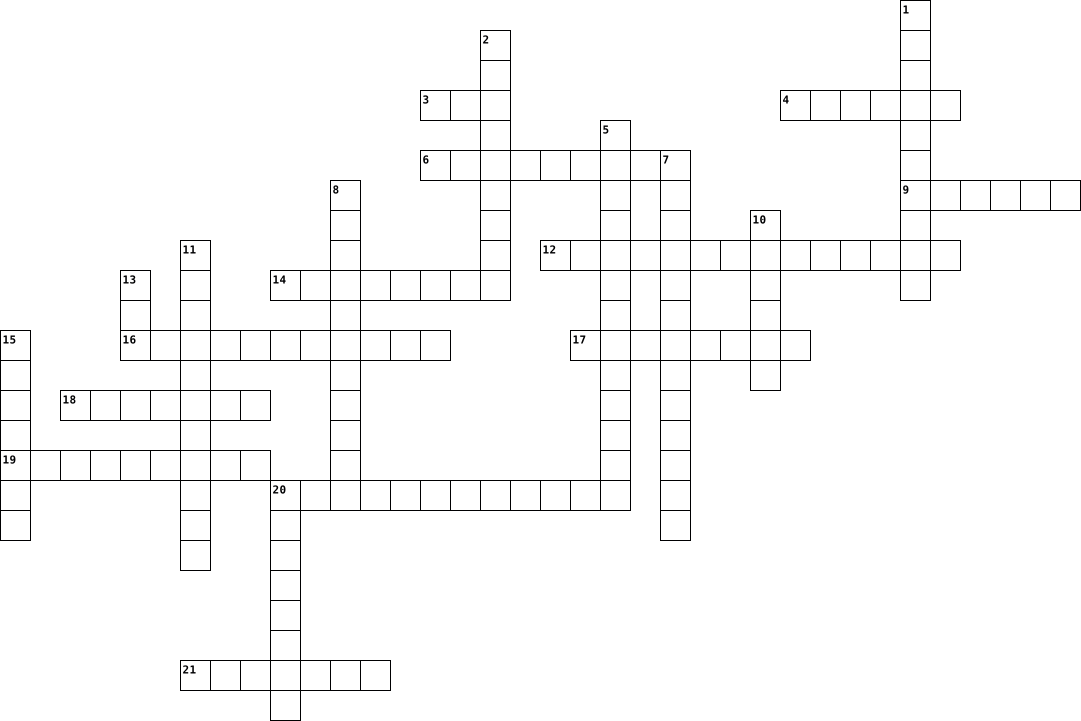
Across
- genetic material stored in the nucleus of eukaryotic cells
- type of cell that has a nucleus, but NO cell wall
- jelly like fluid that fills the cells interior
- molecule required to break down glucose during cellular respiration
- process used to by autotrophs to produce glucose
- substances that are the result of a chemical reaction
- small simple cell with NO nucleus
- organelle where proteins synthesis (making)takes place
- large organelle in plant cells for water storage
- small structures inside cells with unique functions
- selectively permeable outer layer of animal cell
- cell organelle that holds and protects DNA
Down
- complex type of cell that has membrane bound organelles
- substances that go into a chemical reaction
- gas absorbed by plants needed for photosynthesis
- organelle where cellular respiration takes place
- green pigment found inside chloroplast needed for photosynthesis
- type of protein that can speed up a chemical reaction
- plant cell organelle where photosynthesis takes place
- molecule released for energy when glucose is broken down
- simple carbohydrate produced in plants - source of energy
- rigid outer structure made of cellulose in plant cells
22 Clues: small simple cell with NO nucleus • cell organelle that holds and protects DNA • substances that go into a chemical reaction • jelly like fluid that fills the cells interior • gas absorbed by plants needed for photosynthesis • organelle where cellular respiration takes place • process used to by autotrophs to produce glucose • ...
Unit 2 Vocab Review 2025-01-06

Across
- the energy of motion
- the monomer of carbohydrates that is used in cellular respiration
- the organelle in cells where cellular respiration happens
- the process through which food is broken down by breaking chemical bonds using enzymes and acids
- when energy changes form (e.g. chemical to thermal)
- a monomer of fats; there are 3 in one triglyceride molecule
- a substance that is made during a chemical reaction
- the energy associated with temperature
- the monomer of proteins
- the energy stored in chemical bonds
Down
- the process cells use to generate energy from glucose
- the carbohydrate that is hard to digest and goes to waste
- a substance that goes through a chemical reaction
- the process through which food is broken down physically (e.g. chewing)
- anything with mass and takes up space
- a monomer of fats
- a large organic molecule such as a protein, carbohydrate or fat
17 Clues: a monomer of fats • the energy of motion • the monomer of proteins • the energy stored in chemical bonds • anything with mass and takes up space • the energy associated with temperature • a substance that goes through a chemical reaction • when energy changes form (e.g. chemical to thermal) • a substance that is made during a chemical reaction • ...
Chemical Equations And Reactions MA - Rudra Jasnani 2024-04-30

Across
- The substances that undergo chemical change in the reaction and are written on the left side of the equation
- This product is shown by an upward arrow
- AgCl turns into this colour when in contact with sunlight
- Corrosion of silver is also known as
- The kind of decomposition reaction when decomposition takes place in presence of electricity
- SO2 and SO3 are ____ in state
- The process of oxidising of fats and oils which leds to change in their smell and taste
Down
- Heat is absorbed in this reaction
- Common Name for CaCO3
- The Colour of copper oxide
- The Gas that is formed at the Anode when electrolysis
- In this reaction two or more reactants combine to form one product
- The Pop test is used to test presence of this gas
- The Reaction where Heat is PRODUCED
- The substances that are at the end of a chemical reaction and are on the right side of a reaction
- The number of electrons that an element has to lose or gain in order to achieve the configuration of the nearest noble gas
16 Clues: Common Name for CaCO3 • The Colour of copper oxide • SO2 and SO3 are ____ in state • Heat is absorbed in this reaction • The Reaction where Heat is PRODUCED • Corrosion of silver is also known as • This product is shown by an upward arrow • The Pop test is used to test presence of this gas • The Gas that is formed at the Anode when electrolysis • ...
vocab 2015-11-03

Across
- a type of reaction in which multiple reactants combine to form a single product
- a chemical property referring to the ability for a given substance, the solute, to dissolve in a solvent
- states that matter cannot be destroyed or created
- the state in which both reactants and products are present in concentrations which have no further tendency to change with time
- a chemical reaction that occurs when a compound and an oxidant react to produce a new product and heat
- equations that show only the soluble, strong electrolytes reacting and omit the spectator ions, which go through the reaction unchanged
Down
- a type of oxidation-reduction chemical reaction when an element moves out of one compound and into another
- a type of reaction that occurs when the cations and anions switch between two reactants to form new products
- a type of chemical reaction in which a single compound breaks down into two or more elements or new compounds
- equilibrium constant that applies to the dissolution of a slightly solule compound
- a solution in which the solvent is water
- all chemical reactions in which atoms have their oxidation state changed
12 Clues: a solution in which the solvent is water • states that matter cannot be destroyed or created • all chemical reactions in which atoms have their oxidation state changed • a type of reaction in which multiple reactants combine to form a single product • equilibrium constant that applies to the dissolution of a slightly solule compound • ...
chemical reactions 2020-12-17

Across
- of conservation mass - the mass of any one element at the beginning of a reaction will equal the mass of that element at the end of the reaction.
- - is a reaction in which a compound breaks down into two or more simpler substances
- - are used in all chemical equations to show the relative amounts of each substance present
- replacement - a chemical reaction in which one element is substituted for another element in a compound, generating a new element and a new compound as products.
- bond - the interatomic linkage that results from the sharing of an electron pair between two atoms.
Down
- - is the process by which one or more chemical reactions are performed with the aim of converting a reactant
- - tell you the number of. atoms of that element
- of a mole - equal to 6.02214179×10²³ atoms, or other elementary units such as molecules.
- - the species formed from chemical reactions.
- replacement - reaction occurs when parts of two ionic compounds are exchanged, making two new compounds
- bond - formed from the electrostatic attraction between oppositely charged ions in a chemical compound.
- - a substance that takes part in and undergoes change during a reaction.
12 Clues: - the species formed from chemical reactions. • - tell you the number of. atoms of that element • - a substance that takes part in and undergoes change during a reaction. • - is a reaction in which a compound breaks down into two or more simpler substances • of a mole - equal to 6.02214179×10²³ atoms, or other elementary units such as molecules. • ...
Chemical Reactions 2022-11-11

Across
- a substance that takes part in and undergoes a change during a chemical reaction
- method or means of changing one or more chemicals or chemical compounds
- the smallest particle of an element; made of protons, neutrons, and electrons
- physical and chemical characteristics of matter used to describe or identify a substance
Down
- the process by which one or more substances change to produce one or more different substances
- a solid that does not dissolve that is formed from a chemical reaction
- materials made from one or more natural substances that undergo a chemical process
- the simplest unit of a chemical compound that can exist
- a new substance formed when two or more elements are chemically bonded during a chemical reaction
- a substances made during a chemical reaction
10 Clues: a substances made during a chemical reaction • the simplest unit of a chemical compound that can exist • a solid that does not dissolve that is formed from a chemical reaction • method or means of changing one or more chemicals or chemical compounds • the smallest particle of an element; made of protons, neutrons, and electrons • ...
Photosynthesis Review 2020-12-07

Across
- Another name for the Calvin Cycle
- Where light dependent reaction takes place
- Blue, violet, red, orange light is _______ by the chloroplast.
- Scientist that discovered CO2 is needed for glucose
- Cell with a nucleus and membrane bound organelles
- The light independent reaction can take place in the light (true/false).
- Molecule that sunlight breaks (blows) up into parts
- Electron/Hydrogen ion energy for light independent reaction
- Chemical formula for glucose
- Cell without a nucleus and membrane bound organelles
- Gas that goes into photosynthesis
- Scientist that discovered plants produce oxygen
- Where light independent reaction takes place
- Can affect the rate of photosynthesis
- Gas that is produced as waste during photosynthesis
- Which ATP phosphate group is removed to release energy to the cell?
- Stack of thylakoids
- Uncharged chemical energy molecule
- Uncharged electron/H energy carrier
- Type of eukaryotic cell that does photosynthesis
Down
- Where ATP stores its energy
- Scientist that discovered plants need water
- Macromolecule group of ATP
- Charged chemical energy molecule
- The light dependent reaction can take place in the dark(true/false).
- Monomer of ATP
- Best light color for photosynthesis (virtual lab)
- Color of pigment in chloroplasts
- Pigments are what type of macromolecule?
- Organisms that can make their own food.
- Organisms that cannot make their own food.
- Leaves appear green because green light is ________.
- Name of organelle that does photosynthesis
- Scientist that discovered plants need light
- How many membranes does a chloroplast have?
- Sugar in ATP
- Name of pigment in chloroplasts
- Energy source for the light dependent reaction
- Number of CO2 molecules needed to make one glucose
39 Clues: Sugar in ATP • Monomer of ATP • Stack of thylakoids • Macromolecule group of ATP • Where ATP stores its energy • Chemical formula for glucose • Name of pigment in chloroplasts • Charged chemical energy molecule • Color of pigment in chloroplasts • Another name for the Calvin Cycle • Gas that goes into photosynthesis • Uncharged chemical energy molecule • ...
Chapter 7.1 2024-10-17

Across
- A characteristic of a substance that doesn't change.
- What our design cannot or should not do. The Limits.
- Feels Warm. Energy Exits the reaction system. Energy flows from the reaction system to the surroundings.
- The original substances you start with before the chemical reaction occurs.
- A homogeneous mixture composed of two or more substances
- Best or ideal
- Feels Cold. Energy enters the reaction system. Energy flows from the surroundings into the reaction system.
- When individual water molecules on the surface of a liquid gain enough motion energy to leave the liquid and become a gas.
- When water vapor becomes liquid.
- The new substance that is produced from a chemical reaction.
- When a liquid dissolves in a liquid, the solid breaks apart into particles too small to see and it mixes completely in the liquid.
- A group of two or more atoms that form the smallest identifiable unit into which a pure substance can be divided.
Down
- When something has the ability to dissolve.
- Consequences. The many possible changes that happen as a result of making a planned change.
- What a design needs to meet to be considered successful.
- Made of one type of material throughout.
- A systematic series of investigations planned to answer specific questions.
- When one decision directly affects another decision, and you can’t do both things.
- Substance made up of different elements joined together by a chemical bond
- What holds atoms together in molecule
- A physical model built to try out and test.
- The work we do to make our solution the best or ideal.
- Entities like people, groups or things that are impacted by design decisions.
- A blend of two or more substances.
24 Clues: Best or ideal • When water vapor becomes liquid. • A blend of two or more substances. • What holds atoms together in molecule • Made of one type of material throughout. • When something has the ability to dissolve. • A physical model built to try out and test. • A characteristic of a substance that doesn't change. • What our design cannot or should not do. The Limits. • ...
Caleb Bagi/ Chapter 13 Crossword 2016-10-11

Across
- description of a chemical reaction in which there is a net release of energy
- the new materials formed in a chemical reaction
- the minimum energy required in order for a chemical reaction to proceed
- any substance that increases the rate of a chemical reaction without itself being consumed by the reaction
- a rapid exothermic oxidation-reduction reaction between a material and molecular oxygen
Down
- description of a chemical reaction in which there is a net absorption of energy
- a representation of a chemical in which reactants are written to the left of a arrow that points toward the products on the right
- the reacting substances in a chemical reaction
8 Clues: the reacting substances in a chemical reaction • the new materials formed in a chemical reaction • the minimum energy required in order for a chemical reaction to proceed • description of a chemical reaction in which there is a net release of energy • description of a chemical reaction in which there is a net absorption of energy • ...
Reactions 2024-06-18

Across
- The law of _____________ of mass
- A ________ change is when there are no new products made. For example; boiling water
- The smallest part of an element
- What is mass measured in?
- A ________ reaction is when there are new substance made. For example; combustion
- The _____ of reactants must equal the _____ of products
- Breaking down 1 reactant into 2 products
Down
- Substances that go into a chemical reaction
- More that 1 type of atom together but NOT chemically bonded
- Substances that are made in a chemical reaction
- Reacting a fuel with oxygen
- More than 1 type of atom chemically bonded together
- Carbon _______ is formed during thermal decomposition
- A substance made of only 1 type of atom
14 Clues: What is mass measured in? • Reacting a fuel with oxygen • The smallest part of an element • The law of _____________ of mass • A substance made of only 1 type of atom • Breaking down 1 reactant into 2 products • Substances that go into a chemical reaction • Substances that are made in a chemical reaction • More than 1 type of atom chemically bonded together • ...
Chemical Kinetics 13.1-13.3 2019-05-01

Across
- a substance that increases the rate of a chemical reaction without itself undergoing any permanent chemical change
- involves a change in some quantity over a period of time
- this theory states that the greater the frequency and the greater the energy of collision between reactant particles, the greater the rate of reaction
- On the basis of collision theory, the reaction rate for most reactions depend on the positioning of the molecules or their _____, when they collide
- a reaction in which the products are lower in energy than the reactants has a negative delta(H) is known as _____ reaction
- when molecules are thought to form a short-lived, high energy, unstable arrangement of atoms there are called _____ or transition state
- the minimum energy required for a molecule to react
Down
- one important factor that affects the rate of chemical reactions is ____
- the study of rates of reactions and the pathway taken during the reaction
- a reaction which products are higher in energy than the reactants has a positive delat(H) is an ______ reaction
- the abbreviation for kinetic energy
- the change in molar concentration divided by the time period for change
- as temperature increases the kinetic energy ______
- the temperature of a substance is proportional to the _____ kinetic energy
14 Clues: the abbreviation for kinetic energy • as temperature increases the kinetic energy ______ • the minimum energy required for a molecule to react • involves a change in some quantity over a period of time • the change in molar concentration divided by the time period for change • one important factor that affects the rate of chemical reactions is ____ • ...
Chapter 13 Crossword-Konner Sanford 2021-12-02

Across
- The breaking down of an atom in a chemical reation.
- Increasing the consentration _______ the rate of change.
- when reaction and it’s reverse act at
- a substance that lowers the
- Is zero acidic, basic, or neutral on the PH scale?
Down
- How fast the concentration of reactants decreases and the concentration product increases.
- The combining of atoms in a chemical reaction.
- same rate.
- energy of a chemical reaction, which
- Is soap acidic, basic, or neutral on the PH scale?
- for the reaction to proceed at a faster
11 Clues: same rate. • a substance that lowers the • energy of a chemical reaction, which • when reaction and it’s reverse act at • for the reaction to proceed at a faster • The combining of atoms in a chemical reaction. • Is soap acidic, basic, or neutral on the PH scale? • Is zero acidic, basic, or neutral on the PH scale? • The breaking down of an atom in a chemical reation. • ...
Chemistry crossword 2018-12-01

Across
- mass number-atomic mass
- H2O
- mixtures
- workplace hazardous materials information system
- a table of chemical elements
- air combine with metal
- oxygen combines with a substance
- reaction
- burning
- physical substance
Down
- organic catalysts
- groups
- releases heat energy
- mass
- absorbs heat
- charged atom
- period
- fire
- shinny
19 Clues: H2O • mass • fire • groups • period • shinny • burning • mixtures • reaction • absorbs heat • charged atom • organic catalysts • physical substance • releases heat energy • air combine with metal • mass number-atomic mass • a table of chemical elements • oxygen combines with a substance • workplace hazardous materials information system
chemistry 2025-04-24

Across
- attraction of molecules
- smallest part of a substance
- change does not change composition
- branch of science
- takes up space, weight
- atoms bonded together
- moves heat, work
- come together to make new chemical
- measure matter
- change change composition
Down
- property no chemical change
- sped up, no chemical change
- force that holds atoms together
- releases heat
- substance mixed
- amount of space
- absorbs heat
- one atom, contains protons
18 Clues: absorbs heat • releases heat • measure matter • substance mixed • amount of space • moves heat, work • branch of science • atoms bonded together • takes up space, weight • attraction of molecules • change change composition • one atom, contains protons • property no chemical change • sped up, no chemical change • smallest part of a substance • force that holds atoms together • ...
C3.2 Energetics 2021-05-18

Across
- the amount of energy that must be transferred to break a mole of a particular covalent bond
- a reaction between an acid and a base or alkali, producing a salt plus water
- a chart that shows the energy of the reactants and products in a chemical reaction
- the minimum amount of energy needed for a reaction to start
Down
- reaction in which a substance burns in oxygen
- in a chemical reaction, anything that is not a reacting particle
- the difference between the energy transferred from the surroundings to break bonds in the reactants, and the energy transferred from products when bonds form
- describes a process in which there is an overall transfer of energy from the surroundings
- describes a process in which there is an overall transfer of energy to the surroundings
- the substance(s) formed in a chemical reaction
- a substance that takes part in a chemical reactions
11 Clues: reaction in which a substance burns in oxygen • the substance(s) formed in a chemical reaction • a substance that takes part in a chemical reactions • the minimum amount of energy needed for a reaction to start • in a chemical reaction, anything that is not a reacting particle • a reaction between an acid and a base or alkali, producing a salt plus water • ...
Firefighters and chemical reactions 2023-06-19

Across
- What can be used to put out a fire?
- dioxide What gas is released when something burns?
- What is fire an example of?
- A change of state from a liquid to a gas
- A change of state from a solid to a liquid
- The amount of energy required to start a chemical reaction
Down
- A chemical reaction which absorbs more energy than it releases
- What is the device that makes a loud sound to warn about a fire called?
- What is the opposite of "flammable"?
- What tool do firefighters use to break through doors and walls?
- What gas is required for fire?
- What is the chemical symbol for water?
- A chemical reaction which releases more energy than it absorbs
13 Clues: What is fire an example of? • What gas is required for fire? • What can be used to put out a fire? • What is the opposite of "flammable"? • What is the chemical symbol for water? • A change of state from a liquid to a gas • A change of state from a solid to a liquid • dioxide What gas is released when something burns? • ...
Biology 9 Chapter 6 2024-12-28

Across
- A type of stored energy
- The 5-carbon sugar found in ATP
- A molecule that has lost a phosphate group
- A nitrogen-containing compound found in ATP, RNA and DNA
- A unit used to measure the amount of energy food contains
- The type of energy needed to start a chemical reaction
- A chemical that helps in a chemical reaction, but is not consumed or changed in the reaction
Down
- The collection of the chemical reactions that occur in the cell
- A condition of being greatly overweight
- Cellular respiration occurs in this organelle of the cell
- The energy of motion
- A reactant molecule, the molecule on which an enzyme reacts
- A genetic condition where a person has too much sugar in their blood
13 Clues: The energy of motion • A type of stored energy • The 5-carbon sugar found in ATP • A condition of being greatly overweight • A molecule that has lost a phosphate group • The type of energy needed to start a chemical reaction • A nitrogen-containing compound found in ATP, RNA and DNA • Cellular respiration occurs in this organelle of the cell • ...
Science Key terms 2017-01-23

Across
- To act because of something that happened
- A process that changes the properties of an element
- the smallest unit of an element that has the properties of that element
- A process which nitrogen in the atmosphere enters the soil and becomes part of living organisms that eventually returns to the atmosphere
- The path or orbit electrons follow around the nucleus of an atom
- A chemical reaction that absorbs heat energy
Down
- A material with a particular chemical makeup
- The physical matter of which living or nonliving things are composed
- A change in matter that does not affect it's chemical composition
- One of six elemental gasses that does not naturally react with other elements
- The ability to do work or cause change; can be changed into different forms and can move between objects
- Interaction between molecules that causes a chemical change, converting an existing substance into a new substance
- chemical reaction that gives off heat
13 Clues: chemical reaction that gives off heat • To act because of something that happened • A material with a particular chemical makeup • A chemical reaction that absorbs heat energy • A process that changes the properties of an element • The path or orbit electrons follow around the nucleus of an atom • A change in matter that does not affect it's chemical composition • ...
Life's Processes Vocabulary Work-Haridev Ezhilan-Period 2-Teacher Homan 2025-03-06

Across
- the ability to do something.
- Change change that happens without changing it's chemical compositition.
- substance(s) produced by a chemical reaction.
- Matter that cannot be destroyed or created, but only changed.
Down
- a unit that is used to measure the energy in food.
- Respiration A chemical reaction where organisms use oxygen and glucose to make ATP, carbon dioxide, and energy.
- A type of sugar which is what carbohydrates break into.
- substances(s) at the beginning of a chemical reaction.
- A chemical reaction that plants use by using energy from the sun and carbon dioxide and water, to make glucose and oxygen.
- A process is when substances go through a chemical change to change into a different substance.
10 Clues: the ability to do something. • substance(s) produced by a chemical reaction. • a unit that is used to measure the energy in food. • substances(s) at the beginning of a chemical reaction. • A type of sugar which is what carbohydrates break into. • Matter that cannot be destroyed or created, but only changed. • ...
Physical and Chemical Changes 2023-09-17

Across
- A state of matter in which the molecules are held tightly together
- Elements are written as a chemical ________.
- The release of condensed matter back to the ground: sleet, snow, hail or rain
- Anything that has mass and takes up space.
- The solid state of water
- A ________ is a substance that is made by combing two or more elements.
- The temperature at which a solid turns into a liquid is called the _______ point.
- Compounds are written as a chemical ________.
- Gasses do not have a definite ______.
- The name given to the state of matter in which the particles can move about freely.
- ________ is the state of matter in where molecules take the shape of the container.
Down
- A pure substance made of only one type of atom
- When a gas is formed during a chemical reaction ____ form.
- The temperature at which a liquid turns into a gas is called the _______ point.
- The invisible force that pulls matter towards the center of major planetary bodies
- Matter may exist is many _______ such as solid, liquid or gas.
- The amount of space that matter occupies is referred to as _________.
- A new solid that is formed by a chemical reaction.
- Created when iron chemically reacts to oxygen.
- A ________ reaction is an interaction of two or more molecules to create a chemical change.
- The amount of matter that a substance contains is called ________.
- The _________ point is the temperature at which a liquid becomes a solid
- Features that include the color, mass, volume, density, etc. are called _______ properties.
23 Clues: The solid state of water • Gasses do not have a definite ______. • Anything that has mass and takes up space. • Elements are written as a chemical ________. • Compounds are written as a chemical ________. • A pure substance made of only one type of atom • Created when iron chemically reacts to oxygen. • A new solid that is formed by a chemical reaction. • ...
Chemistry in Science 8 2023-02-24

Across
- a number that indicates the number of atoms in a compound formula
- negative particle in an atom
- building block of matter
- the fourth state of matter
- neutral particle in an atom
- the change of a gas directly to a solid
- the law of _____ of mass
- substance to the right of the arrow in a chemical equation
- mass per unit volume
- starting substance in a chemical reaction
- physical property that describes the ability of a substance to dissolve
- one indication of a chemical change
Down
- the amount of space something takes up
- the amount of matter in an object
- the change of a gas to a liquid
- description of a reaction using chemical formulas
- a change in which new substances form
- anything that has mass and takes up space
- a chemical equation that has the same number of atoms of each element on each side
- a physical property that does not depend on the amount of matter present
- a property of matter that you can observe without changing the identity of the matter
- the change of a solid to a liquid
- a number that changes the amount of a reactant or a product
23 Clues: mass per unit volume • building block of matter • the law of _____ of mass • the fourth state of matter • neutral particle in an atom • negative particle in an atom • the change of a gas to a liquid • the amount of matter in an object • the change of a solid to a liquid • one indication of a chemical change • a change in which new substances form • ...
Elements, Compounds, Mixtures, Molecules 2025-09-17

Across
- basic particle form which all elements are made
- substance a sample of matter, either a single element or a single compound that has definite chemical and physical properties
- A pure substance that cannot be broken down into any other substance by chemical or physical means
- molecule 2 or more atoms from the same element bonded together
- A number in front of a chemical formula in an equation that indicates how many molecules or atoms of each reactant and product are involved in a reaction
- equation a representation of a chemical reaction uses symbols to show the relationship between the reactants and the products
- mixture in which substances are evenly distributed (you cannot see the different parts)
Down
- number written below chemical symbol that tells how many atoms that element is in the molecule
- formula shows the elements in a compound and the set ratio of the atoms
- anything that has mass and takes up space (volume)
- mixture a mixture in which you can see the different parts
- A substance produced in a chemical reaction
- A chemical substance that is present at the start of a chemical reaction
- molecule 2 or more atoms from different elements bonded together in a set ratio
- 2 or more substances mixed together but NOT chemically bonded
15 Clues: A substance produced in a chemical reaction • basic particle form which all elements are made • anything that has mass and takes up space (volume) • mixture a mixture in which you can see the different parts • 2 or more substances mixed together but NOT chemically bonded • molecule 2 or more atoms from the same element bonded together • ...
Changes of Matter Review 2023-10-31

Across
- a reaction that absorbs heat is a ___ reaction
- the statue of liberty is rusting!!!! This is a chemical ____
- my hair is blue is a physical ___
- cracking an egg is a __ change
- milk souring is a ___ change
- a substance that speeds up a reaction
Down
- a reaction that releases heat is a _____ reaction
- a substance that slows down a reaction
- an exothermic reaction will suddenly feel __
- I added blue coloring to a beaker of water, this is a __ change
- a beaker being heated and forming vapor is __ change
- an endothermic reaction will suddenly feel ___
12 Clues: milk souring is a ___ change • cracking an egg is a __ change • my hair is blue is a physical ___ • a substance that speeds up a reaction • a substance that slows down a reaction • an exothermic reaction will suddenly feel __ • a reaction that absorbs heat is a ___ reaction • an endothermic reaction will suddenly feel ___ • ...
SCIENCE CROSSWORD 2025-03-09

Across
- Law stating that mass is neither created nor destroyed.
- Amount of energy needed to turn a solid into a liquid.
- A process where gas immediately turns into solid, skipping the liquid phase.
- Ability of a substance to catch fire and burn in the presence of oxygen.
- A process where liquid phases into solid
- Reaction that releases energy.
- State of matter where molecules can move freely as they are very far away from each other.
- A process where solid phases into liquid
- A process where gas phases into liquid.
- State of matter where molecules are still close together but need help developing their shape.
- Substance that speeds up a chemical reaction.
- The temperature where liquid turns into solid.
- Connections between atoms in molecules that keep it together.
- The temperature where liquid turns into vapor.
Down
- High-energy state of matter made of ions and free electrons.
- How much a liquid resist flow.
- Solid that forms from a solution during a chemical reaction.
- A process where liquid phases into gas.
- A reaction where it completely changes the material of said product.
- Amount of energy needed to turn a liquid to gas.
- Ability of a substance to dissolve in a solvent.
- Substances that will undergo change.
- State of matter where molecules are packed tightly.
- Reaction that absorbs energy.
- A process where solid immediately phases into gas, skipping the liquid phase.
- A property degree of consistency measured by the mass quantity per unit volume.
- Change from one state of matter.
- The new substance that was made from a reaction.
- Process where a substance loses electrons.
- Chemical process where a substance gains electrons.
30 Clues: Reaction that absorbs energy. • How much a liquid resist flow. • Reaction that releases energy. • Change from one state of matter. • Substances that will undergo change. • A process where liquid phases into gas. • A process where gas phases into liquid. • A process where liquid phases into solid • A process where solid phases into liquid • ...
GRADE 10 CHEMISTRY CROSSWORD 2024-10-20

Across
- A bond formed when atoms share electrons (Hint: Non-metals are involved)
- A reaction where two or more simple substances combine to form a more complex one (Hint: A + B → AB)
- A reaction where a compound reacts with oxygen, producing heat and light (Hint: CH₄ + O₂ → CO₂ + H₂O)
- A process that results in a change in appearance but not chemical identity
- A bond formed by the transfer of electrons from a metal to a non-metal
- The prefix used for naming a molecule with four atoms of the same element
- The scale used to measure the acidity or basicity of a solution
- The chemical formula for a compound with one carbon and four chlorine atoms
- A reaction where parts of two ionic compounds switch places (Hint: AB + CD → AD + CB)
- A substance that changes color in response to pH, like litmus paper
- A subatomic particle found in the valence shell and key in bonding
- The subatomic particle found in the nucleus that carries no charge
- This law states that mass is conserved before and after a chemical reaction
Down
- This molecule consists of two oxygen atoms and is essential for combustion and respiration
- A reaction where a more reactive element displaces a less reactive one (Hint: A + BC → AC + B)
- A reaction where a single compound breaks down into simpler products (Hint: AB → A + B)
- The atomic number of an element corresponds to the number of these subatomic particles
- A substance with a pH less than 7, such as vinegar
- A formula that is not yet fully balanced
- A common gas produced in combustion reactions that we exhale
20 Clues: A formula that is not yet fully balanced • A substance with a pH less than 7, such as vinegar • A common gas produced in combustion reactions that we exhale • The scale used to measure the acidity or basicity of a solution • A subatomic particle found in the valence shell and key in bonding • The subatomic particle found in the nucleus that carries no charge • ...
Chapter 2.3 - 2.5 Review 2022-10-14

Across
- the monomer of a nucleic acid
- this is how many covalent bonds carbon can form with other atoms
- carbohydrates are made of carbon, hydrogen, and ?
- this element is the building block of life
- energy needed to be absorbed to start a chemical reaction
- this lipid has a ring structure
- the arrow in a chemical reaction shows the ____ of the reaction
- the enzyme present in your saliva
- this is the amount of energy it takes to break a bond between two atoms
- the smallest subunit in a polymer
- this is the specific reactant that an enzyme acts on
- examples are DNA & RNA
- every enzyme's function depends on its ___
- this polymer is made up of simple sugars
- these are on the left side of a chemical equation
- attracted to water
- another name for R group
- the monomer of lipids is fatty acids and ___
Down
- activation energy can come from an increase in
- every nucleotide includes a P group, a nitrogen base, and a ____
- because the tails of a phospholipid do not have charged regions, they are ___
- if a fatty acid has all single bonds, it is considered ____
- a single fat molecule
- in this reaction, more energy is released than absorbed
- in an endothermic reaction, which side of the equation has a higher bond energy?
- many simple sugars bonded together
- this is another name for simple sugar
- this is a catalyst for chemical reactions in living things
- this is the monomer of proteins
- this is the substrate that amylase acts on
- if a reaction can go in both directions at the same time, it is ___
31 Clues: attracted to water • a single fat molecule • examples are DNA & RNA • another name for R group • the monomer of a nucleic acid • this lipid has a ring structure • this is the monomer of proteins • the enzyme present in your saliva • the smallest subunit in a polymer • many simple sugars bonded together • this is another name for simple sugar • ...
Chapter 19 & 20 2022-05-04

Across
- A species that undergoes a decrease in oxidation state.
- A substance that has the potential to cause another substance to be reduced.
- Processes in which the oxidation state of an element decreases are reduction processes.
- A process in which a substance acts as both an oxidizing agent and a reducing agent.
- A single electrode immersed in a solution of its ions
- Use spontaneous oxidation-reduction reactions to convert chemical energy into electrical energy. Voltaic cells are also called galvanic cells.
- A conductor used to establish electrical contact with a nonmetallic part of a circuit, such as an electrolyte.
- The electrode where reduction occurs.
- Processes in which the atoms or ions of an element experience an increase in oxidation state.
- The process of passing a current through a cell for which the cell potential is negative and causing an oxidation-reduction reaction to occur.
- The part of the reaction involving oxidation or reduction alone.
- This tendency for the half-reaction of either copper or zinc to occur
- The electrode where oxidation occurs.
Down
- The branch of chemistry that deals with electricity-related applications of oxidation-reduction reactions.
- The potential of a half-cell under standard conditions measured relative to the standard hydrogen electrode.
- If electrical energy is required to produce a redox reaction and bring about a chemical change in an electrochemical cell.
- The difference in potential between an electrode and its solution.
- Any chemical process in which elements undergo changes in oxidation number.
- a reduction half-reaction in an electrochemical cell.
- A substance that has the potential to cause another substance to be oxidized.
- A species whose oxidation number increases.
- An electrolytic process in which a metal ion is reduced and solid metal is deposited on a surface.
22 Clues: The electrode where reduction occurs. • The electrode where oxidation occurs. • A species whose oxidation number increases. • A single electrode immersed in a solution of its ions • a reduction half-reaction in an electrochemical cell. • A species that undergoes a decrease in oxidation state. • The part of the reaction involving oxidation or reduction alone. • ...
Chapter 1: Molecules in Cells (Part 3) 2013-07-09

Across
- a substance that increases the rate of a chemical reaction without itself being changed
- a molecule that binds to the enzyme at the active site
- a protein that reacts as a biological catalyst
- site the location on an enzyme where a chemical reaction takes place
- substance which can stop enzymes from functioning
- enzyme inhibitor used as a chemical weapon
Down
- enzyme from pancreas which digests fat
- energy the energy required to start a chemical reaction
- enzyme responsible for digesting lactose
- the substance an enzyme acts upon
- enzyme found in the stomach responsible for digestion of protein
- a molecule that binds to the enzyme away from the active site
12 Clues: the substance an enzyme acts upon • enzyme from pancreas which digests fat • enzyme responsible for digesting lactose • enzyme inhibitor used as a chemical weapon • a protein that reacts as a biological catalyst • substance which can stop enzymes from functioning • a molecule that binds to the enzyme at the active site • ...
Chapter 5 Vocab 2024-10-18

Across
- the measure of how acidic or basic a solution is, commonly using a number from 0 (acidic) to 14 (basic)
- energy that is needed to get a reaction started
- the transformation of one molecule(s) into another molecule(s) inside a cell
- elements of compounds produced by a chemical reaction
- a substance that keeps pH in the optimum range for useful reactions to occur.
- elements or compounds that enter into a chemical reaction
Down
- substance that slows down or prevents a biochemical reaction by blocking a substrate from binding to an active site
- the part of an enzyme to which substrates bind
- protein catalyst that speeds up the rate specific biological reactions
- reactant of an enzyme-catalyzed reaction
- point at which all of the active sites on a type of enzyme are filled with substrate
- substrate that speeds up the rate of a chemical reaction
- the ratio of the amount of a substance to the volume of the medium in which it is dissolved
13 Clues: reactant of an enzyme-catalyzed reaction • the part of an enzyme to which substrates bind • energy that is needed to get a reaction started • elements of compounds produced by a chemical reaction • substrate that speeds up the rate of a chemical reaction • elements or compounds that enter into a chemical reaction • ...
Stoich 2022-01-24

Across
- two combine to make third
- actual yield
- contains reactants to balance equation
- 1mol=6.022x10^23
- used to determine relative mass
- contains excess and reactant
- chemical reaction symbolic rep of chem reaction
- transfer of electrons in reaction
- percent mass of element
- not completely in a reaction
- average atomic mass
- two change to make another compound
- number of 1 mol of compound
- insolable from two solutions
- release energy on reaction
- break up into two or more
- 6.022x10^23
Down
- one replaces another
- final part of chem reaction
- ratio elements in compound
- 1 mole of gas at room temp and pressure
- actual formula
- acid reacts with base to produce water and salt
- mass of 1 mol of compound
- substance from start
- max mass from reactants
- used for completion
- quantity consumed in reaction
- conversion factor
29 Clues: 6.022x10^23 • actual yield • actual formula • 1mol=6.022x10^23 • conversion factor • average atomic mass • used for completion • one replaces another • substance from start • percent mass of element • max mass from reactants • two combine to make third • mass of 1 mol of compound • break up into two or more • ratio elements in compound • release energy on reaction • final part of chem reaction • ...
Stoich 2022-01-24

Across
- two combine to make third
- actual yield
- contains reactants to balance equation
- 1mol=6.022x10^23
- used to determine relative mass
- contains excess and reactant
- chemical reaction symbolic rep of chem reaction
- transfer of electrons in reaction
- percent mass of element
- not completely in a reaction
- average atomic mass
- two change to make another compound
- number of 1 mol of compound
- insolable from two solutions
- release energy on reaction
- break up into two or more
- 6.022x10^23
Down
- one replaces another
- final part of chem reaction
- ratio elements in compound
- 1 mole of gas at room temp and pressure
- actual formula
- acid reacts with base to produce water and salt
- mass of 1 mol of compound
- substance from start
- max mass from reactants
- used for completion
- quantity consumed in reaction
- conversion factor
29 Clues: 6.022x10^23 • actual yield • actual formula • 1mol=6.022x10^23 • conversion factor • average atomic mass • used for completion • one replaces another • substance from start • percent mass of element • max mass from reactants • two combine to make third • mass of 1 mol of compound • break up into two or more • ratio elements in compound • release energy on reaction • final part of chem reaction • ...
Chemistry crossword 2015-11-13

Across
- positively charged particle in the nucleus of an atom
- vertical column of elements in the periodic table;elements in a family all have similar chemical properties;also called a group
- catalyst involved in chemical reactions in living things
- invisible negatively charged particle that orbits the nucleus of an atom
- group 17 elements in the periodic table;the most reactive non-metals
- element that has both metallic and non-metallic properties
- description of a substance that can be pounded or rolled into sheets
- horizontal row of elements in the periodic table
- chemical reaction that occurs when oxygen reacts with a substance to form a new substance and give off energy
- substance that reacts with another substance or substances in a chemical reaction to create new substances with different properties
- group of atoms joined by covalent bonds
- atom that has become electrically charged because it has lost or gained electrons;a positive ion is an atom that has lost one or more electrons;a negative ion is an atom that has gained one or more electrons
- positively charged centre of an atom;contains protons and neutrons
Down
- ability to do work
- neutral particle in a nucleus of an atom
- combination of pure substances;unlike a compound,the components of a mixture do not combine chemically and are not always in the same ratio
- amount of mass in a given volume of a substance
- variations within a species
- pure substance that cannot be broken down into other substances;substance made up of only one type of atom
- new substances produced in a chemical reaction between reactants
- the smallest part of an element that is representative of that element;a neutral particle made up of a nucleus containing protons and neutrons,and in which the number of electrons equals the number of protons
- substance that helps a chemical reaction to proceed more quickly
- shiny,malleable,ductile element that conducts electricity
- chemical combination of two or more elements in a specific ratio
- organic molecules made up of atoms of carbon,hydrogen and oxygen (ex,fats,oils and waxes);lipids are insoluble in water
25 Clues: ability to do work • variations within a species • group of atoms joined by covalent bonds • neutral particle in a nucleus of an atom • amount of mass in a given volume of a substance • horizontal row of elements in the periodic table • positively charged particle in the nucleus of an atom • catalyst involved in chemical reactions in living things • ...
Caleb Bagi/ Chapter 13 Crossword 2016-10-11

Across
- description of a chemical reaction in which there is a net release of energy
- the new materials formed in a chemical reaction
- the minimum energy required in order for a chemical reaction to proceed
- any substance that increases the rate of a chemical reaction without itself being consumed by the reaction
- a rapid exothermic oxidation-reduction reaction between a material and molecular oxygen
Down
- description of a chemical reaction in which there is a net absorption of energy
- a representation of a chemical in which reactants are written to the left of a arrow that points toward the products on the right
- the reacting substances in a chemical reaction
8 Clues: the reacting substances in a chemical reaction • the new materials formed in a chemical reaction • the minimum energy required in order for a chemical reaction to proceed • description of a chemical reaction in which there is a net release of energy • description of a chemical reaction in which there is a net absorption of energy • ...
Chem Revision 2026-02-02

Across
- use of chlorine to kill microorganisms
- clumping of fine particles into larger ones
- substance that dissolves another substance
- substance that neutralises acids
- safe to drink
- substance that speeds up a reaction
- substance that is dissolved
- substance that produces hydrogen ions in water
- mixture of solute and solvent
- removal of insoluble solids using a filter
- belonging to the same series
- settling of particles by gravity
- reaction forming salt and water
- reaction with oxygen producing energy
- –COOH group in acids
- containing only single carbon–carbon bonds
- compound with same molecular formula but different structure
Down
- compound containing a hydroxyl group
- group responsible for chemical properties
- unsaturated hydrocarbon with a double bond
- containing carbon–carbon double bonds
- saturated hydrocarbon
- chemical process that neutralises particle charges
- electron-seeking particle
- measure of acidity or alkalinity
- compound containing only carbon and hydrogen
- insoluble solid formed in solution
- reaction where one atom is replaced
- unwanted substance present
- ability of a substance to dissolve
- reaction where atoms add across a double bond
- –OH group in alcohols
- soluble base
- substance that changes colour with pH
34 Clues: soluble base • safe to drink • –COOH group in acids • saturated hydrocarbon • –OH group in alcohols • electron-seeking particle • unwanted substance present • substance that is dissolved • belonging to the same series • mixture of solute and solvent • reaction forming salt and water • substance that neutralises acids • measure of acidity or alkalinity • settling of particles by gravity • ...