
chemical reaction Crossword Puzzles
U10 Vocab 2024-04-29

Across
- What is the state in a reversible chemical reaction when the forward and reverse reactions proceed at the same rate?
- What principle states that if a system at equilibrium is disturbed, it will shift its position to counteract the disturbance?
- What is the measure of how fast a chemical reaction occurs?
- What is the expression used to calculate the reaction quotient in a chemical reaction?
Down
- What is the mathematical expression used to describe the equilibrium constant in a chemical reaction?
- What is the arrangement of molecules in a chemical reaction that influences its rate?
- What theory states that chemical reactions occur when molecules collide with sufficient energy and proper orientation?
- What is the mathematical representation of the rate of a chemical reaction, often denoted as Answer: Rate Law
8 Clues: What is the measure of how fast a chemical reaction occurs? • What is the arrangement of molecules in a chemical reaction that influences its rate? • What is the expression used to calculate the reaction quotient in a chemical reaction? • What is the mathematical expression used to describe the equilibrium constant in a chemical reaction? • ...
U10 Vocab 2024-04-29

Across
- What is the state in a reversible chemical reaction when the forward and reverse reactions proceed at the same rate?
- What principle states that if a system at equilibrium is disturbed, it will shift its position to counteract the disturbance?
- What is the measure of how fast a chemical reaction occurs?
- What is the expression used to calculate the reaction quotient in a chemical reaction?
Down
- What is the mathematical expression used to describe the equilibrium constant in a chemical reaction?
- What is the arrangement of molecules in a chemical reaction that influences its rate?
- What theory states that chemical reactions occur when molecules collide with sufficient energy and proper orientation?
- What is the mathematical representation of the rate of a chemical reaction, often denoted as Answer: Rate Law
8 Clues: What is the measure of how fast a chemical reaction occurs? • What is the arrangement of molecules in a chemical reaction that influences its rate? • What is the expression used to calculate the reaction quotient in a chemical reaction? • What is the mathematical expression used to describe the equilibrium constant in a chemical reaction? • ...
Webster - Chemistry 2019-10-17

Across
- - a chemical substance present at the start of a process
- - Mixture that is the same all the way through
- - Formulated the periodic table
- - 2 substances added together to form a new substance
- - the tendency to float in water or other liquid
- - a change from one state (solid or liquid or gas) to another without a change in chemical composition
- - A property you can notice with your senses
- - process determined by substances' composition and structure
- - a process in which one substance permeates another
- - Basic unit of an element
- - a chemical substance formed as a result of a reaction
- - a particle with a negative electric charge
- - Substance that can't be broken down any further
Down
- - the property of an atom that causes it to have weight
- - consisting of elements not of the same kind or nature
- - Any property that becomes evident after a chemical reaction
- - a fourth state of matter distinct from solid, liquid or gas
- - Atoms bonded together
- - a particle that is electrically charged positive or negative
- - a homogeneous mixture of two or more substances
20 Clues: - Atoms bonded together • - Basic unit of an element • - Formulated the periodic table • - A property you can notice with your senses • - a particle with a negative electric charge • - Mixture that is the same all the way through • - the tendency to float in water or other liquid • - a homogeneous mixture of two or more substances • ...
Chemistry Crossword 2015-12-01

Across
- combination of pure substances
- contains neutrons,protons and electrons.
- change from liquid state to a gas
- cloudy mixture in which tiny particles of one substance are held within another and cannot be separated out of the other substance
- describes a particular substance
- substance that can be pounded or rolled into sheets
- mixture substances that make up the mixture are visible
- warning symbols on hazardous material
- slow chemical change that happens when oxygen reacts with the metal
- ability to do work
- amount of mass in a given volume of a substance
- has lost or gained electrons
Down
- anything that has mass and occupies space
- horizontal row of elements
- resists the flow of electricity
- chemical reaction that releases energy
- cloudy mixture
- element that has both non and metallic properties
- chemical reaction that absorbs energy
- substance made up of only one atom.
- device for producing electricity from chemical or solar energy
- negatively charged that orbits the nucleus.
- the most non-reactive elements
- vertical column of elements
- poisonous
25 Clues: poisonous • cloudy mixture • ability to do work • horizontal row of elements • vertical column of elements • has lost or gained electrons • combination of pure substances • the most non-reactive elements • resists the flow of electricity • describes a particular substance • change from liquid state to a gas • substance made up of only one atom. • chemical reaction that absorbs energy • ...
Chemistry 2024-12-19

Across
- pH level of neutral substance
- Chemical reaction that releases heat
- Type of bond formed by losing or gaining electrons
- where oxygen is added to a substance
- Chemical substance that speeds up reactions
- Type of ion formed when an atom gains electrons
- number of atoms or ions in one mole of a substance
- group of two or more atoms that are held together by attractive forces known as chemical bon
- any atom or group of atoms that bears one or more charge
- Reaction between an acid and a base
- Substance made of two or more elements chemically combined
Down
- process by which electric current is passed through a substance
- A process where gas turns into liquid
- A process where electrons are gained
- type of bonding in metals
- chemical formula showing the simplest ratio of the elements rather than the total number of atoms in the molecule
- Group elements in group 7
- pH level of a strong acid
- mixture where particles are evenly distributed
- Ion with positive charge
20 Clues: Ion with positive charge • type of bonding in metals • Group elements in group 7 • pH level of a strong acid • pH level of neutral substance • Reaction between an acid and a base • A process where electrons are gained • Chemical reaction that releases heat • where oxygen is added to a substance • A process where gas turns into liquid • ...
Cells - Key Words 2025-11-14

Across
- Packages the proteins so they are ready to ship
- Entire body is one cell
- ER that has no ribosomes
- An organism that produces its own food, using light or chemical energy
- Ribosome production station
- Fluid inside of a cell
- An organism that cannot produce its own food and must get nutrients from other organisms
- The way that all living things are grouped together
- An organism that gets its food from chemical compounds
- Protective wall of a cell
- Protective membrane of the nucleus
- Help with cell division
Down
- ER with ribosomes, described as a highway
- Multiple cells in one body
- The temporary connection between two cells to transfer DNA
- What is coming together or changing in a chemical reaction
- Cellular respiration occurs here
- Photosynthesis occurs here
- Cell that has no nucleus or membrane-bound organelles
- Cell that has a nucleus and membrane-bound organelles
- Protein synthesis station
- The result of a chemical reaction
- Security guard of a cell, maintains homeostasis
- Cleanup crew of a cell
- Control center of a cell
25 Clues: Fluid inside of a cell • Cleanup crew of a cell • Entire body is one cell • Help with cell division • ER that has no ribosomes • Control center of a cell • Protein synthesis station • Protective wall of a cell • Multiple cells in one body • Photosynthesis occurs here • Ribosome production station • Cellular respiration occurs here • The result of a chemical reaction • ...
science vocabulary 2023-12-07

Across
- The volume of a object compared to its mass
- When matter changes from one state to another
- Resistance to flow (to change a shape) liquid or gas
- A substance that is sour, and changes the color of indicators
- A reaction where energy is formed into light or heat
- A reaction where the reactants absorb the heart around them
- Something that dissolves in a solvent that makes a solution
- When two or more substance combine
- A chemical substance that cannot be broken down
- A substance that is not able to dissolve
Down
- The starting materials of a new chemical substance
- When a matter is not created or destroyed during any chemical change
- When a gas, liquid or solid forms into a solution
- A product is when a new chemical is formed
- When two different compositions come together to create a new chemical
- The measure of how quickly a item and catch fire and burn
- A substance that is able to dissolve
- A substance that is bitter and is slippery
18 Clues: When two or more substance combine • A substance that is able to dissolve • A substance that is not able to dissolve • A product is when a new chemical is formed • A substance that is bitter and is slippery • The volume of a object compared to its mass • When matter changes from one state to another • A chemical substance that cannot be broken down • ...
Vocabulary 2023-11-03

Across
- Reaction a process that changes substances into a new substances
- a dramatic change in form or appearance
- the process of changing or causing something to change from one form to another
- an organism that can be seen only with aid of microscope end that typically consists of only a single cell
- a multicellular organism that lives in water and produces its own food through photosynthesis
- a pure substance that cannot be broken down into simpler substances by chemical reactions
- substances that are consumed to create a chemical reaction
Down
- a single sugar that is an important energy source in living organisms and is a component of many carbohydrates
- the chemical process in plants that use water, sunlight, and carbon dioxide to produce oxygen and sugar
- the small unit of an element that has the properties of that element
- a substance that provides nourishment for growth and maintenance of life
- a microorganism living in water that consists of a single cell that produces its own food through photosynthesis
- two or more atoms joined together
- substances formed as a result of a chemical reaction
14 Clues: two or more atoms joined together • a dramatic change in form or appearance • substances formed as a result of a chemical reaction • substances that are consumed to create a chemical reaction • Reaction a process that changes substances into a new substances • the small unit of an element that has the properties of that element • ...
8.5 D & E Chemical Reactions and Law of Conservation of Mas 2023-01-09

Across
- law that states that matter is not created or destroyed; it only changes forms or is rearranged
- the number written to the right and slightly below an element to represent the number of atoms of an element present in the formula; no subscript equals 1 atom
- change- the formation of a new substance with new properties
- the arrangement, type, and ratio of atoms in chemical formulas
- substance(s) that result or are produced from a chemical reaction; the yield sign points to the products
- a substance made of two or more different elements
Down
- a change caused by two or more substances interacting (reactants) and resulting in the formation of a new substance(s) (products)
- not expected or unlikely to happen
- arrow in a chemical equation showing the direction of the reaction
- a combination of chemical symbols and numbers to represent a substance
- substances that are combined in a chemical reaction; the yield sign points away from the reactants
- the formation of a solid that results from the mixing of two solutions
- when physical quantity or amount of a substance during reactions does not change
- the production and discharge of something, especially gas or radiation
- equation- representation of a chemical reaction using symbols and numbers
15 Clues: not expected or unlikely to happen • a substance made of two or more different elements • change- the formation of a new substance with new properties • the arrangement, type, and ratio of atoms in chemical formulas • arrow in a chemical equation showing the direction of the reaction • a combination of chemical symbols and numbers to represent a substance • ...
Unit 5 Crossword Puzzle 2022-11-17

Across
- This is written on the right side of a chemical equation and is what you get as the result of a chemical reaction.
- When a hydrocarbon reacts with oxygen to create carbon dioxide and water. CxHy+ O2 → CO2 + H2O
- A combination of multiple elements that become chemically bonded to create a new substance.
- This is written on the left side of a chemical equation and is how a chemical reaction starts.
- Atoms that gain or lose electrons.
- What is written in front of a chemical formula that tells you how much of an element there is which helps you balance them.
- The reactant breaks down into simpler products. AB → A+B
- Two non-metals that are bonded and are sharing electrons.
Down
- When reacting its compounds flip-flop places. AB+CD → AD+CB
- One element in a compound switches places with another element. A+BC → B + AC
- Seven elements that always have two of them in a chemical reaction.
- A number written in a small font that indicates the number of atoms present in an element.
- Two or more elements combine to create one product. A+B → AB
- A metal and non-metal bonded creating positive and negative ions.
14 Clues: Atoms that gain or lose electrons. • The reactant breaks down into simpler products. AB → A+B • Two non-metals that are bonded and are sharing electrons. • When reacting its compounds flip-flop places. AB+CD → AD+CB • Two or more elements combine to create one product. A+B → AB • A metal and non-metal bonded creating positive and negative ions. • ...
Chemistry in Biology - Michael J. Karou 2025-01-15

Across
- branch of chemistry dedicated to the study of compounds containing carbon (organic compounds)
- mixture with a uniform composition throughout
- lipid that has at least one double bond between carbon atoms in the tail chain and can accommodate at least one more hydrogen atom
- molecule made from monomers that are linked together by a series of covalent bonds
- specific location where a substrate binds on an enzyme
- lipid that has a tail chain with only single bonds between the carbon atoms; no more hydrogen atoms can bond
- repeating units of identical or nearly identical compounds
- electrostatic attraction in water; weak interaction involving a hydrogen atom and a fluorine, oxygen, or nitrogen atom
- heterogenous mixture in which the particles do not settle out
- negatively charged particle
- another term for a homogenous mixture
- particle that contains no charge
- substance that lowers the activation energy needed to start a chemical reaction
- special lipid responsible for the structure and function of the cell membrane
- pure substance that cannot be chemically interconverted or broken down into simpler substances
- central core of an atom; consists of protons and neutrons
- compounds composed of carbon, hydrogen, and oxygen in a ratio of one oxygen and two hydrogen atoms for each carbon atom; primarily functions as energy sources (i.e. simple sugars)
- process by which atoms or groups of atoms in substances are reorganized into different substances
- positively charged particle
- substance that releases hydrogen ions when dissolved in water
- molecules made mostly of carbon and hydrogen that make up fats, oils, and waxes; composed of fatty acids, glycerol, etc.; primarily function to store energy
- heterogenous mixture in which the particles settle to the bottom over time
- compound in which the atoms are held together by covalent bonds
- substance in which another substance is dissolved in a solution
- mixture that can react with acids or bases to keep the pH within a particular range
- starting substances in a chemical reaction; on the left side of the arrow
- substances formed during a chemical reaction; on the right side of the arrow
- minimum amount of energy needed for reactants to form products in a chemical reaction
- organized table consisting of all 118 chemical elements and important data regarding each
- carbon-based substance that is the basis of living matter
- complex macromolecules that store and transmit genetic information
- principle that states that in a chemical reaction matter cannot be created or destroyed
Down
- small compounds that are made of carbon, nitrogen, oxygen, hydrogen, and sometimes sulfur; generally all share the same structure
- basic unit, building block of matter
- chemical reaction that releases heat; the energy of the products is lower than the energy of the reactants
- reactant that binds to the enzyme
- large molecule that is formed by joining smaller organic molecules together
- chemical bond that forms when electrons are shared
- category of lipids that include substances like cholesterol, hormones; contain four rings of carbon atoms
- pure substance formed when two or more elements combine
- mixture in which the components remain distinct and can be detected individually
- measure of concentration of hydrogen ions in a solution; utilized to determine how acidic or basic a solution is
- atom that has lost or gained one or more electrons and carries an electric charge
- combination of two or more substances in which each substance retains its individual characteristics and properties
- small repeating subunits that are composed of nitrogen, oxygen, phosphorus, and hydrogen atoms arranged in a specific way; there are six major kinds of these, all of which contain three units: a phosphate, a nitrogenous base, and a ribose sugar
- chemical reaction that absorbs heat; the energy of the products is higher than the energy of the reactants
- number written in front of a reactant or product in a chemical equation
- compound made of small carbon compounds called amino acids; complex and function most of the body
- chemical equations that displays the same number of atoms for each element on both the reactant and product side of the equation
- representation of a chemical reaction using symbols of the elements and chemical formulas to indicate what constitutes each reactant and product
- attractive forces between positively and negatively charged regions of neutral molecules that pull on the molecules and hold them together, attracting the molecules when they come close together
- molecules that have an unequal distribution of charges; have oppositely charged regions
- substance that is dissolved in the solvent in a solution
- special proteins; the biological catalysts that speed up the rate of chemical reactions in biological processes
- electrical attraction between two oppositely charged atoms or groups of atoms (ions)
- atoms of the same element that have different quantities of neutrons in their nuclei; usually contain radioactivity
- substance that releases hydroxide ions when dissolved in water
57 Clues: negatively charged particle • positively charged particle • particle that contains no charge • reactant that binds to the enzyme • basic unit, building block of matter • another term for a homogenous mixture • mixture with a uniform composition throughout • chemical bond that forms when electrons are shared • specific location where a substrate binds on an enzyme • ...
chemistry 2015-10-10

Across
- describes something that is composed of dissimilar components
- anything that takes up space and has mass
- a property of matter that describes a substances ability to participate in chemical reactions
- a combination of 2 or more substances that are not chemically combined
- the quantity of mater contained in that object
- a characteristic of a substance that does not involve a chemical change (ex density, color, hardness)
Down
- a substance that forms in a chemical reaction
- describes something that has uniform structure or composition throughout
- a substance or molecule that participates in a chemical reaction
- something that has magnitude, size or amount
- solid, liquid, gas
- any substance that has a definite composition
- a quantity adopted as a standard o measurement
- the ratio of the mass of a substance to the volume of the substance
- the process by which 1 or more substances change to produce 1 or more different substances
- a measure of the gravitational force exerted on an object
- a measure of the size of a body or region in 3-D space
- pure substances that aren't elements
18 Clues: solid, liquid, gas • pure substances that aren't elements • anything that takes up space and has mass • something that has magnitude, size or amount • a substance that forms in a chemical reaction • any substance that has a definite composition • a quantity adopted as a standard o measurement • the quantity of mater contained in that object • ...
Atoms, Compounds, & Chemical Changes 2025-11-13

Across
- A negatively charged particle that orbits the nucleus
- A substance that results from a chemical reaction
- A pure substance made of only one type of atom
- A number placed in front of a chemical formula to indicate quantity
- A change that does not form a new substance
- A property that describes a substance’s ability to undergo chemical changes
- A particle in the nucleus with a positive charge
- A particle in the nucleus with no charge
Down
- The number written below and to the right of a chemical symbol in a formula
- A particle made of two or more atoms bonded together
- A mixture in which the components are evenly distributed
- A mixture where substances are not evenly distributed
- A property that can be observed or measured without changing the substance
- A combination of two or more elements chemically bonded
- A change that results in a new substance being formed
- A substance that undergoes a chemical change in a reaction
- A combination of two or more elements not chemically bonded
- The smallest unit of matter that retains properties of an element
18 Clues: A particle in the nucleus with no charge • A change that does not form a new substance • A pure substance made of only one type of atom • A particle in the nucleus with a positive charge • A substance that results from a chemical reaction • A particle made of two or more atoms bonded together • A negatively charged particle that orbits the nucleus • ...
Chemical Kinetics 2023-07-30

Across
- rate of reaction determined at a specified concentration or specified time
- amount of substance per unit volume
- speed at which the reaction takes place
- refers to the number of molecules reacting in an elementary step
Down
- refers to whether a reaction can occur spontaneously or not
- a proportionality constant which quantifies the rate and direction of a chemical reaction
- rate of reaction is directly proportional to ______ to chemical reaction
- a substance that can initiate or accelerate a chemical reaction without itself being affected or consumed
- The pressure that is exerted by one among the mixture of gases if it occupies the same volume on its own is known as
- state in which both the reactants and products are present in concentrations which have no further tendency to change with time
10 Clues: amount of substance per unit volume • speed at which the reaction takes place • refers to whether a reaction can occur spontaneously or not • refers to the number of molecules reacting in an elementary step • rate of reaction is directly proportional to ______ to chemical reaction • rate of reaction determined at a specified concentration or specified time • ...
Vocab - Unit 6 2015-11-02

Across
- a solution in which the solvent is water. used in equations as (aq)
- this reaction is classified by the products being always oxygen, and sometimes water.
- this is a type of reaction in which multiple reactants combine to form a single product.
- this is a type of oxidation/reduction reaction when an element or an ion is replaced by another in a compound.
- this is a type of reaction in which a single compound breaks down into two or more elements or new compounds.
- when something is able to be soluble, or to dissolve.
Down
- a law stating that matter cannot be created nor destroyed however, it can be rearranged.
- this is a chemical reaction between two compounds where the positive ion of one compound is exchanged with the positive ion of a different compound.
- this is the product of a substance's ion concentrations raised to the power of their stoichiometric coefficients.
- these involve the transfer of electrons. Includes all reactions when atoms have their oxidation state changed.
- a chemical equation for a reaction which lists only those species participating in the reaction.
- in a chemical reaction this is when both reactants and products are balanced.
12 Clues: when something is able to be soluble, or to dissolve. • a solution in which the solvent is water. used in equations as (aq) • in a chemical reaction this is when both reactants and products are balanced. • this reaction is classified by the products being always oxygen, and sometimes water. • ...
Chem 4 Quiz 4 2022-11-09

Across
- Name of -S-S- bond
- Common name for methylbenzene
- Name for alkanes with alkyl substituents
- Term for hydrocarbons with max # of hydrogens
- line drawing of cyclobutane
- Name of group: C=O
- Name of this chemical: H2SO4
- Structure of acetone
- Structure of phenol
- Number of carbons in 3-bromo-2-methylbutane
- _____ have at least one C-C double bond
- Name of chemical: CH3-SH
- Line drawing of pentane
- Substituents on the opposite side of a double bond
- Name this substituent: CH3-
- Substituents on the same side of a double bond
Down
- Name of this chemical: HNO3
- Structure of benzene
- Name of (PO4)3- ion
- Product of a hydrogenation reaction
- Product of a hydration reaction
- Catalysts lower _____
- Functional group with -CHO ending of formula
- Greek prefix for the number four
- Name this chemical: CH4
- Name this substituent: CH3-CH2-CH2
- Name of saturated hydrocarbon with 8 carbons
- _____ have at least one C-C triple bond
- Classify the type of alcohol: 2-pentanol
29 Clues: Name of -S-S- bond • Name of group: C=O • Name of (PO4)3- ion • Structure of phenol • Structure of benzene • Structure of acetone • Catalysts lower _____ • Name this chemical: CH4 • Line drawing of pentane • Name of chemical: CH3-SH • Name of this chemical: HNO3 • line drawing of cyclobutane • Name this substituent: CH3- • Name of this chemical: H2SO4 • Common name for methylbenzene • ...
bio 2023-04-05

Across
- makes up all living organisms
- transport of molecules that uses energy, in the form of an energy-storing chemical called ATP to help them cross the cell membrane.
- water loving
- proteins that speed things up like metabolism and chemical reaction
- only allows some subtance and molecules to pass
- t means that the substance tends to move from an area of higher concentration to an area of lower concentration.
- A particle of matter that uniquely defines a chemical element
- a different type of diffusion that involves water
- a membrane that allows only some substances and molecules to pass into or leave the cell
Down
- water fearing
- breaking of a protein
- A small structure in a cell
- a group of atoms boned together
- where chemical reaction occurs
- something having many related parts
- molecules upon which an enzyme acts
- cell membranes
- A groups of cells that work together
- to stimulate a cell in a resting state to become active.
- A part of the body that performs a specific function
- complex molecules
21 Clues: water loving • water fearing • cell membranes • complex molecules • breaking of a protein • A small structure in a cell • makes up all living organisms • where chemical reaction occurs • a group of atoms boned together • something having many related parts • molecules upon which an enzyme acts • A groups of cells that work together • only allows some subtance and molecules to pass • ...
Biology unit 4 vocab 2020-10-28

Across
- sequence of reactions by which most living cells generate energy
- A simple sugar,important energy
- A process that plants and algae use to turn carbon dioxide from the air into sugar.
- an input of energy to initiate the reaction
- Proteins consisting of one or more polypeptide chains.
Down
- a substance taking part in a chemical reaction
- An important chemical compound in biochemistry
- Species formed by chemical reactions
- Process modifying the molecular structure of a protein
- Substance added to a reaction to increase the reaction rate without getting consumed.
10 Clues: A simple sugar,important energy • Species formed by chemical reactions • an input of energy to initiate the reaction • a substance taking part in a chemical reaction • An important chemical compound in biochemistry • Process modifying the molecular structure of a protein • Proteins consisting of one or more polypeptide chains. • ...
Chemical Reactions - Reactants to Products 2017-05-03

Across
- When a chemical reaction occurs, old bonds b______ and new bonds are made.
- During an endothermic reaction, energy is taken i___ from the surroundings.
- Every chemical reaction starts off with r_________ that make products.
- In a molecule of hydrogen (H2), there are two hydrogen atoms. There is a chemical b_______ holding the two atoms together.
Down
- Every chemical reaction ends up with p___________ that are made from the reactants.
- In every chemical reaction, e_________ is either taken in or given out to the surroundings.
- When we mix two chemicals together, we say a chemical r________ has occurred.
- The symbol for oxygen is O2. We say that oxygen has two a________ of oxygen.
8 Clues: Every chemical reaction starts off with r_________ that make products. • When a chemical reaction occurs, old bonds b______ and new bonds are made. • During an endothermic reaction, energy is taken i___ from the surroundings. • The symbol for oxygen is O2. We say that oxygen has two a________ of oxygen. • ...
Evy Shrader - chapter 13 crossword 2021-12-01

Across
- a chemical that donates a hydrogen atom
- when a reaction and its opposite act at the same time
- a substance that lowers the activation energy of a chemical reaction
- the word for OH-
- a reaction with a net release of energy
Down
- when there are more plus signs on the reactant side than the product side
- when there are more plus signs on the product side than the reactant side
- what is it called when reactants become oxidized?
- a reaction with a net absorption of energy
- a chemical that accepts hydrogen atom
10 Clues: the word for OH- • a chemical that accepts hydrogen atom • a chemical that donates a hydrogen atom • a reaction with a net release of energy • a reaction with a net absorption of energy • what is it called when reactants become oxidized? • when a reaction and its opposite act at the same time • a substance that lowers the activation energy of a chemical reaction • ...
Vocabulary 2021-03-02

Across
- A solid produced during a chemical reaction in a solution.
- Useful to determine results of a single-replacement reaction.
- A number in front of a chemical formula in an equation that indicates how many molecules of each reactant or product are involved in a reaction.
- AB->A+B
- A+B->AB
- Negative charged ion
Down
- Has products of either a precipitate, gas or water and occurs between two compounds.
- Positively charged ion
- A chemical reaction that occurs when a substance reacts with oxygen and releases energy as heat and light.
- AX+B-->A+BX
10 Clues: AB->A+B • A+B->AB • AX+B-->A+BX • Negative charged ion • Positively charged ion • A solid produced during a chemical reaction in a solution. • Useful to determine results of a single-replacement reaction. • Has products of either a precipitate, gas or water and occurs between two compounds. • ...
Yes! 2022-05-26

Across
- The chemical compound responsible for pineapple scent. [Page 7, two words]
- The planet with the fourth highest number of moons. [Page 5]
- Seventeen of Saturn’s new moons follow a ___ orbit. [Page 5]
- This Japanese animal uses hot springs to stay warm during cold weather. [Page 6, two words]
- The peak month of the flu season is ___. [Page 7]
- These are the staritng substances in all chemical reactions including the handwarmer chemical reaction. [Pages 26 and 27]
- “AI” is the acronym for ___. [Page 4, two words]
- The month immediately before the beginning of the flu season is ___. [Page 7]
- This word means a person is able to spread an illness or sickness to someone else. [Page 7]
- The gas involved in the handwarmer reaction. [Pages 26 and 27]
- The outside of the Treetop Tower has a ___ shape. [Pages 2 and 3, two words]
Down
- This kind of chemical reaction generates heat and is the reason we use handwarmers. [Pages 26 and 27]
- The chemical compound responsible for popcorn scent. [Page 7]
- The powder inside a handwarmer is made of this element. [Pages 26 and 27]
- Scientists were able to discover Saturn’s new moons using a telescope that detects ___ light. [Page 5]
- This word means a moon orbits its planet in the same direction that the planet spins/rotates. [Page 5]
- Scientists hypothesize that sitting in the hot springs results in fewer ___ in the monkey droppings. [Page 6, two words]
- The chemical compound responsible for sweat scent. [Page 7, two words]
- The number of stairs from the bottom to top of the Treetop Tower. [Pages 2 and 3]
19 Clues: “AI” is the acronym for ___. [Page 4, two words] • The peak month of the flu season is ___. [Page 7] • The planet with the fourth highest number of moons. [Page 5] • Seventeen of Saturn’s new moons follow a ___ orbit. [Page 5] • The chemical compound responsible for popcorn scent. [Page 7] • The gas involved in the handwarmer reaction. [Pages 26 and 27] • ...
Cylvia Persaud 2022-03-08

Across
- mass of one mole of a substance.
- a process that leads to the chemical transformation of one set of chemical substances to another.
- A measure of a chemical reaction's efficiency, as a ratio of moles of product to moles of reactant
- a formula giving the number of atoms of each element.
- an equation for a chemical reaction in which the number of atoms for each element in the reaction and the total charge is the same for both the reactants and the products.
Down
- a measure of the quantity of moles of a product formed in relation to the reactant consumed, obtained in a chemical reaction, usually expressed as a percentage
- a number used to change one set of units to another, by multiplying or dividing.
- a section of chemistry that involves using relationships between reactants and/or products in a chemical reaction to determine desired quantitative data.
- the simplest whole number ratio of atoms present in a compound.
- the ratio between the amounts in moles of any two compounds involved in a chemical reaction.
10 Clues: mass of one mole of a substance. • a formula giving the number of atoms of each element. • the simplest whole number ratio of atoms present in a compound. • a number used to change one set of units to another, by multiplying or dividing. • the ratio between the amounts in moles of any two compounds involved in a chemical reaction. • ...
Chemistry - yr 10 2024-06-10

Across
- A substance that absorbs protons.
- Metal and non - metal ions in a lattice
- inert gases
- A substance that contributes Hydrogen ions.
- An atom which has gained or lost electrons.
- Reactive gases normally form diatomic molecules.
- List of elements.
- Reactions that absorb heat
- X + Y -> XY
Down
- One type of double displacement reaction
- XY -> X + Y
- XY +Z -> XZ + Y
- Atoms which differ in the number of neutrons.
- All equations must be:
- A chemical reaction in which a substance burns in oxygen gas.
- Number of protons plus neutrons
- An insoluble solid.
- Chemical properties are due to
18 Clues: XY -> X + Y • inert gases • X + Y -> XY • XY +Z -> XZ + Y • List of elements. • An insoluble solid. • All equations must be: • Reactions that absorb heat • Chemical properties are due to • Number of protons plus neutrons • A substance that absorbs protons. • Metal and non - metal ions in a lattice • One type of double displacement reaction • A substance that contributes Hydrogen ions. • ...
Chemistry 2013-05-24
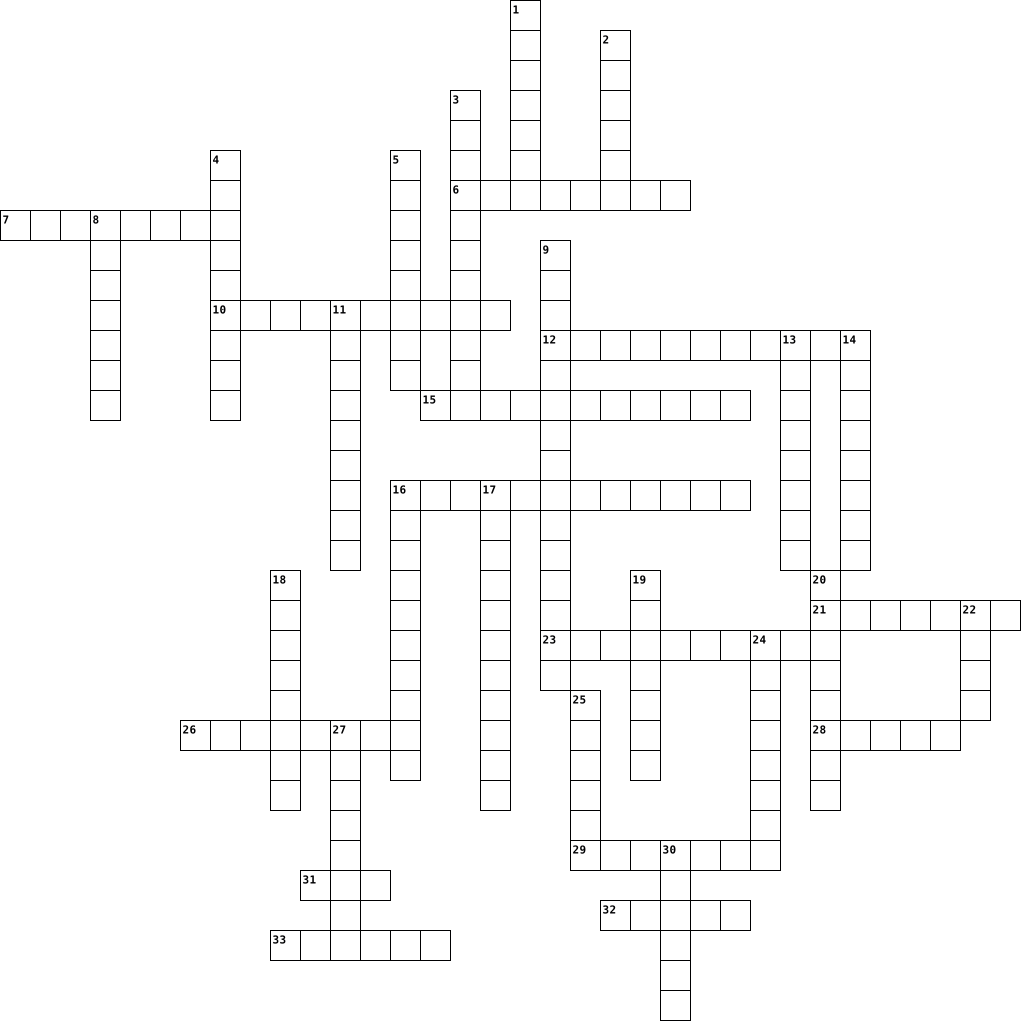
Across
- a substance that speeds up a chemical reaction without being permanently altered
- force exerted by a gas on a surface
- amount of a substance that will dissolve in a given quantity of a solvent at a given temperature
- a type of reaction that absorbs heat
- the measure of movement of heat energy
- solutions that conduct electricity due to ions
- amount of heat required to raise the temperature of one gram of water one degree
- a type of reaction that gives off heat
- the negatively charged part of an atom
- negative ion
- mass per unit volume
- state of matter that has no definite shape and no definite volume
- state of matter that has a definite shape and definite volume
- positive ion
Down
- a substance made up of one kind of atom
- the ability to do work or produce heat
- insoluble solid that is produced when two salt solutions are reacted
- the measure of how close measurements are to one another
- heat energy
- what is doing the dissolving
- solutions that do not ocnduct electricity
- instrument that measures atmospheric pressure
- molar concentration (M)
- a substance made up of two more more elements chemically combined
- a test to prove or disprove a hypothesis
- an insulated device that is designed to trap heat energy
- the new substances produced by a chemical reaction
- disorder
- the measure of how close a measurement is to the actual value
- atoms or compounds that have a positive or negative charge as a result of gaining or losing electrons
- the way of measuring concentration (m)
- state of matter that has no definite shape but definite volume
- the substance that starts a chemical reaction
- what is being dissolved
34 Clues: disorder • heat energy • negative ion • positive ion • mass per unit volume • molar concentration (M) • what is being dissolved • what is doing the dissolving • force exerted by a gas on a surface • a type of reaction that absorbs heat • the ability to do work or produce heat • the measure of movement of heat energy • a type of reaction that gives off heat • ...
11SCA Revision 2020-11-02

Across
- the molecule inside the nucleus that contains genetic information
- the part of the plant where photosynthesis occurs
- the part of the plant that absorbs water from the soil
- a chemical reaction where a compound breaks down into simpler compounds and/or elements
- the development of a plant from a seed
- a section of DNA that codes for a particular trait
- a chemical reaction where a more reactive metal replaces another in a metal compound
- differences between members of the same species
Down
- an object that doesn't allow heat to pass through it easily
- the melted rock underneath a volcano
- a tall, cone-shaped volcano with steep sides
- the transfer of heat due to the movement of a liquid or gas
- the type of plate boundary where two tectonic plates move towards each other
- when heat bounces off an object
- a chemical reaction where two elements join to make a compound
15 Clues: when heat bounces off an object • the melted rock underneath a volcano • the development of a plant from a seed • a tall, cone-shaped volcano with steep sides • differences between members of the same species • the part of the plant where photosynthesis occurs • a section of DNA that codes for a particular trait • the part of the plant that absorbs water from the soil • ...
science 2025-05-06

Across
- To make sure both sides of a reaction have the same amount of each element.
- The ability to do work or cause change.
- substance that undergoes a chemical change in a reaction.
- The smallest unit of an element
- A state of matter with a fixed shape and volume.
- To combine substances, often producing heat or light.-
- To combine substances together.
Down
- A substance produced from a chemical reaction.
- form of energy that makes things warm
- To undergo a chemical change.
- change in the substance, such as color or shape.
- The force that holds atoms together in a molecule.
- state of matter that has no fixed shape and expands to fill a container.
- The amount of matter in an object.
- state of matter that has a fixed volume but takes the shape of its container.
15 Clues: To undergo a chemical change. • The smallest unit of an element • To combine substances together. • The amount of matter in an object. • form of energy that makes things warm • The ability to do work or cause change. • A substance produced from a chemical reaction. • change in the substance, such as color or shape. • A state of matter with a fixed shape and volume. • ...
Unit 2 Vocabulary 2023-01-23

Across
- the substance an enzyme acts upon
- a group of organic compounds made of carbon, hydrogen, and oxygen for use as energy in living organisms
- fatty acids that cannot be dissolved in water
- a substance that changes during a chemical reaction
- a sugar that cannot be broken down into smaller sugars
- the substance that is formed after undergoing chemical reaction
Down
- a substance made of many large molecules
- parts of polymers
- the minimum amount of energy required for a reactant to undergo chemical reaction
- a compound of a nucleoside and a phosphate group
- a substance that decreases the required amount of energy for a reactant to chemically react
- a catalyst produced by living organisms for biochemical reactions
- An organic substance made of many nucleotides that is found in living cells
- a nitrogenous compound with long chains of amino acids
- an organic compound that contains amino and carboxylic acid functional groups
15 Clues: parts of polymers • the substance an enzyme acts upon • a substance made of many large molecules • fatty acids that cannot be dissolved in water • a compound of a nucleoside and a phosphate group • a substance that changes during a chemical reaction • a nitrogenous compound with long chains of amino acids • a sugar that cannot be broken down into smaller sugars • ...
Sorcha's crossword 2026-02-27

Across
- bubbling/fizzing
- H20
- easily reshaped without breaking
- number of valence electrons
- when a reaction releases heat
- atoms with the same element symbol but different number of nuetrons
- negatively charged
- Its chemical symbol : P
- what we need to breathe
Down
- outer shell
- when a compound is heated and breaks down into 2 smaller products
- Its chemical symbol : Be
- have properties of metals
- number of electron shells
- what we need for strong teeth and bones
- when a reaction takes in surrounding heat
- have a full valence shell(does not need to share/gain/lose electrons)
- positively charged
18 Clues: H20 • outer shell • bubbling/fizzing • positively charged • negatively charged • Its chemical symbol : P • what we need to breathe • Its chemical symbol : Be • have properties of metals • number of electron shells • number of valence electrons • when a reaction releases heat • easily reshaped without breaking • what we need for strong teeth and bones • ...
Chemistry 2021-12-02

Across
- keeping or showing a balance
- equations: a symbolic representation of a chemical reaction in the form of symbols and formula
- anything that has mass or takes up space
- make something
- correctly shows that no mass can be created or destroyed in a reaction
Down
- the substance after a chemical reaction
- of conservation of mass: mass cannot be created or destroyed
- not keeping or showing balance
- the substance before a chemical reaction
- put an end to by damaging
10 Clues: make something • put an end to by damaging • keeping or showing a balance • not keeping or showing balance • the substance after a chemical reaction • the substance before a chemical reaction • anything that has mass or takes up space • of conservation of mass: mass cannot be created or destroyed • correctly shows that no mass can be created or destroyed in a reaction • ...
Grade 8 Chemistry Vocab 2025-05-04

Across
- Describes the process where substances react to form new substances with different properties.
- Fundamental unit of matter from which all substances are made.
- Different states of matter (solid, liquid, gas) and transitions between them.
- State of matter where molecules move freely and very fast and are spaced far apart
- The starting substances in a chemical reaction.
- Formed when more than one atom bonds together; can be the same or different type of atom
- Properties that can only be observed after a chemical reaction takes place.
- A change that affects the appearance of a substance but does not result in a new substance.
- State of matter where slow-moving atoms are packed closely together and may vibrate in position
Down
- The substances formed as a result of a chemical reaction.
- A type of molecule made of two or more different elements
- Properties like density, melting point, and boiling point that can be observed with the five senses.
- Formed or broken apart in chemical reactions, leading to new substances with different properties.
- A physical quantity that is an indicator of thermal energy, can cause changes of state.
- A change that results in a new substance.
- The smallest units of matter that participate in chemical reactions without being changed into other types of atoms.
- State of matter where molecules are in contact but move freely around each other.
17 Clues: A change that results in a new substance. • The starting substances in a chemical reaction. • The substances formed as a result of a chemical reaction. • A type of molecule made of two or more different elements • Fundamental unit of matter from which all substances are made. • Properties that can only be observed after a chemical reaction takes place. • ...
Chemistry 2021-12-02

Across
- keeping or showing a balance
- equations: a symbolic representation of a chemical reaction in the form of symbols and formula
- anything that has mass or takes up space
- make something
- correctly shows that no mass can be created or destroyed in a reaction
Down
- the substance after a chemical reaction
- of conservation of mass: mass cannot be created or destroyed
- not keeping or showing balance
- the substance before a chemical reaction
- put an end to by damaging
10 Clues: make something • put an end to by damaging • keeping or showing a balance • not keeping or showing balance • the substance after a chemical reaction • the substance before a chemical reaction • anything that has mass or takes up space • of conservation of mass: mass cannot be created or destroyed • correctly shows that no mass can be created or destroyed in a reaction • ...
Chemistry 2021-12-02

Across
- keeping or showing a balance
- equations: a symbolic representation of a chemical reaction in the form of symbols and formula
- anything that has mass or takes up space
- make something
- correctly shows that no mass can be created or destroyed in a reaction
Down
- the substance after a chemical reaction
- of conservation of mass: mass cannot be created or destroyed
- not keeping or showing balance
- the substance before a chemical reaction
- put an end to by damaging
10 Clues: make something • put an end to by damaging • keeping or showing a balance • not keeping or showing balance • the substance after a chemical reaction • the substance before a chemical reaction • anything that has mass or takes up space • of conservation of mass: mass cannot be created or destroyed • correctly shows that no mass can be created or destroyed in a reaction • ...
Exo and Endothermic Reaction 2025-09-24

Across
- The scientific study of heat and its relationship to other forms of energy.
- A substance present at the start of a chemical reaction
- The energy needed to start a reaction
- A reaction that releases energy, often in the form of heat.
- A measure of the average kinetic energy of the particles in a substance.
Down
- A diagram that shows the energy changes of a reaction
- The total energy contained within a system
- The substance(s) produced during a chemical reaction
- A reaction that absorbs energy from its surroundings
- The state of a reaction where the rate of the forward reaction equals the rate of the reverse reaction
10 Clues: The energy needed to start a reaction • The total energy contained within a system • The substance(s) produced during a chemical reaction • A reaction that absorbs energy from its surroundings • A diagram that shows the energy changes of a reaction • A substance present at the start of a chemical reaction • A reaction that releases energy, often in the form of heat. • ...
Chemistry crossword 2024-07-04

Across
- heat exiting a reaction
- a compound that has carbon and oxygen in it
- scientific word for burning
- heat entering a reaction
- when oxygen is added to a chemical reaction
Down
- symbolic representation of a chemical reaction
- two or more atoms are chemically bonded together
- two liquids are mixed to form a solid
- a pure substance made from more than one element
- when a liquid turns into a solid as the temperature cools
- turns a solid into a liquid using heat
11 Clues: heat exiting a reaction • heat entering a reaction • scientific word for burning • two liquids are mixed to form a solid • turns a solid into a liquid using heat • a compound that has carbon and oxygen in it • when oxygen is added to a chemical reaction • symbolic representation of a chemical reaction • two or more atoms are chemically bonded together • ...
Chemistry 2013-05-29

Across
- what is being dissolved
- instrument that measures atmospheric pressure
- disorder
- the way of measuring concentration (m)
- an insulated device that is designed to trap heat energy
- a test to prove or disprove a hypothesis
- solutions that conduct electricity due to ions
- molar concentration (M)
- the ability to do work or produce heat
- a type of reaction that absorbs heat
- the measure of movement of heat energy
- state of matter that has no definite shape and no definite volume
- the negatively charged part of an atom
- the substance that starts a chemical reaction
- a substance made up of two more more elements chemically combined
- amount of heat required to raise the temperature of one gram of water one degree
- what is doing the dissolving
- positive ion
Down
- insoluble solid that is produced when two salt solutions are reacted
- state of matter that has a definite shape and definite volume
- amount of a substance that will dissolve in a given quantity of a solvent at a given temperature
- force exerted by a gas on a surface
- solutions that do not ocnduct electricity
- heat energy
- atoms or compounds that have a positive or negative charge as a result of gaining or losing electrons
- negative ion
- the new substances produced by a chemical reaction
- a substance made up of one kind of atom
- mass per unit volume
- the measure of how close measurements are to one another
- a type of reaction that gives off heat
- the measure of how close a measurement is to the actual value
- a substance that speeds up a chemical reaction without being permanently altered
- state of matter that has no definite shape but definite volume
34 Clues: disorder • heat energy • negative ion • positive ion • mass per unit volume • what is being dissolved • molar concentration (M) • what is doing the dissolving • force exerted by a gas on a surface • a type of reaction that absorbs heat • the way of measuring concentration (m) • the ability to do work or produce heat • the measure of movement of heat energy • ...
Chapter 13 2017-02-27

Across
- measure of the concentration of hydronium ions
- a chemical that donates a hydrogen ion
- ionize completely in water
- the minimum energy required to overcome the initial breaking of bonds in reactants
- when there is a net absorption of energy
- do not ionize completely in water
- how quickly the concentration of reactants decreases and how quickly the concentration of products increases
Down
- no atoms are gained or lost during any reaction
- when there is a net released of energy
- this impacts a reaction by speeding it up if large
- amount of energy required to pull two bonded atoms apart
- number simply the power to which ten is raised
- one or more new compounds are formed as a result of the rearrangement of atoms
- substance that lowers the activation energy of a chemical reaction
- a chemical that accepts a hydrogen ion
15 Clues: ionize completely in water • do not ionize completely in water • when there is a net released of energy • a chemical that donates a hydrogen ion • a chemical that accepts a hydrogen ion • when there is a net absorption of energy • measure of the concentration of hydronium ions • number simply the power to which ten is raised • ...
Chemistry 2021-12-02

Across
- keeping or showing a balance
- equations: a symbolic representation of a chemical reaction in the form of symbols and formula
- anything that has mass or takes up space
- make something
- correctly shows that no mass can be created or destroyed in a reaction
Down
- the substance after a chemical reaction
- of conservation of mass: mass cannot be created or destroyed
- not keeping or showing balance
- the substance before a chemical reaction
- put an end to by damaging
10 Clues: make something • put an end to by damaging • keeping or showing a balance • not keeping or showing balance • the substance after a chemical reaction • the substance before a chemical reaction • anything that has mass or takes up space • of conservation of mass: mass cannot be created or destroyed • correctly shows that no mass can be created or destroyed in a reaction • ...
SSI FINAL 2023-05-24

Across
- different air masses neither replacing the other
- constriction of a chromosome
- friction between a rolling object and a surface
- XY karyotype
- objects more through a fluid or gas
- two surfaces sliding past each other
- A Double Helix
Down
- warmer mass of air replacing cold mass of air
- one copy of genetic info in a single chromosome
- Decreases speed in a chemical reaction
- colder mass of air replacing warmer
- two surface in contact and not moving
- XX karyotype
- increases speed in a chemical reaction
- a change in DNA sequence
- mass*acceleration
- Ability to reproduce offspring within an environment
- moving objects keep moving
18 Clues: XX karyotype • XY karyotype • A Double Helix • mass*acceleration • a change in DNA sequence • moving objects keep moving • constriction of a chromosome • colder mass of air replacing warmer • objects more through a fluid or gas • two surfaces sliding past each other • two surface in contact and not moving • Decreases speed in a chemical reaction • ...
Cellular Processes 2023-10-18

Across
- Where green plants, phytoplankton, and algae get their energy
- The green pigment in the chloroplast
- Where Cellular Respiration takes place
- The sugar made in Photo. and used in Respiration
- What goes into a chemical reaction
Down
- A plant is considered this because it makes its own food
- The gas made by Photosynthesis
- Glucose has energy stored in this form
- Where Photosynthesis takes place in a cell
- The usable energy made in Cellular Respiration
- What is produced from a chemical reaction
- ______ Dioxide is a gas product in Respiration
- Energy from the sun
- The liquid used in Photosynthesis
14 Clues: Energy from the sun • The gas made by Photosynthesis • The liquid used in Photosynthesis • What goes into a chemical reaction • The green pigment in the chloroplast • Glucose has energy stored in this form • Where Cellular Respiration takes place • What is produced from a chemical reaction • Where Photosynthesis takes place in a cell • ...
PHSC 1000 Exam 6 (Topics 14-16) Extra Credit Crossword 2023-11-26

Across
- when each carbon atom is bonded to four neighboring atoms by four single covalent bonds
- any solution containing an equal number of hydronium and hydroxide ions
- any organic molecule that contains a benzene ring
- how the atoms are connected in an atom
- the sum of atomic masses of the elements in its chemical formula
- general term for any ionic compound formed from the reaction between an acid and a base
- energy that is absorbed as a bond breaks or the energy that is released as a bond forms
- organic compounds that contain only carbon and hydrogen atoms
- a carbonyl-containing organic molecule in which the carbonyl carbon is bonded to a nitrogen atom
- any chemical that donates a hydrogen ion
- a rapid oxidation-reduction reaction between a nonmetallic material and molecular oxygen
- the process whereby a metal deteriorates
- organic compounds structurally related to alcohols
- substance whose ability to behave as an acid is about the same as its ability to behave as a base
- any material that conducts electrons into or out of a medium in which electrochemical reactions are occurring
- acid a carbonyl-containing organic molecule in which the carbonyl carbon is bonded to a hydroxyl group
- a combination of atoms that behave as a unit
- the carbonyl carbon is bonded either to one carbon atom and one hydrogen atom
- the minimum energy required to overcome the energy barrier of breaking bonds
- electrons gained by chemicals at the cathode originate here
- formed when the joining of monomer units is accompanied by the loss of a smaller molecule
- electrode where chemicals are reduced
- the use of electric energy to produce chemical change
- the reaction between an acid and a base
- a carbonyl-containing organic molecule in which the carbonyl carbon is bonded to two carbon atoms
- generic term for saturated hydrocarbons
Down
- molecules with the same molecular formula but different configurations
- a hydrocarbon containing a multiple bond, either double or triple
- reacting substances in a chemical reaction
- these form by joining monomer units
- matter is neither created or destroyed during a chemical reaction
- a numeric scale used to express the acidity of a solution
- the mass of 1 mole of the substance
- a water molecule without the nucleus of one of the hydrogen atoms
- where a reactant gains one or more electrons
- reactions where there is a net absorption of energy
- molecule with different spatial orientations
- the study of the relationship between electric energy and chemical change
- exceedingly long molecules that consist of repeating molecular units
- any substance that increases the rate of a chemical reaction by lowering its activation energy
- reactions where there is a net release of energy
- is the process whereby a reactant loses one or more electrons
- newly formed substances in a chemical reaction
- any chemical that accepts a hydrogen ion
- a water molecule with an extra proton
- organic molecule similar to carboxylic acid except that the hydroxyl hydrogen is replaced by a carbon
- any atom other than carbon or hydrogen in an organic molecule
- organic molecules in which a hydroxyl group is bonded to a saturated carbon
- how quickly the concentration of products increases or how quickly the concentration of reactants decreases
- unsaturated hydrocarbons containing one or more double bonds
- these contain a phenolic group consisting of a hydroxyl group attached to a benzene ring
51 Clues: these form by joining monomer units • the mass of 1 mole of the substance • a water molecule with an extra proton • electrode where chemicals are reduced • how the atoms are connected in an atom • the reaction between an acid and a base • generic term for saturated hydrocarbons • any chemical that donates a hydrogen ion • the process whereby a metal deteriorates • ...
Types of reactions by Hisham 10N 2024-04-29

Across
- absorption of heat
- white precipitate
- Method to prevent corrosion
- simple form of chemical reaction
- higher reactive substances displaces lower reactive substance
- detoriation of metals
- oxidation of fats and oil
- reaction which has 1 reactant
- Substance to prevent rancidity
Down
- Gains oxygen
- release of heat
- Loss of oxygen
- used for whitewashing
- used in black and white photography
- reaction which has 1 product
15 Clues: Gains oxygen • Loss of oxygen • release of heat • white precipitate • absorption of heat • used for whitewashing • detoriation of metals • oxidation of fats and oil • Method to prevent corrosion • reaction which has 1 product • reaction which has 1 reactant • Substance to prevent rancidity • simple form of chemical reaction • used in black and white photography • ...
Organic Chemistry 2022-01-26

Across
- organic compounds in which all the carbon atoms are connected by single bonds
- aromatic organic compounds containing solely carbon and hydrogen atoms
- a compound containing carbon and hydrogen joined together in straight chains, branched trains or non-aromatic rings
- the process of breaking a covalent bond in a neutral molecule takes both original bonding electrons
- a two-stage reaction process of an addition reaction followed by an elimination reaction that gives an overall effect of substitution
Down
- a formula giving the number of atoms of each of the elements present in one molecule of a specific compound
- a formula giving the proportions of the elements present in a compound but not the actual numbers or arrangement of atoms
- a chemical compound that contains carbon-carbon double bonds or triple bonds
- a compound whose molecule has the same number of atoms of each element as another, but with logically distinct bonds between them
- a formula which shows the arrangement of atoms in the molecule of a compound
- a chemical species that forms bonds with nucleophiles by accepting an electron pair
- a reaction in which two molecules combine with elimination of a simple molecule
- an organic reaction where two or more molecules combine to form a larger one
- a substance consumed in the course of a chemical reaction
- used in mechanisms to show the various electron pairs moving around
15 Clues: a substance consumed in the course of a chemical reaction • used in mechanisms to show the various electron pairs moving around • aromatic organic compounds containing solely carbon and hydrogen atoms • a chemical compound that contains carbon-carbon double bonds or triple bonds • a formula which shows the arrangement of atoms in the molecule of a compound • ...
Science Crossword 2015-12-10

Across
- negative charge
- how heavy the atom is
- The order of the element in the Periodic table
- a particle that is electrically charged negative postive
- group number 18 on the periodic table
- A Table of the elements organized by number
- Substance that accelerates a chemical reaction
- Signs that appear on Hazardous Materials
- Absorbing energy (heat)
- the positively charged central core of an atom
- Degradation Of a material Over time
- When one metal and one non metal combine to make a new subbsantce
- Substances that make products
- group number 17 on the periodic table
- the most reactive metal
Down
- Chemical process in which a substance reacts rapidly with oxygen and give off heat
- in a Chemical Reaction the mass of the reactants and will stay the same
- when some of the reactants/products can escape
- the basic unit of a chemical element
- Natural Catalyst in your saliva
- when a metal and a nonmetal combine
- When none of the reactants/products can escape an experiment
- positive charge
- Created by reactants
- Elementary particle with no charge
25 Clues: negative charge • positive charge • Created by reactants • how heavy the atom is • Absorbing energy (heat) • the most reactive metal • Substances that make products • Natural Catalyst in your saliva • Elementary particle with no charge • when a metal and a nonmetal combine • Degradation Of a material Over time • the basic unit of a chemical element • ...
Chemistry 2016-02-10
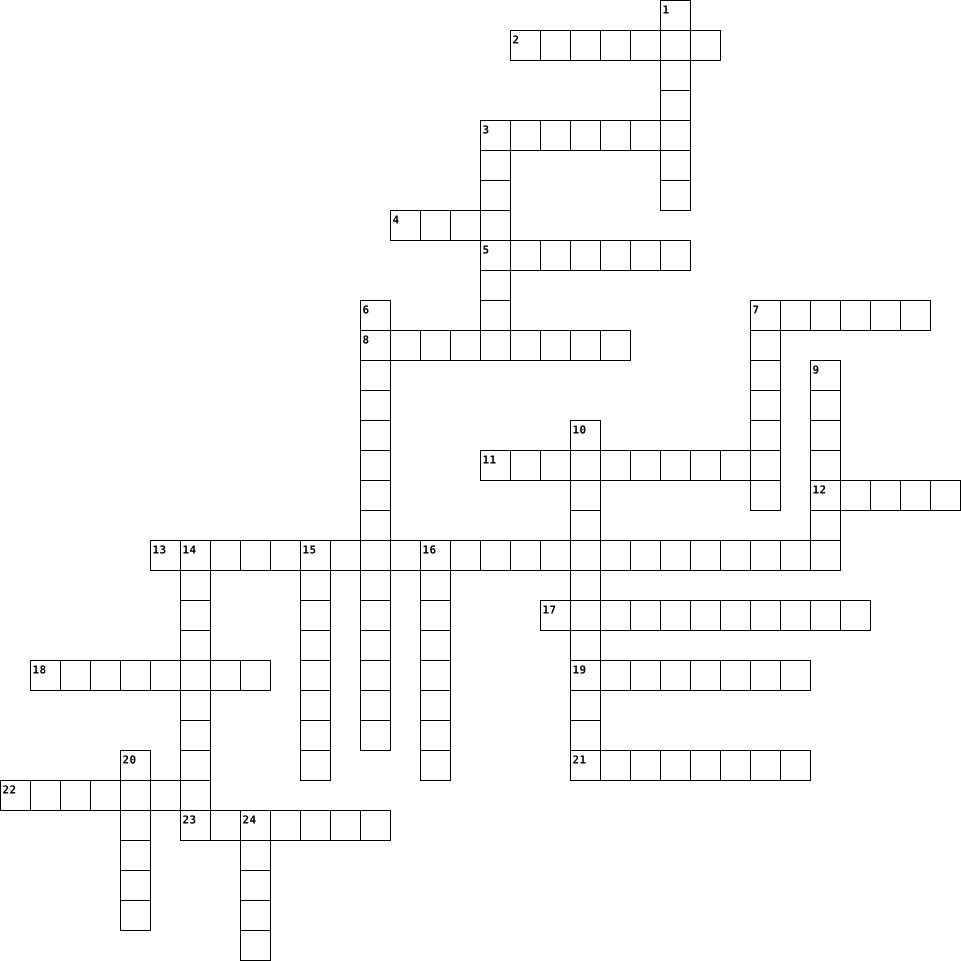
Across
- two electrons and is associated with a region of a chemical bond
- no electric charge
- the smalles unit of an element
- the material of chemical gas or metal that is on the periodic table
- positively charged element
- can form alloys with metals
- energy is released
- 18 numbers groups on the periodic table
- the mass of the products in a chemical reaction must equal the mass of the reactants
- energy is absorbed
- to place farmers do what to crops every year
- a group of atoms bonded together
- changes during a reaction
- consists of protons and electrons
- the letters of an element (au)
Down
- electrons participate in thr formation of a chemical bond
- very brittle and cannot be made into wire
- developed the periodic table
- what you get after you mix things together
- helium
- contains the same amount of protons and electrons
- their absorbency
- composed of two or more separate elements
- negatively charged
- how the elements are arranged with increasing atomic numbers
- sodium, alike metals has one electron
26 Clues: helium • their absorbency • no electric charge • energy is released • negatively charged • energy is absorbed • changes during a reaction • positively charged element • can form alloys with metals • developed the periodic table • the smalles unit of an element • the letters of an element (au) • a group of atoms bonded together • consists of protons and electrons • ...
Chemical Basis of Life 2014-02-04

Across
- Animals cannot make carbohydrates, but they can store this
- Is a polysaccharide found in the shells of insects, crabs and lobsters
- A monosaccharide commonly found in fruit
- An atom with the same number of protons, but different number of neutrons
- Are large molecules too big to pass through the selective plasma membrane of the cell
- A reaction in which simple substances are combined to form complex chemical structures
- Disaccharides are formed by this chemical process
- This is an example of a monosaccharide
- One of the four organic molecules
Down
- The smallest unit of life
- The sum of all chemical reaction that occur within cells
- Are represented by the atomic number of an atom
- Is composed of one glucose plus one galactose
- Share the same chemical formula, but a different structural composition
- Electrons are found in these
- These are made up of sugar units
- A hormone involved with diabetes
- A positively charged atom formed by the loss of one or more electrons
- The ability to do work
- A pure substance that cannot be broken down into simpler substances
20 Clues: The ability to do work • The smallest unit of life • Electrons are found in these • These are made up of sugar units • A hormone involved with diabetes • One of the four organic molecules • This is an example of a monosaccharide • A monosaccharide commonly found in fruit • Is composed of one glucose plus one galactose • Are represented by the atomic number of an atom • ...
Chemistry Exam Review Crossword 2022-05-13

Across
- atoms of the same element with different numbers of protons
- negatively charged ion
- substance with a pH value greater than 7
- substance that participates in and undergoes change during a chemical reaction
- atom that has gained or lost electrons
- ________ radiation is a form of energy emitted or absorbed by matter
- type of chemical bond that involves the sharing of electrons
- substance that is formed during a chemical reaction
- part of the atom that contains the protons and neutrons
Down
- type of chemical bond that involves the transfer of electrons
- subatomic particle with no charge
- ________ electrons are found in the outermost energy level of an atom
- particle of electromagnetic radiation having zero mass and carrying a quantum of energy
- positively charged ion
- subatomic particle with a negative charge
- subatomic particle with a positive charge
- substance with a pH value less than 7
- atomic ________ tells us how many protons an element has
- region around an atom's nucleus that is the probable location of an electron
- type of energy that is related to motion
20 Clues: negatively charged ion • positively charged ion • subatomic particle with no charge • substance with a pH value less than 7 • atom that has gained or lost electrons • substance with a pH value greater than 7 • type of energy that is related to motion • subatomic particle with a negative charge • subatomic particle with a positive charge • ...
Semester 1 Review 2022-12-09

Across
- Positively charged subatomic particle
- What is made during a chemical reaction
- What happened to the lake on Titan
- type of change that occurs when you cook an egg or light a camp fire
- The "H" in H2O
- A scientific guess
- Which phase has the most kinetic energy?
- True or false: some physical changes can be reversed
- The type of energy related to movement
- The horizontal axis on a graph
- Neutrally charged subatomic particle
- The "C" in CO2
- Negatively charged subatomic particle
- Chemical equations must be _______
Down
- A type of graph that shows categorical data
- Does the kinetic energy increase or decrease when you heat up the substance?
- The force that pulls molecules together
- The phase change when a solid becomes liquid
- The vertical axis on a graph
- Type of change that occurs when you break a glass or freeze water
- In 2007, the lake on Titan was filled with liquid _______
- The "ingredients" of a chemical reaction
- Finish the sentence: matter can never be created nor _______
- The basic building block of matter
24 Clues: The "H" in H2O • The "C" in CO2 • A scientific guess • The vertical axis on a graph • The horizontal axis on a graph • What happened to the lake on Titan • The basic building block of matter • Chemical equations must be _______ • Neutrally charged subatomic particle • Positively charged subatomic particle • Negatively charged subatomic particle • ...
Photosynthesis and Respiration 2026-03-12

Across
- Process where plants make their own food
- Lot of this is gotten from aerobic respiration
- Substances formed in a chemical reaction
- Source of food needed for respiration
- Release of energy from food
- Release of energy from food using oxygen
- Small openings in the leaf that allow gases in and out
- Where photosynthesis takes place in the cell
- Release of energy from food without oxygen
- Chemical reactions that happen in the cells of living things
- Gas needed for respiration
- This forms in muscle cells during anaerobic respiration
Down
- Green pigment that absorbs light energy
- All chemical reactions are controlled by these chemicals that help speed up reactions
- Where respiration takes place in the cell
- Another waste product of respiration
- Gas released during repsiration
- A factor that affects the rate of respiration. For example the enzymes in our body works best at 37 degrees Celsius.
- Substances that combine together in a chemical reaction.
- Organ that takes in and releases gases during respiration
- This is formed during anaerobic respiration in yeast
- Supplies light energy for photosynthesis
22 Clues: Gas needed for respiration • Release of energy from food • Gas released during repsiration • Another waste product of respiration • Source of food needed for respiration • Green pigment that absorbs light energy • Process where plants make their own food • Substances formed in a chemical reaction • Release of energy from food using oxygen • ...
Photosynthesis Cross-Word Puzzle 2024-11-07

Across
- This energy comes from the sun
- This is released from plants
- Substances that start a chemical reaction
- A green pigment that allows the leaf to absorb sunlight
- Distributes water to the plant
- Substances that are produced from a chemical reaction
Down
- A chemical process that occurs in plants, algae, and some types of bacteria, when they are exposed to sunlight
- Carries the glucose to the plant for its life process
- Where the food making reaction makes place
- Humans and animals release this when they exhale
- Lets gases in and out of the leaf
11 Clues: This is released from plants • This energy comes from the sun • Distributes water to the plant • Lets gases in and out of the leaf • Substances that start a chemical reaction • Where the food making reaction makes place • Humans and animals release this when they exhale • Carries the glucose to the plant for its life process • ...
Chemical Reactions 2022-03-07

Across
- the process by which a substance changes to produce one or more different substances
- To arrange again in a different order
- the relative size of something
- In any chemical reaction, matter changes form; it is never created or destroyed
Down
- A substance that is present at the start of a chemical reaction
- matter with a composition that is always the same
- A representation of an object or event
- the way that something is put together or arranged
- the smallest unit of matter
- A substance created in a chemical reaction
- to change in form or appearance
- A characteristic used to describe something
12 Clues: the smallest unit of matter • the relative size of something • to change in form or appearance • To arrange again in a different order • A representation of an object or event • A substance created in a chemical reaction • A characteristic used to describe something • matter with a composition that is always the same • the way that something is put together or arranged • ...
kyndel philips p.4 2017-04-06

Across
- very low chemical reactivity
- In the outer shell of an atom
- when a substance combines with another to form a new substance
- attraction between atoms
- the mass of the system must remain constant over time, as system mass cannot change quantity if it is not added or removed
Down
- the result of a chemical reaction.
- when objects or substances undergo a change that changes the physical form of a composition but not the chemical composition
- first colom of periodic table
- symbolic representation of a chemical reaction in the form of symbols and formulas.
- a way of expressing information about the proportions of atoms that constitute a particular chemical compound
- a substance that takes part in and undergoes change during a reaction
11 Clues: attraction between atoms • very low chemical reactivity • first colom of periodic table • In the outer shell of an atom • the result of a chemical reaction. • when a substance combines with another to form a new substance • a substance that takes part in and undergoes change during a reaction • ...
enzymes 2021-10-14

Across
- the maximum reaction rate greatly increases when this happens
- states that the substrate fits perfectly into the enzyme, like a lock and a key would
- type of enzyme inhibition where the inhibitor reduces the activity of the enzyme
- As the concentration of substrate increases, the enzyme becomes saturated with substrate
- chemical reactant that takes part in the chemical reaction and on which an enzyme will act upon
- energy level that the reactant molecules must overcome before a reaction can occur
- he breaking of many of the weak linkages, or bonds
- complex substance that consists of amino acid residues joined by peptide bonds
- reduce the compatibility of substrate and enzyme
Down
- temperature at which an enzyme work at its best
- states an substrate binds to an active site and both change shape slightly
- resembles the normal substrate binds to the enzyme
- substance that acts as a catalyst in living organisms
- the region of an enzyme where substrate molecules bind and undergo a chemical reaction
- refers to the pH resulting in maximal activity of a particular enzyme
15 Clues: temperature at which an enzyme work at its best • reduce the compatibility of substrate and enzyme • resembles the normal substrate binds to the enzyme • he breaking of many of the weak linkages, or bonds • substance that acts as a catalyst in living organisms • the maximum reaction rate greatly increases when this happens • ...
Types of reactions by Hisham 10N 2024-04-29

Across
- absorption of heat
- white precipitate
- Method to prevent corrosion
- simple form of chemical reaction
- higher reactive substances displaces lower reactive substance
- detoriation of metals
- oxidation of fats and oil
- reaction which has 1 reactant
- Substance to prevent rancidity
Down
- Gains oxygen
- release of heat
- Loss of oxygen
- used for whitewashing
- used in black and white photography
- reaction which has 1 product
15 Clues: Gains oxygen • Loss of oxygen • release of heat • white precipitate • absorption of heat • used for whitewashing • detoriation of metals • oxidation of fats and oil • Method to prevent corrosion • reaction which has 1 product • reaction which has 1 reactant • Substance to prevent rancidity • simple form of chemical reaction • used in black and white photography • ...
ENERGY CHANGES IN CHEMICAL REACTION 2021-12-02

Across
- Is the process where the fuels burn.
- Law states that energy cannot be created or destroyed in a system.
- A chemical reaction that absorb energy mostly heat that makes the surroundings cold.
- Bubbles are seen during the chemical reaction.
Down
- The precipitation is formed during the reaction.
- Hues of the reactant & product changed from the reaction.
- The food making process of plant.
- A chemical reaction that releases energy mostly heat to the surroundings.
- The reactant or product becomes warm or chilling.
9 Clues: The food making process of plant. • Is the process where the fuels burn. • Bubbles are seen during the chemical reaction. • The precipitation is formed during the reaction. • The reactant or product becomes warm or chilling. • Hues of the reactant & product changed from the reaction. • Law states that energy cannot be created or destroyed in a system. • ...
Unit 3 2026-03-04

Across
- The total number of atoms must stay the same according to this law.
- A reaction that releases energy to the surroundings.
- A reaction that absorbs energy from the surroundings.
Down
- The substances formed in a chemical reaction.
- A number written in front of a chemical formula to balance it.
- The substances you start with in a chemical reaction.
- The energy needed to start a reaction.
- The average kinetic energy in an object.
- The mixture of products and reactants creating a new substance.
9 Clues: The energy needed to start a reaction. • The average kinetic energy in an object. • The substances formed in a chemical reaction. • A reaction that releases energy to the surroundings. • The substances you start with in a chemical reaction. • A reaction that absorbs energy from the surroundings. • A number written in front of a chemical formula to balance it. • ...
Chemistry 2016-02-10

Across
- of conservation of mass the mass of the products in a chemical reaction must equal the mass of the reactants
- a group of atoms bonded together
- gas helium
- changes during a reaction
- energy is released
- what you get after you mix things together
- no electric charge
- negatively charged
- Mendeleev developed the periodic table
- sodium, alike metals has one electron
- consists of protons and electrons
- how the elements are arranged with increasing atomic numbers
Down
- mass their absorbency
- energy is absorbed
- the material of chemical gas or metal that is on the periodic table
- to place farmers do what to crops every year
- the smalles unit of an element
- positively charged element
- can form alloys with metals
- 18 numbers groups on the periodic table
- two electrons and is associated with a region of a chemical bond
- composed of two or more separate elements
- metal very brittle and cannot be made into wire
- electrons participate in thr formation of a chemical bond
- the letters of an element (au)
25 Clues: gas helium • energy is absorbed • energy is released • no electric charge • negatively charged • mass their absorbency • changes during a reaction • positively charged element • can form alloys with metals • the smalles unit of an element • the letters of an element (au) • a group of atoms bonded together • consists of protons and electrons • sodium, alike metals has one electron • ...
Stoichiometry 2021-04-12

Across
- substances that are formed after a chemical reaction
- substances that are found on the left side of a chemical equation
- a process where coefficients are placed before the reactants or products to have an equal number on both sides of the chemical equation.
- reaction a process that involves rearrangement of the molecular or ionic structure of a substance to form a new substance or product
- a concept in chemistry that involves using relationships between reactants and/or products in a chemical reaction to determine desired quantitative data
- integers, or numbers that are placed before the substances to balance a chemical equation
Down
- state of matter which is represented by an arrow up, which means that it evolves in the process
- represented by an arrow down, these are substances that settle at the bottom of a reagent after a chemical reaction
- represented by a triangle, it acts as a catalyst that speeds up chemical reactions
- a physical quantity that is usually expressed in grams
10 Clues: substances that are formed after a chemical reaction • a physical quantity that is usually expressed in grams • substances that are found on the left side of a chemical equation • represented by a triangle, it acts as a catalyst that speeds up chemical reactions • integers, or numbers that are placed before the substances to balance a chemical equation • ...
Chemistry Crossword 2015-12-02

Across
- Degradation Of a material Over time
- Substance that accelerates a chemical reaction
- A Table of the elements organized by number
- Chemical process in which a substance reacts rapidly with oxygen and give off heat
- Signs that appear on Hazardous Materials
- in a Chemical Reaction the mass of the reactants and will stay the same
- Substances that make products
- Created by reactants
- Elementary particle with no charge
- he basic unit of a chemical element
- negative charge
- Natural Catalyst in your saliva
- a particle that is electrically charged negative postive
Down
- When none of the reactants/products can escape an experiment
- positive charge
- The order of the element in the Periodic table
- When one metal and one non metal combine to make a new subbsantce
- the positively charged central core of an atom
- how heavy the atom is
- when some of the reactants/products can escape
- when substances react to create a new substance
- Absorbing energy (heat)
- the most reactive metal
- when a metal and a nonmetal combine
- the most reactive non metals
25 Clues: positive charge • negative charge • Created by reactants • how heavy the atom is • Absorbing energy (heat) • the most reactive metal • the most reactive non metals • Substances that make products • Natural Catalyst in your saliva • Elementary particle with no charge • Degradation Of a material Over time • when a metal and a nonmetal combine • he basic unit of a chemical element • ...
Chemistry 2016-02-10

Across
- two electrons and is associated with a region of a chemical bond
- the smalles unit of an element
- electrons participate in thr formation of a chemical bond
- how the elements are arranged with increasing atomic numbers
- a group of atoms bonded together
- metal very brittle and cannot be made into wire
- sodium, alike metals has one electron
- to place farmers do what to crops every year
- energy is absorbed
- negatively charged
- gas helium
- the material of chemical gas or metal that is on the periodic table
- number contains the same amount of protons and electrons
Down
- the letters of an element (au)
- composed of two or more separate elements
- mass their absorbency
- energy is released
- changes during a reaction
- positively charged element
- no electric charge
- can form alloys with metals
- what you get after you mix things together
- 18 numbers groups on the periodic table
- consists of protons and electrons
- Mendeleev developed the periodic table
- of conservation of mass the mass of the products in a chemical reaction must equal the mass of the reactants
26 Clues: gas helium • energy is released • no electric charge • energy is absorbed • negatively charged • mass their absorbency • changes during a reaction • positively charged element • can form alloys with metals • the letters of an element (au) • the smalles unit of an element • a group of atoms bonded together • consists of protons and electrons • sodium, alike metals has one electron • ...
bio 2023-04-05

Across
- makes up all living organisms
- transport of molecules that uses energy, in the form of an energy-storing chemical called ATP to help them cross the cell membrane.
- water loving
- proteins that speed things up like metabolism and chemical reaction
- only allows some subtance and molecules to pass
- t means that the substance tends to move from an area of higher concentration to an area of lower concentration.
- A particle of matter that uniquely defines a chemical element
- a different type of diffusion that involves water
- a membrane that allows only some substances and molecules to pass into or leave the cell
Down
- water fearing
- breaking of a protein
- A small structure in a cell
- a group of atoms boned together
- where chemical reaction occurs
- something having many related parts
- molecules upon which an enzyme acts
- cell membranes
- A groups of cells that work together
- to stimulate a cell in a resting state to become active.
- A part of the body that performs a specific function
- complex molecules
21 Clues: water loving • water fearing • cell membranes • complex molecules • breaking of a protein • A small structure in a cell • makes up all living organisms • where chemical reaction occurs • a group of atoms boned together • something having many related parts • molecules upon which an enzyme acts • A groups of cells that work together • only allows some subtance and molecules to pass • ...
Oliver Brunswick Unit 2 2025-03-24

Across
- the basic units of all matter
- a combination of the tissue in a organism
- basic unit of life
- molecules move from being close together to spaced out
- a combination of cells in a organism
- repels water and is 'water fearing'
- a combination of organs in a organism
- a combination of the organ systems forming a single structure or form
- is attracted to water and is 'water loving'
- a protein that speeds up chemical reactions and then to happen
- when cells use ATP energy to move molecules across the membrane
Down
- the reactant of the chemical reaction
- certain things are let in the cell and certain things are kept out
- the diffusion of water across a membrane
- the resulting features or elements from the chemical reaction
- moving molecules across the membrane without using ATP energy
- a combination of atoms that form compound
- the region on the enzyme that binds to the substrate
- a combination of the molecules in an organism
- a molecule containing a hydrophilic head and hydrophobic tails
- the energy required to perform the chemical reactions
21 Clues: basic unit of life • the basic units of all matter • repels water and is 'water fearing' • a combination of cells in a organism • the reactant of the chemical reaction • a combination of organs in a organism • the diffusion of water across a membrane • a combination of the tissue in a organism • a combination of atoms that form compound • ...
Photosynthesis 2025-10-01

Across
- making food from chemical energy instead of sunlight
- atoms that are rearranged, not destroyed, in photosynthesis
- the materials made by a chemical reaction
- green pigment that absorbs light for photosynthesis
- radiant energy from the sun needed for photosynthesis
- process plants use to turn sunlight, water, and carbon dioxide into food (glucose) and oxygen
- the ability to do work; changes form during photosynthesis
- the cells that open and close stomata
- a stack of thylakoids
- tiny pores on leaves where gases move in and out
Down
- an organism that makes its own food
- an organism that eats other organisms for energy
- the cell part where photosynthesis happens
- the “energy currency” molecule of the cell
- tiny ocean organisms that do photosynthesis and make oxygen
- the cycle that uses energy molecules to build glucose
- a sugar made by plants that stores chemical energy
- disc-shaped structure inside the chloroplast that captures light
- fluid inside the chloroplast where glucose is built
- the starting materials that go into a chemical reaction
20 Clues: a stack of thylakoids • an organism that makes its own food • the cells that open and close stomata • the materials made by a chemical reaction • the cell part where photosynthesis happens • the “energy currency” molecule of the cell • an organism that eats other organisms for energy • tiny pores on leaves where gases move in and out • ...
Chapter 13 Austin Santure 2019-02-27

Across
- rate is how quickly the concentration of reactants decrease and how quickly they increase
- reaction when there is a net release of energy
- energy is the minimum energy required to over come the initial breaking of bonds in reactants
Down
- when a reaction and it's reverse act the same rate
- reaction when there is not a net release of energy
- chatelier's principle if changed the equilibrium shifts to oppose change until new equilibrium is reached
- is a chemical that donates a hydrogen atom
- is a substance that lowers the activation energy of a chemical reaction
- is a chemical that accepts a hydrogen ion
- is also known as Activation energy
10 Clues: is also known as Activation energy • is a chemical that accepts a hydrogen ion • is a chemical that donates a hydrogen atom • reaction when there is a net release of energy • when a reaction and it's reverse act the same rate • reaction when there is not a net release of energy • is a substance that lowers the activation energy of a chemical reaction • ...
Chemical vs physical change 2021-12-15

Across
- ending substance in a chemical reaction
- starting substance in a chemical reaction
- more energy is going into the reaction than out
- how many molecules of a substance
Down
- new substance is formed
- amount of space an object takes up
- amount of each element
- no new substance is formed
- more energy is going out of the reaction than in
- amount of matter in an object
10 Clues: amount of each element • new substance is formed • no new substance is formed • amount of matter in an object • how many molecules of a substance • amount of space an object takes up • ending substance in a chemical reaction • starting substance in a chemical reaction • more energy is going into the reaction than out • more energy is going out of the reaction than in
Exothermic Reactions 2024-04-08

Across
- of a reaction/process with absorption of heat
- High temperature
- a substance that undergoes change while reacting
- formed from chemical reactions
- when something changes state, color, shape or texture
- reaction/process accompanied by heat
Down
- when a new substance is formed
- rapid chemical combination of a substance with oxygen
- the ability to exert force which causes a reaction
- a process with absorption or release of heat
10 Clues: High temperature • when a new substance is formed • formed from chemical reactions • reaction/process accompanied by heat • a process with absorption or release of heat • of a reaction/process with absorption of heat • a substance that undergoes change while reacting • the ability to exert force which causes a reaction • ...
Unit 4 2024-04-15

Across
- focusing ones attention on something
- the ratio between the amounts in moles of any two compounds involved in a balanced chemical reaction
- lowest part of something
- a chemical compound is defined as the ratio between the mass
- the process in which carbon atoms continually travel from the atmosphere to the Earth and then back into the atmosphere.
- a state in which opposing forces or influences are balanced.
- a pigmented spot, mark, or small permanent protuberance on the human body
- chemical that gives off hydrogen ions
- the relationship between the weights of reactants and products before, during, and following chemical reactions
Down
- a reduction in the pH of the ocean over an extended period of time, caused primarily by uptake of carbon dioxide (CO2) from the atmosphere
- a reaction in which the conversion of reactants to products and the conversion of products to reactants occur simultaneously
- a chemical reaction in which acid and a base react with an equivalent quantity of each other.
- the ratio between the amounts in moles of any two compounds involved in a balanced chemical reaction
- used to specify acidity or basicity
14 Clues: lowest part of something • used to specify acidity or basicity • focusing ones attention on something • chemical that gives off hydrogen ions • a chemical compound is defined as the ratio between the mass • a state in which opposing forces or influences are balanced. • a pigmented spot, mark, or small permanent protuberance on the human body • ...
Properties of Water 2023-06-12

Across
- molecules with polar covalent bonds that are attracted to water
- binding together of like molecules
- dissolved substance
- the starting molecules of a chemical reaction
Down
- molecules containing both hydrophilic and hydrophobic regions
- the final molecules of a chemical reaction
- occurs when the rate of forward reaction is equal to the rate of the reverse reaction
- binding together of different molecules
- dissolving agent
- liquid consisting of a homogeneous mixture of 2+ substances
- molecules with nonpolar covalent bonds that are more attracted to each other
11 Clues: dissolving agent • dissolved substance • binding together of like molecules • binding together of different molecules • the final molecules of a chemical reaction • the starting molecules of a chemical reaction • liquid consisting of a homogeneous mixture of 2+ substances • molecules containing both hydrophilic and hydrophobic regions • ...
Y9 Chemistry Reaction Revision Crossword 2023-03-06

Across
- Type of reaction AB + C -> AC + B.
- Type of reaction when an acid mixes with an alkali.
- Added to a blast furnace to react with impurities such as silica.
- (2words) The sequence of metals from potassium near the top to platinum near the bottom.
- Gas ______. Can collect and measure the amount of gas released in a reaction.
- area (2words) Affects how much the reactants cn be in contact with each other so affects rate of reaction.
- Something which is always the same (conserved) before and after a reaction.
- The OH- ion.
- A product (always) of a neutralisation reaction.
- An element usually found in its pure state, not part of an ore. Jewellery.
Down
- The chemical formula letters for hydrochloric acid.
- (2words) The gas released when a carbonate reacts with an acid.
- Will dissolve easily.
- Type of reaction with oxygen.
- Type of reaction in which one reactant "breaks down" into multiple products (usually due to heat).
- What the state symbol (aq) stands for.
- Affects particle speeds so affects the rate of reaction.
- All acids contain _______ ions.
- Above iron but below aluminium in the reactivity series.
- Element used to displace iron in iron ore to create pure iron.
20 Clues: The OH- ion. • Will dissolve easily. • Type of reaction with oxygen. • All acids contain _______ ions. • Type of reaction AB + C -> AC + B. • What the state symbol (aq) stands for. • A product (always) of a neutralisation reaction. • The chemical formula letters for hydrochloric acid. • Type of reaction when an acid mixes with an alkali. • ...
science crossword puzzle 2022-09-29

Across
- A process in which glucose (sugar) is partially broken down by cells in enzyme reactions that do not need oxygen.
- the sequence of reactions by which most living cells generate energy during the process of aerobic respiration
- coenzyme that works with enzymes to transfer energy to cell
- double-membrane-bound organelle found in most eukaryotic organisms.
- A substance that speeds up the rate of a chemical reaction.
- plant cell organelles that convert light energy into relatively stable chemical energy via the photosynthetic process.
- the process by which green plants and certain other organisms transform light energy into chemical energy.
Down
- biological catalyst and is almost always a protein
- the net passive movement of molecules or particles from regions of higher to regions of lower concentration
- The process by which organisms exchange gases, especially oxygen and carbon dioxide, with the environment.
- Requiring air or oxygen for life or survival
- The reactants of enzyme-catalyzed reactions
- site on an enzyme that the substrate binds to.
- The elements or compounds produced by the chemical reaction.
- a substance that enters into and is altered in the course of a chemical reaction.
- the movement of water across a semipermeable membrane from an area of high water concentration to an area of lower water concentration.
16 Clues: The reactants of enzyme-catalyzed reactions • Requiring air or oxygen for life or survival • site on an enzyme that the substrate binds to. • biological catalyst and is almost always a protein • coenzyme that works with enzymes to transfer energy to cell • A substance that speeds up the rate of a chemical reaction. • ...
Biology Choice Board 2022-09-28

Across
- reactions - first step of photosynthesis
- - first step in aerobic respiration
- - type of organism that breaks down biotic compounds
- Cycle - second step of aerobic respiration
- - all water on earth
- - second step of aerobic respiration
- - process of turning sun into light
- - charged energy storage with 3 phosphorus groups
- - site of photosynthesis
Down
- respiration - process of breaking down to make ATP
- - all soil and rocks on earth
- - all living things
- substance at the beginning of a chemical reaction
- - pigment in chloroplasts
- - substance created during a chemical reaction
- reactions - second step of photosynthesis
- - type of organisms
- - sphere of earth, all gases surrounding earth
- - anything that has mass
19 Clues: - all living things • - type of organisms • - all water on earth • - site of photosynthesis • - pigment in chloroplasts • - anything that has mass • - all soil and rocks on earth • - first step in aerobic respiration • - process of turning sun into light • - second step of aerobic respiration • reactions - first step of photosynthesis • reactions - second step of photosynthesis • ...
Chemical Reactions 2024-08-04

Across
- Reaction between an acid and a base to form salt and water.
- Reaction where ions are exchanged between two reactants.
- Reaction where two or more reactants combine to form one product.
- Addition of oxygen or removal of hydrogen in a reaction.
Down
- Law stating that mass is neither created nor destroyed in a chemical reaction.
- Reaction involving both oxidation and reduction.
- Reaction where one compound decomposes into two or more substances.
- Reaction where a more reactive element displaces a less reactive element.
- Addition of hydrogen or removal of oxygen in a reaction.
- Type of chemical equation where atoms are not equal on both sides.
10 Clues: Reaction involving both oxidation and reduction. • Addition of hydrogen or removal of oxygen in a reaction. • Reaction where ions are exchanged between two reactants. • Addition of oxygen or removal of hydrogen in a reaction. • Reaction between an acid and a base to form salt and water. • Reaction where two or more reactants combine to form one product. • ...
Exo and Endothermic Reaction 2025-09-24

Across
- The scientific study of heat and its relationship to other forms of energy.
- A substance present at the start of a chemical reaction
- The energy needed to start a reaction
- A reaction that releases energy, often in the form of heat.
- A measure of the average kinetic energy of the particles in a substance.
Down
- A diagram that shows the energy changes of a reaction
- The total energy contained within a system
- The substance(s) produced during a chemical reaction
- A reaction that absorbs energy from its surroundings
- The state of a reaction where the rate of the forward reaction equals the rate of the reverse reaction
10 Clues: The energy needed to start a reaction • The total energy contained within a system • The substance(s) produced during a chemical reaction • A reaction that absorbs energy from its surroundings • A diagram that shows the energy changes of a reaction • A substance present at the start of a chemical reaction • A reaction that releases energy, often in the form of heat. • ...
4th 9-weeks Cumulative Vocabulary (week 11) 2017-05-19

Across
- Substance formed in a chemical reaction. The materials that are written on the right of the arrow of a written chemical reaction.
- Substance that is changed by a chemical reaction. The materials on the left of the arrow of a written chemical reaction.
- A molecule that serves as an electron carrier in a number of reactions. Very similar to ATP.
- Organelle made up of numerous membranes that are used to convert solar energy into chemical energy; contains chlorophyll.
- of photosynthesis that uses energy absorbed during the light-dependent reactions to make carbohydrates.
- The colorless fluid surrounding the grana within the chloroplast. Site of the light-independent reaction of photosynthesis.
Down
- Part of photosynthesis that absorbs energy from sunlight and transfers energy to the light-independent reactions.
- High-energy molecule that contains, within its bonds, energy that cells can use.
- Light absorbing pigment molecule in photosynthetic organisms.
- Membrane bound structure within chloroplasts that contains chlorophyll and other light-absorbing pigments used in the light-dependent reactions of photosynthesis.
- A low energy molecule that can be converted to ATP.
11 Clues: A low energy molecule that can be converted to ATP. • Light absorbing pigment molecule in photosynthetic organisms. • High-energy molecule that contains, within its bonds, energy that cells can use. • A molecule that serves as an electron carrier in a number of reactions. Very similar to ATP. • ...
G8 Physical Science: Chap 18 Chemical Changes 2020-10-18

Across
- There are two main types of change: physical change and ______ change.
- Other than light, what is a condition for photosynthesis?
- In a chemical reaction word equation, these are found to the left of the arrow.
- These are substances present at the end of a chemical reaction.
- Plants use this process to make food in the presence of light
- ______ decomposition is a process in which a substance is broken down into two or more simpler substances by the effect of heat.
- Cellular ______ releases energy from food, this takes place in the cells of all living things.
- A process in which a substance reacts with oxygen.
Down
- In a chemical reaction word equation, these are factors needed for the reaction to happen.
- Coating a coin with a layer of gold is an example of _____.
- NASA astronauts use this method in space crafts to produce oxygen from water
- Water can convert into ice and ice can convert back into water, this means that physical changes are _______.
- Burning of petrol in cars to produce carbon dioxide and water vapour is an exmaple of complete ______.
- Light can change silver bromide into a grey solid on an X-ray film. What is this grey solid product?
- Cooking a piece of steak is an example of interactions between matter and _____.
- A reactant is missing in this oxidation process, what is it? glucose --> carbon dioxide + water
16 Clues: A process in which a substance reacts with oxygen. • Other than light, what is a condition for photosynthesis? • Coating a coin with a layer of gold is an example of _____. • Plants use this process to make food in the presence of light • These are substances present at the end of a chemical reaction. • ...
Advanced Physical Science - Semester 2 exam - Chapter 7 2022-05-21

Across
- Type of reaction in which two different compounds exchange positive ions to form new compounds is _____ replacement.
- You can balance a chemical equation by changing the _____, the numbers that appear before the formula.
- Type of reaction in which one element takes the place of another in a compound is ______ replacement.
- In a chemical reaction, the _____ are on the right side of the arrow.
- During a _____ reaction, electrons are both gained and lost.
- In a chemical equation the ______ are on the left side of the arrow.
Down
- Type of reaction in which one reactant forms two products.
- When the forward and reverse paths of a change occur at the same rate, the system is in ______.
- The statement that in chemical reactions, the total mass of the reactants equals the total mass of the products is the law of conservation of _____.
- Types of reaction in which two reactants form one product.
10 Clues: Type of reaction in which one reactant forms two products. • Types of reaction in which two reactants form one product. • During a _____ reaction, electrons are both gained and lost. • In a chemical equation the ______ are on the left side of the arrow. • In a chemical reaction, the _____ are on the right side of the arrow. • ...
ACIDS & BASES 2023-09-05

Across
- The standard way of measuring the strengths of acids and bases. pH is a number from 0 to 14 that relates to the concentration of hydrogen ions in a solution.
- A substance that has a pH = 7. Chemical formular: H2O
- Able to damage or destroy another substance by a chemical reaction.
- Strong bases are _______________________ and will destroy living material.
- Any substance that changes colour when mixed with an acid or base.
- An indicator that changes colour gradually over a range of pH and is used in testing for acids and alkalis.
- A base that dissolves in water.
- A substance with a pH greater than 7. Bases have certain properties, such as tasting bitter and having a soapy, slippery feel
Down
- An ion that is released by acids in solution.
- A reaction between acid and base to produce salt and carbon dioxide gas.
- An ion that is released by bases in solution.
- A substance that takes part in a chemical reaction
- A paper stained with litmus which is used to indicate the acidity or alkalinity of a substance.
- A substance that is formed as a result of a chemical reaction
- A substance with a pH less than 7. Acids have certain properties, such as tasting sour and dissolving some metals.
15 Clues: A base that dissolves in water. • An ion that is released by acids in solution. • An ion that is released by bases in solution. • A substance that takes part in a chemical reaction • A substance that has a pH = 7. Chemical formular: H2O • A substance that is formed as a result of a chemical reaction • ...
Yr 9 Chemistry 2022-05-15

Across
- carbon dioxide is made when an acid reacts with a ---------
- acids have a --- pH
- a process in which reactants form products
- the new substances produced in a reaction
- a reaction that absorbs heat
- acids and alkalis reaction to make ---- and water
- a pure substance made of two or more elements bonded in a specific ratio
- a change in ------ is a sign of a chemical reaction
- in exothermic reactions, the mixture gets ------
- a substance made of two or more elements/compounds mixed together
- changes colour to show pH levels
Down
- the name of the reaction between an acid and an alkali
- a gas made when a metal and an acid react
- in endothermic reactions, the mixture gets ------
- a reaction that releases heat
- when a gas is made in a reaction you will see -------
- the smallest particle of any element
- a particle made of two or more atoms chemically bonded together
- a pure substance made of atoms of the same type
- shows reactants, and arrow and products
- the test used for hydrogen gas
- alkalis have a --- pH
- substances with a pH of 7 are -------
- the substances that are used in a reaction
24 Clues: acids have a --- pH • alkalis have a --- pH • a reaction that absorbs heat • a reaction that releases heat • the test used for hydrogen gas • changes colour to show pH levels • the smallest particle of any element • substances with a pH of 7 are ------- • shows reactants, and arrow and products • a gas made when a metal and an acid react • ...
Chemistry Basics 2022-08-24

Across
- State of matter with neither fixed volume nor shape
- State of matter with fixed volume but not fixed shape
- Positively charged
- Neutral pH
- Energy of position
- Mixture that is not uniform
- Substances that form in a chemical reaction
- Charge on an electron
- Charge on a proton
Down
- Charge on a neutron
- State of matter with fixed shape and volume
- Substance made up of only one type of atoms
- Mixture that is uniform
- Energy of motion
- Negatively charged
- An Avogadro’s number of particles
- Term for the center of the atom
- Substances that get used up in a chemical reaction
- Scale for determining the acidity or basicity of a solution
19 Clues: Neutral pH • Energy of motion • Positively charged • Negatively charged • Energy of position • Charge on a proton • Charge on a neutron • Charge on an electron • Mixture that is uniform • Mixture that is not uniform • Term for the center of the atom • An Avogadro’s number of particles • State of matter with fixed shape and volume • Substance made up of only one type of atoms • ...
Biology Choice Board 2022-09-28

Across
- reactions - first step of photosynthesis
- - first step in aerobic respiration
- - type of organism that breaks down biotic compounds
- Cycle - second step of aerobic respiration
- - all water on earth
- - second step of aerobic respiration
- - process of turning sun into light
- - charged energy storage with 3 phosphorus groups
- - site of photosynthesis
Down
- respiration - process of breaking down to make ATP
- - all soil and rocks on earth
- - all living things
- substance at the beginning of a chemical reaction
- - pigment in chloroplasts
- - substance created during a chemical reaction
- reactions - second step of photosynthesis
- - type of organisms
- - sphere of earth, all gases surrounding earth
- - anything that has mass
19 Clues: - all living things • - type of organisms • - all water on earth • - site of photosynthesis • - pigment in chloroplasts • - anything that has mass • - all soil and rocks on earth • - first step in aerobic respiration • - process of turning sun into light • - second step of aerobic respiration • reactions - first step of photosynthesis • reactions - second step of photosynthesis • ...
Chapter 6 & 7 vocab 2023-11-03

Across
- equation - a representation of a chemical reaction in which the reactants and products are expressed as formulas
- - a neutral group of atoms that are joined together by one or more covalent bonds
- bond - the attraction between a metal cation and the shared electrons that surround it
- - numbers that appear before a formula in a chemical equation to show the relative proportions of each reactant and product
- dot diagram - a diagram of an atom, ion or molecule in which each dot represents a valence electron
- formula - notation that shows what elements a compound contains and the ratio of the atoms or ions of these elements in the compound
Down
- bond - the force that holds cations and anions together
- - an ion with a positive charge
- bond - a chemical bond in which two atoms share a pair of valence electrons
- - new substances formed as a result of a chemical reaction
- - an ion with a negative charge
- - a mixture of two or more elements, at least one of which is a metal, that has the characteristic properties of a metal
- - an atom or group of atoms that has a positive or negative charge
- bond - the force that holds atoms or ions together as a unit
- - a substance that undergoes change in a chemical reaction
15 Clues: - an ion with a positive charge • - an ion with a negative charge • bond - the force that holds cations and anions together • - new substances formed as a result of a chemical reaction • - a substance that undergoes change in a chemical reaction • bond - the force that holds atoms or ions together as a unit • ...
Chapter 2 Crossword 2024-10-30

Across
- An organic compound that is insoluble in water but soluble in certain organic solvents
- The type of nucleic acid that forms from DNA and functions with ribosomes to form protein molecules
- The non-charged particle in an atoms nucleus
- Energy that is stored until being released
- The negatively charged particle that moves in a shell-like orbit around the nucleus
- The random movement of atoms, ions or molecules from a higher area of concentration to a lower one
- The building blocks of proteins
- A substrate composed of two or more elements chemically combined in definite proportions
- The energy of motion
Down
- The formation of a chemical bond between ions of opposite charge
- An energy-releasing chemical reaction
- One of the forms of an atom produced by different numbers of neutrons but the same number of protons
- The building blocks for lipids
- The positively charged particle in an atoms nucleus
- A chemical bond formed between atoms as a result of sharing a pair of electrons
- An energy-consuming reaction
- The nucleic acid that is located primarily in the nucleus
- A fatty acid molecule in which some carbon atoms are double-bonded to each other
- Diffusion of water through a semipermeable membrane
- Describing a fatty acid molecule with only single bonds between carbon atoms
- A measure of the unusable energy that escapes when energy is being converted
- A substance that affects the rate of a reaction but is not hanged in the reaction
22 Clues: The energy of motion • An energy-consuming reaction • The building blocks for lipids • The building blocks of proteins • An energy-releasing chemical reaction • Energy that is stored until being released • The non-charged particle in an atoms nucleus • The positively charged particle in an atoms nucleus • Diffusion of water through a semipermeable membrane • ...
Lesson 2 Discussion 2025-02-22

Across
- The reactant in a chemical reaction that is the first to be used up
- Groups of atoms bonded together
- Also known as atomic mass
- Is HCl (aq) +NaOH (aq) -> H2O (l) +NaCl (aq) a double displacement reaction or single replacement reaction?
- The amount of product that’s actually obtained from a chemical reaction
- The opposite of combination/synthesis reaction and only has one reactant
Down
- A measure of the efficiency of a reaction
- Mix silver nitrate (AgNO3) with sodium chloride (NaCl). What is the precipitate formed?
- Smallest unit of matter
- Unit of concentration
- The ability of a substance to dissolve in a solvent forming a homogeneous solution
11 Clues: Unit of concentration • Smallest unit of matter • Also known as atomic mass • Groups of atoms bonded together • A measure of the efficiency of a reaction • The reactant in a chemical reaction that is the first to be used up • The amount of product that’s actually obtained from a chemical reaction • ...
Science 2023-06-23

Across
- What kind of bonding is called in which one or more pairs of electrons are shared between atoms?
- What is the chemical symbol for silver?
- Which of the three sub-atomic particles is the lightest?
- How many products does a decomposition reaction create *Eg ans. One-Plus-One*
- What is the PH level of just plain, pure water? *Without Decimals*
- What kind of reaction is the vinger egg reaction?
- What is the PH level of rainwater? *Without Decimals*
- First name of the person who created the modern-day atomic table?
- How many products does a double replacement reaction create
- What is an element called when it loses or gains an electron?
- How many products does a single replacement reaction create
- How many shells do elements have that are placed in the third period of the periodic table?
- What is the center of an atom called?
- What is the chemical symbol for Mercury?
- What is the lightest noble gas?
Down
- What is the charge of an electron {Pos or Neg}
- How many elements can possibly exist? *Eg ans. Four-Hundred-Twenty-Three*
- What is the chemical symbol for Lead?
- Name for elements that produce toxic, coloured vapours. And are Highly reactive.
- What is the lightest element?
- How many neutrons does carbon have?
- How many electrons fit in the first energy level of an atom?|
- How many products does a synthesis type reaction create
- Truth or false, atoms are the smallest unit of matter and combine to form molecules.
- What is another name for columns on the periodic table
25 Clues: What is the lightest element? • What is the lightest noble gas? • How many neutrons does carbon have? • What is the chemical symbol for Lead? • What is the center of an atom called? • What is the chemical symbol for silver? • What is the chemical symbol for Mercury? • What is the charge of an electron {Pos or Neg} • What kind of reaction is the vinger egg reaction? • ...
Changes around us 2018-06-16

Across
- new substance formed during or after chemical reaction
- increase in size
- change in which new substance forms
- milk changing to curd
- original substance present in the reaction
Down
- substance that does not undergo any change in a chemical reaction
- a change in which no new substance is formed
- melting of wax
- iron gets corroded
9 Clues: melting of wax • increase in size • iron gets corroded • milk changing to curd • change in which new substance forms • original substance present in the reaction • a change in which no new substance is formed • new substance formed during or after chemical reaction • substance that does not undergo any change in a chemical reaction
Austin Good chapter 13 lab 2019-03-03

Across
- the deterioration of a metal, typically caused by atmospheric oxygen
- the minimum energy required in order for a chemical reaction to proceed
- a substance that accepts hydrogen ions
- any substance that increases the rate of a chemical reaction without itself being consumed by the reaction
Down
- the process by which a rectant gains one or more electrons
- the new materials formed in a chemical reaction
- description of a chemical reaction in which there is a net release of energy
- description of a substance that can behave as either an acid or a base
- description of a solution in which the hydronium ion concentration is equal to the hydroxide ion concentratuion
- description of a solution in which the hydroxide ion concentration in higher than the hydronium ion concentration also sometimes called alkaline
10 Clues: a substance that accepts hydrogen ions • the new materials formed in a chemical reaction • the process by which a rectant gains one or more electrons • the deterioration of a metal, typically caused by atmospheric oxygen • description of a substance that can behave as either an acid or a base • ...
Cellular Energy 2023-10-04

Across
- the formation/production of chemical compounds by a reaction from simpler materials.
- the process of changing energy from one form to another.
- the breakdown of sugar molecules to produce energy without the presence of oxygen.
- the production of a more complex chemical compound by combining two or more simpler chemicals.
- the substance that the enzyme reacts upon.
- organelle found within the cell of plants and other photosynthetic eukaryotes that is filled with green pigment.
- organelle in which respiration and energy productions occur.
- the breaking down of sugar molecules into simpler compounds to produce substances that can be used in making chemical energy.
Down
- one of the major groups of biomolecules; they are energy-rich organic compounds.
- the production of glucose and oxygen using carbon dioxide, water, and sunlight.
- the process of generating energy in the presence of oxygen.
- a biomolecule (can be either protein or RNA) that acts as a catalyst to speed up specific chemical reactions.
- the green pigment found in plants.
- breaks down glucose and oxygen to from carbon dioxide and energy in the form of ATP.
- a substance capable of initiating or speeding up a chemical reaction.
- the minimum amount of energy which the reactants must possesses in order to undergo a specified reaction.
- a process in which a molecular structure changes from its original state.
17 Clues: the green pigment found in plants. • the substance that the enzyme reacts upon. • the process of changing energy from one form to another. • the process of generating energy in the presence of oxygen. • organelle in which respiration and energy productions occur. • a substance capable of initiating or speeding up a chemical reaction. • ...
Chemistry Crossword Review 2016-04-03

Across
- the state of matter in which a substance has neither definite volume nor definite shape
- the amount of a substance that contains as many particles as there are atoms in exactly 12 g of carbon-12
- a solid that is produced as a result of a chemical reaction
- the sum of the average atomic masses of all the atoms represented in the formula of any molecule, formula unit, or ion
- OH
- the state of matter in which a substance has a definite volume but an indefinite shape
- 2.5-2.1=4---Covalent
- a neutral group of atoms that are held together by covalent bonds
- soluble in water
- Zn
- density x volume
- the formation of ions form solute molecules by the action of the solvent
- a compound composed of two different elements
- AB+CD->AD+CB
- an explanation of how phenomena occur or how data or events are related
- a compound composed of positive and negative ions that are combined so that the charges are equal
- the number of protons in the nucleus of each atom of an element
- (mass of element/total mass)x 100
- K=C+273
- crystal lattice
- mass/density
- the symbols for the elements combined with subscripts showing the smallest whole number ratio of the different atoms in the compound
- formula that indicates the relative numbers of atoms of each kind in a chemical compound by using atomic symbols and numerical subscripts
- a pure substance made of only one kind of atom
- the mass of one mole of a pure substance
- a naming system
- low mp
- a broad generalization that explains a body of facts or phenomena
- 6.022x10^23
- very high mp
- CN
Down
- an ion that does not take part in a chemical reaction and is found in a solution both before and after the reaction
- a measure of the gravitational pull on matter
- a list of elements organized according to the ease with which the elements undergo certain chemical reactions
- a mutual electrical attraction between the nuclei and valence electrons of different atoms that binds the atoms together
- Na
- any compound of which or almost all of the dissolved compound exists as ions in aqueous solution
- the total number of protons and neutrons in the nucleus of an isotope
- mass/volume
- the smallest unit of an element that maintains the properties of an element
- a substance that is made from the atoms of two or more elements that are chemically bonded
- the chemical bond resulting from the electrical attraction between large numbers of cations and anions
- molecules
- having an uneven distribution of charge
- the measurement system accepted worldwide
- a reaction in which a substance combines with oxygen, releasing large amounts of energy in the form of light or heat
- the state of matter in which a substance has definite volume and definite shape
- ((mass)(%)+(mass)(%))/100
- a representation with symbols and formulas of the identities and relative amounts of the reactants and products in a chemical reaction
- M=moles of solute/liters of solution
- the amount of space occupied by an object
- a formula showing the types and numbers of atoms combined in a single molecule of a molecular compound
- a number that appears in front of a formula in a chemical equation
- an ion formed from a single atom
- a compound of which a relatively small amount of the dissolved compound exists as ions in an aqueous solution
- a representation of the reactants and products of a chemical reaction by their symbols or formulas
- an equation that includes only those compounds and ions that undergo a chemical change and reaction in an aqueous solution
- CxHy+->CO2+H20
- Hg
59 Clues: Na • OH • Zn • Hg • CN • low mp • K=C+273 • molecules • mass/volume • 6.022x10^23 • AB+CD->AD+CB • mass/density • very high mp • CxHy+->CO2+H20 • crystal lattice • a naming system • soluble in water • density x volume • 2.5-2.1=4---Covalent • ((mass)(%)+(mass)(%))/100 • an ion formed from a single atom • (mass of element/total mass)x 100 • M=moles of solute/liters of solution • ...
B3, B4 and C5 revision 2022-07-19

Across
- How plants may store glucose; what the glucose is turned into. A long chain carbohydrate
- A chemical needed at the start of a reaction
- Opposite reaction to respiration, occurs in the chloroplasts of plant cells
- Type of respiration, occurs when there is lots of oxygen present
- Type of blood cell that fights infection
- Microorganism which causes a communicable disease; there are 4 types
- A chemical formed by a reaction
- All of the reactions occuring in the human body
- Produced by anaerobic respiration in muscles
- A gas produced by respiration
- Reaction which takes in energy, temperature decreases
- Produced by photosynthesis
Down
- A dead or weakened form of pathogen, used to improve immunity
- A________ Energy - the enrgy needed to start a reaction
- Thing which spreads disease, but may not be affected itself; for example, mosquitos act as a ______ for spreading malaria
- Type of pathogen, like Salmonella and Gonnorhea
- Type of pathogen, causes Athletes Foot
- Type of pathogen, like Covid and Influenza
- Type of pathogen, causes Malaria
- Produced by Lymphocytes (white blood cells) to neutralise "poisons" produced by bacteria
- A reactant for photosynthesis, taken in through plant roots
- Produced by lymphocytes, bind to the antigens on the surface of pathogens
- Type of respiration, occurs when there is not enough oxygen present; releases only a small amount of energy
- A gas produced by photosythesis and reacted during respiration
- Reaction which gives out energy, temperature increases
- Phagocytes DO NOT EAT pathogens, they ________ them
26 Clues: Produced by photosynthesis • A gas produced by respiration • A chemical formed by a reaction • Type of pathogen, causes Malaria • Type of pathogen, causes Athletes Foot • Type of blood cell that fights infection • Type of pathogen, like Covid and Influenza • A chemical needed at the start of a reaction • Produced by anaerobic respiration in muscles • ...
Stoichiometry Crossword 2024-01-05

Across
- ,mass per mole
- , the starting product of a chemical reaction
- ,the end product of a chemical reaction
- , two reactants become one product
- , unit of measurement for mass
Down
- ,results in carbon dioxide, water and heat
- , chemical reaction which results in two products from one
- ,determines the number of atoms
- , determines the number of molecules
9 Clues: ,mass per mole • , unit of measurement for mass • ,determines the number of atoms • , two reactants become one product • , determines the number of molecules • ,the end product of a chemical reaction • ,results in carbon dioxide, water and heat • , the starting product of a chemical reaction • , chemical reaction which results in two products from one
Chemical Reactions 2023-01-17

Across
- A reaction involving heating calcium carbonate to form carbon dioxide and calcium oxide
- A reaction that produces energy.
- Reaction with oxygen
- Acid-base reaction
Down
- An example of a chemical reaction
- An example of a reaction in which atoms from high to low energy state
- A reaction that forms water from oxygen and hydrogen
- A reaction that takes in energy
- Starting material in a reaction
- Formed by a reaction
- An example of a reaction that leads to atoms with more energy
- An example of a physical change
12 Clues: Acid-base reaction • Formed by a reaction • Reaction with oxygen • A reaction that takes in energy • Starting material in a reaction • An example of a physical change • A reaction that produces energy. • An example of a chemical reaction • A reaction that forms water from oxygen and hydrogen • An example of a reaction that leads to atoms with more energy • ...
S3 Unit 1 so far 2025-08-26

Across
- Reaction which takes in energy
- Reaction which gives out energy
- no mass
- increase the size of this and the reaction goes slower
- center of an atom
- the number which includes the number of protons and neutrons
- a substance which speeds up a reaction, without being used up
- potassium is one
Down
- this notation allows us to work out the p,e and n
- positively charged particle
- increase this and the reaction goes faster
- no charge found in the center of an atom
- group 7
- these gases are unreactive
- equal number of protons and electrons
- the way to work out chemical formula
- the number which details the number of protons
- these metals are very reactive
18 Clues: group 7 • no mass • potassium is one • center of an atom • these gases are unreactive • positively charged particle • Reaction which takes in energy • these metals are very reactive • Reaction which gives out energy • the way to work out chemical formula • equal number of protons and electrons • no charge found in the center of an atom • increase this and the reaction goes faster • ...
Science Vocab Crossword #2 2024-09-23

Across
- a pure substance made from two or more elements that are chemically combined
- the substances formed during a chemical reaction, usually indicated on the right-hand side of a chemical equation
- a substance that binds to an enzyme and reduces its activity, tus slowing a chemical reaction that the enzyme catalyzes
- the ability to do work. Especially in biology, the driver of the physical and chemical processes necessary for life.
- the process by which one substance, the solute, is broken up into smaller pieces by and distributed within a second substance, the solvent
- quality of molecules having an uneven distribution of electrical charge, resulting in some regions of a molecule having negative charge while others are positive
- an attraction between two atoms as a result of sharing or transferring valence electrons
- a class of simple organic compounds important in living things as a source of borth energy and structure
- the smallest particle of a covalently bonded compound
- a change in a substance that does not change the identity of the substance (e.g., a change of form or state)
- a naturally occurring catalyst, usually a protein
- the attraction between like particles within polar substances
- a substance that changes the rate of a chemical reaction but is not itself used up or affected by the reaction
- a substance that is present before a chemical reacion and takes part in it, usually shown on the left-hand side of a chemical equation
- a change in a substance that results in one or more new substances being formed that have different physical and chemical properties than those of the original substance
- a pure substance made of only one kind of atom
Down
- an organic compounds comprised of the elements carbon, hydrogen, and oxygen; includes sugars, starch and cellulose
- the tendency of energy to disperse and become less available to do work
- a measurement of the average speed of the particles within a substance
- a substance that can produce hydrogen ions (H+) in solution
- the attraction of particles in one substance to particles in a different substance
- a covalently bonded compound containing the element carbon
- a class of nonpolar organic compounds that are insoluble in water and are used for energy storage and cell membranes in living things
- the building block of matter; the smallest possible particle of an element
- a class of organic compounds that serve as the building blocks of protein
- the physical stuff that makes up the universe. Anything that occupies space and has mass.
26 Clues: a pure substance made of only one kind of atom • a naturally occurring catalyst, usually a protein • the smallest particle of a covalently bonded compound • a covalently bonded compound containing the element carbon • a substance that can produce hydrogen ions (H+) in solution • the attraction between like particles within polar substances • ...
Exothermic Reactions 2024-04-08

Across
- of a reaction/process with absorption of heat
- High temperature
- a substance that undergoes change while reacting
- formed from chemical reactions
- when something changes state, color, shape or texture
- reaction/process accompanied by heat
Down
- when a new substance is formed
- rapid chemical combination of a substance with oxygen
- the ability to exert force which causes a reaction
- a process with absorption or release of heat
10 Clues: High temperature • when a new substance is formed • formed from chemical reactions • reaction/process accompanied by heat • a process with absorption or release of heat • of a reaction/process with absorption of heat • a substance that undergoes change while reacting • the ability to exert force which causes a reaction • ...
Exothermic Reactions 2024-04-08

Across
- of a reaction/process with absorption of heat
- High temperature
- a substance that undergoes change while reacting
- formed from chemical reactions
- when something changes state, color, shape or texture
- reaction/process accompanied by heat
Down
- when a new substance is formed
- rapid chemical combination of a substance with oxygen
- the ability to exert force which causes a reaction
- a process with absorption or release of heat
10 Clues: High temperature • when a new substance is formed • formed from chemical reactions • reaction/process accompanied by heat • a process with absorption or release of heat • of a reaction/process with absorption of heat • a substance that undergoes change while reacting • the ability to exert force which causes a reaction • ...
Changes in Matter Vocabulary 2025-04-23

Across
- Change, doesn't effect chemically
- change Change, with new substance
- Releases energy, hot
- how much something in something
- Combination, not chemically combined
- Different joined together, 2 or more
- Takes energy, cold
- Stuff, takes up space
- Beginning substance, chemical reaction
Down
- Space in an object
- Smallest version, substances
- Traits,or characteristics. physical
- kinetic energy, feeling, average
- Result, chemical
- capacity for work
- Like substances, together
- A base, speeds up reactions
- Smallest unit, elements
18 Clues: Result, chemical • capacity for work • Space in an object • Takes energy, cold • Releases energy, hot • Stuff, takes up space • Smallest unit, elements • Like substances, together • A base, speeds up reactions • Smallest version, substances • how much something in something • kinetic energy, feeling, average • Change, doesn't effect chemically • change Change, with new substance • ...
8th staar review chemistry 2023-04-27

Across
- made of subatomic particles
- the columns in the periodic table
- left side of a chemical reaction, what reacts with each.
- atomic ____ is the number of neutrons and protons in a atom
- _____ electrons are the electrons that determine reactivity
- how likely an element is to react with another
- good conductors, shiny and malleable
- electron ______ is where the electrons are located
- the rows in the periodic table
- a chemical _____ shows the amount of specific atoms there are in a compound
Down
- good insulators, no luster and brittle solid
- where protons and neutrons are located
- neutral subatomic particle
- right side of a chemical reaction, what the end results are
- atomic ____ is the number that identifies an element(also tells you the number of protons)
- negative subatomic particle
- semi-conductors, only few found in the periodic table
- what occupies space
- positive subatomic particle
19 Clues: what occupies space • neutral subatomic particle • made of subatomic particles • negative subatomic particle • positive subatomic particle • the rows in the periodic table • the columns in the periodic table • good conductors, shiny and malleable • where protons and neutrons are located • good insulators, no luster and brittle solid • ...
Chemical Reactions and Equations 2019-05-14

Across
- Common effect of aerial oxidation on metals.
- Reaction in which two reactants form a single product.
- Colour of the solution obtained when iron is kept in copper sulphate solution.
- Symbolic representation of a chemical reaction.
- Colour of precipitate formed when lead nitrate reacts with potassium iodide.
- colour of fumes given out when lead nitrate is heated.
Down
- Addition of oxygen.
- Reaction when two compounds exchange their ions.
- Reaction taking place when calcium carbonate is heated.
- Occurs when barium chloride reacts with sodium sulphate.
- This is what a chemical equation should always be.
- Addition of hydrogen.
12 Clues: Addition of oxygen. • Addition of hydrogen. • Common effect of aerial oxidation on metals. • Symbolic representation of a chemical reaction. • Reaction when two compounds exchange their ions. • This is what a chemical equation should always be. • Reaction in which two reactants form a single product. • colour of fumes given out when lead nitrate is heated. • ...
Enzyme 2026-03-03

Across
- absorbs free energy from the surroundings
- sum of all the chemical reactions occurring in the cell
- energy required to start a chemical reaction
- flexible active site that changes shape to conform to the substrate
- breaking down large molecules into smaller ones
- substrate molecules fit perfectly into active site
Down
- making large molecules from smaller ones
- net release of free energy
- have more stored energy than the products of the reaction.
- an organic cofactor
- have more stored energy than the reactants of the reaction
- molecules that inhibit the activity of enzymes, reducing the reaction rate.
12 Clues: an organic cofactor • net release of free energy • making large molecules from smaller ones • absorbs free energy from the surroundings • energy required to start a chemical reaction • breaking down large molecules into smaller ones • substrate molecules fit perfectly into active site • sum of all the chemical reactions occurring in the cell • ...
Metabolism Niswander 2024-11-25

Across
- You get _____ when you eat starch.
- A condition that when you run you can’t breathe good.
- The blood gets ______ when you blood dope.
- _______ reaction happens when glucose and oxygen combine in the mitochondria.
- _____ intestine
- _________ doping.
- When oxygen and glucose creates a chemical reaction it creates ______
Down
- When you blood dope your ______ has to work harder.
- _______ system is where food goes when you eat.
- Your body is made of 72% of this.
- ______ intestine
- You get this when you when you eat fish or any other meat.
- You have trillions of these.
- This is what your body gets when it digests starch.
- When glucose and ____ come together it creates a reaction and creates energy.
15 Clues: _____ intestine • ______ intestine • _________ doping. • You have trillions of these. • Your body is made of 72% of this. • You get _____ when you eat starch. • The blood gets ______ when you blood dope. • _______ system is where food goes when you eat. • When you blood dope your ______ has to work harder. • This is what your body gets when it digests starch. • ...