
chemical reaction Crossword Puzzles
Chemistry ll Final 2021-06-01

Across
- closeness of resultto the true value
- Two or more compounds with the same formula
- a law stating the vlume of an ideal gas
- A law stating the pressure exerted by a mixture of gases
- graphical representations that give an overview
- rate of reaction
- Net movement of a higher concentration to a lower concentration
Down
- Specific groupings of stomswithin molecules
- a law stating the rates of diffusion and effusion of a gas
- smallest unit that forms a chemical unit
- amount of substance in a certain volume of solution
- rate of chemical reaction and the concentration of its reactants
- an organic acid containing a carboxyl group
- standard temperature and pressure
- saturated hydrocarbons
- a measure of how close a series of measurements
16 Clues: rate of reaction • saturated hydrocarbons • standard temperature and pressure • closeness of resultto the true value • a law stating the vlume of an ideal gas • smallest unit that forms a chemical unit • Specific groupings of stomswithin molecules • Two or more compounds with the same formula • an organic acid containing a carboxyl group • ...
2nd Six-Weeks Science Vocabulary 2024-10-08

Across
- You can't see the individual components
- The number of different ways to identify chemical change
- The lesser quantity in a solution
- An agent that speeds up a chemical reaction
- The Greek word for change in heat
- A solvent and a solute
- The greater quantity in a solution
- A reaction caused by yeast that uses sugar
- A product of fermentation
Down
- The relationship between how much solute is present in a solution
- A solution where water is the solvent
- You can see the individual components
- A living organism that is a catalyst for fermentation
- The reduction of solute by adding more solvent
- The initial product to start fermentation
- This is made up of atoms and molecules
16 Clues: A solvent and a solute • A product of fermentation • The lesser quantity in a solution • The Greek word for change in heat • The greater quantity in a solution • A solution where water is the solvent • You can see the individual components • This is made up of atoms and molecules • You can't see the individual components • The initial product to start fermentation • ...
Enzyme Crossword Puzzle 2017-01-11

Across
- / Substance that is created by a reaction
- Site / An enzyme attracts reactants to this region so that they can react
- competitive Inhibitor / An enzyme's shape is changed when a metal and a part of an enzyme, other than the active site, bond.
- / The structure of an enzyme is changed because it is exposed to high heat temperatures
- / Cell's chemical reactions
- Fit Model / Allows the active site of an enzyme to change its shape in order to fit the substrate better
- / Has the capability to accelerate one type of reaction depending on its shape
- Gland / A large organ in the neck that produces hormones
Down
- and Key Model / The analogy used for the perfect fit between a substrate and an enzyme's active site
- / Essential to our diet
- Inhibitor / does not react but is shaped to fit an enzyme's active site
- / A chemical reaction where an enzyme acts on the reactants
- Energy / Causes a reaction between two molecules that release energy and cause more reactions
- / One of the main coenzymes
- / A protein that is able to accelerate very specific reactions
- / a hormone, produced by a gland in the neck, that increases metabolic rate
16 Clues: / Essential to our diet • / One of the main coenzymes • / Cell's chemical reactions • / Substance that is created by a reaction • Gland / A large organ in the neck that produces hormones • / A chemical reaction where an enzyme acts on the reactants • / A protein that is able to accelerate very specific reactions • ...
Science Keyword Crossword Puzzle By: Andrew and Lydia 2017-09-27

Across
- Sugar molecule.
- Organelle found inside a cell, it is the site of cellular respiration.
- Substances that are formed, from a chemical reaction.
- Process by which oxygen reacts with glucose to form carbon dioxide, water and energy in the form of ATP.
- Type of long chain sugar molecule that is found in plants.
Down
- Enzyme which breaks down carbohydrate, and long sugar molecules into glucose.
- Substances that will interact with each other during a chemical reaction.
- Process by which plants make their own sugar, by reacting carbon dioxide with water, in the presence of sunlight to produce sugar and oxygen.
- REACTION Type of reaction that requires energy to start the reaction, the energy is absorbed from its surroundings.
- Plant cell organelle, where photosynthesis occurs.
- Structure in the intestine, which enables the absorption of nutrients into the blood.
11 Clues: Sugar molecule. • Plant cell organelle, where photosynthesis occurs. • Substances that are formed, from a chemical reaction. • Type of long chain sugar molecule that is found in plants. • Organelle found inside a cell, it is the site of cellular respiration. • Substances that will interact with each other during a chemical reaction. • ...
Day 6 vocab 2023-06-29

Across
- Substances in all living cells that provide energy for metabolic processes involved in making RNA
- A organism that eats plants or animals for energy
- Reaction happens in the first phase of photosynthesis where energy from light is absorbed and converted chemical reaction
- Chemical reaction that happens in the part of the dark reaction of photosynthesis
- A organism that could make its own food by only using water, light, and carbon dioxide
- Plastid that contains chlorophyll where photosynthesis takes place
Down
- A site of the light-dependent reaction of photosynthesis with a pigment embedded in the membrane
- A process where plants use water, sunlight, and carbon dioxide to make oxygen and energy to form sugar
- Main type of sugar in your blood and a source of energy
- Cell and tissue which supports and structure organs, glands, and other tissues
- Colorless, odorless gas
11 Clues: Colorless, odorless gas • A organism that eats plants or animals for energy • Main type of sugar in your blood and a source of energy • Plastid that contains chlorophyll where photosynthesis takes place • Cell and tissue which supports and structure organs, glands, and other tissues • ...
What's brewing? 2022-08-09

Across
- macromolecules that speed up biochemical reactions
- chemical breakdown of a substance by microorganisms
- A substance that speeds up a chemical reaction without being used up by the reaction
- when water dissolves a compound
- making a big molecule from smaller ones
- adding carbon dioxide to a liquid
- Hordeum vulgare
Down
- glucose and sucrose
- When a compound combines with oxygen gas to form water, heat, and carbon dioxide
- adding solvent to a solution to make it less concentrated.
- French chemist and microbiologist famous for vaccination and fermentation
- outermost electrons in an atom
- A large chunk of an ionic solid
- made by dissolving a drug in alcohol
- -log[H+]
15 Clues: -log[H+] • Hordeum vulgare • glucose and sucrose • outermost electrons in an atom • A large chunk of an ionic solid • when water dissolves a compound • adding carbon dioxide to a liquid • made by dissolving a drug in alcohol • making a big molecule from smaller ones • macromolecules that speed up biochemical reactions • chemical breakdown of a substance by microorganisms • ...
Chemistry Crossword 2024-10-02

Across
- each element has their own unique _____
- an atom with the same number of protons as another, but a different amount of neutrons
- reaction when energy is absorbed
- negative charged ion
- a change where nothing new is formed
- a substance shown on the periodic table that cant be broken down into smaller parts
- bond between 2 nonmetals
- a charged particle
- inside the nucleus with positive charge
Down
- reaction when energy is released
- bond between a metal and a nonmetal
- inside the nucleus with no charge
- a change where something new is formed through breaking of chemical bonds
- surrounding the nucleus, has a negative charge
- positive charged ion
15 Clues: a charged particle • negative charged ion • positive charged ion • bond between 2 nonmetals • reaction when energy is released • reaction when energy is absorbed • inside the nucleus with no charge • bond between a metal and a nonmetal • a change where nothing new is formed • each element has their own unique _____ • inside the nucleus with positive charge • ...
8th Grade Physical Science Vocabulary Review 2022-03-06

Across
- resources that can be replenished in a short amount of time
- tiny, very dense, positively charged region in center of an atom; made up of protons & neutron
- found in group 13periodic table
- group 14 periodic table
- atomic mass unit; indicates mass on an atomic/molecular scale
- average mass of protons & neutrons in an element
- formulas and symbols written to represent a reaction
- specific area where electrons of same energy level are found
- most elements, typically solid, shiny malleable, & a good conductor of heat & electricity
- elements typically not shiny, usually a gas or brittle solid, not malleable, & a poor conductor of heat & electricity
- found in group 17 periodic table
- substance produced during a chemical reaction
- form as result of loss or gain of electrons; identified by overall net charge
- atoms of same element that have different numbers of neutrons
- particles smaller than an atom
- columns on periodic table that arranges the elements by the number of electrons that are in outside shell
- subatomic particle without charge; contributes to mass of an atom
- elements in Group 3 with atomic numbers 89 - 103
- rows in periodic table that classifies elements by number of atomic shells
- attempt to fill electron shells; ionic bonds, covalent bonds, metallic bonds
- number of protons in the nucleus of one atom
- elements/compounds that can only be separated/combined to make substances with new properties by means of chemical reaction
- found in group 16 periodic table
- combination of 2 or more substances that are not chemically combined
- form of charge, designated negative, positive, or neutral (without charge)
- substances that we obtain from land, water, & air around us, either renewable or nonrenewable
- anything that has mass & takes up space
- elements in Group 3 with atomic numbers 57 - 71
- one/two letter notation used to represent a particular element
- something that can produce heat, power life, move objects, or produce electricity
- process by which one or more substances change to produce one or more different substances
- found in Group 2 Periodic Table
- mass of all reactants must equal mass of all products, mass is neither created nor destroyed
Down
- electrons in the outermost energy level of an atom that influence how element will react with other substances
- table showing chemical elements arranged according to their atomic numbers
- cannot be remade or re-grown at a scale comparable to its consumption
- negatively charged subatomic particle; involved in formation of chemical bonds
- - can be observed without changing identity
- substances that change into new identity; difficult to put back into original matter
- number written below & to right of a chemical symbol, shows the number of a specific type of atom present
- pure substance that cannot be separated into simpler substances by physical or chemical means
- found in Group 1 Periodic Table
- found in groups 3 - 12 periodic table
- all of the area inside an atom surrounding nucleus where electrons are found
- found in group 18periodic table
- oil, coal, natural gas
- positively charged subatomic particle; contributes to the mass of the atom
- two elements react to form a compound
- found in group 15 Periodic Table
- substance that takes part in & undergoes change during a reaction
- number placed in front of a chemical symbol or formula during balancing of equation
- smallest unit that has all of the properties of that element containing a nucleus within an electron
- rate at which chemical substance tends to undergo chemical reaction & significantly influenced by valence electrons
- pure substance composed of two or elements chemically
- elements that have properties of both metals & nonmetals
55 Clues: oil, coal, natural gas • group 14 periodic table • particles smaller than an atom • found in group 13periodic table • found in Group 1 Periodic Table • found in group 18periodic table • found in Group 2 Periodic Table • found in group 17 periodic table • found in group 15 Periodic Table • found in group 16 periodic table • found in groups 3 - 12 periodic table • ...
CHEMISTRY REVIEW 2016-01-19

Across
- Any substances to the right of the arrow in a chemical equation
- A number placed in front of a formula that tells you how many molecules like the 3 in 3H20
- A summary of a chemical reaction
- A number in a formula written below the line which tells you the number of atoms
- Space where electrons orbit around the nucleus
- Term for a chemical equation having the same number of atoms on both sides
- A term for outer shell electrons in an atom
- A type of bond formed by atoms sharing a pair of electrons, as in water
- The number of electrons in the outer shell which makes the atom stable
- Any substances to the left of the arrow in a chemical equation
Down
- A type of bond formed by atoms borrowing or lending electrons as in NaCl or salt
- States that matter cannot be created nor destroyed
- A group of atoms which acts like a single particle
- When a new substance is created
- The substance, usually water, in a solution that does the dissolving
- Any combination of substances in which no reaction takes place
- The substance(s) in a solution being dissolved, like salt in water
17 Clues: When a new substance is created • A summary of a chemical reaction • A term for outer shell electrons in an atom • Space where electrons orbit around the nucleus • States that matter cannot be created nor destroyed • A group of atoms which acts like a single particle • Any combination of substances in which no reaction takes place • ...
Biology Crossword 2020-10-08

Across
- / an organ or cell that can respond to signals
- / used to describe something that does not require oxygen
- respiration / aerobic process
- / higher osmotic pressure than a substance
- / outcome of chemical reactions
- / colorless fluid
- cycle / series of chemical reactions
- / provides most of the chemical energy
- / organelle that stores DNA
- / substance that produces color
- / maintaining internal status
- / acceptor of energized electrons
- / organic compound that provides energy
- / movement of high concentration to low
- / same osmotic pressure as a substance
Down
- / relating or requiring oxygen
- membrane / membrane that separates the interior from exterior
- / protoplasm within a living cell
- / contains amino acids
- / enlarges the rate of chemical reaction
- / organelles that conduct photosynthesis
- / living organism that produces organic substances
- / metabolic process
- / movement of low concentration to high
- / vesicle within the cytoplasm
25 Clues: / colorless fluid • / metabolic process • / contains amino acids • / organelle that stores DNA • / maintaining internal status • / relating or requiring oxygen • respiration / aerobic process • / vesicle within the cytoplasm • / outcome of chemical reactions • / substance that produces color • / protoplasm within a living cell • / acceptor of energized electrons • ...
Y8 Science Crossword - Elements and Photosynthesis topics 2022-04-05

Across
- In a plant cell, the part that contains the chlorophyll
- A substance with very long molecules, which has identical groups of atoms repeated many times
- The product of photosynthesis that plants use for food
- A natural polymer from plants used to make t-shirts
- A reactant of photosynthesis, plants take this up through their roots
- Chemical with chemical symbol of Na
- Surrounds the little pores on the underside of the leaf, closing and opening them
- A group of 2 or more atoms strongly joined together
- The gas that is needed for photosynthesis to take place
- The smallest part of an element
Down
- A natural polymer found on animals like sheep
- Chemical with formula LiCl
- A chemical reaction where green plants make food
- 2 or more substances chemically bonded together
- Chemical with chemical symbol of Hg
- Absorbed by chlorophyll, gives the plant the energy it needs for photosynthesis
- Chemical with chemical symbol of Mg
- The little pores on the underside of the leaf, allows gases to diffuse in and out of the cell
- The polymer that plants store their food as
- A substance that cannot be split into different substances
20 Clues: Chemical with formula LiCl • The smallest part of an element • Chemical with chemical symbol of Hg • Chemical with chemical symbol of Na • Chemical with chemical symbol of Mg • The polymer that plants store their food as • A natural polymer found on animals like sheep • 2 or more substances chemically bonded together • A chemical reaction where green plants make food • ...
Vocabulary Crossword 2025-10-27

Across
- The smallest unit in a chemical Compound
- States like liquid solid and gas
- The substances that react to a chemical reacton
- the law that states that energy cannot be created or destroyed
- the energy an object possess due to its motion
- the potential energy stored in the bonds between atoms and molecules, which is released or absorbed during a chemical reaction
- The outcome of a chemical reactions
- a substance made by mixing other substances together.
- The building block of life.
- A negatively Charged Atom
- the quality of being hot; high temperature.
- A measurement of how much mass is in a object
- the sum of an object's kinetic energy due to its motion
- Something that is evenly mixed
- the emission of energy as electromagnetic waves or as moving subatomic particles
- Something that is not evenly mixed
- a material that resists the flow of electricity, heat, or sound
Down
- a characteristic that describes a substance's ability to undergo a chemical reaction and change into a new substance
- Something that is composed of one or more Elements
- the total kinetic energy of the random motion of all the atoms and molecules within a substance
- A characteristic of matter that can be observed or measured without changing its chemical identity
- the energy an object has due to its position in a gravitational field
- The amount of stored energy in a substance
- a Positively charged neutron
- the amount of matter in a substance
- a measure of the average kinetic energy of the particles within a substance, indicating its degree of hotness or coldness
- the four States of matter
- a change in the form or appearance of a substance, but not its chemical composition
- The ability to work or cause change
- a process that creates a new substance by transforming one or more substances through a chemical reaction
- a material that allows the flow of energy, such as heat or electricity, with minimal resistance
- a systematic arrangement of the chemical elements, organized by increasing atomic number
- The transfer of heat or physical energy to an object
- The ability to be disolved
- Anything that has mass or takes up space
- the movement caused within a fluid by the tendency of hotter and therefore less dense material to rise, and colder, denser material to sink
- A substance that cant be broken down anymore
- A neutrally charged atom
- A substance that is only one atom or compound
- The amount of protons and neutrons in a atom
40 Clues: A neutrally charged atom • the four States of matter • A negatively Charged Atom • The ability to be disolved • The building block of life. • a Positively charged neutron • Something that is evenly mixed • States like liquid solid and gas • Something that is not evenly mixed • the amount of matter in a substance • The ability to work or cause change • ...
Math, Physics, and Chemistry 2024-09-19

Across
- A table that shows the elements arranged by atomic number
- The force that attracts a body toward the center of the earth
- A reaction where heat is absorbed
- A function that reverses another function
- A number that cannot be expressed as a fraction
- A positively charged ion
- A high-energy state of matter
- A mathematical statement that two expressions are equal
Down
- A subatomic particle with a negative charge
- The force that opposes motion
- A unit of measure for angles
- The rate of change of velocity
- A measure of disorder or randomness
- The amount of matter in an object
- The energy possessed by a body due to its motion
- A substance that speeds up a chemical reaction
- The smallest unit of a chemical element
- A triangle with two equal sides
18 Clues: A positively charged ion • A unit of measure for angles • The force that opposes motion • A high-energy state of matter • The rate of change of velocity • A triangle with two equal sides • A reaction where heat is absorbed • The amount of matter in an object • A measure of disorder or randomness • The smallest unit of a chemical element • ...
Photosynthesis and Cellular Respiration 2023-01-31

Across
- an organism that makes their own food
- another name for a consumer
- sugar needed to make energy
- what part of the plant takes in water
- organelle where photosynthesis occurs
- the color that occurs due to photosynthesis
- a gas needed by plants to perform photosynthesis
- things need to start a chemical reaction
- the energy produced during cellular respiration
Down
- an organism that eats other organisms for glucose
- a gas needed by all organisms to perform cellular respiration
- process by which plants use sun’s energy to make food
- things produced after a chemical reaction
- when plant and animal cells convert food (glucose) into energy (ATP)
- what powers the process of photosynthesis
- organelle where cellular respiration occurs
- a series of events that are regularly repeated in the same order
- another name for a producer
18 Clues: another name for a consumer • sugar needed to make energy • another name for a producer • an organism that makes their own food • what part of the plant takes in water • organelle where photosynthesis occurs • things need to start a chemical reaction • things produced after a chemical reaction • what powers the process of photosynthesis • ...
Biology 1 -- Enzymes 2025-09-15

Across
- area on an enzyme where a substrate is bound
- describes the amount of thermal energy; enzymes are sensitive to changes in this.
- a protein that acts as a catalyst for chemical reactions
- a mineral needed for an enzyme to function properly
- ________ energy is needed to start a chemical reaction
- scale that describes how acidic or alkaline a solution is; enzymes are sensitive to changes in this
- the binding of the enzyme and substrate form the enzyme-substrate ______.
- model showing that the enzyme and substrate fit perfectly
Down
- the substance an enzyme acts on
- model showing that the enzyme changes shape to fit the substrate
- to change an enzyme shape permanently
- enzymes are in this class of organic compounds
- any substance that increases the rate of a reaction without being changed
- a coenzyme obtained by eating
- an organic molecule needed for an enzyme to function properly
- what you get at the end of a reaction
16 Clues: a coenzyme obtained by eating • the substance an enzyme acts on • to change an enzyme shape permanently • what you get at the end of a reaction • area on an enzyme where a substrate is bound • enzymes are in this class of organic compounds • a mineral needed for an enzyme to function properly • ________ energy is needed to start a chemical reaction • ...
Photosynthesis and Cellular Respiration Crossword Puzzle 2023-05-03

Across
- organism that can make its own food
- process plants use to turn sunlight into food
- Mrs. Price needs this
- breaking down glucose into useful energy
- gas that plants release during photosynthesis
- simple sugar that is an important energy source in living organisms
- absorb water and minerals from the ground and anchors the plant
- organism that cannot make its own food
- output of a chemical reaction
- openings on the underside of a leaf
- form of energy cells can store and use that comes from glucose
- carries water and minerals through a plant
Down
- gas that plants take in their leaves during photosynthesis
- location where photosynthesis occurs
- simple sugar produced by plants and used for food
- C6H12O6
- carries glucose through a plant
- input of a chemical reaction
- pigment that absorbs sunlight
- supporting structure of a plant that connects roots and leaves
20 Clues: C6H12O6 • Mrs. Price needs this • input of a chemical reaction • pigment that absorbs sunlight • output of a chemical reaction • carries glucose through a plant • organism that can make its own food • openings on the underside of a leaf • location where photosynthesis occurs • organism that cannot make its own food • breaking down glucose into useful energy • ...
Chemistry 2024-12-19

Across
- any atom or group of atoms that bears one or more charge
- number of atoms or ions in one mole of a substance
- A process where electrons are gained
- Chemical reaction that releases heat
- Reaction between an acid and a base
- Chemical substance that speeds up reactions
- where oxygen is added to a substance
- mixture where particles are evenly distributed
Down
- Substance made of two or more elements chemically combined
- type of bonding in metals
- Type of ion formed when an atom gains electrons
- Type of bond formed by losing or gaining electrons
- A process where gas turns into liquid
- pH level of a strong acid
- process by which electric current is passed through a substance
- pH level of neutral substance
- Ion with positive charge
- Group elements in group 7
18 Clues: Ion with positive charge • type of bonding in metals • pH level of a strong acid • Group elements in group 7 • pH level of neutral substance • Reaction between an acid and a base • A process where electrons are gained • Chemical reaction that releases heat • where oxygen is added to a substance • A process where gas turns into liquid • ...
Clayton's Bio Crossword 2022-09-21

Across
- a reaction in plants that only happen in the dark.
- where electrons are transported to
- What's combining in an chemical equation
- is the second carrier for electrons
- The element with the atomic number of 6
- The gas layer surrounding a planet
- a cycle used to break down glucose even further
- What's used as energy in a cell
- flattened sacs inside a chloroplast, bounded by pigmented membranes on which the light reactions of photosynthesis take place, and arranged in stacks
Down
- How plants create glucose
- What's made in a chemical equation
- everything with mass is _____
- created during photosynthesis
- What transports electrons
- the end-product of glycolysis
- this part of the cell makes ATP energy
- the process of breaking down glucose into ATP
- a reaction in plants that only happens in light
- recycles NADH back to NADP+
19 Clues: How plants create glucose • What transports electrons • recycles NADH back to NADP+ • everything with mass is _____ • created during photosynthesis • the end-product of glycolysis • What's used as energy in a cell • What's made in a chemical equation • where electrons are transported to • The gas layer surrounding a planet • is the second carrier for electrons • ...
Jalen Lucien 2022-03-08

Across
- an equation for a chemical reaction in which the number of atoms for each element in the reaction and the total charge is the same for both the reactants and the products.
- the quantitative relationship between the number of reactants used.
- an arithmetical multiplier for converting a quantity expressed in one set of units into an equivalent expressed in another.
- a way to write the formulas of ionic compounds.
- is a convenient unit to use because of the great number of atoms, molecules, or others in any substance.
Down
- the substance that will be used up the most in a chemical reaction.
- the maximum amount of product that can be produced based on the limiting reactant.
- bond in chemistry is a chemical link between two atoms or ions in which the electron pairs are shared between them.
- the mass of one mole of a substance
- is the ratio between the amounts in moles of any two compounds involved in a chemical reaction.
10 Clues: the mass of one mole of a substance • a way to write the formulas of ionic compounds. • the substance that will be used up the most in a chemical reaction. • the quantitative relationship between the number of reactants used. • the maximum amount of product that can be produced based on the limiting reactant. • ...
Chemistry Vocabulary 2016-05-12

Across
- Law, volume and pressure are inversely related.
- Theory, movement of particles and the collisions they create.
- mass relationships between substances in a chemical reactions.
- Principle, equal volumes of gas at the same temperature and pressure have an equal number of particles.
Down
- Law, temperature and pressure are directly related.
- Reagent, what is added to ensur that the reactant is completely used up.
- what is make in the reaction.
- Reagent, what is used up in a reaction.
- Law, volume and temperature are directly related.
- what you start with in a reaction.
- Gas Law, Puts all three laws together into one.
- Ratio, numbers infront of reactants/products in chemical equation.
12 Clues: what is make in the reaction. • what you start with in a reaction. • Reagent, what is used up in a reaction. • Law, volume and pressure are inversely related. • Gas Law, Puts all three laws together into one. • Law, volume and temperature are directly related. • Law, temperature and pressure are directly related. • ...
Chemistry Crossword Puzzle 2016-04-03

Across
- The minimal amount of any physical entity involved in an interaction
- How close a result comes to the true value
- A white crystalline substance that gives seawater its characteristic taste and is used for seasoning
- The process by which an atom or molecule acquires a negative or positive charge
- The chemical formula of Sulfuric acid
- The distance between successive crests of a wave, especially points in a sound or electromagnetic wave
- An atom or molecule with a net electric charge due to loss or gain of one or more electrons
- The Greek prefix for "ten"
- An atom or nucleus having a specific # of protons & neutrons
- A solution of hydrogen fluoride in water
- The chemical formula of Potassium hydroxide
- Colorless fluid part of blood
- A unit of pressure and sometimes used as a reference or standard pressure
- The Greek prefix for "one"
- The Greek prefix for "four"
- The solute state of carbon dioxide in water
- A formula giving the proportions of the elements present in a compound but not the actual numbers or arrangement of atoms
- The # of positive charges or protons in an atoms nucleus
- A chemical reaction in which a single substance is produced from multiple reactants
- A measure of the size of its atoms; typical distance from the center of the nucleus to the boundary of the electrons
- An insoluble solid that emerges from a liquid solution
- A weak bond between 2 molecules resulting from an electrostatic attraction between a proton in one molecule & an electronegative atom in the other
- Mass of a substance divided by its amount of substance
- The chemical formula of Sodium hydroxide
- Principals on which the practice of an activity is based
- Idea or theory that's not proven but leads to more study
- The Greek prefix for "eight"
- The mass of a substance containing the same number of fundamental units as there are atoms
- The Greek prefix for "nine"
- A part of aspect of something abstract
- A small object built to scale that represents another object
- Separation of electric charge leading to a molecule or its chemical groups having an electric dipole or multiple moment
- The sum of the atomic weights of the atom in the empirical formula of the compound
- An odorless, colorless gas that can kill you
Down
- Is a visual representation of a reaction using chemical formulas
- Having a consistency like that of water or oil
- A chemical compound that contains exactly two different elements
- An activity series list metals and other elements in order of their reactivity, with the most reactive elements at the top
- A specified or indefinite number or amount
- The chemical formula of Nitric acid
- A discrete bundle (or quantum)of electromagnetic (or light) energy
- Named after French mathematician, physicist, inventor, writer Blaise Pascal
- When heated in air will decompose to give elemental mercury, a liquid metal, and oxygen gas
- The lowest energy state of an atom or other particle
- The chemical formula of Hydrochloric acid
- Sum of masses of its isotopes x natural abundance
- The percentage of a formula mass represented by each element
- It is quantitatively expressed in symbols as: X + energy -> X + e
- Are the result of a model which combines atomic orbitals on a single atom that lead to a new set of orbitals
- A coherent,typically large body of matter
- A system of names and terms used in a particular field of study or community
- A reaction in which one of the reactants is oxygen, the other reactants is usually hydrocarbon
- A written representation of a chemical reaction, - symbols and amounts of reactants are separated in an equation
- The idea that atomic orbitals fuse to form newly hybridized orbitals, which influences molecular geometry & bonding properties
- A chemical element with the symbol Li
- The basic unit of a chemical element
- A pair of equal and oppositely charged or magnetized poles separated by a distance
- 3 dimensional space occupied by gas, liquid or solid
- Any of the elements fluorine, chlorine, bromine, iodine, and astatine occupying group VIIA (17)
- Is = to 1/12 the mass of carbon-12 atom
- The rate at which something occurs or is repeated over a particular period of time
- Physical substance in general, as distinct from mind & spirit
- What the "10" represents in P4O10.
- A negatively charged ion, one that would be attracted to the anode in electrolysis
- The chemical formula of Calcium
65 Clues: The Greek prefix for "ten" • The Greek prefix for "one" • The Greek prefix for "four" • The Greek prefix for "nine" • The Greek prefix for "eight" • Colorless fluid part of blood • The chemical formula of Calcium • What the "10" represents in P4O10. • The chemical formula of Nitric acid • The basic unit of a chemical element • The chemical formula of Sulfuric acid • ...
Connor Bartschy- CH 13 2016-10-12

Across
- a substance that is the result of the chemical change
- the energy stored in molecules that can be released during a reaction
- when the product side has no +
- when the product side has a +
- the pH is higher than 7
- energy transfers from reactants to surroundings
- must be added to break bonds
- AB+C-->AC+B
Down
- when water behaves as an acid, what does it loose?
- if changed the equilibrium shifts to oppose change
- when reaction and its reverse act at the same rate
- energy is transferred to reactants from surroundings
- AB+oxygen-->oxides of A and B
- a substance that undergoes a chemical change
- the pH is below 7
15 Clues: AB+C-->AC+B • the pH is below 7 • the pH is higher than 7 • must be added to break bonds • AB+oxygen-->oxides of A and B • when the product side has a + • when the product side has no + • a substance that undergoes a chemical change • energy transfers from reactants to surroundings • when water behaves as an acid, what does it loose? • ...
Phototsynthesis and Cellular Respiration 2022-04-21

Across
- the metabolic pathway that converts glucose into pyruvic acid
- where photosynthesis takes place
- converts light energy into chemical energy; produces ATP molecules
- space inside cristae
- cycle that produces 2 ATP, NADH, and FADH2+CO2
- replaces lost electrons by splitting water
- pathway of respiration process that does not require oxygen
Down
- reaction that breaks down complex molecules into simpler ones
- pathway of respiration process that requires oxygen
- as light increases, rate of photosynthesis increases
- series of proteins in thylakoid membrane
- connections between grana in the chlorophyll
- packets of energy that travel in waves
- energy is being released from chemical reaction
- the pigment in chloroplasts that absorb all light except green
15 Clues: space inside cristae • where photosynthesis takes place • packets of energy that travel in waves • series of proteins in thylakoid membrane • replaces lost electrons by splitting water • connections between grana in the chlorophyll • cycle that produces 2 ATP, NADH, and FADH2+CO2 • energy is being released from chemical reaction • ...
Vocabulary for Jan. 21-24 2025-01-17

Across
- the same distance from two or more objects
- the new substances formed as a result of a chemical reaction
- a large burial chamber, usually above ground
- a national government's policies toward other nations
- in the middle of
- consisting of fine particles
- substances that undergo change in a chemical reaction
- an integer less than ten
Down
- protein found in milk and dairy products
- in a way that is not controlled or limited
- causing great physical or mental pain
- available to be chosen
- two related story lines that come together at the end of a book or movie
- a set of points that satisfies a given condition
- nitrogen base found in DNA, pairs with thymine
15 Clues: in the middle of • available to be chosen • an integer less than ten • consisting of fine particles • causing great physical or mental pain • protein found in milk and dairy products • in a way that is not controlled or limited • the same distance from two or more objects • a large burial chamber, usually above ground • nitrogen base found in DNA, pairs with thymine • ...
Aimee's science and Christmas crossword 2024-12-20

Across
- a chemical element with the symbol O and atomic number 8.
- Is lime an acid or alkaline
- atoms bonded togather
- What do you call the new substances formed in a reaction
- what are the starting substance in a chemical reaction called
- Something people use to light up signs
- A element that is very yellow and shiny
- A candy that is red and white
Down
- A alkiline that you use to brush your teeth
- Something that is flexable and conducts electricity
- A fans favorite cookie in christmas
- Is sulfur dioxide an element or a compound
- Is sulfur an element or compound
- mans favorite pet
- is lemon acid or alkiline
- A element you use to clean your teeth
16 Clues: mans favorite pet • atoms bonded togather • is lemon acid or alkiline • Is lime an acid or alkaline • A candy that is red and white • Is sulfur an element or compound • A fans favorite cookie in christmas • A element you use to clean your teeth • Something people use to light up signs • A element that is very yellow and shiny • Is sulfur dioxide an element or a compound • ...
Photosynthesis Revision 2025-12-12

Across
- dioxide what diffuses into the leaf
- the process by which plants make their own food
- the green pigment in plants
- The new substances that are made in a chemical reaction.
- what diffuses out of the leaf
- a plant that can live under water
- what is absorbed by chlorophyll
- what plants use an energy source
- The starting substances that go into a chemical reaction.
Down
- what is diffused into the root cells
- Plant cell structure where photosynthesis happen
- Process that uses glucose to release energy in plant and animal cells
- what transports the water through the plant
- something that makes its own food
- The energy source needed for photosynthesis
15 Clues: the green pigment in plants • what diffuses out of the leaf • what is absorbed by chlorophyll • what plants use an energy source • something that makes its own food • a plant that can live under water • dioxide what diffuses into the leaf • what is diffused into the root cells • what transports the water through the plant • The energy source needed for photosynthesis • ...
Chemical Reactions and Equations 2024-05-08

Across
- A compound used in the manufacture of cement.
- Slow or gradual destruction of a metal when exposed to air and moisture.
- AB+CD--->AD+CB
- Setup in which Electrolysis of water is performed.
- Reaction in which substance gains oxygen or loses hydrogen.
- Black colour product in the oxidation of Copper.
- Most reactive metal on Reactivity Series.
- Used in the whitewashing of walls.
- In this reaction, there is always a gain of electrons.
Down
- Reaction between acid and base to form slat and water.
- Type of reaction based on heat release: Burning of Natural Gas
- Type of Reaction : 2AgBr(s)--->2Ag(s)+2Br(s)
- Colour of product when Silver chloride is exposed to sunlight.
- Insoluble yellow precipitate formed in the chemical reaction between Potassium Iodide and Lead Nitrate.
- Colourless solution formed when Carbon Dioxide is passed through lime water.
15 Clues: AB+CD--->AD+CB • Used in the whitewashing of walls. • Most reactive metal on Reactivity Series. • Type of Reaction : 2AgBr(s)--->2Ag(s)+2Br(s) • A compound used in the manufacture of cement. • Black colour product in the oxidation of Copper. • Setup in which Electrolysis of water is performed. • Reaction between acid and base to form slat and water. • ...
Chapter 14 2026-03-26

Across
- Chemical released during allergic reactions causing inflammation and symptoms
- Immune cells that release histamine and other mediators during allergic responses
- Disorder where the immune system attacks the body’s own tissues
- Decreased or absent immune response due to immune deficiency
- Antigen that triggers an allergic reaction in sensitive individuals
- Delayed immune response mediated by T cells
- Chronic localized allergic reaction such as asthma or hay fever
- Antibody-mediated destruction of cells using IgG or IgM
- Immediate allergic reaction mediated by IgE and mast cells
- Severe, systemic, and potentially fatal allergic reaction
- Idea that reduced exposure to microbes weakens immune system development
Down
- Immune complex reaction where antigen-antibody complexes deposit in tissues
- Study of diseases caused by overactive or underactive immune responses
- Excessive immune reaction that damages tissues
- Condition in which the immune system is weakened or not functioning properly
15 Clues: Delayed immune response mediated by T cells • Excessive immune reaction that damages tissues • Antibody-mediated destruction of cells using IgG or IgM • Severe, systemic, and potentially fatal allergic reaction • Immediate allergic reaction mediated by IgE and mast cells • Decreased or absent immune response due to immune deficiency • ...
THERMODYNAMICS 2023-12-01

Across
- first aid kits contain an ___ ___ that you can use to limit swelling
- warm air ___, while cold air sinks
- football fans often drop a ___ ___ in their pocket so they don't get cold
- when a chemical reaction gets colder
- the name of this course
- most water on Earth is in the ___ state of matter
- when water reaches 32 , it will ___
- -460
Down
- when a chemical reaction gets hotter
- scale that is used in science because it can reach 0
- tool used to measure temperature
- water in the frozen form is in a ___ state of matter
- temperature scale used in the United States
- trucks add this to snow covered streets to lower the freezing point
- temperature scale used throughout the world
- when water reaches 212 , it will ___
- element inside of a liquid thermometer
- any change in temperature
18 Clues: -460 • the name of this course • any change in temperature • tool used to measure temperature • warm air ___, while cold air sinks • when water reaches 32 , it will ___ • when a chemical reaction gets hotter • when a chemical reaction gets colder • when water reaches 212 , it will ___ • element inside of a liquid thermometer • temperature scale used in the United States • ...
Enzymes and Energy 2024-12-16

Across
- The entirety of an organism’s chemical reactions.
- Reaction type requiring energy input to proceed, often non-spontaneous
- Energy measurement, equivalent to the energy required to raise the temperature of 1 gram of water by 1°C.
- The primary energy currency of the cell, providing energy for various biological processes.
- Biological catalyst.
- Process where proteins lose their native conformation due to external factors.
- Polymer of amino acids
- Pathway that deconstructs complex molecules, often coupled with energy release in the form of ATP.
- Describes a spontaneous reaction where the free energy of the system decreases.
Down
- The molecule upon which an enzyme acts.
- Threshold that reactants must surpass for a chemical reaction to occur.
- Organic molecule required by certain enzymes for catalytic function.
- Form of energy dependent on an object's position, composition, or configuration.
- Molecule that decreases enzyme activity by binding to its active site or allosteric site.
- Metabolic pathway responsible for synthesizing complex molecules from simpler ones.
- Specific enzyme region where substrates bind.
16 Clues: Biological catalyst. • Polymer of amino acids • The molecule upon which an enzyme acts. • Specific enzyme region where substrates bind. • The entirety of an organism’s chemical reactions. • Organic molecule required by certain enzymes for catalytic function. • Reaction type requiring energy input to proceed, often non-spontaneous • ...
Chemistry by Olivia Moore 2025-03-25

Across
- a sign a chemical change is happening
- one state of matter
- the smallest unit of a element
- two or more atoms joined by bonds
- a substance that promotes chemical change
- any substance that cause a chemical change
- the product of a reactant
Down
- a solid object
- atoms of 2 or more different elements
- paper can be used as a indicator of ph
- can form because of a chemical reaction
- a state of matter
- makes a product
- a substance that cannot be separated into other substances
- scale a scale that shows the ph a something
15 Clues: a solid object • makes a product • a state of matter • one state of matter • the product of a reactant • the smallest unit of a element • two or more atoms joined by bonds • a sign a chemical change is happening • atoms of 2 or more different elements • paper can be used as a indicator of ph • can form because of a chemical reaction • a substance that promotes chemical change • ...
Unit 1 Vocabulary Review 2021-12-19

Across
- Consists of two amino acids joined together by a single peptide bond.
- The covalent bond between the carboxyl group on one amino acid and and the amino group on the another, formed by a dehydration reaction.
- The specific region of an enzyme that forms the pocket in which catalysis occurs.
- The amount of energy that reactants must absorb before a chemical reaction will start
- A polymer of many amino acids linked together by peptide bonds.
- Any non protein molecule or ion that is required for the proper functioning of an enzyme. Can be permanently bound to the active site or may bine loosely and reversibly, along with the substrate, during catalysis.
- A chemical reaction that breaks down bonds between two molecules by the addition of water; functions in disassembly of polymers to monomers.
- A substance that reduces the activity of an enzyme by binding to a location remote from the active site, changing the enzyme’s shape so that the active site no longer effectively catalyzes the conversion of substrate to product.
- Caused by entry of the substrate, the change in shape of the active site of an enzyme so that it binds more snugly to the substrate.
- A chemical agent that selectively increases the rate of a reaction without being consumed by the reaction.
- A substance that reduces the activity of an enzyme by entering the active site in place of the substrate, whose structure it mimics.
- A solution in which water is the solvent.
- A polymer (polynucleotide) consisting of many nucleotide monomers; serves as a blueprint for all proteins and, through the action of proteins, for all cellular activities. The two types are DNA and RNA.
- Regions of repetitive coiling or folding of the polypeptide backbone of a protein due to hydrogen bonding between constituents of the backbone.
- A biologically functional molecule consisting of one or more polypeptides folded and coiled into a specific three-dimensional structure.
- The level of protein structure referring to the specific linear sequence of amino acids.
- The linking together of like molecules, often by hydrogen bonds.
- Having no affinity for water.
- A long molecule consisting of many similar or identical monomers linked together by covalent bonds.
- A covalent bond between atoms that differ in electronegativity. The shared electrons are pulled closer to the more electronegative atom, making it slightly negative and the other atom slightly positive.
- A lipid consisting of three fatty acids linked to one glycerol molecule; also called a fat triglyceride.
- A sugar (monosaccharide) or one of its dimers (disaccharides) or polymers (polysaccharides).
- A chemical reaction in which two molecules become covalently bonded to each other with the removal of a water molecule.
- A type of covalent bond in which electrons are shared equally between two atoms of similar electronegativity.
Down
- The amount of heat that must be absorbed or lost for 1 g of a substance to change its temperature by 1°C.
- Any of a group of large biological molecules, including fats, phospholipids, and steroids, that mix poorly, if at all, with water.
- A double sugar, consisting of two monosaccharides joined by a glycosidic linkage formed by a dehydration reaction.
- The attraction of a given atom for the electrons of a covalent bond.
- A chemical bond resulting from the attraction between oppositely charged ions.
- The particular shape of a complex, aggregate protein, defined by the characteristic three-dimensional arrangement of its constituent subunits, each a polypeptide.
- A type of strong chemical bond in which two atoms share one or more pairs of valence electrons.
- An organic molecule serving as a cofactor.
- The clinging of one substance to another, such as water to plant cell walls, in this case by means of hydrogen bonds.
- A macromolecule serving as a catalyst, a chemical agent that increases the rate of a reaction without being consumed by the reaction. Most are proteins.
- A type of weak chemical bond that is formed when the slightly positive hydrogen atom of a polar covalent bond in one molecule is attracted to the slightly negative atom of a polar covalent bond in another molecule or in another region of the same molecule.
- The overall shape of a protein molecule due to interactions of amino acid side chains, including hydrophobic interactions, ionic bonds, hydrogen bonds, and disulfide bridges.
- Having an affinity for water.
- A polymer of many monosaccharides, formed by dehydration reactions.
- A measure of how difficult it is to stretch or break the surface of a liquid.
- The simplest carbohydrate, active alone or serving as a monomer for disaccharides and polysaccharides. Also known as simple sugars, have molecular formulas that are generally some multiple of CH2O.
- The subunit that serves as the building block of a polymer.
41 Clues: Having an affinity for water. • Having no affinity for water. • A solution in which water is the solvent. • An organic molecule serving as a cofactor. • The subunit that serves as the building block of a polymer. • A polymer of many amino acids linked together by peptide bonds. • The linking together of like molecules, often by hydrogen bonds. • ...
Advanced Physical Science - Semester 2 exam - Chapter 7 2022-05-21

Across
- Type of reaction in which two different compounds exchange positive ions to form new compounds is _____ replacement.
- Types of reaction in which two reactants form one product.
- In a chemical equation the ______ are on the left side of the arrow.
- Type of reaction in which one reactant forms two products.
Down
- You can balance a chemical equation by changing the _____, the numbers that appear before the formula.
- When the forward and reverse paths of a change occur at the same rate.
- The statement that in chemical reactions, the total mass of the reactants equals the total mass of the products is the law of conservation of _____.
- During a _____ reaction, electrons are both gained and lost.
- Type of reaction in which one element takes the place of another in a compound is ______ replacement.
9 Clues: Types of reaction in which two reactants form one product. • Type of reaction in which one reactant forms two products. • During a _____ reaction, electrons are both gained and lost. • In a chemical equation the ______ are on the left side of the arrow. • When the forward and reverse paths of a change occur at the same rate. • ...
#6 - Photosynthesis Recap 2022-10-27

Across
- the substances present before a chemical reaction
- The pigment found in chloroplasts that absorbs the sunlight
- An organism that can make its own food
- The product of photosynthesis used for energy
- the substances present after a chemical reaction
- Reactant for photosynthesis that we breathe out (the gas reactant)
- Reactant for photosynthesis that plants can get from the ground or rain
Down
- An organism that consumes other organisms for food
- the energy source for photosynthesis
- The process by which plants use sunlight, water, and carbon dioxide to create oxygen and energy in the form of sugar
- The organelle where photosynthesis occurs
- The chemical makeup of a substance
- the gas released as a product of photosynthesis that we breathe in
13 Clues: The chemical makeup of a substance • the energy source for photosynthesis • An organism that can make its own food • The organelle where photosynthesis occurs • The product of photosynthesis used for energy • the substances present after a chemical reaction • the substances present before a chemical reaction • An organism that consumes other organisms for food • ...
Combustion 2026-02-10

Across
- gas station
- A solid formed from a solution
- the starting substances in a chemical reaction that are consumed, transformed
- Ensuring the same number of atoms on both sides, adhering to the Law of Conservation of Mass.
- Occurs without an external heat source.
- The loss of electrons, or an increase in oxidation state, common in combustion.
- Slow oxidation
- Extremely fast, causing a blast.
Down
- a powerful dark purple crystalline oxidizing
- A reaction that releases energy, such as burning or combustion.
- Formula representing the reaction
- a rapid reaction between a substance (fuel) and oxygen, producing heat and light.
- high heat and light production
- Pollutants released, such as CO2
- new substance formed
15 Clues: gas station • Slow oxidation • new substance formed • high heat and light production • A solid formed from a solution • Pollutants released, such as CO2 • Extremely fast, causing a blast. • Formula representing the reaction • Occurs without an external heat source. • a powerful dark purple crystalline oxidizing • A reaction that releases energy, such as burning or combustion. • ...
macromolecules and energy 2023-11-03

Across
- sugar
- chemical reaction in bodies cells that change food into energy.
- single sub unit of a macro-molecule
- environmental factors and interspecies relationships that influence the speices
- breaking down glucose to produce energy
- 1000
- carbohydrate that makes up plant cell wall
- contains carbon and hydrogen
Down
- what causes the reaction
- additional digestion of plant material
- unit of mass
- multiple monomer bonded together
- removal of undigested food material
- unit of energy
- the outcome
- 1 science calorie
- fatty acids
17 Clues: 1000 • sugar • the outcome • fatty acids • unit of mass • unit of energy • 1 science calorie • what causes the reaction • contains carbon and hydrogen • multiple monomer bonded together • single sub unit of a macro-molecule • removal of undigested food material • additional digestion of plant material • breaking down glucose to produce energy • carbohydrate that makes up plant cell wall • ...
Chemistry Vocabulary 2022-02-18

Across
- Electrons in the outermost shell of an atom
- The most reactive group of metals on the periodic table
- The part of the atom with a positive charge
- An atom that has lost or gained one or more electrons
- A substance composed of two or more chemical elements
- The results of a chemical reaction
- The least reactive group on the periodic table
Down
- The heaviest part of an atom
- Substance used to cause a chemical reaction
- The smallest part of an atom
- Where the protons and neutrons are found in a atom
- the base unit of amount of a substance as determined by the International System of Units
- The smallest unit of matter that forms a element
13 Clues: The heaviest part of an atom • The smallest part of an atom • The results of a chemical reaction • Substance used to cause a chemical reaction • Electrons in the outermost shell of an atom • The part of the atom with a positive charge • The least reactive group on the periodic table • The smallest unit of matter that forms a element • ...
Enzyme Crossword Puzzle 2024-10-16

Across
- all the chemical reactions that take place in your body
- when an enzyme changes active site shape after being exposed to extreme temperature
- reactant or starting product that attaches to an enzyme
- suffix that means enzymes ex: sucrase
- things created a the end of the chemical reaction
- category of macromolecules that enzymes fall into
- catalyst that speeds up chemical reactions
- other suffix that means enzymes- like in pepsin
- the highest or best range that an enzyme works in
- fill in the blank: enzymes are _______ specific
Down
- otherwise known as the ESC- what is created when the substrate connects to the the enzyme
- energy amount of energy needed for a reaction to occur
- location where substrate attaches to enzyme
13 Clues: suffix that means enzymes ex: sucrase • catalyst that speeds up chemical reactions • location where substrate attaches to enzyme • other suffix that means enzymes- like in pepsin • fill in the blank: enzymes are _______ specific • things created a the end of the chemical reaction • category of macromolecules that enzymes fall into • ...
unit 2: Thermochemistry 2025-03-26

Across
- study of measuring the amount of heat absorbed or released during a chemical reaction
- chemical reaction or physical change that releases heat
- change from liquid state to gaseous state
- ____ energy of a particle or system of particles derived from relative position, composition or condition
- process chemical reaction or physical change that absorbs heat
- energy transferred when a force moves an object against another force
Down
- if a process can be represented as the sum of several steps, the enthalpy change of the process equals the sum of the enthalpy changes of the steps
- device designed to measure the energy change for processes occurring under conditions of constant volume
- transfer of thermal energy between two bodies
- change from a solid state to a gaseous state
- capacity to supply heat or do work
11 Clues: capacity to supply heat or do work • change from liquid state to gaseous state • change from a solid state to a gaseous state • transfer of thermal energy between two bodies • chemical reaction or physical change that releases heat • process chemical reaction or physical change that absorbs heat • energy transferred when a force moves an object against another force • ...
Enzymes 2026-03-03

Across
- They reduce or stop the enzyme from functioning and reduce the reaction rate
- Organic, non-protein, molecule which is required by an enzyme to function properly
- Process of making large molecules from smaller ones
- The substances produced at the end of a chemical reaction
- Reactions that have a net release of free energy into the surroundings
- An enzyme model where the active site of an enzyme and the substrate are complimentary and specific
- The minimum amount of energy required for a chemical reaction to begin
Down
- Reactions that absorb free energy from the surroundings
- An enzyme model where the active site of an enzyme needs to be modified to become complimentary to the substrate
- Sum of all the chemical reactions occurring in that cell
- Process of breaking down large molecules into smaller ones
11 Clues: Process of making large molecules from smaller ones • Reactions that absorb free energy from the surroundings • Sum of all the chemical reactions occurring in that cell • The substances produced at the end of a chemical reaction • Process of breaking down large molecules into smaller ones • Reactions that have a net release of free energy into the surroundings • ...
Reactions and Energy 2021-02-22

Across
- A reaction that absorbs energy
- A reaction where a fuel reacts with oxygen and releases energy
- the smallest living part of an organism
- the chemical that makes up the genetic material in most organisms
- A substance that reacts to form one or more new substances
- a type of organelle within a cell that stores water, nutrients and wastes
- A reaction that releases energy
- a living thing; something that is made up of one or more cells, and typically can grow, reproduce, take in nutrients, get rid of wastes and respond to its environment
Down
- a gas found in air that we need to breathe in to stay alive
- A reaction that transforms light energy into chemical energy
- a type of organelle that absorbs sunlight and stores the energy in sugar
- A substance made up of two or more types of atom bonded together
- one of the structures within a cell that performs a particular job or function, such as the nucleus or mitochondria
- a gas found in the atmosphere; used by plants in photosynthesis and produced by all living things, including humans
- A substance that can burn, releasing energy
- a simple sugar made up of carbon, hydrogen and oxygen
16 Clues: A reaction that absorbs energy • A reaction that releases energy • the smallest living part of an organism • A substance that can burn, releasing energy • a simple sugar made up of carbon, hydrogen and oxygen • A substance that reacts to form one or more new substances • a gas found in air that we need to breathe in to stay alive • ...
Biology Crossword 2020-10-08

Across
- / an organ or cell that can respond to signals
- / used to describe something that does not require oxygen
- respiration / aerobic process
- / higher osmotic pressure than a substance
- / outcome of chemical reactions
- / colorless fluid
- cycle / series of chemical reactions
- / provides most of the chemical energy
- / organelle that stores DNA
- / substance that produces color
- / maintaining internal status
- / acceptor of energized electrons
- / organic compound that provides energy
- / movement of high concentration to low
- / same osmotic pressure as a substance
Down
- / relating or requiring oxygen
- membrane / membrane that separates the interior from exterior
- / protoplasm within a living cell
- / contains amino acids
- / enlarges the rate of chemical reaction
- / organelles that conduct photosynthesis
- / living organism that produces organic substances
- / metabolic process
- / movement of low concentration to high
- / vesicle within the cytoplasm
25 Clues: / colorless fluid • / metabolic process • / contains amino acids • / organelle that stores DNA • / maintaining internal status • / relating or requiring oxygen • respiration / aerobic process • / vesicle within the cytoplasm • / outcome of chemical reactions • / substance that produces color • / protoplasm within a living cell • / acceptor of energized electrons • ...
stuff 2022-03-03

Across
- scatter
- sound ___
- mech
- cloud
- bounce off
- hot and cold
- flash ___
- spunge
Down
- short
- reaction
- phone
- rub
12 Clues: rub • mech • short • phone • cloud • spunge • scatter • reaction • sound ___ • flash ___ • bounce off • hot and cold
Science 2022-09-02

Across
- large area covered by characterized vegetation
- an individual animal plant
- orderly formation of cells
- groups of cells with similiar structure
- subset of individuals
- bilogical community
Down
- many cells
- chemical process in cells
- group living in the same location
- one cell
- the regions of the surface
- reaction
- reason of reaction
- smallest unit that can live on its own
- system group of cells that work together
15 Clues: one cell • reaction • many cells • reason of reaction • bilogical community • subset of individuals • chemical process in cells • an individual animal plant • the regions of the surface • orderly formation of cells • group living in the same location • smallest unit that can live on its own • groups of cells with similiar structure • system group of cells that work together • ...
8th Grade Physical Science Vocabulary Review 2022-03-06

Across
- form of charge, designated negative, positive, or neutral (without charge)
- elements in Group 3 with atomic numbers 89 - 103
- subatomic particle without charge; contributes to mass of an atom
- substances that change into new identity; difficult to put back into original matter
- substance that takes part in & undergoes change during a reaction
- found in groups 3 - 12 periodic table
- found in group 17 periodic table
- atomic mass unit; indicates mass on an atomic/molecular scale
- elements typically not shiny, usually a gas or brittle solid, not malleable, & a poor conductor of heat & electricity
- found in Group 2 Periodic Table
- formulas and symbols written to represent a reaction
- columns on periodic table that arranges the elements by the number of electrons that are in outside shell
- pure substance that cannot be separated into simpler substances by physical or chemical means
- most elements, typically solid, shiny malleable, & a good conductor of heat & electricity
- found in group 13periodic table
- form as result of loss or gain of electrons; identified by overall net charge
- tiny, very dense, positively charged region in center of an atom; made up of protons & neutron
- negatively charged subatomic particle; involved in formation of chemical bonds
- rows in periodic table that classifies elements by number of atomic shells
- something that can produce heat, power life, move objects, or produce electricity
- oil, coal, natural gas
- elements that have properties of both metals & nonmetals
- combination of 2 or more substances that are not chemically combined
- specific area where electrons of same energy level are found
- atoms of same element that have different numbers of neutrons
- substances that we obtain from land, water, & air around us, either renewable or nonrenewable
- group 14 periodic table
- substance produced during a chemical reaction
- - can be observed without changing identity
- found in Group 1 Periodic Table
- mass of all reactants must equal mass of all products, mass is neither created nor destroyed
- process by which one or more substances change to produce one or more different substances
Down
- number placed in front of a chemical symbol or formula during balancing of equation
- one/two letter notation used to represent a particular element
- table showing chemical elements arranged according to their atomic numbers
- resources that can be replenished in a short amount of time
- number written below & to right of a chemical symbol, shows the number of a specific type of atom present
- positively charged subatomic particle; contributes to the mass of the atom
- anything that has mass & takes up space
- two elements react to form a compound
- found in group 18periodic table
- electrons in the outermost energy level of an atom that influence how element will react with other substances
- number of protons in the nucleus of one atom
- particles smaller than an atom
- attempt to fill electron shells; ionic bonds, covalent bonds, metallic bonds
- found in group 15 Periodic Table
- elements/compounds that can only be separated/combined to make substances with new properties by means of chemical reaction
- cannot be remade or re-grown at a scale comparable to its consumption
- pure substance composed of two or elements chemically
- found in group 16 periodic table
- smallest unit that has all of the properties of that element containing a nucleus within an electron
- all of the area inside an atom surrounding nucleus where electrons are found
- elements in Group 3 with atomic numbers 57 - 71
- average mass of protons & neutrons in an element
- rate at which chemical substance tends to undergo chemical reaction & significantly influenced by valence electrons
55 Clues: oil, coal, natural gas • group 14 periodic table • particles smaller than an atom • found in Group 2 Periodic Table • found in group 18periodic table • found in group 13periodic table • found in Group 1 Periodic Table • found in group 17 periodic table • found in group 15 Periodic Table • found in group 16 periodic table • found in groups 3 - 12 periodic table • ...
How Are We Organised 2016-09-08

Across
- Lipid consisting of a glycerol and 3 fatty acid chains, aka neutral fats
- RNA. The molecular servant of DNA. Carries out the instructions for protein synthesis
- Very large molecules
- Fatty acids that have had hydrogen forced onto the carbon chain, healthy liquid fats
- DNA. Nucleic acid that carries the instructions that code for the structure and function of the human body
- the monomers of carbohydrates, simple sugars
- Fatty acid chains consisting of one or more double bonds between carbon atoms
- Organic compounds of carbon, hydrogen, and oxygen as well as nitrogen
- ATP. A nucleotide that stores and releases energy for all cellular activities in a cell
- A biological catalyst that increases the rate of a chemical reaction without becoming part of the reaction
- Diverse group of organic compounds consisting of C, H, and O
Down
- Small building block molecules that link to form polymers
- Many monosaccharides linked together to make macromolecule carbohydrates
- Two monosaccharides linked together
- A reaction that breaks down polymers to form monomers, this reaction consumes a molecule of water
- Flat molecules formed of four interlocking rings
- A reaction that joins monomers to form polymers
- Large molecule formed by many identical or similar building block molecules called monomers
- Compounds containing carbon
- Organic compound serving as a form of chemical energy for driving metabolic reactions
- Organic compound consisting of carbon, oxygen, hydrogen, nitrogen and phosphorus also carries genetic information
- The monomers of proteins
- A phosphorous group and two fatty acid chains, double layer of phospholipids forms the cell membrane
- Fatty acid chains consisting of only single bonds between carbon atoms
24 Clues: Very large molecules • The monomers of proteins • Compounds containing carbon • Two monosaccharides linked together • the monomers of carbohydrates, simple sugars • A reaction that joins monomers to form polymers • Flat molecules formed of four interlocking rings • Small building block molecules that link to form polymers • ...
Enzymes 2025-03-18

Across
- Type of enzyme regulation where a small molecule, like Ca²⁺, binds reversibly to a regulatory site, altering the enzyme's activity
- The molecule(s) produced as a result of an enzyme-catalyzed reaction
- An enzyme in the stomach that breaks down proteins into smaller peptides
- The characteristic of enzymes that ensures they only bind to specific substrates, like a lock and key
- A small organic molecule, often derived from vitamins, that helps an enzyme catalyze a reaction
- A biological molecule that accelerates the rate of a biochemical reaction by lowering the activation energy
- A molecule that participates in a chemical reaction and is transformed into a product
- The point where an enzyme is working at its maximum capacity because the active site is always occupied with substrate
- Enzyme that synthesizes ATP in the mitochondria
Down
- Enzyme that remove a phosphate group from a substrate in covalent modification
- Enzymes are made of this biological molecule
- An example of a cofactor that is a trace metal and helps in enzyme catalysis
- Enzyme that add a phosphate group to a substrate in covalent modification
- The official ending of most enzyme names
- Enzyme that breaks down fats
- A molecule that binds to a specific site on a protein, such as an enzyme or receptor, to trigger a response
- The region on an enzyme where the substrate binds
- The strength of the interaction between an enzyme and its substrate, determined by size, shape, and charge
- A non-protein molecule, often a trace metal, that assists an enzyme in its catalytic activity
- The molecule that binds to an enzyme's active site and is converted into a product during a chemical reaction
- An enzyme that breaks down starch into simpler sugars
21 Clues: Enzyme that breaks down fats • The official ending of most enzyme names • Enzymes are made of this biological molecule • Enzyme that synthesizes ATP in the mitochondria • The region on an enzyme where the substrate binds • An enzyme that breaks down starch into simpler sugars • The molecule(s) produced as a result of an enzyme-catalyzed reaction • ...
Stoichiometry Cross-Word 2015-04-13

Across
- A reaction that does not react completely in a chemical reactant.
- The study of mass relationships in a chemical reaction.
- Lowest whole number ratioof elements in a compound.
- The actual formula, usually a representation of a covalent compound.
- Si unit used to describe an amount of matter
- The sum of the atomic masses for a compound, the mass of one mole of the substance in grams.
Down
- The percent of an element in a compound by mass.
- The volume of the mole of gas at STP 22.4L.
- The percent of the theoretical yeild that actually formed.
- The amount of a product that is actually produced by and experiment.
- Reactant which is depleted in a 1st chemical reaction.
11 Clues: The volume of the mole of gas at STP 22.4L. • Si unit used to describe an amount of matter • The percent of an element in a compound by mass. • Lowest whole number ratioof elements in a compound. • Reactant which is depleted in a 1st chemical reaction. • The study of mass relationships in a chemical reaction. • ...
Chem puzzle 2021-10-18

Across
- Mass ___ gives total # of protons and neutrons
- Dimensional___ unit conversions for complicated multi steps
- Precipitation__ a reaction that forms a solid and/or insoluble product
- involves microscopic modes of motion
- Molar ___ average mass of given element or molecule per mol g/mol
- Conversion ___ conversion of 2 equal values into different units. The desired unit is in the numerator and is divided by the given unit in the denominator
- refer to the solubility rules
- involves macroscopic modes of motion
Down
- Empirical __ the whole number ratio of atoms within a compound
- The ____ Gas law states PV=nRT
- reactions contains reactants and products
- equation: balanced chemical equation that includes enthalpy, involves heat, endothermic+exothermic reactions
- Atomic ______ gives total # of protons in nucleus
- how to write the name of chemical compound
14 Clues: refer to the solubility rules • The ____ Gas law states PV=nRT • involves microscopic modes of motion • involves macroscopic modes of motion • reactions contains reactants and products • how to write the name of chemical compound • Mass ___ gives total # of protons and neutrons • Atomic ______ gives total # of protons in nucleus • ...
photosynthesis 2022-05-02

Across
- released as a byproduct
- plant cell organelles that convert light energy into relatively stable chemical energy via the photosynthetic process.
- The energy from light causes a chemical reaction that breaks down
- a process used by plants and other organisms to convert light energy into chemical energy that, through cellular respiration,
- formed by green plants from carbon dioxide and water during the process of photosynthesis
- process called photosynthesis, using both the carbon and the oxygen to construct carbohydrates.
Down
- carbon dioxide and water
- glucose and oxygen
- Plants convert carbon dioxide to oxygen
- involves two reactants, carbon dioxide and water.
- pigment that gives plants their green color,
- provides the hydrogen needed to form glucose
- allow plants to have strong, upright structures
13 Clues: glucose and oxygen • released as a byproduct • carbon dioxide and water • Plants convert carbon dioxide to oxygen • pigment that gives plants their green color, • provides the hydrogen needed to form glucose • allow plants to have strong, upright structures • involves two reactants, carbon dioxide and water. • ...
neutralizing reactions 2019-08-08

Across
- something bases contain
- Used to measure acidity
- Acid H2O + CO2
- solution with water in it
- something acids contain
- something caused by something else
- what comes as a result of a chemical reaction
Down
- to cancel out
- what salts are
- 50-50
- low on the pH scale
- produces CO2 and H2O
- High on the pH scale
- something that indicates salts
- created by hydroxide and hydronium
15 Clues: 50-50 • to cancel out • what salts are • Acid H2O + CO2 • low on the pH scale • produces CO2 and H2O • High on the pH scale • something bases contain • Used to measure acidity • something acids contain • solution with water in it • something that indicates salts • something caused by something else • created by hydroxide and hydronium • what comes as a result of a chemical reaction
CHEM HUNT-CROSS WORD PUZZLE-2 2026-02-08

Across
- : Test for the presence of starch
- : Drying process caused by heat
- : Simple sugar used by cells for energy
- : Chemical reaction where an acid reacts with a base to form salt and water
- : Common name of CaSO₄·2H₂O
- : Base-catalysed reaction of aldehyde with α-hydrogen
- : Solution that resists change in pH
- : Noble gas / inert gas used in fluorescent lamp
Down
- : Lightest element in the periodic table
- : Process of breaking down of compounds using electricity
- : Solid form of carbon used as fuel
- : Element essential for haemoglobin
- : SI unit of force
- reaction : Reaction using HCN and HCl in presence of AlCl₃
- : Scientist who proposed the atomic theory
15 Clues: : SI unit of force • : Common name of CaSO₄·2H₂O • : Drying process caused by heat • : Test for the presence of starch • : Solid form of carbon used as fuel • : Element essential for haemoglobin • : Solution that resists change in pH • : Simple sugar used by cells for energy • : Lightest element in the periodic table • : Scientist who proposed the atomic theory • ...
Chemistry 2014-10-30

Across
- Scale / a measure of how acidic or basic a subtance is
- Reaction / a process that changes one set of chemicals into another set of chemicals
- / a compound that produces hydronium ions
- / is a homogeneous mixtrue composed of only one phase
- / a compound that produces hydroxied ions
Down
- / something "maufactured"by enzyme from its substance
- / substance initionlly presant ina chemical reaction taht are consumed during teh reaction to make products
- / the molecular attraction that holds the surface of two dissmiular subtances together
- / a subtance dissovled in another subtance
- / a solution that is resistatn to large changes in pH
- / any combination or blend of different elements
- / is a subtance that dissolves a sloute resulting in a solution
12 Clues: / a compound that produces hydronium ions • / a compound that produces hydroxied ions • / a subtance dissovled in another subtance • / any combination or blend of different elements • / something "maufactured"by enzyme from its substance • / a solution that is resistatn to large changes in pH • / is a homogeneous mixtrue composed of only one phase • ...
Enzymes 2026-03-03

Across
- Breakdown complex molecules into simpler molecules and releases energy.
- Absorbs free energy from the surroundings.
- A substrate fits exactly into an enzyme's active site, without any change in enzyme shape.
- A substrate binds with the enzyme active site and changes its shape to slightly fit the substrate to facilitate the reaction.
- Other molecules that inhibit the activity of enzymes.
- Organic cofactors.
Down
- Minimum energy required to start any chemical reaction.
- The result of an enzyme-substrate complex.
- Synthesize complex molecules from simpler molecules and absorbs energy.
- Referred to as substrates in a catalyzed reaction.
- The sum of all chemical reactions occurring in a cell.
- Has a net release of free energy.
12 Clues: Organic cofactors. • Has a net release of free energy. • The result of an enzyme-substrate complex. • Absorbs free energy from the surroundings. • Referred to as substrates in a catalyzed reaction. • Other molecules that inhibit the activity of enzymes. • The sum of all chemical reactions occurring in a cell. • Minimum energy required to start any chemical reaction. • ...
Chapter 3 terms Alex 2021-02-02

Across
- another word for fats
- is a chemical test used for detecting the presence of peptide bonds
- two monosaccharides
- a substance produced by a living organism which acts as a catalyst to bring about a specific biochemical reaction
- a type of fat containing a high proportion of fatty acid molecules without double bonds,
- a simple organic compound containing both a carboxyl and an amino
- a chemical solution that changes colour in the presence of glucose
- simple sugar of carbohydrates
Down
- sugar molecules bonded together.
- a type of protein made by your pancreas
- It is a polysaccharide which forms glucose on hydrolysis.
- an enzyme which breaks down proteins and peptides.
- a substance that increases the rate of a chemical reaction without itself undergoing any permanent chemical change.
- a fine dispersion of minute droplets of one liquid in another in which it is not soluble
- any of a large group of organic compounds occurring in foods and living tissues
- a type of fat containing a high proportion of fatty acid molecules with at least one double bond
- It is a polysaccharide which functions as a carbohydrate store
17 Clues: two monosaccharides • another word for fats • simple sugar of carbohydrates • sugar molecules bonded together. • a type of protein made by your pancreas • an enzyme which breaks down proteins and peptides. • It is a polysaccharide which forms glucose on hydrolysis. • It is a polysaccharide which functions as a carbohydrate store • ...
Chemistry revision 2025-03-21

Across
- what role does salt play in water
- if salt can dissolve in water it is
- - Substance formed when two or more elements combine
- - Substance that speeds up a chemical reaction
- - Atom or molecule with a net electric charge
- above pH 7
Down
- - Substance that accepts hydrogen ions (H⁺) in solution
- - A homogeneous mixture of two or more substances
- - Substance present at the start of a chemical reaction
- what role does water play a role with salt
- below ph 7
- - Two or more atoms bonded together
- - Pure substance made of only one kind of atom
- - Substance that donates hydrogen ions (H⁺) in solution
- - Smallest unit of matter
15 Clues: below ph 7 • above pH 7 • - Smallest unit of matter • what role does salt play in water • if salt can dissolve in water it is • - Two or more atoms bonded together • what role does water play a role with salt • - Atom or molecule with a net electric charge • - Substance that speeds up a chemical reaction • - Pure substance made of only one kind of atom • ...
Science Crossword Puzzle 2014-02-26

Across
- Has no definite volume or shape
- The amount of matter
- Made of two or more atoms
- An element that has properties of both a metal and nonmetal
- Study of the properties and changes of matter
- Property/ A Property that doesn't depend on pressure, temperature, or density.
- Made up of atoms of one type
- A vertical column in a periodic table
- Study of matter and how it changes
- An element that is a poor conductor of electricity and does not form positive ions in a solution
- Change/ A change of matter from one form to another without chemical Change (solid, liquid, gas)
- Of State/ Liquid, solid, gas
- An element that is shiny and a good conductor of electricity
Down
- A horizontal row in a periodic table
- Smallest particle
- Study of substances
- organic Chemistry/ Study of non organics
- Has a definite volume and definite shape
- A substance or molecule that participates in a chemical reaction
- Any substance that has a defined composition
- A state of change starting from a gas then ionizing
- Property/ A property that depends on size.
- Anything that takes up space
- Chemistry/ The study of carbon compounds
- Reaction/ The process by which one or more substances change to produce one or more substances
- Has a definite volume, but no definite shape
26 Clues: Smallest particle • Study of substances • The amount of matter • Made of two or more atoms • Made up of atoms of one type • Anything that takes up space • Of State/ Liquid, solid, gas • Has no definite volume or shape • Study of matter and how it changes • A horizontal row in a periodic table • A vertical column in a periodic table • organic Chemistry/ Study of non organics • ...
Biofunctionalized conductive polymers enable efficient CO2 electroreduction 2023-11-10

Across
- Trait of a material to not facilitate electrical flow.
- Measure of a materials ability to carry an electric current.
- Reactant molecules, enzymes act upon.
- Conductor through which electric flow can be realised.
- Lack of a substance to react under specific conditions, undergo chemical changes.
- Biological catalyst that accelerates chemical reactions by stabilizing transition states and therefore lowering activation energies.
- Organic compounds composed of hydrogen and carbon atoms.
- Trait of a system where electrons are delocalized, lowering the overall energy, and increasing stability.
- Additional potential required in an electrochemical cell, exceeding the thermodynamic requirement for the reaction.
- Opposition to alternating current, presented by the combined effect of resistance and reactance in a circuit.
- Electrode within an electrochemical cell, where reduction takes place.
- Trait of a material opposed to being naturally occurring.
Down
- Number of times, a catalyst facilitates a chemical reaction per unit of time.
- Recurring structural element, pattern serving as characteristic feature/building block.
- Accumulating a material, often in form of thin films on a surface.
- The process of combining, or making units of a chemical combine, to make a polymer.
- Techniques involving measuring currents as a function of time in electrochemical experiments.
- Distinct, recognizable part of a molecule.
- Introducing impurities into a semiconductor to alter its electrical properties.
- Graphical representation of current versus applied voltage in an electrochemical cell.
20 Clues: Reactant molecules, enzymes act upon. • Distinct, recognizable part of a molecule. • Trait of a material to not facilitate electrical flow. • Conductor through which electric flow can be realised. • Organic compounds composed of hydrogen and carbon atoms. • Trait of a material opposed to being naturally occurring. • ...
Unit 2 2022-09-26

Across
- function is to shuttle electrons from NADH to FADH2
- all the gasses surrounding earth
- pigment in chloroplasts
- substance at the beginning of a chemical reaction
- type of organism that is able to make its own food
- a situation in which oxygen is present
- releases energy by breaking down food molecules
- nutrient forms backbone for all macromolecules in living things
- type of organism that must eat other organisms to obtain energy
- water, soil, living things,(not air)
- site of cellular respiration
- converts light energy into chemical energy, where photosynthesis takes place
- alcoholic, lactic acid, acetic acid, alkaline
- all the soil and rocks on earth
- uses light energy to make molecules needed for photosynthesis
Down
- one of the principal chemical compounds the cells use to store and release energy, made up of adenosine, 5 carbon sugar, and 3 phosphate groups
- describes a situation in which oxygen is not present
- first step in the breakdown of glucose
- organisms that break down biotic compounds into abiotic compounds
- made up of adenosine, 5 carbon sugar, and 2 phosphate groups
- substances created during a chemical reaction
- AKA the Calvin cycle
- process of using light energy to make glucose
- used in proteins and nucleic acids, must be "fixed" for living things to use, often limited
- all water on earth
- citric acid cycle
- all living things on earth
27 Clues: citric acid cycle • all water on earth • AKA the Calvin cycle • pigment in chloroplasts • all living things on earth • site of cellular respiration • all the soil and rocks on earth • all the gasses surrounding earth • water, soil, living things,(not air) • first step in the breakdown of glucose • a situation in which oxygen is present • ...
Macromolecules 2023-08-11

Across
- the energy release of heat
- the surface on which an organism (eg: plant, fungus, or animal) lives or the substance on which an enzyme can act
- a monosaccharide or a disaccharide
- any chemical reaction that absorbs heat from its environment
- the basic building block of nucleic acids (RNA and DNA)
- a sugar (a carbohydrate) composed of two monosaccharides
- the building blocks of the fat in our bodies and in the food we eat
- proteins that help speed up metabolism, or the chemical reactions in our bodies
- is a simple triol compound
- end substances after a biological process has occurred
Down
- capable of absorbing or dissolving more of something
- the minimum energy required to cause a process (such as a chemical reaction) to occur.
- a carbohydrate formed by long chains of repeating units linked together by glycosidic bonds
- the simplest forms of sugar and the most basic units (monomers) from which all carbohydrates are built
- naturally occurring chemical compounds that serve as the primary information-carrying molecules in cells
- large, complex molecules that play many important roles in the body
- molecules that combine to form proteins
- fatty compounds that perform a variety of functions in your body
- being a solution that is unable to absorb or dissolve any more of a solute at a given temperature and pressure
- are sugar molecules
20 Clues: are sugar molecules • the energy release of heat • is a simple triol compound • a monosaccharide or a disaccharide • molecules that combine to form proteins • capable of absorbing or dissolving more of something • end substances after a biological process has occurred • the basic building block of nucleic acids (RNA and DNA) • ...
Reactions, Acids, and Bases 2025-10-10

Across
- The rule that atoms cannot be created or destroyed in a reaction. (3 words, no spaces)
- The ion released by bases in a solution (OH-).
- A substance with a pH greater than 7.
- The starting substances in a chemical reaction.
- A substance that changes colour in the presence of an acid or base.
Down
- A substance with a pH of 7.
- The ion released by acids in a solution (H⁺).
- A number placed before a formula to balance an equation.
- Able to burn or corrode living tissue, like skin.
- A substance formed by a chemical reaction.
- A substance with a pH less than 7.
- A substance with a pH greater than 7.
- An atom or molecule that has a net electrical charge.
13 Clues: A substance with a pH of 7. • A substance with a pH less than 7. • A substance with a pH greater than 7. • A substance with a pH greater than 7. • A substance formed by a chemical reaction. • The ion released by acids in a solution (H⁺). • The ion released by bases in a solution (OH-). • The starting substances in a chemical reaction. • ...
Enzyme 2026-03-03

Across
- Absorbs free energy from the surroundings
- The sum of all the chemical reactions occurring in that cell
- The energy required to start any reaction
- A model which the active site has the ability to change shape to better fit the substrate
- The process of breaking down large molecules into smaller ones
- A model which the shape of the active site is fixed and matches perfectly with the substrate
Down
- The process of making large molecules from smaller ones.
- Has a net release of free energy
- Substrate that has been used in the chemical reaction
- Organic cofactors
- New substance formed in the reaction
- Molecules that reduces or stop the enzyme from functioning
12 Clues: Organic cofactors • Has a net release of free energy • New substance formed in the reaction • Absorbs free energy from the surroundings • The energy required to start any reaction • Substrate that has been used in the chemical reaction • The process of making large molecules from smaller ones. • Molecules that reduces or stop the enzyme from functioning • ...
Enzymes 2026-03-03

Across
- Breakdown complex molecules into simpler molecules and releases energy.
- Absorbs free energy from the surroundings.
- A substrate fits exactly into an enzyme's active site, without any change in enzyme shape.
- A substrate binds with the enzyme active site and changes its shape to slightly fit the substrate to facilitate the reaction.
- Other molecules that inhibit the activity of enzymes.
- Organic cofactors.
Down
- Minimum energy required to start any chemical reaction.
- The result of an enzyme-substrate complex.
- Synthesize complex molecules from simpler molecules and absorbs energy.
- Referred to as substrates in a catalyzed reaction.
- The sum of all chemical reactions occurring in a cell.
- Has a net release of free energy.
12 Clues: Organic cofactors. • Has a net release of free energy. • The result of an enzyme-substrate complex. • Absorbs free energy from the surroundings. • Referred to as substrates in a catalyzed reaction. • Other molecules that inhibit the activity of enzymes. • The sum of all chemical reactions occurring in a cell. • Minimum energy required to start any chemical reaction. • ...
chem reactions 2023-05-01

Across
- atoms that can't be alone (they get to lonely)
- when two elements in a compound switch with two other elements in a different compound
- the reaction when the compound breaks apart
- the small number in the corner that lets you know how much of an element there is
- the front number to show how many of a compound or element there is.
- different elements stuck together till their forced apart
- when one element in a compound swishes with another element in a different compound
- the chemical reaction that only releases CO2 and H2O, boom
Down
- something that is only made up of itself
- metals and non metals getting together
- the reaction when the different elements and compounds combine into one.
- the atom that gives a negative charge
- a bunch of atoms with a positive charge, they kick out the extra electrons
- a chemical made up of only two atoms
- Ions with several different atoms
- a bunch of atoms with a negative charge, they try to fill a shell
16 Clues: Ions with several different atoms • a chemical made up of only two atoms • the atom that gives a negative charge • metals and non metals getting together • something that is only made up of itself • the reaction when the compound breaks apart • atoms that can't be alone (they get to lonely) • different elements stuck together till their forced apart • ...
jared and daniel´s science crossword. ( bob helped.) 2017-09-27

Across
- Organelle found inside a cell. It is the site of cellular respiration.
- type of long chain sugar molecule that is found in plants.
- is absorbed from its surroundings.
- plant cell organelle, where photosynthesis occurs
- substances that will interact with each other during a chemical reacon
- sugar molecule
Down
- Process by which plants make their own sugar, by reacting carbon dioxide with water, in the presence of sunlight to produce sugar and oxygen
- REACTION: type of reaction that requires energy to start the reaction. The
- enzyme which breaks down carbohydrate, and long sugar molecules into glucose
- substances that are formed, from a chemical reaction.
- structure in the intestine, which enables the absorption of nutrients into the blood.
- RESPIRATION process by which oxygen reacts with glucose to form carbon dioxide, water and energy in the form of ATP.
12 Clues: sugar molecule • is absorbed from its surroundings. • plant cell organelle, where photosynthesis occurs • substances that are formed, from a chemical reaction. • type of long chain sugar molecule that is found in plants. • Organelle found inside a cell. It is the site of cellular respiration. • substances that will interact with each other during a chemical reacon • ...
unit 6b vocab 2017-04-07

Across
- a substance that takes part in and undergoes change during a reaction.
- A chemical equation is the symbolic representation of a chemical reaction in the form of symbols and formulas.
- A chemical formula is a way of expressing information about the proportions of atoms that constitute a particular chemical compound, using a single line of chemical element symbols, numbers, and sometimes also other symbols, such as parentheses, dashes, brackets, commas and plus (+) and minus (−) signs.
- A chemical bond is a lasting attraction between atoms that enables the formation of chemical compounds.
- The noble gases make a group of chemical elements with similar properties. Under standard conditions, they are all odorless, colorless, monatomic gases with very low chemical reactivity. The six noble gases that occur naturally are helium (He), neon (Ne), argon (Ar), krypton (Kr), xenon (Xe), and the radioactive radon (Rn).
- the result of a chemical reaction.
Down
- Physical changes occur when objects or substances undergo a change that changes the physical form of a composition but not the chemical composition.
- Chemical changes occur when a substance combines with another to form a new substance, called synthesis or, alternatively, decomposes into two or more different substances. These processes are called chemical reactions and, in general, are not reversible except by further chemical reactions.
- An electron in an outer shell of an atom that can participate in forming chemical bonds with other atoms.
- The law of conservation of mass or principle of mass conservation states that for any system closed to all transfers of matter and energy, the mass of the system must remain constant over time, as system mass cannot change quantity if it is not added or removed. Hence, the quantity of mass is "conserved" over time.
- The alkali metals are a group of elements in the periodic table. They are all in the first column of the periodic table. They are extremely reactive.
11 Clues: the result of a chemical reaction. • a substance that takes part in and undergoes change during a reaction. • A chemical bond is a lasting attraction between atoms that enables the formation of chemical compounds. • An electron in an outer shell of an atom that can participate in forming chemical bonds with other atoms. • ...
Chapter 18 Vocab 2020-11-30

Across
- a chemical reaction in which the products re-form the original reactants
- a number that relates the concentrations of starting materials and products of a reversible chemical reaction to one another at a given temperature
- the term Ka
- the phenomenon in which the addition of a n ion common to two solutes brings about precipitation or reduces ionization.
Down
- a solution that can resist changes in pH when an aid or a base is added to it; a buffer
- the equilibrium constant for a solid that is in equilibrium with the solid's dissolved ions
- a state of balance in which the rate of a forward reaction equals the rate of the reverse reaction and the concentrations of products and reactants remain unchanged
- a chemical reaction between water and another substance to form two or more new substances; a reaction between water an a salt to create an acid or a base.
- the equation for the equilibrium constant, Keq
9 Clues: the term Ka • the equation for the equilibrium constant, Keq • a chemical reaction in which the products re-form the original reactants • a solution that can resist changes in pH when an aid or a base is added to it; a buffer • the equilibrium constant for a solid that is in equilibrium with the solid's dissolved ions • ...
SCIENCE CROSSWORD 2024-12-14

Across
- The product of mass and velocity of an object.
- A chemical reaction where a substance loses electrons.
- Materials that can be broken down naturally by microorganisms.
- A substance that increases the rate of a chemical reaction without being consumed.
- A weight suspended from a pivot, used to study motion.
Down
- The distance between two consecutive peaks of a wave.
- A subatomic particle with no electric charge.
- The jelly-like substance inside a cell where organelles are located.
- Atoms of the same element with different numbers of neutrons.
- The organelle in plant cells where photosynthesis occurs.
- The study of heredity and the variation of inherited traits.
- The force that attracts objects toward the center of the Earth.
- Law The relationship between voltage, current, and resistance.
- The smallest unit of matter that retains the properties of an element.
- A protein that speeds up chemical reactions in living organisms.
15 Clues: A subatomic particle with no electric charge. • The product of mass and velocity of an object. • The distance between two consecutive peaks of a wave. • A chemical reaction where a substance loses electrons. • A weight suspended from a pivot, used to study motion. • The organelle in plant cells where photosynthesis occurs. • ...
HC U3 key term review 2024-01-11

Across
- refers to the energy to separate an electron from an atom or ion
- consists of mostly atoms of one type of metal with small amounts of another type of atom mixed within
- large number used in front of chemical formulas in chemical equations to show the count of particles taking part in the reaction (compared to the other substances)
- substances prior to any chemical change
- chemical formula typically ends with -OH (hydroxide ion)
- formula that shows how atoms are bonded; bonds are often shown as lines
- two compounds reactat so that members of each compound switch what they are bonded with
- substance made of only one type of particle
- refers to the half the distance between two nuclei of bonded atoms...OR, in common terms, distance between nucleus and outermost electrons
- factors that affect level of interaction between charged particles, including magnitude of charge and distance
- negatively charged ion due to more electrons than protons
- bond type between positive and negative ions; no electrons are shared
- bond type between metal atoms; involves the sharing of all valence electrons with all nearby atoms
- composed of atoms linked by chemical bonds
Down
- bond type between nonmetal atoms in which some valence electrons are shared with one other atom
- multiple types of reactants unite to form one type of product
- substances after a chemical change
- this uses chemical formulas and + signs and an arrow to show how reactants differ from products
- formula composed of element symbols and subscripts
- a change in the distance between the reactant particles, but NOT a change to bonds
- refers to an atom's ability to attract additional electrons to it's valence shell
- positively charged ion due to less electrons than protons
- one type of reactant breaks into multiple types of products
- term used in front of an element name to indicate the count of atoms in a covalent molecule
- a change that involves breaking and/or making chemical bonds
- chemical formula typically begins with H-
- an element and compound reactant so they element bonds with a member of the compound, but leaves the other member all alone
- made of more than one type of particle
- chemical reaction in which O2 is a reactant
29 Clues: substances after a chemical change • made of more than one type of particle • substances prior to any chemical change • chemical formula typically begins with H- • composed of atoms linked by chemical bonds • substance made of only one type of particle • chemical reaction in which O2 is a reactant • formula composed of element symbols and subscripts • ...
STARBASE Goodfellow Review - Day 2 2023-07-31

Across
- This type of change only affects its appearance
- Type of energy made available by flowing electrons
- Two or more elements bonded together
- Energy of motion
- This type of reaction absorbs heat
- This state of matter has the most amount of kinetic energy
Down
- This type of reaction releases heat
- This state of matter has the least amount of kinetic energy
- This is the smallest unit of matter
- Type of energy that is stored in bonds of atoms that can be released by a chemical reaction
- Energy stored in an object, not in motion
- This type of energy comes from natural sources that replenished at a higher rate than they are consumed
12 Clues: Energy of motion • This type of reaction absorbs heat • This type of reaction releases heat • This is the smallest unit of matter • Two or more elements bonded together • Energy stored in an object, not in motion • This type of change only affects its appearance • Type of energy made available by flowing electrons • ...
semester review 2018-12-17

Across
- atoms that are in the same ________ will behave similarly
- a tendency to do nothing or remain unchanged (1st law)
- electron determines the atoms reactivity
- an object that is acted on by unbalanced forces will ___________________________.
- _________= distance / time
- _________= mass / volume
- particle with no charge
- gasses this group on the periodic table has a full outer shell
- for every action, there is an equal and opposite reaction. Newtons __________ law.
Down
- positively charged particle
- H2O is an example of a chemical ____________
- the speed of something in a given direction
- this group on the periodic table has 7 valence electrons
- warmer air rises because it is _______ dense than cooler air
- negatively charged particle that orbits the nucleus
- color change is an example of a _____________ reaction
- Newtons __________ law. F=ma
- a push or a pull on an object
- warm ocean currents originate here
19 Clues: particle with no charge • _________= mass / volume • _________= distance / time • positively charged particle • Newtons __________ law. F=ma • a push or a pull on an object • warm ocean currents originate here • electron determines the atoms reactivity • the speed of something in a given direction • H2O is an example of a chemical ____________ • ...
Maite Ch. Oxidation 2022-01-18

Across
- is the way in which you make symbols in order to show a chemical reaction
- is the change in an organism
- it is a transformation that alters the compound or substance.
- is a set of phases through which a living or inert being passes.
- is the process by which elements and undergo chemical changes.
- is the result of a mixture of substances It is a component which can be natural or chemical.
Down
- is the temperature level of a body
- is the relationship of two beings
- is the change that alters only the physical form
- is a particle which is used for photosynthesis
- is a substance that causes a chemical reaction
11 Clues: is the change in an organism • is the relationship of two beings • is the temperature level of a body • is a particle which is used for photosynthesis • is a substance that causes a chemical reaction • is the change that alters only the physical form • it is a transformation that alters the compound or substance. • ...
Properties of Matter 2024-07-25

Across
- A chemical reaction where iron reacts with oxygen.
- It describes the degree of heat of a substance.
- It describes the resistance of a material to scratching, abrasion, or cutting.
- A chemical property indicating whether a substance is acidic or alkaline.
- The measurement of how much mass of a substance is contained in a given volume. Density = Mass/Volume.
- It describes the ability of a substance to dissolve in a solvent.
- A physical property that describes the ability of a substance to attract or repel other magnetic materials.
- The amount of space that matter occupies.
Down
- The ability to be drawn out into a thin wire.
- It describes the distinctive smell or scent of a substance.
- How likely a substance will undergo a chemical reaction.
- A measure of the force of gravity on an object.
- A measure of how much matter is in an object.
- A chemical property indicating whether a substance is flammable or non-flammable.
- It describes the feel, appearance, or consistency of a material.
- The ability to be hammered or pressed permanently out of shape without breaking or cracking.
- Anything that has mass and takes up space.
17 Clues: The amount of space that matter occupies. • Anything that has mass and takes up space. • The ability to be drawn out into a thin wire. • A measure of how much matter is in an object. • A measure of the force of gravity on an object. • It describes the degree of heat of a substance. • A chemical reaction where iron reacts with oxygen. • ...
Science 10 Crossword 2023-08-04

Across
- Substance with pH higher than 7
- A chemical reaction that releases heat
- When no individuals of a species is left alive
- Chemical reaction that breaks one substance into two separate substances
- Study of genes and inheritance
- The energy of motion
- Theory behind the creation of the universe (2 words, no space)
Down
- An organism or cell that is genetically identical to the parent
- Part of an organism that allows it to survive better in its' environment
- Substance or organism that can cause cancer
- Carries genetic information in form of genes
- Developed principles of inheritance
- Deoxyribonucleic acid
- Splitting atoms in two to generate energy
- Substance with pH lower than 7
15 Clues: The energy of motion • Deoxyribonucleic acid • Study of genes and inheritance • Substance with pH lower than 7 • Substance with pH higher than 7 • Developed principles of inheritance • A chemical reaction that releases heat • Splitting atoms in two to generate energy • Substance or organism that can cause cancer • Carries genetic information in form of genes • ...
Cellular Respiration and Photosynthesis 2024-12-19

Across
- Short for Electron transport chain
- Where cellular respiration take place
- The pigment that allows plants to absorb sunlight
- When no oxygen is present
- Reaction that is located in the grana
Down
- Fluid like substance that fills the space in between the Grana
- Where photosynthesis takes place
- The energy input of photosynthesis
- Another name for Light independent reaction
- One of the reactants in photosynthesis
- When oxygen is present
- Where glycolysis takes place in the cell
- The purpose of this is to convert chemical energy in food to chemical energy stored in ATP
- Another name for Citric acid cycle
- Other molecule needed for cell respiration process to occur
15 Clues: When oxygen is present • When no oxygen is present • Where photosynthesis takes place • Short for Electron transport chain • The energy input of photosynthesis • Another name for Citric acid cycle • Where cellular respiration take place • Reaction that is located in the grana • One of the reactants in photosynthesis • Where glycolysis takes place in the cell • ...
Uses of Electrochemical cells 2020-02-13

Across
- The half cell with the more negative electrode potential will go through this process
- This is how non rechargable batteries should be disposed of
- Lithium ion is an example of this type of battery
- An advantage of using non rechargable batteries in household appliances
- An electrochemical cell is made by joining together two of these
Down
- A risk of using lithium ion batteries in household appliances
- This type of battery is based on a chemical reaction that will go to completion
- An example of a product in which a rechargable battery would be found
- The type of reaction in an electrochemical cell that generates electricity.
- The type of reaction found in a rechargable battery
- A battery based on a chemical reaction between a fuel and oxygen
- The process that a rechargable battery goes through to regenerate the reactant chemicals
12 Clues: Lithium ion is an example of this type of battery • The type of reaction found in a rechargable battery • This is how non rechargable batteries should be disposed of • A risk of using lithium ion batteries in household appliances • A battery based on a chemical reaction between a fuel and oxygen • An electrochemical cell is made by joining together two of these • ...
Types of Reactions 2024-05-05

Across
- During _____ reactions, oxidation and reduction take place simultaneously.
- A substance which gives hydrogen or gains oxygen in a Redox reaction is called a ________ agent.
- The oxidation of oils or fats in food resulting in bad taste and smell.
- A process in which one or more substances react to form new substances with different properties is called ________ reaction.
- The interaction of Iron with air and water forms ____.
- A reaction in which insoluble salts are formed is called ___________ reaction.
- A substance which gives oxygen or gains hydrogen in a Redox reaction is called an _________ agent.
- A reaction in which two or more substances combine to form a single substance is called ___________ reaction.
Down
- A reaction in which one or a group of atoms of a compound is replaced by another atom or group of atoms is called ____________ reaction.
- A process which involves gain of hydrogen or loss of oxygen.
- A reaction in which two compounds exchange their ions to form new compounds is called __________________ reaction.
- The eating up of metals as a result of their exposure to air, moisture and other gases in the atmosphere.
- The reaction in which an acid reacts with a base to form salt and water by an exchange of ions.
- A process which involves gain of oxygen or loss of hydrogen.
- A reaction in which a single substance decomposes to give two or more substances is called _____________ reaction.
15 Clues: The interaction of Iron with air and water forms ____. • A process which involves gain of hydrogen or loss of oxygen. • A process which involves gain of oxygen or loss of hydrogen. • The oxidation of oils or fats in food resulting in bad taste and smell. • During _____ reactions, oxidation and reduction take place simultaneously. • ...
Photophosphorylation 2015-11-29

Across
- complex linking PSI and PSII also responsible for driving protons across the plasma membrane
- responsible for reducing NADP+ to NADPH
- for every _____ photons absorbed, one electron is transferred from H2O to NADP+
- about the amount of ATP produced in noncyclic photophosphorylation
- element that occupies the central position in a chlorophyll molecule
- responsible for driving ATP production
- excitation of this photosystem's reaction center drive electrons through the cytochrome b6f complex
- complex containing chlorophyll associated with other proteins and membrane
- major accessory pigment that absorbs wavelengths chlorophyll cannot absorb
- the capture of solar energy by photosynthetic organisms and its conversion to chemical energy
- about the amount of NADPH produced in noncyclic photophosphorylation
- after the electron passes through the b6f complex, it goes through this protein
- this complex is catalyzed by a manganese and calcium containing protein
- type of reaction center in bacteria that passes electrons through pheophytin to a quinine
- this complex is responsible for passing four electrons one at a time to PSII across the thylakoid membrane
- site of photophosphorylation
Down
- excitation of this photosystem's reaction center drive electrons to ferrodoxin and produce NADPH
- more loosely bound plastoquinone
- reaction occurs when plants are not receiving light
- main light absorbing pigment in photophosphorylation
- type of reaction center in bacteria that passes electrons through a quinone to an iron-sulfur center
- transfers electrons from reduced ferredoxin to NADP+
- reaction that occurs when plants receive sunlight
- site where light energy is converted to chemical energy
- these organisms release carbon dioxide
- proteins that carry electrons between the two photosystems
- photophosphorylation where ATP synthesis is driven by cyclic electron flow through PSI
- type of chlorophyll that transfers light energy to neighboring chlorophyll
- ultimate source of electrons passed to NADPH in plants during photosynthesis is water
- photophosphorylation that involves both photosystems
- pumped across thylakoid membrane to create energy through an electrochemical potential
31 Clues: site of photophosphorylation • more loosely bound plastoquinone • responsible for driving ATP production • these organisms release carbon dioxide • responsible for reducing NADP+ to NADPH • reaction that occurs when plants receive sunlight • reaction occurs when plants are not receiving light • main light absorbing pigment in photophosphorylation • ...
Bio 101 Ch.2 Part 1 2021-07-14

Across
- two or more atoms held together by covalent bonds
- a type of covalent bond in which electrons are shared equally between two atoms of similar electronegativity
- the linking together of like molecules often by hydrogen bonds
- in a chemical reaction, the state in which the rate of the forward reaction equals the rate of the reverse reaction, so that the relative concentrations of reactants and products do not change with time
- a measure of how difficult it is to stretch or break the surface of a liquid
- an atom's dense central core, containing protons and neutrons
- the number of protons in the nucleus of an atom unique for each element and designated by a subscript
Down
- the energy that matter possesses as a result of its location or spatial arrangement
- an energy level of electrons at a characteristic average distance from the nucleus of an atom
- weak attractions between molecules or parts of molecules that result from transient local partial charges
- a molecule with an uneven distribution of charges in different regions of the molecule.
- a chemical bond resulting from the attraction between oppositely charged ions
- a positively charged ion
- the attraction of a given atom for the electrons of a covalent bond
- a material resulting from a chemical reaction
- the clinging of one substance to another, such as water to plant cell walls, in this case by means of hydrogen bonds
- the energy associated with the relative motion of objects. Moving matter can perform work by imparting motion to other matter.
- a subatomic particle with a single positive electrical charge with a mass of about 1.7* 10-24 g, found in the nucleus of an atom
18 Clues: a positively charged ion • a material resulting from a chemical reaction • two or more atoms held together by covalent bonds • an atom's dense central core, containing protons and neutrons • the linking together of like molecules often by hydrogen bonds • the attraction of a given atom for the electrons of a covalent bond • ...
Biology Crossword Puzzle 2023-09-21

Across
- the chemical in proteins that speeds up chemical reactions
- bind into macromolecules
- energy needed to cause a chemical reaction
- quick energy for cell activities
- example of nucleic acid; stores genetic information
- building blocks (monomers) that make up most proteins.
- the sticking together of particles of the same substance.
- a measure of how acidic/basic water is.
- also known as a catalyst
- example of protein; small farm animal with feathers
Down
- example of a carbohydrate; food many eat with Marinara Sauce
- energy storage
- able to dissolve other substances.
- RNA and DNA
- bind into polymers
- example of a lipid; substance that many put on toast.
- holds amino acids together
- the action or process of adhering to a surface or object.
- building blocks of Nucleic Acids
- speeds up chemical reactions
20 Clues: RNA and DNA • energy storage • bind into polymers • bind into macromolecules • also known as a catalyst • holds amino acids together • speeds up chemical reactions • quick energy for cell activities • building blocks of Nucleic Acids • able to dissolve other substances. • a measure of how acidic/basic water is. • energy needed to cause a chemical reaction • ...
Salt 2022-05-17

Across
- Complete the word equation. ___+metal —>salt+ hydrogen
- Is making salt physical or chemical reaction
- What acid reacts in Sodium chloride
- Where is citric acid found in? (clue:fruit)
- what salt is made from calcium and hydrochloric acid
- Which one is the salt? zinc+hydrochloric acid-> zinc chloride+hydrogen
- What salt is used to make blackboard chalk
- What are metal oxides are called
- What does acid tastes like
- What salt is used to keep your hands dry
Down
- What salt is used in food
- What does the reaction between acid and alkali called
- What gas is produced when acid reacts with carbonate
- What salt helps the crops grow well
- What salt is produced from iron and hydrochloric acid
- What gas is produced when acid and metal reacts
- What is the formula of hydrochloric acid
- What acid reacts in copper sulfate?
- What is the formula of sodium chloride?
19 Clues: What salt is used in food • What does acid tastes like • What are metal oxides are called • What salt helps the crops grow well • What acid reacts in Sodium chloride • What acid reacts in copper sulfate? • What is the formula of sodium chloride? • What is the formula of hydrochloric acid • What salt is used to keep your hands dry • What salt is used to make blackboard chalk • ...
Cellular Energy Review 2024-12-04

Across
- part of photosynthesis that requires carbon dioxide and produces glucose
- broken down into pyruvic acid during glycolysis
- type of respiration that does not require oxygen
- cell use this for short term energy
- part of photosynthesis that requires light and water and produces oxygen
- organelle where cellular respiration happens in eukaryotes
- type of fermentation that yeasts and bacteria do
- where the light independent reactions of photosynthesis take place
- things that go in to a chemical reaction
Down
- type of fermentation that animals do
- takes place in the matrix of the mitochondria
- organelle where photosynthesis takes place
- where the light dependent reactions of photosynthesis happen
- things that come out of a chemical reaction
- the electron carrier in cellular respiration
- the electron carrier in photosynthesis
- where glycolysis takes place
- step of cellular respiration that produces the most ATP
- type of respiration that requires oxygen
19 Clues: where glycolysis takes place • cell use this for short term energy • type of fermentation that animals do • the electron carrier in photosynthesis • type of respiration that requires oxygen • things that go in to a chemical reaction • organelle where photosynthesis takes place • things that come out of a chemical reaction • the electron carrier in cellular respiration • ...
Unit 3 AP Bio Exam 2023-10-16

Across
- Anaerobic ATP-forming pathway. Pyruvate from glycolysis is degraded to acetaldehyde, which accepts electrons from NADH (acetaldehyde is reduced/becomes more electronegative) to form ethanol; NAD+ needed for the reactions is regenerated.
- A method of metabolic control in which the end product of a metabolic pathway acts as an inhibitor of an enzyme within that pathway
- In a reaction center complex, the molecule capable of accepting electrons and becoming reduced
- A process for synthesizing ATP using the energy of an electrochemical gradient and the ATP synthase enzyme.
- A.K.A the Krebs Cycle. A chemical cycle involving eight steps that completes the metabolic breakdown of glucose molecules begun in glycolysis by oxidizing acetyl CoA (derived from pyruvate) to carbon dioxide; occurs within the mitochondrion. For each turn of this cycle, 2 CO2 released, 1ATP formed (substrate level phosphorylation via GTP intermediate, 3 NADH and 1 FADH2 is produced; NADH and FADH2 transports e-'s to electron transport chain.
- Organelles that capture the energy from sunlight and convert it into chemical energy in a process called photosynthesis
- Type of reaction that absorbs free energy from surroundings; because energy is stored in molecules, Gibbs free energy is positive; the reaction is non-spontaneous
- The use of an exergonic process to drive an endergonic one
- A metabolic pathway that releases energy by breaking down complex molecules to simpler compounds
- A reduced form of NADP+; a source of electrons as "reducing power" that can be passed along to an electron receptor, thereby reducing it. It provides electrons for photosynthesis
- Heat energy
- The distance between the crests of electromagnetic waves
- The energy of motion
- Potential energy available for release in a chemical reaction
- A reduced form of NAD+. An energy-carrying coenzyme produced by glycolysis and the Krebs cycle. NADH carries energy to the electron transport chain, where it is stored in ATP.
- Protein substances that speed up chemical reactions
- The total process of ATP production including the electron transport chain and chemiosmosis
- Anaerobic process in which glucose is broken down into two molecules of pyruvate and two net ATP (makes a total of 4 ATP) and 2 NADH are produced
- Protein structure in cell mitochondria that uses energy from H+ ions to convert ADP to ATP by adding a phosphate group
- A specific reactant acted upon by an enzyme
- Self-feeder; pertaining to the ability of an organism to produce its own nutrients from inorganic sources obtained from the environment
- Pyruvate from glycolysis is directly reduced by NADH to form lactate/lactic acid and NAD+ as an end product
- Series of proteins embedded in a membrane along which high-energy electrons are transported; as electrons are passed from molecule to molecule, energy is released
Down
- The specific portion of an enzyme that attaches to the substrate by means of weak chemical bonds
- Fuid of the chloroplast surrounding the thylakoid membrane; involved in the synthesis of organic molecules from carbon dioxide and water
- A substance that reduces the activity of an enzyme by binding to a location remote from the active site, changing its conformation so that it no longer binds to the substrate
- A metabolic pathway that requires energy to build a complex molecule from simpler compounds
- Respiration in which oxygen is consumed and glucose is broken down entirely; water, carbon dioxide, and large amounts of ATP are the final products.
- The portion of the electromagnetic spectrum that can be detected as various colors by the human eye, ranging in wavelength from about 380 nm to about 750 nm
- A substance that reduces the activity of an enzyme by entering the active site in place of the substrate whose structure it mimics
- Energy available to do work
- A catabolic process that makes a limited amount of ATP from glucose without an electron transport chain or oxygen and that produces ethyl alcohol or lactic acid.
- The binding of a regulatory molecule to a protein at one site that affects the function of the protein at a different site
- A chemical reaction involving the transfer of one or more electrons from one reactant to another; also called oxidation-reduction reaction
- Energy needed to get a reaction started
- A discrete quantity (quantum) of light energy that behaves like it is a particle
- Process that releases energy by breaking down glucose and other food molecules in the presence or absence of oxygen
- Second stage of photosynthesis in which energy from ATP and NADPH is used to make sugars
- Flattened membrane sacs inside the chloroplast (inner membrane), used to convert light energy to chemical energy.
- Reactions that release energy (spontaneous reaction; neg. delta G)
- The stored energy that matter possesses as a result of its position or internal structure
- Induced by entry of the substrate, the change in shape of the active site of an enzyme so that it binds more snugly to the substrate
- The ability to do work
- The combination of chemical reactions through which an organism builds up or breaks down materials
- Phase of photosynthesis where energy form light dependent reactions is used to produced glucose and additional ATP molecules; Solar energy is converted to chemical energy
- Process by which plants and some other organisms use light energy to convert water and carbon dioxide into oxygen, sugars and starches
- A chemical reaction that involves the loss of an electron. Oxidation often involves the addition of oxygen and the loss of hydrogen ions
- The gain of electrons by a substance involved in a redox reaction (the charge of the substance becomes more negative)
- Nicotinamide adenine dinucleotide, a coenzyme present in all cells that helps enzymes transfer electrons during the redox reactions of metabolism
- (Adenosine Triphosphate) Main energy source that cells use for most of their work
50 Clues: Heat energy • The energy of motion • The ability to do work • Energy available to do work • Energy needed to get a reaction started • A specific reactant acted upon by an enzyme • Protein substances that speed up chemical reactions • The distance between the crests of electromagnetic waves • The use of an exergonic process to drive an endergonic one • ...
Nutrition 2023-03-30
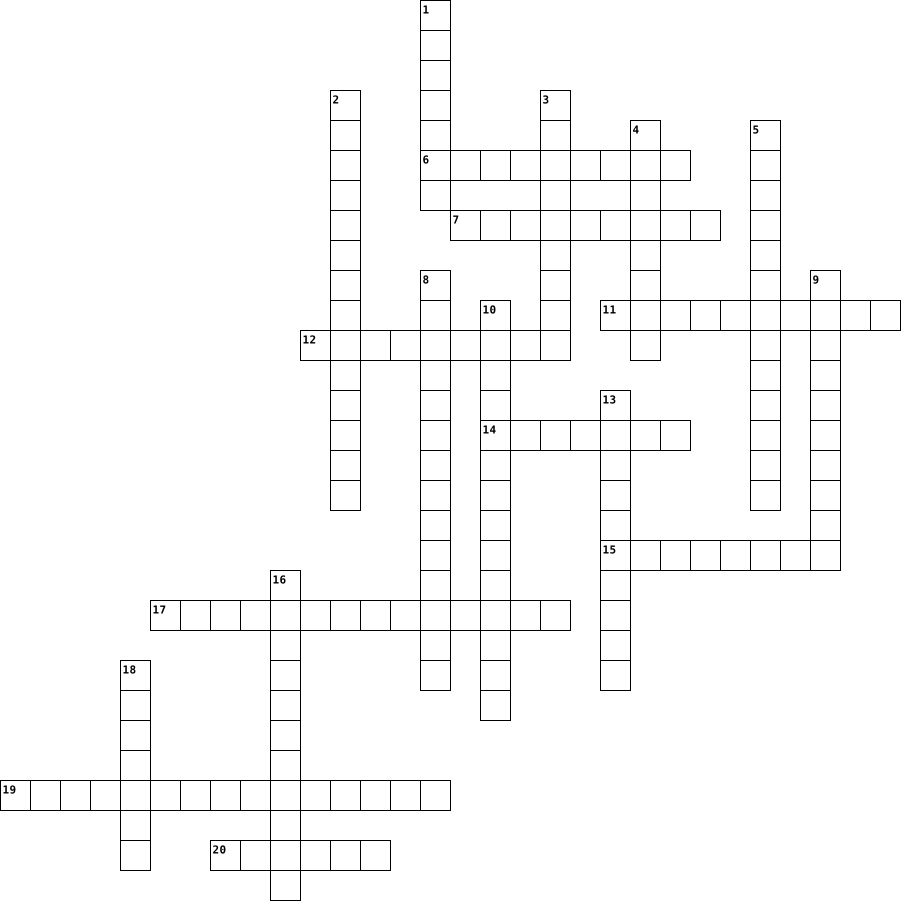
Across
- Hormones are chemical substances that are important for the body, hormones are produced by the glands?
- In the human respiratory system,the process of oxygen diffusion occurs in...
- An infection that causes inflammation of the air sacs in one or both lungs, which can fill with fluid is a disease?
- The reaction between reducing sugars and amino acids in the presence of heating is a reaction?
- Which is the primary lymphatic organ is?
- The condition when the body's immune system reacts abnormally to a foreign substance is?
- Inflammation of the bile ducts is a disease?
- The reaction of an alcohol with a carboxylic acid is called a reaction ?
- Nutrients are included in the examples of factors derived from?
Down
- Biomolecules in the form of proteins that function as catalysts in an organic chemical reaction are?
- Process of processing oil or fat by way of adding hydrogen gas to the double bond of a fatty acid nickel catalyst aid is?
- The intestinal glands produce hormones?
- Diabetes is a disease when there is a deficiency of the hormone ?
- Carbohydrate catabolism undergoes several stages, including the transfer of electrons that occur inside?
- Substitute oil or fat with the same weight as margarine is...
- a gland capable of producing hormones The hormone produced can stimulate other glands to produce hormones which are called ?
- the process of separating a certain quantity of a mixture into smaller parts is a process?
- The movement of the forearms to the palms, looking up and lying down is caused by muscle activity....
- Enzymes that help convert glucose into glucose 6 phosphate in the process of glycolysis are enzymes?
- The lungs are covered by a thin membrane called ?
20 Clues: The intestinal glands produce hormones? • Which is the primary lymphatic organ is? • Inflammation of the bile ducts is a disease? • The lungs are covered by a thin membrane called ? • Substitute oil or fat with the same weight as margarine is... • Nutrients are included in the examples of factors derived from? • ...
Chemistry Crossword 2024-03-01

Across
- One name for the vertical columns on the periodic table
- Used to decrease the concentration of a solution
- Name for group 17 elements
- These are used to speed up a chemical reaction
- ________ compounds are formed between a cation and anion
- Changing phase is an example of a ___________ change
- The SI base unit of distance in the metric system
- A reaction where a hydrocarbon burns in oxygen
- Bunsen _______________
- A reaction that releases heat from the system
- Element P
- kg unit
- A mixture with non-uniform appearance
- Will produce H+ ions when in water
- Will produce OH- when in water
- Used to measure the mass of something in the lab
- Element F
- The center of an atom that contains both protons and neutrons
- A negatively charged ion
- A temperature scale used in science
Down
- A naturally occurring radioactive element
- Worn to protect your eyes in the lab
- A bond between two atoms sharing electrons
- Substances to the left of the arrow in a chemical reaction
- A negatively charged subatomic particle
- Subatomic particle with no charge
- A solution in which water is the solvent
- A reaction that produces only one product
- The name for a substance with two or more atoms chemically bonded to one another
- A measure of the average kinetic energy in a substance
- The lightest noble gas element
- We need this element to live
- One name for the horizontal rows on the periodic table
- Aluminum is categorized as a ______________
- One of the most common solvents
- The state of matter with very little space between atoms
36 Clues: kg unit • Element P • Element F • Bunsen _______________ • A negatively charged ion • Name for group 17 elements • We need this element to live • The lightest noble gas element • Will produce OH- when in water • One of the most common solvents • Subatomic particle with no charge • Will produce H+ ions when in water • A temperature scale used in science • ...
Chapter 19 & 20 Chemistry 2022-05-11

Across
- a single electrode submerged in a solution of its ions
- the mor active an element is, the (blank) its tendency to lose electrons and a better reducing agent it is
- a process in which a substance acts as both an oxidizing agent and a reducing agent
- a battery that combines the oxidation-reduction chemistry of both voltaic and electrolytic cells
- a reaction in which elements undergo changes in oxidation numbers
- the process of passing a current through a cell for which the cell potential is negative causing an oxidation-reduction reaction to occur
- a substance that has the potential to cause another substance to be reduced is a reducing (blank)
- a conductor used to establish electrical contact with a nonmetallic part of a circuit such as an electrolyte
- assigning oxidation numbers is the (blank) step in balancing redox reactions
- oxidation is losing reduction is gaining
- processes in which the oxidation state of an element decreases
- (blank) cells use spontaneous oxidation-reduction reactions to convert chemical energy to electrical energy [galvanic cells]
Down
- a substance that has the potential to cause another substance to increase in charge is a(n) (blank) number
- the branch of chemistry that
- an electrolytic process in which a metal is reduced and a solid metal is deposited on a surface
- the part of a reaction involving oxidation or reduction alone is a (blank) reaction
- the potential of a half-cell under standard conditions measured relative to standard hydrogen electrode is (blank) electrode potential
- the electrode where reduction occurs
- an electrochemical cell that requires an external source of electrical energy to drive a chemical reaction that would not otherwise occur
- the electrode where oxidation occurs
- with electricity related applications of oxidation-reduction reactions
- processes in which the atoms or ions of an element experience an increase in oxidations state
22 Clues: the branch of chemistry that • the electrode where reduction occurs • the electrode where oxidation occurs • oxidation is losing reduction is gaining • a single electrode submerged in a solution of its ions • processes in which the oxidation state of an element decreases • a reaction in which elements undergo changes in oxidation numbers • ...
Chemistry Final 2022-06-01

Across
- a homogenous mixture of variable composition in a single phase
- the process of vaporization caused by random liquid particles close to the surface of a liquid obtaining sufficient kinetic energy to leave the liquid phase.
- a process for separating a mixture on the basis of the different boiling points of its components
- a substance formed when the anion of an acid and the cation of a base combine.
- a heterogenous mixture formed when medium-sized particles are dispersed in a dispersing medium
- the substance that is dissolved by a solvent; the substance in lower abundance in a solution
- The law that states that the pressure and volume of a sample of a gas at a constant temperature are inversely related PV=k
- the ability of a substance to spontaneously fill its available space
- chemical _____ is the state in a reversible chemical reaction in which the forward and reverse reaction rates are equal and the concentration of each substance is stable
- a _____ solution is a solution with a pH less than 7.
- the attraction between the particles of a liquid
- this type of solution contains the maximum amount of solute that it can hold at current conditions
- a naturally occurring biochemical catalyst
- any substance that breaks down normal surface tension by interfering with hydrogen bonds.
- the attraction between particles of a liquid and the particles of other materials.
- the study of the rates of chemical reactions and the steps by which they occur
- the _____ theory explains how chemical reactions occur that states that for a reaction to occur the substances (1) must collide (2) in the proper orientation and (3) with sufficient energy, called the activation energy
- the _____ solution contains more than the maximum amount of solute that it can normally hold at current conditions
- The law that states that the Kelvin temperature and a volume of a sample of gas at a constant pressure are directly related V/T=k
- a substance that changes a reaction rate without being consumed in the chemical reaction.
- the _____ point is the specific pressure and temperature at which a substance will be in the solid, liquid, and vapor forms in equilibrium.
- ______ energy is the energy released when gaseous particles form crystals
- a _____ solid has no distinct shape or underlying pattern.
- this type of reaction is a chemical reaction in which an acid and a base react to form water and a salt.
Down
- the most abundant substance in a solution; the substance that dissolves the solute.
- a heterogenous mixture formed when large particles are suspended in another substance. The suspended particles are so large that they will eventually settle out
- one of the different forms that an element can have
- the _____ law relates the pressure, temperature, volume, and the number of moles in any sample of gas; PV=nRT
- The maximum amount of a solute that can dissolved in a specific solvent under specific conditions, such as temperature and pressure.
- a solution that resists pH changes when acids or bases are added; usually consists of a weak acid and its conjugate base or a weak base and its conjugate acid.
- a _____ reaction is a reaction that can occur in both forward and the reverse directions
- the ability of a substance to be squeezed into a smaller volume by applying pressure
- a liquid's ability to resist flowing.
- a_____ solution is a solution that has a pH greater than 7.
- the ____ law states that the kelvin temperature and pressure of a sample of gas at a constant volume are directly related; P/T=k
- the _____ gas law states that the pressure, volume, and Kelvin temperature of a sample of gas vary jointly; PV/T=k
- ____tension is the elastic "skin" that forms on the surface of liquids, cased by the imbalance of intermolecular forces at the liquids surface
- the curved surface of a liquid caused by the interplay between cohesion and adhesion
- a substance that reduces the effectiveness of a catalyst, slowing its action
- the acronym form Standard Temperature and Pressure; this is a temperature and pressure agreed upon by chemists for comparison of research. 273.15 K and 101.325 kPa
- this type of solution contains less than the maximum amount of solute that it could hold at current conditions
- any substance that produces ions, which conduct electricity in a solution.
- (P) the force per unit area caused by the collisions of fluid particles with their container, usually found in kPa, torr, mmHg, or atm.
- the _______ energy is minimum energy necessary for a chemical reaction to occur when reactants collide in the proper orientation.
- the process by which particles pass through a tiny opening into an evacuated chamber.
- the ______ law states that the volume of a gas at a constant temperature and pressure is directly proportional to the number of moles in a gas.
- any substance that can flow
47 Clues: any substance that can flow • a liquid's ability to resist flowing. • a naturally occurring biochemical catalyst • the attraction between the particles of a liquid • one of the different forms that an element can have • a _____ solution is a solution with a pH less than 7. • a _____ solid has no distinct shape or underlying pattern. • ...
Carbonyl Crossword 2021-03-08

Across
- __ are a compound with general formula of RCNR’R
- What is the simplest carbonyl compound?
- Carboxylic acids have a __ stability than an alcohol
- A group two metal found in grignard reagent
- __ is formed from the addition of an alcohol group to either an aldehyde or ketone
- __ are derived by the removal of one or more hydroxyl groups
- A ketone and cyanide react to produce this
- __ process is a two stage process of an additional reaction followed by an elimination reaction
- __ has a bond angle of 120 degrees.
- __ is the product of a reaction of a Ketone with an Organometallic reagent
- The second step in the reaction between organolithium and carbonyls, using aqueous acid
- What allows more resonance forms?
Down
- what is the hybridisation of the C of R-COOH for a carboxylic acid
- carboxylic acids are made from carbon dioxide reacting with __
- A reagent containing Lithium used to perform addition reactions to carbonyls
- a chemical compound derived from an acid in which at least one -OH group is replaced by an -O-alkyl group
- __ are reagents containing carbon-metal bonds
- __ is an organic reaction that helps to convert carboxylic acids in the presence of alcohol and an acid catalyst to give an ester as the final product. Ester is formed along with water.
- __ is the analysis of infrared light interacting with a molecule. This can be analyzed in three ways by measuring absorption, emission and reflection.
- __ is widely used to methylate carboxylic acids
- __ is another name for a organometallic chemical reaction
- __ are an organic acid that contains a carboxyl group attached to a R-group. The general formula for a this is R-COOH
- A compound that consists of a carbon triple-bonded to a nitrogen atom
- what is usually the number of stretches that an Anhydride gives on the IR spectroscopy.
- A compound that consists of a C=O attached to two R groups
25 Clues: What allows more resonance forms? • __ has a bond angle of 120 degrees. • What is the simplest carbonyl compound? • A ketone and cyanide react to produce this • A group two metal found in grignard reagent • __ are reagents containing carbon-metal bonds • __ is widely used to methylate carboxylic acids • __ are a compound with general formula of RCNR’R • ...
thermochemistry 2022-05-19

Across
- the set of substances and energy that is being studied.
- The heat evolved or absorbed when a substance dissolves.
- A measure of the heat content of a chemical or physical system.
- the amount of heat required at a pressure of 1 standard atmosphere to raise the temperature of 1 gram of water 1° Celsius.
- The heat absorbed by one mole of that substance as it is converted from a liquid to a gas.
- Heat being released from an object.
- The science of measuring the heat absorbed or evolved during the course of a chemical reaction or change of state.
- Energy that comes from a warm object to a cool object.
- one object to another, during chemical reactions.
- Everything that is not a part of the system.
- The SI derived unit used to
Down
- The study of heat being transferred.
- Balanced chemical equations that include the physical states of all reactants and products and the energy change.
- Heat being absorbed into a cooler
- Theheat required to raise the temperature of the unit mass of a given substance by a given amount (usually one degree).
- A tool for measuring the amount of heat involved in a chemical reaction or other process.
- The ability to do work.
- The amount of energy needed to change one mole of a substance from the solid phase to the liquid phase at constant temperature and pressure.
- The number of heat units needed to raise the temperature of a body by one degree.
19 Clues: The ability to do work. • The SI derived unit used to • Heat being absorbed into a cooler • Heat being released from an object. • The study of heat being transferred. • Everything that is not a part of the system. • one object to another, during chemical reactions. • Energy that comes from a warm object to a cool object. • ...
zachs crossword puzzle 2022-09-19

Across
- basic unit of a chemical elemnt
- increases rate of chemical reaction
- sharing of two electrons
- spread around
- gives energy
- measure of thermal energy
- lowest part
- group of atoms bonded together
- reacts to what it is mixed with
- fatty substance
- acid form protiens
- gives your body nutrients to do things
- dissolves metals
- shows someone or something
- cannot be broken down
- manufactured or re defined
- change does not affect the chemical matter
Down
- relates to north or south
- sugar molecules
- composed of two or more elements
- action or fact as a whole
- building blocks
- change of materials into another
- takes up space
- regulates the heat or cold in a place
- wearing away of
- compound large class of compounds
- almost always a protien
- become a liquid
29 Clues: lowest part • gives energy • spread around • takes up space • sugar molecules • building blocks • wearing away of • fatty substance • become a liquid • dissolves metals • acid form protiens • cannot be broken down • almost always a protien • sharing of two electrons • relates to north or south • action or fact as a whole • measure of thermal energy • shows someone or something • ...
Biology Crossword 2020-10-08

Across
- / an organ or cell that can respond to signals
- / used to describe something that does not require oxygen
- respiration / aerobic process
- / higher osmotic pressure than a substance
- / outcome of chemical reactions
- / colorless fluid
- cycle / series of chemical reactions
- / provides most of the chemical energy
- / organelle that stores DNA
- / substance that produces color
- / maintaining internal status
- / acceptor of energized electrons
- / organic compound that provides energy
- / movement of high concentration to low
- / same osmotic pressure as a substance
Down
- / relating or requiring oxygen
- membrane / membrane that separates the interior from exterior
- / protoplasm within a living cell
- / contains amino acids
- / enlarges the rate of chemical reaction
- / organelles that conduct photosynthesis
- / living organism that produces organic substances
- / metabolic process
- / movement of low concentration to high
- / vesicle within the cytoplasm
25 Clues: / colorless fluid • / metabolic process • / contains amino acids • / organelle that stores DNA • / maintaining internal status • / relating or requiring oxygen • respiration / aerobic process • / vesicle within the cytoplasm • / outcome of chemical reactions • / substance that produces color • / protoplasm within a living cell • / acceptor of energized electrons • ...
rate of reaction 2020-01-26

Across
- chemical meaning of speed
- organic catalysts in living cells
- minimum energy required to form a chemical reaction
- the exponents in a rate expression
Down
- a graph of energy against the number of particles
- the slowest step of a reaction mechanism
- an equation that gives information about the rate of a reaction
- a substance that increases the rate of a reaction without being used
8 Clues: chemical meaning of speed • organic catalysts in living cells • the exponents in a rate expression • the slowest step of a reaction mechanism • a graph of energy against the number of particles • minimum energy required to form a chemical reaction • an equation that gives information about the rate of a reaction • ...
vocab 2023-02-06

Across
- a type of reaction in which multiple reactants combine to form a single product
- what is made after a reaction
- symbolic representations of chemical reactions in which the reactants and the products are expressed in terms of their respective chemical formulas
- a reaction that generates heat and light
- A number placed in front of a formula to balance a chemical equation
Down
- processes in which chemical species break up into simpler parts
- a substance that takes part in and undergoes change during a reaction
- a process that involves rearrangement of the molecular or ionic structure of a substance, as opposed to a change in physical form
8 Clues: what is made after a reaction • a reaction that generates heat and light • processes in which chemical species break up into simpler parts • A number placed in front of a formula to balance a chemical equation • a substance that takes part in and undergoes change during a reaction • a type of reaction in which multiple reactants combine to form a single product • ...
Chapter 8 Crossword 2023-02-03

Across
- a chemical reaction in which the standard change in free energy is positive
- lower the energy activation barrier
- A process that can occur without an input of energy
- The capacity to cause change.
- a chemical reaction where the change in the free energy is negative
- The energy of the universe is constant; Energy can be transferred and transformed, but it cannot be created or destroyed.
- energy that matter possesses because of its location or structure.
- Every energy transfer or transformation increases the entropy of the universe.
- Molecules possess energy because of the arrangement of electrons in the bonds between their atoms.
- Energy can be associated with the relative motion of objects
- associated with the random movement of atoms or molecules.
Down
- The study of how energy flows through living organisms.
- The study of the energy transformations that occur in a collection of matter
- Begins with a specific molecule, which is then altered in a series of defined steps, resulting in a certain product.
- A measure of disorder, or randomness.
- Consume energy to build complicated molecules from simpler ones
- The totality of an organism's chemical reactions
- a thermodynamic quantity equivalent to the capacity of a system to do work.
- the cells energy shuttle
- Some metabolic pathways release energy by breaking down complex molecules to simpler compounds
20 Clues: the cells energy shuttle • The capacity to cause change. • lower the energy activation barrier • A measure of disorder, or randomness. • The totality of an organism's chemical reactions • A process that can occur without an input of energy • The study of how energy flows through living organisms. • associated with the random movement of atoms or molecules. • ...
Introduction to science 2023-05-18

Across
- Anything that takes up space, and can be weighed
- Stored energy
- A simple molecule consisting of two atoms of hydrogen, and one of oxygen
- Atoms bonded together
- Made up of protons, neutrons, and electrons
- Sugar in your blood
- The process of breathing in oxygen and breathing out carbon dioxide
- Characteristics that enable us to differentiate one material from another
- How plants make food
- Substance that is present at the end of the chemical reactions
- The number of molecules or atoms involved in a chemical reaction
- A chemical element and its compounds in the natural state
Down
- The embryonic stage of a plant life cycle
- Generates ATP
- Plants need this along with water and oxygen for photosynthesis
- Colorless, odorless, and tasteless gas essential to living organisms
- Increasing of a plants volume and/or mass
- Parts of plants that absorb water and minerals and transport them to the stems
- Substance that is present at the start of the chemical reaction
- Disc shaped structure only found in plants
- A type of matter with special properties that make it less rigid than a solid, but more rigid than a gas
- The sun produces this
- Tells you the number of atoms in an element
- The begin of the growth of a seed into a seedling
- Organism that contains Chlorophyll and uses photosynthesis
- Produces light energy
26 Clues: Generates ATP • Stored energy • Sugar in your blood • How plants make food • Atoms bonded together • The sun produces this • Produces light energy • The embryonic stage of a plant life cycle • Increasing of a plants volume and/or mass • Disc shaped structure only found in plants • Made up of protons, neutrons, and electrons • Tells you the number of atoms in an element • ...
Introduction to science 2023-05-18

Across
- Substance that is present at the start of the chemical reaction
- A simple molecule consisting of two atoms of hydrogen, and one of oxygen
- Stored energy
- Generates ATP
- Increasing of a plants volume and/or mass
- The embryonic stage of a plant life cycle
- Organism that contains Chlorophyll and uses photosynthesis
- A type of matter with special properties that make it less rigid than a solid, but more rigid than a gas
- How plants make food
- The process of breathing in oxygen and breathing out carbon dioxide
- The number of molecules or atoms involved in a chemical reaction
- Parts of plants that absorb water and minerals and transport them to the stems
Down
- Characteristics that enable us to differentiate one material from another
- A chemical element and its compounds in the natural state
- Plants need this along with water and oxygen for photosynthesis
- Anything that takes up space, and can be weighed
- The sun produces this
- The begin of the growth of a seed into a seedling
- Made up of protons, neutrons, and electrons
- Atoms bonded together
- Disc shaped structure only found in plants
- Substance that is present at the end of the chemical reactions
- Sugar in your blood
- Tells you the number of atoms in an element
- Produces light energy
- Colorless, odorless, and tasteless gas essential to living organisms
26 Clues: Stored energy • Generates ATP • Sugar in your blood • How plants make food • The sun produces this • Atoms bonded together • Produces light energy • Increasing of a plants volume and/or mass • The embryonic stage of a plant life cycle • Disc shaped structure only found in plants • Made up of protons, neutrons, and electrons • Tells you the number of atoms in an element • ...
Fall Science Review Pt. 1 2024-12-16

Across
- A rotting pear and using bleach are examples of chemical ___________.
- A particle is a small ___________ of matter.
- ___________ is solid turning to a liquid.
- A crushed can, dissolved salt, and cutting an apple are examples of ___________ changes.
- Vegetable oil, sand, and glass lenses are all ___________ in water.
- A substance that changes during a chemical reaction is called the ___________.
- ___________ is liquid turning to solid.
- Helium, carbon dioxide, and oxygen are all examples of ___________.
- ___________ is the amount of matter in an object.
- A mixture in which a substance is evenly mixed throughout another substance is a ___________.
- Iron nail, balloon, and metamorphic rocks are all examples of ___________.
- A new substance formed during a chemical reaction is a ___________.
- ___________ is how well matter allows energy to pass through.
- A ___________ is a combination of two or more substances.
- Lemon juice, drink mix, and honey are all ___________ in water.
Down
- A ___________ change is a change in which at least one new substance is formed.
- ___________ is gas turning to liquid.
- Rubbing alcohol, canola oil, corn syrup, and melted ice cream are all examples of ___________.
- ___________ is the amount of space matter takes up.
- ___________ state is whether matter is a solid, liquid, or gas.
- ___________ is liquid turning to gas.
- ___________ is whether or not matter dissolves in water.
- Liquids have a fixed volume, and take the ___________ of their container.
- Gases have no fixed ___________ and no fixed shape.
- Solids have a ___________ volume and fixed shape.
25 Clues: ___________ is gas turning to liquid. • ___________ is liquid turning to gas. • ___________ is liquid turning to solid. • ___________ is solid turning to a liquid. • A particle is a small ___________ of matter. • ___________ is the amount of matter in an object. • Solids have a ___________ volume and fixed shape. • ___________ is the amount of space matter takes up. • ...
Vocabulary Ms Rodrigues 2023-10-12

Across
- a solid formed by a change in a solution, often due to a chemical reaction or change in temperature
- throwing a can to the floor and stepping on it
- a representation of a chemical reaction using symbols of the elements to indicate the amount of substance of each reactant and product
- a substance or molecule that participates in a chemical reaction; the ingredients that you start with
Down
- a process of one substance breaking down
- states that the mass of an object, or collection of objects new changes, no matter how the parts are rearranged
- A gate rusting
- a substance or molecule that is formed in a chemical reaction; the final output
8 Clues: A gate rusting • a process of one substance breaking down • throwing a can to the floor and stepping on it • a substance or molecule that is formed in a chemical reaction; the final output • a solid formed by a change in a solution, often due to a chemical reaction or change in temperature • ...
CHEM VOCAB 2023-10-20

Across
- OF CONSERVATION: The amount of matter does not change during a chemical reaction, only that the atoms are rearranged to form new substances. This is evidenced in a balanced chemical equation
- A positive subatomic particle found in the nucleus of an atom
- new substances formed in a chemical reaction and that are located on the right side of the arrow in a chemical equation
- The simplest form of a pure substance that cannot be broken into anything else by physical or chemical means
- substances broken apart or combined in a chemical reaction and that are located on the left side of the arrow in a chemical equation
- MIXTURE: is not uniform throughout, the component substances can be visibly distinguished
Down
- a negatively charged subatomic particle found outside of the nucleus of the atom
- physical combinations of two or more different substances that retain their own individual properties and are combined physically (mixed together)
- a subatomic particle with no charge (neutral) found in the nucleus of the atom
- MIXTURE: is uniform throughout, the substances are evenly mixed and cannot be visibly distinguished
10 Clues: A positive subatomic particle found in the nucleus of an atom • a subatomic particle with no charge (neutral) found in the nucleus of the atom • a negatively charged subatomic particle found outside of the nucleus of the atom • MIXTURE: is not uniform throughout, the component substances can be visibly distinguished • ...
Chemistry 2025-05-09

Across
- invokes a reaction
- acid and base in harmony
- a chemical change
- resists pH changes
- basic building block of matter
- liquid to gas
- basic building block of organic life
Down
- shiny, malleable, and conductive
- group of atoms stuck together
- a paper that exposes the truth
- electron loss
- gas to liquid
- atom's core
- each has a name in the periodic table
- ranges from acidic to basic
15 Clues: atom's core • electron loss • gas to liquid • liquid to gas • a chemical change • invokes a reaction • resists pH changes • acid and base in harmony • ranges from acidic to basic • group of atoms stuck together • a paper that exposes the truth • basic building block of matter • shiny, malleable, and conductive • basic building block of organic life • each has a name in the periodic table