
chemical reaction Crossword Puzzles
Chapter 12 2021-02-11

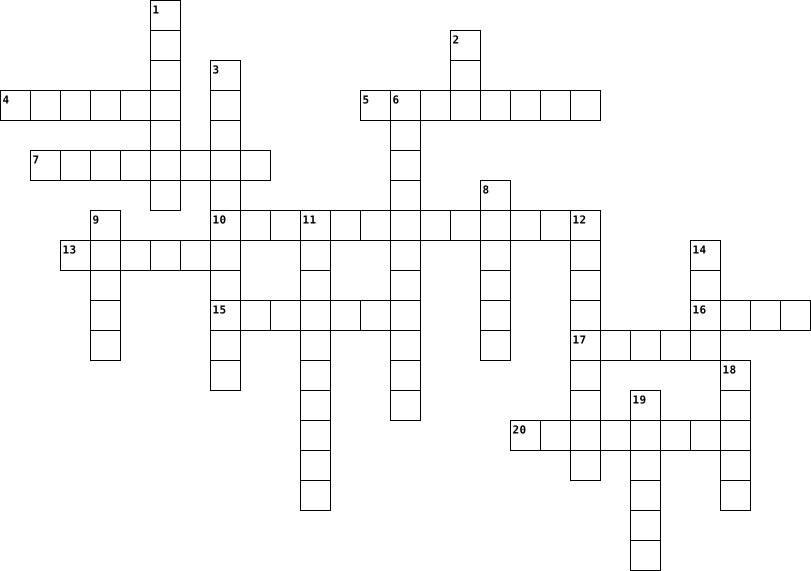
Across
- The branch of ________ that applies to substances that contain carbon is called organic chemistry.
- Chemically combining _________ or more atoms produces a molecule.
- A _______ physical mixture of two or mixture substances is a solution.
- _________ and alcohol are examples of miscible liquids.
- The simplest form of__________matter that cannot be broken down without the loss of identity is an element.
- _________ contains many substances, including nitrogen, carbon dioxide, and water vapor, and is an example of a physical mixture.
- Most inorganic substances do not burn because they do not contain _________.
- A common volatile organic __________ used in hair spray is Ethyl alcohol.
- All _______ has physical and chemical properties and exists in the form of a solid, gas, and liquid.
- Sodium chloride is table ___________.
- Chemical reaction that are characterized by or formed by giving off ________ are exothermic.
- ___________ with a positive electrical charge are considered to be cation.
- An _________ physical mixture of two or more immiscible substances is a emulsion.
- There are ______ naturally occurring elements, each with its own distinct physical and chemical properties.
- Change in the form of a substance that does not cause a chemical ___________ is a physical change.
- Liquids that can be _________ together to form stable solutions are miscible.
- A solution with a ________________value of 7 indicates a Neutral Solution.
Down
- A ___________ , colorless, oily substance that is used as a moisturizer in skin and body creams is Glycerin.
- All haircolor products are ___________ chemicals.
- _______________ cream is an example of an water-in-oil emulsion.
- Elements differ from one another because the difference in the ________ of their atoms.
- As example of an ___________compound that is used to perform chemical services in a salon is Ammonium hydroxide.
- The chemical combination of two or more _________ of different elements produces a compound.
- Substances that allows _______and water to mix, or emulsify, are surfactants.
- Substances used to neutralize ____________ or raise the pH of many hair products are Alkanolamines.
- People begun making _________ about 4,500 years ago by boiling oil or animal fat with wood ashes.
- The oxidation of hair color is an example of a __________ change.
- A substance, usually _______ , that dissolves another substance to form a solution is a solvent.
- An atom or molecule that carries an _____________ charge is a ion.
- A chemical combination of matter in definite (fixed) proportions is a ________ substances.
30 Clues: Sodium chloride is table ___________. • All haircolor products are ___________ chemicals. • _________ and alcohol are examples of miscible liquids. • _______________ cream is an example of an water-in-oil emulsion. • Chemically combining _________ or more atoms produces a molecule. • The oxidation of hair color is an example of a __________ change. • ...
Chemistry Bubble 2014-11-13

Across
- This applies to predictions of future events, to physical measurements that are already made, or to the unknown. Uncertainty arises in partially observable and/or stochastic environments, as well as due to ignorance and/or indolence.
- It is the analysis of the relationships between different physical quantities by identifying their fundamental dimensions (such as length, mass, time, and electric charge) and units of measure (such as miles vs. kilometers, or pounds vs. kilograms vs. grams) and tracking these dimensions as calculations or comparisons are performed.
- A ____________ is a substance or compound that is added to a system in order to bring about a chemical reaction, or added to see if a reaction occurs.
- ____________ is a chemical property that describes the tendency of an atom or a functional group to attract electrons (or electron density) towards itself.
- _______________ are the species formed from chemical reactions.
- This is the quantity of three-dimensional space enclosed by some closed boundary, for example, the space that a substance (solid, liquid, gas, or plasma) or shape occupies or contains.
- ____________ is based on, concerned with, or verifiable by observation or experience rather than theory or pure logic.
- These are those digits that carry meaning contributing to its precision.
- The person the mole is named after.
- This is a clear, colorless, highly pungent solution of hydrogen chloride in water. It is a highly corrosive, strong mineral acid with many industrial uses. It is found naturally in gastric acid.
- ___________ is a group of chemical elements with similar properties: under standard conditions, they are all odorless, colorless, monatomic gases with very low chemical reactivity. helium (He), neon (Ne), argon (Ar), krypton (Kr), xenon (Xe), and the radioactive radon (Rn).
- It is the calculation of relative quantities of reactants and products in chemical reactions.
- This is the very dense region consisting of protons and neutrons at the center of an atom.
- The thing we use to measure small things.
- _________ table is a tabular arrangement of the chemical elements, organized on the basis of their atomic number (number of protons in the nucleus), electron configurations, and recurring chemical properties.
- It is the smallest unit that defines the chemical elements and their isotopes.
- This is a subatomic particle with a negative elementary electric charge.
- _________ mass (M) is a physical property. It is defined as the mass of a given substance (chemical element or chemical compound) divided by its amount of substance. The base SI unit is kg/mol. However, for historical reasons, are almost always expressed in g/mol.
Down
- It is a chemical element. It is a member of the chalcogen group on the periodic table and is a highly reactive nonmetallic element and oxidizing agent that readily forms compounds (notably oxides) with most elements.
- ___________ is the determination of the absolute or relative abundance (often expressed as a concentration) of one, several or all particular substance(s) present in a sample.
- The _________ metals are a group (column) in the periodic table that take a +1 charge (+1 oxidation state.)
- It is an atom or molecule in which the total number of electrons is not equal to the total number of protons, giving the atom a net positive or negative electrical charge.
- Name this(HNO3).
- It is a subatomic particle with a positive electric charge of +1e elementary charge and mass slightly less than that of a neutron.
- The international system of units, abbreviated __________, from French: Le Système International d'Unités) is the modern form of the metric system and is the world's most widely used system of measurement, used in both everyday commerce and science.
- ____________ molecules are molecules composed of only two atoms.
- It is the degree of closeness of measurements of a quantity to that quantity's actual (true) value.
- Percent __________ is a special case of the percentage form of relative change calculated from the absolute change between the experimental (measured) and theoretical (accepted) values, and dividing by the theoretical (accepted) value.
- One mole of an ideal gas has a volume of 22.7 L at _______.
- What you have when two or more of any elements are joined together chemically.
- This is the degree to which repeated measurements under unchanged conditions show the same results.
- The _______ bond is type of chemical bond that involves the electrostatic attraction between oppositely charged ions.
- In chemistry,__________ , also referred to as reaction __________, is the amount of product obtained in a chemical reaction.
- ___________ weight(GFM) refers to the mass of a molecule. It is calculated as the sum of the mass of each constituent atom multiplied by the number of atoms of that element.
- It is found at group 11 period 4.
- He theorized that atoms have their charge Rutherford concentrated in a very small nucleus.
- ___________ are a group in the periodic table consisting of five chemically related elements: fluorine (F), chlorine (Cl), bromine (Br), iodine (I), and astatine (At).
- ____________ is a polyatomic anion with the empirical formula SO4(2−).
- The __________ bond is a chemical bond that involves the sharing of electron pairs between atoms.
- __________ reaction is a process that leads to the transformation of one set of chemical substances to another.
- The law of conservation of ________ , or principle of _______ conservation, states that for any system closed to all transfers of matter and energy (both of which have _______), the _______ of the system must remain constant over time, as system _______ cannot change quantity if it is not added or removed. (All 5 blanks are the same word.)
41 Clues: Name this(HNO3). • It is found at group 11 period 4. • The person the mole is named after. • The thing we use to measure small things. • One mole of an ideal gas has a volume of 22.7 L at _______. • _______________ are the species formed from chemical reactions. • ____________ molecules are molecules composed of only two atoms. • ...
8.3.1-2 Vocabulary 2025-01-30

Across
- a pigment that gives plants their green color and helps facilitate the conversion of light energy into chemical energy during photosynthesis
- A substance produced in a chemical reaction
- organelle where cellular respiration takes place, creating energy for the cell
- a process used by plants and a few other organisms to convert light energy into chemical energy by creating glucose from carbon dioxide and water
- Energy stored in chemical bonds
- the process by which the cells of all living things break down glucose to release its stored chemical energy
Down
- the organelle within a cell where photosynthesis takes place
- a type of sugar; the main source of energy for all living things
- a type of energy transmitted through electromagnetic radiation that is visible to the human eye
- a substance that takes part in and undergoes change during a reaction.
10 Clues: Energy stored in chemical bonds • A substance produced in a chemical reaction • the organelle within a cell where photosynthesis takes place • a type of sugar; the main source of energy for all living things • a substance that takes part in and undergoes change during a reaction. • organelle where cellular respiration takes place, creating energy for the cell • ...
AQA ELC - Rate of Reaction 2021-02-20

Across
- when two particles bump together.
- lowers the activation energy.
- hot and cold are examples of different...
Down
- what is made in a chemical reaction.
- number of particles in a given volume.
- grinding a solid into powder increases the...
- a chemical which is added in a chemical reaction
7 Clues: lowers the activation energy. • when two particles bump together. • what is made in a chemical reaction. • number of particles in a given volume. • hot and cold are examples of different... • grinding a solid into powder increases the... • a chemical which is added in a chemical reaction
biology PAMELA 2020-09-23

Across
- increases the rate of a chemical reaction
- structural protein found in skin
- are polymers of amino acids
Down
- a substance obtained
- energy nessesary to turn a sub to a pro
- deriving from the metabolism of a organism
- the substance on which an enzyme acts
- catalyst to bring about a chemical reaction
8 Clues: a substance obtained • are polymers of amino acids • structural protein found in skin • the substance on which an enzyme acts • energy nessesary to turn a sub to a pro • increases the rate of a chemical reaction • deriving from the metabolism of a organism • catalyst to bring about a chemical reaction
Chemical Reactions 2023-12-13

Across
- Reaction A reaction in which two or more substances combine to form a compound.
- the reaction that happens in an engine
- The elements about to react
- Reaction A type of reaction where energy is absorbed, such as an instant ice pack. More energy is needed to break the bonds of the reactants than is given off by forming the bonds of the products.
- sign symbolizes a reaction
Down
- what is produced in a reaction
- A number placed in front of a product or reactant that tells the number of atoms reacting in an equation (by multiplication).
- solid substance formed in a chemical reaction
- Reaction A reaction in which a single compound breaks down to form two or more simpler substances
- Reaction A type of reaction in which energy is released, such as the combustion of a car engine.
10 Clues: sign symbolizes a reaction • The elements about to react • what is produced in a reaction • the reaction that happens in an engine • solid substance formed in a chemical reaction • Reaction A reaction in which two or more substances combine to form a compound. • Reaction A type of reaction in which energy is released, such as the combustion of a car engine. • ...
Chemical Reactions 2023-12-13

Across
- Reaction A reaction in which two or more substances combine to form a compound.
- the reaction that happens in an engine
- The elements about to react
- Reaction A type of reaction where energy is absorbed, such as an instant ice pack. More energy is needed to break the bonds of the reactants than is given off by forming the bonds of the products.
- sign symbolizes a reaction
Down
- what is produced in a reaction
- A number placed in front of a product or reactant that tells the number of atoms reacting in an equation (by multiplication).
- solid substance formed in a chemical reaction
- Reaction A reaction in which a single compound breaks down to form two or more simpler substances
- Reaction A type of reaction in which energy is released, such as the combustion of a car engine.
10 Clues: sign symbolizes a reaction • The elements about to react • what is produced in a reaction • the reaction that happens in an engine • solid substance formed in a chemical reaction • Reaction A reaction in which two or more substances combine to form a compound. • Reaction A type of reaction in which energy is released, such as the combustion of a car engine. • ...
Chemicaly Science 2017-10-13

Across
- What type of chemical equation is this ? AB>>A+B.
- What type of chemical equation is this ? AB+CD>>AD+CB.
- What type of chemical equation is this ? A+B>>AB.
Down
- What type of chemical equation is this ? AB+BC>>AC+B.
- Where one or more new compounds are formed as a result of the rearrangement.
- How quickly the concentration of reactants decreases and how quickly the concentration of products increases.
- A substance that lowers the activation energy of a chemical reaction, which allows for the reaction to proceed at a faster rate.
- AB+oxygen>>oxides of A&B.
- The amount of energy required to pull two bonded atoms apart, which is the same as the amount of energy released when they are brought together.
- A measure of the concentration of hydronuim irons,H3 O
10 Clues: AB+oxygen>>oxides of A&B. • What type of chemical equation is this ? AB>>A+B. • What type of chemical equation is this ? A+B>>AB. • What type of chemical equation is this ? AB+BC>>AC+B. • What type of chemical equation is this ? AB+CD>>AD+CB. • A measure of the concentration of hydronuim irons,H3 O • ...
Stoichiometry Vocab Review 2022-05-19

Across
- 6.022 x 10²³ of particles (atoms, ions, molecules)
- A way to represent a compound that indicates the elements present in the compound and the relative number of atoms of each element
- The initial substances in a chemical reaction (represented on the left side of the chemical equation)
- A chemical equation in which the number of each type of atom on both sides of the equation are equal
Down
- Representation of a chemical reaction
- The final substances produced in a chemical reaction (represented on the right side of the chemical equation)
- The mass of one mole of an element or one mole of a compound. Numerically equivalent to the element's atomic mass in amu.
7 Clues: Representation of a chemical reaction • 6.022 x 10²³ of particles (atoms, ions, molecules) • A chemical equation in which the number of each type of atom on both sides of the equation are equal • The initial substances in a chemical reaction (represented on the left side of the chemical equation) • ...
Science Vocabulary Crossword 2017-11-30

Across
- the total number of protons and neutrons in a nucleus
- A period is the name given to a horizontal row of the periodic table.
- an element whose properties are intermediate between those of metals and solid nonmetals. They are electrical semiconductors.
- a product is a substance that is formed as the result of a chemical reaction
- a subatomic particle of about the same mass as a proton but without an electric charge, present in all atomic nuclei except those of ordinary hydrogen.
- The law of conservation of mass states that mass is neither created nor destroyed. In a closed system, mass of reactants is equal to mass of products
- the number of protons in the nucleus of an atom, which determines the chemical properties of an element and its place in the periodic table.
- A chemical formula tells us the number of atoms of each element in a compound
- a solid material that is typically hard, shiny, malleable, fusible, and ductile, with good electrical and thermal conductivity
Down
- the basic unit of a chemical element.
- a table of the chemical elements arranged in order of atomic number, usually in rows, so that elements with similar atomic structure (and hence similar chemical properties) appear in vertical columns
- a group is a column of elements in the periodic table of the chemical elements
- a stable subatomic particle occurring in all atomic nuclei, with a positive electric charge equal in magnitude to that of an electron, but of opposite sign.
- The electron cloud is the region of negative charge surrounding an atomic nucleus that is associated with an atomic orbital
- Any rearrangement of electrons in two atoms that generates a force, causing the atoms to be bound to each other, forming a molecule.
- a valence electron is an outer shell electron that is associated with an atom, and that can participate in the formation of a chemical bond if the outer shell is not closed
- an element or substance that is not a metal.
- a substance that takes part in and undergoes change during a reaction.
- a stable subatomic particle with a charge of negative electricity, found in all atoms and acting as the primary carrier of electricity in solids
- the central and most important part of an object, movement, or group, forming the basis for its activity and growth.
20 Clues: the basic unit of a chemical element. • an element or substance that is not a metal. • the total number of protons and neutrons in a nucleus • A period is the name given to a horizontal row of the periodic table. • a substance that takes part in and undergoes change during a reaction. • a product is a substance that is formed as the result of a chemical reaction • ...
Cross word puzzle 2017-11-14

Across
- / A solution that can resist pH change upon the addition of an acidic or basic components
- donors / Donating and accepting protons, and is not limited to aqueous solution.
- / A chemical substance that neutralizes alkali's, dissolves some metals, and turns litmus red; typically, a corrosive or sour-tasting liquid of this kind.
- lleaving agents /Baking soda and baking powder. Baking soda, or bicarbonate of soda, decomposes to form carbon dioxide that produces leavening.
- point / An _______ is when the moles of a standard solution.
- / When the color changes the _____ has been reached
- theory / Theory of Acids and Bases
- ion / The nucleus of a hydrogen atom separated from its accompanying electron.
- / The process by which an atom or a molecule acquires a negative or positive charge by gaining or losing electrons to form ions.
- ion / The ion H3O+, consisting of a detonated water molecule and present in all aqueous acids.
- /Food poisoning caused by a bacterium (botulinum) growing on improperly sterilized canned meats and other preserved foods.
- dye / A colored substance that has an affinity to the substrate to which it is being applied.
Down
- ion / A diatomic anion with chemical formula OH
- / The slow addition of one solution of a known concentration
- scale / Acidic and basic are two extremes that describe a chemical property chemicals.
- / Any chemical compound formed from the reaction of an acid with a base, with all or part of the hydrogen of the acid replaced by a metal or other cation
- / The number of molecules or ions in a given volume of a substance.
- / A chemical reaction in which an acid and a base react quantitatively with each other.
- number /Equal to 6.022140857 × 10 23
- / A substances that, in aqueous solution, are slippery to the touch, taste astringent, change the color of indicators
- / Concentration of a chemical species, such as an acid or an alkali in a solution.
- / Known as the "identity element".
- /The unit is defined as the amount or sample of a chemical substance that contains as many elementary entities
- / A concentration unit, defined to be the number of moles of solute divided by the number of liters of solution
24 Clues: theory / Theory of Acids and Bases • number /Equal to 6.022140857 × 10 23 • / Known as the "identity element". • ion / A diatomic anion with chemical formula OH • / When the color changes the _____ has been reached • / The slow addition of one solution of a known concentration • point / An _______ is when the moles of a standard solution. • ...
Chemistry B CrossWord Puzzle 2019-02-27

Across
- Potential difference between two electrodes; a measure of the chemical potential for a redox reaction to occur.
- The basic units of matter. (proton/neutron/electron)
- The smallest of the particles that make up an atom. (negative charge)
- A chemical property referring to the ability for given substance, the solute, to dissolve in a solvent.
- The ability or power to conduct or transmit heat, electricity, or sound.
- A substance formed when two or more chemical elements are chemically bonded together.
- The tendency of a substance to undergo chemical reaction, either by itself or with other materials, and to release energy.
- A column of elements in the periodic table of the chemical elements.
- A chemical element that is an effective conductor of electricity and heat.
- Contains two or more substances that are not chemically combined.
- A homogeneous mixture of two or more substances. (may exist in any phase)
- A state of matter characterized by particles arranged such that their shape and volume are relatively stable.
- A movement of positive/negative electric particles (such as electrons) accompanied by such observable effects as the production of heat, of magnetic field, or of chemical transformations.
- The name given to a horizontal row of the periodic table.
Down
- A subatomic particle found in the nucleus of every atom. (positive charge)
- A subatomic particle found in the nucleus of every atom. (neutral charge)
- A state of matter consisting of particles that have neither a definite volume or definite shape.
- An element whose properties are intermediate between those of metals and solid nonmetals or semiconductors.
- The opposition that a substance offers to the flow of electric current.
- A characteristic of an atom that is a measure of its size.
- Refers to the way in which atoms bond with each other. (chemical bonding)
- An element that doesn’t have the characteristics of metal including: ability to conduct heat or electricity, luster or flexibility.
- A material or an object that does not easily allow heat, electricity, light, or sound to pass through it.
- A state of matter that is free to flow. While it has volume, it does not have a definite shape.
- A substance whose atoms all have the same number of protons.
25 Clues: The basic units of matter. (proton/neutron/electron) • The name given to a horizontal row of the periodic table. • A characteristic of an atom that is a measure of its size. • A substance whose atoms all have the same number of protons. • Contains two or more substances that are not chemically combined. • ...
science vocab crossword 2023-12-18

Across
- when a substance disintegrates, breaks down or disperses
- incapable of being dissolved
- how compact a substance is
- a substance at the end of a chemical reaction
Down
- capability of being set on fire
- a compound of two or more substances that are not chemically bonded
- ability to be dissolved
- able to be dissolved, especially in water
- a substance that goes into a chemical reaction
9 Clues: ability to be dissolved • how compact a substance is • incapable of being dissolved • capability of being set on fire • able to be dissolved, especially in water • a substance at the end of a chemical reaction • a substance that goes into a chemical reaction • when a substance disintegrates, breaks down or disperses • ...
chemistry 2024-07-04

Across
- oxygen is added to a chemical in a reaction
- made up of more than one type of element or compound
- water turning into ice
- scientific word for burning
- smallest part of any substance
- made up of 1 type of atom
Down
- breaking down a substance using heat
- heat entering a reaction-feels colder
- made up of 2 or more types of atoms joined together by chemical bonds
9 Clues: water turning into ice • made up of 1 type of atom • scientific word for burning • smallest part of any substance • breaking down a substance using heat • heat entering a reaction-feels colder • oxygen is added to a chemical in a reaction • made up of more than one type of element or compound • made up of 2 or more types of atoms joined together by chemical bonds
Epipen Crossword 2024-10-12

Across
- A condition in which the immune system reacts to a harmless substance.
- When a part of the body becomes larger than usual due to fluid buildup, often caused by an allergic reaction.
- A device used to inject medicine during a severe allergic reaction.
- A substance that can cause an allergic reaction.
- A serious, life-threatening allergic reaction that requires immediate treatment.
- The type of situation when an EpiPen should be used
Down
- A chemical in the body that is released during allergic reactions, causing symptoms like swelling and itching.
- Raised, itchy bumps that appear on the skin during an allergic reaction.
- EpiPens affect these to help reverse the symptoms of an allergic reaction.
- The part of the body that can become blocked during an allergic reaction, making it hard to breathe.
- The part of the body where an EpiPen should be injected.
- The process of delivering medicine into the body using a needle.
12 Clues: A substance that can cause an allergic reaction. • The type of situation when an EpiPen should be used • The part of the body where an EpiPen should be injected. • The process of delivering medicine into the body using a needle. • A device used to inject medicine during a severe allergic reaction. • ...
phys sci 2025-11-17

Across
- the energy stored in chemical bonds (measured in kilojoules)
- a Measurement unit that = 6.02x10² particles
- a reaction that gives off heat to its surroundings.
- a reaction where 2 compounds exchange components making new compounds AB + CD -> AD + CB
- A reaction where 2 or more elements form a new compound A + B -> AB
Down
- A reaction where a compound is broken down into its component elements AB -> A + B
- a reaction where a compound and element join to form a different compound & element AB + C -> AC + B
- the molar mass is the AMU number with the unit grams (Measure the mass of I mole of molecules)
- compound a compound made of 2 elements
- (burning) rapid reaction that uses Oxygen to create heat & light.
- a reaction that absorbs heat from its surroundings.
- a unit = to the e mass o Measure Atomic mass) of I proton. (used to
12 Clues: compound a compound made of 2 elements • a Measurement unit that = 6.02x10² particles • a reaction that gives off heat to its surroundings. • a reaction that absorbs heat from its surroundings. • the energy stored in chemical bonds (measured in kilojoules) • (burning) rapid reaction that uses Oxygen to create heat & light. • ...
rock cycle 2021-03-01

Across
- compaction and cementation?
- how rocks are laid down?
- how rocks are broke down?
- heat and pressure?
- the breakdown of rock caused by a chemical reaction
- melting
Down
- how rocks move
- cooling
- the breakdown of rock without changing their composition
- cycle how rocks are formed?
- and crystallization two processes creating igneous
- magma that reaches the earth's surface
12 Clues: cooling • melting • how rocks move • heat and pressure? • how rocks are laid down? • how rocks are broke down? • compaction and cementation? • cycle how rocks are formed? • magma that reaches the earth's surface • and crystallization two processes creating igneous • the breakdown of rock caused by a chemical reaction • the breakdown of rock without changing their composition
Penang Port 2025-02-23

Across
- OH- ion ionised completely in water
- table that contain all elements
- chemical bond between non-metal and non-metal
- energy that bring things closer/farther
- bond sea of electron
- positive subatomic
Down
- negative subatomic
- H+ ion ionised completely in water
- outermost electron
- chemical bond between metal and non-metal
- smallest matter
- substance that speeds up reaction
12 Clues: smallest matter • negative subatomic • outermost electron • positive subatomic • bond sea of electron • table that contain all elements • substance that speeds up reaction • H+ ion ionised completely in water • OH- ion ionised completely in water • energy that bring things closer/farther • chemical bond between metal and non-metal • chemical bond between non-metal and non-metal
OrgoChem Crossword 2022-01-26

Across
- the process of cleaving/breaking a covalent bond where one previously bonded species takes both original bonding electrons from the other species
- the simplest whole number ratio of atoms present in a compound
- a nucleophile is a chemical species that forms bonds with electrophiles by donating an electron pair
- An organic compound in which all the carbon atoms are connected by single bonds
- an atom or a molecule that in chemical reaction seeks an atom or molecule containing an electron pair available for bonding
- show the various electron pairs moving around (it’s wavy)
Down
- The configuration of six carbon atoms in these compounds is called a "benzene ring"
- show the movement of single electrons during the breaking of the bond
- also called homolysis
- a chemical formula of a molecular compound that shows the kinds and numbers of atoms present in a molecule of the compound
- each of two or more compounds with the same formula but a different arrangement of atoms in the molecule and different properties
- an organic reaction where two or more molecules combine to form a larger one (the adduct)
- Aliphatic compounds are those hydrocarbons that are open chain compounds and also closed chains
- An atom or group of atoms which breaks away from the rest of the molecule
- a substance that takes part in and undergoes change during a reaction.
15 Clues: also called homolysis • show the various electron pairs moving around (it’s wavy) • the simplest whole number ratio of atoms present in a compound • show the movement of single electrons during the breaking of the bond • a substance that takes part in and undergoes change during a reaction. • ...
Weathering, Erosion and Deposition 2023-10-02

Across
- type of weathering that can be caused by animals
- type of beach landform caused by waves
- type of physical weathering consisting of falling debris
- the process of physical and chemical breakdown of rocks
- another word for speed
- type of chemical weathering involving acid rain
- word that means dry climate
- process in which sediment is laid down in flat layers
Down
- type of weathering where the minerals bonds break apart
- type of valley formed by glaciers
- type of chemical weathering involving the reaction with oxygen
- type of landform with medium to high elevation
- this moves sediment the most with erosion
- these grow into cracks of rocks and break them apart (2 words)
- this forms sand dunes
15 Clues: this forms sand dunes • another word for speed • word that means dry climate • type of valley formed by glaciers • type of beach landform caused by waves • this moves sediment the most with erosion • type of landform with medium to high elevation • type of chemical weathering involving acid rain • type of weathering that can be caused by animals • ...
chemicals 2023-08-21

Across
- a nuclear accident may cause .... of the surrounding area
- the kind of industry which produces medicines
- a natural or chemical material used by farmers to help grow crops
- the release of a gas
- mixing chemicals may cause a chemical ......
- a chemical found in diamonds and coal
- the chemicals added to food are called food ....
Down
- chemicals used to kill unwanted insects
- a household chemical product used to kill bacteria
- a form of energy from nuclear power which is dangerous to humans and animals
- an increase of gases in the atmosphere leading to global warming
- the opposite of organic
- a way of describing material with particular physical characteristics
- plants ..... water through their roots
- another word for poisonous
15 Clues: the release of a gas • the opposite of organic • another word for poisonous • a chemical found in diamonds and coal • plants ..... water through their roots • chemicals used to kill unwanted insects • mixing chemicals may cause a chemical ...... • the kind of industry which produces medicines • the chemicals added to food are called food .... • ...
Vocab words 2025-10-15

Across
- - formed in a chemical reaction
- - formed by a change in solution
- reaction
- Change
Down
- change
- - participate in a chemical reaction
- equation
- of Conservation of mass
8 Clues: change • Change • equation • reaction • of Conservation of mass • - formed in a chemical reaction • - formed by a change in solution • - participate in a chemical reaction
Mya Gilmore Chapter 13 2019-02-26

Across
- The ____ of reaction is dependent on the collisions among molecules.
- Bond Energy is also known as ______ ____.
- _____ must be moving fast enough to overcome the energy of activation.
- When reaction and it's reverse act at the same rate.
Down
- The _____ ___ is how quickly the concentration of reactants decreases or increases.
- ____ is a substance that lowers the activation energy of a chemical reaction.
- In an _________ reaction there is a net absorption of energy.
- In an _______ reaction there is a net release of energy.
- Is soap acidic or basic?
- Law of ___ conservation: No atom are gained or lost during a reaction.
10 Clues: Is soap acidic or basic? • Bond Energy is also known as ______ ____. • When reaction and it's reverse act at the same rate. • In an _______ reaction there is a net release of energy. • In an _________ reaction there is a net absorption of energy. • The ____ of reaction is dependent on the collisions among molecules. • ...
Lilly Herr - Chapter 13 2021-03-04

Across
- reaction rates are affected by (Co).
- reaction rates are affected by (T).
- the amount of energy required to pull two bonded atoms apart.
- in an ____ reaction there is a net absorption of energy.
Down
- is how quickly the concentration of reactants decreases and how quickly the concentration of products increases.
- no atoms are gained or lost during any reaction is the Law of Mass ________.
- when water behaves as a base, it gains.
- in an ____ reaction there is a net release of energy.
- acids _____ protons, bases accept them.
- is a substance that lowers the activation energy of a chemical reaction.
10 Clues: reaction rates are affected by (T). • reaction rates are affected by (Co). • when water behaves as a base, it gains. • acids _____ protons, bases accept them. • in an ____ reaction there is a net release of energy. • in an ____ reaction there is a net absorption of energy. • the amount of energy required to pull two bonded atoms apart. • ...
chemical reaxctions 2025-09-25

Across
- The new substances formed include carbon dioxide, water, and _________.
- The reaction between vinegar and baking soda is a type of _________ reaction (neutralization/oxidation)
- Vinegar is an example of a _________ (acid/base).
- This reaction is an example of an _________ reaction.
Down
- The vinegar and baking soda reaction absorbs a little heat, so it is _________ (endothermic/exothermic).
- Baking soda is a type of _________ (acid/base).
- The chemical name of baking soda is _________.
- The main visible evidence of the reaction is _________.
- When vinegar and baking soda mix, they produce a gas called _________.
- The fizzing and bubbling are caused by the release of _________.
- The formula CO₂ is _________.
11 Clues: The formula CO₂ is _________. • The chemical name of baking soda is _________. • Baking soda is a type of _________ (acid/base). • Vinegar is an example of a _________ (acid/base). • This reaction is an example of an _________ reaction. • The main visible evidence of the reaction is _________. • The fizzing and bubbling are caused by the release of _________. • ...
CR & P 2022-11-04

Across
- where photosynthesis occurs
- the main type of sugar in the blood and is the major source of energy for the body's cells
- the process by which plants use sunlight, water, and carbon dioxide to create oxygen and energy in the form of sugar.
- an important “energy molecule” found in all life forms.
- membrane-bound cell organelles that generate most of the chemical energy needed to power the cell's biochemical reactions
- A chemical process in which oxygen is used to make energy from carbohydrates
Down
- a process in which one or more substances, also called reactants, are converted to one or more different substances, known as products.
- a group of green pigments used by organisms that convert sunlight into energy via photosynthesis
- a colorless and non-flammable gas at normal temperature and pressure.
- an organism that can produce its own food using light, water, carbon dioxide, or other chemicals.
- an organism that eats other plants or animals for energy and nutrients
- the physical energy resulting from electromagnetic radiation, usually observed as it radiates from a source into the surrounding environment.
- A tiny pore in a plant leaf surrounded by a pair of guard cells that regulate its opening and closure, and serves as the site for gas exchange.
- a substance that is formed as the result of a chemical reaction
- a chemical element with an atomic number of 8
- a substance that enters into and is altered in the course of a chemical reaction.
16 Clues: where photosynthesis occurs • a chemical element with an atomic number of 8 • an important “energy molecule” found in all life forms. • a substance that is formed as the result of a chemical reaction • a colorless and non-flammable gas at normal temperature and pressure. • an organism that eats other plants or animals for energy and nutrients • ...
Section 4: Energy and Matter 2021-11-24

Across
- The ability of matter to produce work is:
- When a physical or chemical change occurs, the energy changes its phase and its
- The microwave is an example of:_____ energy
- Chemical energy is contained in
- A child on a slide is an example of:_____energy
- when a chemical reaction occurs the energy is
Down
- The ways in which energy manifests itself are called:
- name one of the most important examples of chemical energy
- A circuit is:____ energy
- Energy can:
- A person walking is an example of: ______energy
- Electromagnetic energy travels through
12 Clues: Energy can: • A circuit is:____ energy • Chemical energy is contained in • Electromagnetic energy travels through • The ability of matter to produce work is: • The microwave is an example of:_____ energy • when a chemical reaction occurs the energy is • A person walking is an example of: ______energy • A child on a slide is an example of:_____energy • ...
Cosmetology | Monica Slabaugh 2025-09-03

Across
- The study of the properties of matter and how matter changes
- liquid mixture that occurs when hydrogen ions are released when combined with water
- not forming a homogeneous mixture when added together
- tending to combine with or dissolve in lipids or fats.
- a chemical reaction that releases energy by light or heat
- cancer causing
- able to catch fire easily
- forming a homogeneous mixture when added together
Down
- having a tendency to mix with, dissolve in, or be wetted by water.
- A solution that has a pH above 7.0 (neutral)
- any chemical reaction that absorbs heat from its environment
- capable of catching fire or burning
12 Clues: cancer causing • able to catch fire easily • capable of catching fire or burning • A solution that has a pH above 7.0 (neutral) • forming a homogeneous mixture when added together • not forming a homogeneous mixture when added together • tending to combine with or dissolve in lipids or fats. • a chemical reaction that releases energy by light or heat • ...
photosynthesis 2026-02-03

Across
- plants release it into the air
- transports water and upward from the roots to the stems and leaves
- comes from the sun
- transports stuff from the leaves to the roots
- whats needed for reaction to take place to make food
- green plants, algae, and certain bacteria convert light energy (sunlight) into chemical energy (glucose
Down
- are substances that are formed in chemical reaction
- pours found on a plants stem and leaves
- when plants make their own food with sunlight, water, nutrients, and carbon dioxide
- A sugar molecule produced as food
- the green pigment that allows the plan to absorb sunlight
- An organism that makes its own food
12 Clues: comes from the sun • plants release it into the air • A sugar molecule produced as food • An organism that makes its own food • pours found on a plants stem and leaves • transports stuff from the leaves to the roots • are substances that are formed in chemical reaction • whats needed for reaction to take place to make food • ...
Vocabulary 2021-08-13

Across
- a colorless, odorless gas produced by burning carbon and organic compounds and by respiration
- a green pigment, present in all green plants and in cyanobacteria, responsible for the absorption of light to provide energy for
- a hierarchical series of organisms each dependent on the next as a source of food.
- energy that is transferred by electromagnetic radiation
- energy is just the force that causes things to move. Energy is divided into two types: potential and kinetic
- a group of atoms bonded together, representing the smallest fundamental unit of a chemical compound that can take part in a chemical reaction
Down
- a colorless, odorless reactive gas, the chemical element of atomic number 8 and the life-supporting component of the air.
- a biological community of interacting organisms and their physical environment.
- equiring complex organic compounds of nitrogen and carbon
- the process by which green plants and some other organisms use sunlight to synthesize foods from carbon dioxide and water
- is the potential of a chemical substance to undergo a chemical reaction to transform into other substances
- a plastid that contains chlorophyll and in which photosynthesis takes place.
12 Clues: energy that is transferred by electromagnetic radiation • equiring complex organic compounds of nitrogen and carbon • a plastid that contains chlorophyll and in which photosynthesis takes place. • a biological community of interacting organisms and their physical environment. • a hierarchical series of organisms each dependent on the next as a source of food. • ...
Chemical Reactions 2023-05-19

Across
- something that is made up of one type of atom or groups of atoms
- the reddish brown substance in the water
- ideas formed by thinking based on information
- an ending substance that is part of a chemical reaction
- a process where atoms rearrange to form new substances
- statement made based on evidence in answer to a question
- information gathered with the five senses
- science thinking that connects the evidence to the claim
Down
- matter cannot be created or destroyed
- data gathered from reliable sources or experiments
- something that can be observed about a substance
- the substance in the water that came from the farm
- a starting substance that is part of a chemical reaction
- nitrate the additional substance found in the pipes
- the substance the pipes were made out of
- tiny pieces of matter that make up everything
16 Clues: matter cannot be created or destroyed • the reddish brown substance in the water • the substance the pipes were made out of • information gathered with the five senses • ideas formed by thinking based on information • tiny pieces of matter that make up everything • something that can be observed about a substance • data gathered from reliable sources or experiments • ...
Perf 10 Reactions 2023-02-28

Across
- A material that causes a reaction to happen faster
- The molecules formed from a reaction (right of the arrow)
- A material that causes a reaction to happen slower
- Two or more atoms or molecules bonding to form new molecules
- A reaction that combines two or more atoms to a more complex form
Down
- A way of writing out chemical reactions
- A reaction that breaks down a molecule to its simpler form
- The large number that shows how many of an atom or molecule there are in a reaction
- A reaction that replaces two or more atoms from the reactant (simple or complex)
- The molecules or atoms that bond in a reaction (left of the arrow)
10 Clues: A way of writing out chemical reactions • A material that causes a reaction to happen faster • A material that causes a reaction to happen slower • The molecules formed from a reaction (right of the arrow) • A reaction that breaks down a molecule to its simpler form • Two or more atoms or molecules bonding to form new molecules • ...
Atomic Structure 2017-09-25

Across
- change when no new product is made after a certain reaction
- point temperature at which a solid melts
- when you filter a mixture the substance or LIQUID that goes through the filter paper and enters the beaker is called this
- substance made up of 2 or more types of atoms that are chemically bonded together
- 2 or more elements that are NOT chemically bonded together
- a mixture of solute dissolved in a solvent
- when you filter a mixture the left over substance is called this
- liquid that dissolves the solute
Down
- change when a new product is made after a chemical reaction
- substance that dissolves in a solvent
- doesn't dissolve e.g sand
- building blocks of life
- one or more atom
- made up of one type of atom only
- dissolves e.g salt
- point temperature at which a liquid boils
16 Clues: one or more atom • dissolves e.g salt • building blocks of life • doesn't dissolve e.g sand • made up of one type of atom only • liquid that dissolves the solute • substance that dissolves in a solvent • point temperature at which a solid melts • point temperature at which a liquid boils • a mixture of solute dissolved in a solvent • ...
Textbook Trivia 2024-09-27

Across
- Conduct, Convect, Radiate
- Never forget Fluid mechanics
- Unit Operations is my game
- Diffuse, Absorb,Dry
- J. M. Smith., H. C. Van Ness., M. M. Abbott
- Hand me my ChemE handbook
Down
- Balance thy materials
- Controls Chemical Engineers
- Chemical Process Technology
- Reaction Engineering to the rescue
- Transport is phenomenal!
11 Clues: Diffuse, Absorb,Dry • Balance thy materials • Transport is phenomenal! • Conduct, Convect, Radiate • Hand me my ChemE handbook • Unit Operations is my game • Controls Chemical Engineers • Chemical Process Technology • Never forget Fluid mechanics • Reaction Engineering to the rescue • J. M. Smith., H. C. Van Ness., M. M. Abbott
Chemistry Study Guide 2016-02-10

Across
- number that increase left to right
- column of elements
- a substance chemically can be used
- positive electric charge
- number of protons in nucleus of atom
- substance formed as a result of chemical reaction
- element whose properties are between metal and solid non-metals
- solid material, shiny, hard, electoral/thermal conductivity
- mass of one element at the beginning of a reaction will equal the mass of the element at the end
- group of atoms bonded together
- releases energy, heat
- absorbs energy, cool
- no electric charge
Down
- substance that takes part in/undoes changes in reactions
- letter(s) that represent the element
- mixture of 2 or more elements
- layer of something going over something
- patterns of electrons formed in an atom
- an element that is not a metal
- chemist, inventor, made periodic table
- number of protons and neutrons in an atom
- gasey elements
- neutral charge
- basic unit of a chemical element
- electrons in the outer most orbital
- positively charged center of the atom
26 Clues: gasey elements • neutral charge • column of elements • no electric charge • absorbs energy, cool • releases energy, heat • positive electric charge • mixture of 2 or more elements • an element that is not a metal • group of atoms bonded together • basic unit of a chemical element • number that increase left to right • a substance chemically can be used • ...
Foods Crossword 2017-01-23

Across
- Organic acids in proteins
- iron bonding protein pigment in muscle
- bond with 2 amino acids
- Emission of energy as electromagnetic waves
- water repelling
- energy Energy in motion
- foods that contain all the indispensable amino acids
- Sterilizing food from bacteria
- type of permanent denaturation
- covalent bonds that form between 2 protein molecules
- process by which heat or electricity is transmitted through a substance
Down
- preservation Temperature and time required to eliminate microorganisms
- 1 nitrogen and 2 hydrogen bonded to a carbon
- amino acids that must be supplied by foods in the diet
- Movement caused within a fluid
- network of elastic protein strands
- chemical reaction that adds oxygen
- lacking one or more of the indispensable amino acids
- chemical reaction removes oxygen
- Food is scolded in hot water
- chain of multiple amino acids bound by peptide bonds
- by product of cheese
- exchange of thermal energy between two systems
- Process that kills microbes in food and drink
- hydrophobic proteins found in milk
- alcohol that has been dehyrdrogenaed
26 Clues: water repelling • by product of cheese • bond with 2 amino acids • energy Energy in motion • Organic acids in proteins • Food is scolded in hot water • Movement caused within a fluid • Sterilizing food from bacteria • type of permanent denaturation • chemical reaction removes oxygen • network of elastic protein strands • chemical reaction that adds oxygen • ...
Biology Unit 2 crossword puzzle 2022-09-27

Across
- Nutrient used in protein and nucleic acids
- Second step of Anaerobic respiration. 2 types, alcoholic and lactic.
- Nutrient, forms the backbone for all molecules
- type of organism that must eat other organism to obtain energy
- Describes a situation in which oxygen is present
- Nutrient, used in phosphate of nucleic acids and phospholipids of the membrane
- Substances at the beginning of a chemical reaction
- Sphere of earth, all living thing on earth
- Pigment in chloroplast, used to trap light energy during photosynthesis
- Organelle, site of photosynthesis
Down
- Substances created during chemical reaction
- Anything that has mass and takes up space
- Organelle, site of 2 and 3 o Aerobic cellular respiration
- Sphere of earth, all water of earth
- Sphere of earth, all gases surrounding earth
- First step of aerobic respiration. Breaks down glucose into pyruvate.
- process of using light to make glucose.
- Sphere of earth, all the soil and rocks on earth
- Type of organism that is able to make its own food
- Describes a situation in which oxygen is not present.
20 Clues: Organelle, site of photosynthesis • Sphere of earth, all water of earth • process of using light to make glucose. • Anything that has mass and takes up space • Nutrient used in protein and nucleic acids • Sphere of earth, all living thing on earth • Substances created during chemical reaction • Sphere of earth, all gases surrounding earth • ...
Science 2021-03-18

Across
- carbohydrate in saliva(amylase)
- an equipment used to magnify objects (microscope)
- part of a cell that contains instruction to make new cells (nucleus)
- part of a plant cell that carries out photosynthesis chloroplasts)
- make reactions in a cell occur at a faster rate (enzymes)
- a single celled organism (amoeba)
- chemical that speed up a reaction (catalysts)
- enzymes that break down fats (lipases)
- the net movements of particles from area of high to low concentration (diffusion)
- group of tissues working together (organ)
Down
- the process of breaking down food molecules in the gut (digestion)
- in plant and animal cells respiration takes place in these (mitochondria)
- when animal cells swell and burst because of no cell walls (haemolysis)
- part of cell that controls chemical reaction(cytoplasm)
- a substance that dissolves a solute(solvent)
- type of sugar extracted from beet and sugar cane (sucrose)
- found in cells to help make proteins(ribosomes)
- tiny building blocks of living organism (cell)
- membrane are ______permeable(partially)
- two solutions of the same strength (isotonic)
20 Clues: carbohydrate in saliva(amylase) • a single celled organism (amoeba) • enzymes that break down fats (lipases) • membrane are ______permeable(partially) • group of tissues working together (organ) • a substance that dissolves a solute(solvent) • chemical that speed up a reaction (catalysts) • two solutions of the same strength (isotonic) • ...
Photosynthesis 2023-02-25

Across
- organisms that can produce their own food
- The cell where glucose is broken down
- Energy from light that is necessary
- A molecule that absorbs light and had color
- A set of chemical reactions that plants go through to reduce carbon dioxide
- The fluid that surrounds the grana in the chloroplast
- Produced from photosynthesis
- along with water and sunlight the third essential ingredient for photosynthesis
- the decomposition of molecules by the action of light
- flattened sacs inside the chloroplast
Down
- color of visible light for photosynthesis
- An organism that needs to consume other organisms for food
- Light energy is converted into this chemical energy
- A cell organelle in which photosynthesis takes place
- Necessary for photosynthesis along with sunlight and carbon dioxide
- The site for the light reaction of photosynthesis
- reaction in which energy is absorbed by chlorophyll in the thylakoid membrane
- Sugar that plants use to make energy
- A green pigment that absorbs light to provide energy
- A transport molecule that transports high energy electrons through the dark and light reactions
20 Clues: Produced from photosynthesis • Energy from light that is necessary • Sugar that plants use to make energy • The cell where glucose is broken down • flattened sacs inside the chloroplast • color of visible light for photosynthesis • organisms that can produce their own food • A molecule that absorbs light and had color • The site for the light reaction of photosynthesis • ...
Body Systems and Homeostasis 2023-03-01

Across
- type of digestion where food is broken down using enzymes
- system that breaks down food to be absorbed by the body
- when your brain controls your internal body temperature
- the internal framework of your body
- occurs in nature when the product of a reaction leads to the increase in that reaction
- an organ that produces hormones
- system of glands and organs
- condition that provides optimal functioning through balance
- system that pumps blood throughout your body
- system that contains your lungs
Down
- smallest type of blood vessel
- also known as an inhibitory loop
- collect oxygen-poor blood throughout your body and return it to your heart
- type of digestion where teeth are used to break down food into smaller pieces
- blood vessels that carry oxygen-rich blood from your heart to other parts of your body
- system that facilitates the nitrogenous waste from the body
- the process of using the outputs for the inputs
- transmits signals from your brain to the rest of your body
- the body's chemical messengers
- system that contains haploid cells
20 Clues: system of glands and organs • smallest type of blood vessel • the body's chemical messengers • an organ that produces hormones • system that contains your lungs • also known as an inhibitory loop • system that contains haploid cells • the internal framework of your body • system that pumps blood throughout your body • the process of using the outputs for the inputs • ...
photosynthesis 2025-01-22

Across
- Stroma that contains small circular DNA and ______
- H2O from the soil will enter into the roots through the
- The organelle that is responsible for cellular respiration is the
- Photosynthesis occurs in plants, algae, certain other ____ and some prokaryotes.
- The most important plant pigment
- Thylakoids are piles into ____
- The ______ is an organelle that carries out photosynthesis
- and ____
- It accepts electrons and transfer to other electron carrying molecules
Down
- The light absorbing pigment Chlorophyll is found in the _____
- Converts light energy to the chemical energy of food.
- Chlorophyll __ is the main light absorbing pigment.
- CO2 from the atmosphere will enter the leaves of the plants through the _____
- chlorophyll __ helps prevent photo-oxidative stress
- When the white light from the sun passes through a prism, it produces the ____ colors.
- Photosynthesis converts light energy to the chemical energy of ____.
- When a reaction involves ________ at least one electron from one molecule to another, oxidation-reduction reaction occurs.
- Chloroplast is composed of Outer membrane, Inner membrane, ______, and Thylakoids
- The light that comes from the sun
- Two colors are used for photosynthesis, the ___
20 Clues: and ____ • Thylakoids are piles into ____ • The most important plant pigment • The light that comes from the sun • Two colors are used for photosynthesis, the ___ • Stroma that contains small circular DNA and ______ • Chlorophyll __ is the main light absorbing pigment. • chlorophyll __ helps prevent photo-oxidative stress • ...
Photosynthesis and Cellular Respiration 2025-09-19

Across
- 2nd step of aerobic respiration
- Organism that makes its own food; base of the food chain
- Sphere of earth & all surrounding gasses
- Organelle; site of photosynthesis
- All water on earth
- Process of using light energy to make glucose & O2 from CO2 & H2O
- Pigment in chloroplast
- Adenosine diphosphate; energy storage molecule (2 phosphates)
- 2nd step of aerobic respiration
- Non-oxygen-present situation
- Organelle; site of steps 2/3 of cellular respiration (aerobic)
- Nutrient; Backbone for all molecules
Down
- All soils & rocks on earth
- 1st step of aerobic respiration, breaks down glucose into pyruvate + NADH
- Anything that has mass/takes up space
- Oxygen-present situation
- Substance at start of chemical reaction; makes products
- 1st step of photosynthesis
- 2nd step of photosynthesis
- respiration Process of breaking down glucose + O2 to make ATP, CO2 and H2O
- Organism; Must eat other organisms to obtain energy
- Transports electrons; 3rd step of aerobic respiration
- Sphere of all earthly, living things
- Adenosine Triphosphate; energy storage molecule (3 phosphates)
- Result of chemical reaction; from reactions
- Organism; Breaks down biotic compounds
26 Clues: All water on earth • Pigment in chloroplast • Oxygen-present situation • All soils & rocks on earth • 1st step of photosynthesis • 2nd step of photosynthesis • Non-oxygen-present situation • 2nd step of aerobic respiration • 2nd step of aerobic respiration • Organelle; site of photosynthesis • Sphere of all earthly, living things • Nutrient; Backbone for all molecules • ...
Photosynthesis and Cellular Respiration 2025-10-20

Across
- The transformation of energy into something that can be used by living organisms
- Organelle where cellular respiration takes place
- Something made/given off from a chemical reaction
- Organelle where photosynthesis takes place
- Adenosine triphosphate, product of cellular respiration
- A green pigment found in the chloroplast
- CO₂, reactant of photosynthesis, product of cellular respiration
- Type of energy used by plants in the process of photosynthesis
- A process in which plants use sunlight to create glucose, using water and carbon dioxide
Down
- A substance at the beginning of a chemical reaction
- The parts of a cell
- The capacity for work, glucose gets turned into this in cellular respiration
- A process in which food gets turned to energy, using glucose and oxygen
- H₂O,reactant of photosynthesis, product of cellular respiration
- Type of organism(s) that use cellular respiration
- A reactant in the process of photosynthesis
- Sugar, product of photosynthesis, reactant of cellular respiration
- A type of plant that uses photosynthesis, often in water
- Living organism that uses photosynthesis, have chloroplast
- O₂,product of photosynthesis, reactant of cellular respiration
20 Clues: The parts of a cell • A green pigment found in the chloroplast • Organelle where photosynthesis takes place • A reactant in the process of photosynthesis • Organelle where cellular respiration takes place • Something made/given off from a chemical reaction • Type of organism(s) that use cellular respiration • A substance at the beginning of a chemical reaction • ...
1224 2026-03-02

Across
- to stop something from happening
- unusual and from a foreign place
- very important and influential
- able to cause death
- to suggest something as good
- working well and producing results
- a place where legal cases are decided
- to take someone to the police
- the largest amount allowed
- a harmful reaction to certain foods or substances
- an official order that stops something
- to break a law or rule
- land surrounded by water
- to show strong disagreement
- a container used to trap animals
- an official instruction about what is allowed
- to become less
- money paid as punishment
Down
- to receive from parents
- material made of threads used to catch fish
- a person who raises animals
- a substance in food that helps the body grow
- a response to something
- a substance produced by a chemical process
- a person who catches fish for a living
- a sea animal with a hard shell and claws
- helpful advice
- to grow or change over time
- to make someone suffer for doing wrong
- to let something go free
30 Clues: helpful advice • to become less • able to cause death • to break a law or rule • to receive from parents • a response to something • land surrounded by water • to let something go free • money paid as punishment • the largest amount allowed • a person who raises animals • to grow or change over time • to show strong disagreement • to suggest something as good • ...
Chemistry Vocab Mini Puzzle #2 2025-01-12

Across
- property of pure substances that use the Mohs scale to describe its "strength".
- property of pure substances that is described as whether or not it will dissolve in another substance.
- the substance(s) present at the beginning of a chemical reaction.
- a chemical reaction that occurs in this type of system is not sealed and a change in mass can be observed.
Down
- property of pure substance that is described as the mass of an object divided by its volume.
- the substance(s) made as a result of a chemical reaction.
- a chemical reaction that occurs in this type of system is sealed and a change in mass will not be observed.
7 Clues: the substance(s) made as a result of a chemical reaction. • the substance(s) present at the beginning of a chemical reaction. • property of pure substances that use the Mohs scale to describe its "strength". • property of pure substance that is described as the mass of an object divided by its volume. • ...
Biochemistry 2013-11-30

Across
- Protein that catalyzes reactions using a lock and key mechanism
- Reaction that involves forming a larger molecule from smaller subunits
- Process in which a protein's structure is altered due to certain factors
- Characteristic that involves an aversion to water
- Linkages connecting monosaccharides together
- One product of a condensation reaction between alpha glucose and beta fructose
- Function of fats that conserves heat
- An indigestible carbohydrate for humans
- Enzyme for which the substrate is hydrogen peroxide
Down
- Process of removing an amino group from a molecule
- A molecule with the same chemical formula but a varying molecular structure
- Waterproof coating on plants that aids in the conservation of water
- Component of a cell's membrane
- Chemical system that maintains the pH level of a solution
- Energy-storing molecule in plants
- Movement of particles through a membrane down a concentration gradient
- Molecule consisting of one glycerol and three fatty acids
- Building block of protein
- Functional group with a carbonyl group at the end of a chain; acts as a preservative for soft tissues
- The number of amino acids
20 Clues: Building block of protein • The number of amino acids • Component of a cell's membrane • Energy-storing molecule in plants • Function of fats that conserves heat • An indigestible carbohydrate for humans • Linkages connecting monosaccharides together • Characteristic that involves an aversion to water • Process of removing an amino group from a molecule • ...
Chemistry Unit Study Guide 2016-02-10

Across
- on periodic table
- helium,neon,argon,krypton,Xeon,radon are this.
- shiny,hard,malleable and ductile
- substance that is not a metal
- negative charge
- electrons in outermost orbital
- positive charge
- element whose properties are intermediate between those of metals and solid non-metals
- energy absorbed/cold
- number of protons in nucleus of atom
- thin coating of gold, silver, or other metal
- atomic weight I'd another name
- no charge
Down
- groups of atoms bonded together
- basic unit of a chemical element
- substance consumed during the reaction to make products
- states mass in an isolated system is neither created, nor destroyed by chemical reactions of physical transformation
- created periodic table
- known as family
- element name on periodic table
- compound that are formed when a reaction goes to completion
- energy released/hot
- elements with the same number of electron shells arranged in same row
- composed of two or more separate elements
- center of the atom built of protons and neutrons
- regions of space outside the nucleus of atom
26 Clues: no charge • negative charge • known as family • positive charge • on periodic table • energy released/hot • energy absorbed/cold • created periodic table • substance that is not a metal • element name on periodic table • electrons in outermost orbital • atomic weight I'd another name • groups of atoms bonded together • basic unit of a chemical element • shiny,hard,malleable and ductile • ...
Science study guide 2016-02-10

Across
- sets of electrons in a ring
- matter cannot be created or destroyed
- an element with properties of both metals and nonmetals
- the substance in a chemical reaction that's changed
- takes in heat
- releases heat
- a numbering of the electrons/protons an element has
- particle with a negative charge
- a set of different atoms mixed together
- a certain type of matter with unique properties
- the core of an atom, storing protons and neutrons
- an element with poor conductivity and malleability
- particle with a positive charge
- a column on the periodic table
Down
- an element with a full valence orbital
- covering one element with another
- something created by a chemical reaction
- man who created the periodic table
- an electron on the outermost orbital
- an abbreviation for the name of an element
- the mass of an element
- an element with high conductivity and malleability
- particle with no charge
- small unite of matter with the properties of a certain element
- a row on the periodic table
25 Clues: takes in heat • releases heat • the mass of an element • particle with no charge • sets of electrons in a ring • a row on the periodic table • a column on the periodic table • particle with a negative charge • particle with a positive charge • covering one element with another • man who created the periodic table • an electron on the outermost orbital • ...
Chemistry study guide 2016-02-11

Across
- changed when combined with another substance
- number of characteristics of element that represents number of proton in the nucleus
- made of atoms of one kind and can't be separated by chemical reaction
- small amount of something
- brittle not thin or flat can be a liquid
- formed with heat
- atomic particles found in the nucleus of an atom and carries a positive charge
- mix of metal and nonmetal
- weight of substance
- electrons in outer most orbital
- ring or shell
- form something with two substances
Down
- thin pieces of metal
- rare gas include helium or neon or argon
- can't be distorted by a chemical reaction
- smallest part of an element
- center part of an atom made up of protons or neutrons
- row that goes up and down
- shiny good conductor of heat and electricity
- absorbed heat
- atomic particles in the nucleus of an atom and carries a negative charge
- horizontal row on the periodic table
- letter of up to two to sort out the elements
- atomic particles in the nucleus of an atom and carries no change
24 Clues: absorbed heat • ring or shell • formed with heat • weight of substance • thin pieces of metal • small amount of something • row that goes up and down • mix of metal and nonmetal • smallest part of an element • electrons in outer most orbital • form something with two substances • horizontal row on the periodic table • rare gas include helium or neon or argon • ...
Biology Quest Review 2019-11-25

Across
- stands for adenosine triphosphate, is energy for a cell
- happens in the thylakoids, gives us oxygen
- the first step of respiration, doesn't need oxygen
- where respiration occurs in a cell
- used to produce ATP and specifically NAD+ when oxygen is not present
- product of photosynthesis reactant for respiration
- requiring oxygen
- reactant of photosynthesis and product of respiration
- chemical formula O2 product for photosynthesis reactant of respiration
- the second step of respiration
- aka light-independent reaction makes glucose
- where photosynthesis occurs in a plant
- the thin pancakes in the chloroplasts
Down
- produced in lactic acid fermentation, makes your muscles hurt
- chains of chemical enzyme reactions that take place in cells
- the last step of respiration
- the process by which plants make food
- H2O reactant for photosynthesis and product of respiration
- not requiring oxygen
- the process plants and animals use to make ATP energy
- produced in alcoholic fermentation, makes bread rise
- the area of the chloroplast surrounding the thylakoids and grana
22 Clues: requiring oxygen • not requiring oxygen • the last step of respiration • the second step of respiration • where respiration occurs in a cell • the process by which plants make food • the thin pancakes in the chloroplasts • where photosynthesis occurs in a plant • happens in the thylakoids, gives us oxygen • aka light-independent reaction makes glucose • ...
MATTER 2017-03-11
Across
- an object that has a low density will
- ____ change is a change in the state of matter (size or shape)
- _____ is a mixture that is homogeneous
- _______mixture is unevenly distributed
- is the amount of space that matter takes up
- is a physical combination of 2 or more substance
- an object that has a high density will
- chemical reactions happen at different _____
- when matter goes through a ____ change, a new substance is formed
Down
- is a measure of the amount of matter in a given amount of space
- ____ state of matter does not definite shape or volume
- ______ reaction absorbs heat energy
- ______ mixture are uniform throughout
- is the amount of force that gravity puts on that amount of matter
- ____ state of matter has a definite shape and volume
- _____ reaction produces heat energy
- means that no more material may be dissolved into the mixture
- is the amount matter within an object
- is a homogeneous mixture metals
- ____ state of matter has definite volume and takes shape of the container
20 Clues: is a homogeneous mixture metals • ______ reaction absorbs heat energy • _____ reaction produces heat energy • an object that has a low density will • ______ mixture are uniform throughout • is the amount matter within an object • _____ is a mixture that is homogeneous • _______mixture is unevenly distributed • an object that has a high density will • ...
Science 2024-07-03

Across
- A type of book or article to publish scientific findings.
- A fertilised egg cell.
- The formula for speed is the total distance divided by the total what?
- Able to be broken down naturally. (No hyphen in answer)
- An irreversible type of reaction in which a new product is formed.
- The unit for energy. (Starts with the letter J)
- Limewater becomes what colour in the presence of Carbon Dioxide.
- The X axis on a graph represents what type of variable?
- Sacrifical Protection involves sacrificing one material to save another from what?
Down
- The differences in a type of species
- Any preservational store of genetic information is called a gene what?
- Joint Monomers.
- Respiration using oxygen is what?
- The sacrificial material for Sodium.
- A type of field that's direction is from the North to South pole.
- The process of supplying air to the lungs. (Not Respiration)
- The solution used to test for Starch.
- The common term for Dihydrogen Monoxide.
- Incomplete Combustion occurs when there is a lack of what in the chemical reaction?
- A term to describe a no longer existent species.
20 Clues: Joint Monomers. • A fertilised egg cell. • Respiration using oxygen is what? • The differences in a type of species • The sacrificial material for Sodium. • The solution used to test for Starch. • The common term for Dihydrogen Monoxide. • The unit for energy. (Starts with the letter J) • A term to describe a no longer existent species. • ...
Chp. 2 Biochemistry 2023-10-13

Across
- large particles that settle out; ex. blood
- energy that does work
- when two or more different kinds of atoms bind
- bonds that share electrons
- electrically negative
- used in Pet scans
- shell another name for energy level
- electrically neutral
- number of of an atom that is sum of protons and neutrons
- reaction that involves atoms combining to form large molecule
- structural variations of elements like deuterium
- number that is equal to the number of protons in the nucleus
Down
- reactions that release heat
- bonds that hold atoms together
- particles or building blocks of elements
- substances that increase the rate of chemical reactions without being changed
- reaction that occurs when molecule is broken down into smaller molecules
- particles of very tiny and do not settle out
- have positive electrical charge
- usually serve as catalysts
- capacity to do work
- energy that is stored
- bonds that transfer electrons
- are biological catalysts
- occupies space and has mass
- particles are larger and do not settle out; jello
- reactions that absorb heat
27 Clues: used in Pet scans • capacity to do work • electrically neutral • energy that does work • electrically negative • energy that is stored • are biological catalysts • bonds that share electrons • usually serve as catalysts • reactions that absorb heat • reactions that release heat • occupies space and has mass • bonds that transfer electrons • bonds that hold atoms together • ...
Chemistry definition crossword 2024-09-27

Across
- The lowest frequency and longest wavelength of the EM Spectrum
- 6.626x10^-34
- electrons that are in the outermost shell or energy level.
- Transfer of heat by electromagnetic waves
- Absolute zero
- Study of energy changes that happen during chemical reactions
- Atoms of the same element with different numbers of neutrons
- Charged particle
- A type of reaction that absorbs heat
- The weighted average of all the naturally occurring isotopes of that element
- Transfer of heat by fluid motions of materials
- 3.0x10^8
- The capacity to move, do work, change matter, or produce heat.
- A neutral subatomic unit that is in the nucleus
Down
- Thermal equilibrium
- Determines the identity of an element
- The electron arrangement in an atom
- A type of reaction that releases heat
- Energy is neither created or destroyed
- Flow of heat between objects by contact
- Smallest part of an element that maintains the properties of that element
- The energy of an object's motion
- A measure of disorder in a system
- A negative subatomic unit that is in the electron cloud
- Energy stored in chemical bonds
25 Clues: 3.0x10^8 • 6.626x10^-34 • Absolute zero • Charged particle • Thermal equilibrium • Energy stored in chemical bonds • The energy of an object's motion • A measure of disorder in a system • The electron arrangement in an atom • A type of reaction that absorbs heat • Determines the identity of an element • A type of reaction that releases heat • Energy is neither created or destroyed • ...
Biology final project 2025-04-28

Across
- A cell without a nucleus.
- 1/2 of the replicated/duplicated chromosome.
- The process of burning something.
- All living parts in an ecosystem.
- Protein that act as a catalyst to accelerate a reaction.
- A highly contagious disease caused by the SARS- Cov2 virus.
- When a cell is damaged beyond repair, it destroys itself (pop).
- System Releases hormones into the bloodstream.
- Something that causes or starts a chemical reaction.
- An organism that causes disease in the host.
- System Breaks down and absorbs nutrients from the food.
Down
- The end product of a biological or chemical process, what was made or created.
- A preparation that is used to stimulate the body's immune response against a specific disease.
- An organism that is infected with or fed upon by a parasitic or pathogenic organism.
- System Helps the body move
- Transports water through a semipermeable membrane.
- non-living parts of an ecosystem.
- A tumor or growth that is not cancerous.
- A cell with a nucleus.
- Fat tissue that helps keep an organism warm.
20 Clues: A cell with a nucleus. • A cell without a nucleus. • System Helps the body move • The process of burning something. • non-living parts of an ecosystem. • All living parts in an ecosystem. • A tumor or growth that is not cancerous. • 1/2 of the replicated/duplicated chromosome. • Fat tissue that helps keep an organism warm. • An organism that causes disease in the host. • ...
ENZYMES 2025-01-21

Across
- FIRST ENZYME TO BE DISCOVERED
- NONPROTEINIC PART OF ENZYMES
- ENZYMES ARE MADE UP OF ___
- PROTEINIC PART OF ENZYMES
- SCIENTIST WHO GAVE TERM ENZYMES
- ENZYME SPEED UP RATE OF REACTION BY LOWERING___
- MOLECULE OFTEN ACTIING AS COENZYMES
- ANOTHER TERM USED FOR ENZYMES
- A BIOLOGICAL MOLECULE THAT SPEED UP THE CHEMICAL REACTION
Down
- ENZYME WHEN WORK ON ONLY ONE SPECIFIC SUBSTRATE
- ENZYMES ARE BIOLOGICAL _____
- ENZYMES FUNTIONING INSIDE THE CELL
- ENZYMES ARE POLYMER OF____
- FIRST ENZYME TO PURIFY AND CRYTALLIZED
- ENZYMES ARE SENSITIVE TO
- COMBINATION OF APOENZYMES AND COENZYME
- ENZYME WHICH JIONS THE END OF 2 STRAND OF N.A.
- ENZYMES HYDROLYSING STARCH
18 Clues: ENZYMES ARE SENSITIVE TO • PROTEINIC PART OF ENZYMES • ENZYMES ARE POLYMER OF____ • ENZYMES ARE MADE UP OF ___ • ENZYMES HYDROLYSING STARCH • ENZYMES ARE BIOLOGICAL _____ • NONPROTEINIC PART OF ENZYMES • FIRST ENZYME TO BE DISCOVERED • ANOTHER TERM USED FOR ENZYMES • SCIENTIST WHO GAVE TERM ENZYMES • ENZYMES FUNTIONING INSIDE THE CELL • MOLECULE OFTEN ACTIING AS COENZYMES • ...
GENERAL CHEMISTRY 1 2020-05-05

Across
- a chemical substance that is present at the start of a chemical reaction
- an ion with a negative electrical charge
- a chemical process where a solid turns into a gas without going through a liquid stage
- element with atomic number 18 and is represented by the symbol Ar
- an element with an atomic number 6
- Can be bent or hammered into shape
- mass per unit volume
- a branch of science that deals with the form and properties of matter and substances
- group of 8 valence electrons around an atom
- one or more atoms with the same atomic number but with different numbers of neutrons
- containing one mole of a substance
- a very light colorless element that is one of the six inert gasses; the most difficult gas to liquefy; occurs in economically extractable amounts in certain natural gases
- A compound containing only carbon and hydrogen
- element with properties intermediate between those of metals and nonmetals
- a metric unit of weight equal to one thousandth of a kilogram
- that which has mass and occupies space
- A substance containing oxygen that has a pH of more than 7 and less than 14
- a branch of science that explores the chemical processes within and related to living organisms
- a heterogeneous mixture in which solute-like particles settle out of a solvent-like phase sometime after their introduction
- chemical element with the symbol Ag
- a group of atoms bonded together, representing the smallest fundamental unit of a chemical compound that can take part in a chemical reaction
- chemical element with the symbol Au
- containing or involving or occurring in the form of ions
- a mixture containing two or more metallic elements or metallic and nonmetallic
- the conversion of a vapor or gas to a liquid
Down
- means 10
- of or relating to or characterized by covalence
- a fourth state of matter
- a visible suspension in the air of particles of a substance
- A medium or substance that does not conduct heat or electricity
- any compound containing a chlorine atom
- a membrane-bound structure that contains a cell's hereditary information and controls its growth and reproduction
- material which permits the flow of energy and electricity
- any of several complex proteins that are produced by cells and act as catalysts in specific biochemical reactions
- the process of turning from liquid into vapor
- metal with element symbol Pb and atomic number 82
- The relative formula mass of a substance in grams
- The chemical erosion of iron and steel
- state of matter characterized by having a definite volume but not a definite shape
- the degree of hotness or coldness of a body or environment
- a type of homogeneous mixture in which the dispersed particles do not settle out
- incapable of mixing
- a sugar comprising one glucose molecule linked to a galactose molecule; occurs only in milk
- an alloy of copper
- amount of matter in a substance
- unable to dissolve in a solvent
- A substance that dissolves a solute
- something that makes a chemical reaction happen more quickly without itself being changed
- means 100
- a common nonmetallic element; constitutes 78 percent of the atmosphere by volume
50 Clues: means 10 • means 100 • an alloy of copper • incapable of mixing • mass per unit volume • a fourth state of matter • amount of matter in a substance • unable to dissolve in a solvent • an element with an atomic number 6 • Can be bent or hammered into shape • containing one mole of a substance • chemical element with the symbol Ag • A substance that dissolves a solute • ...
Physical Science Review #1 2023-04-13

Across
- The amount of one material in a certain volume of anothe material
- How close a measurement is to the true value
- Material that increases the rate of a reaction
- The temperature at which no more energy can be removed
- Turns red litmus paper blue and produces OH-
- Basic particle from which all elements are made
Down
- Change of state from a gas to a liquid
- Force of attraction that holds two atoms together
- Highest part of a transverse wave
- Number in front of a chemical formula
- Turns blue litmus paper red and produces H+
- Energy needed to start a chemical reaction
12 Clues: Highest part of a transverse wave • Number in front of a chemical formula • Change of state from a gas to a liquid • Energy needed to start a chemical reaction • Turns blue litmus paper red and produces H+ • How close a measurement is to the true value • Turns red litmus paper blue and produces OH- • Material that increases the rate of a reaction • ...
2.3. Vocab Review 2023-10-18

Across
- The organelle in which Photosynthesis takes place
- Glucose is this type of macromolecule
- The process in which CO2 and H2O is turned into glucose and oxygen
- Where plants get their energy from
- The organelle in which Cellular Respiration takes place
Down
- This shows reactants coming together to make products
- The biotic carbon in the cycle
- The process in which glucose and oxygen is turned into CO2, H2O, and energy
- What you start with in a chemical reaction (they react)
- What you end with in a chemical reaction (they are produced)
- The abiotic carbon in the cycle
- The energy the mitochondria makes
12 Clues: The biotic carbon in the cycle • The abiotic carbon in the cycle • The energy the mitochondria makes • Where plants get their energy from • Glucose is this type of macromolecule • The organelle in which Photosynthesis takes place • This shows reactants coming together to make products • What you start with in a chemical reaction (they react) • ...
Types of matter, physical and chemical changes crossword 2024-08-27

Across
- The process where a solid forms from a solution during a chemical reaction.
- A chemical reaction that occurs when a substance reacts with oxygen, releasing heat and light.
- The rapid vaporization of a liquid when it is heated to its boiling point.
- A type of mixture where the components can be easily distinguished.
- A chemical change where a material combines with oxygen, often producing rust or tarnish.
- When a solid changes directly into a gas without becoming liquid.
- The process of gas changing directly into a solid without becoming liquid.
Down
- The process of a liquid changing into a gas.
- The process where gas turns back into a liquid.
- The process of changing from a liquid to a solid.
- The process of changing from a solid to a liquid.
- A type of mixture where the composition is uniform throughout.
- The process of turning vapor into liquid when it cools down
- Another term for freezing, the process where a liquid turns into a solid.
- A process used to separate mixtures based on differences in boiling points.
15 Clues: The process of a liquid changing into a gas. • The process where gas turns back into a liquid. • The process of changing from a liquid to a solid. • The process of changing from a solid to a liquid. • The process of turning vapor into liquid when it cools down • A type of mixture where the composition is uniform throughout. • ...
Permanent Waves 2023-02-03

Across
- this should be tested when the hair is dry
- waving solution breaks disulphide bonds through a chemical reaction called _____________
- do this to the hair immediately before a permanent wave service
- Before proceeding with a perm, check the scalp for ___________
- Avoid excess __________ when styling the hair after a perm service
- off-base placement of rods creates the least amount of _________
Down
- hair that is bent up at the ends
- the size of the ____ determines the size of the "s" pattern
- the most common type of perm rods are __________
- permanent waving solution breaks disulphide bonds by adding ___________
- the chemical reaction involved for neutralization
- the ability of the hair to stretch and contract
- all perm wraps begin by sectioning the hair into ______
- this hair will become saturated with waving lotion quicker than hair with a large diameter
- perm solution should be rinsed from hair for at least ______ minutes
- Avoid getting perm solution in the client's _______
16 Clues: hair that is bent up at the ends • this should be tested when the hair is dry • the ability of the hair to stretch and contract • the most common type of perm rods are __________ • the chemical reaction involved for neutralization • Avoid getting perm solution in the client's _______ • all perm wraps begin by sectioning the hair into ______ • ...
hydrocarbon chemistry 2025-09-18

Across
- A compound ending in -ol.
- The name of the fraction used to fuel cars.
- The alcohol used in alcoholic drinks.
- A type of chemical reaction that produces an alcohol from an alkene and steam.
- A substance containing only hydrogen and carbon atoms.
- A substance that speeds up a chemical reaction without being used up itself.
- The process of breaking down long-chain hydrocarbons into smaller, more useful ones.
Down
- The name of the process by which crude oil is separated.
- The process of separating crude oil into different fractions.
- A long-chain hydrocarbon molecule.
- A molecule with the same molecular formula but a different structural formula.
- The functional group found in all alcohols.
- The smallest alkane molecule.
- A mixture of hydrocarbons with similar boiling points.
- A homologous series of saturated hydrocarbons.
- A compound containing a carbon-carbon double bond.
16 Clues: A compound ending in -ol. • The smallest alkane molecule. • A long-chain hydrocarbon molecule. • The alcohol used in alcoholic drinks. • The name of the fraction used to fuel cars. • The functional group found in all alcohols. • A homologous series of saturated hydrocarbons. • A compound containing a carbon-carbon double bond. • ...
Vocabulary Crossword 2017-11-29

Across
- a group is a column of elements in the periodic table of the chemical elements
- A chemical formula tells us the number of atoms of each element in a compound.
- a stable subatomic particle occurring in all atomic nuclei, with a positive electric charge equal in magnitude to that of an electron, but of opposite sign.
- a product is a substance that is formed as the result of a chemical reaction
- a solid material that is typically hard, shiny, malleable, fusible, and ductile, with good electrical and thermal conductivity
- The electron cloud is the region of negative charge surrounding an atomic nucleus that is associated with an atomic orbital
- The law of conservation of mass states that mass is neither created nor destroyed. In a closed system, mass of reactants is equal to mass of products
- an element or substance that is not a metal.
- a substance that takes part in and undergoes change during a reaction.
- the central and most important part of an object, movement, or group, forming the basis for its activity and growth.
Down
- the basic unit of a chemical element.
- a stable subatomic particle with a charge of negative electricity, found in all atoms and acting as the primary carrier of electricity in solids
- A period is the name given to a horizontal row of the periodic table.
- an element whose properties are intermediate between those of metals and solid nonmetals. They are electrical semiconductors.
- a valence electron is an outer shell electron that is associated with an atom, and that can participate in the formation of a chemical bond if the outer shell is not closed
- a table of the chemical elements arranged in order of atomic number, usually in rows, so that elements with similar atomic structure (and hence similar chemical properties) appear in vertical columns
- the number of protons in the nucleus of an atom, which determines the chemical properties of an element and its place in the periodic table.
- Any rearrangement of electrons in two atoms that generates a force, causing the atoms to be bound to each other, forming a molecule.
- the total number of protons and neutrons in a nucleus
- a subatomic particle of about the same mass as a proton but without an electric charge, present in all atomic nuclei except those of ordinary hydrogen.
20 Clues: the basic unit of a chemical element. • an element or substance that is not a metal. • the total number of protons and neutrons in a nucleus • A period is the name given to a horizontal row of the periodic table. • a substance that takes part in and undergoes change during a reaction. • a product is a substance that is formed as the result of a chemical reaction • ...
Cross word puzzle 2017-11-14

Across
- scale / Acidic and basic are two extremes that describe a chemical property chemicals.
- ion / The nucleus of a hydrogen atom separated from its accompanying electron.
- /The unit is defined as the amount or sample of a chemical substance that contains as many elementary entities
- / The number of molecules or ions in a given volume of a substance.
- theory / Theory of Acids and Bases
- number /Equal to 6.022140857 × 10 23
- / The process by which an atom or a molecule acquires a negative or positive charge by gaining or losing electrons to form ions.
- point / An _______ is when the moles of a standard solution.
- / The slow addition of one solution of a known concentration
- ion / The ion H3O+, consisting of a detonated water molecule and present in all aqueous acids.
- /Food poisoning caused by a bacterium (botulinum) growing on improperly sterilized canned meats and other preserved foods.
- / A chemical substance that neutralizes alkali's, dissolves some metals, and turns litmus red; typically, a corrosive or sour-tasting liquid of this kind.
- / Known as the "identity element".
- dye / A colored substance that has an affinity to the substrate to which it is being applied.
Down
- ion / A diatomic anion with chemical formula OH
- / When the color changes the _____ has been reached
- / A chemical reaction in which an acid and a base react quantitatively with each other.
- donors / Donating and accepting protons, and is not limited to aqueous solution.
- / A substances that, in aqueous solution, are slippery to the touch, taste astringent, change the color of indicators
- / Concentration of a chemical species, such as an acid or an alkali in a solution.
- lleaving agents /Baking soda and baking powder. Baking soda, or bicarbonate of soda, decomposes to form carbon dioxide that produces leavening.
- / A concentration unit, defined to be the number of moles of solute divided by the number of liters of solution
- / A solution that can resist pH change upon the addition of an acidic or basic components
- / Any chemical compound formed from the reaction of an acid with a base, with all or part of the hydrogen of the acid replaced by a metal or other cation
24 Clues: theory / Theory of Acids and Bases • number /Equal to 6.022140857 × 10 23 • / Known as the "identity element". • ion / A diatomic anion with chemical formula OH • / When the color changes the _____ has been reached • / The slow addition of one solution of a known concentration • point / An _______ is when the moles of a standard solution. • ...
Chemistry 2021-11-18

Across
- they interact
- change that causes a change in appearance.
- columns of the periodic table
- Solid, metallic, and fair conductors
- Center of the atom
- the particles below or inside the atom.
- change that causes a new substance to be formed
- a substance that cannot be broken down
- Group of 2 or more atoms
- subatomic particle located in the nucleus and has a neutral charge
- the smallest unit of matter that has all the chemical properties of an element.
Down
- the study of the properties of atoms and
- A substance that forms from a chemical reaction.
- A single kind of matter
- anything that has volume and mass.
- substance made of 2 or more atoms.
- subatomic particle located in the electron cloud and has a negative charge
- subatomic particle located in the nucleus and has a positive charge
- has conductive, malleable, and lustrous properties
- A substance that undergoes a change during a reaction
- the area around the nucleus
- colorless, brittle, poor conductors, and not malleable or ductile.
- rows of the periodic table
23 Clues: they interact • Center of the atom • A single kind of matter • Group of 2 or more atoms • rows of the periodic table • the area around the nucleus • columns of the periodic table • anything that has volume and mass. • substance made of 2 or more atoms. • Solid, metallic, and fair conductors • a substance that cannot be broken down • the particles below or inside the atom. • ...
Chemistry Unit review 2016-02-11

Across
- The outer most orbital
- Regions of space outside the nucleus
- rows and colors
- an object that radiates heat
- Atomic particles in the nucleus
- The letters for the element
- something that has opposite properties of metal
- Rows going down
- a Russian Chemist
- the smallest part of an element
- The number of a proton or electron
- a group of atoms bonded together
- when a layer of one mental goes and sticks onto another metal
Down
- a result of a chemical action
- elements that are strong and elements that are in a lot of things
- the mass of products Ina chemical reaction must equal the mass
- A particle that moves around the nucleus
- The center of the atom
- particles that have a positive charge
- A part or aspect of something that is essential
- sucks energy inside of it
- a substance that changes during reaction
- The mass of an element
- elements that are in between
- a gaseous element such as helium
- all molecules , but not all molecules are compounds
26 Clues: rows and colors • Rows going down • a Russian Chemist • The outer most orbital • The center of the atom • The mass of an element • sucks energy inside of it • The letters for the element • an object that radiates heat • elements that are in between • a result of a chemical action • Atomic particles in the nucleus • the smallest part of an element • a gaseous element such as helium • ...
Biology terms 2021-08-19

Across
- simple sugars made up of three to seven carbons
- building blocks of fat in our bodies
- pertains to the energy needed to initiate a chemical reaction
- the most abundant carbohydrate found in foods
- large complex of molecules made up of smaller units called amino acids
- can observe or dissolve to a greater degree
- any diverse groups of organic compounds
- biological catalyst and is almost always a protein
- building blocks of protein
- a macromolecule containing carbon hydrogen and, oxygen
- anything that is produced
- component of lipids and is an essential sugar for many living things
Down
- molecule acted upon an enzyme
- generic term for any disaccharide and monosaccharide
- any substance that is composed of two molecules of simple sugars
- energy is taken in from surrounding
- is one of the structural components or building blocks of dna/rna
- main information carrying molecules of the cell
- being a solution that is unable to absorb/dissolve any more solute at a given temp & pressure
- when a chemical reaction happens energy is transferred to or from surroundings
20 Clues: anything that is produced • building blocks of protein • molecule acted upon an enzyme • energy is taken in from surrounding • building blocks of fat in our bodies • any diverse groups of organic compounds • can observe or dissolve to a greater degree • the most abundant carbohydrate found in foods • simple sugars made up of three to seven carbons • ...
Physical and chemical changes 2018-05-30

Across
- a substance diffused in the air
- sub-atomic particle
- _____are changed into other substance
- compound two molecular bonded
- columns of element in the periodic table
- pure substance
- there are 6_____ in school
- change of state from solid to a gas
- emit of gas or vapour
- liquid to gas same as evaporate
- when substance particle are collide with each other
- one atom
- only two atoms
- is the abundance of a consitituent divded by the total volume
- easily becomes a gas
Down
- two reactant makes_____
- chain of molecular simpler to each other repeating
- an arrangement in space of isolated points in a regular pattern
- speeds the chemical reaction
- two or more different substance bonded together e.g. water
- when the environment does damage to metal
- gas turn to liquid
- you can soeed this up by adding heat engery
- type of catalyst
- water turns to gas when heated
- element into a table
- ice in the sun
- two attracted to each other
28 Clues: one atom • pure substance • ice in the sun • only two atoms • type of catalyst • gas turn to liquid • sub-atomic particle • element into a table • easily becomes a gas • emit of gas or vapour • two reactant makes_____ • there are 6_____ in school • two attracted to each other • speeds the chemical reaction • compound two molecular bonded • water turns to gas when heated • ...
science project. 2023-05-24

Across
- animals
- bottom of the wave
- a chemical reaction that releases energy by light or heat.
- a compound or substance that has been purified or prepared, especially artificially.
- essential to living organisms
- a group of atoms bonded together
- the process by which green plants and some other organisms use sunlight to synthesize foods from carbon dioxide and water.
- freezing
- a process in living organisms involving the production of energy
- hot
- top of a wave
- Fall
- the branch of biology that deals with the relations of organisms
Down
- the substance of which a physical object is composed
- the bones of a animal
- a fart
- hard
- get from eating food
- like water
- tool to find how hot something is
- a group of atoms bonded together
- reactions in which the reactants absorb heat energy from the surroundings to form products
- after a test you get a
- an organism, especially a soil bacterium, fungus
- A basic part of a whole
- source of nuclear energy.
- science concerned with Earth
- is a chemical element with the symbol C and atomic number 6
28 Clues: hot • hard • Fall • a fart • animals • freezing • like water • top of a wave • bottom of the wave • get from eating food • the bones of a animal • after a test you get a • A basic part of a whole • source of nuclear energy. • science concerned with Earth • essential to living organisms • a group of atoms bonded together • a group of atoms bonded together • tool to find how hot something is • ...
Chemistry Revision Crossword 2024-04-21

Across
- The weight of the nucleus is known as the Atomic _______
- When an atom _______ electrons it becomes negatively charged
- When two or more different atoms bond
- When two or more atoms bond together
- The type of bond formed between non-metals
- Electrons in the outer-most shell of an atom
- The substances that are formed in a chemical reaction
- An atom that has gained or lost electrons
- Negatively charged particle in an atom
- Elements that sit between the metals and non-metals
Down
- The substances that combine in a chemical reaction
- When an atom _______ electrons it becomes positively charged
- The type of bond formed between a metal and non-metal
- Positively charged particle in an atom
- The atomic particle with a neutral charge
- The large group of metals in the middle of the Periodic Table
- Pure substances in the Periodic Table
- The gasses in Group 8
- The smallest particle of matter
- Elements are positioned on the Periodic Table in order of Atomic _______
- Increases down Groups but decreases across Periods
21 Clues: The gasses in Group 8 • The smallest particle of matter • When two or more atoms bond together • When two or more different atoms bond • Pure substances in the Periodic Table • Positively charged particle in an atom • Negatively charged particle in an atom • The atomic particle with a neutral charge • An atom that has gained or lost electrons • ...
Crossword Puzzle 2025-07-21

Across
- – Organic compound with enzymes and muscles
- – Type of cycle recycling matter
- – Reaction that breaks down molecules
- – Water vapor becomes liquid
- – Acid-base indicator color for acids
- – Gas released during respiration
- – Movement of rock or soil by water or wind
- – All water on Earth
- – Scientific investigation process
- – Type of fuel made from ancient life
- – Substance with pH below 7
- – Algae bloom from too much nutrient
- – Type of reaction involving bonding
- – Capacity to do work
- – Ultimate source of energy on Earth
- – Stored form of energy
- – Element essential to all living things
Down
- – Element needed for proteins
- – Element in DNA and bones
- – Plants use sunlight to make food
- – Layer of gases surrounding Earth
- – Universal solvent, essential to life
- – Outer layer of solid Earth
- – Study of organisms and environment
- – Sugars and starches (energy source)
- – A group of tissues working together
- – Energy that travels as waves
- – Type of energy from heat
- – Starting substance in chemical reactions
- – Energy-carrying molecule of cells
30 Clues: – All water on Earth • – Capacity to do work • – Stored form of energy • – Element in DNA and bones • – Type of energy from heat • – Substance with pH below 7 • – Outer layer of solid Earth • – Water vapor becomes liquid • – Element needed for proteins • – Energy that travels as waves • – Type of cycle recycling matter • – Gas released during respiration • ...
Anatomy & Physiology Ch 1 & 2 Crossword 2025-09-26

Across
- a special protein to speed up chemical reactions
- energy that our cells can use
- the organic molecule used to make most body structures (skin, muscle, bone, blood, etc.)
- special fats that make the cell membrane
- reaction that breaks molecules, as in digestion
- the body system that transports oxygen around the body
- keeping the body systems within a healthy range
- all the chemical reactions inside the body
- a charged atom, needed for nerves and muscles to work
- system that attacks bacteria and viruses that have entered the body (AKA immune system)
- system that makes hormones
- chemicals that cause humans to grow, develop, sleep, have emotions, digest, etc.
Down
- the organic molecule that provides humans with most of the energy we use
- system that gets oxygen from the environment and releases CO2
- instructions for making proteins, ex: DNA & RNA
- fancy name for fats- needed to make cell membranes
- the molecule humans exhale
- reaction that builds tissues and requires energy
- molecule that contains carbon & hydrogen
- inorganic molecule needed to make ATP
20 Clues: system that makes hormones • energy that our cells can use • the molecule humans exhale • inorganic molecule needed to make ATP • special fats that make the cell membrane • molecule that contains carbon & hydrogen • instructions for making proteins, ex: DNA & RNA • reaction that breaks molecules, as in digestion • reaction that builds tissues and requires energy • ...
General Chemistry 2022-03-12
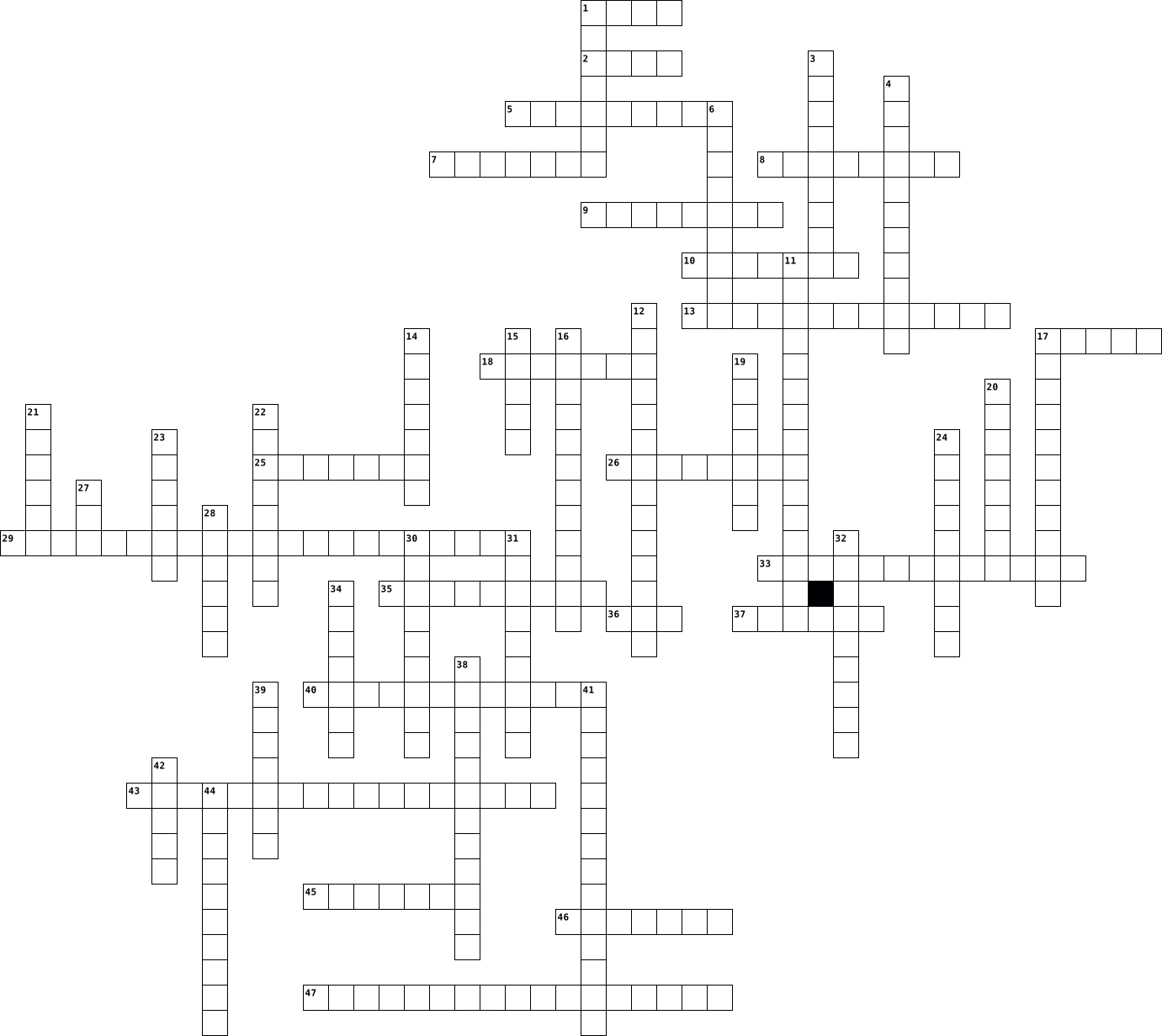
Across
- a loose orange brown flaky layer of hydrated iron oxide.
- The product (other than water) of the reaction between an acid and a base.
- a mixture of organic compounds formed, as a result of high temperatures and pressures, from the remains of living plants and animals which died millions of years ago.
- One of several possible forms of a chemical element that differ from others in the number of neutrons in the atomic nucleus, but not in chemical properties.
- A process when you add solvent to a solution to make it less concentrated.
- An expression showing the chemical formulas of the reactants and products (both in symbols).
- The electrode in which reduction occurs.
- The number of protons in the nucleus of an atom; determines the identity of the element and the number of electrons in the neutral atom.
- an alloy of iron with other elements.
- An organic compound containing the hydroxyl group -OH.
- a small molecule that can be joined together to make a long molecule called a polymer; a monomer must have a double bond or a functional group at either end.
- the breaking down of long-chain alkanes into smaller alkanes and alkenes using a catalyst and heat (500 C).
- weak forces of attraction between
- A breakdown reaction of a compound into two or more components.
- The analysis of composition by measuring the volume of one solution (titrant) needed to react with a given volume of another solution (the analyte).
- An atom or molecule that has lost or gained one or more electrons, and thus becomes positively or negatively charged.
- Anything that occupies space and possesses mass.
- The separation of a mixture by making use of the different volatilities of its components.
- a list of metals with the most reactive metal first based on results from experiments.
- a homologous series of hydrocarbons that are unsaturated as they have at least 1 double bond somewhere in the chain.
- the combining power of an atom or group of atoms; in an ionic compound the valency of an ion is its charge; in a molecule the valency of an atom is the number of bonds it makes.
- A reduced molecular formula.
Down
- the insoluble part that remains behind in the filter paper during filtration or what is left in the flask.
- An element with properties intermediate between those of metals and nonmetals; i.e.: it has the physical appearance and properties of metal but behaves chemically like a nonmetal.
- A state in which the rates of the forward and reverse reactions are equal.
- an oily but soft substance used to reduce friction between two moving surfaces.
- a chemical which oxidizes another chemical; it loses oxygen/gains electrons and becomes reduced.
- a chemical reaction in which many small
- An electrochemical cell, or often several electrochemical cells connected in series, that can be used as a source of direct electric current at a constant voltage.
- A solid solution composed of two or more metals, or of a metal or metals with one or two nonmetals.
- The phenomenon of going from the gaseous state to the liquid state.
- a process during which a solid changes directly into a gas because its particles have alot more energy, move around very fast and are very far apart.
- regular 3-dimensional arrangement of the particles (atoms, ions or molecules).
- A substance that increases the rate of a reaction without being consumed in the reaction.
- A subatomic particle having a single positive electric charge.
- A substance composed of atoms of two or more elements chemically united in fixed properties.
- An energy-containing particle of light.
- The theory of elementary gas-phase bimolecular reactions in which it is assumed that molecules react only if they collide with at least enough kinetic energy for bonds to be broken.
- The natural mineral source of a metal; e.g. hematite; etc.
- horizontal row in the Periodic Table.
- A reaction in which an atom, ion, or molecule loses an electron.
- When the maximum amount of solute is dissolved in a liquid.
- or monomers are joined together to form a long molecule called a polymer.
- A type of covalent bond joining amino acids in a polypeptide.
- A process in which a chemical change is produced by passing an electric current through a
- an ore containing aluminium oxide from which aluminium is extracted.
- a reaction between an acid and a base to produce water and a salt and sometimes also carbon dioxide.
- A reaction that has both oxidation and reduction.
- burning, the reacting of a substance with oxygen, exothermic.
49 Clues: A reduced molecular formula. • weak forces of attraction between • an alloy of iron with other elements. • horizontal row in the Periodic Table. • a chemical reaction in which many small • An energy-containing particle of light. • The electrode in which reduction occurs. • Anything that occupies space and possesses mass. • A reaction that has both oxidation and reduction. • ...
Weathering, Erosion and Deposition Slides 2022-12-05

Across
- type of weathering that can be caused by animals
- type of beach landform caused by waves
- type of physical weathering consisting of falling debris
- the process of physical and chemical breakdown of rocks
- another word for speed
- type of chemical weathering involving acid rain
- word that means dry climate
- process in which sediment is laid down in flat layers
Down
- type of weathering where the minerals bonds break apart
- type of valley formed by glaciers
- type of chemical weathering involving the reaction with oxygen
- type of landform with medium to high elevation
- this moves sediment the most with erosion
- these grow into cracks of rocks and break them apart (2 words)
- this forms sand dunes
15 Clues: this forms sand dunes • another word for speed • word that means dry climate • type of valley formed by glaciers • type of beach landform caused by waves • this moves sediment the most with erosion • type of landform with medium to high elevation • type of chemical weathering involving acid rain • type of weathering that can be caused by animals • ...
CHEMISTRY FOR ENGINEERS CROSSWORD PUZZLE 2021-06-12

Across
- can be defined as materials possessing, at minimum one external dimension measuring 1-100nm.
- is an agent with the capacity to cause cancer in humans.
- is a chain of chemically linked one type of small molecules (or monomers),
- is a process of reacting monomer molecules together in a chemical reaction to form polymer chains.
- is a polymer derived from more than one species of monomer.
- a chemical that will cause an allergic reaction in a substantial number of exposed people.
- are derived from petroleum oil, and made by scientists and engineers.
- the crystal is described by vectors of unequal length.
- are typically viscous substances that convert into rigid polymers through a curing process.
- the ability of the plastic to resist abrasion and wear.
- has three axes that all meet at 90 degrees.
- a substance added to a product (as to increase bulk, weight, viscosity, opacity, or strength)
- is used to coat a variety of products because it's waterproof, cuts down on friction, and creates a nonstick surface.
- one of the structural categories systems to which crystalline solids can be assigned.
- is a thermoplastic “addition polymer” made from the combination of propylene monomers.
- is a category of polymers that contain the ester functional group in every repeat unit of their main chain.
- are polymers in which a crosslinking reaction occurs promoting chemical bonding between macro molecular chains.
- is a substance that is added to a material to make it softer and more flexible.
- is the simplest repeating unit in a simple cubic structure.
- is a field of research and innovation concerned with building 'things'.
Down
- is any artificial elastomer, synthesized from petroleum byproducts.
- are defined as polymers that can be melted and recast almost indefinitely. They are molten when heated and harden upon cooling.
- are nanomaterials that nanosized polymers built from branched units.
- a chemical that causes birth defects.
- an infinite periodic array of points in a space.
- a chemical that damages chromosomes.
- is produced from plants and is classified as a polymer.
- is a solid material whose constituents are arranged in a highly ordered microscopic structure.
- substance is one that will damage or destroy other substances with which it comes into contact by means of a chemical reaction.
- is a polymer made up of siloxane.
- Any of numerous natural and synthetic compounds of usually high molecular weight consisting of up to millions of repeated linked units, each a relatively light and simple molecule.
- are simply a combination of two or more constituent materials with different physical or chemical properties.
- a tough elastic polymeric substance made from the latex of a tropical plant or synthetically.
- are referred to three axes of unequal lengths.
- a substance that causes slight inflammation or other discomfort to the body.
- is a process of heating a thermoplastic sheet to its softening point.
- is a thermoplastic silky material, generally made from petroleum, that can be melt-processed into fibers, films, or shapes.
- is a wide range of synthetic or semi-synthetic materials that are used in a huge and growing range of applications.
- is a lightweight, durable thermoplastic with variable crystalline structure.
- refers to the degree of structural order of a solid.
40 Clues: is a polymer made up of siloxane. • a chemical that damages chromosomes. • a chemical that causes birth defects. • has three axes that all meet at 90 degrees. • are referred to three axes of unequal lengths. • an infinite periodic array of points in a space. • refers to the degree of structural order of a solid. • the crystal is described by vectors of unequal length. • ...
Science Vocabulary 2016-12-08

Across
- Can be observed without changing the substance
- Gained, usually nonmetal
- An element or substance that is not a metal
- A chemical change that produces or makes a new substance
- Parts of mixture look the same
- Cannot be denied or doesn't work
- The columns
- The number placed before the variable
- A change that does not affect the identity of the substance
- Absorbs energy in the form of heat
- Makes a reaction go faster but is not used up
- A reaction in which something reacts with oxygen. The combustion of organic compounds usually takes the form organic compound + oxygen => water + carbon dioxide.
- Elements transfer electrons
- Your purpose for having the experiment
- An element, feature, or factor that is liable to vary or charge
- 1 element and 1 compound form
- Average mass of all atoms
- Ion with more than one atom, has a charge, acts like a single unit
- Symbolic representation of a chemical reaction in the form of symbols and formulae
- 2 or more atoms/ compounds physically combined
- Has a negative charge and is outside the nucleus in orbit
- Parts of a mixture look different
- Have electrons that are like noble gas electrons
- An element whose properties are intermediate between those of metals and solid nonmetals.
- Something that stays the same
- How compact an object is
- Rows
- The elements have a repeating pattern that allow them to be placed in groups and periods
- Identifies the element
- 2 or more atoms chemically combined
- Rounded atomic mass
- To where you can control your experiment
- Characteristic of a substance that is observed during a reaction in which the chemical composition or identity of the substance is changed
- Same ratio of atoms no matter the size of the substances
Down
- The variable that doesn't depend on another
- Has a neutral or no charge and is inside the nucleus
- Energy Energy stored in the bonds of chemical compounds
- The substance after the change has occurred, written o the right side of the arrow
- Protons, electrons, and neutrons
- The amount of times you experience your experiment
- Positive, lost electrons, usually metals
- The substance before the change, written on the left side of the arrow
- Surrounding an object
- 2 elements form a compound
- I compound forms 2 or more elements
- 2 compounds form 2 new compounds
- A change that creates a new substance
- Has an equal number of atoms on both sides of the arrow.
- A shiny hard piece of matter
- Releases energy in the form of heat
- A set of chemical symbols showing the elements present in a compound and their relative proportions, and in some cases the structure of the compound.
- Location of protons and neutrons
- Physical restraints used to hold on to something
- The variable that depends on another
- All atoms want 8 valence electrons like the noble gasses
- Describes how a substances changes into a new substance
- Elements share electrons
- Two or more atoms of the same element, they have the same number of protons but different number of neutrons
- The basic unit of a chemical element
- Simplest form of that species
- Has a positive charge and is inside the nucleus
61 Clues: Rows • The columns • Rounded atomic mass • Surrounding an object • Identifies the element • Gained, usually nonmetal • Elements share electrons • How compact an object is • Average mass of all atoms • 2 elements form a compound • Elements transfer electrons • A shiny hard piece of matter • 1 element and 1 compound form • Something that stays the same • Simplest form of that species • ...
Ch 8 Vocab 16-29 2022-11-29

Across
- (small part) a substance that is dissolved by another substance to form a solution. ex. sugar
- a substance that dissolves one or more other substances to form a solution. ex. water
- a substance at the end of a chemical reaction.
- a change of matter that occurs when atoms link together in new ways, creating a new substance different from the original substance.
- a mixture of substances that are blended so completely that the mixture looks the same everywhere. ex. tea
Down
- a material that is a poor conductor of heat and electricity ex. wood
- the maximum amount of a substance that can be dissolved by another substance.
- a physical combination of two or more substances that are blended together without forming new substances. ex. salad
- a solid formed from the chemical reaction of some solutions.
- a change of matter in size, shape , or state that does not change the type of matter. ex. tearing paper
- an original substances at the beginning of a chemical reaction.
11 Clues: a substance at the end of a chemical reaction. • a solid formed from the chemical reaction of some solutions. • an original substances at the beginning of a chemical reaction. • a material that is a poor conductor of heat and electricity ex. wood • the maximum amount of a substance that can be dissolved by another substance. • ...
Chemical Reactions Vocab 2025-10-20

Across
- A tiny negatively charged particle that moves around the outside of the atom’s nucleus.
- A particle in the atom’s nucleus that has no charge (neutral).
- The different physical forms in which a substance can exist — solid, liquid, gas, or plasma — depending on how particles move and are arranged.
- The starting substances in a chemical reaction — what you begin with.
- The name of the town in Amplify with the reddish-brown water.
- A group of atoms connected by bonds; the smallest unit of a substance that still has the same properties.
Down
- The new substances formed after a chemical reaction occurs.
- Reaction A process where atoms rearrange to make one or more new substances with different properties.
- A type of matter that is made of the same kind of particle (atoms or molecules) throughout.
- A positively charged particle found in the center (nucleus) of an atom.
- The smallest unit of matter; made up of protons (positive), neutrons (neutral), and electrons (negative).
11 Clues: The new substances formed after a chemical reaction occurs. • The name of the town in Amplify with the reddish-brown water. • A particle in the atom’s nucleus that has no charge (neutral). • The starting substances in a chemical reaction — what you begin with. • A positively charged particle found in the center (nucleus) of an atom. • ...
Chemical Reactions 2020-12-06

Across
- We see bubbles of these in a chemical reaction.
- Another word for changes back.
- When a precipitate forms it is a sign of what change?
Down
- Ice melting to water is a ________ change.
- In a chemical reaction, a new _______ is always produced.
- In a chemical reaction, light ______ and heat ______ can be produced.
6 Clues: Another word for changes back. • Ice melting to water is a ________ change. • We see bubbles of these in a chemical reaction. • When a precipitate forms it is a sign of what change? • In a chemical reaction, a new _______ is always produced. • In a chemical reaction, light ______ and heat ______ can be produced.
Chapter 13; Lucy Serna 2020-02-18

Across
- also known as activation energy
- reactants turn into this
- law of this means no atoms are gained or lost
- a net release of energy
- when reaction and its reverse act at the same rate
Down
- the chemical equation must be what
- a net absorption of energy
- a type of chemical reaction
- a type of chemical reaction
- how quickly the concentration reactants decreases and how quickly the concentration of products increases
10 Clues: a net release of energy • reactants turn into this • a net absorption of energy • a type of chemical reaction • a type of chemical reaction • also known as activation energy • the chemical equation must be what • law of this means no atoms are gained or lost • when reaction and its reverse act at the same rate • ...
Law of Conservation 2025-10-20

Across
- A change where no new substance is formed.
- The scientific rule that matter is conserved.
- Tiny building blocks of matter.
- The stuff you start with in a chemical reaction.
- The stuff you end up with in a chemical reaction.
Down
- A group of atoms bonded together.
- Matter cannot be created or
- The measure of how much matter something has.
- A change that forms a new substance.
- The total amount of matter stays the ______.
10 Clues: Matter cannot be created or • Tiny building blocks of matter. • A group of atoms bonded together. • A change that forms a new substance. • A change where no new substance is formed. • The total amount of matter stays the ______. • The scientific rule that matter is conserved. • The measure of how much matter something has. • ...
Matter- Properties and Changes 2022-01-20

Across
- Element whose properties are intended between metals and solid nonmetals or semiconductors
- property relating to is chemical relativity
- Rows on the periodic table
- Product of the pressure and the volume of one gram molecule of an ideal gas is equal to the product of the absolute temperature of the gas and the universal gas constant
- iodized gas
- Liquid solid or gas into a crystal
- flows freely but has constant volume
- Composition is uniform throughout the mixture
- Chemical substance with many identical molecules with atoms from more than one element together with chemical bonds.
- Relation with the compresion and opposition of a gas at constant temperature
- Seperation of a mixture into its compounds
- Liquid to a vapor back to a liquid
- Statement that the volume occupied by a fixed gas amount is directly proportional to its absolute temperature, if the pressure remains constant
- Pure substance w only atom with the same # of protons in their nuclei
- Mass of the element or solute minus the mass of the compound or solute
- substance/takes part in and undergoes a change in a reaction
- Changing the physical properties of a substance
- Does not involve chemical change properties of matter
- species formed from a chemical reaction
- Gas pressure x volume x temperature = constant
- Two elements form a compound the ratios of the masses of the two elements will be ratios or smaller integers
- Mass is not created or destroyed in chemical reactions
- has mass, occupies space
- Elements with similar properties group together or columns
Down
- Chemical Element gains electrons when reacting w metal, not a metal, Forms an acid if combined w oxygen or hydrogen
- Chemical compound has its componets in a fixed ratio and does not depend on sourse or preperation.
- solid into a gas
- Made by mixing other substances together
- Own chemical properties with definite and constant composition
- Solid particles in a liquid or gaseous fluid are removed
- quantity; proportional to the size of substance
- firm and stable does not flow
- suspended or diffused in the air
- most basic unit of a chemical element
- expands to fill container no volume
- Solid liquid gas plasme
- Chemical elements, under normal conditions are odorless, colorless, anatomic gases with low chemical relativity
- Rearrangement of atoms causes in a chemical composition change into a new element
- Law pressures, density og an ideal gaas at constant pressure varies inversely with the absolute temperature of the gas.
- Under the same temperature and pressure, equal columes of a different gas contain an equal number of molecules
- amount of matter
- equal to the product of the absolute temp of the gas
- Table of chemical elements arranged in order of atomic numbers, rows, so that chemicals w similar chemical structures appear next to each other
- Mixture with two or more different substance
- Quantity does not depend on amount of substance
- Element that forms positive ions and has metallic bonds
- Substance from one form to another
47 Clues: iodized gas • solid into a gas • amount of matter • Solid liquid gas plasme • has mass, occupies space • Rows on the periodic table • firm and stable does not flow • suspended or diffused in the air • Liquid solid or gas into a crystal • Liquid to a vapor back to a liquid • Substance from one form to another • expands to fill container no volume • flows freely but has constant volume • ...
Vocabulary Words 2023-02-01

Across
- a chemical bond made by electrons of other atoms being shared with each other
- when chemical bonds are broken or made
- a chemical bond made by opposite magnetic charges attracting each other, they transfer electrons to other atoms
- warmth exerted when chemical reactions occur
- a particle that contains protons, neutrons and electrons
Down
- things in the outer layer of an atom that is involved in chemical bonds
- the correct way of writing out ionic crystal formulas
- a chemical reaction that absorbs heat
- an easy way of showing/identifying a component of atoms and molecules
- two or more atoms chemically bound together
- a way to hold atoms together
11 Clues: a way to hold atoms together • a chemical reaction that absorbs heat • when chemical bonds are broken or made • two or more atoms chemically bound together • warmth exerted when chemical reactions occur • the correct way of writing out ionic crystal formulas • a particle that contains protons, neutrons and electrons • ...
science vocabulary 2023-12-12

Across
- soluble
- flammability
- dissolve
- acid
Down
- reactant
- change
- density
- reaction
- element
9 Clues: acid • change • density • soluble • element • reactant • reaction • dissolve • flammability
Plants 2024-11-04

Across
- The things that react in a chemical reaction.
- The products of photsythisis.
- The chemical formula for water.
- Where the energy plants use for Photosynthesis comes from.
Down
- Where photosynthesis takes place.
- _______ means light + put together.
- ___ energy is turned into chemical energy.
- ____ is absorbed by plants, along with water and carbon dioxide.
- ABC is the answer to this (Free).
- The chemical formula for Carbon Dioxide.
10 Clues: The products of photsythisis. • The chemical formula for water. • Where photosynthesis takes place. • ABC is the answer to this (Free). • _______ means light + put together. • The chemical formula for Carbon Dioxide. • ___ energy is turned into chemical energy. • The things that react in a chemical reaction. • Where the energy plants use for Photosynthesis comes from. • ...
HAZWOPER Quiz #2 2021-06-23

Across
- performs entry rescue
- zone that contains the highest concentration of contaminant
- molecular movement of a chemical through a chemical suit
- performs self-rescue
- a chemical that may cause an allergic reaction
- color of NFPA 704 label associated with Health
Down
- type of control associated with using a procedure
- may ignite spontaneously below 130 F
- maintains contact with personnel inside a Confined Space
- 16 section document required by HAZCOM for each chemical
- to be immersed by material in a confined space
- amount of rainfall a secondary containment must be able to contain (inches)
12 Clues: performs self-rescue • performs entry rescue • may ignite spontaneously below 130 F • to be immersed by material in a confined space • a chemical that may cause an allergic reaction • color of NFPA 704 label associated with Health • type of control associated with using a procedure • maintains contact with personnel inside a Confined Space • ...
chapter 14 2026-03-25

Across
- A fungal infection common in immunocompromised individuals.
- The immune system’s attack against transplanted tissue.
- Reduced or weakened immune response.
- White blood cells important for immune responses.
- The study of inherited traits influencing disease risk.
Down
- A condition that disrupts normal body function.
- A condition where the immune system attacks the body’s own cells.
- Immune cells that engulf and destroy pathogens.
- A chemical released by mast cells that causes allergy symptoms like itching and swelling.
- The invasion and multiplication of harmful microorganisms.
- A visible skin reaction often seen in graft versus host disease.
- A severe, rapid allergic reaction involving widespread chemical release in the body.
- Transplanted tissue or organ placed into a host body.
- A severe and widespread response to infection that can be life threatening.
- A state in which the immune system cannot function properly.
15 Clues: Reduced or weakened immune response. • A condition that disrupts normal body function. • Immune cells that engulf and destroy pathogens. • White blood cells important for immune responses. • Transplanted tissue or organ placed into a host body. • The immune system’s attack against transplanted tissue. • The study of inherited traits influencing disease risk. • ...
phys sci 4 2025-11-03

Across
- a atom or group of atoms with a positive or negative charge
- is larger than the water that makes it making it float
- forms hydrogen bonds when frozen
- loose bond between molecules that contain hydrogen ions & polar molecule
- bond a covalent bond that one side of the molecule is slightly positive and the other slightly negative
- The force that allows 2 or more atoms to stick together in a compound.
- The substances that go into a chemical reaction
- is more stable than its parts
Down
- chemical bond between 2 element s an electron away from the other.
- Notation that records what elements and How many atoms of the elements are in a compound
- is a force between molecules. molecules of the different Substances palling them to Together
- A force between molecules of the same substance that pulls them together.
- a bond between 2 elements sharing electrons
- The substances that are created in a chemical reaction
14 Clues: is more stable than its parts • forms hydrogen bonds when frozen • a bond between 2 elements sharing electrons • The substances that go into a chemical reaction • is larger than the water that makes it making it float • The substances that are created in a chemical reaction • a atom or group of atoms with a positive or negative charge • ...
Super Omega Chemistry Crossword 2024-05-16

Across
- Chemical equation that has oxygen as a reactant
- AX + BY -> AY + BX
- the principle that the entropy of a closed system will always increase over time.
- The amount a substance will dissolve into another
- combination of two or more substances
- Solution that contains less than the maximum amount of solute
- Substance that is disperse/dissolved in another substance
- Same consistency throughout
- the amount of energy required to break one mole of a particular type of bond in a molecule.
- Functions that increases at a a decreasing rate
- the time require for ½ of a radioactive isotope to decay
- Measures the acidity of basicity of a substance
- the SI unit of mass
- the amount of heat required to raise the temperature of 1 gram of water 1 degree Celsius
- positively charged particle
- Study of matter and the changes it undergoes
- a substance that falls out of solution usually because of a chemical change
- A dye whose color is affected by pH
- an atom or compound with an electrical charge
- state of matter that has a definite shape and volume
- the energy that an object possesses due to its position or configuration.
- elements with the same number of protons but different number of neutrons
- Substance is unable to be dissolved in the solvent.
- describes the electrons probable location
- the amount of solute in a given amount of solvent
- Solution that contains the maximum amount of solute
- the standard unit
- Chemical equation that is like a divorce
- the SI unit for heat and energy
- small negatively charged particle
- substance that increases rate of a chemical reaction
- a physical property that dos not depend of the amount
- negatively charged ion
- Radiation particle made of pure energy
- A diamond shaped diagram to show the danger level of a substance
- SI unit of pressure
- A solution that is more concentrated than Saturated
- the transfer of energy that results from a force acting on a system over a distance.
- anything that has mass and takes up space
- substances formed during the reaction
- force that holds two atoms together
- Substance with an even electrical charge, for example oil
- Substance with an uneven electrical charge, for example water and alcohol
- a solid whose atoms are arranged in an orderly manner
- a thermodynamic quantity that represents the total amount of heat content of a system.
- measure of the amount of matter
- physical property of a solution that depend on the concentration
- a physical property that depends on the amount
- the study of the relationships between heat, work, and energy in a system.
- Combining two light elements
- System + Surroundings
- Universal Polar Solvent
- state of matter that flows to conform the shape of its container
- a chemically combined combination of two or more different elements
- the principle that it is impossible to reach absolute zero temperature through a finite number of processes.
- the principle that energy cannot be created or destroyed, only transferred or converted from one form to another.
- two or more atoms covalently bonded to each other
- electrons in the atom’s outermost shell
- found of the periodic table
- a property that can be observed without changing its composition
- smallest particle of an element that retains all chemical properties
- statement that identifies the reactants and production of a chemical reaction
- Everything other than the system
- SI unit of volume
- Safety device use to put out fires on people
- the energy available to do work
- A + BX -> AX + B
Down
- arrangements of electrons in an atom
- the specific part of the universe that contains the reaction or process you wish to study
- a chemical reaction that absorbs heat
- Diagram that shows how electrons are arranged in molecules
- a measure of the average kinetic energy of the particles in a substance.
- Substance that can disperse/dissolve other substances
- Chemical bond between metal and another metal i.e. Bronze
- SI unit for amount of a substance
- a property the describes the ability of a substance to combine with or change
- a thermodynamic property that represents the degree of disorder or randomness in a system.
- force over area
- refers to how close a measured value is to an accepted value
- Group of elements that are explosively reactive i.e. Sodium
- highly reactive group of 7A elements
- the antiparticle of an electron
- Chemical equation that combines two or more substances to make a single product
- Shaking, Stirring, or otherwise mixing
- the SI unit of temperature
- state of matter that has constant volume but takes the shape of its container
- A solution that does not contain electrolytes
- the energy of motion.
- compounds that have the same formula but different structures
- solution that resists changes in pH
- number written in front of a chemical that indicates the smallest ratio needed for the chemical reaction
- how desperate an element is for electrons
- Solution with water as the solvent
- particle made of pure energy with no mass
- indicate the precision of measurement
- a chemical reaction that releases heat
- mixture of two metals
- a change that will happen without outside intervention
- NaOH, OCL
- the reference state used in thermodynamic calculations, typically defined as 1 atm pressure and 298 K temperature.
- the typical charge of an element
- A solute that can conduct electricity, think Gatorade
- number of protons in an element
- HCl, H2SO4, H3PO4
- An electron emitted from a radioactive element
- refers to how close a series of measurements are to one another
- Measurement of Alcohol Concentration
- particle with no charge
- Group of elements that are extremely unreactive
- Sulfate, Nitrate, Acetate are all examples of
- the transfer of energy that results from a temperature difference between two systems.
- positively charged ion
- Process where the solvent pull the solute apart
- average mass of the isotopes of an element
- Chemical bond that share electrons i.e. Cl2
- Rule that states that atoms lose, gain, or share electrons in order to get to 8 electrons
- ionic compound made of an anion and a cation
- Homogeneous Mixture
- Splitting a heavy element
- a mixture that is not blended smoothly
- Reducing Concentration
- Substance is able to be dissolve in the solvent
- the mass in grams of 1 mole of substance
- starting substances of a chemical reaction
- compound where particles are arranged in an irregular pattern
- Emitting Ionizing Radiation
- the amount of heat required to raise the temperature of 1 gram of the substance by 1 degree
- Moles/Liter
- A solute breaking down into ions in solution
- the capacity to do work or produce heat
- Chemical bond between a metal and a nonmetal i.e. NaCl
131 Clues: NaOH, OCL • Moles/Liter • force over area • A + BX -> AX + B • the standard unit • HCl, H2SO4, H3PO4 • SI unit of volume • AX + BY -> AY + BX • the SI unit of mass • SI unit of pressure • Homogeneous Mixture • the energy of motion. • mixture of two metals • System + Surroundings • negatively charged ion • positively charged ion • Reducing Concentration • particle with no charge • ...
Chemical Reactions 2024-11-19

Across
- reactants—products
- Word to describe that a chemical reaction did not work
- periodic table
Down
- before the equation
- 1 or more atoms
- Word to describe that a chemical reaction worked
- after the equation
7 Clues: periodic table • 1 or more atoms • reactants—products • after the equation • before the equation • Word to describe that a chemical reaction worked • Word to describe that a chemical reaction did not work
Unit 7.5.2 Vocab 2024-03-26

Across
- All the things in a compound.
- The things at the end of a chemical reaction.
- The horizontal sorting of the Periodic Table.
- Two or more elements chemically combined.
- The number of molecules in an element or compound.
Down
- A law that states that matter cannot be created or destroyed.
- The starting element or compounds before a chemical reaction.
- The vertical sorting of the Periodic Table.
- An element that is used in a rocket's engines to cool them down before liftoff.
- The number of atoms the element behind it.
- Something that cannot be broken down chemically into simpler substances.
- The smallest unit of an element.
12 Clues: All the things in a compound. • The smallest unit of an element. • Two or more elements chemically combined. • The number of atoms the element behind it. • The vertical sorting of the Periodic Table. • The things at the end of a chemical reaction. • The horizontal sorting of the Periodic Table. • The number of molecules in an element or compound. • ...
Earths atmosphere 2023-05-24

Across
- The trapping of heat energy in the Earths atmosphere. ............. effect
- Weather patterns could become ........ becuase of climate change
- Chemical reaction carried out by plants that removes carbon dioxide from the atmopshere
- Increased heat energy in the Earths atmopshere casues ........... warming
- Chemical reaction that releases carbon dioxide into the atmopshere
- Sea levels rising could cause caostal ...........
Down
- Organisms that break down dead organic matter
- .............. of fossil fuels releases carbon doixide into the atmnopshere
- Levels of this water body will rise as a result of ice caps melting
- A way to reduce waste going to landfill
- A greenhouse gas releases by cattle
- Rain caused by sulphur dioxide in the atmosphere
12 Clues: A greenhouse gas releases by cattle • A way to reduce waste going to landfill • Organisms that break down dead organic matter • Rain caused by sulphur dioxide in the atmosphere • Sea levels rising could cause caostal ........... • Weather patterns could become ........ becuase of climate change • Chemical reaction that releases carbon dioxide into the atmopshere • ...
Y11 Chem Summary 2025-03-05

Across
- the name of the outermost shell
- the type of ion that characterises bases
- the name of a negative ion
- a substance made up of two or more different types of atom chemically bonded
- the starting materials in a chemical reaction
- formed when an atom gains or loses electrons
- the elements or compounds produced by a chemical reaction
- what's the name of the compound CO2
Down
- the type of ion that characterises acids
- when the H+ ions in an acid and OH- ions in a base balance each other out to form H2O
- the negatively charged particles in an atom
- the positively charged particles in an atom
12 Clues: the name of a negative ion • the name of the outermost shell • what's the name of the compound CO2 • the type of ion that characterises acids • the type of ion that characterises bases • the negatively charged particles in an atom • the positively charged particles in an atom • formed when an atom gains or loses electrons • the starting materials in a chemical reaction • ...
Gas Tests 2025-07-24

Across
- The test for hydrogen gas using a lit splint.
- A chemical change observed during a gas test.
- What a glowing splint does in oxygen.
- Used to test for hydrogen; produces a pop sound.
- Reaction that occurs when hydrogen is ignited.
- Gas that turns limewater milky.
- Gas that makes a squeaky pop with a lit splint.
Down
- Gas that relights a glowing splint.
- Used to test for oxygen; relights in presence of the gas.
- A method for identifying common gases using physical or chemical changes.
- A solution used to test for carbon dioxide; turns cloudy if CO₂ is present.
- Description of limewater after carbon dioxide is added.
12 Clues: Gas that turns limewater milky. • Gas that relights a glowing splint. • What a glowing splint does in oxygen. • The test for hydrogen gas using a lit splint. • A chemical change observed during a gas test. • Reaction that occurs when hydrogen is ignited. • Gas that makes a squeaky pop with a lit splint. • Used to test for hydrogen; produces a pop sound. • ...
Photosynthesis Review 2023-05-11

Across
- (2 words) The gas that plants need to do photosynthesis
- The energy form that plants need to do photosynthesis
- A living thing that makes its own energy
- Do all plants do photosynthesis?
- (Hard) Something produced during a chemical reaction that is not needed for that reaction
- When a living thing makes energy from heat and chemicals
Down
- The part of a plant cell that makes photosynthesis happen
- The chemical that gives plants their green color
- The sugar plants make during photosynthesis
- The liquid plants need to do photosynthesis
- The gas that plants make when they do photosynthesis
- When a plant turns light energy into sugar
- The chemical that allows photosynthesis to happen
- The gas that plants breathe
14 Clues: The gas that plants breathe • Do all plants do photosynthesis? • A living thing that makes its own energy • When a plant turns light energy into sugar • The sugar plants make during photosynthesis • The liquid plants need to do photosynthesis • The chemical that gives plants their green color • The chemical that allows photosynthesis to happen • ...
Science Vocabulary I 2014-04-24

Across
- the act of pressing together
- the rubbing of one object or surface against another
- a force that tends to oppose or slow down motion
- something that has a pH above 7.0
- the natural force of attraction exerted by the earth
- a push or a pull
Down
- the act of stretching
- increasing speed
- the symbol relating to hydrogen ion (H+) concentration. Below 7.0 is acidic and above 7.0 is alkaline
- a statement showing the equality of two mathematical expressions, or a representation of a chemical reaction
- a substance that causes or accelerates a chemical reaction without itself being affected
- something that has a pH below 7.0
12 Clues: increasing speed • a push or a pull • the act of stretching • the act of pressing together • something that has a pH above 7.0 • something that has a pH below 7.0 • a force that tends to oppose or slow down motion • the rubbing of one object or surface against another • the natural force of attraction exerted by the earth • ...
Chemical Reactions 2024-01-22

Across
- An ending substance that is made during a chemical reaction.
- The relative size of things.
- a pure substance that cannot be broken down by any physical or chemical means into simpler substances
- Something that is made of all the same atoms or groups of atoms.
Down
- Something that can be observed about a substance, such as color, smell, or boiling point.
- To change the order or position of something.
- The basic unit of a chemical element.
- A starting substance that is part of a chemical reaction.
8 Clues: The relative size of things. • The basic unit of a chemical element. • To change the order or position of something. • A starting substance that is part of a chemical reaction. • An ending substance that is made during a chemical reaction. • Something that is made of all the same atoms or groups of atoms. • ...
Vocab U3S2 2021-11-16

Across
- The relationship between the quantities of reactants and products before, during, and following chemical reactants
- 6.0221409e+23
- The total amount you can produce
Down
- The reactant that's totally consumed
- The amount of product experimentally obtained by a chemical reaction
- A reactant present in an amount in excess of that required to combine with all of the limiting reactant
- A conversation factor between any two chemical species in a chemical reaction
- The ratio of actual yield to theoretical yield, multiplied by 100%
8 Clues: 6.0221409e+23 • The total amount you can produce • The reactant that's totally consumed • The ratio of actual yield to theoretical yield, multiplied by 100% • The amount of product experimentally obtained by a chemical reaction • A conversation factor between any two chemical species in a chemical reaction • ...
Electrochemistry 2023-05-04

Across
- A spontaneous redox reaction that produces an electric current flow.
- Ionic solution that can be decomposed by electricity.
- Gaining Electrons
- Oxidation occurs here
- Process of using electric current to do work on a chemical cell against its electric potential.
- Reduction occurs here
- An equation shows just the oxidation or just the reduction that takes place in a redox reaction.
- Losing Electrons
Down
- Unit of electrical potential
- Force moves one electron from one electrode to the other.
- Connects the two half cells allowing a flow of ions that neutralizes the charge build-up.
- Galvanic cell in which the electrical work is used as a source of electrical power.
- Study of chemical reactions that cause electrons to move, resulting in the transfer of electrical charge.
- The first scientist to work on electrochemistry.
- A constant equal to 96485
15 Clues: Losing Electrons • Gaining Electrons • Oxidation occurs here • Reduction occurs here • A constant equal to 96485 • Unit of electrical potential • The first scientist to work on electrochemistry. • Ionic solution that can be decomposed by electricity. • Force moves one electron from one electrode to the other. • ...
ENZYMES 2013-05-02

Across
- Made up of many amino acid molecules
- Produces bile
- A chemical that speeds up a reaction but is not used up in the reaction
- Used to convert starch into sugar syrup
- Breaks down proteins into amino acids
- Made up of many sugar molecules
- Made up of many fatty acid and glycerol molecules
- Breaks down fats into fatty acids and glycerol
Down
- Organ that produces enzymes but is not a site of digestion
- The chemical breakdown of large molecules into small molecules
- Where bile is stored
- Used to convert glucose syrup into fructose syrup, which is much sweeter and therefore can be used in smaller quantities in slimming foods
- When an enzymes active site shape has been changed by a high temperatures or an unsuitable a pH
- Emulsifies fats and neutralises stomach acid
- Breaks down starch into sugar
15 Clues: Produces bile • Where bile is stored • Breaks down starch into sugar • Made up of many sugar molecules • Made up of many amino acid molecules • Breaks down proteins into amino acids • Used to convert starch into sugar syrup • Emulsifies fats and neutralises stomach acid • Breaks down fats into fatty acids and glycerol • Made up of many fatty acid and glycerol molecules • ...