
forms of energy Crossword Puzzles
Electronics 2016-10-31

Across
- The depiction of the electric potential energy per unit charge
- The speed that electrons flow
- energy Energy due to the moving of electric charges
- When force is used to relocate an object a certain distance
- Path that a current goes through
- Includes more than one path for a current to flow through
- A type of energy that comes naturally or is produced
- Calculated by using the formula of power in divided by power out
- Metals or anything that has less resitance
- The rate of doing work
Down
- Draws power in a circuit
- Named after an Italian physicist who invented the electric battery
- There is only one path for a current to flow through in this type of circuit
- Discovered by Michael Faraday in 1831
- Named after a French physicist
- Insulators have a high _______
- Exists in many forms like mechanical, kinetic or potential
- law States that voltage is equal to the product of current and resistance
18 Clues: The rate of doing work • Draws power in a circuit • The speed that electrons flow • Named after a French physicist • Insulators have a high _______ • Path that a current goes through • Discovered by Michael Faraday in 1831 • Metals or anything that has less resitance • energy Energy due to the moving of electric charges • A type of energy that comes naturally or is produced • ...
photosynthesis vocab quiz 2025-09-05

Across
- main product of light dependent reactions in photosynthesis
- reactant of light dependent reactions
- smaller energy molecule composed of two phosphate groups, an adenine base, and a ribose sugar
- site of light independent reactions of photosynthesis
- reactant of the light independent reactions; undergoes carbon fixation
- process where atmospheric CO2 is converted to a usable form of C
- site of light dependent reactions of photosynthesis
- organism that obtains food and energy from consuming living organisms
- electron carrier; picks up an H to be used in Calvin Cycle
- organelle that captures light energy and converts it to chemical energy
- organism that captures energy from the sun or inorganic substances to make their own food
- electron donor; drops off an H to be used in carbon fixation
- monosaccharide that serves as the primary source of energy
- stacks of thylakoids found in chloroplasts
- light independent reaction that produces glucose by using ATP, NADPH, and CO2
- the process where a phosphate group is added to a molecule; ADP forms to ATP
Down
- reaction in photosynthesis that does not require the direct involvement of sunlight
- the small openings on the leaves through which O2 and CO2 move in and out
- organism that makes their own food from chemicals
- organism that makes their own food from light energy
- reaction in photosynthesis that requires direct involvement of sunlight
- main pigment found in plants that cause them to appear green
- basic energy source used by all cells and contains three phosphate groups
- movement of energy through a system; transfer of energy from one form to another
24 Clues: reactant of light dependent reactions • stacks of thylakoids found in chloroplasts • organism that makes their own food from chemicals • site of light dependent reactions of photosynthesis • organism that makes their own food from light energy • site of light independent reactions of photosynthesis • electron carrier; picks up an H to be used in Calvin Cycle • ...
Geoscience Crossword 2022-12-03

Across
- Determining the relative order of past events or objects
- Waves of energy that travel through the Earth's layers
- An absences of oxygen
- Branch of science studying earthquakes
- Dating rocks using the relative proportions of particular radioactive isotopes
- The presence of oxygen
- Branch of science studying the magnetism in rocks
- Process that help build up the Earth
Down
- Meteor that survives its passage through the Earth's atmosphere and hits the ground
- Representation on a map of the natural and artificial features of an area
- Different forms of the same element that have a different number of nuetrons
- A living factor
- The true age of a rock or fossil
- Movement in a fluid where hotter and less dense matter rises and colder and less dense matter sinks
- A non-living factor
- Time taken for the isotope to decrease into half its original value
- Forms the nuclear mass of a continent or the central basin of an ocean
- Close relationship of two factors that cause them to impact how each other change
- process by which rock is broken down, such as erosion and weathering
- Process where the nucleus of an unstable atom loses energy by emitting radiation
20 Clues: A living factor • A non-living factor • An absences of oxygen • The presence of oxygen • The true age of a rock or fossil • Process that help build up the Earth • Branch of science studying earthquakes • Branch of science studying the magnetism in rocks • Waves of energy that travel through the Earth's layers • Determining the relative order of past events or objects • ...
Unit 1 Energy 6th 2022-08-22

Across
- the total kinetic and potential energy of all the particles of an object
- the energy of electric charges
- the energy of light and other forms of radiation, which travels through space as waves
- potential the energy of stretched or compressed objects
- potential potential energy that depends on the height of an object
Down
- the ability to do work or cause change
- a form of potential energy that is stored in chemical bonds between atoms
- kinetic or potential energy associated with the motion or position of an object
- of conservation of energy the rule that energy cannot be created or destroyed
- the energy that an object has due to its motion
- the energy an object has because of its position; also the internal stored energy of an object, such as energy stored in chemical bonds
- transformation a change from one form of energy to another, also called an energy conversation
- the potential energy stored in the nucleus of an atom
13 Clues: the energy of electric charges • the ability to do work or cause change • the energy that an object has due to its motion • the potential energy stored in the nucleus of an atom • potential the energy of stretched or compressed objects • potential potential energy that depends on the height of an object • ...
Branches of Science 2020-06-30

Across
- the study of the structure of living things
- study of the origin, history, and structure of the Earth, and the physical, chemical, and biological changes that it has experienced or is experiencing
- science that deals with animals and their behavior
- the study of the forms and structures of living things
- study of the universe beyond the earth's atmosphere
- study of change of species through time
- the study of the classification of organisms
- science that deals with matter and energy and the interactions between them
Down
- science that deals with plant life
- science that studies microscopic forms of life
- study of organisms and their environment
- science that deals with matter, its composition, structure and properties, the changes it undergoes, and the energy accompanying these changes
- the study of life functions
- study of the atmosphere and its phenomena, such as weather and climate
- study of heredity and variation
15 Clues: the study of life functions • study of heredity and variation • science that deals with plant life • study of change of species through time • study of organisms and their environment • the study of the structure of living things • the study of the classification of organisms • science that studies microscopic forms of life • ...
Science Crossword - Hard 2024-01-31

Across
- - The natural home or environment of an animal, plant, or other organism (7)
- - A stable subatomic particle with a charge of negative electricity (7)
- - Process of coding genetic information from DNA into RNA (12)
- - The resistance of any physical object to any change in its state of motion (7)
- - Each of two or more forms of the same element that contain equal numbers of protons but different numbers of neutrons in their nuclei (7)
- - Study of heredity and the variation of inherited characteristics (8)
- - Substance that increases the rate of a chemical reaction (8)
- - Principle stating energy cannot be created or destroyed (12)
- - A type of bond in chemistry involving electron sharing (8)
- - The speed of something in a given direction (8)
- - The branch of physical science that deals with the relations between heat and other forms of energy (14)
- - An individual animal, plant, or single-celled life form (8)
- - Microscopic organism without a nucleus (8)
- - A type of cell division that results in two daughter cells each having the same number and kind of chromosomes as the parent nucleus (6)
- - Band of colors produced by separation of the components of light by their different degrees of refraction (8)
Down
- - A type of reaction that releases heat (9)
- - Chemical process of cell energy production (11)
- - A subatomic particle found in the nucleus of atoms (7)
- - Minimum amount of any physical entity involved in an interaction (6)
- - A subatomic particle of about the same mass as a proton but without an electric charge (7)
- - Change of state from gas to liquid (11)
- - Process used by plants to convert light energy into chemical energy (13)
- - Study of genes and heredity (8)
- - A substance that takes part in and undergoes change during a reaction (8)
- Zero - Theoretical temperature point where motion ceases (12)
- - A branch of science dealing with celestial bodies (9)
- - A substance that has a molecular structure consisting chiefly or entirely of a large number of similar units bonded together (7)
- - Systems of millions or billions of stars, together with gas and dust, held together by gravitational attraction (8)
- - A protein that speeds up chemical reactions in the body (6)
- - Emission of energy as electromagnetic waves (9)
30 Clues: - Study of genes and heredity (8) • - Change of state from gas to liquid (11) • - A type of reaction that releases heat (9) • - Microscopic organism without a nucleus (8) • - Chemical process of cell energy production (11) • - The speed of something in a given direction (8) • - Emission of energy as electromagnetic waves (9) • ...
Fitness & Nutrition Crossword Puzzle 2026-04-07

Across
- — Related to the body or bodily activity.
- — Greater than average in size.
- — Planned physical activity done to improve fitness or health.
- — The power the body needs to function and move.
- — A reduction or decrease in something.
- — A measure of how heavy a person or object is.
- — The amount of energy used or work produced.
- — The level of effort used during exercise.
- — A group of similar cells working together in the body.
- — The hard connective tissue that forms the skeleton.
- — Doing something with more effort or difficulty.
Down
- — The main energy molecule used by cells for work.
- — The organ that controls thoughts, feelings, and body functions.
- — The body’s signal that it needs food.
- — The amount of food or nutrients consumed.
- — Energy used during movement and physical activity.
- — Body tissue that contracts to create movement.
- Loss — The reduction of stored body fat over time.
- — The process by which the body converts food into energy.
- — Things that influence or affect an outcome.
- — Units used to measure energy in food.
- — A nutrient that helps build and repair body tissues.
- — Describes something below normal or less than zero, such as energy balance.
- — A period of recovery when the body is not active.
- — A nutrient that stores energy and helps protect organs.
25 Clues: — Greater than average in size. • — The body’s signal that it needs food. • — Units used to measure energy in food. • — A reduction or decrease in something. • — Related to the body or bodily activity. • — The amount of food or nutrients consumed. • — The level of effort used during exercise. • — Things that influence or affect an outcome. • ...
Chemistry Cross Word Puzzle 2023-09-25

Across
- a atom model type that shows how electrons are arranged using dots
- Includes all forms of electromagnetic radiation
- an atom that has either a positive or negative charge
- A high-speed electron
- A set of frequencies of electromagnetic waves given off by atoms
- The shortest distance between equal points on a wave
- an ion with a positive charge
- The composition of electrons within an atom
Down
- The main energy levels within an atom
- A particle with 2 protons and 2 neutrons emitted during radioactive decay.
- The outermost electron on an atoms orbits
- the energy levels within an energy level
- The minimum amount of energy that can be gained or lost by an atom
- the lowest energy state allowed for a single atom
- A particle of electromagnetic radiation with no mass
- The number of waves that pass per second
- Ions can lose, gain, or share electrons to achieve a stable electron configuration
- The event in which substances emit radiation
- an ion with a negative charge
- High-energy radiation that has no electrical charge and no mass
- Equation An equation that shows the atomic number and mass number of particles
- The alpha, beta particles and gamma rays—that are released by radioactive materials
22 Clues: A high-speed electron • an ion with a negative charge • an ion with a positive charge • The main energy levels within an atom • the energy levels within an energy level • The number of waves that pass per second • The outermost electron on an atoms orbits • The composition of electrons within an atom • The event in which substances emit radiation • ...
Cell Chemistry 2013-04-13

Across
- a process where solvent molecules move through a semipermeable membrane
- a process where one substance penetrates into the interior of another material
- the acronym for deoxyribonucleic acid
- threadlike bodies consisting of chromatin that carry the genes in a linear order
- transport the movement of ions or molecules across a cellular membrane requiring the consumption of energy
- Reaction a chemical reaction is a chemical change which forms new substances
- diffusion a process by which substances are transported across cell membranes
- transport transport that doesn’t use energy
- phenyl
- the chemical reaction that occurs between fuel and an oxidizing agent
- a set of chemical reactions used by plants using light for energy
- a polypeptide of molecule made up of polypeptides
- Respiration the oxidation of organic compounds
- a substance that provides nourishment for growth or metabolism
- acid the building blocks of proteins
- acids a carboxylic acid with a long side chain of hydrocarbons
- when particles move from areas of high concentration to areas of low concentration
- the positively charged center of an atom
Down
- a chemical species that is formed when two or more atoms join together
- adenosine triphosphate
- an organic molecule made up of a nucleotide base
- a sugar having many different forms
- the state or degree of being acid
- a measurement of the amount of solute dissolved in a liquid
- an organelle in the cytoplasm that functions in energy production
- defining structure of an element which cannot be broken by any chemical means
- compounds that are generally soluble in organic solvents
- to produce carbohydrates by photosynthesis
- a class of organic compounds
- any gaseous envelope or medium
- reproduction reproduction not involving the union of gametes
- a protein that functions as a catalyst for chemical reactions
- the ability to work
- a carbohydrate characterized by a sweet taste
- to cause a solute to pass into solution
- dioxide a colorless, odorless, incombustible gas
36 Clues: phenyl • the ability to work • adenosine triphosphate • a class of organic compounds • any gaseous envelope or medium • the state or degree of being acid • a sugar having many different forms • acid the building blocks of proteins • the acronym for deoxyribonucleic acid • to cause a solute to pass into solution • the positively charged center of an atom • ...
Chapter 11 and 12 Terms 2014-05-27

Across
- A material through which electrical charge can flow with no resistance
- A closed path along which electrons that are powered by an energy source can flow
- The property of a substance that hinders electric current and converts electrical energy to other forms of energy
- The rate at which an appliance uses electrical energy
- The unit of electrical power
- Practical unit for power
- A electrical device that changes the size of the potential difference of an alternating current
- This is a circuit in which there is only one path for the electrons to flow
- Energy that is generated from plant and animal matter
- A resistor or any other device that transforms energy into heat, light, motion, or sound
Down
- The difference between the electric potential energy per unit of charge at two points of a circuit
- A solution or paste that conducts charge
- The unit for potential difference
- A unit for resistance
- A safety device that is found in older buildings and some appliances which led to outlets and appliances
- This is a circuit in which there are other paths for the electrons to flow
- Energy that is directly converted from the sun to energy
17 Clues: A unit for resistance • Practical unit for power • The unit of electrical power • The unit for potential difference • A solution or paste that conducts charge • The rate at which an appliance uses electrical energy • Energy that is generated from plant and animal matter • Energy that is directly converted from the sun to energy • ...
PRESSURE 3: Airplane Wing 2025-05-04

Across
- _____ pressure forms above the wing
- Low pressure above and high pressure below creates ____
- Air flow over top of wing is ____ than along bottom
- Helps create low pressure above the wing
- An airplane in flight has potential _____
- An airplane wing is _______
Down
- Air flow in downwash moves _____ the ground
- ______ pressure is at the leading edge of a wing
- Downwash forms at the ______ edge of the wing
- Air flow _____ when it hits bottom of wing
- High pressure forms ______ the wing
- Downwash helps pull ______ volumes of air from above the wing
12 Clues: An airplane wing is _______ • _____ pressure forms above the wing • High pressure forms ______ the wing • Helps create low pressure above the wing • An airplane in flight has potential _____ • Air flow _____ when it hits bottom of wing • Air flow in downwash moves _____ the ground • Downwash forms at the ______ edge of the wing • ...
Physical Science 2021-12-09

Across
- pressure, the pressure caused by the collisions f particles in a vapor with the walls of a container.
- Zero, a temperature of 0 degrees Kelvin.
- law, the direct proportion of volume of a gas to its temperature(in kelvin) if the pressure and the number of particles of gas are constant
- a description of a change in which a system releases energy to its surroundings.
- the state of matter in which a material has neither a definite shape nor a definite volume.
- the phase change in which a substance changes from a liquid into a gas.
- change, Change that occurs when a substance reacts and forms one or more new substances.
- Property, any property that produces a change in the composition of matter.
- the process that changes a substance from a liquid to a gas at temperature below that substance's boiling point.
- a solid that forms and separates from a liquid mixture.
- a description of a change in which a system absorbs energy from its surroundings.
- of vaporization, the energy a substance must absorb to change from liquid to a gas.
- Energy, the energy of an object has due to its motion.
- the state of matter in which materials have a definite shape and a definite volume.
Down
- of Fusion, the energy a substance must absorb to change from a solid to a liquid.
- the result of force distributed over an area.
- a process that separates the substances in a solution based on their boiling points.
- the state of matter in which materials have a definite volume but not a definite shape.
- the property that describes how readily a substance combines chemically with other substances.
- a materials ability to burn in the presence of oxygen.
- the phase change in which a substance changes from a gas or vapor to
- law, the inverse variation of the volume of gas with its pressure if the temperature and the number of particles is constant.
- Change, a change that occurs when some properties of a material change, but the substance in the material stay the same.
23 Clues: Zero, a temperature of 0 degrees Kelvin. • the result of force distributed over an area. • a materials ability to burn in the presence of oxygen. • Energy, the energy of an object has due to its motion. • a solid that forms and separates from a liquid mixture. • the phase change in which a substance changes from a gas or vapor to • ...
Forms of Entrancement 2019-07-24

Across
- to exceed
- a pleasant accent
- to pretend to be another person
- to make
- a cause of exhaustion
- to excite or exhilarate
- to be absorbed in one's thought
Down
- to hypnotize
- a person with exceptional qualities
- to influence negatively
- to express disapproval
- to be indirect
- to escape or avoid
- to cast a spell on
- a state of excitement
15 Clues: to make • to exceed • to hypnotize • to be indirect • a pleasant accent • to escape or avoid • to cast a spell on • a state of excitement • a cause of exhaustion • to express disapproval • to influence negatively • to excite or exhilarate • to pretend to be another person • to be absorbed in one's thought • a person with exceptional qualities
Forms of Entrancement 2019-07-24

Across
- to be indirect
- to exceed
- a pleasant accent
- to pretend to be another person
- a state of excitement
- to express disapproval
- to make
Down
- to excite or exhilarate
- to be absorbed in one's thought
- to hypnotize
- a person with exceptional qualities
- to influence negatively
- to cast a spell on
- to escape or avoid
- a cause of exhaustion
15 Clues: to make • to exceed • to hypnotize • to be indirect • a pleasant accent • to cast a spell on • to escape or avoid • a state of excitement • a cause of exhaustion • to express disapproval • to excite or exhilarate • to influence negatively • to be absorbed in one's thought • to pretend to be another person • a person with exceptional qualities
Forms Of Government 2020-09-17

Across
- rule by people who are elected
- the highest class in certain societies, especially those holding hereditary titles or offices.
- relating to or denoting the central government of the US.
- forming a single or uniform entity.
- ruled by a king
- one person rules, few rights for citizens
- relating to or denoting a confederation.
- relating to a system of government that is centralized and dictatorial and requires complete subservience to the state.
Down
- ruled with no religion
- a system of government by one person with absolute power.
- typical of a class, group, or body of opinion.
- a system of government in which priests rule in the name of God or a god.
- the composition of something.
- (in the UK) the highest legislature, consisting of the sovereign, the House of Lords, and the House of Commons.
- small group rules
15 Clues: ruled by a king • small group rules • ruled with no religion • the composition of something. • rule by people who are elected • forming a single or uniform entity. • relating to or denoting a confederation. • one person rules, few rights for citizens • typical of a class, group, or body of opinion. • a system of government by one person with absolute power. • ...
forms of government 2021-09-15

Across
- what is the law of the land called in the USA.
- what form of government has people vote for everything?
- what government has a king with unlimited power?
- what does england use as its reprsenitive government.
- what word means not bound by religion?
- what form of government did 1945 germany have?
- where do we find the second amendment?
- what type of government is used in vatican city?
- what is a small group of people having control of a country?
Down
- monarchy what type of government has a king but the king is more of a figurehead then a actual king?
- what is a government that in general is run by one person with absolute power?
- what did king john sign in 1215?
- what type of government has represenitives of the people vote in behalf of them?
- what government is run by a wealthy family(s)?
- what is a form of government related to a dictatorship?
15 Clues: what did king john sign in 1215? • what word means not bound by religion? • where do we find the second amendment? • what is the law of the land called in the USA. • what government is run by a wealthy family(s)? • what form of government did 1945 germany have? • what government has a king with unlimited power? • what type of government is used in vatican city? • ...
Forms of government 2021-09-10

Across
- The female ruler of a state or country
- A body of fundamental principles
- A state in which supreme power is held by its people
- A form of government in which a person or group possesses absolute power
- Monarchy where the monarch exercises authority
- A small group of people in control
- A form of government that places power in the hands of a small class
- A formal conference for the discussion of public affairs
Down
- A form of government controlled by the people
- A system of government by one person with absolute power
- The male ruler of a state or country
- A form of government where they rule for life
- A form of government that attempts to assert total control over the country
- Denoting attitudes and having no religious belief
- A government by divine guidance
15 Clues: A government by divine guidance • A body of fundamental principles • A small group of people in control • The male ruler of a state or country • The female ruler of a state or country • A form of government controlled by the people • A form of government where they rule for life • Monarchy where the monarch exercises authority • ...
Forms of Government 2021-09-10

Across
- Basic principles used by a state determining powers of government
- Claiming to be officially neutral regarding religion
- A group wanting total control over government, economy and religion
- Government headed by one person by inheritance
- Represents the population making and enforcing laws
- Ruled by a special class with privileges
- Ruled by few, wealthy, powerful groups or families
Down
- A monarch shares power with an organized government under a constitution
- Government headed by a dictator or group with unlimited power
- Government by the all the people having all the power
- Religious based government deriving authority from religious leaders
- Enforcing strict obedience at the cost of personal freedoms
- The people elect representatives that decide on their behalf
- Political group of an area allowed to create its own laws
- Government lies in one person with supreme, unlimited power
15 Clues: Ruled by a special class with privileges • Government headed by one person by inheritance • Ruled by few, wealthy, powerful groups or families • Represents the population making and enforcing laws • Claiming to be officially neutral regarding religion • Government by the all the people having all the power • Political group of an area allowed to create its own laws • ...
Forms Of Goverment 2021-09-09

Across
- government by the people
- central government that demands complete obedience
- ultimate authority of government
- rule by a few
- things that no religious bases
Down
- limited powers
- unlimited power to one person
- ruled by the people
- legislative body of government
- document outlining government
- rulers claim to represent gods
- indirect form of democracy
- government where power is held by nobility
- one person has absolute power
- government headed by one person
15 Clues: rule by a few • limited powers • ruled by the people • government by the people • indirect form of democracy • unlimited power to one person • document outlining government • one person has absolute power • legislative body of government • rulers claim to represent gods • things that no religious bases • government headed by one person • ultimate authority of government • ...
Energy 2026-05-11

Across
- when something stops working
- a machine that converts electrical energy to another form of energy
- the ability to make things move or change
- the place where something comes from
- to make something exist
- producing electricity using movement of water
- a long period with dry weather
- a problem when there is not enough of something
Down
- a machine that can convert other forms of energy to electrical energy when it spins
- a pole used by power companies to hold up the power lines
- wires that transfer electrical energy from many sources to many other places
- an engine driven by moving fluid, such as water, steam or air
- to change from one to another
- a group of parts that work together
- a time when electricity is off due to a power failure
15 Clues: to make something exist • when something stops working • to change from one to another • a long period with dry weather • a group of parts that work together • the place where something comes from • the ability to make things move or change • producing electricity using movement of water • a problem when there is not enough of something • ...
Chemistry Of Life 2013-08-24

Across
- One particular type of atom and it can not be broken down into a simpler substance by ordinary chemical means
- Bond forms when atoms share a pair of electrons
- The attraction among molecules of different substances
- The specific reactants that an enzyme acts on
- Each subunit in the complete molecule.
- The attraction among molecules of a substance
- A solutions acidity or H+ ion concentration
- Is a polymer made of monomers called amino acids
- acids Polymers that are made up of monomers called nucleotides
- Is reached when both the reactants and products are made at the same rate
Down
- The substances changed during a chemical reaction
- Catalysts for chemical reactions in living things
- Chemical reaction absorbs more energy than it releases
- The amount of energy that will break a bond between two atoms
- Is a large molecule, or macromolecule, made of many monomers bonded together
- Bond forms through the electrical force between oppositely changed ions
- Substance that is present in the greater amount and that dissolves another substance
17 Clues: Each subunit in the complete molecule. • A solutions acidity or H+ ion concentration • The specific reactants that an enzyme acts on • The attraction among molecules of a substance • Bond forms when atoms share a pair of electrons • Is a polymer made of monomers called amino acids • The substances changed during a chemical reaction • ...
Energy Crossword 2024-01-11

Across
- Energy produced as a result of moving electrons.
- Potential energy available for release found in both food and fuel.
- The internal energy of a system, including the kinetic and potential energy of its particles
- Potential energy stored as a result of the temporary deformation of an object
- The Law of the ______________ of Energy states energy cannot be created or destroyed, it only changes forms.
- Potential energy stored in an object due to its position
Down
- Energy of motion
- the energy transferred to or from an object via the application of force
- Energy of electromagnetic waves given off by a source into the surrounding environment
- The sum of the potential energy and kinetic energy of an object; changes when work is done on the object
- energy that is made by vibrations traveling as waves and requires a medium (air, water, or solids) in order to travel
- The ability of a system to do work or produce heat
12 Clues: Energy of motion • Energy produced as a result of moving electrons. • The ability of a system to do work or produce heat • Potential energy stored in an object due to its position • Potential energy available for release found in both food and fuel. • the energy transferred to or from an object via the application of force • ...
8th Grade Science 2022-06-21

Across
- Separating solids from a liquid
- Neutrally charged particle
- What holds the solar system together
- Characteristics of a substance
- No mass is destroyed/created
- Putting wet clothes out to dry does this
- When a new substance is made
- Changing energy forms
Down
- Had three laws about physics
- Combining two substances
- Change in speed
- Poster example of a chemical change
- When the moon is covered by earth's shadow
- When a reaction releases lots of thermal energy
- Largest planet in our solar system
- Lunar or Solar
- The force that is usually opposite gravity
- Smallest unit of mass
18 Clues: Lunar or Solar • Change in speed • Smallest unit of mass • Changing energy forms • Combining two substances • Neutrally charged particle • Had three laws about physics • No mass is destroyed/created • When a new substance is made • Characteristics of a substance • Separating solids from a liquid • Largest planet in our solar system • Poster example of a chemical change • ...
Chapter 2 - Vocab Words 2016-09-28

Across
- Consumer - Organisms that eat plants. Herbivores are an example
- - Non-living things
- - Energy Energy from the sun
- Energy - Energy converted from thermal energy that uses kinetic energy to drive generators or other equipment
- Community - The plants that occupy an environment when the succession of species is complete & plant populations become stable.
- Energy - Energy associated with motion and movement
- - Take the primary source of food, incorporate other chemicals and energy forms, and change it into more complex organic compounds,foods, and tissue.
- Consumer - Organisms that eat other organisms (meat eaters) Carnivores are an example
Down
- - Plant eating organisms
- Energy - Energy from the sugars and starches made by plant leaves during photosynthesis
- Succession - Also called Ecological succession: The change that occurs as one kind of living organism replaces another in an environment
- - Green plants that produce new food (sugar) through photosynthesis
- - Living organisms
- Energy - Energy created in the form of heat when coal, crude oil, or other fuels are burned
- - Break the organic materials back down into their constituents for reuse in the ecosystem.
15 Clues: - Living organisms • - Non-living things • - Plant eating organisms • - Energy Energy from the sun • Energy - Energy associated with motion and movement • Consumer - Organisms that eat plants. Herbivores are an example • - Green plants that produce new food (sugar) through photosynthesis • ...
Earth's Structure Crossword 2016-09-20

Across
- A layer of molten metal surrounding the inner core
- A layer of rock that forms Earth's outer skin
- The ability to do work
- A rock that is usually light in color and has coarse grains
- The flow that transfers heat within a fluid
- A group of parts that work together as a whole
- Heat transfer by the movement of fluid
- All of Earth's water
- Forces that wear down, or destroy, landmasses
- The uppermost part of the mantle
Down
- Results from a force pressing on an area
- Heat transfer between materials that are touching
- Earth's solid rocks and metals
- Forces that construct, or build up
- Part of the Earth that is a dense solid ball of metal
- The soft layer of the mantle (the second layer)
- Energy that is carried in rays like light
- The parts of Earth that contain living organisms
- A dark, fine grained rock
- The waves that earthquakes produce
- The relatively thin envelope of gasses that forms Earth's outer most layer
- A layer of hot rock
- A measure of how much mass there is in a given volume of a substance
23 Clues: A layer of hot rock • All of Earth's water • The ability to do work • A dark, fine grained rock • Earth's solid rocks and metals • The uppermost part of the mantle • Forces that construct, or build up • The waves that earthquakes produce • Heat transfer by the movement of fluid • Results from a force pressing on an area • Energy that is carried in rays like light • ...
Ch. 6 Sec. 2 Quiz Review 2023-05-03

Across
- a charged group of covalently-bonded atoms
- 2 atoms
- A covalent bond forms where the potential energy is at a _________.
- multiple atoms
- indicates the relative numbers of atoms of each kind in a chemical compound by using atomic symbols and numerical subscripts
- a covalent bond where 1 pair of electrons is shared between two atoms
- the distance between two bonded atoms
- Chemical compounds tend to form so that each atom has an octet of (8) electrons.
- 1 atom
- The _______ the bond length, the stronger the bond.
- the number of bonding pairs of electrons between two atoms
- Atoms have _______ potential energy when they are bonded to another atom.
- the energy required to break a chemical bond to form separate atoms
- A type of electron configuration where only the valence electrons are shown, indicated by dots placed around the element’s symbol.
Down
- shows the type, number, arrangement, and bonds of elements but not the lone pairs
- a pair of electrons that is not involved in bonding and that belongs only one atom
- the charge assigned to an atom in a molecule
- shows the types and numbers of atoms combined in a molecule
- a neutral group of atoms that are held together by covalent bonds
- a set of two or more Lewis Structures that collectively describe the bonding of a polyatomic compound
- Covalent bonding allows for a stable _______ configuration.
- formulas where element symbols represent nuclei and inner-shell electrons, dashes represent electron pairs, and dots around only one symbol represent lone pairs
- a covalent bond where 3 pairs of electrons are shared between two atoms
- a covalent bond where 2 pairs of electrons are shared between two atoms
- When a covalent bond forms, energy is _________.
25 Clues: 1 atom • 2 atoms • multiple atoms • the distance between two bonded atoms • a charged group of covalently-bonded atoms • the charge assigned to an atom in a molecule • When a covalent bond forms, energy is _________. • The _______ the bond length, the stronger the bond. • the number of bonding pairs of electrons between two atoms • ...
science 2022-12-14

Across
- a curl of hair clouds
- fronts warm and cold air masses
- energy traveling waves
- blue triangles
- wind over the mountain
- downward cloud that touches the ground
- blows down on a very tall hill
- a pile
- red circles
- tropical low pressure
- overlow latitudes
- over large bodies of water
- heating on the mountain
Down
- solar radiation
- energy by currents
- purple triangle and circle
- any form of water
- energy through touching
- hot and cold
- extend over a distance of 100 kilo
- large body of air
- air in motion
- storms that forms up
- water vapor carbon dioxide
- you move have to move to the
- fronts cold air meets warm air
- water in vapor in the air
- blue triangles and red circle opposite
- very cold
- a larger
30 Clues: a pile • a larger • very cold • red circles • hot and cold • air in motion • blue triangles • solar radiation • any form of water • large body of air • overlow latitudes • energy by currents • storms that forms up • a curl of hair clouds • tropical low pressure • energy traveling waves • wind over the mountain • energy through touching • heating on the mountain • water in vapor in the air • ...
Electricity 1 2021-03-15

Across
- The amount the electrical energy is slowed in a circuit by the wires and components.
- A type of battery using two different metals and an electrolyte.
- The unit for the amount of resistance in an electrical circuit.
- A loop of wire and devices that works when it is closed and stops working when it is open.
- A device that converts other forms of energy to electrical energy.
- An end point, The end of a wore that connects to a battery.
- Gives us the ability to do work, change things make new things.
- A component that limits the amount of voltage and current going through a circuit.
Down
- The amount of energy flowing in a circuit.
- A device that allows you to open and close circuits, to start and stop a circuit from working.
- A device that stores electrical energy.
- A electrical device which converts electrical energy to light when a current is passed through it.
- Energy that is taken from electrons.
- The amount of electrical energy flowing in a circuit
- A tiny almost massless particle that is found whizzing around the outside of an atoms nucleus.
- The amount of potential electrical energy in a circuit.
16 Clues: Energy that is taken from electrons. • A device that stores electrical energy. • The amount of energy flowing in a circuit. • The amount of electrical energy flowing in a circuit • The amount of potential electrical energy in a circuit. • An end point, The end of a wore that connects to a battery. • The unit for the amount of resistance in an electrical circuit. • ...
Bend 2: Trees 2021-03-24

Across
- type of membrane that doesn't require energy to move
- release of carbon in the atmosphere
- liquid that forms in seas, lakes, rivers, and rain
- change in global or regional weather patterns
- simple sugar as a result of photosynthesis
- loops to maintain regulate and control
- output is oxygen and glucose
- absorbed by plants in photosynthesis
- use of oxygen to turn fuel into chemical energy
- released into the atmosphere, associated with climate change
- byproduct of photosynthesis
- also known as the cell membrane
Down
- cycle of H2O through the atmosphere
- combination of oxygen with food molecules
- glucose breaks down without oxygen
- movement of molecules that require energy
- process that results in the equalizing of the concentrations on each side of the membrane
- atomic number 15 that moves through the lithosphere, hydrosphere, and biosphere
- dispersal of something
- biochemical cycle that converts nitrogen through both biological and physical processes
20 Clues: dispersal of something • byproduct of photosynthesis • output is oxygen and glucose • also known as the cell membrane • glucose breaks down without oxygen • cycle of H2O through the atmosphere • release of carbon in the atmosphere • absorbed by plants in photosynthesis • loops to maintain regulate and control • combination of oxygen with food molecules • ...
Rock talk! 2022-02-17

Across
- the chemical and physical processes that breaks down rock and other substantiates
- the force pushing on a Surface divided by the area of that surface
- type of rock that forms from the cooling of molten rock.
- the processes by which dissolved minerals and glue particles of sediment together into one mass.
- The molten mixture of rock forming substance, gasses, and water, from the mantle
- a weak spot in the crust where the magma has come to the surface
- liquid magma that reaches the surface
- igneous rock that forms from lava on Earth's surface
- small solid pieces of material that comes from rocks or the remains of organisms
Down
- igneous rock that forms when magma hardens beneath earth's surface
- the process in which sediment is laid down in new locations
- the process by which water ice wind or gravity weathered particles of rock and soil
- A series of processes on the surface and inside Earth that slowly changes Rock from one kind to another
- type of rock that forms from an existing rock (heat,pressure,or chemical reaction).
- stress that squeeze rock until it breaks.
- the transfer of thermal energy from a warmer object to a cooler object
- type of rock that forms when particles from other rocks, plants, or animals are cemented together.
17 Clues: liquid magma that reaches the surface • stress that squeeze rock until it breaks. • igneous rock that forms from lava on Earth's surface • type of rock that forms from the cooling of molten rock. • the process in which sediment is laid down in new locations • a weak spot in the crust where the magma has come to the surface • ...
Unit 4 - Chapter 5 - How Ecosystems Work 2013-10-03

Across
- one species benefits and the other is not harmed/helped
- beneficial to both species
- the final, stable community in the environment
- breaksdown the complex compounds of dead plants/animals
- occurs on a surface where no ecosystem existed before
- gradual process of change and replacement of the types of species in a community
- lightning and bacteria convert nitrogen into usuable forms
- shows all possible feeding relationships in a community
- eats plants
- colonizes an uninhabited area that starts an ecological cycle
Down
- one species benefits and the other is harmed
- occurs where an ecosystem has previously existed
- evaporation, transpiration, condensation, precipitation
- photosynthesis and respiration cycle carbon and oxygen through environment
- eats meat
- they ingest food containing the sun's energy
- eats both plants and meat
- simple model that shows how matter and energy move
- a feeding step in the transfer of energy in ecosystem
- they trap energy from the sun, bottom of the food chain
20 Clues: eats meat • eats plants • eats both plants and meat • beneficial to both species • one species benefits and the other is harmed • they ingest food containing the sun's energy • the final, stable community in the environment • occurs where an ecosystem has previously existed • simple model that shows how matter and energy move • ...
Physical Science 2021-12-09

Across
- pressure, the pressure caused by the collisions f particles in a vapor with the walls of a container.
- Zero, a temperature of 0 degrees Kelvin.
- law, the direct proportion of volume of a gas to its temperature(in kelvin) if the pressure and the number of particles of gas are constant
- a description of a change in which a system releases energy to its surroundings.
- the state of matter in which a material has neither a definite shape nor a definite volume.
- the phase change in which a substance changes from a liquid into a gas.
- change, Change that occurs when a substance reacts and forms one or more new substances.
- Property, any property that produces a change in the composition of matter.
- the process that changes a substance from a liquid to a gas at temperature below that substance's boiling point.
- a solid that forms and separates from a liquid mixture.
- a description of a change in which a system absorbs energy from its surroundings.
- of vaporization, the energy a substance must absorb to change from liquid to a gas.
- Energy, the energy of an object has due to its motion.
- the state of matter in which materials have a definite shape and a definite volume.
Down
- of Fusion, the energy a substance must absorb to change from a solid to a liquid.
- the result of force distributed over an area.
- a process that separates the substances in a solution based on their boiling points.
- the state of matter in which materials have a definite volume but not a definite shape.
- the property that describes how readily a substance combines chemically with other substances.
- a materials ability to burn in the presence of oxygen.
- the phase change in which a substance changes from a gas or vapor to
- law, the inverse variation of the volume of gas with its pressure if the temperature and the number of particles is constant.
- Change, a change that occurs when some properties of a material change, but the substance in the material stay the same.
23 Clues: Zero, a temperature of 0 degrees Kelvin. • the result of force distributed over an area. • a materials ability to burn in the presence of oxygen. • Energy, the energy of an object has due to its motion. • a solid that forms and separates from a liquid mixture. • the phase change in which a substance changes from a gas or vapor to • ...
Semester Final Review 2021-12-15

Across
- emits an electron
- metals delocalized
- 2 or more elements bonded together with an overall charge
- how bad an atom wants to bond
- emits alpha particle
- measurable or observed
- seen in chemical reaction
- negatively charged ion
- evenly mixed
- able to dissolve
- educated guess
- positively charged ion
- e- jumps to higher level
- 2 or more substances physically combined
- charged particle
- location of e-
- shows valence e-/bonds
- shows flammability, health, reactivity
- e- returns to original level
- smallest unit of matter
Down
- unstable isotope that will decay
- depends on amount
- nonmetals share e-
- emits gamma radiation
- forms small stable nuclei
- unevenly mixed
- size of atom
- does NOT depend on amount
- cannot be physically separated
- anything that has mass & takes up space
- safety sheet
- idea with tested evidence
- range of wavelengths and radiation
- gives off energy
- energy is takes to remove an e-
- same amount, different mass
- forms one large nucleus
- breaks things down
- metal + nonmetal transfer e-
39 Clues: size of atom • evenly mixed • safety sheet • unevenly mixed • educated guess • location of e- • able to dissolve • gives off energy • charged particle • emits an electron • depends on amount • nonmetals share e- • metals delocalized • breaks things down • emits alpha particle • emits gamma radiation • measurable or observed • negatively charged ion • positively charged ion • shows valence e-/bonds • ...
Unit 3 3-4 2022-11-29

Across
- electrical energy produced by the flow of water
- the physical material at the surface of the Earth includes grass, trees, concrete and water
- Energy from steam or hot water produced from hot or molten underground rocks.
- involves the management and modification of natural environment or wilderness into built environment such as fields, pastures, and settlements
- The percentage of the input work that is converted to output work
- the process of decomposing and recycling organic matter as a fertilizer to enrich soils
- the state of environmental conditions
- Statement required by Federal law from all agencies for any project using Federal funds to assess the potential affect of the new construction or development on the environment.
- the act of returning an ecological area back to its former condition.
Down
- The energy captured by transforming the motion of air into electrical energy using a turbine
- An energy resource formed from the remains of ancient marine organisms that lived millions of years ago.
- catching or removing from a population more organisms than the population can replace
- an uncontrolled expansion of urban areas.
- energy that comes from the sun
- potential energy stored in the nucleus of an atom
- process where once fertile land becomes a desert as a result of drought, deforestation, or other inappropriate land management practices.
- using natural areas and wildlife in ways that sustain them for current and future generations of humans and other forms of life.
- fossil fuel it has stored energy from carbon compressed, combusting it creates energy
- Energy that comes from the burning of coal. It is non-renewable and produces a large amount of CO2
- Natural things that can be converted into energy
20 Clues: energy that comes from the sun • the state of environmental conditions • an uncontrolled expansion of urban areas. • electrical energy produced by the flow of water • Natural things that can be converted into energy • potential energy stored in the nucleus of an atom • The percentage of the input work that is converted to output work • ...
Ch.3 Menu (Breakfast) 2016-11-16

Across
- The layer of rock that forms Earth's outer skin
- A layer of hot rock
- Is a very small fragment of a much larger object
- The transfer of energy that is carried in rays like light
- Is the relatively thin envelope of gases that forms Earth's outermost
- Heat transfer by the movement of a fluid
- Is the ability to do work
- core Is a layer of molten metal surrounding the inner core
Down
- Is a group of parts that work together as a whole
- Is the force that makes object fall toward Earth's center
- The force pushing on a surface divided by the area of that surface
- A natural power that acts on an object
- A rigid layer made up of the mantle and crust
- Is a measure of how much mass there is in a given volume of a substance
- core is a dense ball of solid metal
15 Clues: A layer of hot rock • Is the ability to do work • core is a dense ball of solid metal • A natural power that acts on an object • Heat transfer by the movement of a fluid • A rigid layer made up of the mantle and crust • The layer of rock that forms Earth's outer skin • Is a very small fragment of a much larger object • Is a group of parts that work together as a whole • ...
Renewable and Non-Renewable Energy Resources 2023-09-25

Across
- the energy we receive from the sun
- Gaseous hydrocarbon that forms with oil
- Uses windmills to generate energy
- the energy obtained using water
- Comes from natural processes
- Oil, natural gas, and coal
Down
- The most abundant fossil fuel
- Energy resources produced from the fission or spitting of atoms
- Resources used up quicker then natural processes can replace them
- Energy obtained from hot magma
- Collect sun energy and convert it into electricity
- the energy generated from ocean tides
- a renewable fuel that is produced when organic matter, such as food or animal waste
13 Clues: Oil, natural gas, and coal • Comes from natural processes • The most abundant fossil fuel • Energy obtained from hot magma • the energy obtained using water • Uses windmills to generate energy • the energy we receive from the sun • the energy generated from ocean tides • Gaseous hydrocarbon that forms with oil • Collect sun energy and convert it into electricity • ...
Energy 2017-05-18

Across
- energy that is stored.
- the process of energy changing forms.
- can not be created or destroyed, can only be transformed.
- also called thermal energy.
Down
- discoverer of the laws of motion.
- energy possessed by by an object from motion or movement.
- caused by an electric charge.
- stores energy to power things like toys or remotes.
- something that changes a an objects state of rest or motion.
- used to harness energy from the sun.
10 Clues: energy that is stored. • also called thermal energy. • caused by an electric charge. • discoverer of the laws of motion. • used to harness energy from the sun. • the process of energy changing forms. • stores energy to power things like toys or remotes. • energy possessed by by an object from motion or movement. • can not be created or destroyed, can only be transformed. • ...
Thermal Energy Transfer 2022-04-19

Across
- The energy that changes to heat energy in an incandescent light bulb is considered to be ______ energy.
- The hood is above the stove because _____ air rises.
- A system _____ energy as heat in nature and in most cases, we cannot capture and reuse this energy.
- Energy is never created and never destroyed; it simply changes form is the ____ of conservation of energy.
- Heat is not a substance; it is a form of ______.
- Like light, _____ waves can travel through the air and they can even move through empty space!
- The cycle of rising and sinking particles is called the ___________ cycle.
- As particles increase their speed, they also move _________ apart.
- _______ always flows from hot to cold.
- If you accidentally touch a hot burner, the heat moves from the burner to your hand, because your hand is _________.
- Thermal energy is a measure of the _____ energy of motion of an object’s particles.
- Particles that move more quickly are “______.”
- Thermal energy is _______ between objects that touch each other.
- Heat always moves from the warmer object to the cooler object until their temperatures are _______.
- The particles in _____ are stuck in place and cannot move.
- Heat flows in a predictable __________.
- As hot particles move into a new area, they increase the area’s _______ energy.
- Heat from our _______ is an example of radiation.
- The campfire warms people by transferring heat through ________.
Down
- A refrigerator relies on the properties of ______ to stay cool.
- Compact fluorescent light bulbs have no _______ to heat up and waste energy.
- Thermal energy always travels from the item with the ______ thermal energy to the item with the least.
- Temperature measures the ______ energy of motion of an object’s particles.
- Heat _________ happens when some of this energy moves from one object to another.
- As the particles rise, they gradually lose energy, cool, and _____.
- Heat radiation is energy that travels as infrared ___________ waves.
- During convection, the particles themselves _____.
- Convection causes hot air balloons to rise and ____.
- During conduction, heat energy moves between particles that _____ each other.
- An object’s thermal energy _______ the total energy of all its moving particles.
- Most forms of energy are _________ transformed into thermal energy.
- _________ can happen in solids, liquids, and gases.
- __________ energy is the particles in the matter are in motion, and motion is a form of energy.
- When the burner is turned on, the handle of the pan will get hot _____.
- ______ is thermal energy that is being transferred from one place to another.
- Temperature does ____ measure heat or thermal energy.
36 Clues: _______ always flows from hot to cold. • Heat flows in a predictable __________. • Particles that move more quickly are “______.” • Heat is not a substance; it is a form of ______. • Heat from our _______ is an example of radiation. • During convection, the particles themselves _____. • _________ can happen in solids, liquids, and gases. • ...
Lessons 91-100 Crossword 2026-05-04

Across
- device to keep too much electricity from flowing
- positive and negative connection points
- two metal bars placed in liquid
- a device that changes mechanical energy into electrical energy
- a current flow that creates a temporary magnet
- the parts that work together to allow electricity to flow
- flow of electricity of low resistance that occurs by accident
- contains a carbon rod
- electricity produces magnetism
- negative and positive terminals in a wet cell
- electricity flows in one direction
Down
- the path that electricity flows through
- two paths for electricity to flow
- poor conductor of electricity; change energy into other forms of energy
- region of the earth’s magnet pull lined up with the North Pole andSouth Pole
- material that electricity does not pass through
- two ends of a magnet have poles; one is positive and one is negative
- a switch to protect circuits
18 Clues: contains a carbon rod • a switch to protect circuits • electricity produces magnetism • two metal bars placed in liquid • two paths for electricity to flow • electricity flows in one direction • the path that electricity flows through • positive and negative connection points • negative and positive terminals in a wet cell • a current flow that creates a temporary magnet • ...
Chapter 2 - Vocab Words 2016-09-28

Across
- Consumer - Organisms that eat other organisms (meat eaters) Carnivores are an example
- Energy - Energy from the sun
- - Green plants that produce new food (sugar) through photosynthesis
- Energy - Energy from the sugars and starches made by plant leaves during photosynthesis
- Succession - Also called Ecological succession: The change that occurs as one kind of living organism replaces another in an environment
- - Living organisms
- - Break the organic materials back down into their constituents for reuse in the ecosystem.
Down
- Energy - Energy created in the form of heat when coal, crude oil, or other fuels are burned
- Consumer - Organisms that eat plants. Herbivores are an example
- Energy - Energy converted from thermal energy that uses kinetic energy to drive generators or other equipment
- - Take the primary source of food, incorporate other chemicals and energy forms, and change it into more complex organic compounds,foods, and tissue.
- - Plant eating organisms
- - Non-living things
- Community - The plants that occupy an environment when the succession of species is complete & plant populations become stable.
- Energy - Energy associated with motion and movement
15 Clues: - Living organisms • - Non-living things • - Plant eating organisms • Energy - Energy from the sun • Energy - Energy associated with motion and movement • Consumer - Organisms that eat plants. Herbivores are an example • - Green plants that produce new food (sugar) through photosynthesis • ...
SCIENCE SMART!! 2021-02-28

Across
- the red planet
- fast moving air
- animal on top of food chain
- attracts everything towards earth
- chew the cud
- breathing organ of fish
- ultimate source of energy
- force that stops moving object
Down
- the planet with maximum rings
- exists in all three forms of matter
- motion of earth that causes day and night
- traps solar energy
- smallest organ in human body
13 Clues: chew the cud • the red planet • fast moving air • traps solar energy • breathing organ of fish • ultimate source of energy • animal on top of food chain • smallest organ in human body • the planet with maximum rings • force that stops moving object • attracts everything towards earth • exists in all three forms of matter • motion of earth that causes day and night
Lock Out/Tag Out 2023-01-13

Across
- Energy from an object in motion.
- A custodian may be an example of this person
- Test and try or else you could die.
- The OSHA Standard to prevent unauthorized start up.
- Energy from liquids under pressure.
- A person able to perform a Lock out.
- Numerous people applying locks to a machine.
Down
- A form of energy involving air pressure.
- Machine specific procedures must be ______.
- A person who's machine is Locked out.
- Gravity or Electrical are all forms of _________.
- Every Machine must have a _________.
- The policy must include a plan for Lock _______.
- A gate ________ may be a possible lock out point.
- These give a false sense of security.
15 Clues: Energy from an object in motion. • Test and try or else you could die. • Energy from liquids under pressure. • Every Machine must have a _________. • A person able to perform a Lock out. • A person who's machine is Locked out. • These give a false sense of security. • A form of energy involving air pressure. • Machine specific procedures must be ______. • ...
Electricity Crossword Nathan 2024-04-12

Across
- around the outside of the atom is a cloud of electrons
- the flow of an electric charge
- and energy transformation is the change of energy from one form to another
- the build up of an electrical charge on the surface of an object
- a device that is used to turn electricity on and off
- a form of energy that is caused by the movements of tiny particles
- the electrical device or devices that use electric power
- usable power or the resources used to produce usable power
- a machine that produces electricity
Down
- found at the centre or nucleus of an atom
- the measure of electric pressure
- charges produced or caused by static electricity
- a device that is used to control the flow of electricity in an electric circuit
- a pathway made of wires that electrons can flow through
- a device that makes a buzzing sound
- cell a sealed container that holds chemicals
- a light-emitting diode is a device that emits light when an electric current is passed through it
- a machine that converts other forms of energy into mechanical energy
- along with protons found at the centre or nucleus of an atom
- incredibly tiny units of matter
20 Clues: the flow of an electric charge • incredibly tiny units of matter • the measure of electric pressure • a device that makes a buzzing sound • a machine that produces electricity • found at the centre or nucleus of an atom • cell a sealed container that holds chemicals • charges produced or caused by static electricity • a device that is used to turn electricity on and off • ...
Forms of Energy 2021-10-20

Across
- travels in a current through wires
- travels in waves
- microwave is an example of this form of energy
Down
- is also known as energy in motion
- travels in waves until it hits another substance
5 Clues: travels in waves • is also known as energy in motion • travels in a current through wires • microwave is an example of this form of energy • travels in waves until it hits another substance
forms of energy 2014-11-03

Across
- harnessed from splitting of atoms
- present in sunlight
- energy found in food
Down
- present in musical instruments
- found in moving bodies
5 Clues: present in sunlight • energy found in food • found in moving bodies • present in musical instruments • harnessed from splitting of atoms
Forms of Energy 2022-11-28

Across
- The energy that a moving object has
- It causes sound
Down
- The form of potential energy in rubber bands
- The energy stored when an object is at rest
- Sail boats use this form of power to move around
5 Clues: It causes sound • The energy that a moving object has • The energy stored when an object is at rest • The form of potential energy in rubber bands • Sail boats use this form of power to move around
Rates of reactions - Chemistry Topic 6 2023-07-03

Across
- What has to be used to calculate the rate of reaction on a curved line of best fit
- A substance that speeds up a chemical reaction without being used up
- Variable in an investigation that is measured
- When no energy or matter can enter or exit
- A factor that affects the rate of reaction
- When the reactants and products have formed a balance
- The speed at which a reaction happens
- The theory of how chemical reactions occur
- A reaction in which energy is transferred from the reaction to the surroundings
Down
- Principle where if a dynamic equilibrium is disturbed by changing the conditions, the position of equilibrium moves to counteract the change
- A reaction in which energy is transferred from the surroundings to the reaction
- A factor that affects the rate of reaction
- Measure of the relative clarity of a liquid
- When the reactants and products are present in a reversible reaction in unchanging amounts.
- Variable in an investigation that is changed
- In a reversible reaction, reaction which forms the products
- In a closed system, when reactants form products and then products re-form reactants
- In a reversible reaction, reaction which 're-forms' reactants
- A factor that affects the rate of reaction
- This is what is lowered by a catalyst to increase the rate of a reaction
20 Clues: The speed at which a reaction happens • When no energy or matter can enter or exit • A factor that affects the rate of reaction • A factor that affects the rate of reaction • A factor that affects the rate of reaction • The theory of how chemical reactions occur • Measure of the relative clarity of a liquid • Variable in an investigation that is changed • ...
Chapter 9 Crossword Puzzle By Jake King 2014-01-23

Across
- A portion of Earth's upper atmosphere.
- A layer of concentrated ozone that shields the earth from harmful forms of ultraviolet light.
- The condition of the atmosphere at a given time.
- The direct transfer of thermal energy from one object to another.
- One of the layers of the atmosphere defined by temperature profile.
- Same as Aurora Borealis, but occurs in Southern Hemisphere.
- A high-speed meandering wind current.
- What humans need in order to breath.
Down
- The indirect transfer of thermal energy from one place to another.
- The streamers or bands of light that appear in the sky of the Northern Hemisphere.
- The outermost zone of the earth's atmosphere; it extends into space.
- The upper boundary of the troposphere that separates it from the stratosphere.
- The upper boundary of the atmospheric mesosphere.
- The science of the earth's atmosphere, especially weather.
- Moisture falling fromthe atmosphere as rain, snow, hail, or sleet.
- The envelope of the gaseous mixture surrounding Earth.
- An atom or molecule having a positive or negative charge.
- This forms 78% of Earth's atmosphere.
18 Clues: What humans need in order to breath. • This forms 78% of Earth's atmosphere. • A high-speed meandering wind current. • A portion of Earth's upper atmosphere. • The condition of the atmosphere at a given time. • The upper boundary of the atmospheric mesosphere. • The envelope of the gaseous mixture surrounding Earth. • ...
Chapters 15-16 Vocabulary Activity 2017-02-25

Across
- system for heating many rooms from one device
- transfer of thermal energy from one object to another due to temperature difference
- transfer of energy by waves moving through space
- energy consisting of changing electric and magnetic fields
- energy from the sun
- a sourece of energy that can be replaced in a relatively short period of time
- energy an object has due to its motion
- potential energy that depends on an object’s height above a reference point
- heat engine in which the fuel burns inside the engine
- the practice of finding ways to use less energy or use more efficiently
- the amount of heat needed to raise the temperature of one gram of a material by one degree Celsius
- changing energy from one form to another
- the fuel burns outside the engine
- a device that uses work to transfer thermal energy from a colder area to a warmer area
- the ability to do work
- rich deposits of hydrocarbon mixtures formed from remains of organisms
- chemical energy stored in living things
- energy associated with the motion and position of everyday objects
Down
- thermal energy discharged into an area at a lower temperature without being converted into useful work
- the total potential and kinetic energy related to the motion of all particles in an object
- potential energy of an object that is stretched or compressed
- the study of conversions between thermal energy and other forms of energy
- a measure of how hot or cold an object is compared to a reference point
- a temperature of 0 kelvins
- thermal energy beneath Earth’s surface
- energy stored in atomic nuclei
- current circulation of fluid in a loop as the fluid alternately heats up and cools down
- transfer of thermal energy by touching
- a source of energy that exists in limited quantities; cannot be replaced easily
- energy associated with electric charge
- instrument used to measure heat
- energy obtained from flowing water
- increase in volume of a material when its temperature increases
- a material that conducts thermal energy poorly
- a device that converts thermal energy into work
- energy that is stored as a result of position or shape
- a material that conducts thermal energy well
- energy stored in chemical bonds
- a fluid that vaporizes and condenses inside the tubing of a heat pump
39 Clues: energy from the sun • the ability to do work • a temperature of 0 kelvins • energy stored in atomic nuclei • instrument used to measure heat • energy stored in chemical bonds • the fuel burns outside the engine • energy obtained from flowing water • thermal energy beneath Earth’s surface • transfer of thermal energy by touching • energy associated with electric charge • ...
Science Vocab 2023-10-30

Across
- When energy travels from one place to another
- A natural resource with a limited amount, such as coal
- A type of gas that can be used as a source of energy
- The ability to do an action
- A person who uses science to come up with solutions to problems
- A large structure that can turn wind into other forms of energy
- Something harmful in the environment
Down
- Energy that is in the form of heat
- A natural resource that exists in a limitless amount, such as wind
- A dark rock made of fossil plants that can be burned and used for fuel
- A panel that can absorb the sun's light to use as a source of energy
- A test used to discover information about a question
- Energy from flowing water to spin turbines to make electricity; a renewable resource
- A type of energy, such as what usually powers light bulbs
14 Clues: The ability to do an action • Energy that is in the form of heat • Something harmful in the environment • When energy travels from one place to another • A type of gas that can be used as a source of energy • A test used to discover information about a question • A natural resource with a limited amount, such as coal • ...
Science 2022-09-20

Across
- Is the stored energy that an object has due to its position (gravitational energy), condition (stretching a rubber band) OR chemical composition (breaking bonds between atoms).
- The kinetic energy of its particles. Particles move faster at higher temperatures than at lower temperatures.
- Electromagnetic waves being transmitted through space, caused by the vibration of electrically charged particles.
- Energy sources that are constantly being replenished, such as sunlight, wind, and water
- Is kinetic energy caused by the transfer in particles in materials such as steel, water, or air
- Unit of measure for energy
- The ability to do work or cause change.
- The amount of useful energy you get from any type of system.
- The movement of energy from one form to another.
Down
- Energy can neither be created nor destroyed--- it can only be transformed from one state to another (change forms).
- Related to the potential energy stored in bonds between particles in the nucleus of an atom.
- The sum of an objects kinetic and potential energy
- Is a form of potential energy related to the energy stored in the bonds between atoms in a compound.
- Energy of an object due to motion.
- Is the energy that results from the position or motion of charged particles.
15 Clues: Unit of measure for energy • Energy of an object due to motion. • The ability to do work or cause change. • The movement of energy from one form to another. • The sum of an objects kinetic and potential energy • The amount of useful energy you get from any type of system. • Is the energy that results from the position or motion of charged particles. • ...
Topic 8 vocab 2023-12-12

Across
- - a material that slows the speed of neutrons
- energy - advantages and disadvantages
- source (energy) - consists of unconverted or original fuels
- diagram - visualization used to depict a flow from one set of values to another
- - energy produced from sources like the sun and wind that are naturally replenished and do not run out
- energy - forms of energy like heat, sound etc., which can't be utilized
- neutrons - any free neutron that has an average energy of motion (kinetic energy) corresponding to the average energy of the particles of the ambient materials
- exchanger - a system used to transfer heat between a source and a working fluid
- - having had the proportion of the isotope U-235 it contains increased in order to make it suitable for use in a nuclear reactor or weapon
- energy - energy per unit mass
Down
- - resources that are derived from the Earth— in a finite supply that can take billions of years to replenish
- storage system - plants store energy using a system of two interconnected reservoirs with one at a higher elevation than the other
- source (energy) - resources that have been converted or stored
- power station - power station in which heat energy is converted to electrical energy
- - advantages and disadvantages
- energy - advantages and disadvantages
- rods - a device that is used to absorb neutrons so that the nuclear chain reaction taking place within the reactor core can be slowed down
- - minimum level of demand on an electrical grid over a span of time
- fuels - fuels that are found in the Earth's crust and contain carbon and hydrogen, which can be burned for energy
- density - the amount of energy that can be stored in a given system, substance, or region of space
20 Clues: energy - energy per unit mass • - advantages and disadvantages • energy - advantages and disadvantages • energy - advantages and disadvantages • - a material that slows the speed of neutrons • source (energy) - consists of unconverted or original fuels • source (energy) - resources that have been converted or stored • ...
Avery's crossword puzzle 2023-05-24

Across
- bridge that forms an arch
- bridge bridge that consists of beams supported by columns.
- thermal energy that flows from a higher to lower temperature.
- thermal energy transfer that doesn't require matter.
- any device securing a suspension bridge at either end.
- law of thermodynamics heat never flows spontaneously from a lower to a higher temp.
- stayed bridge a bridge that consists of one or more towers (or cables) supporting the bridge deck.
- increases when the average kinetic energy of the particles in a material increases.
- energy total kinetic and potential energy of the particles in a material.
- pushing force that tends to lower objects.
- pulling or stretching force that tends to lengthen objects.
Down
- very strong rope made of wire and metal strands used to support cable cars or suspension bridges.
- bridge a bridge on which the deck is hunting from cables.
- a masonry, receiving the arch, beam, truss ect., at each end of the bridge.
- the “top” of the bridge where you can either walk or drive.
- a person who applies their understanding of science and math creating things for the benefit of humanity in our world.
- materials in which thermal energy does not move easily.
- thermal energy is transferred through matter by direct contact of particles.
- a long, rigid, horizontal support structure of a structure.
- the transfer of thermal energy by movement of matter.
20 Clues: bridge that forms an arch • pushing force that tends to lower objects. • thermal energy transfer that doesn't require matter. • the transfer of thermal energy by movement of matter. • any device securing a suspension bridge at either end. • materials in which thermal energy does not move easily. • bridge a bridge on which the deck is hunting from cables. • ...
Inside Earth 2018-12-12

Across
- measure of energy released during an earthquake
- large opening formed when top of volcano collapses
- fossil that forms when crystals fill a mold and harden
- surface where rocks move when they pass their elastic limit and break
- plastic-like layer of earth where lithospheric plates float around
- instrument used to register earthquakes
- in an earthquake, point below earth's surface where energy is released as seismic waves
- point of earths surface above an earthquakes focus
- igneous rock that is formed when magma is squeezed into a vertical crack
Down
- type of fossil that forms in rock when an organism with hard parts decays
- plates moving away from each other
- vibrations that are produced when rock breaks along a fault
- opening in earth's surface that erupts ash and lava at hot spots
- In geology, its the outer solid shell of a rocky planet
- rigid layer of earth made of the crust and part of upper mantle
- remains of once living organisms
- large, ancient landmass that is composed of all continents joined together
- solid bulk of earth's interior
- large section of earth's continental crust and upper mantle that moves around the atmosphere
- depression around a volcano's vent
20 Clues: solid bulk of earth's interior • remains of once living organisms • plates moving away from each other • depression around a volcano's vent • instrument used to register earthquakes • measure of energy released during an earthquake • large opening formed when top of volcano collapses • point of earths surface above an earthquakes focus • ...
Desert Ecosystem Crossword 2022-05-16

Across
- _____ consumers are the top level of the trophic structure
- _____ abundance is the proportional representation of a species in a community
- _____ succession is when ecological succession begins in a virtually lifeless area with no soil
- dead material produced by organisms on all trophic levels
- _____ species is a species whose impact is larger on its community relative to its abundance
- _____ species is a non-native species that spreads beyond the point of introduction and causes environmental/ecological damage
- _____ consumers include mostly small mammals
- biological _____ is the intentional release of a natural enemy to attack a pest population
- _____ factor is a living organism that shapes its environment
Down
- species _____ is the number of different species in a community
- _____ consumers get their energy from secondary consumers
- _____ succession occurs where a disturbance has cleared away en existing community but leaves soil
- feast on detritus
- the diet of these organisms s made up of decaying organic material
- organisms that produce their own sources of energy
- secrete enzymes that digest molecules in organic forms into inorganic forms
- organisms that rely on other organisms as a source of energy
- _____ consumers include mostly herbivores
- a network of interconnecting food chains that shows what animals eat in an ecosystem
- _____ succession occurs when disturbed areas are colonized by a variety of species which are gradually replaced by a succession of other species
- linear network that connects organisms based on what they eat
21 Clues: feast on detritus • _____ consumers include mostly herbivores • _____ consumers include mostly small mammals • organisms that produce their own sources of energy • _____ consumers get their energy from secondary consumers • dead material produced by organisms on all trophic levels • _____ consumers are the top level of the trophic structure • ...
Cell structure and Function (Vocab Study Aid) 2019-01-02

Across
- A reaction that eukaryotic and prokaryotic cells can use to obtain energy from food when oxygen levels are low.
- Membrane-surrounded component of an eukaryotic cell with a specialized function.
- A stiff structure outside the cell membrane that protects a cell from attack by viruses and other harmful organisms.
- The movement of substances through a cell membrane using the cell’s energy.
- A series of chemical reactions that convert the energy in food molecules into a usable form of energy called ATP.
- The process during which a cell’s vesicles release their contents outside the cell.
- The movement of substances through a cell membrane without using the cell’s energy.
- The liquid part of a cell inside the cell membrane; contains salts and other molecules.
- The movement of substances from an area of higher concentration to an area of lower concentration.
Down
- A long chain of amino acid molecules; contains carbon, hydrogen, oxygen, nitrogen, and sometimes sulfur.
- A series of chemical reactions that convert light energy, water, and carbon dioxide into the food-energy molecule glucose and give off oxygen.
- A flexible covering that protects the inside of a cell from the environment outside the cell.
- Substance that forms from joining many small molecules together.
- The process by which molecules pass through a cell membrane using special proteins called transport proteins.
- A process by which glucose, a sugar, is broken down into smaller molecules.
- A macromolecule that forms when long chains of molecules called nucleotides join together.
- Part of an eukaryotic cell that directs cell activity and contains genetic information stored in DNA.
- The process during which a cell takes in a substance by surrounding it with the cell membrane.
- The theory that states that all living things are made of one or more cells, the cell id the smallest unit of life, and all new cells come from preexisting cells.
- A macromolecule made up of one or more sugar molecules, which are composed of carbon, hydrogen, and oxygen; usually the body’s major source of energy.
- The diffusion of water molecules only through a membrane.
- A membrane-bound organelle that uses light energy and makes food - a sugar called glucose - from water and carbon dioxide in a process known as photosynthesis.
- A network of threadlike proteins joined together that gives a cell its shape and helps it move.
- A large macromolecule that does not dissolve in water.
24 Clues: A large macromolecule that does not dissolve in water. • The diffusion of water molecules only through a membrane. • Substance that forms from joining many small molecules together. • A process by which glucose, a sugar, is broken down into smaller molecules. • The movement of substances through a cell membrane using the cell’s energy. • ...
Chapter 2- Understanding ecosystems 2017-01-09

Across
- where we are able to live on Earth
- the hard solid outer layer of Earth
- two words visible forms of radiant energy being seen
- two words the cycle that goes though the lithosphere, atmosphere, hydrosphere and biosphere
- organisms that make their own energy compounds from the suns energy
- two words where sugar is converted into carbon dioxide as well as water an energy
- two words where non-living chemical and physical components of an ecosystem are
Down
- organisms that get energy from eating other organisms
- two words feeding relationships within an ecosystem
- two words organisms eating on each other to show how energy is transferred
- two words living factors and their remains and features such as nests and dens
- a process where plants are able to use the sun to make a chemical energy
- two words shows energy, numbers or the biomass relationships of an ecosystem
- two words where a spices function in their ecosystem like what they eat who eats them and how it behaves
- all water in solid, liquid and gas form on Earth
- two words energy that goes though empty space
- two words the processes that water goes though in the environment
- where all living organisms with all their physical and chemical environment
- area drained by a particular river
19 Clues: where we are able to live on Earth • area drained by a particular river • the hard solid outer layer of Earth • two words energy that goes though empty space • all water in solid, liquid and gas form on Earth • two words feeding relationships within an ecosystem • two words visible forms of radiant energy being seen • ...
REGENTS REVIEW 2024-06-07

Across
- member of group 17
- formula where subscripts are in the lowest possible form
- acid plus base forms water and salt
- same molecular formula different structural formula
- member of group 18
- attraction for electrons
- average kinetic energy
- separation of substances using boiling point
- same number of protons different number of neutrons
Down
- formula where subscripts can be reduced; true formula
- two elements chemically combined in a definite ratio
- homogeneous mixture
- energy needed to remove electrons
- heat of reaction
- element found in all organic compounds
- simplest form of matter
- randomness of a system
17 Clues: heat of reaction • member of group 17 • member of group 18 • homogeneous mixture • average kinetic energy • randomness of a system • simplest form of matter • attraction for electrons • energy needed to remove electrons • acid plus base forms water and salt • element found in all organic compounds • separation of substances using boiling point • ...
Chem Terms 2013-12-19

Across
- 1s2 2s2 2p6 3s1
- model with all the shells
- standard volume
- negative particle
- specific amount of energy
- PO4 3-
- shape of s suborbital
- bond with tighly packed cations
- orbitals in d
- column 7 family
- raw materials for reaction
- packet of electromagnetic energy
- atom(s)with a charge
- result of reaction
- orbitals in f
Down
- positive charge
- solid forms out of liquid
- Switzerland of subatomic particles
- orbitals in p
- standard for length
- sharing bond
- standard mass
- standard time unit
- earth metals
- positive particle
- negative charge
- Mendeleev's first family
- NO3 -
- gases without charge
- 1s2 2s2 2p2
30 Clues: NO3 - • PO4 3- • 1s2 2s2 2p2 • sharing bond • earth metals • orbitals in p • standard mass • orbitals in d • orbitals in f • positive charge • 1s2 2s2 2p6 3s1 • standard volume • column 7 family • negative charge • negative particle • positive particle • standard time unit • result of reaction • standard for length • gases without charge • atom(s)with a charge • shape of s suborbital • Mendeleev's first family • ...
geography 2016-04-10
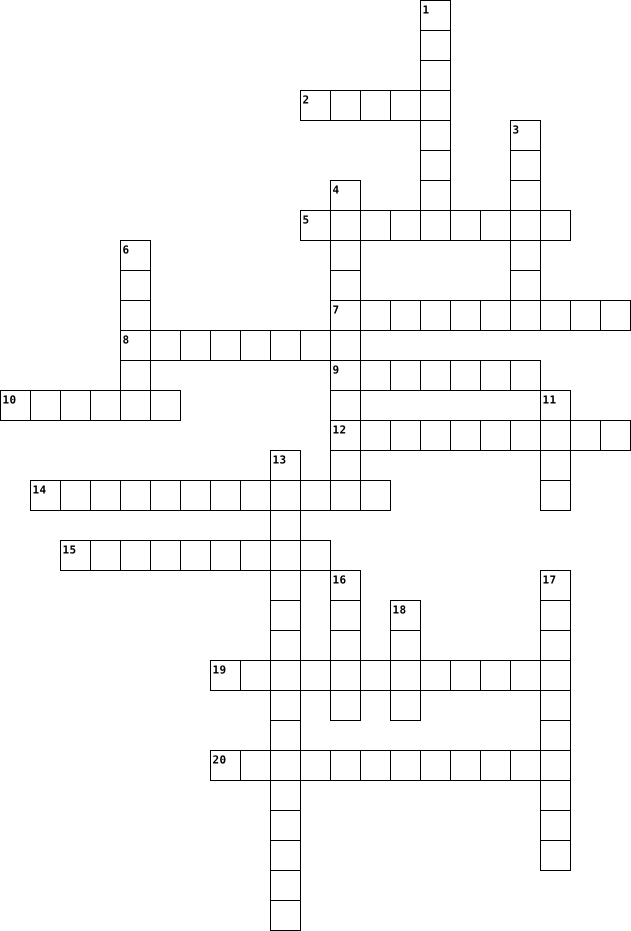
Across
- The center of energy release
- Most common chemical sedimentary rock
- "birth of mountains"
- Crustal pieces that are attached or a accreted
- "all Earth"
- Vertical elevation differences across the surface
- Release of energy that produces seismic waves
- Fastest shock waves traveling through solid, liquid, and gas
- Point closet to the surface
- Also known as shockwaves
- 3rd most important greenhouse gas produced by human activity
Down
- Spots on volcanoes
- Coarse-grained rocks
- Earth's rigid layer
- Lower and upper ____ represent about 80% of Earth's total volume
- When magma reaches surface
- Study of Earth's past climates
- What forms igneous rocks?
- Measurement of land elevation relative to sea level
- Minerals bounded together
20 Clues: "all Earth" • Spots on volcanoes • Earth's rigid layer • Coarse-grained rocks • "birth of mountains" • Also known as shockwaves • What forms igneous rocks? • Minerals bounded together • When magma reaches surface • Point closet to the surface • The center of energy release • Study of Earth's past climates • Most common chemical sedimentary rock • ...
CROSSWORD: Ecosystem & Water Cycle 2026-04-26

Across
- – Formed from condensed water vapor
- – Living things that release water vapor
- – Comes from the sun to power the cycle
- – Main source of heat energy
- – Where plants grow and water is absorbed
- – Water flows over the land into rivers
- – Water falls as rain, snow, or sleet
- – Gas form of water
- – Most common form of precipitation
- – Plants release water vapor
- – The layer of air around Earth
- – All living things on Earth
Down
- – All water found on Earth
- – Continuous movement of water
- – Water vapor cools and forms clouds
- – Water soaks into the soil
- – Needed for evaporation
- – Water turns into vapor because of heat
- – Essential liquid for life
- – Land, rocks, and soil
20 Clues: – Gas form of water • – Land, rocks, and soil • – Needed for evaporation • – All water found on Earth • – Water soaks into the soil • – Essential liquid for life • – Main source of heat energy • – Plants release water vapor • – All living things on Earth • – Continuous movement of water • – The layer of air around Earth • – Formed from condensed water vapor • ...
Relationships within Ecosystems 2023-11-09

Across
- energy forms can be transformed into another form
- number and variety of different species in an area
- make their own food
- different populations that live together
- relationship between two species
- both organisms benefit from relationship
- Baxter's mom
- feeds on other organisms, one benefits and other is harmed
- number of individuals in an area of a spec size
- anything naturally occurring in the environment that humans use
Down
- release of energy from food without oxygen
- the disappearance of all members of a species
- many overlapping food chains in an ecosystem
- process using sunlight to make food
- best school in the world
- diagram showing amount of energy in system
- breaks down biotic waste and dead material
- one organism benefits and other is neither helped nor harmed
- living parts of environment
- where an organism lives, grows, reproduces
- practice of using less of a resource so it can last longer
21 Clues: Baxter's mom • make their own food • best school in the world • living parts of environment • relationship between two species • process using sunlight to make food • different populations that live together • both organisms benefit from relationship • release of energy from food without oxygen • diagram showing amount of energy in system • ...
Cell Chemistry 2013-04-08

Across
- the spontaneous net movement of solvent molecules through a partially permeable membrane into a region of higher solute concentration
- a process used by plants and other autotrophic organisms to convert light energy into chemical energy
- having the form of a sphere
- the reason some object or process occurred in a system that evolved through a process of selection
- a process that leads to the transformation of one set of chemical substances to another
- something that indicates bounds or limits
- a movement of biochemicals across a membrane going down the concentration gradient
- compound is a pure chemical substance consisting of two or more different chemical elements
- a process of passive transport (as opposed to active transport), with this passive transport aided by integral membrane proteins
- the abundance of a constituent divided by the total volume of a mixture
- a condition in which all acting influences are canceled by others, resulting in a stable, balanced, or unchanging system
- a drawing together; a shortening or shrinkage
- an indirectly observed quantity which comes in many forms, such as kinetic
- to govern or direct according to rule
- to produce carbohydrates by photosynthesis
- transport the movement of a substance across a cell membrane against its concentration gradient
Down
- the state or process of being absorbed
- rapid oxidation accompanied by heat and, usually, light.
- a mode of reproduction by which offspring arise from a single parent
- the process by which molecules intermingle as a result of their kinetic energy of random motion
- chemical formula is CO2
- something put into a system
- to cause to pass into solution
- the process of oxidizing food molecules, like glucose, to carbon dioxide and water
- nature’s method of transferring energy through space extremely quickly
- the potential of a chemical substance to undergo a transformation through a chemical reaction
- several forms in science, such as thermal, chemical, electric, etc.
- an arrangement of parts, of organs, or of constituent particles, in a substance or body
- function is to secure supply of energy and data to mobile consumer equipment
29 Clues: chemical formula is CO2 • having the form of a sphere • something put into a system • to cause to pass into solution • to govern or direct according to rule • the state or process of being absorbed • something that indicates bounds or limits • to produce carbohydrates by photosynthesis • a drawing together; a shortening or shrinkage • ...
bolisn energy crossword 2018-02-26

Across
- the biggest use of coal in the usa is
- 81% of our total energy is from this
- compounds that are made from oil
- cannot be replenished in a short period of time takes millions and billions of years
- the energy conservations that occur when a car engine burns gasoline
- petrochemicals are mainly used to make plastics cosmetics and
- this is about a quarter of the energy we use
- two nuclei are combined to form one larger nucleus
- energy produced by flowing water
- fossil fuels are renewable or nonrenewable?
- heat from the earth's interior
- the biggest type of fossil fuel we use
Down
- a factory that crude oil is heated and separated into fuels
- the splitting of an atoms nucleus into two smaller nuclei
- chemicals compounds that contain carbon and hydrogen atoms that make fossil fuels
- wood, manure, food wastes, and plant parts that can be used as fuels
- the original source of energy In wind and flowing water
- fossil fuels are formed by ___ when pressure and heat is added
- replenishes in a relatively short period of time
- about 13% of all energy comes from
- fuel rods generate so much heat they start to melt
- what you put in your walls to keep the cold/warm air in
- the biggest use of oil in the Usa is?
- what we dig for in pockets of rock
- a substance that provides energy
- which lightbulb uses less energy incandescent or compact flourescent
- about 20% of all energy is from this
- using your energy smarter
- adding the mixture of alchohol to gasoline forms and can be used as car fuel
- about 2.2% of the USA's energy
30 Clues: using your energy smarter • about 2.2% of the USA's energy • heat from the earth's interior • compounds that are made from oil • a substance that provides energy • energy produced by flowing water • about 13% of all energy comes from • what we dig for in pockets of rock • 81% of our total energy is from this • about 20% of all energy is from this • ...
Avery's crossword puzzle 2023-05-24

Across
- bridge that forms an arch
- bridge bridge that consists of beams supported by columns.
- thermal energy that flows from a higher to lower temperature.
- thermal energy transfer that doesn't require matter.
- any device securing a suspension bridge at either end.
- law of thermodynamics heat never flows spontaneously from a lower to a higher temp.
- stayed bridge a bridge that consists of one or more towers (or cables) supporting the bridge deck.
- increases when the average kinetic energy of the particles in a material increases.
- energy total kinetic and potential energy of the particles in a material.
- pushing force that tends to lower objects.
- pulling or stretching force that tends to lengthen objects.
Down
- very strong rope made of wire and metal strands used to support cable cars or suspension bridges.
- bridge a bridge on which the deck is hunting from cables.
- a masonry, receiving the arch, beam, truss ect., at each end of the bridge.
- the “top” of the bridge where you can either walk or drive.
- a person who applies their understanding of science and math creating things for the benefit of humanity in our world.
- materials in which thermal energy does not move easily.
- thermal energy is transferred through matter by direct contact of particles.
- a long, rigid, horizontal support structure of a structure.
- the transfer of thermal energy by movement of matter.
20 Clues: bridge that forms an arch • pushing force that tends to lower objects. • thermal energy transfer that doesn't require matter. • the transfer of thermal energy by movement of matter. • any device securing a suspension bridge at either end. • materials in which thermal energy does not move easily. • bridge a bridge on which the deck is hunting from cables. • ...
Single celled organisms 2014-03-08

Across
- Single cells have a ______ surface area:volume ratio in order to obtain the necessary requirements
- Diatoms contain ____________ which help them to harness energy from the sun to produce their own energy
- Can make their own energy
- Site where packaged energy is broken down in order to create energy for the cell.
- Organisms obtain, ___________ distribute and eliminate matter and energy differently. This is what sets them apart
- Paramecium possess ________ which help them move through water
- All of the important processes of this type of organism takes place in the cell
- A group of single-cell organisms that are autotrophs
Down
- Are chemosynthetic and can utilize carbon dioxide to make organic compounds
- Rely on others to provide them with energy
- All living things need energy and _________ for growth
- Process which uses by products of chemical reactions as an energy source
- Is enough for single cell organisms to obtain and release whatever is required
- Once paramecium have obtained enough food, the food forms a __________ and breaks away from the gullet.
- Sometimes individual organisms of the same species live closely together to assist each other with survival
- Paramecium hold food in their ___________
- Paramecium receive their organic requirements by consuming bacteria, yeasts and a________
17 Clues: Can make their own energy • Paramecium hold food in their ___________ • Rely on others to provide them with energy • A group of single-cell organisms that are autotrophs • All living things need energy and _________ for growth • Paramecium possess ________ which help them move through water • Process which uses by products of chemical reactions as an energy source • ...
Boundaries 2022-11-01

Across
- Area of volcanic activity
- New igneous rock forms
- Wave of energy that travels away from the center of the earth
- Two tectonic plates collide
- Break or crack
- Shaking that occurs
- A crack that forms between tectonic plates
- A string of volcanoes
Down
- One plate slides under another
- Underwater mountain range
- boundary Two tectonic plates divide
- boundary Two tectonic plates slide
12 Clues: Break or crack • Shaking that occurs • A string of volcanoes • New igneous rock forms • Area of volcanic activity • Underwater mountain range • Two tectonic plates collide • One plate slides under another • boundary Two tectonic plates slide • boundary Two tectonic plates divide • A crack that forms between tectonic plates • ...
Ecosystems, Environment, and Energy 2024-04-19

Across
- all of the interactions between energy sources in an ecosystem
- a representation of a real object, idea, or concept that scientists use to explain something.
- a model that shows all the different ways that energy can travel.
- the envelope of gases that surround the Earth
- a combination of two or more atoms in a particular way.
- are organisms that eat meat.
- a model that representS one path by which energy can travel through an ecosystem.
- organisms that eat producers, primary consumers, and secondary consumers.
- are organisms that break down dead material and return the nutrients to the soil.
- the process of turning energy from the sun into food for plants.
- all the water in the Earth in all its forms.
- a pyramid where the base of the pyramid represents the producers in a food chain or a food web while each level above represents each group of consumers.
- organisms that eat dead things
Down
- water in all its forms in the Earth.
- an organism that can produce its own energy.
- organisms that eat both plants and animals.
- in every step of the energy pyramid, only ten per cent of the original energy available in that energy level can be used in the next level.
- are organisms that eat plants.
- all the land and rocks in the Earth.
- organisms that are able to make their own food.
- the ability or capacity to do work.
- the system in which all living things in the Earth exist.
22 Clues: are organisms that eat meat. • are organisms that eat plants. • organisms that eat dead things • the ability or capacity to do work. • water in all its forms in the Earth. • all the land and rocks in the Earth. • organisms that eat both plants and animals. • an organism that can produce its own energy. • all the water in the Earth in all its forms. • ...
Carbohydrates 2020-09-27

Across
- Used by plants for structure
- OH group on top
- Breaks apart sugar by adding a molecule of water with the help of enzyme
- OH group on the bottom
- Used by invertebrates for exoskeleton
- Energy storage of carbs
Down
- Made up of more than two monosaccharides
- First form of energy metabolized
- Energy storage used by plants
- Forms H20 and a glyceride bond
- Examples includes Glucose, Galactose,
- Examples includes Maltose, Lactose,
12 Clues: OH group on top • OH group on the bottom • Energy storage of carbs • Used by plants for structure • Energy storage used by plants • Forms H20 and a glyceride bond • First form of energy metabolized • Examples includes Maltose, Lactose, • Examples includes Glucose, Galactose, • Used by invertebrates for exoskeleton • Made up of more than two monosaccharides • ...
BIO:Unit 1 2022-12-09

Across
- pockets in the folds on enzyme surfaces.
- a substance made up of two or more different elements or compounds which do not combine chemically but are physically mixed together.
- attraction of molecules of the same substance.
- the ability to move or change
- The smallest unit of most compounds.
- the basic unit of matter
- a pure substance that consists of one type of atom.
- mixture of water and nondissolved material
- likes water
- an uneven distribution of electron density.
- large units
- substance that is dissolved in solution.
- attraction between molecules of different substances.
- does not like water
- chemical reactions that absorb energy(will NOT occur without an input of energy).
- process that changes or transforms one set of chemicals into another
- proteins that reduce the activation energy of processes to speed them up without being absorbed by the reactions themselves
Down
- tendency of water to rise in a thin tube.
- dissolving substance in a solution.
- chemical bond developed when one or more atoms exchange electrons with one another.
- a substance made of the joined atoms of two or more different elements in known proportions.
- the outer orbital/electron shell.
- chemical reactions that release energy (often occur on their own, or spontaneously).
- small units
- atomic particles with a negative charge that can be found in the nucleus.
- Chemical bond formed when the electrons are shared between atoms.
- atomic particles with a positive charge that can be found in the nucleus.
- type of mixture in which all components are evenly
- a substance on which an enzyme acts during a chemical reaction.
- an atom that experiences electron gain or loss.it has a positive or negative charge as a result.
- A compound that forms H+ ions in solution.
- A compound that forms -OH ions in solution.
- atomic particles with no charge that can be found in the nucleus.
33 Clues: small units • likes water • large units • does not like water • the basic unit of matter • the ability to move or change • the outer orbital/electron shell. • dissolving substance in a solution. • The smallest unit of most compounds. • pockets in the folds on enzyme surfaces. • substance that is dissolved in solution. • tendency of water to rise in a thin tube. • ...
A Level Biology 2024-09-19

Across
- Process by which plants convert light energy into chemical energy.
- Organelle containing digestive enzymes.
- Protein produced by the immune system to neutralize pathogens.
- Maintenance of a stable internal environment.
- Chemical messenger in the body.
- Protein that speeds up chemical reactions.
- Cluster of pigments and proteins that capture light energy.
- Different forms of a gene.
Down
- Movement of water across a semipermeable membrane.
- Organelle known as the powerhouse of the cell.
- Polysaccharide that makes up plant cell walls.
- Structure of DNA and protein found in cells.
- Organism with cells that have a nucleus.
- Building block of DNA and RNA.
- Genetic makeup of an organism.
15 Clues: Different forms of a gene. • Building block of DNA and RNA. • Genetic makeup of an organism. • Chemical messenger in the body. • Organelle containing digestive enzymes. • Organism with cells that have a nucleus. • Protein that speeds up chemical reactions. • Structure of DNA and protein found in cells. • Maintenance of a stable internal environment. • ...
Chapter 11 and 12 Terms 2014-05-26

Across
- Circuit/A circuit in which there is another way for the electrons to flow
- Difference/The difference between the electric potential energy per unit of charge at two points of a circuit
- Resistance/The property of a substance that hinders electric current and converts electrical energy to other forms of energy
- Energy/Energy that is generated from plant and animal matter
- Circuit/A circuit in which there is no other way for the electrons to flow
- unit for resistance
- solution or paste that conducts charge
- unit of electrical power
Down
- Energy/Energy that is directly converted from the sun to energy
- practical unit of electrical power
- resistor or any other device that transforms electrical energy into heat, motion, sound, or light
- electrical device that changes the size of the potential difference of an alternating current
- conductor/A material through which electrical charge can flow with no resistance
- safety device that is found in older buildings and some appliances, which led to appliances and outlets
- unit for potential difference
- Power/The rate at which an appliance uses electrical energy
- circuit/A closed path along which electrons that are powered by an energy source can flow
17 Clues: unit for resistance • unit of electrical power • unit for potential difference • practical unit of electrical power • solution or paste that conducts charge • Power/The rate at which an appliance uses electrical energy • Energy/Energy that is generated from plant and animal matter • Energy/Energy that is directly converted from the sun to energy • ...
Energy and Work 2024-04-12

Across
- It is produced by a force during the movement of a body
- It is the energy due to the movement of a body
- The energy emitted by the sun
- When a body has the ability to create a change we say that it has this
- The energy stored in the nucleus of an atom
- It is the energy due the position or the state of a body
- The unit of energy and work
- The unit of power
Down
- The energy principle that states that the energy can change forms but it is neither created nor destroyed
- The sum of kinetic and potential energies
- The physical quantity that shows how fast a machine or a force is producing work
- The thermal energy that flows from a body to the other
- The work of a force that has the opposite direction to the movement of the body
- The work of a force perpenticular to the movement of the body
- The work of a force that has the same direction as the movement of the body
15 Clues: The unit of power • The unit of energy and work • The energy emitted by the sun • The sum of kinetic and potential energies • The energy stored in the nucleus of an atom • It is the energy due to the movement of a body • The thermal energy that flows from a body to the other • It is produced by a force during the movement of a body • ...
Crossword 2022-03-07

Across
- the law of conservation of energy states that the total energy of an isolated system remains constant; it is said to be conserved over time.
- Gravitational potential energy is energy an object possesses because of its position in a
- Chemical potential energy is the energy stored in the chemical bonds of a substance.
- energy that is transferred by electromagnetic radiation, such as light, X-rays, gamma rays, and thermal radiation.
- Moving or transferring particles.
- Gravitational potential energy is energy an object possesses because of its position in a
- of the kinetic energy,or energy of motion, and the potential energy,or energy stored in a system by reason of the position of its parts.
- The resistance that one surface or object encounters when moving over another.
- Temperature is a measure of the average kinetic energy of the particles in an object.
- is the capacity for doing work. It may exist in potential, kinetic, thermal, helectrical, chemical, nuclear, or other forms.
Down
- The energy possessed by a body by virtue of its position relative to others, stresses within itself, electric charge, and other factors.
- is the mechanical potential energy stored in the configuration of a material or physical system as it is subjected to elastic deformation by work performed upon it.
- (also called heat energy) is produced when a rise in temperature causes atoms and molecules to move faster and collide with each other.
- is something that prevents heat from moving from one place to another.
- is a form of energy that an object or a particle has by reason of its motion.If work, which transfers energy
- is the energy in the nucleus, or core, of an atom.
- Radiation is energy that comes from a source and travels through space at the speed of light.
- is a type of kinetic energy caused by moving electric charges.
- In thermodynamics, the specific heat capacity of a substance is the heat capacity of a sample of the substance divided by the mass of the sample.
- The process by which heat or electricity is directly transmitted through a substance when there is a difference of temperature or of electricalpotential between adjoining regions, without movement of the material.
- is a form of energy that can be heard by living things.
21 Clues: Moving or transferring particles. • is the energy in the nucleus, or core, of an atom. • is a form of energy that can be heard by living things. • is a type of kinetic energy caused by moving electric charges. • is something that prevents heat from moving from one place to another. • The resistance that one surface or object encounters when moving over another. • ...
Physics 9 2023-08-28

Across
- FHS mascot
- __________ Einstein
- Isaac ____________
- light and sound are both forms of this
- unit of speed
- science class you will take next year
- Principal's name
- The study of motion, energy and force
Down
- # of classes each day
- the grade you are in
- device needed for calculations
- force that pulls everything down to Earth
- Often called the "father of the atomic bomb". Movie premiered same day as Barbie
- Isaac Newton has this many laws of motion
- Physics teacher's name
- an electric car company and the unit for measuring magnetism
16 Clues: FHS mascot • unit of speed • Principal's name • Isaac ____________ • __________ Einstein • the grade you are in • # of classes each day • Physics teacher's name • device needed for calculations • science class you will take next year • The study of motion, energy and force • light and sound are both forms of this • force that pulls everything down to Earth • ...
Forms of Energy 2021-10-20

Across
- travels in waves
- travels in a current through wires
- microwave is an example of this form of energy
Down
- is also known as energy in motion
- travels in waves until it hits another substance
5 Clues: travels in waves • is also known as energy in motion • travels in a current through wires • microwave is an example of this form of energy • travels in waves until it hits another substance
forms of energy 2013-03-18

Across
- ________ energy is the energy that is the combination between potential and kinetic energy something has
- ______ is the energy that people use in many ways
Down
- _____ is the energy that can be released by a chemical reaction
- _____ energy is energy that comes from an electric current
- ____ is radiation we see
5 Clues: ____ is radiation we see • ______ is the energy that people use in many ways • _____ energy is energy that comes from an electric current • _____ is the energy that can be released by a chemical reaction • ________ energy is the energy that is the combination between potential and kinetic energy something has
Forms of Energy 2024-09-23

Across
- Energy in a moving object
- Energy stored in a warm object
- Energy in a stretched object
Down
- Energy stored in bonds of atoms and molecules
- Energy produced by vibrating objects
5 Clues: Energy in a moving object • Energy in a stretched object • Energy stored in a warm object • Energy produced by vibrating objects • Energy stored in bonds of atoms and molecules
Forms of Energy 2026-03-12

Across
- Is the energy of motion
- Is the result of kinetic and potential, depends on motion,shape and position
Down
- Is the energy that has the potential to change
- Is the type of potential energy that depends on the material that can be compressed or stretched
- Is a type of potential energy that results from gravity
5 Clues: Is the energy of motion • Is the energy that has the potential to change • Is a type of potential energy that results from gravity • Is the result of kinetic and potential, depends on motion,shape and position • Is the type of potential energy that depends on the material that can be compressed or stretched
Forms of Energy 2026-04-24

Across
- The combination of Mechanical and Potential energy
- A light wave
Down
- The back and forth movement of matter
- the ability to do work or to cause changes
- How loud a sound is
5 Clues: A light wave • How loud a sound is • The back and forth movement of matter • the ability to do work or to cause changes • The combination of Mechanical and Potential energy
types of energy 2022-10-14

Across
- anything that takes up space and can be weighed.
- forms of heat are convection,conduction,radiation.
- is heat moving through gases,liquids,fluids.
- stored energy
- a substance or
- the heat moving through an object and another object touches it.
- measures hot and cold and can be in Fahrenheit or Celsius.
- the quantity per unit volume,unit area,or unit length.
- motion
Down
- energy in a system that is responsible for its temperature.
- energy that comes in a source and does not touch something to give it heat. Like the sun.
- a small fragment that makes up matter.
- is like when a rubber band is stretched. out.
- a substance that flows freely and has constant volume.
- the physical movement to get things Completed.
- anything that keeps energy transferring Through.
- a dependent or independent group of items that unify as a whole.
- the ability to do work.
- that has enough room to expand freely.
- moving from one place to another.
- a firm,hard,or compact in a substance.
21 Clues: motion • stored energy • a substance or • the ability to do work. • moving from one place to another. • a small fragment that makes up matter. • that has enough room to expand freely. • a firm,hard,or compact in a substance. • is heat moving through gases,liquids,fluids. • is like when a rubber band is stretched. out. • the physical movement to get things Completed. • ...
Grade 5 2024-11-08

Across
- Force between magnets and magnetic materials
- What rock is made primarily of a mineral calcite?
- This igneous rock that cools quickly has small crystals and fine grains.
- A force that pulls the objects towards the earth
- Example of igneous rock
- Natural fuel that comes from the remains of living things
- The coldest season of the year
- What forms when magma or lava cools and hardens to become solid?
- Rock that can have fossils in them
- potential Energy stored in a stretched spring
- Push or pull on an object
Down
- Opposite of hot
- What rock is made of sand?
- Force between electrical charges
- A specific type of metamorphic rock.
- Energy that enables us to see
- Soft, white pieces of frozen water that fall on the ground
- Limestone is __________ rock.
- Frozen water
- Energy that can be transferred as heat
20 Clues: Frozen water • Opposite of hot • Example of igneous rock • Push or pull on an object • What rock is made of sand? • Limestone is __________ rock. • A specific type of metamorphic rock. • Energy that enables us to see • Force between electrical charges • The coldest season of the year • Rock that can have fossils in them • ...
Photosynthesis 2013-05-26

Across
- An enzyme that fixes carbon by attaching carbon dioxide.
- membrane Pigments and enzyme function in the formation of ATP and NADPH.
- Process that are concerned with the transfer of electron between species.
- Any light reaction that attaches phosphate to a molecule.
- Coenzyme that accepts electron and hydrogen.
- excitement Step by which energy release in form of heat and light.
- Helps the plant minimize evaporative water loss from leaves and stems.
Down
- cycle Cyclic pathway that forms glucose from Carbon dioxide.
- fixation Process by which carbon atoms form an inorganic molecule pass to an organic molecule.
- The electromagnetic energy of light is organized.
- Measure in nanometers.
- Molecular bridges between sunlight and photosynthesis.
- Converts light energy to chemical energy in photosynthesis.
- Reaction in which light energy breaks down a molecule.
- Main energy carrier.
15 Clues: Main energy carrier. • Measure in nanometers. • Coenzyme that accepts electron and hydrogen. • The electromagnetic energy of light is organized. • Molecular bridges between sunlight and photosynthesis. • Reaction in which light energy breaks down a molecule. • An enzyme that fixes carbon by attaching carbon dioxide. • ...
Forms of Energy 2023-05-09

Across
- the ability to cause motion or a change
- energy energy created by the movement of water
- energy. stored energy
Down
- energy. energy in motion
- converts water energy into electrical energy
5 Clues: energy. stored energy • energy. energy in motion • the ability to cause motion or a change • converts water energy into electrical energy • energy energy created by the movement of water
Forms of Energy 2023-11-16

Across
- potential kinetic energy
- carried by waves and light rays
Down
- produced by vibrations of matter
- moving particles of matter
- comes from the movement of charged particles
5 Clues: potential kinetic energy • moving particles of matter • carried by waves and light rays • produced by vibrations of matter • comes from the movement of charged particles
Science Definitons 2023-11-20

Across
- molten mixture of melted rock
- a rocky outer layer
- the ability to do work
- is a dark fine-grained rock
- the layer of rock that forms around earth's outer skin
- another word for earthquakes
- when magma reaches the surface
- a gas layer
- what shapes earths land
- is a dense ball of solid metal
- molten metal surrounding the inner core
Down
- a layer of hot rock
- force pressing on an area
- what destroys earth's land
- the uppermost layer of the mantle into a single layer
- all living things
- a thin layer that forms around the earth's outermost layer
- something that makes something else work
- all of earth's water
- is a lighter color rock that is also very coarse
20 Clues: a gas layer • all living things • a layer of hot rock • a rocky outer layer • all of earth's water • the ability to do work • what shapes earths land • force pressing on an area • what destroys earth's land • is a dark fine-grained rock • another word for earthquakes • molten mixture of melted rock • when magma reaches the surface • is a dense ball of solid metal • ...
Crsos word 2023-05-18

Across
- When the wavelength gets squished and smaller
- Physical characteristics of an organism
- A molecule that contains genetic information responsible for development of an organism
- Carries genetic information in the form of genes
- A disturbance that moves energy from one place to another
- Alternate variations of genes
- Genetic makeup of an organism
- When the wavelength gets stretched and elongated
- A rock that forms from sediment and a lot of pressure
Down
- A wave that travels parallel to its medium
- A rock that forms when lava cools and crystallizes
- A wave that travels perpendicular to its medium
- The increase or decrease in a sound moving further or away from you and has a noticeable change in pitch
- A rock that has sustained tons of heat and pressure d forms a different rock
- The study of embryos and their development
- The distance between the highest point of a wave and it’s equilibrium
- The lowest part of a wave
- The distance between two crests or two troughs
- The material in which a wave passes through
- The highest point of a wave
20 Clues: The lowest part of a wave • The highest point of a wave • Alternate variations of genes • Genetic makeup of an organism • Physical characteristics of an organism • A wave that travels parallel to its medium • The study of embryos and their development • The material in which a wave passes through • When the wavelength gets squished and smaller • ...
Karlee Baumer 2023-02-08

Across
- where an earthquake starts
- a sensitive device that detects the shaking of a earthquake
- shaking of earth's crust after the initial shaking
- horizontal layers
- the amount of energy released by an earthquake
- a central opening in a volcanic area through which magma may escape
- flows out of a vent
- the continents which drifted in time
- the layer beneath the earth
- directly above the focus
- heat from below earth's surface
- a steep-sided cone that forms from explosive eruptions of hot rocks
Down
- hot molten rock
- a cone formed from explosive eruptions of hot rocks followed by a flow of lave, over and over
- a vibration that spreads out away from a focus
- a very hot part of the earth's mantle
- the sliding of a denser ocean plate under another plate
- the sea floor spreading apart
- a cuplike hollow that forms at the top of a volcaano
- the idea that earth's surface is broke into plates
- a huge crack in the earth's crust
- a wide, gently sloped cone that forms from flows of lava
- rocky surface
23 Clues: rocky surface • hot molten rock • horizontal layers • flows out of a vent • directly above the focus • where an earthquake starts • the layer beneath the earth • the sea floor spreading apart • heat from below earth's surface • a huge crack in the earth's crust • the continents which drifted in time • a very hot part of the earth's mantle • ...
Science words 2022-05-11

Across
- neutral ions
- stored energy
- a moving mass of air
- neither warm or cold front can't replace the other
- the ability to do work
- law of conservation of energy
- cold air mass is replacing a warm air mass
- a substance's ability to dissolve in a solvent
- pressure that brings clear, sunny skies, cold temperature & warm weather
- where a warm front is replacing a cold air mass
- pressure that brings cloudy skies, warmer temperatures & precipitation
- a combination of 2 fronts that forms when a cold front catches up & overtakes a warm front
- very few clouds in the sky
- constantly replaced & never will run out
- energy of motion
Down
- positive ions
- more clouds than sun
- negative ions
- speed
- a substance, usually a liquid, in which other materials dissolve
- more sun than clouds
- both alleles are the same
- a way to show possible offspring
- a substance dissolved in a solution
- cannot be replaced
- a mixture where the parts can't be easily separated
26 Clues: speed • neutral ions • positive ions • negative ions • stored energy • energy of motion • cannot be replaced • more clouds than sun • more sun than clouds • a moving mass of air • the ability to do work • both alleles are the same • very few clouds in the sky • law of conservation of energy • a way to show possible offspring • a substance dissolved in a solution • ...
Variety Vocb 1 - Env Science 2019-05-13

Across
- relationship between animals where they both benefits
- Animal that attacks prey or other animal
- Fossil fuels are considered this type of energy
- Taking more organism for food than one needs to.
- Living things that make their own food e.g. plant
- rain, sleet, hair - are all forms of this
- Organisms that can interbreed and produce fertile offspring are members of this
- when all members of a species die
- Several food chains joined together
- the ultimate energy source
Down
- garbage in a place where it is not supposed to be.
- the sphere for living things
- Plants store energy as this compound
- an educated guess
- The variety of living things
- Step in the water cycle where liquid water becomes water vapor
- Process by which plants make food using the sun’s energy
- Step in the nitrogen cycle where NO2 becomes NO3-
- A trait that helps an organism better survive
- Animal that eat plants
20 Clues: an educated guess • Animal that eat plants • the ultimate energy source • the sphere for living things • The variety of living things • when all members of a species die • Several food chains joined together • Plants store energy as this compound • Animal that attacks prey or other animal • rain, sleet, hair - are all forms of this • ...
bolisn energy crossword 2018-02-26

Across
- about 2.2% of the USA's energy
- fossil fuels are formed by ___ when pressure and heat is added
- what we dig for in pockets of rock
- cannot be replenished in a short period of time takes millions and billions of years
- the energy conservations that occur when a car engine burns gasoline
- wood, manure, food wastes, and plant parts that can be used as fuels
- a factory that crude oil is heated and separated into fuels
- about 13% of all energy comes from
- what you put in your walls to keep the cold/warm air in
- the splitting of an atoms nucleus into two smaller nuclei
- 81% of our total energy is from this
- the biggest type of fossil fuel we use
- fossil fuels are renewable or nonrenewable?
- the biggest use of oil in the Usa is?
Down
- replenishes in a relatively short period of time
- the original source of energy In wind and flowing water
- energy produced by flowing water
- two nuclei are combined to form one larger nucleus
- petrochemicals are mainly used to make plastics cosmetics and
- about 20% of all energy is from this
- chemicals compounds that contain carbon and hydrogen atoms that make fossil fuels
- which lightbulb uses less energy incandescent or compact flourescent
- adding the mixture of alchohol to gasoline forms and can be used as car fuel
- heat from the earth's interior
- fuel rods generate so much heat they start to melt
- compounds that are made from oil
- the biggest use of coal in the usa is
- using your energy smarter
- a substance that provides energy
- this is about a quarter of the energy we use
30 Clues: using your energy smarter • about 2.2% of the USA's energy • heat from the earth's interior • energy produced by flowing water • compounds that are made from oil • a substance that provides energy • what we dig for in pockets of rock • about 13% of all energy comes from • about 20% of all energy is from this • 81% of our total energy is from this • ...
Science Definitons 2023-11-20

Across
- molten mixture of melted rock
- a rocky outer layer
- the ability to do work
- is a dark fine-grained rock
- the layer of rock that forms around earth's outer skin
- another word for earthquakes
- when magma reaches the surface
- a gas layer
- what shapes earths land
- is a dense ball of solid metal
- molten metal surrounding the inner core
Down
- a layer of hot rock
- force pressing on an area
- what destroys earth's land
- the uppermost layer of the mantle into a single layer
- all living things
- a thin layer that forms around the earth's outermost layer
- something that makes something else work
- all of earth's water
- is a lighter color rock that is also very coarse
20 Clues: a gas layer • all living things • a layer of hot rock • a rocky outer layer • all of earth's water • the ability to do work • what shapes earths land • force pressing on an area • what destroys earth's land • is a dark fine-grained rock • another word for earthquakes • molten mixture of melted rock • when magma reaches the surface • is a dense ball of solid metal • ...
Cellular Respiration Worksheet 2022-12-04

Across
- during glycolysis glucose is split into this
- the starting and ending molecule for the Krebs cycle
- the process that splits sugar
- the process that forms energy from sugars in cells
- required for
- the amount a energy required for a reaction to proceed
- requires oxygen
- the ability to do work
- the location which glycolysis takes place
- cycle that converts acetyl coA into CO2
Down
- the 6 carbon molecule formed from oxaloacetate and acetyl CoA
- the location on an enzyme where substrate binds
- the basic unit of life
- the carbohydrate the is a reactant in cellular respiration
- the waste product that glucose is ultimately broken down into
- the energy molecule used by cells to do work
- an electron carrier that is produced in glycolysis and the oxidation of pyruvate
- CoA pyruvate becomes this before the Krebs cycle
- the organelle that converts sugar to energy
- a protein that speeds up chemical reactions
20 Clues: required for • requires oxygen • the basic unit of life • the ability to do work • the process that splits sugar • cycle that converts acetyl coA into CO2 • the location which glycolysis takes place • the organelle that converts sugar to energy • a protein that speeds up chemical reactions • during glycolysis glucose is split into this • ...
Monomers, Polymers, and ATP 2015-05-01

Across
- The cell organelle that produces ATP
- Breaks the bonds of polymers, which forms monomers
- Uses ATP as energy
- The process in which monomers form polymers
- Breaks into two or more monomers
- Has two phosphate groups and one high energy bond
- An example of a carbohydrate monomer
- The process in which polymers break apart to form monomers
- A protein monomer
Down
- A lipid polymer
- Two or more bond together to form polymers
- A nucleotide that is used as energy
- ATP and ADP are this type of macromolecule
- One monomer loses this during a condensation reaction
- A carbohydrate polymer
15 Clues: A lipid polymer • A protein monomer • Uses ATP as energy • A carbohydrate polymer • Breaks into two or more monomers • A nucleotide that is used as energy • The cell organelle that produces ATP • An example of a carbohydrate monomer • Two or more bond together to form polymers • ATP and ADP are this type of macromolecule • The process in which monomers form polymers • ...
Physical Science Unit 3b Vocab 2023-08-10

Across
- the increase in volume of a material when its temperature increases
- a material that conducts energy well
- the energy stored in atomic nuclei
- energy obtained from flowing water
- a measure of the kinetic energy of the particles in an object
- thermal energy discharged into an area at a lower temperature without being converted into useful work
- the amount of heat needed to raise the temperature of one gram of a material by one degree Celsius
- any device that converts thermal energy into work
- rich deposits of hyrdrocarbon mixtures that formed from the remains of organisms
- a heating system that heats any rooms from one central location
- a device that uses work to transfer thermal energy from a colder area to a warmer area
- circulation of a fluid in a loop as the fluid alternately heats and cools down
- instrument used to measure thermal energy released or absorbed during a chemical or physical change16.2
- the transfer of energy by waves moving through space
- a fluid that vaporizes and condenses inside the tubing of a heat pump
- the practice of finding ways to use less energy or to use energy more efficiently
- a heat engine in which the fuel burns inside the engine
Down
- the study of conversions between thermal energy and other forms of energy
- the process of changing energy from one form to another
- thermal energy beneath Earth’s surface
- the transfer of thermal energy from one object to another because of a difference in temperature
- a source of energy that can be replaced in a relatively short period of time
- a source of energy that exists in limited quantities and, once used, cannot be replaced except over the course of millions of years
- a heat engine in which the fuel burns outside the engine
- the chemical energy stored in living things
- A material that conducts thermal energy poorly
- sunlight that is converted into usable energy
- the transfer of thermal with no overall transfer of matter within a material or between materials that are touching
- a temperature of zero kelvins
- the transfer of thermal energy when particles of a fluid move from one place to another
30 Clues: a temperature of zero kelvins • the energy stored in atomic nuclei • energy obtained from flowing water • a material that conducts energy well • thermal energy beneath Earth’s surface • the chemical energy stored in living things • sunlight that is converted into usable energy • A material that conducts thermal energy poorly • ...
5th grade Science 2024-04-07

Across
- the lunar cycle take about this long
- the kind of soil that holds a lot of water
- where petroleum once formed
- original source of energy in a food chain
- an example of a renewable resource
- how light travels
- slows objects down
- this would be beneficial in the tundra
- use this to separate objects that have different relative densities
- this energy causes solids to change to liquids
- an example of a nonrenewable resource
- canyons, valleys form from this
- outermost planet
- silver, gold, copper
- what forms a u-shaped valley
- how sediment is "glued" to form a rock
- a producer that is not a plant
Down
- water vapor turns into droplets
- how sediment is pressed to form a rock
- It rained all weekend
- a key word to identify climate
- this is a thermal conductor but not an electrical conductor
- this is one thing needed to form a fossil fuel
- what happens to light when it passes from air to water
- waxy plant stems would be helpful here
- a shiny object is likely to do this with light
- tools that refract light
- for Earth, it is 24 hours
- to dissolve
- forms at mouth of river from deposition
- time with shortest shado
- birds migrating
- to help
- arrows in a food chain show this
- could turn into coal
35 Clues: to help • to dissolve • birds migrating • outermost planet • how light travels • slows objects down • could turn into coal • silver, gold, copper • It rained all weekend • tools that refract light • time with shortest shado • for Earth, it is 24 hours • where petroleum once formed • what forms a u-shaped valley • a key word to identify climate • a producer that is not a plant • ...
Set 1 - Vocabulary Review 2018-01-24

Across
- thick, black liquid formed from the buried remains of microscopic marine organisms
- can be replaced after it is used or that will not run out
- A renewable energy resource that produces electricity by moving water
- solid sedimentary rock that produces energy when burned
- form from the remains of plants and other organisms
- Narrow bands of strong winds that blow near the top of the troposphere
Down
- forms under similar conditions and often with oil, but it forms as a gas
- derived from burning organic material such as wood, alcohol, and garbage
- energy obtained by using hot magma or, dry rocks
- energy resource that cannot be replaced once it has been used
10 Clues: energy obtained by using hot magma or, dry rocks • form from the remains of plants and other organisms • solid sedimentary rock that produces energy when burned • can be replaced after it is used or that will not run out • energy resource that cannot be replaced once it has been used • A renewable energy resource that produces electricity by moving water • ...
Physics 9 2023-08-28

Across
- device needed for calculations
- The study of motion, energy and force
- force that pulls everything down to Earth
- Physics teacher's name
- unit of speed
- FHS mascot
- light and sound are both forms of this
Down
- an electric car company and the unit for measuring magnetism
- # of classes each day
- __________ Einstein
- Principal's name
- Often called the "father of the atomic bomb". Movie premiered same day as Barbie
- science class you will take next year
- the grade you are in
- Isaac Newton has this many laws of motion
- Isaac ____________
16 Clues: FHS mascot • unit of speed • Principal's name • Isaac ____________ • __________ Einstein • the grade you are in • # of classes each day • Physics teacher's name • device needed for calculations • The study of motion, energy and force • science class you will take next year • light and sound are both forms of this • force that pulls everything down to Earth • ...
Science Definitons 2023-11-20

Across
- molten mixture of melted rock
- a rocky outer layer
- the ability to do work
- is a dark fine-grained rock
- the layer of rock that forms around earth's outer skin
- another word for earthquakes
- when magma reaches the surface
- a gas layer
- what shapes earths land
- is a dense ball of solid metal
- molten metal surrounding the inner core
Down
- a layer of hot rock
- force pressing on an area
- what destroys earth's land
- the uppermost layer of the mantle into a single layer
- all living things
- a thin layer that forms around the earth's outermost layer
- something that makes something else work
- all of earth's water
- is a lighter color rock that is also very coarse
20 Clues: a gas layer • all living things • a layer of hot rock • a rocky outer layer • all of earth's water • the ability to do work • what shapes earths land • force pressing on an area • what destroys earth's land • is a dark fine-grained rock • another word for earthquakes • molten mixture of melted rock • when magma reaches the surface • is a dense ball of solid metal • ...
Work, Power, & Energy 2024-03-06

Across
- Measurement of how much force is amplified by using the simple machine
- Energy stored within an object by either a change in height or shape
- Energy cannot be created nor destroyed, it can only be released or absorbed to transform from one form of energy to another
- The ability of an object to produce work and measured in Joules
Down
- Device that changes the direction or the magnitude of a force
- SI Unit for all forms of energy
- The amount of work an object can do because of the objects kinetic and potential energies
- The ratio of work done to energy applied
- The rate of transfer of work
- Energy possessed by an object in motion
- The object of interest on a simple machine
- Unit for power to measure how fast energy is being moved
- A transfer of energy to apply force to an object to over a distance and measured in Joules
- Force applied to rotate an object
14 Clues: The rate of transfer of work • SI Unit for all forms of energy • Force applied to rotate an object • Energy possessed by an object in motion • The ratio of work done to energy applied • The object of interest on a simple machine • Unit for power to measure how fast energy is being moved • Device that changes the direction or the magnitude of a force • ...