
forms of energy Crossword Puzzles
Thermochemistry 2020-05-01

Across
- Enter your initials and class period after the j (Suzi Smith in 5th period would be jSS5
- the energy in a system that is available for work; a system's capacity to do useful work
- measures the energy absorbed or released as heat in a chemical or physical change
- the quantity of energy transferred as heat during a chemical reaction
- a measure of the degree of randomness of the particles, such as molecules, in a system
- energy of motion, energy being used
- heat transfer by currents in the air or water
- heat transfer by touch
- heat transfer by electromagnetic energy
Down
- a reaction that releases heat into its surroundings and feel warm
- an equation that includes the quantity of energy released or absorbed as heat during the reaction as written
- the SI unit of heat as well as all other forms of energy
- a reaction that takes in energy from its surroundings and feels cold
- the amount of energy required to raise the temperature of one gram of a substance by one kelvin
14 Clues: heat transfer by touch • energy of motion, energy being used • heat transfer by electromagnetic energy • heat transfer by currents in the air or water • the SI unit of heat as well as all other forms of energy • a reaction that releases heat into its surroundings and feel warm • a reaction that takes in energy from its surroundings and feels cold • ...
Thermochemistry 2020-05-01

Across
- Enter your initials and class period after the j (Suzi Smith in 5th period would be jSS5
- the energy in a system that is available for work; a system's capacity to do useful work
- measures the energy absorbed or released as heat in a chemical or physical change
- the quantity of energy transferred as heat during a chemical reaction
- a measure of the degree of randomness of the particles, such as molecules, in a system
- energy of motion, energy being used
- heat transfer by currents in the air or water
- heat transfer by touch
- heat transfer by electromagnetic energy
Down
- a reaction that releases heat into its surroundings and feel warm
- an equation that includes the quantity of energy released or absorbed as heat during the reaction as written
- the SI unit of heat as well as all other forms of energy
- a reaction that takes in energy from its surroundings and feels cold
- the amount of energy required to raise the temperature of one gram of a substance by one kelvin
14 Clues: heat transfer by touch • energy of motion, energy being used • heat transfer by electromagnetic energy • heat transfer by currents in the air or water • the SI unit of heat as well as all other forms of energy • a reaction that releases heat into its surroundings and feel warm • a reaction that takes in energy from its surroundings and feels cold • ...
Space and Physics 2026-04-17

Across
- — How fast work is done
- — Related to the sun
- — When one object blocks light from another
- — Movement around another object
- — Change in speed or direction
- — All space and everything in it
- — Related to the moon
- — A large group of stars and space objects
- — Force that pulls objects toward each other
- — A space rock burning in Earth’s atmosphere
- — A ball of hot gas that gives off light and heat
Down
- Energy — Energy of motion
- — Using force to move an object
- — Spinning on an axis
- — A large object that orbits a star
- — How fast something moves
- — A simple machine used to lift objects
- — A wheel and rope used to lift objects
- — Speed in a specific direction
- — A push or pull on an object
- — An icy object that forms a tail near the sun
- Energy — Stored energy
- — The ability to do work
- — Force that slows motion between surfaces
- — A tool used to see distant objects
- — The path an object follows around another object
- — A small rocky object in space
- — Change in position over time
28 Clues: — Related to the sun • — Spinning on an axis • — Related to the moon • Energy — Stored energy • — How fast work is done • — The ability to do work • Energy — Energy of motion • — How fast something moves • — A push or pull on an object • — Change in speed or direction • — Change in position over time • — Using force to move an object • — Speed in a specific direction • ...
Biogeochemical Cycles 2025-02-07

Across
- Process by which water changes from a liquid into a gas
- A process by which green plants turn carbon dioxide into carbohydrates
- Equation Glucose and oxygen yield carbon dioxide, water, and ATP energy
- Matter Matter originating from a living organism; contains hydrocarbons
- Carbon molecules bonded to hydrogen molecules
- Precipitation not absorbed into soil that moved to water collection points
- Process by which droplets of water fall to Earth as rain, snow, sleet, or hail
- The downward movement of water from land surfaces into soil or porous rock
- The most abundant element in the atmosphere, it is essential for life
- Process by which water vapor in the air is changed into liquid water
- The breaking down of materials by rotting, decay, or microorganisms
- The fourth most abundant element in the universe and essential to life on Earth
Down
- Carbon dioxide, water, and sunlight yields glucose and oxygen
- Carbohydrates(glucose) are used to make ATP energy for metabolic reactions
- The process of burning something
- Cycle Process in which water circulates between Earth’s oceans, atmosphere, and land
- Microscopic marine plants that use carbon to make shells of calcium carbonate
- Cycle A system that changes atmospheric nitrogen into usable forms
- Nitrifying bacteria convert unusable forms of soil nitrogen into useable forms
- Turning atmospheric nitrogen into useable forms
- Cycle A system that transfers carbon from one part of the environment to another
21 Clues: The process of burning something • Carbon molecules bonded to hydrogen molecules • Turning atmospheric nitrogen into useable forms • Process by which water changes from a liquid into a gas • Carbon dioxide, water, and sunlight yields glucose and oxygen • Cycle A system that changes atmospheric nitrogen into usable forms • ...
vocabulary lesson 1 and 2 2023-01-09

Across
- the potential energy stored in the nucleus of an atom
- energy that an object has due to its motion
- the energy an object has because of its motion also the internal stored energy of an object such as energy stored in chemical bonds
- a form of potential energy that is stored in chemical bonds between atoms
- the energy of light and other forms of radiation which travels through space as waves
- ability to do work or cause change
Down
- the energy of electric charges
- the total kinetic and potential energy of all the particles of an object
- a change from one form of energy to another also called an energy conversion
- kinetic or potential energy associated with the motion or position of an object
- the force that two surfaces excert on each other when they rub against each other The transfer of electrons from one uncharged object by rubbing
- of conservation of energy the rule that energy cannot be created or destroyed
12 Clues: the energy of electric charges • ability to do work or cause change • energy that an object has due to its motion • the potential energy stored in the nucleus of an atom • the total kinetic and potential energy of all the particles of an object • a form of potential energy that is stored in chemical bonds between atoms • ...
Sustainability 2014-08-24

Across
- In most homes this force is 110 volts.
- mining Refers to a group of mining techniques used to extract coal from below the ground.
- Rain that has turned acidic because of pollution in the air
- A device that changes electricity from one voltage to another voltage.
- This is made from ancient plant material and gives coal most of its energy.
- A unit of Mesurment
- A type of fuel formed from the remains of plants or sea creatures millions of years ago.
- Sealed vessel in a power plant where water is converted to steam.
- A form of Energy we use to warm up our houses in winter
- A form of energy that is used in homes
- The ability to do work. It comes in many forms such as light, heat, sound, and motion.
Down
- A machine in a powerplant that produces electricity by changing mechanical energy into electrical energy
- In a power plant, it’s where coal is burned.
- A machine thats that grinds coal to a fine powder
- Energy that can't be reused
- One of the greenhouse gases in our atmosphere;colorless and a waste product of burning fossil fuels
- Water at boiling temperature that spins a turbine
- Practically every form of electric power is generated using this type of engine.
- A mineral that looks like a shiny black rock. It’s formed from plant
19 Clues: A unit of Mesurment • Energy that can't be reused • In most homes this force is 110 volts. • A form of energy that is used in homes • In a power plant, it’s where coal is burned. • A machine thats that grinds coal to a fine powder • Water at boiling temperature that spins a turbine • A form of Energy we use to warm up our houses in winter • ...
Energy and Heat Transfer 2021-10-25

Across
- the sum of all potential and kinetic energy in an object; the energy used to make things move
- a form of energy made of waves that allow us to hear
- energy that is stored up due to an object’s position or placement
- also called heat energy; the energy of particles in motion
- the energy created by the movement of charged electrons and particles
- the transfer of heat by a difference in density; usually occurs in liquids and gases
Down
- the transfer of heat by direct contact; works best in solids
- energy stored in chemical bonds; released through a chemical reaction like digestion or burning
- the transfer of heat by waves; occurs in all states of matter AND in places with no matter at all, like space
- energy that something has whenever it is in motion
- a form of energy made of waves that allow us to see
- the ability to do work; comes in many forms
12 Clues: the ability to do work; comes in many forms • energy that something has whenever it is in motion • a form of energy made of waves that allow us to see • a form of energy made of waves that allow us to hear • also called heat energy; the energy of particles in motion • the transfer of heat by direct contact; works best in solids • ...
Energy and Heat Transfer 2021-10-25

Across
- also called heat energy; the energy of particles in motion
- the transfer of heat by a difference in density; usually occurs in liquids and gases
- energy stored in chemical bonds; released through a chemical reaction like digestion or burning
- the transfer of heat by waves; occurs in all states of matter AND in places with no matter at all, like space
- the energy created by the movement of charged electrons and particles
- energy that is stored up due to an object’s position or placement
Down
- the sum of all potential and kinetic energy in an object; the energy used to make things move
- energy that something has whenever it is in motion
- a form of energy made of waves that allow us to hear
- a form of energy made of waves that allow us to see
- the transfer of heat by direct contact; works best in solids
- the ability to do work; comes in many forms
12 Clues: the ability to do work; comes in many forms • energy that something has whenever it is in motion • a form of energy made of waves that allow us to see • a form of energy made of waves that allow us to hear • also called heat energy; the energy of particles in motion • the transfer of heat by direct contact; works best in solids • ...
Renewable Energy Crossword 2013-05-06

Across
- For geothermal electricity we extract water from the earth's _____.
- Most forms of renewable energy do not release _____ gases.
- The problem with fossil fuels is because of the _____ it releases.
- Solar power is i_____.
- Building a dam can cause the loss of _____.
- What is another term used to mean renewable?
- Energy resources that, once used, can replenish themselves and can be used repeatedly are called:
- Hydroelectric power is very _____ after construction costs.
Down
- What is an advantage of solar power?
- What is the word to describe the conservation of an ecological balance by avoiding depletion of natural resources?
- The most commonly used energy source for the generation of electricity are _____ fuels.
- It is very _____ to build a dam.
- Give an example of a five letter renewable energy source that begins with the letter W.
- Sunlight is a renewable _____ source.
- Solar panels are a packaged, connected assembly of solar _____.
15 Clues: Solar power is i_____. • It is very _____ to build a dam. • What is an advantage of solar power? • Sunlight is a renewable _____ source. • Building a dam can cause the loss of _____. • What is another term used to mean renewable? • Most forms of renewable energy do not release _____ gases. • Hydroelectric power is very _____ after construction costs. • ...
EIF Unit 3A Vocabulary 2015-03-05

Across
- Energy within generation systems is often lost due to this.
- A barrier constructed across a waterway to control the flow or raise the level of water
- Process of creating electrical energy from other forms of energy
- a steam generator
- A _______ load plant operates continually at maximum output
- Fossil fuels are classified as this type of compound
- Energy from the heat deep inside the earth
- Generally referred to as “burning”
- A severe nuclear reactor accident
- Gas turbines start quickly and are useful during _________ load.
- A unit of energy in the English system, defined as the energy required to raise the temperature of one pound of water by one degree Fahrenheit
Down
- The amount of useful energy in a system’s output compared to its input
- Structured collection of fuel rods within a nuclear reactor
- Power generated by using moving water to power a turbine generator to produce electricity
- The ______________ building is a concrete and steel enclosure around a nuclear reactor.
- Abbreviation for the agency that ensures the peaceful and safe use of radioactive materials
- A closed vessel in which water or other fluids are heated enough to be converted into steam
- Abbreviation for the type of nuclear plant in which steam that moves the turbine is created
18 Clues: a steam generator • A severe nuclear reactor accident • Generally referred to as “burning” • Energy from the heat deep inside the earth • Fossil fuels are classified as this type of compound • Energy within generation systems is often lost due to this. • Structured collection of fuel rods within a nuclear reactor • ...
Unit 2 Biology 2025-09-30

Across
- an anaerobic (oxygen-free) metabolic process where microorganisms, such as yeast and bacteria, convert carbohydrates like sugar or starch into alcohol, acids, or gases for energy
- a molecule within cells that stores less energy than ATP, acting as a "charged" form for cellular processes
- the initial metabolic process in cellular respiration where a glucose (sugar) molecule is broken down into two pyruvate molecules, releasing a small amount of energy in the form of ATP and NADH
- tiny, membrane-bound structures in a cell known as the "powerhouses of the cell" because they generate the energy needed for the cell to function and survive
- layer of gases that surround the Earth
- a nonmetallic chemical element (symbol C) that forms the fundamental backbone of all life on Earth
- the solid, non-living part of Earth
- where life exists on Earth
- requires oxygen
- the second stage of photosynthesis where carbon dioxide and energy (ATP and NADPH) are converted into sugars, like glucose
- an organism that gets its food and energy by consuming other organisms
- the process by which cells break down glucose and oxygen to release stored chemical energy
- a series of chemical reactions in the cell's mitochondria that breaks down nutrients, producing energy in the form of ATP, electron-carrying molecules (NADH and FADH2), and carbon dioxide as a waste product
- green pigment in plants
Down
- an essential chemical element (symbol N) that forms a colorless, odorless gas making up about 78% of Earth's atmosphere and is a fundamental component of all living things, found in proteins, nucleic acids, and other biologically important compounds
- an organism that makes its own food
- the site of photosynthesis
- without oxygen
- the process by which green plants, algae, and some bacteria use sunlight, water, and carbon dioxide to create their own food in the form of sugars (like glucose), releasing oxygen as a byproduct
- an organism, like bacteria or fungi, that breaks down dead organic matter, such as dead plants and animals, into simpler substances
- the first stage of photosynthesis where light energy is captured by pigments
- any physical substance that has mass and takes up space (volume)
- a molecule found in all living cells that serves as the primary "energy currency" for cellular activities
- an organism, like bacteria or fungi, that breaks down dead organic matter, such as dead plants and animals, into simpler substances
- a nonmetallic chemical element
- all the water on, above, and below the surface of the Earth
- a substance that participates in a chemical reaction and is transformed into other substances, called products
- any substance that is formed as a result of a chemical reaction or natural process
28 Clues: without oxygen • requires oxygen • green pigment in plants • the site of photosynthesis • where life exists on Earth • a nonmetallic chemical element • an organism that makes its own food • the solid, non-living part of Earth • layer of gases that surround the Earth • all the water on, above, and below the surface of the Earth • ...
Forms of Government 2020-09-18

Across
- a system of government by one person with absolute power.
- control of an organization or group by the majority of its members.
- relating to a system of government or organization in which the powers of the separate constituent parts are vested in a central body.
- the highest class in certain societies, especially those holding hereditary titles or offices.
- having or relating to a system of government in which several states form a unity but remain independent in internal affairs.
- relating to a system of government that is centralized and dictatorial and requires complete subservience to the state.
- a small group of people having control of a country, organization, or institution.
Down
- relating to or denoting a confederation.
- (in the UK) the highest legislature, consisting of the sovereign, the House of Lords, and the House of Commons.
- denoting attitudes, activities, or other things that have no religious or spiritual basis.
- a body of fundamental principles or established precedents according to which a state or other organization is acknowledged to be governed.
- government by a dictator.
- a form of government with a monarch at the head.
- a system of government in which priests rule in the name of God or a god.
14 Clues: government by a dictator. • relating to or denoting a confederation. • a form of government with a monarch at the head. • a system of government by one person with absolute power. • control of an organization or group by the majority of its members. • a system of government in which priests rule in the name of God or a god. • ...
Particles, Energy, and Phase Changes 2025-01-15

Across
- Energy particles are vibrating but not moving around one another
- You saw a puddle on your way to school that was gone on your way home. What happened to it?
- Phase change that occurs when energy is removed from a liquid
- Particles of a solid beak away from each other and spread out evenly in the liquid
- The temperature at which particles would be completely still although this has never been achieved
- The transfer of energy from one particle to another when they come into contact
- Gas to liquid
- The ability to do work
- This substance from our lab has a melting point of less than 55 degrees C.
Down
- Removing energy from a substance causes particles to move closer together or ________.
- The temperature at which liquid turns to a gas
- A phase of matter that has no definite shape or volume
- A mixture that forms when one substance dissolves into another
- Iodine gas formed crystals on the cold surface do to which phase change?
- Phase change that turns a solid directly into a gas
- The type of energy that particles have when they are moving
- This substance is unique because of the shape its polar molecules form in a solid causes it to be less dense as a solid than as a liquid.
- The majority of Earth's energy comes from the _______.
- When particles of a substance move further apart
- Any situation in which no energy transfer is happening between particles in a system
20 Clues: Gas to liquid • The ability to do work • The temperature at which liquid turns to a gas • When particles of a substance move further apart • Phase change that turns a solid directly into a gas • A phase of matter that has no definite shape or volume • The majority of Earth's energy comes from the _______. • The type of energy that particles have when they are moving • ...
CHEM Unit 1 Crossword 2023-09-24

Across
- a change in the state of matter is known as a "____ change"
- A type of mixture in which all samples are the same.
- A type of heterogeneous mixture that has a color, can scatter light, and has two different states of matter.
- The LEAST reactive family of metals-commonly used in everyday lives
- A type of heterogeneous mixture in which large particles are visible and be filtered
- The MOST reactive family of metals
- a PURE substance made up of ONE kind of atom
- A type of mixture in which all samples are different.
- the noble gases are classified as this, meaning "nonreactive"
Down
- The substance DOING THE DISSOLVING in a solution.
- a CHEMICAL combination of two or more elements
- A solid that forms & settles out after mixing two liquid solutions
- a PHYSICAL combination of two or more substances
- The family forms violently reactive/deadly gases
- this state of matter has the LEAST energy & particles are CLOSEST togehter
- this state of matter has the MOST energy & particles are SPREAD OUT
- The substance BEING DISSOLVED in a solution.
17 Clues: The MOST reactive family of metals • The substance BEING DISSOLVED in a solution. • a PURE substance made up of ONE kind of atom • a CHEMICAL combination of two or more elements • a PHYSICAL combination of two or more substances • The family forms violently reactive/deadly gases • The substance DOING THE DISSOLVING in a solution. • ...
Cells Puzzle 2022-10-19

Across
- Contains the contents of a cell
- Control center of the cell
- The viscous fluid that holds all the parts of a cell
- Most cells can only be seen with a ___________.
- Releases and creates energy for the cell
- like the cell membrane but only found in plants
- ____________ forms ribosomes
- Contains the food, water and waste of a cell
Down
- Packaging and shipping station of a cell
- shipping trucks of the Golgi Apparatus
- Part of a cell that Takes in solar energy and turn it into energy for the cell
- Cells that are only found in plants, fungi, and animals
- Parts of a cell
- Digests invaders
- All living things are made of _____________.
15 Clues: Parts of a cell • Digests invaders • Control center of the cell • ____________ forms ribosomes • Contains the contents of a cell • shipping trucks of the Golgi Apparatus • Packaging and shipping station of a cell • Releases and creates energy for the cell • All living things are made of _____________. • Contains the food, water and waste of a cell • ...
science 2015-04-24

Across
- a type of tide that forms in a straight line
- earth's shadow on the moon
- non-living thing
- living thing
Down
- a type of tide that forms in a 90 degree angle
- energy used by resting or sleeping
- sun being blocked by the moon
- energy used by running
8 Clues: living thing • non-living thing • energy used by running • earth's shadow on the moon • sun being blocked by the moon • energy used by resting or sleeping • a type of tide that forms in a straight line • a type of tide that forms in a 90 degree angle
Matter 2020-11-11

Across
- matter that can have multiple forms
- no charge
- matter with high energy
- change in the space between atoms
- changes are made to the actual molecule
- positively charge particle
Down
- circling around the nucleus
- matter with low energy
- fourth state of matter
- matter moving from one state to another
- anything that takes up space
- center of an atom
- building blocks for all matter
13 Clues: no charge • center of an atom • matter with low energy • fourth state of matter • matter with high energy • positively charge particle • circling around the nucleus • anything that takes up space • building blocks for all matter • change in the space between atoms • matter that can have multiple forms • matter moving from one state to another • changes are made to the actual molecule
energy transformations crossword 2018-08-07

Across
- the rearrangement of atoms to form one or more new substances
- A bond formed by the sharing of electrons
- a measure of the warmth or coldness of an object or substance with reference to some standard value
- defined as the use of energy in an optimum manner to achieve the same service that could have been achieved using a common less efficient manner
- energy that is stored in an something
- Energy cannot be created or destroyed, it can be transformed or transferred from one form to another
- a derived unit of energy in the International System of Units.
- he process of generating energy in the form of electricity and/or heat from the primary treatment of waste.
Down
- is the smallest amount of something, particularly of a chemical substance, that can exist on its own.
- energy that is stored in atoms and the bonds between atoms and can be released by various chemical reactions
- the defining structure of an element, which cannot be broken by any chemical means
- the process of changing energy from one of its forms into another.
- a device that keeps the heart beating at a normal pace
- the movement of energy from one object to another, possibly undergoing a transformation at the same time
- used to specify the rate at which electrical energy isdissipated, or the rate at which electromagnetic energy is radiated, absorbed, or dissipated.
- mechanical energy that someone or something has by virtue of its being in motion
- refers to the amount of energy consumed by an individual or organization, or to the process or system of such consumption
- defined as the ability to produce something with a minimum amount of effort
18 Clues: energy that is stored in an something • A bond formed by the sharing of electrons • a device that keeps the heart beating at a normal pace • the rearrangement of atoms to form one or more new substances • a derived unit of energy in the International System of Units. • the process of changing energy from one of its forms into another. • ...
Science Chapter 5 vocab 2020-02-12

Across
- thousands of biological catalysts.
- a solid that forms from liquids in a chemical change
- matter does not leave or enter
- change in matter that makes a substance into a other substance
- a law that states that during a chemical reaction matter is not destroyed or created.
- when compounds break down into simpler products
- When two or more elements or compounds combine to make a more complex substance
- when one element take the place of another element or if two different compounds trade.
- the amount of a substance in a given volume.
- energy minimum amount of energy needed to start a chemical reaction.
Down
- the energy released as the products form is greater than the required energy to break it.
- The energy to break it is is greater than the energy that is released by the formation of the product
- New substances that are made
- Any change to the substance that does not change it to another substance
- A way to show a chemical reaction using symbols
- is a number placed in front of a chemical formula
- Substances that gone through a chemical change
- A material used to decrease the rate of a chemical reaction
- matter can enter from or escape to the surroundings
- increases the reaction rate by lowering the activation energy needed.
20 Clues: New substances that are made • matter does not leave or enter • thousands of biological catalysts. • the amount of a substance in a given volume. • Substances that gone through a chemical change • A way to show a chemical reaction using symbols • when compounds break down into simpler products • is a number placed in front of a chemical formula • ...
Cycles 2014-12-02

Across
- All the organisms on Earth
- Ways that matter or energy is moved through a cycle
- Describes a change where energy is taken away - deposition, freezing, condensation
- Going directly from solid to gas
- The energy that drives all the water cycle.
- Reservoir that stores 2% of water on Earth as solid water
- Type of change that creates a new substance, a reaction occurs.
- Rain, hail, snow, sleet.
- The system that includes the Earth's crust, mantle, and core
- One of the processes that moves water from the biosphere to the atmosphere; evaporation from plants.
- When water falls on the crust and goes into the Earth
- The type of matter with the highest kinetic energy; particles fly freely.
- Change in size, shape or state.
- A state change; water to water vapor.
Down
- Places where matter or energy is stored in a cycle
- Gaseous state of water.
- Evaporation of water from animals.
- The system that protects the Earth; a layer of gases like a blanket.
- Process in plants that takes water from the atmosphere into the biosphere and uses it to create energy.
- Reservoir that stores the majority of water on Earth as salt water.
- Series of repeating events that move energy and/or matter through a system - no beginning or end
- Describes a change where energy is added - melting, sublimation, or evaporation.
- All the water on the planet.
- Process that forms clouds.
- Going directly from water vapor to solid, like frost.
- Water that has infiltrated the crust and is stored there.
- Drives the cycles.
- Solid state of water
- Water that falls on land and moves to reservoirs.
- The type of matter with the lowest kinetic energy; particles just vibrate in place.
- H2O
31 Clues: H2O • Drives the cycles. • Solid state of water • Gaseous state of water. • Rain, hail, snow, sleet. • All the organisms on Earth • Process that forms clouds. • All the water on the planet. • Change in size, shape or state. • Going directly from solid to gas • Evaporation of water from animals. • A state change; water to water vapor. • The energy that drives all the water cycle. • ...
Energy Review 2021-03-19

Across
- energy forms that can be used directly as they appear in nature.
- Remains of ancient organisms that with time and pressure converted into coal, oil, or natural gas.
- 76% of consumption on oil.
- A solid, combustible mineral made of carbon, formed from organic matter after million of years of compression.
- 20% of global energy used per year.
- Leach into nearby streams, picking up heavy metals and reacting as it travels.
- Located above oil deposits.
Down
- An energy source that can be easily replenished.
- Derived from sources that will run our or will not be replenished in our lifetimes - or even many, many lifetimes.
- Mountaintop removal.
- Minimal effects on the surface.
- energy in a transformed state.
- Mountaintop Removal.
- the ability to do work
- Toxic materials from ash storage.
15 Clues: Mountaintop removal. • Mountaintop Removal. • the ability to do work • 76% of consumption on oil. • Located above oil deposits. • energy in a transformed state. • Minimal effects on the surface. • Toxic materials from ash storage. • 20% of global energy used per year. • An energy source that can be easily replenished. • ...
Kyla's crossward 2015-11-18

Across
- Energy A resource that cannot be replaced once used.
- Energy The use of flowing water from waterfalls and dams to produce electricity.
- A unit measure of work.
- The first and simplest element on the periodic table. It is one of the most common elements in the galaxy.
- Energy The energy possessed by a body as a result of its motion.
- (Thermal)Energy in transit.
- Gas Gas usually found within the vicinity of petroleum reserves.
Down
- of Conservation of Energy Energy can be neither created nor destroyed. There is a fixed amount of energy present in different forms that can be converted from one form to another, but energy does not go away.
- Energy An energy source that will never run out.
- The unit of energy or work in the MKS system of units, equal to the work done by a force of one Newton-meter.
- Energy Energy produced by mechanical devices, such as gears, pulleys, levers, or internal combustion engines.
- (Radiant) Energy Energy visible to the eye.
12 Clues: A unit measure of work. • (Thermal)Energy in transit. • (Radiant) Energy Energy visible to the eye. • Energy An energy source that will never run out. • Energy A resource that cannot be replaced once used. • Energy The energy possessed by a body as a result of its motion. • Gas Gas usually found within the vicinity of petroleum reserves. • ...
Energy Coversion Vocabulary 2023-08-28

Across
- The ability to make things move or change
- What something can do
- A group of objects that use electricity to work
- A proposed answer to a question
- A type or kind (of energy)
- The form of energy that is trasferred through wires
Down
- A machine that converts electrical energy to another form of energy
- Information that supports an answer to a question
- The use of evidence to say why one idea is the best.
- Putting together multiple pieces of information in order to understand something
- A person who uses science knowledge to solve a problem
- A group of parts that work together
12 Clues: What something can do • A type or kind (of energy) • A proposed answer to a question • A group of parts that work together • The ability to make things move or change • A group of objects that use electricity to work • Information that supports an answer to a question • The form of energy that is trasferred through wires • ...
Science Crossword 2022-11-09

Across
- recategorized as a dwarf planet in 2006
- planet most famous for its rings
- hottest planet in the solar system
- All energy in the food web comes from this.
- The process of turning from liquid into vapor.
- closest planet to the sun
- our home in the solar system
- An animal that only eats plants
- the satellite of earth
- Make their own food using energy from the sun.
Down
- Animal that gets energy from eating.
- first planet discovered with a telescope, ice giant
- the red planet
- At the top of the food chain / food web.
- largest planet in the solar system
- eighth planet from the sun, ice giant
- An animal that only eats meat
- The exhalation of water vapor through leaves.
- Water vapor turns to liquid, forms clouds.
19 Clues: the red planet • the satellite of earth • closest planet to the sun • our home in the solar system • An animal that only eats meat • An animal that only eats plants • planet most famous for its rings • largest planet in the solar system • hottest planet in the solar system • Animal that gets energy from eating. • eighth planet from the sun, ice giant • ...
Energy and ATP 2020-12-03

Across
- main bonds within DNA
- biological transport that requires energy
- reaction where water is used
- reaction when water is lost
- forms a complementary pair
Down
- pentose sugar in DNA/RNA
- catalyses biological reactions
- powerhouse of the cell
- cannot be made or destroyed
- contracts to move skeleton
- genetic material
- binds to active site of enzyme
12 Clues: genetic material • main bonds within DNA • powerhouse of the cell • pentose sugar in DNA/RNA • contracts to move skeleton • forms a complementary pair • cannot be made or destroyed • reaction when water is lost • reaction where water is used • catalyses biological reactions • binds to active site of enzyme • biological transport that requires energy
Thermal Vocab puzzle 2024-10-16

Across
- A measure of how well a system converts heat into useful work or energy.
- The branch of physics that deals with the relationships between heat and other forms of energy.
- A device that automatically regulates temperature.
- A transition between different states of matter (solid, liquid, gas) due to heat transfer.
- A material's ability to conduct heat.
- The heat required to change the state of a substance (e.g., from solid to liquid) without changing its temperature.
- Material or methods used to reduce the rate of heat transfer.
- Heat energy stored within the Earth, often used for heating or electricity generation.
- The amount of heat energy that must be removed from a space to maintain a desired temperature.
- A device that transfers heat energy from a source to a destination.
- The amount of heat energy required to raise the temperature of a substance.
- The transfer of heat energy through electromagnetic waves.
Down
- A device that transfers heat from one medium to another without mixing the two.
- The tendency of matter to change in volume in response to a change in temperature.
- The amount of heat per unit mass required to raise the temperature of a substance by 1°C.
- A substance used in a cooling system to absorb heat and produce cooling.
- A measure of heat energy. One BTU is the amount of energy needed to raise the temperature of one pound of water by 1°F.
- The transfer of heat through a material by direct contact of particles.
- The transfer of heat by the movement of a fluid (liquid or gas).
- A method of heating where heat is transmitted directly from a hot surface to an object without heating the intervening air.
20 Clues: A material's ability to conduct heat. • A device that automatically regulates temperature. • The transfer of heat energy through electromagnetic waves. • Material or methods used to reduce the rate of heat transfer. • The transfer of heat by the movement of a fluid (liquid or gas). • A device that transfers heat energy from a source to a destination. • ...
Thermal Vocab puzzle 2025-02-10

Across
- A measure of how well a system converts heat into useful work or energy.
- The branch of physics that deals with the relationships between heat and other forms of energy.
- A device that automatically regulates temperature.
- A transition between different states of matter (solid, liquid, gas) due to heat transfer.
- A material's ability to conduct heat.
- The heat required to change the state of a substance (e.g., from solid to liquid) without changing its temperature.
- Material or methods used to reduce the rate of heat transfer.
- Heat energy stored within the Earth, often used for heating or electricity generation.
- The amount of heat energy that must be removed from a space to maintain a desired temperature.
- A device that transfers heat energy from a source to a destination.
- The amount of heat energy required to raise the temperature of a substance.
- The transfer of heat energy through electromagnetic waves.
Down
- A device that transfers heat from one medium to another without mixing the two.
- The tendency of matter to change in volume in response to a change in temperature.
- The amount of heat per unit mass required to raise the temperature of a substance by 1°C.
- A substance used in a cooling system to absorb heat and produce cooling.
- A measure of heat energy. One BTU is the amount of energy needed to raise the temperature of one pound of water by 1°F.
- The transfer of heat through a material by direct contact of particles.
- The transfer of heat by the movement of a fluid (liquid or gas).
- A method of heating where heat is transmitted directly from a hot surface to an object without heating the intervening air.
20 Clues: A material's ability to conduct heat. • A device that automatically regulates temperature. • The transfer of heat energy through electromagnetic waves. • Material or methods used to reduce the rate of heat transfer. • The transfer of heat by the movement of a fluid (liquid or gas). • A device that transfers heat energy from a source to a destination. • ...
6-5-2 ENERGY RESOURCES 2018-02-05

Across
- the nuclei of radioactive atoms are split into two or more fragments.
- a nonrenewable resource formed from the buried remains of plants and animals that lived long ago.
- the energy released when the nuclei of atoms are split or combined.
- natural resources used to generate energy.
- Natural resources that are used to make objects, food, or drink.
- a natural resource that can be replaced at the same rate at which it is consumed.
Down
- resource that forms much more slowly than it is consumed.
- a nonrenewable energy resource that forms from the remains of organisms that lived long ago.
- any natural material that is used by humans.
- a natural resource that humans use to generate energy and can be renewable or nonrenewable.
10 Clues: natural resources used to generate energy. • any natural material that is used by humans. • resource that forms much more slowly than it is consumed. • Natural resources that are used to make objects, food, or drink. • the energy released when the nuclei of atoms are split or combined. • the nuclei of radioactive atoms are split into two or more fragments. • ...
Energy Vocabulary 2024-10-15

Across
- Tool used to measure temperature in degrees
- stored energy that depends upon the relative position of various parts of a system
- Energy stored in the bonds of chemical compounds
- average kinetic energy of the particles in an object measured in degrees
- energy contained within a system that is responsible for its temperature
- energy that is transferred from one body to another as the result of a difference in temperature
Down
- Matter cannot be created or destroyed
- energy that an object or a particle has by reason of its motion
- the capacity for doing work
- energy produced by the movement of charged particles, like electrons, through a conductor like a wire
- energy of either an object in motion or the energy that is stored in objects by their position
- type of kinetic energy capable of allowing various forms of lights visible to the human eyes
12 Clues: the capacity for doing work • Matter cannot be created or destroyed • Tool used to measure temperature in degrees • Energy stored in the bonds of chemical compounds • energy that an object or a particle has by reason of its motion • average kinetic energy of the particles in an object measured in degrees • ...
STATES OF MATTER- Mason And Dash 2025-06-04

Across
- A Type Of Electricity-(4th State) (You Can By This Product In a Glass Ball)
- Something With Extremely Spaced Out Atoms
- When Water Gets Heated And Rises Into The Air
- Energy Anything With Movement In It
- The Secound Smallest Element In Our Universe
- The Ability To Do Work
- Energy The Amount Of Energy Stored Into Something
- When Something Happens To Something To Make It A Completely Different Thing Eg Acid Chicked
- Something That Can Be Reversed Eg Ice
- Something With Tightly Packed Atoms
- They Make Up Most Of Our World
- Point The Right Temp That Can Just Melt Something
- Something Hot
Down
- When SOmething Dissapears
- Something That Can Go Back To Its Origianl State
- Its Short Word-(BEC)
- The Smallest Element In Our Universe
- A Orange Dust That Forms On Iron And Steel/Metal
- Something With Tight Molecules But Also Spaced Atoms
- Something That Cant Go Back To Its Original State
- Point When Something Has Just Hit The Right Temp
21 Clues: Something Hot • Its Short Word-(BEC) • The Ability To Do Work • When SOmething Dissapears • They Make Up Most Of Our World • Energy Anything With Movement In It • Something With Tightly Packed Atoms • The Smallest Element In Our Universe • Something That Can Be Reversed Eg Ice • Something With Extremely Spaced Out Atoms • The Secound Smallest Element In Our Universe • ...
Renewable Energy 2026-03-13

Across
- Total greenhouse gases produced by human activities
- Energy resource formed from ancient plants and animals
- Energy produced from organic materials
- Technology used to store electricity for later use
- Resource that forms slowly and cannot be replaced quickly
- Energy source that can naturally replenish over time
- Amount of energy available for use
- Precipitation made acidic by atmospheric pollution
- Facility where electricity is produced
- Energy produced by moving air
- Structure that generates electricity from flowing water
- System that uses sunlight to produce heat
- Gas that traps heat in the atmosphere
- Responsible use and protection of natural resources
- Movement of carbon through the atmosphere land and water
- Device that converts sunlight into electricity
Down
- Contamination of the atmosphere by harmful substances
- Fossil fuel formed from compressed plant material
- Amount of energy required by consumers
- Electricity generated from moving water
- Machine that converts wind into electrical power
- Fuel produced from living or recently living organisms
- Energy captured from sunlight
- Energy generated from ocean tides
- Fossil fuel composed mainly of methane
- Energy derived from heat inside the Earth
- Network that delivers electricity to consumers
- Long term changes in global temperature and weather patterns
- Liquid fossil fuel used to produce gasoline and other products
- Alcohol based fuel often made from corn or sugar crops
- Device that converts sunlight directly into electricity
- Using resources in a way that does not deplete them
- Device that converts mechanical energy into electricity
33 Clues: Energy captured from sunlight • Energy produced by moving air • Energy generated from ocean tides • Amount of energy available for use • Gas that traps heat in the atmosphere • Amount of energy required by consumers • Energy produced from organic materials • Fossil fuel composed mainly of methane • Facility where electricity is produced • ...
Weather and Climate Puzzle 2026-04-02

Across
- gasses that trap heat
- a large rotating tropical weather system with high wind speeds
- greenhouse gasses personal actions generate
- a collection of millions of tiny water droplets or ice crystals
- a large body of air that has similar temperature and moisture throughout
- theory that today's continents were once part of a single landmass
- coal, oil, and natural gas
- a small rotating column of air that has high wind speeds and low central pressure
- the boundary that forms between two different air masses
- circular motion of liquids or gasses by density differences
- tectonic plates move away from each other or divide
- building and increasing population
- forms when warm air rises from the ground
- theory that describes how Earth is divided into giant plates
- tectonic plates slide past each other
Down
- average precipitation and temperature conditions in an area
- soaking in or taking greenhouse gasses
- capturing and storing carbon dioxide
- forms when cool air sinks slowly when an area has not been heated strongly by the sun
- chemicals
- gasses being released
- circulation in ocean waters that distribute energy
- process moves carbon between the biosphere,hydrosphere, geosphere, and atmosphere
- tectonic plates move towards each other and colide
- is the force of air molecules pushing on an area
- small intense weather system that produces strong winds,heavy raining, and thunder
- energy that spreads out from all direction
- burning like the engine of a car burning fossil fuels
28 Clues: chemicals • gasses that trap heat • gasses being released • coal, oil, and natural gas • building and increasing population • capturing and storing carbon dioxide • tectonic plates slide past each other • soaking in or taking greenhouse gasses • forms when warm air rises from the ground • energy that spreads out from all direction • greenhouse gasses personal actions generate • ...
Exhibition Terminology 2026-04-03

Across
- A name for mini pieces of plastic that are less than 5mm in size.
- When a species no longer exists, it is said to be _____________.
- This form of energy relies upon the sun.
- To use materials over again is to _________________
- Energy forms that do not run out or can be replenished are called ______________.
- When a person is often at risk of running out of food they are said to be food _________________.
- The term used for not providing one's basic needs or failing to provide necessary care is _______________.
Down
- The state of not having enough resources to meet your basic needs.
- The process of putting toxins into the environment.
- The term for species in danger of becoming extent.
- This term describes the changes in the Earth's long-term weather patterns. (Two words with no space)
- Forms of energy that can only be used once are_________________.
- The mistreatment of an animal or person through cruelty or neglect is _____________________.
13 Clues: This form of energy relies upon the sun. • The term for species in danger of becoming extent. • The process of putting toxins into the environment. • To use materials over again is to _________________ • When a species no longer exists, it is said to be _____________. • Forms of energy that can only be used once are_________________. • ...
Fuel of Life 2021-02-22

Across
- A tiny particle, attracted to positive charge
- Chemical that catches light energy
- a very small part or piece of something
- Heats things up around it
- Chemicals before
- the breakdown of food into simpler forms that can be used by cells
- Where plant cells make sugar
- to receive or take in
- Chemicals after
- to determine what something is
Down
- A little mass for the nucleus, free of charge
- Rearrangement results in colder surroundings
- Liquid + Liquid = Solid?
- Light + Carbon Dioxide + Water = Sugar + Oxygen
- the main sugar that provides energy for cells
- Chemical _____; rearranges atoms.
- Cellular _____ : sugars get turned into instant energy
- the small openings on leaves or stems that are used for gas exchange
- In the cell it holds DNA, in the atom it holds most of the mass
19 Clues: Chemicals after • Chemicals before • to receive or take in • Liquid + Liquid = Solid? • Heats things up around it • Where plant cells make sugar • to determine what something is • Chemical _____; rearranges atoms. • Chemical that catches light energy • a very small part or piece of something • Rearrangement results in colder surroundings • ...
energy transformations crossword 2018-08-07

Across
- the rearrangement of atoms to form one or more new substances
- A bond formed by the sharing of electrons
- a measure of the warmth or coldness of an object or substance with reference to some standard value
- defined as the use of energy in an optimum manner to achieve the same service that could have been achieved using a common less efficient manner
- energy that is stored in an something
- Energy cannot be created or destroyed, it can be transformed or transferred from one form to another
- a derived unit of energy in the International System of Units.
- he process of generating energy in the form of electricity and/or heat from the primary treatment of waste.
Down
- is the smallest amount of something, particularly of a chemical substance, that can exist on its own.
- energy that is stored in atoms and the bonds between atoms and can be released by various chemical reactions
- the defining structure of an element, which cannot be broken by any chemical means
- the process of changing energy from one of its forms into another.
- a device that keeps the heart beating at a normal pace
- the movement of energy from one object to another, possibly undergoing a transformation at the same time
- used to specify the rate at which electrical energy isdissipated, or the rate at which electromagnetic energy is radiated, absorbed, or dissipated.
- mechanical energy that someone or something has by virtue of its being in motion
- refers to the amount of energy consumed by an individual or organization, or to the process or system of such consumption
- defined as the ability to produce something with a minimum amount of effort
18 Clues: energy that is stored in an something • A bond formed by the sharing of electrons • a device that keeps the heart beating at a normal pace • the rearrangement of atoms to form one or more new substances • a derived unit of energy in the International System of Units. • the process of changing energy from one of its forms into another. • ...
Forms of Transportation 2025-04-28

Across
- A flying vehicle with spinning blades on top that is smaller than a plane.
- A fast airplane, sometimes used for travel or sports teams.
- A long vehicle that runs on tracks.
- A vehicle that floats on water.
- A boat that carries people and cars across water.
- An underground train used in cities.
- A smaller vehicle that drives on roads.
- A flying vehicle that carries people through the sky.
Down
- A flat board with wheels that you ride with both feet.
- A large vehicle used to carry heavy things.
- A board that moves without pedals, using balance.
- A fast two-wheeled vehicle with a motor.
- A vehicle you pedal sometimes they have training wheels.
- A big vehicle that carries lots of people.
14 Clues: A vehicle that floats on water. • A long vehicle that runs on tracks. • An underground train used in cities. • A smaller vehicle that drives on roads. • A fast two-wheeled vehicle with a motor. • A big vehicle that carries lots of people. • A large vehicle used to carry heavy things. • A board that moves without pedals, using balance. • ...
cell transport vocab 2023-02-07

Across
- requires energy to move large molecules into the cell
- requires energy
- the movement of water
- the attraction of water to itself
Down
- when molecules move with the help of a protien
- a relatively stable equilibrium between interdependent elements
- does not require energy
- double layered sheet that forms the core of cell membranes
- attraction between two different surfaces
- requires energy to move molecules out the cell
10 Clues: requires energy • the movement of water • does not require energy • the attraction of water to itself • attraction between two different surfaces • when molecules move with the help of a protien • requires energy to move molecules out the cell • requires energy to move large molecules into the cell • double layered sheet that forms the core of cell membranes • ...
Unit 6&7 Vocab Crossword 2022-04-27

Across
- temperature scale on which water freezes at 0° and boils at 100°
- temperature scale on which water freezes at 32° and boils at 212°
- the transfer of thermal energy from a warmer object to a cooler object
- temperature scale on which 0 is the point at which no more energy can be removed from matter; absolute zero
- the transfer of thermal energy through direct contact
- the energy an object has because of its position or the internal stored energy of the object
- the temperature at which no more thermal energy can be removed from matter
Down
- the transfer of thermal energy by waves or rays
- changing from one form of energy to another; transformation
- the transfer of thermal energy by the movement of a fluid, forms a current
- a measure of the average kinetic energy of the particles of a substance
- energy that an object has due to its motion
12 Clues: energy that an object has due to its motion • the transfer of thermal energy by waves or rays • the transfer of thermal energy through direct contact • changing from one form of energy to another; transformation • temperature scale on which water freezes at 0° and boils at 100° • temperature scale on which water freezes at 32° and boils at 212° • ...
Natural Resources Vocabulary 2025-03-12

Across
- the perceptible natural movement of the air
- organic matter used as a fuel
- existing in finite quantity; not capable of being replenished
- a black or brownish-black sedimentary rock formed from ancient plant matter
- the sun's rays as a source of energy
- a stock or supply that can be drawn on by a person in order to function effectively
- relating to or denoting the generation of electricity using flowing water
- discarded as worthless, defective, or of no use
- convert into reusable material
- flammable gas occurring naturally underground and used as fuel
Down
- make smaller or less in amount, degree, or size
- harnessing heat from within the Earth for energy
- contaminate with harmful or poisonous substances
- the action of using something again
- a viscous liquid derived from petroleum, especially for use as a fuel
- a source of energy that is not depleted by use
- non-renewable energy sources that are formed from the remains of ancient plants and animals
- the capacity to do work, in various forms like heat, light, motion, and electricity
18 Clues: organic matter used as a fuel • convert into reusable material • the action of using something again • the sun's rays as a source of energy • the perceptible natural movement of the air • a source of energy that is not depleted by use • make smaller or less in amount, degree, or size • discarded as worthless, defective, or of no use • ...
Chapter 8 Crossword Puzzle 2025-01-21

Across
- A metabolic pathway that consumes energy to synthesize a complex molecule from simpler molecules
- A process that occurs without an overall input of energy; a process that is energetically favorable
- In cellular metabolism, the use of energy released from an exergonic reaction to drive an endergonic reaction
- Energy that can be associated with the relative motion of objects
- the capacity to cause change
- A measure of molecular disorder or randomness
- An adenine-containing nucleoside triphosphate that releases free energy when it phosphate bonds are hydrolyzed. This energy is used to drive endergonic reactions in cells
- A process by which a chemical agent called a catalyst selectively increases the rate of a reaction without being consumed by the reaction
- The portion of a biological system’s energy that can perform work when temperature and pressure are uniform throughout the system
- A metabolic pathway that releases energy by breaking down complex molecules to simpler molecules
- Kinetic energy associated with the random movement of atoms or molecules;
- The amount of energy that reactants must absorb before a chemical reaction will start also called free energy of activation
- The totality of an organism’s chemical reactions, consisting of catabolic and anabolic pathways, which manage the material and energy resources of the organism
- The study of the energy transformations that occur in a collection of matter
Down
- The reactant on which an enzyme works
- Energy can be transferred and transformed, but it cannot be created or destroyed.
- The specific region of an enzyme that binds the substrate and that forms the pocket in which catalysis occurs
- Potential energy available for release in a chemical reaction
- The overall flow and transformation of energy in an organism
- A spontaneous chemical reaction in which there is a net release of free energy
- A nonspontaneous chemical reaction in which free energy is absorbed from the surroundings
- A temporary complex formed when an enzyme binds to its substrate molecule(s)
- Every energy transfer or transformation increases the entropy of the universe
- A molecule with a phosphate group covalently bound to it, making it more reactive than the unphosphorylated molecule
- A series of chemical reactions that either builds a complex molecule (anabolic pathway) or breaks down a complex molecule to simpler molecules (catabolic pathway)
- Energy that is not kinetic
- Caused by entry of the substrate, the change in shape of the active site of an enzyme so that it binds more snugly to the substrate
27 Clues: Energy that is not kinetic • the capacity to cause change • The reactant on which an enzyme works • A measure of molecular disorder or randomness • The overall flow and transformation of energy in an organism • Potential energy available for release in a chemical reaction • Energy that can be associated with the relative motion of objects • ...
Ecosystem Warm Up Crossword 2025-08-27

Across
- Organisms that obtain energy by feeding on other organisms, including herbivores, carnivores, omnivores, and decomposers.
- The movement of this element through the lithosphere, hydrosphere, and biosphere, primarily through weathering of rocks and uptake by organisms.
- Organisms that consume both plant and animal matter for energy.
- Organisms that feed on dead organic matter and waste, contributing to the decomposition process.
- The process through which C atoms move between the atmosphere, biosphere, oceans, and geosphere through respiration, photosynthesis, decomposition, and combustion.
- The process by which green plants, algae, and some bacteria convert sunlight, carbon dioxide, and water into glucose and oxygen, forming the basis of most food chains.
- Points at which a relatively small change in external conditions causes a rapid and possibly irreversible shift in the state of an ecosystem.
- The continuous movement of water within the Earth and atmosphere through processes like evaporation, condensation, precipitation, and infiltration.
Down
- A group of individuals of the same species living and interacting in a specific geographic area at a given time.
- Microorganisms like bacteria and fungi that break down dead organisms and waste into simpler substances, returning nutrients to the environment.
- A complex network of interconnected food chains showing the feeding relationships and energy flow between organisms in an ecosystem.
- Animals that feed exclusively on other animals for energy.
- The series of processes by which this element is converted between its various chemical forms, involving fixation, nitrification, assimilation, ammonification, and denitrification.
- The process by which organisms break down glucose in the presence of oxygen to release energy, producing carbon dioxide and water as byproducts.
- Animals that consume dead organisms that they did not kill themselves, helping to recycle nutrients in ecosystems.
- Animals that eat only plants or plant-based materials for energy.
- The circulation of this element in various forms through nature, including its movement through the atmosphere, soil, water, and living organisms, often driven by volcanic activity and decomposition.
- A step in a food chain or food web that represents the position of an organism in the flow of energy, such as producers, primary consumers, or secondary consumers.
18 Clues: Animals that feed exclusively on other animals for energy. • Organisms that consume both plant and animal matter for energy. • Animals that eat only plants or plant-based materials for energy. • Organisms that feed on dead organic matter and waste, contributing to the decomposition process. • ...
Chapter 2: Matter- B VERSION 2023-09-27

Across
- force that opposes motion of an object (33- top in picture)
- neutrally charged subatomic particle (41)
- pure substance made of one kind of atom (42- bottom)
- matter made up of two or more different substances which are not chemically bonded (25)
- charged atom (42)
- amount of space occupied by matter (usually liquid) (31)
- that changes a substance into a new substance (46)(burning wood)
- energy cannot be created nor __ (law of conservation of energy)(40)
- liquid to gas(29)
- negatively charged subatomic particle outside the nucleus (41)
- anything that takes up space and has mass (25)
- matter changes forms but not chemical composition (45) (cutting bread)
Down
- gas directly to solid (29)
- solid directly to gas (29)
- force that pushes objects together (33)
- positively charged subatomic particle (41)
- energy in motion (36)
- push or pull (31)
- the ability to do work (36)
- U.S. customary unit for weight (29)
- pulling force (32)
- gives things weight (34)
- gas to liquid (29)
- center of the atom; contains protons and neutrons (41)
24 Clues: charged atom (42) • push or pull (31) • liquid to gas(29) • pulling force (32) • gas to liquid (29) • energy in motion (36) • gives things weight (34) • gas directly to solid (29) • solid directly to gas (29) • the ability to do work (36) • U.S. customary unit for weight (29) • force that pushes objects together (33) • neutrally charged subatomic particle (41) • ...
Cells and Metabolism 2022-02-24

Across
- a difference in concentration of a solution
- all chemical reactions occurring in a living organism
- the site of cellular respiration
- a group of cells that are similar in structure and function
- a small membrane-bound cavity in the cytoplasm of a cell
- tissue that forms the outer part of the skin and lines hollow organs
- the process by which a cell surrounds and takes in solid particles
- the diffusion of water molecules through a semi-permeable membrane
- a molecule that stores energy in cells
- a membrane that forms the external boundary of a celll
Down
- a nerve cell
- the series of reactions that occur in the mitochondria during aerobic respiration; another name for the krebs cycle
- the ions or inorganic molecules required by enzymes to catalyse a reaction
- muscle that is not under our conscious control
- an enzyme that breaks down fats
- a protein that allows ions, water and small molecules to pass through the cell membrane
- a lipid molecule that contains a phosphate group
- chemical reactions that break down large organic molecules into smaller ones, with the release of energy
- a protein that increases the speed of chemical reactions
19 Clues: a nerve cell • an enzyme that breaks down fats • the site of cellular respiration • a molecule that stores energy in cells • a difference in concentration of a solution • muscle that is not under our conscious control • a lipid molecule that contains a phosphate group • all chemical reactions occurring in a living organism • ...
Rock Cycle 2026-03-19

Across
- anything that takes up space and has mass
- the degree of compactness of a substance
- a naturally occurring solid mixture of one or more minerals or organic matter
- rock that forms when magma cools and solidifies
- the process by which wind, water, ice, or gravity transports soil and sediment from one location to another
- decompose rocks
- the solid part of the Earth system
Down
- a rock that forms from compressed or cemented layers of sediment
- rock that has been altered in structure of composition by heat, pressure, and chemical substances usually deep in Earth’s crust
- a natural accumulation of a substance such as iron, coal, or gas naturally occurring: not made by people, existing by nature
- the process in which material is laid down
- ability to do work or cause changed
- a series of events that repeat
- the series of processes in which rock forms, changes from one type to another, is broken down or melted, and forms again by geologic
- the natural process by which atmospheric and environmental agents, such as wind, rain, and temperature changes, disintegrate
- the molten or partially molten rock material containing trapped gases produced under Earth’s surface
- a set of things that work together
17 Clues: decompose rocks • a series of events that repeat • a set of things that work together • the solid part of the Earth system • ability to do work or cause changed • the degree of compactness of a substance • anything that takes up space and has mass • the process in which material is laid down • rock that forms when magma cools and solidifies • ...
Unit 9 Crossword 2024-10-29

Across
- An instrument used to measure changes in thermal energy
- The transfer of thermal energy from one object to another because of temperature difference
- Inclined plane wrapped around a cylinder
- Consists of two disks or cylinders, each one with a different radius
- Consists of a rope that fits into a groove in a wheel
- Ratio of work output to work input
- Rigid bar that is free to move around a fixed point
- The transfer of energy by waves moving through space. As an object’s temperature increases, the rate at which it radiates energy increases.
- The amount of heat needed to raise the temperature of one gram of a material by one degree Celsius.
- ________ = force X distance
- The total potential and kinetic energy of all the particles in an object
- Slanted surface along which a force moves an object to a different elevation
- _________________reactions - take in heat
Down
- Transfer of thermal energy with no overall transfer of matter
- A measure of how hot or cold an object is compared to a reference point
- Combination of two or more simple machines that operate together
- ________ = work / time
- The number of times that the machine can increase the input force
- __________ Mechanical Advantage = Resistance Force / Effort Force
- The study of conversions between thermal energy and other forms of energy
- V-shaped objects whose sides are inclined planes sloped toward each other
- Unit of measure for power
- The transfer of thermal energy when particles of a fluid move from one place to another via convection currents.
- ___________reactions - give off heat
- Unit of measure for Work
- ___________ Mechanical Advantage = Effort Distance / Resistance Distance
26 Clues: ________ = work / time • Unit of measure for Work • Unit of measure for power • ________ = force X distance • Ratio of work output to work input • ___________reactions - give off heat • Inclined plane wrapped around a cylinder • _________________reactions - take in heat • Rigid bar that is free to move around a fixed point • ...
Plate tectonics 2020-09-29

Across
- Transfers energy in the mantle
- pushes on plate down and forms volcanoes
- pulls apart and forms rift valleys
- a thin layer of crust that underlies the ocean basins
- slide past each other and form earthquakes and faults
Down
- the earth's upper mantle
- a thick layer of rock that form the continents
- a series of volcanoes that surround the Pacific Ocean
- crashes together and forms mountains
- the earth's outer crust
10 Clues: the earth's outer crust • the earth's upper mantle • Transfers energy in the mantle • pulls apart and forms rift valleys • crashes together and forms mountains • pushes on plate down and forms volcanoes • a thick layer of rock that form the continents • a series of volcanoes that surround the Pacific Ocean • a thin layer of crust that underlies the ocean basins • ...
6.1-6.4 Crossword 2023-02-22

Across
- The cleanest fossil fuel, its mostly methane
- As the world becomes more industrialized, the need for energy
- Energy sources that can be replenished naturally.
- Commonly used as fuel in the forms of charcoal and fire
- Resources of energy are found all over the world
- Can be recovered form tar sands
Down
- Energy sources that exist in a fixed amount.
- What fuels consumers can get
- Partially decomposed organic matter burned for fuel
- Take advantage of the different boiling points of fuels
- The most widely used sources of energy.
11 Clues: What fuels consumers can get • Can be recovered form tar sands • The most widely used sources of energy. • The cleanest fossil fuel, its mostly methane • Energy sources that exist in a fixed amount. • Resources of energy are found all over the world • Energy sources that can be replenished naturally. • Partially decomposed organic matter burned for fuel • ...
Thermochemistry Crossword 2025-10-09

Across
- The process of distributing electrons evenly to minimize potential repulsion, ___________ theory
- Type of bond formed through the transfer of electrons
- Measure of disorder or randomness in a system
- Preferred position for non-bonded pairs
- Distance from nucleus to outermost electron; ________ radius
- Attractive forces between molecules are ____________ forces
- The shape of XeF₄ molecule
- Calculating change in entalpy by measuring the change in temperature of water
- Total enthalpy change independent of reaction pathway, _______ Law
- Electronegativity is the tendency of an atom to attract __________ electrons
- Strong intermolecular force between molecules with H bonded to N, O, or F, _____________ bonding
Down
- Energy needed to remove an electron from an atom in gaseous state ______________ energy
- Heat energy associated with melting a solid to a liquid, enthalpy of ______________
- Average kinetic energy of particles in a substance
- Minimum energy required for a reaction to occur ________________ energy
- Atoms in Period 3 can exhibit this to enable more than 4 pairs of electrons _______________ octet
- Heat energy required to vaporize a liquid, enthalpy of _________________
- Molecular shape with 90° bond angles
- Shape where atoms form a straight line (180° bond angle)
- Energy required to raise 1 g of a substance by 1°C, specific _________ capacity
- Difference in electronegativity forms a _______ bond
- Type of bond formed by the sharing of electron pairs
- Reaction that releases heat, ____thermic
- Shape of H₂O molecule due to two lone pairs on oxygen
- Total heat content of a system; negative for exothermic reactions
- Reaction that absorbs heat, _____thermic
- Calculating bond _______ uses the formular: bonds broken-bonds formed
- Charge separation in a molecule causes a __________ moment
28 Clues: The shape of XeF₄ molecule • Molecular shape with 90° bond angles • Preferred position for non-bonded pairs • Reaction that releases heat, ____thermic • Reaction that absorbs heat, _____thermic • Measure of disorder or randomness in a system • Average kinetic energy of particles in a substance • Difference in electronegativity forms a _______ bond • ...
Spelling (3) Energy Forms and Uses 2020-02-28

Across
- This energy allows us to see.
- This type of stored energy is found in food, fuel and batteries.
- This energy can be heard.
- This energy enables devices such as TV and hand-phones to work.
- This is how energy can be changed to other forms.
Down
- The energy moving objects possess.
- This type of stored energy is found in objects above ground.
- This type of stored energy is found in stretched, compressed or twisted elastic objects.
- The energy stored in objects.
- This energy makes things warm or hot.
10 Clues: This energy can be heard. • This energy allows us to see. • The energy stored in objects. • The energy moving objects possess. • This energy makes things warm or hot. • This is how energy can be changed to other forms. • This type of stored energy is found in objects above ground. • This energy enables devices such as TV and hand-phones to work. • ...
Energy and Physics Crossword 2022-06-02

Across
- this type of energy is used for bombs
- potential energy that is dependent on height
- includes direction
- the type of energy of heat loss
- power = work divided by ___
- the type of energy of a rolling ball
- used at a doctors office
- range of _____ waves
- often used for wireless communications
- the type of energy of a roller coaster at the the top of the track
- this is the type of simple machine an ax is
- moving an object with a force in the same direction
- waves the wave with the lowest frequency
- work = force x ___
- the rate at which work is done
- how lazy the object is
- has a fulcrum
- measures weight
Down
- rays used to kill bacteria
- the type of energy that is in every transformation
- the amount an object is pulled downward by gravity
- what work is measured in
- the unit used when calculating power
- mass times acceleration
- law of ___ of energy: energy cannot be created nor destroyed, only change forms
- the type of energy within a battery
- rays heat
- newton’s __ law: for every action there is an equal and opposite reaction
- has the ability to do work or cause change
- rays usually given off during nuclear reactions
- (final velocity - initial velocity) / time
- newton’s __ law: an object at rest stays at rest; an object in motion stays in motion
- newton’s __ law: the acceleration of an object depends on the force exerted on it and its mass.
- visible spectrum roy g bv
- the type of energy in movement
- the amount of matter in an object
- energy stored due to being stretched or compressed
- the type of energy emitted from the sun
- a simple machine that is an inclined plane around a cylinder
- plane the type of simple machine that a ramp is
40 Clues: rays heat • has a fulcrum • measures weight • includes direction • work = force x ___ • range of _____ waves • how lazy the object is • mass times acceleration • what work is measured in • used at a doctors office • visible spectrum roy g bv • rays used to kill bacteria • power = work divided by ___ • the type of energy in movement • the rate at which work is done • ...
Weather 2022-02-14

Across
- scientist who studies and predicts weather
- type of weather an occluded front brings
- air mass that forms over land
- energy because of movement
- common severe weather in Chicago
- measures wind speed
Down
- a hurricane near Asia
- air mass that forms over cold regions
- type of weather a warm front brings
- short term atmospheric changes
- lines on a weather map for warm/cold areas
- type of cloud found at the highest altitude
- scale to measure tornado severity
13 Clues: measures wind speed • a hurricane near Asia • energy because of movement • air mass that forms over land • short term atmospheric changes • common severe weather in Chicago • scale to measure tornado severity • type of weather a warm front brings • air mass that forms over cold regions • type of weather an occluded front brings • scientist who studies and predicts weather • ...
joel 2019-06-13

Across
- Forms between a metal and nonmetal
- Forms between two nonmetals
- Form when electrons are gained
- A group of atoms bonded together
- In molecule model of the atom,each energy level is divided into smaller sublevels or orbitals
- equation Is the symbolic representation of a chemical reaction in the form of symbols and formulate where in the reactant entities are given on the left hand side and the product entities on the right hand side
- Form when electrons are lost,change is +because there are more protons than electrons
Down
- Is an outer shell that is associated with atom
- An atom is (stable) when the valence energy level contains a full 8 electrons
- The electrons move in definite “orbit”or energy level (n)around the nucleus
- The stuff you start with
- Are atoms of groups of atom with a change ions are formed when atom or group of atoms other gain of lose electron
12 Clues: The stuff you start with • Forms between two nonmetals • Form when electrons are gained • A group of atoms bonded together • Forms between a metal and nonmetal • Is an outer shell that is associated with atom • The electrons move in definite “orbit”or energy level (n)around the nucleus • An atom is (stable) when the valence energy level contains a full 8 electrons • ...
Cell Transport 2025-10-21

Across
- the energy molecule that powers active transport
- the cell membrane is made of a phospholipid _____
- protein channels that allow water to pass through
- Movement of molecules from high to low concentration
- The movement of water across a selectively permeable membrane
- Transport that requires no energy
- the cell uses these small sacs to move large materials
- the overall structure that forms the cell membrane
Down
- the process of expelling materials out of the cell
- the difference in molecule concentration between two areas
- the energy using transport process that moves materials against the gradient
- the process of taking materials into the cells using the vesicles
- a type of diffusion that uses protein channels
- transport that requires energy
- when molecules move until evenly spread out reaching ____
15 Clues: transport that requires energy • Transport that requires no energy • a type of diffusion that uses protein channels • the energy molecule that powers active transport • the cell membrane is made of a phospholipid _____ • protein channels that allow water to pass through • the process of expelling materials out of the cell • ...
Chapter 2 F1 2020-05-10

Across
- organisms that consists of only one cell
- chloroplast absorbs light energy for _________
- can contract and relax to enable movement
- the processes of cell respirtion and photosynthesis _______ each other
- this cell secretes mucus
- acts as a medium where chemical reactions occur
- the largest organ in human body is _______
- ______ is an organ involve in endocrine system
- externel respiration is also known as __________
- Respiration is a process of breaking down food to release ________
- Normal cells divide continously wothout control
Down
- the main substrate of respiration is __________
- guard cells control the opening and closing of _______
- can be found in plant cell but not in animal cell
- generate energy for reaction
- a few organs with related functions that work together for a specific function forms a ______
- cells woth the same function combine together
- _____ is an example of multicellular organism
- fruit is an example of _______
19 Clues: this cell secretes mucus • generate energy for reaction • fruit is an example of _______ • organisms that consists of only one cell • can contract and relax to enable movement • the largest organ in human body is _______ • cells woth the same function combine together • _____ is an example of multicellular organism • chloroplast absorbs light energy for _________ • ...
energy and physics crossword 2022-06-02

Across
- how many crests pass a given point in 1 second
- law that states that energy cannot be created or destroyed, but can only change forms
- wave that requires a medium and is unable to transfer through a vacuum
- energy stored in the bonds of atoms and molecules
- speed remaining the same
- wave that causes the medium to move parallel to its direction
- a change in position over time
- law that states that force = mass times acceleration
- EM wave with the shortest wavelength
- disturbance that carries energy
- strength exerted on an object; a push or pull
- wave used in x-rays
- color with the shortest wavelength
- color with the longest wavelength
- rate of motion at a specific instant
- established by Newton's first law
- waves used in tanning beds
- used in microwaves
- mechanisms that make work easier
- distance between crests
- rate of motion (change in position)
Down
- the transfer of heat energy through waves
- describes the speed and direction of an object
- range of electromagnetic radiation
- the only part of the em spectrum humans can see
- law that states that no energy transfer is 100% efficient
- energy that has the potential to become kinetic
- type of energy in every energy transfer
- the transfer of heat energy by direct contact
- wave that causes the medium to move perpendicular to its direction
- rate of change in velocity
- waves detected as heat
- energy stored in the nucleus of an atom
- EM wave with the longest wavelength
- sum of forces acting on an object
- the transfer of heat energy through the movement of fluids
- rate at which work is done
- matter that waves travel through
- energy of motion
- the use of force to move an object a distance
40 Clues: energy of motion • used in microwaves • wave used in x-rays • waves detected as heat • distance between crests • speed remaining the same • rate of change in velocity • rate at which work is done • waves used in tanning beds • a change in position over time • disturbance that carries energy • matter that waves travel through • mechanisms that make work easier • ...
energy and physics crossword 2022-06-02

Across
- how many crests pass a given point in 1 second
- law that states that energy cannot be created or destroyed, but can only change forms
- wave that requires a medium and is unable to transfer through a vacuum
- energy stored in the bonds of atoms and molecules
- speed remaining the same
- wave that causes the medium to move parallel to its direction
- a change in position over time
- law that states that force = mass times acceleration
- EM wave with the shortest wavelength
- disturbance that carries energy
- strength exerted on an object; a push or pull
- wave used in x-rays
- color with the shortest wavelength
- color with the longest wavelength
- rate of motion at a specific instant
- established by Newton's first law
- waves used in tanning beds
- used in microwaves
- mechanisms that make work easier
- distance between crests
- rate of motion (change in position)
Down
- the transfer of heat energy through waves
- describes the speed and direction of an object
- range of electromagnetic radiation
- the only part of the em spectrum humans can see
- law that states that no energy transfer is 100% efficient
- energy that has the potential to become kinetic
- type of energy in every energy transfer
- the transfer of heat energy by direct contact
- wave that causes the medium to move perpendicular to its direction
- rate of change in velocity
- waves detected as heat
- energy stored in the nucleus of an atom
- EM wave with the longest wavelength
- sum of forces acting on an object
- the transfer of heat energy through the movement of fluids
- rate at which work is done
- matter that waves travel through
- energy of motion
- the use of force to move an object a distance
40 Clues: energy of motion • used in microwaves • wave used in x-rays • waves detected as heat • distance between crests • speed remaining the same • rate of change in velocity • rate at which work is done • waves used in tanning beds • a change in position over time • disturbance that carries energy • matter that waves travel through • mechanisms that make work easier • ...
Earth Systems Crossword Puzzle 2023-05-13

Across
- What's after the crust?
- Sediment settles and is deposited in a new location.
- What's the location on the surface directly above the focus.
- Out of all the planets, which one is the largest in our solar system?
- What type of soil forms where it is hot and wet?
- What type of soil forms in humid areas with cool seasons?
- Intense tropical low pressure area with sustained winds.
- Small, solid pieces of material from rocks or organisms.
- What is the solid outer portion of the earth called?
- What's after the outer core?
- Which layer in the thinnest layer?
- What's the point within the earth where an earthquake starts.
- All of the water on Earth
- how many rocky inner planets are there?
- What's hot liquified rock that breaks the earth’s surface.
- Water, ice, wind moves pieces of rock and soil.
- What type of soil forms on loosely arranged material?
Down
- A narrow, funnel shaped column of spiral wind that extends downward.
- Living portion of the earth.
- The process of breaking down rock on Earth’s surface.
- What theory explains how our solar system, including the planets, formed.
- What is the layer of gases surrounding the earth?
- Small area storms formed by the strong upward movement of warm moist air.
- How many gassy outer planets are there?
- What type of soil forms where it is dry?
- The vibration of Earth produced by the rapid release of energy when a slip occurs at a fault.
- What type of soil forms on bedrock?
- What type of eruptions are driven by explosive gas and expel lava and tephra.
- What's after the Mantle?
- Vertical movement of the crust.
30 Clues: What's after the crust? • What's after the Mantle? • All of the water on Earth • Living portion of the earth. • What's after the outer core? • Vertical movement of the crust. • Which layer in the thinnest layer? • What type of soil forms on bedrock? • How many gassy outer planets are there? • how many rocky inner planets are there? • What type of soil forms where it is dry? • ...
ecosystems and biogeochemical systems 2023-03-10

Across
- organism who eats plants
- a diagram of the flow of energy, only 10% is used
- a community of organisms and its environment
- any liquid or frozen water that forms in the atmosphere and falls back to the earth
- the first time life exists
- alive
- Feeds on small animals and plants, omnivore or carnivore
- the first species after succession such as lichen and moss
- makes its own food
Down
- feeds on other organisms, cannot make its own food
- feeds on plants, a herbivore
- not alive
- after a fire or natural disaster when life comes back
- organisms who only eat meat
- feeds on large animals, carnivores
- organisms who eat both meat and plants
- the rate at which energy is added to the bodies of a group of organisms
- loss of water vapor through the stomata of plants
- a process in living organisms involving the production of energy, typically with oxygen and carbon dioxide
- an organism who breaks down dead organisms
20 Clues: alive • not alive • makes its own food • organism who eats plants • the first time life exists • organisms who only eat meat • feeds on plants, a herbivore • feeds on large animals, carnivores • organisms who eat both meat and plants • an organism who breaks down dead organisms • a community of organisms and its environment • a diagram of the flow of energy, only 10% is used • ...
Biology 2022-04-01
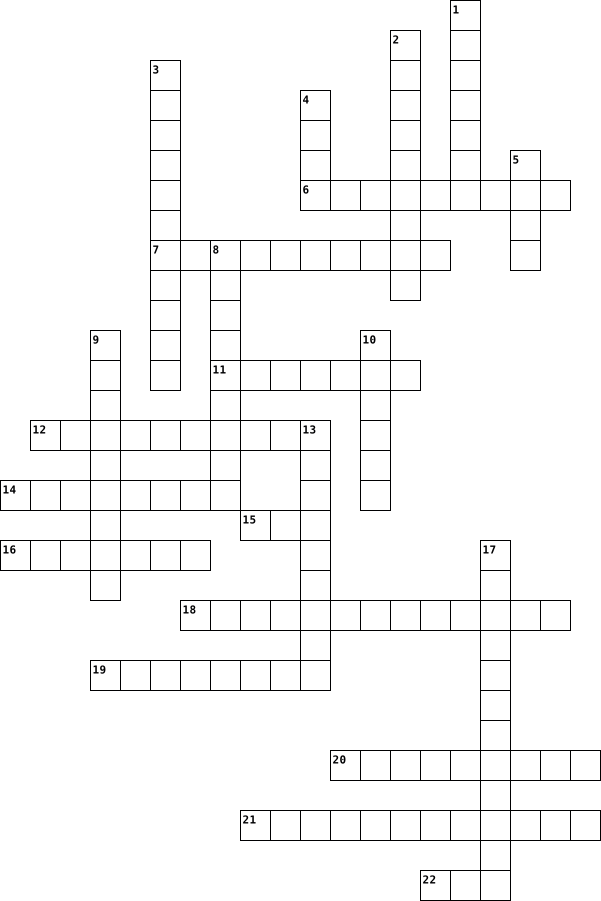
Across
- community of living and nonliving things
- all the same species living in an area
- diffusion of water molecules
- does not have a nucleus
- allele combination for traits
- ribonucleic acid
- different forms of a gene
- energy sources like sugars and starches
- family tree diagram that shows the inheritance
- all of the same species living in an area
- controls what enters and leaves the cell
- deoxyribonucleic acid
Down
- contains DNA in Eukaryotes
- movement of small uncharged cells
- carries out photosynthesis
- flow individuals move in and out of a population
- segment of DNA that codes for a protein
- physical trait determined by genotype
- make protein
- make up cell membranes and store extra energy
- does have a nucleus
- break down glucose
22 Clues: make protein • ribonucleic acid • break down glucose • does have a nucleus • deoxyribonucleic acid • does not have a nucleus • different forms of a gene • contains DNA in Eukaryotes • carries out photosynthesis • diffusion of water molecules • allele combination for traits • movement of small uncharged cells • physical trait determined by genotype • ...
Chapter 4 - Chemical Reactions 2023-03-22

Across
- a law that states nothing is created or destroyed in a chemical reaction
- system in which matter cannot enter or leave
- the amount of a substance in a given volume
- when one element or compound replaces another
- energy the minimum amount of energy needed to start a chemical reaction
- absorb heat energy
- a way to show a chemical reaction using symbols instead of words
- a change in matter that produces one or more new substances
- increases reaction rate by lowering activation energy needed
- system in which matter can enter or escape into surroundings
Down
- the number placed in front of a chemical formula in an equation
- compounds break down into simpler substance
- the new substances that are formed in a chemical reaction
- a biological catalyst
- any change that alters the form or appearance of a substance but does not change it into another substance
- two or more elements or compounds combine to make a more complex substance
- release heat energy
- substances that undergo a chemical change
- a solid that forms from liquids
- a material used to decrease the reate of a chemical reaction
20 Clues: absorb heat energy • release heat energy • a biological catalyst • a solid that forms from liquids • substances that undergo a chemical change • compounds break down into simpler substance • the amount of a substance in a given volume • system in which matter cannot enter or leave • when one element or compound replaces another • ...
The Chemistry of Life- Chapter 2 Vocab 2023-11-21

Across
- used for energy & structure in the cell
- the attraction between molecules of the same kind
- maintains homeostasis by preventing changes in pH
- all structure and function in the cell
- a fatty acid that has all single bonds between carbons
- monomer of carbohydrates
- bond found between amino acids
- the bond that forms between the attraction of 2 ions
- the compounds/elements that go into a chemical reaction
Down
- the nrg needed to start a reaction
- a protein that won't work due to a change in pH, salinity, temperature, etc
- biological catalysts that lower the activation energy
- stored energy, hormones, & waterproofing
- is the complete 3D structure found in a protein
- the substance that is dissolved
- part of a nucleotide that is made up of PO4
- the monomer of proteins
- negative particle of an atom
18 Clues: the monomer of proteins • monomer of carbohydrates • negative particle of an atom • bond found between amino acids • the substance that is dissolved • the nrg needed to start a reaction • all structure and function in the cell • used for energy & structure in the cell • stored energy, hormones, & waterproofing • part of a nucleotide that is made up of PO4 • ...
atmosphere 2025-01-15

Across
- forms a protective layer around the planet
- keep earth warm at night and cool during the day
- layer of the stratosphere that is closest to the ground
- layer layer of the stratosphere with a high concentration of ozone
- waves how energy travels from the sun to the earth
- protects earth from gamma and x-ray radiation
- substance heats up and gets less dense
- above 80 km and extends to space
Down
- the ozone layer is located here
- thermal energy traveling in waves or rays
- stream narrow belt of strong winds
- a layer of electrically charged particles in the thermosphere
- light reflecting off a particle and going in all directions
- group of chemical compounds used refrigerators,air conditioners, ECT
- contains the lower portion of the ionosphere
- thermal energy going through a material by touch
- outer most layer of the atmosphere
- radiation a type of energy that comes to the earth from the sun
18 Clues: the ozone layer is located here • above 80 km and extends to space • outer most layer of the atmosphere • stream narrow belt of strong winds • substance heats up and gets less dense • thermal energy traveling in waves or rays • forms a protective layer around the planet • contains the lower portion of the ionosphere • protects earth from gamma and x-ray radiation • ...
Nutrition Crossword 2023-02-11

Across
- Maintaining a balance in the body
- Proteins that are small and linked together like a chain
- When a red blood cell doesn't have enough hemoglobin what forms?
- Nutrients that occur naturally in rocks and soil
- Mineral that is needed for healthy blood cells
- What happens to excess carbs in the body? What do they turn in to?
- Mineral that helps with blood clotting, and nervous system functioning. Also found in teeth and bones.
- What type of carbs are found in starches?
- What type of carbs are found in fruits?
Down
- Vitamins that help protect healthy cells.
- A waxy,fat-like substance that forms on the walls of the arteries.
- Mineral that maintains water balance and helps lower blood pressure.
- The main thing that fiber helps with.
- the amount of energy released when nutrients are broken down
- What do carbs supply the body with?
15 Clues: Maintaining a balance in the body • What do carbs supply the body with? • The main thing that fiber helps with. • What type of carbs are found in fruits? • Vitamins that help protect healthy cells. • What type of carbs are found in starches? • Mineral that is needed for healthy blood cells • Nutrients that occur naturally in rocks and soil • ...
Ella Mathlin 2019-09-03

Across
- another word for rain
- They go golding mineing for it
- cooling of gas into liquid, in water cycle forms clouds
- it is non-renewable and cars use it
- you can drink it
Down
- Fuels decomposition of buried dead
- energy Wave power is the capture of energy of wind waves to do useful work
- uses sun
- resoures take many many years to be replaced
- water that gets absored by the gound
- change in state from liguid to gas
- resoures are those that replace themselves in a shott amount of time
- energy Although nuclear energy is often held up as a viable alternative to coal and oil
13 Clues: uses sun • you can drink it • another word for rain • They go golding mineing for it • Fuels decomposition of buried dead • change in state from liguid to gas • it is non-renewable and cars use it • water that gets absored by the gound • resoures take many many years to be replaced • cooling of gas into liquid, in water cycle forms clouds • ...
hz2 2024-03-11

Across
- _____ energy is required to make waves at a higher frequency.
- The _____ is the lowest point of a wave on a graph.
- A wave travels through space and _____ in a regular, oscillating fashion.
- Electromagnetic radiation is typically classified by its _____.
- The energy of light travels through a medium called an _____ field.
- Earthquakes shake the ground with _____ waves.
- Longer waves have less _____.
- energy forms may be measured by their frequencies as well as by their _____.
Down
- A wave is a _____ that moves energy from one place to another.
- Middle C has a frequency of 261.6 _____.
- Gamma rays are at a _____ frequency.
- To _____ is to swing back and forth with a steady, uninterrupted rhythm.
- Radio Waves are a part of the electromagnetic _____.
- _____ is one of the three major ways that energy is transferred.
- _____ light is considered a longer-wavelength radiation as microwaves and radio waves.
- Frequency and period are _____ of one another.
- Sound travels with both amplitude and frequency which may be _____.
- The spectrum of electromagnetic radiation ranges from _____ waves to gamma rays.
18 Clues: Longer waves have less _____. • Gamma rays are at a _____ frequency. • Middle C has a frequency of 261.6 _____. • Frequency and period are _____ of one another. • Earthquakes shake the ground with _____ waves. • The _____ is the lowest point of a wave on a graph. • Radio Waves are a part of the electromagnetic _____. • ...
Chapter 2 F1 2020-05-10

Across
- Organisms that consists of only one cell
- Chloroplast absorbs light energy for _________
- Can contract and relax to enable movement
- The processes of cell respirtion and photosynthesis _______ each other
- This cell secretes mucus
- Acts as a medium where chemical reactions occur
- The largest organ in human body is _______
- ______ is an organ involve in endocrine system
- Externel respiration is also known as __________
- Respiration is a process of breaking down food to release ________
- Normal cells divide continously wothout control
Down
- The main substrate of respiration is __________
- Guard cells control the opening and closing of _______
- Can be found in plant cell but not in animal cell
- Generate energy for reaction
- A few organs with related functions that work together for a specific function forms a ______
- Cells with the same function combine together
- _____ is an example of multicellular organism
- Fruit is an example of _______
19 Clues: This cell secretes mucus • Generate energy for reaction • Fruit is an example of _______ • Organisms that consists of only one cell • Can contract and relax to enable movement • The largest organ in human body is _______ • Cells with the same function combine together • _____ is an example of multicellular organism • Chloroplast absorbs light energy for _________ • ...
Unit 2 Crossword 2024-10-02

Across
- Describes a situation in which oxygen is present
- Organelle, site of steps 2 and 3 of aerobic cellular respiration
- Adenosine triphosphate, charged energy storage molecule with 3 phosphorus groups
- Nutrients used in proteins and nucleic acids, must be 'fixed' for living things to use, often limited
- Sphere of earth, all the gases surrounding earth
- Organelle, site of Photosynthesis
- sphere of earth, all the soil and rocks on earth
- Process of using light energy to make glucose, starts with CO2 and H2O and ends with C6H12O6 and O2
- Pigment in chloroplasts, used to trap light energy during photosynthesis
Down
- Describes a situation on which oxygen is not present
- Type of organism that must eat other organisms to obtain energy
- Type of organism that is able to make its own food, base of food chain
- second step of anaerobic respiration, 2 types include alcoholic and lactic energy
- Sphere of earth, all living things on earth
- Adenosine diphosphate, uncharged energy storage molecule with 2 phosphates
- Anything that has mass and takes up space, makes up everything
- Sphere of earth, all of the water on earth
- Type of organism that breaks down biotic components into abiotic components, recyclers
- Nutrient, forms the backbone for all macromolecules in living things
- nutrient used in phosphates of nucleic acids and phospholipids of membranes, often limited
20 Clues: Organelle, site of Photosynthesis • Sphere of earth, all of the water on earth • Sphere of earth, all living things on earth • Describes a situation in which oxygen is present • Sphere of earth, all the gases surrounding earth • sphere of earth, all the soil and rocks on earth • Describes a situation on which oxygen is not present • ...
Bio Crossword 2025-03-03

Across
- an organism that can produce their own food
- A sequence of three nucleotides in DNA that corresponds to a specific amino acid or stop signal
- A process that makes energy with oxygen
- A positively charged subatomic particle
- A neutrally charged subatomic particle
- Process of organisms using sunlight to synthesize foods from carbon dioxide and water
- An organism that eats other organisms for energy
- A special process where cells split in reproducing organisms
- A process in which most living cells generate energy
- Study of life and living things
- A cell that has a nucleus
- A self-replicating material that is present in nearly all living organisms
- The breakdown of glucose by enzymes
Down
- A cell that lacks a nucleus
- is a statement that is tested to see if it is true
- A molecule containing a very large amount of atoms: Protiens
- Different forms of the same element
- A green pigment
- A negatively charged subatomic particle
- A process where cells generate energy without oxygen
- The energy that cells use to perform functions
- The process where a cell splits into two daughter cells
22 Clues: A green pigment • A cell that has a nucleus • A cell that lacks a nucleus • Study of life and living things • Different forms of the same element • The breakdown of glucose by enzymes • A neutrally charged subatomic particle • A process that makes energy with oxygen • A negatively charged subatomic particle • A positively charged subatomic particle • ...
Heat, Matter, and Molecular Energy 2025-01-22

Across
- Distinct forms of matter known in everyday experience; include solid, liquid, gas; also referred to as phases.
- The simplest unit of a chemical compound that can exist; formed when two or more atoms join together chemically.
- To strike or hit something with any amount of force.
- Movement of energy from one system to another.
- A state of Matter with a definite volume but no definite shape.
- The smallest particle of an element; made of electrons, protons, and neutrons.
- A state of matter with a definite volume and shape.
- Energy of motion.
- A form of matter with an indefinite shape and volume.
- Energy transferred between two objects of different temperatures moving continually in a predictable pattern, from a warmer site to a cooler site until all sites have reached the same temperature.
- When a sample of matter changes from a solid to a liquid.
Down
- Thermal energy is the total kinetic (motion) energy of the tiny particles that make up matter. The faster the particles move, the warmer the matter becomes.
- When a sample of matter changes from a liquid to a solid.
- Energy that is stored in a system or object.
- Anything that has volume and mass; occurs as elements, compounds, and mixtures.
- Defines how two different systems can be said to be the same temperature.
- The process by which a sample of matter changes from a gaseous state to a liquid state.
- The sum of all of the kinetic energy (KE) and potential energy (PE) found within a substance.
- Average kinetic energy of all the particles in a material; measured by a thermometer in degrees (usually Celsius or Fahrenheit).
- Force exerted on matter through contact with other matter; affects melting and boiling points.
20 Clues: Energy of motion. • Energy that is stored in a system or object. • Movement of energy from one system to another. • A state of matter with a definite volume and shape. • To strike or hit something with any amount of force. • A form of matter with an indefinite shape and volume. • When a sample of matter changes from a liquid to a solid. • ...
Molecules of Life Part 1 2021-10-31

Across
- biomolecule made from repeating monomers
- in water
- monomers covalently bonded together
- that contain carbon
- reaction that forms a larger molecule and releases a water molecule
Down
- of carbohydrates
- sugar that is an important energy source
- found in plant cell walls
- storing polysaccharide found in plants
- storage polysaccharide found in animal muscles and liver.
- of a polymer because of a reaction with water
- basic unit of a class of biomolecules
12 Clues: in water • of carbohydrates • that contain carbon • found in plant cell walls • monomers covalently bonded together • basic unit of a class of biomolecules • storing polysaccharide found in plants • sugar that is an important energy source • biomolecule made from repeating monomers • of a polymer because of a reaction with water • ...
Energy 2025-12-05

Across
- This keyword describes a material that does not allow thermal energy to pass through it efficiently.
- This energy store is increased when an object speeds up.
- The method of heat energy transferred in a metal.
- The unit of measurement for all energy stores.
- The type of energy that is transferred when heating.
Down
- This type of energy increases as an object is raised.
- The type of energy stored in an object that is stretched.
- This method of heat energy transfer involves gas and liquid rising and falling.
- The word describes a large amount of useful work being produced with the smallest energy input.
- The material that is the best conductor of heat.
- All forms of these are measured in joules.
11 Clues: All forms of these are measured in joules. • The unit of measurement for all energy stores. • The material that is the best conductor of heat. • The method of heat energy transferred in a metal. • The type of energy that is transferred when heating. • This type of energy increases as an object is raised. • This energy store is increased when an object speeds up. • ...
Unit 9 Vocabulary Crossword 2025-02-05

Across
- This is the final form of coal we use
- This act enables a safe working environment
- The fuel source for nuclear energy
- This form of water energy uses dams on rivers
- This form of energy will not replenish in our lifetime
- This is the process of splitting an atom to get energy
- This form of fuel comes from the splitting of atoms
- This is the liquid form of biomass
- This Act was created to reduce pollution in the air
- This act was created to regulate any projects that use government funds
Down
- This is the burning of organic matter (not fossil fuels) to get energy
- The act of converting products back into their original components
- This fossil fuel formed when organic matter burned and gave off methane
- This form of water energy uses the ocean currents to turn a turbine
- These fuels are formed from dead organic matter under the earth for millions of years
- This is the most common biofuel used today
- The _____ footprint helps to show how many resources you consume based on your personal habits
- This Act was created to help reduce pollution in the water
- The act of using less materials or less resources
- This form of energy happens when wind turbines are turned to generate electricity
- This fossil fuel formed when organic matter died in the ocean
- The act of finding new ways to use something or using it repeatedly
- This form of energy comes from converting sunlight into electricity
- This fossil fuel forms by plant matter in swamps
24 Clues: The fuel source for nuclear energy • This is the liquid form of biomass • This is the final form of coal we use • This is the most common biofuel used today • This act enables a safe working environment • This form of water energy uses dams on rivers • This fossil fuel forms by plant matter in swamps • The act of using less materials or less resources • ...
Best crossword 2015-02-09

Across
- the largest planet in solar system
- blood cell- This cells produce the antibodies to fight the pathogen
- allele that always has the small letter
- contains two different metals
- current- current that is the straight line not change the direction.
- energy- heat and sound energy
- - the nearest planet in the solar system
- it’s measure how much force spread out
- current- current that can change the direction
- this is very small living things
- example reptile, mammal, amphibians, fish, and birds
- the organism that make their own food
- allele that always capital letter
- this is the type of white blood cells
- orbit by itself is one day and spin around the Sun is 1 years
- a different group of organisms
Down
- organism that eat only producer.
- this organism in yoghurt, cheese
- the DNA that from the parent
- because of living condition or surrounding
- example insects, jelly fish
- this variation include mass, height, skin color, intelligence, and leaf area
- of conservation of energy- energy that cannot be created or destroyed, just changed to the different forms
- pump- the cell of battery
- organism that eat meat or plants
- has Y-shape
- this variation include blood group, natural eye, and inherited disease
- energy- This energy is stored the energy
- organism that eat only meat or animals
- this organism in wine, beer, bread
30 Clues: has Y-shape • pump- the cell of battery • example insects, jelly fish • the DNA that from the parent • contains two different metals • energy- heat and sound energy • a different group of organisms • organism that eat only producer. • this organism in yoghurt, cheese • organism that eat meat or plants • this is very small living things • allele that always capital letter • ...
Ecology Part 1 2023-03-01

Across
- how energy and nutrients move throughout an ecosystem
- things that represent living and non living things in an ecosystem
- Graphical demostraion of the energy transfer throughout tropic levels
- all the food chains in an ecosystem
- an area that a number of species use
- a area that living organisms and landscape play a role to form a circle of life
- organism fight for the same resource
- a percent of energy that is passed through trophic levels
- something that is food for another organism
- the posistions and roles of orgnaims in a food chain
- something that makes its own food
Down
- is a nonnative species that does harm to a partcular enviorment
- all the different forms of life in an area
- something that holds a polulation form growing
- the total amount of space living organisms take up in an enviorment
- something that eats other things
- a natural behavior
- Species that play a crucial role in en enviorment
- the way energy transfers form organism to organism
- a orgnaism that breaks down dead organic material
20 Clues: a natural behavior • something that eats other things • something that makes its own food • all the food chains in an ecosystem • an area that a number of species use • organism fight for the same resource • all the different forms of life in an area • something that is food for another organism • something that holds a polulation form growing • ...
Science Karol 2024-03-06

Across
- Matter that comes from living organisms
- Series of organisms dependent on each other for food
- Substance burned to produce energy
- Relating to heat
- Molten rock beneath the earth's surface
- Plates that make up the earth's surface
- Simple organisms in water
- Excavated from the ground
- Organism used in baking
- Rise and fall of sea levels
- Distance from top to bottom
- Energy of motion
- Eating only plants
- How high or low a sound is
- Mountain that erupts
- Related to electricity
- Type of fungus
- Breakdown of organic matter
- Stored energy in the nucleus of an atom
- Fungus growth
- Organism that consumes other organisms
- Occurrence
- Animal that hunts other animals
- Study of ecosystems
- Form of energy that allows us to see
- Shaking of the ground
- Along the edge of the land and sea
- Measure of sound intensity
- Microscopic life forms
- Where ships dock
- Sequence of energy transfer
- Energy moved from one place to another
- Energy regained
Down
- Substance in which energy can be stored
- Difference between high and low tide
- Unit of energy
- Energy spread out and lost
- Animal hunted by other animals
- Sequence of actions
- Force that pulls objects toward each other
- Energy not used effectively
- Essential elements for growth
- Small entities
- Energy used effectively
- Liquid rock on the earth's surface
- Single-celled organisms
- Organism that produces its own food
- Eating only meat
- Gelatinous substance used in laboratories
- Emitting light
- Stored energy ready to be used
- Stored energy in an object due to its shape
- Longitudinal wave of pressure
- Pulling force between objects
- Decaying matter
- Transformation from one form to another
- Result of a chemical reaction
- Poisonous mushroom
- Capacity to do work
- Driven by gravitational forces
- Fungus growth
- Waves of pressure traveling through a medium
- Molten rock on the surface
63 Clues: Occurrence • Fungus growth • Fungus growth • Unit of energy • Small entities • Type of fungus • Emitting light • Decaying matter • Energy regained • Relating to heat • Energy of motion • Eating only meat • Where ships dock • Eating only plants • Poisonous mushroom • Sequence of actions • Study of ecosystems • Capacity to do work • Mountain that erupts • Shaking of the ground • Related to electricity • ...
Thermodynamics 2014-04-15

Across
- The amount of heat needed to raise 1g of water 1ͦ Celsius.
- Whenever heat is added to a system, it transforms into an equal amount of another form of energy.
- Conduction, Convection, and Radiation are three forms of _____ _________.
- Transfer of heat through direct contact.
- Temperature in which all molecular motion stops.
- Metric scale for measuring temperature and labeling Absolute Zero.
- The measure of the amount of disorder in a system.
Down
- The ability of a substance to absorb heat energy.
- The measure of the average kinetic energy of an object.
- Standard scale for measuring temperature, used mostly in United States.
- Metric scale for measuring temperature.
- Transfer of heat through space, carried by electromagnetic waves.
- Heat will, itself, never flow from a cold object to a hot object.
- The expansion of a substance due to addition of heat.
- Transfer of heat in liquids or gases through the movement of molecules in currents.
- The energy of motion.
- Energy in transition from one object to another because of difference in temperature.
17 Clues: The energy of motion. • Metric scale for measuring temperature. • Transfer of heat through direct contact. • Temperature in which all molecular motion stops. • The ability of a substance to absorb heat energy. • The measure of the amount of disorder in a system. • The expansion of a substance due to addition of heat. • ...
Vocabulary-AMSTI EWIT 2023-01-26

Across
- current through a conductor between two points is directly proportional to the voltage across the two points
- stream of charged particles
- unit of electric current
- material or object that permits an electrical current
- shows components of circuit in drawing using standardized symbolic
- made of branches that divide the current, only part of it flows through any branch
- the amount of energy transferred or converted per unit time. In the International System of Units, the unit of power is the watt, equal to one joule per second
- providing a continuous path which current can flow
- energy observable in positive and negative forms
- energy that can be emitted such as heat
- an apparatus for measuring the quantity of electricity passed through a conductor by the amount of electrolysis produced
- variable isn't changed by other variables
- representation of the electrical potential energy per unit charge
- a material that can produce its own magnetic field
Down
- makes a path along which whole current flows through each component
- instrument used to measure the current in a circuit
- all variables are constant
- a container that converts chemical energy into electricity and used as a power source
- a device having a designed resistance to the passage of an electric current.
- energy generated by the movement of electrons
- variable depends on other factors
- unit of electrical potential
22 Clues: unit of electric current • all variables are constant • stream of charged particles • unit of electrical potential • variable depends on other factors • energy that can be emitted such as heat • variable isn't changed by other variables • energy generated by the movement of electrons • energy observable in positive and negative forms • ...
Latin/Greek root words 2023-11-13

Across
- uncommunicative
- the act of summoning divine help
- an inability to sleep
- to violate a law
- to break
- of the same type
- life force, energy
- area of control
- a particular characteristic of an individual
Down
- a curse
- capacity to last
- possessing sound judgment
- associated with an appreciation for beauty
- a final demand
- an organism that makes its own food
- outside of the law
- excessively obedient
- having different forms
- self-centered
- a description of the universe
20 Clues: a curse • to break • self-centered • a final demand • uncommunicative • area of control • capacity to last • to violate a law • of the same type • outside of the law • life force, energy • excessively obedient • an inability to sleep • having different forms • possessing sound judgment • a description of the universe • the act of summoning divine help • an organism that makes its own food • ...
Geology Vocabulary 2022-09-06

Across
- thinner, more dense crust made of basalt that forms the seafloor and is found under the ocean.
- a plate boundary where two plates slide past each other (not toward or away
- a deep valley that forms where two continental plates move apart.
- The study of the origin, history and structure of the earth.
- the layer of the earth between the crust and the core
- States that the earth's surface is broken into pieces called tectonic plates that move because of convection in the mantle
- name of a large landmass made of all the continents joined together about 200 million year ago. Supercontinent
- a plate boundary where two plates move toward each other and creates mountains or volcanoes
- A very deep valley in the ocean floor that forms along a subduction zone
- The transfer of thermal energy (heat) where material gets heated and rises before cooling down and sinking. Circular motion
Down
- a plate boundary where two plates move away from each other and forms new ocean crust. Creates Mid Ocean Ridges and Rift Valleys
- process by which new ocean crust forms along a mid‐oceanic ridge and older crust moves away from the ridge Lithosphere‐ the rigid outer part of the earth, consisting of the crust and upper mantle.
- States that the continents once formed a single landmass, broke up, and drifted to their present locations
- when an oceanic plate sinks beneath another tectonic plate. Creates trenches and volcanoes
- Where two tectonic plates made of lithosphere meet or touch
- A section of the Earth's crust, lithosphere, that moves because of convection in the mantle.
- The layer of the mantle where convection currents are thought to cause the movement of tectonic plate.
- a break or crack in Earth's surface. Caused by shifting and moving plates.
- an underwater mountain range where a divergentboundary causes new ocean floor to form.
- molten (melted) rock beneath the earth's surface
- thicker, less dense crust that forms the large landmasses.
21 Clues: molten (melted) rock beneath the earth's surface • the layer of the earth between the crust and the core • thicker, less dense crust that forms the large landmasses. • Where two tectonic plates made of lithosphere meet or touch • The study of the origin, history and structure of the earth. • a deep valley that forms where two continental plates move apart. • ...
Molecules of Life Part 1 2021-10-31

Across
- many monomers covalently bonded together
- simple sugar that is an important energy source
- chemical reaction that forms a larger molecule and releases a water molecule
- breakdown of a polymer because of a reaction with water
- energy storage polysaccharide found in animal muscles and liver.
- insoluble in water
- large biomolecule made from repeating monomers
Down
- polysaccharide found in plant cell walls
- the basic unit of a class of biomolecules
- energy storing polysaccharide found in plants
- monomer of carbohydrates
- compounds that contain carbon
12 Clues: insoluble in water • monomer of carbohydrates • compounds that contain carbon • polysaccharide found in plant cell walls • many monomers covalently bonded together • the basic unit of a class of biomolecules • energy storing polysaccharide found in plants • large biomolecule made from repeating monomers • simple sugar that is an important energy source • ...
Ch.2 Vocabulary 2025-09-18

Across
- combinations of two or more different elements
- a well-tested and widely accepted description of observations that have been repeated many times
- anything that has mass and takes up space
- an atom with a positive or negative charge
- compound that is carbon-based
- change where it is changing its characteristics and states
- important and certain results of science and is based on a large body of evidence
- element with the same atomic number but different atomic mass
- practices to advance knowledge and understanding of how the natural world works
- law of thermodynamics in which the quality of energy declines as it changes states
- matter with a unique set of properties that cannot be broken down into simpler forms
- set of components that function and interact in some regular way
- law of thermodynamics where energy is neither created nor destroyed when changing states
Down
- physical or mathematical representation of a structure or system
- when a system is stuck in a positive feedback loop
- information
- capacity to do work
- basic building block of matter
- scientists reviewing each others work
- energy that is stored and possibly available for use
- energy where matter is moving
- possible an d testable answer to a scientific question
- change where matter is changing its composition
- output of matter/energy is fed back into the system as input and leads to changes
- energy that can be considered kinetic, deals with heat
25 Clues: information • capacity to do work • compound that is carbon-based • energy where matter is moving • basic building block of matter • scientists reviewing each others work • anything that has mass and takes up space • an atom with a positive or negative charge • combinations of two or more different elements • change where matter is changing its composition • ...
Forces and Motion 2024-09-25

Across
- The abundant greenhouse gas
- This energy comes from the sun
- Long term pattern of weather in an area
- The most effective greenhouse gas
Down
- The practice of responsibly using resources over long period of time
- The use of organic matter combusting to create energy
- This energy is generated by differences in heat in the Earth's atmosphere
- These are non renewable forms of energy
- A heavy metal pollutant that results from using coal
- The ability to do work
10 Clues: The ability to do work • The abundant greenhouse gas • This energy comes from the sun • The most effective greenhouse gas • These are non renewable forms of energy • Long term pattern of weather in an area • A heavy metal pollutant that results from using coal • The use of organic matter combusting to create energy • ...
Types of energy 2021-09-21

Across
- the form of energy that is transferred between systems or objects with different temperatures
- the energy stored in an object as the result of its vertical position or height
- ability to do work or cause changes in matter
- the sum of the object’s kinetic energy and potential energy
- the buildup of energy in an object
Down
- kinetic energy of moving electric charges
- kinetic energy caused by the vibration of particles in a medium
- kinetic energy capable of allowing various forms of lights visible to the human eyes
- Energy stored in the bonds of chemical compounds
- the bigger/faster an object the more energy it has
10 Clues: the buildup of energy in an object • kinetic energy of moving electric charges • ability to do work or cause changes in matter • Energy stored in the bonds of chemical compounds • the bigger/faster an object the more energy it has • the sum of the object’s kinetic energy and potential energy • kinetic energy caused by the vibration of particles in a medium • ...
Cell System - extra credit 2023-11-10

Across
- break down food particles and worn-out cell parts
- packages and distributes materials from ER
- stores water, food, wast products or other materials
- how cells taking inside the cytoplasm larger molecules
- directs cell's activities
- forms barrier, controls what goes in and out of cell
Down
- makes food for plant cell using energy from the sun
- how cells remove larger molecules from the cytoplasm
- converts energy in food to energy used by the cell
- fluid inside cell that holds organelles
- helps make proteins and other substances
- produce proteins needed by cell
- protects and supports the cell
- product of cellular respiration
- product of photosynthesis
15 Clues: product of photosynthesis • directs cell's activities • protects and supports the cell • produce proteins needed by cell • product of cellular respiration • fluid inside cell that holds organelles • helps make proteins and other substances • packages and distributes materials from ER • break down food particles and worn-out cell parts • ...
Light Waves Final Project Kirbabas_Jacob Wilkerson 2023-03-15

Across
- Light, Heat, Mechanical, Gravitational, Electrical, Sound, and Chemical are all forms of ______
- Something that carries/transfers energy from place to place
- This is an important heat trapping gas in the atmosphere
- To give off energy (light)
- ___________ light comes from the sun and can cause skin cancer
- A chemical process that occurs in plants when they are exposed to sunlight.
- A condensed beam of light
- the difference between points in a sound wave or electromagnetic wave.
- When a material _____ light, the material changes
- 400 THz to 700 THz is the _____ of visible light
Down
- This protects human skin from the sun's ultraviolet rays
- _______ occurs when light passes through a surface
- This type of light can be seen and comes in many different colors
- when a light wave interacts with an object and bounces off of it, it _____
- The most harmful external hazard
- ______ light comes from the sun and increased the kinetic energy of what it interacts with
- devices that produce visible or near-visible energy for general illumination and specialty applications
- energy that comes from a source and travels through space at the speed of light
18 Clues: A condensed beam of light • To give off energy (light) • The most harmful external hazard • 400 THz to 700 THz is the _____ of visible light • When a material _____ light, the material changes • _______ occurs when light passes through a surface • This protects human skin from the sun's ultraviolet rays • This is an important heat trapping gas in the atmosphere • ...
Biological Molecules 2024-02-18

Across
- Forms when two monosaccharides bond and a water molecule is created.
- Starch is made up of alpha glucose sub-units, but cellulose is made up of ______________ subunits.
- A storage polysaccharide in animals.
- The phospholipid bilayer of membranes forms because each phospholipid has a hydrophobic part and a ______________ part.
- Nitrogen base that bonds with guanine.
- Sucrase, lactase, and maltase.
- Macromolecules that code for proteins and are involved in their construction. (2 words)(2 words)
- The process by which water is used to break larger molecules into smaller ones.
- The process by which two molecules bond and a water molecules is formed. AKA dehydration synthesis.
- The sugar that forms when two glucose molecules bond and water is formed.
- A storage polysaccharide in plants.
- Alpha helix and pleated sheet are formed due to ______________. (2 words)
- All living things use this process to get useable cellular energy for this process. (2 words)
- A type of lipid made up of glycerol, two fatty acids, and a phosphate group.
- The disaccharide formed when glucose and fructose bond and water is produced.
- The disaccharide that forms when glucose and galactose bond and water is formed..
Down
- Forms when two amino acids are bonded and a water molecule forms.
- There are twenty unique forms of this monomer that are used to build proteins.(2 words)
- Also known as a triglyceride, this molecule contains glycerol and three fatty acids.
- A natural emulsifier that breaks fat into smaller particles. It has a hydrophobic and a hydrophilic part and is formed in the gall bladder.
- Macromolecules that do not dissolve in water due to polar functional groups.
- A chain of many amino acids that is coded for by DNA.
- Macromolecules that perform many functions including communication, movement, transport, and immune.
- Reactions of biological molecules can be anabolic and catabolic because they are ______________.
- A structural polysaccharide in plants.
- Long chains of glucose bonded together by condensation synthesis.
- Codes for all proteins, has two sugar-phosphate backbones, uses thymine, and is anti-parallel.
- Macromolecules that have a carbon to hydrogen to oxygen ratio of 1:2:1.
- A structural polysaccharide in animals.
- Nitrogen base that bonds with thymine or uracil.
- A specialized RNA nucleotide that is made up of adenine, ribose, and three phosphate groups. It can transfer energy to molecules to power cell processes and is formed through cellular respiration.
- A type of carbohydrate with 6 carbon atoms, 12 hydrogen atoms and 6 oxygen atoms.
- The three types of monosaccharides are: fructose, galactose, and ______________.
- The three parts of an amino acid are the carboxyl group, the ______________ group, and the variable part of the molecule.
- These lipids all have a backbone of four fused carbon rings and include testosterone, estrogen, and cholesterol.
- Nucleic acid that has one sugar-phosphate backbone, uses uracil, and has three forms all involved in protein synthesis.
- The subunit of DNA or RNA that consists of a sugar, a phosphate group, and a nitrogen base.
37 Clues: Sucrase, lactase, and maltase. • A storage polysaccharide in plants. • A storage polysaccharide in animals. • A structural polysaccharide in plants. • Nitrogen base that bonds with guanine. • A structural polysaccharide in animals. • Nitrogen base that bonds with thymine or uracil. • A chain of many amino acids that is coded for by DNA. • ...
CH 10&11: Nucleotides, Nucleic Acids, & DNA Structure 2023-12-03

Across
- basic proteins found complexed to eukaryotic DNA
- larger empty space in the imaginary cylinder enclosing DNA double helix
- bases containing 6-membered rings fused to a 5-membered ring
- A-T or G-C base pairing
- drives protein synthesis
- T; DNA only
- bases containing 6-membered rings
- reaction type for ADP and ATP formation
- drives carbohydrate metabolism
- enzymes that relax supercoiling in closed circular DNA
- C
- nucleoside 5'-triphosphate carriers of chemical energy
- central to energy metabolism
- A
- U: RNA only
- 2 polynucleotide chains wrapped around each other
Down
- most common bond; forms nucleic acid backbone
- nitrogen-containing aromatic compounds; coding portion of nucleic acids
- normal, physiological DNA conformational form
- nucleic acid bases linked to a sugar via glycosidic bonds
- fundamental chromatin structural unit; "beads"
- circular, forms supercoils
- G
- single-stranded
- purine of pyrimidine bases bonded to sugars bonded to phosphate groups
- linear polymers of nucleotides linked 3' to 5' by phosphodiester bridges
- complex of DNA & protein found in eukaryotic nuclei
- drives lipid synthesis
- alternating 2-deoxy-D-ribose & phosphate units
29 Clues: G • C • A • T; DNA only • U: RNA only • single-stranded • drives lipid synthesis • A-T or G-C base pairing • drives protein synthesis • circular, forms supercoils • central to energy metabolism • drives carbohydrate metabolism • bases containing 6-membered rings • reaction type for ADP and ATP formation • most common bond; forms nucleic acid backbone • ...
Energy and the Earth System 2023-09-12

Across
- ice becomes a gas without passing through the liquid state
- Earth's surface and interior
- refills the groundwater supply
- the largest reservoir of water and carbon on Earth
- oxygen, water vapor, and nitrogen are found in it
- burning fossil fuels or wood puts carbon back in the atmosphere
- liquid to gas
- plants release water vapor
Down
- icebergs and glaciers
- any form of water that falls from the sky
- returns carbon to the geosphere when an organism dies
- all of the living things in a habitat
- producers convert light energy to chemical energy
- forms clouds and dew
- the most abundant gas in the atmosphere
- oceans and lakes
- cellular __________ occurs in the mitochondria to release stored energy
17 Clues: liquid to gas • oceans and lakes • forms clouds and dew • icebergs and glaciers • plants release water vapor • Earth's surface and interior • refills the groundwater supply • all of the living things in a habitat • the most abundant gas in the atmosphere • any form of water that falls from the sky • producers convert light energy to chemical energy • ...
Electric properties 2021-03-23

Across
- another name for potential difference
- a source of electricity
- it is used for measuring the voltage in the circuit
- a material that allows the flow of electricity
Down
- a circuit component that converts electricity to other forms of energy
- a device used for measuring the current
- a type of cells combination
- a positive charge
- it is the heat energy delivered by heaters
- the part of electric energy that is not used for the purpose the circuit is built
- a circuit element that produces light energy
11 Clues: a positive charge • a source of electricity • a type of cells combination • another name for potential difference • a device used for measuring the current • it is the heat energy delivered by heaters • a circuit element that produces light energy • a material that allows the flow of electricity • it is used for measuring the voltage in the circuit • ...
Light Waves 2025-11-20

Across
- most light passes through, forms clear image
- an image that forms from light rays that diverge, or change direction
- when a light wave is reflected from a surface, the angle of reflection is equal to the angle of incidence
- having a surface that curves outward
- having a surface that curves inward
Down
- energy carried by an electromagnetic wave
- some light passes through, forms blurry image
- electromagnetic radiation that you can see
- image that forms where rays converge
- light does not pass through
10 Clues: light does not pass through • having a surface that curves inward • image that forms where rays converge • having a surface that curves outward • energy carried by an electromagnetic wave • electromagnetic radiation that you can see • most light passes through, forms clear image • some light passes through, forms blurry image • ...
Molecules of Life Part 1 2021-10-31

Across
- monomers covalently bonded together
- reaction that forms a larger molecule and releases a water molecule
- found in plant cell walls
- sugar that is an important energy source
- storage polysaccharide found in animal muscles and liver.
Down
- in water
- of a polymer because of a reaction with water
- of carbohydrates
- that contain carbon
- basic unit of a class of biomolecules
- biomolecule made from repeating monomers
- storing polysaccharide found in plants
12 Clues: in water • of carbohydrates • that contain carbon • found in plant cell walls • monomers covalently bonded together • basic unit of a class of biomolecules • storing polysaccharide found in plants • biomolecule made from repeating monomers • sugar that is an important energy source • of a polymer because of a reaction with water • ...
Q4 BONUS - Biology 2023-05-23

Across
- nucleic acid that contains the sugar deoxyribose.
- process that requires oxygen.
- physical characteristics of an organism.
- double-layered sheet that forms the core of nearly all cell membranes.
- first step in releasing the energy of glucose, in which a molecule of glucose is broken into two molecules of pyruvic acid.
- process in which part of the nucleotide sequence of DNA is copied into a complementary sequence in RNA.
- organism that can capture energy from sunlight or chemicals and use it to produce its own food from inorganic compounds; also called a producer.
- situation in which one allele is not completely dominant over another.
- idea that all living things are composed of cells, cells are the basic units of structure and function in living things, and new cells are produced from existing cells.
- second phase of mitosis, during which the chromosomes line up across the center of the cell.
Down
- movement of specific molecules across cell membranes through protein channels.
- opening in the underside of a leaf that allows carbon dioxide and oxygen to diffuse into and out of the leaf.
- change in a DNA sequence that affects genetic information.
- science that seeks to understand the living world.
- energy needed to get a reaction started.
- protein that acts as a biological catalyst.
- diagram that shows the evolutionary relationships among a group of organisms.
- possible explanation for a set of observations or possible answer to a scientific question.
- factor in an experiment that can change.
- one of a number of different forms of a gene.
20 Clues: process that requires oxygen. • physical characteristics of an organism. • energy needed to get a reaction started. • factor in an experiment that can change. • protein that acts as a biological catalyst. • one of a number of different forms of a gene. • nucleic acid that contains the sugar deoxyribose. • science that seeks to understand the living world. • ...
Chapter 5 2013-09-19

Across
- A process in which a system releases heat to its surroundings
- A property of a system that is determined by its state or condition and not by how it got to that state; its value is fixed when temperature, pressure, composition, and physical form are specified
- A unit of energy, it is the amount of energy needed to raise the temperature of 1 g of water by 1 °C from 14.5 °C to 15.5 °C
- The movement of an object against some force
- A quantity defined by the relationship H = E + PV; the enthalpy change, ΔH, for a reaction that occurs at constant pressure is the heat evolved or absorbed in the reaction: ΔH = qp
- A process in which a system absorbs heat from its surroundings
- The change in enthalpy that accompanies the formation of one mole of a substance form its elements, with all substances in their standard states
- The capacity to do work or to transfer heat
- The flow of energy from a body
- Study of energy and its transformations
- The heat capacity of 1 g of a substance; the heat required to raise the temperature of 1 g of a substance by 1 °C
- The quantity of heat required to raise the temperature of a sample of matter by 1 °C (or 1 K)
- In thermodynamics, the portion of the universe that we single out for study. We must be careful to state exactly what the system contains and what transfers of energy it may have with its surroundings
Down
- In thermodynamics, everything that lies outside the system that we study
- The energy that an object possesses as a result of its composition or its position with respect to another object
- The enthalpy change that accompanies the formation of a substance from the most stable forms of its component elements
- Work performed by expansion of a gas against a resisting pressure
- The change in enthalpy in a process when all reactants and products are in their stable forms at 1 atm pressure and a specified temperature, commonly 25 °C
- The energy that an object possesses by virtue of its motion
- A statement that energy is conserved in any process. One way to express the law is that the change in internal energy, ΔE, of a system in any process is equal to the heat, q, added to the system, plus the work, w, done on the system by its surroundings: ΔE = q + w
- A push or a pull
- The SI unit of energy, 1 kg-m^2/s^2
- The enthalpy change associated with a chemical reaction
- The relationship between chemical reactions and energy changes
- The law stating that heat evolved in a given process can be expressed as the sum of the heats of several processes that, when added, yield the process of interest
- The heat required to raise the temperature of one mole of a substance by 1 °C
- The total energy possessed by a system. When a system undergoes a change, the change in internal energy, ΔE, is defined as the heat, q, added to the system, plus the work, w, done on the system by its surrounding: ΔE = q + w
- The experimental measurement of heat produced in chemical and physical processes
- An apparatus that measure the heat released or absorbed in a chemical or physical process
29 Clues: A push or a pull • The flow of energy from a body • The SI unit of energy, 1 kg-m^2/s^2 • Study of energy and its transformations • The capacity to do work or to transfer heat • The movement of an object against some force • The enthalpy change associated with a chemical reaction • The energy that an object possesses by virtue of its motion • ...
Thermochemistry Terms 2013-09-23

Across
- The heat capacity of 1 g of a substance; the heat required to raise the temperature of 1 g of a substance by 1 °C
- The heat required to raise the temperature of one mole of a substance by 1 °C
- The law that states that the heat evolved in a given process can be expressed as the sum of the heats of several processes that, when added, yield the process of interest
- The capacity to do work or to transfer heat
- The flow of energy from a body
- The quantity of heat required to raise the temperature of a sample of matter by 1 °C (or 1 K)
- The movement of an object against some force
- The change in enthalpy that accompanies the formation of one mole of a substance form its elements, with all substances in their standard states
- A property of a system that is determined by its state or condition and not by how it got to that state; its value is fixed when temperature, pressure, composition, and physical form are specified
- In thermodynamics, everything that lies outside the system that we study
Down
- energy The energy that an object possesses by virtue of its motion
- The change in enthalpy in a process when all reactants and products are in their stable forms at 1 atm pressure and a specified temperature, commonly 25 °C
- The enthalpy change associated with a chemical reaction
- An apparatus that measure the heat released or absorbed in a chemical or physical process
- The experimental measurement of heat produced in chemical and physical processes
- A process in which a system releases heat to its surroundings
- A quantity defined by the relationship H = E + PV; the enthalpy change, ΔH, for a reaction that occurs at constant pressure is the heat evolved or absorbed in the reaction: ΔH = qp
- The enthalpy change that accompanies the formation of a substance from the most stable forms of its component elements
- A push or a pull
- The SI unit of energy, 1 kg-m^2/s^2
- The law of thermodynamics that states energy is conserved in any process. One way to express the law is that the change in internal energy, ΔE, of a system in any process is equal to the heat, q, added to the system, plus the work, w, done on the system by its surroundings: ΔE = q + w
- In thermodynamics, the portion of the universe that we single out for study. We must be careful to state exactly what the system contains and what transfers of energy it may have with its surroundings
- A process in which a system absorbs heat from its surroundings
- A unit of energy, it is the amount of energy needed to raise the temperature of 1 g of water by 1 °C from 14.5 °C to 15.5 °C
- energy The energy that an object possesses as a result of its composition or its position with respect to another object
25 Clues: A push or a pull • The flow of energy from a body • The SI unit of energy, 1 kg-m^2/s^2 • The capacity to do work or to transfer heat • The movement of an object against some force • The enthalpy change associated with a chemical reaction • A process in which a system releases heat to its surroundings • A process in which a system absorbs heat from its surroundings • ...
Ch. 4 Sec. 1 Quiz Review 2023-01-30

Across
- a state where an atom has a higher energy than it has in its ground state
- the process of an electron moving to a higher energy level
- transmits heat from sun, fires, and radiators
- the number of waves that pass a certain point in a specific time (usually one second)
- contains all wavelengths of light in a certain range
- electrons are ejected from a metal when light shines on it and electricity is generated (Example: solar panels)
- the process of an electron falling to a lower energy level
- used in medicine for killing cancer cells
- As frequency increases, energy ___________.
- the entire range of all the forms of electromagnetic radiation
Down
- the lowest energy state of an atom
- makes things able to be seen
- used to view inside of bodies and objects
- a form of energy that exhibits wavelike behavior as it travels through space
- the distance between 2 corresponding points on adjacent waves
- absorbed by the skin, used in fluorescent tubes
- used to broadcast radio and television
- electromagnetic radiation has properties of both waves and particles
- the pattern of lines formed when light passes through a prism to separate it into its different wavelengths of light
- As wavelength increases, frequency ____________.
- the minimum quantity of energy that can be lost or gained by an atom
- a particle of electromagnetic radiation that is equal to a quantum of energy
- used in cooking, radar, telephone, and other signals
- an atomic model where electrons circle the nucleus only in orbits
- proposed the relationship between the energy of a photon and the frequency of radiation
25 Clues: makes things able to be seen • the lowest energy state of an atom • used to broadcast radio and television • used to view inside of bodies and objects • used in medicine for killing cancer cells • As frequency increases, energy ___________. • transmits heat from sun, fires, and radiators • absorbed by the skin, used in fluorescent tubes • ...
specific heat capacity 2021-12-02

Across
- It increases when the temperature goes up
- Something that keeps heat in
- The type of energy released when a phase change happened
- Something that allows the flow of energy
- happens when there is a release of gasses
Down
- What happens when the matter changes forms
- The type of energy that comes from the sun
- The type of gas getting released into the air
- The type of energy in a fluid
- The way the energy moves
10 Clues: The way the energy moves • Something that keeps heat in • The type of energy in a fluid • Something that allows the flow of energy • It increases when the temperature goes up • happens when there is a release of gasses • What happens when the matter changes forms • The type of energy that comes from the sun • The type of gas getting released into the air • ...
Electric properties 2021-03-23

Across
- it is the heat energy delivered by heaters
- a circuit element that produces light energy
- it is used for measuring the voltage in the circuit
- a type of cells combination
- a material that allows the flow of electricity
- the part of electric energy that is not used for the purpose the circuit is built
Down
- a circuit component that converts electricity to other forms of energy
- another name for potential difference
- a device used for measuring the current
- a source of electricity
- a positive charge
11 Clues: a positive charge • a source of electricity • a type of cells combination • another name for potential difference • a device used for measuring the current • it is the heat energy delivered by heaters • a circuit element that produces light energy • a material that allows the flow of electricity • it is used for measuring the voltage in the circuit • ...
Ecology Part One 2024-02-29

Across
- the combined portions of the planet in which all of life exists, including land, water, and atmosphere
- an organism that can capture energy from sunlight or chemicals and use it to produce its own food from inorganic compounds; also called a producer
- organism that breaks down and obtains energy from dead organic matter
- ecological pyramid which shows the relative amount of energy in each trophic level in an ecosystem
- organism that obtains energy by consuming plant and animal remains and other dead matter
- group of organisms that can breed and produce fertile offspring
- series of steps in an ecosystem in which organisms transger energy by eating and being eaten
- organism that obtains energy by consuming plants and animals
- process in which elements, chemical compounds, and other forms of matter are passed from one organism to another and from one part of the biosphere to another
Down
- network of complex interactions formed by the feeding relationships among the various organisms in a ecosystem
- an ecological pyramid which shows the relative amount of living tissue at each trophic level in an ecosystem
- process used by some bacteria to convert chemical energy to energy stored in carbohydrates
- organism that obtains energy by consuming plants
- organism that obtains energy by consuming other animals
- group of different populations that live in the same area
- position an organism occupies in a food chain or food web (primary producer, primary consumer, secondary consumer, tertiary consumer)
- an organism that obtains energy from the food it consumes; also called a consumer
- group of organisms of the same species that live in the same area
- the scientific study of interactions among organisms and between organisms and their environment
- process used by plants and some other organisms to convert light energy, water, and carbon dioxide into oxygen and carbohydrates
20 Clues: organism that obtains energy by consuming plants • organism that obtains energy by consuming other animals • group of different populations that live in the same area • organism that obtains energy by consuming plants and animals • group of organisms that can breed and produce fertile offspring • group of organisms of the same species that live in the same area • ...
Renewable and Nonrenewable Resources 2023-04-27

Across
- a resource that is used faster than it can be replaced.
- a resource that humans use to generate energy
- energy released when the nuclei of atoms are split apart or combined.
- energy obtained from the light of the sun
- a nonrenewable resource that forms from the remains of dead organisms.
Down
- energy obtained from water flowing
- energy obtained from the heat of the Earth's interior
- any resource that is used by humans.
- the splitting of radioactive nuclei in an atom into fragments
- a resource that is replaced by natural almost as fast as it is used.
- energy obtained from the force of air moving an electric turbine
11 Clues: energy obtained from water flowing • any resource that is used by humans. • energy obtained from the light of the sun • a resource that humans use to generate energy • energy obtained from the heat of the Earth's interior • a resource that is used faster than it can be replaced. • the splitting of radioactive nuclei in an atom into fragments • ...
ps and cr 2024-02-16

Across
- how oxygen enters your body
- living things
- a form of energy cells can use because not all forms of energy are usable
- pores in the plant
- How water enters a plant
- glucose enters the body
- main site of cellular respiration
- plants need waste products in order to
- What light provides during photosynthesis
Down
- Organelle in which photosynthesis occurs
- waste product
- waste product
- waste product
- waste product
- What the plant does with some substances made from the glucose it produces
15 Clues: waste product • waste product • waste product • living things • waste product • pores in the plant • glucose enters the body • How water enters a plant • how oxygen enters your body • main site of cellular respiration • plants need waste products in order to • Organelle in which photosynthesis occurs • What light provides during photosynthesis • ...