
forms of energy Crossword Puzzles
Energy 2021-02-18
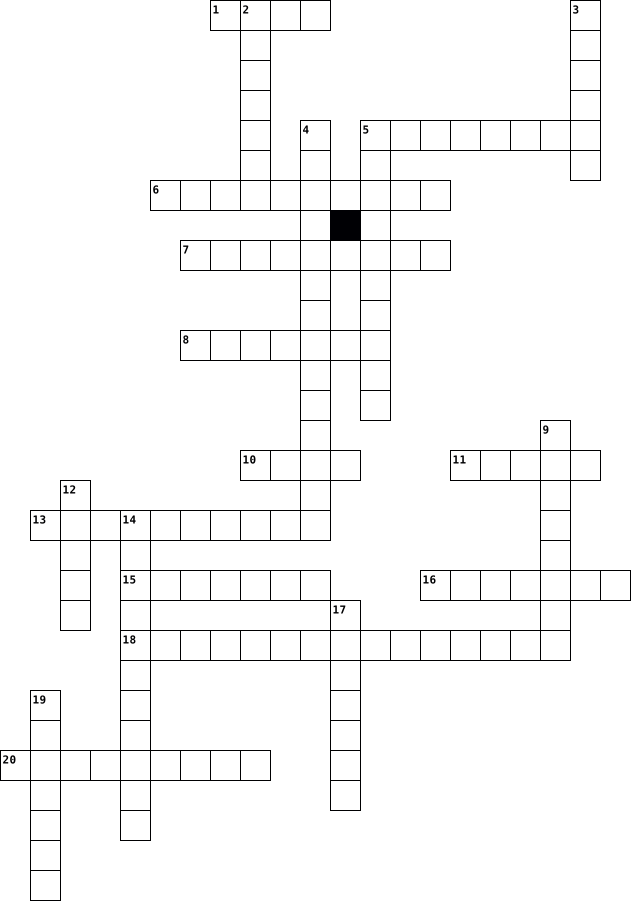
Across
- , doing to making something
- , it is moving
- , something is made
- substances turn into foods and fuels
- , all moving objects
- , burning or hot things
- , a substance that can produce power
- stored energy in an object
- is the ability to do work.
- , destroyed by fires or heat
- changing form from one to another
- , quickly moving back and forth
Down
- , things
- makes things bright so we can see things
- pulls everything down
- , sum of potential and kinetic energy
- stretched and compressed
- ,comes from vibrating objects
- common form of energy using electricity
- giving off much of light
- , power to do something
21 Clues: , things • , it is moving • , something is made • , all moving objects • pulls everything down • , power to do something • stretched and compressed • giving off much of light • stored energy in an object • is the ability to do work. • , doing to making something • , destroyed by fires or heat • ,comes from vibrating objects • , quickly moving back and forth • ...
Energy 2021-03-01
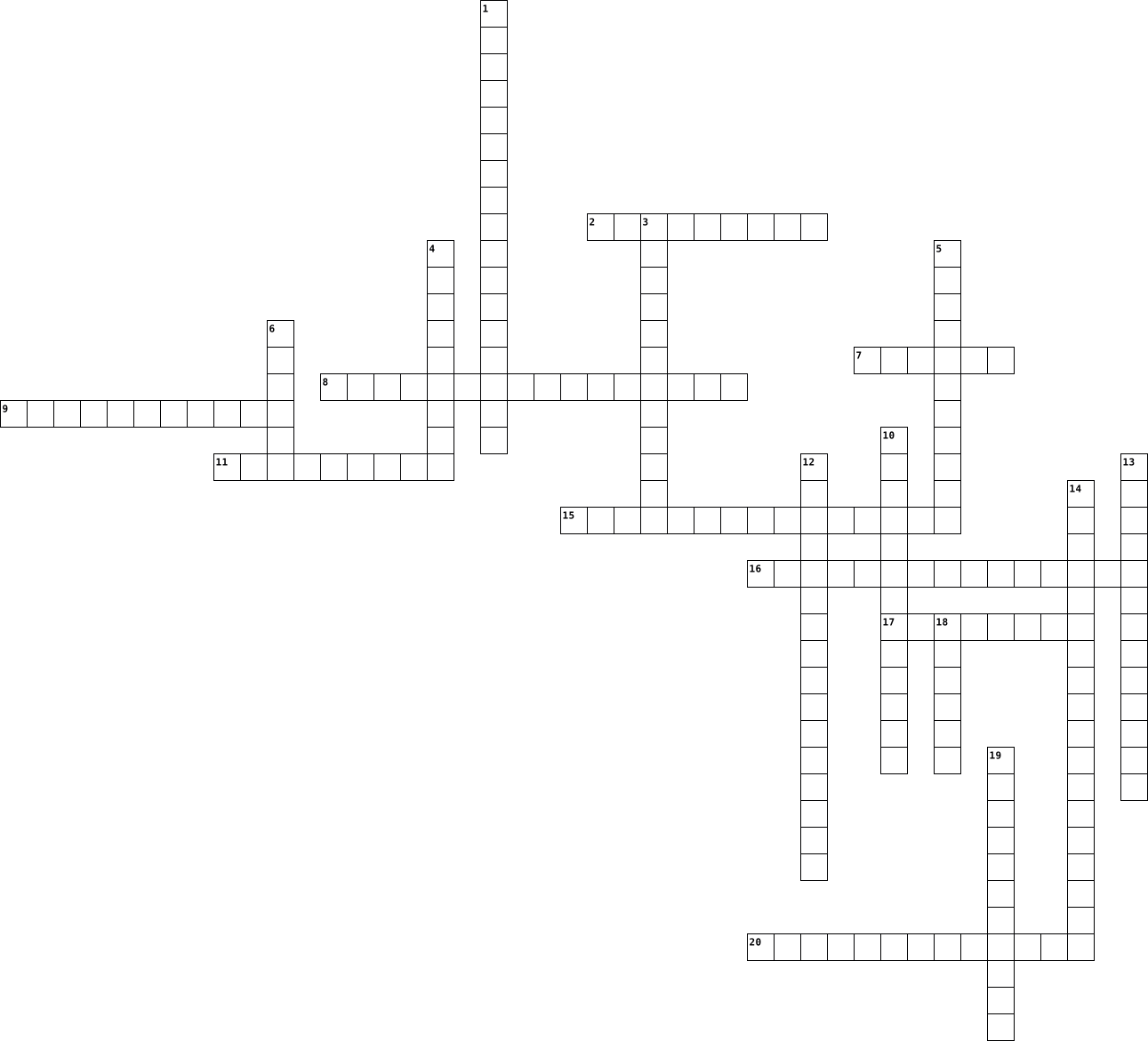
Across
- a resource that can be replaced
- a device for turning on/off a current
- energy of motion
- circuit with holes/gaps
- electricity flows easily through it
- stored energy
- resources made by nature
- negative charge
- energy in motion
Down
- rubbing a balloon on your head
- a resource that can not be replaced
- electricity doesn't flow easily
- energy that helps you see
- positive charge
- heat energy
- energy from a charge
- circuit with no holes/gaps
- charges running through a current
- the ability to do work
- energy that helps you hear
20 Clues: heat energy • stored energy • positive charge • negative charge • energy of motion • energy in motion • energy from a charge • the ability to do work • circuit with holes/gaps • resources made by nature • energy that helps you see • circuit with no holes/gaps • energy that helps you hear • rubbing a balloon on your head • a resource that can be replaced • electricity doesn't flow easily • ...
Energy 2021-05-26
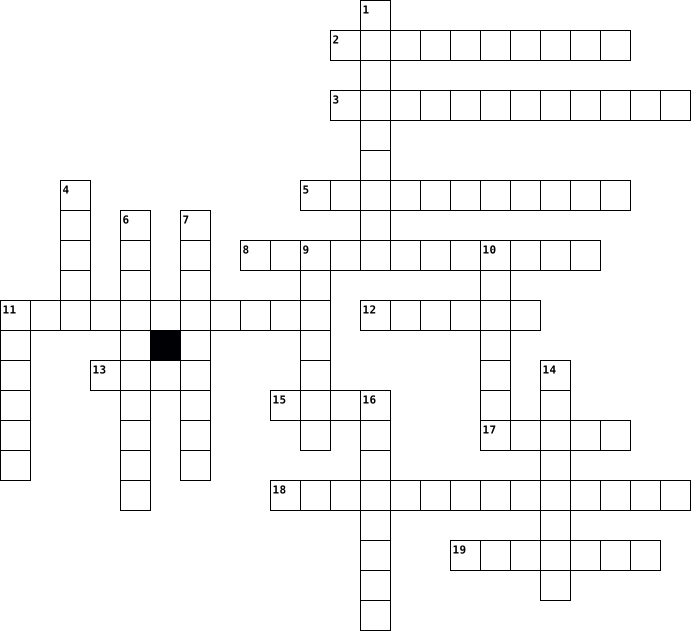
Across
- energy which is spread out
- movement of a wave or energy
- determined by the height above the Earth
- not created or destroyed
- heat energy is absorbed during a reaction
- unit of measurement
- transfer of thermal energy
- unit of power
- spectrum
- energy change
- movement
Down
- EMR used for communication
- produced by the vibration of matter
- heat is released during a reaction
- stored energy
- energy which is from the nuclei of an atom
- heat energy
- to do work
- energy which is no longer available
- movement of energy
20 Clues: spectrum • movement • to do work • heat energy • stored energy • unit of power • energy change • movement of energy • unit of measurement • not created or destroyed • EMR used for communication • energy which is spread out • transfer of thermal energy • movement of a wave or energy • heat is released during a reaction • produced by the vibration of matter • energy which is no longer available • ...
Energy 2022-03-29
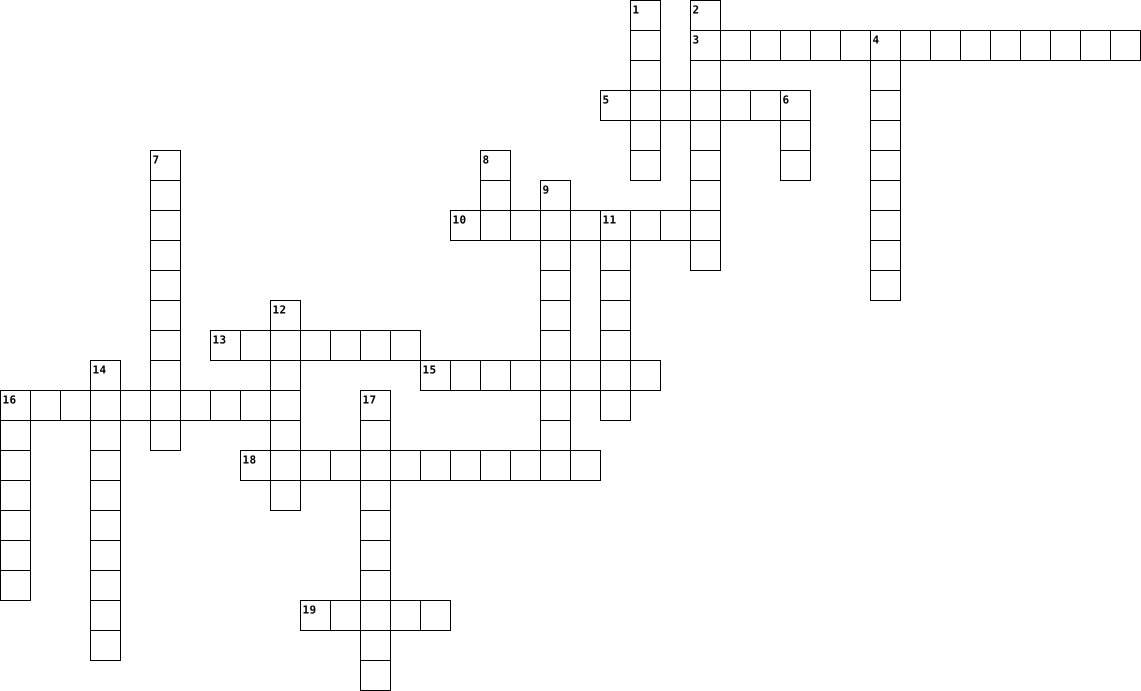
Across
- The energy emitted in the form of waves of the electromagnetic spectrum
- The energy of motion
- Energy of an object due to its position and shape
- loops the super-heated water passes through a pipe (_____) into the steam generator.
- The energy stored in chemical bonds between atoms and molecules.
- what fossil fuel is burned the most on our country?
- All fossil fuels like natural gas, coal and oil
- surface mining
Down
- when the nucleus comes together
- Wind, solar, geothermal
- The Exxon Valdez (1989), and Deepwater Horizon (2010) _______ are considered to be two of the worst man-made ecological disasters ever.
- the _____ released by burning fossil fuels appears to be the major contributor to the process of global warming.
- Energy associated with the movement/flow of electrons
- Nuclear fusion involves joining atomic nuclei.
- The energy required to move/change an object’s position
- he energy in the movement of molecules (a form of kinetic energy)
- nucleus is broken
- mining in tunnels
- The energy stored in forces holding atomic nuclei together
- Industrialized nations use approximately ______ times more energy per person than those with little industry
20 Clues: surface mining • nucleus is broken • mining in tunnels • The energy of motion • Wind, solar, geothermal • when the nucleus comes together • Nuclear fusion involves joining atomic nuclei. • All fossil fuels like natural gas, coal and oil • Energy of an object due to its position and shape • what fossil fuel is burned the most on our country? • ...
Energy 2022-04-12
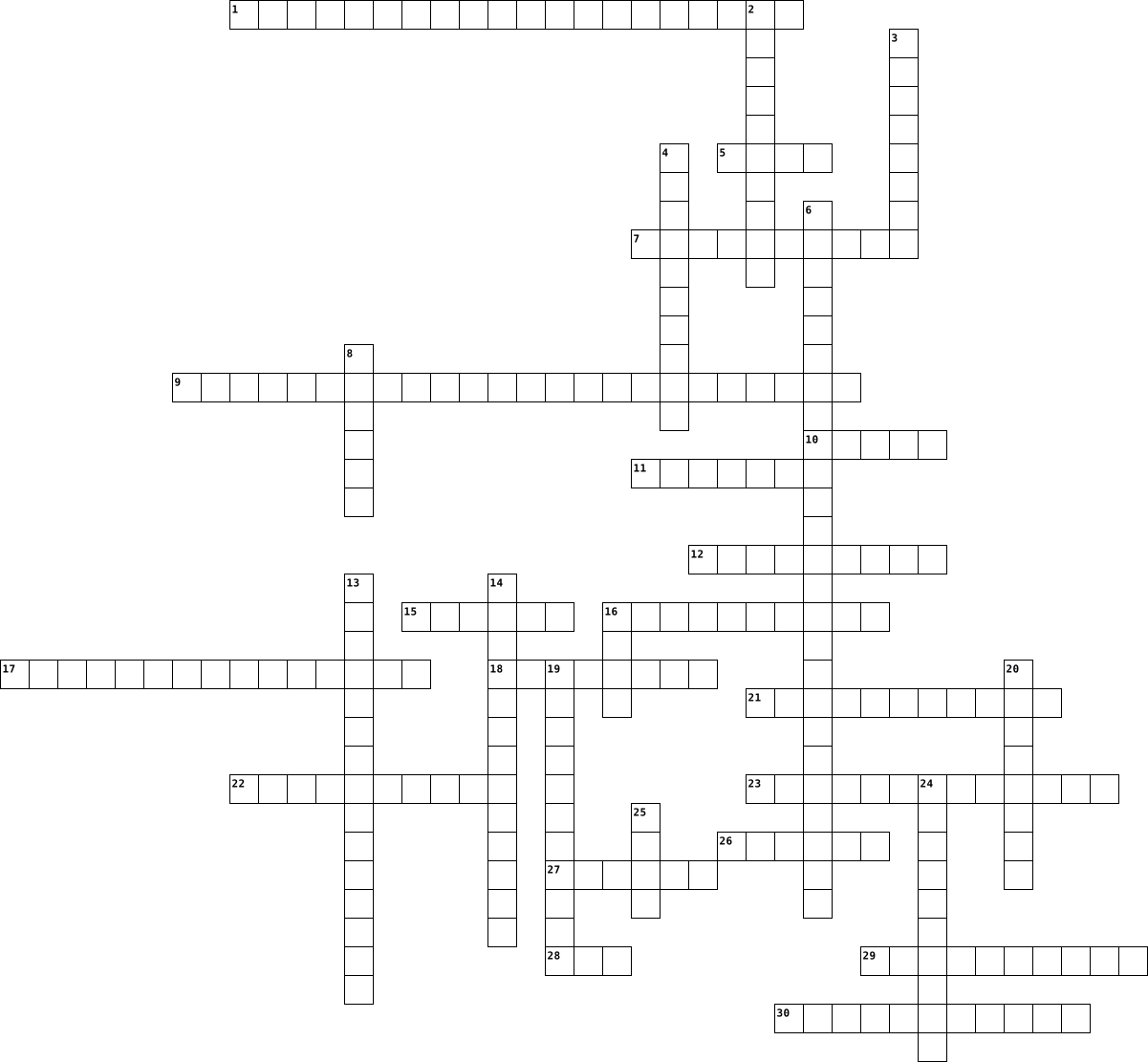
Across
- a natural resource that cannot be re-made or re-grown at a scale comparable to its consumption.
- Rain Rain that has a lower-than-average pH level because of burning fossil fuels
- the slowest; have the longest wavelengths in the electromagnetic spectrum
- heat energy created by the sun
- Flares an explosive out burst
- soft brownish coal that has traces of plant structure, intermediate between bituminous coal and peat.
- the fastest; electromagnetic radiation that has wavelengths less than one tenth of a nanometer.
- an electromagnetic wave of lots of energy and short wavelength, it is able to pass through many materials opaque to light.
- happens when heat energy is moved from earth’s surface air to atmospheric air.
- energy that is stored or energy of position
- waves Electromagnetic radiation spectrum the wavelengths are longer than those of visible light.
- layer of earth responsible for most of visible light
- contains relatively pure carbon and burns with little flame and smoke (cleanest burning)
- the Energy of motion
- the ability to complete work
- the invisible rays that are of the energy that comes from the sun
- main source of energy on Earth
- softer coal contains a tarlike substance called bitumen. It is of higher quality than lignite coal but of poorer quality than anthracite.
- process where carbon is exchanged between organisms and the environment.
Down
- when pockets of air near earth’s surface are heated, become less dense, rise, cool, and sink.
- colder areas of earth's surface that appear darker
- are a continuous stream of electrically charged particles that are given off by a magnetic field around the sun.
- states that energy changes form, but it cannot be created or destroyed.
- outer layer of earth that creates the ‘solar wind
- the energy’s ability to change from one form to another
- the energy from the Sun transmitted as electromagnetic waves.
- Most abundant nonrenewable resource
- Fuel is created from the fossilized remains of prehistoric plants and animals.
- a type of nonrenewable resource that is drilled out of the ground used for gasoline
- use of organic waste through natural decomposition
- Mostly decayed plant material creates lots of pollution
31 Clues: the Energy of motion • the ability to complete work • Flares an explosive out burst • heat energy created by the sun • main source of energy on Earth • Most abundant nonrenewable resource • energy that is stored or energy of position • outer layer of earth that creates the ‘solar wind • colder areas of earth's surface that appear darker • ...
Energy 2022-03-14

Across
- Energy harnessed from the sun is called ______ energy.
- Another name for a rainbow is a ______.
- Something that produces light is called______.
- Jellyfish and fireflies have ______.
- We needed light and ______ to power our solar ovens.
- To listen to a song, we would need to hear ______.
- Sound travels in ______.
- You hear sound using your ______.
- Light can ______ when it bends.
- ______ light does not occur in nature.
- We used a ______ to refract rainbows outside.
Down
- A plastic Ziploc bag is ______.
- Light can ______ when it bounces off a surface.
- ______ is how loud or soft you hear a sound.
- A foggy car window is ______.
- ______ is how high or low you hear a sound.
- We made an _______ using a tube and wax paper.
- Our main source of ______ on Earth is the sun.
- A brick wall is ______.
- One type of energy that we use is ______.
20 Clues: A brick wall is ______. • Sound travels in ______. • A foggy car window is ______. • A plastic Ziploc bag is ______. • Light can ______ when it bends. • You hear sound using your ______. • Jellyfish and fireflies have ______. • ______ light does not occur in nature. • Another name for a rainbow is a ______. • One type of energy that we use is ______. • ...
energy 2022-03-28

Across
- energy associated with movement of electrons
- commercial,residential,transportation industrial.
- changing one form of energy into another
- energy can nither be created or destroyed
- The energy stored in forces holding atomic nuclei together
- a natural fuel such as coal or gas
- energy produced by vibrating sound waves
- industry obtaining ore by open pit mining
- process of burning a fuel
- source that is not depleted when used
- energy that results from position or shape of an object
- sources that will run and can not be replenished
- mining a form of mining in which the soil and the rock covering the mineral deposits are removed.
Down
- the process of separating triglyceride
- energy that is radiant and waves travel at the speed of light
- most common fossil fuel
- a nuclear reaction in which a heavy nucleus splits spontaneously or on impact with another particle, with the release of energy.
- energy is stored as a result of applying force
- a liquid fossil fuel with a thick viscous texture.
- the energy released during nuclear fission
- energy which a body possesses by virtue of being in motion
21 Clues: most common fossil fuel • process of burning a fuel • a natural fuel such as coal or gas • source that is not depleted when used • the process of separating triglyceride • changing one form of energy into another • energy produced by vibrating sound waves • energy can nither be created or destroyed • industry obtaining ore by open pit mining • ...
Energy 2022-09-19

Across
- to change from one form to another
- situation in which heat is retained in Earth's atmosphere by carbon dioxide, methane, water vapor, and other gases
- energy from the sun
- stored energy that results from the position or shape of an object
- oil burning, replaced steam engine, used in transportation
- fuel that is made of hydrocarbons that are 16 carbons long; a high compression internal combustion engine.
- a machine that converts mechanical energy into electrical energy
- gas, consisting largely of methane and other hydrocarbons, occurring naturally underground (often in association with petroleum) and used as fuel.
- transfer movement of energy from one place or object to another
- A diesel substitute produced by extracting and chemically altering oil from plants
- a fossil fuel that occurs in underground deposits, composed of a liquid mixture of hydrocarbons, water, and sulfur
Down
- the total carbon dioxide emissions produced by an individual, group, or location
- gas
- the energy an object has due to its motion
- a form of energy that exhibits wavelike behavior as it travels through space
- a facility that uses heat from nuclear reactors to produce electrical energy
- heat energy
- relating to or denoting the action of heated water in the earth's crust.
- a unit of power equal to 1000 watts
- a resource that has a theoretically unlimited supply and is not depleted when used by humans.
- the ability to do work or cause change
- effect
- liquid fuel created from processed or refined biomass
- coal, oil, natural gas, and other fuels that are ancient remains of plants and animals.
24 Clues: gas • effect • heat energy • energy from the sun • to change from one form to another • a unit of power equal to 1000 watts • the ability to do work or cause change • the energy an object has due to its motion • liquid fuel created from processed or refined biomass • oil burning, replaced steam engine, used in transportation • ...
Energy 2022-09-20

Across
- introduction of harmful materials into the environment
- removal of trees for lumber, crops, extraction, or development
- organic matter used as a fuel for generation of electricity
- the chemical element of atomic number 92, a dense gray radioactive metal used as a fuel in nuclear reactors.
- resources that can replenish themselves over a period of time even as they are used.
- the ability to be maintained at a certain rate or level
- relating to or determined by the sun
- unable to be used up
- the natural movement of air
- the generation of electricity using flowing water
- a natural fuel such as coal or gas, formed in the geological past from the remains of living organisms.
- relating to or produced by the internal heat of the Earth
Down
- energy generated by ways that don’t deplete natural resources or harm the environment
- materials or substances such as minerals, forests, water, and fertile land that occur in nature
- to fill or build up the supply again
- a natural substance that is not replenished with the speed at which it is consumed.
- preventing the wasteful use of a resource
- energy stored inside of an atom
- collecting and processing of materials that would be thrown away and turning them into new products
- fossil fuel formed by the remains of ancient organisms
- process of materials worn away and transported by natural forces
21 Clues: unable to be used up • the natural movement of air • energy stored inside of an atom • to fill or build up the supply again • relating to or determined by the sun • preventing the wasteful use of a resource • the generation of electricity using flowing water • introduction of harmful materials into the environment • fossil fuel formed by the remains of ancient organisms • ...
energy 2022-11-14

Across
- change with time of the position or orientation of a body.
- The universal force of attraction acting between all matter
- Same strength different direction
- Location of something similar to something else
- a vector expression of the displacement that an object or particle undergoes with respect to time
- Where an object is located at a certain time
- The moving of something from its place
- Velocity changes with time
- When speed stays the same
- the progression of events from the past to the present into the future
- dimensionless quantity representing the amount of matter in a particle or object.
- an expression used in physics to indicate the intensity of a gravitational field
Down
- no change in the position of the body
- When a object is moving in positive but the velocity is negative
- A force which a planet draws objects towards its center.
- without any friction
- the force applied in one direction is greater than the force applied in the opposite direction
- A force that resists the motion of one object against another
- It states that the time rate of change of the momentum of a body is equal in both magnitude and direction to the force imposed on it
- the total movement of an object without any regard to direction
- the time rate at which an object is moving along a path
- a force opposite in direction to an accelerating force acting on a body and equal to the product of the accelerating force and the mass of the body
- strength or energy as an attribute of physical action or movement.
23 Clues: without any friction • When speed stays the same • Velocity changes with time • Same strength different direction • no change in the position of the body • The moving of something from its place • Where an object is located at a certain time • Location of something similar to something else • the time rate at which an object is moving along a path • ...
Energy 2022-11-28

Across
- This wave of light redshifted overtime - connected to the big bang
- sequence of stars that fuse hydrogen to helium
- Law that galaxies are moving away from earth - further=faster
- type of heat transfer based on density
- our star will someday become a red ____________
- 2.7 degrees _____________ is evidence of the big bang
- name of star before fusion
- Only massive stars can fuse up to element 26
- disk shooting from nebula that grows into a solar system
- atoms coming together
- a famous nebula that is a remnant of 1054 AD supernova
- acronym for visible light
- this can become matter (E=mc2)
- a cloud of dust and gas .
- most light is this - hint: x-ray, radio, infrared
Down
- this can become energy (E=mc2)
- Betelgeuse is an example of a red ___________________
- a white dwarfs taking matter off a binary red star
- super red giant explodes making heavier elements
- ionized gas
- type of background radiation
- the belt of this constellation has famous nursery nebula
- the name of hydrogen with a neutron (heavy)
- a nebula of an old star with possible white dwarf in the middle
- place in sun where fusion takes place
- zone in the sun just after the core
- either red or blue show how light is moving toward or away from us
- atoms splitting a part
- possible star after a supernova
- The HR ________________ shows temp and luminosity of stars
- either a dwarf or a giant with low surface temperatures
- this is used to make/fuse all the elements
- when a deuterium collides with a hydrogen it makes _________ and releases a gamma ray
- one of the big bang elements besides hydrogen
34 Clues: ionized gas • atoms coming together • atoms splitting a part • acronym for visible light • a cloud of dust and gas . • name of star before fusion • type of background radiation • this can become energy (E=mc2) • this can become matter (E=mc2) • possible star after a supernova • zone in the sun just after the core • place in sun where fusion takes place • ...
Energy 2021-04-26

Across
- Energy that is stored,or conserved,in an
- Any fuel that is derived from biomass
- gas Naturally occurring hydrocarbon gas mixture
- primarily of methane
- The energy that is possessed by an object
- of energy by using Less Energy
- energy Renewable energy powered by the natural rise
- Energy stored in the bonds of chemical
- energy A form of solar energy
- energy They transport and capture of energy by
- Plant or animal material used as fuel to
Down
- or substance
- gas Clean alternative to methane
- or radioactive decay process
- conservation The effort made to reduce the
- surface waves
- The energy of electromagnetic waves
- power Power generated by geothermal energy
- The movement of energy through a substance
- electricity or heat
- Form of energy resulting from the
- to its motion or due to its position
- Energy that is released through a nuclear
- fall of ocean tides and currents
- of electric charge
- Energy that it possesses due to its motion
26 Clues: or substance • surface waves • of electric charge • electricity or heat • primarily of methane • or radioactive decay process • of energy by using Less Energy • energy A form of solar energy • gas Clean alternative to methane • fall of ocean tides and currents • Form of energy resulting from the • The energy of electromagnetic waves • to its motion or due to its position • ...
Energy 2022-10-14

Across
- stored energy
- the transfer of heat in the air or liquid
- average kinetic energy of all particles in a material
- blocks conduction
- energy transfer from electromagnetic heat waves
- energy of movement
- the transfer of kinetic energy from one object to another
- a small portion of matter
- when particles are tightly together and when something keeps its shape
Down
- used to measure energy
- energy transfer from direct contact
- energy
- the ability to do work
- energy that comes from heat
- a set of things working together
- The substances mass per unit of volume
- a type of matter that has no defined shape or volume
- anything that takes up space
- when something can move one place to another
- object that takes the shape of a container it is stored in
20 Clues: energy • stored energy • blocks conduction • energy of movement • used to measure energy • the ability to do work • a small portion of matter • energy that comes from heat • anything that takes up space • a set of things working together • energy transfer from direct contact • The substances mass per unit of volume • the transfer of heat in the air or liquid • ...
Energy 2024-01-01

Across
- Force acting over a distance
- At constant pressure, a change in this equals the energy flow as heat
- The SI unit of measurement for energy;
- Fuels that consist of carbon-based molecules derived from decomposition of once-living organisms; coal, petroleum, or natural gas
- A function used to keep track of the natural tendency for the components of the universe to become disordered; a measure of disorder and randomness
- This law states energy can be converted from one form to another but can not be created nor destroyed
- Energy due to the motion of an object (EX: a roller coaster is moving down the hill)
- Refers to a process in which energy (as heat) flows from the surroundings into the system
- The amount of energy required to raise the temperature of one gram of a substance by one Celsius degree
- The capacity to do work or to cause the flow of heat
- A type of process that occurs in nature without outside intervention (it happens “on its own”)
- The flow of energy due to a temperature difference
Down
- The warming effect exerted by certain molecules in the earth’s atmosphere (particularly carbon dioxide and water)
- Energy due to the position or composition of matter (EX: a roller coaster is at the top of the roller coaster)
- This law of thermodynamics states entropy of the universe is always increasing
- The sum of the kinetic and potential energies of all particles in the system
- The process where energy (as heat) flows out of the system into the surroundings
- This law of thermodynamics states that the energy of the universe is constant
- Measure of the random motions (average kinetic energy) of the components of a substance
- A device used to determine the heat associated with a chemical or physical change
- Everything outside of a system
- That part of the universe on which attention is being focused
- This law states the change in enthalpy in going from a given set of reactants to a given set of products does not depend on the number of steps in the reaction
23 Clues: Force acting over a distance • Everything outside of a system • The SI unit of measurement for energy; • The flow of energy due to a temperature difference • The capacity to do work or to cause the flow of heat • That part of the universe on which attention is being focused • At constant pressure, a change in this equals the energy flow as heat • ...
Energy 2023-12-08

Across
- force that resists the motion of two surfaces
- objects or particles.
- ability to cause change.
- move in the direction of the force.
- energy total energy of an object or group
- energy transfer to an object by a force, making the
- are touching
- energy carried by an electric current.
- from one form into another or transferred
- energy sum of kinetic and potential energy of
Down
- energy carried by sound.
- of conservation of energy states that energy can be
- particles in matter due to their random motion.
- energy stored in the nucleus of an atom.
- energy carried by electromagnetic waves.
- energy due to motion.
- energy stored energy due to interactions
- transmitted by electromagnetic waves.
- destroyed.
- objects due to large-scale motion and interactions.
- one region to another, but energy cannot be created
21 Clues: destroyed. • are touching • objects or particles. • energy due to motion. • energy carried by sound. • ability to cause change. • move in the direction of the force. • transmitted by electromagnetic waves. • energy carried by an electric current. • energy stored in the nucleus of an atom. • energy carried by electromagnetic waves. • energy stored energy due to interactions • ...
Energy 2023-12-08

Across
- force that resists the motion of two surfaces
- objects or particles.
- ability to cause change.
- move in the direction of the force.
- energy total energy of an object or group
- energy transfer to an object by a force, making the
- are touching
- energy carried by an electric current.
- from one form into another or transferred
- energy sum of kinetic and potential energy of
Down
- energy carried by sound.
- of conservation of energy states that energy can be
- particles in matter due to their random motion.
- energy stored in the nucleus of an atom.
- energy carried by electromagnetic waves.
- energy due to motion.
- energy stored energy due to interactions
- transmitted by electromagnetic waves.
- destroyed.
- objects due to large-scale motion and interactions.
- one region to another, but energy cannot be created
21 Clues: destroyed. • are touching • objects or particles. • energy due to motion. • energy carried by sound. • ability to cause change. • move in the direction of the force. • transmitted by electromagnetic waves. • energy carried by an electric current. • energy stored in the nucleus of an atom. • energy carried by electromagnetic waves. • energy stored energy due to interactions • ...
energy 2023-12-07

Across
- radiant energy is collected by solar panelsand converted into electrical energy
- chemimical energy is transformed into thermal energy and radiant
- the ability to do work or cause change
- the energy of vibrations on matter
- electrical energy is transformed into thermal energy
- energy stored in the bonds of molecules
- the energy of moving electron or electric charges
- energy cannot be created or destroyed
- an object gains more energy as its speed and mass increases
- the energy locked in the nucleus of an atom
- the change of energy from on form to another
Down
- potential energy is the water being pulled up toward the clouds then the thermal energy freeze the water to where the kinetic energy is the frozen water pulled down
- energy stored in being twisted it stretched of an object
- an object gains more energy as its height or mass increases
- the energy of heat
- inside of said place a nuclear fission produces thermal energy which changes water into steam the steam is used to produce mechanical energy to spin a turbine and mechanical energy is converted into electrical by a generator
- also known as light energy or electromagnetic energy
- stored energy or energy of position
- mechanical energy is transformed into sound energy as the strings of the guitar being to vibrate
- the energy in moving objects
20 Clues: the energy of heat • the energy in moving objects • the energy of vibrations on matter • stored energy or energy of position • energy cannot be created or destroyed • the ability to do work or cause change • energy stored in the bonds of molecules • the energy locked in the nucleus of an atom • the change of energy from on form to another • ...
Energy 2023-09-17

Across
- Positive part of the atom
- A measure of how fast an object is travelling
- Negative part of the atom
- Potential energy stored in stretched or compressed object
- The variable changed by the scientist
- Unit for energy
- An object or a group of object where energy can be transferred
- Measured in kilograms the amount of matter in an object
- Equipment used to measure the time taken for something to happen
- What a variable is measured in (e.g. seconds, metres, kilogram, joules)
- The amount of energy transferred from one store to another
- Piece of equipment used to measure the mass of an object
- How far an object has travelled
- Energy stored in vibrating particles
- Unit for force
- Equipment used to measure temperature
- Entering data into an equation
- Potential energy stored in objects above ground
Down
- Branch of science concerned with forces and energy
- Neutral part of the atom
- The variable kept the same by the scientist
- Unit for distance
- cylinder, Equipment used to measure volume of a fluid
- Formula used to calculate a variable
- Energy stored in the middle of an atom
- Variable measured by the scientist
- Energy stored in moving objects
- Energy stored in bonds between atoms (food, fuel, batteries)
28 Clues: Unit for force • Unit for energy • Unit for distance • Neutral part of the atom • Positive part of the atom • Negative part of the atom • Entering data into an equation • How far an object has travelled • Energy stored in moving objects • Variable measured by the scientist • Formula used to calculate a variable • Energy stored in vibrating particles • ...
Energy 2023-09-19

Across
- a proposed answer to a question about the natural world
- the energy that is stored in an object or system
- an object, diagram, or computer program that helps us understand something by making it simpler or easier to see
- A stable subatomic particle with a negative charge
- the ability to make things move or change
- the process of making clear how your evidence supports your claim
- A substance that allows current to flow easily through it
- energy from natural sources that are replenished at a higher rate than they are consumed
- A pathway for electrical current to travel
- energy from sources that will run out in out lifetimes
- a set of interacting parts forming a complex whole
- to move from one object to another or one place to another
- a machine that can convert kinetic energy into electrical energy
Down
- Circuit with 2+ single loops connected to the same battery
- a circuit with a break in the electrical pathway
- stored by the application of a force
- information that is used to support or refute a claim
- the energy that an object has because it is moving
- A substance which does NOT readily allow the passage of heat or sound
- Used to turn the electrical flow on or off
- to change from one type to another
- A circuit with a complete and unbroken electrical pathway
- A device having a designed resistance to the passage of an electrical current
- Circuit with bulbs are hooked up in one long line
24 Clues: to change from one type to another • stored by the application of a force • the ability to make things move or change • Used to turn the electrical flow on or off • A pathway for electrical current to travel • the energy that is stored in an object or system • a circuit with a break in the electrical pathway • Circuit with bulbs are hooked up in one long line • ...
ENERGY 2024-02-12

Across
- A form of energy associated with the motion of particles.
- A unit of electrical energy equal to one joule per second.
- is equal to zero at environmental conditions.
- Gibbs free energy is ___ for non-spontaneous reaction.
- Low Grade Energy
- The energy produced by burning organic materials.
- A unit of energy commonly used for household electricity bills
- The energy stored in the nucleus of an atom.
- The energy produced by the flow of water in rivers or dams.
Down
- does not change for reversible process.
- The energy stored in chemical bonds.
- A clean and renewable energy source from the Earth's heat.
- The energy produced by splitting atoms.
- A device that converts mechanical energy into electrical energy.
- The capacity to do work or produce heat.
- A non-renewable fossil fuel used for electricity generation.
- The energy produced by wind turbines.
- A type of energy associated with the movement of electrons.
- High Grade Energy.
- A renewable energy source harnessed from the sun.
20 Clues: Low Grade Energy • High Grade Energy. • The energy stored in chemical bonds. • The energy produced by wind turbines. • does not change for reversible process. • The energy produced by splitting atoms. • The capacity to do work or produce heat. • The energy stored in the nucleus of an atom. • is equal to zero at environmental conditions. • ...
Energy 2024-02-22

Across
- efficiency= ___________ / total energy input
- Stored energy due to position or condition
- Unit of energy in the metric system, equivalent to 1000 calories
- The process by which plants use light to store chemical energy.
- Device that converts kinetic energy into electrical energy
- Energy released from the nucleus of an atom
- The law that states energy cannot be created or destroyed
- Efficiency can not be above this number.
- Energy pathway when a force acts on an object
- Energy required to raise 1kg of substance by one degree Celsius.
- The term used when an object is no longer elastic
- Energy that flows from hot to cold objects
Down
- A resource that will run out
- Term used to describe energy that is wasted into the surroundings
- Units of specific heat capacity (Hint ________ per... )
- An example is Oil as it is used to reduce wasted energy due to friction.
- Apparatus used to get the mass of a substance.
- A resource that is replenished quicker than it is used
- Unit of power
- Type of energy stored in batteries
- A form of potential energy associated with the position of an object relative to the Earth
- The energy stored in food
- Energy source formed from the remains of ancient plants and animals
- Energy harnessed from moving air
- The energy an object possesses due to its motion
- Renewable energy source that uses sunlight
- Energy associated with the motion of particles
- The diagram used to show energy transfers
- Energy of moving electrons
- Energy generated under the surface of the Earths crust
- A material that reduces wasted energy.
- Energy pathway when energy is transferred as waves (e.g. light or sound)
- Unit of energy, often used for food
- Kinetic energy = _______ x mass x speed (squared) (hint: fraction)
34 Clues: Unit of power • The energy stored in food • Energy of moving electrons • A resource that will run out • Energy harnessed from moving air • Type of energy stored in batteries • Unit of energy, often used for food • A material that reduces wasted energy. • Efficiency can not be above this number. • The diagram used to show energy transfers • ...
Energy 2019-04-28

Across
- Gasification produces _________ and solid residue.
- Septic systems are usually used in what area?
- What type of diversion refers to collecting and processing items to make new products?
- an environment without air
- composting using worms
- Where is solid waste disposed of?
- Which gas is a mixture of methane and CO2?
- products that are reused and nothing is burned or goes to landfills
- to use more than once
- How many steps does the municipal sewage treatment have?
Down
- an environment with air
- What are any materials rinsed down a drain or flushed down a toilet called?
- What is the movement of waste from sources to its final destination?
- What type of waste comes from farms?
- waste from plants or animals
- Incineration deals with _________ combustion at high temperatures.
- decreases the amount of organic waste that enters landfills.
- materials that cannot be use more than once
- a mixture of braking down leaves dirt and food
- What type of waste makes up 36% of solid waste?
20 Clues: to use more than once • composting using worms • an environment with air • an environment without air • waste from plants or animals • Where is solid waste disposed of? • What type of waste comes from farms? • Which gas is a mixture of methane and CO2? • materials that cannot be use more than once • Septic systems are usually used in what area? • ...
Energy 2020-10-08

Across
- The prefix that in standard form means 1 x 10^6
- A wasted energy in a laptop
- When a ball is dropped the amount of kinetic energy it has _______________
- The energy store in bananas, petrol and candle wax
- This type of system does not have energy transfers into or out of it
- The energy store in a moving object
- Energy cannot be created or destroyed but only _______________________ from one store to another
- Dissipated energy ends up here
- The energy stored in a stretched or compressed object
- Energy not in the form or place that you want it
- Hot objects have energy stored this way
- Energy cannot be __________or destroyed
- The unit used to measure the amount of energy
Down
- There are 4 of these: mechanically, by radiation, electrically, by heating
- The potential energy stored in a book on a shelf
- Energy that has spread out into the surroundings
- When a ball is thrown up the amount of kinetic energy it has _______________
- The useful energy emitted by a lamp
- Energy in the form you want in the place you want
- The total energy always stays the same. This is called the Law of ______________ of energy
- This force causes moving parts to heat up
21 Clues: A wasted energy in a laptop • Dissipated energy ends up here • The useful energy emitted by a lamp • The energy store in a moving object • Hot objects have energy stored this way • Energy cannot be __________or destroyed • This force causes moving parts to heat up • The unit used to measure the amount of energy • The prefix that in standard form means 1 x 10^6 • ...
energy 2024-05-02

Across
- The ability to do work
- Cycle The continuous process by which carbon is exchanged between organisms and the environment.
- of Conservation of Energy States that energy can change form, but it cannot be created or destroyed.
- Energy Energy of motion
- A soft brownish coal showing traces of plant structure, intermediate between bituminous coal and peat.
- Rays electromagnetic radiation with wavelengths shorter than approximately one tenth of a nanometer. Fastest
- Rain Rain that has a lower than normal pH level because of burning fossil fuels
- occurs when heat energy is transferred from earth’s surface air to atmospheric air.
- The source of all energy on Earth
- an electromagnetic wave of high energy and very short wavelength, which is able to pass through many materials opaque to light.
- Resource Is a natural resource that cannot be re-made or re-grown at a scale comparable to its consumption.
- outer layer that creates the ‘solar wind’ which can go 800 km/s
- Energy Is the energy from the Sun transmitted as electromagnetic wave.
- Oil Known as Petroleum a type of nonrenewable resource that id drilled out of the ground used for gasoline
- surface layer responsible for most of visible light
Down
- Radiation. heat energy from the sun
- Transform Energy’s ability to change from one form to another
- Winds They are a continuous stream of electrically charged particles that are given off by a magnetic field around the sun.
- Is a relatively soft coal containing a tarlike substance called bitumen. It is of higher quality than lignite coal but of poorer quality than anthracite.
- occurs as pockets of air near earth’s surface are heated, become less dense, rise, cool, and sink.
- Most abundant of nonrenewable resource produces sulfur dioxide
- waves. Electromagnetic radiation spectrum at wavelengths longer than those of visible light,
- Rays Invisible rays that are part of the energy that comes from the sun. Filtered by ozone layer
- Energy Stored energy or energy of position
- cooler areas of surface that appear darker
- Hard variety that contains relatively pure carbon and burns with little flame and smoke (cleanest burning)
- Waves Have the longest wavelengths in the electromagnetic spectrum, slowest
- Flares. explosive out burst
- Partially decayed plant material, burns dirty lots of pollution
- Fuels Fuel that have been formed from the fossilized remains of prehistoric plants and animals.
30 Clues: The ability to do work • Energy Energy of motion • Flares. explosive out burst • The source of all energy on Earth • Radiation. heat energy from the sun • cooler areas of surface that appear darker • Energy Stored energy or energy of position • surface layer responsible for most of visible light • ...
energy 2024-05-02

Across
- an electromagnetic wave of high energy and very short wavelength, which is able to pass through many materials opaque to light.
- The source of all energy on Earth
- Rays Invisible rays that are part of the energy that comes from the sun. Filtered by ozone layer
- Flares explosive out burst
- Partially decayed plant material, burns dirty lots of pollution
- Radiation heat energy from the sun
- occurs when heat energy is transferred from earth’s surface air to atmospheric air.
- Energy Is the energy from the Sun transmitted as electromagnetic wave.
- Most abundant of nonrenewable resource produces sulfur dioxide
- Is a relatively soft coal containing a tarlike substance called bitumen. It is of higher quality than lignite coal but of poorer quality than anthracite
- Resource Is a natural resource that cannot be re-made or re-grown at a scale comparable to its consumption.
- The ability to do work
- Fuels Fuel that have been formed from the fossilized remains of prehistoric plants and animals.
Down
- Rays electromagnetic radiation with wavelengths shorter than approximately one tenth of a nanometer. Fastest
- waves Electromagnetic radiation spectrum at wavelengths longer than those of visible light,
- cooler areas of surface that appear darker
- Energy Energy of motion
- outer layer that creates the ‘solar wind’ which can go 800 km/s
- Energy Stored energy or energy of position
- surface layer responsible for most of visible light
- Cycle The continuous process by which carbon is exchanged between organisms and the environment.
- Rain Rain that has a lower than normal pH level because of burning fossil fuels
- Waves Have the longest wavelengths in the electromagnetic spectrum, slowest
- Winds They are a continuous stream of electrically charged particles that are given off by a magnetic field around the sun.
- occurs as pockets of air near earth’s surface are heated, become less dense, rise, cool, and sink.
- Transform Energy’s ability to change from one form to another
- of Conservation of Energy States that energy can change form, but it cannot be created or destroyed.
- A soft brownish coal showing traces of plant structure, intermediate between bituminous coal and peat.
28 Clues: The ability to do work • Energy Energy of motion • Flares explosive out burst • The source of all energy on Earth • Radiation heat energy from the sun • cooler areas of surface that appear darker • Energy Stored energy or energy of position • surface layer responsible for most of visible light • Most abundant of nonrenewable resource produces sulfur dioxide • ...
Energy 2024-05-05

Across
- nature's way of transferring energy through space
- fuels that are gone once they're used up
- the splitting of atoms
- thermal energy transferred from one thing to another
- using the natural underground temperature of the earth for heating or cooling
- energy generated by the movement of electrons from one point to another
- energy that's released when atoms are split or combined
- energy which is possessed by an object due to its motion or its position
- the combining of atoms
Down
- cannot be used up by human action
- energy that is produced by using flowing water to create electricity
- heat transfer through direct contact
- heat transfer in gases and liquids
- energy that is waiting to make change or cause motion
- fuels that can be replenished
- energy that is created through muscle power
- energy in motion
- transfer of heat by way of electromagnetic waves
- electromagnetic waves that travel outward from a central location
- the ability to do work
20 Clues: energy in motion • the splitting of atoms • the ability to do work • the combining of atoms • fuels that can be replenished • cannot be used up by human action • heat transfer in gases and liquids • heat transfer through direct contact • fuels that are gone once they're used up • energy that is created through muscle power • transfer of heat by way of electromagnetic waves • ...
Energy 2024-05-28

Across
- potential energy breadfruit in a tree is an example of
- there are ___ types of energy
- the sun gives us ______ energy
- to save energy
- energy energy produced when something vibrates
- energy stored in the nucleus of an atom
- energy a spinning fan is an example of
- energy can only be _____
- kinetic energy is energy in_____
Down
- energy stored within an object due to its position or state
- a change from one to another
- what law states that energy cannot be created nor destroyed
- the energy from the sun
- energy in electronic appliances
- fossil fuels have what type of energy
- the ability of a body to work
- potential energy _________ is found in a rubber band
- SI UNIT for energy
- energy can be neither destroyed or
- energy another word for heat energy
20 Clues: to save energy • SI UNIT for energy • the energy from the sun • energy can only be _____ • a change from one to another • there are ___ types of energy • the ability of a body to work • the sun gives us ______ energy • energy in electronic appliances • kinetic energy is energy in_____ • energy can be neither destroyed or • energy another word for heat energy • ...
energy 2024-04-25

Across
- strechy
- sends electricity
- from the earth
- humans create this when they breath
- can fall over very easily
- powers campers with gas
- can run out
- comes from the sky
- from the ground
- turbines
- powered by sun
Down
- goes in a fire pit
- can not run out
- comes from crops
- powers cars
- this hops
- heats homes
- powers humans
- lights houses
- powers tractors simis and big vehichles
20 Clues: strechy • turbines • this hops • powers cars • heats homes • can run out • powers humans • lights houses • from the earth • powered by sun • can not run out • from the ground • comes from crops • sends electricity • goes in a fire pit • comes from the sky • powers campers with gas • can fall over very easily • humans create this when they breath • powers tractors simis and big vehichles
Energy 2024-04-25

Across
- Power- a form of renewable energy that harnesses the power of the wind to generate electricity
- Flares- an intense burst of radiation coming from the release of magnetic energy associated with sunspots
- Power- rise and fall of tides caused by the gravitational interaction between Earth
- limit amount of something
- star that all planets revolve around
- of Conservation of Energy- States that energy can change form, but it cannot be created or destroyed
- the electrical and magnetic forces or effects produced by an electric current
- Fuels- a generic term for non-renewable energy sources such as coal
- spots- areas where the magnetic field is stronger
- Sands- mixture of sand, clay, water and bitumen
- Energy- stored energy in an object
- used to extract natural gas and oil from deep rock formations known as shale
- material of botanical origin
- visible layer of sun
Down
- Cell- quiet and efficient source of high-quality electric power
- electromagnetic radiation
- Energy- physical energy resulting from electromagnetic radiation
- vertical transport of heat and moisture in the atmosphere
- black brownish rock with high amount of carbon
- fuels that come from plants
- renewable organic material created by plants and animals
- Rays- rays that come from the sun
- Waves- type of electromagnetic radiation
- Gas- fossil energy source that formed deep beneath the earth's surface
- heat energy is transmitted through collisions between neighboring atoms or molecules
- use an item over and over
- Power- energy from the sun that is transformed into other energy
- Energy- form of energy with motion
- ability to do something
- Shale- a sedimentary rock that is rich in kerogen
- Rain- rain that has elevated levels of hydrogen ions
31 Clues: visible layer of sun • ability to do something • electromagnetic radiation • limit amount of something • use an item over and over • fuels that come from plants • material of botanical origin • Rays- rays that come from the sun • Energy- form of energy with motion • Energy- stored energy in an object • star that all planets revolve around • ...
energy 2024-07-18

Across
- the act or process of converting; state of being converted
- ability of a deformed material body to return to its original shape and size when the forces causing the deformation are removed
- energy derived from natural sources that are replenished at a higher rate than they are consumed
- a form of energy released from the nucleus, the core of atoms, made up of protons and neutrons
- the radiation from the Sun capable of producing heat, causing chemical reactions, or generating electricity
- a combustible black or brownish-black sedimentary rock with a high amount of carbon and hydrocarbons
- a device, machine, or piece of equipment, especially an electrical one that is used in the house, such as a stove or washing machine
- light produced by heat
- the energy of motion, observable as the movement of an object or subatomic particle
- as a topical agent to prevent skin infections, in pharmaceutical preparations (e.g. rubbing compounds, lotions, tonics, colognes), cosmetics, and in perfumes
- a particle of matter that uniquely defines a chemical element
- a type of electromagnetic radiation that allows the human eye to see or makes objects visible
- the process of passing something from one person or place to another
- Materials that do not allow electricity to pass through them
- an invisible force that pulls objects toward each other
Down
- a generic term for non-renewable energy sources such as coal, coal products, natural gas, derived gas, crude oil, petroleum products and non-renewable waste
- s a type of energy made by vibrations
- a dramatic change in form or appearance
- a device that converts chemical energy contained within its active materials directly into electric energy by means of an electrochemical oxidation-reduction (redox) reaction
- comes from sources that will run out or will not be replenished in our lifetimes
- the ability to achieve an end goal with little to no waste, effort, or energy
- the ability to do work
- the act of reflecting, as in casting back a light or heat, mirroring, or giving back or showing an image
- the stored energy in an object due to its position, properties, and forces acting on it
- the process of transferring heat through air or liquid currents
- one of the very small parts of matter (as a molecule, atom, or electron)
- the process of absorbing or soaking up something
- when heat moves from one object to another object through direct touch
- Energy released in the form of particle or electromagnetic waves
29 Clues: the ability to do work • light produced by heat • s a type of energy made by vibrations • a dramatic change in form or appearance • the process of absorbing or soaking up something • an invisible force that pulls objects toward each other • the act or process of converting; state of being converted • Materials that do not allow electricity to pass through them • ...
ENERGY 2024-06-01

Across
- Energy produced by vibrations of a __ wave
- Mangoes hanging from a tree
- Ability to do work
- Ensuring energy is used efficiently
- Energy from moving charged electrons
- Energy in motion
- A wave that includes light and radio waves
- Turning on light
- Thermal energy is related to __
- Can't be created or destroyed is the __ of energy
- Force applied over a distance
- A battery stores __ energy
Down
- An object powered by the sun
- Energy that can change like kinetic
- It helps us see objects
- Energy from nucleus of atoms
- Movement of machines
- Electricity charged particles
- To change energy from one form to another
- Stretched objects
20 Clues: Energy in motion • Turning on light • Stretched objects • Ability to do work • Movement of machines • It helps us see objects • A battery stores __ energy • Mangoes hanging from a tree • An object powered by the sun • Energy from nucleus of atoms • Electricity charged particles • Force applied over a distance • Thermal energy is related to __ • Energy that can change like kinetic • ...
Energy 2024-06-01

Across
- giant kitchen appliance that keeps food cold
- a usually tall woody plant with a trunk
- a machine for printing text or pictures onto paper
- energy derived from the sun
- device that converts electrical signals into sound
- a piece of iron attracting the other iron containing objects
- a device for recording visual images
- a device used to convert electricity into light
Down
- thing we eat that contains nutrients to help us grow
- energy associated with motion
- an object for cooking that operates by burning fuel
- The flame produced by something burning
- a four wheeled vehicle powered by an engine
- synonym for human being
- a seat suspended by ropes or chains
- portable computer
- machine with rotating blades to give air
- a device for charging a battery or battery-powered equipment
- a device usually used to control TVs
- a very small headphone, worn inside the ear
20 Clues: portable computer • synonym for human being • energy derived from the sun • energy associated with motion • a seat suspended by ropes or chains • a device usually used to control TVs • a device for recording visual images • The flame produced by something burning • a usually tall woody plant with a trunk • machine with rotating blades to give air • ...
Energy 2024-06-27

Across
- The 'one way' sign for electrical circuits
- A large body of mass with no definite shape
- Materials that do not allow electricity to pass through them
- of Conservation, States that energy can neither be created nor be destroyed
- Current, The flow of charged particles such as electrons or ions, moving through an electrical conductor or space
- Energy, The energy of motion
- Not moving or not intended to be moved
- The standard unit of measurement that describes an amount of energy or work that occurs in a movement of force
- Study of the loss of Earth's biological diversity and the ways this loss can be prevented
- The process of transferring heat through air or liquid currents
- The action or process of moving or being moved
- Energy that moves from one place to another in a form that can be described as waves or particles
Down
- The study of the relationships between living organisms, including humans, and their physical environment
- Energy, The stored energy in an object due to its position, properties and forces acting on it
- Is a measure of the opposition to current flow in an electrical circuit
- Design, Those that require no external energy source to be effective
- Force that resists the sliding or rolling of one solid object over another
- The transfer of energy, such as heat or an electric charge, through a substance
- The rate at which electrons flow past a point in a complete electrical current
- A substance or material that allows electricity to flow through it
- A marked change in form, nature or appearance of
21 Clues: Energy, The energy of motion • Not moving or not intended to be moved • The 'one way' sign for electrical circuits • A large body of mass with no definite shape • The action or process of moving or being moved • A marked change in form, nature or appearance of • Materials that do not allow electricity to pass through them • ...
Energy 2023-05-02

Across
- Refers to the energy an object possesses due to its motion.
- Related to the transfer of heat or energy through a system.
- The rate at which work is done or energy is transferred.
- The product of a force applied to an object and the distance over which it is applied.
- The principle that energy cannot be created or destroyed, only transferred or transformed.
- Refers to a material or collision where kinetic energy is conserved.
- The movement of energy from one object or system to another.
- Related to the flow of electric charge through a conductor.
- The amount of matter in an object.
- Related to energy derived from the sun.
- The rate of change of an object's position over time.
- The unit of measurement for energy or work.
Down
- The event in which two or more objects come together with force.
- Refers to the way energy is generated, stored, distributed, and used in various applications.
- Refers to the energy an object possesses due to its position or state.
- The force that opposes motion between two surfaces in contact.
- The product of an object's mass and velocity.
- The rate of change of velocity over time.
- Related to the force of attraction between two masses.
- Related to the motion and forces involved in the movement of objects.
20 Clues: The amount of matter in an object. • Related to energy derived from the sun. • The rate of change of velocity over time. • The unit of measurement for energy or work. • The product of an object's mass and velocity. • The rate of change of an object's position over time. • Related to the force of attraction between two masses. • ...
Energy 2025-03-12

Across
- Braunkohle
- Torf
- Zeche
- Primärenergie
- Untertagebau
- Kohlekraftwerk
- Kohlenhalde
- Rekultivierung
- Tagebau
Down
- Umsiedlung
- Vorkommen/Lagerstätte
- Flötz
- fossiler Brennstoff
- Abbau
- Energieverbrauch
- Energieversorgung
- Exportgüter
- Steinkohle
- Förderung
- Reserve
20 Clues: Torf • Flötz • Abbau • Zeche • Reserve • Tagebau • Förderung • Umsiedlung • Braunkohle • Steinkohle • Exportgüter • Kohlenhalde • Untertagebau • Primärenergie • Kohlekraftwerk • Rekultivierung • Energieverbrauch • Energieversorgung • fossiler Brennstoff • Vorkommen/Lagerstätte
Energy 2025-04-22

Across
- снабжать
- связывать
- делить
- сокращать
- источник
- сравнивать
- ноль
- сопротивление
- через, сквозь
- равно
- умножать
- электрический ток
- напряжение
Down
- точка
- закон
- обрыв
- разница
- Ом
- проводник
- результат
- предлагать
- короткое замыкание
- цепь
- повреждение
24 Clues: Ом • ноль • цепь • точка • закон • обрыв • равно • делить • разница • снабжать • источник • умножать • связывать • проводник • результат • сокращать • предлагать • сравнивать • напряжение • повреждение • сопротивление • через, сквозь • электрический ток • короткое замыкание
Energy 2025-05-05

Across
- A chemical element that is part of fossil fuel emissions.
- Energy sources that will eventually run out.
- The ability to do work or cause change.
- Saving energy by using less of it.
- A statement of money owed, often for energy use.
- Nonrenewable energy sources like coal, oil, and natural gas.
- Energy from moving water.
- A system that delivers electricity to homes and businesses.
- The average weather in a region over time.
- Energy generated by moving air.
Down
- Heat energy from inside the Earth.
- The condition of not having enough resources, including energy.
- Pollutants released into the air, often from burning fuel.
- A form of energy used to power homes, devices, and machines.
- A new idea or technology that solves a problem.
- Using resources in a way that protects the future.
- Energy from the sun.
- Harmful materials added to the environment.
- Using less energy to do the same job.
- An energy source that naturally replenishes, like solar or wind.
20 Clues: Energy from the sun. • Energy from moving water. • Energy generated by moving air. • Heat energy from inside the Earth. • Saving energy by using less of it. • Using less energy to do the same job. • The ability to do work or cause change. • The average weather in a region over time. • Harmful materials added to the environment. • Energy sources that will eventually run out. • ...
Energy 2023-01-10

Across
- energy of something in motion
- potential energy stored due to an object being stretched or compressed
- energy stored in bonds between atoms
- if an object slows down the kinetic energy will do this
- energy stored due to an object's position above the ground
- the variable you measure as you change the independent variable
- What affects kinetic energy more, mass or speed?
- the type of energy present when light is emitted
- stored energy
- energy from electrons moving
Down
- what any students forget to include on graphs and data tables
- the variable you purposely change
- when energy changes from one type of energy to another type of energy
- the type of energy present when temperature is increasing
- the ability to do work or cause change
- when energy moves from one object to another
- the type of energy you can hear
- energy stored in the nucleus of an atom
- to increases gravitational potential energy you could place on object _______.
- when this increases the kinetic energy increases
- when this increases the kinetic energy increases
21 Clues: stored energy • energy from electrons moving • energy of something in motion • the type of energy you can hear • the variable you purposely change • energy stored in bonds between atoms • the ability to do work or cause change • energy stored in the nucleus of an atom • when energy moves from one object to another • What affects kinetic energy more, mass or speed? • ...
Energy 2025-02-11

Across
- Something we can use only once, like coal or oil.
- Energy that makes light.
- About nature and the environment.
- When the sea moves up and down.
- Energy that makes heat.
- Energy that makes noise.
- dumps Places where we put trash.
- A type of energy that gives power to lights and machines.
- When the world’s weather changes over time.
- Flat things that take energy from the sun.
- To take something from one place to another.
- The things that tell us how energy works.
- Energy that something has because of its position.
- Energy inside things like food and batteries.
Down
- To change something into something new.
- Energy that makes things move.
- When something moves from one place to another.
- Energy from plants and animals.
- Energy that gives power to machines.
- Energy from inside atoms.
- Thin metal strings that carry electricity.
- A black rock we burn to make energy.
- The thing that connects a machine to electricity.
- Something we can use again and again, like the sun or wind.
- To keep something for later.
- Moving air.
- Things that give us energy, like the sun or water.
- When water falls from a high place.
- A small glass thing that gives light.
29 Clues: Moving air. • Energy that makes heat. • Energy that makes light. • Energy that makes noise. • Energy from inside atoms. • To keep something for later. • Energy that makes things move. • Energy from plants and animals. • When the sea moves up and down. • About nature and the environment. • dumps Places where we put trash. • When water falls from a high place. • ...
Energy 2024-12-10

Across
- Energy from finite resources like fossil fuels or uranium.
- Energy generated from moving air via turbines.
- The sum of kinetic and potential energy in a system.
- Stored energy due to an object's position or configuration.
- Energy derived from organic materials, like plants or waste.
- Energy from resources that replenish naturally, like sunlight or wind.
- Energy transfer when a force moves an object over a distance.
- Energy from changes in an atom's nucleus, as in fission or fusion.
- Heat energy from beneath the Earth's surface.
Down
- Energy from moving water, usually converted through dams.
- The SI unit of energy, equivalent to the work done by a force of one newton over one meter.
- Energy from the flow of electric charges
- A measure of disorder or energy dispersal in a system.
- Energy stored in chemical bonds, released during reactions.
- Energy harnessed from the sun's radiation.
- Energy sources like coal, oil, and natural gas, formed over millions of years.
- The rate at which energy is transferred or converted.
- The ratio of useful output energy to input energy in a system.
- Energy of motion, dependent on mass and velocity.
- Energy from the movement of particles, related to temperature.
20 Clues: Energy from the flow of electric charges • Energy harnessed from the sun's radiation. • Heat energy from beneath the Earth's surface. • Energy generated from moving air via turbines. • Energy of motion, dependent on mass and velocity. • The sum of kinetic and potential energy in a system. • The rate at which energy is transferred or converted. • ...
Energy 2025-09-09

Across
- of energy type or kind (of energy)
- a group of parts that work together
- the place where something comes from
- what something can do
- something that changes one form of energy to another
- the things that engineers think about and test in order to know how well something solves a problem
- to try to make something new that solves a problem
- to change from one form to another
- device a machine that converts electrical energy to another form of energy
- a proposed answer to a question
- energy energy that lets off light
- energy anything that burns fuel, runs on batteries, or uses food as energy
Down
- grid wires that transfer electrical energy from many sources to many other places
- the use of evidence to say why one idea is the best
- to move something from one place to another
- energy energy of things that are moving
- energy energy that makes sound
- a person who uses science knowledge to design something in order to solve a problem
- information that supports an answer to a question
- energy energy that makes heat
- energy the form of energy that is transferred through wires
- the ability to make things move or change
22 Clues: what something can do • energy energy that makes heat • a proposed answer to a question • energy energy that makes sound • to change from one form to another • a group of parts that work together • energy energy that lets off light • of energy type or kind (of energy) • the place where something comes from • energy energy of things that are moving • ...
Energy 2025-10-22

Across
- Energy relating to the sun.
- A particle fund in all atoms.
- Relating to chemistry also a form of energy.
- Wires connected to a switch would be a ____.
- In a blackout there is no _____.
- A flow of charged particles
- Heat energy is also called _____ energy.
- The power source in an electrical circuit.
- Often the form of push or pull.
Down
- Relating to electricity.
- Generating energy would be the ____.
- Energy that travels in transverse waves.
- Energy that holds the nucleus of an atom.
- Expressed in volts.
- Using less energy is referred to as energy ___.
- Stored energy.
- The energy of motion.
- Physical motion of objects or machinery.
- When our body is fueled you have ____.
- The measurement of energy.
20 Clues: Stored energy. • Expressed in volts. • The energy of motion. • Relating to electricity. • The measurement of energy. • Energy relating to the sun. • A flow of charged particles • A particle fund in all atoms. • Often the form of push or pull. • In a blackout there is no _____. • Generating energy would be the ____. • When our body is fueled you have ____. • ...
Energy 2026-01-04

Across
- Goals and the desired features of the solution.
- Wave does this when it bounces off an object
- cold water molecules have this type of motions
- the main source of energy on earth
- A desirable outcome given up to gain another desirable outcome.
- when using a graduated cylinder, we should read the bottom of the -----
- type of data collected by measurement
- The gravitational potential energy is higher where objects have more
- Energy of rock on suspended on top of a clif
- using less amount of energy to achieve the same task
- this material absorbs the most amount of light energy
- A group of interacting objects or processes.
- scientist who studies living things and their environment
- scientist who studies atmospheric patterns
- Another term for energy conversion
Down
- Energy stored in food
- This scientific law states that energy can be transferred or transformed but it cannot be lost or destroyed.
- when energy moves from one object, or place, to another.
- Occurs when materials touch each other and interactions among the particles in the materials transfer energy
- Materials that slow down or stop the rate of thermal energy transfer.
- To take in or to soak up
- Type of data collected by using our senses
- The energy of a substance due to the motion of the particles within the object.
- Something that happens in a repeated and predictable way.
- A measure of the amount of molecular motion
- Half way down, as the object is falling, the amount of the potential and kinetic energy are
- Something that limits the solution to a problem.
- Materials that allow for fast, easy energy transfer are
28 Clues: Energy stored in food • To take in or to soak up • the main source of energy on earth • Another term for energy conversion • type of data collected by measurement • scientist who studies atmospheric patterns • Type of data collected by using our senses • A measure of the amount of molecular motion • Wave does this when it bounces off an object • ...
Energy 2026-01-05

Across
- Another term for energy conversion
- Goals and the desired features of the solution.
- Occurs when materials touch each other and interactions among the particles in the materials transfer energy
- Energy stored in food
- Something that limits the solution to a problem.
- To take in or to soak up
- A measure of the amount of molecular motion
- scientist who studies atmospheric patterns
- A desirable outcome given up to gain another desirable outcome.
- Wave does this when it bounces off an object
- This scientific law states that energy can be transferred or transformed but it cannot be lost or destroyed.
- when using a graduated cylinder, we should read the bottom of the -----
Down
- Energy of rock on suspended on top of a clif
- type of data collected by measurement
- The energy of a substance due to the motion of the particles within the object.
- Type of data collected by using our senses
- Half way down, as the object is falling, the amount of the potential and kinetic energy are
- Materials that slow down or stop the rate of thermal energy transfer.
- when energy moves from one object, or place, to another.
- Something that happens in a repeated and predictable way.
- A group of interacting objects or processes.
- The gravitational potential energy is higher where objects have more
- scientist who studies living things and their environment
- cold water molecules have this type of motions
- using less amount of energy to achieve the same task
- Materials that allow for fast, easy energy transfer are
- this material absorbs the most amount of light energy
- our main source of energy on earth
28 Clues: Energy stored in food • To take in or to soak up • Another term for energy conversion • our main source of energy on earth • type of data collected by measurement • scientist who studies atmospheric patterns • Type of data collected by using our senses • A measure of the amount of molecular motion • Energy of rock on suspended on top of a clif • ...
Energy 2026-03-02

Across
- – Push or pull.
- – Energy related to motion or machines.
- – Tools or devices that make work easier by changing force or motion.
- – Energy cannot be created or destroyed.
- – Energy of motion; energy an object has because it is moving.
- – Mass × velocity (motion of an object)
- – Saving energy for later use.
- – Changing energy from one form to another.
- – Stored energy.
Down
- Work = Force × Distance.
- – Anything that has mass and takes up space.
- – Force that slows down motion.
- – Energy caused by gravity.
- Power – How fast work is done.
- Producing electricity.
- – Study of matter, energy, and motion.
- – Moving energy from one place to another.
- – Ability to do work.
- – Energy stored when stretched or compressed.
- – Parts working together as one.
20 Clues: – Push or pull. • – Stored energy. • – Ability to do work. • Producing electricity. • Work = Force × Distance. • – Energy caused by gravity. • – Saving energy for later use. • – Force that slows down motion. • – Parts working together as one. • Power – How fast work is done. • – Study of matter, energy, and motion. • – Energy related to motion or machines. • ...
Greek Mythology 2025-03-20

Across
- Goddess of vengeance and retribution.
- Public place, like a marketplace.
- Sluggish, or lacking energy.
- Originates from Greek God Pan, fear and anxiety.
- Something requiring much strength.
- Versatile, can take many forms.
- Was a mortal, friend of Odysseus.
- Good humored, and cheerful.
- A youth in Greek mythology.
- The home of the blessed after their death, final resting place.
- Roman Goddess of flowers.
- People of Sparta, very powerful warrior.
Down
- Originates from Narcissus who was obsessed with their reflection..
- Something that displays nice colors like a rainbow.
- Mythologies about war and combat.
- Describes someone who has major mood swings/bipolar..
- Laws or rules.
- A word that means sealed tightly and good.
- A roman goddess of fertility and flocks.
- A titan punished by Zeus.
20 Clues: Laws or rules. • A titan punished by Zeus. • Roman Goddess of flowers. • Good humored, and cheerful. • A youth in Greek mythology. • Sluggish, or lacking energy. • Versatile, can take many forms. • Public place, like a marketplace. • Mythologies about war and combat. • Was a mortal, friend of Odysseus. • Something requiring much strength. • Goddess of vengeance and retribution. • ...
theme 7 voc. words 2012-12-10

Across
- A substance found in plants that enable them
- One of a kind, rare, or uncommon
- An animal that lives in the sea
- I really should know this already
- Part of something
- To inhabit is to live in a place
- Tiny plants and animals that live in the ocean
Down
- A hard material that forms parts of a skeleton
- A struggle among plants and animals food,water,
- many fish
- living space
- When you connect one thing to another
- produce energy from sunlight
13 Clues: many fish • living space • Part of something • produce energy from sunlight • An animal that lives in the sea • One of a kind, rare, or uncommon • To inhabit is to live in a place • I really should know this already • When you connect one thing to another • A substance found in plants that enable them • A hard material that forms parts of a skeleton • ...
Bacteria and Protists 2022-02-17

Across
- chemicals that limit the growth of other bacteria
- a thick-walled structure produced by bacteria
- changes nitrogen from the air into forms that plants and animals can use
- prevents bacterial diseases
- one or many celled organism that lives in moist or wet surroundings
- the whip-like tails of bacteria that live in moist conditions
- use the energy holding molecules of carbon dioxide together and release methane gas as a waste
- sphere-shaped bacteria
- make their own food using carbon dioxide, water, and energy from sunlight
- poisonous substances produced by bacterial pathogens
Down
- using organisms to help clean up or remove environmental pollutions
- a type of consumer bacteria that helps maintain nature's balance
- living cells that carry all the processes of life
- an organism that uses oxygen when breaking down food
- an organism that is adapted to living without oxygen
- a plant-like protist
- the characteristics of both plants and animals
- any organism that causes disease
- a process that produces two new cells with genetic material identical to each other and that of the original
- a process of heating food to a temperature that kills most bacteria but causes little change to the taste of food
20 Clues: a plant-like protist • sphere-shaped bacteria • prevents bacterial diseases • any organism that causes disease • a thick-walled structure produced by bacteria • the characteristics of both plants and animals • chemicals that limit the growth of other bacteria • living cells that carry all the processes of life • an organism that uses oxygen when breaking down food • ...
Waves erosion and deposition 2022-05-16

Across
- _____ are the major force of erosion along coasts.
- Headlands stand out from the coast because they are made out of harder ____ that resists erosion by the waves
- As waves come to shore, they gradually change _________
- Ordinary _______ can produce waves in lakes or small ponds.
- Waves can also erode by ________
- Formed as waves hollow out the cliff
- the energy of these waves is ____________ on headlands
- An area of wave-washed sediment along a coast
Down
- CLiff
- _________ are a part of the shore that sticks out into the ocean
- A ____________ forms when storm waves pile up large amounts of sand above sea level, forming a long narrow island parallel to the coast
- left standing when a sea arch collapses
- Waves shape the coast through _______ by breaking down rock and transporting
- Are beaches that projects like a finger out into the water
- The energy in waves comes from ____ that blows across the water’s surface.
- Large ocean waves are the result of powerful ______ far out at sea.
- One way waves can erode is by ______
- formed when sea caves on either side of a headland join
- (and other sediment)
- A _______ is a long ridge of sand parallel to the shore
20 Clues: CLiff • (and other sediment) • Waves can also erode by ________ • One way waves can erode is by ______ • Formed as waves hollow out the cliff • left standing when a sea arch collapses • An area of wave-washed sediment along a coast • _____ are the major force of erosion along coasts. • the energy of these waves is ____________ on headlands • ...
DI Midterm Review 2023-08-30

Across
- all forms of computerized and direct radiography make use of this
- the radiographic portion that is sharp and cleanly collimated
- part of x-ray tube that is boiling off electrons
- most vulnerable area in the cell struck by radiation
- builds up contrast slowly
- denotes the pictoral element of the image
- added to the names of those projections in which the central ray passes not parallel to one of the three major directional axes through the body part
- 2x[thickness in cm] + 40 + grid factor = kVp
- this results from fixer leaking into the developer
- setting responsible for affecting the overall blackness on a radiograph
- measurement from the tube to the image receptor
Down
- the height of the lead strips compared with the distance between them
- setting responsible for affecting the contrast on a radiograph
- the outside edge that is imperfectly collimated
- used to remove low energy radiation
- can be used as an advantage when radiographing the thorax or abdomen
- this type of imaging eliminates all processing steps and is recorded directly to the output phosphor
- scientist that discovered x-rays
- packages of energy
- not standard imaging views but helpful
20 Clues: packages of energy • builds up contrast slowly • scientist that discovered x-rays • used to remove low energy radiation • not standard imaging views but helpful • denotes the pictoral element of the image • 2x[thickness in cm] + 40 + grid factor = kVp • the outside edge that is imperfectly collimated • measurement from the tube to the image receptor • ...
Nutrition Worksheet #4 2021-10-21

Across
- not considered to be a food group
- calories that supply few, if any, nutrients
- your favorite health teacher
- government agency regulating foods and drugs in the United States
- food low in calories that supplies lots of nutrients
- cherry, mango, nectarine, pomegranate, papaya
- rate at which the body uses energy
- NOT a recommendation of how much you should eat, but what your nutrition label notes are based on
Down
- what makes the product; listed in order of contributing weight
- a nutrient that is also a food group and on a nutrition label
- a protein that is high in fiber
- in a product to cause a desired change
- measurement of energy provided by food
- cabbage, pumpkin, peas, radish, beets, asparagus, mushrooms
- a food with no forms of manipulation or chemicals
- protein in bread or grain products
- milling, pasteurizing, blanching, canning
- a protein that is best to consume when it is lean and low-fat
- what you should do with total fat, cholesterol, and sodium
19 Clues: your favorite health teacher • a protein that is high in fiber • not considered to be a food group • protein in bread or grain products • rate at which the body uses energy • in a product to cause a desired change • measurement of energy provided by food • milling, pasteurizing, blanching, canning • calories that supply few, if any, nutrients • ...
Geological Evolution 2024-04-04

Across
- Forms when the mud or sand hardens into stone where an organism's footprint, trail, or burrow is left behind.
- type of rock formed under or above ground when magma or lava cools
- Forms when organisms or parts, like leaves, stems, flowers, fish, are pressed between layers of soft mud or clay that hardens, squeezing almost all the decaying organism away and leaving the carbon imprint in the rock.
- the complete elimination (dying out) of a species due to its inability to survive and adapt to its environment.
- forms when a mold is filled with sand or mud that hardens into the shape of the organism.
- forms when sediments bury an organism and the sediments change into rock; the organism decays, leaving a cavity in the shape of the organism.
- the study of the rocks, processes, and history of Earth.
- fossil) forms when minerals soak into the buried remains, replacing them and changing them into rock.
- rock formed by deposition of sand, clay and other pieces of rock that are compacted together under pressure.
- the system of chronological measurement that relates to the history of events in Earth's past, consisting of fossils and major events. This timeline includes the divisors of the 4.6 billion years of Earth's geologic and biologic existence and divides time into eons, eras, periods, and epochs. The divisions of the time scale are based on major events that have caused major geologic or biologic changes throughout history, such as mass extinctions.
- the fossil known to have lived in a particular geologic age that can be used to determine the date of the rock layer in which it was found.
Down
- determining the age or order of things from the past or past events without knowing or calculating the actual age.
- a radioactive heavy metal that is an abundant source of nuclear energy that has 14 known isotopes used in radioactive dating.
- the measurement of the known rates of decay of radioactive materials found in an object, that are used to determine the age of that object.
- Form when entire organisms or parts of organisms are prevented from decaying by being trapped in rock, ice, tar, or amber.
- rock created from the transformation of other types of rock through heat and pressure.
- a core sample of ice removed from a sheet of ice. Properties of the ice and the crystallized components in the ice are used to reconstruct climatic record.
- states rock layers that cut across other rock layers are younger than those they cut.
- the preserved remains or traces of an organism that lived in the past.
- In undisturbed rock layers, newer layers will be deposited over older layers.
20 Clues: the study of the rocks, processes, and history of Earth. • type of rock formed under or above ground when magma or lava cools • the preserved remains or traces of an organism that lived in the past. • In undisturbed rock layers, newer layers will be deposited over older layers. • ...
Jeremiah's Science Crossword Puzzle 2022-09-22

Across
- a cell structure that forms passageways in which proteins and other materials are carried through the cell; bumpy
- a cell structure that forms passageways in which proteins and other materials are carried through the cell; unwrinkled
- the genetic material that carries information
- a rigid layer of non-living material
- the material within a cell apart from the nucleus
Down
- a structure in a cell that receives proteins and other newly formed materials
- a small, round cell structure containing chemicals
- rod-shaped cell structures that convert energy
- a sac inside a cell that acts as a storage area
- part of the nucleus
10 Clues: part of the nucleus • a rigid layer of non-living material • the genetic material that carries information • rod-shaped cell structures that convert energy • a sac inside a cell that acts as a storage area • the material within a cell apart from the nucleus • a small, round cell structure containing chemicals • ...
breanna huffman chapter 6 2017-11-19

Across
- An instrument that measures temperature by comparing the expansion and contraction of a liquid as it gains or loses thermal energy
- A measure of the hotness or coldness of substances
- When water becomes ice, it ______.
- The quantity of heat required to raise the temperature of a unit mass of a substance by 1 degree Celsius
- The measure of the energy dispersal of a system
Down
- The amount of heat needed to change the temperature of 1 gram of water by 1 Celsius degree
- The study of heat and its transformation into different forms of energy
- On a hot summer day at the beach which will be hotter? The sand or the water?
- The lowest possible temperature that a substance may have
- The thermal energy that flows from a substance of higher temperature to a substance of lower temperature, commonly measured in calories or joules
10 Clues: When water becomes ice, it ______. • The measure of the energy dispersal of a system • A measure of the hotness or coldness of substances • The lowest possible temperature that a substance may have • The study of heat and its transformation into different forms of energy • On a hot summer day at the beach which will be hotter? The sand or the water? • ...
Introduction to Earth's System 2024-10-14

Across
- the system returns, or feeds back, information about itself, and that information results in change
- a ___ is a hole sunk into the earth to reach a supply of water
- the land area that supplies water to a river system
- the shape of the land
- water that forms in clouds and falls to Earth as rain, snow, hail, or sleet
- this includes the solid metal inner core, the liquid metal outer core, and the rocky mantle and crust
- in this, mapmakers determine distances and elevations using instruments and the principles of geometry
- the boundary between the land and the ocean or a lake
- a series of actions or operations leading toward a particular result
- the relatively thin envelope of gases that forms Earth's outermost layer
- the process by which water vapor becomes liquid water
- a natural steam of water that flows into another body of water
- a group of parts that work together as a whole
- a hill of sand piled up by the wind
Down
- the continuous process by which water moves from Earth's surface to the atmosphere and back again
- below the saturated zone there are layers of rock that hold water and these are called ___
- making a ___ of something helps you understand how things work
- the ability to do work
- this includes all of Earth's water, including water that cycles through the atmosphere
- when sediment builds up, it makes a landform called this
- features such as coastlines, dunes, and mountains
- the frozen component of the hydrosphere
- a landform with both high elevation and high relief
- when water vapor is given off through the leaves in a process called this
- the process by which molecules at the surface of a liquid absorb enough energy to change to a gas
- the parts of Earth that contain all living organisms are collectively known as this
26 Clues: the shape of the land • the ability to do work • a hill of sand piled up by the wind • the frozen component of the hydrosphere • a group of parts that work together as a whole • features such as coastlines, dunes, and mountains • the land area that supplies water to a river system • a landform with both high elevation and high relief • ...
7.4 Crossword 2024-02-08

Across
- This gas is an input of plants.
- A new substance forms.
- This is another output of plants. You can see little droplets in a closed system.
- This is the sugar molecule that plants produce.
Down
- This is where the glucose forms in a plant cell.
- This energy is necessary for the chemical reaction to happen in plants.
- This gas is an output of plants. We breathe it in.
- This DOES NOT provide food molecules to plants.
8 Clues: A new substance forms. • This gas is an input of plants. • This DOES NOT provide food molecules to plants. • This is the sugar molecule that plants produce. • This is where the glucose forms in a plant cell. • This gas is an output of plants. We breathe it in. • This energy is necessary for the chemical reaction to happen in plants. • ...
Balancing Equations 2014-04-09

Across
- Groups 1-2 and 13-18, similar properties
- Can never be changed or it will change the element
- Below the main body of the periodic table
- prefix of one
- States no matter can be destroyed or created, only transformed
- Iron (II) Bromide
- The ionic compoud then forms when opposite ions combine
Down
- Oxide Li2O
- Groups 3-12, less similar properties
- The number you place in an equation to balance it
- W, transition group, period 6
- The charge of a monatomic element
- Strontium oxide
- prefix of 7
- In the outermost energy level
15 Clues: Oxide Li2O • prefix of 7 • prefix of one • Strontium oxide • Iron (II) Bromide • W, transition group, period 6 • In the outermost energy level • The charge of a monatomic element • Groups 3-12, less similar properties • Groups 1-2 and 13-18, similar properties • Below the main body of the periodic table • The number you place in an equation to balance it • ...
Modalities 2023-12-13

Across
- for muscles, chronic pain, and stress
- magic spray for soccer
- heat transfer indirectly through air or water
- heat transfer when liquid turns to gas
- high frequency electrical current
- pulling of a body part continuous, intermittent manual, gravitational
- heat transfer through other forms of energy
Down
- high frequency sound wave
- used for injuries and swelling
- “dry” warmer whirlpool
- blocks pain sensation
- heat transfer by or from its source in form of waves or rays
- heat transfer through direct contact
- manipulation, methodical pressure friction & kneading of soft tissue
- drives medicine into tissue
15 Clues: blocks pain sensation • “dry” warmer whirlpool • magic spray for soccer • high frequency sound wave • drives medicine into tissue • used for injuries and swelling • high frequency electrical current • heat transfer through direct contact • for muscles, chronic pain, and stress • heat transfer when liquid turns to gas • heat transfer through other forms of energy • ...
THE CM CROSSWORD 2025-01-22

Across
- To expect or predict something.
- Documents and forms required for a task.
- A quality or characteristic of something.
- Something essential or required.
- An organization that does not operate for profit.
- In essence; fundamentally.
- Acceptable as evidence in court.
- A green vegetable resembling a small tree.
- Relating to 3D vision or depth perception.
- Something given as a gift or contribution.
Down
- A breed of dog with a distinctive beard and eyebrows.
- A claim that someone has done something wrong.
- The science of heat and energy transfer.
- The eleventh month of the year.
- Related to money or finances.
15 Clues: In essence; fundamentally. • Related to money or finances. • To expect or predict something. • The eleventh month of the year. • Something essential or required. • Acceptable as evidence in court. • Documents and forms required for a task. • The science of heat and energy transfer. • A quality or characteristic of something. • A green vegetable resembling a small tree. • ...
State Achievement Award 2023-05-09

Across
- Nomination forms can be found o the TSO _____.
- One example of a state leadership role is area _____.
- These are announced at the state conventions.
- Nomination forms are actually __________ to follow.
- Nominees for state achievement awards should regularly attend these state events.
- The second place where forms can be found.
- All applications must include a ______.
Down
- Nomination forms should be submitted ________.
- When are awards presented?
- The deadline to submit nomination forms is the first of _________.
- The type of forms to be filled out.
- This Rose Award is given to members who provide service at the state level BUT do not meet all requirements for the higher award.
- Applications must include a letter of __________.
- The highest award given at the state level is the State _______ Award.
- Nominees must have completed at least two leadership roles at what level
- A second example of a state leadership role is committee _______.
- When submitted, a nomination form should be as ________ as possible.
17 Clues: When are awards presented? • The type of forms to be filled out. • All applications must include a ______. • The second place where forms can be found. • These are announced at the state conventions. • Nomination forms should be submitted ________. • Nomination forms can be found o the TSO _____. • Applications must include a letter of __________. • ...
ch.5 cross word puzzle 2022-09-26

Across
- unhealthy food choices or lack of food.
- a chemical reaction which molecules combine with oxygen.
- the inner wall of small intestine.
Down
- the mechanical process of breaking down food and changing nutrients into forms your body can use.
- is a special protein that help a chemical reaction take place.
- a blood disorder that causes a lack of energy.
- a storage form of glucose.
- the amount of energy needed to raise the temperature of 1 kilogram of water.
- is the process by which nutrients move into the blood stream.
- the part of the digestive tract that connects to the mouth.
10 Clues: a storage form of glucose. • the inner wall of small intestine. • unhealthy food choices or lack of food. • a blood disorder that causes a lack of energy. • a chemical reaction which molecules combine with oxygen. • the part of the digestive tract that connects to the mouth. • is the process by which nutrients move into the blood stream. • ...
5th Final Review 2025-05-15

Across
- this type of rock is formed under immense heat and pressure
- this causes the moon to orbit Earth and Earth to orbit the sun
- to pass through
- the variable that you manipulate in the experiment
- this process involves creating new technologies to solve a problem
- a scaled-down first draft of a technology
- anything that causes harm to the environment is an example of an environmental _______
- the measurements and observations gathered from an experiment
- this type of rock is formed from the building up of materials over time
- this type of rock forms when magma cools
- to move around another object in a complete path, such as a circle or oval
- the gravitational force exerted on an object by a planet or moon
- a measure of a wave's displacement from its resting position
- a measure of the amount of matter that makes up an object or substance; measured in grams
- abrasion is an example of this type of weathering
- a measure of the amount of mass in a given volume
- to bounce off of
Down
- the variable that relies on the results of the experiment is called this
- a clear and concise statement that can be proven true or false
- a collection of planets and other objects that orbit a star
- a force that slows motion whenever two objects rub against each other
- something that is living or was once living is known as this
- the distance spanned by one cycle of the motion of a wave
- a type of energy stored in an object based on your height or position in relation to something else
- the process of water falling back to Earth in the form of rain, snow, sleet, or hail
- any change in position,speed, or state of matter due to force
- stored energy
- the smallest unit of matter
- heat is also known as this type of energy
- energy stored in the bonds of atoms and molecules
- the properties of a space that determine how sound waves travel
- to take in
- the number of waves that pass a set point in a given amount of time
- energy that is carried in waves by vibrating molecules
- the energy of motion
- to move back and forth quickly
36 Clues: to take in • stored energy • to pass through • to bounce off of • the energy of motion • the smallest unit of matter • to move back and forth quickly • this type of rock forms when magma cools • a scaled-down first draft of a technology • heat is also known as this type of energy • energy stored in the bonds of atoms and molecules • ...
RSS04 - Quantum Mechanics Key Words 2016-04-14

Across
- The physical laws applying to the microscopic level.
- Any part of reality smaller than an atom.
- The capacity of a physical system to perform work. Energy exists in several forms such as heat, kinetic or mechanical energy.
- Physical objects that are measurable and observable by the naked eye; microscopic being those smaller.
- Packets of energy of a definite size.
- The behaviour of phenomena such as light or other sub-atomic particles.
- A mathematical tool that quantum mechanics uses to describe any physical system.
- Any substance that has mass and occupies space. All physical objects are composed of matter, in the form of atoms, which are in turn composed of protons, neutrons and electrons.
Down
- An experimentally observed phenomenon in which electrons are emitted from metal surfaces when radiation falls on these surfaces.
- Whilst we do not know what the state of any object is, it is actually in all possible states simultaneously as long as we don't look to check.
- As used in physics it is light or energy in the form of waves or particles.
11 Clues: Packets of energy of a definite size. • Any part of reality smaller than an atom. • The physical laws applying to the microscopic level. • The behaviour of phenomena such as light or other sub-atomic particles. • As used in physics it is light or energy in the form of waves or particles. • ...
Combining Forms 2022-02-15

Across
- - Pleura
- - Front
- - Below
- - Fat
- - Bone
- - The stomach region.
- - Side
- - Cell
Down
- - Epithelium
- - Middle
- - The Arm
- - Organ
- - Muscles
- - Near to
- - Spine
- - Tissue
16 Clues: - Fat • - Bone • - Side • - Cell • - Front • - Organ • - Below • - Spine • - Middle • - Pleura • - Tissue • - The Arm • - Muscles • - Near to • - Epithelium • - The stomach region.
Forms vocabulary 2024-02-09

Across
- law Refers to a relationship where a couple lives together as if married but without a formal legal marriage.
- name The additional name between the first name and the last name.
- name Another term for ones first name, often used in historical or formal contexts.
- Abbreviation for “Day/Month/Year,” often used for recording dates.
- Status of being single, married, divorced, widowed, divorced, separated etc.
- Refers to a legally married partner or husband/wife.
- The country to which a person belongs by birth or naturalization.
- Male, female, or other.
- Also known as the last name or family name, it identifies a person’s family lineage.
Down
- initial The initial letter of a person’s middle name.
- Individuals (such as children or other family members) who rely on someone for financial or emotional support.
- name Synonymous with “surname.”
- name The given name or personal name that comes before the surname.
- Brothers and sisters within the same family.
- application A modified or updated version of an application form.
- of birth The specific location (city, town, or hospital) where a person was born.. Country of Birth: The nation in which a person was born.
- Your handwritten mark to validate the form.
17 Clues: Male, female, or other. • name Synonymous with “surname.” • Your handwritten mark to validate the form. • Brothers and sisters within the same family. • Refers to a legally married partner or husband/wife. • initial The initial letter of a person’s middle name. • The country to which a person belongs by birth or naturalization. • ...
past forms 2025-10-05

Across
- do
- take
- help
- say
- go
- are
- buy
Down
- get
- write
- like
- have
- love
- eat
- think
- is
- run
16 Clues: do • go • is • get • say • eat • are • run • buy • like • take • help • have • love • write • think
Ecosystems 2022-04-29

Across
- The study of how living things interact with one another and with their environment is called
- Burning fossil fuels.
- When water evaporates from the leaves of plants and returns to the atmosphere.
- Obtains energy by feeding on other organisms.
- What is a series of events in which one organism eats another?
- Consists of the many overlapping food chains in an ecosystem.
- Dead organisms decay and release carbon into the atmosphere.
- All the populations that live together in an area make up a...
- Environmental factors which determine the types and number of organisms of a species in an ecosystem.
- E.coli live in your intestines and help break down food.
- An organisms specific job or role.
- Tapeworm living inside the digestive tract of a dog.
Down
- All members of one species in a particular area.
- Eats only plants.
- What is the most important process for life Earth?
- A process in which bacteria that live on nodules transform nitrogen gas into usable forms for plants.
- What is a close relationship between individuals of two different species when they live together?
- Water, sunlight, oxygen, temperature, soil
- Living things in an ecosystem.
- Red-tailed hawks build their nests on the saguaro cactus.
- All the living and nonliving things that interact in an area is called...
- The physical location where organisms live is called...
- What percent of the energy is available to be passed on to the next level in the Energy Pyramid?
23 Clues: Eats only plants. • Burning fossil fuels. • Living things in an ecosystem. • An organisms specific job or role. • Water, sunlight, oxygen, temperature, soil • Obtains energy by feeding on other organisms. • All members of one species in a particular area. • What is the most important process for life Earth? • Tapeworm living inside the digestive tract of a dog. • ...
6.5 Water 2022-04-22

Across
- In _____ power plants, water is used to produce energy.
- ______ is less dense than liquid water.
- Water is often called the universal _____
- Water with dissolved chemicals and gases causes rocks to change by ______ weathering.
- Due to water's polar nature, a large number of substances ____ in water.
- Water forms in drops because water has a high ____ tension
Down
- Ice floats because it is less _____ than liquid water.
- It is important to ____ water resources.
- When freezing water expands, it breaks rocks. This process is called _______ weathering.
- Water is used to ____ crops.
- Large bodies of water absorb ______ energy in the summer and release it in the winter, moderating the climate around them.
- Like little magnets, water molecules are polar.
- _____ properties of water are key to life.
13 Clues: Water is used to ____ crops. • ______ is less dense than liquid water. • It is important to ____ water resources. • Water is often called the universal _____ • _____ properties of water are key to life. • Like little magnets, water molecules are polar. • Ice floats because it is less _____ than liquid water. • In _____ power plants, water is used to produce energy. • ...
Topic 2 crossword!! 2025-02-25

Across
- when surface waters in the eastern pacific are colder than normal
- a large stream of water that flows through the ocean
- The way earths rotation makes winds curve
- Gasses in the atmosphere trap some heat near the earths surface while some escapes into space
- The total energy of motion in the particles of a substance
- The flow of air from land to a body of water forms
Down
- The transfer of heat by movement of a fluid
- The transfer of energy by electromagnetic waves
- Cool air blowing inland over water and moves under the warm air
- They consist of an electric field and magnetic field.
- a climate event every two to seven years in the pacific ocean
- The movement of air parallel to earths surface
- a fast band of air that blows around the Earth.
- The transfer of heat between two substances in direct contact
14 Clues: The way earths rotation makes winds curve • The transfer of heat by movement of a fluid • The movement of air parallel to earths surface • The transfer of energy by electromagnetic waves • a fast band of air that blows around the Earth. • The flow of air from land to a body of water forms • They consist of an electric field and magnetic field. • ...
RENEWABLE ENERGY 2023-01-27

Across
- energy is the most abundant of all energy resources and even be harnessed in weather.
- energy is heat energy from the earh.
- energy describes the process by which the wind is used to generate mechanical power or electricity.
Down
- power of homes,businesses,and industries.
- is energy produed from renewable,biological sources such as biomass.
- energy refers to all forms of renwable energy derived from the sea.
6 Clues: energy is heat energy from the earh. • power of homes,businesses,and industries. • energy refers to all forms of renwable energy derived from the sea. • is energy produed from renewable,biological sources such as biomass. • energy is the most abundant of all energy resources and even be harnessed in weather. • ...
Energy Types and Transformations. 2023-12-12

Across
- A type of kinetic energy where radiant energy travels in waves at the speed of light.
- A type of potential energy where there are no moving electrons on an object
- A type of potential energy stored in bending, twisting, or stretching an object.
- The energy of heat, it is also a form of kinetic energy
- The change of energy from one form to another.
- Stored energy or energy of position
- Energy stored in the bonds of molecules, it is also a form of potential energy
- The energy locked in the nucleus of an atom, it is also a form of potential energy
- The energy from vibrations in matter, it is also a form of kinetic energy
- A type of potential energy that is created by a magnetic field
- Radiant energy and light from the sun, it is usually stored in solar pannels
- A type of nuclear energy
Down
- Energy stored in moving objects
- The energy of moving electrons or electrical charges, it is also a form of kinetic energy
- Explains things like how energy can't be created or destroyed
- Energy of motion
- The energy in moving objects, it is also a form of kinetic energy
- A type of potential energy where an object gains potential energy as its mass or height increases
- The ability to do work or cause change
- The energy of light
20 Clues: Energy of motion • The energy of light • A type of nuclear energy • Energy stored in moving objects • Stored energy or energy of position • The ability to do work or cause change • The change of energy from one form to another. • The energy of heat, it is also a form of kinetic energy • Explains things like how energy can't be created or destroyed • ...
SI Lecture 2 2023-01-24

Across
- ******* shell; the outermost electron shell
- anything that has mass and occupies space
- a substance consisting of 2+bonded atoms
- a positively-charged ion
- a chemical that is not reactive; the valence shell is full
- positively-charged subatomic particle
- ****** number; the number of protons unique to that element
- substance that cannot be broken down
- capacity to cause change
- a negatively-charged ion
Down
- smallest unit of matter
- the tendency of an atom to attract electrons
- an atom (or group of atoms) that has gained or lost electron/s
- negatively-charged subatomic particles
- different atomic forms of the same element
- neutrally-charged subatomic particle
- **** number; the total number of protons and neutrons
- a substance consisting of 2+ different elements
18 Clues: smallest unit of matter • a positively-charged ion • capacity to cause change • a negatively-charged ion • neutrally-charged subatomic particle • substance that cannot be broken down • positively-charged subatomic particle • negatively-charged subatomic particles • a substance consisting of 2+bonded atoms • anything that has mass and occupies space • ...
Biology Crossword Puzzle 2024-02-19

Across
- - the amount of work an individual or group accomplishes within a certain amount of time
- - microorganisms that decompose/ convert the dead remains of plants and animals to humus
- - Eats meat
- - a community or group of living organisms that live in and interact with each other in a specific environment.
- - any liquid or frozen water that forms in the atmosphere and falls back to the earth
- - Cannot produce own food
- - the total quantity or weight of organisms in a given area or volume.
- - non living part of an ecosystem
- - The process that changes liquid water to gaseous water
Down
- - Living part of an ecosystem
- - an animal which feeds on dead organic material
- - Consume the food
- - Process which plants use the sun, water, and carbon dioxide to make oxygen and energy
- - Eats plants
- - Make their own food
- - The action of breathing
- - water which collects as droplets on a cold surface when humid air is in contact with it.
- - the process of water movement through a plant and its evaporation from aerial parts, such as leaves, stems and flowers.
- - Produces own food
- - The ability to do work
20 Clues: - Eats meat • - Eats plants • - Consume the food • - Produces own food • - Make their own food • - The ability to do work • - The action of breathing • - Cannot produce own food • - Living part of an ecosystem • - non living part of an ecosystem • - an animal which feeds on dead organic material • - The process that changes liquid water to gaseous water • ...
DAILY CROSSWORD 2023-12-14

Across
- something formed by a union of elements or parts.
- table the organized array of all the chemical elements in order of increasing atomic number
- forms from liquid or gas because the energy of atoms decreases when the atoms
- a particle of matter that uniquely defines a chemical element
- point the temperature at which it changes state from solid to liquid
- of the same or a similar kind or nature
- point the temperature at which the vapour pressure is equal to the standard sea-level atmospheric pressure
- of matter one of the distinct forms in which matter can exist
- a substance made by mixing other substances together.
Down
- a subatomic particle with a positive electric charge
- a pure substance that occurs naturally in, around and on the earth, and cannot be further broken down chemically
- a mixture in which the composition is not uniform throughout the mixture
- consisting of particles that have neither a defined volume nor shape.
- able to be dissolved
14 Clues: able to be dissolved • of the same or a similar kind or nature • something formed by a union of elements or parts. • a subatomic particle with a positive electric charge • a substance made by mixing other substances together. • a particle of matter that uniquely defines a chemical element • consisting of particles that have neither a defined volume nor shape. • ...
Thrivability Crossword Puzzle 2025-01-10

Across
- Total amount of greenhouse gases emitted by an entity.
- All the flora and fauna present in a particular region.
- Fuels produced from renewable biological sources.
- A decarbonisation technique that captures carbon dioxide from the environment.
- What is the name of the current epoch brought on by humankind's actions.
Down
- Emulates nature's processes.
- A material that can breakdown naturally is known as this.
- A term that captures how effectively current systems can absorb shocks and continue to function under climate risk.
- Examples of carbon repositories or stores are called carbon ______ .
- The variety of life forms in an ecosystem.
- A form of energy produced by from organic materials.
- Carbon _____ allowing companies to trade and thereby reduce their impact.
- Type of energy that does not emit greenhouse gases.
13 Clues: Emulates nature's processes. • The variety of life forms in an ecosystem. • Fuels produced from renewable biological sources. • Type of energy that does not emit greenhouse gases. • A form of energy produced by from organic materials. • Total amount of greenhouse gases emitted by an entity. • All the flora and fauna present in a particular region. • ...
THE CM CROSSWORD 2025-01-22

Across
- To expect or predict something.
- Documents and forms required for a task.
- A quality or characteristic of something.
- Something essential or required.
- An organization that does not operate for profit.
- In essence; fundamentally.
- Acceptable as evidence in court.
- A green vegetable resembling a small tree.
- Relating to 3D vision or depth perception.
- Something given as a gift or contribution.
Down
- A breed of dog with a distinctive beard and eyebrows.
- A claim that someone has done something wrong.
- The science of heat and energy transfer.
- The eleventh month of the year.
- Related to money or finances.
15 Clues: In essence; fundamentally. • Related to money or finances. • To expect or predict something. • The eleventh month of the year. • Something essential or required. • Acceptable as evidence in court. • Documents and forms required for a task. • The science of heat and energy transfer. • A quality or characteristic of something. • A green vegetable resembling a small tree. • ...
8-15-16 2016-08-15

Across
- Fertile soil that is great for growing crops.
- The amount of force that presses on an area.
- When you have more than what you need.
- The region between the Tigris and Euphrates river.
- A soft layer of Earth's interior that forms further below the crust.
Down
- A layer of hot, solid material that is between earth's crust and core.
- A period of time with not enough rain or snow to help grow crops.
- Vibrations that carry energy that is released in an earthquake as they travel through Earth.
- a rigid layer that forms near the crust in Earth's interior.
- A climate with very little rainfall and warm temperatures.
10 Clues: When you have more than what you need. • The amount of force that presses on an area. • Fertile soil that is great for growing crops. • The region between the Tigris and Euphrates river. • A climate with very little rainfall and warm temperatures. • a rigid layer that forms near the crust in Earth's interior. • ...
Biology 2024-08-25

Across
- membrane within a cell which includes chromosones
- forms a closed loop structure no free ends
- provides all the energy to a cell
- contains green pigment
- provides protection for a cell
- small, circular and moving
- small molecule that can replicate independently
Down
- new cells
- gelatin fluid that fills inside the cell
- found within all cells, site of photosynthesis
- external layer to provide support
- old cells
12 Clues: new cells • old cells • contains green pigment • small, circular and moving • provides protection for a cell • provides all the energy to a cell • external layer to provide support • gelatin fluid that fills inside the cell • forms a closed loop structure no free ends • found within all cells, site of photosynthesis • small molecule that can replicate independently • ...
Integrated Science Chapters 1-3 Review 2023-10-20

Across
- Can be used to separate parts of liquid mixture when the mixture can pass through a filter
- The property that describes how readily a substance combines chemically with other substances.
- A representation of an object or event.
- Matter that has not definite shape or volume.
- An instrument that measures temperature or how hot an object is.
- A substance that cannot be broken down into simpler substances.
- A heterogeneous mixture that separates into layers over time.
- The phase change that changes from solid to liquid.
- A well-tested explanation for a set of observations or experiments.
- Change that releases energy to its surroundings.
- The phase change that is the reverse of condensation.
- The tendency of a liquid to keep from flowing, its resistance to flowing.
- The point of temperature at which a substance boils.
- A process that separates materials based on the size of filtration.
Down
- Matter that has a definite volume, but no shape.
- A mixture that contains only one substance.
- The point of temperature at which a substance changes from solid to liquid.
- A statement that summarizes a pattern found in nature.
- A material's ability to burn in presence of oxygen.
- The smallest particle of an element.
- Force distributed over an area.
- Change that absorbs energy from its surroundings.
- A mixture that contains more than one substance.
- The closeness of a measurement to the actual value of what is measured.
- A property that can be observed or measured without changing the composition of the substance.
- Matter that has a definite shape and volume.
- A property that has the ability to produce a change in the composition of matter.
- A material's ability to allow heat to flow.
- Any solid that forms and separates from a liquid mixture.
- A substance made from two or more simpler substances and can be broken down into those simpler forms.
30 Clues: Force distributed over an area. • The smallest particle of an element. • A representation of an object or event. • A mixture that contains only one substance. • A material's ability to allow heat to flow. • Matter that has a definite shape and volume. • Matter that has not definite shape or volume. • Matter that has a definite volume, but no shape. • ...
Gr 10 Exam Review Crossword 2025-01-21

Across
- two atoms in a molecular compound that are the same element
- reaction that occurs when an acid and base react to produce water and a salt
- where two identical sister chromatids join together
- contains all of a cell's genetic material
- side of a mountain range that will likely be dry
- organ that pumps blood throughout the body
- transport that does not require extra energy
- parallel light rays converge through a single point after they travel through the lens
- the bending of light when it passes into a new medium
- where gas exchange occurs in plants
- reaction that takes place in chloroplasts to produce sugar and oxygen
- single celled life forms without a nucleus or membrane-bound organelles
- the angle between the incoming ray and the normal line
- number of aortic arches an earthworm has
Down
- using tree rings to give information about past climate patterns
- interferes with the function of neighbouring cells
- the movement of tumor cells to a new location
- when the reactant is a single compound and the products are elements or simpler compounds
- class of drugs that is often used as a cancer treatment
- type of bond that forms when two non-metals share electrons
- all energy which drives weather and climate
- overall circulation of warm surface currents and cold deep currents
- the wavelength with the lowest frequency
- occurs when sister chromatids line up in the middle of a cell
- the movement of a solute down a concentration gradient
- controls the amount of light entering the eye
- the wavelength we can see
- type of bond where electrons are transferred from one atom to another
- potent greenhouse gas
- reaction where two elements combine to form a compound
- the ability of a surface to reflect light
31 Clues: potent greenhouse gas • the wavelength we can see • where gas exchange occurs in plants • the wavelength with the lowest frequency • number of aortic arches an earthworm has • contains all of a cell's genetic material • the ability of a surface to reflect light • organ that pumps blood throughout the body • all energy which drives weather and climate • ...
Electricity in Transit 2016-07-19

Across
- / connected series of materials along which an electric current can flow.
- / a device that can provide an electric current.
- / central part of an atom, made up of protons and neutrons; roundish structure inside a cell that acts as the control centre for the cell.
- / having the same number of protons and electrons.
- / a build-up of charge in one place.
- / having more electrons than protons (more negative charges than positive charges).
- / diagram using symbols to show the parts of an electric circuit.
- / particles with no electrical charge that are found in the nucleus of an atom.
Down
- / negatively charged, very light particles in an atom. Electrons move around the nucleus of the atom.
- / having more protons than electrons (more positive charges than negative charges).
- / coil of wire made from a metal that glows brightly when it gets hot. The filaments in light globes heat up when electricity flows through them.
- / device that opens and closes the conducting path through which a current flows.
- / a measure of the number of electrons flowing through a circuit every second. An increase in current means an increase in the rate of flow of electrons in the circuit.
- / device that uses electrical energy and converts it into other forms of energy.
- / measure of the electrical energy required for an electric current to pass through an object. The energy is changed to heat.
- / positively charged particles found in the nucleus of an atom.
16 Clues: / a build-up of charge in one place. • / a device that can provide an electric current. • / having the same number of protons and electrons. • / positively charged particles found in the nucleus of an atom. • / diagram using symbols to show the parts of an electric circuit. • / connected series of materials along which an electric current can flow. • ...
Diet and CHD's 2021-09-25

Across
- These are fragments in our blood that forms clots
- blockage of blood flow due to a blood clot
- caused by a blood clot due to atherosclerosis and may cause damage to the brain as a result
- severe chest pains caused by exertion
- patients that are doing extreme dieting will experience loss of full control of bodily movements
- this is when the pressure value in the arteries within the heart muscles relaxes
- due to a poor diet this by product helps muscles get the energy they need
Down
- lack of this vitamin results in bleeding gums and skin issues
- build up of fatty material that forms plaque in the arteries
- this is the pressure in the arteries when the ventricles contract
- weaken heart due to blockage of main coronary artery
- hardening of the arteries due to deposit of fatty materials
12 Clues: severe chest pains caused by exertion • blockage of blood flow due to a blood clot • These are fragments in our blood that forms clots • weaken heart due to blockage of main coronary artery • hardening of the arteries due to deposit of fatty materials • build up of fatty material that forms plaque in the arteries • ...
EARTHQUAKES AND VOLCANOES 2012-11-30

Across
- A shaking or trembling of the earth that is volcanic or tectonic in origin
- Rocks that make up over 90 percent of the earth's crust
- Outermost layer of the earth
- A circular depression caused by volcanic activity
- A sudden event bringing great destruction
- An instrument that records the earth's vibrations
- What are huge slow moving pieces of the earth's crust and upper mantle
- Hot, melted rock that forms deep inside the earth
- Energy that travels through the earth
- What comes out of a volcano
- Fracture where blocks of crust on either side move
Down
- Concerning an earthquake or earth vibration
- What determines the strength of an earthquake
- Large pieces that make up the earth's crust and upper mantle
- An earthquake that happens after the main earthquake
- Measures the energy released by an earthquake
- Horizontal fault where the areas of rock slide past one another
- Large ocean wave caused by an underwater earthquake or volcanic eruption
- Harm resulting from injury to person or property
- Location of 1994 earthquake that measured 6.7 on the Richter scale and killed 57 people
- Place or opening in the earth's crust from which rock and gases reach the surface
21 Clues: What comes out of a volcano • Outermost layer of the earth • Energy that travels through the earth • A sudden event bringing great destruction • Concerning an earthquake or earth vibration • What determines the strength of an earthquake • Measures the energy released by an earthquake • Harm resulting from injury to person or property • ...
Protists and Bacteria 2022-02-22

Across
- a type of consumer bacteria that helps maintain nature's balance
- the whip-like tails of bacteria that live in moist conditions
- chemicals that limit the growth of other bacteria
- rod shaped bacteria
- living cells that carry on the processes of life
- poisonous substances
- an organism that uses oxygen when breaking down food
- protists that have characteristics of both plants and animals
- sphere shaped bacteria
- using organisms to help clean up or remove environmental pollution
- changes nitrogen from the air into forms that plants and animals can use
Down
- any organism that causes disease
- prevents bacterial diseases
- are found in freshwater and saltwater
- a process of heating food to a temperature that kills most bacteria but causes little change to the taste of food
- spiral shaped bacteria
- an organism that is adapted to living without
- a process that produces two new cells with genetic material identical to each other and that of the original cell
- make their own food using carbon dioxide, water, and energy from sunlight
- producers use the energy holding molecules of carbon dioxide together and release methane gas as a waste
20 Clues: rod shaped bacteria • poisonous substances • spiral shaped bacteria • sphere shaped bacteria • prevents bacterial diseases • any organism that causes disease • are found in freshwater and saltwater • an organism that is adapted to living without • living cells that carry on the processes of life • chemicals that limit the growth of other bacteria • ...
Plate Tectonics Menu Appetizer 2017-02-21

Across
- the sideways and downward movement of the edge of a plate of the earth's crust into the mantle beneath another plate.
- the hot substance in the the core of the earth
- the movement caused within a fluid by the tendency of hotter and therefore less dense material to rise, and colder, denser material to sink under the influence of gravity, which consequently results in transfer of heat.
- pieces of Earth's crust and uppermost mantle, together referred to as the lithosphere.
- when subduction Occurs in the oceanic crust it forms a
- the movement of the divergent boundary
- when to plates are colliding it forms what boundary
- The earth was once one huge earth called
- when two plates in the continental crust divide it forms a
Down
- when two plates are sliding it forms what boundary
- the movement of the transform boundary
- when two plates are dividing it forms what boundary
- when two plates in the oceanic crust divide it forms a
- the movement of the convergent boundary
- the uppermost layer of the oceanic portion of a tectonic plate.
- the scientist who invented the continental drift theory
- the theory that the earth was once one huge earth called Pangaea and then separated.
- the theory that the earth sea floor spreads and generates new earth and gets rid of old earth
- the scientist who invented the sea floor spreading theory
19 Clues: the movement of the transform boundary • the movement of the divergent boundary • the movement of the convergent boundary • The earth was once one huge earth called • the hot substance in the the core of the earth • when two plates are sliding it forms what boundary • when two plates are dividing it forms what boundary • ...
Electricity crossword by jameela 2024-04-15

Across
- I feel container that holds chemicals which are used for producing in electric also called a dry cell
- found at the center or nucleus of an atom protons have a postive electric charge
- a machine that convert other forms of energy into mechanical energy which then creates motion
- a form of energy that is caused by the movement of some tiny particles that make up atoms
- The build up of an electric charge on the surface of an object static charge do not follow as a current
- incredible tiny unit of matter each is made up of protons and electrons
Down
- Wait The electrical device or devices that use electric power
- the Measure of electricity pressure voltage is usually supplied by a battery or a generator
- usable or the resources used produce usable power
- a device that is used to turn a electricity on to stop an start the flow of electricity
- a light-emitting diode is a device that emits light when an electric current is passed through it
- a pathway made of wires that electrons can flow through
12 Clues: usable or the resources used produce usable power • a pathway made of wires that electrons can flow through • Wait The electrical device or devices that use electric power • incredible tiny unit of matter each is made up of protons and electrons • found at the center or nucleus of an atom protons have a postive electric charge • ...
Week 1 Science crossword 2021-06-02

Across
- go from one place to another in a steady stream, typically in large numbers.
- Earth's rigid outer zone made up of tectonic plates
- a fuel that is formed from the decomposition of dead animals and plants over millions of years
- the layer of gas that surrounds Earth and is 600km thick
- all of the living things on Earth
- the chemical element of atomic number 6, a non-metal which has two main forms (diamond and graphite)
Down
- the process that plants use to make glucose from carbon dioxide and water
- a measure of the ability to do work
- all the water on Earth
- the emission of energy as electromagnetic waves or as moving subatomic particles, especially high-energy particles which cause ionization.
10 Clues: all the water on Earth • all of the living things on Earth • a measure of the ability to do work • Earth's rigid outer zone made up of tectonic plates • the layer of gas that surrounds Earth and is 600km thick • the process that plants use to make glucose from carbon dioxide and water • go from one place to another in a steady stream, typically in large numbers. • ...
Physics crossword 2013-02-26

Across
- The rate at which electric energy is converted to other forms of energy, equal to the product of the current and the voltage drop.
- a unit of energy equal to the work done by a power of 1000 watts operating for one hour
- an electrical resistance of exactly zero which occurs in certain materials below a characteristic temperature
- current An electric current that reverses its direction many times a second at regular intervals, typically used in power supplies.
- current Electric current means, depending on the context, a flow of electric charge
- The SI unit of electrical resistance, expressing the resistance in a circuit transmitting a current of one ampere
- The SI base unit of electric current, equal to a flow of one coulomb per second.
- The ability of all conductors of electricity to resist the flow of current, turning some of it into heat
- A measure of the resisting power of a specified material to the flow of an electric current.
Down
- The difference of electrical potential between two points.
- potential The change in electrical potential associated with the passage of an impulse along the membrane of a muscle cell or nerve cell.
- drift speed slow drift
- A container consisting of one or more cells carrying an electric charge and used as a source of power.
- current a flow of electricity through a conductor; "the current was measured in amperes
- the current through a conductor between two points is directly proportional to the potential difference
- value known as the quadratic mean
- The SI unit of power, equivalent to one joule per second, corresponding to the rate of energy in an electric circuit
- current An electric current flowing in one direction only.
18 Clues: drift speed slow drift • value known as the quadratic mean • The difference of electrical potential between two points. • current An electric current flowing in one direction only. • The SI base unit of electric current, equal to a flow of one coulomb per second. • current Electric current means, depending on the context, a flow of electric charge • ...
mechanics definitions [1/2] 2024-09-10
![mechanics definitions [1/2] crossword puzzle](/image/14483338.svg?size=30&stroke_width=1)
Across
- The resistance against the motion of an object through a fluid. It is usually proportional to the speed of the object.
- When the kinetic energy of a system before an event is not equal to the kinetic energy of the system after the event. The kinetic energy has been transferred to other forms.
- The average point of all parts of an object weighted according to their mass. It is the point through which the total mass of the object is said to act.
- The change of momentum of an object when a force acts on it. Equal to the area underneath a force-time graph.
- The resistance against the motion of an object. This could be caused by the air passing over the object or by the contact of the object with the surface it is moving on.
- The useful output (e.g. power, energy) of a system divided by the total output.
- In a closed system with no external forces the momentum of the system before an event is equal to the momentum of the system after the event.
- The rate of change of momentum of an object. The product of the object’s mass with its acceleration.
Down
- When the kinetic energy of a system before an event is equal to the kinetic energy of the system after the event.
- The energy gained by an object when it is raised by a height in a gravitational field.
- The energy an object has due to its motion. It is the amount of energy that would be transferred from the object when it decelerates to rest.
- In a closed system with no external forces the energy of the system before an event is equal to the energy of the system after the event. The energy does not need to be in the same form after the event as it was before the event
- An object is at equilibrium when the moments on it about a point are balanced and the resultant force on the object is zero
13 Clues: The useful output (e.g. power, energy) of a system divided by the total output. • The energy gained by an object when it is raised by a height in a gravitational field. • The rate of change of momentum of an object. The product of the object’s mass with its acceleration. • ...
U1C3.2 Vocabulary 2024-09-30

Across
- a substance that flows freely but is of constant volume
- one of the distinct forms in which matter can exist.
- the total mass of the products must be equal to the total mass of the reactants
- a substance or matter in a state in which it will expand freely to fill the whole of a container, having no fixed shape and no fixed volume
- the ability to do work
Down
- The amount of motion energy in a particle system dictates its organization and phase/state.
- the energy of a moving object
- one chemical substance is transformed into one or more different substances
- A change in matter which does not alter the chemical properties of the matter
- an ionized gas consisting of positive ions and free electrons
- firm and stable in shape; not liquid or fluid.
11 Clues: the ability to do work • the energy of a moving object • firm and stable in shape; not liquid or fluid. • one of the distinct forms in which matter can exist. • a substance that flows freely but is of constant volume • an ionized gas consisting of positive ions and free electrons • one chemical substance is transformed into one or more different substances • ...
Unit 7 Science 2022-01-11

Across
- amount of salt. It is higher in the poles and decreases the temperature of the water. It also increases the density of water.
- effect-Causes currents to move in circular patterns.
- change in state from a gas to a liquid.
- Small streams of water join together to form rivers
- cycle-Moves water between the atmosphere and Earth's surface by using energy from the sun and the force of gravity.
- a large stream of moving water that flows through the oceans. These do carry water from one place to another
- Nina- When surface water in the Eastern Pacific is colder than normal.
- where groundwater is found. To obtain from this you must drill a well into the water table.
- The process in which molecules at the surface of a liquid absorb enough energy to change into water vapor-a gas.
- change in state from a solid to a gas
- The weather conditions. Is affected by a surface current.
Down
- process in which water is lost through a plants leaves
- that fills up the spaces in the underground soil and rock layers.
- any form of water that falls from clouds and reaches the surface.
- An object that allows liquid and gasses to easily pass through it.
- is a result of energy transferring from an underwater earthquake. These are most common in the pacific ocean,
- movement of water into the ground from the surface.
- Forms, when the wind blows across the water's surface, transmits their energy to the water. The size depends on the duration of the wave and the strength of the wave.
- table-Is the location from the permeable soil and the saturated soil. People drill into this to obtain groundwater from an aquifer.
- Nino- When surface water in the western Pacific Ocean is warmer than normal. This causes a shift in weather patterns
20 Clues: change in state from a solid to a gas • change in state from a gas to a liquid. • Small streams of water join together to form rivers • effect-Causes currents to move in circular patterns. • movement of water into the ground from the surface. • process in which water is lost through a plants leaves • The weather conditions. Is affected by a surface current. • ...
bio 2022-12-16

Across
- a green pigment, present in all green plants
- each of a number of flattened sacs inside a chloroplast,
- the cycle of enzyme-catalyzed dark reactions of photosynthesis that occurs in the chloroplasts of plants
- the enzyme that makes ATP molecules
- the ability to do work
- the supportive tissue of an epithelial organ, tumor, gonad, etc., consisting of connective tissues and blood vessels.
- a type of sugar normally made in the body from glucose
- the process by which green plants use sunlight to synthesize foods from carbon dioxide and water.
- a biochemical mechanism in plants by which chlorophyll absorbs light energy for photosynthesis.
- combining forms used for various senses relating to nourishment and nutrition
Down
- a series of biochemical reactions in photosynthesis not requiring light to proceed
- s the reducing agent produced by the light reactions of photosynthesis
- cell's $
- the natural coloring matter of animal or plant tissue
14 Clues: cell's $ • the ability to do work • the enzyme that makes ATP molecules • a green pigment, present in all green plants • the natural coloring matter of animal or plant tissue • a type of sugar normally made in the body from glucose • each of a number of flattened sacs inside a chloroplast, • s the reducing agent produced by the light reactions of photosynthesis • ...
Bones Of The Skull 2018-06-07

Across
- The skull consists of how many cranium bones?
- Thin layers of spongy bone situated on the outer walls of the nasal depression?
- Forms the prominence of the cheeks?
- A single bone that forms part of the dividing wall of the nose?
- Forms the sides of the head in the ear region, below the parietal bones?
- Joins all of the bones of the cranium together?
- Which forms the floor and outer wall of the nose, the roof of the mouth, and floor of the eye socket?
- Form the bridge of the nose?
- Is largest and strongest bone of the face; forms the lower jaw?
- Forms the forehead and portions of the eye sockets and nasal cavities?
Down
- Are the upper jawbones that join to form the whole upper jaw?
- Is the hindmost bone of the skull and is located below the parietal bones to form the back of the cranium above the nape?
- Are small, fragile bones located at the front part of the inner wall of the eye sockets?
- Form the sides and top of the cranium?
- The skull consists of how many facial bones?
- Is a light, spongy bone between the eye sockets that forms part of the nasal cavities?
16 Clues: Form the bridge of the nose? • Forms the prominence of the cheeks? • Form the sides and top of the cranium? • The skull consists of how many facial bones? • The skull consists of how many cranium bones? • Joins all of the bones of the cranium together? • Are the upper jawbones that join to form the whole upper jaw? • ...
Unit 1 Mechanics 2020-11-17

Across
- In a closed system with no external forces the momentum of the system before an event is equal to the momentum of the system after the event.
- An object at a constant velocity will remain at a constant velocity unless acted on by an external resultant force.
- A force applied over a distance, it is the energy transferred in that distance.
- Any object acted upon only by the force of gravity
- The product of a force and the perpendicular distance from the line of action to the pivot about which the force is acting.
- When the kinetic energy of a system before an event is not equal to the kinetic energy of the system after the event. The kinetic energy has been transferred to other forms.
- A force acting perpendicular to the flow of air or liquid around an object, typically upwards and against the force of gravity.
- In a closed system with no external forces the energy of the system before an event is equal to the energy of the system after the event. The energy does not need to be in the same form after the event as it was before the event.
- An object is at equilibrium when the moments on it about a point are balanced and the resultant force on the object is zero.
- Every action has an equal and opposite reaction. If an object A exerts a force on object B, object B will exert a force of equal magnitude but of opposite direction on object A.
- The rate of change of momentum of an object. The product of the object’s mass with its acceleration.
- Force The sum of all forces on an object.
- If an object is acted upon by a resultant force it will accelerate. The acceleration is inversely proportional to the mass of the object and directly proportional to the force acting upon it.
- The average point of all parts of an object weighted according to their mass. It is the point through which the total mass of the object is said to act.
Down
- A quantity with magnitude and direction (e.g. velocity, acceleration, force).
- When the kinetic energy of a system before an event is equal to the kinetic energy of the system after the event.
- The useful output (e.g. power, energy) of a system divided by the total output
- The resistance against the motion of an object through a fluid. It is usually proportional to the speed of the object.
- The maximum velocity an object can achieve. It is the point at which frictional forces and driving forces are balanced and so no acceleration occurs and the resultant force on the object is 0 N.
- The force of gravity on an object, the product of the object’s mass and the acceleration due to gravity.
- The energy an object has due to its motion. It is the amount of energy that would be transferred from the object when it decelerates to rest.
- The change of momentum of an object when a force acts on it. Equal to the area underneath a force-time graph.
- The energy gained by an object when it is raised by a height in a gravitational field.
- A quantity with only magnitude and no direction (e.g. mass, energy, length).
- The resistance against the motion of an object. This could be caused by the air passing over the object or by the contact of the object with the surface it is moving on.
- The work done by a system divided by the time taken for that work to be done.
- The product of an object’s mass and its velocity.
27 Clues: Force The sum of all forces on an object. • The product of an object’s mass and its velocity. • Any object acted upon only by the force of gravity • A quantity with only magnitude and no direction (e.g. mass, energy, length). • A quantity with magnitude and direction (e.g. velocity, acceleration, force). • ...
Unit 1 Mechanics 2020-11-17

Across
- The force of gravity on an object, the product of the object’s mass and the acceleration due to gravity.
- A force applied over a distance, it is the energy transferred in that distance.
- In a closed system with no external forces the momentum of the system before an event is equal to the momentum of the system after the event.
- The resistance against the motion of an object. This could be caused by the air passing over the object or by the contact of the object with the surface it is moving on.
- A force acting perpendicular to the flow of air or liquid around an object, typically upwards and against the force of gravity.
- The energy gained by an object when it is raised by a height in a gravitational field.
- The rate of change of momentum of an object. The product of the object’s mass with its acceleration.
- When the kinetic energy of a system before an event is not equal to the kinetic energy of the system after the event. The kinetic energy has been transferred to other forms.
- An object is at equilibrium when the moments on it about a point are balanced and the resultant force on the object is zero.
Down
- The maximum velocity an object can achieve. It is the point at which frictional forces and driving forces are balanced and so no acceleration occurs and the resultant force on the object is 0 N.
- Any object acted upon only by the force of gravity
- A quantity with magnitude and direction (e.g. velocity, acceleration, force).
- The energy an object has due to its motion. It is the amount of energy that would be transferred from the object when it decelerates to rest.
- Every action has an equal and opposite reaction. If an object A exerts a force on object B, object B will exert a force of equal magnitude but of opposite direction on object A.
- When the kinetic energy of a system before an event is equal to the kinetic energy of the system after the event.
- The work done by a system divided by the time taken for that work to be done.
- In a closed system with no external forces the energy of the system before an event is equal to the energy of the system after the event. The energy does not need to be in the same form after the event as it was before the event.
- Force The sum of all forces on an object.
- The product of a force and the perpendicular distance from the line of action to the pivot about which the force is acting.
- The product of an object’s mass and its velocity.
- The average point of all parts of an object weighted according to their mass. It is the point through which the total mass of the object is said to act.
- A quantity with only magnitude and no direction (e.g. mass, energy, length).
- The resistance against the motion of an object through a fluid. It is usually proportional to the speed of the object.
- If an object is acted upon by a resultant force it will accelerate. The acceleration is inversely proportional to the mass of the object and directly proportional to the force acting upon it.
- An object at a constant velocity will remain at a constant velocity unless acted on by an external resultant force.
- The change of momentum of an object when a force acts on it. Equal to the area underneath a force-time graph.
- The useful output (e.g. power, energy) of a system divided by the total output
27 Clues: Force The sum of all forces on an object. • The product of an object’s mass and its velocity. • Any object acted upon only by the force of gravity • A quantity with only magnitude and no direction (e.g. mass, energy, length). • A quantity with magnitude and direction (e.g. velocity, acceleration, force). • ...
NOAs & Forms 2013-06-27

Across
- A document with mostly static text that has been populated with specific information like name, address, etc.
- History of generated Forms and NOAs is in the __________________ page. (2)
- This barcode is located on the lower right hand corner of the NOA or Form.
- This type of template can only be printed locally.
- The language of the Notice of Action for a case is determined by the selection on the Individual Demographics screen. (2)
- NOA is the acronym for _____________________.
- A blank Form in which the static text and all of the automatically populated fields have been defined but no data has yet been entered.
- First step following the generation of a Notice of Action. (2)
- This barcode is located in the lower left hand corner on the front facing page of the Form or NOA.
- These help with central mailing processes and tracking a document to a case.
Down
- Form VER100 is sent to the consumer when DCF needs ______________ of information.
- It writes the NOA based on the specific action taking place with the case.
- A dynamic PDF document that can only be created by running EDBC. (Acronym)
- Where would you look when you want to generage a form with populated information. (3)
- Forms can be generated in English and ____________.
- In KEES the Form requires this to be taken.
16 Clues: In KEES the Form requires this to be taken. • NOA is the acronym for _____________________. • This type of template can only be printed locally. • Forms can be generated in English and ____________. • First step following the generation of a Notice of Action. (2) • It writes the NOA based on the specific action taking place with the case. • ...
Cultural Forms 2021-10-19

Across
- two most popular elements of cultural forms
- Graceful warrior dance in which combatants show grace and agility
- Stickfighters play part in the resistance to the colonial police during this riot
- Act of telling an oral narrative in the tradition form
- Lead singer during the Calinda contest
- These are men who fight stick
Down
- Stick licking contests in Trinidad goes by this name
- Hymns used at nine nights
- Act of shifting a blow during stick fighting
- Observance of practices to ensure rites of passage of deceased into ancestral realm
- celebration nine days after someone dies.
- Folk hero-villain of Caribbean folktales
- Another name for stick fighting competition
- Call and response
- Ring where the fight takes place
- Lead singer chants a line of a song, and this is repeated by the gathering.
16 Clues: Call and response • Hymns used at nine nights • These are men who fight stick • Ring where the fight takes place • Lead singer during the Calinda contest • Folk hero-villain of Caribbean folktales • celebration nine days after someone dies. • two most popular elements of cultural forms • Another name for stick fighting competition • ...
Plural Forms 2025-03-12

Across
- deer
- wife
- class
- car
- box
- foot
- potato
Down
- child
- family
- woman
- watch
- toy
- sheep
- roof
- tooth
- radio
16 Clues: toy • car • box • deer • wife • roof • foot • child • woman • watch • class • sheep • tooth • radio • family • potato
Energy 2018-04-07

Across
- Energy derived from the heat in the interior of the earth.
- A gaseous fossil fuel formed from marine organisms that is often found above a layer of oil.
- A hard, black solid fuel formed from the remains of plants over millions of years and extracted from the ground; a nonrenewable fossil fuel.
- Energy cannot be created or destroyed.
- The kinetic energy of electromagnetic energy carried by waves.
- The transfer of heat by the movement of a fluid.
- A source of energy that can be used to transformed into energy to meet people‘s needs.
- A natural resource that can be replaced at the same rate at which the resource is consumed.
- The kinetic energy of moving electrons.
- electricity generated from the energy of moving water.
Down
- The potential energy of position or place.
- A natural fuel such as coal or gas, formed in the geological past from the remains of living organisms.
- heat transfer by electromagnetic waves.
- Energy from the sun that is converted into thermal or electrical energy.
- A natural resource that is not replaced in a useful timeframe.
- kinetic or potential energy associated with the motion or position of an object.
- A form of potential energy that is stored in chemical bonds between Atoms.
- Energy is passed from atom to atom through direct contact.
- Power obtained from the kinetic energy of moving air.
- fuel created from living matter, such as trees.
- The potential energy stored in the nucleus of an atom.
- A liquid fossil fuel friend from decayed marine organisms.
- The kinetic energy in the form of heat.
- The kinetic energy carried in waves through matter.
24 Clues: Energy cannot be created or destroyed. • heat transfer by electromagnetic waves. • The kinetic energy in the form of heat. • The kinetic energy of moving electrons. • The potential energy of position or place. • fuel created from living matter, such as trees. • The transfer of heat by the movement of a fluid. • The kinetic energy carried in waves through matter. • ...
Energy 2017-05-11

Across
- what power is produced by collecting sunlight
- What is not a fossil fuel but is non- renewable
- The energy of moving electric charges
- One of the cleanest energy's to harness
- The energy of moving objects
- An energy source that can't be replaced
- how well a product delivers energy for the intended purpose
- Energy Stored in the nucleus of an atom
- Where do we buy most of our oil from
- What fossil fuel have we increased usage
Down
- when energy is ____________, some is always lost or wasted as heat
- What fossil fuel does America Have the Most of
- The main source of all energy
- Energy that travels in waves
- What rock do we use nuclear energy for
- The ability to make things move
- Heat from the earth
- Created by dams to create electricity
- A fuel developed from organic material
- Energy of moving particles
- The energy stored in the bonds that hold atoms together
21 Clues: Heat from the earth • Energy of moving particles • Energy that travels in waves • The energy of moving objects • The main source of all energy • The ability to make things move • Where do we buy most of our oil from • The energy of moving electric charges • Created by dams to create electricity • What rock do we use nuclear energy for • A fuel developed from organic material • ...