
forms of energy Crossword Puzzles
Spelling Words 2023-10-30

Across
- Property of chemical elements that exist in two or more forms
- Carbohyrates that contain 3-10 sugar residues
- Produces complex compounds using carbon
- Parasitic Organism that kills the living cells
- The physical process of cell division
- Diploid organism
Down
- Cells that form or heal bones
- Something which has a tendency to mix with
- Obtains energy from electron donors
- Cells have membrane bond nucleus
- Organism that requires additional nutrients
- Parasite feeds living organism without killing it
- The ventral part of the midbrain
13 Clues: Diploid organism • Cells that form or heal bones • Cells have membrane bond nucleus • The ventral part of the midbrain • Obtains energy from electron donors • The physical process of cell division • Produces complex compounds using carbon • Something which has a tendency to mix with • Organism that requires additional nutrients • Carbohyrates that contain 3-10 sugar residues • ...
Ch:5- Crossword 2023-01-04

Across
- a mountain that forms in the earth's crust when molten material, or magma, reaches the surface.
- the continents slowly moved over earth's surface
- the transfer of the energy that carried in rays like lights
- heat transfer between materials that are touching
- when magma reaches surface
- the flow that transfer heat within a fluid.
- the name of the single landmass that began to break apart 200 million years ago and gave rise to today's continents
Down
- seams formed mountain ranges that ran along the middle of some ocean floor
- forms along a crack in the oceanic crust
- a major belt of volcanoes that rims the pacific ocean
- the oceanic crust bends downward
- ocean floor sinks beneath a deep -ocean trench snd back into mantle again
- any trace of an ancient organism that has been preserved in a rock
- heat transfer by the movement of a fluid
- an area where material from deep within earth's mantle rises through the crust and melts
- a molten mixture of rock - forming substances, gases, and water from the mantle
16 Clues: when magma reaches surface • the oceanic crust bends downward • forms along a crack in the oceanic crust • heat transfer by the movement of a fluid • the flow that transfer heat within a fluid. • the continents slowly moved over earth's surface • heat transfer between materials that are touching • a major belt of volcanoes that rims the pacific ocean • ...
Waves Crossword by Azzaleia 2025-11-18

Across
- disturbance that carries energy from one place to another
- eye color
- high part of the wave
- long wavelength and quiet sound
Down
- height of how tall a wave is
- short wavelength and loud sound
- # of wavelength per second
- distance between 2 crest or 2 trough
- bottom part is the lowest part
- forms images and focus light
10 Clues: eye color • high part of the wave • # of wavelength per second • height of how tall a wave is • forms images and focus light • bottom part is the lowest part • long wavelength and quiet sound • short wavelength and loud sound • distance between 2 crest or 2 trough • disturbance that carries energy from one place to another
4.2 - Energy Flow 2017-05-16

Across
- 2 words. the position in a food chain occupied by a group of organisms with similar feeding modes.
- 2 words. the energy produced or given off directly from the sun causing the growth of plants and the existence of most life forms.
- an organism that is able to form nutritional organic substances from simple inorganic substances such as carbon dioxide.
- the total mass of living matter within a given unit of environmental area, expressed in terms of living or dry weight per unit area.
- a system that includes all biotic factors (living organisms) in an area as well as its abiotic factors (physical environment) functioning together as a unit.
- 3 words. a graphical model to show how the energy flows through a food chain, how the amount of energy is decreasing and becoming less available for organisms as it enters each trophic level, and how much of the energy in the ecosystem is lost to the atmosphere as heat.
- an organism that is able to form nutritional organic substances from simple inorganic substances such as carbon dioxide.
- an organism that obtains carbon by feeding on the organic material present in other organisms, living or dead.
- 2 words. the name given to an organism that feeds on the producer in a food chain. For example, a goat is considered a first order consumer since it eats green plants.
Down
- 2 words. a feeding hierarchy in which organisms in an ecosystem are grouped into trophic (nutritional) levels and are shown in a succession to represent the flow of food energy and the feeding relationships between them.
- 2 words. an organism that feeds on primary consumers.
- 2 words. the movement of energy around an ecosystem by biotic and abiotic means.
- 2 words. energy released from a substance, or absorbed in the formation of a chemical compound, during a chemical reaction.
- the process in green plants and certain other organisms by which carbohydrates are synthesized from carbon dioxide and water using light as an energy source.
- 2 words. A series of metabolic processes that take place within a cell in which biochemical energy is produced from organic substances and stored as energy carriers (ATP) for use in the energy-requiring activities of the cell.
15 Clues: 2 words. an organism that feeds on primary consumers. • 2 words. the movement of energy around an ecosystem by biotic and abiotic means. • 2 words. the position in a food chain occupied by a group of organisms with similar feeding modes. • an organism that obtains carbon by feeding on the organic material present in other organisms, living or dead. • ...
Coast KQ1 Andy Tan 2013-06-25

Across
- area where the land meets the sea
- large scale continuous movement of water in seas and oceans
- long narrow ridge of sand or pebbles with one end attached to land
- formed when less resistant rocks are eroded away
- combined effect of sediment movement by longshore crrents and beach drift
- zone of sediment decomposition
- daily alternative rise and fall in sea level
- a type of wave that breaks on shore with high energy
- a type of wave that break far from the shore with little energy
- steep and near-vertical rock face
- something that moves up the beach carrying sediments with it
- formed when remaining more resistant rocks which extend into the seas
- arrangement and composition of rocks found in the area
- forms when wind blows across the surface of seas and oceans
Down
- ocean currents that flow parallel to a coast
- may join 2 exisiting islands
- distance the wind has traveled over seas and oceans to form waves
- process which waves changes direction upon approaching coast
- communities of plants and animals interact with each other as well as the environment
- carries sediments from the shore into the sea
20 Clues: may join 2 exisiting islands • zone of sediment decomposition • area where the land meets the sea • steep and near-vertical rock face • ocean currents that flow parallel to a coast • daily alternative rise and fall in sea level • carries sediments from the shore into the sea • formed when less resistant rocks are eroded away • ...
Protists and Bacteria 2022-02-22

Across
- chemicals that limit the growth of other bacteria
- are found in freshwater and saltwater
- make their own food using carbon dioxide, water, and energy from sunlight
- an organism that is adapted to living without
- any organism that causes disease
- producers use the energy holding molecules of carbon dioxide together and release methane gas as a waste
- an organism that uses oxygen when breaking down food
- living cells that carry on the processes of life
- a process of heating food to a temperature that kills most bacteria but causes little change to the taste of food
- sphere shaped bacteria
- a type of consumer bacteria that helps maintain nature's balance
- prevents bacterial diseases
Down
- rod shaped bacteria
- have two flagellum
- changes nitrogen from the air into forms that plants and animals can use
- protists that have characteristics of both plants and animals
- the whip-like tails of bacteria that live in moist conditions
- using organisms to help clean up or remove environmental pollution
- spiral shaped bacteria
- poisonous substances
- a process that produces two new cells with genetic material identical to each other and that of the original cell
21 Clues: have two flagellum • rod shaped bacteria • poisonous substances • spiral shaped bacteria • sphere shaped bacteria • prevents bacterial diseases • any organism that causes disease • are found in freshwater and saltwater • an organism that is adapted to living without • living cells that carry on the processes of life • chemicals that limit the growth of other bacteria • ...
Cross word 2022-06-24
Across
- The push and pull objects acts upon
- has multiple paths
- its formula is p=mw
- the maximum displacement
- What is the force that prevents two solid objects from slipping or rolling over one another?
- the spreading of waves around obstacles
- general quantity or size
- identical to the nucleus of a normal
- has one path only and are connected end-to-end
- its formula is d=vt+1/2at^2
- electromagnetic radiation that can be detected by the human eye
- The capacity or power to do work
- is the branch of the movement that deals with the movement of objects
Down
- is a decrease in speed as the body moves away from the starting point
- its formula is p=w/Delta t
- a closed loop through which charges can continuously move
- has vibrating particles
- pleasing to the ear
- its formula is v=d/t
- it forms energy that an object or a particle has by reason of its motion
- a quantity or aggregate of matter usually of considerable size
- on earth's surface is 9.8m/s
- first law of Newton's
- the act or process of moving faster
24 Clues: has multiple paths • pleasing to the ear • its formula is p=mw • its formula is v=d/t • first law of Newton's • has vibrating particles • the maximum displacement • general quantity or size • its formula is p=w/Delta t • its formula is d=vt+1/2at^2 • on earth's surface is 9.8m/s • The capacity or power to do work • The push and pull objects acts upon • ...
agriculture 2024-02-22

Across
- is type of differential found in vehicles that allows for equal distribution of power between wheels
- hüdroõli
- vedelik
- also known as a propeller shaft or prop shaft
- kojamehed
- is the process or mechanism of controlling the direction of a vehicle is the outher shell of something and holding several things together
- tase
- kontrollima
- kütus
- is mechanical device in a vehicle that controls the power generated by the engine
- is a compacted and tightly bound bundle of dried grasses
- is a heat exchange device typically used in vehicles
- also known as the accelerator pedal
- leke
Down
- is the food given to animals
- refers to a farm implement used in haymaking
- is a collection of dried grasses and other herbaceous plantsprimarly used
- kütusesüsteem
- liigend
- is a mechanical device designed to move fluids, such as liquids or gasses
- tühjendama
- mootori õli
- tuled
- puhas
- jahutusvedelik
- is a circular device typically made of metal, rubber or another durable material, designed to rotate
- is a machine designed to convert various forms of energy into mechanical energy
- a device or mechanism used to separate unwanted elements
- kabiin
29 Clues: tase • leke • tuled • puhas • kütus • kabiin • liigend • vedelik • hüdroõli • kojamehed • tühjendama • mootori õli • kontrollima • kütusesüsteem • jahutusvedelik • is the food given to animals • also known as the accelerator pedal • refers to a farm implement used in haymaking • also known as a propeller shaft or prop shaft • is a heat exchange device typically used in vehicles • ...
Unit 6- Chemical Reactions 2024-06-03

Across
- when one substance forms two or more substances
- when stress is added to a system in equilibrium, it will shift to minimize the stress
- small letter "s" stands for
- loss of electrons from atoms of a substance
- when you combine two substances resulting in salt and water
- replacement when elements switch places
- measure of randomness
- small letter "aq" stands for
- something that is not created or destroyed in a reaction, only used to speed up the process
- small letter "l" stands for
- atoms needs kinetic energy in order to react
Down
- the breakdown of ionic compounds into ions
- atoms have to be angled at the right way in order to react
- a physical state of balance where the concentrations of both sides of the reaction arrow remain constant
- the more particles you have, the faster the reaction will occur
- when one element assumes the place of another element of its own kind
- idea that atoms have to move in specific ways to react with each other
- small letter "g" stands for
- higher pressure=faster reactions
- when two or more reactants form one new substance
20 Clues: measure of randomness • small letter "s" stands for • small letter "g" stands for • small letter "l" stands for • small letter "aq" stands for • higher pressure=faster reactions • replacement when elements switch places • the breakdown of ionic compounds into ions • loss of electrons from atoms of a substance • atoms needs kinetic energy in order to react • ...
Energy Transformations 2015-11-16

Across
- Energy/ energy that is associated with vibrations of matter
- Energy/ power derived from wind
- Energy/ energy stored in the movement of objects
- Energy/ potential energy in the gravitational field
- Energy/ energy found in motion
- the transfer of heat through fluids
- Energy/ energy that travels by waves or particles
- Of Conservation of Energy/ energy is neither destroyed nor created but distributed
- force being applied on a objects causing displacement
Down
- Energy/ a form of power created by the movement of electrons
- Energy/ energy stored in the bonds of chemical compounds
- Energy/ energy made from water
- Energy/ stored energy
- energy is transferred by the movement of electrons or ions
- Transformation/ the change of energy from one form to another
- the resistance that one surface or object encounters when moving over another
- heat transmitted by radiation
- the ability to do work
- Energy/ energy made from heat
- Energy/ the energy released during nuclear fission or fusion
20 Clues: Energy/ stored energy • the ability to do work • heat transmitted by radiation • Energy/ energy made from heat • Energy/ energy made from water • Energy/ energy found in motion • Energy/ power derived from wind • the transfer of heat through fluids • Energy/ energy stored in the movement of objects • Energy/ energy that travels by waves or particles • ...
Sian 2019-09-03

Across
- Gas this non renewable resource is found in the atmosphere
- cooling of gas into liquid, in the water cycle they forms clouds
- water that does not get absorbed or evaporation and collects into lakes, rivers and oceans
- what is a non renewable resource that is formed by a natural resources or the breakdown of fats.
- the process by which plants take up water through their roots
- wate that gets absorbed by the ground
- what is a non renewable resource that can be burned as a solid fossil fuel
- made up of two hydrogen atoms
Down
- energy this renewable resource is generated by the sun
- what renewable resource is formed by the movement of water
- generates rain, hail or snow
- change in state from a liquid to a gas
- energy this renewable resource is created by wind turbines
- fuels include coal, oil and natural gasses
- A molecule of carbon dioxide
15 Clues: generates rain, hail or snow • A molecule of carbon dioxide • made up of two hydrogen atoms • wate that gets absorbed by the ground • change in state from a liquid to a gas • fuels include coal, oil and natural gasses • energy this renewable resource is generated by the sun • what renewable resource is formed by the movement of water • ...
Shane's Super Science Crossword 2014-04-29

Across
- The average weather for a specific place
- Energy powered by and from the sun
- The lowest region in the atmosphere
- Water vapor in the atmosphere
Down
- one from of energy put off by the sun
- The atmospheric temperature
- Includes precipitation and other forms of this word
7 Clues: The atmospheric temperature • Water vapor in the atmosphere • Energy powered by and from the sun • The lowest region in the atmosphere • one from of energy put off by the sun • The average weather for a specific place • Includes precipitation and other forms of this word
biology 2021-10-06

Across
- a substance that takes part in and undergoes change during a reaction.
- an inorganic, transparent, tasteless, odorless, and nearly colorless chemical substance, which is the main constituent of Earth's hydrosphere and the fluids of all known living organisms. It is vital for all known forms of life, even though it provides no calories or organic nutrients.
- a chemical element that constitutes 21 percent of the Earth's atmosphere, that is capable of combining with all elements except some noble gases, that is active in physiological processes of almost all known organisms, and that is involved especially in combustion
- consist of a carbon atom covalently double bonded to two oxygen atoms. It occurs naturally in Earth's atmosphere as a trace gas,an acidic colorless gas with a density about 53% higher than that of dry air.
- the breakdown of glucose by enzymes, releasing energy and pyruvic acid.
- energy-carrying molecule found in the cells of all living things. ATP captures chemical energy obtained from the breakdown of food molecules and releases it to fuel other cellular processes.
- the process by which organisms combine oxygen with foodstuff molecules, diverting the chemical energy in these substances into life-sustaining activities and discarding, as waste products, carbon dioxide and water.
- a simple sugar with the molecular formula C₆H₁₂O₆.
- the process by which plants use sunlight, water, and carbon dioxide to create oxygen and energy in the form of sugar.
Down
- is the respiration using electron acceptors other than moleculer oxygen
- the process of producing cellular energy involving oxygen
- the transformation of heat, the energy that comes from the sun. It has been used for thousands of years in many different ways by people all over the world
- an organism that is able to form nutritional organic substances from simple inorganic substances such as carbon dioxide.
- Chemical energy is the energy of chemical substances that is released when they undergo a chemical reaction and transform into other substances.
- products are the species formed from chemical reactions.
15 Clues: a simple sugar with the molecular formula C₆H₁₂O₆. • products are the species formed from chemical reactions. • the process of producing cellular energy involving oxygen • a substance that takes part in and undergoes change during a reaction. • is the respiration using electron acceptors other than moleculer oxygen • ...
Kate's Crossword puzzle 2023-01-11

Across
- destroy and wear away landmasses through processes like erosion and weathering
- A dark, fine granite rock
- when earthquakes occur
- force pressing down on an area
- the ability to do work
- a rock that is usually a light color
Down
- forces that construct or builds up mountains
- layer of hot rock
- has 3 main parts
- uppermost mantle into a single layer
- contains all earths water
- contains living organisms
- layer of rocks form earths outer skin
- A reletivley thin envelope of gases that forms earths outermost layer
- A group of parts that work together as a whole
15 Clues: has 3 main parts • layer of hot rock • when earthquakes occur • the ability to do work • contains all earths water • A dark, fine granite rock • contains living organisms • force pressing down on an area • uppermost mantle into a single layer • a rock that is usually a light color • layer of rocks form earths outer skin • forces that construct or builds up mountains • ...
Science Vocab 5 2023-11-08

Across
- Shows the electric charge charge gained or lost by that element when it forms a compound
- Chemical formula for an ionic substance
- Two atoms sharing electrons
- A shorthand way of identifying a chemical compound
- Unequal distribution of electric charge
- A chemical compound made from only two elements
- Group of covalently bonded atoms that together have gained or lost electrons
Down
- By rotating the unpaired dots in the electron dot notation for two chlorine atoms, the single dots can be shown forming a bonding pair
- attraction between metal atoms and their sea of shared electrons
- Molecules made of two atoms, whether of the same element or not
- An electrostatic attraction that forms between two atoms when they share or transfer valence electrons
- Opposite electrical charges on these ions attract each other
- Atoms are generally most stable when they have a full eight electrons in their valence energy level
13 Clues: Two atoms sharing electrons • Chemical formula for an ionic substance • Unequal distribution of electric charge • A chemical compound made from only two elements • A shorthand way of identifying a chemical compound • Opposite electrical charges on these ions attract each other • Molecules made of two atoms, whether of the same element or not • ...
Atmosphere and Water cycle 2018-04-24

Across
- a gas that humans and animals need to live
- transfer of thermal energy
- earths atmosphere at a particular time or place
- evaporation from leaves of plants
- forms about 78 percent of the earths atmosphere
Down
- protects us from ultraviolet radiation from the sun
- material that is harmful to humans
- rain sleet snow hail
- layer of gas that surrounds the earth
- gas to liquid
- smoke and fog
- quality the amount of pollution in the air
12 Clues: gas to liquid • smoke and fog • rain sleet snow hail • transfer of thermal energy • evaporation from leaves of plants • material that is harmful to humans • layer of gas that surrounds the earth • a gas that humans and animals need to live • quality the amount of pollution in the air • earths atmosphere at a particular time or place • ...
School Subjects 2023-06-21

Across
- Science The study of non-living matter and energy, such as physics and chemistry.
- The study of numbers, shapes, and patterns.
- Studies The study of society, culture, and human behavior.
- The study and enjoyment of sounds, melodies, and instruments.
- The creative expression through drawing, painting, and other visual forms.
- The study of Earth's physical features, climate, and maps.
- The study of living organisms, including plants, animals, and humans.
- The study of past events, people, and civilizations.
Down
- Science The study of computers, programming, and technology.
- The study of the natural world, including plants, animals, and experiments.
- The study and appreciation of written works such as stories, poems, and novels.
- Education Activities and exercises to promote physical fitness and health.
- The study of substances, their properties, and reactions.
- Language The study of a language other than one's native language.
- The study of matter, energy, and the laws that govern them.
15 Clues: The study of numbers, shapes, and patterns. • The study of past events, people, and civilizations. • The study of substances, their properties, and reactions. • Studies The study of society, culture, and human behavior. • The study of Earth's physical features, climate, and maps. • The study of matter, energy, and the laws that govern them. • ...
Nutrient Crossword by Keiley and Nick 2014-02-16

Across
- helps for healthy bone and teeth development
- is a complex carbohydrate and is found in whole meal/ whole grain bread
- fat found in pastries, cakes, biscuits, etc
- provides energy and fat soluble vitamins
- fat found in plant based foods
- needed for growth, maintenance and repair of body tissues
- comes in two forms: water soluble and fat soluble
- major mineral and creates hard bones and teeth
- foods break down quickly during digestion resulting in large fluctuations in blood sugar levels
Down
- food that is slowly digested and absorbed and gradually rises blood sugar levels
- the body's main supply of energy
- fat found in meat, dairy and coconut/palm
- most important nutrient
- a simple sugar that is found in fruit
- a simple sugar found in milk
- helps for good eyesight and skin
- helps blood to clot
- a minor mineral that is found in dairy, seafood, seaweed and eggs
- sugars found in table sugar
19 Clues: helps blood to clot • most important nutrient • sugars found in table sugar • a simple sugar found in milk • fat found in plant based foods • the body's main supply of energy • helps for good eyesight and skin • a simple sugar that is found in fruit • provides energy and fat soluble vitamins • fat found in meat, dairy and coconut/palm • ...
Cells Parts 2021-10-15

Across
- body Thought of as mail room of cell receives information
- an optical instrument used for viewing very small objects, such as mineral samples or animal or plant cells, typically magnified several hundred times.
- cell prokaryotic, contains no nucleus, no membrane bound organelles
- cell organelle filled with enzymes needed to break down certain materials in the cell
- Cell organelle that stores materials such as water, salts, proteins, and carbohydrates
- A jellylike fluid inside the cell in which the organelles are suspended
- Basic unit of life
- Control center of the cell
Down
- Powerhouse of the cell, organelle that is the site of ATP (energy) production
- organelles that capture the energy from sunlight and convert it into chemical energy in a process called photosynthesis
- Makes proteins
- wall A rigid structure that surrounds the cell membrane and provides support to the cell
- Reticulum A cell structure that forms a maze of passageways in which proteins and other materials are carried from one part of the cell to another.
- theory A widely accepted explanation of the relationship between cells and living things
- membrane thin, flexible barrier around a cell; regulates what enters and leaves the cell
- specialized structure that performs important cellular functions within a eukaryotic cell
16 Clues: Makes proteins • Basic unit of life • Control center of the cell • body Thought of as mail room of cell receives information • cell prokaryotic, contains no nucleus, no membrane bound organelles • A jellylike fluid inside the cell in which the organelles are suspended • Powerhouse of the cell, organelle that is the site of ATP (energy) production • ...
ankh code 2024-11-14

Across
- Organelles which produce spindle fibers
- Scattering of light through the prism
- Elements that form a covalent bond Moment of force
- Bending of waves around obstacles or through slits.
- Cell structure that synthesizes proteins.
Down
- Physicist who developed the atomic model.
- Organelle which destroys old cells
- Bundles of energy
- Substance that speeds up the rate of a reaction
- Reaction that releases heat
- Nuclear membrane forms in this phase
11 Clues: Bundles of energy • Reaction that releases heat • Organelle which destroys old cells • Nuclear membrane forms in this phase • Scattering of light through the prism • Organelles which produce spindle fibers • Physicist who developed the atomic model. • Cell structure that synthesizes proteins. • Substance that speeds up the rate of a reaction • ...
Chapter 8 2021-02-16

Across
- fluid portion of the cell outside the nucleus
- reticulum, internal membrane system found in eukaryotic cells
- relatively constant internal physical and chemical conditions that organisms maintain
- converts the chemical energy stored in food into compounds that are more convenient for the cell to use
- cell organelle that breaks down lipids, carbohydrates, and proteins into small molecules
- membrane, thin, flexible barrier that surrounds all cells, regulates what enters and leaves the cell.
- unicellular organism that lacks a nucleus
- organism whose cells contain a nucleus
- captures the energy from sunlight and converts it into chemical energy
- , group of similar cells that perform a particular function
- when the concentration of two solutions is the same
- diffusion, process of diffusion in which molecules pass across the membrane through cell membrane channels
- basic unit of all forms of life
- water channel protein in a cell
- bilayer, flexible double-layered sheet that makes up the cell membrane and forms a barrier between the cell and its surroundings
- when comparing two solutions, the solution with the lesser concentrations of solution
- the structure that contains the cell's genetic material in the form of DNA
Down
- cell organelle that stores materials such as water, salts, proteins, and carbohydrates
- gives the cell its shape and internal organization and is involved in movement.
- system, group of organs that work together to perform a specific function
- pressure, pressure that must be applied to prevent osmotic movement across a selectively permeable membrane
- specific protein to whose shape fits that of a specific molecular messenger
- cell organelle consisting of RNA and proteins found throughout the cytoplasm in a cell
- wall, strong, supporting layer around the cell membrane in some cells
- group of tissues that work together to perform closely related functions
- apparatus, organelle in cells that modifies, sorts, and packages proteins and other materials for storage
- diffusion of water through a selectively permeable membrane
- theory, fundamental concept of biology that states that all living things are composed of cells.
- specialized structure that performs cellular functions within a eukaryotic cell
- when the comparing two solutions, the solution with the greater concentration of solution
- process by which particles tend to move from an area where they are more concentrated to an area where they are less concentrated
- permeable, property of biological membranes that allows some substances to pass across it while others cannot
32 Clues: basic unit of all forms of life • water channel protein in a cell • organism whose cells contain a nucleus • unicellular organism that lacks a nucleus • fluid portion of the cell outside the nucleus • when the concentration of two solutions is the same • diffusion of water through a selectively permeable membrane • ...
Molecular Mysteries 2025-01-30

Across
- Three-atom molecule that forms a protective layer in the atmosphere
- Essential for all forms of life, commonly found in oceans
- Colorless gas, a major contributor to the greenhouse effect
- Highly addictive alkaloid found in tobacco
Down
- Alcohol used in beverages, also a fuel additive
- Solvent widely used in cosmetics, paint removers, and cleaning products
- Psychoactive substance that stimulates the central nervous system
- Simple sugar that provides energy to the body’s cells
- Organic compound found in urine, used in fertilizers
- Strong-smelling compound, key ingredient in fertilizers and cleaners
10 Clues: Highly addictive alkaloid found in tobacco • Alcohol used in beverages, also a fuel additive • Organic compound found in urine, used in fertilizers • Simple sugar that provides energy to the body’s cells • Essential for all forms of life, commonly found in oceans • Colorless gas, a major contributor to the greenhouse effect • ...
Photosynthesis Respiration Word Puzzle 2022-10-21

Across
- the species formed from chemical reactions. a process in which one or more substances, the reactants, are converted to one or more different substances, the products
- light from the sun
- present in the cells of all green tissues of plants and algae
- a process in living organisms involving the production of energy, typically with the intake of oxygen and the release of carbon dioxide from the oxidation of complex organic substances.
- a colorless, transparent, odorless liquid that forms the seas, lakes, rivers, and rain and is the basis of the fluids of living organisms,also know as H2O.
- put (data) into a computer.
- a chemical element – a substance that contains only one type of atom
- a simple sugar which is an important energy source in living organisms and is a component of many carbohydrates.
Down
- The green color of leaves is due to chlorophyll
- an organelle found in large numbers in most cells, in which the biochemical processes of respiration and energy production occur. It has a double membrane, the inner layer being folded inward to form layers (cristae).
- In a chemical reaction, the atoms and molecules that interact with each other
- a heat-trapping greenhouse gas
- substance present in all living cells that provides energy for many metabolic processes
- the power or force produced by a machine.
14 Clues: light from the sun • put (data) into a computer. • a heat-trapping greenhouse gas • the power or force produced by a machine. • The green color of leaves is due to chlorophyll • present in the cells of all green tissues of plants and algae • a chemical element – a substance that contains only one type of atom • ...
The environment & power 2024-11-07

Across
- a natural wide flow of fresh water across the land into the sea, a lake
- the material on the surface of the ground in which plants grow
- a raised part of the earth's surface, much larger than a hill, the top of which might be covered in snow
- a current of air moving
- something that is different from something else, especially from what is usual, and offering the possibility of choice
- the mixture of gases around the earth
- a large area of water surrounded by land and not connected to the sea
- waste material or unwanted thing that you throw away
- relating to forms of energy that are produced using the sun, wind, etc.
- the act of dropping rubbish on the ground in public places
- a form of energy that can be produced in several ways and that provides power to devices that create light, heat, etc.
Down
- the natural world in which people, animals, and plants live
- a large area of land covered with trees and plants
- the power from something such as electricity or oil that can do work
- a liquid without color or smell that falls as rain and is used for drinking, washing, etc.
- the light that comes from the sun
- a way of living that is good for the environment
- to make something or bring something into existence
18 Clues: a current of air moving • the light that comes from the sun • the mixture of gases around the earth • a way of living that is good for the environment • a large area of land covered with trees and plants • to make something or bring something into existence • waste material or unwanted thing that you throw away • ...
Bacteria and Protists 2022-02-17

Across
- chemicals that limit the growth of other bacteria
- a thick-walled structure produced by bacteria
- changes nitrogen from the air into forms that plants and animals can use
- prevents bacterial diseases
- one or many celled organism that lives in moist or wet surroundings
- the whip-like tails of bacteria that live in moist conditions
- use the energy holding molecules of carbon dioxide together and release methane gas as a waste
- sphere-shaped bacteria
- make their own food using carbon dioxide, water, and energy from sunlight
- poisonous substances produced by bacterial pathogens
Down
- using organisms to help clean up or remove environmental pollutions
- a type of consumer bacteria that helps maintain nature's balance
- living cells that carry all the processes of life
- an organism that uses oxygen when breaking down food
- an organism that is adapted to living without oxygen
- a plant-like protist
- the characteristics of both plants and animals
- any organism that causes disease
- a process that produces two new cells with genetic material identical to each other and that of the original
- a process of heating food to a temperature that kills most bacteria but causes little change to the taste of food
20 Clues: a plant-like protist • sphere-shaped bacteria • prevents bacterial diseases • any organism that causes disease • a thick-walled structure produced by bacteria • the characteristics of both plants and animals • chemicals that limit the growth of other bacteria • living cells that carry all the processes of life • an organism that uses oxygen when breaking down food • ...
Amplify Light waves vocabulary crossword 2025-02-06

Across
- to bounce off without absorbing
- the wave that has the lowest frequency
- a type of wave that carries energy from one place to another even through empty space
- anything that takes up space and has mass (solid, liquid, gas, plasma)
- red, orange, yellow, green, blue, indigo, violet light
- a range of different forms of light from radio to gamma rays (wavelengths large to small).
- the ability to make things move or change
- how often or fast something happens
- the wave with the highest frequency
- a type of invisible light that is beyond violet on the spectrum
Down
- the maximum height of a wave (intensity: brightness or loudness)
- the distance from one peak of a wave to the next
- source an object that emits light
- a pattern that describes how energy is carried from one place to another
- a group of atoms joined together in a particular way
- to pass through (no change occurs)
- a curved line that shows the characteristics of a wave (shows wavelength and amplitude)
- the number of peaks in a wave that pass in a second
- to give off
- to form a mental picture of something that cannot be seen
- to take in (results in a change)
21 Clues: to give off • to bounce off without absorbing • to take in (results in a change) • to pass through (no change occurs) • source an object that emits light • how often or fast something happens • the wave with the highest frequency • the wave that has the lowest frequency • the ability to make things move or change • the distance from one peak of a wave to the next • ...
Health Crossword puzzle 2023-09-05

Across
- Needed for blood.
- Comes from simple Carbohydrates.
- 65% of the human body is made of this.
- Type of starch found in whole grain bread.
- Comes from complex carbohydrates.
- Caused by fatlike substance found in animal.
- Found in the earth. There are 7 of them.
- Condition where the blood lacks hemoglobin.
Down
- Come in simple and complex forms.
- When your body is at balance.
- Come in Water- and Fat-soluble varieties.
- Regulate cell functions, Found in Sports Drinks.
- Needed for bones.
- Vitamins that defend against the aging process
- Rate at which the body processes energy.
15 Clues: Needed for blood. • Needed for bones. • When your body is at balance. • Comes from simple Carbohydrates. • Come in simple and complex forms. • Comes from complex carbohydrates. • 65% of the human body is made of this. • Rate at which the body processes energy. • Found in the earth. There are 7 of them. • Come in Water- and Fat-soluble varieties. • ...
Semester Review 2022-01-04

Across
- most of Earth's mass in the form of rock and metal
- the condition in which an organisms internal environment is kept stable in spite of changes in the outside environment
- Theory, explains; explains why something happens based on tests and data
- water vapor given off through the leaves of plants
- the type of weathering that produces new minerals as it breaks down rocks
- based on conclusions or deductions based on observations
- moving water over the land
Down
- act of noticing and describing events or processes in an orderly way (quantitative/qualitative)
- water that forms in clouds and falls as rain, snow, hail, or sleet
- Law, details; tells what you expect to see
- all of Earth's water
- the relatively thin envelope of gases that forms Earth's outermost layer
- frozen component of the hydrosphere
- the removal of rock particles by wind, water, ice, or gravity
- the type of weathering in which rock is physically broken down into smaller pieces
- view or judgement formed about something, not necessarily based on fact or knowledge
- the process by which water vapor becomes liquid water
- the process by which molecules at the surface of a liquid absorb enough energy to change to a gas
18 Clues: all of Earth's water • moving water over the land • frozen component of the hydrosphere • Law, details; tells what you expect to see • most of Earth's mass in the form of rock and metal • water vapor given off through the leaves of plants • the process by which water vapor becomes liquid water • based on conclusions or deductions based on observations • ...
Energy and disease 2023-02-15

Across
- solids that formed from remains of plants that lived millions of years ago.
- liquid that formed from the remains of sea plants and animals that lived millions of years ago.
- signs of disease
- a medicine that kills bacteria.
- the body’s natural defense against disease.
Down
- a bacteria that can be on uncooked chicken and cause food poisoning.
- an advantage of something.
- one of the most widely used forms of energy in daily life.
- one-celled microorganisms that cause many diseases
- a type of light bulb that help to save energy compared to traditional incandescent light bulbs.
10 Clues: signs of disease • an advantage of something. • a medicine that kills bacteria. • the body’s natural defense against disease. • one-celled microorganisms that cause many diseases • one of the most widely used forms of energy in daily life. • a bacteria that can be on uncooked chicken and cause food poisoning. • ...
science vocabulary 2015-04-28

Across
- water that is suitable to drink
- the careful and responsible management of resources
- an increase in the amount of nutrients in the water
- when water gets to hot
- when forests become deserts
- when waste is put into water
Down
- the cutting down of forests
- how clean the air is
- a body of water that forms behind a dam
- precipitation that contains rain
- when gases in the atmosphere mix to create thermal energy
- the urbanizing of places
12 Clues: how clean the air is • when water gets to hot • the urbanizing of places • the cutting down of forests • when forests become deserts • when waste is put into water • water that is suitable to drink • precipitation that contains rain • a body of water that forms behind a dam • the careful and responsible management of resources • ...
Energy 2013-02-05

Across
- is the rate of doing work
- energy possessed by electrical change moving trough cables
- energy possessed by the moving molecules of steam of any other substance
- is a property of an object in motion such that faster moving objects have greater
- as remain;no changes
- applying a force that makes that object move
- AMA
- the energy that an object has due to position
- pertaining to the subject matter of mechanics
- energy comes from the food we eat
- it makes work easier
- energy conserved by the nuclear processes of fission and fusion
- GPE
Down
- changing object to one another
- an act of keeping or storing energy to make the work accomplished
- EPE
- energy produced by air compression from a loud speaker
- unit of power
- energy from and wind falling water
- energy given off by light from a torch
- being impact of two objects or being united of objects
- is the energy of a moving body
- an object is the change in its momentum
- this is the CES unit of work
- putting the object one place to the another place
25 Clues: EPE • AMA • GPE • unit of power • as remain;no changes • it makes work easier • is the rate of doing work • this is the CES unit of work • changing object to one another • is the energy of a moving body • energy comes from the food we eat • energy from and wind falling water • energy given off by light from a torch • an object is the change in its momentum • ...
Energy 2013-05-08

Across
- transfer of energy but electromagnetic waves
- energy stored in chemical bonds
- transfer of thermal energy by the movement of particles from one place to another in a gas or liquid
- a number of times the input force is multiplied by a machine; equal to the output force divided by the input force
- states that energy can change its form but is never created or destroyed
- the sum of the kinetic and potential energy of the particles in a material
- transfer of thermal energy by direct contact; occurs when energy is transferred by collisions between particles
- measure of the average kinetic energy of the individual particles of a substance
- energy carried an electromagnetic wave
- energy contained in atomic nuclei
- material in which electrons cannot move around easily
Down
- energy an object has due to its motion
- the lifting object against the force of gravity
- energy stored in an object due to its position
- movement of thermal energy
- potential energy that can be stressed or compressed
- energy carried by electric current
- material in which electrons can move or that transfer her easily
- the ability to cause change
- minimum amount of energy needed to start a chemical reaction
20 Clues: movement of thermal energy • the ability to cause change • energy stored in chemical bonds • energy contained in atomic nuclei • energy carried by electric current • energy an object has due to its motion • energy carried an electromagnetic wave • transfer of energy but electromagnetic waves • energy stored in an object due to its position • ...
Energy :) :) :) 2013-05-14

Across
- Used to run things.
- Fuels Commonly found in oils and coal.
- A device that makes electricity.
- What keeps us from floating away.
- Stored energy.
- The use of waves.
- Stretchy :)
- Energy stored in TNT.
- Highly unstable.
- Harnessed with turbines.
Down
- Warms things up.
- A way to realise energy.
- Living things consume it.
- Plants use this to produce food.
- Harnesses the suns rays.
- Used to power things.
- Highly dangerous.
- Movement energy.
- Caused by vibrating air.
- Related to water.
20 Clues: Stretchy :) • Stored energy. • Warms things up. • Movement energy. • Highly unstable. • Highly dangerous. • The use of waves. • Related to water. • Used to run things. • Used to power things. • Energy stored in TNT. • A way to realise energy. • Harnesses the suns rays. • Caused by vibrating air. • Harnessed with turbines. • Living things consume it. • Plants use this to produce food. • ...
Energy 2013-02-28

Across
- Possible Energy
- The Distance Between Two Points
- Law Number Two
- Forces Equally Balanced
- Produced When Two or More Forces Act
- The Resisting Forces When Two Objects Slide Together
- The Distance Traveled in a Certain Amount of Time
- Movement
- The Tendency to Do Nothing or to Remain Unchanged
- How Quickly an Object Can Speed up
- Resisting Forces When Two Objects Touch
Down
- Unequal Forces
- Law Number One
- The Resisting Forces When Rolling an Object
- The Resistance That One Surface Or Object Encounters When Moving
- Continuous Energy
- Gained by a Moving Object
- Strength Or Energy Of an Action Or Movement
- Law Number Three
- The Speed At Which Something Is Traveling
20 Clues: Movement • Unequal Forces • Law Number One • Law Number Two • Possible Energy • Law Number Three • Continuous Energy • Forces Equally Balanced • Gained by a Moving Object • The Distance Between Two Points • How Quickly an Object Can Speed up • Produced When Two or More Forces Act • Resisting Forces When Two Objects Touch • The Speed At Which Something Is Traveling • ...
Energy 2013-08-04

Across
- Energy that work with the sun.
- Is the ability to do work.
- Is the energy of electromagnetic waves.
- Energy Is caused by heat.
- Is the energy that comes from the breakdown, mixture or organic transformation.
- What country is in first place because of the electricity consumption.(source:CIA)
- The country that have more nuclear plants.
- Is the conversion of wind energy into a useful form of energy, such as using wind turbines to make electrical power, windmills for mechanical power, wind pumps for water pumping or drainage, or sails to propel ships.
- Is the potential of a chemical substance to undergo a transformation through a chemical reaction or, to transform other chemical substances.
- Is power derived from the energy of falling water and running water, which may be harnessed for useful purposes.
- Is the energy required to split the nucleus of an atom.
Down
- Is the potential mechanical energy stored in the configuration of a material or physical system as work is performed to distort its volume or shape.
- where you can fid a lot of sound energy and kinetic energy.
- Is the potential energy associated with the gravitational field.
- Is the perceived energy of light. This is sometimes called the quantity of light.
- The guitar produce ..... energy.
- Is renewable energy made available from materials derived from biological sources.
- Electrical energy can be use in ....
- Is the energy which it possesses due to its motion.
- The energy that is more used in Peru.
20 Clues: Energy Is caused by heat. • Is the ability to do work. • Energy that work with the sun. • The guitar produce ..... energy. • Electrical energy can be use in .... • The energy that is more used in Peru. • Is the energy of electromagnetic waves. • The country that have more nuclear plants. • Is the energy which it possesses due to its motion. • ...
Energy 2014-02-25

Across
- The process of splitting an atom apart, which absorbs energy in a system
- Force times distance
- Energy stored in the tensile strength of elastic objects, such as compressed springs or rubber bands
- Energy of motion
- Energy based on an object's mass and height
- Energy from the vibration of atoms and molecules within substances (Think friction)
- Newtons's _________ law of thermodynamics states that the universe is always tending towards disorder
- Energy from the motion of electrons
- Heat energy can also be described by this, or delta H
- The standard unit of power
- The state of disorder, or delta S
Down
- Standard unit of energy
- The amount of heat energy required to raise one unit of mass's temperature one degree Celcius (use a space)
- Energy that is stored in the bonds between atoms; found in batteries, natural gas, and coal.
- Newton's _________ law of thermodynamics states that energy is neither lost nor created.
- The ability to do work
- Electromagnetic energy that travels in waves, such as visible light, x-rays, etc.
- Energy that is used to hold an atom together
- Movement of energy in longitudinal waves (reverberation from a force).
- Newton's _______ law of thermodynamics states that for every reaction, there is an equal and opposite reaction
20 Clues: Energy of motion • Force times distance • The ability to do work • Standard unit of energy • The standard unit of power • The state of disorder, or delta S • Energy from the motion of electrons • Energy based on an object's mass and height • Energy that is used to hold an atom together • Heat energy can also be described by this, or delta H • ...
ENERGY 2014-03-13
Across
- WHICH RELATES TO EXPENDING EFFORT.
- WHEN A PURE LIQUID IS HEATED CONTINOUSLY, IT CHANGES TO GAS OR VAPOR AT A FIXED OR CONSTANT TEMPERATURE
- IS THE ENERGY STORED IN A STRETCHED OR COMPRESSED ELASTIC MATERIAL, SUCH AS IN SPRINGS
- A SIMPLE DEFINITION OF ENERGY STATES THAT IT IS THE CAPACITY TO DO WORK
- IS TURNING LIQUID INTO ITS SOLID PHASE
- A DEVICE CAN BE A THERMOMETER IF IT MAKES USE OF SOME PHYSICAL PROPERTY THAT REACTS TO CHANGES IN TEMPERATURE
- UNIT FOR POWER
- IS THE RATE AT WHICH WORK IS PERFORMED OR ENERGY IS CONVERTED.
- SOLID IS HEATED, IT CHANGES INTO LIQUID
Down
- IS DEFINED AS THE CHANGE OF PHASE OF VAPOR OR GAS INTO LIQUID WITHOUT CHANGE IN TEMPERATURE
- IS THE ATOMIC AND MOLECULAR ENERGY OF MATTER CONSISTING OF 1
- IS DEFINED AS THE MEASURE OF THE DEGREE OF HOTNESS OR COLDNESS OF A BODY
- UNIT FOR WORK
- ENERGY IS THE ENERGY POSSESSED BY AN OBJECT BY VIRTUE OF ITS MOTION
- POTENTIAL ENERGY IS THE ENERGY POSSESSED BY AN OBJECT BECAUSE OF IT'S POSITION
- CAN DEFINED AS THE THERMAL ENERGY THAT IS BEING TRANSFERRED FROM ONE OBJECT TO ANOTHER BECAUSE OF TEMPERATURE DIFFERENCE
- UNIT FOR TIME
- IS A COOLING PROCESS AND IT REQUIRES HEAT
- THIS PHENOMENON OF LOWERING THE MELTING POINT BY APPLYING PRESSURE AND REFREEZING ONCE THE PRESSURE IS REMOVED
- IS DEFINED AS THE AMOUNT OF HEAT NEEDED TO CHANGE THE PHASE OF A SUBSTANCE WITHOUT ANY CHANGE IN TEMPERATURE
20 Clues: UNIT FOR WORK • UNIT FOR TIME • UNIT FOR POWER • WHICH RELATES TO EXPENDING EFFORT. • IS TURNING LIQUID INTO ITS SOLID PHASE • SOLID IS HEATED, IT CHANGES INTO LIQUID • IS A COOLING PROCESS AND IT REQUIRES HEAT • IS THE ATOMIC AND MOLECULAR ENERGY OF MATTER CONSISTING OF 1 • IS THE RATE AT WHICH WORK IS PERFORMED OR ENERGY IS CONVERTED. • ...
Energy 2014-03-13

Across
- the form of energy used to propell the arrow in a bow and arrow.
- the form of energy which keeps everything on the ground.
- the word used to describe heat, sound, light.
- the word used to describe the process when energy moves from one object to another.
- energy is the ability.
- a form of energy found in food.
- this form of energy includes unleaded petrol and diesel.
- the form of energy which the sun releases.
Down
- the form of energy which involves water.
- the word used to describe the process when energy changes its form.
- the passage of energy through something.
- nuclear power plants use this form of energy to generate electricity.
- a form of energy which we receive through our eyes.
- the emission of energy in the form of waves.
- the form of energy that is movement.
- the form of energy used to power digital devices.
- something that is produced when energy is transformed.
- wind turbines harness this form of energy.
- the name given to energy which is being used.
- a form of energy which we receive through our ears.
20 Clues: energy is the ability. • a form of energy found in food. • the form of energy that is movement. • the form of energy which involves water. • the passage of energy through something. • wind turbines harness this form of energy. • the form of energy which the sun releases. • the emission of energy in the form of waves. • the word used to describe heat, sound, light. • ...
energy 2013-09-19

Across
- the amount of potential energy depends on the objects _______ and position
- X-rays are an example of _______ energy
- energy that can be stored
- rule that states that energy cannot be created or destroyed is called the law of _______ of energy
- a small falling rock has _____ kinetic energy than a large rock falling
- the movement of energy in longitudinal waves
- thermal energy transferred through the movement of molecules
- _____ heat = more thermal energy
- the more atoms or molecules a substance has, the more __________ it has
- thermal energy transferred by waves
- solar energy is energy from the ____
Down
- ________ energy is the same as heat energy
- energy of position
- wind is an example of the energy of
- thermal energy transferred by direct contact
- chemical energy is found in anything that can
- the amount of kinetic and potential energy that an object posses is the _______
- the energy in coal is stored as _________ energy
- a measurement of temperature
- the energy of motion
- the energy that gives light and heat to a lightbulb
21 Clues: energy of position • the energy of motion • energy that can be stored • a measurement of temperature • _____ heat = more thermal energy • wind is an example of the energy of • thermal energy transferred by waves • solar energy is energy from the ____ • X-rays are an example of _______ energy • ________ energy is the same as heat energy • ...
Energy 2015-04-06

Across
- state of matter with a fixed volume and shape
- equivalent to one joule per second
- a quantity having a direction and magnitude
- force per unit area
- force or speed of movement
- dormant
- derived unit of pressure
- from liquid to gas
- dividing
- transfer of energy
- melting under pressure
- ability to do work
- definite volume but no fixed shape
- a quantity having only magnitude, not direction
- another term for liquid or gas
- transition from solid to gas or gas to solid
- B
- state of matter in which the molecules are in constant random motion
- below
- joining together
- to become larger
- push or pull or change the motion or shape
Down
- used to measure energy or work
- time rate of doing work
- a tool used for indicating temperature
- relating to heat
- stored energy
- change of momentum
- to decrease in size, numbers, or range
- Canada Deuterium Uranium
- principle of total energy of an isolated system remains constant
- motion
- a scale of temperature
- the same element with different number of neutrons
- flexible
- base unit of thermodynamic temperature
- radiation denoted by a greek letter
- A
- substance diffused or suspended in air
- above
- unit used to measure force
41 Clues: A • B • above • below • motion • dormant • dividing • flexible • stored energy • relating to heat • joining together • to become larger • change of momentum • from liquid to gas • transfer of energy • ability to do work • force per unit area • a scale of temperature • melting under pressure • time rate of doing work • Canada Deuterium Uranium • derived unit of pressure • force or speed of movement • ...
energy 2018-02-26

Across
- a mixture of gas and alcohol
- a renewable energy source used to create energy via wind turbines
- one of the three major types of fossil fuels
- light and heat given off by the sun
- electricity produced by flowing water
- wood, plant parts, and food wastes that can be used as fuels
- turns to produce energy
- uses more energy than compact fluorescent
- cannot be replenished in a short amount time
- breaking apart
- Is mainly used for transportation
- compounds made from oil like plastic, makeup, and paint
- heat from earths interior
- is mainly used for electric power
- the beginning or end of a nuclear reaction
- coming together
Down
- can be replenished in a relatively short time
- chemical compounds that have atoms
- is where crude oil is heated and separated into fuel
- simpelist element known
- uses less energy than incandescent bulbs
- not using energy
- coal, oil, and natural gas
- using smaller percent of energy
- a layer of material that traps the air to help block the transfer of heat
- the going apart or coming together to create energy
- collects suns energy
- energy carrier
- when fuel rods get so hot it starts to melt
- a enhanced geothermal system
30 Clues: breaking apart • energy carrier • coming together • not using energy • collects suns energy • simpelist element known • turns to produce energy • heat from earths interior • coal, oil, and natural gas • a mixture of gas and alcohol • a enhanced geothermal system • using smaller percent of energy • Is mainly used for transportation • is mainly used for electric power • ...
energy 2018-02-26

Across
- the beginning or end of a nuclear reaction
- chemical compounds that have atoms
- a enhanced geothermal system
- Is mainly used for transportation
- a layer of material that traps the air to help block the transfer of heat
- can be replenished in a relatively short time
- the going apart or coming together to create energy
- coal, oil, and natural gas
- electricity produced by flowing water
- a renewable energy source used to create energy via wind turbines
- is where crude oil is heated and separated into fuel
- uses less energy than incandescent bulbs
- heat from earths interior
- wood, plant parts, and food wastes that can be used as fuels
- is mainly used for electric power
- light and heat given off by the sun
- turns to produce energy
Down
- coming together
- one of the three major types of fossil fuels
- collects suns energy
- energy carrier
- breaking apart
- simpelist element known
- uses more energy than compact fluorescent
- cannot be replenished in a short amount time
- not using energy
- using smaller percent of energy
- compounds made from oil like plastic, makeup, and paint
- a mixture of gas and alcohol
- when fuel rods get so hot it starts to melt
30 Clues: energy carrier • breaking apart • coming together • not using energy • collects suns energy • simpelist element known • turns to produce energy • heat from earths interior • coal, oil, and natural gas • a enhanced geothermal system • a mixture of gas and alcohol • using smaller percent of energy • Is mainly used for transportation • is mainly used for electric power • ...
Energy 2018-02-08

Across
- _________ done. Another way of saying energy is transferred.
- The less energy transferred into 'wasted' energy stores the more ___________ a device is.
- This reduces the rate of energy transfer by heating.
- The amount of energy need to raise the temperature of 1kg of water by 1 degree celcius is known as __________ heat capacity.
- The ____________ of energy principle states that energy can never be created or destroyed. Only transferred usefully, dissipated or stored.
- Ee = 1/2ke2. The equation to calculate the amount of elastic potential energy stored in an object.
- Anything which is moving has energy in its _________ energy store.
- Ep = mgh is the equation for calculating the amount of energy in a gravitational potential energy store. What does the 'm' stand for?
- A scientific word for wasted.
- Heat transfer through solids.
- Power is measured in this unit.
- __________ potential energy. The energy stored in a stretched spring.
Down
- _________ excluders. These can be fitted around doors and windows to reduce energy transfers by conduction in peoples homes.
- Heat transfer through fluids.
- This can be used to reduce frictional forces.
- If a system changes energy must have been ____________.
- To calculate efficiency you divide the _________ output energy transfer by the total input energy transfer and times by a hundred so it is shown as a percent.
- When something falls energy is transferred from its _____________ potential energy store to its kinetic energy store.
- The energy in a kinetic energy store is dependant on the objects mass and __________.
- In this type of system no energy leaves and the net change in energy is zero.
- ___________ potential energy. The energy stored in foods and fuels.
21 Clues: Heat transfer through fluids. • A scientific word for wasted. • Heat transfer through solids. • Power is measured in this unit. • This can be used to reduce frictional forces. • This reduces the rate of energy transfer by heating. • If a system changes energy must have been ____________. • _________ done. Another way of saying energy is transferred. • ...
Energy 2019-11-26

Across
- Natural is used for _______ when your cold.
- Energy you get from speed.
- What we get soler energy from.
- Energy cannot be _______.
- It is _______ to understand where energy comes from.
- Where natural gas has Pg and E.
- We use a lot of energy to _______.
- What steam is made from.
- What you use to get natural gas.
Down
- A gas that has Pg and E in it.
- Burning things for electricity is bad for the _______.
- What you use when playing or for exercising.
- We use electricity to _______ things.
- A _____ is the full path of the electric current.
- Something we use to get electricity from that is from hot water.
- The simplest circuit is made of two _______.
- Using _______ _______is a good way to reduce our dependence.
- Mostly what this topic is about.
- Where natural gas is found.
- Most electricity is generated by _______ that run on steam.
20 Clues: What steam is made from. • Energy cannot be _______. • Energy you get from speed. • Where natural gas is found. • A gas that has Pg and E in it. • What we get soler energy from. • Where natural gas has Pg and E. • Mostly what this topic is about. • What you use to get natural gas. • We use a lot of energy to _______. • We use electricity to _______ things. • ...
energy 2021-01-28

Across
- the energy possessed by a body
- is a mechanical device that changes the direction or magnitude of a force
- to the quantity of motion that an object has.
- Formally stated, Newton's third law is: For every action, there is an equal and opposite reaction.
- When two forces acting on an object are not equal in size, we say that they are
- movement
- the same
- two forces acting in opposite directions on an object, and equal in size.
- energy stored in the bonds of chemical compounds, like atoms and molecules.
- a heavy or bulky thing that is being carried or is about to be carried.
- the resistance that one surface or object encounters when moving over another.
Down
- is a form of energy resulting from the flow of electric charge. Energy is the ability to do work or apply force to move an object.
- fancy word for pushing or pulling.
- is the vector sum of forces acting on a particle or body
- pushing somthing away
- strength or energy as an attribute of physical action or movement.
- a plane inclined at an angle to the horizontal.
- pulling somethig close
- apply or bring to bear (a force, influence, or quality).
- strenuous physical or mental exertion.
- pannels that the sun give energy to
- an invisible force that pulls objects toward each other.
22 Clues: movement • the same • pushing somthing away • pulling somethig close • the energy possessed by a body • fancy word for pushing or pulling. • pannels that the sun give energy to • strenuous physical or mental exertion. • to the quantity of motion that an object has. • a plane inclined at an angle to the horizontal. • is the vector sum of forces acting on a particle or body • ...
Energy 2021-03-05

Across
- Elec
- Horse
- Rest
- vit
- Thermo
- magnet
- Geo
- J
Down
- pot
- phy
- intense
- watt
- kilo
- act
- wo
- quan
- volt
- Renew
- Sol
- p
20 Clues: p • J • wo • pot • phy • act • vit • Sol • Geo • watt • kilo • Elec • Rest • quan • volt • Horse • Renew • Thermo • magnet • intense
Energy 2017-05-10

Across
- The energy stored in the bonds that hold atoms together
- Energy Stored in the nucleus of an atom
- Likes to chase mice
- A fuel developed from organic material
- The energy of moving electric charges
- What fossil fuel does America Have the Most of
- Has a trunk
- when energy is ____________, some is always lost or wasted as heat
- What fossil fuel have we increased usage
- Energy of moving particles
- Man's best friend
- The main source of all energy
- Flying mammal
- What is not a fossil fuel but is non- renewable
- The energy of moving objects
Down
- One of the cleanest energy's to harness
- Large marsupial
- how well a product delivers energy for the intended purpose
- Created by dams to create electricity
- what power is produced by collecting sunlight
- Heat from the earth
- An energy source that can't be replaced
- Energy that travels in waves
- Where do we buy most of our oil from
- The ability to make things move
- What rock do we use nuclear energy for
26 Clues: Has a trunk • Flying mammal • Large marsupial • Man's best friend • Likes to chase mice • Heat from the earth • Energy of moving particles • Energy that travels in waves • The energy of moving objects • The main source of all energy • The ability to make things move • Where do we buy most of our oil from • Created by dams to create electricity • The energy of moving electric charges • ...
Energy 2019-03-19

Across
- unit used to express energy
- a measure of how hot or cold something is; a measure of the average kinetic energy of the particles in an object
- a material that allows heat to flow easily through it
- a force that opposes motion between two surfaces that are in contact
- heat transfer through direct contact of molecules
- energy of a compound that changes as its atoms are rearranged (reacts)
- the capacity to do work
- The energy of moving electrons
- states that energy cannot be created or destroyed but can be changed from one form to another
- a change from one form of energy to another
- heat transfer through empty space, in the form of electromagnetic waves
Down
- form of mechanical energy, stored energkineticenergy form of mechanical energy that moves
- the amount of work an object can do because of the object’s kinetic and potential energies
- energy something has due to its height or weight
- Kinetic energy of a substance’s particles, More movement, more heat
- Produced by the vibrations of electrically charged particles thru electromagnetic waves. can travel through matter or a vacuum
- Caused by an object’s vibrations. A vibrating object transmits energy through waves in air around it
- energy that comes from changes in the nucleus of an atom (either splits atoms(fission) or fuses them (fusion)
- movement of heat by transfer of energy from one object to another
- the energy transferred between objects that are at different temperatures
- heat transfer by movement of a fluid like air or liquid
21 Clues: the capacity to do work • unit used to express energy • The energy of moving electrons • a change from one form of energy to another • energy something has due to its height or weight • heat transfer through direct contact of molecules • a material that allows heat to flow easily through it • heat transfer by movement of a fluid like air or liquid • ...
Energy 2019-06-20

Across
- Transformer used to increase Potential Difference
- The green and yellow wire in a plug
- Tidal power can damage these
- What a fuse does when too much current flows through it
- KILOJOULES of energy required to heat 2kg of Aluminium by 10C (c = 900 J/KG C)
- Joules of GPE gained when a mass of 2kg is raised by 1m (g=10)
- The release of Carbon Dioxide is changing this
- Power of a bulb which converts 120J in 2s
- Wind, Solar and Geothermal are all ________ Energy Sources
- Connected into the Live wire in a plug for safety
- One of the major costs of Nuclear power stations
- Energy can neither be _________ nor destroyed
- Reason why the case of a plug is made of rubber or plastic
- Current which changes polarity 50 times per second
- The part of an appliance the Earth wire is connected to
- Potential Energy store of a stretched spring
- Work Done = _______ x Distance
- Current in Amps when a device with a power of 120 W has a Potential Difference of 4 V
- The colour of the neutral wire in a cable
- UK Domestic Potential Difference is 230 ___
Down
- Non renewable resource which gives off no Carbon Dioxide
- Units of Energy
- Transformer used to decrease Potential Difference
- Fuels such as coal, oil and gas
- Energy of a raised object
- A single object or group of objects in which a scientist is interested.
- The energy store of anything from which energy can be released by a reaction eg combustion.
- Percent efficiency of a machine which does 20J of useful work from an input of 50J
- Power from energy in hot rocks in the ground
- Power from water released from dams.
- Energy of a moving object
- The energy stored in a spring stretched by 6m when k = 0.5 N/m
- __________ heat capacity is the energy require to raise 1 kg of a material by 1 C
- The same as energy transferred
- Energy/Time
- Coal, Oil and Gas are all _____________ Energy Sources
- Electrical Power = Potential Difference x ___________
- Units of Power
- Gas that turns a turbine in a Fossil Fuel Power station
- Energy is usually wasted as this type of energy
- Material the pins of a plug are made of
- Frequency of UK domestic electricity
- The brown wire in a plug
43 Clues: Energy/Time • Units of Power • Units of Energy • The brown wire in a plug • Energy of a raised object • Energy of a moving object • Tidal power can damage these • The same as energy transferred • Work Done = _______ x Distance • Fuels such as coal, oil and gas • The green and yellow wire in a plug • Power from water released from dams. • Frequency of UK domestic electricity • ...
Energy 2017-03-07

Across
- Amount of joules in a megajoule
- Warms, burns, dries, melts
- How many types of energy there is total
- A way that heat can be transferred - has duct in it
- Energy in an object above ground
- Things like rubber bands
- Energy inside the tiny atoms that make up all matter
- A way that heat can be transferred - starts with an r
- Movement energy
- joules
Down
- Amount of joules in a kilojoule
- megajoules
- A law that states that energy cannot be made or lost
- A way that heat can be transferred - has vect in it
- Energy stored but not yet used
- From power stations, solar cells, batteries and lightning
- From sun, light globes, fire and animals
- Energy stored in substances
- Vibrating air
- kilojoules
20 Clues: joules • megajoules • kilojoules • Vibrating air • Movement energy • Things like rubber bands • Warms, burns, dries, melts • Energy stored in substances • Energy stored but not yet used • Amount of joules in a kilojoule • Amount of joules in a megajoule • Energy in an object above ground • How many types of energy there is total • From sun, light globes, fire and animals • ...
Energy 2020-09-05

Across
- energy that is stored
- energy to do with movement
- another word for heat
- the scientific word for bending light
- the energy source used
- a 3D glass object that is used to split white light into colours
- the main type of energy coming out of a trumpet
- an energy source that is used for petrol in cars
- Energy is the ability to do______.
- the process that is used by plants to make their own food
- an energy source that is used for some stove tops
Down
- the property of light that allows light to be blocked
- a device that makes use of expansion to take the temperature
- a property of thermal energy that makes rail way tracks buckle unless they have a gap
- most of Australias energy comes from this source
- a property of thermal energy that makes crayons turn into a liquid when heated
- devices that bounce (reflect) light back
- the type of energy in a banana
- the energy source used in fire places
- the energy source used in sailing boats
20 Clues: energy that is stored • another word for heat • the energy source used • energy to do with movement • the type of energy in a banana • Energy is the ability to do______. • the scientific word for bending light • the energy source used in fire places • the energy source used in sailing boats • devices that bounce (reflect) light back • ...
Energy 2021-03-29

Across
- stored energy
- A result of a force moving an object a certain distance.
- the rate at which work is done
- energy that is radiated or transmitted in the form of rays.
- energy caused by an object's vibrations
- the energy an object has due to its motion
- energy carried by light
- the energy produced by heat within the earth
- The transfer of thermal energy by the circulation or movement of a liquid or gas
- Energy stored by objects due to their position above Earth's surface.
- A material that easily allows heat and electricity to pass through it.
- the potential energy of an object that is stretched or compressed
- the total of kinetic and potential energy in an object
Down
- a form of energy that travels in the form of waves
- the law that states that energy cannot be created or destroyed but can be transformed from one type to another.
- energy released by splitting the nucleuses of atoms
- energy The total energy of motion in the particles of a substance
- energy of moving electrons
- The energy transferred between objects that are at different temperatures
- unit of energy
- A measure of the average energy of motion of the particles of a substance.
- A material that does not allow heat or electricity to move through it easily.
- The amount of energy required to raise the temperature of 1 gram of a substance by 1 degree celcius
- The direct transfer of heat from one substance to another substance that it is touching.
- the energy stored in the chemical bonds of a substance
25 Clues: stored energy • unit of energy • energy carried by light • energy of moving electrons • the rate at which work is done • energy caused by an object's vibrations • the energy an object has due to its motion • the energy produced by heat within the earth • a form of energy that travels in the form of waves • energy released by splitting the nucleuses of atoms • ...
Energy 2021-03-29

Across
- the rate at which work is done
- A measure of the average energy of motion of the particles of a substance.
- energy The total energy of motion in the particles of a substance
- energy carried by light
- the potential energy of an object that is stretched or compressed
- energy caused by an object's vibrations
- the energy stored in the chemical bonds of a substance
- energy that is radiated or transmitted in the form of rays.
- the law that states that energy cannot be created or destroyed but can be transformed from one type to another.
- stored energy
- The direct transfer of heat from one substance to another substance that it is touching.
- The amount of energy required to raise the temperature of 1 gram of a substance by 1 degree celcius
- A material that does not allow heat or electricity to move through it easily.
Down
- a form of energy that travels in the form of waves
- Energy stored by objects due to their position above Earth's surface.
- the energy produced by heat within the earth
- A result of a force moving an object a certain distance.
- The transfer of thermal energy by the circulation or movement of a liquid or gas
- unit of energy
- The energy transferred between objects that are at different temperatures
- energy released by splitting the nucleuses of atoms
- the total of kinetic and potential energy in an object
- energy of moving electrons
- the energy an object has due to its motion
- name of the man that the unit for energy was named after (first and last)
- A material that easily allows heat and electricity to pass through it.
26 Clues: stored energy • unit of energy • energy carried by light • energy of moving electrons • the rate at which work is done • energy caused by an object's vibrations • the energy an object has due to its motion • the energy produced by heat within the earth • a form of energy that travels in the form of waves • energy released by splitting the nucleuses of atoms • ...
Energy 2024-05-31

Across
- slingshot, bow & arrow
- energy that powers most machines
- running, jumping
- bus, several people traveling together
- fire
- energy transmitted by vibrations
- the ability to do work
- flashlight
- energy changes from form to form
- stored energy
- compass, ‘opposites attract’
Down
- SI Unit
- energy stored in food
- there is a ———————— amount of energy
- ultrared waves, gamma waves
- energy cannot be —————————— nor destroyed but transformed
- saving energy, using as little as possible
- dumbbell, weight
- conserving energy by————————————— an old habit
- energy collected by turbines
20 Clues: fire • SI Unit • flashlight • stored energy • running, jumping • dumbbell, weight • energy stored in food • slingshot, bow & arrow • the ability to do work • ultrared waves, gamma waves • energy collected by turbines • compass, ‘opposites attract’ • energy that powers most machines • energy transmitted by vibrations • energy changes from form to form • there is a ———————— amount of energy • ...
ENERGY! 2024-05-01

Across
- a source of energy that won't run out is...
- heat energy
- energy stored in the bonds of atoms and molecules
- powerful radiant energy that can pass through soft objects
- any type of energy of motion
- a device that can convert sunlight into electricity (2 words)
- in science terms, "the ability to do work"
- energy of vibrating matter
- just beyond the "red end" of the visible spectrum
- energy stored in the nucleus of an atom
- plants get their energy from this (2 words)
- different frequencies are used for cooking and cell phone calls!
Down
- TRUE or FALSE: energy can be transferred between objects
- a device that spins magnets within wire to produce electricity
- is NOT energy... it's physical "stuff"
- electromagnetic energy; travels in waves
- energy of flowing electrons
- the total potential + kinetic energy of an object
- just beyond the "purple end" of the visible spectrum
- TRUE or FALSE: energy can be created or destroyed
- given off by radioactive materials (2 words)
- a source of energy that can run out is...
- radiant waves that can carry information (2 words)
- any type of energy that is stored
- humans and other animals get their energy from this
25 Clues: heat energy • energy of vibrating matter • energy of flowing electrons • any type of energy of motion • any type of energy that is stored • is NOT energy... it's physical "stuff" • energy stored in the nucleus of an atom • electromagnetic energy; travels in waves • a source of energy that can run out is... • in science terms, "the ability to do work" • ...
Energy 2024-05-27

Across
- you use this type of energy to separate iron and nickel mixed in a bowl together
- is the movement of energy from one location to another
- energy being converted to another type of energy is called?
- food contains what type of energy?
- this type of energy honucleusnecleus together
- energy can't be created nor...?
- A clock that wakes you up daily gives off?
- when a ball starts moving it gives of kinetic energy but what its energy before it started moving?
Down
- solar energy can be converted to a type of energy with the help of a solar cell
- Gives sound energy and you listen to it for news or music
- powers a machine and becomes electrical energy to perform work but stores chemical energy before used
- energy is stored when an object is stretched
- when an electrical kettle is turned on,electrical energy is transformed into?
- another word to save energy
- measures energy
- is a type of chemical that is used in cars for driving
- is a type of Thermal energy that is out during the daytime
- when a ukulele is played from giving of kinetic energy but when touch the strings, it gives of?
- in motion eg. A moving car
- action is done on an object that displaces the object
20 Clues: measures energy • in motion eg. A moving car • another word to save energy • energy can't be created nor...? • food contains what type of energy? • A clock that wakes you up daily gives off? • energy is stored when an object is stretched • this type of energy honucleusnecleus together • action is done on an object that displaces the object • ...
Energy 2024-06-05

Across
- Compression or stretching of materials
- Temperature is measured in the US by
- Transfer of heat through the movement of a fluid
- Fusing of atoms
- Splitting of atoms
- Firewood burning is what kind of energy
- Average kinetic energy of molecules in a substance
- Molecules bumping into each other creates
- Flow of electrons
- Energy created from gravity
Down
- Transfer of heat through electromagnetic rays
- Type of energy when a ball is at the top of a hill
- Temperature is measured everywhere else in the world by
- Energy that is based on the motion of a object
- Light waves
- Transfer of heat from a warmer object to a colder one by direct contact
- Temperature so cold that molecules stop moving
- Type of energy when you throw a dart
- Vibrating molecules that affect temperature
- Temperature measured by scientists
20 Clues: Light waves • Fusing of atoms • Flow of electrons • Splitting of atoms • Energy created from gravity • Temperature measured by scientists • Temperature is measured in the US by • Type of energy when you throw a dart • Compression or stretching of materials • Firewood burning is what kind of energy • Molecules bumping into each other creates • ...
energy 2024-04-25

Across
- strechy
- sends electricity
- from the earth
- humans create this when they breath
- can fall over very easily
- powers campers with gas
- can run out
- comes from the sky
- from the ground
- turbines
- powered by sun
Down
- goes in a fire pit
- can not run out
- comes from crops
- powers cars
- this hops
- heats homes
- powers humans
- lights houses
- powers tractors simis and big vehichles
20 Clues: strechy • turbines • this hops • powers cars • heats homes • can run out • powers humans • lights houses • from the earth • powered by sun • can not run out • from the ground • comes from crops • sends electricity • goes in a fire pit • comes from the sky • powers campers with gas • can fall over very easily • humans create this when they breath • powers tractors simis and big vehichles
Energy 2024-02-07

Across
- The potential energy of a place in space
- Energy is the ability to do _____
- The Law of _________ of Energy
- A stretched rubber band has what energy?
- Acceleration due to _____ on Earth is 9.8m/s/s
- The type of energy the sun produces that is blinding
- What do humans need for energy?
- What type of energy charges your phone?
- Energy cannot be created or _____
- The energy in molecular bonds
- A lightbulb's electrical energy is _____ into light energy
Down
- In an energy equation we measure mass with _____
- What is moving energy?
- If something is making noise, it has what energy?
- What energy holds an atom together?
- Kinetic energy is _____?
- A car driving has _____ energy
- Potential energy is _____?
- What is stored energy?
- Energy is measured in what unit?
- If something is hot, it has what energy?
21 Clues: What is moving energy? • What is stored energy? • Kinetic energy is _____? • Potential energy is _____? • The energy in molecular bonds • The Law of _________ of Energy • A car driving has _____ energy • What do humans need for energy? • Energy is measured in what unit? • Energy is the ability to do _____ • Energy cannot be created or _____ • What energy holds an atom together? • ...
Energy 2024-07-18

Across
- Materials that don't allow electricity to pass through them
- A comparison of the energy output to the energy input in a given system
- The smallest part of a substance that cannot be broken down chemically
- A resource of which there is a seemingly endless supply because it can be replenished
- Objects that emit light by their own
- Light travelling through electromagnetic waves
- The ability of a deformed material body to return to its original shape and size when the forces causing the deformation are removed
- A number used to change one set of units to another, by multiplying or dividing
- A form of energy released from the nucleus, the core of atoms, made up of protons and neutrons
- The ability to do work
- A resource that will run out or will not be replenished in our lifetimes
- The electromagnetic radiation with wavelengths between 380 and 750 nm which is visible to the human eye
- The bouncing back of light from any shiny surface
- Energy from the sunlight
- The process of changing energy from one form to another
Down
- A substance that captures and transforms energy
- A force that tries to pull two objects toward each other
- Its use for a particular purpose
- Made from decomposing plants and animals
- Energy released in the form of particle or electromagnetic waves
- The rate of doing work
- A device that stores chemical energy, and converts it to electricity
- A type of energy that is stored in an object due to its position relative to other objects
- The emission of light by a solid that has been heated until it glows, or radiates light
- A clear, colourless liquid with a characteristic pleasant odour and burning taste
- An extremely tiny piece of matter
- A combustible black or brownish-black sedimentary rock with a high amount of carbon and hydrocarbons
- The transfer of energy, such as heat or an electric charge, through a substance
- The rising motion of warmer areas of a liquid or gas, and the sinking motion of cooler areas of a liquid or gas, sometimes forming a complete cycle
- The energy of motion
- A type of energy made by vibrations
31 Clues: The energy of motion • The rate of doing work • The ability to do work • Energy from the sunlight • Its use for a particular purpose • An extremely tiny piece of matter • A type of energy made by vibrations • Objects that emit light by their own • Made from decomposing plants and animals • Light travelling through electromagnetic waves • ...
Energy 2024-07-18

Across
- the act or process of changing something into a different state or form
- energy The energy of motion
- energy he stored energy in an object due to its position
- capable of being easily stretched
- energy you can reuse this energy
- energy moving to one spot to another
- a generic term for non-renewable energy sources
- the process of changing one form of energy into another
- A container consisting of one or more cells
- energy its not reusable
- the force that attracts a body towards the centre of the earth
- The process of absorbing
- a colorless volatile flammable liquid
Down
- any devices that are plugged into electricity mains
- the state or quality of being efficient
- An object that doesnt allow heat or sound to get to it
- a particle of matter
- possession of control
- gives off light
- intensely bright
- the process of transferring heat through atir or liquid currents
- a relatively small or the smallest discrete portion or amount of something
- Its the main word
- a form of energy released from the nucleus
- vibrations that travel through the air
- the electromagnetic radiation with wavelengths between 380 and 750 nm which is visible to the human eye
- the process by which light and heat are sent back from a surface and do not pass through it
- its a rock
- energy released in form of particles
- energy radiant energy emitted by the sun
30 Clues: its a rock • gives off light • intensely bright • Its the main word • a particle of matter • possession of control • energy its not reusable • The process of absorbing • energy The energy of motion • energy you can reuse this energy • capable of being easily stretched • energy moving to one spot to another • energy released in form of particles • a colorless volatile flammable liquid • ...
Energy 2024-07-18

Across
- a form of energy released from the nucleus, the core of atoms, made up of protons and neutrons
- energy that comes from a source that won't run out
- any type of energy generated by the sun
- a sedimentary deposit composed predominantly of carbon that is readily combustible.
- energy that moves from one place to another in a form that can be described as waves or particles.
- the stored energy in an object due to its position, properties, and forces acting on it
- energy that travels in waves through air, water, or other substances, and can be heard.
- capable of being easily stretched or expanded and resuming former shape
- the process of transferring heat through air or liquid currents
- a generic term for non-renewable energy sources such as coal, coal products, natural gas, derived gas, crude oil, petroleum products and non-renewable wastes.
- full of or giving off light
- the act of transferring something from one spot to another
- the process of absorbing or soaking up something
- the ability to achieve an end goal with little to no waste, effort, or energy
- the force by which a planet or other body draws objects toward its center.
Down
- sources that will run out or will not be replenished in our lifetimes
- emitting light as a result of being heated.
- a form of energy that an object or a particle has by reason of its motion
- the changing of energy from one type to another
- A material or an object that does not easily allow heat, electricity, light, or sound to pass through it.
- the ability to do work
- when heat moves from one object to another object through direct touch.
- A device containing an electric cell or a series of electric cells storing energy that can be converted into electrical power
- a device, machine, or piece of equipment, especially an electrical one that is used in the house, such as a cooker or washing machine
- The smallest part of a substance that cannot be broken down chemically.
- an organic compound with the chemical formula CH 3CH 2OH. It is an alcoho
- the electromagnetic radiation with wavelengths between 380 and 750 nm which is visible to the human eye.
- one of the very small parts of matter (as a molecule, atom, or
- the act or process of changing something into a different state or form
- the act of reflecting, as in casting back a light or heat, mirroring, or giving back or showing an image
- supply (a device) with mechanical or electrical energy.
31 Clues: the ability to do work • full of or giving off light • any type of energy generated by the sun • emitting light as a result of being heated. • the changing of energy from one type to another • the process of absorbing or soaking up something • energy that comes from a source that won't run out • supply (a device) with mechanical or electrical energy. • ...
Energy 2023-03-30

Across
- solar, collect, move and store heat from sun
- one way to create hydropower
- kinetic energy of moving water
- fermentation of starches or sugar
- Photovoltaic Cell
- separates hydrogen from water
- vegetable oil with petroleum
- gas, wastes to methane to heat
- solar, building to collect and store sun heat
Down
- energy, energy from movement of tidal water
- electricity generated by combustion of biomass
- concentrating solar power, uses mirrows
- gasoline plus oil
- liquid fuels from biomass
- high pressure and radioactive elements to make heat
- of river, divert river into pipes for hydro power
- ocean thermal energy conversion
- turbine, converts wind into energy
- Energy formed from wood, grain, manure
- plate, 2 plates to collect suns heat and make into energy
- cells, opposite of electrolysis
21 Clues: gasoline plus oil • Photovoltaic Cell • liquid fuels from biomass • one way to create hydropower • vegetable oil with petroleum • separates hydrogen from water • kinetic energy of moving water • gas, wastes to methane to heat • ocean thermal energy conversion • cells, opposite of electrolysis • fermentation of starches or sugar • turbine, converts wind into energy • ...
Energy 2021-12-08

Across
- Energy stored in the movement of objects. The faster they move, the more energy is stored.
- The energy an object has due to its motion.
- Force exerted on an object that causes it to move, change position or direction.
- Energy cannot be created or destroyed; it may be transformed from one form into another, but the total amount of energy never changes.
- Energy stored by objects due to their position above Earth's surface.
- Energy caused by an object's vibrations.
- Energy in the form of moving waves, rays, or particles.
- A group of parts that work together as a whole in a particular place working together.
- A natural resource of energy that can be replaced at the same rate at which the resource is consumed.
- The amount of work an object can do because of the sum of the object's kinetic and potential energies.
- The potential energy caused by a strong nuclear force.
- Energy caused by the movement of electrons.
Down
- Transfer of energy is always from warmer to colder to reach equilibrium.
- The potential energy of an object that is stretched or compressed.
- The energy stored in the chemical bonds of a substance.
- Stored energy that results from the position, shape or composition of an object.
- The range of wavelengths or frequencies over which electromagnetic radiation extends.
- An energy resource that cannot be replaced.
- The ability to do work or cause change.
- Energy that comes from the movement of atoms or molecules.
20 Clues: The ability to do work or cause change. • Energy caused by an object's vibrations. • The energy an object has due to its motion. • An energy resource that cannot be replaced. • Energy caused by the movement of electrons. • The potential energy caused by a strong nuclear force. • The energy stored in the chemical bonds of a substance. • ...
Energy 2024-01-12

Across
- stored energy due to its position
- interaction of electric currents and magnetic fields
- weight synonym
- inside of batteries
- form of energy causing photosynthesis
- protons and neutrons are____
- sum of k+p
- Everything is made up of_____
- noise the loud band made
- ke=1/2 mass x______
Down
- apple falling from tree
- He is almost 7 foot
- first law of _________
- hot summer day
- how water boils
- discovered law of conservation of energy
- World War 2 combat
- in motion
- the stove burned my hand
- the sun is shining bright
- opposite of staying still
- basic unit of matter
22 Clues: in motion • sum of k+p • hot summer day • weight synonym • how water boils • World War 2 combat • He is almost 7 foot • inside of batteries • ke=1/2 mass x______ • basic unit of matter • first law of _________ • apple falling from tree • the stove burned my hand • noise the loud band made • the sun is shining bright • opposite of staying still • protons and neutrons are____ • ...
Energy 2024-02-01

Across
- solid to liquid
- energy of motion
- anything you can imagine inside a boundary
- force applied
- no definite volume or shape
- gas to solid
- liquid to solid
- gas to liquid
- energy cannot be created or destroyed
- the average kinetic energy of all particles
- ability to cause change
Down
- particles are always in motion
- can change shape, but not volume
- size of something being increased because of the increase in temperature
- stored energy
- energy being transferred through electromagnetic waves
- transfer of thermal energy through touch
- forces moving from one object to another
- liquid to gas
- transfer of thermal energy in a fluid by the movements of warmed and colder fluids
- energy coming from gravitational forces
- cannot be compressed
- energy transferred between objects because of the difference in temperature
- solid to gas
- stored energy by compressing or stretchcing
25 Clues: gas to solid • solid to gas • stored energy • force applied • liquid to gas • gas to liquid • solid to liquid • liquid to solid • energy of motion • cannot be compressed • ability to cause change • no definite volume or shape • particles are always in motion • can change shape, but not volume • energy cannot be created or destroyed • energy coming from gravitational forces • ...
Energy 2025-04-01

Across
- - Replenishable energy sources
- - To lessen
- - Energy from moving air
- - Our planet
- - A time after the present
- - Meeting needs without harming future
- - Harmful contamination
- - Energy from Earth's heat
- - The natural world
Down
- - Machines that convert kinetic energy into electricity
- - The capacity to do work
- - Another term for sustainable
- - Effect
- - Environmentally friendly
- - Devices that convert sunlight into electricity
- - Power generated from water
- - Origin of energy
- - Energy harnessed from the sun
- - Organic matter used for energy
- - The ability to do work
20 Clues: - Effect • - To lessen • - Our planet • - Origin of energy • - The natural world • - Harmful contamination • - Energy from moving air • - The ability to do work • - The capacity to do work • - Environmentally friendly • - A time after the present • - Energy from Earth's heat • - Power generated from water • - Replenishable energy sources • - Another term for sustainable • ...
Energy 2024-03-01

Across
- energy of moving objects (car moving)
- energy from the sun
- can be replaced as it is or cannot be used up
- used up much faster than it can be replaced
- the ability to make things move or change
- any material from living things that can be used as an energy source
- store electrical energy produced by solar cells
- energy of moving water
- energy that travels as waves through matter or through empty space
- energy of moving charges (lamps, toasters)
- solar cell can change light energy into electricity
Down
- a change form one form to another
- reflects and forces sunlight onto a fluid pipe, thermal energy is used to create steam, which turns the turbine wind energy
- energy stored in the bonds that hold atoms together
- energy stored in the nucleus of an atom
- the energy of moving particles (hot cocoa has many)
- energy of moving air( wind turbines)
- an energy resource that formed over millions of years from decayed remains of plants and animals
- careful use of resources
- heat energy from inside the earth that can be used to heat buildings and produce electricity
20 Clues: energy from the sun • energy of moving water • careful use of resources • a change form one form to another • energy of moving air( wind turbines) • energy of moving objects (car moving) • energy stored in the nucleus of an atom • the ability to make things move or change • energy of moving charges (lamps, toasters) • used up much faster than it can be replaced • ...
Energy 2024-03-21

Across
- determined based on the strength and material the spring is composed of
- trig function used for work on an incline
- states that energy is never create or destroyed
- force times distance
- a quantity that remains constant
- when force and displacement are in the same direction the work is this
- energy is only conserved in the absence of this
- unit of work
- energy due to stretching or compression
- a suspended object that swings back and forth due to Gravitational force which shows KE & PE conversions
- When this type of force is applied to an object science says no work is done.
- equivalent to 746 watts
Down
- energy composed of potential and kinetic
- theorem that emphasized the change in kinetic energy being due to work
- the rate at which work is done
- energy in motion
- trig function used for work on a flat surface
- energy due to position or condition
- when force acts against displacment the work is this
- unit of power
- an example of nonmechanical energy related to heat
21 Clues: unit of work • unit of power • energy in motion • force times distance • equivalent to 746 watts • the rate at which work is done • a quantity that remains constant • energy due to position or condition • energy due to stretching or compression • energy composed of potential and kinetic • trig function used for work on an incline • trig function used for work on a flat surface • ...
ENERGY 2024-03-19

Across
- SOURCE OF HYDROGEN IN PHOTOSYNTHESIS
- PRODUCT OF PHOTOSYNTHESIS
- PROCESS OF CREATING ENERGY IN PLANTS
- WHERE CHLOROPHYLL IS FOUND
- WHERE LIGHT INDEPENDENT REACTION OCCURS
- COLOR REFLECTED BY CHLOROPHYLL
- WHERE CELL REACTIONS TAKE PLACE
- CHEMICAL ENERGY FORMED BY SUNLIGHT
- WHERE H20 IS ABSORBED
- GREEN SUBSTANCE FOUND IN THYLAKOID MEMBRANE
- CELL FURNACE
Down
- CREATING ENERGY FROM GLUCOSE
- WHERE THE GASES ENTER THE PLANT
- ATOM FOUND IN CO2
- ORGANELLE WHERE ATP IS CREATED
- SOURCE OF ENERGY IN PHOTOSYNTHESIS
- ENERGY STORAGE
- BURNING OF FOOD FOR ENERGY
- USE OF ENERGY
- BY PRODUCT OF PHOTOSYNTHESIS
- ATOM FOUND IN H20
21 Clues: CELL FURNACE • USE OF ENERGY • ENERGY STORAGE • ATOM FOUND IN CO2 • ATOM FOUND IN H20 • WHERE H20 IS ABSORBED • PRODUCT OF PHOTOSYNTHESIS • WHERE CHLOROPHYLL IS FOUND • BURNING OF FOOD FOR ENERGY • CREATING ENERGY FROM GLUCOSE • BY PRODUCT OF PHOTOSYNTHESIS • ORGANELLE WHERE ATP IS CREATED • COLOR REFLECTED BY CHLOROPHYLL • WHERE THE GASES ENTER THE PLANT • WHERE CELL REACTIONS TAKE PLACE • ...
Energy 2025-08-11

Across
- energy Energy stored in an object due to its position, condition, or configuration, which has the potential to do work in the future.
- The smallest unit of matter that retains the properties of an element, made of protons, neutrons, and electrons.
- Emits light as a result of being heated to a high temperature.
- A form of energy that makes things visible and travels in waves.
- A black or dark brown sedimentary rock
- Energy Energy released from the nucleus of an atom through fission or fusion.
- The ability to do work
- Vibrations that travel through the air or another medium and can be heard.
- The transfer of heat through direct contact between materials.
- The bouncing back of light, heat, or sound from a surface.
- fuel Energy sources like coal, oil, and natural gas formed from the remains of ancient plants and animals over millions of years
- he transfer of energy through particles through a material.
- Tiny pieces of matter, like atoms or molecules, that make up everything around us.
- A type of alcohol often used as a renewable fuel made by fermenting sugars from plants like corn or sugarcane.
- energy the energy that comes from the sun
- The transfer of heat by the movement of fluids (liquids or gases).
Down
- Energy Energy that is produced from natural sources
- A device or machine designed to perform a specific household task, like a refrigerator or microwave.
- The rate at which work is done or energy is transferred
- material that doesn't allow electricity to pass
- transformation The process of changing energy from one form to another.
- A device that stores chemical energy and converts it into electrical energy to power things.
- Emits reflecting light; shining or glowing
- The passing of something from one place to another.
- energy The energy an object has because of its motion.
- The process of soaking up energy, liquid etc.
- The ability to do something well without wasting time, energy, or resources.
- The natural force that attracts objects with mass toward one another, especially the force that makes things fall to the ground on Earth.
- Able to stretch and return to its original shape.
- The process of changing something from one form or use to another
30 Clues: The ability to do work • A black or dark brown sedimentary rock • energy the energy that comes from the sun • Emits reflecting light; shining or glowing • The process of soaking up energy, liquid etc. • material that doesn't allow electricity to pass • Able to stretch and return to its original shape. • The passing of something from one place to another. • ...
Energy 2025-08-08

Across
- – A fossil fuel burned to make electricity, produces greenhouse gases.
- Energy – Energy sources that will eventually run out (e.g., coal, oil, natural gas).
- – A device that uses energy to do a task (e.g., fridge, TV).
- – When a material takes in energy (e.g., dark clothes absorb heat).
- – A material that slows or stops the transfer of heat, sound, or electricity.
- – Stores chemical energy and converts it into electrical energy.
- – Transfer of energy as waves (e.g., heat from the Sun travelling through space).
- – A type of biofuel made from plants like sugarcane or corn.
- Energy – Energy stored in stretched or compressed objects (e.g., a spring).
- – Something that produces its own light (e.g., the Sun, a light bulb).
- – A form of energy that can travel through space and be seen by the eye.
- – A type of energy that travels as vibrations through air, water, or solids.
- – Changing something into a different form (energy conversion is transforming energy).
- Energy – Energy sources that can be replaced naturally (e.g., solar, wind, hydro).
- – The ability to do work or cause change (e.g., move objects, heat things, produce light).
- Fuel – Fuels made from ancient plants and animals (coal, oil, natural gas).
Down
- – The rate at which energy is used or produced.
- – Tiny bits of matter (atoms or molecules).
- Energy – Stored energy (e.g., a stretched rubber band).
- – Transfer of heat through direct contact between materials.
- Transformation – Changing energy from one form to another (e.g., solar → electrical).
- Energy – Energy stored in the nucleus of atoms, released in nuclear reactions.
- Energy – Energy of movement (e.g., a rolling ball).
- Energy – Energy from the Sun, often captured by solar panels.
- – A force that pulls objects toward each other (e.g., keeps us on Earth).
- – Transfer of heat through movement of fluids (liquids or gases).
- – Producing light by being heated (e.g., old-style filament light bulbs).
- – Movement of energy through a material (e.g., light through glass).
- – How much of the input energy is converted into useful output energy.
- – The smallest unit of matter, made up of protons, neutrons, and electrons.
- – When energy bounces off a surface (e.g., a mirror reflecting light).
31 Clues: – Tiny bits of matter (atoms or molecules). • – The rate at which energy is used or produced. • Energy – Energy of movement (e.g., a rolling ball). • Energy – Stored energy (e.g., a stretched rubber band). • – Transfer of heat through direct contact between materials. • – A device that uses energy to do a task (e.g., fridge, TV). • ...
Energy 2022-10-14

Across
- stored energy
- the transfer of heat in the air or liquid
- average kinetic energy of all particles in a material
- blocks conduction
- energy transfer from electromagnetic heat waves
- energy of movement
- the transfer of kinetic energy from one object to another
- a small portion of matter
- when particles are tightly together and when something keeps its shape
Down
- used to measure energy
- energy transfer from direct contact
- energy
- the ability to do work
- energy that comes from heat
- a set of things working together
- The substances mass per unit of volume
- a type of matter that has no defined shape or volume
- anything that takes up space
- when something can move one place to another
- object that takes the shape of a container it is stored in
20 Clues: energy • stored energy • blocks conduction • energy of movement • used to measure energy • the ability to do work • a small portion of matter • energy that comes from heat • anything that takes up space • a set of things working together • energy transfer from direct contact • The substances mass per unit of volume • the transfer of heat in the air or liquid • ...
Energy 2022-11-16

Across
- Stored energy due to a high position
- One type to another
- The distance from the middle to the crest of a wave
- When sound or light bounces off an object
- Splitting atoms
- A vibration that travels through a medium, like air or water
- Not able to see through
- How many waves hit a fixed point per sound
- A 3D object that only has a flat surface
- Energy that travels in waves
Down
- When light bends around something
- The distance of one wave
- When light partially going through something
- Energy due to motion or position
- A 3D object you can see through
- Joining atoms
- One location to another
- Energy of moving objects
- Energy that is stored
- A 3D object that only has a curved surface
20 Clues: Joining atoms • Splitting atoms • One type to another • Energy that is stored • One location to another • Not able to see through • The distance of one wave • Energy of moving objects • Energy that travels in waves • A 3D object you can see through • Energy due to motion or position • When light bends around something • Stored energy due to a high position • ...
Energy 2022-11-27

Across
- Ability to do work. It makes things move and change.
- A material used to reduce or prevent the transfer of electricity, heat, or sound.
- Energy that keeps us warm.
- A dark area where light from its source is blocked.
- Light travels in a _________ line.
- Energy that an object has due to its motion or its position.
- Materials that heat and/or electricity flow through easily.
Down
- Energy that comes from the movement of charged particles. Can be converted into heat, light, sound, or mechanical energy.
- Similar charges will do this (positive & positive, negative & negative)
- When light slows down as it passes from one substance into another (changes direction).
- A result of the build-up of electrical charge that occurs from rubbing two objects together.
- The movement of sound vibrations through the air. Lower pitch are spread out and move with less speed. Higher pitch are closer together and move with more speed.
- The relative frequency (high or low) of a sound as perceived by a listener.
- To bounce light, sound, or heat off of a surface.
- Energy that allows us to see.
- Quickly moving back and forth. The movement that creates sound energy.
- Opposite charges will do this (positive & negative, positive & uncharged, negative & uncharged)
- Energy from the Sun. Light and heat energy comes from the sun.
- To take in without reflecting or transmitting that energy.
- Energy we hear that is produced by the vibration of matter.
20 Clues: Energy that keeps us warm. • Energy that allows us to see. • Light travels in a _________ line. • To bounce light, sound, or heat off of a surface. • A dark area where light from its source is blocked. • Ability to do work. It makes things move and change. • To take in without reflecting or transmitting that energy. • ...
Energy 2022-03-25

Across
- Nuclear __________ joins two nuclei
- The energy of an object due to its position or shape
- Energy associated with the movement or flow of electrons
- The energy stored in forces holding atomic nuclei together
- Nuclear __________ breaks up an atom's nucleus
- The worst man-made ecological disaster ever
- ______ mining is used when coal deposits are near the surface
- ______ oil is a mixture of many different hydrocarbons
- Hydraulic fracturing is also known as ___________
- Resources which can never be replaced, or are replaced too slowly to be practical are ____________
- The energy in the movement of molecules
- The energy required to move or change an object's position
- The fuel for a nuclear reactor
Down
- Also known as burning
- Fossil fuels are formed from ___________
- Resources that can be replaced quickly or continually are ____________
- The energy emitted in the form of waves of the electromagnetic spectrum
- The energy of motion
- The ability to do work
- Oil extraction involving natural underground pressure
- The law of ___________ of energy states that energy can never be created or destroyed, it can only change form.
- Oil extraction involving the injection of water or gas underground
- __________ mining is used when coal deposits are deep underground
- Fossil fuels consist of coal, natural gas, and _________
- The energy stored in chemical bonds between atoms and molecules
25 Clues: The energy of motion • Also known as burning • The ability to do work • The fuel for a nuclear reactor • Nuclear __________ joins two nuclei • The energy in the movement of molecules • Fossil fuels are formed from ___________ • The worst man-made ecological disaster ever • Nuclear __________ breaks up an atom's nucleus • Hydraulic fracturing is also known as ___________ • ...
Energy 2023-01-05

Across
- an act of changing physical location or position or of having this changed.
- occurs when a neutron slams into a larger atom, forcing it to excite and split into two smaller atoms
- of or relating to or constituting the nucleus of an atom
- activity involving physical effort done in order to achieve a purpose or result.
- occurs when two atoms slam together to form a heavier atom
- of, derived from, relating to, or caused by the sun
- the rate at which someone or some thing is able to move or operate.
- balance among all the body systems needed for the body to survive and function correctly
- a substitution of one component for another so as to effect a change
- ability of a deformed material body to return to its original shape and size when the forces causing the deformation are removed
- caused by or related to heat or temperature
- a currently unrealized ability
- motion or movement that objects can transfer, from one position/state to another.
Down
- a force that exists among all material objects in the universe
- relating to or resulting from motion.
- the process by which green plants and some other organisms use sunlight to synthesize foods from carbon dioxide and water
- strength or energy as an attribute of physical action or movement.
- a subdivision of nuclear chemistry which is the study of the chemical effects of radiation on matter
- energy can neither be created nor destroyed - only converted from one form of energy to another.
- the process by which th ebody changes food and drink into energy
- the speed of something in a given direction.
- the ability to do something or act in a particular way, especially as a faculty or quality.
- the quality of being hot; high temperature.
23 Clues: a currently unrealized ability • relating to or resulting from motion. • the quality of being hot; high temperature. • caused by or related to heat or temperature • the speed of something in a given direction. • of, derived from, relating to, or caused by the sun • of or relating to or constituting the nucleus of an atom • ...
Energy 2022-09-28

Across
- used up much faster than it can be replaced
- energy that travels as waves through matter or through empty space
- energy of moving objects (car moving)
- energy from the sun
- store electrical energy produced by solar cells
- the energy of moving particles (hot cocoa has many)
- energy of moving water
- the ability to make things move or change
- energy stored in the nucleus of an atom
- solar cell can change light energy into electricity
- an energy resource that formed over millions of years from decayed remains of plants and animals
Down
- can be replaced as it is or cannot be used up
- energy of moving air( wind turbines)
- careful use of resources
- reflects and forces sunlight onto a fluid pipe, thermal energy is used to create steam, which turns the turbine wind energy
- any material from living things that can be used as an energy source
- energy stored in the bonds that hold atoms together
- heat energy from inside the earth that can be used to heat buildings and produce electricity
- a change form one form to another
- energy of moving charges (lamps, toasters)
20 Clues: energy from the sun • energy of moving water • careful use of resources • a change form one form to another • energy of moving air( wind turbines) • energy of moving objects (car moving) • energy stored in the nucleus of an atom • the ability to make things move or change • energy of moving charges (lamps, toasters) • used up much faster than it can be replaced • ...
Energy 2022-09-15

Across
- Form of energy of nuclear reactions
- Energy of radiant objects such as fire
- When cooking on a stove, the heat energy moves from the stove to the saucepan to the cooking food. This in an example of an energy ________
- Form of potential energy in food and dynamite
- Law of _______ of Energy states that energy cannot be created nor destroyed in a chemical reaction. It can be changed from one form to another
- In an energy transfer, the same type of energy moves to a ________ object
- Energy of appliances such as stereos and computers
- The height of the wave above the midline
- In an energy transformation, the object remains the ______ but the energy changes to a different type
- Form of energy produced by musical instruments
- When the frequency increases the _______ of the sound increases
- Thermal Energy
Down
- The distance from the peak of one wave to the peak of the next
- In a light bulb, electrical energy changes to light energy. This is an example of an energy _________
- Type of energy that is stored
- Unit of energy
- Type of potential energy of objects at a height
- The number of oscillations per second
- Ability to do work
- Type of potential energy of springs and rubber bands
20 Clues: Unit of energy • Thermal Energy • Ability to do work • Type of energy that is stored • Form of energy of nuclear reactions • The number of oscillations per second • Energy of radiant objects such as fire • The height of the wave above the midline • Form of potential energy in food and dynamite • Form of energy produced by musical instruments • ...
Energy 2022-09-19

Across
- oil burning, replaced steam engine, used in transportation
- 1000 watts
- The total energy of motion in the particles of a substance
- fossil fuel; oil
- stored energy that results from the position or shape of an object
- A resource that can be replaced when needed.
- a natural fuel such as coal or gas, formed in the geological past from the remains of living organisms.
- The ability to do work or cause change
- the total carbon dioxide emissions produced by an individual, group, or location
- A fossil fuel in the gaseous state
- The change of potential (stored) energy into kinetic (moving) energy. (e.g., the chemical energy in a battery is changed into electricity, which gives off heat and light.)
Down
- relating to or denoting the action of heated water in the earth's crust.
- that is made of hydrocarbons that are 16 carbons long; a high compression internal combustion engine.
- the energy an object has due to its motion
- A diesel-equivalent, processed fuel derived from biological sources (such as vegetable oils), that can be used in unmodified diesel-engine vehicles.
- Natural situation in which heat is retained in Earth's atmosphere by carbon dioxide, methane, water vapor, and other gases
- A machine that converts mechanical energy into electrical energy
- relating to the interrelation of electric currents or fields and magnetic fields.
- energy from splitting Uranium atoms.
- Movement of energy from one place or object to another
- energy from the sun that is converted into thermal or electrical energy
21 Clues: 1000 watts • fossil fuel; oil • A fossil fuel in the gaseous state • energy from splitting Uranium atoms. • The ability to do work or cause change • the energy an object has due to its motion • A resource that can be replaced when needed. • Movement of energy from one place or object to another • oil burning, replaced steam engine, used in transportation • ...
Energy 2022-09-20

Across
- When multiple trials are completed during experimentation.
- The samples treated like all the others except they do not receive the independent variable.
- When another scientist copies or duplicates another scientist experiment exactly.
- The variable in an experiment that is being measured.
- A prediction that can be tested.
- The unit for energy is the _____________.
- A fact or statement that occurs every time under certain conditions; does not give an explanation.
- This is the variable that is being changed in an experiment
- Scientific _______________ ia and probably always will be changing.
- The type of energy that makes up light, microwaves, radio, and etc.
- How many variables can you change in an experiment at one time?
- This force causes objects to fall.
- This type of energy is produced from the vibrations of particles, travels the fastest through solids.
- This type of energy determines how active the particles are in an object.
- This force produces heat when two objects are rubbed together.
- An explanation based on many observations and experiments.
Down
- This type of energy is stored in food, wood, plants and batteries.
- Any change of energy from one form to another is called an energy _______________.
- This type of energy is stored or due to position or height.
- The ability to do work or cause change.
- Type of energy caused when particles are released during a reaction between hydrogen atoms.
- What is the scientific principle that energy is neither created or destroyed during a transformation.
- The variables in an experiment that stay the same.
- This type of energy is the movement or flow of electrons.
- This type of energy is the sum of potential energy plus kinetic energy.
- This type of energy is given off in any energy transformation.
- A ball that is on a shelf at 50 m compared to a ball that is on a shelf at 25 m has more ____________ energy.
- The type of energy that results from the motion of an object.
28 Clues: A prediction that can be tested. • This force causes objects to fall. • The ability to do work or cause change. • The unit for energy is the _____________. • The variables in an experiment that stay the same. • The variable in an experiment that is being measured. • This type of energy is the movement or flow of electrons. • ...
Energy 2026-02-22

Across
- Creation of energy by joining the nuclei of two hydrogen atoms to form helium.
- a change in form, appearance, nature, or characteristic
- a machine in which moving gas or liquid is used to turn a wheel or cylinder
- nuclei of atoms are split, causing energy to be released
- A box moving along a conveyor belt
- Sand on the beach feels warm to the touch
- Lightning produced during a storm
- nuclei of atoms are joined together, causing energy to be released
- A piece of fruit hanging from a tree
- energy stored in the chemical bonds of atoms.
Down
- the energy of stretched or compressed objects
- The splitting of an atomic nucleus to release energy.
- a group of related objects that interact and form a complex whole
- the principle that energy cannot be created or destroyed;the total amount of energy in the universe is always thesame
- fuels fuels such as coal, oil, and natural gas that formed from remains of prehistoric plants and animals
- the part of total internal energy that can be transferred in the form of heat
- the energy stored in the nucleus of an atom
- Radio waves transmitted from a tower
- the energy associated with electromagnetic waves
- Almost all of the energy on Earth comes from the Sun
20 Clues: Lightning produced during a storm • A box moving along a conveyor belt • Radio waves transmitted from a tower • A piece of fruit hanging from a tree • Sand on the beach feels warm to the touch • the energy stored in the nucleus of an atom • the energy of stretched or compressed objects • energy stored in the chemical bonds of atoms. • ...
Energy 2025-10-14

Across
- pattern that energy travels through in electromagnetic energy
- when energy changes from one form to another
- energy stored in the bonds of molecules
- energy that travels in waves through space
- energy energy of motion
- energy cannot be created or destroyed
Down
- device that stores chemical energy and produces electricity
- using force to move an object over a distance
- the ability to do work or cause change
- smallest unit of matter that makes up elements and molecules
- energy that travels through vibrations in the air
- energy caused by the movement of electrons
- energy from the movement of tiny particles
- energy of motion or position
- energy stored energy due to position or condition
- a form of energy that moves from hot to cold objects
- energy that allows us to see and comes from the Sun
- main source of energy for Earth
- material burned to produce heat or power
- energy stored in the nucleus of an atom
20 Clues: energy energy of motion • energy of motion or position • main source of energy for Earth • energy cannot be created or destroyed • the ability to do work or cause change • energy stored in the bonds of molecules • energy stored in the nucleus of an atom • material burned to produce heat or power • energy caused by the movement of electrons • ...
Energy 2026-03-05

Across
- The ability to do work or cause change.
- Energy Energy caused by the movement of electric charges.
- of Energy The rule that energy cannot be created or destroyed, only changed from one form to another.
- When energy changes from one form to another.
- Energy that travels in waves and can be seen by our eyes.
- Energy Stored energy that an object has because of its position or condition.
- The total energy of motion and position in an object.
Down
- Energy produced by vibrations that travel through matter.
- The movement of energy from one object or system to another.
- Energy The energy an object has because it is moving.
- A device that transforms light energy from the sun into electrical energy.
- A spinning device moved by water, wind, or steam that helps produce electricity.
- A force that often transforms motion energy into heat.
- A machine that converts mechanical energy into electrical energy.
- A machine that transforms the kinetic energy of wind into electrical energy.
- The process plants use to transform light energy into chemical energy stored in sugar.
- A source of chemical energy for living organisms.
- A device that transforms chemical energy into electrical energy.
- Energy The energy related to the temperature of an object.
- Energy Energy stored in the bonds of atoms and molecules, such as in food or gasoline.
20 Clues: The ability to do work or cause change. • When energy changes from one form to another. • A source of chemical energy for living organisms. • Energy The energy an object has because it is moving. • The total energy of motion and position in an object. • A force that often transforms motion energy into heat. • Energy produced by vibrations that travel through matter. • ...
Ocean Movements 2025-03-12

Across
- time required for a wave to pass a given point
- sand deposited as wave energy decreases, forms a low ridge
- tide that is greatest during new and full moon
- surge of water rushing upstream into a long bay or river mouth
- bottom of a wave
- winds in middle latitudes, blow from SW or NW
- streamlike movement of ocean water below the surface
- process by which ocean waves bend toward the coastline as they approach shallow water
- water pulled back into deeper water by the force of gravity
- slow, rocking motion of ocean water that occurs as the tidal bulges move around ocean basins
- distance that wind blows across an area of the sea to generate waves
- when a wave topples and a foamy mass washes onto shore
- form when water from large breakers return to ocean through channels cut in underwater sandbars parallel to beach
- top of a wave
- difference in levels of ocean water at high and low tide
Down
- periodic disturbance as energy is transmitted through a medium
- tide that flows toward the coast
- warm current that flows along eastern U.S.
- calm, warm water in middle of Atlantic
- an ocean wave created by an underwater earthquake
- current that forms when waves approach the beach at an angle
- tide that flows toward the ocean
- movement of water in well-defined pattern like a river or stream
- time between flood and ebb tide
- huge circle of moving ocean water near each side of equator
- periodic rise and fall of the water level in the oceans
- curving path of a moving object due to earth's rotation
- tide that is smallest during first and third quarter moon
- when wind blows the crest off a wave
- wind located just north/south of equator, blow from NE or SE
- current caused by underwater landslide
31 Clues: top of a wave • bottom of a wave • time between flood and ebb tide • tide that flows toward the coast • tide that flows toward the ocean • when wind blows the crest off a wave • calm, warm water in middle of Atlantic • current caused by underwater landslide • warm current that flows along eastern U.S. • winds in middle latitudes, blow from SW or NW • ...
meteorology 2025-05-08

Across
- imaginary line across the earth that is equally between both poles and dividing earth into norther and southern hemisphere.
- the gradual increase of the average temperature of the earth.
- a warm ocean current that flows from the gulf of mexico across the Atlantic to the coast of Europe.
- the warming of the earth cause by gases in the atmosphere trapping heat.
- the amount of matter in a given space or volume. mass divided by volume.
- the process of turning from liquid to vapor.
- The spectrum of waves from gamma rays to radio waves that can travel without a medium. All of them travel at the speed of light.
- Gases like methane and carbon dioxide in the atmosphere that trap heat in the earth.
Down
- the area over which the airmass forms.
- a large rotating storm with very low air pressure that begins over warm ocean waters.
- transfer of energy by direct contact.
- Smoke, haze, dust, and other particles suspended in the atmosphere.
- transformation of energy by electromagnetic waves.
- The transfer of energy by the circular movement of a liquid or gas.
- the gases that surround the earth.
15 Clues: the gases that surround the earth. • transfer of energy by direct contact. • the area over which the airmass forms. • the process of turning from liquid to vapor. • transformation of energy by electromagnetic waves. • the gradual increase of the average temperature of the earth. • Smoke, haze, dust, and other particles suspended in the atmosphere. • ...
Energy Crossword 2023-05-03

Across
- the international system of units
- Energy comes from the nucleus of atoms
- Energy comes from an object being stretched or compresses
- Energy energy of motion
- Energy light energy also known as electromagnetic energy
- Energy energy from the vibrations of atoms and molecules
- form of energy resulting from the existence of charged particles
- Energy energy that moves through matter
- of Conservation of Energy Energy cannot be created or destroyed
- Energy capacity to develop into something moving in the future
- the SI unite of force
Down
- Energy relating to or resulting from motion or movement
- when energy is moved from one object to another
- force that attracts a body towards the center of the earth
- Energy the movement of electrons
- Energy the energy stored in the bonds of molecules
- unite measurement of energy
- Energy based on the height and mass of an objects
- capacity to do work and the ability to exert force
- when energy changed from one form to another
20 Clues: the SI unite of force • Energy energy of motion • unite measurement of energy • the international system of units • Energy the movement of electrons • Energy comes from the nucleus of atoms • Energy energy that moves through matter • when energy changed from one form to another • when energy is moved from one object to another • ...
Energy 2015-10-19
Across
- snlatIrou (anagram)
- lctrns (missing vowels)
- kntcnrgy (missing vowels)
- rdtn (missing vowels)
- wrm (missing vowel)
- rflctn (missing vowels
- vecCinonto (anagram)
- bsrb (missing vowels)
- lght (missing vowel)
- Cndctr (missing vowels)
Down
- niCdnoctou (anagram)
- ysnhi (anagram)
- oloc (anagram)
- tciEctlemngaoer (anagram)
- nerETyglamher (anagram)
- ht (missing vowels)
- tmie (anagram)
- nfrrd (missing vowels)
- smAot (anagram)
- nbVrtaioi (anagram)
20 Clues: oloc (anagram) • tmie (anagram) • ysnhi (anagram) • smAot (anagram) • snlatIrou (anagram) • ht (missing vowels) • wrm (missing vowel) • nbVrtaioi (anagram) • niCdnoctou (anagram) • vecCinonto (anagram) • lght (missing vowel) • rdtn (missing vowels) • bsrb (missing vowels) • rflctn (missing vowels • nfrrd (missing vowels) • lctrns (missing vowels) • nerETyglamher (anagram) • Cndctr (missing vowels) • ...
Energy 2017-01-07
Across
- The distance between corresponding points of two consecutive waves
- The lowest part of the wave
- Waves that can travel through an empty space
- A disturbance that travels through a medium from one location to another location
- The change in direction of a wavefront at an interface between two different media so that it returns to the medium from which it came
- Occurs when waves bend around small obstacles, or when waves spread out after they pass through small openings
- The storing of energy
- Any substance that carries the wave, or through which the wave travels
- A point on the wave where the displacement of the medium is at a maximum
- wave A wave vibrating at right angles to the direction of its propagation
Down
- The frequency of a sound wave
- Waves where the disturbance moves in the same direction as the wave
- The entire range of electromagnetic waves from low to high frequency
- The number of waves that pass a fixed point in unit time
- Occurs when waves pass from one medium to another
- The ability to do work
- Waves that require a medium
- The change in direction of a wave, caused by the change in the wave's speed
- The length and width of waves as they move or vibrate
- Makes up everything around you
20 Clues: The storing of energy • The ability to do work • The lowest part of the wave • Waves that require a medium • The frequency of a sound wave • Makes up everything around you • Waves that can travel through an empty space • Occurs when waves pass from one medium to another • The length and width of waves as they move or vibrate • ...
energy 2017-10-21
Across
- The capacity to do work.
- It is made up of hydrocarbons with sulfur as an additional substance.
- An energy coming from the heat produced by the sun.
- The product of force and displacement.
- An energy from the steam of the geysers and hot springs that are used to drive turbines to generate electricity.
- An energy of a moving object.
- An energy source that cannot be restored.
- It is a sedimentary rock that is combustible and is color black or brownish black with a large amount of carbon and hydrocarbons.
- A kind of energy wherein an object rises to a specific height.
- An energy that is stored in plants and animals such as wood, crop wastes, animal wastes, forestry waste, and garbage.
- An energy produced by an electric current.
Down
- An energy of water that is transformed into kinetic energy of moving water, which is used to drive large turbines to produce electricity.
- An energy of an object that are being compressed, stretched, or twisted which can do work as it returns to its original shape.
- An energy produced by an object whether at rest or in motion.
- An energy source is the uranium element to generate electricity through fission, which is the splitting of the atoms that releases a very large amount of energy
- A kind of energy wherein the atoms bond together in various combinations to form different kinds of molecules involving varying amounts of energy.
- An energy from the ocean waves.
- An energy source that can be refilled or restored.
- The rate at which work is performed.
- An energy from the ocean tides and tidal currents.
20 Clues: The capacity to do work. • An energy of a moving object. • An energy from the ocean waves. • The rate at which work is performed. • The product of force and displacement. • An energy source that cannot be restored. • An energy produced by an electric current. • An energy source that can be refilled or restored. • An energy from the ocean tides and tidal currents. • ...
Energy 2013-04-25
Across
- a fuel from trees, backwards
- Moving ___ turns a windmill
- Which kind of food has the most energy?
- The fuel that cars use
- Made from trees from long ago
- the source of most of our energy
- moving water that can be used to produce electricity
- fuel is burnt to release energy
- All organisms __________ to release energy
- Used to make biogas
- Trees are cut into _________
- Can turn a turbine to produce electricity
- needed by plants to make food
- platform for drilling oil wells at sea
Down
- A fuel which rhymes with 'heat' and releases energy when burnt.
- This is needed for burning fuels
- Coal, oil and natural gas are all __________
- Fuel made from sewage and dead organisms
- Fuels supply _______
- Energy from the sun, _____ energy
- Burning gives off ______
- Source of Wood
- Moving air that can be used to produce electricity
- Food substance found in leaves
- these strike against the shore with a lot of energy
- machine powered by wind
- Another name for petroleum
- Moving water can ______ a waterwheel
28 Clues: Source of Wood • Used to make biogas • Fuels supply _______ • The fuel that cars use • machine powered by wind • Burning gives off ______ • Another name for petroleum • Moving ___ turns a windmill • a fuel from trees, backwards • Trees are cut into _________ • Made from trees from long ago • needed by plants to make food • Food substance found in leaves • fuel is burnt to release energy • ...
Energy 2013-05-15
Across
- A fossil fuel
- Unit for measuring energy
- Needed to make things work
- The source of the Earth's energy
- Energy which creates vibrations
- Energy that is stored
- Energy in a trampoline
- Energy which is used the most
- Energy that plants need
Down
- One thousand joules
- Energy from the sun
- Electromagnetic radiation used to look at broken bones
- Moving energy
- Needed for wind turbines to work
- A fossil fuel which is non-renewable
- Energy made in power stations
- Energy that can be extremely dangerous
- Energy you get when eating food
- An object which transfers wind energy to electrical energy
- Energy that is wasted a lot
20 Clues: A fossil fuel • Moving energy • One thousand joules • Energy from the sun • Energy that is stored • Energy in a trampoline • Energy that plants need • Unit for measuring energy • Needed to make things work • Energy that is wasted a lot • Energy made in power stations • Energy which is used the most • Energy which creates vibrations • Energy you get when eating food • ...
Energy 2013-08-05
Across
- What tyoe of energy is a light bulb.
- This is a thermal energy, it is transparent.
- What type of energy is a violin.
- This is a chemical energy, it is dangerous if it touch your skin.
- This object have two energys sound and kinetic, you can play it with two sticks.
- What type of energy is a television.
- This is a kinetic energy and os the best friend of the humans.
- This is a nuclear energy that in summer appears.
- This is a nuclear energy that is needed in the wars.
- What type of energy is a earthquake.
- This is a magnetic energy, it is like a U.
Down
- Where the chemical energy is transfered to the electrical energy.
- This is a sound energy that is big and have strings.
- This object have two energys light and thermal energy, you can't see without them.
- What type of energy is a rubber band.
- This is a chemical energy that you can eat and find in fast food restaurants.
- A place where the sound of a guitar is transfered.
- Its the ability to work.
- What type of energy is a hot chocolate.
- This is a gravitational energy that you can jump with.
20 Clues: Its the ability to work. • What type of energy is a violin. • What tyoe of energy is a light bulb. • What type of energy is a television. • What type of energy is a earthquake. • What type of energy is a rubber band. • What type of energy is a hot chocolate. • This is a magnetic energy, it is like a U. • This is a thermal energy, it is transparent. • ...
Energy 2013-08-06
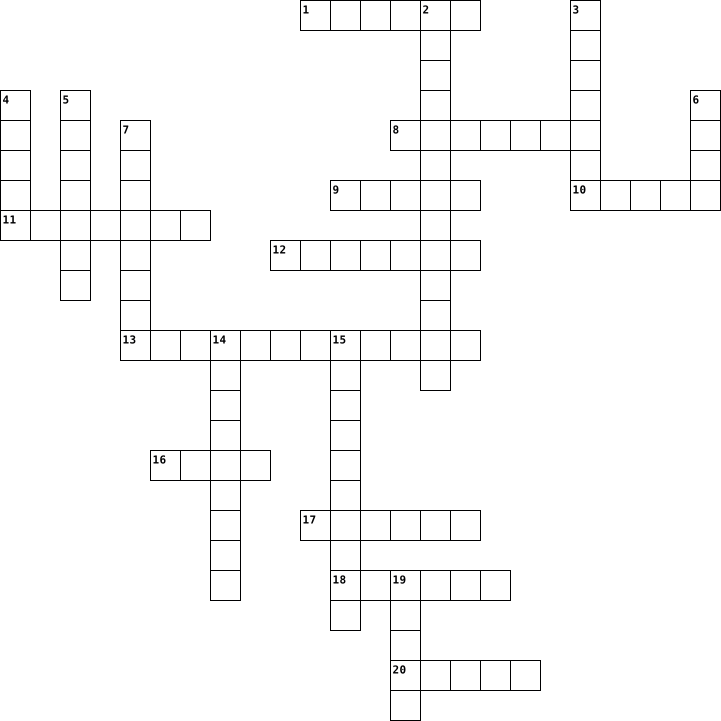
Across
- the ability to do work to cause motion and change.
- if a dog run in a park the type of energy will be _____ energy.
- This energy is used to receive heat and light, this energy is _____ energy.
- if you are hearing people talking or music the type of energy will be _____ energy.
- hot water, a hot radiator.
- a wind-up toy, a rubben band.
- the electrical energy is transferred to the surroundings by the lamp as _____ energy and _____ energy.
- if you are close to fire the type of energy that you will fell is _____ energy.
- Energy is important to _____ things because otherwise they already disappeared.
- Whe _____ that energy to use it on sports or activities.
- This energy is used to receive cold winds, this energy is _____ energy.
Down
- if a airplane is flying the type of energy will be _____ energy.
- All _____ must have energy or they will disappear.
- if a light buld will be on the type of energy will be _____ energy.
- nuclear bombs, power station.
- when we don't have so much energy what restored it?
- when you cook a hamburguer the type of energy will be _____ energy.
- This energy is used to make energy throught the water, this energy is _____ energy.
- if you want to use your TV when you turn it on the type of energy will be _____ energy.
- when we are tired we need to _____ to restore energy.
20 Clues: hot water, a hot radiator. • nuclear bombs, power station. • a wind-up toy, a rubben band. • the ability to do work to cause motion and change. • All _____ must have energy or they will disappear. • when we don't have so much energy what restored it? • when we are tired we need to _____ to restore energy. • Whe _____ that energy to use it on sports or activities. • ...
Energy 2014-03-06
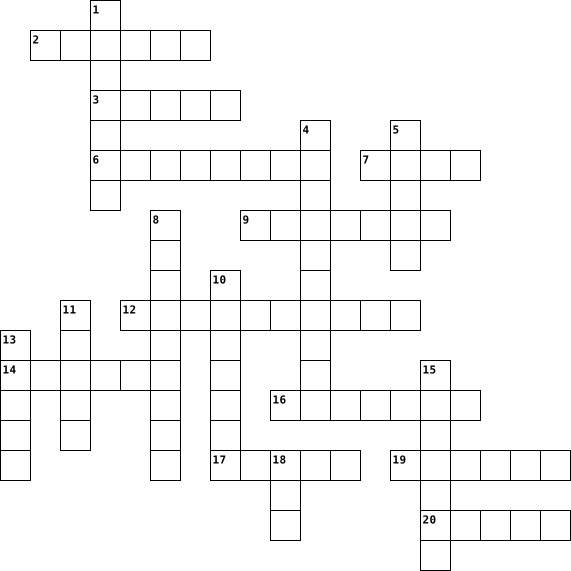
Across
- Measurement for energy.
- Strength or energy as an attribute of physical action or movement.
- Stored energy; Energy that can be "burned" to do work.
- Conversion from potential energy to kinetic energy.
- The use of exothermic nuclear processes to create useful heat and electricity.
- Energy that is in motion or can be put into motion.
- Negative energy
- potential mechanical energy stored in the configuration of a material or physical system.
- Energy where waves travel through empty space.
- Amplifies the potential energy
- Positive energy
Down
- If there is any tension in the surface of something such as stretched rubber it can be defined as.
- Energy that flows through a circuit.
- Energy from the sun.
- Mechanical energy that can be put into motion because of its position.
- Energy that speeds up the particles of matter.
- Measurement for power.
- Energy where the vibration of particles travels through solids, liquids, and gases.
- Mechanical energy that is in motion.
- mgh is the formula for what type of energy?
20 Clues: Negative energy • Positive energy • Energy from the sun. • Measurement for power. • Measurement for energy. • Amplifies the potential energy • Energy that flows through a circuit. • Mechanical energy that is in motion. • mgh is the formula for what type of energy? • Energy that speeds up the particles of matter. • Energy where waves travel through empty space. • ...
Energy 2013-11-11
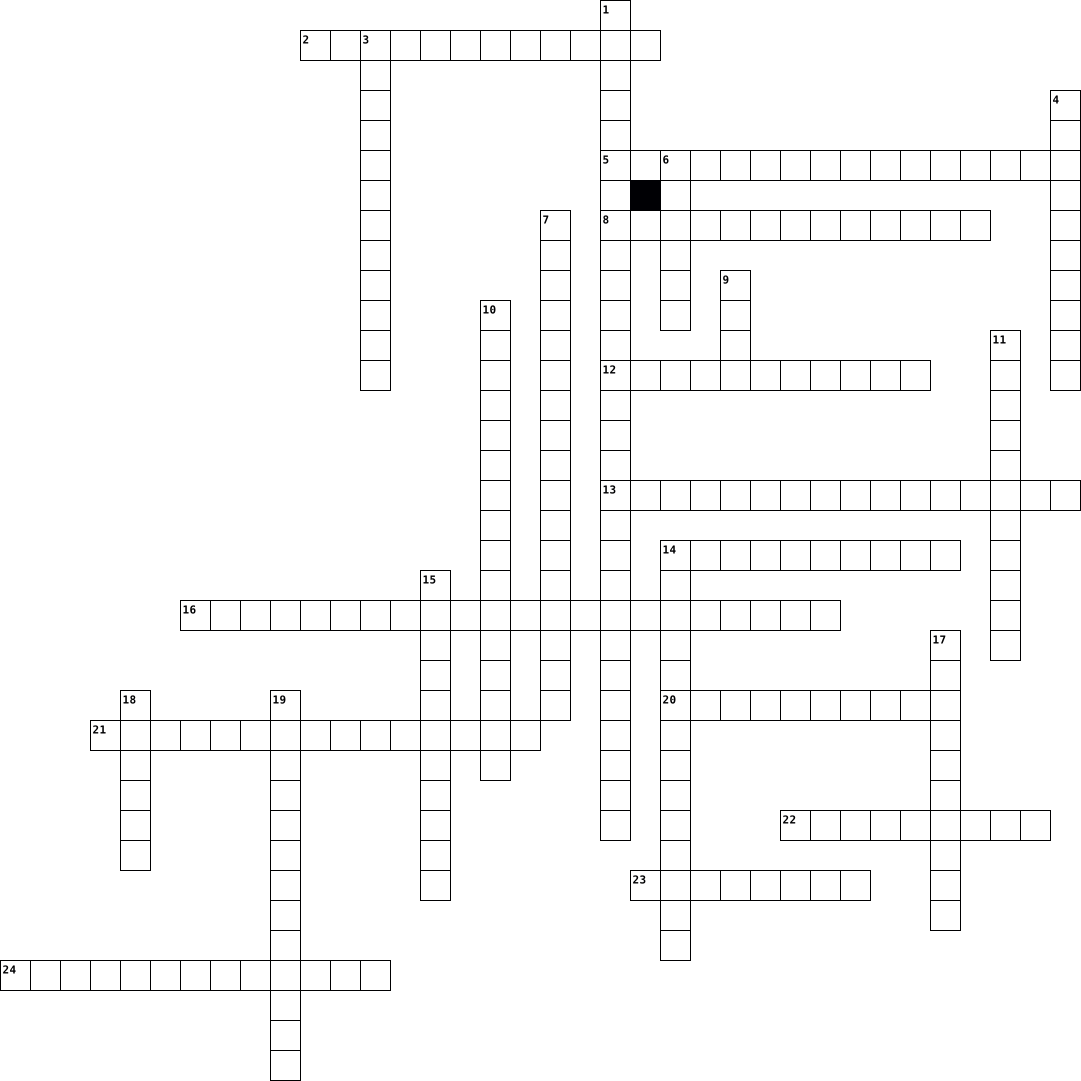
Across
- temperature when all molecular motion stops; only a theory
- an object's volume increases due to an increase in temperature
- all of the kinetic energy due to the motion of the particles
- energy produced by the vibrations of electrically charged particles
- energy of moving electrons
- transfer of thermal energy from direct contact
- the energy found in a stretched rubber band
- substances that conduct thermal energy very well
- stored energy
- transfer of thermal energy by electromagnetic waves
- a force that causes a transfer from kinetic energy into thermal energy
- energy that comes from changes in the nucleus of an atom
Down
- type of energy that is calculated using weight and height
- amount of energy needed to change the temperature of 1 kg by 1 degree Celsius
- transfer of thermal energy by the circulation of liquids and gases
- the ability to do work
- of energy law that states that energy cannot be created or destroyed only transferred from one form to another
- the energy transferred between objects that are at different temperatures
- type of energy that is calculated by adding potential energy and kinetic energy
- the measure of the average kinetic energy of the particles in an object
- potential energy of a compound that changes as its atoms are rearranged; example is food
- energy caused by an object's vibrations
- substances that do not conduct thermal energy very well
- the unit for energy
- type of energy that is calculated using mass and velocity
25 Clues: stored energy • the unit for energy • the ability to do work • energy of moving electrons • energy caused by an object's vibrations • the energy found in a stretched rubber band • transfer of thermal energy from direct contact • substances that conduct thermal energy very well • transfer of thermal energy by electromagnetic waves • ...
Energy 2015-04-02
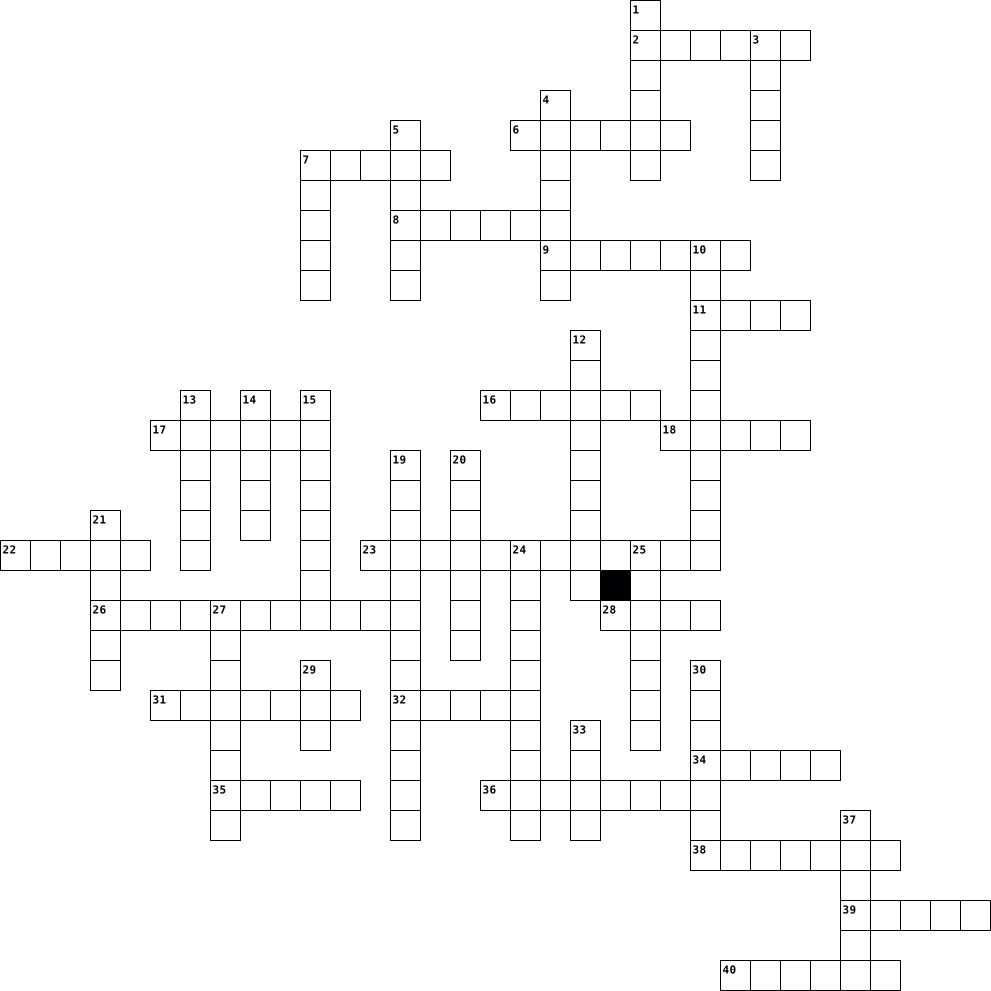
Across
- ability to do work
- has a definite size or volume and will not have any particular shape of its own
- push or pull on an object
- present or potential but not evident or active
- product of the force acting on a body and the time interval during which the force is exerted
- an electron or positron emitted from a atomic nucleus
- quantity that has a direction
- a substance diffused or suspended in air
- a nuclear reactor
- rate at which work is done
- law stating that a quantity or a property remain constant as the system changes
- an instrument for measuring temperature
- activities involving both a force and a displacement
- of, relating to, or caused by heat
- a positively charged particle consisting of two neutrons and two protons
- ___-state physics is the study of rigid matter
- prefix meaning above
- a decrease in volume due to removal of heat
- standard unit of temperature measurement in most countries
- prefix meaning below
- an increase in the volume of a substance usually due to an addition of heat
Down
- SI unit of thermodynamic temperature
- involving or relating to photons or very high energy
- energy of a moving object
- quantity that has no direction
- a substance that continuously flows under an applied sheer stress
- a phase transition directly from a solid to a gaseous state vice versa
- the work per unit charge necessary to move a charged body in an electric field
- unit of pressure or stress
- measurement of work done by a force
- ratio of force applied per area covered
- rapid change of water to steam
- the act of cleaving or splitting apart
- one ___ equals one kilogram-metre per second squared
- phenomenon of melting under pressure and freezing again when the pressure is reduced
- different forms of the same element, with the nuclei having different numbers of neutron
- property or tendency of a moving object to continue moving
- ideal ___ can be characterized by absolute pressure, volume, and absolute temperature
- energy stored in an object when it is formed out of its normal shape
- represents the transfer or transformation of energy
- combining 2 or more things together into one
41 Clues: a nuclear reactor • ability to do work • prefix meaning above • prefix meaning below • energy of a moving object • push or pull on an object • unit of pressure or stress • rate at which work is done • quantity that has a direction • quantity that has no direction • rapid change of water to steam • of, relating to, or caused by heat • measurement of work done by a force • ...
Energy 2015-04-02
Across
- a positively charged particle consisting of two neutrons and two protons
- the act of cleaving or splitting apart
- measurement of work done by a force
- a decrease in volume due to removal of heat
- phenomenon of melting under pressure and freezing again when the pressure is reduced
- different forms of the same element, with the nuclei having different numbers of neutron
- an instrument for measuring temperature
- a nuclear reactor
- prefix meaning below
- rapid change of water to steam
- ability to do work
- the work per unit charge necessary to move a charged body in an electric field
- quantity that has no direction
- energy stored in an object when it is formed out of its normal shape
- prefix meaning above
- a substance diffused or suspended in air
- push or pull on an object
- ___-state physics is the study of rigid matter
- rate at which work is done
- one ___ equals one kilogram-metre per second squared
Down
- an increase in the volume of a substance usually due to an addition of heat
- combining 2 or more things together into one
- product of the force acting on a body and the time interval during which the force is exerted
- unit of pressure or stress
- quantity that has a direction
- an electron or positron emitted from a atomic nucleus
- property or tendency of a moving object to continue moving
- standard unit of temperature measurement in most countries
- law stating that a quantity or a property remain constant as the system changes
- SI unit of thermodynamic temperature
- represents the transfer or transformation of energy
- of, relating to, or caused by heat
- activities involving both a force and a displacement
- energy of a moving object
- ideal ___ can be characterized by absolute pressure, volume, and absolute temperature
- a phase transition directly from a solid to a gaseous state vice versa
- ratio of force applied per area covered
- involving or relating to photons or very high energy
- has a definite size or volume and will not have any particular shape of its own
- a substance that continuously flows under an applied sheer stress
- present or potential but not evident or active
41 Clues: a nuclear reactor • ability to do work • prefix meaning below • prefix meaning above • energy of a moving object • push or pull on an object • unit of pressure or stress • rate at which work is done • quantity that has a direction • rapid change of water to steam • quantity that has no direction • of, relating to, or caused by heat • measurement of work done by a force • ...
energy 2015-02-04
Across
- i walk to the _____ of my own drum
- CAN flow freely
- not able to renew
- electrical energy, __________ bill, powers a light bulb
- bat + tree
- radius is to radiation as conduct is to __________
- sir+kit
- you have potential
- potential energy,saved, kept for later
- off is to on as nonrenewable is to _________
Down
- moving, kinetic energy, running
- a type of oven
- Conserve + Nation
- fossil ____, powers things, car ____, gas=____
- connect (sounds like the word)
- Turn + Bine
- CAN NOT flow freely
- sun _____, _____bulb, flash_____
- ________ student, i _________ schools, i will ________ the money into your account
- Bill Nye The _______ Guy
20 Clues: sir+kit • bat + tree • Turn + Bine • a type of oven • CAN flow freely • Conserve + Nation • not able to renew • you have potential • CAN NOT flow freely • Bill Nye The _______ Guy • connect (sounds like the word) • moving, kinetic energy, running • sun _____, _____bulb, flash_____ • i walk to the _____ of my own drum • potential energy,saved, kept for later • ...
Energy 2021-02-18
Across
- , doing to making something
- , it is moving
- , something is made
- substances turn into foods and fuels
- , all moving objects
- , burning or hot things
- , a substance that can produce power
- stored energy in an object
- is the ability to do work.
- , destroyed by fires or heat
- changing form from one to another
- , quickly moving back and forth
Down
- , things
- makes things bright so we can see things
- pulls everything down
- , sum of potential and kinetic energy
- stretched and compressed
- ,comes from vibrating objects
- common form of energy using electricity
- giving off much of light
- , power to do something
21 Clues: , things • , it is moving • , something is made • , all moving objects • pulls everything down • , power to do something • stretched and compressed • giving off much of light • stored energy in an object • is the ability to do work. • , doing to making something • , destroyed by fires or heat • ,comes from vibrating objects • , quickly moving back and forth • ...