
forms of energy Crossword Puzzles
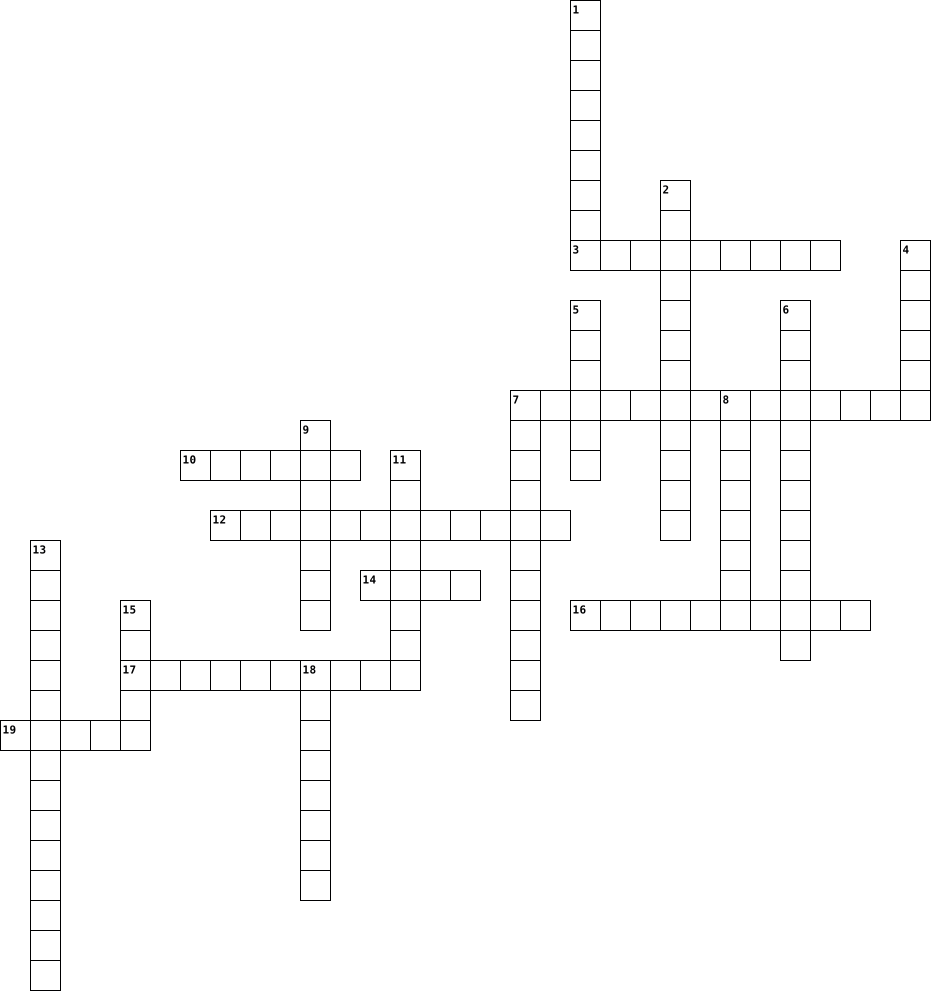
Important Community Ecology Terms 2023-01-19

Across
- a simple diagram that shows one pathway that energy moves from producers to a high level consumer, showing the intermediate links.
- a principle in ecology that states that 90% of the energy in any trophic level is lost as waste or heat, and only ten percent is retained in the next tropic level.
- a form of symbiosis in which one species benefits by causing direct harm.
- _____________ competition occurs when individuals from the same species compete with one another for a resource.
- organisms that eat primary consumers, always carnivorous or omnivorous.
- the hardy, first species that arrive after a disturbance that sets the stage for primary or secondary succession.
- an organism that has part of itself consumed by a parasite.
- an interaction in which two organisms attempt to obtain the same resource.
- An organism that is fed on by another, usually resulting in its death.
- a group of populations of many different species living in the same area at the same time.
- another name for plants, this group forms the foundation of all energy pyramids.
- a group of individuals of the same species living in the same area at the same time.
- an organism that lives on another and feeds on part of it to sustain itself.
- organisms that eat producers, always herbivores.
- the role an organism fills in its community (includes its place, the way it gets energy, and the interactions it has with others in the community)
- a form of symbiosis in which one organism harms another with no clear benefit for itself.
- a progression of species in a predictable sequence that occurs when most of the biomass in an area is destroyed.
- a form of competition in which one organism physically restricts another organism's access to resources.
Down
- a complex diagram that shows multiple pathways for energy movement through consumption in a community.
- a form of symbiosis in which both species gain a benefit due to the interaction
- a progression of species in a predictable sequence that occurs when all the biomass in an ecosystem is destroyed (including the soil).
- a form of competition in which the use of the resource by one individual will decrease the amount available for other individuals without direct interaction between the two.
- organisms that eat secondary consumers, always carnivorous or omnivorous.
- A scientific explanation of community health that suggests that local species diversity is increased when disturbances are not too rare or too frequent.
- a form of predation in which one organism eats all or part of a plant.
- _____________ competition occurs when individuals from two different species compete with one another for a resource.
- the final community that forms that is relatively stable after the process of succession (this concept is somewhat dated)
- a diagram that shows a representation of how much energy (or biomass) is available in each successive trophic level.
- a form of symbiosis in which one species benefits and the other experiences no positive or negative effects.
- An organism that feeds on another, while these are usually called carnivores the term also technically includes any organism that consumes another.
- The amount of matter that is stored in a group of organisms.
31 Clues: organisms that eat producers, always herbivores. • an organism that has part of itself consumed by a parasite. • The amount of matter that is stored in a group of organisms. • a form of predation in which one organism eats all or part of a plant. • An organism that is fed on by another, usually resulting in its death. • ...
Physical and chemical change 2018-10-23

Across
- pushes upwards, as in pushes water upwards
- a solid formed during a chemical change
- measures how much space is occupied by a substance (units: mL or cm3)
- the substances formed in chemical reactions
- describes a process that gives off energy in the form of heat, light or sound
- the change of state when a solid is heated and forms a liquid
- the starting substances in chemical reactions
- a simplified representation of solids, liquids and gases
- change a change that does not result in a new substance being produced
- a type of chemical equation where the chemicals in the reaction are represented by their chemical formulas
- a change of state from solid to gas
- a measure of the mass per unit volume of a substance, d = mV (unit: g/cm3)
- a decrease in size
- a mixture where the substances are mixed on the atomic level
- a change of state where aliquid is heated and changes to a gas within the liquid
Down
- measures how much matter is in a substance (unit: g)
- when atoms rearrange to form new substances
- the change of state from liquid to solid
- change a change that results in a new substance being formed
- the smallest building block that makes up all substances
- describes a process that absorbs energy from the surroundings
- a change of state from gas to solid
- a change of state where a gas is cooled and forms a liquid
- an increase in size
- a type of chemical equation where the chemicals are represented by the chemical names
- the change of state where a liquid changes to a gas at the surface of the liquid
- a process where two liquids or two gases mix due to the motion of their particles
- the change of state from liquid to solid
- a cluster of atoms
29 Clues: a cluster of atoms • a decrease in size • an increase in size • a change of state from gas to solid • a change of state from solid to gas • a solid formed during a chemical change • the change of state from liquid to solid • the change of state from liquid to solid • pushes upwards, as in pushes water upwards • when atoms rearrange to form new substances • ...
Unit 3 crossword puzzle 2021-10-07

Across
- A supercontinent containing all of Earth's land that existed about 225 million years ago.
- two tectonic plates move away from one another and allows the asthenosphere to move to the Earth's surface creating new lithosphere
- Collision of tectonic plates, they push against each other, and the denser plate sinks.
- The lower, more dense part of the mantle
- large tectonic moving pieces of the lithosphere
- Earth's thick middle compositional layer just below the crust
- the process by which new sea floor forms, where new rock forms
- fold is a stack of originally planar surfaces, such as sedimentary strata, that are bent or curved during permanent deformation
- the center of the Earth, made of dense elements, divided into inner and outer sections
- two tectonic plate that move past each other horizontally in opposite directions, slowly scraping and building energy
- the hypothesis that today's continents were once part of a single landmass
Down
- a theory that states Earth's surface is made up of giant, moving slabs called tectonic plates
- the process by which one tectonic plate is pulled beneath another plate
- a change of the magnetic poles resulting in a pattern that provides evidence for seafloor spreading and plate tectonics.
- the bending, tilting, and breaking of Rock due to stress
- a current caused by the rising of heated fluid and sinking of cooled fluid
- Energy released by earthquakes that travel through rocks outward
- Stress that squeezes rock until it folds or breaks
- The Earth's shell-like thin compositional layer
- The soft layer of the mantle on which the tectonic plates move
- the outermost physical layer of Earth
- a break in Earth's crust along which blocks of rock move
- Stress that stretches rock so that it becomes thinner in the middle and eventually breaks
23 Clues: the outermost physical layer of Earth • The lower, more dense part of the mantle • large tectonic moving pieces of the lithosphere • The Earth's shell-like thin compositional layer • Stress that squeezes rock until it folds or breaks • the bending, tilting, and breaking of Rock due to stress • a break in Earth's crust along which blocks of rock move • ...
Life Science Q2 Review 2023-12-14

Across
- things that exist in the world without human intervention or are not made by humans.
- the small particles that make up the nutrients in our food, such as carbohydrates, proteins, and fats. Our bodies break these down to get energy.
- the ability to do work or cause change. It comes in various forms, such as light, heat, and motion.
- the process by which plants make their own food using sunlight, carbon dioxide, and water to produce glucose and oxygen.
- things that are made by humans, usually through chemical processes, and do not occur naturally.
- a type of nutrients found in food that our bodies use for energy. They are also important for the proper functioning of our cells.
- a method of growing plants without soil. Instead, plants are grown in nutrient-rich water.
- anything that has mass and takes up space. It can exist in the form of solids, liquids, or gases.
- organisms, like bacteria and fungi, that break down dead plants and animals into simpler substances.
- a type of sugar that is a primary source of energy for living organisms.
- nutrients that help build and repair our body tissues. They are found in foods like meat, eggs, and beans.
- structures within cells that produce energy through cellular respiration.
- the results or products that come out of a system or process. They are what the system produces or delivers.
- a unit of measurement for the energy content of food. They represent the amount of energy our bodies get from consuming food.
- the things or information that are put into a system or process to produce an output. They are the starting components.
Down
- a type of nutrient found in food, like bread and pasta. They are an important source of energy for our bodies.
- are structures in plant cells that contain chlorophyll, a green pigment necessary for photosynthesis.
- the process where plants release water vapor through small openings in their leaves called stomata.
- organisms, usually plants, that make their own food through processes like photosynthesis.
- organisms that obtain their food by eating other organisms, either plants or animals.
- a measure of how much water vapor is in the air compared to the maximum amount it could hold at a given temperature.
- a group of related parts that work together to perform a specific function or achieve a particular goal.
- the process by which cells break down glucose to release energy for various cellular activities.
- tiny openings on the surface of plant leaves that allow them to exchange gases like oxygen and carbon dioxide with the environment.
24 Clues: a type of sugar that is a primary source of energy for living organisms. • structures within cells that produce energy through cellular respiration. • things that exist in the world without human intervention or are not made by humans. • organisms that obtain their food by eating other organisms, either plants or animals. • ...
BIO121 7.1 Crossword - 11/5/2025 2025-11-05

Across
- The term for a paired set of oxidation and reduction reactions
- The process of breaking down a molecule by splitting water
- The process that generates 90% of the ATP during glucose catabolism
- The B vitamin (B2) that FAD is derived from
- The molecule that results when ATP releases its terminal phosphate group
- The high-energy particle transferred in redox reactions
- The B vitamin (B3) that NAD+ is derived from
- The oxidized form of an electron carrier derived from Niacin (Vitamin B3)
Down
- The process of adding a phosphate group to a molecule
- A molecule that binds substrates to facilitate a chemical reaction
- The five-carbon sugar found in ATP
- The process of adding an electron to a compound
- A reactant that binds to an enzyme
- The eukaryotic organelle where oxidative phosphorylation occurs (singular)
- The process of stripping an electron from a compound
- The molecule composed of adenine, ribose, and a single phosphate group
- The nitrogenous base that forms the core of AMP, ADP, and ATP
- The primary "energy currency" of the cell
18 Clues: The five-carbon sugar found in ATP • A reactant that binds to an enzyme • The primary "energy currency" of the cell • The B vitamin (B2) that FAD is derived from • The B vitamin (B3) that NAD+ is derived from • The process of adding an electron to a compound • The process of stripping an electron from a compound • The process of adding a phosphate group to a molecule • ...
Electricity crossword 2024-04-11

Across
- usable power or the resources used to produce usable power[6]
- a sealed container that holds chemicals[7]
- a substance or material that does not conduct electricity or heat[9]
- a pathway made of wires that can flow through[7]
- the terminal of a battery or other voltage source[8]
- a light emitting diode is a device that emits light[3]
- the electrical device or devices[4]
Down
- a machine that produces electricity[9]
- an incandescent glass bulb wich contains gas[4]
- incredibly tiny units of matter each is made up of protons[4]
- a device that is used to turn on or turn off[6]
- a machine that converts other forms of energy [5]
- circuit an incomplete electrical circuit in which no current flows[4]
- the measure of electric pressure[4]
14 Clues: the measure of electric pressure[4] • the electrical device or devices[4] • a machine that produces electricity[9] • a sealed container that holds chemicals[7] • an incandescent glass bulb wich contains gas[4] • a device that is used to turn on or turn off[6] • a pathway made of wires that can flow through[7] • a machine that converts other forms of energy [5] • ...
Dental Growth & Development 2021-08-14

Across
- begins at end of cap stage
- where outer/inner epithelium meet
- _____ reticulum
- tissue enamel derived from
- space between lip and gum
- forms into dentin and pulp
- stage of partial mineralized enamel
- stage when enamel knot forms
Down
- deposition of hard tissue
- primitive mouth
- stage at 11-12 weeks
- dentin cells
- are remnants of lamina
- epithelial root sheath
- forms periodontium
- enamel cells
- stage at 8 weeks
- ________ dentinogenesis
- location permanent teeth form next to baby teeth
19 Clues: dentin cells • enamel cells • primitive mouth • _____ reticulum • stage at 8 weeks • forms periodontium • stage at 11-12 weeks • are remnants of lamina • epithelial root sheath • ________ dentinogenesis • deposition of hard tissue • space between lip and gum • begins at end of cap stage • tissue enamel derived from • forms into dentin and pulp • stage when enamel knot forms • ...
Biomes 2024-09-23

Across
- The rate of energy accumulation, usually through photosynthesis.
- Subsistence and intensive forms of agriculture practiced in many developing countries.
- An area near a river's mouth where the tide ebbs and flows.
- A community of interacting plants and animals and their physical surroundings.
- The capacity of an ecosystem to respond to a disturbance by resisting damage and recovering quickly.
- A plant that completes its life cycle in one year.
- A process by which green plants make carbohydrates using water, carbon-dioxide and sunlight.
- An organism that gains its energy requirements by eating plants or animal matter.
Down
- A water-based community of plants and animals.
- A way of life that involves moving across a territory in search of food and other water.
- A land-based community of plants and animals.
- The use of energy, water and chemicals to produce food and other agricultural products for sale.
- A large area populated by characteristic plants and animal life. A vegetation community occupying a large area of the earth's surface.
- An organism that gains its energy requirements by eating plant or animal matter.
- A plant that produces its own food via photosynthesis.
15 Clues: A land-based community of plants and animals. • A water-based community of plants and animals. • A plant that completes its life cycle in one year. • A plant that produces its own food via photosynthesis. • An area near a river's mouth where the tide ebbs and flows. • The rate of energy accumulation, usually through photosynthesis. • ...
Tectonic Plate Crossword 2021-03-29
Across
- Boundary, Tectonic plates moving opposite ways from each other.
- The viscous upper layer of Earths mantle.
- Molten rock under the Earths surface.
- These occur due to tectonic plates moving releasing energy that sends energy waves through the crust and creates shakes on Earths surface.
- Forms, Formed by two convergent tectonic plates pressed against each other.
- Boundary, Tectonic plates moving away from each other creating new crust.
- The rupture in Earths crust due to tectonic plates moving under each other.
- The hot and dense centre of Earth.
Down
- Boundary, Tectonic plates moving away from each other destroying old crust.
- The type of plates formed by convergent boundaries.
- The outer solid shell of Earth.
- The planet we live on.
- The outer part of Earth consisting of the crust and upper mantle.
- The layer\layers of gasses surrounding a planet.
- Spreading, The process in which tectonic plates split apart from each other.
- The mostly solid bulk of Earth's interior.
- A big wave
- The former large continent that has had other parts of it broken off.
- Molten rock the breaks through the crust to Earth's surface.
- The type of plates formed by divergent boundaries.
20 Clues: A big wave • The planet we live on. • The outer solid shell of Earth. • The hot and dense centre of Earth. • Molten rock under the Earths surface. • The viscous upper layer of Earths mantle. • The mostly solid bulk of Earth's interior. • The layer\layers of gasses surrounding a planet. • The type of plates formed by divergent boundaries. • ...
Vocabulary Crossword 2024-04-22

Across
- edible seeds in pods
- science or study of food
- a form of fat necessary for health
- to meat the body's nutritional needs
- tube between the throat and stomach
- substance within plants
Down
- forms protein in the body
- products made from grains
- measures the energy amount of food
- portion size, measured in calories, grams, or ounces
10 Clues: edible seeds in pods • substance within plants • science or study of food • forms protein in the body • products made from grains • measures the energy amount of food • a form of fat necessary for health • tube between the throat and stomach • to meat the body's nutritional needs • portion size, measured in calories, grams, or ounces
Types of reactions by Sujay yadav 2025-04-23

Across
- – A reaction involving the transfer of electrons between two species.
- – The substances formed as a result of a chemical reaction.
- – The loss of electrons during a reaction.
- – A reaction that releases energy in the form of heat.
- – A hydrocarbon reacts with oxygen to produce carbon dioxide and water.
- – A solid that forms from a solution during a chemical reaction.
- Equation – A symbolic representation of a chemical reaction.
- – A reaction where two or more substances combine to form a single product.
Down
- – A single compound breaks down into two or more simpler substances.
- Replacement – One element replaces another in a compound.
- – A reaction that absorbs energy from its surroundings.
- Replacement – Two compounds exchange ions to form two new compounds.
- – An acid and a base react to form salt and water.
- – A substance that speeds up a reaction without being consumed.
- – The starting substances in a chemical reaction.
15 Clues: – The loss of electrons during a reaction. • – The starting substances in a chemical reaction. • – An acid and a base react to form salt and water. • – A reaction that releases energy in the form of heat. • – A reaction that absorbs energy from its surroundings. • Replacement – One element replaces another in a compound. • ...
Types of reactions by Sujay Yadav 2025-04-23

Across
- – A single compound breaks down into two or more simpler substances.
- – A hydrocarbon reacts with oxygen to produce carbon dioxide and water.
- – An acid and a base react to form salt and water.
- – The starting substances in a chemical reaction.
- – A reaction involving the transfer of electrons between two species.
- – A reaction that releases energy in the form of heat.
- – A reaction that absorbs energy from its surroundings.
- Replacement – One element replaces another in a compound.
- – A substance that speeds up a reaction without being consumed.
Down
- – The substances formed as a result of a chemical reaction.
- Replacement – Two compounds exchange ions to form two new compounds.
- – The loss of electrons during a reaction.
- – A solid that forms from a solution during a chemical reaction.
- – A reaction where two or more substances combine to form a single product.
- Equation – A symbolic representation of a chemical reaction.
15 Clues: – The loss of electrons during a reaction. • – The starting substances in a chemical reaction. • – An acid and a base react to form salt and water. • – A reaction that releases energy in the form of heat. • – A reaction that absorbs energy from its surroundings. • Replacement – One element replaces another in a compound. • ...
Cell Parts/Processes 2013-10-23

Across
- reticulum internal membrane system in cells in which components of the cell membrane are assembled and some proteins modified
- group of similar cells that perform a particular function
- process in which cells release energy in the absence of oxygen
- hollow tube of protein that maintains cell shape and that can be used as a "track" along which organelles are moved
- respiration process that releases energy by breaking down food particles in the presence of oxygen
- process by which particles tend to move from an area where they are more concentrated to an area where they are less concentrated
- process by which the number of chromosomes per cell cut in half through the separation of homologous chromosomes in a diploid cell
- small particle in cell on which proteins are assembled
Down
- envelope double-layer membrane that surrounds the nucleus of a cell
- process by which plants and some other organisms use light energy to power chemical reactions to convert carbon dioxide and water into oxygen and high-energy carbohydrates such as sugars and starches
- process that requires the presence of oxygen
- part of eukaryotic cell division in which the cell nucleus divides
- diffusion of water through a semipermeable membrane
- process that doesn't require oxygen
- granular material visible within the nucleus
- process by which a cell takes material into the cell by in folding of the cell membrane
- bylayer double-layered sheet that forms the core of nearly all cell membranes
- cell organelle filled with enzymes needed to break down certain materials in the cell
- filament long, thin fiber that functions in the movement and support of cell
19 Clues: process that doesn't require oxygen • process that requires the presence of oxygen • granular material visible within the nucleus • diffusion of water through a semipermeable membrane • small particle in cell on which proteins are assembled • group of similar cells that perform a particular function • process in which cells release energy in the absence of oxygen • ...
Annabelle Hughes- Heat 2017-11-16

Across
- - the quantity of heat required to raise the temperature of a unit mass of a substance by 1 degree Celsius
- - the total energy(kinetic and potential)
- - measures temperature by the radiation a substances emits
- - the study of heat and its transformation into different forms of energy
Down
- - no system can reach absolute zero
- - Matter made up of tiny particles
- - the amount of heat needed to change the temperature of 1 gram of water by 1 Celsius degree
- - is the measure of hotness or coldness of an object
- - is the lowest limit
- - is an instrument that measures temperature
10 Clues: - is the lowest limit • - no system can reach absolute zero • - Matter made up of tiny particles • - the total energy(kinetic and potential) • - is an instrument that measures temperature • - measures temperature by the radiation a substances emits • - is the measure of hotness or coldness of an object • ...
THE ENVIRONMENT - COMPACT FIRST UNIT 7 2019-04-26

Across
- AN OVERFLOW OF A LARGE AMOUNT OF WATER DUE TO EXTREME RAINFALL
- AN ACCIDENTAL RELEASE OF OIL INTO A BODY OF WATER
- FORMS OF ENERGY WHICH CAN BE USED REPEATEDLY AND REPLACED NATURALLY
- THE AMOUNT OF CARBON DIOXIDE RELEASED INTO THE ATMOSPHERE BY AN INDIVIDUAL OR AN ORGANISATION
- MATERIALS LEFT OVER FROM A MANUFACTURING PROCESS
Down
- THE PRACTICE OF PROTECTING ANIMAL SPECIES IN THEIR NATURAL HABITAT
- THE PHENOMENON OF INCREASING AVERAGE AIR TEMPERATURES NEAR THE SURFACE OF THE EARTH
- THE RELEASE OF GREENHOUSE GASES INTO THE ATMOSPHERE
- A PERIOD OF PROLONGED HOT WEATHER
- ENERGY OBTAINED FROM THE SUN
10 Clues: ENERGY OBTAINED FROM THE SUN • A PERIOD OF PROLONGED HOT WEATHER • MATERIALS LEFT OVER FROM A MANUFACTURING PROCESS • AN ACCIDENTAL RELEASE OF OIL INTO A BODY OF WATER • THE RELEASE OF GREENHOUSE GASES INTO THE ATMOSPHERE • AN OVERFLOW OF A LARGE AMOUNT OF WATER DUE TO EXTREME RAINFALL • THE PRACTICE OF PROTECTING ANIMAL SPECIES IN THEIR NATURAL HABITAT • ...
Forms of Government 2012-12-18

Across
- Rule by elected officials
- Rule by a few
- Rule by the people
- Rule by a single person who gained power through force
Down
- Rule by go or a higher power
- Rule by none
- Rule by the citizenry or public without representatives
- Rule by one
- Rule by a king or queen
9 Clues: Rule by one • Rule by none • Rule by a few • Rule by the people • Rule by a king or queen • Rule by elected officials • Rule by go or a higher power • Rule by a single person who gained power through force • Rule by the citizenry or public without representatives
Forms of Government 2021-01-17

Across
- Rule by a king or queen
- Rule by God or higher power
- Rule by the people with elected representatives
- Rule by the people
Down
- Rule by none
- Rule by one
- Rule by a single person;power by force
- Rule by the citizens without representatives
- Rule by the few
9 Clues: Rule by one • Rule by none • Rule by the few • Rule by the people • Rule by a king or queen • Rule by God or higher power • Rule by a single person;power by force • Rule by the citizens without representatives • Rule by the people with elected representatives
Forms of Ser 2021-03-22

Across
- it means we are
- It means I am
- This means they are or yall are
- Words are somos, sois, and son
- Means "to be"
Down
- This is yall are (in spain)
- Words are es, eres, and soy
- It means you are (familiar)
- It can mean he is, she is, you are, and it is
9 Clues: It means I am • Means "to be" • it means we are • This is yall are (in spain) • Words are es, eres, and soy • It means you are (familiar) • Words are somos, sois, and son • This means they are or yall are • It can mean he is, she is, you are, and it is
Forms of Government 2023-09-26

Across
- Citizens hold the political power
- People are not subject to any nation or government
- Type of democracy where citizens are involved in day-to-day government
- One leader has absolute control over citizens’ lives
Down
- Recognizes God as the ultimate authority in government and law
- A king or queen rules the country
- Type of democracy where citizens elect leaders to represent them in government
- One person has all the power
- A small group of people has all the power
9 Clues: One person has all the power • A king or queen rules the country • Citizens hold the political power • A small group of people has all the power • People are not subject to any nation or government • One leader has absolute control over citizens’ lives • Recognizes God as the ultimate authority in government and law • ...
forms of nature 2023-06-21

Across
- sea
- mountain
- waterfall
- star
Down
- desert
- moon
- volcano
- island
- river
9 Clues: sea • moon • star • river • desert • island • volcano • mountain • waterfall
Forms of Government 2022-05-22

Across
- one person gains power usually by force
- each person has a vote
- king or queen has power
- another name for representative democracy
Down
- people elect representatives
- one person has power
- no one has power
- government based on religion
- rule by a small group of people
9 Clues: no one has power • one person has power • each person has a vote • king or queen has power • people elect representatives • government based on religion • rule by a small group of people • one person gains power usually by force • another name for representative democracy
Paxton M crossword puzzle. 2024-05-15

Across
- When two or more elements combined its forms ___
- Two or atoms bonded together from a _____
- The average kinetic energy in an collection of atoms is called its ____
- Substance that cant be broken down further chemically are ___
- A reaction that absorbs heat is a _______ reaction
- when substance interact with each other and form new substance its a ____
- The amount of matter in something is its _____
Down
- Amount of space something takes up is its ____
- when the same substance are attracted to each other its because of ____
- The result of mixing reactants is the _____
- A reaction that release heat is a ________ reaction
- The smallest form of matter is an _____
- The study of elements and how they interact with each other is ____
- A mix of substance can be separated physically is a ____
- Anything that has mass and takes up space is ___
- the ability to do work of cause change is called _____
- Substance that are used in a chemical reaction are called ____
- You use a _____ that speeds up a chemical reaction
18 Clues: The smallest form of matter is an _____ • Two or atoms bonded together from a _____ • The result of mixing reactants is the _____ • Amount of space something takes up is its ____ • The amount of matter in something is its _____ • When two or more elements combined its forms ___ • Anything that has mass and takes up space is ___ • ...
Ecology and Classification 2024-12-04

Across
- A feature or behavior that helps an organism survive in its environment.
- A complex network of interconnected food chains in an ecosystem.
- The ability to do work, often transferred through food chains.
- Organisms that break down dead material, recycling nutrients.
- The natural environment where an organism lives.
- An organism that eats plants.
- A substance that provides nourishment essential for growth and maintenance of life.
- A group of organisms capable of interbreeding and producing fertile offspring.
Down
- An animal that hunts other animals for food.
- The variety of life forms in a particular habitat or ecosystem.
- An organism that eats other animals.
- A system of interacting organisms and their environment.
- All the organisms of the same species in a given area.
- The long-term weather conditions in a particular area.
- A sequence of organisms, each dependent on the next as a source of food.
- Organisms that make their own food, often plants.
- An animal that is hunted and eaten by a predator.
- Organisms that obtain energy by eating other organisms.
18 Clues: An organism that eats plants. • An organism that eats other animals. • An animal that hunts other animals for food. • The natural environment where an organism lives. • Organisms that make their own food, often plants. • An animal that is hunted and eaten by a predator. • All the organisms of the same species in a given area. • ...
Biology vocabulary 2020-09-24

Across
- release of substances out of a cell by the fusion of a vesicle with the membrane.
- having or consisting of many cells.
- bean shaped organelle that supplies energy to the cell and has its own ribosomes and DNA.
- membrane, made up of two lipid bilayer membranes which in eukaryotic cells surrounds the nucleus, which encases the genetic material.
- transport, energy requiring movement of molecules across a membrane from a region of lower concentration to higher concentration.
- organelle composer of numerous membranes that are used to convert solar energy into chemical energy contains chlorophyll.
- diffusion of water molecules across a semipermeable membrane from an area of high concentration to an area of lower water concentration.
- transport, movement of molecules across the cell membrane without energy input from the cell.
- cell that has a nucleus and other membrane-bound organelles.
- organelle that is used to store materials such as water food or enzymes that are needed by the cell.
- cell that does not have a nucleus or other membrane bound organelles.
- is an organism that consists of a single cell.
Down
- regulation and maintenance of constant internal conditions of an organism.
- the basic unit of life.
- is a type of biological or synthetic, polymeric membrane that will allow certain molecules or ions to pass through it by diffusion—or occasionally by more specialized processes of facilitated diffusion, passive transport or active transport.
- triphosphate, high energy molecule that contains within its bonds energy that cells can use.
- movement of dissolved molecules in a fluid or gas from a region of higher concentration to a region of lower concentration.
- membrane-bound structure that is specialized to perform a distinct process within a cell.
- uptake of liquids or large molecules into a cell by inward folding of the cell membrane.
- membrane, double layer of phospholipids that forms a boundary between a cell and the surrounding environment and controls the passage of materials into and out of the cell.
- organelle that links amino acids together to form proteins.
- wall, rigid structure that gives protection support and shape to cells in plants fungi algae and bacteria.
- diffusion, diffusion of molecules assisted by protein channels that pierce the membrane.
- uptake of a solid particle into the cell by engulfing the particle.
- organelle composed of double membrane that acts of a store space house for most cells’ DNA.
- gradient, difference in the concentration of a substance from one location to another.
26 Clues: the basic unit of life. • having or consisting of many cells. • is an organism that consists of a single cell. • organelle that links amino acids together to form proteins. • cell that has a nucleus and other membrane-bound organelles. • uptake of a solid particle into the cell by engulfing the particle. • ...
Arizona 2023-09-05

Across
- Desert Region Known for Cacti
- Capital of Arizona
- River That Forms Part of Arizona's Border
- The Arizona Cardinals Play in This City
- Desert City Famous for Golf and Resorts
Down
- Arizona's State Mammal
- Site of the O.K. Corral Gunfight
- Native American Tribe in Arizona
- Arizona's State Gem
- City Known for Its Red Rocks and Energy Vortexes
10 Clues: Capital of Arizona • Arizona's State Gem • Arizona's State Mammal • Desert Region Known for Cacti • Site of the O.K. Corral Gunfight • Native American Tribe in Arizona • The Arizona Cardinals Play in This City • Desert City Famous for Golf and Resorts • River That Forms Part of Arizona's Border • City Known for Its Red Rocks and Energy Vortexes
Energy of Waves 2022-02-16

Across
- Stored Energy
- What happens to the wavelengths when the pitch gets higher
- The lowest part of the sound wave
- What happens to the wavelength when the pitch gets lower
- The part of the wave that changes with pitch
- Energy of motion
- What happens to the waves when the volume is increased
- The tallest part of the sound wave
Down
- Particles move parallel to the direction the wave is moving
- The part of the wave that changes with volume
- What happens to the waves when the volume is decreased
- The ability to do work
- Line of _________________
- Particles move at right angles to the direction of the wave travel
14 Clues: Stored Energy • Energy of motion • The ability to do work • Line of _________________ • The lowest part of the sound wave • The tallest part of the sound wave • The part of the wave that changes with pitch • The part of the wave that changes with volume • What happens to the waves when the volume is decreased • What happens to the waves when the volume is increased • ...
Types of Energy 2023-12-07

Across
- the motion of objects
- energy stored in objects by tension
- energy that is stored in an elastic object
- consists of photons, which are produced when an object's atoms heat up.
- energy that comes from the movement of atoms and molecules in a substance
- energy stored in moving objects
- energy stored in the bonds of atoms and molecules
- energy stored in the nucleus of an atom—the energy that holds the nucleus together
Down
- stored energy
- energy is produced when a force causes an object or substance to vibrate
- delivered by tiny, charged particles called electrons,
- includes visible light, x-rays, gamma rays, and radio waves
- typically move through a wire
- energy stored in an object's height
14 Clues: stored energy • the motion of objects • typically move through a wire • energy stored in moving objects • energy stored in objects by tension • energy stored in an object's height • energy that is stored in an elastic object • energy stored in the bonds of atoms and molecules • delivered by tiny, charged particles called electrons, • ...
Types of energy 2025-09-01

Across
- Energy stored in magnets
- Energy we hear
- Energy stored in food or fuel
- Energy stored in stretched or squashed objects
- – Energy of moving things
- Energy that travels as waves
- Another word for heat energy
Down
- A force that turns movement into heat
- Energy cannot be made or _______.
- Energy that powers phones and lights
- Energy from atoms splitting or joining
- – When energy moves from one place or form to another
- Energy stored when something is high up
- Energy that helps us see
14 Clues: Energy we hear • Energy stored in magnets • Energy that helps us see • – Energy of moving things • Energy that travels as waves • Another word for heat energy • Energy stored in food or fuel • Energy cannot be made or _______. • Energy that powers phones and lights • A force that turns movement into heat • Energy from atoms splitting or joining • ...
Black Hole Crossword 2023-12-18

Across
- The minimum speed needed to escape the pull of an object
- Center of a black hole where density is practically infinite
- Irregular flashes of bright light that generate more energy than a supernova
- A disk of matter that forms around black holes
- Maximum limit of mass a white dwarf can have and remain stable
- One of two outcomes for dying high mass stars typically of the smaller ones
- The other outcome for supernovas, generally for the much larger stars
- Type of neutron star when the magnetic field is extremely strong
Down
- The massive release of energy from a high mass star leading to a black hole or neutron star
- Type of radiation believed to emit from black holes
- Radius of a black hole where its escape velocity is equal to the speed of light
- The concept of time slowing down when looking at a black hole from the outside
- Energy emissions in the form of violent eruptions that make the star much brighter for a few seconds
- Point of no return for a black hole
- Object in space that emits a pattern of flashes every few seconds like a pulse
15 Clues: Point of no return for a black hole • A disk of matter that forms around black holes • Type of radiation believed to emit from black holes • The minimum speed needed to escape the pull of an object • Center of a black hole where density is practically infinite • Maximum limit of mass a white dwarf can have and remain stable • ...
Flow of Energy 2024-08-14

Across
- step in a food chain or food web
- a system of interlocking and interdependent food chains.
- a consumer that eats only animals.
- organisms that make their own food
- process by which plants and some other organisms use light energy to convert water and carbon dioxide into oxygen and sugars
- a series of events in which one organism eats another and obtains energy.
Down
- an organism that obtains energy and nutrients by feeding on other organisms or their remains.
- a consumer that eats only plants.
- organism that feeds on plant and animal remains and other dead matter
- process by which some organisms, such as certain bacteria, use chemical energy to produce sugar
- a consumer that eats both plants and animals
- organism that breaks down and obtains energy from dead organisms
- an organism that cannot make its own food and gets food by consuming other living things.
- an organism that makes its own food
14 Clues: step in a food chain or food web • a consumer that eats only plants. • a consumer that eats only animals. • organisms that make their own food • an organism that makes its own food • a consumer that eats both plants and animals • a system of interlocking and interdependent food chains. • organism that breaks down and obtains energy from dead organisms • ...
Types of Energy 2023-05-19

Across
- the ability to do work
- Energy associated with vibrating air particles wiggling your ear drum.
- Energy stored in the nucleus of an atom.
- When energy changes from one form to another
- Energy is never created nor destroyed, but transferred from one form to another
- Energy stored in a stretched or pressed object
- Energy associated with moving electrons
- Energy associated with the motion or position of an object.
Down
- Energy an object has due to is height above ground.
- energy of vibrating molecules that affect temperature
- Energy from light waves
- stored energy
- Energy stored in chemical bonds.
- Energy of motion
14 Clues: stored energy • Energy of motion • the ability to do work • Energy from light waves • Energy stored in chemical bonds. • Energy associated with moving electrons • Energy stored in the nucleus of an atom. • When energy changes from one form to another • Energy stored in a stretched or pressed object • Energy an object has due to is height above ground. • ...
Sources of energy 2025-05-15

Across
- A tall structure with large blades that spin when the wind blows and is used to create electricity.
- Something that cannot be easily replaced after it's used.
- Something that doesn't run out, like a never-ending supply.
- To figure out the specific thing you are seeing, hearing, or thinking about.
- A big, artificial lake where water is stored.
- To crush something, usually grains like wheat, into a fine powder called flour.
Down
- A tall building with large blades that are turned by the wind to do work.
- When two or more things hit each other with force.
- When two tiny parts of atoms smash together and join .
- A big oven or heater that burns fuel (like gas, oil, or wood) to create heat.
- Toothed wheels that work together to move parts of a machine and change their speed or direction.
- A machine that turns movement into electricity.
- To make something full or complete again by adding what was lost or used.
- To save things and use them well so they don't run out quickly.
14 Clues: A big, artificial lake where water is stored. • A machine that turns movement into electricity. • When two or more things hit each other with force. • When two tiny parts of atoms smash together and join . • Something that cannot be easily replaced after it's used. • Something that doesn't run out, like a never-ending supply. • ...
Conversion Of Energy 2025-12-11

Across
- energy stored in atomic nuclei
- energy cannot be created or destroyed, only transformed
- force that opposes motion and converts energy to heat
- force applied over a distance
- stored energy due to position
- energy transferred due to a temperature difference
- sum of kinetic and potential
Down
- ratio of useful energy output to total energy input
- energy of motion
- energy due to an objects height above ground
- stored energy in stressed out compressed objects
- energy related to heat
- energy stored in chemical bonds
- force applied over a distance
- changing energy from one form to another
15 Clues: energy of motion • energy related to heat • sum of kinetic and potential • force applied over a distance • force applied over a distance • stored energy due to position • energy stored in atomic nuclei • energy stored in chemical bonds • changing energy from one form to another • energy due to an objects height above ground • stored energy in stressed out compressed objects • ...
Chemistry Craze 2024-05-06

Across
- mixture where the individual particles cannot be distinguished at all
- a solution where the solvent is water
- requires input of energy (heat)
- transition from solid to gas
- elements that do not exist naturally as a single atom, however, is bonded together by two elements
- number of digits that are known to some degree of reliability ( ____ for life)
- where a solution is boiled in order to separate liquids
- whenever two liquids do not mix with each other
- the study of how heat is affects matter and how it is converted to and from other forms of energy
- a biological catalyst that speeds up the rate of reactions that occur in the body
- a principle under the conditions of equal pressure and temperature, as well as, equal volumes of all gases that contain the same number of particles
- the energy that is required to remove an electron from an atom
Down
- releases heat
- a negative ion
- a point where H3O+ ions from the acid equals the moles of OH- from the base and is determined from a graph of the titration
- diffusion that is through a tiny opening
- a mixture that contains particles, which will settle out if it is left undisturbed
- when a base accpets a hydrogen atom from an acid; species produced
- a rule that means atoms will gain, lose, or share valence electrons to attain all 8 valence electrons
- the mixture is poured through a filter to separate liquids and solids
20 Clues: releases heat • a negative ion • transition from solid to gas • requires input of energy (heat) • a solution where the solvent is water • diffusion that is through a tiny opening • whenever two liquids do not mix with each other • where a solution is boiled in order to separate liquids • the energy that is required to remove an electron from an atom • ...
Chemistry of Life 2022-10-12

Across
- A charged atom, positive or negative
- The periodic table is organized based on this characteristic of elements
- Any compound resulting from covalent (shared electron) bonding
- The key element present in all forms of life on earth
- The type of chemical bond where electrons are transferred from one atom to another
- A biological substance containing carbon bonded to at least one other type of atom
- An organic compound that is the primary source of energy
- A substance in which something is dissolved
Down
- The substance to be dissolved in a solution
- A joining between two or more atoms
- A group of atoms with the same number of protons displaying specific properties
- A negatively charged atomic particle
- An organic compound that provides building material for cells and stores energy
- A positively charged atomic particle
- The description given to molecules with unequal distribution of charges, water being one example
- An organic compound that is composed of a chain of amino acids
16 Clues: A joining between two or more atoms • A charged atom, positive or negative • A negatively charged atomic particle • A positively charged atomic particle • The substance to be dissolved in a solution • A substance in which something is dissolved • The key element present in all forms of life on earth • An organic compound that is the primary source of energy • ...
Review - Water Cycle, Carbon Cycle, Properties of Water 2018-04-04

Across
- sugar
- type of both found between molecules of water
- type of bond within the molecule of water
- in a mixture of salt and water - salt is referred to as the?
- water in the soil and water in underground aquifers
- the process by which elements of a dead animal are returned to the environment
- cooling down water increases the ________ of the water molecules
- winds move micro-droplets of water together to form clounds
- a process that uses energy and releases carbon dioxide
- makes its own food
Down
- a general term for carbohydrates, proteins, nucleic acids and lipids
- excess water expelled from a eaf through stomata
- too much carbon in the ocean causes the water's pH to do what?
- this process brings water from the surface into the soil
- snow and hail are a type of this
- allows water droplets to form
- a process used to created stored energy
- this process helps to clean the water
- allows bugs to walk on water
- combines with calcium to form shells and coral skeletons
- this forms when the amount of precipitation is greater than infiltration
- water
22 Clues: sugar • water • makes its own food • allows bugs to walk on water • allows water droplets to form • snow and hail are a type of this • this process helps to clean the water • a process used to created stored energy • type of bond within the molecule of water • type of both found between molecules of water • excess water expelled from a eaf through stomata • ...
Review - Water Cycle, Carbon Cycle, Properties of Water 2018-04-04

Across
- this process helps to clean the water
- a general term for carbohydrates, proteins, nucleic acids and lipids
- combines with calcium to form shells and coral skeletons
- winds move micro-droplets of water together to form clounds
- the process by which elements of a dead animal are returned to the environment
- a process used to created stored energy
- snow and hail are a type of this
- type of both found between molecules of water
Down
- allows water droplets to form
- this process brings water from the surface into the soil
- sugar
- excess water expelled from a eaf through stomata
- this forms when the amount of precipitation is greater than infiltration
- allows bugs to walk on water
- water in the soil and water in underground aquifers
- in a mixture of salt and water - salt is referred to as the?
- type of bond within the molecule of water
- too much carbon in the ocean causes the water's pH to do what?
- a process that uses energy and releases carbon dioxide
- makes its own food
- cooling down water increases the ________ of the water molecules
- water
22 Clues: sugar • water • makes its own food • allows bugs to walk on water • allows water droplets to form • snow and hail are a type of this • this process helps to clean the water • a process used to created stored energy • type of bond within the molecule of water • type of both found between molecules of water • excess water expelled from a eaf through stomata • ...
Review - Water Cycle, Carbon Cycle, Properties of Water 2018-04-04

Across
- allows water droplets to form
- type of bond within the molecule of water
- this process helps to clean the water
- sugar
- water in the soil and water in underground aquifers
- cooling down water increases the ________ of the water molecules
- a process used to created stored energy
- snow and hail are a type of this
- allows bugs to walk on water
- this process brings water from the surface into the soil
- too much carbon in the ocean causes the water's pH to do what?
Down
- type of both found between molecules of water
- a process that uses energy and releases carbon dioxide
- combines with calcium to form shells and coral skeletons
- makes its own food
- the process by which elements of a dead animal are returned to the environment
- in a mixture of salt and water - salt is referred to as the?
- excess water expelled from a eaf through stomata
- winds move micro-droplets of water together to form clounds
- water
- this forms when the amount of precipitation is greater than infiltration
- a general term for carbohydrates, proteins, nucleic acids and lipids
22 Clues: sugar • water • makes its own food • allows bugs to walk on water • allows water droplets to form • snow and hail are a type of this • this process helps to clean the water • a process used to created stored energy • type of bond within the molecule of water • type of both found between molecules of water • excess water expelled from a eaf through stomata • ...
Water Cycle Review 2024-05-08

Across
- the process by which water forms surface water
- water flowing downhill on land
- 3% of Earth's water is this
- chemicals and fertilizer are often picked up in runoff, leading to ____
- a way to transport freshwater from one area to another
- water under the ground
- the release of water vapor into the air from the stomata of leaves
- a way to access groundwater by digging into the ground and pumping water to the surface
- the movement of water around Earth & our atmosphere
- 97% of Earth's water is this
- the process of removing salt from salt water
Down
- energy from this powers the entire water cycle
- the change in state from water vapor to liquid water due to cold
- solid water changes directly to water vapor
- the percentage of freshwater that is accessible (write in words)
- a molecule made of 2 Hydrogen atoms bonded to 1 Oxygen atom
- any form of water that falls to the Earth from our atmosphere
- the process by which water seeps into the ground
- one of the areas where freshwater is "trapped"
- ____ & energy are transported in the water cycle
- liquid water changes into water vapor due to heating the molecules
21 Clues: water under the ground • 3% of Earth's water is this • 97% of Earth's water is this • water flowing downhill on land • solid water changes directly to water vapor • the process of removing salt from salt water • energy from this powers the entire water cycle • the process by which water forms surface water • one of the areas where freshwater is "trapped" • ...
Weather 2024-09-27

Across
- – Flash of electrical energy in the sky
- – Severe weather with wind and rain
- – Precipitation that falls from clouds
- – Warmth and light from the sun
- – Moving air felt on the ground
- – The sound caused by lightning
Down
- – Thick mist reducing visibility
- – Severe snowstorm with strong winds
- – Forms in the sky, often brings rain
- – Light and gentle wind
- – Frozen water falling in the form of flakes
- – Small balls of ice that fall like rain
12 Clues: – Light and gentle wind • – Warmth and light from the sun • – Moving air felt on the ground • – The sound caused by lightning • – Thick mist reducing visibility • – Severe weather with wind and rain • – Severe snowstorm with strong winds • – Forms in the sky, often brings rain • – Precipitation that falls from clouds • – Flash of electrical energy in the sky • ...
LIGHT ENERGY 2025-03-19

Across
- A material that lets some light through but not all
- The main natural source of light on Earth
- When light bends as it passes through an object
- When light bounces off a surface
- A smooth surface that reflects light to show an image
- Light travels at a very fast ____
Down
- A material that allows light to pass through completely
- When an object takes in light instead of reflecting or passing it through
- A dark area created when light is blocked
- A material that does not let any light through
- A colorful band of light that forms when light is refracted through water droplets
- The ability to do work or cause change
- The form of energy that helps us see
- A tool that separates white light into a rainbow
- A curved piece of glass or plastic that bends light
15 Clues: When light bounces off a surface • Light travels at a very fast ____ • The form of energy that helps us see • The ability to do work or cause change • A dark area created when light is blocked • The main natural source of light on Earth • A material that does not let any light through • When light bends as it passes through an object • ...
Vocabulary Quiz 37 2022-05-10

Across
- The reliance of two or more organisms upon each other for survival.
- Organisms that consume plants and animals
- Plants that use the sun's energy to grow and serve as food for other organisms
- Animals that feed on other animals
- Any living thing such as plant, animal, or microbe
- A unit of living organisms and non-living elements that interact
Down
- A consumer organism that feeds primarily on plant matter
- Organisms that get their energy from feeding on other organisms
- The transfer of food energy through a series of organisms as each one is fed upon by the next – from producers to consumers.
- Organisms that break down dead materials into simpler forms, such as fungi, insects, and bacteria
10 Clues: Animals that feed on other animals • Organisms that consume plants and animals • Any living thing such as plant, animal, or microbe • A consumer organism that feeds primarily on plant matter • Organisms that get their energy from feeding on other organisms • A unit of living organisms and non-living elements that interact • ...
SCIENCE CORSSWORD PUZZLE 2021-08-06

Across
- The ability to do work.
- A double membrane-bound organelle found in most eukaryotic organisms.
- The lens or group of lenses that is closest to the eye in a microscope, telescope, or other optical instrument.
- Light from the sun.
- A chemical reaction that happens in cells.
- The organelle where photosynthesis occurs.
- Any of a number of organised or specialised structures within a living cell.
- A usually round part of most cells that is enclosed in a double membrane.
Down
- A simple sugar which is an important energy source in living organisms and is a component of many carbohydrates.
- An organelle within the cells of plants and certain algae that is the site of photosynthesis.
- A colourless, odourless reactive gas, the chemical element of atomic number 8 and the life-supporting component of the air
- An optical instrument used for viewing very small objects, such as mineral samples or animal or plant cells, typically magnified several hundred times.
- The process used by plants and other organisms to convert light energy into chemical energy.
- wall A boundary or wall that is part of the outer structure of certain cells.
- The thin layer surrounding the cell.
- A space within a cell that is empty of cytoplasm, lined with a membrane, and filled with fluid.
- The flat plate where the slides are placed for observation on a compound microscope.
- A colourless, transparent, odourless liquid that forms the seas, lakes, rivers, and rain and is the basis of the fluids of living organisms.
- A mass of cytoplasm that is bound externally by a cell membrane.
- A colourless, odourless gas produced by burning carbon and organic compounds and by respiration. It is naturally present in air (about 0.03 per cent) and is absorbed by plants in photosynthesis.
20 Clues: Light from the sun. • The ability to do work. • The thin layer surrounding the cell. • A chemical reaction that happens in cells. • The organelle where photosynthesis occurs. • A mass of cytoplasm that is bound externally by a cell membrane. • A double membrane-bound organelle found in most eukaryotic organisms. • ...
Chemical bonds 2023-01-06

Across
- Negatively charged subatomic particles located in the outer energy layer
- when 2 or more atoms are held together by a force
- a substance that cannot be separated into simpler substances
- The type of bond that forms between a metal and a nonmetal that transfer electrons
- The type of bond that forms between a nonmetal and a nonmetal that shares electrons
Down
- a neutral particle formed when nonmetal and a nonmetal share a valence electron
- chemical symbols and numbers that represent a substance
- an atom with a charge due to the loss or gain of 1 or more electrons
- A negatively charged Ion
- a positively charged Ion
- not going to react
11 Clues: not going to react • A negatively charged Ion • a positively charged Ion • when 2 or more atoms are held together by a force • chemical symbols and numbers that represent a substance • a substance that cannot be separated into simpler substances • an atom with a charge due to the loss or gain of 1 or more electrons • ...
Rock Crossword 2021-01-08

Across
- the force exerted on a surface divided by the total area over which the force is exerted
- the process by which dissolved minerals crystallize and glue particles of sediment together into one mass
- a type of rock that forms from the cooling of molten rock at or below the surface
- a type of rock that forms from an existing rock that is changed by heat,pressure, or chemical reactions
- lava when it is underground
Down
- stress that squeezes rock until it folds or break
- the transfer of thermal energy from one object to another because of a difference in temperature
- a mineral's ability to split easily along flat surfaces
- a type of rock that forms when particles from other rocks or the remains of plants and animals are pressed and cemented together
- term used to describe metamorphic rocks that have grains in parallel layers or bands
10 Clues: lava when it is underground • stress that squeezes rock until it folds or break • a mineral's ability to split easily along flat surfaces • a type of rock that forms from the cooling of molten rock at or below the surface • term used to describe metamorphic rocks that have grains in parallel layers or bands • ...
Week One review 2014-03-23

Across
- This act concerns the Collection, Use, Storage and Disclosure of personal information
- The Fair Trading Act ensures that you do not make false or ___ statements
- What could you ignore, downplay, outweigh or turn around?
- than New Zealand Herald
- Energy online is a part of which larger power company
- Is the process of finding out what savings can be made by looking at a past power bill
- Needs to be clearly marked to ensure correct delivery
- 20% is the rate of what payment discount Energy Online customers can receive
- Energy online customers are only charged for this usual, rather than an estimate
Down
- You have 5 seconds to make a good what?
- Never make this unless you are sure what you are offering is true and accurate
- What should we ask to find out which benefits are important to a customer?
- What legislation requires that telemarketers state their name, company and reason when making outbound calls?
- There are two main forms of power that EOL customers receive: Electricty and ___
- The type of consumer who we may offer a newspaper
- New Zealand Herald has two subscription plane: Pay In Advance and ___ Payment Plan
16 Clues: than New Zealand Herald • You have 5 seconds to make a good what? • The type of consumer who we may offer a newspaper • Energy online is a part of which larger power company • Needs to be clearly marked to ensure correct delivery • What could you ignore, downplay, outweigh or turn around? • The Fair Trading Act ensures that you do not make false or ___ statements • ...
Study Guide 9 2025-01-16

Across
- an increase in the proportion of a population living in urban areas rather than in rural areas.
- pollution, pollution that comes from a specific site.
- pollution, pollution that comes form many sources rather than from a single specific site; an example is pollution that reaches a body of water form streets and storm sewers.
- pollution, a temperatures increase in a body of water that is caused by human activity and that has a harmful effect on water quality and on the ability of that body water to support life.
- and indversity, The (2) major sources of chemical pollution.
- on a hill the most potential energy from a rollercoaster can be found at the.
Down
- an increase in the amount of nutrients such as nitrates in a marine or aquatic ecosystem.
- an artifical body of water that usually forms behind a dam.
- water, Earth freshwater liquid is found.
- quality, dissolved solids ph temp and oxygen.
- Protection Agency, EPA stand for.
- body of rock sediment that allows water to flow easily through it.
- Pollution, waste matter or other material that is introduced into water and that is harmful to organisms that live in,drink, or are exposed to the water.
- is never created or destroyed.
- suitable for drinking.
- sources pollution run-off from farmland into a river.
- eutrophication, when human activity increases nutrient levels in water.
- transformation, is the process of changing from one form to another.
18 Clues: suitable for drinking. • is never created or destroyed. • Protection Agency, EPA stand for. • water, Earth freshwater liquid is found. • quality, dissolved solids ph temp and oxygen. • pollution, pollution that comes from a specific site. • sources pollution run-off from farmland into a river. • an artifical body of water that usually forms behind a dam. • ...
Vocabulary words test 2020-08-24

Across
- Is a scientist who studies fossils.
- energy-rich resource formed from the burried remains of once-living organisms.
- can form if the mold is later filled with mud that hardens.
- The teory that Earth crust is divided into plates that are always moving.
- Very small pieces of rock such sand and silt.
- help to identify short period of Earths history.
- The process of moving weathered rock from one place to another.
Down
- The preserved remains or traces of once-living organism.
- The dropping of weathered rock by wind or moving weather.
- Forms when a shell leaves its shape in the mud.
- It is the release of energy and shaking of the ground
- large events, caused by climate change.
- Break in Earths crust where rock on one side can move in relation to rock on the other side.
- Organism that look as if they have not changed much over.
- Is the process of rock breaking apart.
- Poening that allows magma to Earth surface.
- The point on Earth surface directly above the focus.
- The point inside Earth where an earthquake begins.
18 Clues: Is a scientist who studies fossils. • Is the process of rock breaking apart. • large events, caused by climate change. • Poening that allows magma to Earth surface. • Very small pieces of rock such sand and silt. • Forms when a shell leaves its shape in the mud. • help to identify short period of Earths history. • The point inside Earth where an earthquake begins. • ...
Paxton M crossword puzzle. 2024-05-15

Across
- When two or more elements combined its forms ___
- Two or atoms bonded together from a _____
- The average kinetic energy in an collection of atoms is called its ____
- Substance that cant be broken down further chemically are ___
- A reaction that absorbs heat is a _______ reaction
- when substance interact with each other and form new substance its a ____
- The amount of matter in something is its _____
Down
- Amount of space something takes up is its ____
- when the same substance are attracted to each other its because of ____
- The result of mixing reactants is the _____
- A reaction that release heat is a ________ reaction
- The smallest form of matter is an _____
- The study of elements and how they interact with each other is ____
- A mix of substance can be separated physically is a ____
- Anything that has mass and takes up space is ___
- the ability to do work of cause change is called _____
- Substance that are used in a chemical reaction are called ____
- You use a _____ that speeds up a chemical reaction
18 Clues: The smallest form of matter is an _____ • Two or atoms bonded together from a _____ • The result of mixing reactants is the _____ • Amount of space something takes up is its ____ • The amount of matter in something is its _____ • When two or more elements combined its forms ___ • Anything that has mass and takes up space is ___ • ...
condense 2022-10-25

Across
- has 3 different forms
- when a water turns into a gas
- a melted state of matter
- small bits that is seen in a microscope
Down
- changes its state into gas
- when a gas turns to a solid
- when something turns into a solid
- an evaporated state of matter
- a frozen state of matter
- energy that has heat
10 Clues: energy that has heat • has 3 different forms • a frozen state of matter • a melted state of matter • changes its state into gas • when a gas turns to a solid • an evaporated state of matter • when a water turns into a gas • when something turns into a solid • small bits that is seen in a microscope
Features and Characteristics of life 2017-09-20

Across
- releasing chemical energy from complex reactions
- taking in of food
- organism uses material from environment and converts it to something it can use
- condition of maintaining constant internal environment
- sexual reproduction producing offspring with only one parent
- removal of waste substances from an organism
- a living thing
- increase in size of an organism
Down
- chemical substances in food that an organism needs
- breakdown of food into similar forms
- combine substances chemically to form complex substances
- involves activities that control and coordinate an organism
- producing new offspring
- study of life
- reproduction involves 2 parents offspring not identical to parent
- all chemical reactions occurring within cells of an organism
- substances entering / leaving cell
17 Clues: study of life • a living thing • taking in of food • producing new offspring • increase in size of an organism • substances entering / leaving cell • breakdown of food into similar forms • removal of waste substances from an organism • releasing chemical energy from complex reactions • chemical substances in food that an organism needs • ...
Air Masses 2023-08-25

Across
- a huge body of air that has a similar temperature, humidity, and air pressure
- the boundary where air masses meet
- the prevailing westerlies push air masses in the US from _____ ___ ____
- Maritime polar air masses are ___ and ___
- a __ front forms when a warm air mass gets caught between 2 cold air masses
- Continental tropical air masses are ___ and ___
- a swirling center of low air pressure can form a __
- Continental polar air masses are ___ and ___
- a ___ front forms when a fast-moving warm air overtakes a slower moving cold air mass
- an air mass is ___ if it forms over water
Down
- the characteristics of an air mass depend on the temperature and ____ of the region over which it forms
- a __ front forms when a cold and warm air mass meet but neither can move the other
- In a(n) ___ winds spiral outward from the center, moving toward areas of lower pressure.
- the ___ stream is a band of high speed winds about 6-14 km above Earth
- a __ front forms hwen a cold air mass runs into a warm air mass
- Maritime tropical air masses are __ and ___
- an air mass is ___ if it forms over land
17 Clues: the boundary where air masses meet • an air mass is ___ if it forms over land • Maritime polar air masses are ___ and ___ • an air mass is ___ if it forms over water • Maritime tropical air masses are __ and ___ • Continental polar air masses are ___ and ___ • Continental tropical air masses are ___ and ___ • a swirling center of low air pressure can form a __ • ...
Types of Forces 2023-12-09

Across
- Energy that is created from the vibrations of atoms
- The energy of motion
- Movement of energy through a substance
- Energy of motion
- Energy cannot be created or destroyed but it can do this
- Example of mechanical energy
- Example of Elastic energy stored in an elastic object
- Example of radiant energy
- Energy stored within an object
- Consists of photons
- Energy stored in the nucleus of atoms and molecules
Down
- Energy in the movement of electrons
- Another name for radiant energy
- Which law of energy states energy can't be created or destroyed
- Sound energy travels in
- Form of potential energy
- Energy stored in the bonds of atoms
- Energy associated with gravity
- Stored chemical energy is found in
- Type of kinetic energy that travels in waves
20 Clues: Energy of motion • Consists of photons • The energy of motion • Sound energy travels in • Form of potential energy • Example of radiant energy • Example of mechanical energy • Energy associated with gravity • Energy stored within an object • Another name for radiant energy • Stored chemical energy is found in • Energy in the movement of electrons • Energy stored in the bonds of atoms • ...
4.2 Energy Flow 2017-05-10

Across
- the total mass of living matter within a given unit of environmental area, expressed in terms of living or dry weight per unit area.
- an organism that obtains carbon by feeding on the organic material present in other organisms, living or dead.
- a feeding hierarchy in which organisms in an ecosystem are grouped into trophic (nutritional) levels and are shown in a succession to represent the flow of food energy and the feeding relationships between them.
- a series of metabolic processes that take place within a cell in which biochemical energy is produced from organic substances and stored as energy carriers (ATP) for use in the energy-requiring activities of the cell.
- a graphical model to show how the energy flows through a food chain, how the amount of energy is decreasing and becoming less available for organisms as it enters each trophic level, and how much of the energy in the ecosystem is lost to the atmosphere as heat.
- the movement of energy around an ecosystem by biotic and abiotic means.
- the name given to an organism that feeds on the producer in a food chain. For example, a goat is considered a first order consumer since it eats green plants.
- the process in green plants and certain other organisms by which carbohydrates are synthesized from carbon dioxide and water using light as an energy source.
- a system that includes all biotic factors (living organisms) in an area as well as its abiotic factors (physical environment) functioning together as a unit.
Down
- an organism that is able to form nutritional organic substances from simple inorganic substances such as carbon dioxide.
- the position in a food chain occupied by a group of organisms with similar feeding modes.
- energy released from a substance, or absorbed in the formation of a chemical compound, during a chemical reaction.
- an organism that feeds on primary consumers.
- the energy produced or given off directly from the sun causing the growth of plants and the existence of most life forms.
- an organism that is able to form nutritional organic substances from simple inorganic substances such as carbon dioxide.
15 Clues: an organism that feeds on primary consumers. • the movement of energy around an ecosystem by biotic and abiotic means. • the position in a food chain occupied by a group of organisms with similar feeding modes. • an organism that obtains carbon by feeding on the organic material present in other organisms, living or dead. • ...
4.2 - Energy Flow 2017-05-16

Across
- 2 words. the position in a food chain occupied by a group of organisms with similar feeding modes.
- 2 words. A series of metabolic processes that take place within a cell in which biochemical energy is produced from organic substances and stored as energy carriers (ATP) for use in the energy-requiring activities of the cell.
- an organism that is able to form nutritional organic substances from simple inorganic substances such as carbon dioxide.
- an organism that is able to form nutritional organic substances from simple inorganic substances such as carbon dioxide.
- 3 words. a graphical model to show how the energy flows through a food chain, how the amount of energy is decreasing and becoming less available for organisms as it enters each trophic level, and how much of the energy in the ecosystem is lost to the atmosphere as heat.
- 2 words. a feeding hierarchy in which organisms in an ecosystem are grouped into trophic (nutritional) levels and are shown in a succession to represent the flow of food energy and the feeding relationships between them.
- 2 words. the energy produced or given off directly from the sun causing the growth of plants and the existence of most life forms.
Down
- 2 words. the name given to an organism that feeds on the producer in a food chain. For example, a goat is considered a first order consumer since it eats green plants.
- an organism that obtains carbon by feeding on the organic material present in other organisms, living or dead.
- 2 words. an organism that feeds on primary consumers.
- the process in green plants and certain other organisms by which carbohydrates are synthesized from carbon dioxide and water using light as an energy source.
- the total mass of living matter within a given unit of environmental area, expressed in terms of living or dry weight per unit area.
- 2 words. the movement of energy around an ecosystem by biotic and abiotic means.
- 2 words. energy released from a substance, or absorbed in the formation of a chemical compound, during a chemical reaction.
- a system that includes all biotic factors (living organisms) in an area as well as its abiotic factors (physical environment) functioning together as a unit.
15 Clues: 2 words. an organism that feeds on primary consumers. • 2 words. the movement of energy around an ecosystem by biotic and abiotic means. • 2 words. the position in a food chain occupied by a group of organisms with similar feeding modes. • an organism that obtains carbon by feeding on the organic material present in other organisms, living or dead. • ...
Forensics pathology 2025-11-30

Across
- studies insects
- when blood vessels break and fungilood into your body
- perform gas exchange
- single single-celled microorganism
- removes substances from the blood and modifies them.
- to change body forms.
- part of a transport system
- mortis, blood pooling after death
- the body is broken down by microorganisms
- skull
- the larval stage of a fly
Down
- shoulder blade
- remove waste from the blood and create urine
- arch, cheek bone
- knee cap
- collar bone
- the process of releasing energy from oxygen and glucose
- eat dead things
- a microorganism that causes disease.
- a microbe that is only 1/2 alive
- protects you from the outside world
- a multicellular microorganism
- mortis, the body stiffens after death
23 Clues: skull • knee cap • collar bone • shoulder blade • studies insects • eat dead things • arch, cheek bone • perform gas exchange • to change body forms. • the larval stage of a fly • part of a transport system • a multicellular microorganism • a microbe that is only 1/2 alive • mortis, blood pooling after death • single single-celled microorganism • protects you from the outside world • ...
Types of reactions by Sujay Yadav 2025-04-23

Across
- – A reaction involving the transfer of electrons between two species.
- – The substances formed as a result of a chemical reaction.
- – The loss of electrons during a reaction.
- – A reaction that releases energy in the form of heat.
- – A hydrocarbon reacts with oxygen to produce carbon dioxide and water.
- – A solid that forms from a solution during a chemical reaction.
- Equation – A symbolic representation of a chemical reaction.
- – A reaction where two or more substances combine to form a single product.
Down
- – A single compound breaks down into two or more simpler substances.
- Replacement – One element replaces another in a compound.
- – A reaction that absorbs energy from its surroundings.
- Replacement – Two compounds exchange ions to form two new compounds.
- – An acid and a base react to form salt and water.
- – A substance that speeds up a reaction without being consumed.
- – The starting substances in a chemical reaction.
15 Clues: – The loss of electrons during a reaction. • – The starting substances in a chemical reaction. • – An acid and a base react to form salt and water. • – A reaction that releases energy in the form of heat. • – A reaction that absorbs energy from its surroundings. • Replacement – One element replaces another in a compound. • ...
Cell Parts/Processes 2013-10-23

Across
- cell organelle filled with enzymes needed to break down certain materials in the cell
- process by which a cell takes material into the cell by in folding of the cell membrane
- filament long, thin fiber that functions in the movement and support of cell
- group of similar cells that perform a particular function
- process by which the number of chromosomes per cell cut in half through the separation of homologous chromosomes in a diploid cell
- hollow tube of protein that maintains cell shape and that can be used as a "track" along which organelles are moved
- diffusion of water through a semipermeable membrane
- process that doesn't require oxygen
- envelope double-layer membrane that surrounds the nucleus of a cell
- respiration process that releases energy by breaking down food particles in the presence of oxygen
Down
- process by which plants and some other organisms use light energy to power chemical reactions to convert carbon dioxide and water into oxygen and high-energy carbohydrates such as sugars and starches
- process in which cells release energy in the absence of oxygen
- process by which particles tend to move from an area where they are more concentrated to an area where they are less concentrated
- granular material visible within the nucleus
- part of eukaryotic cell division in which the cell nucleus divides
- small particle in cell on which proteins are assembled
- reticulum internal membrane system in cells in which components of the cell membrane are assembled and some proteins modified
- process that requires the presence of oxygen
- bylayer double-layered sheet that forms the core of nearly all cell membranes
19 Clues: process that doesn't require oxygen • granular material visible within the nucleus • process that requires the presence of oxygen • diffusion of water through a semipermeable membrane • small particle in cell on which proteins are assembled • group of similar cells that perform a particular function • process in which cells release energy in the absence of oxygen • ...
Biochemistry Crossword Puzzle 2013-05-11

Across
- Type of base that contains two rings
- Strongest type of bond
- Moves a functional group from one metabolite to another
- Type of molecule that has both polar and nonpolar groups
- Uses water to cleave a bond
- Uses energy from ATP or ATP equivalent to create new bond
- Type of inhibition that does not change Vmax
- State that has low affinity for oxygen
- Oxidizes the substrate and reduces the cofactor
- Functional group found at carbon two of a sugar that makes the sugar a ribose
- Term used to describe shape of hemoglobin binding curve
- Eliminates or creates a double bond using water
Down
- Type of fatty acids whose chains contain double bonds
- The only amino acid that does not have a chiral center
- Used for energy storage
- Isomeric forms or monosaccharides that differ only in their configuration about the hemiacetal or hemiketal carbon atoms
- Allows conversion between two constitutional isomers
- End of glycogen that has a free anomeric carbon
- Maximum number of hydrogen bonds a water molecule can maintain at one time
- Type of bond found between amino acids in a polypeptide
20 Clues: Strongest type of bond • Used for energy storage • Uses water to cleave a bond • Type of base that contains two rings • State that has low affinity for oxygen • Type of inhibition that does not change Vmax • End of glycogen that has a free anomeric carbon • Oxidizes the substrate and reduces the cofactor • Eliminates or creates a double bond using water • ...
Life science 2026-05-12

Across
- different forms of gene
- A physical expression of traits
- ones whose always shows up on the organism when the allels are present
- The specific combination of genus
- the scientific study of heredity
- an organism that makes its own food
- the passing of physical character from parent to offspring
- animal that eats both meat and plants
- each specific characteristic such as height or hair color
- the process by which molecules at the surface of a liquid absorb enough energy to change to a gas
- a lake that stores water from human use
- animal that eats only meat
Down
- a factor that controls a trait
- The part of an organism and carry out all of it's function
- the process by which a cell captures energy in sunlight and uses it to make food
- is when one organism is helped and one is harmed
- an organism that cannot make its own food
- a region of the solar system between Mars and Jupiter
- animals that eats only plants
- a semi enclosed tidal costal body of water open to the sea in which freshwater and saltwater mix
20 Clues: different forms of gene • animal that eats only meat • animals that eats only plants • a factor that controls a trait • A physical expression of traits • the scientific study of heredity • The specific combination of genus • an organism that makes its own food • animal that eats both meat and plants • a lake that stores water from human use • ...
Chapter 3: Light 2020-10-05

Across
- Matter can ______ when it loses heat.
- We see an object when it _______ light into our eyes.
- Objects that give off light.
- Light is a form of _____.
- Things become colder due to heat _____.
- A measure of how hot something is.
Down
- Things become hotter when they _____ heat.
- Good _______ of heat allow heat to flow through easily.
- Temperature is measured in degree _______.
- An equipment to measure temperature.
- Light travels in a _____ line.
- Matter can _____ when it gains heat.
- Forms when light is blocked.
13 Clues: Light is a form of _____. • Objects that give off light. • Forms when light is blocked. • Light travels in a _____ line. • A measure of how hot something is. • An equipment to measure temperature. • Matter can _____ when it gains heat. • Matter can ______ when it loses heat. • Things become colder due to heat _____. • Things become hotter when they _____ heat. • ...
Matter Vocab 2017-07-31

Across
- the smallest identifiable unit of an element
- the energy of a body that is associated with its position or the arrangement of it parts
- a type of kinetic energy associated with the temperature-dependent random movement of atoms and molecules
- energy associated with the flow of electric charge
- describes a process that releases heat energy
- the energy associated with chemical changes
- two or more atoms joined in a specific arrangement by chemical bonds
- a state of matter in which atoms or molecules are packed close to each other but are free to move around and by each other
- a law stating that energy can be neither created nor destroyed
- a mixture that has the same composition throughout
- a type of solid matter with atoms or molecules arranged in a well-ordered, three-dimensional array with long-range, repeating order
- energy associated with the motion of an object
- able to occupy a smaller volume when subjected to increased pressure
- a change in which matter changes its composition
- a type of solid matter in which atoms or molecules do not have long-range order
- a substance composed of two or more elements in fixed, definite proportions
- a final substance produced in a chemical reaction; represented on the right side of a chemical equation
- the result of a force acting on a distance
- a characteristic we use to distinguish one substance from another
- an initial substance in a chemical reaction, represented on the left side of a chemical equation
Down
- tending to vaporize easily
- a change in which matter does not change its composition, even though its appearance might change
- a property that a substance displays without changing its composition
- the process by which one or more substances transform into different substances via a chemical change
- the amount of energy required to raise the temperature of 1 g or water by 1 C
- a substance that cannot be broken down into simpler substances
- a substance composed of two or more different types of atoms or molecules combined in variable proportions
- a property that a substance can display only through changing its composition
- a mixture that has two or more regions with different compositions
- the transfer or exchange of thermal energy caused by a temperature difference
- a method of separating a mixture composed of a solid and a liquid in which the mixture is poured through filter paper held in a funnel to capture the solid component.
- a substance composed of only one type of atom or molecule
- a way to separate mixtures in which the mixture is heated to boil off the more volatile component
- the capacity to do work
- a state of matter in which atoms or molecules are widely separated and free to move relative to one another
- one of the three forms in which matter can exist; solid, liquid, and gas
- a way to separate a mixture in which one layer is carefully poured off of another layer
- a unit of energy equal to 3.6 million joules
- describes a process that absorbs heat energy
- anything that occupies space and has mass
- a state of matter in which atoms or molecules are packed close to each other in fixed locations
41 Clues: the capacity to do work • tending to vaporize easily • anything that occupies space and has mass • the result of a force acting on a distance • the energy associated with chemical changes • the smallest identifiable unit of an element • a unit of energy equal to 3.6 million joules • describes a process that absorbs heat energy • ...
Waves, Sounds and Light energy 2023-10-06

Across
- An over exposure to ‘this’ can cause sunburns and skin cancer
- represents the different forms of electromagnetic radiation
- the loudness in a sound depends on ‘this’
Down
- microwaves are one type of ‘this’
- is energy that travels by radiation (we can see this type of light)
- Heat radiation also known as ‘this’ cant be seen by our eyes but can be felt by our skin
- can be used to communicate with satellites
- light is classified as ‘this’ because electrical and magnetic fields vibrate in a light wave
- has the highest energy of all electromagnetic radiation so its the mist damaging to human tissue
- sound can only vibrate through ‘this’
10 Clues: microwaves are one type of ‘this’ • sound can only vibrate through ‘this’ • the loudness in a sound depends on ‘this’ • can be used to communicate with satellites • represents the different forms of electromagnetic radiation • An over exposure to ‘this’ can cause sunburns and skin cancer • is energy that travels by radiation (we can see this type of light) • ...
Anatomy of the Head and Neck 2022-03-27

Across
- single flat bone; forms the base of the septum.
- creates the floor of the cranium, the orbit, and the nasal cavity.
- horseshoe-shaped; does not meet any other bone in face/cranium.
- forms the roof and upper sides of the cranium
- AKA malar bones; form parts of the cheeks.
- a part of the mandible that lies in the glenoid fossa
- irregular-shaped bones that join together in the middle, forming the jaw.
- forms the bridge of the nose
- forms the forehead, part of the cranium floor, and part of the top of orbits.
Down
- a raised piece of temporal bone in front of the glenoid fossa.
- forms part of the anterior base of the skull and walls of the orbits; has a body and a pair of greater wings.
- one on either side of the head; forms the side and base of the cranium.
- at the back and base of the cranium
- make up the orbit near the inner angle of the eye.
- forms the lower part of the jaw; the longest and strongest bone in the face.
15 Clues: forms the bridge of the nose • at the back and base of the cranium • AKA malar bones; form parts of the cheeks. • forms the roof and upper sides of the cranium • single flat bone; forms the base of the septum. • make up the orbit near the inner angle of the eye. • a part of the mandible that lies in the glenoid fossa • ...
Spencer's Science Transfer Task 2014-05-05

Across
- The amount of moisture in the air.
- Circularity motion in liquid or gas.
- Radiant energy emitted by the sun.
- The State of the atmosphere at a place and time that regards heat, wind, rain etc.
- Temperature when dew forms.
Down
- The layer of gases that is closest to the earth, weather occurs here.
- The Weather conditions in a general area or over a long period of time.
- Electromagnetic radiation beyond the violet end of the visible light spectrum.
- Energy emitted in the form of particles.
9 Clues: Temperature when dew forms. • The amount of moisture in the air. • Radiant energy emitted by the sun. • Circularity motion in liquid or gas. • Energy emitted in the form of particles. • The layer of gases that is closest to the earth, weather occurs here. • The Weather conditions in a general area or over a long period of time. • ...
Physics of My Life 2023-12-08

Across
- Energy stored in the bonds between atoms in an object when it is temporarily under stress
- The transfer of heat by the evaporation of water
- Energy of motion
- When heat moves from one object to another through contact
- Energy carried by light waves
- Energy of a moving object
- Vibration of particles with matter
- The transfer of heat to electromagnetic waves
- Energy stored in the nucleus of an atom
- Vibration of Waves through matter
Down
- Energy stored in chemical bonds between atoms/molecules
- Unit for Energy
- Energy stored in an object due to its height above the earth
- Stored Energy
- The transfer of radiant energy to chemical energy for a plant to get food for itself
- The transfer of heat between two objects due to the currents of a gas or liquid
- When one type of energy transforms into another type of energy
- Movement of electrons
- Formula for kinetic energy
- Formula for potential energy
20 Clues: Stored Energy • Unit for Energy • Energy of motion • Movement of electrons • Energy of a moving object • Formula for kinetic energy • Formula for potential energy • Energy carried by light waves • Vibration of Waves through matter • Vibration of particles with matter • Energy stored in the nucleus of an atom • The transfer of heat to electromagnetic waves • ...
Topic 1 Lesson 1 2025-09-02

Across
- a change causes the opposite effect
- all of Earth’s water, including the water cycle
- includes the solid metal inner core, the liquid metal outer core. And the rocky mantle and crust
- means a change in a system that either strengthens or weakens the original effect
- another way to say heat energy
Down
- a change causes more of the same change
- the relatively thin envelope of gases that forms Earth’s outermost layer
- all living organisms are collectively known as the ________
- the ability to do work
- a group of parts that work together as a whole
- the frozen the frozen component of the hydrosphere
11 Clues: the ability to do work • another way to say heat energy • a change causes the opposite effect • a change causes more of the same change • a group of parts that work together as a whole • all of Earth’s water, including the water cycle • the frozen the frozen component of the hydrosphere • all living organisms are collectively known as the ________ • ...
Study Guide 9 2025-01-16

Across
- an increase in the proportion of a population living in urban areas rather than in rural areas.
- pollution, pollution that comes from a specific site.
- pollution, pollution that comes form many sources rather than from a single specific site; an example is pollution that reaches a body of water form streets and storm sewers.
- pollution, a temperatures increase in a body of water that is caused by human activity and that has a harmful effect on water quality and on the ability of that body water to support life.
- and indversity, The (2) major sources of chemical pollution.
- on a hill the most potential energy from a rollercoaster can be found at the.
Down
- an increase in the amount of nutrients such as nitrates in a marine or aquatic ecosystem.
- an artifical body of water that usually forms behind a dam.
- water, Earth freshwater liquid is found.
- quality, dissolved solids ph temp and oxygen.
- Protection Agency, EPA stand for.
- body of rock sediment that allows water to flow easily through it.
- Pollution, waste matter or other material that is introduced into water and that is harmful to organisms that live in,drink, or are exposed to the water.
- is never created or destroyed.
- suitable for drinking.
- sources pollution run-off from farmland into a river.
- eutrophication, when human activity increases nutrient levels in water.
- transformation, is the process of changing from one form to another.
18 Clues: suitable for drinking. • is never created or destroyed. • Protection Agency, EPA stand for. • water, Earth freshwater liquid is found. • quality, dissolved solids ph temp and oxygen. • pollution, pollution that comes from a specific site. • sources pollution run-off from farmland into a river. • an artifical body of water that usually forms behind a dam. • ...
Study Guide 9 2025-01-16

Across
- an increase in the proportion of a population living in urban areas rather than in rural areas.
- pollution, pollution that comes from a specific site.
- pollution, pollution that comes form many sources rather than from a single specific site; an example is pollution that reaches a body of water form streets and storm sewers.
- pollution, a temperatures increase in a body of water that is caused by human activity and that has a harmful effect on water quality and on the ability of that body water to support life.
- and indversity, The (2) major sources of chemical pollution.
- on a hill the most potential energy from a rollercoaster can be found at the.
Down
- an increase in the amount of nutrients such as nitrates in a marine or aquatic ecosystem.
- an artifical body of water that usually forms behind a dam.
- water, Earth freshwater liquid is found.
- quality, dissolved solids ph temp and oxygen.
- Protection Agency, EPA stand for.
- body of rock sediment that allows water to flow easily through it.
- Pollution, waste matter or other material that is introduced into water and that is harmful to organisms that live in,drink, or are exposed to the water.
- is never created or destroyed.
- suitable for drinking.
- sources pollution run-off from farmland into a river.
- eutrophication, when human activity increases nutrient levels in water.
- transformation, is the process of changing from one form to another.
18 Clues: suitable for drinking. • is never created or destroyed. • Protection Agency, EPA stand for. • water, Earth freshwater liquid is found. • quality, dissolved solids ph temp and oxygen. • pollution, pollution that comes from a specific site. • sources pollution run-off from farmland into a river. • an artifical body of water that usually forms behind a dam. • ...
Flow of Energy 2022-02-28

Across
- Shows how organisms are connected by multiple food chains
- Another name for producer
- Eats ONLY plants
- These organisms eat the producers in a food chain/web
- Eat other organisms for energy
- These organisms eat the PRIMARY consumer in a chain/web
- Breakdown dead plants and animals to absorb their nutrients
Down
- Makes its own food with energy from the sun
- Eats BOTH plants and animals
- Follows a single path as organisms eat eachother
- Anything that has mass and occupies space
- Another name for consumer
- Eats ONLY meat
- Eats dead animals
14 Clues: Eats ONLY meat • Eats ONLY plants • Eats dead animals • Another name for producer • Another name for consumer • Eats BOTH plants and animals • Eat other organisms for energy • Anything that has mass and occupies space • Makes its own food with energy from the sun • Follows a single path as organisms eat eachother • These organisms eat the producers in a food chain/web • ...
types of energy 2022-04-25

Across
- is a type of energy that cant be replenished
- the generation of electricity using flowing water
- convert waste into reusable material
- energy made by using the sunlight
- energy from sources that are naturally replenishing
- energy is heat within the earth.
- prevention of wasteful use of a resource.
Down
- the introduction of harmful materials into the environment
- make smaller or less in amount, degree, or size
- Our top clean energy source active 24/7
- to be able to use something again
- remains of dead plants and animals that humans extract and burn as fuel
- is mostly the use of wind turbines to generate electricity
- plant-based material used as fuel to produce heat or electricity
14 Clues: energy is heat within the earth. • to be able to use something again • energy made by using the sunlight • convert waste into reusable material • Our top clean energy source active 24/7 • prevention of wasteful use of a resource. • is a type of energy that cant be replenished • make smaller or less in amount, degree, or size • ...
Types of Energy 2023-10-04

Across
- Ability to work
- energy from magnets and their surrounding magnet field
- energy resulting in the movement of particles
- energy cant be destroyed or created
- energy that creates noise through vibrations
- heat
- Energy harnessed from the sun
- pull or push
- work an object can do cause of kinetic & potential energy
Down
- potential energy stored in a object
- energy stored by objects due to the position of the object
- when energy changes from one form to another
- stored in fuel, cells, and food
- energy stored in the nucleus of an atom
14 Clues: heat • pull or push • Ability to work • Energy harnessed from the sun • stored in fuel, cells, and food • potential energy stored in a object • energy cant be destroyed or created • energy stored in the nucleus of an atom • when energy changes from one form to another • energy that creates noise through vibrations • energy resulting in the movement of particles • ...
Fundamentals of Energy 2024-04-24
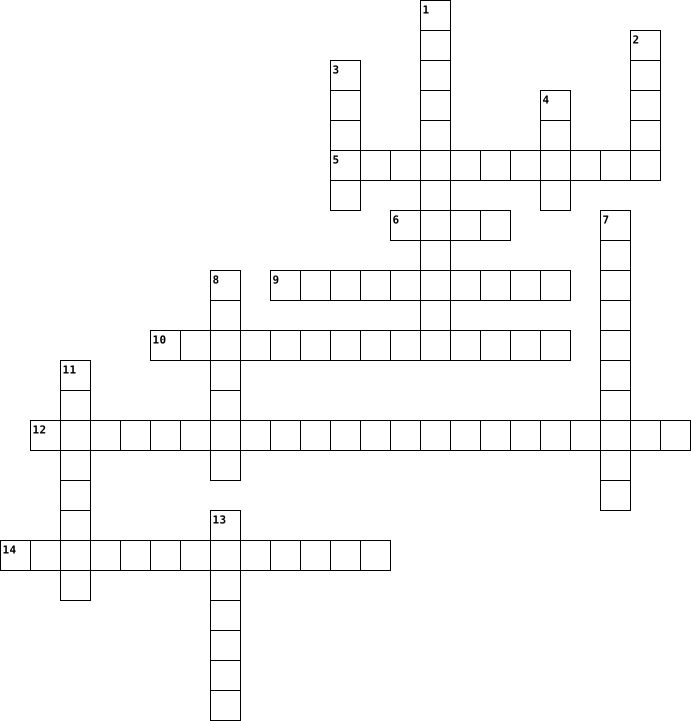
Across
- A form of energy that can be stored
- The quantity of matter in a body. It is measured in kg
- The percentage of energy that is used for a useful task and how much is wasted.
- A form of energy that results in one energy store becoming another type of energy store.
- The energy stored in an object by raising it up high. If it fell down to the ground all of this would be converted into kinetic/heat.
- A visual representation of the conservation of energy that shows how much energy is useful and how much energy is wasted from a give input.
Down
- The value is kept constant before and after a change.
- The unit for energy. [J]
- The rate of energy transfer (work done per second).
- Unit of Power
- Material or process that prevents the transfer of heat by conduction, convection or radiation.
- Heat energy.
- The energy used to move an object a certain distance.
- Movement energy
14 Clues: Heat energy. • Unit of Power • Movement energy • The unit for energy. [J] • A form of energy that can be stored • The rate of energy transfer (work done per second). • The value is kept constant before and after a change. • The energy used to move an object a certain distance. • The quantity of matter in a body. It is measured in kg • ...
Chapter 8 2021-02-16

Across
- the structure that contains the cell's genetic material in the form of DNA
- cell organelle that stores materials such as water, salts, proteins, and carbohydrates
- diffusion, process of diffusion in which molecules pass across the membrane through cell membrane channels
- apparatus, organelle in cells that modifies, sorts, and packages proteins and other materials for storage
- when the comparing two solutions, the solution with the greater concentration of solution
- membrane, thin, flexible barrier that surrounds all cells, regulates what enters and leaves the cell.
- basic unit of all forms of life
- diffusion of water through a selectively permeable membrane
- converts the chemical energy stored in food into compounds that are more convenient for the cell to use
- specialized structure that performs cellular functions within a eukaryotic cell
- reticulum, internal membrane system found in eukaryotic cells
- wall, strong, supporting layer around the cell membrane in some cells
- when the concentration of two solutions is the same
- when comparing two solutions, the solution with the lesser concentrations of solution
- fluid portion of the cell outside the nucleus
- pressure, pressure that must be applied to prevent osmotic movement across a selectively permeable membrane
- water channel protein in a cell
- cell organelle consisting of RNA and proteins found throughout the cytoplasm in a cell
- theory, fundamental concept of biology that states that all living things are composed of cells.
Down
- permeable, property of biological membranes that allows some substances to pass across it while others cannot
- gives the cell its shape and internal organization and is involved in movement.
- process by which particles tend to move from an area where they are more concentrated to an area where they are less concentrated
- group of tissues that work together to perform closely related functions
- , group of similar cells that perform a particular function
- bilayer, flexible double-layered sheet that makes up the cell membrane and forms a barrier between the cell and its surroundings
- cell organelle that breaks down lipids, carbohydrates, and proteins into small molecules
- system, group of organs that work together to perform a specific function
- relatively constant internal physical and chemical conditions that organisms maintain
- captures the energy from sunlight and converts it into chemical energy
- specific protein to whose shape fits that of a specific molecular messenger
- unicellular organism that lacks a nucleus
- organism whose cells contain a nucleus
32 Clues: basic unit of all forms of life • water channel protein in a cell • organism whose cells contain a nucleus • unicellular organism that lacks a nucleus • fluid portion of the cell outside the nucleus • when the concentration of two solutions is the same • , group of similar cells that perform a particular function • ...
6.6 Water 2024-05-02

Across
- Ice floats because it is less _ than liquid water
- It is important to _ water resources.
- _ is less dense than liquid water.
- Large bodies of water absorb __ energy in the summer and release it in the winter, moderating the climate around them.
- Like little magnets, water molecules are ______.
- Water forms in drops because water has a high _ tension.
- Water is used to _____ crops.
Down
- In _ power plants, water is used to produce energy.
- Due to water's polar nature, a large number of substances _ in water.
- Water is often called the universal _.
- Water with dissolved chemicals and gases causes rock to change by _ weathering.
- When freezing water expands, it breaks rocks. This process is called _ weathering.
- _ properties of water are key to life
13 Clues: Water is used to _____ crops. • _ is less dense than liquid water. • It is important to _ water resources. • _ properties of water are key to life • Water is often called the universal _. • Like little magnets, water molecules are ______. • Ice floats because it is less _ than liquid water • In _ power plants, water is used to produce energy. • ...
Unifying Themes of Life 2020-12-11

Across
- steady-state
- it determines function
- is obtained from chemical reactions
- it is where plants obtain nutrients
- forms when an egg cell is fertilized by the sperm
- contains the genetic information from parents
Down
- group of cells working together
- explains the changes in organisms over time
- the father of evolution
- functions based on the interactions of its parts
10 Clues: steady-state • it determines function • the father of evolution • group of cells working together • is obtained from chemical reactions • it is where plants obtain nutrients • explains the changes in organisms over time • contains the genetic information from parents • functions based on the interactions of its parts • forms when an egg cell is fertilized by the sperm
condense 2022-10-25

Across
- has 3 different forms
- when a water turns into a gas
- a melted state of matter
- small bits that is seen in a microscope
Down
- changes its state into gas
- when a gas turns to a solid
- when something turns into a solid
- an evaporated state of matter
- a frozen state of matter
- energy that has heat
10 Clues: energy that has heat • has 3 different forms • a frozen state of matter • a melted state of matter • changes its state into gas • when a gas turns to a solid • an evaporated state of matter • when a water turns into a gas • when something turns into a solid • small bits that is seen in a microscope
Star Crossword 2023-03-27

Across
- Force that pulls stars in
- How stars make their energy
- Heavy star that fuses iron
- A cloud of gas that forms stars
Down
- The light seen from Earth
- Dictates the life of a star
- Stars that fuse helium into carbon
- Classification of stars
- Nuclear fusion & gravity in stars are in a...
- High mass star that collapses
10 Clues: Classification of stars • The light seen from Earth • Force that pulls stars in • Heavy star that fuses iron • Dictates the life of a star • How stars make their energy • High mass star that collapses • A cloud of gas that forms stars • Stars that fuse helium into carbon • Nuclear fusion & gravity in stars are in a...
Science 9 Quarter 1 2024-10-07

Across
- A simple sugar that provides energy for cells.
- A form of dominance where the heterozygous phenotype is intermediate.
- A group of individuals of the same species living in a particular area.
- The gel-like substance inside cells where cellular processes occur.
- A condition where a person is unable to distinguish certain colors.
- A genetic situation where both alleles are fully expressed.
- The structure that divides the nostrils of the nose or the chambers of the heart.
- Small airways in the lungs that lead to the alveoli.
- Different versions or forms of a gene.
- The organ responsible for breathing and smelling.
- Having two identical alleles for a particular gene.
Down
- An enzyme that helps plants fix carbon during photosynthesis.
- A protein produced by the immune system to neutralize pathogens.
- The partial or complete loss of hair from the scalp.
- The concentration of salts in water or soil.
- A gene trait that is expressed only when two copies are present.
- The specific location of a gene on a chromosome.
- The basic structural and functional unit of all living organisms.
- The capacity to do work, essential for all biological processes.
- dissolved in the solvent
20 Clues: dissolved in the solvent • Different versions or forms of a gene. • The concentration of salts in water or soil. • A simple sugar that provides energy for cells. • The specific location of a gene on a chromosome. • The organ responsible for breathing and smelling. • Having two identical alleles for a particular gene. • ...
light 2025-04-08

Across
- A form of electromagnetic energy that makes things
- A model for tricking the eye into seeing almost any color by mixing Red Green and Blue
- The smallest possible amount of light like a wave bundle
- A kind of lens that magnifies
- What is the acronym to remember the visible light colors
- Wave with the Highest Frequency
- A process that makes light with heat
- The process of a wave bouncing off a surface
- A process that makes light directly from electricity
- What does the K stand for in CMYK
- A surface that reflects light rays
Down
- What kind of color does a stop sign use
- An optical device for bending light rays
- As wavelength Decreases Frequency and energy _____
- If you mix cyan and magenta what color do you get
- A kind of lens that reduces
- A single dot that forms part of an image of many dots
- wave with the lowest frequency
- If a wave is in its fourth harmonic how many wavelengths are there
- The process of a wave bending as it crossed a mirror boundary
- what color of light are absorbed by the cyan spot
21 Clues: A kind of lens that reduces • A kind of lens that magnifies • wave with the lowest frequency • Wave with the Highest Frequency • What does the K stand for in CMYK • A surface that reflects light rays • A process that makes light with heat • What kind of color does a stop sign use • An optical device for bending light rays • The process of a wave bouncing off a surface • ...
Ecology Part 2 2024-02-27

Across
- main type of sugar produced by plants
- total amount of greenhouse gases produced by human actions
- a process when plants use sunlight to synthesize food from carbon dioxide and water
- any solution that has a high solute concentration and a low water concentration
- gas that humans exhale
- long term change in the global temperatures
- gases in the earth atmosphere that traps heat
Down
- no net movement of water will take place
- cycle carbon atoms traveling from the earth to the atmosphere and back to the earth in a cycle
- cycle process that nitrogen converts into other forms
- process of cellular respiration that needs oxygen gas
- respiration process of cellular respiration that does not need oxygen to take place
- the source of energy for use of storage at the cellular level
- movement of particles from an area of higher concentration
- process that cells use to derive energy
- membrane found in all cells
- gas plants produce
- process that causes the earth to become hotter
- movement of water molecules in a solution according to the concentration
- cycle a process by which water circulates between the earth oceans, atmosphere, and land
20 Clues: gas plants produce • gas that humans exhale • membrane found in all cells • main type of sugar produced by plants • process that cells use to derive energy • no net movement of water will take place • long term change in the global temperatures • gases in the earth atmosphere that traps heat • process that causes the earth to become hotter • ...
Year 11 End of Mocks (Topic 1-6) 2024-12-15

Across
- above this the light will totally internally reflect
- the number of waves or vibrations per second
- a voltage that is continuously changing in direction (and value)
- mass per unit volume
- the spectrum of radiation
- A turning effect
- the time taken to produce on wave or vibration
- the change is speed and direction of a wave when it crosses the boundary bewtween two media
- a property of motion. How easy or hard it is to stop something.
- a push or pull
- force per unit area
- anthing that is measurable
- the movement of energy through a fluid
- a transformer used in small electronics connected to the mains
- the effect that causes an apparent change in frequency and wavelength of a wave due to relative motion of source (or observer)
- a very thin wire that glows when electricity flows
- getting faster, increasing in velocity
- his name is a unit that describes the kientic energy of particles
- the energy store of an object at height
- small particles that matter is made of
- A ratio that shows the amount a substance
- a sensor. Detects when its infrared ray is broken.
- A long coil of wire. Forms the basic electromagnet
- he came up with the laws of motion (and gravitation)
- a type of relationship where one variable increases and the other decreases
- the wire that provides a low resistance path to the ground - for safety
Down
- the energy store that is equivalent to temperature. In other words the motion of particles
- the unit of charge
- he came up with a rule to predict the motion of a motor
- A device used to analyse waves and vibrations
- is equal to energy transferred
- the release (typically of energy) from an system
- The top speed / velocity
- something that is constant, unchanging. Obvious examples in motion and fields.
- everything is balanced
- the movement of energy through solid
- a change of state from liquid to gas
- when something is created, caused, produced
- a force produced due to an object being submerged in a liquid
- a force that opposes motion
- the distance from one point on a wave to another identical point on the adjacent wave
- the ratio of useful energy or power, to total energy or power
- energy is stored due to an object position, state or shape.
- avoid by looking at eye level
- the charge on an electron
- a special resistor where the resistance drops with increasing temeprature
- Gamma rays can do this to medical equipment
- the maximum displacement moved by a vibrating object from its rest position
- equipment used in investigations and experiments
- a sound device that uses the motor effect
- a line at 90 degrees.
- energy that is useless, often dissipated to the surroundinsg as heat
- this requires both size and direction
- the linear region of a force-extension graph.
- the distance moved in a stright line from A to B
55 Clues: a push or pull • A turning effect • the unit of charge • force per unit area • mass per unit volume • a line at 90 degrees. • everything is balanced • The top speed / velocity • the spectrum of radiation • the charge on an electron • anthing that is measurable • a force that opposes motion • avoid by looking at eye level • is equal to energy transferred • ...
Chem-Is-Try 2022-07-30

Across
- solid to gas
- water_______ is an example of small insect that can walk on water
- ___________forces is the attraction between molecules in liquid
- _________action is one of the physical characteristics of water
- the water vapors get cold, it turn back into liquid and forms rains
- When a matter is __________, heat energy is released by its particles
Down
- solid to liquid
- water has high surface ________
- sun heats up water in river, lakes, oceans. The water vapor/steam goes into the air
- When a matter is heated, heat energy is __________
10 Clues: solid to gas • solid to liquid • water has high surface ________ • When a matter is heated, heat energy is __________ • ___________forces is the attraction between molecules in liquid • _________action is one of the physical characteristics of water • water_______ is an example of small insect that can walk on water • ...
Chem-Is-Try 2022-07-30

Across
- solid to gas
- water_______ is an example of small insect that can walk on water
- ___________forces is the attraction between molecules in liquid
- _________action is one of the physical characteristics of water
- the water vapors get cold, it turn back into liquid and forms rains
- When a matter is __________, heat energy is released by its particles
Down
- solid to liquid
- water has high surface ________
- sun heats up water in river, lakes, oceans. The water vapor/steam goes into the air
- When a matter is heated, heat energy is __________
10 Clues: solid to gas • solid to liquid • water has high surface ________ • When a matter is heated, heat energy is __________ • ___________forces is the attraction between molecules in liquid • _________action is one of the physical characteristics of water • water_______ is an example of small insect that can walk on water • ...
Chem-Is-Try 2022-07-30

Across
- solid to gas
- water_______ is an example of small insect that can walk on water
- ___________forces is the attraction between molecules in liquid
- _________action is one of the physical characteristics of water
- the water vapors get cold, it turn back into liquid and forms rains
- When a matter is __________, heat energy is released by its particles
Down
- solid to liquid
- water has high surface ________
- sun heats up water in river, lakes, oceans. The water vapor/steam goes into the air
- When a matter is heated, heat energy is __________
10 Clues: solid to gas • solid to liquid • water has high surface ________ • When a matter is heated, heat energy is __________ • ___________forces is the attraction between molecules in liquid • _________action is one of the physical characteristics of water • water_______ is an example of small insect that can walk on water • ...
Renewable and nonrenewable resources 2024-11-13

Across
- (Renewable resource created from burning sugarcane or wood)
- Gas (Nonrenewable resource that forms from decomposing organic matter over a long time)
- (Formed from tiny sea animals and plants millions of years ago)
- (Nonrenewable resource on the periodic table that makes up another energy resource)
- (A fossil fuel that is nonrenewable and formed over millions of years)
- (Renewable resource made from rotting plant material)
Down
- (Nonrenewable resource made from heat in the Earth)
- (Renewable resource made from differences in air pressure)
- (Renewable resource provided by the sun)
- (Nonrenewable resource made up of another energy source)
10 Clues: (Renewable resource provided by the sun) • (Nonrenewable resource made from heat in the Earth) • (Renewable resource made from rotting plant material) • (Nonrenewable resource made up of another energy source) • (Renewable resource made from differences in air pressure) • (Renewable resource created from burning sugarcane or wood) • ...
science web quest 2025-04-10

Across
- A relationship where both species benefit from their interactions with each other
- Many interconnected food chains
- Like an ecosystem but more of a home felling
- Study of relationship between different forms of animals
- A place where animals and plants live
- The dependence on both nature and each other for survival
Down
- Shows how energy moves from one organism to another in pyramid shape
- The three basic levels are consumer, producer and decomposer
- Shows how energy moves from one organism to another
- The relationship between and animal and its food
10 Clues: Many interconnected food chains • A place where animals and plants live • Like an ecosystem but more of a home felling • The relationship between and animal and its food • Shows how energy moves from one organism to another • Study of relationship between different forms of animals • The dependence on both nature and each other for survival • ...
Unit E Section 2 & 4 2024-06-13

Across
- a trace of once-living things preserved in rocks
- rock that forms under intense heat and pressure
- ____________ prospecting using instruments to detect mineral deposits
- molten rock under the surface of the earth
- the substances that make up rock
- when a mineral breaks into a smooth surface
- rock that forms from layers of sediment
- made up of minerals
- layers of sedimentary rock
- era with the dinosaurs
- igneous rock that forms under the surface of the earth
- rock that forms from cooled lava or magma
Down
- ____________ prospecting using chemical analysis of samples to detect minerals present
- era where the earth formed and live began
- era with the first reptiles, insects, land plants, and fish with jaws
- a measure of how easily a mineral can be scratched
- when a mineral breaks with rough uneven surface
- molten rock on the surface of the earth
- era with humans and grasses
- the colour of the powder that is left behind when its rubbed against a surface
- igneous rock that forms on the surface of the earth
- the way the surface of a mineral reflects light
22 Clues: made up of minerals • era with the dinosaurs • layers of sedimentary rock • era with humans and grasses • the substances that make up rock • molten rock on the surface of the earth • rock that forms from layers of sediment • era where the earth formed and live began • rock that forms from cooled lava or magma • molten rock under the surface of the earth • ...
vocab day 12 2024-07-01

Across
- a gradual increase in the earth's temperature generally due to the greenhouse effect caused by increased levels of carbon dioxide, CFCs, and other pollutants
- an organism that cannot produce its own food and must eat other plants and/or animals to get energy
- the biogeochemical cycle by which nitrogen is converted into multiple chemical forms as it circulates among atmospheric, terrestrial, and marine ecosystems
- water which collects as droplets on a cold surface when humid air is in contact with it.
- any liquid or frozen water that forms in the atmosphere and falls to Earth
- describes how carbon moves between the atmosphere, soils, living creatures, the ocean, and human sources
- a chemical or natural substance added to soil or land to increase its fertility.
Down
- the process of burning something.
- the process of converting natural nitrogen compounds into ammonia
- a biological community of interacting organisms and their physical environment.
- Liquid water evaporates into water vapor, condenses to form clouds, and precipitates back to earth in the form of rain and snow
- have the ability to break down dead organisms into smaller particles and create new compounds
- nonrenewable sources of energy formed from the organic matter of plants and microorganisms that lived millions of years ago
13 Clues: the process of burning something. • the process of converting natural nitrogen compounds into ammonia • any liquid or frozen water that forms in the atmosphere and falls to Earth • a biological community of interacting organisms and their physical environment. • a chemical or natural substance added to soil or land to increase its fertility. • ...
Types of reactions by sujay yadav 2025-04-23

Across
- – A reaction involving the transfer of electrons between two species.
- – The substances formed as a result of a chemical reaction.
- – The loss of electrons during a reaction.
- – A reaction that releases energy in the form of heat.
- – A hydrocarbon reacts with oxygen to produce carbon dioxide and water.
- – A solid that forms from a solution during a chemical reaction.
- Equation – A symbolic representation of a chemical reaction.
- – A reaction where two or more substances combine to form a single product.
Down
- – A single compound breaks down into two or more simpler substances.
- Replacement – One element replaces another in a compound.
- – A reaction that absorbs energy from its surroundings.
- Replacement – Two compounds exchange ions to form two new compounds.
- – An acid and a base react to form salt and water.
- – A substance that speeds up a reaction without being consumed.
- – The starting substances in a chemical reaction.
15 Clues: – The loss of electrons during a reaction. • – The starting substances in a chemical reaction. • – An acid and a base react to form salt and water. • – A reaction that releases energy in the form of heat. • – A reaction that absorbs energy from its surroundings. • Replacement – One element replaces another in a compound. • ...
8 Energy and Matter U3 Lesson 4 Ionic, Covalent, and Metallic Bonding 2025-04-21

Across
- This is the ability to dissolve in liquid
- Most covalent compounds are ____ conductors of electrical current
- The Chrystal's of ionic compounds are hard and ____
- This is when ions bond and form a repeating three dimensional pattern
- this forms when atoms share one or more pairs of electrons.
- ____ electrons can move from one atom to another when atoms join together
- This forms between metal atoms when their other most energy levels overlap
- Electrons move ____ in all directions throughout metal
- Metallic Bonding is ____ compared to ionic bonding
Down
- Some Covalent compounds ____ in water while others do not
- This is a force that brings oppositely charged ions together.
- An atom has a ____ charge because it has an equal number of electrons and protons
- When a covalent compound melts the bonds holding the molecules together do not ____
- This is when atoms join together with Covalent bonds, they form a ____
- This is a particle with a positive or negative charge
- These objects can be bent without being broken
- Ionic bonds are formed when electrons are transferred from a metal atom to a ____ atom
17 Clues: This is the ability to dissolve in liquid • These objects can be bent without being broken • Metallic Bonding is ____ compared to ionic bonding • The Chrystal's of ionic compounds are hard and ____ • This is a particle with a positive or negative charge • Electrons move ____ in all directions throughout metal • ...
Physical and chemical change 2018-10-23

Across
- measures how much matter is in a substance (unit: g)
- pushes upwards, as in pushes water upwards
- a mixture where the substances are mixed on the atomic level
- a solid formed during a chemical change
- a type of chemical equation where the chemicals are represented by the chemical names
- the change of state from liquid to solid
- a simplified representation of solids, liquids and gases
- a change of state from solid to gas
- a change of state from gas to solid
- an increase in size
- describes a process that gives off energy in the form of heat, light or sound
- when atoms rearrange to form new substances
- change a change that does not result in a new substance being produced
- a change of state where a gas is cooled and forms a liquid
- a process where two liquids or two gases mix due to the motion of their particles
Down
- a cluster of atoms
- the change of state where a liquid changes to a gas at the surface of the liquid
- a measure of the mass per unit volume of a substance, d = mV (unit: g/cm3)
- a change of state where aliquid is heated and changes to a gas within the liquid
- a type of chemical equation where the chemicals in the reaction are represented by their chemical formulas
- the substances formed in chemical reactions
- measures how much space is occupied by a substance (units: mL or cm3)
- the change of state from liquid to solid
- describes a process that absorbs energy from the surroundings
- the starting substances in chemical reactions
- change a change that results in a new substance being formed
- the smallest building block that makes up all substances
- a decrease in size
- the change of state when a solid is heated and forms a liquid
29 Clues: a cluster of atoms • a decrease in size • an increase in size • a change of state from solid to gas • a change of state from gas to solid • a solid formed during a chemical change • the change of state from liquid to solid • the change of state from liquid to solid • pushes upwards, as in pushes water upwards • the substances formed in chemical reactions • ...
Physical and Chemical Changes 2018-10-30

Across
- a cluster of atoms
- measures how much matter is in a substance (unit: g)
- the change of state where a liquid changes to a gas at the surface of the liquid
- pushes upwards, as in pushes water upwards
- describes a process that absorbs energy from the surroundings
- a change of state where a gas is cooled and forms a liquid
- when atoms rearrange to form new substances
- the starting substances in chemical reactions
- the change of state from liquid to solid
- a mixture where the substances are mixed on the atomic level
- the smallest building block that makes up all substances
- a decrease in size
- the change of state when a solid is heated and forms a liquid
Down
- a process where two liquids or two gases mix due to the motion of their particles
- an increase in size
- a change of state from solid to gas
- the substances formed in chemical reactions
- describes a process that gives off energy in the form of heat, light or sound
- a type of chemical equation where the chemicals in the reaction are represented by their chemical formulas
- a change of state from gas to solid
- a change that does not result in a new substance being produced
- a change that results in a new substance being formed
- a type of chemical equation where the chemicals are represented by the chemical names
- a solid formed during a chemical change
- a simplified representation of solids, liquids and gases
- the change of state from liquid to solid
- a measure of the mass per unit volume of a substance, d = mV (unit: g/cm3)
- measures how much space is occupied by a substance (units: mL or cm3)
- a change of state where a liquid is heated and changes to a gas within the liquid
29 Clues: a cluster of atoms • a decrease in size • an increase in size • a change of state from solid to gas • a change of state from gas to solid • a solid formed during a chemical change • the change of state from liquid to solid • the change of state from liquid to solid • pushes upwards, as in pushes water upwards • the substances formed in chemical reactions • ...
components of food 2019-09-03

Across
- Which of these forms most of our body weight?
- Lack of nutrients leads to _______ diseases
- In which disease will you advice the intake of iodized salt?
- In which vitamin would your body be most deficient if you did not eat fresh fruits and green vegetables?
- What is the quickest source of energy?
Down
- What gives your body energy?
- Which mineral is necessary for the formation of strong bones and muscles?
- The place where fats are mainly stored is under the _______
- Iron is a
9 Clues: Iron is a • What gives your body energy? • What is the quickest source of energy? • Lack of nutrients leads to _______ diseases • Which of these forms most of our body weight? • The place where fats are mainly stored is under the _______ • In which disease will you advice the intake of iodized salt? • ...
Tys crossword 2026-04-27

Across
- A substance that speeds up a chemical reaction without being permanently changed.
- When one substance breaks down into two or more substances.
- Formed from 2 or more elements proportions are always the same.
- When one element replaces a similar element forming a new element.
- When two or more substances combine to form another.
Down
- When the energy given off is thermal energy.
- The number of molecules in a chemical equation.
- Substance with atoms that are alike
- When a substance reacts with oxygen to produce energy in the form of light or heat.
- When water or gas forms two ionic compounds in solution are combined.
10 Clues: Substance with atoms that are alike • When the energy given off is thermal energy. • The number of molecules in a chemical equation. • When two or more substances combine to form another. • When one substance breaks down into two or more substances. • Formed from 2 or more elements proportions are always the same. • ...
3,4,5 Vocabulary 2025-01-15

Across
- magma reaches the surface
- the flow that transfer heat within a fluid
- material from deep within earths mantle rises
- single landmass
- process by which the ocean floor sinks
- the transfer on energy that is carried in rays like light
- a mountain that forms in Earth's crust with molten materials
Down
- mid- ocean ridges continually add new material to the ocean floor
- plunges into deep ocean trench
- movement of fluid
- heat transfer between materials that are touching
- molten mixture of rock
- trace of ancient organism
- broken into pieces
- one major belt of volcanoes
15 Clues: single landmass • movement of fluid • broken into pieces • molten mixture of rock • magma reaches the surface • trace of ancient organism • one major belt of volcanoes • plunges into deep ocean trench • process by which the ocean floor sinks • the flow that transfer heat within a fluid • material from deep within earths mantle rises • ...
Light and Sound 2026-02-25

Across
- sound travels fastest through this state of matter
- how loud or soft a sound is
- light travels fastest through a ______
- when something looks bent or broken
- light and sound travel in _____
- some light travels through something that is ___________
- how strong a sound is
- something is ______ when light can't travel through it
Down
- the invention that helps you see
- sound is __________
- what you use to hear
- light that is all the colors of the rainbow
- light and sound are both forms of ______
- all light can travel through something that is ___________
- the largest source of light
15 Clues: sound is __________ • what you use to hear • how strong a sound is • how loud or soft a sound is • the largest source of light • light and sound travel in _____ • the invention that helps you see • when something looks bent or broken • light travels fastest through a ______ • light and sound are both forms of ______ • light that is all the colors of the rainbow • ...
Carbon Cycle 2022-02-21

Across
- crystalline form of pure carbon
- The steady movement of particles
- the action of breathing
- non-metal two main forms diamond and graphite
- the sphere occupied by living organisms.
Down
- the state or process of rotting or decaying
- on fire
- the emission of energy as electromagnetic waves
- envelop of gases surrounding the earth
- the action of one object hitting another
10 Clues: on fire • the action of breathing • crystalline form of pure carbon • The steady movement of particles • envelop of gases surrounding the earth • the action of one object hitting another • the sphere occupied by living organisms. • the state or process of rotting or decaying • non-metal two main forms diamond and graphite • the emission of energy as electromagnetic waves
Anatomy of the Head and Neck 2022-03-27

Across
- forms the forehead, part of the cranium floor, and part of the top of orbits.
- a part of the mandible that lies in the glenoid fossa
- forms the roof and upper sides of the cranium
- creates the floor of the cranium, the orbit, and the nasal cavity.
- forms the bridge of the nose
- a raised piece of temporal bone in front of the glenoid fossa.
- at the back and base of the cranium
Down
- forms part of the anterior base of the skull and walls of the orbits; has a body and a pair of greater wings.
- AKA malar bones; form parts of the cheeks.
- forms the lower part of the jaw; the longest and strongest bone in the face.
- horseshoe-shaped; does not meet any other bone in face/cranium.
- single flat bone; forms the base of the septum.
- one on either side of the head; forms the side and base of the cranium.
- make up the orbit near the inner angle of the eye.
- irregular-shaped bones that join together in the middle, forming the jaw.
15 Clues: forms the bridge of the nose • at the back and base of the cranium • AKA malar bones; form parts of the cheeks. • forms the roof and upper sides of the cranium • single flat bone; forms the base of the septum. • make up the orbit near the inner angle of the eye. • a part of the mandible that lies in the glenoid fossa • ...
Spelling Words 2023-10-30

Across
- Property of chemical elements that exist in two or more forms
- Carbohyrates that contain 3-10 sugar residues
- Produces complex compounds using carbon
- Parasitic Organism that kills the living cells
- The physical process of cell division
- Diploid organism
Down
- Cells that form or heal bones
- Something which has a tendency to mix with
- Obtains energy from electron donors
- Cells have membrane bond nucleus
- Organism that requires additional nutrients
- Parasite feeds living organism without killing it
- The ventral part of the midbrain
13 Clues: Diploid organism • Cells that form or heal bones • Cells have membrane bond nucleus • The ventral part of the midbrain • Obtains energy from electron donors • The physical process of cell division • Produces complex compounds using carbon • Something which has a tendency to mix with • Organism that requires additional nutrients • Carbohyrates that contain 3-10 sugar residues • ...