
forms of energy Crossword Puzzles
Energy 2022-01-23

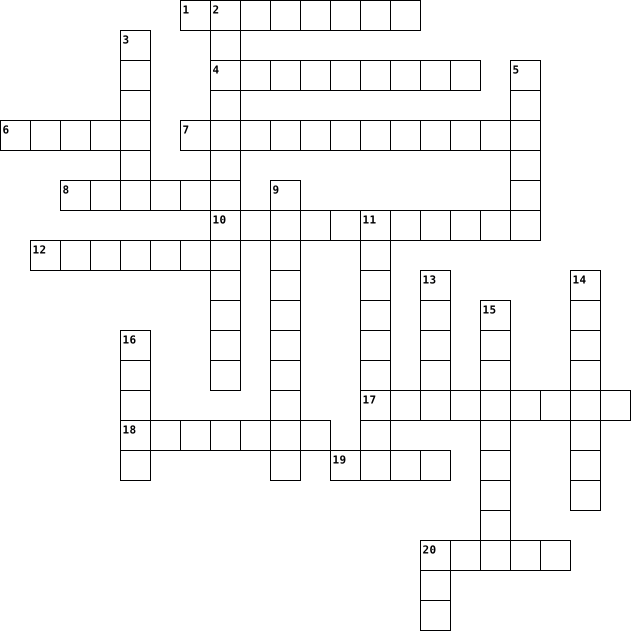
Across
- transfer of energy
- energy from the nucleus of an atom
- comes form outlets and power plants
- a bow and arrow are an example
- can travel through space
- touching a hot plate
- sum of KE and PE
- prevents heat to flow easily
- total amount of KE and PE in a system
- heat from a camp fire
Down
- the relationship between GPE and KE
- stored energy
- light that comes from the sun
- measure of average KE of particles
- energy in motion
- allows eat to flow easily
- energy stored in chemical bonds
- the ability to cause change
- used mostly for communication
- water boiling
20 Clues: stored energy • water boiling • energy in motion • sum of KE and PE • transfer of energy • touching a hot plate • heat from a camp fire • can travel through space • allows eat to flow easily • the ability to cause change • prevents heat to flow easily • light that comes from the sun • used mostly for communication • a bow and arrow are an example • energy stored in chemical bonds • ...
Energy 2020-09-06

Across
- the abbreviation for Light Emitting Diode, an electronic part similar to a lamp
- a 3D glass object that is used to split white light into seven colours
- a device that makes use of expansion to take the temperature
- the property of light that allows light to be blocked
- a renewable energy source that uses the sun
- the process that is used by plants to make their own food
- another word for heat
- the opposite of positive
- energy to do with movement
- a type of electrical wire that has clips at both ends
- an energy source that is used to make petrol to power cars
- an energy source that is used in fire places
Down
- the type of energy in a banana
- these things are found in most bathrooms and bounce (reflect) light back
- the scientific word for bending light
- the type of energy that we use by plugging in to a power point
- the main type of energy coming out of a trumpet
- a part used in an electrical circuit. It converts chemical energy to electrical energy.
- an energy source that is used to create a flame on some stove tops
- a property of thermal energy that makes crayons turn into a liquid when heated
- an energy source that is used to make sail boats move
- energy that is stored
- a property of thermal energy that makes train tracks buckle on hot days, unless they have a gap in the rail
- most of Australia‘s energy comes from this source
- Energy is the ability to do______.
25 Clues: energy that is stored • another word for heat • the opposite of positive • energy to do with movement • the type of energy in a banana • Energy is the ability to do______. • the scientific word for bending light • a renewable energy source that uses the sun • an energy source that is used in fire places • the main type of energy coming out of a trumpet • ...
Energy 2022-02-25

Across
- Complete circuit
- energy from water in the earths crust
- Parts are in one line
- fossil energy
- water energy
- comes from wood and solid waste
- Metal strip breaks
- How much electricity is flowing through a circuit
- power created by burning this substance
- Lets electrons move
- forces current through circuit
- rate of converted energy
Down
- used to show diagram parts
- creates open switch to stop flow
- each bulb can light it's own path
- Doesn't let electrons move
- steam into electricity
- Set of components that help move electrons
- Caused by electron movements
- slowing the circuit down
- Opening in circuit
- comes from dead plants and animals
- power from the wind
- power from the sun
24 Clues: water energy • fossil energy • Complete circuit • Opening in circuit • Metal strip breaks • power from the sun • power from the wind • Lets electrons move • Parts are in one line • steam into electricity • slowing the circuit down • rate of converted energy • used to show diagram parts • Doesn't let electrons move • Caused by electron movements • forces current through circuit • ...
Energy 2021-12-08

Across
- sources of energy that are naturally replenished
- the process of producing syngas from coal, water, and sometimes O2
- a collection of chemical reactions that converts a mixture of carbon monoxide and hydrogen/water gas to liquid hydrocarbons
- materials extracted from the ground and burned to generate energy
- materials that can be used to generate energy from fission or fusion of atoms
- alkylation of unsaturated fuels (creating larger and branched molecules)
- a positively charged carbon atom (usually intermediate)
- the column which petroleum is fractionated through
- finite sources of energy
- sources of power
- light hydrocarbons (in gas state) that are extracted directly from the oil mining process
- a molecule comprised of entirely carbon and hydrogen
Down
- a fuel gas mixture made of hydrogen carbon monoxide and some carbon dioxide
- a general term regarding a mixture of organic molecules (mainly hydrocarbons) extracted from the earth
- a source of energy seldom used in its own state (made into a secondary source)
- taking actions to preserve resources used for energy production
- the separation of a mixture into its component parts (fractions)
- the process in which striaght chain hydrocarbons are reformed to more efficient, branched-chain alkanes and cycloalkanes (some aromatics too) via catalyst
- a rating of combustion performance
- the lightest hydrocarbons produced in the refinery process
- the process in which unsaturated hydrcarbons are extended
21 Clues: sources of power • finite sources of energy • a rating of combustion performance • sources of energy that are naturally replenished • the column which petroleum is fractionated through • a molecule comprised of entirely carbon and hydrogen • a positively charged carbon atom (usually intermediate) • the process in which unsaturated hydrcarbons are extended • ...
Energy 2022-03-25

Across
- Dangerous form of clean energy
- Produces radioactive waves
- Fossil fuels, nuclear, biomass, geothermal, and solar thermal energy
- Splitting of Uranium
- 290-360 million years process
- Liquid fossil fuel
- Reason for climate change
- Made from Dinosaurs
- Mining is most commonly used for nickel, tin, gold, coal, and uranium.
Down
- Compression of dead plant material
- Primary stage of crude oil recovery Conversion of non-recyclable waste materials into usable heat
- The cleanest of the most common fossil fuels
- The energy required to move an object’s position
- Skateboard in motion
- H2O, CO2, CH4, N2O,and O3
- Drilling technology used to extract oil or natural gas from underground
- Burning of Wood or Coal
- Solar, wind, hydro, geothermal
- How fossil fuels form
- Used in grilling
20 Clues: Used in grilling • Liquid fossil fuel • Made from Dinosaurs • Skateboard in motion • Splitting of Uranium • How fossil fuels form • Burning of Wood or Coal • H2O, CO2, CH4, N2O,and O3 • Reason for climate change • Produces radioactive waves • 290-360 million years process • Dangerous form of clean energy • Solar, wind, hydro, geothermal • Compression of dead plant material • ...
Energy 2022-03-25

Across
- "Burning" Oxygen mixed with chemical energy
- Breaking up of atoms
- Formed with fossils from a long time ago
- Joining of 2 atomic nuclei
- energy of motion
- Natural pressure will force oil up
- Cleanest form of fossil fuel
- Energy in the form of waves
- Water or gas used to force oil up
- Unstable atom
- Energy stored in chemical bonds
- Energy do to a position or shape
Down
- Energy in the movement of molecules
- Close to the surface mining
- Readily available- Wind, solar, geothermal
- Network of tunneling to get coal deposits
- Energy associated with the flow of electrons
- Formed from the peat plant
- Release CO2 into the atmosphere
- Energy required to move/ change an object
- Energy stored in bonds between subatomic particles
21 Clues: Unstable atom • energy of motion • Breaking up of atoms • Joining of 2 atomic nuclei • Formed from the peat plant • Close to the surface mining • Energy in the form of waves • Cleanest form of fossil fuel • Release CO2 into the atmosphere • Energy stored in chemical bonds • Energy do to a position or shape • Water or gas used to force oil up • Natural pressure will force oil up • ...
ENERGY 2013-08-04

Across
- example to thermal energy, hot ...
- in a prectical w burn ... the satrting energy was chemical and the finish was thermal and light
- light bulbs are ... energy
- anything that uses electricity
- anything that is moving
- is an example of elastic energy
- t.v is and example of ... energy
- with this the wind mill can move
- the ability to do work
- is an example of sound energy
Down
- a book on a sheelf is an example of ... energy
- when you hear someone ..., a action, belongs to sound energy
- a hot radiator is a example of ... energy
- this is a action, example of kinetic energy
- a rubber band is ... energy
- batteries is ... energy
- this is an example of light energy a ... flame
- this is chemical energy
- nuclear bombs is ... energy
- this is an example of heat energy
20 Clues: the ability to do work • batteries is ... energy • anything that is moving • this is chemical energy • light bulbs are ... energy • a rubber band is ... energy • nuclear bombs is ... energy • is an example of sound energy • anything that uses electricity • is an example of elastic energy • t.v is and example of ... energy • with this the wind mill can move • ...
Energy 2012-10-16
Across
- the type of energy in foods
- energy can not be created or_________
- energy we get from the sea
- this energy type will eventually run out
- the fuels we use in our everyday lives
- the energy from electrons
- moving energy
- these have stored energy, A.A. for example
- the type of energy in atoms
- the energy in cookers for example
- power that comes from the sun
Down
- the energy we get from dams
- The unit of energy
- the ability to move or do work
- Energy that comes from deep within the earths crust
- This type of energy can never be used up
- the energy that comes from bulbs
- this energy can move two metal bars
- the type of energy due to somethings position
- energy from vibrations
- where most or our energy comes from
21 Clues: moving energy • The unit of energy • energy from vibrations • the energy from electrons • energy we get from the sea • the type of energy in foods • the energy we get from dams • the type of energy in atoms • power that comes from the sun • the ability to move or do work • the energy that comes from bulbs • the energy in cookers for example • this energy can move two metal bars • ...
Energy 2013-05-07

Across
- The unit used for measuring energy
- Anything that takes up space and has mass
- The movement of energy from one object to another
- The type of energy that deals with the total energy of the particles of an object
- The type of energy a moving object has
- Energy is the ability to do __________
- The law of ________ of energy says energy cannot be made or destroyed
- This type of energy travels in waves
- The form of energy associated with the position and motion of an object
- A type of potential energy stored in a stretched spring
- Food, candles, and matches are examples of this type of energy
- The ability to do work
- A waste product of energy conversion
Down
- This type of energy is stored in the nucleus of an atom
- Coal, oil, and natural gas are this type of energy source
- Receiving a shock from a doorknob is an example of this type of energy
- The formula for power is energy transferred divided by _______
- The kinetic energy of an object depends on both its mass and its _________
- Potential energy related to an object's height is called ___________ potential energy
- The term given to energy sources that cannot be replaced
- The amount of matter in an object
- The formula for gravitational potential energy is _______ times height
22 Clues: The ability to do work • The amount of matter in an object • The unit used for measuring energy • This type of energy travels in waves • A waste product of energy conversion • The type of energy a moving object has • Energy is the ability to do __________ • Anything that takes up space and has mass • The movement of energy from one object to another • ...
ENERGY 2013-05-14

Across
- powered by the sun
- used to measure energy
- energy produced by water
- used in everything you do
- a solid fossil fuel
- potential -> kinetic -> electrical this is an energy___
- used to power a turbine
- found in bananas and used to power batteries
- a dangerous non-renewable energy
Down
- item used in remote controlers
- couse of vibration in the air
- stored aenergy
- what makes heat energy
- the most common energy used in a home
- known as coal, oil and gas (two words)
- energy used for movement
- all energys produce this
- needs sun to produce plants that make the ____
- can be caused by the sun and globes
- used to stick to metal
20 Clues: stored aenergy • powered by the sun • a solid fossil fuel • used to measure energy • what makes heat energy • used to stick to metal • used to power a turbine • energy used for movement • energy produced by water • all energys produce this • used in everything you do • couse of vibration in the air • item used in remote controlers • a dangerous non-renewable energy • ...
Energy 2015-04-02

Across
- a nuclear reactor
- a substance that continuously flows under an applied sheer stress
- different forms of the same element, with the nuclei having different numbers of neutron
- rate at which work is done
- involving or relating to photons or very high energy
- ___-state physics is the study of rigid matter
- an electron or positron emitted from a atomic nucleus
- present or potential but not evident or active
- a substance diffused or suspended in air
- law stating that a quantity or a property remain constant as the system changes
- ideal ___ can be characterized by absolute pressure, volume, and absolute temperature
- a phase transition directly from a solid to a gaseous state vice versa
- activities involving both a force and a displacement
- a decrease in volume due to removal of heat
- an instrument for measuring temperature
- one ___ equals one kilogram-metre per second squared
- the work per unit charge necessary to move a charged body in an electric field
- has a definite size or volume and will not have any particular shape of its own
- standard unit of temperature measurement in most countries
- push or pull on an object
- a positively charged particle consisting of two neutrons and two protons
Down
- measurement of work done by a force
- prefix meaning below
- prefix meaning above
- the act of cleaving or splitting apart
- ratio of force applied per area covered
- unit of pressure or stress
- of, relating to, or caused by heat
- energy stored in an object when it is formed out of its normal shape
- SI unit of thermodynamic temperature
- rapid change of water to steam
- an increase in the volume of a substance usually due to an addition of heat
- phenomenon of melting under pressure and freezing again when the pressure is reduced
- quantity that has a direction
- property or tendency of a moving object to continue moving
- energy of a moving object
- represents the transfer or transformation of energy
- product of the force acting on a body and the time interval during which the force is exerted
- ability to do work
- combining 2 or more things together into one
- quantity that has no direction
41 Clues: a nuclear reactor • ability to do work • prefix meaning below • prefix meaning above • energy of a moving object • push or pull on an object • rate at which work is done • unit of pressure or stress • quantity that has a direction • rapid change of water to steam • quantity that has no direction • of, relating to, or caused by heat • measurement of work done by a force • ...
Energy 2016-06-16

Across
- __ Forest __!
- Hickory Dickory Dock.
- Let the food ___ up.
- The most important resource.
- Don't go into the...!
- Lose weight and get in shape.
- Energy from the sun.
- Organic manner.
- You burn them when you talk or walk.
- A ___ Band.
- Energy from the ground
- Can you hear that?
- Don't play with...
- Inside a big bomb.
- It will blow you away.
- What you drink and bathe in.
Down
- Let's fill the petrol tank up with...
- And I would __ five hundred miles!
- Drive.
- Electric dreams.
- Double A's.
- It can be used again.
- A subject at schools.
- Put the thing in the other thing.
- Let's watch our favourite show.
- Energy from the dinosaur times.
- I have an idea.
- Fly.
- On a bike and in a clock.
- What is in a machine that can transport.
30 Clues: Fly. • Drive. • Double A's. • A ___ Band. • __ Forest __! • Organic manner. • I have an idea. • Electric dreams. • Can you hear that? • Don't play with... • Inside a big bomb. • Let the food ___ up. • Energy from the sun. • Hickory Dickory Dock. • It can be used again. • A subject at schools. • Don't go into the...! • Energy from the ground • It will blow you away. • On a bike and in a clock. • ...
Energy 2022-04-18

Across
- Cycle, continuous process which carbon is exchanged between organisms and environment
- Rays, Invisible rays that are part of the energy that comes from the sun Filtered by ozone layer
- Energy, Is the energy from the Sun transmitted as electromagnetic wave
- Rays, electromagnetic radiation with wavelengths shorter than approximately one tenth of a nanometer Fastest
- occurs as pockets of air near earth's surface are heated become less dense rise cool and sink
- Fuels, Fuel that have been formed from the fossilized remains of prehistoric plants and animals
- an electromagnetic wave of high energy and very short wavelength which is able to pass through many materials opaque to light
- Transform, Energy's ability to change from one form to another
- outer layer that creates the solar wind which can go 800 km/s
- Energy, Stored energy or energy of position
- waves, Electromagnetic radiation spectrum at wavelengths longer than those of visible light
- occurs when heat energy is transferred from earth's surface air to atmospheric air
- Oil, Known as Petroleum a type of nonrenewable resource that id drilled out of the ground used for gasoline
- Hard variety that contains relatively pure carbon and burns with little flame and smoke (cleanest burning)
- A soft brownish coal showing traces of plant structure intermediate between bituminous coal and peat
- surface layer responsible for most of visible light
Down
- Flares, explosive out burst
- The source of all energy on Earth
- Is a relatively soft coal containing a tarlike substance called bitumen It is of higher quality than lignite coal but of poorer quality than anthracite
- Most abundant of nonrenewable resource produces sulfur dioxide
- Rain, Rain that has a lower than normal pH level because of burning fossil fuels
- Resource, resource that cannot be remade at a scale comparable to consumption
- Radiation, heat energy from the sun
- Winds, They are a continuous stream of electrically charged particles that are given off by a magnetic field around the sun
- cooler areas of surface that appear darker
- of Conservation of Energy, States that energy can change form but it cannot be created or destroyed
- Energy, Energy of motion
- The ability to do work
- Waves, Have the longest wavelengths in the electromagnetic spectrum slowest
- Partially decayed plant material burns dirty lots of pollution
30 Clues: The ability to do work • Energy, Energy of motion • Flares, explosive out burst • The source of all energy on Earth • Radiation, heat energy from the sun • cooler areas of surface that appear darker • Energy, Stored energy or energy of position • surface layer responsible for most of visible light • outer layer that creates the solar wind which can go 800 km/s • ...
Energy 2022-09-21

Across
- wave from the portion of the electromagnetic spectrum at lower frequencies than microwaves
- lowest energy state of an atom or other particle
- state of a physical system that is higher in energy than the ground state
- the ability to do work
- number of waves that pass a fixed point in unit time
- particle representing a quantum of light or other electromagnetic radiation
- the smallest discrete unit of an phenomenon
- function describing the location and wave-like behavior of an electron in an atom
- a periodic disturbance that moves through space
- maximum displacement or distance moved by a point on a vibrating body or wave
- an electromagnetic wave with a wavelength in the range 0.001-3m. used in radar for communications
Down
- natural agent that makes things visible
- the pattern of lines passing through a prism to separate it into the different frequencies of light it contains
- energy level defined by the quantum theory
- fundamental physical constant of a foundational importance in quantum mechanics (E=hf)
- phenomenon where electrically charged particles are released from or within a material when it absorbs electromagnetic radiation
- the distance between identical points (crests) in the adjacent cycles of a wave form
- negatively charged particle of the atom
- the range of all types of electromagetic radiation
- the segment of the electromagnetic spectrum that the human eye can see
20 Clues: the ability to do work • natural agent that makes things visible • negatively charged particle of the atom • energy level defined by the quantum theory • the smallest discrete unit of an phenomenon • a periodic disturbance that moves through space • lowest energy state of an atom or other particle • the range of all types of electromagetic radiation • ...
Energy 2022-09-19

Across
- Fuel from organic sources
- Fuel that is made of hydrocarbons that are 16 carbons long; a high compression internal combustion engine.
- the ability to do work
- electric or motive power generated by a nuclear reactor.
- 1,000 watts
- A diesel-equivalent, processed fuel derived from biological sources (such as vegetable oils), that can be used in unmodified diesel-engine vehicles.
- the energy an object has due to its motion
- when heat from the surface is trapped be the atmosphere
- of or related to hot water
- to change from one form to another
- energy
Down
- energy A form of energy that travels through space as waves
- Another name for oil
- A machine that converts mechanical energy into electrical energy
- the transfer of energy from one organism to another through a food chain or web; or the transfer of energy from one object to another, such as heat energy
- stored energy that results from the position or shape of an object
- oil burning, replaced steam engine, used in transportation
- heat energy humans.
- fuels Coal, oil, natural gas, and other fuels that are ancient remains of plants
- A fossil fuel in the gaseous state
- footprint measure of the impact human activities have on the environment in terms of the amount of greenhouse gases produced, measured in units of carbon dioxide
21 Clues: energy • 1,000 watts • heat energy humans. • Another name for oil • the ability to do work • Fuel from organic sources • of or related to hot water • A fossil fuel in the gaseous state • to change from one form to another • the energy an object has due to its motion • when heat from the surface is trapped be the atmosphere • electric or motive power generated by a nuclear reactor. • ...
Energy 2022-09-19

Across
- oil burning, replaced steam engine, used in transportation
- 1000 watts
- The total energy of motion in the particles of a substance
- fossil fuel; oil
- stored energy that results from the position or shape of an object
- A resource that can be replaced when needed.
- a natural fuel such as coal or gas, formed in the geological past from the remains of living organisms.
- The ability to do work or cause change
- the total carbon dioxide emissions produced by an individual, group, or location
- A fossil fuel in the gaseous state
- The change of potential (stored) energy into kinetic (moving) energy. (e.g., the chemical energy in a battery is changed into electricity, which gives off heat and light.)
Down
- relating to or denoting the action of heated water in the earth's crust.
- that is made of hydrocarbons that are 16 carbons long; a high compression internal combustion engine.
- the energy an object has due to its motion
- A diesel-equivalent, processed fuel derived from biological sources (such as vegetable oils), that can be used in unmodified diesel-engine vehicles.
- Natural situation in which heat is retained in Earth's atmosphere by carbon dioxide, methane, water vapor, and other gases
- A machine that converts mechanical energy into electrical energy
- relating to the interrelation of electric currents or fields and magnetic fields.
- energy from splitting Uranium atoms.
- Movement of energy from one place or object to another
- energy from the sun that is converted into thermal or electrical energy
21 Clues: 1000 watts • fossil fuel; oil • A fossil fuel in the gaseous state • energy from splitting Uranium atoms. • The ability to do work or cause change • the energy an object has due to its motion • A resource that can be replaced when needed. • Movement of energy from one place or object to another • oil burning, replaced steam engine, used in transportation • ...
Energy 2022-09-27

Across
- Energy of moving water
- A change from one form to another
- can be replaced
- comes from the sun
- Energy stored in bonds that hold atoms together
- Energy of moving air
- the ability to make things move or change
- an energy source made from ancient plants
- The energy of moving particles
- Energy of moving charges
- heat energy from inside the earth that can be used as heating
- Store electrical energy produced by the sun
Down
- energy that travels through matter an empty space
- reflects and focuses into a pipe that turns a turbine
- any material from living things that can be used as an energy source
- cannot be replaced
- can change light energy into electricity
- carful use of resources
- Energy of moving objects
- Energy stored in the nucleus of an atom
20 Clues: can be replaced • cannot be replaced • comes from the sun • Energy of moving air • Energy of moving water • carful use of resources • Energy of moving objects • Energy of moving charges • The energy of moving particles • A change from one form to another • Energy stored in the nucleus of an atom • can change light energy into electricity • the ability to make things move or change • ...
Energy 2023-04-18

Across
- a sustainable way to generate electricity
- The energy found in the core of atoms
- A waste product of anaerobic respiration
- A simple sugar converted during respiration
- Chemicals mixed together to make new substances
- Does not support combustion
- The process that separates plants and animals
- The energy of moving objects
- The inventor of the radiometer
- The unit of energy
- The energy of position
- A Biological catalyst
Down
- When a reaction releases energy
- The rate at which work is done
- The energy needed for a reaction to occur
- The Way in which living organisms make energy from food
- When you a reaction takes in energy
- What happens in a newton's cradle
- A colourless, odourless gas that supports respiration
- The unit of Power
- Thermal energy
- What is made in a reaction
- Lowers the energy needed for reactions
- Irish scientist who showed efficiency of devices
24 Clues: Thermal energy • The unit of Power • The unit of energy • A Biological catalyst • The energy of position • What is made in a reaction • Does not support combustion • The energy of moving objects • The rate at which work is done • The inventor of the radiometer • When a reaction releases energy • What happens in a newton's cradle • When you a reaction takes in energy • ...
Energy 2023-02-09

Across
- can prevent seasonal flooding.
- most used resource in the 18th century.
- Nuclear power plant disaster on 26 April 1986.
- formed from decaying plant remains.
- ________ power stations produce heat that changes water into steam.
- liquid fossil fuels.
- coal, gas, and oil are ______ fuel.
- dangerous gas from nuclear waste.
- electricity company in Iceland.
- various generator sizes and prizes
Down
- partially build underground.
- solar _________, use the power of sunlight.
- HEP project in iceland.
- used to hold cracking shale rocks.
- burning wood
- methane which can be burnt.
- nuclear power fuel.
- predictable, and usually happens twice a day.
- extracting oil from shale rock.
- area which is best for the HEP scheme.
20 Clues: burning wood • nuclear power fuel. • liquid fossil fuels. • HEP project in iceland. • methane which can be burnt. • partially build underground. • can prevent seasonal flooding. • extracting oil from shale rock. • electricity company in Iceland. • dangerous gas from nuclear waste. • used to hold cracking shale rocks. • various generator sizes and prizes • ...
Energy 2023-05-02

Across
- The product of a force applied to an object and the distance over which it is applied.
- Related to the transfer of heat or energy through a system.
- Related to the flow of electric charge through a conductor.
- The force that opposes motion between two surfaces in contact.
- Refers to the energy an object possesses due to its position or state.
- The amount of matter in an object.
- Refers to the way energy is generated, stored, distributed, and used in various applications.
- The rate at which work is done or energy is transferred.
- The event in which two or more objects come together with force.
Down
- The principle that energy cannot be created or destroyed, only transferred or transformed.
- Refers to the energy an object possesses due to its motion.
- Related to the force of attraction between two masses.
- The movement of energy from one object or system to another.
- The rate of change of velocity over time.
- The rate of change of an object's position over time.
- The unit of measurement for energy or work.
- Refers to a material or collision where kinetic energy is conserved.
- The product of an object's mass and velocity.
- Related to the motion and forces involved in the movement of objects.
- Related to energy derived from the sun.
20 Clues: The amount of matter in an object. • Related to energy derived from the sun. • The rate of change of velocity over time. • The unit of measurement for energy or work. • The product of an object's mass and velocity. • The rate of change of an object's position over time. • Related to the force of attraction between two masses. • ...
Energy 2022-10-17

Across
- passing
- joules
- thickness
- hotness matter
- heat or sound
- charcoal
- combine
- thermal
- fluid
- germs
Down
- opposite of solid
- plasma
- still
- motion
- opposite of liquids
- repelling
- hot
- generate
- sound waves
- vapor
20 Clues: hot • still • fluid • vapor • germs • plasma • joules • motion • passing • combine • thermal • charcoal • generate • thickness • repelling • sound waves • heat or sound • hotness matter • opposite of solid • opposite of liquids
energy 2018-03-07

Across
- the thing that powers turbines
- the stuff we eat to get energy
- some trains run on it (water vapour)
- energy from decaying plants
- my camera is _____________ so it works in reality
- energy that is infinite
- something that cannot be used over and over again
- something you do to wood and fossilfuels to create the energy
- also known as energy
Down
- a source of energy that grows from the ground and is burnt for energy
- something that doesn't pollute the world
- the energy that we use now that is nonrenewable
- also known as natural gas
- energy that will eventually run out
- high temperature
- another type of fossilfuel that is found in whales
- something that you use in the dark and it need energy
- energy from the sun
- the ability to do work
- energy from fossilfuels from dead animals + heat
20 Clues: high temperature • energy from the sun • also known as energy • the ability to do work • energy that is infinite • also known as natural gas • energy from decaying plants • the thing that powers turbines • the stuff we eat to get energy • energy that will eventually run out • some trains run on it (water vapour) • something that doesn't pollute the world • ...
energy 2018-03-07

Across
- also known as energy
- energy from decaying plants
- something that doesn't pollute the world
- energy that will eventually run out
- a source of energy that grows from the ground and is burnt for energy
- my camera is _____________ so it works in reality
- also known as natural gas
- another type of fossilfuel that is found in whales
- some trains run on it (water vapour)
Down
- something you do to wood and fossilfuels to create the energy
- the stuff we eat to get energy
- something that cannot be used over and over again
- the energy that we use now that is nonrenewable
- energy that is infinite
- the thing that powers turbines
- energy from the sun
- high temperature
- something that you use in the dark and it need energy
- energy from fossilfuels from dead animals + heat
- the ability to do work
20 Clues: high temperature • energy from the sun • also known as energy • the ability to do work • energy that is infinite • also known as natural gas • energy from decaying plants • the stuff we eat to get energy • the thing that powers turbines • energy that will eventually run out • some trains run on it (water vapour) • something that doesn't pollute the world • ...
energy 2024-01-17

Across
- an important class of micro-/nanomaterials that display magnetic properties when subjected to external magnetic fields
- a strong, hard magnetic silvery-gray metal, the chemical element of atomic number 26, much used as a material for construction and manufacturing, especially in the form of steel.
- a machine, especially one powered by electricity or internal combustion, that supplies motive power for a vehicle or for some other device with moving parts.
- the direction in which a compass needle normally points, toward the horizon on the left-hand side of a person facing east, or the part of the horizon lying in this direction.
- he direction along Earth's surface towards the place where the imaginary rotational axis of the Earth intersects the surface of the Earth.
- belonging to the present time; happening or being used or done now.
- a soft metal core made into a magnet by the passage of electric current through a coil surroundielectricityctrcity a form of energy resulting from the existence of charged particles
- short for ampere.
- the chemical element of atomic number 27, a hard silvery-white magnetic metal.
- the direction toward the point of the horizon 90° clockwise from east, or the point on the horizon itself.
- an electromotive force or potential difference expressed in volts
Down
- a dynamo or similar machine for converting mechanical energy into electricity.
- metal drawn out into the form of a thin flexible thread or rod.
- a red-brown metal, the chemical element of atomic number 29.
- a small metal spike with a broadened flat head, driven typically into wood with a hammer to join things together or to serve as a peg or hook.
- a thing that has a powerful at cfield a region around a magnetic material or a moving electric charge within which the force of magnetism acts.
- the direction in which the north end of a compass needle or other freely suspended magnet will point in response to the earth's magnetic field.
- a silvery-white metal, the chemical element of atomic number 28.
- a minute portion of matter.
- an instrument containing a magnetized pointer which shows the direction of magnetic north and bearings from it.
20 Clues: short for ampere. • a minute portion of matter. • a red-brown metal, the chemical element of atomic number 29. • metal drawn out into the form of a thin flexible thread or rod. • a silvery-white metal, the chemical element of atomic number 28. • an electromotive force or potential difference expressed in volts • ...
ENERGY! 2024-01-06

Across
- Nuculas of a cell or atom
- An electromagnetic wave with a wavelength in the range of 0.001-0.3
- Energy can neither be created or destroyed
- frequency to wave lengths
- A forceful attraction or movement toward something
- penetrating electromagnetic radiation
- A segment of electromagnetic spectrum the human eye can see
- The result of joining 2 or more things together
- Repeated motion of a particle
- energy thatb can be renewed
- Can return to length or shape after being stretched
Down
- Can not be repleneshed
- A form of non ionizing radiation
- A wave vibrating at right angles
- The action of dividing or splitting atoms
- Heat and light
- Vibrating waves
- A compound of substances that have been puified
- Energy in motion
- Type of electromagnetic radiation
- Energy in electrons
- Stored energy
- Having a wavelength just greater than that of red
- An electromagnetic wave of high energy
- Vibrations that travel through the air to your ear
25 Clues: Stored energy • Heat and light • Vibrating waves • Energy in motion • Energy in electrons • Can not be repleneshed • Nuculas of a cell or atom • frequency to wave lengths • energy thatb can be renewed • Repeated motion of a particle • A form of non ionizing radiation • A wave vibrating at right angles • Type of electromagnetic radiation • penetrating electromagnetic radiation • ...
Energy 2023-12-08

Across
- force that resists the motion of two surfaces
- objects or particles.
- ability to cause change.
- move in the direction of the force.
- energy total energy of an object or group
- energy transfer to an object by a force, making the
- are touching
- energy carried by an electric current.
- from one form into another or transferred
- energy sum of kinetic and potential energy of
Down
- energy carried by sound.
- of conservation of energy states that energy can be
- particles in matter due to their random motion.
- energy stored in the nucleus of an atom.
- energy carried by electromagnetic waves.
- energy due to motion.
- energy stored energy due to interactions
- transmitted by electromagnetic waves.
- destroyed.
- objects due to large-scale motion and interactions.
- one region to another, but energy cannot be created
21 Clues: destroyed. • are touching • objects or particles. • energy due to motion. • energy carried by sound. • ability to cause change. • move in the direction of the force. • transmitted by electromagnetic waves. • energy carried by an electric current. • energy stored in the nucleus of an atom. • energy carried by electromagnetic waves. • energy stored energy due to interactions • ...
Energy 2023-12-08

Across
- force that resists the motion of two surfaces
- objects or particles.
- ability to cause change.
- move in the direction of the force.
- energy total energy of an object or group
- energy transfer to an object by a force, making the
- are touching
- energy carried by an electric current.
- from one form into another or transferred
- energy sum of kinetic and potential energy of
Down
- energy carried by sound.
- of conservation of energy states that energy can be
- particles in matter due to their random motion.
- energy stored in the nucleus of an atom.
- energy carried by electromagnetic waves.
- energy due to motion.
- energy stored energy due to interactions
- transmitted by electromagnetic waves.
- destroyed.
- objects due to large-scale motion and interactions.
- one region to another, but energy cannot be created
21 Clues: destroyed. • are touching • objects or particles. • energy due to motion. • energy carried by sound. • ability to cause change. • move in the direction of the force. • transmitted by electromagnetic waves. • energy carried by an electric current. • energy stored in the nucleus of an atom. • energy carried by electromagnetic waves. • energy stored energy due to interactions • ...
energy 2023-12-14

Across
- rubber band's energy
- 2 poles
- hot
- tidal
- power outlets
- fossilfule
- for motors and cockings
- Avatar's first
- not moving
- fission
- pe+ke
Down
- thermal
- food
- lava+earth
- naturalgas
- h20
- g forces
- burning natural materials
- movement
- a solid fossil fuel
- hear
- sun
- fuel for gas power things
- sight
- sun
25 Clues: h20 • hot • sun • sun • food • hear • tidal • sight • pe+ke • thermal • 2 poles • fission • g forces • movement • lava+earth • naturalgas • fossilfule • not moving • power outlets • Avatar's first • a solid fossil fuel • rubber band's energy • for motors and cockings • burning natural materials • fuel for gas power things
Energy 2024-03-08

Across
- A unit of measure that equals the force required to accelerate 1 kilogram of mass at 1 meter per second per second.
- The transfer of thermal energy from a warmer object to a cooler object.
- The energy of electric charges.
- The force that two surfaces exert on each other when they rub against each other
- Kinetic or potential energy associated with the motion or position of an object.
- A measure of how much matter is in an object.
- A form of energy that is able to travel through space.
- to save/not lose
- The rate at which one form of energy is transformed into another.
- A form of potential energy that is stored in chemical bonds between atoms.
- A measure of the force of gravity acting on an object.
- Potential energy that depends on the height of an object.
- Force exerted on an object that causes it to move.
Down
- Energy that an object has due to its motion.
- The energy an object has because of its position; also the internal stored energy of an object, such as energy stored in chemical bonds.
- The rule that energy cannot be created or destroyed.
- The potential energy stored in the nucleus of an atom.
- The energy of stretched or compressed objects.
- The distance an object travels per unit of time.
- A push or pull exerted on an object.
- The ability to do work or cause change.
- Anything that has mass and takes up space.
- The basic particle from which all elements are made; the smallest particle of an element that has the properties of that element.
23 Clues: to save/not lose • The energy of electric charges. • A push or pull exerted on an object. • The ability to do work or cause change. • Anything that has mass and takes up space. • Energy that an object has due to its motion. • A measure of how much matter is in an object. • The energy of stretched or compressed objects. • The distance an object travels per unit of time. • ...
ENERGY 2024-03-03

Across
- Most of the energy wasted in generating electricity is
- The bodies of the sea creatures were turned into oil and gas by the ... and thermal energy.
- The demand for primary energy sources needed to generate electricity
- electricity and fuels such as petrol/gasoline and hydrogen.
- The simplest example of a generator in a bicycle
- ...are energy converters that produce other fuels from oil, such as petrol (gas or gasoline).
- The steam drives a ..., which is like a giant fan that spins round.
- ... need to be built near a water supply such as the sea, a river, or a reservoi
- If the magnet inside of the coil of wire, so reading on the voltmeter will be..
- Tools to measure the voltage
- We say that a voltage has been produced or ... in the coil of wire.
Down
- The generators inside a power station are very, very big
- can be found in the ground, such as coal, oil, gas,uranium
- Units of energy
- Some energy sources such as coal, oil, gas, and uranium will run out
- ...is also used to generate electricity in a power station
- The turbine is connected to the ... . This produces a voltage in the coils around it
- energy can replace fairly quickly such as wood,
- ...are non-renewable energy sources so they will run out
- If the magnet moves towards the coil ... reading on the voltmeter
20 Clues: Units of energy • Tools to measure the voltage • energy can replace fairly quickly such as wood, • The simplest example of a generator in a bicycle • Most of the energy wasted in generating electricity is • The generators inside a power station are very, very big • ...are non-renewable energy sources so they will run out • ...
energy 2024-04-25

Across
- strechy
- sends electricity
- from the earth
- humans create this when they breath
- can fall over very easily
- powers campers with gas
- can run out
- comes from the sky
- from the ground
- turbines
- powered by sun
Down
- goes in a fire pit
- can not run out
- comes from crops
- powers cars
- this hops
- heats homes
- powers humans
- lights houses
- powers tractors simis and big vehichles
20 Clues: strechy • turbines • this hops • powers cars • heats homes • can run out • powers humans • lights houses • from the earth • powered by sun • can not run out • from the ground • comes from crops • sends electricity • goes in a fire pit • comes from the sky • powers campers with gas • can fall over very easily • humans create this when they breath • powers tractors simis and big vehichles
energy 2025-12-18

Across
- a back and forth motion of an object
- first thing a sound enters in the process of hearing
- a portion of matter
- unit of frequency
- the reflection of a sound wave from a surface back to the listener
- the distance between the top of each wave
- wave where particles of the medium vibrate and move
- atoms grouped together
- measure of how high a sound is
- how you can measure the power of a sound or intensity
Down
- specific amount, size or degree of something
- measure of pressure or force on something
- Humans can her sounds with a between 20-20000 hz
- move from one place to another
- particles moving and transferring energy through the medium motion
- how high or low the frequency is
- when two objects collide while one of them is moving
- the height of a waves peak or valley from the starting position
- what the sound travels through
- what is transferred through a sound wave
20 Clues: unit of frequency • a portion of matter • atoms grouped together • move from one place to another • what the sound travels through • measure of how high a sound is • how high or low the frequency is • a back and forth motion of an object • what is transferred through a sound wave • measure of pressure or force on something • the distance between the top of each wave • ...
Energy 2025-01-09

Across
- measure of average kinetic energy
- when the heating curve graph is flat, a phase ___ is taking place
- heat of ___ is the amount of heat needed to go from solid to liquid
- freezing point of water in celcius
- result of a force acting on body and producing motion
- when potential energy decreases on the cooling curve the graph is
- releases energy and feels hot
- absorbs energy, feels cold
Down
- phase change from gas to solid
- the slope on the heating curve is when it is a
- when the kinetic energy decreases on the cooling curve the graph is
- ability to do work
- units energy is measured in
- potential energy is converted into heat energy as the ____ proceeds
- law of ____ of energy says energy can't be created or destroyed
- heat of ___ is the amount of heat energy needed to go from liquid to gas
- phase change from solid to gas
- 0 kelvin is ____ zero
- ___ energy is stored energy
- ____ energy is energy of motion
20 Clues: ability to do work • 0 kelvin is ____ zero • absorbs energy, feels cold • units energy is measured in • ___ energy is stored energy • releases energy and feels hot • phase change from gas to solid • phase change from solid to gas • ____ energy is energy of motion • measure of average kinetic energy • freezing point of water in celcius • ...
Energy 2025-03-19

Across
- limited in quantity and cannot be naturally replenished or regenerated
- the process of moving from one place to another
- of or from the Sun, or using the energy from the Sun
- liquid petroleum that is found in Earth’s crust and extracted for burning as fuel
- can be replaced or has an endless supply
- the place something comes from or starts at
- the comparison of useful output per required input
- electrical energy resulting from the movement of an electrical charge
- heat that is generated within Earth
- the ability to do work
- using as little of something as possible; wasting nothing or very little
Down
- relating to or involving technology
- a mixture of gases produced by the breakdown of organic matter
- specific categories of things that have something in common
- a state of matter characterised by particles that lack both a definite volume and shape
- a physical law that states energy cannot be created or destroyed but may be changed from one form to another
- relating to the nucleus of an atom
- the movement of air caused by the uneven heating of the Earth by the Sun
- renewable organic material that comes from plants and animals used for energy production
- a physical system that does not exchange matter with its surroundings but can exchange energy
- the process of changing from one form to another
- to produce, create, bring into existence, or cause something to happen
- a black or brownish-black sedimentary rock that can be burned for fuel
23 Clues: the ability to do work • relating to the nucleus of an atom • relating to or involving technology • heat that is generated within Earth • can be replaced or has an endless supply • the place something comes from or starts at • the process of moving from one place to another • the process of changing from one form to another • ...
Energy 2025-01-10

Across
- What is the energy of motion?
- What is the measurement of average kinetic energy?
- What reaction feels cold to touch?
- A device used to determine the heat associated with a chemical reaction.
- Energy transferred between two objects.
- When there is no molecular movement due to extreme temperature.
- Heat transfer through electromagnetic waves.
- The energy of either an object in motion or the energy that is stored in objects by their position
- A substance that resists electric current or a material that resists the flow of heat.
- Unit of energy equal to the work done by a force of one newton.
- Energy we can see; can travel in waves through a vacuum such as space
Down
- Coal,natural gasses,petroleum.
- A substance that allows the flow of electric charge through matter.
- The ability to do work.
- What type of energy does a rubber band have when stretched?
- The amount of energy needed to raise a unit of mass 1 ˚C.
- Force acting over a distance.
- Amount of energy to raise 1 gram of water 1 degrees.
- Group of interacting or independent parts form a complex whole
- Stored energy; form of energy produced through reactions that occur in chemical compounds
20 Clues: The ability to do work. • What is the energy of motion? • Force acting over a distance. • Coal,natural gasses,petroleum. • What reaction feels cold to touch? • Energy transferred between two objects. • Heat transfer through electromagnetic waves. • What is the measurement of average kinetic energy? • Amount of energy to raise 1 gram of water 1 degrees. • ...
Energy 2025-05-14

Across
- – Wheel with a rope used to lift or move objects.
- – The highest point of a wave.
- – Height of a wave from rest to crest.
- – Measure of average kinetic energy of particles.
- – Stored energy based on position or condition.
- – Using force to move an object over a distance.
- – The ability to do work or cause change.
- – A round object that rolls to reduce friction.
- – Number of wave cycles per second.
Down
- – A device that makes work easier.
- – A sloped surface that reduces force needed to lift.
- – Energy of motion.
- – A device that is thick at one end and tapers.
- – An inclined plane wrapped around a cylinder.
- – A bar that pivots on a point to lift loads.
- – Transfer of thermal energy from warmer to cooler objects.
- – Rate at which work is done or energy is transferred.
- – The lowest point of a wave.
- – A shaft on which a wheel rotates.
- – A disturbance that transfers energy through matter or
20 Clues: – Energy of motion. • – The lowest point of a wave. • – The highest point of a wave. • – A device that makes work easier. • – A shaft on which a wheel rotates. • – Number of wave cycles per second. • – Height of a wave from rest to crest. • – The ability to do work or cause change. • – A bar that pivots on a point to lift loads. • ...
Energy 2026-04-28

Across
- The unit for Energy in the International System of Units
- Part of the electromagnetic spectrum between microwaves and visible light
- Fnet
- Molecule that is the main source of energy in living cells, abbr.
- The force that transforms kinetic energy into thermal energy
- Objects have potential energy if there is a force acting on them due to their ______
- In the equation E=mc^2, c stands for the speed of ______ in a vacuum
- Newton's First Law is also called the Law of ______
- Any quantity that has magnitude but no direction
- The hotter an object is, the more ______ energy it has
- Energy can only be transferred or ______
- Unit for energy used on electricity bills, abbr.
- Uranium-237 has a lot of ______ potential energy
- The kinetic energy of an object is directly proportional to the square of this
- A stretched rubber band has ______ potential energy
Down
- The Law of ______ of Energy
- The ______ of energy is when energy moves from one object to another
- The unit for Temperature in the International System of Units
- The unit for Force in the International System of Units
- Objects that are in motion have ______ energy
- James Joule's middle name
- A chemical reaction in which energy is absorbed from the surroundings is an ___thermic reaction
- The unit for Energy used on food labels
- A _____ panel is placed on a roof in order to generate electricity
- Formula for calculating GPE
- Light waves can travel in a vacuum, but ______ waves cannot
- Amount of matter in an object
- Fspring = ______
- A chemical reaction that releases heat to the surroundings is an ___thermic reaction
- A Joule is a Newton multiplied by a ______
30 Clues: Fnet • Fspring = ______ • James Joule's middle name • The Law of ______ of Energy • Formula for calculating GPE • Amount of matter in an object • The unit for Energy used on food labels • Energy can only be transferred or ______ • A Joule is a Newton multiplied by a ______ • Objects that are in motion have ______ energy • Any quantity that has magnitude but no direction • ...
Topic 4 2024-05-21

Across
- Multi cellular organisms, that don't contain chloroplast
- Organisms that cannot carry out photosynthesis
- Multi cellular organisms, that contain chloroplast
- A carbohydrate which forms fibres and is found in the cell walls of plant cells
- The molecule that is used as an energy store in plant cells
- The variety of living things in an ecosystem
- Microorganisms that cause disease, eg.fungi
Down
- Microscopic single celled organisms, an example is Plasmodium
- Not living organisms, parasitic and only reproduce in living cells
- The molecule that is used as an energy store in animals cells and fungi
- Microscopic living organisms that have only one cell
11 Clues: Microorganisms that cause disease, eg.fungi • The variety of living things in an ecosystem • Organisms that cannot carry out photosynthesis • Multi cellular organisms, that contain chloroplast • Microscopic living organisms that have only one cell • Multi cellular organisms, that don't contain chloroplast • The molecule that is used as an energy store in plant cells • ...
Photosynthesis - Light rxns & Calvin Cycle 2021-10-28

Across
- this is the abbreviation for the product of the Calvin cycle
- this is the primary pigment used in plants
- this enzyme fixes CO2 to a 5 carbon molecule in the Calvin cycle
- these "windows" allow gases into and out of the plant
- the number of Calvin cycles needed to form sugars and regenerate the cycles
- colored molecules that absorb light
- this is the part of the chloroplast where the light rxn takes place
- this machine forms ATP by adding an phosphate to ADP with the power from flowing hydrogens
- this is the energy molecule that powers cells
- a (singular) stack of thylakoids
- this is the raw material that enters the Calvin cycle
Down
- this is the second "system" of two that excites an electron so it can form NADPH
- when water is split, this part of it enters a photosystem
- this is the first "system" of two that transfers sunlight energy to an electron
- this is the part of the chloroplast where the Calvin cycle takes place
- this is the transport molecule that will take an excited electron from the light rxn to the Calvin cycle
- this is pumped across the membrane by the energy of the excited electron
- this is the 5 carbon molecule that CO2 is "fixed" to at the beginning of the Calvin cycle
18 Clues: a (singular) stack of thylakoids • colored molecules that absorb light • this is the primary pigment used in plants • this is the energy molecule that powers cells • these "windows" allow gases into and out of the plant • this is the raw material that enters the Calvin cycle • when water is split, this part of it enters a photosystem • ...
2B Dominique Franklin 2021-04-20

Across
- worldwide sum of all ecosystems.
- a seed, pod, or other edible part of a , used as food.
- a small single-celled organisms.
- is the process of water movement through a plant
Down
- a natural fuel such as coal or gas,
- all the waters on the earth's surface, such as lakes and seas, and sometimes including water over the earth's surface, such as clouds.
- the process of absorption of vitamins,
- movement of water on, above and below the surface of the Earth.
- the process of turning from liquid into vapor.
- (CO2)
- is the biogeochemical cycle by which nitrogen is converted into multiple chemical forms
- is a process used by plants and other organisms to convert light energy into chemical energy that.
12 Clues: (CO2) • worldwide sum of all ecosystems. • a small single-celled organisms. • a natural fuel such as coal or gas, • the process of absorption of vitamins, • the process of turning from liquid into vapor. • is the process of water movement through a plant • a seed, pod, or other edible part of a , used as food. • ...
Unit 3 Part 1 Vocabulary BONUS POINT OPPORTUNITY 2021-10-20

Across
- an empirical, calculated, and structurally analytical progression of a series of metals, arranged by their "reactivity" from highest to lowest.
- two or more chemical species combine to form a more complex product: A + B → AB.
- reactions or processes that release energy, usually in the form of heat or light.
- the quantity of a product obtained from a chemical reaction.
- reactions that require external energy, usually in the form of heat, for the reaction to proceed.
- equation has equal numbers of atoms for each element involved in the reaction are represented on the reactant and product sides.
- an insoluble solid that emerges from a liquid solution.
- contain two atoms that are chemically bonded.
- A reaction or chemical reaction is a chemical change which forms new substances.
- a substance that is formed as the result of a chemical reaction.
- Solid that dissolves in a liquid, usually water
Down
- A chemical reaction is a chemical change which forms new substances.
- a chemical reaction where two reactant ionic compounds exchange ions to form two new product compounds with the same ions.
- a constant term related to the properties of a product.
- solid that doesn't dissolve in a liquid
- when oxygen reacts with another substance and gives off heat and light.
- the law of conservation of mass says that in a chemical reaction, the mass of the products equals the mass of the reactants.
- a reaction in which one element is substituted for another element in a compound.
- solid,liquid,water,gas
- a conversion factor between compounds in a chemical reaction, that is derived from the coefficients of the compounds in a balanced equation.
- a chemical reaction in which one reactant breaks down into two or more products.
- what reaction will take place when two chemicals are mixed.
22 Clues: solid,liquid,water,gas • solid that doesn't dissolve in a liquid • contain two atoms that are chemically bonded. • Solid that dissolves in a liquid, usually water • a constant term related to the properties of a product. • an insoluble solid that emerges from a liquid solution. • what reaction will take place when two chemicals are mixed. • ...
Rocks 2012-10-29

Across
- the process in which dissolved minerals crystallize and glue particles of sediment together.
- light-colored rock that has a high silica content.
- rock that forms when minerals that are dissolved in a solution, crystallize.
- the romoval of rock particles by wind, water, ice, or gravity.
- rock that forms from the cooling of molten material underground.
- rock that forms from the cooling of lava/magma.
- sedimentary rock that forms when rock fragments are squeezed together.
Down
- small, solid pieces of material that come from rocks and other remains of living things.
- dark-colored rock that has low silica content.
- particles of minerals or other rocks.
- the process by which sediment settles out of water or wind carrying it.
- the process that presses sediments together
- rock that forms when lava is erupted onto the Earth's surface.
- rock that forms where the remains of plants and animals are deposited in thick layers.
- a material formed from oxygen and silicon.
- the look and feel of the rock's surface.
16 Clues: particles of minerals or other rocks. • the look and feel of the rock's surface. • a material formed from oxygen and silicon. • the process that presses sediments together • dark-colored rock that has low silica content. • rock that forms from the cooling of lava/magma. • light-colored rock that has a high silica content. • ...
Sugar! 2022-10-19

Across
- A portion of the population cannot digest this carbohydrate found in dairy
- The storage form of glucose in animals
- A carbohydrate that is made up of 3 or more sugar molecules
- The carbohydrate used in cellular respiration
- The carbohydrate found in fruits
- Disaccharides are formed using __________ synthesis
- This complex carbohydrate is stored in amyloplasts
- This carbohydrate links together using phosphates to form the back bone of DNA, is a monosaccharide
- The process that plants use to create glucose and oxygen using only sunlight, water, and carbon dioxide
Down
- A carbohydrate that is made up of 2 sugar molecules
- This carbohydrate forms cell walls, cannot be digested by humans, and is commonly referred to as fibre
- Where we get most of our carbohydrates in our diets
- When a glucose molecule bonds with this carbohydrate it forms lactose, and this carbohydrate is said to be involved in brain development
- The main energy source of our bodies
- This hormone is used to regulate blood sugar, many diabetic people have to get shots of this hormone
- A carbohydrate that is made up of a single sugar molecule
- Disaccharides are broken down into mono saccharides though ___________
- Table sugar, made from glucose and fructose
- This carbohydrate is used in the fermentation of beer
- This carbohydrate links together using phosphates to form the back bone of DNA, is a monosaccharide
20 Clues: The carbohydrate found in fruits • The main energy source of our bodies • The storage form of glucose in animals • Table sugar, made from glucose and fructose • The carbohydrate used in cellular respiration • This complex carbohydrate is stored in amyloplasts • A carbohydrate that is made up of 2 sugar molecules • Where we get most of our carbohydrates in our diets • ...
APES U4 1 2024-05-08

Across
- The process of new oceanic crust from upward movement of magma
- Fast and often unexpected movement of Earth's crust from a release of energy
- Theory that lithosphere is divided into plates
- Where molten material from the mantle reaches the lithosphere
- Rock formed right from magma
- Crack that is in cooling rock
- Layer of Earth composed of semi-molten rock
- The outermost layer of the lithosphere
- Plate boundary where tectonic plates move towards each other
- Landform that ejects molten lava
- Type of rock that forms from cooled magma underground
- Outermost layer of Earth
- Activity the level of and amount of Earthquakes in a period of time
- The constant formation, change and destruction of rock material
- Process of one crustal plate passing under another
- Plate boundary where tectonic plates move away from each other
Down
- Layer of Earth that contains magma
- Type of rock that forms from cooled magma above ground
- Fracture in rock from movement of Earth's crust
- Molten rock
- Plate boundary where tectonic plates move sideways past each other
- Zone of Earth's interior composed mostly of iron and nickel
- Base-10 logarithmic scale measuring Earthquake intensity
- Processes that make and break down lithosphere
- Waves caused from seismic activity underseas
- Point on Earth's surface above the location where the rock ruptures in Earthquake
26 Clues: Molten rock • Outermost layer of Earth • Rock formed right from magma • Crack that is in cooling rock • Landform that ejects molten lava • Layer of Earth that contains magma • The outermost layer of the lithosphere • Layer of Earth composed of semi-molten rock • Waves caused from seismic activity underseas • Theory that lithosphere is divided into plates • ...
Food webs 2025-04-02

Across
- the hunted
- The hunter
- A complex chain of organisms
- when two organisms help each other
- The plant is called what in a food web
- The study of relationships between different life forms of animals and their natural surroundings
Down
- The consumer that eats plants
- chains linearpath of organisms
- a place where an organism lives
- Flow of energy divided into categories
10 Clues: the hunted • The hunter • A complex chain of organisms • The consumer that eats plants • chains linearpath of organisms • a place where an organism lives • when two organisms help each other • Flow of energy divided into categories • The plant is called what in a food web • The study of relationships between different life forms of animals and their natural surroundings
Waves Crossword by Ms. Scott 2025-11-13

Across
- waves bounce off an object and return to their origin
- waves pass through an object
- protection of the eye
- eye color
Down
- object "soaks up" wave energy.
- number of wavelengths per second
- the only part of the electromagnetic spectrum that humans can see with a naked eye
- top of a wave
- bottom of a wave
- forms images and focus light
10 Clues: eye color • top of a wave • bottom of a wave • protection of the eye • waves pass through an object • forms images and focus light • object "soaks up" wave energy. • number of wavelengths per second • waves bounce off an object and return to their origin • the only part of the electromagnetic spectrum that humans can see with a naked eye
Anthony 2-15-17 2nd 2017-02-15

Across
- the rate of doing work.
- of conservation of energy: Energy cannot be created or destroyed.
- the ability to do work.
- energy: a source of energy that can be replaced in a relatively short period of time.
- energy: a form of energy consisting of changing electric and magnetic fields.
- consists of weight swinging back and forth from a rope or string.
- energy: The energy associated with the motion and position of everyday objects.
- energy: The total potential and kinetic energy related to the motion of all the particles in an object.
- The SI unit of power, equal to one joule per second.
- energy: The energy stored in atomic nuclei.
Down
- the product of distance and the force in the direction an object moves.
- The SI unit of work, equal to 1 newton-meter.
- energy: energy that is stored as a result of position or shape.
- potential energy: energy an object has due to its position.
- energy: The energy associated with electrical charges.
- energy: a source of energy that exists in limited quantities and, once used, cannot be replaced except over the course of millions of years.
- energy: The energy stored because of chemical bonds.
- energy: the energy an object has due to its motion.
- potential energy: The potential energy of an object that is stretched or compressed.
- conversion: The process of changing energy form to another.
20 Clues: the rate of doing work. • the ability to do work. • energy: The energy stored in atomic nuclei. • The SI unit of work, equal to 1 newton-meter. • energy: the energy an object has due to its motion. • energy: The energy stored because of chemical bonds. • The SI unit of power, equal to one joule per second. • energy: The energy associated with electrical charges. • ...
Energy Study Guide 2025-05-15

Across
- – A force applied over a distance (W = F × d).
- – Transfer of heat through direct contact.
- – The rate at which work is done or energy is transferred (P = E/t).
- – A measure of the average kinetic energy of particles.
- Energy – The sum of kinetic and potential energy in an object.
- Energy – Stored energy due to position or condition.
- Energy – Energy from the movement of electrons.
- Fuels – Coal, oil, and natural gas formed from ancient organic matter.
- Energy – Energy related to the temperature of an object (heat).
- Energy – Energy from the sun.
- Transfer – The movement of energy from one object or system to another.
Down
- Energy – Energy stored in the nucleus of atoms.
- Energy – Energy carried by electromagnetic waves (e.g., light).
- Energy – Energy from sources that are naturally replenished (e.g., solar, wind).
- Energy – Energy from sources that can run out (e.g., fossil fuels).
- – Transfer of heat by the movement of fluids (liquids or gases).
- – The transfer of thermal energy from a warmer object to a cooler one.
- Energy – Energy of motion.
- Energy – Energy carried by vibrations through a medium.
- Energy – Energy stored in chemical bonds.
- – Transfer of energy through electromagnetic waves.
- – The ability to do work or cause change.
- of Conservation of Energy – Energy cannot be created or destroyed, only transformed.
- Efficiency – The ratio of useful energy output to total energy input.
- Transformation – The change of energy from one form to another.
25 Clues: Energy – Energy of motion. • Energy – Energy from the sun. • Energy – Energy stored in chemical bonds. • – The ability to do work or cause change. • – Transfer of heat through direct contact. • – A force applied over a distance (W = F × d). • Energy – Energy stored in the nucleus of atoms. • Energy – Energy from the movement of electrons. • ...
Secret Alien File 2021-09-08

Across
- When the moon is full (behind the Earth) or new (between the Earth and Sun) we get _______ tides
- The small osscilations (swinging) during precession that does slightly change the tilt
- The wobble of the Earth on its axis without changing the tilt
- If we want to decrease the gravitational force between 2 objects we could _______ (increase/decrease) their mass
- Nuclear _____ is how Earth's energy is made
- Type of waves the Sun's energy travels as
Down
- How solar energy in converted to chemical energy
- Kepler's first law says that all planets must orbit the sun in a(n) ________ (circle/ellipse/square)
- Kepler's 2nd law is the law of equal ______ (volume, masses, areas)
- When the moon is perpindicular (forms a 90 degree angle) to the sun and Earth, we get _____ tides
- The _______ has more effect on the tides because it is closer to Earth
11 Clues: Type of waves the Sun's energy travels as • Nuclear _____ is how Earth's energy is made • How solar energy in converted to chemical energy • The wobble of the Earth on its axis without changing the tilt • Kepler's 2nd law is the law of equal ______ (volume, masses, areas) • The _______ has more effect on the tides because it is closer to Earth • ...
Diet and CHD's 2021-09-25

Across
- blockage of blood flow due to a blood clot
- lack of this vitamin results in bleeding gums and skin issues
- this is when the pressure value in the arteries within the heart muscles relaxes
- patients that are doing extreme dieting will experience loss of full control of bodily movements
- These are fragments in our blood that forms clots
Down
- this is the pressure in the arteries when the ventricles contract
- weaken heart due to blockage of main coronary artery
- due to a poor diet this by product helps muscles get the energy they need
- hardening of the arteries due to deposit of fatty materials
- build up of fatty material that forms plaque in the arteries
- severe chest pains caused by exertion
- caused by a blood clot due to atherosclerosis and may cause damage to the brain as a result
12 Clues: severe chest pains caused by exertion • blockage of blood flow due to a blood clot • These are fragments in our blood that forms clots • weaken heart due to blockage of main coronary artery • hardening of the arteries due to deposit of fatty materials • build up of fatty material that forms plaque in the arteries • ...
FOOD WEB 2023-05-11

Across
- animals eat other animals in order to survive
- relationship where both species benefit from their interaction with each other
- the study of the relationships between different forms of animals and their natural surroundings
Down
- illustrates the flow of energy as it moves thru the ecosystem
- environment of an animal
- all living things are dependent on both nature and each other for their survival
- an individual animal, plant, or single cell life form
- comes from the recognition that food chains are linked
- flow of energy divided into categories
- made up of the interaction of all living organisms
10 Clues: environment of an animal • flow of energy divided into categories • animals eat other animals in order to survive • made up of the interaction of all living organisms • an individual animal, plant, or single cell life form • comes from the recognition that food chains are linked • illustrates the flow of energy as it moves thru the ecosystem • ...
ecology 2025-01-21

Across
- a layer of gas and suspended solids extending from the Earth's surface up many thousands of miles.
- web consists of all the food chains in a single ecosystem
- a colorless tasteless odorless element that occurs as a gas which makes up 78 percent of the atmosphere and that forms a part of all living tissues.
- an organism that eats plants and animals.
- a community of living organisms (plants, animals and microbes) in a particular area.
- a nonliving part of an ecosystem that shapes its environment.
- an organism, often a bacterium, fungus, or invertebrate that feeds on and breaks down dead plant or animal matter, making organic nutrients available to the ecosystem.
- the rigid, outermost layer of the Earth's rocks and minerals, which consists of the crust and upper mantle.
- pyramid a model that shows the flow of energy from one trophic, or feeding, level to the next in an ecosystem.
- dioxide a clear gas composed of one atom of carbon (C) and two atoms of oxygen (O).
- a directional, predictable change in community structure over time
- the ratio of the number of births to the size of that population.
- the sum of Earth's water, in the ocean, the ground, on the surface, and in the air.
- the direct effect that one kind of particle has on another, in particular, in inducing the emission or absorption of one particle by another.
- the regions of the surface, atmosphere, and hydrosphere of the earth (or analogous parts of other planets) occupied by living organisms.
Down
- the state of being mortal (destined to die).
- system a system that is completely isolated from its environment.
- A chemical process that occurs in plants, algae, and some types of bacteria, when they are exposed to sunlight.
- a large naturally occurring community of flora and fauna occupying a major habitat, could be a forest or tundra.
- the process by which organisms exchange gases, especially oxygen and carbon dioxide, with the environment.
- an organism that creates its own food or energy.
- an organism that mostly feeds on plants.
- an interacting group of various species in a shared/ common location.
- capacity the number of organisms that an ecosystem can sustainably support.
- a group of individuals of the same species living and interbreeding within a given area.
- an organism that cannot produce its own food and must eat other plants and/or animals to get energy.
- any living thing.
- a reactive element that is found in water, rocks, and free as a colorless tasteless odorless gas which forms about 21 percent of the atmosphere.
- system a system that has flows of information, energy, and/or matter between the system and its environment, and which adapts to the exchange
- the study of the relationships between living organisms, including humans, and their physical environment.
- Consisting of living organisms.
- an organism that eats meat, or the flesh of other animals.
- convert (waste) into reusable material.
33 Clues: any living thing. • Consisting of living organisms. • convert (waste) into reusable material. • an organism that mostly feeds on plants. • an organism that eats plants and animals. • the state of being mortal (destined to die). • an organism that creates its own food or energy. • an organism that eats meat, or the flesh of other animals. • ...
8.1 CW 1 2024-09-16

Across
- The bouncing back of a wave when it hits a surface through which it cannot pass.
- the soft layer of the upper-mantle on which the lithosphere floats
- the amount of matter in an object
- a rock that is usually a light color and has coarse grains and makes up most of the continental crust
- crust that lies beneath the ocean
- A description of surface features of land.
- All the rock, soil and sediments that makeup Earth’s land. It comes from the word “Geo” which means “Earth.”
- the movement of a fluid, caused by differences in temperature, that transfers heat from one part of the fluid to another
- transfer of thermal energy between materials because of collisions between particles
- the layer of hot, solid material between Earth’s crust and core
- the crust that forms the continents
- type of force that destroys and wear away landmasses through processes like erosion and weather
- the physical force exerted on an object
- The conversion of one form of energy into another, or the movement of energy from one place to another.
- seismic waves that can vibrate from side to side
- seismic waves that compress and expand the ground like an accordion
- this layer is formed with the crust and rigid upper mantle, and is above the asthenosphere
- All the oceans, rivers, lakes and water on Earth. It comes from the word “Hydro” which means “water.”
- Process in which sediment is laid down in new locations
- an element subject to spontaneous degeneration (decay) of its nucleus accompanied by the emission of alpha particles, beta particles, or gamma rays
Down
- All the living things on Earth. It comes from the word “Bio” which means “life.”
- the process of changing one form of energy to another
- dark, fine-grained rock that makes up most of the oceanic crust
- vibrations that travel through Earth carrying the energy released during an earthquake
- Movement caused by warm fluids rising and cooler fluids sinking.
- the process of moving things from one place to another.
- This is a process in which more dense materials of a planet sink to the center, while less dense materials stay on the surface.
- layer of molten metal surrounding the inner core
- The bending of a wave as it passes at an angle from one medium to another
- the layer of rock that forms Earth’s outer surface, which includes both dry land and the ocean floor
- layer of earth that is made mostly of the metals iron and nickel, and consists of two parts
- process of breaking down of rocks and land due to forces such as gravity, wind, water and ice
- type of force that shapes the land’s surface by building up mountains and other landmasses.
- the amount of space that matter occupies
- the rigid layer of the lower-mantle and extends down to Earth’s core
- a dense sphere of solid metal
- the measurement of how much mass of a substance is contained in a given volume
37 Clues: a dense sphere of solid metal • the amount of matter in an object • crust that lies beneath the ocean • the crust that forms the continents • the physical force exerted on an object • the amount of space that matter occupies • A description of surface features of land. • layer of molten metal surrounding the inner core • seismic waves that can vibrate from side to side • ...
8.2 Cell Structure 2026-01-12

Across
- _________ apparatus: modifies, sorts and packages proteins / other materials from the E.R. for storage or shipment
- ___________ permeable, property allowing some substances to pass across while others cannot pass
- network of protein filaments that gives the cell its shape and internal organization, also helps in movement
- breaks down lipids, carbohydrates and proteins into small molecules that can be used by the cell
- strong, supporting layer around the cell membrane in some cells
- fluid portion of the cell outside the nucleus
- specialized structure that performs important cellular functions within a eukaryotic cell
Down
- stores materials such as water, salts, proteins and carbohydrates
- cell organelle consisting of RNA and protein found in the cytoplasm; site of protein synthesis
- found in cells of plants, captures energy from sunlight and convers it into chemical energy
- ____________ reticulum, internal membrane system where lipid parts of a cell are assembled
- converts chemical energy in food into compounds that cell can use "powerhouse"
- flexible double-layered sheet that makes up the cell membrane and forms a barrier between cell and surroundings
13 Clues: fluid portion of the cell outside the nucleus • strong, supporting layer around the cell membrane in some cells • stores materials such as water, salts, proteins and carbohydrates • converts chemical energy in food into compounds that cell can use "powerhouse" • specialized structure that performs important cellular functions within a eukaryotic cell • ...
cells 2023-12-18
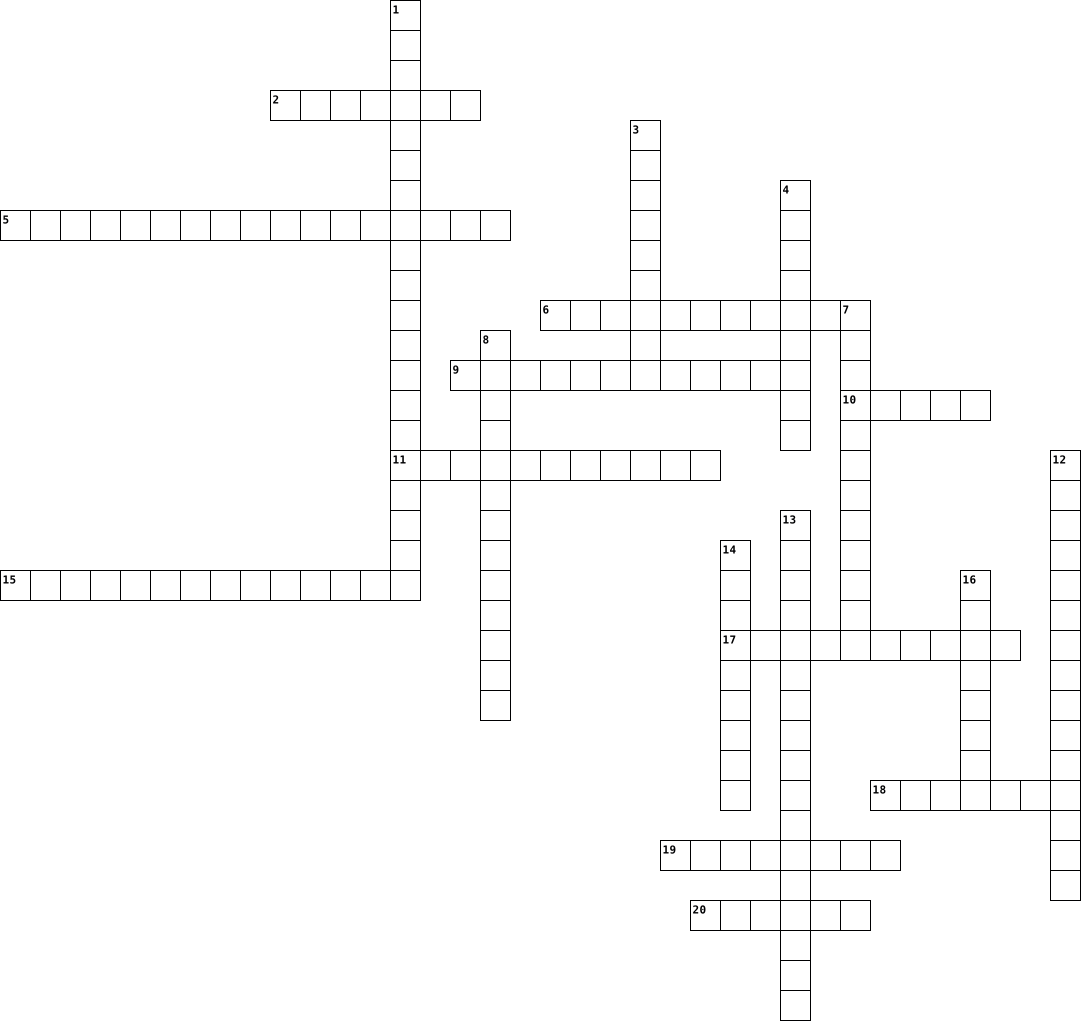
Across
- help sequester waste products
- delivers oxygen and nutrients to cells and takes away wastes
- pumping blood or processing and utilizing nutrients
- provides protection for a cell.
- self-contained group of tissues that performs a specific function in the body
- produce energy through photosynthesis and oxygen-release processes, which sustain plant growth and crop yield
- responsible for movement
- the basic structural and functional units of animal tissues and organs
- the repository of genetic information and as the cell's control center
- making proteins
- a group of cells that have similar structure and that function together as a unit
Down
- produce proteins for the rest of the cell to function
- holding the components of the cell and protects them from damage
- eukaryotic cells that vary in several fundamental factors from other eukaryotic organisms
- generate the energy necessary to power cells
- helps all the parts of the body to communicate with each other
- converts the foods we eat into their simplest forms
- move fresh air into your body while removing waste gases
- a subcellular structure that has one or more specific jobs to perform in the cell
- separates the interior contents of the cell from the exterior environment
20 Clues: making proteins • responsible for movement • help sequester waste products • provides protection for a cell. • generate the energy necessary to power cells • pumping blood or processing and utilizing nutrients • converts the foods we eat into their simplest forms • produce proteins for the rest of the cell to function • ...
cells 2023-12-18
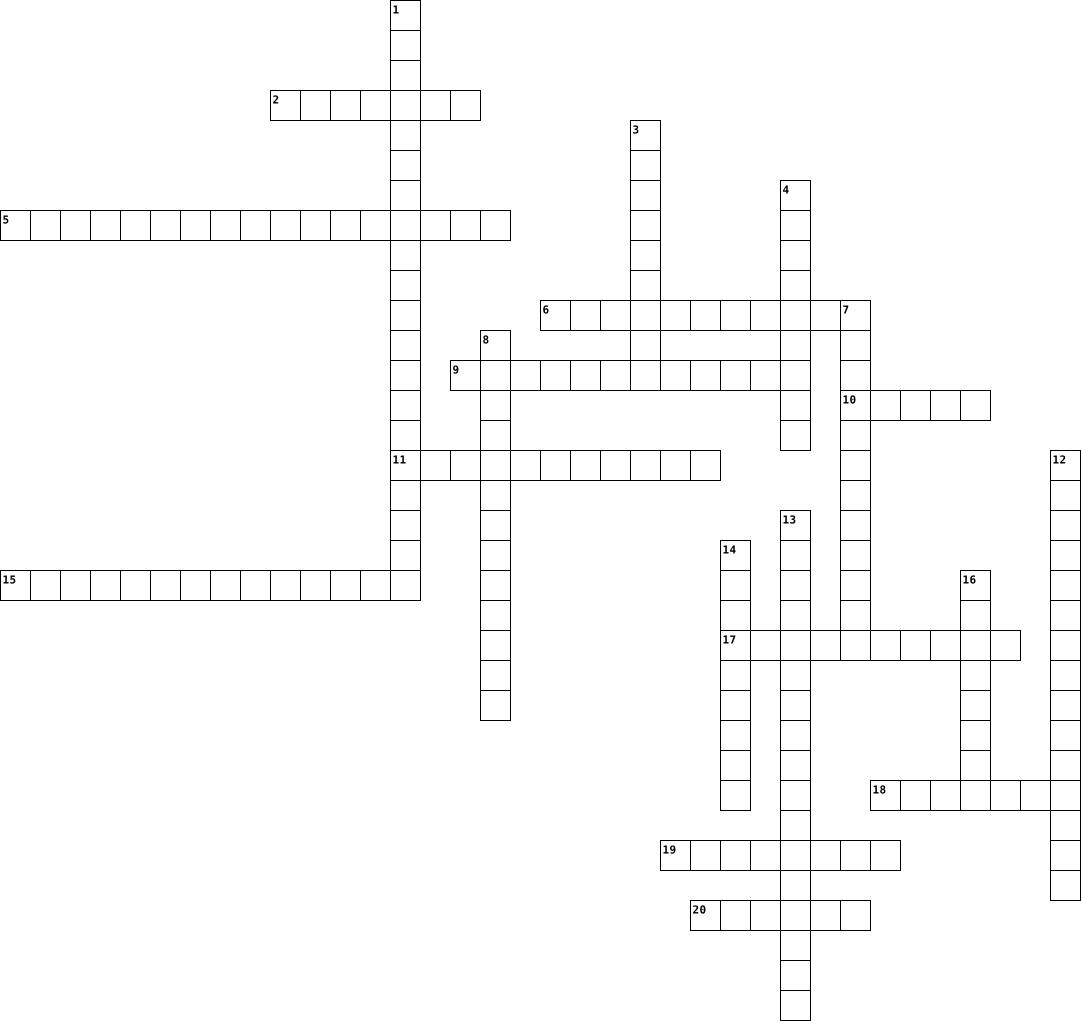
Across
- help sequester waste products
- delivers oxygen and nutrients to cells and takes away wastes
- pumping blood or processing and utilizing nutrients
- provides protection for a cell.
- self-contained group of tissues that performs a specific function in the body
- produce energy through photosynthesis and oxygen-release processes, which sustain plant growth and crop yield
- responsible for movement
- the basic structural and functional units of animal tissues and organs
- the repository of genetic information and as the cell's control center
- making proteins
- a group of cells that have similar structure and that function together as a unit
Down
- produce proteins for the rest of the cell to function
- holding the components of the cell and protects them from damage
- eukaryotic cells that vary in several fundamental factors from other eukaryotic organisms
- generate the energy necessary to power cells
- helps all the parts of the body to communicate with each other
- converts the foods we eat into their simplest forms
- move fresh air into your body while removing waste gases
- a subcellular structure that has one or more specific jobs to perform in the cell
- separates the interior contents of the cell from the exterior environment
20 Clues: making proteins • responsible for movement • help sequester waste products • provides protection for a cell. • generate the energy necessary to power cells • pumping blood or processing and utilizing nutrients • converts the foods we eat into their simplest forms • produce proteins for the rest of the cell to function • ...
8 Matter and Energy U2 L1 Intro to Energy 2025-03-04

Across
- Potential energy is the energy of ____
- ____ energy is the energy of an object that is due to motion
- ____ potential energy depends on chemical composition
- Kinetic energy ____ as mass increases
- ____ energy is the energy that an object has due to its position, condition etc
- This energy is kinetic energy caused by the vibration of particles
- Space ____ includes any activity happening in space that mifht affect Earth's environment
- The ____ energy of an object is the kinetic energy of its particles
- ____ energy is transmitted through space in the form of electromagnetic waves
- This is the ability to cause change
- ____ energy is a form of potential energy The amount of this energy depends on molecules, atoms and their arrangements
- The ____ of an atom is the source of nuclear energy
- ____ potential energy increases as the object's height or mass increases
Down
- Energy is expressed in ____
- Energy ____ takes place when energy changes from one form into another form
- Electromagnetic energy includes ____ ____
- This is one of the general types of energy
- Kinetic energy is the energy of ____
- An object can have ____ potential and kinetic energy at that same time
- The more ____ an object has the more thermal energy it has
- Kinetic energy increases as ____ increases
- Space weather can affect ____
- All ____ objects have kinetic energy
- ____ energy is the energy that results from the position of motion of charged particles
- Space weather can ground ____
- ____ energy is the sum of an object's kinetic energy and potential energy
26 Clues: Energy is expressed in ____ • Space weather can affect ____ • Space weather can ground ____ • This is the ability to cause change • Kinetic energy is the energy of ____ • All ____ objects have kinetic energy • Kinetic energy ____ as mass increases • Potential energy is the energy of ____ • Electromagnetic energy includes ____ ____ • This is one of the general types of energy • ...
Chapter 9 Crossword - Brooklyn McCracken 2019-09-11

Across
- the basic unit of a chemical element
- positive electric charge
- model of atomic structure
- negative charge
- the central and most important part of an object
Down
- each of two or more forms of the same element
- has no charge
- spherical with its center as the nucleus
- electrons a electron in the outermost energy
- an atom or molecule with a net electric charge
10 Clues: has no charge • negative charge • positive electric charge • model of atomic structure • the basic unit of a chemical element • spherical with its center as the nucleus • electrons a electron in the outermost energy • each of two or more forms of the same element • an atom or molecule with a net electric charge • the central and most important part of an object
Nuclear Energy Crossword 2023-11-01

Across
- High-energy, short-wavelength, electromagnetic radiation emitted from the nucleus of an atom.massnumber
- the center of an atom
- subatomic particle with the same mass as an atom
- an atomic particle that occurs in the nucleus of every atom and carries a positive charge equal in size to the negative charge of an electron radioactivity.
- two atoms combine to form a heavier atom that releases massive amounts of energy
Down
- negatively charged particle identical to a high-energy electron.half-life
- the number of protons in the nucleus of an atom, which determines the chemical properties of an element and its place in the periodic table.
- atoms are split apart and release energy
- particles consisting of 2 protons and 2 neutrons tightly bound together
- each of two or more forms of the same element that contain equal numbers of protons but different numbers of neutrons in their nuclei chain reaction.
10 Clues: the center of an atom • atoms are split apart and release energy • subatomic particle with the same mass as an atom • particles consisting of 2 protons and 2 neutrons tightly bound together • negatively charged particle identical to a high-energy electron.half-life • two atoms combine to form a heavier atom that releases massive amounts of energy • ...
Unit B Topic 1 2024-10-19

Across
- temperature scale based on absolute zero
- heat transfer between things in contact with each other
- breeze that occurs at night
- a measure of how fast particles are moving
- amount of energy particles have
- force that resists sliding between two objects
- type of motion that explains how particles move randomly
- heat transfer that does not involve particles
- to do with heat
Down
- heat transfer in fluids; forms currents
- to do with motion
- temperature scale based on water
- temperature scale not used in science
- breeze that occurs during the day
14 Clues: to do with heat • to do with motion • breeze that occurs at night • amount of energy particles have • temperature scale based on water • breeze that occurs during the day • temperature scale not used in science • heat transfer in fluids; forms currents • temperature scale based on absolute zero • a measure of how fast particles are moving • ...
Energy Vocabulary 2023-05-01

Across
- resources that exist in limited quantities, and, once used, cannot be replaced except over the course of millions of years
- resources that can be replaced in a relatively short period of time
- oil, natural gas, and coal; they were formed underground from the remains of once-living organisms
- the energy associated with electric charges
- generates electricity by reacting hydrogen with oxygen
- process of changing energy from one form to another
- the chemical energy stored in living things
- energy of motion; equal to 1/2mv2
- the energy stored in chemical bonds
- finding ways to use less energy or to use energy more efficiently
Down
- energy obtained from flowing water
- a form of energy that travels through space in the form of waves
- potential energy of an object that is stretched or compressed
- total potential and kinetic energy of all the microscopic particles in an object
- energy that is stored as a result of position or shape
- potential energy that depends upon an object's height; equal to mgh
- energy associated with the motion and position of everyday objects
- thermal energy beneath the Earth's surface
- energy stored in atomic nuclei
- sunlight that is converted into usable energy
- the ability to do work
21 Clues: the ability to do work • energy stored in atomic nuclei • energy of motion; equal to 1/2mv2 • energy obtained from flowing water • the energy stored in chemical bonds • thermal energy beneath the Earth's surface • the energy associated with electric charges • the chemical energy stored in living things • sunlight that is converted into usable energy • ...
Glencoe Biology Chapter 2 - Principles of Ecology 2023-12-07

Across
- process in which elements, chemical compounds, and other forms of matter are passed from one organism to another and from one part of the biosphere to another
- the study of the relationships between living organisms, including humans, and their physical environment
- the chemical processes by which atmospheric nitrogen is assimilated into organic compounds
- the portion of Earth that supports life
- a model representing the many interconnected food chains and pathyways in which energy flows through a group of organisms
- an organism which eat fragments of dead matter in an ecosystem and returns nutrients to the environment
- process in which fixed nitrogen compounds are converted back into nitrogen gas and returned to the atmosphere
- shows the continuous movement of water within the Earth and atmosphere
- the act of one organism consuming an other organism for food
- a relationship between two or more organisms that live closely together and benefit from each other
- The change of state from a gas to a liquid
- a group of interacting populations that occupy the same geographic area at the same time
- the nonliving factors in an organism's environment
- any substance that has mass and takes up space by having volume
- substance used by an organism to survive, grow, and reproduce.
- Any form of water that falls from clouds and reaches Earth's surface.
- the living factors in an organism's environment
- the close relationship that forms when two or more species live together
Down
- a relationship where one organism benefits at the expense of another
- an organism that gets its energy requirements from consuming other organisms
- a heterotroph that only eats plants
- individual organisms of a single species that share the same geographic location at the same time
- A carnivore that feeds on the bodies of dead organisms
- a heterotroph that eats both plants and animals
- a biological commuunity and all of the biotic and abiotic factors that affect it
- a role or position that an organism has in its environment
- The change of a substance from a liquid to a gas
- a relationship where one organism benefits and the other is neither hurt nor helped
- where an organism lives
- step in a food chain or web
- the total mass of living matter at a trophic level
- a simple model that shows how energy flows through an ecosystem
- an organism that collects energy from sunlight or inorganic substances to produce food
- a large group of ecosystems that share the same climate and have similar types of communities
- a heterotroph that preys on other heterotrophs
35 Clues: where an organism lives • step in a food chain or web • a heterotroph that only eats plants • the portion of Earth that supports life • The change of state from a gas to a liquid • a heterotroph that preys on other heterotrophs • a heterotroph that eats both plants and animals • the living factors in an organism's environment • ...
8.1 CW 2 2024-09-23

Across
- the layer of rock that forms Earth’s outer surface, which includes both dry land and the ocean floor
- All the oceans, rivers, lakes and water on Earth. It comes from the word “Hydro” which means “water.”
- the amount of matter in an object
- dark, fine-grained rock that makes up most of the oceanic crust
- the process of changing one form of energy to another
- layer of earth that is made mostly of the metals iron and nickel, and consists of two parts
- the process of moving things from one place to another.
- The bouncing back of a wave when it hits a surface through which it cannot pass.
- layer of molten metal surrounding the inner core
- process of breaking down of rocks and land due to forces such as gravity, wind, water and ice
- crust that lies beneath the ocean
- The bending of a wave as it passes at an angle from one medium to another
- type of force that destroys and wear away landmasses through processes like erosion and weather
- the soft layer of the upper-mantle on which the lithosphere floats
- seismic waves that can vibrate from side to side
- an element subject to spontaneous degeneration (decay) of its nucleus accompanied by the emission of alpha particles, beta particles, or gamma rays
Down
- All the living things on Earth. It comes from the word “Bio” which means “life.”
- the crust that forms the continents
- vibrations that travel through Earth carrying the energy released during an earthquake
- the amount of space that matter occupies
- this layer is formed with the crust and rigid upper mantle, and is above the asthenosphere
- a dense sphere of solid metal
- a rock that is usually a light color and has coarse grains and makes up most of the continental crust
- The conversion of one form of energy into another, or the movement of energy from one place to another.
- the measurement of how much mass of a substance is contained in a given volume
- This is a process in which more dense materials of a planet sink to the center, while less dense materials stay on the surface.
- Process in which sediment is laid down in new locations
- seismic waves that compress and expand the ground like an accordion
- the movement of a fluid, caused by differences in temperature, that transfers heat from one part of the fluid to another
- type of force that shapes the land’s surface by building up mountains and other landmasses.
- All the rock, soil and sediments that makeup Earth’s land. It comes from the word “Geo” which means “Earth.”
- the rigid layer of the lower-mantle and extends down to Earth’s core
- the layer of hot, solid material between Earth’s crust and core
- Movement caused by warm fluids rising and cooler fluids sinking.
- transfer of thermal energy between materials because of collisions between particles
- A description of surface features of land.
- the physical force exerted on an object
37 Clues: a dense sphere of solid metal • the amount of matter in an object • crust that lies beneath the ocean • the crust that forms the continents • the physical force exerted on an object • the amount of space that matter occupies • A description of surface features of land. • layer of molten metal surrounding the inner core • seismic waves that can vibrate from side to side • ...
Science Terms 2021-12-14

Across
- a harmful thing that has negative effects on organisms and can be poisonous, also has many different forms
- a consumer that eats plants or decomposers
- an animal that only eats meat
- a group of different species in an area
- a chain that shows where each organism involved gets their energy
- a factor in an ecosystem that is living or once lived
- a system of biotic and abiotic factors
- an animal that eats a variety of foods
- an organism that gets its energy from the sun
- an animal that only eats plants
- any living thing
- the process that plants go through in order to make food for themselves
- a symbiotic relationship in which one benefits while the other is unaffected
- a symbiotic relationship in which one organism benefits while the other is harmed
- a home and/or food source for parasites
- a consumer that eats primary consumers or plants and primary consumers (carnivore or omnivore)
Down
- a species that doesn't naturally live in it's habitat and can harm the native organisms there
- a consumer that eats secondary consumers and primary consumers
- a factor in an ecosystem that is non-living and has never lived
- a symbiotic relationship in which both organisms involved benefit from each other
- two or more food chains mixed together to better show how the process of getting energy works
- contains all ecosystems
- an organism that gets its energy from eating other organisms
- an organism that breaks down dead plants or animals and returns nutrients back to the soil
- the amount of organisms of a certain species
- the variety in species in an area
- the study of ecosystems
- an organism that harms its host
28 Clues: any living thing • contains all ecosystems • the study of ecosystems • an animal that only eats meat • an animal that only eats plants • an organism that harms its host • the variety in species in an area • a system of biotic and abiotic factors • an animal that eats a variety of foods • a group of different species in an area • a home and/or food source for parasites • ...
Stellar Evolution Crossword Puzzle #2 - Massive Stars 2025-03-07

Across
- Ripples in spacetime caused by accelerating massive objects like merging neutron stars.
- High-energy radiation often emitted by neutron stars and black hole accretion disks.
- The leftover structure after a supernova explosion, which can be a neutron star or black hole.
- A massive explosion that occurs when a high-mass star reaches the end of its life cycle.
- A key element fused in the late stages of a high-mass star’s life before iron forms.
- A neutron star with an extremely strong magnetic field, capable of releasing powerful bursts of energy.
- The force that prevents a star from collapsing under gravity, arising from quantum mechanics.
- The heaviest element that can be fused in a star’s core before it collapses.
- The event that triggers a supernova when a massive star’s core runs out of fusion fuel.
- The process by which lighter elements combine to form heavier ones, releasing energy in stars.
Down
- Extremely energetic electromagnetic waves released during neutron star mergers or supernovae.
- The process by which new atomic nuclei are formed in stars and during supernovae.
- The powerful energy burst that propagates outward during a supernova explosion.
- The incredibly dense remnant left behind after a massive star collapses in a supernova.
- The observatory that first detected gravitational waves from neutron star mergers.
- A rapidly spinning neutron star that emits beams of electromagnetic radiation.
- The quantum mechanical effect that prevents electrons or neutrons from being squeezed indefinitely.
- A swirling structure of gas and dust surrounding a black hole or neutron star.
- A heavy element formed in neutron star mergers, explaining its cosmic origins.
- Scientists at this university helped confirm that neutron star mergers produce heavy elements like gold.
20 Clues: The heaviest element that can be fused in a star’s core before it collapses. • A rapidly spinning neutron star that emits beams of electromagnetic radiation. • A swirling structure of gas and dust surrounding a black hole or neutron star. • A heavy element formed in neutron star mergers, explaining its cosmic origins. • ...
Chapter 5 vocabulary 2020-02-06

Across
- A number in front of a chemical formula in an equation that indicates how many molecules or atoms of each reactant and product are involved in a reaction.
- system A system in which no matter is allowed to enter or leave
- A reaction in which one element replaces another in a compound or when two elements in different compounds trade places
- A solid in which the atoms arranged in a pattern that repeats again and again.
- A substance formed as a result of a chemical reaction.
- A chemical reaction that breaks down compounds into simpler products.
- reaction A reaction that absorbs energy.
- A type of protein that spreads up a chemical reaction in a living thing a biological catalyst.
- A material that decreases the rate of a reaction.
- conservation mass The principle that the total amount of matter is neither created nor destroyed during any chemical or physical change.
Down
- equation A short easy way shows a chemical reaction using symbols.
- The amount of one material in a certain volume of another material.
- system A system in which can enter from or escape to the surroundings.
- reaction A reaction that releases energy usually in the form of heat.
- A solid that forms a solution during a chemical reaction.
- A chemical reaction in which two or more simple substances combine to form a new more complex substance.
- energy The minimum amount of energy needed to start a chemical reaction.
- A Substance that enters into a chemical reaction.
- change A change in which one or more substances combine or break apart to new substances.
- change A change that alters the form or appearance of material but does not make the material into another substance.
20 Clues: reaction A reaction that absorbs energy. • A Substance that enters into a chemical reaction. • A material that decreases the rate of a reaction. • A substance formed as a result of a chemical reaction. • A solid that forms a solution during a chemical reaction. • system A system in which no matter is allowed to enter or leave • ...
Oceanography Merit Badge 2025-10-25

Across
- a vast, flat part of the sea floor
- the zone where waves are breaking as they approach the shore
- forms the shells and skeletons of marine organisms
- strong localized currents flowing seaward from the shore
- a rapidly rising tide, has a lot of water and force behind it
Down
- the process by which producers convert light energy into chemical energy (glucose)
- the scientific study of the ocean
- currents that occur in the uppermost part of the ocean
- a type of natural barrier that provides protection from hurricanes and storms
- vertical distance between the crest and the trough
- branch that focuses on properties and processes of the ocean
- organisms that drift in water and are unable to propel themselves effectively
- the concentration of dissolved salts in seawater
- the organisms that live on, in, or near the bottom of a body of water
14 Clues: the scientific study of the ocean • a vast, flat part of the sea floor • the concentration of dissolved salts in seawater • vertical distance between the crest and the trough • forms the shells and skeletons of marine organisms • currents that occur in the uppermost part of the ocean • strong localized currents flowing seaward from the shore • ...
BJU Press Physical Science: Chapter 14 - Energy Vocab 2026-05-06

Across
- Thermal energy transferred from a warmer object to a cooler object.
- The transfer of energy when a force moves an object over a distance.
- Energy Energy from living or once-living material.
- The unit used to measure energy and work.
- Energy Resource An energy source that can be replaced naturally in a short amount of time.
- The ability to do work or cause change.
- Potential Energy Energy stored in stretched or compressed objects, such as springs or rubber bands.
- Energy Energy carried by moving electric charges.
- How fast work is done or energy is transferred.
- Energy Energy an object has because it is moving.
- A force that opposes motion and often changes motion energy into thermal energy.
- Energy Energy from heat inside the earth.
- Energy Energy from the rise and fall of ocean tides.
- Energy Energy stored in the center of an atom.
- of Conservation of Energy Energy cannot be created or destroyed, only changed from one form to another.
- Transformation A change from one form of energy to another.
Down
- Potential Energy Energy stored because of an object’s height.
- A comparison of useful energy output to total energy input.
- Energy Energy from the sun.
- A measure of the average motion energy of particles in a substance.
- Energy Stored energy due to an object’s position, shape, or condition.
- Energy Energy carried by vibrations through matter.
- Energy Electrical energy produced from moving water.
- Energy The total energy of motion and position.
- Energy Energy carried by waves that can travel through space.
- Energy Energy from moving air.
- Energy Energy related to the motion of particles in matter.
- Energy Energy stored in chemical bonds, such as in food, fuel, or batteries.
- Fuels Fuels formed from the remains of ancient organisms, such as coal, oil, and natural gas.
- Energy Resource An energy source that is used faster than it can be replaced.
30 Clues: Energy Energy from the sun. • Energy Energy from moving air. • The ability to do work or cause change. • The unit used to measure energy and work. • Energy Energy from heat inside the earth. • Energy Energy stored in the center of an atom. • Energy The total energy of motion and position. • How fast work is done or energy is transferred. • ...
20 vocab words for energy 2025-07-12

Across
- Energy: Energy carried by electromagnetic waves, like light and radio waves.
- The ability to do work or cause change.
- A unit of electrical power.
- Energy: Stored energy due to an object's position or condition.
- A measure of how effectively energy is converted from one form to another.
- Energy: The sum of potential and kinetic energy in a system.
- Energy: Energy associated with the random motion of atoms and molecules in a substance; heat.
- The process of energy changing from one form to another.
Down
- The rate at which energy is transferred or transformed.
- Energy: Energy associated with the flow of electric charge.
- Energy: Energy that is visible to the human eye.
- Energy: Energy of motion.
- Energy: Energy stored in the bonds of molecules.
- A substance that is burned to produce energy.
- Energy: Energy stored in the nucleus of an atom.
- A device that converts mechanical energy into electrical energy.
- A material that resists the flow of energy.
- A material that allows energy to flow through it easily, such as electricity or heat.
- Energy: Energy carried by sound waves, produced by vibrations.
- Energy: Energy derived from the sun.
20 Clues: Energy: Energy of motion. • A unit of electrical power. • Energy: Energy derived from the sun. • The ability to do work or cause change. • A material that resists the flow of energy. • A substance that is burned to produce energy. • Energy: Energy that is visible to the human eye. • Energy: Energy stored in the bonds of molecules. • ...
drug & alcoholic 2012-11-29

Across
- produced from grapes?
- originally distilled from fermented wheat mash
- small tablets in various sizes and colours
- an alcoholic liquor distilled from wine or fermented fruit juice
- produced from a plant with the scientific name Cannabis sativa?
- an alcoholic made out of lemon?
- made worldwide
Down
- from germany
- made from the plant Cannabis sativa?
- made from corn
- made in backyard laboratories and sold illegally
- made from any variety of apple?
- an alcoholic made out of grapes?
- It is best grown in a warm climate?
- the energy release
- drinks that from barley and hops?
- used in three main forms: marijuana, hashish and hash oil
- dried milk of the opium poppy
- made from sugarcane byproducts
19 Clues: from germany • made from corn • made worldwide • the energy release • produced from grapes? • dried milk of the opium poppy • made from sugarcane byproducts • made from any variety of apple? • an alcoholic made out of lemon? • an alcoholic made out of grapes? • drinks that from barley and hops? • It is best grown in a warm climate? • made from the plant Cannabis sativa? • ...
Waves 2021-05-23

Across
- perpendicular to the direction of the wave
- highest point of a wave
- When an object causes a wave to change direction and bend around it
- the number of wavelengths that pass a fixed point each second
- repeating disturbances or movement that transfers energy through matter or space
- particles in a longitudinal wave are closest together
- when light bounces off a surface
- the size of a disturbance from a wave
- parallel with direction
Down
- a place in a wave where the molecules are far apart
- when two or more waves overlap and combine to form a new wave
- process by which an object is made to vibrate by absorbing energy at its natural frequencies
- Wave bends due to change of speed
- lowest point of a wave
- the distance between one point on a wave and the nearest point just like it
- waves that can travel through earth and along the surface
- The amount of time it takes one wavelength to pass a point
- the matter through which mechanical waves travel
- What type of waves can be either transverse or compressional
- Forms when waves equal in wavelength and amplitude
20 Clues: lowest point of a wave • highest point of a wave • parallel with direction • when light bounces off a surface • Wave bends due to change of speed • the size of a disturbance from a wave • perpendicular to the direction of the wave • the matter through which mechanical waves travel • Forms when waves equal in wavelength and amplitude • ...
cells 2023-12-18
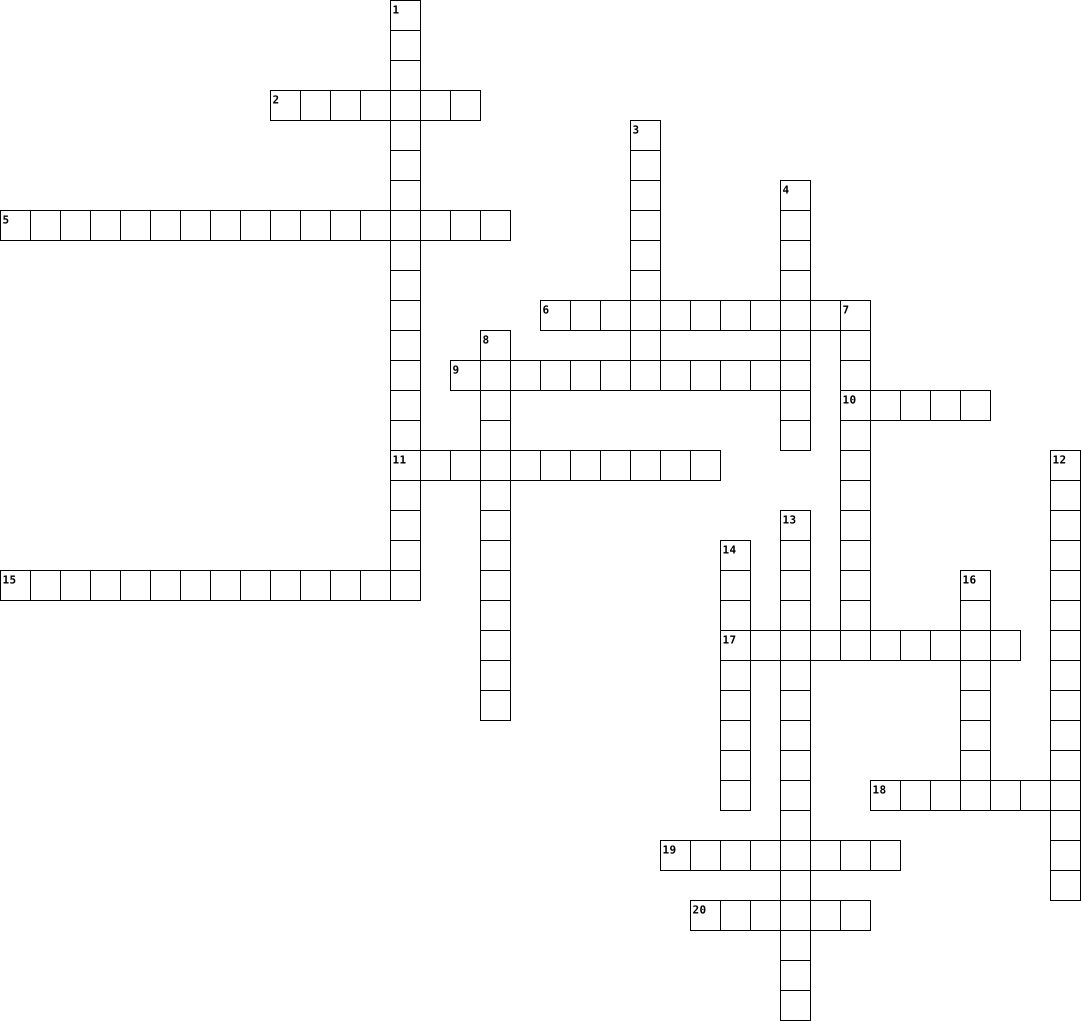
Across
- help sequester waste products
- delivers oxygen and nutrients to cells and takes away wastes
- pumping blood or processing and utilizing nutrients
- provides protection for a cell.
- self-contained group of tissues that performs a specific function in the body
- produce energy through photosynthesis and oxygen-release processes, which sustain plant growth and crop yield
- responsible for movement
- the basic structural and functional units of animal tissues and organs
- the repository of genetic information and as the cell's control center
- making proteins
- a group of cells that have similar structure and that function together as a unit
Down
- produce proteins for the rest of the cell to function
- holding the components of the cell and protects them from damage
- eukaryotic cells that vary in several fundamental factors from other eukaryotic organisms
- generate the energy necessary to power cells
- helps all the parts of the body to communicate with each other
- converts the foods we eat into their simplest forms
- move fresh air into your body while removing waste gases
- a subcellular structure that has one or more specific jobs to perform in the cell
- separates the interior contents of the cell from the exterior environment
20 Clues: making proteins • responsible for movement • help sequester waste products • provides protection for a cell. • generate the energy necessary to power cells • pumping blood or processing and utilizing nutrients • converts the foods we eat into their simplest forms • produce proteins for the rest of the cell to function • ...
Unit 1 Mechanics 2020-11-17

Across
- In a closed system with no external forces the energy of the system before an event is equal to the energy of the system after the event. The energy does not need to be in the same form after the event as it was before the event.
- Every action has an equal and opposite reaction. If an object A exerts a force on object B, object B will exert a force of equal magnitude but of opposite direction on object A.
- A quantity with magnitude and direction (e.g. velocity, acceleration, force).
- The resistance against the motion of an object through a fluid. It is usually proportional to the speed of the object.
- Force The sum of all forces on an object.
- The change of momentum of an object when a force acts on it. Equal to the area underneath a force-time graph.
- The energy an object has due to its motion. It is the amount of energy that would be transferred from the object when it decelerates to rest.
- the resultant force on the object is zero.
- A force applied over a distance, it is the energy transferred in that distance.
- When the kinetic energy of a system before an event is not equal to the kinetic energy of the system after the event. The kinetic energy has been transferred to other forms.
- The energy gained by an object when it is raised by a height in a gravitational field.
Down
- The force of gravity on an object, the product of the object’s mass and the acceleration due to gravity.
- The average point of all parts of an object weighted according to their mass. It is the point through which the total mass of the object is said to act.
- A force acting perpendicular to the flow of air or liquid around an object, typically upwards and against the force of gravity.
- The product of an object’s mass and its velocity.
- Any object acted upon only by the force of gravity
- When the kinetic energy of a system before an event is equal to the kinetic energy of the system after the event.
- In a closed system with no external forces the momentum of the system before an event is equal to the momentum of the system after the event.
- If an object is acted upon by a resultant force it will accelerate. The acceleration is inversely proportional to the mass of the object and directly proportional to the force acting upon it.
- The useful output (e.g. power, energy) of a system divided by the total output
- An object is at equilibrium when the moments on it about a point are balanced
- The maximum velocity an object can achieve. It is the point at which frictional forces and driving forces are balanced and so no acceleration occurs and the resultant force on the object is 0 N.
- The resistance against the motion of an object. This could be caused by the air passing over the object or by the contact of the object with the surface it is moving on.
- The rate of change of momentum of an object. The product of the object’s mass with its acceleration.
- The work done by a system divided by the time taken for that work to be done.
- An object at a constant velocity will remain at a constant velocity unless acted on by an external resultant force.
- The product of a force and the perpendicular distance from the line of action to the pivot about which the force is acting.
- A quantity with only magnitude and no direction (e.g. mass, energy, length).
28 Clues: Force The sum of all forces on an object. • the resultant force on the object is zero. • The product of an object’s mass and its velocity. • Any object acted upon only by the force of gravity • A quantity with only magnitude and no direction (e.g. mass, energy, length). • An object is at equilibrium when the moments on it about a point are balanced • ...
Rockin Crossword 2019-10-03

Across
- Igneous rock that forms when lava erupts, or extrudes, onto Earth’s surface
- The chemical make up of a rock; describes either the minerals or other materials in rock
- a rock that forms from other rocks as a result of intense heat, pressure, or chemical processes
- the natural process by which atmospheric and environmental agents, such as wind, rain, and temperature changes, disintegrate and decompose rocks
- the series of processes in which rock forms, changes from one type to another, is broken down or melted, and forms again by geologic
- type of sedimentary rock that forms when sediments are buried, compacted, and cemented together by calcite or quartz
- type of sedimentary rock that forms from the remains or fossils, of once-living plants and animals
Down
- the quality of a rock that is based on the sizes, shapes, and positions of the rock’s grains
- what happens When magma pushes into, or intrudes, surrounding rock below Earth’s surface and cools, the rock that forms
- Metamorphic rocks that do not have mineral grains that are aligned in planes or bands
- a rock that forms from compressed or cemented layers of sediment
- The metamorphic process in which mineral grains are arranged in planes or bands
- rock that forms when magma cools and solidifies
- type of sedimentary rock that form when water, usually seawater, evaporates
- a naturally occurring solid mixture of one or more minerals or organic matter
15 Clues: rock that forms when magma cools and solidifies • a rock that forms from compressed or cemented layers of sediment • Igneous rock that forms when lava erupts, or extrudes, onto Earth’s surface • type of sedimentary rock that form when water, usually seawater, evaporates • a naturally occurring solid mixture of one or more minerals or organic matter • ...
Inside Earth Chapter 2 Key Terms 2016-04-18

Across
- a type of seismic wave that moves the ground up and down or side-to-side
- the force that opposes the motion of one surface as it moves across another surface
- a type of fault where the hanging wall slides upward; caused by compression in the crust
- an earthquake that occurs after a larger earthquake in the same area
- a type of fault in which rocks on either side move past each other sideways with little up or down movement
- a device that records ground movements caused by seismic waves as they move through Earth
- a type of seismic wave that forms when P waves and S waves reach Earth's surface
- a scale that rates earthquakes by estimating the total energy released by an earthquake
- the measurement of an earthquake's strength based on seismic waves and movement along faults
- an upward fold in rock formed by compression of Earth's crust
- a type of fault where the hanging wall slides downward; caused by tension in the crust
- the point on Earth's surface directly above an earthquake's focus
Down
- stress that squeezes rock until it folds or breaks
- a downward fold formed by compression in Earth's crust
- a scale that rates an earthquake's magnitude based on the size of its seismic waves
- a scale that rates earthquakes according to their intensity and how much damage they cause at a particular place
- the process by which an earthquake's violent movement suddenly turns loose soil into liquid mud
- a building mounted on bearings designed to absorb the energy of an earthquake
- the block of rock that forms the upper half of a fault
- the block of rock that forms the lower half of a fault
- stress that pushes masses of rock in opposite directions, in a sideways movement
- the record of an earthquake's seismic waves produced by a seismograph
- the point beneath Earth's surface where rock breaks under stress and causes an earthquake
- stress that stretches rock so that it becomes thinner in the middle
- a large wave produced by an earthquake on the ocean floor
- the shaking that results from the movement of rock beneath Earth's surface
- a large area of flat land elevated high above sea level
- a type of seismic wave that compresses and expands the ground
- a force that acts on rock to change its shape or volume
29 Clues: stress that squeezes rock until it folds or breaks • a downward fold formed by compression in Earth's crust • the block of rock that forms the upper half of a fault • the block of rock that forms the lower half of a fault • a large area of flat land elevated high above sea level • a force that acts on rock to change its shape or volume • ...
Biology I - Crossword #1: Words starting with the letters B and C 2025-05-27

Across
- particular preference or point of view that is personal, rather than scientific
- total of the variety of organisms in the biosphere, also called biological diversity
- scientific study of life
- disorder in which some of the body’s cells lose the ability to control growth
- organisms that live attached to or near the bottom of lakes, streams, or oceans
Down
- a group of ecosystems that share similar climates and typical organisms
- dense covering formed by the leafy tops of tall rain forest trees
- organism that obtains energy by eating animals
- total amount of living tissue within a given trophic level
- part of Earth which life exists including land, water, and air or atmosphere
- measure of heat energy in food
- substance that speeds up the rate of a chemical reaction
- basic unit of all forms of life
13 Clues: scientific study of life • measure of heat energy in food • basic unit of all forms of life • organism that obtains energy by eating animals • substance that speeds up the rate of a chemical reaction • total amount of living tissue within a given trophic level • dense covering formed by the leafy tops of tall rain forest trees • ...
Plural Forms of a Word 2022-11-03

Across
- group of human beings
- top of your house or dwelling
- homes numbers where someone lives
- small insects
- places that make and sell things
- photographs
- boundary around your property or home
Down
- nations with their own government
- teaching given at one time
- opinions without exact knowledge
- people you enjoy spending time with
- more than one life
- a female human being
- people related to you
- parts of a tree
- baby cows
- tools to glide through the snow
- small dark red fruit
18 Clues: baby cows • photographs • small insects • parts of a tree • more than one life • a female human being • small dark red fruit • group of human beings • people related to you • teaching given at one time • top of your house or dwelling • tools to glide through the snow • opinions without exact knowledge • places that make and sell things • nations with their own government • ...
Forms of Government Grant Garton 2020-09-18

Across
- A person who is elected or chosen to represent a person or group of people.
- Having to do with the central authority of a confederation, which has little to no power and generally answers to the states that make it up.
- A form of government where a small, elite, and usually rich class are in control.
- Having to do with the central government of a federation, which has power over and essentially rules over the smaller sub-units of government.
- A form of government, where government takes no form because it doesn't exist (there is no government).
- The document from which the powers and means of a government/governments are anointed.
- A country ruled with force by one person.
- The separation of religion and something, or meaning that something is non-religious.
Down
- A form of government where one person has complete power with no restrictions.
- A form of government where a central government exists and makes all of the decisions, with no smaller governments existing under it.
- A form of government where the workers have control (similar to communism).
- A form of government where people elect representatives to vote and run the government for them.
- The equivalent of the legislative branch of government in a parliamentary system.
- A form of government where people rule themselves by voting.
- The government or head of government has a lot of control over its citizen's lives.
- A form of government where few people or a small group have control and rule.
- A form of government that is ruled by the head of a religion and governed by a religions text.
- A form of government with one person in control for life, and that position being passed down through their family.
18 Clues: A country ruled with force by one person. • A form of government where people rule themselves by voting. • A form of government where the workers have control (similar to communism). • A person who is elected or chosen to represent a person or group of people. • A form of government where few people or a small group have control and rule. • ...
Forms of Government - Anna Pontious 2020-09-17

Across
- relating to a system of government in which several states form a unity but remain independent in internal affairs
- a system of government by one person with absolute power
- rule by force
- an organization which consists of a number of parties or groups united in an alliance or league
- rule by King or Queen
- created by the founding fathers
- the highest legislature, consisting of the sovereign, the House of Lords, and the House of Commons
- denoting attitudes, activities, or other things that have no religious or spiritual basis
- religion is a big part of the government
Down
- does what the people want
- group of people running government together
- rules voted on by whole community
- a small group of people having control of a country, organization, or institution
- People give up some freedoms to get protection
- wealthy families run government
- people vote for representatives
- provides protection and other services to the people
- forming a single or uniform entity
18 Clues: rule by force • rule by King or Queen • does what the people want • wealthy families run government • people vote for representatives • created by the founding fathers • rules voted on by whole community • forming a single or uniform entity • religion is a big part of the government • group of people running government together • People give up some freedoms to get protection • ...
Ch. 10 Forms of Ownership 2026-03-27

Across
- Business owned by a group of people and authorize by the state in which it is located to act as though it were a single person, separate from its owners
- A person who starts, manages, and owns a business
- Situation when an agent, or someone who works for another, pursues their own interest over their employers
- An employee who is given funds and freedom to create a special unit of department within a company in order to develop a new product, process or service
- A written agreement between two or more people identifying how the partners will add capital, labor, or other assets and divide any profits
- Business owned and managed by one person
- Ruling body of a corporation
- Corporation that offers its shares of stock for public sale
Down
- When each partneris personally liable for all the debts incurred by the partnership
- A written document that describes the nature of the business, its goals and objectives, and how they will be achieved
- Official document through which a state grants the power to operate as a corporation
- Corporation that does not offer its shares of stock for public sale
- Business owned by two or more people
- Partnership with at least one general partner who has unlimited liability and at least one limited partner whose liability is limited to his or her investment
- Owners of a corporation
- Person who owns and manages a business and often performs the day-to-day tasks, with the help of hired employees
- Top executive who is hired to manage a business
- Person or business to whom money is owed
18 Clues: Owners of a corporation • Ruling body of a corporation • Business owned by two or more people • Business owned and managed by one person • Person or business to whom money is owed • Top executive who is hired to manage a business • A person who starts, manages, and owns a business • Corporation that offers its shares of stock for public sale • ...
Current Electricity & Circuits 2024-12-12

Across
- Man's best friend
- Energy from the Sun, captured using solar panels or other devices to create electricity or heat.
- Has a trunk
- A material that does not allow electricity to flow through it easily, like rubber or plastic.
- A device that stores electrical energy and provides it to a circuit as voltage.
- A unit used to measure voltage, or the force that moves electric current.
- How well a device converts electrical energy into useful work, without wasting energy as heat or other forms.
- Energy generated by using water flow (usually from a dam or river) to turn turbines and produce electricity.
- Energy produced by the movement of air (wind), which is captured by wind turbines to generate electricity.
- A unit used to measure the amount of electric current flowing in a circuit.
- Likes to chase mice
- A material that allows electricity to flow through it easily, like metals (e.g., copper).
- A material that can conduct electricity with no resistance at very low temperatures, meaning no energy is lost as heat.
- Energy from sources that cannot be replaced once used up, like coal, oil, or natural gas.
- A component in a circuit that limits or controls the flow of electric current.
- Energy from organic materials like plants or animal waste, which can be burned to create electricity or heat.
- A device used to open or close a circuit, turning the flow of electricity on or off.
- A type of circuit where the components are connected in multiple paths, so the current can flow through more than one path at the same time.
- Point A place in an electrical circuit where two or more wires or components meet.
- An instrument used to measure the electric current in a circuit, usually in amperes (A).
- Flying mammal
- A rule that says the current in a circuit equals the voltage divided by the resistance. (V = I × R)
Down
- Fuel made from the remains of ancient plants and animals, like coal, oil, and natural gas. These are non-renewable.
- Energy from the heat inside the Earth, often used for heating or generating electricity.
- Large marsupial that hops
- An instrument used to measure the voltage (electric pressure) across two points in a circuit, usually in volts (V).
- The flow of electric charge (like the flow of water through a pipe), usually measured in amperes (A).
- Energy produced by splitting atoms in a process called fission, which releases a lot of energy.
- A material that can conduct electricity under some conditions but not others, like silicon in computers. It is somewhere between a conductor and an insulator.
- A measure of how much a material or object resists the flow of electricity, like a narrow pipe that slows down water.
- A type of circuit where all the components are connected one after another, so the current flows through each component.
- Energy produced from the movement of ocean tides, often used to turn turbines and generate electricity.
- The electric "pressure" that pushes the electric current through a circuit, measured in volts (V).
- A simplified drawing of an electrical circuit, showing how all the components are connected.
- Energy from sources that can be replenished naturally, like sunlight, wind, or water.
- A unit used to measure electrical resistance, showing how difficult it is for electricity to flow through a material.
- A unit of power, measuring the rate at which electrical energy is used or produced.
- The amount of energy used or produced by an electrical device, measured in watts (W).
38 Clues: Has a trunk • Flying mammal • Man's best friend • Likes to chase mice • Large marsupial that hops • A unit used to measure voltage, or the force that moves electric current. • A unit used to measure the amount of electric current flowing in a circuit. • A component in a circuit that limits or controls the flow of electric current. • ...
Rockin Crossword 2019-10-03

Across
- Igneous rock that forms when lava erupts, or extrudes, onto Earth’s surface
- The chemical make up of a rock; describes either the minerals or other materials in rock
- a rock that forms from other rocks as a result of intense heat, pressure, or chemical processes
- the natural process by which atmospheric and environmental agents, such as wind, rain, and temperature changes, disintegrate and decompose rocks
- the series of processes in which rock forms, changes from one type to another, is broken down or melted, and forms again by geologic
- type of sedimentary rock that forms when sediments are buried, compacted, and cemented together by calcite or quartz
- type of sedimentary rock that forms from the remains or fossils, of once-living plants and animals
Down
- the quality of a rock that is based on the sizes, shapes, and positions of the rock’s grains
- what happens When magma pushes into, or intrudes, surrounding rock below Earth’s surface and cools, the rock that forms
- Metamorphic rocks that do not have mineral grains that are aligned in planes or bands
- a rock that forms from compressed or cemented layers of sediment
- The metamorphic process in which mineral grains are arranged in planes or bands
- rock that forms when magma cools and solidifies
- type of sedimentary rock that form when water, usually seawater, evaporates
- a naturally occurring solid mixture of one or more minerals or organic matter
15 Clues: rock that forms when magma cools and solidifies • a rock that forms from compressed or cemented layers of sediment • Igneous rock that forms when lava erupts, or extrudes, onto Earth’s surface • type of sedimentary rock that form when water, usually seawater, evaporates • a naturally occurring solid mixture of one or more minerals or organic matter • ...
Crossword 2021-11-09

Across
- has many different forms and can be transferred from one form to another
- a vent which transfers magma from depth to the Earth's surface through eruptions
- used to determine the location and magnitude of earthquakes
- a series of waves in a water body caused by the displacement of a large volume of water
- carried slowly by a current of water
Down
- the point on the earth's surface directly above the focus of an earthquake
- visual representations of information intended to present information quickly and clearly
- stretched or strained intensely
- process by which heat is transferred by movement of a heated fluid such as air or water
- where the heavier plate dives beneath the second plate and sinks into the mantle
- the size or extent of something
- make up Earth's lithosphere
- a planar fracture in a volume of rock
- occurs when natural tension in tectonic plates changes so rapidly that energy is displaced
14 Clues: make up Earth's lithosphere • stretched or strained intensely • the size or extent of something • carried slowly by a current of water • a planar fracture in a volume of rock • used to determine the location and magnitude of earthquakes • has many different forms and can be transferred from one form to another • ...
Structure/Properties of Matter Vocab 2025-09-08

Across
- Point: physical property that describes the temperature at which a solid will become a liquid
- the transfer of energy through the movement of a liquid.
- Mass: equals the number of protons plus electrons in an atom
- Mixtures: made of two or more substances and you can differentiate between the substances (sand)
- neutrally charged subatomic particles found in the nucleus of an atom
- pure chemical substance that is made up of two or more different elements
- positively charged subatomic particles found in the nucleus of an atom
- Electrons: electrons found in the outermost shell and involved in forming molecules
- smallest unit of matter that defines the chemical reaction
- definite volume but no fixed shape (water)
- gas that is charged and conducts electricity easily (stars, neon lights, lightning). Plasma is different from the other states of matter in that it is a high-energy state of matter.
- pure chemical substances that are made up of one type of atom
- chemical property of how easily a substance will set on fire
- physical property that describes how tightly matter is put together
- Energy: Energy that is generated by movement within an atom**
- definite shape and volume which cannot be easily changed (ice)
- Properties: properties that are measurable and can be observed, can be determined without changing the chemical properties of an object (color, hardness, area, length, strength, temperature, state of matter)
Down
- Table of Elements: table arranging all the known elements into groups with common properties. This arrangement also demonstrates trends based on those properties.
- made of two or more atoms joined together chemically; can be the same element (Oxygen) or different elements (Water)
- Energy: energy that is generated and measured by heat (kinetic energy of an atom)
- Mixtures: made of two or more substances and you cannot differentiate between the substances (salt water)
- negatively charged subatomic particles found in the electron cloud of an atom
- amount of space that an object or substance occupies (physical property)
- energy that is transferred by waves of the electromagnetic spectrum, such as sunlight.
- anything that has mass and occupies space
- Substance: matter of any form that cannot be broken down into separate elements by physical means but can be broken down using chemical changes
- chemical property of the capacity of an atom or molecule to go through a chemical reaction with another atom or molecule
- made of two or more substances that are not combined chemically
- Point: physical property that describes the temperature at which a liquid will become a gas
- no definite shape (take the shape of the container) and no definite volume (steam)
- the transfer of energy through direct contact of objects.
- Number: equals the number of protons in an atoms
- of Matter: different forms that matter can be found in
- Atomic mass unit.
- Properties: properties that can be measured only by chemically changing an object (fire)
35 Clues: Atomic mass unit. • anything that has mass and occupies space • definite volume but no fixed shape (water) • Number: equals the number of protons in an atoms • of Matter: different forms that matter can be found in • the transfer of energy through the movement of a liquid. • the transfer of energy through direct contact of objects. • ...
crossword puzzle 2025-05-07

Across
- A positively charged particle located in the nucleus of an atom.
- The smallest particle of an element that retains the properties of that element and can exist alone or combined.
- The smallest particle of a substance with all its chemical properties, composed of atoms chemically bonded.
- An atom or group of atoms with a net electrical charge due to loss or gain of electrons.
- Mass The mass of an atom, generally the sum of protons and neutrons.
- The force holding atoms together in molecules (e.g., covalent, ionic bonds).
- State The lowest energy level of an atom.
- Level Stable states of energy that electrons in an atom may occupy.
- Pure substances made of only one type of atom, which cannot be broken down chemically.
Down
- Forms of the same element differing in the number of neutrons.
- Table The tabular arrangement of elements ordered by atomic number, grouping those with similar properties.
- A particle in the nucleus with mass similar to a proton but no charge.
- Number The number of protons in the nucleus, defining the element.
- A negatively charged elementary particle orbiting the nucleus.
- A pure substance formed by chemically bonding two or more different elements.
- The central part of an atom containing protons and neutrons, holding nearly all the atom's mass.
- Fundamental particles that make up protons and neutrons.
17 Clues: State The lowest energy level of an atom. • Fundamental particles that make up protons and neutrons. • Forms of the same element differing in the number of neutrons. • A negatively charged elementary particle orbiting the nucleus. • A positively charged particle located in the nucleus of an atom. • ...
Respiratory System 2015-03-25

Across
- The windpipe.
- The gas our respiratory system helps us get rid of.
- Small tubes that lead to alveoli.
- The voice box.
- Where oxygen and carbon dioxide exchange.
- Inhaling and exhaling.
- Gas needed for cellular respiration.
Down
- Disease where bronchioles constrict making breathing difficult.
- The throat.
- chemical reaction releasing energy from food.
- Tube that splits off of the trachea.
- Material that forms the rings in the trachea.
- Sponge-like organs that contain alveoli.
- Air sacs in the lungs.
- Dome-shaped muscle under the lungs.
- Warms and filters the air coming in to our system.
16 Clues: The throat. • The windpipe. • The voice box. • Air sacs in the lungs. • Inhaling and exhaling. • Small tubes that lead to alveoli. • Dome-shaped muscle under the lungs. • Tube that splits off of the trachea. • Gas needed for cellular respiration. • Sponge-like organs that contain alveoli. • Where oxygen and carbon dioxide exchange. • chemical reaction releasing energy from food. • ...
The Bones and Muscles in the face 2025-10-28

Across
- Found in interior of eye sockets
- Forms back of skull
- Found in lower skull
- Makes up lower jaw
- Forms face and eye sockets
- Gives forehead structure
- Forms lower eye sockets
Down
- Small opening for ear canal
- Forms cheekbones
- Forms bridge of nose
- Makes lower edge of sockets
- Fills in hollow space in Sphenoid Bone
- Acts like floor of nasal cavity
13 Clues: Forms cheekbones • Makes up lower jaw • Forms back of skull • Forms bridge of nose • Found in lower skull • Forms lower eye sockets • Gives forehead structure • Forms face and eye sockets • Small opening for ear canal • Makes lower edge of sockets • Acts like floor of nasal cavity • Found in interior of eye sockets • Fills in hollow space in Sphenoid Bone
Earth Resources 2023-05-07

Across
- rock solid unweathered rock lying beneath surface deposits of soil
- Density-__________factors environmental factors like disease, parasites, and lack of food, that affect population growth
- A gas mixture of methane and carbon dioxide produced by bacterial degradation of organic matter and used as a fuel.
- resources natural resources that it is possible to use indefinitely without causing reduction in the available supply
- fuels energy sources that formed over geologic time as a result of the compression and partial decomposition of plants and other organic matter
- a plant material that is compressed by the weight of water and by other sediments that accumulate above it turning it into a light, spongy material
- A mixture of gravel, sand, and crushed stone that naturally accumulates on or close to Earth's surface.
- resources resources that exists in a fixed amount in various places in Earth's crust and can only be replaced by processes that take hundreds of millions of years
- the process whereby productive land becomes desert
- the planting of one species in a field
- the restoring of land to its original contours and the replanting of vegetation
- substances that can adversely affect the survival, health, or activities of organisms
- energy Involves global management of Earth's natural resources to ensure that current and future energy needs will be met without causing environmental damage.
- yield replaced through natural processes at the same rate as it's being used
- efficiency the use of energy resources in the ways that are most productive
- production of two usable forms of energy at the same time from the same process, which can conserve resources and generate income.
Down
- growth a pattern of growth in which population grows faster as it increases in size.
- a wide variety of different species (plants and/or animals)
- minerals left after an ore is extracted that may release harmful chemicals into ground water or surface water
- energy Energy produced by naturally occurring steam and hot water
- Density - __________ factors environmental factors like storms, droughts, floods and pollution, that affect population growth
- a natural resource that can be mined for a profit
- the use of organisms to clean up toxic wastes
- pollution occurs when pollutants in air are at quantities that become harmful to the health of humans and the environment.
- capacity the number of organisms that any given environment can support
- a gasoline and ethanol mixture used in conventional gasoline engines
- removal of trees from a forested area without adequate replanting
- resources materials or substances that the Earth provides
- __________cell Thin, transparent wafers made up of layers of boron- and phosphorus-enriched silicon that when exposed to sunlight produce an electrical current.
- process of removing salt from salt water through distillation
30 Clues: the planting of one species in a field • the use of organisms to clean up toxic wastes • a natural resource that can be mined for a profit • the process whereby productive land becomes desert • resources materials or substances that the Earth provides • a wide variety of different species (plants and/or animals) • ...
Unit 6: Atmosphere and Weather 2017-02-08

Across
- air masses that form over the ocean
- the movement of Earth in its orbit around the sun
- a vertical cylinder of rotating air that develops in the updraft of a thunderstorm
- the transfer of heated by mass movements or circulation
- produces precipitation over a large area for an extended period of time
- violent windstorms that take the formation of a rotating column of air
- makes up 78% of the atmosphere
- a mixture of gases that surrounds a planet, such as Earth
- a storm that generates lightning and thunder
- occurs when particles and gas molecules in the atmosphere reflect and bend solar rays
- a boundary that separates two air masses of different properties
Down
- includes all forms of energy that travel through space as waves
- tropical cyclones that produce sustained winds of at least 119 km per hour
- a gas molecule that is made up of three oxygen atoms
- air masses that form over land are called
- the lowest layer of the atmosphere where weather conditions exist
- the coldest layer of the atmosphere
- an immense body of air that is characterized by similar temperatures and moisture
- the transfer of heat through matter by molecular activity
- the spinning of the Earth around its axis
- forms when cold dense air moves into a region occupied by warmer air
21 Clues: makes up 78% of the atmosphere • air masses that form over the ocean • the coldest layer of the atmosphere • air masses that form over land are called • the spinning of the Earth around its axis • a storm that generates lightning and thunder • the movement of Earth in its orbit around the sun • a gas molecule that is made up of three oxygen atoms • ...
Physics 2025-03-05

Across
- the product of the force and the time over which the force acts on an object
- something that always returns to, or keeps, its original shape
- size, quantity, or extent of a physical property
- energy an object has due to its motion
- measurable property of a physical system
- branch of physics that deals with the analysis of the motion of the objects without concern for forces causing the motion
- change in an object's position over time
- SI unit of momentum
- duration or amount of time that passes between two specific points of time
- If an unbalanced force acts on an object, then it’s acceleration will be directly proportional to the net force and inversely proportional to its mass
- total energy contained within a system
- a vector quantity, a push or pull on an object, a force can change shape or velocity of an object
- the movement of an object along a straight line, where its position can only change in one direction
- a force that is exerted on an object with a constant direction and magnitude over a period of time
- every action has an equal and opposite reaction
Down
- a quantity that has magnitude and direction
- The total momentum of all objects interacting with one another remains constant regardless of the nature of the forces between the objects
- stored energy in an object due to its position
- a collision in which two objects stick together after colliding
- a collision in which the total momentum and the total kinetic energy are conserved
- a quantity defined as the product of the mass and velocity of an object
- total force acting on an object
- system that does not exchange matter or energy with its surroundings
- total change in an object's momentum is directly related to net force acting on it over a specific time interval
- plural of momentum
- inelastic material is something that is converted to other forms of energy
- event where two or more objects exert forces on each other for a relatively short period of time
- the speed of something with a given direction
- amount of matter in an object
- the rate at which an object's position changes over time without a direction
30 Clues: plural of momentum • SI unit of momentum • amount of matter in an object • total force acting on an object • energy an object has due to its motion • total energy contained within a system • measurable property of a physical system • change in an object's position over time • a quantity that has magnitude and direction • the speed of something with a given direction • ...
Nutrients Revision 2023-03-26

Across
- Diseases of the heart and blood vessels.
- Functions include collagen production, aids the absorption of iron, fights infection.
- Functions include normal vision and lining of cells.
- Nutrients that we need in small amounts.
- Sugar and starch stick to teeth enamel, which provides food source for bacteria.
- There are 4 types of these. 2 are beneficial for the body, the other 2 cause health problems such as cardiovascular disease.
- The bodies main and preferred energy source.
- We can live without this for approximately 3 days.
Down
- My food sources include Oily fish that contains omega 3 and omega 6.
- Nutrients that we need in large amounts.
- Stored in our bones and teeth.
- Essential in the process of converting fuels into energy. Also helps make red blood cells.
- The final preferred fuel source for the body.
- Forms the 'haem' part of haemoglobin (red blood cell) that transports oxygen.
- Inadequate levels of haemoglobin resulting in lack of oxygen delivery around the body.
- Regulates the digestive system and adds bulk to feces.
16 Clues: Stored in our bones and teeth. • Nutrients that we need in large amounts. • Diseases of the heart and blood vessels. • Nutrients that we need in small amounts. • The bodies main and preferred energy source. • The final preferred fuel source for the body. • We can live without this for approximately 3 days. • Functions include normal vision and lining of cells. • ...
Deep Sea 2022-11-15

Across
- the opposite of shallow
- never ending
- it is made of material that comes from living organisms
- a physical force
Down
- the process where plants use sunlight, water, and carbon dioxide to create oxygen and energy in the form of sugar
- its the green stuff you find in forms of water
- predators find their ____
- 12am
- a system of nature
- downhill
10 Clues: 12am • downhill • never ending • a physical force • a system of nature • the opposite of shallow • predators find their ____ • its the green stuff you find in forms of water • it is made of material that comes from living organisms • the process where plants use sunlight, water, and carbon dioxide to create oxygen and energy in the form of sugar
Physics cryptic 1 2024-12-27

Across
- Berry onside said the composite but I'd got dropped (7)
- Not unusual but always crosswise (6)
- Somehow Cloe Caterina was inversely rad! (12)
- Always conserved when given time before you headmistress (8)
- Particular transfer due to temperature difference one by one (8)
- The point you see Trotsky not a lepton (7)
- Perhaps careful crone can only act over small distances (6)
- Perth skirled somehow is law for planet harmony (7, 5)
- Measured the object when in motion and found less. (6)
Down
- About relative indefinite article church naturally (9)
- Acid air vote about what to do with excess energy (11)
- Spooner said shoe fon together (6)
- Energetic Edwina ate bread back (4)
- does not behave when resisting (8)
- Describes the minimum energy required with this function (4)
- VIP always never has to pay (6)
- May this be with you by the time (7)
- Help rope Roger hold the measurement when resting.
- Apparently understand Dee (4)
- Type of blue-green northern territory youth measure of all forms of the queen. (6)
20 Clues: Apparently understand Dee (4) • VIP always never has to pay (6) • Spooner said shoe fon together (6) • does not behave when resisting (8) • Energetic Edwina ate bread back (4) • Not unusual but always crosswise (6) • May this be with you by the time (7) • The point you see Trotsky not a lepton (7) • Somehow Cloe Caterina was inversely rad! (12) • ...
physical science 2023-12-12

Across
- energy Energy that is electrically charged particles
- energy Energy is created from the vibratoin of molecules
- energy Energy is a form of potential energy
- energy that is transferred
- energy Energy form of potential energy
- the push or pull on an obect with mass
- INcrease in the rate or speed of something
- the distacne covered by an object in unit time
- force applied in one direction is greater than the force applied in the oppiste direction
Down
- energy Energy anything that moves
- energy Energy that is present
- energy Energy nuclear reactons to produce electricity
- force that attract the body towards the center of earth
- is electromagnetic force that occurs between electrically
- transformation are processes that convert energy from one type to another type
- energy Energy is sum of potential energy and kintic energy
- energy Energy of chemcial substances
- energy Energy is a form of enrgy that can be heard by living thing
- energy Energy that is a form of electromagnetic radiation
- force When two forces are the same strength but act in opposite direction
20 Clues: energy that is transferred • energy Energy that is present • energy Energy anything that moves • energy Energy of chemcial substances • energy Energy form of potential energy • the push or pull on an obect with mass • INcrease in the rate or speed of something • energy Energy is a form of potential energy • the distacne covered by an object in unit time • ...
Matter 2022-11-28

Across
- amount of matter in something
- change of state from solid to liquid
- change of state from gas to solid
- is anything that has a mass and can occupy space
- forms when water boils
- change of state from gas to liquid
- takes the shape of its container
- change of state from liquid to solid
Down
- has a fixed shape
- change of state from solid to gas
- takes up the volume of its container
- change of state from liquid to gas
- energy needed to change the state of matter
- mass is measured in
14 Clues: has a fixed shape • mass is measured in • forms when water boils • amount of matter in something • takes the shape of its container • change of state from solid to gas • change of state from gas to solid • change of state from liquid to gas • change of state from gas to liquid • change of state from solid to liquid • takes up the volume of its container • ...
the lost puzzle 2024-12-09

Across
- are organisms that cannot produce their own food. They rely on consuming other organisms or organic matter for energy and nutrients
- is a process used by plants, algae, and some bacteria to convert light energy into chemical energy
- organisms that cannot produce their own food. They rely on consuming other organisms or organic matter for 1 energy and nutrients
- refers to a group of individuals of the same species living in a specific geographic area
- is a community of living organisms (plants, animals, and microbes) interacting with their non-living environment (air, water, soil, sunlight, etc.) in a specific area
- the process by which organisms use chemical energy to produce their own food
- is the process by which nutrients are continuously recycled through the environment
- is an animal that primarily eats plants
- are organisms that break down dead plant and animal matter into simpler forms
- is an organism that feeds on dead or decaying organic matter. They play a crucial role in the ecosystem by breaking down complex organic materials into simpler substances that can be recycled
Down
- chain are substances that an organism needs to survive, grow, and reproduce. They are essential for maintaining bodily functions and overall health.
- the act of keeping something alive, intact, or free from damage or decay. It involves protecting and conserving something of value, whether it's a historical artifact, a natural resource, or a cultural tradition.
- is an animal that eats both plants and animals. They have a diverse diet and can adapt to various food sources. Examples of omnivores include humans, bears, pigs, raccoons, and chickens
- refers to anything that is living or was once living. It relates to living organisms and their interactions within an ecosystem
- These non-living factors interact with biotic (living) factors to create a balanced ecosystem
- They are similar to terrestrial plants in that they contain chlorophyll and require sunlight to live and grow
- is a group of people living in a specific location or sharing common interests, values, or experiences
- They are often called producers because they create their own energy. Examples of autotrophs include plants and some bacteria.
- an animal that primarily eats meat. They are often referred to as predators
- are organisms that can produce their own food using energy from sunlight, chemicals, or other sources.
20 Clues: is an animal that primarily eats plants • an animal that primarily eats meat. They are often referred to as predators • the process by which organisms use chemical energy to produce their own food • are organisms that break down dead plant and animal matter into simpler forms • is the process by which nutrients are continuously recycled through the environment • ...
20 vocab words for types of energy 2025-07-03

Across
- Energy: Energy stored in the bonds of molecules.
- Energy: Energy derived from the sun.
- Energy: Energy associated with the flow of electric charge.
- A substance that is burned to produce energy.
- A material that resists the flow of energy.
- Energy: Energy of motion.
- Energy: Energy carried by sound waves, produced by vibrations.
- Energy: Energy associated with the random motion of atoms and molecules in a substance; heat.
- A device that converts mechanical energy into electrical energy.
- A measure of how effectively energy is converted from one form to another.
Down
- Energy: The sum of potential and kinetic energy in a system.
- A material that allows energy to flow through it easily, such as electricity or heat.
- The process of energy changing from one form to another.
- A unit of electrical power.
- Energy: Energy that is visible to the human eye.
- The rate at which energy is transferred or transformed.
- Energy: Energy stored in the nucleus of an atom.
- Energy: Energy carried by electromagnetic waves, like light and radio waves.
- The ability to do work or cause change.
- Energy: Stored energy due to an object's position or condition.
20 Clues: Energy: Energy of motion. • A unit of electrical power. • Energy: Energy derived from the sun. • The ability to do work or cause change. • A material that resists the flow of energy. • A substance that is burned to produce energy. • Energy: Energy stored in the bonds of molecules. • Energy: Energy that is visible to the human eye. • ...
20 vocab words for energy 2025-07-03

Across
- Energy: The sum of potential and kinetic energy in a system.
- Energy: Energy of motion.
- The ability to do work or cause change.
- A unit of electrical power.
- The rate at which energy is transferred or transformed.
- A material that resists the flow of energy.
- A measure of how effectively energy is converted from one form to another.
- A material that allows energy to flow through it easily, such as electricity or heat.
- Energy: Energy derived from the sun.
- Energy: Energy that is visible to the human eye.
- Energy: Energy associated with the flow of electric charge.
- Energy: Energy stored in the nucleus of an atom.
Down
- Energy: Stored energy due to an object's position or condition.
- A device that converts mechanical energy into electrical energy.
- The process of energy changing from one form to another.
- Energy: Energy associated with the random motion of atoms and molecules in a substance; heat.
- A substance that is burned to produce energy.
- Energy: Energy carried by sound waves, produced by vibrations.
- Energy: Energy carried by electromagnetic waves, like light and radio waves.
- Energy: Energy stored in the bonds of molecules.
20 Clues: Energy: Energy of motion. • A unit of electrical power. • Energy: Energy derived from the sun. • The ability to do work or cause change. • A material that resists the flow of energy. • A substance that is burned to produce energy. • Energy: Energy stored in the bonds of molecules. • Energy: Energy that is visible to the human eye. • ...
Quake O's 2024-04-28

Across
- faults which move along the direction of the dip plane
- vibrations caused by the rupture and sudden movement of rocks along a break or crack in the earth's crust
- the brittle, rocky outer layer of the earth
- a wave that forms when an ocean disturbance suddenly moves a large volume of water
- a fault that forms where tectonic plates slide horizontally past each other
- the first waves to arrive at a seismograph
Down
- the partially melted portion of the mantle below the lithosphere
- an earthquake wave that travels around the earth's surface and is usually the third conspicuous wave to reach a seismograph
- a graphic illustration of seismic waves
- energy that travels as vibrations on and in the earth
- location of earth's surface directly above an earthquake's focus
- shear waves that are transverse in nature
12 Clues: a graphic illustration of seismic waves • shear waves that are transverse in nature • the first waves to arrive at a seismograph • the brittle, rocky outer layer of the earth • energy that travels as vibrations on and in the earth • faults which move along the direction of the dip plane • the partially melted portion of the mantle below the lithosphere • ...
Unit C Crossword Jamie Olegario 2017-03-23

Across
- describes materials that allow some light to pass through
- refers to the whole range of wavelengths of visible and invisible electromagnetic radiation
- curved piece of glass or other transparent material that refracts light in a predictable way
- telescope that uses a curved mirror and a lens to form an enlarged image
- angle between the reflected ray and the normal
- device for viewing distant objects;made up of two short refracting telescopes fitted together
- model used to explain the characteristics and behaviour of light energy; it describes light as energy in the form of waves; the different colours of light have different wavelengths; waves with shorter wavelengths have higher energy than those with longer wavelengths
- point at which light rays meet, or appear to meet, after being reflected by a mirror, or refracted by a lens
- acronym for radio detection and ranging; system that detects reflected microwaves
- ray of light that arrives at a mirror or other substance
- piece of transparent material that is thicker in the middle than at the edges; light rays passing through it converge or come together
- angle of incidence of a wave hitting a surface equals the angle of reflection
- optical device for viewing distant objects ;there are two types:reflecting and refracting telescopes
- describes materials that allow light to pass through with little or no reflection; for example, glass
Down
- reflection reflection that happens when parallel rays hit a rough surface; all rays reflect at different angles
- line perpendicular to a surface (that is, forms a 90˚ angle with the surface)
- angle between the incident ray and the normal
- any device that uses light; for example,mirrors,lenses,microscopes,and telescopes
- all forms of radiant energy: visible light, infrared radiation,ultraviolet radiation, radio waves, X-rays etc.
- reflection that happens when parallel rays hit a smooth surface; all rays reflect at the same angle
- reflecting surface that bulges out like the back of a spoon; light rays reflected from it diverge (spread out)
- describes objects that do not produce light but may reflect it (for example, the moon); most objects on earth are non-luminous
- bending of light as it travels from one material to another materia
- piece of transparent material that is thinner in the middle than at the edges; light rays passing through it diverge or spread out
- describes objects that produce light; for example, the sun, light bulb, fire, etc
- flat mirror; reflecting surface that has no curvature
- image formed when rays meet at a point; the image can be projected onto a screen
- brightness of light;amount of light arriving per unit area at a place
28 Clues: angle between the incident ray and the normal • angle between the reflected ray and the normal • flat mirror; reflecting surface that has no curvature • ray of light that arrives at a mirror or other substance • describes materials that allow some light to pass through • bending of light as it travels from one material to another materia • ...