
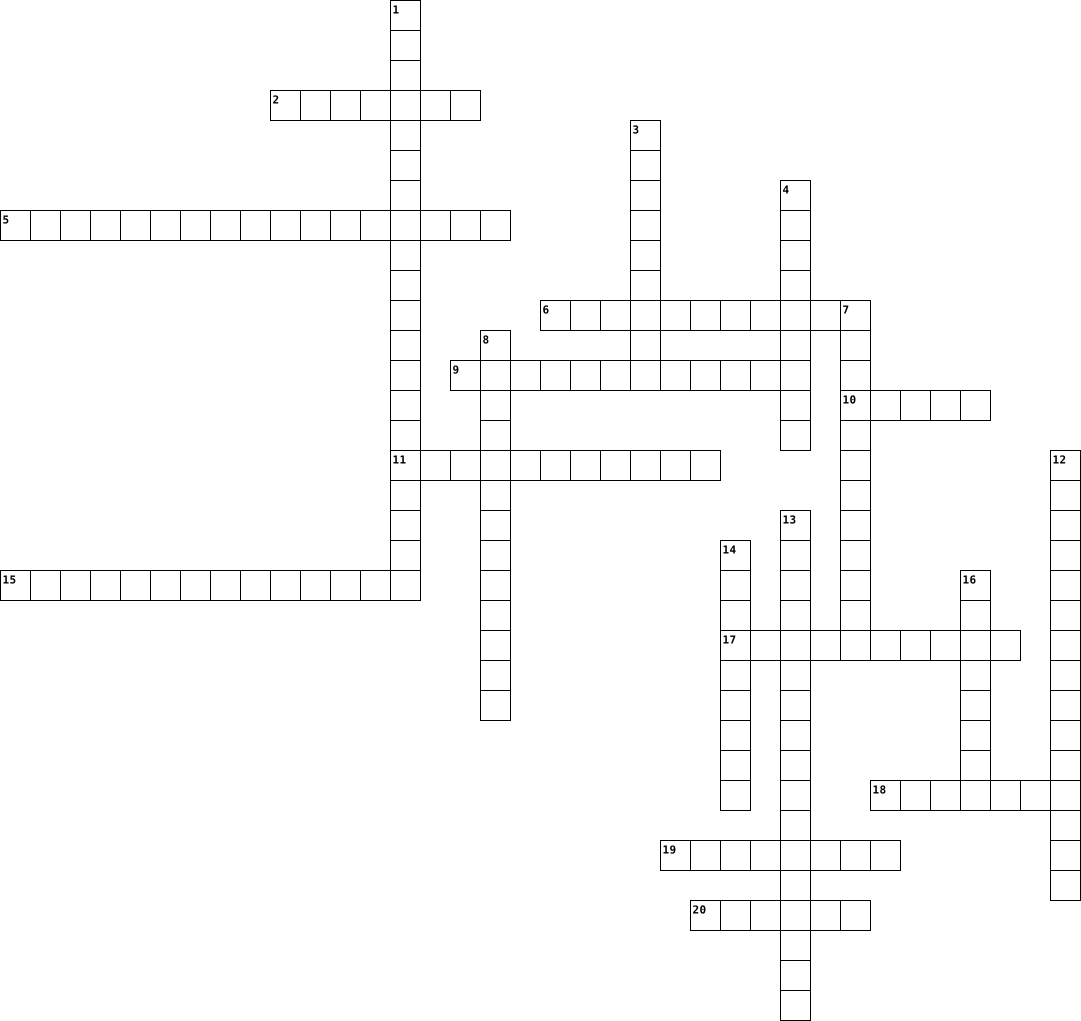
forms of energy Crossword Puzzles
Ava's puzzle 2022-09-06

Across
- - The direct transfer of energy by
- atoms, molecules, substances, and
- of a fluid (liquid or gas).
- energy that binds the nucleus together.
- ENERGY is energy stored in the bonds of atoms and molecules.
- waves
- ENERGY is the movement of energy through substances in longitudinal (compression/rarefaction) waves.
- and the energy of position, or gravitational potential energy.
- ENERGY is energy stored in objects when they are under temporary strain, such as being stretched or squashed.
- from one place to another.
- ENERGY is electromagnetic energy that
- The direct transfer of heat from
- ENERGY - Potential energy is stored
Down
- measure of how hot or cold an object
- ENERGY is energy possessed by an
- substance to another substance that is
- due to the movement of its particles.
- in transverse waves.
- electrical ENERGY is the movement of electrons.
- ENERGY is the movement of objects and
- ENERGY, which is often described as heat, is the internal energy in substances—the vibration and movement of atoms and molecules within substances.
- ENERGY is energy stored in the nucleus of an
- PE is the energy of a position or place.
- The transfer of heat by the
- ENERGY is energy in motion—the motion of
25 Clues: waves • in transverse waves. • from one place to another. • of a fluid (liquid or gas). • The transfer of heat by the • ENERGY is energy possessed by an • The direct transfer of heat from • atoms, molecules, substances, and • - The direct transfer of energy by • ENERGY - Potential energy is stored • measure of how hot or cold an object • due to the movement of its particles. • ...
LEXI-COMBAT 2024 2024-06-06

Across
- Responsible travel trend promoting nature conservation
- Process turning fertile land into desert
- Replanting trees to restore lost forests
- Energy Power sources harnessing sunlight or wind, for instance
- Environmental phenomenon caused by pollutant emissions
- Material capable of natural decomposition
- Balancing present needs with future environmental health
Down
- Resource not replenished within a human timeframe
- Variety of life forms seen in diverse habitat
- Tiny plastic particles contaminating ecosystems
- Footprint Measure of one's environmental impact
- Clearing forests for agricultural expansion, e.g.
- Preservation efforts aimed at protecting natural resources
- Underground reservoir storing groundwater
14 Clues: Process turning fertile land into desert • Replanting trees to restore lost forests • Material capable of natural decomposition • Underground reservoir storing groundwater • Variety of life forms seen in diverse habitat • Tiny plastic particles contaminating ecosystems • Footprint Measure of one's environmental impact • Resource not replenished within a human timeframe • ...
Chapter 5 vocabulary 2020-02-19

Across
- A number in front of a chemical formula in an equation that indicates how many molecules or atoms of each reactant and product are involved in a reaction.
- system A system in which no matter is allowed to enter or leave.
- A reaction in which one element replaces another in a compound or when two elements in different compounds trade places.
- A solid in which the atoms arranged in a pattern that repeats again and again.
- A substance formed as a result of a chemical reaction.
- A chemical reaction that breaks down compounds into simpler products.
- reaction A reaction that absorbs energy.
- A type of protein that spreads up a chemical reaction in a living thing a biological catalyst.
- A material that decreases the rate of a reaction.
- conservation mass The principle that the total amount of matter is neither created nor destroyed during any chemical or physical change.
Down
- equation A short easy way shows a chemical reaction using symbols.
- The amount of one material in a certain volume of another material.
- system A system in which can enter from or escape to the surroundings.
- reaction A reaction that releases energy usually in the form of heat.
- A solid that forms a solution during a chemical reaction.
- A chemical reaction in which two or more simple substances combine to form new more complex substances.
- energy The minimum amount of energy needed to start a chemical reaction.
- A Substance that enters into a chemical reaction.
- change A change in which one or more substances combine or break apart to new substance.
- change A change that alters the form or appearance of material but does not make the material into another substance.
20 Clues: reaction A reaction that absorbs energy. • A Substance that enters into a chemical reaction. • A material that decreases the rate of a reaction. • A substance formed as a result of a chemical reaction. • A solid that forms a solution during a chemical reaction. • system A system in which no matter is allowed to enter or leave. • ...
puzzlz 2022-02-17

Across
- are found inside your digestive system that help you
- changes nitrogen from the air into forms that plants and animals can use
- prevent bacterial diseases
- heating to a temperature that kills most of the harmful Bactria
- any organism that causes disease
- uses dead organisms as food and energy sources
Down
- make there own food using carbon dioxcide water and energy from sunlight.
- is a process that produces two new cells with genetic material that is identical to each other and that of the original cell
- structures like roots to hold them in as the roots of plants to Bactria these have
- however when light is not presented it can feed on Bactria and other proteins
- using organisms to help clean up or remove environmental pollutants
- produces thick wall substances
- limits the growth of Bactria
- poises substance
- algae contains brown pigments in addition to chronological usually found growing in cool
- a organism that uses oxygen when breaking down food
- found in freshwater and saltwater
17 Clues: poises substance • prevent bacterial diseases • limits the growth of Bactria • produces thick wall substances • any organism that causes disease • found in freshwater and saltwater • uses dead organisms as food and energy sources • a organism that uses oxygen when breaking down food • are found inside your digestive system that help you • ...
Be Thankful 2013-09-01

Across
- the buckeye state
- The light or the direct rays from the sun
- commander-in-chief of the United States Armed Forces
- relationship of mutual affection between two or more people
- the father or mother of either of one's parents
- place of refuge where love and affection is the center
- Aggie Pride
Down
- Georgia Football Team
- Dennisa
- 2008 NBA Champions
- Tameeka, Marlon, Michael, Miah
- art of producing images of objects on sensitized surfaces by the chemical action of light or of other forms of radiant energy
- Lightning McQueen
- watercraft capable of independent operation underwater
- the largest city in Michigan and a major Great Lakes port
15 Clues: Dennisa • Aggie Pride • the buckeye state • Lightning McQueen • 2008 NBA Champions • Georgia Football Team • Tameeka, Marlon, Michael, Miah • The light or the direct rays from the sun • the father or mother of either of one's parents • commander-in-chief of the United States Armed Forces • watercraft capable of independent operation underwater • ...
Chemical Reactions 2025-09-14

Across
- A reaction that absorbs heat energy.
- A representation of a chemical reaction using symbols and formulas.
- A reaction that releases heat energy.
- A change that results in new substances forming.
- A chemical equation with equal numbers of each type of atom on both sides.
- A change that affects the form of a substance but not its chemical composition.
- A solid that forms and separates from a liquid mixture.
Down
- How easily a substance undergoes chemical change.
- Process where reactants change into new products with new properties.
- Symbols showing the elements in a compound and their ratios
- A one- or two-letter abbreviation for an element
- Traits of a substance that can be observed without changing its identity
- Traits that describe a substance's ability to undergo chemical change
13 Clues: A reaction that absorbs heat energy. • A reaction that releases heat energy. • A one- or two-letter abbreviation for an element • A change that results in new substances forming. • How easily a substance undergoes chemical change. • A solid that forms and separates from a liquid mixture. • Symbols showing the elements in a compound and their ratios • ...
Jarrod's Food Tech Activity 2015-03-17

Across
- A yellow fruit
- Needed for energy.
- Good source of calcium.
Down
- Used to keep yourself hydrated.
- Used to bring up body mass.
- A person who is proficient in sports and other forms of physical exercise.
- Good source of protein.
- Needed for muscle growth and repair.
- Needed for bone growth
9 Clues: A yellow fruit • Needed for energy. • Needed for bone growth • Good source of protein. • Good source of calcium. • Used to bring up body mass. • Used to keep yourself hydrated. • Needed for muscle growth and repair. • A person who is proficient in sports and other forms of physical exercise.
Earth Space Honors Semester 1 Vocab Crossword Puzzle 2021-12-08

Across
- One of the three mechanisms of plate motion; occurs at convergent boundaries
- Zone of rapid change in temperature with depth in the ocean
- Part of the Earth system that contains all of the ice
- Tool used to measure air pressure
- The study of the atmosphere and weather
- The variable that the scientist changes on purpose AKA independent or manipulated
- The largest reservoir (or sink) for both water and carbon dioxide
- Part of the Earth system that contains all of the living things
- Variable that is located on the y-axis of a bar or line graph
- Plate boundary that forms mountain ranges
Down
- Process in the water cycle that occurs when plants release excess water vapor into the air
- Part of the Earth system that is made up of liquid water
- Currents that are driven by wind
- Plate boundary where new seafloor forms
- Factor that can change in an experiment
- Part of the Earth system that contains all of the gases that surround Earth
- Plate boundary where MOST earthquakes occur
- Part of the Earth system that contains all of the rocks and Earth's interior
- Deep ocean currents are driven by changes in temperature and ___________
- The vertical movement of air caused by differences in air pressure
- Process in which cells convert sugars into usable energy
21 Clues: Currents that are driven by wind • Tool used to measure air pressure • Plate boundary where new seafloor forms • Factor that can change in an experiment • The study of the atmosphere and weather • Plate boundary that forms mountain ranges • Plate boundary where MOST earthquakes occur • Part of the Earth system that contains all of the ice • ...
Suaad’s Crossword Puzzle 2022-03-22

Across
- positively charged ion.
- collection of elements found in group 18 of the periodic table
- a particle with no charge
- postivly charged particles
- negatively charged ion.
- elements found in group 17
- atom found in group.
- a bond that forms between an anion and cation.
- molecule formed through covalent bonding
- found on the left hand side of periodic table.
- transfer of thermal energy
- arrangement of electrons in an atom
- found on the right hand side of periodic table.
- Diagram that shows the arrangement of electrons and electron shells in an atom.
- formed as a result of a chemical reaction
- molecule that contains only carbon and hydrogen atoms
Down
- found in group 2 of periodic table
- outer most shell in an atom
- A vertical list of elements a pure substance
- A horizontal list of elements.
- a comlecule that has 2 atoms
- a bond formed when 2 or more atoms share electrons.
- way to represent the electrons of an atom in a shell
- negatively charged particle
- the number of protons in an atom
- smallest unit
- an atom that has gained or lost electrons
- table of arranged elements a pure substance with the same type of atom
- a mixture of a solute dissolved in a liquid such as water.
- a molecule that forms by anions and cations
30 Clues: smallest unit • atom found in group. • positively charged ion. • negatively charged ion. • a particle with no charge • postivly charged particles • elements found in group 17 • transfer of thermal energy • outer most shell in an atom • negatively charged particle • a comlecule that has 2 atoms • A horizontal list of elements. • the number of protons in an atom • ...
Bio 11 2013-10-28

Across
- contains chlorophyll a and c
- contains chlorophyll a and b
- algae which is made up of multiple single celled algae
- process in which the plant converts sunlight into energy
- very common single celled algae which grows in ponds, ditches and wet soil
- production of two different types of gametes within the same plant
- contains chlorophyll a and sometimes d
- a threadlike colony formed by many green algae
- thin heart shaped structure formed from the gametophytes of a fern
- vascular tissue that provides support and conducts water
- in fungi, rootlike structure that anchors itself to ground
Down
- bright green multicellular marine algae known as "sea lettuce"
- haploid plant that produces gametes
- irish moss
- cell in xylem tissue which conducts water
- diploid plant that produces spores
- threadlike algae that grows and reproduces asexually
- pigment in the cells of photosynthetic autotrophs that captures light energy
- colonial algae which consists of 4-32 cells
- female reproductive structure in mosses
- male reproductive structure in mosses
- Colonial algae with as little up made up of 500-50,000 cells.
- vascular tissue responsible for the flow of nutrients
- tangled mass in a green filaments in moss that forms during germination
24 Clues: irish moss • contains chlorophyll a and c • contains chlorophyll a and b • diploid plant that produces spores • haploid plant that produces gametes • male reproductive structure in mosses • contains chlorophyll a and sometimes d • female reproductive structure in mosses • cell in xylem tissue which conducts water • colonial algae which consists of 4-32 cells • ...
cells 2023-12-18
Across
- help sequester waste products
- delivers oxygen and nutrients to cells and takes away wastes
- pumping blood or processing and utilizing nutrients
- provides protection for a cell.
- self-contained group of tissues that performs a specific function in the body
- produce energy through photosynthesis and oxygen-release processes, which sustain plant growth and crop yield
- responsible for movement
- the basic structural and functional units of animal tissues and organs
- the repository of genetic information and as the cell's control center
- making proteins
- a group of cells that have similar structure and that function together as a unit
Down
- produce proteins for the rest of the cell to function
- holding the components of the cell and protects them from damage
- eukaryotic cells that vary in several fundamental factors from other eukaryotic organisms
- generate the energy necessary to power cells
- helps all the parts of the body to communicate with each other
- converts the foods we eat into their simplest forms
- move fresh air into your body while removing waste gases
- a subcellular structure that has one or more specific jobs to perform in the cell
- separates the interior contents of the cell from the exterior environment
20 Clues: making proteins • responsible for movement • help sequester waste products • provides protection for a cell. • generate the energy necessary to power cells • pumping blood or processing and utilizing nutrients • converts the foods we eat into their simplest forms • produce proteins for the rest of the cell to function • ...
Dance Injury Prevention 2022-11-06

Across
- Byproduct of muscular contraction
- Do this after dancing to avoid soreness
- Inflammation of the fascia
- Inflammation of a bursa
- Result of insufficient bloodflow to body
- Happens muscle cell depleted of energy & fluid
- Injury that develops over time
- Injury to soft tissue; muscle tear
- Breathing too much
- Inflammation of a tendon
- Forms at the site of an injury
- Injury to joint capsule and/or ligaments
Down
- safest treatment for injuries
- Injury caused by suddent movement/impact
- loss of bone mass
- Depletion of fluid and body salts & minerals
- The body's initial response to injury
- Bruise to the head; inside the skull
- Destruction of structural bone integrity
- Inflammation of muscle tissue
- The uncontrolled painful contraction of muscle
- Abnormal hardening of a muscle
- Rest, ice compression, and elevation
23 Clues: loss of bone mass • Breathing too much • Inflammation of a bursa • Inflammation of a tendon • Inflammation of the fascia • safest treatment for injuries • Inflammation of muscle tissue • Injury that develops over time • Abnormal hardening of a muscle • Forms at the site of an injury • Byproduct of muscular contraction • Injury to soft tissue; muscle tear • ...
Chapter 2- The Chemistry of Life Vocabulary 2025-09-26

Across
- The simplest type of carbohydrate, consisting of a single sugar molecule that cannot be broken down into smaller sugars.
- Substance that speeds up the rate of a chemical reaction.
- Protein catalysts that speeds up the rate of specific biological reactions.
- Regions surrounding the atomic nucleus containing a specific number of electrons.
- Atom that has a positive or negative charge.
- Negatively charged particle; located in the space surrounding the nucleus.
- Compound that produces hydroxide ions (OH–) in solution; with a pH of more than 7.
- A subatomic particle of about the same mass as a proton but without an electric charge, present in all atomic nuclei except those of ordinary hydrogen.
- Type of bond between atoms in which the electrons are shared.
- A carbohydrate formed by long chains of repeating units linked together by glycosidic bonds.
- One of several forms of a single element, which contains the same number of protons but a different number of neutrons.
- Substance formed by the chemical combination of two or more elements in definite proportions.
- Energy input that is needed for a reaction to begin.
- A molecule containing a very large number of atoms, such as a protein, nucleic acid, or synthetic polymer.
- Covalent bond forms between the carbon atom of the carboxyl group of one amino acid and the nitrogen atom of the amino group of another.
- A stable subatomic particle occurring in all atomic nuclei, with a positive electric charge equal in magnitude to that of an electron.
- Reactant of an enzyme-catalyzed reaction.
Down
- A waxy substance found in the blood.
- Weak attraction between a hydrogen atom and another atom.
- Macromolecules that contain carbon, hydrogen, oxygen, and nitrogen; needed by the body for growth and repair.
- A scale used to measure the acidity or basicity of a solution.
- Smallest unit of most compounds that displays all the properties of that compound.
- Process that changes, or transforms, one set of chemicals into another set of chemicals.
- A compound consisting of a nucleoside linked to a phosphate group. Forms the basic structural unit of nucleic acids such as DNA.
- Macromolecule containing hydrogen, oxygen. Nitrogen, carbon, and phosphorus.
- Chemical bond formed when one of more electrons are transferred form one atom to another.
- Macromolecule made mostly from carbon and hydrogen atoms; includes fats, oils, and waves.
- A strong affinity for water.
- The property of a substance that repels water or does not mix with it.
- Compound with an amino group on one end and a carboxyl group on the other end.
- Compound that forms hydrogen ions (H+) in solution; a solution with a pH of less than 7.
- The base unit of matter.
- Compound made of carbon, hydrogen, and oxygen atoms; types of nutrients that are the major source of energy in the body.
- Relating to or derived from living matter.
- Pure substance that consists entirely of one type of atom.
35 Clues: The base unit of matter. • A strong affinity for water. • A waxy substance found in the blood. • Reactant of an enzyme-catalyzed reaction. • Relating to or derived from living matter. • Atom that has a positive or negative charge. • Energy input that is needed for a reaction to begin. • Weak attraction between a hydrogen atom and another atom. • ...
The Water Cycle 2018-05-18

Across
- Water changes from a liquid to a gas due to the sun’s energy
- Water vapor (gas) turns back to liquid due to colder temperatures (clouds forms)
- Evaporation of water from plants
- Flow into a body of water
Down
- Water in liquid or solid forms fall to the ground from clouds
- A large body of water
- Precipitation that soaks into the ground
7 Clues: A large body of water • Flow into a body of water • Evaporation of water from plants • Precipitation that soaks into the ground • Water changes from a liquid to a gas due to the sun’s energy • Water in liquid or solid forms fall to the ground from clouds • Water vapor (gas) turns back to liquid due to colder temperatures (clouds forms)
chemistry of life 2023-11-09

Across
- acid- an organic molecule that is half of a glucose molecule with the molecular formula C3H6O3.
- solution- a solution where the concentration of solutes outside a cell is lower than that found inside the cell
- a lipid composed of glycerol and three fatty acids which are bonded together
- acid- long chain of carbon and hydrogen joined together the end of the chain has an acid group (-COOH)
- the process by which plants use chlorophyll to trap sunlight energy and use it to produce carbohydrates
- the movement of molecules from an area of higher concentration to an area of lower concentration
- a three carbon chain molecule containing three hydroxyl (-OH) groups
- solution- a solution where the concentration of solutes outside a cell higher than that found inside cell
- the diffusion of water molecules across a selectively permeable membrane
- the carbohydrate that forms the cell walls of plant cells
- a condition in which all acting influences are balanced resulting in a stable environment
- gradient- a difference in the number of molecules or ions of a substance between adjoining regions without the addition of energy molecules tend to diffuse from the area of higher concentration to the area of lower concentration
Down
- a form of endocytosis in which liquid droplets are engulfed by cells
- a large carbohydrate molecule used by plants to store energy
- nutrients made up of a single sugar molecule or many sugars molecules carbohydrates contain only carbon hydrogen and oxygen
- solution- a solution where the concentration of solute molecules outside a cell is equal to the concentration of solute molecules inside the cell
- synthesis- a series of chemical reactions that allow two molecules to bond by the formation of water molecule
- the form of concentration storage in animals
- the raw materials needed for cell metabolism
- large molecules that are made by joining several separate units such as joining several sugar units to form a starch molecule
- transport- involves the use of cell energy to move materials across a cell membrane against the concentration gradient
- transport- the movement of materials across a cell membrane without the use of energy from the cell
22 Clues: the form of concentration storage in animals • the raw materials needed for cell metabolism • the carbohydrate that forms the cell walls of plant cells • a large carbohydrate molecule used by plants to store energy • a form of endocytosis in which liquid droplets are engulfed by cells • a three carbon chain molecule containing three hydroxyl (-OH) groups • ...
Ch 2A Final Exam Review 2023-12-04

Across
- Anything that has mass and occupies space.
- Synthesis chemical reactions are building processes. Another term for a "building process" is an ________ process.
- Most atoms desire ________ electrons in their valence shell.
- These subatomic particles carry a negative charge and have virtually no weight.
- All elements are made up of ___________, which are the unique building blocks for each element.
- C6H12O6 is an example of a _______ because it has 2 or more DIFFERENT kinds of atoms bound together
- Blood is an example of this type of mixture?
- The ____ shell is the outermost electron shell.
- One of the two forms of energy, this term refers to energy in action (or in movement).
- State of matter with changeable shape and definite volume.
- The term meaning the capacity to do work or put matter into motion.
- These bonds are more like "attractive forces" between the positive portion of a polar water molecule and the negative polar portion of another.
- These bonds form when atoms share electrons.
- This term refers to structural variations of the same element.
Down
- Chemical reactions that give off energy during the course of the reaction are described with this term.
- When an atom gives away an electron, it takes on a positive charge and is called a(n) _______.
- Out of the 3 types of mixtures, which one is homogenous?
- The atomic number represents the number of _________ in the nucleus of an atom.
- Your answer to #25 have the same number of protons, but different numbers of _________.
- Carbon, __________, hydrogen, and nitrogen make up 96% of the body.
- This type of energy results from moving charged particles.
- These molecules increase the rate of a reaction without being chemically changed or becoming part of the product. Enzymes are an example of these within living organisms.
- Unequal sharing of electrons between 2 atoms leads to the formation of _______ covalent bonds.
- These are the strongest chemical bonds.
- Protons and neutrons make up this portion of an atom.
25 Clues: These are the strongest chemical bonds. • Anything that has mass and occupies space. • Blood is an example of this type of mixture? • These bonds form when atoms share electrons. • The ____ shell is the outermost electron shell. • Protons and neutrons make up this portion of an atom. • Out of the 3 types of mixtures, which one is homogenous? • ...
MSP Vocabulary 2017-05-09

Across
- solid material that is moved and deposited in a new location
- a material or an object that does not easily allow heat, electricity, light, or sound to pass through it.
- the movement of energy through substances in longitudinal (compression/rarefaction) waves
- the set of organs that allows a person to breathe and exchange oxygen and carbon dioxide throughout the body.
- a feature or quality belonging typically to a person, place, or thing and serving to identify it.
- a change or the process of change by which an organism or species becomes better suited to its environment.
- a minute particle consisting of RNA and associated proteins
- a simple sugar that is an important energy source in living organisms.
Down
- the emission and propagation of energy in the form of rays or waves.
- formed through the cooling and solidification of magma or lava.
- a group of stars forming a recognizable pattern that is traditionally named after its apparent form or identified with a mythological figure.
- between two bodies is proportional to the product of their masses and inversely proportional to the square of the distance between them.
- one of the distinct forms that matter takes on
- the collection of eight planets and their moons in orbit around the sun, together with smaller bodies in the form of asteroids, meteoroids, and comets.
- a self-contained system within a larger system.
- a power source is connected to two or more components.
16 Clues: one of the distinct forms that matter takes on • a self-contained system within a larger system. • a power source is connected to two or more components. • a minute particle consisting of RNA and associated proteins • solid material that is moved and deposited in a new location • formed through the cooling and solidification of magma or lava. • ...
MSP Vocabulary 2017-05-09

Across
- a power source is connected to two or more components.
- a material or an object that does not easily allow heat, electricity, light, or sound to pass through it.
- between two bodies is proportional to the product of their masses and inversely proportional to the square of the distance between them.
- the emission and propagation of energy in the form of rays or waves.
- the collection of eight planets and their moons in orbit around the sun, together with smaller bodies in the form of asteroids, meteoroids, and comets.
- one of the distinct forms that matter takes on
- solid material that is moved and deposited in a new location
- a simple sugar that is an important energy source in living organisms.
Down
- a group of stars forming a recognizable pattern that is traditionally named after its apparent form or identified with a mythological figure.
- a minute particle consisting of RNA and associated proteins
- the set of organs that allows a person to breathe and exchange oxygen and carbon dioxide throughout the body.
- formed through the cooling and solidification of magma or lava.
- the movement of energy through substances in longitudinal (compression/rarefaction) waves
- a feature or quality belonging typically to a person, place, or thing and serving to identify it.
- a self-contained system within a larger system.
- a change or the process of change by which an organism or species becomes better suited to its environment.
16 Clues: one of the distinct forms that matter takes on • a self-contained system within a larger system. • a power source is connected to two or more components. • a minute particle consisting of RNA and associated proteins • solid material that is moved and deposited in a new location • formed through the cooling and solidification of magma or lava. • ...
Weather 2 2020-03-04

Across
- The average weather conditions in an area over a long period of time
- Causes warm air to rise quickly and causes quick, violent storms
- Wispy, feathery clouds made of crystals
- The transfer of heat through a fluid (liquid or gas). When warm fluids rise and cool fluids sinks.
- A flat layer of gray clouds (cover sky like a blanket)
- Water vapor becomes liquid water and forms clouds
- Water that falls to Earth as rain, snow, hail or sleet
- Fluffy clouds in the sky on nice days
- A large body of air
- Warmer air rises and moisture in the air causes lousy weather
- Giant thunderhead clouds (violent thunderstorm clouds)
- A long period of time with a shortage of rainfall
- An instrument used to measure air pressure
- A funnel shaped cloud that reaches the ground. It I a violent and destructive wind storm that moves across land.
Down
- How much moisture is in the air
- A storm produced by a cumulonimbus cloud. There is thunder, lightening, strong winds, heavy rains and maybe even hail.
- Heat transfer by direct physical contact
- The place where air masses meet
- Water changed from a liquid to a gas
- Unique cloud shape caused by the vortex of rising air.
- Heat from the sun causes water to evaporate from plant leaves
- Weather phenomenon caused by rising warm, moist air. Examples are hurricanes (formed over warm oceans) and tornadoes (formed in cumulonimbus clouds)
- Cooler air sinks and very little moisture in the air causes happy weather
- A tropical storm that forms over warm ocean waters and can be up to 600 miles wide
- Warm air slides over top of cool air and causes feathery clouds and maybe some light showers
- Energy that can transfer by traveling in waves. This form of energy can also travel through empty space.
- Air moves from areas of high pressure to areas of low pressure
27 Clues: A large body of air • How much moisture is in the air • The place where air masses meet • Water changed from a liquid to a gas • Fluffy clouds in the sky on nice days • Wispy, feathery clouds made of crystals • Heat transfer by direct physical contact • An instrument used to measure air pressure • Water vapor becomes liquid water and forms clouds • ...
Types of Rocks 2020-05-14

Across
- an example of a sedimentary rock
- layered or banded appearance
- forms a the surface of earth and cools quickly
- may be found trapped within layers of sedimentary rock
- an example of a metamorphic rock
- forms from intense heat and pressure
- forms within the earth and cools slowly
- stuck or 'glued' together
Down
- squeezed together
- an example of an igneous rock
- forms from molten rock that cools and hardens
- 2 or more minerals combined
- forms from sediments that are compacted and cemented
- inorganic solid composed of elements or compounds
14 Clues: squeezed together • stuck or 'glued' together • 2 or more minerals combined • layered or banded appearance • an example of an igneous rock • an example of a sedimentary rock • an example of a metamorphic rock • forms from intense heat and pressure • forms within the earth and cools slowly • forms from molten rock that cools and hardens • ...
Chapter 5 vocabulary 2020-02-06

Across
- A number in front of a chemical formula in an equation that indicates how many molecules or atoms of each reactant and product are involved in a reaction
- A type of protein that spreads up a chemical reaction in a living thing a biological catalyst
- The amount of one material in a certain volume of another material
- A reaction in which one element replaces another in a compound or when two elements in different compounds trade places
- reaction, A reaction that absorbs energy
- A Substance that enters into a chemical reaction
- energy, The minimum amount of energy needed to start a chemical reaction
- change, A change that alters the form or appearance of material but does not make the material into another substance
- system, A system in which no matter is allowed to enter or leave
Down
- a material that decreases the rate of a reaction
- A solid that forms a solution during a chemical reaction
- A chemical reaction in which two or more simple substances combine to form a new more complex substances
- change, A change in which one or more substances combine or break apart to new substance.
- A chemical reaction that breaks down compounds into simpler products
- A substance formed as a result of a chemical reaction
- reaction, A reaction that releases energy usually in the form of heat
- conservation mass, the principle that the total amount of matter is neither created nor destroyed during any chemical or physical change
- A solid in which the atoms arranged in a pattern that repeats again and again
- equation, A short easy way shows a chemical reaction using symbols.
- system, A system in which can enter from or escape to the surroundings
20 Clues: reaction, A reaction that absorbs energy • a material that decreases the rate of a reaction • A Substance that enters into a chemical reaction • A substance formed as a result of a chemical reaction • A solid that forms a solution during a chemical reaction • system, A system in which no matter is allowed to enter or leave • ...
Chapter 5 vocabulary 2020-02-06

Across
- A number in front of a chemical formula in an equation that indicates how many molecules or atoms of each reactant and product are involved in a reaction
- A type of protein that spreads up a chemical reaction in a living thing a biological catalyst
- The amount of one material in a certain volume of another material
- A reaction in which one element replaces another in a compound or when two elements in different compounds trade places
- reaction, A reaction that absorbs energy
- A Substance that enters into a chemical reaction
- energy, The minimum amount of energy needed to start a chemical reaction
- change, A change that alters the form or appearance of material but does not make the material into another substance
- system, A system in which no matter is allowed to enter or leave
Down
- a material that decreases the rate of a reaction
- A solid that forms a solution during a chemical reaction
- A chemical reaction in which two or more simple substances combine to form a new more complex substances
- change, A change in which one or more substances combine or break apart to new substance.
- A chemical reaction that breaks down compounds into simpler products
- A substance formed as a result of a chemical reaction
- reaction, A reaction that releases energy usually in the form of heat
- conservation mass, the principle that the total amount of matter is neither created nor destroyed during any chemical or physical change
- A solid in which the atoms arranged in a pattern that repeats again and again
- equation, A short easy way shows a chemical reaction using symbols.
- system, A system in which can enter from or escape to the surroundings
20 Clues: reaction, A reaction that absorbs energy • a material that decreases the rate of a reaction • A Substance that enters into a chemical reaction • A substance formed as a result of a chemical reaction • A solid that forms a solution during a chemical reaction • system, A system in which no matter is allowed to enter or leave • ...
What am I? 2025-02-06

Across
- A type of carbohydrate found in plants, used for energy storage.
- A biological molecule that carries genetic information.
- The main energy currency of cells.
- The type of bond that links two amino acids together.
Down
- The process by which enzymes break down large molecules into smaller ones.
- A lipid molecule that forms the structural component of cell membranes.
- A polymer of glucose used for structural support in plants.
- A simple monosaccharide sugar, often a building block of more complex carbohydrates.
- A large, complex protein molecule that speeds up chemical reactions in living organisms.
- The building blocks of proteins.
10 Clues: The building blocks of proteins. • The main energy currency of cells. • The type of bond that links two amino acids together. • A biological molecule that carries genetic information. • A polymer of glucose used for structural support in plants. • A type of carbohydrate found in plants, used for energy storage. • ...
Crossword 2021-11-09

Across
- carried slowly by a current of water
- the point on the earth's surface directly above the focus of an earthquake
- occurs when natural tension in tectonic plates changes so rapidly that energy is displaced
- process by which heat is transferred by movement of a heated fluid such as air or water
- a vent which transfers magma from depth to the Earth's surface through eruptions
- visual representations of information intended to present information quickly and clearly
Down
- the size or extent of something
- stretched or strained intensely
- Line a planar fracture in a volume of rock
- where the heavier plate dives beneath the second plate and sinks into the mantle
- has many different forms and can be transferred from one form to another
- used to determine the location and magnitude of earthquakes
- Plate make up Earth's lithosphere
- a series of waves in a water body caused by the displacement of a large volume of water
14 Clues: the size or extent of something • stretched or strained intensely • Plate make up Earth's lithosphere • carried slowly by a current of water • Line a planar fracture in a volume of rock • used to determine the location and magnitude of earthquakes • has many different forms and can be transferred from one form to another • ...
LEXI-COMBAT 2024 2024-06-06

Across
- Resource not replenished within a human timeframe
- Variety of life forms seen in diverse habitat
- Preservation efforts aimed at protecting natural resources
- Replanting trees to restore lost forests
- Tiny plastic particles contaminating ecosystems
- Responsible travel trend promoting nature conservation
- Footprint Measure of one's environmental impact
- Balancing present needs with future environmental health
- Material capable of natural decomposition
Down
- Clearing forests for agricultural expansion, e.g.
- Process turning fertile land into desert
- Rain Environmental phenomenon caused by pollutant emissions
- Energy Power sources harnessing sunlight or wind, for instance
- Underground reservoir storing groundwater
14 Clues: Process turning fertile land into desert • Replanting trees to restore lost forests • Underground reservoir storing groundwater • Material capable of natural decomposition • Variety of life forms seen in diverse habitat • Tiny plastic particles contaminating ecosystems • Footprint Measure of one's environmental impact • Clearing forests for agricultural expansion, e.g. • ...
Science Crossword 2013-09-18

Across
- the movement of atoms, molecules, waves and electrons is _________ energy
- the movement of energy through substances in waves is _________ energy
- Fission and fusion is an example of _________
- what this crossword is about
- this flying object has both electrical energy and magnetic energy
- Wind is an example of the energy of ________
- stored energy and the energy of position are ________ energy
- this farm animal starts with a S and produces thermal energy
- this object has gives off solar heat light and nuclear energy.
- the movement of electrons is __________ energy
Down
- the type of energy that most are measured in
- energy stored in the bonds of atoms and molecules is __________ energy
- the energy of position - such as a rock on a hill is _________ energy
- the vibration and movement of the atoms and molecules within a substance is called ________ energy
- X-rays are an example of _________ energy
- this energy is found all around you
- this energy works by using the ________ fields
- this is the unit of measurement for magnetic energy
- ________ is the energy emitted from the sun
- what electrical energy is measured in
20 Clues: what this crossword is about • this energy is found all around you • what electrical energy is measured in • X-rays are an example of _________ energy • ________ is the energy emitted from the sun • the type of energy that most are measured in • Wind is an example of the energy of ________ • Fission and fusion is an example of _________ • ...
Quincy D1-3 2023-02-08

Across
- a huge crack in earths crust
- the boundry were plates are moving apart from each other
- a sensitive device that detect shaking
- the sliding of a denser ocean plate
- magma that reaches earths surface
- name of a large super contenet
- the central opening of a volcano
- hot molten rock below earths surface
- plates are sliding past each other
- very hot spot of earths mantle
- a cup like hollow that forms at the top of the volcano
- contenets split apart
- the point above the focus
Down
- earths surface is broken into plates
- plates colliding
- giant ocean wave
- heat below earths surface
- a vibration that spreads out away
- horizonle layers
- the amount if energy released
- where the earthquake starts
- earths rocky surface
22 Clues: plates colliding • giant ocean wave • horizonle layers • earths rocky surface • contenets split apart • heat below earths surface • the point above the focus • where the earthquake starts • a huge crack in earths crust • the amount if energy released • name of a large super contenet • very hot spot of earths mantle • the central opening of a volcano • a vibration that spreads out away • ...
3.2 science crossword 2021-10-06

Across
- chemical reaction that includes heat
- could happen when mixing things together
- solid that emerges from a liquid solution
- a thing that people go to on Sunday morning
- needed to battle with a pokemon card
- there are 3 main forms about this
- a type of metal and color
- food rots
- happens in your stomach after you eat
- atoms are made out of this
Down
- a pure form of matter
- putting substances together
- a scale discovery
- decipher the relationship between things
- usually melts with heat
- changing of color on metal
- will expand freely - having no fixed shape
- what people say when they find out stuff
- this happens when heat is applied
- a material made up of 2 or more substances
20 Clues: food rots • a scale discovery • a pure form of matter • usually melts with heat • a type of metal and color • changing of color on metal • atoms are made out of this • putting substances together • there are 3 main forms about this • this happens when heat is applied • chemical reaction that includes heat • needed to battle with a pokemon card • happens in your stomach after you eat • ...
The Importance of Personal Health 2024-02-05

Across
- state of being free from illness and injury
- the power and ability to be physically and mentally active
- physical structure that forms a person
- illnes that constantly recurring
- to continue to have
- protected againts a particular disease
- forming the best, from wich everything else develops
- physical activity to make your body strong and healthy
- extremely important or necessary
- relating to the mind
- great worry caused by a difficult situation
Down
- an attemp to do something
- to arrange in order of importance
- having positive result
- the practice of being aware to create a feeling of calm
- relating to society its organization
- tbe center of interest or activity
- something that cause difficulty
- a single person or thing
- doing something that cuts your weight
20 Clues: to continue to have • relating to the mind • having positive result • a single person or thing • an attemp to do something • something that cause difficulty • illnes that constantly recurring • extremely important or necessary • to arrange in order of importance • tbe center of interest or activity • relating to society its organization • doing something that cuts your weight • ...
CROSSWORD REVIEW 2016-04-07

Across
- energy/ The sum of the potential energy an the kinetic energy in a system.
- The process of changing position.
- A statement of what will happen next in a sequence of events.
- thinking/ Comparing what you already know with the information you are given in order to decide whether you agree with it.
- force/ A force that one object applies to another object without touching it.
- An attractive force that exists between all objects that have mass.
- The distance an object moves divided by the time it takes to move that distance.
- force/ A push or pull on one object by another object that is touching it.
- group/ the part of the controlled experiment used to study relationship among variables.
- collision/ Is defined as one in which there is no loss of kinetic energy in the collision.
- motion/ Any motion in which an object is moving a long a curved path.
- force/ The combination of all the forces acting on an object.
- variable/ The factor a scientist observes or measures during an experiment.
- energy/ Energy carried by sound waves.
- energy/ Energy stored in an object when it is stored above the earth's surface.
- Any factor that can have more than one value.
- point/ The starting point you use to describe the motion or the position of an object.
- motion/ Is motion under the influence of gravity.
- energy/ energy carried by an electric current.
- A contact force that resists the sliding motion of two surfaces that are touching.
- Forces acting on an object that combine and form a net force that is not zero.
- A possible explanation for an observation that can be tested by scientific investigations.
- energy/ Energy causing push or pull.
- year/ Forms of energy our eyes can detect.
- speed/ The rate of change of position in which the same distance is traveled each second.
- The speed and the direction of a moving object.
- The tendency of an object to resist a change in its motion.
- A type of friction that when the surface of an object moves along the surface of another object causing motion.
- The amount of matter in an object.
- energy/ Energy stored in food.
Down
- forces/ Forces acting on an object that combine and form a net force of zero.
- the factors in an experiment that remain the same.
- inquiry/ A process that uses a variety of skills and tools to answer questions or to test ideas.
- variable/ The factor that is changed by the investigator to observe how it affects a dependent variable.
- force/ In circular motion, a force that acts perpendicular to the direction of motion, toward the center of the curve.
- group/ The part of a controlled experiment that contains the same factors as the experimental group, but the independent variable is not changed.
- speed/ The total distance traveled divided by the total time taken to travel that distance.
- The difference between the initial position and the final position of an object that has moved.
- A push or pull on an object.
- Type of energy due to motion.
- An object's distance and direction from a reference point.
- Type of energy stored due to the interactions between objects and particles.
- energy/ energy stored in and released from the nucleus of an atom.
- science/ Study the processes that occur on earth and deep within the earth.
- A measure of the change in velocity during a period of time.
- energy/ The sum of the kinetic energy and the potential energy of the particles that make up an object.
- speed/ An object's speed at a specific instant in time.
- theory/ An explanation of observations or events that is based on knowledge gained from many observations and investigations.
- It is information gathered during an experiment.
- science/ Study all organisms and the many processes that occur in them.
- The investigation and exploration of natural events.
- fall/ Any object that is being acted upon only by the force of gravity.
- collision/ Is one in which part of the kinetic energy is changed to some other form of energy in the collision.
- Is a measure of how far an object has traveled from its starting point, or how far away it is.
- A measure of how hard is to stop a moving object.
- The gravitational force exerted on an object.
- A type of friction that occurs when a round object rolls around a surface.
- science/ The type of science that studies matter and energy.
- A type of friction that is a resistance offered by a fluid against its flow.
- A type of friction that when force is applied to an object it does not cause a change.
- of conservation of momentum/ a principle stating the total momentum of a group of objects stays the same unless outside forces act on the objects.
- The ability to cause a change.
62 Clues: A push or pull on an object. • Type of energy due to motion. • The ability to cause a change. • energy/ Energy stored in food. • The process of changing position. • The amount of matter in an object. • energy/ Energy causing push or pull. • energy/ Energy carried by sound waves. • year/ Forms of energy our eyes can detect. • Any factor that can have more than one value. • ...
cells 2023-12-18

Across
- help sequester waste products
- delivers oxygen and nutrients to cells and takes away wastes
- pumping blood or processing and utilizing nutrients
- provides protection for a cell.
- self-contained group of tissues that performs a specific function in the body
- produce energy through photosynthesis and oxygen-release processes, which sustain plant growth and crop yield
- responsible for movement
- the basic structural and functional units of animal tissues and organs
- the repository of genetic information and as the cell's control center
- making proteins
- a group of cells that have similar structure and that function together as a unit
Down
- produce proteins for the rest of the cell to function
- holding the components of the cell and protects them from damage
- eukaryotic cells that vary in several fundamental factors from other eukaryotic organisms
- generate the energy necessary to power cells
- helps all the parts of the body to communicate with each other
- converts the foods we eat into their simplest forms
- move fresh air into your body while removing waste gases
- a subcellular structure that has one or more specific jobs to perform in the cell
- separates the interior contents of the cell from the exterior environment
20 Clues: making proteins • responsible for movement • help sequester waste products • provides protection for a cell. • generate the energy necessary to power cells • pumping blood or processing and utilizing nutrients • converts the foods we eat into their simplest forms • produce proteins for the rest of the cell to function • ...
cells 2023-12-18

Across
- help sequester waste products
- delivers oxygen and nutrients to cells and takes away wastes
- pumping blood or processing and utilizing nutrients
- provides protection for a cell.
- self-contained group of tissues that performs a specific function in the body
- produce energy through photosynthesis and oxygen-release processes, which sustain plant growth and crop yield
- responsible for movement
- the basic structural and functional units of animal tissues and organs
- the repository of genetic information and as the cell's control center
- making proteins
- a group of cells that have similar structure and that function together as a unit
Down
- produce proteins for the rest of the cell to function
- holding the components of the cell and protects them from damage
- eukaryotic cells that vary in several fundamental factors from other eukaryotic organisms
- generate the energy necessary to power cells
- helps all the parts of the body to communicate with each other
- converts the foods we eat into their simplest forms
- move fresh air into your body while removing waste gases
- a subcellular structure that has one or more specific jobs to perform in the cell
- separates the interior contents of the cell from the exterior environment
20 Clues: making proteins • responsible for movement • help sequester waste products • provides protection for a cell. • generate the energy necessary to power cells • pumping blood or processing and utilizing nutrients • converts the foods we eat into their simplest forms • produce proteins for the rest of the cell to function • ...
Geological History Crossword 2022-02-25

Across
- fossil that forms when minerals are deposited in molds
- unit of time in an era
- a species that no longer exists and will never exist again
- the number of years since a rock formed
- a substance made up of only one kind of atom
- element used for dating younger organisms and rocks; half-life is 5,730 years
- type of fossil that forms when minerals replace part or all of an organism
- The hypothesis that states that the continents once formed a single landmass, broke up, and drifted to their present locations
- the breakdown of a radioactive element, releasing energy and particles
- longest period of geologic time scale
- smallest unit of matter
- the preserved remains or traces of an organism
- a long period in geologic history with a distinct characteristic or feature
- In horizontal sedimentary rocks, the oldest layer is at the bottom and the newest layer is on the top.
- time scale established by geologists to reflect a sequence of historical period
- scientist who studies fossils
- element used to date very old rocks; half-life is 1.3 billion years
- fossils that were around for a short time, but were widespread. Useful for dating rock layers
Down
- the age of a rock compared to the rocks around it
- a break in Earth's crust
- lava that hardens in the racks of existing rocks below the surface
- chronological collection of life's remains in sedimentary rock layers
- time it takes for half of the radioactive atoms to decay in a substance
- smallest unit of geologic time
- a place where and old rock layer is in contact with a newer one
- imprint left by an organism
- type of rock that forms from compressed layers of sediment
- type of fossil that has a thin coating of carbon
- type of rock that has been changed by heat and pressure
- scientist who studies rocks
- type of rock that forms when magma cools and hardens at or below the surface
- a hollow area in sediment that is the shape of an organism
- the gradual change in species over time
- lava that hardens on the surface
34 Clues: unit of time in an era • smallest unit of matter • a break in Earth's crust • imprint left by an organism • scientist who studies rocks • scientist who studies fossils • smallest unit of geologic time • lava that hardens on the surface • longest period of geologic time scale • the number of years since a rock formed • the gradual change in species over time • ...
Ava's puzzle 2022-09-06

Across
- - The direct transfer of energy by
- atoms, molecules, substances, and
- of a fluid (liquid or gas).
- energy that binds the nucleus together.
- ENERGY is energy stored in the bonds of atoms and molecules.
- waves
- ENERGY is the movement of energy through substances in longitudinal (compression/rarefaction) waves.
- and the energy of position, or gravitational potential energy.
- ENERGY is energy stored in objects when they are under temporary strain, such as being stretched or squashed.
- from one place to another.
- ENERGY is electromagnetic energy that
- The direct transfer of heat from
- ENERGY - Potential energy is stored
Down
- measure of how hot or cold an object
- ENERGY is energy possessed by an
- substance to another substance that is
- due to the movement of its particles.
- in transverse waves.
- electrical ENERGY is the movement of electrons.
- ENERGY is the movement of objects and
- ENERGY, which is often described as heat, is the internal energy in substances—the vibration and movement of atoms and molecules within substances.
- ENERGY is energy stored in the nucleus of an
- PE is the energy of a position or place.
- The transfer of heat by the
- ENERGY is energy in motion—the motion of
25 Clues: waves • in transverse waves. • from one place to another. • of a fluid (liquid or gas). • The transfer of heat by the • ENERGY is energy possessed by an • The direct transfer of heat from • atoms, molecules, substances, and • - The direct transfer of energy by • ENERGY - Potential energy is stored • measure of how hot or cold an object • due to the movement of its particles. • ...
ECOLOGY CROSSWORD 2020-03-01

Across
- The place in which an organism lives out its life (address)
- Shows all possible feeding relationships in a community at each trophic level.
- Photosynthesis and respiration cycle carbon and oxygen through the environment.
- An animal which feeds on dead organic material.
- A temporary change in environmental conditions that causes a pronounced change in an ecosystem
- a state within a community of organisms in which genetic, species and ecosystem diversity remain relatively stable, subject to gradual changes through natural succession.
- Show the transfer of energy from the bottom of the pyramid through several levels of consumers toward the top of the pyramid.
- Several interacting populations that inhabit a common environment.
- Nonliving parts of the environment (i.e. temperature, soil, light, moisture, air currents
- An organism that causes ecological or economic harm in a new environment where it is not a native of.
- One specifies benefits and the other is neither harmed nor helped ex. Orchids on a tree.
- All primary producers (plant), they trap energy from the sun. They are at the bottom of the food chain.
Down
- All living organisms inhabiting the Earth.
- Organism that eats plants.
- All consumers. They ingest food containing the sun’s energy.
- Simple model that shows how matter and energy move through an ecosystem
- Animals that eat the meat/flesh of other animals.
- Breakdown the complex compounds of dead and decaying plants and animals into simpler molecules that can be absorbed.
- Ability to cause some kind of change. Can take many different forms ex. Light, heat and electrical energy.
- Loss or removal of nitrogen or nitrogen compounds. Reduction of nitrates and nitrites commonly by bacteria (as in soil) that usually results in the escape of nitrogen into the air.
- Final stage of succession, remaining relatively unchanged until destroyed by an event such as fire, or human interference.
- Populations in a community and the abiotic factors with which they interact (ex. Marine, terrestrial)
- Number of species and abundance of each species that live in an environment.
- The amount of organic matter comprising a group of organisms in a habitat.
- The branch of biology that deals with the relations of organisms to one another and to their environment.
25 Clues: Organism that eats plants. • All living organisms inhabiting the Earth. • An animal which feeds on dead organic material. • Animals that eat the meat/flesh of other animals. • The place in which an organism lives out its life (address) • All consumers. They ingest food containing the sun’s energy. • Several interacting populations that inhabit a common environment. • ...
Level 15 science 2025-04-28

Across
- A basic unit equal to the amount of heat needed to raise the temperature of one gram of water by 1c
- A solid that forms and falls to the bottom of a test tube when two liquids reacts
- A brown solution containing iodine used to test for starch
- The substance that dissolves, usually the smaller amount
- The liquid that has padded through a filter
- How hot or cold compared to a standard
- The substance that dissolves, usually water
- The amount of energy available for transfer
Down
- The blue solution used to test for simple sugars
- An instrument used to measure heat energy in calories
- Able to dissolve
- The solid caught in a filter
- Anything that allows light to pass through but cannot be seen though clearly
13 Clues: Able to dissolve • The solid caught in a filter • How hot or cold compared to a standard • The liquid that has padded through a filter • The substance that dissolves, usually water • The amount of energy available for transfer • The blue solution used to test for simple sugars • An instrument used to measure heat energy in calories • ...
Food Chains and Food Webs 2023-11-14

Across
- an organism that can produce its own food using light, water, carbon dioxide, or other chemicals
- an animal that is caught and killed by another for food
- an animal that preys on others
- an organism that makes its own food
- A bacteria commonly found in the lower intestine of warm-blooded organisms.
- an organism derives its nutritional requirements from complex organi substances
- an interaction between different species that results in positive effects on per capita ra microorganismd/or survival of the interacting population
- an association between 2 organisms in which one benefits and the other derives neither benefit nor harm
- hierarchical levels in an ecosystem
- an organism that eats meat
Down
- The process by which green plants, algae, diatoms, and certain forms of bacteria make carbohydrates from carbon dioxide and water in the presence of chlorophyll, using energy captured from sunlight by chlorophyll, and releasing excess oxygen as a byproduct.
- plant cell organelles that convert light energy into relatively stable chemical energy via the photosynthetic process.
- eats both plants and animals
- representation of total living biomass or organic matter present at different trophic levels in an ecosystem
- an organism that only eats plants
- an antibiotic or group of antibiotics produced naturally by certain blue moulds, now usually prepared synthetically
- a series of organisms dependent on the next as a source of food
- the action of breathing
- all food chains in a single ecosystem
- a microorganism especially a bacterium causing disease or fementation
20 Clues: the action of breathing • an organism that eats meat • eats both plants and animals • an animal that preys on others • an organism that only eats plants • an organism that makes its own food • hierarchical levels in an ecosystem • all food chains in a single ecosystem • an animal that is caught and killed by another for food • ...
Energy 2020-11-12

Across
- energy contained within a system that is responsible for its temperature such as heat
- energy of an element due to its position or motion or both
- energy in the process of creating electricity using the wind
Down
- energy derived from electric potential energy or kinetic energy
- energy sent out in the form of electromagnetic waves Heat, light, and radio waves are forms of ________
- energy that can be heard by living beings
6 Clues: energy that can be heard by living beings • energy of an element due to its position or motion or both • energy in the process of creating electricity using the wind • energy derived from electric potential energy or kinetic energy • energy contained within a system that is responsible for its temperature such as heat • ...
Particle Model of waves 2022-05-16

Across
- the energy needed to free the most weakly bound electron from a metal
- if the frequency of the incident radiation is greater than a certain minimum value
- A graph of the intensity of the radiation emitted from an object over a range of frequencies
Down
- The emission of electrons when electromagnetic radiation falls on an object
- visible light and other forms of electromagnetic radiation consists of discrete,quantized bundles of energy
- only exists in bundles of specific amounts
- the shift in the energy of scattered photons
- electrons eject from the cathode
8 Clues: electrons eject from the cathode • only exists in bundles of specific amounts • the shift in the energy of scattered photons • the energy needed to free the most weakly bound electron from a metal • The emission of electrons when electromagnetic radiation falls on an object • if the frequency of the incident radiation is greater than a certain minimum value • ...
Suaad’s Crossword Puzzle 2022-03-22

Across
- positively charged ion.
- collection of elements found in group 18 of the periodic table
- a particle with no charge
- postivly charged particles
- negatively charged ion.
- elements found in group 17
- atom found in group.
- a bond that forms between an anion and cation.
- molecule formed through covalent bonding
- found on the left hand side of periodic table.
- transfer of thermal energy
- arrangement of electrons in an atom
- found on the right hand side of periodic table.
- Diagram that shows the arrangement of electrons and electron shells in an atom.
- formed as a result of a chemical reaction
- molecule that contains only carbon and hydrogen atoms
Down
- found in group 2 of periodic table
- outer most shell in an atom
- A vertical list of elements a pure substance
- A horizontal list of elements.
- a comlecule that has 2 atoms
- a bond formed when 2 or more atoms share electrons.
- way to represent the electrons of an atom in a shell
- negatively charged particle
- the number of protons in an atom
- smallest unit
- an atom that has gained or lost electrons
- table of arranged elements a pure substance with the same type of atom
- a mixture of a solute dissolved in a liquid such as water.
- a molecule that forms by anions and cations
30 Clues: smallest unit • atom found in group. • positively charged ion. • negatively charged ion. • a particle with no charge • postivly charged particles • elements found in group 17 • transfer of thermal energy • outer most shell in an atom • negatively charged particle • a comlecule that has 2 atoms • A horizontal list of elements. • the number of protons in an atom • ...
Laser, Light & RF 2023-12-07

Across
- the amount of attenuation or a reduction of radiant laser energy as it passes through the filter material in laser eyewear
- beams reflect off a shiny surface and cause surface skin burns
- a state in which all light waves are traveling in the same direction and in unison
- laser light is made up of one wavelength and one color
- is a nonregulatory, nonprofit professional organization that has established more than 100,000 national safety standards
- reactions occur when lasers are mechanically engineered to deliver a beam of light pulsed in a nanosecond duration
- causes the desired ablation of the material
- measured from the distance of the top of one wave (amplitude) to the next
- small particles that compose all forms of light
Down
- the deeper the transmission, the more scattering of light occurs
- is an individual working in the establishment who has advanced training and education of the facility’s laser equipment and knowledge of potential hazards and monitors and enforces safety practices
- laser light can be transmitted through tissue, fluid, or glass
- deliver visible results without damaging or vaporizing the epidermis
- the vaporization, cutting, or removal of a portion (or all) of the epidermis or dermis
- refers to the energy of pulsed laser beam or radian energy expressed in J/cm2
- are the target in the epidermis or dermis that absorbs the laser beam’s thermal energy
- is the amount of time necessary for a chromophore, blood vessel, melanin, or hair follicle to lose the majority of its heat by diffusion
17 Clues: causes the desired ablation of the material • small particles that compose all forms of light • laser light is made up of one wavelength and one color • beams reflect off a shiny surface and cause surface skin burns • laser light can be transmitted through tissue, fluid, or glass • the deeper the transmission, the more scattering of light occurs • ...
Weather Crossword Puzzle 2020-11-19

Across
- as air warms it becomes less dense and rises creating this
- thermal energy transmitted in waves or a stream of particles
- hot fluid rises and cold fluid sinks
- warm air replaces cold air
- a space in between two air masses
- as air cools it becomes more dense and sinks creating this
Down
- a large body of air that has relatively uniform temperature and humidity
- a boundary in between two different air masses, neither of which is strong enough to replace the other.
- the movement of heat of electricity through matter
- heat energy transfer between two parts of a fluid of different temperatures.
- cold air replaces warm air
- a large storm that generally forms over warm waters near the equator
12 Clues: cold air replaces warm air • warm air replaces cold air • a space in between two air masses • hot fluid rises and cold fluid sinks • the movement of heat of electricity through matter • as air warms it becomes less dense and rises creating this • as air cools it becomes more dense and sinks creating this • thermal energy transmitted in waves or a stream of particles • ...
Structure/Properties of Matter Vocab 2025-09-08

Across
- Point: physical property that describes the temperature at which a solid will become a liquid
- the transfer of energy through the movement of a liquid.
- Mass: equals the number of protons plus electrons in an atom
- Mixtures: made of two or more substances and you can differentiate between the substances (sand)
- neutrally charged subatomic particles found in the nucleus of an atom
- pure chemical substance that is made up of two or more different elements
- positively charged subatomic particles found in the nucleus of an atom
- Electrons: electrons found in the outermost shell and involved in forming molecules
- smallest unit of matter that defines the chemical reaction
- definite volume but no fixed shape (water)
- gas that is charged and conducts electricity easily (stars, neon lights, lightning). Plasma is different from the other states of matter in that it is a high-energy state of matter.
- pure chemical substances that are made up of one type of atom
- chemical property of how easily a substance will set on fire
- physical property that describes how tightly matter is put together
- Energy: Energy that is generated by movement within an atom**
- definite shape and volume which cannot be easily changed (ice)
- Properties: properties that are measurable and can be observed, can be determined without changing the chemical properties of an object (color, hardness, area, length, strength, temperature, state of matter)
Down
- Table of Elements: table arranging all the known elements into groups with common properties. This arrangement also demonstrates trends based on those properties.
- made of two or more atoms joined together chemically; can be the same element (Oxygen) or different elements (Water)
- Energy: energy that is generated and measured by heat (kinetic energy of an atom)
- Mixtures: made of two or more substances and you cannot differentiate between the substances (salt water)
- negatively charged subatomic particles found in the electron cloud of an atom
- amount of space that an object or substance occupies (physical property)
- energy that is transferred by waves of the electromagnetic spectrum, such as sunlight.
- anything that has mass and occupies space
- Substance: matter of any form that cannot be broken down into separate elements by physical means but can be broken down using chemical changes
- chemical property of the capacity of an atom or molecule to go through a chemical reaction with another atom or molecule
- made of two or more substances that are not combined chemically
- Point: physical property that describes the temperature at which a liquid will become a gas
- no definite shape (take the shape of the container) and no definite volume (steam)
- the transfer of energy through direct contact of objects.
- Number: equals the number of protons in an atoms
- of Matter: different forms that matter can be found in
- Atomic mass unit.
- Properties: properties that can be measured only by chemically changing an object (fire)
35 Clues: Atomic mass unit. • anything that has mass and occupies space • definite volume but no fixed shape (water) • Number: equals the number of protons in an atoms • of Matter: different forms that matter can be found in • the transfer of energy through the movement of a liquid. • the transfer of energy through direct contact of objects. • ...
taxes 2024-04-24

Across
- name of forms you can't get rid of
- what is difficult to open for clients
- it cost a fortune but has never worked
- rejects you can never figure out
- the wise one
- broke the ceiling on FYTP return count
- form disappeared after entered
- who do you call as a last resort
- professional caller
Down
- locked and I can't throw out trash
- what messes up our hair
- this payment is declined
- what we need but can't order
- what is now green instead of classy black
- Dana likes entering winnings from
- what form for a credit still does not work
- what works sometimes randomly
- used to be automatic now need coupon
18 Clues: the wise one • professional caller • what messes up our hair • this payment is declined • what we need but can't order • what works sometimes randomly • form disappeared after entered • rejects you can never figure out • who do you call as a last resort • Dana likes entering winnings from • locked and I can't throw out trash • name of forms you can't get rid of • ...
some odd crossword 2024-01-23

Across
- This transport requires energy to move a substance into and out of a cell.
- Compounds that can be added together to make proteins.
- Cells found in plants
- All organisms are made of cells (one or more);
- Large molecules made from stringing amino acids together.
- Cells found in animals.
- Very simple, single-celled bacteria that do not have a membrane-bound nucleus
- Organism that is composed of many cells
- Molecules that help a chemical reaction proceed.
- A small structure found inside the nucleus that makes ribosomes and transports them to the cytoplasm.
- The cell’s transport organelle
- All of the chemical reactions that allow a cell to survive
- Organisms that exist that are composed of a single cell
- Temporary storage bubbles for the cell
Down
- The movement of things in and out of the cell without the use of energy
- Jelly-like substance in the cell containing all the organelles in the cell
- Transport proteins on the cell’s membrane transport substances into and out of the cell without energy.
- A type of diffusion; it is simply the process of water molecules from a higher to a lower concentration through a membrane.
- A protective double membrane surrounding the nucleus that controls the flow of materials in and out of the nucleus.
- Much more complex types of cells
- The cell’s powerhouse
- In plant cells only, they are organelles that produce food.
- The movement of molecules from an area of high to low concentration
- The chemical reaction a plant carries out in order to produce energy from sunlight
- Glucose in food reacts with oxygen, producing carbon dioxide, water and energy in the mitochondria
- The basic structural and functional unit of all forms of life
- Plants, algae, fungi and some bacteria have an extra computer layer that is very rigid and tough
- Another chemical reaction where energy is released through the breakdown of food
- Organelle that contains digestive chemicals that break down food, cell waste
- Protein-making factories in a cell.
- The parts of a cell.
- Moving things inside and outside of the cell membrane.
- In every cell, there is a layer on the outside of the cell that holds the cell together
- The cell’s packaging, sorting, and distributing organelle
- The cell’s “control center”
35 Clues: The parts of a cell. • Cells found in plants • The cell’s powerhouse • Cells found in animals. • The cell’s “control center” • The cell’s transport organelle • Much more complex types of cells • Protein-making factories in a cell. • Temporary storage bubbles for the cell • Organism that is composed of many cells • All organisms are made of cells (one or more); • ...
Cells 2024-01-23

Across
- they process and release energy
- All of the chemical reactions that allow a cell to survive
- layer on the outside of the cell that holds the cell together
- A small structure found inside the nucleus that makes ribosomes and transports them to the cytoplasm.
- the basic building block of life
- The movement of molecules from an area of high to low concentration.
- A protective double membrane surrounding the nucleus that controls the flow of materials in and out of the nucleus.
- Organism that is composed of many cells, and many different types of cells that perform different tasks throughout the organism.
- powerhouse of the cell
- Another chemical reaction where energy is released through the breakdown of food
- organelle that contains digestive chemicals and breaks down food
- Moving things inside and outside of the cell membrane.
- The chemical reaction a plant carries out in order to produce energy from sunlight.
- Transport proteins on the cell’s membrane transport substances into and out of the cell without energy.
- Large molecules made from stringing amino acids together.
- protein-making factories in the cell
Down
- Much more complex types of cells (containing a membrane-bound nucleus, mitochondria, and organelles) found in protists, fungi, animals and plants.
- helps the protect and shape the cell
- In plant cells only
- Cells found in plants
- The cell’s transport organelle, processing and moving materials throughout the cell.
- Glucose in food reacts with oxygen, producing carbon dioxide, water and energy in the mitochondria
- jellylike substance
- Organisms that exist that are composed of a single cell (bacteria, yeast, protozoa, and diatoms).
- Cells found in animals.
- Very simple, single-celled bacteria that do not have a membrane-bound nucleus, mitochondria, or organelles.
- Compounds that can be added together to make proteins.
- this transport requires energy to move a substance into and out of a cell.
- Temporary storage bubbles for the cell, storing food, water, or waste.
- the basic structure and functional unit of all forms of life
- The cell’s packaging, sorting, and distributing organelle
- A type of diffusion; it is simply the process of water molecules from a higher to a lower concentration through a membrane.
- The cell’s “control center”, housing the cell’s chromosomes.
- The movement of things in and out of the cell without the use of energy.
34 Clues: In plant cells only • jellylike substance • Cells found in plants • powerhouse of the cell • Cells found in animals. • they process and release energy • the basic building block of life • helps the protect and shape the cell • protein-making factories in the cell • Compounds that can be added together to make proteins. • Moving things inside and outside of the cell membrane. • ...
Bacteria and Protist 2022-02-17

Across
- they make their own food using carbon dioxide, water, and energy from sunlight
- using organism to help clean up or remove environmental pollutants
- consumer bacteria
- some bacterial pathogens produce poisonous substance
- whiplike traits that help them move
- some bacteria produce chemicals
- producers use the energy holding moluceles of carbon dioxide
- an organism that uses oxygen when breaking down food
- many industries rely on bacteria to make many products
- from the environment
- an organism that is adapted to live without oxygen
- Living cells that carry on all of the processes of life
Down
- food bacteria break down substances in milk to make many products
- almost everywhere
- produce thick-walled structures
- some bacteria cause illness
- changes nitrogen from the air into forms that plants and animals can use
- any organism that causes disease
- made from damaged particles taken from bacteria cell walls or from killed bacteria
- A process that produces two new cells with genetic material identical to each other
- not all bacteria are beneficials
21 Clues: almost everywhere • consumer bacteria • from the environment • some bacteria cause illness • produce thick-walled structures • some bacteria produce chemicals • any organism that causes disease • not all bacteria are beneficials • whiplike traits that help them move • an organism that is adapted to live without oxygen • some bacterial pathogens produce poisonous substance • ...
Bacteria 2022-03-16

Across
- any organism that causes disease
- uses organisms to help clean up or remove environmental pollutants
- make their own food using carbon dioxide water and energy from the sun
- bacteria found in extreme conditions
- rod shaped bacteria
- one or many celled organism that lives in moist or wet surroundings
- any organism that uses dead organisms as a food and energy source
- sphere shaped bacteria
Down
- changes nitrogen from the air into forms that plants and animals can use
- heating food to a temperature that kills most harmful bacteria
- plant like protist
- a process that uses two new cells with genetic material identical to each other and that of the original cell
- an organism that doesn't not use oxygen to live
- made from damaged particles taken from bacterial cell walls or from killed bacteria
- limit the growth of bacteria
- an organism that uses oxygen when breaking down food
- a poisonous substance
- whiplike tail used for movement
- the largest of the bacteria categories
- thick walled structures
- spiral shaped bacteria
21 Clues: plant like protist • rod shaped bacteria • a poisonous substance • spiral shaped bacteria • sphere shaped bacteria • thick walled structures • limit the growth of bacteria • whiplike tail used for movement • any organism that causes disease • bacteria found in extreme conditions • the largest of the bacteria categories • an organism that doesn't not use oxygen to live • ...
Electricity Crossword Puzzle 2012-03-15

Across
- standard unit for potential difference
- allows little or no resistance to charged particles
- Correct term for static electricity; not stationary
- do no conduct electricity
- potential difference between circuits
- unlike charges attract. like charges repel, and charged objects attract uncharged ones
- allow charges to move freely
- symbol to represent one of many loads
- resistance between 2 points
- combination of different cells
Down
- items that convert electricity into other forms or energy
- Charge produced by rubbing objects together
- flow of electric charge
- filled with neutral or uncharged particles
- opens and closes a circuit
- device that measures ohms
16 Clues: flow of electric charge • do no conduct electricity • device that measures ohms • opens and closes a circuit • resistance between 2 points • allow charges to move freely • combination of different cells • potential difference between circuits • symbol to represent one of many loads • standard unit for potential difference • filled with neutral or uncharged particles • ...
Garden Club Crossword 2025-10-20

Across
- mixture of organic material, minerals, air, and water that forms the top layer of the Earth's surface
- Day and night nearly equal in length
- Main energy source
- How hot or cold it is
- Has roots, stems, and leaves
- First leaves
- The force that pulls roots downward
Down
- Parts of the plant above ground
- Parts of the plant below ground
- The moment the seed "wakes up" and begins to grow
- Contains all information for a new plant
- Falls from deciduous trees in autumn
- Supports leaves and carries water and nutrients
- Bloom
- new above ground growth from a seed
- H20
16 Clues: H20 • Bloom • First leaves • Main energy source • How hot or cold it is • Has roots, stems, and leaves • Parts of the plant above ground • Parts of the plant below ground • new above ground growth from a seed • The force that pulls roots downward • Day and night nearly equal in length • Falls from deciduous trees in autumn • Contains all information for a new plant • ...
introduction and history 2020-03-03

Across
- the first person to observed live microorganism
- discovered the importance of Agar in culture media
- Carl Woese discovered __________
- known as microbial agents
- Some bacteria existed in heat-stable form known as __________ cell.
- are found in our tears and sweat that kills bacteria
Down
- discoverd prions
- the study of fungi
- bacteria that use decaying life forms as energy source
- archae is a prokaryote with cell wall lacking in ___________
- the origin of the green land plants
- an encapsulated diplococci are called ___________
- was identified by Koch
- destroy microbes that cause spoilage by heat
- study of diseases in populations of humans or other animals
- proposed spontaneous generation
- protozoa gain nutrients by ___________
- protozoa is a __________
18 Clues: discoverd prions • the study of fungi • was identified by Koch • protozoa is a __________ • known as microbial agents • proposed spontaneous generation • Carl Woese discovered __________ • the origin of the green land plants • protozoa gain nutrients by ___________ • destroy microbes that cause spoilage by heat • the first person to observed live microorganism • ...
Hunters crossword 2016-05-20

Across
- ability to work or cause change
- stream that flows into a larger stream or river
- water flows over the ground rather then soaking in
- one plate moves under into the mantle
- wearing away rock by a grinding action
- a rock formed from lava or molten rock
- upper mantle and crust
- a rock that forms by heat and pressure
- a rock that turns into slate
- large moving of ice and snow
- cone shaped object on a cave floor
- where living things live
Down
- a bending river
- is make from sandstone
- a large stream
- organic material in soil
- takes up about 1% of the earth
- has grains that look like bands
- preserved remains of living thing
- a type of rock made of hardened sediment
20 Clues: a large stream • a bending river • is make from sandstone • upper mantle and crust • organic material in soil • where living things live • a rock that turns into slate • large moving of ice and snow • takes up about 1% of the earth • ability to work or cause change • has grains that look like bands • preserved remains of living thing • cone shaped object on a cave floor • ...
The Importance of Personal Health 2024-02-05

Across
- tbe center of interest or activity
- the power and ability to be physically and mentally active
- to continue to have
- something that cause difficulty
- relating to society its organization
- forming the best, from wich everything else develops
- the practice of being aware to create a feeling of calm
- physical activity to make your body strong and healthy
- doing something that cuts your weight
- state of being free from illness and injury
- physical structure that forms a person
Down
- illnes that constantly recurring
- a single person or thing
- great worry caused by a difficult situation
- having positive result
- extremely important or necessary
- protected againts a particular disease
- to arrange in order of importance
- relating to the mind
- an attemp to do something
20 Clues: to continue to have • relating to the mind • having positive result • a single person or thing • an attemp to do something • something that cause difficulty • illnes that constantly recurring • extremely important or necessary • to arrange in order of importance • tbe center of interest or activity • relating to society its organization • doing something that cuts your weight • ...
The Importance of Personal Health 2024-02-05

Across
- physical structure that forms a person
- forming the best, from wich everything else develops
- having positive result
- relating to the mind
- protected againts a particular disease
- illnes that constantly recurring
- a single person or thing
- to arrange in order of importance
- the power and ability to be physically and mentally active
- relating to society its organization
- physical activity to make your body strong and healthy
Down
- something that cause difficulty
- an attemp to do something
- state of being free from illness and injury
- extremely important or necessary
- to continue to have
- doing something that cuts your weight
- tbe center of interest or activity
- the practice of being aware to create a feeling of calm
- great worry caused by a difficult situation
20 Clues: to continue to have • relating to the mind • having positive result • a single person or thing • an attemp to do something • something that cause difficulty • extremely important or necessary • illnes that constantly recurring • to arrange in order of importance • tbe center of interest or activity • relating to society its organization • doing something that cuts your weight • ...
The Importance of Personal Health 2024-02-05

Across
- something that cause difficulty
- physical structure that forms a person
- the power and ability to be physically and mentally active
- to arrange in order of importance
- protected againts a particular disease
- relating to the mind
- tbe center of interest or activity
- relating to society its organization
- illnes that constantly recurring
- great worry caused by a difficult situation
Down
- forming the best, from wich everything else develops
- physical activity to make your body strong and healthy
- an attemp to do something
- a single person or thing
- to continue to have
- the practice of being aware to create a feeling of calm
- extremely important or necessary
- doing something that cuts your weight
- state of being free from illness and injury
- having positive result
20 Clues: to continue to have • relating to the mind • having positive result • a single person or thing • an attemp to do something • something that cause difficulty • extremely important or necessary • illnes that constantly recurring • to arrange in order of importance • tbe center of interest or activity • relating to society its organization • doing something that cuts your weight • ...
The Importance of Personal Health 2024-02-05

Across
- physical structure that forms a person
- something that cause difficulty
- an attemp to do something
- tbe center of interest or activity
- forming the best, from wich everything else develops
- state of being free from illness and injury
- having positive result
- physical activity to make your body strong and healthy
- to continue to have
Down
- to arrange in order of importance
- great worry caused by a difficult situation
- the practice of being aware to create a feeling of calm
- relating to the mind
- relating to society its organization
- extremely important or necessary
- illnes that constantly recurring
- doing something that cuts your weight
- protected againts a particular disease
- the power and ability to be physically and mentally active
- a single person or thing
20 Clues: to continue to have • relating to the mind • having positive result • a single person or thing • an attemp to do something • something that cause difficulty • extremely important or necessary • illnes that constantly recurring • to arrange in order of importance • tbe center of interest or activity • relating to society its organization • doing something that cuts your weight • ...
Physics Crossword 2025-07-08

Across
- type of wave used to heat up your food
- type of wave that makes your eardrum vibrate
- the number of laws of motion Newton has
- one of the states of matter
- the ____ spectrum includes microwaves, visible light and x-rays
- they cause a change in momentum
- the R in V = I x R
- the least dense state of matter
- electricity is distributed using the ____ grid
- has the units metres per second squared
- process used to turn a solid into a liquid
- a planet and the name of a chemical element
- location where sound can’t travel
- the unit of power
- renewable energy resource that uses heat from underground
- the charge of a proton is ____
- a non-renewable energy source commonly burnt in fireplaces
- physicist who has the unit of force named after him
- the L in LED
- responsible for the tides
- one of the two poles of a magnet
- a planet famous for its rings
- the flow of electrical charge
- different forms of the same chemical element
Down
- measures the current flowing through an electrical circuit
- the unit of energy
- has the units metres per second
- an early model of the atom was the Plum ____ model
- renewable energy resource that uses turbines
- equal to mass divided by volume
- the largest planet in our solar system
- when waves change direction at a boundary
- known as “the red planet”
- touching a live wire can give you an ____ shock
- type of energy stored by a moving object
- the force that causes things to fall
- the centre of the atom that has protons and neutrons
- the unit of mass
- the unit of current
- one of the two poles of a magnet
- a planet named after the Roman God of the sea
- the only known planet with life on it
- they orbit the centre of the atom in shells
- used to be a planet
- number of planets in our solar system
- the charge of an electron is ____
- the unit of time
47 Clues: the L in LED • the unit of mass • the unit of time • the unit of power • the unit of energy • the R in V = I x R • the unit of current • used to be a planet • known as “the red planet” • responsible for the tides • one of the states of matter • a planet famous for its rings • the flow of electrical charge • the charge of a proton is ____ • has the units metres per second • ...
Cell Structures and Functions 2014-02-23

Across
- Large organic molecule made of carbon, hydrogen, oxygen, nitrogen, and sometimes sulfur
- Organelles made of protein and RNA that direct protein synthesis in the cytoplasm
- Rod-shaped cell structures that convert energy in food molecules to energy the cell can use to carry out its functions
- Any substance that cannot be broken down into simpler substances
- Thin, flexible barrier around a cell; regulates what enters and leaves the cell
- A property of cell membranes that allows some substances to pass through, while others cannot
- Two or more elements that are chemically combined
- Specialized proteins that speed up chemical reactions
- A structure in the cells of plants and some other organisms that captures energy from sunlight and uses it to produce food
- Compound made up of carbon, hydrogen, and oxygen atoms; major source of energy for the human body
- Storage structures for food, water, minerals, waste
- Device that produces magnified images of structures that are too small to see with the unaided eye
- Energy-rich organic compound (fat, oil, wax) that's made of carbon, hydrogen, and oxygen.
- Cell organelle filled with enzymes needed to break down certain materials in the cell
Down
- Control center of the cell
- The process by which molecules move from an area of higher concentration to an area of lower concentration
- Organelles that package cellular material and transport them within the cell or out of the cell
- The movement of materials through a cell membrane without using energy
- Small units that are linked together chemically to form large protein molecules
- A cell structure that forms a maze of passageways in which proteins and other materials are carried from one part of the cell to another.
- Basic unit of structure and function in living things
- Idea that all living things are composed of cells, cells are the basic units of structure and function in living things, and new cells are produced from existing cells
- Ribonucleic acid; a nucleic acid that plays an important role in the production of proteins
- The movement of materials through a cell membrane using cellular energy
- Deoxyribonucleic acid; the genetic material that carries information about an organism and is passed from parent to offspring.
- A tiny cell structure that carries out a specific function within the cell.
- The diffusion of water through a selectively permeable membrane
- A jellylike fluid inside the cell in which the organelles are suspended.
28 Clues: Control center of the cell • Two or more elements that are chemically combined • Storage structures for food, water, minerals, waste • Basic unit of structure and function in living things • Specialized proteins that speed up chemical reactions • The diffusion of water through a selectively permeable membrane • ...
Unit 3 2025-09-16

Across
- so small as to be seen only with a microscope
- an organism that lives in or on another organism and receives benefits, usually while harming the other organism
- shared
- the process by which green plants use the sun’s energy to make food
- the green substance found in most plants
- single-celled organisms that have plant, animal, or fungus characteristics
- very tiny living organisms
- a group of organisms belonging to the same ecosystem
Down
- the end of or the dying out of a type of organism
- organisms that eat other organisms
- organisms that make their own food
- organisms that break down dead organisms
- a simple plant that forms a crust-like growth on rocks or tree trunks
- simple, nonflowering plant that is usually found in or around water
- the process by which some organisms use chemical energy to make food
15 Clues: shared • very tiny living organisms • organisms that eat other organisms • organisms that make their own food • organisms that break down dead organisms • the green substance found in most plants • so small as to be seen only with a microscope • the end of or the dying out of a type of organism • a group of organisms belonging to the same ecosystem • ...
Environmental Science 2023-09-06

Across
- comprises all types of water resources oceans, seas lakes, rivers, streams, reservoir, polar icecaps, glaciers and ground water
- a compound found mainly in living things
- the study of interactions among physical, chemical, and biological components of the environment and the solution of the environmental problems.
- study of the sources, reactions, transport, effects, and fates of chemical species in the hydrosphere, lithosphere, atmosphere, and biosphere .
- it is the outer mantle of the solid earth.
- economic, social and political elements are essentially man-made features, which make cultural mileu
- the study of the interactions between life and its physical environment.
- it is a common substance on planet Earth
- organized body of knowledge that is obtained by study and experimentation
- it is often measured in calories
- the energy stored in molecules and chemical compounds
- determine the variable character of the human habitat, its opportunities as well as limitations.
- it is the ability to do work
- it is the smallest particle of an element that still has the properties of the element
- it is the main element in organic compounds, so carbon is essential to life on Earth
Down
- it is generally expressed in kilowatt-hours (kWh)
- it is the protective blanket of gases surrounding the Earth
- the vast majority of our people directly dependent on the nature resources of their country for their basic needs
- a widely accepted hypothesis that stads the test of line
- where life operates
- it is a substance that consists of two or more elements
- it is the study of energy
- a substance that forms as a result of a chemical reaction
- anything that takes up space and has mass.
- the energy that comes from the temperature of the heated substance
- it is the energy in the nucleus, oe core of an atom
- it is a pure substance, it cannot be broken down into other types of substance
- it isthe sum of all the biochemical reactions in an organism
- it is a process that changes some chemical substances into others
- it is done when force is applied to an object over distance
30 Clues: where life operates • it is the study of energy • it is the ability to do work • it is often measured in calories • a compound found mainly in living things • it is a common substance on planet Earth • anything that takes up space and has mass. • it is the outer mantle of the solid earth. • it is generally expressed in kilowatt-hours (kWh) • ...
Food Webs 2021-05-17

Across
- a tool used to explain complex relationships that may be seen in an ecosystem
- any living thing
- a relationship where both organisms benefit from each other
- frequency of one organism
- all living things are dependent on both nature and each other for survival
Down
- a singular series of animals showing the flow of energy
- one organism is being hunted while the other organism is the hunter
- indicate the flow of energy in food webs and food chains
- a place where multiple organisms live
- the study of relationships between different forms of animals and their natural surroundings
10 Clues: any living thing • frequency of one organism • a place where multiple organisms live • a singular series of animals showing the flow of energy • indicate the flow of energy in food webs and food chains • a relationship where both organisms benefit from each other • one organism is being hunted while the other organism is the hunter • ...
Celeste Vocab Crossword 2024-11-08

Across
- the upper layer of soil
- the ability to do work
- a generic term for non-renewable energy sources
- formed from pre-existing rocks or pieces of once-living organisms
- the process of wearing or being worn by long exposure to the atmosphere
Down
- the changes in which new substance with new chemical properties are formed
- forms when hot, molten rock crystallizes and solidifies
- a recurrent series of events or processes in plants and animals
- a change in matter which does not alter the chemical properties of the matter
- an organised group of related objects or components that form a whole
10 Clues: the ability to do work • the upper layer of soil • a generic term for non-renewable energy sources • forms when hot, molten rock crystallizes and solidifies • a recurrent series of events or processes in plants and animals • formed from pre-existing rocks or pieces of once-living organisms • an organised group of related objects or components that form a whole • ...
CH. 2 Science vocab GCL 2014-10-09

Across
- are the basic units of structure and function in living things
- the diffusion of water molecules across a selectively permeable membrane
- an instrument that makes small objects appear larger
- forms from many small molecules connected together
- movement of materials across a membrane using cellular energy
- a widely accepted explanation of the relationship between cells and living things
- a genetic material that carries information about an organism and is passed from parent to offspring
- some substances can cross the membrane while others cannot
- is a group of similar cells that work together to perform a specific function
- the process by which molecules move from an area of higher concentration an area of lower concentration
- small grain-shaped organelles that produce proteins
- a rigid layer that surrounded the cells of plants and some other organisms
- cell membrane changes shape and engulfs the particle
- controls which substances pass into and out of a cell
- single-celled organisms
- is a group of organs that work together to perform a major function
Down
- covert energy stored in food to energy the cell can use to live and function
- energy-rich organic compounds made of elements carbon, hydrogen, and oxygen
- contain substances that break down large food particles into smaller ones
- are compounds that are made mostly of carbon and hydrogen and some oxygen
- fills the region between the cell membrane and the nucleus
- which means “made of many cells”
- receives proteins and other newly formed materials from, ER, packages them, and distributes them to other parts of the cell or to the outside of the cell
- movement of dissolved materials across a cell membrane without using the cell’s energy
- an substance that cannot be broken down simpler substances
- very long organic molecules which consist of carbon, oxygen, hydrogen, nitrogen, and phosphorus
- many tiny cell structures
- form when two or more elements combine chemically
- (ER) is an organelle with a network of membranes that produces many substances
- captures energy from sunlight and changes it to a form of energy cells can use in making food
- allows large particles to leave a cell
- large organic molecules made of carbon, hydrogen, oxygen, nitrogen, and , in some cases sulfur
- group pf proteins that speed up chemical reactions in living things
- made of different kinds of tissue that function together
- acts as a cell’s control center, directing all of the cell’s activities
- stores water, food, or other materials needed by the cell
36 Clues: single-celled organisms • many tiny cell structures • which means “made of many cells” • allows large particles to leave a cell • form when two or more elements combine chemically • forms from many small molecules connected together • small grain-shaped organelles that produce proteins • an instrument that makes small objects appear larger • ...
Physics 2025-03-05

Across
- energy an object has due to its motion
- every action has an equal and opposite reaction
- a force that is exerted on an object with a constant direction and magnitude over a period of time
- the movement of an object along a straight line, where its position can only change in one direction
- a quantity defined as the product of the mass and velocity of an object
- a vector quantity, a push or pull on an object, a force can change shape or velocity of an object
- system that does not exchange matter or energy with its surroundings
- amount of matter in an object
- something that always returns to, or keeps, its original shape
- plural of momentum
- total change in an object's momentum is directly related to net force acting on it over a specific time interval
- measurable property of a physical system
- branch of physics that deals with the analysis of the motion of the objects without concern for forces causing the motion
- If an unbalanced force acts on an object, then it’s acceleration will be directly proportional to the net force and inversely proportional to its mass
- the product of the force and the time over which the force acts on an object
Down
- size, quantity, or extent of a physical property
- total energy contained within a system
- event where two or more objects exert forces on each other for a relatively short period of time
- change in an object's position over time
- a collision in which two objects stick together after colliding
- a collision in which the total momentum and the total kinetic energy are conserved
- total force acting on an object
- duration or amount of time that passes between two specific points of time
- stored energy in an object due to its position
- a quantity that has magnitude and direction
- the rate at which an object's position changes over time without a direction
- The total momentum of all objects interacting with one another remains constant regardless of the nature of the forces between the objects
- SI unit of momentum
- the speed of something with a given direction
- inelastic material is something that is converted to other forms of energy
30 Clues: plural of momentum • SI unit of momentum • amount of matter in an object • total force acting on an object • total energy contained within a system • energy an object has due to its motion • change in an object's position over time • measurable property of a physical system • a quantity that has magnitude and direction • the speed of something with a given direction • ...
Physics 2025-03-05

Across
- If an unbalanced force acts on an object, then it’s acceleration will be directly proportional to the net force and inversely proportional to its mass
- branch of physics that deals with the analysis of the motion of the objects without concern for forces causing the motion
- The total momentum of all objects interacting with one another remains constant regardless of the nature of the forces between the objects
- the movement of an object along a straight line, where its position can only change in one direction
- the speed of something with a given direction
- inelastic material is something that is converted to other forms of energy
- total energy contained within a system
- the rate at which an object's position changes over time without a direction
- total change in an object's momentum is directly related to net force acting on it over a specific time interval
- a quantity defined as the product of the mass and velocity of an object
- SI unit of momentum
- event where two or more objects exert forces on each other for a relatively short period of time
- duration or amount of time that passes between two specific points of time
- a vector quantity, a push or pull on an object, a force can change shape or velocity of an object
- something that always returns to, or keeps, its original shape
- a collision in which the total momentum and the total kinetic energy are conserved
- stored energy in an object due to its position
- measurable property of a physical system
Down
- plural of momentum
- energy an object has due to its motion
- a quantity that has magnitude and direction
- a collision in which two objects stick together after colliding
- size, quantity, or extent of a physical property
- total force acting on an object
- the product of the force and the time over which the force acts on an object
- a force that is exerted on an object with a constant direction and magnitude over a period of time
- amount of matter in an object
- change in an object's position over time
- every action has an equal and opposite reaction
- system that does not exchange matter or energy with its surroundings
30 Clues: plural of momentum • SI unit of momentum • amount of matter in an object • total force acting on an object • energy an object has due to its motion • total energy contained within a system • change in an object's position over time • measurable property of a physical system • a quantity that has magnitude and direction • the speed of something with a given direction • ...
Physics 2025-03-05

Across
- a collision in which the total momentum and the total kinetic energy are conserved
- a collision in which two objects stick together after colliding
- something that always returns to, or keeps, its original shape
- every action has an equal and opposite reaction
- inelastic material is something that is converted to other forms of energy
- system that does not exchange matter or energy with its surroundings
- energy an object has due to its motion
- the movement of an object along a straight line, where its position can only change in one direction
- total force acting on an object
- stored energy in an object due to its position
- a quantity defined as the product of the mass and velocity of an object
- plural of momentum
- change in an object's position over time
Down
- the product of the force and the time over which the force acts on an object
- a quantity that has magnitude and direction
- amount of matter in an object
- The total momentum of all objects interacting with one another remains constant regardless of the nature of the forces between the objects
- the speed of something with a given direction
- a force that is exerted on an object with a constant direction and magnitude over a period of time
- event where two or more objects exert forces on each other for a relatively short period of time
- total change in an object's momentum is directly related to net force acting on it over a specific time interval
- measurable property of a physical system
- SI unit of momentum
- total energy contained within a system
- duration or amount of time that passes between two specific points of time
- the rate at which an object's position changes over time without a direction
- a vector quantity, a push or pull on an object, a force can change shape or velocity of an object
- If an unbalanced force acts on an object, then it’s acceleration will be directly proportional to the net force and inversely proportional to its mass
- branch of physics that deals with the analysis of the motion of the objects without concern for forces causing the motion
- size, quantity, or extent of a physical property
30 Clues: plural of momentum • SI unit of momentum • amount of matter in an object • total force acting on an object • total energy contained within a system • energy an object has due to its motion • measurable property of a physical system • change in an object's position over time • a quantity that has magnitude and direction • the speed of something with a given direction • ...
Introduction and History 2020-03-03

Across
- bacteria that use decaying life forms as energy source
- an encapsulated diplococci are called ___________
- archae is a prokaryote with cell wall lacking in ___________
- protozoa gain nutrients by ___________
- known as microbial agents
- was identified by Koch
- protozoa is a __________
- destroy microbes that cause spoilage by heat
- proposed spontaneous generation
- the origin of the green land plants
- are found in our tears and sweat that kills bacteria
Down
- Carl Woese discovered __________
- discoverd prions
- study of diseases in populations of humans or other animals
- the first person to observed live microorganism
- the study of fungi
- Some bacteria existed in heat-stable form known as __________ cell.
- discovered the importance of Agar in culture media
18 Clues: discoverd prions • the study of fungi • was identified by Koch • protozoa is a __________ • known as microbial agents • proposed spontaneous generation • Carl Woese discovered __________ • the origin of the green land plants • protozoa gain nutrients by ___________ • destroy microbes that cause spoilage by heat • the first person to observed live microorganism • ...
science project 2022-10-12

Across
- energy in the form of heat
- the universal force of attraction
- a fundamental interaction of nature that acts between subatomic particles of matter.
- between all matter.
- the central, densest part of the atom, which is composed of protons and neutrons
Down
- is stronger than gravity, but it is only effective at very short distances.
- solid, liquid, gas or plasma
- a massive ball of gas in outer space that gives off heat, light, and other forms of radiation
- science of charge and of the forces and fields associated with charge.
- an attractive force that occurs between all objects that have mass
- release of energy or matter from components in a system
11 Clues: between all matter. • energy in the form of heat • solid, liquid, gas or plasma • the universal force of attraction • release of energy or matter from components in a system • an attractive force that occurs between all objects that have mass • science of charge and of the forces and fields associated with charge. • ...
Keating's 1.2.1 Student Product 2024-03-04

Across
- Active transportation uses
- Endocytosis and Exocytosis are part of
- The protein molecule that forms a pore
- The net movement of a substance
- What part of the body relugates water
- Maintaining an equilibrium
- Water goes in both directions
Down
- Water moves out the cell
- Transportation not using any energy
- The protein molecule that acts as a carrier
- What transportation moves high to low
- Water moves into the cell
- How does active transport move a substance to its concentration gradient
- What transportation moves low to high
- Transportation with water
- What does the body release in response to changes in pH
- You get goosebumps when you are
- Transportation using ATP energy
- You sweat when you are
- What you do when you are cold
20 Clues: You sweat when you are • Water moves out the cell • Water moves into the cell • Transportation with water • Active transportation uses • Maintaining an equilibrium • Water goes in both directions • What you do when you are cold • You get goosebumps when you are • The net movement of a substance • Transportation using ATP energy • Transportation not using any energy • ...
MRT Week 2025 2025-10-22

Across
- Imaging modality that is used to measure the strength of bones
- A device that creates and receives sound waves that forms images of the inside of the body
- Imaging modality that uses x-rays to create detailed cross sectional images through the body
- A physician who interprets medical images to aid in diagnosis
- Element in the body that is imaged in an MRI
- Highly trained healthcare professional that administers various forms of energy to create images for diagnostics
- X-ray image
- A downward angle on an x-ray beam
Down
- Imaging modality that uses a strong magnetic field and radio waves to create detailed cross sectional images through the body
- Use of x-ray to create real time live images
- A common screening test for breast cancer that uses X-rays
- Imaging modality that requires the administration of radioisotopes to create an image
- Imaging modality that uses high-frequency sound waves to produce real-time images and videos of internal organs, tissues, and blood flow within the body
- NM uses this type of radiation
- Father of CT and its attenuation units
- Most common radioisotope used for NM
- BMD is used to diagnose this condition
17 Clues: X-ray image • NM uses this type of radiation • A downward angle on an x-ray beam • Most common radioisotope used for NM • Father of CT and its attenuation units • BMD is used to diagnose this condition • Use of x-ray to create real time live images • Element in the body that is imaged in an MRI • A common screening test for breast cancer that uses X-rays • ...
The Importance of Personal Health 2024-02-05

Across
- something that cause difficulty
- tbe center of interest or activity
- the practice of being aware to create a feeling of calm
- relating to society its organization
- to continue to have
- physical activity to make your body strong and healthy
- extremely important or necessary
- having positive result
- physical structure that forms a person
Down
- a single person or thing
- great worry caused by a difficult situation
- to arrange in order of importance
- relating to the mind
- forming the best, from wich everything else develops
- illnes that constantly recurring
- protected againts a particular disease
- state of being free from illness and injury
- the power and ability to be physically and mentally active
- an attemp to do something
- doing something that cuts your weight
20 Clues: to continue to have • relating to the mind • having positive result • a single person or thing • an attemp to do something • something that cause difficulty • illnes that constantly recurring • extremely important or necessary • to arrange in order of importance • tbe center of interest or activity • relating to society its organization • doing something that cuts your weight • ...
Strictly Anaerobic Bacteria – Medical Microbiology Crossword 2025-10-25

Across
- | Toxic to strictly anaerobic bacteria
- | Clostridium ____ produces neurotoxin causing botulism
- | Filamentous Gram-positive anaerobe
- | Genus linked to periodontitis
- | Syndrome caused by Fusobacterium necrophorum
- | Most common clinical isolate of Bacteroides
- | Clostridium ____ - agent of gas gangrene
- | Chronic infection with abscesses and sinus tracts caused by Actinomyces
- | Antibiotic effective against anaerobes
Down
- | Genus of spore-forming Gram-positive rods
- | Disease characterized by muscle rigidity and spasms
- | Major anaerobe in gut flora
- | Black-pigmented anaerobe of oral cavity
- | Toxin produced by enterotoxigenic B. fragilis (ETBF)
- | Energy source process for anaerobes
- | Genus associated with Lemierre’s syndrome
- | Protease enzyme produced by Porphyromonas gingivalis
- | Resistant forms produced by Clostridium species
- | Cutibacterium species found in sebaceous glands
- | Bacterium that grows only in the absence of oxygen
20 Clues: | Major anaerobe in gut flora • | Genus linked to periodontitis • | Filamentous Gram-positive anaerobe • | Energy source process for anaerobes • | Toxic to strictly anaerobic bacteria • | Antibiotic effective against anaerobes • | Black-pigmented anaerobe of oral cavity • | Clostridium ____ - agent of gas gangrene • | Genus of spore-forming Gram-positive rods • ...
Bones of Skull Crossword - JL 2025-10-24

Across
- Suture that connects the frontal bone to the paired parietal bones
- Forms the medial walls of the eye orbits and the roof of the nasal cavity.
- The foramen in the chin.
- Forms the posterior and bottom of the skull.
- Forms the side walls of eye orbits and cheek bones.
- Suture that connects the parietal bones to each other.
- Crosses the width of the cranium and is behind the eye sockets.
- Forms upper and lateral walls of skull.
- The small bones that work with the tear ducts.
- 2 bones that form the upper jaw.
Down
- The largest hole in the skull, where spinal cord passes through.
- Divides the nasal cavity in two.
- Front of the skull forming the forehead.
- Suture that connects the occipital bone to the parietal bones.
- The most lateral bones of skull, one on each side.
- The foramen that is above the eye socket.
- Suture that connects the temporal bones to the parietal bones.
- The foramen that is below the eye sockets.
- Bone that forms the lower jaw and chin.
- Small bones that form the bridge of the nose.
20 Clues: The foramen in the chin. • Divides the nasal cavity in two. • 2 bones that form the upper jaw. • Bone that forms the lower jaw and chin. • Forms upper and lateral walls of skull. • Front of the skull forming the forehead. • The foramen that is above the eye socket. • The foramen that is below the eye sockets. • Forms the posterior and bottom of the skull. • ...
Plant Cells 2023-08-30

Across
- The energy-producing organelles in plant cells
- Functions as a micro-machine for making proteins
- The semi-permeable barrier that encloses the cell
- The phase of mitosis where chromosomes move apart to opposite polls of the cell
- Process by which a cell divides its nucleus into two identical nuclei
- Large storage sac in plant cells
Down
- The phase of mitosis where chromosomes line up and move to the center
- The process by which the cytoplasm divides after nuclear division
- Jellylike substance that fills the cell
- The division of a cell's genetic material into two identical nuclei
- The phase of mitosis where a nuclear membrane forms around separated chromosomes
- The green pigment responsible for capturing light energy in chloroplasts
- Structure that stores DNA and acts as a cell's command center
13 Clues: Large storage sac in plant cells • Jellylike substance that fills the cell • The energy-producing organelles in plant cells • Functions as a micro-machine for making proteins • The semi-permeable barrier that encloses the cell • Structure that stores DNA and acts as a cell's command center • The process by which the cytoplasm divides after nuclear division • ...
Chapter 5 Vocab 2024-11-22

Across
- A form of energy exhibiting wavelike behavior as it travels through space; can be described by wavelength, frequency, amplitude, and speed
- the minimum amount of energy that can be gained or lost by an atom
- 3-dimensional region around the nucleus of an atom that describes a electron's probable location
- The number of waves that pass a given point per second
Down
- Includes all forms of electromagnetic radiation; the types of radiation differ in their frequencies and wavelengths
- The height of a wave from the origin to a crest, or from the origin to a trough
- The number assigned to each orbit of an electron
- The lowest allowable energy state of an atom
- A particle of electromagnetic radiation with no mass that carries a quantum of energy
- The shortest distance between equivalent points on a continuous wave; is usually expressed in meter,s, centimeters and nanometers
10 Clues: The lowest allowable energy state of an atom • The number assigned to each orbit of an electron • The number of waves that pass a given point per second • the minimum amount of energy that can be gained or lost by an atom • The height of a wave from the origin to a crest, or from the origin to a trough • ...
Honors Biology Exam Review 2015-01-12

Across
- The form of energy used by cells
- A term used to describe an organism (like plants) that make energy
- This form of cellular transport requires energy input
- These organelles contain enzymes that break down damaged cell parts
- The diffusion of water is called?
- This is a membrane bound sack used to transport large molecules through the cell membrane
- This acid forms in your muscles due to a deficit of oxygen
- A fluid mosaic model represents the structure of the cell ___________.
- the jelly-like substance inside the cell membrane
- A solution is __________ if it has less solutes than the cell.
- Carbon based molecules that include sugars & starches
- The reactants of photosynthesis are the ___________ of respiration
- This experimental variable is the one manipulated by the scientist
- Two or more elements chemically combined
- these organisms reproduce through binary fission
- All of the chemical and physical processes that sustain life are called
- An example of a nucleus acid
- The first part of cellular respiration when complex sugar is broken down
- This form of respiration occurs when oxygen is present
- This occurs during anaerobic respiration
- ___________ reactions form new substances by breaking & reforming bonds
- Both ____________ & respiration use an electron transport chain when making ATP
- Speed up reactions by decreasing the amount of activation energy needed
- this type of cell division creates haploid daughter cells
- Hydrogen _______ form between regions of polar molecules that are oppositely charged
- a scientific _______ may change when conflicting evidence is presented
Down
- This substance has unique properties as a result of its hydrogen bonds
- Osmosis & diffusion are examples of this type of cellular transport
- These organelles assemble proteins and are found on rough ER & in the cytoplasm
- Another name for fats, oils & waxes
- This organelle is the location of cellular respiration / the cells powerhouse
- These bonds share electrons
- The part of a solution that is in higher concentration
- These substances have a high H+ concentration & are low #s on the pH scale
- An attraction between molecules of different substances
- This experimental variable is the one being measured
- After making observations in nature, a scientist begins by asking...
- A form of energy production used when sunlight is not available
- These macromolecules are made of amino acids
- This element is unique because it has 4 bonding electrons
- ____________ diffusion is the movement of molecules through transport proteins
- This type of fermentation occurs in grains and fruits
- The______ Theory states that all organisms are made of cells, all cells come from other cells & cells are the basic unit of all life
- In the light-independent reactions of photosythesis, ________ & oxygen are produced
- Prokaryotic cells do not have these
- A pure substance that cannot be broken down into a simpler substance
- this type of cell division creates diploid daughter cells
- This forms when an atom gains or loses electrons
48 Clues: These bonds share electrons • An example of a nucleus acid • The form of energy used by cells • The diffusion of water is called? • Another name for fats, oils & waxes • Prokaryotic cells do not have these • Two or more elements chemically combined • This occurs during anaerobic respiration • These macromolecules are made of amino acids • ...
Electron Structure and Bonding 2026-01-24

Across
- What is the word for a regular arrangement of atoms?
- What is the combing between a metal and a non-metal?
- Layers in an ionic compound repel if they are forced over each other. What property does this refer to?
- Non-Metals form _______ ions.
- Layers can slide over each other. What is this property called?
- Metals can be drawn into wires. What is this property called?
- What elements does covalent bonding occur between?
- What are the melting and boiling points of ionic compounds like?
Down
- What is the word for different physical forms of the same element?
- Elements with full outer shells are generally _______.
- What do we call the electrons in metallic bonding?
- What has to happen to ionic compounds for them to conduct?
- Metals form _______ ions.
- What is the bonding which occurs between metals?
- Innermost energy levels have the ____ amount of energy.
15 Clues: Metals form _______ ions. • Non-Metals form _______ ions. • What is the bonding which occurs between metals? • What do we call the electrons in metallic bonding? • What elements does covalent bonding occur between? • What is the word for a regular arrangement of atoms? • What is the combing between a metal and a non-metal? • ...
Word Work List #24 - Cellular Energy 2023-03-27

Across
- - The macromolecules of life that include: carbohydrates, lipids, proteins and nucleic acids.
- - process by which organisms maintain a relatively stable internal environment
- - a measure of how much energy we use to maintain basic body functions when our body is at rest
- - Delivers nutrients and oxygen to all cells in the body
- - Contains carbon
Down
- - the chemical processes that occur within a living organism in order to maintain life
- - A very large organic molecule composed of many smaller molecules
- - Proteins that speed up chemical reactions
- - macromolecules containing hydrogen, oxygen, nitrogen, carbon, and phosphorus - DNA, RNA
- - Inhalation and exhalation of air; rids the body of wastes of cellular respiration
- - Breakdown of food into simpler forms that can be absorbed into the bloodstream and used by cells
- - macromolecule made up of carbon, hydrogen, and oxygen atoms; major source of energy for the human body - simple and complex
- - macromolecule made mostly from carbon and hydrogen atoms; includes fats, oils, and waxes - unsaturated, saturated and trans fats
- - macromolecule that contains carbon, hydrogen, oxygen, and nitrogen; needed by the body for growth and repair - amino acids
- - A unit of the energy supplied by food
15 Clues: - Contains carbon • - A unit of the energy supplied by food • - Proteins that speed up chemical reactions • - Delivers nutrients and oxygen to all cells in the body • - A very large organic molecule composed of many smaller molecules • - process by which organisms maintain a relatively stable internal environment • ...
Organization and Anatomy of the Nervous System 2023-09-26

Across
- nodule-like structures found on the posterior roots of each spinal nerve, which contain the soma (or cell bodies) of the afferent sensory nerves carrying sensory signals back to the central nervous system
- Keeps body in homeostasis; master hormone regulator
- memory consolidation
- fight or flight response;readies the body for activity, use of energy (increases in heart rate, blood pressure, and focus)
- Manage thinking, emotions, personality, judgment, self-control, muscle control, and movements, memory storage and more
- Process and interpret somatosensory input
- Enables communication between two cerebral hemispheres
- contains myelin; fatty substance that wraps around axons
- Immune cells of the brain
- The medulla helps control heart rate, breathing, and blood pressure
- Primarily responsible for motor control
- brain and spinal cord
- away from the brain (CNS)
- Relay station between cerebellum and rest of the brain and spinal
- Key part of emotional control and processes (fear response)
- glial cells that line cavities and produce CSF
- contains interneurons, as well as the dendrites and cell bodies of projection neurons
- Muscle control; balance and movement
- Visual perception, color, form, and motion
Down
- Glial cell that forms the myelin around neurons in the CNS
- towards the brain (CNS)
- refers to back; sensory information enters here
- Glial cell that forms the myelin around neurons in the PNS
- everything outside of brain and spinal cord
- interacts with external environment; voluntary
- Relays motor and sensory signals to cerebral cortex
- refers to front; motor commands exit here
- dendrite, cell body, axon, axon terminals
- regulates internal environment; involuntary
- Eye movements and pain modulation
- A group of interconnected structures that help us sense and interpret surroundings, and to make appropriate behavioral responses
- rest and digest; readies the body for storage of energy and rest (decreases in heart rate, blood pressure, increased digestion)
- Processing auditory information; encoding of memory
- Glial cells that make up majority of CNS; blood brain barrier
34 Clues: memory consolidation • brain and spinal cord • towards the brain (CNS) • Immune cells of the brain • away from the brain (CNS) • Eye movements and pain modulation • Muscle control; balance and movement • Primarily responsible for motor control • refers to front; motor commands exit here • dendrite, cell body, axon, axon terminals • Process and interpret somatosensory input • ...
Cell Structures and Functions 2014-02-23

Across
- Specialized proteins that speed up chemical reactions
- Deoxyribonucleic acid; the genetic material that carries information about an organism and is passed from parent to offspring.
- A structure in the cells of plants and some other organisms that captures energy from sunlight and uses it to produce food
- Organelles made of protein and RNA that direct protein synthesis in the cytoplasm
- A jellylike fluid inside the cell in which the organelles are suspended.
- Compound made up of carbon, hydrogen, and oxygen atoms; major source of energy for the human body
- The diffusion of water through a selectively permeable membrane
- Two or more elements that are chemically combined
- Thin, flexible barrier around a cell; regulates what enters and leaves the cell
- A property of cell membranes that allows some substances to pass through, while others cannot
- Energy-rich organic compound (fat, oil, wax) that's made of carbon, hydrogen, and oxygen.
- Device that produces magnified images of structures that are too small to see with the unaided eye
- The process by which molecules move from an area of higher concentration to an area of lower concentration
- Ribonucleic acid; a nucleic acid that plays an important role in the production of proteins
- The movement of materials through a cell membrane using cellular energy
- A tiny cell structure that carries out a specific function within the cell.
- Storage structures for food, water, minerals, waste
Down
- A cell structure that forms a maze of passageways in which proteins and other materials are carried from one part of the cell to another.
- Rod-shaped cell structures that convert energy in food molecules to energy the cell can use to carry out its functions
- Organelles that package cellular material and transport them within the cell or out of the cell
- Any substance that cannot be broken down into simpler substances
- Basic unit of structure and function in living things
- The movement of materials through a cell membrane without using energy
- Small units that are linked together chemically to form large protein molecules
- Cell organelle filled with enzymes needed to break down certain materials in the cell
- Idea that all living things are composed of cells, cells are the basic units of structure and function in living things, and new cells are produced from existing cells
- Large organic molecule made of carbon, hydrogen, oxygen, nitrogen, and sometimes sulfur
- Control center of the cell
28 Clues: Control center of the cell • Two or more elements that are chemically combined • Storage structures for food, water, minerals, waste • Specialized proteins that speed up chemical reactions • Basic unit of structure and function in living things • The diffusion of water through a selectively permeable membrane • ...
Cell Structures and Functions 2014-02-23

Across
- Basic unit of structure and function in living things
- The diffusion of water through a selectively permeable membrane
- Idea that all living things are composed of cells, cells are the basic units of structure and function in living things, and new cells are produced from existing cells
- Specialized proteins that speed up chemical reactions
- A cell structure that forms a maze of passageways in which proteins and other materials are carried from one part of the cell to another.
- The movement of materials through a cell membrane without using energy
- The movement of materials through a cell membrane using cellular energy
- Organelles that package cellular material and transport them within the cell or out of the cell
- Organelles made of protein and RNA that direct protein synthesis in the cytoplasm
- Two or more elements that are chemically combined
Down
- A jellylike fluid inside the cell in which the organelles are suspended.
- Rod-shaped cell structures that convert energy in food molecules to energy the cell can use to carry out its functions
- A property of cell membranes that allows some substances to pass through, while others cannot
- Any substance that cannot be broken down into simpler substances
- A structure in the cells of plants and some other organisms that captures energy from sunlight and uses it to produce food
- Device that produces magnified images of structures that are too small to see with the unaided eye
- Thin, flexible barrier around a cell; regulates what enters and leaves the cell
- Compound made up of carbon, hydrogen, and oxygen atoms; major source of energy for the human body
- Deoxyribonucleic acid; the genetic material that carries information about an organism and is passed from parent to offspring.
- Ribonucleic acid; a nucleic acid that plays an important role in the production of proteins
- Control center of the cell
- Large organic molecule made of carbon, hydrogen, oxygen, nitrogen, and sometimes sulfur
- Energy-rich organic compound (fat, oil, wax) that's made of carbon, hydrogen, and oxygen.
- Storage structures for food, water, minerals, waste
- Small units that are linked together chemically to form large protein molecules
- A tiny cell structure that carries out a specific function within the cell.
- Cell organelle filled with enzymes needed to break down certain materials in the cell
- The process by which molecules move from an area of higher concentration to an area of lower concentration
28 Clues: Control center of the cell • Two or more elements that are chemically combined • Storage structures for food, water, minerals, waste • Basic unit of structure and function in living things • Specialized proteins that speed up chemical reactions • The diffusion of water through a selectively permeable membrane • ...
Cell Structures and Functions 2014-02-23

Across
- Small units that are linked together chemically to form large protein molecules
- The process by which molecules move from an area of higher concentration to an area of lower concentration
- Any substance that cannot be broken down into simpler substances
- Energy-rich organic compound (fat, oil, wax) that's made of carbon, hydrogen, and oxygen.
- Organelles made of protein and RNA that direct protein synthesis in the cytoplasm
- Rod-shaped cell structures that convert energy in food molecules to energy the cell can use to carry out its functions
- A structure in the cells of plants and some other organisms that captures energy from sunlight and uses it to produce food
- A cell structure that forms a maze of passageways in which proteins and other materials are carried from one part of the cell to another.
- Device that produces magnified images of structures that are too small to see with the unaided eye
- The movement of materials through a cell membrane using cellular energy
- Specialized proteins that speed up chemical reactions
- Ribonucleic acid; a nucleic acid that plays an important role in the production of proteins
- The diffusion of water through a selectively permeable membrane
- Control center of the cell
- Compound made up of carbon, hydrogen, and oxygen atoms; major source of energy for the human body
Down
- The movement of materials through a cell membrane without using energy
- A jellylike fluid inside the cell in which the organelles are suspended.
- Thin, flexible barrier around a cell; regulates what enters and leaves the cell
- Deoxyribonucleic acid; the genetic material that carries information about an organism and is passed from parent to offspring.
- A property of cell membranes that allows some substances to pass through, while others cannot
- Basic unit of structure and function in living things
- Cell organelle filled with enzymes needed to break down certain materials in the cell
- A tiny cell structure that carries out a specific function within the cell.
- Large organic molecule made of carbon, hydrogen, oxygen, nitrogen, and sometimes sulfur
- Organelles that package cellular material and transport them within the cell or out of the cell
- Idea that all living things are composed of cells, cells are the basic units of structure and function in living things, and new cells are produced from existing cells
- Two or more elements that are chemically combined
- Storage structures for food, water, minerals, waste
28 Clues: Control center of the cell • Two or more elements that are chemically combined • Storage structures for food, water, minerals, waste • Basic unit of structure and function in living things • Specialized proteins that speed up chemical reactions • The diffusion of water through a selectively permeable membrane • ...
Kenetic and Potential Energy Crossword 2025-01-22

Across
- Energy transferred between objects of different temperatures.
- Energy: Energy stored in the nucleus of an atom, released in nuclear reactions.
- (Light) Energy: Energy carried by electromagnetic waves, like sunlight.
- Energy: Energy from the flow of electric charge (electrons).
- Heat transfer through the movement of fluids (liquids or gases).
- of Conservation of Energy: Energy cannot be created or destroyed, only transformed or transferred.
- The amount of matter in an object.
- Energy: Energy carried by vibrations in the air or another medium.
- Heat transfer through direct contact between objects.
- Heat transfer through electromagnetic waves without needing a medium.
Down
- Energy: Energy stored in the bonds of chemical compounds.
- Energy: The total energy of all particles in a substance due to their movement.
- Potential Energy: Energy stored in an object due to its height and gravity.
- The unit of energy in the metric system.
- The ability to do work or cause change.
- Energy: The total of kinetic and potential energy in a system.
- Energy: Stored energy based on an object's position or condition.
- Energy: The energy of motion; depends on mass and speed.
- Potential Energy: Energy stored in objects that are stretched or compressed, like springs.
- Transformation: The process of changing energy from one form to another.
20 Clues: The amount of matter in an object. • The ability to do work or cause change. • The unit of energy in the metric system. • Heat transfer through direct contact between objects. • Energy: The energy of motion; depends on mass and speed. • Energy: Energy stored in the bonds of chemical compounds. • Energy: Energy from the flow of electric charge (electrons). • ...
Physical Science Chapter 5 2025-10-07

Across
- covalent bond The two shared electrons called a bonding pair for a...
- bond The attraction between metal atoms and their sea of shared electrons.
- bond Is an electrostatic attraction that forms between atoms when they share or transfer valence electrons.
- unit The chemical formula for an ionic substance represents a...
- formula Shorthand way of identifying a chemical compound.
- Definition of meaning many.
- ion A group of or lost electrons.
- molecules Molecules made of two atoms, weather of the same element of not.
- bond A chemical bond formed as a result of two atoms sharing electrons.
- compounds Those made with only two elements that are found on the periodic table.
Down
- The name we use for this unequal distribution of electrical charge.
- structure Simpler way to model a covalent bond.
- Compounds made of carbon and oxygen.
- phosphate A common cleaning agent.
- bond The opposite electrical charges on these ions attract each other to form an..
- dioxide Stuff in carbonated drinks.
- state This shows an elements electric charge gained or lost by that element when it forms a compound.
- monoxide A toxic gas that is a component of smog.
- rule When atoms are generally most stable when they have full eight electrons in their valance energy level.
19 Clues: Definition of meaning many. • phosphate A common cleaning agent. • Compounds made of carbon and oxygen. • ion A group of or lost electrons. • dioxide Stuff in carbonated drinks. • structure Simpler way to model a covalent bond. • monoxide A toxic gas that is a component of smog. • formula Shorthand way of identifying a chemical compound. • ...
space 2021-05-16

Across
- is the curved path that an object in space takes
- property of a physical body and a measure of its resistance to acceleration
- force.
- formulated the laws of motion and universal gravitation that formed the dominant scientific viewpoint until it was superseded by the theory of relativity
- is a natural phenomenon by which all things with mass or energy, and objects are brought towards each other
- he star at the center of the Solar System
- existing state of rest or uniform motion in a
Down
- the Earth's only natural satellite.
- property of matter by which it continues in
- small rocky body orbiting the sun
- line, unless that state is changed by an
- all of space and time and their contents, including planets, stars, galaxies, and all other forms of matter and energy.
- the amount that something weighs
- another object due to gravity.
14 Clues: force. • another object due to gravity. • the amount that something weighs • small rocky body orbiting the sun • the Earth's only natural satellite. • line, unless that state is changed by an • he star at the center of the Solar System • property of matter by which it continues in • existing state of rest or uniform motion in a • ...
Chapter Two Vocabulary 2020-09-28

Across
- substance that decreases activation energy and increases reaction rate in a chemical reaction.
- attraction between molecules of different substances.
- energy amount of energy needed to break a bond between two particular atoms; or the amount of energy released when a bond forms between two particular atoms.
- acid molecule that makes up proteins; composed of carbon, hydrogen, oxygen, nitrogen, and sometimes sulfur.
- chemical reaction that yields a net release of energy in the form of heat.
- substance formed by a chemical reaction.
- measurement of acidity; related to free hydrogen ion concentration in solution.
- acid hydrocarbon chain often bonded to glycerol in a lipid.
- compound that donates a proton (H+) when dissolved in solution.
- atom that has gained or lost one or more electrons
- bond chemical bond formed through the electrical force between oppositely charged ions.
- protein that catalyzes chemical reactions for organisms.
- two or more atoms held together by covalent bonds; not necessarily a compound.
- substance that dissovles in a solvent and is present at a lower concentration that the solvent.
- condition in which reactants and products of a chemical reaction are formed at the same rate.
- reactant in a chemical reaction upon which an enzyme acts.
- bond chemical bond formed when two atoms share one or more pairs of electrons.
- reaction process by which substances change into different substances through the breaking and forming of chemical bonds.
- large, carbon-based molecule formed by monomers.
Down
- molecule composed of carbon, hydrogen, and oxygen; includes sugars and starches.
- mixture (solvent + solute) that is consistent throughout; also called a homogenous mixture.
- substance in which solutes dissolved and that is present in greater concentration in a solution.
- substance that is changed by a chemical reaction.
- bond attraction between a slightly positive hydrogen atom and a slightly negative atom.
- substance made of atoms of different elements that are bonded together in a particular ratio.
- energy energy input necessary to initiate a chemical reaction.
- attraction between molecules of the same substance.
- acid polymer of nucleotides; the genetic material of organisms.
- compound that accepts a proton (H+) when dissolved in solution.
- molecular subunit of a polymer.
- chemical reaction that requires a net input of energy.
- substance made of only one type of atom that cannot be broken down by chemical means.
- polymer composed of amino acids linked by peptide bonds; folds into a particular structure depending on bonds between amino acids.
- nonpolar molecule composed of carbon, hydrogen, and oxygen; includes fats and oils.
- smallest basic unit of matter.
35 Clues: smallest basic unit of matter. • molecular subunit of a polymer. • substance formed by a chemical reaction. • large, carbon-based molecule formed by monomers. • substance that is changed by a chemical reaction. • atom that has gained or lost one or more electrons • attraction between molecules of the same substance. • ...
Natural resources 2024-05-08

Across
- acronym that forms sedimentary rock
- second smallest particles (soil)
- formed from swamp plants
- plant that forms coal
- pressure that forms sedimentary rock
- depositing sediments
- biggest particles (soil)
- three agents of weathering, erosion, and deposition
- liquid fossil fuel
- broken pieces of rock
Down
- moving sediments
- rock formed of sediments
- smallest particles (soil)
- mineral glues rock
- second biggest particles (soil)
- breaking rock
- gas formed in the ocean
- where coal is formed
- where oil and natural gas are formed
19 Clues: breaking rock • moving sediments • mineral glues rock • liquid fossil fuel • depositing sediments • where coal is formed • plant that forms coal • broken pieces of rock • gas formed in the ocean • rock formed of sediments • formed from swamp plants • biggest particles (soil) • smallest particles (soil) • second biggest particles (soil) • second smallest particles (soil) • ...
Science Ch. 6 Keyterms 2014-12-03

Across
- The point beneath Earth’s surface where rock breaks under stress and causes an earthquake.
- The force that opposes the motion of one surface as it moves across another surface.
- A device that records ground movements caused by seismic waves as they move through Earth.
- A scale that rates earthquakes by estimating the total energy released by an earthquake.
- A scale that rates an earthquake’s magnitude based on the size of its seismic waves.
- An earthquake that occurs after a larger earthquake in the same area.
- A type of fault where the hanging wall slides downward; caused by tension in the crust.
- A type of fault in which rocks on either side move past each other sideways with little up or down motion.
- Stress that pushes masses of rock in opposite directions, in a sideways movement.
- A type of seismic wave that forms when P waves and S waves reach Earth’s surface.
- The process by which an earthquake’s violent movement suddenly turns loose soil into liquid mud.
- A type of fault where the hanging wall slides upward; caused by compression in the crust.
- A downward fold in rock formed by compression in Earth’s crust.
- Stress that squeezes rock until it folds or breaks.
- A force that acts on rock to change its shape or volume.
Down
- The record of an earthquake’s seismic waves produced by a seismograph.
- The block of rock that forms the upper half of a fault.
- A building mounted on bearings designed to absorb the energy of an earthquake.
- A scale that rates earthquakes according to their intensity and how much damage they cause at a particular place.
- The shaking that results from the movement of rock beneath Earth’s surface.
- The block of rock that forms the lower half of a fault.
- Stress that stretches rock so that it becomes thinner in the middle.
- A type of seismic wave that compresses and expands the ground.
- The point on Earth’s surface directly above an earthquake’s focus.
- An upward fold in rock formed by compression of Earth’s crust.
- A large wave produced by an earthquake on the ocean floor.
- The measurement of an earthquake’s strength based on seismic waves and movement along faults.
- A type of seismic wave that moves the ground up and down or side to side.
28 Clues: Stress that squeezes rock until it folds or breaks. • The block of rock that forms the upper half of a fault. • The block of rock that forms the lower half of a fault. • A force that acts on rock to change its shape or volume. • A large wave produced by an earthquake on the ocean floor. • A type of seismic wave that compresses and expands the ground. • ...
Cell Organelles and Structures 2024-03-07

Across
- The organelle that stores water and food.
- Plants store ____and other essential nutrients in the vacuole.
- Jellylike material that makes up much of the cell inside the cell membrane.
- Responsible for capturing energy from the sun and converting it into chemical energy.
- Thin membrane that forms the outer surface of the cytoplasm of a cell and regulates the passage of materials in and out of the cell.
Down
- A thick, rigid barrier found outside of the cell membrane in plant cells.
- Organelle that functions in energy production.
- Contains the genetic material and is responsible for controlling cell activities.
- A Threadlike substance located in the nucleus that contains genetic information.
9 Clues: The organelle that stores water and food. • Organelle that functions in energy production. • Plants store ____and other essential nutrients in the vacuole. • A thick, rigid barrier found outside of the cell membrane in plant cells. • Jellylike material that makes up much of the cell inside the cell membrane. • ...
Bio Vocab Unit 2 2025-10-01

Across
- Sphere of the earth, all soil and rocks on earth
- Process of using light energy to make glucose, starts with CO2 and H2O and ends with C6H12O6 and O2
- Organelle, site of steps 2 and 3 of (aerobic) cellular respiration
- Type of organism than must eat other organisms to obtain energy
- Organelle, site of photosynthesis
- Describes a situation in which oxygen is present
- Sphere of the earth, all living things on earth
- Second step of aerobic cellular respiration, pyruvate is broken down NADH and FADH2 are made, released CO2
- type of organism that is able to make it's own food, base of the food chain
- Substances at the beginning of a chemical reactions, changed into products
- Sphere of the earth, all the water on earth
- Nutrient, forms the backbone for all macromolecules and living things
- Nutrient, used in phosphates of nucleic acids, and phosphate lipids of membranes, often limited
- First step of photosynthesis, uses sunlight to split H2O and make ATP and NADPH, O2 is released
- type of organism that breaks down biotic compounds into abiotic compounds, recyclers
Down
- Sphere of the earth, all the glasses surrounding earth
- Second step of anaerobic cellular respiration, 2 types include alcoholic and lactic acid
- Third step of aerobic cellular respiration, NADH and FADH2 from earlier reactions are used to make 32 units of ATP
- Substances created during a chemical reactions, made from reactants
- Adenosine Diphosphate, uncharged energy storage molecule with 2 phosphates
- Process of breaking down glucose to make ATP, starts with CO2 and H2O and ends with C6H12O6 and O2
- Anything that has mass and takes up space, makes up everything
- Adenosine Triphosphate, charged energy storage molecule with 3 phosphate groups
- Describes a situation in which oxygen is NOT present
- Pigment in chloroplasts, used to trap light energy during photosynthesis
- Nutrient, used in proteins and nucleic acids, must be "fixed" for living things to use, often limited
- First step of cellular respiration breaks down glucose into pyruvate, makes NADH
27 Clues: Organelle, site of photosynthesis • Sphere of the earth, all the water on earth • Sphere of the earth, all living things on earth • Sphere of the earth, all soil and rocks on earth • Describes a situation in which oxygen is present • Describes a situation in which oxygen is NOT present • Sphere of the earth, all the glasses surrounding earth • ...
Cell Organelles Crossword Puzzle 2024-02-21

Across
- the basic unit of structure in all living things
- stores, packages, and sends out protiens in the cell
- many organ systems formed together to create a living thing
- helps the cytoplasm to keep all organelles in the same place
- the digestive system of the cell
- located on rough er
- on the exterior of plant cells
- located only in animal cells
- a group of cells together
- a group of tissues
- Stores water and other waste
Down
- Keeps all organelles from moving anywhere
- only in plant cells
- Creates ATP energy for the cell
- contains genetic information
- Allows selected elements to be passed through
- Stores DNA
- produces proteins
- creates hormones and lipids
- produce and assemble ribosomes
- the smallest thing that forms everything known to man
21 Clues: Stores DNA • produces proteins • a group of tissues • only in plant cells • located on rough er • a group of cells together • creates hormones and lipids • contains genetic information • located only in animal cells • Stores water and other waste • on the exterior of plant cells • produce and assemble ribosomes • Creates ATP energy for the cell • the digestive system of the cell • ...
The Importance of Personal Health 2024-02-05

Across
- doing something that cuts your weight
- illnes that constantly recurring
- protected againts a particular disease
- a single person or thing
- to arrange in order of importance
- the practice of being aware to create a feeling of calm
- extremely important or necessary
- the power and ability to be physically and mentally active
- relating to the mind
Down
- an attemp to do something
- relating to society its organization
- having positive result
- physical activity to make your body strong and healthy
- state of being free from illness and injury
- something that cause difficulty
- to continue to have
- physical structure that forms a person
- forming the best, from wich everything else develops
- great worry caused by a difficult situation
- tbe center of interest or activity
20 Clues: to continue to have • relating to the mind • having positive result • a single person or thing • an attemp to do something • something that cause difficulty • illnes that constantly recurring • extremely important or necessary • to arrange in order of importance • tbe center of interest or activity • relating to society its organization • doing something that cuts your weight • ...
The Importance of Personal Health 2024-02-05

Across
- to continue to have
- illnes that constantly recurring
- an attemp to do something
- to arrange in order of importance
- great worry caused by a difficult situation
- tbe center of interest or activity
- the power and ability to be physically and mentally active
- physical structure that forms a person
- a single person or thing
- physical activity to make your body strong and healthy
- state of being free from illness and injury
Down
- forming the best, from wich everything else develops
- having positive result
- the practice of being aware to create a feeling of calm
- something that cause difficulty
- relating to society its organization
- relating to the mind
- doing something that cuts your weight
- protected againts a particular disease
- extremely important or necessary
20 Clues: to continue to have • relating to the mind • having positive result • a single person or thing • an attemp to do something • something that cause difficulty • illnes that constantly recurring • extremely important or necessary • to arrange in order of importance • tbe center of interest or activity • relating to society its organization • doing something that cuts your weight • ...
unite 5 2024-11-21

Across
- what does lytes stands for
- HTN
- low-energy shocks to restore a regular heart rhythm
- ultrasound that look at the heart and vessels
- diagnose stenosis using contrast dye
- records the electrical activity of the heart
- condition that increases pressure from the blood vessels
- Bld
- an artery has a weakened wall
- thin layer of the heart
Down
- cath
- pressure
- electrical signal to regulate heart beats
- upper chambers of the heart
- a blood clot that forms on the wall of a vessel
- the outer layer of the heart
- thick walls and carry blood away from the heart
- term for chest
- know as low blood pressure
- dealing with coron
- when having small arteries
- heart rate is ultra
- term for muscle
- fat
- heart beats slower than expected
25 Clues: HTN • fat • Bld • cath • pressure • term for chest • term for muscle • dealing with coron • heart rate is ultra • thin layer of the heart • what does lytes stands for • know as low blood pressure • when having small arteries • upper chambers of the heart • the outer layer of the heart • an artery has a weakened wall • heart beats slower than expected • diagnose stenosis using contrast dye • ...
Earth Science - Semester Two Review 2013-05-20

Across
- An air mass responsible for cold, moist air
- A destructive, rotating column of air that has very high wind speeds and that may be visible as a funnel-shaped cloud
- The movement of matter due to differences in density caused by temperature variation
- The curving of the path of a moving object from an otherwise straight path due to earth’s rotation
- Highest altitude, feathery clouds composed of ice crystals
- Study of the alignment of magnetic minerals in rock
- Magma that flows onto earth’s surface; the rock that forms when lava cools and solidifies
- All forms of energy that travel through space as waves
- A seismic wave that travels through the body of a medium
- A usually brief, heavy storm that consists of rain, strong winds, lightning, and thunder
- An instrument that records ground vibrations
- A fossil used to date rock layers
- The lowest layer of the atmosphere, in which temperature drops as altitude increases and in which weather conditions exist
Down
- A layer of sediment deposited annually
- Type of rock that forms when magma cools and hardens
- The sudden return of elastically deformed rock to its undeformed shape
- Formation of a large droplet by the combination of smaller droplets
- Layer of plastic rock just below the lithosphere
- The actual amount of water vapor contained in a given volume of air
- Cooling a below its freezing point, condensation point, or sublimation point without a change in state
- A volcanically active area of earth’s surface, commonly far from a tectonic plate boundary
- The fastest seismic wave; can travel through solids, liquids, and gases
- Temperature at which the rate of condensation is the same as the rate of evaporation
- Any activity that includes the movement of magma toward or onto earth’s surface
- A system that uses reflected radio waves to determine the velocity and location of objects
25 Clues: A fossil used to date rock layers • A layer of sediment deposited annually • An air mass responsible for cold, moist air • An instrument that records ground vibrations • Layer of plastic rock just below the lithosphere • Study of the alignment of magnetic minerals in rock • Type of rock that forms when magma cools and hardens • ...
Soil Formation and Erosion 2023-05-15

Across
- The physical removal of rock fragments from a landscape or ecosystem
- The process of looking for minerals, metals, and precious stones in river sediments
- An area beneath the ocean where tectonic plates move away from each other
- The formation of new ocean crust as a result of magma pushing upward and outward from Earth’s mantle to the surface
- The sum of the processes that build up and break down the lithosphere
- A vent in the surface of Earth that emits ash, gases, or molten lava
- Rock that forms when sedimentary rock, igneous rock, or other metamorphic rock is subjected to high temperature and pressure
- Igneous rock that forms when magma rises up and cools in a place underground
- An agricultural method in which two or more crop species are planted in the same field at the same time to promote a synergistic interaction
- The permeability of soil depends on its texture. Sand, with its large, loosely packed particles, drains quickly
- A fracture in rock caused by a movement of Earth’s crust
Down
- An area where plates move toward one another and collide
- The sudden movement of Earth’s crust caused by a release of potential energy along a geologic fault and usually causing a vibration or trembling at Earth’s surface
- A mining technique that uses a large visible pit or hole in the ground
- The theory that the lithosphere of Earth is divided into plates, most of which are in constant motion
- The mechanical breakdown of rocks and minerals
- Rock formed directly from magma
- The removal of strips of soil and rock to expose ore
- The geologic cycle governing the constant formation, alteration, and destruction of rock material that results from tectonics, weathering, and erosion, among other processes
- Rock that forms when magma cools above the surface of Earth
- An area where tectonic plates move sideways past each other
- Precipitation high in sulfuric acid and nitric acid from reactions between water vapor and sulfur and nitrogen oxides in the atmosphere
- The loss of some or all of a soil’s ability to support plant growth
- Rock that forms when sediments such as muds, sands, or gravels are compressed by overlying sediments
- Mining techniques used when the desired resource is more than 100 m below the surface of Earth
25 Clues: Rock formed directly from magma • The mechanical breakdown of rocks and minerals • The removal of strips of soil and rock to expose ore • An area where plates move toward one another and collide • A fracture in rock caused by a movement of Earth’s crust • Rock that forms when magma cools above the surface of Earth • ...
Emma 2025-04-11

Across
- the zone where all life on Earth is occupied
- a chemical element which has two main forms (diamond and graphite)
- a group of atoms bonded together that can take part in a chemical reaction
- the process where energy moves from one location or object to another
- relating to water
- a person or animal that eats both plants and animals
Down
- organisms that break down organic material
- the capacity to withstand or recover from difficulties
- of, on, or relating to Earth
- organisms that get the energy they need from the consumption of other organisms
- organisms that produce organic compounds from substances like water and carbon dioxide
- a colorless, odorless, unreactive gas that form 78% of the Earth's atmosphere
- the basic unit of a chemical element
13 Clues: relating to water • of, on, or relating to Earth • the basic unit of a chemical element • organisms that break down organic material • the zone where all life on Earth is occupied • a person or animal that eats both plants and animals • the capacity to withstand or recover from difficulties • a chemical element which has two main forms (diamond and graphite) • ...
Plant Reproduction and Processes Crossword 2023-02-07

Across
- Forms from tissue in a male reproductive structure of a seed plant
- The male reproductive organ of a flower
- Substances that act as chemical messengers within plants
- At the base of the style;contains one or more ovules
- The female reproductive organ of a flower
- What the female reproductive structure of a seed plant where the haploid egg develops is called
- A series of chemical reactions that convert light energy, water, and carbon dioxide into the food-energy molecule glucose and give off oxygen
- Any changes in an organism's environment that cause a response
- A class of plant hormones that promote cell division in plant roots and shoots.
- A green pigment,present in all green plants responsible for the absorption of light to provide energy for photosynthesis
- The natural coloring matter of animal or plant tissue.
- The surroundings or conditions in which a person, animal, or plant lives or operates.
- A response that results in plant growth toward or away from a stimulus
- Haploid or diploid stages in the life cycle of a plant
Down
- Occurs when the life cycle of an organism alternates between diploid and haploid generations
- A plant's response to the number of hours of darkness in its environment
- the source of energy for use and storage at the cellular level.
- An immature diploid plant that develops from the zygote
- A plant's response to gravity
- The vascular tissue in plants that conducts sugars and other metabolic products downward from the leaves
- One of the first plant hormones discovered
- a type of cell division that results in two daughter cells each having the same number and kind of chromosomes as the parent nucleus
- Occurs when pollen grains land on a female reproductive structure of a plant that is the same species as the pollen grains
- A simple sugar which is an important energy source in living organisms and is a component of many carbohydrates.
- What the ovary and other parts of the flower will develop into that contains one or more seed
- What an embryo, its food supply, and a protective covering makeup
- A series of chemical reactions that convert the energy in food molecules into a usable form of energy called ATP
- The vascular tissue in plants that conducts water and dissolved nutrients upward from the root
- A plant's response to touch
- What the daughter cells produced from haploid structures are called
30 Clues: A plant's response to touch • A plant's response to gravity • The male reproductive organ of a flower • The female reproductive organ of a flower • One of the first plant hormones discovered • At the base of the style;contains one or more ovules • The natural coloring matter of animal or plant tissue. • Haploid or diploid stages in the life cycle of a plant • ...
Sustainability 2025-05-13

Across
- a point of time
- it is worm or cold
- it can be powerful or weak
- it is a source of energy
- the only thing like it
- it can be in diffrent forms
Down
- it can be used in jobs
- it is every where
- making somthing old new
9 Clues: a point of time • it is every where • it is worm or cold • it can be used in jobs • the only thing like it • making somthing old new • it is a source of energy • it can be powerful or weak • it can be in diffrent forms
Forces and Motion Vocabulary Puzzle 2024-05-24

Across
- The study of motion
- A force that resists the relative motion of two objects or substances sliding against one another
- An interaction between an object and another object or a field that acts to change the motion of the object
- An encounter between objects in which some of the kinetic energy is converted into other forms of energy
- A property of a moving object; determined by the product of its mass and velocity
- A force exerted over a time interval that causes a change in an object’s momentum
Down
- The rate of change in velocity; speeding up, slowing down, or changing direction
- An encounter between objects in which the total kinetic energy of the objects before and after the collision is equal
- A measure of how much matter is present in a substance
- The ability of a system to do work or produce heat
10 Clues: The study of motion • The ability of a system to do work or produce heat • A measure of how much matter is present in a substance • The rate of change in velocity; speeding up, slowing down, or changing direction • A property of a moving object; determined by the product of its mass and velocity • ...