
forms of energy Crossword Puzzles
Anatomy and Physiology 2014-12-04

Across
- Forms milieu in which all the reactions of life occur
- Release energy for cellular activities
- apparatus Transports material to various parts of the cell
- Contains chromosomes which have DNA
- Rewrite RNA and combine with proteins
- Site of protein synthesis
Down
- endoplasmic reticulum metabolism of fats
- Used for osmotic uptake of water during plant growth
- Contains chlorophyll for photosynthesis
- reticulum Production and storage of protein molecules
- development of spindle fibers in cell division
- membrane Separates cell contents from external environment
- They destroy cell debris and foreign particles
13 Clues: Site of protein synthesis • Contains chromosomes which have DNA • Rewrite RNA and combine with proteins • Release energy for cellular activities • Contains chlorophyll for photosynthesis • endoplasmic reticulum metabolism of fats • development of spindle fibers in cell division • They destroy cell debris and foreign particles • ...
Cell Structures and Functions 2014-02-23

Across
- Basic unit of structure and function in living things
- Control center of the cell
- Any substance that cannot be broken down into simpler substances
- A tiny cell structure that carries out a specific function within the cell.
- The movement of materials through a cell membrane using cellular energy
- Cell organelle filled with enzymes needed to break down certain materials in the cell
- Energy-rich organic compound (fat, oil, wax) that's made of carbon, hydrogen, and oxygen.
- Rod-shaped cell structures that convert energy in food molecules to energy the cell can use to carry out its functions
- Small units that are linked together chemically to form large protein molecules
- A jellylike fluid inside the cell in which the organelles are suspended.
- A property of cell membranes that allows some substances to pass through, while others cannot
- Compound made up of carbon, hydrogen, and oxygen atoms; major source of energy for the human body
- A structure in the cells of plants and some other organisms that captures energy from sunlight and uses it to produce food
- Device that produces magnified images of structures that are too small to see with the unaided eye
- Organelles that package cellular material and transport them within the cell or out of the cell
- Specialized proteins that speed up chemical reactions
- The diffusion of water through a selectively permeable membrane
Down
- Thin, flexible barrier around a cell; regulates what enters and leaves the cell
- A cell structure that forms a maze of passageways in which proteins and other materials are carried from one part of the cell to another.
- Idea that all living things are composed of cells, cells are the basic units of structure and function in living things, and new cells are produced from existing cells
- Deoxyribonucleic acid; the genetic material that carries information about an organism and is passed from parent to offspring.
- Two or more elements that are chemically combined
- The movement of materials through a cell membrane without using energy
- Storage structures for food, water, minerals, waste
- Ribonucleic acid; a nucleic acid that plays an important role in the production of proteins
- Organelles made of protein and RNA that direct protein synthesis in the cytoplasm
- Large organic molecule made of carbon, hydrogen, oxygen, nitrogen, and sometimes sulfur
- The process by which molecules move from an area of higher concentration to an area of lower concentration
28 Clues: Control center of the cell • Two or more elements that are chemically combined • Storage structures for food, water, minerals, waste • Basic unit of structure and function in living things • Specialized proteins that speed up chemical reactions • The diffusion of water through a selectively permeable membrane • ...
cycles of matter 2023-10-05

Across
- reactions -first step of photosynthesis uses sunlight to split H2O and make ATP and NADPH O2 is released
- -nutrient used in phosphates of nucleic acids and phospholipids of membranes often limited
- -organelle site of steps 2 and 3 aerobic cellular respiration
- -third steps of aerobic respiration NADH and FADH2 from earlier reactants are used to make 32 units of ATP
- - any number of organized or specialized structures within an living cell
- reactions -second step of photosynthesis, uses energy in ATP and NADH to make glucose
- respiration -process of breathing down glucose to make ATP starts with C6H12O6 and end with CO2 and H2O
- cycle -second step of aerobic respiration pyruvate is broken down while NADH and FADH are made releases CO2
- -nutrient forms the backbone for all macromolecules in living things
- -sphere of earth all the water on earth
- -adenosine triphosphate charged energy storage molecule with 3 phosphorus groups
- - first step of aerobic respiration breaks down glucose
- -nutrient used in proteins and acids must be fixed for living to use often limited
- -pigment in chloroplast used to trap light energy during photosynthesis
Down
- -type of organism that is able to make its own food base of the food chain
- - process of using light to create glucose
- -anything that has mass and takes up space makes up everything
- -adenosine diphosphate uncharged energy storage molecule with 2 phosphates
- -type of organism that breaks down biotic compounds into abiotic compounds recycles
- -sphere of earth all living things on earth
- - substances created during a chemical reaction made from reactants
- -substances at the beginning of a chemical reaction changed into products
- -second step of anaerobic respiration 2 types include alcoholic and lactic acid
- -sphere of earth all the gasses surrounding earth
- -describes a situation in which oxygen is not present
- - site of photosynthesis
- -type of organism that must eat other organisms to obtain energy
- -describe a situation in which oxygen is present
- -sphere of earth all soil and rocks on earth
29 Clues: - site of photosynthesis • -sphere of earth all the water on earth • - process of using light to create glucose • -sphere of earth all living things on earth • -sphere of earth all soil and rocks on earth • -describe a situation in which oxygen is present • -sphere of earth all the gasses surrounding earth • -describes a situation in which oxygen is not present • ...
Ecosystems Vocab 2024-08-20

Across
- competition between members of the same species
- A group of organisms of the same species that live in the same geographic area at the same time
- the division of limited resources by species to help avoid competition in an ecological niche
- Process by which matter cycles from the living world to the nonliving physical environment and back again. Examples of biogeochemical cycles include the carbon cycle, nitrogen cycle, phosphorus cycle, and sulfur cycle
- The successive series of organisms through which energy flows in an ecosystem. Each organism in the series eats or decomposes the preceding organism in the chain
- An intimate relationship between two or more organisms of different species
- A symbiotic relationship in which both partners benefit from the association
- nonliving factors
- A type of symbiosis in which one organism benefits and the other one is neither harmed nor helped
- an organism that uses the energy of the Sun to produce usable forms of energy
- A complex interconnection of all the food chains in an ecosystem
Down
- The interaction among organisms that vie for the same resources in an ecosystem (such as food, living space, or other resources)
- A group of ecosystems that share similar climates and typical organisms
- Each level in a food chain. All producers belong to the first trophic level, all herbivores belong to the second trophic level, and so on
- A symbiotic relationship in which one member (the parasite) benefits and the other (the host) is adversely affected
- A chemical reaction that breaks down compounds into simpler products.
- The conversion of atmospheric nitrogen (N₂) to ammonia (NH₃) by nitrogen fixing bacteria and cyanobacteria; part of the nitrogen cycle
- The interacting system of biotic and abitoic factors in an area
- competition between members of different species
- The biological process that captures light energy and transforms it into the chemical energy of organic molecules (such as glucose), which are manufactured from carbon dioxide and water. Photosynthesis is performed by plants, algae, and several kinds of bacteria.
- A process in which the energy of organic molecules is released within cells
- Scientific study of interactions among organisms and between organisms and their environment
- living factors
- Different species living together at the same time in a habitat
24 Clues: living factors • nonliving factors • competition between members of the same species • competition between members of different species • The interacting system of biotic and abitoic factors in an area • Different species living together at the same time in a habitat • A complex interconnection of all the food chains in an ecosystem • ...
Sports Science Exam revision 2024-10-31

Across
- the muscle that is relaxing in a movement
- forms the long axis of the body
- part of the respiratory system
- preferred source of fuel during exercise
- muscle fibers used for anaerobic activities
- attaches bone to bone
- joint type that is free and movable
Down
- skeleton that consists of upper and lower limbs
- Q = SV x HR
- energy system used in first 10 seconds
- receive blood returning from the body
- muscle fibers used for aerobic activities
- pumps blood away from the heart
- the muscle that is contracting in a movement
- attaches muscle to bone
- the muscle that pumps blood around the body
16 Clues: Q = SV x HR • attaches bone to bone • attaches muscle to bone • part of the respiratory system • forms the long axis of the body • pumps blood away from the heart • joint type that is free and movable • receive blood returning from the body • energy system used in first 10 seconds • preferred source of fuel during exercise • the muscle that is relaxing in a movement • ...
Science Ch. 6 Keyterms 2014-12-03

Across
- The record of an earthquake’s seismic waves produced by a seismograph.
- The force that opposes the motion of one surface as it moves across another surface.
- The measurement of an earthquake’s strength based on seismic waves and movement along faults.
- A force that acts on rock to change its shape or volume.
- A device that records ground movements caused by seismic waves as they move through Earth.
- The point on Earth’s surface directly above an earthquake’s focus.
- A scale that rates earthquakes by estimating the total energy released by an earthquake.
- An earthquake that occurs after a larger earthquake in the same area.
- A type of fault in which rocks on either side move past each other sideways with little up or down motion.
- The process by which an earthquake’s violent movement suddenly turns loose soil into liquid mud.
- An upward fold in rock formed by compression of Earth’s crust.
- A type of seismic wave that forms when P waves and S waves reach Earth’s surface.
- A downward fold in rock formed by compression in Earth’s crust.
- The shaking that results from the movement of rock beneath Earth’s surface.
Down
- The point beneath Earth’s surface where rock breaks under stress and causes an earthquake.
- A building mounted on bearings designed to absorb the energy of an earthquake.
- Stress that stretches rock so that it becomes thinner in the middle.
- A scale that rates earthquakes according to their intensity and how much damage they cause at a particular place.
- Stress that squeezes rock until it folds or breaks.
- A type of fault where the hanging wall slides upward; caused by compression in the crust.
- The block of rock that forms the upper half of a fault.
- A type of seismic wave that compresses and expands the ground.
- The block of rock that forms the lower half of a fault.
- A type of seismic wave that moves the ground up and down or side to side.
- A scale that rates an earthquake’s magnitude based on the size of its seismic waves.
- A type of fault where the hanging wall slides downward; caused by tension in the crust.
- Stress that pushes masses of rock in opposite directions, in a sideways movement.
- A large wave produced by an earthquake on the ocean floor.
28 Clues: Stress that squeezes rock until it folds or breaks. • The block of rock that forms the upper half of a fault. • The block of rock that forms the lower half of a fault. • A force that acts on rock to change its shape or volume. • A large wave produced by an earthquake on the ocean floor. • A type of seismic wave that compresses and expands the ground. • ...
Earthquakes 2014-12-04

Across
- The block of rock that forms the lower half of the fault.
- A type of seismic wave that compresses and expands the ground.
- The record of an earthquake's seismic waves produced by a seismograph.
- A type of seismic wave that moves the ground up and down or side to side.
- A type of seismic wave that forms when P waves and S waves reach earth's surface.
- A scale that rates an earthquakes magnitude based on the size of the seismic waves.
- Stress that squeezes rock until it folds or breaks.
- A type of fault where the hanging wall slides upwards; caused by compression in the crust.
- An upward fold in rock formed by compression of earth's crust.
- A scale that rates earthquakes by estimating the total energy released by an earthquake.
- A downward fold in a rock formed compression in earth's crust.
- Stress that pushes masses of rock in opposite directions, in a sideways movement.
- That he shaking that results from the movement of rock beneath the earth's surface.
- The measurement of an earthquakes strength based on seismic waves and movement along faults.
- Stress that stretches a rock so that it becomes thinner in the middle.
Down
- An earthquake that occurs after a larger earthquake in the same area.
- A building mounted on bearings designed to absorb the energy of an earthquake.
- A land form that has high elevation and a more or less level surface.
- A force that acts on a rock to change its shape or volume.
- The process by which an earthquakes violent movement suddenly turn loose soil into liquid mud.
- The point beneath earth's surface where rock breaks under stress and causes an earthquake.
- The force that opposes the motion of one surface as it moves across another surface.
- A scale that rates earthquakes according to their intensity and how much damage they cause at a particular pace.
- A type of fault where rocks on either side move past each other sideways with little up-or-down motion.
- A giant wave usually caused by an earthquake beneath the ocean floor.
- A type of fault where the hanging wall slides down; caused by tension in the crust.
- The block of rock that forms the upper half of the fault.
- A device that records ground movement caused by seismic waves as they move through earth.
- The point on earth's surface directly above an earthquakes focus.
29 Clues: Stress that squeezes rock until it folds or breaks. • The block of rock that forms the lower half of the fault. • The block of rock that forms the upper half of the fault. • A force that acts on a rock to change its shape or volume. • A type of seismic wave that compresses and expands the ground. • An upward fold in rock formed by compression of earth's crust. • ...
Trimester II Final Review XWord 2020-02-27

Across
- a type of rock that forms when melted rock cools and hardens
- nonrenewable resources that are rich in energy.
- melted rock on Earth's surface
- rock that is created from previously existing rock by the action of intense heat and pressure
- water stored below Earth's surface in soil and rock layers
- a model describing the transformations of rocks from one major rock type to another
- stored energy
- all of the water on, under, and above the Earth
- a tectonic plate boundary at which two tectonic plates move away from each other
- movement of energy and matter through fluids, such as the asthenosphere or atmosphere, that enable natural processes, such as the rock cycle and water cycle, respectively
- resources that are obtained from the earth
- the transfer of energy though a vacuum
- energy of motion
- the transfer of heat through a solid
- geologic event that frequently occurs at transform plate boundaries and sometimes at convergent boundaries
- melted rock located beneath Earth's surface
Down
- a tectonic plate boundary at which two tectonic plates move toward each other, causing collisions and subduction zones
- that part of Earth in which life can exist
- Earth's geologic processes are the same in the present as in the past
- the part of Earth which is composed mostly of rocks; the crust and outer mantle
- a tectonic plate boundary along which plates slide horizontally past one another in opposite directions
- a nuclear reaction in which nuclei combine to produce more massive nuclei resulting in the release of large amounts of energy
- The layer of soft but solid mobile rock found below the lithosphere.
- Earth's crust, both beneath the oceans and continents, as well as the mantle and inner and outer core
- a crack in a body of rock that the rock can move along
- rock formed by gravity pressing fragments of other rocks and minerals together as they settle on land or under the ocean over a long period of time
- scientific law stating that, in undisturbed rock layers, each layer is younger than the layer beneath it, and older than the layer above it
- the transfer of heat through a fluid
- a natural, solid substance found in rocks
- resource that is able to meet the demands of current use and yet be maintained in usable quantities to meet indefinite future demands.
- renewable energy source created from organisms
- the sinking of an oceanic plate beneath a plate of lesser density at a convergent boundary
- a substance or matter that is human-made
- the layers of gases that surround a planet
- energy in the form of heat
35 Clues: stored energy • energy of motion • energy in the form of heat • melted rock on Earth's surface • the transfer of heat through a fluid • the transfer of heat through a solid • the transfer of energy though a vacuum • a substance or matter that is human-made • a natural, solid substance found in rocks • that part of Earth in which life can exist • ...
Year 7 Science Revision Crossword 2026-05-07

Across
- What you can calculate from the gradient (slope) of a distance-time graph.
- The force caused by gravity.
- Animal that eats only plants.
- Organism that makes its own food. Bottom of the food chain (usually a plant).
- Made up of two or more different atoms chemically joined together.
- Group of similar cells working together to perform a function e.g. muscle.
- _____ paper. Turns red in acidic solutions, blue in alkali solutions.
- Measures current ina circuit.
- Muscles work in "a______ pairs" to enable movement.
- Building block of life. Smallest unit of an organism.
- The unit of force.
- Salt dissolves in water. This forms a salt-water _______.
- The units of resistance.
- (2words) The amount of energy transferred per charge.
- The unit for energy.
- Controls the functions of a cell.
- Will turn universal indicator red. Contains many H+ ions.
- The force that occurs between two surfaces.
- Salt dissolves in water. The salt is called the s________.
- Measures potential difference in a circuit.
- The standard unit for mass.
- Unit of energy used by energy companies to charge of electricity use at home.
Down
- The energy associated with moving objects.
- Change of state. Liquid to solid.
- (2words) Measures the volume of liquid for an experiment.
- Change of state. Liquid to gas.
- Consists of two or more elements or compounds not chemically combined.
- E.g. wind or solar. An energy resource which can be used repeatedly and won't run out.
- The charged particles which flows through a circuit.
- Not found in an animal cell. Contains sap.
- Salt dissolves in water. The water is called the s________.
- Animal that eats plants and animals.
- Cell _____. Controls what goes in a out of a cell.
- Made up of only one type of atom
- Provides structure for an organism. Made of bones in mammals.
- The units for potential difference.
- A group of tissues working together to perform a function.
- Higher particle concentration to low particle concentration.
- A material that will allow current to pass. Has a low resistance.
- No resultant force. Forces sum to zero. The forces are b______.
- An organism that is eaten by other animals.
- An organism that eats other animals.
- The amount of charge passing a point each second in a circuit.
- You would need this and a tape measure to determine someone's speed.
- Where aerobic respiration happens in a cell.
- Energy cannot be created or destroyed only transferred. This is the c_____ of energy.
- A low concentration. Few particles in a volume.
47 Clues: The unit of force. • The unit for energy. • The units of resistance. • The standard unit for mass. • The force caused by gravity. • Animal that eats only plants. • Measures current ina circuit. • Change of state. Liquid to gas. • Made up of only one type of atom • Change of state. Liquid to solid. • Controls the functions of a cell. • The units for potential difference. • ...
Meat Crossword 2021-03-23

Across
- Tissue This is lean meat with less connective tissue.
- large, round, high-walled pots with loop handles for boiling and simmering.
- Rectangular, shallow pans of various sizes.
- Meat of a young sheep under 12 months.
- Market Forms of Meat; refers to newly slaughtered animals.
- 12” long with a pointed blade to dissect around bones or to slice cooked meats.
- Wide curving and pointed blade usually 12” long; used for slicing, chopping, or mincing.
- Perforated metal bowls with feet and loop handle; for draining salad ingredients after washing.
- Heavy bladed and pointed used in sectioning raw meat or to chop through small bones and cartilage.
- Measures interior temperature of meat being cooked.
- for light frying; varying size.
- Tissues This is found around and within the muscular tissue.
Down
- It refers to the part of an animal used as food.
- Cuts of Meat; These are special cuts.
- Very short blade for paring fruits and vegetables.
- Meat of a young cow under 12 months.
- Cuts of Meat; refers to the wholesale cut.
- Cuts of Meat; The primal cuts are further subdivided.
- Perforated metal bowls with long handles and hook for hanging; used for draining and straining.
- Meat of a pig.
- Meat of an older sheep.
- This is the ossified tissue that forms the skeleton of an animal.
- Market Forms of Meat; This refers to the frozen meat products whether cooked or uncooked.
- Market Forms of Meat; It is either salted, dried, or both.
- Market Forms of Meat; It is where different cuts are arranged and labeled in an open chiller.
- Market Forms of Meat; These are usually bought on farms.
- A person whose trade is cutting up and selling meat in a shop.
- Meat of an older cow.
- Market Forms of Meat; It is subjected to quick-freezing after slaughtering.
- Cuts of Meat; These are the specific parts of the animal cut further into smaller portions.
30 Clues: Meat of a pig. • Meat of an older cow. • Meat of an older sheep. • for light frying; varying size. • Meat of a young cow under 12 months. • Cuts of Meat; These are special cuts. • Meat of a young sheep under 12 months. • Cuts of Meat; refers to the wholesale cut. • Rectangular, shallow pans of various sizes. • It refers to the part of an animal used as food. • ...
space 2021-05-16

Across
- he star at the center of the Solar System
- force.
- is a natural phenomenon by which all things with mass or energy, and objects are brought towards each other
- is the curved path that an object in space takes
- existing state of rest or uniform motion in a
- another object due to gravity.
- small rocky body orbiting the sun
Down
- all of space and time and their contents, including planets, stars, galaxies, and all other forms of matter and energy.
- the amount that something weighs
- property of matter by which it continues in
- line, unless that state is changed by an
- property of a physical body and a measure of its resistance to acceleration
- the Earth's only natural satellite.
- formulated the laws of motion and universal gravitation that formed the dominant scientific viewpoint until it was superseded by the theory of relativity
14 Clues: force. • another object due to gravity. • the amount that something weighs • small rocky body orbiting the sun • the Earth's only natural satellite. • line, unless that state is changed by an • he star at the center of the Solar System • property of matter by which it continues in • existing state of rest or uniform motion in a • ...
Science 2024-03-22

Across
- What part of your body controls all the other parts?
- What material is known as an insulator?
- Which planet has the largest system of rings
- What device uses electric current to intentionally produce light?
- Which planet takes the longest time to make one revolution around the sun?
- A body part or behavior that helps a living thing survive in its environment is?
- energy What kind of energy does a battery store
Down
- Rain, sleet, snow, and hail are all examples of what?
- What is a controlled test of a hypothesis called?
- What are human lungs used for?
- The process of turning from liquid into vapor
- Which type of precipitation forms when raindrops freeze the fall to Earth's surface
- What are the smallest building blocks of matter
- What does a group of many stars, dust, and gas held together by gravity form?
14 Clues: What are human lungs used for? • What material is known as an insulator? • Which planet has the largest system of rings • The process of turning from liquid into vapor • What are the smallest building blocks of matter • What is a controlled test of a hypothesis called? • energy What kind of energy does a battery store • ...
Chemical Reactions 2017-01-18

Across
- chemical reaction that gives off heat energy
- a process that changes substances into new substances
- a material with a particular chemical makeup
- a chemical reaction that absorbs energy
- a change in the matter that doesn't affect it's chemical composition
- to act because of something that happened
- one of the six elemental gases that doesn't naturally react with other elements
Down
- the smallest unit of an element that has all the chemical properties of that element
- the ability to do work or cause change, can be changed into different forms and can move between objects
- a substance that has a unique composition and the properties; it may exist as a solid, liquid, or gas
- a process in which nitrogen in the atmosphere enters the soil and becomes part of living organisms then eventually returns to the atmosphere
- interaction between molecules that cause a chemical change, converting an existing substance into a new one
- the path or orbit electrons follow around the nucleus of an atom
- the physical matter of which living or nonliving things are composed
14 Clues: a chemical reaction that absorbs energy • to act because of something that happened • chemical reaction that gives off heat energy • a material with a particular chemical makeup • a process that changes substances into new substances • the path or orbit electrons follow around the nucleus of an atom • ...
Energy and Heat 2025-09-18

Across
- Energy of movement.
- A measure of how much of the input energy is useful energy.
- A form of energy that can be transferred as heat.
- Energy that passes through an electric circuit.
- The standard unit of energy.
- Energy stored when an object is raised above the ground.
- A unit of energy equal to 1000 joules.
- The total kinetic and potential energy.
- A measure of how hot or cold something is.
- Energy that is stored.
- Energy stored when an object is compressed, stretched or twisted.
- The passing of energy from one object or place to another.
- Energy that goes into a device.
Down
- Energy stored in the nucleus of an atom.
- The transfer of thermal energy by direct contact.
- Energy stored by chemical bonds.
- The ability to do work.
- The conversion of energy from one form to another.
- Energy that can be seen.
- The transfer of thermal energy by the flow of a fluid.
- The transfer of thermal energy by electromagnetic waves.
- Energy that can be heard.
- The transfer of thermal energy from a hotter to a colder object.
- Output energy that is not useful.
- Energy that comes out of a device.
25 Clues: Energy of movement. • Energy that is stored. • The ability to do work. • Energy that can be seen. • Energy that can be heard. • The standard unit of energy. • Energy that goes into a device. • Energy stored by chemical bonds. • Output energy that is not useful. • Energy that comes out of a device. • A unit of energy equal to 1000 joules. • The total kinetic and potential energy. • ...
Energy Vocabulary 2013-05-13

Across
- the ability to do work or cause change
- energy energy carried by an electric current
- energy energy an object has due to its motion
- measure of the average kinetic energy of the individual particles of a substance
- energy energy stated in its object due to its position
- transfer of thermal energy by the movement of particles from one place to another in a gas or liquid
- energy energy produced by vibrations
- energy energy associated with motion or position of an object
- of conservation of energy states that energy can never be created nor destroyed
- energy energy contained in atomic nuclei
Down
- energy the sum of kinetic and potential energy of the particles in a material
- energy energy stored in chemical bonds
- material in which electrons can move or materials that transfer heat easily
- potential energy energy carried by light
- transfer of energy by electromagnetic waves
- movement of thermal energy from a substance at a higher temperature to a substance at a lower temperature
- energy energy carried by an electromagnetic wave
- transfer of thermal energy by direct contact or collision between particles
- a material in which electrons cannot move easily
- potential energy associated with things that can be stretched or compressed
20 Clues: energy energy produced by vibrations • energy energy stored in chemical bonds • the ability to do work or cause change • potential energy energy carried by light • energy energy contained in atomic nuclei • transfer of energy by electromagnetic waves • energy energy carried by an electric current • energy energy an object has due to its motion • ...
Decode Climate Change 2022-02-22

Across
- emission of radioactive energy
- combustible black rock
- total amount of water on a planet
- large body of water
- prevailing weather conditions in a specific area
- process of taking carbon and making it oxygen
Down
- non-mental that has two main forms (diamond/graphite)
- gases surrounding the earth's surface
- non-polar chemical liquid
- solid material that is moved to another location
10 Clues: large body of water • combustible black rock • non-polar chemical liquid • emission of radioactive energy • total amount of water on a planet • gases surrounding the earth's surface • process of taking carbon and making it oxygen • solid material that is moved to another location • prevailing weather conditions in a specific area • ...
FILL IN DA WORDS 2022-03-04

Across
- produced in a club shaped structure
- bacteria usually reproduce by
- creates a thick wall structure in unflavoralbe conditions
- a one celled animal like protist
- uses dead organism as as food and energy sources
- any organism that causes disease
- when a pathogen produces a poisonous substance
- short threadlike structure that extends from the cell membrane
- a chemical that bacteria produces
- Bacteria that live in moist conditions also have a whiplike tail
- made from a damaged particles in a bacterial cell wall or from a killed bacteria
- the body of a fungus is usually a mass of many celled, thread like tubes
Down
- is a form of asexual reproduction in which a new organism forms on the side of a parent organism
- changes nitrogen in the air into forms that plants and animals can use
- an organism that is adapted to live without oxygen
- is a plant like protist
- is a waterproof reproductive cell that grows into a new organism
- is a one or many celled organism that lives in wet or moist surroundings
- when a protozoan moves through their environment and feed by using extensions of their cytoplasm
- is a long,thin,whiplike structure used for movement
- uses oxygen when breaking down food
21 Clues: is a plant like protist • bacteria usually reproduce by • a one celled animal like protist • any organism that causes disease • a chemical that bacteria produces • produced in a club shaped structure • uses oxygen when breaking down food • when a pathogen produces a poisonous substance • uses dead organism as as food and energy sources • ...
Topic 4Lesson 3:Earthquakes and Tsunami Hazards 2025-03-20

Across
- Seismic waves that move the ground side to side or up and down.
- The most destructive seismic waves that move like ocean waves.
- Type of stress that squeezes rock together, forming mountains.
- An area around the Pacific Ocean with frequent earthquakes and volcanoes.
- A fault where the hanging wall moves downward due to tension.
- The point on Earth’s surface directly above an earthquake’s focus.
- An upward fold in rock that forms mountains.
- A massive ocean wave caused by an underwater earthquake or landslide.
- A fault caused by compression, where the hanging wall moves up.
- The force that acts on rock to change its shape or volume.
- Type of stress where rock is pushed in opposite directions.
Down
- Type of stress that pulls on the crust and makes it thinner.
- Mountains formed when compression bends rock without breaking it.
- A downward fold in rock that forms valleys.
- A measure of an earthquake’s size based on energy released.
- A fault where rocks grind past each other horizontally.
- Fastest seismic waves that compress and expand the ground.
- A break in Earth’s crust due to stress.
- A method used to locate the epicenter of an earthquake.
- An instrument used to measure seismic waves.
20 Clues: A break in Earth’s crust due to stress. • A downward fold in rock that forms valleys. • An upward fold in rock that forms mountains. • An instrument used to measure seismic waves. • A fault where rocks grind past each other horizontally. • A method used to locate the epicenter of an earthquake. • Fastest seismic waves that compress and expand the ground. • ...
Energy crossword 2023-12-06

Across
- Example of Chenergyl energy
- energy Example of themral energy
- The energy from vibrations in matter.
- Energy Stored in the bands or molecules
- The energy of heat
- The energy of moving electrons or electrical change
- Example Energyrmal energy
- example of electrical energy
- Example of nuclear energy
Down
- Example of sound energy
- to cause change
- The energy in a moving object
- energy cannot be created or ____
- The energy of light
- Example of sound energy
- Example of Mechanical energy
- strategy to memerize types of energy
- Example of chemical energy
- The energy locked in the nucleus of an atom
- The ability to do work
20 Clues: to cause change • The energy of heat • The energy of light • The ability to do work • Example of sound energy • Example of sound energy • Example Energyrmal energy • Example of nuclear energy • Example of chemical energy • Example of Chenergyl energy • Example of Mechanical energy • example of electrical energy • The energy in a moving object • energy cannot be created or ____ • ...
Section 1.1 & 1.2 - Unit 3 b chem 2023-10-03

Across
- Color, _____ and matter are 3 properties of matter (1.2)
- Saying an apple is red is describing this kind of property of matter (1.2)
- French Chemists Antoine & Marie Anne _____ were chemists who worked on chemical reactions (1.2)
- a measure of the pull of gravity on a sample of matter (1.2)
- Study of chemical substances occurring in living things (1.1)
- Study of heat and its conversion to other forms of energy (1.1)
- Tells you how much matter is in a unit volume (1.2)
- Scientific _______ is someone who make drawings, diagrams, and sketches to illustrate scientific processes, structures, cycles, or equations to help people understand scientific concepts (1.1)
- anything that has mass and takes up space (1.2)
- The law of ____ of Mass states that mass is neither created nor destroyed during a chemical change (1.2)
- branch of science that deals with energy and matter and how they interact (1.1)
Down
- This type of physics studies the characteristics, behavior and structure of atomic nuclei (1.1)
- Studying both plant and animal ____ is apart of biochemistry (1.1)
- characteristics used to describe an object (1.2)
- The space we take up (1.2)
- studying or working in one area of a subject (1.1)
- branch of science that deals with the study of the structure and the makeup of matter and the changes matter undergoes (1.1)
- Science of light and vision (1.1)
- _____ is a the amount of matter a sample of matter contains (1.2)
- ____ and engineering are 2 careers to pursue if you are interested in thermodynamics (1.1)
- Physical science is the study of matter and ____ (1.1)
21 Clues: The space we take up (1.2) • Science of light and vision (1.1) • anything that has mass and takes up space (1.2) • characteristics used to describe an object (1.2) • studying or working in one area of a subject (1.1) • Tells you how much matter is in a unit volume (1.2) • Physical science is the study of matter and ____ (1.1) • ...
Energy 2023-01-09

Across
- The energy an object has because of its position also the internal stored energy of an object,such as energy stored in chemical bonds
- the ability to do work or cause changes
- The energy of light and other forms of radiation witch travels through space as waves
Down
- Energy that an object has to do its motion
- The energy of electric charges
- Kinetic or potential energy associated with the motion or position of an object
6 Clues: The energy of electric charges • the ability to do work or cause changes • Energy that an object has to do its motion • Kinetic or potential energy associated with the motion or position of an object • The energy of light and other forms of radiation witch travels through space as waves • ...
Cell Structures and Functions 2014-02-23

Across
- Large organic molecule made of carbon, hydrogen, oxygen, nitrogen, and sometimes sulfur
- Compound made up of carbon, hydrogen, and oxygen atoms; major source of energy for the human body
- Organelles made of protein and RNA that direct protein synthesis in the cytoplasm
- The movement of materials through a cell membrane without using energy
- Specialized proteins that speed up chemical reactions
- Organelles that package cellular material and transport them within the cell or out of the cell
- A structure in the cells of plants and some other organisms that captures energy from sunlight and uses it to produce food
- A cell structure that forms a maze of passageways in which proteins and other materials are carried from one part of the cell to another.
- Small units that are linked together chemically to form large protein molecules
- Idea that all living things are composed of cells, cells are the basic units of structure and function in living things, and new cells are produced from existing cells
- Energy-rich organic compound (fat, oil, wax) that's made of carbon, hydrogen, and oxygen.
- Device that produces magnified images of structures that are too small to see with the unaided eye
- The diffusion of water through a selectively permeable membrane
Down
- A property of cell membranes that allows some substances to pass through, while others cannot
- The process by which molecules move from an area of higher concentration to an area of lower concentration
- A tiny cell structure that carries out a specific function within the cell.
- Two or more elements that are chemically combined
- Deoxyribonucleic acid; the genetic material that carries information about an organism and is passed from parent to offspring.
- Thin, flexible barrier around a cell; regulates what enters and leaves the cell
- Basic unit of structure and function in living things
- The movement of materials through a cell membrane using cellular energy
- A jellylike fluid inside the cell in which the organelles are suspended.
- Control center of the cell
- Rod-shaped cell structures that convert energy in food molecules to energy the cell can use to carry out its functions
- Ribonucleic acid; a nucleic acid that plays an important role in the production of proteins
- Cell organelle filled with enzymes needed to break down certain materials in the cell
- Storage structures for food, water, minerals, waste
- Any substance that cannot be broken down into simpler substances
28 Clues: Control center of the cell • Two or more elements that are chemically combined • Storage structures for food, water, minerals, waste • Specialized proteins that speed up chemical reactions • Basic unit of structure and function in living things • The diffusion of water through a selectively permeable membrane • ...
Cell Structures and Functions 2014-02-23

Across
- Energy-rich organic compound (fat, oil, wax) that's made of carbon, hydrogen, and oxygen.
- A tiny cell structure that carries out a specific function within the cell.
- Basic unit of structure and function in living things
- Device that produces magnified images of structures that are too small to see with the unaided eye
- Thin, flexible barrier around a cell; regulates what enters and leaves the cell
- The movement of materials through a cell membrane using cellular energy
- Two or more elements that are chemically combined
- Storage structures for food, water, minerals, waste
- Idea that all living things are composed of cells, cells are the basic units of structure and function in living things, and new cells are produced from existing cells
- A cell structure that forms a maze of passageways in which proteins and other materials are carried from one part of the cell to another.
- The movement of materials through a cell membrane without using energy
- Cell organelle filled with enzymes needed to break down certain materials in the cell
- Deoxyribonucleic acid; the genetic material that carries information about an organism and is passed from parent to offspring.
- Large organic molecule made of carbon, hydrogen, oxygen, nitrogen, and sometimes sulfur
Down
- Organelles made of protein and RNA that direct protein synthesis in the cytoplasm
- Small units that are linked together chemically to form large protein molecules
- Organelles that package cellular material and transport them within the cell or out of the cell
- A jellylike fluid inside the cell in which the organelles are suspended.
- Control center of the cell
- Any substance that cannot be broken down into simpler substances
- The diffusion of water through a selectively permeable membrane
- A property of cell membranes that allows some substances to pass through, while others cannot
- The process by which molecules move from an area of higher concentration to an area of lower concentration
- Ribonucleic acid; a nucleic acid that plays an important role in the production of proteins
- Rod-shaped cell structures that convert energy in food molecules to energy the cell can use to carry out its functions
- A structure in the cells of plants and some other organisms that captures energy from sunlight and uses it to produce food
- Compound made up of carbon, hydrogen, and oxygen atoms; major source of energy for the human body
- Specialized proteins that speed up chemical reactions
28 Clues: Control center of the cell • Two or more elements that are chemically combined • Storage structures for food, water, minerals, waste • Basic unit of structure and function in living things • Specialized proteins that speed up chemical reactions • The diffusion of water through a selectively permeable membrane • ...
Honors Atmosphere Unit Crossword 2022-11-29

Across
- the thin envelope of gases that surround the planet
- lines connecting areas of similar temperature
- these are used to carry measuring devices high into the atmosphere to learn more about high altitude conditions
- the transfer of heat through touch
- the movement of air from high pressure to low pressure
- the temperature at which condensation occurs
- the barrier between two air masses where much of our changing weather occurs
- the discharge of static electricity that builds up in a thundercloud. can be 3 times hotter than the surface of the sun
- this form of precipitation starts as rain then freezes into an ice pellet before hitting the ground.
- lines connecting areas of similar air pressure
- the transfer of energy through electromagnetic waves
- a long period with little or no precipitation.
- this describes an airmass that forms over the water and near the equator
- pollution that is widely spread and cannot be tied to a specific origin
- a violet disturbance in the atmosphere
- a storm accompanied by heavy precipitation, loud thunder and dangerous lightning
- a dome of water brought on shore by the hurricane
- the evaporation of water through the leaves of trees and plants
- a scientist who studies and predicts weather
- when a cold air mass blows in from Canada over the great lakes and dumps feet of snow
- a local wind created when the water cools down slower than the land. occurs at night time.
- a gas that forms from burning fossil fuels. it can lead to nausea, headaches and even death
- the amount of water vapor in the air
- these objects orbit high above earth in space gathering data for meteorologists
- the movement of water from the Earth's surface, to the atmosphere and back again
- when water vapor cools down and turns into liquid water
- the energy of motion in the particles of a substance (heat)
- a specific, identifiable source of pollution
- a radioactive gas that forms from the decay of certain rocks
Down
- this front can last for a long time because neither air mass can move each other.
- a form of energy that can move through the vacuum of space
- precipitation that is more acidic than normal due to pollution in the air
- an overflowing of water in a normally dry area
- a toxic form of oxygen that is harmful to breathe
- a local wind created when the land heats up faster than the water
- this effect is caused by gases trapping heat in the atmosphere
- this type of front brings about extreme weather like thunderstorms and sometimes tornadoes
- the opposite of a cyclone, a high pressure center of dry air
- a huge body of air that has similar temperature, pressure and humidity
- the amount of water vapor in the air compared with how much can fit based on the temperature of the air
- a swirling center of low pressure
- an extremely fast spinning column of air
- a tool used to measure relative humidity
- the force of the air pushing against an object
- the distance above sea level
- this effect is caused by the rotation of the earth and gives wind an apparent curve in their path
- any form of water that falls to earth from a cloud
- a cyclone whos winds exceed 119km/h
- pollution that is released into the air
- bands of high speed winds about 10km above Earth's surface
- a device that measures the amount of precipitation
- the transfer of heat through density differences in a fluid
- this form of precipitation occurs in thunderclouds and forms in layers
53 Clues: the distance above sea level • a swirling center of low pressure • the transfer of heat through touch • a cyclone whos winds exceed 119km/h • the amount of water vapor in the air • a violet disturbance in the atmosphere • pollution that is released into the air • an extremely fast spinning column of air • a tool used to measure relative humidity • ...
Terms on the Sun 2022-11-07

Across
- a brief eruption of high-energy radiation
- a spot or patch appearing on suns surface
- most outermost layer of the suns atmosphere
- plasma from the suns surface injected into space
- happens when the sun is dying
Down
- reddish gaseous layer
- 25% of the sun
- 73% of the sun is this
- when hydrogen is converted to helium
- process that forms convection cells
10 Clues: 25% of the sun • reddish gaseous layer • 73% of the sun is this • happens when the sun is dying • process that forms convection cells • when hydrogen is converted to helium • a brief eruption of high-energy radiation • a spot or patch appearing on suns surface • most outermost layer of the suns atmosphere • plasma from the suns surface injected into space
Foods for good nutrition! 2021-05-06

Across
- you choose foods that provide your body with many nutrients it needs, you have a...
- forms of nutrients that are taken in addition to foods.
- that help your body perform specific functions.
- of sugar that supply your body with energy
- nutrients that contain the most calories are...
- high in Calories give you lots of...
Down
- nutrients that helps your digestive system
- in the walls of the esophagus contact in a rhythmic motion called...
- enzyme is a chemical that helps break apart other...
- that help your body perform many important jobs
- Energy in food is measured in...
11 Clues: Energy in food is measured in... • high in Calories give you lots of... • nutrients that helps your digestive system • of sugar that supply your body with energy • that help your body perform many important jobs • that help your body perform specific functions. • nutrients that contain the most calories are... • enzyme is a chemical that helps break apart other... • ...
cycles of matter 2023-10-05

Across
- reactions -first step of photosynthesis uses sunlight to split H2O and make ATP and NADPH O2 is released
- -nutrient used in phosphates of nucleic acids and phospholipids of membranes often limited
- -organelle site of steps 2 and 3 aerobic cellular respiration
- -third steps of aerobic respiration NADH and FADH2 from earlier reactants are used to make 32 units of ATP
- - any number of organized or specialized structures within an living cell
- reactions -second step of photosynthesis, uses energy in ATP and NADH to make glucose
- respiration -process of breathing down glucose to make ATP starts with C6H12O6 and end with CO2 and H2O
- cycle -second step of aerobic respiration pyruvate is broken down while NADH and FADH are made releases CO2
- -nutrient forms the backbone for all macromolecules in living things
- -sphere of earth all the water on earth
- -adenosine triphosphate charged energy storage molecule with 3 phosphorus groups
- - first step of aerobic respiration breaks down glucose
- -nutrient used in proteins and acids must be fixed for living to use often limited
- -pigment in chloroplast used to trap light energy during photosynthesis
Down
- -type of organism that is able to make its own food base of the food chain
- - process of using light to create glucose
- -anything that has mass and takes up space makes up everything
- -adenosine diphosphate uncharged energy storage molecule with 2 phosphates
- -type of organism that breaks down biotic compounds into abiotic compounds recycles
- -sphere of earth all living things on earth
- - substances created during a chemical reaction made from reactants
- -substances at the beginning of a chemical reaction changed into products
- -second step of anaerobic respiration 2 types include alcoholic and lactic acid
- -sphere of earth all the gasses surrounding earth
- -describes a situation in which oxygen is not present
- - site of photosynthesis
- -type of organism that must eat other organisms to obtain energy
- -describe a situation in which oxygen is present
- -sphere of earth all soil and rocks on earth
29 Clues: - site of photosynthesis • -sphere of earth all the water on earth • - process of using light to create glucose • -sphere of earth all living things on earth • -sphere of earth all soil and rocks on earth • -describe a situation in which oxygen is present • -sphere of earth all the gasses surrounding earth • -describes a situation in which oxygen is not present • ...
Meat Crossword 2021-03-23

Across
- Market Forms of Meat; It is subjected to quick-freezing after slaughtering.
- Meat of an older sheep.
- Market Forms of Meat; It is where different cuts are arranged and labeled in an open chiller.
- Tissue This is lean meat with less connective tissue.
- It refers to the part of an animal used as food.
- Tissues This is found around and within the muscular tissue.
- Rectangular, shallow pans of various sizes.
- Market Forms of Meat; It is either salted, dried, or both.
- Perforated metal bowls with feet and loop handle; for draining salad ingredients after washing.
- Market Forms of Meat; This refers to the frozen meat products whether cooked or uncooked.
- Very short blade for paring fruits and vegetables.
- This is the ossified tissue that forms the skeleton of an animal.
- Meat of a pig.
- Meat of an older cow.
- Wide curving and pointed blade usually 12” long; used for slicing, chopping, or mincing.
Down
- Cuts of Meat; refers to the wholesale cut.
- Measures interior temperature of meat being cooked.
- large, round, high-walled pots with loop handles for boiling and simmering.
- Market Forms of Meat; These are usually bought on farms.
- 12” long with a pointed blade to dissect around bones or to slice cooked meats.
- Cuts of Meat; These are special cuts.
- Market Forms of Meat; refers to newly slaughtered animals.
- Cuts of Meat; These are the specific parts of the animal cut further into smaller portions.
- Perforated metal bowls with long handles and hook for hanging; used for draining and straining.
- Meat of a young cow under 12 months.
- Heavy bladed and pointed used in sectioning raw meat or to chop through small bones and cartilage.
- Meat of a young sheep under 12 months.
- Cuts of Meat; The primal cuts are further subdivided.
- for light frying; varying size.
- A person whose trade is cutting up and selling meat in a shop.
30 Clues: Meat of a pig. • Meat of an older cow. • Meat of an older sheep. • for light frying; varying size. • Meat of a young cow under 12 months. • Cuts of Meat; These are special cuts. • Meat of a young sheep under 12 months. • Cuts of Meat; refers to the wholesale cut. • Rectangular, shallow pans of various sizes. • It refers to the part of an animal used as food. • ...
REVIEW: CHEMICAL REACTIONS AND CONSERVATION OF MASS 2019-01-19

Across
- a chemical equation that has the same number and kinds of atoms on both sides
- kind of substance that is made by humans; it come from natural substances
- substance that forms as a result of a chemical reaction
- a solid that sometimes forms during a chemical reaction; it is a sign that a chemical reaction has occurred
- substance that exists before a chemical reaction begins
- a process that produces chemical change, resulting in new substances that have properties different from those of the original substances
Down
- a kind of chemical reaction in which more heat energy is absorbed to break the reactants' bonds, than is released in forming the products; temperature goes down
- this law states that mass (atoms) cannot be created or destroyed in a chemical reaction
- shorthand form for writing what reactants are used and what products are formed in a chemical reaction
- a kind of chemical reaction in which more heat energy is released when the products are formed, than is used to break the reactants' bonds; temperature goes up
10 Clues: substance that forms as a result of a chemical reaction • substance that exists before a chemical reaction begins • kind of substance that is made by humans; it come from natural substances • a chemical equation that has the same number and kinds of atoms on both sides • this law states that mass (atoms) cannot be created or destroyed in a chemical reaction • ...
Electricity Crossword Puzzle 2012-03-15

Across
- opens and closes a circuit
- unlike charges attract. like charges repel, and charged objects attract uncharged ones
- device that measures ohms
- allow charges to move freely
- Charge produced by rubbing objects together
- standard unit for potential difference
- filled with neutral or uncharged particles
- potential difference between circuits
Down
- symbol to represent one of many loads
- allows little or no resistance to charged particles
- resistance between 2 points
- Correct term for static electricity; not stationary
- do no conduct electricity
- flow of electric charge
- combination of different cells
- items that convert electricity into other forms or energy
16 Clues: flow of electric charge • device that measures ohms • do no conduct electricity • opens and closes a circuit • resistance between 2 points • allow charges to move freely • combination of different cells • symbol to represent one of many loads • potential difference between circuits • standard unit for potential difference • filled with neutral or uncharged particles • ...
Electricity Crossword Puzzle 2012-03-15

Across
- resistance between 2 points
- opens and closes a circuit
- standard unit for potential difference
- unlike charges attract. like charges repel, and charged objects attract uncharged ones
- do no conduct electricity
- flow of electric charge
- potential difference between circuits
- Correct term for static electricity; not stationary
- allow charges to move freely
Down
- device that measures ohms
- symbol to represent one of many loads
- Charge produced by rubbing objects together
- items that convert electricity into other forms or energy
- filled with neutral or uncharged particles
- allows little or no resistance to charged particles
- combination of different cells
16 Clues: flow of electric charge • device that measures ohms • do no conduct electricity • opens and closes a circuit • resistance between 2 points • allow charges to move freely • combination of different cells • symbol to represent one of many loads • potential difference between circuits • standard unit for potential difference • filled with neutral or uncharged particles • ...
Chemistry of Life 2024-08-19

Across
- a special type of protein that changes the rate of a chemical reaction
- a pure substance that cannot be broken down into other substances; building blocks of all matter
- deoxyribonucleic acid, it is the carrier of genetic information.
- a complex carbohydrate made up of smaller carbohydrates called monosaccharides
- the basic subunit, building block, or monomer of a nucleic acid
- a molecule that is made of many bonded subunits (monomers)
- a large, complex polymer composed of carbon, hydrogen, oxygen, nitrogen, and sometimes sulfur
- a molecule that is made of many bonded subunits called nucleotides
- ribonucleic acid; a nucleic acid that plays an important role in the production of proteins
- a substance that increases the speed of a chemical reaction without being consumed in the process
- a lipid that contains phosphorus and is a structural component in cell membranes
- a self-regulating process that allows organisms to maintain stability and adjust to conditions that are best for survival.
Down
- all of the chemical reactions that occur within an organism
- the simplest forms of sugar and the building block or monomer from which all carbohydrates are built
- small subunit of a molecule that bond to form larger molecules
- a chain of amino acids that are linked together by peptide bonds
- monosaccharide that is the main source of energy for living organisms.
- a large biomolecule made mostly of carbon and hydrogen with a small amount of oxygen
- a solution that forms H+ ions in water, pH is less than 7
- the basic building block or monomer of protein
- a solution that forms OH- ions in water; PH greater than 7
- a biomolecule composed of carbon, hydrogen, and oxygen
- a polysaccharide that is the main structural component of plant cell walls
- a covalent bond formed between the amino acids of proteins
- measure of how acidic or basic a substance is
25 Clues: measure of how acidic or basic a substance is • the basic building block or monomer of protein • a biomolecule composed of carbon, hydrogen, and oxygen • a solution that forms H+ ions in water, pH is less than 7 • a molecule that is made of many bonded subunits (monomers) • a solution that forms OH- ions in water; PH greater than 7 • ...
Chapter 4 A &P 2024-09-24

Across
- covers body surfaces; lines body cavities hollow organs, and ducts, and forms glands
- study of tissue
- cells that secret substances
- a group of similar cells that work together
- liquid matrix (plasma), red blood cells, white blood cells, platelets
- 2 or more layers of epithelium tissue
- single layer that looks like more
- protects and supports the body and its organs, binds organs together, stores energy reserves as fat, and provides immunity
- composed of several different connective tissues- bone and red and yellow bone marrow
- collagen and elastic fibers embedded in chondroitin sulfate
- cube-shaped epithelium tissue
- generates the force needed to make body structures move
- single-layer epithelium tissue
Down
- fibers loosely intertwined among many cells; connective tissue
- change from flat epithelium tissue
- support nerve cells
- walls of hollow organs
- thicker, more fiber, less cells connective tissue
- attached to bones; muscular tissue
- detects changes inside and outside the body and initiates and transmits nerve impulses that coordinate body activities to help maintain homeostasis
- study cells and tissues to diagnose disease
- tall and thin epithelium tissue
- forms heart; muscular tissue
- flat epithelium tissue
- nerve cells
- fluid in lymphatic vessels
- strengthen and support tissues
27 Clues: nerve cells • study of tissue • support nerve cells • walls of hollow organs • flat epithelium tissue • fluid in lymphatic vessels • cells that secret substances • forms heart; muscular tissue • cube-shaped epithelium tissue • strengthen and support tissues • single-layer epithelium tissue • tall and thin epithelium tissue • single layer that looks like more • ...
Bombo 2024-01-25

Across
- Able to be replenished or replaced naturally within a human lifespan, such as solar, wind, or hydroelectric energy sources.
- The ratio of useful energy output to the total energy input in a system, process, or device, representing how effectively energy is converted or utilized to achieve a desired outcome.
- Relating to or derived from the sun, such as solar energy, which harnesses sunlight to generate electricity or heat.
- Relating to the generation of electricity from the energy of flowing or falling water, such as hydroelectric power plants that utilize the energy of water to generate electricity.
Down
- A resource or energy source that is finite and cannot be replenished within a human lifespan, such as fossil fuels like coal, oil, and natural gas.
- Relating to or produced by the movement of air, such as wind energy, which converts the kinetic energy of wind into electricity.
- A form of energy resulting from the movement of charged particles, typically generated by the conversion of other forms of energy (e.g., mechanical, chemical, thermal) into electrical energy.
- fuels: Organic substances, such as coal, oil, and natural gas, formed from the remains of ancient plants and animals, which are burned to release energy and are the primary source of non-renewable energy.
- Relating to the energy released from nuclear reactions, particularly the fission or fusion of atomic nuclei, which is used in nuclear power plants to generate electricity.
- The rate at which energy is transferred or converted, often measured in watts (W) or kilowatts (kW), and can refer to both the capacity to do work and the amount of energy consumed or produced per unit of time.
10 Clues: Relating to or derived from the sun, such as solar energy, which harnesses sunlight to generate electricity or heat. • Able to be replenished or replaced naturally within a human lifespan, such as solar, wind, or hydroelectric energy sources. • ...
MYP5 Classification 2025-01-26

Across
- A method that separates components of a mixture based on movement through a medium.
- A state of matter with a definite shape and volume.
- Stored energy based on position or composition.
- The phase transition from liquid to gas at a specific temperature.
- Everything that has mass and occupies space.
- The process where gas turns into a liquid.
- A pure substance made of only one type of atom.
- A combination of substances that retain their individual properties.
- A type of mixture with uniform composition throughout.
- The phase transition from solid to liquid.
- A technique that separates substances based on boiling points.
- A state of matter that expands to fill any container.
- A substance formed by the chemical combination of two or more elements.
- The form of energy associated with heat.
- A process that removes a liquid, leaving behind dissolved solids.
- The energy of motion.
- The gradual deterioration of metals due to chemical reactions.
- The mass of a substance per unit volume.
- A method used to separate solids from liquids.
Down
- A technique used to form pure solid particles from a solution.
- The space occupied by an object.
- A homogeneous mixture of two or more substances.
- The process in which a substance reacts with oxygen.
- The transition of a liquid into a solid.
- A solid that forms and settles out of a liquid solution.
- A heterogeneous mixture with particles that eventually settle.
- The direct transition from solid to gas without passing through the liquid state.
- A state of matter with a definite volume but no fixed shape.
- A type of mixture with visibly different components.
- A measure of the average kinetic energy of particles.
- The amount of substance in an object.
- The substance dissolved in a solution.
- The substance that dissolves another to form a solution.
- A mixture where particles remain dispersed and scatter light.
- The transfer of energy due to temperature differences.
- A process where substances undergo chemical changes to form new substances.
36 Clues: The energy of motion. • The space occupied by an object. • The amount of substance in an object. • The substance dissolved in a solution. • The transition of a liquid into a solid. • The form of energy associated with heat. • The mass of a substance per unit volume. • The process where gas turns into a liquid. • The phase transition from solid to liquid. • ...
Biology Crossword 2026-05-11

Across
- The semi-permeable shell of a cell
- Different populations in the same area
- Conversion of sunlight, water, and carbon dioxide into glucose and oxygen
- Biomolecules made of amino acids that carry out various functions
- Trait designed to aid an organism in survival in a particular envrionment
- Conversion of Glucose and oxygen into energy, water, and carbon dioxide
- A rigid support of cells found most commonly in plants
- A biomolecule related to long-term storage of energy
- Cell division into 2 gametes
- The basic trophic level, consumed by primary consumers and get energy from the sun
- Protein that speeds up the times of reactions
- A living thing
- Envrionment of an organism
- The powerhouse of the cell
- The amount of one species in a given area
- The passive movement of molecules along the gradient
- Has three different forms, messenger, transfer, and ribosomal
- The state of stability in an organism
- found in eukaryotes, membrane bound and contains DNA
- Organisms that eat other organisms for energy
- Strucutres that build proteins
- An average human has 23 of these
Down
- Change in species over time,
- Movement of water through a cell membrane following the gradient
- The gel like substance inside a cell
- The survival of the fittest
- the most basic unit of life
- A specific trait and segment of DNA
- Organelles that carry out photosynthesis
- The interaction between the biotic and abiotic factors in an envrionment
- Variety of organisms in an area
- Basic building blocks of DNA and RNA
- A structure in a cell that performs a function
- Contains hereditary information in a double helix structure
- Cell division into 2 identical daughter cells
- A biomolecule related to quick-term storage of energy
- Organisms that create their own food
- Organisms that break down dead tissues for nutrients
- Organisms that cannot create their own food, but eat other organisms
- The building blocks of proteins
40 Clues: A living thing • Envrionment of an organism • The powerhouse of the cell • The survival of the fittest • the most basic unit of life • Change in species over time, • Cell division into 2 gametes • Strucutres that build proteins • Variety of organisms in an area • The building blocks of proteins • An average human has 23 of these • The semi-permeable shell of a cell • ...
Biology Crossword 2026-05-11

Across
- The semi-permeable shell of a cell
- Different populations in the same area
- Conversion of sunlight, water, and carbon dioxide into glucose and oxygen
- Biomolecules made of amino acids that carry out various functions
- Trait designed to aid an organism in survival in a particular envrionment
- Conversion of Glucose and oxygen into energy, water, and carbon dioxide
- A rigid support of cells found most commonly in plants
- A biomolecule related to long-term storage of energy
- Cell division into 2 gametes
- The basic trophic level, consumed by primary consumers and get energy from the sun
- Protein that speeds up the times of reactions
- A living thing
- Envrionment of an organism
- The powerhouse of the cell
- The amount of one species in a given area
- The passive movement of molecules along the gradient
- Has three different forms, messenger, transfer, and ribosomal
- The state of stability in an organism
- found in eukaryotes, membrane bound and contains DNA
- Organisms that eat other organisms for energy
- Strucutres that build proteins
- An average human has 23 of these
Down
- Change in species over time,
- Movement of water through a cell membrane following the gradient
- The gel like substance inside a cell
- The survival of the fittest
- the most basic unit of life
- A specific trait and segment of DNA
- Organelles that carry out photosynthesis
- The interaction between the biotic and abiotic factors in an envrionment
- Variety of organisms in an area
- Basic building blocks of DNA and RNA
- A structure in a cell that performs a function
- Contains hereditary information in a double helix structure
- Cell division into 2 identical daughter cells
- A biomolecule related to quick-term storage of energy
- Organisms that create their own food
- Organisms that break down dead tissues for nutrients
- Organisms that cannot create their own food, but eat other organisms
- The building blocks of proteins
40 Clues: A living thing • Envrionment of an organism • The powerhouse of the cell • The survival of the fittest • the most basic unit of life • Change in species over time, • Cell division into 2 gametes • Strucutres that build proteins • Variety of organisms in an area • The building blocks of proteins • An average human has 23 of these • The semi-permeable shell of a cell • ...
physics 2016-04-25
Across
- : The speed of an object in a particular direction
- Engine :A machine that transform heat into mechanical energy or work.
- Motion :the curved path that an object follows when thrown, launched, or otherwise projected near the surface of he earth; the motion of objects that are moving in two dimensions under the influence of gravity
- :A quantity, usually expressed as a percentage that measures the ratio of useful work output to work input
- :A quantity that measures the rate at which work is done or energy is transformed
- Fall :the motion of a body when only the force of gravity is acting on the body.
- : is a measure of how hot (or cold) something is; specifically; a measure of average kinetic energy of the particles in an object
- : an action exerted on a body in order to change the body’s state of rest or motion; force has magnitude and direction
- :The energy that is transferred as electromagnetic waves, such as visible light and infrared waves
- : The rate at which velocity changes over time; an objects accelerates if its speed, direction or both change
- Velocity :The constant velocity of a falling object when the force of air resistance is equal in magnitude and opposite in direction to the force of gravity
- :A quantity defined as the product of the mass and the velocity of an object
- : objects change in position relative to a reference point
- Machine :One of six basic machine types of machines which are the basis for all other forms of machines
Down
- :The tendency of an object to resist being moved or, if the object is moving, to resist a change in speed or direction until and outside force acts on the object.
- Heat :The quantity of heat required to raise a unit of mass of homogeneous material 1oK or 1oC in a specific way given constant pressure and volume
- Energy :The amount of work an object can do because of the object’s kinetic and potential energy
- :The transfer of energy to a body by the application of a force that causes the body to move in the direction of the force
- :The movement of matter due to differences in density that are caused by temperature variations
- :A material used to cool an area or object to a temperature that is lower than the temperature of the environment
- :The change in position of an object
- Friction : The force that opposes the movement of two surfaces that are in contact with each other and are sliding over each other
- Zero :The temperature at which molecular energy is a minimum 0oK on the Kelvin scale or -273.16oC on the Celsius scale
- Machines :A machine made of more that one simple machine
- Energy :The energy an object has because of position, shape or condition of the object
- : an Instrument that measures and indicates temperature
- Conduction :The transfer of energy as heat through a material
- Friction: The force that resists the initiation between two surfaces that are in contact and at rest
- : the distance traveled by the time interval during which the motion occurred
29 Clues: :The change in position of an object • : The speed of an object in a particular direction • : an Instrument that measures and indicates temperature • Machines :A machine made of more that one simple machine • : objects change in position relative to a reference point • Conduction :The transfer of energy as heat through a material • ...
physics 2016-04-25
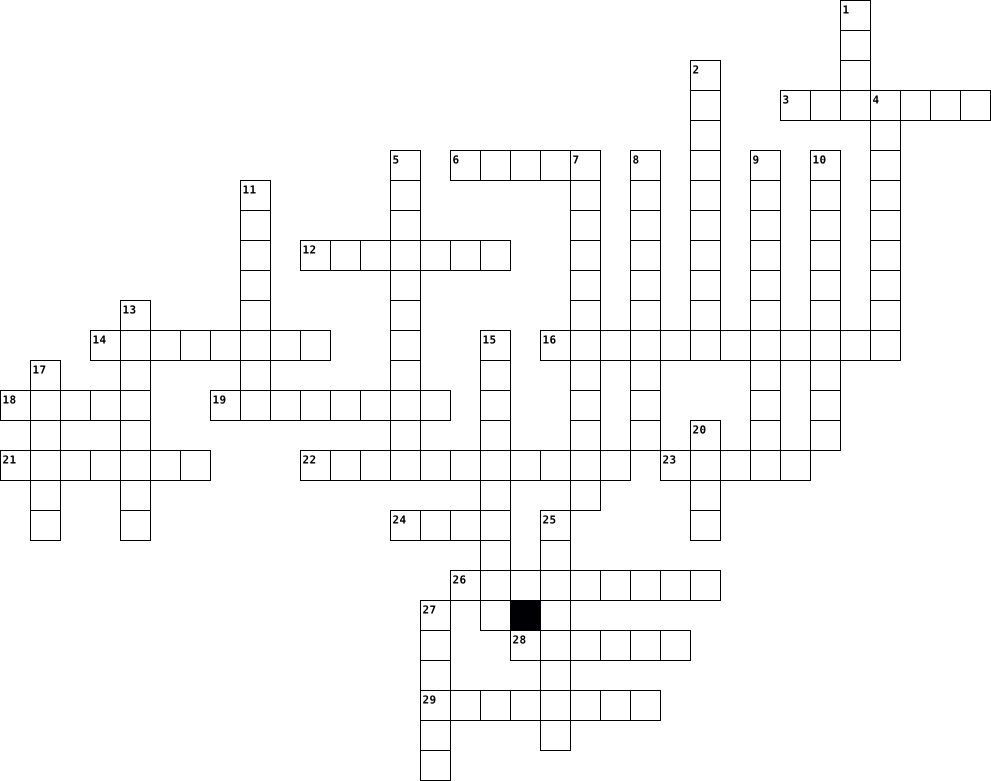
Across
- Conduction :The transfer of energy as heat through a material
- : the distance traveled by the time interval during which the motion occurred
- :The tendency of an object to resist being moved or, if the object is moving, to resist a change in speed or direction until and outside force acts on the object.
- Machines :A machine made of more that one simple machine
- : The rate at which velocity changes over time; an objects accelerates if its speed, direction or both change
- : an action exerted on a body in order to change the body’s state of rest or motion; force has magnitude and direction
- : The speed of an object in a particular direction
- Friction : The force that opposes the movement of two surfaces that are in contact with each other and are sliding over each other
- :A material used to cool an area or object to a temperature that is lower than the temperature of the environment
- :A quantity that measures the rate at which work is done or energy is transformed
- Engine :A machine that transform heat into mechanical energy or work.
- Energy :The energy an object has because of position, shape or condition of the object
- Machine :One of six basic machine types of machines which are the basis for all other forms of machines
- Velocity :The constant velocity of a falling object when the force of air resistance is equal in magnitude and opposite in direction to the force of gravity
Down
- Fall :the motion of a body when only the force of gravity is acting on the body.
- Motion :the curved path that an object follows when thrown, launched, or otherwise projected near the surface of he earth; the motion of objects that are moving in two dimensions under the influence of gravity
- :The energy that is transferred as electromagnetic waves, such as visible light and infrared waves
- : an Instrument that measures and indicates temperature
- :The change in position of an object
- :A quantity, usually expressed as a percentage that measures the ratio of useful work output to work input
- : is a measure of how hot (or cold) something is; specifically; a measure of average kinetic energy of the particles in an object
- Energy :The amount of work an object can do because of the object’s kinetic and potential energy
- Zero :The temperature at which molecular energy is a minimum 0oK on the Kelvin scale or -273.16oC on the Celsius scale
- :A quantity defined as the product of the mass and the velocity of an object
- :The movement of matter due to differences in density that are caused by temperature variations
- : objects change in position relative to a reference point
- :The transfer of energy to a body by the application of a force that causes the body to move in the direction of the force
- Heat :The quantity of heat required to raise a unit of mass of homogeneous material 1oK or 1oC in a specific way given constant pressure and volume
- Friction: The force that resists the initiation between two surfaces that are in contact and at rest
29 Clues: :The change in position of an object • : The speed of an object in a particular direction • : an Instrument that measures and indicates temperature • Machines :A machine made of more that one simple machine • : objects change in position relative to a reference point • Conduction :The transfer of energy as heat through a material • ...
COAST KQ1 2013-06-24

Across
- this roots enable species to take in oxygen in waterlogged conditions
- the cause of the different colors of corals
- this type of farming includes farming fish in cages or ponds
- a relationship where two organisms live together and benefit each other
- occurs when there are high sea temperatures
- where the structure and dominant species in each zone varies due to environmental conditions
- tiny coral animals
- areas where fish are bred and raised
- this energy could supply 3 percent of the energy needs in USA
- this species are salt-tolerant or subtropical plants
- level of murkiness of water
Down
- this species develop prop roots to support their heights
- a plant that grows naturally in saline environment
- this refers to the ability of life forms to adjust to changing conditions
- this service provides products such as seafood ,water and building materials
- the inland zone is a habitat for this species
- this item can be crushed and used to manufacture cement
- provides sheltered harbors for recreational and trading vessels
- suffocate living corals
- mangroves are more common along the coastlines such as the Malay peninsula, Borneo and many more
20 Clues: tiny coral animals • suffocate living corals • level of murkiness of water • areas where fish are bred and raised • the cause of the different colors of corals • occurs when there are high sea temperatures • the inland zone is a habitat for this species • a plant that grows naturally in saline environment • this species are salt-tolerant or subtropical plants • ...
alma cross word 2024-04-15

Across
- excess of electrons
- volt is the unit of electric potential.
- may be mechanical, electromechanical, or piezoelectric
- chemical element.
- cell a dry cell is a type of electric battery, commonly
- the electricity presents, and a body or substance that
- a circuit is a complete, circular path that
- LED is a device that lights up and displays information
- circuit an open circuit is a circuit where the
- a buzzer or beeper is an audio signaling device
- of power which shortens the life and consumes more
- a structure such as a brige or a person or animal
- has been interrupted or “opened “ at some point
Down
- negative is the electricity presents in a body or substitute that has
- that current will not flow.
- lighting static lighting is a device using continuous
- forms.
- electricity passes through it
- energy is the capacity for doing work, it may exist
- but is simpler to design.
- an atom is a particle of matter that uniquely defines
- flows through
- for portable electric device
- a load is amount or weight of something carried by a
- potential kinetic , thermal , chemical, nuclear or other
- a deficiency of electrons
26 Clues: forms. • flows through • chemical element. • excess of electrons • but is simpler to design. • a deficiency of electrons • that current will not flow. • for portable electric device • electricity passes through it • volt is the unit of electric potential. • a circuit is a complete, circular path that • circuit an open circuit is a circuit where the • ...
Crossword Puzzle 2019-10-15

Across
- This is caused by the earth's weather patterns creating high and low pressure centers forcing wind to rush from high to low pressure.
- A form of energy resulting from the existence of charged particles (such as electrons or protons), either statically as an accumulation of charge or dynamically as a current.
- The capacity of a large-scale power station is usually on this scale of measurement (MW). One of these is equal to one million watts or one thousand kilowatts.
- The electricity generated from the sun’s energy.
- Also known as Combined Heat and Power. This is the production of electricity from steam, heat, or other forms of energy produced as a by-product of another process.
- The electricity generated from the flow of water.
Down
- Energy sources that do not come from finite resources. They include wind energy, hydropower, solar energy (solar thermal, photovoltaics), bioenergy (biomass and biogas) and geothermal energy.
- A system of interconnected power lines and generators that is managed so that power from generators is dispatched as needed to meet the requirements of the customers connected to it (this system) at various points.
- Organic waste from agricultural, livestock, and lumber industry products, dead trees, foliage, etc., and is considered a renewable energy source.
- The unit of electrical potential. It is the electromotive force which, if steadily applied to a circuit having a resistance of one ohm, will produce a current of one ampere.
- A unit of measure for electrical energy equal to 1 Billion watts. This is the preferred measure of utility scale power plants. It is enough electricity to power 5000 homes for a year.
- A document, approved by the responsible regulatory agency, listing the terms and conditions, including a schedule of prices, under which utility services will be provided.
12 Clues: The electricity generated from the sun’s energy. • The electricity generated from the flow of water. • This is caused by the earth's weather patterns creating high and low pressure centers forcing wind to rush from high to low pressure. • ...
MRT Week 2025 2025-11-07

Across
- Imaging modality that is used to measure the strength of bones
- A physician who interprets medical images to aid in diagnosis
- Downward angle on an x-ray beam
- Imaging modality that uses a strong magnetic field and radio waves to create detailed cross-sectional images through the body
- A common screening test for breast cancer that uses x-rays
- Imaging modality that uses x-rays to create detailed cross-sectional images
- Most common radioisotope used for NM
Down
- Use of x-ray to create real time live images
- A device that creates and receives sound waves that forms images of the inside of the body
- Imaging modality that uses high-frequency sound waves to produce real-time images and videos of internal organs, tissues and blood flow within the body
- An X-ray image
- Imaging modality that requires the administraion of radioisotopes to create an image
- NM uses this type of radiation
- BMD is used to diagnose this condition
- Highly trained healthcare professional that administers various forms of energy to create images for diagnostics
- Element in the body that is imaged in MRI
- Father of CT and its attenuation units
17 Clues: An X-ray image • NM uses this type of radiation • Downward angle on an x-ray beam • Most common radioisotope used for NM • BMD is used to diagnose this condition • Father of CT and its attenuation units • Element in the body that is imaged in MRI • Use of x-ray to create real time live images • A common screening test for breast cancer that uses x-rays • ...
cro 2024-04-30

Across
- Replanting trees in a deforested area.
- Study of the ocean's physical and biological aspects.
- Animals living in their natural habitat.
- Campaigning for social or political change.
- Element central to climate change discussions.
- Structure for growing plants or regulating temperature.
- Release of gases into the atmosphere.
- Clearing of trees from an area.
- Permanent disappearance of a species.
- Natural environment where an organism lives.
- Publicly support a cause or policy.
- Energy sources that can be replenished.
Down
- Variety of life in a particular ecosystem.
- Remains or impressions of ancient life forms.
- Patterns of weather conditions over a long period of time.
- Extended period of low rainfall.
- Protection and preservation of natural resources.
- Greenhouse gas produced by agriculture.
- Ability to meet present needs without compromising the future.
- Large mass of ice moving slowly over land.
20 Clues: Clearing of trees from an area. • Extended period of low rainfall. • Publicly support a cause or policy. • Release of gases into the atmosphere. • Permanent disappearance of a species. • Replanting trees in a deforested area. • Greenhouse gas produced by agriculture. • Energy sources that can be replenished. • Animals living in their natural habitat. • ...
DMV Forms 2022-05-19

Across
- Need pay sales tax
- Renew/upgrade license
- Online Permit Test Attestation for Applicants 18
- Adding a lien
- up
- Sales tax paid to Michigan
- Large marsupial
Down
- Renewal/Original registration transaction
- Information for what is need for a nys
- Lost license, need tp surrender
- Has a trunk
- form to register vehicle for next to kin
- form to register vehicle for surviving spouse
- Flying mammal
- Likes to chase mice
- Man's best friend
16 Clues: up • Has a trunk • Adding a lien • Flying mammal • Large marsupial • Man's best friend • Need pay sales tax • Likes to chase mice • Renew/upgrade license • Sales tax paid to Michigan • Lost license, need tp surrender • Information for what is need for a nys • form to register vehicle for next to kin • Renewal/Original registration transaction • form to register vehicle for surviving spouse • ...
Verb Forms 2020-09-27

Across
- spend
- become
- drink
- buy
- write
- choose
- bring
- sing
- shut
Down
- think
- eat
- break
- throw
- cut
- hold
- sit
16 Clues: eat • buy • cut • sit • hold • sing • shut • spend • think • break • drink • write • throw • bring • become • choose
Future forms 2023-05-14

Across
- My parents __(flying) to Mexico next month.
- We don't have any milk. I will __ (buy) some later.
- Look at that boy! He is going to __ (fall).
- I think it __ (rain) today.
- The train __ (leave) at 10 p.m.
- My parents __ visit Madrid next month.
- I __ (play) computer games with my brother tomorrow.
- We ___ (help)you.
Down
- I think she will pass the exam.
- Look at the sky! It __ (rain).
- I __ (visit) my grandparents today but I'm not sure yet.
- I promise I __ (give) you back the money.
- I __ (help) you later but I don't know yet.
- The film __ (finish) at 6 p.m.
- I'm __ (play) basketball tomorrow.
- I __ go to the concert if I have the time.
16 Clues: We ___ (help)you. • I think it __ (rain) today. • Look at the sky! It __ (rain). • The film __ (finish) at 6 p.m. • I think she will pass the exam. • The train __ (leave) at 10 p.m. • I'm __ (play) basketball tomorrow. • My parents __ visit Madrid next month. • I promise I __ (give) you back the money. • I __ go to the concert if I have the time. • ...
Combining Forms 2022-02-15

Across
- below
- neck, cervix
- pelvis
- abdomen
- side
- chest
- buttock
- away from
Down
- back
- fat
- near to
- cell
- pubis, genital region
- front
- nerve
- tissue
16 Clues: fat • back • cell • side • below • front • nerve • chest • pelvis • tissue • near to • abdomen • buttock • away from • neck, cervix • pubis, genital region
Preterite forms 2023-09-13

Across
- traducir él form
- ofrecer tu form
- caminar nosotros form
- hacer yo form
- ir ellos form
- empzar yo form
- vender yo form
- ir nosotros form
Down
- comprar ellos form
- ser yo form
- venir ellos form
- saber ellos form
- abrir tu form
- buscar yo form
- ser él form
- poder nosotros form
16 Clues: ser yo form • ser él form • abrir tu form • hacer yo form • ir ellos form • buscar yo form • empzar yo form • vender yo form • ofrecer tu form • traducir él form • venir ellos form • saber ellos form • ir nosotros form • comprar ellos form • poder nosotros form • caminar nosotros form
science 2025-09-25

Across
- Unstable particles transform into stable particles
- when one reaction causes several more reactions and so on
- central core of an atom which consists of protons and neutrons
- highly radioactive waste that is hard to get rid of
- energy that can travel through space
- use of nuclear reactions to power stuff
- Nucleus splitting into two
Down
- Two small nucleus combine
- time it takes for half of a substance to decay
- different forms of the same element
- center of an atom
- It makes up everything
12 Clues: center of an atom • It makes up everything • Two small nucleus combine • Nucleus splitting into two • different forms of the same element • energy that can travel through space • use of nuclear reactions to power stuff • time it takes for half of a substance to decay • Unstable particles transform into stable particles • highly radioactive waste that is hard to get rid of • ...
Science Review 2023-12-18

Across
- a material that attracts iron
- a part something has
- the pulling force of a magnet is called this
- the part of blood that forms clots
- the pushing force of a magnet is called this
- the muscle that causes breathing
- a path electricity flows through
- a tube that carries blood to the heart
- something electricity can flow through
- the smallest blood vessel
Down
- something electricity cannot flow through
- the liquid part of blood
- a small sac in the lungs where the gas exchange takes place
- the main organ of the circulatory system
- the two sides of a magnet
- the ability to cause change
- a tube that carries blood away from the heart
- a component that transforms electricity to motion
- the job something does
19 Clues: a part something has • the job something does • the liquid part of blood • the two sides of a magnet • the smallest blood vessel • the ability to cause change • a material that attracts iron • the muscle that causes breathing • a path electricity flows through • the part of blood that forms clots • a tube that carries blood to the heart • something electricity can flow through • ...
Class 2: The Magic of Carbohydrates 2025-01-03

Across
- A food made of flour, water, and a leavening agent (such as yeast) mixed together and baked.
- An edible seed, typically kidney-shaped, growing in long pods on certain leguminous plants.
- A type of carbohydrate that the body can't digest or absorb and that has many benefits for the body.
- A dough made from durum wheat, extruded or stamped into various shapes and cooked in boiling water.
- Consisting of many different and connected parts.
- The strength and vitality required for sustained physical or mental activity.
- Food consisting of sugars, starch, and/or cellulose that can be broken down to release energy in the human body.
- A simple sugar found in many plants, especially fruits.
- A carbohydrate consisting of many glucose units bonded together.
- A seed from a South American plant, eaten like a grain, containing protein, fiber, B vitamins, and minerals.
- The entire seed of a plant, containing the bran, endosperm, and germ.
- A simple sugar that your body uses for energy.
Down
- A cereal plant whose edible grains are called groats, and can come in steel cut or rolled forms.
- Hulled but unpolished rice that retains most of the bran layers, endosperm, and germ.
- Uncomplicated form.
- A starchy plant tuber, cooked and eaten like a vegetable.
- An elongated tropical fruit, typically yellow in color, that grows in clusters.
- A sweet crystalline substance obtained from various plants consisting essentially of sucrose.
- A sugar present in milk.
- Tiny legumes high in vitamins, minerals, and fiber.
20 Clues: Uncomplicated form. • A sugar present in milk. • A simple sugar that your body uses for energy. • Consisting of many different and connected parts. • Tiny legumes high in vitamins, minerals, and fiber. • A simple sugar found in many plants, especially fruits. • A starchy plant tuber, cooked and eaten like a vegetable. • ...
Chemistry A CrossWord Puzzle 2019-02-20

Across
- The highest point the medium rises to. (A trough is the lowest point the medium sinks to.)
- The movement of heat by a moving liquid or gas.
- Energy that travels by waves or particles, particularly electromagnetic radiation such as heat or x-rays.
- The passage of energy, particularly electrical or heat, through matter.
- A measure of the amount of matter in an object.
- A longitudinal wave (sound wave) propagated by the elastic compression of the medium.
- The change in direction of a wave at a boundary between two different media, so that the wave moves back into the medium it came from.
- A force that causes a change in the motion of an object.
- A push or pull upon an object resulting from the object’s interaction with another object.
- The quantity of motion of a moving body, measured as a product of its mass and velocity.
- The tendency of a body to maintain its state of rest or uniform motion.
- The displacement if a wave from zero.
- A (chemical) change in which forms new substances.
Down
- The SI derived unit used to measure force.
- A force that attracts any two objects with mass.
- The action or state of being squished down or made smaller or more pressed together.
- The bending of light as it passes from one substance to another.
- Released when bonds form in a chemical reaction, often producing heat as a by-product (exothermic reaction).
- A change in position of an object over time.
- The speed of something in a given direction.
- Measure of how fast velocity is changing, so we can think of it as the change in velocity over time.
- A wave property of electromagnetic radiation that causes the radiation to bend as it passes by an edge or through an aperture.
- The number of events per unit of time where an event is repeating at regularly spaced time intervals.
- The basic SI unit of energy.
- The rate at which someone or something is able to move or operate.
25 Clues: The basic SI unit of energy. • The displacement if a wave from zero. • The SI derived unit used to measure force. • A change in position of an object over time. • The speed of something in a given direction. • The movement of heat by a moving liquid or gas. • A measure of the amount of matter in an object. • A force that attracts any two objects with mass. • ...
Muscular System 2021-03-08

Across
- _____ twitch is endurance and long lasting energy
- treat conditions related to the body's structure
- ______ muscle is voluntary muscles (move consciously)
Down
- Muscular _________ is a group of disease that damage and weaken your muscles over time
- responsible for movement
- ______ muscle found in walls of the heart
- _______ muscle forms organs like the stomach and bladder and changes shape to facilitate bodily functions
- _____ twitch is sudden bursts of energy, tiring quickly
8 Clues: responsible for movement • ______ muscle found in walls of the heart • treat conditions related to the body's structure • _____ twitch is endurance and long lasting energy • ______ muscle is voluntary muscles (move consciously) • _____ twitch is sudden bursts of energy, tiring quickly • ...
SUPERCOOL AWESOME BIOLOGY CROSSWORD PUZZLE BOSS EDITION 2023-10-11

Across
- POWER HOUSE OF THE CELL!!!
- basic structural and functional unit of all forms of life
- biological process used by many cellular organisms to convert light energy
Down
- monomer that makes up proteins; contains carboxyl and amino functional groups
- Cells have a membrane-bound nucleus.
- compound made up of carbon, hydrogen, and oxygen atoms; major source of energy for the human body
- macromolecule made mainly from carbon and hydrogen atoms; includes fats, oils, and waxes
- the change in heritable characteristics of biological populations over successive generations
- membrane-bound organelle found in eukaryotic cells
- biological living system that functions as an individual life form
10 Clues: POWER HOUSE OF THE CELL!!! • Cells have a membrane-bound nucleus. • membrane-bound organelle found in eukaryotic cells • basic structural and functional unit of all forms of life • biological living system that functions as an individual life form • monomer that makes up proteins; contains carboxyl and amino functional groups • ...
Amazing Sites in the Sky: Constellations 2023-04-04

Across
- happening only in certain seasons
- the measure of a star's brightness
- the half of Earth that is south of the equator
- groups of visible stars that form patterns when viewed from Earth
- masses of burning gas visible in the sky, especially at night
- very old, or belonging to a period long ago
- a group of stars that forms a pattern in the sky and has a popular name but is smaller than a constellation
Down
- scientists who study the stars, planets, and outer space
- the science of determining the position of something or a distance traveled
- the total amount of energy that a star gives off
- power from a source that produces light and heat
- a position or perspective from which something is viewed
- the half of Earth that is north of the equator
13 Clues: happening only in certain seasons • the measure of a star's brightness • very old, or belonging to a period long ago • the half of Earth that is north of the equator • the half of Earth that is south of the equator • the total amount of energy that a star gives off • power from a source that produces light and heat • ...
Nuclear Radioactivity 2025-09-26

Across
- radioactive material left over from the operation of nuclear reactors
- time takes for half of a given quantity of substance to decay
- basic unit of chemical element/building block
- by which an unstable atomic nucleus trans into more stable
- extremely dense and tiny,central core of atom contain almost all of its mass
- where 2 light atomic nuclei combine to form single
- large atomic nucleus splits into 2 or more
Down
- energy as electromagnetic waves or as moving subatomic particles
- energy released from an atoms nucleus which is central core
- with unstable atomic nuclei that decay to become stable
- sequence of reactions where a reactive product or by-product causes additional reactions
- two or more forms of of same element that contains equal number of protons but different number of nuetrons
- central membrane bound organelle
13 Clues: central membrane bound organelle • large atomic nucleus splits into 2 or more • basic unit of chemical element/building block • where 2 light atomic nuclei combine to form single • with unstable atomic nuclei that decay to become stable • by which an unstable atomic nucleus trans into more stable • energy released from an atoms nucleus which is central core • ...
Chapter 6 menu crossword puzzel 2023-03-26

Across
- are the preserved remains or traces of living things
- magma cools and hardens into a mass of igneous rock called an intrusion
- is a record of the geologic events and evolution of life forms as shown in fossil record
- is its age compared to the ages of other rocks
- lava that hardens on the surface and forms igneous rock
- it no longer exists and will never again live on Earth
- is a ball of dust,gas and ice that orbits the sun
Down
- scientist who study fossils
- of a radioactive element is the time it takes for half of the radio active atoms to decay
- is the change in living things over time
- these elements release particle and energy in a process
- a absolute age of a rock is the number of years that have passed since the rock formed
- is a gap in the geologic record
- eras are subdivided into units of geologic time
- geologist divide the time between precambrian time and the present into three long units of time
15 Clues: scientist who study fossils • is a gap in the geologic record • is the change in living things over time • is its age compared to the ages of other rocks • eras are subdivided into units of geologic time • is a ball of dust,gas and ice that orbits the sun • are the preserved remains or traces of living things • it no longer exists and will never again live on Earth • ...
Chapter Two Vocabulary 2020-09-27

Across
- substance that decreases activation energy and increases reaction rate in a chemical reaction.
- attraction between molecules of different substances.
- energy amount of energy need to break a bond between two particular atoms; or the amount of energy released when a bond forms between two particular atoms.
- acid molecule that makes up proteins; composed of carbon, hydrogen, oxygen, nitrogen, and sometimes sulfur.
- chemical reaction that yields a net release of energy in the form of heat.
- substance formed by a chemical reaction.
- measurement of acidity; related to free hydrogen ion concentration in solution.
- acid hydrocarbon chain often bonded to glycerol in a lipid.
- compound that donates a proton (H+) when dissovled in solution.
- atom that has gained or lost one or more electrons
- bond chemical bond formed through the electrical force between oppositely charged ions.
- protein that catalyzes chemical reactions for organisms.
- two or more atoms held together by covalent bonds; not necessarily a compound.
- substance that dissovles in a solvent and is present at a lower concentration that the solvent.
- condition in which reactants and products of a chemical reaction are formed at the same rate.
- reactant in a chemical reaction upon which an enzyme acts.
- bond chemical bond formed when two atoms share one or more pairs of electrons.
- reaction process by which substances change into different substances through the breaking and forming of chemical bonds.
- large, carbon-based molecule formed by monomers.
Down
- molecule composed of carbon, hydrogen, and oxygen; includes sugars and starches.
- mixture that is consistent throughout; also called a homogenous mixture.
- substance in which solutes dissovled and that is present in greater concentration in a solution.
- substance that is changed by a chemical reaction.
- bond attraction between a slightly positive hydrogen atom and a slightly negative atom.
- substance made of atoms of different elements that are bonded together in a particular ratio.
- energy energy input necessary to initiate a chemical reaction.
- attraction between molecules of the same substance.
- acid polymer of nucleotides; the genetic material of organisms.
- compound that accepts a proton (H+) when dissovled in solution.
- molecular subunit of a polymer.
- chemical reaction that requires a net input of energy.
- substance made of only one type of atom that cannot be broken down by chemical means.
- polymer composed of amino acids linked by peptide bonds folds into a particular structure depending on bonds between amino acids.
- nonpolar molecule composed of carbon, hydrogen, and oxygen; includes fats and oils.
- smalles basic unit of matter.
35 Clues: smalles basic unit of matter. • molecular subunit of a polymer. • substance formed by a chemical reaction. • large, carbon-based molecule formed by monomers. • substance that is changed by a chemical reaction. • atom that has gained or lost one or more electrons • attraction between molecules of the same substance. • ...
FILL IN DA WORDS 2022-03-04

Across
- produced in a club shaped structure
- bacteria usually reproduce by
- creates a thick wall structure in unflavoralbe conditions
- a one celled animal like protist
- uses dead organism as as food and energy sources
- any organism that causes disease
- when a pathogen produces a poisonous substance
- short threadlike structure that extends from the cell membrane
- a chemical that bacteria produces
- Bacteria that live in moist conditions also have a whiplike tail
- made from a damaged particles in a bacterial cell wall or from a killed bacteria
- the body of a fungus is usually a mass of many celled, thread like tubes
Down
- is a form of asexual reproduction in which a new organism forms on the side of a parent organism
- changes nitrogen in the air into forms that plants and animals can use
- an organism that is adapted to live without oxygen
- is a plant like protist
- is a waterproof reproductive cell that grows into a new organism
- is a one or many celled organism that lives in wet or moist surroundings
- when a protozoan moves through their environment and feed by using extensions of their cytoplasm
- is a long,thin,whiplike structure used for movement
- uses oxygen when breaking down food
21 Clues: is a plant like protist • bacteria usually reproduce by • a one celled animal like protist • any organism that causes disease • a chemical that bacteria produces • produced in a club shaped structure • uses oxygen when breaking down food • when a pathogen produces a poisonous substance • uses dead organism as as food and energy sources • ...
A&P Chapter 2 Review 2025-09-16

Across
- Acid The monomer unit of a protein is (2 words)
- Relatively weak bonds that can be broken rather easily
- Which molecule is the most abundant in the human body
- Fats, phospholipids, and these don’t dissolve in water
- Sugars with three to seven carbon atoms are called
- How many fatty acids does a fat molecule contain
- What is the symbol for sodium
- The smallest unit of an element that still retains the chemical and physical properties of that element
- Usually of plant origin
- reaction Joining small molecules together to form longer chains requires a (2 words)
- base feature of a nucleotide (2 words)
- In an electrically neutral atom, the number of protons always equals the number of
- Water climbing up a capillary tube
- one function of proteins in the body
Down
- Polysaccharide that is stored as a long term energy source in the body of animals
- combination of hydrogen and this element are required for a compound to be considered organic
- substance is added to a compound during a hydrolysis reaction
- membranes of cells are composed primarily of this
- NaCl is a salt that forms as the result of what type of bond
- Usually of animal origin
- Atoms that share electrons have what type of bonds
- Alpha helix or a beta sheet are examples of what level of protein structure
- Isotopes of an element differ due to the number of
- source main function of carbohydrates in the body (2 words)
- Starch, cellulose, and glycogen are all made of this
- This structure is considered the energy currency of the body
- Ca3(PO4)2 represents a
27 Clues: Ca3(PO4)2 represents a • Usually of plant origin • Usually of animal origin • What is the symbol for sodium • Water climbing up a capillary tube • one function of proteins in the body • base feature of a nucleotide (2 words) • How many fatty acids does a fat molecule contain • membranes of cells are composed primarily of this • ...
Cellular Respiration 2015-03-11

Across
- Another type of energy. ____ energy. It is used when a race is longer, and cellular respiration is the only way to generate a continuing supply of ATP.
- 6O2+C6H12O6--->6CO2+6H2O+Energy
- pyruvic acid accumulates and as a result of glycolysis, it can be converted to lactic acid. pyruvic acid+NADH--->lactic acid+NAD+
- A type of energy. _____ energy. It is used when your body needs a lot of energy in a hurry. For example, sprinters need this type of energy.
- the process of producing cellular energy that does not require oxygen. It is the alternate pathway that generates smaller amounts of ATP.
Down
- the process of producing cellular energy involving oxygen. It is the preferred pathway that generates larger amounts of ATP.
- ______ is used by yeasts and other microorganisms. It forms ethyl alcohol and carbon dioxide as wastes. pyruvic acid+NADH--->alcohol+CO2+NAD+
- amount of energy needed to raise the temperature of 1 gram of water by 1 degree Celsius.
- It is the first step in releasing the energy of glucose, in which a molecule of glucose is broken into two molecules of pyruvic acid. ________ is broken down into 2 molecules of pyruvic acid.
- In the presence of oxygen, pyruvic acid passes to the second stage of cellular respiration, the _________. Pyruvic acid is broken down into carbon dioxide in a series of energy-extracting reactions. ADP is converted into ATP and the electron carriers NAD+ and FAD change to NADH and FADH2.
- a kilocalorie, or 1000 calories.
11 Clues: 6O2+C6H12O6--->6CO2+6H2O+Energy • a kilocalorie, or 1000 calories. • amount of energy needed to raise the temperature of 1 gram of water by 1 degree Celsius. • the process of producing cellular energy involving oxygen. It is the preferred pathway that generates larger amounts of ATP. • ...
Spelling 2025-11-20

Across
- paired blades pivoting for cutting
- upward trajectory or climb
- trace carried on the air
- landscape that forms a backdrop
- move upward, often with effort
- setting in which an action unfolds
- The Creators
Down
- capture attention in an irresistible way
- emitting light after energy absorption
- tissue that contracts to create force
- move from a higher point to a lower one
- systematic pursuit of knowledge
- shape formed by a partially illuminated moon
13 Clues: The Creators • trace carried on the air • upward trajectory or climb • move upward, often with effort • landscape that forms a backdrop • systematic pursuit of knowledge • paired blades pivoting for cutting • setting in which an action unfolds • tissue that contracts to create force • emitting light after energy absorption • move from a higher point to a lower one • ...
Energy crossword 2023-12-06

Across
- Example of Chenergyl energy
- energy Example of themral energy
- The energy from vibrations in matter.
- Energy Stored in the bands or molecules
- The energy of heat
- The energy of moving electrons or electrical change
- Example Energyrmal energy
- example of electrical energy
- Example of nuclear energy
Down
- Example of sound energy
- to cause change
- The energy in a moving object
- energy cannot be created or ____
- The energy of light
- Example of sound energy
- Example of Mechanical energy
- strategy to memerize types of energy
- Example of chemical energy
- The energy locked in the nucleus of an atom
- The ability to do work
20 Clues: to cause change • The energy of heat • The energy of light • The ability to do work • Example of sound energy • Example of sound energy • Example Energyrmal energy • Example of nuclear energy • Example of chemical energy • Example of Chenergyl energy • Example of Mechanical energy • example of electrical energy • The energy in a moving object • energy cannot be created or ____ • ...
Energy crossword 2023-12-06

Across
- Example of Chenergyl energy
- energy Example of themral energy
- The energy from vibrations in matter.
- Energy Stored in the bands or molecules
- The energy of heat
- The energy of moving electrons or electrical change
- Example Energyrmal energy
- example of electrical energy
- Example of nuclear energy
Down
- Example of sound energy
- to cause change
- The energy in a moving object
- energy cannot be created or ____
- The energy of light
- Example of sound energy
- Example of Mechanical energy
- strategy to memerize types of energy
- Example of chemical energy
- The energy locked in the nucleus of an atom
- The ability to do work
20 Clues: to cause change • The energy of heat • The energy of light • The ability to do work • Example of sound energy • Example of sound energy • Example Energyrmal energy • Example of nuclear energy • Example of chemical energy • Example of Chenergyl energy • Example of Mechanical energy • example of electrical energy • The energy in a moving object • energy cannot be created or ____ • ...
Energy crossword 2023-12-06

Across
- Example of Chenergyl energy
- energy Example of themral energy
- The energy from vibrations in matter.
- Energy Stored in the bands or molecules
- The energy of heat
- The energy of moving electrons or electrical change
- Example Energyrmal energy
- example of electrical energy
- Example of nuclear energy
Down
- Example of sound energy
- to cause change
- The energy in a moving object
- energy cannot be created or ____
- The energy of light
- Example of sound energy
- Example of Mechanical energy
- strategy to memerize types of energy
- Example of chemical energy
- The energy locked in the nucleus of an atom
- The ability to do work
20 Clues: to cause change • The energy of heat • The energy of light • The ability to do work • Example of sound energy • Example of sound energy • Example Energyrmal energy • Example of nuclear energy • Example of chemical energy • Example of Chenergyl energy • Example of Mechanical energy • example of electrical energy • The energy in a moving object • energy cannot be created or ____ • ...
Cell's Crossword 2024-01-23

Across
- The parts of a cell. They process and release energy, destroy and digest materials, and replicate genetic information.
- Temporary storage bubbles for the cell, storing food, water, or waste.
- Cells found in animals.
- The basic structural and functional unit of all forms of life; they are able to replicate independently.
- All organisms are made of cells, The cell is the basic building block of life, Every cell comes from another existing cell.
- The cell’s “control center”, housing the cell’s chromosomes.
- This transport requires energy to move a substance into and out of a cell.
Down
- Cells found in plants (with a cell wall, chloroplasts, and a large, central vacuole for storage that takes up a lot of space).
- Large molecules made from stringing amino acids together.
- Very simple, single-celled bacteria that do not have a membrane-bound nucleus, mitochondria, or organelles.
- Organism that is composed of many cells, and many different types of cells that perform different tasks throughout the organism.
- The chemical reaction a plant carries out in order to produce energy from sunlight.
- Plants, algae, fungi and some bacteria have an extra computer layer that is very rigid and tough, that helps protect the cell and give it shape
- In plant cells only, they are organelles that produce food.
- Much more complex types of cells
- The movement of things in and out of the cell without the use of energy.
- Jelly-like substance in the cell containing all the organelles in the cell. It helps to maintain the structure of the cell
17 Clues: Cells found in animals. • Much more complex types of cells • Large molecules made from stringing amino acids together. • In plant cells only, they are organelles that produce food. • The cell’s “control center”, housing the cell’s chromosomes. • Temporary storage bubbles for the cell, storing food, water, or waste. • ...
agriculture 2024-02-22

Across
- is the food given to animals
- refers to a farm implement used in haymaking
- mootori õli
- kojamehed
- is a heat exchange device typically used in vehicles
- kütus
- a divaice or mechanism used to separate unwanted elements
- is type of differential found in vehicles that allows for equal distribution of power between wheels
- leke
- is a mechanical device designed to move fluids, such as liquids or gasses
- kabiin
- is a compacted and tightly bound bundle of dried grasses
- also known as a propeller shaft or prop shaft
- puhas
- is the outher shell of something and holding several things together
Down
- is mechanical device in a vehicle that controls the power generated by the engien
- is a circular device typically made of metal, rubber or another durable material, designed to rotate
- for example, you drive a tractor with a different meaning
- kütusesüsteem
- is a machine designed to convert various forms of energy into mechanical energy
- hüdroõli
- liigend
- tase
- kontrollima
- tühjendama
- vedelik
- tuled
- jahutusvedelik
- also known as the accelerator pedal
- is a collection of dried grasses and other herbaceous plantsprimarly used
30 Clues: tase • leke • kütus • tuled • puhas • kabiin • liigend • vedelik • hüdroõli • kojamehed • tühjendama • mootori õli • kontrollima • kütusesüsteem • jahutusvedelik • is the food given to animals • also known as the accelerator pedal • refers to a farm implement used in haymaking • also known as a propeller shaft or prop shaft • is a heat exchange device typically used in vehicles • ...
States of Matter? 2020-05-12

Across
- when a substance changes from solid matter to liquid matter
- when water vapour in the air is changed to liquid water
- when a substance changes from liquid matter to solid matter
- matter which has no fixed shape or volume
- when a liquid turns into a gas
- matter which has particles that are stable in shape
Down
- movement of particles in matter which is elastic
- Theory theory which explains the properties of matter and the way its particles move
- something which has mass and occupies space
- a measurement of how hot or cold something is
- when matter in a liquid state turns into gas
- the capacity to do the work required to influence action
- energy transferred between two things which are different temperatures
- matter which forms into the shape of a container
14 Clues: when a liquid turns into a gas • matter which has no fixed shape or volume • something which has mass and occupies space • when matter in a liquid state turns into gas • a measurement of how hot or cold something is • movement of particles in matter which is elastic • matter which forms into the shape of a container • matter which has particles that are stable in shape • ...
physics 2016-04-25
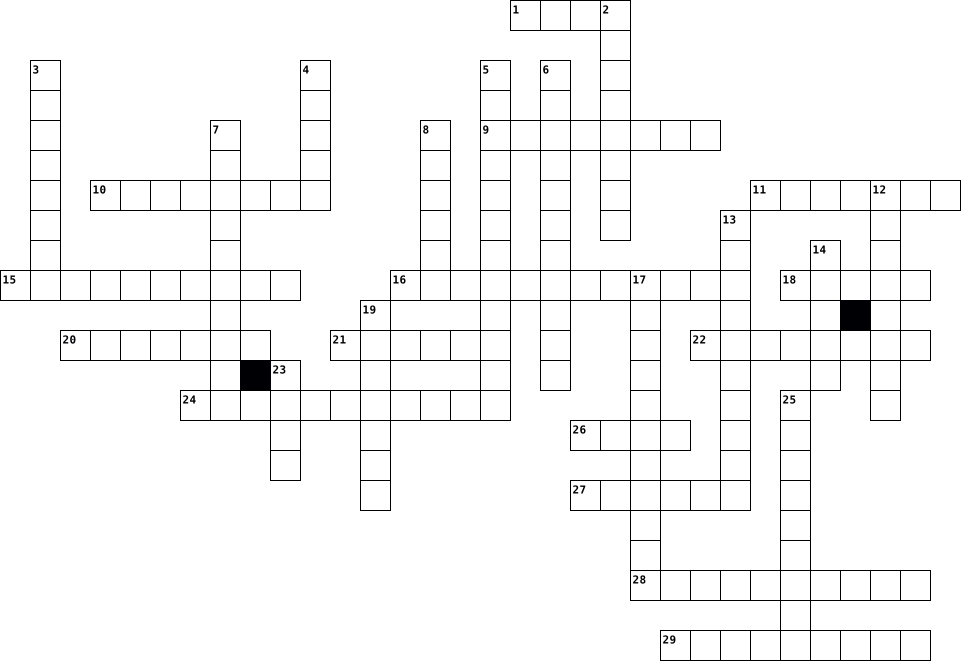
Across
- Engine :A machine that transform heat into mechanical energy or work.
- Heat :The quantity of heat required to raise a unit of mass of homogeneous material 1oK or 1oC in a specific way given constant pressure and volume
- Machines :A machine made of more that one simple machine
- Conduction :The transfer of energy as heat through a material
- Energy :The amount of work an object can do because of the object’s kinetic and potential energy
- : The rate at which velocity changes over time; an objects accelerates if its speed, direction or both change
- :A quantity that measures the rate at which work is done or energy is transformed
- :The tendency of an object to resist being moved or, if the object is moving, to resist a change in speed or direction until and outside force acts on the object.
- Machine :One of six basic machine types of machines which are the basis for all other forms of machines
- : The speed of an object in a particular direction
- :A material used to cool an area or object to a temperature that is lower than the temperature of the environment
- :The transfer of energy to a body by the application of a force that causes the body to move in the direction of the force
- : objects change in position relative to a reference point
- :A quantity, usually expressed as a percentage that measures the ratio of useful work output to work input
- Energy :The energy an object has because of position, shape or condition of the object
Down
- Velocity :The constant velocity of a falling object when the force of air resistance is equal in magnitude and opposite in direction to the force of gravity
- Zero :The temperature at which molecular energy is a minimum 0oK on the Kelvin scale or -273.16oC on the Celsius scale
- : the distance traveled by the time interval during which the motion occurred
- :The change in position of an object
- : an Instrument that measures and indicates temperature
- Motion :the curved path that an object follows when thrown, launched, or otherwise projected near the surface of he earth; the motion of objects that are moving in two dimensions under the influence of gravity
- Friction: The force that resists the initiation between two surfaces that are in contact and at rest
- :A quantity defined as the product of the mass and the velocity of an object
- :The movement of matter due to differences in density that are caused by temperature variations
- : an action exerted on a body in order to change the body’s state of rest or motion; force has magnitude and direction
- : is a measure of how hot (or cold) something is; specifically; a measure of average kinetic energy of the particles in an object
- Friction : The force that opposes the movement of two surfaces that are in contact with each other and are sliding over each other
- Fall :the motion of a body when only the force of gravity is acting on the body.
- :The energy that is transferred as electromagnetic waves, such as visible light and infrared waves
29 Clues: :The change in position of an object • : The speed of an object in a particular direction • : an Instrument that measures and indicates temperature • Machines :A machine made of more that one simple machine • : objects change in position relative to a reference point • Conduction :The transfer of energy as heat through a material • ...
physics 2016-04-25
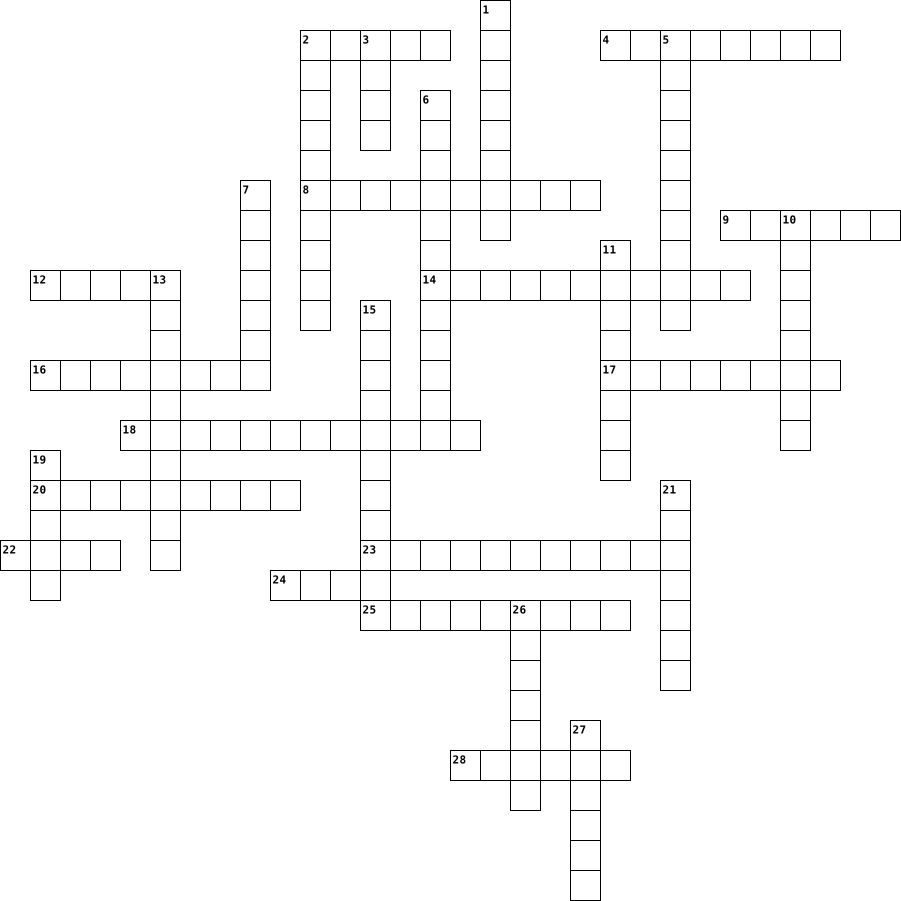
Across
- :A quantity that measures the rate at which work is done or energy is transformed
- :A quantity defined as the product of the mass and the velocity of an object
- :The movement of matter due to differences in density that are caused by temperature variations
- : objects change in position relative to a reference point
- : an action exerted on a body in order to change the body’s state of rest or motion; force has magnitude and direction
- :A material used to cool an area or object to a temperature that is lower than the temperature of the environment
- Heat :The quantity of heat required to raise a unit of mass of homogeneous material 1oK or 1oC in a specific way given constant pressure and volume
- Machines :A machine made of more that one simple machine
- :The change in position of an object
- Energy :The energy an object has because of position, shape or condition of the object
- Engine :A machine that transform heat into mechanical energy or work.
- : is a measure of how hot (or cold) something is; specifically; a measure of average kinetic energy of the particles in an object
- Fall :the motion of a body when only the force of gravity is acting on the body.
- :The energy that is transferred as electromagnetic waves, such as visible light and infrared waves
- Friction: The force that resists the initiation between two surfaces that are in contact and at rest
Down
- Zero :The temperature at which molecular energy is a minimum 0oK on the Kelvin scale or -273.16oC on the Celsius scale
- Motion :the curved path that an object follows when thrown, launched, or otherwise projected near the surface of he earth; the motion of objects that are moving in two dimensions under the influence of gravity
- :The transfer of energy to a body by the application of a force that causes the body to move in the direction of the force
- Energy :The amount of work an object can do because of the object’s kinetic and potential energy
- : The rate at which velocity changes over time; an objects accelerates if its speed, direction or both change
- Friction : The force that opposes the movement of two surfaces that are in contact with each other and are sliding over each other
- Velocity :The constant velocity of a falling object when the force of air resistance is equal in magnitude and opposite in direction to the force of gravity
- : The speed of an object in a particular direction
- :A quantity, usually expressed as a percentage that measures the ratio of useful work output to work input
- : an Instrument that measures and indicates temperature
- : the distance traveled by the time interval during which the motion occurred
- :The tendency of an object to resist being moved or, if the object is moving, to resist a change in speed or direction until and outside force acts on the object.
- Conduction :The transfer of energy as heat through a material
- Machine :One of six basic machine types of machines which are the basis for all other forms of machines
29 Clues: :The change in position of an object • : The speed of an object in a particular direction • : an Instrument that measures and indicates temperature • Machines :A machine made of more that one simple machine • : objects change in position relative to a reference point • Conduction :The transfer of energy as heat through a material • ...
Anatomy vocab 2024-09-04

Across
- powerhouse of a cell; generates most of the chemical energy needed to power the cell's biochemical reactions.
- used to name enzymes
- higher concentration of solute than another solution, meaning water will flow into it
- the surface on which an organism grows or is attached in biology
- the main type of sugar in the blood and is the major source of energy for the body's cells.
- a solution with a lower concentration of solute than the cell.
- forms the names of sugars and other carbohydrates
- made up of amino acids, they are the basis of body structures
- Any of a group of lipids (fats) with a certain chemical structure.
- a salt concentration that is exactly equal to that of blood cells.
Down
- any of various neutral compounds of carbon, hydrogen, and oxygen (such as sugars, starches, and celluloses) most of which are formed by green plants
- the unfolding or breaking up of a protein, modifying its standard three-dimensional structure
- the rupture or destruction of red blood cells.
- used to form the names of polymers
- sugar
- the membrane found in all cells that separates the interior of the cell from the outside environment.
- is the stored form of glucose comprising any connected glucose molecules.
- a biological catalyst and is almost always a protein.
- The process of breakdown of food in the cell with the release of energy
- potential hydrogen; a measure of the concentration of hydrogen ions in a solution
- means “sugar” or “glucose and its derivatives.”
21 Clues: sugar • used to name enzymes • used to form the names of polymers • the rupture or destruction of red blood cells. • means “sugar” or “glucose and its derivatives.” • forms the names of sugars and other carbohydrates • a biological catalyst and is almost always a protein. • made up of amino acids, they are the basis of body structures • ...
Biology Unit 4 Vocab 2022-01-13

Across
- Organisms that are in higher trophic levels eat more poisons which accumulate in their bodies
- Water vapor cooling and forming liquid
- Organisms that can produce the energy they need from sunlight
- These eat dead producers and consumers and are considered heterotrophs
- These eat producers or other consumers and are considered heterotrophs
- converting nitrogen into more useful forms or putting it back into the air
- Energy rich substances that burn the hydrocarbons from dead plants & animals
- A group of ecosystems from similar climates
- The things in an ecosystem that are alive
- Contains numerous populations
- Evaporation FROM PLANTS
- Water falling to earth from the sky as rain, snow, sleet, or hail
- All the livings things on the planet AND the environment they interact with
- A place where something is stored
- These make their own food and are autotrophs
- The maximum amount of population that an area can sustain
- These organize producers and consumers by how many organisms energy has passed through
Down
- Kind of symbiosis where both species benefit
- Organisms that must get the energy they need from eating
- Things that keep populations from growing bigger
- Two organisms that interact with each other regularly
- The non-living things in an ecosystem
- A living thing
- All the living things in an area AND the physical environment they interact with
- One organism killing and eating another
- A group of the same living things
- Kind of symbiosis where one is helped and the other isn’t helped or harmed
- Kind of symbiosis where one is helped and other is harmed
- Animals use oxygen and breathe out CARBON dioxide; plants use CO2 and breathe out O2
- Water changing from liquid to gas and entering the air
30 Clues: A living thing • Evaporation FROM PLANTS • Contains numerous populations • A group of the same living things • A place where something is stored • The non-living things in an ecosystem • Water vapor cooling and forming liquid • One organism killing and eating another • The things in an ecosystem that are alive • A group of ecosystems from similar climates • ...
Earthquakes 2021-10-21

Across
- the point beneath earth's surface where rock breaks under stress and causes an earthquake.
- _________ scale -A scale that rates earthquakes according to there intensity and how much damage they cause at a particular place.
- pulls on the crust, stretching rock so that it becomes thinner in the middle.
- seismic waves that vibrate from side to side to side as well as up and down.
- an earthquake that occurs after a larger earthquake in the same area.
- _________ magnitude scale - a scale that rates earthquakes by estimating the total energy released by an earthquake.
- squeezes rock until it folds or breaks.
- a device that records ground movement caused by seismic waves as they move through Earth.
- the measurement of an earthquake's strength based on seismic waves and movement along faults.
- the force that opposes the motion of one surface as it moves across another surface
- ________ fault -a type of fault in which rocks on either side move past each other sideways with little up or down motion.
- the point on earth's surface directly above an earthquake's focus.
- an upward fold in rock formed by compression of earth's crust.
- can cause rock to break and slip apart or to a change its shape.
Down
- the record of an earthquake's seismic waves produced by a seismograph.
- -the block of rock that forms the lower half of a fault.
- the process by which an earthquake's violent movement suddenly turns lose soil into liquid mud.
- ________ scale - a scale that rates an earthquake's magnitude based on the size of its seismic waves.
- ________ fault - a type of fault where the hanging wall slides downward; caused by tension in the crust.
- _________ fault -a type of fault where the hanging wall slides upward caused by compression in the crust.
- a downward fold in rock formed by compression in earth's crust.
- ________ waves -A type of seismic wave that forms when p waves and s waves reach earth's surface.
- ___________ wall - the block that forms the upper half of a fault.
- a type of seismic wave and that compresses and expands the ground.
- base _______ building - a building mounted on bearings designed to absorb the energy of an earthquake.
- the shaking that results from the movement of rock beneath earths surface.
- a force that acts on rock to change its shape or volume.
- a large area of flat land elevated high above sea level.
- a large wave produced by an earthquake on the ocean floor.
29 Clues: squeezes rock until it folds or breaks. • -the block of rock that forms the lower half of a fault. • a force that acts on rock to change its shape or volume. • a large area of flat land elevated high above sea level. • a large wave produced by an earthquake on the ocean floor. • an upward fold in rock formed by compression of earth's crust. • ...
Unit 4: Weather and Hurricanes 2022-11-14

Across
- an area where the air is clear, dry, dense, and sinks low to the ground
- a boundary separating two air masses of different densities
- a body of air with similar temperature, humidity, and pressure
- form of energy transfer that involves rising and falling currents due to temperature and density
- represented by a red line with half suns, brings warmer temperatures
- atmospheric changes over longer periods of time
Down
- an area where the air is less dense, rises and forms clouds resulting in rainy weather
- What hurricanes need to form
- area on earth that receives the most direct sunlight
- conditions of the atmosphere are over a short period of time
- Tropical storm that forms over the ocean due to warm water and results in thunderstorms, strong winds and waves
- represented by a blue line with triangles, brings cooler temperatures
12 Clues: What hurricanes need to form • atmospheric changes over longer periods of time • area on earth that receives the most direct sunlight • a boundary separating two air masses of different densities • conditions of the atmosphere are over a short period of time • a body of air with similar temperature, humidity, and pressure • ...
Chemistry Connections: "Chemistry Terminologies" 2024-09-13

Across
- Sum of the masses of its protons and neutrons in an atom. (Marieb, 2013, p.27)
- Group of chemical substances including certain hormones and cholesterol; they are fat soluble and contain little oxygen.(Marieb, 2013,p.47)
- Bond joining the amine group of one amino acid to the acid carboxyl group of a second amino acid with the loss of a water molecule. (Marieb, 2013, p.47)
- composition is dissimilar in different areas of the mixture. (Marieb, 2013, p.29)
- Control centre of a cell that contains genetic material and clusters of nerve cell bodies in the CN. (Marieb, 2013, p.25)
- Process that occurs before cell division; ensures that all daughter cells have identical genes. (Marieb, 2013, p.53)
- Organic compound composed of carbon, oxygen, hydrogen, and nitrogen; types include enzymes, structural components.(Marieb,2013,p.47)
- The building blocks of proteins. . (Marieb, 2013, p.47)
- are substances composed of two or more components physically intermixed. (Marieb, 2013, p.29)
- Compact,spherical protein that have at least tertiary structure.(Marieb, 2013, p.150)
- substances present in smaller amounts (Marieb, 2013, p.29)
- One of a limited number of unique varieties of matter that composes substances of all kinds. (Marieb, 2013, p.25)
- an average of the relative weight of all isotopes of an element taking into account their relative weights (Marieb, 2013, p.28)
- electrically balanced molecules.
- A chemical bond between atoms formed by the transfer of one or more electrons from one atom to the other. (Marieb, 2013, p.32)
- A substance capable of binding with hydrogen ions; a proton acceptor. . (Marieb, 2013, p.39)
- Isotope that exhibits radioactive behaviour. (Marieb, 2013, p.28)
- the smallest particle of an elemental substance that exhibits the properties of that element; composed of protons, neutrons, and electrons. (Marieb, 2013, p.25)
- anything that occupies space and has mass. (Marieb, 2013, p.24)
- Energy stored in the bonds of chemical substances. (Marieb, 2013, p.24)
- Class of organic molecules that includes DNA and RNA. (Marieb, 2013, p.53)
- A substance of high molecular weight with long, chain-like molecules consisting of many similar (repeated) units. (Marieb, 2013, p.42)
- Organic molecule that stores and releases chemical energy for use in body cells. (Marieb, 2013, p.55)
- Nucleic acid that contains ribose and the bases A, G, C, and U. Carries out DNA’s instructions for protein synthesis. . (Marieb, 2013, p.53)
- heterogeneous mixtures with large, often visible solutes that tend to settle out. (Marieb, 2013, p.30)
- Energy formed by the movement of charged particles across cell membranes. (Marieb, 2013, p.24)
Down
- Subatomic particle that bears a positive charge; located in the atomic nucleus. (Marieb, 2013, p.25)
- is energy in action. (Marieb, 2013, p.24)
- mixture that has exactly the same composition or makeup throughout. (Marieb, 2013, p.29)
- Regions of space that consecutively surround the nucleus of an atom. (Marieb,2013,p.31)
- energy that travels in waves. (Marieb, 2013, p.24)
- A reactant on which an enzyme acts to cause a chemical action to proceed. (Marieb, 2013, p.52)
- the amount of energy required to push a reactant to the level necessary for action. . (Marieb, 2013, p.52)
- A chemical reaction in which larger, more complex atoms or molecules are formed from simpler ones.(Marieb, 2013, p.36)
- Process in which molecules are formed, changed, or broken down.(Marieb, 2013, p.35)
- 29. Chemical bond An energy relationship holding atoms together; involves the interaction of electrons.(Marieb,2013,p.52)
- a nucleic acid found in all living cells; it carries the organism’s hereditary information. (Marieb, 2013, p.53)
- This is equal to its atomic weight or its molecular weight measured in grams. (Marieb, 2013, p.29)
- reactions that are decomposition reaction in that they are the basis of all reactions in which food fuels are broken down for energy.(Marieb, 2013, p.36)
- The number of protons in an atom. (Marieb, 2013, p.27)
- Energy The energy directly involved in moving matter; e.g., in bicycle riding, the legs provide the mechanical energy that moves the pedals. (Marieb, 2013, p.24)
- the substance present in the greatest amount. (Marieb, 2013, p.29)
- Particle consisting of two or more atoms joined together by chemical bonds. (Marieb, 2013, p.28)
- the study of the chemical composition and reactions of living matter. (Marieb, 2013, p.38)
- Different atomic forms of the same element, which vary only in the number of neutrons they contain; the heavier species tend to be radioactive. (Marieb, 2013, p.27)
- Non-symmetrical molecules that contain electrically unbalanced atoms.(Marieb, 2013, p.34)
- stored energy, that is, inactive energy that has the potential, or capability, to do work but is not presently doing so. (Marieb, 2013, p.24)
- A way to express the concentration of a solution; moles per litre of solution. (Marieb, 2013, p.29)
- The capacity to do work, or to put matter into motion. (Marieb, 2013, p.24)
- A substance that releases hydrogen ions when in solution; a proton donor. (Marieb, 2013, p.39)
- Displacement reaction in which mixing an acid and a base forms water and a salt. . (Marieb, 2013, p.41)
51 Clues: electrically balanced molecules. • is energy in action. (Marieb, 2013, p.24) • energy that travels in waves. (Marieb, 2013, p.24) • The number of protons in an atom. (Marieb, 2013, p.27) • The building blocks of proteins. . (Marieb, 2013, p.47) • substances present in smaller amounts (Marieb, 2013, p.29) • ...
Electrochemistry & Chemical Bonding 2020-11-17
Across
- The SI unit of potential difference.
- The process by which an electrical current is used to drive an otherwise nonspontaneous redox reduction.
- An empty molecular orbital in a semiconductor.
- A measure of the difference in potential energy per unit of charge.
- An orbital whose electrons remain localized on an atom.
- A mathematical procedure in which standard atomic orbitals are combined to form new, hybrid orbitals.
- The molecular geometry of a molecule with octahedral electron geometry and one lone pair.
- The electrode in an electrochemical cell where oxidation occurs.
- The bond that forms between two p orbitals that overlap side to side.
- The electrode in an electrochemical cell where reduction occurs.
- A conductive surface through which electrons can enter or leave a half-cell.
- A type of semiconductor material that produces an electric current when it is exposed to light.
- A local molecular geometry where the bond angle is less than 180-degrees.
- In solids, a higher energy set of normally empty molecular orbitals that are involved in electrical conduction.
- A molecular orbital that is higher in energy than any of the atomic orbitals from which it was formed.
- The molecular geometry of a molecule with trigonal bipyramidal electron geometry and two lone pairs in axial positions.
- A device in which a chemical reaction either produces or is carried out by an electrical current.
- The molecular geometry of five atoms with 109.5-degree bond angles.
Down
- In solids, a lower energy set of filled molecular orbitals.
- The force that results in the motion of electrons due to a difference in potential.
- The molecular geometry of three atoms with a 180-degree bond angle due to the repulsion of two-electron groups.
- A general term for long pairs, single bonds, multiple bonds or lone electrons in a molecule.
- Devices composed of photovoltaic materials that are used to produce electricity from light.
- The flow of electric charge.
- An energy gap that exists between the valence band and conduction band of semiconductors and insulators.
- The molecular geometry of four atoms with 120-degree bond angles in a plane.
- For a molecule, the number of electrons in bonding orbitals minus the number of electrons in nonbonding orbitals divided by two.
- The resulting bond that forms between a combination of any two s, p, or hybridized orbitals that overlap end to end.
- An electrochemical cell that uses electrical current to drive a nonspontaneous chemical reaction.
- orbitals formed from the combination of standard atomic orbitals that correspond more closely to the actual distribution of electrons ina chemically bonded atom.
- The molecular geometry of a molecule with tetrahedral electron geometry and one lone pair.
- The molecular geometry of a molecule with trigonal bipyramidal electron geometry and one lone pair in an axial position.
- The potential difference between the cathode and the anode in an electrochemical cell.
- One half of an electrochemical cell where either oxidation or reduction occurs.
- Set of empty molecular orbitals that are slightly higher in energy than the valence band in a semiconductor material.
- From quantum theory, probability distribution maps for the electrons as they exist within atoms.
- The molecular geometry of six atoms with 120-degree bonds between the three equatorial electron groups and 90-degree bond angles between the two axial electron groups and the trigonal plane.
- The geometrical arrangement of electron groups in a molecule.
- The geometrical arrangement of atoms in a molecule.
- A voltaic cell that uses the oxidation of hydrogen and the reduction of oxygen, forming water, to provide electrical current.
- Set of occupied molecular orbitals that are slightly lower in energy than the conduction band in a semiconductor material.
- A device that allows the flow of electrical current in only one direction.
42 Clues: The flow of electric charge. • The SI unit of potential difference. • An empty molecular orbital in a semiconductor. • The geometrical arrangement of atoms in a molecule. • An orbital whose electrons remain localized on an atom. • In solids, a lower energy set of filled molecular orbitals. • The geometrical arrangement of electron groups in a molecule. • ...
Energy Crossword 2023-12-09

Across
- Energy stored in bonds & molecules.
- Potential
- Something chemical
- Energy cannot be created or destroyed.
- Stored energy or energy of position.
- Energy of moving electrons or electric charges.
Down
- Gains more potential energy as height increases.
- Energy in moving objects.
- Something nuclear
- Kintetic
- Energy of light.
- The ability to do work or cause change.
- Energy stored in stretching or bending and object.
- Has less potential energy.
- Unit of Energy
- Can travel through liquids/gases/solids.
- Energy locked in the nucleus of an atom.
- Energy of motion.
- Energy of Heat.
- Has more potential energy
20 Clues: Kintetic • Potential • Unit of Energy • Energy of Heat. • Energy of light. • Something nuclear • Energy of motion. • Something chemical • Energy in moving objects. • Has more potential energy • Has less potential energy. • Energy stored in bonds & molecules. • Stored energy or energy of position. • Energy cannot be created or destroyed. • The ability to do work or cause change. • ...
Workplace Forms: Timesheets & Leave Form 2025-12-15

Across
- – Leave taken when you’re unwell
- – Short rest during the workday
- – What you need before leave is granted
- – Task or role you’re assigned
- – Your name written to confirm a form
- – Extra hours worked beyond normal shift
- – How you look when forms are neat and correct
- – The form you fill to record hours worked
- – Advance warning before taking leave
- – Showing professionalism when using forms
- – Evidence attached to a leave form
- – Schedule showing your shifts
- – Type of certificate for sick leave
- – Feeling good about doing forms properly
- – Single unit of work time
- – Tidy presentation of your paperwork
- – Day written on timesheets or leave forms
- – Units of time you record on a timesheet
Down
- – Time away from work, needs approval
- – Document from a doctor for sick leave
- – The steps followed to complete paperwork
- – The end of your work shift
- – The beginning of your work shift
- – Block of work hours on the roster
- – Action needed to complete a form
- – Written proof of hours or leave
- – Person who checks and approves your forms
- – How your writing should look on forms
- – Seven days, often the timesheet period
- – Duplicate kept for your records
- – Specific piece of work to complete
- – Paper or digital document to fill in
- – Asking formally for time off
- – What you earn for your work
- – Type of leave for holidays each year
35 Clues: – Single unit of work time • – The end of your work shift • – What you earn for your work • – Task or role you’re assigned • – Schedule showing your shifts • – Asking formally for time off • – Short rest during the workday • – Leave taken when you’re unwell • – Written proof of hours or leave • – Duplicate kept for your records • – The beginning of your work shift • ...
Heat and Energy 2020-12-21

Across
- The capacity for doing work. It may exist in potential, kinetic, thermal, electrical, chemical, nuclear, or other various forms.
- This a heat transfer mechanism that occurs when the heat is transferred by the movement of liquids or gases.
- The base unit of temperature in the international system of units.
- This phase change occurs when a liquid turns into a gas.
- The process by which heat energy is transmitted through collisions between neighboring atoms or molecules.
Down
- This phase change occurs when a gas turns into a solid.
- The energy that comes from a source and travels through space and may be able to penetrate various materials.
- A unit of energy defined as the amount of heat needed to raise a quantity of water by one degree of temperature.
- The form of energy that is transferred between systems or objects with different temperatures.
9 Clues: This phase change occurs when a gas turns into a solid. • This phase change occurs when a liquid turns into a gas. • The base unit of temperature in the international system of units. • The form of energy that is transferred between systems or objects with different temperatures. • ...
Unit 4 Science Vocab d4Crossword 2023-10-20

Across
- a process in living organisms involving the production of energy, typically with the intake of oxygen and the release of carbon dioxide
- an organelle found in large numbers in most cells, in which the biochemical processes of respiration and energy production
- rapid chemical combination of a substance with oxygen, involving the production of heat and light.
- all the waters on the earth's surface, such as lakes and seas, and sometimes including water over the earth's surface, such as clouds
- the process by which organisms combine oxygen with foodstuff molecules, diverting
- a natural fuel such as coal or gas, formed in the geological past from the remains of living organisms
- a forest, ocean, or other natural environment viewed in terms of its ability to absorb carbon dioxide from the atmosphere.
- a plastid that contains chlorophyll and in which photosynthesis takes place
- relating to or resulting from living things, especially in their ecological relations
- the envelope of gases surrounding the earth or another planet
- Power made from resources that can be use to provide heat light and nutrients
- any thing that produces carbon and releases it into the air
- A group of words use in a specific language
- physical substance in general, as distinct from mind and spirit; (in physics) that which occupies space and possesses rest mass, especially as distinct from energy
- any of the almost spherical concentric regions of matter that make up the earth and its atmosphere, as the lithosphere and hydrosphere
Down
- an individual animal, plant, or single-celled life form
- a green pigment, present in all green plants thats responsible for the absorption of light to provide energy
- a method of cellular respiration that does not require oxygen to generate energy.
- A process when a plant synthesizes food from carbon dioxide and water
- the chemical element of atomic number 6, a nonmetal which has two main forms (diamond and graphite) and which also occurs in impure form in charcoal, soot, and coal
- physical rather than biological; not derived from living organisms
- the process by which green plants and some other organisms use sunlight to synthesize foods from carbon dioxide and water
- the regions of the surface, atmosphere, and hydrosphere of the earth (or analogous parts of other planets) occupied by living organisms
- the rigid outer part of the earth, consisting of the crust and upper mantle
24 Clues: A group of words use in a specific language • an individual animal, plant, or single-celled life form • any thing that produces carbon and releases it into the air • the envelope of gases surrounding the earth or another planet • physical rather than biological; not derived from living organisms • ...
Muscular Unit Crossword 2026-05-17

Across
- Type of respiration used by fast twitch fibers
- Structures activated during stronger muscle contractions
- Type of control used by skeletal muscles
- Muscle fibers used in explosive movements
- Another word used to describe striations
- Type of respiration used by slow twitch fibers
- Structures in cardiac muscle that allow signals to pass from fiber to fiber
- Smooth muscle cells have a single one
- The return of a muscle to its resting state
- Ion released during muscle contraction
- Muscle fibers used for endurance and prolonged exercise
- Substance muscles need along with ATP
- Primary job of muscles in the body
- Connective tissue that attaches muscles to bones
- Full name of ATP
- Structures that make up muscles and contract
Down
- Force generated during contraction
- How smooth muscles often work
- Energy produced from chemical energy during movement
- Type of control used by smooth and cardiac muscles
- The shortening and tightening of muscle fibers that generates tension
- Main energy source that feeds muscles
- Muscle type only found in the heart
- Muscle type controlled involuntarily that is found in organs like the stomach
- Protein that blocks muscle synthesis
- Muscle type under voluntary control and attached to bones
- Tissue that wraps muscle subunits and forms tendons
- The only place cardiac muscle is found
- Having a striped appearance or pattern
- Smooth muscle movement that pushes food through the digestive tract
30 Clues: Full name of ATP • How smooth muscles often work • Force generated during contraction • Primary job of muscles in the body • Muscle type only found in the heart • Protein that blocks muscle synthesis • Main energy source that feeds muscles • Smooth muscle cells have a single one • Substance muscles need along with ATP • The only place cardiac muscle is found • ...
Atomic Theory 2022-09-09

Across
- - number of wave cycles per unit of time
- – approximately the mass of one nucleon and is equivalent to 1 g/mol
- – describes the distribution of electrons in an atom or ion
- – the lowest energy state possible for an electron
- – the total number of protons and neutrons (together known as nucleons) in a nucleus.
- – a subatomic particle with a positive elementary charge
- – atoms of an element that has different number of neutrons, giving them different masses, but the same number of protons.
- – Smallest constituent unit of ordinary matter that has the properties of a chemical element
- – The number of protons found in the nucleus of an atom of that element.
- – a subatomic particle with a negative elementary charge
- - distance between crest
Down
- – an electron in any quantum state above its ground state
- – the average mass of all of the isotopes of an element.
- - Particles that come together to form atoms
- – very dense region consisting of a positive change at the center of an atom.
- – mathematical description of where an electron is located
- – the minimal amount of energy involved in an interaction.
- an elementary particle, a quantum of light, and all other forms of electromagnetic radiation
- – an atom or molecule in which the total number of electrons is not equal to the total number of protons, giving the atom or molecule a net positive or negative electrical charge.
- - wave height from zero to crest
- – discrete energy value or levels that an electron can exist at
- – a subatomic particle with no elementary charge,
22 Clues: - distance between crest • - wave height from zero to crest • - number of wave cycles per unit of time • - Particles that come together to form atoms • – a subatomic particle with no elementary charge, • – the lowest energy state possible for an electron • – the average mass of all of the isotopes of an element. • ...
Rock Cycle Crossword 2014-03-10

Across
- is a dark-colored rock that is low in silica
- Sedimentary rock that forms from remains of organisms deposited in thick layers.
- Small, solid pieces of material that come from rocks or organisms.
- rock forms when an existing rock is changed by heat, pressure, or chemical reactions.
- The process by which sediment settles out of the water or wind that is carrying it.
- the look and feel of the rock’s surface.
- rocks are made up of particles of minerals or other rocks
- rock forms from the cooling of magma or lava
- an idealized cycle of processes undergone by rocks in the earth's crust, involving igneous intrusion, uplift, erosion, transportation, deposition as sedimentary rock, metamorphism, remelting, and further igneous intrusion.
- The process by which dissolved minerals crystallize and glue particles of sediment together into one mass.
Down
- The process by which sediments are pressed together under their own weight.
- Sedimentary rock that forms when rock fragments are squeezed together under high pressure.
- is generally a light-colored rock that has high silica content
- Sedimentary rock that forms when minerals crystallize from a solution.
- rock forms when particles of other rocks or the remains of plants and animals are pressed and cemented together
- The destructive process in which water or wind loosens and carries away fragments of rock.
- Igneous rock that forms from lava on Earth’s surface.
17 Clues: the look and feel of the rock’s surface. • is a dark-colored rock that is low in silica • rock forms from the cooling of magma or lava • Igneous rock that forms from lava on Earth’s surface. • rocks are made up of particles of minerals or other rocks • is generally a light-colored rock that has high silica content • ...
Energy Crossword 2023-12-09

Across
- Energy stored in bonds & molecules.
- Potential
- Something chemical
- Energy cannot be created or destroyed.
- Stored energy or energy of position.
- Energy of moving electrons or electric charges.
Down
- Gains more potential energy as height increases.
- Energy in moving objects.
- Something nuclear
- Kintetic
- Energy of light.
- The ability to do work or cause change.
- Energy stored in stretching or bending and object.
- Has less potential energy.
- Unit of Energy
- Can travel through liquids/gases/solids.
- Energy locked in the nucleus of an atom.
- Energy of motion.
- Energy of Heat.
- Has more potential energy
20 Clues: Kintetic • Potential • Unit of Energy • Energy of Heat. • Energy of light. • Something nuclear • Energy of motion. • Something chemical • Energy in moving objects. • Has more potential energy • Has less potential energy. • Energy stored in bonds & molecules. • Stored energy or energy of position. • Energy cannot be created or destroyed. • The ability to do work or cause change. • ...
Meat Crossword 2021-03-23

Across
- Meat of an older cow.
- Market Forms of Meat; It is either salted, dried, or both.
- for light frying; varying size.
- Meat of a young sheep under 12 months.
- Very short blade for paring fruits and vegetables.
- This is found around and within the muscular tissue.
- A person whose trade is cutting up and selling meat in a shop.
- Heavy bladed and pointed used in sectioning raw meat or to chop through small bones and cartilage.
- Perforated metal bowls with feet and loop handle; for draining salad ingredients after washing.
- 12” long with a pointed blade to dissect around bones or to slice cooked meats.
- Wide curving and pointed blade usually 12” long; used for slicing, chopping, or mincing.
- Market Forms of Meat; It is subjected to quick-freezing after slaughtering.
- Cuts of Meat; refers to the wholesale cut.
- Measures interior temperature of meat being cooked.
Down
- Cuts of Meat; These are special cuts.
- Cuts of Meat; These are the specific parts of the animal cut further into smaller portions.
- Perforated metal bowls with long handles and hook for hanging; used for draining and straining.
- This is the ossified tissue that forms the skeleton of an animal.
- large, round, high-walled pots with loop handles for boiling and simmering.
- This is lean meat with less connective tissue.
- Market Forms of Meat; These are usually bought on farms.
- Market Forms of Meat; This refers to the frozen meat products whether cooked or uncooked.
- Cuts of Meat; The primal cuts are further subdivided.
- Rectangular, shallow pans of various sizes.
- Market Forms of Meat; It is where different cuts are arranged and labeled in an open chiller.
- Meat of a pig.
- Market Forms of Meat; refers to newly slaughtered animals.
- Meat of an older sheep.
- Meat of a young cow under 12 months.
- It refers to the part of an animal used as food.
30 Clues: Meat of a pig. • Meat of an older cow. • Meat of an older sheep. • for light frying; varying size. • Meat of a young cow under 12 months. • Cuts of Meat; These are special cuts. • Meat of a young sheep under 12 months. • Cuts of Meat; refers to the wholesale cut. • Rectangular, shallow pans of various sizes. • This is lean meat with less connective tissue. • ...
Chemical Bonds 2023-03-06

Across
- groups of atoms held together with chemical bonds
- links between atoms in a substance that determines its identity
- unequal sharing
- share valence electrons
- written format of elements or bonds
Down
- equal sharing
- what do atoms search to have?
- 3 basic particle-protons, neutrons, and electrons
- transfer valence electrons
- release of energy, usually in forms of heat, when chemical bonds are broken
10 Clues: equal sharing • unequal sharing • share valence electrons • transfer valence electrons • what do atoms search to have? • written format of elements or bonds • groups of atoms held together with chemical bonds • 3 basic particle-protons, neutrons, and electrons • links between atoms in a substance that determines its identity • ...
Unit 4 Biology Review 2025-04-03

Across
- Organisms that are in higher trophic levels eat more poisons which accumulate in their bodies
- Water vapor cooling and forming liquid
- Organisms that can produce the energy they need from sunlight
- These eat dead producers and consumers and are considered heterotrophs
- These eat producers or other consumers and are considered heterotrophs
- converting nitrogen into more useful forms or putting it back into the air
- Energy rich substances that burn the hydrocarbons from dead plants & animals
- A group of ecosystems from similar climates
- The things in an ecosystem that are alive
- Contains numerous populations
- Evaporation FROM PLANTS
- Water falling to earth from the sky as rain, snow, sleet, or hail
- All the livings things on the planet AND the environment they interact with
- A place where something is stored
- These make their own food and are autotrophs
- The maximum amount of population that an area can sustain
- These organize producers and consumers by how many organisms energy has passed through
Down
- Kind of symbiosis where both species benefit
- Organisms that must get the energy they need from eating
- Things that keep populations from growing bigger
- Two organisms that interact with each other regularly
- The non-living things in an ecosystem
- A living thing
- All the living things in an area AND the physical environment they interact with
- One organism killing and eating another
- A group of the same living things
- Kind of symbiosis where one is helped and the other isn’t helped or harmed
- Kind of symbiosis where one is helped and other is harmed
- Animals use oxygen and breathe out CARBON dioxide; plants use CO2 and breathe out O2
- Water changing from liquid to gas and entering the air
30 Clues: A living thing • Evaporation FROM PLANTS • Contains numerous populations • A group of the same living things • A place where something is stored • The non-living things in an ecosystem • Water vapor cooling and forming liquid • One organism killing and eating another • The things in an ecosystem that are alive • A group of ecosystems from similar climates • ...
Digestive System 2023-12-07

Across
- The tube that connects the throat to the stomach
- The process of breaking down food into forms that the body can use
- A substance that helps break down food
- The part of the digestive system that takes in water and salts
- A nonliving material found naturally in the earth
- An organ that produces insulin and enzymes
- A small flap of tissue that covers the opening to the trachea
Down
- A unit of energy
- A large organ that filters blood and produces bile
- The part of the digestive system where nutrients from food pass through to the blood vessels
- The opening where food enters the digestive system
- A ring of muscles that controls an opening
- A nutrient that is used to build and repair the body
- A green liquid that helps break down and absorb fats
- A hard covering that protects the teeth
- A small organ that stores extra bile
- Tiny, finger-like structures in the small intestine that take in nutrients
- The main source of energy for the body
- A nutrient that is necessary for the body to grow and function
- The clear liquid in the mouth that begins the digestive process
20 Clues: A unit of energy • A small organ that stores extra bile • A substance that helps break down food • The main source of energy for the body • A hard covering that protects the teeth • A ring of muscles that controls an opening • An organ that produces insulin and enzymes • The tube that connects the throat to the stomach • A nonliving material found naturally in the earth • ...
chapter 3 2023-12-06

Across
- organelle that converts glucose into ATP
- the internal framework of the cell
- large vesicles used for storage of the cell
- barrier between outside and inside of the cell
- a system that expresses the flow of building and transporting proteins and lipids
- organelle that modifies proteins after leaving the rough ER
- organelle that helps move the entire cell
- where ribosomes are built
- tiny organelle that surrounds the surface of the cell to move fluids
- only allowing certain molecules to cross (picky)
- genetic information stored and wrapped around proteins
Down
- organelle that makes glucose through photosynthesis
- organelle that builds proteins
- organelle that makes proteins because it is covered in ribosomes
- organelles that help with digestion by breaking down molecules for the cell (cells stomach)
- a strong extra barrier found in plant cells
- a copy of DNA used to build a protein
- a hole through which mRNA is able to leave the nucleus
- this reaction forms new bounds with the use of energy
- houses the cell’s DNA
- this reaction breaks bonds and releases energy
- organelle that helps with detox and makes lipids
22 Clues: houses the cell’s DNA • where ribosomes are built • organelle that builds proteins • the internal framework of the cell • a copy of DNA used to build a protein • organelle that converts glucose into ATP • organelle that helps move the entire cell • large vesicles used for storage of the cell • a strong extra barrier found in plant cells • ...
Sustainability 2024-04-01

Across
- _______Energy sources are better for the environment
- All forms of debris and pollution come from outside sources that did not originate within this ecosystem
- Humans need _______ to breathe
- _______Fuels are not renewable and are not clean energy sources
- To use something again is to _______
- Able to be broken down by living organisms such as bacteria
- To reclaim parts of materials and make use of them in a different way is to _______
Down
- Planting _______ helps to make clean air for us to breathe
- To use less of something is to _______
- When you throw trash on the ground you are _______
- Pollution in the air is leading to a hole in the _______ layer
- Food scraps can be put in the _______
- Able to be maintained at a certain level or rate
- Its important to reduce our _______ usage
14 Clues: Humans need _______ to breathe • To use something again is to _______ • Food scraps can be put in the _______ • To use less of something is to _______ • Its important to reduce our _______ usage • Able to be maintained at a certain level or rate • When you throw trash on the ground you are _______ • _______Energy sources are better for the environment • ...
Balanced diet 2024-12-06

Across
- - Complex molecules made up of amino acids that are essential for building and repairing body tissues.
- - Organic compounds that are required in small quantities for various metabolic processes in the body.
- - Large molecules formed from smaller units, including proteins, nucleic acids, lipids, and carbohydrates.
- - Plant-based carbohydrate that aids in digestion and helps prevent constipation.
- - Organic compounds that are the main source of energy for the body, including sugars and starches.
- - A type of fat that contains one or more double bonds between carbon atoms, usually liquid at room temperature.
- - A group of organic compounds that include fats and oils, important for energy storage and cell function.
- - A simple sugar that is a primary source of energy for cells, commonly found in carbohydrates.
Down
- - A vital liquid that makes up a large portion of the body, essential for maintaining body functions.
- - Describes a type of fat that contains no double bonds between carbon atoms, making it solid at room temperature.
- - Inorganic elements essential for body functions, such as calcium and iron.
- - A complex carbohydrate made of glucose units, primarily found in plants and used for energy storage.
- - A simple sugar alcohol that forms part of the structure of lipids, particularly fats.
- - Two or more atoms bonded together, forming the smallest unit of a compound.
- Acids - Carboxylic acids with a long hydrocarbon chain, which combine with glycerol to form lipids.
- Acids - The building blocks of proteins, which are linked together to form complex proteins.
16 Clues: - Inorganic elements essential for body functions, such as calcium and iron. • - Two or more atoms bonded together, forming the smallest unit of a compound. • - Plant-based carbohydrate that aids in digestion and helps prevent constipation. • - A simple sugar alcohol that forms part of the structure of lipids, particularly fats. • ...
The 17 Goals 2021-06-07

Across
- Ensure inclusive quality education.
- Achieve gender equality and empower all women.
- Ensure sustainable management of water.
- Take urgent action to combat climate change.
- Promote peaceful and inclusive societies.
Down
- Ensure healthy life and promote well-being.
- Build infrastructure & foster innovation.
- Achieve food security and improved nutrition.
- End poverty in all its forms everywhere.
- Strengthen the means of implantation.
- Ensure access to affordable and clean energy.
11 Clues: Ensure inclusive quality education. • Strengthen the means of implantation. • Ensure sustainable management of water. • End poverty in all its forms everywhere. • Build infrastructure & foster innovation. • Promote peaceful and inclusive societies. • Ensure healthy life and promote well-being. • Take urgent action to combat climate change. • ...
energy types and transformations 2023-12-11

Across
- energy that is stored
- movement of electrons
- factors determine somethings kinetic energy
- lighting and an outlet is an example of what energy
- energy stored in chemical bonds between atoms
- talking is an example of what type of energy
- anything running is an example of what energy
- energy stored in the nucleus of an atom
- energy of light and travels in sound waves
- radiant and chemical energy transform into what
Down
- one factor that determines potential energy
- energy vibration of particles with matter
- energy that is not created or destroyed
- hot stove is an example of what energy
- energy of a moving object
- the unit for energy
- the second factor that determines kinetic energy
- a flashlight is an example of what energy
- vibrations of waved with matter
- energy of motion
20 Clues: energy of motion • the unit for energy • energy that is stored • movement of electrons • energy of a moving object • vibrations of waved with matter • hot stove is an example of what energy • energy that is not created or destroyed • energy stored in the nucleus of an atom • energy vibration of particles with matter • a flashlight is an example of what energy • ...
Energy crossword 2023-12-06

Across
- Example of Chenergyl energy
- energy Example of themral energy
- The energy from vibrations in matter.
- Energy Stored in the bands or molecules
- The energy of heat
- The energy of moving electrons or electrical change
- Example Energyrmal energy
- example of electrical energy
- Example of nuclear energy
Down
- Example of sound energy
- to cause change
- The energy in a moving object
- energy cannot be created or ____
- The energy of light
- Example of sound energy
- Example of Mechanical energy
- strategy to memerize types of energy
- Example of chemical energy
- The energy locked in the nucleus of an atom
- The ability to do work
20 Clues: to cause change • The energy of heat • The energy of light • The ability to do work • Example of sound energy • Example of sound energy • Example Energyrmal energy • Example of nuclear energy • Example of chemical energy • Example of Chenergyl energy • Example of Mechanical energy • example of electrical energy • The energy in a moving object • energy cannot be created or ____ • ...
Energy crossword 2023-12-06

Across
- Example of Chenergyl energy
- energy Example of themral energy
- The energy from vibrations in matter.
- Energy Stored in the bands or molecules
- The energy of heat
- The energy of moving electrons or electrical change
- Example Energyrmal energy
- example of electrical energy
- Example of nuclear energy
Down
- Example of sound energy
- to cause change
- The energy in a moving object
- energy cannot be created or ____
- The energy of light
- Example of sound energy
- Example of Mechanical energy
- strategy to memerize types of energy
- Example of chemical energy
- The energy locked in the nucleus of an atom
- The ability to do work
20 Clues: to cause change • The energy of heat • The energy of light • The ability to do work • Example of sound energy • Example of sound energy • Example Energyrmal energy • Example of nuclear energy • Example of chemical energy • Example of Chenergyl energy • Example of Mechanical energy • example of electrical energy • The energy in a moving object • energy cannot be created or ____ • ...
Energy crossword 2023-12-06

Across
- Example of Chenergyl energy
- energy Example of themral energy
- The energy from vibrations in matter.
- Energy Stored in the bands or molecules
- The energy of heat
- The energy of moving electrons or electrical change
- Example Energyrmal energy
- example of electrical energy
- Example of nuclear energy
Down
- Example of sound energy
- to cause change
- The energy in a moving object
- energy cannot be created or ____
- The energy of light
- Example of sound energy
- Example of Mechanical energy
- strategy to memerize types of energy
- Example of chemical energy
- The energy locked in the nucleus of an atom
- The ability to do work
20 Clues: to cause change • The energy of heat • The energy of light • The ability to do work • Example of sound energy • Example of sound energy • Example Energyrmal energy • Example of nuclear energy • Example of chemical energy • Example of Chenergyl energy • Example of Mechanical energy • example of electrical energy • The energy in a moving object • energy cannot be created or ____ • ...
Jack Jobling - Black Holes 2023-12-15

Across
- similar to weight
- happens on the surface of water and black holes
- something that happens to a large star
- highly luminous objects in the early universe
- the single strongest gravitational point
- black hole surface
- a friend
Down
- the largest black hole
- the widest scope of space we can imagine
- what happens after a supernova
- this process in a star ending creates a black hole
- how black holes absorb
- energy that can take on many forms
- type of code with 0's and 1's
- how we see bones
15 Clues: a friend • how we see bones • similar to weight • black hole surface • the largest black hole • how black holes absorb • type of code with 0's and 1's • what happens after a supernova • energy that can take on many forms • something that happens to a large star • the widest scope of space we can imagine • the single strongest gravitational point • ...
Types of kinetic energy 2018-05-21

Across
- Radiant energy is transmitted by ___________
- Unit energy is measured in
- A stereo uses electrical energy to produce __________
- A stationary ball has __________ energy
- Amount of types of kinetic energy
- As objects move _______, more energy is stored
- Made up of negatively and positively charged neutrons.
- motion of atoms and molecules
- Energy can be _____________ from one type to another.
- A moving ball has _________ energy
- Sound energy is movement of energy through some substance such as water and _______
- Thermal is another word for __________
Down
- caused by vibrations
- Another word for mechanical energy is ___________________
- Stored energy
- Energy of motion
- Energy cannot be _______________
- Radio waves are an example of what type of energy.
- Electrical energy commonly moves through a _____
- stored energy in moving objects
- Amount of main types of energy
- Ability to do work
- Electrical energy is another word for ________ energy.
23 Clues: Stored energy • Energy of motion • Ability to do work • caused by vibrations • Unit energy is measured in • motion of atoms and molecules • Amount of main types of energy • stored energy in moving objects • Energy cannot be _______________ • Amount of types of kinetic energy • A moving ball has _________ energy • Thermal is another word for __________ • ...
coasts 2026-02-02

Across
- the process of breaking down rocks
- covers more than 70% of the earth surface
- forms behind a spit
- when sediment is moved on a beach in a zig zag pattern
- protects coast come in the form of groynes and sea wall
- strong swash and weak backwash
- inlet forms between two headlands
- the process of wearing away rocks
- when a stack collapses
- when water opens a small hole in a headland
Down
- when a wave cannot carry the sediment any more
- forms between two bays
- has strong backwash and weak swash
- when a crack enlarges
- where wind deposit sand near a coast
- the movement of sediment
- forms on a spit when the secondary wind is blowing
- where the coast changes direction and longshore drift is happening
- when a cave goes all the way through a headland
- when the roof of the arch collapse
20 Clues: forms behind a spit • when a crack enlarges • forms between two bays • when a stack collapses • the movement of sediment • strong swash and weak backwash • inlet forms between two headlands • the process of wearing away rocks • the process of breaking down rocks • has strong backwash and weak swash • when the roof of the arch collapse • where wind deposit sand near a coast • ...