
greys anatomy Crossword Puzzles
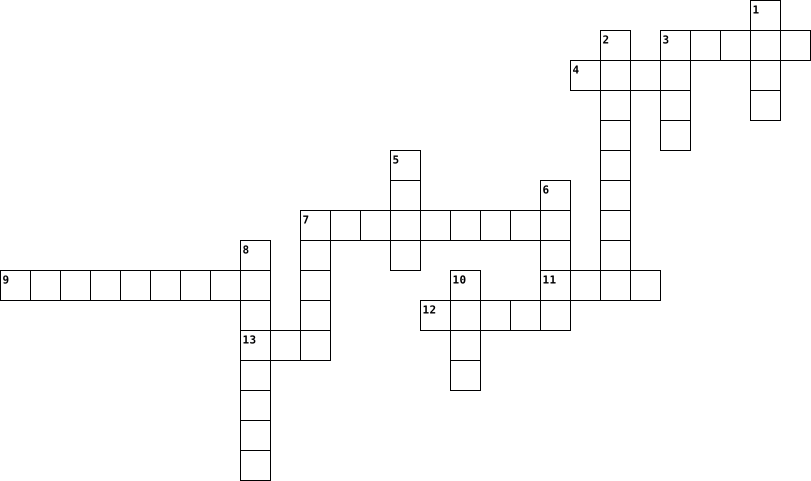
Anatomy Crossword Puzzle 2025-05-19

Across
- Bundles of axons transmitting electrical impulses between the central nervous system and peripheral tissues
- Dome-shaped skeletal muscle separating thoracic and abdominal cavities, primary muscle of respiration
- First digit of the hand with an opposable joint enabling grasp and fine motor skills
- Complex joint formed by tibia, fibula, and talus bones allowing foot dorsiflexion and plantarflexion
- Bony basin consisting of hip bones, sacrum, and coccyx, providing structural support and attachment for lower limbs
- Flexible tube reinforced with cartilage rings, conducting air from the larynx to the bronchi
- Organ responsible for detecting sound waves and maintaining equilibrium via cochlea and vestibular apparatus
- Largest part of the brain responsible for higher cognitive functions, voluntary movement, and sensory processing
- Also called clavicle, a long bone connecting the sternum to the scapula, stabilizing shoulder movement
- Vertebral column protecting the spinal cord and supporting body posture and flexibility
- Medial long bone of the forearm, forming the elbow joint with the humerus and wrist articulation
- Digital bones of the fingers and toes enabling dexterity and locomotion
- Muscular tubes transporting urine from each kidney to the urinary bladder
- Flat triangular bone, known as the shoulder blade, providing attachment points for upper limb muscles
- Endocrine gland at the brain base regulating growth, metabolism, and reproductive hormones
- Large metabolic organ that detoxifies substances, synthesizes plasma proteins, and produces bile for digestion
- Paired respiratory organs where oxygen is exchanged for carbon dioxide in alveoli
- Sensory organ specialized for detecting light and enabling vision through the retina and optic nerve
- Also known as the collarbone, a slender bone acting as a strut between shoulder blade and sternum
- Bony structure encasing and protecting the brain, supporting facial structure and sensory organs
- Curved bones forming the thoracic cage, protecting heart and lungs and assisting in respiration
- Dense connective tissue that attaches skeletal muscle to bone, transmitting contractile force
- Fibrous connective tissue connecting bones to other bones, stabilizing joints and limiting movement
- Muscular tube transporting food from the pharynx to the stomach via coordinated peristalsis
- Bean-shaped organ that filters blood to remove waste, regulate electrolytes, and maintain fluid balance
- Major airways branching from the trachea into each lung, conducting air to smaller bronchioles
- Tubular organ divided into small and large sections that absorbs nutrients and water from digested food
- Cartilaginous structure housing the vocal cords, responsible for sound production and airway protection
Down
- Neural layer at the back of the eye containing photoreceptors that convert light into electrical signals
- Muscular organ that pumps oxygenated blood through systemic circulation and deoxygenated blood through pulmonary circulation
- Contractile tissue composed of fibers that generate force and movement via actin and myosin interactions
- Connective tissue transporting oxygen, nutrients, hormones, and immune cells throughout the body
- Blood vessel returning oxygen-poor blood to the heart, equipped with valves to prevent backflow
- Lower brainstem region controlling autonomic functions like heartbeat and respiration
- Blood vessel carrying oxygen-rich blood away from the heart under high pressure
- Hollow muscular organ that stores urine before voluntary release through the urethra
- The proximal long bone of the thigh, crucial for weight-bearing and locomotion
- Narrow, tube-shaped sac attached to the cecum, thought to play a role in immune function and gut flora maintenance
- Gland with exocrine functions secreting digestive enzymes and endocrine functions producing insulin and glucagon
- Brain region located posteriorly that coordinates voluntary movements, balance, and motor learning
- Small sac beneath the liver storing and concentrating bile released to aid fat digestion
- Lateral forearm bone that rotates around the ulna enabling pronation and supination of the hand
- Organ involved in filtering blood, recycling red blood cells, and mounting immune responses
- Hollow muscular organ that mechanically and chemically breaks down food using gastric acid and enzymes
- Complex organ in the skull responsible for cognition, sensory processing, motor control, and homeostasis
- Muscular organ aiding in taste sensation, food manipulation, swallowing, and speech articulation
- Largest and strongest facial bone forming the lower jaw and enabling mastication
- Muscular funnel-shaped passage connecting nasal and oral cavities to the larynx and esophagus
- Multilayered organ providing a protective barrier, regulating temperature, and enabling sensation
- Calcified structure embedded in the jawbone used for mechanical digestion of food through biting and chewing
50 Clues: Digital bones of the fingers and toes enabling dexterity and locomotion • Muscular tubes transporting urine from each kidney to the urinary bladder • The proximal long bone of the thigh, crucial for weight-bearing and locomotion • Blood vessel carrying oxygen-rich blood away from the heart under high pressure • ...
Body Regions Anatomy 2025-01-14

Across
- Thigh
- Foot
- Ankle
- Cervical spine
- Leg
- Heel
- Armpit
- Face-front of head
- Kneecap
- Triangular depression in elbow
- Palm
Down
- Upper arm
- Hip
- Head
- Forearm
- Wrist
- Back of neck
- Sole of foot
- Shoulder
- Buttocks
- Groin
21 Clues: Hip • Leg • Head • Foot • Heel • Palm • Thigh • Ankle • Wrist • Groin • Armpit • Forearm • Kneecap • Shoulder • Buttocks • Upper arm • Back of neck • Sole of foot • Cervical spine • Face-front of head • Triangular depression in elbow
Theo's anatomy work 2024-12-03

Across
- Leg bone
- Type of vertebrae C
- Hip bone
- Not red bone marrow
- Arm bone
- Middle of the wrist
- The smelling bone
- Type of vertebrae T
- Type of vertebrae L
Down
- Part of the spine
- Head
- Shaped roughly with a thin layer of compact bone
- Cheek bone
- The chewing bone
- Not yellow bone marrow
- Chest bone
- Heel bone
- Made of sponge bone
- Category of ribs
- Two bully ends with a long shaft
20 Clues: Head • Leg bone • Hip bone • Arm bone • Heel bone • Cheek bone • Chest bone • The chewing bone • Category of ribs • Part of the spine • The smelling bone • Type of vertebrae C • Not red bone marrow • Made of sponge bone • Middle of the wrist • Type of vertebrae T • Type of vertebrae L • Not yellow bone marrow • Two bully ends with a long shaft • Shaped roughly with a thin layer of compact bone
medical anatomy terminology 2025-10-09

Across
- kneecap
- hips
- segment
- backbone
- support
- thigh
- shin
- connect
- head
- movement
- calf
Down
- chest
- shoulder
- forearm
- bend
- framework
- skullcap
- upperarm
- collarbone
- elbow
20 Clues: hips • bend • shin • head • calf • chest • thigh • elbow • kneecap • segment • forearm • support • connect • shoulder • backbone • skullcap • upperarm • movement • framework • collarbone
Anatomy & Physiology Crossword 2025-10-24

Across
- - Middle layer of the skin containing blood vessels and glands.
- - The body’s ability to maintain stable internal conditions despite external changes.
- - Toward the feet or lower part of the body.
- - Dense, solid bone tissue that provides strength.
- - Connects bone to bone.
- - Liquid part of blood that carries cells and nutrients.
- - Small organelle responsible for protein synthesis.
- - Toward the front of the body.
- - Deepest skin layer containing fat tissue.
- - Porous bone tissue containing marrow spaces.
- - Pigment that gives skin its color.
- - Diffusion of water across a membrane.
- - Process that helps maintain homeostasis by adjusting body functions.
Down
- - Tissue that supports, binds, and protects body parts.
- - Tissue that contracts to produce movement.
- - Organelle that produces energy (ATP) for the cell.
- - Protein that strengthens skin, hair, and nails.
- - Toward the head or upper part of the body.
- - Control center of the cell containing DNA.
- - Mature bone cell that maintains bone tissue.
- - Gel-like fluid inside the cell where organelles are suspended.
- - Outer layer of the skin.
- - Smooth, flexible tissue that cushions joints.
- - Toward the back of the body.
- - Tissue that sends electrical signals throughout the body.
25 Clues: - Connects bone to bone. • - Outer layer of the skin. • - Toward the back of the body. • - Toward the front of the body. • - Pigment that gives skin its color. • - Diffusion of water across a membrane. • - Deepest skin layer containing fat tissue. • - Tissue that contracts to produce movement. • - Toward the head or upper part of the body. • ...
Anatomy Chapter 7 2025-11-11

Across
- bones a bone with a long longitudinal axis and expanded ends
- shaft of a long bone
- bones category of bones that come in a variety of shapes
- bones a bone with approximately equal length and width
- union of two or more bones
- bone bone that has bars and plates separated by irregular spaces
- joint type of synovial joint that allows for rotational movement
- skeleton pertaining to upper or lower limbs
- narrow cleft separating parts, such as lobes of cerebrum
- bone dense bone tissue in which cells are organized in osteons without apparent spaces
- bone-forming cell
- mature bone cell
- joints two or more bones joined by dense connective tissue
Down
- bones bones that are expanded into broad, flat plates
- discs fibrocartilage structure between bodies of adjacent vertebrae
- freely movable joint; provide body movement
- remodeling osteoclasts resorb and osteoblasts deposit bone throughout life
- cavity fluid-filled space between two or more bones that allows for smooth movement
- joints freely movable joint
- condition that weakens bone, making them more able to fracture
- cells that break down bone matrix
- either end of a long bone
- bones of a finger or toe
- joints type of joint where it looks like a saddle
- cartilage hyaline cartilage that covers the end of bones in synovial joints
- dense connective tissue covering the surface of a bone
- localized collection of blood outside of circulatory system
- skeleton the portion that supports and protects the organs of the head, neck, and trunk
- slightly movable joints that provide balance
- fluid-filled cushioning structure that is lined with synovial membrane
30 Clues: mature bone cell • bone-forming cell • shaft of a long bone • bones of a finger or toe • either end of a long bone • union of two or more bones • joints freely movable joint • cells that break down bone matrix • freely movable joint; provide body movement • skeleton pertaining to upper or lower limbs • slightly movable joints that provide balance • ...
Anatomy Chapter 7 2025-11-13

Across
- bones a bone with a long longitudinal axis and expanded ends
- shaft of a long bone
- bones category of bones that come in a variety of shapes
- bones a bone with approximately equal length and width
- union of two or more bones
- bone bone that has bars and plates separated by irregular spaces
- joint type of synovial joint that allows for rotational movement
- skeleton pertaining to upper or lower limbs
- narrow cleft separating parts, such as lobes of cerebrum
- bone dense bone tissue in which cells are organized in osteons without apparent spaces
- bone-forming cell
- mature bone cell
- joints two or more bones joined by dense connective tissue
Down
- bones bones that are expanded into broad, flat plates
- discs fibrocartilage structure between bodies of adjacent vertebrae
- freely movable joint; provide body movement
- remodeling osteoclasts resorb and osteoblasts deposit bone throughout life
- cavity fluid-filled space between two or more bones that allows for smooth movement
- joints freely movable joint
- condition that weakens bone, making them more able to fracture
- cells that break down bone matrix
- either end of a long bone
- bones of a finger or toe
- joints type of joint where it looks like a saddle
- cartilage hyaline cartilage that covers the end of bones in synovial joints
- dense connective tissue covering the surface of a bone
- localized collection of blood outside of circulatory system
- skeleton the portion that supports and protects the organs of the head, neck, and trunk
- slightly movable joints that provide balance
- fluid-filled cushioning structure that is lined with synovial membrane
30 Clues: mature bone cell • bone-forming cell • shaft of a long bone • bones of a finger or toe • either end of a long bone • union of two or more bones • joints freely movable joint • cells that break down bone matrix • freely movable joint; provide body movement • skeleton pertaining to upper or lower limbs • slightly movable joints that provide balance • ...
Plant Anatomy Review 2026-02-11

Across
- The bulk of photosynthesis takes place here. Contains the xylem tissue
- Primary food producing organ in plants
- Another name for root hairs. Reduces water loss
- Tissue that is responsible for the production of new xylem and phloem
- Roots absorb water and _____ that plants need to live
- Roots act as an anchor so the plant stays in the _____
- Connects leaf blade to the rest of the plant’s stem
- Where new growth in length occurs in the stem
Down
- Waxy, non-cellular layer found on top of the leaf. It prevents water from escaping
- Roots _____ extra food, water and minerals
- A tissue that carries water and minerals throughout the plant
- Supports the leaves and moves water, minerals and manufactured foods throughout the plant
- Side bud found on the stem
- _____ roots are white and smell fresh
- Skin-like layer of cells found on both the top and bottom surface of the leaf
- A root system that has no dominant primary root but has many primary and secondary roots. Is thicker and more compact.
- Leaf is attached to the stem at the ______
- Opens in the stem to exchange gases with the environment
- A tissue that moves food (sugar) that is produced by the leaves to the rest of the plant
- A root system composed of one main primary root and many secondary roots. Examples are carrot
20 Clues: Side bud found on the stem • _____ roots are white and smell fresh • Primary food producing organ in plants • Roots _____ extra food, water and minerals • Leaf is attached to the stem at the ______ • Where new growth in length occurs in the stem • Another name for root hairs. Reduces water loss • Connects leaf blade to the rest of the plant’s stem • ...
Anatomy & Physiology Revision 2026-02-12

Across
- Structures that branch one into each lung to carry air from windpipe into lungs.
- Deoxygenated blood is transported from the heart to the lungs via the _________ artery.
- Anchor plants and absorb nutrients from the soil.
- Part of the flower that produces and contains unfertilised seeds.
- A structure in plant leaves that can open and close to control gas exchange.
- Complete the equation for photosynthesis: carbon dioxide + water --> _______ + oxygen.
- Where gaseous exchange with the capillaries occurs in the lungs.
- Clot together at the site of a wound to seal it shut.
- The five types of bones are: long, short, flat, irregular and ________.
- Part of the flower that contains pollen.
Down
- The organelle that acts as the site of photosynthesis in plants.
- Involuntary muscle that allows blood to be pumped around the body.
- The windpipe, it transports air from the mouth to the lungs.
- A type of white blood cell that engulfs pathogens.
- The only blood vessels to contain valves.
- Connect muscle to bone.
- Connect bone to bone.
- The transport medium of blood.
- The blood vessels with a membrane that is one-cell-thick.
- Carries oxygen-rich blood away from the heart to the rest of the body.
20 Clues: Connect bone to bone. • Connect muscle to bone. • The transport medium of blood. • Part of the flower that contains pollen. • The only blood vessels to contain valves. • Anchor plants and absorb nutrients from the soil. • A type of white blood cell that engulfs pathogens. • Clot together at the site of a wound to seal it shut. • ...
Anatomy and Physiology 2025-09-28

Across
- Protein in blood plasma that helps regulate blood pressure (8)
- Type of immune cell (5)
- Blood type system (3)
- Condition where blood clots excessively (9)
- Type of blood vessel that exchanges oxygen and nutrients (7)
- Disorder characterized by low red blood cell count (6)
- Condition where blood vessels become narrowed or blocked (9)
- Lymphatic vessel that transports lymph fluid (7)
- pressure measurement (4)
- Type of respiratory cell (5)
Down
- Organ that exchanges oxygen and carbon dioxide (6)
- Condition where the lymphatic system is impaired (10)
- Smallest blood vessels in the body (6)
- Blood vessel that carries oxygenated blood away from the heart (7)
- Systemic blood vessel that carries deoxygenated blood back to the heart (8)
- Type of white blood cell (4)
- Component of blood that carries oxygen (5)
- Largest artery in the body (5)
- Blood vessel disorder characterized by inflammation (10)
- Organ that filters lymph fluid (6)
20 Clues: Blood type system (3) • Type of immune cell (5) • pressure measurement (4) • Type of white blood cell (4) • Type of respiratory cell (5) • Largest artery in the body (5) • Organ that filters lymph fluid (6) • Smallest blood vessels in the body (6) • Component of blood that carries oxygen (5) • Condition where blood clots excessively (9) • ...
Nervous System Anatomy 2026-02-18

Across
- Protective membranes that cover the brain
- Composed of the thalamus, hypothalamus and epithalamus
- Matter that is found most deep in the spinal cord
- The fluid that cushions, circulates wastes and nutrients in the central nervous system
- Major endocrine gland that is responsible for growth and development
- Which structure is responsible for the 4 Fs? (Fighting, feeding, fleeing and fornication)
- How many lobes of the brain are there?
- Gland that secretes melatonin
- Deepest and most thin layer of the meninges, *blank* mater
- This structure plays a role in memory, emotion and learning
- Brain matter that is found most deep in the cerebrum
Down
- A hormone that is secreted by the substantia nigra in the midbrain
- The cerebral aqueduct flows through this structure
- "Little brain" a structure of the hindbrain that is responsible for balance, motor learning and coordinating voluntary movements
- Interconnected cavities that circulate CSF
- Ridges or "bumps" on the surface of the cerebrum
- Middle layer of meninges, *blank* mater
- Most superficial and strongest layer of meninges; *blank* mater
- Brain matter found most superficial in the cerebrum
- Grooves or "wrinkles" on the surface of the cerebrum
- The folds of the cerebellum
- The gyrus found above the corpus callosum
- paired, oval-shaped swellings found on the medulla oblongata
- the plexus that creates cerebrospinal fluid
24 Clues: The folds of the cerebellum • Gland that secretes melatonin • How many lobes of the brain are there? • Middle layer of meninges, *blank* mater • Protective membranes that cover the brain • The gyrus found above the corpus callosum • Interconnected cavities that circulate CSF • the plexus that creates cerebrospinal fluid • Ridges or "bumps" on the surface of the cerebrum • ...
Anatomy March Madness! 2026-04-16

Across
- Muscle that flexes the forearm at the elbow
- “Six-pack” muscle that flexes the trunk
- Root meaning within
- Root meaning electrical
- Large back muscle used in pulling movements
- Root meaning nerve
- Root meaning tongue
- Muscle that extends the forearm
- Suffix meaning something written or recorded
- Root meaning bad
- used for chewing
Down
- Suffix meaning obsession or compulsion
- Large calf muscle used for walking and jumping
- Suffix meaning inflammation
- Shoulder muscle responsible for lifting the arm
- back muscle that moves the shoulders and neck
- Main muscle used for hip extension and power
- Neck muscle that turns the head
- Root meaning against or resisting
- Root meaning half
20 Clues: Root meaning bad • used for chewing • Root meaning half • Root meaning nerve • Root meaning within • Root meaning tongue • Root meaning electrical • Suffix meaning inflammation • Neck muscle that turns the head • Muscle that extends the forearm • Root meaning against or resisting • Suffix meaning obsession or compulsion • “Six-pack” muscle that flexes the trunk • ...
Eye Anatomy Crossword 2026-04-30

Across
- ba
- aj
- az
- ar
- al
- ah
- at
- ae
- ag
- as
- af
- an
Down
- ai
- aq
- ao
- ax
- aa
- ad
- aw
- ak
- ap
- bb
- ac
- am
- au
- ab
- av
- ay
- bc
29 Clues: ai • aq • ba • aj • az • ao • ax • ar • aa • ad • al • aw • ak • ah • ap • bb • at • ac • ae • am • ag • as • au • af • ab • av • ay • an • bc
Anatomy & Physiology Crossword 2026-03-03

Across
- Connects bone to bone.
- The skin and protective covering system.
- Flat epithelial cells.
- A group of similar cells organized to perform a specific function.
- Fat tissue that stores energy and provides insulation.
- Chemical messengers that regulate body functions.
- Muscle tissue found only in the heart.
- Organ system made of glands that release hormones.
- Organ system that breaks down food.
- The process in which cells become specialized in structure and function.
- Tissue that supports, protects, and connects body parts.
- Tissue responsible for movement.
- A group of organs that work together to carry out a specific activity.
- The liquid portion of blood.
- Organ system that provides framework and protection.
- Organ system responsible for producing offspring.
- Caring for animals so their needs are met and they do not suffer.
Down
- Tissue that transmits impulses and controls body functions.
- Features that require magnification to be seen.
- Connects muscle to bone.
- Column-shaped epithelial cells.
- Voluntary muscle responsible for body movement.
- Organ system that removes wastes through filtration of blood.
- Connective tissue that transports oxygen and nutrients.
- Organ system responsible for gas exchange.
- Features that can be seen with the unaided eye.
- Organ system that transports nutrients and oxygen.
- Firm but flexible tissue found in joints, ears, and nose.
- The study of the form, shape, and appearance of an animal.
- Living tissue that supports and protects the body.
- Cube-shaped epithelial cells.
- A group of tissues that work together to perform a specific function.
- The basic building block of an animal’s body.
- Involuntary muscle found in internal organs.
- The study of the functions of cells, tissues, organs, and organ systems.
- Tissue that lines body surfaces, openings, and tubes.
36 Clues: Connects bone to bone. • Flat epithelial cells. • Connects muscle to bone. • The liquid portion of blood. • Cube-shaped epithelial cells. • Column-shaped epithelial cells. • Tissue responsible for movement. • Organ system that breaks down food. • Muscle tissue found only in the heart. • The skin and protective covering system. • Organ system responsible for gas exchange. • ...
Devin 15 2014-03-02

Across
- the mental action or process of acquiring knowledge and understanding through thought, experience, and the senses
- the chemical element of atomic number 12, a silver-white metal of the alkaline earth series. It is used to make strong lightweight alloys, esp. for the aerospace industry, and is also used in flashbulbs and pyrotechnics because it burns with a brilliant white flame
- characteristic of, influenced by, or representing a current popular trend or style
- a system or organization in which people or groups are ranked one above the other according to status or authority
- lacking organization; untidy
- the enclosing boundary of a curved geometric figure, esp. a circle
- the branch of science concerned with the bodily structure of humans, animals, and other living organisms, esp. as revealed by dissection and the separation of parts
- the art or pastime of embroidering cloth
- prevent (something or someone) from moving or operating as normal
- the branch of medicine or biology that deals with the anatomy, functions, and organic disorders of nerves and the nervous system
Down
- able to catch fire and burn easily
- movement, or a tendency to move, toward a center of attractive force, as in the falling of bodies to the earth.
- the action of humiliating someone or the state of being humiliated
- the action of enlightening or the state of being enlightened
- outward behavior or bearing
- render (something) ineffective or harmless by applying an opposite force or effect
- great destruction or damage
- a hundredth anniversary
- arousing or likely to arouse envy
- a statue that is much bigger than life size
20 Clues: a hundredth anniversary • outward behavior or bearing • great destruction or damage • lacking organization; untidy • arousing or likely to arouse envy • able to catch fire and burn easily • the art or pastime of embroidering cloth • a statue that is much bigger than life size • the action of enlightening or the state of being enlightened • ...
Evolution Express Crossword 2017-05-02

Across
- study of life
- From nature
- human body study
- study of biology over different regions of the Earth
- select with an ion
- proteins that make up all life
- the changing of species
- a group of living organisms consisting of similar individuals capable of exchanging genes or interbreeding.
Down
- the man behind evolution
- weather patterns over time
- man-made
- habitat of an organism is its __________
- how man makes sense of the world.
- a group of species
14 Clues: man-made • From nature • study of life • human body study • select with an ion • a group of species • the changing of species • the man behind evolution • weather patterns over time • proteins that make up all life • how man makes sense of the world. • habitat of an organism is its __________ • study of biology over different regions of the Earth • ...
Valentines Day 2024-01-25
Across
- the french city of love
- what you might sign a love letter with
- Box of __________
- card you give someone to declare love
- the flower of valentines day
- Love at first _______
- one color that represents love
Down
- something to leave on someone's cheek
- people who truly belong together
- these can be haikus or limericks
- craft material used for valentines
- anatomy that matters for love
- cherub who shoots arrows of love
- the month of valentines day
- one color that represents love
15 Clues: Box of __________ • Love at first _______ • the french city of love • the month of valentines day • the flower of valentines day • anatomy that matters for love • one color that represents love • one color that represents love • people who truly belong together • these can be haikus or limericks • cherub who shoots arrows of love • craft material used for valentines • ...
Composite Finishing & Polishing 2025-09-23

Across
- To evaluate margins and anatomy, use air and an ________ to thoroughly assess the restoration.
- The ideal contact shape where teeth meet on the sides is called the proximal ________.
- The final step that produces a smooth, lustrous finish and resists plaque and stain.
- The rule of thumb for abrasive order: start coarse and end ________.
- If a composite has a gross overhang or recurrent caries, polishing is contraindicated and the restoration likely needs this (one word).
- PPE is essential because this can be created during finishing and polishing.
- Overly thick composite material at the edge of a restoration is called flash or an ________.
- A key reason for polishing is to create a surface that resists plaque and lowers the risk of ________.
- Smooth, continuous contact at the cavosurface helps keep this pink tissue healthy.
Down
- The hard tissue inside a tooth that can become irritated by heat if not cooled with water.
- The process of reshaping a composite to correct anatomy and remove irregularities before final gloss
- Use points, brushes, cups, or discs to achieve this high-gloss surface (one word).
- The surface junction where composite meets natural tooth structure is called the ________ margin.
- The type of bur often used to remove excess on occlusal surfaces: egg or ________ bur.
- Type of motion recommended to prevent overheating: short, light ________ strokes.
15 Clues: The rule of thumb for abrasive order: start coarse and end ________. • PPE is essential because this can be created during finishing and polishing. • Type of motion recommended to prevent overheating: short, light ________ strokes. • Use points, brushes, cups, or discs to achieve this high-gloss surface (one word). • ...
Fingerprint Crossword 2022-03-28

Across
- A ridge splits in 2
- A ridge that forks and re-joins
- Proof of something
- Deposits that remain for a very long time
- Least alike to the other two types
- 3D impressions left in something soft
- When 2 ridges cross over each other
Down
- Rarest fingerprint type
- A small yet crucial part of human anatomy
- Prints left with a liquid
- A very short ridge
- Multiple ridges converge into a triangle
- When a ridge ends
- Similar to a whorl
- The centre
- Evidence left behind at a crime scene
16 Clues: The centre • When a ridge ends • A very short ridge • Proof of something • Similar to a whorl • A ridge splits in 2 • Rarest fingerprint type • Prints left with a liquid • A ridge that forks and re-joins • Least alike to the other two types • When 2 ridges cross over each other • 3D impressions left in something soft • Evidence left behind at a crime scene • ...
Fingerprint Crossword 2022-03-28

Across
- A ridge splits in 2
- A ridge that forks and re-joins
- Proof of something
- Deposits that remain for a very long time
- Least alike to the other two types
- 3D impressions left in something soft
- When 2 ridges cross over each other
Down
- Rarest fingerprint type
- A small yet crucial part of human anatomy
- Prints left with a liquid
- A very short ridge
- Multiple ridges converge into a triangle
- When a ridge ends
- Similar to a whorl
- The centre
- Evidence left behind at a crime scene
16 Clues: The centre • When a ridge ends • A very short ridge • Proof of something • Similar to a whorl • A ridge splits in 2 • Rarest fingerprint type • Prints left with a liquid • A ridge that forks and re-joins • Least alike to the other two types • When 2 ridges cross over each other • 3D impressions left in something soft • Evidence left behind at a crime scene • ...
chapter 1 vocab 2022-09-12

Across
- the study of the endocrine glands
- the study of the structure of organisms
- a factor
- the science of non living things
- observations recorded in an organized manner
- the answer to the problem
- the study of living things
- a prediction based on research
Down
- the study of animals
- the study of the interactions of organisms in the environment
- tests only one variable
- knowledge explaining how the world works
- the study of hereditary
- a conclusion based off of observations
- the study of plants
- the study of cells
16 Clues: a factor • the study of cells • the study of plants • the study of animals • tests only one variable • the study of hereditary • the answer to the problem • the study of living things • a prediction based on research • the science of non living things • the study of the endocrine glands • a conclusion based off of observations • the study of the structure of organisms • ...
Branches Of Biology 2025-04-08

Across
- study of relationship of an organism
- study of metabolism
- study of genomes
- study of forms and structure of animals and plants
- science and art of growing fruits, vegetables etc.
- study life elsewhere in universe
- study of fishes
- study of development
- study of gross structure of organs
Down
- study of fossils
- study of fungi
- study of cells
- study of tiny bits of the body at tissue level
- study of algae
- aims to improve the human race through controlled heredity
- study of plants
16 Clues: study of fungi • study of cells • study of algae • study of fishes • study of plants • study of fossils • study of genomes • study of metabolism • study of development • study life elsewhere in universe • study of gross structure of organs • study of relationship of an organism • study of tiny bits of the body at tissue level • study of forms and structure of animals and plants • ...
word list 3 2017-01-31

Across
- an individual animal, plant or piece of material
- an instrument of converting sound
- the same kind of something
- awaiting decision
- a system that transmits sound
- producing powerful or strong images
Down
- branch of science concerned with the body
- organisms using sunlight
- a long speech from one actor
- to go back
10 Clues: to go back • awaiting decision • organisms using sunlight • the same kind of something • a long speech from one actor • a system that transmits sound • an instrument of converting sound • producing powerful or strong images • branch of science concerned with the body • an individual animal, plant or piece of material
Secret Buddy Crossword :) 2023-10-15

Across
- The best sport in the world is
- My native country
- My favorite food
Down
- Ken's job is
- I love ________ in stem (I am one lol)
- My spirit animal
- and Ike, The best candy ever
- What type of Barbie am I? Hint: ______ Barbie
- I heart (My favorite movie)
- Grey's ________
10 Clues: Ken's job is • Grey's ________ • My spirit animal • My favorite food • My native country • I heart (My favorite movie) • and Ike, The best candy ever • The best sport in the world is • I love ________ in stem (I am one lol) • What type of Barbie am I? Hint: ______ Barbie
Puberty and Reproductive System 2024-07-26

Across
- Tube which the egg travels along
- urine and sperm pass through
- female hormone
- Where the fertilized egg develops
- present both male and female anatomy
Down
- Male hormone
- duct that conveys sperm from the testes
- Happens monthly in women
- Produced in the testes
- changes both male and female go through
10 Clues: Male hormone • female hormone • Produced in the testes • Happens monthly in women • urine and sperm pass through • Tube which the egg travels along • Where the fertilized egg develops • present both male and female anatomy • duct that conveys sperm from the testes • changes both male and female go through
Anatomy and Physiology 2025-03-27

Across
- Towards the back of the body
- Towards the front of the body
- The epithelium of the integument
- The study of structure and form
- Skeletal muscle cell
- The smallest living structures
Down
- Nearer to the trunk
- A living being
- Farther from the trunk
- The study of function of body parts
10 Clues: A living being • Nearer to the trunk • Skeletal muscle cell • Farther from the trunk • Towards the back of the body • Towards the front of the body • The smallest living structures • The study of structure and form • The epithelium of the integument • The study of function of body parts
The Renaissance 2023-04-06

Across
- The design of a building.
- someone who knows a lot about a subject
- A book about a perfect society.
- He wrote Romeo and Juliet.
- the ______ press printed books.
Down
- This means rebirth.
- He invented the printing press.
- parts of the human body
- belief that humans can solve human problems.
- foolishness
10 Clues: foolishness • This means rebirth. • parts of the human body • The design of a building. • He wrote Romeo and Juliet. • He invented the printing press. • A book about a perfect society. • the ______ press printed books. • someone who knows a lot about a subject • belief that humans can solve human problems.
Puberty and Reproductive System 2024-07-26

Across
- Tube which the egg travels along
- urine and sperm pass through
- female hormone
- Where the fertilized egg develops
- present both male and female anatomy
Down
- Male hormone
- duct that conveys sperm from the testes
- Happens monthly in women
- Produced in the testes
- changes both male and female go through
10 Clues: Male hormone • female hormone • Produced in the testes • Happens monthly in women • urine and sperm pass through • Tube which the egg travels along • Where the fertilized egg develops • present both male and female anatomy • duct that conveys sperm from the testes • changes both male and female go through
All About Lexi 2025-08-27

Across
- Tim Bradford's beau in "The Rookie"
- The city of love
- Never stops turning in "Grey's Anatomy"
- High School
- Lara Jean's flame
- "The Summer I turned Pretty" main endgame couple
Down
- Future career
- Highest of the 4 standard singing voices
- Happiest place on earth
- Deserves better from Ferrari
10 Clues: High School • Future career • The city of love • Lara Jean's flame • Happiest place on earth • Deserves better from Ferrari • Tim Bradford's beau in "The Rookie" • Never stops turning in "Grey's Anatomy" • Highest of the 4 standard singing voices • "The Summer I turned Pretty" main endgame couple
🧩 Crossword Creation Challenge 2025-09-17

Across
- term for all biochemical reactions in living organisms
- movement of charged particles
- study of energy transformation
- study of function
- high to low
- study of structure and form
Down
- strongest bond commonly formed in human body
- the capacity to do work
- study of cells
- movement due to applied force
10 Clues: high to low • study of cells • study of function • the capacity to do work • study of structure and form • movement of charged particles • movement due to applied force • study of energy transformation • strongest bond commonly formed in human body • term for all biochemical reactions in living organisms
Medical Science & Terms 2025-10-29

Across
- The body’s ability to fight infection
- Study of diseases
- The breakdown of food for energy
- Process of making something free of bacteria
- Study of body structure
- Study of drugs and their effects
Down
- Study of microorganisms
- Movement of blood around the body
- Study of body function
- The process of breathing
10 Clues: Study of diseases • Study of body function • Study of microorganisms • Study of body structure • The process of breathing • The breakdown of food for energy • Study of drugs and their effects • Movement of blood around the body • The body’s ability to fight infection • Process of making something free of bacteria
BIOLOGY ACTIVITY 2026-04-21

Across
- The technique of growing fish
- The study of animals
- The study of fish
- The study of birds
Down
- The study of origin and descent of organisms
- The study of reptiles
- The study of different organs in an organism
- The study of viruses
- Raising crops and livestock
- The study of plants
10 Clues: The study of fish • The study of birds • The study of plants • The study of viruses • The study of animals • The study of reptiles • Raising crops and livestock • The technique of growing fish • The study of origin and descent of organisms • The study of different organs in an organism
AGILE 3.4v 2020-08-16

Across
- ABRE delivery system shaft design (tips: Everflex Entrust)
- the protein which makes up 80 percent of our skin, also found in chronic DVT
- blood vessel that carries blood towards the heart
- Medtronic Venous Stent
Down
- the name of vein segment/anatomy that can be treated with ABRE
- the anatomy where right and left common iliac vein merged and become the IVC (tips: similar to aortic bifurcation)
6 Clues: Medtronic Venous Stent • blood vessel that carries blood towards the heart • ABRE delivery system shaft design (tips: Everflex Entrust) • the name of vein segment/anatomy that can be treated with ABRE • the protein which makes up 80 percent of our skin, also found in chronic DVT • ...
Upper Limbs Anatomy 2016-03-26

Across
- The bases of the metacarpals articulate with the:
- The largest, longest bone of the upper limb.
- The acromion articulates with the:
- Clavicles are not very strong and are likely to:
- The radial tuberosity, anchors the:
- The medial trochlea looks like an:
- The radius is thin at its proximal end and widened distally-the opposite of the:
- Part of the humerus that articulates with the radius.
- The spine of scapula ends at the:
- The ulna is slightly -------- than the radius.
- the radius and ulna proximally and distally:
- The thumb has ------ phalanges.
- The Radius and the ulna are connected by a flexible membrane called:
Down
- How many metacarpals bone there are in each arm.
- The shortest, sharpest border of the scapula.
- At the distal end of the humerus are two:
- The medial border of the scapula.
- The scapulae, or shoulder blades, are thin and
- The anterior, or costal, surface of the scapula is:
- How many borders have the scapula.
- Projecting anteriorly from the superior scapular border is the:
- The posterior bone of the pectoral girdle.
- Bones of each upper limb.
- The carpus consists of a group of ------- marble-size short bones.
24 Clues: Bones of each upper limb. • The thumb has ------ phalanges. • The medial border of the scapula. • The spine of scapula ends at the: • The acromion articulates with the: • The medial trochlea looks like an: • How many borders have the scapula. • The radial tuberosity, anchors the: • At the distal end of the humerus are two: • The posterior bone of the pectoral girdle. • ...
Neuro-anatomy 2 2015-09-29

Across
- This structure consists of a bulbous head and a narrowed body and tail (2 words)
- This artery runs through the groove along the midline on the ventral surface of the pons
- The seventh cranial nerve has ...... fibres
- Together with the fasciculus cuneatus this tract is responsible for touch and pressure (2 words)
- This division of the trigeminal nerve supplies the following: nasopharynx, palate, the lower eyelid the dura mater
- These fibres link various grey matter parts in the same hemisphere
- This structure synthesises melatonin (2 words)
- This structure has a controlling influence upon the activity of the autonomic nervous system
- Who are the best tutors ever?
Down
- This structure lies between the cerebral hemispheres and brain stem and forms the lateral wall of the third ventricle
- This structure is a prominent c-shaped fascicle of fibres that links the hippocampus with the mammillary body of the hypothalamus
- This structure is responsible for smooth coordinated contraction of the skeletal muscles, balance and posture
- These nuclei of the brain stem are associated with motor functions of the extra-pyramidal system (2 words)
- This structure is responsible for the secretion of cerebrospinal fluid (2 words)
- The anatomical structures involved in a reflex are: a receptor, an afferent neuron, a connecting neuron, an efferent neuron and .....
- This structure extends from the spinal cord to the pons (2 words)
- This is the principle efferent projection from the amygdala that terminates in the hypothalamus (2 words)
- The fibres of the second order neurons ascend in the ..... posterios spinalcerebellar tract (which side)
- This nucleus is situated lateral to the capsula interna
- The lateral two openings of the fourth ventricle are called the foramina of ......
20 Clues: Who are the best tutors ever? • The seventh cranial nerve has ...... fibres • This structure synthesises melatonin (2 words) • This nucleus is situated lateral to the capsula interna • This structure extends from the spinal cord to the pons (2 words) • These fibres link various grey matter parts in the same hemisphere • ...
Intro to Anatomy 2017-09-18

Across
- Genital region
- Digests and breaks down proteins and lipids
- Further away from where the limb attaches to the body
- Sole of the foot
- The spinal or back side of an organism
- Posterior knee area, "knee pit"
- Protein "factories"
- The thigh
- The arm
- Constant random movement of solutes in a solution
- The back of an organism
- The study of the structure of organisms
- Stomach area
- Where the thigh meets the hips
- Small, finger-like protrusions on the outside of the cell
- The front of an organism
- Armpit area
- Separates body into right and left portions
- Towards the top; above
Down
- Gel-like substance that suspends organelles in the cell
- Around the eyes
- A solution with a lower amount of water
- Towards the bottom
- Navel area
- The powerhouse of the cell
- Flat "pancakes" that serve as packaging center for materials leaving the cell
- Diffusion of water across a selectively permeable membrane
- Chest region of an organism
- Substance dissolved in a solvent
- Hereditary material (DNA) found inside nucleus
- Separates the body into equal right and left sections
- Aka "transverse", separates into superior and inferior
- A solution with a greater amount of water
- Movement of particles from high to low concentration
- Outer layer of the cell, transport and communication
- Helps with cell division
- Control center of the cell
- Closer to where the limb attaches to the body
- The study of the functions of organisms
- The underside or "belly side" of an organism
- Aka "coronal", separates the body into anterior and posterior
- Referring to the fingers and toes
- Transport of materials in and out of the cell
43 Clues: The arm • The thigh • Navel area • Armpit area • Stomach area • Genital region • Around the eyes • Sole of the foot • Towards the bottom • Protein "factories" • Towards the top; above • The back of an organism • Helps with cell division • The front of an organism • The powerhouse of the cell • Control center of the cell • Chest region of an organism • Where the thigh meets the hips • ...
Intro to Anatomy 2017-09-18

Across
- The arm
- The spinal or back side of an organism
- Diffusion of water across a selectively permeable membrane
- Closer to where the limb attaches to the body
- Genital region
- Separates the body into equal right and left sections
- A solution with a greater amount of water
- Chest region of an organism
- The front of an organism
- Flat "pancakes" that serve as packaging center for materials leaving the cell
- Small, finger-like protrusions on the outside of the cell
- Where the thigh meets the hips
- Navel area
- The study of the structure of organisms
- Armpit area
- Outer layer of the cell, transport and communication
- Helps with cell division
- Referring to the fingers and toes
- Towards the bottom
- Towards the top; above
- Aka "coronal", separates the body into anterior and posterior
- The thigh
Down
- Around the eyes
- Digests and breaks down proteins and lipids
- Further away from where the limb attaches to the body
- Movement of particles from high to low concentration
- Posterior knee area, "knee pit"
- The powerhouse of the cell
- The back of an organism
- Constant random movement of solutes in a solution
- Control center of the cell
- Hereditary material (DNA) found inside nucleus
- A solution with a lower amount of water
- Stomach area
- The study of the functions of organisms
- Separates body into right and left portions
- Sole of the foot
- Aka "transverse", separates into superior and inferior
- The underside or "belly side" of an organism
- Protein "factories"
- Substance dissolved in a solvent
- Gel-like substance that suspends organelles in the cell
- Transport of materials in and out of the cell
43 Clues: The arm • The thigh • Navel area • Armpit area • Stomach area • Genital region • Around the eyes • Sole of the foot • Towards the bottom • Protein "factories" • Towards the top; above • The back of an organism • The front of an organism • Helps with cell division • The powerhouse of the cell • Control center of the cell • Chest region of an organism • Where the thigh meets the hips • ...
Anatomy Vocabulary Crossword 2017-08-28

Across
- Fat exists as solids in room temperature. Contain only single covalent bonds
- lipids containing phosphorus
- a substance that speeds up a chemical reaction, but is not used up or changed in the process
- one sugar, a building block of carbohydrates.
- organic compound made up of carbon, hydrogen, and oxygen. Examples include starches, sugars, cellulose
- organic compound containing nitrogen, carbon, hydrogen, and oxygen; a building block of protein
- complex substance containing carbon, oxygen, hydrogen, and nitrogen. makes up 10%-30% of cell mass
- fats and oils composed of fatty acids and glycerol, the body's most concentrated source of energy
- Scale a scale running from 0-14, where it is based on the number of hydrogen ions in a solution
Down
- Fat liquid at room temperature, contain one or more double covalent bonds causing chains to link
- group of chemical substances that include certain hormones and cholesterol. Fat is soluble and contain little oxygen
- linear chains of carbon and hydrogen atoms with an organic acid group at one end
- many sugars, polymer of linked monosaccharides
- protein that acts as a biological catalyst to speed up a chemical reaction
- steroid found in animal fats, and in many body tissues, which was made by the liver
- double sugar
- organic molecule that stores and releases chemical energy for use in body cells
- blood sugar
- substance that releases hydrogen ions when in solution
- substance capable of binding with hydrogen ions
- organic compound formed of carbon, hydrogen, and oxygen. Examples include fats and cholesterol
21 Clues: blood sugar • double sugar • lipids containing phosphorus • one sugar, a building block of carbohydrates. • many sugars, polymer of linked monosaccharides • substance capable of binding with hydrogen ions • substance that releases hydrogen ions when in solution • protein that acts as a biological catalyst to speed up a chemical reaction • ...
Anatomy Excretory System 2017-05-07

Across
- organic compound composed of carbon, hydrogen, and oxygen. includes starches, sugars, and cellulose
- a substance that is secreted by the stomach wall and converted into the enzyme pepsin by gastric acid
- baby teeth
- the act of chewing
- digestive tract
- The Actual Exchange of gases between the alveoli and the blood
- an enzyme capable of digestion proteins in an acid pH
- the maximal amount of additional air that can be drawn into the lungs by determined effort after normal inspiration
- the ease with which they expand
- fingerlike projections of the small intestinal mucosa that tremendously increases it's surface area for absorption
- Corpuscle Initial blood-filtering component of a nephron
- the elimination of the contents of the bowels
- an expansion at the closed ends of a renal tubule
- Elevations or ridges, as in the mucosa of the stomach
- A small amount of oxygen is carried in the plasma as a dissolved gas
- Pressure within the pleural cavity, normally slightly less than the atmospheric pressure
- metabolic processes in which ATP is produced
- Amount of air inhaled or exhaled with a normal breath
- Breathing, consists of inspiration and expiration
- excess fluid in a kidney due to a backup of urine
- passage of a substance into or across a blood vessel or membrane
- structural and functional units of the kidney
- the tiny projections on the free surfaces of some epithelial cells, increases surface area for absorption
Down
- a naturally oily or greasy substance occurring in animal bodies
- acidic fluid secreted by the stomach glands and active in promoting digestion
- pair of soft tissue masses
- The act of expelling air from the lungs
- valve separating stomach and duodenum
- the process of taking food, drink, or another substance into the body by swallowing or absorbing it
- the act of swallowing
- sphincter muscle valve that separates the small ad large intestine
- synthesized in the pancreas by protein biosynthesis
- Volume of air still remaining in the lungs after the most forcible expiration possible
- The use of oxygen by body cells
- a greenish yellow fluid produced in and secreted by the liver stored in the gallbladder and released into the small intestine
- valve between the stomach and esophagus
- The Volume of air that can be expelled from the lungs by forcible expiration after the deepest inspiration
- The space inside a tube, blood vessel, or hollow organ
- material discharged from the bowel composed of food residue, secretions, and bacteria
- the additional amount of air that can be expired from the lungs by determined effort after normal expiration
- a pancreatic enzyme that catalyzes the breakdown of fats to fatty acids
- the movement of food through the alimentary canal
- cells in the bowmans capsule in the kidneys that wrap around capillaries of the glomerulus
- the waves of contraction seen in tubelike organs, propels substances along the tract
- the semifluid stomach contents consisting of partially digested food and gastric secretions
- the drawing of air into the lungs
- contractions occur in the large intestine and small intestine
- an enzyme, found chiefly in saliva and pancreatic fluid that converts starch and glycogen into simple sugars
- the main nitrogen- containing waste excreted in the urine
- microvilli covered surface of simple cuboidal epithelium and simple columnar epithelial cells
- A knot of coiled capillaries in the kidney
- special lymphatic capillaries of the small intestine that take up liquids
52 Clues: baby teeth • digestive tract • the act of chewing • the act of swallowing • pair of soft tissue masses • The use of oxygen by body cells • the ease with which they expand • the drawing of air into the lungs • valve separating stomach and duodenum • The act of expelling air from the lungs • valve between the stomach and esophagus • A knot of coiled capillaries in the kidney • ...
Shoulder Anatomy Crossword 2017-05-24

Across
- a narrow, elongated muscle of the rotator cuff
- the muscle forming the rounded contour of the shoulder
- muscle principally responsible for extension of the elbow joint
- the only direct connection between upper extremity and the trunk
- attaches to bicipital groove of humerus
- attaches to humerus from interior scapula
- Joint the "true shoulder" joint
- is one of the seven scapulohumeral muscles
Down
- attaches from spine to medial border of scapula
- attaches to greater tuberosity of humerus from spine of scapula
- long bone of the arm
- the prime mover of elbow flexion
- the I that is part of the four rotator cuffs
- the smallest of the three muscles that attach to the coracoid process of the scapula
- a thick, fan-shaped muscle, situated at the chest
- also known as the breastbone
- also known as the collarbone
- a socket that moves at a inferior and superior angle
- also known as spinotrapezius
- also known as the shoulder blade
20 Clues: long bone of the arm • also known as the breastbone • also known as the collarbone • also known as spinotrapezius • Joint the "true shoulder" joint • the prime mover of elbow flexion • also known as the shoulder blade • attaches to bicipital groove of humerus • attaches to humerus from interior scapula • is one of the seven scapulohumeral muscles • ...
Anatomy and Physiology 2018-10-02

Across
- This body system, affects growth, development, sexual activities, and health of the entire body. Consists of specialized glands.
- Circulates the blood
- This body system controls and coordinates all other systems and makes it work harmoniously and efficiently; consist of brain, spinal cord, and nerves.
- This body system purifies the body by eliminating waste matter. Consist of kidneys, liver, skin, intestines, and lungs
- Excrete water and waste products
- This body system covers, shapes and supports the skeleton tissue; also contracts and moves various parts of the body
- Division of cells is known as
- Study of the science of minute structures of organic tissue (microscopic anatomy)
- A substance that is colorless, jellylike, contains food elements such as protein, fat, carbohydrates, mineral salts, and water are present
- This body system controls the steady circulation of blood through the body by means of the heart and blood vessels.
- during this process the body stores water, food, and oxygen for when it is needed. Constructive metabolism. The building of larger molecules from smaller ones.
- Study of the functions and activities performed by body structures.
- The study of the structure of the human body
Down
- Dense active protoplasm found in the center of the cell. Plays an important part in cell reproduction and metabolism
- This body system changes food into nutrients and waste; consists of mouth, stomach, intestines, salivary and gastric glands.
- This process releases energy that is stored by special molecules to be used in muscle contractions, body secretions, or heat production
- The basic unit of all living things.
- Largest organ of the body forming an external protective covering
- All the protoplasm of a cell, except for what is in the nucleus. Contains food material for growth, reproduction and self-repair of the cell.
- Encloses protoplasm and permits soluble substances to enter and leave the cell
- Supply oxygen to the blood
- This body system is responsible for plants and animals producing offspring
- This body system enables breathing, supplying the body with oxygen eliminating carbon monoxide as a waste product; consists of lungs and air passages
- This organ removes toxic products of digestion
- Digests Food
25 Clues: Digests Food • Circulates the blood • Supply oxygen to the blood • Division of cells is known as • Excrete water and waste products • The basic unit of all living things. • The study of the structure of the human body • This organ removes toxic products of digestion • Largest organ of the body forming an external protective covering • ...
Chapter 7 Anatomy 2012-12-12

Across
- pertaining to the outer part
- muscular section under the lungs
- windpipe
- part of the pharynx behind and above the soft palate
- part of the pharynx between the soft palate and the upper edge of the epiglottis
- air going in
- valvelike, cartilaginous structure that covers the glottis during swallowing, preventing the entrance of food and drink into the larynx.
- a small branch of a bronchus
- fluid any of various clear, watery fluids in the body
- a little cavity, pit, or cell, as a cell of a honeycomb
- respiration process of breathing in and out
- roof of mouth
- signs med indications that a person is still alive
- serves primarily to protect and lubricate surfaces
- hairlike organelles
Down
- vocal cords
- or paired cavities of the body.
- air going out
- a roundish projection or division
- sinuses around the nose sinus
- act of inhaling and exhaling
- muscles pertaining to the innner muscle of the lungs
- canal
- throat
- pertaining to the bronchia or bronchi
- tube a canal extending from the middle ear to the pharynx
- either of the two main branches of the trachea
- septum The wall dividing the nasal cavity into halves
- pleuron a narrow, fluid-filled space between the pleural membranes of the lung and the inner chest wall
29 Clues: canal • throat • windpipe • vocal cords • air going in • air going out • roof of mouth • hairlike organelles • pertaining to the outer part • act of inhaling and exhaling • a small branch of a bronchus • sinuses around the nose sinus • or paired cavities of the body. • muscular section under the lungs • a roundish projection or division • pertaining to the bronchia or bronchi • ...
Anatomy and Physiology 2014-01-24

Across
- type of bond that accepts or donates e- to another atom to reach complete outer e- shell
- Compound that releases or combines with H+ ions to stabilize the pH of a solution
- electron acceptor (gains e-)
- type of bond with a weak attraction but give molecules structure
- most common bond where atoms share electrons that orbit the nucleus
- “parts hydrogen”
- electron donor (loses e-)
- pH of 7
- bonds where e- are shared equally
- ion that makes fluids acidic (ion abbreviation)
- pH less than 7
Down
- type of bond where e- are attracted to the nucleus of one atom more than the other
- biological substance with a pH of 7.35-7.45
- pH less than 7.35
- structural formula for Hydrogen occurring in the environment
- two or more atoms combine
- pH greater than 7
- atoms of different combine to form a ____________
- molecules that release H+ ions in H2O solution
- biocarbonate ion abbreviation
- charged atom
21 Clues: pH of 7 • charged atom • pH less than 7 • “parts hydrogen” • pH less than 7.35 • pH greater than 7 • electron donor (loses e-) • two or more atoms combine • electron acceptor (gains e-) • biocarbonate ion abbreviation • bonds where e- are shared equally • biological substance with a pH of 7.35-7.45 • molecules that release H+ ions in H2O solution • ...
Anatomy and Physiology 2014-08-04

Across
- the most important organelle within the cell
- an immovable joint
- a system that purifies the body by elimination of waste matter
- a tissue that is a protective covering on body surfaces
- a bone that is the hindmost bone of the skull
- myology is the study of ________
- a system that consists of the heart and blood vessels
- the constructive that builds up cellular tissue
- a bone that is the light, spongy bone between the eye sockets
Down
- a tissue that contracts and moves various parts of the body
- excretes water and other waste products
- bones that form the prominence of the cheeks
- found in the nucleus and cytoplasm
- a system that consist of specialized glands
- the humerus is located in the_______
- thorax is the term for _________
- during mitosis, cells divide into _________ daughter cell(s)
- the study of the shape and structure of an organisms body and the relationship of one vary part to another
- the basic units of structure and function of all living things
- muscles that are controlled by will
20 Clues: an immovable joint • thorax is the term for _________ • myology is the study of ________ • found in the nucleus and cytoplasm • muscles that are controlled by will • the humerus is located in the_______ • excretes water and other waste products • a system that consist of specialized glands • the most important organelle within the cell • ...
Anatomy Nervous System 2015-05-26

Across
- / responsible for the integration of complex sensory and neural functions and the initiation and coordination of voluntary activity in the body.
- / act, or influence which produces functional or trophic reaction in a receptor or an irritable tissue.
- / a nerve cell forming part of a pathway along which impulses pass from the brain or spinal cord to a muscle or gland.
- / a neuron that transmits impulses between other neurons, especially as part of a reflex arc.
- / the thin layer of tissue forming the natural outer covering of the body of a person or animal.
- / conducted or conducting outward or away from something (for nerves, for blood vessels, the organ supplied).
- / an organ or cell able to respond to light, heat, or other external stimulus and transmit a signal to a sensory nerve.
- / comprising the brain and spinal cord
- / a junction between two nerve cells, consisting of a minute gap across which impulses pass by diffusion of a neurotransmitter.
Down
- / function is to coordinate and regulate muscular activity.
- / a specialized cell transmitting nerve impulses
- / that transmits nerve impulses from a sense organ towards the central nervous system—compare interneuron, motor neuron.
- / the sensation of flavor perceived in the mouth and throat on contact with a substance.
- / situated on the edge
- / a short branched extension of a nerve cell
- / the inner region of an organ or tissue
- / the nucleus-containing central part of a neuron
- / an action that is performed as a response to a stimulus and without conscious thought.
- / a faculty by which the body perceives an external stimulus
- / the long threadlike part of a nerve cell along which impulses are conducted from the cell body to other cells.
20 Clues: / situated on the edge • / comprising the brain and spinal cord • / the inner region of an organ or tissue • / a short branched extension of a nerve cell • / a specialized cell transmitting nerve impulses • / the nucleus-containing central part of a neuron • / function is to coordinate and regulate muscular activity. • ...
Anatomy and Physiology 2015-02-03

Across
- part of the skeletal system
- provides structure to the cell
- part of the nervous system
- part of the respiratory system
- transport that consumes energy
- posterior
- system for the synthesis of Vitamin D
- away from the heart
- right
- provides mechanism for the production of offspring
- forehead
- shallow
- surrounding
- tissue found on the bone
- maintains posture
- viewing
- hold the internal organs
- component of the circulatory system
- helps defend against infection
Down
- physical property of the respiratory system that allows it to expand
- under
- tissue found on the skin
- number of normal breaths per minute
- energy storage
- removes solid waste
- composed of similar cells that holds a specific function
- maintains fluid volume within the body
- physical property of the respiratory system that allows it to return to its original shape
- number of layers of the cell membrane
- 60% component of cell
- structure of the body
- one of the structure of the cell membrane
- reservoir of stored storage
- system which produces hormones
- number of liters of blood within the body
- serves as distribution system of various substances and solutions for the body
- without
- breast
- intravenous
- upper and lower extremities
40 Clues: under • right • breast • shallow • without • viewing • forehead • posterior • surrounding • intravenous • energy storage • maintains posture • removes solid waste • away from the heart • 60% component of cell • structure of the body • tissue found on the skin • tissue found on the bone • hold the internal organs • part of the nervous system • part of the skeletal system • reservoir of stored storage • ...
General Anatomy - revision 2015-03-23

Across
- Name of the outer layer of bone
- Nerve for all others!
- Tissue with no blood supply
- A loose type of tissue
- Pinocytosis
- 5 types of this cell
- Eye rotates upwards
- Squamous epithelium
- Modified columnar cell
- Colour of a blood cell
- Transport mechanism
Down
- Has cells, fibres and matrix
- Taller than they are wide cells
- Binocular movement (opposite direction)
- A function of this tissue is to keep you warm
- Part of the cell membrane
- Often considered a gaseous movement
- Dense regularly arranged connective tissue
- Lareral rectus involvement?
- Binocular movement (same direction)
20 Clues: Pinocytosis • Eye rotates upwards • Squamous epithelium • Transport mechanism • 5 types of this cell • Nerve for all others! • A loose type of tissue • Modified columnar cell • Colour of a blood cell • Part of the cell membrane • Tissue with no blood supply • Lareral rectus involvement? • Has cells, fibres and matrix • Name of the outer layer of bone • Taller than they are wide cells • ...
Anatomy Crossword Puzzle 2015-05-15

Across
- Muscle that helps with flexion of the arm.
- Connects bone to bone.
- Medial Epicondyle in the arm.
- The largest artery in the arm.
- Synonym for tailbone.
- The ligament within the anterior aspect of the knee.
- Helps prevent hyperextension of the fingers.
- Number of phalanges in each hand.
- A protruding bone in the arm at the distal end of the ulna.
- Muscle that helps with extension of the arm.
- Number of sesamoid bones in the foot.
- Stronger bone of the lower leg medial to the Fibula.
- Connects bone to muscle.
- Most commonly injured ligament in the arm.
- Total number of bones in both hands.
- Synonym for jaw.
Down
- This joint is more shallow than the ball and socket in the pelvis.
- C1 of the vertebral column.
- Joint that makes up the creases between the fingers.
- Largest Tarsal bone.
- Carpal Bone most commonly dislocated.
- Synonym for collarbone.
- The strongest bone in the body.
- Carpal bone most commonly fractured.
- Largest lobe in head.
- The ligament within the medial aspect of the knee.
- Total Number of vertebrae.
- Above the condyle.
- The sensitive part of a baby's head.
- Synonym for hip.
- Sesamoid bone inferior to the pelvis and superior to the tarsals.
31 Clues: Synonym for hip. • Synonym for jaw. • Above the condyle. • Largest Tarsal bone. • Synonym for tailbone. • Largest lobe in head. • Connects bone to bone. • Synonym for collarbone. • Connects bone to muscle. • Total Number of vertebrae. • C1 of the vertebral column. • Medial Epicondyle in the arm. • The largest artery in the arm. • The strongest bone in the body. • ...
Anatomy Crossword Puzzle 2015-05-15

Across
- Number of sesamoid bones in the foot.
- Muscle that helps with extension of the arm.
- Helps prevent hyperextension of the fingers.
- Largest lobe in head.
- Joint that makes up the creases between the fingers.
- Connects bone to bone.
- Medial Epicondyle in the arm.
- Most commonly injured ligament in the arm.
- Sesamoid bone inferior to the pelvis and superior to the tarsals.
- C1 of the vertebral column.
- Number of phalanges in each hand.
- The strongest bone in the body.
- Above the condyle.
- Synonym for collarbone.
- The sensitive part of a baby's head.
Down
- Synonym for tailbone.
- This joint is more shallow than the ball and socket in the pelvis.
- The ligament within the medial aspect of the knee.
- Largest Tarsal bone.
- Muscle that helps with flexion of the arm.
- A protruding bone in the arm at the distal end of the ulna.
- The largest artery in the arm.
- Synonym for jaw.
- Synonym for hip.
- The ligament within the anterior aspect of the knee.
- Total Number of vertebrae.
- Connects bone to muscle.
- Total number of bones in both hands.
- Carpal Bone most commonly dislocated.
- Carpal bone most commonly fractured.
- Stronger bone of the lower leg medial to the Fibula.
31 Clues: Synonym for jaw. • Synonym for hip. • Above the condyle. • Largest Tarsal bone. • Synonym for tailbone. • Largest lobe in head. • Connects bone to bone. • Synonym for collarbone. • Connects bone to muscle. • Total Number of vertebrae. • C1 of the vertebral column. • Medial Epicondyle in the arm. • The largest artery in the arm. • The strongest bone in the body. • ...
Anatomy Chapter 3 2021-09-28

Across
- the membrane protein that extends across the bi-layer.
- these allow certain things to enter or exit.
- a form of endocytosis that the ligand/receptors complex binds, and triggers into folding around the particle (like a pocket)
- this process follows concentration gradient
- this is the energy stored in ionic concentration gradient that is used to drive substance across the membrane.
- the recognition sites, an example
- part of the cell that separates internal components from extracellular material.
- these allow cells to recognize other cells that are the same or different.
- secretory vessel in cell that fuses with plasma membrane and expels contents
- segments of plasma membrane surround the particle and bring it into the cell
- random mixing of particles due to kenetic energy.
- this process generally goes against concentration gradient
- these anchor proteins in the membrane or link cells together.
Down
- this reaches out and surrounds the particle
- the process where endocytosis is on one side and exocytosis is on the other side
- catalyze reactions
- these carry substances side to side inside the membrane.
- when the molecule binds to the transporter on on side of the membrane and then is released after the transporter changes shape.
- the membrane folds in
- when the energy from ATP directly pumps substances across the membrane.
- used to move large molecules
- basic living structure and functional unit of the body.
- the cell contents between the plasma membrane and the nucleus.
- this is hormones
- the membrane protein that is loosely attached to the inner or outer surfaces of the membrane, and does not cross.
- where the genetic material is contained.
- this mean the difference in charges.
- the diffusion of water through a plasma membrane.
28 Clues: this is hormones • catalyze reactions • the membrane folds in • used to move large molecules • the recognition sites, an example • this mean the difference in charges. • where the genetic material is contained. • this reaches out and surrounds the particle • this process follows concentration gradient • these allow certain things to enter or exit. • ...
Inner Ear Anatomy 2021-02-03

Across
- The tiny fibers that connect individual hair cell stereocilia are called ____________.
- The ___________ membrane extends from the spiral limbus out into the Scala media over the entire Organ of Corti, making contact with the tallest tips of the outer hair cell stereocilia.
- __________ is the fluid located within the membranous labyrinth of the inner ear. This fluid is high in Potassium (K).
- The three canals of the vestibular system which each contain a sense organ that responds to angular acceleration of the body.
- The cochlear pattern of the membranous labyrinth that is filled with endolymph is called the ________________.
- The single row of flask-shaped sensory cells in the Organ of Corti at the inner ear is called the ________________.
- Cylindrically shaped cells in the Organ of Corti that are arranged in three rows along the length of the basilar membrane are the _____________.
Down
- The _____________ is the sense organ of hearing.
- The ___________ is a triangular-shaped support structure created by the inner and outer rods of Corti and located between the inner and outer hair cells.
- ____________ membrane separates the scala media and the Scala tympani.
- This is the vascular strip located on the lateral wall of the scala media.
- The Organ of Corti resides in the ______________ membrane.
- The __________ is the part of the inner ear that contains the sense organ hearing and where mechanical motions generated by sound are coded into nerve impulses for transmission to the CNS.
- The spiral, corkscrew-shaped bony shelf that projects from the side of the modiolus and partially divides the cochlear tunnel into smaller sections is called the ____________.
- The upper surface of the Organ of Corti formed by the tops of the hair cells and supporting cells is called the _______________.
- The _________________ is the cavity that contains the inner ear and is located within the petrous portion of the temporal bone.
- The ________________ is a narrow passage at the apex of the cochlea at which the scala tympani and scala vestibuli are connected.
- ___________ is the fluid located within the bony labyrinth. It is high in Sodium (Na).
- The central bony channel of the cochlea within which the spiral ganglia are located is the ___________.
- The ________________ are the tiny hair-like projections from one end of a hair cell that are responsible for changing mechanical motions into electrochemical impulses that can be transmitted by the nervous system.
20 Clues: The _____________ is the sense organ of hearing. • The Organ of Corti resides in the ______________ membrane. • ____________ membrane separates the scala media and the Scala tympani. • This is the vascular strip located on the lateral wall of the scala media. • ___________ is the fluid located within the bony labyrinth. It is high in Sodium (Na). • ...
Respiratory Anatomy Crossword 2021-03-01

Across
- respiratory tract that includes the bronchi
- includes vocal cords and opening between vocal cords
- each lung is enclosed in a double walled sac called __
- the palate that is more anterior and supported by bone
- each lung has separate sections called ____
- zone outside of the respiratory zone
- pneumocyte found in alveoli that produces surfactant
- the larger lung with a steeper angle
- forms a lid over larynx during swallowing
- single tonsil located in the nasopharynx
- network of branching pathways in the respiratory system
- the smallest of respiratory branches
- clusters of thin-walled sacs where gas exchange occurs
- chambers that connect individual alveoli
- dome shaped muscle involved in breathing
- located inferior to pharynx; commonly called the voice box
- fatty molecule that coats gas exposed alveolar surfaces
- cells that pick up bacteria and debris
Down
- terminal bronchioles lead into this zone
- tube commonly called the throat shared by digestive and respiratory systems
- vocal cords that vibrate with expelled air and allow us to speak
- projections from lateral walls of nose that increase surface area
- pneumocyte; primary cell found in alveoli with unusually thin simple squamous epithelium
- cell structures that help to expel mucus and other debris from lungs
- the trachea divides into left and right primary _____
- respiratory tract that includes the nose
- region of pharynx attached to larynx
- cartilage that produces the Adam's apple
- lung that has cardiac notch
- windpipe, has C-shaped cartilage to help keep it open
- cavities within bones that help to lighten skull and act as resonance chambers for speech
- part of lung located near the clavicle
32 Clues: lung that has cardiac notch • zone outside of the respiratory zone • the larger lung with a steeper angle • region of pharynx attached to larynx • the smallest of respiratory branches • part of lung located near the clavicle • cells that pick up bacteria and debris • terminal bronchioles lead into this zone • respiratory tract that includes the nose • ...
Tree & Plant Anatomy 2020-12-29

Across
- the arms of a tree (singular)
- the main stem & support of a leaf, flower, or fruit
- the hormones that stimulate growth in cells
- the language used to give the scientific name
- the brightly colored and reproductive structure in some plants; sometimes called the bloom or blossom
- one of two main structural axes of a vascular plant that supports the leaves, flowers, or fruits
- the outermost & protective layer of a tree
- __________ cell layer that is the growing part of a trunk
- The nonliving central wood of trunk
- the origin point for buds, leaves, or branching twigs
- the angle between the upper side of a leaf and stem; contains a specific bud
Down
- the process of converting sunlight into food
- the first part of the scientific name that categorizes & gives the family name of a plant
- the living layers of secondary wood acting as a pipeline to bring water from the roots to leaves
- ________bud (aka lateral bud) the bud caught in the corner of the stem and petiole/the "armpit" area of a plant
- aka the inner-bark, it's the pipeline for food transport
- the second part of the scientific name that individualizes the plant
- the stalk that joins a leaf to a steam
- a small growth on the stem of a plant that may develop into a leaf or flower
- _________bud (aka apical bud) that's the primary growing point for the plant
- the foliage of a plant specialized for photosynthesis (singular)
21 Clues: the arms of a tree (singular) • The nonliving central wood of trunk • the stalk that joins a leaf to a steam • the outermost & protective layer of a tree • the hormones that stimulate growth in cells • the process of converting sunlight into food • the language used to give the scientific name • the main stem & support of a leaf, flower, or fruit • ...
Anatomy + Physiology Crossword 2021-08-19

Across
- landmark located in the chin
- cavity that helps the lungs function
- part of organism that has a specific
- organ system includes the pituitary gland
- landmark located at the bottom of leg
- landmark located in the mouth
- cavity that contains reproductive organs
- landmark located in the abdomen
- organ system that includes the heart
- organ system that includes the lungs
- body plane from top to bottom of body
- organ system that filters waste
Down
- landmark located in the middle of face
- direction away from median
- organ system that breaks down food
- direction farthest away from origin
- study of how living organisms function
- landmark located in the lower back
- posterior body landmark
- organ system that is different for males and females
- organ system that controls coordination
- study of internal or structure workings
22 Clues: posterior body landmark • direction away from median • landmark located in the chin • landmark located in the mouth • landmark located in the abdomen • organ system that filters waste • organ system that breaks down food • landmark located in the lower back • direction farthest away from origin • cavity that helps the lungs function • part of organism that has a specific • ...
Anatomy + Physiology Crossword 2021-08-19

Across
- part of organism that has a specific
- direction farthest away from origin
- organ system that is different for males and females
- direction away from median
- cavity that contains reproductive organs
- posterior body landmark
- organ system that includes the heart
- organ system that controls coordination
- body plane from top to bottom of body
Down
- landmark located in the mouth
- organ system that filters waste
- cavity that helps the lungs function
- landmark located in the middle of face
- organ system includes the pituitary gland
- landmark located in the chin
- landmark located in the lower back
- organ system that includes the lungs
- landmark located at the bottom of leg
- landmark located in the abdomen
- study of how living organisms function
- organ system that breaks down food
- study of internal or structure workings
22 Clues: posterior body landmark • direction away from median • landmark located in the chin • landmark located in the mouth • organ system that filters waste • landmark located in the abdomen • landmark located in the lower back • organ system that breaks down food • direction farthest away from origin • part of organism that has a specific • cavity that helps the lungs function • ...
Anatomy and Physiology 2021-08-26

Across
- a set of tissues in the body with the ability to change shape.
- the production of offspring by a sexual or asexual process.
- your body's central framework
- an organ or cell able to respond to light, heat, or other external stimulus and transmit a signal to a sensory nerve.
- a large musical instrument having rows of tuned pipes sounded by compressed air, and played using one or more keyboards to produce a wide range of musical effects.
- a colorless, odorless reactive gas, the chemical element of atomic number 8 and the life-supporting component of the air.
- allow systems to self-stabilize
- the quality of reacting quickly and positively.
Down
- the enhancement or amplification of an effect by its own influence on the process that gives rise to it.
- the network of nerve cells and fibers which transmits nerve impulses between parts of the body.
- an individual animal, plant, or single-celled life form.
- relating to or effecting reproduction.
- the act or process of moving especially
- An organ system is a group of organs that work together to perform one or more functions.
- what happens to food after being consumed
- the chemical processes that occur within a living organism in order to maintain life.
- relating to or affecting respiration or the organs of respiration.
- The ability of the cell to receive and respond to a stimulus.
- smallest cell ever
- a group of cells that have similar structure and that function together as a unit
- microscopic organism
21 Clues: smallest cell ever • microscopic organism • your body's central framework • allow systems to self-stabilize • relating to or effecting reproduction. • the act or process of moving especially • what happens to food after being consumed • the quality of reacting quickly and positively. • an individual animal, plant, or single-celled life form. • ...
Structure/Bone Anatomy 2021-10-26

Across
- Encloses the bone except for the cartilage
- A hole
- A depression
- Sharp projection or bony ridge
- small projection above a condyle
- a line that joins 2 bones
- A ridge on the top of a bone
- Bone's system for moving nutrients and disposing of wastes
- A pit
- The production of blood cells by the bone
- Break that doesn't come through the skin
- Canals that link one lacuna to another
- A cavity of hollow space within a bone
- Smooth, nearly flat articular surface
Down
- Part of the bone that contains yellow marrow for fat storage (2 words)
- The bone shaft
- Classification for the sternum or the ribs
- Middle ear bones
- bone cell
- A canal
- Classification for the femur (bone of the upper leg)
- Contains red marrow
- Any projection on a long bone
- small cavities or spaces that contain a bone cell
- Generally the larger end of a long bone
- A round projection that articulates with another bone
- Tightly packed together tissue that keeps the bone from bending
- Fracture in which the bone sticks out of the skin
- Narrow passage way
- Bones that aren't classified in any other categories ex. vertebra
30 Clues: A pit • A hole • A canal • bone cell • A depression • The bone shaft • Middle ear bones • Narrow passage way • Contains red marrow • a line that joins 2 bones • A ridge on the top of a bone • Any projection on a long bone • Sharp projection or bony ridge • small projection above a condyle • Smooth, nearly flat articular surface • Canals that link one lacuna to another • ...
Anatomy and Physiology 2022-04-01

Across
- base of the cerebrum; relays information between the brain and the spinal cord
- covers long axons to insulate the elecrical signal
- Lobe that is primarily involved in sensory perception; allows you to process senses such as touch, pain, temperature, and pressure.
- excitable cells that respond to stimuli by conducting impulses to transmit signals
- unmyelinated gaps in the myelin sheath that aid in increasing the velocity of nerve signal conduction
- supportive cells that provide nutrition, insulation, and help with signal transmission
- bundles of axons that extend from the brain and spinal cord to the rest of the body.
- the ultimate control center of the body overseeing all communication among the organ systems
- Lobe involved in taste; planning and problem solving
- Directs sensory signals to the proper region of the cerebrum to process those signals
- control center for heart rate and respiration
Down
- Lobe that allows you to process auditory information and remember short-term and long-term memories
- the folded surface of the cerebrum
- the main receptor of signals; input region of a neuron
- the end of the axon that releases neurotransmitters at a synapse when a nerve impulse is received; the secretory region of a neuron
- Lobe where visual information from the eyes is processed.
- "bridge" of the brainstem; sends information between your cerebrum and cerebellum
- "the little brain"
- Helps your body maintain homeostasis
- generates and transmits nerve impulses; the conducting region; also known as a nerve fiber
- the largest part of the brain that is divided into 4 lobes
- The uppermost part of the brain stem that allows the body to react reflexively to visual and auditory information
22 Clues: "the little brain" • the folded surface of the cerebrum • Helps your body maintain homeostasis • control center for heart rate and respiration • covers long axons to insulate the elecrical signal • Lobe involved in taste; planning and problem solving • the main receptor of signals; input region of a neuron • Lobe where visual information from the eyes is processed. • ...
Horse Anatomy Vocab 2022-04-12

Across
- The upper portion of the neck where the mane grows
- An area that dips down slightly on the lower jaw, behind the lower lip and chin.
- The highly elastic wedge-shaped mass on the underside of the hoof
- Located at the beginning of the neck, immediately behind the ears; a depression where the atlas meets the occipital crest
- Bones in each of the legs on either side of the cannon bone
- The foot of the horse.
- A ring of soft tissue just above the hoof that blends into the skin of the leg
- The long hairs that grow from the dock
- A callosity on the inside of each of the horse’s legs
- Commonly called the ankle of the horse
- A callosity on the back of the fetlock
- The “living” part of the tail, consisting of the coccygeal vertebrae, muscles, and ligaments.
- Where the saddle sits
- The carpus; a large joint in the front legs
- The point at which the windpipe meets the head at the underside of the jaw
- The body of the horse, enclosing major organs and the rib cage
- An area in the front leg between the knee and the elbow, made up of the fused radius and ulna
Down
- The area between the forehead and the tip of the upper lip
- This is how the height of a horse is measured.
- Identical to the knee of humans, consisting of the articulation between the femur and the tibia, as well as the articulation between the patella and femur
- The area right behind the saddle, going from the last rib to the croup
- The continuation of the mane, hanging from between the ears down to the forehead of the horse
- The area between the knee and or hock and the fetlock joint
- The large muscle in the hind leg, just above the hock and below the stifle
- The joint of the front leg at the point where belly of the horse meets the leg. It is actually quite similar to the elbows in humans
- The joint at the front of the chest.
- The chin, mouth, and nostrils of the face
- Long, coarse hair growing from the dorsal ridge of the neck
- Where the hind legs and barrel meet
- The large, muscular area of the hind legs of the horse
- The tarsus (hind limb comparable to the human ankle and heel) – a large joint in the hind leg
- It’s considered the topline of the hindquarters.
- The connection between the coronet and the fetlock
- The area above the jugular vein, carotid artery, and part of the sympathetic trunk
- The area right behind the elbow of the horse
35 Clues: Where the saddle sits • The foot of the horse. • Where the hind legs and barrel meet • The joint at the front of the chest. • The long hairs that grow from the dock • Commonly called the ankle of the horse • A callosity on the back of the fetlock • The chin, mouth, and nostrils of the face • The carpus; a large joint in the front legs • ...
Anatomy Extra Credit 2021-11-28

Across
- Keratin plate that grows at the end of your phalanges
- Drawings embedded in the skin
- Nail ___, the part of the nail that is embedded in the skin
- The hypodermis, also known as _____ tissue
- Most abundant sweat gland, found in palms, forehead, and soles of feet
- The main function of #1
- Amino acid that gives your skin color
- Outermost layer of skin
- Main organ to the integumentary system, serves as a barrier to the environment
- Layer of the skin that tattoos are located
- outermost layer of hair, made of a single layer of overlapping cells
Down
- Subcutaneous tissue below the hypodermis
- ___ gland that is responsible for cooling you down
- Hair shaft and hair ____
- The epidermis is made up of ____ tissue
- Begins in your epidermis and grows out, protrudes out of your skin, is mostly found in your head
- The dermis is made up of dense ____ tissue
- Sweat gland found in the dermis and are larger, come in during puberty
- Gland that's function is to lubricate/soften skin
- Lowest layer of skin
- System of the body that consists of the skin, hair, nails, and glands
- Type of epidermal cell that produces keratin
- Central core of the hair, made of soft keratin
23 Clues: Lowest layer of skin • The main function of #1 • Outermost layer of skin • Hair shaft and hair ____ • Drawings embedded in the skin • Amino acid that gives your skin color • The epidermis is made up of ____ tissue • Subcutaneous tissue below the hypodermis • The dermis is made up of dense ____ tissue • The hypodermis, also known as _____ tissue • ...
anatomy and physiology 2021-12-13

Across
- - pathy
- How many types of epithelial tissue are there
- -osis
- (2) classifications of simple epithelium based on
- - itis
- (as a whole) -Major skin area where derivatives (hair, nails) reside
- low Ph (under 7)
- Upper division of the skeleton
- When over 25% of the body is burned
- The function of this system filters blood and remove waste. It also concentrates waste into urine and gets rid of urine from the body
- High Ph (over 7)
- Maintenance of relatively stable internal environments
- -ology
Down
- Most abundant and widely distributed tissue type
- How many organ systems are in the human body
- Simple epithelia has one layer and Stratified epithelia have ____
- type of burn that causes your skin to be of a grey-white color/ black
- Largely adipose tissue; anchors the skin to underlying tissue
- How many stages of mitosis are there
- How many classes of connective tissue are there
- (1)classifications of simple epithelium based on
- Considered a biological catalyst that helps speed up reactions and uses less energy
- Ph of 7
23 Clues: -osis • - itis • -ology • - pathy • Ph of 7 • low Ph (under 7) • High Ph (over 7) • Upper division of the skeleton • When over 25% of the body is burned • How many stages of mitosis are there • How many organ systems are in the human body • How many types of epithelial tissue are there • How many classes of connective tissue are there • Most abundant and widely distributed tissue type • ...
Anatomy Criss Cross 2022-03-26

Across
- The _________ is located below the lungs.
- __________ is the muscular layer of the heart.
- The ______________ is composed of three cusps/flaps.
- ______________ measure approximately 50 to 100 micrometers in length.
- _____ are thin-walled chambers that receive blood from the veins.
- Covering the inner surface of the heart wall is the ___________.
- The _____________________ are thin structures that are composed of endocardium and connective tissue.
- ____________ are key molecular regulators of the contraction.
- The heart is located underneath the _______.
Down
- Covering the outer surface of the heart is the __________.
- The _____________ is composed of two cusps/flaps.
- Rising pressure in the pulmonary trunk artery and aorta forces the _______________ to open.
- ________ is a displacement of tissue/organ from its normal position.
- Cardiac muscle cells are called ___________.
- __________ pumps blood out of the heart.
- The _______ expands the volume of the chamber.
- An elastic artery called the _____.
- Surrounding the heart is a fibrous sac called the ___________.
- The _______ is the control center of a cell.
- ________ is relaxation.
- The narrow end of the heart is called the _____.
21 Clues: ________ is relaxation. • An elastic artery called the _____. • __________ pumps blood out of the heart. • The _________ is located below the lungs. • Cardiac muscle cells are called ___________. • The _______ is the control center of a cell. • The heart is located underneath the _______. • The _______ expands the volume of the chamber. • ...
Anatomy Crossword Puzzle 2022-03-25

Across
- transports blood with oxygen around the body
- difference between upper and lower numbers of blood pressure
- maintaining arterial pressure and tissue perfusion
- link cells and define border
- creates blood pressure and flow of blood
- allows oxygen and nutrients from the blood to move into organs and tissues
- holding chamber for blood going into the lungs and a pump for blood transportation
- allows ventricles to pump blood and atria to receive blood
- reduces pressure in thoracic cavity while inhaling to support venous return
Down
- regulates blood vessel diameter
- blood vessels that form a closed circuit between heart and lungs
- produces, transports, and excretes CSP
- period of relaxation of heart muscle, chambers filling with blood
- takes blood from heart and delivers it to different organs and brings it back dto the heart
- the amount of blood pumped into the heart in a minute
- time period between end of heart contraction to end of subsequent contraction
- pressure of blood within the arteries
- protect inner layers; supports the production of pericardial fluid
- returns blood from spleen and digestive tract to liver
- surgical connection between two structures
20 Clues: link cells and define border • regulates blood vessel diameter • pressure of blood within the arteries • produces, transports, and excretes CSP • creates blood pressure and flow of blood • surgical connection between two structures • transports blood with oxygen around the body • maintaining arterial pressure and tissue perfusion • ...
flower anatomy crossword 2022-05-03

Across
- a flower that is missing male or female parts
- an elongated inflorescence with a central axis where sessile flowers are attached
- usually colorful leaf-like structures, attract animals and insects
- the female part of the flower
- the male part of the flower
- when two sepals are fused together
- when plants have flower clusters
- a flower with male and female parts
Down
- plants that have male and female flowers on one plant
- when petals are fused together and form a structure
- contained in the anther and released by flowers
- flowers that have female parts and no male parts
- beneath petals are green leaf-like structures
- a sticky tissue at the end of the pistil that is receptive to pollen
- petals and the sepals together are called
- the main stem of an inflorescence
- flowers that have male parts and no female parts
- located below the stigma and is a rod-shaped middle part
- plants that have male and female flowers on separate plants
- flower that has sepals, petals, pistils, and stamens
- is the basic unit of the female reproductive organ
21 Clues: the male part of the flower • the female part of the flower • when plants have flower clusters • the main stem of an inflorescence • when two sepals are fused together • a flower with male and female parts • petals and the sepals together are called • a flower that is missing male or female parts • beneath petals are green leaf-like structures • ...
flower anatomy crossword 2022-05-03

Across
- the male part of the flower
- a flower that is missing male or female parts
- plants that have male and female flowers on separate plants
- a sticky tissue at the end of the pistil that is receptive to pollen
- flower that has sepals, petals, pistils, and stamens
- when plants have flower clusters
- when two sepals are fused together
- flowers that have female parts and no male parts
Down
- plants that have male and female flowers on one plant
- located below the stigma and is a rod-shaped middle part
- flowers that have male parts and no female parts
- contained in the anther and released by flowers
- an elongated inflorescence with a central axis where sessile flowers are attached
- beneath petals are green leaf-like structures
- is the basic unit of the female reproductive organ
- petals and the sepals together are called
- the female part of the flower
- a flower with male and female parts
- usually colorful leaf-like structures, attract animals and insects
- the main stem of an inflorescence
- when petals are fused together and form a structure
21 Clues: the male part of the flower • the female part of the flower • when plants have flower clusters • the main stem of an inflorescence • when two sepals are fused together • a flower with male and female parts • petals and the sepals together are called • a flower that is missing male or female parts • contained in the anther and released by flowers • ...
Anatomy Crossword Puzzle 2022-07-08

Across
- Is the distal attachment of the biceps brachii
- A metacarpal bone that is part of the anatomical snuff box
- Pronates the forearm and is a superficial ventral forearm muscle
- Is the distal attachment of the brachialis
- Nerve that innervates latisismus dorsi
- Nerve that innervates the palmar interossei
- Nerve that innervates quadriceps
- A rotator cuff muscle that is responsible for external rotation of the GH joint
- Is a ventral arm muscle that does elbow flexion
- Nerve that innervates the shoulder
- Bone that the thigh muscle groups are located upon
- A muscle that has a proximal attachment of T7 to T12 spinous processes
- A rotator cuff muscle that is responsible for abduction of the GH joint
Down
- Is a dorsal arm muscle that does elbow extension
- Nerve that innervates the biceps brachii
- Second layer muscle of the plantar foot
- Nerve that innervates the triceps brachii
- Supinates the forearm and is a deep dorsal forearm muscle
- Bone of the lateral forearm
- Attaches to the posterior gluteal line of illiac crest
20 Clues: Bone of the lateral forearm • Nerve that innervates quadriceps • Nerve that innervates the shoulder • Nerve that innervates latisismus dorsi • Second layer muscle of the plantar foot • Nerve that innervates the biceps brachii • Nerve that innervates the triceps brachii • Is the distal attachment of the brachialis • Nerve that innervates the palmar interossei • ...
anatomy crossword puzzle 2021-12-16

Across
- cavity, Potential space between the visceral and parietal pericardial membranes.
- Branch of science concerned with the study of body functions.
- Pertaining to the head, neck, and trunk.
- feedback, A mechanism that returns the level of a chemical or other substance or condition in the internal environment to its set point level.
- feedback system, Process by which changes cause additional similar changes, producing unstable conditions.
- Dynamic state in which the body’s internal environment is maintained in the normal range.
- Branch of science involving the form and structure of body parts.
- Pertaining to the wall of a cavity.
- cavity, Hollow space inside the chest containing the thoracic organs.
- Structure consisting of two or more tissues that performs a specialized function.
- The structural/functional unit of an organism.
- system, Group of organs coordinated to carry on a specialized function.
- cavity, Space between the diaphragm and the pelvic cavity that contains the abdominal viscera.
- Particle composed of two or more bonded atoms.
- Assembled group of similar cells that performs a specialized function.
- cavity, Space in the skull containing the brain.
- Smallest particle of an element with properties of that element.
Down
- A structure in a cell that has a specialized function.
- cavity, Space between the diaphragm and the pelvic outlet that contains the abdominal and pelvic organs.
- An individual living thing.
- cavity ,Space within the ring formed by the sacrum and hip bones that encloses the terminal part of the large intestine, the urinary bladder, and the internal reproductive organs.
- Pertaining to the organs within a body cavity.
- canal, Canal formed by hollow areas in the vertebrae that contains the spinal cord.
- Organs in the thoracic and abdominopelvic cavities.
- Pertaining to the upper or lower limbs.
- In cells, the combined chemical reactions of anabolism and catabolism that use or release energy.
- membrane, Serous membrane that encloses the lungs and lines the chest wall.
- The compartment in the thoracic cavity between the lungs
28 Clues: An individual living thing. • Pertaining to the wall of a cavity. • Pertaining to the upper or lower limbs. • Pertaining to the head, neck, and trunk. • Pertaining to the organs within a body cavity. • The structural/functional unit of an organism. • Particle composed of two or more bonded atoms. • cavity, Space in the skull containing the brain. • ...
Forex Candlestick Anatomy 2022-02-16

Across
- A candle with a small body, that shows weak buying or selling activity
- The filled part of the candlestick
- Also known as the pinbar. This is a bullish reversal candlestick. This candlestick has little to no upper shadow and has a long lower shadow and small body.
- A bearish or selling candle that is larger than the previous candle
- A bullish reversal pattern; It consist of 3 candlesticks: 1. A long bearish body candle continuing the downtrend, 2. A small bearish or bullish body candle showing indecision or very little activity 3.A bullish candle that closes at least halfway up the first day's bearish candle.
- Where the candlestick session began
- Compromised of mainly strong buying activity
- Where the candlestick session ended
- A bullish reversal candlestick pattern. This candlestick ends up with a long lower tail with no body. It is easily identified as a capitalized letter 'T.'
- This bearish reversal candlestick opens and closes at or near its low. It has a longer upper shadow. It is easily identified as a capitalized letter 'T,' that is upside down.
- the sessions highest point reached
Down
- Also known as the inverted or bearish pinbar. This is a bearish reversal candlestick. This candlestick has little to no lower shadow and has a long upper shadow and small body.
- This candle pattern is sometimes referred to as the railroad pattern. It is a bearish reversal pattern and consist of two candlesticks. The first candle is bullish and the second is bearish. A Tweezer Top occurs during an uptrend when buyers push prices higher, often ending the session near the highs, but were not able to push the top any further.
- A bearish reversal pattern; It consists of 3 candlesticks: 1. A long bullish body candle continuing the uptrend, 2. A small bearish or bullish body candle showing indecision or very little activity 3. A bearish candle that closes within the frame of the first candles body.
- Also known as the inside bar. This candlestick pattern is made up of two candles. The first candle is the large one which is called the mother and the second candle is the small one, which is called the baby. The second candle should close within the frame of the first candles body.
- A bullish or buying candle that is larger than the previous candle
- A candle with a long body, that shows strong buying or selling activity
- This candle pattern is sometimes referred to as the railroad pattern. It is a bullish reversal pattern and consist of two candlesticks. The first candle is bearish and the second is bullish. A Tweezer bottom occurs during a downtrend when sellers push prices lower, often ending the session near the lows, but were not able to push the bottom any further.
- An indecision candle; The opening and closing price ends up at or near the same price level; Therefore, no real body is formed.
- Compromised of mainly strong selling activity
- the sessions lowest point reached
21 Clues: the sessions lowest point reached • The filled part of the candlestick • the sessions highest point reached • Where the candlestick session began • Where the candlestick session ended • Compromised of mainly strong buying activity • Compromised of mainly strong selling activity • A bullish or buying candle that is larger than the previous candle • ...
human anatomy terms 2022-10-04

Across
- a cell that can produces collagen.
- tissue that is in between the bone.
- A bone cell that lies within the substance of fully formed bones.
- cell. A white blood cell that is in connective tissue especially under the skin or in blood vessels or lymph.
- a cell that has a matrix and is embedded in it
- Color of hair skin and eyes.
- Cartlidge an example of this are ears nose and the epiglottis.
- Cartlidge found in joint surfaces.
- examples are connective epithelial muscle and nervous.
Down
- changes over time in the skin.
- membrane. found in most animal tissue in specializes in self assemble meant.
- tissue. helps the body move.
- invertebral discs in the spinal cord.
- system of the body that covers all of your organs.
- membrane it lines the abdomen chest and stomach.
- A polymorphophonecular leukocyt.
- Yellow white tinted pieces holding up the skeleton.
- cylindrical vascular shaped tunnel.
- membrane A connective soft tissue of the synovial joint capsules.
- membrane. epithelial tissue that lines the respiratory or the digestive tract.
- fibrocartilage. an example of this is in vertebral discs in the spinal cord.
21 Clues: Color of hair skin and eyes. • tissue. helps the body move. • changes over time in the skin. • A polymorphophonecular leukocyt. • a cell that can produces collagen. • Cartlidge found in joint surfaces. • tissue that is in between the bone. • cylindrical vascular shaped tunnel. • invertebral discs in the spinal cord. • a cell that has a matrix and is embedded in it • ...
Equine Anatomy & Physiology 2021-03-24

Across
- Food such as grass or hay for horses.
- Blood vessels which carry blood towards. the heart.
- Originated in Kentucky, has a pronounced wither, a long curved neck, and, refined head.
- Lighter and more attractive.
- Horses under 14.2 hands.
- Originated in North Africa, it has the appearance of a small donkey, they usually retain the famous mar of the cross or the dorsal strip which runs from mane to tail is intersected at the withers by a shoulder stripe.
- mother.
- Condition caused by an increased loss of water from the body.
Down
- Male organ which produces sperm.
- Main structural protein found in hair, wool, horns and feathers.
- related to the horse and share many characteristics.
- Offspring produced when an American Jack or standard Jack is bred to a horse mare.
- Blood vessels which carry blood towards. the heart
- Two main branches of the trachea.
- Located above each kidney and helps control the heart rate and blood pressure.
- Something which causes an internal or external body response.
- pair or organs in the rib cage which are responsible for inhaling oxygen and releasing back in.
- Female reproductive organ in which eggs are produced.
- Tan body with dark main.
- Four beat lateral gait.
- Father.
21 Clues: mother. • Father. • Four beat lateral gait. • Horses under 14.2 hands. • Tan body with dark main. • Lighter and more attractive. • Male organ which produces sperm. • Two main branches of the trachea. • Food such as grass or hay for horses. • Blood vessels which carry blood towards. the heart • Blood vessels which carry blood towards. the heart. • ...
Angels, Animals, Anatomy 2022-10-20

Across
- rule
- eyes
- knees
- my
- city
- for
- lift up
- forearm
- water
- pig
- heart
- dog
- fingers
- to you
- jump, leap
- guardian
- forehead
- scratch
- goat
- suffered
- angels
- belly
Down
- rest
- thigh
- door, gate
- for us
- poor man
- from
- today
- tap
- your
- hand
- hair
- foretaste
- fish
- body
- sheep
- you
- blood
- enlighten
- arm
- donkey
- true
- cow
44 Clues: my • for • tap • pig • dog • you • arm • cow • rest • rule • eyes • from • city • your • hand • hair • fish • body • goat • true • thigh • knees • today • water • heart • sheep • blood • belly • for us • to you • donkey • angels • lift up • forearm • fingers • scratch • poor man • guardian • forehead • suffered • foretaste • enlighten • door, gate • jump, leap
dental anatomy keyterms 2023-11-16

Across
- last 3 teeth
- first 3 teeth
- spider web thingy
- 20 teeth
- top of mouth hardp
- heart of tooth
- last layer of tooth
- 3rd teeth
- top part you see when you smile
- lower teeth
- where you floss
- end of root
- separtes left from right
- cementum enamel joint
- bottom teeth
- last teeth after first 3
- 1/4 of mouth
- triangle piece
- connected to soft palate thing in back of throat
Down
- top teeth
- front of the teeth
- point part of canine
- upper teeth
- part at the back of the mouth
- root of tooth
- in between maxillary central incisors like an attachment
- adult teeth
- first layer of tooth
- forms dental tissue
- biggest layer of tooth
- smaller then molars
31 Clues: 20 teeth • top teeth • 3rd teeth • upper teeth • adult teeth • lower teeth • end of root • last 3 teeth • bottom teeth • 1/4 of mouth • first 3 teeth • root of tooth • heart of tooth • triangle piece • where you floss • spider web thingy • front of the teeth • top of mouth hardp • last layer of tooth • forms dental tissue • smaller then molars • point part of canine • first layer of tooth • cementum enamel joint • ...
Dental Anatomy Term 2023-11-16

Across
- top portion of the tooth
- go around the tooth line
- tissue covered by the root portion of the tooth
- seperates the right and left
- arch 16 teeth
- arch bottom teeth
- bleaching of the teeth
- palate back of the mouth
- dentition 20 teeth
- Natural teeth in the dental arch
- heart of the tooth
- palate front of the mouth
- connect to the soft palate
- tip of the root
- underneath your gingiva
Down
- behind anterior teeth
- main portion of the inside of the tooth
- 6-8 teeth from the midline
- In between maxillary central incisors
- 1st 3 teeth from the midline
- 4 and 5 tooth from the midline
- sharp point on the canine
- 4-8 teeth in one quadrant
- arch upper teeth
- we use dental floss
- function to tear
- the first 2 teeth in the midline
- dentition 32 teeth
28 Clues: arch 16 teeth • tip of the root • function to tear • arch bottom teeth • arch upper teeth • heart of the tooth • we use dental floss • dentition 32 teeth • dentition 20 teeth • behind anterior teeth • bleaching of the teeth • underneath your gingiva • top portion of the tooth • go around the tooth line • palate back of the mouth • sharp point on the canine • 4-8 teeth in one quadrant • ...
Cell Anatomy & Physiology 2023-12-08

Across
- component of the cytoskeleton used to move genetic material during cell division
- type of microscope that uses visible light to magnify an object
- organelle that synthesizes polysaccharides and finalizes proteins
- a type of vacuole formed from phagocytosis
- the understanding that all living organisms are composed of 1+ cells, which are the basic units of organismal structure created by a parent cell.
- largest protein fiber of the cytoskeleton
- a process in which the plasma membrane surrounds an object to bring it into the cell via a vesicle
- a component of the cytoskeleton used for moving the entire cell; typically only 1 or 2 per cell
- a sticky layer surrounding the cell wall of a prokaryotic cell
- organelle responsible for cellular respiration in plants & animals
- type of protein that associates with only 1 side of a phospholipid bilayer
- a process in which the plasma membrane surrounds an object to bring it out of the cell via a vesicle
- type of protein that extends through both sides of a phospholipid bilayer
- type of protein that allows active movement across a phospholipid bilayer
- free-floating genetic material
- organelle responsible for photosynthesis in plant cells
- where ribosomes are synthesized
- an organelle that monomerizes macromolecules
- type of protein that allows passive movement across a phospholipid bilayer
- an organelle that neutralizes toxins to protect the cell
- protein fiber of the cytoskeleton that is medium in size
- organelle that packages membrane proteins
- a type of cell that is large and complex
- a type of vacuole that removes excess water from the cell
Down
- cell structure that increases a cell's surface area
- organelle that synthesizes proteins
- a type of cell that is small and simple
- a process in which the plasma membrane surrounds food to bring it into the cell via a vesicle
- proteins with the specific function of allowing water to flow in or out of the cell
- organelle that synthesizes lipids
- a component of the cytoskeleton used for moving the entire cell; typically a lot covering the outside of the cell
- an appendage of a prokaryotic cell used for sticking to surfaces
- a rigid structure surrounding the plasma membrane of prokaryote and plant cells
- smallest protein fiber of the cytoskeleton
- what separates the inside of a cell from the outside; the cell's "skin"
- semifluid material that fill in the empty space of a cell
- a channel through which plant cells communicate and share nutrients
- an organelle that surrounds and protects genetic material
- type of microscope that bounces electrons off an object to develop a magnified image of it
- a type of vacuole that plants use for storage
40 Clues: free-floating genetic material • where ribosomes are synthesized • organelle that synthesizes lipids • organelle that synthesizes proteins • a type of cell that is small and simple • a type of cell that is large and complex • largest protein fiber of the cytoskeleton • organelle that packages membrane proteins • a type of vacuole formed from phagocytosis • ...
ANATOMY STUDY CROSSWORD 2023-12-01

Across
- MOVES THE ARM AT THE SHOULDER
- CONNECTS THE ACTIN AND MYOSIN
- CAUSES THE WRIST TO BEND
- CAUSES THE ELBOW TO BEND
- WHERE NEUROTRANSMITTERS ARE RELEASED
- BREAKS DOWN ACETYLCHOLINE
- GAP BETWEEN THE NEURON AND THE MOTOR END PLATE
- COMRRESSES ABDOMINAL PARTS
- TELLS THE MUSCLE TO CONTRACT
- MAKES US BREATHE
- CAUSES THE ELBOW TO STRAIGHTEN
Down
- PULLS CHEST DOWN AND COMPRESSES ABDOMINAL PARTS
- WHERE A NERVE AND MUSCLE FIBER COME TOGETHER
- MOVES SHOULDERS AND HEAD
- FOLDED AREA OF THE SARCOLEMMA WHERE THE MUSCLE AND NERVE COMMUNICATE
- FLEXES PLANTAR FOOT
- THIN FILAMENT
- EXTENDS THE HIP, ALLOWS US TO RUN OR CLIMB
- THICK FILAMENT
- FLEXES KNEE AND EXTENDS HIP
20 Clues: THIN FILAMENT • THICK FILAMENT • MAKES US BREATHE • FLEXES PLANTAR FOOT • MOVES SHOULDERS AND HEAD • CAUSES THE WRIST TO BEND • CAUSES THE ELBOW TO BEND • BREAKS DOWN ACETYLCHOLINE • COMRRESSES ABDOMINAL PARTS • FLEXES KNEE AND EXTENDS HIP • TELLS THE MUSCLE TO CONTRACT • MOVES THE ARM AT THE SHOULDER • CONNECTS THE ACTIN AND MYOSIN • CAUSES THE ELBOW TO STRAIGHTEN • ...
Anatomy Integumentar system 2023-09-12

Across
- the outermost layer of the epidermis
- a small tubular cavity containing the root of a hair,
- A reaction to injury or infection that is characterized by pain, redness, and swelling,
- glands Ducts that empty into hair follicles, excreting oily substances,
- Outermost layer of the skin,
- Darker pigment that gives hair a brown-black color,
- Protective coverings on the ends of the fingers and toes,
Down
- modified apocrine glands, which, together with sebaceous glands, produce the cerumen, the ear wax
- separates the interior of the cell from the outside environment.
- a dry, rough protective crust that forms over a cut or wound during healing.
- the deepest layer, separated from the dermis by the basement membrane (basal lamina) and attached to the basement membrane by hemidesmosomes,
- Lighter pigment that gives hair more reddish yellow color,
- specialised cells involved in the detection, phagocytosis and destruction of bacteria and other harmful organisms
- The inner layer of the skin,
- The dark pigment synthesized by melanocytes; responsible for skin color,
- Composed of connective and adipose (fat) tissue that connects the skin to the surface muscles,
- a protein that helps form hair, nails and your skin's outer layer
- a small gland in the skin which secretes a lubricating oily matter (sebum) into the hair follicles to lubricate the skin and hair.
- any abnormal enlargement of a body part.
- denoting multicellular glands which release some of their cytoplasm in their secretions,
20 Clues: The inner layer of the skin, • Outermost layer of the skin, • the outermost layer of the epidermis • any abnormal enlargement of a body part. • Darker pigment that gives hair a brown-black color, • a small tubular cavity containing the root of a hair, • Protective coverings on the ends of the fingers and toes, • ...
Respiratory System Anatomy 2023-09-29

Across
- Tonsils at the tip of the soft palate
- The breathing sound heard as the air fills the alopoly is
- The nasal cavity is surrounded by a ring
- Normal respiratory rate
- The road is about 13cm long
- Olfactory receptors are located in the mucosa in the gaps of the nasal cavity called recaptors
- Removal of carbon dioxide
- The surface of each lung is filled with uiseral callulose
- The remaining mucosal layar, namely the nasal cavity, is called the respiratory tract
Down
- Three mucosal projects or lobes are called
- The reserve volume which is usually between 2100 ml to 3200 ml is called volume
- The Pharymponic duct, which drains the maiddle ear, opens into the
- Tonsils located at the base of the tongue
- The right and left bronchi are formed by division
- Pharangeal tonsils are called
- During exercise, we deeply because breathe more forcefully and the muscular centers send more impulses to the so-called breathing pattern
- Passageways that allow air to reach the lungs
- What system keeps the body supplied with oxygen
- The Cells of the nasal bulb create a gentle current as the cells
- humidifier Warms the incoming air
20 Clues: Normal respiratory rate • Removal of carbon dioxide • The road is about 13cm long • Pharangeal tonsils are called • humidifier Warms the incoming air • Tonsils at the tip of the soft palate • The nasal cavity is surrounded by a ring • Tonsils located at the base of the tongue • Three mucosal projects or lobes are called • Passageways that allow air to reach the lungs • ...
Lecture One Anatomy 2023-10-15

Across
- a membranous organelle that is the energy transformer of the cell
- type of energy that directly powers the movement of matter
- the jelly-like substance within the cell that provides the fluid medium necessary for biochemical reactions
- ribose containing nucleotide that helps manifest the genetic code as protein
- organelle that breaks downs and digests unneeded cellular components
- an atom is most ___ when there are less electrons on their valence shell
- carbohydrates, lipids, proteins, and nucleotides (carbon atoms bonded to hydrogen and usually oxygen)
- the number of electrons the first electron shell can hold
- an atoms negative shell causes them to ___ each other, so they never touch
- a more or less stable grouping of two or more atoms held together by chemical bonds
- the sum total of all chemical reactions that go on to maintain an organisms life and health
- an atom is most ___ when there are 8 electrons on their valence shell
- these atoms have a positive charge
- energy emitted and transmitted as waves rather than matter
- helps maintain cells structural integrity
- has two covalent bonds linking its three phosphates and stores a significant amount of potential energy that helps to fuel the body’s activities
- type of potential energy that is stored in chemical bonds
- smallest quantity of an element
- elements combine by chemical bonds to form this
Down
- when a molecule is made up of two or more atoms of different elements
- energy supplied by electrolytes in cells and body fluids that transmit impulses in nerve and muscle cells
- water, salt, acids, and bases (substances that do not contain BOTH carbon and hydrogen
- organelle responsible for sorting, modifying, and shipping off products that come from the rough ER
- system of channels continuous with the nuclear membrane
- an atoms outermost electron shell
- cellular organelle that functions in protein synthesis
- a layer of electrons that encircle the nucleus at a distinct energy level
- cell’s central organelle containing DNA
- membrane part of cell that separates the inner contents of a cell from its exterior environment
- “little organ” each performing a unique function, they work together to keep the cell healthy
- the organelles and cytosol compose the cell’s…
- these atoms have a negative charge
- thse bonds hold together substances that are used by the body for critical aspects of homeostasis, signaling, and energy production. These include ionic, covalent, and hydrogen bonds
- the the number of electrons an electron shell can hold (except the first one)
- nucleotide that sores genetic information
- these atoms have no charge
36 Clues: these atoms have no charge • smallest quantity of an element • an atoms outermost electron shell • these atoms have a negative charge • these atoms have a positive charge • cell’s central organelle containing DNA • nucleotide that sores genetic information • helps maintain cells structural integrity • the organelles and cytosol compose the cell’s… • ...
Valentines Anatomy Puns 2024-02-14

Across
- We Be-________ together.
- It may be _______________, but I've got my eye on you.
- I'm so glad _________ my life.
- I love your gut (_________________).
- Blood is red. _____________ is blue. I get tachycardia when I think of you.
- You are _______-resistable.
- I can't __________ without you.
- I ___________ tell you how much I love you.
- Are you _______________? Because I can't breathe when you're around.
- I am ______________ into you.
Down
- You make life __________________.
- You're the _______________.
- You _______ so much to me.
- I am so proud. You work your _______________ off in this class.
- I am head over ___________s for you.
- You're pretty hip.
- I want ____________ your valentine.
- I've got you on the ________________.
- I _________d you.
- __________ you a lot!
- You're my biggest ___________.
21 Clues: I _________d you. • You're pretty hip. • __________ you a lot! • We Be-________ together. • You _______ so much to me. • You're the _______________. • You are _______-resistable. • I am ______________ into you. • I'm so glad _________ my life. • You're my biggest ___________. • I can't __________ without you. • You make life __________________. • I want ____________ your valentine. • ...
Anatomy Ch. 3 2024-01-30

Across
- dry
- Flow, discharge
- Damaged tissue
- pain
- Plastic repair
- rapid
- Inflammation
- Fungus, mold
- Cause of a disease
- slow
- Caused by bacteria
- Crushing
- Instrument for recording data
- Enlargement
- hard
- Heat, pain, redness, swelling
- Death of tissue
Down
- pus
- Surgical fixation
- Tumor, Abnormal growth
- Pain
- instrument for cutting
- Virus
- Act of recording data
- Abnormal filled sac or pouch
- Abnormal
- A record of data
- Work
- Puncture, tap
- Sudden, severe
30 Clues: pus • dry • Pain • pain • slow • Work • hard • rapid • Virus • Abnormal • Crushing • Enlargement • Inflammation • Fungus, mold • Puncture, tap • Damaged tissue • Plastic repair • Sudden, severe • Flow, discharge • Death of tissue • A record of data • Surgical fixation • Cause of a disease • Caused by bacteria • Act of recording data • Tumor, Abnormal growth • instrument for cutting • Abnormal filled sac or pouch • ...
Basic Anatomy & Physicology 2024-01-29

Across
- inflated due to pressure
- a regulatory substance produced in an organism and transported in tissue fluids such as blood or sap to stimulate specific cells or tissues into action.
- simple
- basic
- can be found in the mouth
- seep or pass through a filter
- expand
- something which is intended to act as a barrier
- Juliana
- oosing out
Down
- same
- a word or phrase whose function is to link linguistic units together.
- is a clean fuel that, when consumed in a fuel cell, produces only water
- where it is at
- further divided
- an organ in the human or animal body which secretes particular chemical substances for use in the body or for discharge into the surroundings.
- empty space inside
- a group of cells that have similar structure and that function together as a unit
- cover surrounding something
- a particular kind of matter with uniform properties.
- the process or action by which one thing absorbs or is absorbed by another.
- make
22 Clues: same • make • basic • simple • expand • Juliana • oosing out • where it is at • further divided • empty space inside • inflated due to pressure • can be found in the mouth • cover surrounding something • seep or pass through a filter • something which is intended to act as a barrier • a particular kind of matter with uniform properties. • ...
Lecture One Anatomy 2023-10-15

Across
- the medial attachment point
- portion of EAM that is flexible, continuous with the cartilage of the pinna, and has hair and ceruminous glands
- CN V, VII, IX, and X, C2-3, are…
- cutaneous (sensory) nerve of the head that provides sensory inner action to the skin
- fibrous that is sparse in the center and more numerous towards the edge
- nerve that innervates the skin of the auricle and auditory meatus
- extrinsic ligament that extends from the Tragus to the root of the zygomatic process
- part of TM consisting of three layers: skin, fibrous tissue, and mucosa. Most prone to perphoration, circular and radical fibers
- transforms acoustic energy to mechanical energy
- the type of epithelium that the pinna is covered with
- STV, PAV, and mastoid emissary veins provide
- collect and funnel sound energy into ear canal, assists in localization, amplifies 5KHZ by 10dB
- of Rivinus superior edge where the sulcus is incomplete
- maxillary artery from superior asked of EAC to unmbo then eradicating outward
- the posterior attachment
- the EAM is ___ shaped
- the anterior attachment point
- tympanic branch of the maxillary artery and stylomastoid branch of PAA
- layer of the TM that contains radial fibrous and circular fibrous
- composed of fibrocartilage and ligaments covered by epithelium
- 6-8 weeks for new TM
- the narrowest portion of the EAM, osseocartilaginous junction
- extrinsic muscle that is the smallest of the three and forms a thin fan, attaches at the spine of the helix
Down
- the anterior and posterior extrinsic ligaments connect the auricle to what bone
- the helicis major and minor, tragicus, antitragicus, transversus, and obliques
- auriculares anterior, superiors and posterior
- layer of TM continuous with the middle ear
- extrinsic muscle that is the largest of the three, attaches to the upper part of the cranial surface of the auricle
- tympanic plexus and chords tympani
- posterior auricular, internal maxillary, and temporal arteries
- the pinna reaches what size at 9 years old
- portion of EAM that is formed by the tympanic and squamous portion of the temporal bone and the condyle of the mandible
- extrinsic muscle that consists of two to three fleshy fasciculi that arise in the temporal bone and insert at the concha
- all vasculature empty’s into the external and internal ____ veins
- layer of the TM continuous with the EAM
- fragile part of the TM that lives above the process of the malleus, only circular fibers
- the anterior tympanic of the maxillary artery and posterior tympanic of the posterior auricular artery gives blood to the ____ portion
- the two branches of the external carotid artery
- outside rim of TM made of fiber and cartilage
- the TM is loosely supported by…
- has inner secretory cell layer, outer myoepithelial cell layer, and ducts that convey secretions to skin
- anterior and posterior ligaments
- cutaneous spinal nerve of the cervical plexus, it innervates the skin of the back upper neck and scalp posterior to the ear
- ligaments from tragic to helix (forming part of the boundary of the concha), antihelix to tail of helix
- dense layer of connective tissue that converts the external surface of most of the body’s cartilage, the pinna is covered with this
- resonance, protection, and cleaning are the purposes of the
- population with underdeveloped canals
- population where we see collapsing canals due to loss of rigidity in cartilage
- extrinsic ligament that extends from the posterior surface of the concha to lateral surface of the mastoid process
- determined by a single gene variation, racial and age variables as well
- the deep auricular of the maxillary artery give blood to the ____ portion
- fibrous that is dense in the center and more sparse as it moves out
- what develops during the 20th week of gestation
- provides protection by keeping canals lubricated, antibacterial, maintains PH balance
- maximum point of convexity
55 Clues: 6-8 weeks for new TM • the EAM is ___ shaped • the posterior attachment • maximum point of convexity • the medial attachment point • the anterior attachment point • the TM is loosely supported by… • CN V, VII, IX, and X, C2-3, are… • anterior and posterior ligaments • tympanic plexus and chords tympani • population with underdeveloped canals • ...
Anatomy Physiology Class 2020-08-01

Across
- what do you call a skeleton with no friends
- all cells have the capacity to
- vitamin d is produced in the body by exposure to
- Ignorance is
- this will always win in a battle with wish
- this is the best vaccine for any child
- 40 trillion of these are present in the human body
- consumption of milk causes premature ...
- what should be done to salt before cooking
- children can encounter this fracture after a fall
- these cells can differentiate into any type of cell
Down
- how should we live by sense or science
- high intake of this causes more fractures
- consuming animal proteins causes this disease
- necessary toxin for the cooking process
- this organ secretes the hormone called insulin
- children develop caries tooth because of this emotion
- this is the list of all things which excite us
- ask for this before eating non veg food
- weakens the kidneys
- how many external senses do we have
- the smallest bone in the body is present here
- these cells are generated from the bone marrow
23 Clues: Ignorance is • weakens the kidneys • all cells have the capacity to • how many external senses do we have • how should we live by sense or science • this is the best vaccine for any child • necessary toxin for the cooking process • ask for this before eating non veg food • consumption of milk causes premature ... • high intake of this causes more fractures • ...
Upper Extremity Anatomy 2020-06-23

Across
- Origin is the supraspinous fossa of scapula and performs shoulder abduction
- This muscle originates at the lateral epicondyle of humerus and adjacent ulna
- The subscapularis helps conduct this kind of shoulder rotation
- This teres and quadratus muscle help perform forearm pronation
- The abductor pollicis longus helps perform this movement of the thumb
- The brachialis inserts at this process
- Posterior deltoid helps perform shoulder extension, hyperextension, lateral rotation, horizontal abduction, and...
- Triceps brachi help perform this movement
- Three muscle perform elbow flexion: biceps, brachioradialis and...
- Insertion is the greater tubercle of humerus and origin is infraspinous fossa of scapula
- Flexor digitorum _ originates at the upper 3/4 of the ulna and inserts at distal phalanx of the four fingers
- This triceps head originates at the infraglenoid tubercle of scapula
- This extensor digiti muscle extend all three joints of the 5th finger
Down
- This carpi radialis longus muscle inserts at the base of 2nd metacarpal and helps perform wrist extension and radial deviation
- This longus muscle originates at the epicondyle of the humerus and innervates at the median nerve
- Extensor indicis innervates at this nerve (C6, C7, C8)
- This muscle stabilizes the shoulder joint and assists in flexion of the shoulder
- This teres muscle originates at the axillary border of scapula (near inferior angle)
- Extensor pollicis longus muscle originates at the middle posterior ulna and _ membrane
- Biceps help perform this type of forearm movement
- Flexor carpi ulnaris innervates at this nerve (C8, T1)
- One of the teres muscles whose origin is the axillary border of scapula and insertion is the greater tubercle of humerus
- This deltoid muscle originates at the acromion process and helps perform shoulder abduction
- The latissimus dorsi inserts medial floor of bicipital groove of...
- This muscle has two heads and inserts at the radial tuberosity
- Flexor digitorum superficialis innervates with this nerve (C7, C8, T1)
- This muscle inserts at the lateral and inferior to olecranon process of ulna and originates at the lateral eipcondyle of the humerus
- This deltoid muscle originates lateral 1/3 of clavicle and inserts at the deltoid tuberosity
- Brachioradialis muscle inserts at this process of the radius
- The extensor indicis originates at the _ ulna
30 Clues: The brachialis inserts at this process • Triceps brachi help perform this movement • The extensor indicis originates at the _ ulna • Biceps help perform this type of forearm movement • Extensor indicis innervates at this nerve (C6, C7, C8) • Flexor carpi ulnaris innervates at this nerve (C8, T1) • Brachioradialis muscle inserts at this process of the radius • ...
Fetal Pig Anatomy 2016-06-04

Across
- windpipe
- separates abdominal from thoracic cavity
- contains vocal chords
- passageway for digestive/respiratory system
- small sac at end of bronchiole
- finishes digestion and absorbs nutrients
- pumps blood through body
- digests and breaks down food
- at end of trachea, branches for air to enter lungs
- remove metabolic wastes from blood
- protein synthesis, detoxification
- carry blood to heart
Down
- supplies and drains heart
- helps close trachea during swallowing
- enzyme producer, makes hormones
- carry blood away from heart
- stores and releases bike to small intestine
- passageway for food to the stomach
- organs used for breathing
- controls metabolic use of energy
20 Clues: windpipe • carry blood to heart • contains vocal chords • pumps blood through body • supplies and drains heart • organs used for breathing • carry blood away from heart • digests and breaks down food • small sac at end of bronchiole • enzyme producer, makes hormones • controls metabolic use of energy • protein synthesis, detoxification • passageway for food to the stomach • ...
Anatomy Final Review 2019-03-08

Across
- Name a muscle that spans from one spinous process to the next spinous process travelling only one segment.
- Which joint of the thorax is a symphysis joint?
- This muscle of mastication can elevate and contralaterally deviate the jaw.
- Which hyoid muscle attaches to the thyroid cartilage of the larynx.
- This ligament retrains excessive rotation of the head & C1 on C2.
- A joint found between the manubrium and 1st costal cartilage.
- Which curvature of the spine develops when children begin to stand and walk?
- Name the facial muscle responsible for shaping the lips during speech.
- This ligament is made of thickened fibrous tissue from the occiput to the spinous processes of all cervical vertebrae.
- This muscle attaches to a spinous process medially and spans mulitiple segments.
- This muscle attaches to the mandible, temporal bone and the hyoid.
Down
- Muscle attaches to adjacent transverse processes along the length of the spine.
- Which joint of the thorax is a synchondrosis joint?
- This action is the principle movement for the atlanto-axial joint.
- The muscle found in the superficial layer of the intrinsic back muscle, with distal attachment to the posterior tubercles of the TVP'S of C1-C4.
- Which muscle inserts on the TVP'S of C 7, T 1 to T 11.
- This bone is NOT considered part of the thoracic cage.
- This back muscle is the deepest of the transversospinalis group.
- An abdominal wall muscle that attaches form the pubic symphysis and pubic crest to the xyphoid process and 5-7 costal cartilages.
- This muscle is part of the transversospinalis group.
20 Clues: Which joint of the thorax is a symphysis joint? • Which joint of the thorax is a synchondrosis joint? • This muscle is part of the transversospinalis group. • Which muscle inserts on the TVP'S of C 7, T 1 to T 11. • This bone is NOT considered part of the thoracic cage. • A joint found between the manubrium and 1st costal cartilage. • ...
Anatomy crossword puzzle 2019-09-23

Across
- stereocilia in a curved line
- interplay of TW inertial forces and BM mass and stiffness
- changing in potentials (electric charge)looks like an...
- labyrinth that is hard, protects
- basic difference in voltage
- 0mV charge, found in the organ of
- presence of acoustic stimulus evokes a change in the electrical current flowing through cells
- moves from base to apex
- determined by stapes speed
Down
- held in the petrous portion of the temporal bone
- stereocilia in a w shape
- endocochlear potential and intracellular potential
- +80mV charge, found in the scala media
- determined by how much the stapes is moving
- heavy, floppy, thin, and wide
- labyrinth that is fluid filled
- tonotopically organized
- 0mV charge, found in the scale vestibuli and scala tympani
- battery which helps move ions
- light, stiff, thick, and narrow
20 Clues: tonotopically organized • moves from base to apex • stereocilia in a w shape • determined by stapes speed • basic difference in voltage • stereocilia in a curved line • heavy, floppy, thin, and wide • battery which helps move ions • labyrinth that is fluid filled • light, stiff, thick, and narrow • labyrinth that is hard, protects • 0mV charge, found in the organ of • ...
Anatomy and physiology 2019-12-11

Across
- A harsh,vibratory sounds caused by harrowing of the upper airway refer to ___.
- ACE system works by changing the amount of water retained by the ___.
- High-pitched sounds produced by narrowed airways namely ___.
- Respiratory sounds are heard when a person ___ in.
- Tubular,cavernous and ___ are the types of breath sounds.
- The lungs secrete many enzymes and proteins that serve non-respiratory ___ functions.
- ___ contains hairs that filter foreign particles from ispired air.
- The epithelial cells and macrophages of the lungs secrete many ___.
- Respiratory sounds can be auscultated across the chest with ___.
- ___ is one of the cardinal symptoms of pleural effusion.
- ___ is one of the common signs of pleural affusion.
- ___ will reduce the amount of ACE.
- The measurement of the volume of air that a person can move into and out of the lungs called ___.
- ___is one of the examples for nonrespiratory air movements.
- Upper respiratory system is the nose,nasal cavity and ___.
- ACE system works to regulate blood ___ and blood volumes by changing the amount of water.
Down
- FEV1 is the volume of air echaled in one second of ___.
- the amount of air breathed in or out during normal reapiration called ___ volume.
- ___ is the sounds that resemble snoring
- Emphysema and broncitis was caused by ___.
- 6000ml (4-6l) is the ___ value of lungs volumes and capacities
- Angiotensin 1 into angiotensin ||,which is are two important ___ in the reninangiotensin feedback loop of the renal system.
- The maximum amount of air a person can expel from the lungs ofter a maximum inhalatan was named ___ capacity
- The volume of unexpended air that remains in the lungs following maximum expiration called ___ volume.
- ACE leads to more ___.
- There are 3 regions of pharynx which is nasopharynx,oropharynx,and ___ .
- Crackles (rales) are causes by ___ fuid (scretons) in the air ways.
- Function residual capacity (FRC) can be calculated by adding together residual and ___.
- Ask the patient to say "E" as your auscultate the lungs refer to ___.
- Lower respiratory system is the larynx,trachea,___,bronchioles and lungs
30 Clues: ACE leads to more ___. • ___ will reduce the amount of ACE. • ___ is the sounds that resemble snoring • Emphysema and broncitis was caused by ___. • Respiratory sounds are heard when a person ___ in. • ___ is one of the common signs of pleural affusion. • FEV1 is the volume of air echaled in one second of ___. • ___ is one of the cardinal symptoms of pleural effusion. • ...
Anatomy Directional Vocabulary 2020-10-18

Across
- Further away from the body surface
- Toward or nearest the trunk, nearest the point of origin of a structure
- The cavity inside the skull that contains the brain
- Toward the head, upper, above
- Toward the feet, lower, below
- Lengthwise plane that divides a structure into right and left sections
- Reference position that gives meaning to directional terms
- Nearer the body surface
- The cavity that houses reproductive organs, urinary bladder, and lowest parts of the intestine
- Front, in front of, ventral in humans
- Away from the midline or toward the side of a structure
- The Cavity that houses the thoracic, mediastinum, pleural, abdominopelvic and pelvic cavities
Down
- Back, in back of, dorsal in humans
- Body region that covers the head, neck and torso
- Horizontal plane that divides a structure into upper and lower sections
- The cavity that houses the heart and trachea
- Body region that covers the upper and lower extremities
- Away from or farthest from the trunk, farthest from structure’s origin point
- Lengthwise plane that divides a structure into anterior and posterior sections
- Sagittal plane that divides the body into two equal halves
- Toward the midline of a structure
- The cavity that houses the stomach, intestine, gallbladder, pancreas, and spleen
- The cavity that houses the mediastinum and pleural cavities
- The cavity that houses the cranial and spinal cavities
- The cavity inside the spinal column
- The cavity that houses the lungs
26 Clues: Nearer the body surface • Toward the head, upper, above • Toward the feet, lower, below • The cavity that houses the lungs • Toward the midline of a structure • Further away from the body surface • Back, in back of, dorsal in humans • The cavity inside the spinal column • Front, in front of, ventral in humans • The cavity that houses the heart and trachea • ...
Comparative Vertibrate Anatomy 2020-04-27

Across
- evolutionary biologist and paleontologist
- early life
- farther away from the attachment of the body
- age of mammals
- feature with similar function
- caudal or tail
- rocks could be arranged from oldest to youngest
- species were immutable
- ancient rocks
- proposed relationships of the animal to other species
- formed on the basis of non homologous characters
- shows the taxonomic relationship of the organism
- closer to the attachment of thr body
- method of placing fossils in a relative sequence
- belly or front part
- lineage of organism
- midline to the body
- becomes Darwin's Bulldog
- basis for rocognizing a clade
- embraces the study of form and function
Down
- study of how decay and tissue disintegration affect fossilization
- study of structure of vertobrates
- metamerism
- roman name for whales
- cranial
- splits into left and right
- can be summarized in graphic schemes or dendograms
- smallest clade
- molten rocks
- synonym for a paraphyletic group
- also known as coronal plane
- features that simoly look a like
- scientific consistency and cohesiveness to the concept of evolution
- body that is laid out equally
- functional significance to structure
- vertibrate story
- visible life
- side to the body
- term coined to recognize the importance of ecological analysis
- back
- series of internal compartments
- wrote the Evolution of man
- age of fishes
- repeated design
44 Clues: back • cranial • metamerism • early life • molten rocks • visible life • ancient rocks • age of fishes • age of mammals • smallest clade • caudal or tail • repeated design • vertibrate story • side to the body • belly or front part • lineage of organism • midline to the body • roman name for whales • species were immutable • becomes Darwin's Bulldog • splits into left and right • wrote the Evolution of man • ...
Anatomy Muscle Vocabulary 2024-04-30

Across
- Each muscle cell/fiber is surrounded by a membrane
- Sustained contraction of individual fibers
- The muscle fiber and the motor neuron
- Plate Folded area of the sarcolemma, where the muscle and neuron communicate
- Special name for the plasma membrane of muscle cells
- Enzyme that breaks down ACH
- Fascicles surrounded by a membrane
- Able to shorten and pull on its attachment points
- Fibers organized into bundles
- The boundary between sarcomeres
- Where the thick and thin filaments overlap
Down
- Where a nerve and muscle fiber/cell come together
- Causes cholinesterase to not break down the acetylcholine in the synapse
- Muscle surrounded by a membrane
- Gap between the neuron and motor end plate
- A single muscle cell
- The smaller fibers in each muscle cell/fiber
- Where the neurotransmitters are stored
- Functional unit inside of a muscle fiber
- The neurotransmitter that crosses the synaptic gap and causes muscle contraction
20 Clues: A single muscle cell • Enzyme that breaks down ACH • Fibers organized into bundles • Muscle surrounded by a membrane • The boundary between sarcomeres • Fascicles surrounded by a membrane • The muscle fiber and the motor neuron • Where the neurotransmitters are stored • Functional unit inside of a muscle fiber • Sustained contraction of individual fibers • ...
Nervous System Anatomy 2024-04-26

Across
- responsible for reflex actions such as chewing, tasting, and saliva production
- thick, tough, outer layer of meninges
- this is responsible for reasoning, thought, memory, judgment
- section between the cerebrum and midbrain
- membrane that contains blood vessels that nourish the nerve tissue
- nerves that carry messages from all parts of the body to brain and spinal cord
- carry impulses toward the cell body
- lipid covering of of axons
- chemicals that allow nerve impulses to pass from one neuron to another
- part of nervous system that consists of the brain and spinal cord
- division of PNS that carries messages between CNS and the body
- oblongata regulates heartbeat, respiration, swallowing, coughing, and blood pressure
- branch of nervous system that prepares the body to act (fight or flight response)
- contains the sympathetic and parasympathetic nervous systems
Down
- regulates the autonomic nervous system, temperature, appetite, water balance,sleep
- hollow spaces that connect with each other and with the space under the arachnoid membrane
- 3 membranes that cover and protect the brain and spinal cord
- space between axons and dendrites
- membrane that allows space for fluid to flow between layers
- part of nervous system that consists of the nerves
- branch of nervous system that slows the heart rate, decreasing respiration and blood pressure (rest and digest response)
- responsible for muscle coordination, balance, posture, muscle tone
- conducts impulses between brain parts and for certain eye and auditory reflexes
- serves as a shock absorber and carries nutrients to parts of brain and spinal cord
- carry impulses away from the cell body
- basic structural unit of the nervous system
- branch of nervous system consisting of 12 pairs of cranial nerves and 31 pairs of spinal nerves
- relay center that directs sensory impulses to cerebrum
28 Clues: lipid covering of of axons • space between axons and dendrites • carry impulses toward the cell body • thick, tough, outer layer of meninges • carry impulses away from the cell body • section between the cerebrum and midbrain • basic structural unit of the nervous system • part of nervous system that consists of the nerves • ...
Anatomy Vocabulary Game 2024-09-04

Across
- solution with lower amount of solute outside than in
- Forming names of sugars and carbohydrates
- solution with higher concentration of solutes outside of the cell
- destruction of red blood cells
- Main sugar in the blood and major source of body cell energy
- Organic compounds that break down to release energy for the body
- any group of lipids with a certain chemical structure
- potential of hydrogen
- unfolding of protein from 3-d structure
- Substance that acts as a catalyst for biochemical reactions
Down
- Combining form used as a prefix for sugar
- A combining form with the meanings "sugar," glucose and its derivatives
- membrane bound organelles that give energy to the cell
- Forming names of enzymes
- Substance that consists of amino acid residues joined by peptide bonds
- Stored form of glucose made up of glucose molecules
- base where an organism lives or moves
- A prefix meaning "many"
- series of chemical reactions break down glucose to make ATP
- equal tension of osmotic pressure
- seperates interior of cell from the outside
21 Clues: potential of hydrogen • A prefix meaning "many" • Forming names of enzymes • destruction of red blood cells • equal tension of osmotic pressure • base where an organism lives or moves • unfolding of protein from 3-d structure • Combining form used as a prefix for sugar • Forming names of sugars and carbohydrates • seperates interior of cell from the outside • ...
Josie's anatomy crossoword 2024-05-05

Across
- progressive neurodegenerative disease
- communication between muscle and neuron
- single muscle cell
- a muscles not under conscious control
- Where thick and thin filaments overlap
- acetylcholine receptors are damaged
- neurotransmitter that crosses the synaptic gap
- boundary between sarcomeres
- gap between the neuron and motor
- bundles
- neurotransmitter are stored
Down
- lowers the threshold level
- a muscle under conscious control
- enzyme that breaks down
- Functional unit inside of a muscle fiber
- thick filament
- thin filament
- Produced by cellular respiration
- plasma membrane
- tearing of the muscle
20 Clues: bundles • thin filament • thick filament • plasma membrane • single muscle cell • tearing of the muscle • enzyme that breaks down • lowers the threshold level • boundary between sarcomeres • neurotransmitter are stored • a muscle under conscious control • Produced by cellular respiration • gap between the neuron and motor • acetylcholine receptors are damaged • ...
Anatomy Exit Ticket 2024-05-27

Across
- ______ is like the “bootcamp” for white blood cells where they receive specialized training to become T cells (lymphocytes).
- What system killer T cells belong to?
- What bone is on your forearm/ pinky side?
- What special sense contains the retina and cornea?
- The _______ and spinal cord make up the Central Nervous System.
- Platelets are like a _______ which stop bleeding.
- What carries blood away from the heart ?
- The integumentary system makes up your _____, hair, and nails?
- __________ is the clear/yellowish liquid part of your blood that makes up 55% of it.
- What system does the brain, spinal cord, and nerves belong to?
- What bone makes up your thighs?
- What bone makes up the top of your head?
- What is the Latin root for white?
- What is the Latin root that means “cell”?
- What part of your respiratory system causes air to enter into the blood?
- What part of your respiratory system are like balloons that fill and empty?
- What kind of muscle makes up the heart?
- What causes chemical digestion to occur in your mouth?
- What system do bones belong to?
- Your urinary system removes waste and stores in the ______ until full.
- What causes mechanical digestion to occur right after eating food?
- The most common type of nerve in the brain is called a _____.
Down
- What part of your respiratory system causes air to enter and exit?
- What system does the gluteus maximus belong to?
- After you chew your food, it becomes a _____ or little ball which is swallowed and goes down into your stomach.
- Your heart is split into four sections. The bottom two sections are called your left and right __________
- The ___NS makes up the 62 spinal nerves that go to the rest of the body.
- What type of metal is carried inside of your red blood cells?
- This part of your gastrointestinal system creates chyme.
- What bone makes up your jaw?
- What is the Latin root that means "muscle"
- The gustatory system deals with which special sense?
- Your heart is split into four sections. The top two sections are called your left and right __________
- What carries blood toward the heart?
- What type of joint is in your ankle?
- What part of your auditory system allows you to hear?
- What muscle opens and closes your jaw?
- What part of your gastrointestinal system processes nutrients and breaks down fat?
- These are the “little hairs” which increase the surface area of the small intestines.
- What is the cardio part of the cardiovascular system?
40 Clues: What bone makes up your jaw? • What bone makes up your thighs? • What system do bones belong to? • What is the Latin root for white? • What carries blood toward the heart? • What type of joint is in your ankle? • What system killer T cells belong to? • What muscle opens and closes your jaw? • What kind of muscle makes up the heart? • What carries blood away from the heart ? • ...
anatomy ch 2 2024-03-14

Across
- another name for the breast bone
- taking in oxygen
- fingers
- uppermost bone in the arm
- group of specialized cell
- taking in food
- bone bone forming the forehead
- muscle next to the bone
- collarbone
- shoulder blade
- group of specialized tissue
- 12 pairs of bones forming a cage
- produced in the nucleus
Down
- white blood cells
- largest organ in the body
- when muscles turn inward
- middle of the muscle
- fluid part of the blood and lymph
- basic unit of all living things
- where massage starts
- muscular cone shaped organ
- moving food along the digestive tract
- little finger side of the hand
- when muscles turn outward
- nerve supplies thumb side of the hand
- body's largest artery
- breaking food down
- main organs of respiratory system
28 Clues: fingers • collarbone • taking in food • shoulder blade • taking in oxygen • white blood cells • breaking food down • middle of the muscle • where massage starts • body's largest artery • muscle next to the bone • produced in the nucleus • when muscles turn inward • largest organ in the body • uppermost bone in the arm • group of specialized cell • when muscles turn outward • ...
Dog External Anatomy 2024-04-24

Across
- extra toe on the side of the leg
- soles of the feet
- joint between the forearm and upper arm
- position of teeth
- part of the body between the chest and hindquarter
- upper hind quarter
- equivalent to the human wrist
- part of the abdomen in front of the hind legs
- fleshy part of the side of the face
- bone at the back of the head
Down
- external part of the ear
- the head from the nose to the stop
- joint between the tibia and femur, between knee joint and hock
- area between the shoulder and carpus
- part of the back between the ribs and tail
- upper bone of the hind leg
- joint between the stifle and metatarsus
- lower portion of the leg
- aka the thorax, trunk part of the body
- long hair on the muzzle
20 Clues: soles of the feet • position of teeth • upper hind quarter • long hair on the muzzle • external part of the ear • lower portion of the leg • upper bone of the hind leg • bone at the back of the head • equivalent to the human wrist • extra toe on the side of the leg • the head from the nose to the stop • fleshy part of the side of the face • area between the shoulder and carpus • ...
Anatomy and Pathology 2024-07-31

Across
- Condition often indicated by blunting of the costophrenic angle
- Serious bone infection
- Pea shaped carpal bone
- Term for an enlarged heart
- Large, thick, curved bony process on the proximal ulna
- Area where Osgood Schlatter develops
- Angle required for an OM30 view
- Opening made by the articulation of two vertebral bodies
- Tarsal bone named after its boat-like shape
- End part of a long bone
- Cylindrical bony process that projects posteriorly from the vertebral body
- Frontal, ________, occipital and temporal lobes
- Joint space that is imaged with the patient prone
- Cheekbone
- Air trapped in the space between parietal and visceral pleura
- Dense area of bone that needs to be inferior to maxillary sinus for adequate OM view
- Lung tumour that is why 2.5cm is needed above apices
- _____ foramen located on mandible
- Articular surface on scapula for humeral head
- Bifurcation of trachea
- Ilium, _______ and pubis
- Number of carpal bones
- Right diaphragm is higher because of this organ
- Large opening in the hemipelvis
- Angle between diaphragm and heart
- Connection between transverse process and spinous process
Down
- _______ peg
- Area of density which consists of lymph nodes, pulmonary arteries and pulmonary veins
- Condition where one vertebral body slips forward
- Fracture which prevent us performing HBL hip view
- Ulnar attachment point on the humerus
- Number of tarsal bones
- Radial attachment point on the humerus
- Hollow part of bone that contains bone marrow.
- Forms the upper part of the jaw
- Horseshoe-shaped bone typically anterior to C3 vertebra
- Bony process associated with the AP shoulder centering point
- Fracture of the neck of 5th metacarpal
- Fracture that occurs between the greater and lesser aspects of femur
- Articular surface for proximal femur
- Joint where you will find the radial head
- Group of three tarsal bones
- Chronic, auto-immune disease that causes inflammation of joints
- Result of an intra-articular fracture with the escape of fat and blood, commonly seen in the knee
- Name of x-ray that is an inferior-superior axial view of patella
- Central part of a long bone
- Tarsometatarsal fracture dislocation
- Superior aspect of the patella
- Large compartment in thorax that contains the heart and th emajor blood vessels
- Carpal bone that articulates with lunate, pisiform and hamate
- Bony process on scapula that articulates with clavicle
- Located between inferior and superior articular processes
- Name of a bony process that is present on both ulna and mandible
- Most commonly fractured carpal bone
- Common mechanism of injury of wrist fractures (abbr.)
55 Clues: Cheekbone • _______ peg • Serious bone infection • Pea shaped carpal bone • Number of tarsal bones • Bifurcation of trachea • Number of carpal bones • End part of a long bone • Ilium, _______ and pubis • Term for an enlarged heart • Group of three tarsal bones • Central part of a long bone • Superior aspect of the patella • Forms the upper part of the jaw • Angle required for an OM30 view • ...
Anatomy and Pathology 2024-07-31

Across
- Name of a bony process that is present on both ulna and mandible
- Area where Osgood Schlatter develops
- Bony process associated with the AP shoulder centering point
- Radial attachment point on the humerus
- Condition where one vertebral body slips forward
- Result of an intra-articular fracture with the escape of fat and blood, commonly seen in the knee
- Tarsal bone named after its boat-like shape
- _______ peg
- Condition often indicated by blunting of the costophrenic angle
- Dense area of bone that needs to be inferior to maxillary sinus for adequate OM view
- Area of density which consists of lymph nodes, pulmonary arteries and pulmonary veins
- Fracture which prevent us performing HBL hip view
- Joint where you will find the radial head
- Most commonly fractured carpal bone
- Group of three tarsal bones
- Cheekbone
- Number of tarsal bones
- End part of a long bone
- Lung tumour that is why 2.5cm is needed above apices
- Angle required for an OM30 view
- Opening made by the articulation of two vertebral bodies
- Air trapped in the space between parietal and visceral pleura
- Number of carpal bones
- Central part of a long bone
- Bifurcation of trachea
- Large opening in the hemipelvis
- Located between inferior and superior articular processes
- Ilium, _______ and pubis
Down
- Common mechanism of injury of wrist fractures (abbr.)
- Name of x-ray that is an inferior-superior axial view of patella
- Serious bone infection
- Pea shaped carpal bone
- Large compartment in thorax that contains the heart and th emajor blood vessels
- Ulnar attachment point on the humerus
- Carpal bone that articulates with lunate, pisiform and hamate
- Fracture that occurs between the greater and lesser aspects of femur
- Angle between diaphragm and heart
- Term for an enlarged heart
- Superior aspect of the patella
- Articular surface on scapula for humeral head
- Horseshoe-shaped bone typically anterior to C3 vertebra
- _____ foramen located on mandible
- Hollow part of bone that contains bone marrow.
- Connection between transverse process and spinous process
- Frontal, ________, occipital and temporal lobes
- Chronic, auto-immune disease that causes inflammation of joints
- Large, thick, curved bony process on the proximal ulna
- Forms the upper part of the jaw
- Tarsometatarsal fracture dislocation
- Bony process on scapula that articulates with clavicle
- Articular surface for proximal femur
- Joint space that is imaged with the patient prone
- Fracture of the neck of 5th metacarpal
- Cylindrical bony process that projects posteriorly from the vertebral body
- Right diaphragm is higher because of this organ
55 Clues: Cheekbone • _______ peg • Serious bone infection • Pea shaped carpal bone • Number of tarsal bones • Number of carpal bones • Bifurcation of trachea • End part of a long bone • Ilium, _______ and pubis • Term for an enlarged heart • Group of three tarsal bones • Central part of a long bone • Superior aspect of the patella • Angle required for an OM30 view • Forms the upper part of the jaw • ...
Anatomy and Physiology 2024-09-17

Across
- Apart in the body where two bones meet.
- A large, flat, triangular sheet of muscle extending from the skull and vertebral column medially to the pectoral girdle laterally.
- These joints allow limited movement and are connected by cartilage, such as those between vertebrae in the spine.
- The term for blood cell production that occurs within the bone marrow.
- These joints are freely movable, surrounded by a fluid-filled cavity, and include types like hinge (elbow) and ball-and-socket (hip) joints.
- Moving a body part towards the midline of the body.
- A structure being closer to the root of the limb than another structure in that limb.
- Study of Tissues
- Study of function.
Down
- These joints are immovable and held together by dense connective tissue, like the sutures in the skull.
- The study of how living organisms' bodies and systems function.
- Another name for the first cervical vertebrae; one of the two vertebrae specialized to accommodate movement of the head.
- Moving a body part backward
- The control center of a cell, containing genetic material (DNA).
- Tissues that contract to produce movement; includes skeletal, smooth, and cardiac types.
- The concave and ventral posture maintained by the thoracic and sacral segments.
- The study of structure of body parts and their relationship to one another
- Powerhouse of the cell.
- Functional unit of all living organism.
- Bending a joint or decreasing the angle between two bones.
- Skeletal musculature innervated by motor axons in a given spinal root.
21 Clues: Study of Tissues • Study of function. • Powerhouse of the cell. • Moving a body part backward • Apart in the body where two bones meet. • Functional unit of all living organism. • Moving a body part towards the midline of the body. • Bending a joint or decreasing the angle between two bones. • The study of how living organisms' bodies and systems function. • ...