
matter Crossword Puzzles
matter chapter 3.2 2021-10-06

Across
- physical material from which something is made or which has discrete existence
- cookies bake
- lemonade
- the sun has mood swings
- what is a wisk used for?
- not a liquid nor a gas
- the wood in a fire ____.
- any of the basic units of matter and energy (such as a molecule, atom, proton, electron, or photon)
- compact snow
Down
- degree of hotness or coldness measured on a definite scale
- marshmallows roast
- an old screw appearance
- breathing elemental needs
- any of various conditions characterized by definite quantities (as of energy, angular momentum, or magnetic moment) in which an atomic system may exist
- when you mix salt and water what happens?
- its _____ outside!
- water
- ice melting but the density is the same
- 1 _____ molecule
- this is happening to ice left at room temperature.
- wood into chair
- organisms are ______ to light
- molding clay
- nucleus, protons and electrons make up this.
- the substance of which a physical object is composed
- steamy
- the screws on the door
27 Clues: water • steamy • lemonade • cookies bake • molding clay • compact snow • wood into chair • 1 _____ molecule • marshmallows roast • its _____ outside! • not a liquid nor a gas • the screws on the door • an old screw appearance • the sun has mood swings • what is a wisk used for? • the wood in a fire ____. • breathing elemental needs • organisms are ______ to light • ...
matter chapter 3.2 2021-10-06

Across
- organisms are ______ to light
- ice melting but the density is the same
- not a liquid nor a gas
- the wood in a fire ____.
- its _____ outside!
- cookies bake
- degree of hotness or coldness measured on a definite scale
- steamy
- the screws on the door
- water
- the sun has mood swings
- nucleus, protons and electrons make up this.
- when you mix salt and water what happens?
- any of various conditions characterized by definite quantities (as of energy, angular momentum, or magnetic moment) in which an atomic system may exist
Down
- molding clay
- marshmallows roast
- 1 _____ molecule
- physical material from which something is made or which has discrete existence
- the substance of which a physical object is composed
- what is a wisk used for?
- lemonade
- any of the basic units of matter and energy (such as a molecule, atom, proton, electron, or photon)
- compact snow
- breathing elemental needs
- wood into chair
- this is happening to ice left at room temperature.
- an old screw appearance
27 Clues: water • steamy • lemonade • molding clay • cookies bake • compact snow • wood into chair • 1 _____ molecule • marshmallows roast • its _____ outside! • not a liquid nor a gas • the screws on the door • the sun has mood swings • an old screw appearance • the wood in a fire ____. • what is a wisk used for? • breathing elemental needs • organisms are ______ to light • ...
states of matter :) 2021-10-07

Across
- no fixed shape and no fixed volume.
- pressure increase=volume decrease
- particles move and vibrate past each other
- gas to liquid
- liquid's resistant to flow
- may exist in potential, kinetic, thermal, electrical, chemical, nuclear
- similar to condensation and evaporation
- water vapor to ice
- the perpendicular force per unit area
- Increase the temperature of a gas such as air, while holding its volume constant, increases the pressure of the gas.
- what a thermometer measures
- states all matter is small particle moving
Down
- solid to gas
- liquid to solid/ making ice cubes
- water to cloud
- anything that takes up space
- the gas state has the most _____
- superheated matter
- If you over-inflate a pool float on a hot day, it can swell in the sun and burst.
- particles don't move/a chair
- Rocks to lava
21 Clues: solid to gas • gas to liquid • Rocks to lava • water to cloud • superheated matter • water vapor to ice • liquid's resistant to flow • what a thermometer measures • anything that takes up space • particles don't move/a chair • the gas state has the most _____ • liquid to solid/ making ice cubes • pressure increase=volume decrease • no fixed shape and no fixed volume. • ...
states of matter :) 2021-10-07

Across
- superheated matter
- solid to gas
- particles don't move/a chair
- liquid's resistant to flow
- liquid to solid/ making ice cubes
- states all matter is small particle moving
- the perpendicular force per unit area
- Rocks to lava
- no fixed shape and no fixed volume.
- anything that takes up space
- gas to liquid
- water to cloud
- pressure increase=volume decrease
Down
- similar to condensation and evaporation
- water vapor to ice
- the gas state has the most _____
- If you over-inflate a pool float on a hot day, it can swell in the sun and burst.
- what a thermometer measures
- particles move and vibrate past each other
- Increase the temperature of a gas such as air, while holding its volume constant, increases the pressure of the gas.
- may exist in potential, kinetic, thermal, electrical, chemical, nuclear
21 Clues: solid to gas • Rocks to lava • gas to liquid • water to cloud • superheated matter • water vapor to ice • liquid's resistant to flow • what a thermometer measures • particles don't move/a chair • anything that takes up space • the gas state has the most _____ • liquid to solid/ making ice cubes • pressure increase=volume decrease • no fixed shape and no fixed volume. • ...
Matter Part 2 2021-10-05

Across
- An increase in the size of a substance when the temperature is increased
- A state of balance
- The change from a gas to a liquid
- A substance that is dissolved in a solution.
- The study of the properties of matter and how matter changes
- the form in which particles are arranged and move
- Mass per unit volume
- the change of a substance from one physical state to another
- the change from a gas to solid
- The temperature at which a solid becomes a liquid
- a solution that contains a small amount of solute relative to the solvent.
Down
- A liquid substance capable of dissolving other substances
- The temperature at which a liquid changes into a solid
- To increase in size or amount
- a solution that cannot dissolve any more solute at room temperature
- The temperature at which a liquid changes to a gas
- a solution containing a large amount of solute
- To draw together, to reduce in size
- A change directly from the solid to the gaseous state without becoming liquid
- the change from a liquid to a gas
- The energy transferred between objects that are at different temperatures
21 Clues: A state of balance • Mass per unit volume • To increase in size or amount • the change from a gas to solid • The change from a gas to a liquid • the change from a liquid to a gas • To draw together, to reduce in size • A substance that is dissolved in a solution. • a solution containing a large amount of solute • the form in which particles are arranged and move • ...
matter chapter 3.2g 2021-10-07

Across
- lemonade
- not a liquid nor a gas
- the wood in a fire ____.
- any of the basic units of matter and energy (such as a molecule, atom, proton, electron, or photon)
- cookies bake
- marshmallows roast
- degree of hotness or coldness measured on a definite scale
- steamy
- water
- 1 _____ molecule
- when you mix salt and water what happens?
- what is a wisk used for?
- physical material from which something is made or which has discrete existence
- any of various conditions characterized by definite quantities (as of energy, angular momentum, or magnetic moment) in which an atomic system may exist
- molding clay
Down
- the sun has mood swings
- wood into chair
- organisms are ______ to light
- ice melting but the density is the same
- compact snow
- its _____ outside!
- the screws on the door
- the substance of which a physical object is composed
- nucleus, protons and electrons make up this.
- an old screw appearance
- this is happening to ice left at room temperature.
- breathing elemental needs
27 Clues: water • steamy • lemonade • compact snow • cookies bake • molding clay • wood into chair • 1 _____ molecule • its _____ outside! • marshmallows roast • not a liquid nor a gas • the screws on the door • the sun has mood swings • an old screw appearance • the wood in a fire ____. • what is a wisk used for? • breathing elemental needs • organisms are ______ to light • ...
Matter Crossword Puzzle 2021-11-10

Across
- When a substance reacts with oxygen
- Acids react with these, bases do not
- Substances that contain H+ ions
- Acids and bases both conduct ________
- Greek mathematician
- The type of acid found in fruits
- A characteristic of matter that describes how it will react with other forms of matter.
- In order for an object to float its density must be _____ than the substance it's submerged in
- a metal that oxidizes, but does not rust
- The amount of space an object or substance occupies
- A characteristic of matter that can be observed without altering the chemical composition
Down
- The attraction between water molecules
- Type of change that occurs when bending iron bars
- Example of a chemical property
- The amount of mass per unit volume
- Substances that contain OH- ions
- Type of change that occurs when mixing an acid and a base
- The density of water
- The amount of matter in an object or substance (the amount of particles it has)
- The consistency or feel of bases
- Example of a physical property
- The resistance of flow in a liquid. How thin or thick it is.
- A common household cleaner
23 Clues: Greek mathematician • The density of water • A common household cleaner • Example of a chemical property • Example of a physical property • Substances that contain H+ ions • Substances that contain OH- ions • The type of acid found in fruits • The consistency or feel of bases • The amount of mass per unit volume • When a substance reacts with oxygen • ...
Matter Vocab List 2022-01-19

Across
- a substance combines with another to form a new substance
- smallest unit of ordinary matter that forms a chemical element
- transition from a solid to a gas state without passing through the liquid phase
- a given chemical compound always cotains its component elements in fixed ratio
- any of a materials properties that becomes evident during or after chemical reaction
- the product of the pressure and the volume of one gram molecule of an ideal gas is equal to the product of the absolute temperature
- a substance that takes part in and undergoes changes during a reaction
- something that is the result of anaction or process
- quantity of matter in a physical body
- group of elements with similar chemical properties
- any property that is measureable, value describes a state
- an element whose properties are intermediate between those of metals and solid nonmetals
- a state o fmatter consisting of particles that have neither a defined volume nor defined shape
- pure substance consisting only of atoms that have the same number of protons in their nuclei
- property a property that is measureable, and describes a state of matter
- one state of matter not liquid
- an experimental gas law that describes how the pressure of a gas tends to decrease as the volume of the container increases
- describes how gases tend to exapnd when heated
- lab technique for the separation of a mixture into its components
- any substance that has mass and takes up space
- compnenets are distributed the same or in uniform
- a substance with high electrival conductivity, readily forms positive ions
- a physical quantity whose value is proportional to the size of the system it describes
- solid forms where atoms or molecules are highly organized into a crystal structure
- a substance in the gas phase at a temerature lower than its critical temperature
- consists of different substances
- equal volumes of gases at the same temperature and pressure equa; numbers of molecules
Down
- a purifying liquid by a process of heating and cooling
- physical separation process, separates solid matter
- if two elements form more than one compound the the ratios of the masses of the second element which combine with a fixed mass of the first element
- exhibit great stability and extremely low reaction rates helium, neon, argon, krypton, xenon, radon
- table chemical elements arranged in order of atomic number usually in rows so that elements with similar atomic structure appear in vertical columns
- volume of gases undergoing rection at constant pressure and temperature one in a simple ratio to each other and the product
- chemical substance composed of many identical molecules composed of atoms from more than one element held together by chemical bonds
- that flows freely has constant volume
- lacks characteristics of metal, elements on the right of the periodic table
- all collisions between atoms and molecules are perfectly elastic
- a single substance made of only one type of particle
- physical quantity whose value does not depend on the amount of substance for which it is measured
- a chemical reaction mass is neither created nor destroyed
- changes affecting form of a chemical substance but not its chemical composition
- the change of a substance from one physical form to another
- calculated as the mass of a component divided by the total mass of a mixture
- state of matter consists of gas ions
- horizontal rows of elements on the periodic table
- a substance made by mixing other substances together
- one of the distinct forms in which matter can exist
47 Clues: one state of matter not liquid • consists of different substances • state of matter consists of gas ions • that flows freely has constant volume • quantity of matter in a physical body • describes how gases tend to exapnd when heated • any substance that has mass and takes up space • horizontal rows of elements on the periodic table • ...
Matter Crossword Review 2022-01-20

Across
- In this state of matter, both shape and volume are indefinite.
- This process converts a liquid to a gas.
- As a particle gains more energy, it moves ___.
- This process converts a gas into a solid.
- When particles are closer to one another, the attractive forces between them become __.
- The __ point is the temperature at which a substance goes from a solid to a liquid.
- The volume and shape of a gas is __.
- In this state both shape and volume are definite.
- The volume and shape of a solid is ___.
- This process converts a solid into a gas.
- The __ Molecular Theory describes that all matter is made of particles
Down
- This is anything that has mass and takes up space.
- This process converts a gas into a liquid.
- According to the Kinetic Molecular Theory, all particles are in constant __.
- This is the measurement of the quantity of matter a substance contains.
- The __ point is the temperature at which a substance goes from a liquid to a solid.
- In this state, shape is indefinite but volume is definite.
- This process converts a solid into a liquid.
- As you go from a solid to a liquid to a gas, the spaces between particles get __
- This process converts a liquid into a solid.
- This is the amount of space matter occupies.
- The ____ point is the temperature at which a substance goes from a liquid to a gas.
22 Clues: The volume and shape of a gas is __. • The volume and shape of a solid is ___. • This process converts a liquid to a gas. • This process converts a gas into a solid. • This process converts a solid into a gas. • This process converts a gas into a liquid. • This process converts a solid into a liquid. • This process converts a liquid into a solid. • ...
Matter and Energy 2022-01-05

Across
- What unit is energy measured in?
- What is the process of separating substances in a mixture based on their boiling points?
- What type of reaction releases heat energy, feeling hot?
- When two or more substances are combined, what do they form?
- What property changes based on your location?
- What is a mixture with a varied composition classified as?
- Which state of matter has a crystalline structure?
- Which state of matter has the largest distance between particles?
- Do the flat portions of a heating curve represent an increase in kinetic or potential energy?
- Do substances with a lower specific heat get warmer faster or slower?
- What is the measure of how warm or cold a substance is due to the movement of its particles, or its average kinetic energy?
- When elements and compounds are pure, what are they classified as?
Down
- What is the process of separating substances in a mixture based on their size and solubility?
- Mass and volume are what kind of property?
- What is a mixture with an unvaried composition classified as?
- Do the sloped portions of a heating curve represent an increase in kinetic or potential energy?
- What type of reaction absorbs heat energy, feeling cold?
- What state of matter takes the shape of the container it is in, while having a fixed volume?
- What property is used to measure matter?
- Does energy flow towards warmer or cooler temperatures?
- What unit is mass measured in?
- Density, solubility,and boiling point are what kind of property?
22 Clues: What unit is mass measured in? • What unit is energy measured in? • What property is used to measure matter? • Mass and volume are what kind of property? • What property changes based on your location? • Which state of matter has a crystalline structure? • Does energy flow towards warmer or cooler temperatures? • What type of reaction absorbs heat energy, feeling cold? • ...
It DOES Matter 2017-01-22

Across
- the smallest unit of matter that retains all of the chemical properties of an element.
- substances consisting of atoms that all have the same number of protons - (the same atomic number).
- where electrons spend most of their time in sometimes-complex-shaped regions of space around the nucleus.
- an expression that shows the number and types of atoms joined in a compound. (CO2 = Carbon Dioxide)
- a table of the chemical elements arranged in order of atomic number, usually in rows.
- anything that occupies space and has mass. It is made up of substances called elements.
- when energy is absorbed from the surroundings in the form of heat.
- a covalent bond where electrons are shared unequally.
- the substances produced at the end of the reaction
- pair of shared electrons between two atoms.
- control center of a cell
Down
- occur when chemical bonds between atoms are formed or broken.
- the internal make-up of the object (molecules) stays the same, even after the change — only its form changes.
- a number written to the right and below of the chemical symbol. (CO2)
- a group of atoms held together by a covalent bond.
- uncharged/neutral particles
- when energy is released from the system into the surroundings.
- the area outside an atom's nucleus where electrons exist.
- the substances that go into a chemical reaction
- the force of attraction between positive and negative ions.
- negatively charged particles
- substances formed when two or more chemical elements are chemically bonded together.
- positively charged particles
23 Clues: control center of a cell • uncharged/neutral particles • negatively charged particles • positively charged particles • pair of shared electrons between two atoms. • the substances that go into a chemical reaction • a group of atoms held together by a covalent bond. • the substances produced at the end of the reaction • a covalent bond where electrons are shared unequally. • ...
Cycles of Matter 2017-04-12

Across
- During photosynthesis, sunlight is used to convert carbon dioxide and water into _______ and oxygen.
- Green is an example of a _____________, or colored chemical compound that absorbs light.
- A waste product of photosynthesis.
- An organism that makes its own food / does NOT need to eat to survive.
- The processes by which carbon and oxygen are recycled are _______________.
- The processes of evaporation, condensation, and precipitation make up the _______________.
- The process by which a cell captures energy in sunlight and uses it to make food.
- "Together these two processes form a cycle that keeps the levels of oxygen and carbon dioxide fairly ____________"
- When water vapor cools and turns back into liquid.
- The ______________ in the photosynthesis formula means "yields".
- Nitrogen fixation is done by these organisms.
- An organism that cannot make its own food / must eat to survive.
- The process by which liquid water turns into a gas.
- Another word for "respiration".
- Every living things needs __________.
Down
- A _______________ is a group of parts that work together to perform a function.
- Nearly all living things obtain energy either directly or indirectly from the energy of __________ .
- Cellular ____________ is the process by which cells obtain energy from glucose.
- "According to the ___________ laws, the total amount of matter and energy in the Earth system stays constant.
- An energy releasing process that does not require oxygen.
- The _______________________ is the process by which carbon moves within and between organisms and their physical environment.
- C6 H12 06 is the chemical compound for ______________.
- Where in the cell the second stage of cellular respiration occurs.
- One type of human impact on the carbon cycle, raising the overall temperature of the Earth.
- Rain, snow, sleet, and hail are all examples of ___________________.
- Organelle in plant cells where photosynthesis occurs.
- The main pigment used for photosynthesis.
- Number of stages in both cellular respiration AND photosynthesis.
- A community of organisms that live in a particular areas, along with their non-living environment.
- Cellular respiration and photosynthesis can be considered _____________ processes.
30 Clues: Another word for "respiration". • A waste product of photosynthesis. • Every living things needs __________. • The main pigment used for photosynthesis. • Nitrogen fixation is done by these organisms. • When water vapor cools and turns back into liquid. • The process by which liquid water turns into a gas. • Organelle in plant cells where photosynthesis occurs. • ...
Cycles of Matter 2017-04-12

Across
- The ______________ in the photosynthesis formula means "yields".
- Number of stages in both cellular respiration AND photosynthesis.
- Cellular respiration and photosynthesis can be considered _____________ processes.
- C6 H12 06 is the chemical compound for ______________.
- Rain, snow, sleet, and hail are all examples of ___________________.
- Another word for "respiration".
- The processes by which carbon and oxygen are recycled are _______________.
- When water vapor cools and turns back into liquid.
- Nitrogen fixation is done by these organisms.
- One type of human impact on the carbon cycle, raising the overall temperature of the Earth.
- Every living things needs __________.
- "According to the ___________ laws, the total amount of matter and energy in the Earth system stays constant.
- A _______________ is a group of parts that work together to perform a function.
- The main pigment used for photosynthesis.
- Nearly all living things obtain energy either directly or indirectly from the energy of __________ .
- An organism that makes its own food / does NOT need to eat to survive.
- "Together these two processes form a cycle that keeps the levels of oxygen and carbon dioxide fairly ____________"
Down
- A community of organisms that live in a particular areas, along with their non-living environment.
- A waste product of photosynthesis.
- Cellular ____________ is the process by which cells obtain energy from glucose.
- The process by which a cell captures energy in sunlight and uses it to make food.
- The _______________________ is the process by which carbon moves within and between organisms and their physical environment.
- Green is an example of a _____________, or colored chemical compound that absorbs light.
- Where in the cell the second stage of cellular respiration occurs.
- An energy releasing process that does not require oxygen.
- An organism that cannot make its own food / must eat to survive.
- Organelle in plant cells where photosynthesis occurs.
- The processes of evaporation, condensation, and precipitation make up the _______________.
- The process by which liquid water turns into a gas.
- During photosynthesis, sunlight is used to convert carbon dioxide and water into _______ and oxygen.
30 Clues: Another word for "respiration". • A waste product of photosynthesis. • Every living things needs __________. • The main pigment used for photosynthesis. • Nitrogen fixation is done by these organisms. • When water vapor cools and turns back into liquid. • The process by which liquid water turns into a gas. • Organelle in plant cells where photosynthesis occurs. • ...
Properties of Matter 2018-03-06

Across
- The substances in a compound are always joined in a ___________ proportion.
- check this property by scratching one material with another
- a separation technique you would use to separate sand from water
- Whether an object sinks or floats depends on its _____________.
- Theory the theory that states that all particles are in constant motion
- a mixture who parts are not easily seen or separated
- Density = Mass ÷ _____________
- Syrup has a __________ viscosity.
- evaporation and boiling are both part of this phase change
- a solid that may form during a chemical reaction
- Mixtures are classified as solution, suspension, or colloid based on the size of the ___________ particles.
Down
- The particles in a solid ___________ in place.
- the smallest particles that make up an element
- a pure substance made of 2 or more substances in a fixed proportion
- Reactivity and flammability are examples of a ____________ change.
- dry ice changes from a solid directly to a gas in this phase change
- Both the shape and volume of a __________ are definite.
- the ability to allow heat to flow
- gas changing to a liquid
- A ___________ property can be observed or measured without changing the composition of the substance.
- orderly The arrangement of molecules becomes _____ _______ as a liquid changes to a solid.
- substance that cannot be broken down into smaller substance
- Particles are free to move randomly and quickly in straight lines in this state of matter.
23 Clues: gas changing to a liquid • Density = Mass ÷ _____________ • the ability to allow heat to flow • Syrup has a __________ viscosity. • The particles in a solid ___________ in place. • the smallest particles that make up an element • a solid that may form during a chemical reaction • a mixture who parts are not easily seen or separated • ...
Properties of Matter 2017-11-06

Across
- The ability of a material to attract a magnet
- Two or more substances arranged randomly in a container together.
- A tool used to measure mass.
- The unit for liquid volume.
- What an object will do if it is placed in a less dense liquid.
- The temperature at which a substance will turn from solid to liquid.
- A measure of how packed together the particles of a substance are.
- A measure of how much of a substance can dissolve in a liquid.
- No matter how big or small a piece of gold you have, its density will always be the...
- The temperature at which a substance will turn from liquid to gas.
- All tin melts at exactly the same...
Down
- A measure of how much space something takes up.
- The ability of a material to pass an electric charge through itself.
- Anything that takes up space and has mass.
- A tool used to measure volume of a liquid.
- A substance made of only one kind of particle is called...
- A measure of how much matter is in an object.
- Copper is extremely good at pass this through it.
- At the right temperature, any material in the universe can exist as a solid, liquid, or a...
- What forms when several liquids of different densities are placed in a container together.
- The unit for mass.
21 Clues: The unit for mass. • The unit for liquid volume. • A tool used to measure mass. • All tin melts at exactly the same... • Anything that takes up space and has mass. • A tool used to measure volume of a liquid. • The ability of a material to attract a magnet • A measure of how much matter is in an object. • A measure of how much space something takes up. • ...
IWO Cyrill Matter 2016-01-19

Across
- wickeln
- Gewürz
- übung
- Hochzeit
- unterschiedlich
- Ort
- Linse
- Stoff
- gründen
Down
- Juwel
- Moschee
- schnell
- Nadel
- Druck
- Armut
- anhängen
- Stil
- Knopf
- verneigen
- Gericht
20 Clues: Ort • Stil • Juwel • Nadel • übung • Druck • Armut • Knopf • Linse • Stoff • Gewürz • Moschee • schnell • wickeln • gründen • Gericht • Hochzeit • anhängen • verneigen • unterschiedlich
IWO Cyrill Matter 2016-01-19

Across
- gründen
- Ort
- Gewürz
- Knopf
- Moschee
- übung
- Juwel
- anhängen
- Hochzeit
- Nadel
Down
- verneigen
- Gericht
- Druck
- Stil
- schnell
- Armut
- unterschiedlich
- Stoff
- Linse
- wickeln
20 Clues: Ort • Stil • Druck • Armut • Knopf • übung • Stoff • Linse • Juwel • Nadel • Gewürz • gründen • Gericht • schnell • Moschee • wickeln • anhängen • Hochzeit • verneigen • unterschiedlich
States Of Matter 2016-11-23

Across
- if you saw wood than some of it turns to ______
- in Antarctica it's ________
- when wind blows it gets a bit ____
- when ice melts
- when water freezes
- the thingy mobobs in side the states of mater
- when its a hot summers day it is _____
- another name for water
- decreases by the minute
- flows like air
- When ice gets hot it starts to ____
Down
- when water is heated you get ______
- when water gets really cold it starts to ______
- when water freezes it will ________
- ice cubes are ______
- doesn't stay in one place
- liquid turning into a gas
- when it's winter it's ____
- when water gets really hot it starts _______
- water never keeps it's ______
20 Clues: when ice melts • flows like air • when water freezes • ice cubes are ______ • another name for water • decreases by the minute • doesn't stay in one place • liquid turning into a gas • when it's winter it's ____ • in Antarctica it's ________ • water never keeps it's ______ • when wind blows it gets a bit ____ • when water is heated you get ______ • when water freezes it will ________ • ...
atoms and matter 2019-03-18

Across
- smallest unit of an element that keeps the properties of the element
- elements that have properties of both metals and nonmetals
- states that matter cannot be created or destroyed
- made of two or more atoms
- made of two or more different atoms
- one group of elements that are unreactive
- horizontal row of elements, tells you the number of shells
- positively charged particle in the center of the atom
- can have a chemical reaction with another substance
- a mixture where one of the substances dissolves in the other, looks uniform
- dense, positively center of an atom
Down
- neutrally charged particle in the center of the atom
- The electrons on the outermost shell of the atom
- the amount of space an object takes up
- easily set on fire
- combination of 2 or more substances not chemically combined
- the system of electrons surrounding the nucleus of an atom
- Substance made of only one type of atom or only one type of molecule
- measure of the amount of mass in a given volume
- number number of protons in the nucleus
- a charged particle that forms when an atom gains or loses one electrons
- A vertical column on the Periodic Table of Elements
22 Clues: easily set on fire • made of two or more atoms • made of two or more different atoms • dense, positively center of an atom • the amount of space an object takes up • number number of protons in the nucleus • one group of elements that are unreactive • measure of the amount of mass in a given volume • The electrons on the outermost shell of the atom • ...
ALL ABOUT MATTER 2019-10-15

Across
- USED BY VENDOR IN WEIGHING FOOD
- ABILITY OF MATERIALS TO BE SHAPED INTO SOMETHING WITHOUT BREAKING
- A SUBSTANCE DIFFUSED OR SUSPENDED IN THE AIR
- TAKE THE SHAPE OF THE CONTAINER
- TEMPERATURE BELOW WHEN LIQUID TURNS INTO SOLID
- GROUP OF ATOMS BOUND TOGETHER
- CAPACITY OF AN OBJECT TO WITHSTAND GREAT FORCE
- TENDENCY OF MATERIALS TO BE EASILY BROKEN INTO PIECE
- LIQUIDS THAT FLOW VERY SLOWLY
- AMOUNT OF MATTER AN OBJECT CONTAINS
- TEMPERATURE AT WHICH SOLID TURNS INTO LIQUID
- PROCESS OF CHANGING FROM A GAS TO A LIQUID STATE
- PROCESS OF A SUBSTANCE IN A LIQUID STATE CHANGING INTO A GASEOUS STATE DUE TO AN INCREASE IN TEMPERATURE
- INTENSITY OF HEAT PRESENT IN AN OBJECT
- THE AMOUNT OF SPACE OCCUPIED BY A THREE DIMENSIONAL OBJECTS AS MEASURED
- BECOMING LIQUEFIED BY HEAT
- FORCE THAT PULLS ALL OBJECTS
Down
- IS THE PULL OF GRAVITY ON MATTER
- USED TO MEASURE THE MASS OF AN OBJECTS
- VOLUME OF LIQUID IS MEASURED BY USING
- HAS DEFINITE SHAPE
- HAS MASS AND OCCUPIES SPACE
- IS AN EXAMPLE OF GAS
- PROPERTY OF SOLID TO RESIST SCRATCHING
- PROPERTY OF SOLID OBJECTS TO BE STRETCHED WHEN PRESSURE IS APPLIED
- A SUBSTANCE MADE BY MIXING OTHER SUBSTANCE TOGETHER
- A CHANGE DIRECTLY FROM THE SOLID TO THE GASEOUS STATE
- IS THE RESISTANCE OF LIQUID TO FLOW
- TEMPERATURE AT WHICH IT CAN CHANGED ITS STATE FROM A LIQUID TO A GAS
- THE FOURTH PHASE OF MATTER
- NO DEFINITE SHAPE
- MEANS CHARACTERISTIC THAT YOU CAN USE TO DESCRIBE MATTER BY OBSERVATION, MEASUREMENT OR COMBINATION
32 Clues: NO DEFINITE SHAPE • HAS DEFINITE SHAPE • IS AN EXAMPLE OF GAS • THE FOURTH PHASE OF MATTER • BECOMING LIQUEFIED BY HEAT • HAS MASS AND OCCUPIES SPACE • FORCE THAT PULLS ALL OBJECTS • GROUP OF ATOMS BOUND TOGETHER • LIQUIDS THAT FLOW VERY SLOWLY • USED BY VENDOR IN WEIGHING FOOD • TAKE THE SHAPE OF THE CONTAINER • IS THE PULL OF GRAVITY ON MATTER • IS THE RESISTANCE OF LIQUID TO FLOW • ...
Properties of Matter 2019-07-29

Across
- _______ take the shape of any container.
- The maximum amount of a substance that can dissolve in a given amount of liquid at a given temperature.
- The ability to withstand scratches.
- The process during which a liquid changes into a solid.
- The liquid that has passed through the filter paper.
- The process during which a gas changes into a liquid.
- Water acts as the _______ when salt dissolves in it.
- The ability of a material to return to its original length or shape after bending or stretching.
- The process during which a liquid changes into a gas.
Down
- ______ cannot be compressed.
- _______ is the mass per unit volume of a substance.
- A _______ is formed when two or more substances are added together.
- A ________ is formed when salt dissolves in water.
- Where matter changes in state from liquid to gas at any temperature.
- The process during which a solid changes into a liquid.
- The process of removing insoluble solids from a mixture of solids and a liquid by passing the mixture through a filter.
- The method used to obtain water from a salt solution.
- The substance which is trapped in the filter paper.
- Salt becomes the ______ when it dissolves in water.
- _____ have no fixed shape.
20 Clues: _____ have no fixed shape. • ______ cannot be compressed. • The ability to withstand scratches. • _______ take the shape of any container. • A ________ is formed when salt dissolves in water. • _______ is the mass per unit volume of a substance. • The substance which is trapped in the filter paper. • Salt becomes the ______ when it dissolves in water. • ...
States of Matter 2013-02-12

Across
- change of state from solid directly to a gas
- Very weak forces of attraction found in nonpolar and atomic substances
- Bond (intermolecular force) between hydrogen and "FON"
- The opposing process to freezing
- KCl is this type of solid
- When two liquids are soluble in one another
- Analytical method for studying true crystals
- Force per unit area
- diagram or "road map" showing changes of pressure and temperature in relation to change of state
Down
- Energy of motion of atoms or molecules
- State of matter where molecules flow over one another and take the shape of its container
- resistance to flow
- Easily vaporized due to weak intermolecular forces
- solid with no pattern of particles
- Force existing between the atoms within a compound (chemical bond)
- geometry of the crystal that shows 4 atoms per unit cell
- State of matter where particles are moving randomly and have negligible forces of attraction
- "tension" measuring inward forces of attraction
- point where a pure substance exists in all three phases
- The smallest repeating unit in a solid called a ___ cell
20 Clues: resistance to flow • Force per unit area • KCl is this type of solid • The opposing process to freezing • solid with no pattern of particles • Energy of motion of atoms or molecules • When two liquids are soluble in one another • change of state from solid directly to a gas • Analytical method for studying true crystals • "tension" measuring inward forces of attraction • ...
Matter Part 2 2013-11-11

Across
- the substance that is dissolved
- elements that are shiny and conduct heat and electricity
- area outside of the nucleus where the electrons are found
- elements that are in group 16; includes oxygen and sulfur
- elements that are dull and do not conduct heat and electricity
- elements that are part of the transition metals; many are radioactive
- the part of the Periodic Table that is arranged by increasing atomic number
- elements in groups 3-12, includes most of the well-known metals
- atoms with the same number of protons but different number of neutrons
- a substance that is physically combined
- the number of protons
- elements in group 2 that form useful compounds
- elements that are in group 15; includes nitrogen that makes up 80% of the air we breath
- elements that are in group 13; includes aluminum is the most abundant
- the ability of the solute to dissolve in a solvent at a certain temperature
- a mixture that appears to be a single substance
- the type of matter that is found on the Periodic Table
- neutral particles of an atom found in the nucleus
Down
- elements that are in group 18; unreactive nonmetals
- elements that are part of the transition metals; many are used to make steel
- elements that are in group 17; very reactive nonmetals
- elements that have properties of both metals and nonmetals
- the number of protons plus the number of neutrons
- elements and compounds
- the part of the Periodic Table that is arranged by similar properties
- elements in group 1 that are the most reactive
- charged particles of an atom found in the nucleus
- a mixture where the particles do not settle out
- negatively charged particles of an atom found in electron clouds
- a pure substance that is combined chemically
- a measure the amount of solute dissolved in solvent
- a word that means repeating
- elements that are in group 14; these form compounds that are necessary for living things
- a mixture where the particles are big enough to settle out
- element that does not belong to a group because its properties do not match
- the substance that does the dissolving
- the smallest unit of matter that makes up all matter
37 Clues: the number of protons • elements and compounds • a word that means repeating • the substance that is dissolved • the substance that does the dissolving • a substance that is physically combined • a pure substance that is combined chemically • elements in group 1 that are the most reactive • elements in group 2 that form useful compounds • ...
Matter Bella Hart 2015-03-09

Across
- Elements that can’t be broken down into anything simpler.
- When water droplets collects on a cold surface.
- Solid, Liquid, Gas, Plasma.
- It is in very high temperatures.
- Smallest particle of matter made up of molecules, protons, neutrons, and electrons. (It is all one element.)
- The atoms are crazy and aren’t close to eachother.
- The amount of space something takes up.
- (Evaporation) When a liquid becomes a gas.
- Smallest parts of compounds.
- Two elements that mix together, Chemical combination that forms compounds.
Down
- It changes and does not stay like it used to be.
- Anything that takes up space and has mass
- When a solid becomes a liquid.
- It does not change what it is.
- When a liquid becomes a solid.
- Water is rising into the sky.
- The atoms are really close together you can’t break them apart.
- Something you can’t separate.
- A combination with two or more foods that you can separate them.
- The atoms aren’t that close but they are still close to eachother.
- How much / amount
21 Clues: How much / amount • Solid, Liquid, Gas, Plasma. • Smallest parts of compounds. • Water is rising into the sky. • Something you can’t separate. • When a solid becomes a liquid. • It does not change what it is. • When a liquid becomes a solid. • It is in very high temperatures. • The amount of space something takes up. • Anything that takes up space and has mass • ...
Matter Karley E. 2015-03-11

Across
- A substance made by mixing other substances together.
- When a liquid goes up into the air.
- When temperature changes, matter can undergo a phase change, shifting from one form to another.
- Anything that takes up space and has mass.
- Consisting of two or more atoms held together by chemical bonds.
- a pure substance is anything that can be observed without changing the identity of the substance.
- An object is a measure of the number of atoms in it
- Atoms of matter are a little close together.
- Atoms of matter are spread out.
- The basic unit of a chemical element
- Mixture of two or more substances in which the molecules or atoms of the substances are completely dispersed.
Down
- When liquid becomes a gas.
- The amount of space that a substance or object occupies.
- A physical change is any change NOT involving a change in the substance's chemical identity
- Atoms can’t move at all.
- A substance that cannot be broken down into simpler substances by chemical means.
- The temperature at which a liquid freezes
- Gas consisting of positive ions and free electrons in proportions resulting in more or less no overall electric charge,
- When a solid becomes a liquid.
- Rain, water, snow, and hail are all types of this.
- A substance that comes from a combination of two or more elements.
21 Clues: Atoms can’t move at all. • When liquid becomes a gas. • When a solid becomes a liquid. • Atoms of matter are spread out. • When a liquid goes up into the air. • The basic unit of a chemical element • The temperature at which a liquid freezes • Anything that takes up space and has mass. • Atoms of matter are a little close together. • ...
Matter Tatumn Lane 2015-03-11

Across
- The smallest part of an element that still has parts of an element
- A change where it still keeps its identity
- Mixture that I or more dissolves
- When something turns to solid due to coldness
- One or more types of matter with different properties
- It stays the shape of its container
- Changes phases from a solid to Liquid
- A type of matter made up of two or more elements
- A process in which a liquid changes to a vapor or gas
- A substance that can't be broken down
Down
- Very hyper and is always going
- Anything that has mass and takes up space
- The amount of matter in a solid liquid,solid,and gas
- Has lots of energy
- Solid, Liquid, Gas, Plasma
- When a liquid turns to gas
- When different materials are mixed together
- A conversion of vapor or gas to a liquid
- Smallest particle of an compound that still has properties of a compound
- It is one shape and firm
- Amount of space an object takes up
21 Clues: Has lots of energy • It is one shape and firm • Solid, Liquid, Gas, Plasma • When a liquid turns to gas • Very hyper and is always going • Mixture that I or more dissolves • Amount of space an object takes up • It stays the shape of its container • Changes phases from a solid to Liquid • A substance that can't be broken down • A conversion of vapor or gas to a liquid • ...
matter DJ Muir 2015-03-11

Across
- is the space around us and its something that takes up space.
- hard like sment or like a rock.
- change when something has no color like a painting and you paint it.
- change when something turns into a solid to a liquid.
- when water comes down and then it goes back up to the clouds in a few weeks.
- is bigger than a atom.
- is something that is bigger.
- is something that's packed together or like a rock.
Down
- of matter it can change to solid liquid or gas when the tempter changes.
- is small than a molecule.
- is when its cold outside and you can see your breath.
- is when you mix something together.
- is the fourth state of matter.
- is bigger than a atom.
- is the weight or how big something is.
- point when its 13 the puddle might freeze outside
- is something with no color to it.
- point when something is on a hot stove or its really hot some were.
- is like water that takes the shape of the glass.
- the amount of something.
- point when something like ice in the summertime melts
21 Clues: is bigger than a atom. • is bigger than a atom. • the amount of something. • is small than a molecule. • is something that is bigger. • is the fourth state of matter. • hard like sment or like a rock. • is something with no color to it. • is when you mix something together. • is the weight or how big something is. • is like water that takes the shape of the glass. • ...
Properties of Matter 2016-01-10

Across
- How hard/soft something is
- Ability to react
- Part of solution that solute is dissolved in
- A mixture with more than one phase
- The temperature at which something melts (2w)
- Covalently bonded atoms
- The ability to conduct electricity (2w)
- Baking a cake is a _____ change
- Two or more elements that are chemically combined
- A material that contains one phase is a ______ mixture
- Through a physical or chemical change, matter cannot be created nor _______
- Two or more substances physically combined
Down
- A _____ has a constant composition
- Universal solvent
- Adding more solvent to the solute
- Gas, liquid, solid
- The acidity of a substance
- Water at 0 degrees celsius (2w)
- The feel of a substance
- The smell of a substance
- Ability to catch fire
- Gets dissolved in a solution
- The boiling point of a substance is a _____ property
- Water at 100 degrees celsius (2w)
- Lots of solute in a solvent
- Deterioration caused by oxidation
- Substance made with one type of atom
- When a substance reacts with oxygen and its chemical properties change
- When the solvent cannot dissolve more solute without a temperature or pressure change
- A metal that is liquid at room temperature
30 Clues: Ability to react • Universal solvent • Gas, liquid, solid • Ability to catch fire • The feel of a substance • Covalently bonded atoms • The smell of a substance • The acidity of a substance • How hard/soft something is • Lots of solute in a solvent • Gets dissolved in a solution • Water at 0 degrees celsius (2w) • Baking a cake is a _____ change • Adding more solvent to the solute • ...
Classification of Matter 2016-01-10

Across
- solid without any regular, internal geometric shape
- abbreviations for compounds (two words put together)
- homogeneous part separated by physical boundaries
- not uniform in appearance, has parts with different properties (two words put together)
- matter with a definite, fixed composition
- positively charged ion
- positively or negatively charged atom or group of atoms
- properties intermediate between metals and those of nonmetals
- not lustrous, low melting points and densities
- numbers that appear below and to the right of symbol of an element
- substance that contains two or more elements
- indefinite volume and no fixed shape
- union of two or more atoms
- definite shape and volume
- abbreviation of each element
Down
- two or more physically distinct phases
- anything with mass and occupies space
- prepared by mixing correct amounts of salt and water (two words put together)
- material containing two or more substances
- solids at room temperature
- smallest particle of an element that can exist
- contain exactly two atoms (two words put together)
- negatively charged ion
- has same properties throughout
- substance that cannot be broken down by chemical means to simpler substances
- body of matter under consideration
- definite volume but not shape
27 Clues: negatively charged ion • positively charged ion • definite shape and volume • solids at room temperature • union of two or more atoms • abbreviation of each element • definite volume but not shape • has same properties throughout • body of matter under consideration • indefinite volume and no fixed shape • anything with mass and occupies space • ...
Properties of Matter 2016-01-09

Across
- Gets dissolved in a solution
- Covalently bonded atoms
- The smell of a substance
- The boiling point of a substance is a _____ property
- Acidity
- Water at 0 degrees celsius (2w)
- A _____ has a constant composition
- Baking a cake is a _____ change
- A material that contains one phase is a ______ mixture
- A metal that is liquid at room temperature
- Adding more solvent to the solute
- Lots of solute in a solvent
- Ability to catch fire
- Part of solution that solute is dissolved in
- How hard or soft something is
- When a substance reacts with oxygen and its chemical properties change
- When the solvent cannot dissolve more solute without a temperature or pressure change
Down
- A mixture with more than one phase
- Water at 100 degrees celsius (2w)
- The ability to conduct electricity (2w)
- Through a physical or chemical reaction, matter cannot be created nor _______
- Gas, liquid, solid
- Deterioration caused by oxidation
- Two or more elements that are chemically combined
- The feel of a substance
- Ability to react
- Universal solvent
- The temperature at which something melts (2w)
- Substance made with one type of atom
- Two or more substances physically combined
30 Clues: Acidity • Ability to react • Universal solvent • Gas, liquid, solid • Ability to catch fire • Covalently bonded atoms • The feel of a substance • The smell of a substance • Lots of solute in a solvent • Gets dissolved in a solution • How hard or soft something is • Water at 0 degrees celsius (2w) • Baking a cake is a _____ change • Water at 100 degrees celsius (2w) • ...
Classification of Matter 2016-01-11

Across
- basic unit of a chemical element
- having no definite or clear shape or form
- what represents name of an element?
- consisting of dissimilar or diverse ingredients or constituents : mixed
- composed of molecules that move freely among themselves but do not tend to separate like those of gases; neither gaseous nor solid
- matter which has a specific composition and specific properties
- a chemical element with properties intermediate between those of typical metals and nonmetals
- negatively charged ion
- molecules composed of only two atoms
- a chemical element (as boron, carbon, or nitrogen) that lacks the characteristics of a metal
- Any substance that has a uniform and unchanging composition is considered to be pure
- a substance that usually has a shiny appearance, is a good conductor of electricity and heat, and is usually capable of being shaped
- positively charged ion
- What does Au stand for?
- an electrically charged atom or group of atoms formed by the loss or gain of one or more electrons
Down
- a part or step in a process
- of the same or a similar kind or nature
- state of matter that doesn't have a defined volume nor shape
- rule expressed in symbols
- Is a solid's volume definite?
- number of atoms in a molecule
- short representation of a chemical element
- A group of interacting, interrelated, or interdependent elements forming a complex whole,
- he substance of which a physical object is composed
- substance formed when two or more chemical elements are chemically bonded together
- what does the symbol of an element stand for?
- the smallest physical unit of an element or compound
- This is not liquid or fluid
28 Clues: negatively charged ion • positively charged ion • What does Au stand for? • rule expressed in symbols • a part or step in a process • This is not liquid or fluid • Is a solid's volume definite? • number of atoms in a molecule • basic unit of a chemical element • what represents name of an element? • molecules composed of only two atoms • of the same or a similar kind or nature • ...
Classification of Matter 2016-01-11

Across
- Is a solid's volume definite?
- a part or step in a process
- what does the symbol of an element stand for?
- molecules composed of only two atoms
- This is not liquid or fluid
- What does Au stand for?
- matter which has a specific composition and specific properties
- a chemical element (as boron, carbon, or nitrogen) that lacks the characteristics of a metal
- of the same or a similar kind or nature
- short representation of a chemical element
- basic unit of a chemical element
- having no definite or clear shape or form
- Any substance that has a uniform and unchanging composition is considered to be pure
- he substance of which a physical object is composed
- positively charged ion
- what represents name of an element?
Down
- A group of interacting, interrelated, or interdependent elements forming a complex whole,
- number of atoms in a molecule
- consisting of dissimilar or diverse ingredients or constituents : mixed
- a substance that usually has a shiny appearance, is a good conductor of electricity and heat, and is usually capable of being shaped
- composed of molecules that move freely among themselves but do not tend to separate like those of gases; neither gaseous nor solid
- substance formed when two or more chemical elements are chemically bonded together
- rule expressed in symbols
- state of matter that doesn't have a defined volume nor shape
- the smallest physical unit of an element or compound
- an electrically charged atom or group of atoms formed by the loss or gain of one or more electrons
- negatively charged ion
- a chemical element with properties intermediate between those of typical metals and nonmetals
28 Clues: negatively charged ion • positively charged ion • What does Au stand for? • rule expressed in symbols • a part or step in a process • This is not liquid or fluid • Is a solid's volume definite? • number of atoms in a molecule • basic unit of a chemical element • what represents name of an element? • molecules composed of only two atoms • of the same or a similar kind or nature • ...
Classification of Matter 2016-01-11

Across
- what does the symbol of an element stand for?
- short representation of a chemical element
- a chemical element (as boron, carbon, or nitrogen) that lacks the characteristics of a metal
- what represents name of an element?
- the smallest physical unit of an element or compound
- rule expressed in symbols
- having no definite or clear shape or form
- consisting of dissimilar or diverse ingredients or constituents : mixed
- matter which has a specific composition and specific properties
- Any substance that has a uniform and unchanging composition is considered to be pure
- What does Au stand for?
- A group of interacting, interrelated, or interdependent elements forming a complex whole,
Down
- an electrically charged atom or group of atoms formed by the loss or gain of one or more electrons
- a chemical element with properties intermediate between those of typical metals and nonmetals
- a part or step in a process
- substance formed when two or more chemical elements are chemically bonded together
- molecules composed of only two atoms
- Is a solid's volume definite?
- This is not liquid or fluid
- he substance of which a physical object is composed
- composed of molecules that move freely among themselves but do not tend to separate like those of gases; neither gaseous nor solid
- state of matter that doesn't have a defined volume nor shape
- of the same or a similar kind or nature
- number of atoms in a molecule
- negatively charged ion
- positively charged ion
- basic unit of a chemical element
- a substance that usually has a shiny appearance, is a good conductor of electricity and heat, and is usually capable of being shaped
28 Clues: negatively charged ion • positively charged ion • What does Au stand for? • rule expressed in symbols • a part or step in a process • This is not liquid or fluid • Is a solid's volume definite? • number of atoms in a molecule • basic unit of a chemical element • what represents name of an element? • molecules composed of only two atoms • of the same or a similar kind or nature • ...
States of Matter 2016-03-16

Across
- takes the entire volume of its ,container can be compresses
- definite shape and volume can not be compressed
- one or more substances changing into new ones
- a chemical combination of 2 or more elements
- pure substance that can not be broken down in to simpler substances
- uses paras barrier to separate solid from liquid
- produces pure solid particulars from a solution that contains a dissolved solid
- transition of matter from one state to another
- characteristic of matter that can be obderved
- separation based on different boiling points
Down
- does not change the composition of the substance
- a uniform mixture also called homogeneous mixture
- solid changes directly to a gas
- ability or inability of a substance to combine with or change into one or more substances
- based on tendency of each compound to travel or be drawn across the surface of another material
- physical blend of 2 or more substances (physical separated)
- gaseous state of a substance that is liquid or solid at room temp
- percent determined by the ratio of mass of each element to total mass
- chart that organizes elements
- has constant volume and takes shape of its container
20 Clues: chart that organizes elements • solid changes directly to a gas • a chemical combination of 2 or more elements • separation based on different boiling points • one or more substances changing into new ones • characteristic of matter that can be obderved • transition of matter from one state to another • definite shape and volume can not be compressed • ...
Changes in Matter 2023-10-18

Across
- in chemical change ___________ causes the atoms to break free.
- a physical change takes place when matter changes _________.
- matter is never _________ in a chemical change.
- scientists can always __________ a mixture back into substances from which it was made?
- most solutions are liquids but some are ________?
- there are exactly the same number of __________ before the chemical change as there are afterward.
- a chemical change happens whenever there is a change in a substance's ___________.
- elements are made of only ______ type of atom?
- ________ is different in different places?
- a solid or a gas can become a ________.
Down
- when elements and compounds combine.
- chemical changes even happen inside your__________?
- any change in matter that does not change the matters molecules?
- what makes molecules move faster
- the state of matter depends mostly on its __________.
- a group of atoms.
- burning wood is an example of ____________ change.
- a substance that is made from molecules of more than one element?
- a mixture that is not easy to separate?
- every molecule in a compound is the __________?
20 Clues: a group of atoms. • what makes molecules move faster • when elements and compounds combine. • a mixture that is not easy to separate? • a solid or a gas can become a ________. • ________ is different in different places? • elements are made of only ______ type of atom? • matter is never _________ in a chemical change. • every molecule in a compound is the __________? • ...
Properties of matter 2023-11-15

Across
- A solid that does not consist of Crystalline
- The amount of space an object occupies in a container.
- The amount of compactness of something
- A characteristic that can be looked at while it’s changing its chemical reaction
- Resistance of liquid or gas that can change shape
- How hard it is to change the shape of an object.
- The amount a substance can take and go back to its original form after the forces are removed.
- A metric unit of mass
- The periodic translational organization of atoms or molecules in a solid.
- The SI unit of mass
- The ability when metal or metal alloy can form into different shapes.
- A characteristic of something that can be measured by changing what it looks like.
- How quickly a substance can catch fire.
- The amount of stress a substance can take when being pulled or stretched.
- How easy electricity can pass through an object.
Down
- 212 degrees ferinheit
- An object or material that does not let sound, heat, or light pass through it.
- The process when you change one or more substances are changed through chemical means.
- The amount tensile stress that a material can withstand with plastic formation before failure
- A substance that is physical and possesses space.
- The ability to float in water or in other substances or in air.
- The exact measurement of how hot or cold something is.
- A theory that explains how physical properties of matter work
- An element that is good with heat and electricity
- You can change the shape of a substance but don’t change the substance itself.
- The amount a material will change in size or shape when temperature is introduced.
- A usually large body of matter with no define shape.
- How easy an object can fracture or break
28 Clues: The SI unit of mass • 212 degrees ferinheit • A metric unit of mass • The amount of compactness of something • How quickly a substance can catch fire. • How easy an object can fracture or break • A solid that does not consist of Crystalline • How hard it is to change the shape of an object. • How easy electricity can pass through an object. • ...
Procedure Text Matter 2023-11-13

Across
- To help.
- Two kinds of imperative are negative and ... imperative
- Examine methodically and in detail.
- Perform an activity or exercise a skill repeatedly.
- Do not leave.
- To think.
- Not agree.
- Arrive at a judgement or opinion by reasoning.
- Opposite of finish.
Down
- Tips are useful pieces of ..., especially how to do something.
- The social function of tips is to ... how something is completely done through a sequence of series.
- The form of a verb which is usually used to giving instruction.
- Synonym of answer.
- Synonym of speak.
- The three kinds of procedure are recipes, manual, and ....
- Do not ... lazy.
- One of the language features of tips is ... verb.
- Look at closely in order to read or observe.
- Synonym of recall.
- Opposite of close.
20 Clues: To help. • To think. • Not agree. • Do not leave. • Do not ... lazy. • Synonym of speak. • Synonym of answer. • Synonym of recall. • Opposite of close. • Opposite of finish. • Examine methodically and in detail. • Look at closely in order to read or observe. • Arrive at a judgement or opinion by reasoning. • One of the language features of tips is ... verb. • ...
Garrett's Matter crossword 2023-11-13

Across
- the amount of space a object takes up
- a temperature at which a given solid will melt
- the amount of matter or substance that makes up an object.
- a solid becomes a gas without becoming a liquid first
- a temperature at which a liquid boils and turns into vapor
- the process in which something changes from liquid to solid
- a homogeneous mixture of one or more solutes dissolved in a solvent
- a substance that dissolves a Solute
- increased concentration of a solution beyond saturation point.
Down
- the process that changes liquid water to gaseous water
- The process in which solid substances are converted into liquids by adding heat
- Condensation is the change of the state of matter from the gas phase into the liquid phase, and is the reverse of vaporization
- matter in which the particles are free to move in all directions until they have spread evenly throughout their container
- the most common state of matter in the universe.
- a physical or chemical situation where a system can take no more of a substance.
- a type of matter with specific properties that make it less rigid than a solid but more rigid than a gas.
- a gas becomes a solid without becoming a liquid first
- firm and stable in shape
- volume per mass
- a substance that is dissolved in a Solution
20 Clues: volume per mass • firm and stable in shape • a substance that dissolves a Solute • the amount of space a object takes up • a substance that is dissolved in a Solution • a temperature at which a given solid will melt • the most common state of matter in the universe. • a solid becomes a gas without becoming a liquid first • ...
Matter and Chemistry 2023-12-04

Across
- different things in a mixture
- Alkali metals,Alkalin earth metals,Transition metals, boon, carbon,nitrogen,oxygen,Halogens,and noble gases
- electrons on the outer ring of the electron cloud
- solids,liquids,and gases
- positive,determines the identy of a element
- state of matter the is a solid object
- the protons plus neutrons
- zero charge,found in nuclues
- the point at wich something melts
- satate of matter the takes the shape of its contaner
- two or more substances combine
Down
- two or more different elements
- the same amount of indergents like salt to water
- the abuilty to dissolve
- things that cannot be separate into simpler substances by phiscal or chemical means
- the point at wich something boils
- negative charged, in electron cloud
- the table of elements
- the number of electron shells
- the building blocks of matter that make up everything
- state of matter the floats freely in a container
- the number of protons in the period table of elements
- the center of an atom
23 Clues: the table of elements • the center of an atom • the abuilty to dissolve • solids,liquids,and gases • the protons plus neutrons • zero charge,found in nuclues • different things in a mixture • the number of electron shells • two or more different elements • two or more substances combine • the point at wich something boils • the point at wich something melts • ...
Matter of Balance 2024-01-07

Across
- an event which results in a person coming to rest inadvertently on the ground or floor or other lower level.
- maximum number of participants that can be in an MOB class
- Synonym for desired result
- the goal of the MOB program is to reduce _______ of falling
- the ability to sustain a prolonged stressful effort or activity
- minimum number of participants required to have an MOB class
- the MOB program consists of 8 of these
- something you do to get stronger
- something you gain from exercising muscle
- synonym for avoidance
Down
- the state of being free from illness or injury
- will improve with stretching
- an even distribution of weight enabling someone or something to remain upright and steady.
- material used to help MOB participants learn
- feeling sure of yourself and your abilities
- responsible for teaching MOB participants
- the MOB program is geared toward this population
- participants restrict this due to fear of falling
- will result from sedentary lifestyle
- how many coaches are required to teach each MOB class
20 Clues: synonym for avoidance • Synonym for desired result • will improve with stretching • something you do to get stronger • will result from sedentary lifestyle • the MOB program consists of 8 of these • responsible for teaching MOB participants • something you gain from exercising muscle • feeling sure of yourself and your abilities • material used to help MOB participants learn • ...
Classification of Matter 2024-01-25

Across
- a mixture in which the parts are noticeably different from one another.
- any characteristic of a material that can be observed or measured without changing the composition of the substances in the material
- a process that separates the substances in a solution based on their boiling points.
- any ability to produce a change in the composition of matter.
- the ability to be hammered without shattering
- a process that separates materials based on the size of their particles.
- a substance that is made from two or more simpler substances and can be broken down into those simpler substances.
- the resistance of a liquid to flow
- matter that always has exactly the same composition. (made of same substance)
- a mixture in which the substances are so evenly distributed that it is difficult to distinguish one substance in the mixture from another.
Down
- The temperature at which a substance changes from solid to liquid (melts)
- when one substance (solute) is dissolved into another substance (solvent) to form a homogenous mixture.
- a material’s ability to burn in the presence of oxygen.
- how readily a substance combines chemically with other substances
- occurs when a substance reacts and forms one or more new substances.
- occurs when some of the properties of a material change, but the substances in the material remain the same.
- The temperature at which a substance changes from liquid to gas (boils)
- contains some particles that are intermediate in size between the small particles in a solution and the larger particles in a suspension.
- a substance that cannot be broken down into simpler substances. (C,H,O)
- the ability of a material to allow heat or electricity to flow
- a heterogeneous mixture that separates into layers over time.
21 Clues: the resistance of a liquid to flow • the ability to be hammered without shattering • a material’s ability to burn in the presence of oxygen. • any ability to produce a change in the composition of matter. • a heterogeneous mixture that separates into layers over time. • the ability of a material to allow heat or electricity to flow • ...
States of Matter 2022-08-15

Across
- The term used to describe how the smell of a substance can move across a room
- When a gas has been squashed into a smaller space, it is said to have been ____________
- A liquid will take the _____ of the container they are placed in
- A substance made of different things mixed, but can be separated again
- The name of the process when water in a puddle dries up
- The name of the process when a liquid turns back into a solid
- Particles are closest together in this state
- The name of the process where a liquid turns into a gas
- The name of the process when a solid turns directly into a gas
- A solid is the only state that cannot do this (particles move over each other)
- Water will ____ at 100 degrees
- The name of the process when a gas turns back into a liquid
Down
- The state of matter where the particles are moving the fastest
- The name of the process when a gas turns straight back into a solid
- A substance made up of only one type of atom is called an ___________
- A solid is the only state that has a fixed _____
- Ice will ____ at 0 degrees
- The name of the process where a solid turns into a liquid
- When a change makes something new, this is called a ________ change
- A pure substance that is made up of more than one type of atom is called a _______________
- When a change occurs that does not make something new, this is called a ________ change
21 Clues: Ice will ____ at 0 degrees • Water will ____ at 100 degrees • Particles are closest together in this state • A solid is the only state that has a fixed _____ • The name of the process when water in a puddle dries up • The name of the process where a liquid turns into a gas • The name of the process where a solid turns into a liquid • ...
States of matter 2022-10-27

Across
- State of matter without shape and volume but with weight.
- What happens with water when we heat it.
- The solid form of the water.
- State of matter with no shape but with volume and weight.
- when we want to make pancakes we add flour, milk, eggs and we create.
- We heat water for drinks with it.
- what happens to water when it's really cold.
- When we want to move the water from one glass to the other.
- We use it to make things sweet.
- It get's bigger when heated. We eat it.
Down
- Ice cream does that when it's hot.
- State of matter with volume, shape and weight.
- When we want to make something hot we _______ it.
- We put it on pancakes or in our coffee.
- we use it to make things salthy.
- What water does when it moves slowly and continuosly.
- frozen watter that drips from the roofs.
- where we keep our icecream.
- pop Like a lollypop but with ice.
- bags We use them to move things from one place to the other.
- We use it on parties and it gets bigger if we put gas in it.
21 Clues: where we keep our icecream. • The solid form of the water. • We use it to make things sweet. • we use it to make things salthy. • pop Like a lollypop but with ice. • We heat water for drinks with it. • Ice cream does that when it's hot. • We put it on pancakes or in our coffee. • It get's bigger when heated. We eat it. • What happens with water when we heat it. • ...
Properties of Matter 2023-03-22

Across
- no definite volume or shape
- how quickly a substance can catch on fire
- two or more elements combined chemically
- matter that always has the exact same makeup
- substance allowing heat or energy to flow
- anything that has mass and takes up space
- how harmful a substance is
- a substance that contains only one type of atom
- any mix of atoms or molecules
- tool chemists use
Down
- type of change when when properties of a substance change but the composition does not
- how much space something takes up
- degree of compactness of a substance
- the branch of science that deals with the identification of the substances that make up matter
- can't see parts of the mixture
- how reactive a substance is
- if a substance will scratch another substance
- how acidic a substance is
- type of change when a substance reacts and forms one or more new substances
- something dissolved in water
- definite volume and indefinite shape
- parts of the mixture are noticeably different
- definite shape and volume
- resistance to flow
- ability to be flattened into sheets
25 Clues: tool chemists use • resistance to flow • how acidic a substance is • definite shape and volume • how harmful a substance is • no definite volume or shape • how reactive a substance is • something dissolved in water • any mix of atoms or molecules • can't see parts of the mixture • how much space something takes up • ability to be flattened into sheets • ...
Matter and energy 2023-03-03

Across
- You can separate the different elements easily.
- Is produced by movement.
- Are unlimited and will never run out.
- Makes up everything you can see.
- Is produced by vibrations.
- Makes machines work.
- It is not always possible to separate the different elements.
- When the ice is heated, it becomes water (liquid).
- It means that it dissolves in liquids.
Down
- It is made up of two or more pure substances.
- Is the fastest form of energy.
- Are limited and cannot be replaced.
- Is the amount of space an object occupies.
- Refers to how difficult a material is to scratch and change shape.
- Natural materials which go through a chemical transformation.
- When the substance can change back to its original state.
- Is the relationship between the mass and the volume of an object or substance.
- Is the amount of matter something contains.
- When the water is cooled, it becomes ice (solid).
- When water vapour is cooled, it becomes water (liquid).
- When water is heated, it becomes water vapour (gas).
21 Clues: Makes machines work. • Is produced by movement. • Is produced by vibrations. • Is the fastest form of energy. • Makes up everything you can see. • Are limited and cannot be replaced. • Are unlimited and will never run out. • It means that it dissolves in liquids. • Is the amount of space an object occupies. • Is the amount of matter something contains. • ...
Matter and Materials 2023-02-21

Across
- the water the body loses.
- a hommogeneous mixture formed by two or more substances.
- the substance that dissolves.
- the amount of substance that is able to dissolve.
- the water necessary for the survival of most species.
- a condition that makes something uniform.
- the process in which more fluids leave the body than the amount that it receives.
- the air going in and out of the lungs.
- the large containers that hold wastewater to allow suspended solids to settle to the bottom.
- the containers that allow wastewater to flow at a very slow speed.
- excessive watery feces eliminated due to an illness.
- the wastewater going into a residual water treatment plant.
- a deposit of mudlike waste.
Down
- the substance added to disinfect wastewater.
- the process of sweating.
- the disinfected water fron a treatment plant.
- the amount of solute dissloved or contained in a given solution.
- the containers where waste water is ejected with air.
- the devices that have parallel bars.
- the part of solution that does the dissolving.
20 Clues: the process of sweating. • the water the body loses. • a deposit of mudlike waste. • the substance that dissolves. • the devices that have parallel bars. • the air going in and out of the lungs. • a condition that makes something uniform. • the substance added to disinfect wastewater. • the disinfected water fron a treatment plant. • ...
States of Matter 2023-03-20

Across
- tendency for molecules to be attracted to different substances or surfaces
- the rising of liquids in a narrow tube
- reduces the surface tension of a liquid by decreasing the cohesiveness
- forces that cause identical molecules to stick together
- property of the surface of a liquid that allows it to resist external forces due to the cohesive nature of the liquid
- a weak attractive form between molecules
Down
- a strong attractive force within a molecule
- a state of matter that has a fixed volume but no fixed shape
- substances that are usually liquid or solid but currently existing as a gas
- forces that cause molecules to be attracted to a different substance or surface
- a state of matter that has widely separated molecules in constant motion
- used to measure the average kinetic energy
- resistance to flow
- energy of motion
- tendency for molecules to be attracted to identical molecules
- measure of the average kinetic energy
- a solid with an orderly structure and with a set melting point
- a good wetting agent
- a solid without orderly structure and without a set melting point
- a state of matter that has very strong IMFs
20 Clues: energy of motion • resistance to flow • a good wetting agent • measure of the average kinetic energy • the rising of liquids in a narrow tube • a weak attractive form between molecules • used to measure the average kinetic energy • a strong attractive force within a molecule • a state of matter that has very strong IMFs • ...
Properties of Matter 2023-04-19

Across
- All the dimensions of a 3d object
- A measure of an object's resistance
- Only takes after the shape of its container
- The point at which something melts
- The quality of being shaped by another object
- All the dimensions of 2d and 3d objects
- How easily electricity can flow through something
- The point at which something freezes
- Physical substance
Down
- The fragrant of something
- Firm and stable in shape
- How long something is
- The outline of an object
- How capable something is of bending
- The point at which something boils
- How compact something is
- The amount of matter something has
- Takes the shape and size of the container it is in
- How the surface of an object feels
- How hot or cold something is
20 Clues: Physical substance • How long something is • Firm and stable in shape • The outline of an object • How compact something is • The fragrant of something • How hot or cold something is • All the dimensions of a 3d object • The point at which something boils • The amount of matter something has • The point at which something melts • How the surface of an object feels • ...
Properties of matter 2023-01-09

Across
- having little elasticity
- The temperature at which solid changes its state to liquid at atmospheric pressure is called the melting point of that liquid.
- the strength of material expressed as the greatest longitudinal stress it can bear without tearing apart
- the tendency to float in water or other liquid
- the amount per unit size
- any property used to characterize matter and energy and their interactions
- the tendency of a body to return to its original shape
- that which has mass and occupies space
- a change from one state (solid or liquid or gas) to another without a change in chemical composition
- the tendency of matter to change in shape, volume, and area in response to a change in temperature.
- a material with little electrical or thermal conductivity
- a property used to characterize materials in reactions that change their identity
Down
- the property of transmitting heat, electricity, or sound
- easily ignited
- the quality of being difficult to do
- the property of something that is great in magnitude
- process determined by substances' composition and structure
- capacity to be drawn into threads or hammered into sheets
- the property of a body that causes it to have weight
- one thousand grams
- the property of material that can be shaped without breaking
- a unit of mass approximately equal to 0.035 ounces
- a chemical element or alloy that is usually a shiny solid
- (physics) a theory that gases consist of small particles in random motion
- the degree of hotness or coldness of a body or environment
- having no definite form or distinct shape
- resistance of a liquid to flowing
- consisting of or containing or of the nature of crystals
28 Clues: easily ignited • one thousand grams • having little elasticity • the amount per unit size • resistance of a liquid to flowing • the quality of being difficult to do • that which has mass and occupies space • having no definite form or distinct shape • the tendency to float in water or other liquid • a unit of mass approximately equal to 0.035 ounces • ...
Unit 2 Matter 2022-11-09

Across
- small dense center of an atom.
- the amount of mass in a given volume.
- elements that are shiny and conduct heat and electricity well.
- made up of one or more of the same kind of atom.
- vertical columns on periodic table.
- contains a variety of elements and compounds not chemically combined.
- anything that has mass and takes up space.
- the amount of matter in an object.
- when a liguid becomes a gas throughout.
- when a gas becomes a solid.
- elements that have some properties of metals and nonmetals.
- poor conductors of heat and electricity.
- describes a substances ability to change into a new substance with different properties.
- when liquid surface layer becomes a gas.
Down
- substance with no definite shape or volume.
- horizontal rows on periodic tabel.
- substance with a definite volume but no definite shape.
- a characteristic of a substance that can be observed without changing its identity.
- mixture without uniform composition.
- particles with no charge.
- a measure of the gravitational force on an object.
- where elements are arranged in order of increasing atomic mass.
- number of protons in the nucleus of an atom.
- mixture with uniform composition.
- when a solid becomes a gas.
- smallest unit of an element that retains the properties of that element.
- total number of neutrons and protons in an atoms nucleus.
- the amount of space an object takes up.
- occurs when one or more substances change into an entirely new substance.
- refers to items that contain carbon and hydrogen.
- substance with a definite shape and volume.
- made up of different kinds of atoms.
- positively charged particles.
- negatively charged particles.
34 Clues: particles with no charge. • when a solid becomes a gas. • when a gas becomes a solid. • positively charged particles. • negatively charged particles. • small dense center of an atom. • mixture with uniform composition. • horizontal rows on periodic tabel. • the amount of matter in an object. • vertical columns on periodic table. • mixture without uniform composition. • ...
states of matter 2022-12-13

Across
- the inability of the solute to form such a solution
- the transition of a substance directly from the gas to the solid state on cooling, without passing through the liquid state
- the process of turning from liquid into vapor
- type of homogeneous mixture composed of two or more substances
- to form a solution with another substance, the solvent
- the colorless fluid part of blood
- occur when a substance combines with another to form a new substance
- a measure of the size of a body or region in three-dimensional space
- neither definite shape nor definite volume
- the process where water vapor becomes liquid
- A substance containing two or more materials with different properties
Down
- no definite shape but definite volume
- definite shape and volume
- A change in matter which does not alter the chemical properties of the matter
- the temperature at which its vapour pressure equals the external pressure
- a measure of how hot (or cold) something is; specifically, a measure of the average kinetic energy of the particles in an object
- a substance that dissolves a solute, resulting in a solution
- the temperature at which a given solid will melt
- transition of a substance directly from the solid to the gas state, without passing through the liquid state
- below 32°F (0°C)
- has mass and occupies space
21 Clues: below 32°F (0°C) • definite shape and volume • has mass and occupies space • the colorless fluid part of blood • no definite shape but definite volume • neither definite shape nor definite volume • the process where water vapor becomes liquid • the process of turning from liquid into vapor • the temperature at which a given solid will melt • ...
All About Matter! 2022-09-02

Across
- _________ is a property of water that causes it to stick to other surfaces.
- The Law of _________ of Mass states that atoms are not lost during a chemical reaction.
- _________ is when gas cools and turns to a liquid.
- _________ is when liquid turns to a solid.
- Matter is neither ______ nor destroyed.
- The elements at the bottom of the Periodic Table with the highest atomic number are ________ elements.
- This element has an atomic number of ten.
- Matter is anything that takes up space and has _______.
- Mixing sugar, lemon juice and water to make lemonade is an example of a ______ change.
- ________ is a property of water that causes it to stick to itself.
Down
- ____________ is a hypothetical form of matter thought to take up 85% of the universe.
- Water can exist in three states of matter: liquid, gas and ______.
- Combine this with Vinegar to form Sodium Acetate, Water and Carbon Dioxide.
- H2O turning from Ice to Water is an example of a _________ change.
- When you digest food in your stomach, this is an example of a ________ reaction.
- An increase in heat is also an increase in _________ energy.
- ________ are subatomic particles with a positive charge.
- _________ are subatomic particles with no charge.
- Krypton is an example of a noble ______.
- _________ tension is caused by water molecules binding together to create a “solid” outer layer.
- _______ is when liquid changes to a gas.
- __________ are subatomic particles with a negative charge.
22 Clues: Matter is neither ______ nor destroyed. • Krypton is an example of a noble ______. • _______ is when liquid changes to a gas. • This element has an atomic number of ten. • _________ is when liquid turns to a solid. • _________ are subatomic particles with no charge. • _________ is when gas cools and turns to a liquid. • ...
State of Matter 2022-09-22

Across
- Sum of the protons and neutrons in the nucleus
- Atoms of the same element that have different numbers of neutrons and different mass numbers
- Gas or vapor changes directly from a solid without changing into a liquid
- Negatively charged subatomic particle found in the space outside the nucleus
- Caused by the collisions of the vapor and walls of the container
- Number of protons in an atom
- System absorbs energy from its surroundings
- Neutral subatomic particle found in the nucleus of an atom
- System releases energy into its surroundings
- Direct relationship between volume and gas
Down
- Positively charged subatomic particle that is found in the nucleus
- Temperature of 0K
- Changes from a gas to a liquid
- Substance changes from one state of matter to another
- Volume of a gas is inversely proportional to its pressure if the temperature and number of particles are constant
- Result of a force distributed over an area
- Changes from liquid to gas
- Changes from a solid to a gas without changing to a liquid
- Amount of energy released or absorbed
- Dense, positively charges mass located in the center of the atom
- One gram of water gains 2261 joules of energy
21 Clues: Temperature of 0K • Changes from liquid to gas • Number of protons in an atom • Changes from a gas to a liquid • Amount of energy released or absorbed • Result of a force distributed over an area • Direct relationship between volume and gas • System absorbs energy from its surroundings • System releases energy into its surroundings • ...
Matter (phase change) 2022-09-09

Across
- gas to solid
- negatively charged particle
- Basic unit of matter
- used to measure the volume of a liquid
- A group of atoms bonded together
- the degree of compactness of a substance.
- of matter solid, liquid, gas, plasma
- The change in state from a solid to a liquid
- Liquid to gas
Down
- A small particle in the nucleus of the atom, with no electrical charge
- Gas to liquid
- change a change of matter from one form to another without a change in chemical properties
- nucleus An atom's central core, containing protons and neutrons.
- temperature of water 32 degrees Fahrenheit and 0 degrees Celsius
- change a change from one state (solid or liquid or gas) to another without a change in chemical composition
- molecule 2 hydrogen atoms(+), 1 oxygen atom(-)
- Amount of space occupied by an object
- positively charged particle
- The change of state from a liquid to a solid
- change A change that occurs when one or more substances change into entirely new substances with different properties.
- a lipped cylindrical glass container for laboratory use.
- solid to gas
- liquid, solid, plasma states of matter
23 Clues: gas to solid • solid to gas • Gas to liquid • Liquid to gas • Basic unit of matter • positively charged particle • negatively charged particle • A group of atoms bonded together • of matter solid, liquid, gas, plasma • Amount of space occupied by an object • used to measure the volume of a liquid • liquid, solid, plasma states of matter • the degree of compactness of a substance. • ...
Light and Matter 2023-09-07

Across
- - the color part of the eye that can open or shut to let certain amounts of light into the eye
- - light changing direction
- - when light reflects in all directions
- - a very thin layer of silver, aluminum, tin or nickel mixed into a clear piece of plastic
- - go through
- - the transparent covering of the eye that protects the front of it
- variable - the variable that is changed on purpose
- - area where light enters the eye
- - an event that happens in nature that is hard to explain
Down
- - causes the light that passes through it to focus to a point on the retina at the back of the eye
- - bounce off
- - a material that transmits most of the light that shines on it
- - adding a metal, such as silver, to the back of a piece of glass.
- - parts working together
- nerve - passes electrical signals from the retina to the brain
- - anything that has mass and takes up space
- - a smaller representation of something
- - area in back of the eye where light signals are changed to electrical signals
- - something that can be changed or adapted
- - a material that lets no light transmit through it
- variable - the variable that changes because of the independent variable change
21 Clues: - bounce off • - go through • - parts working together • - light changing direction • - area where light enters the eye • - when light reflects in all directions • - a smaller representation of something • - something that can be changed or adapted • - anything that has mass and takes up space • variable - the variable that is changed on purpose • ...
science chemistry matter 2023-09-12

Across
- a combination of different qualities in which the component elements are individually distinct
- to make different
- a substance that takes part in and undergoes change during a reaction.
- a component or constituent of a whole
- extend by inferring unknown values from trends in the known data.
- describe the characteristic of a substance
- a liquid mixture
- characterized by ions
- a stable positive subatomic particle present in the nucleus of every atom.
Down
- a particular kind of matter with uniform properties
- the species formed from chemical reactions
- a rigorous, systematic endeavor that builds and organizes knowledge in the form of testable explanations and predictions about everything
- an electron of an atom, located in the outermost shell, that can be transferred or shared with other atoms
- the loss of electrons during a reaction by a molecule, atom or ion
- a stable subatomic particle with a negative electrical charge
- a group of atoms bonded together in a specific ratio
- present in the nucleus of every atom with a neutral charge
- the number of electrons associated with an atom or a group of atoms is increased.
- the smallest building block of all matter
- a chemical bond that involves the sharing of electrons
20 Clues: a liquid mixture • to make different • characterized by ions • a component or constituent of a whole • the smallest building block of all matter • the species formed from chemical reactions • describe the characteristic of a substance • a particular kind of matter with uniform properties • a group of atoms bonded together in a specific ratio • ...
states of matter 2022-05-23

Across
- shows the continuous movement of water within the Earth and atmosphere.
- the temperature at which a liquid turns into a solid when cooled.
- energy that is transferred from one body to another as the result of a difference in temperature.
- glass,rock, metals, wood are examples of...
- the external form, contours, or outline of someone or something.
- the process of turning from liquid into vapor.
- water, juice,oil, blood are examples of...
- (with reference to a solid) become or cause to become incorporated into a liquid so as to form a solution.
- instrument for measuring the temperature of a system
- One of the four principal conditions in which matter exists-solid, liquid, gas, and plasma
- lightining, a welding arc are examples of...
- the basic unit of a chemical element.
- the temperature at which a liquid boils and turns to vapor.
- water vapour, oxygen, helium are examples of...
- the removal of heat which results in a lower temperature or a change in the phase
- a mathematical relationship or rule expressed in symbols.
- a substance that has inertia and occupies physical space.
- the gravitational field of the Earth at the surface.
Down
- frozen water, a brittle transparent crystalline solid.
- a physical change in a matter.
- the temperature at which a given solid will melt.
- make (something) denser or more concentrated.
- a part or aspect of something abstract, especially one that is essential or characteristic.
- the measurement from base to top or (of a standing person) from head to foot.
- fog in the air, clouds in the sky are examples of...
- a coherent, typically large body of matter with no definite shape.
- carbon steel, cast iron are examples of...
- the process of turning from liquid into vapor.
- reach or cause to reach the temperature at which it bubbles and turns to vapor.
- a book forming part of a work or series.
- becoming liquefied by heat.
31 Clues: becoming liquefied by heat. • a physical change in a matter. • the basic unit of a chemical element. • a book forming part of a work or series. • water, juice,oil, blood are examples of... • carbon steel, cast iron are examples of... • glass,rock, metals, wood are examples of... • lightining, a welding arc are examples of... • make (something) denser or more concentrated. • ...
cycles of matter 2023-10-05

Across
- reactions -first step of photosynthesis uses sunlight to split H2O and make ATP and NADPH O2 is released
- -nutrient used in phosphates of nucleic acids and phospholipids of membranes often limited
- -organelle site of steps 2 and 3 aerobic cellular respiration
- -third steps of aerobic respiration NADH and FADH2 from earlier reactants are used to make 32 units of ATP
- - any number of organized or specialized structures within an living cell
- reactions -second step of photosynthesis, uses energy in ATP and NADH to make glucose
- respiration -process of breathing down glucose to make ATP starts with C6H12O6 and end with CO2 and H2O
- cycle -second step of aerobic respiration pyruvate is broken down while NADH and FADH are made releases CO2
- -nutrient forms the backbone for all macromolecules in living things
- -sphere of earth all the water on earth
- -adenosine triphosphate charged energy storage molecule with 3 phosphorus groups
- - first step of aerobic respiration breaks down glucose
- -nutrient used in proteins and acids must be fixed for living to use often limited
- -pigment in chloroplast used to trap light energy during photosynthesis
Down
- -type of organism that is able to make its own food base of the food chain
- - process of using light to create glucose
- -anything that has mass and takes up space makes up everything
- -adenosine diphosphate uncharged energy storage molecule with 2 phosphates
- -type of organism that breaks down biotic compounds into abiotic compounds recycles
- -sphere of earth all living things on earth
- - substances created during a chemical reaction made from reactants
- -substances at the beginning of a chemical reaction changed into products
- -second step of anaerobic respiration 2 types include alcoholic and lactic acid
- -sphere of earth all the gasses surrounding earth
- -describes a situation in which oxygen is not present
- - site of photosynthesis
- -type of organism that must eat other organisms to obtain energy
- -describe a situation in which oxygen is present
- -sphere of earth all soil and rocks on earth
29 Clues: - site of photosynthesis • -sphere of earth all the water on earth • - process of using light to create glucose • -sphere of earth all living things on earth • -sphere of earth all soil and rocks on earth • -describe a situation in which oxygen is present • -sphere of earth all the gasses surrounding earth • -describes a situation in which oxygen is not present • ...
Phases of Matter 2025-03-07

Across
- Matter in this phase has freely flowing molecules. They have no definite shape or volume. They fill their container.
- Liquids and gases are considered ________ because they have molecules that can move past each other.
- This is the last name of the scientist that determined that as the pressure of a gas increases, its volume decreases.
- The phase change from gas to solid.
- The relationship between temperature and volume, and the relationship between temperature and pressure in a gas is a _________ relationship.
- Carbon dioxide sinks below air because it is more ________ than air.
- The average kinetic energy of molecules moving as a result of thermal energy.
- Vaporization that happens slowly over time.
- The phase change form gas to liquid.
- Vaporization that happens rapidly as a result of a rapid increase in temperature
Down
- Matter in this phase has tightly compacted molecules that vibrate in place.
- The relationship between pressure and volume in a gas is a _______ relationship.
- The phase change from solid to gas.
- The phase change from gas to plasma.
- The thermal energy that causes molecules to move and drives phase changes.
- The phase change from solid to liquid.
- This is the last name of the scientist that determined that as the temperature of a gas increases, its volume increases.
- Matter in this phase is moving so quickly that it has split into positive and negative ions.
- The phase change from liquid to solid.
- The phase change from plasma to gas.
- This is the last name of the scientist that determined that as the temperature of a gas increases, its pressure increases (don't include the hyphen!).
- The phase change from liquid to gas.
- The chemical compound that sublimates at average pressure and temperature on Earth. Its solid form is more commonly known as dry ice.
- Matter in this phase has loose molecules that can move past one another, but not flow freely. They have a definite volume, but take the shape of their container.
24 Clues: The phase change from solid to gas. • The phase change from gas to solid. • The phase change from gas to plasma. • The phase change from plasma to gas. • The phase change from liquid to gas. • The phase change form gas to liquid. • The phase change from solid to liquid. • The phase change from liquid to solid. • Vaporization that happens slowly over time. • ...
Types of Matter 2024-09-18

Across
- type of mixture in which you cannot see the different parts - looks uniform in appearance
- the smallest unit of a unique pure substance
- anything that has mass and volume
- made of 2 or more different atoms combined in a specific ratio
- type of heterogeneous mixture in which parts will filter, separate and settle
- this is what has to be broken to separate a pure substance and is done through a chemical reaction
- type of mixture in which you can see the different parts
Down
- type of homogeneous mixture with tiny particles that don't settle or filter
- the part of a solution that dissolves the other part
- the part of a solution that gets dissolved
- the amount of mass in a given volume
- any type of matter that cannot be separated by physical means
- not a pure substance - can be physically separated
- the amount of space matter takes up
- a chart that shows all of the elements
- smallest unit of 2 or more atoms bonded together - can be made of atoms that are alike or different
- a mixture of metals
- smallest BASIC unit of any pure substance
- a solution that has large particles that don't filter or settle
- the amount of matter in an object
20 Clues: a mixture of metals • anything that has mass and volume • the amount of matter in an object • the amount of space matter takes up • the amount of mass in a given volume • a chart that shows all of the elements • smallest BASIC unit of any pure substance • the part of a solution that gets dissolved • the smallest unit of a unique pure substance • ...
Matter and Energy 2025-01-31

Across
- A set of interacting parts forming a complex whole
- A group of atoms joined together
- Matter that makes up the living and dead organisms in an ecosystem
- All the living and nonliving things interacting in a particular area
- The chemical reaction between oxygen and glucose that releases energy into cells
- A type of energy storage molecule
- Matter that makes up the nonliving parts of an ecosystem
- Living things, such as plants, animals, and bacteria
- An ending substance that is made during a chemical reaction
- Something that is required for a process
- A type of energy storage molecule made of many glucose molecules connected together
- An organism that can make its own energy storage molecules
- The part of a cell where photosynthesis happens
- An organism that gets energy storage molecules by breaking down dead matter
Down
- A molecule that organisms can use to release the energy they need to survive
- To link two or more things
- The tiny pieces that all matter is made of
- A type of atom that makes up the living and dead organisms in an ecosystem
- A starting substance that is part of a chemical reaction
- An organism that needs to eat in order to get energy storage molecules
- The ability to make things move or change
- A molecule made of carbon and oxygen atoms
- The process by which plants and other producers use energy from sunlight to change carbon dioxide and water into oxygen and glucose
- An ecosystem experiment in the 90's
- A type of energy storage molecule
- A molecule that organisms can use to release energy, made of carbon, hydrogen, and oxygen
- The part of a cell where cellular respiration happens
- Something that results from a process
28 Clues: To link two or more things • A group of atoms joined together • A type of energy storage molecule • A type of energy storage molecule • An ecosystem experiment in the 90's • Something that results from a process • Something that is required for a process • The ability to make things move or change • The tiny pieces that all matter is made of • ...
States of matter 2025-06-04

Across
- Keeps you warm
- I'm a state of matter that goes into fluro lights
- Water turns into ice, is there any other way with water.
- We are made of...
- a solid changing directly into a gas, skipping the liquid phase
- If you look up, you will see something bright, it is made of...
- Take a lucky guess (two words in one)
- What we live on
- you see me every day, I live in millions of objects
- NOT FREEZING, (two words in one)
- neutrons, protons, atoms then...
- the energy of xxx, meaning it's the energy something has because it's moving
- You Can't see me
- What happens when you heat ice
Down
- What we are talking about
- change This when you change something not chemically (two words in one)
- It's not reversible it's!...
- I'm a matter that is usually very degenerate (two words in one)
- You need me to stay alive, and to keep you hydrated
- I'm a state of matter, I'm made of particles of light (two words in one)
- YOU NEED ME
21 Clues: YOU NEED ME • Keeps you warm • What we live on • You Can't see me • We are made of... • What we are talking about • It's not reversible it's!... • What happens when you heat ice • NOT FREEZING, (two words in one) • neutrons, protons, atoms then... • Take a lucky guess (two words in one) • I'm a state of matter that goes into fluro lights • ...
Ecology Energy Matter 2025-01-21

Across
- an animal that only eats plants
- a colorless odorless gas that humans breath out
- a system completely isolated from it's environment
- the rigid outer part of the earth that consists of the crust and upper mantle
- the state of being subject to death
- an organism that creates it's own food or energy
- a community of living organisms in a certain area
- a group of people living in the same place or having a certain characteristic in common
- a person who purchases goods and services for personal use
- convert waste into reusable material
- breathing
- the ratio of number of births to the size of the population
- animal that eats meat
- a model that shows flow of energy from one level to the next in an ecosystem
- has all food chains in one ecosystem
- a chemical element that is a gas with no color or taste, forms most of the Earth's atmosphere, it's part of all living things
Down
- the total amount of water on a planet
- organisms that break down dead organisms and release nutrients from the dead matter into the enviorment
- something that does not live and breaths
- area classified to the species that lives there
- a living thing that can function on it's own
- the max number of organisms of a species that can survive in that particular environment
- with other systems by having inputs and outputs
- a mixture of gas surrounding the earth
- the process when plants change the sunlight's energy to energy that can be stored and used later
- a system that
- a number of people of things sharing a specific characteristic and following one after another
- the study of the relationship between living organisms which include humans and the physical environment
- an animal that eats plants and animals
- colorless odorless gas that humans breath in
- the action or influence of people, groups or things on one another
- a particular section, group or type of people or animals living in an area or country
- the part of the world where life exists
- something that lives and breaths
34 Clues: breathing • a system that • animal that eats meat • an animal that only eats plants • something that lives and breaths • the state of being subject to death • convert waste into reusable material • has all food chains in one ecosystem • the total amount of water on a planet • a mixture of gas surrounding the earth • an animal that eats plants and animals • ...
Matter & pH Crossword 2025-01-05

Across
- Negatively charged particles that orbit the nucleus of an atom
- Studies all matter that is not alive, has never been alive and does not contain carbon; ie: rocks, water & minerals
- Having no electrical charge; indicates equal number of hydrogen ions and hydroxide ions, seven on the pH scale
- Measures less than 7 on the pH scale, has more hydrogen ions than hydroxide ions
- Determines the pH value of a solution
- Measures more than 7 on the pH scale, has more hydroxide ions than hydrogen ions
- The ability to allow liquids or gases through a membrane, such as the skin
- A logarithmic scale that ranges from 0 to 14, indicates the acidity or alkalinity of a substance
- Form of matter having definite weight, volume and shape
- A product with a pH of 4.5-5.5 (average range of hair, skin and nails)
- The scientific study of matter and the physical and chemical changes of matter
- The branch of science that deals with the chemicals within the body
- Basic building-block molecules that connect with each other to form larger, more complex compounds
- Each step or number increases by multiples of ten, as in the pH scale
- Biochemical compound that helps the body construct and renew itself
- Biochemical compounds that join together in chains to form proteins
- The smallest complete unit of an element
- Positively charged particle in the nucleus of an atom
- Refers to anything that occupies space and has weight
Down
- Deals with all matter that is now living or was alive at one point, with carbon present, such as plants & animals
- Biochemical compounds used by the body to store energy
- Molecule formed when two or more atoms and combined chemically
- Substance made of only one type of atom or molecule
- Two or more atoms joined together by a chemical bond
- A simple unit of a carbohydrate
- Two saccharides linked together, such as table sugar
- Formed when two or more compounds are blended together mechanically
- Many saccharides linked together to form larger, more complex substances like starch
- Thousands of amino acids connected lengthwise to form a chain
- Biochemical compounds that fill intercellular spaces in skin; ie: triglycerides, fats & steroids
- Groups of monomers that bond together to create complex compounds
- A change in the physical characteristics of a substance, does not create a new substance
- The dense core of an atom that contains protons and sometimes neutrons
- A numerical measurement that indicates the acidity or alkalinity of a water-based substance
- Bond involving the sharing of electrons of two or more atoms
- A single saccharide; a simple sugar like glucose
- Form of matter having definite weight and volume, but no definite shape - takes shape of the container its in
- Form of matter having definite weight, but indefinite volume and shape
- A change in a substance that creates a new substance with new chemical characteristics
- Particle with no electric charge found in the nucleus of an atom
40 Clues: A simple unit of a carbohydrate • Determines the pH value of a solution • The smallest complete unit of an element • A single saccharide; a simple sugar like glucose • Substance made of only one type of atom or molecule • Two or more atoms joined together by a chemical bond • Two saccharides linked together, such as table sugar • ...
MATTER IN CHEMISTRY 2025-01-06

Across
- Anything that occupies space.
- An example of filtration.
- Anything that has mass and occupies space.
- Separation based on size.
- A property that can be observed without changing the chemical make-up of the substance.
- Matter that has the same properties or characteristics.
- A property that depends on the size of the sample.
- A mixture that has the same uniform composition throughout.
Down
- Made up of two or more different elements chemically combined.
- A mixture with a different composition, visibly different parts.
- Separation based on size and charge(polarity).
- Elements combined in definite proportions.
- Something used to identify unknown substances.
- A property that does not depend on size.
- A property that describes a permanent change.
- A substance that can't be broken down by a chemical change.
- A set of characteristics by which a substance is recognized.
- We measure matter by finding the ____ because ____ is always constant.
- consists of two or more substances.
- Separation based on boiling points.
20 Clues: An example of filtration. • Separation based on size. • Anything that occupies space. • consists of two or more substances. • Separation based on boiling points. • A property that does not depend on size. • Elements combined in definite proportions. • Anything that has mass and occupies space. • A property that describes a permanent change. • ...
black lives matter 2026-03-06

Across
- residential area on the outskirts of a city
- move something or someone to a place
- quality of being courageous
- draw air into and expel from the lungs
- have legal possession of something
- make a solid become part of a liquid
- legal proceeding or lawsuit
- group of people with shared interests or strong supportive bond
- ot allowed by law or rules
Down
- lack of fairness in a situation
- secret society promoting white supremacy and racial violence
- large bovine animal found in Africa and Asia
- hit forcibly and deliberately with one's hand or a weapon
- condition of not being held captive or restricted in choices
- person legally owned by another and forced to work without pay
- metal rings joined by a chain for wrists
- fire a weapon to release a projectile
- keep away from or stop oneself from doing
- perspire greatly from heat
- established deeply and firmly
- set of beliefs or principles guiding actions
21 Clues: perspire greatly from heat • ot allowed by law or rules • quality of being courageous • legal proceeding or lawsuit • established deeply and firmly • lack of fairness in a situation • have legal possession of something • move something or someone to a place • make a solid become part of a liquid • fire a weapon to release a projectile • draw air into and expel from the lungs • ...
Structure of matter 2025-10-10

Across
- occurs when water molecules stick to one another
- your teacher's first name
- state of matter with definite shape and volume
- location where electrons are found outside the atoms nucleus
- matter that has the same composition throughout
- negatively charged particle outside the nucleus
- your teacher's favorite pie
- positively charged particle in the nucleus
- amount of space an object takes up
- amount of matter in an object
- chart organizing elements by their properties
- your teacher's favorite sweet treat
- the number of grandchildren your teacher has
Down
- the number of children your teacher has
- the smallest part of an element that still has the properties of that element
- the number of dogs your teacher has
- definite volume but takes the shape of its container
- neutral particle in the nucleus
- no definite shape or volume
- two or more atoms bonded together
- a pure substance made of only one kind of atom
- center of the atom containing protons and neutrons
- anything that has mass and takes up space
- number of protons in an atom
24 Clues: your teacher's first name • no definite shape or volume • your teacher's favorite pie • number of protons in an atom • amount of matter in an object • neutral particle in the nucleus • two or more atoms bonded together • amount of space an object takes up • the number of dogs your teacher has • your teacher's favorite sweet treat • the number of children your teacher has • ...
Properties of matter 2025-10-13

Across
- State of matter with definite shape and volume.
- Change from solid to liquid.
- Transfer of thermal energy between substances.
- Characteristic that can be observed without changing a substance.
- Gas law: volume and temperature are directly related.
- Amount of matter in an object.
- Transfer of energy through electromagnetic waves without direct contact.
- Transfer of heat by movement of fluids (liquids or gases).
- State of matter with no definite shape or volume.
- Measure of the average kinetic energy of particles.
- Energy an object has due to its motion.
- Temperature at which a liquid changes to a gas.
- Material that allows heat or electricity to pass through easily.
Down
- Gas law: pressure and volume are inversely related.
- Law stating buoyant force equals the weight of displaced fluid.
- Material that resists the flow of heat or electricity
- Change from gas to liquid.
- Change from solid directly to gas without becoming liquid.
- Gas law: pressure and temperature are directly related.
- Total energy of particles due to their motion and position.
- A change that affects form but not chemical composition.
- Force applied per unit area by particles in a gas.
- High-energy state of matter found in stars and lightning.
- Transfer of heat through direct contact between particles.
- State of matter with definite volume but no definite shape.
- Amount of space an object or substance occupies.
- Change from liquid to solid.
- Change from liquid to gas at the surface of a liquid.
- Characteristic that describes a substance’s ability to change into a new substance.
- A change that results in a new substance.
- Mass per unit volume of a substance.
31 Clues: Change from gas to liquid. • Change from solid to liquid. • Change from liquid to solid. • Amount of matter in an object. • Mass per unit volume of a substance. • Energy an object has due to its motion. • A change that results in a new substance. • Transfer of thermal energy between substances. • State of matter with definite shape and volume. • ...
Light and Matter 2025-10-15

Across
- Small but exact copy of something
- silver-colored material used to coat glass in order to make it reflective
- an organ that has nerve endings that respond to stimulation
- a material that does not allow light to pass through, not transparent
- goes through
- anything that makes light, whether natural and artificial
- a measure of the amount of light reflected by a material
- the only wavelengths of the electromagnetic spectrum that humans can see
- variable that is changed
- structure that carries electrical signals to the brain where they are processed it into what we see
- a layer senses light and changes it into electrical signals that are sent to the brain
- one of the ways that energy travels through space
Down
- questions that are answered by conducting tests, and collecting evidence about a phenomenon or problem
- a piece of glass that is a mirror on one side but that can be seen through like a window from the other side
- variable affected by the change
- bounces off
- a representation we use to understand or describe phenomenon
- a reflective surface that reflects a clear image
- a behavior, that is agreed upon and expected of a group
- a material that allows light to pass through so that objects behind can be seen
- a piece of glass that can separate white light
21 Clues: bounces off • goes through • variable that is changed • variable affected by the change • Small but exact copy of something • a piece of glass that can separate white light • a reflective surface that reflects a clear image • one of the ways that energy travels through space • a behavior, that is agreed upon and expected of a group • ...
Matter and Ecosystems 2025-11-12

Across
- An organism that makes its own food like a plant
- the number of protons in the nucleus of an atom
- an element that is shiny and that conducts heat and electricity well
- Any biotic or abiotic factor that restricts the existence, numbers, reproduction, or distribution of organisms.
- A relationship between two species in which both species benefit
- change in a substance that does not involve a change in the identity of the substance
- A subatomic particle that has no charge and that is found in the nucleus of an atom
- a vertical column of elements in the periodic table with similar properties
- element that is dull, brittle, and poor conductor
- Provides the Cells with Quick Energy
- Electrons on the outermost energy level of an atom
- how plant and animal cells convert food into energy
- A pure substance made of only one kind of atom
- an element that has properties of both metals and nonmetals
- The organic circulation of carbon from the atmosphere into organisms and back again
- Provides insulation and protection for organs in the body
Down
- Largest number of individuals of a population that a environment can support
- when plants take sun, CO2, and water and turn it into glucose
- Helps with growth and repair of tissue and cells
- A relationship between two organisms of different species where one benefits and the other is harmed
- Group 1, 1 electron in outer level, very reactive, soft, silver, shiny
- A series of steps in which organisms transfer energy by eating and being eaten
- An organism that obtains energy by feeding on other organisms
- chart of the elements showing the repeating pattern of their properties
- A relationship between two organisms in which one organism benefits and the other is unaffected
- This is used along with glucose to perform cellular respiration
- Number of protons and neutrons in nucleus of an atom
- a system of interlocking food chains.
- The sugar that is created during photosynthesis
29 Clues: Provides the Cells with Quick Energy • a system of interlocking food chains. • A pure substance made of only one kind of atom • the number of protons in the nucleus of an atom • The sugar that is created during photosynthesis • An organism that makes its own food like a plant • Helps with growth and repair of tissue and cells • ...
Ecosystems Matter & Energy 2025-12-12

Across
- the process of administering, organizing, and controlling a specific thing
- accumulation of partially decomposed plant material
- long-term temperature or other trends changing for a certain place or system
- carbon dioxide + water + light energy yields glucose and oxygen
- parts of the Earth’s surface where water is frozen
- improvement in one area comes with a decline in another area
- The size or level of observation, ranging from small to large, when studying a phenomenon.
- Requiring oxygen. For example, aerobic respiration occurs in the presence of oxygen.
- The part of the Earth where living organisms exist, including land, water, and air.
- sink something that stores carbon and keeps it out of the atmosphere
- fire a fire that reignites after smoldering over the winter
- frozen earth, plant and animal material, and ice
- Scar The area of land that has been damaged or changed by a fire, leaving visible marks or scars.
- Glucose + Oxygen yields Carbon Dioxide + Water + Energy
- chemical reaction that converts a fuel and oxygen into carbon dioxide and water
Down
- a proposed explanation for the relationship between two variables in a phenomenon
- The solid part of the Earth, including rocks, soil, and landforms.
- The portion of the Earth that is water, including oceans, lakes, rivers, and groundwater.
- when the result affects the initial change
- Not requiring oxygen. Anaerobic processes occur in the absence of oxygen.
- Relating to the interaction between social (human) and ecological (environmental) factors.
- The angle at which the Earth's axis is inclined, leading to seasons
- The layer of gases surrounding the Earth.
- anything that occupies space and has mass
- factors that limit the possible solutions
- energy stored because of how atoms are arranged or energy stored when atoms rearrange.
- gasses that can trap heat in the atmosphere
- sequestration the storage of carbon dioxide in vegetation, soils, and oceans
- cycle how carbon moves between the atmosphere, soils, living creatures, the ocean, and human sources
- the ability to do work or cause change
- material that is easy to burn, releases energy
- The efforts to control and extinguish fires to prevent them from spreading.
32 Clues: the ability to do work or cause change • The layer of gases surrounding the Earth. • anything that occupies space and has mass • factors that limit the possible solutions • when the result affects the initial change • gasses that can trap heat in the atmosphere • material that is easy to burn, releases energy • frozen earth, plant and animal material, and ice • ...
Chemistry and Matter 2026-04-17

Across
- — A substance with a pH of 7
- — A state of matter with no fixed shape or volume
- Change — A change that does not form a new substance
- — Changing from liquid to solid
- — The substance that does the dissolving
- — Gas changing to liquid
- — A state of matter with a fixed shape and volume
- — A combination of substances that are not chemically bonded
- — A substance with a pH less than 7
- — The smallest unit of an element
- — Anything that has mass and takes up space
- — Two or more atoms bonded together
- — A particle with no charge in the nucleus
- — The substance that is dissolved
Down
- — Liquid changing to gas at the surface
- — A state of matter with a fixed volume but no fixed shape
- — A mixture where one substance is dissolved in another
- — Changing from liquid to gas
- — The amount of matter in an object
- — A process where substances change into new substances
- Change — A change that forms a new substance
- — A substance with a pH greater than 7
- — How much mass is in a given volume
- — The amount of space something takes up
- — A substance made of two or more elements chemically combined
- — A positively charged particle in the nucleus
- — Changing from solid to liquid
- — A negatively charged particle outside the nucleus
- — A pure substance made of one kind of atom
29 Clues: — Gas changing to liquid • — A substance with a pH of 7 • — Changing from liquid to gas • — Changing from liquid to solid • — Changing from solid to liquid • — The smallest unit of an element • — The substance that is dissolved • — The amount of matter in an object • — A substance with a pH less than 7 • — Two or more atoms bonded together • — How much mass is in a given volume • ...
Test your luck on states of matter! 2024-02-12

Across
- a tool used to measure masses very precisely
- the forms matter can take, such as solid, liquid, and gas
- any substance that has mass and takes up space
- a force of attraction that causes a magnetic material to move
- a state of matter that has a constant size but does not have a constant shape
- the amount of matter in something
- a state of matter with constant shape and size
Down
- a property that can be observed, measured, or changed without changing the matter itself
- a container with measured markings used to measure the volume of liquids
- the amount of space that a substance or object takes up
- how much mass a substance has in relation to the amount of space it takes up
- the decimal measuring system based on the meter, liter, and gram as units of length volume (capacity) and weight or mass
- a way of measuring how hot or cold something is; measured using either the Fahrenheit (F) or Celsius (C) scale
- the force over a unity of area caused by the weight of the atmosphere pushing down on Earth
- a state of matter in which the substance expands to take both the shape and the volume of its container
15 Clues: the amount of matter in something • a tool used to measure masses very precisely • any substance that has mass and takes up space • a state of matter with constant shape and size • the amount of space that a substance or object takes up • the forms matter can take, such as solid, liquid, and gas • a force of attraction that causes a magnetic material to move • ...
Physical Properties of Matter 2024-02-04

Across
- A property that can be observed, measured, or changed without changing the matter itself.
- A state of matter, in which the substance expands to take both the shape and the volume of its container.
- The forms matter can take, such as solid, liquid, and gas.
- A tool used to measure masses very precisely.
- A container with measured markings used to measure the volume of liquids.
- A force of attraction that causes a magnetic material to move.
Down
- A state of matter that has a constant size, but does not have a constant shape.
- A state of matter with a constant shape and size.
- The decimal measuring system, based on the meter, liter, and gram, as units of length, volume (capacity), and weight or mass.
- A way of measuring how hot or cold something is, measuring using either the Fahrenheit (F) or Celsius (C) scale.
- Any substance that has mass, and takes up space.
- The amount of matter in something.
- The force over a unit of area caused by the weight of the atmosphere pushing down on earth.
- The amount of space that a substance or object takes up.
- How much mass a substance has in relation to the amount of space it takes up.
15 Clues: The amount of matter in something. • A tool used to measure masses very precisely. • Any substance that has mass, and takes up space. • A state of matter with a constant shape and size. • The amount of space that a substance or object takes up. • The forms matter can take, such as solid, liquid, and gas. • ...
Photosynthesis pt.2 2024-10-07

Across
- Process in which glucose and oxygen are combined to produce carbon dioxide water and ATP
- Respiration in the presence of oxygen
- Output matter of cellular respiration (what you breathe out)
- Input matter that is combined in cellular respiration
- Energy that is produced in cellular respiration needed for cell to maintain life and carry out tasks
- input matter that is used in cellular respiration (what you breathe in)
Down
- Input matter that is a reactant (stored Chem energy)
- Organelle whose function is the process of cellular respiration
- Anaerobic process which makes 2 ATP's when oxygen is not present
- Output matter that is produced as a result of combining reactants
- Respiration without oxygen
- Output matter of cellular respiration
- Help the cell respiration reaction to occur quickly
13 Clues: Respiration without oxygen • Respiration in the presence of oxygen • Output matter of cellular respiration • Help the cell respiration reaction to occur quickly • Input matter that is a reactant (stored Chem energy) • Input matter that is combined in cellular respiration • Output matter of cellular respiration (what you breathe out) • ...
Science Extra Credit - Waves 2024-01-19

Across
- The low points in a transverse wave.
- A type of longitudinal wave that occurs when air molecules are pushed together.
- The absence of matter.
- The distance between one point on a wave and the nearest like point.
- What causes a wave?
- Repeating disturbance that transfers energy through matter or space.
Down
- The high points of a transverse wave.
- Waves that can travel only through matter.
- The less dense region of a longitudinal wave.
- Waves that occur in Earth's surface. Can be longitudinal or transverse.
- Matter through which a wave travels.
- Particles in this wave move back and forth at right angles to wave direction.
- The more dense region of a longitudinal wave.
- Matter in this wave moves back and forth along the same direction as the wave.
- What do waves carry?
15 Clues: What causes a wave? • What do waves carry? • The absence of matter. • The low points in a transverse wave. • Matter through which a wave travels. • The high points of a transverse wave. • Waves that can travel only through matter. • The less dense region of a longitudinal wave. • The more dense region of a longitudinal wave. • ...
Unit 3: Matter Vocabulary 2024-10-31

Across
- A molecule made of two or more DIFFERENT types of atoms
- A process where the producers use sunlight, carbon dioxide, and water to make glucose.
- A simple sugar made by producers during photosynthesis
- Energy in the form of heat
- A change in state of matter from liquid to gas
- The simplest form of matter - made of only one type of atom
- Something produced during a chemical reaction
- The number of protons in a an atom.
Down
- Two or more atoms joined (chemically bonded) together
- A change in state of matter from gas to liquid
- The smallest unit of a chemical element
- When matter increases or decreases in energy, resulting in a change of state
- Anything that has mass and takes up space
- Energy associated with motion
- A substance that enters into a chemical reaction
15 Clues: Energy in the form of heat • Energy associated with motion • The number of protons in a an atom. • The smallest unit of a chemical element • Anything that has mass and takes up space • Something produced during a chemical reaction • A change in state of matter from gas to liquid • A change in state of matter from liquid to gas • ...
Chem Crossword- Chp.1 2026-02-05

Across
- Substance: A form of matter where there is unity throughout
- A pure substance formed when two or more chemical elements are combined
- The combination of two substances
- A reaction to a change that causes something to absorb heat
- A answer not using numbers
- A state of matter with no fixed volume or shape
- How tightly matter is packed
Down
- Total number of molecules
- A answer using numbers
- Using senses or facts to create a true statement
- The ----- of matter is the rule that states matter is neither created or destroyed
- line: A line drew through a scatter plot to represent the "average"
- A substance that cannot be simplified
- The small number at the bottom right of a element
- A reaction to a change that causes something to release heat
15 Clues: A answer using numbers • Total number of molecules • A answer not using numbers • How tightly matter is packed • The combination of two substances • A substance that cannot be simplified • A state of matter with no fixed volume or shape • Using senses or facts to create a true statement • The small number at the bottom right of a element • ...
Turbo Chem: Wk 1-2 2012-09-25

Across
- the process in which a solid changes directly into a gas
- point the temperature at which a solid becomes a liquid
- the study of matter and how it changes
- the random motion of particles in solution
- the process by which a liquid changes into a gas
- matter that has a definite volume but no definite shape
Down
- anything that has mass and takes up space
- matter that has no definite shape or volume
- the process by which a gas changes to a liquid
- a pure substance made of only one kind of atom
- two or more atoms bonded together
- The basic particle from which all elements are made.
- matter with a definite shape and volume
- H₂O
- point the temperature at which a substance changes from a liquid to a gas
15 Clues: H₂O • two or more atoms bonded together • the study of matter and how it changes • matter with a definite shape and volume • anything that has mass and takes up space • the random motion of particles in solution • matter that has no definite shape or volume • the process by which a gas changes to a liquid • a pure substance made of only one kind of atom • ...
Chemistry 2021-10-15

Across
- the layer of the atmosphere that collects the harmful radiation and chemicals
- Measurement that reflects the amount of matter
- polyatomic ion composed of an element
- Something man made and doesn't always occur in nature
- numerical information
- The study of matter and the changes it undergoes
- known as a chemical matter that has a definite and uniform composition. Any element or compound
- To gain knowledge for the sake of knowledge itself
- a variable whos variation doesn't depend on anything
Down
- The chemical formula for iconic unit
- research undertaken tot solve a specific problem
- A one atom ion such as mg2 or Br
- visual, verbal, or mathematical explanation of experimental data
- anything that has mass and takes up space
- the amount of gravitational pull on matter
15 Clues: numerical information • A one atom ion such as mg2 or Br • The chemical formula for iconic unit • polyatomic ion composed of an element • anything that has mass and takes up space • the amount of gravitational pull on matter • Measurement that reflects the amount of matter • research undertaken tot solve a specific problem • ...
Unit 3: Matter Vocabulary 2024-10-30

Across
- A process where producers use sunlight, carbon dioxide, and water to make glucose
- Change When matter increases or decreases in energy, resulting in a change of state
- Anything that has mass and takes up space
- The simplest form of matter - made of only one type of atom
- Two or more atoms joined (chemically bonded) together
- Something produced during a chemical reaction
- Number The number of protons in a an atom.
- A change in state of matter from gas to liquid
Down
- A substance that enters into a chemical reaction
- A simple sugar made by producers during photosynthesis
- The smallest unit of a chemical element
- A molecule made of two or more DIFFERENT types of atoms
- Energy associated with motion
- A change in state of matter from liquid to gas
- Energy in the form of heat
15 Clues: Energy in the form of heat • Energy associated with motion • The smallest unit of a chemical element • Anything that has mass and takes up space • Number The number of protons in a an atom. • Something produced during a chemical reaction • A change in state of matter from liquid to gas • A change in state of matter from gas to liquid • ...
State Of Matter 2015-12-22
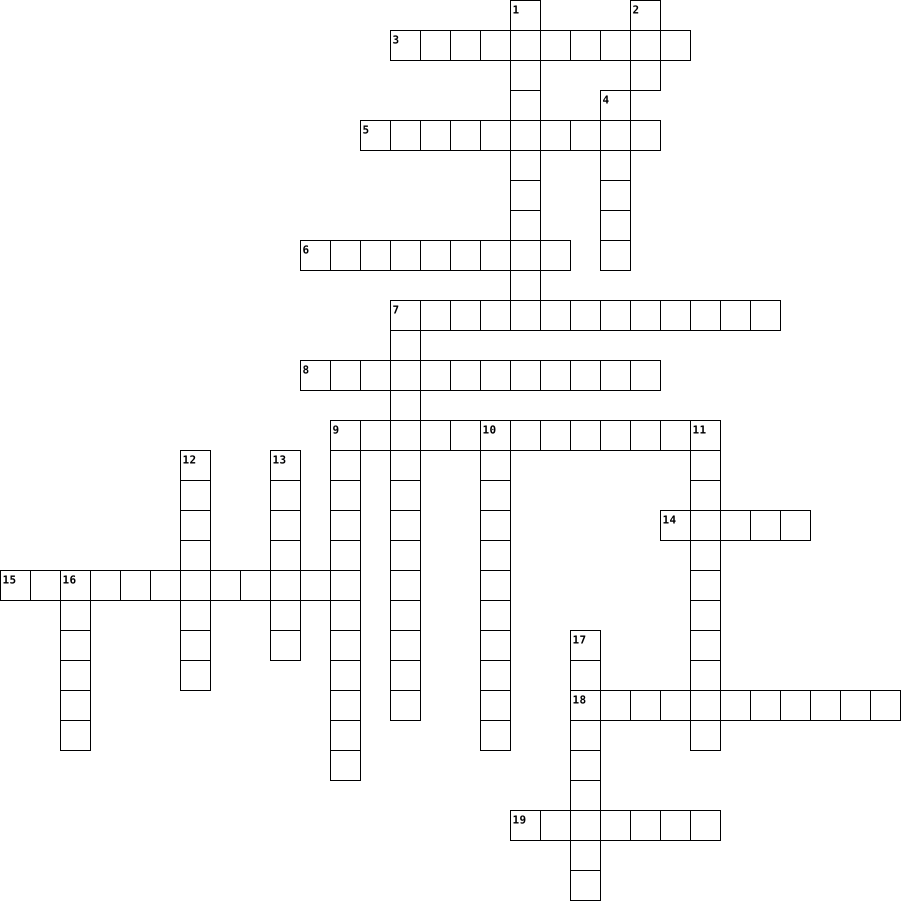
Across
- Fixed amount of gas at a constant temperature, volume of the gas is inversely related to the pressure
- Releases heat
- Having no specific shape
- Physical forms of matter that includes solid, liquid and gas
- Fixed amount of gas at a constant pressure, the volume of the gas changes in the same way the temperature does
- Change of substance from one physical state to another
- State of matter in which the volume and shape of a substance are fixed
- Conversion of a substance from the liquid or solid phase into gas
- Process in which a solid changes directly into a gas
- Conversion of liquid to a vapor when the vapor pressure of the liquid equals atmospheric pressure
Down
- Measure of how hot or cold something is
- Form of matter that does not have a definite shape or volume
- State of matter that has a definite volume but not a definite shape
- Force that acts on the surface of a liquid, tends to minimize the area of the surface
- Change of state from gas to a liquid
- Change of state from a liquid to a gas
- Absorbs heat
- State in which a liquid becomes a solid by loss of heat
- State in which a solid becomes a liquid by adding heat
- Matter that has no definite shape or volume
- Resistance of a gas or liquid to flow
21 Clues: Absorbs heat • Releases heat • Having no specific shape • Change of state from gas to a liquid • Resistance of a gas or liquid to flow • Change of state from a liquid to a gas • Measure of how hot or cold something is • Matter that has no definite shape or volume • Process in which a solid changes directly into a gas • Change of substance from one physical state to another • ...
Properties of Matter 2016-01-10

Across
- How hard/soft something is
- Substance made with one type of atom
- The boiling point of a substance is a _____ property
- The ability to conduct electricity (2w)
- Ability to react
- Gas, liquid, solid
- A material that contains one phase is a ______ mixture
- Through a physical or chemical change, matter cannot be created nor _______
- Ability to catch fire
- A _____ has a constant composition
- When a substance reacts with oxygen and its chemical properties change
- Two or more substances physically combined
- Deterioration caused by oxidation
- Gets dissolved in a solution
- Lots of solute in a solvent
- Baking a cake is a _____ change
- Adding more solvent to the solute
- When the solvent cannot dissolve more solute without a temperature or pressure change
Down
- The acidity of a substance
- Water at 0 degrees celsius (2w)
- Water at 100 degrees celsius (2w)
- A mixture with more than one phase
- The feel of a substance
- The temperature at which something melts (2w)
- Universal solvent
- Part of solution that solute is dissolved in
- Two or more elements that are chemically combined
- A metal that is liquid at room temperature
- Covalently bonded atoms
- The smell of a substance
30 Clues: Ability to react • Universal solvent • Gas, liquid, solid • Ability to catch fire • The feel of a substance • Covalently bonded atoms • The smell of a substance • The acidity of a substance • How hard/soft something is • Lots of solute in a solvent • Gets dissolved in a solution • Water at 0 degrees celsius (2w) • Baking a cake is a _____ change • Water at 100 degrees celsius (2w) • ...
Classification of Matter 2016-01-10

Across
- substance that contains two or more elements
- substance that cannot be broken down by chemical means to simpler substances
- anything with mass and occupies space
- abbreviation of each element
- indefinite volume and no fixed shape
- prepared by mixing correct amounts of salt and water (two words put together)
- negatively charged ion
- matter with a definite, fixed composition
- definite shape and volume
- positively or negatively charged atom or group of atoms
- two or more physically distinct phases
- solid without any regular, internal geometric shape
- body of matter under consideration
Down
- abbreviations for compounds (two words put together)
- not uniform in appearance, has parts with different properties (two words put together)
- smallest particle of an element that can exist
- numbers that appear below and to the right of symbol of an element
- definite volume but not shape
- has same properties throughout
- contain exactly two atoms (two words put together)
- properties intermediate between metals and those of nonmetals
- positively charged ion
- not lustrous, low melting points and densities
- material containing two or more substances
- union of two or more atoms
- solids at room temperature
- homogeneous part separated by physical boundaries
27 Clues: positively charged ion • negatively charged ion • definite shape and volume • union of two or more atoms • solids at room temperature • abbreviation of each element • definite volume but not shape • has same properties throughout • body of matter under consideration • indefinite volume and no fixed shape • anything with mass and occupies space • ...
Properties of Matter 2016-01-09

Across
- The properties of a substance that describes its ability to change into different substances. _______ properties.
- Unit of heat equal to 1 calorie.
- The substances produced.
- Energy can neither be created nor destroyed, but it is transferable. (abbreviated)
- Form of energy that is stored and possessed due to its relative position.
- A change producing products that differ in composition from the original substance. A chemical _____.
- Matter that is homogeneous and has a fixed composition.
- The quantity of heat required to change the temperature of 1g of a substance by 1 degree Celsius.
- The starting substances.
- A characteristic of a substance that gives it a unique identity.
- Has a definite volume but not definite shape.
- The sum of kinetic and potential energy.
- The temperature at which a given solid will melt. ____ point.
- The temperature at which the vapor pressure of a liquid is equal to the pressure above the liquid. _____ point.
- Has a definite shape and volume.
Down
- A characteristic of matter that involves smell.
- Unit of heat equal to 4.184 joules.
- The common measure of heat.
- A characteristic of matter found by making contact with it.
- The properties of a substance that can be determined without changing composition. ______ properties.
- The capacity of matter to do work.
- A shorthand expression showing the reactants and products of chemical change. A chemical _____.
- A form of energy that is produced by moving electric charges.
- A scale of temperature on which water freezes at 32° and boils at 212° under standard conditions.
- No change is observed in the total mass of the substances involved in a chemical change. (abbreviated)
- The temperature at which the temperature becomes enough to solidify a substance. ______ point.
- Form of energy matter possesses due to its motion.
- The the scale of temperature in which water freezes at 0° and boils at 100° under standard conditions.
- Indefinite volume no shape.
- A visual characteristic of matter.
30 Clues: The substances produced. • The starting substances. • The common measure of heat. • Indefinite volume no shape. • Unit of heat equal to 1 calorie. • Has a definite shape and volume. • The capacity of matter to do work. • A visual characteristic of matter. • Unit of heat equal to 4.184 joules. • The sum of kinetic and potential energy. • ...
Properties of Matter 2016-01-09

Across
- A visual characteristic of matter.
- The the scale of temperature in which water freezes at 0° and boils at 100°.
- The substances produced.
- A form of energy that is produced by moving electric charges.
- Has a definite shape and volume.
- The sum of kinetic and potential energy.
- The starting substances.
- The process when a substance obtains a new composition. A chemical _____.
- Unit of heat equal to 1 calorie.
- Energy can neither be created nor destroyed, but it is transferable. (abbreviated)
- The common measure of heat.
- The temperature at which water can form into gas.
- A shorthand expression showing the reactants and products of chemical change. A chemical _____.
- The temperature at which a given solid will melt. ____ point.
- Unit of heat equal to 4.184 joules.
Down
- A characteristic of a substance that gives it a unique identity.
- Matter that is homogeneous and has a fixed composition.
- Has a definite volume but not definite shape.
- The quantity of heat required to change the temperature of 1g of a substance by 1° Celsius.
- The temperature at which the temperature becomes enough to solidify a substance. ______ point.
- The properties of a substance that describes its ability to change into different substances. _______ properties.
- A characteristic of matter that involves smell.
- No change is observed in the total mass of the substances involved in a chemical change. (abbreviated)
- A scale of temperature on which water freezes at 32° and boils at 212°.
- The properties of a substance that can be determined without changing composition. ______ properties.
- The capacity of matter to do work.
- A characteristic of matter found by making contact with it.
- Form of energy that is stored.
- Form of energy matter possesses due to its motion.
- Indefinite volume no shape.
30 Clues: The substances produced. • The starting substances. • The common measure of heat. • Indefinite volume no shape. • Form of energy that is stored. • Has a definite shape and volume. • Unit of heat equal to 1 calorie. • A visual characteristic of matter. • The capacity of matter to do work. • Unit of heat equal to 4.184 joules. • The sum of kinetic and potential energy. • ...
Properties of matter 2016-11-16

Across
- The perception of light based on frequency
- How well a substance is attracted to a magnet
- how readily a substance combines chemically with another substance
- How light shines and reflects off of a surface
- The name for an object with low conductivity
- How easily an object lets heat or electricity flow
- A material's ability to burn in the presence of oxygen
- The temperature at which a substance freezes
- Being thick and sticky due to internal friction
- The temperature at which a substance melts
Down
- An object's resistance to shape change and scratching
- The temperature at which a substance condenses.
- How compact an object is
- How an object feels (rough or smooth)
- The smell of an object
- The degree to which a substance damages a living organism
- The adjective describing low malleability.
- The temperature at which a substance boils
- How easily an object is formed through compression
- How well a substance dissolves into another substance
- The ability to be pulled into strings or wires
- Amount of space an object takes up
- Amount of matter in an object
23 Clues: The smell of an object • How compact an object is • Amount of matter in an object • Amount of space an object takes up • How an object feels (rough or smooth) • The perception of light based on frequency • The adjective describing low malleability. • The temperature at which a substance boils • The temperature at which a substance melts • ...
Mysteries of Matter 2017-02-17

Across
- Who is supposed to melt snow?
- Who gnaws on wall?
- A flowing fluid
- What trapped Hormiguita?
- To become a liquid because of warmth
- What happens in a story
- The people in a story
- The state of something
- How hot or cold it is
- To become solid because of cold
Down
- Who keeps sun from melting snow?
- Hard and firm
- Who pushes cloud?
- The material something is made of
- Who blocks the wind?
- Plot is made up of these
- To catch
- The way something is at a certain time
- What measures hot or cold
- When something happens
- Who makes hot chocolate?
- To change something
22 Clues: To catch • Hard and firm • A flowing fluid • Who pushes cloud? • Who gnaws on wall? • To change something • Who blocks the wind? • The people in a story • How hot or cold it is • When something happens • The state of something • What happens in a story • What trapped Hormiguita? • Plot is made up of these • Who makes hot chocolate? • What measures hot or cold • Who is supposed to melt snow? • ...
Mixtures Matter & Solutions 2017-11-05

Across
- solution of a metal and at least one other solid which is often also a metal
- measure of how gravity pulls on an object
- center of an atom that has most of its mass
- anything that has mass and takes up space
- particle in the nucleus of an atom that has no electric charge
- change change that occurs when atoms link together in a new way, creating a new substance
- original substance at the beginning of a chemical reaction
- particle that contains more than one atom joined together
- any group of elements that conduct heat and electricity; shiny; flexible
- a solid formed by the chemical reaction of two solutions
- smallest unit of an element that retains the properties of that element
- process of changing directly from a solid to a gas without first becoming a liquid
- point particular temperature for a substance at which it changes state from a liquid to a gas
- substance that is dissolved by another substance to form a solution
- point temperature at which a substance changes state from liquid to solid
- change change in size, shape or a state without any change in identity
- amount of matter in a certain volume of a substance, found by dividing the mass of an object by its volume
- particle in the nucleus of an atom atom that carries one unit of positive electric charge
Down
- measure of how much space the matter of an object takes up
- measure of the amount of matter in an object
- physical combination of 2 or more substances that are blended together without forming a new substance
- pure substance that cannot be broken down into any simpler substance through chemical reactions
- mixture of substance that are blended so completely that mixture looks the same everywhere
- expansion expansion of matter caused by a change in heat
- substance that is formed by the chemical combination of 2 or more elements and that acts like a single substance
- upward push of a liquid or gas on an object placed in it
- process of separating the parts of a mixture by evaporation and condensation
- substance that dissolves one or more other substances to form a solution
- type of mixture in which the particles of one material are scattered through another and block passage of light
- maximum amount of a substance that can be dissolved by another substance
- substance at the end of a chemical reaction
- point temperature at which it changes from a solid to a liquid
32 Clues: measure of how gravity pulls on an object • anything that has mass and takes up space • center of an atom that has most of its mass • substance at the end of a chemical reaction • measure of the amount of matter in an object • expansion expansion of matter caused by a change in heat • upward push of a liquid or gas on an object placed in it • ...
Chapter 11: Matter 2018-01-24

Across
- substance made of atoms of more than one element bound together
- mass per unit volume
- are not uniformly mixed
- is anything that has mass and occupies space
- the way a substance reacts to form new substances
- change in composition by forming one or more new substances
- smallest unit of a substance
- has four rules
- the force exerted per unit area of surface
- combination of more than one pure substance
- ability to change or move matter
Down
- smallest particle that has the properties of elements
- characteristic that can be observed or measured without changing the composition
- matter that has a fixed composition
- two or more liquids that don't mix
- mixing occurs between individual units
- change in physical form but not composition
- the chemical symbols and numbers indicating the atoms in the basic unit of a substance
- substance that cannot be broken down into simpler substances
- two or more liquids that are able to dissolve into each other
20 Clues: has four rules • mass per unit volume • are not uniformly mixed • smallest unit of a substance • ability to change or move matter • two or more liquids that don't mix • matter that has a fixed composition • mixing occurs between individual units • the force exerted per unit area of surface • change in physical form but not composition • ...
Chapter 2 Matter 2018-08-28

Across
- the determination of the age or date of organic matter using ratio of the carbon isotopes
- organelle that performs photosynthesis
- acidity or alkalinity of a solution
- energy flow through living systems
- glucose and starch are ____
- single cell organism
- all chemical reactions taking place in cell
- ___law of thermodynamics states total amount of energy constant and conserved
Down
- smallest component of element
- energy that is stored
- cell with organelles
- 60-70% of body is made up of _______
- requires sunlight, carbon dioxide and water to produce oxygen and carbohydrate
- organism that can produce its own food
- carry blueprint of life (DNA and RNA)
- ability to do work or create change
- type of energy created when food molecules are broken
- obtains energy and carbon by consuming other organisms
- molecules that contain carbon
- basic unit of life
20 Clues: basic unit of life • cell with organelles • single cell organism • energy that is stored • glucose and starch are ____ • smallest component of element • molecules that contain carbon • energy flow through living systems • ability to do work or create change • acidity or alkalinity of a solution • 60-70% of body is made up of _______ • carry blueprint of life (DNA and RNA) • ...
Interactions of Matter 2018-10-18

Across
- his arrangement of elements became known as the periodic table
- elements that have some properties of metals and some properties of nonmetals
- number written below and to the right of chemical symbols
- positively charged particle
- smallest particle into which an element can be divided
- at higher ________________, there are more reactants in a given volume
- number number of protons in the nucleus of an atom
- number placed in front of a chemical formula
- gases found in Group 18
- able to be formed into different shapes
- element from atomic number 90 to atomic number 103
- substance formed in a chemical reaction
- substance that changes the rate of a chemical reaction without being used up
- neutral particle found in the nucleus
- small, dense center of an atom
Down
- a type of catalyst found in living things
- shiny and conduct heat and electricity well
- reaction that releases energy
- particles move ___________ at higher temperatures
- metals found in Group 1
- atoms that have the same number of protons but different numbers of neutrons
- poor conductors of heat and electricity
- substance that participate in a chemical reaction
- reaction that required an input of energy
- vertical column of elements
- symbol abbreviation for an element
- negatively charged particle
- can be made into wires
- horizontal row of elements
- number total number of protons and neutrons in an atom’s nucleus
30 Clues: can be made into wires • metals found in Group 1 • gases found in Group 18 • horizontal row of elements • positively charged particle • vertical column of elements • negatively charged particle • reaction that releases energy • small, dense center of an atom • symbol abbreviation for an element • neutral particle found in the nucleus • poor conductors of heat and electricity • ...
States of Matter 2018-10-26

Across
- A _________________ is a substance that flows.
- A ___________________ solid has particles that form a regular, repeating pattern.
- This state has a definite volume but no shape of its own.
- These occur at the plateaus (flat lines) of a time vs temperature graph (2 words)
- This takes place when the particles of a liquid gain enough energy to form a gas.
- Another name for solidification is _________________.
- The four states of matter are: solid, liquid, gas, and ____________________.
- This is the opposite of vaporization.
- This state has a definite volume and a definite shape.
- A liquid's resistance to flowing is called __________________.
- When condensation occurs, a gas' thermal energy ___________________________.
- A change in state from gas directly to solid.
- This change in state goes from solid directly to gas.
Down
- When a liquid’s particles are moving faster, its temperature ____________________.
- The temperature at which a liquid vaporizes. (2 words)
- When the temperature of a gas in increases, the molecules move _________________.
- The temperature at which a solid liquifies. (2 words)
- A change of state from liquid to solid.
- An _____________________ solid does not melt at a distinct temperature.
- When the surface of a liquid vaporizes it is called ____________________________.
- When a liquid turns into a gas, its thermal energy __________________.
- When vaporization takes place throughout a liquid it is called ____________________.
- This state has no definite shape and no definite volume.
23 Clues: This is the opposite of vaporization. • A change of state from liquid to solid. • A change in state from gas directly to solid. • A _________________ is a substance that flows. • The temperature at which a solid liquifies. (2 words) • Another name for solidification is _________________. • This change in state goes from solid directly to gas. • ...
Cycles of Matter 2013-02-28

Across
- the process of dropping off and building up layers of sediment.
- gas to liquid.
- hot iron and nickel center of the earth
- from a gas to a solid
- in animals, the process of burning sugar in oxygen to release energy. Carbon dioxide is produced, as well.
- rock a rock that is changed due to heat or pressure
- evaporation of water through plants.
- when water is absorbed into the ground
- someone who studies volcanoes
- effect greenhouse gasses absorb heat and trap it in earth’s atmosphere. Greenhouse gasses act as a blanket for the earth.
- the process of breaking larger rocks into smaller pieces, due to rain, wind or freezing\thawing.
- someone who studies the movement of the Earth’s crust – earthquakes.
- someone who studies plants
- process of hardening compacted sediment into rock.
- the areas of the planet that are habitable for life.
- plates sections of the earth’s crust.
- cells single cells that control the opening and closing of the stomata
- the hot interior of the earth.
Down
- the movement of small particles that have weathered from larger rocks. Movement is the result of gravity, wind or flowing water.
- all of the water on the planet
- someone who studies long-term weather patterns.
- when fossil fuels are burned in oxygen. It produced carbon dioxide.
- process of squeezing deposited sediment.
- when water falls from the sky
- someone who studies groundwater.
- fuel coal, oil and natural gas. Created from sedimentary rock created from organic matter such as plants in ancient swamps.
- liquid to gas
- someone who studies that climate of the past
- the process in which plants breath in carbon dioxide and take in water, then ‘cook’ it in sunlight to produce sugar and oxygen.
- rockformed by the broken pieces of other rock
- from a solid to a gas
- someone who studies rocks
- where tectonic plates meet. They are the cracks between the plates.
- someone who studies the composition of the Earth.
- the layers of air surrounding the planet.
- water storage water that is stored underground in rocks called aquifers
- opening on the underside of leaves through which water transpires
- the outer cool layer of the earth.
- rock forms when lava or magma is cooled
39 Clues: liquid to gas • gas to liquid. • from a gas to a solid • from a solid to a gas • someone who studies rocks • someone who studies plants • when water falls from the sky • someone who studies volcanoes • all of the water on the planet • the hot interior of the earth. • someone who studies groundwater. • the outer cool layer of the earth. • evaporation of water through plants. • ...
Cycles of Matter 2013-02-28

Across
- water storage water that is stored underground in rocks called aquifers
- hot iron and nickel center of the earth
- fuel coal, oil and natural gas. Created from sedimentary rock created from organic matter such as plants in ancient swamps.
- the layers of air surrounding the planet.
- the hot interior of the earth.
- plates sections of the earth’s crust.
- the areas of the planet that are habitable for life.
- the process in which plants breath in carbon dioxide and take in water, then ‘cook’ it in sunlight to produce sugar and oxygen.
- all of the water on the planet
- opening on the underside of leaves through which water transpires
- the process of dropping off and building up layers of sediment.
Down
- effect greenhouse gasses absorb heat and trap it in earth’s atmosphere. Greenhouse gasses act as a blanket for the earth.
- process of squeezing deposited sediment.
- process of hardening compacted sediment into rock.
- when fossil fuels are burned in oxygen. It produced carbon dioxide.
- cells single cells that control the opening and closing of the stomata
- gas to liquid.
- in animals, the process of burning sugar in oxygen to release energy. Carbon dioxide is produced, as well.
- where tectonic plates meet. They are the cracks between the plates.
- the outer cool layer of the earth.
20 Clues: gas to liquid. • the hot interior of the earth. • all of the water on the planet • the outer cool layer of the earth. • plates sections of the earth’s crust. • hot iron and nickel center of the earth • process of squeezing deposited sediment. • the layers of air surrounding the planet. • process of hardening compacted sediment into rock. • ...
Structure of Matter 2014-04-14

Across
- Neutral Particle made of 2 or more atoms joined by covalent bonds
- orderly three dimensional pattern of ions or atoms in a solid
- Chemical bond formed when two atoms share elctrons
- temperature at which a substance changes from liquid to gas
- state of matter with no definite shape or volume
- Measure of average energy of motion in particles of a substance
- change in substance that doesn't change identity
- change from liquid to gas
- Mixture which pure substances are unevenly distributed
- Basic Particle which all elements are made of
Down
- change from liquid o solid
- Well mixed mixture containg a solvent
- Force that holds atoms together
- form of energy that travels through space as waves
- Change from solid to liquid
- a change in which energy is given off
- mixture of two or more elements, one which is a metal
- Liquid resistent to flowing
- a covalent bond in which electrons shared equally
- group of atoms that became electrically charged
- Something that has Mass and takes over space
21 Clues: change from liquid to gas • change from liquid o solid • Change from solid to liquid • Liquid resistent to flowing • Force that holds atoms together • Well mixed mixture containg a solvent • a change in which energy is given off • Something that has Mass and takes over space • Basic Particle which all elements are made of • group of atoms that became electrically charged • ...
NATURE OF MATTER 2014-03-17

Across
- REFERS TO PROPERTIES THAT ARE TOO SMALL TO BE SEEN EVEN WITH THE VERY BEST MICROSCOPIC
- IS THE REVERSE OF SUBLIMATION
- IS THE RATIO OF MASS PER UNIT VOLUME
- THE PROCESS BY WHICH A GAS OR A VAPOR BECOMES LIQUID
- ARE PURE SUBSTANCES WHICH ARE COMPOSED OF TWO OR MORE ELEMENTS CHEMICALLY JOINED TOGETHER IN A FIXED PROPORTION
- IS THE SMALLEST ARRANGEMENT OF CONNECTED POINTS THAT CAN BE REPEATED IN THREE DIRECTIONS TO FORM THE LATTICE
- IS A PURE SUBSTANCE MADE UP OF ONLY ONE TYPE OF ATOM
- REFERS TO PROPERTIES THAT CAN BE OBSERVED BY THE FIVE HUMAN SENSES, AIDED OR UNAIDED
- HE NAMED THE PARTICLES AS ATOM, FORM THE GREEK WORD ATOMOS, MEANING, 'INDIVISIBLE'
- THE INDIVIDUAL PIECES OF CRYSTALLINE SOLIDS
- IS ANYTHING THAT TAKES UP SPACE AND HAS MASS
- ARE TWO OR MORE SUBSTANCES THAT ARE MIXED TOGETHER PHYSICALLY
Down
- IS THE FORCE OF ATTRACTION BETWEEN DIFFERENT MOLECULES
- IS THE PROCESS BY WHICH A LIQUID CHANGES GAS TO VAPOR
- IS NOT UNIFORMLY MIXED
- IS THE ABILITY TO FLOW
- IS A MEASURE OF THE RESISTANCE OF A LIQUID TO FLOW
- IS CONSIDERED AS THE FOURTH PHASE OF MATTER
- IS THE FORCE OF ATTRACTION BETWEEN IDENTICAL MOLECULES
- ARE SUBSTANCES WHOSE COLORS ARE AFFECTED BY ACIDS AND BASES
20 Clues: IS NOT UNIFORMLY MIXED • IS THE ABILITY TO FLOW • IS THE REVERSE OF SUBLIMATION • IS THE RATIO OF MASS PER UNIT VOLUME • IS CONSIDERED AS THE FOURTH PHASE OF MATTER • THE INDIVIDUAL PIECES OF CRYSTALLINE SOLIDS • IS ANYTHING THAT TAKES UP SPACE AND HAS MASS • IS A MEASURE OF THE RESISTANCE OF A LIQUID TO FLOW • THE PROCESS BY WHICH A GAS OR A VAPOR BECOMES LIQUID • ...
Matter Part 1 2013-11-11

Across
- property that describes an object using the five senses
- the endothermic change of state from a solid to a gas
- unit for mass
- measured in liters
- property that describes matter's ability to change
- law that states if the volume of a gas increases the pressure will decrease
- found by measuring the amount of water displaced
- change that does not change the substance's identity
- calculated by multiplying length times width times height
- state of matter where the particles are close together and vibrate
- rate at which a substance transfers heat
- unit for weight
- the exothermic change of state from a liquid to a solid
- measured in cubic meters
- state of matter that is a super heated gas
- property that is measured in grams
Down
- state of matter where the particles are close together and flow
- law that states if the temperature of a gas increase the volume will increase
- the tendency of an object to resist a change in motion
- the endothermic change of state from a solid to a liquid
- unit for density
- property that measures the amount of force exerted on a given area of a surface
- property that measures how fast the particles of matter are moving
- the exothermic change of state from a gas to a liquid
- physical form in which a substance exists; solid, liquid, gas, plasma
- state of matter where the particles are far apart and fast moving
- property calculated by mass divided by volume
- unit for volume
- the endothermic change of state from a liquid to a vapor (gas)
- property that is measured in Newtons
- the endothermic change of state from a liquid to a gas
- the curve at a liquid's surface by which one measures the volume of a liquid
- change that happens when matter is changed into a new substance
- the change of a substance from one physical form to another
- anything that has mass and takes up space
- amount of space that something takes up
36 Clues: unit for mass • unit for volume • unit for weight • unit for density • measured in liters • measured in cubic meters • property that is measured in grams • property that is measured in Newtons • amount of space that something takes up • rate at which a substance transfers heat • anything that has mass and takes up space • state of matter that is a super heated gas • ...
What's the Matter? 2014-06-24

Across
- A particle in an atomic nuclei that produces a positive charge.
- Substance that can not be broken down to a simpler form.
- A form of energy produced by the existence of charged particles.
- The smallest particle of a chemical element.
- Related to chemistry and substances.
- Composed of two or more separate elements.
- A particle with an electric charge that is not a proton.
- A substance that flows freely.
- Able to be drawn out into a thin wire.
Down
- Related to the periodic table of elements.
- Able to conduct electricity.
- Water that forms as droplets.
- Purified by heating.
- A group of atoms bonded together.
- A chemical process in which substances act together.
- Related to atom or atoms.
- The positively charged core of an atom.
- Boiling point or boiling water.
- An electric charge gathering on an object that can not conduct a current.
- Melt or become liquified by the process of heating.
20 Clues: Purified by heating. • Related to atom or atoms. • Able to conduct electricity. • Water that forms as droplets. • A substance that flows freely. • Boiling point or boiling water. • A group of atoms bonded together. • Related to chemistry and substances. • Able to be drawn out into a thin wire. • The positively charged core of an atom. • ...
Matter Dylan V. 2015-03-11

Across
- when you add energy and a liquid goes into a gas it is also in the water cycle
- 2 or more things put together that can be taken apart
- the fourth state of matter
- turns into something else can't be undone
- starts to condense
- liquid into gas
- solid turns into a liquid
- smallest part of matter
- spread out evenly
- has its own shape
Down
- liquid into a solid
- steam
- smallest part of compounds
- doesn’t turn into something different can be undone
- anything that takes up space and has mass
- gas,solid,liquid,and plasma
- cannot be broken down
- the amount of space something takes up
- 2 or more elements combine
- takes the shape of container
- how much or amount of something
21 Clues: steam • liquid into gas • spread out evenly • has its own shape • starts to condense • liquid into a solid • cannot be broken down • smallest part of matter • solid turns into a liquid • smallest part of compounds • the fourth state of matter • 2 or more elements combine • gas,solid,liquid,and plasma • takes the shape of container • how much or amount of something • ...