
moon phases Crossword Puzzles
Numbers 2021-01-25
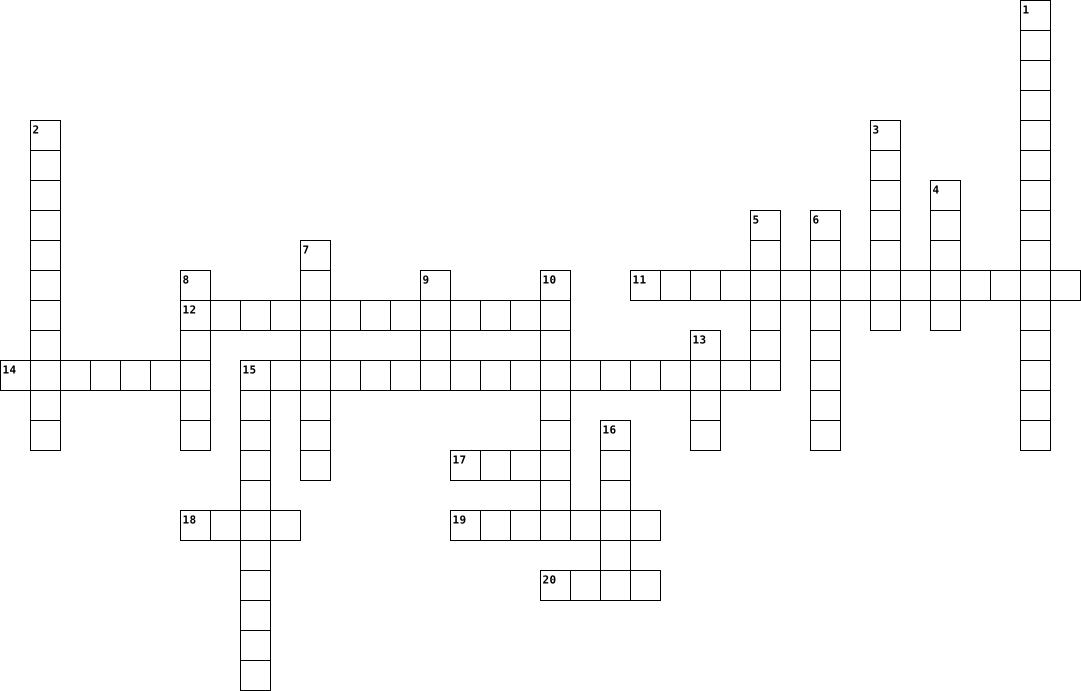
Across
- playing football
- waving good bye
- sixteen
- watering the flowers
- cake
- nine
- oranges
- nose
Down
- climbing a ladder
- flying a kite
- balloon
- mouth
- olives
- eighteen
- nineteen
- twenty
- moon
- seventeen
- pear
- washing a car
- sweets
21 Clues: moon • pear • cake • nine • nose • mouth • olives • twenty • sweets • balloon • sixteen • oranges • eighteen • nineteen • seventeen • flying a kite • washing a car • waving good bye • playing football • climbing a ladder • watering the flowers
DESTINATION PLANET EARTH 2023-10-17

Across
- Coordinates
- Cardinal Points
- Tilted Axis
- Moss
- Sun
- Meridians
- Revolution
- Fire
- Rotation
- Stars
- Map
- Longitude
Down
- Parallels
- Compass
- Latitude
- Moon
- Liquid Water
- Northen Hemisphere
- Weather
- Southern Hemisphere
- Solar System
- The Equator
- Globe
23 Clues: Sun • Map • Moon • Moss • Fire • Stars • Globe • Compass • Weather • Latitude • Rotation • Parallels • Meridians • Longitude • Revolution • Coordinates • Tilted Axis • The Equator • Liquid Water • Solar System • Cardinal Points • Northen Hemisphere • Southern Hemisphere
Words about Night Time 2024-08-29

Across
- not nighttime
- when the world is grey
- sleepy
- a.m.
- dinner
- the time before night
- the opposite of light
- to open your mouth when you are tired
- not dark
- the opposite of sunrise
- the opposite of nightfall
- not the sun but in the sky
Down
- the home of the stars and moon
- not tired
- when the moon appears
- not energized
- wanting to sleep
- 12 p.m.
- 12 a.m.
- not awake
- p.m.
- the opposite of dusk
- when the sun sets
- when the sun rises
24 Clues: a.m. • p.m. • sleepy • dinner • 12 p.m. • 12 a.m. • not dark • not tired • not awake • not energized • not nighttime • wanting to sleep • when the sun sets • when the sun rises • the opposite of dusk • when the moon appears • the time before night • the opposite of light • when the world is grey • the opposite of sunrise • the opposite of nightfall • not the sun but in the sky • the home of the stars and moon • ...
CE 7 & 8 2022-03-02

Across
- something that cannot be touched
- to pester
- love
- make a noisy speech
- separate a group from one another
- moon
- a very loud cry
- something that can be touched
- have things intertwined
- generous
- a feeling of love
Down
- staying in a group
- driven mad by the moon
- group together
- cry out
- someone who has a job because they love it
- thoughtful
- punctuation that shows a loud call
- taking place under a full moon
- indirect or slanting
- imperious; arrogant
- group
- touch
23 Clues: love • moon • group • touch • cry out • generous • to pester • thoughtful • group together • a very loud cry • a feeling of love • staying in a group • make a noisy speech • imperious; arrogant • indirect or slanting • driven mad by the moon • have things intertwined • something that can be touched • taking place under a full moon • something that cannot be touched • separate a group from one another • ...
Space vocab- Izzy Hartwig 5th 2019-04-05

Across
- the force that attracts a body toward the center of the earth, or toward any other physical body having mass.
- the shadow cast by the earth or moon over an area experiencing a partial eclipse.
- a celestial object consisting of a nucleus of ice and dust and, when near the sun, a “tail” of gas and dust particles pointing away from the sun.
- either of the two times in the year, the summer solstice and the winter solstice, when the sun reaches its highest or lowest point in the sky at noon, marked by the longest and shortest days.
- a large, bowl-shaped cavity in the ground or on the surface of a planet or the moon, typically one caused by an explosion or the impact of a meteorite or other celestial body.
- a tide just after the first or third quarters of the moon when there is the least difference between high and low water.
- the fully shaded inner region of a shadow cast by an opaque object, especially the area on the earth or moon experiencing the total phase of an eclipse.
- a law stating that any two masses attract each other with a force equal to a constant (constant of gravitation) multiplied by the product of the two masses and divided by the square of the distance between them.
- a fixed luminous point in the night sky which is a large, remote incandescent body like the sun.
- a tide just after a new or full moon, when there is the greatest difference between high and low water.
- a celestial body moving in an elliptical orbit around a star.
- an obscuring of the light from one celestial body by the passage of another between it and the observer or between it and its source of illumination.
- the alternate rising and falling of the sea, usually twice in each lunar day at a particular place, due to the attraction of the moon and sun.
- each of the aspects of the moon or a planet, according to the amount of its illumination, especially the new moon, the first quarter, the full moon, and the last quarter.
- a forcible overthrow of a government or social order, in favor of a new system.
- a small body moving in the solar system that would become a meteor if it entered the earth's atmosphere.
Down
- a chart or series of pages showing the days, weeks, and months of a particular year, or giving particular seasonal information.
- the action of rotating around an axis or center.
- a group or cluster of related things.
- the curved path of a celestial object or spacecraft around a star, planet, or moon, especially a periodic elliptical revolution.
- a small body of matter from outer space that enters the earth's atmosphere, becoming incandescent as a result of friction and appearing as a streak of light.
- an eclipse in which the moon appears darkened as it passes into the earth's shadow.
- the time or date (twice each year) at which the sun crosses the celestial equator when day and night are of equal length
- an eclipse in which the sun is obscured by the moon.
- An object that orbits a planet.
- a large, level basalt plain on the surface of the moon, appearing dark by contrast with highland areas.
- an imaginary line about which a body rotates.
27 Clues: An object that orbits a planet. • a group or cluster of related things. • an imaginary line about which a body rotates. • the action of rotating around an axis or center. • an eclipse in which the sun is obscured by the moon. • a celestial body moving in an elliptical orbit around a star. • ...
Moon Review 2023-02-15

Across
- Period of 29.5 day orbit of the Moon
- When the sun's light reflects off the Earth and illuminates the moon
- Gravity of moon compared to earth (there is a dash between the two numbers)
- Illumination growing towards full moon
- Craters on the surface of the moon from meteor strikes
Down
- Illumination decreasing towards new moon
- Period of 27 day orbit of the Moon
- Dust on surface of moon
- Gravity dependent
- The planet that crashed into our Earth making our Moon
- Not gravity dependent
11 Clues: Gravity dependent • Not gravity dependent • Dust on surface of moon • Period of 27 day orbit of the Moon • Period of 29.5 day orbit of the Moon • Illumination growing towards full moon • Illumination decreasing towards new moon • The planet that crashed into our Earth making our Moon • Craters on the surface of the moon from meteor strikes • ...
Space Talk 2013-01-03

Across
- When two full moons happen in the same month the second is called a...Happens once in a...
- flow of charged particles from the corona.
- When the Moon appears to shrink.
- A spinning neutron star that gives of pulses of radiation.
- Darker cooler regions of the sun's surface.
- A massive object with REALLY strong gravity.
- Farther away from the moon.
- A very small and dense star which have neutron particles.
- The actual amount of energy or light given off by a star.
- You see a quarter of the moon.
- When the Moon appears to grow.
- Moon is almost completely covered or uncovered, but not quite.
Down
- Moving in a circle with a center.
- Outermost layer of the Sun.
- Shadow of anybody with two parts.
- Baby star or star in training.
- Two cells fly together and become one.
- Distance from the sun to earth as a way of measurement.
- Part of an eclipse when everything is covered.
- Closer to earth
- Death of a large star by EXPLOSION!
- Center of the sun
- Clusters of billions of stars.
23 Clues: Closer to earth • Center of the sun • Outermost layer of the Sun. • Farther away from the moon. • Baby star or star in training. • You see a quarter of the moon. • When the Moon appears to grow. • Clusters of billions of stars. • When the Moon appears to shrink. • Moving in a circle with a center. • Shadow of anybody with two parts. • Death of a large star by EXPLOSION! • ...
lesson29 2013-03-13

Across
- A lunar eclipse occurs when the Moon passes directly behind the Earth into its umbra (shadow). This can occur only when the Sun, Earth, and Moon are aligned ...
- somethin god gave us
- a complete overthrow of government
- something that u do in slow ____
- something haveing to do with the sky
- A measure of distance equal to the distance that light travels
- are small Solar System bodies or dwarf planets that are not comets. The term asteroids historically referred to objects inside the orbit of Jupiter.
- somthin u use to look at the sky with
- somthin that you can see fly in the sky
- somthing that happen every 50 year
- somethin that happen when the sun and the moon hug
- something ower earth have
Down
- somthin that the earth do
- somthin that have to do with the group of stars
- someones name
- a big rock speeding down
- a thing every one have
- the science that deals with sun moon and stars
- something you ride to outter space
- is a moon, planet or machine that orbits a planet or star.
20 Clues: someones name • somethin god gave us • a thing every one have • a big rock speeding down • somthin that the earth do • something ower earth have • something that u do in slow ____ • a complete overthrow of government • something you ride to outter space • somthing that happen every 50 year • something haveing to do with the sky • somthin u use to look at the sky with • ...
Space and Satellites 2015-03-12

Across
- a continuos area or expanse that is free
- A large object orbiting a star
- A natural satellite of a planet
- A space vehicle that lands on another planet or moon
- The path that a planet takes around a star
- Anything that orbits a planet or moon
- The force of attraction between any two objects
- An unnamed spacecraft that has cameras and other equipment to find out about other planets
- The unit of force
- A small rocky body orbiting the sun
- Relating to, or determined by the sun
Down
- The amount of matter that something is made of
- The american space program for landing astronauts on the moon
- An optical instrument designed to make distant objects appear nearer
- A small lump of dirty ice orbiting the sun
- The star around which earth orbits
- A space probe that goes into orbit around a planet or moon
- A vehicle used for traveling in space
- Millions of stars grouped together
- A huge ball of gas that gives out heat and light energy
20 Clues: The unit of force • A large object orbiting a star • A natural satellite of a planet • The star around which earth orbits • Millions of stars grouped together • A small rocky body orbiting the sun • Anything that orbits a planet or moon • A vehicle used for traveling in space • Relating to, or determined by the sun • a continuos area or expanse that is free • ...
Science 2022-04-22

Across
- the most northerly circle of latitude on Earth
- layer of Earth's atmosphere that extends 311-621 Miles
- type of wind that blows from the ocean to the land
- latitude on the Earth at 66.5 degrees south
- orbits the earth and reflects sunlight
- waves in which the vibration of the medium is parallel
- It is the second layer of the atmosphere
- means the moon is shrinking
- type of wind that blows from the land to the ocean
- extends from about 50 to 85 km (31 to 53 miles) above
Down
- latitude on the Earth 23.5 degrees south of the equator
- uppermost region of the Earth's atmosphere
- the lowest layer of Earth's atmosphere
- line of latitude around the Earth, at 66°3 north
- an instrument that can be use to observe small object
- imaginary line around the middle of a planet.
- means the moon is growing
- a wave vibrating at right angles to the direction
- When the Moon casts a shadow on the Earth
- When the Earth casts a shadow on the moon
20 Clues: means the moon is growing • means the moon is shrinking • the lowest layer of Earth's atmosphere • orbits the earth and reflects sunlight • It is the second layer of the atmosphere • When the Moon casts a shadow on the Earth • When the Earth casts a shadow on the moon • uppermost region of the Earth's atmosphere • latitude on the Earth at 66.5 degrees south • ...
Sky Science 2023-12-13

Across
- way Our galaxy
- To produce it’s own light
- The shadow is at the longest during
- Crescent The phase of the moon before the new moon
- You are unable to see the sun during a solar eclipse because the ____ is blocking it
- A group of stars that form an image
- To view celestial objects you should use this
- The 5th planet from the sun
- Constellations are based on these
- First planet from the sun
- The month in which the spring equinox is in
Down
- The month in which the longest day of the year is on
- The north star
- solstice December 21st
- gibbous The phase of the moon following the full moon
- viewer To view the sun safely you should use this
- eclipse You are unable to the full moon during this
- solstice June 21st
- To bounce light off of an object
- The reason for the seasons
- noon The sun is at the highest point
- clockwise Planet earth rotates in this direction
- crescent Right hand C
- The hottest planet
- moon The phase
- The sun rises in the _____
26 Clues: The north star • way Our galaxy • moon The phase • solstice June 21st • The hottest planet • crescent Right hand C • solstice December 21st • To produce it’s own light • First planet from the sun • The reason for the seasons • The sun rises in the _____ • The 5th planet from the sun • To bounce light off of an object • Constellations are based on these • The shadow is at the longest during • ...
Facts About Space 2022-02-10

Across
- In the late evening shadows point toward the ____.
- Shadows are _____ in the winter than the summer.
- When the Southern Hemisphere has summer, the Northern Hemisphere has ______.
- Earth's gravity pulls toward the _____ of the Earth.
- The Earth stays in orbit around the Sun because of the Suns' ______ gravitational pull.
- Every object has its own _____.
- The Sun only projects light onto one ____ of the Earth at a time.
- The third phase of the Moon.
- Scientists think that a big object ______ with Earth a long time ago.
- How long it takes the Earth to rotate on its axis one time.
- The sun is a _____ sized star.
Down
- In the morning shadows point toward the ______.
- Shadows are _____ in the summer than the winter.
- What causes shadows?
- The sixth phase of the Moon.
- Groton-Dunstable's mascot.
- Earth's _____ causes seasons.
- The seventh phase of the Moon.
- ____ stars are the hottest.
- The fifth phase of the Moon.
- ____ stars are the coolest.
- It takes the Moon about _____ to complete its full cycle.
- Earth's axis is tilted at a _____ ° angle.
23 Clues: What causes shadows? • Groton-Dunstable's mascot. • ____ stars are the hottest. • ____ stars are the coolest. • The sixth phase of the Moon. • The third phase of the Moon. • The fifth phase of the Moon. • Earth's _____ causes seasons. • The seventh phase of the Moon. • The sun is a _____ sized star. • Every object has its own _____. • Earth's axis is tilted at a _____ ° angle. • ...
Sky Science 2023-12-13

Across
- moon The phase
- Crescent The phase of the moon before the new moon
- First planet from the sun
- The shadow is at the longest during
- The 5th planet from the sun
- You are unable to see the sun during a solar eclipse because the ____ is blocking it
- A group of stars that form an image
- To view celestial objects you should use this
- gibbous The phase of the moon following the full moon
- Constellations are based on these
- The month in which the longest day of the year is on
- noon The sun is at the highest point
- The month in which the spring equinox is in
- The sun rises in the _____
Down
- The north star
- eclipse You are unable to the full moon during this
- solstice December 21st
- To produce it’s own light
- viewer To view the sun safely you should use this
- crescent Right hand C
- solstice June 21st
- To bounce light off of an object
- The reason for the seasons
- clockwise Planet earth rotates in this direction
- The hottest planet
- Our galaxy
26 Clues: Our galaxy • The north star • moon The phase • solstice June 21st • The hottest planet • crescent Right hand C • solstice December 21st • To produce it’s own light • First planet from the sun • The reason for the seasons • The sun rises in the _____ • The 5th planet from the sun • To bounce light off of an object • Constellations are based on these • The shadow is at the longest during • ...
Puzzle 1 2020-10-16

Across
- suggested that hydrogen atoms in the sun fused or combined to form helium atoms
- only moon in solar system with substantial atmosphere
- type of visible star is coolest
- magellanic cloud is a
- natural disasters happen on moon
- the sun
- Horsehead nebula is
- brightest star in southern constellation of carina
- pulsar is actually a
- a black hole of mass of earth would be of size of a
- Device that does not work on moon
- Saturn's moon has distinctive equatorial ridge
- class name that andromeda galaxy belongs to
- largest volcano
- two bright spots of light on opposite sides of a halo
- the dragon
- great red spot located at
- cool areas on the surface of earth
Down
- star closest to sun
- galaxy home to solar system
- unit measurement used to describe the expansion of universe
- rotation axis to most celestial bodies is
- astronomical event that made headlines in 1986
- only moon with active volcanoes
- asteroid type of heavenly body
- first rover to explore mars
- the hunter
- bright star in constellation Ursa major
28 Clues: the sun • the hunter • the dragon • largest volcano • star closest to sun • Horsehead nebula is • pulsar is actually a • magellanic cloud is a • great red spot located at • galaxy home to solar system • first rover to explore mars • asteroid type of heavenly body • type of visible star is coolest • only moon with active volcanoes • natural disasters happen on moon • ...
Sky Science Crossword Puzzle 2022-12-14

Across
- way Our galaxy
- To produce it’s own light
- The shadow is at the longest during
- Crescent The phase of the moon before the new moon
- You are unable to see the sun during a solar eclipse because the ____ is blocking it
- A group of stars that form an image
- To view celestial objects you should use this
- The 5th planet from the sun
- Constellations are based on these
- First planet from the sun
- The month in which the spring equinox is in
Down
- The month in which the longest day of the year is on
- The north star
- solstice December 21st
- gibbous The phase of the moon following the full moon
- viewer To view the sun safely you should use this
- eclipse You are unable to the full moon during this
- solstice June 21st
- To bounce light off of an object
- The reason for the seasons
- noon The sun is at the highest point
- clockwise Planet earth rotates in this direction
- crescent Right hand C
- The hottest planet
- moon The phase
- The sun rises in the _____
26 Clues: The north star • way Our galaxy • moon The phase • solstice June 21st • The hottest planet • crescent Right hand C • solstice December 21st • To produce it’s own light • First planet from the sun • The reason for the seasons • The sun rises in the _____ • The 5th planet from the sun • To bounce light off of an object • Constellations are based on these • The shadow is at the longest during • ...
Unit 2: Earth - Sun - Moon Relationship 2025-01-09

Across
- light bounces off an object
- light enters the object and doesn't leave
- between microwaves and visible light
- why our sky is blue
- most dangerous EM radiation
- 12 hours of day/12 hours of night
- how "bunched up" waves are
- total solar eclipse viewing zone
- energy in a "cooking box"
- moon gets bigger
- height of a wave
- "bent pencil in water"
- Earth blocks moon
- imaginary line through Earth's poles
- sunscreen to protect us
- shadow that creates path of totality
- somewhat balancing of high & low tide
- moon blocks sun
Down
- phase needed for solar eclipse
- time to go from new to full moon
- range of waves from radio to gamma
- longest wavelength, lowest frequency EM wave
- highest high tide, lowest low tide
- "orbit"
- sun right over it during equinoxes
- 1 takes Earth 24 hours
- moon gets smaller
- sun directly over this line on June 21
- crest to crest or trough to trough
- ony part of EM spectrum we can see
- June 21 or December 21
- lighter portion of a shadow
32 Clues: "orbit" • moon blocks sun • moon gets bigger • height of a wave • moon gets smaller • Earth blocks moon • why our sky is blue • 1 takes Earth 24 hours • "bent pencil in water" • June 21 or December 21 • sunscreen to protect us • energy in a "cooking box" • how "bunched up" waves are • light bounces off an object • most dangerous EM radiation • lighter portion of a shadow • ...
CE 7 & 8 2022-03-02

Across
- something that cannot be touched
- to pester
- love
- make a noisy speech
- separate a group from one another
- moon
- a very loud cry
- something that can be touched
- have things intertwined
- generous
- a feeling of love
Down
- staying in a group
- driven mad by the moon
- group together
- cry out
- someone who has a job because they love it
- thoughtful
- punctuation that shows a loud call
- taking place under a full moon
- indirect or slanting
- imperious; arrogant
- group
- touch
23 Clues: love • moon • group • touch • cry out • generous • to pester • thoughtful • group together • a very loud cry • a feeling of love • staying in a group • make a noisy speech • imperious; arrogant • indirect or slanting • driven mad by the moon • have things intertwined • something that can be touched • taking place under a full moon • something that cannot be touched • separate a group from one another • ...
CE 7 & 8 2022-03-02

Across
- something that cannot be touched
- to pester
- love
- make a noisy speech
- separate a group from one another
- moon
- a very loud cry
- something that can be touched
- have things intertwined
- generous
- a feeling of love
Down
- staying in a group
- driven mad by the moon
- group together
- cry out
- someone who has a job because they love it
- thoughtful
- punctuation that shows a loud call
- taking place under a full moon
- indirect or slanting
- imperious; arrogant
- group
- touch
23 Clues: love • moon • group • touch • cry out • generous • to pester • thoughtful • group together • a very loud cry • a feeling of love • staying in a group • make a noisy speech • imperious; arrogant • indirect or slanting • driven mad by the moon • have things intertwined • something that can be touched • taking place under a full moon • something that cannot be touched • separate a group from one another • ...
CE 7 & 8 2022-03-02

Across
- something that cannot be touched
- to pester
- love
- make a noisy speech
- separate a group from one another
- moon
- a very loud cry
- something that can be touched
- have things intertwined
- generous
- a feeling of love
Down
- staying in a group
- driven mad by the moon
- group together
- cry out
- someone who has a job because they love it
- thoughtful
- punctuation that shows a loud call
- taking place under a full moon
- indirect or slanting
- imperious; arrogant
- group
- touch
23 Clues: love • moon • group • touch • cry out • generous • to pester • thoughtful • group together • a very loud cry • a feeling of love • staying in a group • make a noisy speech • imperious; arrogant • indirect or slanting • driven mad by the moon • have things intertwined • something that can be touched • taking place under a full moon • something that cannot be touched • separate a group from one another • ...
CE 7 & 8 2022-03-02

Across
- something that cannot be touched
- to pester
- love
- make a noisy speech
- separate a group from one another
- moon
- a very loud cry
- something that can be touched
- have things intertwined
- generous
- a feeling of love
Down
- staying in a group
- driven mad by the moon
- group together
- cry out
- someone who has a job because they love it
- thoughtful
- punctuation that shows a loud call
- taking place under a full moon
- indirect or slanting
- imperious; arrogant
- group
- touch
23 Clues: love • moon • group • touch • cry out • generous • to pester • thoughtful • group together • a very loud cry • a feeling of love • staying in a group • make a noisy speech • imperious; arrogant • indirect or slanting • driven mad by the moon • have things intertwined • something that can be touched • taking place under a full moon • something that cannot be touched • separate a group from one another • ...
CE 7 & 8 2022-03-02

Across
- something that cannot be touched
- to pester
- love
- make a noisy speech
- separate a group from one another
- moon
- a very loud cry
- something that can be touched
- have things intertwined
- generous
- a feeling of love
Down
- staying in a group
- driven mad by the moon
- group together
- cry out
- someone who has a job because they love it
- thoughtful
- punctuation that shows a loud call
- taking place under a full moon
- indirect or slanting
- imperious; arrogant
- group
- touch
23 Clues: love • moon • group • touch • cry out • generous • to pester • thoughtful • group together • a very loud cry • a feeling of love • staying in a group • make a noisy speech • imperious; arrogant • indirect or slanting • driven mad by the moon • have things intertwined • something that can be touched • taking place under a full moon • something that cannot be touched • separate a group from one another • ...
Alphabet Vocabulary 2025-04-11

Across
- fox
- apple
- hat
- tree
- cat
- egg
- fish
- lion
- king
- van
- igloo
- nut
- ball
- jam
- yoyo
Down
- rocket
- zip
- watch
- queen
- pig
- sun
- orange
- goat
- dog
- umbrella
- moon
26 Clues: fox • zip • pig • hat • cat • egg • sun • van • dog • nut • jam • tree • fish • lion • king • goat • ball • moon • yoyo • watch • queen • apple • igloo • rocket • orange • umbrella
The big alphabet puzzle 2025-03-31

Across
- jam
- xylophone
- queen
- igloo
- tomato
- koala
- orange
- watermelon
- house
- cat
- zebra
- dog
Down
- girl
- umbrella
- sock
- yogurt
- bee
- fish
- note
- moon
- lion
- elephant
- vet
- pencil
- alien
- rainbow
26 Clues: jam • bee • vet • cat • dog • girl • sock • fish • note • moon • lion • queen • igloo • koala • alien • house • zebra • yogurt • tomato • pencil • orange • rainbow • umbrella • elephant • xylophone • watermelon
Moon Crossword 2026-03-02

Across
- Phase when the entire lit half faces Earth
- Earth’s shadow on the Moon causes this event
- Phase when half the Moon appears lit and the light is decreasing
- Phase when only a thin sliver remains before new moon
- Phase when more than half of the Moon is lit but the light is decreasing
Down
- Shape of the Moon’s orbit
- Phase when more than half is lit and still increasing before full moon
- Phase when half the Moon appears lit and the light is increasing
- Phase when a small sliver of light appears and grows after new moon
- Phase when the Moon is between Earth and the Sun
- The Moon shines because it reflects this from the Sun
- The Moon’s path around Earth
12 Clues: Shape of the Moon’s orbit • The Moon’s path around Earth • Phase when the entire lit half faces Earth • Earth’s shadow on the Moon causes this event • Phase when the Moon is between Earth and the Sun • Phase when only a thin sliver remains before new moon • The Moon shines because it reflects this from the Sun • ...
Third Grade Science Words 2020-01-16

Across
- cycle the cycle of processes by which water circulates between the earth's oceans, atmosphere, and land
- attraction electric currents as well as magnets
- phases rises with the side that faces Earth fully exposed to sunlight
- prevention of wasteful materials
- effects indicate adverse effects produced by poisons
- take note of or detect
- an animal's young
- layers of gases surrounding the planet
- cycle the series of changes in the life of an organism
- the state of being on or moving
- rain, snow, sleet, or hail that falls to the ground
- change reversible change in the physical properties of a substance
- resources materials or substances such as minerals, forests, water
- an individual animal, plant, or single-celled life form
- physical substance
Down
- no longer in existence
- the action of rotating around an axis or center
- worn away or altered by long exposure to the air
- method systematic observation, measurement, and experiment, and the formulation, testing, and modification of hypotheses
- the process by which green plants and some other organisms use sunlight
- system the collection of eight planets and their moons in orbit around the sun
- an animal that naturally preys on others
- features formation or geological formation
- strength or energy as an attribute
- conserved quantity
- the presence in or introduction into the environment of a substance or thing that has harmful
- properties characteristic of matter that can be observed and measured without changing the chemical identity
- an animal that is hunted and killed by another for food
28 Clues: an animal's young • conserved quantity • physical substance • no longer in existence • take note of or detect • the state of being on or moving • prevention of wasteful materials • strength or energy as an attribute • layers of gases surrounding the planet • an animal that naturally preys on others • features formation or geological formation • ...
Unit 9 vocab 2024-01-30

Across
- A building or group of buildings where goods are manufactured or assembled chiefly by machine.
- Rule by an emperor.
- A class of people in the middle of a social hierarchy,
- A implicit agreement among the members of a society to cooperate for social benefits
- Public intellectuals dedicated to solving the real problems of the world
- Telescopic observations of the mountains on the moon, the moons of Jupiter, the phases of Venus, and the rings of Saturn.
- Separation of church and state
- Natural laws
- Scottish inventor, mechanical engineer, and chemist who improved on Thomas Newcomen's 1712 Newcomen steam engine
- The process of making an area more urban.
- Social Contract
- An empirical method for acquiring knowledge
Down
- A spatial region or concept division over which a state or organization has a level of cultural, economic, military or political exclusivity.
- Breaks the manufacture of a good into steps that are completed in a pre-defined sequence.
- People are 2 things, evil and selfish
- A superseded astronomical model in which the Earth and planets revolve around the Sun
- A person who organizes and operates a business or businesses
- Meeting at which the major European powers negotiated and formalized claims to territory in Africa
- The right that is supposedly given to a king or queen by God to rule a country.
- Separation of powers
- An economic and political system in which a country's trade and industry are controlled by private owners for profit.
21 Clues: Natural laws • Social Contract • Rule by an emperor. • Separation of powers • Separation of church and state • People are 2 things, evil and selfish • The process of making an area more urban. • An empirical method for acquiring knowledge • A class of people in the middle of a social hierarchy, • A person who organizes and operates a business or businesses • ...
Space and Satellites 2015-03-12

Across
- a continuos area or expanse that is free
- A large object orbiting a star
- A natural satellite of a planet
- A space vehicle that lands on another planet or moon
- The path that a planet takes around a star
- Anything that orbits a planet or moon
- The force of attraction between any two objects
- An unnamed spacecraft that has cameras and other equipment to find out about other planets
- The unit of force
- A small rocky body orbiting the sun
- Relating to, or determined by the sun
Down
- The amount of matter that something is made of
- The american space program for landing astronauts on the moon
- An optical instrument designed to make distant objects appear nearer
- A small lump of dirty ice orbiting the sun
- The star around which earth orbits
- A space probe that goes into orbit around a planet or moon
- A vehicle used for traveling in space
- Millions of stars grouped together
- A huge ball of gas that gives out heat and light energy
20 Clues: The unit of force • A large object orbiting a star • A natural satellite of a planet • The star around which earth orbits • Millions of stars grouped together • A small rocky body orbiting the sun • Anything that orbits a planet or moon • A vehicle used for traveling in space • Relating to, or determined by the sun • a continuos area or expanse that is free • ...
The Sun, Earth, Moon, and Eclipse 2023-12-19

Across
- zone where the sun's energy moves outward
- evidence of meteorite hits on the moon
- the darkest part of the moon's shadow
- where the moon somewhat covers the Sun
- the top layer of the Earth
- zone where the sun's energy starts to bubble
- giant loops of plasma
- type of eclipse where the Earth is between the Sun and moon
- the layer of the sun we see from Earth
- atmosphere layer where weather balloons fly
- the sun's energy flowing out into space
- the lightest part of the moon's shadow
- atmosphere layer where satellites orbit
- the hottest atmosphere layer
- Earth layer made of molten rock
Down
- Earth layer made of liquid iron and nickel
- the coldest atmosphere layer where meteors burn up
- explosions causing gases to go out in space
- layer of the sun's energy we cannot see
- layer of the sun where energy is made
- solid sphere made of iron and nickel
- atmosphere layer where weather is formed
- where the moon completely covers the Sun
- type of eclipse where the moon is between the Sun and Earth
24 Clues: giant loops of plasma • the top layer of the Earth • the hottest atmosphere layer • Earth layer made of molten rock • solid sphere made of iron and nickel • the darkest part of the moon's shadow • layer of the sun where energy is made • evidence of meteorite hits on the moon • where the moon somewhat covers the Sun • the layer of the sun we see from Earth • ...
Space Race 2024-04-10

Across
- Saturn's biggest moon
- What you do on planets that are not Earth.
- The direction that venus spins (relative to other planets)
- Space phenomena whose gravitational pull is so intense that no matter can escape
- The center of our solar system
- Name of the group of space rocks in between Mars and Jupiter
- _____ Giants
- What you hear in space
- largest planet in the solar system
- The explosion of a star
- The hottest planet, with a surface temperature of 465 degrees celsius
- Who the US beat in the 1950s space race to the moon
Down
- What the US left on the moon
- Habitable zone in space; where water is able to remain in liquid state
- The solar systems biggest moon, belonging to Jupiter
- The gemstone that rains on Jupiter and Saturn
- Once the 9th planet, removed in 2006
- The name of the famous storm on Jupiter
- Second man to walk on the moon
- How many NASA spacecrafts have blown up in space missions
- Funny planet name
21 Clues: _____ Giants • Funny planet name • Saturn's biggest moon • What you hear in space • The explosion of a star • What the US left on the moon • The center of our solar system • Second man to walk on the moon • largest planet in the solar system • Once the 9th planet, removed in 2006 • The name of the famous storm on Jupiter • What you do on planets that are not Earth. • ...
L11 Sunita in space 2022-01-24

Across
- Red planet
- First Indian man to go in space.
- Shape of earth
- coldest planet
- The path around a spacial body in which other one revolves .
- Force exerted by Earth on all objects
- Movement of earth on its own axis
- Hottest planet in the solar system
- largest planet
- Another name for force of gravity.
- group of astar
- Number of planets in solar system
- A celestial body which is called a dwarf planet.
Down
- No moon night.
- It has its own light
- The sky, stars, sun and moon are all in ................ .
- First person to walk on moon.
- Indian space research organisation
- Moving around another object
- Model of the earth
- A meteorite which catches fire when it enters the earth's atmosphere.
- is used for the TV, telephones and weather reports
- Night when moon it appears perfectly round in the sky.
- Organisation for which Sunita Williams works
- First Indian woman to go in space.
- Our planet
- A vehicle designed to travel in space
- Natural satellite of Earth
- An object that revolves around SUN
29 Clues: Red planet • Our planet • No moon night. • Shape of earth • coldest planet • largest planet • group of astar • Model of the earth • It has its own light • Natural satellite of Earth • Moving around another object • First person to walk on moon. • First Indian man to go in space. • Movement of earth on its own axis • Number of planets in solar system • Indian space research organisation • ...
CE 7 & 8 2022-03-02

Across
- something that cannot be touched
- to pester
- love
- make a noisy speech
- separate a group from one another
- moon
- a very loud cry
- something that can be touched
- have things intertwined
- generous
- a feeling of love
Down
- staying in a group
- driven mad by the moon
- group together
- cry out
- someone who has a job because they love it
- thoughtful
- punctuation that shows a loud call
- taking place under a full moon
- indirect or slanting
- imperious; arrogant
- group
- touch
23 Clues: love • moon • group • touch • cry out • generous • to pester • thoughtful • group together • a very loud cry • a feeling of love • staying in a group • make a noisy speech • imperious; arrogant • indirect or slanting • driven mad by the moon • have things intertwined • something that can be touched • taking place under a full moon • something that cannot be touched • separate a group from one another • ...
6th 100 sight words 2014-08-01

Across
- Test
- Perhaps
- Can't
- Divided
- Syllables
- Anything
- Bill
- Believe
- Region
- Ready
- Center
- Dance
- Europe
Down
- Square
- Felt
- Direction
- Suddenly
- Farmers
- Matter
- General
- Subject
- Members
- Picked
- Energy
- Moon
- Return
26 Clues: Test • Felt • Bill • Moon • Can't • Ready • Dance • Square • Matter • Picked • Region • Center • Energy • Return • Europe • Perhaps • Divided • Farmers • General • Subject • Members • Believe • Suddenly • Anything • Direction • Syllables
Q1 Reflection 2025-11-04

Across
- the pull that causes the moon to revolve around earth
- an imprint made from bones or shells
- rock layers are also called this
- moon phase getting smaller
- the grand canyon is made out of it
- what keeps your feet planted on the ground
Down
- eclipse where the sun is covered by the moon
- the movement of one object around another
- these are what fossils are
- the planets that have shorter revolution time around the sun
- the spinning of an object on its axis
- a very HOT season
- scenic cool adjacent season
- eclipse with the earth in between the sun and moon
- the planets that have a longer revolution time around the sun
- moon phase getting larger
16 Clues: a very HOT season • moon phase getting larger • these are what fossils are • moon phase getting smaller • scenic cool adjacent season • rock layers are also called this • the grand canyon is made out of it • an imprint made from bones or shells • the spinning of an object on its axis • the movement of one object around another • what keeps your feet planted on the ground • ...
Q1 reflection 2025-10-30

Across
- Plants, animals, or other BLANK die and sink to the ground or ocean flour.
- When the moon is fully lit up
- planets More than 10 moons
- planets No rings
- The BLANK rock layers are at the bottom
- Remains or impressions of ancient organisms
- To move around another object
- The lighting of the moon is decreasing
- the force that pulls objects toward each other.
Down
- Seasons are a regular change in BLANK that change every year.
- Moon passes between the earth and sun, blocking sunlight.
- Earth passes between the sun and moon casting a shadow on the moon.
- To spin on a axis
- Some BLANK experience all four seasons but others don’t.
- strata Layers of rock
- Gravity keeps them in orbit
16 Clues: To spin on a axis • planets No rings • strata Layers of rock • planets More than 10 moons • Gravity keeps them in orbit • When the moon is fully lit up • To move around another object • The lighting of the moon is decreasing • The BLANK rock layers are at the bottom • Remains or impressions of ancient organisms • the force that pulls objects toward each other. • ...
Why does the Moon change shape? 2025-02-28

Across
- moon phase when the Moon looks like a sliver
- the part of the Moon that we can see on a particular night
- a pretend version of something that scientists use when the real thing is too big, small, or complicated to work with
- a large, round object in the night sky that can reflect the Sun's light
- something that happens again and again in a way that can be predicted
Down
- moon phase when the Moon looks like a little less than a full circle
- moon phase when the Moon looks like a half circle
- a set of events that repeats in the same order over and over
- moon phase when the Moon looks like a circle
- moon phase when the Moon looks completely dark
- circling another object, like the Moon around the Earth
11 Clues: moon phase when the Moon looks like a circle • moon phase when the Moon looks like a sliver • moon phase when the Moon looks completely dark • moon phase when the Moon looks like a half circle • circling another object, like the Moon around the Earth • the part of the Moon that we can see on a particular night • ...
solar system 2025-09-29

Across
- the hottest planet
- the biggest moon
- a red planet
- the closest planet to the sun
- has rings
- sucks things up
- the 8th planet
- the closest star
- the solar systms are in here
Down
- the smallest solar system
- the biggest solar system
- the biggest planet
- the planet we live on
- a dwawf planet
- the smallest moon
- 7th planet
- only shows at night
- elon musk owns this place
18 Clues: has rings • 7th planet • a red planet • a dwawf planet • the 8th planet • sucks things up • the biggest moon • the closest star • the smallest moon • the hottest planet • the biggest planet • only shows at night • the planet we live on • the biggest solar system • the smallest solar system • elon musk owns this place • the solar systms are in here • the closest planet to the sun
Space Race Achievements 2023-12-23

Across
- Docking
- Program
- Orbit
- Moon Landing
- Orbit
- Space Station
- Communications
Down
- Moon Impact
- Program
- Moon Lander
- Tereshkova
- Capsule
- Mars Landing
- Columbia
- Land
15 Clues: Land • Orbit • Orbit • Program • Docking • Program • Capsule • Columbia • Tereshkova • Moon Impact • Moon Lander • Mars Landing • Moon Landing • Space Station • Communications
lunar cycle crossword puzzle 2021-05-07

Across
- the force that pulls 2 objects together.
- when the moon is about to become a new moon
- the biggest object in the night sky.
- when the moon is completely shown.
- when the moon appears to be half dark half light and is getting bigger.
- The waves and the height of the ocean
Down
- when the moon appears bigger each night.
- when the moon gets smaller each night.
- when the moon is almost full but not quick.
- when there is no moon in the night sky.
- when the moon appears to be half dark half light and is getting smaller.
11 Clues: when the moon is completely shown. • the biggest object in the night sky. • The waves and the height of the ocean • when the moon gets smaller each night. • when there is no moon in the night sky. • when the moon appears bigger each night. • the force that pulls 2 objects together. • when the moon is almost full but not quick. • when the moon is about to become a new moon • ...
Lune 2025-08-20

Across
- the shape of a cresent moon
- semi-circular partial horseshoe
- affected with periodic insanity dependant on the changes of the moon
- condition of being a lunatic
- the moons period of between the old moon and the new
- is of the moon
- small cresent shaped moon
Down
- situated under the moon
- situated beyond the moon or its orbit
- an interval
- time from one new moon to the next
11 Clues: an interval • is of the moon • situated under the moon • small cresent shaped moon • the shape of a cresent moon • condition of being a lunatic • semi-circular partial horseshoe • time from one new moon to the next • situated beyond the moon or its orbit • the moons period of between the old moon and the new • affected with periodic insanity dependant on the changes of the moon
Q1 reflection 2025-10-30

Across
- Plants, animals, or other BLANK die and sink to the ground or ocean flour.
- When the moon is fully lit up
- planets More than 10 moons
- planets No rings
- The BLANK rock layers are at the bottom
- Remains or impressions of ancient organisms
- To move around another object
- The lighting of the moon is decreasing
- the force that pulls objects toward each other.
Down
- Seasons are a regular change in BLANK that change every year.
- Moon passes between the earth and sun, blocking sunlight.
- Earth passes between the sun and moon casting a shadow on the moon.
- To spin on a axis
- Some BLANK experience all four seasons but others don’t.
- strata Layers of rock
- Gravity keeps them in orbit
16 Clues: To spin on a axis • planets No rings • strata Layers of rock • planets More than 10 moons • Gravity keeps them in orbit • When the moon is fully lit up • To move around another object • The lighting of the moon is decreasing • The BLANK rock layers are at the bottom • Remains or impressions of ancient organisms • the force that pulls objects toward each other. • ...
The Man on the Moon: A Day in the Life of Bob 2022-11-07

Across
- This ___ you may know him as the Man on the Moon.
- ___ drops sweet packets and cans on the moon.
- He wears a special 'man on the moon' ___.
- After lunch ___ spaceships start arriving from earth.
- On his way to the moon he reads his ___.
- The rocket ___ is where he goes every morning.
Down
- He ___ his fantastic rocket ship.
- He has a cup of tea and two eggs for ___.
- He is on his way to work on the ___.
- There's no such thing as ___.
- By four-thirty all ___ must leave the moon.
- On his way he does the ___.
- His very job is very ___. He has to keep the moon clean and tidy.
13 Clues: On his way he does the ___. • There's no such thing as ___. • He ___ his fantastic rocket ship. • He is on his way to work on the ___. • On his way to the moon he reads his ___. • He has a cup of tea and two eggs for ___. • He wears a special 'man on the moon' ___. • By four-thirty all ___ must leave the moon. • ___ drops sweet packets and cans on the moon. • ...
The Space Race 2025-05-29

Across
- Set the goal to land a man on the moon
- US Created in response to the Soviet Union's lead in space tech
- First artificial satellite to be placed into orbit
- Lost the Space Race
- Union of Soviet Socialist Republics
- First man on the Moon
- Important US spaceflight mission during the Space Race
Down
- First woman in space
- Approximately how long the Space Race lasted
- of, determined by, or resembling the moon.
- Won the Space Race
- First man in space
- Second man on the Moon
- An object placed in orbit around a planet or moon.
- A significant event in the progress of something
15 Clues: Won the Space Race • First man in space • Lost the Space Race • First woman in space • First man on the Moon • Second man on the Moon • Union of Soviet Socialist Republics • Set the goal to land a man on the moon • of, determined by, or resembling the moon. • Approximately how long the Space Race lasted • A significant event in the progress of something • ...
Marine Crossword 2023-10-10

Across
- Type of plate boundary that makes mountains
- Type of plate boundary that can result in earthquakes
- outermost layer of the Earth
- Tide when the moon is out of alignment from the sun and earth
- When moon is after the New moon until the Full moon
- Type of plate boundary that makes mid ocean ridges
Down
- When moon is less than half full
- When moon is more than half full
- Change in temperature in the ocean
- Tide when the sun, moon, and earth are in line
- When moon is after the Full moon until new moon
11 Clues: outermost layer of the Earth • When moon is less than half full • When moon is more than half full • Change in temperature in the ocean • Type of plate boundary that makes mountains • Tide when the sun, moon, and earth are in line • When moon is after the Full moon until new moon • Type of plate boundary that makes mid ocean ridges • ...
Solar Eclipse Key Terms 2024-04-05

Across
- a thin layer of plasma that lies between the Sun’s visible surface and the corona.
- the phase of the moon when it’s in conjunction with the sun and invisible from earth.
- Ring-shape; of or forming a ring.
- the sun’s light will burst from the first place that becomes uncovered, shining like a diamond that’s set on a ring.
- the external layer of the sun which is known as the luminous envelope or the visible layer of the sun from which light as well as heat radiate.
- one of a series of darkish narrow parallel bands seen to rush swiftly across the landscape just before or after totality in a solar eclipse probably due to optical effects of the earth’s atmosphere.
- when the moon fully obscures the sun.
- happens when the moon passes between the Sun and Earth but the Sun, Moon, and Earth are not perfectly lined up.
- the moment the moon first touches the edge of the solar disk, approaching it from the right as seen from the Northern Hemisphere.
- the apparent path of the sun throughout the course of a year.
- areas where the magnetic field is about 2,500 times stronger than Earth’s
- a rare eclipse that starts as an Annular eclipse and can change to a Total Eclipse, or vice versa.
- when the outer edge of the moon last touches the sun, marks its end.
- the lighter part of a shadow that forms at a certain distance from the object casting the shadow.
- an eclipse in which a thin outer ring of the sun’s disk is not covered by the smaller dark disk of the moon.
- and eclipse in which the whole of the disk of the sun or moon is obscured.
Down
- a period of approximately 6,585.3 days.
- the region of the complete shadow
- obscuration the fraction of the Sun’s area occulted by the Moon.
- a person who chases eclipses
- a dark-gray, cone-shaped shadow.
- the Sun’s upper atmosphere.
- the region of the diffuse shadow
- season the only time the Sun is close enough to one of the Moon’s nodes to allow an eclipse to occur.
- magnitude the fraction of the Sun’s diameter that is covered by the moon.
- the recurring increase and decrease in the number of ______ over a period averaging about eleven years.
- the instant when the total or annular phase of a solar eclipse ends.
- starting with Baily’s beads and the diamond ring effect.
- the row of brilliant points of sunlight shining through valleys on the edge of the moon that are seen for a few seconds before and after the central phase in an eclipse of the sun.
- the state of being important.
30 Clues: the Sun’s upper atmosphere. • a person who chases eclipses • the state of being important. • a dark-gray, cone-shaped shadow. • the region of the diffuse shadow • the region of the complete shadow • Ring-shape; of or forming a ring. • when the moon fully obscures the sun. • a period of approximately 6,585.3 days. • starting with Baily’s beads and the diamond ring effect. • ...
astranome 2023-11-20

Across
- orbit around the earth
- eclipse
- moon growing
- spinning on a axle
- massive illumination
- mixture of gas
Down
- moderate tides
- on an angle
- moon shrinking
- eclipse sun is obscured by the lunar eclipse the moon passes in the moon's shadow
- very long period waves
- tide after the new moon
12 Clues: eclipse • on an angle • moon growing • moderate tides • moon shrinking • mixture of gas • spinning on a axle • massive illumination • orbit around the earth • very long period waves • tide after the new moon • eclipse sun is obscured by the lunar eclipse the moon passes in the moon's shadow
Earth, the Moon and Our Solar System 2025-01-30

Across
- Meteors are space rock that are found in Earth's ___________________.
- This moon would have to be in this phase during a lunar eclipse.
- This moon phase occurs between a 1st quarter and full moon.
- One day on this planet (its rotation period) lasts only 10 hours on this planet! (Use the posters)
- In the core of the Sun, hydrogen atoms fuse into what to generate light energy?
- the largest volcano in our solar system.
- Without an atmosphere, Mercury's temperatures can vary as much as this many degrees! (Use the posters)
- This is the name of the hottest planet with surface temperatures over 900 degrees Fahrenheit! (Use the posters)
- These are found in large numbers on Mercury's surface due to there not being an atmosphere to protect the planet.
- This moon phase occurs just before a new moon.
- This planet is 93 million miles from the Sun! (Use the posters)
- The Hubble Telescope is an example of this type of spacecraft.
- All planets revolve around the Sun in this direction (if you were looking from above the solar system).
- High tides will be at their absolute highest and low tides will be at their absolute lowest during this special type of tide.
- This planet has a thick atmosphere full of CO2 (carbon dioxide)!
- This telescope discovered the Galilean moons of Jupiter (Jupiter's 4 largest moons).
- Space rock floating around in space all alone.
- This is the name of the layer of the Sun's atmosphere that we would see during a total solar eclipse.
Down
- Gas giant planet that rotates on its side.
- This eclipse occurs when the Moon falls in Earth's shadow.
- A space rock that lands on Earth's surface.
- The asteroid belt consists of billions of asteroids found between these two planets.
- Water exists in all three states of matter on this planet.
- This moon phase would place the moon directly between Earth and the Sun.
- This special type of tide occurs when the Sun, Moon, and Earth form a 90 degree angle.
- Comets in our solar system that are on the same plane as the planets are found here.
- This eclipse occurs when the Moon blocks sunlight from Earth.
- The inner planets are referred to as this because of their rock/metal composition.
- All four outer planets have this feature, even though Saturn is the only one that always gets the credit for having such prominent ones in pictures.
- This process gives this planet its red look. (Use the posters)
- These space object have two tails - a gas tail and a dust tail!
31 Clues: the largest volcano in our solar system. • Gas giant planet that rotates on its side. • A space rock that lands on Earth's surface. • This moon phase occurs just before a new moon. • Space rock floating around in space all alone. • This eclipse occurs when the Moon falls in Earth's shadow. • Water exists in all three states of matter on this planet. • ...
Solar Eclipse Key Terms 2024-04-05

Across
- a thin layer of plasma that lies between the Sun’s visible surface and the corona.
- the phase of the moon when it’s in conjunction with the sun and invisible from earth.
- Ring-shape; of or forming a ring.
- the sun’s light will burst from the first place that becomes uncovered, shining like a diamond that’s set on a ring.
- the external layer of the sun which is known as the luminous envelope or the visible layer of the sun from which light as well as heat radiate.
- one of a series of darkish narrow parallel bands seen to rush swiftly across the landscape just before or after totality in a solar eclipse probably due to optical effects of the earth’s atmosphere.
- when the moon fully obscures the sun.
- happens when the moon passes between the Sun and Earth but the Sun, Moon, and Earth are not perfectly lined up.
- the moment the moon first touches the edge of the solar disk, approaching it from the right as seen from the Northern Hemisphere.
- the apparent path of the sun throughout the course of a year.
- areas where the magnetic field is about 2,500 times stronger than Earth’s
- a rare eclipse that starts as an Annular eclipse and can change to a Total Eclipse, or vice versa.
- when the outer edge of the moon last touches the sun, marks its end.
- the lighter part of a shadow that forms at a certain distance from the object casting the shadow.
- an eclipse in which a thin outer ring of the sun’s disk is not covered by the smaller dark disk of the moon.
- and eclipse in which the whole of the disk of the sun or moon is obscured.
Down
- a period of approximately 6,585.3 days.
- the region of the complete shadow
- obscuration the fraction of the Sun’s area occulted by the Moon.
- a person who chases eclipses
- a dark-gray, cone-shaped shadow.
- the Sun’s upper atmosphere.
- the region of the diffuse shadow
- season the only time the Sun is close enough to one of the Moon’s nodes to allow an eclipse to occur.
- magnitude the fraction of the Sun’s diameter that is covered by the moon.
- the recurring increase and decrease in the number of ______ over a period averaging about eleven years.
- the instant when the total or annular phase of a solar eclipse ends.
- starting with Baily’s beads and the diamond ring effect.
- the row of brilliant points of sunlight shining through valleys on the edge of the moon that are seen for a few seconds before and after the central phase in an eclipse of the sun.
- the state of being important.
30 Clues: the Sun’s upper atmosphere. • a person who chases eclipses • the state of being important. • a dark-gray, cone-shaped shadow. • the region of the diffuse shadow • the region of the complete shadow • Ring-shape; of or forming a ring. • when the moon fully obscures the sun. • a period of approximately 6,585.3 days. • starting with Baily’s beads and the diamond ring effect. • ...
Astronomy 2024-10-27

Across
- When the moon is getting smaller.
- The Sun is the ______ star to Earth.
- The type of star our Sun is.
- How much of the moon is lit up by the Sun.
- Earth's tilt causes these.
- The belt that runs between Mars and Jupiter.
- The farthest planet from the Sun.
- The largest planet.
Down
- The force that pulls things together.
- What Earth rotates on.
- When the moon is more than half full.
- Where you find the Sun and all of the planets.
- The closest planet to the Sun.
- What the Moon does to the Sun's light.
- When the moon is getting bigger.
15 Clues: The largest planet. • What Earth rotates on. • Earth's tilt causes these. • The type of star our Sun is. • The closest planet to the Sun. • When the moon is getting bigger. • When the moon is getting smaller. • The farthest planet from the Sun. • The Sun is the ______ star to Earth. • The force that pulls things together. • When the moon is more than half full. • ...
Our Solar System 2022-02-23

Across
- Repeating path of an object around another
- Jupiter's natural satellite and largest orbiting Sol
- Galaxy formation of one or more arms
- Celestial object of ice and dust
- System, Network of bodies that orbit Sol
- Unit, Distance between center of Earth and center of Sol
- Third planet of Sol and our home
- Phases, Shape of Luna's sunlit portion
- Sixth planet of Sol and second largest
- Seventh planet of Sol and first planet discovered by telescope
- Jupiter's second largest natural satellite
- Larger of two natural satellites orbiting Mars
- Largest natural satellite of Pluto
- Gravity bound system of stars planets gas dust and dark matter
- Fourth planet of Sol and second smallest
- Saturn's second largest natural satellite
- Clouds of dust and gas occupying space
Down
- Galaxy formation of no distinct shape
- Jupiter's third largest natural satellite
- Eighth and most dense planet of Sol
- Galaxy formation of oval shape
- Saturn's largest natural satellite
- Smaller of two natural satellites orbiting Mars
- The sun of our solar system
- Neptune's largest natural satellite
- Saturn's third largest natural satellite
- Uranus's largest natural satellite
- Fifth planet of Sol and largest
- Jupiter's smallest natural satellite
- Celestial object small and rocky
- Empty space
- Earth's natural satellite
- Smallest and closest planet with shortest orbit of Sol
- Second planet of Sol and brightest object in Earth's night sky
- dwarf planet in the Kuiper Belt orbiting Sol
35 Clues: Empty space • Earth's natural satellite • The sun of our solar system • Galaxy formation of oval shape • Fifth planet of Sol and largest • Celestial object of ice and dust • Third planet of Sol and our home • Celestial object small and rocky • Saturn's largest natural satellite • Uranus's largest natural satellite • Largest natural satellite of Pluto • ...
Dragonwings 2022-03-10

Across
- What is Demons tongue?
- What was the place they worked at called?
- Who made the kites that mother used?
- Windrider killed who?
- What was the name of the super lazy horse?
- What was Moon Shadow's favorite job?
- What was one of the Mountains Called?
- What cookies did Moon Shadow end up liking?
- Who are The Sleepers?
Down
- What did Black Dog steal from Moon Shadow?
- who beat up Moon Shadow?
- Demoness that let Windrider and Moon Shadow stay the night?
- What were the women in the Demon's town called?
- What was the old name for the Tiger General?
- Who was Black Dog's Father?
15 Clues: Windrider killed who? • Who are The Sleepers? • What is Demons tongue? • who beat up Moon Shadow? • Who was Black Dog's Father? • Who made the kites that mother used? • What was Moon Shadow's favorite job? • What was one of the Mountains Called? • What was the place they worked at called? • What did Black Dog steal from Moon Shadow? • What was the name of the super lazy horse? • ...
Space Race 2023-05-22

Across
- The Soviet program for lunar exploration
- The first artificial Earth satellite
- Celestial body that was a major goal in the Space Race
- The spacecraft that carried the first human into space
- Orbiter launched into space
- Texas city associated with Mission Control
- Long-serving Russian spacecraft design
Down
- The path followed by an object in space
- The first man to step on the moon
- First name of the first man in space
- NASA's second human spaceflight program
- President who pledged to put man on the moon
- Vehicle that propels astronauts into space
- NASA's moon landing program
- Next major destination after the moon
15 Clues: NASA's moon landing program • Orbiter launched into space • The first man to step on the moon • First name of the first man in space • The first artificial Earth satellite • Next major destination after the moon • Long-serving Russian spacecraft design • The path followed by an object in space • NASA's second human spaceflight program • ...
Formation of the Galaxy 2021-12-06

Across
- the most widely accepted theory to explain the creation of the universe
- matter with an indefinite shape and volume
- the shape of the illuminated portion of the sun
- forge pulling objects toward one another
- tiny particles of matter floating in space
- happens when the moon passes into Earth's shadow
- more shadow than light
- about half of the moon is shaded
Down
- more light than shadow
- large mass of stars
- the sun and the group of planets that revolve around it
- light of the moon is on the left; light fades
- occurs when the moon covers part or all of the sun
- light of the moon is on the right; light grows
- Mercury, Venus, Earth, and Mars are ___ planets
- a self-luminous celestial body
- The ___ of the earth causes seasons
17 Clues: large mass of stars • more light than shadow • more shadow than light • a self-luminous celestial body • about half of the moon is shaded • The ___ of the earth causes seasons • forge pulling objects toward one another • matter with an indefinite shape and volume • tiny particles of matter floating in space • light of the moon is on the left; light fades • ...
science vocab 3 2023-01-13

Across
- eclipse /an eclipse in which the sun is blocked out by the moon.
- eclipse / an eclipse in which the moon appears darkened as it passes into the earth's shadow.
- / to light up
- /large icy objects with a tail that orbit the Sun
- /chunks of rocky material that orbit the Sun.
- /a measure of the gravitational pull on an object
- cycle / the four-week period during which the Moon orbits Earth one time and goes through all of its phases.
- moon /any phase of the moon that has more than half of its face illuminated.
Down
- /large dark gray areas that are smooth on the surface of the Moon
- /when the face of the Moon looks smaller each day.
- /when a meteoroid hits an object like the
- / round structures with various sizes and details found on the surface of the Moon
- /a small object in space
- /when the face of the Moon looks larger each day
14 Clues: / to light up • /a small object in space • /when a meteoroid hits an object like the • /chunks of rocky material that orbit the Sun. • /when the face of the Moon looks larger each day • /large icy objects with a tail that orbit the Sun • /a measure of the gravitational pull on an object • /when the face of the Moon looks smaller each day. • ...
lunar cycle crossword puzzle 2021-05-07

Across
- the force that pulls 2 objects together.
- when the moon is about to become a new moon
- the biggest object in the night sky.
- when the moon is completely shown.
- when the moon appears to be half dark half light and is getting bigger.
- The waves and the height of the ocean
Down
- when the moon appears bigger each night.
- when the moon gets smaller each night.
- when the moon is almost full but not quick.
- when there is no moon in the night sky.
- when the moon appears to be half dark half light and is getting smaller.
11 Clues: when the moon is completely shown. • the biggest object in the night sky. • The waves and the height of the ocean • when the moon gets smaller each night. • when there is no moon in the night sky. • when the moon appears bigger each night. • the force that pulls 2 objects together. • when the moon is almost full but not quick. • when the moon is about to become a new moon • ...
Eclipse's 2024-08-07

Across
- Moon covers sun but still shows the sun disk around the moon.
- Point of an object orbit when its closed to the sun.
- Moon Shadow moves around the globe.
- Sun, Moon and Earth not fully inline so sun looks like a cresent during eclipse
- Large star.
Down
- Rocky metor like object rotating around the Earth.
- Moon blocks the the sunlight for earth by going in front of the sun.
- Where we live.
- Earth blocks the moon from the sunlight.
- Area the light is completly blocked. (Shadow)
- Area that the sun that the sun is partly blocked.
- Moon covers the entire sun.
12 Clues: Large star. • Where we live. • Moon covers the entire sun. • Moon Shadow moves around the globe. • Earth blocks the moon from the sunlight. • Area the light is completly blocked. (Shadow) • Area that the sun that the sun is partly blocked. • Rocky metor like object rotating around the Earth. • Point of an object orbit when its closed to the sun. • ...
CH22-The Sun, Moon, & Earth System 2024-02-29

Across
- the outer region of the sun's atmosphere
- large, flat regions of the moon's surface that are made of hardened basaltic lava
- a large, dark area on the surface of the moon
- seasons are caused by the earth's motion relative to the sun and its ___
- we call the 356 named days from January 1st-December 31st a ___ year
- some ___ may be cracks in the moon's crust that formed when it cooled and shrank
- where gases in the moon's very thin atmosphere mainly come from
- this is defined as the distance between the earth and sun
- scientists think that the moon has a liquid outer core and a solid ___ core
- we know the moon's interior structure is similar to Earth's from collecting data on ___
- the moons surface gravity is ___ of Earth's
- materials blasted out of a crater during a meteorite impact
- these appear to be uplift mountains, extinct volcanoes, and/or rims of impact basins
- we can observe how the sun rotates on its axis because of the movement of ___
- the visible surface of the sun
- astronomers believe that these form when pairs of local magnetic disturbances appear on the sun's surface
- the sun is composed mostly of this
Down
- a depression on the surface of the moon usually surrounded by circular walls
- hot plasma rises to the surface, cools, and descends into the sun's interior again in the sun's ___ zone
- the region within the sun where energy travels primarily as electromagnetic waves
- compared with the earth, the average density of the moon is ___ dense
- the entire range of electromagnetic waves released by the sun is called the solar ___
- a continuation of the sun's atmosphere
- streams of plasma that rise up into and descend from the sun's corona, often forming loops
- severe solar storms that can disrupt telecommunications on Earth
- effects from ___ between the earth and moon cause the Earth's spin to slow, the moon orbits faster, and moonquakes occur
- the apparent path that the sun follows through the stars as seen from Earth's perspective
- the sun is located far from the ___ of the Milky Way galaxy
- the moon has a very thin atmosphere because it has too little ___
- how many times the moon rotates during one revolution around the earth
- a total solar eclipse is usually ___ than a total lunar eclipse
- the moon has a nearly perfect spherical shape likely because it rotates very ___
- the lunar phase the moon must be in during a total solar eclipse
33 Clues: the visible surface of the sun • the sun is composed mostly of this • a continuation of the sun's atmosphere • the outer region of the sun's atmosphere • the moons surface gravity is ___ of Earth's • a large, dark area on the surface of the moon • this is defined as the distance between the earth and sun • the sun is located far from the ___ of the Milky Way galaxy • ...
Astronomy Eclipses, Sun, Spectroscopy, & Tides 2019-12-12

Across
- This is the type of spectrum created by a hot gas.
- Totally shadowed (darkest) portion of an eclipse.
- _______ tides occur at every new and full moon.
- _______ tides occur at every 1st quarter and 3rd (last) quarter moon.
- Tides are caused by a difference between the _________ force acting on different parts of an object.
- The ______ has a larger effect on the Earth's tides.
- Diagram "F" represents a(n): (2 words)
- Letter "D" on the Crossword Quiz Diagram would be a(n) ___________ solar eclipse.
- These result in higher than normal high tides and lower than normal low tides. (2 words)
- Type of lunar month that lasts 29.5 days.
- This type of eclipse can occur when moonrise and runrise occur at the same time (2 words).
- _________ remains fixed and Earth rotates into and out of it causing the tides to rise and fall twice a day. (2 words)
- Spring tides cause _______ than normal high tides and _______ than normal low tides. (2 words)
- Letter "E" on the Crossword Quiz Diagram would be a(n) ___________ solar eclipse.
- Number 3 in the sun diagram is the ______ zone.
- These result in high tides being lower than normal and low tides being higher than normal. (2 words)
- Most stars create this type of spectra:
Down
- This describes one complete revolution of the moon around the Earth. (2 words)
- This describes the moon going from a moon phase back to the same moon phase. (2 words)
- This is the type of eclipse visible to most everyone on the side of the Earth facing the moon.
- This type of eclipse could happen during a full moon (2 words).
- _______ of oceans against the ocean floor is slowing Earth’s rotation by 0.0015 seconds per century due to the moon's gravitational pull.
- Number 6 in the sun diagram is the:
- The type of spectrum created due to light passing through a cool gas.
- Letter "C" on the Crossword Quiz Diagram would be a(n) ___________ solar eclipse.
- Number 9 in the sun diagram is the:
- Type of lunar month that lasts 27.3 days.
- Diagram "G" represents a(n): (2 words)
- The moon is moving _________ from Earth at the rate of about 3.8 cm per year.
- This is the study of the properties of light.
- Neap tides cause ______ than normal high tides and _____ than normal low tides. (2 words)
- The type of spectrum emitted by most incandescent lights.
- Partially shadowed portion of an eclipse.
- How many tides do most areas have each day.
34 Clues: Number 6 in the sun diagram is the: • Number 9 in the sun diagram is the: • Diagram "F" represents a(n): (2 words) • Diagram "G" represents a(n): (2 words) • Most stars create this type of spectra: • Type of lunar month that lasts 27.3 days. • Type of lunar month that lasts 29.5 days. • Partially shadowed portion of an eclipse. • ...
Foundations Of Emergency Management 2018-11-11

Across
- Which phase usually overlaps the third phase of emergency management?
- Who provided the most recognized benchmark for describing the four phases of emergency management?
- Recovery involves the timely resumption of?
- What can make a difference in mitigating against the effects of a disaster?
- In preparing for a disaster, it is important to start with?
- Which phase involves how a community reacts to a disaster, hazard or emergency?
Down
- The second phase in emergency management is?
- What is commonly known as mitigation?
- How many phases are there in emergency management?
- Preparedness comes in many different forms but has one similar?
10 Clues: What is commonly known as mitigation? • Recovery involves the timely resumption of? • The second phase in emergency management is? • How many phases are there in emergency management? • In preparing for a disaster, it is important to start with? • Preparedness comes in many different forms but has one similar? • ...
Kelsi Crossword Puzzle 2026-01-13

Across
- Fast, narrow currents of air high in the atmosphere
- Plain within a large impact basin on Mercury
- Jupiter, Saturn, Uranus, and Neptune
- Four rocky planets
- Minimum distance which a celestial body is held together by its own gravity
- Process where a molecule breaks apart
- Large continent sized highland on Venus
- Largest volcano and tallest mountain on Mars
Down
- Located along the equator of Mars
- Jupiters four largest moons
- Jupiters largest moon
- very steep bank or slope
- Neptunes largest moon
- Saturns largest moon
- System for detecting direction, distance, and speed
- Larger innermost moon of Mars
- smaller of Mars two moons
- planets Outerplanets, Jupiter, Saturn, Uranus, and Neptune
18 Clues: Four rocky planets • Saturns largest moon • Jupiters largest moon • Neptunes largest moon • very steep bank or slope • smaller of Mars two moons • Jupiters four largest moons • Larger innermost moon of Mars • Located along the equator of Mars • Jupiter, Saturn, Uranus, and Neptune • Process where a molecule breaks apart • Large continent sized highland on Venus • ...
Relfection sheet 2025-11-05

Across
- an object spinning around another object
- outer planets
- inner planets
- the northern and southern means the opposite season
- rock and clay that preserves fossils
- the moon decreasing in light
Down
- what controls earths seasons
- what it takes for a fossil to preserve
- the moon between the sun and earth
- a gravitational pull
- an object spinning on its axis
- the moon in increasing in light
- the earth between the sun and moon
- layers building up overtime
- things piling on top of each other
- your weight on earth
16 Clues: outer planets • inner planets • a gravitational pull • your weight on earth • layers building up overtime • what controls earths seasons • the moon decreasing in light • an object spinning on its axis • the moon in increasing in light • the moon between the sun and earth • the earth between the sun and moon • things piling on top of each other • rock and clay that preserves fossils • ...
Tides 2016-10-11

Across
- High tides occur in areas ____ to the moon.
- Low tides occur in areas ____ from the moon.
- Smaller tides occur when the sun and moon are at ____ angles to each other.
- The sun and moon's ____ force causes tides.
- The moon attracts water ____ to it.
- Tidal bulges occur when the earth's water is pulled ____ the moon.
- Does the sun or moon have a stronger force on the earth?
Down
- Larger tides are called ____ tides.
- Tides change as the earth ____.
- Larger tides occur when the sun and moon pull in the ____ direction.
- How many high tides and low tides are there in a day?
- Smaller tides are called ____ tides.
12 Clues: Tides change as the earth ____. • Larger tides are called ____ tides. • The moon attracts water ____ to it. • Smaller tides are called ____ tides. • High tides occur in areas ____ to the moon. • The sun and moon's ____ force causes tides. • Low tides occur in areas ____ from the moon. • How many high tides and low tides are there in a day? • ...
Science trivia! 2024-10-30

Across
- the most colorful season.
- the moon in between the sun and earth.
- the beginning of a year.
- preserved from the prehistoric.
- layers of rock stacked on top of each other.
- the phase when the moon is dark.
- the distance and mass of an object.
- the coldest season.
- the biggest gas giant.
Down
- a hole in space and time.
- the hottest season.
- the phase when the moon is brightest.
- a way of orbiting.
- spinning on an axis.
- the earth’s shadow on the moon.
- the only planet with life.
16 Clues: a way of orbiting. • the hottest season. • the coldest season. • spinning on an axis. • the biggest gas giant. • the beginning of a year. • a hole in space and time. • the most colorful season. • the only planet with life. • preserved from the prehistoric. • the earth’s shadow on the moon. • the phase when the moon is dark. • the distance and mass of an object. • ...
Science Crossword 2024-10-25

Across
- Rocky,solid,and no rings
- Mostly gas and have rings
- Spinning on an axis
- At the top of the layers of earth
- Earth between the sun and moon
- the moon is fully lit
Down
- Facing the sun causes different seasons
- Reveals the fossils for scientists
- The moon getting smaller
- At the bottom of the layers of earth
- help define and identify geologic periods
- Discoverer of gravity
- Causes the seasons
- Gravity between two objects depends on
- moving in a circular orbit
- The moon between the earth and sun
16 Clues: Causes the seasons • Spinning on an axis • Discoverer of gravity • the moon is fully lit • The moon getting smaller • Rocky,solid,and no rings • Mostly gas and have rings • moving in a circular orbit • Earth between the sun and moon • At the top of the layers of earth • Reveals the fossils for scientists • The moon between the earth and sun • At the bottom of the layers of earth • ...
rotation and revolution 2023-04-28

Across
- angle between an object's axis of rotation and its orbital axis, perpendicular to the orbital plane
- the curved path of a celestial object or spacecraft around a star, planet, or moon, especially a periodic elliptical revolution.
- an eclipse in which the sun is obscured by the moon.
- an eclipse in which the moon appears darkened as it passes into the earth's shadow.
- light blocked by an object
- when the Moon comes between the Sun and Earth, but the Moon only partially covers the Sun's disk.
- the partially shaded outer region of the shadow cast by an opaque object
- a 4.5 billion-year-old yellow dwarf star – a hot glowing ball of hydrogen and helium
- the action by a celestial body of going round in an orbit or elliptical course
Down
- the fully shaded inner region of a shadow cast by an opaque object, especially the area on the earth or moon experiencing the total phase of an eclipse.
- when the Moon completely covers the Sun's disk
- an object that orbits a planet or something else that is not a star
- when a portion of the Moon passes through the Earth's umbral shadow
- an obscuring of the light from one celestial body by the passage of another between it and the observer or between it and its source of illumination.
- the action of spinning around an axis or center.
15 Clues: light blocked by an object • when the Moon completely covers the Sun's disk • the action of spinning around an axis or center. • an eclipse in which the sun is obscured by the moon. • an object that orbits a planet or something else that is not a star • when a portion of the Moon passes through the Earth's umbral shadow • ...
Chapters 8-14 2018-03-04

Across
- a type of potential energy when an object is held in its place by gravity
- second-largest planet in the solar system that has distinctive rings
- occurs once per year and marks the beginning of winter when there will be more nighttime hours than any other day of the year
- energy that happens when an object is pulled or stretched
- a change from one type of energy to another
- planets that are made mostly of gas and very large in size
- sometimes called a "dirty snowball" because it is made of rock, dust, and ice; it will have a tail that points away from the sun
- material in which electricity can easily move
- energy that comes from the nucleus of an atom
- large blue planet that rotates on its side, has pale rings, and diamond rain
- type of energy stored in the atoms of an object that will be changed as it is used
- fourth planet from the sun and may possibly have frozen water; rovers have samples of its soil
- twice per month the earth, sun, and moon are at a right angle and this causes a tide with very little tidal movement
- the measured amount the actual brightness of a star
- tide that happens twice per 24 hour period when the moon has a weaker gravitational pull on the ocean resulting in less movement of the water
- the transfer of energy through direct touch
- an abject in space that has such strong gravity that not even light can escape
- all of the potential and kinetic energy of an object; the total energy
- phase when the moon is between the earth and sun and appears completely dark
- the ability to do work
- a small, hot star that is the left over center of an old star that has "died"
- piece of a meteor that has traveled through Earth's atmosphere and struck the planet's surface
- occurs twice per year when the sun is directly above the equator and there are equal hours of day and night
- eclipse that occurs when the moon is lined up between the sun and the earth
- the largest high tide that occurs twice per month because the earth, sun, and moon line up in a straight line and combine gravitational pull
- phase when the moon is more than halfway lit by the sun beginning on the right side
- large groups of stars, dust, and gas that may contain multiple solar sytems
- tide that happens twice per 24 hour period when the moon has a stronger gravitational pull on the ocean resulting in more movement of the water
- consists of a sun and the planets that orbit that sun
- the measurement of time it takes Earth to make one complete rotation on its axis
Down
- known as Earth's twin, has the densest atmosphere made of mostly carbon dioxide and has the hottest surface of any planet
- energy cannot be created or destroyed
- the average distance between the earth and the sun; approximately 150 kilometers
- energy due to heat
- planets that are dense and rocky
- material in which electricity cannot move easily
- energy that is in motion
- a redish star that is late in its life cycle and has expanded and grown very large
- moon phase when the right half of the moon appears to have light
- type of energy due to the movement of electrons
- contains all of the known objects in space
- a path through which electricity can travel that has a load, energy source, and wires
- moon phase where the light on the moon begins to disappear but more than half of the moon is still showing light
- occurs once per year and marks the beginning of summer when there will be more daylight hours than any other day of the year
- moon phase when the moon is directly opposite the sun and appears completely lit by the sun
- eclipse that occurs when the earth's shadow falls on the moon
- has a large storm that can be seen known as the Great Red Spot
- moon phase when light is beginning to appear on the right side of the moon
- half of the moon has light but the light on the moon is slowly disappearing
- less than half of the moon has light and it is continuing to have less light in the following lnights
- the amount of brightness we see from a star in our galaxy based on its distance from us
- the distance light can travel in space in one year
- type of energy caused by vibrations of electrically charged particles
- only planet known to have liquid water and living organisms
- the energy stored in an object
- outer planet that had a Great Dark Spot that may have been a giant storm but has now disappeared
- small, rocky bodies that orbit around the sun; many are found between Mars and Jupiter
- planet closest to the sun
- type of energy cause by the vibrations of objects moving through the air
59 Clues: energy due to heat • the ability to do work • energy that is in motion • planet closest to the sun • the energy stored in an object • planets that are dense and rocky • energy cannot be created or destroyed • contains all of the known objects in space • a change from one type of energy to another • the transfer of energy through direct touch • ...
Solar System 2026-04-09

Across
- Number of minutes it takes light to reach Earth from the sun
- One of Mars' moons
- The most famous dwarf planet
- A moon of Uranus
- What the inner planets are made from
- The Earth's natural satellite
- Extinct volcano on Mars
- Recentley discovered dwarf planet
- The outermost planet
- The type of rin on Venus
Down
- Contains a big storm 3 times the size of the Earth
- What the outer planets are made from
- An object like the sun that emits light
- Biggest moon in the Solar system
- Dwarf planet Pluto's moon
- planet with the most spectacular rings
- Closest planet to the sun
- Planet that spins on its side
18 Clues: A moon of Uranus • One of Mars' moons • The outermost planet • Extinct volcano on Mars • The type of rin on Venus • Dwarf planet Pluto's moon • Closest planet to the sun • The most famous dwarf planet • The Earth's natural satellite • Planet that spins on its side • Biggest moon in the Solar system • Recentley discovered dwarf planet • What the outer planets are made from • ...
Out of the World 2013-08-08

Across
- who is the first dog in sace
- A planet that has the highest mountains
- how do they study in space
- the first astronaut sent to space
- unidentified flying object
- what is the same size as Earth
- What happens after a star dies.
- what galaxy are we on
Down
- the first monkey sent to space
- Famous for its rings
- how found Jupiter and its Moon
- how did they reach the Moon
- Orbits the Earth
- that we can start fire
- the coldest planet
- one of Jupiter's Moon has water
16 Clues: Orbits the Earth • the coldest planet • Famous for its rings • what galaxy are we on • that we can start fire • how do they study in space • unidentified flying object • how did they reach the Moon • who is the first dog in sace • the first monkey sent to space • how found Jupiter and its Moon • what is the same size as Earth • What happens after a star dies. • ...
Q1 reflection crossword 2025-10-30

Across
- spinning on an axis
- rocky and has a higher density
- when the Earth blocks light from the sun reaching the moon
- remains or impressions of ancient organisims
- the moon is fully lit up
- define and identify geologic periods
- the force that pulls objects toward each other
- keeps us on earth and pulls ocean water towards the moon
- the dark side of the moon completely
Down
- gassy and has a low density
- when the moon blocks from from the sun
- undisturbed layers of rock
- layers of rock
- moving around another object
14 Clues: layers of rock • spinning on an axis • the moon is fully lit up • undisturbed layers of rock • gassy and has a low density • moving around another object • rocky and has a higher density • define and identify geologic periods • the dark side of the moon completely • when the moon blocks from from the sun • remains or impressions of ancient organisims • ...
172 Hours on the Moon 2023-04-24

Across
- The "Wow!" signature
- Old Janitor who has a bad memory
- Where we learn that a doppelganger of Mia has been playing her since she got back from the moon
- Mia's band name
- 17 year old protagonist who lives in France
- The exact copies that are bringing death to the crew
- Main commander of the whole moon mission
- 16 year old protagonist who lives in Japan
- The first part of the signature that Mia finds on Murray's back
- The engineer that discovers the hatch is locked
Down
- Name of the main ship they traveled on
- The homeless man Mia meets in Central Park
- The last part of the signature that is the gate Midori couldn't find
- What Midori takes that Buzz Aldrin left on the moon
- 16 year old protagonist who lives in Norway
- The hotel where the doppelganger of Mia started to multiply
- Where the training facility is
- The middle part of the signature Antoine sees on the crashing airplane
- Mia's younger brother
- In charge of the moon base
- The engineer that tries to stay and fix the power
- Moon base where the kids stay
- Antoine's EX-girlfriend
- Only female astronaut who landed Demeter
- The ocean that Mia landed in once she came back from the moon
- The name of the Lunar Lander
26 Clues: Mia's band name • The "Wow!" signature • Mia's younger brother • Antoine's EX-girlfriend • In charge of the moon base • The name of the Lunar Lander • Moon base where the kids stay • Where the training facility is • Old Janitor who has a bad memory • Name of the main ship they traveled on • Only female astronaut who landed Demeter • Main commander of the whole moon mission • ...
Semester 2 Review PS 2024-05-12

Across
- everything living and nonliving that surrounds an organism
- a way of hiding by looking the same as the background
- when the moon is completely dark
- a moon phase that looks like a full circle from Earth
- the kind of trait that makes it less likely an individual will survive in a particular environment
- the process by which species adapt to environmental changes over a very long time
- a related organism from a previous generation
- a moon phase in which the Moon is not visible from Earth
- the process by which the distribution of traits in a population changes over many generations
Down
- the shape of the illuminated part of the Moon as it appears from Earth
- the process by which one population evolves into two or more different species
- an older population from which two or more newer species descended
- a more recent species that evolved from an ancestor population
- the kind of trait that makes it more likely an individual will survive in a particular environment
- to shine light on an object and make it visible
- sharing a common ancestor population
- the border between light and dark on the Moon
- a body structure in two or more species that features the same parts
- a graph that uses bars to show how characteristics are distributed within a group
- a part of an organism
20 Clues: a part of an organism • when the moon is completely dark • sharing a common ancestor population • the border between light and dark on the Moon • a related organism from a previous generation • to shine light on an object and make it visible • a way of hiding by looking the same as the background • a moon phase that looks like a full circle from Earth • ...
Astro Ch 1 review 2025-09-08

Across
- solstice , Longest day of the year in the Northern Hemisphere.
- , Sun’s yearly path across the sky.
- , Spinning of a planet on its axis.
- sphere , Imaginary sky dome with stars fixed on it.
- , Darkest part of a shadow.
- moon , Thin curved sliver of moon’s light.
- celestial pole, Sky point directly above Earth’s South Pole.
- year , Earth’s orbit time relative to fixed stars.
- eclipse , Only part of the celestial body is covered.
- celestial pole ,Sky point directly above Earth’s North Pole.
- eclipse , Earth casts a shadow on the moon.
- moon ,Moon phase with no visible light from Earth.
- The current North Star.
- , Moon’s growing light phase.
- month , Moon’s orbit time relative to stars.
- , Slow wobble of Earth’s rotational axis.
Down
- month , Time between two new moons.
- year , Distance light travels in one year.
- ,Star groupings that form imaginary patterns.
- , 12-sign belt along the ecliptic.
- year ,Time from one vernal equinox to the next.
- equinox , Spring day when night and day are equal.
- equinox ,Fall day when night and day are equal.
- solstice , Shortest day of the year in the Northern Hemisphere.
- day , Time from one noon to the next.
- equator , Sky’s projection of Earth’s equator.
- eclipse ,,Entire celestial body is obscured.
- moon , Entire face of the moon is lit.
- ,Lighter, outer part of a shadow.
- ,Everything that exists—space, time, matter, and energy.
- day , Time Earth takes to rotate once relative to stars.
- , Moon’s shrinking light phase.
32 Clues: The current North Star. • , Darkest part of a shadow. • , Moon’s growing light phase. • , Moon’s shrinking light phase. • ,Lighter, outer part of a shadow. • , 12-sign belt along the ecliptic. • month , Time between two new moons. • , Sun’s yearly path across the sky. • , Spinning of a planet on its axis. • day , Time from one noon to the next. • ...
Space 2013-07-08
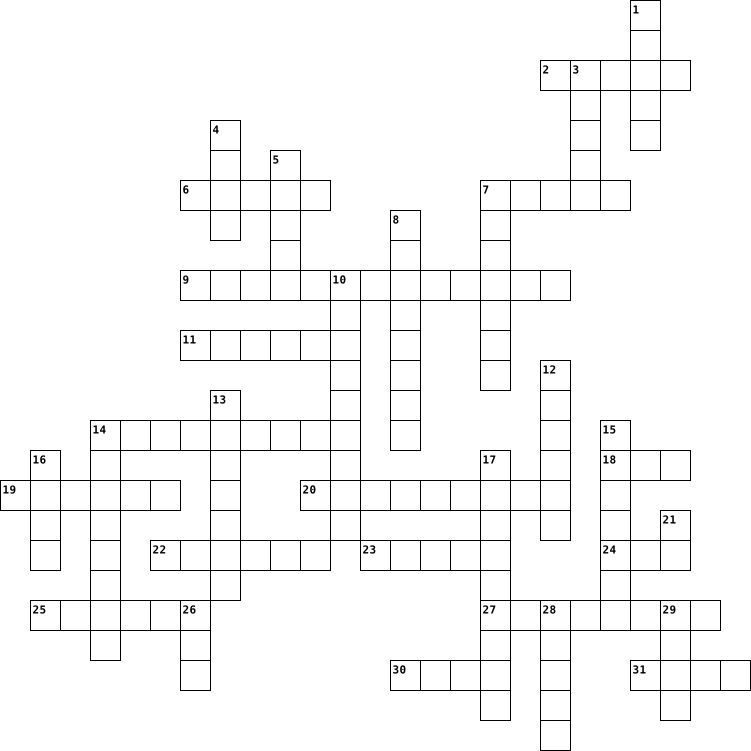
Across
- The time taken for the Moon to orbit the Earth once
- An icy object that has a long tail
- Third rock from the Sun
- A group of stars seen in the night sky are given names
- The name of the space project that landed man on the Moon
- Name given to a star exploding
- Unidentified flying objects
- Billions of stars form this structue
- A rock from space
- A plant that has a ring aound it
- No longer called a planet
- Number of moons on Mars
- The brightest star seen from Earth
- A belt of rocks between Mars and Jupiter
- 365 days
- A metal only created in exploding stars
Down
- We need this for life
- Motion of planets around the Sun
- Where you can find the Sea of Tranquility
- Hottest planet in the Solar System
- When the Moon covers the Sun completely
- The name of our galaxy
- Name given to planets orbiting other stars
- A gas needed for life
- The force that keeps planets in orbit
- A film which had two Suns
- The planet with a giant red spot
- A planet that looks like a red star from Earth
- They once ruled the Earth
- A moon of Jupiter
- Superman gets his powers frm this
- Largest moon of Saturn
- A metal at the cor of the Earth
33 Clues: 365 days • A rock from space • A moon of Jupiter • We need this for life • A gas needed for life • The name of our galaxy • Largest moon of Saturn • Third rock from the Sun • Number of moons on Mars • A film which had two Suns • They once ruled the Earth • No longer called a planet • Unidentified flying objects • Name given to a star exploding • A metal at the cor of the Earth • ...
Eclipses 2021-05-20

Across
- during a solar eclipse the moon is in this phase
- the fully shaded inner region of a shadow cast by the Earth or Moon in a total eclipse
- when the Earth's shadow completely overs the moon as seen from Earth
- when the Earth casts a shadow on the Moon
- when the Moon is at its furthest point from Earth but passes directly in front of the Sun; causes a ring around the Moon.
Down
- when the moon casts a shadow on the Earth
- when only part of the Moon's shadow covers the Earth
- during a lunar eclipse the Moon is in this phase
- when only part of the Earth's shadow covers the Moon
- the partially shaded outer region of the shadow cast by the Earth or Moon
- when the moon completely covers the sun as seen from Earth
- an obscuring of the light from one celestial body by the passage of another between it and the observer or between it and its source of illumination
12 Clues: when the moon casts a shadow on the Earth • when the Earth casts a shadow on the Moon • during a lunar eclipse the Moon is in this phase • during a solar eclipse the moon is in this phase • when only part of the Moon's shadow covers the Earth • when only part of the Earth's shadow covers the Moon • when the moon completely covers the sun as seen from Earth • ...
Moon Phase Nathaniel Nguyen 2022-10-28

Across
- When the moon is half-lit on the left side.
- when the light on the moon is on the left side
- what causes the tides on Earth
- When a majority of the moon is lit from the right side.
- When the moon isn't visible in the night sky.
- When the moon is half-lit on the right side.
Down
- When the light on the moon is on the right side
- When a majority of the moon is lit from the left side.
- When the moon is fully lit and visible in the night sky
- When the light on the moon is a crescent on the left side of the moon
- When the light on the moon is a crescent on the right side of the moon.
11 Clues: what causes the tides on Earth • When the moon is half-lit on the left side. • When the moon is half-lit on the right side. • When the moon isn't visible in the night sky. • when the light on the moon is on the left side • When the light on the moon is on the right side • When a majority of the moon is lit from the left side. • ...
Puzzle 2018-08-31

Across
- open system
- entropy constant
- heat rejected
- joule thomson coefficient is zero
- isolated system
- three phases are exist in equalibiriun
- due to friction
Down
- entropy increases
- kinetic energy of molecule
- work done by the device
- use in open system
- use to exchanging heat only
- enthalpy contant
- lack of order
- use to increase the pressure
15 Clues: open system • heat rejected • lack of order • isolated system • due to friction • entropy constant • enthalpy contant • entropy increases • use in open system • work done by the device • kinetic energy of molecule • use to exchanging heat only • use to increase the pressure • joule thomson coefficient is zero • three phases are exist in equalibiriun
moon 2018-12-12

Across
- beyond earth's atmosphere
- source of warmth in temperature
- area where magnetism occurs
- power source
Down
- creates magnetic field
- earth's natural satellite
- colorless and tasteless fluid
- transforming of a planet into a habitable location
8 Clues: power source • creates magnetic field • earth's natural satellite • beyond earth's atmosphere • area where magnetism occurs • colorless and tasteless fluid • source of warmth in temperature • transforming of a planet into a habitable location
Ancient Astronomers 2025-11-11

Across
- Greek philosopher who realized the Moon shines by reflecting sunlight and correctly explained the causes of lunar phases.
- Polish astronomer who revived the heliocentric theory, showing that Earth and other planets orbit the Sun rather than the Earth being the center of the universe.
- Greek-Egyptian astronomer whose Almagest described the geocentric model with Earth at the center, dominating astronomy for over a thousand years.
- German mathematician and astronomer who used Brahe’s data to formulate the three laws of planetary motion describing elliptical orbits.
- English scientist who formulated the laws of motion and universal gravitation, explaining how planetary motion confirmed the heliocentric system.
- Ancient Greek observer who created the first star catalog and discovered the precession of the equinoxes, improving measurement of celestial motions.
- Greek mathematician who believed the planets and stars moved in perfect circles and that numbers could explain the harmony of the universe.
- Danish astronomer who made precise naked-eye observations of the planets and stars, creating data that helped disprove the geocentric model.
- Chinese scientist of the Han Dynasty who mapped stars, recorded eclipses and comets, and invented an early seismoscope for studying Earth and sky.
- Babylonian ruler-astronomer who established a fixed calendar era beginning in 747 BCE, allowing long-term tracking of astronomical cycles.
- Arab astronomer who refined the length of the solar year, improved trigonometric astronomy, and influenced later European scientists like Copernicus.
Down
- Librarian of Alexandria who used geometry and shadow measurements to accurately calculate the circumference of Earth.
- Greek philosopher who predicted a solar eclipse around 585 BCE and was among the first to explain celestial events using natural causes instead of mythology.
- Italian astronomer who used the telescope to observe Jupiter’s moons and Venus’s phases, providing strong evidence for the heliocentric model.
- Influential Greek philosopher who argued that Earth was spherical based on lunar eclipses and promoted a geocentric view of the universe.
- Greek astronomer who first proposed a heliocentric model with the Sun at the center, suggesting Earth moves around it long before Copernicus.
- Andalusian Arab astronomer who improved the astrolabe and developed precise solar tables used for navigation and calendar reform.
- Early Greek thinker who proposed that Earth floats freely in space without any physical support, using natural laws instead of myths to describe the cosmos.
- Italian philosopher who supported the heliocentric model and proposed that stars are distant suns surrounded by their own planets.
- Indian mathematician-astronomer who proposed that Earth rotates on its axis and correctly explained lunar and solar eclipses using geometry.
20 Clues: Librarian of Alexandria who used geometry and shadow measurements to accurately calculate the circumference of Earth. • Greek philosopher who realized the Moon shines by reflecting sunlight and correctly explained the causes of lunar phases. • ...
Moon 2021-12-14

Across
- the region of a shadow that is totally shaded
- Ocean tide of lowest amplitude occurring at first- and third- quarter moon
- the point closest to Earth in the orbit of a body circling Earth
- Motion around an axis passing through the rotating body
Down
- The darkening of the moon when it moves through Earth's shadow.
- The event that occurs when the moon passes directly between Earth and the sun, blocking our view of the sun.
- the portion of a shadow that is only partially shaded
- Ocean tide of high amplitude that occurs at full and new moon
8 Clues: the region of a shadow that is totally shaded • the portion of a shadow that is only partially shaded • Motion around an axis passing through the rotating body • Ocean tide of high amplitude that occurs at full and new moon • The darkening of the moon when it moves through Earth's shadow. • the point closest to Earth in the orbit of a body circling Earth • ...
172 Hours on the Moon 2023-04-24

Across
- The "Wow!" signature
- Old Janitor who has a bad memory
- Where we learn that a doppelganger of Mia has been playing her since she got back from the moon
- Mia's band name
- 17 year old protagonist who lives in France
- The exact copies that are bringing death to the crew
- Main commander of the whole moon mission
- 16 year old protagonist who lives in Japan
- The first part of the signature that Mia finds on Murray's back
- The engineer that discovers the hatch is locked
Down
- Name of the main ship they traveled on
- The homeless man Mia meets in Central Park
- The last part of the signature that is the gate Midori couldn't find
- What Midori takes that Buzz Aldrin left on the moon
- 16 year old protagonist who lives in Norway
- The hotel where the doppelganger of Mia started to multiply
- Where the training facility is
- The middle part of the signature Antoine sees on the crashing airplane
- Mia's younger brother
- In charge of the moon base
- The engineer that tries to stay and fix the power
- Moon base where the kids stay
- Antoine's EX-girlfriend
- Only female astronaut who landed Demeter
- The ocean that Mia landed in once she came back from the moon
- The name of the Lunar Lander
26 Clues: Mia's band name • The "Wow!" signature • Mia's younger brother • Antoine's EX-girlfriend • In charge of the moon base • The name of the Lunar Lander • Moon base where the kids stay • Where the training facility is • Old Janitor who has a bad memory • Name of the main ship they traveled on • Only female astronaut who landed Demeter • Main commander of the whole moon mission • ...
P6 Science crosswords 2023-11-27

Across
- when the moon is entering the antumbra, we will see this type of solar eclipse
- the system of plant which remain above the ground
- part of heart that is responsible to pump the blood out of the heart
- the blood vessels that are connected to the lungs is called ..... artery/vena
- blood vessel which carry oxygenated blood
- this part of our body contains our voice box
- reproductive part of a plant
- the veins in plant which responsible for carrying sugar, nutrients, proteins, and other organic molecules
- other name for large intestine
- on the 10th day of a moon cycle, the moon phase will be on the waxing......
- the event when one astronomical object such as a moon or planet moves into the shadow of another one
Down
- second layer of the earth
- the largest bone in our body
- part of plant which responsible for the transpiration process
- this part of blood responsible for blood clotting
- the place where exchange of oxygen and carbon dioxide into the bloodstream occurs
- the largest part of our blood
- the digestive enzyme which exist both in stomach and pancreas. this enzyme responsible for the digestion of fat
- the phase of the moon when the moon is getting "bigger"
- one way to increase the strength of an electromagnet is to increase the....
- the organ that produces bile
21 Clues: second layer of the earth • the largest bone in our body • reproductive part of a plant • the organ that produces bile • the largest part of our blood • other name for large intestine • blood vessel which carry oxygenated blood • this part of our body contains our voice box • the system of plant which remain above the ground • ...
Moon Phase Nathaniel Nguyen 2022-10-28

Across
- When the moon is half-lit on the left side.
- when the light on the moon is on the left side
- what causes the tides on Earth
- When a majority of the moon is lit from the right side.
- When the moon isn't visible in the night sky.
- When the moon is half-lit on the right side.
Down
- When the light on the moon is on the right side
- When a majority of the moon is lit from the left side.
- When the moon is fully lit and visible in the night sky
- When the light on the moon is a crescent on the left side of the moon
- When the light on the moon is a crescent on the right side of the moon.
11 Clues: what causes the tides on Earth • When the moon is half-lit on the left side. • When the moon is half-lit on the right side. • When the moon isn't visible in the night sky. • when the light on the moon is on the left side • When the light on the moon is on the right side • When a majority of the moon is lit from the left side. • ...
A Dog's Life 2023-09-20

Across
- A street name in the town Claremont
- The place where Moon and Squirrel get most of their food
- where bone and squirrel were born
- The first holiday that Bone and Squirrel discovered
- The place where Squirrel and Bone slept until the ran off
- A stray dog that becomes friends with Squirrel
- Squirrels brother
- The second holiday that they discovered from a parade
Down
- The families house where Squirrel was at when she got hit by a truck
- the place where Moon and Squirrel were brought when they got hit by a truck
- The place where Moon and Squirrel try and eat but kept getting scared away
- Dog that has to embrace her fears of being without her brother (bone) and with another dog
- The room where Bone and Squirrel were put when at a home
- the families house where bone and squirrel were hiding in the shed
- The place where Squirrel and Bone were born
- The place where Squirrel and Bone ended up after leaving the shed they were living in
- The bed that Marcy gave Bone and Squirrel to sleep when they were at there home
- The sound of cars described in the book
- The town where Squirrel and Moon eat from the garbage at night
- Where Moon and Squirrel slept for three nights
20 Clues: Squirrels brother • where bone and squirrel were born • A street name in the town Claremont • The sound of cars described in the book • The place where Squirrel and Bone were born • Where Moon and Squirrel slept for three nights • A stray dog that becomes friends with Squirrel • The first holiday that Bone and Squirrel discovered • ...
172 Hours on the Moon 2023-04-24

Across
- The "Wow!" signature
- Old Janitor who has a bad memory
- Where we learn that a doppelganger of Mia has been playing her since she got back from the moon
- Mia's band name
- 17 year old protagonist who lives in France
- The exact copies that are bringing death to the crew
- Main commander of the whole moon mission
- 16 year old protagonist who lives in Japan
- The first part of the signature that Mia finds on Murray's back
- The engineer that discovers the hatch is locked
Down
- Name of the main ship they traveled on
- The homeless man Mia meets in Central Park
- The last part of the signature that is the gate Midori couldn't find
- What Midori takes that Buzz Aldrin left on the moon
- 16 year old protagonist who lives in Norway
- The hotel where the doppelganger of Mia started to multiply
- Where the training facility is
- The middle part of the signature Antoine sees on the crashing airplane
- Mia's younger brother
- In charge of the moon base
- The engineer that tries to stay and fix the power
- Moon base where the kids stay
- Antoine's EX-girlfriend
- Only female astronaut who landed Demeter
- The ocean that Mia landed in once she came back from the moon
- The name of the Lunar Lander
26 Clues: Mia's band name • The "Wow!" signature • Mia's younger brother • Antoine's EX-girlfriend • In charge of the moon base • The name of the Lunar Lander • Moon base where the kids stay • Where the training facility is • Old Janitor who has a bad memory • Name of the main ship they traveled on • Only female astronaut who landed Demeter • Main commander of the whole moon mission • ...
172 Hours on the Moon 2023-04-24

Across
- The "Wow!" signature
- Old Janitor who has a bad memory
- Where we learn that a doppelganger of Mia has been playing her since she got back from the moon
- Mia's band name
- 17 year old protagonist who lives in France
- The exact copies that are bringing death to the crew
- Main commander of the whole moon mission
- 16 year old protagonist who lives in Japan
- The first part of the signature that Mia finds on Murray's back
- The engineer that discovers the hatch is locked
Down
- Name of the main ship they traveled on
- The homeless man Mia meets in Central Park
- The last part of the signature that is the gate Midori couldn't find
- What Midori takes that Buzz Aldrin left on the moon
- 16 year old protagonist who lives in Norway
- The hotel where the doppelganger of Mia started to multiply
- Where the training facility is
- The middle part of the signature Antoine sees on the crashing airplane
- Mia's younger brother
- In charge of the moon base
- The engineer that tries to stay and fix the power
- Moon base where the kids stay
- Antoine's EX-girlfriend
- Only female astronaut who landed Demeter
- The ocean that Mia landed in once she came back from the moon
- The name of the Lunar Lander
26 Clues: Mia's band name • The "Wow!" signature • Mia's younger brother • Antoine's EX-girlfriend • In charge of the moon base • The name of the Lunar Lander • Moon base where the kids stay • Where the training facility is • Old Janitor who has a bad memory • Name of the main ship they traveled on • Only female astronaut who landed Demeter • Main commander of the whole moon mission • ...
Earth and Space 6th Grade Science 2022-10-27

Across
- part of the universe and home to our solar system
- the Earth completes one of these every 24 hours
- when the moon appears to be growing in size
- when day and night are equal
- when more than half of the moon is visible
- the imaginary line the Earth rotates on
- the Earth makes one of these around the sun once every 365 1/4 days
- of Earth causes the change in the seasons
- when the sun, Earth and moon are lined up in this order
Down
- when the moon appears to be shrinking in size
- when the sun, moon and Earth are lined up in this order
- shortest day in the northern hemisphere
- when less than half of the moon is visible
- longest day in the northern hemisphere
- natural force of attraction between any two massive bodies
15 Clues: when day and night are equal • longest day in the northern hemisphere • shortest day in the northern hemisphere • the imaginary line the Earth rotates on • of Earth causes the change in the seasons • when less than half of the moon is visible • when more than half of the moon is visible • when the moon appears to be growing in size • ...
Space race puzzle 2025-05-30

Across
- First artificial satellite
- struck by lightning
- Frist human in space
- First woman in space
- played gold in space
- First man on the moon
Down
- the dog flew in this
- year the Apollo 11 landed
- First time humans walked on the moon
- first American to orbit the Earth
- the dog sent to space
- second man on the moon
- won the race
- used to get to the moon
- Other team in the race
15 Clues: won the race • struck by lightning • the dog flew in this • Frist human in space • First woman in space • played gold in space • the dog sent to space • First man on the moon • second man on the moon • Other team in the race • used to get to the moon • year the Apollo 11 landed • First artificial satellite • first American to orbit the Earth • First time humans walked on the moon
Moon Phase Nathaniel Nguyen 2022-10-28

Across
- When the moon is half-lit on the left side.
- when the light on the moon is on the left side
- what causes the tides on Earth
- When a majority of the moon is lit from the right side.
- When the moon isn't visible in the night sky.
- When the moon is half-lit on the right side.
Down
- When the light on the moon is on the right side
- When a majority of the moon is lit from the left side.
- When the moon is fully lit and visible in the night sky
- When the light on the moon is a crescent on the left side of the moon
- When the light on the moon is a crescent on the right side of the moon.
11 Clues: what causes the tides on Earth • When the moon is half-lit on the left side. • When the moon is half-lit on the right side. • When the moon isn't visible in the night sky. • when the light on the moon is on the left side • When the light on the moon is on the right side • When a majority of the moon is lit from the left side. • ...
Space Crossword puzzle 2020-05-15

Across
- First astrount on the moon-famous quote
- old debris from old space projects floating in space
- 11 first space craft mission that made it to the moon and back
- caused by the moon
- The distance that light travels in one year
- torus-shaped region in the Solar System, located roughly between the orbits of the planets Jupiter and Mars
- Mercury, Venus, Earth, Mars
- A method for reducing all measurements by the same amount to achieve the proportions of the scale model.
- branch of science that studies the stars, planets, and other objects in space.
- the planet we live on
- what orbits the Earth
- Jupiter, Saturn, Uranus, Neptune
Down
- A large system of dust, gas, stars, and other celestial bodies that has a particular shape.
- A natural (for example, the moon) or artificial (for example, the hubble space telescope) object that orbits another object in space.
- what all the planets in our solar system orbit
- outer most planet in our solar system
- eight planets and their moons in orbit around the sun.
- The curved path of one object, such as a planet or moon, around a central object
- Used to be a planet, now a dwarf planet
- The most widely accepted and used civil calander used internationally.
- other suns in our galaxy/universe far away
- closest planet to the sun
22 Clues: caused by the moon • the planet we live on • what orbits the Earth • closest planet to the sun • Mercury, Venus, Earth, Mars • Jupiter, Saturn, Uranus, Neptune • outer most planet in our solar system • First astrount on the moon-famous quote • Used to be a planet, now a dwarf planet • other suns in our galaxy/universe far away • The distance that light travels in one year • ...
Astronomy B Review Crossword Puzzle 2023-12-01

Across
- june 21st is the first day
- a picture in the sky created by joining together groups of stars
- the force that causes tides
- another name for the 4 gas giants
- this movement makes stars appear to move 15’ every hour around polaris
- the direction of its swing appears to change due to Earth’s rotation
- the north star
- takes 365.25 days
- also known as a blood moon
- the theory that the universe started as a single point
- another word for revolution
Down
- phase of the moon where we see a white circle in the night sky
- a huge explosion in space that occurs when a massive star is near the end of its life
- the moon revolves around it
- between march 1st and may 1st days get ___________.
- takes 365.25 days for Earth
- the phase of the moon when it is in between the earth and sun
- the celestial object that causes tides
- the shape of earths orbit
- december 21st is the first day
- the biggest brightest star in your ESRT
- the hottest star in your ESRT
- the approximate length of time of one full lunar phase cycle
- this planet is 227.9 million kilometers from the sun
- seasonal change is partly due to earths tilted ______
- takes 23 hours 56 minutes on Earth
- a rare celestial event that occurs during a new moon
27 Clues: the north star • takes 365.25 days • the shape of earths orbit • june 21st is the first day • also known as a blood moon • the moon revolves around it • the force that causes tides • takes 365.25 days for Earth • another word for revolution • the hottest star in your ESRT • december 21st is the first day • another name for the 4 gas giants • takes 23 hours 56 minutes on Earth • ...
172 Hours on the Moon 2023-04-24

Across
- The "Wow!" signature
- Old Janitor who has a bad memory
- Where we learn that a doppelganger of Mia has been playing her since she got back from the moon
- Mia's band name
- 17 year old protagonist who lives in France
- The exact copies that are bringing death to the crew
- Main commander of the whole moon mission
- 16 year old protagonist who lives in Japan
- The first part of the signature that Mia finds on Murray's back
- The engineer that discovers the hatch is locked
Down
- Name of the main ship they traveled on
- The homeless man Mia meets in Central Park
- The last part of the signature that is the gate Midori couldn't find
- What Midori takes that Buzz Aldrin left on the moon
- 16 year old protagonist who lives in Norway
- The hotel where the doppelganger of Mia started to multiply
- Where the training facility is
- The middle part of the signature Antoine sees on the crashing airplane
- Mia's younger brother
- In charge of the moon base
- The engineer that tries to stay and fix the power
- Moon base where the kids stay
- Antoine's EX-girlfriend
- Only female astronaut who landed Demeter
- The ocean that Mia landed in once she came back from the moon
- The name of the Lunar Lander
26 Clues: Mia's band name • The "Wow!" signature • Mia's younger brother • Antoine's EX-girlfriend • In charge of the moon base • The name of the Lunar Lander • Moon base where the kids stay • Where the training facility is • Old Janitor who has a bad memory • Name of the main ship they traveled on • Only female astronaut who landed Demeter • Main commander of the whole moon mission • ...
172 Hours on the Moon 2023-04-24

Across
- The "Wow!" signature
- Old Janitor who has a bad memory
- Where we learn that a doppelganger of Mia has been playing her since she got back from the moon
- Mia's band name
- 17 year old protagonist who lives in France
- The exact copies that are bringing death to the crew
- Main commander of the whole moon mission
- 16 year old protagonist who lives in Japan
- The first part of the signature that Mia finds on Murray's back
- The engineer that discovers the hatch is locked
Down
- Name of the main ship they traveled on
- The homeless man Mia meets in Central Park
- The last part of the signature that is the gate Midori couldn't find
- What Midori takes that Buzz Aldrin left on the moon
- 16 year old protagonist who lives in Norway
- The hotel where the doppelganger of Mia started to multiply
- Where the training facility is
- The middle part of the signature Antoine sees on the crashing airplane
- Mia's younger brother
- In charge of the moon base
- The engineer that tries to stay and fix the power
- Moon base where the kids stay
- Antoine's EX-girlfriend
- Only female astronaut who landed Demeter
- The ocean that Mia landed in once she came back from the moon
- The name of the Lunar Lander
26 Clues: Mia's band name • The "Wow!" signature • Mia's younger brother • Antoine's EX-girlfriend • In charge of the moon base • The name of the Lunar Lander • Moon base where the kids stay • Where the training facility is • Old Janitor who has a bad memory • Name of the main ship they traveled on • Only female astronaut who landed Demeter • Main commander of the whole moon mission • ...
Moon Phase Nathaniel Nguyen 2022-10-28

Across
- When the moon is half-lit on the left side.
- when the light on the moon is on the left side
- what causes the tides on Earth
- When a majority of the moon is lit from the right side.
- When the moon isn't visible in the night sky.
- When the moon is half-lit on the right side.
Down
- When the light on the moon is on the right side
- When a majority of the moon is lit from the left side.
- When the moon is fully lit and visible in the night sky
- When the light on the moon is a crescent on the left side of the moon
- When the light on the moon is a crescent on the right side of the moon.
11 Clues: what causes the tides on Earth • When the moon is half-lit on the left side. • When the moon is half-lit on the right side. • When the moon isn't visible in the night sky. • when the light on the moon is on the left side • When the light on the moon is on the right side • When a majority of the moon is lit from the left side. • ...
Moon Phase Nathaniel Nguyen 2022-10-28

Across
- When the moon is half-lit on the left side.
- when the light on the moon is on the left side
- what causes the tides on Earth
- When a majority of the moon is lit from the right side.
- When the moon isn't visible in the night sky.
- When the moon is half-lit on the right side.
Down
- When the light on the moon is on the right side
- When a majority of the moon is lit from the left side.
- When the moon is fully lit and visible in the night sky
- When the light on the moon is a crescent on the left side of the moon
- When the light on the moon is a crescent on the right side of the moon.
11 Clues: what causes the tides on Earth • When the moon is half-lit on the left side. • When the moon is half-lit on the right side. • When the moon isn't visible in the night sky. • when the light on the moon is on the left side • When the light on the moon is on the right side • When a majority of the moon is lit from the left side. • ...
Our Solar System 2012-05-15

Across
- The most distant of the gas giants.
- Pluto, Charon, Eris, and Sedna are all icy dwarf planets found in this part of the outer solar system
- A short period comet that we can see ~ every 76 years.
- One of the largest of the asteroids. Was originally considered a planet.
- A moon of Pluto
- A dwarf planet that is one reason why Pluto is no longer a planet.
- A terrestrial planet with the thickest atmosphere.
Down
- One reason why Venus and Earth are warmer than they should be.
- The largest of the gas giants.
- A moon of Saturn that has the thickest atmosphere of any moon.
- Our moon.
- Useful for finding the relative age of a planet (or moon's) surface.
- A terrestrial planet with an extremely thin atmosphere. Some would say it hasn't got one.
- The rings of this gas giant were first observed by Galileo.
- A vast swarm of comets on the outskirts of our solar system.
- The fourth rock from the Sun.
- A moon of Jupiter that may have a liquid water ocean underneath its icy crust.
- A moon of Jupiter that has active volcanism.
18 Clues: Our moon. • A moon of Pluto • The fourth rock from the Sun. • The largest of the gas giants. • The most distant of the gas giants. • A moon of Jupiter that has active volcanism. • A terrestrial planet with the thickest atmosphere. • A short period comet that we can see ~ every 76 years. • The rings of this gas giant were first observed by Galileo. • ...
Eclipses 2020-11-30

Across
- when part of the earth's shadow covers the moon
- when the moon is at its furthest point from earth and passes directly in front of the sun and causes a ring of light to be seen around the moon.
- the blocking of light when one celestial body passes between the light source and another celestial body
- when part of the moon's shadow covers earth
- when the earth's shadow completely covers the moon as seen from earth
Down
- when the moon casts a shadow on earth
- when the moon completely covers the sun as seen from earth
- the fully shaded inner region of a shadow cast by the earth or moon
- partially shaded outer region of a shadow
- when the earth casts a shadow on the moon
- during a solar eclipse the moon is in this phase
- during a lunar eclipse the moon is in this phase
12 Clues: when the moon casts a shadow on earth • partially shaded outer region of a shadow • when the earth casts a shadow on the moon • when part of the moon's shadow covers earth • when part of the earth's shadow covers the moon • during a solar eclipse the moon is in this phase • during a lunar eclipse the moon is in this phase • ...
ASTRONOMY VOCABULARY 2024-09-06

Across
- NATURAL SATELLITE ORBITTING AROUND THE EARTH
- A SMALL ROCKY BODY ORBITING THE SUN
- THE MOVEMENT OF THE OCEAN CAUSED BY THE MOON
- A BODY IN SPACE SUCH AS A PLANET OR STAR
- BETWEEN NEW MOON AND A HALF MOON
Down
- BETWEEN A HALF MOON AND A FULL MOON
- CURVED PATH OF A CELESTIAL OBJECT
- A CELESTIAL BODY THAT ORBITS AROUND THE SUN
- HALF OF A SPHERE
- THE LONGEST OR SHORTEST DAY IN THE YEAR
- WHEN NIGHT AND DAY ARE EQUAL IN LENGTH
- WHEN PART OF THE MOON OR SUN ARE IN SHADOW
12 Clues: HALF OF A SPHERE • BETWEEN NEW MOON AND A HALF MOON • CURVED PATH OF A CELESTIAL OBJECT • BETWEEN A HALF MOON AND A FULL MOON • A SMALL ROCKY BODY ORBITING THE SUN • WHEN NIGHT AND DAY ARE EQUAL IN LENGTH • THE LONGEST OR SHORTEST DAY IN THE YEAR • A BODY IN SPACE SUCH AS A PLANET OR STAR • WHEN PART OF THE MOON OR SUN ARE IN SHADOW • ...
Matter and Change 2025-08-14

Across
- It is the study of the compostition , structure, and properties of matter and the changes it undergoes
- Particles of matter are always in motion
- is the energy possessed by an object due to its position, composition, or condition
- depends on the type of matter, not the amount present
- a change in the appearance, without the composition of the material
Down
- a property that can be observed and measured without changing the material's composition
- only 1 visibly distinct phases, the phase has the same properties throughout.
- a process that absorbs energy from the surroundings
- energy of motion
- 2 or more visibly distinct phases, each phase has very different properties
- depends on the amount of matter in the sample
- Anything with mass that occupies space
- Mass cannot be destroyed or created. It remains the same during a chemical reaction
- Very high Kinetic Energy - particles collide with enough energy to break into charged particles
14 Clues: energy of motion • Anything with mass that occupies space • Particles of matter are always in motion • depends on the amount of matter in the sample • a process that absorbs energy from the surroundings • depends on the type of matter, not the amount present • a change in the appearance, without the composition of the material • ...
Earth & the Solar System 2025-12-12

Across
- objects that orbit planets or dwarf planets
- the planet closest to the sun
- the planet that we live on
- what it is when the Earth is facing the sun
- using available data to guess what will happen
- force that comes from an object with mass. It holds the solar system together
- everything that orbits around the sun including planets, asteroids, moons, etc.
- when the moon appears to be getting smaller in appearance
- the path that planets take around the sun
- small objects that orbit the Sun but that haven't cleared the orbit of other debris
Down
- Occurs when the Earth passes directly between the sun and the moon
- when the moon blocks out light from the sun
- rocky, airless objects that orbit the sun. Mostly found in the Asteroid belt.
- what it is when the Earth is facing away from the sun
- different appearance of the moon throughout the month
- pattern of stars in the night sky that we see
- when the moon appears to be getting larger in appearance
- motion of water at the coast caused by gravitational forces from the moon
18 Clues: the planet that we live on • the planet closest to the sun • the path that planets take around the sun • objects that orbit planets or dwarf planets • when the moon blocks out light from the sun • what it is when the Earth is facing the sun • pattern of stars in the night sky that we see • using available data to guess what will happen • ...
The Space Race 2025-02-26

Across
- – First human in space
- – Lunar module name for Apollo 11
- – First name of the first Moonwalker
- – U.S. Moon mission program
- – Path followed around a planet
- – First artificial satellite
- – First Soviet human spaceflight program
- – Soviet Moon probe series
- – NASA’s first crewed spaceflight program
Down
- – First living being in orbit
- – NASA program between Mercury and Apollo
- – Rocket series that launched Moon missions
- – Destination of Apollo 11
- – Soviet term for astronaut
- – U.S. space agency
15 Clues: – U.S. space agency • – First human in space • – Destination of Apollo 11 • – Soviet Moon probe series • – Soviet term for astronaut • – U.S. Moon mission program • – First artificial satellite • – First living being in orbit • – Path followed around a planet • – Lunar module name for Apollo 11 • – First name of the first Moonwalker • – First Soviet human spaceflight program • ...
Outer space 2025-11-17

Across
- A division of the year that is characterized by recurring weather conditions, and determined by both Earth's tilt relative to the sun and Earth's position in its orbit around the sun
- In astronomy, the change in the sunlit area of one celestial body as seen from another celestial body; phases of the moon are caused by the changing positions of Earth, the sun, and the moon.
Down
- An event which the shadow of one celestial body falls on another.
- The path that a body follows as it travels another body in space
4 Clues: The path that a body follows as it travels another body in space • An event which the shadow of one celestial body falls on another. • A division of the year that is characterized by recurring weather conditions, and determined by both Earth's tilt relative to the sun and Earth's position in its orbit around the sun • ...