
moon phases Crossword Puzzles
Earth + Moon and Acids + Alkalis 2021-10-26

Across
- Caused by the Earth's revolution around the Sun
- The moon goes through _____ throughout the moon
- Water is an acid: True or false?
- A _____ moon looks like it is growing bigger
- A ___ moon is a circle
- A(n) ____ can turn litmus paper blue
- The force keeping us on the ground
- A ____ moon looks like it is growing smaller
- ____ taste sour
- Caused by an object blocking a light source
Down
- Salt is neutral: True or false?
- What the earth revolves on
- The direction the Earth rotates about its axis on, and around the sun
- Lemon is a base: True or false?
- A(n) _____ can turn litmus paper red
- The hottest planet
- The planet we live on
- A measure of matter
- _____ taste bitter
19 Clues: ____ taste sour • The hottest planet • _____ taste bitter • A measure of matter • The planet we live on • A ___ moon is a circle • What the earth revolves on • Salt is neutral: True or false? • Lemon is a base: True or false? • Water is an acid: True or false? • The force keeping us on the ground • A(n) ____ can turn litmus paper blue • A(n) _____ can turn litmus paper red • ...
Regents Solar System 2023-05-17

Across
- planet whose day is longer than it's year
- space rock that didn't completely burn up
- the closest planet to the sun
- known as the red planet
- space rock that burns up, creating a meteor
- has rings of ice and dust
- the only planet known to have life
- this planet takes 84 years to orbit the sun
- one day on this planet is 16 hours long
- mass of ice & dust with a very elliptical orbit
- the star we orbit
Down
- has a giant spot that is actually a storm
- moon phase where half of the moon is illuminated
- also known as shooting stars
- moon phase adjacent to the full moon
- has a cycle of phases that is 29.5 days long
- moon phase adjacent to the new moon
- rocky mass orbiting the sun in the ______ belt
18 Clues: the star we orbit • known as the red planet • has rings of ice and dust • also known as shooting stars • the closest planet to the sun • the only planet known to have life • moon phase adjacent to the new moon • moon phase adjacent to the full moon • one day on this planet is 16 hours long • has a giant spot that is actually a storm • planet whose day is longer than it's year • ...
Astronomy 2023-11-20

Across
- When the phases of the moon appear to be growing.
- Happens when the Moon passes between the Earth and the Sun casting a shadow on Earth
- The action of rotating around an axis or center.
- The Moon orbits the Earth not in a circle but in a.
- A long wave period that moves due to the constant forces produced by the Moon and Sun.
Down
- Happens when the Earth'ssts the Earth's shadow onto the Moon.
- How we see the moon differently at different times of the month.
- The force that pulls everything towards the center of the earth.
- The curved path of a celestial object around something.
- When the phases of the moon appear to be shrinking.
10 Clues: The action of rotating around an axis or center. • When the phases of the moon appear to be growing. • When the phases of the moon appear to be shrinking. • The Moon orbits the Earth not in a circle but in a. • The curved path of a celestial object around something. • Happens when the Earth'ssts the Earth's shadow onto the Moon. • ...
Lunar Mysteries: Explore the mysteries of Earth's closest celestial neighbor 2025-04-29

Across
- Layer of loose, fragmented material covering the Moon's surface
- Passage of the Moon across Earth’s sky or a telescope’s view
- Scientific study of the Moon’s geology
- Moon phase when more than half is illuminated but not full
- Ocean movements influenced by lunar gravity
- Hemisphere of the Moon not visible from Earth
- Current NASA program aiming to return humans to the Moon
- Dark volcanic rock common on lunar maria
- Long, narrow valley or trench on the lunar surface
- Earth's natural satellite
- Lunar rock type rich in potassium, rare earth elements, and phosphorus
Down
- Light-colored rock dominating the lunar highlands
- Target region for future lunar bases due to water ice deposits
- Dark, flat plains on the Moon formed by ancient lava flows
- Frozen water detected in shadowed lunar craters
- 29.5-day cycle between identical Moon phases
- Wobbling motion allowing us to see slightly more than half the Moon
- Bowl-shaped depression formed by meteor impacts
- Event when Earth or Moon blocks sunlight from the other
- NASA program that landed humans on the Moon
20 Clues: Earth's natural satellite • Scientific study of the Moon’s geology • Dark volcanic rock common on lunar maria • Ocean movements influenced by lunar gravity • NASA program that landed humans on the Moon • 29.5-day cycle between identical Moon phases • Hemisphere of the Moon not visible from Earth • Frozen water detected in shadowed lunar craters • ...
Earth in Space Vocab 2024-10-21

Across
- - A large collection of stars held together by gravity.
- - Happening once a year
- - When the position of an object in space blocks how we see another object.
- - The angle of an object above the horizon
- - Pass across
- - Bounces off
- - The different appearances of the moon’s shape are the phases of the moon.
- - Related to the moon
- - All of space, all of matter, and all of the energy in it.
- - The motion of the Earth around the Sun
Down
- - Happening once a day
- - The coming together or clumping together of matter by gravity to form larger objects
- - The north star
- - Related to the sun
- -Something that repeats or happens over and over
- - When light reflects off of matter in all directions
16 Clues: - Pass across • - Bounces off • - The north star • - Related to the sun • - Related to the moon • - Happening once a day • - Happening once a year • - The motion of the Earth around the Sun • - The angle of an object above the horizon • -Something that repeats or happens over and over • - When light reflects off of matter in all directions • ...
Sun-Earth-Moon System 2022-03-17

Across
- another name for moon
- "growing"
- Shortest day in Northern Hemisphere (two words)
- different shapes of the moon as seen from earth
- Earth’s _______ of rotation is tilted 23.5°
- occurs when the moon gets between Earth and the sun, and the moon casts a shadow over Earth.
- Invisible line around Earth’s waist
- Southern Hemisphere season that begins in December
- Earth’s orbit is not a perfect________.
Down
- "shrinking"
- when the Earth comes between the Sun and the Full Moon and blocks the Sun's direct rays from lighting up the Moon.
- when the moon is more than half visible
- Northern Hemisphere season that begins in March
- When the Sun is directly overhead at noon on the equator
- Earth’s farthest point from the Sun
- Month when Earth is closest to the Sun
- caused by the tilt of Earth's axis as the Earth travels around the sun
- when the moon is less than half visible
18 Clues: "growing" • "shrinking" • another name for moon • Earth’s farthest point from the Sun • Invisible line around Earth’s waist • Month when Earth is closest to the Sun • when the moon is more than half visible • when the moon is less than half visible • Earth’s orbit is not a perfect________. • Earth’s _______ of rotation is tilted 23.5° • ...
Moon Phases 2026-02-26

Across
- The Earth rotates
- The final phases of the moon
- The Earth revolves around the Sun
Down
- Many planets are orbited by these
- The beginning phases of the moon
- Our home
- The two poles of Earth showing its axis
- Our Earth revolves around the Sun
8 Clues: Our home • The Earth rotates • The final phases of the moon • The beginning phases of the moon • Many planets are orbited by these • Our Earth revolves around the Sun • The Earth revolves around the Sun • The two poles of Earth showing its axis
Earth's motions & space crossword 2020-03-22

Across
- consists of a star and everything that orbits that star
- tide in which the difference between high and low tide is the greatest
- moon phase where the side of the moon facing earth is completely visible (100% illuminated)
- the massive expansion of an extremely small, dense and hot bit of matter- the most widely accepted theory of the origin of the universe
- all of space and everything in it
- the day in the spring when everyone on earth experiences equal day and night (12 hours of each)
- the distance light travels in one year (about 5.88 trillion miles)
- when the ocean water is at its lowest level during an approximately 12 hour period
- turning or spinning on an axis
- an imaginary line drawn around the earth that divides the earth into northern and southern hemispheres
- the shortest day of the year (least daylight)
- the rising and falling of the ocean's surface
- a huge burning sphere of gas fueled by nuclear fusion
- moon phases where more than half of the side of the moon facing earth is visible (may be waxing or waning)
Down
- the explosion of a dying high-mass star
- the spiral-shaped galaxy in which we live
- moon phase where no reflected light from the sun is visible on earth
- the motion of one object moving completely around another in an orbit
- the longest day of the year (most daylight)
- a huge cloud of dust and gas in space held together by gravity
- a region of space having a gravitational field so intense that no matter or radiation can escape
- a huge system of millions or billions of stars, together with gas and dust, held together by gravity
- tide with the least amount of difference between high and low tide
- moon phases where there is an increasing amount of visible light on the moon's surface (light on the right)
- the path an object, such as a planet, takes as it revolves around another object
- moon phases where there is an decreasing amount of visible light on the moon's surface (light on the left)
- light from objects moving away from us in space will shift towards the red end of the visible light spectrum
27 Clues: turning or spinning on an axis • all of space and everything in it • the explosion of a dying high-mass star • the spiral-shaped galaxy in which we live • the longest day of the year (most daylight) • the shortest day of the year (least daylight) • the rising and falling of the ocean's surface • a huge burning sphere of gas fueled by nuclear fusion • ...
Earth's motions & space crossword 2020-03-22

Across
- an imaginary line drawn around the earth that divides the earth into northern and southern hemispheres
- a huge system of millions or billions of stars, together with gas and dust, held together by gravity
- the spiral-shaped galaxy in which we live
- the massive expansion of an extremely small, dense and hot bit of matter- the most widely accepted theory of the origin of the universe
- the shortest day of the year (least daylight)
- the longest day of the year (most daylight)
- the path an object, such as a planet, takes as it revolves around another object
- all of space and everything in it
- light from objects moving away from us in space will shift towards the red end of the visible light spectrum
- the day in the spring when everyone on earth experiences equal day and night (12 hours of each)
- tide with the least amount of difference between high and low tide
- tide in which the difference between high and low tide is the greatest
- the explosion of a dying high-mass star
- moon phases where there is an decreasing amount of visible light on the moon's surface (light on the left)
Down
- consists of a star and everything that orbits that star
- the distance light travels in one year (about 5.88 trillion miles)
- moon phases where there is an increasing amount of visible light on the moon's surface (light on the right)
- when the ocean water is at its lowest level during an approximately 12 hour period
- a huge cloud of dust and gas in space held together by gravity
- the motion of one object moving completely around another in an orbit
- a region of space having a gravitational field so intense that no matter or radiation can escape
- moon phases where more than half of the side of the moon facing earth is visible (may be waxing or waning)
- moon phase where no reflected light from the sun is visible on earth
- the rising and falling of the ocean's surface
- a huge burning sphere of gas fueled by nuclear fusion
- moon phase where the side of the moon facing earth is completely visible (100% illuminated)
- turning or spinning on an axis
27 Clues: turning or spinning on an axis • all of space and everything in it • the explosion of a dying high-mass star • the spiral-shaped galaxy in which we live • the longest day of the year (most daylight) • the shortest day of the year (least daylight) • the rising and falling of the ocean's surface • a huge burning sphere of gas fueled by nuclear fusion • ...
Chapter 3 - Lunar Phases 2023-11-21

Across
- The moon phase after a New Moon, with a lit crescent on the right side.
- The "Renaissance Man" who first theorized earthshine.
- The time when the Last Quarter moon transits the meridian.
- The moon phase when it appears that the left half of the moon is lit.
- The approximate amount of time between the New Moon and First Quarter Moon phases.
- Phase of the moon just before a Full Moon, during which the right side of the moon is lit.
- Phenomenon when the earth reflects light onto the dark part of the moon.
- 29 1/2 day astronomical cycle based on the time it takes for the moon to complete one orbit around the earth
Down
- The moon phase during which we see the left half of the moon lit.
- The phase of the moon after a Full Moon, during which the left side of the moon is mostly lit.
- Increasing
- The time when the First Quarter moon sets.
- Decreasing
- Phase of the moon when the moon is located between the Sun and Earth
- Time when the Full Moon rises
- The moon rises about this many minutes later each day.
- The moon phase just before a New Moon when the left side of the moon has a lit sliver.
- Dark, flat areas on the moon's surface formed from lava.
- Means humpback
- The moon phase during which we see the right half of the moon lit.
- The phase of the moon when the moon is on the opposite side of Earth from the Sun.
21 Clues: Increasing • Decreasing • Means humpback • Time when the Full Moon rises • The time when the First Quarter moon sets. • The "Renaissance Man" who first theorized earthshine. • The moon rises about this many minutes later each day. • Dark, flat areas on the moon's surface formed from lava. • The time when the Last Quarter moon transits the meridian. • ...
luna and sol 2015-03-24

Across
- 29.5 days a lunar month or the time from one new moon to the next
- (French) moonlight
- a light portable sunshade
- time between a new and old moon when the moon is visible
- a sun dial a glass encloed sun room
- stopping or standing still of the sun
- system the sun with objects that revolve around it
- madness caused by the moon
Down
- one whose sleepwalking is caused by the moon
- having to do with the moon
- mad affected by the moon
- instument showing the motions and phases of the moon
- a star fish with more than five "arms"
- folk name for the sun
14 Clues: (French) moonlight • folk name for the sun • mad affected by the moon • a light portable sunshade • having to do with the moon • madness caused by the moon • a sun dial a glass encloed sun room • stopping or standing still of the sun • a star fish with more than five "arms" • one whose sleepwalking is caused by the moon • system the sun with objects that revolve around it • ...
Moon/Lunar phases 2026-01-15

Across
- A force that tries to pull two objects together.
- Caused by the pull of gravity.
- The moon is in sight.
- Is the planet that "Trapped" the moon because of its gravitational pull.
- More than half of the moon but not a full moon.
- Revolves around the planet Earth and was "trapped" within its gravitational pull.
- Means it's decreasing (shrinking from full back to new)
- The moon's illuminated portion is increasing (growing from new to full)
Down
- The movement of a cycling around something (most likely a planet)
- Is the movement of an object.
- Caused by the pull of gravity.
- Appears as a toenail shape.
- The spinning of an object.
- Is the largest Star in our galaxy.
- The moon is not in sight.
15 Clues: The moon is in sight. • The moon is not in sight. • The spinning of an object. • Appears as a toenail shape. • Is the movement of an object. • Caused by the pull of gravity. • Caused by the pull of gravity. • Is the largest Star in our galaxy. • More than half of the moon but not a full moon. • A force that tries to pull two objects together. • ...
Lunar Station Crossword 2024-02-08

Across
- moon happens when the moon is between the earth and the sun
- caused by the moons gravitational pull
- spins on an axis
- larger portion of the moon lit
- either half of the moon is lit
- all planets orbit this star
Down
- small portion of the moon is lit
- spins around an object
- orbits the earth
- lunar ______
- comes from the sun
11 Clues: lunar ______ • orbits the earth • spins on an axis • comes from the sun • spins around an object • all planets orbit this star • larger portion of the moon lit • either half of the moon is lit • small portion of the moon is lit • caused by the moons gravitational pull • moon happens when the moon is between the earth and the sun
8th Grade Science Vocabulary 4 2021-05-10

Across
- Diagram a diagram that shows the forces on an object
- a state of matter in which matter takes the shape and volume of the container
- a variable that is changed by the experimenter
- sunlight that has low concentration or is spread across a large area; causes winter
- an atom with a positive or negative charge
- Process a process used to design and build solutions to problems
- strong supports at the bottom of a structure that support the floor and walls of the structure, between the flooring and the footing
- a subatomic particle with a negative charge
- a substance that is made of only 1 type of atom; cannot be separated or broken down
- moon phases in which the Moon is waxing and 1/4 of the Moon can be seen
- the tendency of an object to resist change in motion
- the process by which wind and water transport sediment from one location to another
Down
- Mixture a mixture that is not evenly mixed
- Mixture a mixture that is evenly mixed
- a force of attraction between any two objects based on their mass and the distance between them
- the solid, dense center of the Earth
- Moon moon phases in which the observer can see the full lit half of the Moon
- a material that heat and electricity cannot pass through
- moon phase that is more than half full
- the height of an object above sea level
- a huge mass of ice slowly flowing over a land mass
- a tool used to measure the force on an object
- the ability to cause an object to move engineering
- Energy energy of position
- the force that opposes motion between two surfaces that are touching
- push or pull
26 Clues: push or pull • Energy energy of position • the solid, dense center of the Earth • Mixture a mixture that is evenly mixed • moon phase that is more than half full • the height of an object above sea level • Mixture a mixture that is not evenly mixed • an atom with a positive or negative charge • a subatomic particle with a negative charge • ...
LUNAR CALENDAR 2025-01-16

Across
- THE MOON LOOKS BIG AND ROUND IN THIS PHASE FULL
- WHEN THE MOON IS DARK AND HARD TO SEE IT IS IN THIS PHASE NEW
- THE LUNAR CALENDAR HAS 12 ANIMALS IN THIS SPECIAL GROUP ZODIAC
- FAMILITES DO THIS AT NY TO WELCOME GOOD LUCK CELEBRATE
- THIS SHINES BRIGHT IN THE NIGHT SKY AND IS AKA 'LUNAR' MOON
Down
- CALENDAR BASED ON THE MOON IS CALLED THIS LUNAR
- WHEN THE MOON LOOKS LIKE A BANANA IT IS IN THIS PHASE CRESCENT
- THE STEPS THE MOON GOES THROUGH EACH MONTH PHASES
- A FULL CYCLE OF THE MOON IS ABOUT THIS LONG MONTH
9 Clues: CALENDAR BASED ON THE MOON IS CALLED THIS LUNAR • THE MOON LOOKS BIG AND ROUND IN THIS PHASE FULL • THE STEPS THE MOON GOES THROUGH EACH MONTH PHASES • A FULL CYCLE OF THE MOON IS ABOUT THIS LONG MONTH • FAMILITES DO THIS AT NY TO WELCOME GOOD LUCK CELEBRATE • THIS SHINES BRIGHT IN THE NIGHT SKY AND IS AKA 'LUNAR' MOON • ...
ASTRONAMY :) 2025-02-18

Across
- all planets orbit this body
- when the moon is blocking the sun
- start of moon phases
- shortest day of the year
- cause of seasons
- inner planets are....
Down
- when earth cast a shadow on the moon
- growing
- our atmosphere is made up of...
- the sun rises in the___
- the sun sets in the___
- shrinking
- invisible line around earth
13 Clues: growing • shrinking • cause of seasons • start of moon phases • inner planets are.... • the sun sets in the___ • the sun rises in the___ • shortest day of the year • all planets orbit this body • invisible line around earth • our atmosphere is made up of... • when the moon is blocking the sun • when earth cast a shadow on the moon
The Planets and Space 2025-02-07

Across
- It has phases.
- It is between the red and biggest planets.
- It is beyond Neptune and it has Pluto's orbit.
- The largest planet and has the red spot.
- It spins on its side.
- It has sulfric acid.
- The largest moon.
Down
- It is beyond the Kuiperbelt.
- It is a hole in the moon.
- It captures light.
- It has rings.
- It used to be like Earth.
- One of Saturn's moons.
- It has organic life.
- The smallest planet.
- It has the blue spot.
- It fits 1.3 million Earths.
- The galaxy we live on.
18 Clues: It has rings. • It has phases. • The largest moon. • It captures light. • It has organic life. • The smallest planet. • It has sulfric acid. • It has the blue spot. • It spins on its side. • One of Saturn's moons. • The galaxy we live on. • It is a hole in the moon. • It used to be like Earth. • It fits 1.3 million Earths. • It is beyond the Kuiperbelt. • ...
Phases and Eclipses 2021-03-25

Across
- Occurs when the moon passes directly between the Earth and sun.
- occurs at a full moon when Earth is directly between the moon and the sun
- The very darkest part of the moon's shadow
- When the moon passes __ __ the Earth and sun.
- The moon's ___ then hits Earth
Down
- What Causes the Moon's Phases?
- When an object comes between the sun and a third object, casting a shadow on the object.
- The larger part of the moon's shadow
- The different shapes of the moon you see on Earth.
9 Clues: What Causes the Moon's Phases? • The moon's ___ then hits Earth • The larger part of the moon's shadow • The very darkest part of the moon's shadow • When the moon passes __ __ the Earth and sun. • The different shapes of the moon you see on Earth. • Occurs when the moon passes directly between the Earth and sun. • ...
Earth's motions & space crossword 2020-03-22

Across
- consists of a star and everything that orbits that star
- tide in which the difference between high and low tide is the greatest
- moon phase where the side of the moon facing earth is completely visible (100% illuminated)
- the massive expansion of an extremely small, dense and hot bit of matter- the most widely accepted theory of the origin of the universe
- all of space and everything in it
- the day in the spring when everyone on earth experiences equal day and night (12 hours of each)
- the distance light travels in one year (about 5.88 trillion miles)
- when the ocean water is at its lowest level during an approximately 12 hour period
- turning or spinning on an axis
- an imaginary line drawn around the earth that divides the earth into northern and southern hemispheres
- the shortest day of the year (least daylight)
- the rising and falling of the ocean's surface
- a huge burning sphere of gas fueled by nuclear fusion
- moon phases where more than half of the side of the moon facing earth is visible (may be waxing or waning)
Down
- the explosion of a dying high-mass star
- the spiral-shaped galaxy in which we live
- moon phase where no reflected light from the sun is visible on earth
- the motion of one object moving completely around another in an orbit
- the longest day of the year (most daylight)
- a huge cloud of dust and gas in space held together by gravity
- a region of space having a gravitational field so intense that no matter or radiation can escape
- a huge system of millions or billions of stars, together with gas and dust, held together by gravity
- tide with the least amount of difference between high and low tide
- moon phases where there is an increasing amount of visible light on the moon's surface (light on the right)
- the path an object, such as a planet, takes as it revolves around another object
- moon phases where there is an decreasing amount of visible light on the moon's surface (light on the left)
- light from objects moving away from us in space will shift towards the red end of the visible light spectrum
27 Clues: turning or spinning on an axis • all of space and everything in it • the explosion of a dying high-mass star • the spiral-shaped galaxy in which we live • the longest day of the year (most daylight) • the shortest day of the year (least daylight) • the rising and falling of the ocean's surface • a huge burning sphere of gas fueled by nuclear fusion • ...
Moon, tides, and spheres 2022-10-21

Across
- The sphere that refers to all the rock and soil.
- The moon phases that create neap tides
- The sphere that refers to water
- The moon phases that create spring tides
- A sphere that refers to all living things on earth
- cycle the traveling of water through the spheres is called the
Down
- the sphere that refers to the air.
- The number of days that it takes to go from new moon to new moon
- The number of times that we experience a full moon
- The number of times we experience a new moon
10 Clues: The sphere that refers to water • the sphere that refers to the air. • The moon phases that create neap tides • The moon phases that create spring tides • The number of times we experience a new moon • The sphere that refers to all the rock and soil. • The number of times that we experience a full moon • A sphere that refers to all living things on earth • ...
Moon Phases 2020-12-13

Across
- its half illuminated from earths view
- a curved shape of the waxing or waning moon
- occurs the the right
- occurs to the left
- a satellite that orbits the earth
Down
- final stage of lunar cycle
- between the fist quarter and full moon
- when the moon is fully illuminated
- first lunar phase
9 Clues: first lunar phase • occurs to the left • occurs the the right • final stage of lunar cycle • a satellite that orbits the earth • when the moon is fully illuminated • its half illuminated from earths view • between the fist quarter and full moon • a curved shape of the waxing or waning moon
Moon Phases 2020-12-14

Across
- Is the disk or crescent of light you see in the night sky. The natural satellite of Earth.
- As the moon starts to move around the earth, the illuminated side becomes more and more visible. From our vantage point it seems to grow and get bigger. This period of getting bigger is called waxing.
- as fading or becoming less strong or powerful. When the moon goes from a full moon to a crescent moon, this is an example of a time when it is waning.
- occurs when the other half of the Moon is illuminated compared to the first quarter.
Down
- when the moon is near the sun and invisible.
- Wolves howl on this phase of the moon.
- The first fourth of the Moon's period of revolution around the Earth.
- A moon in between a half-moon but less than a full moon, or something that protrudes or creates an obvious bulge.
- A thin, curved shape that's thicker in the middle and tapers to thin points at each end, like the little sliver of moon you might notice in the sky.
9 Clues: Wolves howl on this phase of the moon. • when the moon is near the sun and invisible. • The first fourth of the Moon's period of revolution around the Earth. • occurs when the other half of the Moon is illuminated compared to the first quarter. • Is the disk or crescent of light you see in the night sky. The natural satellite of Earth. • ...
Moon Phases 2022-02-17

Across
- light on the right. Growing every. night
- the moon's gravity causes these in the ocean
- getting smaller each night
- less than half illuminated
- When the moon is between the sun & the earth
Down
- moon is half illuminated on the right side
- moon is half illuminated on the left side
- the earth is between the sun and the moon
- more than half illuminated
9 Clues: getting smaller each night • more than half illuminated • less than half illuminated • light on the right. Growing every. night • moon is half illuminated on the left side • the earth is between the sun and the moon • moon is half illuminated on the right side • the moon's gravity causes these in the ocean • When the moon is between the sun & the earth
Moon Phases 2021-05-07

Across
- of or relating to the moon.
- of the moon when it is more than half but less than fully illuminated.
- the phase of the moon that occurs a quarter of the way through the moon's revolution. The face appears half-illuminated.
- (of the moon) to gradually increase the part of the surface that is illuminated or seem to get bigger, until the full moon.
Down
- one of the aspects of the moon as we see it from Earth, relating to how much of it is visible at different times of the months.
- the moon or phase of the moon when it looks like a full circle.
- (of the moon) to gradually decrease the part of the surface that is illuminated or seem to get smaller, until the new moon.
- the shape of the moon in its first or last quarter, resembling a curved shape that is pointed at each end.
- the phase of the moon when it is invisible from Earth because it passes directly between the Earth and the sun.
9 Clues: of or relating to the moon. • the moon or phase of the moon when it looks like a full circle. • of the moon when it is more than half but less than fully illuminated. • the shape of the moon in its first or last quarter, resembling a curved shape that is pointed at each end. • ...
Moon phases 2024-05-02

Across
- darkness in the sky
- spinning right round
- dark sky
- moon
Down
- crescent
- made of cheese
- halfway point
- Every month
- in the sky
9 Clues: moon • crescent • dark sky • in the sky • Every month • halfway point • made of cheese • darkness in the sky • spinning right round
Earth Science Crossnumber! 2024-08-15

Across
- The time in hours for one Solar Day
- The approximate number of days for each season
- A Lunar Day is 24 hours and _ _ minutes
- There are _ recognised (named) moon phases
- The summer solstice in NZ this year is _ _ December
- The number of hours of daylight and night during an equinox
Down
- The moon takes _ _ days and 7 hours to orbit Earth
- The tilt of the Earth's axis is _ _.5 degrees
- The angle of the Moon's orbit around Earth is _.1 degrees to the ecliptic plane (horizontal)
- Lunar cycle: The time between consecutive moon phases is _ _.5 days
- The number of days between consecutive spring tides
- The average distance of the Moon to Earth is 3_ _ 000 km
- The time between two consecutive high tides is _ _ hours and 25 minutes
- The time it takes for the Earth to orbit the Sun is 365._ _ days
14 Clues: The time in hours for one Solar Day • A Lunar Day is 24 hours and _ _ minutes • There are _ recognised (named) moon phases • The tilt of the Earth's axis is _ _.5 degrees • The approximate number of days for each season • The moon takes _ _ days and 7 hours to orbit Earth • The number of days between consecutive spring tides • ...
The universe 2015-04-24

Across
- A _____ moon is first moon phase.
- the earth does this every day.
- every summer and winter one of these occurs
- there is an ______ once every spring and fall.
- the moon takes ______ days to revolve around the earth.
- _______ means the darkness is growing.
- what the moon causes on earth.
- A ______ moon is the brightest.
Down
- there are how many moon phases total?
- the earth does this once a year.
- ________ the biggest planet in our solar system.
- _______ means it's getting brighter.
- when our hemisphere isn't facing the sun what happens?
- earth's ______ causes seasons.
- when our hemisphere is facing the sun what happens?
15 Clues: the earth does this every day. • what the moon causes on earth. • earth's ______ causes seasons. • A ______ moon is the brightest. • the earth does this once a year. • A _____ moon is first moon phase. • _______ means it's getting brighter. • there are how many moon phases total? • _______ means the darkness is growing. • every summer and winter one of these occurs • ...
The Sun-Earth-Moon System 2021-09-02

Across
- This object's shadow covers the moon during a lunar eclipse
- Daily rising and falling of the oceans
- Galaxy that includes our solar system
- Shape of Earth's orbit around the sun
- Visible shapes of the Moon
- The orbit of an object around another object
- Includes the sun, planets and the moon
- Occurs during a new moon
- Means equal night
Down
- Beginning of summer or winter
- To circle around an object
- Occurs only during a full moon
- The spin of an object around its axis
- An object that revolves around Earth
- The largest object in the solar system
15 Clues: Means equal night • Occurs during a new moon • To circle around an object • Visible shapes of the Moon • Beginning of summer or winter • Occurs only during a full moon • An object that revolves around Earth • The spin of an object around its axis • Galaxy that includes our solar system • Shape of Earth's orbit around the sun • Daily rising and falling of the oceans • ...
weathering/ moon 2023-05-11

Across
- tide that occurs during new or full moon
- also called physical weathering
- is when the moon completes all the phases
- it means the moon is becoming smaller
- this agent of weathering will either expands or contract the rocks
- when object orbits another object
- the movement of a celestial body on its axis
- it means the moon is getting bigger
- kind of weathering where there is a change in composition
- rise and fall of sea level
- the time when the moon is farthest from the earth
Down
- are weathering caused by living things
- ___month, when the moon complete the 27 day revolution
- the breaking of rocks into smaller pieces
- a month when the moon takes 29.5 days to orbit earth
- it also means a hump or a hunchback
- this agent of weathering continues to rub itself to the rocks and eventually will cause cracks
- the time when the moon is nearest from the earth
- means an object that orbits around a planet
- tide that occurs during the quarter phase of the moon
20 Clues: rise and fall of sea level • also called physical weathering • when object orbits another object • it also means a hump or a hunchback • it means the moon is getting bigger • it means the moon is becoming smaller • are weathering caused by living things • tide that occurs during new or full moon • the breaking of rocks into smaller pieces • ...
Moon Phases 2021-02-24

Across
- increasing
- half of the moon is showing
- 3/4 of the moon is showing
- no piece of the moon is showing
Down
- decreasing
- something that orbits or moves around a planet.
- all of the moon is showing
- a small sliver of the moon is showing
- a regular, repeating path one object in space takes around another.
9 Clues: decreasing • increasing • all of the moon is showing • 3/4 of the moon is showing • half of the moon is showing • no piece of the moon is showing • a small sliver of the moon is showing • something that orbits or moves around a planet. • a regular, repeating path one object in space takes around another.
Moon phases 2020-12-17

Across
- 3/4 Towards the new moon
- The beginning quarter
- Decreasing
- Growing
- 4 quarters
Down
- represent the lunar phase in the first quarter,
- revolves around the earth.
- Begining phase
- Phases between the first and third period
9 Clues: Growing • Decreasing • 4 quarters • Begining phase • The beginning quarter • 3/4 Towards the new moon • revolves around the earth. • Phases between the first and third period • represent the lunar phase in the first quarter,
Moon Phases 2020-12-14

Across
- the phase in which its visible surface area is getting smaller.
- occurs between a New Moon and a Full Moon.
- between a half-moon but less than a full moon.
- opposite half of the Moon is illuminated compared to the First Quarter.
- phase that is invisible to us here on Earth because the moon is between the earth and the sun, and its illuminated side is facing away from us.
Down
- the time of month between new moon and first half-moon.
- The huge sphere that illuminates in the sky at night.
- A curved moon.
- the phase of the moon in which its whole disk is illuminated.
9 Clues: A curved moon. • occurs between a New Moon and a Full Moon. • between a half-moon but less than a full moon. • The huge sphere that illuminates in the sky at night. • the time of month between new moon and first half-moon. • the phase of the moon in which its whole disk is illuminated. • the phase in which its visible surface area is getting smaller. • ...
moon phases 2020-12-15

Across
- fresh start
- the opposite of new moon
- the same as waxing crescent but flipped
- half but flipped
- a half moon + crescent
Down
- banana basically
- the opposite of full moon
- half of the moon
- same as waning gibbous just flipped
9 Clues: fresh start • banana basically • half of the moon • half but flipped • a half moon + crescent • the opposite of new moon • the opposite of full moon • same as waning gibbous just flipped • the same as waxing crescent but flipped
moon phases 2020-12-16

Across
- When the moon is 100% it has to be a?
- phase?
- When there is more light the moon has to be in
- When half of the moon light is on the left it is a?
- When the light is on the right the moon has to be in this phase?
Down
- When the moon disappears it has to be a?
- When the light is on the left the moon has to be in this phase?
- When half of the moon light is in the right it is a?
- Orbits the earth and can be seen at night
9 Clues: phase? • When the moon is 100% it has to be a? • When the moon disappears it has to be a? • Orbits the earth and can be seen at night • When there is more light the moon has to be in • When half of the moon light is on the left it is a? • When half of the moon light is in the right it is a? • When the light is on the left the moon has to be in this phase? • ...
Moon Phases 2021-05-07

Across
- moon, the phase of the moon when it is invisible from Earth because it passes directly between the Earth and the sun.
- (of the moon) to gradually decrease the part of the surface that is illuminated or seem to get smaller, until the new moon.
- the phase of the moon that occurs a quarter of the way through the moon's revolution. The face appears half-illuminated.
- of or relating to the moon.
Down
- the shape of the moon in its first or last quarter, resembling a curved shape that is pointed at each end.
- one of the aspects of the moon as we see it from Earth, relating to how much of it is visible at different times of the months.
- of the moon when it is more than half but less than fully illuminated.
- (of the moon) to gradually increase the part of the surface that is illuminated or seem to get bigger, until the full moon.
- moon, the moon or phase of the moon when it looks like a full circle.
9 Clues: of or relating to the moon. • moon, the moon or phase of the moon when it looks like a full circle. • of the moon when it is more than half but less than fully illuminated. • the shape of the moon in its first or last quarter, resembling a curved shape that is pointed at each end. • ...
Moon Phases 2021-09-30

Across
- I look like a banana
- I am getting bigger
- You see half of the moon
- I am mostly rocky
Down
- the time for the phases to go forward
- I am getting smaller
- the main source of light
- The moon orbits
- I am bright in the sky
9 Clues: The moon orbits • I am mostly rocky • I am getting bigger • I am getting smaller • I look like a banana • I am bright in the sky • the main source of light • You see half of the moon • the time for the phases to go forward
MOON PHASES 2014-09-27

Across
- the second phase
- the moon is now at its fullest phase
- when the sunlight side faces away from earth
Down
- one fourth of the moons rotation is complete
- the moon is now almost back to the new moon phase
- the moon is now at its last phase before full moon
- the different shapes of the moon seen from earth
- second to last phase
- the moon's sunlit side is now starting to shrink
9 Clues: the second phase • second to last phase • the moon is now at its fullest phase • one fourth of the moons rotation is complete • when the sunlight side faces away from earth • the different shapes of the moon seen from earth • the moon's sunlit side is now starting to shrink • the moon is now almost back to the new moon phase • ...
Science 2024-10-25

Across
- A scientific law that supports the oldest rock layers will always be on the bottom and the youngest will always be on the top.
- The force that causes planets to be spherical.
- A season when the Southern axis is tilted away from the Sun.
- A type of fossil that leaves parts of the organism's body.
- When the Earth is between the Sun and Moon.
- A type of fossil, usually when a bug is preserved in tree sap.
- When Earth materials are worn away by natural forces.
Down
- When the Moon is between the Earth and Sun.
- One of the moon phases that is not visible.
- The name of the four outer planets.
- The name of the four inner planets.
- When an object spins on its axis over the course of one day.
- When an object moves in a circular motion around another object over the course of a year.
- One of the moon phases that if fully illuminated.
- When a celestial object follows an elliptical course around anther celestial object due to gravity.
- A season when the Northern axis is tilted towards the Sun.
16 Clues: The name of the four outer planets. • The name of the four inner planets. • When the Moon is between the Earth and Sun. • One of the moon phases that is not visible. • When the Earth is between the Sun and Moon. • The force that causes planets to be spherical. • One of the moon phases that if fully illuminated. • When Earth materials are worn away by natural forces. • ...
earth and space 2025-11-21

Across
- dwarf planet
- moon part of the phases of the moon
- happens to the moon every 27.5 days
Down
- the biggest planet
- orbits the earth
- the biggest star in the solar system
- the red planet
7 Clues: dwarf planet • the red planet • orbits the earth • the biggest planet • moon part of the phases of the moon • happens to the moon every 27.5 days • the biggest star in the solar system
ES Review: Wed 9/13 2023-09-13

Across
- the asteroid belt is essentially a corridor of _____ located between the inner and outer planets
- things that remain the same no matter how many times you repeat an experiment
- highest and lowest tides (occur during the new and full moon phases)
- extended drought over the _____ zone causes a lowering of the water table
- describes how far east or west a location is on earth
- a corridor of rocks that separates the inner and outer planets
- contains information on temperature, precipitation, etc. over some area/region
- what causes a lowering of the water table
- the outcome of an experiment, or what is measured at the end
Down
- the moon has a stronger influence on tides than the sun because the moon is _____
- plant and animal life is preserved _____ via burial in sediment
- remains of ancient life are preserved through _____ in sediment
- the force that the moon exerts on earth, which causes tides
- describes how far north or south a location is on earth
- the highest and lowest _____ occur during the new and full moon phases
- another word for the independent variable
- what "I" change in an experiment is the _____ variable
- to interpret a graph, you look and see where the x and y values _____
- the "H's" and "L's" on a weather map represent high and low _____
- to determine a point on a graph, you must _____ over to where the x meets the y
20 Clues: another word for the independent variable • what causes a lowering of the water table • describes how far east or west a location is on earth • what "I" change in an experiment is the _____ variable • describes how far north or south a location is on earth • the force that the moon exerts on earth, which causes tides • ...
Moon Phases/Tidal Cycle 2025-01-22

Across
- this object has a small effect on tides
- 24 hours 50 minutes
- light has almost fully decreased
- water level is low
- 29.5 days
- really high tides and really low tides
- light has almost full increased
- light is starting to decrease
- no moon is showing
- light is increasing on half of moon
Down
- light is starting to increase
- equal tides all around
- water level is high
- whole moon is showing
- this celestial object has a large effect on tides
- level is increasing
- light has halfway decreased
- moon name
- water level is decreasing
- force
20 Clues: force • 29.5 days • moon name • water level is low • no moon is showing • water level is high • 24 hours 50 minutes • level is increasing • whole moon is showing • equal tides all around • water level is decreasing • light has halfway decreased • light is starting to increase • light is starting to decrease • light has almost full increased • light has almost fully decreased • ...
Get out there crossword 2024-07-04

Across
- A group of stars in a formation
- Lunar cycle segment
- the densest giant planet
- A air star sign/constellation
- A planet with rings
- when the moon covers the sun
- the path an object follows as it moves around another thing or object
- A cold season
Down
- A warm season
- Focus of a lunar eclipse
- A famous constellation in NZ
- The planet which we live in
- tide When the moon is at its Firstquarter or thirdquarter
- The force that attracts body towards the center of the earth
- a moon phase
15 Clues: a moon phase • A warm season • A cold season • Lunar cycle segment • A planet with rings • Focus of a lunar eclipse • the densest giant planet • The planet which we live in • A famous constellation in NZ • when the moon covers the sun • A air star sign/constellation • A group of stars in a formation • tide When the moon is at its Firstquarter or thirdquarter • ...
Lunar Cycle Station Vocab 2021-11-04

Across
- moon: a full moon
- Phases: cycles of the moon
- light is getting bigger
- a force that tries to pull two things together
- Movement of an object
- spinning object
Down
- Cycle: change of the appearance of the moon
- light is getting smaller
- Moon: a new moon
- caused by the pull of gravity
10 Clues: spinning object • Moon: a new moon • moon: a full moon • Movement of an object • light is getting bigger • light is getting smaller • Phases: cycles of the moon • caused by the pull of gravity • Cycle: change of the appearance of the moon • a force that tries to pull two things together
Science 2025-11-30

Across
- Force that pulls objects together, causing tides.
- Phase where the whole face of the Moon is lit.
- Highest tides when Sun and Moon pull together.
- The lighter part of the eclipse shadow.
- Earth’s spinning movement that causes day and night.
- Lower tides when Sun and Moon pull at right angles.
- Lined up in a straight line (important for eclipses & spring tides).
- The regular rise and fall of ocean water.
- When the Moon blocks the Sun’s light.
Down
- Moon phase when the Moon is between Earth and the Sun.
- Moon phase where we see half the Moon lit.
- Half of the Earth (north or south).
- Earth leans 23.5°, causing different seasons.
- A scientific diagram or representation used to explain ideas.
- The darkest part of the eclipse shadow.
- The path something follows as it moves around another object.
- Type of sunlight that creates warmer temperatures.
- The invisible line Earth spins around.
- Changes in weather patterns due to Earth’s tilt.
- Type of sunlight that creates cooler temperatures.
- The changing shapes of the Moon we see from Earth.
21 Clues: Half of the Earth (north or south). • When the Moon blocks the Sun’s light. • The invisible line Earth spins around. • The darkest part of the eclipse shadow. • The lighter part of the eclipse shadow. • The regular rise and fall of ocean water. • Moon phase where we see half the Moon lit. • Earth leans 23.5°, causing different seasons. • ...
lunar cycle 2023-02-28

Across
- what is it called when the earth goes around the sun
- what moon phase is first
- where the moon looks all dark
- light is being added and look bigger
- what way are the sun and moon during a spring tide
- what way are the sun and moon during a neap tide
- what happen during a gibbous
- what last about 3.5 days
- the moon effects______
- what is it called when the tide is higher than normal
- which side is light for the third quarter
Down
- the earth_______on its axis
- how many moon phases can you see in a week
- the light is going away and look like it shrinking
- which moon phase resembles a smile
- there will be low tide and______
- where the moon looks bright
- what is it called when the tide is lower than normal
- the earth will spin on its _______
- which side is light for the first quarter
- what makes the sun effect the water
21 Clues: the moon effects______ • what moon phase is first • what last about 3.5 days • the earth_______on its axis • where the moon looks bright • what happen during a gibbous • where the moon looks all dark • there will be low tide and______ • which moon phase resembles a smile • the earth will spin on its _______ • what makes the sun effect the water • ...
earth in space 2022-11-30

Across
- when the moon passes between the earth and sun
- the galaxy that includes the solar system
- when most of the moon's dayside has come into view
- brightest star seen from earth
- when the moon moves into the earth's shadow
- mainly made of gases
- when the illuminated part of the moon phases away from earth
- furthest known planet in the solar system
- has a dusty cold desert ground
- made up of the layers of gases surrounding a planet
Down
- smallest planet
- a region where the gravity is so strong that nothing can escape it
- large celestial body of gas that is visible in the night sky
- when the moon is a quarter way through its monthly journey
- hottest planet
- largest planet
- the earth's only natural satallite
- when one whole side of the moon can be seen
- coldest planet
- water covers 70% of it's surface
- the invisible phase of the moon
21 Clues: hottest planet • largest planet • coldest planet • smallest planet • mainly made of gases • brightest star seen from earth • has a dusty cold desert ground • the invisible phase of the moon • water covers 70% of it's surface • the earth's only natural satallite • the galaxy that includes the solar system • furthest known planet in the solar system • ...
The Moon's Changing Face: Eight Phases in a Lunar Cycle 2025-03-04

Across
- there are 12 complete lunar cycles in this time period
- This is when half of the lit side of the Moon is visible.
- This means decreasing or shrinking.
- this changes between the Sun, Earth , and Moon so we see different amounts of the moon lit throughout each month
- the amount of the Moon that the Sun always illuminates
Down
- a repeated pattern such as the 29.5 days in which the moon completes is phases
- This means growing or expanding.
- phase of moon when we cannot see its illlumniated side
- distict phases(looks) that the moon goes through each month
9 Clues: This means growing or expanding. • This means decreasing or shrinking. • there are 12 complete lunar cycles in this time period • phase of moon when we cannot see its illlumniated side • the amount of the Moon that the Sun always illuminates • This is when half of the lit side of the Moon is visible. • distict phases(looks) that the moon goes through each month • ...
Tides Crossword Puzzle 2024-03-21

Across
- How many hours does it take for a tide change to occur
- Amount of different tides
- The force that causes the tides
- This object's gravity pulls on the ocean water
- The moon's gravity caused the oceans to _____ towards it
- The periodic rise and fall of sea level
- This bay in canada has the most dramatic tidal range
- Where tides occur
Down
- The tide that occurs during 1st and 3rd moon phases
- The tide that occurs during new and full moon phases
- The difference in height between high and low tide
- This tide happens twice a day and it is the lowest the water will get
- This star also has a gravitational pull on the tides
- The amount of tide changes every 24 hours
- This tide happens twice a day and it is the highest the water will get
15 Clues: Where tides occur • Amount of different tides • The force that causes the tides • The periodic rise and fall of sea level • The amount of tide changes every 24 hours • This object's gravity pulls on the ocean water • The difference in height between high and low tide • The tide that occurs during 1st and 3rd moon phases • ...
luna and sol 2015-03-24

Across
- a star fish with more than five arms
- de lune french for moonlight
- system the sun with the objects which revolve around it
- instrument showing the phases and motions of the moon
- time between old and new moon when the moon is invisble
- pertaining to the sun
Down
- stopping or standing still of the sun
- one who sleepwalks because of the moon
- a light portable sunshade
- Sol" folk name for the sun
- having to deal with the moon
- a sun dial or a glass enclosed sun room
- "moonstruck"
- mad affected by the moon
- 29 1/2 days a lunar month or the time from one new moon to the next
15 Clues: "moonstruck" • pertaining to the sun • mad affected by the moon • a light portable sunshade • Sol" folk name for the sun • de lune french for moonlight • having to deal with the moon • a star fish with more than five arms • stopping or standing still of the sun • one who sleepwalks because of the moon • a sun dial or a glass enclosed sun room • ...
Moon Phases/Tidal Cycle 2022-12-08

Across
- this object has a small effect on tides
- 24 hours 50 minutes
- light has almost fully decreased
- water level is low
- 29.5 days
- really high tides and really low tides
- light has almost full increased
- light is starting to decrease
- no moon is showing
- light is increasing on half of moon
Down
- light is starting to increase
- equal tides all around
- water level is high
- whole moon is showing
- this celestial object has a large effect on tides
- level is increasing
- light has halfway decreased
- moon name
- water level is decreasing
- force
20 Clues: force • 29.5 days • moon name • water level is low • no moon is showing • water level is high • 24 hours 50 minutes • level is increasing • whole moon is showing • equal tides all around • water level is decreasing • light has halfway decreased • light is starting to increase • light is starting to decrease • light has almost full increased • light has almost fully decreased • ...
Moon Phases/Tidal Cycle 2024-04-12

Across
- this object has a small effect on tides
- 24 hours 50 minutes
- light has almost fully decreased
- water level is low
- 29.5 days
- really high tides and really low tides
- light has almost full increased
- light is starting to decrease
- no moon is showing
- light is increasing on half of moon
Down
- light is starting to increase
- equal tides all around
- water level is high
- whole moon is showing
- this celestial object has a large effect on tides
- level is increasing
- light has halfway decreased
- moon name
- water level is decreasing
- force
20 Clues: force • 29.5 days • moon name • water level is low • no moon is showing • water level is high • 24 hours 50 minutes • level is increasing • whole moon is showing • equal tides all around • water level is decreasing • light has halfway decreased • light is starting to increase • light is starting to decrease • light has almost full increased • light has almost fully decreased • ...
Moon phases and eclipses 2025-04-15

Across
- the side of the moon where the shadow starts during a lunar eclipse
- when the moon appears to lose light
- Latin for "shadow"
- nickname for a lunar eclipse
- the amount of the moon that is always lit by the sun
- the type of lunar eclipse when the moon completely enters Earth's umbra
- the order of the 3 objects involved in a lunar eclipse
- the shape the moon appears when the sun, earth, and moon are at an obtuse angle
- when the moon appears half lit and on the left
- the color the moon turns during a total lunar eclipse
- the shape the moon appears when the sun, earth, and moon are at an acute angle
- the type of eclipse when only part of the moon enters earth's umbra
- to bend light
Down
- the lighter part of earth's shadow
- what produces light in our solar system
- when the moon appears to gain light
- The month and day of the next total lunar eclipse
- A lunar eclipse happens during this phase
- Latin for "almost shadow"
- the phase that follows a new moon
- the darker part of earth's shadow
- located around the earth and refracts light
- when the moon appears half lit and on the right
23 Clues: to bend light • Latin for "shadow" • Latin for "almost shadow" • nickname for a lunar eclipse • the phase that follows a new moon • the darker part of earth's shadow • the lighter part of earth's shadow • when the moon appears to gain light • when the moon appears to lose light • what produces light in our solar system • A lunar eclipse happens during this phase • ...
Vocabulary Puzzle 2019-02-10

Across
- 3/4 of the moon is lit
- force that draws objects towards them
- all the phases of the moon in a circuit
- no light is seen and the moon can’t be seen
- light grows on the right
- weak tides that occur when the sun moon and earth are at a right angle
- the moon appears dark while in the earth’s shadow
- the entire moon is seen
Down
- what we call all of the names given to the different amounts of the moon seen
- something that is lit up
- an object orbits around another object
- 1/4 of the moon is lit
- strong tides that occur when the moon sun and earth are in a straight line
- light disappears on the right
- only half of the moon is lit
15 Clues: 3/4 of the moon is lit • 1/4 of the moon is lit • the entire moon is seen • something that is lit up • light grows on the right • only half of the moon is lit • light disappears on the right • force that draws objects towards them • an object orbits around another object • all the phases of the moon in a circuit • no light is seen and the moon can’t be seen • ...
Earth, Moon and Sun! 2020-04-28

Across
- The moon phase where the entire illuminated face is visible
- Describes the moon appearing to grow larger
- The imaginary line that passes through the earth from North to South
- Describes the moon appearing to shrink
- Caused by the tilt of the Earth and it’s revolution around the sun
- The moon phase where it appears there is no moon
- Causes the day and night cycle on Earth
- A moon that is half illuminated
- Earth is _______ to approximately 23.5 degrees
- The hemisphere we live in!
- Occurs when the hemisphere is tilted away from the sun
Down
- Occurs when the hemisphere is tilted toward the sun
- One year on Earth
- A moon that is more than half illuminated
- The _______ of the moon show how the moon appears to change shape over a month
- A moon that is less than half illuminated
- The Earth revolves around the _______
- Takes approximately 27 days to revolve around the earth
- The path that the Earth takes to move around the sun
- The imaginary line that runs through the middle of the earth horizontally
- The _______ takes 24 hours to rotate on it’s axis
21 Clues: One year on Earth • The hemisphere we live in! • A moon that is half illuminated • The Earth revolves around the _______ • Describes the moon appearing to shrink • Causes the day and night cycle on Earth • A moon that is more than half illuminated • A moon that is less than half illuminated • Describes the moon appearing to grow larger • ...
Lunar Cycle 2021-10-19

Across
- Large, dark areas of the moon. Means "seas" in Latin
- about 8000 miles
- a small, rocky object that orbits the Sun
- the spinning motion of a planet or satellite on its axis
- markings on the moons surface that are visible to earth
- The second full moon in a month
- The movement of an object around another object
Down
- about 28 days
- the pattern of phases of the moon
- about 2000 miles
- phase after new moon
- a large round pit caused by the impact of an asteroid
- No moon is visible because the sun is only illuminating the side of the moon the earth does not see
- a force of attraction between objects that is due to their masses
- a natural object that revolves around a planet
- the path an object follows as it moves around another object
- The alternate rising and falling from the sea
- phase after waxing gibbous
18 Clues: about 28 days • about 2000 miles • about 8000 miles • phase after new moon • phase after waxing gibbous • The second full moon in a month • the pattern of phases of the moon • a small, rocky object that orbits the Sun • The alternate rising and falling from the sea • a natural object that revolves around a planet • The movement of an object around another object • ...
Planets, moon cycle, tides and seasons 2024-06-06

Across
- mars is the _____ planet from the sun
- the ____ 's gravity pulls on the earth and the oceans causing tides
- weight is measured in
- separates the northern and southern hemisphere
- the four larger outer planets are known as ___ giants
- in summer the planets tilt makes the suns rays stronger because they are more
- there are _____ moon phases
- does not change if you travel to space or another planet
- after the waning gibbous comes the ____ quarter
Down
- The brightest moon phase is
- the second planet from the sun
- when we cannot see the moon it is a ___ moon
- to spin or turn
- your ______ is much less if you are on the moon than on earth
- the longest or shortest daylight hours
- the earth takes 365 days to _______ around the sun
- the attractive force between two objects
- when the moon and sun line up a ____ spring tide is formed
18 Clues: to spin or turn • weight is measured in • The brightest moon phase is • there are _____ moon phases • the second planet from the sun • mars is the _____ planet from the sun • the longest or shortest daylight hours • the attractive force between two objects • when we cannot see the moon it is a ___ moon • separates the northern and southern hemisphere • ...
McMullen Chapter 1 lesson 4 astronomy.. 2021-11-09

Across
- moon eclipse
- caused when an object comes between the sun and a third object
- the light part of the moon's shadow
- the 6th phase of the moon
- different shapes of the moon
Down
- the 2nd phase of the moon
- Sun eclipse
- after the last new moon, a new moon occurs again
- 8th phase of the moon
- the moon always facing the earth
- the dark part of the moon
11 Clues: Sun eclipse • moon eclipse • 8th phase of the moon • the 2nd phase of the moon • the dark part of the moon • the 6th phase of the moon • different shapes of the moon • the moon always facing the earth • the light part of the moon's shadow • after the last new moon, a new moon occurs again • caused when an object comes between the sun and a third object
McMullen Chapter 1 lesson 4 astronomy.. 2021-11-09

Across
- moon eclipse
- caused when an object comes between the sun and a third object
- the light part of the moon's shadow
- the 6th phase of the moon
- different shapes of the moon
Down
- the 2nd phase of the moon
- Sun eclipse
- after the last new moon, a new moon occurs again
- 8th phase of the moon
- the moon always facing the earth
- the dark part of the moon
11 Clues: Sun eclipse • moon eclipse • 8th phase of the moon • the 2nd phase of the moon • the dark part of the moon • the 6th phase of the moon • different shapes of the moon • the moon always facing the earth • the light part of the moon's shadow • after the last new moon, a new moon occurs again • caused when an object comes between the sun and a third object
McMullen Chapter 1 lesson 4 astronomy.. 2021-11-09

Across
- moon eclipse
- caused when an object comes between the sun and a third object
- the light part of the moon's shadow
- the 6th phase of the moon
- different shapes of the moon
Down
- the 2nd phase of the moon
- Sun eclipse
- after the last new moon, a new moon occurs again
- 8th phase of the moon
- the moon always facing the earth
- the dark part of the moon
11 Clues: Sun eclipse • moon eclipse • 8th phase of the moon • the 2nd phase of the moon • the dark part of the moon • the 6th phase of the moon • different shapes of the moon • the moon always facing the earth • the light part of the moon's shadow • after the last new moon, a new moon occurs again • caused when an object comes between the sun and a third object
Stage 3 "Our Solar System" Name:............... 2022-12-06

Across
- a planet spinning on its axis
- the lion zodiac sign
- a planet's path around the sun
- the moon is one of these
- one trip of earth around the sun
- this is provided by the sun
- the different stages of the moon each month
- these are made by the earth's orbit around sun
- an adjective to describe the moon
- this flag features the southern cross
Down
- the fifth planet in our solar system
- a group of stars
- this is called the red planet
- the planet furthest from the sun
- the bull zodiac sign
- this is called the dwarf planet
- the sun is made of these
- one of the sun's gases
- this reflects the sun's light
- the hottest planet in our solar system
20 Clues: a group of stars • the lion zodiac sign • the bull zodiac sign • one of the sun's gases • the moon is one of these • the sun is made of these • this is provided by the sun • a planet spinning on its axis • this is called the red planet • this reflects the sun's light • a planet's path around the sun • this is called the dwarf planet • the planet furthest from the sun • ...
Spelling List Week 15 2023-11-17

Across
- Having to do with the moon.
- Two of the four major phases of the moon.
- "Large" or "swollen"
- Something that has has the shape of a single curve, especially one that is broad in the center and tapers to a point at each end.
- A pattern that repeats over and over.
- Lessens in size; less and less is seen.
- The eight stages of the visible moon.
Down
- A direction of motion opposite from that of a clock's hands.
- Grows in size; gets bigger.
- The period of time it takes the moon to complete a lunar cycle.
10 Clues: "Large" or "swollen" • Grows in size; gets bigger. • Having to do with the moon. • A pattern that repeats over and over. • The eight stages of the visible moon. • Lessens in size; less and less is seen. • Two of the four major phases of the moon. • A direction of motion opposite from that of a clock's hands. • ...
The Moon Crossword Puzzle 2015-03-01

Across
- It is when the moon is invisible
- You can see about 2000 of them in a clear night sky
- They will stay on he moon for millions of years
- The phase in which the moon is slightly larger than half
- The moon does this to Earth every 28 days
- 12 of them have set foot on the moon
- It shimmers in the night sky.
- It keeps us on the ground
- There are more than 300,000 on the moon
Down
- It happens when the sun, Earth and moon are in a straight line
- The sunlit part of the moon is getting smaller
- They hit the moon and made craters on it
- The phase before the waxing gibbous when the moon is half illuminated
- Once a month it shines in the night sky
- The moon has 8 different ones
15 Clues: It keeps us on the ground • It shimmers in the night sky. • The moon has 8 different ones • It is when the moon is invisible • 12 of them have set foot on the moon • Once a month it shines in the night sky • There are more than 300,000 on the moon • They hit the moon and made craters on it • The moon does this to Earth every 28 days • ...
Earth, sun, and moon 2022-04-25

Across
- A big star that gives off lots of light
- what happens when an object blocks light from getting to another object
- opposite of waxing
- when its day time and your outside you can see your...
- the earth complets one of these in a day
- after a new moon and before a full moon
- difference between high and low tide is the least.
- the changing of something
- 23.44
- only plant that has life
Down
- occurs when the Moon moves into the Earth's shadow
- the darkest part of a shadow
- pulls things to the center of the earth
- occurs when the Moon is either new or full
- occurs when a portion of the Earth is engulfed in a shadow cast by the Moon which fully or partially blocks sunlight
- comes out during the night and has phases
- half of a shadow between a full shadow
- more than half but not the whole moon
- happens when the moon is on it first or last quarter
- the rise and fall of sea levels
- when something curves
- moon when the moon gives off all of its light source
- moon none of the moons night is being shown
23 Clues: 23.44 • opposite of waxing • when something curves • only plant that has life • the changing of something • the darkest part of a shadow • the rise and fall of sea levels • more than half but not the whole moon • half of a shadow between a full shadow • A big star that gives off lots of light • pulls things to the center of the earth • after a new moon and before a full moon • ...
science 2024-03-22

Across
- is the motion of one object around another
- an imaginary line around the middle of a planet or other celestial body
- dark area on the moon
- one of the four phases of the moon when earth lies between the sun and moon
- the sliver of the moon occurs when illuminated half of the moon
- layers the core,mantle,crust
- it happens on or around the 21st days of certain months of the year
- between half moon and full moon
- the world we live on
Down
- the invisible phase of the moon
- the many pieces pull each other into orbits
- sunlight shines equally on the northern and southern hemisphere
- an early version of earth is struck by a slightly smaller space body
- the darkest part of the earth
- patterns of temperature changes and weather trends
- seems to consist of iron and other metals
- big heat ball
- occurs when a shadow makes the sun or moon seem to grow dark
- occur when the moon gravity changes the shape of Earth's ocean
- of rotation the ends of the axis are the north and south poles
20 Clues: big heat ball • the world we live on • dark area on the moon • the darkest part of the earth • the invisible phase of the moon • layers the core,mantle,crust • between half moon and full moon • seems to consist of iron and other metals • is the motion of one object around another • the many pieces pull each other into orbits • ...
Earth, Moon and Sun! 2020-04-28

Across
- The Earth revolves around the _______
- A moon that is more than half illuminated
- The imaginary line that runs through the middle of the earth horizontally
- Causes the day and night cycle on Earth
- Caused by the tilt of the Earth and it’s revolution around the sun
- The moon phase where the entire illuminated face is visible
- One year on Earth
- The _______ takes 24 hours to rotate on it’s axis
- Describes the moon appearing to grow larger
- The hemisphere we live in!
- Occurs when the hemisphere is tilted away from the sun
Down
- A moon that is half illuminated
- The moon phase where it appears there is no moon
- Occurs when the hemisphere is tilted toward the sun
- The imaginary line that passes through the earth from North to South
- Takes approximately 27 days to revolve around the earth
- Describes the moon appearing to shrink
- The path that the Earth takes to move around the sun
- Earth is _______ to approximately 23.5 degrees
- The _______ of the moon show how the moon appears to change shape over a month
- A moon that is less than half illuminated
21 Clues: One year on Earth • The hemisphere we live in! • A moon that is half illuminated • The Earth revolves around the _______ • Describes the moon appearing to shrink • Causes the day and night cycle on Earth • A moon that is more than half illuminated • A moon that is less than half illuminated • Describes the moon appearing to grow larger • ...
Our Earth, Sun, and Moon 2024-02-01

Across
- THE SHAPE OF THE MOON AT NIGHT.
- SEASON IN WHICH THE SUN APPEARS HIGHEST IN THE SKY.
- WHEN EARTH BLOCKS THE SUN'S LIGHT FROM THE MOON.
- THE PATH AN OBJECT TAKES AS IT MOVES AROUND ANOTHER OBJECT.
- A LINE THROUGH THE CENTER OF A SPINNING OBJECT.
- ABOUT HOW MANY WEEKS DOES IT TAKE FOR THE MOON TO COMPLETE ITS LUNAR CYCLE?
- TIME OF DAY WHEN THE SUN IS THE HIGHEST IN THE SKY.
- EARTH'S AXIS IS THIS, NOT STRAIGHT UP AND DOWN.
- TO MOVE AROUND ANOTHER OBJECT.
- NEXT MOON PHASE AFTER THE NEW MOON.
Down
- WHEN SHADOWS ARE LONG AND STRETCH TO THE EAST.
- IT TAKES 24 ________ FOR EARTH TO MAKE A COMPLETE ROTATION.
- THE SUN APPEARS TO SET IN THIS DIRECTION EVERY EVENING.
- WORD USED TO DESCRIBE THINGS RELATED TO THE MOON.
- DAYLIGHT IS SHORTEST DURING THIS SEASON.
- MOON PHASES BEFORE AND AFTER THE FULL MOON.
- MOON PHASE 14 DAYS AFTER THE NEW MOON.
- AS THE MOON BECOMES MORE VISIBLE, IT IS SAID TO BE THIS.
- THE SUN SEEMS TO RISE IN THIS DIRECTION EVERY MORNING.
- HOW LONG IT TAKES EARTH TO ORBIT THE SUN.
20 Clues: TO MOVE AROUND ANOTHER OBJECT. • THE SHAPE OF THE MOON AT NIGHT. • NEXT MOON PHASE AFTER THE NEW MOON. • MOON PHASE 14 DAYS AFTER THE NEW MOON. • DAYLIGHT IS SHORTEST DURING THIS SEASON. • HOW LONG IT TAKES EARTH TO ORBIT THE SUN. • MOON PHASES BEFORE AND AFTER THE FULL MOON. • WHEN SHADOWS ARE LONG AND STRETCH TO THE EAST. • ...
Earth, Moon and Sun! 2020-04-28

Across
- The Earth revolves around the _______
- A moon that is more than half illuminated
- The imaginary line that runs through the middle of the earth horizontally
- Causes the day and night cycle on Earth
- Caused by the tilt of the Earth and it’s revolution around the sun
- The moon phase where the entire illuminated face is visible
- One year on Earth
- The _______ takes 24 hours to rotate on it’s axis
- Describes the moon appearing to grow larger
- The hemisphere we live in!
- Occurs when the hemisphere is tilted away from the sun
Down
- A moon that is half illuminated
- The moon phase where it appears there is no moon
- Occurs when the hemisphere is tilted toward the sun
- The imaginary line that passes through the earth from North to South
- Takes approximately 27 days to revolve around the earth
- Describes the moon appearing to shrink
- The path that the Earth takes to move around the sun
- Earth is _______ to approximately 23.5 degrees
- The _______ of the moon show how the moon appears to change shape over a month
- A moon that is less than half illuminated
21 Clues: One year on Earth • The hemisphere we live in! • A moon that is half illuminated • The Earth revolves around the _______ • Describes the moon appearing to shrink • Causes the day and night cycle on Earth • A moon that is more than half illuminated • A moon that is less than half illuminated • Describes the moon appearing to grow larger • ...
Dalen's cool cross word 2020-12-14

Across
- the right half of the moon is full
- we ben talking about the phases of the ____
- right
- when the moon look nearly missing
- when the left half of the moon is full
Down
- left
- the moon looks nearly full
- 25% of the moon is there
- where the moon goes missing + solar ellipses
- when the moon looks ____
10 Clues: left • right • 25% of the moon is there • when the moon looks ____ • the moon looks nearly full • when the moon look nearly missing • the right half of the moon is full • when the left half of the moon is full • we ben talking about the phases of the ____ • where the moon goes missing + solar ellipses
Phases of the Moon 2021-01-04

Across
- the phase of the Moon when half of the Moon's near side is sunlit
- the phase of the Moon when the Moon's near side receives no sunlight
- the phases of the Moon when an increasing amount of the Moon's near side is sunlit
- one of the four parts of the year - spring, summer, fall, and winter
- made-up line that circles Earth halfway between the North and South Poles
Down
- the phase of the Moon when all of the Moon's near side is sunlit
- the phase of the Moon when a thin part of the Moon's near side is sunlit
- To turn on an axis
- to move in a path around another object
- An imaginary line through the center of an object
- The phases of the Moon when a decreasing amount of the Moon's near side is sunlit
11 Clues: To turn on an axis • to move in a path around another object • An imaginary line through the center of an object • the phase of the Moon when all of the Moon's near side is sunlit • the phase of the Moon when half of the Moon's near side is sunlit • the phase of the Moon when the Moon's near side receives no sunlight • ...
Vocab 2021-10-08

Across
- moon phases are also called
- moon gets bigger
- the moon's lit side is visible from earth
- order is sun,moon,earth
- south half of the equator
- Earth has one at 23.5
- moon gets smaller
- Imaginary line at which a body rotates
Down
- order is sun, earth, moon
- Angle at which the sun hits the earth
- north half of the equator
11 Clues: moon gets bigger • moon gets smaller • Earth has one at 23.5 • order is sun,moon,earth • order is sun, earth, moon • north half of the equator • south half of the equator • moon phases are also called • Angle at which the sun hits the earth • Imaginary line at which a body rotates • the moon's lit side is visible from earth
Earth Moon and Sun 2023-02-14

Across
- From earth we can only see the half of the moon that is ________________us
- the amount of time it takes for a planet to complete one orbit around the star or stars
- when the Moon is completely dark (2 words)
- the border between light and dark on the Moon
- the relative size of things
- a moon outside our solar system
- a moon phase that looks like more than half a circle from Earth
- ________________eclipses can only happen when Earth is in between the sun and the Moon.
- It takes about one___________for the Moon to orbit Earth
Down
- a moon phase that looks like less than half a circle from Earth
- There is a ___________________to the position of the Moon because the Moon orbits around Earth.
- The sun _________________the Moon
- It takes about one month to see the full pattern of moon_____________
- a moon phase in which the Moon is not visible from Earth (2 words)
- Light from the sun travels in ______________lines
- a rocky sphere that travels around a planet
- The moon does not make its own____________
- The sun illuminates the ___________of the moon that is facing it
18 Clues: the relative size of things • a moon outside our solar system • The sun _________________the Moon • when the Moon is completely dark (2 words) • The moon does not make its own____________ • a rocky sphere that travels around a planet • the border between light and dark on the Moon • Light from the sun travels in ______________lines • ...
Hichez - Chapter 1 lesson 4 Astronomy 2021-11-09

Across
- happens to the Earth moon,and sun when the moon orbits Earth
- happens during a lunar eclipes
- light part of the moon's shadow
- two types of eclipes
Down
- at the full moon when Earth is directly between the moon and the sun
- different shapes of the moon you see from the Earth
- causes phases
- dark part of the moon's shadow
8 Clues: causes phases • two types of eclipes • dark part of the moon's shadow • happens during a lunar eclipes • light part of the moon's shadow • different shapes of the moon you see from the Earth • happens to the Earth moon,and sun when the moon orbits Earth • at the full moon when Earth is directly between the moon and the sun
Lesson 3 2022-04-26

Across
- In which direction does Earth revolve around the sun?
- The moon's _____ causes moon phases.
- During which season does the sun appear highest in the sky at noon?
- Earth's revolution affects how we view the sun's position in the sky.
- About how many days does it take the moon to complete all of its phases?
- All of the planets in the solar system revolve around the _____.
- The _____ orbits the Earth.
Down
- The moon is a natural _____ of Earth.
- It takes about 365 days for Earth to complete one _____ around the sun.
- It takes 24 hours for Earth to complete one _____.
10 Clues: The _____ orbits the Earth. • The moon's _____ causes moon phases. • The moon is a natural _____ of Earth. • It takes 24 hours for Earth to complete one _____. • In which direction does Earth revolve around the sun? • All of the planets in the solar system revolve around the _____. • During which season does the sun appear highest in the sky at noon? • ...
Life in space 2024-05-30

Across
- they work in space
- light up the night sky
- the u.s space program
- when the moon is red
- the sun sets in the
- make a wish
Down
- the planet you live on
- the sun rises in the
- this surrounds the earth
- the planet you can see at night
- the moon has 8 of these
- creatures in space
- the center of the solar system
- this machine orbits the earth
- you use this to get to space
15 Clues: make a wish • they work in space • creatures in space • the sun sets in the • the sun rises in the • when the moon is red • the u.s space program • the planet you live on • light up the night sky • the moon has 8 of these • this surrounds the earth • you use this to get to space • this machine orbits the earth • the center of the solar system • the planet you can see at night
Earth-Sun-Moon Relationship 2022-11-18

Across
- moon blocks sun from Earth
- changing appearances of the moon
- universal pulling force
- maximum amount of moon we see
- moon's appearance shrinks
- he said gravity bends space/time
- ability to cause change
- friction in the air
- opposes motion between surfaces
- energy in motion
- unlike mass, relates to gravity
- how fast something gains/loses speed
Down
- tendency to maintain state of motion
- shadow line to see solar eclipse
- can't lose energy only transfer it
- stored energy
- Newton's First Law
- laws of motion/law of gravity
- "almost full"
- Earth blocks sun from moon
- only phase entirely out during the day
- waxing crescent,___waxing gibbous
- moon's appearance grows
- another term for revolution
- 2 factors determine gravity
25 Clues: stored energy • "almost full" • energy in motion • Newton's First Law • friction in the air • universal pulling force • ability to cause change • moon's appearance grows • moon's appearance shrinks • moon blocks sun from Earth • Earth blocks sun from moon • another term for revolution • 2 factors determine gravity • laws of motion/law of gravity • maximum amount of moon we see • ...
Unit 7: Investigating The Sun, Earth, Moon, & Tides 2023-01-30

Across
- when the solar radiation is equal all throughout the Earth, but one hemisphere is moving out of summer
- the other appropriate name for the fall season
- the third major moon phase
- when the Earth's axis is tilted perpendicular to the Sun, allowing for equal hours of daylight and darkness
- imaginary line about which an object rotates
- when more than half of the Moon (but less than full) is illuminated or in shadow
- occurs during first and third quarter moon phases, the least amount of change between high and low tides
- the process of an object moving in an orbit around another object of greater mass
- occurs during new and full moon phases, the greatest difference between high and low tides
- the gradual decrease of sunlight reflected from the Moon's surface
- the force exerted between all objects with mass in the universe, like the sun and the Earth.
- the first major phase, the Moon is completely enveloped in darkness
- the final phase of the Moon with a small sliver of lit surface on the left side
- the apparent changing patterns of the Moon's surface due to its orbit of the Earth
- the small sliver of the Moon's surface either illuminated or in shadow
- when the Earth rotates into the lowest level of tidal force on the bulging ocean
Down
- when the Sun casts the Moon's shadow onto the Earth's surface
- the reason for the seasons
- the second minor phase where most of the Moon illuminated on the right and a small shadow on the left
- when the Sun casts the Earth's shadow onto the Moon's surface
- when the Earth rotates into the highest level of tidal force on the bulging ocean
- when the solar radiation is equal all throughout the Earth, but one hemisphere is moving out of winter
- the rising and falling of oceans due to the gravitational attraction of the Moon and Sun
- the first minor phase with a small lit sliver on the right side of the Moon
- the second major phase, the Moon is lit on the right half
- the process of an object spinning on its central axis
- the path an object in space makes around a more massive object due to gravitational attraction
- when the solar radiation received is weakest in either the Northern or Southern Hemisphere
- the four major changing climate patterns on the Earth due to it's tilted axis
- the fourth major moon phase, the Moon is lit on the left half
- the third minor phase with most of the left side of the Moon illuminated and small shadow on the right
- the other acceptable name for the fourth major phase of the Moon
- the name given for the NASA missions to explore the Moon
- when the Earth's axis is tilted at it most extreme angle from the Sun
- the gradual increase of sunlight reflected from the Moon's surface
- refers to the same side of the Moon always facing towards the Earth due to the Moon's rotational velocity matching it's orbital velocity
- when the solar radiation received is strongest in either the Northern or Southern Hemisphere
37 Clues: the reason for the seasons • the third major moon phase • imaginary line about which an object rotates • the other appropriate name for the fall season • the process of an object spinning on its central axis • the name given for the NASA missions to explore the Moon • the second major phase, the Moon is lit on the right half • ...
Moon things for science 2022-10-08

Across
- going around an object
- moon decreasing in visibility
- an invisible force pulling something
- the moon has different ______
Down
- the second phase of the moon
- the planet closest to us
- caused by the pull of the moon
- spinning on an axis
- moon increasing in visibility
- more than the first quarter + last quarter phase
10 Clues: spinning on an axis • going around an object • the planet closest to us • the second phase of the moon • moon decreasing in visibility • moon increasing in visibility • the moon has different ______ • caused by the pull of the moon • an invisible force pulling something • more than the first quarter + last quarter phase
Moon Phases and Eclipses 2024-11-08

Across
- The number of phases in the lunar cycle.
- The moon is halfway lit. The light is on the left.
- The act of the Earth spinning on its axis.
- This is a lighter type of shadow.
- In a ____ moon, we cannot see it because the light is on the back side.
- In a waxing _______ moon, more than half of the moon is illuminated on the right.
- This means "getting smaller" or "decreasing"
Down
- The moon is halfway lit. The light is on the right.
- The moon's orbit is _______ 5 degrees.
- In a____ moon, the entire side is illuminated.
- In a waning ________ moon, less than half of the moon is illuminated on the left.
- In a ______ eclipse, the Earth's shadow falls on the moon.
- This is the point where the moon is closest to the Earth.
- In a ______ eclipse, the moon's shadow falls on the Earth
- This is the dark center of the moon's shadow.
- This is the point where the moon is farthest from the Earth.
- The pathway the Earth follows around the sun.
- This means "growing" or "increasing"
- The light from the ____ is reflected onto the moon.
19 Clues: This is a lighter type of shadow. • This means "growing" or "increasing" • The moon's orbit is _______ 5 degrees. • The number of phases in the lunar cycle. • The act of the Earth spinning on its axis. • This means "getting smaller" or "decreasing" • This is the dark center of the moon's shadow. • The pathway the Earth follows around the sun. • ...
Earth,Sun, Moon Crosswork 2023-05-10

Across
- Begins a new lunar cycle
- Season when Northern Hemisphere is tilted toward the sun
- More then half the moon is illuminated
- Time it takes Earth to revolve once around sun
- Place on Earth where one season exists
- Eclipse when Sun, Moon Earth are positioned
- 12 hours of day light and 12 hours of night
- Earth revolves around this once every 365 days
- Earth's geographical pole aligns with this one star
- Month Earth is farthest from Earth
- Reason for the seasons
- Eclipse when Sun, Earth Moon are positioned
- 360 degree around once on an axis
Down
- Longest and shortest daylenght
- Full shadow zone
- Moon phases when Sun, Earth, and Moon are lined up in this order
- Partial shadow zone
- One spin of Earth's Axis
- Pull Force between any two objects
- Extreme season occur here
- Shape of Earth and Moon's orbit
- It takes 29 days for moon to make one ______ around Earth
- Less then half the moon illuminated
- Illuminated side gets less each day
- Right side of moon illuminated
- Invisible line running North and South
26 Clues: Full shadow zone • Partial shadow zone • Reason for the seasons • Begins a new lunar cycle • One spin of Earth's Axis • Extreme season occur here • Longest and shortest daylenght • Right side of moon illuminated • Shape of Earth and Moon's orbit • 360 degree around once on an axis • Pull Force between any two objects • Month Earth is farthest from Earth • ...
The Moon 2024-02-16

Across
- Stages of the moon
- The seventh phase of the moon
- When the moon is behind the earth
- When the moon goes around the earth
- The fifth phase of the moon
Down
- The third phase of the moon
- Deep holes in the moon
- When the moon blocks the sun
- Spinning on an axis in place
- The first phase of the moon
10 Clues: Stages of the moon • Deep holes in the moon • The third phase of the moon • The first phase of the moon • The fifth phase of the moon • When the moon blocks the sun • Spinning on an axis in place • The seventh phase of the moon • When the moon is behind the earth • When the moon goes around the earth
Moon Phases Vocabulary 2021-10-28

Across
- when the size of the illuminated portion of the moon is greater than half but not a full moon
- 28-31 days, the amount of time it takes the moon to orbit the Earth, 12 months in one year
- less than half of the Moon appears to be illuminated
- when the moon appears to be growing larger, shadow on the left
- moon phase when we see the half the moon, lighted side on the left
- the eight different predictable appearances of the moon caused by the moon's revolution (orbit) around the Earth, the moon's location in its orbit determines how much sunlight it reflects
- a satellite that rotates and revolves around Earth and reflects the sun's light.
Down
- to light up
- when we see half the moon, lighted side on the right
- It occurs when the moon is between Earth and the sun
- The moon rotates in the same time as it takes to orbit Earth. This is why we always see the same side of the Moon.
- when the moon appears to be getting smaller, shadow on the right
- moon phase when the moon is located on the side of the Earth opposite of the sun
13 Clues: to light up • when we see half the moon, lighted side on the right • It occurs when the moon is between Earth and the sun • less than half of the Moon appears to be illuminated • when the moon appears to be growing larger, shadow on the left • when the moon appears to be getting smaller, shadow on the right • ...
Moon Phases & Eclipses 2025-08-29

Across
- The path the moon follows around the earth
- The star at the center of our solar system
- The shape of the moon when its more than half but not full
- The dark moon phase when no light is visible
- The phase when the moon appears to grow larger
- The Earth blocks the sun's light from the moon
Down
- The shadow blocking the sun during the day
- The moon phase when it is completely visible
- The cycle of the moon's shapes
- The natural satellite orbiting Earth
- The Sun, Earth, and moon line up causing shadow
- The phase after a full moon when it appears to shrink
- The planet we live on
13 Clues: The planet we live on • The cycle of the moon's shapes • The natural satellite orbiting Earth • The shadow blocking the sun during the day • The path the moon follows around the earth • The star at the center of our solar system • The moon phase when it is completely visible • The dark moon phase when no light is visible • The phase when the moon appears to grow larger • ...
Other Members and Beyond the Solar System 2022-09-13

Across
- groups of stars and other space objects held together by gravity
- decreasing illumination
- a luminous ball of gas, mostly hydrogen and helium
- a small space rock moving through a solar system
- the moon is closest to earth
- a meteor that reaches the surface of the earth
- cloud of gas and dust
- dirty "snowballs" in space
- pictures in the sky
- small, rocky objects that orbit the Sun
- our milky way galaxy
Down
- means expanding in illumination
- regions of space with gravitational fields so strong that nothing, not even light, can escape
- moon is less than half-illuminated
- the moon is farthest from earth
- a powerful and luminous explosion of a star
- "shooting star"
- changing shapes of the moon every night
- more than half of the moon is lighted
19 Clues: "shooting star" • pictures in the sky • our milky way galaxy • cloud of gas and dust • decreasing illumination • dirty "snowballs" in space • the moon is closest to earth • means expanding in illumination • the moon is farthest from earth • moon is less than half-illuminated • more than half of the moon is lighted • changing shapes of the moon every night • ...
astronomy lacie 2016-10-27

Across
- measure of force of gravity in an object
- the darkest part of a moons shadow
- equal night
- amount of matter in an object
- the resistance in change of motion
- organizing time
- a push or pull
- earths path
Down
- the way the moon sits
- caused by motions of the moon around earth
- a way the moon shines on earth
- the sum appears father north
- imaginary line
- the lager part of the moons shadow
- attracts all objects toward each other
15 Clues: equal night • earths path • imaginary line • a push or pull • organizing time • the way the moon sits • the sum appears father north • amount of matter in an object • a way the moon shines on earth • the darkest part of a moons shadow • the resistance in change of motion • the lager part of the moons shadow • attracts all objects toward each other • ...
The moon crossword 2024-08-16

Across
- Revolves around earth
- what spacecraft landed on the moon
- The death of a star
- what the moon goes through
- Some people thing the moon is mad out of this
Down
- Invoking the moon
- flys in space
- when the moon makes a full rotation we call it what
- where the moon is at
- what the moon does around the earth
10 Clues: flys in space • Invoking the moon • The death of a star • where the moon is at • Revolves around earth • what the moon goes through • what spacecraft landed on the moon • what the moon does around the earth • Some people thing the moon is mad out of this • when the moon makes a full rotation we call it what
Sun, Moon, and Earth 2021-10-08

Across
- Blocking
- 23.5
- Dark
- Around-Another-Object
- Increasing
- Spinning
- Equal
Down
- Longest-Day
- Illuminated
- Moon-Phases
- Imaginary-Line
- Decreasing
- The-Way-The-Sun-Hits-The-Earth
13 Clues: 23.5 • Dark • Equal • Blocking • Spinning • Increasing • Decreasing • Longest-Day • Illuminated • Moon-Phases • Imaginary-Line • Around-Another-Object • The-Way-The-Sun-Hits-The-Earth
Planets 2014-10-28
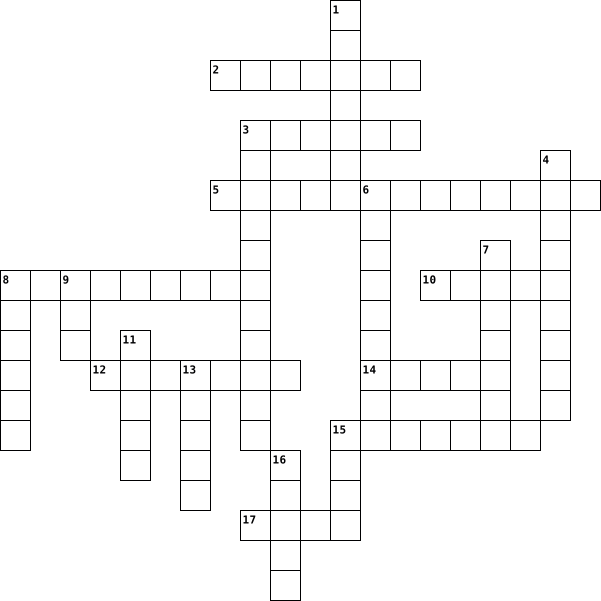
Across
- When the moon phases infront of the sun casting a shadow on the Earth this is known as a solar ______
- A bright globe surrounded by three main rings
- A person who only studies the planets
- Jupiter, Saturn, Uranus and Neptune are all what?
- An object which has not been agreed by scientist as being a planet as it orbits the sun in a zone full of other objects. Unlike all the other planets
- Uranus is the________ planet from the sun
- All planets _______ the sun
- The planet closest to the sun
- The moon changes from a thin crescent to a full moon and back to crescent in 29________
Down
- Which planet is named after the Roman God of the Sea?
- The_____ ________ contains the sun, planets, comets, moons, dust, gas and minor planets
- Someone who travels to outer space
- An instrument used to help see stars and planets clearly
- The largest planet in the solar system
- The milky way is a ________ that contains our solar system
- The largest object in the solar system
- This planet has phases like the moon and is known as the morning and evening star
- The only planet that has an atmosphere of 21% oxygen and liquid water on its surface
- Which planet is known as the red planet?
- Pluto is known as a what kind of planet?
20 Clues: All planets _______ the sun • The planet closest to the sun • Someone who travels to outer space • A person who only studies the planets • The largest planet in the solar system • The largest object in the solar system • Which planet is known as the red planet? • Pluto is known as a what kind of planet? • Uranus is the________ planet from the sun • ...
Rside-science-Peter 2015-03-04

Across
- a region of complete shadow resulting from total obstruction of light
- the Earth move around the Sun
- seven stars in the sky, like a spoon
- a large thing come from the sky
- a fringe region of partial shadow around an umbra
- sun is the middle
- the phases of the moon
- To avoid meteorites
Down
- you can see all the moon
- a half moon
- somebody said sun is moving around Earth
- a great astronomer from ancient Greek
- something in the sky
- sometime the Earth moves between the Moon and The Sun
- sometime the Moon moves between the Earth and the Sun
- something from the sky, have a littler tail and move fast
- A constellation which looks like a bear
- a great Germany astronomer
- people who want to discover the universe
- the two point that Earth is the furthest from the Sun
20 Clues: a half moon • sun is the middle • To avoid meteorites • something in the sky • the phases of the moon • you can see all the moon • a great Germany astronomer • the Earth move around the Sun • a large thing come from the sky • seven stars in the sky, like a spoon • a great astronomer from ancient Greek • A constellation which looks like a bear • ...
Gavo's Astronomy Crossword 2016-10-27

Across
- force and gravity in an object
- different shapes of the moon
- giant ball of hot gasses
- vampire movie
- pattern of stars that make a shape
- amount of matter in an object
- something that resist changing motion
- 24 hour period
- darkest part of the moon
Down
- what goes up must come down
- imaginary line that put earth on a tilt
- orbit around something
- bigger part of a moon shadow
- check the date
- cold mixture of dust and ice
15 Clues: vampire movie • check the date • 24 hour period • orbit around something • giant ball of hot gasses • darkest part of the moon • what goes up must come down • different shapes of the moon • bigger part of a moon shadow • cold mixture of dust and ice • amount of matter in an object • force and gravity in an object • pattern of stars that make a shape • ...
MOON REVIEW 2024-09-17

Across
- THIS MEANS MOON.
- A _____ MOON IS WHEN YOU CAN SEE LESS THAN HALF THE MOON.
- THESE ARE DARK SPOTS ON THE MOON THAT THEY THOUGHT WERE OCEANS.
- THIS IS WHEN THE MOON APPEARS TO BE SHRINKING.
- THE _____ ON THE MOON IS ON SIX THAT OF THE EARTH.
- PHASE WHEN YOU CANNOT SEE THE MOON.
- MOON PHASE JUST BEFORE AND AFTER A FULL MOON.
Down
- PHASE WHEN YOU CAN SEE THE ENTIRE MOON.
- A _____ MOON IS WHEN YOU CAN SEE HALF OF THE MOON.
- THE LIGHTED SIDE OF THE MOON CONTAINS MANY...
- THIS IS WHEN THE MOON APPEARS TO BE GROWING.
- THE NUMBER OF MOON PHASES.
12 Clues: THIS MEANS MOON. • THE NUMBER OF MOON PHASES. • PHASE WHEN YOU CANNOT SEE THE MOON. • PHASE WHEN YOU CAN SEE THE ENTIRE MOON. • THIS IS WHEN THE MOON APPEARS TO BE GROWING. • THE LIGHTED SIDE OF THE MOON CONTAINS MANY... • MOON PHASE JUST BEFORE AND AFTER A FULL MOON. • THIS IS WHEN THE MOON APPEARS TO BE SHRINKING. • A _____ MOON IS WHEN YOU CAN SEE HALF OF THE MOON. • ...
Astronomy Vocab 2025-10-03

Across
- Mercury, Venus, Earth, Mars
- The amount of matter in an object.
- Sunlight that hits the earth at a 90 degree angle.
- Caused by the tilt of Earth on its axis as it revolves around the Sun
- An elongated circle, or oval shape.
- A mixture of gases that surrounds a planet or moon.
- the part of a shadow during an eclipse where the light is partially blocked
- A natural satellite that revolves around a planet.
- Sunlight that hits earth with less than a 90 degree angle.
- A typical star that is the source of light and heat for the planets in the solar system.
- Heat energy
- the physical universe beyond the earth's atmosphere
- the force of gravity on an object
Down
- an object located in space and observed in Astronomy
- The movement of an object around another object
- Phases of the Moon when the Moon appears to be getting "bigger".
- Energy released by the Sun which heats the Earth
- Space and all the matter and energy in it
- Any natural or artificial object that revolves around another object
- A sun and all the planets that orbit around it.
- The partial or total blocking of one object in space by another
- the path that a body follows as it travels around another body in space
- The spinning motion of a planet on its axis
- The changing appearances of the Moon as seen from Earth due to the position of the Earth, Sun, and Moon.
- Jupiter, Saturn, Uranus, Neptune
- the darkest part of a shadow during an eclipse
- Phases of the Moon when the Moon appears to be getting "smaller".
- A force of attraction between objects that is due to their masses and distance apart.
- 3rd planet from the sun
29 Clues: Heat energy • 3rd planet from the sun • Mercury, Venus, Earth, Mars • Jupiter, Saturn, Uranus, Neptune • the force of gravity on an object • The amount of matter in an object. • An elongated circle, or oval shape. • Space and all the matter and energy in it • The spinning motion of a planet on its axis • the darkest part of a shadow during an eclipse • ...
Unit 7 Crossword 2026-03-26

Across
- The moon looks different due to moon _____
- Earth moving around the sun
- The last name of our dear principal
- We live in the Milky Way _________
- We live in the Solar _______
- ________ is our biggest planet
- The moon reflects _____ back to Earth
- The only KNOWN planet with life
- It takes 365 ______ for us to go around the sun
- Outer planets are known as gas _________
Down
- _______ are made of ice and have tails
- Outer planets have ______ around them
- _______ is known as a dwarf planet
- Inner and Outer planets are separated by the ______ belt
- Inner planets have ______ surfaces
- Earth spinning on it's axis
- A ______ moon is kinda shaped like a banana
- A ______ moon is completely dark
- The Milky Way is shaped like a ________
- The biggest star in from our perspective
- The last name of your Science teacher :)
21 Clues: Earth moving around the sun • Earth spinning on it's axis • We live in the Solar _______ • ________ is our biggest planet • The only KNOWN planet with life • A ______ moon is completely dark • _______ is known as a dwarf planet • Inner planets have ______ surfaces • We live in the Milky Way _________ • The last name of our dear principal • Outer planets have ______ around them • ...
Astronomy 2015-03-29

Across
- A smaller object that orbits a planet.
- __________ surround Saturn and are made of ice and dust.
- The Earth blocks out the Moon, and some of the blue light from the Sun passes through Earth's atmosphere and shines on the Moon as red.
- Pluto is a _____________.
- The Moon blocks out the Sun.
- The Moon is caught in Earth's gravity.
- The light from the Sun is shining less and less on the Moon.
- Moon, in practically every romance language.
- The planets in our solar system located outside the asteroid belt,further from the Sun.
- A storm, ragging on the surface of Neptune, similar to the Great Red Spot of Jupiter.
- The Moon goes though ________.
- The Earths __________ is on a 23.5° axis.
Down
- The planets in our solar system located inside the asteroid belt, closer to the Sun.
- Another name for Mars.
- Clusters of planets located within a galaxy.
- Planets that have rocky surfaces.
- A year is based on the Earths __________ around the Sun.
- A planet that consists mostly of gas.
- The Moon is Earth's natural __________.
- The light from the Sun is shining more and more on the Moon.
20 Clues: Another name for Mars. • Pluto is a _____________. • The Moon blocks out the Sun. • The Moon goes though ________. • Planets that have rocky surfaces. • A planet that consists mostly of gas. • The Moon is caught in Earth's gravity. • A smaller object that orbits a planet. • The Moon is Earth's natural __________. • The Earths __________ is on a 23.5° axis. • ...
The Moon 2022-10-18

Across
- One of the first astronauts to make it to the moon.
- Travels around Earth.
- When the moon is NOT visible at night.
- 1/2 of the moon is visible.
- The number of phases of the moon.
- The moon gets smaller.
Down
- This is when the moon is completely visible.
- 1/4 of the moon is visible.
- The moon gets lager.
- Lights up the moon.
10 Clues: Lights up the moon. • The moon gets lager. • Travels around Earth. • The moon gets smaller. • 1/4 of the moon is visible. • 1/2 of the moon is visible. • The number of phases of the moon. • When the moon is NOT visible at night. • This is when the moon is completely visible. • One of the first astronauts to make it to the moon.
Unit 2 Review - Moon Phases, Eclipses, & Seasons 2020-12-07

Across
- identified based on the time of year, climate conditions, and position of earth around the sun
- the number of seasons we have
- less than 50% of the moon we see is illuminated, but not 0%
- another word used to refer to the fall season
- the illuminated portion of the moon we see ______ during waning phases
- 100% of the moon we see is illuminated
- more than 50% of the moon we see is illuminated, but not 100%
- a _______ eclipse happens when either the moon or earth pass through the most concentrated (darker) shadow region
- imaginary line running north to south dividing the Eastern and Western Hemispheres
- identified by the part of the moon that we can see illuminated at different times of the month
- the moon orbits the ________
- this much of the moon is always illuminated (but we see different portions of this amount throughout the month)
- another word used to refer to the spring season
- 0% of the moon we see is illuminated
- the quarter moon phase when illuminated on the left side
- the season in the Northern Hemisphere is always the ________ of the season in the Southern Hemisphere
- either longer days and shorter nights (summer) or shorter days and longer nights (winter)
- hours of day and night are the same (spring and fall)
- the earth spinning on its axis (determines length of day)
- the illuminated portion of the moon we see _______ during the first half
- the eclipse that can occur during a full moon phase when orbits line up (Sun → Earth → Moon; Earth’s shadow is cast upon moon; moon turns a red color)
- December 21st officially starts our ______ season (Northern Hemisphere is tilted away from the Sun; it would be Summer in the Southern Hemisphere)
- earth orbiting the sun (determines length of year)
Down
- the hemisphere that has summer during our winter season, spring during our fall season, winter during our summer season, and fall during our spring season
- the illuminated portion of the moon we see when its on the left side
- the direction of orbit of the moon and earth
- a _______ eclipse happens when either the moon or earth pass through the less concentrated (lighter) shadow region
- northern hemisphere is ______ to the sun during spring and fall
- the quarter moon phase when illuminated on the right side
- the earth orbits the __________
- northern hemisphere is tilted ______ the sun during summer
- Earth is _______ on its axis; also the moon’s orbit is _______.
- March 21st officially starts our ______ season (Northern Hemisphere is parallel to Sun; it would be fall in the Southern Hemisphere)
- 50% of the moon we see is illuminated
- the moon does not make its own light but instead is __________ by the sun resulting in the parts we see throughout each month
- northern hemisphere is tilted ______ the sun during winter
- results from either the moon passing through the shadow of the earth or the earth passing through the shadow of the moon
- the hemisphere that we live in
- imaginary line running east to west dividing the Northern and Southern Hemispheres
- Earth is tilted 23.5 degrees on its _______ (imaginary line runs straight through the center of Earth from north to south pole)
- the illuminated portion of the moon we see when its on the right side
- the number of moon phases we have
- September 21st officially starts our ______ season (Northern Hemisphere is parallel to Sun; it would be Spring in the Southern Hemisphere)
- the eclipse that can occur during a new moon phase when orbits line up (Sun → Moon → Earth; moon’s shadow is cast upon Earth)
- half of earth (northern, southern, eastern, or western)
- the number of days for a complete moon phase cycle
- June 21st officially starts our ______ season (Northern Hemisphere is tilted towards the Sun; it would be Winter in the Southern Hemisphere)
47 Clues: the moon orbits the ________ • the number of seasons we have • the hemisphere that we live in • the earth orbits the __________ • the number of moon phases we have • 0% of the moon we see is illuminated • 50% of the moon we see is illuminated • 100% of the moon we see is illuminated • the direction of orbit of the moon and earth • ...
Unit 2 Review - Moon Phases, Eclipses, & Seasons 2020-12-07

Across
- identified based on the time of year, climate conditions, and position of earth around the sun
- the number of seasons we have
- less than 50% of the moon we see is illuminated, but not 0%
- another word used to refer to the fall season
- the illuminated portion of the moon we see ______ during waning phases
- 100% of the moon we see is illuminated
- more than 50% of the moon we see is illuminated, but not 100%
- a _______ eclipse happens when either the moon or earth pass through the most concentrated (darker) shadow region
- imaginary line running north to south dividing the Eastern and Western Hemispheres
- identified by the part of the moon that we can see illuminated at different times of the month
- the moon orbits the ________
- this much of the moon is always illuminated (but we see different portions of this amount throughout the month)
- another word used to refer to the spring season
- 0% of the moon we see is illuminated
- the quarter moon phase when illuminated on the left side
- the season in the Northern Hemisphere is always the ________ of the season in the Southern Hemisphere
- either longer days and shorter nights (summer) or shorter days and longer nights (winter)
- hours of day and night are the same (spring and fall)
- the earth spinning on its axis (determines length of day)
- the illuminated portion of the moon we see _______ during the first half
- the eclipse that can occur during a full moon phase when orbits line up (Sun → Earth → Moon; Earth’s shadow is cast upon moon; moon turns a red color)
- December 21st officially starts our ______ season (Northern Hemisphere is tilted away from the Sun; it would be Summer in the Southern Hemisphere)
- earth orbiting the sun (determines length of year)
Down
- the hemisphere that has summer during our winter season, spring during our fall season, winter during our summer season, and fall during our spring season
- the illuminated portion of the moon we see when its on the left side
- the direction of orbit of the moon and earth
- a _______ eclipse happens when either the moon or earth pass through the less concentrated (lighter) shadow region
- northern hemisphere is ______ to the sun during spring and fall
- the quarter moon phase when illuminated on the right side
- the earth orbits the __________
- northern hemisphere is tilted ______ the sun during summer
- Earth is _______ on its axis; also the moon’s orbit is _______.
- March 21st officially starts our ______ season (Northern Hemisphere is parallel to Sun; it would be fall in the Southern Hemisphere)
- 50% of the moon we see is illuminated
- the moon does not make its own light but instead is __________ by the sun resulting in the parts we see throughout each month
- northern hemisphere is tilted ______ the sun during winter
- results from either the moon passing through the shadow of the earth or the earth passing through the shadow of the moon
- the hemisphere that we live in
- imaginary line running east to west dividing the Northern and Southern Hemispheres
- Earth is tilted 23.5 degrees on its _______ (imaginary line runs straight through the center of Earth from north to south pole)
- the illuminated portion of the moon we see when its on the right side
- the number of moon phases we have
- September 21st officially starts our ______ season (Northern Hemisphere is parallel to Sun; it would be Spring in the Southern Hemisphere)
- the eclipse that can occur during a new moon phase when orbits line up (Sun → Moon → Earth; moon’s shadow is cast upon Earth)
- half of earth (northern, southern, eastern, or western)
- the number of days for a complete moon phase cycle
- June 21st officially starts our ______ season (Northern Hemisphere is tilted towards the Sun; it would be Winter in the Southern Hemisphere)
47 Clues: the moon orbits the ________ • the number of seasons we have • the hemisphere that we live in • the earth orbits the __________ • the number of moon phases we have • 0% of the moon we see is illuminated • 50% of the moon we see is illuminated • 100% of the moon we see is illuminated • the direction of orbit of the moon and earth • ...
Astronomy Project 2023-12-07

Across
- Located in the middle of our solar system
- The phase almost fully covered in darkness
- The reason that we see phases of the moon
- 25% done with the entire moon cycle
- The direction that the Sun produces light
- This phase of the moon starts the fall off
- Making something smaller
Down
- This is the second phase of the moon
- This phase is the last quarter of the moon
- The phase of the moon fully lit up
- Making something bigger
- Almost fully lit up by the sun
- The phase of the moon opposite to full
13 Clues: Making something bigger • Making something smaller • Almost fully lit up by the sun • The phase of the moon fully lit up • 25% done with the entire moon cycle • This is the second phase of the moon • The phase of the moon opposite to full • Located in the middle of our solar system • The reason that we see phases of the moon • The direction that the Sun produces light • ...
Astronomy Crossword Assignment 2016-10-27

Across
- has less gravity than Earth
- works together with gravity to keep things in orbit
- opposite of a crescent moon
- brightest phase of moon
- most common type of lunar eclipse
- a push or pull
- have the most gravitational pull of anything in a solar system
Down
- darkest part of Earth or moon's shadow in an eclipse
- darkest phase of moon
- larger part of Earth or moon's shadow
- newton's first name
- type of eclipse that occurs only during a full moon
- cycle through every 29.5 days
- the more an object has of this the more inertia will affect it
- type of eclipse that occurs during the new moon
15 Clues: a push or pull • newton's first name • darkest phase of moon • brightest phase of moon • has less gravity than Earth • opposite of a crescent moon • cycle through every 29.5 days • most common type of lunar eclipse • larger part of Earth or moon's shadow • type of eclipse that occurs during the new moon • works together with gravity to keep things in orbit • ...
moon 2021-02-26

Across
- the moon and gravity create this
- you are on this planet
- this moon phase you can see
- this is white and in the solar system
- a bit of light shown
- this moon phase you can't see
Down
- 3/4 light is on the moon
- how many moon phases
- cycle the moon does this every 29.5 days
- the moon goes around the earth
10 Clues: how many moon phases • a bit of light shown • you are on this planet • 3/4 light is on the moon • this moon phase you can see • this moon phase you can't see • the moon goes around the earth • the moon and gravity create this • this is white and in the solar system • cycle the moon does this every 29.5 days
Wynn- Chapter 1 lesson 4 Astronomy 2021-11-09

Across
- at the full moon when Earth is directly between the moon and the sun
- different shapes of the moon you see from Earth are called
- sunlight from Earth-What happens during a lunar eclipse
- two types of eclipse
- happens to the earth, moon, and sun when the moon orbits earth
Down
- light part of the moons shadow
- causes phases
- dark part of the moons shadow
8 Clues: causes phases • two types of eclipse • dark part of the moons shadow • light part of the moons shadow • sunlight from Earth-What happens during a lunar eclipse • different shapes of the moon you see from Earth are called • happens to the earth, moon, and sun when the moon orbits earth • at the full moon when Earth is directly between the moon and the sun