
moon phases Crossword Puzzles
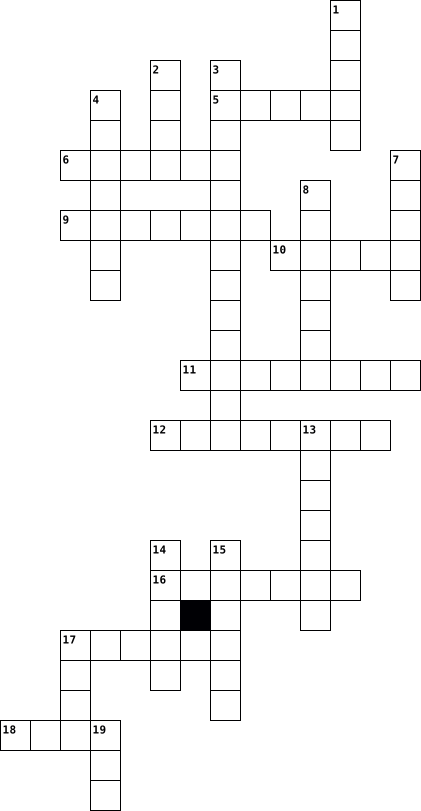
Planets Crossword 2024-05-16

Across
- another word for the Northern lights
- was once considered the ninth planet. Now a dwarf planet
- known as the red planet. Traces of water can be found
- large outer planets, made of mostly gases
- a "hole" in the moon or other planet usually caused by the impact of a meteor
- seventh planet from the sun
- eight planet from the sun
- this planet has many visible rings
- space between Mars and Jupiter containing most asteroids
- scientist credited with the discovery of gravity
Down
- First planet from the sun
- meteorite burning up in Earth's atmosphere
- Second planet from the sun
- debris and other materials orbiting giant planets like Saturn
- this pulls everything down, making sure we don't fly into space
- the center of our galaxy. Provides most of our heat.
- the Roman goddess Venus is named after
- Pluto's only moon
- the largest planet
- gases surrounding a planet
- white space object orbiting Earth. Has many craters
- the planet we live on
22 Clues: Pluto's only moon • the largest planet • the planet we live on • First planet from the sun • eight planet from the sun • Second planet from the sun • gases surrounding a planet • seventh planet from the sun • this planet has many visible rings • another word for the Northern lights • the Roman goddess Venus is named after • large outer planets, made of mostly gases • ...
science chapter 6 2023-03-07

Across
- Moon reflects light of this
- The tilt of the Earth gives us our _____
- Hole on surface of the moon or other planet
- The phrase for the sun & bodies that orbit it
- The only planet that is habitable
- Group of stars that make a picture
- The smallest planet
- The planet tipped on it's side
- The sun is at the ___ of our solar system
- Planet that takes longest to orbit the sun
- Planets orbit the sun because of the sun's ___
Down
- station scientists in space can live and work in this
- The ____ is a natural satellite of Earth
- Means suitable for life
- Name of our Galaxy
- The red planet
- A continual path around the sun
- The four planets farthest from the sun are ___planets
- Moon's gravity affects the ocean's ______
- The brightest planet; Earth's twin
- When N.America is tilted toward sun,it's ___ season
- The planet with rings
- The Earth continuously spins or rotates on it's ___
- The star closest to Earth
- The largest planet; has a Great Red spot
25 Clues: The red planet • Name of our Galaxy • The smallest planet • The planet with rings • Means suitable for life • The star closest to Earth • Moon reflects light of this • The planet tipped on it's side • A continual path around the sun • The only planet that is habitable • The brightest planet; Earth's twin • Group of stars that make a picture • The ____ is a natural satellite of Earth • ...
6th Grade Earth Science- Space 2025-02-25

Across
- Largest Planet
- Planet that rotates completely on its side
- Earth spinning on its axis
- A meteoroid that has hit Earth's surface
- Which object's gravity affects tides the most?
- When the moon appears to be getting larger
- Supported heliocentric model of solar system
- Smallest planet
- Earth centered model of the solar system.
- Earth is a ____ planet (terrestrial)
- When the moon appears to be getting smaller
- Planet with lowest density and large number of rings.
Down
- Sun-centered model of the solar system.
- Force that holds all planets in orbiting position around the sun.
- Oxygen and ____ mostly make up Earth's atmosphere
- Became a dwarf planet.
- One complete trip of Earth around the sun.
- First country to orbit human around the Earth
- Between Mars and Jupiter is an ____ belt.
- Created geocentric model of solar system
- A planet with similar size and mass to Earth.
- Planet closest to the sun.
- Created heliocentric model of solar system.
23 Clues: Largest Planet • Smallest planet • Became a dwarf planet. • Earth spinning on its axis • Planet closest to the sun. • Earth is a ____ planet (terrestrial) • Sun-centered model of the solar system. • A meteoroid that has hit Earth's surface • Created geocentric model of solar system • Between Mars and Jupiter is an ____ belt. • Earth centered model of the solar system. • ...
Miss Crawly's Crossword 2022-04-12

Across
- Ash and Lance play these
- Great set of pipes, boring to watch
- Hangs from the moon theater ceiling
- Raise the !
- Where the show takes place
- Didn't know how to play guitar
Down
- Director of Moon Theater
- one mean lady
- Worn for a performance
- Wants to sing but too shy
- Wants to get out of her boyfriends shadow
11 Clues: one mean lady • Raise the ! • Worn for a performance • Director of Moon Theater • Ash and Lance play these • Wants to sing but too shy • Where the show takes place • Didn't know how to play guitar • Great set of pipes, boring to watch • Hangs from the moon theater ceiling • Wants to get out of her boyfriends shadow
Ashy crosswords 2014-02-19

Across
- fake
- swivel
- confusing
- propaganda
- moon
- lesion
- obscure
Down
- artificial
- democracy
- nodule
10 Clues: fake • moon • swivel • nodule • lesion • obscure • confusing • democracy • artificial • propaganda
Ashy crosswords 2014-02-19

Across
- democracy
- confusing
- artificial
- moon
Down
- propaganda
- fake
- obscure
- swivel
- nodule
- lesion
10 Clues: fake • moon • swivel • nodule • lesion • obscure • democracy • confusing • propaganda • artificial
Future predictions 2020-10-10

Across
- vechicle
- cars
- medicine
- food
- exam
Down
- time
- language
- moon
- alien
- space
10 Clues: time • moon • cars • food • exam • alien • space • language • vechicle • medicine
skydiver surprise 2024-08-14

Across
- balloon
- cloud
- star
- moon
- kite
- bird
Down
- airplane
- sun
- rainbow
- rain
10 Clues: sun • star • moon • kite • bird • rain • cloud • balloon • rainbow • airplane
NATURE ELEMENTS 2023-02-23

Across
- MOUNTAIN
- SUN
- WATERFALL
- RIVER
Down
- MOON
- STAR
- SEA
- BEACH
- FLOWER
- TREE
10 Clues: SUN • SEA • MOON • STAR • TREE • BEACH • RIVER • FLOWER • MOUNTAIN • WATERFALL
raya 2022-04-23

Across
- mosque
- lamp
- ketupat
- dates
Down
- moon
- envelope
- visiting
- cookies
- mat
- card
10 Clues: mat • moon • lamp • card • dates • mosque • cookies • ketupat • envelope • visiting
Lunar Eclipse 2014-04-15

Across
- Will you ____________ the night show in the sky?
- The moon will look ____________ on April 15.
- Many ____________ in North America will watch it.
- The Earth blocks the ____________ from the moon.
- This is called a ____________ eclipse.
Down
- The Earth ____________ a lunar eclipse.
- The Earth's ____________ colors the moon red.
- Early in the ____________, the moon will be red.
- The ____________ can be seen for several hours.
- You can see the lunar eclipse ____________ than a hour.
10 Clues: This is called a ____________ eclipse. • The Earth ____________ a lunar eclipse. • The moon will look ____________ on April 15. • The Earth's ____________ colors the moon red. • The ____________ can be seen for several hours. • Early in the ____________, the moon will be red. • Will you ____________ the night show in the sky? • ...
Lunar Cycle Crossword 2022-05-24

Across
- The right side of the moon is lit (half).
- The process of spinning on an axis.
- The force that pulls two objects together.
- The moon changing appearances.
- One object going around another object.
- The process of something increasing.
Down
- The left side of the moon is lit (half).
- The sliver of light that is visible.
- The gravity of the moon and the ocean.
- The process of something decreasing.
10 Clues: The moon changing appearances. • The process of spinning on an axis. • The sliver of light that is visible. • The process of something decreasing. • The process of something increasing. • The gravity of the moon and the ocean. • One object going around another object. • The left side of the moon is lit (half). • The right side of the moon is lit (half). • ...
Lunar Cycle Crossword 2022-05-24

Across
- The right side of the moon is lit (half).
- The process of spinning on an axis.
- The force that pulls two objects together.
- The moon changing appearances.
- One object going around another object.
- The process of something increasing.
Down
- The left side of the moon is lit (half).
- The sliver of light that is visible.
- The gravity of the moon and the ocean.
- The process of something decreasing.
10 Clues: The moon changing appearances. • The process of spinning on an axis. • The sliver of light that is visible. • The process of something decreasing. • The process of something increasing. • The gravity of the moon and the ocean. • One object going around another object. • The left side of the moon is lit (half). • The right side of the moon is lit (half). • ...
Science crossword - Emmanuel 0. #61 2025-06-06

Across
- When the Earth is between the Moon and the Sun.
- When the Moon is between the Earth and the Sun.
- When water vapor becomes liquid water.
- When the amount of day and night is the same.
- The phase of the Moon during a Lunar eclipse.
- When the amount of day and night is vastly different.
Down
- When water becomes water vapor.
- A measure of the mass to volume ratio of an object.
- When water droplets get too heavy and fall to the ground.
- The law that states rocks strata closer to the center of the earth areolder then the ones above them
- Nonrenewable resources that we use for energy.
- When water collects on the surface of the earth.
- The phase of the Moon during a solar eclipse.
13 Clues: When water becomes water vapor. • When water vapor becomes liquid water. • The phase of the Moon during a solar eclipse. • When the amount of day and night is the same. • The phase of the Moon during a Lunar eclipse. • Nonrenewable resources that we use for energy. • When the Earth is between the Moon and the Sun. • When the Moon is between the Earth and the Sun. • ...
Eek! Halloween! 2022-10-04

Across
- wizard
- moon
- cat
- chicken
- treat
Down
- pumpkin
- witch
- mouse
- trick
- hat
10 Clues: cat • hat • moon • witch • mouse • trick • treat • wizard • pumpkin • chicken
Future predictions 2020-10-10

Across
- vechicle
- cars
- medicine
- food
- exam
Down
- time
- language
- moon
- alien
- space
10 Clues: time • moon • cars • food • exam • alien • space • language • vechicle • medicine
Nature 2021-03-17

Across
- bird
- tree
- star
- sky
- moon
Down
- butterfly
- river
- bush
- sun
- rock
10 Clues: sky • sun • bird • bush • tree • star • rock • moon • river • butterfly
1234 2024-10-08

Across
- Spider
- Mask
- Claw
- Moon
- Rain
Down
- Shadow
- Potion
- Demon
- Storm
- Lantern
10 Clues: Mask • Claw • Moon • Rain • Demon • Storm • Shadow • Potion • Spider • Lantern
Celestial objects 2021-10-13

Across
- the galaxy group containing the Milky Way
- the brightest star in the night sky
- a dwarf planet that is the 2nd largest object in the kuiper belt
- the largest moon in the Solar System
- the first Neptune moon to be discovered
Down
- The second largest Jupiter moon
- the second-largest dwarf planet
- the only planet w rings
- also known as the Sister stars
- 4th Pluto moon to be discovered
10 Clues: the only planet w rings • also known as the Sister stars • The second largest Jupiter moon • the second-largest dwarf planet • 4th Pluto moon to be discovered • the brightest star in the night sky • the largest moon in the Solar System • the first Neptune moon to be discovered • the galaxy group containing the Milky Way • ...
moon landing cross word 2024-05-14

Across
- first person on the moon
- the name of the Soviet moon landing program
- NASA program after skylab
- last person on the moon
- the cause of the space race
Down
- the United States space agency
- the first living thing sent in to space
- the rival of the USA in the space race
- the name of the United State moon landing program
- the space project after the shuttle program
10 Clues: last person on the moon • first person on the moon • NASA program after skylab • the cause of the space race • the United States space agency • the rival of the USA in the space race • the first living thing sent in to space • the name of the Soviet moon landing program • the space project after the shuttle program • the name of the United State moon landing program
Physics chap 13 2026-01-28

Across
- causes two daily high tides in the same place
- crushed themselves out of visible existence
- low tides are higher than average low tides
- the absence of a support force
- moon and sun in line
- a surrounding magnet
Down
- surrounds massive objects
- remain relatively fixed with respect to the moon while earth spins daily beneath them
- the tides due to the sun and moon coincide
- earth sun and moon in line
10 Clues: moon and sun in line • a surrounding magnet • surrounds massive objects • earth sun and moon in line • the absence of a support force • the tides due to the sun and moon coincide • crushed themselves out of visible existence • low tides are higher than average low tides • causes two daily high tides in the same place • ...
Q1 Reflection 2025-10-30

Across
- Gravity does this to get you to stay on the ground
- The rock that is the layers of sedimentary rock
- When you can see the whole side of the moon that is illuminated
- The planets that are made of gas and are more dense
- When the Earth blocks the sunlight from the sun on the moon
- The season when people like to do things like skiing and sledding
- The remains or impressions of ancient organisms
- When something is leftover or left behind by something
- The force that holds the universe together
Down
- When the moon covers up the light from the sun
- The law that says the oldest rock is on the bottom and the youngest rock is on the top
- The movement of an object spinning on its axis
- The planets that are rocky and are hotter
- The movement of one object going around another object
- When you can not see the illuminated side of the moon at all
- The season when the temperatures are the highest of the year
16 Clues: The planets that are rocky and are hotter • The force that holds the universe together • When the moon covers up the light from the sun • The movement of an object spinning on its axis • The rock that is the layers of sedimentary rock • The remains or impressions of ancient organisms • Gravity does this to get you to stay on the ground • ...
tides 2023-03-01

Across
- land mass of water
- moon pulled waves
- water from ocean
- moon has one of these
- body of water making up most of earth
Down
- to do with land
- highest and lowest tide
- smallest tide
- to do with water
- causes night
10 Clues: causes night • smallest tide • to do with land • water from ocean • to do with water • moon pulled waves • land mass of water • moon has one of these • highest and lowest tide • body of water making up most of earth
Space Vocabulary 2021-03-03

Across
- 2 days in which night and day are both 12 hours.
- Longest day of the year.
- Solar system model with Sun in the center.
- Sun, planets, and all the other objects that revolve around the sun
- When the Earth is farther from the Sun. (July)
- Path the umbra travels across Earth.
- Moon is between the Sun and Earth.
- Resistance to any change in motion
- Attraction force between any two objects
- When Earth's shadow falls on the Moon.
- Solar system model with Earth in the center.
Down
- Shortest day of the year.
- The darkest part of the Moon's shadow.
- When the Earth is closer to the Sun. (January)
- A collection of stars, dust, and gas bound together by gravity
- The lighter part of the Moon's shadow.
- When moon's shadow falls on the Earth.
- Really high and really low tides.
- Moon is on the opposite side of Earth from the Sun.
- Not much difference between high and low tide.
20 Clues: Longest day of the year. • Shortest day of the year. • Really high and really low tides. • Moon is between the Sun and Earth. • Resistance to any change in motion • Path the umbra travels across Earth. • The darkest part of the Moon's shadow. • The lighter part of the Moon's shadow. • When moon's shadow falls on the Earth. • When Earth's shadow falls on the Moon. • ...
Hudson - Tides, Currents, and Waves (Oh My) 2020-03-31

Across
- The Gulf Stream is a ____ _____current
- These islands protect much of the eastern United State
- the flat, not so deep part of the ocean floor.
- an underwater mountain
- as you go deeper in the ocean, this decreases
- Boiling ocean water is Step 1 in this process
- cause of waves and surface currents
- cause of tides
- a seamount that has lost its top
- sun,moon,earth all line up(2 words)
- sun,moon,earth form a right angle(2 words)
Down
- currents always flow toward the equator(2 words)
- this plain is found at the bottom of the ocean
- as you go deeper in the ocean, this increases
- the higher the frequency, the shorter the ___
- melting glaciers change the _____ of the ocean
- The ___'s gravity has the largest affect on earth's tides
- when this happens, the beach disappears
- New crust is produced at the mid-ocean ______
- number of waves per second
20 Clues: cause of tides • an underwater mountain • number of waves per second • a seamount that has lost its top • cause of waves and surface currents • sun,moon,earth all line up(2 words) • The Gulf Stream is a ____ _____current • when this happens, the beach disappears • sun,moon,earth form a right angle(2 words) • as you go deeper in the ocean, this increases • ...
THE SOLAR SYSTEM 2017-07-20
Across
- The gravitationally curved path of an object around a point in space
- The coldest planet in the Solar System
- The planet with the shortest day
- ''The water planet''
- The name of the galaxy we live in
- The largest moon in the Solar System
- When the Sun or the Moon passes through a shadow of another heavenly body
- The second largest planet in the Solar System
- The planet named after the Roman God of War
Down
- The largest dwarf planet
- The natural satellite of a planet
- A group of stars that form a recognizable pattern
- Closest planet to the Sun
- The number of planets in the Solar System
- The force that keeps all of the planets in orbit around the Sun
- Shape of the planet's orbits
- The hottest planet in the Solar System
- A celestial body moving in an elliptical orbit around a star
- A luminous sphere of plasma
- The closest star to the Earth
20 Clues: ''The water planet'' • The largest dwarf planet • Closest planet to the Sun • A luminous sphere of plasma • Shape of the planet's orbits • The closest star to the Earth • The planet with the shortest day • The natural satellite of a planet • The name of the galaxy we live in • The largest moon in the Solar System • The coldest planet in the Solar System • ...
Surprise?♥️ 2018-06-13

Across
- When the night is still,it brings me closest to you
- Thats your favourite girl no?
- Lemons or tomatoes?
- Pizza with a fork?
- And whoever you'll meet whatever you'll,nothing will be like it would be with him.
- The two of us on a ride in the sky
- Yummy surprises I love
- Who needs to create a puzzle in a hurry to avoid messing up a surprise?
- When you got pricked by the rose
- You kissed him!!!
- The belt that shines bright.
Down
- The robot that created a bond
- The moon on Earth
- When bangla came to rescue
- First and perfect
- We love shakes.
- What should you check on your phone to know all the answers?
- Was the moon blue or red?
- Shadow room and cravings.Hihi.
- Dont call me that!!
- Moon or stars?
- 23k came with my first surprise
- You eat it only with me and I would love to eat it just with you.
23 Clues: Moon or stars? • We love shakes. • The moon on Earth • First and perfect • You kissed him!!! • Pizza with a fork? • Lemons or tomatoes? • Dont call me that!! • Yummy surprises I love • Was the moon blue or red? • When bangla came to rescue • The belt that shines bright. • The robot that created a bond • Thats your favourite girl no? • Shadow room and cravings.Hihi. • ...
The Planets 2014-10-30

Across
- Uranus is classified as an ___ giant pplanet.
- How many planets are in our solar system?
- The sun is mainly made up of______.
- Which planet is the coldest?
- Jupiter has the ________ day io all the planets.
- What planet is the largest of the dwarf planets?
- What is the largest planet in our solar system?
- What colour is Mars known to be?
- A solar eclipseis when the Moon passes in front of the Sun casting a_____ on Earth.
- Earth is the _____ planet from the sun.
Down
- The rise and fall of the _____ on Earth is caused by the Moon
- Which is the furthest planet from the sun?
- Terristrial planet, second from the sun.
- Mercury is the most _____ planet in the Solar System
- Which planet is closest to the sun?
- Neptune is the ______ of the ice giants.
- Apollo 11 landed on what planet?
- Which planet is known for its rings?
- What is the only planet that inhabits humans?
- Pluto is now considered a ______ planet.
20 Clues: Which planet is the coldest? • Apollo 11 landed on what planet? • What colour is Mars known to be? • The sun is mainly made up of______. • Which planet is closest to the sun? • Which planet is known for its rings? • Earth is the _____ planet from the sun. • Terristrial planet, second from the sun. • Neptune is the ______ of the ice giants. • ...
5 - Minute Fun (Puzzle #2) 2024-01-16

Across
- the variable that you measure
- month with the shortest amount of light in NY
- imaginary pattern of stars
- depends on mass and distance
- made of ice and grows tails
- amount of space something occupies
- the Sun is at the center
- largest Jovian planet
- eclipse when the moon blocks the sun
- located between Mars and Jupiter
- heat transfer by direct contact
- spring and fall
Down
- hottest planet in solar system
- the burning of a space rock in the atmosphere
- shown on a map using hachure lines
- reason for the seasons
- mass/volume
- reference line for latitude
- a line that connects equal air pressure
- the direction the Sun rises
- tides that occur new and full moon
- a solid, rocky planet
- causes a planet's year
- the north star
- causes a planet's day
- lines that measure east and west
- the Milky way
- phase after quarter moon
28 Clues: mass/volume • the Milky way • the north star • spring and fall • a solid, rocky planet • largest Jovian planet • causes a planet's day • reason for the seasons • causes a planet's year • the Sun is at the center • phase after quarter moon • imaginary pattern of stars • reference line for latitude • made of ice and grows tails • the direction the Sun rises • depends on mass and distance • ...
Puzzle #19 2024-02-27

Across
- The hottest planet in the Solar System. (5)
- Roughly 93 million miles. (12, 4)
- The first shuttle to reach space. (8)
- The craft that orbited a comet. (7)
- First artificial Earth satellite. (7)
- Cosmic body with extremely intense gravity. (5, 4)
- First animal to be launched into space. (5)
- The largest known volcano in the solar system. (7, 4)
- First man in space. (4, 8)
- A failed star, perhaps? (7)
- Plto's largest moon. (6)
- It orbited Ceres. (4)
- Our closest star. (3, 3)
Down
- Planet with the most number of moons. (6)
- The last evolutionary stage of a massive star. (9)
- This spacecraft landed on a comet. (6)
- Largest moon in our solar system. (8)
- Originally called “Le Verrier’s planet”. (7)
- First man on the moon. (4, 10)
- This spacecraft orbited Jupiter. (7)
- Coldest known object in the solar system. (6)
- The closest major galaxy. (9)
- A "star sailor". (9)
- Originally called “George’s Star”. (6)
24 Clues: A "star sailor". (9) • It orbited Ceres. (4) • Plto's largest moon. (6) • Our closest star. (3, 3) • First man in space. (4, 8) • A failed star, perhaps? (7) • The closest major galaxy. (9) • First man on the moon. (4, 10) • Roughly 93 million miles. (12, 4) • The craft that orbited a comet. (7) • This spacecraft orbited Jupiter. (7) • Largest moon in our solar system. (8) • ...
What Do You Know? 2022-09-04

Across
- summer begins on the 21st of this month
- tool used to see microorganisms
- the planet we live on
- during condensation, a gas becomes a _____
- phase change in which a liquid becomes a solid
- a measurement of heat energy
- spring begins on the 21st of this month
- to orbit around another object
- season with the most daylight
- general term referring to the moon
Down
- general term referring to the Sun
- caused by the moon pulling on the ocean water
- velocity is another word for this
- what a meteorologist studies
- fall begins on the 21st of this month
- season with the longest nights
- object in space that orbits the earth
- tool used to see distant stars
- winter begins on the 21st of this month
- basic building block of all matter
- to spin on an axis
- object in space that the Earth orbits around
- the faster an object moves, the more _____ energy it has
23 Clues: to spin on an axis • the planet we live on • what a meteorologist studies • a measurement of heat energy • season with the most daylight • season with the longest nights • tool used to see distant stars • to orbit around another object • tool used to see microorganisms • general term referring to the Sun • velocity is another word for this • basic building block of all matter • ...
Halloween 2025-10-31

Across
- Another word for spooky
- story Tale told to give you chills
- Sweet treat you get on Halloween
- Sound you make when you’re scared
- What you dress up in for Halloween
- Gives light in a pumpkin
- Dark shape that follows you
- Big scary creature
- What you wear with a costume
- Creature that drinks blood
- or treat What you say at the door
- Invisible person who says “boo”
- Animal that flies at night
- Bird that hoots in the dark
- Orange decoration you carve for Halloween
- Mist that makes things spooky
- Bug that spins a web
Down
- house Spooky place with ghosts
- What a witch rides
- Place with tombstones
- Pot witches use for potions
- Figure that stands in a field
- Shines bright on Halloween night
- Dead person who walks around
- Wrapped-up person from a tomb
- Body made of bones
- Person who flies on a broom
- Black animal witches like
- October 31st celebration
- moon When the moon is bright and round
30 Clues: What a witch rides • Body made of bones • Big scary creature • Bug that spins a web • Place with tombstones • Another word for spooky • Gives light in a pumpkin • October 31st celebration • Black animal witches like • Creature that drinks blood • Animal that flies at night • Pot witches use for potions • Dark shape that follows you • Person who flies on a broom • ...
Space 2026-01-20

Across
- The red planet
- What humans need to breathe
- A tool to see far objects in space
- A vehicle that carries people or things into space
- A large group of stars
- A person who travels into space
- The star at the center of our solar system
- What stars and the sun give us
- The path something follows around a planet
- A vehicle that goes into space
- The planet where we live
- The opposite of light
Down
- Where the Earth, moon, and stars are
- A space object with a long bright tail
- An object that moves around a planet
- Special clothes astronauts wear
- A large round object that moves around a star
- A big ball of light in the sky
- The space above the Earth
- The force that pulls things down
- Light from the moon
- A small rocky object in space
- A life form from another planet
- The object that goes around the Earth
- To send a rocket into space
25 Clues: The red planet • Light from the moon • The opposite of light • A large group of stars • The planet where we live • The space above the Earth • What humans need to breathe • To send a rocket into space • A small rocky object in space • A big ball of light in the sky • What stars and the sun give us • A vehicle that goes into space • Special clothes astronauts wear • ...
vocab 25 2024-03-11

Across
- repetition of constants
- dictionary defenition
- to have, or seem to have, opposite meanings
- implied or indirect refrence
- two words or phases used together that have,or
Down
- repetition of vowels
- a group of words in a fixed order
- a statement that seems self-contradictory.
- suggested meaning of a word
- substitution of a mild, indirect,or vague
- collection of selected literay pieces
11 Clues: repetition of vowels • dictionary defenition • repetition of constants • suggested meaning of a word • implied or indirect refrence • a group of words in a fixed order • collection of selected literay pieces • substitution of a mild, indirect,or vague • a statement that seems self-contradictory. • to have, or seem to have, opposite meanings • ...
Astronomy 2025-03-10

Across
- eclipse Occurs at a full moon when Earth is directly between the moon and the sun
- A large cloud of dust and gas in space
- the rigid outer part of the earth, consisting of the crust and upper mantle; another name for geosphere
- point in a planet's orbit that is farthest from the sun
- The mostly solid, rocky part of the Earth; extends from the center of the core to the surface of the crust.
- the point in the orbit of a planet, asteroid, or comet at which it is closest to the sun.
- The study of the moon, stars, and other objects in space
- eclipse Occurs when the Moon passes directly between the Sun and Earth and casts a shadow over part of Earth
- wind A stream of electrically charged particles produced by the sun's corona
Down
- All the water at and near the surface of the earth, 97% of which is in oceans
- A mixture of gases that surrounds a planet or moon.
- Based on the belief that the sun is the center of the universe
- part of Earth in which life exists including land, water, and air or atmosphere
- Earth centered
- an atmospheric phenomenon consisting of bands of light caused by charged solar particles following the earth's magnetic lines of force
- flare A sudden eruption of intense high-energy radiation from the sun's surface
16 Clues: Earth centered • A large cloud of dust and gas in space • A mixture of gases that surrounds a planet or moon. • point in a planet's orbit that is farthest from the sun • The study of the moon, stars, and other objects in space • Based on the belief that the sun is the center of the universe • ...
The Hero Twins 2022-04-18

Across
- moon
- trick
- ballgame
- magical
- sun
Down
- underworld
- brothers
- invitation
- river
- catfish
10 Clues: sun • moon • trick • river • catfish • magical • brothers • ballgame • underworld • invitation
Crossword 2022-05-03

Across
- moon
- pool
- fruit
- chew
- news
- due
Down
- mule
- prune
- cue
- soup
10 Clues: cue • due • moon • mule • pool • chew • news • soup • prune • fruit
asdasdasdasdasdsdddddd 2024-03-13

Across
- revolution
- Lithosphere
- Hydrosphere
- technological
- Atmosphere
Down
- biosphere
- axis
- telescope
- Galileo
- Moon
10 Clues: axis • Moon • Galileo • biosphere • telescope • revolution • Atmosphere • Lithosphere • Hydrosphere • technological
Nature 2025-02-27

Across
- grass
- leaf
- moon
- butterfly
- sun
Down
- bee
- rain
- flower
- cloud
- tree
10 Clues: bee • sun • rain • leaf • moon • tree • grass • cloud • flower • butterfly
Nature1 2025-09-09

Across
- moon
- cloud
- nature
- rock
- tree
- sea
Down
- pond
- flower
- lake
- river
10 Clues: sea • pond • moon • lake • rock • tree • cloud • river • flower • nature
Lunar cycles! 2021-03-16

Across
- cycle the change in the appearance of the Moon as it makes one full revolution around the Earth
- to light up an object
- caused by the pull of gravity from the moon
- the progressive decrease in illuminated area of the moon
Down
- force that tries to pull two objects together
- patches of lower elevation on the moon
- the spinning of an object, like the Earth, on its axis
- the progressive increase in illuminated area of the moon
- movement of an object, like the Earth, around another object
- a shallow hole in the ground in result of a collision of some sorts
10 Clues: to light up an object • patches of lower elevation on the moon • caused by the pull of gravity from the moon • force that tries to pull two objects together • the spinning of an object, like the Earth, on its axis • the progressive increase in illuminated area of the moon • the progressive decrease in illuminated area of the moon • ...
Space Race 2017-05-11

Across
- The good old red white and blue country.
- The name of a race between the Soviet Union and America for landing on the moon.
- Russian for "traveller".
- Last name of the first man on the moon.
- Apollo ___ was the first to land astronauts.
- The big rock in the black sky.
Down
- President Dwight Eisenhower signed a public order creating a Federal agency dedicated to space exploration.
- The sickle and hammer country.
- America and the Soviet Union were _________ with each other to get a man on the moon.
- ______ 8 was the first mission to orbit the moon.
10 Clues: Russian for "traveller". • The sickle and hammer country. • The big rock in the black sky. • Last name of the first man on the moon. • The good old red white and blue country. • Apollo ___ was the first to land astronauts. • ______ 8 was the first mission to orbit the moon. • The name of a race between the Soviet Union and America for landing on the moon. • ...
Lunar Cycle and Tides 2017-02-10

Across
- The process of getting smaller
- Duration of lunar cycles
- when the water rises the most it can
- new moon,waxing crescent,1st quarter, waxing gibbous, full moon, waning gibbous,ext.
Down
- the amount of light that the moon reflects off the sun that we see from earth
- a tide just after the first or third quarters of the moon when there is the least difference between high and low water
- Being more than half, but less than full
- the moons gravitational pull on earth
- the curved sickle shape of the waxing or waning moon
- the process of getting larger
10 Clues: Duration of lunar cycles • the process of getting larger • The process of getting smaller • when the water rises the most it can • the moons gravitational pull on earth • Being more than half, but less than full • the curved sickle shape of the waxing or waning moon • the amount of light that the moon reflects off the sun that we see from earth • ...
DAVION MAVIA'S SCIENCE HOMEWORK 2018-02-01

Across
- the phase when the moon appears to grow smaller
- a round shape dent on the surface of the earth/moon
- when a meteoroid enters earths atmosphere and begins to burn up
- when the earth blocks sunlight from reaching the moon
- a space rock that has made it through the earths atmosphere and hit the crust
Down
- the different amounts of sunlight that the moon reflects on the earth
- the phase when the moon appears to grow larger
- a layer of gases that surrounds the earth
- a small rock moving through space
- the falling and rising of oceans along the shore
10 Clues: a small rock moving through space • a layer of gases that surrounds the earth • the phase when the moon appears to grow larger • the phase when the moon appears to grow smaller • the falling and rising of oceans along the shore • a round shape dent on the surface of the earth/moon • when the earth blocks sunlight from reaching the moon • ...
QUIZ ABOUT ECLIPSE 2024-04-17

Across
- OCCURS WHEN THE MOON IS FARTHEST FROM THE EARTH IN ITS ORBIT
- OCCURS WHEN THE ENTIRE FULL MOON FALLS WITHIN THE CENTER OF EARTH'S SHADOW OR UMBRA
- OCCURS WHEN SOURCE OF LIGHT IS BLOCKED
- BECAUSE OF THIS POSITION OF THE MOON ECLIPSES BECOME UNUSUAL
- LIGHTER OUTER PORTION OF THE SHADOW
Down
- DARK INNER PORTION OF THE SHADOW CONE
- ECLIPSE MOON PASSES THROUGH EARTH'S SHADOW
- a cylinder-shaped device for making objects that are far away look closer and larger, using a combination of lenses, or lenses and curved mirrors
- OCCURS WHEN THE MOON IS DIRECTLY BETWEEN EARTH AND SUN
- SOURCE OF LIGHT
10 Clues: SOURCE OF LIGHT • LIGHTER OUTER PORTION OF THE SHADOW • DARK INNER PORTION OF THE SHADOW CONE • OCCURS WHEN SOURCE OF LIGHT IS BLOCKED • ECLIPSE MOON PASSES THROUGH EARTH'S SHADOW • OCCURS WHEN THE MOON IS DIRECTLY BETWEEN EARTH AND SUN • OCCURS WHEN THE MOON IS FARTHEST FROM THE EARTH IN ITS ORBIT • BECAUSE OF THIS POSITION OF THE MOON ECLIPSES BECOME UNUSUAL • ...
All about tides 2021-10-27

Across
- what force causes tides
- marine and terrestrial are part of this
- having to do with ocean
- when the moon, Earth, & sun are 90 degrees
Down
- higher towards coast in dry land
- caused by moon's gravitational pull
- when the moon, Earth, & sun are 180 degrees
- this moon phase happens during a neap tide
- this zone is mostly above the high tide
- this moon phase happens during a spring tide
10 Clues: what force causes tides • having to do with ocean • higher towards coast in dry land • caused by moon's gravitational pull • this zone is mostly above the high tide • marine and terrestrial are part of this • this moon phase happens during a neap tide • when the moon, Earth, & sun are 90 degrees • when the moon, Earth, & sun are 180 degrees • ...
Density and Moon 2021-12-08

Across
- needed to find the density of an object
- When an object circles around another object
- takes one month
- star that keeps all the planets in orbit
- when the moon appears fully lit
- when half of the moon appears illuminated
Down
- the amount of mass in a given area or space
- amount of matter in an object
- Moon is not visible from Earth
- a large object that orbits Earth
10 Clues: takes one month • amount of matter in an object • Moon is not visible from Earth • when the moon appears fully lit • a large object that orbits Earth • needed to find the density of an object • star that keeps all the planets in orbit • when half of the moon appears illuminated • the amount of mass in a given area or space • When an object circles around another object
astronomy 2022-01-14

Across
- planet thats closest to the sun
- when you cant see the moon
- place that sells big mac and mcflurry
- planet closest in size to earth
Down
- planet with most moons in our solar system
- when you can see the whole moon
- the galaxy earth is in
- when the moon looks like is getting bigger
- fourth planet from the sun
- when the moon looks like its getting smaller
10 Clues: the galaxy earth is in • when you cant see the moon • fourth planet from the sun • when you can see the whole moon • planet thats closest to the sun • planet closest in size to earth • place that sells big mac and mcflurry • planet with most moons in our solar system • when the moon looks like is getting bigger • when the moon looks like its getting smaller
moon landing cross word 2024-05-14

Across
- first person on the moon
- the name of the Soviet moon landing program
- NASA program after skylab
- last person on the moon
- the cause of the space race
Down
- the United States space agency
- the first living thing sent in to space
- the rival of the USA in the space race
- the name of the United State moon landing program
- the space project after the shuttle program
10 Clues: last person on the moon • first person on the moon • NASA program after skylab • the cause of the space race • the United States space agency • the rival of the USA in the space race • the first living thing sent in to space • the name of the Soviet moon landing program • the space project after the shuttle program • the name of the United State moon landing program
born in the 60s space race 2023-06-30

Across
- - Unmanned NASA missions to capture images of the moon
- - Surface material on the moon
- - Safe return of a spacecraft to Earth's ocean
- - Path followed by a satellite around a celestial body
Down
- - First human in space (Surname)
- - NASA's program to develop space travel techniques
- - Soviet spacecraft that carried Yuri Gagarin
- - Pertaining to the moon
- - NASA's space program for moon missions
- - Second human to orbit the Earth (Surname)
10 Clues: - Pertaining to the moon • - Surface material on the moon • - First human in space (Surname) • - NASA's space program for moon missions • - Second human to orbit the Earth (Surname) • - Soviet spacecraft that carried Yuri Gagarin • - Safe return of a spacecraft to Earth's ocean • - NASA's program to develop space travel techniques • ...
Eclipses and Tides 2026-01-07

Across
- A small part of something
- Moon,sun,and Earth are at right angles
- Total or partial obscuring of a planet,star,or moon
- To line everything up
- To block out of view
Down
- When the moon blocks out the sun entirely
- Dark part of a shadow
- When something is in order or a straight line
- The area or partial shadow surrounding the total shadow
- Moon,Sun,and Earth are aligned
10 Clues: To block out of view • Dark part of a shadow • To line everything up • A small part of something • Moon,Sun,and Earth are aligned • Moon,sun,and Earth are at right angles • When the moon blocks out the sun entirely • When something is in order or a straight line • Total or partial obscuring of a planet,star,or moon • The area or partial shadow surrounding the total shadow
Space 2023-11-03

Across
- spinning around an axis
- illumination increasing
- moon darkened by Earth
- act of revolving
- illumination of a planet or moon
Down
- curved path around a star or planet
- imaginary line
- sun obscured by moon
- force of attraction
- system of stars
10 Clues: imaginary line • system of stars • act of revolving • force of attraction • sun obscured by moon • moon darkened by Earth • spinning around an axis • illumination increasing • illumination of a planet or moon • curved path around a star or planet
Solar and lunar eclipses 2017-08-20

Across
- The eclipse that occurs when the Moon blocks the light from the Sun
- The phase of the Moon during a solar eclipse
- Where part of the Sun or Moon is still visible during a lunar or solar eclipse
- The phase of the Moon during a lunar eclipse
- The darkest area of shadow
- Eclipses happen because a ______________ falls on either the Moon or the Earth
Down
- During a solar eclipse, only a small piece of the Earth is cast in shadow because the Moon is ____________ than the Earth
- Where you cannot see the Moon (during a lunar eclipse) or the Sun (during a solar eclipse) at all
- The edges of the shadow, where it is less intense
9 Clues: The darkest area of shadow • The phase of the Moon during a solar eclipse • The phase of the Moon during a lunar eclipse • The edges of the shadow, where it is less intense • The eclipse that occurs when the Moon blocks the light from the Sun • Where part of the Sun or Moon is still visible during a lunar or solar eclipse • ...
oo words 2021-09-26

Across
- cool
- foot
- bedroom
- good
- look
Down
- spoon
- cookbook
- food
- moon
- zoo
10 Clues: zoo • cool • foot • food • moon • good • look • spoon • bedroom • cookbook
Ashy crosswords 2014-02-19

Across
- fake
- swivel
- confusing
- propaganda
- moon
- lesion
- obscure
Down
- artificial
- democracy
- nodule
10 Clues: fake • moon • swivel • nodule • lesion • obscure • confusing • democracy • artificial • propaganda
Planets 2015-06-15

Across
- Neptune
- Venus
- Mercury
- Sun
Down
- Uranus
- Saturn
- Jupiter
- Moon
- Earth
- mars
10 Clues: Sun • Moon • mars • Earth • Venus • Uranus • Saturn • Jupiter • Neptune • Mercury
things 2024-08-29

Across
- Robot
- Airplane
- Juice
- Flower
Down
- Umbrella
- Moon
- House
- Star
- Doll
- Kite
10 Clues: Moon • Star • Doll • Kite • House • Robot • Juice • Flower • Umbrella • Airplane
124 2024-10-12

Across
- Shadow
- Lantern
- Demon
Down
- Mask
- Claw
- Potion
- Spider
- Rain
- Storm
- Moon
10 Clues: Mask • Claw • Rain • Moon • Storm • Demon • Potion • Shadow • Spider • Lantern
Reading 2024-10-09

Across
- star
- moon
- dinner
- lunch
- rake
Down
- jet
- round
- small
- hungry
- breakfast
10 Clues: jet • star • moon • rake • round • small • lunch • hungry • dinner • breakfast
Miss Woodley's Cove: Crossword 2025-09-16

Across
- traintrack
- blanket
- ladder
- shoe
- fish
Down
- moon
- bottle
- chairlift
- gardenhose
- sandwich
10 Clues: moon • shoe • fish • bottle • ladder • blanket • sandwich • chairlift • gardenhose • traintrack
Cell cycle 2020-02-10

Across
- Keeps separase in an inactive state
- PTM activating or inhibiting cdk
- Degrades cohesin
- Metaphase to anaphase
- Holds sister chromatids together
Down
- PTM carried out by APC/C
- External or internal, regulates cdk/cyclin activity
- After metaphase
- Carried out if a cell passed G1/S checkpoint
- Before a cell divides, it has to pass a few of those
- Direct consequence of cyclin D nuclear export
- Develops when checkpoints ineffective or ignored
- Binds and activates cdk
- Four in cell cycle
14 Clues: After metaphase • Degrades cohesin • Four in cell cycle • Metaphase to anaphase • Binds and activates cdk • PTM carried out by APC/C • PTM activating or inhibiting cdk • Holds sister chromatids together • Keeps separase in an inactive state • Carried out if a cell passed G1/S checkpoint • Direct consequence of cyclin D nuclear export • ...
Chapter 21 Vocab 2013-02-27

Across
- mass of slime-like cytoplasm
- dipliod zygote with thick protective wall
- reproductive cycle characterized by two distinct cellular phases
- flexible cytoplasmic extensions
- heterotrophic protist
- members of Phylum Bacillaniophyta, photosynthetic,unicellular protist with double shells
Down
- tightly packed rows of small flagella
- cells in second stage of the life cycle
- infective stage of plasmodium
- photosynthetic protest
- Members of Phylum Kinetoplastida,unicellular heterotrophs with at least one flagellum
- members of Phylum Rhizopoda, protist the move with pseudopodium
- members of Phylum Euglenophyta
- reproductive cells
14 Clues: reproductive cells • heterotrophic protist • photosynthetic protest • mass of slime-like cytoplasm • infective stage of plasmodium • members of Phylum Euglenophyta • flexible cytoplasmic extensions • tightly packed rows of small flagella • cells in second stage of the life cycle • dipliod zygote with thick protective wall • ...
Water Cycle 2020-10-01

Across
- layers of gases that surround earth
- water in different phases
- frozen water falling from clouds
- water from land surface to rock
- water held underground
- snow and ice changing to water vapor
Down
- frozen water on the ground
- transpiration through plants
- water in a plant and its evaporation
- precipitation that didn't absorb
10 Clues: water held underground • water in different phases • frozen water on the ground • transpiration through plants • water from land surface to rock • frozen water falling from clouds • precipitation that didn't absorb • layers of gases that surround earth • water in a plant and its evaporation • snow and ice changing to water vapor
Planets & Dwarf Planets 2025-10-03

Across
- The smallest planet.
- The red DWARF planet.
- A burning ball of gas.
- The red planet.
- The Earth's moon.
- The farthest planet.
- The one with the rings.
- Our Solar System is centered on it.
Down
- The largest planet.
- The egg-shaped dwarf planet.
- The hottest planet.
- This dwarf is really shiny.
- Earth's real name.
- The first dwarf planet.
- The tilted giant.
- A satelite of a planet
- The demoted planet.
- The planet we live on.
18 Clues: The red planet. • The tilted giant. • The Earth's moon. • Earth's real name. • The largest planet. • The hottest planet. • The demoted planet. • The smallest planet. • The farthest planet. • The red DWARF planet. • A satelite of a planet • A burning ball of gas. • The planet we live on. • The first dwarf planet. • The one with the rings. • This dwarf is really shiny. • ...
All About Eclipses Crossword 2023-04-13

Across
- The eclipse When the Moon only covers a portion of the Sun.
- The Moon phase when the shadow side of the moon is facing the Earth during a solar eclipse.
- The eclipse when the Earth blocks the Sun's light from reaching the Moon.
- The partial shadow surrounding a perfect shadow.
- When the Moon's disk completely covers the face of the Sun.
Down
- The eclipse when the Moon blocks the Sun's light from reaching the Earth.
- The Moon Phase when we see the moon as a fully illuminated disc.
- When the Moon's disk is too small to completely cover the Sun's face.
- The perfect shadow in an eclipse, the darkest part of the Sun's shadow.
9 Clues: The partial shadow surrounding a perfect shadow. • The eclipse When the Moon only covers a portion of the Sun. • When the Moon's disk completely covers the face of the Sun. • The Moon Phase when we see the moon as a fully illuminated disc. • When the Moon's disk is too small to completely cover the Sun's face. • ...
vocab 2022-03-15

Across
- the constant G in the equation for Newton's law of universal gravitation, it measures the strength of gravity.
- a physical quantity varies inversely as another quantity squared
- that which exists in the space surrounding a mass, electric charge, or magnet, so that another mass, electric charge, or magnet introduced to this region will experience a force.
- the cutoff of light from the full moon when the earth is directly between the sun and the moon, so that the earth's shadow is cast on the moon.
- a high or low tide that occurs when the sun, earth, and moon are all lined up so that the tides due to the sun and moon coincide, making the high tides higher than average and the low tides lower than average
- a tide that occurs when the moon is halfway between a new moon and a full moon; the high tide is lower than average and the low tide is higher than average.
Down
- for any pair of objects, each object attracts the other object with a force that is directly proportional to the product of the masses of the objects, and inversely proportional to the square of the distance between their centers of mass.
- the condition of free fall toward or around the earth, in which an object experiences no support force (and exerts no force on a scale).
- a force field that exists in the space around every mass or group of masses.
- the cutoff of light from the sun to an observer on the earth when the moon is directly between the sun and the earth.
- a mass that has collapsed to so great a density that its enormous local gravitational field prevents light from escaping.
- the deviation of an orbiting object from its path around a center of force caused by the action of an additional center of force
12 Clues: a physical quantity varies inversely as another quantity squared • a force field that exists in the space around every mass or group of masses. • the constant G in the equation for Newton's law of universal gravitation, it measures the strength of gravity. • ...
Universal Gravitation Crossword 2022-03-01

Across
- hole a mass that has collapsed to so great a density that its enormous local gravitational field prevents light from escaping.
- the condition of free fall toward or around the earth, in which an object experiences no support force (and exerts no force on a scale).
- gravitation constant the constant G in the equation for Newton's law of universal gravitation, it measures the strength of gravity.
- eclipse the cutoff of light from the full moon when the earth is directly between the sun and the moon, so that the earth's shadow is cast on the moon.
- field that which exists in the space surrounding a mass, electric charge, or magnet, so that another mass, electric charge, or magnet introduced to this region will experience a force.
- field a force field that exists in the space around every mass or group of masses.
- tide a tide that occurs when the moon is halfway between a new moon and a full moon; the high tide is lower than average and the low tide is higher than average.
Down
- the deviation of an orbiting object from its path around a center of force caused by the action of an additional center of force
- law a physical quantity varies inversely as another quantity squared
- tide a high or low tide that occurs when the sun, earth, and moon are all lined up so that the tides due to the sun and moon coincide, making the high tides higher than average and the low tides lower than average
- eclipse: the cutoff of light from the sun to an observer on the earth when the moon is directly between the sun and the earth.
- of universal gravitation for any pair of objects, each object attracts the other object with a force that is directly proportional to the product of the masses of the objects, and inversely proportional to the square of the distance between their centers of mass.
12 Clues: law a physical quantity varies inversely as another quantity squared • field a force field that exists in the space around every mass or group of masses. • eclipse: the cutoff of light from the sun to an observer on the earth when the moon is directly between the sun and the earth. • ...
Universal Gravitation Crossword 2022-03-01

Across
- law a physical quantity varies inversely as another quantity squared
- of universal gravitation for any pair of objects, each object attracts the other object with a force that is directly proportional to the product of the masses of the objects, and inversely proportional to the square of the distance between their centers of mass.
- field a force field that exists in the space around every mass or group of masses.
- gravitation constant the constant G in the equation for Newton's law of universal gravitation, it measures the strength of gravity.
- tide a high or low tide that occurs when the sun, earth, and moon are all lined up so that the tides due to the sun and moon coincide, making the high tides higher than average and the low tides lower than average
- the deviation of an orbiting object from its path around a center of force caused by the action of an additional center of force
- field that which exists in the space surrounding a mass, electric charge, or magnet, so that another mass, electric charge, or magnet introduced to this region will experience a force.
Down
- the condition of free fall toward or around the earth, in which an object experiences no support force (and exerts no force on a scale).
- eclipse: the cutoff of light from the sun to an observer on the earth when the moon is directly between the sun and the earth.
- eclipse the cutoff of light from the full moon when the earth is directly between the sun and the moon, so that the earth's shadow is cast on the moon.
- tide a tide that occurs when the moon is halfway between a new moon and a full moon; the high tide is lower than average and the low tide is higher than average.
- hole a mass that has collapsed to so great a density that its enormous local gravitational field prevents light from escaping.
12 Clues: law a physical quantity varies inversely as another quantity squared • field a force field that exists in the space around every mass or group of masses. • eclipse: the cutoff of light from the sun to an observer on the earth when the moon is directly between the sun and the earth. • ...
Univeral Gravition Vocabulary 2024-03-07

Across
- gravitation constant: the constant G in the equation for Newton's law of universal gravitation, it measures the strength of gravity.
- field: that which exists in the space surrounding a mass, electric charge, or magnet, so that another mass, electric charge, or magnet introduced to this region will experience a force.
- field: a force field that exists in the space around every mass or group of masses.
- of universal gravitation: for any pair of objects, each object attracts the other object with a force that is directly proportional to the product of the masses of the objects, and inversely proportional to the square of the distance between their centers of mass.
- tide: a high or low tide that occurs when the sun, earth, and moon are all lined up so that the tides due to the sun and moon coincide, making the high tides higher than average and the low tides lower than average
- the deviation of an orbiting object from its path around a center of force caused by the action of an additional center of force
- tide: a tide that occurs when the moon is halfway between a new moon and a full moon; the high tide is lower than average and the low tide is higher than average.
Down
- law: a physical quantity varies inversely as another quantity squared
- the condition of free fall toward or around the earth, in which an object experiences no support force (and exerts no force on a scale).
- eclipse: the cutoff of light from the full moon when the earth is directly between the sun and the moon, so that the earth's shadow is cast on the moon.
- eclipse: the cutoff of light from the sun to an observer on the earth when the moon is directly between the sun and the earth.
- hole: a mass that has collapsed to so great a density that its enormous local gravitational field prevents light from escaping.
12 Clues: law: a physical quantity varies inversely as another quantity squared • field: a force field that exists in the space around every mass or group of masses. • eclipse: the cutoff of light from the sun to an observer on the earth when the moon is directly between the sun and the earth. • ...
Physics Vocabulary Gravitational Interactions 2025-02-07

Across
- field a force field that exists in the space around every mass or group of masses.
- tide a tide that occurs when the moon is halfway between a new moon and a full moon; the high tide is lower than average and the low tide is higher than average.
- tide a high or low tide that occurs when the sun, earth, and moon are all lined up so that the tides due to the sun and moon coincide, making the high tides higher than average and the low tides lower than average
- eclipse the cutoff of light from the full moon when the earth is directly between the sun and the moon, so that the earth's shadow is cast on the moon.
- field that which exists in the space surrounding a mass, electric charge, or magnet, so that another mass, electric charge, or magnet introduced to this region will experience a force.
Down
- gravitation constant the constant G in the equation for Newton's law of universal gravitation, it measures the strength of gravity.
- of universal gravitation for any pair of objects, each object attracts the other object with a force that is directly proportional to the product of the masses of the objects, and inversely proportional to the square of the distance between their centers of mass.
- hole a mass that has collapsed to so great a density that its enormous local gravitational field prevents light from escaping.
- square law a physical quantity varies inversely as another quantity squared
- the condition of free fall toward or around the earth, in which an object experiences no support force (and exerts no force on a scale).
- the deviation of an orbiting object from its path around a center of force caused by the action of an additional center of force
- eclipse the cutoff of light from the sun to an observer on the earth when the moon is directly between the sun and the earth.
12 Clues: square law a physical quantity varies inversely as another quantity squared • field a force field that exists in the space around every mass or group of masses. • hole a mass that has collapsed to so great a density that its enormous local gravitational field prevents light from escaping. • ...
Space-tis-tic 2017-06-05

Across
- Red in space
- Big and red in the night sky
- goes around the brightest thing in the solar system
- keeps us from floating away
- a moon always restarts
- big ocean water
- Eclipse The earth blocks the light from reaching the moon which creates a ?
Down
- low ocean water
- Blueish and groundish colour in space and starts with j
- wolves hunt on a full ?
- spins around in space
- shines in the night
12 Clues: Red in space • low ocean water • big ocean water • shines in the night • spins around in space • a moon always restarts • wolves hunt on a full ? • keeps us from floating away • Big and red in the night sky • goes around the brightest thing in the solar system • Blueish and groundish colour in space and starts with j • ...
Solar and lunar eclipses 2015-05-04

Across
- The eclipse that occurs when the Moon blocks the light from the Sun
- The phase of the Moon during a solar eclipse
- Where part of the Sun or Moon is still visible during a lunar or solar eclipse
- The phase of the Moon during a lunar eclipse
- The darkest area of shadow
- Eclipses happen because a ______________ falls on either the Moon or the Earth
Down
- During a solar eclipse, only a small piece of the Earth is cast in shadow because the Moon is ____________ than the Earth
- Where you cannot see the Moon (during a lunar eclipse) or the Sun (during a solar eclipse) at all
- The edges of the shadow, where it is less intense
9 Clues: The darkest area of shadow • The phase of the Moon during a solar eclipse • The phase of the Moon during a lunar eclipse • The edges of the shadow, where it is less intense • The eclipse that occurs when the Moon blocks the light from the Sun • Where part of the Sun or Moon is still visible during a lunar or solar eclipse • ...
Slow Food 2023-07-12

Across
- The international Slow Food campaign is committed to rediscovering the value chain behind fish.
- The least healthful and most likely to contribute to weight issues, especially if consumed frequently.
- Slow food is food that conditions and pay for producers, and accessible prices for consumers.
- It is created in labs for desirable traits by injecting seeds with genes from another plant
- Where did slow food originate?
- Food should be grown and bought locally, prepared with care, and consumed with appreciation.
- It is an international network of markets that operate under the Slow Food tenets.
Down
- These are the Slow Food Communities, who strive tirelessly to preserve local agricultural products such as cured meats,fruit and vegetable. They care for the environment,they enhance the beauty of landscapes, regions, and civilizations.
- It occurs before the food reaches the consumer as a result of issues in the production, storage, processing, and distribution phases.
- Protecting local food as well as food cultures and traditions
- Refers to food that is fit for consumption but consciously discarded at the retail or consumption phases.
- A living catalog of delicious and distinctive foods facing extinction.
- These are foods that are healthy to eat pretty much whenever. They have the best health.
- An informal network of beekeepers and enthusiasts who work to defend pollinators.
14 Clues: Where did slow food originate? • Protecting local food as well as food cultures and traditions • A living catalog of delicious and distinctive foods facing extinction. • An informal network of beekeepers and enthusiasts who work to defend pollinators. • It is an international network of markets that operate under the Slow Food tenets. • ...
Physics Vocabulary Gravitational Interactions 2023-04-14

Across
- gravitation constant: the constant G in the equation for Newton's law of universal gravitation, it measures the strength of gravity.
- field: that which exists in the space surrounding a mass, electric charge, or magnet, so that another mass, electric charge, or magnet introduced to this region will experience a force.
- field: a force field that exists in the space around every mass or group of masses.
- of universal gravitation: for any pair of objects, each object attracts the other object with a force that is directly proportional to the product of the masses of the objects, and inversely proportional to the square of the distance between their centers of mass.
- tide: a high or low tide that occurs when the sun, earth, and moon are all lined up so that the tides due to the sun and moon coincide, making the high tides higher than average and the low tides lower than average
- the deviation of an orbiting object from its path around a center of force caused by the action of an additional center of force
- tide: a tide that occurs when the moon is halfway between a new moon and a full moon; the high tide is lower than average and the low tide is higher than average.
Down
- law: a physical quantity varies inversely as another quantity squared
- the condition of free fall toward or around the earth, in which an object experiences no support force (and exerts no force on a scale).
- eclipse: the cutoff of light from the full moon when the earth is directly between the sun and the moon, so that the earth's shadow is cast on the moon.
- eclipse: the cutoff of light from the sun to an observer on the earth when the moon is directly between the sun and the earth.
- hole: a mass that has collapsed to so great a density that its enormous local gravitational field prevents light from escaping.
12 Clues: law: a physical quantity varies inversely as another quantity squared • field: a force field that exists in the space around every mass or group of masses. • eclipse: the cutoff of light from the sun to an observer on the earth when the moon is directly between the sun and the earth. • ...
iuohyfu;ew 2023-04-14

Across
- gravitation constant: the constant G in the equation for Newton's law of universal gravitation, it measures the strength of gravity.
- field: that which exists in the space surrounding a mass, electric charge, or magnet, so that another mass, electric charge, or magnet introduced to this region will experience a force.
- field: a force field that exists in the space around every mass or group of masses.
- of universal gravitation: for any pair of objects, each object attracts the other object with a force that is directly proportional to the product of the masses of the objects, and inversely proportional to the square of the distance between their centers of mass.
- tide: a high or low tide that occurs when the sun, earth, and moon are all lined up so that the tides due to the sun and moon coincide, making the high tides higher than average and the low tides lower than average
- the deviation of an orbiting object from its path around a center of force caused by the action of an additional center of force
- tide: a tide that occurs when the moon is halfway between a new moon and a full moon; the high tide is lower than average and the low tide is higher than average.
Down
- law: a physical quantity varies inversely as another quantity squared
- the condition of free fall toward or around the earth, in which an object experiences no support force (and exerts no force on a scale).
- eclipse: the cutoff of light from the full moon when the earth is directly between the sun and the moon, so that the earth's shadow is cast on the moon.
- eclipse: the cutoff of light from the sun to an observer on the earth when the moon is directly between the sun and the earth.
- hole: a mass that has collapsed to so great a density that its enormous local gravitational field prevents light from escaping.
12 Clues: law: a physical quantity varies inversely as another quantity squared • field: a force field that exists in the space around every mass or group of masses. • eclipse: the cutoff of light from the sun to an observer on the earth when the moon is directly between the sun and the earth. • ...
iuohyfu;ew 2023-04-14

Across
- gravitation constant: the constant G in the equation for Newton's law of universal gravitation, it measures the strength of gravity.
- field: that which exists in the space surrounding a mass, electric charge, or magnet, so that another mass, electric charge, or magnet introduced to this region will experience a force.
- field: a force field that exists in the space around every mass or group of masses.
- of universal gravitation: for any pair of objects, each object attracts the other object with a force that is directly proportional to the product of the masses of the objects, and inversely proportional to the square of the distance between their centers of mass.
- tide: a high or low tide that occurs when the sun, earth, and moon are all lined up so that the tides due to the sun and moon coincide, making the high tides higher than average and the low tides lower than average
- the deviation of an orbiting object from its path around a center of force caused by the action of an additional center of force
- tide: a tide that occurs when the moon is halfway between a new moon and a full moon; the high tide is lower than average and the low tide is higher than average.
Down
- law: a physical quantity varies inversely as another quantity squared
- the condition of free fall toward or around the earth, in which an object experiences no support force (and exerts no force on a scale).
- eclipse: the cutoff of light from the full moon when the earth is directly between the sun and the moon, so that the earth's shadow is cast on the moon.
- eclipse: the cutoff of light from the sun to an observer on the earth when the moon is directly between the sun and the earth.
- hole: a mass that has collapsed to so great a density that its enormous local gravitational field prevents light from escaping.
12 Clues: law: a physical quantity varies inversely as another quantity squared • field: a force field that exists in the space around every mass or group of masses. • eclipse: the cutoff of light from the sun to an observer on the earth when the moon is directly between the sun and the earth. • ...
universal gravitation 2025-02-11

Across
- gravitation constant: the constant G in the equation for Newton's law of universal gravitation, it measures the strength of gravity.
- field: that which exists in the space surrounding a mass, electric charge, or magnet, so that another mass, electric charge, or magnet introduced to this region will experience a force.
- field: a force field that exists in the space around every mass or group of masses.
- of universal gravitation: for any pair of objects, each object attracts the other object with a force that is directly proportional to the product of the masses of the objects, and inversely proportional to the square of the distance between their centers of mass.
- tide: a high or low tide that occurs when the sun, earth, and moon are all lined up so that the tides due to the sun and moon coincide, making the high tides higher than average and the low tides lower than average
- the deviation of an orbiting object from its path around a center of force caused by the action of an additional center of force
- tide: a tide that occurs when the moon is halfway between a new moon and a full moon; the high tide is lower than average and the low tide is higher than average.
Down
- law: a physical quantity varies inversely as another quantity squared
- the condition of free fall toward or around the earth, in which an object experiences no support force (and exerts no force on a scale).
- eclipse: the cutoff of light from the full moon when the earth is directly between the sun and the moon, so that the earth's shadow is cast on the moon.
- eclipse: the cutoff of light from the sun to an observer on the earth when the moon is directly between the sun and the earth.
- hole: a mass that has collapsed to so great a density that its enormous local gravitational field prevents light from escaping.
12 Clues: law: a physical quantity varies inversely as another quantity squared • field: a force field that exists in the space around every mass or group of masses. • eclipse: the cutoff of light from the sun to an observer on the earth when the moon is directly between the sun and the earth. • ...
Universal Gravitation Crossword 2022-03-01

Across
- that which exists in the space surrounding a mass, electric charge, or magnet, so that another mass, electric charge, or magnet introduced to this region will experience a force.
- a mass that has collapsed to so great a density that its enormous local gravitational field prevents light from escaping.
- a high or low tide that occurs when the sun, earth, and moon are all lined up so that the tides due to the sun and moon coincide, making the high tides higher than average and the low tides lower than average
- the cutoff of light from the full moon when the earth is directly between the sun and the moon, so that the earth's shadow is cast on the moon.
- the constant G in the equation for Newton's law of universal gravitation, it measures the strength of gravity.
Down
- a force field that exists in the space around every mass or group of masses.
- the condition of free fall toward or around the earth, in which an object experiences no support force (and exerts no force on a scale).
- for any pair of objects, each object attracts the other object with a force that is directly proportional to the product of the masses of the objects, and inversely proportional to the square of the distance between their centers of mass.
- the deviation of an orbiting object from its path around a center of force caused by the action of an additional center of force
- a tide that occurs when the moon is halfway between a new moon and a full moon; the high tide is lower than average and the low tide is higher than average.
- the cutoff of light from the sun to an observer on the earth when the moon is directly between the sun and the earth.
- a physical quantity varies inversely as another quantity squared
12 Clues: a physical quantity varies inversely as another quantity squared • a force field that exists in the space around every mass or group of masses. • the constant G in the equation for Newton's law of universal gravitation, it measures the strength of gravity. • ...
Vocabulary 2024-03-08

Across
- hole a mass that has collapsed to so great a density that its enormous local gravitational field prevents light from escaping.
- the condition of free fall toward or around the earth, in which an object experiences no support force (and exerts no force on a scale).
- gravitation constant the constant G in the equation for Newton's law of universal gravitation, it measures the strength of gravity.
- eclipse the cutoff of light from the full moon when the earth is directly between the sun and the moon, so that the earth's shadow is cast on the moon.
- field that which exists in the space surrounding a mass, electric charge, or magnet, so that another mass, electric charge, or magnet introduced to this region will experience a force.
- field a force field that exists in the space around every mass or group of masses.
- tide a tide that occurs when the moon is halfway between a new moon and a full moon; the high tide is lower than average and the low tide is higher than average.
Down
- the deviation of an orbiting object from its path around a center of force caused by the action of an additional center of force
- law a physical quantity varies inversely as another quantity squared
- tide a high or low tide that occurs when the sun, earth, and moon are all lined up so that the tides due to the sun and moon coincide, making the high tides higher than average and the low tides lower than average
- eclipse the cutoff of light from the sun to an observer on the earth when the moon is directly between the sun and the earth.
- of universal gravitation for any pair of objects, each object attracts the other object with a force that is directly proportional to the product of the masses of the objects, and inversely proportional to the square of the distance between their centers of mass.
12 Clues: law a physical quantity varies inversely as another quantity squared • field a force field that exists in the space around every mass or group of masses. • eclipse the cutoff of light from the sun to an observer on the earth when the moon is directly between the sun and the earth. • ...
Universal Gravitation 2024-03-11

Across
- gravitation constant: the constant G in the equation for Newton's law of universal gravitation, it measures the strength of gravity.
- field: that which exists in the space surrounding a mass, electric charge, or magnet, so that another mass, electric charge, or magnet introduced to this region will experience a force.
- field: a force field that exists in the space around every mass or group of masses.
- of universal gravitation: for any pair of objects, each object attracts the other object with a force that is directly proportional to the product of the masses of the objects, and inversely proportional to the square of the distance between their centers of mass.
- tide: a high or low tide that occurs when the sun, earth, and moon are all lined up so that the tides due to the sun and moon coincide, making the high tides higher than average and the low tides lower than average
- the deviation of an orbiting object from its path around a center of force caused by the action of an additional center of force
- tide: a tide that occurs when the moon is halfway between a new moon and a full moon; the high tide is lower than average and the low tide is higher than average.
Down
- law: a physical quantity varies inversely as another quantity squared
- the condition of free fall toward or around the earth, in which an object experiences no support force (and exerts no force on a scale).
- eclipse: the cutoff of light from the full moon when the earth is directly between the sun and the moon, so that the earth's shadow is cast on the moon.
- eclipse: the cutoff of light from the sun to an observer on the earth when the moon is directly between the sun and the earth.
- hole: a mass that has collapsed to so great a density that its enormous local gravitational field prevents light from escaping.
12 Clues: law: a physical quantity varies inversely as another quantity squared • field: a force field that exists in the space around every mass or group of masses. • eclipse: the cutoff of light from the sun to an observer on the earth when the moon is directly between the sun and the earth. • ...
iuohyfu;ew 2023-04-14

Across
- gravitation constant: the constant G in the equation for Newton's law of universal gravitation, it measures the strength of gravity.
- field: that which exists in the space surrounding a mass, electric charge, or magnet, so that another mass, electric charge, or magnet introduced to this region will experience a force.
- field: a force field that exists in the space around every mass or group of masses.
- of universal gravitation: for any pair of objects, each object attracts the other object with a force that is directly proportional to the product of the masses of the objects, and inversely proportional to the square of the distance between their centers of mass.
- tide: a high or low tide that occurs when the sun, earth, and moon are all lined up so that the tides due to the sun and moon coincide, making the high tides higher than average and the low tides lower than average
- the deviation of an orbiting object from its path around a center of force caused by the action of an additional center of force
- tide: a tide that occurs when the moon is halfway between a new moon and a full moon; the high tide is lower than average and the low tide is higher than average.
Down
- law: a physical quantity varies inversely as another quantity squared
- the condition of free fall toward or around the earth, in which an object experiences no support force (and exerts no force on a scale).
- eclipse: the cutoff of light from the full moon when the earth is directly between the sun and the moon, so that the earth's shadow is cast on the moon.
- eclipse: the cutoff of light from the sun to an observer on the earth when the moon is directly between the sun and the earth.
- hole: a mass that has collapsed to so great a density that its enormous local gravitational field prevents light from escaping.
12 Clues: law: a physical quantity varies inversely as another quantity squared • field: a force field that exists in the space around every mass or group of masses. • eclipse: the cutoff of light from the sun to an observer on the earth when the moon is directly between the sun and the earth. • ...
iuohyfu;ew 2023-04-14

Across
- gravitation constant: the constant G in the equation for Newton's law of universal gravitation, it measures the strength of gravity.
- field: that which exists in the space surrounding a mass, electric charge, or magnet, so that another mass, electric charge, or magnet introduced to this region will experience a force.
- field: a force field that exists in the space around every mass or group of masses.
- of universal gravitation: for any pair of objects, each object attracts the other object with a force that is directly proportional to the product of the masses of the objects, and inversely proportional to the square of the distance between their centers of mass.
- tide: a high or low tide that occurs when the sun, earth, and moon are all lined up so that the tides due to the sun and moon coincide, making the high tides higher than average and the low tides lower than average
- the deviation of an orbiting object from its path around a center of force caused by the action of an additional center of force
- tide: a tide that occurs when the moon is halfway between a new moon and a full moon; the high tide is lower than average and the low tide is higher than average.
Down
- law: a physical quantity varies inversely as another quantity squared
- the condition of free fall toward or around the earth, in which an object experiences no support force (and exerts no force on a scale).
- eclipse: the cutoff of light from the full moon when the earth is directly between the sun and the moon, so that the earth's shadow is cast on the moon.
- eclipse: the cutoff of light from the sun to an observer on the earth when the moon is directly between the sun and the earth.
- hole: a mass that has collapsed to so great a density that its enormous local gravitational field prevents light from escaping.
12 Clues: law: a physical quantity varies inversely as another quantity squared • field: a force field that exists in the space around every mass or group of masses. • eclipse: the cutoff of light from the sun to an observer on the earth when the moon is directly between the sun and the earth. • ...
iuohyfu;ew 2023-04-14

Across
- gravitation constant: the constant G in the equation for Newton's law of universal gravitation, it measures the strength of gravity.
- field: that which exists in the space surrounding a mass, electric charge, or magnet, so that another mass, electric charge, or magnet introduced to this region will experience a force.
- field: a force field that exists in the space around every mass or group of masses.
- of universal gravitation: for any pair of objects, each object attracts the other object with a force that is directly proportional to the product of the masses of the objects, and inversely proportional to the square of the distance between their centers of mass.
- tide: a high or low tide that occurs when the sun, earth, and moon are all lined up so that the tides due to the sun and moon coincide, making the high tides higher than average and the low tides lower than average
- the deviation of an orbiting object from its path around a center of force caused by the action of an additional center of force
- tide: a tide that occurs when the moon is halfway between a new moon and a full moon; the high tide is lower than average and the low tide is higher than average.
Down
- law: a physical quantity varies inversely as another quantity squared
- the condition of free fall toward or around the earth, in which an object experiences no support force (and exerts no force on a scale).
- eclipse: the cutoff of light from the full moon when the earth is directly between the sun and the moon, so that the earth's shadow is cast on the moon.
- eclipse: the cutoff of light from the sun to an observer on the earth when the moon is directly between the sun and the earth.
- hole: a mass that has collapsed to so great a density that its enormous local gravitational field prevents light from escaping.
12 Clues: law: a physical quantity varies inversely as another quantity squared • field: a force field that exists in the space around every mass or group of masses. • eclipse: the cutoff of light from the sun to an observer on the earth when the moon is directly between the sun and the earth. • ...
Moon, part 2 2016-09-18

Across
- half lit on the left
- happens every 2 ½ years; Second Full Moon in one month
- completely dark Moon is between the Sun and the Earth
- light getting bigger
Down
- how the moon appears in the sky as it orbits the Earth
- half lit on the right
- moon lit up completely; Earth is between the Sun and the Moon
- the moon's ____ takes every 28-29 days
- light getting smaller
9 Clues: half lit on the left • light getting bigger • half lit on the right • light getting smaller • the moon's ____ takes every 28-29 days • completely dark Moon is between the Sun and the Earth • how the moon appears in the sky as it orbits the Earth • happens every 2 ½ years; Second Full Moon in one month • moon lit up completely; Earth is between the Sun and the Moon
Eclipse Vocabulary Crossword 2024-02-27

Across
- When the Moon passes between the Sun and Earth, partially or completely blocking the Sun's light
- Gaseous eruptions or loops of plasma that can be seen along the edges of the Sun during a total solar eclipse
- The central, darkest part of the Moon or Earth’s shadow
- "Bailey's ________" - A series of bright spots and points of light that appear around the Moon's edge just before or after totality during a total solar eclipse
- "_________" ring - A phenomenon during a total solar eclipse when a bright spot of sunlight appears just before or after totality, resembling a precious stone on a metal band
- The technical term for when three objects in space (like the Sun, Earth, and Moon) line up
Down
- The state of being hidden from view, like when the Sun is obscured or occulted by the Moon
- The outer, lighter part of the Moon or Earth’s shadow where there is still partial illumination
- The ring of light that is seen around the Moon during an annular solar eclipse
- The outermost layer of the Sun's atmosphere, which is visible during a total solar eclipse as a halo of faint light
- The period when the Sun is completely obscured by the Moon
11 Clues: The central, darkest part of the Moon or Earth’s shadow • The period when the Sun is completely obscured by the Moon • The ring of light that is seen around the Moon during an annular solar eclipse • The state of being hidden from view, like when the Sun is obscured or occulted by the Moon • ...
Space 2023-04-17

Across
- planet that is named after the Roman god of war
- hottest planet
- largest moon in solar system
- brightest comet
- name given to the invisible material once thought to occupy all space
Down
- force that bends light rays travelling though the universe
- the term for a natural satellite
- largest moon of Saturn
- Where is the chromosphere
- first man in space
- first planet in the solar system
- planet that is the densest
12 Clues: hottest planet • brightest comet • first man in space • largest moon of Saturn • Where is the chromosphere • planet that is the densest • largest moon in solar system • the term for a natural satellite • first planet in the solar system • planet that is named after the Roman god of war • force that bends light rays travelling though the universe • ...
iuohyfu;ew 2023-04-14

Across
- gravitation constant: the constant G in the equation for Newton's law of universal gravitation, it measures the strength of gravity.
- field: that which exists in the space surrounding a mass, electric charge, or magnet, so that another mass, electric charge, or magnet introduced to this region will experience a force.
- field: a force field that exists in the space around every mass or group of masses.
- of universal gravitation: for any pair of objects, each object attracts the other object with a force that is directly proportional to the product of the masses of the objects, and inversely proportional to the square of the distance between their centers of mass.
- tide: a high or low tide that occurs when the sun, earth, and moon are all lined up so that the tides due to the sun and moon coincide, making the high tides higher than average and the low tides lower than average
- the deviation of an orbiting object from its path around a center of force caused by the action of an additional center of force
- tide: a tide that occurs when the moon is halfway between a new moon and a full moon; the high tide is lower than average and the low tide is higher than average.
Down
- law: a physical quantity varies inversely as another quantity squared
- the condition of free fall toward or around the earth, in which an object experiences no support force (and exerts no force on a scale).
- eclipse: the cutoff of light from the full moon when the earth is directly between the sun and the moon, so that the earth's shadow is cast on the moon.
- eclipse: the cutoff of light from the sun to an observer on the earth when the moon is directly between the sun and the earth.
- hole: a mass that has collapsed to so great a density that its enormous local gravitational field prevents light from escaping.
12 Clues: law: a physical quantity varies inversely as another quantity squared • field: a force field that exists in the space around every mass or group of masses. • eclipse: the cutoff of light from the sun to an observer on the earth when the moon is directly between the sun and the earth. • ...
universal gravitation 2025-02-19

Across
- gravitation constant: the constant G in the equation for Newton's law of universal gravitation, it measures the strength of gravity.
- field: that which exists in the space surrounding a mass, electric charge, or magnet, so that another mass, electric charge, or magnet introduced to this region will experience a force.
- field: a force field that exists in the space around every mass or group of masses.
- of universal gravitation: for any pair of objects, each object attracts the other object with a force that is directly proportional to the product of the masses of the objects, and inversely proportional to the square of the distance between their centers of mass.
- tide: a high or low tide that occurs when the sun, earth, and moon are all lined up so that the tides due to the sun and moon coincide, making the high tides higher than average and the low tides lower than average
- the deviation of an orbiting object from its path around a center of force caused by the action of an additional center of force
- tide: a tide that occurs when the moon is halfway between a new moon and a full moon; the high tide is lower than average and the low tide is higher than average.
Down
- law: a physical quantity varies inversely as another quantity squared
- the condition of free fall toward or around the earth, in which an object experiences no support force (and exerts no force on a scale).
- eclipse: the cutoff of light from the full moon when the earth is directly between the sun and the moon, so that the earth's shadow is cast on the moon.
- eclipse: the cutoff of light from the sun to an observer on the earth when the moon is directly between the sun and the earth.
- hole: a mass that has collapsed to so great a density that its enormous local gravitational field prevents light from escaping.
12 Clues: law: a physical quantity varies inversely as another quantity squared • field: a force field that exists in the space around every mass or group of masses. • eclipse: the cutoff of light from the sun to an observer on the earth when the moon is directly between the sun and the earth. • ...
Alexander Vocab Universal Gravitation 2025-02-12

Across
- gravitation constant: the constant G in the equation for Newton's law of universal gravitation, it measures the strength of gravity.
- field: that which exists in the space surrounding a mass, electric charge, or magnet, so that another mass, electric charge, or magnet introduced to this region will experience a force.
- field: a force field that exists in the space around every mass or group of masses.
- of universal gravitation: for any pair of objects, each object attracts the other object with a force that is directly proportional to the product of the masses of the objects, and inversely proportional to the square of the distance between their centers of mass.
- tide: a high or low tide that occurs when the sun, earth, and moon are all lined up so that the tides due to the sun and moon coincide, making the high tides higher than average and the low tides lower than average
- the deviation of an orbiting object from its path around a center of force caused by the action of an additional center of force
- tide: a tide that occurs when the moon is halfway between a new moon and a full moon; the high tide is lower than average and the low tide is higher than average.
Down
- law: a physical quantity varies inversely as another quantity squared
- the condition of free fall toward or around the earth, in which an object experiences no support force (and exerts no force on a scale).
- eclipse: the cutoff of light from the full moon when the earth is directly between the sun and the moon, so that the earth's shadow is cast on the moon.
- eclipse: the cutoff of light from the sun to an observer on the earth when the moon is directly between the sun and the earth.
- hole: a mass that has collapsed to so great a density that its enormous local gravitational field prevents light from escaping.
12 Clues: law: a physical quantity varies inversely as another quantity squared • field: a force field that exists in the space around every mass or group of masses. • eclipse: the cutoff of light from the sun to an observer on the earth when the moon is directly between the sun and the earth. • ...
The Three Phases of Production 2024-12-05

Across
- What is the term for the setting where filming takes place?
- What is created to estimate and manage the costs of a production?
- What can be minimized during production to simplify editing later?
- What process involves combining video clips to create the final product?
- What do you call the team responsible for executing a production?
- What is one still image in a sequence of video called?
- What phase involves planning everything needed before filming begins?
- What phase involves editing and finalizing the video?
- What element includes sound, dialogue, and music in a production?
- What must be met to keep the production on schedule?
- What groups must work together during all phases of production?
- What process visually outlines each scene to improve production efficiency?
- What enhances the visual and audio quality of a video during post-production?
Down
- What tool is used to arrange video and audio clips in chronological order?
- Who manages the logistical and financial aspects of a production?
- What becomes harder to do in post-production if done poorly during production?
- What document provides the written dialogue and directions for a production?
- What tool is used to visually plan each shot in a project?
- What phase focuses on capturing video footage and audio?
- What ensures everyone in the crew knows their responsibilities?
- Who oversees the creative vision of the production?
- What should you trace back to find the cause if it appears in the final video?
- What determines the perspective or position from which a shot is filmed?
- What keeps the production process organized and on time?
- What is a single, uninterrupted take in a video called?
25 Clues: Who oversees the creative vision of the production? • What must be met to keep the production on schedule? • What phase involves editing and finalizing the video? • What is one still image in a sequence of video called? • What is a single, uninterrupted take in a video called? • What phase focuses on capturing video footage and audio? • ...
biology uhh 2013-01-15

Across
- suspends organelles in cell
- supports cell and allows substance to move
- phases of a cell
- contains all genetic info
- Creates energy in cell
- usually in middle of cell contains cells gentetic info
Down
- produces protein
- System formed by membranes
- closly stacked and flattened sacs
- protects
- a mass of cells that continue to diviide and pile up
- movment of substances from area of high to low concentration
- Cytoplasim divides two daughter cells are formed
- made of 2 membranes contains pigment
- stores and contains food partcles and waist
15 Clues: protects • produces protein • phases of a cell • Creates energy in cell • contains all genetic info • System formed by membranes • suspends organelles in cell • closly stacked and flattened sacs • made of 2 membranes contains pigment • supports cell and allows substance to move • stores and contains food partcles and waist • Cytoplasim divides two daughter cells are formed • ...
uh 2014-11-17

Across
- segment of dna that codes for a protein
- an organism's reproductive cells
- nucleus is divided into two nuclei
- cytoplasm divides
- contains two sets of chromosomes
- contains one set of chromosomes
- photo of the chromosomes
Down
- two identical parts of a chromosome
- fertilized egg cell
- holds sister chromatids together
- uncontrolled cell growth
- repeating sequence of cellular growth and division
- term for genetic information when the cell is dividing
- first three phases of the cycle
- chromosomes that are not involved in determining the gender
15 Clues: cytoplasm divides • fertilized egg cell • uncontrolled cell growth • photo of the chromosomes • first three phases of the cycle • contains one set of chromosomes • holds sister chromatids together • an organism's reproductive cells • contains two sets of chromosomes • nucleus is divided into two nuclei • two identical parts of a chromosome • segment of dna that codes for a protein • ...
Unit 3 Week 4 Spelling Words 2024-12-05

Across
- sea creatures with eight tentacles
- an example from a group
- pressures
- sicknesses; abnormal conditions
- Meets together with conflict
- parts of a cycle; stages of development
- narrow openings between hills or mountains; canyons
Down
- how someone feels for or against something
- reasons for doing something
- a long, narrow, raised part of a surface; a high edge of a hill or mountain
- a warm blooded animal with hair
- makes up living organisms; rooms where a prisoner lives
- exposures to danger
- hide identities
- achievements; triumphs
15 Clues: pressures • hide identities • exposures to danger • achievements; triumphs • an example from a group • reasons for doing something • Meets together with conflict • a warm blooded animal with hair • sicknesses; abnormal conditions • sea creatures with eight tentacles • parts of a cycle; stages of development • how someone feels for or against something • ...
Moral Development 2022-04-26

Across
- I did a bad thing!
- Phase One
- Phase Three
- How many Stages in Moral Development
- I am bad!
- Process through which children acquire those sets of principles
- A set of principles that people use to distinguish between right and wrong
Down
- Punishment and Obedience
- I won’t eat them because I don’t like cookies
- One of the most influential psychologist
- Phase Two
- 30th most eminent psychologist of the 20th century
- Cognitive development founder
- A critical period for obtaining the right set of moral principles
- How many Phases in Moral Development
15 Clues: Phase Two • Phase One • I am bad! • Phase Three • I did a bad thing! • Punishment and Obedience • Cognitive development founder • How many Stages in Moral Development • How many Phases in Moral Development • One of the most influential psychologist • I won’t eat them because I don’t like cookies • 30th most eminent psychologist of the 20th century • ...
Tide, Waves, Currents Crossword (Brandon King) 2025-05-12

Across
- A process where deep, cold, nutrient-rich water rises to the surface.
- A continuous flow of ocean water in a specific direction.
- Range The vertical difference between high tide and low tide.
- Field The electric field that exists in the Earth due to natural processes.
- The regular rise and fall of sea level caused by the Moon and Sun’s gravity.
- Tide A tide with the smallest tidal range, occurring when the Sun and Moon are at right angles.
- A material’s ability to carry an electric current.
- The study of the underwater depth of ocean floors.
- The area around Earth controlled by Earth’s magnetic field.
- System The relationship between these bodies that affects tides.
- Tide When the water level is at its highest point.
- Current A current created by the movement of water during rising or falling tides.
- Effect The deflection of moving water caused by Earth’s rotation.
- Water A short period when tidal currents slow down and change direction.
- Tide A tide pattern with one high and one low tide each day.
Down
- Current The incoming tide, when water flows toward shore.
- A large circular system of ocean currents formed by global wind patterns and Earth’s rotation.
- Pull The force that attracts objects toward each other, like the Moon pulling on Earth’s oceans.
- Field A physical field created by moving electric charges, including those in the Earth.
- Tide When the water level is at its lowest point.
- Tide A tide pattern with two high and two low tides of similar height each day.
- A layer of Earth’s atmosphere that contains charged particles and influences telluric currents.
- Current The outgoing tide, when water flows back toward the sea.
- Current Natural electric currents flowing through Earth’s surface and oceans.
- Day The time it takes for the Moon to return to the same position over a location (about 24 hours and 50 minutes).
- Cycle The repeating pattern of rising and falling tides over time.
- The process where a magnetic field creates an electric current in a conductor.
- Point A location in the ocean with little to no tidal change.
- Tide A tide pattern with unequal high and low tides each day.
- Tide A tide with the greatest tidal range, occurring when the Sun and Moon are aligned.
30 Clues: Tide When the water level is at its lowest point. • A material’s ability to carry an electric current. • The study of the underwater depth of ocean floors. • Tide When the water level is at its highest point. • A continuous flow of ocean water in a specific direction. • Current The incoming tide, when water flows toward shore. • ...
Final Exam S2 21-22 2022-04-26

Across
- planet that was once warmer and has evidence of dry lake beds and currently has frozen ice caps
- type of tide that occurs when the sun, moon, and earth are at a 90 degree angle
- type of tide that occurs when the sun, moon, and earth are in a straight line
- the sun heats earth through this type of heat transfer
- planets that are like earth
- located between mars and jupiter
- where most water is found on Earth
- idea that an object in motion stays in motion
- water changing from liquid to vapor by heating
- creates a day
- type of currents created by density differences
- outer planets
- model which places the sun in the center of our solar system
- water being stored underground
- type of atmosphere needed for a storm
- inner planets are dense and ________
- this planet could float in a bathtub due to its low density
- water changing from gas to liquid by cooling
- gaining light
- water moving over the land
- rising and falling of ocean water due to the moon's gravitational pull
- heat transfer by materials rising and sinking due to density differences
- water returning to earth's surface as rain, sleet, snow, or hail
- all outer planets have these
- moon phase where the moon is completely dark
Down
- warm current that brings water from the gulf to the British Isles to create a mild climate
- two forces that affect gravity's strength
- fuel for this storm is warm water
- amount of salt in ocean water
- gravity and inertia work together to keep planets in __________
- dense things _________ below less dense thinks
- theory that explains that the universe began with an explosion
- powers the water cycle
- water seeping into the soil
- losing light
- created by wind moving over the ocean water
- water evaporating from plant leaves
- protecting and saving our resources
- force that pulls objects towards each other
- creates a year
- moon phase where the moon is completely illuminated
- heat transfer by direct contact
- when hurricanes move over this they lose power
- ocean water following a regular path
- according to the big bang, our universe is __________
- earth's twin
46 Clues: losing light • earth's twin • creates a day • outer planets • gaining light • creates a year • powers the water cycle • water moving over the land • planets that are like earth • water seeping into the soil • all outer planets have these • amount of salt in ocean water • water being stored underground • heat transfer by direct contact • located between mars and jupiter • ...
horror fun 2022-01-28

Across
- his debut was in Ghost Adventurers but then went on to star in Paranormal Lockdown as the lead investigator.
- Bonnie parker's husband.
- The first recorded female serial killer in America
- The king of horror
- The villain with the most kills in a horror series.
- He built a murder castle in Chicago.
- The first horror film in color.
Down
- author of "Deadman's touch'. He is also a fire fighter.
- He is the author of "The Castle of Otranto" (1764).
- 1963 film was the first to show gore.
- The featured artist in Blood Moon Chronicles, Volume 1 by Victoria Osborn.
- Youngest celebrity paranormal investigator. (answer can be found in Blood Moon Chronicles: Volume 1 by Victoria Osborn)
- An indies film company that was formed by two people that refer to themselves as The Old guys. (answer can be found in Blood Moon Chronicles: Volume 1 by Victoria Osborn)
- Texas Chainsaw Massacre, Silence of the Lambs, and Psycho were all inspired by this serial killer.
- pet walker in The walking dead that was interviewed in Blood Moon Chronicles: Volume 1.
- She played a sun in Andromeda.
- She got sparkle all over her face in 'Just my imagination', Supernatural. (actress name)
17 Clues: The king of horror • Bonnie parker's husband. • She played a sun in Andromeda. • The first horror film in color. • He built a murder castle in Chicago. • 1963 film was the first to show gore. • The first recorded female serial killer in America • He is the author of "The Castle of Otranto" (1764). • The villain with the most kills in a horror series. • ...
Puzzle 12: 2026 Drug Cost Changes 2025-06-23

Across
- : Drug eligible for discount program
- : Shares cost during all drug phases
- : Covers part of cost in early phase
- : Federal agency overseeing Medicare
- : Phase after deductible is met
- : Covers prescription drugs in Medicare
- : Set at $615 in 2026
- : Covered drug with no extra discounts
- : Pays 10% for applicable drugs
Down
- : New tool for lowering drug costs
- : Percentage of drug cost you pay
- : Act that allows Medicare to negotiate prices
- : Annual $2000 limit on drug costs
- : Final phase with $0 out-of-pocket
14 Clues: : Set at $615 in 2026 • : Phase after deductible is met • : Pays 10% for applicable drugs • : Percentage of drug cost you pay • : New tool for lowering drug costs • : Annual $2000 limit on drug costs • : Final phase with $0 out-of-pocket • : Drug eligible for discount program • : Shares cost during all drug phases • : Covers part of cost in early phase • ...
Electricity 2024-11-04

Across
- Current flows poorly through
- Quantity that tells how much material resists the flow of current
- The potential difference between two points
- The product of voltage and current
- The flow of electrical charge
- Unit of power
- Number of phases in household socket
Down
- Unit of voltage
- Connection for batteries that gives higher output voltage
- Current that keeps the same direction
- Unit of current
- Current flows easily through
- Connection for batteries that gives longer lifetime
- Unit of resistance
14 Clues: Unit of power • Unit of voltage • Unit of current • Unit of resistance • Current flows poorly through • Current flows easily through • The flow of electrical charge • The product of voltage and current • Number of phases in household socket • Current that keeps the same direction • The potential difference between two points • Connection for batteries that gives longer lifetime • ...
Greenhouse Gases 2023-02-16

Across
- / inner tissue of a leaf
- / main atmospheric organic trace gas
- dioxide / gas that needs to be reduced
- / lower atmosphere layer
- fuels / made from decomposing plants and animals
- oxygen species / highly reactive chemicals
- / timing of phases occurrence in the life cycle
Down
- / state of balance among systems
- / found in cytoplasm
- / second layer of earths atmosphere
10 Clues: / found in cytoplasm • / inner tissue of a leaf • / lower atmosphere layer • / state of balance among systems • / second layer of earths atmosphere • / main atmospheric organic trace gas • dioxide / gas that needs to be reduced • oxygen species / highly reactive chemicals • / timing of phases occurrence in the life cycle • ...