
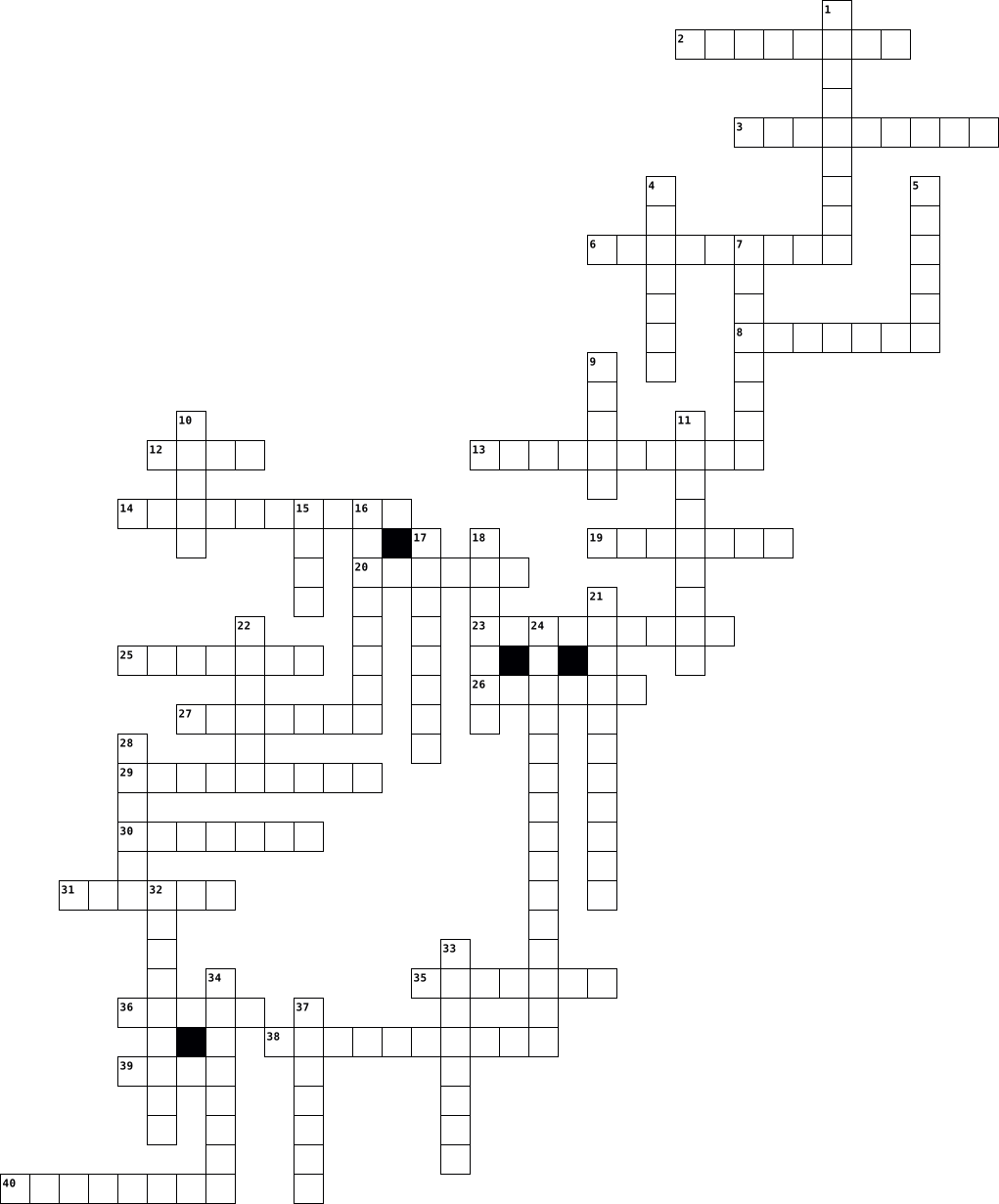
opposites Crossword Puzzles
English Final Review 2013-06-06

Across
- A character who provides striking contrast to another character
- The repetition of vowel sounds within nonrhyming words
- An extra scene put in to lower the tension from the story and it usually makes the audience laugh
- The occurrence of similar or identical sounds at the end of 2 words
- Comparing two things using like or as
- Comparing two things that are completely unrelated
- The repetition of constant sounds at the beginning of words
- a beginning scene that introduces the story
- A tragic work that presents the downfall of the tragic hero
- They comment on the characters action
- A special kind of contrast between appearance and reality
- Opposites
Down
- A piece of work that is entirely false and everything is usually made up Meter A regular pattern of stressed and unstressed syllables
- A problem that happens within he or she
- A story that is entirely true and has real people, events, and places
- A poem that has 14 lines
- unrhymed poetry written in iambic pentameter
- A speech in which a character speaks his or her own thoughts or feelings
- A person that has super human qualities but in the end they die
- Literature in which plots and characters are developed through dialogue and action
- Regular pattern of stressed and unstressed syllables
- The feeling or atmosphere that the reader or author creates
- An indirect reference to a famous person, place,event or literary work
- I saw the puffy white clouds slowly floating over the green grass
- A long narrative poem
- The message that the author is trying to convey to you
26 Clues: Opposites • A long narrative poem • A poem that has 14 lines • Comparing two things using like or as • They comment on the characters action • A problem that happens within he or she • a beginning scene that introduces the story • unrhymed poetry written in iambic pentameter • Comparing two things that are completely unrelated • ...
algebra 2023-12-14

Across
- represented by a dot used to mark an exact location
- process of combining two or more numbers
- point where two objects meet
- line drawn from top to bottom
- following each other in a sequence, one after another corresponds
- relation between a set of inputs having one output each
- the value of a numb er without regard to its sign
- y=mx+b
- straight line that goes from left to right or right to left
- The difference between the lowest and highest values
- mathematical statement that shows that two mathematical expressions are equal.
Down
- putting an equation into a simpler form
- part of a cartesian plane that is obtained when the two axes intersect each other
- term that is mathematically inexpressible, or without meaning
- all the whole numbers together with their opposites—not fractions or decimals solution
- straight line graph
- graphical technique for representing a data set, usually as a graph showing the relationship between two or more variables.quadrant
- the right most position in a number
- numbers that are written differently but represent the same amount
- set of a functions possible inputs
- equation that indicates how many time a number is added to itself
- the relation between two values that are not equal
- pair of matching sides that are in the same spot in two different shapes
- a structure amounting to a set of objects
- value or values which, when substituted for a variable in an equation, make the equation true
- ordered pairs of points that help us locate any point in a 2D plane or 3D space.
- beginning or starting point
- one-dimensional figure, which has length but no width and extends infinitely in both directions
28 Clues: y=mx+b • straight line graph • beginning or starting point • point where two objects meet • line drawn from top to bottom • set of a functions possible inputs • the right most position in a number • putting an equation into a simpler form • process of combining two or more numbers • a structure amounting to a set of objects • the value of a numb er without regard to its sign • ...
Math Vocabulary 2023-05-03

Across
- The set of whole numbers and their opposites
- A fraction in which the numerator is greater than the denominator
- The point where the x-axis and y-axis intersect on the coordinate plane
- A mathematical sentence that shows that two expressions are equivalent
- A mathematical sentence that shows the relationship between quantities that are not equivalent
- The number or numbers that occur most frequently in a set of data
- A figure made up of simple geometric shapes
- The distance around a circle
- A number that is multiplied by another number to get a product
- A letter or symbol used to represent an unknown value
- The sum of the items in a set of data divided by the number of items in the set
- The middle number
Down
- The result when one number is subtracted from another
- A line with one endpoint at the center of a circle and the other endpoint on the circle
- An integer less than zero
- The result when two or more numbers are added
- The ratio of the circumference of a circle to the length of its diameter π ≈ 3.14
- An integer greater than zero
- A mathematical phrase that contains operations, numbers, and/or variables
- A value much greater or much less than the others in a data set
- The number of cubic units needed to fill a given space
- A line that passes through the center of a circle
- The distance around a polygon
- The top number of a fraction
- The bottom number of a fraction
- The result when one number is divided by another
- A ratio that compares two quantities measured in different units
- The result when two or more numbers are multiplied
28 Clues: The middle number • An integer less than zero • An integer greater than zero • The top number of a fraction • The distance around a circle • The distance around a polygon • The bottom number of a fraction • A figure made up of simple geometric shapes • The set of whole numbers and their opposites • The result when two or more numbers are added • ...
colors 2023-09-24
Across
- What's happening outside, like rain.
- Different ways to travel, like planes.
- Things you wear, like shirts and shoes.
- What you do with food, like chewing.
- and Drinks: What you eat and drink, like pizza.
- Words that mean the opposite.
- Words: Words that tell about things.
- People in your home, like mom and dad.
- of the Year: Names of the months, like July.
- Repeating designs like stripes.
- The outdoors, like rivers and mountains.
- The universe and stars.
- Yummy things like apples and bananas.
- Special days like Christmas.
- Growing things like flowers and trees.
- Playing instruments like guitars.
- Where you go to learn new things.
- Measuring moments, like hours.
- Different places in the world.
- of the Week: Names of the days, like Monday.
- Words that describe actions.
Down
- How you feel, like happy or sad.
- Fun games like soccer and basketball.
- Things to help with tasks, like hammers.
- Tiny creatures like ants and bees.
- What people do for work, like teachers.
- Fun things to play with, like dolls.
- Emotions like love and anger.
- Parts: Parts of your body, like your head and arms.
- Counting from one to ten.
- Living creatures like cats and dogs.
- Different shapes like circles and squares.
- Healthy foods like carrots and broccoli.
- the House: Things you find in your home.
- Ways to get around, like cars and buses.
- and Colors: Combining shapes and colors.
- Creatures: Made-up animals like unicorns.
- Things you do, like running and jumping.
- Different times of the year.
- Different shades like red and blue.
40 Clues: The universe and stars. • Counting from one to ten. • Special days like Christmas. • Different times of the year. • Words that describe actions. • Emotions like love and anger. • Words that mean the opposite. • Measuring moments, like hours. • Different places in the world. • Repeating designs like stripes. • How you feel, like happy or sad. • Playing instruments like guitars. • ...
Math Vocabulary 2023-05-24

Across
- number that ends in 0,2,4,6,8
- answer to a multiplication problem
- way of describing the likelihood of an event as a percent
- quadrilateral that has two pairs of parallel sides
- a period of 10 years
- polygon that has four sides
- triangle where all sides are unequal
- length x width x height
- also known as the mean
- polygon that has eight sides
- distance around a polygon
- parallelogram with equal sides
- angle greater than 90 degrees
- the middle number in a set of numbers
- distance of a number from zero
- a number with only two factors
- polygon that has three sides and three angles
- triangle that has 2 sides of equal length
- a polygon with five sides
- a period of 1000 years
- flat surface of a geometric solid
- same shape and size
Down
- distance around the outer edge of a circle
- up and down
- quadrilateral that has four right angles
- number that ends in 1,3,5,7,9
- same shape but not the same size
- way of describing the likelihood of an event as a fraction
- distance across a circle
- answer to a division problem
- a period of 100 years
- a polygon with six sides
- angle that is less than 90 degrees
- side to side
- list of all the possible outcomes of an event
- top number of a fraction
- answer to a subtraction problem
- half the diameter
- bottom number of a fraction
- the number you see most in a set of numbers
- angle that measures exactly 90 degrees
- another word for average
- answer to an addition problem
- all counting numbers, their opposites, and zero
44 Clues: up and down • side to side • half the diameter • same shape and size • a period of 10 years • a period of 100 years • also known as the mean • a period of 1000 years • length x width x height • distance across a circle • a polygon with six sides • top number of a fraction • another word for average • distance around a polygon • a polygon with five sides • polygon that has four sides • ...
End of Year Math Terms 2023 2023-05-09

Across
- the numbers being multiplied together
- a repeated pattern that covers a plane without gaps or overlap
- all whole numbers and their opposites
- another word for exponent
- the middle number in a set
- sum or difference of monomials
- the number that occurs most often
- a chord that goes the through the center of the circle
- rise over run
- the answer to an addition problem
- to raise to the third power
- a date point much higher or much lower than all the other points
- a number being multiplied by a variable
- a polygon with 6 sides
- same size and shape
- describes a number that has exactly 2 factors
- when 2 angles' sum is 180 degrees
- a type of transformation where the object is turned
- the number of cubic units it takes to fill a space figure
- the only transformation where the size does not remain the same
Down
- the answer to a subtraction problem
- a mathematical sentence with an equal sign
- the answer to a division problem
- what we call letters in algebra class
- a type of transformation where the object slides
- comes before the word value to mean the distance from zero
- an example of an irrational number
- to cut in to 2 equal parts
- a type of transformation where the object is flipped
- to raise to the second power
- the intersection point of the x and y axis
- when 2 angles' sum is 90 degrees
- an angle that measures more than 90 degrees
- a type of number whose decimal never repeats or ends
- the theorem we use to find the lengths of sides of right triangles
- the answer to a multiplication problem
36 Clues: rise over run • same size and shape • a polygon with 6 sides • another word for exponent • the middle number in a set • to cut in to 2 equal parts • to raise to the third power • to raise to the second power • sum or difference of monomials • the answer to a division problem • when 2 angles' sum is 90 degrees • the number that occurs most often • the answer to an addition problem • ...
Algebra Real Numbers/Math Expressions Vocabulary 2024-10-25

Across
- Numbers and variables that are being multiplied together
- These numbers are the ratios of integers, also called fractions
- A number that only has the factors of 1 and itself
- A number that can be found on the number line.
- What the expression sits on. The part that has been raised to a power.
- A number that is not a fraction or decimal.
- A mathematical phrase or statement that can have variables numbers addition subtraction multiplication division parenthesis square roots and exponents
- A mathematic sentence, this sentence shows that two things are equal
- these are the counting numbers 1,2,3
- The word less than tells you to do what operation.
Down
- What is the name of class that you are doing this assignment for?
- These numbers are the natural numbers and their opposites
- It can be a number variable or both multiplied together. It can be separated by addition subtraction or division.
- This is the first thing you should do when doing order of operations.
- The word divided by tells you to do what operation,
- The number up in the air next to the base. The number of times you multiply something times itself.
- Symbols or letters used to represent an unknown number
- This number is any real number that cannot be expressed as a fraction a/b, where a and b are integers, with b non-zero
- The number that has no variable and it can be positive or negative
- The word product of tells you to do what operation.
- Terms that have the same variable raised to the same exponent(power).
- PEMDAS
- A number that has no variable and it can be positive or negative
- What operation does the word sum tell you to use.
24 Clues: PEMDAS • these are the counting numbers 1,2,3 • A number that is not a fraction or decimal. • A number that can be found on the number line. • What operation does the word sum tell you to use. • A number that only has the factors of 1 and itself • The word less than tells you to do what operation. • The word divided by tells you to do what operation, • ...
vocab #3 2024-11-15

Across
- a plateau in north-central China
- a physiographical region in Southern Asia
- a lush, expansive understanding of the divine accommodating a vast assortment of dynamic and multifaceted concepts
- formed a united defence system against invasions from the north
- they can avoid violence, suffering, and struggle
- the spiritual life principle of the universe
- the most ancient Hindu scriptures
- people who descend from the Proto-Indo-Europeans as a racial grouping
- the highest state that someone can attain
- the permanent professional branches of a government's administration
- a balance between two opposites
Down
- a monotheistic pre-Islamic religion of ancient Persia
- the truth of suffering, the truth of the cause of suffering, the truth of the end of suffering, and the truth of the path that leads to the end of suffering
- the idea that there could be only one legitimate ruler of China at a time
- an important political theory in Chinese history
- a member of the highest Hindu caste, that of the priesthood
- right view, right resolve, right speech, right conduct, right livelihood, right effort, right mindfulness, and right samadhi
- the eternal and inherent nature of reality
- developed the religion Hinduism through the different belief systems that citizens believed in
- the rebirth of a soul in a new body
- a social hierarchy passed down through families
- the virtue of exhibiting love and respect for one's parents, elders, and ancestors
- release from the cycle of rebirth impelled by the law of karma
- the sum of a person's actions in this and previous states of existence
- a member of a religious group who is sent into an area in order to promote its faith
- respect for all living things and avoidance of violence toward others
26 Clues: a balance between two opposites • a plateau in north-central China • the most ancient Hindu scriptures • the rebirth of a soul in a new body • a physiographical region in Southern Asia • the highest state that someone can attain • the eternal and inherent nature of reality • the spiritual life principle of the universe • a social hierarchy passed down through families • ...
algebra 1 2025-05-05

Across
- variable or expression is multiplied by. Combining like terms
- A polynomial with two terms. boundary condition, An extreme value in an inequality problem. Solutions will be less than or greater than that value
- function
- A ratio that compares two quantities measured in
- made up of one or more terms.
- The repeated factor of a number written in exponential
- a set X to a set Y assigns to each element of X exactly one element of Y. The set X is called the domain
- then for y is f(x), read "f of x", where f names
- If x is the independent variable and y is the dependent
- The numbers m and b give the slope and y -intercept of the line that is the graph of that equation
- The set of whole numbers and their opposites
- indicates how many times a number, or algebraic expression, should be multiplied by itself
Down
- equation that can be rearranged in standard form as where the variable x represents an unknown number
- The largest number that divides into two terms
- The relationship a/b of two quantities, a and b
- Terms with the same variables raised to the same
- an x . Coordinates: A point on a 2
- an equation that may be put in the form where are the variables, and are the coefficients
- is a symbol that we assign to an unknown value. It is usually represented by letters such as x, y, or t. For example, we might say
- is 1
- units
- s where the only common factor of a numerator and
- The distance between zero and the point representing real number on the number line
23 Clues: is 1 • units • function • made up of one or more terms. • an x . Coordinates: A point on a 2 • The set of whole numbers and their opposites • The largest number that divides into two terms • The relationship a/b of two quantities, a and b • Terms with the same variables raised to the same • A ratio that compares two quantities measured in • ...
Vocabulary Quarter 1 Math 8 2025-10-13

Across
- A number by itself that does not change
- Numbers that include non-repeating and non-terminating decimals
- The number in front of the variable
- A number that is the result of multiplying an integer to itself
- When we multiply the quantity outside of the parenthesis to all terms on the inside
- The list of whole numbers and their opposites
- This does not have any equal signs
- The amount saved on the price of a product
- A point of measure or comparison
- All numbers we talk about in this class
- The counting numbers
- The number of places after the decimal that we have when talking about money
- Increasing
- A smaller group inside of a larger group
- Two equal fractions
- A form of writing really big or really small numbers
Down
- Can be constants or variable terms separated by addition, subtraction, multiplication
- The amount added to the price that goes to the government
- The original total before anything is added or subtracted
- Making equal payments over time
- To estimate
- Terms Terms with the same variable that do not have to have the same coefficient
- To distribute and combine like terms
- Another word for equal
- Back to back
- Numbers that can be written as a ratio or fraction
- The percent a number increases or decreases over time
- The amount added to the cost of a service
- The list of positive numbers starting at 0
- Decreasing
- The number that is multiplied to itself
- The amount added to the price of a product to make profit
- A letter that represents an unknown number
33 Clues: Decreasing • Increasing • To estimate • Back to back • Two equal fractions • The counting numbers • Another word for equal • Making equal payments over time • A point of measure or comparison • This does not have any equal signs • The number in front of the variable • To distribute and combine like terms • A number by itself that does not change • The number that is multiplied to itself • ...
Math 6 Vocabulary 2026-01-05

Across
- To change a percent to a decimal, you move the decimal two places ______.
- Quadrant ____ has a postive x and a negative y value.
- You use this type of circle when graphing greater than
- We always turn our improper fractions into this. (2 words, no space)
- Any number raised to the power of ____ equals one.
- To change a decimal to a percent, you move the decimal two places _______.
- When we compare two quantities we find the _______.
- A number times itself creates a (2 words, no space)
- When multiplying a fraction times a whole number, a __ goes under the whole number
- The perfect square that falls between 4 and 16.
- Less than, greater than, less than or equal to, greater than or equal to
- Multiply two negatives and your answer will be ______.
- You use this type of circle when graphing an inequality that is less than or equal to
- Quadrant ___ contains (-,+)
- The distance a number is from zero (2 words, no space)
Down
- _______ means per 100.
- When dividing fractions, we multiply by the ______
- Another math term for raised to the power
- Whole Numbers, their opposites and zero are called _____
- The statement 8 x 8 x 8 is in _____________ form
- (3,4) and (-4,5) are known as ______ (2 words, no space)
- The numerator is bigger than the denominator is a ____fraction
- A letter that represents a number
- When subtracting integers, we ______, add the opposite
- This is where the x axis and y axis intersect (0,0)
- When dividing fractions, we keep, change, _______.
- To change a fraction into a decimal, you _____ the numerator by the denominator.
- When we turn our mixed numbers into improper fractions we multiply down and ____ up.
28 Clues: _______ means per 100. • Quadrant ___ contains (-,+) • A letter that represents a number • Another math term for raised to the power • The perfect square that falls between 4 and 16. • The statement 8 x 8 x 8 is in _____________ form • When dividing fractions, we multiply by the ______ • Any number raised to the power of ____ equals one. • ...
English Fun! 2026-01-06

Across
- film studio that created Toy Story, the first full-length CGI movie
- teen book series written by Rick Riordin
- introduces a list
- example of a coordinating conjunction
- example of a subordinating conjunction
- TV series features characters named Eleven, Max, and Vecna
- movie based on a video game that earned 1 billion in 2025
- instrument with 88 keys
- twisting or misrepresenting someone's argument
- a group of words that cannot stand alone
- video game features locations like Tilted Towers and Loot Lake
- sport that uses the terms “strike” and “spare”
- a noun which represents a feeling, idea or emotion
- descriptive details which include sensory details
- verb phrase that acts as a describing phrase
- connects two independent clauses
- a meaningful coincidence- usually opposites
- company that owns PlayStation
Down
- shows possession
- superhero who uses a shield made of vibranium
- plastic silverware is an example of a(n)____
- a positive or negative feeling attached to a word
- renames a noun with added description
- country home to Mount Fuji
- always used before the fan boys
- the name of the coffee shop in Friends
- an appeal to logic
- a present tense verb that becomes a subject
- music streaming that officially launched in 2008
- this element’s symbol is Fe
- intended exaggeration
- attack a person's character rather than their ideas
- an appeal to emotion
- the maximum number of players in a standard Among Us game
- youngest person ever to win a Grammy Award
- a sentences with two independent clauses
- hit song from KPop Demon Hunters
- largest organ in the human body
- idea or concept that is present through the entire body of literature
39 Clues: shows possession • introduces a list • an appeal to logic • an appeal to emotion • intended exaggeration • instrument with 88 keys • country home to Mount Fuji • this element’s symbol is Fe • company that owns PlayStation • always used before the fan boys • largest organ in the human body • hit song from KPop Demon Hunters • connects two independent clauses • ...
Word Formation - Opposites 1 2023-02-07

Across
- Although he has gone through the courses and training, Kassim still feels __________________ about doing the job.
- An __________________ way of having a friendly gathering is to organize a potluck in a park.
Down
- Joe’s dad __________________ his plan of finding a job instead of continuing his studies after Form 5.
- It was rude of you to __________________ your teacher when he was talking to you.
- The young detective __________________ the mystery behind the skeleton that was found hanging from a tree in the forest.
- Look at that little boy trying to hold back tears. He must be _________________ about something.
6 Clues: It was rude of you to __________________ your teacher when he was talking to you. • An __________________ way of having a friendly gathering is to organize a potluck in a park. • Look at that little boy trying to hold back tears. He must be _________________ about something. • ...
Coffee - find the opposites! 2021-12-18

Across
- Inside
- Black
Down
- Fast
- Cold
- Left
- East
6 Clues: Fast • Cold • Left • East • Black • Inside
PROBLEMS IN MY ENVIRONMENT - OPPOSITES 2025-09-04

Across
- clean
- light
- big
- ugly
- polluted
Down
- safe
- old
- short
- short
- old
10 Clues: old • big • old • safe • ugly • clean • light • short • short • polluted
Elements of Drama 2024-04-08

Across
- someone who contrasts the traits and actions of another character, often the protagonist.
- a play dealing with tragic events and having an unhappy ending, especially one concerning the downfall of the main character.
- elements of a sentence which do not contain information essential to the meaning of the sentence as a whole
- the foretelling or prediction of what is to come.
- an act of speaking one's thoughts aloud when by oneself or regardless of any hearers, especially by a character in a play.
- a remark or passage in a play that is intended to be heard by the audience but unheard by the other characters in the play.
Down
- reverse (invert) the normal word order of a structure, most commonly the subject-verb word order.
- figure of speech in which an opposition or contrast of ideas is expressed by parallelism of words that are the opposites of, or strongly contrasted with, each other,
- exaggerated statements or claims not meant to be taken literally.
- comic episodes in a dramatic or literary work that offset more serious sections.
- a story, poem, or picture that can be interpreted to reveal a hidden meaning, typically a moral or political one
11 Clues: the foretelling or prediction of what is to come. • exaggerated statements or claims not meant to be taken literally. • comic episodes in a dramatic or literary work that offset more serious sections. • someone who contrasts the traits and actions of another character, often the protagonist. • ...
Systems of Equations 2022-11-18

Across
- A system of equations is a set of one or more equations involving a number of variables. The solutions to systems of equations are the variable mappings such that all component equations
- question x + 3y = 1 -3x - 3y = -15
- To solve a system of linear equations graphically we graph both equations in the same coordinate system.
Down
- question - 3y = -1 y = x - 1
- solve one of the equations for either variable. Substitute the expression from Step 1 into the other equation. Solve the resulting equation.
- any coefficients are fractions, clear them. Make the coefficients of one variable opposites. Decide which variable you will eliminate.
6 Clues: question - 3y = -1 y = x - 1 • question x + 3y = 1 -3x - 3y = -15 • To solve a system of linear equations graphically we graph both equations in the same coordinate system. • any coefficients are fractions, clear them. Make the coefficients of one variable opposites. Decide which variable you will eliminate. • ...
Week 1 Vocabulary Crossword 2024-05-07

Across
- natural numbers, their opposites and zero. Can be positive or negative and do not contain fractions or decimals.
- a graph that represents the real numbers as ordered points on a line, may be horizontal or vertical.
- is the set of numbers containing all of the rational numbers and all of the irrational numbers.
Down
- know more than isolated facts and methods. They understand why a mathematical idea is important and how it works.
- a number that can be written as a fraction of two integers a/b, where b cannot equal zero. Can integers, fractions, and repeating and terminating decimals.
5 Clues: is the set of numbers containing all of the rational numbers and all of the irrational numbers. • a graph that represents the real numbers as ordered points on a line, may be horizontal or vertical. • natural numbers, their opposites and zero. Can be positive or negative and do not contain fractions or decimals. • ...
Atsuko 2.21.23 2023-02-21

Across
- I remember being extremely nervous when I ______ my husband’s parents for the first time.
- After my sister ______ my cooking, I said I’d never cook for her again until she apologized.
- My kids often ______ that the house is too cold in winter or too hot in summer.
- I’m always ______ by the end of summer vacation. Having my kids home is great, but exhausting.
- To be honest, he’s more of a(n) ______ than a friend.
- A lot of ______ are shy, but not all of them.
- He got a bit ______ when one of his male colleagues gave him an expensive box of heart-shaped chocolates on Valentine’s Day.
- When my boss said he needed to speak with me privately, I was filled with ______. I was certain he was going to fire me!
- My high school friend Audrey was actually a(n) ______. She was constantly comparing our test scores and pointing out my flaws.
Down
- battery After the big party, my ______ was extremely low.
- Do you ever wish that you could be more ______? Sometimes I wish I had more energy for socializing.
- I’m an introvert but my husband is a(n) ______. I guess it’s true that opposites attract!
- My husband likes going out, but our sons and I are ______.
- I’m much more ______ than my husband. He’s extremely social.
- Constructive criticism is great, but I think your comments were a bit too ______. Remember, he is just a kid!
- The YouTube video’s comment section was filled with ______. People who are rude for no reason really annoy me!
- I ______ an old friend last week. We enjoyed catching up over coffee.
17 Clues: A lot of ______ are shy, but not all of them. • To be honest, he’s more of a(n) ______ than a friend. • battery After the big party, my ______ was extremely low. • My husband likes going out, but our sons and I are ______. • I’m much more ______ than my husband. He’s extremely social. • I ______ an old friend last week. We enjoyed catching up over coffee. • ...
Write the OPPOSITES on the appropriate lines. 2023-05-28

Across
- The opposite of REDUCE
- The opposite of MOMENTARY
- The opposite of DETERIORATE
- The opposite of DETRIMENTAL
- The opposite of HEALTHY
- The opposite of MAJOR
Down
- The opposite of CONTINUOUS
- The opposite of OPEN
- The opposite of INNOCUOUS
- The opposite of DEAD
- The opposite of BENIGN
- The opposite of SMOOTH
- The opposite of BACK
13 Clues: The opposite of OPEN • The opposite of DEAD • The opposite of BACK • The opposite of MAJOR • The opposite of REDUCE • The opposite of BENIGN • The opposite of SMOOTH • The opposite of HEALTHY • The opposite of INNOCUOUS • The opposite of MOMENTARY • The opposite of CONTINUOUS • The opposite of DETERIORATE • The opposite of DETRIMENTAL
Vocab 2025-07-25

Across
- The feeling of being a stranger or disconnected from one’s environment or self.
- A division or contrast between two things that are presented as opposites or entirely different.
- The existence or ability to navigate between two different cultures or cultural identities.
- Extending across or transcending traditional cultural boundaries.
- The quality or state of having two parts, often in conflict with each other.
- The quality of ambiguity or disorientation that occurs in the middle stage of transitions, often associated with being "in-between" states.
- A situation, person, or thing that combines contradictory features or qualities.
- The process of changing from one state or condition to another, often implying a temporary phase of being between two worlds.
- The state of being out of harmony or inconsistent with the surroundings.
Down
- The process or state of breaking or being broken into parts, often used to describe a divided sense of self.
- The state of being removed from one’s original location or context, often causing a sense of loss or rootlessness.
- Mixed or contradictory feelings about something or someone.
- A struggle or clash between opposing forces or ideas, often internal or psychological.
- The process of being pushed to the edge of a group or society, often leading to a feeling of being caught between belonging and exclusion.
- The occurrence of ideas or elements that are in opposition or conflict with each other.
- The state of being stretched tight, either physically or emotionally, often due to opposing forces.
- The feeling of being isolated or estranged from a group or one’s surroundings.
- The state of being barred from one’s native country or cultural context, either voluntarily or forcibly.
- Something made by combining different elements, often used to describe cultural or identity blending.
19 Clues: Mixed or contradictory feelings about something or someone. • Extending across or transcending traditional cultural boundaries. • The state of being out of harmony or inconsistent with the surroundings. • The quality or state of having two parts, often in conflict with each other. • The feeling of being isolated or estranged from a group or one’s surroundings. • ...
psychology chapter 14 vocab 2021-12-13

Across
- the pattern of feelings, thoughts, and behavior that sets people apart from one another
- a person who tends to be active and self expressive and to gain energy from interaction with others
- in psychoanalytic theory, the personality component that is conscious and that controls behavior
- an aspect of personality that is considered to be reasonably consistent
- formation, in psychoanalytic theory, a defense mechanism by which the ego unconsciously switches unacceptable impulses into their opposites
- a defense mechanism in which the individual refuses to admit that a problem exists
- in psychoanalytic theory, the defense mechanism that removes anxiety arousing thoughts, feelings, and memories from one's consciousness
- in psychoanalytic theory, the reservoir of unconscious psychic energy that strives to satisfy basic sexual and aggressive drives
- in psychoanalytic theory, a defense mechanism by which an individual retreats to an earlier stage of development when faced with anxiety
- mechanism, psychological distortions used to remain psychologically stable or in balance
Down
- in psychoanalytic theory, the defense mechanism by which an individual finds justifications for unacceptable thoughts, impulses, or behaviors
- in psychoanalytic theory, a defense mechanism by which people attribute their own unacceptable impulses to others
- a person who tends to be more interested in his or her own thoughts and feelings than in what is going on around him or her
- the defense mechanism that shifts negative impulses toward a more acceptable object or person
- according to Freud, the part of personality that represents the individual's internalized ideals and provides standards for judgment
15 Clues: an aspect of personality that is considered to be reasonably consistent • a defense mechanism in which the individual refuses to admit that a problem exists • the pattern of feelings, thoughts, and behavior that sets people apart from one another • mechanism, psychological distortions used to remain psychologically stable or in balance • ...
Force and Motion Review 2021-09-24

Across
- when two bodies interact, they apply forces to one another that are equal in magnitude and opposite in direction
- the available power
- that the acceleration of an object is dependent upon two variables - the net force acting upon the object and the mass of the object.
- the change in velocity
- rapidity of motion or operation; swiftness; speed.
- physical power or strength possessed by a living being.
- the energy of a body or a system with respect to the position of the body or the arrangement of the particles of the system.
- surface resistance to relative motion, as of a body sliding or rolling.
- forces that are equal on opposite sides.
Down
- the force of attraction by which terrestrial bodies tend to fall toward the center of the earth.
- forces that are unequal on opposites sides.
- if the object is at rest or moving at a constant speed in straight line it will remain at rest unless a force act on it.
- Transfer the process by which energy is relocated from one system to another.
- the action or process of moving or of changing place or position; movement.
- the energy of a body or a system with respect to the motion of the body or of the particles in the system.
- the property of matter by which it retains its state of rest or its velocity along a straight line so long as it is not acted upon by an external force.
16 Clues: the available power • the change in velocity • forces that are equal on opposite sides. • forces that are unequal on opposites sides. • rapidity of motion or operation; swiftness; speed. • physical power or strength possessed by a living being. • surface resistance to relative motion, as of a body sliding or rolling. • ...
South Asia Crossword Puzzle by Chase Singletary 2024-05-06

Across
- This vast desert is located in northern China and southern Mongolia.
- Also known as the Yangtze River, it is the longest river in Asia and the third-longest in the world.
- Fine, yellowish soil found in the Huang He valley, contributing to its fertility.
- One of China's major agricultural regions, known for its fertile soil and densely populated cities.
- Traditional East Asian towers with multiple eaves, often used as religious monuments or landmarks.
- The capital city of China, known for its rich history and iconic landmarks like the Forbidden City and the Great Wall.
- A former British colony and now a Special Administrative Region of China, known for its vibrant culture and skyline.
- A Chinese philosophy and religion emphasizing harmony with nature and the balance of opposites.
Down
- A philosophical and ethical system based on the teachings of Confucius, emphasizing moral values and social harmony.
- An economic system where the government controls production, distribution, and prices of goods and services.
- Known as the "Roof of the World," this high plateau is located in Central Asia and is home to the Tibetan people.
- A regional variety of a language, often with distinct vocabulary and pronunciation.
- Also known as the Yellow River, it is the second-longest river in China and is often associated with its yellowish sediment.
- These are the tallest mountains in the world, stretching across several countries including Nepal and India.
- China's largest city and a global financial hub, located on the east coast.
15 Clues: This vast desert is located in northern China and southern Mongolia. • China's largest city and a global financial hub, located on the east coast. • Fine, yellowish soil found in the Huang He valley, contributing to its fertility. • A regional variety of a language, often with distinct vocabulary and pronunciation. • ...
Mahnets 2021-05-10

Across
- Alikes
Down
- Opposites
2 Clues: Alikes • Opposites
Alpha Club Day Activity! 2021-07-28

Across
- the man whose incompleteness theory broke maths
- the last name of a WW2 cartographer who was born in 1912 and cracked enigma
- _____ dilemma is famously studied in game theory
- A non orientable surface which is a two dimensional manifold
- this city played a major role in the inception of graph theory
- who uttered the words Cogito Ergo Sum
- the part of mathematics that deals with the study of chaos
- a cat pays 8 dollars to enter a place and a human pays 4 dollars, how much will a spider pay?
- the man who knew infinity
Down
- ifmmp (minus 1 alphabet)
- in the movie a beautiful mind, John Nash created a concept of game theory which is a cornerstone of modern economics...what's the name of the theory
- this concept is what they used to make the map of the world we all know today but it's also why the map is not accurate because there is disorientation when you try to flatten a curve (covid pun intended)
- A non orientable surface (have you seen loki?)
- just how multiplication and division are opposites in maths, so are addition and subtraction, what is the opposite of (e^x)
- what is 3.14159265359 into 2.71828182846 (approximately)
- the father of graph theory
- who said (a^n)+(b^n)≠(c^n) for a, b and c as positive integers
- a clock moves from midnight to 9 am. What is the sum of digits of the total degrees that the minute and hour hand moved in totality [sum of the digits(degrees of minute hand + degrees of hour hand)] (in words)
- ____ conjecture is one of the Millennium problem
19 Clues: ifmmp (minus 1 alphabet) • the man who knew infinity • the father of graph theory • who uttered the words Cogito Ergo Sum • A non orientable surface (have you seen loki?) • the man whose incompleteness theory broke maths • _____ dilemma is famously studied in game theory • ____ conjecture is one of the Millennium problem • ...
Literary Devices Terms 2023-02-23

Across
- The repetition of end sounds in two or more words or phrases that appear close to each other in a poem.
- A word that sounds like the sound it makes.
- The repetition of a sound at the beginning of words.
- An object, person, place, or action that has a meaning in itself, and that also stands for something larger than itself.
- The feeling that the writer creates for the reader.
- When an author repeats a word, phrase, sentence, or stanza for effect or emphasis.
- A story, picture, or other piece of art that uses symbols to convey a hidden or ulterior meaning, typically a moral or political one.
- A comparison of two things that are essentially different, using the words like or as.
- Figurative language in which nonhuman things or abstractions are represented as having human qualities.
Down
- A literary device that alludes to a later point in the story.
- An intentional and extreme exaggeration for emphasis or effect.
- The writer’s attitude toward a subject, character, or audience and is conveyed through the author’s choice of diction, imagery, figurative language, details, and syntax.
- A figure of speech in which opposites are paired for effect.
- A reference to a person, place, event, or literary work that a writer expects the reader to recognize and understand.
- A direct comparison without using like or as.
- A manner or “way” of writing.
- A literary technique used to create meaning that seems to contradict the literal meaning or events.
- Phrases people use in everyday language which do not make sense literally, but the meaning is understood.
- The lesson learned and/or central message of a literary work that the author wishes to convey about that subject.
19 Clues: A manner or “way” of writing. • A word that sounds like the sound it makes. • A direct comparison without using like or as. • The feeling that the writer creates for the reader. • The repetition of a sound at the beginning of words. • A literary device that alludes to a later point in the story. • A figure of speech in which opposites are paired for effect. • ...
Key Terms - Poetry 2025-05-08

Across
- The general mood/atmosphere that is communicated in the poem, often by the way in which something is expressed
- A phrase combining two terms that seem to be opposites
- The repetition of similiar or identical sounds in words which follow each other
- Describing a natural thing like the weather or the sea, as if it is feeling the emotion expressed by the poet/characters
- verse Poetry that avoids regular pattern of rhyme and rhythm, although it may use other repetitive patterns of word, phrases or structures
- General term to refer to word-pictures (images), figures of speech (similes, metaphors) and description
- Repeating a word or phrase
- A word or expression used of saying something which might be unpleasant or embarrassing
Down
- A word or phrase that suggests something else - often a story or idea that many people know
- Like the simile, is comparing one thing with another thing, but identifies them completely without using the words 'like' and 'as'
- Use of words which sound like the things they are describing
- An idea or feeling that is often associated with a specific word or phrase
- Just as in music, the pattern of beats created by the words in a poem and the way they are organised
- Comparing one thing to another thing using the words 'like'or 'as'
- A word or phrase that could mean more than one thing
- The repetition of words beginning with the same letter
- The use of words with matching sounds, often at the end of each line
- A technique in which the idea and perhaps rhythm of one line are continued and completed in the next line
- A play on words, in which two different meanings are suggested either by the same word or two similiar sounding words
19 Clues: Repeating a word or phrase • A word or phrase that could mean more than one thing • A phrase combining two terms that seem to be opposites • The repetition of words beginning with the same letter • Use of words which sound like the things they are describing • Comparing one thing to another thing using the words 'like'or 'as' • ...
Write the opposites of the adjectives 2023-12-13

Across
- generous
- unreliable
- disloyal
- unhappy
Down
- handsome
- tall
- unfriendly
- plump
- strong
- young
10 Clues: tall • plump • young • strong • unhappy • handsome • generous • disloyal • unfriendly • unreliable
Force and Motion Review 2021-09-24

Across
- the property of matter by which it retains its state of rest or its velocity along a straight line so long as it is not acted upon by an external force.
- forces that are equal on opposite sides.
- surface resistance to relative motion, as of a body sliding or rolling.
- the available power
- physical power or strength possessed by a living being.
- the force of attraction by which terrestrial bodies tend to fall toward the center of the earth.
- if the object is at rest or moving at a constant speed in straight line it will remain at rest unless a force act on it.
- the action or process of moving or of changing place or position; movement.
Down
- forces that are unequal on opposites sides.
- the energy of a body or a system with respect to the motion of the body or of the particles in the system.
- the change in velocity
- when two bodies interact, they apply forces to one another that are equal in magnitude and opposite in direction
- Transfer the process by which energy is relocated from one system to another.
- that the acceleration of an object is dependent upon two variables - the net force acting upon the object and the mass of the object.
- rapidity of motion or operation; swiftness; speed.
- the energy of a body or a system with respect to the position of the body or the arrangement of the particles of the system.
16 Clues: the available power • the change in velocity • forces that are equal on opposite sides. • forces that are unequal on opposites sides. • rapidity of motion or operation; swiftness; speed. • physical power or strength possessed by a living being. • surface resistance to relative motion, as of a body sliding or rolling. • ...
unit 2 math vocab 2024-07-22

Across
- to compared to something or someone
- that are the same distance from 0 on a number line but in opposite directions. Opposite numbers have the same numeral, but opposite signs.The opposite of a number is also called the additive inverse of that number.
- a number that can be expressed as the fraction & or the opposite of & where a and b are whole numbers and b # 0. Rational numbers can also be expressed as a decimal.
- numbers that are less than 0. They are located to the left of 0 on a horizontal number line and below 0 on a vertical number line.
- height above or below a given level, often sea level.
- a number's distance from O on the number line. Absolute value is never negative.
- an example that opposes or proves that an idea or claim is incorrect.
Down
- numbers that are greater than 0. They are located to the right of 0 on a horizontal number line and above 0 on a vertical number line.
- a statement that something is true or false. A claim can be proven with reasons and evidence and can be disproven with counterexamples.
- two numbers whose sum is zero. Opposite numbers form a zero pair.
- the set of whole numbers and their opposites.
- system of symbols or characters used to represent information.
- to use as a sign, symbol, or example for something.
13 Clues: to compared to something or someone • the set of whole numbers and their opposites. • to use as a sign, symbol, or example for something. • height above or below a given level, often sea level. • system of symbols or characters used to represent information. • two numbers whose sum is zero. Opposite numbers form a zero pair. • ...
Chapter 11 Puzzle 5 2026-03-04

Across
- formation ego defense mechanism in which a person confronted with anxiety swaps unacceptable urges or behaviors for their opposites
- ego defense mechanism in which a person confronted with anxiety makes excuses to justify behavior
- (RISB)projective test that is similar to a word association test in which a person completes sentences in order to reveal their unconscious desires, fears, and struggles
Down
- belief that one’s environment can determine behavior, but at the same time, people can influence the environment with both their thoughts and behaviors
- ego defense mechanism in which anxiety-related thoughts and memories are kept in the unconscious
- ego defense mechanism in which a person confronted with anxiety returns to a more immature behavioral state
- person who we actually are
- projective test that employs a series of symmetrical inkblot cards that are presented to a client by a psychologist in an effort to reveal the person’s unconscious desires, fears, and struggles
- stages of development stages of child development in which a child’s pleasure-seeking urges are focused on specific areas of the body called erogenous zones
9 Clues: person who we actually are • ego defense mechanism in which anxiety-related thoughts and memories are kept in the unconscious • ego defense mechanism in which a person confronted with anxiety makes excuses to justify behavior • ego defense mechanism in which a person confronted with anxiety returns to a more immature behavioral state • ...
PSYC 3303 Crossword Week 4 2015-07-28

Across
- one's intellectual attainments as shown by vocabulary and accumulated knowledge.
- the young adult's process of becoming their own person by means of integrating his or her own values and beliefs with those of others.
- hormones that cause muscles in the uterine wall to contract.
- a condition involving progressive loss of bone tissue.
- the first stage of ethnic identity development; similar to the diffusion or foreclosure identity statuses.
- the onset of menstruation.
- mental flexibility the ability to process information rapidly.
Down
- the absence of mentruation.
- according to Kohlberg a period during which moral judgmwents are derived from moral principles and people look to themselves to set moral standards.
- thinking that divides the cognitive world into opposites.
- the process by which the body converts food energyt to heat at a lower rate when a person eats less, because of, famine or dieting.
- the fourth stage in Piaget's cognitive developmental theory characterized by the capacity for flexible, reversible operations concerning abstract ideas and concepts.
- an eating disorder characterized by cycles of binge eating and purging as a means of controlling weight gain.
- the practice of people getting married to people who are similar to them.
- the experience of warmth toward another person that arises from feelings of closeness and connectedness.
- unblanced growth, such as the growth that occurs during the early part of adolescence and causes many adolescents to appear gawky.
- a theoretical period of development spanning the ages of 18 to 25 in which young people in developed nations engage in extended role exploration.
- thought processes directed at considering how we arrive at our beliefs, facts, and ideas.
18 Clues: the onset of menstruation. • the absence of mentruation. • a condition involving progressive loss of bone tissue. • thinking that divides the cognitive world into opposites. • hormones that cause muscles in the uterine wall to contract. • mental flexibility the ability to process information rapidly. • ...
Midterm Review 2023-11-22

Across
- requirement that measured and evaluated government workers, ensuring that talented people who could made a positive differenc
- A guide to behavior, actions and qualities Buddhists try to achieve to reach Enlightenment
- Teaches that human life is full of suffering, and that meditation, spiritual and physical labor, and good behavior are the wa
- political leadership uniting entire empire, kingdom, or nation
- Chinese belief system that emphasizes peace through respecting the flow of nature
- when people are ranked to create order and structure to society, people at the bottom follow (obey) those at the top
- basic pillars of Buddhist beliefs about the cause of suffering and how to escape it
- familial (family) and spiritual rituals (like honoring deceased ancestors and their spirits) that began in China.
- show proper respect and love for one’s parents, elders, and ancestors
- an idea that shows balanced opposites that create peace and stability
Down
- belief system that does not trust individuals and emphasizes that government or those with power should rule in a way that re
- systems to help the function and operation of every day living, schools, hospitals, roads, communication towers, internet
- international routes where goods and ideas are exchanged
- government officials who help organize and run daily government functions
- final state of being where one has the ultimate understanding and achievement of escaping suffering, also called Nirvana
- time period characterized by great growth, progress, and advancements that promotes all sorts of wealth, financial wealth, cu
- a force of energy that flows through nature, creates balance, peace, and harmony
- sometimes grassroots, like a common belief in democracy, sometimes forced upon people like a dominant religion
18 Clues: international routes where goods and ideas are exchanged • political leadership uniting entire empire, kingdom, or nation • show proper respect and love for one’s parents, elders, and ancestors • an idea that shows balanced opposites that create peace and stability • government officials who help organize and run daily government functions • ...
unit2 vocabulary 2021-11-30

Across
- Solution of Linear Equation
- A plane formed by the intersection of a horizontal number line and a vertical number line.
- The change in x between any two points on a line.
- The change in y between any two points on a line.
- The distance between a number and 0 on a number line; The absolute value of a number a is written as |a|.
- The form is Ax+By=C, where A and B are not both zero
- A linear equation written in the form y-1₁=m(x-x₁); The graph of the equation is a line that passes through the point (x₁,y₁), and has the slope m.
- The four regions created by the intersection of the horizontal and vertical number lines in a coordinate plane.
Down
- An equation whose graph is a line y=x-1.
- The x-coordinate of the point where a line crosses the x-axis.
- Numbers that are greater than 0.
- A linear equation written in the form y=mx+b; The graph of the equation is a line that has a slope of m and a y-intercept of b.
- The point, represented by the ordered pair (0,0), where the horizontal and vertical number lines intersect in a coordinate plane.
- The y-coordinate of the point where a line crosses the y-axis.
- The value of a ratio of the change in y (the rise) to the change in x (the run) between any two points on a line, Slope is measure of the steepness of a line.
- ordered pair (x,y) that makes an equation true.
- Numbers that are less than 0.
- Two numbers that are the same distance from 0 on a number line, but on opposite sides of 0.
18 Clues: Solution of Linear Equation • Numbers that are less than 0. • Numbers that are greater than 0. • An equation whose graph is a line y=x-1. • ordered pair (x,y) that makes an equation true. • The change in x between any two points on a line. • The change in y between any two points on a line. • The form is Ax+By=C, where A and B are not both zero • ...
Expressions 2025-02-06

Across
- Terms that have the same variable raised to the same power (e.g., 2x and 5x
- The process of simplifying an expression by adding or subtracting like terms.
- To combine like terms and perform operations to make an expression more concise
- The numerical factor in a term with a variable
- An operation that reverses another (e.g., multiplication and division, addition and subtraction)
- The largest number or expression that divides two or more terms exactly.
- A letter or symbol that represents an unknown value
- The process of writing an expression as a product of its factors
- A single number, variable, or the product of numbers and variables separated by addition or subtraction
- a mathematical statement with an 'equal to' symbol between two expressions that have equal values
Down
- To apply the distributive property to rewrite a factored expression as a sum or difference
- property: when you multiply a number by a sum (like two numbers added together inside parentheses), you can multiply the number by each individual number in the sum, then add the results together
- the relationship between factoring and expanding/distributing
- a statement involving at least two different numbers (known or unknown) and at least one operation (no equal sign)
- property: you can change the order of numbers when adding or multiplying them, and the answer will still be the same
- A number or expression that divides another number or expression evenly.
- A number on its own, without a variable
- property: when adding or multiplying three or more numbers, the result stays the same no matter how you group the numbers together using parentheses
18 Clues: A number on its own, without a variable • The numerical factor in a term with a variable • A letter or symbol that represents an unknown value • the relationship between factoring and expanding/distributing • The process of writing an expression as a product of its factors • A number or expression that divides another number or expression evenly. • ...
Learn the Signs. Act Early. 2024-03-09

Across
- The AAP recommends using a validated developmental screening tool at the 9, 18 and ___ month well-visits.
- Children aged 0-3 years can be referred to these programs for evaluation and treatment of developmental delays.
- The disorder that should be screened for at 18 AND 24 months.
- At 15 months, a language milestone achieved by 75% of children is to ____ at a familiar object when it is named
- The appropriate next step after a concern is identified during developmental surveillance.
- Children aged 3 years and older can be referred to these services for evaluation and treatment of developmental delays.
- A positive screen identifying developmental concerns should lead to this.
- At 6 months, a physical milestone achieved by 75% of children is to lean on hands to support themselves while ____
- Exposure to this element may prompt a healthcare provider to conduct developmental screening more frequently
Down
- The process of using validated tools at recommended ages to identify areas of concern.
- This is a type of early childhood mental health service that can be helpful for children with behavior problems
- The CDC developmental milestones checklists include these to help caregivers promote development
- The CDC developmental domains include social/emotional, language/communication, movement/physical and ________
- Describes a longitudinal and continuous process that should occur at each health supervision visit to identify children with developmental concerns
- This is a free app created by the CDC that parents can use to track developmental milestones.
- CDC milestone checklists are provided from ages 2 months to __ years.
- The CDC developmental milestone checklists are based on the things that __ % of children can do at a certain age.
- At 4 years old, children understand opposites, such as the opposite of over is ________
18 Clues: The disorder that should be screened for at 18 AND 24 months. • CDC milestone checklists are provided from ages 2 months to __ years. • A positive screen identifying developmental concerns should lead to this. • The process of using validated tools at recommended ages to identify areas of concern. • ...
Unit 7 pt 2 2022-03-08

Across
- an individual's characteristic pattern of thinking, feeling, and acting
- a test (such as the MMPI) developed by testing a pool of items and then selecting those that discriminate between groups
- a theory of death-related anxiety; explores people's emotional and behavioral responses to reminders of their impending death
- a reservoir of unconscious psychic energy that, according to Freud, strives to satisfy basic sexual and aggressive drives
- in psychoanalytic theory, the basic defense mechanism that banishes from consciousness anxiety-arousing thoughts, feelings, and memories
- in psychoanalytic theory, according to Freud, a lingering focus of pleasure-seeking energies at an earlier psychosexual stage, in which conflicts were unresolved
- in contemporary psychology, assumed to be the center of personality, the organizer of our thoughts, feelings, and actions
- transferring of unacceptable impulses into socially valued motives
- the process by which, according to Freud, children incorporate their parents' values into their developing superegos
Down
- focuses on the effects of learning on our personality development
- theories that view personality with a focus on the unconscious and the importance of childhood experiences
- the part of personality that, according to Freud, represents internalized ideals and provides standards for judgment (the conscience) and for future aspirations
- a readiness to perceive oneself favorably
- psychoanalytic defense mechanism by which the ego unconsciously switches unacceptable impulses into their opposites
- according to Maslow, the striving for identity, meaning, and purpose beyond the self
- giving priority to the goals of one's group (often one's extended family or work group) and defining one's identity accordingly
- refusing to believe or even perceive painful realities
- the largely conscious, "executive" part of personality
18 Clues: a readiness to perceive oneself favorably • refusing to believe or even perceive painful realities • the largely conscious, "executive" part of personality • focuses on the effects of learning on our personality development • transferring of unacceptable impulses into socially valued motives • ...
Romance Movies 2023-02-07

Across
- Soldier John Tyree meets an idealistic college student Savannah Curtis, which starts the beginning of a strong romance.
- Childhood best friends take years to finally discover their feelings for each other.
- A struggling jazz pianist and an aspiring actress fall in love while pursuing their dreams.
- Hazel and Gus, two cancer patients meet in a support group and fall in love.
- A young woman falls in love with her dance instructor at a vacation resort.
Down
- Young and shy Quentin is in for the night of his life when Margo, the most popular student at their high school recruits him to help her play pranks on her friends who betrayed her.
- Tony and Maria’s romance helps to fuel the fire between two rival gangs, the Jets and the Sharks.
- Maria takes the job of being a governess to a large family while she decides whether to become a nun.
- A positive woman becomes the caregiver of a paralyzed man with an extremely negative outlook on life.
- Two eighth graders start to have feelings for each other, despite being total opposites.
- A story of unwavering love, and the effects of dementia on patients and their caregivers.
- Two people from different social classes fall in love aboard a ship that sinks.
- A middle-aged husband’s life changes when his wife asks for a divorce, and he seeks help from a young player he met at a bar.
13 Clues: A young woman falls in love with her dance instructor at a vacation resort. • Hazel and Gus, two cancer patients meet in a support group and fall in love. • Two people from different social classes fall in love aboard a ship that sinks. • Childhood best friends take years to finally discover their feelings for each other. • ...
andrew tate 2022-09-29

Across
- a diagram showing the relation between variable quantities, typically of two variables, each measured along one of a pair of axes at right angles.
- a person or thing that is totally different from or the reverse of someone or something else.
- the process of making known one's thoughts or feelings.
- a decimal fraction in which a figure or group of figures is repeated indefinitely, as in 0.666… or as i
- a decimal which can be expressed in a finite number of figures or for which all figures to the right of some place are zero
- the arrangement or disposition of people or things in relation to each other according to a particular sequence, pattern, or method. x
- find an answer to, explanation for, or means of effectively dealing with (a problem or mystery).
Down
- any number that can be written as a fraction, where both the numerator (the top number) and the denominator (the bottom number) are integers, and the denominator is not equal to zero.
- the magnitude of a real number without regard to its sign.
- whole number; a number that is not a fraction
- whole numbers - Google Search
- a number that when added to a given number gives zero Dividing 0 by any number gives us a zero
- a statement that the values of two mathematical expressions are equal (indicated by the sign =).
13 Clues: whole numbers - Google Search • whole number; a number that is not a fraction • the process of making known one's thoughts or feelings. • the magnitude of a real number without regard to its sign. • a person or thing that is totally different from or the reverse of someone or something else. • ...
Unit 1. Opposites Attract? / Dating and Mate Selection 2022-04-11

Across
- n. the mating of like with like
- n. a fundamental truth that is the basis for a system of beliefs or behaviors
- v. to appear suddenly
- n. a quality that distinguishes a person or from other people
- adv. in an interesting or unexpected manner
- n. a single human being
- adj. having the possibility to become something in the future
Down
- n. an organization in which people or things are ranked
- v. to become aware or conscious of something
- v. to give meaning to something
- adj. loyal and willing to give your time and energy to something that you believe in
- adj. relating to the body rather than the mind
- adj. providing help and support to someone or something
- adj. worth having and wanted by most people
- adj.relating to national and cultural origins
- v. to remove from consideration; leave out
16 Clues: v. to appear suddenly • n. a single human being • v. to give meaning to something • n. the mating of like with like • v. to remove from consideration; leave out • adj. worth having and wanted by most people • adv. in an interesting or unexpected manner • v. to become aware or conscious of something • adj.relating to national and cultural origins • ...
Opposites - Write the answers on the line too 2025-01-27

Across
- I'm so ______________! I ate too much food. (hungry)
- Do not run across the busy road. It is not ______________. (dangerous)
- My neighbour is very ______________. (unfriendly)
- This math question is so ______________! (difficult).
- My friend is very ______________. (quiet)
- My friend is very ______________. She always share her things. (selfish)
- My teacher is a ______________ person. She always make us laugh. (serious)
Down
- Be ______________ on the stage! You can do it! (shy)
- My mother is a ______________ person, she talks softly and gently. (angry)
- My art teacher is very ______________, she has many ideas. (boring, no imagination)
- The road is too ______________! Drive slowly! (smooth)
- We need to eat vegetables and fruit to stay ______________. (sick)
- The ______________ soldier fought for the country. (scared)
- My glass is ______________! Can I have more water? (full)
- My brother is always ______________ for school because he cannot wakes up. (early)
- We have to ______________ to our friends in school. Let's help each other. (mean)
16 Clues: My friend is very ______________. (quiet) • My neighbour is very ______________. (unfriendly) • Be ______________ on the stage! You can do it! (shy) • I'm so ______________! I ate too much food. (hungry) • This math question is so ______________! (difficult). • The road is too ______________! Drive slowly! (smooth) • ...
Unit 7 pt 2 2022-03-08

Across
- an individual's characteristic pattern of thinking, feeling, and acting
- a test (such as the MMPI) developed by testing a pool of items and then selecting those that discriminate between groups
- a theory of death-related anxiety; explores people's emotional and behavioral responses to reminders of their impending death
- a reservoir of unconscious psychic energy that, according to Freud, strives to satisfy basic sexual and aggressive drives
- in psychoanalytic theory, the basic defense mechanism that banishes from consciousness anxiety-arousing thoughts, feelings, and memories
- in psychoanalytic theory, according to Freud, a lingering focus of pleasure-seeking energies at an earlier psychosexual stage, in which conflicts were unresolved
- in contemporary psychology, assumed to be the center of personality, the organizer of our thoughts, feelings, and actions
- transferring of unacceptable impulses into socially valued motives
- the process by which, according to Freud, children incorporate their parents' values into their developing superegos
Down
- focuses on the effects of learning on our personality development
- theories that view personality with a focus on the unconscious and the importance of childhood experiences
- the part of personality that, according to Freud, represents internalized ideals and provides standards for judgment (the conscience) and for future aspirations
- a readiness to perceive oneself favorably
- psychoanalytic defense mechanism by which the ego unconsciously switches unacceptable impulses into their opposites
- according to Maslow, the striving for identity, meaning, and purpose beyond the self
- giving priority to the goals of one's group (often one's extended family or work group) and defining one's identity accordingly
- refusing to believe or even perceive painful realities
- the largely conscious, "executive" part of personality
18 Clues: a readiness to perceive oneself favorably • refusing to believe or even perceive painful realities • the largely conscious, "executive" part of personality • focuses on the effects of learning on our personality development • transferring of unacceptable impulses into socially valued motives • ...
English 12 Part 1 terms 2025-09-16

Across
- When two opposites are placed side by side to highlight the differences between them (the newly constructed building shone in glory next to the run down apartment)
- the use of words to create a picture in the mind of the reader (the sweet smell of the bread filled the living room)
- sudden recounting of past events, typically used to give background information (The smell of my mom’s cooking took me back to when I was a little boy)
- A hint at an important event later in the story (“I didn’t study at all for this test”)
- The repetition of a letter or sound in close words (Alex ate apples all day)
Down
- When words are used in a non literal sense to create more powerful writing (Drew’s whistle was as loud as a siren)
- A short and clever statement that states a truth (practice makes permanent)
- When the opposite of what is expected happens, usually in a comedic fashion (the tennis player doesn’t know how to serve)
8 Clues: A short and clever statement that states a truth (practice makes permanent) • The repetition of a letter or sound in close words (Alex ate apples all day) • A hint at an important event later in the story (“I didn’t study at all for this test”) • ...
Poetic techniques 2026-04-23

Across
- The special atmosphere or mood created by a particular environment: "The noir ambience is dominated by low- key lighting . . . and deep shadows, creating feelings of disorientation, loneliness and entrapment" .
- implies the opposite of what is said. The intention is for the opposite to be understood. It is the tone which tempers or conveys this meaning. For example: “I can’t wait for my detention on Friday afternoon.”
- The repetition of consonant sounds within close proximity, usually in consecutive words within the same sentence or line.
- Compare by observing differences or opposites.
- The running on of the thought from one line, couplet, or stanza to the next without a syntactical break (full stop, comma).
Down
- is a comparison without the use of “like” or “as”. A direct relationship where one thing or idea substitutes for another
- Language which describes something in detail, using words to substitute for and create sensory stimulation, including visual imagery and sound imagery.
- An overused expression or idea, e.g. ‘to die for’; ‘as thick as a plank’
- Reference to matters outside of literary work. For example, people, events, myths, legends, biblical, historical, Shakespearean, contemporary references.
- Where future events in a story, or perhaps the outcome, are suggested by the author before they happen
10 Clues: Compare by observing differences or opposites. • An overused expression or idea, e.g. ‘to die for’; ‘as thick as a plank’ • Where future events in a story, or perhaps the outcome, are suggested by the author before they happen • is a comparison without the use of “like” or “as”. A direct relationship where one thing or idea substitutes for another • ...
Poetic techniques 2026-04-23

Across
- The special atmosphere or mood created by a particular environment: "The noir ambience is dominated by low- key lighting . . . and deep shadows, creating feelings of disorientation, loneliness and entrapment" .
- implies the opposite of what is said. The intention is for the opposite to be understood. It is the tone which tempers or conveys this meaning. For example: “I can’t wait for my detention on Friday afternoon.”
- The repetition of consonant sounds within close proximity, usually in consecutive words within the same sentence or line.
- Compare by observing differences or opposites.
- The running on of the thought from one line, couplet, or stanza to the next without a syntactical break (full stop, comma).
Down
- is a comparison without the use of “like” or “as”. A direct relationship where one thing or idea substitutes for another
- Language which describes something in detail, using words to substitute for and create sensory stimulation, including visual imagery and sound imagery.
- An overused expression or idea, e.g. ‘to die for’; ‘as thick as a plank’
- Reference to matters outside of literary work. For example, people, events, myths, legends, biblical, historical, Shakespearean, contemporary references.
- Where future events in a story, or perhaps the outcome, are suggested by the author before they happen
10 Clues: Compare by observing differences or opposites. • An overused expression or idea, e.g. ‘to die for’; ‘as thick as a plank’ • Where future events in a story, or perhaps the outcome, are suggested by the author before they happen • is a comparison without the use of “like” or “as”. A direct relationship where one thing or idea substitutes for another • ...
Cold War Crossword I guess... I need a decent grade...please 2025-02-05

Across
- One of the superpowers after WW2
- It was a physical wall that separated West and East Berlin. The wall was Guarded and was 155 kilometers long
- it was a movement that happened in 1961. It was used to develop countries.
- It was a competition between the US and the Soviet Union. It was who could go to space first and who would be more advanced in the technology to go with it
- it was a strategic pursuit from the US to prevent the spread of Communism
- The Soviet Union created a blockade to allied controlled areas of Berlin. The US and UK then flew supplies into those parts.
- A program that provided economic aid to western Europe
Down
- He was the leader of northern Vietnam. He was a communist leader who went against French colonization.
- A meeting in 1945 between the leaders of the allied powers.
- This is the line that separates the northern and southern hemispheres. This line also separates North and South Korea.
- It was an imaginary boundary line that separated Europe into two. It started the beginning of the Cold war and ended at the end of the war.
- a country that seems independent but is actually controlled by another country.
- one of the superpowers after WW2
- Another competition between the US and Soviet Union. This race was about who could develop the more powerful nuclear weapon.
- It was a pact between the Soviet Union and a few Eastern European countries. The Warsaw pact and NATO are opposites of each other.
15 Clues: One of the superpowers after WW2 • one of the superpowers after WW2 • A program that provided economic aid to western Europe • A meeting in 1945 between the leaders of the allied powers. • it was a strategic pursuit from the US to prevent the spread of Communism • it was a movement that happened in 1961. It was used to develop countries. • ...
Vocabulary- Opposites 2022-08-05

Across
- taste of tamarind
Down
- you are sick
- appreciate someone
3 Clues: you are sick • taste of tamarind • appreciate someone
7.NS.A.1a 2025-08-08

Across
- The distance a number is from zero on the number line, regardless of direction. Example: The absolute value of -7 is 7.
- Two numbers that are the same distance from 0 on the number line but on opposite sides. Example: +4 and -4
- A visual representation of numbers in order on a straight line, where zero is typically in the center, with positive numbers to the right and negative numbers to the left.
- A whole number that can be positive, negative, or zero. Examples: -3, 0, 5
- A number greater than zero. Found to the right of zero on the number line.
Down
- To add together two or more quantities or values.
- A number less than zero. Found to the left of zero on the number line.
- The result of adding two or more numbers together.
- A pair of numbers that are opposites and add up to zero. For example, (+3) and (-3) form a zero pair.
- The number you add to a given number to get zero. For any number a, its additive inverse is -a. Example: 5 and -5 are additive inverses.
- A situation or scenario from everyday life used to apply mathematical concepts. For example, gaining and losing money, rising and falling temperatures, or elevation above and below sea level.
11 Clues: To add together two or more quantities or values. • The result of adding two or more numbers together. • A number less than zero. Found to the left of zero on the number line. • A whole number that can be positive, negative, or zero. Examples: -3, 0, 5 • A number greater than zero. Found to the right of zero on the number line. • ...
Unit 3 Crossword 2026-05-12

Across
- The corner or turning point of an absolute value graph. It represents the maximum or minimum point of the v shape
- A number that is either positive or zero. The result of an absolute value operation is always non-negative.
- Two numbers that have the same absolute value but different signs
- In a geometric sense, the space between two points. Since distance cannot be negative, absolute value is the primary tool used to calculate it
- of Symmetry A vertical line that passes through the vertex and divides the V graph into two perfectly mirrored halves
- The expression or number located inside the absolute value bars
- A term is often used interchangeably with absolute value it refers to the size or largeness of a number regardless of its sign
Down
- An and statement often resulting from absolute value inequalities
- Value The distance a number is from zero on a number line, It is always expressed as a non-negative value
- Solution A solution acquired during the algebraic process that does not actually satisfy the original absolute value equation when plugged back in
- The characteristic geometric shape of an absolute value function graph
- junction An or statement often resulting from absolute value inequalities
- Symbols The vertical bars used to enclose a number or expression to indicate that the absolute value should be taken
- Value Function A function containing an algebraic expression within absolute value symbols
- The point labeled 0 on a number line or on a coordinate plane. Absolute value measures how far a point is from this specific location
15 Clues: The expression or number located inside the absolute value bars • An and statement often resulting from absolute value inequalities • Two numbers that have the same absolute value but different signs • The characteristic geometric shape of an absolute value function graph • junction An or statement often resulting from absolute value inequalities • ...
Find the opposites of the words given as clues 2020-03-28

Across
- - quiet
- - dreary
- - zenith
- - voluntary
- - graceful
- - lenient
- - some
- - safe
- - narrow
- - senior
- - wild
Down
- - exclude
- - natural
- - decline
- - contaminated
- - rude
- - collect
- - contract
- - miser
- - straight
- - proud
- - pessimist
- - courteous
- - shut
- - opposite
25 Clues: - rude • - some • - safe • - wild • - quiet • - miser • - proud • - shut • - dreary • - zenith • - narrow • - senior • - exclude • - natural • - decline • - collect • - lenient • - contract • - graceful • - straight • - opposite • - voluntary • - pessimist • - courteous • - contaminated
weeks 1-6 vocabulary (ALL OPPOSITES) Lola and Olyvia 2017-11-08

Across
- To get something free
- Bright
- Chous
- To not hide
- One place
- To do something for a short time
- Right and fair
- Dead plants
- Not yummy
Down
- Quiet
- Shy
- Not a strong female
- Advantage
- To not litter
- Not needed in life
- Shorten
- To get strong feelings
- Likes people
- TO give in to something
- A increase
20 Clues: Shy • Quiet • Chous • Bright • Shorten • Advantage • One place • Not yummy • A increase • To not hide • Dead plants • Likes people • To not litter • Right and fair • Not needed in life • Not a strong female • To get something free • To get strong feelings • TO give in to something • To do something for a short time
Opposites Crossword 2014-04-19

Across
- the opposite of full
Down
- the opposite of slow
- the opposite of dry
3 Clues: the opposite of dry • the opposite of slow • the opposite of full
Write the OPPOSITES on the appropriate lines. 2023-05-28

Across
- The opposite of CONTINUOUS
- The opposite of INNOCUOUS
- The opposite of DEAD
- The opposite of HEALTHY
- The opposite of SMOOTH
Down
- The opposite of DETERIORATE
- The opposite of REDUCE
- The opposite of MOMENTARY
- The opposite of OPEN
- The opposite of BACK
- The opposite of BENIGN
- The opposite of MAJOR
12 Clues: The opposite of OPEN • The opposite of BACK • The opposite of DEAD • The opposite of MAJOR • The opposite of REDUCE • The opposite of BENIGN • The opposite of SMOOTH • The opposite of HEALTHY • The opposite of MOMENTARY • The opposite of INNOCUOUS • The opposite of CONTINUOUS • The opposite of DETERIORATE
Contrarys - Opposites (The answer is opposite to the clue) 2023-06-27

Across
- Gleb
- Drehavel
- Tewl
- Lent
- Lowen
- Pell
- Degea
- Gwag
- Cales
- Sogh
- Hanaja
- Blewak
- Bras
- Cam
Down
- Adhelergh
- Scav
- Garow
- Herdhya
- Hager
- gwetha
- Ena
- Assentya
- Cot
- Cref
- Coth
25 Clues: Ena • Cot • Cam • Gleb • Scav • Tewl • Lent • Pell • Gwag • Sogh • Cref • Coth • Bras • Garow • Lowen • Hager • Degea • Cales • gwetha • Hanaja • Blewak • Herdhya • Drehavel • Assentya • Adhelergh
Interior Design 2022-09-21

Across
- a complete description of building systems (structural, mechanical, HVAC, plumbing and electrical), interior and exterior finishes and the building site.
- where two or more elements that have opposite characteristics are placed together.
- you take one basic color and apply color theory to create a range of hues by playing with the various tones, shades, and tints that can be created from the original.
- furniture that stands out by adding character and personality to a room while complementing the general décor.
- a decor that comprises heterogeneous elements — a mixture of textures, time periods, styles, trends, and colors.
- a collection of lines and forms, making it a part of the “line” family of elements along with form
Down
- obtaining bids from contractors, sub-contractors and vendors who will provide products and or services to implement the design into the space.
- the Tender Documents, Designs, Drawings, Specifications, Schedule of Quantities and Rates, Letter of Acceptance and agreed variations if any, and such other documents constituting the tender and acceptance thereof.
- he process of gathering and analyzing information about a problem before trying to solve it with design.
- occurs when you have different visual images on either side of a design, and yet the image still seems balanced.
- a set of opposites for on the color wheel
- matching nightstands on either side of a perfectly-centered bed, or matching sofas flanking a fireplace.
12 Clues: a set of opposites for on the color wheel • where two or more elements that have opposite characteristics are placed together. • a collection of lines and forms, making it a part of the “line” family of elements along with form • he process of gathering and analyzing information about a problem before trying to solve it with design. • ...
Review 2024-10-21

Across
- Do you remember the opposites? Now it's a good time to try, because what I want is the opposite of cheap.
- Come on, this crossword is not difficult, it's so easy that I can say it's a piece of _____
- I can do anything today, except dance ballet, but little Amanda _____ she was a dancer as they say...
- A synonym of sorry. I'm sorry = I ______
- What is the name of my favorite student?
- What, When, Which, Who, there is one word missing, let me see... ____ are you?
- I use this word when I'm one hundred percent talking about frequency.
Down
- Ok, this one is big, it's a proverb, but can't you see? It's the only one that is big, because it's an event so rare that more than one can't appear.
- Brrrr, I don't like this season, the snow gets everywhere.
- This is easy, please repeat, when the sentence is in the present continuous we put ___
- Today is sunny, and it's hot outside, I shouldn't wear pants, that would be bad. That's why it's best to wear a _____.
- Do you remember the parts of the house? I do hope so, because I drank too much water, where should I go?
- This is an OBLIGATION. Complete this word. It's an order, you ____ complete it.
- If I can't put -ed when the verb is in the past I have to memorize it because it is an ________ verb.
- When I compare two small words I just have to put ___+than and the magic is done.
15 Clues: A synonym of sorry. I'm sorry = I ______ • What is the name of my favorite student? • Brrrr, I don't like this season, the snow gets everywhere. • I use this word when I'm one hundred percent talking about frequency. • What, When, Which, Who, there is one word missing, let me see... ____ are you? • ...
2023 OCAT Practice - LEC 3 - Proteins 2023-09-22

Across
- AI is more useful than for writing Praxis reflections, look at how it almost solved this problem.
- [BONUS] ELISA's a social science before I come in. Use me to start working with numbers.
- Here, I'm one out of hundreds of siblings, but only I get to decide how long we live or die.
- I'm large, unique, and shaped like a "Y", if I don't know you, you will be neutralized!
- Not everyone gets to shake hands, only the big boys do.
- Centro would fail a food safety inspection if these were found in the "creamy beef tenderloin"
- When tetracycline covers here, there is no other choice but to RUSH B!
- Sounds like I should be from math, not biology. But you can count on me.
- When a couple who are opposites meet, they shed a tear, and I'm created (2 words)
Down
- Don't waste me - I'm not SCP-500 or a miracle pill, but there's not a lot left in the world.
- I give up! There's too many mistakes to fix!
- I don't belong here. I kicked sulfur out and I'm here to stay.
- Bioinformatics are an EXPLOSIVE discovery, even thought I have a short FUSE when having to search things up.
- When I'm free, I'm not at liberty - my hard work still can't leave my jail cell
- Not only do I drive on the wrong side of the road, I'll also be stuck in a roundabout.
- I look like a sweet chicken leg, but at least I'll go where I'm supposed to.
- Maybe Sweden has grade inflation too, look how bad he is at math!
17 Clues: I give up! There's too many mistakes to fix! • Not everyone gets to shake hands, only the big boys do. • I don't belong here. I kicked sulfur out and I'm here to stay. • Maybe Sweden has grade inflation too, look how bad he is at math! • When tetracycline covers here, there is no other choice but to RUSH B! • ...
algebra crossword puzzle 2026-03-18

Across
- A mathematical phrase containing numbers, variables, and operators (like \(+\) or \(-\)) but no equal sign (e.g., \(8x - 9y\)).
- The value of a variable that makes an equation true, or the solution to a polynomial equation.
- A mathematical statement asserting that two expressions are equal, featuring an equals sign (e.g., \(4x - 7 = 5\)).
- Any number from the set of whole numbers and their opposites, including negative numbers, zero, and positive numbers (\(\dots, -2, -1, 0, 1, 2, \dots\)).
- A number used to multiply a variable; it is the numerical part in front of a variable, such as the '4' in \(4x\).
- An algebraic expression consisting of one or more terms, specifically with non-negative integer exponents (e.g., \(3x^2 - 2x + 1\)).
Down
- A fixed value that does not change, usually a number on its own (e.g., in \(4x + 3\), 3 is the constant).
- A polynomial expression with exactly two unlike terms, such as \(4a^2 + 3b\).
- A number or expression that divides another number or expression exactly.
- A single number, a variable, or numbers and variables multiplied together, separated by \(+\) or \(-\) signs.
- The intersection point of the \(x\)-axis and \(y\)-axis on a coordinate plane, with coordinates \((0,0)\).
- A number that indicates how many times a base number is used as a factor (e.g., in \(x^{3}\), 3 is the exponent).
- A symbol (usually a letter like \(x\) or \(y\)) that represents an unknown or changeable number.
- A mathematical sentence that compares two expressions using signs like \(<, >, \le, \ge, \ne\).
- A polynomial expression with only one term, such as \(4a^{2}\).
15 Clues: A polynomial expression with only one term, such as \(4a^{2}\). • A number or expression that divides another number or expression exactly. • A polynomial expression with exactly two unlike terms, such as \(4a^2 + 3b\). • The value of a variable that makes an equation true, or the solution to a polynomial equation. • ...
Ava’s Crossword Puzzle Number 2 Opposites 2020-11-15

Across
- hard
- hot
- short
- low
- down
Down
- day
- happy
- slow
- short
- quiet
10 Clues: day • hot • low • hard • slow • down • happy • short • short • quiet
Describing places - Find the opposites of the adjectives 2014-05-18

Across
- The opposite of lovely - h _ _ _ _ _ _ e
- The opposite of safe - d _ _ _ _ _ _ _ s
- The opposite of ugly - b _ _ _ _ _ _ _ l
- The opposite of small - l _ _ _ e
- The opposite of unpleasant - p _ _ _ _ _ _ t
- The opposite of modern - a _ _ _ _ _ t
- The opposite of quiet - q _ _ _ t
Down
- The opposite of cool - w _ _ m
- The opposite of hot - c _ _ d
- The opposite of cheap - e _ _ _ _ _ _ _ e
- The opposite of polluted - c _ _ _ n
- The opposite of boring - e _ _ _ _ _ _ g
- The opposite of busy - c _ _ m
- The opposite of old - n _ w
- The opposite of spacious - c _ _ _ _ _ d
15 Clues: The opposite of old - n _ w • The opposite of hot - c _ _ d • The opposite of cool - w _ _ m • The opposite of busy - c _ _ m • The opposite of small - l _ _ _ e • The opposite of quiet - q _ _ _ t • The opposite of polluted - c _ _ _ n • The opposite of modern - a _ _ _ _ _ t • The opposite of lovely - h _ _ _ _ _ _ e • The opposite of safe - d _ _ _ _ _ _ _ s • ...
2A 2023-04-07

Across
- She has always been very spontaneous and it's not unusual for her to go off travelling on a ___
- She was so used to getting her own ____ that when he refused to comply with her wishes. she was lost for words.
- He often came ___ as over-confident when in difficult situations, but I knew it was because he was trying to compensate for his shyness.
- His parents always had such high ____ of him and I think he must've felt under a lot of pressure
- hey've always been good ____ to be around and I guess that's why they're so popular
Down
- They were polar opposites and never ___ eye to eye on anything
- After the accident, they became very ___ and often spent their weekends together. He has always been quite reclusive and likes very much to Holf to himself.
- He had his ____ set on travelling to New Zealand to visit his cousins and after working hard to put the money aside for the trip, he had enough to pay for the ticket.
- He has always been quite reclusive and likes very much to ____ himself to himself.
- Good looks and a great sense of humour seem to ___ in his family.
- He was a very well-behaved child and always did exactly as he was ____
- When I said she ___ after her mother, it was clear from her expression that she didn't see it as the compliment I intended it to be.
- Until that point they had looked ___ to him and held him in very high regard
13 Clues: They were polar opposites and never ___ eye to eye on anything • Good looks and a great sense of humour seem to ___ in his family. • He was a very well-behaved child and always did exactly as he was ____ • Until that point they had looked ___ to him and held him in very high regard • ...
2A 2023-04-05

Across
- She has always been very spontaneous and it's not unusual for her to go off travelling on a ___
- She was so used to getting her own ____ that when he refused to comply with her wishes. she was lost for words.
- He often came ___ as over-confident when in difficult situations, but I knew it was because he was trying to compensate for his shyness.
- His parents always had such high ____ of him and I think he must've felt under a lot of pressure
- hey've always been good ____ to be around and I guess that's why they're so popular
Down
- They were polar opposites and never ___ eye to eye on anything
- After the accident, they became very ___ and often spent their weekends together. He has always been quite reclusive and likes very much to Holf to himself.
- He had his ____ set on travelling to New Zealand to visit his cousins and after working hard to put the money aside for the trip, he had enough to pay for the ticket.
- He has always been quite reclusive and likes very much to ____ himself to himself.
- Good looks and a great sense of humour seem to ___ in his family.
- He was a very well-behaved child and always did exactly as he was ____
- When I said she ___ after her mother, it was clear from her expression that she didn't see it as the compliment I intended it to be.
- Until that point they had looked ___ to him and held him in very high regard
13 Clues: They were polar opposites and never ___ eye to eye on anything • Good looks and a great sense of humour seem to ___ in his family. • He was a very well-behaved child and always did exactly as he was ____ • Until that point they had looked ___ to him and held him in very high regard • ...
Revision 2023-04-07

Across
- She has always been very spontaneous and it's not unusual for her to go off travelling on a ___
- She was so used to getting her own ____ that when he refused to comply with her wishes. she was lost for words.
- He often came ___ as over-confident when in difficult situations, but I knew it was because he was trying to compensate for his shyness.
- His parents always had such high ____ of him and I think he must've felt under a lot of pressure
- hey've always been good ____ to be around and I guess that's why they're so popular
Down
- They were polar opposites and never ___ eye to eye on anything
- After the accident, they became very ___ and often spent their weekends together. He has always been quite reclusive and likes very much to Holf to himself.
- He had his ____ set on travelling to New Zealand to visit his cousins and after working hard to put the money aside for the trip, he had enough to pay for the ticket.
- He has always been quite reclusive and likes very much to ____ himself to himself.
- Good looks and a great sense of humour seem to ___ in his family.
- He was a very well-behaved child and always did exactly as he was ____
- When I said she ___ after her mother, it was clear from her expression that she didn't see it as the compliment I intended it to be.
- Until that point they had looked ___ to him and held him in very high regard
13 Clues: They were polar opposites and never ___ eye to eye on anything • Good looks and a great sense of humour seem to ___ in his family. • He was a very well-behaved child and always did exactly as he was ____ • Until that point they had looked ___ to him and held him in very high regard • ...
Vocabulary 2020-08-31

Across
- to cause to stop temporarily
Down
- somethingsu that alternates between opposites
2 Clues: to cause to stop temporarily • somethingsu that alternates between opposites
Kathryn's Bridal Shower Ice Breaker! 2013-04-24
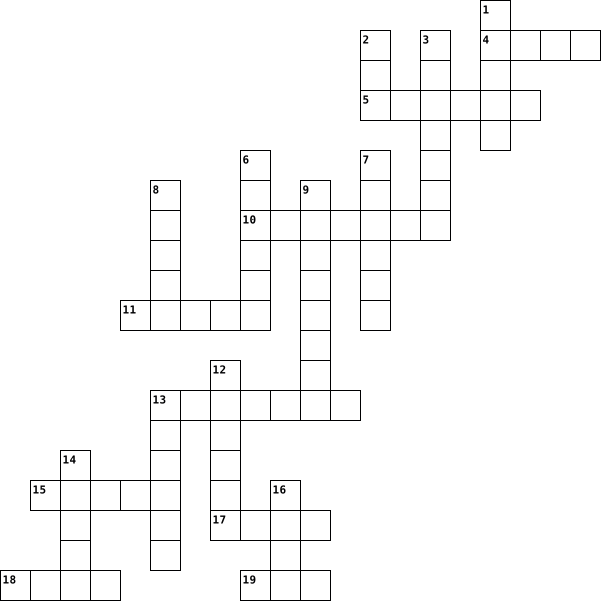
Across
- I've run 3 half marathons and a marathon relay (while pregnant)
- I grew up in Montana and I have three dogs
- I was hit by a car walking home from school when I was 15 years old
- I was born in New Jersey, my middle name is Elaine, and I'm Kathryn's step-mother in law to be
- I was at a Metallica concert on the night of President Obama's election
- For the last 3 years I have toured the US as a traveling physical therapist and during my time I got to meet the actual inventor of the VCR
- I went to Switzerland, Italy and Greece for 17 days with my sister when we were in high school. We went to the Vatican and we met Pope John Paul II!
- My top two favorite movies are complete opposites. Goodfellas and Sound of Music
- I've had my picture taken with 13 different players from the Colorado Rockies
Down
- I have so many stretchmarks my body looks like a typographical road map of the United States
- I was a tennis doubles state champion in high school
- last year my best friend participated in the Avon Walk for Breast Cancer. We walked 26.2 miles in 2 days, from Keystone to Breckenridge!
- I am in LOVE with purses!
- I've run 16 triathlons to raise money for women's cancers research
- I've traveled in 32 of the 50 states and been to 4 countries
- My alias is "Suzy Homemaker"
- I am double jointed in my knees and my fingers
- I've never eaten an orange in my life until about two months ago and I had to google how to peel it
- If it is my turn to cross the street...cars better watch out...I am on a mission and it is all about me!
- I'm a cowgirl, I love horses, and my husband is a firefighter
20 Clues: I am in LOVE with purses! • My alias is "Suzy Homemaker" • I grew up in Montana and I have three dogs • I am double jointed in my knees and my fingers • I was a tennis doubles state champion in high school • I've traveled in 32 of the 50 states and been to 4 countries • I'm a cowgirl, I love horses, and my husband is a firefighter • ...
Chapter One 2013-09-13
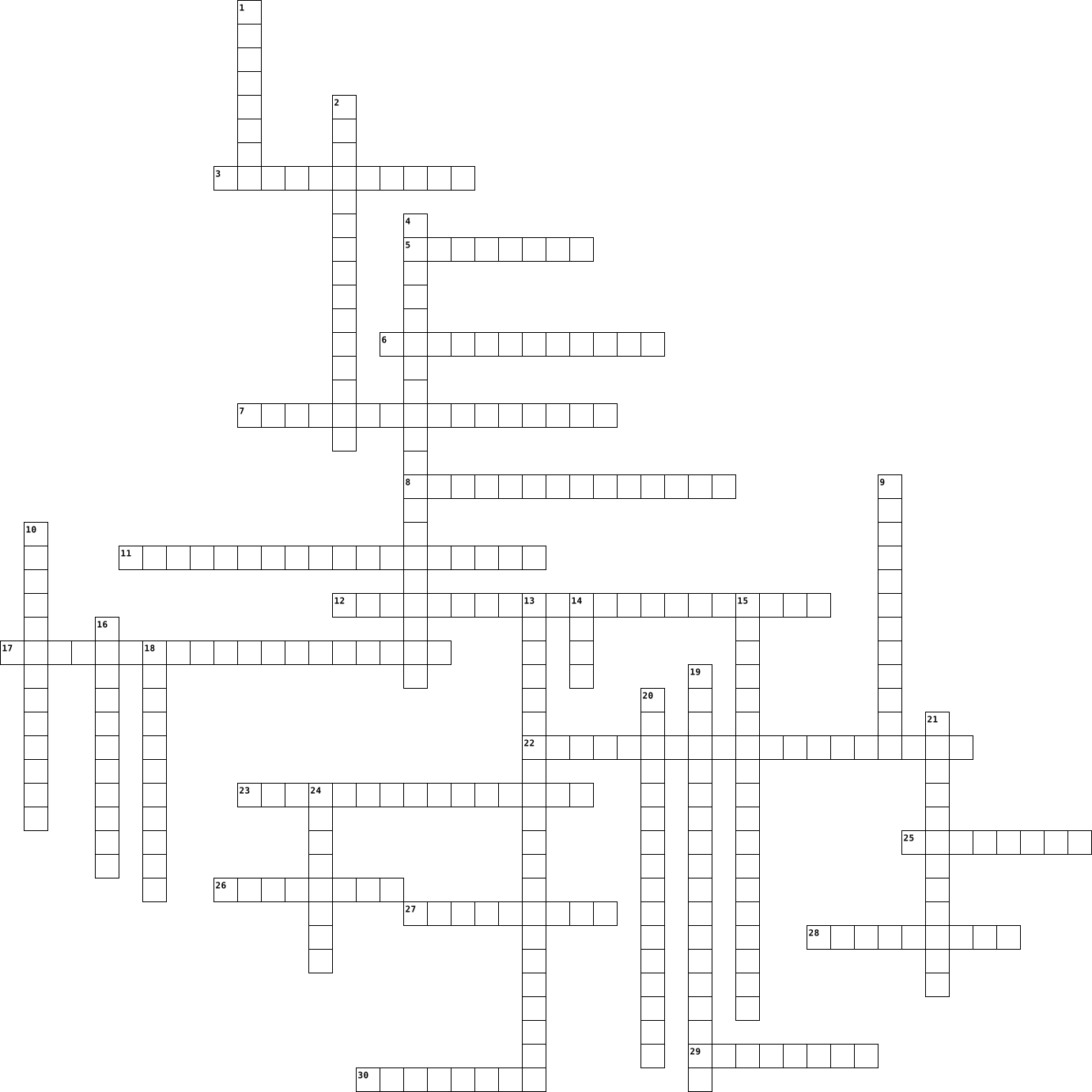
Across
- The property where the ( ) moves.
- Other name for the additive inverse of any number a is -a.
- The property of a(b+c)=ab+ac.
- The operations that undo each other.(2 Words)
- Counting numbers. (2 Words)
- You can join two or more inequalities with the word and or the word or to form a _______.(2 Words)
- Other name for reciprocal. Any nonzero number a is 1/a.(2 Words)
- A mathematical phrase that contains numbers and operation symbols.(2 Words)
- A mathematical phrase that contains one or more variables.(2 Words)
- An equation that uses more than one letter as a variable.(2 Words)
- A symbol, usually a letter that represents one or more numbers.
- An equation that is true for every value of the variable.
- A quantity whose value does not change.
- have the same variables raised to the same powers.(2 Words)
- To ____ an algebraic expression, substitute a number for each variable in the expression.
- The name of this symbol <. (2 Words)
Down
- The natural numbers, their opposites, and zero.
- All numbers you can write as a quotient of integers a/b, b. (2 Words)
- A number that makes the equation true. (4 Words)
- The natural numbers and zero.(2 Words)
- A real number, x, written [x], is its distance from zero on the number line.(2 Words)
- The property of a+b=b+a. (2 Words)
- A number, a variable or the product of a number of one or more variable.
- A solution of an equation derived from an original equation but is not a solution of the original equation.(2 Words)
- The name of this symbol >. (2 words)
- The numerical factor of a term.
- Have values that vary.(2 Words)
- Square root of 12. (2 words)
- A term with no variables.(2 Words)
- A statement that two algebraic expressions are equal.
30 Clues: Counting numbers. (2 Words) • Square root of 12. (2 words) • The property of a(b+c)=ab+ac. • The numerical factor of a term. • Have values that vary.(2 Words) • The property where the ( ) moves. • The property of a+b=b+a. (2 Words) • A term with no variables.(2 Words) • The name of this symbol >. (2 words) • The name of this symbol <. (2 Words) • ...
Math Vocabulary 2016-11-03

Across
- (0,0) on a coordinate plane
- a comparison of two quantities by division
- the answer to a division problem
- a ratio that compares two quantities of different kinds of units
- the distance between a number and 0 on the number line
- positive whole numbers, their opposite, and zero
- used to locate a point on the coordinate plane
- a fraction with a numerator that is greater than the denominator
- the product of a number and its ______________ is one
- the cost per unit
- a ratio that compares a number to 100
- ratios that express the same relationship between two quantities
- the vertical line on a coordinate plane
- the number below the fraction bar
- the biggest common factor of two or more numbers
- any number that can be written as a fraction
Down
- has a denominator of 1 unit when the rate is written as a fraction
- numbers that are the same distance from zero in opposite directions
- the number above the fraction bar
- the answer to a multiplication problem
- whole numbers less than zero
- a bar placed over the digits that repeat
- a decimal whose digits repeat in groups of one or more
- a number that has a digit in the tenths place, hundredths place, or beyond
- a number that has a whole number part and a fraction part
- the first number of an ordered pair
- a number that represents part of a whole or part of a set
- whole numbers greater than zero
- show that two ratios are equal
- the horizontal line on a coordinate plane
- the second number of an ordered pair
- two numbers that you multiply together to get a product
- the four regions of a coordinate plane
- the smallest number that is a multiple of two or more numbers
34 Clues: the cost per unit • (0,0) on a coordinate plane • whole numbers less than zero • show that two ratios are equal • whole numbers greater than zero • the answer to a division problem • the number above the fraction bar • the number below the fraction bar • the first number of an ordered pair • the second number of an ordered pair • a ratio that compares a number to 100 • ...
Honors Algebra 1 2018-03-28

Across
- A mathematical sentence that compares the values of two expressions using an inequality symbol
- An equation whose graph forms a straight line
- A mathematical sentence that uses an equal sign
- A number that shows repeated multiplication
- The point where two lines cross
- Lines that intersect to form right angles and have slopes that always multiply to -1
- The possible values for the input, or the independent variable, of a function
- A plane formed by two number lines that intersect at right angles
- A ratio of the number of times an event actually happens to the number of times the experiment is done
- A relation that assigns exactly one value in the range to each value of the domain
- The numbers that make an ordered pair and identify the location of a point
- Terms with exactly the same variable factors in a variable expression
- Two lines in the same plane that never intersect and have the same slope
- Two numbers that identify the location of a point
Down
- A variable that provides the output values of an equation
- The distance a number is from zero on a number line
- A mathematical sentence that describes a region of the coordinate plane having a boundary line. Each point in the region is a solution tho the inequality
- The numerical factor when a term has a variable
- Whole numbers and their opposites
- A mathematical phrase that can include numbers, variables, and operation symbols
- A linear equation of a non vertical line written as y-y1=m(x-x1)
- Numbers Whose square roots are integers
- The ratio of the vertical change to the horizontal change
- A number that cannot be written as a ratio of two integers
- A variable that provides the input values of a function
25 Clues: The point where two lines cross • Whole numbers and their opposites • Numbers Whose square roots are integers • A number that shows repeated multiplication • An equation whose graph forms a straight line • The numerical factor when a term has a variable • A mathematical sentence that uses an equal sign • Two numbers that identify the location of a point • ...
ACT Vocabulary 2020-01-15

Across
- part of the circumference of a circle made by a wedge
- the set of real numbers that can be expressed in the form of a fraction
- the distance through the center of a circle
- provide the numeric value of an given expression
- these lines have slopes that are negative reciprocals of each other
- the longest side of a right triangle
- means equal to
- a real number whose decimal form neither terminates nor repeats
- the property of real numbers such that a + b = b + a
- the line between non-consecutive corners in a polygon
- a five sided polygon
- the number that results when you take the square root of a negative number
- rate of change
- cut into two equal segments or angles
Down
- the corner of a shape
- the curve formed by any equation that has an x squared
- the same on one side as it is on the other
- lines with the same slope
- the name given to an equation where the x and y values do not have an exponent
- the set of all possible y values of a function's graph
- a solution that does not satisfy the original equation
- an expression with a rational exponent
- one after the other
- a triangle with at least two sides and two angles congruent
- the name given to an equation with an x squared
- the number in an expression
- the set of whole numbers and their opposites
- binomials of the form a + bi and a - bi
- Value a graph of this function forms a V shape
- the x-intercepts of the graph of a quadratic equation
- the set of all x values in a function's graph
- next to
- the highest y value of a graph
33 Clues: next to • means equal to • rate of change • one after the other • a five sided polygon • the corner of a shape • lines with the same slope • the number in an expression • the highest y value of a graph • the longest side of a right triangle • cut into two equal segments or angles • an expression with a rational exponent • binomials of the form a + bi and a - bi • ...
Unit 9 Review 2018-10-12

Across
- This is a place where animals live and farmers work.
- This is a place where doctors and nurses work.
- This is a thing that you look at in a restaurant. It tells you which foods and drinks you can buy.
- This is a place where you can swim.
- This is a big machine that can fly. It has 2 or 3 blades on top of it.
- This is a place where you can borrow and read books.
- This is something you wear when you are in an airplane, a car, or a helicopter.
- This is a very hot, very dry place. There is very little water here.
- This animal scared the city mouse.
- This is a kind of park where many people go to play and have fun.
- This is a place next to the ocean. It has a lot of sand.
Down
- This is a place outside where you can buy some foods, drinks, and clothes.
- This is a car that can take sick people to a hospital.
- This is a place where you can look at paintings and dinosaurs.
- These are things, and a place. People can climb them. Sometime they have snow on top of them.
- This is a kind of poem with 3 lines. The first line is 5 syllables, the second line is 7 syllables, and the third line is 5 syllables.
- This is a place where you can buy many different things. The American English is "mall".
- These are words with different meanings. Example: hot/cold.
- This is a very small animal. The name of Unit 9's story is "The city ____ and the country _____".
- This is a place where you can buy drinks and snacks.
- This is a kind of drink made from lemon juice, sugar, and water.
- This animal scared the country mouse.
22 Clues: This animal scared the city mouse. • This is a place where you can swim. • This animal scared the country mouse. • This is a place where doctors and nurses work. • This is a place where animals live and farmers work. • This is a place where you can borrow and read books. • This is a place where you can buy drinks and snacks. • ...
Mathematics Challenge 2019-06-06
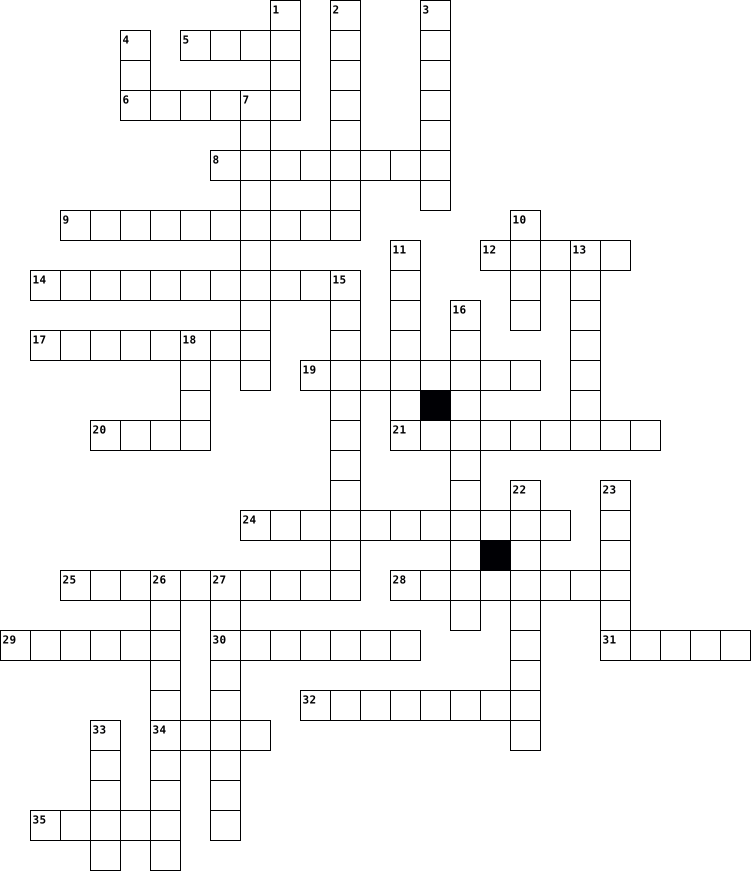
Across
- A ratio comparing two different units
- The middle data value when they are written in numerical order.
- The product of a number with another number
- The answer to a subtraction problem
- A diagram used to record information
- An angle more than 90 degrees
- A word for straight up and down
- A straight line from one corner to another corner
- The data value that occurs most often.
- The dividend (top number) of a fraction
- Ordered pairs that identify points on a coordinate plane. (x, y)
- Straight across from side to side
- The answer to a division problem
- The amount of space occupied by an object
- A polyhedron whose base is a polygon and whose other faces are triangles that share a common vertex
- From the lowest score to the highest score in a graph
- A number less than zero
- A line on a graph that runs either vertically or horizontally through zero
- An exact location (dot) on a coordinate plane
Down
- The sum of data values divided by the numbers of values.
- A number greater than zero
- A positive or negative number, including zero
- The whole amount; the answer to an addition problem
- An angle smaller than a right angle.
- The space inside a shape
- A closed plane figure (shape) made up of line segments
- A ratio that compares a number to 100; out of 100
- Having all sides or faces equal
- The divisor (bottom number) of a fraction
- A solid with six congruent square faces
- The distance around a shape
- A number that is multiplied by another number to get a product
- When two values are not equal, it is called a(n)
- Two numbers that have the same absolute value but have different signs
- A comparison of two numbers using division
35 Clues: A number less than zero • The space inside a shape • A number greater than zero • The distance around a shape • An angle more than 90 degrees • Having all sides or faces equal • A word for straight up and down • The answer to a division problem • Straight across from side to side • The answer to a subtraction problem • An angle smaller than a right angle. • ...
Extra Credit 2017-02-09

Across
- is the repetition of vowel sounds
- when phrases in a sentence have similar structure
- present a problem and then present your solution
- when there are three parallel clauses
- putting opposites close to each other to show differences
- one event causes another to happen
- repeating similar consonant sounds @ the beginning of words
- series of actions, changes, or functions bringing about results
- is a question that does not offer an explicit answer.
- an appeal that uses/focuses on logic to persuade the audience.
- is a poem that tells a story
- repetition of consonant sounds often at the end of words
- portrayal of a person, object, or event
- an order telling closest to farthest away or vice versa
Down
- parallelism in phrases with contrasting ideas close together.
- when you voice an idea at least twice using different words
- is a reference to something famous within a text.
- similarities and differences to assess value or worth
- out similarities between two things
- that is represents a group or serves as a model
- are blank spaces between stanzas of poetry.
- the speaker states the same idea using the same words
- based on similarities and differences
- an appeal that tries to manipulate the feelings of the audience
- sections of a poem containing a number of lines
- a comparison,using “like” "than," "compare" or “as”.
- a single line of words in a poem which may or not be sentences
- is giving human qualities to an object, animal, or idea
- is a type of brief poem that expresses personal emotions
- tell the meaning of a phrase, word or idea
- the order in which things happened
- an appeal that emphasizes expertise, right, and wrong
- direct comparison between two seemingly unrelated subjects
33 Clues: is a poem that tells a story • is the repetition of vowel sounds • one event causes another to happen • the order in which things happened • out similarities between two things • based on similarities and differences • when there are three parallel clauses • portrayal of a person, object, or event • tell the meaning of a phrase, word or idea • ...
OSCILLATION 2021-08-14

Across
- The centripetal force is proportional to the mass
- quotient of force by cross-sectional area
- The force that causes an object to move in a circle is style
- The frictional force between the surfaces of a moving solid in fluid will be proportional to the relative velocity of motion the object to its "fluid is the sound of law"
- Opposite of centripetal force
- how stiff is the spring is the meaning of … spring
- The physical properties of an object used to describes the behaviour of the observed object
- Interactions that can cause an object mass changes objects
- The force produced by the work of an elastic object is style
- The force that appears when 2 objects touch and its direction opposite is style
- The time it takes for an object to do one full vibration/turn
- The product of the period by the time is the sum
- Friction between two solid objects that are not moving relative to each other is the frictional force
- When two objects are moving relative to each other and rub against each other there is friction
Down
- If the tensile force applied to a spring is not exceeds the elastic limit of the material, the increase in length spring is directly proportional or proportional to the tensile force is the sound of law
- In the spring force if the spring constant is reduced then the spring force will increase
- Centripetal force occurs on objects that are moving
- Stress is proportional to the cross-sectional area
- unit of spring force
- Changes in speed in a certain time unit
- Non-negative scalar measurement of the magnitude of the oscillation a wave
- An object maintains a certain state called
- The force caused by the associated gravity with a certain mass of an object is called a force
- The centripetal force is the product of the velocity squared in times … in the fingers
- The distance between the position of the vibrating object from equilibrium position
25 Clues: unit of spring force • Opposite of centripetal force • Changes in speed in a certain time unit • quotient of force by cross-sectional area • An object maintains a certain state called • The product of the period by the time is the sum • The centripetal force is proportional to the mass • Stress is proportional to the cross-sectional area • ...
OSCILLATION 2021-08-14

Across
- Stress is proportional to the cross-sectional area
- how stiff is the spring is the meaning of … spring
- quotient of force by cross-sectional area
- An object maintains a certain state called
- Changes in speed in a certain time unit
- Opposite of centripetal force
- The product of the period by the time is the sum
- The distance between the position of the vibrating object from equilibrium position
- The force that appears when 2 objects touch and its direction opposite is style
- The force caused by the associated gravity with a certain mass of an object is called a force
- The centripetal force is the product of the velocity squared in times … in the fingers
- In the spring force if the spring constant is reduced then the spring force will increase
Down
- The force that causes an object to move in a circle is style
- Friction between two solid objects that are not moving relative to each other is the frictional force
- The centripetal force is proportional to the mass
- Centripetal force occurs on objects that are moving
- Non-negative scalar measurement of the magnitude of the oscillation a wave
- If the tensile force applied to a spring is not exceeds the elastic limit of the material, the increase in length spring is directly proportional or proportional to the tensile force is the sound of law
- When two objects are moving relative to each other and rub against each other there is friction
- The time it takes for an object to do one full vibration/turn
- unit of spring force
- The force produced by the work of an elastic object is style
- The frictional force between the surfaces of a moving solid in fluid will be proportional to the relative velocity of motion the object to its "fluid is the sound of law"
- Interactions that can cause an object mass changes objects
- The physical properties of an object used to describes the behaviour of the observed object
25 Clues: unit of spring force • Opposite of centripetal force • Changes in speed in a certain time unit • quotient of force by cross-sectional area • An object maintains a certain state called • The product of the period by the time is the sum • The centripetal force is proportional to the mass • Stress is proportional to the cross-sectional area • ...
OSCILLATION - ANGELINE SHARON 2021-08-14

Across
- Stress is proportional to the cross-sectional area
- how stiff is the spring is the meaning of … spring
- quotient of force by cross-sectional area
- An object maintains a certain state called
- Changes in speed in a certain time unit
- Opposite of centripetal force
- The product of the period by the time is the sum
- The distance between the position of the vibrating object from equilibrium position
- The force that appears when 2 objects touch and its direction opposite is style
- The force caused by the associated gravity with a certain mass of an object is called a force
- The centripetal force is the product of the velocity squared in times … in the fingers
- In the spring force if the spring constant is reduced then the spring force will increase
Down
- The force that causes an object to move in a circle is style
- Friction between two solid objects that are not moving relative to each other is the frictional force
- The centripetal force is proportional to the mass
- Centripetal force occurs on objects that are moving
- Non-negative scalar measurement of the magnitude of the oscillation a wave
- If the tensile force applied to a spring is not exceeds the elastic limit of the material, the increase in length spring is directly proportional or proportional to the tensile force is the sound of law
- When two objects are moving relative to each other and rub against each other there is friction
- The time it takes for an object to do one full vibration/turn
- unit of spring force
- The force produced by the work of an elastic object is style
- The frictional force between the surfaces of a moving solid in fluid will be proportional to the relative velocity of motion the object to its "fluid is the sound of law"
- Interactions that can cause an object mass changes objects
- The physical properties of an object used to describes the behaviour of the observed object
25 Clues: unit of spring force • Opposite of centripetal force • Changes in speed in a certain time unit • quotient of force by cross-sectional area • An object maintains a certain state called • The product of the period by the time is the sum • The centripetal force is proportional to the mass • Stress is proportional to the cross-sectional area • ...
ELA VOCABULARY 2023-08-10

Across
- A literary device that compares one thing to another while avoiding words such as “like” or “as”
- A joke utilizing the multiple meanings of a word or words that sound similar bet have different meanings.
- The literary figure that uses two words, concepts, or grammatical constructs and put them in reverse order in the same sentence.
- A comparison between two things using words such as “like” or “as” to compare.
- The specific usage of words/phrases in speech or writing.
- The communicating of someone’s feeling or an event that occurs expressed as the opposite of what it should be; also a literary device where the characters of the story do not know of an occurrence but the reader/audience does.
- A device used in literature which contains contradictory statements together.
- The usage of a word to refer to a word/words used earlier in a sentence.
- The misuse of a word by confusing it with a similar sounding word that is intended to be humorous.
- An interesting or humorous short story about a real person or event.
- An expression specifically made to indirectly reference something else while not directly mentioning it.
Down
- Statements that are exaggerated and are not meant to be taken literally.
- When two objects considered to be opposites are put next to each other specifically to have a contrasting effect.
- A sentence that removes a conjunction between parts.
- A repeating theme or characteristic in literature; an example of a typical part of a subject (I.e. a book in a genre).
- An emotion or thought that a word causes one to have in addition to the word’s literal meaning.
- A repetition of a conjunction in a sentence.
- A comparison between two different things that have a similarity using metaphors and /or similes.
- The usage of words or phrases in a certain order in a language to create a well-written sentence.
- A replacement word or phrase that means something worse or inappropriate.
20 Clues: A repetition of a conjunction in a sentence. • A sentence that removes a conjunction between parts. • The specific usage of words/phrases in speech or writing. • An interesting or humorous short story about a real person or event. • Statements that are exaggerated and are not meant to be taken literally. • ...
Math Vocabulary 2024-05-10

Across
- a mathematical sentence that compares two quantities using symbols
- the number that occurs the most
- opposite
- the order of operations
- shows the quartiles, minimum and maximum, and the median
- a quantity that is not whole - has a numerator and denominator
- how to divide fractions
- the set of positive whole numbers, their opposites, and 0
- LCM
- the top number in a fraction
- does not have an equal sign
- GCF
- the number in front of the letter
- the vertical axis
- the relationship between two quantities
- has at least one factor besides 1 and itself
- a question whose answer varies
- a raised number beside the base
- letter
- has an equal sign
- put into simplest form
- the bottom number in a fraction
- the difference between the biggest number and the smallest number in a set of data
Down
- the number on the outside of the division house
- the big number in an exponent
- the number on the inside of the division house
- a graph to plot points on
- the answer to a subtraction problem
- flip the fraction
- one quarter of the coordinate plane
- the answer to a division problem
- the numbers below zero
- a number that is only divisible by 1 and itself
- the distance around a shape
- a ratio that compares a number to 100
- the horizontal axis
- the number in the center of the data
- the average
- the space inside a shape
- to flip over an axis
- a fraction whose numerator is bigger than the denominator
- estimated as 3.14
- the point (0,0)
- the answer to a multiplication problem
- when adding and subtracting fractions, you need a
- example:2,4,6,8,10
- a two dimensional pattern that you can fold into a three dimensional figure
- the distance from zero
- to solve
- the answer to an addition problem
50 Clues: LCM • GCF • letter • opposite • to solve • the average • the point (0,0) • flip the fraction • estimated as 3.14 • the vertical axis • has an equal sign • example:2,4,6,8,10 • the horizontal axis • to flip over an axis • the numbers below zero • the distance from zero • put into simplest form • the order of operations • how to divide fractions • the space inside a shape • a graph to plot points on • ...
Electrostatics 2022-04-08

Across
- While the electrons are attracted to the protons of the nucleus, the addition of _________ to an atom can persuade the electron to leave the atom.
- The building block of which all matter is composed became known as the _________ around 400 BC.
- The amount of charge on a single proton is _________ to the amount of charge possessed by a single electron, although they may have a different sign.
- Objects that have opposite charges (one positive and one negative) have a(n) _________ force.
- If an atom has _________ electrons than protons it is said to be positively charged.
- Rutherford developed the idea that the _________ is a densely packed core surrounded by electrons.
- Bohr’s findings led us to our current view of the atom, called __________ (twowords).
- The Coulomb is the basic unit of _________.
- Neils Bohr explained that the electrons were in _________ around the nucleus.
- If an atom has _________ electrons than protons it is said to be negatively charged.
- This is the positively charged particle in the nucleus.
- If your socks _________ electrons, they become negatively charged.
- Each electron shell has a different _________ level.
Down
- In the world of electrostatics, opposites _________ and likes _________ (two words, in order, and don’t use a space).
- Since the unit of Coulomb is so large, we often use _________coulombs and nanocoulombs.
- If your socks have an equal amount of electrons and protons, they are _________.
- This type of electricity is responsible for lightning, giving you a shock when you touch a doorknob, and sticking balloons to walls.
- The atom is mostly _________ (two words).
- If your socks _________ electrons, they become positively charged.
- JJ Thompson discovered a negatively charged particle which we know as the _________.
- Electostatics and electricity is all about one particle moving, and that’s the _________.
- The number of electrons around a nucleus will determine if an atom is electrically _________ or neutral.
- The unit of charge is the _________.
- Objects that have like charges (both positive or both negative) have a(n) _________ force.
- If an atom has the same number of protons and electrons, it is described as electrically _________.
25 Clues: The unit of charge is the _________. • The atom is mostly _________ (two words). • The Coulomb is the basic unit of _________. • Each electron shell has a different _________ level. • This is the positively charged particle in the nucleus. • If your socks _________ electrons, they become positively charged. • ...
HIMYM Final Crossword 2025-01-01

Across
- Robin’s former BFF from her teenage days, whose name sparkled on a space-themed show
- Marshall’s emotional tradition honoring a family member, which grew from a private moment to a heartwarming gathering
- A nostalgic stop for Ted and Marshall, marked by long drives, a broken radio, and unforgettable college memories
- Barney's conclusion after a chaotic discussion about confusing club names
- The cop who communicated over the radio during a tense standoff, revealing unexpected connections
- The last name of the neighbors whose overbearing friendship taught Marshall and Lily an important lesson about boundaries
- A holiday born from a bet, celebrated with unexpected chaos
- A vehicle that endured endless road trips, a single-song soundtrack, and a scalding caffeine mishap
- Made-up neighborhood with an unfortunate acronym hiding a smelly secret
- Ted’s online date whose true identity was a mystery until the very end, and whose behavior fit a certain infamous theory
- Barney’s loss of confidence, first triggered by a lie and later affecting his game with women, which he calls the ...
Down
- The nanny with ties to a family business that didn’t quite live up to its rhyming potential
- Ted’s mysterious date with a secretive woman, whose real name was hidden behind a nickname
- Ted’s ‘date’ to an awards show whose true profession was misunderstood
- Ted's date who unknowingly led him to an important connection through a subway encounter
- The name of the man behind an audacious 2-out-of-3 confidence play
- Artist whose gallery opening was interrupted by candy, with a hidden nod to a martial arts rat
- The recurring tradition where each watch sparks reflections on the passage of time
- Barney’s made up word that blends two opposites, showcased in his infamous video resume
- The costume of Ted’s long-time obsession, tied to a KitKat and a disappointing reunion
20 Clues: A holiday born from a bet, celebrated with unexpected chaos • The name of the man behind an audacious 2-out-of-3 confidence play • Ted’s ‘date’ to an awards show whose true profession was misunderstood • Made-up neighborhood with an unfortunate acronym hiding a smelly secret • Barney's conclusion after a chaotic discussion about confusing club names • ...
Math Vocabulary Review 2025-02-17

Across
- The top number in a fraction or ratio
- The numbers added to get the sum
- Another name for coordinates, how we find a location on the Coordinate Plane; (X,Y)
- A rate that is simplified so it has a denominator of 1; uses the word per
- The distance a number is from zero
- The answer to a multiplication problem
- The number you're dividing by, the denominator
- The Horizontal axis on the Coordinate Plane; negative numbers on the left, positive on the right
- The answer to a subtraction problem
- The answer to a division problem
- A comparison out of 100, written with this symbol: %
- Numbers greater than zero
- The Vertical axis on the Coordinate Plane; negative numbers on the bottom, positive numbers on the top
- Numbers less than zero
Down
- A number with 3 or more factors
- The set of whole numbers that include positives, negatives, and zero.
- Numbers that are the same distance from zero, both on different sides of zero on a number line
- The number that appears most often in a data set
- The number being divided, the numerator
- When a data set is arranged from least to greatest, this is the middle value
- The bottom number in a fraction or ratio
- A relationship or comparison between two quantities
- The answer to an addition problem
- When two ratios are equivalent
- A type of ratio comparing two quantities with different units of measure
- The Coordinate Plane is split into four of them
- Coordinates here are (0,0)
- The average of a data set
- The numbers multiplied to get the product
- The distance between the smallest and largest data points in a data set
- A number with only 2 factors, 1 and itself
31 Clues: Numbers less than zero • The average of a data set • Numbers greater than zero • Coordinates here are (0,0) • When two ratios are equivalent • A number with 3 or more factors • The numbers added to get the sum • The answer to a division problem • The answer to an addition problem • The distance a number is from zero • The answer to a subtraction problem • ...
4th Quarter Long Quiz 2025-03-11

Across
- A pathway or yoga that focuses on: Devotion and love for a personal deity.
- The traditional religion of Japanese people during the eight century C.E.
- Compassion and kindness towards others
- Term associated by Greeks to those people living beyond the Sindhu (Indus) River.
- A pathway or yoga that focuses on: Meditation and control of the mind.
- It is translated as right view. SAMMA-_____________.
- Acting morally and justly, even if it's difficult
- The god of preservation and protection.
- Refers to the liberation of the soul from the cycle of reincarnation.
- Goddess of Wealth and Prosperity.
- It is translated as right intention. SAMMA-_____________.
- Known founder of Confucianism
- A pathway or yoga that focuses on: Knowledge, wisdom, and discernment.
- The Third Noble Truth – the Truth of the Cessation of Suffering.
- It is translated as right speech. SAMMA-_____________.
- It is translated as right mindfulness. SAMMA-_____________.
- Deep respect for parents and ancestors
- A pathway or yoga that focuses on: Selfless service and performing duties without attachment to the results.
Down
- Following rituals, customs, and social norms
- It is translated as right livelihood. SAMMA-_____________.
- Refers to the ethical and moral principles that govern an individual’s life.
- A traditional Japanese gate, which marks the boundary between the sacred and mundane.
- The Balance of Opposites, represents the duality of nature
- Regarded as the Supreme Being in Hinduism.
- Confucius was born in Lu which is now the modern-day ___________.
- Applying knowledge and experience to make good decisions
- The god of destruction and transformation
- It is translated as right action. SAMMA-_____________.
- Three principal deities responsible for creation, preservation, and destruction of the Universe.
- The First Noble Truth – the Truth of Suffering.
- It is translated as right concentration. SAMMA-_____________.
- A manifestation or incarnation of a deity on Earth.
- It is translated as right effort. SAMMA-_____________.
- Taoism is also known as ________________.
- The fundamental principle that governs all life.
35 Clues: Known founder of Confucianism • Goddess of Wealth and Prosperity. • Compassion and kindness towards others • Deep respect for parents and ancestors • The god of preservation and protection. • The god of destruction and transformation • Taoism is also known as ________________. • Regarded as the Supreme Being in Hinduism. • Following rituals, customs, and social norms • ...
Algebra II 2024-10-16

Across
- where the line crosses the y-axis
- expression, mathematical phrase that contains one or more variables.
- line, lines that intersect to form a right angle
- a set of ordered pairs
- all natural numbers their opposites and zero
- / multiplicative inverse,-a and 1/a the product is 1 absolute value of a real number the distance from zero on the number line notated with read 2 as “the absolute value of 2”
- form, y=mx+b
- a relation in which each element of the domain corresponds with exactly one element in the range
- form, y-y1=m(x-x1) where m is the slope of the line and (x1 y1) is a point on the line
- quantities, quantities whose values change or vary
- equation, an equation that uses at least two different letters as variables
- the ratio of the vertical change to the horizontal change between points
- shifts the graph of the parent function horizontally
- where the line crosses the x-axis
Down
- symbol that represents a number
- when you substitute numbers for the variable to answer.
- numbers, cannot be written as fractions/decimals that never end and do not repeat.
- a point where the function reaches a maximum or a minimum value
- quantity, anything that can be measured or counted.
- the set of all inputs or x-coordinates of the ordered pair
- expression, a mathematical phrase that contains numbers & operation symbol.
- numbers, all the numbers that can be written as fractions terminating decimals and repeating decimals
- numbers, all natural numbers AND zero
- lines, coplanar lines that do not intersect
- flips the graph of a function across a line
- the set of all outputs or y-coordinates of the ordered pair
- numbers, numbers used for counting
- quantities whose values do not change
- solution, a solution derived from an original equation that is not a solution of the original equation.
29 Clues: form, y=mx+b • a set of ordered pairs • symbol that represents a number • where the line crosses the y-axis • where the line crosses the x-axis • numbers, numbers used for counting • numbers, all natural numbers AND zero • quantities whose values do not change • lines, coplanar lines that do not intersect • flips the graph of a function across a line • ...
Common AP Chem Vocabulary 2025-04-14

Across
- Like K, but before equilibrium gets comfy
- Electrons on the move, someone gains, someone loses
- Ratio that tells how far the reaction’s gone
- Same protons, different neutrons
- A solution that takes acid/base swings like a champ
- Energy needed to kick out an electron
- Size matters, at least when it comes to atoms
- The first ingredient to run out in the reaction race
- Sharing is caring (at the atomic level)
- Logarithmic scale of acidity—lower means sourer
- Polar opposites attract
- Measuring heat by watching temperature changes
- A bond built on giving and taking
- That titration moment when acid = base, mic drop
- Electrons throwing shapes
- Only the reacting VIPs make the cut
- Charting changes to reach equilibrium, one row at a time
- Fully dissociates, no regrets
- H⁺ trades places, water may form
- One single move in a reaction’s dance
- Will it go? This value knows
Down
- Step-by-step playbook of how reactions unfold
- Drop by drop, finding that perfect stoichiometric moment
- Speeds it up, but stays out of the final product
- Orbital remix for bonding success
- Shining light to eject electrons and find their energy
- A reaction’s speed formula
- Forward and reverse reactions in perfect balance
- The atom’s version of clinginess
- Strong attraction, but only if you’re N, O, or F
- Heat it up till it bubbles over
- What’s left after an acid gives up a proton
- Absorbs heat—feel the chill
- When one Lewis structure just isn’t enough
- The energetic hurdle reactants must jump
- Weak attraction, big molecules feel it more
- Like dissolves like, unless it's not
- When stress hits a system, it shifts to resist
- Heat in or out? This has the answer
- Measure of molecular chaos
40 Clues: Polar opposites attract • Electrons throwing shapes • A reaction’s speed formula • Measure of molecular chaos • Absorbs heat—feel the chill • Will it go? This value knows • Fully dissociates, no regrets • Heat it up till it bubbles over • Same protons, different neutrons • The atom’s version of clinginess • H⁺ trades places, water may form • Orbital remix for bonding success • ...
2nd 9 Weeks Vocabulary Review 2022-11-07

Across
- a numerical or qualitative measurement of how far apart objects or points are.
- a line that runs from top to bottom (up and down) and is perpendicular to the base or horizon.
- a whole number and it's opposite; a number that cannot be a decimal or fraction.
- to understand a function in a meaningful way.
- the arrangement of things in relation to each other according to a particular sequence or pattern.
- a tool used for graphing points, lines, and other objects.
- the magnitude of a real number without regard to its sign.
- a transformation where each point is at a equal distance on the opposite side of a given line.
- a property which determines whether the object is larger or smaller than other objects of the same kind.
- the worth of each digit depending on where it lies in the number.
Down
- refers to the "x" and "y" lines that cross at right angles to make a graph.
- the amount or number of something.
- two numbers that are the same distance from zero on a number line.
- numbers that are less than zero; can be written with a - sign.
- a line that runs across from left to right.
- a number that can be written as a fraction (a/b), where a and b are integers and b cannot equal zero.
- a line on which numbers are marked at intervals, used to illustrate simple numerical operations.
- the region formed by intersections of the x-axis and y-axis.
- ordered pairs; a composition of the x-coordinate and y-coordinate having two values written in a fixed order within parentheses.
- numbers that are greater than zero; can be written with a + sign.
- a statement of an ordered relationship; greater than, less than, equal to, between two numbers.
- presentation of information in a quick and easy visual tool.
22 Clues: the amount or number of something. • a line that runs across from left to right. • to understand a function in a meaningful way. • a tool used for graphing points, lines, and other objects. • the magnitude of a real number without regard to its sign. • the region formed by intersections of the x-axis and y-axis. • ...
Personality Vocabulary 2022-02-14

Across
- one’s feelings of high or low self-worth.
- the perception that you control your own fate.
- a projective test where people express their inner feelings and interests through the stories they make up about ambiguous scenes.
- giving priority to one’s own goals over group goals; defining one’s identity in terms of personal attributes rather than group identifications.
- a characteristic pattern of behavior to feel and act; can be assessed by self or by peers.
- a reservoir of unconscious psychic energy that strives to satisfy basic sexual and aggressive drives.
- the most widely researched and clinically used of all personality tests.
- a boy’s sexual desires towards his mother and feelings of hatred and jealousy towards the rival father.
- a caring, accepting, nonjudgmental attitude that would help people to develop self acceptance and self awareness.
- views behavior as influenced by the interaction between people’s traits and social context.
Down
- the part of personality that represents internalized ideals and provides standards for judgment and for future aspirations.
- assumed to be the center of personality; the organizer of our thoughts, feelings, and actions.
- concept of a shared, inherited reservoir of memory traces from our species’ history.
- defense mechanism where people re-channel their unacceptable impulses into socially approved activities.
- an individual’s characteristic pattern of thinking, feeling, and acting.
- defense mechanism that offers self-justifying explanations in the place of the real, more threatening, unconscious reasons for one’s actions.
- a lingering focus of pleasure-seeking energies at an earlier psychosexual stage, where conflicts were unresolved.
- a theory of death related anxiety; explores people’s emotional and behavioral responses to reminders of their impending death.
- the extent where people perceive control over their environment rather than feeling helpless.
- defense mechanism where the ego unconsciously switches unacceptable impulses into their opposites.
- therapeutic techniques that attributes thoughts and actions to unconscious motives and conflicts.
- the basic defense mechanism that banishes anxiety-arousing thoughts, feelings, and memories from consciousness.
22 Clues: one’s feelings of high or low self-worth. • the perception that you control your own fate. • an individual’s characteristic pattern of thinking, feeling, and acting. • the most widely researched and clinically used of all personality tests. • concept of a shared, inherited reservoir of memory traces from our species’ history. • ...
WH Final Exam Review Part 3 2023-01-10

Across
- Most northern island in Japan
- Which school of thought stressed opposites fit together and that all things are connected?
- Shield of the Roman Soldiers
- Roman Goddess of Love and Beauty
- Ming farmers cut wide steps, called __________, into hillsides to gain more farmland.
- ancient practice of wrapping a Chinese girls toes starting at age 6-8
- island most south in Japan
- The largest of the 4 big islands in Japan:
- Sandals of the Roman Soldiers
- Javelin like spears Roman soldiers carried
- Head of the Roman Gods, carries a thunderbolt
- Sword of the Roman Soldiers
- Smallest of the big 4 islands in Japan
- This school in Japan blend of Chinese tactics and native warrior tactics
- If a girl did not have bound feet she was considered this by the people in China
- was actually never connected and consisted of many parts
Down
- 2 men voted to run the Roman government
- The 2 mountain ranges in Korea that dominate the peninsula are the Sobaek and the __________
- Which school of thought stressed good government, education and Hsiao (filial Piety)?
- have both protected and isolated Japan
- This group was the bottom of the Roman government and was voted from the Plebians, _________ Assembly
- Mask of a Samurai Warrior
- This is a river in china, also known as the Yellow River; flows from Mongolia to the Pacific Ocean
- Roman God of War
- The river in southeastern China has a very fertile delta and millions cram into this area
- skirt of a Samurai Warrior
- Tracing the rise and fall of the ruling dynasties was known as
- Roman God of the Sea
- What mountain range is located in southern China? (hint: it runs along the border between China and India)
- shoes of a Samurai Warrior
- 4,000 mile complex of roads from China to Western Europe
31 Clues: Roman God of War • Roman God of the Sea • Mask of a Samurai Warrior • island most south in Japan • skirt of a Samurai Warrior • shoes of a Samurai Warrior • Sword of the Roman Soldiers • Shield of the Roman Soldiers • Most northern island in Japan • Sandals of the Roman Soldiers • Roman Goddess of Love and Beauty • have both protected and isolated Japan • ...
Crossword 24.10.25 2025-10-23

Across
- – the study of primates such as monkeys, apes, and lemurs
- – a strong feeling of wanting something
- – a great victory or success
- – the way a person or animal acts
- – great damage or ruin
- – a struggle or disagreement between people or ideas
- – watching something carefully to learn about it
- – an old word for a dishonest or tricky person
- – not willing to forgive; harsh or unkind
- – words that end with the same sound
- – a very strong feeling of love, enthusiasm, or anger
- – a group of living things that are of the same kind
- – a comparison using “like” or “as”
- – a word that sounds like what it means
- – the process by which living things slowly change and develop over time
- – the ability to stay calm while waiting for something
Down
- – the people or animals from whom we are descended
- – giving human qualities to non-human things
- – to die or be destroyed
- – using an object or idea to stand for something deeper
- – a group of mammals that includes humans, apes, and monkeys
- – a strong feeling of dislike or anger towards someone or something
- – a person who pretends to be someone else to in order to deceive others
- – repeating the same beginning sound in nearby words
- – a feeling of uncertainty; not being sure
- – a feeling such as happiness, sadness, anger, or fear
- – a good quality such as honesty, kindness, or courage
- – a terrible event that causes great damage or loss
- – the ability to keep going even when something is hard
- – an exaggeration used to show strong feeling
- – the study of humans, their history, and how they live
- – careful study to find new facts or information
- – to be enough or sufficient
- – a comparison that says one thing is another
- – the natural home or environment of an animal or plant
- – things that are completely different from each other
36 Clues: – great damage or ruin • – to die or be destroyed • – a great victory or success • – to be enough or sufficient • – the way a person or animal acts • – a comparison using “like” or “as” • – words that end with the same sound • – a strong feeling of wanting something • – a word that sounds like what it means • – not willing to forgive; harsh or unkind • ...
Interpersonal Relationship Stages, Theories, and Communication. 2025-12-28

Across
- The overall benefit derived from a relationship, calculated by subtracting costs from rewards
- The concept that opposites can attract and enhance each other in a relationship
- A theory that describes the process of developing deeper intimacy in relationships
- The standard by which individuals evaluate the rewards and costs of a relationship
- Significant events that change the trajectory of a relationship
- Actions that show appreciation and affection in a relationship
- A theory that suggests relationships are governed by specific rules and expectations
- Negative aspects or sacrifices involved in a relationship
- The principle that people are attracted to those who are similar to them
- The ability to understand and share the feelings of another person
- Efforts made to restore a damaged or deteriorating relationship
- The closeness and connectedness experienced in a relationship
- A theory that examines how communication strategies are used to maintain social harmony
- The process of gradually withdrawing from a relationship
- The initial stage of interaction in developing a relationship
Down
- A theory that explores the tensions and contradictions in relationships
- The process of decline in the quality and satisfaction of a relationship
- The cognitive aspect of understanding another's perspective
- A theory that examines relationships based on perceived costs and rewards
- The understanding that certain behaviors are permissible in a close relationship
- The stage of a relationship where individuals begin to develop a deeper connection
- Positive outcomes or benefits derived from a relationship
- The range of topics discussed in a relationship
- The process of ending a relationship
- A theory that posits that relationships are maintained based on fairness and balance
- The degree of intimacy and personal information shared in a relationship
- The principle that we tend to like those who like us back
- The emotional response to another person's feelings
- A theory that explains the factors that lead to interpersonal attraction
29 Clues: The process of ending a relationship • The range of topics discussed in a relationship • The emotional response to another person's feelings • The process of gradually withdrawing from a relationship • Positive outcomes or benefits derived from a relationship • The principle that we tend to like those who like us back • ...
Unit 8 Vocabulary 2022-02-17

Across
- a letter or symbol used to represent an unknown
- numbers (specifically integers) that follow each other
- the numbers that include zero and natural numbers (no negatives, fractions, or decimals)
- the multiplicative inverse of the base; results in the reciprocal of the positive exponent
- numbers we can multiply together to get another number
- the set of natural numbers and their opposites, to include zero (no fractions or decimals)
- finding the smallest possible equivalent value
- a number which produces a specified quantity when multiplied by itself
- the symbol used to represent the “root”
- the number which produces a given number when cubed
- a number multiplied by a variable
- rules used to simplify the multiplication and division operations with exponents
Down
- two operations that will be performed on a number or variable, that always results in the original number or variable
- every positive real number has a positive and a negative square root; this is the positive root
- second power
- a number, variable, or expression inside the radical symbol
- a method of expressing numbers in terms of a decimal number between 1 and 10 multiplied by a power of 10
- an algebraic expression that has only ONE term
- terms that have the same exact variables with the same exact power
- the set of all possible outputs (y-values) for a function
- is the number that relates two variables that are directly proportional or inversely proportional to one another; represented by "k"
- written above and to the right of an expression to indicate raising to a power; tells you how many times to multiply the base
- an expression containing a radical symbol
- third power
- a number that results from multiplying an integer by itself
- a combination of numbers and variables that does not have an equal sign
- the set of all possible inputs (x-values) for a function
- the expression that gets multiplied when raised to a power
28 Clues: third power • second power • a number multiplied by a variable • the symbol used to represent the “root” • an expression containing a radical symbol • an algebraic expression that has only ONE term • finding the smallest possible equivalent value • a letter or symbol used to represent an unknown • the number which produces a given number when cubed • ...
Unit 1: Tools of Mathematics: Vocabulary 2013-09-23

Across
- Fractions Fractions that can be converted into each other
- Reasoning When you apply a general rule to a specific example
- The number that indicates how many variables there are in an expression
- Factorization The process of which you break down a number, ending in a multiplication problem with all prime numbers
- The group of numbers that include whole numbers and negative numbers (no fractions or decimals)
- Expressions A combination of numbers, variables, & operations
- Numbers that have the same absolute value, but are on different sides of the number line
- To solve a mathematical equation
- Number A number that has factors other than one and itself
- Terms Terms whose variables are the same
- Common Factor The greatest number that two numbers have as a factor
- The number that is being raised to a power
- A Single number, a variable, numbers and variables multiplied together
- This is a number that says how many times to use that number in a multiplication problem
Down
- Identity The property that allows you to multiply anything by 1 and still have the product as the first number
- Numbers Numbers that are close in value to the actual numbers and easy to add, subtract, multiply, or divide mentally
- A number or quantity that when multiplied with another produces a given number or expression
- Form When you’ve reduced a fraction until you can’t anymore
- Identity The property that allows you to add 0 to any number and keep the sum the same as the first number
- Value The distance from zero to the number
- a Variable Expression To do this you replace it with an equivalent expression having as few terms as possible.
- Means Can be evenly divided
- A number that stands alone without any variables
- The power of a number shows you how many times you use the number in a multiplication problem
- of Operations The order of which mathematical operations must be preformed in
25 Clues: Means Can be evenly divided • To solve a mathematical equation • Terms Terms whose variables are the same • Value The distance from zero to the number • The number that is being raised to a power • A number that stands alone without any variables • Fractions Fractions that can be converted into each other • Number A number that has factors other than one and itself • ...
Unit 1: Tools of Mathematics: Vocabulary 2013-09-23

Across
- This is a number that says how many times to use that number in a multiplication problem
- A combination of numbers, variables, & operations
- A number that only has 1 and itself for factors
- The property that allows you to multiply anything by 1 and still have the product as the first number
- The power of a number shows you how many times you use the number in a multiplication problem
- The distance from zero to the number
- When you’ve reduced a fraction until you can’t anymore
- The property that allows you to add 0 to any number and keep the sum the same as the first number
- The process of which you break down a number, ending in a multiplication problem with all prime numbers
- Numbers that are close in value to the actual numbers and easy to add, subtract, multiply, or divide mentally
- Fractions that can be converted into each other
- A number or quantity that when multiplied with another produces a given number or expression
- Numbers that have the same absolute value, but are on different sides of the number line
- A Single number, a variable, numbers and variables multiplied together
Down
- Terms whose variables are the same
- Factor The greatest number that two numbers have as a factor
- To do this you replace it with an equivalent expression having as few terms as possible.
- The number that indicates how many variables there are in an expression
- A letter substituted for a number
- A number that stands alone without any variables
- The group of numbers that include whole numbers and negative numbers (no fractions or decimals)
- The number that is being raised to a power
- Means Can be evenly divided
- A number that has factors other than one and itself
- To solve a mathematical equation
- When you apply a general rule to a specific example
- The order of which mathematical operations must be preformed in
27 Clues: Means Can be evenly divided • To solve a mathematical equation • A letter substituted for a number • Terms whose variables are the same • The distance from zero to the number • The number that is being raised to a power • A number that only has 1 and itself for factors • Fractions that can be converted into each other • A number that stands alone without any variables • ...
MATH PUZZLE 2014-04-01

Across
- number -A whole number that is not divisible by 2.
- -The line segment joining two points on a circle and passing through the center of the circle.
- price -Price per unit of measure
- -A number used to name a part of a group or a whole. The number below the bar is the denominator, and the number above the bar is the numerator.
- -The bottom part of a fraction.
- -A equation that states a rule or a fact
- line with zero slope
- -A point on a line segment that divides the segment into two congruent segments
- -Information that is gathered.
- value-The distance of a number from zero; the positive value of a number.
- number -A real number greater than zero
- notation -A method for writing extremely large or small numbers compactly in which the number is shown as the product of two factors
- number -A real number that is less than zero
- -The answer to a division problem
- -A ratio that compares different kinds of units.
Down
- -The value of a variable that makes an equation true.
- equations -Two equations whose solutions are the same.
- -A change in the position, shape, or size of a geometric figure.
- -Two numbers that lie the same distance from 0 on the number line but in opposite directions
- numbers -The set of numbers that includes zero and all of the natural numbers
- numbers -The combined set of rational numbers and irrational numbers
- -A limitless quantity
- -Two lines are parallel if they are in the same plane and never intersect.
- segment -Two points on a line, and all the points between those two points.
- -Opposite. -5 is the additive inverse of 5, because their sum is zero. 1/3 is the multiplicative inverse of 3, because their product is 1.
25 Clues: line with zero slope • -A limitless quantity • -Information that is gathered. • -The bottom part of a fraction. • price -Price per unit of measure • -The answer to a division problem • number -A real number greater than zero • -A equation that states a rule or a fact • number -A real number that is less than zero • -A ratio that compares different kinds of units. • ...
Math 2013-02-21

Across
- angle an angle that measures greater than 0 degrees and less than 90 degrees
- plane a plan that is divided into four regions by a horizontal line
- a prism with six square faces
- a number or expression that is multiplied by another number or expression to get a product
- angles two angles who measures have a sum of 90 degress
- a member of the set of whole numbers and their opposites
- the sum of the side lengths of a closed plane figure
- the number that indicates how many times the base in a power is used as a factor
- lines lines in the same plane that do not intersect
- interesecting to form 90 degree angles
- graph a graph that uses vertical or horizontal bars to display data
- the number of nonoverlapping unit squares of a given size that will exactly cover the interior of a plane figure
- a relation in which every input is paired with exactly one output
- inequality two inequalities that are combined into one statement by the word and or or
- value the absolute value of x is the distance, from zero to x on a number line
- information gathered from a survey or experiment
Down
- expression an expression that contains at least one variable
- to find the value of an algebraic expression by substituting a number for each variable and simplifying by using the order of operations
- a monomial or a sum or difference of monimials
- a mathematical statement that two expressions are equivalent
- the distance around a circle
- a polynomial with three terms
- the process of writing a number or algebraic expression as a product
- form y-y=m(x-x)
- a mathematical phrase that contains operations, numbers, and/or variables.
- a polynomial with two terms
- a literal equation that states a rule for a relationship among quantaties
27 Clues: form y-y=m(x-x) • a polynomial with two terms • the distance around a circle • a prism with six square faces • a polynomial with three terms • interesecting to form 90 degree angles • a monomial or a sum or difference of monimials • information gathered from a survey or experiment • lines lines in the same plane that do not intersect • ...
6th Grade Math Vocabulary Crossword Puzzle 2023-03-29

Across
- Can be written as fraction with a denominator of 100.
- The formula for the area of a triangle is “one-____ base times height”.
- Positive and negative numbers.
- The second number in an ordered pair.
- The number that occurs most often in a set of data.
- The smallest value in a set of data.
- A symbol that indicates whether a number is positive or negative.
- The greatest value in a set of data.
- Compares two values or expressions, showing if one is less than, greater than, or equal to another value.
- The difference between the first and third quartiles.
- The answer to a subtraction problem.
- The answer to an addition problem.
- The answer to an equation that makes the equation true.
- A pair of numbers, (x, y), that indicate the position of a point on the coordinate plane.
- The _____ of a fraction can be found by switching the numerator and denominator.
- A type of variable that depends on other factors.
Down
- How many times a number is multiplied by itself.
- The Commutative _______ of Multiplication states the product of a group of numbers is equal regardless of the order multiplied.
- When two or more numbers are multiplied, each number is a _____ of the product.
- A shape that only has two dimensions.
- plot A diagram that summarizes data using the median, quartiles, minimum, and maximum values.
- Numbers with a value less than zero.
- The _______ Property of Addition states the sum of a group of numbers is equal regardless of the order added.
- Two equivalent ratios.
- Two different numbers that have the same absolute value.
- The vertical number line on the coordinate plane.
- The “average” of a set of data.
- The formula for the area of a rectangle is “base times ______”.
- A mathematical sentence that contains an equal sign.
- plane A plane containing two perpendicular axes (x and y), intersecting at a point called the origin (0,0).
30 Clues: Two equivalent ratios. • Positive and negative numbers. • The “average” of a set of data. • The answer to an addition problem. • Numbers with a value less than zero. • The smallest value in a set of data. • The greatest value in a set of data. • The answer to a subtraction problem. • A shape that only has two dimensions. • The second number in an ordered pair. • ...
Unit 4 2021-03-03

Across
- disparity Using two eyes gives you speth perception
- The sense of movement without having to look around to notice
- constancy My mom always looks the same in my eyes
- processing Putting the pieces together and making a full picture, perceiving
- receptors The nerves that receive sensory signals and relay that info to the brain
- theory The pitch will change based in the amount of nerve impulses
- threshold The bare min to notice a difference
- Humans want to put things into groups that make sense
- Helmholtz trichromatic theory 3 colors when combined can create the whole color spectrum
- The way we put the pieces in order to understand and give context to what we are understanding
- monocular cue Using two eyes gives you depth perception
- theory The pitch will change depending on which part of the cochlea is stimulated
- threshold The bare min. In order to notice something 50% of the time.
- processing Sensing two things at once
Down
- cognition Warm tends to invoke a feeling of safe while cold is rigid
- detection theory Everyone's absolute threshold is unique.
- perception Fortune tellers claim to have esp. The ability to know or do something just using your mind
- ground The ability to separate things and make them look 3d
- process theory Opposites on the color wheel in the eye are either accepted or prohibited
- The brain taking electrical pulses and transforming them into smells sounds sights etc.
- interaction Smell and taste go hand in hand
- How we intake and interact with our outside stimuli
- Law It is harder to notice a difference in excess
- attention Putting all focusing energy on one thing
- constancy Apples are always red oranges are always orange
- control theory The gate that allows/blocks pain signals from reaching your brain
- cliff Lab experiment that tests depth perception
- adaptation I can adapt to a changed environment quickly
- processing Sensing. Just getting the stimuli to the brain
- spot A place where you cannot see
- adaptation If its not changing for a long time I will no longer notice it.
31 Clues: spot A place where you cannot see • processing Sensing two things at once • interaction Smell and taste go hand in hand • threshold The bare min to notice a difference • cliff Lab experiment that tests depth perception • constancy My mom always looks the same in my eyes • Law It is harder to notice a difference in excess • ...
Math Vocabulary 2021-09-13

Across
- The value on a number in relation to zero. (the distance that number is from zero)
- a number that has more than 2 factors
- the result of when two or more equal groups are combined
- The result of taking away one number from another number
- A raised small number to the right of a normally sized number that tells how many times the base is used as a factor
- whole numbers and their opposites
- Two numbers that are the same distance from zero on a number line
- The total amount that will be divided up equally in a division problem
- The number of groups that the total will be broken up into or how many that are in a group to be broken up evenly
- A product that has been broken down into only the prime numbers that are multiplied together to get that number. Is written in exponential form
Down
- The unknown number solved for in a division problem that shows either how many equal groups a total can be broken into or how many pieces are a part of a group
- A diagram showing how a whole number breaks down into its prime factors
- The number to be removed from a certain amount
- The result of combining together different amounts that are not necessarily equal
- The form of writing the value of a number by a base and its exponent
- The regular sized number in an exponent that is the only number used as a factor based on the power of the exponent
- A number that is multiplied by another number to get a product
- Any number that can be placed exactly on a number line and written as a fraction
- Digits starting with zero and going up to infinity. No fractions.
- Any number that you are combining with another to generate a group
- Digits you count with starting with 1 and going up to infinity
- A number that has exactly 2 factors; one and itself
- The amount of something that will be broken up into pieces that are not equal
23 Clues: whole numbers and their opposites • a number that has more than 2 factors • The number to be removed from a certain amount • A number that has exactly 2 factors; one and itself • the result of when two or more equal groups are combined • The result of taking away one number from another number • A number that is multiplied by another number to get a product • ...
OSCILLATION 2021-08-14

Across
- quotient of force by cross-sectional area
- Friction between two solid objects that are not moving relative to each other is the frictional force
- Centripetal force occurs on objects that are moving
- The physical properties of an object used to describes the behaviour of the observed object
- Interactions that can cause an object mass changes objects
- In the spring force if the spring constant is reduced then the spring force will increase
- The centripetal force is proportional to the mass
- The frictional force between the surfaces of a moving solid in fluid will be proportional to the relative velocity of motion the object to its "fluid is the sound of law"
- The time it takes for an object to do one full vibration/turn
- The distance between the position of the vibrating object from equilibrium position
- The product of the period by the time is the sum
- how stiff is the spring is the meaning of … spring
- Opposite of centripetal force
Down
- Stress is proportional to the cross-sectional area
- The force that causes an object to move in a circle is style
- The force caused by the associated gravity with a certain mass of an object is called a force
- Non-negative scalar measurement of the magnitude of the oscillation a wave
- Changes in speed in a certain time unit
- If the tensile force applied to a spring is not exceeds the elastic limit of the material, the increase in length spring is directly proportional or proportional to the tensile force is the sound of law
- The centripetal force is the product of the velocity squared in times … in the fingers
- The force produced by the work of an elastic object is style
- The force that appears when 2 objects touch and its direction opposite is style
- When two objects are moving relative to each other and rub against each other there is friction
- unit of spring force
- An object maintains a certain state called
25 Clues: unit of spring force • Opposite of centripetal force • Changes in speed in a certain time unit • quotient of force by cross-sectional area • An object maintains a certain state called • The product of the period by the time is the sum • The centripetal force is proportional to the mass • Stress is proportional to the cross-sectional area • ...
OSCILLATION 2021-08-14

Across
- quotient of force by cross-sectional area
- Friction between two solid objects that are not moving relative to each other is the frictional force
- Centripetal force occurs on objects that are moving
- The physical properties of an object used to describes the behaviour of the observed object
- Interactions that can cause an object mass changes objects
- In the spring force if the spring constant is reduced then the spring force will increase
- The centripetal force is proportional to the mass
- The frictional force between the surfaces of a moving solid in fluid will be proportional to the relative velocity of motion the object to its "fluid is the sound of law"
- The time it takes for an object to do one full vibration/turn
- The distance between the position of the vibrating object from equilibrium position
- The product of the period by the time is the sum
- how stiff is the spring is the meaning of … spring
- Opposite of centripetal force
Down
- Stress is proportional to the cross-sectional area
- The force that causes an object to move in a circle is style
- The force caused by the associated gravity with a certain mass of an object is called a force
- Non-negative scalar measurement of the magnitude of the oscillation a wave
- Changes in speed in a certain time unit
- If the tensile force applied to a spring is not exceeds the elastic limit of the material, the increase in length spring is directly proportional or proportional to the tensile force is the sound of law
- The centripetal force is the product of the velocity squared in times … in the fingers
- The force produced by the work of an elastic object is style
- The force that appears when 2 objects touch and its direction opposite is style
- When two objects are moving relative to each other and rub against each other there is friction
- unit of spring force
- An object maintains a certain state called
25 Clues: unit of spring force • Opposite of centripetal force • Changes in speed in a certain time unit • quotient of force by cross-sectional area • An object maintains a certain state called • The product of the period by the time is the sum • The centripetal force is proportional to the mass • Stress is proportional to the cross-sectional area • ...
OSCILLATION 2021-08-14

Across
- The centripetal force is proportional to the mass
- quotient of force by cross-sectional area
- The force that causes an object to move in a circle is style
- The frictional force between the surfaces of a moving solid in fluid will be proportional to the relative velocity of motion the object to its "fluid is the sound of law"
- Opposite of centripetal force
- how stiff is the spring is the meaning of … spring
- The physical properties of an object used to describes the behaviour of the observed object
- Interactions that can cause an object mass changes objects
- The force produced by the work of an elastic object is style
- The force that appears when 2 objects touch and its direction opposite is style
- The time it takes for an object to do one full vibration/turn
- The product of the period by the time is the sum
- Friction between two solid objects that are not moving relative to each other is the frictional force
- When two objects are moving relative to each other and rub against each other there is friction
Down
- If the tensile force applied to a spring is not exceeds the elastic limit of the material, the increase in length spring is directly proportional or proportional to the tensile force is the sound of law
- In the spring force if the spring constant is reduced then the spring force will increase
- Centripetal force occurs on objects that are moving
- Stress is proportional to the cross-sectional area
- unit of spring force
- Changes in speed in a certain time unit
- Non-negative scalar measurement of the magnitude of the oscillation a wave
- An object maintains a certain state called
- The force caused by the associated gravity with a certain mass of an object is called a force
- The centripetal force is the product of the velocity squared in times … in the fingers
- The distance between the position of the vibrating object from equilibrium position
25 Clues: unit of spring force • Opposite of centripetal force • Changes in speed in a certain time unit • quotient of force by cross-sectional area • An object maintains a certain state called • The product of the period by the time is the sum • The centripetal force is proportional to the mass • Stress is proportional to the cross-sectional area • ...