
planets Crossword Puzzles
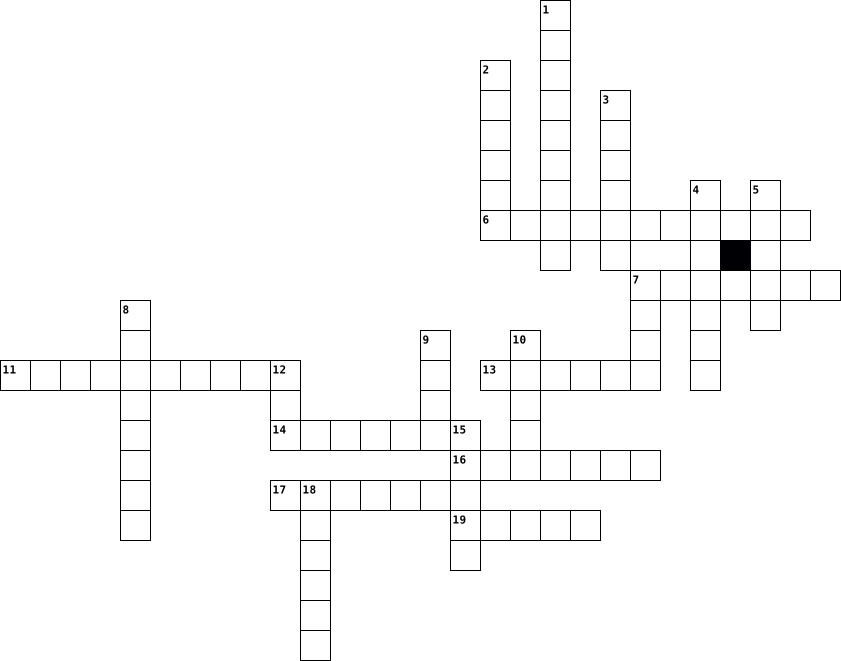
Kaylani's Scientific Revolution Crossword 2023-12-12

Across
- German astronomer and mathematician; assistant to Brahe Used Brahe’s data to formulate laws to describe planetary motion.
- an English statesman and writer Believed that a better understanding of the natural world will produce practical knowledge that could improve people’s lives
- Polish astronomer Developed the heliocentric system (the Sun is at the center of the universe, with all the planets and stars revolving around circular orbits)o9
- a Danish astronomer established observatories to chart the movements of the stars and planets. (no telescope… only the naked eye)
- Flemish anatomist and surgeon Considered the father of modern anatomy
Down
- an Italian astronomer and physicist was an outspoken supporter of Copernicus's Heliocentric theory (the Sun is at the center of the universe, with all the planets and stars revolving around it)
- English philosopher and mathematician Developed the Law of Universal Gravitation; all physical objects are affected equally by the same forces, in space and on earth
- English physician Disproved many of Galen’s hypotheses
- French philosopher and mathematician Believed that scientists needed to reject old assumptions
- German physicist and engineer Developed precise thermometers filled with mercury to measure temperature
10 Clues: English physician Disproved many of Galen’s hypotheses • Flemish anatomist and surgeon Considered the father of modern anatomy • French philosopher and mathematician Believed that scientists needed to reject old assumptions • German physicist and engineer Developed precise thermometers filled with mercury to measure temperature • ...
Space 2020-08-02

Across
- possible planet for life
- people in spacesuits
- our planet
- space facility
- icerock
- cave shield for planting
- Way giant gather of stars
Down
- round and round
- an infinite space
- study of planets
- fireball
11 Clues: icerock • fireball • our planet • space facility • round and round • study of planets • an infinite space • people in spacesuits • possible planet for life • cave shield for planting • Way giant gather of stars
Revision Crossword - Year 5 Science 2020-10-09

Across
- The Process where a liquid turns into a gas.
- When light reflects off a smooth, shiny surface, it changes _____.
- The Earth rotates on its _____ every 24 hours.
- This is a device we can use to look at the moon, stars and planets
- Fertilisation is the process where the _____ joins with the pollen to make a seed.
- The process where plants make more of themselves is called _____.
- If one side of the Earth is experiencing day, the other will be experiencing _____.
- In the water cycle, water evaporates and turns into water vapour. As it rises, it cools and _____ to form clouds.
- The opposite of evaporation.
Down
- Shadows change _____ and size as the sun moves across the sky.
- Seeds with hooks are usually dispersed by _____.
- Flowers have bright _____ to attract insects.
- The boiling point of a liquid is the _____ at which that liquid boils.
- Light intensity refer to the _____ of light.
- The tilting of the Earth and its revolution around the sun causes _____.
- Seeds dispersed by _____ are light and dry and have wing-like structures.
- Heated Water Vapour is called _____.
- Evaporation happens faster in a _____ place.
- A type of robot used to explore other planets.
19 Clues: The opposite of evaporation. • Heated Water Vapour is called _____. • The Process where a liquid turns into a gas. • Light intensity refer to the _____ of light. • Evaporation happens faster in a _____ place. • Flowers have bright _____ to attract insects. • The Earth rotates on its _____ every 24 hours. • A type of robot used to explore other planets. • ...
Solar System Crossword 2022-11-16

Across
- Large and small rocks or metallic masses orbiting the Sun; made up of materials similar to those that formed the planets
- The force that causes objects with mass to attract one another
- A large celestial body that revolves around a star in a solar system
- A star and the group of planets and other celestial bodies that are held by its gravitational attraction and revolve around it
Down
- A curved path followed by a satellite as it revolves around an object
- The attraction between two objects due to the invisible force of gravity; the gravitational pull from the Moon is primarily responsible for the tides that form on Earth
- A celestial body that revolves around a planet
- The luminous star around which Earth and other planets revolve; composed mainly of hydrogen and helium
8 Clues: A celestial body that revolves around a planet • The force that causes objects with mass to attract one another • A large celestial body that revolves around a star in a solar system • A curved path followed by a satellite as it revolves around an object • The luminous star around which Earth and other planets revolve; composed mainly of hydrogen and helium • ...
Dwarf Planets, Minor Planets, and Comets 2022-12-16

Across
- any celestial object that orbits the sun and is not classified as a planet, dwarf planet, moon, or comet
- disk-shaped region beyond the orbit of Neptune that contains asteroids, comets, and other debris from the formation of the solar scale
- a small grain about 1 millimeter in diameter embedded in a meteorite, often containing amino acids or other organic molecules
- a fragment from an asteroid or comet traveling in an irregular orbit through the inner solar system
Down
- an object composed of loosely bound rock and ice that appears to form a bright head and extended fuzzy tail when it approaches the sun
- small, dry rocky body in orbit around the sun between Mars and Jupiter or beyond the orbit of Neptune
- a meteor that does not completely vaporize and that strikes Earth's surface
- an object in orbit around the sun that is massive enough to be round or nearly round but is not massive enough to have cleared its orbital area of space debris
- a falling meteoroid that enters Earths atmosphere and glows as it vaporized; colloquially called shooting star
9 Clues: a meteor that does not completely vaporize and that strikes Earth's surface • a fragment from an asteroid or comet traveling in an irregular orbit through the inner solar system • small, dry rocky body in orbit around the sun between Mars and Jupiter or beyond the orbit of Neptune • ...
Vocabulary - Geography chapter 13 2020-05-04

Across
- Revolution
- Reducing period
- Belt of broken rocks and debris
- Revolves around planets
- Family
- In the sky
- Big hole made by fallen meteor
Down
- Pluto or Ceres
- Boundless expanse where matter exists
- Pieces of rock in the sky
- Recognizable pattern of stars in the sky
- Rotation
- Growing period
- Means the sun
- Ball of dust, ice, and frozen gas
15 Clues: Family • Rotation • Revolution • In the sky • Means the sun • Pluto or Ceres • Growing period • Reducing period • Revolves around planets • Pieces of rock in the sky • Big hole made by fallen meteor • Belt of broken rocks and debris • Ball of dust, ice, and frozen gas • Boundless expanse where matter exists • Recognizable pattern of stars in the sky
Space terms 2024-04-30

Across
- Icy small solar system body
- Earth's satellite
- belt divided outer and inner planets
- Life on____
- Biggest planet
- Red dot
- Farthest from the sun
- 13 rings
- Hottest planet
Down
- The mixture of gases that surround planet
- 8 Main Rings
- Neil Armstrong
- Closest to the Sun
- Star
- The average distance from the Earth to the Sun
15 Clues: Star • Red dot • 13 rings • Life on____ • 8 Main Rings • Neil Armstrong • Biggest planet • Hottest planet • Earth's satellite • Closest to the Sun • Farthest from the sun • Icy small solar system body • belt divided outer and inner planets • The mixture of gases that surround planet • The average distance from the Earth to the Sun
Space terms 2024-04-30

Across
- Icy small solar system body
- Earth's satellite
- belt divided outer and inner planets
- Life on____
- Biggest planet
- Red dot
- Farthest from the sun
- 13 rings
- Hottest planet
Down
- The mixture of gases that surround planet
- 8 Main Rings
- Neil Armstrong
- Closest to the Sun
- Star
- The average distance from the Earth to the Sun
15 Clues: Star • Red dot • 13 rings • Life on____ • 8 Main Rings • Neil Armstrong • Biggest planet • Hottest planet • Earth's satellite • Closest to the Sun • Farthest from the sun • Icy small solar system body • belt divided outer and inner planets • The mixture of gases that surround planet • The average distance from the Earth to the Sun
astronomy 2025-02-01

Across
- related to the moon
- to let a rocket go to space
- opposite of bright
- the path one object takes around another in space.
- huge
- opposite of inner
- go discover new things
- heavenly
Down
- opposite of natural
- way our galaxy
- a force of attraction
- synonym of distant
- cosmos
- go from place to another
- small planets
15 Clues: huge • cosmos • heavenly • small planets • way our galaxy • opposite of inner • synonym of distant • opposite of bright • opposite of natural • related to the moon • a force of attraction • go discover new things • go from place to another • to let a rocket go to space • the path one object takes around another in space.
crossword 2023-12-03

Across
- currency of feudal japan
- when its cold; "The Road Not Taken"
- c
- athenian tragedy by sophocles
- capital of czech
- kevin's not allowed to dance
- shakesphere's many plays about this man
Down
- storage, digestion, filled with fluid
- world tree
- its 9 o'clock on a saturday
- telegraph
- by gustav holst
- jane eyre's school
- "The Raven"
- language for handling data
15 Clues: c • telegraph • world tree • "The Raven" • by gustav holst • capital of czech • jane eyre's school • currency of feudal japan • language for handling data • its 9 o'clock on a saturday • kevin's not allowed to dance • athenian tragedy by sophocles • when its cold; "The Road Not Taken" • storage, digestion, filled with fluid • shakesphere's many plays about this man
U6 ANNA CASABÓ 2022-05-02

Across
- light
- a person who doesn't have a lot of money is...
- oficina
- in the aqua park you can find a lots of...
- buy
- begin
- caritat
- teach
Down
- bomber
- a person who has a lot of money is...
- tidy
- when you don't sleep a lot you are...
- be
- xarxa
- a person who studies planets and stars is an...
15 Clues: be • buy • tidy • light • begin • xarxa • teach • bomber • oficina • caritat • a person who has a lot of money is... • when you don't sleep a lot you are... • in the aqua park you can find a lots of... • a person who doesn't have a lot of money is... • a person who studies planets and stars is an...
Outer Space 2022-05-20

Across
- a system of millions or billions of stars, together with gas and dust, held together by gravitational attraction.
- the movement of an object around another object
- the spinning of a planet on its axis
- an object that orbits a star, is large enough to have become rounded by its own gravity, and has cleared the area of its orbit.
- period of time when the sun shines at a maximum on one hemisphere and a minimum on the other
- one of the highly dense planets nearest to the sun that have a solid surface; Mercury, Venus, Mars, and Earth
- a thin disk of small ice and rock particles surrounding a planet.
- the distance light travels in one year; about 6 trillion miles
- dark area of gas on the sun's surface that is cooler than surrounding gases.
- Space and all the matter and energy in it
Down
- planetary bodies made mainly of gases and no solid surface, including Jupiter, Saturn, Uranus, and Neptune
- path of one object around a more massive object due to gravity
- the collection of planets and their moons in orbit around a sun, together with smaller bodies in the form of asteroids, meteoroids, and comets.
- a pattern of climate and weather changes that occur during a year
- A force of attraction between objects that is due to their masses.
- rise and fall of the Earth's water due to the pull of the moon's gravity
- a round depression formed on the surface of a planet, moon, or other space object by the impact of a meteorite
- period of time when the sun shines equally on the northern and southern hemispheres
- unit of length used for distances within the solar system; 1 AU = about 93 million miles
- large spiral galaxy that is home to Earth and the rest of our solar system, and about a trillion stars.
- the outermost layer of the sun's atmosphere
- elongated circle, or oval shape; the shape of the planets orbit.
22 Clues: the spinning of a planet on its axis • Space and all the matter and energy in it • the outermost layer of the sun's atmosphere • the movement of an object around another object • path of one object around a more massive object due to gravity • the distance light travels in one year; about 6 trillion miles • ...
Earth and Spaces 2022-06-24

Across
- icy bodies of frozen gases, rocks and dust left over from the formation of the solar system
- Each planet in the solar system moves to its own rhythm.
- an imaginary line around the middle of the Earth. It is halfway between the North and South Poles, and divides the Earth into the Northern and Southern Hemispheres.
- are lumps of rock or iron that orbit the sun, just as planets, asteroids, and comets do
- when the Earth comes between the Sun and the Full Moon and blocks the Sun's direct rays from lighting up the Moon.
- rocky objects revolving around the sun that are too small to be called planets.
- During an eclipse, two shadows are cast. This shadow gets smaller as it goes away from the sun. It is the dark center of the eclipse shadow.
- the asteroid belt found between mars and...
- During a lunar eclipse Earth blocks_________ from reaching the moon
- something that occur twice a month, happen when the sun and moon are at right angles to each other.
- the partial shadow. the lighted area around the shadow of a planet or moon during an eclipse
- period of the year that is distinguished by special climate conditions because of of Earth's axial tilt, our planet orbits the Sun on a slant which means different areas of earth point toward or away from the Sun at different times of the year.
Down
- a space rock that enters Earth's atmosphere.
- any celestial body in space that orbits around a larger body.
- The inner planets are also called as
- The ________ is in between the sun and Earth during a
- The darkest part of the moon's shadow
- occurs when the Moon passes between Earth and the Sun, thereby obscuring Earth's view of the Sun, totally or partially.
- rock that falls to Earth from space. are pieces of asteroids, the small rocky bodies that orbit the Sun mostly between Mars and Jupiter.
- The movement of the Earth around the Sun in a fixed path is called
- something that occur twice each lunar month all year long without regard to the season.
- A lunar eclipse occurs at a _________ moon
- A solar eclipse occurs at a _______moon
- planet that has the most extensive ring structure, the second largest in solar system.
- What color does the moon look during a lunar eclipse
25 Clues: The inner planets are also called as • The darkest part of the moon's shadow • A solar eclipse occurs at a _______moon • A lunar eclipse occurs at a _________ moon • the asteroid belt found between mars and... • a space rock that enters Earth's atmosphere. • What color does the moon look during a lunar eclipse • The ________ is in between the sun and Earth during a • ...
The solar system 2022-02-11

Across
- a natural or artificial body that revolves around a planet
- a small, rocky object that orbits the sun, usually in a band between the orbit of Jupiter and Mars
- the portion of Earth that is water
- a model for the formation of the solar system in which the sun and planets condense from a cloud (or nebula) of gas and dust
- contains the sun and all of the planets and other bodies that travel around in it
- a accumulation of matter
- the distance that light travels in one year; about 9.5 trillion kilometers
- a large, reddish star late in it's life cycle
Down
- Any of the nine primary bodies that orbit the sun; a similar body that orbits another star
- a large celestial body that is composed of gas and emits light; the sun is a typical star
- a large cloud of dust and gas in interstellar space; a region in space where stars are born or where stars explode at the end of their lives
- a small, hot, dim star that us the leftover center of an old star
- an event in which the shadow of one celestial body falls on another
- a collection of stars, dust and gas bound together by gravity
- a gigantic explosion in which a massive star collapses and throws its outer layers into space; plural supernovae
- one of the highly dense planets nearest to the sun; Mercury, Venus, Earth, and Mars
- a group of stars bound by gravity
- a planet that has a deep, massive atmosphere, such as Jupiter, Saturn, Uranus, or Neptune
- a small body of ice, rock, and cosmic dust loosely packed together that follows an elliptical orbit and that gives off gas and dust in the form of a tail as it passes close to the sun
- the change in the illuminated area of one celestial body as seen from another celestial body;phases of the moon are caused by the position of Earth,the sun,and the moon
- an object so massive and dense that not even light can escape its gravity
21 Clues: a accumulation of matter • a group of stars bound by gravity • the portion of Earth that is water • a large, reddish star late in it's life cycle • a natural or artificial body that revolves around a planet • a collection of stars, dust and gas bound together by gravity • a small, hot, dim star that us the leftover center of an old star • ...
The solar system 2022-02-11

Across
- one of the highly dense planets nearest to the sun; Mercury, Venus, Earth, and Mars
- a large, reddish star late in it's life cycle
- an object so massive and dense that not even light can escape its gravity
- a small, rocky object that orbits the sun, usually in a band between the orbit of Jupiter and Mars
- contains the sun and all of the planets and other bodies that travel around in it
- a small, hot, dim star that us the leftover center of an old star
- a group of stars bound by gravity
- a large celestial body that is composed of gas and emits light; the sun is a typical star
- the change in the illuminated area of one celestial body as seen from another celestial body;phases of the moon are caused by the position of Earth,the sun,and the moon
- Any of the nine primary bodies that orbit the sun; a similar body that orbits another star
- a small body of ice, rock, and cosmic dust loosely packed together that follows an elliptical orbit and that gives off gas and dust in the form of a tail as it passes close to the sun
- a collection of stars, dust and gas bound together by gravity
Down
- the distance that light travels in one year; about 9.5 trillion kilometers
- a accumulation of matter
- a natural or artificial body that revolves around a planet
- a large cloud of dust and gas in interstellar space; a region in space where stars are born or where stars explode at the end of their lives
- an event in which the shadow of one celestial body falls on another
- a planet that has a deep, massive atmosphere, such as Jupiter, Saturn, Uranus, or Neptune
- a model for the formation of the solar system in which the sun and planets condense from a cloud (or nebula) of gas and dust
- the portion of Earth that is water
- a gigantic explosion in which a massive star collapses and throws its outer layers into space; plural supernovae
21 Clues: a accumulation of matter • a group of stars bound by gravity • the portion of Earth that is water • a large, reddish star late in it's life cycle • a natural or artificial body that revolves around a planet • a collection of stars, dust and gas bound together by gravity • a small, hot, dim star that us the leftover center of an old star • ...
Earth, Moon, Sun Vocabulary Choice Board #1 2024-04-15

Across
- the nearly circular path a smaller object (like the Moon) travels around a larger object like Earth)
- Moon the moon during the phases in which the part illuminated by the sun gets larger (new moon to full moon)
- the amount of time it takes for a planet to complete one orbit around a star or stars
- the shape of the illuminated part of the Moon as it appears from Earth
- to shine light on an object and make it visible
- The moment that the moon orbits directly between the sun and the Earth
- the force by which all things with mass or energy (including planets, stars, galaxies, and light) are brought towards one another
- all of space and its contents (including planets, stars, galaxies, and all other forms of energy and matter)
- the relative size of things
- a collection of gas, dust, stars, and solar systems that are held together by gravity
- a moon phase that looks like more than a half circle from Earth
- a moon phase where the Moon is not visible from the Earth
- a moon phase that looks like half a circle from Earth
- the force that pulls two objects together due to their mass
Down
- the sun, the planets that orbit the sun, and other objects that orbit the sun
- the tendency of an object to remain at rest or unchanged
- the border between light and dark on the Moon
- a moon phase that looks like less than half a circle from Earth
- when the moon is completely dark
- a moon phase that looks like a full circle from Earth
- the four parts of the year where weather, ecology, and number of daylight hours change as a result of Earth’s orbit around the sun
- the moon during the phases in which the part illuminated by the sun gets smaller (full moon to new moon)
- a rocky sphere that travels around a planet
- the circular movement of an object around its center (like a top spinning)
- the star that is the main source of light at the center of our solar system
25 Clues: the relative size of things • when the moon is completely dark • a rocky sphere that travels around a planet • the border between light and dark on the Moon • to shine light on an object and make it visible • a moon phase that looks like a full circle from Earth • a moon phase that looks like half a circle from Earth • ...
Name ___________________________________ 2024-05-29

Across
- A massive, luminous sphere of plasma held together by its own gravity, emitting light and heat.
- A chemical element with the symbol He and atomic number 2; a colorless, odorless, and non-toxic gas.
- All of space and everything in it, including planets, stars, galaxies, and all other forms of matter and energy.
- A subatomic particle with no electrical charge found in the nucleus of an atom.
- System A system comprising the Sun and the celestial bodies that orbit it, including planets, moons, asteroids, and comets.
- The basic unit of a chemical element, consisting of a nucleus containing protons and neutrons, surrounded by electrons in shells.
- The rapid expansion of matter from a state of extremely high density and temperature that marked the origin of the universe.
- The process of combining two or more atomic nuclei to form a heavier nucleus, releasing a large amount of energy.
- A tabular arrangement of the chemical elements, organized by their atomic number, electron configuration, and recurring chemical properties.
- Groups of atoms held together by chemical bonds; the smallest unit of a chemical compound.
- A pure substance made of only one type of atom that cannot be broken down into simpler substances by chemical means.
Down
- The chemical element with the symbol H and atomic number 1; the lightest and most abundant element in the universe.
- A measure of the amount of matter in an object; often measured in kilograms or grams.
- Substance A material that has a constant composition and properties; can be either an element or a compound.
- A subatomic particle with a negative charge that orbits the nucleus of an atom.
- The star at the center of our solar system, around which Earth and other planets orbit.
- The property of certain elements to spontaneously emit radiation as a result of nuclear instability.
- The total number of protons and neutrons in an atom's nucleus.
- A substance formed when two or more chemical elements are chemically bonded together.
- A subatomic particle with a positive charge found in the nucleus of an atom.
20 Clues: The total number of protons and neutrons in an atom's nucleus. • A subatomic particle with a positive charge found in the nucleus of an atom. • A subatomic particle with a negative charge that orbits the nucleus of an atom. • A subatomic particle with no electrical charge found in the nucleus of an atom. • ...
Space 2023-06-06

Across
- Has super strong gravity
- Thing made of gas and dust
- When the Sun,Moon,And Earth are all in a line
- One of 2 Exoplanets first discovered
- A black hole that is about the mass of a star
- _____ the Hunter
- Thing that we live on
- One of which we live in
- Peers into space
- An independent space travel company
- Started our Universe
- A capsule used to transport supplies to the ISS
- US space Agency
- Invisible lines connecting stars
- Sideways Planet
- ___________ Look through telescopes
- A _________ is a thing that landed on Earth
- Radio waves come from it at regular intervals
- An orbiting body around an object
- The death planet
- Thing that blasts into space
- First dwarf planet
- Biggest man made object in space
- Extraterrestrial
- Planet closest to the Sun
- Explosion that could shake Earth apart
- A ______ shower
- Core of liquid H that might behave like a solid
Down
- Wiped out the Dinosaurs
- A star with a very strong magnetic field
- Where life can exist in space
- Name of our star
- The Red Planet
- Thing with a long tail
- Things that always appear during the night
- Zodiac sign in the shape of a scorpion
- Extremely big explosion from a star
- Made of Photons
- North star
- Egg shaped dwarf planet
- Shortest name for a moon
- Person in space
- Planet farthest from the Sun
- Capsule for the Soviet Space Agency
- Planets _____ the Sun
- Zodiac sign for most of August
- A ______ of stars and planets
- Goes on other planets to collect data
- Our atmosphere is 21% ______
- The thing that we see in our sky every night
- "Blue Planet"
- Planet with prettiest rings
- Time it takes for the photons to travel
- Closest part of the atmosphere to Earth
- Farthest part of the atmosphere from Earth
- Forth country to land on the moon
56 Clues: North star • "Blue Planet" • The Red Planet • Made of Photons • Person in space • US space Agency • Sideways Planet • A ______ shower • Name of our star • _____ the Hunter • Peers into space • The death planet • Extraterrestrial • First dwarf planet • Started our Universe • Thing that we live on • Planets _____ the Sun • Thing with a long tail • Wiped out the Dinosaurs • One of which we live in • ...
Earth's Motion & its Seasons 2024-11-13

Across
- Where the sunsets in the Summer
- All of space and time and their contents, including planets, stars, galaxies, and all other forms of matter and energy.
- The time of day when the sun is highest in the sky
- A system of millions or billions of stars, together with gas and dust, held together by gravitational attraction.
- The only sky that does not appear to move in our sky. It remains stationary.
- Special name for March 21st in the Northern Hemisphere
- Special name for Dec. 21st in the Northern Hemisphere
- Name for our current day model of the Solar System where the Sun is in the center and planets revolve around the sun
- The name for the point directly over an observer
- Spinning of the Earth on its axis causes the apparent daily motion of the sun, earth, & moon.
- The collection of eight planets and their moons in orbit around the sun, together with smaller bodies such as asteroids, meteoroids, and comets.
- The name of the latitude that receives the vertical sun rays on the first day of Spring and Fall
- Where the sunrises in the Winter
- Earth orbiting around the sun causes us to see different constellations throughout the year.
Down
- The name of the latitude that receives the vertical sun rays on the first day of summer
- Object on Earth
- Object in Space
- Name for the model of the Solar System where the Earth is in the center and everything revolves around the Earth
- Special name for Sept. 22nd in the Northern Hemisphere
- The name of the latitude that receives the vertical sun rays on the first day of winter
- The number of degrees the stars appear to move across the sky per hour because of Earth’s rotation
- Where the sunsets in the Fall and Spring
- Where the sunrises in the Fall and Spring
- Special name for June 21st in the Northern Hemisphere
- Where the sunsets in the Winter
- Where the sunrises in the Summer
26 Clues: Object on Earth • Object in Space • Where the sunsets in the Summer • Where the sunsets in the Winter • Where the sunrises in the Summer • Where the sunrises in the Winter • Where the sunsets in the Fall and Spring • Where the sunrises in the Fall and Spring • The name for the point directly over an observer • The time of day when the sun is highest in the sky • ...
Chapter 3 - The Solar System 2026-05-21

Across
- Meteoroids that pass through the atmosphere and are found on Earth's surface.
- The solid inner core of a comet.
- Areas of gas on the sun's surface that are cooler than the gases around them.
- From the Latin word "terra" meaning Earth.
- The outer layer of the sun's atmosphere, appears as a white halo during an eclipse.
- The central region of the sun.
- An object that orbit the sun, has enough gravity to be spherical but has not cleared the area of its orbit.
- A meteoroid as it's moving through Earth's atmosphere.
- Four largest, outer planets made mostly of gas.
- Huge loops of gas that often link different parts of sunspot regions.
- A thin disk of small particles of ice and rock.
- 'Ge' is the Greek word for 'Earth, an Earth-centered model of the solar system.
- A region of tightly packed gas where energy moves mainly in the form of electromagnetic radiation.
- Earth and the other planets revolve around the sun.
- The extension of the corona into space that thins into streams of electrically charged particles.
- Must be round, orbit the sun, and have cleared out the region of the solar system along its orbit.
Down
- An oval shape.
- Beyond Neptune's orbit and extends about 100 times Earth's distance from the sun.
- Beyond the Kuiper belt this region stretches out more than 1,000 times the distance between the sun and Neptune.
- Sometimes loops in the sunspot regions suddenly connect, releasing large amounts of magnetic energy, causing gas to erupt into space.
- The inner layer of the sun's atmosphere. Gives off visible light.
- The middle layer of the sun's atmosphere.
- Loose collection of ice, dust and and small rocky particles whose orbits can be very long, narrow ellipses.
- Irregular rocky objects that are too small and numerous to be considered dwarf planets.
- Hydrogen atoms join to form helium.
- Clouds and dust form this fuzzy outer layer of a comet.
- Chunks of rock or dust smaller than asteroids.
- The outermost layer of the sun's interior.
- A region of the solar system between Mars and Jupiter where most asteroids orbit.
29 Clues: An oval shape. • The central region of the sun. • The solid inner core of a comet. • Hydrogen atoms join to form helium. • The middle layer of the sun's atmosphere. • From the Latin word "terra" meaning Earth. • The outermost layer of the sun's interior. • Chunks of rock or dust smaller than asteroids. • Four largest, outer planets made mostly of gas. • ...
A New Earth 2023-02-06

Across
- a large round object of burning gas in space(e.g., the sun)
- people who study the planets and stars in
- large round objects in space made of rock and
Down
- going around a planet or star
- the gas humans breathe
- or gas (e.g., the Earth)
- the solid part of the Earth or a planet
7 Clues: the gas humans breathe • or gas (e.g., the Earth) • going around a planet or star • the solid part of the Earth or a planet • people who study the planets and stars in • large round objects in space made of rock and • a large round object of burning gas in space(e.g., the sun)
Solar system vocabulary check 2023-03-16

Across
- it includes the stars and planets!
- It pushes and pulls in the universe!
- These bodies in space go around stars as they are smaller
Down
- Our solar system is inside it!
- A piece of rock in space
- It shines brightest during the night
- The fancy word we use to explain planets going around a star
7 Clues: A piece of rock in space • Our solar system is inside it! • it includes the stars and planets! • It shines brightest during the night • It pushes and pulls in the universe! • These bodies in space go around stars as they are smaller • The fancy word we use to explain planets going around a star
2nd Grade 2025-02-12

Across
- Gives earth heat and light. Other planets orbit around it
- Space rocks that are smaller than planets
- A streak of light in the sky
- A space rock that lands on earth
- Temperature of an asteroid entering the atmosphere
Down
- A person that studies meteorites to learn about space
- The planet that we live on
7 Clues: The planet that we live on • A streak of light in the sky • A space rock that lands on earth • Space rocks that are smaller than planets • Temperature of an asteroid entering the atmosphere • A person that studies meteorites to learn about space • Gives earth heat and light. Other planets orbit around it
The Solar System 2024-06-09

Across
- A body that gives out light.
- The path that all planets take around the Sun.
- A planet that orbits a star outside our Solar System.
Down
- A body that orbits a planet.
- Made up of billions of galaxies.
- The Sun and planets and other bodies in orbit around it.
- Collection of stars held together by gravity.
7 Clues: A body that orbits a planet. • A body that gives out light. • Made up of billions of galaxies. • Collection of stars held together by gravity. • The path that all planets take around the Sun. • A planet that orbits a star outside our Solar System. • The Sun and planets and other bodies in orbit around it.
Space 2013-06-08

Across
- Second biggest planet, also a gas giant and is surrounded with icy rings
- The planet that can sustain living creatures
- Scientists that study about space and astronomy
- The distance which a ray of light would travel in one year. This is about 6,000,000,000,000 (6 trillion) miles.
- A special kind of elongated circle. The orbits of the solar system planets form ellipses.
- The star that it is in the centre of the solar system
- A small particle from a comet or asteroid
- Seventh planet from the sun
Down
- Icy small Solar System Body
- Biggest planet and is a gas giant
- Second planet closest to the sun
- A group of stars, gas and dust held together by gravity
- Minor Planets that are not comets
- Described as the "Red Planet", named after the Roman God of war
- When our view of one object in the sky is blocked by either another object or the Earth's shadow
- An area in the Earth's upper atmosphere which absorbs many of the lethal radiations coming from space
- Negative particle which orbits an atom
- A dwarf planet that used to be a part of the solar system
- Smallest and closest planet to the Sun
- A cloud of gas and dust
20 Clues: A cloud of gas and dust • Icy small Solar System Body • Seventh planet from the sun • Second planet closest to the sun • Biggest planet and is a gas giant • Minor Planets that are not comets • Negative particle which orbits an atom • Smallest and closest planet to the Sun • A small particle from a comet or asteroid • The planet that can sustain living creatures • ...
Scientific revolution 2022-03-01

Across
- Orbits,When an object moves around another object in an oval shaped path.
- Method, Principles and procedures for the systematic pursuit of knowledge
- travel around the sun in elliptical orbits.
- and for his law of gravitation and his three laws of motion.
- and experiment, and the formulation and testing of hypotheses.
- An optical instrument used for viewing very small objects.
- force.
- Copernicus, Astronomer who declared the now accepted theory that the earth
- Kepler, Mathematician and astronomer who discovered that the Earth and
Down
- An optical instrument designed to make distant objects appear nearer.
- Bacon,English philosopher whose works are seen as developing the scientific
- force that attracts a body toward the center of the earth, or toward any
- Galilei, Italian astronomer, mathematician, and physicist. He was the first to use
- and remained influential through the scientific revolution.
- centered
- the other planets move around the sun.
- and physical principles.
- remains in constant motion along a straight line unless acted upon by an
- Newton,English mathematician and physicist; remembered for developing the
- Three Laws of Motion, A body at rest persists in its state of rest, and a body in
- centered
- physical body having mass.
- the recognition and formulation of a problem, the collection of data through
23 Clues: force. • centered • centered • and physical principles. • physical body having mass. • the other planets move around the sun. • travel around the sun in elliptical orbits. • An optical instrument used for viewing very small objects. • and remained influential through the scientific revolution. • and for his law of gravitation and his three laws of motion. • ...
Q1-4 2022-04-25

Across
- this rock type is made with heat
- the layer of atmosphere where weather occurs
- when heat goes up and cold goes down
- these plate boundaries cause earthquakes
- we revolve around this
- the hottest layer of Earth
- heat traveling through empty space
- the thinnest layer of Earth
- this is what stays the same during the lab
- the thickest layer of Earth
- this is made when magma cools and hardens
- fast current of moving air that flows West to East
- this is what you change in a lab
- this is what you count or measure in a lab
- these 4 planets are made of rock
Down
- these 4 planets are made of gas
- when rocks break through other rocks
- when two objects are touching and heat is transferred
- these plate boundaries create mountains
- the moving of rocks
- the 3 kinds of boundaries
- the 3 kinds are elliptical, spiral and irregular
- these plate boundaries cause sea floor spreading
- there are 2 kinds, heliocentric and geocentric
- this needs warm water in order to form
- this is made by weathered rocks squishing together
- when water freezes it does this
- the breaking down of rocks
- states the oldest rocks are on the bottom
29 Clues: the moving of rocks • we revolve around this • the 3 kinds of boundaries • the hottest layer of Earth • the breaking down of rocks • the thinnest layer of Earth • the thickest layer of Earth • these 4 planets are made of gas • when water freezes it does this • this rock type is made with heat • this is what you change in a lab • these 4 planets are made of rock • ...
space 2022-09-22
Across
- the system that includes all our planets and the sun
- this planet heats up to 1400 degrees
- we have labeled jupiter and saturn this because of how the terrain is
- organisms that we believe live in space and that they are green and short
- it has 14 moons and is known for being super blue
- this spaceship brought Neil armstrong to the moon
- the biggest planet in our solar system made of gas
- the largest moon of saturn
Down
- a region of spacetime where gravity is so strong that nothing can escape from getting sucked into it
- we sent these to the moon and mars to explore the rocky terrain
- this planet has rings and is a gas planet
- floating pieces of rock that travel through space
- a day in this planet is a year on earth and it is the 2nd planet to the sun
- the planet we are trying to live on
- the galaxy that our solar system is in
- humans have landed on this and it is considered a satellite for earth
- it is no longer considered a planet
- the energy source of all planets
- is the home to 7 billion organisms
- known for its funny name and it has small rings
20 Clues: the largest moon of saturn • the energy source of all planets • is the home to 7 billion organisms • the planet we are trying to live on • it is no longer considered a planet • this planet heats up to 1400 degrees • the galaxy that our solar system is in • this planet has rings and is a gas planet • known for its funny name and it has small rings • ...
solar system 2022-02-15

Across
- natural satellite
- the path a satellite follows as it revolves
- a whole because of impact from an object
- named after the greek god of the sky
- the distance light travels in one yearnebula a cloud of gas and dust in space
- every galaxy come together form this
- the planet we are living on
- a dwarf planet that used to be considered a main planet
- the center of an object
- our solar system
- has the largest mass by far
- minor planet of the inner Solar System
- hottest star
- large bodies in space that orbit the sun
Down
- next closest solar system
- closest planet to the sun
- an envelope of gas surrounding a body in space
- farthest planet from the sun
- planets that are rocky and Earthlike in size
- body of gas that shines by radiation in the sky also called the celestial sphere
- cosmic clumps of frozen gases, rocks or debris orbiting the sun
- referred as the red planet
- areas on the sun that give off less energy
- an force attraction between to objects revolution the movement of one object in its orbit around another object in space
- named after a roman goddess meaning love and beauty
- known as the gas giant
26 Clues: hottest star • our solar system • natural satellite • known as the gas giant • the center of an object • next closest solar system • closest planet to the sun • referred as the red planet • the planet we are living on • has the largest mass by far • farthest planet from the sun • named after the greek god of the sky • every galaxy come together form this • ...
Unit 2 Test Review 2020-10-08

Across
- collections of clusters
- Irregularly shaped rocky objects that orbit between Mars and Jupiter
- Any object that orbits the Sun; has a spherical shape and is large enough to clear its orbit of space debris
- Planet that appears red; most similar to Earth
- Small planets with rocky surfaces
- Used to measure distances across the universe; the distance light travels in a year
- process that produces energy through the combination of nuclei of atoms
- Planet with easily distinguishable rings
- Planet closest to the Sun
- collections of galaxies
Down
- Small spherical objects that are unable to push space debris out of its orbit
- Planet with lots of carbon dioxide in its atmosphere; creating a really thick atmosphere
- Made up of the Sun and everything that orbits or travels around the Sun
- a large ball of gas that shines through the process of nuclear fusion
- how bright a star appears from Earth
- Large planets that are often gaseous in nature
- A huge collection of gas, dust and billions of stars and their solar systems, all held together by gravity
- The actual brightness of a star
- unit Used to measure distances in the solar system;distance between Earth and Sun
- Only planet covered with 70% water
- Planet that possesses huge hurricane called the Great Red Spot
21 Clues: collections of clusters • collections of galaxies • Planet closest to the Sun • The actual brightness of a star • Small planets with rocky surfaces • Only planet covered with 70% water • how bright a star appears from Earth • Planet with easily distinguishable rings • Planet that appears red; most similar to Earth • Large planets that are often gaseous in nature • ...
Scientists of the Scientific Revolution 2024-05-16

Across
- how Galileo figured out large and small swings took the same amount of time
- worked with Descartes on mathematical reasoning
- used to believe that the Sun traveled around the Earth
- punished Galileo by not letting him leave his house
- the first to study the sky with this was Galileo
- the type of modern day telescope that Kepler invented
- position Bacon served as in England
- where Bacon was knighted
- what Galileo originally wanted to study at college
- science Galileo is the founder of this
- problems could be solved by converting them into algebraic problems
- philosopher from France
- where Newton went to college
Down
- Descartes was one of these before he studied philosophy
- a pull that controls the motion of the planets around the sun
- first to say that the Earth and other planets travel around the sun
- named in honor of Galileo’s discovery
- Society used Bacon’s scientific approach
- the country where Kepler is from
- created to keep track of time
- sometimes white light passes through it
- Copernicus’ position in the Roman Catholic Church
- shown to Copernicus by his mother
- the country where Copernicus is from
- not there when Descartes’ body was moved
- shaped the type of orbit Mars moves in
26 Clues: philosopher from France • where Bacon was knighted • where Newton went to college • created to keep track of time • the country where Kepler is from • shown to Copernicus by his mother • position Bacon served as in England • the country where Copernicus is from • named in honor of Galileo’s discovery • science Galileo is the founder of this • ...
pluto 2023-02-14

Across
- year on this is 248 Earth years.
- relatively small planetoid, smaller than the Earth's moon.
- had been discovered decades earlier
- fictional dog that belongs to Mickey Mouse. He is a golden-yellow mutt with a green colla
- in the Kuiper Belt
- was discovered while searching for planet X
- closer to the Sun than Neptune
- orbit is erratic
- first vessel devoted to studying Pluto's environment, is the size of a grand piano.
- of its moons, Charon, is about half
- considered a planet until 2006
- only about half the width of the United States.
Down
- Scientists discovered the Solar System’s third zone
- was made due to an error in the calculations
- has a heart shape on its surface
- an extremely elliptical orbit that's not in the same plane as the eight official planets' orbits
- just the tip of the iceberg
- a heart shape on its surface.
- a dwarf plant
- dense and rocky, like the terrestrial planets (Mercury, Venus, Earth and Mars)
- It has not yet cleared the neighborhood of its orbit in space
- are white mountains
- is smaller than the Moon
- than Earth's moon but larger than previously thought
- closer to The Sun than Neptune
25 Clues: a dwarf plant • orbit is erratic • in the Kuiper Belt • are white mountains • is smaller than the Moon • just the tip of the iceberg • a heart shape on its surface. • closer to the Sun than Neptune • closer to The Sun than Neptune • considered a planet until 2006 • year on this is 248 Earth years. • has a heart shape on its surface • had been discovered decades earlier • ...
Lunar Cycle Crossword Puzzle 2025-03-13

Across
- This keeps up on the ground while the Earth is rotating.
- The fourth kind of moon in the lunar cycle.
- Quarter The seventh kind of moon in the lunar cycle.
- The revolves around the Earth.
- Every planet in the Solar System revolves around this star.
- The "brightest" kind of moon in the lunar cycle.
- Very long-period waves that move through the ocean in response to the forces exerted by the moon and sun.
- All planets and moons....(another word for spin)
- The only planet we know of that inhabits life.
- Our Solar System is in a ...(uni..)
- The sixth kind of moon in the lunar cycle.
- An obscuring of the light from one celestial body by the passage of another between it and the observer or between it and its source of illumination.
Down
- The second kind of moon in the lunar cycle.
- The "darkest" kind of moon in the lunar cycle.
- The planets and sun are in the...(blank system).
- The eighth kind of moon in the lunar cycle.
- We have 8 of these in our Solar System(used to be nine).
- The third kind of moon in the lunar cycle.
- A lunar cycle resets about every...
- We are learning about the moon...
- The Earth spins on its...
21 Clues: The Earth spins on its... • The revolves around the Earth. • We are learning about the moon... • A lunar cycle resets about every... • Our Solar System is in a ...(uni..) • The third kind of moon in the lunar cycle. • The sixth kind of moon in the lunar cycle. • The second kind of moon in the lunar cycle. • The fourth kind of moon in the lunar cycle. • ...
Formation of the Solar System 2025-03-10

Across
- person who first proposed the nebular theory
- Mercury, Venus, Earth, and Mars are classified as this kind of planet
- this movement made the solar nebula spin faster
- when a nebula is flattened by spinning and gravity
- Jupiter and Saturn are classified as this kind of planet
- these planets form before the inner planets
- once a protoplanet has accumulated enough material to reach a certain size it becomes this
- Uranus and Neptune are classified as this kind of planet
- a contracting mass of gas which represents the step before a star is born
Down
- when rocky, solid, or metal particles accumulate and stick together
- it is believed that this planet most likely formed first
- when icy or gaseous particles accumulate and stick together
- the force that causes the solar nebula to shrink and heat up
- the step that comes after planetesimal and before planet
- theory that states our solar system formed from the collapse of a solar nebula
- the celestial body whose explosion & resulting shockwave triggered the solar nebula to collapse
- rocks from this celestial body provide proof of the nebular theory
- massive rotating cloud of gas and dust
- small, irregularly shaped bodies
- a protostar turns into this once it is hot enough for nuclear fusion to occur
20 Clues: small, irregularly shaped bodies • massive rotating cloud of gas and dust • these planets form before the inner planets • person who first proposed the nebular theory • this movement made the solar nebula spin faster • when a nebula is flattened by spinning and gravity • it is believed that this planet most likely formed first • ...
ILEARN Review 2025-04-14

Across
- Top of the wave
- A consumer that only eats meat
- Moon What the moon looks like during a solar eclipse
- A relationship where both organisms benefits
- A consumer that only eats producers
- A species that is originally from an ecosystem
- A relationship where one organism benefits and the other is not helped or harmed
- When the moon blocks the sun and casts a shadow on Earth
- A relationship where one organism benefits and the other is harmed.
- The length of a wave
- Number of waves that pass a point
- A consumer that eats both plants and animals
- The amount and variety of organisms an ecosystem has
Down
- A species that is not originally from an environment and causes harm to the native species.
- Types of observations where you use descriptions or five senses
- Mercury, Venus, Earth, and Mars are all what kind of planets?
- The bottom of the wave
- When the Earth blocks the sun and casts a shadow on the Moon
- Jupiter, Saturn, Uranus and Neptune are all what kind of planets?
- The height of a wave
- What the moon looks like during a lunar eclipse
- Types of observations where you use numbers
- An organism that makes it's own energy through photosynthesis
23 Clues: Top of the wave • The height of a wave • The length of a wave • The bottom of the wave • A consumer that only eats meat • Number of waves that pass a point • A consumer that only eats producers • Types of observations where you use numbers • A relationship where both organisms benefits • A consumer that eats both plants and animals • ...
The Solar System (English Version of Crossword) 2025-05-24

Across
- – The largest planet with the Great Red Spot.
- – An instrument used to observe distant objects.
- – A giant cloud of dust and gas where stars are born.
- – The U.S. space agency.
- – A moon of Jupiter with an icy ocean.
- – A icy object that develops a tail when near the Sun.
- – The smallest and closest planet to the Sun.
- – A robotic vehicle exploring planets (e.g., Curiosity).
- – A dwarf planet in the Kuiper Belt.
- – The hottest planet with a toxic atmosphere.
- – The only known planet with liquid water and life.
- – The windiest planet with the strongest storms.
- – One of Mars’ two moons.
- – Famous for its beautiful rings.
- – Neptune’s largest moon, orbits backward.
Down
- – Earth’s natural satellite.
- – Saturn’s largest moon with a thick atmosphere.
- – The largest object in the asteroid belt.
- – A streak of light caused by a burning space rock (shooting star).
- Hole – A region of space with gravity so strong nothing escapes.
- – A rocky body orbiting the Sun, mostly found in the asteroid belt.
- – The force that keeps planets in motion around the Sun.
- – A gas giant that rotates on its side.
- – Known as the "Red Planet," home to Olympus Mons.
- – The path a planet or satellite follows around a star.
25 Clues: – The U.S. space agency. • – One of Mars’ two moons. • – Earth’s natural satellite. • – Famous for its beautiful rings. • – A dwarf planet in the Kuiper Belt. • – A moon of Jupiter with an icy ocean. • – A gas giant that rotates on its side. • – The largest object in the asteroid belt. • – Neptune’s largest moon, orbits backward. • ...
UNIT 2 2023-05-09

Across
- Got the first close ups of Pluto
- orbited it for 13 years and used gravity assist to get there, but later impacted Saturn's atmosphere
- materials that were theorized to create the solar system
- smaller pieces of asteroids left over after an impact
- mapped Mar's surface out in more detail and later impacted the surface
- was the first to land on Mar's surface and analyze the soil contents and rocks
- meteoroids that burn while falling into the Earth’s atmosphere
- was made to find more worlds in space
- dense, solid, have few moons, and no rings
Down
- Uses a planet’s gravity to “slingshot” the spacecraft in a desired location
- large, gaseous, many moons, and sometimes rings
- the farthest place in our solar system, full of many icy objects, comets, and much more
- Heading to Jupiter in 2016
- galactic debris made of rock and metal that float around in the universe.
- streaks of icy matter that soar through space, leaving behind a trail.
- red planet next to Earth
- Planetology comparing and contrasting the descriptions of planets to figure out how they came to be
- a collection of rocky particles that’s in between mars and jupiter
- is the region most dwarf planets exist in
- meteors that land on the earth's surface.
20 Clues: red planet next to Earth • Heading to Jupiter in 2016 • Got the first close ups of Pluto • was made to find more worlds in space • is the region most dwarf planets exist in • meteors that land on the earth's surface. • dense, solid, have few moons, and no rings • large, gaseous, many moons, and sometimes rings • smaller pieces of asteroids left over after an impact • ...
5th Grade Homeroom Open House: Catholic Schools Week! 2025-01-26

Across
- A bond between people who care about each other
- Doing the right thing, even when no one is watching
- Wanting to learn and ask questions
- Staying true to your friends and family
- A group of plants and animals living together
- Someone who discovers new places
- A mountain that erupts with lava
- A tool to look at stars and planets
- Being thankful for what you have
- The document that guides the U.S. government
- Being a good member of a community or country
- Not giving up, even when it’s hard
- Related to the sun
- Power that makes things work
- Living peacefully with others
Down
- Using good manners, like saying please and thank you
- A large group of stars and planets
- Following rules and staying focused
- Staying calm while waiting
- Plants use sunlight to make food
- A government where people vote to make decisions
- Remains of ancient plants or animals
- Sharing with others without expecting something in return
- A place where animals or plants live
- Understanding how someone else feels
- Treating everyone fairly
- Letting go of anger toward someone
- What keeps us on Earth instead of floating
- Earth, Mars, or Jupiter, for example
- Thinking of new and imaginative ideas
30 Clues: Related to the sun • Treating everyone fairly • Staying calm while waiting • Power that makes things work • Living peacefully with others • Plants use sunlight to make food • Someone who discovers new places • A mountain that erupts with lava • Being thankful for what you have • A large group of stars and planets • Wanting to learn and ask questions • ...
Unit 1 2025-09-25

Across
- the planets that orbit the sun, and other objects that orbit the sun
- to move in a regular path around something (also: revolve, revolution)
- an answer to a question
- observations or measurements recorded in an investigation
- an attempt to find out about something
- the amount of light that appears to come from an object
- an arrangement of stars as seen from Earth
- something we observe to be similar over and over again
Down
- a period of time that is 24 hours long and includes daytime and nighttime
- to make a picture in your mind using information from different sources
- the pull between Earth and other objects, which acts even without touching
- information observations or data that is used to support a claim
- when an object spins on an axis
- a scientist who studies stars, planets, and other objects in the universe
- the imaginary line that an object, such as Earth, spins around
- a huge object in space that gives off heat and light
- the length of time it takes for Earth to orbit the sun once
- something scientists make to answer questions about the real world
- a group of billions of stars
- the only star in our solar system
20 Clues: an answer to a question • when an object spins on an axis • a group of billions of stars • an attempt to find out about something • an arrangement of stars as seen from Earth • the only star in our solar system • something we observe to be similar over and over again • ...
Grubbs: End of Year Science 2026-05-18

Across
- word for the type of waves (sound or ocean) that need a medium to go through
- scientific unit for measuring temperature
- This "belt" is in our solar system is made of small rocky fragments
- in a water molecule, this element is slightly negative
- material that allows the flow of electrons to make electricity
- transfer of heat by the rising and falling of water or air
- shape of the "S" shape waves such as light
- this is the coldest biome
- type of energy that includes food, fuel and batteries
- this part of the atom is positive
Down
- force that holds that planets in orbit around the Sun
- variable that "I" the scientist am changing in an experiment
- the "powerhouse" of the cell that makes energy
- the part of the water cycle where gas turns back into liquid and clouds are formed
- Newton's Law of Inertia (what is at rest, stays at rest)
- source of energy that Earth can remake easily (solar, wind, water)
- Newton's second law states that this depends on mass and acceleration
- these planets are rocky, smaller and closer to the Sun
- type of bond between a metal and nonmetal
- found only in plant cells, it's the site of photosynthesis
20 Clues: this is the coldest biome • this part of the atom is positive • scientific unit for measuring temperature • type of bond between a metal and nonmetal • shape of the "S" shape waves such as light • the "powerhouse" of the cell that makes energy • force that holds that planets in orbit around the Sun • type of energy that includes food, fuel and batteries • ...
Jobs (I have a dream) 2021-02-02

Across
- I like food
- I like teeth
- I like bread
- I like painting
- I like flowers
- I like school
Down
- I like acting
- I like jokes
- I like music
- I like planets
- I like animals
11 Clues: I like food • I like jokes • I like music • I like teeth • I like bread • I like acting • I like school • I like planets • I like flowers • I like animals • I like painting
vocab memory 2023-05-26

Across
- sudden growth
- plan
- kayaks are a kind of this
- a push
- stars and planets
Down
- lose control
- barrier
- a huge amount of people (or bees)
- fall rapidly
- reducing over time
- brown. grow plants in it
11 Clues: plan • a push • barrier • lose control • fall rapidly • sudden growth • stars and planets • reducing over time • brown. grow plants in it • kayaks are a kind of this • a huge amount of people (or bees)
Solar System Special Facts 2018-01-30

Across
- Titan is this planet's largest moon
- 'Red planet'; Color of the dust on this planet
- Has a red spot that is believed to be a raging storm
- Shape of the planets
Down
- Planet with thick and heavy atmosphere that can crush a human if they were to land on this planet
- The methane gas above the cloud layers gives it a blue-green color
- Number of planets in the solar system that have a ring structure
- Planet with metals such as nickel and iron
- Planet that resembles Luna
9 Clues: Shape of the planets • Planet that resembles Luna • Titan is this planet's largest moon • Planet with metals such as nickel and iron • 'Red planet'; Color of the dust on this planet • Has a red spot that is believed to be a raging storm • Number of planets in the solar system that have a ring structure • ...
Addie Ricker 2022-05-17

Across
- The solar system consists of _ _ _.
- According to the nebular theory, the Sun and planets formed together from a cloud of gas and dust _ _ _ _ _ _.
- between materials in the cloud pulled it inward _ _ _ _ _ _ _ _ _ _ _.
- Planets are divided into two classes _ _ _ _ _.
- The Sun is the nearest star to _ _ _ _ _.
Down
- The _ _ _ _ _ _ _ _ cloud conformed to the shape of a spinning disk.
- When the cloud was pulled inward, its spin increased in _ _ _ _ _ _ _ _ _ _ with the conservation of angular momentum.
- _ _ _ _ _ _ _ _ is fused to helium by thermonuclear fusion in the Sun's core.
- Planets are divided into two classes _ _ _ _ _.
- A _ _ _ _ fraction of this energy reaches and sustains Earth.
10 Clues: The solar system consists of _ _ _. • The Sun is the nearest star to _ _ _ _ _. • Planets are divided into two classes _ _ _ _ _. • Planets are divided into two classes _ _ _ _ _. • A _ _ _ _ fraction of this energy reaches and sustains Earth. • The _ _ _ _ _ _ _ _ cloud conformed to the shape of a spinning disk. • ...
Space and objects in space 8th 2025-01-23

Across
- the amount of energy that is given off the surface of a star
- appears to have a bulge in the center and arms in a spiral
- do not have regular shapes
- are shaped like round or flattened balls
- a giant ball of hot gas made up of mostly of hydrogen and helium
Down
- something that the characteristics of a group or type
- the sun and all the planets are called
- the distance that light travels in one year
- is a huge system composed of stars, dust, gas, planets, and other objects bound by gravity.
9 Clues: do not have regular shapes • the sun and all the planets are called • are shaped like round or flattened balls • the distance that light travels in one year • something that the characteristics of a group or type • appears to have a bulge in the center and arms in a spiral • the amount of energy that is given off the surface of a star • ...
Patterns of Earth and Sun Vocabulary chap 1 2025-08-21

Across
- the sun, the planets that orbit the sun, and other objects that orbit the sun
- a huge object in space that gives of heat and light
- a scientist who studies stars, planets, and other objects in the universe
- an attempt to find out about something
Down
- a description of how something works or why something happens
- to make a picture in your mind using information from different sources
- something scientists make to answer questions about the real world
- the only star in our solar system
- observations or measurements recorded in an investigation
9 Clues: the only star in our solar system • an attempt to find out about something • a huge object in space that gives of heat and light • observations or measurements recorded in an investigation • a description of how something works or why something happens • something scientists make to answer questions about the real world • ...
grade 6 SA 2017-09-12

Across
- _________________ is the first big kingdom.
- Distribution of rainfall can be shown through a ____________ map.
- A ______ is a celestial body that moves around the planets in the same way as the planets move around the sun.
- When we fix people in one image, we create a ________.
- When a person is being judged negatively, he is being subject to ____________.
Down
- _______ means earth-like shape.
- A _____________ has the power to make decisions and run the government in a Monarchy.
- Women’s struggle to vote is known as ______________.
- The earliest period is known as _______________.
- ____________ is the term that people belonging to so-called lower castes use to address themselves.
10 Clues: _______ means earth-like shape. • _________________ is the first big kingdom. • The earliest period is known as _______________. • Women’s struggle to vote is known as ______________. • When we fix people in one image, we create a ________. • Distribution of rainfall can be shown through a ____________ map. • ...
SES6Sci 2022-03-28

Across
- the revolution of planets around the sun caused by gravity
- what newton called the fact that gravity acts on all planets
- the theory about an ancient star blowing up starting the universe
- a rock flying through space increasing speed (sometimes described as a shooting star)
Down
- the force that pulls objects toward each other.
- a famous scientist who first thought about gravity
- the planet we live on
- how much space an object takes up
- when lots of space material compressed into the middle of the universe and it’s atoms merged causing an explosion it creates… (it produces heat and light)
- the measure of gravitational pull on an object
10 Clues: the planet we live on • how much space an object takes up • the measure of gravitational pull on an object • the force that pulls objects toward each other. • a famous scientist who first thought about gravity • the revolution of planets around the sun caused by gravity • what newton called the fact that gravity acts on all planets • ...
Cosmic Crossword 2023-12-05

Across
- Rocky bodies covered in craters that rotate around planets
- Pieces of ice, dust, and gas that have a tail effect
- The spinning of a planet on its axis
- Rise and fall of water levels caused by gravitational affects of the moon and sun
- These can be terrestrial or gas and have moons orbit them
Down
- Curved path of celestial body's circling each other
- Rocks that burn up in our atmosphere
- Parts of the sun that you can only see during a solar eclipse
- Parts of the sun that are much cooler and appear as dark spots
- Made up of gas, dust, and billions of stars
10 Clues: Rocks that burn up in our atmosphere • The spinning of a planet on its axis • Made up of gas, dust, and billions of stars • Curved path of celestial body's circling each other • Pieces of ice, dust, and gas that have a tail effect • These can be terrestrial or gas and have moons orbit them • Rocky bodies covered in craters that rotate around planets • ...
Astronomy 2023-12-18

Across
- caused by a meteoroid crashing through Earth's atmosphere
- Highly elliptical orbit
- The word comet comes from the Greek word
- located between the planets Mars and Jupiter
- The month when Ceres was discovered in 1801
Down
- are precious rock samples preserving material from the birth of the Solar System 4.6 billion years ago
- The one who discovered the first Asteroid
- the largest asteroid in the main asteroid belt, and the first asteroid to be discovered
- composed of ices, dust and rocky debris carried from the early formation of the solar system about 4.5 billion years ago.
- Sometimes called minor planets
- Cloud collection of icy objects farther away than everything else in the solar system
11 Clues: Highly elliptical orbit • Sometimes called minor planets • The word comet comes from the Greek word • The one who discovered the first Asteroid • The month when Ceres was discovered in 1801 • located between the planets Mars and Jupiter • caused by a meteoroid crashing through Earth's atmosphere • ...
Solar System 2024-01-19

Across
- With it's rings, this planet is known as the "crown jewel" of the solar system
- This planet has one moon and can sustain life.
- The red planet that has Wifi and currently is occupied by robots.
- This planet is the biggest in the solar system.
- This planet is icy blue with rings that go up and down
Down
- All the planets in our solar system orbit this giant.
- This separates Mars from Jupiter
- The planet that rotates opposite from all the other planets and has clouds of c02 gas and acid
- The second to last planet in our solar system
- This planet is the closest to the sun.
10 Clues: This separates Mars from Jupiter • This planet is the closest to the sun. • The second to last planet in our solar system • This planet has one moon and can sustain life. • This planet is the biggest in the solar system. • All the planets in our solar system orbit this giant. • This planet is icy blue with rings that go up and down • ...
Space crossword 2026-05-07

Across
- planets farther from the sun and have a surface of gas.
- it is between mars and Jupiter.
- the 7th planet in the solar system.
- The largest planet in our solar system.
- The closest planet to the sun in our solar system it also has no moons
Down
- A natural satellite that orbits around a planet
- A ball made of ice and dust that make a trail when they move in space.
- the only planet that has life on it in the solar system.
- The glowing ball of light that is in the center of our solar system.
- Planets near the sun that have a rocky surface.
10 Clues: it is between mars and Jupiter. • the 7th planet in the solar system. • The largest planet in our solar system. • A natural satellite that orbits around a planet • Planets near the sun that have a rocky surface. • planets farther from the sun and have a surface of gas. • the only planet that has life on it in the solar system. • ...
Space Crossword 2022-03-11

Across
- What did Mars say to Saturn? Give me a ____ sometime
- Where do you get your coffee in space?
- Why did Mickey Mouse go to outer space? He was looking for ____
- Why does the moon need money? It’s down to its ____ _______
- What do you call an alien with three eyes?
- What does Earth say to tease the other planets? You guys have no ____
- What did they call Iron Man when he went to space?
- What do you say if you want to start a fight in space? “____ me, bro!”
- What’s the best board game to play with your family in space?
Down
- Why do aliens always spill their tea? They have ___ ____
- What is an astronaut's favourite chocolate? A _______
- Why is the sun so smart? It has thousands of ________
- Why couldn’t the star stay focused? He kept _______ ___
- How does the solar system hold up its pants?
- Why haven’t aliens come to our solar system yet? The reviews were ___
- What do you call a tick on the moon? A ___ ___
- Where can planets update their status?
- What did the cow that jumped over the moon create? The ________
18 Clues: Where do you get your coffee in space? • Where can planets update their status? • What do you call an alien with three eyes? • How does the solar system hold up its pants? • What do you call a tick on the moon? A ___ ___ • What did they call Iron Man when he went to space? • What did Mars say to Saturn? Give me a ____ sometime • ...
Patterns of Earth and Sky Vocabulary 2024-11-07

Across
- The length of time it takes for the Earth to orbit the Sun.
- A scientist who studies the stars, planets, and other objects in the sky
- A huge object in space that gives off heat and light
- Observations or measurements recorded in an investigation
- Something we observe to be similar over and over again
- An attempt to find out about something
- A group of stars that form a pattern in the sky as seen from Earth
- When one object moves around another object in a path
- An invisible force that pulls all objects to Earth's center
Down
- A period of 24 hours and includes daytime and nighttime
- The planet we live on
- Information that supports an answer to a question
- A description of how something works or why something happens
- Something scientists make to answer questions about the real world
- The only star in our solar system
- When an object spins in place or on an axis
- To make a picture in your mind using information from different sources
- system The sun, planets that orbit the sun, and other objects that revolve around the sun
18 Clues: The planet we live on • The only star in our solar system • An attempt to find out about something • When an object spins in place or on an axis • Information that supports an answer to a question • A huge object in space that gives off heat and light • When one object moves around another object in a path • Something we observe to be similar over and over again • ...
Enlightenment Crossword puzzle 2020-10-31

Across
- Influence writer devoted himself to the study of political liberty
- He developed analytical geometry, which linked algebra and geometry
- Vaccination for smallpox
- discovered the relationship between volume gas and pressure
- Created a telescope and discovered Jupiter has 4 moons
- The agreement between the government and the people
- Came up with the idea that planets move in orbits shaped like an ellipse.
- he believed without the government's keeping order there would be war and life would be solitary poor nasty brutish and short
- He believed that people could learn from experience and improve themselves
- a tool to study space
- A woman who published something on the rights of women
- He was an English writer that helped with the scientific method
Down
- theory that states that the earth is the center of the universe
- new way of thinking of the Modern World
- created the Sun centered theory
- François-Marie Arouet writing name
- Theorys of motion
- social critics
- theory that states that the planets revolve around the sun
- social gathering where attendees would discuss enlightenment ideas
- A tool to make large objects smaller to look at cells, bacteria, etc.
- committed to individual freedom
- Is an Italian philosopher his thoughts were mostly on the justice system
23 Clues: social critics • Theorys of motion • a tool to study space • Vaccination for smallpox • created the Sun centered theory • committed to individual freedom • François-Marie Arouet writing name • new way of thinking of the Modern World • The agreement between the government and the people • Created a telescope and discovered Jupiter has 4 moons • ...
Astronomy Crossword Puzzle 2021-12-12

Across
- Day and night on Earth are caused by the Earth's ___
- If the Earth's tilt were increases, these would be more extreme
- The layer of the Sun where the UV light is produced
- This part of the Earth receives direct rays from the Sun year-round
- The distance between the Sun and the Earth
- The largest object in our solar system
- Changes depending on the gravitational pull of the planet
- The amount of the Earth that receives sunlight each day
- An eclipses that occurs when the Moon is between the Earth and the Sun
- As two objects move toward each other, the gravitational force between them ___
- One of the things that causes our seasons
Down
- The planets in our solar system that are really far apart
- This moon phase occurs when the Moon is between the Earth and the Sun
- The length of a planet's year is based on its ___ around the Sun
- A collection of rocks located between the terrestrial planets and the gas giants
- A lunar cycle lasts approximately one ___
- Solar systems from from this
- The force responsible for the formation of the solar system
- If an object has a lower mass, its gravitational pull does this.
- Occurs when the Northern Hemisphere is pointed away from the Sun
20 Clues: Solar systems from from this • The largest object in our solar system • A lunar cycle lasts approximately one ___ • One of the things that causes our seasons • The distance between the Sun and the Earth • The layer of the Sun where the UV light is produced • Day and night on Earth are caused by the Earth's ___ • The amount of the Earth that receives sunlight each day • ...
Out of this World 2013-08-08

Across
- A dwarf planet that used to be a planet
- An explosion of a star
- Without it we would be frozen
- The only planet that has life existence
- An undentified flying object found in the sky
- Made from stars
- A very hot planet
- The planets that are made out of gas
- A creature that comes from a different planet
- Also known as the red planet
- The 8th planet from the sun
- A planet that is over 400 degrees
Down
- Smaller than an asteroid
- If you get sucked in you can't get out
- Dark spots found on the sun
- A place were you can learn about space
- A planet named after the Roman god of agriculture
- A comet that comes past Earth every 75 years
- The first person to walk on the moon
- A moon of Saturn's it is also the second largest moon
- It seperates the inner and outer planets
- A constellation
- Is known from it's giant red spot that has lasted for over 300 years
- When the sun goes down
- We see them in the night sky
- When the sun comes up
- A dwarf planet
- The 7th planet from the sun
28 Clues: A dwarf planet • Made from stars • A constellation • A very hot planet • When the sun comes up • An explosion of a star • When the sun goes down • Smaller than an asteroid • Dark spots found on the sun • The 8th planet from the sun • The 7th planet from the sun • We see them in the night sky • Also known as the red planet • Without it we would be frozen • A planet that is over 400 degrees • ...
Circular Motion and Gravitation 2024-02-07

Across
- He attempted to reconcile observation with theory and to keep Earth at the center of the universe.
- In circular motion, an acceleration due to a change in speed is called tangential ____________.
- the perpendicular distance from the axis of rotation to a line drawn along the direction of the force
- The lever arm depends on the _________.
- Tangential speed depends on _________.
- Centripetal force is necessary for ________ motion.
- a quantity that measures the ability of a force to rotate an object around some axis
- Gravitational force acts between ___________ masses.
- Gravity is a _______ force.
- Newton's law of gravitation accounts for ocean ______.
- the acceleration directed toward the center of a circular path
- Astronauts in orbit experience apparent _________.
Down
- is an object that is so massive that nothing, not even light, can escape the pull of its gravity
- He conducted an experiment that determined the value of the constant G.
- His three laws describe the motion of the planets
- a measure of how well a machine works
- Orbiting objects are in _____________.
- the mutual force of attraction between particles of matter
- He proposed that Earth and other planets orbit the sun in perfect circles.
- Gravitational mass equals ______ mass.
- one of the six simple machines
21 Clues: Gravity is a _______ force. • one of the six simple machines • a measure of how well a machine works • Orbiting objects are in _____________. • Tangential speed depends on _________. • Gravitational mass equals ______ mass. • The lever arm depends on the _________. • His three laws describe the motion of the planets • Astronauts in orbit experience apparent _________. • ...
Unit 13 Vocabulary Review 2023-03-28

Across
- its two moons are Phobos and Deimos
- The nickname given to the outer planets
- This is a meteoroid that has broken through Earth's atmosphere and will hit the surface of the Earth
- This is the average distance from the sun to the earth (93 million miles)
- A subtype of planet that is not the largest in its orbit
- The movement of one object around another
- A variable that does not change within an experiment
- The variable we measure in an experiment
- Its main moons are Titan, Rhea, Dione, Iapetus, and Tethys
Down
- A small mass of dust, rocks, and ice that travels in an orbit around the sun
- Space rock that is smaller than an asteroid
- This planet's two moons are Titania and Oberon
- This planet's main moon is Triton
- its moons are Ganymede, Io, Callisto, and Europa
- A spherical region of large icy objects that surrounds the solar system
- The movement of an object on a central axis
- Space rocks that orbit the sun in a belt between Mars and Jupiter
- This occurs when a meteoroid enters Earth's atmosphere and burns up in a flash
- the nickname of the inner planets
- The variable we change in an experiment
20 Clues: This planet's main moon is Triton • the nickname of the inner planets • its two moons are Phobos and Deimos • The nickname given to the outer planets • The variable we change in an experiment • The variable we measure in an experiment • The movement of one object around another • Space rock that is smaller than an asteroid • The movement of an object on a central axis • ...
Solar System 2023-05-05

Across
- The windiest of the planets
- Second largest near-Earth object
- Saturn is what kind of planet
- Best known for its icy/rocky rings
- Dwarf planet in the asteroid belt between Mars and Jupiter
- Named after the Greek myth of son of the sun god Helios.
- This asteroid has been seen more than 4.5 billion years of history
- Called the RED PLANET
- Comet Arguably the most famous comets in history
- Most massive and second largest known dwarf planet
- Uranus takes how many years to orbit the sun
- Venus rotates what way?
- Saturn's largest moon/second-largest in the solar system
- Know as the king of planets
Down
- Neptune is what kind of planet
- Smaller than Earths moon
- Known as the SIDEWAYS planet
- Pluto's surface is covered with
- 70% covered in water
- Mercury is closet to__?
- Jupiter is the first __ planet
- This object has the most elliptical orbit
- Discovered from the ground by the Australian astronomer Terry Lovejoy
- Like Earth it has weather and seasons
- Earth is the only known planet to host__?
- Hottest planet
- Largest meteorite found in Mexico and the third largest in the Americas
- First Neptunian moon discovered and orbits in the direction opposite to its planet
28 Clues: Hottest planet • 70% covered in water • Called the RED PLANET • Mercury is closet to__? • Venus rotates what way? • Smaller than Earths moon • The windiest of the planets • Know as the king of planets • Known as the SIDEWAYS planet • Saturn is what kind of planet • Neptune is what kind of planet • Jupiter is the first __ planet • Pluto's surface is covered with • ...
SC Pass_Astronomy_CW 2025-05-11

Across
- – A constellation also known as the Big Dipper or Great Bear.
- – Earth orbiting around the Sun, causing the seasons.
- – A tool used to see faraway objects in space.
- – Gas giants like Jupiter, Saturn, Uranus, and Neptune.
- – The study of objects in our solar system and beyond.
- – Rocky planets like Mercury, Venus, Earth, and Mars.
- – The star at the center of our solar system; main source of Earth’s energy.
- – A tool used to measure angles between objects in the sky.
- – A moon phase where half of the Moon appears lit.
- – A moon phase where only a small, curved edge is lit.
- – When the side of the Moon facing Earth is fully lit.
Down
- – The invisible line Earth spins on, tilted to create seasonal changes.
- – Earth spinning on its axis, causing day and night.
- – When the side of the Moon facing Earth is completely dark.
- – Earth’s natural satellite, rocky with craters, no water or atmosphere.
- – An ancient tool used to measure the position of stars and planets.
- – A time of year with specific weather caused by Earth’s tilt and revolution.
- – The rise and fall of ocean water levels caused mainly by the Moon’s gravity.
- – A well-known constellation called the Great Hunter.
- – A tool used to find direction (e.g., North, South, East, West).
20 Clues: – A tool used to see faraway objects in space. • – A moon phase where half of the Moon appears lit. • – Earth spinning on its axis, causing day and night. • – Earth orbiting around the Sun, causing the seasons. • – Rocky planets like Mercury, Venus, Earth, and Mars. • – A well-known constellation called the Great Hunter. • ...
Vocabulary Review 2025-02-27

Across
- Pictures taken with a camera
- Worth lots of money or means a lot to someone
- Very short amount of time
- Spoken in a very quiet voice
- You do not believe something
- Looked at something closely and carefully
- Only one of its kind
- Funny poem of five lines
- Chance for good things
- You do things for yourself.
- Spring back after hitting something
- You got to where you were going.
- Person who creates something for the first time
- Study of the stars, planets, and other outer space objects
- You choose by voting.
Down
- Something you tell people about
- Round model of the world or Earth
- System Earth and the other planets that orbit the Sun
- Someone who watches something
- Things that are noticeable about something
- The people seeking an office or honor.
- To guess an amount
- Occurs when several words in a row start with the same sound
- Picture it in your mind
- Outside of something
- You make choices.
- You came to a new country to live.
- Verse Poem that the lines do not need to rhyme
- Words end with the same sound
- You cause someone to believe or do something.
30 Clues: You make choices. • To guess an amount • Outside of something • Only one of its kind • You choose by voting. • Chance for good things • Picture it in your mind • Funny poem of five lines • Very short amount of time • You do things for yourself. • Pictures taken with a camera • Spoken in a very quiet voice • You do not believe something • Someone who watches something • ...
Level 5 Challenge 2025-02-03

Across
- A huge group of stars, planets, and space dust.
- A high body temperature from being sick.
- Being careful to avoid danger.
- A special way of doing things that people follow for a long time.
- The path something takes around a planet or star.
- Based on science and facts.
- A combination of different things.
- Not happening or found very often.
- Being sick or unwell.
- Very nice and likeable.
- One of a kind, special.
- Something you do often without thinking.
- Making sense and being reasonable.
- The order that things happen in.
- Feeling happy with what you have or did.
- The way you think about things.
- Opening your mouth wide when tired.
Down
- A vehicle used to travel in space.
- The way someone thinks, feels, and acts.
- New and creative.
- Very good or amazing.
- Making someone feel a little angry or bothered.
- A sudden blow of air from your nose and mouth.
- Doing something again and again to get better at it.
- A pain that lasts for a while.
- Feeling scared.
- Traveling in the air, like in a plane or bird.
- Traveling to discover new places.
- Everything in space, including planets, stars, and galaxies.
29 Clues: Feeling scared. • New and creative. • Very good or amazing. • Being sick or unwell. • Very nice and likeable. • One of a kind, special. • Based on science and facts. • Being careful to avoid danger. • A pain that lasts for a while. • The way you think about things. • The order that things happen in. • Traveling to discover new places. • A vehicle used to travel in space. • ...
ELD Lab Unit 2 2025-10-23

Across
- a math question written in words
- splitting into equal parts
- a band that walks and plays music
- showing kindness and honor to others
- the star at the center of our solar system
- telling the truth
- a show where people play or sing music
- showing kindness and concern
- moves around something in space
- things people are allowed to have or do
- putting numbers together to find the total
- a large group of musicians with many instruments
- taking one number away from another
- information or facts
- the planet we live on
Down
- doing what you should do
- shows that two things are the same
- adding the same number many times
- a large group of stars and planets
- knowing important facts
- around the whole world
- a large round object in space that moves around a star
- a bright ball of hot gas in space
- everything that exists in space
- giving support or aid
- a round object that moves around Earth
- the ability to make choices and act freely
- a group of people singing together
- use your voice to make music
- ideas about being a good citizen
- nearby or close to you
- the Sun and the planets that move around it
32 Clues: telling the truth • information or facts • giving support or aid • the planet we live on • around the whole world • nearby or close to you • knowing important facts • doing what you should do • splitting into equal parts • showing kindness and concern • use your voice to make music • everything that exists in space • moves around something in space • a math question written in words • ...
TOPIC 11 Lesson 1 2026-09-12

Across
- Astronomer whose model placed Earth at the center
- A Sun-centered model of the solar system
- An object that revolves around another object in space
- The star that appears nearly stationary above Earth's North Pole
- Scientific observations used to support or challenge a model
- Scientist who used a telescope to gather evidence supporting the heliocentric model
- Astronomer known for making careful observations of planetary motion
- The shape of a planet's orbit around the Sun
- Ancient Greek scientist who proposed an early Sun-centered model
- Scientist who explained that Earth rotates and revolves around the Sun
Down
- A large spherical object that revolves around a star
- A scientist who studies stars, planets, and other objects in space
- An instrument that makes distant objects easier to observe
- A representation scientists use to explain or predict how a system works
- The path an object follows as it revolves around another object
- An Earth-centered model of the solar system
- A recognizable pattern or group of stars as seen from Earth
- Earth's spinning motion that makes stars appear to move across the night sky
- Scientist who determined that planets travel in elliptical orbits
- An object in space that produces its own light and energy
20 Clues: A Sun-centered model of the solar system • An Earth-centered model of the solar system • The shape of a planet's orbit around the Sun • Astronomer whose model placed Earth at the center • A large spherical object that revolves around a star • An object that revolves around another object in space • An object in space that produces its own light and energy • ...
Inner Planets Vocab Crossword 2023-01-09

Across
- the outermost solid shell of rocks
- Small Grains of dust and gas began colliding and sticking together
- early stages of the planets made from accretion
- the exact temp where matter melts, going from solid to a liquid
- a ring of asteroids where most of the asteroids in the solar system are found
- the curved path a planet takes around a star
- is the temp where matter freezes, goes from a liquid to solid
- What something is made of
Down
- huge cliff like structures
- the exact temp where matter condenses, goes from a gas to a liquid
- where temp cools to the freezing point of most hydrogen-containing molecules
- exact temp where matter boils, goes from a liquid to a gas
- The gas layer that surrounds the planet
- the spin of a planet axis
- the movement of a planet around the sun
- Solid or liquid heavy metals in the center
16 Clues: the spin of a planet axis • What something is made of • huge cliff like structures • the outermost solid shell of rocks • The gas layer that surrounds the planet • the movement of a planet around the sun • Solid or liquid heavy metals in the center • the curved path a planet takes around a star • early stages of the planets made from accretion • ...
The Sun and Planets 2024-02-20

Across
- when there is not a lot of visible light
- a large round object in outer space that orbits a star
- all the planets and other objects that orbit around a star
- the seventh planet from the Sun
- a panel that can absorb the Sun's light to use as a source of energy
- the eighth planet from the Sun
- the first planet from the Sun
- circling another object like the Earth around the Sun
- when there is a lot of visible light
Down
- the sixth planet from the Sun
- the fifth planet from the Sun
- the fourth planet from the Sun
- the amount of space between two things
- energy from the Sun that can warm things up and be made into electricity
- the second planet from the Sun
- the third planet from the Sun
16 Clues: the sixth planet from the Sun • the fifth planet from the Sun • the third planet from the Sun • the first planet from the Sun • the fourth planet from the Sun • the second planet from the Sun • the eighth planet from the Sun • the seventh planet from the Sun • when there is a lot of visible light • the amount of space between two things • ...
Kaylani's Scientific Revolution Crossword 2023-12-12

Across
- German astronomer and mathematician; assistant to Brahe Used Brahe’s data to formulate laws to describe planetary motion.
- an English statesman and writer Believed that a better understanding of the natural world will produce practical knowledge that could improve people’s lives
- Polish astronomer Developed the heliocentric system (the Sun is at the center of the universe, with all the planets and stars revolving around circular orbits)o9
- a Danish astronomer established observatories to chart the movements of the stars and planets. (no telescope… only the naked eye)
- Flemish anatomist and surgeon Considered the father of modern anatomy
Down
- an Italian astronomer and physicist was an outspoken supporter of Copernicus's Heliocentric theory (the Sun is at the center of the universe, with all the planets and stars revolving around it)
- English philosopher and mathematician Developed the Law of Universal Gravitation; all physical objects are affected equally by the same forces, in space and on earth
- English physician Disproved many of Galen’s hypotheses
- French philosopher and mathematician Believed that scientists needed to reject old assumptions
- German physicist and engineer Developed precise thermometers filled with mercury to measure temperature
10 Clues: English physician Disproved many of Galen’s hypotheses • Flemish anatomist and surgeon Considered the father of modern anatomy • French philosopher and mathematician Believed that scientists needed to reject old assumptions • German physicist and engineer Developed precise thermometers filled with mercury to measure temperature • ...
Space Cross word 2021-04-05

Across
- 4th smallest planet
- Big floating rock
- coldest planet
- Hottest planet
Down
- Big divot
- biggest planet
- orbits earth
- 4th smallest planet
- All planets orbit
- zero gravity
10 Clues: Big divot • orbits earth • zero gravity • biggest planet • coldest planet • Hottest planet • Big floating rock • All planets orbit • 4th smallest planet • 4th smallest planet
Enlightenmnet & Scientific Revolution Crossword Puzzle 2023-11-26

Across
- French chemists who disproved the theory of combustion and discovered oxygen
- English physician who discovered that blood circulates throughout the body, pumped by the heart
- Book written by Thomas Hobbes, discusses the need for a strong government to maintain order
- Polish astronomer who developed the heliocentric system
- English writer of Two Treatises on Government, believed people are the source of power, government must protect natural rights
- French writer on freedom of speech, religious toleration, separation of church & state
- German physicist and engineer who developed the Fahrenheit scale for measuring temperature
- Italian astronomer and physicist who used a telescope to study the stars and supported the heliocentric theory
- British physicist and chemist who rejected the theory of four elements and defined an element as a substance that cannot be reduced
- American scientist and inventor who proved that lightning and electricity are identical
- English statesman and writer who believed in experimenting and developing the scientific method
- Danish astronomer who established observatories to chart the movements of the stars and planets
- French writer of On the Spirit of Laws, wrote about the importance of separation of powers, provides checks & balances
Down
- German astronomer and mathematician who used Brahe's data to formulate laws to describe planetary motion
- A Roman Catholic tribunal for the discovery and punishment of heresy
- The Sun is at the center of the universe, with all the planets and stars revolving around it in circular orbits
- English advocate for women's rights, wrote A Vindication of the Rights of Woman, strengthen the female mind by enlarging it
- English writer of Leviathan, believed people are naturally wicked, strong government is needed to keep order
- French philosopher and mathematician who emphasized reason and logic in gaining knowledge
- Flemish anatomist and surgeon considered the father of modern anatomy
- French writer of The Social Contract, government is an agreement or contract between ruler & people, people give up some rights for protection
- Planets revolve around the Sun, while the Sun revolves around the Earth
- English philosopher and mathematician who developed the Law of Universal Gravitation and calculus
23 Clues: Polish astronomer who developed the heliocentric system • A Roman Catholic tribunal for the discovery and punishment of heresy • Flemish anatomist and surgeon considered the father of modern anatomy • Planets revolve around the Sun, while the Sun revolves around the Earth • French chemists who disproved the theory of combustion and discovered oxygen • ...
Astronomy So Far 2024-04-25

Across
- First to see other galaxies.
- A large planet about the same size as Neptune.
- The time it takes the Solar System to orbit the galaxy.
- A spherical object that orbits a star without any other object in the same orbit.
- Discovered Uranus
- The designing and building of a rocket.
- The second smallest rocky planet in our system.
- The largest sphere in our system.
- Everything
- Probe that studied Pluto
- Series of manned flights to the Moon.
- Said planets orbit in ellipses.
- Explained that gravity acts on planets causing orbits.
- First person in space
- The largest planet in our system.
- Predicted expansion by the Big Bang
- Said heavenly motion must be perfect because it's the realm of the gods.
- First giant space telescope
- A large planet about the same size as Uranus.
- The approximate time it takes to revolve around the Sun
- Figured out the Earth is a sphere using triangles.
- A lot of star systems orbiting a black hole
- First woman in space
- For every action there is an equal and opposite reaction.
- The second largest planet in our system.
Down
- The smallest planet in our system.
- A bunch of groups of galaxies
- Discovered Neptune
- Discovered black holes.
- Determined how to classify stars.
- A star and its planets
- Probe that studied Jupiter
- About 8 light minutes.
- First human object in space.
- Father of modern rocketry.
- A time period loosely based on Moon orbits
- First American in space
- First to see moons around Jupiter.
- The planetoid that marks the "end" of the solar system.
- A bunch of galaxies
- The largest rocky planet in our system.
- The distance light can travel in a year.
- A little over three light years.
- First dog in space
- Largest space telescope
- 300,000,000 m/s
- Discovered Ceres
- One rotation of a planet plus just a little bit to make up for revolution.
- The second largest rocky planet in our system.
- First person of color in space.
- The distance from the Sun to the Earth
51 Clues: Everything • 300,000,000 m/s • Discovered Ceres • Discovered Uranus • Discovered Neptune • First dog in space • A bunch of galaxies • First woman in space • First person in space • A star and its planets • About 8 light minutes. • Discovered black holes. • First American in space • Largest space telescope • Probe that studied Pluto • Probe that studied Jupiter • Father of modern rocketry. • ...
The Solar Explosion 2022-02-10

Across
- a gigantic explosion in which a massive star collapses and throws its outer layers into space; plural supernovae
- a small, rocky object that orbits the sun, usually in a band between the orbit of Jupiter and Mars
- a collection of stars, dust and gas bound together by gravity
- an object so massive and dense that not even light can escape its gravity
- the portion of Earth that is water
- one of the highly dense planets nearest to the sun; Mercury, Venus, Earth, and Mars
- the change in the illuminated area of one celestial body as seen from another celestial body;phases of the moon are caused by the position of Earth,the sun,and the moon
Down
- a large celestial body that is composed of gas and emits light; the sun is a typical star
- a model for the formation of the solar system in which the sun and planets condense from a cloud (or nebula) of gas and dust
- a large cloud of dust and gas in interstellar space; a region in space where stars are born or where stars explode at the end of their lives
- a small, hot, dim star that us the leftover center of an old star
- a large, reddish star late in it's life cycle
- a planet that has a deep, massive atmosphere, such as Jupiter, Saturn, Uranus, or Neptune
- an event in which the shadow of one celestial body falls on another
- contains the sun and all of the planets and other bodies that travel around in it
- Any of the nine primary bodies that orbit the sun; a similar body that orbits another star
- the distance that light travels in one year; about 9.5 trillion kilometers
- a small body of ice, rock, and cosmic dust loosely packed together that follows an elliptical orbit and that gives off gas and dust in the form of a tail as it passes close to the sun
- a natural or artificial body that revolves around a planet
- a accumulation of matter
- a group of stars bound by gravity
21 Clues: a accumulation of matter • a group of stars bound by gravity • the portion of Earth that is water • a large, reddish star late in it's life cycle • a natural or artificial body that revolves around a planet • a collection of stars, dust and gas bound together by gravity • a small, hot, dim star that us the leftover center of an old star • ...
The solar system 2022-02-11

Across
- one of the highly dense planets nearest to the sun; Mercury, Venus, Earth, and Mars
- a large, reddish star late in it's life cycle
- an object so massive and dense that not even light can escape its gravity
- a small, rocky object that orbits the sun, usually in a band between the orbit of Jupiter and Mars
- contains the sun and all of the planets and other bodies that travel around in it
- a small, hot, dim star that us the leftover center of an old star
- a group of stars bound by gravity
- a large celestial body that is composed of gas and emits light; the sun is a typical star
- the change in the illuminated area of one celestial body as seen from another celestial body;phases of the moon are caused by the position of Earth,the sun,and the moon
- Any of the nine primary bodies that orbit the sun; a similar body that orbits another star
- a small body of ice, rock, and cosmic dust loosely packed together that follows an elliptical orbit and that gives off gas and dust in the form of a tail as it passes close to the sun
- a collection of stars, dust and gas bound together by gravity
Down
- the distance that light travels in one year; about 9.5 trillion kilometers
- a accumulation of matter
- a natural or artificial body that revolves around a planet
- a large cloud of dust and gas in interstellar space; a region in space where stars are born or where stars explode at the end of their lives
- an event in which the shadow of one celestial body falls on another
- a planet that has a deep, massive atmosphere, such as Jupiter, Saturn, Uranus, or Neptune
- a model for the formation of the solar system in which the sun and planets condense from a cloud (or nebula) of gas and dust
- the portion of Earth that is water
- a gigantic explosion in which a massive star collapses and throws its outer layers into space; plural supernovae
21 Clues: a accumulation of matter • a group of stars bound by gravity • the portion of Earth that is water • a large, reddish star late in it's life cycle • a natural or artificial body that revolves around a planet • a collection of stars, dust and gas bound together by gravity • a small, hot, dim star that us the leftover center of an old star • ...
Unit 6 Vocab 2022-01-28

Across
- system Sun, planets, and all the other objects that revolve around the sun
- An object's change in position relative to a reference point.
- a mixture of gases that surrounds a planet or moon.
- an object that orbits a star, is large enough to have become rounded by its own gravity, and has cleared the area of its orbit.
- a natural satellite that revolves around a planet.
- A typical star that is the source of light and heat for the planets in the solar system.
- A force of attraction between objects that is due to their masses and distance.
- process by which, in a fluid being heated, the warmer part of the mass will rise and the cooler portions will sink.
- a dark area of gas on the sun's surface that is cooler than surrounding gases.
- A representation of an object or event
- reddish loops of gas that link different parts of sunspot regions
- a ball of hot gas, primarily hydrogen and helium, that undergoes nuclear fusion.
- planet an object that orbits the sun and is spherical, but has not cleared the area of its orbit.
- A hypothesis that has been tested with a significant amount of data
Down
- A push or pull exerted on an object
- flares violent eruptions of particles and radiation from the surface of the Sun
- A model of the solar system in which Earth and the other planets revolve around the sun
- any of numerous small celestial bodies composed of rock and metal that move around the sun (mainly between the orbits of Mars and Jupiter)
- A model of the universe in which Earth is at the center of the revolving planets and stars.
- a ball of frozen dust and rock that orbits the sun and has a tail that glows
- A measure of the amount of matter in an object
- The distance an object travels per unit of time
- The spinning motion of a planet on its axis
- unit the average distance between Earth and the sun, about 150 million kilometers
24 Clues: A push or pull exerted on an object • A representation of an object or event • The spinning motion of a planet on its axis • A measure of the amount of matter in an object • The distance an object travels per unit of time • a natural satellite that revolves around a planet. • a mixture of gases that surrounds a planet or moon. • ...
Our universe 2023-02-02

Across
- Planets whose orbit is within the asteroid belt, including Mercury, Venus, Earth and Mars.
- A push or pull on an object when it interacts with another.
- A regular and repeating circuit that one celestial object takes around another.
- A system of two stars where one revolves around the other or both revolve around a common centre.
- The area of air and gas that envelopes Earth and other astronomical objects.
- The region between Mars and Jupiter that contains the largest population of asteroids in our solar system.
- The main theory explaining how the universe started. It states that 13.8 billion years ago, space expanded quickly to form the atoms that would produce stars and galaxies.
- A person trained to travel in a spacecraft.
- A body in space that resembles a small planet but lacks criteria to class it as such.
- Small, rocky objects that orbit the Sun.
Down
- When one celestial body blocks light from reaching another by moving between it and its light source.
- Small dim galaxies that are abundant in the universe.
- Planets whose orbits are outside the asteroid belt, including Jupiter, Saturn, Uranus and Neptune.
- A large celestial object that acts as a natural satellite to Earth. Most planets in our solar system have at least one moon and some have several.
- A celestial body that orbits the sun that has sufficient mass for its gravity to overcome rigid body forces and has not cleared the neighbourhood around its orbit.
- The force that pulls objects towards each other.
- A building equipped with materials to make astronomical observations.
- A scientist who studies the universe.
- One object revolving around another in an oval shape. The shape is known as an ellipse.
- A cloud of dust and gas in space.
- Basic units of matter that every solid, liquid gas and plasma is composed of.
- A small star with low luminosity.
- A huge collection of gas, dust and billions of stars and their solar systems held together by gravity.
23 Clues: A cloud of dust and gas in space. • A small star with low luminosity. • A scientist who studies the universe. • Small, rocky objects that orbit the Sun. • A person trained to travel in a spacecraft. • The force that pulls objects towards each other. • Small dim galaxies that are abundant in the universe. • A push or pull on an object when it interacts with another. • ...
P2.8 Space (+ other P2 topics) 2026-03-11

Across
- A red giant forms, if the star is ..... or the same size as the ....
- A ..... is induced if magnetic field cuts the conductor.
- This is an explosion near the end of a star's lifecycle.
- A main sequence star is .... as the forces inwards and outwards are balanced.
- A satellite orbits ....
- The effect when placing a current carrying wire experiences a force in an external magnetic field.
- A white dwarf emits lots of .....
- In a red supergiant, fusion forms heavy elements up to ....
- A moon is an example of a natural ......
- In Fleming's left hand rule, the second finger represents the ......
- Current, Magnetic field and force must always act ...... to eachother (Fleming's left hand rule).
- This is the material of a transformers core.
- A white dwarf ..... to form a black dwarf.
- When a red giant sheds it's outerlayer it forms a .....
- A directly proportional graph will always go through the .....
Down
- When planets orbit, the resultant force acts towards the .....
- Nebula -> ...... -> main sequence star.
- In the generator effect, current may be induced if there is a .... circuit.
- If an object is accelerating, there must be a ..... acting.
- This is cloud of dust and gas.
- After a supernova, if the star is very massive a ...... forms.
- When a main sequence star runs out of hydrogen, it may become a .......
- As planets orbit, they accelerate, as their ..... changes.
- This causes the inwards force on a main sequence star.
- In a main sequence, the process of .... begins.
- In a main sequence star, hydrogen fuses into ....
- In a loudspeaker, current must be ..... to produce a changing magnetic field.
- If an artificial satellite is too ......, it may spiral in and hit the planet it is orbitting.
- Magnetic field lines point towards ....
- If an artificial satellite is too ......, it may drift away from its orbit.
- Nuclear fusion produces lots of ....
- Experiments are repeated and averaged, to reduce the effect of ..... errors.
- A closed system is when there are no external ....
- The galaxy that our solar system is apart of.
34 Clues: A satellite orbits .... • This is cloud of dust and gas. • A white dwarf emits lots of ..... • Nuclear fusion produces lots of .... • Nebula -> ...... -> main sequence star. • Magnetic field lines point towards .... • A moon is an example of a natural ...... • A white dwarf ..... to form a black dwarf. • This is the material of a transformers core. • ...
Astronomy 2023-04-13

Across
- the moon, sun, and the known planets—Mercury, Venus, Mars, and Jupiter—orbit Earth
- The center of the Milky Way galaxy is a ___________ ___________.
- large, dark, basaltic plains on Earth's Moon, formed by ancient volcanic eruptions
- The slow movement of the axis of a spinning body around another axis due to a torque acting to change the direction of the first axis
- the duration of a complete rotation of the Milky Way, approximately 200 million years
- the point at which the moon is farthest from Earth
- the moon moves in a line directly between Earth and the sun, casting a shadow on Earth
- Most of the lunar surface is made up of densely pitted, light-colored areas
- an imaginary plane that connects Earth’s orbit with the celestial sphere
- The very darkest part of the moon's shadow is cone-shaped
- the shadow cast by the earth or moon over an area experiencing a partial eclipse
- the time in January when Earth is closest to the sun
- _________ are caused mainly by differences in how much the moon's gravity pulls on different parts of Earth.
- When the moon is at a right angle to the sun
- Earth and the other planets orbit the sun
Down
- the motion of a body, such as a planet or moon, along a path around some point in space
- – a thin, gray layer on the surface of the moon, consisting of loosely compacted, fragmented material believed to have been formed by repeated impacts of meteorites
- the depression at the summit of a volcano or a depression produced by a meteorite impact
- the time it takes for Earth to make one complete rotation (360º) with respect to a star other than the sun
- designed and built instruments to measure the locations of the heavenly bodies
- the moon passes through Earth’s shadow
- a result of the motion of the moon and the sunlight that is reflected from its surface
- created a model of the universe that accounted for the movement of the planets
- the average distance between Earth and the sun
- a long channel associated with lunar maria
- He proposed a model of the solar system with the sun at the center
- the point at which the moon is closest to Earth
- an oval-shaped path
- any of a system of bright, elongated streaks, sometimes associated with a crater on the moon
- discovered three laws of planetary motion
- the apparent westward motion of the planets with respect to the stars
- a tide just after a new or full moon, when there is the greatest difference between high and low water
- the time in July when Earth is farthest from the sun
- the science that studies the universe
- relation to stars or constellations
- the turning, or spinning, of a body on its axis
36 Clues: an oval-shaped path • relation to stars or constellations • the science that studies the universe • the moon passes through Earth’s shadow • discovered three laws of planetary motion • Earth and the other planets orbit the sun • a long channel associated with lunar maria • When the moon is at a right angle to the sun • the average distance between Earth and the sun • ...
History of Astronomy Vocabulary 2026-08-27

Across
- An astronomical event where one celestial body moves into the shadow of another, or passes directly between a larger body and the observer, temporarily blocking the light.
- An imaginary, giant rotating sphere of infinite radius centered on Earth, onto which all celestial objects can be projected for mapping purposes.
- The twice-yearly event when the Sun reaches its highest or lowest point relative to the celestial equator, resulting in the longest and shortest days of the year.
- The apparent yearly movement of the Sun against the background stars, caused by Earth's actual orbit around the Sun.
- The apparent backward or westward motion of a planet across the sky against the background stars, which occurs as Earth passes that planet in orbit.
- The apparent path that the Sun traces across the celestial sphere over the course of a year, which also represents the plane of Earth's orbit around the Sun.
- A division of the year marked by changes in weather, ecology, and the amount of daylight, caused by the tilt of Earth's axis as it orbits the Sun.
- The twice-yearly event when the Sun crosses the celestial equator, resulting in roughly equal lengths of day and night across the globe.
Down
- A small geometric circle used in the geocentric model along which a planet moves, the center of which itself moves around a larger circle.
- A band of the sky extending about 8 degrees on either side of the ecliptic, divided into 12 traditional signs through which the Sun, Moon, and planets appear to move.
- The apparent daily rotation of the entire sky from east to west, caused by Earth's actual rotation on its axis from west to east.
- In ancient and medieval science, the fifth element (quintessence) believed to fill the universe beyond the terrestrial sphere and compose all celestial bodies.
- Relating to the sky, outer space, or the astronomical objects observed in the heavens.
- An ancient astronomical model that places a stationary Earth at the center of the universe, with all planets, the Moon, and the Sun orbiting it.
- Relating to the Earth, its land, or planets that share Earth-like characteristics (such as being rocky and solid).
- The astronomical model that places the Sun at the center of the solar system, with Earth and other planets revolving around it.
- One of the 88 officially recognized regions of the celestial sphere used to map the sky, often named after traditional star patterns.
- The large circular path centered on (or near) Earth along which the center of a planet's epicycle travels in the geocentric model.
- A prominent, recognizable pattern or group of stars that is not an official constellation, such as the Big Dipper or Orion's Belt.
- The figure-eight curve that represents the changing position of the Sun in the sky at the exact same time of day throughout a calendar year.
20 Clues: Relating to the sky, outer space, or the astronomical objects observed in the heavens. • Relating to the Earth, its land, or planets that share Earth-like characteristics (such as being rocky and solid). • The apparent yearly movement of the Sun against the background stars, caused by Earth's actual orbit around the Sun. • ...
solar system vocabulary 2022-11-17

Across
- A curved path followed by a satellite as it revolves around an object
- the attraction between two objects due to the invisible force of gravity; the gravitational pull from the Moon is primarily responsible for the tides that form on Earth
- A star and the group of planets and other celestial bodies that are held by its gravitational attraction and revolve around it
Down
- The force that causes objects with mass to attract one another
- The luminous star around which Earth and other planets revolve; composed mainly of hydrogen and helium
- a large celestial body that revolves around a star in a solar system
- Large and small rocks or metallic masses orbiting the Sun; made up of materials similar to those that formed the planets
- A celestial body that revolves around a planet
8 Clues: A celestial body that revolves around a planet • The force that causes objects with mass to attract one another • a large celestial body that revolves around a star in a solar system • A curved path followed by a satellite as it revolves around an object • The luminous star around which Earth and other planets revolve; composed mainly of hydrogen and helium • ...
Science 2021-07-06

Across
- cells
- to breath
- is gas to liquid
- is solid to liquid
Down
- is gas to solid
- is liquid to gas
- is liquid to solid
- of matter
- of space
- dioxide
10 Clues: cells • dioxide • of space • of matter • to breath • is gas to solid • is liquid to gas • is gas to liquid • is liquid to solid • is solid to liquid
Science 2021-07-05

Across
- cells
- to breath
- is gas to liquid
- is solid to liquid
Down
- is gas to solid
- is liquid to gas
- is liquid to solid
- of matter
- of space
- dioxide
10 Clues: cells • dioxide • of space • of matter • to breath • is gas to solid • is liquid to gas • is gas to liquid • is liquid to solid • is solid to liquid
Bangalore Landmarks 2024-09-24

Across
- death by chocolate
- Indian six flags
- CIS's weird nemesis
- Virat's home
- good for a brisk walk
- too many in Bangalore
- Reddy Anna
- gaze at the stars and planets
- Where we spend most of our time
Down
- boing! boing!
- fit for royalty
- advertisement road
- #1 lake in the city
- airport sequel
- impossible to reach with Bangalore traffic
15 Clues: Reddy Anna • Virat's home • boing! boing! • airport sequel • fit for royalty • Indian six flags • advertisement road • death by chocolate • CIS's weird nemesis • #1 lake in the city • good for a brisk walk • too many in Bangalore • gaze at the stars and planets • Where we spend most of our time • impossible to reach with Bangalore traffic
big bang 2024-09-25

Across
- The galaxy that contains our solar system. 2words
- Scientists who study stars, planets, and the universe.
- A light gas that is the second most common atom in the universe.
- The ability to do work or cause change; it can be found in different forms.
- A Prize given to people who make significant contributions to science and peace.
Down
- A massive system of stars, gas, and dust held together by gravity
- The simplest and most abundant atom in the universe.
- The vast space that includes everything, like stars, planets, and galaxies.
- Anything that has mass and takes up space.
- The tiny building blocks that make up all matter.
10 Clues: Anything that has mass and takes up space. • The galaxy that contains our solar system. 2words • The tiny building blocks that make up all matter. • The simplest and most abundant atom in the universe. • Scientists who study stars, planets, and the universe. • A light gas that is the second most common atom in the universe. • ...
Birth of Earth 2023-01-06

Across
- gaseous cloud from which in the so called nebular hypothesis of the origin of the solar system, sun, and planets formed by condensation
- a substance made of various types of particles that occupies physical space
- a force the attracts a body toward any other physical body
- an instance of one moving object striking violently against another
- a small rocky body orbiting the sun
Down
- energy which a body possesses by virtue of being in motion
- the emission of energy in the from of ionizing radiation
- energy an object possesses because of its position in a gravitational field
- the collection of eight planets
- the star around which the Earth orbits
10 Clues: the collection of eight planets • a small rocky body orbiting the sun • the star around which the Earth orbits • the emission of energy in the from of ionizing radiation • energy which a body possesses by virtue of being in motion • a force the attracts a body toward any other physical body • an instance of one moving object striking violently against another • ...
Stars 2025-12-09

Across
- – Bright objects in the night sky that give off light and heat.
- – A famous constellation that looks like a hunter.
- – A light gas found in stars that helps them shine.
- – A group of stars that form a pattern or picture in the sky.
- – The line where the sky seems to meet the ground.
- – Large round objects that move around a star, like Earth.
Down
- – A number that tells the direction of an object in the sky.
- – A tool used to make faraway objects in space look closer.
- – The point in the sky that is directly above your head.
- – A huge collection of stars, planets, and dust held together by gravity.
10 Clues: – A famous constellation that looks like a hunter. • – The line where the sky seems to meet the ground. • – A light gas found in stars that helps them shine. • – The point in the sky that is directly above your head. • – Large round objects that move around a star, like Earth. • – A tool used to make faraway objects in space look closer. • ...
Science crossword by howard 2026-01-15

Across
- the fundamental capacity to do work
- an energy storage device converting chemical energy into electrical energy
- is a chemical substance that releases hydrogen ions
- the third planet from the Sun and the only astronomical object known to harbor life.
- a vital, highly reactive, nonmetallic element essential for life
Down
- no longer in existence
- sound or sounds caused by the reflection of sound waves from a surface back to the listener.
- the fundamental force of attraction between any two objects with mass, keeping planets in orbit, holding atmospheres to planets, and causing objects to fall
- the process where a liquid turns into a gas
- a alloy of iron and carbon
10 Clues: no longer in existence • a alloy of iron and carbon • the fundamental capacity to do work • the process where a liquid turns into a gas • is a chemical substance that releases hydrogen ions • a vital, highly reactive, nonmetallic element essential for life • an energy storage device converting chemical energy into electrical energy • ...
Earth's Movement in the Solar System. 2026-01-06

Across
- It is the center between 2 different planets or other orbital objects that evens out depending on the difference in mass between them.
- It is the change of the rotation in the axis.
- The invisible line through the center which is where the planet rotates.
- Wobble like movement in the axis of a planet.
- The orbiting movement of a planet.
Down
- Keeps all the planets in place and doesn't let them trail off.
- The planet that the Earth orbits around.
- An area that is good for living purposes.
- The movement that the Earth does around the sun.
- Earth's ________ around on the axis is what causes the day and night cycle.
10 Clues: The orbiting movement of a planet. • The planet that the Earth orbits around. • An area that is good for living purposes. • It is the change of the rotation in the axis. • Wobble like movement in the axis of a planet. • The movement that the Earth does around the sun. • Keeps all the planets in place and doesn't let them trail off. • ...
Planets Vocab Bryson 2023-02-10

Across
- the 4th planet from the sun which has a red rocky surface and polar ice caps
- A dwarf planet at the edge of the Solar System.
- the 5th planet from the sun ans is the largest planet with a continues storm called the giant red spot
- body A natural object which is located outside of Earths atmosphere such as the moon, the sun, an asteroid,a planet or star
- the 7th planet from the sun which is blue in color
- the 8th planet from the sun that has many storms.
- the 2nd planet from the sun with a thick atmosphere
Down
- the way in which something is put together or arranged.
- the planet closest to the sun with a rocky surface
- the 6th planet from the sun with many rings
- the 3rd planet from the sun and the only planet that can sustain life
11 Clues: the 6th planet from the sun with many rings • A dwarf planet at the edge of the Solar System. • the 8th planet from the sun that has many storms. • the planet closest to the sun with a rocky surface • the 7th planet from the sun which is blue in color • the 2nd planet from the sun with a thick atmosphere • the way in which something is put together or arranged. • ...
Logan-space planets 2022-09-20

Across
- ice giant
- dwarf planet
- has 0 moons
- big blue ice giant
- a Jovian plant that can't become a star
Down
- hottest planet in the solar system
- mad of mostly hydrogen and helium and has ringlets
- very tin atmosphere,cold and dusty
- orbits earth
- very very very hot
- has life on it
11 Clues: ice giant • has 0 moons • dwarf planet • orbits earth • has life on it • very very very hot • big blue ice giant • hottest planet in the solar system • very tin atmosphere,cold and dusty • a Jovian plant that can't become a star • mad of mostly hydrogen and helium and has ringlets
The Solar System and Stars 2017-01-08

Across
- Planet after Saturn
- A complete spin on an axis
- Smallest planet
- Hottest star color
- Big planets made out of gasses
- Pluto is a
Down
- Center of our galaxy
- Coolest star color
- Planet after Jupiter
- Planet after Mars
- Galaxy we live in
- Hottest planet
- Red planet
- Planet farthest from The Sun
- Hot ball of gas
15 Clues: Red planet • Pluto is a • Hottest planet • Smallest planet • Hot ball of gas • Planet after Mars • Galaxy we live in • Coolest star color • Hottest star color • Planet after Saturn • Center of our galaxy • Planet after Jupiter • A complete spin on an axis • Planet farthest from The Sun • Big planets made out of gasses
Space terms 2024-04-30

Across
- Icy small solar system body
- Earth's satellite
- belt divided outer and inner planets
- Life on____
- Biggest planet
- Red dot
- Farthest from the sun
- 13 rings
- Hottest planet
Down
- The mixture of gases that surround planet
- 8 Main Rings
- Neil Armstrong
- Closest to the Sun
- Star
- The average distance from the Earth to the Sun
15 Clues: Star • Red dot • 13 rings • Life on____ • 8 Main Rings • Neil Armstrong • Biggest planet • Hottest planet • Earth's satellite • Closest to the Sun • Farthest from the sun • Icy small solar system body • belt divided outer and inner planets • The mixture of gases that surround planet • The average distance from the Earth to the Sun
Spelling Words 2019-03-05

Across
- orb
- help
- the planets
- exterior
- heat
Down
- climate
- to study the stars
- how much
8 Clues: orb • help • heat • climate • how much • exterior • the planets • to study the stars
Final Extra Credit 2025-03-03

Across
- the birthplace of stars
- phase of a star's life that fuses H to He
- plate boundary defined by a colliding motion
- elements are substances with the same number of ______
- the major flaw with the Big Bang theory is that it goes against the law of conservation of _______\
- robots sent to other planets to gather samples
- sublayer of the mantle where convection currents occur
- theory for the formation of the Solar System (2 words)
- model of the solar system with the Earth at the center
- the process by which stars make energy. heat. and light (2 words)
- ________ radiation, how energy from the sun gets to earth
- inner planets are considered to be this, rocky planets
- a shift in spectra that tells us an object is moving towards us
- sublayer of the mantle that is closest to the crust
- force that draws objects towards the center
- plate boundary defined by a dividing motion
- when one plate goes sideways and downwards underneath another
- number of peaks in a given time period of EM waves
- What process causes continental drift? (2 words)
- most of the nebula pulls towards the center, the outer edges spin and thin during the nebular theory, _________ disk
- element with 16 protons
- baby star
- shape of an orbit
- to go from protostar to main sequence ______ fusion has to occur
- widest point of an ellipse (two words)
- element with 93 protons
- object spinning on axis, or around itself
- ratio of focal length and major axis
- where two plates meet, plate _________ (plural)
- violent explosion at the end of a high mass star's life
Down
- x-axis (horizontal) of the HR diagram
- sublayer of the mantle that is closest to the core
- ___% of all stars are main sequence
- mass and ________ affect gravitational pull
- _____________ space station
- dust collides to form small rocky bodies called ________
- element with 71 protons
- step before final planets
- _______ ranges form when two continental plates collide
- a device that splits light into wavelength and frequency
- phase of a star's life that fuses He to C
- one of the final phases of a high mass star's life, formed from a smaller core
- color of light with the greatest frequency
- the luminosity of the sun
- hotter magma rises, cooler magma falls, because of the difference in ______
- comic __________ ___________
- element with 77 protons
- type of crust that will subduct under the other
- model of the solar system with the sun at the center
- ______ brightness, brightness of stars as viewed from Earth
- theory of universal expansion, large explosion created universe
- the second focal point of an orbit
- the core of a lo/med mass star becomes this, no fusion
- gravitational pull on mass
- y-axis (vertical) of the HR diagram
- color of stars that have the shortest lifespan
- outer planets are considered to be this, gas giants
- Earth's crust divided into pieces ______ plates
- color of stars that have the longest lifespan
- plate boundary defined by a sliding motion
- distance between peaks of EM waves
- a process that happens today that also happened in the past
- phase of a star's life that fuses He up to Fe
- a shift in spectra that tells us an object is moving away from us
- type of crust you are currently sitting on
- an object spinning around another object
- one of the final phases of a high mass star's life, formed from a larger core
- ______ brightness, brightness of stars in comparison to another star
- how many atoms an object is made of
69 Clues: baby star • shape of an orbit • the birthplace of stars • element with 71 protons • element with 77 protons • element with 16 protons • element with 93 protons • step before final planets • the luminosity of the sun • gravitational pull on mass • _____________ space station • comic __________ ___________ • the second focal point of an orbit • distance between peaks of EM waves • ...
Space by Zak Huot 2020-04-05

Across
- gravitational bound system of the sun and the planets that orbit it
- the seventh planet from the sun and has the third largest planetary radius
- this is the last planet in the solar system and is very blue
- the smallest planet in the solar system
- fourth planet from the sun and the second smallest planet
- this is the largest plant in the solar system
Down
- a gravitational bound system of stars
- an icy small body in the solar system that when it passes the sun it warms and releases gas
- lies at the heart of the solar system and is very bright
- sixth planet in the solar system and the second largest
- third planet from the sun and the only planet that contains life
- this is all of space including galaxies, solar systems, stars, planets and more
- a body of matter in space that enters the earth atmosphere
13 Clues: a gravitational bound system of stars • the smallest planet in the solar system • this is the largest plant in the solar system • sixth planet in the solar system and the second largest • lies at the heart of the solar system and is very bright • fourth planet from the sun and the second smallest planet • a body of matter in space that enters the earth atmosphere • ...
Space Crossword 2016-10-20

Across
- How many planets are in our Solar System?
- Which planet has the most visible rings?
- The force that attracts a body towards the centre of the Earth is what?
- What is a small body moving in the Solar System that would become a meteor if it entered the Earth's atmosphere?
- Which planet is closest to the sun?
- How many moons does Mars have?
Down
- What is the name of the most well-known comet in the Solar System?
- The ____ is a star and is the biggest object in the Solar System.
- The ______ is made up of everything that exists, including planets, stars, galaxies and all forms of matter and energy.
- The largest planet in our Solar System is?
- What planet is known as the 'Red Planet'?
- The Solar System and the Earth are located in the _____ way.
- What is a relatively small Solar System that orbits the sun called?
13 Clues: How many moons does Mars have? • Which planet is closest to the sun? • Which planet has the most visible rings? • How many planets are in our Solar System? • What planet is known as the 'Red Planet'? • The largest planet in our Solar System is? • The Solar System and the Earth are located in the _____ way. • ...
Aristotle and Ptolemy 2025-08-27

Across
- Stellar _____: the appearance of movement of a star as a result of the Earth moving around the sun
- Centered on Earth
- _____ Sphere: A set of seven nested rings used to predict the positions of planets
- Earth astronomy 'computer' used to determine the positions of planets
Down
- Used 'epicycles' to explain the motion of planets
- Used logical arguments to demonstrate, incorrectly, that the Earth is at the center of the solar system
6 Clues: Centered on Earth • Used 'epicycles' to explain the motion of planets • Earth astronomy 'computer' used to determine the positions of planets • _____ Sphere: A set of seven nested rings used to predict the positions of planets • Stellar _____: the appearance of movement of a star as a result of the Earth moving around the sun • ...
Chapter 8 Crossword puzzle 2019-01-25

Across
- years that it took for first surface to form
- why stars shine
- sun will become a red giant and engulf this
- what planets formed through
- turns hydrogen into helium
- made discovery that universe is still expanding
- is just right, keeps water accessible and in one spot
- iron sinks to middle and lighter materials form surface
- believed heat energy could form complex molecules of life
- protects us from uv rays
- releases volatile substances and water vapor
- Huge rotating aggregations of stars, dust, and gas held together by gravity.
- what stars form in
- occured 2.5 billion years ago
- chemical element that makes up planets, stars, oceans,and organisms
- its clear so sun can penetrate
- spinning skater that brings their arm in
Down
- they are 3.4 -3.5 billion years old and are bacteria-like organisms
- oldest rocks on earth
- how stars were formed
- had an experiment in 1953
- included methane, ammonia, co2, and water vapor
- star that blows up
- provides for gentle tides
- early steps of organisms forming organic building blocks
- fell for 10 million years
- formed in stanley millers experiment
- what the sun is
- Spiraled galaxy
- earth is believed to have formed from these
- sun will become this in 6 billion years
31 Clues: why stars shine • what the sun is • Spiraled galaxy • star that blows up • what stars form in • oldest rocks on earth • how stars were formed • protects us from uv rays • had an experiment in 1953 • provides for gentle tides • fell for 10 million years • turns hydrogen into helium • what planets formed through • occured 2.5 billion years ago • its clear so sun can penetrate • ...
Astronomy Crossword Puzzle 2021-12-12

Across
- Occurs when the Northern Hemisphere is pointed away from the Sun
- The layer of the Sun where the UV light is produced
- The distance between the Sun and the Earth
- The length of a planet's year is based on its ___ around the Sun
- This moon phase occurs when the Moon is between the Earth and the Sun
- An eclipses that occurs when the Moon is between the Earth and the Sun
- If the Earth's tilt were increases, these would be more extreme
- A collection of rocks located between the terrestrial planets and the gas giants
- Solar systems from from this
- The largest object in our solar system
Down
- Day and night on Earth are caused by the Earth's ___
- A lunar cycle lasts approximately one ___
- If an object has a lower mass, its gravitational pull does this.
- The force responsible for the formation of the solar system
- This part of the Earth receives direct rays from the Sun year-round
- One of the things that causes our seasons
- The planets in our solar system that are really far apart
- Changes depending on the gravitational pull of the planet
- As two objects move toward each other, the gravitational force between them ___
- The amount of the Earth that receives sunlight each day
20 Clues: Solar systems from from this • The largest object in our solar system • A lunar cycle lasts approximately one ___ • One of the things that causes our seasons • The distance between the Sun and the Earth • The layer of the Sun where the UV light is produced • Day and night on Earth are caused by the Earth's ___ • The amount of the Earth that receives sunlight each day • ...
Visible Light and the Solar System 2013-02-04

Across
- System A collection of planets orbiting a star
- A local collection of stars and planets orbiting a central point
- A device that allows objects in the sky to be magnified
- Length The distance between a lens and a focussed image
- A vibration that transfers energy but not material
- Image An image that can be seen but not projected onto a screen
- Wave A wave where the vibration is perpendicular to the direction of travel
- Suggests that all objects orbit the Sun
- Maximum displacement of a wave
- Suggests that all objects orbit the Earth
- A device for bending light rays
Down
- The increase in size of an image from a telescope
- A device for splitting light into its separate components
- Image An image that can be projected onto a screen
- The distance between two equal parts of a wave
- Wave A wave where the vibrations are in line with the direction of travel
- The bending of a wave as it travels from one material to another at an angle
- The lens of a telescope placed closest to the eye
- Lens The lens that is pointed towards the object to be viewed
- The number of waves that pass a certain point each second
- The Universe contains all of space
21 Clues: Maximum displacement of a wave • A device for bending light rays • The Universe contains all of space • Suggests that all objects orbit the Sun • Suggests that all objects orbit the Earth • System A collection of planets orbiting a star • The distance between two equal parts of a wave • The increase in size of an image from a telescope • ...
Space 2013-05-20
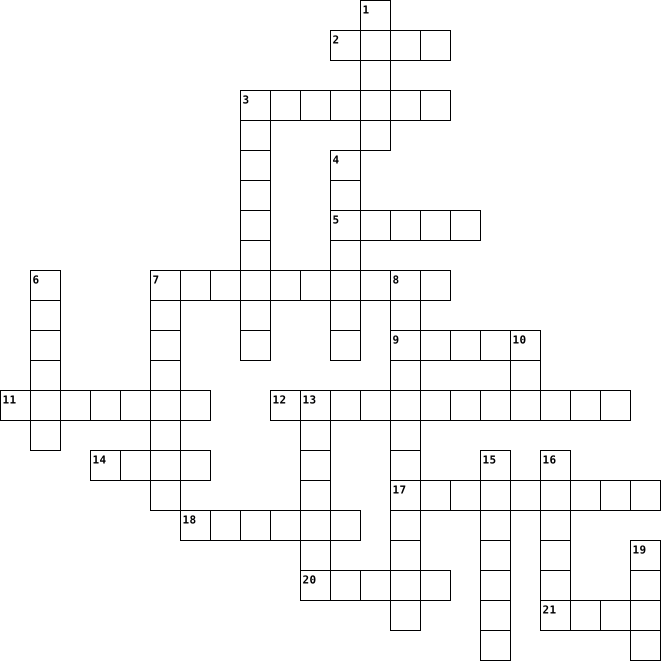
Across
- the duration of Earths revolution around the sun
- I am the closest planet to the Sun
- I was once a planet but and now a dwarf planet
- making one complete rotation around an object
- result of the pull of the moons gravity on Earth
- one of the reasons the Earth doesn't fall into the sun
- I am the planets closest to the Sun (2 words)
- Earth's natural satellite
- large pieces of rocks or metal
- I am so tilted on my axis that I rotate on my side
- I am made up of 70% water
- giant balls of gas that can have actual and apparent brightness
Down
- I am almost the same size as my neighbouring planet
- I am smaller than a comet and I orbit the sun
- I have a large red spot on my surface that is a storm
- Surrounded by a 1000 ring system made of water and dust
- turning on an axis
- I am the planets further away from the Sun (2 words)
- largest star in our solar system
- I am large and blue and green with large dark spots
- Earth's tilt on its axis causes these
- chunks of dirty dark ice that are mixed with dirt and grit
- I have ice caps on my poles
23 Clues: turning on an axis • Earth's natural satellite • I am made up of 70% water • I have ice caps on my poles • large pieces of rocks or metal • largest star in our solar system • I am the closest planet to the Sun • Earth's tilt on its axis causes these • I am smaller than a comet and I orbit the sun • making one complete rotation around an object • ...