
plate tectonics Crossword Puzzles
Plate tectonics, earthquakes, volcanos 2026-01-14

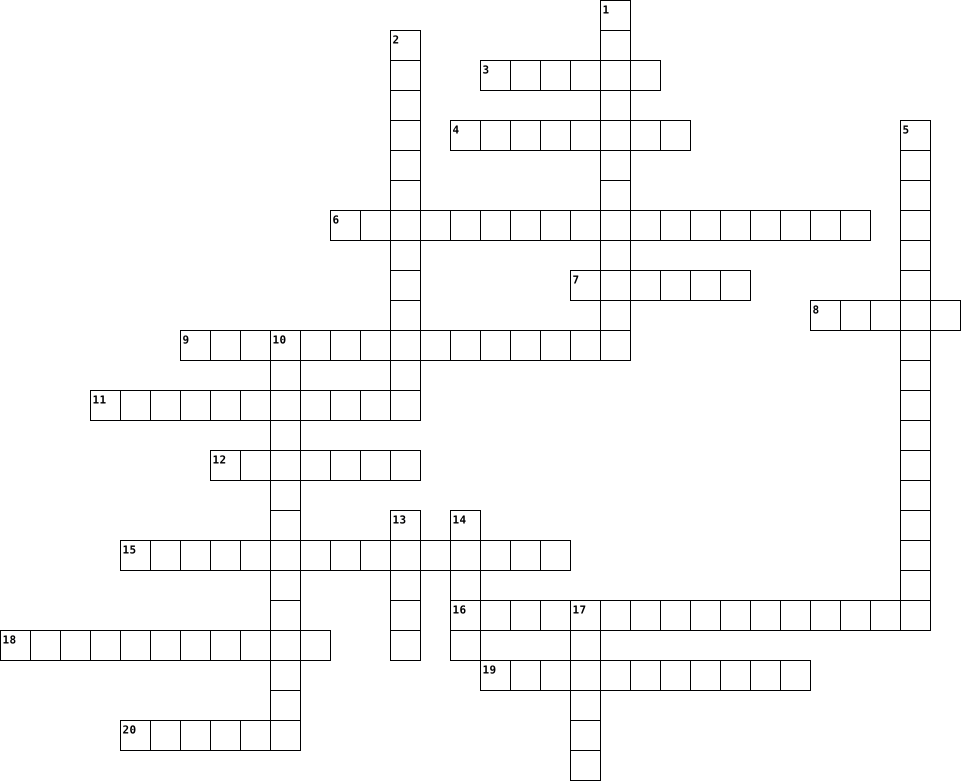
Across
- Pulls on Earths Crust stretching it to make it thinner
- A Volcano that is a mix of bombs ash and cinders
- Molten mixture of rock forming substances, gases, and water from the mantle
- A wave or series of waves produced by a earthquake or a landslide
- A volcano that is like a sleeping volcano it poses medium threat but it could reawaken someday
- A volcano that has slow and steady eruptions
- The shaking and trembling that results from the plate movement is a
- The sinking movement of Ocean floor Back in the mantle
- Squeezes rocks until it bends or breaks
Down
- Rocks being pushed in two opposite directions to the point where it bends or breaks
- Zipper like chains of undersea mountains
- A structure that forms in Earths crust when molten material or magma reaches Earths surface
- A volcano that is a more immediate threat
- A number that geologists use to assign to an earthquake based on the earthquakes size
- A break in the rock of Earths Crust or mantle
- A force that acts on rocks to change the shape or volume
- A volcano that has alternating layers of lava and ash
- When magma reaches the surface it is known as
- An area where lava frequently erupts at the surface independent of plate boundary processes
- A dead volcano the pose very little to no threat
20 Clues: Squeezes rocks until it bends or breaks • Zipper like chains of undersea mountains • A volcano that is a more immediate threat • A volcano that has slow and steady eruptions • A break in the rock of Earths Crust or mantle • When magma reaches the surface it is known as • A Volcano that is a mix of bombs ash and cinders • A dead volcano the pose very little to no threat • ...
Unit 6: Plate Tectonics 2026-01-22

Across
- German scientist who proposed the theory of continental drift
- all of the continents on Earth used to be joined as one giant landmass and have since slowly drifted to their current locations
- a depression of the earth's surface in which an ocean lies
- the location where one tectonic plate come in contact with another
- the process in Earth’s mantle that scientists believe is driving the movement of the plates due to the heating and cooling of magma
- a mountain from which lava, ash, and hot gases flow or are ejected during an eruption
- an event that occurs when tension built up along Earth’s plates is released
- the deepest parts of the ocean floor
- the type of plate boundary where two plates slide past each other
- a curved chain of volcanic islands
- the type of plate boundary where two plates collide
- the most common types of rock that make up oceanic crust
- the type of plate boundary where two plates separate or divide
Down
- states that in undisturbed rock layers, the oldest rocks are at the bottom and younger rocks are at the top
- has had an eruption of magnitude 8 on the Volcano Explosivity Index (VEI)
- the process that occurs when one plate sinks beneath another plate because it is more dense
- thick part of Earth’s crust that forms the landmasses
- occurs in the middle of a plate, where magma rises upward until it erupts on the seafloor
- an underwater mountain range, formed by the movement of plates
- the most common types of rock that make up continental crust
- an area of land that rises very high above the land around it
- a fracture or break in the rocks that make up Earth’s crust
- a lowland region that forms where Earth's tectonic plates move apart
- supercontinent that included all current land masses before they split apart
- the process that occurs at mid-ocean ridges, where new oceanic crust is formed
- thin part of Earth’s crust under oceans and seas
26 Clues: a curved chain of volcanic islands • the deepest parts of the ocean floor • thin part of Earth’s crust under oceans and seas • the type of plate boundary where two plates collide • thick part of Earth’s crust that forms the landmasses • the most common types of rock that make up oceanic crust • a depression of the earth's surface in which an ocean lies • ...
leo's plate tectonics puzzle 2026-02-03

Across
- most recent supercontinent
- the boundary between plates that are pulling apart
- the theory about continents moving
- the divergent boundary in the middle of a ocean
- the waves that earthquakes make
- the middle of the mechanical layers
- rock that has the ability to melt
- the word used to difine still rock
- mechanical layer of earth that forms up the earths plates
- a boundary between two plates that come together
- molten rock that is really fluffy
- the shaking of the lithosphere
- arc of volcanoes
- the field of which captures compases
- the process of one plate going under another
- the only purely molten layer of the earth
- the split in the ocean
- the hottest compsitional layer of the earth
- the layers of the earth that are based on what they are made of
- the type of crust that forms the thing that we stand on
Down
- a chunk of the lithosphere
- the rock that continental crust is made up of
- the thing that oceanic crust is made up of
- woman who came up of seafloor spreading
- the moment when the earths magnetic field reverses
- the study of earths old magnetic field
- the functional layyers of the earth
- the split in the earth that from a divergent boundary
- the process used to map the ocean floor
- the flow of lava in the mantle
- the mechanical layer of the earth that the lithosphere slides on
- hhhhhhoooootttttt!!! rocks
- rock which has strong magnetic force that traps the earths magnetic field
- a series of fire farting mountains that form islands
- the theory that the ocean is constantly expanding
- liquid rock
- boundary which forms when two plates slide past one another
- dense crust that is under the ocean
- man who first thought of the continents moving
- theory that there are plates in the earth that move around
- uppermost of earths compositional layers
41 Clues: liquid rock • arc of volcanoes • the split in the ocean • a chunk of the lithosphere • most recent supercontinent • hhhhhhoooootttttt!!! rocks • the flow of lava in the mantle • the shaking of the lithosphere • the waves that earthquakes make • rock that has the ability to melt • molten rock that is really fluffy • the theory about continents moving • ...
plate tectonics, earthquakes, volcanoes. 2026-03-02

Across
- The opening through which volcanic material escapes
- A supercontinent that existed 200 million years ago.
- Molten rock beneath Earth's surface.
- Large ocean wave caused by an underwater earthquake.
- Instrument used to record earthquake waves.
- A fracture in the crust where movement occurs.
- A plume of magma creating volcanic features in the middle of a plate.
- Underwater mountain range formed by divergent plates.
- Scale used to measure the magnitude of an earthquake.
- A plate boundary where plates collide
Down
- A plate boundary where plates pull apart
- Heat transfer in the mantle that moves plates.
- Energy waves released during an earthquake.
- The soft, plastic layer of the mantle beneath the lithosphere.
- Massive, moving pieces of Earth's lithosphere.
- The rigid outer part of the Earth consists of the crust and upper mantle.
- The point on Earth's surface directly above an earthquake's focus.
- A process where one plate sinks beneath another.
- A plate boundary where plates slide past each other horizontally.
- The point inside the crust where an earthquake begins.
20 Clues: Molten rock beneath Earth's surface. • A plate boundary where plates collide • A plate boundary where plates pull apart • Energy waves released during an earthquake. • Instrument used to record earthquake waves. • Heat transfer in the mantle that moves plates. • A fracture in the crust where movement occurs. • Massive, moving pieces of Earth's lithosphere. • ...
Weathering/Erosion/Plate Tectonics 2026-05-01

Across
- These drive plate movement, caused by the heating and cooling of earth's interior
- This type of weathering occurs when a rock is broken down by physical means
- This boundary is caused by two plated moving towards eachother
- Weathering by living things
- This layer of the earth is what tectonic plates sit on top of
- This type of weathering occurs when a chemical reaction takes place
- The dropping off of sediment
- This weathering occurs when carbon dioxide builds up in the atmosphere
- This type of weather occurs when water frezes in the cracks of rocks
- The movement of sediment
- The breaking down of rocks
Down
- This boundary is caused when one plate goes underneath another
- This boundary is caused by two plates sliding past one another
- The most recent supercontinent
- The point of orgin for a earthquake
- The breaking down of rocks by wind, water, or gravity (think sandpaper)
- A type of weathering that occurs when a living thing creates an ____________ acid
- A chemical reaction between a substance and water. This causes the substance to break down
- The reaction between oxygen and a metal, also called rusting
- Where an earthquake occured on the crust
- This boundary is is what caused the mid-ocean ridge
- __________-spreading occurs at the midocean ridge, this creates new ocean crust
- The scientist who proposed the idea of continental drift
23 Clues: The movement of sediment • The breaking down of rocks • Weathering by living things • The dropping off of sediment • The most recent supercontinent • The point of orgin for a earthquake • Where an earthquake occured on the crust • This boundary is is what caused the mid-ocean ridge • The scientist who proposed the idea of continental drift • ...
Fatima's Plate Tectonics Crossword 2026-05-28

Across
- Ancient life evidence
- Lava erupting
- Supercontinent that existed 200 million years ago
- Has an upper layer which is solid on the top, soft on the bottom and a lower layer which is really hot and allows the lithosphere to move
- The peak of the ________
- Two things coming together
- The third closest planet to the sun
- The action of a plate sliding under another
- Has an outer layer which carries a very hot liquid metal layer and an inner layer which is a super dense solid
- The size of an earthquake
- Two things moving in opposite direction
- A thin layer of rock around the Earth
- It covers 71% of the earth's surface
- The act of change
Down
- Large solid rocks that make up the lithosphere
- A molten rock
- A real or imagined limit that separates two things
- The boundary between two plates
- Large scale movement and interaction of large solid rocks
- The sudden shaking of the Earth
- There are seven __________ on earth
- Mountain systems formed by the diverging tectonic plates
- Long, narrow depressions on the sea floor that mark the locations of convergent boundries
23 Clues: A molten rock • Lava erupting • The act of change • Ancient life evidence • The peak of the ________ • The size of an earthquake • Two things coming together • The boundary between two plates • The sudden shaking of the Earth • The third closest planet to the sun • There are seven __________ on earth • It covers 71% of the earth's surface • A thin layer of rock around the Earth • ...
Fatima's Plate Tectonics Crossword 2026-05-28

Across
- Ancient life evidence
- Lava erupting
- Supercontinent that existed 200 million years ago
- Has an upper layer which is solid on the top, soft on the bottom and a lower layer which is really hot and allows the lithosphere to move
- The peak of the ________
- Two things coming together
- The third closest planet to the sun
- The action of a plate sliding under another
- Has an outer layer which carries a very hot liquid metal layer and an inner layer which is a super dense solid
- The size of an earthquake
- Two things moving in opposite direction
- A thin layer of rock around the Earth
- It covers 71% of the earth's surface
- The act of change
Down
- Large solid rocks that make up the lithosphere
- A molten rock
- A real or imagined limit that separates two things
- The boundary between two plates
- Large scale movement and interaction of large solid rocks
- The sudden shaking of the Earth
- There are seven __________ on earth
- Mountain systems formed by the diverging tectonic plates
- Long, narrow depressions on the sea floor that mark the locations of convergent boundries
23 Clues: A molten rock • Lava erupting • The act of change • Ancient life evidence • The peak of the ________ • The size of an earthquake • Two things coming together • The boundary between two plates • The sudden shaking of the Earth • The third closest planet to the sun • There are seven __________ on earth • It covers 71% of the earth's surface • A thin layer of rock around the Earth • ...
Fatima's Plate Tectonics Crossword 2026-05-27

Across
- The size of an earthquake
- Large solid rocks that make up the lithosphere
- Large scale movement and interaction of large solid rocks
- A molten rock
- Supercontinent that existed 200 million years ago
- There are seven __________ on Earth
- Lava erupting
- Ancient life evidence
- the third closest planet to the sun
- The action of a plate sliding under another plate
- Long, narrow depressions on the sea floor that mark the locations of convergent boundries
- Has an upper layer which is solid on the top and softer on the bottom and a lower layer which is really hot and allows the lithosphere to move
Down
- The sudden shaking of the Earth
- Mountain systems formed by diverging tectonic plates
- The act of change
- The peak of the ________
- It covers 71% of the Earth's surface
- Two things moving in opposite directions
- Has an outer layer which carries a very hot liquid metal layer and an inner layer which is a super dense solid
- Two things coming together
- A thin layer of rock around the Earth
- The boundary between two plates
- A real or imagined limit that separates two things
23 Clues: A molten rock • Lava erupting • The act of change • Ancient life evidence • The peak of the ________ • The size of an earthquake • Two things coming together • The sudden shaking of the Earth • The boundary between two plates • There are seven __________ on Earth • the third closest planet to the sun • It covers 71% of the Earth's surface • A thin layer of rock around the Earth • ...
Processes that Shape the Earth 2024-01-15

Across
- boundary,A plate boundary where two plates move away from each other.
- map,A map that shows the surface features of an area.
- plate,a piece of the lithosphere that moves around on top of the asthenosphere
- by which rock, sand, and soil are broken down and carried away (i.e. weathering, glaciation)
- weathering,The process in which rock is broken down by changes in its chemical makeup
- interval,the difference in elevation from one contour line to the next
- drift,The hypothesis that states that the continents once formed a single landmass, broke up, and drifted to their present locations
- description of surface features of land.
- line,A line on a topographic map that connects points of equal elevation
- breaking down of rocks and other materials on the Earth's surface.
- soft layer of the mantle on which the lithosphere floats.
Down
- boundary,A plate boundary where two plates move toward each other.
- plate going under another plate
- difference in elevation between the highest and lowest parts of an area
- contour,on a map, a darker, heavier contour line that is usually every fifth line and that indicates a change in elevation
- weathering,Any process that breaks rock down into smaller pieces without changing the chemistry of the rock; typically wind and water.
- rigid layer made up of the uppermost part of the mantle and the crust.
- in which sediment is laid down in new locations.
- boundary,A plate boundary where two plates move past each other in opposite directions
- hypothesis that has been tested with a significant amount of data
- tectonics,The theory that pieces of Earth's lithosphere are in constant motion, driven by convection currents in the mantle.
- spreading,the formation of new areas of oceanic crust, which occurs through the upwelling of magma at midocean ridges and its subsequent outward movement on either side.
22 Clues: plate going under another plate • description of surface features of land. • in which sediment is laid down in new locations. • map,A map that shows the surface features of an area. • soft layer of the mantle on which the lithosphere floats. • hypothesis that has been tested with a significant amount of data • ...
science 2021-10-13

Across
- the circulation of material caused by differences in temperature and density.
- when the denser plate sinks below the more buoyant plate
- forms where two plates slide past each other
- tectonics earth's surface is made of rigid slabs of rock or plates that move with respect to each other
- the cold and rigid outermost rock layer
- as a slab sinks it pulls on the rest of the plate with a force
- form where two plates collide
Down
- a state in which magnetized objects would reverse direction and orient themselves to point south
- the process by which new oceanic crust forms along a mid-ocean ridge and older oceanic crust moves away from the ridge
- mountain ranges in the middle in the middle of the oceans
- occurs and the magnetic field reverses direction
- suggested that continents are in constant motion on the surface of earth
- forms where two plates seperate
- rising mantle material at mid-ocean ridges creates the potentail for plates to move away from the ridge with a force
- a state in which magnetized objects such as compass needles will orient themselves to point north
- all the continents were once part of a supercontinent
16 Clues: form where two plates collide • forms where two plates seperate • the cold and rigid outermost rock layer • forms where two plates slide past each other • occurs and the magnetic field reverses direction • all the continents were once part of a supercontinent • when the denser plate sinks below the more buoyant plate • ...
Plate Tectonics,Earthquakes, Volcanoes 2018-03-06

Across
- large super continent that existed 250 million years ago.
- Type of volcano that is almost entirely made of magma and lava
- hot molten rock above the Earth's surface
- the part of the Earth that contains most of Earth's mass
- the part of the Earth that is made of iron and nickel
- Small volcanoes made from ash and rocks.
- area where magma from the mantle continually breaks through the crust
- earths crust made of land
- plates the two sub-layers of the earth that float causing volcanoes and Earth Quakes
- a sudden and violent shaking of the Earth as a result of movements within the earth's crust
Down
- large pieces of Earth's crust that move due to convection currents
- Volcanic gases can block out the sunlight causing what?
- when two oceanic plates pull apart, magma rises and new crust is formed
- earths crust located under the ocean
- the composition of the magma determines its what of the volcano?
- technical name for crust and upper mantle
- Flows fast flowing clouds of hot ash and volcanic glass rolling down the mountainside
- Explosive eruptions followed by outpourings of lava
- A mountain that forms when magma is forced to the Earth's surface
- hot fluid that is under the Earth's surface
20 Clues: earths crust made of land • earths crust located under the ocean • Small volcanoes made from ash and rocks. • hot molten rock above the Earth's surface • technical name for crust and upper mantle • hot fluid that is under the Earth's surface • Explosive eruptions followed by outpourings of lava • the part of the Earth that is made of iron and nickel • ...
chapter 10 plate tectonics 2013-10-31

Across
- contain large areas of stable rock
- boundary boundary in which two plates slide past each other horizontally
- single large ocean that covered earths surface during the time the supercontinent
- cycle form an break apart over time
- the study of magnetic properties of rock
- boundary 2 plates move away from each other
- drift a germen scientist names Alfred Wegener proposed a hypothesis
- terranes may be small volcanic or underwater valcaones
- rigid upper part of the mantle form a layer of earth
- process in which continents break apart
- ridge undersea mountain range through the center of which run steep, narrow valleys
Down
- exposed at earths surface
- boundaries plate boundaries that form where 2 plate collide
- piece of lithosphere that has a unique geologic history that differs from the history of the surrounding lithosphere
- continents arranged into large landmasses
- layer of plastic rock just below the lithosphere
- terrane becomes part of a continent
- form on top of seamounts
- formed over 30 million years ago
- spreading new ocean floor forms when magma rises to earths surface and solidifies at a mid ocean ridge
20 Clues: form on top of seamounts • exposed at earths surface • formed over 30 million years ago • contain large areas of stable rock • cycle form an break apart over time • terrane becomes part of a continent • process in which continents break apart • the study of magnetic properties of rock • continents arranged into large landmasses • boundary 2 plates move away from each other • ...
Chapter 6 Plate Tectonics 2013-01-29

Across
- The Earth's thickest layer.
- Underwater mountain ranges.
- When one plate sinks beneath another.
- States that the Earth's lithosphere is made up of huge plates that move over the surface of the Earth.
- Occurs where plates scrape past each other.
- A gap that is formed where the ocean floor spreads causing a gap.
- Where heated rocks rise in plumes, or thin columns.
- A motion that transfers heat energy in a material.
- A thin layer of cool rock.
Down
- A ball of hot, solid metals.
- Alfred Wegener's hypothesis.
- Comes from the Greek word meaning all lands.
- Is the energy transfer by the movement of the material.
- comes from the Greek word asthenes and means weak.
- Occurs where plates move apart.
- A layer of liquid metals that surrounds the inner core.
- Occurs where plates push together.
- A poles switch in direction.
- Large and small slabs of rock.
- has the greek prefix meaning stone.
20 Clues: A thin layer of cool rock. • The Earth's thickest layer. • Underwater mountain ranges. • A ball of hot, solid metals. • Alfred Wegener's hypothesis. • A poles switch in direction. • Large and small slabs of rock. • Occurs where plates move apart. • Occurs where plates push together. • has the greek prefix meaning stone. • When one plate sinks beneath another. • ...
Plate Tectonics and Earthquakes 2014-10-21

Across
- Fault with horizontal motion
- 90% of the world's earthquakes are along the __________
- California's major fault
- A plate boundary where plates are moving towards one another
- Large wave created by an undersea earthquake
- Instrument for measuring earthquakes
- Process of one plate sinking beneath another
- A plate boundary where plates are sliding past each other
- Formed when continental plates spread apart
- Discovered continental drift
- Southern supercontinent
- New oceanic crust is formed during _____ spreading
- Northern supercontinent
- A more horizontal fault found at convergent boundaries
- Supercontinent
Down
- A plate boundary where plates are spreading apart
- Fault usually found at divergent boundaries
- Worldwide ocean
- Organism that provided fossil evidence for continental shift
- _____ magnitude scale
- Underwater mountain chain along plate boundary
- The point on the earth's surface above an earthquake's location
- Driving force of continental drift
- Formed when two oceanic plates converge
- The west coast of North America is made up of many _____ terranes
- Fault usually found at convergent boundaries
- Fault with vertical motion
- Break in the Earth's crust/lithosphere
28 Clues: Supercontinent • Worldwide ocean • _____ magnitude scale • Southern supercontinent • Northern supercontinent • California's major fault • Fault with vertical motion • Fault with horizontal motion • Discovered continental drift • Driving force of continental drift • Instrument for measuring earthquakes • Break in the Earth's crust/lithosphere • Formed when two oceanic plates converge • ...
PLATE TECTONICS CROSSWORD PUZZLE 2023-03-18
Across
- an area of fracturing between rocks resulting from stress.
- a visible exposure of bedrock or ancient superficial deposits on the surface of the Earth.
- a geologic process in which tectonic plates—large slabs of Earth's lithosphere split apart from each other.
- the outermost shell of a terrestrial planet.
- It's made up of a liquid metal outer core that flows around a solid metal inner core.
- occur along divergent plate boundaries, where new ocean floor is created as the Earth's tectonic plates spread apart.
- a depression in the earth's crust.
- the mostly solid bulk of Earth's interior.
- THE MOVEMENT OR STUDY OF THE MOVEMENT OF EARTHS CRUST
- where crust is neither produced nor destroyed as the plates slide horizontally past each other.
- when an oceanic plate runs into a continental plate and slides beneath it.
- occurs when two tectonic plates move away from each other.
- molten rock in the earths crust.
Down
- includes the brittle upper portion of the mantle and the crust, the outermost layers of Earth's structure.
- bounderies between plates.
- The plates have moved across Earth's surface for hundreds of millions of years.
- long, narrow depressions on the seafloor.
- an area of rock that has been bent by stress.
- is a split between 2 plates that were once joined.
- When forces are parallel but moving in opposite directions.
20 Clues: bounderies between plates. • molten rock in the earths crust. • a depression in the earth's crust. • long, narrow depressions on the seafloor. • the mostly solid bulk of Earth's interior. • the outermost shell of a terrestrial planet. • an area of rock that has been bent by stress. • is a split between 2 plates that were once joined. • ...
Plate tectonics and Earthquakes 2022-08-29

Across
- centre of the earth, made of iron
- rocky shell of the earth
- point at which the rock first moves
- method to determine the origin of an earthquake
- scientist, continental drift
- moving towards
- earth's middle layer
- cracks caused by movement of plates
- moving away
- envelope of gases surrounding earth
- transfer of heat around in a circle
- all the water on earth
Down
- great southern continent
- second wave to arrive
- earth's outermost layer
- this action creates mountains and hills
- first wave to arrive
- two plates moving past one another
- great northern continent
- point on surface, above earthquake
- shaking, natural disaster
- ____ plates
- living things
- supercontinent, contains all landmasses
24 Clues: ____ plates • moving away • living things • moving towards • first wave to arrive • earth's middle layer • second wave to arrive • all the water on earth • earth's outermost layer • great southern continent • rocky shell of the earth • great northern continent • shaking, natural disaster • scientist, continental drift • centre of the earth, made of iron • two plates moving past one another • ...
Plate Tectonics CW 3 2022-10-03

Across
- A solid form of carbon dioxide that is very cold and turns directly from a solid to a gas.
- To reuse something that would have otherwise been thrown out or to turn it into something usable again instead of sending it to a landfill.
- A boundary of two tectonic plates where the plates move towards each other.
- A scientist who studies earthquakes.
- a cycle of heating, rising, cooling and sinking
- a deep valley where pieces of Earth’s crust diverge on land
- When two tectonic plates slowly crash into each other and mountains are formed.
- the layer below the lithosphere and is plasticlike
- Wegener’s hypothesis that all continents were once connected in a large landmass that broke apart & drifted slowly to their current positions
- this layer is formed with the crust and rigid upper mantle, and is above the asthenosphere
- a theory that proposes that magma under Earth’s crust is forced up toward the surface at the mid-ocean ridges, forming new seafloor
- Slowly moving pieces of Earth’s crust.
- scientist that discovered sea-floor spreading
- melted rock
- All the rock, soil and sediments that makeup Earth’s land. It comes from the word “Geo” which means “Earth.”
- All the gases surrounding the earth. It comes from the word “Atmos” which means “air.”
- large sections of Earth’s crust and upper mantle
- scientist that developed the idea of continental drift
- deep underwater canyons
- large, slow moving bodies of ice on land
- When one tectonic plate converges under another due to density differences.
Down
- All the oceans, rivers, lakes and water on Earth. It comes from the word “Hydro” which means “water.”
- a chain of ridges and valleys stretching along Earth’s ocean floor
- pull-apart forces
- Movement caused by warm fluids rising and cooler fluids sinking.
- forces that destroy and wear away landmasses through process like erosion and weathering
- the process of moving things from one place to another.
- A boundary of two tectonic plates where the plates slide past each other.
- these are constantly being created and destroyed by competing forces
- a single landmass composed of all the continents joined together
- All the living things on Earth. It comes from the word “Bio” which means “life.”
- a measure of how much mass there is in a given volume of a substance
- forces that shape the land’s surface by building up mountains & other landmasses.
- breaks in Earth’s crust where rocks have slipped past each other
- any trace of an ancient organism that has been preserved in rock
- The outer most layer of the Earth. This is the layer we walk on.
- A boundary of two tectonic plates where the plates move away from each other.
37 Clues: melted rock • pull-apart forces • deep underwater canyons • A scientist who studies earthquakes. • Slowly moving pieces of Earth’s crust. • large, slow moving bodies of ice on land • scientist that discovered sea-floor spreading • a cycle of heating, rising, cooling and sinking • large sections of Earth’s crust and upper mantle • ...
Plate Tectonics Crossword Puzzle 2022-12-14

Across
- What the Earth's core is made up of
- Boundary of when two plates move toward each other
- The first of Earth's layers
- A circular process in the mantle
- Boundary of when two plates slide past each other
- Horseshoe shaped string of volcanoes from the tip of South America to New Zealand
- Beneath the Lithosphere
- Made up of the crust and upper mantle
- Underwater mountains
Down
- What lava becomes when it gets colder
- Caused by transform boundaries
- A process in which the plate moves beneath another
- The innermost part of the Earth
- Boundary of when two oceanic plates move away from each other
- invisible lines that the earth is made up of
- How a plate moves
- Forms when two plates push toward each other
- Formed by subduction
- What lava becomes when it gets hotter
- Main material inside of the mantle
20 Clues: How a plate moves • Formed by subduction • Underwater mountains • Beneath the Lithosphere • The first of Earth's layers • Caused by transform boundaries • The innermost part of the Earth • A circular process in the mantle • Main material inside of the mantle • What the Earth's core is made up of • What lava becomes when it gets colder • Made up of the crust and upper mantle • ...
Plate Tectonics Chap. 5 2023-02-09

Across
- Caused when a plate goes under one another in the ocean.
- Hot rock above the ground.
- A boundary that slides past other boundaries.
- Occurs when a pan touches a stove, also known as the transfer of heat when one object touches another.
- Boundaries that are pushing towards other boundaries.
- Mountain formed by hot spots in the Earth.
- Occurs along divergent boundaries, and makes new oceanic crust.
- A theory that states the sea-floor is always moving.
Down
- Hot rock underground.
- When an oceanic plate slides under a continental plate.
- A boundary that is moving away from the other boundaries.
- Super continent made millions of years ago.
- A place filled with magma that rises to the Earth surface.
- The theory that states that there are plates in the crust that move everything around.
- The transfer of energy through space.
- Dead organisms preserved in rock.
- Chain of islands formed by a volcano.
- This can cause boiling water.
- Pieces of the earth's lithosphere which together make up the earth's surface.
- Found both on land and at the bottom of the ocean, where they are created by the process of seafloor spreading.
20 Clues: Hot rock underground. • Hot rock above the ground. • This can cause boiling water. • Dead organisms preserved in rock. • The transfer of energy through space. • Chain of islands formed by a volcano. • Mountain formed by hot spots in the Earth. • Super continent made millions of years ago. • A boundary that slides past other boundaries. • ...
Introduction to Plate Tectonics 2021-02-04

Across
- molten rock found below the crust
- molten rock found above the crust
- the supercontinent making the countries in the northern hemisphere
- the upper part of the mantle that the crust sits on top of
- the centre of the Earth
- the mid-_________ ridge runs along the west coast of America
- ___________ spreading is responsible for forming ocean ridges
- ________ waves are used to take measurements inside the Earth
- the supercontinent made of Gondwana and Laurasia
- this scientist that gave evidence for the mid-atlantic ridge
- the first super =continent
Down
- continental _________ are underwater cliffs
- the branch of science studying the Earth
- contains the semi-solid layer of the Earth
- a person who studies geology
- the theory that the Earth is made of moving plates
- the solid, outer layer of the Earth
- the theory that the continents have moved over time
- the scientist who first proposed continental drift
- ____________ currents move tectonic plates
- the supercontinent making the countries in the southern hemisphere
21 Clues: the centre of the Earth • the first super =continent • a person who studies geology • molten rock found below the crust • molten rock found above the crust • the solid, outer layer of the Earth • the branch of science studying the Earth • contains the semi-solid layer of the Earth • ____________ currents move tectonic plates • continental _________ are underwater cliffs • ...
Unit 7: Plate Tectonics 2021-03-07

Across
- outer chemical layer of the Earth
- when a denser tectonic plate moves underneath a less-dense tectonic plate
- landform created from two continental plates colliding
- chemical layers of Earth are separated due to differences in this property
- layer of Earth that is most dense
- thickest chemical layer of the Earth
- type of tectonic boundary that forms when two plates slide past each other
- crust is destroyed at this location as it subducts
- huge pieces of lithosphere that move
- chemical layer of the Earth made of iron and nickel
- method of heat transfer through space, no direct contact
- layer of Earth that is responsible for the Earth's magnetic field
- landform that is present when continental crust diverges or moves apart
- german scientist proposing continental drift
- transform fault in California
- proposed Theory of Seafloor Spreading
- type of crust that is made mostly of basalt, and is more dense
Down
- freshwater reptile fossil that provides evidence for Continental Drift
- type of tectonic boundary that forms with two plates moving apart
- is the solid outer layer that is broken into plates that move
- landform created when two oceanic plates collide
- responsible for the movement of tectonic plates, method of heat transfer through fluids
- landform found at divergent boundary in the Atlantic Ocean
- we refer to polarity as this when the magnetic north pole matches the geographic north pole
- used data from SONAR to create a map of the floor of the Atlantic Ocean
- Volcanic island arc formed from the collision of two oceanic plates
- physical layer of the Earth that flows slowly, allowing the plates to move
- method of heat transfer through direct contact
- grooves formed in bedrock from moving glacial ice
- name of Wegener's supercontinent
- lower part of the mantle
- type of tectonic boundary that forms with two plates moving together
- we refer to polarity as this when the magnetic north pole matches the geographic south pole
- mountains formed from collision of India and Eurasia
- type of crust that is made mostly of granite, and is less dense
- mountain range formed from a collision of oceanic and continental plates
36 Clues: lower part of the mantle • transform fault in California • name of Wegener's supercontinent • outer chemical layer of the Earth • layer of Earth that is most dense • thickest chemical layer of the Earth • huge pieces of lithosphere that move • proposed Theory of Seafloor Spreading • german scientist proposing continental drift • method of heat transfer through direct contact • ...
Plate Tectonics Vocabulary Crossword 2021-10-17

Across
- Flow of ash, cinders, bombs, and gases down the side of a volcano during an explosive eruption
- Boundary between tectonic plates that are sliding past each other horizontally
- Space below ground filled with magma
- Hypothesis that states that the continents once formed a single landmass, broke up, and drifted to their present locations
- Area along a fault where there has not been any earthquake activity for a long period of time
- Vibrations that travel through Earth carrying the energy released during an earthquake
- String of islands formed by the volcanoes along a deep ocean trench
- Force that acts on rock to change its shape or volume
- Major belt of volcanoes that surrounds the Pacific Ocean
- Pulling of a tectonic plate as its edge subducts deep in the mantle
- Shaking that results from the movement of rock beneath Earth’s surface
- Theory that pieces of Earth’s crust are in constant motion, driven by convection currents in the mantle
- Molten mixture of rock-forming substances, gases, and water from the mantle
Down
- Point on Earth’s surface directly above an earthquake’s focus
- Mountain through which lava, rock fragments, hot vapor, and gas are erupted from the earth’s crust
- Point beneath Earth’s surface where rock breaks under stress and causes an earthquake
- Bowl-shaped area that may form at the top of a volcano around the vent
- Boundary between two tectonics plate that are moving away from each other
- Magma that reaches Earth’s surface
- Process by which oceanic crust sinks beneath a deep-ocean trench and back into the mantle
- Process in which new material at a ridge pushes older material aside
- Formation of new ocean crust as a result of magma pushing upward and outward from Earth’s mantle to the surface
- Rock fragments and particles ejected by a volcanic eruption
- Boundary between tectonic plates that are colliding
- Large crater caused when it collapses due to a violent explosion
- Graph of arrival times of seismic waves that determines the focus of an earthquake
- Fracture along which movement occurs
- Deformation of materials in response to stress
28 Clues: Magma that reaches Earth’s surface • Space below ground filled with magma • Fracture along which movement occurs • Deformation of materials in response to stress • Boundary between tectonic plates that are colliding • Force that acts on rock to change its shape or volume • Major belt of volcanoes that surrounds the Pacific Ocean • ...
Plate Tectonics Crossword Puzzle 2018-02-20

Across
- A large, slowly moving body of snow and ice
- The solid, outer layer of the earth that consists of the crust and the rigid upper part of the mantle
- A break in the earths crust that moves
- Thickest layer of the Earth, part solid part liquid where convection currents are found
- When two plates come together
- Thicker, less dense crust
- The theory that the continents are moving very slowly
- when two plates grind past each other
- Extremely deep areas in the ocean that are created by a subducting plate
- A solid mass of iron and nickel
- When two plates pull apart
- How much mass there is in any given volume
- A semi-fluid layer of solid liquid rock
Down
- A single landmass that includes two or more continents
- Thin, more dense than continental crust, subducting crust
- The movement of a fluid, caused by differences in temperature, that transfers heat from one part of the fluid to another
- When one tectonic plates drives under another
- A layer of molten iron and nickel that surrounds the inner core of Earth
- Waves produced by earthquakes that help us study the inner layers of earth
- The state of matter the earth's inner core is
20 Clues: Thicker, less dense crust • When two plates pull apart • When two plates come together • A solid mass of iron and nickel • when two plates grind past each other • A break in the earths crust that moves • A semi-fluid layer of solid liquid rock • How much mass there is in any given volume • A large, slowly moving body of snow and ice • ...
Chapter 5 Plate Tectonics 2023-10-30

Across
- A well-tested concept that explains a wide range of observations
- A layer of hot, solid rock below the crust and above the core
- The process where lava adds new ocean crust to the ocean floor
- A section of lithosphere that slowly moves over the asthenosphere, carrying pieces of crust.
- A break or crack in Earth’s lithosphere along which the rocks move
- A device that determines the distance of an object under water by recording echoes of sound waves
- The layer of rock that forms Earth’s outer skin
- The theory that pieces of Earth’s lithosphere are in constant motion driven by mantle convection
- The solid iron and nickel layer in the middle of the Earth
- The process where ocean floor sinks beneath a deep-ocean trench into the mantle
- A boundary where two plates move towards each other
- A boundary where two plates move away from each other
- A deep valley where two plates move apart
- The transfer of energy through space
Down
- The soft layer of rock in the mantle
- Flow which transfers heat within a fluid
- The transfer of heat by the movement of fluid currents
- A deep valley where ocean crust sinks toward the mantel
- Very hard rock which forms the top layer of the mantle and the crust
- Core- The only liquid layer in the earth, made of iron and nickel
- The theory that all continents were once joined together and have since drifted apart.
- The transfer of heat between touching material
- A boundary where two plates move past each other in opposite direction
- An undersea mountain chain where new ocean floor is made
- The name of the single landmass that broke apart 200 million years ago and made today’s continents
25 Clues: The soft layer of rock in the mantle • The transfer of energy through space • Flow which transfers heat within a fluid • A deep valley where two plates move apart • The transfer of heat between touching material • The layer of rock that forms Earth’s outer skin • A boundary where two plates move towards each other • A boundary where two plates move away from each other • ...
Plate Tectonics Crossword Puzzle 2023-11-15

Across
- ocean floor sinks under a deep ocean trench and back into the mantle
- chains of mountains that rise up from the floor of the ocean
- transferring energy/heat through liquids
- earths plates which meet at plate bounderies
- volcanos similar to a belt mostly on the pacific ocean
- heating and cooling of a liquid along with changes in the density with force of gravity makes this
- transferring energy/heat through electromagnetic waves
- earths lithosphere section that is broboundariesieces
- molten material inside the mantle
- remains of something from the past that is preserved
Down
- how much mass is in an object
- continents moving overtime due to the plates
- area where material deep in the earth rises to the crust and melts, forming magma
- ocean floor turning into deep underwater canyons
- mid-ocean ridges adding new material to the floor of the ocean
- a weak spot in earth's surface which allows magma from the mantle to rise
- volcanos creating a string of volcanos
- transferring energy/heat through a direct object or thing
- continent from millions of years ago
- magma that has risen to earth's surface
20 Clues: how much mass is in an object • molten material inside the mantle • continent from millions of years ago • volcanos creating a string of volcanos • magma that has risen to earth's surface • transferring energy/heat through liquids • continents moving overtime due to the plates • earths plates which meet at plate bounderies • ...
Dafna Plate Tectonics Crossword 2024-01-12

Across
- When the Earth cracks far down and hits the asthenosphere creating a volcano inside a fissure in the Earth’s crust.
- When Oceanic crust goes under continental crust and creates trenches in the sea floor.
- Heat transferred through the movement of fluids or gasses, based on density.
- Solid uppermost part of the mantle.
- Solid outermost layer of the earth subdivided continental crust and oceanic crust, broken into tectonic plates.
- A place where two plates meet or collide.
- Solid inner most layer of earth, it is also made up of nickel and iron.
- solid top most layer of the earth, includes crust and solid part of the mantle.
- Natural disasters caused by the movement of tectonic plates.
Down
- When two plates collide with each other.
- When one plate goes under another because there is a difference in density.
- When continental plates collide the crust gets folded and mountains form.
- Really hot liquid metal and rock primary, metals are iron and nickel, It is also under the asthenosphere.
- When Oceanic plates collide if there is a difference in density there is subduction which often creates trenches in the ocean floor.
- When plates move away from each other
- A break in the Earth’s crust.
- Gooey melted rock that is located directly under the lithosphere.
- depression in the ocean floor usually by a subduction zone or fault line
- When Plates collide and doing so shakes or reshapes the Earth.
- A mountain spewing molten rock or lava from the Asthenosphere.
20 Clues: A break in the Earth’s crust. • Solid uppermost part of the mantle. • When plates move away from each other • When two plates collide with each other. • A place where two plates meet or collide. • Natural disasters caused by the movement of tectonic plates. • When Plates collide and doing so shakes or reshapes the Earth. • ...
Unit 4: Plate Tectonics 2026-03-27

Across
- The point beneath Earth's surface where rock breaks under stress and causes an earthquake
- a small volcano built primarily of pyroclastic material ejected from a single vent
- A type of fault where the hanging wall slides downward; caused by tension in the crust
- Point on Earth's surface directly above an earthquake's origin
- A scale that rates an earthquake's magnitude based on the size of its seismic waves.
- Movements within Earth's mantle that causes tectonic plates to collide, separate, or slide past each other are called __________ __________.
- a wide, gently sloping mountain made of layers of lava and formed by quiet eruptions
- a type of fault where rocks on either side move past each other sideways with little up or down motion
- extremely deep areas in the ocean that are created by a subducting plate
- A device that records ground movements caused by seismic waves as they move through Earth
- a large crater caused by the violent explosion of a volcano that collapses into a depression
- known for its layers of lava flows and cinders. Has pyroclastic flows.
- occur under compressional force, rock gets thrust upward
Down
- the liquid layer of the Earth's core that lies beneath the mantle and surrounds the inner core
- mountains formed by two continental plates colliding and forcing each other upwards.
- The theory that the earth's crust is divided into plates that move.
- An underwater moutain chain where new ocean floor is formed
- boundary that occurs when two tectonic plates slide past each other.
- One plate going under another plate
- A type of seismic wave that moves the ground up and down or side to side (transverse)
- valley A large valley shaped area of the Earth in which plates of the Earth's crust are moving away from each other, forming a system of cracks.
- A dense sphere of solid iron and nickel at the center of Earth
- A type of seismic wave that compresses and expands the ground.
- a sudden and violent shaking of the ground, sometimes causing great destruction, as a result of plate movement.
- thicker, less dense, older crust making the continents
- The layer of hot, solid material between Earth's crust and core.
- Type of plate boundary where two plates separate from each other.
- A supercontinent containing all of Earth's land that existed about 225 million years ago.
- boundary that occurs when two tectonic plates collide into each other.
- thinner, more dense, younger crust making ocean floor
30 Clues: One plate going under another plate • thinner, more dense, younger crust making ocean floor • thicker, less dense, older crust making the continents • occur under compressional force, rock gets thrust upward • An underwater moutain chain where new ocean floor is formed • A dense sphere of solid iron and nickel at the center of Earth • ...
Plate Tectonics Vocabulary Worksheet 2025-01-05

Across
- The downward movement of a plate into the mantle.
- Waves that travel through both fluid and solid material.
- The third outmost layer of the Earth.
- Plates move apart.
- The transfer of heat caused by the movement of fluids.
- All continents were once joined in a single landmass and have since slowly drifted apart.
- The second outmost layer of the Earth.
- Waves that travel through only solid material.
- Weak spots around the crust where magma flows to the surface.
- Plates side-slip past each other.
- Waves that spread through Earth's interior.
Down
- A process that continually adds new material to the ocean floor.
- The innermost layer of the Earth.
- The outmost layer of the Earth.
- Plates collide or smash together.
- Pieces of the Earth's crust and upper mantle constantly move.
- The longest chain of under-water mountains.
- A single landmass that existed 300 million years ago comprised of all of Earth's continents.
- The transfer of energy through space with no direct contact between a heat source and an object.
- The transfer of heat between materials that are touching.
20 Clues: Plates move apart. • The outmost layer of the Earth. • The innermost layer of the Earth. • Plates collide or smash together. • Plates side-slip past each other. • The third outmost layer of the Earth. • The second outmost layer of the Earth. • The longest chain of under-water mountains. • Waves that spread through Earth's interior. • ...
Plate Tectonics and Erosion 2025-04-22

Across
- The theory that states that Earth's surface is made of rigid slabs of rock, or plates, that move with respect to each other
- Molten rock beneath the earth's surface
- volcano with a tall, cone-shaped mountains in which layers of lava alternate with layers of ash by quiet and explosive eruptions
- no longer in existence
- The theory that suggests that continents are in constant motion and have moved to their current location from a single landmass
- A glacier that covers much of a continent or large island
- the outermost layer of Earth
- volcano with a wide, gently sloping mountain made of layers of lava and formed by quiet eruptions
- a destructive mud flow on the slopes of a volcano.
- core the inner most layer of Earth that is a solid sphere
- German scientist who proposed that all the continents were once part of a supercontinent
- The boundary where plates move away from each other
- The process by which new oceanic crust forms along a mid-ocean ridge and older oceanic crust moves away from the ridge
- A small, steeply sloped volcano that forms from moderately explosive eruptions of pyroclastic material.
- core the layer that is made of liquid iron & nickel
- The boundary where plates slide past one another
Down
- The process by which, in a fluid being heated, the warmer part of the mass will rise and the cooler portions will sink.
- Underwater mountains created by a divergent boundary
- volcanoes forming from a thin spot in the crust where magma builds up and bursts through
- flow from high to low elevation in mountain settings
- flow a dense, destructive mass of very hot ash, lava fragments, and gases ejected explosively from a volcano and flowing at great speed.
- The boundary between two plates moving together
- An idea that is not proven but much evidence supports the idea
- liquid magma that reaches the surface
- A major geological fault in California. Sliding Boundary
- The process by which wind, water, ice, or gravity transports soil and sediment from one location to another
- A vent or fissure in the Earth's surface through which magma and gases are expelled
- the region where two tectonic plates are in contact
- the thicket layer of Earth that is located under the crust
- inactive, sleeping volcano
- The supercontinent that existed 250 million years ago when all the landmasses were together
31 Clues: no longer in existence • inactive, sleeping volcano • the outermost layer of Earth • liquid magma that reaches the surface • Molten rock beneath the earth's surface • The boundary between two plates moving together • The boundary where plates slide past one another • a destructive mud flow on the slopes of a volcano. • the region where two tectonic plates are in contact • ...
Module 13: Plate Tectonics 2025-04-09

Across
- Type of plate boundary where two tectonic plates are moving apart from each other. (page 357)
- Wegener found similar _____ of several different types of animals and plants that once lived on or near land had been found on widely separated continents. (page 346)
- Hypothesis developed by Wegner that proposed that Earth’s continents had once been joined as a single landmass and then broke apart. (page 345 – two words)
- The transfer of thermal energy by the movement of heated material from one place to another. (page 362)
- Type of plate boundary where two tectonic plates move toward each other. (page 357)
- A device that helps study the depth of the ocean floor by using sound waves to measure distance by measuring the time it takes for sound waves sent from a ship to bounce off the seafloor and return to the ship. (page 349)
- Forms from the compaction and decomposition of accumulations of ancient swamp plants that grew in warm, wet regions, but were found in extremely cold environments. (page 347 – two words)
- Theory that describes how tectonic plates move and shape Earth’s surface. (page 356 – two words)
- The theory that explains how new oceanic crust forms at ocean ridges, slowly moves away from ocean ridges, and is destroyed at deep-sea trenches. (page 355 – two words)
- A narrow, elongated depression in the seafloor that can be thousands of kilometers long and many kilometers deep. (page 350 – three words)
- Observations of ocean-floor sediments revelated that the _____ of the sediments increases with distance from an ocean ridge. (page 351)
- Wegener observed that ____ in the Appalachian Mountains were identical to those in the mountains of Greenland and Europe. (page 346)
Down
- Form parallel to a trench when two oceanic plates collide. (page 358 – two words)
- The name of the supercontinent that contained all the Earth’s continents as a single landmass. (page 345)
- A device that can detect small changes in magnetic fields that was used to study the ocean floor. (page 349)
- Earth’s magnetic field is generated by the flow of _____ in the outer core. (page 352 – two words)
- Found in Africa, India, Australia, and South America indicating that were once covered by a thick ice cap and then drifted to warmer locations. (page 347 – two words)
- Two features that are created when an oceanic and continental plate collide. (page 358 – two words)
- A continuous mountain chain on the ocean floor where new ocean rock forms. (page 357 – three words)
- Long, narrow depression that forms when continental crust begins to separate. (page 357 – two words)
- Occurs when the flow in the outer core changes, and Earth’s magnetic field changes direction. (page 352 – two words)
- Type of plate boundary where two plates slide horizontally past each other. (page 360).
- Huge pieces of crust and upper mantle that fit together at their edges to cover Earth’s surface. (page 356 – two words)
- German meteorologist that first proposed the scientific hypothesis that the continents were moving. (page 344 – two words)
- The age of oceanic crust consistently _____ with distance from a ridge. (page 351)
- A process where the denser plate descends below a less-dense plate when they collide. (page 357)
26 Clues: Form parallel to a trench when two oceanic plates collide. (page 358 – two words) • The age of oceanic crust consistently _____ with distance from a ridge. (page 351) • Type of plate boundary where two tectonic plates move toward each other. (page 357) • Type of plate boundary where two plates slide horizontally past each other. (page 360). • ...
Weathering/Erosion/Plate Tectonics 2026-05-01

Across
- These drive plate movement, caused by the heating and cooling of earth's interior
- This type of weathering occurs when a rock is broken down by physical means
- This boundary is caused by two plated moving towards eachother
- Weathering by living things
- This layer of the earth is what tectonic plates sit on top of
- This type of weathering occurs when a chemical reaction takes place
- The dropping off of sediment
- This weathering occurs when carbon dioxide builds up in the atmosphere
- This type of weather occurs when water frezes in the cracks of rocks
- The movement of sediment
- The breaking down of rocks
Down
- This boundary is caused when one plate goes underneath another
- This boundary is caused by two plates sliding past one another
- The most recent supercontinent
- The point of orgin for a earthquake
- The breaking down of rocks by wind, water, or gravity (think sandpaper)
- A type of weathering that occurs when a living thing creates an ____________ acid
- A chemical reaction between a substance and water. This causes the substance to break down
- The reaction between oxygen and a metal, also called rusting
- Where an earthquake occured on the crust
- This boundary is is what caused the mid-ocean ridge
- __________-spreading occurs at the midocean ridge, this creates new ocean crust
- The scientist who proposed the idea of continental drift
23 Clues: The movement of sediment • The breaking down of rocks • Weathering by living things • The dropping off of sediment • The most recent supercontinent • The point of orgin for a earthquake • Where an earthquake occured on the crust • This boundary is is what caused the mid-ocean ridge • The scientist who proposed the idea of continental drift • ...
Unit 2 Spheres 2023-10-02

Across
- Minerals and ______ are found in the lithosphere
- the ability to do work
- neither created or destroyed
- An example of the lithosphere and biosphere interacting
- Plate tectonics, mountains,rocks etc
- Living things
Down
- What makes up the atmosphere
- The number of spheres
- Interacting parts
- Rivers, lakes, streams, etc
- is a closed system because only energy is naturally transferred outside the atmosphere
- Where all weather occurs
- Plants, animals and __________ are all living things
13 Clues: Living things • Interacting parts • The number of spheres • the ability to do work • Where all weather occurs • Rivers, lakes, streams, etc • What makes up the atmosphere • neither created or destroyed • Plate tectonics, mountains,rocks etc • Minerals and ______ are found in the lithosphere • Plants, animals and __________ are all living things • ...
vocab 2023-04-27

Across
- In geology, Earth’s middle layer.
- of Fire An area around the Pacific Ocean’s edge where plate tectonics processes cause relatively frequent earthquakes and volcanic eruptions.
- plates The gigantic slabs — some spanning thousands of miles — that make up Earth’s outer layer.
- The process by which material rises from Earth’s middle layer into its outer layer, where it will become part of the tectonic plates.
- tectonics The study of massive moving pieces that make up Earth’s outer layer, which is called the lithosphere, and the processes that cause those rock masses to rise from inside Earth, travel along its surface, and sink back down.
Down
- The rising and falling of material in a fluid due to uneven temperatures.
- In geology, Earth’s innermost layer.
- Able to carry an electric current.
- or subduction The process by which tectonic plates sink or slide back from Earth’s outer layer into its middle layer, called the mantle.
- In geology, an area where tectonic plates move past each other.
- The study of Earth’s physical structure, history and processes.
11 Clues: In geology, Earth’s middle layer. • Able to carry an electric current. • In geology, Earth’s innermost layer. • In geology, an area where tectonic plates move past each other. • The study of Earth’s physical structure, history and processes. • The rising and falling of material in a fluid due to uneven temperatures. • ...
Plate motion 2025-11-05

Across
- A circular area in the Pacific known for volcanoes and earthquakes
- Molten rock found beneath the Earth's surface
- formed underneath the ocean at a divergent plate boundary
- outermost layer of the earth
- The first person to propose plate tectonics(last name)
- The outermost rigid layer of the Earth
- True or false: the ocean floor is flat
- (the layer below the lithosphere that plates move on)
- the continents were together how many million years ago?
- 2 plates moving together
Down
- Vibrations of the Earth due to released energy
- Something in nature that is observed to happen again and again
- 2ed outermost layer of the earth
- Geological features formed when two continental plates converge
- 2 plates moving away from each other
- true or false: the bottom of the ocean is hard solid rock
- the deepest layer of the earth
- The super continent
- where 2 plates meet
- 2 plates boundary’s slide past each other
20 Clues: The super continent • where 2 plates meet • 2 plates moving together • outermost layer of the earth • the deepest layer of the earth • 2ed outermost layer of the earth • 2 plates moving away from each other • The outermost rigid layer of the Earth • True or false: the ocean floor is flat • 2 plates boundary’s slide past each other • Molten rock found beneath the Earth's surface • ...
Pate Tectonics 2023-12-14

Across
- A plate boundary where two plates move away from each other
- The process by which oceanic crust sinks beneath a deep-ocean trench and back into the mantle at a convergent plate boundary
- A plate boundary where two plates move past each other in opposite directions.
- The hypothesis that the continents slowly move across Earth's surface
- The point on Earth's surface directly above an earthquake's focus
Down
- A plate boundary where two plates move towards each other.
- The movement of a fluid, caused by differences in temperature, that transfers heat from one part of the fluid to another
- Stress that stretches rock so that it becomes thinner in the middle
- Stress that pushes masses of rock in opposite directions, in a sidewasy motion
- The shaking that results from the movement of rock beneath Earth's surface.
- Stress that squeezed rock until it folds or breaks
- The point beneath Earth's surface where rock first breaks nder stress and causes an earthquacke
- tectonics The theory that pieces of Earth's lithosphere are in constant motion, driven by convection currents in the mantle
13 Clues: Stress that squeezed rock until it folds or breaks • A plate boundary where two plates move towards each other. • A plate boundary where two plates move away from each other • The point on Earth's surface directly above an earthquake's focus • Stress that stretches rock so that it becomes thinner in the middle • ...
E 2025-06-09

Across
- of Fire Where is a location on earth that has about 80% of all earthquakes and volcanoes occuring at?
- When an earthquake occurs underwater, it causes a...
- What is the point on the surface directly above the focus?
- waves __________________ carry the energy of of an earthquake away from the focus
- the shaking of the earth due to the release of energy caused by the movement of plate tectonics
- & liquid P waves can travel through ______________________ material.
- cracks in the Earth's crust along which movements that create earthquakes take place faults
- but they are typically not as strong as those that happen on tectonic plate boundaries. Can earthquakes happen away form a plate boundary?
- What is the point deep below the surface where an earthquake starts?
- and surface waves Types of seismic waves are
Down
- S waves get stopped at __________________________ layers of Earth. It only travels through the crust and the mantle.
- instrument that records and measures an earthquake's seismic waves. Seismograph
- The energy released by an earthquake is given a number, called the...
- and liquid P waves can travel through ______________________ layers of earth.
- most Earthquakes occur Plate boundaries
- P waves are the _____________________ waves.
- S waves get stopped at __________________________ material.
- Waves What kind of waves do Seismologists use to study the inside of the Earth
- solid S waves can travel through ______________________ material.
19 Clues: most Earthquakes occur Plate boundaries • P waves are the _____________________ waves. • and surface waves Types of seismic waves are • When an earthquake occurs underwater, it causes a... • What is the point on the surface directly above the focus? • S waves get stopped at __________________________ material. • ...
Earthquakes, Volcanoes, and Plate tectonics Crossword Puzzle 2023-01-11

Across
- The theory that the continets are slowly drifting farther apart
- Theory that pieces of the Earth's lithosphere are in motion,driven by convection currents in the mantle
- A deep valley where two plates move apart
- When something molten adds crust to the ocean floor
- The theory that all of the continets used to all be together which formed _______.
- When two plates move side by side in opposite directions and create an earthquake.
- The massive chunks of the crust that shifts evry so often
- The process by which oceanic crust sinks beneath a deep-ocean trench and back into the mantle at a convergent plate boundary
- The borders of the tectonic plates; usually looks like a massive trench
Down
- The man that discovered plate tectonics
- Cause the plates to move; between the lithosphere and the asthenosphere
- The undersea mountain mountain chain where new ocean floor is produced; a divergent plate boundary
- When two plates move away from each other and create a volcano.
- When a tectonic two teconic plate suddenly shift pass eachother
- When two tectonic plates move in the opposite direction of the other and create a ______.
- A deep canyon on the ocean floor
16 Clues: A deep canyon on the ocean floor • The man that discovered plate tectonics • A deep valley where two plates move apart • When something molten adds crust to the ocean floor • The massive chunks of the crust that shifts evry so often • The theory that the continets are slowly drifting farther apart • When two plates move away from each other and create a volcano. • ...
Geology 2025-05-20

Across
- The theory that the crust is divided into large pieces that slowly move on top of the mantle
- The thin, solid, outermost layer of Earth
- The theory that continents were once connected but have drifted apart
- The solid layer of Earth between the crust and the core; made of dense silicates
- Deep and narrow depression in the seafloor where the subducted plate moves into the asthenosphere
Down
- The mineralized remains of organisms, showing how long-dead organisms lived and how their bodies were structured
- when something is weathered
- Melted, or molten, rock material beneath Earth’s surface
- Huge pieces of crust that slowly moves on the upper, ductile part of the mantle
- The process in which a denser plate is pushed downward beneath a less dense plate when plates converge
10 Clues: when something is weathered • The thin, solid, outermost layer of Earth • Melted, or molten, rock material beneath Earth’s surface • The theory that continents were once connected but have drifted apart • Huge pieces of crust that slowly moves on the upper, ductile part of the mantle • ...
Tectonic Plate Crossword 2022-02-16

Across
- Lies above the inner core
- Area of Earth between core and thin crust
- Deep ridge under the surface of the ocean
- Innermost layer of planet Earth
- Plates come together
- Plates spread apart
- Theory that all the continents were one large land mass
- Going back into the mantle
- Process that occurs at mid-ocean ridges where new oceanic crust is formed through volcanic activity
Down
- Area where there is motion of one plate next to each other
- Crust broken into large pieces called tectonic plates
- Uppermost layer of the oceanic portion of tectonic plates
- Plates slide past each other
- Located along mid-ocean ridges formed by divergent boundaries
- Region of earth's atmosphere above stratosphere and below thermosphere
- Seafloor mountain formed by plate tectonics
- Theory that explains how continents shift position
- Number of continental plates
- Earth's lithosphere comprised by a number of large tectonic plates that slowly move
- Upper layer of Earth's mantle, below lithosphere
20 Clues: Plates spread apart • Plates come together • Lies above the inner core • Going back into the mantle • Plates slide past each other • Number of continental plates • Innermost layer of planet Earth • Area of Earth between core and thin crust • Deep ridge under the surface of the ocean • Seafloor mountain formed by plate tectonics • Upper layer of Earth's mantle, below lithosphere • ...
Landen White's land crossword 2025-04-25

Across
- a vent in the crust of the earth or another planet
- ancient supercontintent that included almost all of the earth's land area
- a layer within the earth between the crust and the core
- a hypothetical land mass in the northern hemisphere
- a thin pasty suspension
- a moving fluid mass composed of volcanic debris
- a sea floor mountain system formed by plate tectonics
- the process and dynamics of tectonic plate movement
- a slow movement of continents
- the action of the water conditions in altering the color, texture, compositions, ect
- outer most layer of the earth
Down
- a natural feature of land surface
- a German climatologist
- a hot chaotic mixture of rock
- ancient supercontintent
- molten rock that issues from a volcano
- major fracture of the earths crust in extreme western north america
- volcanos that have not erupted
- inner most layer of the earth
- the outside layer of the earth
- the action or process of eroding
21 Clues: a German climatologist • ancient supercontintent • a thin pasty suspension • a hot chaotic mixture of rock • inner most layer of the earth • a slow movement of continents • outer most layer of the earth • volcanos that have not erupted • the outside layer of the earth • the action or process of eroding • a natural feature of land surface • molten rock that issues from a volcano • ...
Class Activity 2026-06-10

Across
- Landforms often created by convergent boundaries
- large section of Earth's lithosphere
- The process where one plate moves beneath another
- An underwater mountain chain formed at divergent boundaries
- A deep ocean feature formed at subduction zones
- Magma that reaches the surface
- The rigid outer layer of Earth
- Molten rock beneath Earth's surface
- A boundary where plates move apart
- Type of crust that forms continents
- A boundary where plates slide past one another
Down
- The edge where tectonic plates meet
- Earth's outermost solid layer
- An opening where magma, gas, and ash escape
- layer beneath Earth's crust
- study of Earth's crustal movement
- A boundary where plates move toward each other
- Sudden shaking caused by movement along faults
- Type of crust found beneath oceans
- A fracture in Earth's crust where movement occurs
- Relating to earthquakes and vibrations
- The soft layer beneath the lithosphere
- Movement of continents over geologic time
- The ancient supercontinent
24 Clues: The ancient supercontinent • layer beneath Earth's crust • Earth's outermost solid layer • Magma that reaches the surface • The rigid outer layer of Earth • study of Earth's crustal movement • Type of crust found beneath oceans • A boundary where plates move apart • The edge where tectonic plates meet • Molten rock beneath Earth's surface • Type of crust that forms continents • ...
ellie s. astronomy vocab 2023-02-01

Across
- region surrounding the earth or another astronomical body
- a zone of energetic charged particles
- an instrument that measures and records details of earthquakes
- Redirection of a wave as it passes from one median to another
- movement caused within a fluid by the tendency of hotter material
- plates moving closer together
- the outer layer of the earth
- when plate tectonics move apart from each other
- theory explaining the structure of the Earth’s crust
- fault along a plate boundary where the motion is predominantly horizontal
- volcanoes throughout a fault
- sideways and downward movement of tectonic plates
Down
- the continuous flow of charged particles from sun which permeates the solar system
- A metric until of length equal to 1,000 meters
- the study of the earth
- An elastic wave in the earth caused by earthquakes
- what makes something different
- rock formed by deposition of mineral or organic particles at Earth’s surface
- rock that has transformed from intense heat/pressure
- a rock that solidified from lava or magma
20 Clues: the study of the earth • the outer layer of the earth • volcanoes throughout a fault • plates moving closer together • what makes something different • a zone of energetic charged particles • a rock that solidified from lava or magma • A metric until of length equal to 1,000 meters • when plate tectonics move apart from each other • ...
Plate Tectonics By:Mathew Rodriguez 2013-02-21

Across
- stress that squeezes or pushes rock together
- a layer of weak or soft mantle
- any place where gas, ash, or melted rock come out of the ground.
- when 2 plates collide
- plce in earth
- extends below the mantle to the center of the earth
- the lithosphere divided into different parts
- pulls rock apart
- Liquid layer of earths crust
- 2 plates slide against each other.
Down
- All the continents put together
- 2 plates that move away from eachother
- describes large scale movements of earths lithosphere
- located between the core and the crust
- Where 2 or more tectonic plates meet
- rock layers bend under stress
- quakes 2 pltes move suddenly releasing energy
- center of our planet
- magnetic patterns of sea floor rock
- the outer most layer of earth.
- stress that pushes rock in a parralell position
- lower part of the mantle
22 Clues: plce in earth • pulls rock apart • center of our planet • when 2 plates collide • lower part of the mantle • Liquid layer of earths crust • rock layers bend under stress • a layer of weak or soft mantle • the outer most layer of earth. • All the continents put together • 2 plates slide against each other. • magnetic patterns of sea floor rock • Where 2 or more tectonic plates meet • ...
Geophysics 2023-10-14

Across
- - Study of earthquakes and seismic waves.
- - Crack in the Earth's crust.
- - Measurement of Earth's shape.
- - Disturbance in Earth's magnetic field.
- - Scientist studying Earth's composition.
- - Large crustal section.
- - Study of Earth's crustal movements.
- - Earth's solid outer layer.
- - Study of Earth's magnetic field.
- - Semi-fluid layer beneath the lithosphere.
- - Plates responsible for earthquakes.
- - Type of rock formed under high pressure and temperature.
- - Erupting mountain.
- - Earth's outermost layer.
Down
- - Region prone to earthquakes.
- - Plate sinking beneath another.
- - Heat from the Earth's interior.
- - Force of attraction on Earth.
- - Point on Earth's surface above an earthquake's origin.
- - Related to earthquakes.
- - Molten rock beneath the Earth's surface.
- - Rock formed from deposited materials.
- - Layer beneath Earth's crust.
- - Geological formations.
- - Study of Earth's structure and composition.
- - Tremor following a major earthquake.
- - Planet of study in geophysics.
- - Related to Earth's magnetic field.
- - Large sections of Earth's crust.
- - Natural, inorganic substances in the Earth.
30 Clues: - Erupting mountain. • - Geological formations. • - Large crustal section. • - Related to earthquakes. • - Earth's outermost layer. • - Earth's solid outer layer. • - Crack in the Earth's crust. • - Region prone to earthquakes. • - Layer beneath Earth's crust. • - Force of attraction on Earth. • - Measurement of Earth's shape. • - Plate sinking beneath another. • ...
Plate Tectonic Crossword 2026-05-28

Across
- this is a classic science fair experiment (baking soda, vinegar )
- a denser plate moves under a less dense plate.
- It develops in different directions
- the size, amount, or strength of something
- what does bumblebee do
- it is extremely hot
- this is a ceramic kitchen serving vessel
- Relies on measurable facts and data, not opinions or beliefs
- the highest point of a roof were two sloping sides meet
- this was used in world war one
- describing things
Down
- deformation of the earth’s crust
- you have this with friend
- tough center hiding in seeds
- some people don't eat this on their pizza
- an ancient supercontinent
- you hike these
- a sleeveless cloak
- this area above the asthenosphere
- it is formed when magma or lava cools and solidifies
- what archaeologist try to find
- this is a sudden violent shaking of the ground
- it holds about 69% of the world’s fresh water
23 Clues: you hike these • describing things • a sleeveless cloak • it is extremely hot • what does bumblebee do • you have this with friend • an ancient supercontinent • tough center hiding in seeds • what archaeologist try to find • this was used in world war one • deformation of the earth’s crust • this area above the asthenosphere • It develops in different directions • ...
Moving continants 2025-08-22

Across
- arc a curved line of volcanoes that forms parallel to a plate boundary.
- drifted slowly to their current positions.
- Has a trunk
- Likes to chase mice
- a crack or a fracture in Earth’s lithosphere along which movement
- 200 million years ago.
- the process that occurs when one tectonic plate moves under
- boundary the boundary between two plates that move away from each other.
- zone an area of many fractured pieces of crust along a large fault.
- a vent in Earth's crust through which molten rock flows.
- a break or a crack in Earth’s crust.
- ridge long, narrow mountain range on the ocean floor; formed by magma
- drift Wegener’s hypothesis that all continents were once connected in a
- vibrations caused by the rupture and sudden movement of rocks
- spreading the process by which new oceanic crust forms along a mid-ocean
- and older oceanic crust moves away from the ridge.
- trench a deep, underwater trough created by one plate subducting under
Down
- crater a round depression formed on the surface of a planet, moon, or
- Large marsupial
- magma that erupts onto Earth's surface.
- tectonics theory that Earth’s surface is broken into large, rigid pieces that
- boundary the boundary between two plates that slide past each other.
- rapid, downhill movement of soil, loose rocks, and boulders.
- plate at a convergent plate boundary.
- divergent plate boundaries.
- Flying mammal
- Man's best friend
- molten rock stored below Earth's surface.
- a wave that forms when an ocean disturbance suddenly moves a
- with respect to each other.
- given to a supercontinent that began to break apart
- large landmass that broke apart about 200 million years ago
- boundary the boundary between two plates that move toward each other.
- space object by the impact of a meteorite.
- volume of water.
- tectonic plate.
36 Clues: Has a trunk • Flying mammal • Large marsupial • tectonic plate. • volume of water. • Man's best friend • Likes to chase mice • 200 million years ago. • divergent plate boundaries. • with respect to each other. • a break or a crack in Earth’s crust. • plate at a convergent plate boundary. • drifted slowly to their current positions. • space object by the impact of a meteorite. • ...
Science Lesson Plan 8th Grade 2022-10-27

Across
- boundary - A plate boundary where two plates come together
- - The name of the single landmass that began to break apart 200 millions years ago and gave rise to today’s continents.
- boundary - A plate boundary where two plates move away from each other
- boundary - A plate boundary where two plates move past each other in opposite directions
- tectonics - The theory that pieces of Earth's lithosphere are in constant motion, driven by conventional currents in the mantle.
- spreading - The process by which molten material adds new oceanic crust to the ocean floor
- ridge - An undersea mountain chain where new ocean floor is produced; a divergent plate boundary under the ocean
Down
- drift - The hypothesis that the continents slowly move across Earth’s surface.
- trench - A deep valley along the ocean floor beneath which oceanic crust slowly sinks toward the mantel
- - The preserved remains or traces of an organism that lived in the past.
- - A break or crack in Earth's lithosphere along which the rocks move
- - The process by which oceanic crust sinks beneath a deep-ocean trench and back into the mantel at a convergent plate boundary
- boundary - A valley that forms where plates spread apart at spreading boundaries
- - A section of lithosphere that slowly moves over the asthenosphere, carrying pieces of continental and oceanic crust
14 Clues: boundary - A plate boundary where two plates come together • - A break or crack in Earth's lithosphere along which the rocks move • boundary - A plate boundary where two plates move away from each other • - The preserved remains or traces of an organism that lived in the past. • drift - The hypothesis that the continents slowly move across Earth’s surface. • ...
Science Crossword Puzzle 2024-03-22

Across
- eruption
- a sudden and violent shaking of the ground fossil
- large-scale processes affecting the structure of the earth's crust
- the sideways and downward movement of the edge of a plate of the earth's crust into the mantle beneath another plate.
Down
- forming or belonging to a continent.
- bend
- the central or most important part of something
- a deep and narrow hole, or ditch, in the ground
- the floor of a sea or ocean
- the outermost solid shell of a rocky planet,
10 Clues: bend • eruption • the floor of a sea or ocean • forming or belonging to a continent. • the outermost solid shell of a rocky planet, • the central or most important part of something • a deep and narrow hole, or ditch, in the ground • a sudden and violent shaking of the ground fossil • large-scale processes affecting the structure of the earth's crust • ...
Science Vocab 2023-05-01

Across
- The process by which tectonic plates sink or slide back from Earth’s outer layer into its middle layer, called the mantle.
- The rising and falling of material in a fluid due to uneven temperatures.
- plates The gigantic slabs — some spanning thousands of miles — that make up Earth’s outer layer.
- An area around the Pacific Ocean’s edge where plate tectonics processes cause relatively frequent earthquakes and volcanic eruptions.
Down
- In geology, an area where tectonic plates move past each other.
- tectonics The study of massive moving pieces that make up Earth’s outer layer, which is called the lithosphere, and the processes that cause those rock masses to rise from inside Earth, travel along its surface, and sink back down.
- The process by which material rises from Earth’s middle layer into its outer layer, where it will become part of the tectonic plates.
- In geology, Earth’s middle layer.
- Able to carry an electric current.
- In geology, Earth’s innermost layer.
- The study of Earth’s physical structure, history and processes.
11 Clues: In geology, Earth’s middle layer. • Able to carry an electric current. • In geology, Earth’s innermost layer. • In geology, an area where tectonic plates move past each other. • The study of Earth’s physical structure, history and processes. • The rising and falling of material in a fluid due to uneven temperatures. • ...
Plate Tectonics CW 1 2022-09-20

Across
- All the oceans, rivers, lakes and water on Earth. It comes from the word “Hydro” which means “water.”
- Movement caused by warm fluids rising and cooler fluids sinking.
- The outer most layer of the Earth. This is the layer we walk on.
- a theory that proposes that magma under Earth’s crust is forced up toward the surface at the mid-ocean ridges, forming new seafloor
- A solid form of carbon dioxide that is very cold and turns directly from a solid to a gas.
- Wegener’s hypothesis that all continents were once connected in a large landmass that broke apart & drifted slowly to their current positions
- large, slow moving bodies of ice on land
- A boundary of two tectonic plates where the plates move towards each other.
- When two tectonic plates slowly crash into each other and mountains are formed.
- melted rock
- A scientist who studies earthquakes.
- To reuse something that would have otherwise been thrown out or to turn it into something usable again instead of sending it to a landfill.
- A boundary of two tectonic plates where the plates move away from each other.
- the layer below the lithosphere and is plasticlike
- All the living things on Earth. It comes from the word “Bio” which means “life.”
Down
- a cycle of heating, rising, cooling and sinking
- When one tectonic plate converges under another due to density differences.
- All the rock, soil and sediments that makeup Earth’s land. It comes from the word “Geo” which means “Earth.”
- Slowly moving pieces of Earth’s crust.
- a chain of ridges and valleys stretching along Earth’s ocean floor
- A boundary of two tectonic plates where the plates slide past each other.
- pull-apart forces
- a single landmass composed of all the continents joined together
- this layer is formed with the crust and rigid upper mantle, and is above the asthenosphere
- All the gases surrounding the earth. It comes from the word “Atmos” which means “air.”
- the process of moving things from one place to another.
- large sections of Earth’s crust and upper mantle
27 Clues: melted rock • pull-apart forces • A scientist who studies earthquakes. • Slowly moving pieces of Earth’s crust. • large, slow moving bodies of ice on land • a cycle of heating, rising, cooling and sinking • large sections of Earth’s crust and upper mantle • the layer below the lithosphere and is plasticlike • the process of moving things from one place to another. • ...
Plate Tectonics - Science 10 2022-10-09

Across
- ______ CRUST IS THICK BUT LESS DENSE AND IS NOT COVERED WITH WATER
- This type of plate boundary has resulted from the collision of plates
- the highest peak in the Philippines
- refers to a deep part of the ocean and is caused by a convergence of plates
- __________ boundary happens when plates move apart from each other causing to a formation of new crust
- the Himalayas mountain range was formed by the convergence of eurasian and ___________ plates
- ___________ process where a denser plate moves beneath/under a less dense plate
- Oceanic __________ is also referred to as underwater mountain ranges and is caused by the divergence of plates
- the longest mountain range in the philippines spanning for over 540 kilometers
- a lowland region that forms where Earth's tectonic plates move apart,
- the ductile and viscous later of the earth just below the lithosphere, including the upper mantle
Down
- THE SUPER CONTINENT FORMED
- THE VIBRATION OF EARTH DUE TO THE RAPID RELEASE OF ENERGY
- CONSISTS OF THE CRUST AND THE UPPER MANTLE
- Mt. _____________ is the highest elevation on earth and is part of the Himalayas Mountain Range
- ___________ zone is formed when two continental plates converge forming mountain ranges
- __________ method is used to locate the epicenter of an earthquake using distance information from at least three seismic stations
- _______ CRUST IS THIN BUT DENSE AND IS COVERED WITH WATER
- __________ fault boundary happens when plates slide or grind past each other without diverging or converging
- REFERS TO THE SLOW AND CONSTANT MOVEMENT OF THE PLATES
- OUTER LAYER OF THE EARTH
21 Clues: OUTER LAYER OF THE EARTH • THE SUPER CONTINENT FORMED • the highest peak in the Philippines • CONSISTS OF THE CRUST AND THE UPPER MANTLE • REFERS TO THE SLOW AND CONSTANT MOVEMENT OF THE PLATES • THE VIBRATION OF EARTH DUE TO THE RAPID RELEASE OF ENERGY • _______ CRUST IS THIN BUT DENSE AND IS COVERED WITH WATER • ...
Plate Tectonics by Tadhg 2020-06-01

Across
- the rigid outer part of the earth
- the point on the earth's surface vertically above the focus of an earthquake
- a mountain or hill in which lava or hot fragments of rock erupt from
- the force that attracts a body towards the centre of the earth
- another name for core
- the sideways and downward movement of the edge of a plate of the earth's crust into the mantle beneath another plate
- an instrument that measures and records details of earthquakes
- a thin layer of gases that surrounds the Earth
- the outermost shell of earth
- he solid mineral material forming part of the surface of the earth and other similar planets
- the upper layer of the earth's mantle, below the lithosphere
- the layer just beneath the crust
- the centre of the earth
- hot molten or semi-fluid rock erupted from a volcano or fissure
- the branch of physics that deals with the deformation and flow of matter
- relating to earthquakes or other vibrations of the earth and its crust
- a sudden violent shaking of the ground
- the branch of science concerned with earthquakes
- a line on a rock surface or the ground that traces a geological fault
- a volcano that will no longer erupt
Down
- the person who came up with the Pangea theory
- the science which deals with the physical structure and substance of the earth
- a smaller earthquake following the main shock of a large earthquake
- the great size or extent of something
- hot fluid or semi-fluid material below or within the earth's crust
- continuous physical force exerted on or against an object by something in contact with it
- a dark fine-grained volcanic rock that sometimes displays a columnar structure
- the outermost layer that we live on
- a slight earthquake
- the gradual movement of the continents across the earth's surface
- a volcano that hasn't erupted in a long time but is set to erupt in the future
- a large natural elevation of the earth's surface rising abruptly from the surrounding level
- large-scale processes affecting the structure of the earth's crust
- wave, an elastic wave in the earth produced by an earthquake or other means
- the planet we live on
- the hypothetical landmass that existed when all continents were joined
- the powdery residue left after the burning of a substance
- the region of the earth's interior between the crust and the core
- a sharp change of pressure in a narrow region travelling through a medium
- the mass of a substance per unit volume
40 Clues: a slight earthquake • another name for core • the planet we live on • the centre of the earth • the outermost shell of earth • the layer just beneath the crust • the rigid outer part of the earth • the outermost layer that we live on • a volcano that will no longer erupt • the great size or extent of something • a sudden violent shaking of the ground • ...
Plate Tectonics Vocab Crossword 2021-04-14

Across
- Earth's outermost layer
- current a current caused by the rising of heated fluid and sinking of cooled fluid
- Ridge divergent boundary in the middle of the Atlantic Ocean
- plate boundary forms where two plates slide past each other
- the shaking that results from the movement of rock beneath Earth's surface
- crust a solid, thin outermost layer of Earth
- the layer of hot, solid material between Earth's crust and core
- spreading the process that creates new sea floor as plates move away from each other at the mid-ocean ridges
- plate boundary where two plates are moving apart, magma comes up to create new crust
- spot a volcanically active area of Earth's surface far from a tectonic plate boundary
- the supercontinent containing all of Earth's land that existed about 225 million years ago
- plate boundary an area where plates move toward one another and collide
- crust thinner, more dense, younger crust making ocean floor
- core a dense sphere of solid iron and nickel at the center of Earth
Down
- one plate going under another plate
- drift the hypothesis that states that the continents once formed a single landmass, broke up, and drifted to their present locations
- plates large movable plates under the Earth's surface.
- the solid, outer layer of the earth that consists of the crust and the rigid upper part of the mantle
- core a layer of molten iron and nickel that surrounds the inner core of Earth
- a weak spot in the crust where magma has come to the surface
- a crack in the earth's crust
- valley a valley formed by the separation of tectonic plates
- extremely deep areas in the ocean that are created by a subducting plate
- the soft layer of the mantle on which the lithosphere floats
- a landform with high elevation and high relief and formed by movement of the tectonic plates in the Earth's crust
25 Clues: Earth's outermost layer • a crack in the earth's crust • one plate going under another plate • crust a solid, thin outermost layer of Earth • plate boundary forms where two plates slide past each other • plates large movable plates under the Earth's surface. • a weak spot in the crust where magma has come to the surface • ...
Plate Tectonics Test Review 2023-03-15

Across
- ____________ crust is thin and dense.
- The broad gently sloping volcano that mostly nonexplosive.
- The metamorphic rock that limestone turns into.
- All are inorganic, solid, natural, crystalline, and have chemical composition.
- The boundary type where plates come together.
- Stress at a strike slip fault
- Where convection currents move the plates.
- Process where crust is destroyed.
- Has pea sized tephra fragments piled around a vent.
- The circle of active volcanoes around the Pacific Ocean.
- ________ is an organic sedimentary rock used for energy production.
- The metamorphic rock that sandstone turns into.
- Stress at a normal fault.
- Common example of strike slip (side by side) plate motion at the surface.
- Seconds that separate P and S waves if you are 400km from epicenter (use chart on back of notes).
- The number of half lives that have occured if 1/16 parent isotope remains.
- The rock type that can contain fossils.
- Way s waves move relative to the direction of motion.
Down
- Point where an earthquake originates below the surface.
- Steep sided with alternating layers of tephra and magma.
- Densest layer over 12g/mL.
- The boundary type at the mid ocean ridge.
- Stress at a reverse fault.
- fool's gold mineral name
- ______ rocks are classified as intrusive or extrusive.
- The Metamorphic rock that shale turns into.
- __________ rocks have small grains because they have cool quickly on the surface.
- Rocks are classified into 3 groups based on their ______ (how they formed).
- The type of mining that has the LEAST impact on the environment (of the surface).
- Color of mineral powder when rubbed on rough surface.
- A visual inspection of a mineral described as metallic or nonmetallic.
- The boundary that never has volcanoes.
- If a mineral scratches calcite with a hardness of 3, but is scratched by apatite with a hardness of 5...what is the mineral hardness.
- Country found at the top of the mid ocean ridge.
34 Clues: fool's gold mineral name • Stress at a normal fault. • Densest layer over 12g/mL. • Stress at a reverse fault. • Stress at a strike slip fault • Process where crust is destroyed. • ____________ crust is thin and dense. • The boundary that never has volcanoes. • The rock type that can contain fossils. • The boundary type at the mid ocean ridge. • ...
Chapter 14 - Plate Tectonics 2023-04-28

Across
- event in which the magnetic field reverses direction
- hypothesis that continents are in constant motion
- naturally preserved remains, imprints, or traces of organisms
- plate boundary where two plates separate
- new oceanic crust forms at a mid-ocean ridge as old oceanic crust moves away
- Wegener could not explain the ___________ that caused the continents to move.
- plate boundary where two plates collide
- mountain range located on the seafloor in the middle of the ocean
- plate boundary where two plates slide by each other
- force created by rising mantle of ocean ridges that creates potential for plates to move away from the ridge
Down
- ancient supercontinent, composed of land that forms today’s continents
- polarity of magnetic field in which magnets orient themselves to point south
- sinking of a denser plate below a more buoyant plate at a convergent plate boundary
- cold, rigid outermost rock layer of Earth
- middle layer of Earth situated between the crust above and the core below
- Alfred Wegener proposed that at one time all the continents were part of one large __________.
- Continental drift is the slow ___________ of Earth’s continental plates.
- polarity of today’s magnetic field; magnets orient themselves to point north
- circulation of material caused by differences in temperature and density
- capable of being molded or changing shape
- theory that Earth’s surface is made of rock plates that move with respect to each other
- Wegener noticed that the shapes of the coastlines of the continents fit together much like pieces of a ___________.
- Evidence of __________ in places that are now warm supported Wegener's hypothesis.
- The farther away rocks are from the mid- ocean ridge, the _________ they are.
- force created by sinking of a plate, or slab, that pulls on the rest of the plate
25 Clues: plate boundary where two plates collide • plate boundary where two plates separate • cold, rigid outermost rock layer of Earth • capable of being molded or changing shape • hypothesis that continents are in constant motion • plate boundary where two plates slide by each other • event in which the magnetic field reverses direction • ...
River's Plate tectonics crossword 2012-12-03

Across
- trench long narrow steep-sided depression in the earth's oceanic crust
- merging
- the crust and upper mantel of the earth
- upper layer of earth's mantel
- limit
- the strength and vitality required for sustaining physical or mental activity
- to change in form, appearance of structure
- vent in the earth's crust through which lava, steam, ashes, etc., are expelled, either continuously or at irregular intervals
- core solid sphere in the middle of the fluid core such as the iron-nickel core of the Earth
- movement caused within a fluid by the tendency of hotter and therefore less dense to rise
- hot molten or semi-fluid rock erupted from a volcano or surface
- ocean ridge long mountain range on the ocean floor
- rising or falling, increasing or decreasing, according to a standard or to a set of conditions
Down
- boundary is the place where two plates meet
- crust that part of the earth's crust that underlies the continents and continental shelves
- sea trench hemispheric-scale long but narrow topographic depressions of the sea floor
- a theory explaining the structure of the earth's crust
- a large natural elevation of the earths surface
- hit with force
- valley sub sea chasm extending along the crest of a mid-ocean ridge, locus of the magma upwelling that accompany seafloor spreading
20 Clues: limit • merging • hit with force • upper layer of earth's mantel • the crust and upper mantel of the earth • to change in form, appearance of structure • boundary is the place where two plates meet • a large natural elevation of the earths surface • ocean ridge long mountain range on the ocean floor • a theory explaining the structure of the earth's crust • ...
Geology and Plate Tectonics 2012-12-16

Across
- Type of crust that is made up of granite.
- The result of the continental and oceanic crusts meeting.
- What is inside the mantle.
- Where the tectonic plates are located.
- The pulling apart of the sea floor at the ridge.
- Two plates sliding side-by-side.
- Where new rocks form from rising magma.
- ________ created the first proposed rock cycle.
- The dividing or pulling apart of plates.
- Type of crust that is made up of basalt.
Down
- A new form of technology that bounced sound waves off of the ocean floor.
- What is outside of the mantle.
- The force that derives plate movement.
- The coming or pushing together of plates.
- Discovered the process called sea-floor spreading.
- The supercontinent that was theorized by Alfred Wegener.
- An area where a lot of subduction activity occurs.
- The study of the Earth and the forces that change the shape of the Earth.
- The process of one plate sliding below the other.
- A well researched idea or thought that has not been proven a fact.
20 Clues: What is inside the mantle. • What is outside of the mantle. • Two plates sliding side-by-side. • The force that derives plate movement. • Where the tectonic plates are located. • Where new rocks form from rising magma. • The dividing or pulling apart of plates. • Type of crust that is made up of basalt. • Type of crust that is made up of granite. • ...
Plate tectonics, Earthquakes & Volcanoes! 2013-05-29

Across
- A ring like area where there are a lot of volcanoes is the called the ring of
- One of the huge sections which make up the Earth's crust
- When one play goes underneath another
- Islands chains can be made from ... volcanoes
- The theory that the continents where all one land mass
- The point where an earthquakes power is released from is the ep
- Two plates moving towards each other
- Molten rock
- An earthquake which occurs after the initial shock
- The layer of rock that lies between the crust and the outer core of the Earth
Down
- Plates that move away from each other are
- The cycle of heat inside the earth
- Two plates moving past each other
- line An area where earthquakes are likely to happen are called f
- An event that shakes the ground causing damage
- Earthquakes are described by the theory of plate
- An underwater mountain system could be called a mid-ocean
- Outer layer of the earth
- A measurement of the strength of an earthquake
- Comes out of volcanoes, super hot
20 Clues: Molten rock • Outer layer of the earth • Two plates moving past each other • Comes out of volcanoes, super hot • The cycle of heat inside the earth • Two plates moving towards each other • When one play goes underneath another • Plates that move away from each other are • Islands chains can be made from ... volcanoes • An event that shakes the ground causing damage • ...
Plate Tectonics and Geology 2013-02-15

Across
- A single landmass on Earth about 300 million years ago
- A German scientist that proposed the theory of continental drift
- The process by which the ocean floor sinks beneath a deep-ocean trench and back into the mantle
- A dense ball of solid metal.
- Breaks in Earths crust where rocks have slipped past each other
- A layer of molten metal surrounding the inner core
- Heat transfer between materials that are touching
- A group of parts that work together as a whole
- The parts of Earth where that contain living organisms make this up
Down
- Results from a force pressing on an area
- Has three main parts: a metal core, a solid middle layer, and a rocky outer layer
- Any trace of an ancient organism that has been preserved in rock
- Contains all of Earths water
- The layer of rock that forms that Earths outer skin
- A dark, fine-grained rock
- Heat transfer by the movement of a fluid
- A layer of hot rock
- The Earths outermost layer
- Transfer of energy that is carried in rays
- The ability to do work
20 Clues: A layer of hot rock • The ability to do work • A dark, fine-grained rock • The Earths outermost layer • Contains all of Earths water • A dense ball of solid metal. • Results from a force pressing on an area • Heat transfer by the movement of a fluid • Transfer of energy that is carried in rays • A group of parts that work together as a whole • ...
chapter 10 plate tectonics 2013-10-31

Across
- contain large areas of stable rock
- boundary boundary in which two plates slide past each other horizontally
- single large ocean that covered earths surface during the time the supercontinent
- cycle form an break apart over time
- the study of magnetic properties of rock
- boundary 2 plates move away from each other
- drift a germen scientist names Alfred Wegener proposed a hypothesis
- terranes may be small volcanic or underwater valcaones
- rigid upper part of the mantle form a layer of earth
- process in which continents break apart
- ridge undersea mountain range through the center of which run steep, narrow valleys
Down
- exposed at earths surface
- boundaries plate boundaries that form where 2 plate collide
- piece of lithosphere that has a unique geologic history that differs from the history of the surrounding lithosphere
- continents arranged into large landmasses
- layer of plastic rock just below the lithosphere
- terrane becomes part of a continent
- form on top of seamounts
- formed over 30 million years ago
- spreading new ocean floor forms when magma rises to earths surface and solidifies at a mid ocean ridge
20 Clues: form on top of seamounts • exposed at earths surface • formed over 30 million years ago • contain large areas of stable rock • cycle form an break apart over time • terrane becomes part of a continent • process in which continents break apart • the study of magnetic properties of rock • continents arranged into large landmasses • boundary 2 plates move away from each other • ...
PLATE TECTONICS, VOLCANOES, EARTHQUAKES 2014-03-21

Across
- Magma may form when this is added to hot rock.
- Magma that cools below the Earth's surface forming intrusive igneous rock bodies
- One of Earth's major earthquake zones
- a form of ductile strain in which rock layers ben, usually as a result of compression
- magma rich in magnesium and iron and is commonly dark in color
- a seismic wave that causes particles of rock to move in a back and forth direction parallel to the direction the wave is traveling
- a measure of the strentgth of an earthquake
- commonly form as the result of the collision of tectonic plates
- a seismic wave that causes particles of rock to move in a side to side direction perpendicular to the direction in which the wave is traveling
- magma that flows onto the Earth's surface
Down
- used by scientists to record earthquake vibrations
- often caused by ocean-floor earthquakes
- a series of mountains that are closely related in orientation, age, and mode of formation
- fragments of rock that form during a volcanic eruption
- a break in a body of rock along which one block slides relative to another
- the bending, tilting, and breaking of Earth's crust; the change in shape or volume of rock in response to stress
- the measure of the effects of an earthquake
- the point on Earht's surface directly above an earthquake's starting point, or focus
- Areas of volcanic activity that are located over rising mantle plumes that can exist far from tectonic plate boundaries
- any chain in a rock's shape or volume caused by stress
20 Clues: One of Earth's major earthquake zones • often caused by ocean-floor earthquakes • magma that flows onto the Earth's surface • the measure of the effects of an earthquake • a measure of the strentgth of an earthquake • Magma may form when this is added to hot rock. • used by scientists to record earthquake vibrations • ...
Plate Tectonics - First Block 2014-09-29

Across
- one plate moves under the other
- how thick a liquid is
- crack in the plates
- elevated region with a central valley on the ocean floor
- depth of earthquake
- the inside of the earth
- a current in a fluid that results from convection
- size of an earthquake
- come apart
- upper layer of the mantle below the lithosphere
- upper mantle and the crust
Down
- the middle of the earth
- when 2 plates pass each other
- super continent
- when 2 plates collide the younger will rise over the other
- one plate slides past another
- linear shaped lowland between several mountians
- one plate slips down relative to the other
- one plate is moved upward to the other
- boundary pull apart
- ocean around the super continent
21 Clues: come apart • super continent • crack in the plates • depth of earthquake • boundary pull apart • how thick a liquid is • size of an earthquake • the middle of the earth • the inside of the earth • upper mantle and the crust • when 2 plates pass each other • one plate slides past another • one plate moves under the other • ocean around the super continent • ...
Evolution and Plate Tectonics 2014-05-26

Across
- fossil copy of an organism in a rock
- impression of an organism in a rock
- preserved evidence of the activity of an organism
- person who studies plants and animals by observing them
- when all individuals of a species have died
- similar cells that work together and perform a function
- pulling force at a divergent boundary
- the breeding of organisms for desired characteristics
- characteristic of a species that enables the species to survive in its environment
- set of all the fossils ever discovered on Earth
- states that Earth’s crust is broken into rigid plates that move slowly over Earth’s surface
- squeezing force at a convergent boundary
Down
- chart that divides Earth’s history into different time units
- hypothesis stating that continents move
- slight difference in the appearance of individual members of a species
- boundary where two plates move apart from each other
- resemblance of one species to another species
- boundary where plates slide horizontally past each other
- process by which populations of organisms with variations that help them survive in their environments live longer, compete better, and reproduce more than those that do not have the variations
- boundary where two plates move toward each other
- area where one plate slides under another
- adaptation that enables species to blend in with their environments
- change over time in populations of related organisms
- side-by-side dragging force at transform boundaries
24 Clues: impression of an organism in a rock • fossil copy of an organism in a rock • pulling force at a divergent boundary • hypothesis stating that continents move • squeezing force at a convergent boundary • area where one plate slides under another • when all individuals of a species have died • resemblance of one species to another species • ...
Plate Tectonics Crossword Puzzle. 2014-05-08

Across
- A number of rigid, but moving, pieces of the Earth's surface.
- The shaking of Earth's crust.
- Surface along which rocks break and move.
- The partially melted layer of the mantle that underlies the lithosphere.
- Forms when two (Crustal) Lithospheric plates slide past each other.
- Forms when two (Crustal) Lithospheric Plates move apart.
- States that youngest rocks of ocean floor are at divergent boundaries, moving outward.
- The layer of the Earth between the crust and the core.
- Waves of energy that reach Earth's surface during an earthquake, travel outward from the epicenter, and move rock particles up and down, and side to side.
- A long narrow valley on an ocean or sea floor.
- The outer shell of Earth that extends to a depth of 100 km.
- Energy waves that are produced at and travel outward from the earthquake's focus.
Down
- Waves that travel outward from an Earthquake's focus and cause particles in rocks to move back and forth in the same direction the wave is moving.
- A hypothesis proposed by Alfred Wegener that the states that continents have moved slowly to their current locations on Earth.
- Forms when two (Crustal) Lithospheric Plates come together.
- Single large landmass made up of all the continents connected together that broke apart 200 million years ago.
- Waves that travel outward from an earthquake's focus and move through Earth by causing particles in rocks to vibrate at right angles to the direction of the wave.
- The theory that Earth's crust and upper mantle are broken into sections.
- In an earthquake, the point beneath Earth's surface where energy release occurs.
- Opening in Earth's surface that often forms a mountain when layers of lava and volcanic ash erupt and build up.
20 Clues: The shaking of Earth's crust. • Surface along which rocks break and move. • A long narrow valley on an ocean or sea floor. • The layer of the Earth between the crust and the core. • Forms when two (Crustal) Lithospheric Plates move apart. • Forms when two (Crustal) Lithospheric Plates come together. • The outer shell of Earth that extends to a depth of 100 km. • ...
Plate Tectonics and Earthquakes 2014-10-28

Across
- Fault usually found at convergent plate boundaries
- Driving force of continental drift
- Formed when continental plates spread apart
- A plate boundary where plates are moving towards one another
- Break in the Earth's crust/lithosphere
- Large wave created by an undersea earthquake
- Fault with horizontal motion
- Underwater mountain chain along divergent plate boundary
- California's major fault
- A plate boundary where plates are spreading apart
- Fault usually found at divergent plate boundaries
- Supercontinent (means "worldwide earth" in Greek)
Down
- The west coast of North America is made up of many ___________ terranes
- Process of one plate sinking beneath another
- 90% of the world's earthquakes are along the
- Northern supercontinent
- Ancient reptile that provided fossil evidence for continental drift
- Worldwide ocean
- New oceanic crust is formed during _________ spreading
- Instrument for measuring earthquakes
- Formed when two oceanic plates converge
- Southern supercontinent
- The point on the Earth's surface above an earthquake's location
- Discovered continental drift
- __________ magnitude scale
- Fault with vertical motion
- A more horizontal fault found at convergent plate boundaries
27 Clues: Worldwide ocean • Northern supercontinent • Southern supercontinent • California's major fault • __________ magnitude scale • Fault with vertical motion • Fault with horizontal motion • Discovered continental drift • Driving force of continental drift • Instrument for measuring earthquakes • Break in the Earth's crust/lithosphere • Formed when two oceanic plates converge • ...
Plate Tectonics & Earth's Layers 2016-01-10

Across
- this is what happens when a plate moves BELOW another plate. For example, oceanic plates subducting under continental plates creates above ground volcanos.
- Heat & pressure do this, the further down you go from the Earth's crust to the core
- this is created when 2 oceanic plates spread apart. Seafloor spreading happens, when is what happens when new seafloor is being created; like when the Atlantic Ocean began growing.
- this part of the Earth's crust is found under the oceans AND is only about 5km thick.
- the type of movement that happens when 2 or more things come together.
- this is what is created when an oceanic plate moves below a continental plate, because the oceanic plate takes water with it; which mixes with magma.
- this is a landform made when 2 continental plates crash into each other and an upheaval of land/rock happens.
- sections of the Earth's crust that move, because of the convection currents in the mantle of the Earth
- this layer of the Earth is solid in the upper and lower parts, and is liquid-like in the middle; because convection currents causes flowing of the material here.
- a large break in the Earth's crust.
- a vibration of the Earth's plates that is caused by 2 plates sliding past each other AND getting stuck on one another.
- when convection currents do THIS, heat is taken away from the plates and the plates come closer together
Down
- when convection currents do THIS, heat is added to the plates and the plates separate and move apart
- this is created when an older oceanic plate moves below another younger oceanic plate. Because the plate takes water with it when it moves below, it mixes with magma.
- this layer of the Earth's crust is solid, because there is SO MUCH heat and pressure, the nickel and iron metals are squeezed into a solid.
- these are the heat waves that travel through the Earth's mantle, and allow the plates on the crust to move.
- the type of movement that happens when 2 or more things spread apart.
- this layer of the Earth is the only COMPLETELY liquid layer of the Earth. It is made of two metals: nickel and iron.
- the movement of the Earth's crust upward. This upward motion creates mountains.
- Heat & pressure do this, the further up you go from the Earth's core to the crust
- this part of the Earth's crust is found under the continents AND is about 30km thick.
- the layer of the Earth we live on. This is the outermost layer of the Earth.
- this was the name of the Earth's continents, when all 7 of them were joined together, 200 million years ago.
23 Clues: a large break in the Earth's crust. • the type of movement that happens when 2 or more things spread apart. • the type of movement that happens when 2 or more things come together. • the layer of the Earth we live on. This is the outermost layer of the Earth. • the movement of the Earth's crust upward. This upward motion creates mountains. • ...
Plate Tectonics Crossword Puzzle 2018-02-20

Across
- A large, slowly moving body of snow and ice
- The solid, outer layer of the earth that consists of the crust and the rigid upper part of the mantle
- A break in the earths crust that moves
- Thickest layer of the Earth, part solid part liquid where convection currents are found
- When two plates come together
- Thicker, less dense crust
- The theory that the continents are moving very slowly
- when two plates grind past each other
- Extremely deep areas in the ocean that are created by a subducting plate
- A solid mass of iron and nickel
- When two plates pull apart
- How much mass there is in any given volume
- A semi-fluid layer of solid liquid rock
Down
- A single landmass that includes two or more continents
- Thin, more dense than continental crust, subducting crust
- The movement of a fluid, caused by differences in temperature, that transfers heat from one part of the fluid to another
- When one tectonic plates drives under another
- A layer of molten iron and nickel that surrounds the inner core of Earth
- Waves produced by earthquakes that help us study the inner layers of earth
- The state of matter the earth's inner core is
20 Clues: Thicker, less dense crust • When two plates pull apart • When two plates come together • A solid mass of iron and nickel • when two plates grind past each other • A break in the earths crust that moves • A semi-fluid layer of solid liquid rock • How much mass there is in any given volume • A large, slowly moving body of snow and ice • ...
Plate Tectonics CROSS/SEARCH 2022-03-01

Across
- Covers the axon and works like an insulator to keep the signal inside the cell
- Nerve that carries impulses to the brain or spinal cord
- Connector nerve cells that carry messages between sensory and motor neurons
- Lobe of the cerebrum that is responsible for visual processing
- Lobe of the cerebrum that is responsible for movement, balance
- An involuntary response to something, which happens quickly use to protect your body from harm
- controls all body functions by sending and receiving messages up and down the spinal cord through the nerves
- Lobe of the cerebrum that is responsible for auditory, memory
- Neuron cell body
- A pathway in which your brain sends and receives information about what is happening in and around the body
- The message carried by neurons is called a nerve.
- Carries messages to and from parts of the body to the central nervous system through nerves
Down
- Sends information through peripheral nerves to your central nervous system
- A gap that separates the axon of one neuron and the dendrite of the next neuron
- Makes sure processes in your body work automatically
- Made up of the brain and spinal cord
- Connects brain to spinal cord controls hunger, body temperature, blood pressure and breathing
- Located under the cerebrum in the back of the brain and controls balance and complex actions like walking
- Neuron A nerve that carries impulses from the brain or spinal cord to a muscle or gland
- Lobe of the cerebrum that is responsible for reasoning, planning
- brings electrical signals towards the soma
- Takes information away from the soma
- Specialized cells that carry messages through an electrochemical process
- Largest part of the brain that uses information from our senses to tell us what is going on and how to respond
24 Clues: Neuron cell body • Made up of the brain and spinal cord • Takes information away from the soma • brings electrical signals towards the soma • The message carried by neurons is called a nerve. • Makes sure processes in your body work automatically • Nerve that carries impulses to the brain or spinal cord • Lobe of the cerebrum that is responsible for auditory, memory • ...
Plate tectonics crossword puzzle 2023-11-15

Across
- A mountain with a crater were lava comes out of.
- The shaking feeling from rocks being moved below earth's surface.
- A force that acts on rocks to change its shape or its volume.
- the transfer of heat by direct physical touch.
- Energy that travels through space at the speed of light.
- A stress that pushes inward on a rock until it breaks or folds.
- The area on the surface above where the focus is located.
- The certain number scientist give to earthquakes based on the size.
- Where rocks on the same fault slip past each other.
- A stress that pushes a mass of rocks in two different directions
Down
- Same as a the normal fault except this one move the opposite way.
- A type of fault that is pulled by tension.
- A place that is hotter than it's surroundings.
- A type of heat transfer
- Molten rock above earth's surface.
- A current in a gas/fluid from convection
- The area under earth's surface where rock begin to move.
- Molten rock below earth's crust.
- Records produced by a seismograph
- A stress that pulls outwards on rock thinning it in the middle.
20 Clues: A type of heat transfer • Molten rock below earth's crust. • Records produced by a seismograph • Molten rock above earth's surface. • A current in a gas/fluid from convection • A type of fault that is pulled by tension. • A place that is hotter than it's surroundings. • the transfer of heat by direct physical touch. • A mountain with a crater were lava comes out of. • ...
Plate tectonics crossword puzzle 2023-11-20

Across
- rate magnitude of small earthquake's size
- instrument that records an earthquake's seismic waves
- a fault zone where two blocks of land move horizontally rather than vertically along a fault plane
- a dip-slip fault in which the block above the fault has moved downward relative to the block below
- a number based on the earthquake's size
- a sudden and violent shaking of the ground
- a fault in which the rock above the fault plane is displaced upward relative to the rock below the fault plane
- rate total energy a earthquake releases
Down
- plates come together
- record of an earthquake's seismic waves produced by a seismograph
- point directly above the focus
- seismic waves that vibrate side to side or up and down
- rates amount of shaking from an earthquake
- seismic waves that expand like an accordian
- large area of flat land
- plates pull apart
- slow but can produce severe ground movements
- area of rock that begins to break or move
- mountain that forms when magma reaches the surface
- plates slip past each other
20 Clues: plates pull apart • plates come together • large area of flat land • plates slip past each other • point directly above the focus • a number based on the earthquake's size • rate total energy a earthquake releases • rate magnitude of small earthquake's size • area of rock that begins to break or move • rates amount of shaking from an earthquake • ...
Plate Tectonics Vocab Crossward 2024-01-10

Across
- When Oceanic plates collide if there is a difference in density there is subduction which often creates trenches in the ocean floor.
- A break in the earth’s crust.
- When Plates collide and doing so shakes or reshapes the Earth.
- When continental plates collide the crust gets folded and mountains form.
- When one plate goes under another because there is a difference in density.
- solid top most layer of the earth, includes crust and solid part of the mantle.
- When plates move away from each other
- A mountain spewing molten rock or lava from the Asthenosphere.
- Volcanoes- When the Earth cracks far down and hits the asthenosphere creating a volcano inside a fissure in the Earth’s crust.
- When Oceanic crust goes under continental crust and creates trenches in the sea floor.
- Core- Solid inner most layer of earth, it is also made up of nickel and iron.
Down
- mantle- Solid uppermost part of the mantle.
- Solid outermost layer of the earth subdivided continental crust and oceanic crust, broken into tectonic plates.
- Gooey melted rock that is located directly under the lithosphere.
- Events- Natural disasters caused by the movement of tectonic plates.
- core- Really hot liquid metal and rock primary, metals are iron and nickel, It is also under the asthenosphere.
- Boundaries- A place where two plates meet or collide.
- When two plates collide with each other.
- depression in the ocean floor usually by a subduction zone or fault line
- currents- Heat transferred through the movement of fluids or gasses, based on density.
20 Clues: A break in the earth’s crust. • When plates move away from each other • When two plates collide with each other. • mantle- Solid uppermost part of the mantle. • Boundaries- A place where two plates meet or collide. • When Plates collide and doing so shakes or reshapes the Earth. • A mountain spewing molten rock or lava from the Asthenosphere. • ...
Plate Tectonics Vocabulary Crossword 2026-02-20

Across
- A, roughly 2,900-km-thick, solid but ductile layer of silicate rock between Earth's crust and outer core, comprising ~84% of Earth's volume
- A tectonic boundary where two plates move away from each other, creating a gap filled by rising magma, which forms new crust, seafloor ridges, or rift valleys
- Elevated landforms created primarily through plate tectonics, specifically via the folding, faulting, and uplifting of the Earth's crust at convergent boundaries where tectonic plates collide
- A type of plate boundary where two tectonic plates slide horizontally past one another
- The active, three-dimensional zones where Earth's rigid lithospheric plates meet, interact, and move relative to one another
- A series of massive, long-wavelength ocean waves caused by the sudden vertical displacement of a large volume of water, typically triggered by underwater earthquakes, landslides, or volcanic eruptions
- A German scientist who proposed the theory of continental drift
- A long, narrow, and incredibly deep depression in the ocean floor that marks the boundary where two tectonic plates meet
- The supercontinent that existed approximately 300 to 200 million years ago, encompassing most of Earth's landmasses in one single, massive unit before breaking apart
- A location where two or more tectonic plates move toward each other and collide, creating intense pressure, geological deformation, and, frequently, volcanic activity
Down
- Involves the interaction between shifting lithospheric plates and the accumulation of sediment in basins, shaping Earth's surface through erosion, deposition, and crustal movement
- Rock that has been liquefied by intense heat, primarily within the Earth's mantle
- The thin, rigid, outermost solid layer of the Earth, divided into puzzle-like, moving plates (tectonic plates)
- How the movement of Earth's crustal plates creates, melts, and solidifies rock
- The process where rock changes its mineral composition and texture in the solid state due to intense heat, pressure, and chemical fluids, driven primarily by plate tectonic processes like convergence, collision, and subduction
- A linear zone where the Earth's lithosphere is being pulled apart by tectonic forces, forming a depression or valley
- The scientific theory that Earth's outer shell (lithosphere) is divided into several large, rigid slabs called tectonic plates that glide slowly over a semi-fluid mantle layer (asthenosphere)
- The rigid, outermost shell of Earth, comprising the crust and upper mantle, broken into tectonic plates that move over the plastic asthenosphere
- Ruptures in Earth’s crust allowing molten rock (magma) and gas to escape, typically forming at plate boundaries
- A fracture or zone of weakness in the Earth's crust where rock masses have moved relative to each other, often acting as plate boundaries
20 Clues: A German scientist who proposed the theory of continental drift • How the movement of Earth's crustal plates creates, melts, and solidifies rock • Rock that has been liquefied by intense heat, primarily within the Earth's mantle • A type of plate boundary where two tectonic plates slide horizontally past one another • ...
Continental Drift & Plate Tectonics 2025-04-01

Across
- an area where one plate is moving underneath another plate
- type of volcano that is created when magma is too thick to move so it just piles up
- where 2 plates are coming together
- created the theory of seafloor spreading
- giant wave of water caused by a major earthquake
- type of volcano that looks more like a gentle hill
- sudden downshift in land caused by earthquakes
- area surrounding the Pacific Ocean with lots of volcanoes and earthquakes
- type of evidence used by Wegener where he found that the same rocks were found on different continents and mountain ranges match up
- type of evidence used by Wegener where he found evidence of glaciers in warm places and fossil fuels in Antarctica
- type of evidence used by Wegener where he found the remains of the same plants and animals on different continents
Down
- type of volcano that releases cinders
- caused by sudden movement in the Earth, causes the ground to shake
- stationary area of the Earth with a plume of magma that goes down into the mantle, the crust moves over the top of it
- areas in the Earth where magma erupts on the surface
- where 2 plates are sliding past each other
- where 2 plates are pulling apart
- created the theory of continental drift
- type of evidence used by Wegener where he noticed that some continents seem to fit together like puzzle pieces
- type of volcano with very destructive eruptions
20 Clues: where 2 plates are pulling apart • where 2 plates are coming together • type of volcano that releases cinders • created the theory of continental drift • created the theory of seafloor spreading • where 2 plates are sliding past each other • sudden downshift in land caused by earthquakes • type of volcano with very destructive eruptions • ...
Plate Tectonics Review Crossword 2024-10-18

Across
- Pangaea means ___________.
- Alfred Wegener used geologic ___________ to support continental drift.
- Alfred Wegener used identical _________ of plants and animals found in areas once connected to support continental drift.
- A mid-ocean ridge is a chain or underwater ___________ that run throughout the ocean basins, have a total length of 65,000 km, and contain active and extinct volcanoes
- Describes how tectonic plates move and shape Earth's surface
- Huge pieces of crust and rigid upper mantle that fit together at their edges
- Type of boundary that have long faults and shallow earthquakes
- The plastic-like layer of the mantle that the plates move around on
- Alfred Wegener used climate ________ to support continental drift.
- German Meteorologist who came up with continental drift
Down
- Type of boundary the causes ocean basins to expand
- Type of boundary where 2 plates are moving apart
- The transfer of thermal energy by the movement of heated material from one place to another
- States the the seafloor is young because it is moving apart in the middle
- Type of boundary where 2 plates move towards each other
- Alfred Wegener used the similarities in the _______ of continents to support continental drift.
- Scientists believe that this causes the motion of tectonic plates
- Type of boundary found along the seafloor in rift valleys
- Occurs when 2 plates collide, and the denser plate moves below the less dense plate
- The Earth's crust and the rigid layer of the mantle that is connected to the crust
- Type of boundary where 2 plates slide horizontally past each other
- States that the continents once formed a single landmass, broke up, and drifted to their present locations
- Geologist who came up with seafloor spreading
- Number of major plates
24 Clues: Number of major plates • Pangaea means ___________. • Geologist who came up with seafloor spreading • Type of boundary where 2 plates are moving apart • Type of boundary the causes ocean basins to expand • Type of boundary where 2 plates move towards each other • German Meteorologist who came up with continental drift • ...
Marine Biology Plate Tectonics 2025-09-09

Across
- Flat topped underwater volcanic mountains
- plates, Large rigid pieces of Earths lithosphere that move over the mantle
- crust, The thin dense layer of crust that forms the ocean floor mostly made of basalt
- Underwater volcanic mountains that rise from the ocean floor but do not reach the surface
- drift, The theory that continents slowly move across the Earths surface over time
- tectonics, The theory that Earths lithosphere is broken into plates that move and interact at boundaries
- ocean ridge, An underwater mountain range where new oceanic crust forms at divergent plate boundaries
- The thick layer of Earth between the crust and core made of hot solid rock that flows slowly
- margin, A continental margin located near a plate boundary with frequent earthquakes and volcanoes
- margin, A continental margin far from plate boundaries with little earthquake or volcanic activity
- The central part of the Earth composed mostly of iron and nickel divided into inner and outer layers
- A dark dense volcanic rock that makes up much of the oceanic crust
Down
- margin, The zone where the continental crust meets the oceanic crust
- rise, The gently sloping area at the base of the continental slope made of sediments
- shelf, The shallow submerged edge of a continent extending into the ocean
- A light colored coarse grained rock that makes up much of the continental crust
- anomalies, Variations in the Earths magnetic field caused by the movement of seafloor rocks
- The process where one tectonic plate sinks beneath another into the mantle
- canyon, A steep sided valley cut into the continental shelf and slope often leading to the deep ocean
- The supercontinent that existed about 300 million years ago before breaking apart into todays continents
- plains, Flat deep areas of the ocean floor found between the continental rise and mid ocean ridges
- Deep narrow depressions in the ocean floor formed at subduction zones
- The outermost layer of the Earth which includes continental and oceanic crust
- spreading, The process by which new oceanic crust forms at mid ocean ridges and moves outward
24 Clues: Flat topped underwater volcanic mountains • A dark dense volcanic rock that makes up much of the oceanic crust • margin, The zone where the continental crust meets the oceanic crust • Deep narrow depressions in the ocean floor formed at subduction zones • shelf, The shallow submerged edge of a continent extending into the ocean • ...
Earthquakes and Plate tectonics 2022-06-02

Across
- squeezes and pulls apart rocks
- Transverse waves
- plates move away from each other
- a bed in layers of rock
- ground shaking
- old oceanic plates sink
- the location above the focus
- Vibrations during an earthquake
- creation of new oceanic crust
- where a earthquake starts
Down
- chain of underwater mountains
- plates slide past each other
- device that detects seismic waves
- develop upon reaching the surface
- a depression in the ocean floor
- plates move towards each other
- rocks move along this break
- theory that the crust is moving
- Compression waves
19 Clues: ground shaking • Transverse waves • Compression waves • a bed in layers of rock • old oceanic plates sink • where a earthquake starts • rocks move along this break • plates slide past each other • the location above the focus • chain of underwater mountains • creation of new oceanic crust • squeezes and pulls apart rocks • plates move towards each other • a depression in the ocean floor • ...
Earthquakes 2013-05-13

Across
- what movement changes the course of a river
- when sandy soil collapses after an earthquake, it is called?
- another term for plate tectonics
- when two plates continuously rub against each other, what is released?
- what fault line is the Southern Alps on
- when two plates collide
- an EQ can cause this natural event
- what is caused by a natural process
- what is a sequence of events called
Down
- centre of the Earth
- when all the continents were one it was called?
- the middle layer of the Earth
- ridges when two plates move apart from each other
- the outer layer of the Earth surface
- the result of a natural process beyond the control of people
- the point the seismic waves first reach the Earth's surface
- measures the strength of an earthquake
- when on plate moves underneath another
- cracks in the land
- The ________ Mercalli scale measure the intensity of an EQ
- when the land moves upwards this movement is called?
- another word for flooding
22 Clues: cracks in the land • centre of the Earth • when two plates collide • another word for flooding • the middle layer of the Earth • another term for plate tectonics • an EQ can cause this natural event • what is caused by a natural process • what is a sequence of events called • the outer layer of the Earth surface • measures the strength of an earthquake • ...
Plate Tectonics Crossword puzzle 2023-02-09

Across
- This causes mountains and volcanos to form
- Two plates moving away from each other
Down
- The person who came up with the thoery of plate tectonics
- the theory of how the landmasses drifted
- A super continent connected to the theory of plate tectonics
5 Clues: Two plates moving away from each other • the theory of how the landmasses drifted • This causes mountains and volcanos to form • The person who came up with the thoery of plate tectonics • A super continent connected to the theory of plate tectonics
Geography Crossword 2013-05-28

Across
- ocean the other main fishing region
- Agriculture is the industry
- Rock layers between two cracks in the earths crust cause this
- this is where the crust is the most thinnest
- Official government agreement between the federal government and aboriginal people
- Heat from the inside of the earth is responsible for all of this
- One of the two main fishing regions
- Forestry is the industry
- Fishery is the industry
Down
- Rock layers fold at the front of the plate and create this
- When magma escapes above the earth's crust this is caused
- The theory of plate tectonics is what devolved the answer in 1960's
- Mining is the industry
- This occurs when two plates converge and rub side by side
- a metaphor for people in a diverse area
15 Clues: Mining is the industry • Fishery is the industry • Forestry is the industry • Agriculture is the industry • ocean the other main fishing region • One of the two main fishing regions • a metaphor for people in a diverse area • this is where the crust is the most thinnest • When magma escapes above the earth's crust this is caused • ...
Plate Tectonics 2021-01-22

Across
- Sections of lithosphere that move and continually change shape and size.
- Plate boundary in which plates move away from each other.
- Plate boundary in which plates slip past each other side to side.
- The uppermost mantle along with the crust behaves as a strong rigid layer known as the lithosphere.
Down
- Plate boundary in which plates move toward each other.
- The continents had once been joined to form a single supercontinent.
- Name of Wegener's supercontinent.
7 Clues: Name of Wegener's supercontinent. • Plate boundary in which plates move toward each other. • Plate boundary in which plates move away from each other. • Plate boundary in which plates slip past each other side to side. • The continents had once been joined to form a single supercontinent. • Sections of lithosphere that move and continually change shape and size. • ...
yayayyay 2022-04-22

Across
- crustal-plate
- Pangaea plates tectonics
- landform Convergent
- tectonic-shift
Down
- geodynamic
- lithosphere
6 Clues: geodynamic • lithosphere • crustal-plate • tectonic-shift • landform Convergent • Pangaea plates tectonics
Grecia T. 2022-04-29

Across
- Drift
- tectonics is a theory demonstrating the structure of our planets crust, and many other phenomena. It moves slowly over the mantle.
- drift used to be a theory that explanation the continents shifting position on the earths surface.
- into different directions, dividing each other.
Down
- sideway and downward movements the edge of a plate on the earths crust into a mantle under another plate.
- is also a sediment rock, made by water or air
- is a matter that settles on the bottom of a sort of liquid.
- is something coming closer all together.
- is is a rock that is solidified by lava or magma.
- is a rock that transforms by heat, pressure, and other natural causes.
- a dramatic change in shape, appearance, personality, etc.
- tectonics
12 Clues: Drift • tectonics • is something coming closer all together. • is also a sediment rock, made by water or air • into different directions, dividing each other. • is is a rock that is solidified by lava or magma. • a dramatic change in shape, appearance, personality, etc. • is a matter that settles on the bottom of a sort of liquid. • ...
Bryce Dunham Crossword 2025-04-29

Across
- flow a fast moving current of hot gas and volcano matter
- tectonics crustal plates that move and collide on the astenosphere
- largest part of land above sea level
- when something is worn away by natural elements
- chemical and mechanical systems that move rock that decompose
- a vent in the Earths crust
- between crust and core
- a super continent
- all physical forms of land
- a landslide of wet volcanic debris
- inactive or alseep
- molten rock
- heat driven cycles that occur in the ocean air, etc
- when plates shift
Down
- drift when continents move on their plates
- new crust when plate diverge
- a layer of spinning metal in the Earths inner layer
- extensive chain of mountains
- SSliding boundary between Pacific and NA plates
- S.A. Africa Arabia Australia and Antarctica combined
- molten material
- core intermost layer of the Earth
- north American and Europe together
- he was a geologists
- outer layer of the earth
25 Clues: molten rock • molten material • a super continent • when plates shift • inactive or alseep • he was a geologists • between crust and core • outer layer of the earth • a vent in the Earths crust • all physical forms of land • new crust when plate diverge • extensive chain of mountains • core intermost layer of the Earth • a landslide of wet volcanic debris • ...
chapter seven 2021-10-22

Across
- Earth's magnetic field has flipped its polarity many times over the millennia.
- Two plates sliding past each other convergent/plate-boundary two or more lithospheric plates collide subduction
- is a continent that split
- the formation of new areas of oceanic crust, which occurs through the upwelling of magma at mid-ocean ridges and its subsequent outward movement on either side
- scientific theory that explains how major landforms are created as a result of Earth's subterranean movements
- rigid outer part of the earth, consisting of the crust and upper mantle.
Down
- two tectonic plates move away from each other
- is the gradual movement of the continents across the earth's surface through geological time
- is the process by which the North pole is transformed into a South pole and the South pole becomes a North pole
- state of having two opposite or contradictory tendencies, opinions, or aspects
- lithosphere comprises a number of plates
- the pulling force exerted by a cold, dense oceanic plate plunging into the mantle due to its own weight.
- long, seismically active submarine ridge system situated in the middle of an ocean basin and marking the site of the upwelling of magma associated with seafloor spreading
- movement caused within a fluid by the tendency of hotter and therefore less dense material to rise
- sliding plate force is a proposed driving force for plate motion
15 Clues: is a continent that split • lithosphere comprises a number of plates • two tectonic plates move away from each other • sliding plate force is a proposed driving force for plate motion • rigid outer part of the earth, consisting of the crust and upper mantle. • Earth's magnetic field has flipped its polarity many times over the millennia. • ...
Plate Tectonics 2021-11-03

Across
- What is the bowl-shaped basin in the top of the volcano called?
- Which is lighter: oceanic or continental crust?
- lava What are the characteristics of a shield volcano?
Down
- Ridge where could we see an example of a constructive plate boundary?
- plate boundaries where are earthquakes created?
- What is the second layer of Earth
- What can cause plate tectonics?
7 Clues: What can cause plate tectonics? • What is the second layer of Earth • plate boundaries where are earthquakes created? • Which is lighter: oceanic or continental crust? • lava What are the characteristics of a shield volcano? • What is the bowl-shaped basin in the top of the volcano called? • Ridge where could we see an example of a constructive plate boundary?
Science Lesson Plan 8th Grade 2022-10-27

Across
- boundary - A plate boundary where two plates come together
- - The name of the single landmass that began to break apart 200 millions years ago and gave rise to today’s continents.
- boundary - A plate boundary where two plates move away from each other
- boundary - A plate boundary where two plates move past each other in opposite directions
- tectonics - The theory that pieces of Earth's lithosphere are in constant motion, driven by convention currents in the mantle.
- spreading - The process by which molten material adds new oceanic crust to the ocean floor
- ridge - An undersea mountain chain where new ocean floor is produced; a divergent plate boundary under the ocean
Down
- drift - The hypothesis that the continents slowly move across Earth’s surface.
- trench - A deep valley along the ocean floor beneath which which oceanic crust slowly sinks toward the mantel
- - The preserved remains or traces of an organism that lived in the past.
- - A break or crack in Earth's lithosphere along which the rocks move
- - The process by which oceanic crust sinks beneath a deep-ocean trench and back into the mantel at a convergent plate boundary
- boundary - A valley that forms where plates spread apart at spreading boundaries
- - A section of lithosphere that slowly moves over the asthenosphere, carrying pieces of continental and oceanic crust
14 Clues: boundary - A plate boundary where two plates come together • - A break or crack in Earth's lithosphere along which the rocks move • boundary - A plate boundary where two plates move away from each other • - The preserved remains or traces of an organism that lived in the past. • drift - The hypothesis that the continents slowly move across Earth’s surface. • ...
Continental Drift 2022-10-27

Across
- boundary - A plate boundary where two plates come together
- - The name of the single landmass that began to break apart 200 millions years ago and gave rise to today’s continents.
- boundary - A plate boundary where two plates move away from each other
- boundary - A plate boundary where two plates move past each other in opposite directions
- tectonics - The theory that pieces of Earth's lithosphere are in constant motion, driven by convention currents in the mantle.
- spreading - The process by which molten material adds new oceanic crust to the ocean floor
- ridge - An undersea mountain chain where new ocean floor is produced; a divergent plate boundary under the ocean
Down
- drift - The hypothesis that the continents slowly move across Earth’s surface.
- trench - A deep valley along the ocean floor beneath which which oceanic crust slowly sinks toward the mantel
- - The preserved remains or traces of an organism that lived in the past.
- - A break or crack in Earth's lithosphere along which the rocks move
- - The process by which oceanic crust sinks beneath a deep-ocean trench and back into the mantel at a convergent plate boundary
- boundary - A valley that forms where plates spread apart at spreading boundaries
- - A section of lithosphere that slowly moves over the asthenosphere, carrying pieces of continental and oceanic crust
14 Clues: boundary - A plate boundary where two plates come together • - A break or crack in Earth's lithosphere along which the rocks move • boundary - A plate boundary where two plates move away from each other • - The preserved remains or traces of an organism that lived in the past. • drift - The hypothesis that the continents slowly move across Earth’s surface. • ...
Science Lesson Plan 8th Grade 2022-10-27

Across
- boundary - A plate boundary where two plates come together
- - The name of the single landmass that began to break apart 200 millions years ago and gave rise to today’s continents.
- boundary - A plate boundary where two plates move away from each other
- boundary - A plate boundary where two plates move past each other in opposite directions
- tectonics - The theory that pieces of Earth's lithosphere are in constant motion, driven by conventional currents in the mantle.
- spreading - The process by which molten material adds new oceanic crust to the ocean floor
- ridge - An undersea mountain chain where new ocean floor is produced; a divergent plate boundary under the ocean
Down
- drift - The hypothesis that the continents slowly move across Earth’s surface.
- trench - A deep valley along the ocean floor beneath which oceanic crust slowly sinks toward the mantel
- - The preserved remains or traces of an organism that lived in the past.
- - A break or crack in Earth's lithosphere along which the rocks move
- - The process by which oceanic crust sinks beneath a deep-ocean trench and back into the mantel at a convergent plate boundary
- boundary - A valley that forms where plates spread apart at spreading boundaries
- - A section of lithosphere that slowly moves over the asthenosphere, carrying pieces of continental and oceanic crust
14 Clues: boundary - A plate boundary where two plates come together • - A break or crack in Earth's lithosphere along which the rocks move • boundary - A plate boundary where two plates move away from each other • - The preserved remains or traces of an organism that lived in the past. • drift - The hypothesis that the continents slowly move across Earth’s surface. • ...
Science Lesson Plan 8th Grade 2022-10-27

Across
- boundary - A plate boundary where two plates come together
- - The name of the single landmass that began to break apart 200 millions years ago and gave rise to today’s continents.
- boundary - A plate boundary where two plates move away from each other
- boundary - A plate boundary where two plates move past each other in opposite directions
- tectonics - The theory that pieces of Earth's lithosphere are in constant motion, driven by conventional currents in the mantle.
- spreading - The process by which molten material adds new oceanic crust to the ocean floor
- ridge - An undersea mountain chain where new ocean floor is produced; a divergent plate boundary under the ocean
Down
- drift - The hypothesis that the continents slowly move across Earth’s surface.
- trench - A deep valley along the ocean floor beneath which oceanic crust slowly sinks toward the mantel
- - The preserved remains or traces of an organism that lived in the past.
- - A break or crack in Earth's lithosphere along which the rocks move
- - The process by which oceanic crust sinks beneath a deep-ocean trench and back into the mantel at a convergent plate boundary
- boundary - A valley that forms where plates spread apart at spreading boundaries
- - A section of lithosphere that slowly moves over the asthenosphere, carrying pieces of continental and oceanic crust
14 Clues: boundary - A plate boundary where two plates come together • - A break or crack in Earth's lithosphere along which the rocks move • boundary - A plate boundary where two plates move away from each other • - The preserved remains or traces of an organism that lived in the past. • drift - The hypothesis that the continents slowly move across Earth’s surface. • ...
Layers of the Earth 2025-10-17

Across
- of solid iron
- currents Process that occurs in the mantle. This is the engine that causes hotter magma to rise and sink when it cools.
- core Layer of the Earth above the Inner Core. Made of liquid metal
- Crust Part of the crust that made up of rocks that form continents. This is where you live.
- Layer of the Earth above the Outer Core. Location where Convection currents Occur
- Boundary that causes plates to collide
- Boundary that causes plates to slide
- Layer of the Earth above the Mantle. Made of oceans and continents. Layer with the least pressure, temperature and density.
- Supercontinent
- Pieces of the crust
Down
- Crust Part of the crust made out of rocks that forms the ocean floors.
- Boundary that causes plates to spread apart
- Drift Theory that the landmasses move apart.
- core Layer of the Earth that has the greatest temperature, pressure and density.
- Spreading Geologic event that occurs when magma rises causing seafloor to spread. This is a divergent boundary.
- Deformation
- Landmasses
- Tectonics Theory that pieces of the crust are deformed from the convection currents in the mantle.
18 Clues: Landmasses • Deformation • of solid iron • Supercontinent • Pieces of the crust • Boundary that causes plates to slide • Boundary that causes plates to collide • Boundary that causes plates to spread apart • Drift Theory that the landmasses move apart. • core Layer of the Earth above the Inner Core. Made of liquid metal • ...
GR1AFET: Plate Tectonics 2025-04-16

Across
- Evidence for continental drift includes the puzzle-like fit of this continent with South America.
- Rocks that form from the accumulation and compression of sediments.
- This type of rock forms when magma cools and solidifies.
- This type of rock forms under heat and pressure but does not melt.
- The continuous process of rock formation, change, and recycling.
- The theory explaining the movement of Earth's plates and the resulting geological activity.
Down
- This layer of the Earth is broken into tectonic plates.
- A type of plate boundary where two plates move away from each other.
- When two plates slide past each other, this boundary is formed.
- The supercontinent that once existed before breaking into current continents.
- The process where rocks are broken down into smaller pieces by wind, water, or ice.
- A region where plates move toward each other, often forming mountains or trenches.
- This scientist proposed the idea of continental drift.
13 Clues: This scientist proposed the idea of continental drift. • This layer of the Earth is broken into tectonic plates. • This type of rock forms when magma cools and solidifies. • When two plates slide past each other, this boundary is formed. • The continuous process of rock formation, change, and recycling. • ...
Plate Tectonics & Seafloor 2022-02-14

Across
- Evidence used to support continental drift
- Evidence of past species or life
- Where old crust is recycled
- Reaction from two tectonic plates moving
- Developed the idea of seafloor spreading
- Outer layer of the Earth
- Developed the idea of Continental Drift
Down
- Hot molten rock in the mantle
- Layer beneath the crust
- Moving away from each other
- Moving toward each other
- Where hot magma comes up to create new crust
- When one plate moves below another plate
13 Clues: Layer beneath the crust • Moving toward each other • Outer layer of the Earth • Moving away from each other • Where old crust is recycled • Hot molten rock in the mantle • Evidence of past species or life • Developed the idea of Continental Drift • Reaction from two tectonic plates moving • Developed the idea of seafloor spreading • When one plate moves below another plate • ...
Tectonic Processes 2013-10-08

Across
- An example of the result of a continental-continental collision margin
- This is a country where you will find shield volcanoes
- The element, along with Iron, makes up in the Inner and Outer Core
- An example of a Stratovolcano
- This planet also has active plate tectonics
- This plate partially melts durins subduction
- 4.5 of these equal the age of the Earth
Down
- Another name for a Stratovolcano
- A seismic tremour
- The result of an oceanic-oceanic destructive collision margin
- What the continental crust is mostly made from
- This layer of the Earth is solid although some think it is liquid
- A large wave created by tectonic activity or asteroids
- What the oceanic crust is mostly made from
14 Clues: A seismic tremour • An example of a Stratovolcano • Another name for a Stratovolcano • 4.5 of these equal the age of the Earth • What the oceanic crust is mostly made from • This planet also has active plate tectonics • This plate partially melts durins subduction • What the continental crust is mostly made from • This is a country where you will find shield volcanoes • ...
Plate Tectonics Crossword 2021-04-16

Across
- The solid, outer part of the earth
- Super continent with every landmass
- When one plate descends below another
- The outermost layer of the earth
- Long, narrow depressions on the seafloor
- Land form that rises above its surroundings
- A violent shaking of the ground
- Hot dense ball made of mostly iron
Down
- Hot area in the mantle
- A fracture in the rock
- A layer made of fluid
- The thickest layer of the earth
- A mountain that releases gases and rock
13 Clues: A layer made of fluid • Hot area in the mantle • A fracture in the rock • The thickest layer of the earth • A violent shaking of the ground • The outermost layer of the earth • The solid, outer part of the earth • Hot dense ball made of mostly iron • Super continent with every landmass • When one plate descends below another • A mountain that releases gases and rock • ...
Plate Tectonics Vocab 2018-09-17

Across
- the theory that the Earth’s surface is made up of giant, moving slabs of lithosphere, made of both oceanic and continental slabs.
- a plate boundary in which plates move past one another in opposite directions.
- the study of changes in Earth's magnetic field, as shown by patterns of magnetism in rocks that have formed over time
- when a plate slides under another plate as it more dense than the plate above, occurs at convergent boundaries.
- the process by which new oceanic crust forms as magma rises towards the surface and solidifies, occur at mid-ocean ridges.
- a valley created at a divergent boundary where plates are spreading apart.
Down
- a plate boundary in which plates move towards one another.
- deep underwater depressions created by one plate subducting under another plate at a convergent plate boundary.
- a single land mass, or supercontinent, that existed from about 350 to 200 million years ago.
- An area far from a plate boundary in which magma rises from deep within Earth through the lithosphere to reach the ocean floor.
- a plate boundary in which plates move away from one another.
- an undersea mountain chain where new ocean floor is produced at a divergent plate boundary, also includes underwater volcanoes.
- the idea that continents were once joined in a single landmass that eventually broke apart into pieces that slowly moved away from each other
13 Clues: a plate boundary in which plates move towards one another. • a plate boundary in which plates move away from one another. • a valley created at a divergent boundary where plates are spreading apart. • a plate boundary in which plates move past one another in opposite directions. • ...
Plate Tectonics Vocab 2018-09-17

Across
- an undersea mountain chain where new ocean floor is produced at a divergent plate boundary, also includes underwater volcanoes.
- the theory that the Earth’s surface is made up of giant, moving slabs of lithosphere, made of both oceanic and continental slabs.
- deep underwater depressions created by one plate subducting under another plate at a convergent plate boundary.
- a plate boundary in which plates move towards one another.
- the study of changes in Earth's magnetic field, as shown by patterns of magnetism in rocks that have formed over time
- the process by which new oceanic crust forms as magma rises towards the surface and solidifies, occur at mid-ocean ridges.
Down
- a valley created at a divergent boundary where plates are spreading apart.
- a single land mass, or supercontinent, that existed from about 350 to 200 million years ago.
- a plate boundary in which plates move past one another in opposite directions.
- the idea that continents were once joined in a single landmass that eventually broke apart into pieces that slowly moved away from each other
- a plate boundary in which plates move away from one another.
- when a plate slides under another plate as it more dense than the plate above, occurs at convergent boundaries.
- an area far from a plate boundary in which magma rises from deep within Earth through the lithosphere to reach the ocean floor.
13 Clues: a plate boundary in which plates move towards one another. • a plate boundary in which plates move away from one another. • a valley created at a divergent boundary where plates are spreading apart. • a plate boundary in which plates move past one another in opposite directions. • ...
Chapter 7 Vocab 2021-10-12

Across
- A transform fault or transform boundary, sometimes called a strike-slip boundary, is a fault along a plate boundary where the motion is predominantly horizontal. It ends abruptly where it connects to another plate boundary, either another transform, a spreading ridge, or a subduction zone
- A geomagnetic reversal is a change in a planet's magnetic field such that the positions of magnetic north and magnetic south are interchanged.
- the sideways and downward movement of the edge of a plate of the earth's crust into the mantle beneath another plate.
- all the continents that were once part of a super continent
- A convergent boundary is an area on Earth where two or more lithospheric plates collide. One plate eventually slides beneath the other, a process known as subduction. The subduction zone can be defined by a plane where many earthquakes occur, called the Wadati–Benioff zone
- the gradual movement of the continents across the earth's surface through geological time.
- the rigid outer part of the earth, consisting of the crust and upper mantle.
- Reverse Polarity is when a receptacle is wired backward. This happens when the “hot” wire, also known as the black or red wire, is wired on the neutral side and the neutral wire is wired on the “hot” side. Looking at the featured image above, the outlet tester shows exactly this.
- A natural remanent magnetization closely parallel to the present ambient geomagnetic field direction. (b) A configuration of the Earth's magnetic field with the magnetic negative pole, where field lines enter the Earth, located near the geographic south pole.
Down
- a long, seismically active submarine ridge system situated in the middle of an ocean basin and marking the site of the upwelling of magma associated with seafloor spreading. An example is the Mid-Atlantic Ridge.
- In plate tectonics, a divergent boundary or divergent plate boundary is a linear feature that exists between two tectonic plates that are moving away from each other. Divergent boundaries within continents initially produce rifts, which eventually become rift valleys.
- Ridge push or sliding plate force is a proposed driving force for plate motion in plate tectonics that occurs at mid-ocean ridges as the result of the rigid lithosphere sliding down the hot, raised asthenosphere below mid-ocean ridges
- he movement caused within a fluid by the tendency of hotter and therefore less dense material to rise, and colder, denser material to sink under the influence of gravity, which consequently results in transfer of heat.
- a theory explaining the structure of the earth's crust and many associated phenomena as resulting from the interaction of rigid lithospheric plates which move slowly over the underlying mantle.
- the formation of new areas of oceanic crust, which occurs through the upwelling of magma at midocean ridges and its subsequent outward movement on either side.
- Slab pull is that part of the motion of a tectonic plate caused by its subduction. In 1975 Forsyth and Uyeda used the inverse theory method to show that
16 Clues: all the continents that were once part of a super continent • the rigid outer part of the earth, consisting of the crust and upper mantle. • the gradual movement of the continents across the earth's surface through geological time. • the sideways and downward movement of the edge of a plate of the earth's crust into the mantle beneath another plate. • ...
chapter seven 2021-10-22

Across
- Earth's magnetic field has flipped its polarity many times over the millennia.
- Two plates sliding past each other convergent/plate-boundary two or more lithospheric plates collide subduction
- is a continent that split
- the formation of new areas of oceanic crust, which occurs through the upwelling of magma at mid-ocean ridges and its subsequent outward movement on either side
- scientific theory that explains how major landforms are created as a result of Earth's subterranean movements
- rigid outer part of the earth, consisting of the crust and upper mantle.
Down
- two tectonic plates move away from each other
- is the gradual movement of the continents across the earth's surface through geological time
- is the process by which the North pole is transformed into a South pole and the South pole becomes a North pole
- state of having two opposite or contradictory tendencies, opinions, or aspects
- lithosphere comprises a number of plates
- the pulling force exerted by a cold, dense oceanic plate plunging into the mantle due to its own weight.
- long, seismically active submarine ridge system situated in the middle of an ocean basin and marking the site of the upwelling of magma associated with seafloor spreading
- movement caused within a fluid by the tendency of hotter and therefore less dense material to rise
- sliding plate force is a proposed driving force for plate motion
15 Clues: is a continent that split • lithosphere comprises a number of plates • two tectonic plates move away from each other • sliding plate force is a proposed driving force for plate motion • rigid outer part of the earth, consisting of the crust and upper mantle. • Earth's magnetic field has flipped its polarity many times over the millennia. • ...
chapter seven 2021-10-22

Across
- Earth's magnetic field has flipped its polarity many times over the millennia.
- Two plates sliding past each other convergent/plate-boundary two or more lithospheric plates collide subduction
- is a continent that split
- the formation of new areas of oceanic crust, which occurs through the upwelling of magma at mid-ocean ridges and its subsequent outward movement on either side
- scientific theory that explains how major landforms are created as a result of Earth's subterranean movements
- rigid outer part of the earth, consisting of the crust and upper mantle.
Down
- two tectonic plates move away from each other
- is the gradual movement of the continents across the earth's surface through geological time
- is the process by which the North pole is transformed into a South pole and the South pole becomes a North pole
- state of having two opposite or contradictory tendencies, opinions, or aspects
- lithosphere comprises a number of plates
- the pulling force exerted by a cold, dense oceanic plate plunging into the mantle due to its own weight.
- long, seismically active submarine ridge system situated in the middle of an ocean basin and marking the site of the upwelling of magma associated with seafloor spreading
- movement caused within a fluid by the tendency of hotter and therefore less dense material to rise
- sliding plate force is a proposed driving force for plate motion
15 Clues: is a continent that split • lithosphere comprises a number of plates • two tectonic plates move away from each other • sliding plate force is a proposed driving force for plate motion • rigid outer part of the earth, consisting of the crust and upper mantle. • Earth's magnetic field has flipped its polarity many times over the millennia. • ...
Plate Tectonics Test Review 2017-11-29

Across
- the echo sounder showed the _____ of the ocean floor
- melted mantle
- when to plates slide past each other
- type of reversal which shows that the poles switched
- an example of an volcanic island arc
- least dense type of crust
- mountains created by converging continents
- what happens are convergent boundaries
Down
- valley formed by two plates diverging
- ______ rocks are closer to the center of the mid ocean ridge
- the pattern which the magnetic poles show on the ocean floor
- magma cooled down to create new crust
- location where two plates meet
- boundary where two plates move away from each other
- mid ocean ridges form underwater _______
- younger crust
- created by continental crust and oceanic crust colliding
- the type of boundary when two plates slide opposite directions
- when one plate ______ under another during subduction
- break in earth's crust
20 Clues: melted mantle • younger crust • break in earth's crust • least dense type of crust • location where two plates meet • when to plates slide past each other • an example of an volcanic island arc • valley formed by two plates diverging • magma cooled down to create new crust • what happens are convergent boundaries • mid ocean ridges form underwater _______ • ...