
plate tectonics Crossword Puzzles
plate tectonics 2023-02-06

Across
- it's located at the center of a planet called earth
- when two plates separate from each other
- it was a super continent that got separated 175 million years ago
- when one plate goes under and the other one goes on top
- it is located in the middle of the Atlantic ocean.
Down
- when two plates crash into each other
- what is between 2 plates
- it's located under earths crust
- its located over the inner core but it is under the mantle
9 Clues: what is between 2 plates • it's located under earths crust • when two plates crash into each other • when two plates separate from each other • it is located in the middle of the Atlantic ocean. • it's located at the center of a planet called earth • when one plate goes under and the other one goes on top • its located over the inner core but it is under the mantle • ...
Plate Tectonics 2023-02-01

Across
- fossils that are widespread come from organisms that lived over a short period of time
- the thin,solid,outermost layer of the earth
- the theory that the crust is divided into large pieces that are called tectonic plates that move
- two part layer of the earth below the mantle with a liquid outer core and and solid inner core
- Huge pieces of crust that slowly moves on the upper;delicate part of the mantle
Down
- is the theory that continents were connected but have been drifted apart
- the mineralized remains of organisms to show how long they lived and there bodies were structured
- the solid layer of earth between the crust and the core: made of dense silicates
- the top of the mantle
9 Clues: the top of the mantle • the thin,solid,outermost layer of the earth • is the theory that continents were connected but have been drifted apart • Huge pieces of crust that slowly moves on the upper;delicate part of the mantle • the solid layer of earth between the crust and the core: made of dense silicates • ...
Plate Tectonics 2014-02-10

Across
- Cold, rigid outermost rock layer
- A state in which magnetized objects will orient themselves to point north is called ____ polarity.
- Magnetic ____ occurs when the magnetic field reverses direction.
- Continents fit like pieces of a..
- Denser plate sinks below buoyant plate
- Supercontinent.
Down
- Mountain ranges in the middle of the ocean are called ____ ridges.
- Process by which new oceanic crust forms along a mid-ocean ridge and older oceanic crust moves away from the ridge.
- Circulation of material caused by differences in temperature and density
9 Clues: Supercontinent. • Cold, rigid outermost rock layer • Continents fit like pieces of a.. • Denser plate sinks below buoyant plate • Magnetic ____ occurs when the magnetic field reverses direction. • Mountain ranges in the middle of the ocean are called ____ ridges. • Circulation of material caused by differences in temperature and density • ...
plate tectonics 2021-12-10

Across
- What plate boundary causes the most earthquakes?
- What type of plate boundary is it if the plates are pulling apart?
- what in the mantle causes the plates to move?
- What happens to the plates the subduct at subduction zones?
Down
- What layer of the earth do the plates lay onto?
- What is formed when a plate goes under another plate?
- What forms from subduction zones in the ocean?
- What type of plate boundary is it if the plates push together?
- What type of plate boundary is it if the plates slide pas each other?
9 Clues: what in the mantle causes the plates to move? • What forms from subduction zones in the ocean? • What layer of the earth do the plates lay onto? • What plate boundary causes the most earthquakes? • What is formed when a plate goes under another plate? • What happens to the plates the subduct at subduction zones? • ...
Plate tectonics 2022-04-20

Across
- The rising and falling of material fluid
- The gigantic slabs that make up the earths outer layer
- Able to carry an electric current
- an area around the pacific oceans edge where volcanoes are
- The Study of Earth
Down
- The study of massive peices that make up earth
- an area where tectonic plates move past each other
- the process which tectonic plates sink or slide back
- the process by which material rises from the earths middle layer.
9 Clues: The Study of Earth • Able to carry an electric current • The rising and falling of material fluid • The study of massive peices that make up earth • an area where tectonic plates move past each other • the process which tectonic plates sink or slide back • The gigantic slabs that make up the earths outer layer • ...
Plate Tectonics 2022-03-07

Across
- cool lava will do this action
- means to move away
- hot lava will do this action
- the layers where convection currents are
Down
- the layer that moves
- means to move together
- materials in the middle mantle
- means to slide
- convection currents moves in this shape
9 Clues: means to slide • means to move away • the layer that moves • means to move together • hot lava will do this action • cool lava will do this action • materials in the middle mantle • convection currents moves in this shape • the layers where convection currents are
PLATE TECTONICS 2023-12-18

Across
- what makes the world go shaky shake
- the rocky outer part of our earth
- When 2 plates separate from each other,
- Like a big Triangle on earth
Down
- Like white snow
- Second layer of the earth
- Liquid that comes out of a volcano
- the study of planet earth
- outer most layer of the earth,
9 Clues: Like white snow • Second layer of the earth • the study of planet earth • Like a big Triangle on earth • outer most layer of the earth, • the rocky outer part of our earth • Liquid that comes out of a volcano • what makes the world go shaky shake • When 2 plates separate from each other,
Plate Tectonics 2024-01-25

Across
- occurs on land at divergent boundaries
- A type of plate boundary where plates come together
- a type of plate boundary where the plates slip past each other
- How do the plates move?
- Occurs on the ocean floor of convergent boundaries
Down
- Occurs on land at convergent boundaries
- occurs on the ocean floor at divergent boundaries
- a type of plate boundary where the plates move away from each other
- what layer of the Earth do convection currents come from?
9 Clues: How do the plates move? • occurs on land at divergent boundaries • Occurs on land at convergent boundaries • occurs on the ocean floor at divergent boundaries • Occurs on the ocean floor of convergent boundaries • A type of plate boundary where plates come together • what layer of the Earth do convection currents come from? • ...
Plate Tectonics 2024-02-08

Across
- when two tectonic plates collide
- created by continental divergent boundary
- the thickest layer of the earth
Down
- when the ocean plate goes underneath the continental plate when colliding
- when something presses together
- Harry Hess came up with this theory
- made up of mostly iron and nickel
- the hottest layer of earth
- 1 percent of the earth is _______
9 Clues: the hottest layer of earth • when something presses together • the thickest layer of the earth • when two tectonic plates collide • made up of mostly iron and nickel • 1 percent of the earth is _______ • Harry Hess came up with this theory • created by continental divergent boundary • when the ocean plate goes underneath the continental plate when colliding
Plate Tectonics Crossword Puzzle 2023-06-22

Across
- (instruments used to record the motion of the ground during an earthquake)
- (an opening in the Earth's crust through which lava, ash, and gases erupt)
- Waves (an elastic wave in the earth produced by an earthquake or other means)
- Plate Boundary (occurs when two tectonic plates move away from each other)
- (long, narrow depressions on the seafloor)
- (a concentration or centring of attention on a stimulus)
- (a planar fracture or discontinuity in a volume of rock across which there has been significant displacement as a result of rock-mass movements)
- Convection (Mantle convection describes the movement of the mantle as it transfers heat from the white-hot core to the brittle lithosphere)
- (the great size or extent of something)
Down
- (a sudden and violent shaking of the ground, sometimes causing great destruction, as a result of movements within the earth's crust or volcanic action.)
- ridges (a sea floor mountain system formed by plate tectonics) floor spreading (process in which tectonic plates split apart from each other)
- of Plate Tectonic (Earth's outer shell is divided into several plates that glide over the Earth's rocky inner layer above the soft core)
- Plate Boundary (when two plates come together)
- Push (The newly-formed plates slide sideways off these high areas, pushing the plate in front of them resulting in a _____-____ mechanism)
- Plate Boundary (occurs when two tectonic plates move past one another)
- (the location on the surface of the Earth directly above where the earthquake starts)
- Pull (The force exerted by the weight of the subducted slab on the plate it is attached to)
17 Clues: (the great size or extent of something) • (long, narrow depressions on the seafloor) • Plate Boundary (when two plates come together) • (a concentration or centring of attention on a stimulus) • Plate Boundary (occurs when two tectonic plates move past one another) • (instruments used to record the motion of the ground during an earthquake) • ...
plate boundaries 2023-02-13

Across
- rive the movement of Earth's rigid tectonic plates in the planet's fluid molten mantle
- pulls apart
- long, seismically active submarine ridge system situated in the middle of an ocean basin
- a theory explaining the structure of the earth's crust and many associated phenomena as resulting from the interaction of rigid lithospheric plates which move slowly over the underlying mantle.
Down
- the sideways and downward movement of the edge of a plate of the earth's crust into the mantle beneath another plate
- lava/magma
- ground shaking
- different segments of the earth
- collide into each other
- slides past each other
10 Clues: lava/magma • pulls apart • ground shaking • slides past each other • collide into each other • different segments of the earth • rive the movement of Earth's rigid tectonic plates in the planet's fluid molten mantle • long, seismically active submarine ridge system situated in the middle of an ocean basin • ...
Drift Words: Pangaea Crossword 2026-05-03

Across
- Matigas na bahagi ng ibabaw ng Daigdig na binubuo ng crust at upper mantle
- Bitak sa crust kung saan nagaganap ang paggalaw ng lupa
- Tunaw na materyal sa ilalim ng crust
- Tawag sa pag-aaral ng galaw at interaksiyon ng mga plate
- Proseso ng paggalaw ng init sa loob ng Daigdig na nagpapagalaw sa plates
Down
- Proseso kung saan lumulubog ang isang plate sa ilalim ng isa pa
- Supercontinent na minsang bumuo sa lahat ng kontinente
- Malalaking tipak ng lithosphere na gumagalaw
- Patong ng Daigdig sa ilalim ng crust na semi-solid
- Siyentistang nagpanukala ng Continental Drift Theory
10 Clues: Tunaw na materyal sa ilalim ng crust • Malalaking tipak ng lithosphere na gumagalaw • Patong ng Daigdig sa ilalim ng crust na semi-solid • Siyentistang nagpanukala ng Continental Drift Theory • Supercontinent na minsang bumuo sa lahat ng kontinente • Bitak sa crust kung saan nagaganap ang paggalaw ng lupa • Tawag sa pag-aaral ng galaw at interaksiyon ng mga plate • ...
Plate Tectonic Boundaries & Features 2023-10-26

Across
- Originator of Continental Drift theory
- a long cut in the ground : ditch
- the rigid outer part of the earth, consisting of the crust and upper mantle
- large slabs of rock that divide Earth's crust
- occurs when two tectonic plates move away from each other
- an opening in the sea floor out of which heated mineral-rich water flows.
- places where plates slide sideways past each other
- the uppermost layer of the oceanic portion of the tectonic plates
Down
- a tectonic plate that consists primarily of continental crust
- a seafloor mountain system formed by plate tectonics
- the continent we now know as North America was contiguous with Africa, South America, and Europe
- an area on Earth where two or more lithospheric plates collide
- the sideways and downward movement of the edge of a plate of the earth's crust into the mantle beneath another plate.
- the hypothesis that the Earth's continents have moved closer together over time
- a geologic process in which tectonic plates—large slabs of Earth's lithosphere—split apart from each other
15 Clues: a long cut in the ground : ditch • Originator of Continental Drift theory • large slabs of rock that divide Earth's crust • places where plates slide sideways past each other • a seafloor mountain system formed by plate tectonics • occurs when two tectonic plates move away from each other • a tectonic plate that consists primarily of continental crust • ...
Earth Science 2023-05-24

Across
- The mud flow from a volcano.
- Tectonic plates float on this layer of molten rock.
- Boundaries that occur when two plates pull apart.
- Rocks that are formed from magma.
- The height of the zig-zag line on a seismograph.
- Solid rock layer that we live on.
- AN instrument used to record an earthquake or the shaking of the ground.
- When a volcano has not recently erupted but could erupt again.
- Large portions of land on the earths surface.
- In the North Island this plate is subducting under the Australian plate.
Down
- The first person to propose the theory of plate tectonics.
- Molten rock on the surface.
- This crust is dense and is found under the sea floor.
- These rocks form from grains of eroded rock or undecomposed plant or animal parts.
- Sticky airborne solids from explosive eruptions like a lava bomb.
- Wave that is caused by an earthquake.
- The inner and outer core are made up of molten iron and.
- This current is in the mantle and is caused by difference in temperature.
- The first landmass that existed.
- Crack formed when part of the crust breaks as it shifts.
20 Clues: Molten rock on the surface. • The mud flow from a volcano. • The first landmass that existed. • Rocks that are formed from magma. • Solid rock layer that we live on. • Wave that is caused by an earthquake. • Large portions of land on the earths surface. • The height of the zig-zag line on a seismograph. • Boundaries that occur when two plates pull apart. • ...
Dynamic Planet Unit Test Review 2022-04-29

Across
- The point on the surface above the source of an earthquake is called the:
- Heat convection in the mantle is responsible for breaking the ___ up into plates.
- The Hawaiian Islands are ___ volcanoes.
- The Hawaiian Islands are a chain of volcanic islands that have formed as the Pacific Ocean plate has moved over a mantle plume. What type of volcano are they? They are ___ volcanoes.
- The Earth's ___ heat is the source of the energy that drives plate tectonics.
- Earth's ___ crust is the most density.
- In addition to forming ore deposits, the ancient failed rift also caused undersea volcanic eruptions. Evidence for this can be found along highways near Marquette in the basalt ___ lavas that formed as lava erupted into the ancient seas.
- What type of volcano tends to have explosive eruptions due to having lots of dissolved gasses in the magma?
- Our planet's magnetic field is generated by Earth's:
- Plates come together at ___ boundaries.
- Island arcs – like Alaska’s Aleutian Islands – form at what type of plate boundary?
- New oceanic crust forms at divergent plate boundaries. The crust moves ___ the ridge that runs along the center of the divergent boundary.
- Alaska's Aleutian Islands are what type of volcano?
- An earthquake’s magnitude is a measure of the size of seismic waves it produces.
- This type of seismic wave cannot pass through liquids, like our planet's liquid outer core.
- The first ___ waves to arrive at a seismograph station, like ours at CHMI, are called P waves.
- The ___ magnitude scale is the scale used today to indicate the size of an earthquakes waves,
- Africa is splitting apart along the Great Rift Valley. What type of plate boundary is found here?
Down
- The oldest ocean crust is found farthest from mid-ocean ___.
- Elastic ___ causes earthquakes.
- The lithosphere is Earth's outermost solid layer. It includes the crust and the upper ___
- A volcano that is fairly symmetrical and has both layers of lava and pyroclastic deposits is a ___ cone volcano.
- The study of the behavior of earthquake waves is called:
- The Hawaiian Islands were formed when the Pacific Plate moved over a ____.
- The point underground where stored energy in a fault is first released - causing an earthquake.
- S waves travel ___ than P waves.
- Our planet's magnetic field protects us from dangerous ___ radiation.
- ___ reversals provide strong evidence for seafloor spreading
- Earthquakes are usually associated with ____.
- High silica content and dissolved gases contribute to the ___ eruptions of stratovolcanoes.
- Most earthquakes occur along plate ___.
- The crust and uppermost mantle make up the rigid outer layer of Earth called the ____.
- A chain of hot spot volcanoes forms when oceanic crust moves over a mantle ___.
- The theory of plate___ helps scientists explain how earthquakes and volcanoes occur.
- Both the crust and mantle are made up mostly of ___ minerals.
- What metal ore deposits in our Upper Peninsula formed on the bottom of an ancient sea when North America almost split apart along a divergent plate boundary?
- Earth's inner core is ___
37 Clues: Earth's inner core is ___ • Elastic ___ causes earthquakes. • S waves travel ___ than P waves. • Earth's ___ crust is the most density. • The Hawaiian Islands are ___ volcanoes. • Most earthquakes occur along plate ___. • Plates come together at ___ boundaries. • Earthquakes are usually associated with ____. • Alaska's Aleutian Islands are what type of volcano? • ...
Plate Tectonics 2013-04-21

Across
- A popular example of a hot spot forming a volcanic island.
- Powers continental drift.
- Floats on top of the Asthenosphere.
- Occurs at divergent plate boundaries.
Down
- Made at a convergent plate boundary.
- Crust is made of it.
- The islands of New Zealand were created by these means.
- Created the theory of continental drift.
- Original supercontinent.
9 Clues: Crust is made of it. • Original supercontinent. • Powers continental drift. • Floats on top of the Asthenosphere. • Made at a convergent plate boundary. • Occurs at divergent plate boundaries. • Created the theory of continental drift. • The islands of New Zealand were created by these means. • A popular example of a hot spot forming a volcanic island.
Plate Tectonics 2021-09-16

Across
- Zone where one plate is denser than the other
- Created by convergent boundaries
- left after divergent boundary seperates plates
- created by transform faults
- Magma that fills a divergent boundary gap in land
Down
- Something tectonic plates ride along
- Boundary where plates go away from each other
- Boundary where plates slide past each other
- fills in the gap created at a divergent boundary
9 Clues: created by transform faults • Created by convergent boundaries • Something tectonic plates ride along • Boundary where plates slide past each other • Zone where one plate is denser than the other • Boundary where plates go away from each other • left after divergent boundary seperates plates • fills in the gap created at a divergent boundary • ...
Plate Tectonics 2022-03-25

Across
- apart of the crust and uppermost mantle
- moves under
- the plates all together
- intense shaking of Earth's surface
- Below the lithosphere
Down
- Slide past each other
- Move apart
- what transform boundaries make
- One plate goes under another
9 Clues: Move apart • moves under • Slide past each other • Below the lithosphere • the plates all together • One plate goes under another • what transform boundaries make • intense shaking of Earth's surface • apart of the crust and uppermost mantle
Plate Tectonics 2022-03-25

Across
- apart of the crust and uppermost mantle
- moves under
- the plates all together
- intense shaking of Earth's surface
- Below the lithosphere
Down
- Slide past each other
- Move apart
- what transform boundaries make
- One plate goes under another
9 Clues: Move apart • moves under • Slide past each other • Below the lithosphere • the plates all together • One plate goes under another • what transform boundaries make • intense shaking of Earth's surface • apart of the crust and uppermost mantle
Plate Tectonics 2022-09-08

Across
- boundary found between two tectonic plates moving away from each other
- scientist who theorized continental drift, plate tectonics, and Pangea
- process in which denser plate is pushed downward beneath a less dense plate when plates converge
- theory that continents were once connected but have drifted apart
- a narrow depression of the sea floor the deepest part of the ocean
Down
- boundary where two tectonic plates move away from each other
- provided evidence that tectonic plates were moving
- a circular movement of fluids caused by the rising of hotter, less dense fluid and the falling of cooler, denser fluid
- a place where two tectonic plates slide past each other
9 Clues: provided evidence that tectonic plates were moving • a place where two tectonic plates slide past each other • boundary where two tectonic plates move away from each other • theory that continents were once connected but have drifted apart • a narrow depression of the sea floor the deepest part of the ocean • ...
plate tectonics 2021-12-10

Across
- What plate boundary causes the most earthquakes?
- What type of plate boundary is it if the plates are pulling apart?
- what in the mantle causes the plates to move?
- What happens to the plates the subduct at subduction zones?
Down
- What layer of the earth do the plates lay onto?
- What is formed when a plate goes under another plate?
- What forms from subduction zones in the ocean?
- What type of plate boundary is it if the plates push together?
- What type of plate boundary is it if the plates slide pas each other?
9 Clues: what in the mantle causes the plates to move? • What forms from subduction zones in the ocean? • What layer of the earth do the plates lay onto? • What plate boundary causes the most earthquakes? • What is formed when a plate goes under another plate? • What happens to the plates the subduct at subduction zones? • ...
Plate Tectonics 2021-06-04

Across
- l
- e
- cd
- a
Down
- mc
- v
- Plates tp
- Push rp
- pull sp
9 Clues: v • l • e • a • mc • cd • Push rp • pull sp • Plates tp
Plate Tectonics 2022-10-14

Across
- an extinct reptile that lived about 300 million years ago
- any of Earth's main continuous areas of land, such as Africa, Asia, and North America
- boundary, the place where two plates meet
- one of the very large sections of hard, solid rock that make up Earth's outer layer.
- moving apart in different directions
- moving toward the same place
Down
- an underwater mountain range formed when two plates move apart
- a sudden shaking of Earth's surface
- evidence of life from the past, such as fossilized bones, footprints, or leaf prints
- the layer of soft, solid rock underneath Earth's plates
10 Clues: moving toward the same place • a sudden shaking of Earth's surface • moving apart in different directions • boundary, the place where two plates meet • the layer of soft, solid rock underneath Earth's plates • an extinct reptile that lived about 300 million years ago • an underwater mountain range formed when two plates move apart • ...
PLATE TECTONICS 2023-12-18

Across
- what makes the world go shaky shake
- the rocky outer part of our earth
- When 2 plates separate from each other,
- Like a big Triangle on earth
Down
- Like white snow
- Second layer of the earth
- Liquid that comes out of a volcano
- the study of planet earth
- outer most layer of the earth,
9 Clues: Like white snow • Second layer of the earth • the study of planet earth • Like a big Triangle on earth • outer most layer of the earth, • the rocky outer part of our earth • Liquid that comes out of a volcano • what makes the world go shaky shake • When 2 plates separate from each other,
plate tectonics 2024-09-26

Across
- this boundaries plates slide past each other
- meant to move away
- means to move towards and meet
- is molten rock
- valleys occur at divergent boundaries
Down
- curves away and never meets
- a light low density rock that forms the ____ crust
- a dividing line
- causes tectonic plates to move they are called convection currents
- the mass of a substance per unit volume
10 Clues: is molten rock • a dividing line • meant to move away • curves away and never meets • means to move towards and meet • valleys occur at divergent boundaries • the mass of a substance per unit volume • this boundaries plates slide past each other • a light low density rock that forms the ____ crust • causes tectonic plates to move they are called convection currents
Plate Tectonics 2023-03-02

Across
- trench is when plates collide and overlap and makes a crack
- when two plates slide past each other
- volcano is a landform that happens with almost every boundary
- when two plates collide
Down
- currents when hot magma rises and falls
- when plates overlap
- is when two plates move away from each other
- is when seafloor spreading happens
- is hot molten rock that cools when meets the air
- mid-ocean range is when a convergent boundary happens and makes a deep long hole
10 Clues: when plates overlap • when two plates collide • is when seafloor spreading happens • when two plates slide past each other • currents when hot magma rises and falls • is when two plates move away from each other • is hot molten rock that cools when meets the air • volcano is a landform that happens with almost every boundary • ...
Plate Tectonics 2023-03-01

Across
- Something that moves gradually over millions of years
- when two plates move toward each other
- the outside of the earth, it is 5km thick
- the center of the earth
Down
- this can either be divergent or convergent
- when two plates move away from each other
- when something is repeated
- a land form that appears near plate boundaries
- ___ per ____
9 Clues: ___ per ____ • the center of the earth • when something is repeated • when two plates move toward each other • when two plates move away from each other • the outside of the earth, it is 5km thick • this can either be divergent or convergent • a land form that appears near plate boundaries • Something that moves gradually over millions of years
Plate tectonics 2023-03-13

Across
- When the earth shakes
- Plates moving towards each other
- A solid
- Plate moving away
Down
- The middle part
- The planet we live on
- The liquid
- Something that erupts
- The layer we live on
9 Clues: A solid • The liquid • The middle part • Plate moving away • The layer we live on • The planet we live on • When the earth shakes • Something that erupts • Plates moving towards each other
Plate tectonics 2023-01-05

Across
- is the shortest mountain range in the world
- 0.03% chance of dying on the mountain
- longest mountain range in the world
- still growing mountain
- smallest mountain in the world
Down
- the mountain has killed the most climbers
- the mountain that has never been climbed
- The biggest mountain
- where two continental plates collide.
9 Clues: The biggest mountain • still growing mountain • smallest mountain in the world • longest mountain range in the world • 0.03% chance of dying on the mountain • where two continental plates collide. • the mountain that has never been climbed • the mountain has killed the most climbers • is the shortest mountain range in the world
Plate tectonics 2023-01-05

Across
- is the shortest mountain range in the world
- 0.03% chance of dying on the mountain
- longest mountain range in the world
- still growing mountain
- smallest mountain in the world
Down
- the mountain has killed the most climbers
- the mountain that has never been climbed
- The biggest mountain
- where two continental plates collide.
9 Clues: The biggest mountain • still growing mountain • smallest mountain in the world • longest mountain range in the world • 0.03% chance of dying on the mountain • where two continental plates collide. • the mountain that has never been climbed • the mountain has killed the most climbers • is the shortest mountain range in the world
plate tectonics 2025-02-25

Across
- something that subduction does
- plates the rub together
- when plates come together
- when a land form is created
Down
- what does convergent do
- when one plate goes under another
- when plates move apart
- when all of the contents were one
- what transform does
9 Clues: what transform does • when plates move apart • what does convergent do • plates the rub together • when plates come together • when a land form is created • something that subduction does • when one plate goes under another • when all of the contents were one
Plate Tectonics 2025-02-28

Across
- The center of the earth
- A super continent
- DRIFT the drift of continents
- A break in rock
- the bending of rock layers due to stress
Down
- a mountain or hill
- plate moving down and taking the rest with it
- a rigid layer of the earth
- The second layer of earth
9 Clues: A break in rock • A super continent • a mountain or hill • The center of the earth • The second layer of earth • a rigid layer of the earth • DRIFT the drift of continents • the bending of rock layers due to stress • plate moving down and taking the rest with it
Plate Tectonics 2024-11-06

Across
- A massive, irregularly shaped slab of solid rock that makes up Earth's surface.
- A type of solid that may change shape more easily than a hard solid due to less tightly packed particles.
- A type of solid that maintains a definite shape and volume due to tightly packed particles.
Down
- A large, continuous mass of land on Earth's surface.
- The outermost layer of Earth, where we live.
- The layer of Earth located between the crust and the core.
- A geological formation where magma reaches the surface, often through eruptions.
- The area where two tectonic plates meet, often causing earthquakes or volcanic activity.
- Molten rock located beneath Earth's surface.
9 Clues: The outermost layer of Earth, where we live. • Molten rock located beneath Earth's surface. • A large, continuous mass of land on Earth's surface. • The layer of Earth located between the crust and the core. • A massive, irregularly shaped slab of solid rock that makes up Earth's surface. • ...
Plate Tectonics 2025-12-19

Across
- when two plates move side by side causing earthquakes
- plates moving apart
- landform at a transform boundary
- when two plates collide or move together
- when the ocean floor becomes deeper because of a subducted plate
Down
- partially melted rock
- when two tectonic plate with the same density collide
- when an oceanic plate goes underneath a continental plate when they collide
- underwater volcano
9 Clues: underwater volcano • plates moving apart • partially melted rock • landform at a transform boundary • when two plates collide or move together • when two tectonic plate with the same density collide • when two plates move side by side causing earthquakes • when the ocean floor becomes deeper because of a subducted plate • ...
day 2 crossword 2024-06-14

Across
- an animal or plant that lived many thousands of years ago and that has been preserved
- invisible or indistinguishable without the use of a microscope
- Gram-negative prokaryotic microorganisms that were originally referred to as the 'blue-green algae'
- the movement of continents resulting from the motion of tectonic plates
- originator of continental drift hypothesis
- supercontinent named by Alfred wagner
- cells that have specific structures and functions in the body
Down
- bizarre fossils whose biological origins were debated until only a few decades ago
- that is found in small quantities in the atmosphere
- the sideways and downward movement of the edge of a plate of the earth's crust into the mantle beneath another plate.
- he bottom of the ocean.
- the long-term, predictable atmospheric conditions of a specific area
- a seafloor mountain system formed by plate tectonics
- an individual animal, plant, or single-celled life form.
14 Clues: he bottom of the ocean. • supercontinent named by Alfred wagner • originator of continental drift hypothesis • that is found in small quantities in the atmosphere • a seafloor mountain system formed by plate tectonics • an individual animal, plant, or single-celled life form. • cells that have specific structures and functions in the body • ...
Geology 2025-04-27

Across
- The upper layer of the earth's mantle, below the lithosphere, in which there is relatively low resistance 1 to plastic flow and convection is thought to occur. 2
- The German scientist who proposed the theory of continental drift.
- The process by which one tectonic plate slides beneath another at a convergent boundary.
- The process that A large natural elevation of the earth's surface, with ranges that match across separated continents.
- A long, narrow elevation on the seafloor, marking a divergent plate boundary where new crust is formed.
- The single, enormous ocean that surrounded the supercontinent Pangaea.
- The rigid outer part of the earth, consisting of the crust and upper mantle.
- A supercontinent that existed millions of years ago, containing all of Earth's landmasses.
- A long, narrow, and deep depression on the ocean floor, typically formed at a convergent boundary where subduction occurs.
- A type of plate boundary where tectonic plates move toward each other and collide.
Down
- A fracture or zone of fractures between two blocks of rock, allowing the blocks to move relative to each other, common at all plate boundaries.
- A type of plate boundary where tectonic plates move away from each other.
- A type of plate boundary where tectonic plates slide past each other horizontally.
- A sudden and violent shaking of the ground, often occurring at plate boundaries.
- The outermost solid shell of the Earth
- The transfer of heat by the movement of fluids (like the mantle), driving plate tectonics.
- The large, continuous masses of land on the Earth's surface.
- The southern supercontinent formed from the breakup of Pangaea.
- A rupture in the Earth's crust that allows hot lava, volcanic ash, and gases to escape, often found at convergent or divergent boundaries.
- Preserved remains or traces of ancient life, used as evidence for continental drift.
- A large, rigid slab of solid rock that makes up the Earth's lithosphere.
- The innermost layer of the Earth, divided into a liquid outer part and a solid inner part.
22 Clues: The outermost solid shell of the Earth • The large, continuous masses of land on the Earth's surface. • The southern supercontinent formed from the breakup of Pangaea. • The German scientist who proposed the theory of continental drift. • The single, enormous ocean that surrounded the supercontinent Pangaea. • ...
CKLA Unit 5 Chapter 2 2026-01-08

Across
- There is a deep ocean ______ along Chile's coast
- One is a _______ plate and one is an ocean plate
Down
- This process has a big name I learned today - it's _____
- The heavier oceanic plate is sliding beneath the lighter continental _____
- There are two _______ plates that meet along the western coast of South America
- The plates _____ at plate boundaries along the Pacific Coast
- I learned about the _____ of plate tectonics when I was in school, too
7 Clues: There is a deep ocean ______ along Chile's coast • One is a _______ plate and one is an ocean plate • This process has a big name I learned today - it's _____ • The plates _____ at plate boundaries along the Pacific Coast • I learned about the _____ of plate tectonics when I was in school, too • ...
Plate Tectonic Boundaries & Features Crossword Puzzle 2023-10-26

Across
- the hypothesis that the Earth's continents have moved closer together over time
- large slabs of rock that divide Earth's crust
- a tectonic plate that consists primarily of continental crust
- the sideways and downward movement of the edge of a plate of the earth's crust into the mantle beneath another plate.
- a seafloor mountain system formed by plate tectonics
- the rigid outer part of the earth, consisting of the crust and upper mantle
- a geologic process in which tectonic plates—large slabs of Earth's lithosphere—split apart from each other
- Originator of Continental Drift theory
Down
- an opening in the sea floor out of which heated mineral-rich water flows.
- an area on Earth where two or more lithospheric plates collide
- a long cut in the ground : ditch
- the uppermost layer of the oceanic portion of the tectonic plates
- places where plates slide sideways past each other
- occurs when two tectonic plates move away from each other
- the continent we now know as North America was contiguous with Africa, South America, and Europe
15 Clues: a long cut in the ground : ditch • Originator of Continental Drift theory • large slabs of rock that divide Earth's crust • places where plates slide sideways past each other • a seafloor mountain system formed by plate tectonics • occurs when two tectonic plates move away from each other • a tectonic plate that consists primarily of continental crust • ...
Layer Of The Earth 2022-03-03

Across
- means A Massive irregularly shaped slab of solid rock. Generally composed of both continental and oceanic lithosphere.
- means are caused by the very hot material at the deepest part of the mantle rising then cooling and sinking again repeating this cycle over and over again.
- means this occurs when plates move towards each other and collide.
- means the upper layer of the earth's mantle, below the lithosphere, in wich there is relatively low convection is thought to occur.
- Means a lowland region that forms where earth's tectonic plates move apart or rift.
- means the formation of an new area of oceanic crust.
- Means Though Outer Part Of A Loaf Of Bread.
- Means That He Is A Science And Meteorogist and geophysicist.
- means ___________ Is defined as the rock and crust surface that covers the earth.
- Is A liquid That Is Call ____ And Its Hot When It Fells To The Water Starts Creating A New Island Made Of Extrusive rocks And The Lava Comes From The Layers Of The Earth.
- means an elevated region with a central valley on an ocean floor at the boundary between between two diverging tectonics plates where new crust forms from upwelling magma.
- The ______ is the mostly solid bulk of the earth's interior the ______ Lies between earth's dense,super heated core and it's thin outer layer.
Down
- means A plate boundary along wich relative motion between the two plates is parallel to the strike of the fault.
- means a scientific theory that explains how major lands forms are created as a result of earth's subterranean movements.
- Means _____ also _______ In Early Geologic Time, A Super Continent that incorporated almost all the land masses on earth's.
- Means Is A Liquid And It's hot by inner core heat.
- boundary means occurs when two tectonics plates move away each other.
- means the movement of continents resulting from the motion of tectonics plates.
- Means The Solid Material Found In The Center Of The Earth And It Has High Temperature and Pressure, distinct from the liquid outer core.
- means A fracture or zone of fractures between two blocks or rocks.
- means Molten Rock that's is underground.
21 Clues: means Molten Rock that's is underground. • Means Though Outer Part Of A Loaf Of Bread. • Means Is A Liquid And It's hot by inner core heat. • means the formation of an new area of oceanic crust. • Means That He Is A Science And Meteorogist and geophysicist. • means this occurs when plates move towards each other and collide. • ...
Tectonic Plates 2022-04-12

Across
- boundaries Two tectonic plates moving away
- Molten rock
- boundaries Two tectonic plates come together
Down
- zone One convergent plate is more dense than the other
- ocean ridge A seafloor mountain system formed by plate tectonics.
- magma
- boundaries Two plates slide past each other
7 Clues: magma • Molten rock • boundaries Two tectonic plates moving away • boundaries Two plates slide past each other • boundaries Two tectonic plates come together • zone One convergent plate is more dense than the other • ocean ridge A seafloor mountain system formed by plate tectonics.
Tectonic Plates 2021-12-17

Across
- Plates that collide into one another
- A scientist who proposed the theory of plates tectonics
Down
- Plates that separate from one another
- The theory that tectonic plates drift
- Plates that slide across each other
- Broken parts of the lithosphere
- A super continent that is formed when the continents are together
7 Clues: Broken parts of the lithosphere • Plates that slide across each other • Plates that collide into one another • Plates that separate from one another • The theory that tectonic plates drift • A scientist who proposed the theory of plates tectonics • A super continent that is formed when the continents are together
Tectonics, weathering and erosion! 2018-02-12

Across
- Scientist who first proposed the theory that the continents drifted. Al _ _ _ _ Wegner.
- _____________________ weathering is the type of weathering that occurs when roots, ice or other hard object break down rock.
- The type of plate boundary when two tectonic plates push against each other and cause mountains or volcanoes.
- The name of the tectonic plate boundary when two continents slide against each other. ____________ fault.
- The name of the tectonic plate boundary when the plates move apart and cause rifts and valleys.
Down
- Alfred Wegener noticed that the coast of South America seemed to fit the coast of _________.
- The movement of weathered materials. Can be through water, wind or gravity.
- The process that occurs when bedrock breaks down into finer dust
- The name of the very centre core of Earth
- Plate _____________.
- The Theory of Continental _____________.
11 Clues: Plate _____________. • The Theory of Continental _____________. • The name of the very centre core of Earth • The process that occurs when bedrock breaks down into finer dust • The movement of weathered materials. Can be through water, wind or gravity. • Scientist who first proposed the theory that the continents drifted. Al _ _ _ _ Wegner. • ...
marlee chapter 7 2021-10-14

Across
- was a supercontinent that existed during the late Paleozoic and early Mesozoic
- drift the gradual movement of the continents across the earth's surface through geological time.
- proposed driving force for plate motion in plate tectonics that occurs at mid-ocean ridges
Down
- the movement caused within a fluid by the tendency of hotter and therefore less dense material to rise, and colder
- he sideways and downward movement of the edge of a plate of the earth's crust into the mantle beneath another plate.
- tectonics a theory explaining the structure of the earth's crust and many associated phenomena as resulting from the interaction of rigid lithospheric plates which move slowly over the underlying mantle.
- proposed driving force for plate motion in plate tectonics that occurs at mid-ocean ridges
7 Clues: was a supercontinent that existed during the late Paleozoic and early Mesozoic • proposed driving force for plate motion in plate tectonics that occurs at mid-ocean ridges • proposed driving force for plate motion in plate tectonics that occurs at mid-ocean ridges • ...
Bella/Rodrick Arroyo 2022-04-29

Across
- Plate tectonics is a scientific theory that explains how major landforms are created as a result of Earth's subterranean movements
- Divergent boundaries are areas where plates move away from each other, forming either mid-oceanic ridges or rift valleys
- This occurs when plates move towards each other and collide
- a revolutionary theory explaining that continents shift position on Earth's surface
Down
- the sideways and downward movement of the edge of a plate of the earth's crust into the mantle beneath another plate
- matter that settles to the bottom of a liquid; dregs
- having solidified from lava or magma
- a change in the constitution of rock
- The transform plate boundary is a broad zone forming as the Pacific Plate slides northwestward past the North American Plate
- A rock that has formed from sediment deposited by water or air
10 Clues: having solidified from lava or magma • a change in the constitution of rock • matter that settles to the bottom of a liquid; dregs • This occurs when plates move towards each other and collide • A rock that has formed from sediment deposited by water or air • a revolutionary theory explaining that continents shift position on Earth's surface • ...
ROCK ON! 2012-05-30

Across
- a response to stimulus.
- in a structure of a substance.
- layer of the Earths mantel.
- drift
- reaction
Down
- rock contains a mineral in large quantities valuable enough to be mined.
- that is originating from birth place/place of origin.
- rock altered by pressure and heat.
- occurring solid substance
- rock or other material in which valuable minerals are found.
- tectonics
- movement caused within fluid.
12 Clues: drift • reaction • tectonics • a response to stimulus. • occurring solid substance • layer of the Earths mantel. • movement caused within fluid. • in a structure of a substance. • rock altered by pressure and heat. • that is originating from birth place/place of origin. • rock or other material in which valuable minerals are found. • ...
Tectonics, weathering and erosion! 2018-02-12

Across
- The Theory of Continental _____________.
- The name of the tectonic plate boundary when the plates move apart and cause rifts and valleys.
- Scientist who first proposed the theory that the continents drifted. Al _ _ _ _ Wegner.
- Plate _____________.
- The type of plate boundary when two tectonic plates push against each other and cause mountains or volcanoes.
- The movement of weathered materials. Can be through water, wind or gravity.
- _____________________ weathering is the type of weathering that occurs when roots, ice or other hard object break down rock.
Down
- Alfred Wegener noticed that the coast of South America seemed to fit the coast of _________.
- The name of the tectonic plate boundary when two continents slide against each other. ____________ fault.
- The process that occurs when bedrock breaks down into finer dust
- The name of the very centre core of Earth
11 Clues: Plate _____________. • The Theory of Continental _____________. • The name of the very centre core of Earth • The process that occurs when bedrock breaks down into finer dust • The movement of weathered materials. Can be through water, wind or gravity. • Scientist who first proposed the theory that the continents drifted. Al _ _ _ _ Wegner. • ...
Plate Tectonic 2024-02-22

Across
- Line. A break in Earth's crust where rocks on either side move past one another
- The rigid outer layer, of Earth that includes the crust and upper mantle
- These currents within the Earth's mantle drive plates moving
- The partially molten layer of Earth's mantle below the lithosphere.
- The process by which denser oceanic crust sinks into the mantle that's beneath a less dense plate
- A supercontinent that began to break apart around 175 million years ago
- Arc. A chain of volcanic islands that are formed at tectonic plate boundary
- Type of plate boundary where two plates run into one another and create mountains
- Spreading. Process where new oceanic crust is created at mid-ocean riges
Down
- A break in the Earth's crust where blocks of the crust slide relate to each other
- Tectonics. The theory that explains the movement of the Earth's plates
- The boundary were two plates begin to move away from one another.
- Type of boundary that occurs when two plates pass one another.
- Drift. The theory proposed by Alfred Wegener that suggests continents were at one point connnected
- Boundary. Type of boundary where two plates slide past one another horizontally
- Zone. The process where one tectonic plate sinks below another
- Valley. A long, narrow valley that's formed by the stretching of Earth's crust.
- Circular pattern of heated material rising and cooler material sinks
- Boundary. Type of boundary where two plates spread apart from one another and create new crust.
- Boundary. The type of boundary where two plates run into one another and create mountain ranges.
20 Clues: These currents within the Earth's mantle drive plates moving • Type of boundary that occurs when two plates pass one another. • The boundary were two plates begin to move away from one another. • Zone. The process where one tectonic plate sinks below another • The partially molten layer of Earth's mantle below the lithosphere. • ...
Science Vocabulary 2016-10-10

Across
- boundary A plate boundary where two plates move away from each other
- The preserved remains or traces of an organism that lived in the past
- drift The hypothesis that the continents slowly move across Earth's surface
- The super continent that broke apart 200 million years ago
Down
- A break in Earth's crust along which rocks move
- The process by which oceanic crust sinks beneath a deep-ocean trench and back into the mantle at a convergent plate boundary
- boundary A plate boundary where two plates move toward each other
- ridge An undersea mountain chain where new ocean floor is produced
- spreading The process where molten material adds new oceanic crust to the ocean floor
- boundary A plate boundary where two plates move past each other in opposite directions
- valley A deep valley that forms where two plates move apart
- tectonics The theory that pieces of Earth's lithosphere are in constant motion, driven by convection currents in the mantle
12 Clues: A break in Earth's crust along which rocks move • The super continent that broke apart 200 million years ago • valley A deep valley that forms where two plates move apart • boundary A plate boundary where two plates move toward each other • ridge An undersea mountain chain where new ocean floor is produced • ...
Earthquake Crossword 2019-01-10

Across
- /the asthenosphere is the ductile part of the Earth just below the lithosphere.
- /the point on the Earth's surface vertically above the focus of an earthquake.
- /shaking or slipping movement of the earth's crust, followed by seismic waves and vibrations.
- /the point inside the Earth where the rock breaks off and pressure is released.
Down
- Scale /the magnitude of seismic energy released during an earthquake is measured by the Richter scale.
- /the largest, main earthquake.
- /a crack in the Earth´s crust along which the rocks slide.
- /smaller earthquakes that occur after the main earthquake in the same place as the mainshock. Aftershocks are linked to the size of the mainshock and if this is large can continue for many weeks, months or years.
- tectonics /plate tectonics is the science of the process where rigid plates move across hot molten material.
- /as fluid is warmed it expands and rises as the density decreases.
- fault /an active fault is one that has moved once or more times.
11 Clues: /the largest, main earthquake. • /a crack in the Earth´s crust along which the rocks slide. • fault /an active fault is one that has moved once or more times. • /as fluid is warmed it expands and rises as the density decreases. • /the point on the Earth's surface vertically above the focus of an earthquake. • ...
Science 2022-04-19

Across
- or subduction The process by which tectonic plates sink or slide back from Earth’s outer layer into its middle layer, called the mantle.
- The rising and falling of material in a fluid due to uneven temperatures.
- Able to carry an electric current.
- The study of Earth’s physical structure, history and processes.
Down
- In geology, an area where tectonic plates move past each other.
- The process by which material rises from Earth’s middle layer into its outer layer, where it will become part of the tectonic plates.
- plates The gigantic slabs — some spanning thousands of miles — that make up Earth’s outer layer.
- tectonics The study of massive moving pieces that make up Earth’s outer layer, which is called the lithosphere, and the processes that cause those rock masses to rise from inside Earth, travel along its surface, and sink back down.
- In geology, Earth’s middle layer.
- of Fire An area around the Pacific Ocean’s edge where plate tectonics processes cause relatively frequent earthquakes and volcanic eruptions.
- In geology, Earth’s innermost layer.
11 Clues: In geology, Earth’s middle layer. • Able to carry an electric current. • In geology, Earth’s innermost layer. • In geology, an area where tectonic plates move past each other. • The study of Earth’s physical structure, history and processes. • The rising and falling of material in a fluid due to uneven temperatures. • ...
vocab 2023-01-13

Across
- ridge-a long, seismically active submarine ridge system situated in the middle of an ocean basin and marking the site of the upwelling of magma associated with seafloor spreading. An example is the Mid-Atlantic Ridge.
- hypothetical landmass that existed when all continents were joined, from about 300 to 200 million years ago
- sideways and downward movement of the edge of a plate of the earth's crust into the mantle beneath another plate.
- reversal-When magma rises to the Earth's surface at a mid-ocean ridge, it flows out onto both sides of the ridge, gradually cooled by the seawater
Down
- spreading-the formation of new areas of oceanic crust, which occurs through the upwelling of magma at mid ocean ridges and its subsequent outward movement on either side.
- boundary-In plate tectonics, a divergent boundary or divergent plate boundary is a linear feature that exists between two tectonic plates that are moving away from each other. Divergent boundaries within continents initially produce rifts, which eventually become rift valleys.
- boundary-A convergent boundary is an area on Earth where two or more lithospheric plates collide. One plate eventually slides beneath the other, a process known as subduction.
- movement caused within a fluid by the tendency of hotter and therefore less dense material to rise, and colder, denser material to sink under the influence of gravity, which consequently results in transfer of heat.
- boundary-A transform fault or transform boundary, is a fault along a plate boundary where the motion is predominantly horizontal. It ends abruptly where it connects to another plate boundary, either another transform, a spreading ridge, or a subduction zone.
- drift-the gradual movement of the continents across the earth's surface through geological time.
- tectonics-a theory explaining the structure of the earth's crust and many associated phenomena as resulting from the interaction of rigid lithospheric plates which move slowly over the underlying mantle.
11 Clues: drift-the gradual movement of the continents across the earth's surface through geological time. • hypothetical landmass that existed when all continents were joined, from about 300 to 200 million years ago • sideways and downward movement of the edge of a plate of the earth's crust into the mantle beneath another plate. • ...
Geosphere Review 2025-01-08

Across
- Earth's layers are stacked in order of increasing ______ from crust to core
- Ice wedging is an example of ________ weathering
- Process that causes the movement of tectonic plates
- Rock type that forms as a result of weathering, erosion, compaction and cementation
- Type of weathering that occurs when acid breaks down rock
- Soil forms from ___________ rock
- Gas released by volcanoes that can lead to the formation of acid rain
- Crack between two blocks of rock
- Ash and particulate matter ejected by volcanoes can block sunlight leading toward a ________ effect
- The most erosive force on earth
- core Responsible for creating Earth's magnetic field
Down
- Mountain formation, subduction zones, seafloor spreading, rifts, etc. are all examples of how plate tectonics shape earth's _________
- The type of crust that subducts at convergent plate boundaries
- The ______ made up of the crust and upper mantle is broken into tectonic plates
- Rock type you're most likely to find around volcanoes or plate boundaries
- Mid-ocean ridges occur at _______ plate boundaries
- Heat from the earth's ______ is caused by the radioactive decay of unstable isotopes
- ______ molten rock is less dense and rises toward the surface of the mantle
- Plate boundary that does not create or destroy crust
- ________ is the measurement of the size of an earthquake
- Method used to locate an earthquake's epicenter by using three seismograph readings
- The addition of the biotic factor to soil will help maintain its structure, reducing the rates of erosion
- Region in the Pacific that has high amounts of seismic activity and volcanic eruptions
23 Clues: The most erosive force on earth • Soil forms from ___________ rock • Crack between two blocks of rock • Ice wedging is an example of ________ weathering • Mid-ocean ridges occur at _______ plate boundaries • Process that causes the movement of tectonic plates • Plate boundary that does not create or destroy crust • ...
Seafloor Spreading Vocab 2024-10-28

Across
- Melted, or molten, rock material beneath Earth’s surface
- A phenomenon by which magma from Earth’s mantle comes up at the mid-ocean ridge and creates new oceanic crust
- Huge pieces of crust that slowly move on the upper ductile part of the mantle
- A depression of Earth’s surface in which an ocean lies
- Deep and narrow depression in the seafloor where the subducted plate moves into the asthenosphere
Down
- Two tectonic plates that move away from each other at a ________ boundary
- The process in which a denser plate is pushed downward beneath a less dense plate when plates converge
- An underwater mountain system formed by plate tectonics
- Molten rock that emerges as a liquid onto Earth's surface
- The thin solid outermost layer of Earth, is either continental(landmass) or oceanic(ocean floor)
- Two tectonic plates slide past each other horizontally at a _____ boundary
- Two tectonic plates move toward each other and collide at a ____ boundary
12 Clues: A depression of Earth’s surface in which an ocean lies • An underwater mountain system formed by plate tectonics • Melted, or molten, rock material beneath Earth’s surface • Molten rock that emerges as a liquid onto Earth's surface • Two tectonic plates that move away from each other at a ________ boundary • ...
Rowan's Dynamic Earth Crossword Puzzle 2026-02-03

Across
- The crust that is the outermost layer of earth.
- The geologist that came up with the idea of continental drift.
- Juan De Fuca is an example of this.
- The woman who was tasked with mapping the ocean floor in the year 1952.
- An event that happens only every 780,000 years in which the magnetic polarities of earth switch.
Down
- The theory that was turned into plate tectonics today.
- A dark, volcanic rock, divergent boundaries are made up of this.
- A crack in the Earth, caused by a divergent plate boundary of two continental plates pulling apart.
- An event caused from a transform plate boundary of plates sliding past each other.
- The innermost part of earth, it is very hot.
- Caused from subduction, or oceanic divergent plate boundaries pulling apart.
- The famous supercontinent, comes from the Greek words pan, which means all or entire, and gaea which means earth.
12 Clues: Juan De Fuca is an example of this. • The innermost part of earth, it is very hot. • The crust that is the outermost layer of earth. • The theory that was turned into plate tectonics today. • The geologist that came up with the idea of continental drift. • A dark, volcanic rock, divergent boundaries are made up of this. • ...
Continental Drift Vocabulary 2024-01-26

Across
- Spreading the usual process at work at divergent plate boundaries, leading to the creation of new ocean floor
- a fracture or zone of fractures between two blocks of rock.
- Boundary occurs when two tectonic plates move away from each other.
- Valley an area where the earth's crust is splitting apart
- long, narrow depressions on the seafloor. These chasms are the deepest parts of the ocean—and some of the deepest natural spots on Earth.
- Push The upward movement of hot material causes the lithosphere to be moved upward and sideways and be split
- Current heat-driven cycles that occur in the air, ocean, and mantle.
- Boundary an area on Earth where two or more lithospheric plates collide
- these are the areas of the ocean that are below sea level
- Zone where two oceanic plates collide with one another and the denser plate goes under the less dense plate
- Islands an island of volcanic origin.
- tectonic Theory theory that Earth's lithosphere comprises a number of large tectonic plates, which have been slowly moving since about 3.4 billion years ago.
Down
- Boundary places where plates slide sideways past each other.
- the study of the history of Earth’s magnetic field
- Pull The downward movement of cooled material causes the plates to be dragged along with it
- Drift hypothesis Wegner developed to explain the separation or movement of the continents.
- Plates gigantic pieces of the Earth's crust and uppermost mantle.
- The remains of an organism preserved in rock
- Ridge seafloor mountain system formed by plate tectonics
- supercontinent
20 Clues: supercontinent • Islands an island of volcanic origin. • The remains of an organism preserved in rock • the study of the history of Earth’s magnetic field • Ridge seafloor mountain system formed by plate tectonics • these are the areas of the ocean that are below sea level • Valley an area where the earth's crust is splitting apart • ...
tectonic plates 2024-02-08

Across
- Name of the biggest tectonic plate
- This action is when tectonic plates move into each other
- This action is when tectonic plates move apart
- beneath the Lithospheric mantle
- Substance is made by mixing together 2 or more substances
- The layer in which earthquakes are most likely to occur
- This is caused when two tectonic plates collide with each other
- When 2 things are getting squeezed together by pressure
- The thickest layer of the Earth
- When converging the continental and oceanic plates and the oceanic plate goes under this happens
- Tectonic plates can move less than a ___________a day
Down
- The movement of tectonic plates causes ____________ and volcanoes
- includes the crust and the top of the mantle
- The state where the largest volcano is located
- The number of major tectonic plates
- This action is when tectonic plates move against each other
- Last name of the man who came up with the Theory of Continental Drift
- crack in the earth's surface
- Layer of the Earth that is the the innermost layer of the core
- Last name of the person who came up with the idea of seafloor spreading
- The plate tectonic theory was developed _________ years ago
- made up of most of the mantle
- Name of the supercontinent, 300 million years ago
- Layer of the Earth that is the outermost layer of the core
- First name of the person who came up with the plate tectonics theory
- special properties of a substance or layer
- Tectonic plate motion causes __________ to rise
27 Clues: crack in the earth's surface • made up of most of the mantle • beneath the Lithospheric mantle • The thickest layer of the Earth • Name of the biggest tectonic plate • The number of major tectonic plates • special properties of a substance or layer • includes the crust and the top of the mantle • The state where the largest volcano is located • ...
Plate Tectonics & Ocean Floor 2020-11-13

Across
- Ocean floor feature found at a divergent boundary, underwater mountain range.
- A flat-topped, submerged inactive volcano.
- Sediment formed from living organisms.
- Settling of sediments out of the water.
- Organic or inorganic particles that accumulate in a loose form.
- Sediment formed from particles dissolved in water.
- Plate boundary in which Earth's plates slide past each other.
- The layer of Earth between the crust and core.
- Sediment formed from particles from space.
- Small, sediment-covered inactive volcano, found on the abyssal plain.
- The hot layer of Earth's upper mantle below the crust.
- Large destructive wave commonly caused by underwater earthquakes.
- Movement of sediments through the action of wind, gravity, and moving water.
- Sediment formed from weathering and erosion of land.
Down
- Deep, narrow valley with very steep sides found at subduction zones.
- Theory that the continents have moved slowly apart over the past 250 million years.
- A vent in the Earth's crust through which lava, steam, and ash are expelled.
- Breakdown of rocks & minerals by ice, water, and heat.
- Occurs when a dense, oceanic plate converges with a less dense continental plate, creates trenches.
- The gentle transition from the slope to the deep sea floor, created by the accumulation of sediments.
- A sudden motion of the Earth's crust resulting from plate movement.
- The greatly sloping transition between the shelf and rise.
- The outermost layer of Earth, top of the lithosphere.
- Name given by Alfred Wegener to the original "supercontinent."
- Vast, flat sediment-covered deep ocean floor.
- Type of current found in the mantle that causes the Earth's plates to move.
- The outermost layer of Earth, rigid layer of the mantle.
- Type of plate boundary in which the Earth's plates divide.
- Type of plate boundary in which the Earth's plates collide.
- Cone-shaped, underwater, volcanic mountain peak.
- The gently sloping submerged portion of a continent, just off land.
31 Clues: Sediment formed from living organisms. • Settling of sediments out of the water. • A flat-topped, submerged inactive volcano. • Sediment formed from particles from space. • Vast, flat sediment-covered deep ocean floor. • The layer of Earth between the crust and core. • Cone-shaped, underwater, volcanic mountain peak. • Sediment formed from particles dissolved in water. • ...
Chapter 5 Plate Tectonics 2020-11-02

Across
- vibrations that tell us about Earth's layers
- thick layer of hot rock, below lithosphere
- heat transfer that drives the plates
- liquid metal layer of Earth
- heat transfer, direct contact
- the "supercontinent"
- proposed the idea of continental drift
- technology that uses sound echoes
- generated by the liquid outer core
- decreases as heat is added
Down
- found mid-ocean ridges
- definite volume but no definite shape
- freshwater creature, no salt water!
- soft part of upper mantle
- organisms make energy without light
- system of underwater mountains
- crust + uppermost mantle
- plates pull apart at a___boundary
- discovery that ocean crust moves
- idea that landmasses move
- trace of an organism
- transfer of heat through space
22 Clues: the "supercontinent" • trace of an organism • found mid-ocean ridges • crust + uppermost mantle • soft part of upper mantle • idea that landmasses move • decreases as heat is added • liquid metal layer of Earth • heat transfer, direct contact • system of underwater mountains • transfer of heat through space • discovery that ocean crust moves • plates pull apart at a___boundary • ...
Unit 4: Plate Tectonics 2020-02-12

Across
- Crust that is thinner and MORE dense.
- When tectonic plates move apart. "Di-" means "two."
- Scientist who came up with the Continental Drift Theory.
- Boundary between tectonic plates.
- Theory that states the continents have moved around over time.
- Means "Earth-ball."
- Layer under the Asthenosphere that is hardening due to increased pressure. Means "Middle-ball."
- Most rigid layer made of the crust and upper part of the mantle. Means "rock-ball."
- Layer made up of oxygen, silicon, aluminum, iron, and calcium.
- Plastic-y semisolid layer that allows for convection currents of magma. Means "Weak-ball."
- Layer that is liquid due to iron and nickel being melted. This causes the magnetosphere.
- Happens at convergent boundary where denser crust slides underneath less dense crust.
- Mostly made up of iron and nickel.
Down
- Happens at transform boundary where plates slide across each other horizontally.
- Deepest layer of Earth that is solid due to pressure.
- Happens at divergent boundary where mantle cools to become new crust.
- When tectonic plate move towards each other. "Con-" means "with."
- Supercontinent made up of all landmasses scientists believe formed over 300 million years ago and split up over time. Means "All-land."
- Has more magnesium and iron than the crust and has the most volume of the layers.
- Crust that is thicker and LESS dense.
- Theory that states that Earth's Lithosphere is divided into sever slabs/parts that glide over the Asthenosphere.
- Study of ancient life. Means "ancient-life-study."
- When tectonic plates slide past each other. "Trans-" means "across."
23 Clues: Means "Earth-ball." • Boundary between tectonic plates. • Mostly made up of iron and nickel. • Crust that is thinner and MORE dense. • Crust that is thicker and LESS dense. • Study of ancient life. Means "ancient-life-study." • When tectonic plates move apart. "Di-" means "two." • Deepest layer of Earth that is solid due to pressure. • ...
Earth Structure & Plate Tectonics 2021-05-20

Across
- molten rock that has been expelled from the interior of the Earth
- The thinnest earth layer and the only layer humans have ever dug
- molten rock that is within the Earth
- Tectonic plates move because of convection currents in the Earth’s mantle. These are driven by the ____ produced by the decay of radioactive elements inside the Earth.
- Which of the earth layers mostly consists of iron and nickel?
- A thin layer of Earth, about 150 miles thick, at the border between the mantle and the crust. It is very hot and nearly a liquid.
- Geologic formations that form when plates collide and one is pushed under the other. The Mariana ------- is an example.
- The middle layer of Earth's interior
- Primary state of matter of Earth's outer core
- Alfred Wegener proposed this theory at the beginning of the last century. It states that the continents were once all together in one land mass.
- Geologic formations that form when plates collide and push upward
Down
- The crust and the upper layer of the mantle together make up this zone of rigid, brittle rock
- ____ occur when molten rock pushes up through weaknesses in the crust.
- A ---- is a crack between tectonic plates. Earthquakes often occur there.
- Earth's core is mostly made of this
- Inner core radiates its heat by....?
- A natural disaster that is caused by the movement of tectonic plates
- Earth's crust is broken into pieces called ____ plates.
- Primary state of matter of Earth's inner core
- ____ rocks are made when molten rock cools down and solidifies.
20 Clues: Earth's core is mostly made of this • molten rock that is within the Earth • Inner core radiates its heat by....? • The middle layer of Earth's interior • Primary state of matter of Earth's inner core • Primary state of matter of Earth's outer core • Earth's crust is broken into pieces called ____ plates. • Which of the earth layers mostly consists of iron and nickel? • ...
Plate tectonics crossword puzzle 2021-11-09

Across
- The layer of earth where convection currents take place
- a vibration that travels through the earth carrying the energy released by an earthquake
- a deep valley that is formed when to plates move apart
- The innermost/ densest layer of earth
- a system that determines the distance of an object underwater by recording the echoes of sound waves
- Two plates colliding
- the upper most layer of the mantle
- the name of a single landmass that broke up around 200-300 million years ago
- process by which a denser crust sinks down into the mantle
- a break in the earths lithosphere along which the rocks move along
Down
- a liquid-like solid layer in the mantle that the plates float on
- Two plates separating
- Two plates sliding past each other
- a extensive break in the middle of the ocean which shows how plates are moving
- a deep valley along the ocean floor where the oceanic crust sinks into the mantle
- a process in which new land is created and the old land moves further away from where it was created
- The Scientist that created the plate Tectonics theory
- Large chunks of land that float on the mantle
- Alfred Wegener created this idea
- The outermost/ least dense layer of earth
20 Clues: Two plates colliding • Two plates separating • Alfred Wegener created this idea • Two plates sliding past each other • the upper most layer of the mantle • The innermost/ densest layer of earth • The outermost/ least dense layer of earth • Large chunks of land that float on the mantle • The Scientist that created the plate Tectonics theory • ...
Plate Tectonics CROSS/SEARCH 2022-03-01

Across
- controls all body functions by sending and receiving messages up and down the spinal cord through the nerves
- Neuron A nerve that carries impulses from the brain or spinal cord to a muscle or gland
- Lobe of the cerebrum that is responsible for auditory, memory
- A gap that separates the axon of one neuron and the dendrite of the next neuron
- Nerve that carries impulses to the brain or spinal cord
- Connector nerve cells that carry messages between sensory and motor neurons
- brings electrical signals towards the soma
- Lobe of the cerebrum that is responsible for visual processing
- Lobe of the cerebrum that is responsible for reasoning, planning
- A pathway in which your brain sends and receives information about what is happening in and around the body
- Specialized cells that carry messages through an electrochemical process
- Lobe of the cerebrum that is responsible for movement, balance
- Carries messages to and from parts of the body to the central nervous system through nerves
- The message carried by neurons is called a nerve.
Down
- Covers the axon and works like an insulator to keep the signal inside the cell
- Connects brain to spinal cord controls hunger, body temperature, blood pressure and breathing
- Made up of the brain and spinal cord
- Makes sure processes in your body work automatically
- Largest part of the brain that uses information from our senses to tell us what is going on and how to respond
- Located under the cerebrum in the back of the brain and controls balance and complex actions like walking
- Sends information through peripheral nerves to your central nervous system
- Takes information away from the soma
- An involuntary response to something, which happens quickly use to protect your body from harm
- Neuron cell body
24 Clues: Neuron cell body • Made up of the brain and spinal cord • Takes information away from the soma • brings electrical signals towards the soma • The message carried by neurons is called a nerve. • Makes sure processes in your body work automatically • Nerve that carries impulses to the brain or spinal cord • Lobe of the cerebrum that is responsible for auditory, memory • ...
Volcanoes and Plate Tectonics 2018-03-01

Across
- this is a type of evidence that continents are moving
- this type of volcano has explosive eruptions followed by outpourings of lava
- pieces of the crust that float on the mantle
- this crust is made from basalt rock and is very dense
- the force responsible for plate movements
- theory that explains that crustal plates are moving the mantle
- Volcanoes can shoot ___ high into the atmosphere
- 75% of Earth's volcanoes happen here
- places where the sea floor is spreading
Down
- this type of volcano looks like a giant ______
- a mountain that forms when magma is forced to the Earth's surface
- this crust is granitic and 20-30 miles thick
- technical name for the crust and upper mantle
- clouds of hot ash and volcanic glass flowing down the mountain side
- this part of the Earth is made of iron and nickel
- These can block out the sun light
- contains most of Earth's mass
- german scientist who originated the continental drift theory
- this happens when new oceanic crust is created and older material is pushed away
- small volcanoes made from ash and rocks
20 Clues: contains most of Earth's mass • These can block out the sun light • 75% of Earth's volcanoes happen here • small volcanoes made from ash and rocks • places where the sea floor is spreading • the force responsible for plate movements • this crust is granitic and 20-30 miles thick • pieces of the crust that float on the mantle • technical name for the crust and upper mantle • ...
Plate Tectonics Crossword Puzzle 2018-02-20

Across
- Thin, more dense than continental crust, subducting crust
- A solid mass of iron and nickel
- The theory that the continents are moving very slowly
- A large, slowly moving body of snow and ice
- Thickest layer of the Earth, part solid part liquid where convection currents are found
- Waves produced by earthquakes that help us study the inner layers of earth
- The solid, outer layer of the earth that consists of the crust and the rigid upper part of the mantle
- Thicker, less dense crust
- When one tectonic plates drives under another
- When two plates come together
- When two plates pull apart
Down
- A semi-fluid layer of solid liquid rock
- A single landmass that includes two or more continents
- A break in the earths crust that moves
- when two plates grind past each other
- Extremely deep areas in the ocean that are created by a subducting plate
- The movement of a fluid, caused by differences in temperature, that transfers heat from one part of the fluid to another
- How much mass there is in any given volume
- The state of matter the earth's inner core is
- A layer of molten iron and nickel that surrounds the inner core of Earth
20 Clues: Thicker, less dense crust • When two plates pull apart • When two plates come together • A solid mass of iron and nickel • when two plates grind past each other • A break in the earths crust that moves • A semi-fluid layer of solid liquid rock • How much mass there is in any given volume • A large, slowly moving body of snow and ice • ...
plate tectonics Kyle Williams 2015-02-11

Across
- third layer of the earth
- part of the crust under the continental crust
- the transfer of heat by the mass movement of heated particles
- Scientist that came up with the Sea Floor Spreading Theory
- second layer of the earth
- when two plates slide past each other
- this moves the continents
- a deep and long channel formed by the earths crust
- Deep Valley that forms when two plates pull apart
Down
- An area where the most volcanic eruptions happen
- break in earths crust where rocks have slipped past each other
- part of the crust above oceanic crust
- when two plates join
- when two plates join and both contain continental crust
- first layer of the earth
- when two plates separate
- Scientist that came up with the Continental Drift theory
- another type of convergent boundary
- super continent that was made millions of years ago
- fourth layer of the earth
20 Clues: when two plates join • third layer of the earth • first layer of the earth • when two plates separate • second layer of the earth • this moves the continents • fourth layer of the earth • another type of convergent boundary • part of the crust above oceanic crust • when two plates slide past each other • part of the crust under the continental crust • ...
PLATE TECTONICS STUDY GUIDE 2016-05-01

Across
- Boundary where plates move apart.
- Consists of oceanic/continental crust and the uppermost mantle.
- The reason why basalt is created at a Mid Ocean Ridge rather that granite.
- Oceanic crust is subducted here and is recycled back into the asthenosphere.
- Oceanic crust is make of this denser rock.
- Created at an ocean-ocean convergent boundary. ex. Caribbean Islands.
- A portion of the lithosphere that slowly moves over the asthenosphere, carrying pieces of continental and oceanic crust.
- Boundary where plates come together
- Created at a continental-continental divergent boundary. example Africa.
- Boundary where plates slip past each other.
- Deep Ocean Trench
- Where Earth's plates meet.
- Theory that explains the movement of Earth's plates.
Down
- Cracks in Earth's crust that occur at transform boundaries due to earthquakes.
- Continental crust is made of this lighter rock.
- Breaks in Earth's crust at plate boundaries.
- The process by which molten material produced at the Mid Ocean Ridge creates new oceanic crust.
- New oceanic crust is created here.
- Example of a continental-continental convergent boundary.
- A geologic feature in the middle of the Atlantic Ocean where new oceanic crust is produced.
- Occur as mirror images on both sides of the Mid Ocean Ridge and alternately orient north or south.
- Single landmass that broke apart and gave rise to today's continent.
- Occurs at a Deep Ocean Trench
- Example of a continental-continental transform fault.
- Developed the Theory of Continental Drift. Did not take into account movement of the oceanic crust.
- Oceanic crust nearest the Mid Ocean Ridge is _________ than crust further away.
26 Clues: Deep Ocean Trench • Where Earth's plates meet. • Occurs at a Deep Ocean Trench • Boundary where plates move apart. • New oceanic crust is created here. • Boundary where plates come together • Oceanic crust is make of this denser rock. • Boundary where plates slip past each other. • Breaks in Earth's crust at plate boundaries. • Continental crust is made of this lighter rock. • ...
Plate Tectonics Crossword Puzzle 2024-01-12

Across
- Rising magma pushing ends of plates up and apart (2 words)
- Landform created when continental plates separate (2 words)
- Type of crust that is more dense and younger
- Landform created when 2 oceanic plates collide (3 words)
- Landform created when 2 continental plates collide (2 words)
- First person to suggest the existence of Pangaea (2 words)
- Source of thermal energy for convection currents in the mantle
- Movement that occurs in the mantle and moves the plates (2 words)
- Boundary where two plates collide
- Border where two plates interact
- Continental plates do not subduct because they are less __ than oceanic plates
Down
- Sinking end of plate pulling remaining plate into mantle (2 words)
- Where new oceanic crust forms (3 words)
- Area where one plate sinks under another plate (2 words)
- Type of crust that is less dense and thicker
- Giant chunks of Earth's crust (2 words)
- Boundary where two plates divide
- Boundary where two plates slide
- Landform created when 2 plates slide alongside of each other
- Occur at ALL types of plate boundaries (Can be deep or shallow)
- When oceanic plates collide, what determines which subducts?
- Thinnest and outermost layer of Earth
- Deep landform created by a subducting plate
23 Clues: Boundary where two plates slide • Boundary where two plates divide • Border where two plates interact • Boundary where two plates collide • Thinnest and outermost layer of Earth • Where new oceanic crust forms (3 words) • Giant chunks of Earth's crust (2 words) • Deep landform created by a subducting plate • Type of crust that is less dense and thicker • ...
💥 PLATE TECTONICS 💥 2023-11-28

Across
- a device used to measure the vibrations of an earthquake
- when one tectonic plate moves under the other
- the liquid layer of the core of the earth
- where two tectonic plates are separating from each other
- when the earth begins to shake uncontrollably due to seismic waves
- a well known tectonic belt where many of the world's volcanoes are located
- the outermost and thinnest layer of the earth
- the theory that the continents are constantly drifting away from each other
- boundary where two tectonic plates meet
- a vent in the earth that erupts
- the layer of the earth in between the crust and the core
- the bottom of the ocean
Down
- where oceanic plates sink down into the earth
- the exact middle point of an earthquake
- the scale at which the intensity of an earthquake is measured
- where two tectonic plates slide past each other horizontally
- the large landmass that used to be every continent combined
- the solid innermost layer of the core of the earth
- a place where two tectonic plates slide past each other
- the movement of the Earth's crust
20 Clues: the bottom of the ocean • a vent in the earth that erupts • the movement of the Earth's crust • the exact middle point of an earthquake • boundary where two tectonic plates meet • the liquid layer of the core of the earth • where oceanic plates sink down into the earth • when one tectonic plate moves under the other • the outermost and thinnest layer of the earth • ...
💥 PLATE TECTONICS 💥 2023-11-28

Across
- a device used to measure the vibrations of an earthquake
- when one tectonic plate moves under the other
- the liquid layer of the core of the earth
- where two tectonic plates are separating from each other
- when the earth begins to shake uncontrollably due to seismic waves
- a well known tectonic belt where many of the world's volcanoes are located
- the outermost and thinnest layer of the earth
- the theory that the continents are constantly drifting away from each other
- boundary where two tectonic plates meet
- a vent in the earth that erupts
- the layer of the earth in between the crust and the core
- the bottom of the ocean
Down
- where oceanic plates sink down into the earth
- the exact middle point of an earthquake
- the scale at which the intensity of an earthquake is measured
- where two tectonic plates slide past each other horizontally
- the large landmass that used to be every continent combined
- the solid innermost layer of the core of the earth
- a place where two tectonic plates slide past each other
- the movement of the Earth's crust
20 Clues: the bottom of the ocean • a vent in the earth that erupts • the movement of the Earth's crust • the exact middle point of an earthquake • boundary where two tectonic plates meet • the liquid layer of the core of the earth • where oceanic plates sink down into the earth • when one tectonic plate moves under the other • the outermost and thinnest layer of the earth • ...
Plate Tectonics Part One 2023-03-16

Across
- is a series of processes that create and transform the types of rocks in Earth's crust.
- Hot, liquid metal layer of earth
- Loose Earth materials, such as sand, soil, & rocks found on the surface of the Earth.
- rocks formed from cooled/solidified molten rock.
- Cool & rocky, surface layer of earth
- rocks formed from extreme heat and pressure.
- Solid rock found everywhere on Earth, often under SEDIMENT.
- Is a sudden & violent shaking of the ground, sometimes causing great destruction, as a result of movements within the earth's crust.
- The plane or a rupture zone along which two rocks mov
- The surface location of the earthquake, directly above the focus.
Down
- Describes the damage of the earthquake.
- Plate material containing DENSER BASALT that is usually found under the ocean.
- rocks formed from compacted sediment.
- Plate material containing LESS DENSE GRANITE that is usually found underground on continents.
- Large slabs of solid, cool rock on the Earth's crust that moves slowly.
- How the energy of the earthquake travels.
- Hottest, solid metal ball of earth
- Measures the energy (or strength) of the earthquake.
- Hot, magma flowing layer of earth
- The starting point of the earthquake.
20 Clues: Hot, liquid metal layer of earth • Hot, magma flowing layer of earth • Hottest, solid metal ball of earth • Cool & rocky, surface layer of earth • rocks formed from compacted sediment. • The starting point of the earthquake. • Describes the damage of the earthquake. • How the energy of the earthquake travels. • rocks formed from extreme heat and pressure. • ...
Plate Tectonics Crossword Puzzle 2026-03-20

Across
- The name of the earth's outer crust
- The name of all the continents when they were one large supercontinent
- Fractures in the earth crust formed by the movement of tectonic plates
- The thickest layer of the earth.
- The preserved remains of ancient animals. Alfred Wegener found these on different continents and used them to prove that the continents were once part of the same landmass
- Earth's The outer shell could also be called ____
- A land form that is created by tectonic plates converging or diverging resulting in magma rising to the surface
- The boundary between two tectonic plates that move away from each other, creating land forms such as the Mariana Trench or volcanoes
- The last name of the person who created the continental drift theory
- Seismic activity caused by two tectonic plates moving causing the ground to shake
Down
- A word that refers to the structure of the earth's crust
- An area of the Earth's mantle where hot plumes rise, forming volcanoes on the crust
- The boundary between two tectonic plates that collide into each other often creating mountains
- A substance made of liquid rock beneath the earth's surface. Erupts from volcanoes
- A land form that is created when two tectonic plates collide with each other and push rock up as a result
- The name of the layer of molten rock the tectonic plates float on
- The boundary between two tectonic plates that are sliding past each other in opposite directions. This movement often creates earthquakes
- The name of the landmasses that Alfred Wegener believed once fit together to create once large landmass
- A narrow, steep gap or crack underneath the ocean caused by the movement of tectonic plates
- Large sheets of ice that form at the coldest places of the earth. Alfred Wegener used striations made by these large ice sheets to prove his theory of continental drift
20 Clues: The thickest layer of the earth. • The name of the earth's outer crust • Earth's The outer shell could also be called ____ • A word that refers to the structure of the earth's crust • The name of the layer of molten rock the tectonic plates float on • The last name of the person who created the continental drift theory • ...
Plate Tectonics/Rock Cycle 2026-02-06

Across
- This type of rock is made from solidified magma
- This plate boundary occurs when two plates are being pushed together
- This type of weathering involves metallic elements combining with oxygen in the atmosphere
- This type of sedimentary rock is created by dissolved minerals
- This process involves the movement of sediment
- This type of weathering occurs when lichen or moss grows on the side of a rock
- This plate boundary is responsible for mid-ocean ridges
- The majority of earthquakes occur at this plate boundary
- This type of sedimentary rock is created by sediments being compacted and cemented together
- This molten rock is what creates igneous rocks
- This type of weathering involves rocks dissolving in water
Down
- This type of mechanical weathering is done by water, wind, other rocks, or gravity
- This type of rock is made by bits and peices of weathered rock cementing back together
- This plate boundary occurs when ocean crust goes below continental crust
- This process involves the breaking down of rocks to make sediments
- This type of weathering physically breaks down a rock
- This type of weathering is the result of a chemcial reaction
- This scientist is responsible for the theory of continental drift
- This is the dropping off of sediment at a new location after erosion
- this type of weathering involves the freezing and melting of water
- An example of this type of weathering is a tree growing through a rock
- This is the area that is affect by an earthquake, right about it's orgin
- This is the orgin point of an earthquake
- This type of rock is made from extreme pressure and heat
24 Clues: This is the orgin point of an earthquake • This process involves the movement of sediment • This molten rock is what creates igneous rocks • This type of rock is made from solidified magma • This type of weathering physically breaks down a rock • This plate boundary is responsible for mid-ocean ridges • The majority of earthquakes occur at this plate boundary • ...
Plate Tectonics By:Mathew Rodriguez 2013-02-22

Across
- Stress that pushes rock in a parallel position
- Extends below the mantle to the center of the earth
- Center of our planet
- 2 plates move past each other horizontally
- The outer most layer of earth.
- Any place where gas, ash, or melted rock come out of the ground.
- Pulls rock apart
- 2 plates move suddenly releasing energy
- The lithosphere divided into different parts
- All the continents put together
Down
- Located between the core and the crust
- Lower part of the mantle
- 2 plates that move away from each other
- Ahere 2 plates collide
- Stress that squeezes or pushes rock together
- Describes large scale movements of earths lithosphere
- Magnetic patterns of sea floor rock
- Rock layers bend under stress
- A layer of weak or soft mantle
- Liquid layer of earths crust
20 Clues: Pulls rock apart • Center of our planet • Ahere 2 plates collide • Lower part of the mantle • Liquid layer of earths crust • Rock layers bend under stress • A layer of weak or soft mantle • The outer most layer of earth. • All the continents put together • Magnetic patterns of sea floor rock • Located between the core and the crust • 2 plates that move away from each other • ...
Plate Tectonics and Geology 2013-02-15

Across
- A German scientist that proposed the theory of continental drift
- The layer of rock that forms that Earths outer skin
- The process by which the ocean floor sinks beneath a deep-ocean trench and back into the mantle
- A single landmass on Earth about 300 million years ago
- Has three main parts: a metal core, a solid middle layer, and a rocky outer layer
- A layer of molten metal surrounding the inner core
- The parts of Earth where that contain living organisms make this up
- Heat transfer between materials that are touching
- A layer of hot rock
- Transfer of energy that is carried in rays
Down
- The ability to do work
- Contains all of Earths water
- The Earths outermost layer
- Breaks in Earths crust where rocks have slipped past each other
- A group of parts that work together as a whole
- Heat transfer by the movement of a fluid
- Results from a force pressing on an area
- Any trace of an ancient organism that has been preserved in rock
- A dense ball of solid metal.
- A dark, fine-grained rock
20 Clues: A layer of hot rock • The ability to do work • A dark, fine-grained rock • The Earths outermost layer • Contains all of Earths water • A dense ball of solid metal. • Heat transfer by the movement of a fluid • Results from a force pressing on an area • Transfer of energy that is carried in rays • A group of parts that work together as a whole • ...
Plate Tectonics and Earthquakes 2014-10-28
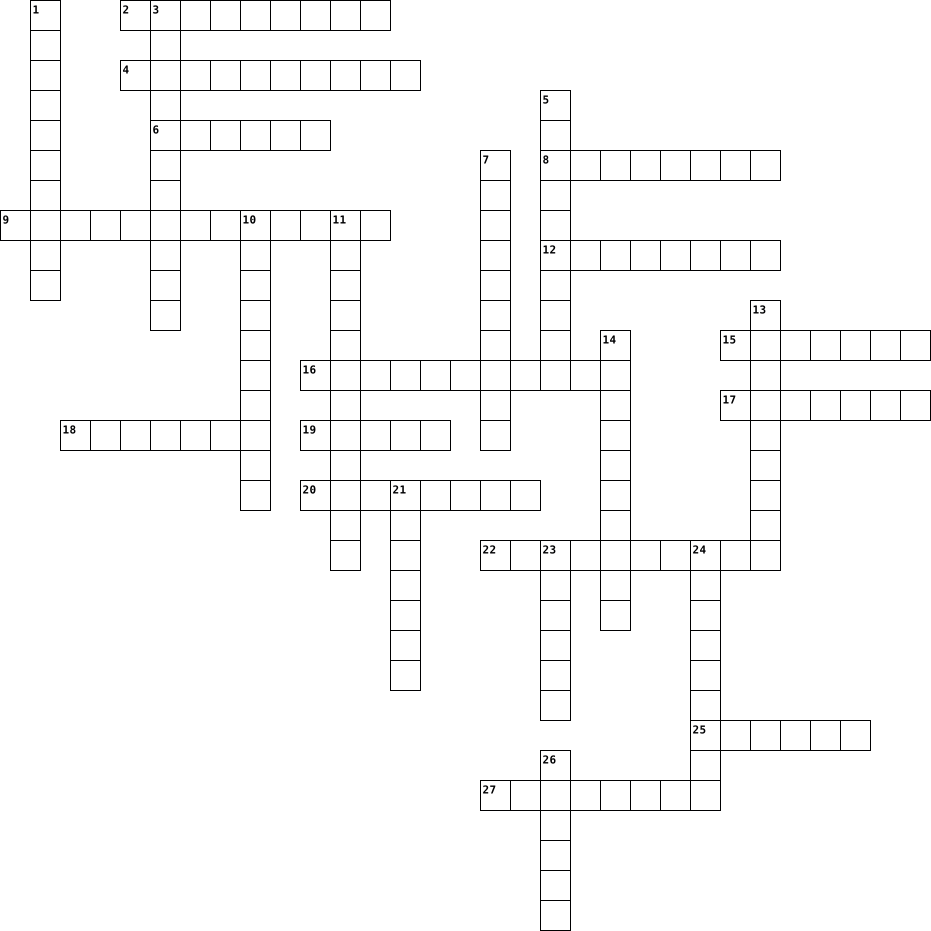
Across
- Formed when two oceanic plates converge
- Formed when continental plates spread apart
- __________ magnitude scale
- Driving force of continental drift
- Underwater mountain chain along divergent plate boundary
- The west coast of North America is made up of many ___________ terranes
- Fault with vertical motion
- Worldwide ocean
- Discovered continental drift
- Large wave created by an undersea earthquake
- Break in the Earth's crust/lithosphere
- Northern supercontinent
- A plate boundary where plates are moving towards one another
- A more horizontal fault found at convergent plate boundaries
- New oceanic crust is formed during _________ spreading
Down
- Process of one plate sinking beneath another
- Instrument for measuring earthquakes
- Ancient reptile that provided fossil evidence for continental drift
- Fault with horizontal motion
- 90% of the world's earthquakes are along the
- Southern supercontinent
- A plate boundary where plates are spreading apart
- California's major fault
- Fault usually found at convergent plate boundaries
- Fault usually found at divergent plate boundaries
- The point on the Earth's surface above an earthquake's location
- Supercontinent (means "worldwide earth" in Greek)
27 Clues: Worldwide ocean • Southern supercontinent • Northern supercontinent • California's major fault • __________ magnitude scale • Fault with vertical motion • Fault with horizontal motion • Discovered continental drift • Driving force of continental drift • Instrument for measuring earthquakes • Break in the Earth's crust/lithosphere • Formed when two oceanic plates converge • ...
Plate Tectonics Crossword Puzzle 2019-11-22

Across
- The process of plates sliding past each other in opposite directions. This can be found at transform boundaries and results in faults
- The word used to describe the state of the mantle
- The cool, outermost layer of the Earth that consists of the crust and uppermost part of the mantle
- Type of plate boundary where two plates collide
- The layer just below the lithosphere
- Layer of Earth that is composed of Fe & Ni and is liquid
- Scientist that proposed Earth's continents were once joined together as a single land mass
- This is a type of heat transfer (hint: lava lamp). Some scientists believe these are occurring in the mantle and moving the tectonics plates
- These are formed under water at divergent plate boundaries. They are areas where new crust is formed
- Areas along a transform boundary created by the shearing of two pieces of crust. There is a famous one in California
- These form under water (on the ocean floor) at most convergent boundaries
- Earth's thickest layer
- Scientists study these in order to learn about the interior of the Earth
- Layer of Earth with the lowest temperature
- Type of crust that is thinner and contains basalt
Down
- Layer of Earth that is composed of Fe & Ni and is solid
- Type of crust that is thick and contains granite
- This is the process of creating new oceanic crust
- Theory that the lithosphere is divided into tectonic plates that move on the asthenosphere
- This forms on land at divergent plate boundaries. There is a great one in eastern Africa
- Type of plate boundary where two plates separate or move apart
- The name of the supercontinent that existed 245 million years ago
- The bending and crumpling of rock. This happens at continental vs continental convergent boundaries and results in the tallest mountains
- Theory that they continents were once joined as one large, single land mass
- When one tectonic plate moves underneath another one, it's called this
- These occur at transform boundary faults and can cause tremendous devastation
- Type of plate boundary where two plates slide past each other in opposite directions
27 Clues: Earth's thickest layer • The layer just below the lithosphere • Layer of Earth with the lowest temperature • Type of plate boundary where two plates collide • Type of crust that is thick and contains granite • This is the process of creating new oceanic crust • The word used to describe the state of the mantle • Type of crust that is thinner and contains basalt • ...
Introduction to Plate Tectonics 2021-02-04

Across
- ___________ crust is thicker
- the first super =continent
- the upper part of the mantle that the crust sits on top of
- contains the semi-solid layer of the Earth
- a person who studies geology
- the theory that the Earth is made of moving plates
- this scientist that gave evidence for the mid-atlantic ridge
- ____________ currents move tectonic plates
- molten rock found above the crust
- ________ waves are used to take measurements inside the Earth
Down
- the supercontinent making the countries in the northern hemisphere
- the scientist who first proposed continental drift
- the theory that the continents have moved over time
- the supercontinent made of Gondwana and Laurasia
- the branch of science studying the Earth
- ___________ spreading is responsible for forming ocean ridges
- molten rock found below the crust
- the centre of the Earth
- the supercontinent making the countries in the southern hemisphere
- the mid-_________ ridge runs along the west coast of America
- the solid, outer layer of the Earth
- continental _________ are underwater cliffs
- _________ crust is thinner
23 Clues: the centre of the Earth • the first super =continent • _________ crust is thinner • ___________ crust is thicker • a person who studies geology • molten rock found below the crust • molten rock found above the crust • the solid, outer layer of the Earth • the branch of science studying the Earth • contains the semi-solid layer of the Earth • ...
Plate Tectonics & Earth's Layers 2021-01-12

Across
- measure of how much material there is
- a boundary where two plates meet and move towards each other
- the hypothesis that states the continents were once connected
- upper layer of Earth's mantle below the lithosphere
- rigid layer that makes up the upper mantle
- the theory that Earth's lithosphere is in constant motion
- where old oceanic lithosphere is pulled back into the mantle
- the movement of a fluid caused by differences in temperature
- the process where new oceanic lithosphere forms
- Molten rock beneath the Earth
- mostly solid rocky part of Earth
- sections of Earth's crust that move due to convection currents
Down
- lower part of the mantle
- the thick part of Earth's crust
- a boundary where two plates meet and pull away from each other
- a boundary where two plates meet and slide past each other
- the central part of the Earth
- thin and solid outermost layer
- layer between the crust and core
- the thin part of Earth's crust
20 Clues: lower part of the mantle • the central part of the Earth • Molten rock beneath the Earth • thin and solid outermost layer • the thin part of Earth's crust • the thick part of Earth's crust • layer between the crust and core • mostly solid rocky part of Earth • measure of how much material there is • rigid layer that makes up the upper mantle • ...
Continental Drift & Plate Tectonics 2017-03-23

Across
- Earth's crust is broken up into pieces called _________.
- preserved remains or traces of organisms that lived in the past
- appears to be a large crack along the land with a river running through it
- large flat area of land
- Plate boundary that is created when two plates slide past each other
- high points of land with a flat top
- This theory believes that the continents only move because they are on top of the plates that are actually moving
- caused by divergent plate boundary when they separate from each other on land
- drift a) the continents used to be together/connnected (Pangea)b) the continents are moving and are still moving from old locations to new locations
- caused by divergent plate boundary when they separate from each other in the ocean
Down
- low point between two mountains
- caused by a convergent plate boundary when they collide
- made of compressed tropical plants
- Plate boundary that is created when two plates collide
- Plate boundary _____________ causes landforms and events to occur.
- cracks where one plate touches another plate
- Plate boundary that is created when two plates divide/separate
- caused by transform plate boundary when they slide past each other
- height of land above or below sea level
- deep points below the ocean along the sea floor
20 Clues: large flat area of land • low point between two mountains • made of compressed tropical plants • high points of land with a flat top • height of land above or below sea level • cracks where one plate touches another plate • deep points below the ocean along the sea floor • Plate boundary that is created when two plates collide • ...
Plate Tectonics & Ocean Floor 2023-09-14

Across
- This increases as you get deeper in the ocean and in the earth as well
- A boundary where two tectonic plates are colliding.
- the inner most layer of the earth
- the scientific tool used to detect mountains in the ocean
- The outermost layer of the Earth's surface that includes the ocean floor.
- the part of the ocean floor where light reaches the most
- Large sections of the Earth's lithosphere that float on the semi-fluid asthenosphere.
- The lowest part of the ocean floor
- A boundary were two tectonic plates are sliding past each other
Down
- The outermost layer located above water.
- The process by which continents move over geological time.
- A part of the convergent boundary when one plate overlaps the other
- the middle layer of the earth
- The process of the ocean floor spreading apart at mid-ocean ridges.
- a deep sea mountain that was previously a volcano but whos top had flattened below sea level.
- A boundary where two tectonic plates are moving away from each other.
- the mountainous structure in subduction zones that forms as a result of an upswelling of magma
- The last name of the person who hypothesized continental drift.
- The part of the divergent boundary that plays a large role in seafloor spreading.
- The supercontinent that existed before all of the continents separated due to continental drift
20 Clues: the middle layer of the earth • the inner most layer of the earth • The lowest part of the ocean floor • The outermost layer located above water. • A boundary where two tectonic plates are colliding. • the part of the ocean floor where light reaches the most • the scientific tool used to detect mountains in the ocean • ...
plate tectonics activity 3 2023-11-17

Across
- a type of heat and light source that can be very dangerous to eat and or touch
- forms when two continental plates crash into each other
- when a piece of land goes under another piece of land
- the middle of a subduction zone
- hot stuff trapped in a volcano
- a speculation about something
- when two plates move away from each other
- an underwater mountain
- when two plates come together
Down
- something in the mantle that helps plates move
- hot stuff that comes out of volcanoes
- the layer under the crust
- when two plates rift together
- the ways plates move
- the sciencetist who made the theory of continental drift
- a theory about how the continents got to where they are today
- when two plates move past each other
- a super continent from 200 to 300 million years ago
- a fire mountain
- a dead things bones
20 Clues: a fire mountain • a dead things bones • the ways plates move • an underwater mountain • the layer under the crust • when two plates rift together • a speculation about something • when two plates come together • hot stuff trapped in a volcano • the middle of a subduction zone • when two plates move past each other • hot stuff that comes out of volcanoes • ...
💥 PLATE TECTONICS 💥 2023-11-28

Across
- a device used to measure the vibrations of an earthquake
- when one tectonic plate moves under the other
- the liquid layer of the core of the earth
- where two tectonic plates are separating from each other
- when the earth begins to shake uncontrollably due to seismic waves
- a well known tectonic belt where many of the world's volcanoes are located
- the outermost and thinnest layer of the earth
- the theory that the continents are constantly drifting away from each other
- boundary where two tectonic plates meet
- a vent in the earth that erupts
- the layer of the earth in between the crust and the core
- the bottom of the ocean
Down
- where oceanic plates sink down into the earth
- the exact middle point of an earthquake
- the scale at which the intensity of an earthquake is measured
- where two tectonic plates slide past each other horizontally
- the large landmass that used to be every continent combined
- the solid innermost layer of the core of the earth
- a place where two tectonic plates slide past each other
- the movement of the Earth's crust
20 Clues: the bottom of the ocean • a vent in the earth that erupts • the movement of the Earth's crust • the exact middle point of an earthquake • boundary where two tectonic plates meet • the liquid layer of the core of the earth • where oceanic plates sink down into the earth • when one tectonic plate moves under the other • the outermost and thinnest layer of the earth • ...
Plate Tectonics Vocabulary Review 2024-09-05

Across
- This is the area where you will find most of the volcanoes in the world
- Type of boundary where two plates separate
- This mountain range that stretches along the Atlantic Ocean was created by a new crust from a divergent boundary
- This is where two tectonic plates meet
- This natural disaster, along with volcanoes, can cause a tsunami
- Large chunks of lithosphere that gradually move
- The 750-mile long fault in California that is created by a transform boundary
- The prehistoric conglomerate of the 7 continents all combined
- This is how scientists track movements of tectonic plates
- This process creates new crust in the ocean
- Process where one plate moves below another plate
- An area in the Earth’s mantle that is unusually hot
Down
- The theory that plates slowly move the continents over time
- Type of boundary where two plates collide
- Lava that is below the Earth’s surface
- Layer of the earth that represents the crust
- The largest tectonic plate
- The deepest part of the ocean floor
- The scientist credited for the Continental Drift theory
- Type of boundary where two plates slide past each other
- This is the type of rock that is created at a ridge
- This is created in the ocean when subduction occurs
- Layer of the earth that contains magma
- The mountain range in Colorado that is created by a convergent boundary
24 Clues: The largest tectonic plate • The deepest part of the ocean floor • Lava that is below the Earth’s surface • This is where two tectonic plates meet • Layer of the earth that contains magma • Type of boundary where two plates collide • Type of boundary where two plates separate • This process creates new crust in the ocean • Layer of the earth that represents the crust • ...
Plate Tectonics & Mountain Building 2023-02-13

Across
- Which way does the hanging wall move in a reverse fault
- Term referring to a break in rock without movement
- Pangea is the name of the _____________ which existed 200 MYA
- The Mesosaurus was found in both Africa and South America! This provided ________ evidence that the continents were once connected
- Type of fault found at a divergent boundary
- Type of fault found at a transform boundary
- Type of stress found at a transform boundary
- Theory that the continents were once connected but then overtime drifted apart
- Type of stress found at a divergent boundary
- Type of boundary where plates slide past each other
Down
- Type of fault found at a convergent boundary (Low angle)
- Type of stress found at a convergent boundary
- Term referring to the balance between the crust and mantle
- Term referring to a break in rock with movement
- Type of fault found at a convergent boundary (High angle)
- Name of the german scientist who came up with the theory of continental drift
- Term referring to the creation of mountains
- Type of boundary where plates are moving away from each other
- Type of boundary where plates are moving towards each other
- Which way does the hanging wall move in a normal fault
20 Clues: Type of fault found at a divergent boundary • Term referring to the creation of mountains • Type of fault found at a transform boundary • Type of stress found at a transform boundary • Type of stress found at a divergent boundary • Type of stress found at a convergent boundary • Term referring to a break in rock with movement • ...
Plate Tectonics Crossword Puzzle 2023-03-02

Across
- Scientists study these in order to learn about the interior of the earth.
- These are formed under water at divergent plate boundaries. They are areas where new ocean crust is formed.
- Layer of earth that is composed of Fe & Ni and is solid.
- Theory that the continents were once as one large, single land mass.
- These form under water (on the ocean floor) at most convergent boundaries.
- This is a type of heat transfer (hint: lava lamp). Some scientist believe these are occurring in the mantle and moving the tectonic plates.
- Earths thickest layer.
- This forms on land at divergent plate boundaries. There is a great one in Eastern Africa.
- Type of plate boundary where two plates collide.
- Type of plate boundary where two plates slide past each other in opposite directions.
- Scientist that proposed Earth's continents were once joined together in one single land mass
Down
- These occur at transform boundary faults and can cause tremendous devastation.
- When one tectonic plate moves underneath another one, it's called this.
- The name of the supercontinent that existed 245 million years ago.
- Word used to describe the state of the mantle.
- Type of plate boundary where two plates separate or move apart.
- The cool, outermost layer of Earth that consists of the crust and uppermost part of the mantle.
- Type of crust that is thinner and contains basalt.
- The bending and crumpling of rock. This happens at continental vs. continental convergent boundaries and results in the tallest mountains.
- The process of plates sliding past each other in opposite directions. This can be found at transform boundaries and results in faults.
- The layer just below the lithosphere.
- Layer of earth with the lowest temperature.
- This is the process of creating new oceanic crust.
- Type of crust that is thick and contains granite.
- Areas along the transform boundary created by the shearing of two pieces of crust. There is a famous one in California.
- Layer of earth that is composed of Fe & Ni and is liquid.
26 Clues: Earths thickest layer. • The layer just below the lithosphere. • Layer of earth with the lowest temperature. • Word used to describe the state of the mantle. • Type of plate boundary where two plates collide. • Type of crust that is thick and contains granite. • Type of crust that is thinner and contains basalt. • This is the process of creating new oceanic crust. • ...
Plate Tectonics Crossword Puzzle 2021-09-30

Across
- crash together with violent impact
- a sheet of floating ice
- relating to or forming part of the structure of a building or other item
- the movement or study of the movement of Earth's crust
- a specialist in the history of the Earth recorded in rocks
- liquid rock
- a mobile, destructive vortex of violently rotating winds having the appearance of a funnel-shaped cloud and advancing beneath a large storm system.
- a strike-slip fault occurring at the boundary between two plates of the earth's crust
Down
- a celestial body moving in an elliptical orbit around a star
- subject to or caused by an earthquake or earth vibration
- reduce or cause to be reduced from a solid to a liquid state
- a mountain or hill, typically conical, having a crater or vent through which lava, rock fragments, hot vapor, and gas are being or have been erupted from the earth's crust
- another word for disengage
- a sudden outbreak of something, typically something unwelcome or noisy
- a sheet, quantity, or thickness of material, typically one of several, covering a surface or body
- any of the world's main continuous expanses of land
- the process of covering the earth with glaciers or masses of ice
- a biological community of interacting organisms and their physical environment
- a continent or other large body of land
- the regions of the Earth where living organisms exist
20 Clues: liquid rock • a sheet of floating ice • another word for disengage • crash together with violent impact • a continent or other large body of land • any of the world's main continuous expanses of land • the regions of the Earth where living organisms exist • the movement or study of the movement of Earth's crust • subject to or caused by an earthquake or earth vibration • ...
Plate Tectonics Crossword Puzzle 2021-09-30

Across
- a sheet, quantity, or thickness of material, typically one of several, covering a surface or body
- crash together with violent impact
- relating to or forming part of the structure of a building or other item
- a continent or other large body of land
- subject to or caused by an earthquake or earth vibration
- reduce or cause to be reduced from a solid to a liquid state
- the movement or study of the movement of Earth's crust
- another word for disengage
- the process of covering the earth with glaciers or masses of ice
- a sudden outbreak of something, typically something unwelcome or noisy
Down
- a strike-slip fault occurring at the boundary between two plates of the earth's crust
- a biological community of interacting organisms and their physical environment
- a specialist in the history of the Earth recorded in rocks
- a mobile, destructive vortex of violently rotating winds having the appearance of a funnel-shaped cloud and advancing beneath a large storm system.
- a celestial body moving in an elliptical orbit around a star
- the regions of the Earth where living organisms exist
- any of the world's main continuous expanses of land
- a sheet of floating ice
- a mountain or hill, typically conical, having a crater or vent through which lava, rock fragments, hot vapor, and gas are being or have been erupted from the earth's crust
- liquid rock
20 Clues: liquid rock • a sheet of floating ice • another word for disengage • crash together with violent impact • a continent or other large body of land • any of the world's main continuous expanses of land • the regions of the Earth where living organisms exist • the movement or study of the movement of Earth's crust • subject to or caused by an earthquake or earth vibration • ...
Plate Tectonics Crossword Puzzle 2021-04-28

Across
- If magma reaches the surface without cooling and solidifying, it can break through in the form of _______________ eruptions.
- Where plates move apart,_______________ form.
- At _______________ boundaries, neighbouring plates are moving toward one another.
- A continental rift, often referred to as a rift valley, forms where continental plates_______________.
- Earthquakes send out _______________ waves when there is movement along transform boundaries.
- In a subduction zone, the subducted _______________ becomes molten and forms magma chambers.
- Oceanic plates are pulled _______________ continental plates.
- _______________ is when one plate is pulled under another.
- Where a continental plate converges with an oceanic plate, the thinner, denser _______________ plate subducts beneath the thicker, more rigid _______________ plate
- At_______________ boundaries, neighbouring plates are moving away from one another.
- The rifting of plates allows _______________ to move to the surface.
Down
- The edges of tectonic plates are called _______________.
- Plates move because of forces in the _______________.
- Subduction creates a _______________ between the plates and a subduction zone below.
- Movements of crust often result in _______________.
- When magma cools in a rift,it creates more _______________ in the gap between the plates.
- At _______________ boundaries, neighbouring plates are sliding past one another or locked in place as they are trying to slide past one another.
- Where plates _______________, earthquakes occur and volcanoes and mountains form.
- During subduction, magma that is less _______________ than the rest of the mantle rises to the surface.
- An _______________ rift, often referred to as a rift valley, forms where oceanic plates diverge.
- Where oceanic plates converge, the _______________, denser plate subducts under the less dense plate.
- At convergent boundaries, neighbouring plates are moving _______________ one another.
- Continental plates are _______________ in strength.
23 Clues: Where plates move apart,_______________ form. • Movements of crust often result in _______________. • Continental plates are _______________ in strength. • Plates move because of forces in the _______________. • The edges of tectonic plates are called _______________. • _______________ is when one plate is pulled under another. • ...
Plate Tectonics and More 2025-02-14

Across
- underground layer of material through which water flows
- type of convergence where one plate slides under another
- rocks that have changed from their original form due to heat and pressure
- transfer of heat between two touching items due to temperature differences
- solid surface of the Earth
- device that measures vibrations in the Earth and converts them into electric signals
- series of vibrations in the Earth caused by plate tectonics
- type of boundary where two plates slide past each other
- vent in the Earth's crust through which magma, steam and ash can be expelled
- plate boundary where two plates move away from each other
- hot liquid layer of the Earth made of iron and nickel
- solid, dense extremely hot layer of the Earth
- type of boundary where two plates come together
- ocean feature which can be created by subduction
- process by which the surface of the earth is worn away but water, wind, etc
Down
- conduction, convection and radiation
- a long narrow land mass between two divergent plates
- liquid part of upper mantle below the lithosphere
- area of science that studies the movement and interaction of the Earth's plates
- heat transfer by the movement of a liquid or a gas
- portion of the Earth made up mostly of a very thick molten liquid
- process that occurs at mid-ocean ridges where rising magma creates new ocean crust
- motion created with the hand and wrist to say hello or goodbye
- energy wave that travels through the Earth caused by motion
- used by Dr.Wegener to help support his hypothesis
- process by which rocks are mechanically or chemically broken down
- type of rock produced under extreme heat by volcanoes and magma
- molten material beneath the Earth's crust that can create igneous rock
- area on the ocean floor where seafloor spreading takes place
- transfer of heat through empty space
- rocks formed when sediment is deposited and becomes tightly compacted
- elevation of the Earth's surface created by divergent or convergent plates
- the thin outermost layer of the Earth
- depression in the ground caused by the collapse of the surface from moving water
34 Clues: solid surface of the Earth • conduction, convection and radiation • transfer of heat through empty space • the thin outermost layer of the Earth • solid, dense extremely hot layer of the Earth • type of boundary where two plates come together • ocean feature which can be created by subduction • liquid part of upper mantle below the lithosphere • ...
Topic 4 Plate Tectonics 2025-02-25

Across
- liquid magma that reaches the surface
- a break in earth's crust along which rocks move
- boundary a plate boundary where to plates move toward each other
- a type of stress that stretches rock so that it becomes thinner in the middle
- a type of stress that pushes masses of rock in opposite dir4ections, in a sideways movement
- a giant wave usually causes by an earthquake beneath the ocean floor
- a type of stress that squeezes rock until it folds or breaks
- term used to describe a volcano that is not currently active but able to become active in the future
- a molten mixture of rock-forming substances, gases, and water from the mantle
Down
- boundary a plate boundary where two plates move away from each other
- process by which oceanic crust sinks beneath a deep-ocean trench and back into the mantle at a convergent plate boundary
- term used to describe a volcano that is no longer active and unlikely to erupt again
- the shaking that results from the movement of rock beneath earth's surface
- spreading the process by which molten material adds new oceanic crust to the ocean floor
- a force that acts on rock to change its shape or volume
- trench an undersea valley that represents one of the deepest parts of the ocean
- the measurement of an earthquake's strength based on seismic waves and movement along faults
- spot an area where magma from deep within the mantle melts through the crust above it
- a weak spot in the crust where magma has come to the surface
- ridge an undersea mountain chain where new ocean floor is produced; a divergent plate boundary under the ocean
- boundary a plate boundary where two plates move past each other in opposite directions
21 Clues: liquid magma that reaches the surface • a break in earth's crust along which rocks move • a force that acts on rock to change its shape or volume • a weak spot in the crust where magma has come to the surface • a type of stress that squeezes rock until it folds or breaks • boundary a plate boundary where to plates move toward each other • ...
Plate Tectonics & Geologic Time 2025-03-04

Across
- how old an object is compared to another
- where tectonic plates slide past each other
- where tectonic plates pull apart
- an unstable form of an element
- the use of isotopes to find the absolute age of an object
- an area of the ocean where oceanic plates collide
- what drives the cycling of material in the mantle
- where tectonic plates collide with each other
- a giant wave caused by an earthquake
- the remains or traces of an organism
- between the crust and the core
- the process by which a plate is shoved back into the mantle
- consists of the crust and upper mantle
Down
- the uppermost layer of Earth
- deepest layer of Earth
- a theory that explains that Earth's plates are in constant motion
- the location on Earth's surface above an earthquake
- a break in the Earth's crust
- the exact age of an object
- an area surrounding the Pacific where most volcanoes and earthquakes are located
- the supercontinent that existed long ago
- molten rock
- layer beneath the lithosphere that is semi-solid
- a ridge of undersea mountains
- liquid layer of Earth
25 Clues: molten rock • liquid layer of Earth • deepest layer of Earth • the exact age of an object • the uppermost layer of Earth • a break in the Earth's crust • a ridge of undersea mountains • an unstable form of an element • between the crust and the core • where tectonic plates pull apart • a giant wave caused by an earthquake • the remains or traces of an organism • ...
Plate tectonics and boundaries 2023-12-18

Across
- the process by which Earth's crust breaks apart; can occur within continental crust or oceanic crust
- Outer most layer of earth
- The vent on the earth's surface through which magma and gases are expelled is a called a _________.
- Most inner layer of earth
- Thickest layer in earth crust
- is the layer of the upper mantle composed of low-density rock matterial that is semiplastic,like putty.
- the solid, outer layer of the earth that consists of the crust and the rigid upper part of the mantle
- Said to be a liquid layer
- In this boundary plates slide past each other.
- where two plates are moving apart, magma comes up to create new crust
Down
- A major volcanic zone which is found along the Pacific ocean and travels all the way from South America, to North America and along Asia.
- boundary between two colliding plates, often associated with mountain building ocean trenches and volcanic islands
- This is an example of a mid ocean ridge.
- When the earth's tectonic plates move, we call this a ______.
- A ______________ boundary creates mountains.
- What type of process is created by a divergent boundary.
- When one tectonic plates dives under another, it is called __________.
- boundary between two plates that are sliding past each other.
- the theory that explains how large pieces of the lithosphere, called plates, move and change shape the topography of the earth.
- At a convergent convergent boundary where an ocean meets a continent, the ocean dives under. This is called _________.
- A ___________ boundary creates new ocean floor.
21 Clues: Outer most layer of earth • Most inner layer of earth • Said to be a liquid layer • Thickest layer in earth crust • This is an example of a mid ocean ridge. • A ______________ boundary creates mountains. • In this boundary plates slide past each other. • A ___________ boundary creates new ocean floor. • What type of process is created by a divergent boundary. • ...
Extended Vocabulary - Plate Tectonics 2023-10-20

Across
- This principle states that layers of rock are superimposed, or laid down one on top of another.
- The "Age of Early Life" continents formed and our modern atmosphere developed, while early life evolved and flourished during this time.
- _____ ________ occurs when the nucleus of a radioactive atom spontaneously transforms into an atomic nucleus of a different, more stable isotope.
- The "Age of Reptiles" Pangaea began separating into the modern continents, and the modern Rocky Mountains rose during this time.
- The mineralized sediment that fills the mold recreates the shape of the remains.
- The preserved remains of plants and animals whose bodies were buried in sediments, such as sand and mud.
- The mineralized impression of the organism left in the sediment is called a ______.
- The process of forming something by forcing or pushing it out, especially through a small opening.
Down
- The "Age of Ancient Life" Fish diversified and marine organisms were very abundant during this time.
- The "Age of Mammals" North America's characteristic landscapes began to develop during this time.
- A type of geologic contact caused by a period of erosion or a pause in sediment accumulation, followed by the deposition of new sediments.
- The “calendar” for events in Earth history.
- This occurs when the organic matter is completely replaced by minerals and the fossil is turned to stone.
- The time required for one-half of the radioactive (parent) isotopes in a sample to decay to radiogenic (daughter) isotopes.
- The action or process of forcing a body of igneous rock between or through existing formations, without reaching the surface.
- The approximate age determination of rocks, fossils or minerals made by comparing whether the material is younger or older than other surrounding material.
- The measurement of geologic age in years.
- A fossil that provides indirect evident evidence of ancient plants or animals, such as footprints, nests, burrows, or feces.
- It is a type of fossil found in any rock when organic material is compressed, leaving only a carbon residue or film.
- A mineral is used in geology to determine the degree of metamorphism a rock has experienced.
- An event or a time that begins a new period or development.
- A fracture or zone of fractures between two blocks of rock
22 Clues: The measurement of geologic age in years. • The “calendar” for events in Earth history. • A fracture or zone of fractures between two blocks of rock • An event or a time that begins a new period or development. • The mineralized sediment that fills the mold recreates the shape of the remains. • ...
Science plate tectonics Vocab 2023-10-21

Across
- a scientist who specializes in the study of life forms that existed in previous geologic periods
- pertaining to the present era, beginning 65 million years ago
- to thrust out, force or press out
- an organism outline of a fossil
- The geologic age of a fossil organism, rock, or geologic feature or event given in units of time
- a fossil that is useful for dating and correlating the strata in which it is found
- the period of time to which anything belongs or is to be assigned
- pertaining to an era occurring between 230 and 65 million years ago
- to thrust or force into
- pertaining to the earliest era of earth history, ending 570 million years ago
- a hollow form or matrix for giving a particular shape to something in a molten or plastic state
Down
- to receive form in a mold
- having been turned to stone
- one of a class of substances that cannot be separated into simpler substances by chemical means
- a fossil of a footprint, trail, or burrow
- pertaining to an era occurring between 570 million and 230 million years ago
- cracks in the earth's crust along which there is movement
- mineral or organic matter deposited by water, air, or ice
- any remains, impression, or trace of a living thing of a former geologic age
- particular period of time marked by distinctive features
20 Clues: to thrust or force into • to receive form in a mold • having been turned to stone • an organism outline of a fossil • to thrust out, force or press out • a fossil of a footprint, trail, or burrow • particular period of time marked by distinctive features • cracks in the earth's crust along which there is movement • mineral or organic matter deposited by water, air, or ice • ...
Unit 1: Plate Tectonics 2024-02-04

Across
- the transfer of heat through electromagnetic waves.
- hot air rises, cool air sinks.
- the upper layer of the earth's mantle, below the lithosphere, in which there is relatively low resistance to plastic flow and convection is thought to occur.
- the second most abundant element found in the inner and outer cores of Earth.
- the theory that changes in the earth's crust during geological history have resulted from the action of continuous and uniform processes.
- theory that the Earth's lithosphere (the crust and upper mantle) is divided into a number of large, platelike sections
- a split or break that forms when the earth's crust divides.
- at this type of boundary, plates are moving toward each other, eventually colliding
- a chain of underwater mountains formed by seafloor spreading at divergent plate boundaries. Similar to the stitching on a baseball.
Down
- the transfer of heat or matter by the flow of a fluid, especially horizontally in the atmosphere or the sea.
- the layer of Earth composed of solid iron and nickel.
- at this type of boundary, plates are moving away from each other, creating rift valleys or mid-ocean ridges
- boundary between two tectonic plates, where the plates are moving horizontally or vertically in opposite directions, not against or away from each other
- the outermost layer of Earth, where we live, work and play.
- the rocky outer part of Earth. It is made up of the brittle crust and the top part of the upper mantle. It lies below the crust.
- at this type of boundary, plates are sliding past each other in opposite directions, often leading to earthquakes
- the theory that our continents are slowly drifting across the surface of Earth
- the layer of Earth in which convection takes place.
- when heat moves from one object to another object through direct touch.
- the layer of Earth composed of liquid iron and nickel
- the heaviest of metal elements found in the inner and outer cores of Earth.
21 Clues: hot air rises, cool air sinks. • the transfer of heat through electromagnetic waves. • the layer of Earth in which convection takes place. • the layer of Earth composed of solid iron and nickel. • the layer of Earth composed of liquid iron and nickel • the outermost layer of Earth, where we live, work and play. • ...
Earthquakes and Plate Tectonics 2024-03-25

Across
- what can earthquakes and tectonic plates shifting create?
- the process where one tectonic plate slices beneath another into the mantle
- what is the scale used to measure the magnitude of an earthquake?
- what is the term for the molten rock beneath the earths surface?
- what is the term for tectonic plates sliding past eachother horizontally?
- what is the shaking of the earths surface called?
- what is the name of the giant moving pieces of the earths lithosphere?
- what is the term for the sudden movement of tectonic plates that causes an earthquake?
- what is the instrument used to detect and measure earthquakes?
- what is the name of a break in the earths crust where earthquakes appear?
Down
- what is the outermost layer of the earths surface where we live?
- what is the name for the process where the earths crust if lifted to form mountains?
- what is the term for the waves that travel through the earth during an earthquake?
- what is the term for a giant wave caused by an underground earthquake?
- the point beneath the earths surface where an earthquake originates
- what is the term for the measurement of the size of an earthquake based on the amount of energy released?
- what is the term for a sudden release of energy in the earths crust that causes an earthquake?
- what is the term for the boundary where two tectonic plates move away from each other?
- what is the term for the process of measuring and recording seismic waves?
- what is it called when molten rock, ash, and, and gases erupt from a volcano?
20 Clues: what is the shaking of the earths surface called? • what can earthquakes and tectonic plates shifting create? • what is the instrument used to detect and measure earthquakes? • what is the outermost layer of the earths surface where we live? • what is the term for the molten rock beneath the earths surface? • ...
Chapter 1 Plate Tectonics 2022-03-18

Across
- a layer of molten iron and nickel that surrounds the inner core of Earth
- a plate boundary where two plates move past each other in opposite directions
- a dense sphere of solid iron and nickel at the center of Earth
- a dark, igneous rock with a fine texture found in oceanic crust
- the name of the single landmass that broke apart 200 million years ago and gave rise to today’s continents
- a rigid layer made up of the uppermost part of the mantle and the crust
- country that is being split apart at the Mid-Atlantic ridge
- the force exerted on a surface divided by the area over which the force is exerted
- a trace of an ancient organism that has been preserved in rock
- a deep valley along the ocean floor beneath which oceanic crust slowly sinks toward the mantle
- the amount of mass in a given space, mass per unit of volume (like g/cm3)
- the process by which molten material adds new oceanic crust to the ocean floor
- the theory that pieces of Earth’s lithosphere are in constant motion, driven by convection currents in the mantle
- the transfer of heat by movement of a fluid
- a well-tested concept that explains a wide range of observations
- name of the ship that took rock samples from the deep ocean floor
- the hypothesis that the continents slowly move across Earth’s surface
Down
- the transfer of heat within a material or between materials that are touching
- the transfer of energy through space
- the process by which oceanic crust sinks beneath a deep-ocean trench and back into the mantle at a convergent plate boundary
- a section of the lithosphere that slowly moves over the asthenosphere, carrying pieces of continental crust
- a usually light-colored igneous rock that is found in continental crust
- a plate boundary where two plates move toward each other
- a break in the Earth’s crust where masses of rock slip past each other
- vibrations that travel through Earth carrying the energy released during an earthquake
- the layer of hot, solid material between Earth’s crust and core
- first scientist to hypothesize about continental drift
- the layer of rock that forms Earth’s outer surface
- a deep valley that forms where two plates move apart
- a device that determines the distance of an object under water by recording echoes of sound waves
- An undersea mountain chain where new ocean floor is produce; a divergent plate boundary
- a plate boundary where two plates move away from each other
- the movement of a fluid caused by differences in temperature, that transfers heat from one part of the fluid to another
- the soft layer of the mantle on which the lithosphere floats
34 Clues: the transfer of energy through space • the transfer of heat by movement of a fluid • the layer of rock that forms Earth’s outer surface • a deep valley that forms where two plates move apart • first scientist to hypothesize about continental drift • a plate boundary where two plates move toward each other • country that is being split apart at the Mid-Atlantic ridge • ...
Plate Tectonics CW 2 2022-09-28

Across
- A scientist who studies earthquakes.
- this layer is formed with the crust and rigid upper mantle, and is above the asthenosphere
- All the oceans, rivers, lakes and water on Earth. It comes from the word “Hydro” which means “water.”
- When two tectonic plates slowly crash into each other and mountains are formed.
- a theory that proposes that magma under Earth’s crust is forced up toward the surface at the mid-ocean ridges, forming new seafloor
- the process of moving things from one place to another.
- When one tectonic plate converges under another due to density differences.
- the layer below the lithosphere and is plasticlike
- A boundary of two tectonic plates where the plates slide past each other.
- A boundary of two tectonic plates where the plates move away from each other.
- A solid form of carbon dioxide that is very cold and turns directly from a solid to a gas.
- A boundary of two tectonic plates where the plates move towards each other.
- The outer most layer of the Earth. This is the layer we walk on.
- Slowly moving pieces of Earth’s crust.
- To reuse something that would have otherwise been thrown out or to turn it into something usable again instead of sending it to a landfill.
- Movement caused by warm fluids rising and cooler fluids sinking.
Down
- melted rock
- a chain of ridges and valleys stretching along Earth’s ocean floor
- All the living things on Earth. It comes from the word “Bio” which means “life.”
- All the rock, soil and sediments that makeup Earth’s land. It comes from the word “Geo” which means “Earth.”
- large, slow moving bodies of ice on land
- a single landmass composed of all the continents joined together
- All the gases surrounding the earth. It comes from the word “Atmos” which means “air.”
- Wegener’s hypothesis that all continents were once connected in a large landmass that broke apart & drifted slowly to their current positions
- pull-apart forces
- large sections of Earth’s crust and upper mantle
- a cycle of heating, rising, cooling and sinking
27 Clues: melted rock • pull-apart forces • A scientist who studies earthquakes. • Slowly moving pieces of Earth’s crust. • large, slow moving bodies of ice on land • a cycle of heating, rising, cooling and sinking • large sections of Earth’s crust and upper mantle • the layer below the lithosphere and is plasticlike • the process of moving things from one place to another. • ...
Rocks/Minerals/Plate Tectonics 2025-05-22

Across
- name of metamorphic rock formed deep underground
- layered structure found in metamorphic rocks (banding)
- igneous rock formed underground
- Causes movement of tectonic plates. _____________ currents
- Type of rock formed by solidification of magma
- As you move away from a mid ocean ridge, ocean floor rocks get ___________
- Type of rock formed by extreme heat and pressure
- Last mineral to crystallize on Bowen's Reaction Series
- Type of rock formed by compaction and cementation of sediments
- Feature formed at convergent plate boundaries
- Mineral made of Si and 0
- smallest particle size
- Mineral characteristics are based off the minerals arrangement of ________
- Dark red; hardness of 7-7.5
- Hawaii and Iceland are examples of these
Down
- igneous rock formed at Earth's surface (Volcanic)
- Caused by underwater earthquake
- Ocean crust sinking beneath continental crust
- Mid-ocean ridges form at this type of boundary
- Earth's outer core is in this state of matter
- word for an igneous rock having large crystals (intrusive)
- Earth's layer with a density of 3.4-5.6 g/cm3
- the ability of a mineral to scratch is based off this characteristic
- Fool's Gold
- The reason Earth is separated into layers
- Mineral found in calcite that bubbles with acid
- San Andrea Fault
- Evidence of Pangaea
- Supercontinent
29 Clues: Fool's Gold • Supercontinent • San Andrea Fault • Evidence of Pangaea • smallest particle size • Mineral made of Si and 0 • Dark red; hardness of 7-7.5 • Caused by underwater earthquake • igneous rock formed underground • Hawaii and Iceland are examples of these • The reason Earth is separated into layers • Ocean crust sinking beneath continental crust • ...
Plate tectonics: crossword puzzle 2026-01-20

Across
- the Process where new oceanic crust forms at mid-ocean ridges.
- Events such as earthquakes and volcanoes caused by Earths processes.
- the outermost layer of the Earth.
- A deep valley in the ocean floor formed by subduction.
- Type of crust found under oceans.
- Where two continental plates collide.
- a very large landmass made of all continents joined together.
- Early theory stating continents slowly move over Earth’s surface.
- Sudden shaking of Earth caused by plate movement.
- A large ocean wave caused by undersea earthquakes or eruptions.
- a naturally occurring solid material that makes up Earth.
- a plate boundary where plates move apart.
- Earth’s outer rocky layer.
- The thick layer beneath Earth’s crust
Down
- Long underwater mountain chains.
- Process where one plate sinks beneath another.
- The point underground where an earthquake begins.
- A volcanic area fed by magma from deep within Earth.
- a plate boundary where plates slide past each other.
- the theory explaining the movement of Earth's plates.
- Preserved remains or traces of ancient life.
- Scientist who proposed sea-floor spreading.
- the ancient super continent that existed millions of years ago.
- The solid center of the Earth.
- Rigid outer layer made of crust and upper mantle.
- Molten rock that erupts from volcanoes.
- Vibrations that travel through Earth during an earthquake.
- A crack or break where Earth’s crust is pulling apart.
28 Clues: Earth’s outer rocky layer. • The solid center of the Earth. • Long underwater mountain chains. • the outermost layer of the Earth. • Type of crust found under oceans. • Where two continental plates collide. • The thick layer beneath Earth’s crust • Molten rock that erupts from volcanoes. • a plate boundary where plates move apart. • ...