
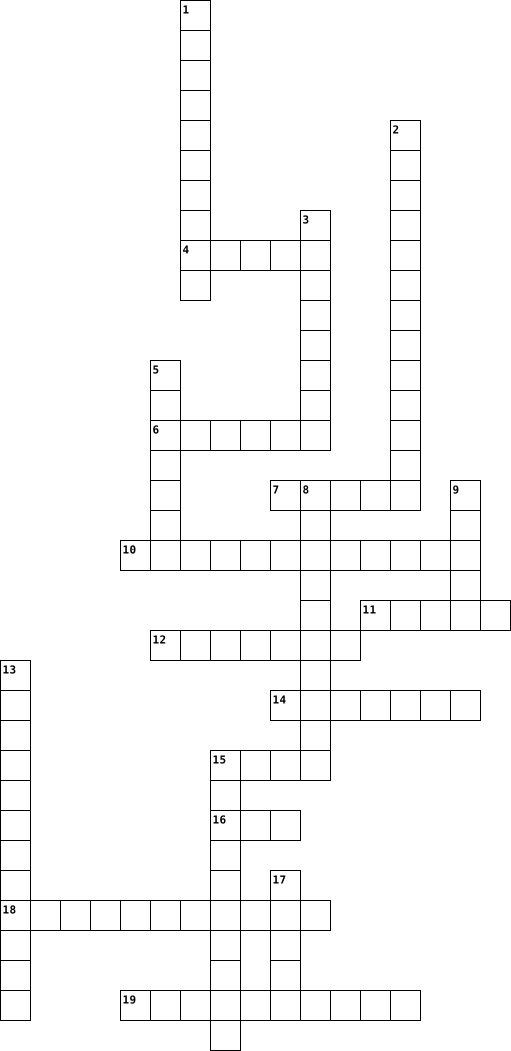
solar system Crossword Puzzles
spacee 2022-04-26

Across
- the fifth planet in our solar system
- Area of space that contains as many as several thousand galaxies
- Estimated number of galaxies in the universe(it has to be a word not a number)
- A large celestial body that is composed of gas and emits light
- second plant in our solar system
- The four planets that orbit closest to our sun
- small galaxy consisting of as few as 100 million stars
- fourth planet our solar system
- Space and all matter and energy in it
- a galaxy we live on
- The four planets that orbit farthest from the sun
- Look like spheres or ovals, and they do not have spiral arms
- The process that produces energy in stars
Down
- Area of space that contains as many as ten or more clusters of galaxies
- Number of planets that orbit our sun
- a central bulge from which two or more spiral arms extend
- Small bodies that orbit planets
- the eight planet in our solar system
- the six planet in our solar system
- A large collection of stars, gas, and dust that is held together by gravity
- a planet that we live on
- A spherical body that orbits the sun
- The collection of large and small bodies that orbit our central star
- Appear as splotchy, irregularly shaped blobs and Very active areas of star formation
- Area of space where very little matter exists
- a planet that is close to the sun
- The distance that light travels through space in 1 year
- the seventh planet in our solar system
28 Clues: a galaxy we live on • a planet that we live on • fourth planet our solar system • Small bodies that orbit planets • second plant in our solar system • a planet that is close to the sun • the six planet in our solar system • Number of planets that orbit our sun • the fifth planet in our solar system • the eight planet in our solar system • A spherical body that orbits the sun • ...
Solar system test _Alsa 2026-01-22

Across
- Celestial bodies that fall to the earth's surface.
- often called morning star.
- when moon blocks sunlight to earth.
- The science that studies the solar system is...
- the planet has two moons
- Jupiter, saturn, Uranus, and neptune included in category of...
- he is first muslim astronout.
- the biggest asteroid in the solar system.
- massive luminous balls of gas in space.
- third planet from the sun .
- center of the solar system.
- how many moon on Jupiter?
- how long time while earth rotation?
- i am the farthest planet from the sun.
- earth'srevolution make changing of season, in Indonesia namely two main seasons...
- the path of a planet as it revolves around the sun.
Down
- is another name for Earth?
- when earth is between the sun and moon.
- how many moon on uranus.
- they don't have satellites
- this is calestial body composed of ice, dust, and gas that orbit the sun in a highly elliptical path.
- how long time while earth revolution?
- the spinning of earth on its axis.
- the closest galaxy from the milky way galaxy.
- the planet has ring.
- The dark area during a lunar eclipse is...
- the most famous comet
- mercury, venus, earth, and mars included in category of...
- i am has most satellites
- is the term for a shooting star commonly called...
- this is the coldest planet.
- earth is in the galaxy...
- Rocky remnants that formed during early stages of the solar system.
- number of planets in the solar system is...
- The Earth's revolution causes the replacement...
- The rotation of earth causes
- movement of the planet orbiting the sun.
- i am the biggest planet.
- the red planet.
- this is the biggest volcano in the solar system in mars.
40 Clues: the red planet. • the planet has ring. • the most famous comet • how many moon on uranus. • i am has most satellites • the planet has two moons • i am the biggest planet. • earth is in the galaxy... • how many moon on Jupiter? • is another name for Earth? • they don't have satellites • often called morning star. • this is the coldest planet. • third planet from the sun . • ...
Space 2025-03-14

Across
- The star at the center of the solar system
- This planet is now classified as a dwarf planet
- The smallest moon in the solar system
- 1st planet from the Sun
- 8th planet from the sun
- 70% of this planets surface is covered in water
- This planet is named after the goddess of love and beauty
Down
- The largest planet in the solar system
- Known as the "Red Planet"
- The largest moon in the solar system
- A large spiral galaxy containing our solar system
- This planet is a gaseous blue-green ice giant
- This planet is known for its prominent rings
13 Clues: 1st planet from the Sun • 8th planet from the sun • Known as the "Red Planet" • The largest moon in the solar system • The smallest moon in the solar system • The largest planet in the solar system • The star at the center of the solar system • This planet is known for its prominent rings • This planet is a gaseous blue-green ice giant • ...
space 2023-10-24

Across
- planet composed primarily of silicate rocks or metals.
- a small body of water
- a rock from space that hits earth's ground
- energetic charged particles that originate from solar winds
- an illusion caused by objects in our solar system orbit the Sun
- a small icy solar system body
- fundamental system in condensed matter
- a disk in the outer solar system
- distance from a star at which liquid water could exist on orbiting planets
- pluto is one of them
- planet composed of hydrogen and helium
- pieces of junk in space
Down
- a lot of meteor's together
- body that can come together to form a planet.
- distance from the center of the earth to the sun
- its called a shooting star
- a measure of how circular an orbit is
- a circle which has been squashed or flattened a bit
18 Clues: pluto is one of them • a small body of water • pieces of junk in space • a lot of meteor's together • its called a shooting star • a small icy solar system body • a disk in the outer solar system • a measure of how circular an orbit is • fundamental system in condensed matter • planet composed of hydrogen and helium • a rock from space that hits earth's ground • ...
Other Members of the Solar System 2023-05-02

Across
- classified as a dwarf planet since 2006
- an area of space beyond Neptune's orbit containing small rocks thought to be remnants from the formation of the Solar System
- made up of the Kuiper Belt and the Oort Cloud
- the largest planet in the Solar System
- the closest planet to the sun
- a celestial body that lies in the _______ belt between Mars and Jupiter
- a cloud of icy planetesimals that exists 50,000 AU from the sun
- an abbreviation of objects that orbit the sun at a farther distance than Neptune
- the distance in which a ray of light would travel in one year
- the farthest planet from the sun
- the planet famous for its rings
- small celestial bodies living in the Kuiper belt that may have existed since the birth of the Solar System
- a celestial body of gas; the category our sun is in
Down
- a celestial body that is in orbit around the Sun
- the hottest planet in the Solar System
- the four planets closest to the sun with rocky cores
- celestial objects that do not belong into the category of a planet or moon
- the collection of eight planets and their moons around the sun
- known as "the red planet"
- the four outer planets in the Solar System with gaseous bodies and rings
- nicknamed "dirty snowballs", it is composed of an icy, rocky core with two tails that point away from the sun
- the planet that spins on its side
- a small, rocky object that is heated up as it enters the Earth's atmosphere
- the planet located in the habitable zone
- 4.5 billion-year-old yellow dwarf star that is the center of the Solar System
- an object that orbits another celestial object
26 Clues: known as "the red planet" • the closest planet to the sun • the planet famous for its rings • the farthest planet from the sun • the planet that spins on its side • the hottest planet in the Solar System • the largest planet in the Solar System • classified as a dwarf planet since 2006 • the planet located in the habitable zone • made up of the Kuiper Belt and the Oort Cloud • ...
Other Members of the Solar System 2023-11-09

Across
- known as "the red planet"
- a celestial body of gas; the category our Sun is in
- 4.5 billion-year-old yellow dwarf star that is the center of the Solar System
- an area of space beyond Neptune's orbit containing small rocks thought to be remnants from the formation of the Solar System
- the four outer planets in the Solar System with gaseous bodies and rings
- the closest planet to the Sun
- the four planets closest to the Sun with rocky cores
- the planet famous for its rings
- nicknamed "dirty snowball(s)", it is composed of an icy, rocky core with two tails that point away from the Sun
- small celestial bodies living in the Kuiper belt that may have existed since the birth of the Solar System
- a celestial body that lies in the _______ belt between Mars and Jupiter
- an abbreviation of objects that orbit the Sun at a farther distance than Neptune
Down
- an object that orbits another celestial object
- celestial objects that do not belong into the category of a planet or moon
- a small, rocky object that is heated up as it enters the Earth's atmosphere
- made up of the Kuiper Belt and the Oort Cloud
- classified as a dwarf planet since 2006
- the largest planet in the Solar System
- the distance in which a ray of light would travel in one year
- the collection of eight planets and their moons around the Sun
- the planet located in the habitable zone
- a cloud of icy planetesimals that exists 50,000 AU from the Sun
- the hottest planet in the Solar System
- a celestial body that is in orbit around the Sun
- the planet that spins on its side
- the farthest planet from the Sun
26 Clues: known as "the red planet" • the closest planet to the Sun • the planet famous for its rings • the farthest planet from the Sun • the planet that spins on its side • the largest planet in the Solar System • the hottest planet in the Solar System • classified as a dwarf planet since 2006 • the planet located in the habitable zone • made up of the Kuiper Belt and the Oort Cloud • ...
Our Solar System 2024-12-17

Across
- planet after Saturn and before Neptune
- the unit of force
- said that Earth in center of solar system
- number of AU's from Sun to Earth
- its in the middle of our Solar System
- technically a dwarf planet, Mickey Mouse named his dog after it!
- how Greeks first described planets
- an object in orbit
- a measure of one rotation for a planet
- gravity will be like this with larger masses and smaller distances
- 2nd largest planet in our Solar System
- name of our star
- planet closest to Sun
- largest planet in our Solar System
- gas giants have A LOT of them
- stuff between Mars and Jupiter that didn't have enough mass for a planet
- shape of orbits
- he was first to propose that planets orbit the Sun
- orbiting the Sun
Down
- a measure of distance used in our solar system
- spinning about axis
- the plane that all planets orbit the Sun upon
- last planet in our Solar System
- Sun and all of the objects that are bound by gravity to the Sun
- all gas giants have them
- planet we can see now, VERY BRIGHT!
- forward motion of an object
- a massive object orbiting a star, like our Sun
- Earth just has one
- a measure of one revolution for a planet
- the type of planets that are closest to the Sun
- the type of planets furthest from the Sun
- the direction all planets revolve
- the Sun has the most and it keeps our planets in orbit
- planet between Mercury and Earth
- imaginary line that passes through the center of a planet from pole to. pole
- our planet
- sometimes called the red planet
- the element that makes Mars red
39 Clues: our planet • shape of orbits • name of our star • orbiting the Sun • the unit of force • Earth just has one • an object in orbit • spinning about axis • planet closest to Sun • all gas giants have them • forward motion of an object • gas giants have A LOT of them • last planet in our Solar System • sometimes called the red planet • the element that makes Mars red • ...
5-T6 Solar System 2026-03-30

Across
- chunks of space rock that make up the belt that separates the inner and outer planets.
- the hottest planet due to a thick, toxic atmosphere.
- a planet with one moon and an atmosphere that supports life.
- pantheon of god and goddesses that most planets are named after.
- middle layer of a star's atmosphere.
- the path of a planet or moon around another space object.
- outside layer of a star's atmosphere.
- the planet that rotates on its side and was first discovered with a telescope.
- chunks of ice, dust, and rock that sometimes have trails.
- a huge ball of very hot matter that gives off energy.
- the four rocky planets.
- zone outside the radiative zone of a star.
- the way something looks.
- the galaxy our solar system is located in.
- the force that holds the solar system together.
- known as the red planet because of rusted iron on its surface.
Down
- the most distant and coldest planet.
- a satellite made of rock or ice that orbits a planet.
- occurs when solar particles explode into space because of high energy.
- the four gas giants.
- a system of planets and moons orbiting a star.
- unit of distance used in space.
- the largest planet in the solar system.
- first layer of a star's atmosphere.
- the closest star to our sun.
- the star at the center of our solar system.
- zone outside of the core of a star.
- the layer at the center of a planet or star.
- the sixth planet known for its beautiful rings.
- the smallest planet on our solar system and closest to the sun.
30 Clues: the four gas giants. • the four rocky planets. • the way something looks. • the closest star to our sun. • unit of distance used in space. • first layer of a star's atmosphere. • zone outside of the core of a star. • the most distant and coldest planet. • middle layer of a star's atmosphere. • outside layer of a star's atmosphere. • the largest planet in the solar system. • ...
The Solar System 2024-04-17

Across
- a large disk shaped cloud of dust and gas formed as the solar nebula rotated faster and flattened out
- the process of adding mass in the formation of the planets by collisions between planetesimals
- The different shapes of the illuminated side of the moon as seen from Earth
- a round depression in the surface of a planet or moon caused by the impact of a meteoroid
- A model of the solar system in which all planets revolve around the Sun
- The low, flat plains of basalt on the moon formed by ancient lunar lava flows
- the type of nebula that can eventually collapse to form one or more stars with a planetary system
- a very sparse sphere of comets encircling the solar system out to a distance of 50,000 AU
- a disk made of many small particles of rock and ice in orbit around the sun
- a chunk of rock that travels through the solar system
- A model of the solar system in which all planets revolve around Earth
- the name of the wide belt beyond Pluto's orbit where objects mostly made of ice and rock orbit the sun
Down
- a relatively small body in space that revolves around a planet
- the four planets closest to the sun which are similar in structure to Earth
- asteroid-sized bodies in the protoplanetary disk from which planets are formed by accretion
- a tide at the new or full moon when the change between high and low tide is the greatest
- small, rocky solar-system bodies mostly found between Mars and Jupiter
- the regular rise and fall of water in the oceans
- Event that occurs when the shadow of one body in space falls on another
- a tide at the first or last quarter moon when the change between high and low tide is the smallest
- a unit of measurement that is equal to the distance from the Earth to the Sun (149,598,000 km)
21 Clues: the regular rise and fall of water in the oceans • a chunk of rock that travels through the solar system • a relatively small body in space that revolves around a planet • A model of the solar system in which all planets revolve around Earth • small, rocky solar-system bodies mostly found between Mars and Jupiter • ...
SolarSystem 2023-01-30

Across
- Natural satellite of earth
- Red planet in our solar system
- Closest Planet to earth
- Largest planet of our solar system
Down
- Last planet in our solar system
- Name of our galaxy
- Saturn has these many rings.
- Total planets in out solar System
- Brightest planet in our solar system
- Third planet of our Solar System
10 Clues: Name of our galaxy • Closest Planet to earth • Natural satellite of earth • Saturn has these many rings. • Red planet in our solar system • Last planet in our solar system • Third planet of our Solar System • Total planets in out solar System • Largest planet of our solar system • Brightest planet in our solar system
Space 2016-10-20

Across
- Earth-centred model of the solar system.
- The colour of a very cool star.
- The dwarf planet in our solar system.
- Sun-centred model of the solar system.
- A place where strong gravitational effects occur, even light can't escape it.
- The colour of a very hot star.
- The name of our galaxy.
Down
- The largest planet in the solar system.
- The hottest planet in the solar system.
- A group of stars that form a pattern.
- Explosion that occur at the end of a supergiant star's life.
- The clouds of dust and gas that stars are made of.
- A small rock in space.
13 Clues: A small rock in space. • The name of our galaxy. • The colour of a very hot star. • The colour of a very cool star. • A group of stars that form a pattern. • The dwarf planet in our solar system. • Sun-centred model of the solar system. • The largest planet in the solar system. • The hottest planet in the solar system. • Earth-centred model of the solar system. • ...
Jason science crossword 2024-10-31

Across
- h20
- our solar systems star
- 8th planet
- big reptiles from a long time ago
- red planet
- biggest planet
- powerhouse of the cell
- 3rd planet
Down
- planet made of gas
- 2nd planet in solar system
- shiny and ductile
- dull and brittle
- of elements
- mix of metal
- dwarf planet
- first planet in solar system
16 Clues: h20 • 8th planet • red planet • 3rd planet • of elements • mix of metal • dwarf planet • biggest planet • dull and brittle • shiny and ductile • planet made of gas • our solar systems star • powerhouse of the cell • 2nd planet in solar system • first planet in solar system • big reptiles from a long time ago
Science Terms Review 2025-02-13

Across
- The vibration rate of sound and descriptions like high and low are used to describe it.
- The first four planets from the sun that are smaller, warmer, orbit sun faster, less moons, no rings and solid.
- The center of a solar system, made of gas, gives off heat and light.
- The last four planets from the sun that are bigger, orbit sun slower, colder, have rings, more moons and made of gas.
- __________ planets are solar system objects that are sphere shaped orbit the sun only but do not clear their orbital path. Pluto is one of these.
- Small piece that breaks off of asteroid or comet and stays in space.
- Consumer that only eats other consumers.
- Small piece of asteroid or comet that burns up in earth's atmosphere leaving a streak of light.
- Solar system object irregular in shape and are made of rock and metal.
- Living thing that gets energy from the sun.
- _________ or shiny surfaces reflect light.
- Solar system objects that are sphere shaped, orbit the sun only, and clear their orbital path. There are 8 in our solar system.
- A relationship between two organisms where they both benefit from each other.
- A relationship between two or more organisms that are trying to get energy from the same thing.
- The energy the sound has and is described by how loud or quiet the sound is.
- The earth ________ or revolves around the sun once every year.
- Surfaces that absorb sound vibrations.
- The star at the center of our solar system that is just medium in size and brightness but appears from earth to be the biggest and brightest.
Down
- A relationship between two organisms where one benefits and the other is harmed.
- When light goes through and surface and bends a little.
- _________/prey relationship is where one consumer hunts and kills another consumer.
- Living thing that gets energy from other living things.
- Consumer that only eats producers (plants).
- Consumer that eats both plants and animals/insects.
- Solar system objects irregular shaped made of ice, dust and frozen gasses. It gets a vapor tail when it gets closer to the sun.
- Surfaces that reflect sound vibrations.
- Small piece of asteroid or comet that lands on earth's surface.
- A species that is introduced to a new ecosystem and disrupts it.
- Surfaces that absorb light.
- A relationship between two organisms where one benefits and the other is unaffected.
- Solar system objects that orbit a planet.
- The earth ________ or spins once every 24 hours which causes us to experience day and night.
- ____________ Way is the name of the galaxy our solar system is in. Which is a group of billions of stars and solar systems.
33 Clues: Surfaces that absorb light. • Surfaces that absorb sound vibrations. • Surfaces that reflect sound vibrations. • Consumer that only eats other consumers. • Solar system objects that orbit a planet. • _________ or shiny surfaces reflect light. • Consumer that only eats producers (plants). • Living thing that gets energy from the sun. • ...
Jason science crossword 2024-10-31

Across
- dull and brittle
- big reptiles from a long time ago
- biggest planet
- powerhouse of the cell
- red planet
- dwarf planet
- shiny and ductile
- h20
Down
- mix of metal
- first planet in solar system
- our solar systems star
- 2nd planet in solar system
- table of elements
- 3rd planet
- 8th planet
- planet made of gas
16 Clues: h20 • 3rd planet • red planet • 8th planet • mix of metal • dwarf planet • biggest planet • dull and brittle • table of elements • shiny and ductile • planet made of gas • our solar systems star • powerhouse of the cell • 2nd planet in solar system • first planet in solar system • big reptiles from a long time ago
Inner & Outer Planets Vocabulary 2026-01-12

Across
- An extremely steep slope/cliff located on Mercury
- Radio detection and ranging technology sends out radio waves and analyzes the returning echoes
- the four giant outer planets of our solar system
- the outermost and smallest of Mars's two moons
- Jupiter's four largest moons
- the minimum distance at which a celestial body held together by its own gravity can approach a larger body without being torn apart by the larger body's tidal forces
- The planet's largest impact basin in the Solar System, located on Mercury
- A major rolling plains located on Venus
- the innermost and largest of Mars's two moons
- flat, disc-like structures of dust, ice, and rock particles orbiting giant planets
Down
- The Largest canyon in the solar system located on Mars
- The first 4 planets of the solar system which are mostly a rocky material
- the largest moon of Saturn
- the process where a molecule breaks apart after absorbing energy from a photon
- Jupiter's largest moon
- the largest volcano and tallest planetary mountain in the Solar System, located on Mars
- fast, narrow currents of air high in the atmosphere that steer weather
- Neptune's largest moon
18 Clues: Jupiter's largest moon • Neptune's largest moon • the largest moon of Saturn • Jupiter's four largest moons • A major rolling plains located on Venus • the innermost and largest of Mars's two moons • the outermost and smallest of Mars's two moons • the four giant outer planets of our solar system • An extremely steep slope/cliff located on Mercury • ...
crossword Puzzle: 2021-04-21

Across
- dense water which flows on top of the ocean is
- bear more solar energy in a tropical zone
- collision largest bodies formed are called planetesimals
- scattered solar radiation is called Diffuse
- regions recieves solar energy maximum
- house part receives a majority of solar radiation
- Planetesimals grow they attract more......
- solar system is formed in 10 million years
- generated when density of ocean water
- furnace is an example of passive solar technology
Down
- waves are radiated from the sun
- conditioners not used in a passive heating system
- influence density of ocean water includes
- building with excessive glass cover results
- involved in heat transfer through building
15 Clues: waves are radiated from the sun • regions recieves solar energy maximum • generated when density of ocean water • bear more solar energy in a tropical zone • influence density of ocean water includes • involved in heat transfer through building • Planetesimals grow they attract more...... • solar system is formed in 10 million years • ...
Space crossword 2026-03-06

Across
- the name of the star that every planet in the solar system orbits around
- acronym for National Aeronautics and Space Administration
- mars closest moon
- name of the smallest planet in the solar system
- saturns closet moon
- a famous asteroid in the asteroid belt
- an asteroid orbiting jupiter
- renamed by RadioLab, a quasi-satellite
- name of the acronym for the international space station
Down
- a famous space telescope before the James Webb
- a massive cluster of star systems held together by gravity
- name of the biggest planet in the solar system
- name of earths natural satellite
- the name of the dwarf planet in the solar system
- a hot ball of gas
- mars farthest moon
16 Clues: mars closest moon • a hot ball of gas • mars farthest moon • saturns closet moon • an asteroid orbiting jupiter • name of earths natural satellite • a famous asteroid in the asteroid belt • renamed by RadioLab, a quasi-satellite • a famous space telescope before the James Webb • name of the biggest planet in the solar system • name of the smallest planet in the solar system • ...
THE BLUE PLANET IN SPACE! 2012-05-24

Across
- way, the galaxy containing the solar system consists of millions of stars that can be seen across the night sky.
- The study of the whole universe.
- Everything that exists anywhere.
- smallest planet in the Solar System.
- An artificial body placed in orbit around the earth or another planet in order to collect information or for communication.
- The largest planet in the solar system, a gas giant that is the fifth in order from the sun.
- A celestial object consisting of a nucleus of ice and dust and, when near the sun, a “tail” of gas and dust particles pointing away...
- A dwarf planet, formerly considered the ninth planet in order from the sun.
- The satellite of the earth.
- any of numerous small celestial bodies composed of rock and metal that move around the sun.
- The second planet of the sun.
- A path that the planets move around the sun.
Down
- A system of millions or billions of stars, together with gas and dust, held together by gravitational attraction.
- A group of stars forming a pattern.
- The star around which the earth orbits
- relating to the sky or the heavens.
- The seventh planet from the Sun, and the third-largest
- A distant planet of the solar system, eighth in order from the sun.
- a planet circled with flat rings.
- Known as the red planet.
- The planet on which we live, the third planet from the sun in the solar system.
21 Clues: Known as the red planet. • The satellite of the earth. • The second planet of the sun. • The study of the whole universe. • Everything that exists anywhere. • a planet circled with flat rings. • A group of stars forming a pattern. • relating to the sky or the heavens. • smallest planet in the Solar System. • The star around which the earth orbits • ...
Ajendra(81121)_SolarSystem_8th 2023-01-30

Across
- Which planet is called as “Morning Star” or “Evening Star”
- Which planet is known as the Red Planet?
- The natural satellite of the Earth
- the most common element found in our universe
- The Planet with maximum number of moons ?
- Which planet in the Solar System has the highest density?
- Which is the farthest planet from the Sun ?
- If there is no Sun the colour of the sky would be
- Which of the following is the largest planet of the Solar System according to size?
Down
- The “Green Planet” of Solar System is
- is the second most abundant element found on earth’s crust
- Find the Jovian Planets among the following.
- Which of the following part of the Sun is visible at the time of the eclipse?
- Which of the following part of the Sun is visible to humans
- Largest moon in the Solar System?
- Which of the following planets in the Solar System takes the shortest revolution?
16 Clues: Largest moon in the Solar System? • The natural satellite of the Earth • The “Green Planet” of Solar System is • Which planet is known as the Red Planet? • The Planet with maximum number of moons ? • Which is the farthest planet from the Sun ? • Find the Jovian Planets among the following. • the most common element found in our universe • ...
Space 2024-01-03

Across
- a place in space where gravity pulls so much that even light can not get out.
- a large natural object that orbits, or travels around, Earth.
- dark, cold, and very windy
- a terrestrial planet.
- huge, glowing balls of gases.
- the fourth planet from the sun in our solar system.
- small, rocky bodies that orbit, or travel around, the sun.
- consists of the Sun and everything that orbits, or travels around, the Sun.
Down
- the hottest planet in our solar system.
- A gas giant like Jupiter, it is made mostly of hydrogen and helium.
- the region of interplanetary space between the orbits of Mars and Jupiter in which most asteroids are found.
- the smallest planet in our solar system.
- Way the name given to the galaxy our Solar System is located in.
- the state or condition of weightlessness.
- the star at the center of the solar system.
15 Clues: a terrestrial planet. • dark, cold, and very windy • huge, glowing balls of gases. • the hottest planet in our solar system. • the smallest planet in our solar system. • the state or condition of weightlessness. • the star at the center of the solar system. • the fourth planet from the sun in our solar system. • small, rocky bodies that orbit, or travel around, the sun. • ...
Space 2024-01-03

Across
- a place in space where gravity pulls so much that even light can not get out.
- a large natural object that orbits, or travels around, Earth.
- dark, cold, and very windy
- a terrestrial planet.
- huge, glowing balls of gases.
- the fourth planet from the sun in our solar system.
- small, rocky bodies that orbit, or travel around, the sun.
- consists of the Sun and everything that orbits, or travels around, the Sun.
Down
- the hottest planet in our solar system.
- A gas giant like Jupiter, it is made mostly of hydrogen and helium.
- the region of interplanetary space between the orbits of Mars and Jupiter in which most asteroids are found.
- the smallest planet in our solar system.
- Way the name given to the galaxy our Solar System is located in.
- the state or condition of weightlessness.
- the star at the center of the solar system.
15 Clues: a terrestrial planet. • dark, cold, and very windy • huge, glowing balls of gases. • the hottest planet in our solar system. • the smallest planet in our solar system. • the state or condition of weightlessness. • the star at the center of the solar system. • the fourth planet from the sun in our solar system. • small, rocky bodies that orbit, or travel around, the sun. • ...
Space Crossword Puzzle 2024-11-04

Across
- The star at the center of the solar system
- Rocks and chunks of metal that come from space and land on the ground
- A small, rocky bodies that orbit, or travel around, the sun.
- It has 146 moons in it's orbit
- An are between Mars and Jupiter that has millions of asteroids and other space junk
- Spins sideways
- Named after the god of war because it's red color was like blood
Down
- Similar to the solar system's eight planets but smaller
- The biggest planet in our solar system.
- Large chunks of ice, dust, and rock.
- the hottest planet in our solar system
- A small stony or metallic object that orbits the sun out in space
- Balls of hot, explosive gas that make their own light
- Dark, cold, and whipped by supersonic winds
- The smallest planet in our solar system
- A green and blue planet
16 Clues: Spins sideways • A green and blue planet • It has 146 moons in it's orbit • Large chunks of ice, dust, and rock. • the hottest planet in our solar system • The biggest planet in our solar system. • The smallest planet in our solar system • The star at the center of the solar system • Dark, cold, and whipped by supersonic winds • ...
Space Crossword 2024-10-31

Across
- earth's natural satellite
- a dwarf planet that used to be considered the ninth planet
- the name of the asteroid belt between Neptune and pluto
- the name of the Galaxy we live in
- the planet in our solar system with the largest rings
- a glowing dot in the night sky made of hydrogen
- a government agency known for doing space stuff
Down
- the closest planet to the sun
- the largest planet in our solar system
- the name of the vehicle that took Humans to the moon
- the name of the star in the centre of our solar system
- the hottest planet in our solar system
- the name of a person who is going to space in a space suit
- the first name of the person who landed on the moon first
- the only planet in our solar system that can support life
15 Clues: earth's natural satellite • the closest planet to the sun • the name of the Galaxy we live in • the largest planet in our solar system • the hottest planet in our solar system • a glowing dot in the night sky made of hydrogen • a government agency known for doing space stuff • the name of the vehicle that took Humans to the moon • ...
Beyond Earth 2025-10-21

Across
- The farthest distance from the sun.
- “shooting star”
- asteroid made up of nickel and silicate
- When several meteors enter Earth’s atmosphere at great speeds.
- formed when a comet gets closer to the Sun
- the biggest asteroid
- The small bodies being part of the Solar system are referred as _____.
- It is the system of stars.
- the asteroids that are bright
- when it hits the Earth’s ground
- The four planets closest to the sun are the ____ solar system.
- It is a diagram that shows the sun is the center.
- “dirty snowballs”
- the task force who assigns names to meteor showers
- “planetoid / miniature planets”
Down
- asteroids that cross but spend most of their time outside Earth’s orbit
- asteroids that approach but do not cross Earth’s orbit.
- It is composed of the sun and the eight planets.
- It separates the eight planets into half.
- The four planets farther to the sun are the ____ solar system.
- way We are in this galaxy.
- asteroids mostly made up of carbon
- the amount of light reflected by a celestial object
- asteroids spends most of their time in Earth’s orbit
- coined the term “asteroid”
- It means that the orbits are not confined to the plane of the solar system.
- small chunks of space debris
- the solid mass in a comet
- the cloud where most comets come from
- The center of our solar system.
- The closest distance from the sun.
31 Clues: “shooting star” • “dirty snowballs” • the biggest asteroid • the solid mass in a comet • way We are in this galaxy. • It is the system of stars. • coined the term “asteroid” • small chunks of space debris • the asteroids that are bright • when it hits the Earth’s ground • The center of our solar system. • “planetoid / miniature planets” • asteroids mostly made up of carbon • ...
space 2025-03-24

Across
- this planet is the closest to our sun out of all the other planets.
- this is the vehicle that Aliens manouver.
- this protects our planet, Earth, from the suns radiation.
- this is another creature that lives in space beside humans.
- the burning hot gas planet in the middle of our solar system.
- what colour is space
- this planet is in our solar system but it is a dwarf planet.
Down
- this planet is the furthest planet away from our sun in the solar system.
- this galaxy holds the solar system.
- the planet us, humanoids live on.
- this planet is known as the ice giant and i big and blue.
- the biggest planet in our solar system
- the thing you see shine when it turns night.
- this moon is one of mars`s moons, and its named after fear in greek.
- the planet with rings orbiting itself
15 Clues: what colour is space • the planet us, humanoids live on. • this galaxy holds the solar system. • the planet with rings orbiting itself • the biggest planet in our solar system • this is the vehicle that Aliens manouver. • the thing you see shine when it turns night. • this planet is known as the ice giant and i big and blue. • ...
space kfv 2022-10-10

Across
- stars are composed of helium and ...
- a star is composed of
- when atoms dont move, they are hot or cold
- what is in the center of a solar system
- a star which explode become a
- our galaxy
- set of galaxies
- time to form a star (in millions years)
- fusion create light and …
- molecular cloud is composed of gas and ...
- set of solar systems
Down
- where born a star
- what is on the center of a galaxy
- a star works by...
- it was a planet in our solar system, now it's a dwarf planet
- what is the next step after a white dwarf
- bigger planet of solar system
- force that collapse different body, also the name of a film
- pillars of creation is a ...
19 Clues: our galaxy • set of galaxies • where born a star • a star works by... • set of solar systems • a star is composed of • fusion create light and … • pillars of creation is a ... • bigger planet of solar system • a star which explode become a • what is on the center of a galaxy • stars are composed of helium and ... • what is in the center of a solar system • ...
Our Solar System 2022-03-07

Across
- Vehicle used to travel in space.
- Invisible line on the Earth's waist.
- An icy object in space that develops a long bright tail when it passes near the Sun.
- coldest planet in the solar system.
- The movement of planets around the Sun.
- Planet named after the Roman Goddess of Love and Beauty.
- Farthest planet from the Sun in the recent Solar System.
- Fictional creatures from outer space.
- Our solar system is a part of this galaxy.
Down
- Closest planet to the Sun.
- Layer of gases that surrounds the Earth.
- This planet has rings.
- Now a Dwarf Planet.
- Nicknamed as " Red Planet".
- A star and has planets orbiting it.
- Largest planet in our solar system.
16 Clues: Now a Dwarf Planet. • This planet has rings. • Closest planet to the Sun. • Nicknamed as " Red Planet". • Vehicle used to travel in space. • coldest planet in the solar system. • A star and has planets orbiting it. • Largest planet in our solar system. • Invisible line on the Earth's waist. • Fictional creatures from outer space. • The movement of planets around the Sun. • ...
Chapter 3 and 4 Vocabulary Review 2020-06-08

Across
- interesting
- composer
- comedy
- de camara camera operator
- unusual
- action
- writer
- moon
- fantasy
- orbit
- similar
Down
- romance
- rocket
- stylist
- horror
- different
- galaxy
- dangerous
- solar solar system
- director
20 Clues: moon • orbit • rocket • horror • comedy • galaxy • action • writer • romance • stylist • unusual • fantasy • similar • composer • director • different • dangerous • interesting • solar solar system • de camara camera operator
Jason science crossword 2024-10-31

Across
- of elements
- 3rd planet
- first planet in solar system
- biggest planet
- shiny and ductile
- mix of metal
- dwarf planet
- our solar systems star
Down
- dull and brittle
- big reptiles from a long time ago
- 2nd planet in solar system
- 8th planet
- h20
- powerhouse of the cell
- red planet
15 Clues: h20 • 3rd planet • 8th planet • red planet • of elements • mix of metal • dwarf planet • biggest planet • dull and brittle • shiny and ductile • powerhouse of the cell • our solar systems star • 2nd planet in solar system • first planet in solar system • big reptiles from a long time ago
Jason science crossword 2024-10-31

Across
- of elements
- 3rd planet
- first planet in solar system
- biggest planet
- shiny and ductile
- mix of metal
- dwarf planet
- our solar systems star
Down
- dull and brittle
- big reptiles from a long time ago
- 2nd planet in solar system
- 8th planet
- h20
- powerhouse of the cell
- red planet
15 Clues: h20 • 3rd planet • 8th planet • red planet • of elements • mix of metal • dwarf planet • biggest planet • dull and brittle • shiny and ductile • powerhouse of the cell • our solar systems star • 2nd planet in solar system • first planet in solar system • big reptiles from a long time ago
Space Crossword 2020-05-15

Across
- an astronomical body orbiting Earth as its only natural satellite.
- occurs when a portion of the Earth is engulfed in a shadow cast by the Moon which fully or partially blocks sunlight.
- is the seventh planet from the Sun.
- is the sixth planet from the Sun
- is the fifth planet from the Sun and the largest in the Solar System.
- is the force by which a planet or other body draws objects toward its center.
- is the eighth and farthest known planet from the Sun in the Solar System.
Down
- is an object in space that orbits or circles around a bigger object.
- is the second planet from the Sun
- is the gravitationally bound system of the Sun and the objects that orbit it, either directly or indirectly.
- is the fourth planet from the Sun.
- are minor planets, especially of the inner Solar System.
- the planet on which we live.
- is the star at the center of the Solar System.
- depends on both the mass of the objects and the distance between them.
- is the smallest and innermost planet in the Solar System.
16 Clues: the planet on which we live. • is the sixth planet from the Sun • is the second planet from the Sun • is the fourth planet from the Sun. • is the seventh planet from the Sun. • is the star at the center of the Solar System. • are minor planets, especially of the inner Solar System. • is the smallest and innermost planet in the Solar System. • ...
Space 2026-05-13

Across
- I am an object that orbits a star
- I am in the center of our solar system
- I'm a space rock in space
- I'm only red because my surface is made out of iron
- I'm a colorful cloud in space
- I have an elliptical orbit around the sun burning
- I'm a graveyard of all things if you come too close to me you will turn so thin you would look like a hair
- I am the only planet in our solar system to have life
- I'm too small to be called a planet but too big to be a moon
- I'm home to many solar systems including The solar system
Down
- We are the farthest planets from the sun
- I am the biggest planet in our solar system
- I am inner
- I am the biggest thing known to exist
- Im what has been discovered by telescopes
- I rotate around planets and i'm covered in rocks
- I'm a space rock burning and falling into the earths atmosphere
17 Clues: I am inner • I'm a space rock in space • I'm a colorful cloud in space • I am an object that orbits a star • I am the biggest thing known to exist • I am in the center of our solar system • We are the farthest planets from the sun • Im what has been discovered by telescopes • I am the biggest planet in our solar system • I rotate around planets and i'm covered in rocks • ...
Solar System 2024-11-13

Across
- largest planet in our solar system
- very bright and hot
- our home planet
- sixth planet from the sun
- seventh planet from the sun
- milky way
- smallest planet in our solar system
Down
- has the largest volcano in the solar system
- eight distant planet from our solar system
- second planet from the sun
- our “space neighborhood”
- between 100-200 billion galaxies
12 Clues: milky way • our home planet • very bright and hot • our “space neighborhood” • sixth planet from the sun • second planet from the sun • seventh planet from the sun • between 100-200 billion galaxies • largest planet in our solar system • smallest planet in our solar system • eight distant planet from our solar system • has the largest volcano in the solar system
solar system 2025-01-14

Across
- only planet in our solar system w/ life
- shines down on you
- 13 known rings
- four times wider than earth
- dwarf planet
- floats around the earth
- fourth planet in our solar system
Down
- closest planet to the sun
- Earth's closest planetary neighbor
- second largest planet in our solar system
- belt full of space rocks
- largest planet in our solar system
12 Clues: dwarf planet • 13 known rings • shines down on you • floats around the earth • closest planet to the sun • four times wider than earth • belt full of space rocks • fourth planet in our solar system • Earth's closest planetary neighbor • largest planet in our solar system • only planet in our solar system w/ life • second largest planet in our solar system
The Solar System 2014-11-10

Across
- Neptune is four times the size of which planet?
- Which is the largest moon orbiting Saturn?
- How many phases of the moon are there?
- ............ Planets are rocky planets
- The last planet in the solar system
- The gravity on Jupiter is too ............ for humans to live there safely
- The biggest planet in the Solar System
- All the planets in the Solar System orbit the ............
- how many moons does Mars have?
- As solar eclipse is caused when light from the Sun is blocked by the...........
Down
- What would the ice on Mars have to do to enable the planet habitable by humans?
- Which planet is named after the Roman God of the sea?
- Where most dwarf planets are, and where all comets with an orbit of less than 200 years exist
- The shape of an orbit is an .............
- The planet closest to the Sun
- How many gas giants are there in the Solar System?
- Which planet was classified a dwarf planet in 2006?
17 Clues: The planet closest to the Sun • how many moons does Mars have? • The last planet in the solar system • How many phases of the moon are there? • ............ Planets are rocky planets • The biggest planet in the Solar System • The shape of an orbit is an ............. • Which is the largest moon orbiting Saturn? • Neptune is four times the size of which planet? • ...
Planets 2022-11-01

Across
- dwarf planet in the solar system
- coldest planet in the solar system
- smallest planet in the solar system
- hottest planet in the solar system
Down
- second largest planet in the solar system
- largest planet in the solar system
- blue planet in the solar system
- ice giant in the solar system
- red planet in the solar system
9 Clues: ice giant in the solar system • red planet in the solar system • blue planet in the solar system • dwarf planet in the solar system • largest planet in the solar system • coldest planet in the solar system • hottest planet in the solar system • smallest planet in the solar system • second largest planet in the solar system
The Universe 2022-07-24

Across
- Defines the limit of our Solar System.
- It is very cold, despite looking warm.
- Objects in space that range in size from dust grains to small asteroids.
- Known as the smallest constellation in the sky.
- It tilts at roughly 66 degrees.
- It is the second largest planet.
- It has the coldest temperature in our Solar System.
- Frozen leftovers from the formation of the Solar System composed of dust, rock, and ices.
- Meteoroids that enter Earth’s atmosphere at high speed and burn up, creating fireballs or “shooting stars".
- Known as the largest constellation in the sky.
- Group of stars that looks like a particular shape in the sky and has been given a name.
- It is the only planet in our Solar System not visible to the naked eye.
Down
- Massive self-luminous celestial body of gas that shines by radiation derived from its internal energy sources.
- It has the shortest rotation period.
- Meteoroid that survives a trip through the atmosphere and hits the ground.
- Consists mainly of small bodies or remnants from when the Solar System formed, including Dwarf Planets.
- This planet has no seasons.
- It is referred to as Earth's sister planet.
- Small, rocky objects that orbit the Sun.
- Human made objects that are in Earth's orbit.
- It is a natural satellite, larger than any known Dwarf Planet.
21 Clues: This planet has no seasons. • It tilts at roughly 66 degrees. • It is the second largest planet. • It has the shortest rotation period. • Defines the limit of our Solar System. • It is very cold, despite looking warm. • Small, rocky objects that orbit the Sun. • It is referred to as Earth's sister planet. • Human made objects that are in Earth's orbit. • ...
Planetary Motion and The Inner Planets 2024-04-02
Across
- Mercury, Venus, Earth, and Mars are rocky or _____ planets
- Kepler's _____ law states that planets move faster when closer to the sun due to gravitational pull.
- What planets is similar in size to ours but has a very hot surface temperature
- An __________unit is the distance between the Earth and the sun
- Earth is the_______ planet from the sun
- ________ theory is a hypothesis that states the solar system formed from a huge cloud of gas, ice, and dust.
- Which planet closest to the sun?
- Which planet is called the red planet due to iron oxide?
- Mars has ____moons
- __________planets are called rocky planets
- the __________ effect makes the surface of Venus hotter
Down
- What model of the solar system has Earth placed in the center and other planets and the sun orbit around it?
- ___________are organisms that can be found in extreme environments
- Mercury’s surface is highly ______
- Jovian planets like Jupiter are _____________
- Scientists study ____________ focusing on finding potential signs of life on planets outside our Solar system
- _______ ice caps on Mars are made of mostly water and CO2
- What model of the solar system has the sun placed in the center and other and the Earth and other planets orbit around it?
- ______ on found on Earth provide attention information on Mars’s composition
- What planet is unique to our solar system because it supports life
20 Clues: Mars has ____moons • Which planet closest to the sun? • Mercury’s surface is highly ______ • Earth is the_______ planet from the sun • __________planets are called rocky planets • Jovian planets like Jupiter are _____________ • the __________ effect makes the surface of Venus hotter • Which planet is called the red planet due to iron oxide? • ...
Planets and Solar System Crossword 2014-10-15

Across
- Known as the red planet.
- This planet has a spectacular ring system surrounding it that extends out from the planet for about 250 000 kilometres.
- A yellow star.About 5 billion years old.
- This is the hottest planet.
- Made of water, ice, rock, dust and organic compounds from the earliest formation of the Solar System.
- Mercury, Venus, Earth and Mars are known as ________ planets.
- Astronauts travel in this to the moon.
- The Solar System is in a galaxy called the _________.
- It takes 365 days for Earth to _______ the Sun.
- Winds move around this planet at about 2000km/hr.
- Number of planets in our Solar System
- Time taken for a planet to complete an orbit around the Sun.
Down
- Jupiter, Saturn, Uranus and Neptune have _____ around them.
- Asteroid, comet and meteorite impacts have caused craters on its surface.
- The largest planet. Also known as a Gas Giant.
- Small, rocky, metallic bodies found all over the Solar System.
- This planet is closest to the Sun.
- When the Moon passes between the Sun and the Earth casting a shadow on the Earth it is called a solar ________.
- This is the only planet to have water over its surface.
- This planet spins on its side.
- A dwarf planet that has two moons.
- Sea-level changes created because of the attraction between the Earth and Moon.
22 Clues: Known as the red planet. • This is the hottest planet. • This planet spins on its side. • This planet is closest to the Sun. • A dwarf planet that has two moons. • Number of planets in our Solar System • Astronauts travel in this to the moon. • A yellow star.About 5 billion years old. • The largest planet. Also known as a Gas Giant. • ...
The Amazing solar system 2021-07-04

Across
- The Satellite which helps study Saturn
- The densest dwarf planet discovered to date
- The largest moon in the solar system
- I am a comet and was discovered on 27th March 2020
- A program that Returns us to the moon in 2024
- The only planet that harbours life
- I am one the most famous Drawf plant and got demoted from behind a planet in 2006
- At end of this year, you can see me dazzling the sky.i have been discovered in January of 2021 Who am I ?
- The moon which has the most active volcano in the solar system
- This Dwarf planet was once shortlisted for being the 10th planet
Down
- The closest Star from the sun
- Humans discovered me in 2008
- Flattest and lightest planet in the solar system
- A Satellite sent to unveil the protector of the inner solar system
- The planet which has a blue sunset
- If you spent a day on this planet it will be like a year
- i am the only moon suspected to harbour life and have an underground ocean twice as big as the earth
- I am a Comet and visit earth every 76 years Who am I
- The planet which has protected the inner solar system
- The Only moon with an atmosphere
- The only Drwaf planet without moons
21 Clues: Humans discovered me in 2008 • The closest Star from the sun • The Only moon with an atmosphere • The planet which has a blue sunset • The only planet that harbours life • The only Drwaf planet without moons • The largest moon in the solar system • The Satellite which helps study Saturn • The densest dwarf planet discovered to date • ...
Our Galaxy 2021-04-26

Across
- The closest galaxy to the milky way
- closest star to our galaxy
- What are comets mostly made of
- The thirth planet from the sun
- A rock that crashes into Earth's atmosphere
- who invented the telescope
- how many moons does uranus have
- was the first astronomer to determine that the “milky” band of light was actually made up of many individual stars
- Of what is made of the sun
- What is the approximate diameter of the Milky Way
- The biggest planet in the solar system
Down
- how many moons are in our solar system
- What is the second planet from the sun
- Where is the largest volcano in the solar system
- What is the eighth planet from the sun
- how moons doe the earth have
- The first astronaut in the moon
- The Milky Way has a supermassive black hole at its centre. What is it called
- How many planets are in our solar system
- what is the name of smallest planet
- The planet that is known by his rings
- how is our solar system called
- Number of moons in Jupiter
- it was a plante but now isn´t
- The Milky Way is a spiral galaxy. Which of these is NOT a type of galaxy
- How many moons does mars have
- the biggest star
27 Clues: the biggest star • closest star to our galaxy • Number of moons in Jupiter • who invented the telescope • Of what is made of the sun • how moons doe the earth have • it was a plante but now isn´t • How many moons does mars have • What are comets mostly made of • how is our solar system called • The thirth planet from the sun • The first astronaut in the moon • ...
The Solar System 2021-08-08

Across
- ninth planet in the solar system
- An object that orbits a larger object
- how many planets Are there?
- first planet in the solar system
- 8th planet in the solar system
Down
- Smaller than the Astoriods or comet
- Fifth Planet In The Solar System
- The Biggest Star
- the planet which you live
- small objects mostly made up of ice
- second planet in the solar system
11 Clues: The Biggest Star • the planet which you live • how many planets Are there? • 8th planet in the solar system • Fifth Planet In The Solar System • ninth planet in the solar system • first planet in the solar system • second planet in the solar system • Smaller than the Astoriods or comet • small objects mostly made up of ice • An object that orbits a larger object
The Solar System 2021-08-08

Across
- ninth planet in the solar system
- An object that orbits a larger object
- how many planets Are there?
- first planet in the solar system
- 8th planet in the solar system
Down
- Smaller than the Astoriods or comet
- Fifth Planet In The Solar System
- The Biggest Star
- the planet which you live
- small objects mostly made up of ice
- second planet in the solar system
11 Clues: The Biggest Star • the planet which you live • how many planets Are there? • 8th planet in the solar system • Fifth Planet In The Solar System • ninth planet in the solar system • first planet in the solar system • second planet in the solar system • Smaller than the Astoriods or comet • small objects mostly made up of ice • An object that orbits a larger object
Our Solar System 2023-05-10

Across
- coldest planet
- the only planet that has life
- _another word for sun
- this planet has beautiful rings
- the smallest planet in our solar system
- larger planets that are made up mostly of gas
- this planet is tilted on its side
- all planets _ around the sun
- the curved path of an object around a point in space
- Earth's twin sister
Down
- largest planet in the solar system
- this planet is red due to the iron oxide
- _are scientist who study the solar system
- these planets are Mercury, Venus, Earth and Mars
- Jupiter, Saturn, Uranus, Neptune
- space between Mars and Jupiter that is full of asteroids
16 Clues: coldest planet • Earth's twin sister • _another word for sun • all planets _ around the sun • the only planet that has life • this planet has beautiful rings • Jupiter, Saturn, Uranus, Neptune • this planet is tilted on its side • largest planet in the solar system • the smallest planet in our solar system • this planet is red due to the iron oxide • ...
Things in our solar system 2023-05-14

Across
- All of space and time and everything in our galaxies including all forms of matter and energy
- It is the second planet from the Sun and is the hottest planet in our solar system
- The international space station is also called
- The only planet we think has life on it, it is the third planet from the Sun
- The theory of how the universe was created
- A large object that orbits Earth
- The second largest planet in our solar system, it also has rings
- The seventh planet from the Sun, made from water and methane, the name is seen as a joke
- The galaxy that we are in
- A region where the gravity is so strong that nothing can escape it
- The force that draws on object or another body towards it, it is the same force preventing us from drifting of thee surface of the earth
Down
- It is the eight planet from the Sun and is named after the roman god of the sea
- The largest planet in our solar system
- It is called the red planet, NASA has sent five rovers there, it is the fourth planet from the Sun
- The study of space
- A model where the planets in our solar system orbit the sun
- The first planet from the Sun and the smallest, this planet is the second most hottest planet in our solar sytem
- The thing our solar system revolves around
- The the group of planets and other objects that orbit the sun
- A model where everything revolved around Earth
20 Clues: The study of space • The galaxy that we are in • A large object that orbits Earth • The largest planet in our solar system • The theory of how the universe was created • The thing our solar system revolves around • The international space station is also called • A model where everything revolved around Earth • A model where the planets in our solar system orbit the sun • ...
Space crossword 2021-04-26

Across
- Is the fourth planet in our solar system and is the second smallest planet. This planet is also named as the “Red Planet”. It is a terrestrial planet with a thin atmosphere.
- Is a dwarf planet and is the farthest planet from the sun. The surface of this planet is covered with ices, and has mountain ranges, light and dark regions, and craters.
- It is a small, irregular-shaped moon composed mostly of water ice.
- this dwarf planet is a geologically active body also this planet has less than a third of the moon’s width.
- It is an M-Type asteroid, its orbit period it’s about five Earth years. There is going to be a mission with the main purpose of investigating this asteroid.
- This dwarf planet could be the 10# planet in our solar system but because it was really small is known as a dwarf planet. Also it has the name of one of the Greek Gods.
- is the first mission to collect a sample of the near-Earth asteroid 101955 Bennu.
- Is a natural satellite of Pluto and is the third farthest moon from Pluto. Is the third largest moon.
- this is a scientific mission to investigate the mysteries of the Sun’s corona and solar wind.
- it provides scientists a unique and revolutionary view of the Sun- Earth system. It is ahead of Earth in its orbit.
- Is the largest moon of Pluto. Is so big that Pluto and this moon orbit each other. This moon has a frigid surface, covered with nitrogen ice, methane and possibly some water ice.
- is the seventh planet in our solar system and is the coldest planet in the solar system. Is known as the “sideways planet”. This planet is blue-green in color and its atmosphere contains ice.
- This is a comet with the shape of a flattened sphere, it is known as a fresh periodic comet.
Down
- is the third planet in our solar system. Is a rocky, terrestrial planet and it has a solid and active surface with mountains, valleys, canyons, plains and more.
- is the fifth planet in our solar system and the biggest one. Is a gas giant planet and it doesn't have a solid surface. It is covered in swirling cloud stripes.
- 1 it's a short-period comet and it has made many passages through the inner solar system. Also, it was the ninth periodic comet to be recognized as one.
- It is the second largest moon of Pluto. This moon has a highly reflective surface.
- is the sixth planet in our solar system and the second largest planet. It is a gas giant planet made up mostly of helium and hydrogen and it has thousands of beautiful ringlets.
- this asteroid was discovered on Aug,13,1898. This asteroid is known for being the first asteroid to be orbited by a spacecraft.
- Is the eight planet in our solar system. Is an ice giant and it is made of a thick soup of water, ammonia, and methane flowing over a solid core.
- is the first planet in our solar system and the smallest one. It has a solid surface that is covered with craters. It has no atmosphere, and it doesn't have any moons.
- it was discovered in June,26 of 2014. It is the most distant object visited by a spacecraft. Is the reddest outer solar system object visited by a spacecraft.
- is a star, a hot ball of glowing gases at the heart of our solar system.
- It is located in the Kuiper Belt, it's really cold and it is the second brightest icy dwarf planet.
- Is a small natural satellite of Pluto. Has a double-lobed shape and has a highly-reflective surface
- It was NASA’s first mission to the outer planets. It was the first spacecraft to visit Jupiter, the first one to fly beyond Mars, the first one to fly through the main asteroid belt, it was the first human-made object to go beyond Neptune.
- is the second object with more mass in the asteroid belt. This giant asteroid has separated into crust, mantle and core, much like Earth.
- it provided scientists a unique and revolutionary view of the Sun- Earth system. In 2014 NASA operations lost contact with the spacecraft.
- they build up a spacecraft created to perform a detailed study of this comet, the spacecraft is called Rosetta. This comet was first observed in 1969.
- is the second planet in our solar system. The surface of this planet is extremely dry and is the hottest planet in the solar system.
30 Clues: It is a small, irregular-shaped moon composed mostly of water ice. • is a star, a hot ball of glowing gases at the heart of our solar system. • is the first mission to collect a sample of the near-Earth asteroid 101955 Bennu. • It is the second largest moon of Pluto. This moon has a highly reflective surface. • ...
QUIZ FOR CLASS 5 2020-10-08

Across
- NAME THE PLANET WHICH HAS LIFE
- GALAXY IS ALSO CALLED AS
- WHICH IS THE LARGEST PLANET IN THE SOLAR SYSTEM
- NAME THE PLANET WHICH HAS A RING OUTSIDE IT
- NAME A DWARF PLANET
- HOW MANY LAYERS ARE ON EARTH
Down
- NAME THAT PROPERLY BLACK IN IT
- WHICH IS THE SMALLEST PLANET IN THE SOLAR SYSTEM
- HOW MANY PLANETS ARE THEIR IN SOLAR SYSTEM
- WHICH IS THE LAST PLANET IN THE SOLAR SYSTEM
- NAME THE RED PLANET IN THE SOLAR SYSTEM
- WHAT GIVES SUNLIGHT TO THE PLANETS
12 Clues: NAME A DWARF PLANET • GALAXY IS ALSO CALLED AS • HOW MANY LAYERS ARE ON EARTH • NAME THAT PROPERLY BLACK IN IT • NAME THE PLANET WHICH HAS LIFE • WHAT GIVES SUNLIGHT TO THE PLANETS • NAME THE RED PLANET IN THE SOLAR SYSTEM • HOW MANY PLANETS ARE THEIR IN SOLAR SYSTEM • NAME THE PLANET WHICH HAS A RING OUTSIDE IT • WHICH IS THE LAST PLANET IN THE SOLAR SYSTEM • ...
Astronomy 2025-12-19

Across
- This planet is known for its ring system.
- These large rocks separate the inner planets from the outer planets.
- The planet that rotates on it's side.
- The name of the system that has all the planets revolving around the Sun.
- The name of the planets that are gas and ice giants.
- The name of the galaxy where you can find our solar system.
- These large asteroids surround the inner and outer planets.
- The smallest planet in the solar system.
- The furthest ice giant.
Down
- The force that pulls objects together.
- The name of the planets that are hard and rocky
- The layer of air that covers a planet.
- the only star in our solar system.
- The planet that has the Great Red Spot, which is a large storm that has been occurring for over 300 years.
- The greenhouse gas found in the thick atmosphere of Venus.
- This object is found in the center of our galaxy.
- The planet found in the habitable zone.
- The hottest planet in the solar system.
- The soil here is rich in iron oxide which makes the planet appear red.
19 Clues: The furthest ice giant. • the only star in our solar system. • The planet that rotates on it's side. • The force that pulls objects together. • The layer of air that covers a planet. • The planet found in the habitable zone. • The hottest planet in the solar system. • The smallest planet in the solar system. • This planet is known for its ring system. • ...
space 2018-06-04

Across
- a natural satellite which orbits the Earth
- the planet on which we live
- astronomy a lot of stars that are close to each other
- someone trained to be a crew member of a spacecraft
- An instrument used to view objects in outer space
- a star and the biggest object in the Solar System
- a huge, bright ball of burning gas
- the smallest planet in our solar system
- an extremely large group of stars and planets
Down
- a small object made mostly of ice, dust, gas and rock
- The seventh planet from the Sun
- A meteoroid that survives falling through the Earth’s atmosphere
- the second closest planet to the Sun
- a meteor that makes a line of light
- the largest planet in solar system
- the second largest planet in our solar system
- red planet
17 Clues: red planet • the planet on which we live • The seventh planet from the Sun • the largest planet in solar system • a huge, bright ball of burning gas • a meteor that makes a line of light • the second closest planet to the Sun • the smallest planet in our solar system • a natural satellite which orbits the Earth • the second largest planet in our solar system • ...
crossword unit test review 2023-09-28

Across
- a point between two object
- 88 days rotation
- day rotation
- 90,582 days rotation
- 4,33 days rotation
- cosmic background
- The Universe formed from a massive expansion approx
- our is galaxy part of a bigger system
- 225 days rotaion
- who's 3 laws
- formed in the middle caused by heat
- how the universe was formed
- earth rotates every
- how did our solar system form
Down
- the galaxy we are apart of
- moves faster when close to the sun
- Cloud flattened as it spun around, forming an
- puts things together
- Electromagnetic Spectrum
- the sun is at the center of
- hottestt planet
- nutation happens off the course over
- earth rotates around the sun every
- the planet starts to wobble
- solar system must include
25 Clues: day rotation • who's 3 laws • hottestt planet • 88 days rotation • 225 days rotaion • cosmic background • 4,33 days rotation • earth rotates every • puts things together • 90,582 days rotation • Electromagnetic Spectrum • solar system must include • the galaxy we are apart of • a point between two object • the sun is at the center of • the planet starts to wobble • how the universe was formed • ...
Space & Astronomy 2025-09-09

Across
- – The windiest planet
- – Known as the Red Planet
- – The only planet known to support life
- – Planet that rotates on its side
- – A star at the center of our solar system
- – The path one object takes around another
- – A large system of stars, gas, and dust
- – When one celestial body blocks another
- – Vehicle used to travel into space
- – An icy space object with a glowing tail
Down
- – A shooting star
- – A person trained to travel in space
- – The hottest planet in our solar system
- – Tool used to see distant space objects
- – Closest planet to the Sun
- – Planet famous for its rings
- – Earth’s natural satellite
- – A rocky object orbiting the Sun
- – The largest planet in our solar system
- – Once called the ninth planet, now a dwarf planet
20 Clues: – A shooting star • – The windiest planet • – Known as the Red Planet • – Closest planet to the Sun • – Earth’s natural satellite • – Planet famous for its rings • – Planet that rotates on its side • – A rocky object orbiting the Sun • – Vehicle used to travel into space • – A person trained to travel in space • – The only planet known to support life • ...
Random crossword 2026-03-31

Across
- Pokey brown things that fall off of trees
- Largest BIG STAR in the solar system
- Large dark feline
- "What's so funny, Mr. ___?"
- Graceful tree
- Biggest US state
- Six-legged bug
- Most important SMALL STAR in the solar system
- To pair up
- Car brand
- Looked at previously
- One of the first books in reading class
- "In the ___ of the moment"
Down
- Smallest US state
- Longest word in Mary Poppins
- The thing you rest your head on when you sleep
- Small light canine
- Center of your digestive system
- "High ___!"
- What you're doing right now
- Largest planet in the solar system
- Greek goddess of love and beauty
- Most commonly played New York Times game
- Common greeting
- Peter's last words: "___!"
- Greek god with flying shoes
26 Clues: Car brand • To pair up • "High ___!" • Graceful tree • Six-legged bug • Common greeting • Biggest US state • Smallest US state • Large dark feline • Small light canine • Looked at previously • Peter's last words: "___!" • "In the ___ of the moment" • "What's so funny, Mr. ___?" • What you're doing right now • Greek god with flying shoes • Longest word in Mary Poppins • ...
Space Exploration 2024-08-06

Across
- International Space Station orbiting Earth
- Occurrence when one celestial body blocks another
- Small rocky body orbiting the Sun
- NASA program that landed the first humans on the Moon
- Red planet explored by rovers
- Path of a celestial body around another
- Planet outside our solar system
- Planet known for its rings
- System of stars, gas, and dust bound together
- Robotic vehicle used to explore planetary surfaces
Down
- Space telescope providing deep-space images
- Largest planet in the solar system
- Person trained to travel in space
- Instrument for observing distant objects in space
- Space probes that traveled beyond the solar system
- Cloud of gas and dust in space
- The universe as a whole
- Russian spacecraft used for crewed missions
- Pertaining to the Moon
- Private company founded by Elon Musk
20 Clues: Pertaining to the Moon • The universe as a whole • Planet known for its rings • Red planet explored by rovers • Cloud of gas and dust in space • Planet outside our solar system • Person trained to travel in space • Small rocky body orbiting the Sun • Largest planet in the solar system • Private company founded by Elon Musk • Path of a celestial body around another • ...
Solar System Crossword 2022-03-02

Across
- the centre of solar system
- a craft capable of traveling in outer space
- a collection of star systems
- the twin of the earth
- a small celestial body composed of rock and metal
- the closest planet to the sun
- the largest planet in Solar System
- the galaxy containing the solar system
Down
- relating to the sun or utilizing the energies of the sun
- a person trained to travel in a spacecraft
- bands of light caused by charged solar particles
- where we live in
- any celestial body orbiting around a planet or star
- the path of a celestial body in its revolution about another
- a celestial body that revolves around the sun
15 Clues: where we live in • the twin of the earth • the centre of solar system • a collection of star systems • the closest planet to the sun • the largest planet in Solar System • the galaxy containing the solar system • a person trained to travel in a spacecraft • a craft capable of traveling in outer space • a celestial body that revolves around the sun • ...
The Solar System 2023-01-27

Across
- The biggest planet in the Solar System.
- Solid Earth like planets.
- What is the hottest planet in the Solar System?
Down
- What galaxy is our Solar System in?
- planets made of gas
- Considered to be the edge of the Solar System.
- How many planets are in our Solar System?
- Ice giant famous for rotating on its side.
- This planet is a terrestrial planet, and the year is three Earth months long.
- Outermost planet of the Solar system and also one of the coldest.
- Dwarf planet in the asteroid belt.
11 Clues: planets made of gas • Solid Earth like planets. • Dwarf planet in the asteroid belt. • What galaxy is our Solar System in? • The biggest planet in the Solar System. • How many planets are in our Solar System? • Ice giant famous for rotating on its side. • Considered to be the edge of the Solar System. • What is the hottest planet in the Solar System? • ...
Pop M3A 2021-03-03

Across
- the center of the solar system
- the planet which travelled around the Earth
- the planet that have a ring around
- the first planet on the solar system
Down
- the planet which have been cancel out of the solar system
- the largest planet in the solar system
- the second planet on the solar system
- the third planet of the solar system
- the last planet on the solar system
- the planet which is smaller than the Mercury
10 Clues: the center of the solar system • the planet that have a ring around • the last planet on the solar system • the third planet of the solar system • the first planet on the solar system • the second planet on the solar system • the largest planet in the solar system • the planet which travelled around the Earth • the planet which is smaller than the Mercury • ...
Solar System 2026-04-30

Across
- The planet known for its rings
- The force that keeps planets orbiting the Sun
- Planet closest to the sun
- The star at the center of the solar system
- Path a plants follows around the Sun
- Planet we live in
Down
- Hottest planet in our solar system
- Planet that spins on its side
- Biggest planet in our solar system
- Blue planet far from the sun
- Red planet in our solar system
- Tool used to look at stars and planets
- Earth's natural satellite, circles Earth
13 Clues: Planet we live in • Planet closest to the sun • Blue planet far from the sun • Planet that spins on its side • The planet known for its rings • Red planet in our solar system • Hottest planet in our solar system • Biggest planet in our solar system • Path a plants follows around the Sun • Tool used to look at stars and planets • Earth's natural satellite, circles Earth • ...
Planets and Stars: 2021-05-10

Across
- Known as the "red planet"
- The most blue planet in the Solar System
- A surrounding sphere of every planet
- This is the star of the Solar System.
- We live here.
- Used to be a planet but isn't anymore.
- The same size as Earth.
- The zone where Earth is.
Down
- A rock zone where asteroids and meteors orbit, and it's between Mars and Jupiter.
- Saturn's largest moon
- The closest to the sun.
- The most popular ring planet.
- The largest planet in the Solar System.
- The 2nd coldest planet in the Solar System.
14 Clues: We live here. • Saturn's largest moon • The closest to the sun. • The same size as Earth. • The zone where Earth is. • Known as the "red planet" • The most popular ring planet. • A surrounding sphere of every planet • This is the star of the Solar System. • Used to be a planet but isn't anymore. • The largest planet in the Solar System. • The most blue planet in the Solar System • ...
PLANETS 2025-03-13

Across
- Sixth planet from the sun, known for its prominent rings
- Earth's natural satellite
- Way The galaxy that contains our solar system
- The planet we live on
- A person who travels and works in space
- Seventh planet from the sun, known for its unique tilt
- The star at the center of our solar system
- Bright streak of light caused by a meteoroid entering Earth's atmosphere
- Icy object that orbits the sun, often with a visible tail
- Rocky object that orbits the sun, smaller than a planet
Down
- System The collection of planets, moons, and other celestial bodies that orbit the sun
- Former ninth planet, now classified as a dwarf planet
- Eighth planet from the sun, known for its deep blue color
- Second planet from the sun, known as Earth's "sister planet"
- Vast system of stars, gas, and dust held together by gravity
- Fourth planet from the sun, often called the "Red Planet"
- Prominent constellation visible in the night sky
- Closest planet to the sun
- Largest planet in our solar system, known for its Great Red Spot
- The vast, seemingly infinite expanse beyond Earth's atmosphere
20 Clues: The planet we live on • Earth's natural satellite • Closest planet to the sun • A person who travels and works in space • The star at the center of our solar system • Way The galaxy that contains our solar system • Prominent constellation visible in the night sky • Former ninth planet, now classified as a dwarf planet • ...
Solar system and space 2023-11-30

Across
- All of space and all the matter in it
- The natural satellite of the Earth
- A big gassy,light blue planet that spins on its side
- Imaginary line on which the earth rotates or spins
- The hottest planet in the solar system
- The smallest planet in the Solar System
- Causes day and night
- How long it takes the earth to complete a revolution
- System The sun and planets with their moons in orbit around the sun
- An object made of ice and dust that forms a tail when near the sun
Down
- A giant planet with large rings made of dust and gas
- A person who is trained to travel in a spacecraft
- A system of billions of stars, planets and gas
- The biggest planet in the solar system
- A tool used to view far away objects in space
- The star that the Earth and other planets orbit
- Movement of the earth around the sun
- Huge balls of burning gases
- A planet that has 70% of its surface covered with liquid water
- A red planet with volcanoes and very high mountains
20 Clues: Causes day and night • Huge balls of burning gases • The natural satellite of the Earth • Movement of the earth around the sun • All of space and all the matter in it • The biggest planet in the solar system • The hottest planet in the solar system • The smallest planet in the Solar System • A tool used to view far away objects in space • ...
PLANETS 2023-06-03

Across
- Sixth planet from the sun, known for its prominent rings
- Earth's natural satellite
- Way The galaxy that contains our solar system
- The planet we live on
- A person who travels and works in space
- Seventh planet from the sun, known for its unique tilt
- The star at the center of our solar system
- Bright streak of light caused by a meteoroid entering Earth's atmosphere
- Icy object that orbits the sun, often with a visible tail
- Rocky object that orbits the sun, smaller than a planet
Down
- System The collection of planets, moons, and other celestial bodies that orbit the sun
- Former ninth planet, now classified as a dwarf planet
- Eighth planet from the sun, known for its deep blue color
- Second planet from the sun, known as Earth's "sister planet"
- Vast system of stars, gas, and dust held together by gravity
- Fourth planet from the sun, often called the "Red Planet"
- Prominent constellation visible in the night sky
- Closest planet to the sun
- Largest planet in our solar system, known for its Great Red Spot
- The vast, seemingly infinite expanse beyond Earth's atmosphere
20 Clues: The planet we live on • Earth's natural satellite • Closest planet to the sun • A person who travels and works in space • The star at the center of our solar system • Way The galaxy that contains our solar system • Prominent constellation visible in the night sky • Former ninth planet, now classified as a dwarf planet • ...
Space 2023-10-02

Across
- Related to water.
- Revolves around Earth.
- Has many craters and canyons.
- The coldest planet in our solar system.
- A giant, ball of gas that you can't look at.
- Spins on its side.
- Is the biggest planet in our solar system.
- Is known as "Earth's Twin" and is very, very hot.
Down
- Goes around something.
- Spins and rotates at the same time.
- The only planet that is known to have life.
- The smallest planet in our solar system.
- Has the biggest rings in our solar system.
- Used to be a planet, but got changed into a dwarf planet
14 Clues: Related to water. • Spins on its side. • Goes around something. • Revolves around Earth. • Has many craters and canyons. • Spins and rotates at the same time. • The coldest planet in our solar system. • The smallest planet in our solar system. • Has the biggest rings in our solar system. • Is the biggest planet in our solar system. • The only planet that is known to have life. • ...
Our Solar System 2025-07-04

Across
- Force that keeps a planet moving in orbit
- Planet furtherest from the sun
- A planet named after roman god of agriculture
- Our solar system is part of this galaxy
- System A star and planets orbiting around it
- A layer of gas that surrounds the planet
- Largest planet in our solar system
- Closest star to Earth
Down
- Planet closest to the sun
- Now called a dwarf planet
- Nicked named the "red planet"
- Covers 70% of Earths surface
- The third largest planet in our solar system
- Planet named after the roman goddess of love and beauty
14 Clues: Closest star to Earth • Planet closest to the sun • Now called a dwarf planet • Covers 70% of Earths surface • Nicked named the "red planet" • Planet furtherest from the sun • Largest planet in our solar system • Our solar system is part of this galaxy • A layer of gas that surrounds the planet • Force that keeps a planet moving in orbit • ...
PLANETS 2023-12-11

Across
- Sixth planet from the sun, known for its prominent rings
- Earth's natural satellite
- Way The galaxy that contains our solar system
- The planet we live on
- A person who travels and works in space
- Seventh planet from the sun, known for its unique tilt
- The star at the center of our solar system
- Bright streak of light caused by a meteoroid entering Earth's atmosphere
- Icy object that orbits the sun, often with a visible tail
- Rocky object that orbits the sun, smaller than a planet
Down
- System The collection of planets, moons, and other celestial bodies that orbit the sun
- Former ninth planet, now classified as a dwarf planet
- Eighth planet from the sun, known for its deep blue color
- Second planet from the sun, known as Earth's "sister planet"
- Vast system of stars, gas, and dust held together by gravity
- Fourth planet from the sun, often called the "Red Planet"
- Prominent constellation visible in the night sky
- Closest planet to the sun
- Largest planet in our solar system, known for its Great Red Spot
- The vast, seemingly infinite expanse beyond Earth's atmosphere
20 Clues: The planet we live on • Earth's natural satellite • Closest planet to the sun • A person who travels and works in space • The star at the center of our solar system • Way The galaxy that contains our solar system • Prominent constellation visible in the night sky • Former ninth planet, now classified as a dwarf planet • ...
Amazing Space & Astronomy 2026-06-04

Across
- Curved path followed by a celestial body
- Event where one celestial body blocks another
- Person trained for space travel
- Luminous celestial body powered by nuclear fusion
- Force that attracts objects toward one another
- Farthest major planet from the Sun
- Planet often called the Red Planet
- Scientific study of space and celestial objects
- Planet famous for its prominent rings
- Cloud of gas and dust in space
- Planet known to support life
- Recognizable pattern of stars in the night sky
- Galaxy containing our solar system
- Hottest planet in the solar system
- Closest planet to the Sun
- Icy object that develops a glowing tail near the Sun
- The Sun and all objects orbiting it
Down
- Ice giant that rotates on its side
- Streak of light caused by a space rock entering the atmosphere
- Largest planet in the solar system
- Powerful explosion of a dying star
- Star at the center of our solar system
- Instrument used to observe distant objects in space
- Rocky object orbiting the Sun
- Natural satellite orbiting Earth
- Object placed in orbit around a planet
- The universe viewed as an ordered system
- Massive system of stars, gas, and dust
- Region of space with extremely strong gravity
- Vehicle used to travel into space
30 Clues: Closest planet to the Sun • Planet known to support life • Rocky object orbiting the Sun • Cloud of gas and dust in space • Person trained for space travel • Natural satellite orbiting Earth • Vehicle used to travel into space • Ice giant that rotates on its side • Largest planet in the solar system • Powerful explosion of a dying star • Farthest major planet from the Sun • ...
space 2021-09-09

Across
- the way we use to travel up in space.
- little creatures we think might live on other planets
- biggest planet in our solar system
- see things far away closer up.
- the temperature in space.
- rocks that broke off planets that now orbit them.
- the closest star to earth that gives us light.
- lots of little dots in the night sky
Down
- a type of measurement used in space.
- dwarf planet in our solar system
- a person who explores space.
- astronauts travel in it to explore.
- rocky spheres in our solar system.
- our solar system
14 Clues: our solar system • the temperature in space. • a person who explores space. • see things far away closer up. • dwarf planet in our solar system • biggest planet in our solar system • rocky spheres in our solar system. • astronauts travel in it to explore. • a type of measurement used in space. • lots of little dots in the night sky • the way we use to travel up in space. • ...
Our Solar System 2026-06-05

Across
- rocky objects that collide with planets
- space rocks that land on Earth
- this body is classified as dwarf planet
- icy objects with long tails
- the planet with a funny name
- the planet with the most surface water in the solar system
- the hottest planet in the solar system
Down
- the study of rocks and minerals
- the body with a "dark side"
- the planet with 8 ring systems
- one of the most explored planets besides Earth
- the largest planet in the solar system
- the smallest planet in the solar system
- the "blue" planet
14 Clues: the "blue" planet • the body with a "dark side" • icy objects with long tails • the planet with a funny name • the planet with 8 ring systems • space rocks that land on Earth • the study of rocks and minerals • the largest planet in the solar system • the hottest planet in the solar system • rocky objects that collide with planets • the smallest planet in the solar system • ...
SSE - Extra Credit - Vocabulary Crossword (j-w) 2024-02-02

Across
- all the planets and other objects that orbit around a star
- to spin or turn around a central point, like the Earth around its axis
- the eighth planet from the Sun in our solar system
- one of four main directions; when you face this direction, west is to the left and east is to the right
- a large, round object in the night sky that can reflect the Sun’s light
- a tool that tells time by using the changing direction of shadows caused by the Sun's movement across the sky
- one of four main directions; if you are facing north, it is to the left
- the fourth planet from the Sun in our solar system
- one of four main directions; if you are facing north, it is the direction behind you
- energy from the Sun that can warm things up and be made into electricity; a renewable resource
- a tool used to make very distant objects look closer, often used to look at space
- the fifth planet from the Sun in our solar system
Down
- a time of year with specific weather that repeats every year
- a large, round object in outer space that orbits a star
- the part of the Moon that we can see on a particular night
- a pretend version of something that scientists use when the real thing is too big, small, or complicated to work with
- something that happens again and again and again in a way that can be predicted
- the second planet from the Sun in our solar system
- the seventh planet from the Sun in our solar system
- the sixth planet from the Sun in our solar system
- circling another object, like the Earth around the Sun
- the amount of matter an object has
- to add a number to itself a certain number of times
- the first planet from the Sun in our solar system
- a panel that can absorb the Sun's light to use as a source of energy
- moon phase when the Moon looks completely dark
26 Clues: the amount of matter an object has • moon phase when the Moon looks completely dark • the sixth planet from the Sun in our solar system • the first planet from the Sun in our solar system • the fifth planet from the Sun in our solar system • the second planet from the Sun in our solar system • the eighth planet from the Sun in our solar system • ...
Intergalactic Gauntlet 2024-11-23

Across
- The “Red Planet”
- Natural satellite that orbits Earth
- Smallest and innermost dwarf planet in our solar system
- Closest planet to the Sun
- First human to walk on the Moon
- Planet known for its rings
- Largest volcano in the solar system
Down
- Planet that rotates on its side
- Name of NASA’s famous space telescope
- Name of the galaxy that contains our solar system
- Phase when the Moon is not visible from Earth
- Largest planet in our solar system
- Term for a star explosion
13 Clues: The “Red Planet” • Closest planet to the Sun • Term for a star explosion • Planet known for its rings • Planet that rotates on its side • First human to walk on the Moon • Largest planet in our solar system • Natural satellite that orbits Earth • Largest volcano in the solar system • Name of NASA’s famous space telescope • Phase when the Moon is not visible from Earth • ...
PLANETS 2024-04-24

Across
- Sixth planet from the sun, known for its prominent rings
- Earth's natural satellite
- Way The galaxy that contains our solar system
- The planet we live on
- A person who travels and works in space
- Seventh planet from the sun, known for its unique tilt
- The star at the center of our solar system
- Bright streak of light caused by a meteoroid entering Earth's atmosphere
- Icy object that orbits the sun, often with a visible tail
- Rocky object that orbits the sun, smaller than a planet
Down
- System The collection of planets, moons, and other celestial bodies that orbit the sun
- Former ninth planet, now classified as a dwarf planet
- Eighth planet from the sun, known for its deep blue color
- Second planet from the sun, known as Earth's "sister planet"
- Vast system of stars, gas, and dust held together by gravity
- Fourth planet from the sun, often called the "Red Planet"
- Prominent constellation visible in the night sky
- Closest planet to the sun
- Largest planet in our solar system, known for its Great Red Spot
- The vast, seemingly infinite expanse beyond Earth's atmosphere
20 Clues: The planet we live on • Earth's natural satellite • Closest planet to the sun • A person who travels and works in space • The star at the center of our solar system • Way The galaxy that contains our solar system • Prominent constellation visible in the night sky • Former ninth planet, now classified as a dwarf planet • ...
The Solar system 2022-09-12

Across
- Mars' larger moon
- The hottest planet in the Solar System
- The first planet to be found with a telescope
- Planet that orbits the sun faster than any other planet
- A planet without a true surface made up of hot dense fluids-water, methane and ammonia (two words)
- A planet with 7 rings
Down
- Spherical shell of space debris that surrounds the Solar System (two words)
- The fourth planet from the Sun
- Giant star at the centre of the Solar System
- Only planet with liquid water on it's surface
- Biggest planet in the Solar System
- A planet made of helium/hydrogen without a solid surface (two words)
- Windiest planet in the Solar System
13 Clues: Mars' larger moon • A planet with 7 rings • The fourth planet from the Sun • Biggest planet in the Solar System • Windiest planet in the Solar System • The hottest planet in the Solar System • Giant star at the centre of the Solar System • Only planet with liquid water on it's surface • The first planet to be found with a telescope • ...
Solar System 2021-06-18

Across
- / A ________ is a large body of rock or gas that orbits the Sun or another star.
- _________ is a huge rock that does not have its own light.
- planet is closest to the Sun?
- is NOT the hottest planet in the solar system True False.
- _________ is the star closest to Earth.
- Pluto a planet?
- is the fiftieth planet in the solar system
Down
- is the forth planet in the solar system
- is the third planet in the solar system
- /Does the Sun rotate?
- four /here are ________ hours in a day.
- many planets are there in the solar system
- Sun is our closest ________ .
13 Clues: Pluto a planet? • /Does the Sun rotate? • planet is closest to the Sun? • Sun is our closest ________ . • is the forth planet in the solar system • is the third planet in the solar system • four /here are ________ hours in a day. • _________ is the star closest to Earth. • many planets are there in the solar system • is the fiftieth planet in the solar system • ...
Solar System EAS B 2022-09-14

Across
- shell of icy bodies that surrounds the solar system
- these planets are also called terrestrial planets, solid rocky surfaces
- 90% of stars are this type, all are going through nuclear fusion
- remnants of formation of solar system composed of minerals, rock and mostly ice
- belt that starts outside of Neptune's orbit and extends out into the solar system
- colder area on the sun surface that appears dark
- rocky remnants from the formation of the solar system
- planet that doesn't have a clear path around the sun
Down
- theory that states that the solar system started as a cloud of gas and dust
- a natural satellite that orbits a planet or asteroid
- sphere of gas held together by its own gravity
- when Hydrogen atoms are pushed together at high pressure and create Helium
- these planets are ice and gas giants
- a spiral or elliptical system of billions of stars, gas, and dust
14 Clues: these planets are ice and gas giants • sphere of gas held together by its own gravity • colder area on the sun surface that appears dark • shell of icy bodies that surrounds the solar system • a natural satellite that orbits a planet or asteroid • planet that doesn't have a clear path around the sun • rocky remnants from the formation of the solar system • ...
Solar System 2021-06-18

Across
- Pluto a planet?
- is the third planet in the solar system
- Sun is our closest ________ .
- _________ is the star closest to Earth.
- is the forth planet in the solar system
- is the fiftieth planet in the solar system
- planet is closest to the Sun?
Down
- / A ________ is a large body of rock or gas that orbits the Sun or another star.
- many planets are there in the solar system
- /Does the Sun rotate?
- is NOT the hottest planet in the solar system True False.
- _________ is a huge rock that does not have its own light.
- four /here are ________ hours in a day.
13 Clues: Pluto a planet? • /Does the Sun rotate? • Sun is our closest ________ . • planet is closest to the Sun? • is the third planet in the solar system • four /here are ________ hours in a day. • _________ is the star closest to Earth. • is the forth planet in the solar system • many planets are there in the solar system • is the fiftieth planet in the solar system • ...
Solar System B 2025-10-31

Across
- Which terrestrial planet has a thick atmosphere and extreme heat?
- What type of planets are large, gaseous, and have many moons?
- Which type of planets typically have more moons?
- Which terrestrial planet supports life?
- What is the region between Mars and Jupiter where many asteroids orbit?
- What icy object has a tail and orbits the Sun?
- What cloud of gas and dust did the solar system form from?
- What type of planets are small, rocky, and have solid surfaces?
- Which terrestrial planet is closest to the Sun?
- What path do planets follow around the Sun?
- Where are most asteroids found in the solar system?
- What system includes the Sun and everything that orbits it?
- What process caused planetesimals to grow into planets?
- What is the spinning of a planet on its axis called?
- Which Jovian planet is famous for its prominent rings?
- Which Jovian planet has strong winds and dark storms?
- What is the solid center of a comet called?
- Which terrestrial planet is known as the Red Planet?
Down
- What event can create meteoroids from asteroids?
- Which type of planets have a solid surface?
- What do Jovian planets have that terrestrial planets mostly lack?
- What shape did the solar nebula take during formation?
- What is the central part of a terrestrial planet called?
- What is a meteoroid often made from?
- Which Jovian planet rotates on its side?
- What feature is formed when a meteoroid hits a planet?
- What small rocky body can become a meteor or meteorite?
- What small bodies formed from dust and rock in the early solar system?
- What force caused the solar system to collapse into a disk?
- What is one major difference between terrestrial and Jovian planets?
- How did the solar system begin to form?
- What forms when a comet gets close to the Sun?
- What type of tail does a comet have besides an ion tail?
- What causes meteoroids to enter Earth’s atmosphere?
- What imaginary line do planets rotate around?
- What formed at the center of the solar nebula?
- Which Jovian planet is the largest in the solar system?
- Which type of planets often have ring systems?
- Which type of planets have higher average density?
- What are terrestrial planets primarily made of?
- What are Jovian planets primarily made of?
41 Clues: What is a meteoroid often made from? • Which terrestrial planet supports life? • How did the solar system begin to form? • Which Jovian planet rotates on its side? • What are Jovian planets primarily made of? • Which type of planets have a solid surface? • What path do planets follow around the Sun? • What is the solid center of a comet called? • ...
Space Crossword Puzzle 2022-07-02

Across
- The center of our solar system
- The red planet
- The number of dwarf planets in our solar system
- The farthest planet from the sun
- The smallest dwarf planet
- The largest moon in our solar system
Down
- The planet with the most moons
- The coldest planet
- The hottest planet
- The smallest planet
- The number of planets in our solar system
- The only planet with life
12 Clues: The red planet • The coldest planet • The hottest planet • The smallest planet • The smallest dwarf planet • The only planet with life • The planet with the most moons • The center of our solar system • The farthest planet from the sun • The largest moon in our solar system • The number of planets in our solar system • The number of dwarf planets in our solar system
Space 2023-01-15

Across
- We could live on this planet with some special equipment
- Coldest planet in the solar system
- You can see this at night
- These are also known as minor planets
- There is a black hole at the centre of this
- This has more moons than other planet
- This is an ice giant
Down
- Closest planet to the sun
- There are 8 of these in the solar system
- There are at least 100 billion of these in the solar system
- This planet has 80 known moons
- This place is completely silent
- Home to 8 billion people
- Where a day is longer than a year
- This takes up over 99% of the solar system
15 Clues: This is an ice giant • Home to 8 billion people • Closest planet to the sun • You can see this at night • This planet has 80 known moons • This place is completely silent • Where a day is longer than a year • Coldest planet in the solar system • These are also known as minor planets • This has more moons than other planet • There are 8 of these in the solar system • ...
Space 2023-11-14

Across
- How many earth's can fit into the sun
- A plant with a ring around it
- A small or large rock that orbits around the solar system
- Named after the "Roman God of War"
- Known as Earth's twin
- The biggest planet in the solar system
- First planet in the solar system
- A Greek myth about a goddess who sprayed milk across the sky
Down
- A planet with methane atmosphere
- The only planet that can hold life
- The coldest planet in our solar system
- Bright lights that shine in the night sky
- An invisible force that pulls objects towards each other
- Another word of Rotation
- A space government agency
15 Clues: Known as Earth's twin • Another word of Rotation • A space government agency • A plant with a ring around it • A planet with methane atmosphere • First planet in the solar system • The only planet that can hold life • Named after the "Roman God of War" • How many earth's can fit into the sun • The coldest planet in our solar system • The biggest planet in the solar system • ...
The Solar System 2022-02-28

Across
- Saturn has ... made of rocks and ice.
- Which is the only planet that has liquid water on its surface?
- Which planet lays on its side?
- Which is the second largest planet in our solar system?
- Which is the coldest place in the solar system?
- Which is our closest star?
Down
- Venus is the ... object in the night sky.
- Which is the hottest planet in our solar system?
- Mercury is the ... planet in our solar system.
- How do we call the storms on the Sun's surface?
- It is often called the "Red Planet".
- Which planet has three rings which are hard to see?
- Which is the smallest planet in our solar system?
13 Clues: Which is our closest star? • Which planet lays on its side? • It is often called the "Red Planet". • Saturn has ... made of rocks and ice. • Venus is the ... object in the night sky. • Mercury is the ... planet in our solar system. • How do we call the storms on the Sun's surface? • Which is the coldest place in the solar system? • ...
Solar System Crossword Puzzle 2023-01-30

Across
- Morning star
- Our galaxy
- Seventh planet from the sun
- Red planet
- Smallest planet in the solar system
- Smaller bodies in orbit around sun
- Earth's only natural satellite
Down
- Farthest planet in the solar system
- Distance travelled by light in a vaccum in one year
- Titan is the largest mppn of ______
- Largest planet in the solar system
- The star at center of solar system
12 Clues: Our galaxy • Red planet • Morning star • Seventh planet from the sun • Earth's only natural satellite • Largest planet in the solar system • Smaller bodies in orbit around sun • The star at center of solar system • Farthest planet in the solar system • Titan is the largest mppn of ______ • Smallest planet in the solar system • Distance travelled by light in a vaccum in one year
SPACE 2021-09-16

Across
- SMELLS LIKE RUM
- A RED ROCKY PLANET
- BIGGEST OBJECT IN THE SOLAR SYSTEM
- USUALLY IN BELTS
- THE ONLY PLANET WE CAN LIVE ON
- YOU CAN NOT STAND ON THIS PLANET
- PROVIDES INFORMATION ABOUT EARTH
- IT HAS NO ATMOSPHERE
- SMALL BRIGHT THINGS SEEN IN THE SKY
- THE HOTTEST PLANET
- HAS 14 RINGS
Down
- THERE ARE EIIGHT IN THE MILKY WAY GALAXY
- BIGGEST PLANET IN THE SOLAR SYSTEM
- A DWARF PLANET THAT ORBITS NEPTUNE
- PLANETS DO THIS
- COLDEST PLANET IN OUR SOLAR SYSTEM
- GOES INTO SPACE
- CHUNK OF SPACE ROCK
- SUCKS EVERYTHING IN IT
- IT IS A DWARF PLANET
- CLOSEST PLANET TO THE SUN
- ASTEROIDS AND METEORS
22 Clues: HAS 14 RINGS • SMELLS LIKE RUM • PLANETS DO THIS • GOES INTO SPACE • USUALLY IN BELTS • A RED ROCKY PLANET • THE HOTTEST PLANET • CHUNK OF SPACE ROCK • IT HAS NO ATMOSPHERE • IT IS A DWARF PLANET • ASTEROIDS AND METEORS • SUCKS EVERYTHING IN IT • CLOSEST PLANET TO THE SUN • THE ONLY PLANET WE CAN LIVE ON • YOU CAN NOT STAND ON THIS PLANET • PROVIDES INFORMATION ABOUT EARTH • ...
Space 2013-01-14
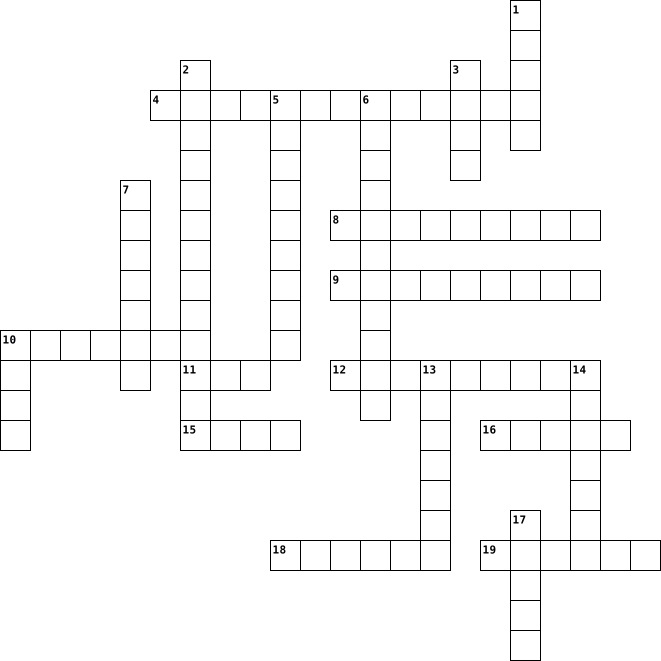
Across
- First man on the Earth's natural satellite
- An Object that helps you look at sky
- A star's explosive finale
- biggest planet in the solar system
- The abbrevation for International Space Station
- Tunnels through spacetime
- The red planet
- hottest planet in the solar system
- One name for collection of million of stars
- Before the Space Shuttle
Down
- Saturn has these
- Nemo of the Nicolaus Copernicus discovery
- The English name for Earth's natural satellite
- Name of a person going to space
- Country that launched the first man in space
- A force that attracts one object to another
- First month of the summer
- Smallest planet in the solar system
- Neme of the first artificial satellite
- What has a tail?
20 Clues: The red planet • Saturn has these • What has a tail? • Before the Space Shuttle • A star's explosive finale • First month of the summer • Tunnels through spacetime • Name of a person going to space • biggest planet in the solar system • hottest planet in the solar system • Smallest planet in the solar system • An Object that helps you look at sky • ...
Space Ace Crossword Puzzle 2017-03-23

Across
- result of an imploding star
- also known as "minor planets"
- Jupiter's largest moon
- largest planet in our solar system
- Neptune's biggest moon
- seventh planet from the sun
- ours is called the milky way
- the planet which we live on
- the red planet
Down
- dwarf planet named after the Roman god of the underworld
- patterns in the sky made by groups of stars
- Pluto's biggest moon
- also known as a "dirty snowball"
- Saturn's largest moon
- planet named after the Roman god of the sea
- planet closest to the sun
- life source for the Earth
- planet that most rings in our solar system
- hottest planet in our solar system
- space team that launched the Apollo 11 mission
20 Clues: the red planet • Pluto's biggest moon • Saturn's largest moon • Jupiter's largest moon • Neptune's biggest moon • planet closest to the sun • life source for the Earth • result of an imploding star • seventh planet from the sun • the planet which we live on • ours is called the milky way • also known as "minor planets" • also known as a "dirty snowball" • ...
Hidroponia 2024-02-21
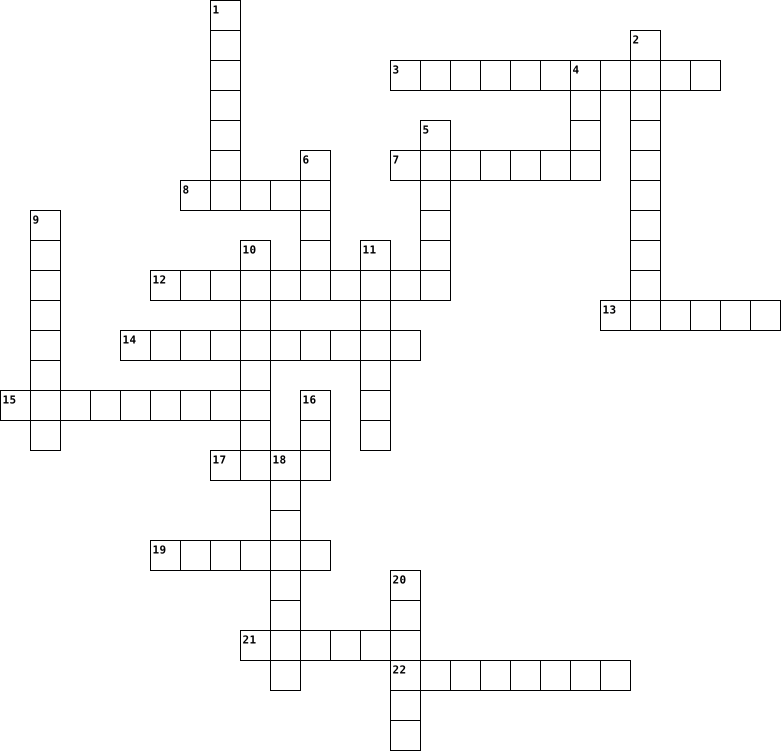
Across
- germinations
- solar solar system
- stem
- ecosystem
- garden
- nutrients
- carrots
- root
- flowers
- tomate
- harvest
Down
- lettuce
- hydroponics
- water
- soil
- leaves
- seeds
- spinach
- parsley
- light
- insects
- grow
22 Clues: soil • stem • root • grow • water • seeds • light • leaves • garden • tomate • lettuce • spinach • parsley • carrots • insects • flowers • harvest • ecosystem • nutrients • hydroponics • germinations • solar solar system
Hidroponia 2024-02-21

Across
- soil
- insects
- flowers
- spinach
- carrots
- parsley
- stem
- harvest
- ecosystem
- seeds
Down
- solar solar system
- hydroponics
- lettuce
- tomate
- water
- grow
- garden
- germination
- nutrients
- leaves
- root
- light
22 Clues: soil • grow • stem • root • water • seeds • light • tomate • garden • leaves • insects • flowers • lettuce • spinach • carrots • parsley • harvest • nutrients • ecosystem • hydroponics • germination • solar solar system
Space and the galaxy 2025-12-10

Across
- how many moons in our solar system
- hottest constellation in the universe
- largest planet
- an ice giant and seventh planet from the sun
- hottest planet in the solar system
- how many planets in our solar system
- coldest place in the universe
- known as the red planet
- closest star to the sun
- approximately how old is the earth
- the planet we live on
Down
- shortest space flight
- how many stars in the big dipper
- this is in the center of the milky way
- the smallest planet
- what is the largest constellation
- the planet farthest from the sun
- what animal was first in orbit
- second largest planet with rings
- how many moons does Jupiter have
20 Clues: largest planet • the smallest planet • shortest space flight • the planet we live on • known as the red planet • closest star to the sun • coldest place in the universe • what animal was first in orbit • how many stars in the big dipper • the planet farthest from the sun • second largest planet with rings • how many moons does Jupiter have • what is the largest constellation • ...
Space Unit 2023-06-07

Across
- This planet was thought of as a star
- The violent death of a star
- Center of the sun
- The Milky Way ______
- How we measure distance in space
- Stars are born from ______
- Hottest planet in our solar system
- Over 1000 rings
- The surface of the sun
- A big Fireball in the sky
- The largest planet in our solar system
- Our only natural satellite
Down
- If you look into the sky at night you might see these
- The closest planet to the sun
- What holds everything together
- Dry red and almost habitable
- "It's not a planet"
- After the violent death of a star
- The only currently habitable planet in our solar system
- Furthest planet from our sun
20 Clues: Over 1000 rings • Center of the sun • "It's not a planet" • The Milky Way ______ • The surface of the sun • A big Fireball in the sky • Stars are born from ______ • Our only natural satellite • The violent death of a star • Dry red and almost habitable • Furthest planet from our sun • The closest planet to the sun • What holds everything together • How we measure distance in space • ...
Our solar system 2023-11-03

Across
- Icy space object with a tail
- The Morning Star
- Space rock
- Flare: Explosive solar event
- Known for its rings
- Closest planet to the Sun
- Probe: Unmanned spacecraft
- Largest planet in the solar system
- Our home planet
- Vast system of stars
- The Sideways Planet
Down
- Earth's natural satellite
- Rocky object in space
- Telescope: Orbital observatory
- The distance light travels in a year
- Wind: Stream of charged particles from the Sun
- A scientist who studies the stars
- Eclipse: When the Moon blocks the Sun
- The Red Planet
- Patterns of stars in the sky
- Dwarf planet in the Kuiper Belt
- The center of our solar system
- The Blue Giant
- Ring: Disc of debris around a planet
- Hole: A region of intense gravity
25 Clues: Space rock • The Red Planet • The Blue Giant • Our home planet • The Morning Star • Known for its rings • The Sideways Planet • Vast system of stars • Rocky object in space • Earth's natural satellite • Closest planet to the Sun • Probe: Unmanned spacecraft • Icy space object with a tail • Flare: Explosive solar event • Patterns of stars in the sky • Telescope: Orbital observatory • ...
Solar System Crossword 2021-05-19

Across
- Farthest-known planet from the Sun in our solar system
- Largest and most massive of the Solar System's moons
- Planet has red coloured soil
- Humans live on this planet
- The closest star
Down
- Rotates on its side
- Largest moon on Saturn
- Moon of Saturn (has lots of water)
- Largest planet in our solar system
- Closest to Sun in our solar system
- Planet has beautiful rings and is sixth from the Sun
- Hottest planet in our solar system
12 Clues: The closest star • Rotates on its side • Largest moon on Saturn • Humans live on this planet • Planet has red coloured soil • Moon of Saturn (has lots of water) • Largest planet in our solar system • Closest to Sun in our solar system • Hottest planet in our solar system • Largest and most massive of the Solar System's moons • ...
Solar System 2022-03-05

Across
- มีอีกชื่อว่า ดาวประกายพรึก
- ระบบดาวซึ่งประกอบด้วยดวงอาทิตย์และวัตถุอื่น ๆ ที่โคจรรอบดวงอาทิตย์เนื่องจากแรงโน้มถ่วง
- ดาวเคราะห์ที่มีความหนาแน่นมากที่สุดในกลุ่มดาวเคราะห์ชั้นใน
- ดาวเคราะห์ที่มีมวลน้อยที่สุดในระบบสุริยะชั้นนอก
- ดาวเคราะห์ที่เล็กที่สุดในระบบสุริยะ
- มีมวลสูงกว่ามวลของดาวเคราะห์อื่นรวมกันราว 2.5 เท่า
- ชั้นเมฆในอวกาศที่ล้อมรอบระบบสุริยะอยู่เป็นทรงกลม
- มีชื่อไทยว่า ดาวเกตุ
Down
- ดาวเคราะห์น้อยดวงแรกที่ถูกค้นพบ
- ดาวเคราะห์ที่สามารถมองเห็นวงแหวนได้ชัดเจน
- บริเวณในระบบสุริยะที่อยู่ระหว่างวงโคจรของดาวอังคารกับดาวพฤหัสบดี
- ดาวเคราะห์ที่ได้ชื่อตามเทพเจ้าแห่งสงครามของโรมัน
- วัตถุทางดาราศาสตร์ขนาดเล็กกว่าดาวเคราะห์แต่ใหญ่กว่าสะเก็ดดาว
13 Clues: มีชื่อไทยว่า ดาวเกตุ • มีอีกชื่อว่า ดาวประกายพรึก • ดาวเคราะห์น้อยดวงแรกที่ถูกค้นพบ • ดาวเคราะห์ที่เล็กที่สุดในระบบสุริยะ • ดาวเคราะห์ที่สามารถมองเห็นวงแหวนได้ชัดเจน • ดาวเคราะห์ที่มีมวลน้อยที่สุดในระบบสุริยะชั้นนอก • ดาวเคราะห์ที่ได้ชื่อตามเทพเจ้าแห่งสงครามของโรมัน • ชั้นเมฆในอวกาศที่ล้อมรอบระบบสุริยะอยู่เป็นทรงกลม • มีมวลสูงกว่ามวลของดาวเคราะห์อื่นรวมกันราว 2.5 เท่า • ...
solar system 2021-11-30

Across
- Number of planets in our solar system (spell the number).
- Object made of frozen gases that orbits the Sun with very wide orbits.
- The asteroid belt is between Mars and _____.
- Another name for the gas giant planets.
- The gas giants are all in the (inner or outer?) part of our Solar System.
- The terrestrial planets are all in the (inner or outer?) part of our Solar System.
- Largest object in our solar system.
Down
- Another name for the rocky planets.
- True or false: The Sun and all of the planets are approximately the same age.
- These burn up in our atmosphere to create "shooting stars".
- Our solar system formed approximately 4.6 ____ years ago.
- Hole created as a result of a meteor hitting the surface of a planet or moon.
- When comets come close to the Sun, sometimes a ____ (streak of light behind the comet) can be seen.
13 Clues: Another name for the rocky planets. • Largest object in our solar system. • Another name for the gas giant planets. • The asteroid belt is between Mars and _____. • Number of planets in our solar system (spell the number). • Our solar system formed approximately 4.6 ____ years ago. • These burn up in our atmosphere to create "shooting stars". • ...
Solar System 2021-12-03

Across
- closest planet to the sun
- 4th planet from the Sun, has 2 moons
- former planet, farthest from the sun
- farthest planet from the sun
- its axis point towards the sun
- Mercury, Venus, Earth, and Mars
- Jupiter, Saturn, Uranus, and Neptune
Down
- has the most moons of any planet
- largest mountain in the solar system
- where pluto is located
- has the largest, most defined rings
- Hottest planet
- largest celestial body in the solar system
13 Clues: Hottest planet • where pluto is located • closest planet to the sun • farthest planet from the sun • its axis point towards the sun • Mercury, Venus, Earth, and Mars • has the most moons of any planet • has the largest, most defined rings • largest mountain in the solar system • 4th planet from the Sun, has 2 moons • former planet, farthest from the sun • ...
Solar system 2021-12-03

Across
- dwarf planet.
- cosmic snowballs of frozen gases, rocks, and dust
- Has rings
- What we live on
- The red planet
- a hot ball of glowing gases in the middle of our solarsystem
- the vast 3-dimensional region that begins where the earth's atmosphere ends.
Down
- large barred spiral galaxy
- Gas giant
- Smallest planet in our solar system
- Second planet from the sun
- Has a giant blue storm
- Ice giant
13 Clues: Gas giant • Has rings • Ice giant • dwarf planet. • The red planet • What we live on • Has a giant blue storm • large barred spiral galaxy • Second planet from the sun • Smallest planet in our solar system • cosmic snowballs of frozen gases, rocks, and dust • a hot ball of glowing gases in the middle of our solarsystem • ...
Solar System 2023-03-07

Across
- object that goes around a star
- our star
- rocks usually found between mars and jupiter
- planet with beautiful rings
- the red planet
- huge ball of gas undergoing nuclear reactions
- 3rd largest planet and 8th from the sun
Down
- rocky icy body with a "tail"
- 4th largest planet and 7th from the sun
- planet with huge storm called the red spot
- planet closest in size to Earth
- planet that is 70% water
- planet closest to the sun
13 Clues: our star • the red planet • planet that is 70% water • planet closest to the sun • planet with beautiful rings • rocky icy body with a "tail" • object that goes around a star • planet closest in size to Earth • 4th largest planet and 7th from the sun • 3rd largest planet and 8th from the sun • planet with huge storm called the red spot • ...
Solar System 2018-10-24

Across
- dark area of the sun's surface that gives off less energy than the rest of the sun
- the region between Mars and Jupiter where most asteroids orbit the sun
- an envelope of gas surrounding a body in space
- earth-like
- a ball of ice, rock, frozen gases, and dust that orbits the sun
Down
- a large body in space that orbits a star such as the sun
- the amount of material that an object contains
- an asteroid that enters the Earth's atmosphere
- the warming of the atmosphere because of trapped heat energy from the sun
- a rocky object smaller than a planet that orbits a star
- a star, such as the sun, and all the bodies that revolve around it in space
- a glowing ball of hot gas that makes its own energy and light
- the force of attraction that exists between two objects
13 Clues: earth-like • the amount of material that an object contains • an asteroid that enters the Earth's atmosphere • an envelope of gas surrounding a body in space • a rocky object smaller than a planet that orbits a star • the force of attraction that exists between two objects • a large body in space that orbits a star such as the sun • ...
Solar System 2024-04-25

Across
- vi-i-en-yu-es
- yu-ar-ei-en-yu-es
- i-ei-ar-ti-eich
- em-i-ar-ci-yu-ar-guai
- em-ou-ou-en
Down
- yei-yu-pi-ai-ti-i-ar
- es-yu-en
- yi-ar-ei-vi-ai-ti-guai
- es-ei-ti-yu-ar-en
- pi-el-yu-ti-ou
- em-ai-el-kei-dable yu-ei-guai
- em-ei-ar-es
- en-i-p-ti-yu-en
13 Clues: es-yu-en • em-ou-ou-en • em-ei-ar-es • vi-i-en-yu-es • pi-el-yu-ti-ou • i-ei-ar-ti-eich • en-i-p-ti-yu-en • yu-ar-ei-en-yu-es • es-ei-ti-yu-ar-en • yei-yu-pi-ai-ti-i-ar • em-i-ar-ci-yu-ar-guai • yi-ar-ei-vi-ai-ti-guai • em-ai-el-kei-dable yu-ei-guai
Solar System 2025-12-11

Across
- Great Red Spot
- Only planet where we've sent rovers to
- The seventh planet from the Sun
- Dwarf planet
- Smallest planet in our solar system
- About the same size as Pluto
- Only planet in our solar system with liquid water on the surface.
Down
- Only about half the width of the United States.
- Makes a complete orbit around the Sun in about 165 Earth years
- The largest object in the asteroid belt
- The second-shortest day in the solar system.
- Earth's closest planetary neighbor.
- Oval-shaped
13 Clues: Oval-shaped • Dwarf planet • Great Red Spot • About the same size as Pluto • The seventh planet from the Sun • Earth's closest planetary neighbor. • Smallest planet in our solar system • Only planet where we've sent rovers to • The largest object in the asteroid belt • The second-shortest day in the solar system. • Only about half the width of the United States. • ...
solar system 2024-11-13

Across
- orange rock
- fireball
- “big blue”
- ;)
- a chemical
- featured in two mario games
Down
- the roman’s possiden
- our “space neighborhood”
- w rizz
- toy box of galaxies
- sunburnt
- put a ring on it
- Elons dream
13 Clues: ;) • w rizz • fireball • sunburnt • “big blue” • a chemical • orange rock • Elons dream • put a ring on it • toy box of galaxies • the roman’s possiden • our “space neighborhood” • featured in two mario games
solar system 2024-11-13

Across
- known for its rings
- has the best living atmosphere
- spin on its side
- we live in the milky way ____
- there are 400 billion of them
- everything in space and galaxy
- biggest planet
- hottest planet
Down
- our “space neighborhood”
- smallest planet
- a cold desert
- is an ice giant
- biggest star that lights up the moon
13 Clues: a cold desert • biggest planet • hottest planet • smallest planet • is an ice giant • spin on its side • known for its rings • our “space neighborhood” • we live in the milky way ____ • there are 400 billion of them • has the best living atmosphere • everything in space and galaxy • biggest star that lights up the moon
Solar System 2024-11-13

Across
- our “ space neighborhood.”
- Biggest planet
- the hottest planet
- pulls never pushes
- we live in the milky way _
- has 27 moons
- has life
Down
- fastest orbit around the sun
- has rings
- billions of them
- the biggest star
- contains 100-200 billions of galaxies
- has volcanos and weather
13 Clues: has life • has rings • has 27 moons • Biggest planet • billions of them • the biggest star • the hottest planet • pulls never pushes • has volcanos and weather • we live in the milky way _ • our “ space neighborhood.” • fastest orbit around the sun • contains 100-200 billions of galaxies