
solar system Crossword Puzzles
Astronomy Crossword 2020-09-09

Across
- Proposed geocentric model.
- First proposed heliocentric model.
- Way The galaxy our solar system is in.
- What do astronomical units measure.
- Outer planets are made mostly of.
- Inner planets are made mostly of.
- Earth centered solar system.
- Discovered 4 moons orbiting Jupiter with telescope.
Down
- Proposed elliptical orbit of planets.
- Sun centered solar system.
- Why planets orbit the sun.
- Space rock that makes it to earth's surface.
- Found in belt between Mars and Jupiter.
- Shooting star.
- The red planet.
15 Clues: Shooting star. • The red planet. • Sun centered solar system. • Why planets orbit the sun. • Proposed geocentric model. • Earth centered solar system. • Outer planets are made mostly of. • Inner planets are made mostly of. • First proposed heliocentric model. • What do astronomical units measure. • Proposed elliptical orbit of planets. • Way The galaxy our solar system is in. • ...
Space Crossword 2021-08-29

Across
- a big piece of rock that floats around space, can be lethal if it hits a planet
- a planet in our solar system which has a giant ring around it
- a big rock that orbits the earth
- A thing used to study space while on earth
- A place of space where different groups of planets are (e.g. earth, the sun, mars, ect)
- A giant ball of fire in our solar system
- the thing that protects the earth, anything that comes past it burns up in to nothing (normally)
Down
- The farthest planet from the sun
- the biggest planet in our solar system
- the only way to get past the earth's atmosphere
- a person who goes to space
- a thing that sucks things into it, never to be seen again
- the closest planet to the sun (in our solar system)
- A dwarf planet which is in the far reaches of our solar system
14 Clues: a person who goes to space • The farthest planet from the sun • a big rock that orbits the earth • the biggest planet in our solar system • A giant ball of fire in our solar system • A thing used to study space while on earth • the only way to get past the earth's atmosphere • the closest planet to the sun (in our solar system) • ...
Space Crossword 2021-08-29

Across
- a big piece of rock that floats around space, can be lethal if it hits a planet
- a planet in our solar system which has a giant ring around it
- a big rock that orbits the earth
- A thing used to study space while on earth
- A place of space where different groups of planets are (e.g. earth, the sun, mars, ect)
- A giant ball of fire in our solar system
- the thing that protects the earth, anything that comes past it burns up in to nothing (normally)
Down
- The farthest planet from the sun
- the biggest planet in our solar system
- the only way to get past the earth's atmosphere
- a person who goes to space
- a thing that sucks things into it, never to be seen again
- the closest planet to the sun (in our solar system)
- A dwarf planet which is in the far reaches of our solar system
14 Clues: a person who goes to space • The farthest planet from the sun • a big rock that orbits the earth • the biggest planet in our solar system • A giant ball of fire in our solar system • A thing used to study space while on earth • the only way to get past the earth's atmosphere • the closest planet to the sun (in our solar system) • ...
solar system 2024-04-22

Across
- the sixth planet in our solar system
- the seventh planet in our solar system
- the last planet in our solar system
- the first planet in our solar system
Down
- the second planet in our solar system
- the fourth planet in our solar system
- the fifth planet in our solar system
- goes around in a specific belt separating the gas giants and the rocky planets
- the third planet in our solar system
9 Clues: the last planet in our solar system • the fifth planet in our solar system • the sixth planet in our solar system • the third planet in our solar system • the first planet in our solar system • the second planet in our solar system • the fourth planet in our solar system • the seventh planet in our solar system • ...
Planets Crossword 2014-10-30

Across
- Often called the red planet
- What the earth is
- The largest planet in the solar system
- What the planets do around the sun
- Something the sun provides for us
- The star at the centre of our solar system
- The planet we live on
- What makes up the belt between Mars and Jupiter
- Planet with rings of ice
Down
- What the planets are in
- Furthest planet from the sun
- Icy planet between Earth and Mercury
- Planet with rings of dust
- The number of planets in our solar system
- The largest object in the sky at night
- All the stars and planets make up this
- Chunks of ice flying through space
- The dwarf planet
- The closest planet to the sun
- What our sun is
20 Clues: What our sun is • The dwarf planet • What the earth is • The planet we live on • What the planets are in • Planet with rings of ice • Planet with rings of dust • Often called the red planet • Furthest planet from the sun • The closest planet to the sun • Something the sun provides for us • Chunks of ice flying through space • What the planets do around the sun • ...
Outer Space 2026-05-05

Across
- Made of gas, dust, and billions of stars.
- Used to be a considered a planet.
- This planet rains diamonds.
- Made of gas, they are really big and farther from the sun.
- This planet is tilted almost 90 degrees on its axis.
- Holds many galaxys inside itself.
- Closest planet to the sun.
Down
- The only planet that can support life in our solar system.
- Made of rock, they are small and closer to the sun.
- The biggest planet inside our solar system.
- The planet with the most moons in our solar system.
- The closest star to planet earth.
- A ball of extremely hot gas and plasma.
- The farthest satilite from earth.
- Hottest planet in our solar system.
- 4th planet from the sun, we are trying to travel to this planet.
16 Clues: Closest planet to the sun. • This planet rains diamonds. • Used to be a considered a planet. • The closest star to planet earth. • Holds many galaxys inside itself. • The farthest satilite from earth. • Hottest planet in our solar system. • A ball of extremely hot gas and plasma. • Made of gas, dust, and billions of stars. • The biggest planet inside our solar system. • ...
RiSa Astronomy Crossword 2024-11-29

Across
- The third planet from the Sun
- Earth's natural satellite
- A star that suddenly increases in brightness
- Planet famous for its rings
- Once considered the ninth planet
- The largest planet in our solar system
- A tool for observing distant objects in space
- A cloud of gas and dust in space
Down
- The hottest planet in the solar system
- The curved path of a planet around a star
- Known as the Red Planet
- A depression caused by an impact
- The star at the center of our solar system
- A "dirty snowball" that orbits the Sun
- When one celestial body blocks another
- A massive system of stars, gas, and dust
- A highly luminous object powered by a black hole
- A small rocky body orbiting the Sun
18 Clues: Known as the Red Planet • Earth's natural satellite • Planet famous for its rings • The third planet from the Sun • A depression caused by an impact • Once considered the ninth planet • A cloud of gas and dust in space • A small rocky body orbiting the Sun • The hottest planet in the solar system • A "dirty snowball" that orbits the Sun • The largest planet in our solar system • ...
The Planets Crossword 2014-10-19

Across
- Controls the tides; man on the ______
- Has winds of up to 2000km/hr
- Small, rocky debris; the ____ belt
- The study of space
- There are 8 of these in our Solar System
- The red planet
- The largest planet with 67 moons
- Number of planets in our solar system
- Gas giant well known for its rings
- Dwarf planet
- Big yellow star that produces heat
Down
- The planet that we live on
- Made up of water, ice, rock and dust"; 'dirty snowball'
- Closest planet to the sun
- The hottest planet
- Our solar system
- An astronaut wears a ______ suit
- A space traveller
- Used to look into space
- A large ball of hot gas found in the sky at night
- Ice giant that spins on its side
21 Clues: Dwarf planet • The red planet • Our solar system • A space traveller • The hottest planet • The study of space • Used to look into space • Closest planet to the sun • The planet that we live on • Has winds of up to 2000km/hr • An astronaut wears a ______ suit • The largest planet with 67 moons • Ice giant that spins on its side • Small, rocky debris; the ____ belt • ...
Science 2023-10-27

Across
- Closet planet to the Sun
- Balls of burning nuclear energy
- The Red Planet
- Has a fixed volume, but no fixed shape
- Fastest thing in the universe
- Molecular motion
- Basic building block of a substance
- An icy ball of rock
- A satellite around a planet
- Has a fixed shape and volume
- Has a positive charge
- Gas giant
- Has no charge
Down
- Flow of electrons
- A singularity with extremely strong gravity
- Has no fixed volume
- The biggest planet in our solar system
- Building block of matter
- Has a negative charge
- Hottest planet in the solar system
- Anything that flows
- Farthest planet from the Sun
- A cluster of stars, dust, gas, etc.
- Dwarf planet
- The Jewel of the Solar System
25 Clues: Gas giant • Dwarf planet • Has no charge • The Red Planet • Molecular motion • Flow of electrons • Has no fixed volume • Anything that flows • An icy ball of rock • Has a negative charge • Has a positive charge • Closet planet to the Sun • Building block of matter • A satellite around a planet • Farthest planet from the Sun • Has a fixed shape and volume • Fastest thing in the universe • ...
The Solar System 2024-01-04

Across
- The only dwarf planet in the asteroid belt
- The furthest planet in the solar system with rings
- This hypothetical cloud of ice is one light year away from the sun
- The hottest planet in the solar system
- This place is filled with astoroids
- This dwarf planet looks like an egg
- A planet where a day is twice as long as its year
- The planet with the most moons
Down
- Used to be a planet
- Just like the astoroid belt
- The only planet in the solar system with a blue spot
- The second largest dwarf planet in the solar system
- The only planet in the goldilocks zone
- A planet with herding moons
- A translation error gave news of there being canals and rivers on this planet
- It has 60% of Pluto's diameter
16 Clues: Used to be a planet • Just like the astoroid belt • A planet with herding moons • It has 60% of Pluto's diameter • The planet with the most moons • This place is filled with astoroids • This dwarf planet looks like an egg • The only planet in the goldilocks zone • The hottest planet in the solar system • The only dwarf planet in the asteroid belt • ...
Astronomy Crossword Puzzle 2022-10-11

Across
- hole left by meteorite
- the day with the most sunlight
- the place with the most direct sunlight year round
- space rock coming through earth's atmosphere
- the largest planet in our solar system
Down
- the explosion that created our universe
- group of thousands of solar systems
- the hottest planet in our solar system
- dirty ball of ice with a tail
- big chunk of rock in space, but not big enough to be a planet
- group of planets and stars in space
- space rock that hit earth
- the planet we live on
- the largest object in our solar system
- the red planet
15 Clues: the red planet • the planet we live on • hole left by meteorite • space rock that hit earth • dirty ball of ice with a tail • the day with the most sunlight • group of thousands of solar systems • group of planets and stars in space • the hottest planet in our solar system • the largest object in our solar system • the largest planet in our solar system • ...
aschille planets 2023-07-20

Across
- the planet we live on
- this planet has 8 rings
- The Windiest Planetin our Solar System
- the red planet
- was preveously a plannet but is now a dwarf planet
- he largest planet in the solar system
Down
- the second planet from the Sun and Earth's closest planetary neighbor.
- the first of the two ice planets in our solar system
- the only star in our solar system
- the smallest planet in our solar system
- way galaxy the name of the galay we live in
11 Clues: the red planet • the planet we live on • this planet has 8 rings • the only star in our solar system • he largest planet in the solar system • The Windiest Planetin our Solar System • the smallest planet in our solar system • way galaxy the name of the galay we live in • was preveously a plannet but is now a dwarf planet • ...
Science 7 Unit C 3.0 & 4.0 2026-03-11

Across
- a device the controls the temperature of a whole building
- a measure of a materials ability to transfer energy
- chemical pollution emitted from car and truck emissions (two words)
- energy from radioactive uranium
- energy that comes from inside the earth
- heating system that converts solar energy into electricity and thermal energy
- heating system that relies on building design and capturing solar energy directly
- a measure of a materials resistance to energy flow
- the liquid inside a fridge
- energy from wind turbines
- heating system that uses a boiler, radiator, and pipes
Down
- many solar panels connecte together (two words)
- chemical pollution emitted from industry (two words)
- heating system the uses duct, vents, furnaces
- energy from moving water
- heating system that can heat entire buildings
- when two forms of energy are created at the same time
- heating system that is used for one room at a time
- infrared photo of heat loss of a building
- the precipitation that is created from sulfur oxide emissions (two words)
20 Clues: energy from moving water • energy from wind turbines • the liquid inside a fridge • energy from radioactive uranium • energy that comes from inside the earth • infrared photo of heat loss of a building • heating system the uses duct, vents, furnaces • heating system that can heat entire buildings • many solar panels connecte together (two words) • ...
Planets & Space 2023-05-28

Across
- What is the term for the path that a planet follows around the Sun?
- The closest planet to the Earth
- Which spacecraft was the first to land humans on the Moon?
- The largest planet in Solar System
- The last planet in Solar System
- This planet takes 365 days to go around the sun
- Yellow star in the middle of our solar system
Down
- What is the brightest star in the night sky?
- What is the name of the galaxy that contains our solar system?
- What is the name of the red planet?
- How many planets are in Solar System?
- Planet has rings you can see with a telescope
12 Clues: The closest planet to the Earth • The last planet in Solar System • The largest planet in Solar System • What is the name of the red planet? • How many planets are in Solar System? • What is the brightest star in the night sky? • Planet has rings you can see with a telescope • Yellow star in the middle of our solar system • This planet takes 365 days to go around the sun • ...
The SPaCe 2026-05-12

Across
- Who is the biggest planet of the solar system ?
- What is the type of Jupiter ?
- How many moons Neptune have ?
- What is the type of venus ?
- How many planet the solar system have ?
- How the person which go in the space call ?
- The matter which the comet being create is Metal and _______ ?
Down
- What is the name of the planet where we live ?
- what is the name one special vehicle which is used by the human for traveling in the space ?
- Who is the coldest planet in the solar system ?
- How many planet with rings the solar system have ?
- Who is the smallest planet of the solar system ?
12 Clues: What is the type of venus ? • What is the type of Jupiter ? • How many moons Neptune have ? • How many planet the solar system have ? • How the person which go in the space call ? • What is the name of the planet where we live ? • Who is the biggest planet of the solar system ? • Who is the coldest planet in the solar system ? • ...
The Solar System 2021-08-08

Across
- small objects mostly made up of ice
- Fifth Planet In The Solar System
- what Are Nine Number
- second planet in the solar system
- 8th planet in the solar system
Down
- first planet in the soar system
- An object that orbits a larger object
- ninth planet in the solar system
- the planet which you live
- The Biggest Star
- Smaller than the Astoriods or comet
11 Clues: The Biggest Star • what Are Nine Number • the planet which you live • 8th planet in the solar system • first planet in the soar system • Fifth Planet In The Solar System • ninth planet in the solar system • second planet in the solar system • small objects mostly made up of ice • Smaller than the Astoriods or comet • An object that orbits a larger object
The SPaCe 2026-05-12

Across
- How many moons Neptune have ?
- what is the name one special vehicle which is used by the human for traveling in the space ?
- The matter which the comet being create is Metal and _______ ?
- What is the name of the planet where we live ?
- Who is the coldest planet in the solar system ?
- Who is the biggest planet of the solar system ?
Down
- What is the type of Jupiter ?
- Who is the smallest planet of the solar system ?
- What is the type of venus ?
- How the person which go in the space call ?
- How many planet the solar system have ?
- How many planet with rings the solar system have ?
12 Clues: What is the type of venus ? • What is the type of Jupiter ? • How many moons Neptune have ? • How many planet the solar system have ? • How the person which go in the space call ? • What is the name of the planet where we live ? • Who is the coldest planet in the solar system ? • Who is the biggest planet of the solar system ? • ...
planets 2014-07-17

Across
- the red planet
- the blue planet
- farthest planet in the solar system
- morning star
- smallest planet in the solar system
- way our galaxy
Down
- seventh planet from the sun
- Earth's only natural satellite
- the star at the centre of the solar system
- smaller bodies in orbit around the sun
- largest planet in the solar system
11 Clues: morning star • the red planet • way our galaxy • the blue planet • seventh planet from the sun • Earth's only natural satellite • largest planet in the solar system • farthest planet in the solar system • smallest planet in the solar system • smaller bodies in orbit around the sun • the star at the centre of the solar system
planets 2014-07-17

Across
- the red planet
- farthest planet in the solar system
- smallest planet in the solar system
- seventh planet from the sun
- way our galaxy
- the blue planet
Down
- Earth's only natural satellite
- the star at the centre of the solar system
- smaller bodies in orbit around the sun
- morning star
- largest planet in the solar system
11 Clues: morning star • the red planet • way our galaxy • the blue planet • seventh planet from the sun • Earth's only natural satellite • largest planet in the solar system • farthest planet in the solar system • smallest planet in the solar system • smaller bodies in orbit around the sun • the star at the centre of the solar system
THE SOLAR SYSTEM 2016-02-23

Across
- brightest planet seen in the sky
- planet closet to the sun
- Beyond Neptune some small heavenly bodies which revolve around the sun
- heavenly bodies that revolve around specific planets
- this the name of our galaxy
- planets beyond the band of asteroids
- the head of the solar system
- Indian spacecraft sent to moon
- this is the biggest planet
- there are rings around this planets
- they are made up of frozen matter and dust particles
Down
- a band of innumerable tiny celestial bodies between the planets mars and Jupiter
- this is a reddish planet
- We live on this planet
- planets that lie between the sun and the band of asteroids
- They have their own light and heat
- lake in Maharashtra formed in a depression created by the impact of a meteorite
- this is the farthest planet from the sun
- this is the greenish blue colour planet
- it is a telescope
20 Clues: it is a telescope • We live on this planet • this is a reddish planet • planet closet to the sun • this is the biggest planet • this the name of our galaxy • the head of the solar system • Indian spacecraft sent to moon • brightest planet seen in the sky • They have their own light and heat • there are rings around this planets • planets beyond the band of asteroids • ...
The Solar System 2016-02-12

Across
- Takes 243 Earth days to rotate and has a thin toxic atmosphere
- Become meteors when they enter Earth's atmosphere
- Largest moon in the solar system, belongs to Jupiter
- Closest planet to the sun
- Cosmic snowballs, generally the size of Warrenton
- 5 moons, no rings, rotates slowly, moons named afterm Roman mythological characters
- Distance between the sun and the Earth
- Has 3 layers:core, radioactive zone, and convective
- A stream of energized,charged particles flowing outward from the sun
- Looped-shaped eruption
- Temperatures allow water to be naturally solid, water, and gas
- Pluto was once this, Ceres is this type of planet
- Has the largest volcano in our solar system, Phobos and Deimos are its moons
- The "rays" of the sun's atmospheric layers, can reach up to 1 million degrees Celsius
- Ice giant, 13 moons named after Greek mythological monsters
Down
- 2nd Gas giant, has the most rings
- Giant rocks from space that survives the passage from space
- Lowest layer in the sun's atmospheric layer, 6000 degrees Celsius
- Ring of icy rocks just outside the orbit of Neptune
- Composition of a star, hydrogen and helium. Has storms for hundreds of years
- Intense electromagnetic flare which causes radio interruption on Earth
- 7th planet, has 2 rings that are vertical and 27 mooons
- These become meteorites when they strike Earth's surface
- Earthlings see this move across the sun when it rotates
24 Clues: Looped-shaped eruption • Closest planet to the sun • 2nd Gas giant, has the most rings • Distance between the sun and the Earth • Become meteors when they enter Earth's atmosphere • Cosmic snowballs, generally the size of Warrenton • Pluto was once this, Ceres is this type of planet • Ring of icy rocks just outside the orbit of Neptune • ...
solar system 12 2018-04-12

Across
- the center of the solar system
- this is another dwarf planet
- this planets moons are named after William Shakespeare's characters
- This is a piece of space rock that enters an atmosphere
- this is the closest moon to Jupiter
- this dwarf is -407 degrees Fahrenheit
- the smallest planet
- This planet is in the ooart cloud and is four times the size of jupiter
- the largest moon in the solar system
- we live on this planet
- this planet has about 70 moons
- This planet has a storm that has winds of 25000 miles per hour
Down
- vet another dwarf planet
- the closest planet to the sun
- This planet is famous for its rings
- this dwarf planet is 600 miles in diameter
- the smallest dwarf planet
- This dwarf planet has a moon called Charon
- this is the largest dwarf planet
- Jupiter's only moon with water on it
- this is an astroid belt that is farther than Neptune
- this planet was named after a hawaiian god
- This is a space snowball
- this planet is nicknamed the red planet
- the most cratered moon in the solar system
- this dwarf planet is shaped like a football
- this dwarf planet is about 1500 miles in diameter
27 Clues: the smallest planet • we live on this planet • vet another dwarf planet • This is a space snowball • the smallest dwarf planet • this is another dwarf planet • the closest planet to the sun • the center of the solar system • this planet has about 70 moons • this is the largest dwarf planet • This planet is famous for its rings • this is the closest moon to Jupiter • ...
The Solar System 2013-08-27

Across
- When a planet spins on its axis.
- The abbreviation of the National Aeronautics and Space Administration.
- The name of our galaxy.
- The oval path that the planets move in.
- A natural satellite.
- The number of planets in our solar system.
- Often seen in the night sky as a shooting star.
- A scientist who studies space.
- Now known as a 'dwarf planet'.
- A grouping of stars.
- The largest planet in our solar system.
- The closest planet to the sun.
- The planet famous for its rings.
- The planet known as the Red Planet.
Down
- The force that holds everything in place.
- The first astronomer to explain solar and lunar eclipses.
- There are billions of these visible in the night sky.
- Provides all things with life.
- Is made up of the sun, planets, comets, asteroids and meteors.
- The Italian astronomer who confirmed that the sun is the centre of the solar system.
- The organisation that operates the Australia Telescope National Facility.
- The astronomer to suggest that the sun is the centre of the solar system.
- The planet known as the Morning Star.
- Earth is considered to be one.
- Large rocks that orbit the sun.
- The only planet that water is in liquid form.
- One of the planets composed only of gas.
- Frozen dust and gas which orbits the sun, often seen with a tail.
- The smallest of the gas giants.
29 Clues: A natural satellite. • A grouping of stars. • The name of our galaxy. • Provides all things with life. • A scientist who studies space. • Now known as a 'dwarf planet'. • Earth is considered to be one. • The closest planet to the sun. • Large rocks that orbit the sun. • The smallest of the gas giants. • When a planet spins on its axis. • The planet famous for its rings. • ...
Sun/Solar System 2014-02-05

Across
- Esta zona es la capa más externa del interior del Sol
- La región central del Sol, donde tiene lugar la fusión nuclear.
- Una unidad de distancia igual a la distancia media entre la Tierra y el Sol, unos 150 millones de kilómetros.
- Una gran ronda hoyo causado por el impacto de un meteorito
- Un gran lazo, rojizo de gas que sobresale de la superficie del Sol, que une partes de las regiones de manchas solares.
- El efecto de atrapar el calor cerca de la superficie de un planeta por ciertos gases en la atmósfera del planeta.
- Un objeto que orbita alrededor del Sol y es esférica, pero no ha despejado la zona de su órbita.
- Un área oscura de gas en la superficie del sol que es más frío que los gases circundantes.
- La capa media de la atmósfera del sol.
- La capa interna de la atmósfera del Sol que emite su luz visible; la superficie del sol.
- El sistema consiste en el sol y los planetas y otros objetos que giran a su alrededor.
- El nombre dado a menudo a los cuatro planetas interiores: Mercurio, Venus, Tierra y Marte
- Un trozo de roca o polvo en el espacio, generalmente más pequeñas que un asteroide.
- Una corriente de partículas eléctricamente cargadas que emanan de la corona solar.
Down
- el proceso por el cual la energía se produce en estrellas.
- Las áreas oscuras, planas sobre la superficie de la Luna se formó a partir de enormes flujos de lava antiguos.
- Uno de los pequeños cuerpos similares a asteroides que formaron los bloques de construcción de los planetas
- Una erupción de gas a partir de la superficie del Sol que se produce cuando los bucles en las regiones de manchas solares se conectan repentinamente
- Un objeto que orbita alrededor de una estrella, es suficiente con haber convertido redondeado por su propia gravedad grande, y ha despejado la zona de su órbita.
- La capa externa de la atmósfera del Sol, que se ve como un halo blanco
- Una zona de gas muy cuidadosamente embalados en el interior del Sol, donde la energía se transfiere principalmente en forma de radiación electromagnética.
21 Clues: La capa media de la atmósfera del sol. • Esta zona es la capa más externa del interior del Sol • el proceso por el cual la energía se produce en estrellas. • Una gran ronda hoyo causado por el impacto de un meteorito • La región central del Sol, donde tiene lugar la fusión nuclear. • La capa externa de la atmósfera del Sol, que se ve como un halo blanco • ...
SOLAR SYSTEM CROSSWORD 2014-10-26

Across
- NAMED AFTER THE ROMAN GOD OF THE SEA
- THIS PLANET TILTS OVER SO FAR ON ITS AXIS THAT IT ROTATES ON ITS SIDE
- WHEN THE MOON PASSES IN FRONT OF THE SUN
- THE LARGEST PLANET IN OUR SOLAR SYSTEM
- ALL THE GASES THAT SURROUND THE STARS AND PLANETS
- TO TURN AROUND A CENTER POINT
- THE SMALLEST PLANET IN OUR SOLAR SYSTEM
- THE LARGEST OBJECT IN THE SOLAR SYSTEM
- A ROCKY SPACE OBJECT OF VARYING SIZE
- THE SECOND LARGEST PLANET WITH MANY RINGS
Down
- PLANETS HAVE RINGS
- EARTH HAS ONE
- IRON IN THE SOIL GIVES THIS PLANET ITS RED COLOUR
- USE TO VIEW THE STARS AND PLANETS FROM EARTH
- THIS PLANET IS SOMETIMES CALLED THE EVENING STAR
- THE HUGE SPACE WHICH CONTAINS ALL OF THE MATTER AND ENERGY
- THIRD CLOSEST PLANET FROM THE SUN
- CAN TRAVEL TO SPACE IN A ROCKET
- THE PATH FOLLOWED BY AN OBJECT IN SPACE AS IT GOES AROUND ANOTHER OBJECT
- RECENTLY NAMED A DWARF PLANET
20 Clues: EARTH HAS ONE • PLANETS HAVE RINGS • TO TURN AROUND A CENTER POINT • RECENTLY NAMED A DWARF PLANET • CAN TRAVEL TO SPACE IN A ROCKET • THIRD CLOSEST PLANET FROM THE SUN • NAMED AFTER THE ROMAN GOD OF THE SEA • A ROCKY SPACE OBJECT OF VARYING SIZE • THE LARGEST PLANET IN OUR SOLAR SYSTEM • THE LARGEST OBJECT IN THE SOLAR SYSTEM • THE SMALLEST PLANET IN OUR SOLAR SYSTEM • ...
solar system crossword 2015-05-04

Across
- named after the roman god of Thieves
- a monkey who successfully was sent to space
- the second person to walk on the Moon
- when they hit the surface of a planet or a moon it is considered a ...
- first astronaut in space
- Jupiter’s volcanic moon
- about the size of a pebble
- has the big red spot
- last person to walk on the moon
- the only planet with life
- a program to see if humans could function in space.
- It is the only moon in the entire solar system with a dense atmosphere
- coldest planet in the solar system
- has 27 moons
- has over 30 rings
Down
- became the first American woman in space aboard the space shuttle
- a minor space object that has entered the Earth's atmosphere
- an animal that was sent into space on 9 March 1961
- the first mission to land a man on the moon
- these planets haven’t ¨Cleared their neighborhood¨
- NASA's second human spaceflight program
- first animal/dog in space
- Earth’s sister planet
- Jupiter's moon that is very close to Earth's moon
- larger than meteoroids
- neptune’s biggest moon
- the second smallest planet in our solar system
27 Clues: has 27 moons • has over 30 rings • has the big red spot • Earth’s sister planet • larger than meteoroids • neptune’s biggest moon • Jupiter’s volcanic moon • first astronaut in space • first animal/dog in space • the only planet with life • about the size of a pebble • last person to walk on the moon • coldest planet in the solar system • named after the roman god of Thieves • ...
solar system crossword 2015-05-05

Across
- the second smallest planet in our solar system
- these planets haven’t ¨Cleared their neighborhood¨
- coldest planet in the solar system
- an animal that was sent into space on 9 March 1961
- a program to see if humans could function in space.
- Jupiter’s volcanic moon
- about the size of a pebble
- has 27 moons
- Jupiter's moon that is very close to Earth's moon
- last person to walk on the moon
- named after the roman god of Thieves
- the only planet with life
- larger than meteoroids
- It is the only moon in the entire solar system with a dense atmosphere
Down
- a minor space object that has entered the Earth's atmosphere
- has over 30 rings
- first astronaut in space
- first animal/dog in space
- neptune’s largest moon
- NASA's second human spaceflight program
- Earth’s sister planet
- the first mission to land a man on the moon
- has the big red spot
- when they hit the surface of a planet or a moon it is considered a
- the second person to walk on the Moon
- became the first American woman in space aboard the space shuttle
- a monkey who successfully was sent to space
27 Clues: has 27 moons • has over 30 rings • has the big red spot • Earth’s sister planet • neptune’s largest moon • larger than meteoroids • Jupiter’s volcanic moon • first astronaut in space • first animal/dog in space • the only planet with life • about the size of a pebble • last person to walk on the moon • coldest planet in the solar system • named after the roman god of Thieves • ...
Solar System Crossword 2021-09-29

Across
- Fourth Planet (Red)
- Third rock from the Sun
- Second Planet (Hottest)
- Fifth Planet (Biggest)
- Icy "Space Rock"
- "Space Rock" that orbits the Sun
- Separates inner and outer Planets
- Sixth Planet (Rings)
- Amount of time to orbit Sun
- (Dwarf Planet)
Down
- First Planet
- "Space Rock" flying through space
- Center of Solar System (Star)
- "Space Rock" in an atmosphere
- Seventh Planet (Tilted Axis)
- Eighth Planet
- Revolves around the Sun
- "Space Rock" when it hits a planet
- Name of our Galaxy
- Orbits Earth (Satellite)
20 Clues: First Planet • Eighth Planet • (Dwarf Planet) • Icy "Space Rock" • Name of our Galaxy • Fourth Planet (Red) • Sixth Planet (Rings) • Fifth Planet (Biggest) • Third rock from the Sun • Second Planet (Hottest) • Revolves around the Sun • Orbits Earth (Satellite) • Amount of time to orbit Sun • Seventh Planet (Tilted Axis) • Center of Solar System (Star) • "Space Rock" in an atmosphere • ...
The Solar System 2021-03-05

Across
- the force that holds the planets in their orbit
- a rock that crashes into Earth's atmosphere
- our planet
- our sun is a ____
- the path that a planet takes around the sun
- the star at the center of our solar system
- planet famous for its rings
- Jupiter, Saturn, Uranus, and Neptune are ___ planets.
- this planet is known as the red planet
- the satellite that orbits Earth
- planet between Saturn and Neptune
- the planet closest to the sun
- Mercury, Venus, Earth, & Mars are _____ planets.
Down
- the largest planet in the solar system
- one of the many rocks in a belt between Mars and Jupiter
- something that Jupiter, Saturn, Uranus, & Neptune have
- an icy rock that has a bright tail when it comes close to the sun
- a hole in the ground caused by a meteor hitting a planet
- our galaxy
- layers of gas surrounding a terrestrial planet
- planet known as the morning and evening star
- the furthest planet from the sun
22 Clues: our planet • our galaxy • our sun is a ____ • planet famous for its rings • the planet closest to the sun • the satellite that orbits Earth • the furthest planet from the sun • planet between Saturn and Neptune • the largest planet in the solar system • this planet is known as the red planet • the star at the center of our solar system • a rock that crashes into Earth's atmosphere • ...
Solar System Vocab 2022-04-07

Across
- the sun together with the eight planets and all other Celestial bodies that move around
- the 8th planet from the sun is big blue and gassy
- a sphere of comets in meteoroid's Far Beyond Pluto
- a giant sphere super hot gas made of hydrogen and helium
- the sixth planet from the sun has large rings made of dust and ice
- a region between Mars and Jupiter where many asteroids are found
- the seventh planet from the sun is big blue-green and is gassy
- the first planet From the Sun is the smallest is very hot and has almost no atmosphere
- When I see space object that forms a tail when it passes near the Sun
- small rocky objects in space smaller than an asteroid
- a group of stars that forms a shape that usually has a story about it
- the fifth planet from the sun is the largest and has a stormy great red spot
- The third planet from the Sun is covered with water and is the only planet known to contain life
- a system of millions or billions of stars together with gas and dust held together by gravity
- space Rock burning up in the Earth's atmosphere
- a person who trained to travel in a spacecraft
Down
- A region Beyond Neptune that contains many meteoroids and comets
- an instrument designed to make distant objects appear nearer
- A piece of rock that has fallen to the ground from space
- the fourth planet from the sun has the largest volcanoes and the highest mountains
- the second planet from the sun has a very thick hot and stormy atmosphere
- Rocky objects in space too small to be called a plant
- a region of space With gravity so intense that light cannot escape
- the explosion of stars caused by gravitational collapse
- the Earth's natural satellite that shines by the sun reflected light
- an area in space with a lot of gas and dust where new stars can be born
- an artificial body placed in orbit around the Earth to collect information or for Communication
- a deep impression left Behind after an asteroid strikes
28 Clues: a person who trained to travel in a spacecraft • space Rock burning up in the Earth's atmosphere • the 8th planet from the sun is big blue and gassy • a sphere of comets in meteoroid's Far Beyond Pluto • Rocky objects in space too small to be called a plant • small rocky objects in space smaller than an asteroid • ...
Our Solar System 2022-02-23

Across
- Repeating path of an object around another
- Jupiter's natural satellite and largest orbiting Sol
- Galaxy formation of one or more arms
- Celestial object of ice and dust
- System, Network of bodies that orbit Sol
- Unit, Distance between center of Earth and center of Sol
- Third planet of Sol and our home
- Phases, Shape of Luna's sunlit portion
- Sixth planet of Sol and second largest
- Seventh planet of Sol and first planet discovered by telescope
- Jupiter's second largest natural satellite
- Larger of two natural satellites orbiting Mars
- Largest natural satellite of Pluto
- Gravity bound system of stars planets gas dust and dark matter
- Fourth planet of Sol and second smallest
- Saturn's second largest natural satellite
- Clouds of dust and gas occupying space
Down
- Galaxy formation of no distinct shape
- Jupiter's third largest natural satellite
- Eighth and most dense planet of Sol
- Galaxy formation of oval shape
- Saturn's largest natural satellite
- Smaller of two natural satellites orbiting Mars
- The sun of our solar system
- Neptune's largest natural satellite
- Saturn's third largest natural satellite
- Uranus's largest natural satellite
- Fifth planet of Sol and largest
- Jupiter's smallest natural satellite
- Celestial object small and rocky
- Empty space
- Earth's natural satellite
- Smallest and closest planet with shortest orbit of Sol
- Second planet of Sol and brightest object in Earth's night sky
- dwarf planet in the Kuiper Belt orbiting Sol
35 Clues: Empty space • Earth's natural satellite • The sun of our solar system • Galaxy formation of oval shape • Fifth planet of Sol and largest • Celestial object of ice and dust • Third planet of Sol and our home • Celestial object small and rocky • Saturn's largest natural satellite • Uranus's largest natural satellite • Largest natural satellite of Pluto • ...
Our Solar System 2022-02-23

Across
- Jupiter's natural satellite and largest orbiting Sol
- Empty space
- Sixth planet of Sol and second largest
- Smallest and closest planet with shortest orbit of Sol
- System, Network of bodies that orbit Sol
- Saturn's largest natural satellite
- The sun of our solar system
- Phases, Shape of Luna's sunlit portion
- Fifth planet of Sol and largest
- Uranus's largest natural satellite
- Saturn's third largest natural satellite
- Jupiter's smallest natural satellite
- Repeating path of an object around another
- Fourth planet of Sol and second smallest
- Neptune's largest natural satellite
Down
- Jupiter's second largest natural satellite
- Second planet of Sol and brightest object in Earth's night sky
- Largest natural satellite of Pluto
- Saturn's second largest natural satellite
- dwarf planet in the Kuiper Belt orbiting Sol
- Earth's natural satellite
- Seventh planet of Sol and first planet discovered by telescope
- Eighth and most dense planet of Sol
- Smaller of two natural satellites orbiting Mars
- Jupiter's third largest natural satellite
- Third planet of Sol and our home
- Larger of two natural satellites orbiting Mars
27 Clues: Empty space • Earth's natural satellite • The sun of our solar system • Fifth planet of Sol and largest • Third planet of Sol and our home • Largest natural satellite of Pluto • Saturn's largest natural satellite • Uranus's largest natural satellite • Eighth and most dense planet of Sol • Neptune's largest natural satellite • Jupiter's smallest natural satellite • ...
Solar System Crossword 2022-04-25

Across
- dipper: big spoon in the sky
- small and red
- giant: when a star expands
- way: the galaxy we are in
- hot glowing sphere
- the chemical element of atomic number 80
- large snowball
- big & blue
- year: the distance a beam of light travels
- a flytrap
Down
- largest planet in our solar system
- large group of stars, gas, and dust held by gravity
- unit: the distance between the Sun and the Earth
- not a planet or is it?
- only planet with water that we know
- 6th from the sun
- Outermost layer of a star's atmosphere
- was thought to be made of cheese
- large cloud of dust and gas
- discovered in 1846
- tail: created by sun
- center of our solar system
22 Clues: a flytrap • big & blue • small and red • large snowball • 6th from the sun • hot glowing sphere • discovered in 1846 • tail: created by sun • not a planet or is it? • way: the galaxy we are in • giant: when a star expands • center of our solar system • dipper: big spoon in the sky • large cloud of dust and gas • was thought to be made of cheese • largest planet in our solar system • ...
The Solar System 2022-01-18

Across
- The planet with rings
- The outer layer of the suns atmosphere
- luminous ball of gas
- This planet is the hottest, but not the closest to the sun
- in the middle of the Solar System and is not a planet but a star
- The closest planet to the sun
- envelope of gases surrounding the earth or another planet
- a scientist in the field of astronomy who focuses their studies on a specific question or field outside the scope of Earth.
- group of stars forming a recognizable pattern
- a tool that astronomers use to see faraway objects
Down
- a place in space where gravity pulls so much that even light can not get out.
- A force that pulls a body towards the center of the earth
- Made from ice and dust and orbits the sun
- Huge collection of gas, stars, dust and other solar systems
- Is a tilted planet that rotates the sun on its side
- boundless three-dimensional extent in which objects and events have relative position and direction
- This planet is known as the dwarf planet
- This can commonly be known for as the shooting star and burns when it enters Earths atmosphere
- The largest planet in the Solar System
- The Roman god of the sea
- Comes out at night
- You were born on this planet
- Rocky objects revolving around the sun to small to be a planet
- Is the fourth planet from the sun and is nicknamed the "Red Planet"
24 Clues: Comes out at night • luminous ball of gas • The planet with rings • The Roman god of the sea • You were born on this planet • The closest planet to the sun • The outer layer of the suns atmosphere • The largest planet in the Solar System • This planet is known as the dwarf planet • Made from ice and dust and orbits the sun • group of stars forming a recognizable pattern • ...
The solar system 2022-02-11

Across
- one of the highly dense planets nearest to the sun; Mercury, Venus, Earth, and Mars
- a large, reddish star late in it's life cycle
- an object so massive and dense that not even light can escape its gravity
- a small, rocky object that orbits the sun, usually in a band between the orbit of Jupiter and Mars
- contains the sun and all of the planets and other bodies that travel around in it
- a small, hot, dim star that us the leftover center of an old star
- a group of stars bound by gravity
- a large celestial body that is composed of gas and emits light; the sun is a typical star
- the change in the illuminated area of one celestial body as seen from another celestial body;phases of the moon are caused by the position of Earth,the sun,and the moon
- Any of the nine primary bodies that orbit the sun; a similar body that orbits another star
- a small body of ice, rock, and cosmic dust loosely packed together that follows an elliptical orbit and that gives off gas and dust in the form of a tail as it passes close to the sun
- a collection of stars, dust and gas bound together by gravity
Down
- the distance that light travels in one year; about 9.5 trillion kilometers
- a accumulation of matter
- a natural or artificial body that revolves around a planet
- a large cloud of dust and gas in interstellar space; a region in space where stars are born or where stars explode at the end of their lives
- an event in which the shadow of one celestial body falls on another
- a planet that has a deep, massive atmosphere, such as Jupiter, Saturn, Uranus, or Neptune
- a model for the formation of the solar system in which the sun and planets condense from a cloud (or nebula) of gas and dust
- the portion of Earth that is water
- a gigantic explosion in which a massive star collapses and throws its outer layers into space; plural supernovae
21 Clues: a accumulation of matter • a group of stars bound by gravity • the portion of Earth that is water • a large, reddish star late in it's life cycle • a natural or artificial body that revolves around a planet • a collection of stars, dust and gas bound together by gravity • a small, hot, dim star that us the leftover center of an old star • ...
The Solar System 2021-05-07

Across
- The force that keeps objects orbiting
- The path that an object takes around the sun (or around the sun)
- The second largest planet in the solar system
- The first dwarf planet in the Kuiper Belt
- Canada's first and biggest contribution to the ISS
- A person who is trained to go into space
- The last dwarf planet in the Kuiper Belt
- The largest planet in the solar system
- Earths only natural satellite
- The dwarf planet located in the asteroid belt
- The second dwarf planet in the Kuiper Belt
- The only planet in the solar system capable of supporting life
- The planet the furthest away from the sun
Down
- A ball of rock, dust and ice that has a tail when near the sun
- A large or small rock orbiting the sun or a planet
- The planet that turns on its side
- A robotic handyman that attaches to the outside of the ISS
- The planet closest to the sun
- The source of light and energy for our solar system
- The red planet
- We use this to see far away in space
- A chunk of rock that is burning up as it passes through Earth's atmosphere
- Something natural or artificial that is orbiting a celestial body
- The planet the same size as Earth
- I used to be considered a planet, but now I'm considered a dwarf planet
25 Clues: The red planet • The planet closest to the sun • Earths only natural satellite • The planet that turns on its side • The planet the same size as Earth • We use this to see far away in space • The force that keeps objects orbiting • The largest planet in the solar system • A person who is trained to go into space • The last dwarf planet in the Kuiper Belt • ...
The solar system 2021-04-29

Across
- an area of space with a really strong gravitational field
- Named after the roman goddess of Love.
- Star small rapidly moving meteor
- Length of a year on this planet equals to 88 days on earth.
- Is something that is about 10 billion light years
- Word derived from the Greek words atmos, meaning 'vapour', 'ball' or 'sphere'. It is the envelope of gases surrounding Earth and other planets.
- A system made of millions of stars, planets and dust held together by gravitational attraction.
- Pluto’s only known moon
- Thought to be a planet, but is now considered a dwarf planet. Is named after the Roman god of death and King of the Underworld.
- A long period comet which passed close to the sun in the spring of 1997.
- Neptune, Uranus, Saturn, and Jupiter are considered planets
- The second biggest gas giant.
- Also a dwarf planet. Less known and named after the Greek goddess of discord.
- Length of a year on this planet is about 11.86 years on Earth.
Down
- Amount of moons Venus has.
- Minor planets that can neither be classified either as a planet or as a comet. Word derived from greek word aster, similar to the Greek goddess Asteria.
- Magnetic force that attracts everything it can towards the center of any physical body having mass.
- Length of a year on this planet is about 1.88 years on Earth.
- the star around which the earth orbits. In Greek mythology, its god was named Helios.
- Liquid that is the basis of the fluids of living organisms. Until now, only found on Earth and came here from asteroids full of it.
- Dwarf planet that spins so fast that distorts its shape, giving this dwarf planet a distinct egg-like shape.
- Neptune has 6 of this
- a natural luminous body visible in the sky especially at night
- Name of our galaxy derived from a Greek myth about Heracles.
- the natural satellite of the earth. It is also the classification of other natural satellites. It is named after the Roman goddess whose Greek equivalent is named Selene.
- are cosmic snowballs of frozen gases
- One nickname of this planet is The “Ice Giant”
- the curved path of a celestial object or spacecraft around a star
- Really small planet that is also considered an asteroid
- Planet that has 365.25 days per year.
30 Clues: Neptune has 6 of this • Pluto’s only known moon • Amount of moons Venus has. • The second biggest gas giant. • Star small rapidly moving meteor • are cosmic snowballs of frozen gases • Planet that has 365.25 days per year. • Named after the roman goddess of Love. • One nickname of this planet is The “Ice Giant” • Is something that is about 10 billion light years • ...
Solar System Crossword 2024-01-26

Across
- cloud where comet nuclei orbit
- trans-Neptunian objects abbreviation
- planets like Neptune and Uranus
- conversion of free gas atoms or molecules into a liquid or solid.
- the solid remains of a meteor that falls to Earth
- interstellar grains come together and form these
- type of rocky planets similar to Earth
- a stream of ionized particles evaporated from a comet and then swept away from the Sun by the solar wind
- the gaseous atmosphere surrounding the head of a comet.
Down
- the region where asteroids are located
- the conversion of ultraviolet light into visible light
- Mercury, Venus, Earth, and Mars
- the force exerted by radiation on matter
- planet not orbiting our Sun
- planets like Jupiter and Saturn
- a cloud of dust and gas in between stars
- a region from which some comets come
- type of giant, gaseous planets
- Jupiter, Saturn, Uranus, and Neptune
- the Sun, planets, their moons, and other bodies that orbit the Sun
- a comet tail containing dust that reflects sunlight
- a small, generally rocky, solid body orbiting the Sun and ranging in diameter from a few meters to hundreds of kilometers.
- a small body in orbit around the Sun, consisting of a tiny, icy core and a tail of gas and dust
- the plume of gas and dust from a comet
- a "shooting star"
25 Clues: a "shooting star" • planet not orbiting our Sun • cloud where comet nuclei orbit • type of giant, gaseous planets • Mercury, Venus, Earth, and Mars • planets like Jupiter and Saturn • planets like Neptune and Uranus • a region from which some comets come • trans-Neptunian objects abbreviation • Jupiter, Saturn, Uranus, and Neptune • the region where asteroids are located • ...
Solar System crossword 2024-01-29

Across
- , the distance light travels in one year.
- ,a celestial body that -orbits the sun, has enough mass to assume a nearly round shape, has not cleared the neighborhood around its orbit and is not a moon.
- , small, rocky objects that orbit the Sun.
- , the seventh planet from the Sun. It is a gaseous cyan-coloured ice giant
- , A regular and repeating circut that one celestial object takes around another.
- , large objects made of dust and ice that orbit the Sun. Best known for their long, streaming tails
- ,a small body of matter from outerspace that enters earth's atmosphere and appears like a streak of ligh .
- , a cloud-swaddled planet named for a love goddess, and often called Earth's twin.
- , also known as the Red Planet.
- , an object that orbits a planet or another celestial body that is not a star.
- ,The gaseous outer layer of the sun's atmosphere
- ,the eight and most distant planet from the Sun. It's the fourth largest, and the first planet discovered with math.
- , a huge collection of gas, dust and billions of stars and their solar systems held together by gravity.
Down
- , fifth planet from the Sun and the largest in the Solar System
- , a natural body visible in the sky especially at night that gives off light or shines by reflection.
- , how much material an object is made of, as opposed to weight which measures the pull of gravity on an object
- , an area of such immense gravity that nothing -- not even light -- can escape from it.
- ,the sixth planet from the Sun, and the second largest in the solar system. It's surrounded by beautiful rings.
- ,the collection of eight planets and their moons in orbit around the sun
- , round object in space that moves around a star.
- ,everything that exist in space
- , the planet on which we live; the world.
- , our galaxy that contains over 200 billion stars.
- , a push or pull on an object when it interacts with another.
- , a cloud of dust and gas in space
25 Clues: ,everything that exist in space • , also known as the Red Planet. • , a cloud of dust and gas in space • , the distance light travels in one year. • , the planet on which we live; the world. • , small, rocky objects that orbit the Sun. • ,The gaseous outer layer of the sun's atmosphere • , round object in space that moves around a star. • ...
Solar System Crossword 2024-02-26

Across
- All planets travel around the Sun in this direction (page 200).
- This is an object in our solar system that orbits the Sun, is massive enough that its gravity compresses it into an approximately spherical shape, but has not swept its orbital region clear of other objects.
- These icy bodies orbit the Sun from very far away and grow huge tails of gas and dust when they get closer to the Sun.
- This, also known as the IAU, was responsible for classifying Pluto and other celestial bodies, as dwarf planets in 2006.
- These are large rocky or metallic bodies, which the largest being the dwarf body Ceres.
- The planets of Mercury to Mars are also classified as _____________ due to their resemblance to the Earth.
- The planets of Jupiter to Neptune are also classified as __________ due to their resemblance to Jupiter.
- Most comets orbit far beyond Neptune in a region of the Solar System known as this.
- These objects are small, planet-like bodies that collide to form our planets!
- This planet's rotational axis is so large that it spins backward, technically known as retrograde rotation. (Page 200)
- This is the classification of the planets that are small rocky bodies with relatively thin or no atmospheres.
- It takes millions of years for an interstellar cloud to collapse and become a rotating disk, known as a ____________________ ____________.
- This process occurs when tiny particles that condensed from the nebula begin to stick together, similar to making a snow ball!
Down
- This celestial body is not classified as a planet due to its small size, composition of ice and rock, and its odd orbit.
- The Sun's second most abundant element is this at 27% (found on page 197).
- This theory of how the Solar System was born states that it originated from a rotation cloud, known as a nebula.
- The Sun is mostly this element at 71% (found on page 197).
- Most asteroids orbit the Sun in this large gap between Mars and Jupiter.
- This is a method of finding an exoplanet, in which an exoplanet's orbit is in front of a star, and thus transits it.
- The modern form of the solar nebula theory proposes that the Solar System was born 4.6 billion years ago from an ___________ ________.
- This is the process of detecting the bending of light from a distant star as the star's light traveled past our Sun. This is a common technique for detecting exoplanets.
- This type of force is the reason why the planets are held in orbit around the Sun and have consistent orbital patterns (page 197).
- This is the classification of the planets that are gaseous and liquid.
- Beyond Neptune is the _________ ________, where objects held here are mostly icy bodies.
- These are known as planets orbiting stars other than our Sun.
25 Clues: The Sun is mostly this element at 71% (found on page 197). • These are known as planets orbiting stars other than our Sun. • All planets travel around the Sun in this direction (page 200). • This is the classification of the planets that are gaseous and liquid. • Most asteroids orbit the Sun in this large gap between Mars and Jupiter. • ...
Solar system crossword 2019-07-27

Across
- planet we live on
- planet with rings
- what twinkles at night
- streak of light left by a meteoroid
- name of a chocolate bar
- biggest planet
- study of the sky and outer space
- how many planets in the solar system
- the study of how the universe began
- imaginery line through the centre of a planet
- name of the first space ship that landed on the moon
- planet closet to the sun
Down
- hottest planet
- planet with a faint ring
- what an astronaut wears
- name of the Roman sea god
- what launches into space
- the largest star we can see from earth
- body orbiting a planet
- our galaxy
- what can we see as it reflects the suns light
- farthest away planet
- what has a bright tail in the night sky
23 Clues: our galaxy • hottest planet • biggest planet • planet we live on • planet with rings • farthest away planet • what twinkles at night • body orbiting a planet • what an astronaut wears • name of a chocolate bar • planet with a faint ring • what launches into space • planet closet to the sun • name of the Roman sea god • study of the sky and outer space • streak of light left by a meteoroid • ...
The Solar System 2020-05-08

Across
- A song goes "Tickle Me! goes the_____!"
- This animal is related to the hedgehog.
- This local snake is poisonous.
- This animal's pack is called a pride.
- This animal's name is interesting.
- Cormac was this type of cat.
- This is the largest animal on Earth.
- This bird is said to bring babies.
- This animal's pack is called a murder.
- This is another name for seaweed.
- This animal is the Americas version of a crocodile.
- This animal is related to the shrimp.
- This animal is related to the mouse.
- This animal is related to the wolf.
- This large frog lives in the South.
- This animal has a shell.
- This type of panda is not related to the giant panda.
- This animal is scum and an abomination and should be completely eradicated from the Earth.
- This animal is happy.
- This is the largest rodent and lives in South America.
- This eel-like fish secretes slime.
- This animal can be two-toed or three-toed.
- This small lizard has sticky feet.
- This is the only living animal in the echinoderm family.
- This animal is called "the ship of the desert."
- This is a mammal closely related to a dolphin.
- This is what Asterix hunts.
- These animals like strawberries.
- This type of fish lures other fish in with its light.
Down
- This animal is not a parrotfish.
- This animal likes you.
- This North American mammal builds dams.
- There is a well-known diplomat by the name of Señor Usted _______.
- These organisms make large reefs.
- These large mammals have huge tusks.
- This animal can come in many colors.
- This animal is related to the lobster.
- This animal's favorite food is eucalyptus.
- This animal is used in Tibet and Nepal and New Zealand.
- This animal "never forgets".
- This scarlet mollusk has two long tentacles.
- This spotted animal has a long neck.
- This animal lives in Chicago.
- This creature lives in hydrothermal vents.
- This animal is also the name of a superhero.
- This large cat is related to the bobcat and the cougar.
- One of these animals is named Temp.
- This is the name of Ender's first army.
- This animal's meat is venison.
- This animal is not named Photos Glow-Glow.
- This is the smallest type of ape.
- These tiny creatures build on each other to make coral.
- This is the only mammal capable of flight.
- This Australian mammal is related to the kangaroo.
- This is an Australian dog-like creature.
- This Asian animal is half black and half white.
- This type of monkey is black and has long limbs.
- This animal is not a lion.
- This is the zodiac sign for Ares.
- These large birds can be black or white.
- Polar bears love to eat these.
- An arctic variety of this has white fur and hunts.
62 Clues: This animal is happy. • This animal likes you. • This animal has a shell. • This animal is not a lion. • This is what Asterix hunts. • Cormac was this type of cat. • This animal "never forgets". • This animal lives in Chicago. • This local snake is poisonous. • This animal's meat is venison. • Polar bears love to eat these. • This animal is not a parrotfish. • ...
Solar System Puzzle 2020-11-24

Across
- a large cloud of dust and gas
- the most accepted and supported theory of the origin of the universe (two words, use a hyphen)
- a star and all the planets and other objects that revolve around it (two words with a hyphen)
- a layer of gases surround a planet, star, or moon
- a chunk of rock from outer space that enters the Earth's atmosphere
- an object in space that emits energy in the form of light and heat
- a meteor that does not burn up in the earth's atmosphere and lands on the ground
- A group of billions of stars, objects that orbit those stars, gas and dust
- a hole in the ground caused by the impact of an object from space
- the north star
Down
- when a large supernova collapses and the force of gravity sucks everything in so strongly that not even light can escape
- everything that exists, including galaxies
- Gravity is the force of attraction between things that have mass
- the path of an object around another object, for example the path of the Earth around the Sun
- the study of objects in space and their properties
- a large object that orbits a planet
- to spin on an axis
- A large, round body that revolves around a star.
- the shape of the Milky Way Galaxy
- a chunk of rock that orbits the sun
- patterns of stars in the night sky
21 Clues: the north star • to spin on an axis • a large cloud of dust and gas • the shape of the Milky Way Galaxy • patterns of stars in the night sky • a large object that orbits a planet • a chunk of rock that orbits the sun • everything that exists, including galaxies • A large, round body that revolves around a star. • a layer of gases surround a planet, star, or moon • ...
The Solar System 2024-03-21

Across
- WORD THAT MEANS 'OF THE SUN'.
- A TOOL USED TO SEE DISTANT OBJECTS.
- THE 'A' IN 'AU' STANDS FOR THIS.
- SMALL OBJECTS FROM SPACE THAT ENTER EARTH'S ATMOSPHERE.
- PLANETS MAY HAVE ONE OR MORE OF THESE.
- TYPE OF TIDE WHERE THE MOON AND THE SUN ARE PULLING IN DIFFERENT DIRECTIONS.
- THE WAY OBJECTS ACT WHEN THEY MOVE OR STAY AT REST.
- THE VISIBLE SURFACE OF THE SUN.
- THE HOTTEST PLANET.
- THE PLANET WITH THE MOST MOONS.
Down
- LAYER OF THE SUN WHERE GASES MOVE IN CIRCLES.
- OUTER LAYER OF THE SUN'S ATMOSPHERE.
- A PULLING FORCE BETWEEN ANY TWO OBJECTS.
- AN OBJECT IN SPACE THAT MAKES ITS OWN LIGHT AND HEAT.
- ANY OBJECT IN SPACE THAT CIRCLES AROUND ANOTHER OBJECT.
- THE PATH ONE OBJECT TAKES AROUND ANOTHER.
- THE INNER LAYER OF THE SUN'S ATMOSPHERE.
- DARK SPOTS ON THE SUN'S SURFACE.
- THE AMOUNT OF MATTER IN SOMETHING.
- THE SUN IS MADE UP MOSTLY OF HYDROGEN AND THIS GAS.
- MEASUREMENT OF SOMETHING'S GRAVITATIONAL PULL.
- THE LAYER OF THE SUN WHERE ENERGY FROM THE CORE MOVES OUT.
22 Clues: THE HOTTEST PLANET. • WORD THAT MEANS 'OF THE SUN'. • THE VISIBLE SURFACE OF THE SUN. • THE PLANET WITH THE MOST MOONS. • THE 'A' IN 'AU' STANDS FOR THIS. • DARK SPOTS ON THE SUN'S SURFACE. • THE AMOUNT OF MATTER IN SOMETHING. • A TOOL USED TO SEE DISTANT OBJECTS. • OUTER LAYER OF THE SUN'S ATMOSPHERE. • PLANETS MAY HAVE ONE OR MORE OF THESE. • ...
Our Solar System 2024-04-03

Across
- I do not orbit, instead I get pulled to Earth by gravity.
- I am the planet farthest away from the sun. I am dark blue.
- I have large collections of stars, gas, dust, and planets.
- I am made of hot gases. I make and release large amounts of light energy
- I am the planet that rotates on its side. The atmosphere's methane gas makes me blue green.
- If the meteoroid does not completely burn up in the atmosphere and chunks of it crash the ground, I am called a _________.
- Moons are a type of _____________.
- I orbit the sun, but I do not dominate their orbits.
- My planet has rusty-coloured surface rocks and very strong winds.
- I am the largest planet in the solar system.
- I am any object in space
Down
- I am a celestial object that is spherical and non-luminous.
- I am made of large chunks of ice, dust, and rock.
- I separate the inner and outer planets.
- It takes 365 days for my planet to rotate around the sun.
- I am a group of planets mainly made of gases and liquids. I have long orbital periods and rings.
- If the meteoroid completely burns up in the Earth's atmosphere, I am called a _________.
- I am a group of planets mainly made of rock. I have high temperatures and short orbital periods.
- My planet is hot because the carbon dioxide in my atmosphere traps all the heat.
- I am the planet with a ring system that is made of different sized ice particles.
- I am the planet with no atmosphere.
- I am made of rock and metal, but I am not a planet because I am too small.
22 Clues: I am any object in space • Moons are a type of _____________. • I am the planet with no atmosphere. • I separate the inner and outer planets. • I am the largest planet in the solar system. • I am made of large chunks of ice, dust, and rock. • I orbit the sun, but I do not dominate their orbits. • It takes 365 days for my planet to rotate around the sun. • ...
Our Solar System 2023-05-02

Across
- How thick the atmosphere/air/a planet is.
- Move in a circular orbit around.
- A coherent, typically large body of matter with no definite shape.
- Seventh planet from the sun.
- The action of rotating around a center.
- A substance or matter in a state.
- The force that attracts a body toward the center of the earth.
- Orbits around planets.
- A length or portion of time.
- Orbits around the sun.
- Fifth planet from the sun.
- The center of our solar system.
Down
- First planet from the sun.
- Physical force exerted in the solar system.
- A repeating path that something takes around another.
- Fourth planet from the sun.
- Separates the planet from space.
- Ice traveling in space.
- Our planet.
- Eighth planet from the sun.
- Appears during night time.
- Has a ring around orbiting.
- Dwarf planet.
23 Clues: Our planet. • Dwarf planet. • Orbits around planets. • Orbits around the sun. • Ice traveling in space. • First planet from the sun. • Appears during night time. • Fifth planet from the sun. • Fourth planet from the sun. • Eighth planet from the sun. • Has a ring around orbiting. • Seventh planet from the sun. • A length or portion of time. • The center of our solar system. • ...
Solar System Crossword 2023-05-03

Across
- planet with a thin atmosphere
- Mercury is the *blank* planet in the solar system
- this planet was named by an 11-year-old girl
- Meteoroids come from the Greek word, meteor, that means suspended in the *blank*
- planet that is called Earth's twin
- referred to as "dirty snowballs"
- Jupiter has more than *blank* moons
- Saturn could *blank* in water
- The famous moon, *blank*, is the only one with its own magnetic field
- planet that is more than twice as massive than all the other planets in the solar system combined
- its unknown how old these planet's rings are
- scientists claim that over 4 billion of these fall into Earth daily
- Venus is the *blank* planet
Down
- planets Eris is the most massive of these
- Io is the most volcanically active body in the solar system, it's one of these
- Neptune is whipped by *blank* winds
- this planet is slightly larger than Earth's moon
- some become moons of planets
- Eris is the most *blank* dwarf planet
- Uranus is the only planet that spins on its *blank*
- only planet with liquid water on the surface
- first planet located through mathematical calculations
- Pluto has a *blank* shape on its surface
- Comets have *blank* components
- Ceres is the *blank* asteroid
- rotates at a nearly 90 degree angle
- Mars is known as the "Red Planet" due to high levels of *blank* minerals
- only known planet inhabited by *blank* things
28 Clues: Venus is the *blank* planet • some become moons of planets • planet with a thin atmosphere • Saturn could *blank* in water • Ceres is the *blank* asteroid • Comets have *blank* components • referred to as "dirty snowballs" • planet that is called Earth's twin • Neptune is whipped by *blank* winds • Jupiter has more than *blank* moons • rotates at a nearly 90 degree angle • ...
The Solar System 2023-08-14

Across
- The path a planet takes around the Sun.
- Red Spot A massive storm on Jupiter.
- This planet rotates on its side.
- The spinning of a planet on its axis.
- Mons The largest volcano in the Solar System.
- Tilt The angle at which a planet's axis is tilted.
- Giants A category of large planets composed mainly of gases.
- Saturn's largest moon with hydrocarbon lakes.
- A measure of thermal energy.
- System The collection of planets, moons, and the Sun.
- The farthest planet from the Sun.
- A gas responsible for the blue color of Neptune.
- Our home planet with diverse ecosystems.
- Which planet is closest to the Sun?
- Known for its stunning ring system.
Down
- The orbital motion of a planet around the Sun.
- Used to describe the shape of planetary orbits.
- Cooler areas on the Sun's surface.
- Planets A category of planets with solid surfaces.
- The largest planet with a Great Red Spot.
- Moons Four largest moons of Jupiter.
- A thin layer of gases surrounding a planet.
- The central star of the Solar System.
- This planet's thick clouds create a greenhouse effect.
- Often called the "Red Planet".
25 Clues: A measure of thermal energy. • Often called the "Red Planet". • This planet rotates on its side. • The farthest planet from the Sun. • Cooler areas on the Sun's surface. • Which planet is closest to the Sun? • Known for its stunning ring system. • Red Spot A massive storm on Jupiter. • The spinning of a planet on its axis. • Moons Four largest moons of Jupiter. • ...
Solar System Review 2025-04-01

Across
- The star at the center of our solar system.
- The spinning of a planet on its axis.
- A tool used to observe distant objects in space.
- The Sun and all the objects that revolve around it, including planets, moons, and asteroids.
- The movement of one object around another in space.
- A large body that orbits a star and does not produce its own light.
- The path an object takes as it revolves around another object in space.
- The third planet from the Sun, known for supporting life.
- The region around a star where conditions might be right to support life.
- The distance light travels in one year.
Down
- The change in the visible shape of the Moon as seen from Earth.
- A group of stars that form a recognizable pattern in the sky.
- A chunk of rock or metal from space that burns up in Earth's atmosphere.
- A natural satellite that orbits a planet; Earth's is visible at night.
- The force that attracts objects toward one another, especially the pull Earth exerts on objects.
- An imaginary line that a planet spins around.
- A small rocky object that orbits the Sun, mostly in a belt between Mars and Jupiter.
- A bowl-shaped hole created by an object hitting a surface, like on the Moon.
- A giant ball of gas that gives off light and heat.
- The apparent path of the Sun across the sky, caused by Earth's rotation.
20 Clues: The spinning of a planet on its axis. • The distance light travels in one year. • The star at the center of our solar system. • An imaginary line that a planet spins around. • A tool used to observe distant objects in space. • A giant ball of gas that gives off light and heat. • The movement of one object around another in space. • ...
The solar system 2025-05-16

Across
- Closest star to us other than the sun
- The two fish
- The distance light travels in a year
- Located in Ursa minor
- Abbreviates to ISS
- The first element on the periodic table with the atomic number 1
- Orion is a example of a
- Located beyond the orbit of Neptune
- The planet we live on
- The galaxy we live in
- located in Ursa major
Down
- equivalent to an hour and a half
- An area where the gravity is so intense no even light can pass trough
- The milky-way is an example of this
- Closest major galaxy to our own
- Another name for the north star
- There are eight of these in our solar system
- The twins
- Acrtures is a huge version of this
- The earth has more blank than the moon
- Starlink is an example of this
- A space probe launched in 1977
- The ISS take 90 minutes to blank the earth
- Cloud of gas dust in space
- known as the red planet
- Invented by a man named Edwin
- The force that causes things to fall
27 Clues: The twins • The two fish • Abbreviates to ISS • Located in Ursa minor • The planet we live on • The galaxy we live in • located in Ursa major • Orion is a example of a • known as the red planet • Cloud of gas dust in space • Invented by a man named Edwin • Starlink is an example of this • A space probe launched in 1977 • Closest major galaxy to our own • Another name for the north star • ...
Solar System Crossword 2022-12-07

Across
- This planet's space mission is called Juno.
- The farthest planet away from the Sun.
- A large dormant volcano on Mars
- The percentage of water that makes up Earth
- Saturn's largest moon.
- Biosphere 2 was a ___.
- Some people believe Uranus' core is made of?
- The two elements that make up Earth's core
- One of Mars' moons
- Uranus' moons are named after ___ characters.
- How many sets of rings does Uranus have?
- How many layers does Earth have?
- Clusters of rimless depressions with flat floors and haloes of bright material surrounding them.
- The ___ in Uranus' atmosphere makes the planet appear bluish in color.
Down
- Which planet has strong winds comparable to a category four hurricane?
- Mars' atmosphere can be described as ___.
- Earth's rotation period
- A day on ___ is longer than a day on Earth
- Jupiter's nickname is King of the ___ Gods.
- The ___ creates the seasons for Neptune.
- Jupiter's key physical feature.
- Neptune and Uranus' space mission is named ___.
- The scar of a large impact on Mercury
- Closest planet to the Sun
- Neptune's mass is mostly made of ____.
- How many moons does Earth have?
- Also named Biosphere 1
- The researcher that named Uranus.
- Hottest planet in our solar system
29 Clues: One of Mars' moons • Saturn's largest moon. • Biosphere 2 was a ___. • Also named Biosphere 1 • Earth's rotation period • Closest planet to the Sun • A large dormant volcano on Mars • Jupiter's key physical feature. • How many moons does Earth have? • How many layers does Earth have? • The researcher that named Uranus. • Hottest planet in our solar system • ...
The Solar System 2023-05-11

Across
- Shaped like a donut around the sun (1 - in the space)
- Idea how space was created (2 - in the spaces)
- The pattern of stars around sun
- The 8th farthest planet from the sun
- The sun gives this off so we can see
- You can see hundreds of these in the nightsky
- When something at night is fully lit up (1 - in the space)
- The smallest planet
- The name of this is "the milky way"
- Rocky Objects that orbit the sun
- The 5th planet from the sun
- A small solar body that releases gas by the sun
- You feel this when your in space
- The sun is one of these (1 - in space)
- Astronauts go on these
Down
- 7th planet from the sun
- A layer in our atmosphere
- The space between stars
- 2nd closet planet to the sun
- Is not a planet anymore
- We live on this planet
- A circle of light that surrounds the sun or moon
- The study of these (2 - in spaces)
- 4 planets have these around them
- Super small planet like Pluto
- The dark area that contains all of this (1 - in space)
26 Clues: The smallest planet • We live on this planet • Astronauts go on these • 7th planet from the sun • The space between stars • Is not a planet anymore • A layer in our atmosphere • The 5th planet from the sun • 2nd closet planet to the sun • Super small planet like Pluto • The pattern of stars around sun • 4 planets have these around them • Rocky Objects that orbit the sun • ...
The Solar System 2023-05-10

Across
- __________ has a mass that is 2 1/2 times greater than the mass of all the other planets and moons combined.
- The fuzzy, gaseous component of a comet’s head
- One year here lasts 88 Earth days and has no satellites
- The huge gas giants—Jupiter, Saturn, Uranus, and Neptune
- The largest satellite of Saturn
- The Jovian planets have very thick __________ of hydrogen, helium, methane, and ammonia.
- Planets that are small and rocky—Mercury, Venus, Earth, and Mars
- One year here lasts 682 Earth days and has two satellites
- A small, rocky body whose diameter can range from a few hundred kilometers to less than a kilometer
- The ____________ ____________ _____________, is twice as wide as Earth with winds peaking at about 400 mph
- One day here lasts 243 Earth days because the planet spins backwards
- One year here last 248 Earth years
Down
- Unlikely Saturn’s icy rings full of large icy and rock chunks, they are composed of small ____________ ____________.
- ___________ is the most obvious difference between the terrestrial and Jovian planets.
- Small, irregularly shaped bodies formed by colliding matter
- The substances that make up the planets are divided into three groups: gases, rocks, and __________.
- The luminous phenomenon observed when a meteoroid enters Earth’s atmosphere and burns up, popularly called a shooting star
- A small, solid particle that travels through space
- The planet that rotates on its sides
- According to the nebular________, the sun and planets formed from a rotating disk of dust and gases.
- One year here is 165 Earth years, and it has 14 satellites
- One day here lasts 10 hours and 33 minutes on Earth, and one year here is 25 Earth years
- Mercury has the greatest _____________ extremes of any planet.
- Small bodies made of rocky and metallic pieces held together by frozen gases
- Any portion of a meteoroid that reaches Earth’s surface
- A cloud of gas and/or dust in space
26 Clues: The largest satellite of Saturn • One year here last 248 Earth years • A cloud of gas and/or dust in space • The planet that rotates on its sides • The fuzzy, gaseous component of a comet’s head • A small, solid particle that travels through space • One year here lasts 88 Earth days and has no satellites • Any portion of a meteoroid that reaches Earth’s surface • ...
The Solar System 2025-02-21

Across
- path an object makes as it goes around
- different shapes of the moon
- 24 hours
- small crescent lit on the right side of the moon
- four divisions of the year
- small crescent lit on the left side of the moon
- Earth's ______ around the sun takes 1 year
- Earth's shadow covers the moon
- the angle of the Earth's axis
- the phase before the full moon
Down
- whole moon is lit
- the left half of the moon is lit
- force that pulls objects towards eachother
- moon blocks the sunlight
- Center of our solar system
- spinning of an object on its axis
- an imaginary line
- none of the moon is lit
- the phase before the third quarter
- 365 or 366 days
- Earth's natural satellite
- divides the north and south hemisphere
- 3rd planet from the sun
23 Clues: 24 hours • 365 or 366 days • whole moon is lit • an imaginary line • none of the moon is lit • 3rd planet from the sun • moon blocks the sunlight • Earth's natural satellite • Center of our solar system • four divisions of the year • different shapes of the moon • the angle of the Earth's axis • Earth's shadow covers the moon • the phase before the full moon • ...
Solar System Crossword 2026-01-28

Across
- – The spinning of Earth on its axis, causing day and night.
- – The movement of Earth as it travels around the Sun.
- – Earth’s natural satellite that orbits Earth and reflects light from the Sun.
- – The planet we live on that rotates on its axis and revolves around the Sun.
- – An imaginary line through Earth from the North Pole to the South Pole that Earth rotates around.
- – The rise and fall of ocean water caused mainly by the gravity of the Moon and the Sun.
- Tide – When ocean water reaches its highest level along the shore.
- Quarter – The phase when half of the Moon appears lit and is decreasing in size.
- Moon – The phase when the entire face of the Moon is visible from Earth.
Down
- – The curved path an object takes as it moves around another object in space.
- – The time when a place on Earth is facing the Sun.
- Quarter – The phase when half of the Moon appears lit and is increasing in size.
- – Changes in weather patterns during the year caused by Earth’s tilt and revolution around the Sun.
- – A star at the center of our solar system that provides light and heat to Earth.
- Moon – The phase when the Moon is between Earth and the Sun and is not visible from Earth.
- of the Moon – The different shapes of the Moon we see from Earth as it orbits Earth.
- – The time when a place on Earth is facing away from the Sun.
- Tilt – The tilt of Earth’s axis, which helps cause the seasons.
- – A force that pulls objects toward each other; it causes tides and keeps planets in orbit.
- Tide – When ocean water reaches its lowest level along the shore.
20 Clues: – The time when a place on Earth is facing the Sun. • – The movement of Earth as it travels around the Sun. • – The spinning of Earth on its axis, causing day and night. • – The time when a place on Earth is facing away from the Sun. • Tilt – The tilt of Earth’s axis, which helps cause the seasons. • ...
Solar System Review 2025-11-03

Across
- hottest planet in the solar system
- the largest planet in our solar system
- scientists say the big ____ created the universe
- this is a hole left by impact from space objects
- this planet was the first discovered by telescope
- the second largest dwarf planet
- an explosion happens when a star runs out of...
- comets have this feature that follows them
- solar ______, particles emitted from the Sun
- the galaxy we are in is the Milky ___
- our galaxy is this type
- OMS's original mascot
- a "shooting star" of gas and ice
- new stars are born here
- dwarf planet located in the asteroid belt
- it means the moon is losing light
- _____ belt, the area beyond Neptune
- Jupiter is an example of a ___ giant
- the sun's name
- the center of the Earth
- this is the largest natural satellite of Earth
- the "cloud" on the edge of our solar system
- ____ giants, planets such as Uranus & Neptune
Down
- planet furthest from the sun
- the larger of Mars' moons
- planet closest to the sun
- the only habitable planet in our solar system
- this is the largest manmade satellite of Earth
- Pluto is an example of a _____ planet
- being suitable or good enough to live in
- when the moon isn't lit, it's a ___ moon
- one of Jupiter's moons that may be habitable
- it means the moon is gaining light
- the smaller of Mars' moons
- a _____ hole has very powerful gravity
- this planet has the most visible rings
- it stopped being a planet in 2006
- what the "O" in OMS stands for
- Earth's magnetic _____ protects it
- the third most abundant gas in Earth's atmosphere
- the sun is one of these
- the path one object follows around another
- it is known as the "red planet"
43 Clues: the sun's name • OMS's original mascot • our galaxy is this type • new stars are born here • the sun is one of these • the center of the Earth • the larger of Mars' moons • planet closest to the sun • the smaller of Mars' moons • planet furthest from the sun • what the "O" in OMS stands for • the second largest dwarf planet • it is known as the "red planet" • ...
The Solar System 2025-12-01

Across
- BELT Region of icy bodies beyond Neptune
- Small rocky bodies orbiting the Sun
- WAY Our galaxy
- The planet with prominent rings
- The ice giant farthest from the Sun
- Earth’s natural satellite
- The largest planet in the Solar System
- MEDIUM Space between planets filled with gas and dust
- A small icy world once considered the ninth planet
- SYSTEM A system of planets and other objects orbiting a star
- Massive collection of stars in the universe
- BELT Region of rocky bodies between Mars and Jupiter
Down
- A rock or metal body that burns up in the atmosphere
- HOLE Object with gravity so strong not even light can escape
- The fourth planet from the Sun
- Ice giant with blue-green hue
- The smallest and innermost planet
- Pattern of stars forming an image
- Our home planet
- The second planet from the Sun
- Luminous sphere in the night sky
21 Clues: WAY Our galaxy • Our home planet • Earth’s natural satellite • Ice giant with blue-green hue • The fourth planet from the Sun • The second planet from the Sun • The planet with prominent rings • Luminous sphere in the night sky • The smallest and innermost planet • Pattern of stars forming an image • Small rocky bodies orbiting the Sun • The ice giant farthest from the Sun • ...
Solar system Crossword 2025-12-03

Across
- theoretic shell of icy objects that surrounds the solar system
- red desert planet
- The smallest planet
- A planet with a bunch of rings
- a planet we live on
- massive glowy things in the sky
- massive hot star, it gives us light
- donut shaped ring of icy bodies
- suit warn for going into space
- long tail
- catered thing, Earth has 1
Down
- a region of spacetime with incredibly strong gravity
- You need it to survive in space
- massive gravitationally bound system
- “icy giant”
- earths “twin” in size
- “Gas giant”
- rocky object that orbits the sun
- farthest planet from the sun.
- A streak of light in the sky.
20 Clues: long tail • “icy giant” • “Gas giant” • red desert planet • The smallest planet • a planet we live on • earths “twin” in size • catered thing, Earth has 1 • farthest planet from the sun. • A streak of light in the sky. • A planet with a bunch of rings • suit warn for going into space • You need it to survive in space • massive glowy things in the sky • donut shaped ring of icy bodies • ...
Solar System Vocabulary 2026-02-25

Across
- this is created when fusion begins in a protostar
- motion gravity and inertia work together to make objects orbit
- the attractive force between any two objects
- the tendency of an object to resist a change in motion
- ball of hot gas at the center of the accretion disk
- the shape of objects in space that have enough gravity to pull its matter to the center
- an object that orbits the sun and has cleared its orbit of space objects.
- after the sun formed, the rest of the matter flattened
- the rocky planets closest to the sun
- when hydrogen atoms fuse together releasing a tremendous amount of energy
- exploding star
- when matter is pulled toward the center of an object.
- the speed and direction of an object
- a giant cloud of gas and dust held together by gravity
- objects found between Mars and Jupiter
Down
- (planetesimals) Gravity pulled small solid objects together to form bigger objects
- the process of how the Solar System formed
- an object that orbits the sun, but is too small to have enough gravity to clear its orbit of space objects.
- the process when gravity pulls gas and dust together to form large objects
- when the gravity of a massive object pulls another object into orbit
- a big “dirty snowball” space object that orbits the sun. When it gets close it melts and a tail can be seen.
- an asteroid that moves around the sun in front of or behind Jupiter in its orbit
- this formed after the nebula’s contraction, it began to spin and flatten the material into a spinning disk
- a meteor that doesn't totally burn up in the atmosphere and hits the ground.
- dust and rocks in space
- the gas giant planets beyond the asteroid belt
- a natural satellite of a planet (orbits a planet)
- when dust or rocks burn up in the atmosphere creating a “shooting star.”
28 Clues: exploding star • dust and rocks in space • the rocky planets closest to the sun • the speed and direction of an object • objects found between Mars and Jupiter • the process of how the Solar System formed • the attractive force between any two objects • the gas giant planets beyond the asteroid belt • this is created when fusion begins in a protostar • ...
Our Solar System 2026-03-23

Across
- a hot sphere of glowing gases
- first planet
- hollow area or pit in the ground
- June 20
- suns most important gas
- orbits the earth
- 24 hours 1 spin
- largest planet
- imaginary line that a spinning object turns around
- great dark spot
- only planet where life exists
- 1000s of shiny rings made of ice and rock
Down
- The 8 planets, all their moons, the asteroid belt, and all the smaller objects
- December 21
- hottest planet
- an object that moves in orbit around another larger body
- 365 days 1 time around the sun
- The invisible curved path that a planet travels along
- shape similar to an oval
- the red planet
- rotates on a tilted axis
21 Clues: June 20 • December 21 • first planet • hottest planet • largest planet • the red planet • 24 hours 1 spin • great dark spot • orbits the earth • suns most important gas • shape similar to an oval • rotates on a tilted axis • a hot sphere of glowing gases • only planet where life exists • 365 days 1 time around the sun • hollow area or pit in the ground • 1000s of shiny rings made of ice and rock • ...
The Solar System 2026-04-14

Across
- a planet that orbits a star outside of our solar system
- a small, rocky object that orbits the Sun
- the name given to the four inner planets: Mercury, Venus, Earth, and Mars ("relating to earth")
- light and dark bands on some gas giant planets
- (LY) the distance light travels in one year
- compares orbital period and radius of orbit of a planet to other planets; gives description of time and distance for orbit
- the time required for a body to complete a single orbit, one year
- states that each planet orbits the sun in a path called an ellipse, not a circle
- planets similar to gas giants, but with a higher concentration of ammonia and methane in their atmosphere
Down
- describes the speed at which objects travel at different points in their orbits
- the sun-centered model of the solar system
- the movement of one object around another, one year
- (AU) the average distance between the earth and the sun
- half of the major axis
- the spinning of an object on its axis, one day
- Planet a celestial body resembling a small planet but lacking certain technical criteria that are required for it to be classed as such
- a region of the solar system that is just beyond the orbit of Neptune and that contains small bodies made mostly of ice
- the name given to the four outer planets: Jupiter, Saturn, Uranus, and Neptune ("relating to Jupiter")
- a large planet that consists mostly of gases in a dense form
- a representation of the universe in which starts and planets revolve around Earth, Ptolemy's proposed model
20 Clues: half of the major axis • a small, rocky object that orbits the Sun • the sun-centered model of the solar system • (LY) the distance light travels in one year • the spinning of an object on its axis, one day • light and dark bands on some gas giant planets • the movement of one object around another, one year • a planet that orbits a star outside of our solar system • ...
The Solar System 2026-04-29

Across
- The force that attracts objects toward one another.
- Energy emitted as electromagnetic waves or high-energy particles.
- A large celestial body that orbits a star and has cleared its path of other debris.
- A group of stars forming a recognisable pattern or "picture."
- A "dirty snowball" of ice and dust that develops a tail when near the Sun.
- An oval-like shape; often describes the path of orbits.
- The branch of science that studies space and the physical universe.
- A drawing that represents the relative distances or sizes of celestial bodies accurately.
- When one celestial body moves into the shadow of another.
- The distance light travels in one year (about 9.46 trillion km).
- An object that orbits a planet (can be natural like the Moon or man-made).
Down
- The lightest and most abundant element; the primary fuel for stars.
- Small particles of matter floating in space.
- An imaginary line through the centre of a body around which it rotates.
- The whole of all space, time, matter, and energy.
- Reoccurring arrangements, such as the cycle of moon phases or constellations.
- A small, rocky object that orbits the Sun.
- A massive system of stars, gas, dust, and dark matter held together by gravity.
- An unmanned spacecraft sent to explore and send back data from space.
- The curved path an object takes around a star, planet, or moon.
- A streak of light caused by a space rock burning up in Earth's atmosphere.
- A gas found in the atmospheres of planets like Neptune and moons like Titan.
- A giant cloud of dust and gas in space, often a nursery for new stars.
- The layer of gases surrounding a planet or star.
- A luminous ball of gas (mostly hydrogen and helium) held together by gravity.
- A reusable spacecraft designed to transport people and cargo to and from space.
- A group of interacting objects, like a star and its orbiting planets.
27 Clues: A small, rocky object that orbits the Sun. • Small particles of matter floating in space. • The layer of gases surrounding a planet or star. • The whole of all space, time, matter, and energy. • The force that attracts objects toward one another. • An oval-like shape; often describes the path of orbits. • When one celestial body moves into the shadow of another. • ...
the solar system 2026-04-29

Across
- studying space
- a drrawing of an object or area
- a force pulling matter together
- the element in the sun
- when one body make another body in space dark
- a cloud of gas that makes a star
- thing that orbits stars
- the streak of light caused when entering the atmosphere
- path of a celestial body
- particles of matter floating through space
- a object made of ice that when near the sun gets a "tail"
- all of space
Down
- a sort of bubble around a planet
- a mission in space without humans
- energy or particles let off by stars
- an imaginary straight line which an object rotates on
- the thing that comes out of nebulas
- to travel around an object you _____ it
- a massive system in the universe
- the distance light travels in a year
- a regular predictable and often repeating group of elements
- a group of stars
- a kind of spacecraft
- stinky gas
- a spacecraft monitoring a planet
- a group of interacting elements
- a rock floating through space
27 Clues: stinky gas • all of space • studying space • a group of stars • a kind of spacecraft • the element in the sun • thing that orbits stars • path of a celestial body • a rock floating through space • a drrawing of an object or area • a force pulling matter together • a group of interacting elements • a sort of bubble around a planet • a massive system in the universe • ...
the solar system 2026-04-29

Across
- studying space
- a drrawing of an object or area
- a force pulling matter together
- the element in the sun
- when one body make another body in space dark
- a cloud of gas that makes a star
- thing that orbits stars
- the streak of light caused when entering the atmosphere
- path of a celestial body
- particles of matter floating through space
- a object made of ice that when near the sun gets a "tail"
- all of space
Down
- a sort of bubble around a planet
- a mission in space without humans
- energy or particles let off by stars
- an imaginary straight line which an object rotates on
- the thing that comes out of nebulas
- to travel around an object you _____ it
- a massive system in the universe
- the distance light travels in a year
- a regular predictable and often repeating group of elements
- a group of stars
- a kind of spacecraft
- stinky gas
- a spacecraft monitoring a planet
- a group of interacting elements
- a rock floating through space
27 Clues: stinky gas • all of space • studying space • a group of stars • a kind of spacecraft • the element in the sun • thing that orbits stars • path of a celestial body • a rock floating through space • a drrawing of an object or area • a force pulling matter together • a group of interacting elements • a sort of bubble around a planet • a massive system in the universe • ...
the solar system 2026-04-29

Across
- studying space
- a drrawing of an object or area
- a force pulling matter together
- the element in the sun
- when one body make another body in space dark
- a cloud of gas that makes a star
- thing that orbits stars
- the streak of light caused when entering the atmosphere
- path of a celestial body
- particles of matter floating through space
- a object made of ice that when near the sun gets a "tail"
- all of space
Down
- a sort of bubble around a planet
- a mission in space without humans
- energy or particles let off by stars
- an imaginary straight line which an object rotates on
- the thing that comes out of nebulas
- to travel around an object you _____ it
- a massive system in the universe
- the distance light travels in a year
- a regular predictable and often repeating group of elements
- a group of stars
- a kind of spacecraft
- stinky gas
- a spacecraft monitoring a planet
- a group of interacting elements
- a rock floating through space
27 Clues: stinky gas • all of space • studying space • a group of stars • a kind of spacecraft • the element in the sun • thing that orbits stars • path of a celestial body • a rock floating through space • a drrawing of an object or area • a force pulling matter together • a group of interacting elements • a sort of bubble around a planet • a massive system in the universe • ...
the solar system 2026-04-29

Across
- studying space
- a drrawing of an object or area
- a force pulling matter together
- the element in the sun
- when one body make another body in space dark
- a cloud of gas that makes a star
- thing that orbits stars
- the streak of light caused when entering the atmosphere
- path of a celestial body
- particles of matter floating through space
- a object made of ice that when near the sun gets a "tail"
- all of space
Down
- a sort of bubble around a planet
- a mission in space without humans
- energy or particles let off by stars
- an imaginary straight line which an object rotates on
- the thing that comes out of nebulas
- to travel around an object you _____ it
- a massive system in the universe
- the distance light travels in a year
- a regular predictable and often repeating group of elements
- a group of stars
- a kind of spacecraft
- stinky gas
- a spacecraft monitoring a planet
- a group of interacting elements
- a rock floating through space
27 Clues: stinky gas • all of space • studying space • a group of stars • a kind of spacecraft • the element in the sun • thing that orbits stars • path of a celestial body • a rock floating through space • a drrawing of an object or area • a force pulling matter together • a group of interacting elements • a sort of bubble around a planet • a massive system in the universe • ...
the solar system 2026-04-29

Across
- the streak of light caused when entering the atmosphere
- a drawing of an object or area
- thing that orbits stars
- energy or particles let off by stars
- to travel around an object you _____ it
- particles of matter floating through space
- a rock floating through space
- a group of interacting elements
- a force pulling matter together
- a object made of ice that when near the sun gets a "tail"
- an imaginary straight line which an object rotates on
- a spacecraft monitoring a planet
- the element in the sun
- stinky gas
- when one body make another body in space dark
Down
- path of a celestial body
- a group of stars
- studying space
- a cloud of gas that makes a star
- a regular predictable and often repeating group of elements
- all of space
- the distance light travels in a year
- the thing that comes out of nebulas
- a massive system in the universe
- a sort of bubble around a planet
- a mission in space without humans
- a kind of spacecraft
27 Clues: stinky gas • all of space • studying space • a group of stars • a kind of spacecraft • the element in the sun • thing that orbits stars • path of a celestial body • a rock floating through space • a drawing of an object or area • a group of interacting elements • a force pulling matter together • a cloud of gas that makes a star • a massive system in the universe • ...
Solar System Crossword 2026-05-05

Across
- A dwarf planet in the Kuiper belt with an elongated shape and two moons
- The largest object in the asteroid belt
- The furthest known planet from the sun
- The fixed path that planets follow as they move around the sun
- Smaller pieces of asteroids or comets that travel through space
- A dwarf planet located in the scattered disc beyond Neptune
- The second-brightest object in the Kuiper belt after Pluto
- Our home planet
- The dwarf planet that was once considered the ninth planet
- The celestial body known as the red planet
- The blue-green ice giant planet
Down
- The name of the most famous comet that returns every 75 years
- Space rocks that survive the atmosphere and land on Earth
- The largest planet in our solar system with a giant red spot
- Space rocks that enter the atmosphere and burn up, also known as shooting stars
- The outer planet known for its beautiful rings
- Icy metal or rocky bodies found in a belt between Mars and Jupiter
- The inner planet often referred to as Earth's sister planet
- The planet located closest to the sun
- The largest object in our solar system that provides light and heat
20 Clues: Our home planet • The blue-green ice giant planet • The planet located closest to the sun • The furthest known planet from the sun • The largest object in the asteroid belt • The celestial body known as the red planet • The outer planet known for its beautiful rings • Space rocks that survive the atmosphere and land on Earth • ...
The Solar System 2020-10-16

Across
- The only planet in our solar system with liquid water on the surface.
- it is the hottest planet in our solar system
- It spins on its side
- causes seasons
- zips around the Sun in only 88 Earth days
- It is called the RED planet
Down
- Causes day and night
- The last planet of our solar system
- Is has the most massive and most complex ring system of any planet
- The largest planet in the solar system
- In this category are gas giants Jupiter and Saturn and ice giants Uranus and Neptune.
- How our galaxy is called
- The inner, rocky planets
13 Clues: causes seasons • Causes day and night • It spins on its side • How our galaxy is called • The inner, rocky planets • It is called the RED planet • The last planet of our solar system • The largest planet in the solar system • zips around the Sun in only 88 Earth days • it is the hottest planet in our solar system • ...
planets 2014-07-17

Across
- the red planet
- smaller bodies in orbit around the sun
- farthest planet in the solar system
- largest planet in the solar system
- the star at the centre of the solar system
Down
- seventh planet from the sun
- smallest planet in the solar system
- morning star
- the blue planet
- Earth's only natural satellite
- way our galaxy
11 Clues: morning star • the red planet • way our galaxy • the blue planet • seventh planet from the sun • Earth's only natural satellite • largest planet in the solar system • smallest planet in the solar system • farthest planet in the solar system • smaller bodies in orbit around the sun • the star at the centre of the solar system
The Solar System 2023-10-06

Across
- Hottest planet in our solar system
- Closest planet to the Sun
- Final planet in the solar system
- It has rings
- Twinkle, twinkle, little...
Down
- Martions live on it ;)
- It is the largest object in our solar system.
- We live on this planet
- An ice giant
- It's not actually made of cheese.
- Biggest planet in our solar system
11 Clues: An ice giant • It has rings • Martions live on it ;) • We live on this planet • Closest planet to the Sun • Twinkle, twinkle, little... • Final planet in the solar system • It's not actually made of cheese. • Hottest planet in our solar system • Biggest planet in our solar system • It is the largest object in our solar system.
Purple book 2024-09-08

Across
- takes 365 days to orbit the sun
- Coldest planet in the solar system
- nicknamed the red planet
- closest planet to the sun
- a group of lions
Down
- windist planet in the solar system
- hottest planet in the solar system
- has the most rings in the solar system
- a group of fish
- largest planet in the solar system
10 Clues: a group of fish • a group of lions • nicknamed the red planet • closest planet to the sun • takes 365 days to orbit the sun • windist planet in the solar system • hottest planet in the solar system • Coldest planet in the solar system • largest planet in the solar system • has the most rings in the solar system
The Solar System 2021-01-21

Across
- All of space and everything in it.
- An imaginary pattern of stars in the sky.
- The study of moons, stars, and other objects in space.
- the galaxy we live in
- A meteorite that enters the Earth's Atmosphere.
- the largest planet
- the fuzzy outer layer of a comet
- him title
- the solid inner core of a comet
- A meteor that hits the surface of the earth.
- Nature made satellite
- The God of War (Planet name)
- Rocky objects revolving around the sun that are too small and numerous to be considered a planet.
- A dark area of gas on the sun's surface that is cooler that surrounding gases.
- mercury, venus, earth and mars
- earth's twin planet
- farthest planet from the sun
- A loose collection of ice, dust, and small rocky particles, typically with a long, narrow orbit.
Down
- Bay de Noc game fish
- hardest substance
- The force that pulls objects towards each other.
- The spinning motion of a planet on its axis.
- A huge group of a single stars, star systems, star clusters, dusts, and gas bound together by gravity.
- I create all the energy in the solar system
- dwarf planet
- I have rings
- An artificial body placed in orbit around the earth or moon or another planet in order to collect information or for communication.
- The movement of an object around another object.
- six times two
- The main surface of the sun.
- team from Detroit
- third rock from the sun.
- NC mascot
- The area located between Jupiter and Mars.
- new social fad
- gravity is so strong that nothing can escape.
36 Clues: him title • NC mascot • dwarf planet • I have rings • six times two • new social fad • hardest substance • team from Detroit • the largest planet • earth's twin planet • Bay de Noc game fish • the galaxy we live in • Nature made satellite • third rock from the sun. • The main surface of the sun. • The God of War (Planet name) • farthest planet from the sun • mercury, venus, earth and mars • ...
our solar system 2021-02-10

Across
- the fifth planet from the sun and the biggest
- a dwarf planet farther from the sun than neptune
- closest planet to the sun
- a theoretical stellar remnant, specifically a white dwarf that has cooled sufficiently that it no longer emits significant heat or light.
- a cloud of gas and dust in outer space
- fourth planet from the sun
- the sixth planet from the sun
- a small very dense star that is typically the size of a planet.
- second planet from the sun
- a ring-shaped nebula formed by an expanding shell of gas around an aging star.
- the collapsed core of a massive supergiant star
Down
- the eighth planet from the sun
- a very large star of high luminosity and low surface temperature
- the seventh planet from the sun
- a star that suddenly increases greatly in brightness because of a catastrophic explosion that ejects most of its mass.
- cosmic snowballs of frozen gases, rock and dust that orbit the Sun.
- our home and the third planet from the sun
- a place in space where gravity pulls so much that even light can not get out.
- a small rocky body orbiting the sun.
- separates the inner and outer planets
20 Clues: closest planet to the sun • fourth planet from the sun • second planet from the sun • the sixth planet from the sun • the eighth planet from the sun • the seventh planet from the sun • a small rocky body orbiting the sun. • separates the inner and outer planets • a cloud of gas and dust in outer space • our home and the third planet from the sun • ...
The Solar System 2020-06-08

Across
- Star at the center of our solar system.
- The force that holds planets in their orbits.
- Our galaxy. (Hint: the answer is two (2) words)
- Planet named after the sea god.
- Planet known as the evening star.
- An icy rock that has a bright tail when it comes close to the sun.
- A hole in the ground caused by a meteor hitting a planet.
- The kind of planet that Earth and Mars are.
- Planet closest to the sun.
- Planet famous for its rings.
- Earth's companion.
- The largest planet in the solar system.
Down
- Planets like Jupiter, Saturn, Uranus, and Neptune. (Hint: the answer is two (2) words)
- Our sun is this. (Hint: It rhymes with "car" and "far")
- A rock that crashes into Earth's atmosphere.
- This planet is known as the red planet.
- One of many "rocks" in a belt between Mars and Jupiter.
- An instrument that scientists use to observe planets.
- An outer layer of gas on a terrestrial planet.
- Our planet.
- Something that both Saturn and Uranus have.
- Planet between Saturn and Neptune.
- The path that a planet takes around the sun.
23 Clues: Our planet. • Earth's companion. • Planet closest to the sun. • Planet famous for its rings. • Planet named after the sea god. • Planet known as the evening star. • Planet between Saturn and Neptune. • Star at the center of our solar system. • This planet is known as the red planet. • The largest planet in the solar system. • The kind of planet that Earth and Mars are. • ...
Solar System Crossword 2022-02-10

Across
- second closest planet to the sun
- our earth is always doing this but we can't see
- closest planet to the sun
- we live on it
- this is made in the center of the sun
- earth is the only known planet with ____
- the symbol for this is He
- a stream of protons moving radially from the sun
- where all the other planets, galaxies etc. are
- a place in space where gravity is so strong you can not escape it
- scientists think this planet could sustain life or once did
- there will someday in a very long time be an ___ to the sun and our earth, along with all of us.
Down
- their are 8 of them in our solar system
- when it's nighttime and clear you can see them
- this phase happens after the red giant
- our earth revolves around it
- the sun will grow to this and eat planets
- the sun is the center and the other planets circle
- what each planet is on the circles the sun
- our earth does this throughout the year
20 Clues: we live on it • closest planet to the sun • the symbol for this is He • our earth revolves around it • second closest planet to the sun • this is made in the center of the sun • this phase happens after the red giant • their are 8 of them in our solar system • our earth does this throughout the year • earth is the only known planet with ____ • ...
Our Solar System 2022-02-23

Across
- Rover that landed on Mars in 2012
- Building housing an astronomical telescope
- United States robotic space probe launched 1989 to study Jupiter and its moons
- First successful Mars lander in 1976
- South region
- Shuttle, Comprising of two solid rocket boosters, one external tank and an orbiter (or space plane)
- NASA mission that mapped entire surface of Venus
- United States space probe launched in 1972 passing Jupiter and first to leave our solar system
- Occuring twice a year and is when the sun reaches maximum or minimum declination resulting in the longest and shortest days
- Building with interior that projects the night sky
- Four divisions of Earth's orbit around Sol marking changes in weather and daylight hours
- Lab, First United States space station launched in 1973
- Space Station, Intergovernmental establishment in orbit of Earth comprised of modules
- Colloquial grouping of stars on the celestial sphere
- NASA program beginning in 1992 to improve understanding of our solar system
- Curie, Sojourner's flight spare
- Airborne Observatory, Aka KAO jet used by NASA for infrared astronomy
- First United States spacecraft to achieve orbit
- Failed space shuttle resulting in death of 7 crew members in 1986
- Path of Earth's orbit around Sol
- Soviet crewed spacecraft resulting Yuri Gagarin as the first man in space
- First Mars rover and first wheeled vehicle on another planet that landed in 1997
- Occuring twice a year and is when the sun crosses the celestial equator resulting in day and night to be approximate in length
- Space probes launched to photograph and study interplanetary matter of Mars and Venus
Down
- Area on celestial sphere representing perceived outline or pattern of stars
- Soviet artificial satellites and first launched into orbit in October 1957
- Astronomy, traditional practice of observing the sky for time and navigation
- Robotic interstellar probes launched in 1977 to collect data of Jupiter and Saturn
- Motion, Yearly movement of stars on the celestial sphere
- Soviet program that sent spacecraft to our moon for study
- Mars rover active from 2004 to 2010
- Communication using electromagnetic waves between 30 hertz and 300 gigahertz
- Sphere, imaginary sphere around the observer on which celestial objects appear to lie
- Global Surveyor, United States space probe launched in 1996 to globally map Mars
- robotic lunar rovers made by the Soviets during the Moon race
- Device that uses the reverberation of radio waves to sense objects
- Tool used to see faraway objects
- retired space shuttle that was created after Challenger
- point 90 degrees from the horizon directly up
- Fixed points in the night sky of object similar to Sol
- North region
- United States uncrewed space mission in the 1960s to take close photos of Luna
- Russian space mission to Venus set to be launched in 2029
- Research mission between NASA and ISA to study Saturn
- Mission resulting in successful keeping of humans on the ISS since 2000
- Third United States spaceflight program resulting in the first humans on Luna
- Pathfinder, United States robotic spacecraft that landed on Mars in 1997
- Eye, Visual perception without use of assisting factors
48 Clues: South region • North region • Curie, Sojourner's flight spare • Tool used to see faraway objects • Path of Earth's orbit around Sol • Rover that landed on Mars in 2012 • Mars rover active from 2004 to 2010 • First successful Mars lander in 1976 • Building housing an astronomical telescope • point 90 degrees from the horizon directly up • ...
Our Solar System 2022-02-23

Across
- Soviet crewed spacecraft resulting Yuri Gagarin as the first man in space
- Third United States spaceflight program resulting in the first humans on Luna
- Russian space mission to Venus set to be launched in 2029
- Curie, Sojourner's flight spare
- Soviet artifical satelites and first launched into orbit in October 1957
- Failed space shuttle resulting in death of 7 crew members in 1986
- Airborne Observatory, Aka KAO jet used by NASA for infrared astronomy
- Lab, First United States space station launched in 1973
- NASA program beginning in 1992 to improve understanding of our solar system
- Mission resulting in successful keeping of humans on the ISS since 2000
- robotic lunar rovers made by the Soviets during the Moon race
- Communication using electromagnetic waves between 30 hertz and 300 gigahertz
- NASA mission that mapped entire surface of Venus
- retired space shuttle that was created after Challenger
- First successful Mars lander in 1976
- United States uncrewed space mission in the 1960s to take close photos of Luna
- Tool used to see faraway objects
Down
- First Mars rover and first wheeled vehicle on another planet that landed in 1997
- First United States spacecraft to achieve orbit
- Soviet program that sent spacecraft to our moon for study
- Global Surveyor, United States space probe launched in 1996 to globally map Mars
- Rover that landed on Mars in 2012
- Robotic interstellar probes launched in 1977 to collect data of Jupiter and Saturn
- Pathfinder, United States robotic spacecraft that landed on Mars in 1997
- United States space probe launched in 1972 passing Jupiter and first to leave our solar system
- Research mission between NASA and ISA to study Saturn
- United States robotic space probe launched 1989 to study Jupiter and its moons
- Shuttle, Comprising of two solid rocket boosters, one external tank and an orbiter (or space-plane)
- Mars rover active from 2004 to 2010
- Space probes launched to photograph and study interplanetary matter of Mars and Venus
- Space Station, Intergovernmental establishment in orbit of Earth comprised of modules
- Device that uses the reverberation of radio waves to sense objects
32 Clues: Curie, Sojourner's flight spare • Tool used to see faraway objects • Rover that landed on Mars in 2012 • Mars rover active from 2004 to 2010 • First successful Mars lander in 1976 • First United States spacecraft to achieve orbit • NASA mission that mapped entire surface of Venus • Research mission between NASA and ISA to study Saturn • ...
Solar system assessment 2021-06-10

Across
- the relationship that exists between the size, number, or amount of two things and that is often represented by two numbers
- a science that deals with the history of a planet as recorded in rocks.
- any state or process known through the senses rather than by intuition or reasoning.
- a group of animals or plants that are similar and can produce young animals or plants.
- of or relating to an orbit, that is, he curved path that something (such as a moon or satellite) follows as it goes around something else.
- the science or occupation of farming.
- the line at which the sky and Earth appear to meet.
- the act or process of moving or turning around a central point
- a device that is used to obtain information from outer space and send back to earth.
- existing in or derived from nature; not made or caused by humankind.
- having to do with the natural force that causes things to fall towards the earth.
- a set of things working together as parts of a mechanism or an interconnecting network; a complex whole.
Down
- plural) any one of the very large groups of stars that make up the universe.
- to look at (something) in a careful way to learn more about it
- not in a state of sleep; completely conscious.
- water falling in drops from vapor condensed in the atmosphere.
- plural) a group of stars that forms a particular shape in the sky and has been given a name.
- the entire range of wavelengths of electromagnetic radiation.
- want something to happen or be the case
- everything that exists anywhere.
- the line at which the sky and Earth appear to meet.
- a situation in which there is much destruction or confusion
- a device that requires skill for proper use.
- an obscuring of the light from one celestial body by the passage of another between it and the observer or between it and its source.
- facts or information used usually to calculate, analyze, or plan something.
25 Clues: everything that exists anywhere. • the science or occupation of farming. • want something to happen or be the case • a device that requires skill for proper use. • not in a state of sleep; completely conscious. • the line at which the sky and Earth appear to meet. • the line at which the sky and Earth appear to meet. • ...
The Solar System 2017-01-15

Across
- Venus is the ___________ night sky object after the Moon.
- This word is Greek for "wanderer"
- Mars has the largest _____________ in the solar system
- Earth’s magnetic field protects us from the effects of the solar _______
- The Solar System includes all objects under the Sun’s __________ influence
- Gases on Uranus and Neptune are almost all completely ________
- The Sun would collapse if the energy released by ______ didn’t balance the force of gravity
- Jupiter is mostly made of __________ and helium
- Mercury is the ___________ moving planet
- This planet is tilted almost completely on its side
- This moon of Jupiter has the most volcanoes in the Solar System
- Sunspots increase and decrease on ________ year cycles
Down
- Solar flares are caused when the ___________ fields of sunspots connect
- The average distance from Earth to the Sun is one __________ Unit
- The outer planets are sometimes called _________ which means "like Jupiter"
- Earth has the largest ___________ for its size.
- The light of the sun is radiated from the ______________
- A star’s energy comes from hydrogen being fused into ___________
- Mars's red surface is evidence that it once had _________ on its surface.
- This moon of Jupiter has liquid water and possibly life
- Venus's thick CO2 atmosphere creates a strong __________ effect
- Jupiter's Great Red Spot is an enormous __________
- Saturn is distinguished by its large __________
23 Clues: This word is Greek for "wanderer" • Mercury is the ___________ moving planet • Earth has the largest ___________ for its size. • Jupiter is mostly made of __________ and helium • Saturn is distinguished by its large __________ • Jupiter's Great Red Spot is an enormous __________ • This planet is tilted almost completely on its side • ...
Solar system formation 2017-11-13
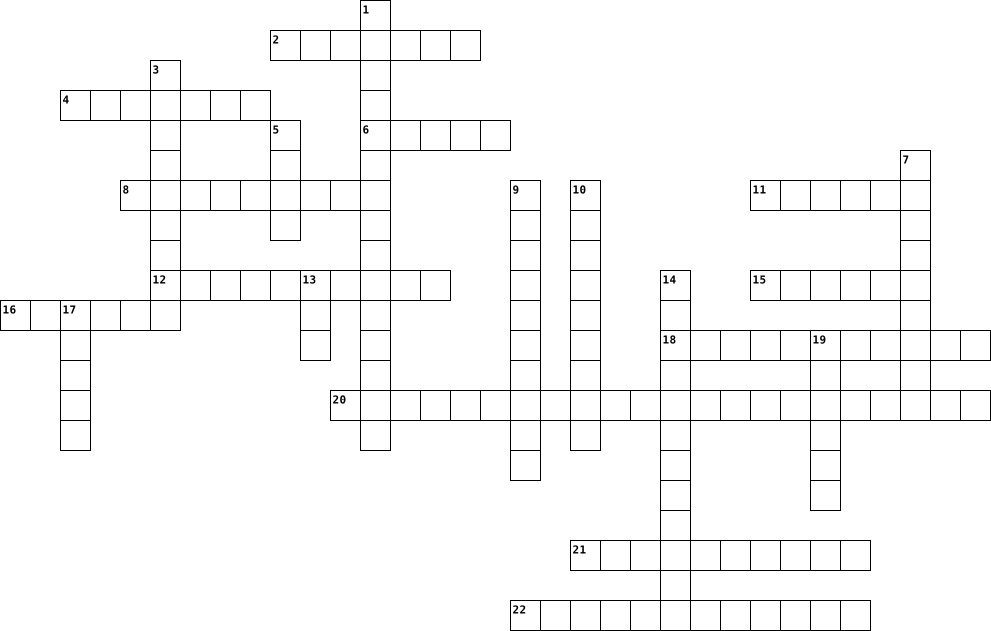
Across
- largest planet
- closest planet to sun
- our planet
- rock from outer space that hits the earth
- dirty snowballs
- planet gets pulled together by gravity and atmosphere forms
- dust grains that burn up in the atmosphere
- large gas planets
- rock like planets
- basis of modern planet formation
- dust grains in the solar system
- planet that is forming
Down
- heavier elements sink in growing planet
- snowball effect in formation of planets
- next planet out after earth
- large lumpy potatoes like small planets
- small objects outside neptunes orbit
- long period comets
- our star
- between mars and Jupiter
- closest planet to earth
- planet with largest rings
22 Clues: our star • our planet • largest planet • dirty snowballs • large gas planets • rock like planets • long period comets • closest planet to sun • planet that is forming • closest planet to earth • between mars and Jupiter • planet with largest rings • next planet out after earth • dust grains in the solar system • basis of modern planet formation • small objects outside neptunes orbit • ...
THE SOLAR SYSTEM 2019-09-09

Across
- Are planets are massive planets usually with a primary composition of gases or ice instead of solid matter such as rocks.
- Star composed of 92.1% hydrogen atoms and 7.8% helium atoms, around which the planets gravitate; represents more than 99.8% of the solar system’s total mass.
- Earth’s only natural satellite; devoid of water and atmosphere, it displays a highly uneven surface.
- A planet known most for its rings and has numerous moons.
- is a rock that falls to Earth from space. The vast majority of it are pieces of asteroids.
- Are objects that enter Earth’s atmosphere from space. But these are typically pieces of comet dust no larger than a grain of rice—burn up before reaching the ground.
- Are planets made up primarily of metals or silicate rocks which constitute most of Earth’s crust, asteroids, and rocky moons.
- A sphere of gas massive enough to generate light and heat through nuclear reactions that transform hydrogen into helium in its core.
- The closest planet to the sun and is only a bit larger than Earth's moon.
- Grouping of stars and interstellar matter linked together by gravitation; each comprises an average of 100 billion stars.
- A planet that is terribly hot, even hotter than Mercury. The atmosphere is toxic and the pressure at the surface would crush and kill you. Scientists describe the planet's situation as a runaway greenhouse effect.
Down
- It is unlike other planets in many respects. It is smaller than Earth's moon. Its orbit carries it inside the orbit of Neptune and then way out beyond that orbit.
- It is a layer or a set of layers of gases surrounding a planet or other material body, that is held in place by the gravity of that body.
- It's huge and is the most massive planet in our solar system. It’s a mostly gaseous world, mostly hydrogen and helium. Its swirling clouds are colorful due to different types of trace gases.
- it's the name that we use to describe the collection of all the things that exist in space. It is made of many millions of millions of stars and planets and enormous clouds of gas.
- it's an astronomical body orbiting a star or stellar remnant that is massive enough to be rounded by its own gravity, is not massive enough to cause thermonuclear fusion, and has cleared its neighboring region of planetesimals.
- A rocky objects smaller than planets that are left over from the formation of our solar system.
- It is a path of a body revolving around an attracting center of mass, as a planet around the Sun or a satellite around it.
- It is a cold, dusty planet. The dust, an iron oxide, gives the planet its reddish cast. Scientists think it was once wet and warm, though today it’s cold and desert-like.
- It is a water world, with two-thirds of the planet covered by ocean. It’s the only world known to harbor life, its atmosphere is rich in life-sustaining nitrogen and oxygen.
- Formed at farther distances from the Sun, beyond what we call the frost or snow line and past the orbits of Mars and Jupiter, where temperatures were low enough for water to freeze.
- it's the galaxy that contains the Solar System, with the name describing the galaxy's appearance from Earth: a hazy band of light seen in the night sky formed from stars that cannot be individually distinguished by the naked eye.
- It is known for strong winds — sometimes faster than the speed of sound. it's far out and cold. The planet is more than 30 times as far from the sun as Earth and it has a rocky core.
- It's an oddball. The only giant planet whose equator is nearly at right angles to its orbit — it basically orbits on its side. Methane in its atmosphere gives a blue-green tint. It has numerous moons and faint rings.
24 Clues: A planet known most for its rings and has numerous moons. • The closest planet to the sun and is only a bit larger than Earth's moon. • is a rock that falls to Earth from space. The vast majority of it are pieces of asteroids. • A rocky objects smaller than planets that are left over from the formation of our solar system. • ...
Sun/Solar system 2014-02-04

Across
- The central region of the sun, where nuclear fusion takes place.
- the process by which energy is produced in stars.
- A unit of distance equal to the average distance between Earth and the sun, about 150 million kilometers.
- A dark area of gas on the sun’s surface that is cooler than the surrounding gases.
- Dark, flat areas on the moon’s surface formed from huge ancient lava flows.
- The inner layer of the sun’s atmosphere that gives off its visible light; the sun’s surface.
- One of the small asteroid-like bodies that formed the building blocks of the planets.
- The effect of trapping heat near a planet’s surface by certain gases in the planet’s atmosphere.
- An object that orbits the sun and is spherical, but has not cleared the area of its orbit.
- The name often given to the four inner planets: Mercury, Venus, Earth, and Mars
- An object that orbits a star, is large enough to have become rounded by its own gravity, and has cleared the area of its orbit.
Down
- Outer layer of the sun’s atmosphere, which looks like a white halo
- This zone is the outermost layer of the sun’s interior.
- The middle layer of the sun’s atmosphere.
- A large round pit caused by the impact of a meteoroid
- A zone of very tightly packed gas in the sun’s interior where energy is transferred mainly in the form of electromagnetic radiation.
- A chunk of rock or dust in space, generally smaller than an asteroid.
- A stream of electrically charged particles that emanate from the sun’s corona.
- The system consisting of the sun and the planets and other objects that revolve around it.
- An eruption of gas from the sun’s surface that occurs when the loops in sunspot regions suddenly connect.
- A huge, reddish loop of gas that protrudes from the sun’s surface, linking parts of sunspot regions.
21 Clues: The middle layer of the sun’s atmosphere. • the process by which energy is produced in stars. • A large round pit caused by the impact of a meteoroid • This zone is the outermost layer of the sun’s interior. • The central region of the sun, where nuclear fusion takes place. • Outer layer of the sun’s atmosphere, which looks like a white halo • ...
The Solar System 2015-05-26

Across
- Methane in this planets atmosphere gives it its blue tint
- Surname of the first astronaut to walk upon the moon
- The planet which takes 365 days to orbit the sun
- The government agency of the USA which researches space and sends astronauts on missions
- The planet closest to the sun
- The term which means the planet is spinning in the opposite direction to other planets
- The gas giant that is furthest from the sun
- The term given to the model of solar system that puts the sun at the middle
- This planet is most famous for its set of rings
- Now known as a dwarf planet
Down
- The largest planet in the Solar System
- Planet covered in clouds of sulphuric acids and spins in retrograde
- This red planet was named after the Roman god of war
- The term given to a scientist who studies planets
- The moon does not have one of these, therefore it has no protection against cosmic rays, meteors or solar winds
- The type of planets that are closest to the sun
- A piece of stony or metallic debris that travels in outer space
- The galaxy in which Earth belongs
- Name of the instrument used to look at planets, stars and objects in space
- This planet controls the tides on Earth
20 Clues: Now known as a dwarf planet • The planet closest to the sun • The galaxy in which Earth belongs • The largest planet in the Solar System • This planet controls the tides on Earth • The gas giant that is furthest from the sun • The type of planets that are closest to the sun • This planet is most famous for its set of rings • ...
Solar System Crossword 2014-09-05

Across
- This planet is between Earth and Jupiter
- belt What seperates the inner and the outer solar system
- Everything revolves around this
- This is the 7th planet from the sun
- This planet has rings around it
- What do all planets do around the sun?
- What can be used to view planets in space
- The name given to earth's moon
- This is the dwarf planet that comes after Neptune
- This is the largest planet in the solar system
Down
- The closest planet to the sun, it takes 88 days for this planet to orbit the sun!
- What is the name of the people who go into space?
- Rocketships go into outer......?
- The study of outer space
- There are billions and billions of these in the galaxy
- What is earths only natural satellite?
- The second planet from the sun
- This use to be considered the 2nd last planet from the sun, but is now considered the last
- The planet we live on
- How many planets are there in our solar system
20 Clues: The planet we live on • The study of outer space • The second planet from the sun • The name given to earth's moon • Everything revolves around this • This planet has rings around it • Rocketships go into outer......? • This is the 7th planet from the sun • What is earths only natural satellite? • What do all planets do around the sun? • This planet is between Earth and Jupiter • ...
The Solar System 2014-04-10

Across
- hole An area in space that has a strong gravitational force
- A strong force that pulls objects closer to the other object
- Natural satellites that orbit around a planet
- An instance of revolting
- Earth's "sister" planet
- The hottest planet
- The largest planet in our solar system
- Planet with the most rings
- An area in space made of dust and gas
- The center of our solar system
Down
- A celestial body that orbits around a star
- A giant ball of fire and gas
- belt A group of asteroids that orbit around the sun
- The red planet
- The action of rotating around on an axis
- A gas planet
- The furthest planet from the sun
- An imaginary line in which a body rotates on
- The curved path of a celestial body around a star
- The water planet
20 Clues: A gas planet • The red planet • The water planet • The hottest planet • Earth's "sister" planet • An instance of revolting • Planet with the most rings • A giant ball of fire and gas • The center of our solar system • The furthest planet from the sun • An area in space made of dust and gas • The largest planet in our solar system • The action of rotating around on an axis • ...
Our Solar System 2016-02-12

Across
- The center of our Solar System
- Mars has a abundant amount of what in its surface
- What planet is known as the red planet
- Jupiter has how mnay known moons
- what is the belt that has icy rocks in it
- Home many satellites surround Earth
- Between Mars and Jupiter
- Mercury's what has been blown off by solarwind
- Venus has a thin atmosphere of what
- is the largest moon of Jupiter
- How much percentage of Earth covered in water
- Venus has been visited by hoe many satellites
- is the closest dwarf planet to the sun
- Jupiter has how many moons
Down
- How hot is mercury at daytime
- A stream of energized charged particles
- Has no moons, no rings and is the closet planet to the sun h
- The sun has how many layers
- Intense electromagnetic flare which causes radio interruption on earth.
- Pluto is the what from the sun
- What planet do we live on
- Uranus is tilted on its what
- The second closes planet to the sun
23 Clues: Between Mars and Jupiter • What planet do we live on • Jupiter has how many moons • The sun has how many layers • Uranus is tilted on its what • How hot is mercury at daytime • The center of our Solar System • Pluto is the what from the sun • is the largest moon of Jupiter • Jupiter has how mnay known moons • Home many satellites surround Earth • ...
Solar System Crossword 2023-10-31

Across
- The natural satellite of the earth (other planets have them too).
- The sun is composed of hydrogen and __.
- Sphere-shaped group of small rock and ice that are the furthest objects from the sun.
- The third planet from the sun.
- The closest planet to the sun
- The farthest planet from the sun
- Debris from comets that would be meteors if they enter earth's atmosphere.
- These orbit the sun and are located between Mars and Jupiter.
- When an object spins on its axis
- Disk-shaped group of small rock and ice beyond the orbit of Neptune.
- Force of attraction between two objects due to their masses.
Down
- The process in which plants create oxygen and chemical energy, which is one reason why life exists on earth.
- The earth is 78% __.
- These burn when entering the atmosphere, causing light.
- Jupiter, Saturn, Uranus, and Neptune are all __ planets.
- The earth is 21% __.
- These form large tails of gas and dust, melt when they near the sun, and originate from the Kuiper belt or Oort cloud.
- The largest and hottest object in our solar system.
- When an object moves around another object.
- the curved path of a celestial object or spacecraft around a star, planet, or moon
- Mercury, venus, earth, and mars are all __ planets.
- The collection of planets, moons, and other objects that orbit around the sun.
22 Clues: The earth is 78% __. • The earth is 21% __. • The closest planet to the sun • The third planet from the sun. • The farthest planet from the sun • When an object spins on its axis • The sun is composed of hydrogen and __. • When an object moves around another object. • The largest and hottest object in our solar system. • Mercury, venus, earth, and mars are all __ planets. • ...
Solar System Fun 2023-10-11

Across
- A system of millions or billions of stars.
- The name for the four inner planets
- This is the largest planet
- The Planet that we live on
- Mars has these that are extinct
- Mercury doesn't have this
- This planet is red.
- This is the hottest planet
- Study of the moon,stars, and other objects.
- Mercury has a surface similar to this
- The path of an object as it revolves around another object
- This is the great red spot on Jupiter
Down
- It often rains this type of acid on Venus
- A scientist who studies the universe beyond Earth
- A gas giant made of hydrogen,helium, and methane.
- Saturns rings are made of dust and this
- This gives Uranus
- The outer planets
- Saturn has a lot of these
- A chunk of rock or dust in space
- Six planet from the Sun
- Rocky debris revolving around the Sun
- Energy source for all the planets
- This planet rotates on it's sides and has any moons
- The closest planet to the Sun.
25 Clues: This gives Uranus • The outer planets • This planet is red. • Six planet from the Sun • Saturn has a lot of these • Mercury doesn't have this • This is the largest planet • The Planet that we live on • This is the hottest planet • The closest planet to the Sun. • Mars has these that are extinct • A chunk of rock or dust in space • Energy source for all the planets • ...
solar system - kylah 2024-01-26

Across
- mercury
- old star
- light deflection
- kirkwood gaps
- bright blue color
- trail emerges from a cloud
- a force acts repeatedly
- yellowish apperance
- no clouds
- rocky, dusty, grey color
- lumpy structure
- neptune
- "shooting star"
- dwarf planet
- tiny dust particles
Down
- giant dust and gas
- dark blue color
- jupiter
- H2O clouds
- radii disance
- our star
- rocky metallic bodies
- venus carbon dioxide
- grains
- blood red color
- neptune
26 Clues: grains • jupiter • mercury • neptune • neptune • old star • our star • no clouds • H2O clouds • dwarf planet • radii disance • kirkwood gaps • dark blue color • blood red color • lumpy structure • "shooting star" • light deflection • bright blue color • giant dust and gas • yellowish apperance • tiny dust particles • venus carbon dioxide • rocky metallic bodies • a force acts repeatedly • rocky, dusty, grey color • ...
The Solar System 2023-11-23

Across
- Small, Cold, Hard and Rocky Planet
- powerful and luminous explosion of a star
- large telescope
- giant cloud of dust and gas in space
- the universe is ...
- Ziggy __________ OR David Bowie
- remote incandescent body like the sun
- an area of activity, interest, or influence
- particle of matter that uniquely defines a chemical element
- all existing matter and space considered as a whole
- most abundant element found in the sun and in the allende meteorite
Down
- system of millions or billions of stars, together with gas and dust, held together by gravitational attraction
- You cannot walk on this planet, rather you would float.
- Formed when supernovas explode
- Cosmic background radiation explorer
- force that attracts a body towards the centre of the earth
- developing planets
- the only planet to roll around the sun in its orbit. The rest spin.
- H2
- new Star
- Planet like asteroids
- Italian astronomer, physicist and engineer, sometimes described as a polymath
- new planet
- another name for the universe
- H1
25 Clues: H2 • H1 • new Star • new planet • large telescope • developing planets • the universe is ... • Planet like asteroids • another name for the universe • Formed when supernovas explode • Ziggy __________ OR David Bowie • Small, Cold, Hard and Rocky Planet • Cosmic background radiation explorer • giant cloud of dust and gas in space • remote incandescent body like the sun • ...
Solar System Review 2023-02-27

Across
- The wide, outermost layer of a star's atmosphere.
- The distance light travels in 1 year (two words).
- The true brightness of an object.
- A large ball of gas held together by gravity with a core so hot that nuclear fusion occurs.
- A graph that plots luminosity vs. temperature of stars (2 initials and word).
- A process that occurs when the nuclei of several atoms combine into one larger nucleus (two words).
- Where hot gas moves up toward the surface and cooler gas moves deeper into the interior (two words).
- The apparent surface of a star.
- Theory that the universe began from one point billions of years ago and has been expanding ever since (3 words).
- A cloud of gas and dust.
- An object whose gravity is so great that no light can escape (2 words).
Down
- A measure of how bright an object appears from Earth (two words).
- The average distance between Earth and the Sun, about 150 million km (two words).
- A hot, dense, slowly cooling sphere of carbon (2 words).
- Matter that emits no light at any wavelength.
- A shell of cooler hydrogen above a star's core (two words).
- Huge collections of stars.
- The orange-red layer above the photosphere.
- The shift to a different wavelength (2 words).
- Spreads light into different wavelengths.
- An enormous explosion that destroys a star.
- A dense core of neutrons that remains after a supernova (2 words).
22 Clues: A cloud of gas and dust. • Huge collections of stars. • The apparent surface of a star. • The true brightness of an object. • Spreads light into different wavelengths. • The orange-red layer above the photosphere. • An enormous explosion that destroys a star. • Matter that emits no light at any wavelength. • The shift to a different wavelength (2 words). • ...
Solar System Crossword 2023-03-17

Across
- The only planet with one moon.
- The smallest planet.
- Pluto's largest moon.
- One of Mar's moons.
- A huge canyon on Mars's surface.
- A dark blue planet with incredibly strong winds.
- The largest of the dwarf planets.
- The word for the point in space that the binary Pluto-Charon system revolves around.
- The number of tails most comets have as they approach the inner solar system.
- The nearest celestial body to the Earth.
- The first dwarf planet discovered and the largest asteroid in the asteroid belt.
- A planet that appears to "roll" through the solar system.
- The largest volcano on Mars.
- The huge area of icy bodies where most short period comets come from.
- A small chunk of asteroid that burns up in Earth's amtmosphere.
- The only moon in the solar system that revolves retrograde, or opposite, of the planet's (Neptune) motion.
- The largest planet.
- A small celestial body made primarily of rocky material.
Down
- A chunk of asteroid big enough that doesn't entirely burn up and strikes Earth.
- One of Mar's moons.
- The shape of all celestial bodies that revolve around the sun.
- A Galilean moon that definitely has water ice.
- The most massive dwarf planet.
- A small celestial body made primarily of icy material.
- A massive storm on Jupiter that's at least hundreds of years old.
- This planet would float in a bathtub
- The largest moon in the solar system.
- The giant spherical zone of icy bodies that houses long period comets and overlaps with the same zone from the next star.
- The hottest planet.
- One of Uranus's moons that's named after an impish creature from A Midsummer Night's Dream
- A moon of Saturn that has organic molecules on it.
- The location of the majority of the asteroids.
- The reddest planet.
- The number of moon's of Pluto.
- A small asteroid chunk that hasn't yet entered Earth's atmosphere.
- The third largest moon of Jupiter.
- The number of planets revolving around the sun.
37 Clues: One of Mar's moons. • One of Mar's moons. • The hottest planet. • The reddest planet. • The largest planet. • The smallest planet. • Pluto's largest moon. • The largest volcano on Mars. • The only planet with one moon. • The most massive dwarf planet. • The number of moon's of Pluto. • A huge canyon on Mars's surface. • The largest of the dwarf planets. • ...
Crossword Solar System 2024-03-07

Across
- a small rocky or metallic body in outer space
- the largest of the inner satellites of Jupiter
- one of the celestial bodies floating berween galaxies
- when the entire umbral shadow of the earth falls over the moon, so that the sun, earth and moon are exactly on the same line
- movement in trajectory
- the planet with the hottest temperature
- The object that revolves around the planet
- the rotational movement of the planet Earth on its axis
Down
- A planet that is located the farthest from the sun
- the fifth planet from the sun and the largest in the solar system
- A planet that has the most satellites
- planet known as the red planet
- A planet that has no satellites
- a planet outside the solar system
- the planet where we live
- the coldest planet
- a celestial body that is in orbit around the sun
- celestial bodies that revolve around the sun in an orbit
- celestial bodies that are in the form of small fragments and move around the sun
- the center of the solar system
20 Clues: the coldest planet • movement in trajectory • the planet where we live • planet known as the red planet • the center of the solar system • A planet that has no satellites • a planet outside the solar system • A planet that has the most satellites • the planet with the hottest temperature • The object that revolves around the planet • ...
The Solar System 2024-05-28

Across
- Galilean (I)
- The Star
- Black and White
- Son of Poseidon
- Galilean (G)
- Outer Belt
- Shape-Shifting
- Sea
- Luna
- Funny Name
- King of the Fairies
- Snowy Land
- War
- Panic
- The Mermaid
- Dense Atmosphere
- Death
- Home
Down
- Daughter of Prospero
- Strife
- Largest
- Rings
- Of The Lock
- Fear
- Queen of the Fairies
- Speed
- Galilean (E)
- Sea Nymphs
- Love
- Galilean (C)
- Inner Belt
31 Clues: Sea • War • Fear • Luna • Love • Home • Rings • Speed • Panic • Death • Strife • Largest • The Star • Outer Belt • Funny Name • Sea Nymphs • Snowy Land • Inner Belt • Of The Lock • The Mermaid • Galilean (I) • Galilean (G) • Galilean (E) • Galilean (C) • Shape-Shifting • Black and White • Son of Poseidon • Dense Atmosphere • King of the Fairies • Daughter of Prospero • Queen of the Fairies
The Solar System 2023-06-08

Across
- Only Planet With Life
- People Who Go To Space
- The closest star
- The Sideways Planet
- A Rock Between Mars And Jupiter
- A Small Object That Orbits A Planet
- Rocky And Red
- The Coldest Planet
- A Space Station People Live In
- The First Gas Planet
- First Planet
Down
- First Man On The Moon
- A Giant Storm On Jupiter
- Planets And The Sun Created This
- Bright And Hot
- Ice And Dust With A Blue Tail
- _____ Is A Dwarf Planet
- A Person Who Discovered The Earth Is Spinning
- A Team That Launched Astronauts
- The Galaxy We Live In
- Created Everything
- Famous For Its Rings
22 Clues: First Planet • Rocky And Red • Bright And Hot • The closest star • The Coldest Planet • Created Everything • The Sideways Planet • Famous For Its Rings • The First Gas Planet • First Man On The Moon • Only Planet With Life • The Galaxy We Live In • People Who Go To Space • _____ Is A Dwarf Planet • A Giant Storm On Jupiter • Ice And Dust With A Blue Tail • A Space Station People Live In • ...
The solar System 2023-04-13

Across
- : The path that an object takes as it revolves around another object under the influence of gravity.
- : The largest planet in the solar system, with a distinctive striped appearance and many moons.
- : A massive, luminous ball of gas held together by its own gravity that produces light and other forms of radiation.
- : The collection of planets, moons, asteroids, comets, and other objects that orbit around the sun.
- : The second planet from the sun and the brightest natural object in the night sky after the moon.
- : A hypothetical region of the solar system far beyond the orbit of Pluto that is thought to contain many icy objects and comets.
- : The eighth and farthest known planet from the sun, with a deep blue coloration and many storms, including the Great Dark Spot.
Down
- : The seventh planet from the sun, with a tilted axis of rotation that causes it to appear to roll on its side.
- : A small icy object that orbits the sun and produces a visible coma or tail when it approaches the sun.
- : A region of the solar system beyond Neptune that contains many small icy objects, including dwarf planets like Pluto.
- : The force of attraction between objects that has a mass, which causes them to move toward each other.
- : The fourth planet from the sun, also known as the Red Planet due to its reddish appearance in the night sky.
- : The sixth planet from the sun, known for its iconic rings made up of ice particles and debris.
- : The smallest planet in the solar system and the one closest to the sun.
- : A small rocky or metallic object that orbits the sun and is often found in the asteroid belt between Mars and Jupiter.
- : A dwarf planet and the largest known object in the Kuiper Belt, located beyond Neptune.
- : The third planet from the sun and the only known planet with an atmosphere and liquid water on its surface, making it capable of supporting life.
- : A large group of stars, gas, and dust held together by gravity, with the Milky Way being the galaxy that includes the solar system.
- : The natural satellite of Earth, which orbits around it and causes tides on the planet's surface.
- : The star at the center of the solar system, around which the planets and other objects orbit.
20 Clues: : The smallest planet in the solar system and the one closest to the sun. • : A dwarf planet and the largest known object in the Kuiper Belt, located beyond Neptune. • : The largest planet in the solar system, with a distinctive striped appearance and many moons. • ...
Solar System Vocab 2023-01-24

Across
- The amount of gravitational pull between two objects.
- A collection of stars and their solar systems that are gravitationally bound to one another.
- A scientist who studies objects and events beyond Earth’s atmosphere, such as the movement of stars and planets.
- A star and all of the objects that orbit it.
- A sequence of events that repeats.
- The different shapes of the Moon visible from Earth.
- A push or a pull.
- A natural phenomenon that causes objects to be attracted to each other based on each object’s mass and the distance between them.
- The mixture of gases that surrounds a planet.
- Information that supports or refutes a claim.
- When the Moon passes between Earth and the Sun such that the Moon’s shadow causes some places on Earth to experience darkness during daytime.
Down
- When the Moon passes into Earth’s shadow.
- A flat two-dimensional plane where a space object is at any point in its orbit.
- The angle of Earth’s axis(approximately 23.5 degrees from perpendicular) relative to Earth’s orbital plane around the Sun.
- The amount of matter in an object.
- A desirable outcome given up to gain another desirable outcome.
- The imaginary line around which an object spins, or rotates.
- Rockets, satellites, probes, space stations, and space shuttles that carry various tools and equipment to gather data about space and space objects.
- The ratio of the size of a real object to the size of a model, map, diagram, or other representation of that object.
- the mean, or average, distance between Earth and the Sun.
- Something that happens in a repeated and predictable way.
- Any description or measurement gathered by the senses or instruments.
- A curved path that a space object takes around a star, planet, or moon.
23 Clues: A push or a pull. • The amount of matter in an object. • A sequence of events that repeats. • When the Moon passes into Earth’s shadow. • A star and all of the objects that orbit it. • The mixture of gases that surrounds a planet. • Information that supports or refutes a claim. • The different shapes of the Moon visible from Earth. • ...
7H Solar System 2022-05-18

Across
- The rocky object which orbits the earth
- The closest planet to the Sun
- The Earth is tiled on its ____
- The closest galaxy to The Milky Way
- An object which orbits something else
- The period in 24h when the sun is on the same side of the earth as you
- A word which describes the shape of the northern or southern region of the Earth
- The largest star in our solar system
- Objects look smaller as their _________ increases
- This increases or decreases depending on closeness to the sun
- A word to describe objects such as stars, which give off their own light
- Caused by the northern and southern hemispheres pointing towards or away from the sun
Down
- A collection of stars
- The force which pulls objects towards the centre of the Earth
- Used to be classed as a planet, but is now classed as a dwarf planet
- The period in 24h when the sun is on the opposite side of the earth to you
- the length of time it takes Earth to orbit the sun fully
- This decreases on planets with weaker gravity and increases on planets with stronger gravity
- The largest type of star
- An objects which allows us to see objects further away than the eye can see
- The fourth planet from the sun
- The seventh planet from the sun
22 Clues: A collection of stars • The largest type of star • The closest planet to the Sun • The Earth is tiled on its ____ • The fourth planet from the sun • The seventh planet from the sun • The closest galaxy to The Milky Way • The largest star in our solar system • An object which orbits something else • The rocky object which orbits the earth • ...
The Solar System 2025-02-21

Across
- 365 or 366 days
- spinning of an object on its axis
- path an object makes as it goes around
- force that pulls objects towards eachother
- different shapes of the moon
- 3rd planet from the sun
- Center of our solar system
- an imaginary line
- Earth's natural satellite
- none of the moon is lit
- divides the north and south hemisphere
- the phase before the third quarter
- four divisions of the year
Down
- small crescent lit on the left side of the moon
- the angle of the Earth's axis
- the left half of the moon is lit
- Earth's shadow covers the moon
- whole moon is lit
- Earth's ______ around the sun takes 1 year
- the phase before the full moon
- moon blocks the sunlight
- 24 hours
22 Clues: 24 hours • 365 or 366 days • whole moon is lit • an imaginary line • 3rd planet from the sun • none of the moon is lit • moon blocks the sunlight • Earth's natural satellite • Center of our solar system • four divisions of the year • different shapes of the moon • the angle of the Earth's axis • Earth's shadow covers the moon • the phase before the full moon • ...