
solar system Crossword Puzzles
Space 2022-05-12

Across
- space watching gadget
- Halley's _____
- the fourth largest planet in the solar system
- this star in also known as the pole star, north star and guiding star
- ninth brightest star
- the brightest star
Down
- fourth largest star
- place where stars are born
- the outest layer in the earth's atmosphere
- the only planet in the solar system which has its rings vertically
- Proxima ________ is the smallest red dwarf star
- the color of space is _____
- brightest planet in the solar system
- brightest star in the Boötes constellation
14 Clues: Halley's _____ • the brightest star • fourth largest star • ninth brightest star • space watching gadget • place where stars are born • the color of space is _____ • brightest planet in the solar system • the outest layer in the earth's atmosphere • brightest star in the Boötes constellation • the fourth largest planet in the solar system • ...
Space 2022-06-23

Across
- is about 450 degrees
- The second planet in our solar system
- Is used to jump
- Astronauts can work there
- Theres over a billion of them
- green space-people
- a million of them can fit inside of the sun
Down
- on the planet is a huge storm
- the coldest planet in our solar system
- People are wondering if you can live on this planet
- Costs about 12.000.000 dollars
- The people that get sent into space
- the biggest star in our solar system
- can be used for navigation
14 Clues: Is used to jump • green space-people • is about 450 degrees • Astronauts can work there • can be used for navigation • on the planet is a huge storm • Theres over a billion of them • Costs about 12.000.000 dollars • The people that get sent into space • the biggest star in our solar system • The second planet in our solar system • the coldest planet in our solar system • ...
2 Tri 2023-08-25

Across
- The last of the Rocky Planets
- ____ Belt, the last thing on the Solar System
- One of the things created after the Big Bang
- An evidence of The Big Bang
- The process that created the Moon
- Biggest planet on the Solar System
- Hot and dense point that contained the Universe
- Name of the planet that collapsed with Earth in the creation of the Moon
Down
- Planets that are more dense and have less moons
- _______ Belt, in between Mars and Jupiter
- A gas planet, famous for it's rings around it
- The meaning of the R in CMBR, an evidence of the Big Bang
- The closest planet to the Sun
- A gas planet, the seventh in The Solar System
- No longer considered a planet
- The Star in our system
16 Clues: The Star in our system • An evidence of The Big Bang • The last of the Rocky Planets • The closest planet to the Sun • No longer considered a planet • The process that created the Moon • Biggest planet on the Solar System • _______ Belt, in between Mars and Jupiter • One of the things created after the Big Bang • A gas planet, famous for it's rings around it • ...
The Planets 2016-01-30

Across
- the third planet in the solar system.
- the fourth planet in the solar system.
- the eighth planet in the solar system and the farthest from the sun.
- the fifth planet in the solar system.
Down
- the sixth planet in the solar system.
- the seventh planet in the solar system.
- the first planet in the solar system.
- the second planet in the solar system.
8 Clues: the sixth planet in the solar system. • the third planet in the solar system. • the first planet in the solar system. • the fifth planet in the solar system. • the fourth planet in the solar system. • the second planet in the solar system. • the seventh planet in the solar system. • the eighth planet in the solar system and the farthest from the sun.
Th Solar System 2013-03-01

Across
- Orbits planets, Mercury and Venus don't have one, smaller than planets
- The hottest thing in the solar system, shoots out solar flares, planets orbit around it
- Used to be a planet, a dwarf planet, orbits the Sun
- Largest planet in the solar system, home to the "Giant Red Spot", starts the outer planets
- In the asteroid belt, a very large rock, many hit the earth the earth
- The hottest planet, it's atmosphere is made out of carbon dioxide, named Earths "Twin"
- 2nd largest planet, lightest planet, in the outer planets family
- Has the most violent weather, an icy planet, last planet
Down
- Called "Shooting Stars", very bright, in our solar system
- System
- We live in one, many others, billions and billions of miles long
- Has no atmosphere, the smallest planet, closest to the Sun
- Home to many volcanoes, 4th planet, looks like a big fire ball
- It's rings orbit from top to bottom, ice planet, twins with Neptune
- The only planet with life on it, blue with green on it, 3rd planet
15 Clues: System • Used to be a planet, a dwarf planet, orbits the Sun • Has the most violent weather, an icy planet, last planet • Called "Shooting Stars", very bright, in our solar system • Has no atmosphere, the smallest planet, closest to the Sun • Home to many volcanoes, 4th planet, looks like a big fire ball • ...
Space 2022-05-12

Across
- space watching gadget
- Halley's _____
- the fourth largest planet in the solar system
- this star in also known as the pole star, north star and guiding star
- ninth brightest star
- the brightest star
Down
- fourth largest star
- place where stars are born
- the outest layer in the earth's atmosphere
- the only planet in the solar system which has its rings vertically
- Proxima ________ is the smallest red dwarf star
- the color of space is _____
- brightest planet in the solar system
- brightest star in the Boötes constellation
14 Clues: Halley's _____ • the brightest star • fourth largest star • ninth brightest star • space watching gadget • place where stars are born • the color of space is _____ • brightest planet in the solar system • the outest layer in the earth's atmosphere • brightest star in the Boötes constellation • the fourth largest planet in the solar system • ...
Astronomy 2022-03-09

Across
- eclipse, Blocking of Sun's light which can occur during a new moon.
- a person who is trained to travel in a spacecraft.
- Closest planet to the Sun
- Complete shadow, the fully shaded inner region of a shadow cast by an opaque object, especially the area on the earth or moon experiencing the total phase of an eclipse.
- Largest planet in the solar system
- Layer of air, made up of many layers and gases surrounding the Earths and other planets' surface.
- A satellite is a natural or man made object that orbits around a planet.
Down
- Partial shadow, lighter, outer parts of a shadow. the partially shaded outer region of the shadow cast by an opaque object.
- the spinning of Earth in its axis.
- Sixth planet to the Sun, second largest planet in the solar system.
- the movement of one object around another object.
- little chunks of rock and debris in space that falls through a planet’s atmosphere.
- sunlight on its surface.
- Largest objects in the Solar system which revolve around the Sun.
- Second closest planet to the Sun. Sometimes called earth's twin.
- eclipse, Blocking of Sunlight to the moon, this can occur during a full moon
- small body of ice, rock and cosmic dust that follows an elliptical orbit around the Sun.
- primary source of heat and energy for the solar system.
18 Clues: sunlight on its surface. • Closest planet to the Sun • Largest planet in the solar system • the spinning of Earth in its axis. • the movement of one object around another object. • a person who is trained to travel in a spacecraft. • primary source of heat and energy for the solar system. • Second closest planet to the Sun. Sometimes called earth's twin. • ...
Astronomy 2022-03-09

Across
- eclipse, Blocking of Sun's light which can occur during a new moon.
- a person who is trained to travel in a spacecraft.
- Closest planet to the Sun
- Complete shadow, the fully shaded inner region of a shadow cast by an opaque object, especially the area on the earth or moon experiencing the total phase of an eclipse.
- Largest planet in the solar system
- Layer of air, made up of many layers and gases surrounding the Earths and other planets' surface.
- A satellite is a natural or man made object that orbits around a planet.
Down
- Partial shadow, lighter, outer parts of a shadow. the partially shaded outer region of the shadow cast by an opaque object.
- the spinning of Earth in its axis.
- Sixth planet to the Sun, second largest planet in the solar system.
- the movement of one object around another object.
- little chunks of rock and debris in space that falls through a planet’s atmosphere.
- sunlight on its surface.
- Largest objects in the Solar system which revolve around the Sun.
- Second closest planet to the Sun. Sometimes called earth's twin.
- eclipse, Blocking of Sunlight to the moon, this can occur during a full moon
- small body of ice, rock and cosmic dust that follows an elliptical orbit around the Sun.
- primary source of heat and energy for the solar system.
18 Clues: sunlight on its surface. • Closest planet to the Sun • Largest planet in the solar system • the spinning of Earth in its axis. • the movement of one object around another object. • a person who is trained to travel in a spacecraft. • primary source of heat and energy for the solar system. • Second closest planet to the Sun. Sometimes called earth's twin. • ...
Unit 1 Space 2020-09-05

Across
- This describes inner planets made of rock
- It has a clear orbit
- The name of our solar system
- A meteor that has hit the Earth's surface
- It is smaller than an asteroid and could be a part of an old planet, comet or asteroid
- It is round, orbits the sun, but does not have a clear orbit
- They usually have many moons, are larger and are outer planets
Down
- A meteoroid that has entered Earth's atmosphere
- This planet rotates on its side
- A group of planets orbiting a star
- The number of planets in our solar system that don't have moons
- The name of the space probe used to explore objects far away in our solar system
- It is found far away from the Sun, has a tail and an icy core
- It is made of all the galaxies and everything else
- The area where Ceres is found
- It orbits a planet
- Most of the dwarf planets are found here
- The force that attracts things and holds things together
- A group of solar systems held together by gravity
19 Clues: It orbits a planet • It has a clear orbit • The name of our solar system • The area where Ceres is found • This planet rotates on its side • A group of planets orbiting a star • Most of the dwarf planets are found here • This describes inner planets made of rock • A meteor that has hit the Earth's surface • A meteoroid that has entered Earth's atmosphere • ...
SHEILA KINANTI ADHANA 8C 2024-05-02

Across
- The 6th planet from the sun
- The 7th planet from the sun
- The blue planet
- The study of stars, planets, and other objects in space
- A pulling force between every object in the universe
Down
- The largest planet
- The red planet
- The person who travels in outer space
- Smallest planet in the solar system
- The senter of our solar system
- The planet we live on
- Eart's only natural satellite
- Our solar system
13 Clues: The red planet • The blue planet • Our solar system • The largest planet • The planet we live on • The 6th planet from the sun • The 7th planet from the sun • Eart's only natural satellite • The senter of our solar system • Smallest planet in the solar system • The person who travels in outer space • A pulling force between every object in the universe • ...
The Solar System 2025-04-10

Across
- Heat and light energy from the sun
- Celestial bodies
- A luminous body visible in the sky at night
- The smallest and closest planet to the sun
- The hottest planet in the solar system
- An ice giant
Down
- The largest planet in the solar system
- Small celestial bodies that orbit planets
- Furthest planet from the sun
- Has rings surrounding it
- The red planet
- Our home planet
- The star that everything in our solar system orbits around
13 Clues: An ice giant • The red planet • Our home planet • Celestial bodies • Has rings surrounding it • Furthest planet from the sun • Heat and light energy from the sun • The largest planet in the solar system • The hottest planet in the solar system • Small celestial bodies that orbit planets • The smallest and closest planet to the sun • A luminous body visible in the sky at night • ...
Planets and Celestial Bodies 2025-10-31

Across
- known as the red planet
- has a funny name
- known as the sister planet
- center of the solar system
- light up the night sky, make constellations
- used to be a planet
- famous god of the see
Down
- causes the tides on our planet
- closest planet to the sun
- holds all of outer space
- only planet with life on earth (as we know)
- has largest rings in the solar system
- biggest planet in the solar system
13 Clues: has a funny name • used to be a planet • famous god of the see • known as the red planet • holds all of outer space • closest planet to the sun • known as the sister planet • center of the solar system • causes the tides on our planet • biggest planet in the solar system • has largest rings in the solar system • only planet with life on earth (as we know) • ...
Th Solar System 2013-03-01

Across
- Orbits planets, Mercury and Venus don't have one, smaller than planets
- The hottest thing in the solar system, shoots out solar flares, planets orbit around it
- In the asteroid belt, a very large rock, many hit the earth the earth
- Has no atmosphere, the smallest planet, closest to the Sun
- The hottest planet, it's atmosphere is made out of carbon dioxide, named Earths "Twin"
- Has the most violent weather, an icy planet, last planet
Down
- Home to many volcanoes, 4th planet, looks like a big fire ball
- Called "Shooting Stars", very bright, in our solar system
- Largest planet in the solar system, home to the "Giant Red Spot", starts the outer planets
- 2nd largest planet, lightest planet, in the outer planets family
- It's rings orbit from top to bottom, ice planet, twins with Neptune
- We live in one, many others, billions and billions of miles long
- System
- Used to be a planet, a dwarf planet, orbits the Sun
- The only planet with life on it, blue with green on it, 3rd planet
15 Clues: System • Used to be a planet, a dwarf planet, orbits the Sun • Has the most violent weather, an icy planet, last planet • Called "Shooting Stars", very bright, in our solar system • Has no atmosphere, the smallest planet, closest to the Sun • Home to many volcanoes, 4th planet, looks like a big fire ball • ...
Blake's Impossible Crossword Puzzle :) 2023-12-12

Across
- This planet was too small and got removed from the planets
- The hottest planet
- the break between terrestrial and jovial planets.
- Has vertical rings
- This planet is a Star in our solar system
- The closest planet to the sun
- The planet we live on
Down
- The last planet of the solar system
- Rings, Rings, Rings!
- The thing that is stuck in our orbit
- The biggest planet in the solar system
- The red planet
- our galaxy
13 Clues: our galaxy • The red planet • The hottest planet • Has vertical rings • Rings, Rings, Rings! • The planet we live on • The closest planet to the sun • The last planet of the solar system • The thing that is stuck in our orbit • The biggest planet in the solar system • This planet is a Star in our solar system • the break between terrestrial and jovial planets. • ...
Blake's Impossible Crossword Puzzle :) 2023-12-12

Across
- The closest planet to the sun
- Has vertical rings
- The biggest planet in the solar system
- The thing that is stuck in our orbit
- the break between terrestrial and jovial planets.
Down
- Rings, Rings, Rings!
- The hottest planet
- The planet we live on
- The last planet of the solar system
- This planet was too small and got removed from the planets
- The red planet
- our galaxy
- This planet is a Star in our solar system
13 Clues: our galaxy • The red planet • The hottest planet • Has vertical rings • Rings, Rings, Rings! • The planet we live on • The closest planet to the sun • The last planet of the solar system • The thing that is stuck in our orbit • The biggest planet in the solar system • This planet is a Star in our solar system • the break between terrestrial and jovial planets. • ...
Solar Energy 2024-06-05

Across
- What is the environmental impact of solar energy?
- What offsets a building's energy use in the Madison office?
- What does a solar panel produce by processing the energy from sunlight?
- What type of cells are used in solar panels to convert sunlight into electricity?
- What is needed to gather and generate power from sunlight?
- What technology converts sunlight into electricity?
- What is the other benefit of having Solar Panels?
- What has greatly improved the efficiency and output of solar power?
- What can power all of the world's energy needs for one year in just one hour?
- To use solar power you need to use?
- What type of technology has been around for decades and is used in calculators?
Down
- What has made solar power more affordable?
- What is a clear characteristic of solar energy in terms of being renewable and environmentally _____
- What is the key factor in using solar power wherever you please?
- What is the primary energy of the Sun?
- Solar Energy is ________
- What creates heat and light in our solar system?
- What is needed to gather and generate power from sunlight?
- What does sunlight do once it hits a solar panel?
- What does the Sun create?
20 Clues: Solar Energy is ________ • What does the Sun create? • To use solar power you need to use? • What is the primary energy of the Sun? • What has made solar power more affordable? • What creates heat and light in our solar system? • What is the environmental impact of solar energy? • What is the other benefit of having Solar Panels? • ...
Blake's Impossible Crossword Puzzle :) 2023-12-12

Across
- The closest planet to the sun
- Has vertical rings
- The biggest planet in the solar system
- The thing that is stuck in our orbit
- the break between terrestrial and jovial planets.
Down
- Rings, Rings, Rings!
- The hottest planet
- The planet we live on
- The last planet of the solar system
- This planet was too small and got removed from the planets
- The red planet
- our galaxy
- This planet is a Star in our solar system
13 Clues: our galaxy • The red planet • The hottest planet • Has vertical rings • Rings, Rings, Rings! • The planet we live on • The closest planet to the sun • The last planet of the solar system • The thing that is stuck in our orbit • The biggest planet in the solar system • This planet is a Star in our solar system • the break between terrestrial and jovial planets. • ...
Science and Social Studies 2021-03-23

Across
- when Earth orbits around the sun (takes 365 days)
- the only continent that is also a country
- a material that does not conduct electricity well
- the capital of New York State
- a prediction for what will happen in an experiment
- Jamaica's Prime Minister
Down
- Jamaica's Legislative Branch
- the hottest planet in the Solar System
- hot molten rock in the Earth's mantle
- a material that conducts electricity well
- this planet has the shortest day in the Solar System
- When a President says "no" to a bill
- an atom that has 6 protons
- when Earth spins on its axis
- America's Legislative Branch
- the center of our Solar System
16 Clues: Jamaica's Prime Minister • an atom that has 6 protons • Jamaica's Legislative Branch • when Earth spins on its axis • America's Legislative Branch • the capital of New York State • the center of our Solar System • When a President says "no" to a bill • hot molten rock in the Earth's mantle • the hottest planet in the Solar System • a material that conducts electricity well • ...
space 2023-04-25

Across
- Largest planet in the solar system
- Which road is there in space.(use a -)
- Another name for space
- Which planet is no longer part of the solar system
- What layer is around our earth?
- Known as the "Red Planet"
- Which typ of stone killed the dinosaurs?
Down
- Closest planet to the sun
- The name of the first rocket in space
- Why are we not floating on earth? (noun)
- Type of a car in space
- A job in space
- The moon goes through 4 moon___ in a month.
- Fist human on the moon?(First Name)
- How many planets are in the solar system.
- The sun isn’t a planet shes a____
16 Clues: A job in space • Type of a car in space • Another name for space • Closest planet to the sun • Known as the "Red Planet" • What layer is around our earth? • The sun isn’t a planet shes a____ • Largest planet in the solar system • Fist human on the moon?(First Name) • The name of the first rocket in space • Which road is there in space.(use a -) • ...
Dynamics 2023-10-26

Across
- The decrease in speed per second.
- The star in our solar system.
- When forces are balanced, an object's speed is ______.
- The smallest planet in the solar system.
- The distance covered per second.
- A force experienced when skydiving.
- Had three laws of motion.
- The force pulling us down to Earth.
Down
- If the forces on an object cancel each other out, the forces are ______.
- A force that opposes motion.
- Every action has an equal and opposite ________.
- The largest planet in the solar system.
- The increase in speed per second.
- This force causes an acceleration.
- The amount of matter in an object.
- The coolest physics teacher on Earth.
16 Clues: Had three laws of motion. • A force that opposes motion. • The star in our solar system. • The distance covered per second. • The decrease in speed per second. • The increase in speed per second. • This force causes an acceleration. • The amount of matter in an object. • A force experienced when skydiving. • The force pulling us down to Earth. • ...
Unit 4 vocab part 3 2024-02-14

Across
- A huge group of single stars
- An attractive force between two masses
- station A large artificial satellite
- Belt A region in the solar system roughly located between the orbits of the planets Jupiter and mars
- Streaks of light
- An object that revolves around another object
- loose collections of ice
- Belt A large region in the solar system past Neptune where pluto and other dwarf planets orbits the sun
Down
- system A gravitationally bound system
- Rocky objects
- Shuttle Spacecraft that can carry a crew to space
- All of space and time and their contents
- Probe A spacecraft that has various scientific instruments
- An astronomical body that orbits a star
- A place that is empty
- spinoff An item that has uses on Earth
- Space Telescope a space telescope
17 Clues: Rocky objects • Streaks of light • A place that is empty • loose collections of ice • A huge group of single stars • Space Telescope a space telescope • An attractive force between two masses • station A large artificial satellite • An astronomical body that orbits a star • system A gravitationally bound system • All of space and time and their contents • ...
Space 2024-06-07

Across
- The natural satellite of Earth
- A large system of stars, gas, and dust held together by gravity
- The planet known for its rings
- The red planet
- The fifth planet from the sun
- The planet closest to the sun
- The planet known for its extreme temperatures and thick atmosphere
- A person who travels into space
Down
- The galaxy that contains our solar system
- The largest planet in our solar system
- Star at the center of our solar system
- The planet famous for its beautiful blue color
- The force that keeps planets in orbit around the sun
- A space rock that enters Earth's atmosphere and burns up
- A vehicle used to travel into space
15 Clues: The red planet • The fifth planet from the sun • The planet closest to the sun • The natural satellite of Earth • The planet known for its rings • A person who travels into space • A vehicle used to travel into space • The largest planet in our solar system • Star at the center of our solar system • The galaxy that contains our solar system • ...
Unit 4 vocab part 3 2024-02-14

Across
- A huge group of single stars
- An attractive force between two masses
- station A large artificial satellite
- Belt A region in the solar system roughly located between the orbits of the planets Jupiter and mars
- Streaks of light
- An object that revolves around another object
- loose collections of ice
- Belt A large region in the solar system past Neptune where pluto and other dwarf planets orbits the sun
Down
- system A gravitationally bound system
- Rocky objects
- Shuttle Spacecraft that can carry a crew to space
- All of space and time and their contents
- Probe A spacecraft that has various scientific instruments
- An astronomical body that orbits a star
- A place that is empty
- spinoff An item that has uses on Earth
- Space Telescope a space telescope
17 Clues: Rocky objects • Streaks of light • A place that is empty • loose collections of ice • A huge group of single stars • Space Telescope a space telescope • An attractive force between two masses • station A large artificial satellite • An astronomical body that orbits a star • system A gravitationally bound system • All of space and time and their contents • ...
Space - General Knowledge 2023-06-09

Across
- First Moon Visitor From Earth - No Space
- Our Solar System's Star
- Most Recent Space Telescope Short-Hand
- Funny Planet
- First Lunar Module - Without Number
- Hottest Planet
- Biggest Moon
- Biggest Satellite
- Coldest Planet
- Smallest Planet
Down
- Marvel Fake Conspiracy Theory
- Outer Solar System Region First Name
- Best Planet
- Star Artwork
- Our Planet
- World's Biggest Space Program
- System Of Stars and Other Things
- Biggest Planet
- Giant Cloud Of Dust and Gas
- Planet With Most Known Moons
- Worst Planet
21 Clues: Our Planet • Best Planet • Star Artwork • Funny Planet • Biggest Moon • Worst Planet • Biggest Planet • Hottest Planet • Coldest Planet • Smallest Planet • Biggest Satellite • Our Solar System's Star • Giant Cloud Of Dust and Gas • Planet With Most Known Moons • Marvel Fake Conspiracy Theory • World's Biggest Space Program • System Of Stars and Other Things • First Lunar Module - Without Number • ...
Outer Space 2023-02-01

Across
- Made up of rock, stone, iron, Nickle.
- Centre-old storm bigger than earth
- Fastest planet zipping around the sun in 88 days.
- Biggest planet in our solar system.
- Outermost layer of a star.
- Study of stars, planets, and outerspace.
- Name for all the outer planets.
Down
- Now known as a dwarf planet.
- only planet that spins on its side
- Spiral Galaxy.
- Located through mathematical calculations
- Hottest planet in our solar system.
- The force by which a planet or other body draws objects toward its center.
- Big star in the center of our solar system.
- The only planet with oxygen on it
- Dusty, cold dessert with thin atmosphere.
16 Clues: Spiral Galaxy. • Outermost layer of a star. • Now known as a dwarf planet. • Name for all the outer planets. • The only planet with oxygen on it • only planet that spins on its side • Centre-old storm bigger than earth • Hottest planet in our solar system. • Biggest planet in our solar system. • Made up of rock, stone, iron, Nickle. • Study of stars, planets, and outerspace. • ...
Unit 4 vocab part 3 2024-02-14

Across
- A huge group of single stars
- An attractive force between two masses
- station A large artificial satellite
- Belt A region in the solar system roughly located between the orbits of the planets Jupiter and mars
- Streaks of light
- An object that revolves around another object
- loose collections of ice
- Belt A large region in the solar system past Neptune where pluto and other dwarf planets orbits the sun
Down
- system A gravitationally bound system
- Rocky objects
- Shuttle Spacecraft that can carry a crew to space
- All of space and time and their contents
- Probe A spacecraft that has various scientific instruments
- An astronomical body that orbits a star
- A place that is empty
- spinoff An item that has uses on Earth
- Space Telescope a space telescope
17 Clues: Rocky objects • Streaks of light • A place that is empty • loose collections of ice • A huge group of single stars • Space Telescope a space telescope • An attractive force between two masses • station A large artificial satellite • An astronomical body that orbits a star • system A gravitationally bound system • All of space and time and their contents • ...
Unit 4 vocab part 3 2024-02-14

Across
- A huge group of single stars
- An attractive force between two masses
- station A large artificial satellite
- Belt A region in the solar system roughly located between the orbits of the planets Jupiter and mars
- Streaks of light
- An object that revolves around another object
- loose collections of ice
- Belt A large region in the solar system past Neptune where pluto and other dwarf planets orbits the sun
Down
- system A gravitationally bound system
- Rocky objects
- Shuttle Spacecraft that can carry a crew to space
- All of space and time and their contents
- Probe A spacecraft that has various scientific instruments
- An astronomical body that orbits a star
- A place that is empty
- spinoff An item that has uses on Earth
- Space Telescope a space telescope
17 Clues: Rocky objects • Streaks of light • A place that is empty • loose collections of ice • A huge group of single stars • Space Telescope a space telescope • An attractive force between two masses • station A large artificial satellite • An astronomical body that orbits a star • system A gravitationally bound system • All of space and time and their contents • ...
Space!!!!!!!!!!!!!! 2025-12-06

Across
- You need to do this before going on a mission.
- the layer(s) of gas that surround some planets.
- Those little dots that are visible in the night sky.
- The only planet confirmed to have life.
- The big boss of the Solar System. Protects us from comets and asteroids.
- An object that orbits a star, has enough gravity to clear its orbit, and must be spherical.
- A planet that orbits a star(s) outside our Solar System.
- the distance in which light takes 1 second to travel.
- The main measurement of Earth.
- A type of planet covered in ice or ocean water.
Down
- Respectfully the stinkiest planet of the Solar System. Has a tilt of 98 degrees.
- A planet that does not orbit a star(s) and wanders the universe by itself and possibly a few moons.
- The reflectiveness of a planet.
- The star of the show! Literally...
- the distance in which light takes 1 day to travel.
- the distance in which light takes 1 year to travel.
- A hypothetical hycean world beleived to have been ejected from the early Solar System
- Formed when a planet or moon gets ripped apart by the Roche Limit.
18 Clues: The main measurement of Earth. • The reflectiveness of a planet. • The star of the show! Literally... • The only planet confirmed to have life. • You need to do this before going on a mission. • the layer(s) of gas that surround some planets. • A type of planet covered in ice or ocean water. • the distance in which light takes 1 day to travel. • ...
The Solar system 2022-09-19

Across
- the last planet in the solar system
- red planet smaller than the Earth
- A satellite that goes around the Earth.
- the biggest planet in the solar system
- Where we live
- the planet with rings next to Jupiter
- A star located in the middle of the solar system
Down
- Round huge spheres that orbit the sun.
- a cold planet from where diamond rain is known
- The smallest planet in the solar system.
- It is also called the planet of love
11 Clues: Where we live • red planet smaller than the Earth • the last planet in the solar system • It is also called the planet of love • the planet with rings next to Jupiter • Round huge spheres that orbit the sun. • the biggest planet in the solar system • A satellite that goes around the Earth. • The smallest planet in the solar system. • ...
The Planets 2026-03-12

Across
- You live on this planet!
- The furthest planet (that we know of) in the solar system
- The hottest planet in the Solar System
- This planet has beautiful rings
- Wait a minute... This isn't a planet, this is a star!
Down
- The largest planet in the solar system!
- Used to be called the 9th planet... Rip
- Nicknamed "The Red Planet"
- A large dwarf planet located in the asteroid belt
- The closest planet to the Sun
- The coldest planet in the solar system!
11 Clues: You live on this planet! • Nicknamed "The Red Planet" • The closest planet to the Sun • This planet has beautiful rings • The hottest planet in the Solar System • The largest planet in the solar system! • Used to be called the 9th planet... Rip • The coldest planet in the solar system! • A large dwarf planet located in the asteroid belt • ...
The Planets 2015-04-22

Across
- This planet is considered unusual as it is tipped on its side due to the fact that its magnetic field is tilted 60 degrees from the axis of rotation.
- Is the only planet in our solar system that has an atmosphere of 21 percent oxygen
- A gas planet and the fourth largest planet in our solar system with 13 moons
- Known as the red planet due to its red, dusty landscape
Down
- No longer considered a planet but rather a dwarf planet
- Has 62 known moons and is the second largest planet in our solar system
- The smallest planet in our solar system and has no atmosphere
- The largest planet in our solar system
- The brightest planet in our solar system
- Is not considered a planet but is a star in the centre of our solar system
10 Clues: The largest planet in our solar system • The brightest planet in our solar system • No longer considered a planet but rather a dwarf planet • Known as the red planet due to its red, dusty landscape • The smallest planet in our solar system and has no atmosphere • Has 62 known moons and is the second largest planet in our solar system • ...
Solar System easy 2022-10-04

Across
- The seventh planet from the Sun and the coldest.
- is the smallest planet in the Solar System and the closest to the Sun.
- Second the second planet from the Sun and Earth's closest planetary neighbor.
- At the center of our solar system, and its gravity holds the solar system together.
- The galaxy that includes the Solar System.
- The third planet from the Sun and the only planet known to support life.
Down
- The sixth planet from the Sun and the second-largest in the Solar System.
- The force by which a planet or other body draws objects toward its center and keeps all of the planets in orbit around the sun.
- The fifth planet from the Sun and the largest in the Solar System.
- The fourth planet from the Sun and the second-smallest planet in the Solar System.
10 Clues: The galaxy that includes the Solar System. • The seventh planet from the Sun and the coldest. • The fifth planet from the Sun and the largest in the Solar System. • is the smallest planet in the Solar System and the closest to the Sun. • The third planet from the Sun and the only planet known to support life. • ...
Keagen Markuson P4 10-23-2023 2023-10-23

Across
- artificial material that is orbiting Earth but is no longer functional
- a celestial event in which a number of meteors are observed to radiate, or originate, from one point in the night sky
- a torus-shaped region in the Solar System, centered on the Sun and roughly spanning the space between the orbits of the planets Jupiter and Mars.
- an icy, small Solar System body that warms and begins to release gases when passing close to the Sun
- a regular oval shape, traced by a point moving in a plane so that the sum of its distances from two other points
- a small body of matter from outer space that enters the earth's atmosphere
- fundamental system in condensed matter sciences and the main constituent of gas giant planets
- a planet that is composed primarily of silicate rocks or metals
- a meteor that survives its passage through the earth's atmosphere
- composed mainly of hydrogen and helium
Down
- a conic section is a non-negative real number that uniquely characterizes its shape.
- a unit of measurement equal to 149.6 million kilometers, the mean distance from the center of the earth to the center of the sun.
- circumstellar disc in the outer Solar System
- solid objects thought to exist in protoplanetary disks and debris disks
- a small body moving in the solar system
- actual or apparent motion of a body in a direction opposite to that of the (direct) motions of most members of the solar system or of other astronomical systems with a preferred direction of motion.
- A small planet
- the area around a star where it is not too hot and not too cold for liquid water to exist on the surface of surrounding planets
18 Clues: A small planet • composed mainly of hydrogen and helium • a small body moving in the solar system • circumstellar disc in the outer Solar System • a planet that is composed primarily of silicate rocks or metals • a meteor that survives its passage through the earth's atmosphere • artificial material that is orbiting Earth but is no longer functional • ...
Keagen Markuson P4 10-23-2023 2023-10-23

Across
- artificial material that is orbiting Earth but is no longer functional
- a celestial event in which a number of meteors are observed to radiate, or originate, from one point in the night sky
- a torus-shaped region in the Solar System, centered on the Sun and roughly spanning the space between the orbits of the planets Jupiter and Mars.
- an icy, small Solar System body that warms and begins to release gases when passing close to the Sun
- a regular oval shape, traced by a point moving in a plane so that the sum of its distances from two other points
- a small body of matter from outer space that enters the earth's atmosphere
- fundamental system in condensed matter sciences and the main constituent of gas giant planets
- a planet that is composed primarily of silicate rocks or metals
- a meteor that survives its passage through the earth's atmosphere
- composed mainly of hydrogen and helium
Down
- a conic section is a non-negative real number that uniquely characterizes its shape.
- a unit of measurement equal to 149.6 million kilometers, the mean distance from the center of the earth to the center of the sun.
- circumstellar disc in the outer Solar System
- solid objects thought to exist in protoplanetary disks and debris disks
- a small body moving in the solar system
- actual or apparent motion of a body in a direction opposite to that of the (direct) motions of most members of the solar system or of other astronomical systems with a preferred direction of motion.
- A small planet
- the area around a star where it is not too hot and not too cold for liquid water to exist on the surface of surrounding planets
18 Clues: A small planet • composed mainly of hydrogen and helium • a small body moving in the solar system • circumstellar disc in the outer Solar System • a planet that is composed primarily of silicate rocks or metals • a meteor that survives its passage through the earth's atmosphere • artificial material that is orbiting Earth but is no longer functional • ...
Jupiter 2020-05-12

Across
- Jupiter's largest moon.
- Jupiter is just beyond the _____________ belt.
- Saturn has more of these, but Jupiter still has them.
- Jupiter has at lease 67 of these, the most in our solar system.
- Jupiter is the ______ planet in our Solar System.
- ________ is the largest planet in our solar system.
Down
- The path a planet takes around the sun.
- one of the moons of Jupiter.
- Another moon of Jupiter.
- Jupiter is a _______ giant.
- Jupiter is the largest planet in our solar _________.
- One of the moons of Jupiter.
12 Clues: Jupiter's largest moon. • Another moon of Jupiter. • Jupiter is a _______ giant. • one of the moons of Jupiter. • One of the moons of Jupiter. • The path a planet takes around the sun. • Jupiter is just beyond the _____________ belt. • Jupiter is the ______ planet in our Solar System. • ________ is the largest planet in our solar system. • ...
The Solar system by Izzy and Robert 2024-05-13

Across
- The biggest planet in our solar system
- The planet with the most moons
- the object that orbits the earth
- Earths "sister"
- The smallest planet in our solar system
Down
- The furthest planet from the sun
- The only dwarf planet that orbits our sun
- The thing that powers the sun
- The force that is the reason the planets orbit the sun
- The center of our solar system.
- The only planet in our solar system known to have life on it
11 Clues: Earths "sister" • The thing that powers the sun • The planet with the most moons • The center of our solar system. • The furthest planet from the sun • the object that orbits the earth • The biggest planet in our solar system • The smallest planet in our solar system • The only dwarf planet that orbits our sun • The force that is the reason the planets orbit the sun • ...
Space 2024-09-15

Across
- Seventh from the sun and known as the icy planet
- Largest planet in the solar system
- The name of our galaxy
- Farthest planet from the sun
- Fourth from sun and known as "The Red Planet"
Down
- Second from the sun and the hottest planet in the solar system
- Sixth planet from sun and a gas giant
- The center of the solar system, is a star
- Dwarf Planet
- Smallest plant in the solar system and closest to the sun
- Third planet from the sun
11 Clues: Dwarf Planet • The name of our galaxy • Third planet from the sun • Farthest planet from the sun • Largest planet in the solar system • Sixth planet from sun and a gas giant • The center of the solar system, is a star • Fourth from sun and known as "The Red Planet" • Seventh from the sun and known as the icy planet • Smallest plant in the solar system and closest to the sun • ...
Planets and Celestial Bodies 2024-11-19

Across
- – The second planet from the Sun, similar in size to Earth but with a toxic atmosphere.
- – The third planet from the Sun, the only known planet to support life.
- Hole – A region in space where gravity is so strong that nothing, not even light, can escape.
- – The star at the center of the solar system, providing light and heat to the planets.
- – A dwarf planet that was formerly considered the ninth planet in the solar system.
- – The curved path that a celestial object follows around a star, planet, or moon.
- – A space rock or particle that enters Earth's atmosphere and burns up, creating a streak of light.
- – A small rocky body that orbits the Sun, mostly found in the asteroid belt.
- – The seventh planet from the Sun, known for its tilted axis and pale blue color.
- – A circular band of ice, dust, and rock particles that orbits around a planet (e.g., Saturn's rings).
- – A massive, luminous ball of gas (mostly hydrogen and helium) held together by gravity.
Down
- – A large cloud of gas and dust in space, often the birthplace of stars.
- – The blocking of light from one celestial body by another (e.g., solar or lunar eclipse).
- – A small icy body that, when close to the Sun, develops a glowing coma and tail.
- – The largest planet in the solar system, known for its Great Red Spot.
- – The eighth planet from the Sun, known for its deep blue color and strong winds.
- – A natural satellite that orbits a planet, Earth's is the only one in our solar system.
- – The sixth planet from the Sun, famous for its prominent ring system.
- – The fourth planet from the Sun, known as the "Red Planet."
- – A massive system of stars, gas, dust, and dark matter, bound together by gravity.
20 Clues: – The fourth planet from the Sun, known as the "Red Planet." • – The sixth planet from the Sun, famous for its prominent ring system. • – The third planet from the Sun, the only known planet to support life. • – The largest planet in the solar system, known for its Great Red Spot. • – A large cloud of gas and dust in space, often the birthplace of stars. • ...
Unit 5: Investigating the Solar System 2026-01-06

Across
- a measure of gravity exerted on an object
- a natural satellite that orbits a planet
- a rocky object that orbits the Sun; composed of the metals nickel and iron; much
- nearness in space, time, or relationship
- the star that the Earth and other planets in the solar system orbit
- a large, rock-shaped object in space that orbits the Sun – smaller than a planet
- a meteor that hits or lands on Earth’s surface; very small, cause little damage, and usually only weigh a few pounds
- the force that pulls all objects with mass toward one another
- a sphere-shaped object in space that orbits a star
- a huge burning sphere of gas fueled by nuclear fusion
- are located
- in size than asteroids
- a rocky object that produces a streak of light in the sky as it enters Earth’s atmosphere, known as a “shooting star”
- a chunk of ice and dust travelling through space
- the first four planets closest to the Sun with rocky or solid surfaces – Mercury, Venus,Earth, and Mars
Down
- the air that surrounds Earth
- the most distant region in the solar system believed to be a giant shell of icy, cometlike objects surrounding the Sun, planets, and Kuiper Belt objects Gravity in the Solar System
- the last four planets in the solar system referred to as the “gas giants” – Jupiter, Saturn, Uranus, and Neptune
- a region of the solar system between the orbits of Mars and Jupiter where most
- consists of a star and everything that orbits that star
- the spiral shaped galaxy in which we live
- the 4 largest moons of Jupiter - Io, Europa, Ganymede, and Callisto
- a collection of small, icy objects located in a doughnut-shaped ring beyond the orbit of Neptune
- a huge system of millions or billions of stars, together with gas and dust held together by gravity
- the amount of matter in an object
25 Clues: are located • in size than asteroids • the air that surrounds Earth • the amount of matter in an object • a natural satellite that orbits a planet • nearness in space, time, or relationship • a measure of gravity exerted on an object • the spiral shaped galaxy in which we live • a chunk of ice and dust travelling through space • ...
SCIENCE - 6th GRADE 2023-08-29

Across
- CALENDÁRIO
- FORMA/DE/VIDA
- CONHECIMENTO
- AGRICULTURA
- SOL
Down
- CAÇA
- FORMA
- POEIRA CÓSMICA
- TELESCÓPIO
- LUA
- SISTEMA SOLAR
- CALOR
- UNIVERSO
- REDONDA
- ATMOSFERA
15 Clues: LUA • SOL • CAÇA • FORMA • CALOR • REDONDA • UNIVERSO • ATMOSFERA • CALENDÁRIO • TELESCÓPIO • AGRICULTURA • CONHECIMENTO • FORMA/DE/VIDA • SISTEMA SOLAR • POEIRA CÓSMICA
Galaxy crossword puzzle 2022-11-30

Across
- Where are galaxies located
- What is inside the Milky Way
- The smallest star
- What made galaxies
- What is the Milky Way
Down
- The biggest planet in the solar system
- The smallest planet in the solar system
- What is in our solar system
- The biggest star
- The galaxy but in a different word
- Shining balls of fire
- What makes you float in space
12 Clues: The biggest star • The smallest star • What made galaxies • Shining balls of fire • What is the Milky Way • Where are galaxies located • What is in our solar system • What is inside the Milky Way • What makes you float in space • The galaxy but in a different word • The biggest planet in the solar system • The smallest planet in the solar system
Crispy Crossword - 7C Physics 2021-04-26

Across
- The model that states the solar system revolves around Earth, and says that the sun moved around instead of Earth.
- They are rocky objects that mostly orbit the sun in a region between the orbits of Mars and Jupiter.
- A type of artificial satellite that is polar and used to collect information about changes to Earth and to observe space.
- The largest planet in our solar system.
- A type of artificial satellite that is geostationary and polar and used to spy on other countries.
- A satellite that is not man-made and was made by the Big Bang billions of years ago.
- A type of artificial satellite that is geostationary and used to send radio signals, television programs and phone calls.
- The model that states Earth is the center of the solar system.
- The motion that is when a planet appears to go backwards, even though Earth is overtaking it instead.
Down
- The telescope planned to orbit the Sun and take amazing photos never seen before.
- They are made of dust and ice and seem to have "tails" when close to the sun.
- A type of artificial satellite that is geostationary and used to let people find their location anywhere on Earth.
- A type of artificial satellite that is geostationary and polar and used to map and look down at Earth and find resources.
- The smallest planet in our solar system.
- The model that states the solar system's center is the Earth.
- The equation that is used to predict the number of alien civilizations capable of receiving radio transmissions.
- A satellite that is man-made by humans on Earth.
- A type of artificial satellite that is polar and used to predict weather forecasts based on movement in the atmosphere.
- The telescope currently in Space used to take photos of the solar system.
19 Clues: The largest planet in our solar system. • The smallest planet in our solar system. • A satellite that is man-made by humans on Earth. • The model that states the solar system's center is the Earth. • The model that states Earth is the center of the solar system. • The telescope currently in Space used to take photos of the solar system. • ...
space 2024-05-21

Across
- is the only planet with rings in the solar system
- is the longest revolution around the sun
- is the coldest planet in the solar system
- is the only planet with rovers
Down
- the biggest planet in the solar system
- is the only planet with life in the solar system
- is the hottest planet in the solar system
- is the only dwarf planet to be in the solar system
- is the smallest and the closest planet to the sun
9 Clues: is the only planet with rovers • the biggest planet in the solar system • is the longest revolution around the sun • is the hottest planet in the solar system • is the coldest planet in the solar system • is the only planet with life in the solar system • is the only planet with rings in the solar system • is the smallest and the closest planet to the sun • ...
The Solar System 2022-09-19

Across
- the planet with rings next to Jupiter
- where we live
- the last planet in the solar system
- the smallest planet in the solar system.
Down
- the biggest planet in the solar system
- round huge spheres that orbit the sun.
- red planet smaller than the Earth
- it is also called the planet of love
- a star located in the middle of the solar system
- a cold planet from where diamond rain is known
- a satellite that goes around the Earth.
11 Clues: where we live • red planet smaller than the Earth • the last planet in the solar system • it is also called the planet of love • the planet with rings next to Jupiter • the biggest planet in the solar system • round huge spheres that orbit the sun. • a satellite that goes around the Earth. • the smallest planet in the solar system. • ...
Chapter 28 and 29 Crossword - Ashlyn Luttrell 2021-05-25

Across
- Pluto is classified as this type of planet
- this planet has the lowest density of all planets in our solar system
- Most of this planet's surface is liquid water
- The closest planet to our sun
- Largest planet in our solar system
- What was at the center of the solar system in Copernicus' Heliocentric model?
Down
- What was at the center of the solar system in Aristotle's Geocentric model?
- Eclipse that occurs when the moon's shadow falls on part of the Earth
- The furthest planet from the sun in our solar system
- The hottest planet in our solar system
10 Clues: The closest planet to our sun • Largest planet in our solar system • The hottest planet in our solar system • Pluto is classified as this type of planet • Most of this planet's surface is liquid water • The furthest planet from the sun in our solar system • this planet has the lowest density of all planets in our solar system • ...
Galaxies Lab Assignment 2024-04-17

Across
- _____ system is a component in making a galxy.
- The object we orbit around in our solar system
- A galaxy is made of ___, dust, solar systems and stars
- Type of Galaxy that is oval-shaped
Down
- Type of Galaxy that has arms
- A galaxy is made of gas, ____, solar systems and stars
- A galaxy is made of gas, dust, solar systems, and _____
- Made of dust, gas, stars, and solar systems
- The galaxy that our solar system is in
- Type of Galaxy that has no identified shape
10 Clues: Type of Galaxy that has arms • Type of Galaxy that is oval-shaped • The galaxy that our solar system is in • Made of dust, gas, stars, and solar systems • Type of Galaxy that has no identified shape • _____ system is a component in making a galxy. • The object we orbit around in our solar system • A galaxy is made of gas, ____, solar systems and stars • ...
SOLAR THERMAL SYSTEMS 2023-03-07

Across
- ----- Use solar energy to evaporate water and collect its condensate within the same closed system
- Use solar energy to dry substances
- ------ solar still that solely relies on sun to distill water
- ---- solar still that uses additional heat sources apart from sun
- direct solar dryers ------------- the substance by directly exposing to sunlight
- ----------is used to concentrate sunlight in solar cookers.
Down
- Solar panel cookers are not effective under _______ conditions
- Uses direct sunlight to produce heat and cook food
- solar cookers use highly insulated glass tube for the cooking chamber.
- ------ solar dryer work By heating the incoming air with the help of a black surface
- is the process of treating water to eliminated pathogens and extend self life
- The cooking pan used in solar cookers convert ……….energy.
- manufacture parabolic dish concentrator
- -------cover increases the efficiency of solar dryers.
- Indirect solar dryers …….. the food.
- Linear --------- reflector is a line focus collector.
16 Clues: Use solar energy to dry substances • Indirect solar dryers …….. the food. • manufacture parabolic dish concentrator • Uses direct sunlight to produce heat and cook food • Linear --------- reflector is a line focus collector. • -------cover increases the efficiency of solar dryers. • The cooking pan used in solar cookers convert ……….energy. • ...
Astronomy 2015-08-27

Across
- A large system of stars in outer space.
- The area outside the earth’s atmosphere including planets and stars
- Have an origin from outside of the Earth's atmosphere, from space, or from another planet.
- An area in space that nothing, not even light, can escape from.
- Second largest planet with a large ring.
- Seventh planet in our solar system.
- The largest planet in the solar system
- A piece of rock from outer space that makes a bright line across the night sky
- A very bright star with tail that occasionally flies by the Earth.
- The whole space and everthing in it, including stars and planets.
Down
- An electronic device that is sent into space and moves around the earth.
- This used to be the ninth planet in the solar system.
- The study of planets, stars, and all things in the universe.
- This planet was named after the God of the Sea.
- Small, bright objects that we see in the sky at night.
- The round object that moves around the earth.
- The second planet from the Sun.
- The smallest planet in the solar system.
- Earth is the only (...) where life has been found.
- A person travelling and working in a spacecraft.
- The planet that we live on.
- Creatures, or life forms that come from outer space.
- We often call it “the Red Planet”.
- Very hot star that shines during the day and gives the earth heat and light.
24 Clues: The planet that we live on. • The second planet from the Sun. • We often call it “the Red Planet”. • Seventh planet in our solar system. • The largest planet in the solar system • A large system of stars in outer space. • The smallest planet in the solar system. • Second largest planet with a large ring. • The round object that moves around the earth. • ...
Space Science 2024-11-24

Across
- the telescope and scientist who worked on evidence for the big bang
- a huge collection of stars
- the big bag theory can be though of as a massive _______ followed by rapid expansion
- the name of the galaxy our solar system belongs to (2 words with a space)
- the kind of star our sun is (2 words with a space)
- the only planet known to support life
- evidence from distant galaxies as they move away from us that supports the big bang theory
- a planet that belong to planetary systems beyond the solar system are known as
- the largest planet in our solar system
- the system earth belongs to
Down
- a _______ system is a star orbited by one or more planets
- the type or shape of the milky way galaxy
- the universe consists of more than 100 _________ galaxies
- the universe was born _________ point seven billion years ago
- this kind of background radiation is a remnant of the big bang and exists still today as evidence that supports it
- an immensely powerful object at the center of our galaxy (2 words with a space)
- the term given to an explosion of a star at the end of its life
- there is evidence that supports the universe is not only still expanding but at a ________ rate
- the theory that explains the origins of the universe (2 words with a space)
- the closest planet to our sun
20 Clues: a huge collection of stars • the system earth belongs to • the closest planet to our sun • the only planet known to support life • the largest planet in our solar system • the type or shape of the milky way galaxy • the kind of star our sun is (2 words with a space) • a _______ system is a star orbited by one or more planets • ...
Space Crossword 2016-10-10

Across
- What planet is known as the red planet?
- What is the hottest planet in our solar system?
- What is the closest planet to the Sun?
- What is the name given to a very small planet?
- What is the name of the biggest planet in our solar system?
- What is the name of the largest star in our solar system?
Down
- What is the name of the planet we can see at night?
- What is the name of the planet we live on?
- What is the name of the second biggest planet in our solar system?
- What is the coldest planet in our solar system?
- What is the name of the force holding us to the Earth?
11 Clues: What is the closest planet to the Sun? • What planet is known as the red planet? • What is the name of the planet we live on? • What is the name given to a very small planet? • What is the hottest planet in our solar system? • What is the coldest planet in our solar system? • What is the name of the planet we can see at night? • ...
Solar System 2017-05-14

Across
- The largest planet in the Solar System.
- This planet was discovered in 1846.
- The largest volcano found in the Solar System.
- System All objects in this system orbit the sun.
- This planets rings are as wide as 22 planet earths all in a row but are only 30 feet thick.
Down
- This planet takes 59 days to make a rotation but only 88 days to circle the Sun.
- This planet orbit's on its side.
- This planet is the solar system's brightest planet.
- This planet is no longer considered a planet.
- The star in the center of the Solar System.
- This planet has more exposed water than land. This planet has one moon.
11 Clues: This planet orbit's on its side. • This planet was discovered in 1846. • The largest planet in the Solar System. • The star in the center of the Solar System. • This planet is no longer considered a planet. • The largest volcano found in the Solar System. • System All objects in this system orbit the sun. • This planet is the solar system's brightest planet. • ...
Astronomy :) 2023-05-14

Across
- A planet that is the smallest in our Solar system
- A planet which is suitable for humans to live on
- A model where the sun is in the center of the solar system
- A planet with rings on it
- An area of such immense gravity that nothing can escape from it.
Down
- A model where the earth is in the center of the solar system
- A planet that has 80-95 moons on it, also the largest planet in the Solar system
- A rock that falls to Earth from space
- A galaxy that holds our Solar system
- A planet that used to be in the Solar system and now is a Dwarf planet
10 Clues: A planet with rings on it • A galaxy that holds our Solar system • A rock that falls to Earth from space • A planet which is suitable for humans to live on • A planet that is the smallest in our Solar system • A model where the sun is in the center of the solar system • A model where the earth is in the center of the solar system • ...
Astronomy 2021-02-15

Across
- A large system of stars in outer space.
- The area outside the earth’s atmosphere including planets and stars
- Have an origin from outside of the Earth's atmosphere, from space, or from another planet.
- An area in space that nothing, not even light, can escape from.
- Second largest planet with a large ring.
- Seventh planet in our solar system.
- The largest planet in the solar system
- A piece of rock from outer space that makes a bright line across the night sky
- A very bright star with tail that occasionally flies by the Earth.
- The whole space and everthing in it, including stars and planets.
Down
- An electronic device that is sent into space and moves around the earth.
- This used to be the ninth planet in the solar system.
- The study of planets, stars, and all things in the universe.
- This planet was named after the God of the Sea.
- Small, bright objects that we see in the sky at night.
- The round object that moves around the earth.
- The second planet from the Sun.
- The smallest planet in the solar system.
- Earth is the only (...) where life has been found.
- A person travelling and working in a spacecraft.
- The planet that we live on.
- Creatures, or life forms that come from outer space.
- We often call it “the Red Planet”.
- Very hot star that shines during the day and gives the earth heat and light.
24 Clues: The planet that we live on. • The second planet from the Sun. • We often call it “the Red Planet”. • Seventh planet in our solar system. • The largest planet in the solar system • A large system of stars in outer space. • The smallest planet in the solar system. • Second largest planet with a large ring. • The round object that moves around the earth. • ...
solar system puzzle 2023-06-13

Across
- contains 1.5+ million asteroids
- blue and green from space
- named after the roman god of war
- has large distinct rings
- named for the roman god of water
- seventh planet from the sun
Down
- a home to icy rocks left over from the birth of the colar system
- largest planet in our solar system
- closest planet to the sun
- largest object in our solar system
- hottest planet in the solar system
- no longer a planet
12 Clues: no longer a planet • has large distinct rings • blue and green from space • closest planet to the sun • seventh planet from the sun • contains 1.5+ million asteroids • named after the roman god of war • named for the roman god of water • largest planet in our solar system • largest object in our solar system • hottest planet in the solar system • ...
THE SPACE 2021-12-30

Across
- the planet where we live
- the fastest planet in the solar system
- a big star that give us light
- the planet that have a ring
- a lonely planet
- the hottest planet in the solar system
Down
- the planet beside Earth
- the biggest planet in the solar system
- the coldest planet in the solar system
- the furthest planet from Sun
10 Clues: a lonely planet • the planet beside Earth • the planet where we live • the planet that have a ring • the furthest planet from Sun • a big star that give us light • the biggest planet in the solar system • the fastest planet in the solar system • the coldest planet in the solar system • the hottest planet in the solar system
Space 2023-02-09

Across
- earths natural satellite.
- the star in the center of our solar system.
- A person who travels in space.
- The Galaxy we live in.
- Earth's red neighbor.
- The biggest planet in the solar system.
Down
- the only dwarf planet in the solar system.
- the smallest planet in the solar system.
- A big space administration in the U.S.
- "The Hubble _________ is huge!".
10 Clues: Earth's red neighbor. • The Galaxy we live in. • earths natural satellite. • A person who travels in space. • "The Hubble _________ is huge!". • A big space administration in the U.S. • The biggest planet in the solar system. • the smallest planet in the solar system. • the only dwarf planet in the solar system. • the star in the center of our solar system.
Planets 2022-10-20

Across
- no longer a planet in our solar system
- has a deep blue colour
- surface has many craters and volcanos
- orbits on its side
- smallest planet in the solar system
Down
- largest planet in the solar system
- name of our solar system
- has rings visible to the human eye
- also known as evening or morning star
- 5th planet, made of 70% water
10 Clues: orbits on its side • has a deep blue colour • name of our solar system • 5th planet, made of 70% water • largest planet in the solar system • has rings visible to the human eye • smallest planet in the solar system • surface has many craters and volcanos • also known as evening or morning star • no longer a planet in our solar system
Space 2024-12-16

Across
- The red planet
- The only planet on its side
- Largest planet in our solar system
- Gas cloud from supernova explosion
Down
- Hottest planet in the solar system
- The only planet in our solar system that can support life
- made up of mostly hydrogen
- the last planet in our solar system
- is the closest planet to the sun
- known for its rings
10 Clues: The red planet • known for its rings • made up of mostly hydrogen • The only planet on its side • is the closest planet to the sun • Hottest planet in the solar system • Largest planet in our solar system • Gas cloud from supernova explosion • the last planet in our solar system • The only planet in our solar system that can support life
Out of this World Crossword 2014-05-18

Across
- The Second planet in the Solar System
- The Farthest planet in the Solar system
- The "tilted" Planet
- The biggest planet in he solar system
Down
- The plane with the rings
- The Smallest planet in the Solar System
- One of Pluto's Moons
- This planet is referred to as "the Red Planet"
- The Planet we live in
- A well know Dwarf Plane
10 Clues: The "tilted" Planet • One of Pluto's Moons • The Planet we live in • A well know Dwarf Plane • The plane with the rings • The Second planet in the Solar System • The biggest planet in he solar system • The Smallest planet in the Solar System • The Farthest planet in the Solar system • This planet is referred to as "the Red Planet"
Space Crossword 2017-05-09

Across
- The windiest planet in our solar system.
- The hottest planet in our solar system.
- A small group of stars that form a pattern
- What is our planets name?
- A cool star colour.
Down
- The colour we see Neptune as.
- The largest planet in our solar system.
- A small rock in space.
- The smallest planet in our solar system
- A dwarf planet?
10 Clues: A dwarf planet? • A cool star colour. • A small rock in space. • What is our planets name? • The colour we see Neptune as. • The largest planet in our solar system. • The smallest planet in our solar system • The hottest planet in our solar system. • The windiest planet in our solar system. • A small group of stars that form a pattern
Space 2016-10-18

Across
- The closest star to the Earth
- There are _____ planets in the solar system
- Furthest planet from the sun in our solar system
- The study of planets, stars, and all things in the universe
- Takes 365 days to rotate around the sun
Down
- Smallest planet in the solar system
- Blue gas giant
- Largest planet in the solar system
- Outer _____
- Full ____
10 Clues: Full ____ • Outer _____ • Blue gas giant • The closest star to the Earth • Largest planet in the solar system • Smallest planet in the solar system • Takes 365 days to rotate around the sun • There are _____ planets in the solar system • Furthest planet from the sun in our solar system • The study of planets, stars, and all things in the universe
the solar system 2021-08-01

Across
- small objects mostly made of ice.
- smaller than an asteroid or comet.
- the biggest star
- those are nine in number
- ninth planet in the solar system.( dwarf planet)
Down
- fifth planet in the solar system.
- small, rocky or metallic objects.
- eight planet in the solar system.
- an object that orbits a larger object.
- second planet in the solar system.
10 Clues: the biggest star • those are nine in number • fifth planet in the solar system. • small, rocky or metallic objects. • eight planet in the solar system. • small objects mostly made of ice. • smaller than an asteroid or comet. • second planet in the solar system. • an object that orbits a larger object. • ninth planet in the solar system.( dwarf planet)
Planets 2025-01-29

Across
- A dying star that has collapsed into a dense object with strong gravity.
- The galaxy that contains our Solar System.
- The name for a natural or artificial body in space that orbits a planet.
- A path that a celestial body follows as it orbits another body.
- The hottest planet in our Solar System.
- The largest planet in our Solar System.
- A system of millions or billions of stars held together by gravity.
- This planet is known as the “Red Planet.”
Down
- A rocky body that orbits the Sun, mostly found between Mars and Jupiter.
- Belt The region of space beyond Neptune, believed to contain icy bodies.
- The second-largest planet, known for its rings.
- Eclipse This phenomenon occurs when the Moon blocks the Sun’s light.
- A celestial body that orbits a planet.
- The closest star to Earth.
14 Clues: The closest star to Earth. • A celestial body that orbits a planet. • The hottest planet in our Solar System. • The largest planet in our Solar System. • This planet is known as the “Red Planet.” • The galaxy that contains our Solar System. • The second-largest planet, known for its rings. • A path that a celestial body follows as it orbits another body. • ...
Inner Planets Vocab 2023-08-23

Across
- First planet in the solar system
- Able to live on
- Planets that are like Earth
- Gases that surround a planet
Down
- Moving repeatedly around
- Second planet in the solar system
- Planets that are between the sun and the asteroid belt
- Fourth planet in the solar system
- Third planet in the solar system
- A celestial object that orbits around a planet
10 Clues: Able to live on • Moving repeatedly around • Planets that are like Earth • Gases that surround a planet • First planet in the solar system • Third planet in the solar system • Second planet in the solar system • Fourth planet in the solar system • A celestial object that orbits around a planet • Planets that are between the sun and the asteroid belt
BAA Solar Eclipse Pre-K Crossword Puzzle 2023-12-27

Across
- Related to the sun.
- Another word for planet.
- The shape of the Earth and the moon.
- Where you can see the sun and the moon.
- When the moon and stars are visible.
- A small rocky body orbiting the sun.
- A bowl-shaped area on the moon's surface.
- When the moon covers the sun.
- The red planet in our solar system.
- A spacecraft that carries astronauts.
- A tool to look at stars and planets.
- The star at the center of our solar system.
- Where the planets and stars are.
Down
- A huge system of stars, like the Milky Way.
- A group of constellations in the sky.
- A vehicle that can travel into space.
- This object blocks the sun during a solar eclipse.
- What the sun gives us.
- A dark area or shape produced by an object blocking rays of light.
- Tiny points of light in the night sky.
- The planet we live on.
- The path an object takes around the sun.
- Saturn has these around it.
- What happens during a total solar eclipse.
- A blue planet far away from the sun.
- A rock from space that enters Earth's atmosphere.
- The planet known for its beautiful rings.
- A space object with a bright tail that orbits the sun.
- When the sun is out.
29 Clues: Related to the sun. • When the sun is out. • What the sun gives us. • The planet we live on. • Another word for planet. • Saturn has these around it. • When the moon covers the sun. • Where the planets and stars are. • The red planet in our solar system. • The shape of the Earth and the moon. • When the moon and stars are visible. • A small rocky body orbiting the sun. • ...
Module 1- Crossword Puzzle 1 2025-02-14

Across
- Solar Park - India's larget solar power plant
- - Unit of electricity consumption in households.
- - A system that stores solar heat using layers of salt water.
- - A solar power system that is not connected to the electrical grid.
- - A device that converts sunlight into electricity.
- - A black surface absorbs more solar energy due to this property.
Down
- - A parameter that determines the solar irradiance based on atmospheric thickness.
- The ability to do work
- - The total energy radiated by the Sun is measured in this unit (W).
- - The most widely used fossil fuel.
- - This scientist's law states that blackbody radiation is proportional to temperature to the fourth power.
- The rate at which energy is transferred or transformed.
- - The primary gas responsible for absorbing UV radiation in Earth's atmosphere.
- - A type of solar collector using vacuum tubes.
14 Clues: The ability to do work • - The most widely used fossil fuel. • Solar Park - India's larget solar power plant • - A type of solar collector using vacuum tubes. • - Unit of electricity consumption in households. • - A device that converts sunlight into electricity. • The rate at which energy is transferred or transformed. • ...
Solar System crossword puzzle 2023-06-07

Across
- Neptune and Uranus are blue in colour because of the _____ in their atmosphere.
- The inner planets are also known as _____ planets because they are primarily made of rocks and silicate.
- The _____ belt is located between Mars and Jupiter.
- This phenomenon is the reason that we always see the same side of the Moon. (2 words)
- This planet with rings has the most number of moons in the Solar System.
- This gas makes up most of Jupiter's mass.
Down
- Compared to Mars, Earth's drifting ____ ____ are the reason for its active volcanism. (2 words)
- Phobos and Deimos are irregularly shaped moons of _____.
- The Solar System is almost 4.6 _____ years old.
- All the planets in the Solar System orbit the Sun within 6° of the _____ plane.
- There are _____ planets in the solar system.
- This is the hottest planet in the Solar System even though it is not the closest one to the Sun.
- _____ rotates on its side due to its 98° axis of rotation.
13 Clues: This gas makes up most of Jupiter's mass. • There are _____ planets in the solar system. • The Solar System is almost 4.6 _____ years old. • The _____ belt is located between Mars and Jupiter. • Phobos and Deimos are irregularly shaped moons of _____. • _____ rotates on its side due to its 98° axis of rotation. • ...
Solar System 2023-01-30

Across
- - Brightest star in the night sky.
- - Farthest planet from the sun.
- - Planet nearest to the Sun.
- - First person to walk on the moon.
Down
- - Largest planet in our solar system.
- - Imaginary line around which Earth spins.
- - Planets orbit around ______.
- - Planet with rings around it.
- - Natural satellite of Earth.
- - Number of planets in our solar system.
- - Solar System is part of which galaxy.
11 Clues: - Planet nearest to the Sun. • - Natural satellite of Earth. • - Planets orbit around ______. • - Planet with rings around it. • - Farthest planet from the sun. • - Brightest star in the night sky. • - First person to walk on the moon. • - Largest planet in our solar system. • - Solar System is part of which galaxy. • - Number of planets in our solar system. • ...
Solar System 2017-05-18

Across
- Every planet revolves around this Star
- When planet blocks out the sun
- Group of Stars
- Third Planet from the Sun
- Big ball of gas and fire
- Orbits the Earth
Down
- Vehicle for travelling space
- Exploding star
- Biggest Planet in our Solar System
- Person who travels in space
- Known for it's Rings
11 Clues: Exploding star • Group of Stars • Orbits the Earth • Known for it's Rings • Big ball of gas and fire • Third Planet from the Sun • Person who travels in space • Vehicle for travelling space • When planet blocks out the sun • Biggest Planet in our Solar System • Every planet revolves around this Star
solar system 2020-10-27

Across
- no longer considered as a planet
- known as the red planet
- closest planet to sun
- number of planets in our solar system
- farthest planet from sun
- earth's twin
Down
- largest planet
- largest moon in solar system
- coldest planet
- famous for its rings
- takes approximately 365 days to rotate around sun
11 Clues: earth's twin • largest planet • coldest planet • famous for its rings • closest planet to sun • known as the red planet • farthest planet from sun • largest moon in solar system • no longer considered as a planet • number of planets in our solar system • takes approximately 365 days to rotate around sun
solar system 2020-11-20

Across
- space rock in space
- a piece of rock similar to a material made on planets
- the idea of the sun being the center of everything
- a shadow cast by the moon or earth
- dirty snow ball
- a almost but not quite perfect circle
Down
- the motion of a object going around a object
- space rock on the earth
- object that
- burns up in atmosphere
- any object that orbits another object
11 Clues: object that • dirty snow ball • space rock in space • burns up in atmosphere • space rock on the earth • a shadow cast by the moon or earth • any object that orbits another object • a almost but not quite perfect circle • the motion of a object going around a object • the idea of the sun being the center of everything • a piece of rock similar to a material made on planets
Solar System 2021-03-03

Across
- The furthest planet from the Sun
- Has the most beautiful rings in the solar system
- Rings of this planet is arranged sideways
- The biggest planet in the Solar System
- Neil Armstrong was the first group of people to land on this
Down
- The planet with a source of water and the only planet with life
- The first planet from the Sun
- NASA just landed on this planet for the first time for the past few days
- A source of energy can be used for photosynthesis
- Known as the dwarf planet but no longer included in the Solar System
- Every planet does this around the Sun
11 Clues: The first planet from the Sun • The furthest planet from the Sun • Every planet does this around the Sun • The biggest planet in the Solar System • Rings of this planet is arranged sideways • Has the most beautiful rings in the solar system • A source of energy can be used for photosynthesis • Neil Armstrong was the first group of people to land on this • ...
Solar System 2021-06-22

Across
- Earths natural Satellite
- patterns formed by different group of stars
- The Planet that we call home
- Planetai or wanderers
- light of the sun takes to reach earth
- The Star at the center of the Solar system
Down
- Shape of the Earth
- Our Galaxy
- Smaller bodies in orbit around the Sun
- A person who travels to space
- Farthest planet of the Solar system
11 Clues: Our Galaxy • Shape of the Earth • Planetai or wanderers • Earths natural Satellite • The Planet that we call home • A person who travels to space • Farthest planet of the Solar system • light of the sun takes to reach earth • Smaller bodies in orbit around the Sun • The Star at the center of the Solar system • patterns formed by different group of stars
Solar System 2018-05-02

Across
- Seventh planet from the sun
- First four planets from the sun
- Last four planets from the sun
Down
- Largest planet
- Farthest planet from the sun
- Planets that were later proven not to be planets
- First planet from the sun
- Second planet from the sun
- "The Red Planet"
- Third planet from the sun, and also the only planet with life
- Planet known for it's rings
11 Clues: Largest planet • "The Red Planet" • First planet from the sun • Second planet from the sun • Seventh planet from the sun • Planet known for it's rings • Farthest planet from the sun • Last four planets from the sun • First four planets from the sun • Planets that were later proven not to be planets • Third planet from the sun, and also the only planet with life
Solar System 2023-11-29

Across
- - carries astronauts
- - is a dwarf planet
- - number of planets in the solar system
- - a pull
- - made of chunks of metal and rock
Down
- - made of dirt and ice
- - the first human-made object to orbit Earth
- - another name for the solar system
- - to go around the sun
- - energy from the sun
- - at the center of the solar system
11 Clues: - a pull • - is a dwarf planet • - carries astronauts • - energy from the sun • - made of dirt and ice • - to go around the sun • - made of chunks of metal and rock • - another name for the solar system • - at the center of the solar system • - number of planets in the solar system • - the first human-made object to orbit Earth
Solar system 2023-12-30

Across
- เป็นดาวเคราะห์แก๊ส และมีขนาดใหญ่เป็นลำดับที่ 3 มีวงแหวนส่วนตัว
- เป็นดาวเคราะห์แห่งพายุ สภาพอากาศแปรปรวน พบพายุหมุนขนาดใหญ่เท่าโลก ปรากฏเป็นจุดสีคล้ำเด่นชัด เรียกว่า จุดดำใหญ่
- ดาวเคราะห์ที่อยู่ใกล้ดวงอาทิตย์ที่สุด มีซีกหนึ่งร้อน ซีกหนึ่งหนาว ขึ้นชื่อว่าเป็นดาวเคราะห์เตาหลอม
- ดาวเคราะห์ที่ถูกวางไว้ว่าจะสร้างอนานิคมใหม่ของมนุษย์ ส่วนประกอบหลักคือสนิม
Down
- กลุ่มฝุ่น แก๊ส และพลาสมาในอวกาศ ที่อยู่รวมตัวกันจะมีลักษณะเป็นก้อนหมอกเมฆขนาดใหญ่
- ดาวเคราะห์หิน มีวงแหวน และมีดวงจันทร์มากที่สุด
- ดาวที่เป็นที่ตั้งของภูเขาโอลิมปัส
- ดาวเคราะห์หิน สามารถเห็นได้ทั้งกลางวันละกลางคืน
- ดาราจักรประกอบด้วยก๊าซ ฝุ่น และดาวฤกษ์หลายพันล้านดวง กาแล็กซีมีขนาดใหญ่หมื่นล้านถึงแสนล้านปีแสง
- กลุ่มก้อนของแก๊สในอวกาศ ในแต่ละช่วงอายุจะมีสีและอุณหภูมิที่แตกต่างกัน
- ดาวเคราะห์ที่ถูกขนานนามว่าเป็นดาวเคราะห์สีฟ้า มีชั้นบรรยากาศ
11 Clues: ดาวที่เป็นที่ตั้งของภูเขาโอลิมปัส • ดาวเคราะห์หิน มีวงแหวน และมีดวงจันทร์มากที่สุด • ดาวเคราะห์หิน สามารถเห็นได้ทั้งกลางวันละกลางคืน • ดาวเคราะห์ที่ถูกขนานนามว่าเป็นดาวเคราะห์สีฟ้า มีชั้นบรรยากาศ • เป็นดาวเคราะห์แก๊ส และมีขนาดใหญ่เป็นลำดับที่ 3 มีวงแหวนส่วนตัว • กลุ่มก้อนของแก๊สในอวกาศ ในแต่ละช่วงอายุจะมีสีและอุณหภูมิที่แตกต่างกัน • ...
Solar System 2024-08-30

Across
- a small space rock moving through a solar system
- a small body made of rock and metal that orbits the sun typically in the inner solar system
- a large body that orbits around the sun
- to move in a circular course or orbit
Down
- Belt, a region of the solar system beyond the orbit of Neptune, believed to contain many comets, asteroids, and other small bodies made largely of ice
- a natural satellite of a planet; an object that revolves around a planet
- system, the collection of all the objects in orbit around the sun
- the path an object takes as it travels around a star or a planet
- belt, a region between the orbits of Mars and Jupiter that contains many asteroids
- small body made of ice, dust and gas that that orbits the sun typically in the outer solar system
- planet, a body that resembles a small planet but lacks certain criteria needed for it to be classed as a planet
11 Clues: to move in a circular course or orbit • a large body that orbits around the sun • a small space rock moving through a solar system • the path an object takes as it travels around a star or a planet • system, the collection of all the objects in orbit around the sun • a natural satellite of a planet; an object that revolves around a planet • ...
Solar System 2024-05-03

Across
- 53% smaller than Earth. Also known as the "Red Planet" because of its majority of iron and soil.
- 30 astronomical units from the sun. Has 16 moons, and was the first planet discovered with math.
- Giants space snowballs made frozen gases, rock, and dust. Given nicknames like "Halley's____" and "Great ____ of 1811."
- 71% of this planet is water. It is the only planet in our solar system that can sustain life.
- It is the sixth planet from the sun. Known for its rings.
Down
- Rains sulfuric acid, sometimes called "Earth's Evil Twin". One day on this planet is equal to 243 Earth days.
- Is the largest planet in our solar system. Could fit 1000 Earths if it was hollow.
- Smallest planet in our solar system. The closest one to the sun.
- Happens when meteoroid burns up in the atmosphere.
- A chunk of rock that can become a planet. Has the ability to travel 25 km per second.
- Can be up to 27 million degrees Fahrenheit. It keeps all planets in orbit.
11 Clues: Happens when meteoroid burns up in the atmosphere. • It is the sixth planet from the sun. Known for its rings. • Smallest planet in our solar system. The closest one to the sun. • Can be up to 27 million degrees Fahrenheit. It keeps all planets in orbit. • Is the largest planet in our solar system. Could fit 1000 Earths if it was hollow. • ...
Solar System 2024-05-03

Across
- 53% smaller than Earth. Also known as the "Red Planet" because of its majority of iron and soil.
- 30 astronomical units from the sun. Has 16 moons, and was the first planet discovered with math.
- Giants space snowballs made frozen gases, rock, and dust. Given nicknames like "Halley's____" and "Great ____ of 1811."
- 71% of this planet is water. It is the only planet in our solar system that can sustain life.
- It is the sixth planet from the sun. Known for its rings.
Down
- Rains sulfuric acid, sometimes called "Earth's Evil Twin". One day on this planet is equal to 243 Earth days.
- Is the largest planet in our solar system. Could fit 1000 Earths if it was hollow.
- Smallest planet in our solar system. The closest one to the sun.
- Happens when meteoroid burns up in the atmosphere.
- A chunk of rock that can become a planet. Has the ability to travel 25 km per second.
- Can be up to 27 million degrees Fahrenheit. It keeps all planets in orbit.
11 Clues: Happens when meteoroid burns up in the atmosphere. • It is the sixth planet from the sun. Known for its rings. • Smallest planet in our solar system. The closest one to the sun. • Can be up to 27 million degrees Fahrenheit. It keeps all planets in orbit. • Is the largest planet in our solar system. Could fit 1000 Earths if it was hollow. • ...
solar system 2024-11-13

Across
- one day is 17 hours
- our space neighborhood
- no moons
- has rings but are very very hard to see
- planet is named after god of the sea
Down
- a force that relies on an objects mass
- named by the ancient Romans for their god of war because its reddish color was reminiscent of blood
- 146 moons
- a dwarf star
- winds measured as high as 224 mph
- the biggest of the terrestrial planets
11 Clues: no moons • 146 moons • a dwarf star • one day is 17 hours • our space neighborhood • winds measured as high as 224 mph • planet is named after god of the sea • a force that relies on an objects mass • the biggest of the terrestrial planets • has rings but are very very hard to see • ...
Solar system 2024-11-13

Across
- a force that only pulls
- Our “space neighborhood”
- slightly larger the than Venus
- Very hot star
- rust makes this planet looks red
Down
- _______ is bigger than galaxy and solar system
- a planet the is dark and cold
- Very cold
- ______ is the bigger than solar system
- Second largest planet
- “earths twin”
11 Clues: Very cold • “earths twin” • Very hot star • Second largest planet • a force that only pulls • Our “space neighborhood” • a planet the is dark and cold • slightly larger the than Venus • rust makes this planet looks red • ______ is the bigger than solar system • _______ is bigger than galaxy and solar system
Solar System 2025-04-30

Across
- name of the belt past Neptune's orbit.
- fourth planet from the sun
- bodies of rock located between Mars and Jupiter
- largest planet, contains the great red spot.
- smallest planet
Down
- eighth planet from the sun.
- only planet known to support life.
- the Galaxy our solar system is part of.
- known for its large rings
- 2nt planet from the sun
- giant star in the center of our solar system.
11 Clues: smallest planet • 2nt planet from the sun • known for its large rings • fourth planet from the sun • eighth planet from the sun. • only planet known to support life. • name of the belt past Neptune's orbit. • the Galaxy our solar system is part of. • largest planet, contains the great red spot. • giant star in the center of our solar system. • ...
Solar System 2025-04-30

Across
- when the moon moves right between the sun and earth
- saturns largest moon
- closest planet to the sun
- burns up n earths atmosphere
- the middle of the sun
- the star in the middle of our solar system
- now considered a dwarf planet
Down
- the same size as the earth
- belt of asteroids between mars and jupiter
- made up of rocks and dust mixed with frozen water
- spots on the moon that appear darker then others
11 Clues: saturns largest moon • the middle of the sun • closest planet to the sun • the same size as the earth • burns up n earths atmosphere • now considered a dwarf planet • belt of asteroids between mars and jupiter • the star in the middle of our solar system • spots on the moon that appear darker then others • made up of rocks and dust mixed with frozen water • ...
Solar System 2025-09-25

Across
- This planet is known as the red planet
- It takes Earth 365 days to _____ the Sun
- The name of our planet
- Something that both Saturn and Uranus have
- The air we breathe is called _____
- A hole in the ground caused by a meteor
Down
- The largest planet in the solar system
- The planet closest to the Sun
- The Moon is Earth's only __________
- The star at the centre of our solar system
- The force that keep people attached to the Earth's surface
11 Clues: The name of our planet • The planet closest to the Sun • The air we breathe is called _____ • The Moon is Earth's only __________ • The largest planet in the solar system • This planet is known as the red planet • A hole in the ground caused by a meteor • It takes Earth 365 days to _____ the Sun • Something that both Saturn and Uranus have • ...
Astronomy Study Cross Word 2017-05-08

Across
- This moon phase is when the moon is behind the Earth.
- The theory that the universe began with an explosion
- What are the two reasons for the seasons?
- the largest planet in our solar system
- believed in the geocentric theory, and people believed him for 1400 years
- This man believed in the heliocentric theory first
- if this was to suddenly leave, the Earth would get pulled into the sun
- This eclipse happens during the new moon phase
- The shadow in which their is a total solar eclipse
Down
- It takes 28 days for the moon to ____ around the Earth
- Which is the largest: universe, solar system, galaxy
- Causes day and night
- This moon phase is when the moon is between the Earth and Sun.
- This eclipse is when the moon passes behind Earth and is in full moon phase
- This is the idea that the sun is in the middle of our solar system
- When the south pole is tilted toward the sun, it is ___ in the southern hemisphere
- The name of our galaxy
- This "space junk" is on Earth's surface and is made of rock and dust
- This "space junk" is made of ice and dust and orbits the sun with a tail
- the planets closer to the sun travel around it faster or slower
- The moon's light comes from the ____
21 Clues: Causes day and night • The name of our galaxy • The moon's light comes from the ____ • the largest planet in our solar system • What are the two reasons for the seasons? • This eclipse happens during the new moon phase • This man believed in the heliocentric theory first • The shadow in which their is a total solar eclipse • ...
Solar System Crossword 2016-09-02

Across
- The planet in our Solar System furthest from the sun
- The planet famous for its rings
- The closest planet to the sun
- The planet we live on
- A dwarf planet
Down
- The hottest planet in the Solar System
- The largest planet in the Solar System
- The star at the centre of the Solar System
- The red planet
- An icy giant
10 Clues: An icy giant • The red planet • A dwarf planet • The planet we live on • The closest planet to the sun • The planet famous for its rings • The hottest planet in the Solar System • The largest planet in the Solar System • The star at the centre of the Solar System • The planet in our Solar System furthest from the sun
Stacy's crossword puzzle 2022-09-22

Across
- 5 - 4 what type of equation is this?
- a sphere that contains everything in life
- the biggest planet in the solar system
- the comparison of two numbers by division
- The sun gives us ____ for us to stay up
- good enough to live in
- a sphere that makes matter and forms earth
- the water sphere that we use to live
- it has a numerator and a denominator
- the horizontal axis in the coordinate plane
Down
- a group of parts that interact
- The bottom number of a fraction
- some type of sphere we use to breath
- 2 x 3 what type of equation is this?
- The top number of a fraction
- the first rocky planet on the solar system
- Something that supports the claim
- the planet we currently live on
- Some green thing with big black eyes that must just be a cell
- a round place in space
- The second rocky planet in the solar system
- the vertical axis in the coordinate plane
22 Clues: a round place in space • good enough to live in • The top number of a fraction • a group of parts that interact • The bottom number of a fraction • the planet we currently live on • Something that supports the claim • some type of sphere we use to breath • 2 x 3 what type of equation is this? • 5 - 4 what type of equation is this? • the water sphere that we use to live • ...
Space Vocab 2020-05-15

Across
- a celestial body orbiting a star.
- the quantity of matter in which a body contains.
- a number which scales, or multiplies, some quantity.
- a celestial object made up of a nucleus of ice and dust.
- the name we use to describe all the things in space.
- the curved path of a celestial object or spacecraft.
- a mostly spherical area that is around the Solar System.
- has wavelengths longer than those of visible light.
- a celestial body resembling a small planet.
- an instrument made to make far objects look closer
- eight planet and their moons orbiting the Sun.
Down
- a place of the Solar System beyond the orbit of Neptune.
- the natural satellite of the earth.
- a system of millions or billions of stars.
- a fixed luminous point in the night sky.
- the branch of science which deals with objects in space.
- a torus-shaped region in the Solar System,
- an artificial body placed in orbit around a planet.
- a unit of astronomical distance.
- an imaginary line about which a body rotates.
20 Clues: a unit of astronomical distance. • a celestial body orbiting a star. • the natural satellite of the earth. • a fixed luminous point in the night sky. • a system of millions or billions of stars. • a torus-shaped region in the Solar System, • a celestial body resembling a small planet. • an imaginary line about which a body rotates. • ...
astronomy crossword 2025-05-20

Across
- earths only natrual sattelite
- the seventh planet from the solar system
- the 6th planet from the sun
- the distance light travels in one Earth year. One light-year is about 6 trillion miles
- a system of stars
- the 5th planet from the sun
- object follows when it travels around another object in space
- region of space having a gravitational
- small, rocky objects in our solar system that orbit the Sun
Down
- subatomic particle of about the same mass as a proton but without an electric charge
- second planet from the sun
- the fourth state of matter after solid, liquid, and gas,
- the closest planet to the sun
- fourth planet from the sun
- universe originated from a single point and expanded rapidly
- at the center of solar system
- farthest known planet from the sun
- vast, diffuse cloud of gas and dust in interstellar space
- the planet we live on
- fixed luminous point in the night sky which is a large, remote incandescent body like the sun.
20 Clues: a system of stars • the planet we live on • second planet from the sun • fourth planet from the sun • the 6th planet from the sun • the 5th planet from the sun • the closest planet to the sun • earths only natrual sattelite • at the center of solar system • farthest known planet from the sun • region of space having a gravitational • the seventh planet from the solar system • ...
Enlightenment 2023-09-26
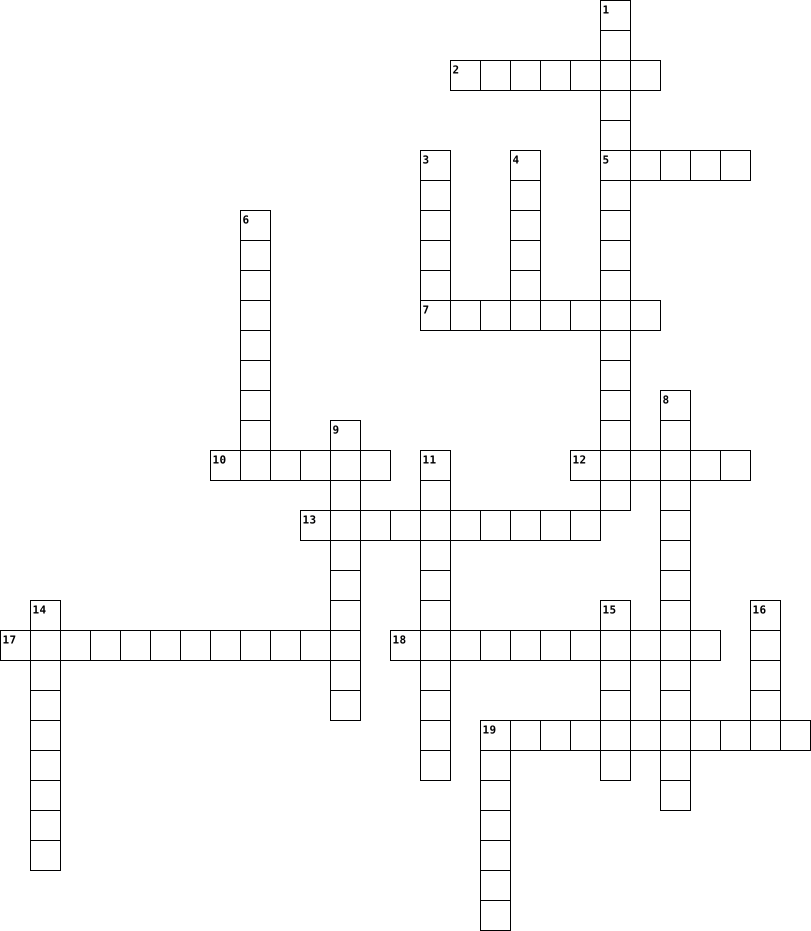
Across
- he discovered that the moon has craters.
- parties where people meet to discuss new ideas.
- he belived that the people should write the laws.
- a person who rules with absolute power.
- he discovered that the planets are ellipeses.
- the theory that the Earth is the center of the solar system
- the theory that the Sun is the center of the solar system.
- to know something one did not know before.
- the people who presented new ways of thinking during the enlightenment.
Down
- a system decision making power; it's designed to ensure that one person or group doesn't abuse its power.
- Who created the first vaccine for small pox?
- he invented the social contract.
- he came up with the geocentric theory.
- she fought for women's rights.
- his idea was that the Sun was the center of the solar system.
- He used the microscope and studied microorganisms.
- He developed analytical geometry.
- he invented Newtons 3 laws.
- who was the founder on modern chemistry?
- who also thought the Earth was centered too?
20 Clues: he invented Newtons 3 laws. • she fought for women's rights. • he invented the social contract. • He developed analytical geometry. • he came up with the geocentric theory. • a person who rules with absolute power. • he discovered that the moon has craters. • who was the founder on modern chemistry? • to know something one did not know before. • ...
p1 2023-04-16

Across
- Large, wild cat also known as a cougar or mountain lion
- Hard mineral often used in watches and electronic devices
- Physical, mental, and spiritual practice originating in ancient India
- Soft, luxurious fabric with a dense pile
- Graceful, fast running antelope found in Africa and Asia
- Large, hopping marsupial native to Australia
- Massive, ill fated passenger ship that sank in 1912
- Flat fish often served in restaurants as a delicacy
- Romantic ballroom dance originating in Argentina
Down
- Sixth planet from the sun in our solar system with a prominent ring system
- Black and white bear native to China
- Fourth planet from the sun and the second smallest planet in our solar system
- Burrowing marsupial with a sturdy build and short legs
- Dwarf planet that was formerly considered the ninth planet of our solar system
- Large bird of prey with a hooked beak and sharp talons
- Short message sent on Twitter
- Carnivorous mammal with a distinctive laugh like vocalization
- Desert plant with sharp spines and thick, fleshy stems
- State of uncertainty or neglect
- Genre of music originating in New Orleans
20 Clues: Short message sent on Twitter • State of uncertainty or neglect • Black and white bear native to China • Soft, luxurious fabric with a dense pile • Genre of music originating in New Orleans • Large, hopping marsupial native to Australia • Romantic ballroom dance originating in Argentina • Flat fish often served in restaurants as a delicacy • ...
p1 2023-04-17

Across
- Large, hopping marsupial native to Australia
- Fourth planet from the sun and the second smallest planet in our solar system
- Hard mineral often used in watches and electronic devices
- Carnivorous mammal with a distinctive laugh like vocalization
- Dwarf planet that was formerly considered the ninth planet of our solar system
- Desert plant with sharp spines and thick, fleshy stems
- Large, wild cat also known as a cougar or mountain lion
- Romantic ballroom dance originating in Argentina
- Large bird of prey with a hooked beak and sharp talons
Down
- Massive, ill fated passenger ship that sank in 1912
- Burrowing marsupial with a sturdy build and short legs
- Physical, mental, and spiritual practice originating in ancient India
- Genre of music originating in New Orleans
- Short message sent on Twitter
- Flat fish often served in restaurants as a delicacy
- State of uncertainty or neglect
- Graceful, fast running antelope found in Africa and Asia
- Soft, luxurious fabric with a dense pile
- Sixth planet from the sun in our solar system with a prominent ring system
- Black and white bear native to China
20 Clues: Short message sent on Twitter • State of uncertainty or neglect • Black and white bear native to China • Soft, luxurious fabric with a dense pile • Genre of music originating in New Orleans • Large, hopping marsupial native to Australia • Romantic ballroom dance originating in Argentina • Flat fish often served in restaurants as a delicacy • ...
Earth. Moon And Sun System 2022-04-18

Across
- The relative size of things
- eclipse When the Moon is completely dark
- A moon phase that looks like a full circle from Earth
- A moon outside our solar system
- A moon phase that looks like less than half a circle from Earth
- The shape of the illuminated part of the Moon as it appears from Earth
- The star that is the main source of light at the center of our solar system
- Something we observe to be similar over and over again
- A moon phase that looks like more than half a circle from Earth
- A moon phase that looks like a half-circle from Earth
- An object, diagram, or computer program that helps us understand something
Down
- system The sun, the planets that orbit the sun, and other objects that orbit the sun
- A rocky sphere that travels around a plane
- To shine light on an object and make it visible
- The amount of time it takes for a planet to complete one orbit around a star or stars
- A moon phase in which the Moon is not visible from Earth
- A planet outside our solar system
- The nearly circular path a smaller object travels around a larger object
- The border between light and dark on the Moon
19 Clues: The relative size of things • A moon outside our solar system • A planet outside our solar system • eclipse When the Moon is completely dark • A rocky sphere that travels around a plane • The border between light and dark on the Moon • To shine light on an object and make it visible • A moon phase that looks like a full circle from Earth • ...
Celestial Objects 2020-09-19

Across
- Source of light at night.
- The red planet.
- The 8th planet in the solar system.
- The 6th and most ringed planet.
- The planet closest to the sun.
- The dwarf planet.
- The primary source of light.
- The Planet we live in.
Down
- The celestial object made of frozen rock, gases, and dust
- The 7th planet in the solar system.
- The burning objects that is falling from the sky.
- The celestial object that twinkles in the sky.
- The celestials objects that fall from outer spaces and causes extinction of Dinosaurs.
- The hottest planet.
- The 5th and largest planet in the solar system.
15 Clues: The red planet. • The dwarf planet. • The hottest planet. • The Planet we live in. • Source of light at night. • The primary source of light. • The planet closest to the sun. • The 6th and most ringed planet. • The 7th planet in the solar system. • The 8th planet in the solar system. • The celestial object that twinkles in the sky. • The 5th and largest planet in the solar system. • ...
Space Crossword 2017-03-09

Across
- Has the highest mountains in the solar system
- The same size as Earth but spins the other way
- It can travel around the earth 7 times in 1 second
- Surname of the first man on the moon
- Our planet
- Our solar system(also a chocolate bar!)
- Its rings are made of ice
- It has the biggest moon
Down
- Controls the tides on earth
- The name of the country that launched the first man into space
- The most storms occur here
- Sucks up anything in its path
- Coldest planet in the solar system
- A ball of iron
- A ball of fire
15 Clues: Our planet • A ball of iron • A ball of fire • It has the biggest moon • Its rings are made of ice • The most storms occur here • Controls the tides on earth • Sucks up anything in its path • Coldest planet in the solar system • Surname of the first man on the moon • Our solar system(also a chocolate bar!) • Has the highest mountains in the solar system • ...
Space Crossword Puzzle 2024-04-18

Across
- Milky Way is our ______,
- Envelope of gas that surrounds a planet.
- _____ is a cloudy tail that orbits the sun.
- What is the coldest planet in the solar system?
- Debris that can come INTO Earth.
- What is the 2nd closest planet from the sun?
Down
- What is the largest planet in the solar system?
- What planet is most famous for its rings?
- What planet is the farthest from the sun?
- _____ belt is between Mars & Jupiter.
- What is the smallest planet?
- _____ is no longer considered a planet
- What star is in the center of the solar system?
- What orbits the Earth?
- What planet do we live on?
15 Clues: What orbits the Earth? • Milky Way is our ______, • What planet do we live on? • What is the smallest planet? • Debris that can come INTO Earth. • _____ belt is between Mars & Jupiter. • _____ is no longer considered a planet • Envelope of gas that surrounds a planet. • What planet is most famous for its rings? • What planet is the farthest from the sun? • ...
Space Crossword Puzzle 2024-04-18

Across
- Milky Way is our ______,
- Envelope of gas that surrounds a planet.
- _____ is a cloudy tail that orbits the sun.
- What is the coldest planet in the solar system?
- Debris that can come INTO Earth.
- What is the 2nd closest planet from the sun?
Down
- What is the largest planet in the solar system?
- What planet is most famous for its rings?
- What planet is the farthest from the sun?
- _____ belt is between Mars & Jupiter.
- What is the smallest planet?
- _____ is no longer considered a planet
- What star is in the center of the solar system?
- What orbits the Earth?
- What planet do we live on?
15 Clues: What orbits the Earth? • Milky Way is our ______, • What planet do we live on? • What is the smallest planet? • Debris that can come INTO Earth. • _____ belt is between Mars & Jupiter. • _____ is no longer considered a planet • Envelope of gas that surrounds a planet. • What planet is most famous for its rings? • What planet is the farthest from the sun? • ...
space 2023-06-08

Across
- the biggest planet in the solar system
- is known as "The Red Planet"
- its the furthest planet from the sun
- a planet too small to be considered a plant
- most planets have a sun and a ?
- a piece of rock smaller than an asteroid
- its known for its rings
Down
- is the hottest planet in the solar system
- what planet rotates on its side
- orbits the around the sun fully in 365 days
- all planets orbit around it
- what we see during meteor showers
- only planet with a heart
- is the smallest planet in the solar system
- lives on the asteroid belt
15 Clues: its known for its rings • only planet with a heart • lives on the asteroid belt • all planets orbit around it • is known as "The Red Planet" • what planet rotates on its side • most planets have a sun and a ? • what we see during meteor showers • its the furthest planet from the sun • the biggest planet in the solar system • a piece of rock smaller than an asteroid • ...
ASSA Game Zone 2022-10-14

Across
- What type of galaxy is the Milky way?
- A planet with no moons
- The closest star to the Earth apart from the Sun
- The largest moon of the solar system
- Who discovered the laws of planetary motion
- The Red planet
- The brightest star in the night sky
Down
- First man who stepped on the moon
- Visible part of the Sun
- Wavelengths observed by James Webb Space Telescope
- The largest volcano of the solar system
- A star which makes the Summer Triangle
- The planet with the Great Red Spot
- The name of our galaxy
- The hottest planet of the solar system
15 Clues: The Red planet • A planet with no moons • The name of our galaxy • Visible part of the Sun • First man who stepped on the moon • The planet with the Great Red Spot • The brightest star in the night sky • The largest moon of the solar system • What type of galaxy is the Milky way? • A star which makes the Summer Triangle • The hottest planet of the solar system • ...
Space 2023-10-02

Across
- The planet known for its rings
- Number of years for the Earth to rotate around the sun
- Planet closest to the sun
- Jupiter and Uranus are called ___ ______
- Our galaxy is called the _____ ___
- What shooting stars are called scientifically
- Objects in the galaxy too small to be considered planets
- The furthest planet from the sun
Down
- Force that keeps planets rotating around the sun
- The biggest planet in our solar system
- Pluto is a _____ ______
- First person to walk on the moon
- Number of planets in the solar system
- The Earth spins around its ____
- Hottest planet in our solar system
15 Clues: Pluto is a _____ ______ • Planet closest to the sun • The planet known for its rings • The Earth spins around its ____ • First person to walk on the moon • The furthest planet from the sun • Our galaxy is called the _____ ___ • Hottest planet in our solar system • Number of planets in the solar system • The biggest planet in our solar system • ...