
solar system Crossword Puzzles
Astronomy Review 2022-10-02

Across
- chemical reaction in the sun's core to create photons
- the movement of one object around another
- layer of the sun light comes from
- similar to mass but affected by gravity
- center of our solar system; most mass so most gravity
- a force that slows a falling object
- the direction the earth revolves the sun
- sun centered solar system
- cooler dark patches on the surface of the sun
Down
- if distance increases then gravity _____
- man who first studied gravity
- an invisible pull between two objects
- how much matter is in an object
- an inverse factor of gravity
- earth centered solar system
- the outside of an area affected by air
- if mass increases then gravity _____
- layer of the sun where the color comes from
18 Clues: sun centered solar system • earth centered solar system • an inverse factor of gravity • man who first studied gravity • how much matter is in an object • layer of the sun light comes from • a force that slows a falling object • if mass increases then gravity _____ • an invisible pull between two objects • the outside of an area affected by air • ...
The Solar System 2013-07-25

Across
- These planets have no hard surface
- These bodies are sometimes called shooting stars when they enter the Earth's atmosphere
- Large, round bodies in outer space that revolve around a star
- The sun and all of the objects that orbit around the sun
- Chunks of rock and metal in orbit around the sun
- small, frozen mass of dust and gas revolving around the sun
- 2/3 of this planet's surface is covered with water
- This is how long it takes the Earth to revolve around the Sun
- The biggest planet in the Solar System
- This planet has the most rings
Down
- This planet has a very thin atmosphere which makes it very, very cold
- This body orbits around the Earth but it does not rotate
- This is the imaginary line that runs and south that the Earth rotates on
- These planets have a solid surface made of rock
- This is the last of the gas planets and the furthest planet from the sun
- This is the smallest planet in our Solar System
- This planet is sometimes called the topsy-turvy planet because it spins on its side
- This planet has toxic carbon dioxide in it's atmosphere which makes it impossible for humans to survive in
18 Clues: This planet has the most rings • These planets have no hard surface • The biggest planet in the Solar System • These planets have a solid surface made of rock • This is the smallest planet in our Solar System • Chunks of rock and metal in orbit around the sun • 2/3 of this planet's surface is covered with water • This body orbits around the Earth but it does not rotate • ...
Our Solar System 2012-05-15

Across
- The most distant of the gas giants.
- Pluto, Charon, Eris, and Sedna are all icy dwarf planets found in this part of the outer solar system
- A short period comet that we can see ~ every 76 years.
- One of the largest of the asteroids. Was originally considered a planet.
- A moon of Pluto
- A dwarf planet that is one reason why Pluto is no longer a planet.
- A terrestrial planet with the thickest atmosphere.
Down
- One reason why Venus and Earth are warmer than they should be.
- The largest of the gas giants.
- A moon of Saturn that has the thickest atmosphere of any moon.
- Our moon.
- Useful for finding the relative age of a planet (or moon's) surface.
- A terrestrial planet with an extremely thin atmosphere. Some would say it hasn't got one.
- The rings of this gas giant were first observed by Galileo.
- A vast swarm of comets on the outskirts of our solar system.
- The fourth rock from the Sun.
- A moon of Jupiter that may have a liquid water ocean underneath its icy crust.
- A moon of Jupiter that has active volcanism.
18 Clues: Our moon. • A moon of Pluto • The fourth rock from the Sun. • The largest of the gas giants. • The most distant of the gas giants. • A moon of Jupiter that has active volcanism. • A terrestrial planet with the thickest atmosphere. • A short period comet that we can see ~ every 76 years. • The rings of this gas giant were first observed by Galileo. • ...
The Solar System 2012-12-04

Across
- How many moons does mars have?
- Approximately how old is the Universe?
- Which scientists played a major role in overturning the ancient idea of an Earth-centered universe?
- Belt What is it called that has a region of the solar system beginning just beyond the orbit of neptune and contains many icy comets?
- What plant other than earth has been visited by the largest number of robotic spacecraft?
- Once considered a plant, but its now a dwarf plant?
- What is it called that has a trillion or so comets thought to orbit the sun at great distances?
- Rocky space object of varying size?
- and Helium What is the sun mainly made of?
- What is earth's moon called?
Down
- The average distance of Earth from the Sun is called a/an _____________.
- The Huge space which contains all of the matter and energy in existence?
- What has the Similar character to mar's moon?
- The Third closest plant to the sun?
- and Einstein
- The Smallest Plant in our solar system?
- A force that pulls you towards the center of a plant?
- Mar's has the biggest____in the solar system?
18 Clues: and Einstein • What is earth's moon called? • How many moons does mars have? • The Third closest plant to the sun? • Rocky space object of varying size? • Approximately how old is the Universe? • The Smallest Plant in our solar system? • and Helium What is the sun mainly made of? • What has the Similar character to mar's moon? • Mar's has the biggest____in the solar system? • ...
The Solar System 2014-11-05

Across
- the sideways planet that is made of chemicals
- center of the solar system
- has a giant canyon longer than the distance across the USA
- a large space rock
- narrow rings circle around this planet
- the air around a planet
- the planet closest to the sun
- a ball of ice
- a path in the solar system
Down
- orange and white clouds travel around this planet
- the force that attracts all objects to another
- nearly as large as earth
- the blue planet
- bounces off the moon and makes the moon look white in color
- scientists who study objects in space
- known as the lost planet because it is very far away
- the planet we live on
- has a crater called Copernicus
18 Clues: a ball of ice • the blue planet • a large space rock • the planet we live on • the air around a planet • nearly as large as earth • center of the solar system • a path in the solar system • the planet closest to the sun • has a crater called Copernicus • scientists who study objects in space • narrow rings circle around this planet • the sideways planet that is made of chemicals • ...
The solar system 2022-12-15

Across
- The biggest satellite of the Earth
- The Asteroid ... is between Mars and Jupiter
- It is a red planet
- It has very strong winds
- Mercury is the same ... as Earth's satellite
- The ... mountain of the Solar System is on Mars
- Mars is red because its rocks contain ...
- Pluto is the biggest ... planet
- Neptune is the ... planet from the Sun
Down
- Venus is the second planet from the ...
- Neptune is the ... planet
- The sixthe planet from the Sun
- It is similar in size to the Earth, but it spins the other way
- Pluto is the ... dwarf planet
- Mars is red and it has the highest ... of the Solar System
- One Moon year is 29 ... years.
- It is hotter than Mercury
- Mars is about ... the size of the Earth
- The Asteroid belt is made of dust, ...,stone and metal
19 Clues: It is a red planet • It has very strong winds • Neptune is the ... planet • It is hotter than Mercury • Pluto is the ... dwarf planet • The sixthe planet from the Sun • One Moon year is 29 ... years. • Pluto is the biggest ... planet • The biggest satellite of the Earth • Neptune is the ... planet from the Sun • Venus is the second planet from the ... • ...
The Solar System 2017-11-27
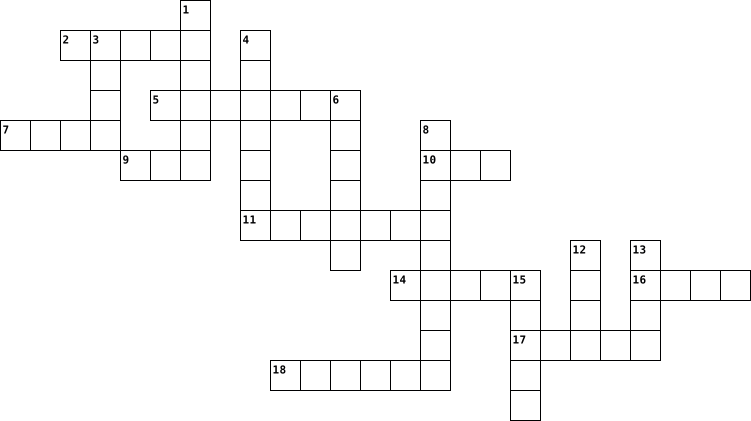
Across
- The furthest planet from the Sun?
- The closest planet to the Sun?
- the number of planets in our solar sytem?
- the sun is a huge ball of hot g___
- This is at the centre of the solar system (s___)
- The planets r_____ around the sun
- Energy from the sun is called s____ energy
- Clouds of dust and ice (O___)
- the largest Asteroid (C___)
- The outer 4 planets are called gas g____
Down
- We see c____ as they pass through our solar system
- Without the suns energy there would be no l____ on earth
- the sun's energy comes from n___ fusion reactions
- the colour of the sun
- Hundreds of large rocks found between mars and Jupiter
- the sun is a type of s______
- The names for the planets are G___ from ancient Greece or Rome.
- The 4 closest planets are called r_____ planets
18 Clues: the colour of the sun • the largest Asteroid (C___) • the sun is a type of s______ • Clouds of dust and ice (O___) • The closest planet to the Sun? • The furthest planet from the Sun? • The planets r_____ around the sun • the sun is a huge ball of hot g___ • The outer 4 planets are called gas g____ • the number of planets in our solar sytem? • ...
The solar system 2018-06-07

Across
- The area of gases and dust that form around a comet as it passes by the Sun.
- A very small star that does not shine brightly.
- The second closest planet to the Sun.
- An instrument used to view objects in outer space.
- The American spelling of plough.
- A very large cloud of dust and gas that exists in outer space.
- A bright object in space that has a tail of gas and dust.
- Wind A stream of charged particles that is constantly flowing from the Sun.
Down
- Any other planet.
- A dark area on the Sun caused by cooling from electromagnetic activity within the Sun.
- The path a celestial object takes around a star or planet.
- A natural or artificial object that is in orbit around a planet.
- A spiral galaxy where our Solar System and Earth are located.
- A person who is specially trained to travel into outer space.
- The furthest planet from the Sun until it was demoted from a planet to a dwarf planet in 2006.
- The large group of stars and planets that the Earth and our sun are part of.
- The fifth largest planet in the Solar System and third from the Sun.
- Any very bright star, especially one that a planet travels round.
18 Clues: Any other planet. • The American spelling of plough. • The second closest planet to the Sun. • A very small star that does not shine brightly. • An instrument used to view objects in outer space. • A bright object in space that has a tail of gas and dust. • The path a celestial object takes around a star or planet. • ...
Solar System Crossward 2024-01-30

Across
- cloud Big collection of gas and dust drifting between stars
- planets named for their resemblance to Jupiter
- Distant worlds
- planets Jupiter, Saturn, Uranus, Neptune
- system where the planets circle each other in orbit
- nebula theory The solar system originated from a ____cloud
- Limit a planet with 2.44 planetary radii
- belt Rocky metallic bodies circling together in orbit
- giants Neptune and Uranus are____giants
- giants Jupiter and Saturn are_____giants.
Down
- It’s not precipitation but it’s___
- planet A fake planet
- A planet MUCH bigger than earth
- Grains tiny dust particles made of heavier elements such as carbon, oxygen, or silicon.
- great red spot The most popular part about jupiter
- not a asteroid or meteor, but a ___
- planets named for their resemblance to earth.
- Not a comet but an____
- planets Mercury, Venus, Earth, Mars.
- another word for pass or move
20 Clues: Distant worlds • Not a comet but an____ • another word for pass or move • A planet MUCH bigger than earth • It’s not precipitation but it’s___ • not a asteroid or meteor, but a ___ • planet A fake planet • planets Mercury, Venus, Earth, Mars. • planets Jupiter, Saturn, Uranus, Neptune • planets named for their resemblance to earth. • ...
Solar System Stuff 2023-10-23

Across
- planets made of rocks and metals
- a belt, band, or strip of earth material
- a small interstellar body moving in the solar system
- A Meteoroid that passes thru earths atmosphere
- a minute planet
- The section oustsied the orbit of neptune
- also known as (LMH)
- Almost considered a planet
- planets mostly of hydrogen and helium
Down
- opposite movement
- Meteors that radiate from one point in the sky
- non circular
- Distance from earth to sun
- When a meteor survives thru the earths atmosphere and lands
- A Cliff
- A zone of earths crust affected by orogeny
- has a "head" and a "tail"
- oval shape with two foci
18 Clues: A Cliff • non circular • a minute planet • opposite movement • also known as (LMH) • oval shape with two foci • has a "head" and a "tail" • Distance from earth to sun • Almost considered a planet • planets made of rocks and metals • planets mostly of hydrogen and helium • a belt, band, or strip of earth material • The section oustsied the orbit of neptune • ...
solar system crossword 2024-08-30

Across
- the average distance between Earth and the Sun
- the path that an object with mass in motion follows through space as a function of time.
- a line segment that is at right angles with the semi-major axis and has one end at the center of the conic section
- any object that orbits a planet, star, or moon
- an invisible line around which an object rotates, or spins.
- the longest semidiameter or one half of the major axis
- A measure of the deviation of an elliptical path, especially an orbit, from a perfect circle
- the circular movement of an object around a central line
Down
- the proportionality constant connecting the gravitational force between two bodies with the product of their masses and the inverse square of their distance.
- a point of convergence of light or other electromagnetic radiation, particles, sound waves, etc, or a point from which they appear to diverge
- A closed curve consisting of points whose distances from each of two fixed points all add up to the same value
- the curved path of a celestial object or spacecraft around a star, planet, or moon, especially a periodic elliptical revolution.
- The motion of an object around a point, especially around another object or a center of mass.
- the force that pulls two masses toward each other.
- the interval of time it takes for a motion to repeat.
- a mixture of gases that surrounds the Earth
- the point in the orbit of a planet, comet or other body most distant from the Sun.
- the point in the orbit of a planet or other astronomical body, at which it is closest to the sun.
18 Clues: a mixture of gases that surrounds the Earth • the average distance between Earth and the Sun • any object that orbits a planet, star, or moon • the force that pulls two masses toward each other. • the interval of time it takes for a motion to repeat. • the longest semidiameter or one half of the major axis • the circular movement of an object around a central line • ...
The solar system 2025-09-12

Across
- – What we see when we look up outside.
- – The way something goes around a planet or the sun.
- – A space rock with a tail that moves across the sky.
- – A big group of stars and planets.
- – A person who goes to space.
- – The big light in the sky that keeps us warm.
- – A rock that falls from space and burns in the sky.
- – A hard hat astronauts wear in space.
- – All the stars, planets, and space.
Down
- – Special clothes for astronauts in space.
- – The big dark place with stars and planets.
- – What pulls things down to the ground.
- – A fast machine that flies to space.
- – A tool that helps us see far things in space.
- – When a rocket goes up into space.
- – A tiny light in the sky, very far away.
- – A vehicle that carries people into space.
- – A round rock in the sky we see at night.
18 Clues: – A person who goes to space. • – A big group of stars and planets. • – When a rocket goes up into space. • – All the stars, planets, and space. • – A fast machine that flies to space. • – What we see when we look up outside. • – A hard hat astronauts wear in space. • – What pulls things down to the ground. • – A tiny light in the sky, very far away. • ...
Planets 2018-06-04

Across
- A meteoroid that has entered the Earth's atmosphere is called
- Third planet from the sun.
- A giant ball of hot gas and plasma that generates huge amounts of energy through nuclear fusion.
- A person who is specially trained to travel into outer space.
- The galaxy that contains the Solar System.
- the third largest planet in the Solar System and seventh planet from the Sun.
- A huge explosion caused when a star collapses on itself.
- The largest planet in our solar system.
Down
- The path a celestial object takes around a star or planet.
- Closest planet to the sun.
- The hotest planet in the solar system.
- A large group of stars, dust, gas and dark matter held together by gravity.
- An envelope of gases that surround a planet.
- An instrument used to view objects in outer space.
- a natural satellite which orbits the Earth or any other planet.
15 Clues: Closest planet to the sun. • Third planet from the sun. • The hotest planet in the solar system. • The largest planet in our solar system. • The galaxy that contains the Solar System. • An envelope of gases that surround a planet. • An instrument used to view objects in outer space. • A huge explosion caused when a star collapses on itself. • ...
Solar system crossword puzzle. 2024-04-21

Across
- This planet is the color blue because of the methane in the atmosphere.
- Has 8 phases and rotates around the Earth.
- Saturn's larger moon.
- The farthest planet from the Sun.
- The first and smallest planet in our solar system.
- Has a huge storm, which is a big red spot on the planet.
Down
- This planet has 146 moons.
- Once one of the main planets, but later became a dwarf planet.
- This planet once had water, oceans, lakes, and rivers.
- The only planet in our solar system that has life.
- Belt, The section which separates the inner and outer planets.
- system, Has eight main planets and a star in the center that all the planets go around.
- The second planet from the sun.
- The star at the center of our solar system.
- Way, The galaxy the we live in.
15 Clues: Saturn's larger moon. • This planet has 146 moons. • The second planet from the sun. • Way, The galaxy the we live in. • The farthest planet from the Sun. • Has 8 phases and rotates around the Earth. • The star at the center of our solar system. • The only planet in our solar system that has life. • The first and smallest planet in our solar system. • ...
Henry's Space Crossword 2021-12-20

Across
- Which animal was the first to go into space?
- Which country were the first to send a man into space?
- Which planet is known as the Red Planet?
- Which of the planets is no longer a planet?
- How many planets are in the Solar System?
- What country was the first man on the moon from?
- Which is the hottest planet in the solar system?
- What is the study of the stars, planets, and galaxies?
Down
- The smallest planet in our solar system.
- What's the name of the force that stops us floating away from earth?
- Which planet in our solar system is the biggest?
- Which cat would make the best astronaut?
- What has an incredibly strong gravitational pull that light can’t even escape?
- Which planet has rings around it?
- Einstein discovered a lot about the universe but what was his first name?
15 Clues: Which planet has rings around it? • The smallest planet in our solar system. • Which planet is known as the Red Planet? • Which cat would make the best astronaut? • How many planets are in the Solar System? • Which of the planets is no longer a planet? • Which animal was the first to go into space? • Which planet in our solar system is the biggest? • ...
Our Solar System 2022-10-07

Across
- ______is known as the morning or evening star.
- _____ is the most famous KPO.
- The path that a planet takes as it moves around the Sun is called a/an _____.
- The _____ planets are made up of gaseous surfaces.
- ______ is the coldest planet in our solar system.
- An invisible force that pulls objects towards each other.
- The ring of rocky bodies found between Mar’s and Jupiter’s orbit is known as the _____ belt.
- The ______ belt is a ring of icy bodies or objects found just outside of Neptune’s orbit.
- ______is the second largest planet in our solar system.
Down
- Our solar system is _____ in shape.
- The name of Earth’s natural satellite is called the _____.
- The _____is the most distant region of our solar system.
- The _____ planets are made up of solid surfaces.
- _____ is the planet that is usually tilted sideways.
- The largest objects that orbit the Sun are called _______.
15 Clues: _____ is the most famous KPO. • Our solar system is _____ in shape. • ______is known as the morning or evening star. • The _____ planets are made up of solid surfaces. • ______ is the coldest planet in our solar system. • The _____ planets are made up of gaseous surfaces. • _____ is the planet that is usually tilted sideways. • ...
Planets 2019-04-26

Across
- Contains our solar system
- Largest moon in our solar system.
- Has a Nickel/ Iron core.
- Neptune's biggest moon
- Moon that will one day be torn apart by gravitational forces and become a ring around Mars.
- A day on the surface planet is equivalent to 176 days on Earth.
- Surface temperature on this planet can reach 471 degrees Celsius (about 879 Degrees Fahrenheit.)
- The first planet to be discovered by the use of a telescope.
- Moon that is made of ice but has ice canyons, terraces and other strange surfaces.
Down
- Moon made of Nitrogen. Mainly composed of water, ice and rocks
- Will collide with the Milky Way in 4.5 billion years.
- Has the largest dust storms in the solar system.
- This planet is made of hydrogen, helium and some methane gases.
- Fifth brightest object in solar system. Can be seen with the naked eye.
- Orbits the sun every 11.8 Earth Years.
15 Clues: Neptune's biggest moon • Has a Nickel/ Iron core. • Contains our solar system • Largest moon in our solar system. • Orbits the sun every 11.8 Earth Years. • Has the largest dust storms in the solar system. • Will collide with the Milky Way in 4.5 billion years. • The first planet to be discovered by the use of a telescope. • ...
Planets and Our Solar System 2023-11-20

Across
- The abbreviation of National Aeronautics and Space Administration
- This planet is the brightest and hottest planet in the solar system
- This planet looks like our moon and is closest planet to the sun
- The farthest planet in the solar system that is the bluest
- This planet has many rings and is named after the Roman God of Agriculture and Wealth
- The abbreviation of the Circumstellar Habitable Zone
- Large bodies made mostly of gases like hydrogen and helium
- The first gas giant in the solar system
- The coldest planet in the solar system
Down
- The sun and everything that revolves around it
- Similar to the Asteroid Belt but 20% larger and 200x more massive
- Rocky, mineral filled Earth like planets
- This planet has 71% of its surface covered in water
- A collection of space debris, asteroids and ice chunks
- The nickname for this planet is the "Red Planet" due to iron oxide
15 Clues: The coldest planet in the solar system • The first gas giant in the solar system • Rocky, mineral filled Earth like planets • The sun and everything that revolves around it • This planet has 71% of its surface covered in water • The abbreviation of the Circumstellar Habitable Zone • A collection of space debris, asteroids and ice chunks • ...
Solar system crossword puzzle. 2024-04-21

Across
- This planet is the color blue because of the methane in the atmosphere.
- Has 8 phases and rotates around the Earth.
- Saturn's larger moon.
- The farthest planet from the Sun.
- The first and smallest planet in our solar system.
- Has a huge storm, which is a big red spot on the planet.
Down
- This planet has 146 moons.
- Once one of the main planets, but later became a dwarf planet.
- This planet once had water, oceans, lakes, and rivers.
- The only planet in our solar system that has life.
- Belt, The section which separates the inner and outer planets.
- system, Has eight main planets and a star in the center that all the planets go around.
- The second planet from the sun.
- The star at the center of our solar system.
- Way, The galaxy the we live in.
15 Clues: Saturn's larger moon. • This planet has 146 moons. • The second planet from the sun. • Way, The galaxy the we live in. • The farthest planet from the Sun. • Has 8 phases and rotates around the Earth. • The star at the center of our solar system. • The only planet in our solar system that has life. • The first and smallest planet in our solar system. • ...
The Origin and Structure of the Earth 2025-07-14

Across
- The star at the center of our solar system.
- A belief that the universe was created by a divine being.
- A theory that many universes exist beyond our own.
- A theory that the universe goes through cycles of expansion and contraction.
- The third planet from the Sun; our home.
Down
- The totality of space, time, matter, and energy.
- Giants Large planets made mostly of gas, like Jupiter and Saturn.
- An outdated theory that says the universe is unchanging.
- The layer of gases surrounding a planet.
- The most widely accepted theory of how the universe began.
- Massive systems of stars, gas, and dust, like the Milky Way.
- Way The galaxy that contains our solar system.
- The largest planet in our solar system.
- System A group of planets and celestial bodies orbiting a star.
- Planets made mostly of rock, like Earth and Mars.
15 Clues: The largest planet in our solar system. • The layer of gases surrounding a planet. • The third planet from the Sun; our home. • The star at the center of our solar system. • Way The galaxy that contains our solar system. • The totality of space, time, matter, and energy. • Planets made mostly of rock, like Earth and Mars. • ...
Solar system crossword puzzle. 2024-04-21

Across
- This planet is the color blue because of the methane in the atmosphere.
- Has 8 phases and rotates around the Earth.
- Saturn's larger moon.
- The farthest planet from the Sun.
- The first and smallest planet in our solar system.
- Has a huge storm, which is a big red spot on the planet.
Down
- This planet has 146 moons.
- Once one of the main planets, but later became a dwarf planet.
- This planet once had water, oceans, lakes, and rivers.
- The only planet in our solar system that has life.
- Belt, The section which separates the inner and outer planets.
- system, Has eight main planets and a star in the center that all the planets go around.
- The second planet from the sun.
- The star at the center of our solar system.
- Way, The galaxy the we live in.
15 Clues: Saturn's larger moon. • This planet has 146 moons. • The second planet from the sun. • Way, The galaxy the we live in. • The farthest planet from the Sun. • Has 8 phases and rotates around the Earth. • The star at the center of our solar system. • The only planet in our solar system that has life. • The first and smallest planet in our solar system. • ...
Ask Me about Space 2026-03-15

Across
- a group of stars that make a picture
- the red planet
- an invisible part of space that can only be seen by the swirling disc of gas, stars, and light around it
- special clothes that keep space travelers alive and safe
- the brightest planet in our solar system
Down
- people who travel into space
- a planet in our solar system that is surrounded by rings
- a piece of equipment we can use to see into and take pictures of space
- the name of the galaxy we live in
- a giant ball of ice and dust that seems to have a tail
- the third planet from the Sun
- the path something takes to go around a planet or star
- holes made by space rocks that are all over the moon
- the fastest planet in our solar system
- the largest planet in our solar system
15 Clues: the red planet • people who travel into space • the third planet from the Sun • the name of the galaxy we live in • a group of stars that make a picture • the fastest planet in our solar system • the largest planet in our solar system • the brightest planet in our solar system • holes made by space rocks that are all over the moon • ...
SPACE 2022-12-12

Across
- The first planet we think of with rings
- Saturn has ______ moons
- People use ______ to get to space
- The rock that orbits Earth
- The hottest planet
- The bright star in our solar system
- The red planet we could move to
- The biggest planet
- Some people think these might be real
Down
- The bright things we see every night
- The holes that suck up everything
- All the planets and stars are in the ______
- What do you call people that go into space?
- The last planet in our solar system
- The planet that lies on its side
- The first planet in our solar system
- The place where we are
- The planet that is not a planet and its name is Otulp backwards
18 Clues: The hottest planet • The biggest planet • The place where we are • Saturn has ______ moons • The rock that orbits Earth • The red planet we could move to • The planet that lies on its side • The holes that suck up everything • People use ______ to get to space • The last planet in our solar system • The bright star in our solar system • The bright things we see every night • ...
Celestial Crosswords: Lunar Edition 2023-07-03

Across
- Discovered by Giovanni Cassini in 1672, its the first moon in the Solar System to have rings discovered around it
- The egg-shaped moon that orbits Saturn having a mean radius of just 1 mile
- Has a crust of frozen nitrogen; Io, Venus and this moon are the only bodies besides the earth to have volcanic activity at present
- The water particles ejected from the cryo-volcanoes of this moon form the 2nd outermost ring of Saturn
- The "Frankenstein moon" of Uranus
- A faint inner moon of Uranus, named after the roman god of love
- A potato-shaped moon, tends to disrupt Saturn's F ring
- Being in a co-orbital condition with its sister moon Janus, this moon switches orbits with Janus every 4 years
- The largest moon in the solar system relative to its parent body
- One of the inner moons of Saturn orbiting in Saturn's A ring; Shaped like a flying saucer or a ravioli
- The double-lobed moon of Pluto
- The farthest orbiting moon of any planet in the Solar System
- The only moon in the solar system that has its own magnetic field
- Named after the guardian of the land of the fire in Norse mythology
- Orbits in the keeler gap of Saturn's rings, its known as the wavemaker moon causing ripples to form in the rings of Saturn
Down
- Named after the nine-headed venomous snake monster in Chinese mythology, the only moon of the dwarf planet Gonggong
- Being 1/4th of the Earth's diameter, this moon's 60-150 Km deep ocean may contain twice the amount of water as on the Earth
- The closest moon of Uranus, is a shepherd moon that keeps the particles of the epsilon ring contained
- Uranus' largest moon, named after the queen of fairies in William Shakespeare's "A Midsummer Night's Dream"
- The first non-round moon to be discovered
- The largest member of a 16 moon group which formed from a captured asteroid which broke off into the 16 pieces in a collision
- Most cratered moon in the solar system
- The reddest object in the solar system and appears to give out more heat than it receives from the Sun
- One of the darkest moons in the Solar System; Shares it's name with one of the main characters of "Friends"
- Also known as the Yin and Yang moon, where one side of the moon is bright and the other is dark
- Has a crater(Stickney) half its size and is expected to crash into its planet in about 50 million years
- A leafy vegetable
- Taking 360 days to complete one orbit around Neptune, it has the most eccentric orbit of any moon in the Solar System
- Closest moon of Saturn, has a giant impact crater which makes the moon look like the Death star from "Star Wars"
29 Clues: A leafy vegetable • The double-lobed moon of Pluto • The "Frankenstein moon" of Uranus • Most cratered moon in the solar system • The first non-round moon to be discovered • A potato-shaped moon, tends to disrupt Saturn's F ring • The farthest orbiting moon of any planet in the Solar System • A faint inner moon of Uranus, named after the roman god of love • ...
Astronomy Crossword Puzzle 2021-12-17

Across
- What is the smallest planet in our solar system?
- What planet has a moon named Titan?
- Which planet is the brightest in the night sky?
- What planet in our solar system rotates the sun on it’s side?
- What force keeps the planets in orbit around the sun?
- What is the largest moon in our solar system?
Down
- What is the brightest star in the sky?
- What is the outermost layer on the sun called?
- What is the name of the largest constellation in the sky?
- There are more ___ on earth than stars in the milky way.
- What candy bar has the same name as a galaxy?
- What is the biggest planet in our solar system?
- What planet rains diamonds?
- What planet is also known as the Red Planet
14 Clues: What planet rains diamonds? • What planet has a moon named Titan? • What is the brightest star in the sky? • What planet is also known as the Red Planet • What candy bar has the same name as a galaxy? • What is the largest moon in our solar system? • What is the outermost layer on the sun called? • Which planet is the brightest in the night sky? • ...
Space history and Solar bodies 2022-05-12

Across
- What the universe started with
- electrons attached to this
- this type of planet is giant and has no solid surface
- One of the biggest planets in our solar system with a ring
- One of the smallest planets in our solar system and the closest to the sun
- what end up turning into planets after gaining mass
- This forms from dust gas and ice because of gravity
Down
- creates a large amount of energy and makes new elements
- the catalyst for nearly everything in space
- the debris that doesnt turn into a planet
- has the longest orbit in our solar system
- these form after gas clouds condense and gravitate too each other
- electrons attached to this
- Has the shortest day in earth hours in the solar system
- E = ?c^2
15 Clues: E = ?c^2 • electrons attached to this • electrons attached to this • What the universe started with • the debris that doesnt turn into a planet • has the longest orbit in our solar system • the catalyst for nearly everything in space • what end up turning into planets after gaining mass • This forms from dust gas and ice because of gravity • ...
Space history and Solar bodies 2022-05-12

Across
- What the universe started with
- electrons attached to this
- this type of planet is giant and has no solid surface
- One of the biggest planets in our solar system with a ring
- One of the smallest planets in our solar system and the closest to the sun
- what end up turning into planets after gaining mass
- This forms from dust gas and ice because of gravity
Down
- creates a large amount of energy and makes new elements
- the catalyst for nearly everything in space
- the debris that doesnt turn into a planet
- has the longest orbit in our solar system
- these form after gas clouds condense and gravitate too each other
- electrons attached to this
- Has the shortest day in earth hours in the solar system
- E = ?c^2
15 Clues: E = ?c^2 • electrons attached to this • electrons attached to this • What the universe started with • the debris that doesnt turn into a planet • has the longest orbit in our solar system • the catalyst for nearly everything in space • what end up turning into planets after gaining mass • This forms from dust gas and ice because of gravity • ...
Planets 2018-06-04

Across
- a natural satellite which orbits the Earth or any other planet.
- the third largest planet in the Solar System and seventh planet from the Sun.
- Closest planet to the sun.
- Third planet from the sun.
- A giant ball of hot gas and plasma that generates huge amounts of energy through nuclear fusion.
- The path a celestial object takes around a star or planet.
- An envelope of gases that surround a planet.
- A huge explosion caused when a star collapses on itself.
Down
- The hotest planet in the solar system.
- A large group of stars, dust, gas and dark matter held together by gravity.
- An instrument used to view objects in outer space.
- A person who is specially trained to travel into outer space.
- The largest planet in our solar system.
- Way The galaxy that contains the Solar System.
- A meteoroid that has entered the Earth's atmosphere is called
15 Clues: Closest planet to the sun. • Third planet from the sun. • The hotest planet in the solar system. • The largest planet in our solar system. • An envelope of gases that surround a planet. • Way The galaxy that contains the Solar System. • An instrument used to view objects in outer space. • A huge explosion caused when a star collapses on itself. • ...
Outer Space 2026-02-13

Across
- A small icy body that orbits the Sun and forms a tail near it.
- The second planet from the Sun known for extreme heat.
- A planet known as the "Red Planet."
- A group of stars that form a pattern in the sky.
- The path a planet takes around the Sun.
- The closest planet to the Sun in our solar system.
Down
- The largest planet in our solar system.
- The galaxy that contains our solar system.
- A spacecraft that orbits Earth and is used for communication and weather observation.
- The natural satellite of Earth.
- A large planet known for its rings.
- The star at the center of our solar system.
- The planet we live on.
- The natural satellite that revolves around Earth.
14 Clues: The planet we live on. • The natural satellite of Earth. • A planet known as the "Red Planet." • A large planet known for its rings. • The largest planet in our solar system. • The path a planet takes around the Sun. • The galaxy that contains our solar system. • The star at the center of our solar system. • A group of stars that form a pattern in the sky. • ...
Celestial Crosswords: Lunar Edition 2023-07-21

Across
- Orbits in the keeler gap of Saturn's rings, its known as the wavemaker moon causing ripples to form in the rings of Saturn
- The egg-shaped moon that orbits Saturn having a mean radius of just 1 mile
- Taking 360 days to complete one orbit around Neptune, it has the most eccentric orbit of any moon in the solar system
- Uranus' largest moon, named after the queen of fairies in William Shakespeare's "A midnight summer night's dream"
- A faint inner moon of Uranus, named after the roman god of love
- Most cratered moon in the solar system
- The reddest object in the solar system and appears to give out more heat than it recieves from the sun
- Named after the nine-headed venomous snake monster in Chinese mythology, the only moon of the dwarf planet Gonggong.
- A potato-shaped moon, tends to disrupt Saturn's F ring
- Named after the guardian of the land of the fire in Norse mythology
- One of the inner moons of Saturn orbiting in saturn's A ring; Shaped like a flying saucer or a ravioli
- The first non-round moon to be discovered
- The water particles ejected from the cryo-volcanoes of this moon form the 2nd outermost ring of Saturn
- The double-lobed moon of Pluto
- The closest moon of Uranus; is a shepherd moon that keeps the particles of the epsilon ring contained
Down
- One of the darkest moons in the solar system;Shares its name with one of the main characters of the TV show "Friends"
- The "Frankenstein moon" of Uranus
- Being 1/4th of the earth's diameter, this moon's 60-150 km deep ocean may contain twice the amount of water as on the Earth
- Being in a co-orbital condition with its sister moon Janus, this moon switches orbits with Janus every 4 Earth years
- Also known as the Yin and Yang moon, where one side of the moon is bright and the other is dark
- Closest moon of Saturn, has a giant impact crater which makes the moon look like the Death star from "Star Wars"
- The largest moon in the solar system relative to its parent body
- The largest member of a 16 moon group which formed from a captured asteroid which broke off into the 16 pieces in a collision
- Having a crust of frozen nitrogen; Io, Venus and this moon are the only bodies besides the earth to have volcanic activity at present
- The only moon in the solar system that has its own magnetic field
- The farthest orbiting moon of any planet in the solar system
- Discovered by Giovanni Cassini in 1672, its the first moon in the solar system to have rings discovered around it
- Has a crater(Stickney) half its size and is expected to crash into its planet in about 50 million years
- A leafy vegetable
29 Clues: A leafy vegetable • The double-lobed moon of Pluto • The "Frankenstein moon" of Uranus • Most cratered moon in the solar system • The first non-round moon to be discovered • A potato-shaped moon, tends to disrupt Saturn's F ring • The farthest orbiting moon of any planet in the solar system • A faint inner moon of Uranus, named after the roman god of love • ...
Unit 1 Test Review - Our Solar System & Beyond 2020-10-23

Across
- the 3rd planet from the Sun
- everything we know of exists within this (the largest scale)
- a theory which attempts to explain the formation of the universe as starting from an explosion from a singular point and everything continued to expand out at a rapid rate
- a key piece of evidence used to support the Big Bang theory
- supported the idea of the geocentric model of the solar system
- the farthest region where some comets originate from
- _________ planets is another name given to the inner planets (made of solid rock)
- the science of the study of space and beyond
- the next biggest thing we know of within our solar system after the planets (we have one that orbits us)
- the next biggest thing we know of within our solar system (our sun is the closest we can see)
- what an object is made up of
- The streak of light seen when a space rock enters the atmosphere and starts burning. Also known as a “falling star” or “shooting star”.
- ________ planets are Jupiter, Saturn, Uranus, and Neptune (farthest from the Sun)
- first introduced the idea of the Big Bang theory
- ________ planets are the outer planets which are made of mostly gas and have an icy core
- the most popular asteroid because it’s the largest (so large and unique that it’s called a dwarf planet)
- ________ planets are Mercury, Venus, Earth, and Mars (closest to the Sun)
- the 8th planet from the Sun
- where a planet completely orbits the sun (determines the length of its year)
- next biggest thing we know of within our universe (a large group of stars and matter bound together by gravity)
- an object completely moves around a center point due to their gravitational attraction (can be circular or elliptical)
- the 4th planet from the Sun
- first proposed the geocentric model of the solar system
- the name of our galaxy
- the 2nd planet from the Sun
- where a planet spins on its axis (determines the length of its day)
- model of the solar system where Sun is the center (second model and proven correct)
Down
- an object located in outer space (outside of Earth’s atmosphere)
- Large rocks leftover from the formation of our solar system. They are generally in orbit between Mars and Jupiter, but sometimes get bounced towards Earth.
- we live on a ________ arm of of galaxy
- a force that brings objects with mass towards each other (pulled together by attraction)
- next biggest thing we know of within our galaxy (our sun being orbited by our planets)
- the name of the arm that we live on within our galaxy
- the 7th planet from the Sun
- model of the solar system where Earth is the center (original/first model and proven incorrect)
- the 5th planet from the Sun
- a type of rotation of a planet in which it rotates in the opposite direction of the majority of the planets within our solar system (2 of our planets do this)
- the 6th planet from the Sun
- A chunk of ice and rock originating from the outer solar system (Oort cloud and/or Kuiper Belt) and often accompanied by a coma and a tail.
- A space rock bigger than a dust grain but smaller than an asteroid. Most are a result of asteroid collision and comet debris but haven’t entered Earth’s atmosphere.
- the beginning, or starting point of something
- the most popular comet to us because it’s the only one we can see every 75-76 years from Earth (the shortest orbiting comet)
- A piece of rock that doesn’t entirely burn up when moving through Earth’s atmosphere and lands on Earth’s surface.
- the weight of an object due to what (or how much) “stuff” it is made up of
- the closest planet to the Sun
- an object in motion stays in motion and an object a rest stays at rest unless acted upon by a force
- where asteroids orbit the Sun
- proposed the heliocentric model of the solar system
- the closest region where some comets originate from
- the next biggest thing we know of within our solar system after the Sun (we have 8 of these and live on one of them)
- ________ planets is another name given to the gas giant planets
- confirmed the heliocentric model of the solar system with his telescope invention (his invention also helped support evidence for the Big Bang theory)
52 Clues: the name of our galaxy • the 3rd planet from the Sun • the 7th planet from the Sun • the 5th planet from the Sun • the 6th planet from the Sun • the 8th planet from the Sun • the 4th planet from the Sun • the 2nd planet from the Sun • what an object is made up of • the closest planet to the Sun • where asteroids orbit the Sun • we live on a ________ arm of of galaxy • ...
Unit 1 Test Review - Our Solar System & Beyond 2020-10-23

Across
- the 3rd planet from the Sun
- everything we know of exists within this (the largest scale)
- a theory which attempts to explain the formation of the universe as starting from an explosion from a singular point and everything continued to expand out at a rapid rate
- a key piece of evidence used to support the Big Bang theory
- supported the idea of the geocentric model of the solar system
- the farthest region where some comets originate from
- _________ planets is another name given to the inner planets (made of solid rock)
- the science of the study of space and beyond
- the next biggest thing we know of within our solar system after the planets (we have one that orbits us)
- the next biggest thing we know of within our solar system (our sun is the closest we can see)
- what an object is made up of
- The streak of light seen when a space rock enters the atmosphere and starts burning. Also known as a “falling star” or “shooting star”.
- ________ planets are Jupiter, Saturn, Uranus, and Neptune (farthest from the Sun)
- first introduced the idea of the Big Bang theory
- ________ planets are the outer planets which are made of mostly gas and have an icy core
- the most popular asteroid because it’s the largest (so large and unique that it’s called a dwarf planet)
- ________ planets are Mercury, Venus, Earth, and Mars (closest to the Sun)
- the 8th planet from the Sun
- where a planet completely orbits the sun (determines the length of its year)
- next biggest thing we know of within our universe (a large group of stars and matter bound together by gravity)
- an object completely moves around a center point due to their gravitational attraction (can be circular or elliptical)
- the 4th planet from the Sun
- first proposed the geocentric model of the solar system
- the name of our galaxy
- the 2nd planet from the Sun
- where a planet spins on its axis (determines the length of its day)
- model of the solar system where Sun is the center (second model and proven correct)
Down
- an object located in outer space (outside of Earth’s atmosphere)
- Large rocks leftover from the formation of our solar system. They are generally in orbit between Mars and Jupiter, but sometimes get bounced towards Earth.
- we live on a ________ arm of of galaxy
- a force that brings objects with mass towards each other (pulled together by attraction)
- next biggest thing we know of within our galaxy (our sun being orbited by our planets)
- the name of the arm that we live on within our galaxy
- the 7th planet from the Sun
- model of the solar system where Earth is the center (original/first model and proven incorrect)
- the 5th planet from the Sun
- a type of rotation of a planet in which it rotates in the opposite direction of the majority of the planets within our solar system (2 of our planets do this)
- the 6th planet from the Sun
- A chunk of ice and rock originating from the outer solar system (Oort cloud and/or Kuiper Belt) and often accompanied by a coma and a tail.
- A space rock bigger than a dust grain but smaller than an asteroid. Most are a result of asteroid collision and comet debris but haven’t entered Earth’s atmosphere.
- the beginning, or starting point of something
- the most popular comet to us because it’s the only one we can see every 75-76 years from Earth (the shortest orbiting comet)
- A piece of rock that doesn’t entirely burn up when moving through Earth’s atmosphere and lands on Earth’s surface.
- the weight of an object due to what (or how much) “stuff” it is made up of
- the closest planet to the Sun
- an object in motion stays in motion and an object a rest stays at rest unless acted upon by a force
- where asteroids orbit the Sun
- proposed the heliocentric model of the solar system
- the closest region where some comets originate from
- the next biggest thing we know of within our solar system after the Sun (we have 8 of these and live on one of them)
- ________ planets is another name given to the gas giant planets
- confirmed the heliocentric model of the solar system with his telescope invention (his invention also helped support evidence for the Big Bang theory)
52 Clues: the name of our galaxy • the 3rd planet from the Sun • the 7th planet from the Sun • the 5th planet from the Sun • the 6th planet from the Sun • the 8th planet from the Sun • the 4th planet from the Sun • the 2nd planet from the Sun • what an object is made up of • the closest planet to the Sun • where asteroids orbit the Sun • we live on a ________ arm of of galaxy • ...
Unit 1 Test Review - Our Solar System & Beyond 2020-10-23

Across
- the 3rd planet from the Sun
- everything we know of exists within this (the largest scale)
- a theory which attempts to explain the formation of the universe as starting from an explosion from a singular point and everything continued to expand out at a rapid rate
- a key piece of evidence used to support the Big Bang theory
- supported the idea of the geocentric model of the solar system
- the farthest region where some comets originate from
- _________ planets is another name given to the inner planets (made of solid rock)
- the science of the study of space and beyond
- the next biggest thing we know of within our solar system after the planets (we have one that orbits us)
- the next biggest thing we know of within our solar system (our sun is the closest we can see)
- what an object is made up of
- The streak of light seen when a space rock enters the atmosphere and starts burning. Also known as a “falling star” or “shooting star”.
- ________ planets are Jupiter, Saturn, Uranus, and Neptune (farthest from the Sun)
- first introduced the idea of the Big Bang theory
- ________ planets are the outer planets which are made of mostly gas and have an icy core
- the most popular asteroid because it’s the largest (so large and unique that it’s called a dwarf planet)
- ________ planets are Mercury, Venus, Earth, and Mars (closest to the Sun)
- the 8th planet from the Sun
- where a planet completely orbits the sun (determines the length of its year)
- next biggest thing we know of within our universe (a large group of stars and matter bound together by gravity)
- an object completely moves around a center point due to their gravitational attraction (can be circular or elliptical)
- the 4th planet from the Sun
- first proposed the geocentric model of the solar system
- the name of our galaxy
- the 2nd planet from the Sun
- where a planet spins on its axis (determines the length of its day)
- model of the solar system where Sun is the center (second model and proven correct)
Down
- an object located in outer space (outside of Earth’s atmosphere)
- Large rocks leftover from the formation of our solar system. They are generally in orbit between Mars and Jupiter, but sometimes get bounced towards Earth.
- we live on a ________ arm of of galaxy
- a force that brings objects with mass towards each other (pulled together by attraction)
- next biggest thing we know of within our galaxy (our sun being orbited by our planets)
- the name of the arm that we live on within our galaxy
- the 7th planet from the Sun
- model of the solar system where Earth is the center (original/first model and proven incorrect)
- the 5th planet from the Sun
- a type of rotation of a planet in which it rotates in the opposite direction of the majority of the planets within our solar system (2 of our planets do this)
- the 6th planet from the Sun
- A chunk of ice and rock originating from the outer solar system (Oort cloud and/or Kuiper Belt) and often accompanied by a coma and a tail.
- A space rock bigger than a dust grain but smaller than an asteroid. Most are a result of asteroid collision and comet debris but haven’t entered Earth’s atmosphere.
- the beginning, or starting point of something
- the most popular comet to us because it’s the only one we can see every 75-76 years from Earth (the shortest orbiting comet)
- A piece of rock that doesn’t entirely burn up when moving through Earth’s atmosphere and lands on Earth’s surface.
- the weight of an object due to what (or how much) “stuff” it is made up of
- the closest planet to the Sun
- an object in motion stays in motion and an object a rest stays at rest unless acted upon by a force
- where asteroids orbit the Sun
- proposed the heliocentric model of the solar system
- the closest region where some comets originate from
- the next biggest thing we know of within our solar system after the Sun (we have 8 of these and live on one of them)
- ________ planets is another name given to the gas giant planets
- confirmed the heliocentric model of the solar system with his telescope invention (his invention also helped support evidence for the Big Bang theory)
52 Clues: the name of our galaxy • the 3rd planet from the Sun • the 7th planet from the Sun • the 5th planet from the Sun • the 6th planet from the Sun • the 8th planet from the Sun • the 4th planet from the Sun • the 2nd planet from the Sun • what an object is made up of • the closest planet to the Sun • where asteroids orbit the Sun • we live on a ________ arm of of galaxy • ...
The solar system 2023-04-06

Across
- Smallest planet in the solar system.
- What planet is farthest away from the sun.
- Warmest planet in the solar system.
- Second smallest planet in the solar system.
Down
- The largest planet in our solar system.
- Second largest planet in the solar system.
- First planet found with a telescope.
- What is the name of the star which everything in the solar system orbits.
- The only known planet to have life
9 Clues: The only known planet to have life • Warmest planet in the solar system. • Smallest planet in the solar system. • First planet found with a telescope. • The largest planet in our solar system. • Second largest planet in the solar system. • What planet is farthest away from the sun. • Second smallest planet in the solar system. • ...
Solar System Crossword Puzzle 2023-01-30

Across
- Red planet
- Seventh planet from the sun
- blue planet
- Distance travelled by light in a vaccum in one year
- Smallest planet in the solar system
- Largest planet in the solar system
- Titan is the largest mppn of ______
Down
- Earth's only natural satellite
- The star at center of solar system
- Smaller bodies in orbit around sun
- Our galaxy
- Morning star
12 Clues: Red planet • Our galaxy • blue planet • Morning star • Seventh planet from the sun • Earth's only natural satellite • The star at center of solar system • Smaller bodies in orbit around sun • Largest planet in the solar system • Smallest planet in the solar system • Titan is the largest mppn of ______ • Distance travelled by light in a vaccum in one year
Search the Solar System 2013-02-11

Across
- This is the second planet of Solar System
- This is the name of the planet where humans and animals live in
- This planet is the largest in Solar System.
- This planet is best known for its rings, which are actually rocks of different sizes that spin around the planet
Down
- This is the amount of planets in our Solar System
- This is the fourth planet of the Solar System. It is red because scientists believe it once had water
- This planet is very cold which gives off its blue color.
- This cartoon dog character has the same name as the last planet of the Solar System
- This planet is the first planet in Solar System
- This is the center of our Solar System. It is a star
10 Clues: This is the second planet of Solar System • This planet is the largest in Solar System. • This planet is the first planet in Solar System • This is the amount of planets in our Solar System • This is the center of our Solar System. It is a star • This planet is very cold which gives off its blue color. • ...
Solar System 505 2024-10-25

Across
- Shower - Appear every 15 minutes on a clear night, a bunch of Meteorites
- - Large pieces of ice, dust and rock that orbit the sun
- - Smallest planet in our solar system
- - Appears to rotate sideways, seventh planet from the sun
- - Composed of rock and metal, to small to be a planet
- - The largest planet in the solar system
- - Earths closest celestial neighbor
- - Crash into the ground during meteor showers
- - A celestial object that orbits the sun but does not dominate its orbit
Down
- - Only planet that we know is inhabited with life
- - The fourth planet from the sun and is a cold, dust, desert world
- - Second planet from the sun and is Earths closest planetary neighbor
- Belt - 700,000 to 1.7 million Asteroids with a diameter of 1 km or more
- - Is the sixth planet from the sun and is the second largest planet in our solar system
- - Is the eighth most distant planet in our solar system
- - A piece of metal or rock smaller then an asteroid
16 Clues: - Earths closest celestial neighbor • - Smallest planet in our solar system • - The largest planet in the solar system • - Crash into the ground during meteor showers • - Only planet that we know is inhabited with life • - A piece of metal or rock smaller then an asteroid • - Composed of rock and metal, to small to be a planet • ...
Unit 1 Test Review - Our Solar System & Beyond 2020-10-23

Across
- the 3rd planet from the Sun
- everything we know of exists within this (the largest scale)
- a theory which attempts to explain the formation of the universe as starting from an explosion from a singular point and everything continued to expand out at a rapid rate
- a key piece of evidence used to support the Big Bang theory
- supported the idea of the geocentric model of the solar system
- the farthest region where some comets originate from
- _________ planets is another name given to the inner planets (made of solid rock)
- the science of the study of space and beyond
- the next biggest thing we know of within our solar system after the planets (we have one that orbits us)
- the next biggest thing we know of within our solar system (our sun is the closest we can see)
- what an object is made up of
- The streak of light seen when a space rock enters the atmosphere and starts burning. Also known as a “falling star” or “shooting star”.
- ________ planets are Jupiter, Saturn, Uranus, and Neptune (farthest from the Sun)
- first introduced the idea of the Big Bang theory
- ________ planets are the outer planets which are made of mostly gas and have an icy core
- the most popular asteroid because it’s the largest (so large and unique that it’s called a dwarf planet)
- ________ planets are Mercury, Venus, Earth, and Mars (closest to the Sun)
- the 8th planet from the Sun
- where a planet completely orbits the sun (determines the length of its year)
- next biggest thing we know of within our universe (a large group of stars and matter bound together by gravity)
- an object completely moves around a center point due to their gravitational attraction (can be circular or elliptical)
- the 4th planet from the Sun
- first proposed the geocentric model of the solar system
- the name of our galaxy
- the 2nd planet from the Sun
- where a planet spins on its axis (determines the length of its day)
- model of the solar system where Sun is the center (second model and proven correct)
Down
- an object located in outer space (outside of Earth’s atmosphere)
- Large rocks leftover from the formation of our solar system. They are generally in orbit between Mars and Jupiter, but sometimes get bounced towards Earth.
- we live on a ________ arm of of galaxy
- a force that brings objects with mass towards each other (pulled together by attraction)
- next biggest thing we know of within our galaxy (our sun being orbited by our planets)
- the name of the arm that we live on within our galaxy
- the 7th planet from the Sun
- model of the solar system where Earth is the center (original/first model and proven incorrect)
- the 5th planet from the Sun
- a type of rotation of a planet in which it rotates in the opposite direction of the majority of the planets within our solar system (2 of our planets do this)
- the 6th planet from the Sun
- A chunk of ice and rock originating from the outer solar system (Oort cloud and/or Kuiper Belt) and often accompanied by a coma and a tail.
- A space rock bigger than a dust grain but smaller than an asteroid. Most are a result of asteroid collision and comet debris but haven’t entered Earth’s atmosphere.
- the beginning, or starting point of something
- the most popular comet to us because it’s the only one we can see every 75-76 years from Earth (the shortest orbiting comet)
- A piece of rock that doesn’t entirely burn up when moving through Earth’s atmosphere and lands on Earth’s surface.
- the weight of an object due to what (or how much) “stuff” it is made up of
- the closest planet to the Sun
- an object in motion stays in motion and an object a rest stays at rest unless acted upon by a force
- where asteroids orbit the Sun
- proposed the heliocentric model of the solar system
- the closest region where some comets originate from
- the next biggest thing we know of within our solar system after the Sun (we have 8 of these and live on one of them)
- ________ planets is another name given to the gas giant planets
- confirmed the heliocentric model of the solar system with his telescope invention (his invention also helped support evidence for the Big Bang theory)
52 Clues: the name of our galaxy • the 3rd planet from the Sun • the 7th planet from the Sun • the 5th planet from the Sun • the 6th planet from the Sun • the 8th planet from the Sun • the 4th planet from the Sun • the 2nd planet from the Sun • what an object is made up of • the closest planet to the Sun • where asteroids orbit the Sun • we live on a ________ arm of of galaxy • ...
Planets 2021-11-20

Across
- Smallest planet in the Solar System and closest to the sun
- Third planet from the sun and the only astronomical object is known to have life.
- The largest in the Solar System
- They have compact and rocky surfaces
- Has bright and beautiful rings that circle its equator.
Down
- The coldest planet in the Solar System
- The second-smallest planet in the Solar System
- The only planet in our solar system not visible to the naked eye and the first predicted by mathematics before its discovery.
- Planets that are made out of hydrogen and helium meaning they do not have solid surfaces
- The hottest planet in our solar system.
10 Clues: The largest in the Solar System • They have compact and rocky surfaces • The coldest planet in the Solar System • The hottest planet in our solar system. • The second-smallest planet in the Solar System • Has bright and beautiful rings that circle its equator. • Smallest planet in the Solar System and closest to the sun • ...
Planets Crossword 2015-05-21

Across
- The first planet in our solar system, starting with the letter M
- The second planet in our solar system, starting with a V
- The eighth planet in our solar system, starting with the letter N.
- A planet that can be seen at night
- Is very hot and can be seen during the day
Down
- The planet that has rings! This planet starts with the letter S.
- The fifth planet in our solar system, starting with the letter J.
- The planet we live on
- The seventh planet in our solar system starting with the letter U.
- The fourth planet in our solar system, also the same name as a chocolate!
10 Clues: The planet we live on • A planet that can be seen at night • Is very hot and can be seen during the day • The second planet in our solar system, starting with a V • The planet that has rings! This planet starts with the letter S. • The first planet in our solar system, starting with the letter M • The fifth planet in our solar system, starting with the letter J. • ...
Space 2025-05-16

Across
- a robot probe
- research lab in space
- Bigness of something
- a type of gas
- live on it
- big cloud of gas and dust
- star in constellation
- remains unchanged
- a strong hole that nothing can escape
- holds or pulls us
- a distance that light travels
Down
- 1 hour and 30 minutes
- recognizable pattern
- a region in outer solar system
- Greek myth
- pile
- object that moves around larger obhect
- a Galaxy in solar system
- triple star system
- a path around something
- group of stars
- Jupiter
- a bright light you can see on the sky
23 Clues: pile • Jupiter • Greek myth • live on it • a robot probe • a type of gas • group of stars • remains unchanged • holds or pulls us • triple star system • recognizable pattern • Bigness of something • 1 hour and 30 minutes • research lab in space • star in constellation • a path around something • a Galaxy in solar system • big cloud of gas and dust • a distance that light travels • ...
Year8SolarPuzzle 2025-04-10

Across
- known as the red planet
- ability to work or cause change
- radiation
- rays of sun
- has a giant ring around it
- in the solar system
- the rocky planet
Down
- the planet out of metal
- comes out at night
- where humans live
- many consist in the solar system
- the largest planet
- hottest star
13 Clues: radiation • rays of sun • hottest star • the rocky planet • where humans live • comes out at night • the largest planet • in the solar system • the planet out of metal • known as the red planet • has a giant ring around it • ability to work or cause change • many consist in the solar system
Science 2023-07-19

Across
- The fourth planet from the sun
- The '+' symbol
- Light and heat source for the solar system
- What comes out of a bulb
- In space and sucks everything up
- H20
Down
- Attracts or repels
- The largest planet in the solar system
- The '-' symbol
- How you turn a circuit on
- The smallest planet in the solar system
- The dwarf planet after Neptune
12 Clues: H20 • The '+' symbol • The '-' symbol • Attracts or repels • What comes out of a bulb • How you turn a circuit on • The fourth planet from the sun • The dwarf planet after Neptune • In space and sucks everything up • The largest planet in the solar system • The smallest planet in the solar system • Light and heat source for the solar system
michael's monkey mode 2023-04-21

Across
- triple star system
- constellation
- the ISS tavels around earth every
- space telescope
- master chief's _______ hammer
- can either be a stellar or a planetary of these
- things in the sky that give you service
- disc in the solar system
- vehicle company
- the distance a beam of light travels on earth
- flammable gas
- twinkle twinkle little ____
Down
- our solar system in the galaxy
- space probe launched by nasa in 1977
- empty space with high gravity
- group of stars
- _____ gum
- the resistance to acceleration
- home planet
- station in space
- star wars takes place in what?
- friction
22 Clues: friction • _____ gum • home planet • constellation • flammable gas • group of stars • space telescope • vehicle company • station in space • triple star system • disc in the solar system • twinkle twinkle little ____ • empty space with high gravity • master chief's _______ hammer • our solar system in the galaxy • the resistance to acceleration • star wars takes place in what? • ...
The Solar System 2014-11-30

Across
- The only planet with life.
- It is the blue planet
- It has rings.
- One of many large rocks that circle the sun
- The sun and planets that move around it
- A machine that has been sent into space and goes around the Earth, moon etc, used for radio, television, and other electronic communication
- An object in space that leaves a bright line behind it in the sky
- The large, bright star that shines in the sky during the day and provides light and heat for the Earth
Down
- It is the 7th planet.
- Everything that exists, including stars,space, etc
- It is not a planet any more.
- Spacecraft
- It is the red planet.
- It has a great red spot.
- The planet next to Earth.
- The curved path followed by a moon, planet or artificial satellite as it travels around another body in space
- It is the planet closest to the sun.
- A large, round object in space that moves around the sun or another star
18 Clues: Spacecraft • It has rings. • It is the 7th planet. • It is the blue planet • It is the red planet. • It has a great red spot. • The planet next to Earth. • The only planet with life. • It is not a planet any more. • It is the planet closest to the sun. • The sun and planets that move around it • One of many large rocks that circle the sun • ...
Solar System Crossword 2022-03-04

Across
- A single journey along an orbital path. It takes Earth 365 1/4 days to do this around the sun.
- A body in outer space, made of hot gases, that shines in the night sky.(Our Sun is one of these!)
- A planet with large rings around it that is sixth from the Sun; a gas giant.
- The area in space between Mars and Jupiter where most asteroids orbit together. It will not help hold up your pants!!
- A single turn of something around an axis or a fixed point; spinning. (It takes Earth 24 hours)
- The smallest planet in our solar system and the closest to the Sun; a terrestrial planet.
- A large planet that is mainly made up of gases. (Think Outer Planets)
- A large blue-green planet that is seventh from the Sun; a gas giant.
- A space object made of ice and dust that orbits a star and develops
- The largest planet in our solar system and the fifth from the Sun; a gas giant.
Down
- A large blue planet that is eighth from the Sun; a gas giant.
- An area of our solar system beyond the orbit of Neptune where a group of minor planets and other objects orbit the Sun.
- The center of an object. (Think about an apple.)
- a nearly round object that orbits a star,
- is smaller than a planet, and is not a satellite of another object. (Think…Pluto!)
- This means to revolve around another object. Our Moon does this to Earth.
- A layer of gases surrounding a planet, star, or moon.
- A dwarf planet that was discovered in 1930 and that was once considered a planet.
18 Clues: a nearly round object that orbits a star, • The center of an object. (Think about an apple.) • A layer of gases surrounding a planet, star, or moon. • A large blue planet that is eighth from the Sun; a gas giant. • A space object made of ice and dust that orbits a star and develops • A large blue-green planet that is seventh from the Sun; a gas giant. • ...
our solar system 2022-04-26

Across
- large ball of ice and dust that orbits the sun
- four planets farthest from the sun
- center of the solar system
- Small rocky objects that burn up in Earth’s atmosphere, often called “shooting stars”
- the path the object takes as it moves around another object in space
- the galaxy in which we live
- four planets closest to the sun
- the force of one object's pull on another
Down
- the sun and the objects that orbit around it
- closest planet to Earth
- big, blue-green planet
- a large body of rock or gas that orbits around a star
- chunk of rock or metal that orbits the sun
- smallest planet, closest to the sun
- largest planet
- planet with rings made of rocks and gas
- the perfect planet for life
- hot ball of glowing gases
18 Clues: largest planet • big, blue-green planet • closest planet to Earth • hot ball of glowing gases • center of the solar system • the galaxy in which we live • the perfect planet for life • four planets closest to the sun • four planets farthest from the sun • smallest planet, closest to the sun • planet with rings made of rocks and gas • the force of one object's pull on another • ...
KMS Solar System 2018-12-10

Across
- number of other known earth sized planets with large moon
- physical state of earth's iron core
- planet that crashed into early earth
- type of field surrounding and protecting earth
- built giant towers to observe planets
- necessary to confirm a hypothesis
- June 21
- brought water to earth during unstable epoch
- caused the early odd shaped earth to become a sphere
Down
- stabilizes incline of earth promoting reliable seasons
- dangerous period for earth "war of the titans"
- form of the earth 4.5 billion years ago,prior to becoming rocky
- season when northern hemisphere is tilted toward the sun
- midpoint between summer and winter solstice
- proposed sun centered solar system
- initial force to bind pre-earth dust particles
- discovered moons orbiting Jupiter
- Kepler's proposed shape of planet orbits
18 Clues: June 21 • discovered moons orbiting Jupiter • necessary to confirm a hypothesis • proposed sun centered solar system • physical state of earth's iron core • planet that crashed into early earth • built giant towers to observe planets • Kepler's proposed shape of planet orbits • midpoint between summer and winter solstice • brought water to earth during unstable epoch • ...
Solar System Vocabulary 2025-08-15

Across
- Curve shaped flattened circle
- Unit Unit equal to average distance between the earth and the sun
- Relating to the movement of gravity
- Path an object follows moving through space
- axis Half the length of the shortest diameter
Down
- Constant Constant connecting the gravitational force between two bodies
- Point farthest from the sun
- Measure of a curve
- Imaginary line where a body rotates
- axis Defines size of an ellipse
- Movement of a celestial body around another
- Surrounding the Earth or other planets
- Point of orbit closest to the sun
- Curved path of a celestial object
- Duration of one complete cycle
- An artificial body placed in orbit used to collect information
- Circular movement of an object around central point
- Point of light
18 Clues: Point of light • Measure of a curve • Point farthest from the sun • Curve shaped flattened circle • Duration of one complete cycle • axis Defines size of an ellipse • Point of orbit closest to the sun • Curved path of a celestial object • Imaginary line where a body rotates • Relating to the movement of gravity • Surrounding the Earth or other planets • ...
BIG BANG PROJECT 2024-05-14

Across
- the natural satellite of the earth, visible (chiefly at night) by reflected light from the sun:
- the planet on which we live; the world:
- the largest planet in the solar system, a gas giant which is the fifth in order from the sun and one of the brightest objects in the night sky.
- a distant planet of the solar system, seventh in order from the sun, discovered by William Herschel in 1781.
- a fixed luminous point in the night sky which is a large, remote incandescent body like the sun.
- a small planet that is the closest to the sun in the solar system, sometimes visible to the naked eye just after sunset.
- hole a region of space having a gravitational field so intense that no matter or radiation can escape.
- a small, rapidly moving meteor burning up on entering the earth's atmosphere.
Down
- a distant planet of the solar system, eighth in order from the sun, discovered in 1846.
- the second planet from the sun in the solar system, the brightest celestial object after the sun and moon and frequently appearing in the twilight sky as the evening or morning star.
- a small planetary body orbiting the sun, discovered in 1930 by Clyde Tombaugh.
- a system of millions or billions of stars, together with gas and dust, held together by gravitational attraction.
- the star around which the earth orbits:
- the sixth planet from the sun in the solar system, circled by a system of broad flat rings.
- a small reddish planet which is the fourth in order from the sun and is periodically visible to the naked eye
15 Clues: the planet on which we live; the world: • the star around which the earth orbits: • a small, rapidly moving meteor burning up on entering the earth's atmosphere. • a small planetary body orbiting the sun, discovered in 1930 by Clyde Tombaugh. • a distant planet of the solar system, eighth in order from the sun, discovered in 1846. • ...
The Planets 2015-05-28

Across
- Smallest planet in our Solar System
- Planet with the highest temperatures and volcanic activity
- Last gas giant in our Solar System
- Planet with the Great Red Spot
- Frozen gases, rock and dust
Down
- Fourth planet from the Sun
- Center of our Solar System
- Chunks of rock and debris in space
- Seventh planet from the Sun
- Planet with a fantastic ring system
- Largest asteroid
- Planet with no rings and one moon
12 Clues: Largest asteroid • Fourth planet from the Sun • Center of our Solar System • Seventh planet from the Sun • Frozen gases, rock and dust • Planet with the Great Red Spot • Planet with no rings and one moon • Chunks of rock and debris in space • Last gas giant in our Solar System • Smallest planet in our Solar System • Planet with a fantastic ring system • ...
Astronomy 2023-06-11

Across
- Way (Our galaxy)
- (Explosion of a massive star)
- (Largest planet in the solar system)
- (Interstellar cloud of gas and dust)
- (Ringed planet)
- (Luminous celestial body)
- (Person who travels in space)
- (Prominent constellation)
- (Alignment of celestial bodies blocking light)
Down
- (Vast system of stars)
- (Instrument for observing distant objects)
- (Earth's natural satellite)
- (Icy celestial object with a tail)
- (Small rocky object burning up in the atmosphere)
- (Second planet from the Sun)
- (Red planet)
- (Dwarf planet)
- (Large celestial body orbiting a star)
- Hole (Region of spacetime with strong gravitational pull)
- (Star at the center of the solar system)
20 Clues: (Red planet) • (Dwarf planet) • (Ringed planet) • Way (Our galaxy) • (Vast system of stars) • (Luminous celestial body) • (Prominent constellation) • (Earth's natural satellite) • (Second planet from the Sun) • (Explosion of a massive star) • (Person who travels in space) • (Icy celestial object with a tail) • (Largest planet in the solar system) • (Interstellar cloud of gas and dust) • ...
McSpacey Space- Extension Science 2019-08-06

Across
- The part of the moon phases where the moon appears to grow
- There are two of these on Earth with Australia being in the Southern and North America in the Northern
- The planet famously known for it's large red spot
- Natural satellite of the Earth
- The only planet that has been known to have life on it
- The imaginary pole that Earth rotates on
- Groups of stars that are known for forming Zodiac signs
Down
- Largest star in our solar system
- A mass that orbits around a larger mass and can be artificical or natural
- The less dense shadow of an eclipse
- The mottion of Mars that proved the solar system is heliocentric
- The model of our solar system if the Earth was the centre
- The full and dark shadow of an Eclipse
- There is a large belt of these in our solar system after Mars and before Jupiter
- Plutos' moon
- The closest planet to the Sun
16 Clues: Plutos' moon • The closest planet to the Sun • Natural satellite of the Earth • Largest star in our solar system • The less dense shadow of an eclipse • The full and dark shadow of an Eclipse • The imaginary pole that Earth rotates on • The planet famously known for it's large red spot • The only planet that has been known to have life on it • ...
Our Solar System 2023-11-07

Across
- any of numerous small celestial bodies that may have existed at an early stage of the development of the solar system
- a doughnut-shaped region of icy objects beyond the orbit of Neptune
- a solid piece of debris from an object
- Earth like planets made up of rocks or metals with a hard surface
- dust grains to small asteroids
- Earth passes through the path of a comet
- some noticeable deviation in behavior, style, or manner from what is normal or expected
- a region of space between the orbits of Mars and Jupiter where most of the asteroids in our Solar System are found orbiting the Sun
- the main constituent of gas giant planets
Down
- large planet mostly composed of helium and/or hydrogen
- ice planets for example pluto
- a closed-plane curve that results from the intersection of a plane cutting through a cone
- orbits the sun and has a long "tail" of gas
- a line of cliffs formed by the faulting or fracturing of the earth's crust
- the distance from a star that allows liquid water to persist on its surface
- the orbital motion of a spatial body in a direction that is opposite of what is normal in a given system
- the mean distance between the center of the Earth and the center of the sun
- streak of light to appear in the sky
18 Clues: ice planets for example pluto • dust grains to small asteroids • streak of light to appear in the sky • a solid piece of debris from an object • Earth passes through the path of a comet • the main constituent of gas giant planets • orbits the sun and has a long "tail" of gas • large planet mostly composed of helium and/or hydrogen • ...
The Solar System 2024-03-19

Across
- the curved path of an object around a star, planet, or moon
- the smallest planet; has a thin atmosphere
- the outer planets all have many moons and _______ orbiting around them
- a satellite made of rock and dust that orbits a planet
- the farthest planet from the sun; cannot be seen without a telescope
- Saturn's rings appear to be _____________
- orbits on its side; the farthest planet visible without a telescope
- a huge ball of very hot matter that gives off energy
Down
- the largest planet in our solar system; contains the most moons
- a chunk of rock that orbits the sun
- a ring of asteroids that orbit the sun between Mars and Jupiter
- known for its very large rings made of ice, dust, and rock
- a large body of matter that travels around the sun
- a chunk of ice and dust or rock that has a stretched out orbit around the sun like a trail behind it
- Jupiter appears to have stripes or ___________ of color
- the gas in Uranus and Neptune's atmospheres which makes them appear blue
- the hottest planet with an atmosphere made of thick, toxic gases
- the only planet known to support life
18 Clues: a chunk of rock that orbits the sun • the only planet known to support life • Saturn's rings appear to be _____________ • the smallest planet; has a thin atmosphere • a large body of matter that travels around the sun • a huge ball of very hot matter that gives off energy • a satellite made of rock and dust that orbits a planet • ...
Regents Solar System 2023-05-17

Across
- planet whose day is longer than it's year
- space rock that didn't completely burn up
- the closest planet to the sun
- known as the red planet
- space rock that burns up, creating a meteor
- has rings of ice and dust
- the only planet known to have life
- this planet takes 84 years to orbit the sun
- one day on this planet is 16 hours long
- mass of ice & dust with a very elliptical orbit
- the star we orbit
Down
- has a giant spot that is actually a storm
- moon phase where half of the moon is illuminated
- also known as shooting stars
- moon phase adjacent to the full moon
- has a cycle of phases that is 29.5 days long
- moon phase adjacent to the new moon
- rocky mass orbiting the sun in the ______ belt
18 Clues: the star we orbit • known as the red planet • has rings of ice and dust • also known as shooting stars • the closest planet to the sun • the only planet known to have life • moon phase adjacent to the new moon • moon phase adjacent to the full moon • one day on this planet is 16 hours long • has a giant spot that is actually a storm • planet whose day is longer than it's year • ...
The Solar System 2023-05-25

Across
- a rocky object that orbits the Sun, found mostly in the region between Mars and Jupiter
- the 3rd planet
- A huge ball of gases that makes its own heat and light
- the movement of an object around another object. The earth revolves around the sun.
- the 4th planet
- the 6th planet
- a large body in space that orbits a star and does not produce light on its own
- the 2nd planet
- When a meteoroid lands on the Earth's surface
- the 7th planet
Down
- a small object in space that orbits a star and is made of ice, dust particles, and frozen gases
- when an object spins on its axis
- the 1st planet in our solar system
- the 5th planet
- a natural object that revolves around a planet
- Our Solar System's star that is made of hydrogen and helium gases, and supplies the heat and light that sustains life on Earth
- the 8th planet
- a piece of rock or metal from space that enters Earth's atmosphere
18 Clues: the 3rd planet • the 5th planet • the 4th planet • the 6th planet • the 8th planet • the 2nd planet • the 7th planet • when an object spins on its axis • the 1st planet in our solar system • When a meteoroid lands on the Earth's surface • a natural object that revolves around a planet • A huge ball of gases that makes its own heat and light • ...
Solar System Vocabulary 2025-08-15

Across
- Unit equal to average distance between the earth and the sun
- Half the length of the shortest diameter
- Surrounding the Earth or other planets
- An artificial body placed in orbit used to collect information
- Curve shaped flattened circle
- Curved path of a celestial object
- Point of light
Down
- Constant connecting the gravitational force between two bodies
- Measure of a curve
- Point of orbit closest to the sun
- Circular movement of an object around central point
- Imaginary line where a body rotates
- Movement of a celestial body around another
- Relating to the movement of gravity
- Point farthest from the sun
- Path an object follows moving through space
- Duration of one complete cycle
- Defines size of an ellipse
18 Clues: Point of light • Measure of a curve • Defines size of an ellipse • Point farthest from the sun • Curve shaped flattened circle • Duration of one complete cycle • Point of orbit closest to the sun • Curved path of a celestial object • Imaginary line where a body rotates • Relating to the movement of gravity • Surrounding the Earth or other planets • ...
Solar System I 2025-11-19

Across
- I am a planet that is primarily known for my large size and Great Red Spot, a never-ending hurricane.
- I am a force that keeps the planets, and other items in the solar system, from flying off into outer space away from the Sun.
- I am a planet with the fastest winds in the solar system, have a deep blue color, and was discovered with mathematical prediction.
- I have a star at my center, 8 planets (and other items) revolving around me, and am sometimes called a "space neighborhood".
- I am the only planet known to currently have life.
- I am a planet that has the largest volcano in the solar system: Olympus Mons.
- I am a very small and dense planet. I am slightly larger than Earth's moon and it takes me only 88 days to go around the Sun once.
- I contain "everything" that is known. I was created during the Big Bang.
- I am the star at the center of our solar system. Without me, life on Earth would not exist.
Down
- I am a dwarf planet found in the Kuiper Belt. I spin so fast my shape is similar to a football.
- I am a dwarf planet in the Kuiper Belt, the 2nd brightest object in the Kuiper Belt, and I take 305 years to go around the Sun once.
- I used to be considered the 9th planet in the solar system. Now, I am considered a dwarf planet.
- I am the only dwarf planet found in the INNER solar system (the asteroid belt between Mars & Jupiter).
- I am sometimes called Earth's twin planet. Though I am not the closest planet to the Sun, I am the hottest.
- I contain approximately 100-400 billion stars. I contain Earth and am a swirl shape.
- I am a planet known for my large size and enormous rings.
- I am a large dwarf planet. I am about the same size as Pluto but am about 3 times further away from the Sun. It takes sunlight over 9 hours to reach me.
- I am a planet that appears to spin on its side because my axis is tilted 98 degrees.
18 Clues: I am the only planet known to currently have life. • I am a planet known for my large size and enormous rings. • I contain "everything" that is known. I was created during the Big Bang. • I am a planet that has the largest volcano in the solar system: Olympus Mons. • I contain approximately 100-400 billion stars. I contain Earth and am a swirl shape. • ...
Our Solar System 2022-09-14

Across
- It is the coldest planet in our solar system.
- It is the planet we live on
- It is the natural satellite of Earth.
- It is the biggest planet in our solar system.
- It is blue-green in colour.
Down
- All planets of solar system revolve around this star.
- This planet has set of rings around it.
- It is a red planet
- It is the smallest planet of our solar system.
- It is the hottest planet of our solar system.
10 Clues: It is a red planet • It is the planet we live on • It is blue-green in colour. • It is the natural satellite of Earth. • This planet has set of rings around it. • It is the hottest planet of our solar system. • It is the coldest planet in our solar system. • It is the biggest planet in our solar system. • It is the smallest planet of our solar system. • ...
Our Solar System 2022-09-14

Across
- It is the coldest planet in our solar system.
- It is the planet we live on
- It is the natural satellite of Earth.
- It is the biggest planet in our solar system.
- It is blue-green in colour.
Down
- All planets of solar system revolve around this star.
- This planet has set of rings around it.
- It is a red planet
- It is the smallest planet of our solar system.
- It is the hottest planet of our solar system.
10 Clues: It is a red planet • It is the planet we live on • It is blue-green in colour. • It is the natural satellite of Earth. • This planet has set of rings around it. • It is the hottest planet of our solar system. • It is the coldest planet in our solar system. • It is the biggest planet in our solar system. • It is the smallest planet of our solar system. • ...
Solar System 2023-08-28

Across
- First planet of the solar system.
- Huge star that is in the middle of our solar system.
- The last planet in the solar system.
- The biggest planet of our solar system.
- The only plant that has life on it.
Down
- We study our sun, planets, asteroids and more.
- This belt is located between the rocky and gas planets.
- This planets are made of hard rocky surface.
- Number of planets in the solar system.
- This element is found in the gas gigants.
10 Clues: First planet of the solar system. • The only plant that has life on it. • The last planet in the solar system. • Number of planets in the solar system. • The biggest planet of our solar system. • This element is found in the gas gigants. • This planets are made of hard rocky surface. • We study our sun, planets, asteroids and more. • ...
Dusty Per.1 2023-10-24

Across
- a circumstellar disc in the outer Solar System, extending from the orbit of Neptune
- The planets Mercury, Venus, Earth, and Mars are
- is a celestial event in which a number of meteors are observed
- When a planet does not meet the three rquirments
- the apparent motion of a planet in a direction opposite to that of other bodies within its system
- a measure of how circular an orbit is
- are long, curvilinear structures found on some planetary bodies
- Planets in our solar system travel on this
- is a large planet mostly composed of helium and/or hydrogen
Down
- is a fundamental system in condensed matter sciences and the main constituent of gas giant planets
- is an icy, small Solar System body that warms and begins to release gases when passing close to the Sun
- a body that could or did come together with many others under gravitation to form a planet
- a region of space between the orbits of Mars and Jupiter
- When the meteoroid hits Earth's surface it turn into
- A small body moving in the solar system that can turn into a meteor
- This is when a meteoroid enters Earth's atmosphere it turns into a
- Cloud activity on planets such as jupiter
- How we measure distance in space
18 Clues: How we measure distance in space • a measure of how circular an orbit is • Cloud activity on planets such as jupiter • Planets in our solar system travel on this • The planets Mercury, Venus, Earth, and Mars are • When a planet does not meet the three rquirments • When the meteoroid hits Earth's surface it turn into • ...
The Solar System 2013-07-25

Across
- System The sun and all of the objects that orbit around the sun
- This body orbits around the Earth but it does not rotate
- This is the last of the gas planets and the furthest planet from the sun
- Planets These planets have a solid surface made of rock
- The biggest planet in the Solar System
- This is the imaginary line that runs and south that the Earth rotates on
- This is the smallest planet in our Solar System
- This planet has the most rings
- small, frozen mass of dust and gas revolving around the sun
Down
- This planet has toxic carbon dioxide in it's atmosphere which makes it impossible for humans to survive in
- Large, round bodies in outer space that revolve around a star
- These bodies are sometimes called shooting stars when they enter the Earth's atmosphere
- Year This is how long it takes the Earth to revolve around the Sun
- Chunks of rock and metal in orbit around the sun
- This planet is sometimes called the topsy-turvy planet because it spins on its side
- This planet has a very thin atmosphere which makes it very, very cold
- Planets These planets have no hard surface
- 2/3 of this planet's surface is covered with water
18 Clues: This planet has the most rings • The biggest planet in the Solar System • Planets These planets have no hard surface • This is the smallest planet in our Solar System • Chunks of rock and metal in orbit around the sun • 2/3 of this planet's surface is covered with water • Planets These planets have a solid surface made of rock • ...
Solar System Crossword 2020-12-24

Across
- the 7th planet
- the 4th planet
- the 1st planet in our solar system
- a rocky object that orbits the Sun, found mostly in the region between Mars and Jupiter
- the 5th planet
- the movement of an object around another object. The earth revolves around the sun.
- when an object spins on its axis
- Our Solar System's star that is made of hydrogen and helium gases, and supplies the heat and light that sustains life on Earth
- the 3rd planet
- the 8th planet
Down
- a large body in space that orbits a star and does not produce light on its own
- a piece of rock or metal from space that enters Earth's atmosphere
- the 6th planet
- A huge ball of gases that makes its own heat and light
- a small object in space that orbits a star and is made of ice, dust particles, and frozen gases
- a natural object that revolves around a planet
- When a meteoroid lands on the Earth's surface
- the 2nd planet
18 Clues: the 7th planet • the 6th planet • the 4th planet • the 5th planet • the 2nd planet • the 3rd planet • the 8th planet • when an object spins on its axis • the 1st planet in our solar system • When a meteoroid lands on the Earth's surface • a natural object that revolves around a planet • A huge ball of gases that makes its own heat and light • ...
Our solar system 2023-10-23

Across
- a fundamental system in condensed matter sciences and the main constituent of gas giant planets
- a large planet mostly composed of helium and/or hydrogen
- a doughnut-shaped region of icy objects beyond the orbit of Neptune
- a line of cliffs formed by the faulting or fracturing of the earth's crust
- they have a compact, rocky surface like Earth's terra firma
- Objects in space that range in size from dust grains to small asteroids
- a rock that falls to Earth from space.
- cosmic snowballs of frozen gases, rock, and dust that orbit the Sun
- the distance from a star that allows liquid water to persist on its surface
- apparent motion of a body in a direction opposite to that of the motions of most members of the solar system
Down
- a torus-shaped region in the Solar System
- a celestial body that -orbits the sun
- the average distance between Earth and the Sun
- a solid object arising during the accumulation of orbiting bodies
- When meteoroids enter Earth's atmosphere
- apparent motion of a body in a direction opposite to that of the (direct) motions of most members of the solar system
- happens when Earth passes through the path of a comet.
- a measure of how non-circular the orbit of a body is
18 Clues: a celestial body that -orbits the sun • a rock that falls to Earth from space. • When meteoroids enter Earth's atmosphere • a torus-shaped region in the Solar System • the average distance between Earth and the Sun • a measure of how non-circular the orbit of a body is • happens when Earth passes through the path of a comet. • ...
The Solar System 2023-10-23

Across
- a body that could or did come together with many others under gravitation to form a planet
- Doughnut-shaped region of icy objects beyond the orbit of Neptune
- space rocks that fall to Earth's surface
- Earth-like planets made up of rocks or metal with a hard surface
- a small body moving in the Solar System
- a celestial event in which a number of meteors are observed to radiate, or originate, from one point in the night sky
- the deviation of a planet's orbit from circularity
- a zone of energetic charged particles
- a fundamental system in condensed matter science and the main constituent of gas giant planets
Down
- a large planet mostly composed of helium and/or hydrogen
- about the size of Earth's moon
- a closed curve, the intersection of a right circular cone and a plane that is not parallel to the base, the axis, or an element of the cone
- an icy, small Solar System body that warms and begins to release gasses when passing the Sun
- a steep slope or cliff found at the margin of a flat or gently sloping area, usually against the dip of the rocks
- any of the five regions of the Earth that are loosely divided according to prevailing climate and latitude
- actual or apparent motion of a body in a direction opposite to that of the direct motions of
- a unit of measurement equal to 149.6 million kilometers
- a small body of matter from outer space
18 Clues: about the size of Earth's moon • a zone of energetic charged particles • a small body of matter from outer space • a small body moving in the Solar System • space rocks that fall to Earth's surface • the deviation of a planet's orbit from circularity • a unit of measurement equal to 149.6 million kilometers • a large planet mostly composed of helium and/or hydrogen • ...
Our Solar System 2025-10-28

Across
- imaginary line running through the center of the earth
- how long it takes earth to orbit around the sun
- earth's shape
- how long it takes the earth to revolve around the sun
- number of planets in the solar system
- made the solar system
- the center of the solar system
- scientist that studies sun, moon, stars, planets
- first planet from the sun
Down
- how the earth sits on its axis
- last planet from the sun
- caused by the earth's tilt and earth's orbit
- the earth's path around the sun
- when the earth moves around the sun
- shows land and water on the earth
- time it takes the earth to rotate one time
- what number planet from the sun earth is
- gives the earth sunrise and sunset, daytime and nighttime
18 Clues: earth's shape • made the solar system • last planet from the sun • first planet from the sun • how the earth sits on its axis • the center of the solar system • the earth's path around the sun • shows land and water on the earth • when the earth moves around the sun • number of planets in the solar system • what number planet from the sun earth is • ...
Eric's crossword 2021-05-13

Across
- the type of rock that form from magma beneath the crust.
- the satellite of the Earth
- the star of solar system
- the substance that has the pH of 0-6
- the state of matter that can be compressed of poured
- the third planet of the solar system.
- the rock that form from pressure and heat.
Down
- the seventh planet of the solar system
- the first planet of the solar system
- the type of rock that form from the sediment under the sea.
- the state of matter that can be poured
- the substance that has the pH of 8-14
12 Clues: the star of solar system • the satellite of the Earth • the first planet of the solar system • the substance that has the pH of 0-6 • the third planet of the solar system. • the substance that has the pH of 8-14 • the seventh planet of the solar system • the state of matter that can be poured • the rock that form from pressure and heat. • ...
planet of the solar system 2025-11-17

Across
- planet closest to the Sun
- star at the center of the solar system
- second planet from the Sun known as the Morning Star
- red planet in the solar system
- largest planet in the solar system
- unique planet with an almost horizontal axis of rotation
Down
- planet where we live
- farthest planet from the Sun
- System system of planets orbiting the Sun
- planet famous for its rings
10 Clues: planet where we live • planet closest to the Sun • planet famous for its rings • farthest planet from the Sun • red planet in the solar system • largest planet in the solar system • star at the center of the solar system • System system of planets orbiting the Sun • second planet from the Sun known as the Morning Star • ...
Space 2026-04-17

Across
- sixth planet from the Sun, second-largest in our solar system
- A natural or artificial body that orbits a planet.
- A space that is empty of matter
- space object made of ice and dust with a long, bright tail.
- Stellar explosion
- An irregularly shaped rock that orbits a star.
- A system of millions or billions of stars, gas, and dust held together by gravity.
- The largest planet in our solar system.
Down
- The gravitationally curved path of an object around a point in space.
- Occurring between stars
- System The collection of eight planets and their moons in orbit round the sun.
- Gas and dust cloud
- A person trained to travel in a spacecraft.
- planet fourth in order from the sun and conspicuous for its red colour
- NASA's current program which aims to land humans on the Moon again.
- A force that causes all objects with mass to attract to one another.
- Sun's outer atmosphere
- The flight path of a space vehicle
- Lacking perceived gravity
19 Clues: Stellar explosion • Gas and dust cloud • Sun's outer atmosphere • Occurring between stars • Lacking perceived gravity • A space that is empty of matter • The flight path of a space vehicle • The largest planet in our solar system. • A person trained to travel in a spacecraft. • An irregularly shaped rock that orbits a star. • A natural or artificial body that orbits a planet. • ...
The planets 2014-10-30

Across
- This is the second smallest planet in our solar system.
- The planet we live on is called.....
- This is something that only comes out during the day.
- Our galaxy is the .........
- Thousands of these can be seen at night
- The farthest planet from the sun is?
- Is the largest planet in our solar system.
- This only comes out at night
- This planet is the second closest to the sun.
Down
- This planety is closest to the sun.
- The milky way is our........
- there are 8 of these in our solar system.
- The only planet with rings around it.
- This planet is the third largest in our solar asytem.
14 Clues: Our galaxy is the ......... • The milky way is our........ • This only comes out at night • This planety is closest to the sun. • The planet we live on is called..... • The farthest planet from the sun is? • The only planet with rings around it. • Thousands of these can be seen at night • there are 8 of these in our solar system. • Is the largest planet in our solar system. • ...
Space Crossword 2016-10-17

Across
- The first person to use a telescope to prove that the planets revolve around the sun
- A polish astronomer who believed the planets revolve around the sun
- The belief that the Earth is the centre of the solar system
- The fifth planet in the solar system
- The solar system we live in
Down
- An American space organisation
- The belief that the planets revolve around the sun
- The first planet in the solar system
- The centre of the solar system
- NASA's mission to Jupiter
10 Clues: NASA's mission to Jupiter • The solar system we live in • An American space organisation • The centre of the solar system • The first planet in the solar system • The fifth planet in the solar system • The belief that the planets revolve around the sun • The belief that the Earth is the centre of the solar system • ...
Know Your Planets 2021-01-01

Across
- Total number of Planets
- The part of the sun that we can see
- The outer most part of the sun, which visible only at the time of the eclipse
- Second largest planet
- third planet from the Sun and the fifth largest planets in the Solar System
Down
- which are also called ‘giant planets’
- Largest planet in the solar system
- planet in the Solar System has the highest density
- fifth-largest natural satellite in the Solar System
- planet in the Solar System takes the shortest revolution
- Nearest planet to the sun
- Planet which lies between the orbits of Venus and Mars
- a star at the centre of the Solar System
13 Clues: Second largest planet • Total number of Planets • Nearest planet to the sun • Largest planet in the solar system • The part of the sun that we can see • which are also called ‘giant planets’ • a star at the centre of the Solar System • planet in the Solar System has the highest density • fifth-largest natural satellite in the Solar System • ...
Members of the Solar System 2023-04-10

Across
- A celestial body that isn't a moon or planet
- A planet outside of the solar system
- the largest moon in the Solar System
- The furthest dwarf planet
- The third largest moon in the Solar System
Down
- The four outer planets
- The dwarf Planet that has an atmosphere made of Nitrogen and Methane
- The four planets closest to the sun
- The third largest dwarf planet found on the Kiuper belt
- The dwarf planet that is the largest on the Asteroid belt
- The most geologically active body in the Solar System
- Jupiter's moon made of ice and water
12 Clues: The four outer planets • The furthest dwarf planet • The four planets closest to the sun • A planet outside of the solar system • the largest moon in the Solar System • Jupiter's moon made of ice and water • The third largest moon in the Solar System • A celestial body that isn't a moon or planet • The most geologically active body in the Solar System • ...
space crossword easy 2026-02-22

Across
- What is the hottest planet in the solar system?
- Which planet is often called the Red Planet?
- how many planets are there in our solar system
- What is the coldest planet in the solar system?
- which planet is furtest away from the sun
- what was the first country to step foot in space
Down
- what is the biggest planet in our solar system
- which planet is closest to the sun
- Which planet is known for its rings?
- what is the smallest planet in our solar system
- yes or no is jupiter a gas planet?
- is saturn a gas planet right or wrong
- What is the name of our galaxy?
13 Clues: What is the name of our galaxy? • which planet is closest to the sun • yes or no is jupiter a gas planet? • Which planet is known for its rings? • is saturn a gas planet right or wrong • which planet is furtest away from the sun • Which planet is often called the Red Planet? • what is the biggest planet in our solar system • how many planets are there in our solar system • ...
The Solar System 2021-05-21

Across
- dirty snowball
- planet that rotates on its side
- home to 5 dwarf planets
- rock in the earth's atmosphere
- largest planet in the solar system
- closest star to the sun
- 99% of the solar system's mass
Down
- defines solar systems boundary
- smallest gas giant
- where comets are born
- sometimes found in the kuiper belt
- found on the earth's surface
- 3rd planet from the sun
- rotates the sun in 88 days
- rock in space
- least dense planet
- home to olympus mons
- sister planet of the Earth
18 Clues: rock in space • dirty snowball • smallest gas giant • least dense planet • home to olympus mons • where comets are born • 3rd planet from the sun • home to 5 dwarf planets • closest star to the sun • rotates the sun in 88 days • sister planet of the Earth • found on the earth's surface • defines solar systems boundary • rock in the earth's atmosphere • 99% of the solar system's mass • ...
The Solar System 2020-08-26

Across
- An astroid is a chunk of ___ or metal that orbits the sun
- The planet that has 11 dark rings around it
- Is a large ball of ice and dust that orbits the sun
- The suns energy comes from
- The only planet to support living organisms.
- This planet is the closest to the sun.
- Jupiter is the ______ planet and Tyler's favorite.
- This planet is the brightest object in the sky.
- Gas giants are mostly made of ______
Down
- The Earths surface is composed of 71%______.
- Revolution is the ___ of one object around another
- It takes approximately 30 year to orbit the sun, this planet also has many rings
- A path an object takes as it moves around another object in space
- The planet that has the fastest winds
- This planet has ice caps at its poles.
- Rocky planets move very _____ in the solar system.
- Rotation is the _______ of an object on its axis
- The moon's surface is covered in _____ and rocky debris.
18 Clues: The suns energy comes from • Gas giants are mostly made of ______ • The planet that has the fastest winds • This planet is the closest to the sun. • This planet has ice caps at its poles. • The planet that has 11 dark rings around it • The Earths surface is composed of 71%______. • The only planet to support living organisms. • ...
Solar System Challenge 2021-03-02

Across
- I am a hypothetical planet in which researchers have found evidence of my existence, but I am found in deep space.
- _________ comet is the most famous comet and takes about 76 years to travel around the Sun.
- Which planet is named after a Roman god, who is known as Zeus to those in Greek mythology?
- This is the only planet that rotates on it's side.
- This is a dwarf planet that is extremely cold and only 1/9 of the radius of Earth.
- Is the name for a celestial body in our solar system that is not one of our 8 planets, and is another name for the god Hades.
- considered to be a giant spherical shell surrounding the universe.
- I was discovered by William Lassell who was an amateur astronomer in 19th century England.
- This planet's moons orbit the closest to the planet itself compared to the other moons and planets in the solar system.
Down
- This amino acid _____ was found in comet dust and here on Earth is used by organisms to make proteins.
- This show first aired in 1966 and took inspiration from the cosmos.
- Our Solar system makes up the _______ arm of the Milky Way galaxy.
- This was the first planet in our solar system that was explored by a spacecraft.
- Our sun is considered a ___________ (hint 2 words, no space) star.
- the name of Pluto's largest moon.
- this planet has 5 main rings, and is not the planet saturn.
- There are roughly ____ billion galaxies in the universe.
- Our Sun is a giant ball of ______.
18 Clues: the name of Pluto's largest moon. • Our Sun is a giant ball of ______. • This is the only planet that rotates on it's side. • There are roughly ____ billion galaxies in the universe. • this planet has 5 main rings, and is not the planet saturn. • Our Solar system makes up the _______ arm of the Milky Way galaxy. • ...
The Solar System 2013-07-25

Across
- This body orbits around the Earth but it does not rotate
- This is the imaginary line that runs and south that the Earth rotates on
- These planets have a solid surface made of rock
- 2/3 of this planet's surface is covered with water
- This planet is sometimes called the topsy-turvy planet because it spins on its side
- The biggest planet in the Solar System
- These bodies are sometimes called shooting stars when they enter the Earth's atmosphere
- small, frozen mass of dust and gas revolving around the sun
- This planet has a very thin atmosphere which makes it very, very cold
Down
- Large, round bodies in outer space that revolve around a star
- These planets have no hard surface
- This is the smallest planet in our Solar System
- The sun and all of the objects that orbit around the sun
- Chunks of rock and metal in orbit around the sun
- This is the last of the gas planets and the furthest planet from the sun
- This planet has the most rings
- This planet has toxic carbon dioxide in it's atmosphere which makes it impossible for humans to survive in
- This is how long it takes the Earth to revolve around the Sun
18 Clues: This planet has the most rings • These planets have no hard surface • The biggest planet in the Solar System • This is the smallest planet in our Solar System • These planets have a solid surface made of rock • Chunks of rock and metal in orbit around the sun • 2/3 of this planet's surface is covered with water • This body orbits around the Earth but it does not rotate • ...
Solar system crossword 2022-02-10

Across
- 8 minutes to reach the earth
- powerful ejections of plasma
- plasma is cared up and out
- the last stage of the death of our sun
- particles from the sun interacting with Earth's gasses
- built-up magnetic energy that is released
- charged particles launched from the corona
- largest thing in our solar system
- is the zone where a planet can sustain life
- the outer part of the sun that isn't visible
Down
- is the first stage our sun takes after it dies
- energy created by combining hydrogen
- the center of the sun
- is the visible part of the sun
- when the moon blocks out the sun
- the middle layer of the sun's atmosphere
- the cooler darker region of the photosphere
- the layer after the center
18 Clues: the center of the sun • plasma is cared up and out • the layer after the center • 8 minutes to reach the earth • powerful ejections of plasma • is the visible part of the sun • when the moon blocks out the sun • largest thing in our solar system • energy created by combining hydrogen • the last stage of the death of our sun • the middle layer of the sun's atmosphere • ...
Our Solar System 2023-11-07

Across
- any of numerous small celestial bodies that may have existed at an early stage of the development of the solar system
- a doughnut-shaped region of icy objects beyond the orbit of Neptune
- a solid piece of debris from an object
- Earth like planets made up of rocks or metals with a hard surface
- dust grains to small asteroids
- Earth passes through the path of a comet
- some noticeable deviation in behavior, style, or manner from what is normal or expected
- a region of space between the orbits of Mars and Jupiter where most of the asteroids in our Solar System are found orbiting the Sun
- the main constituent of gas giant planets
Down
- large planet mostly composed of helium and/or hydrogen
- ice planets for example pluto
- a closed-plane curve that results from the intersection of a plane cutting through a cone
- orbits the sun and has a long "tail" of gas
- a line of cliffs formed by the faulting or fracturing of the earth's crust
- the distance from a star that allows liquid water to persist on its surface
- the orbital motion of a spatial body in a direction that is opposite of what is normal in a given system
- the mean distance between the center of the Earth and the center of the sun
- streak of light to appear in the sky
18 Clues: ice planets for example pluto • dust grains to small asteroids • streak of light to appear in the sky • a solid piece of debris from an object • Earth passes through the path of a comet • the main constituent of gas giant planets • orbits the sun and has a long "tail" of gas • large planet mostly composed of helium and/or hydrogen • ...
Solar System Vocab 2023-11-09

Across
- a small planet-like body of rock that orbits a star
- a system of objects that revolve around a star
- to move around another object along a circular path, as in an orbit
- electromagnetic energy
- the study of the properties and behavior of bodies in outer space
- a large circular mass that revolves around a star
- a specific point in space
- the large, empty part of the universe that does not contain any matter
Down
- a body in outer space that orbits a planet; a natural satellite
- the second planet from the sun
- a small object made of rock or metal that orbits the sun
- a person who travels outside Earth's atmosphere; a person who travels into space
- 3rd planet from the sun/where we live
- layers of gas that surround a planet
- turning around on an axis; spinning
- any star around which planets revolve
- an interstellar cloud made up of hydrogen gas, plasma, helium gas, and dust
- the circular path of an object as it revolves around another object
18 Clues: electromagnetic energy • a specific point in space • the second planet from the sun • turning around on an axis; spinning • layers of gas that surround a planet • 3rd planet from the sun/where we live • any star around which planets revolve • a system of objects that revolve around a star • a large circular mass that revolves around a star • ...
Solar System Vocab 2024-08-30

Across
- an object that orbits another object
- the point of orbit where a planet is farthest from the sun
- the smallest radius in an ellipse
- the path that an object in motion has through space
- the motion that an object has around another object
- a point of focus in an orbit
- the distance between Earth and the sun
Down
- a planets orbit that is closer to 1
- the constant in gravity relating to the masses and separation of the objects
- the envelope of gases around a planet
- the movement toward or attraction to something
- the amount of time it takes for an object to complete its orbit
- the longest radius in an ellipse
- the farther away from circular an orbit is
- an invisible line on which and object spins
- the spinning motion of an object on its axis
- The point of obit where a planet is closest to the sun
- the curved path a celestial object has around another celestial object
18 Clues: a point of focus in an orbit • the longest radius in an ellipse • the smallest radius in an ellipse • a planets orbit that is closer to 1 • an object that orbits another object • the envelope of gases around a planet • the distance between Earth and the sun • the farther away from circular an orbit is • an invisible line on which and object spins • ...
The Solar System 2024-04-24

Across
- known for "aliens"
- planets made up of mostly rock and metal
- Neptune crosses orbit with:
- Named after the Roman God of the Sea
- once it strikes Earth it becomes:
- Takes the Earth 24hrs complete
- pieces of dust and rock that usually break from comets or asteroid collision
- Earth's twin planet
- Around the sun. Takes Earth Apprx 365 days to complete
Down
- a giant high pressure storm in Jupiter
- Saturn's Largest moon
- planets composed of mostly gases
- Lies between Mars and Jupiter
- Shooting Star
- Central star in our solar system
- is the closest planet to the sun
- 2nd largest planet. Big rings
- Axis of rotation is tilted on its side
18 Clues: Shooting Star • known for "aliens" • Earth's twin planet • Saturn's Largest moon • Neptune crosses orbit with: • Lies between Mars and Jupiter • 2nd largest planet. Big rings • Takes the Earth 24hrs complete • planets composed of mostly gases • Central star in our solar system • is the closest planet to the sun • once it strikes Earth it becomes: • ...
The Solar System 2025-04-20

Across
- A cloud of gas and dust
- Commonly referred to as "dirty snowballs", they are composed of a icy, rocky core that has two tails that point away from the sun
- Furthest planet from then sun and the coldest planet
- Grains of dust clumped up that create small, irregularly shaped objects
- Closest planet to the sun, hit by comets constantly
- The largest planet in our solar system, known for its famous Red Spot
- Has huge volcanoes and deep canyons in its surface, also known for its famous red color
- Our home planet, it harbours life, and is the third planet from the sun
- Planetesimals are formed into these, they develop their own gravitational fields
Down
- A planet that rotates on its side, has a system of eleven rings
- A celestial object that lies mostly in the belt between Mars and Jupiter
- The only one of the known dwarf planets to be located in the asteroid belt
- Formed at the center of a cloud that is flattened into a disc shape
- Objects that orbit the sun at a further distance than Neptune, located in the scattered disk (Abbreviated)
- 6th planet from the sun, has many beautiful rings
- Used to be known as the ninth planet of the Solar system, has 3 moons
- Made up of mostly carbon dioxide, has extensive volcanic featured in the surface
- A Small, rocky object from space that is heated up as it enters the Earth's surface
18 Clues: A cloud of gas and dust • 6th planet from the sun, has many beautiful rings • Closest planet to the sun, hit by comets constantly • Furthest planet from then sun and the coldest planet • A planet that rotates on its side, has a system of eleven rings • Formed at the center of a cloud that is flattened into a disc shape • ...
The Solar System 2025-08-22

Across
- outer layer of the atmosphere of the sun.
- huge loops of plasma that are polarized and link sunspot regions.
- Ptolemy created epicycles that helped earth centered models.
- streams of electrically charged particles.
- the average distance measured from the center of the sun to the S.S. objects.
- Galileo Galillei discovered moons on Jupiter that helped this sun centered model.
Down
- eruptions releasing large amounts of magnetic energy
- chunks of dust or rocks smaller than asteroids.
- orbits the sun, clears out the region of its orbit.
- reddish glow sometimes visible around the edge.
- objects that orbit and have enough gravity to be spherical but does not clear the area of their orbits.
- areas of plasma that are cooler than the plasma around them.
- small rocky bodies found between Mars & Jupiter.
- natural satellite
- inner layer of the sun's atmosphere.
- accounts for 99.8% of the entire mass of S.S.
- loose balls of ice and rocks with narrow and long orbits.
- the force that attracts all objects toward each other.
18 Clues: natural satellite • inner layer of the sun's atmosphere. • outer layer of the atmosphere of the sun. • streams of electrically charged particles. • accounts for 99.8% of the entire mass of S.S. • chunks of dust or rocks smaller than asteroids. • reddish glow sometimes visible around the edge. • small rocky bodies found between Mars & Jupiter. • ...
Inner & Outer Planets Vocab 2026-01-16

Across
- the critical distance in astronomy within which a celestial body held together only by its own gravity will disintegrate due to a larger body's tidal forces.
- a flat, disk-like structure of countless small particles (dust, ice, rock, moonlets) orbiting a celestial body
- Jupiter's largest moon
- a colossal volcano on mars largest volcano and tallest mountain in the solar system
- 4 largest moons on jupiter
- an active technique in astronomy that bounces radio waves or microwaves off nearby solar system objects
- a long steep slope or cliff on a planetary surface
- a large , continent-sized highland region in the northern hemisphere of venus
- largest moon on Saturn
- a rocky, Earth-like planet with a solid surface, primarily composed of silicate rocks and metals
- the Greek god personification of fear and panic/ larger, inner moon of mars
- the largest impact basin on mars
Down
- the four large, outer planets of our solar system—Jupiter, Saturn, Uranus, and Neptune
- the process where a molecule breaks apart into smaller atoms or fragments after absorbing a photon of light.
- a fast-flowing, narrow air current, like a river, high in a planet's atmosphere
- Is the largest Canyon system in the solar system
- Neptune's largest moon
- the Greek personification of terror/dead/ smaller, outermost moon of mars
18 Clues: Jupiter's largest moon • Neptune's largest moon • largest moon on Saturn • 4 largest moons on jupiter • the largest impact basin on mars • Is the largest Canyon system in the solar system • a long steep slope or cliff on a planetary surface • the Greek personification of terror/dead/ smaller, outermost moon of mars • ...
Space Crossword Puzzle 2025-09-20

Across
- moon of Quaoar
- largest moon in the solar system
- nickname for makemake's moon
- most famous dwarf planet
- outermost moon of haumea (no apostrphe)
- football-shaped dwarf planet
- star system with twelve stars (no spaces)
- outer-most gallilaen moon of Jupiter
- innermost moon of haumea
Down
- large object in scattered disc
- dwarf planet with ammonia splotches
- second largest known object in scattered disc
- bright yellow dwarf planet
- large moon with huge subsurface ocean
- asteroid with two moons, including one on a super-eccentric orbit
- star system with nine stars (no spaces)
- moon of varda
- largest object in scattered disk
- large moon with methane and ethane lakes
- most volcanically active object in the solar system
20 Clues: moon of varda • moon of Quaoar • most famous dwarf planet • innermost moon of haumea • bright yellow dwarf planet • nickname for makemake's moon • football-shaped dwarf planet • large object in scattered disc • largest moon in the solar system • largest object in scattered disk • dwarf planet with ammonia splotches • outer-most gallilaen moon of Jupiter • ...
Solar system 2021-06-01

Across
- the main source of light
- the hottest planet in the solar system
- the creator of all the magnificent planets
- the coldest planet in the solar system
- the biggest planet in the solar system
Down
- the red planet
- the ring planet
- the smallest planet in the solar system
- the giant ice planet
- the planet we live in
10 Clues: the red planet • the ring planet • the giant ice planet • the planet we live in • the main source of light • the hottest planet in the solar system • the coldest planet in the solar system • the biggest planet in the solar system • the smallest planet in the solar system • the creator of all the magnificent planets
Solar 2026-03-24

Across
- large object that orbits a star
- tool used to observe space
- planet with rings
- closest planet to the sun
- the blue planet we live on
- small planet like pluto
- hot glowing ball of gas
- the red planet
- icy object with a glowing tail
- natural satellite of a planet
Down
- when one object blocks another
- force that pulls objects together
- cloud of gas and dust in space
- small rocky object in space
- largest planet in the solar system
- path an object follows around another object
- the sun and everything orbiting it
- space rock that falls to earth
- huge system of stars and planets
- star at the center of our solar system
20 Clues: the red planet • planet with rings • small planet like pluto • hot glowing ball of gas • closest planet to the sun • tool used to observe space • the blue planet we live on • small rocky object in space • natural satellite of a planet • when one object blocks another • cloud of gas and dust in space • space rock that falls to earth • icy object with a glowing tail • ...
The Planets 2015-05-24

Across
- the star that is the centre of our solar system
- the coolest planet
- a dwarf planet
- the gaseous planet, blue in colour
- the smallest planet in our solar system
- also known as the red planet
Down
- the hostess planet in our solar system
- the 6th planet from the sun
- largest planet in our solar system
- where humans live
10 Clues: a dwarf planet • where humans live • the coolest planet • the 6th planet from the sun • also known as the red planet • largest planet in our solar system • the gaseous planet, blue in colour • the hostess planet in our solar system • the smallest planet in our solar system • the star that is the centre of our solar system
What Orbits the Sun? 2023-11-17

Across
- Hottest Planet in the Solar System
- Planet with Life
- Coldest planet in the Solar System
- People that believe aliens exist there
- Used the be the 9th planet in the Solar System
- Biggest Planet in the Solar System
Down
- In between Jupiter and Mars
- Known for it's rings
- First planet from the Sun
- Farthest planet from the sun
10 Clues: Planet with Life • Known for it's rings • First planet from the Sun • In between Jupiter and Mars • Farthest planet from the sun • Hottest Planet in the Solar System • Coldest planet in the Solar System • Biggest Planet in the Solar System • People that believe aliens exist there • Used the be the 9th planet in the Solar System
Earth, Sun, and Moon - Notes Vocabulary 2024-01-09

Across
- To shine light on an object and make it visible
- Path of a smaller object traveling around a larger object
- A change in an area climate due to earth's tilt and orbit around the sun.
- The sun, the planets that orbit the sun, and other objects that orbit the sun
- Rocky sphere that travels around a planet
- Eclipse when the Sun is partially blocked out by the moon
- Moon outside our solar system
- a system of millions or billions of stars, together with gas and dust, held together by gravity
- Planet outside our solar system
Down
- all existing matter and space, including billions of Galaxies.
- move around another object
- Shape of the illuminated part of the moon as it appears from Earth
- The border between light and dark on the moon
- Moon phase looking like more than half a circle from earth
- The star that is the main source of light at the center of our solar system
- Eclipse when the Moon is completely dark, because the earth blocks the sun
- Spin in place on ones axis
17 Clues: move around another object • Spin in place on ones axis • Moon outside our solar system • Planet outside our solar system • Rocky sphere that travels around a planet • The border between light and dark on the moon • To shine light on an object and make it visible • Eclipse when the Sun is partially blocked out by the moon • ...
The Planets Crossword 2014-08-25

Across
- What planet is now classified as a dwarf planet?
- Which planet has the most distinct ring around it?
- Which planet is the only planet in our Soar Syetm not named after a god?
- What is the name of the force holding us to the Earth?
- Which is the brightest planet in the Solar System?
- Which planet is closest to the sun?
- Mercury, Venus, Earth and Mars are known as which planets?
- Which is the largest planet in the Solar System?
- What is a big ball of ice and rock known as?
Down
- Is the Sun a Star or a Planet?
- What take 8minutes and 20 seconds to move from the Sun to Earth?
- Which planet is often referred to as The Red Planet?
- Now that Pluto is not officially part of the Solar System, how many planets are in our Solar System?
- Which planet is located between Uranus and Pluto?
- Rocks that fall from space and hit the Earth are called...?
- Which planet would float in your bathtub, if it was large enough for the planet to fit into it?
- Which is the only planet in our Solar System to contain known life?
- Jupiter, Saturn, Uranus, Neptune are known as which planets?
- Does the Earth orbit the Sun?
19 Clues: Does the Earth orbit the Sun? • Is the Sun a Star or a Planet? • Which planet is closest to the sun? • What is a big ball of ice and rock known as? • What planet is now classified as a dwarf planet? • Which is the largest planet in the Solar System? • Which planet is located between Uranus and Pluto? • Which planet has the most distinct ring around it? • ...
Planets 2025-04-10

Across
- The second planet from the sun
- the red planet
- energy given off by the sun
- A burning ball of gas
- Kinetic, thermal and chemical...
- Earths natural Satelight
- The solar system contains 8 of these
Down
- It is the largest planet
- The smallest planet in our solar system
- The 6th planet from the sun
- Visible radiation
- Relating to sun
- Planets orbit around this star
- Where we live
14 Clues: Where we live • the red planet • Relating to sun • Visible radiation • A burning ball of gas • It is the largest planet • Earths natural Satelight • The 6th planet from the sun • energy given off by the sun • The second planet from the sun • Planets orbit around this star • Kinetic, thermal and chemical... • The solar system contains 8 of these • The smallest planet in our solar system
Planets 2025-04-10

Across
- The second planet from the sun
- the red planet
- energy given off by the sun
- A burning ball of gas
- Kinetic, thermal and chemical...
- Earths natural Satelight
- The solar system contains 8 of these
Down
- It is the largest planet
- The smallest planet in our solar system
- The 6th planet from the sun
- Visible radiation
- Relating to sun
- Planets orbit around this star
- Where we live
14 Clues: Where we live • the red planet • Relating to sun • Visible radiation • A burning ball of gas • It is the largest planet • Earths natural Satelight • The 6th planet from the sun • energy given off by the sun • The second planet from the sun • Planets orbit around this star • Kinetic, thermal and chemical... • The solar system contains 8 of these • The smallest planet in our solar system
Earth and Space 2024-06-25

Across
- What is the name of the galaxy our solar system is in?
- What is the name of the plates that make up the Earth's crust?
- List the first letters of the planets in our solar system, starting closest to the Sun.
- How many planets are there in our solar system?
- Which planet is referred to as the Red Planet?
- What is the force that keeps all of the planets in orbit around the Sun?
Down
- What is the hottest layer of Earth?
- Which planet is the closest to Earth and is also the hottest in the solar system?
- What do we call the large wave that can be created by an earthquake in the sea?
- What is the name of the celestial body that was removed as a planet in 2006?
- What do we call the substance that makes up most of the mantle?
- Which planet takes approximately 365 days to orbit the Sun?
- What is the closest planet to the Sun?
- What is the name of the second largest planet in our solar system?
14 Clues: What is the hottest layer of Earth? • What is the closest planet to the Sun? • Which planet is referred to as the Red Planet? • How many planets are there in our solar system? • What is the name of the galaxy our solar system is in? • Which planet takes approximately 365 days to orbit the Sun? • What is the name of the plates that make up the Earth's crust? • ...
Galaxy 2024-08-03

Across
- hot ball of gas in space
- A big explosion which created the Universe
- person who travels in space
- The largest planet in our solar system
- closest star to us
- The name of our galaxy
- planet we live on
Down
- Hottest planet in our solar system
- The path which planets in our solar system take around the Sun
- A small rock from space that hits Earth's surface
- force that keeps us on the ground
- planet farthest from the sun
- planet known as the Red Planet
- planet known for its rings
14 Clues: planet we live on • closest star to us • The name of our galaxy • hot ball of gas in space • planet known for its rings • person who travels in space • planet farthest from the sun • planet known as the Red Planet • force that keeps us on the ground • Hottest planet in our solar system • The largest planet in our solar system • A big explosion which created the Universe • ...
Space 2022-05-12

Across
- space watching gadget
- Halley's _____
- the fourth largest planet in the solar system
- this star in also known as the pole star, north star and guiding star
- ninth brightest star
- the brightest star
Down
- fourth largest star
- place where stars are born
- the outest layer in the earth's atmosphere
- the only planet in the solar system which has its rings vertically
- Proxima ________ is the smallest red dwarf star
- the color of space is _____
- brightest planet in the solar system
- brightest star in the Boötes constellation
14 Clues: Halley's _____ • the brightest star • fourth largest star • ninth brightest star • space watching gadget • place where stars are born • the color of space is _____ • brightest planet in the solar system • the outest layer in the earth's atmosphere • brightest star in the Boötes constellation • the fourth largest planet in the solar system • ...