
states and capitals Crossword Puzzles
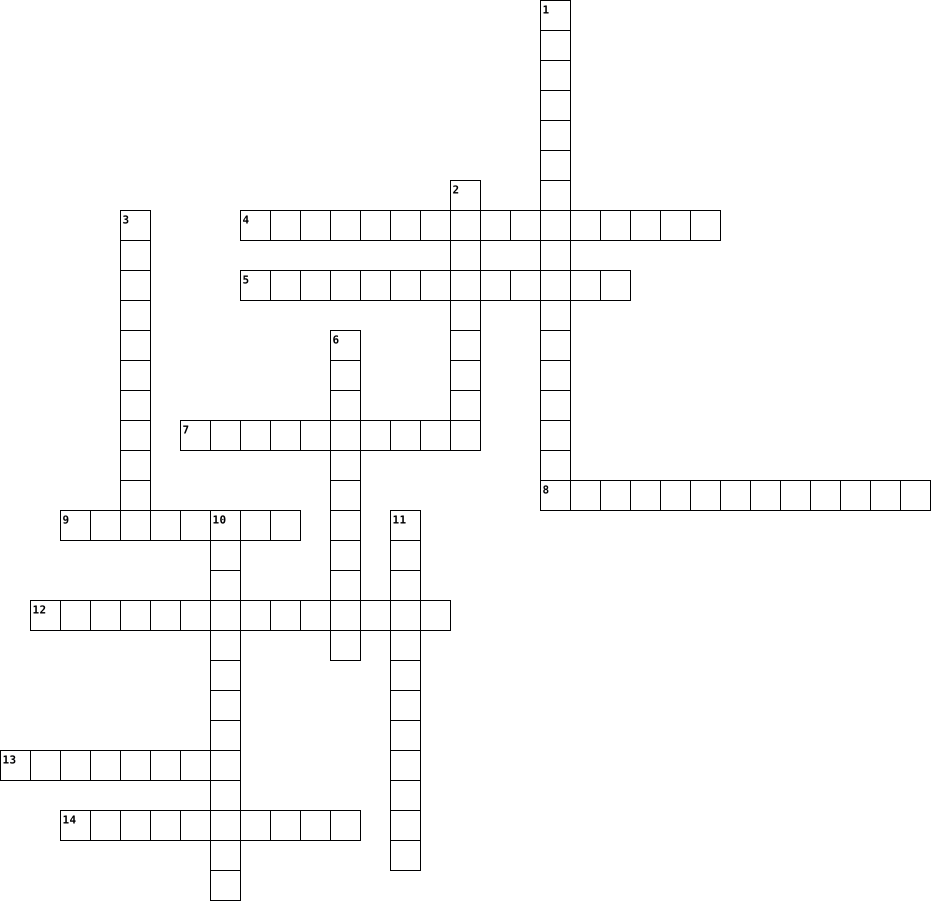
CH. 10 - 11 Test Review 2021-04-19

Across
- George Washington's home
- Declaration of Independence was signed on this day
- A list of rights or freedoms added to the constitution to protect the freedom of individuals and groups
- First President of the United States
- capital of the United States
- A document with the reasons why American colonist wanted freedom from English rule
- American colonists who wanted America to be free from Englands rule
- Lady who stitched together the first American flag
Down
- American colonist who remained loyal to England
- First capital of the United States
- Massachusetts soldiers who said they could be ready to fight at a minutes notice
- Author of the Declaration of Independence
- Towns in Massachusetts where the first battle of the War for Independence took place
- Area of Pennsylvania where Washington's army stayed during the harsh winter of 1777-1778
- You did the most Important work at the constitutional convention, later he became the fourth President of the United States
- First Vice President, later became the second President of the United States
- Government run by representatives of the people
- Money that people pay to help run the government
18 Clues: George Washington's home • capital of the United States • First capital of the United States • First President of the United States • Author of the Declaration of Independence • American colonist who remained loyal to England • Government run by representatives of the people • Money that people pay to help run the government • ...
Musgrove War of 1812 2020-12-07

Across
- One effect of the war of 1812 was a growing feeling of ____________ amongst the citizens of the United States.
- Shawnee leader, and hero, who united Native Americans against the US during the war of 1812 in hopes of preserving their land and culture.
- He became a naval hero after defeating the British at the Battle of Lake Erie.
- Feeling proud of your
- The National Anthem was composed during the bombardment of this fort in 1812
- The embargo act boosted __________ in the US because foreign trade was not allowed.
- Andrew Jackson defeated the Creek Nation in this battle
- This region of the United States threatened to leave the union during this time
- A famous American warship from the war of 1812
- This group demanded war in 1812
- Two regions of the United States that supported the War of 1812
- Huge American victory during the war of 1812.
- This was the practice of forcing American sailors into the British Navy
- He was the hero of the Battle of New Orleans, and later became president.
- This party opposed the War of 1812
Down
- She saved Washington's portrait from the fire when the British set fire to the White House during the war of 1812.
- The national anthem for the United States.
- William Henry Harrison won this battle agains t the Native Americans during the war of 1812, and cleared the way for westward expansion.
- punish Britain and France for interfering with American trade.
- The United States was not able to invade the British territory in ____________ during the War of 1812.
- He wrote the national anthem during the war of 1812.
- This treaty ended the War of 1812
- This president passed the embargo act
- This group allied with the British during the war of 1812
- He was president during the war of 1812.
- The british burned this in the war of 1812
26 Clues: Feeling proud of your • This group demanded war in 1812 • This treaty ended the War of 1812 • This party opposed the War of 1812 • This president passed the embargo act • He was president during the war of 1812. • The national anthem for the United States. • The british burned this in the war of 1812 • Huge American victory during the war of 1812. • ...
Psychology of Motivation Crossword 2022-06-16

Across
- The _________ Effect states that one reinforcer can replace another if they serve the same function
- _______ Law states that As objective incentive value increases, utility increases but in smaller & smaller amounts
- One of the 7 major psychological needs defined by a desire for authority or status
- Tells us how we are progressing towards our goals, also informs us which behaviors are and are not affective in reaching said goal
- The lowest level in Maslow's Hierarchy of Needs
- A type of demand including food and rent. More resistant to increases in demand
- This type of motivation is not affected by external coercion
- A lack of visual stimulants at a developing age could result in poorer _____
- An incentive chosen to be achieved or acquired
- _____Theory of Needs has five tiers
- Select for behavior and increase expression of said behaviors
- _______ Effect states that an incentive's ability to motivate is dependent upon the subject's prior experience with it
Down
- Drive caused by a lack of variability in stimulus in one's environment. Causes one to seek new stimulant
- The highest level of Maslow's Hierarchy of needs
- Law of _________ Contrast states that there will be subjective feeling accompanying incentive contrasts
- The way a goal is perceived
- A _______ Map provides a mental image of the relationship among features in the environment and the goal
- Drive which is activated when a novel item is in the environment
- Select against behaviors and decrease their expression
- ______ function motivates one to expend energy
- _______ drive theory states that a physiological drive comes from a physiological need
- These types of thoughts are more akin to daydreams about achieving a goal
- a goal ________ is the process by which a person becomes set to achieve a goal
- These types of thoughts develop strategies to help one achieve their goal
- A highly stereotyped sequence of behaviors to accomplish a goal
25 Clues: The way a goal is perceived • _____Theory of Needs has five tiers • ______ function motivates one to expend energy • An incentive chosen to be achieved or acquired • The lowest level in Maslow's Hierarchy of Needs • The highest level of Maslow's Hierarchy of needs • Select against behaviors and decrease their expression • ...
The Jackson Era Crossword Puzzle 2025-02-01

Across
- The practice of giving government jobs to political supporters. (9 letters)
- The act that forced Native Americans to leave their land for territories to the west. (16 letters)
- A system of government where power is vested in the people, who rule either directly or through elected representatives. (9 letters)
- The term for the legal idea that states could cancel federal laws they disagreed with. (12 letters)
- A person sent to represent others at a political convention. (9 letters)
- This president succeeded Andrew Jackson. (5 letters)
- Jackson's idea of government that emphasized the common people's role.
- A political party that opposed Jackson, founded in the 1830s. (4 letters)
- The belief in the idea that states' powers should be stronger than the federal government. (13 letters)
Down
- This event allowed more people to vote by reducing property requirements. (9 letters)
- A woman who wrote about and was a close observer of Jackson's life and presidency. (21 letters)
- The seventh president of the United States, known for his populist policies and controversial actions. (13 letters)
- The Native American tribe removed during Jackson’s presidency, known for their alphabet. (8 letters)
- The forced march of the Cherokee people to Indian Territory. (12 letters)
- Jackson's plan for handling state-chartered banks that led to economic troubles.
- This president lost to Jackson in the 1828 election. (4 letters)
- This future president of the U.S. was a strong opponent of Jackson, running against him in 1836. (7 words, 3 parts)
- The event where states threaten to leave the Union over disputes, especially over slavery. (10 letters)
- Jackson's wife, who was criticized during the campaign. (6 letters)
- A state known for its strong abolitionist movement, and where one of Jackson’s key opponents came from. (12 letters)
- The vice president under Jackson, who strongly supported states' rights and nullification. (15 letters)
21 Clues: This president succeeded Andrew Jackson. (5 letters) • This president lost to Jackson in the 1828 election. (4 letters) • Jackson's wife, who was criticized during the campaign. (6 letters) • Jackson's idea of government that emphasized the common people's role. • A person sent to represent others at a political convention. (9 letters) • ...
States of Matter and Change in States 2024-11-27

Across
- Solid form of water
- Liquid form of water
- Gas turns into a liquid when cooled
- Particles are loosely packed, takes the shape of its container, has a fixed volume
Down
- Solid turns into a liquid when heated
- Liquid turns into a gas when heated
- Liquid turns into a solid when cooled
- Particles are far apart, fills the shape and volume of its container
- Gas form of water
- Particles are closely packed, has a fixed shape and volume
10 Clues: Gas form of water • Solid form of water • Liquid form of water • Liquid turns into a gas when heated • Gas turns into a liquid when cooled • Solid turns into a liquid when heated • Liquid turns into a solid when cooled • Particles are closely packed, has a fixed shape and volume • Particles are far apart, fills the shape and volume of its container • ...
Aidan Bonnycastle 2019-10-18

Across
- this is what happens when a rocket gas has a reaction resulting in going in the air
- This law states that every action has an equal reaction to that force.
- This law states that objects that are at rest stay at rest and objects at motion stay at motion unless unbalanced by an outside force
- this part of the rocket helps push out the thrust off the rocket
- this is used to make the thrust of the rocket have movement and make the rocket take liftoff
- this type of airflow states that air is uneven around the rocket causing more drag
Down
- a rate of change of speed of a time and distance.
- this factor makes the rocket stay in the air and push off from the launchpad
- this type of airflow states that all air is evenly around the rocket, making less drag
- this scientist made the first liquid fueled rocket and helped advance rocket science
- surrounding forces that apply to a moving object.
- This law states that force is defined by multiplying the mass and acceleration
- this determines how good a rocket engine is by measuring its acceleration over a certain amount of time
- this scientist was a leading push to make rocket science easier, he made the V2 rocket
- of pressure this is where all drag forces act upon a rocket, to control where this point is, you must put the fins in a certain place
- a device that can go in the air and can be used for many things.
16 Clues: a rate of change of speed of a time and distance. • surrounding forces that apply to a moving object. • this part of the rocket helps push out the thrust off the rocket • a device that can go in the air and can be used for many things. • This law states that every action has an equal reaction to that force. • ...
PARTS OF THE RESEARH PAPER 2026-02-19

Across
- – Provides an overview of the topic and prepares the reader for the research problem.
- – Explains the reason and importance of conducting the study.
- – Identifies the missing or unexplored area found after reviewing literature and studies.
- – Reviews books, journals, and written sources related to the study.
- -The formal name of the study that clearly reflects its focus and main variables.
- – States the specific questions that the research aims to answer.
- – Explains the procedures, respondents, instruments, and data collection process.
- – Mathematical methods used to analyze and interpret collected data.
- – Presents, analyzes, and interprets the gathered data and findings.
Down
- – Explains who will benefit from the research and how it contributes to knowledge.
- – Presents existing facts, conditions, and information related to the topic.
- – Defines the coverage, boundaries, and restrictions of the study.
- – Provides suggested actions and directions for future research based on the results.
- – Describes the overall plan or structure of how the research will be conducted.
- – An educated guess or predicted answer to the research questions.
- – Presents previous research works closely related to the present study.
- – Summarizes the major findings and directly answers the research questions.
- – States that there is no significant relationship or difference between variables.
- – States that there is a significant relationship or difference between variables.
19 Clues: – Explains the reason and importance of conducting the study. • – States the specific questions that the research aims to answer. • – Defines the coverage, boundaries, and restrictions of the study. • – An educated guess or predicted answer to the research questions. • – Reviews books, journals, and written sources related to the study. • ...
Similar Triangles 2021-02-04
Across
- Types of angles that add up to equal 180 degrees, are on the interior of two parallel lines and on the same side of the transversal.
- The similarity theorem that states if two sides of one triangle are proportional to two sides of a second triangle, and the included angles are congruent, then the two triangles are similar.
- The similarity theorem that states if two angles of one triangle are congruent to two angles of another triangle, the the triangles are similar.
- The similarity theorem that states the altitude to the hypotenuse of a right triangle divides the triangle into two triangles that are similar to the original triangle and to each other.
- Types of angles that are across the vertex from each other.
- Two figures that have the same shape, but different size.
- When a pre-image is enlarged or reduced.
- A property that states if two shapes, angles, or lines are congruent to a third, then they are congruent to each other.
Down
- Types of angles that are equal to each other, are inside a set of parallel lines, and are on the alternate side of the transversal.
- A property that states that a shared shape, side, or angle is congruent to itself.
- The value a pre-image is multiplied by to create an image.
- The theorem that states the sum of all interior angles of a triangle is 180 degrees.
- Types of angles that are equal to each other, are on the same side of the transversal, and in the same location on each parallel line.
- The similarity theorem that states if the corresponding sides of two triangles are proportional, then the triangles are similar.
14 Clues: When a pre-image is enlarged or reduced. • Two figures that have the same shape, but different size. • The value a pre-image is multiplied by to create an image. • Types of angles that are across the vertex from each other. • A property that states that a shared shape, side, or angle is congruent to itself. • ...
Civil war Terms 2018-12-13

Across
- The military campaign that left a 300 mile-long destructive path between the Georgian cities of Atlanta and Savannah was known as Sherman's ___________ to the sea
- The ________ of 1850 accepted California as a free state of the Union
- The ___________ compromise accepted both Maine and Missouri as states in the United States
- The union blockade of 1861 was also known as the _________ plan
- The Emancipation _________ stated that all slaves in rebellious states (Confederacy) would be freed on January 1, 1863
- The bloodiest one-day battle of the Civil war
- The ______ Scott case ended with a verdict that stated it was impossible for a slave to sue, as they were not a citizen
Down
- The union acquired most of the controversial land in the 1850's and 60's through the __________ purchase
- The number of states in the Confederacy.
- The second bloodiest battle of the Civil War
- Jefferson ________ was the president of the Confederate States of America
- The union prison that was led by Captain Henry Wirz
- A state's ___________ of succession is an official document stating why they have left the nation or entity it belonged to
- The main controversy surrounding the Civil war
- The bloodiest battle of the Civil War
15 Clues: The bloodiest battle of the Civil War • The number of states in the Confederacy. • The second bloodiest battle of the Civil War • The bloodiest one-day battle of the Civil war • The main controversy surrounding the Civil war • The union prison that was led by Captain Henry Wirz • The union blockade of 1861 was also known as the _________ plan • ...
Civil war Terms 2018-12-13

Across
- The number of states in the Confederacy.
- The ________ of 1850 accepted California as a free state of the Union
- The second bloodiest battle of the Civil War
- The union blockade of 1861 was also known as the _________ plan
- The ______ Scott case ended with a verdict that stated it was impossible for a slave to sue, as they were not a citizen
- The union prison that was led by Captain Henry Wirz
Down
- The bloodiest battle of the Civil War
- The ___________ compromise accepted both Maine and Missouri as states in the United States
- The bloodiest one-day battle of the Civil war
- The military campaign that left a 300 mile-long destructive path between the Georgian cities of Atlanta and Savannah was known as Sherman's ___________ to the sea
- The Emancipation _________ stated that all slaves in rebellious states (Confederacy) would be freed on January 1, 1863
- A state's ___________ of succession is an official document stating why they have left the nation or entity it belonged to
- The union acquired most of the controversial land in the 1850's and 60's through the __________ purchase
- The main controversy surrounding the Civil war
- Jefferson ________ was the president of the Confederate States of America
15 Clues: The bloodiest battle of the Civil War • The number of states in the Confederacy. • The second bloodiest battle of the Civil War • The bloodiest one-day battle of the Civil war • The main controversy surrounding the Civil war • The union prison that was led by Captain Henry Wirz • The union blockade of 1861 was also known as the _________ plan • ...
Government sijun 2024-01-17

Across
- the smaller upper assembly in the US Congress, most US states, France, and other countries
- the separation of power in the government, which is ensured through the establishment of three different branches: the executive branch, the judicial branch, and the legislative branch
- All legislative Powers herein granted shall be vested in a Congress of the United States
- makes and passes federal laws
- a charge of misconduct made against the holder of a public office
- provided a dual system of congressional representation
- refers to the authority of the United States Senate to approve or reject a resolution of ratification of any treaty to which the United States is a proposed signatory,
- includes all the citizens of the United States of America
- an omission or error due to carelessness
Down
- a group of people that seeks to influence public policy on the basis of a particular common interest or concern.
- the action or result of apportioning something.
- the people who live within that area
- the action of taking something for one's own use, typically without the owner's permission.
- having two branches or chambers
- use one's authority to reject or cancel (a decision, view, etc.).
15 Clues: makes and passes federal laws • having two branches or chambers • the people who live within that area • an omission or error due to carelessness • the action or result of apportioning something. • provided a dual system of congressional representation • includes all the citizens of the United States of America • ...
Our Puzzling goverment 2021-12-08

Across
- Allows the powers of congress to stretch
- The constitution makes the acts and treaties of the United States supreme
- Laws relating to disputes between individuals, groups, or states
- Powers the constitution grants or delegates to the national government.
- Powers directly expressed or stated in the constitution by the founders
- The power the national government may exercise simply because it is a government
Down
- The principal way in which states may do this to negotiate
- What expressed powers might also be known as
- clause The basis of implied powers
- he powers that the national government requires to carry out the powers that are expressly defined in the constitution
- The procedure for admission begins when a congress passes
- Are the powers that both the national government and the states have
- Certain powers reserved strictly for the states
13 Clues: clause The basis of implied powers • Allows the powers of congress to stretch • What expressed powers might also be known as • Certain powers reserved strictly for the states • The procedure for admission begins when a congress passes • The principal way in which states may do this to negotiate • Laws relating to disputes between individuals, groups, or states • ...
History 2023-05-04

Across
- (Northern and Western states that fought against the Confederacy)
- Slave Laws (punishments related to the return of escaped slaves to their owners)
- Kansas (violent confrontation in 1856 between proslavery and antislavery)
- state (states in which slavery was legal)
- sovereignty (belief that the political power comes from the consent of the people)
- of Abominations (taxed things from other countries)
- clay (served in Congress for more than 30 years)
Down
- Act (resolve the issue of whether slavery would be legal in certain areas)
- Party (one of the two major political parties in the United States)
- gin (Thing to separate seeds)
- Scott (African American man whose status as free or enslaved was decided by the Supreme Court)
- Compromise (enter the United States as a free state or slave state)
- state (states that did not allow slavery)
13 Clues: gin (Thing to separate seeds) • state (states in which slavery was legal) • state (states that did not allow slavery) • clay (served in Congress for more than 30 years) • of Abominations (taxed things from other countries) • (Northern and Western states that fought against the Confederacy) • Party (one of the two major political parties in the United States) • ...
Prague Crossword 2022-03-22

Across
- - Prague is full of these diverse buildings and art statues
- - the most important city or town of a country or region, usually its seat of government and administrative center.
Down
- - Prague makes a lot of cash from tourist viewings.
- - Prague is one of the least religious capitals in the world.
- - German or Russian is commonly spoken.
5 Clues: - German or Russian is commonly spoken. • - Prague makes a lot of cash from tourist viewings. • - Prague is full of these diverse buildings and art statues • - Prague is one of the least religious capitals in the world. • - the most important city or town of a country or region, usually its seat of government and administrative center.
Alana Riddell: Our Puzzling Government #2 | Federalism 2022-11-18

Across
- Powers directly stated in the Constitution by the founders
- act An act that allows a territory wishing to become a state to prepare a constitution
- country which is unincorporated but still part of the US
- One of the last two states admitted to the USA
- court case which ruled that between a state and national government, the national one is superior
- a type of compact made between two different states
- a position taken on how federalism should run which leans toward national action
- Powers given to the states if not given specifically to the government
- laws relating to disputes between people, groups, or the state itself (not criminal)
- powers which are refused to all forms of government
- powers held by both the national and state governments
- refers to documents such as mortgages, birth certificates, leases, and deeds
Down
- Clause which states that the constitution is the supreme law of the land
- Powers the Constitution grants to the national government
- an organization of government administrators
- organization made up of all of the USA's governors
- state and local governments making their own policies
- Powers are not directly stated but can be inferred from other expressed powers
- law which prohibits public officials from holding closed/secret meetings
- to return criminals from other states to their state of origin after committing a crime
- a law that requires checking government agencies from time to time to see if they are still needed
- a type of tax that is put on the money that you make
- Clause which allows the powers of Congress to stretch if need be
- a government system that divides power between the state and national governments
- court case that declared Congress overstepped boundaries by banning guns in or near schools
25 Clues: an organization of government administrators • One of the last two states admitted to the USA • organization made up of all of the USA's governors • a type of compact made between two different states • powers which are refused to all forms of government • a type of tax that is put on the money that you make • state and local governments making their own policies • ...
Westward Expansion Crossword Puzzle 2026-05-12

Across
- Destiny, The 19th-century belief that the United States was destined by God to expand across the continent from the Atlantic to the Pacific.
- Trail, A major 2,000-mile wagon route that allowed thousands of settlers to travel to the West.
- People who flocked to California in 1849 in search of gold.
- The formal giving up of land, often through a treaty (e.g., Mexican Cession).
- Land that is under the jurisdiction of the United States but is not yet a state.
- Purchase, The 1803 purchase of vast land from France for $15 million, which doubled the size of the US.
- A person who is among the first to settle in a new area.
- A device that sent messages over long distances using electricity, which made communication faster.
- Wire, Sharp wire fencing that changed the West by allowing farmers to fence in land on the treeless plains.
- The extreme limit of settled land beyond which lies wilderness.
- Train, A large group of covered wagons traveling together for safety.
Down
- Land set aside by the United States government for Native Americans.
- A community that experiences sudden and rapid growth in business or population, usually near a mining site.
- Act, A law that allowed citizens to claim 160 acres of surveyed government land out West for a small fee.
- A long, organized journey made for a specific purpose, such as the Lewis and Clark expedition.
- Expansion, The movement of settlers and the United States government into the American West, particularly between 1787 and 1860.
- Railroad, A train system that connected the eastern and western coasts of the United States.
- A farmer on the Great Plains who had to break through thick sod to farm.
- To add or take over new land, such as the annexation of Texas.
- A hired hand who managed cattle, particularly on long drives.
20 Clues: A person who is among the first to settle in a new area. • People who flocked to California in 1849 in search of gold. • A hired hand who managed cattle, particularly on long drives. • To add or take over new land, such as the annexation of Texas. • The extreme limit of settled land beyond which lies wilderness. • ...
Westward Expansion Crossword Puzzle 2026-05-01

Across
- A device that sent messages over long distances using electricity, which made communication faster.
- that is under the jurisdiction of the United States but is not yet a state.
- A major 2,000-mile wagon route that allowed thousands of settlers to travel to the West.
- A law that allowed citizens to claim 160 acres of surveyed government land out West for a small fee.
- The 1803 purchase of vast land from France for $15 million, which doubled the size of the US.
- A hired hand who managed cattle, particularly on long drives.
- People who flocked to California in 1849 in search of gold.
- The 19th-century belief that the United States was destined by God to expand across the continent from the Atlantic to the Pacific.
- To add or take over new land, such as the annexation of Texas.
- A community that experiences sudden and rapid growth in business or population, usually near a mining site.
- A train system that connected the eastern and western coasts of the United States.
Down
- The movement of settlers and the United States government into the American West, particularly between 1787 and 1860.
- The extreme limit of settled land beyond which lies wilderness.
- A person who is among the first to settle in a new area.
- Land set aside by the United States government for Native Americans.
- A long, organized journey made for a specific purpose, such as the Lewis and Clark expedition.
- The formal giving up of land, often through a treaty (e.g., Mexican Cession).
- A large group of covered wagons traveling together for safety.
- Sharp wire fencing that changed the West by allowing farmers to fence in land on the treeless plains.
- A farmer on the Great Plains who had to break through thick sod to farm.
20 Clues: A person who is among the first to settle in a new area. • People who flocked to California in 1849 in search of gold. • A hired hand who managed cattle, particularly on long drives. • A large group of covered wagons traveling together for safety. • To add or take over new land, such as the annexation of Texas. • ...
Westward Expansion Crossword Puzzle 2026-05-12

Across
- formal giving up of land, often through a treaty (e.g., Mexican Cession).
- set aside by the United States government for Native Americans.
- A large group of covered wagons traveling together for safety.
- farmer on the Great Plains who had to break through thick sod to farm.
- person who is among the first to settle in a new area.
- that is under the jurisdiction of the United States but is not yet a state.
- extreme limit of settled land beyond which lies wilderness.
- law that allowed citizens to claim 160 acres of surveyed government land out West for a small fee.
- 1803 purchase of vast land from France for $15 million, which doubled the size of the US.
- 19th-century belief that the United States was destined by God to expand across the continent from the Atlantic to the Pacific.
- long, organized journey made for a specific purpose, such as the Lewis and Clark expedition.
- train system that connected the eastern and western coasts of the United States.
Down
- who flocked to California in 1849 in search of gold.
- wire fencing that changed the West by allowing farmers to fence in land on the treeless plains.
- movement of settlers and the United States government into the American West, particularly between 1787 and 1860.
- hired hand who managed cattle, particularly on long drives.
- device that sent messages over long distances using electricity, which made communication faster.
- A major 2,000-mile wagon route that allowed thousands of settlers to travel to the West.
- community that experiences sudden and rapid growth in business or population, usually near a mining site.
- add or take over new land, such as the annexation of Texas.
20 Clues: who flocked to California in 1849 in search of gold. • person who is among the first to settle in a new area. • hired hand who managed cattle, particularly on long drives. • add or take over new land, such as the annexation of Texas. • extreme limit of settled land beyond which lies wilderness. • A large group of covered wagons traveling together for safety. • ...
Samantha Walker’s ch.2-3 crossword 2019-08-28

Across
- System of government in which sovereignty is constitutionally divided between national and state government
- writer whose teachings the Declaration of Independence was based on, like everyone having unalienable rights
- government is in total control
- gives congress the ability to pass laws that are necessary
- Form of government in which power derives from citizens, but public officials make policy and govern according to existing law
- list of powers that congress can employ, listed in Constitution
- Form of democracy in which political power is exercised directly by citizens
- Initial governing authority of the United States
- power given to the president to block legislation passed by congress, but it can be overridden by congress
- list of rights that congress can’t take away
- Powers retained by the states under the Constitution
- gives people the right to choose U.S. senators directly
- system of government in which ultimate authority rests with the regional governments
- Documents that establish the basic rules and procedures for how a society shall be governed
- gives each branch of government power over each other to prevent one branch from having full control
- at this meeting the new constitution was purposed
Down
- affirms the right to indictment by a grand jury and right to due process; protects against double jeopardy, self-incrimination, and taking of property without just compensation
- Gives Congress the power to regulate commerce with foreign nations, with Indian tribes, and among the various states
- Makes federal law supreme over state laws
- declared America’s independence from England
- Powers held by both the national and state governments in a federal system
- gives congress ability to tax to provide for the general welfare
- process of changing the constitution
- prohibits slavery
- Right of states to invalidate acts of Congress they believe to be illegal
- prevents citizens from one state from suing another state in federal court
- reserves the Powers not granted to the national government to the states or to the people
- rule by the people
- Powers not expressly granted to Congress but added through the necessary and proper clause.
29 Clues: prohibits slavery • rule by the people • government is in total control • process of changing the constitution • Makes federal law supreme over state laws • declared America’s independence from England • list of rights that congress can’t take away • Initial governing authority of the United States • at this meeting the new constitution was purposed • ...
Practice Vocabulary Quiz V 2023-03-20

Across
- known for having done or participated in something bad
- looking down on someone or something with scorn
- the authority of a state to govern itself
- Nathan ____,Confederate general then chosen as the first leader, or "grand wizard," of the Ku Klux Klan
- Ulysses S. ____,18th president of the U.S. who first was a commanding general of the Union Army
- a battle or game that comes to a halt without anyone winning or able to continue
- something enormous in size and strength
- growing quickly and in a way that is difficult to control
- to cover or conceal
- unavoidable
- to slow or hamper
- ___ Proclamation declared that all enslaved people in the slave states "shall be free" and permitted African Americans to join the Union army
Down
- represented Mississippi in the U.S. congress then became the president of the Confederate States
- required by law to enlist into the armed forces
- inability or unwillingness to move or advance
- Robert ____,a sailor and later a Union naval captain, he was highly honored for his feats of bravery and heroism. He became a Congressman after the Civil War.
- an action or statement that insults or offends someone
- a choice or option for dealing with a difficult situation
- part of the United States that seceded from the US federal government and lost the Civil War
- an order from a person in a position of authority
- William ___ staged a successful one-man revolt after his ship was captured and gave Union 1st naval victory.
- part of the United States that stayed loyal to the US federal government and won the Civil War
- to reduce to a lower rank
- to call out or bring up emotions or feelings
- formal separation from an alliance or nation
- 16th president of the U.S. whose main goal was to restore the Union, be believed blacks should be freed but that they should be sent to Africa
- Robert E. ___,Commander of the Confederate States Army who surrendered to the Union on April 1865
27 Clues: unavoidable • to slow or hamper • to cover or conceal • to reduce to a lower rank • something enormous in size and strength • the authority of a state to govern itself • to call out or bring up emotions or feelings • formal separation from an alliance or nation • inability or unwillingness to move or advance • required by law to enlist into the armed forces • ...
Our puzzling govt 2 2022-11-18

Across
- powers the Constitution grants or delegates to the national government
- are rights to pass through or live in any state;
- Such compacts are written agreements between two or more states
- the power to assume responsibility for a state government function, in order to gain authority over a state.
- that is, return to a state criminals and fugitives who flee across state lines to escape justice
- laws relating to disputes between individuals, groups, or with the state.
- Article VI, Section 2, of the Constitution makes the acts and treaties of the United States supreme
- favors state and local action in dealing with problems
- A nationalist Chief Justice; presided during McCulloch
- Supreme Court has accepted this view. Under whos view
- shall be given in each state to the public acts, records, and judicial proceedings of every other stat
Down
- The Constitution also reserves certain powers strictly to the states
- These are sums of money given to state or local governments to be spent for a variety of specific purposes
- Those powers that the national government requires to carry out the powers that are expressly defined in the Constitution are?
- when signed by the president, enables the people of the territory interested in becoming a state to prepare a constitution
- the ability of state and local governments to make their own policies
- article1 section 8
- organization of government administrators, to carry out legislation
- those powers that both the national government and the states have.
- favors national action in dealing with these matters
- the national government must control immigration and establish diplomatic relations with other countries, even though these powers are not spelled out in the Constitution.
- levied on individual earnings has become the major source of money for the national government
- those powers directly expressed or stated in the Constitution by the Founders
- racial discrimination in public accommodations such as hotels and restaurants.
- is a federal order requiring states to provide a serviceor undertake an activity in a manner that meets minimum national standards set by Congress.
25 Clues: article1 section 8 • are rights to pass through or live in any state; • favors national action in dealing with these matters • Supreme Court has accepted this view. Under whos view • favors state and local action in dealing with problems • A nationalist Chief Justice; presided during McCulloch • Such compacts are written agreements between two or more states • ...
U.S. HISTORY EOC REVIEW 2016-04-19

Across
- Gave African American men the right to vote
- provided direct election of senators
- ended poll tax
- Peace plan issued by Wilson that called for freedom of the seas, reduction of armaments , and end to secret diplomacy. Important part was the creation of the League of Nations a national peace organization
- required states to give citizenship to all citizens born in the United States and gave other basic civil rights
- Written mostly by Jefferson to list the grievances (complaints) against Great Britain and to declare independence from Great Britain
- Treaty that ended WW1. Was extremely harsh on Germany.
- Document which formed the first government of the U.S. near the end of the American Revolution. States had more power than the national government.
- First ten amendments to the Constitution guaranteeing individual liberties and due process
- Major ideas found in the U.S. Constitution of limiting the power to tax and right to fair trial
Down
- gave the right to vote to 18 year olds
- gave women the right to vote
- Created a graduated income tax
- A document outlining the basic form and rules of the U.S. government
- by Truman to economically assist any country fighting communism after World War two. The declaration marked the beginning of the containment Policy
- gave freedom to the slaves in all states
- Essays written by James Madison, Alexander Hilton, and John Jay to support the ratification of the Constitution
- Foundation for American government for freedoms such as freedom of speech and trial by jury
18 Clues: ended poll tax • gave women the right to vote • Created a graduated income tax • provided direct election of senators • gave the right to vote to 18 year olds • gave freedom to the slaves in all states • Gave African American men the right to vote • Treaty that ended WW1. Was extremely harsh on Germany. • ...
Civil War Crossword 2021-09-28

Across
- sea fort built on an artificial island protecting Charleston, South Carolina.
- 1860 nominee for election
- repealed the Missouri Compromise, created two new territories, and allowed for popular sovereignty
- effort to preserve the balance of power in Congress between slave and free states
- act required that slaves be returned to their owners, even if they were in a free state
- harpers ferry
- presidential proclamation and executive order issued by United States President Abraham Lincoln on September 22, 1862, during the Civil War.
- borough and town in the U.S. state of Pennsylvania.
Down
- abolitionist slave who escaped and started a movement
- an American politician who served as the president of the Confederate States from 1861 to 1865. As a member of the Democratic Party, he represented Mississippi in the United States Senate and the House of Representatives before the American Civil War.
- five laws passed in September of 1850 that dealt with the issue of slavery and territorial expansion
- is the withdrawal of a group from a larger entity, especially a political entity, but also from any organization, union or military alliance.
- an African American who had been a slave and moved by his master to a state
- a political party fromed in 1854, majority supported the end to slavery (abolitionists).
- people who want to abolish slavery
- Confederate General Robert E. Lee surrendered to Union General Ulysses S. Grant to effectively end the American Civil War.
- people who express loyalty to thier region
- battle of vicks____
18 Clues: harpers ferry • battle of vicks____ • 1860 nominee for election • people who want to abolish slavery • people who express loyalty to thier region • borough and town in the U.S. state of Pennsylvania. • abolitionist slave who escaped and started a movement • an African American who had been a slave and moved by his master to a state • ...
Portfolio Project Crossword 2022-01-12

Across
- Extending a country's power and influence through diplomacy or military force.
- A vote on a yes or no question.
- War between Mexico and the spanish colonial government.
- Making an opening move to put yourself in situations that have social potential.
- Novel published by Upton Sinclair that exposed the harsh conditions of the meat industry in 1906.
- Ones who believed that people and government had the power to correct abuses produced by nature and the free market.
- 26th president. Youngest president of the United States.
- Waterway in Panama that connects the Atlantic Ocean and the Pacific Ocean.
Down
- State and local laws that enforced racial segregation in the Southern United States.
- A person who searches for and tries to expose real or alleged corruption, scandal, or other wrongdoing, especially in politics.
- A civil rights organization in the United States that acts as an interracial endeavor to advance justice for African Americans.
- A person favoring a policy of remaining apart from the affairs or interests of other groups, especially the political affairs of other countries.
- An addition to the Monroe Doctrine.
- A treaty signed by Spain and the United States that ended the Spanish–American War.
- Muckraker that exposed John D. Rockefeller’s Standard Oil Company.
- The process by which citizens can remove elected officials from office before their term is completed.
- "separate but equal."
- Founded in Chicago in 1889 to help aid needy immigrants.
18 Clues: "separate but equal." • A vote on a yes or no question. • An addition to the Monroe Doctrine. • War between Mexico and the spanish colonial government. • 26th president. Youngest president of the United States. • Founded in Chicago in 1889 to help aid needy immigrants. • Muckraker that exposed John D. Rockefeller’s Standard Oil Company. • ...
unit 4 crossword 2024-11-12

Across
- the idea that the United States was destined to expand westward across North America, spreading democracy and capitalism.
- restriction of interest to a narrow sphere; undue concern with local interests or petty distinctions at the expense of general well-being.
- the region of land in the modern-day Western United States that was ceded to the United States from Mexico after the Mexican-American War
- a legal theory that states can invalidate federal laws, treaties, or judicial decisions they believe are unconstitutional.
- a period in the 1820s–1850s when the United States transitioned from a moral economy to a capitalist system
- the seventh President of the United States from 1829 to 1837
Down
- a mid-19th century political party in the United States. Alongside the Democratic Party, it was one of two major parties between the late 1830s and the early 1850s and part of the Second Party System.
- foreign policy statement made by President James Monroe in 1823
- American social reformer, abolitionist, orator, writer, and statesman.
- a forced migration of Native Americans and their enslaved African Americans from the southeastern United States between 1830 and 1850
10 Clues: the seventh President of the United States from 1829 to 1837 • foreign policy statement made by President James Monroe in 1823 • American social reformer, abolitionist, orator, writer, and statesman. • a period in the 1820s–1850s when the United States transitioned from a moral economy to a capitalist system • ...
Civil War 2022-11-30

Across
- debate which you are trying to achieve a goal
- trained civilians soldiers
- freedom of choice
- name of the southern states in 1861
- military post where troops are stationed
- someone who wishes to abolish slavery
Down
- production and management of wealth
- led by John Brown in Virginia
- 16th president
- bringing death
- the northern states
- where slaves worked
- any of the southern states
- war during 1861-1865
14 Clues: 16th president • bringing death • freedom of choice • the northern states • where slaves worked • war during 1861-1865 • trained civilians soldiers • any of the southern states • led by John Brown in Virginia • production and management of wealth • name of the southern states in 1861 • someone who wishes to abolish slavery • military post where troops are stationed • ...
Chapter 12 Jack 2024-03-20

Across
- 2 person arguments
- one house
- gives the federal government some powers and states others
- early release from prison
- less serious crimes
- two houses
- judge in small towns name
- 43 governors have the power to veto
- powers that are for the states only
- awards of money
Down
- shared by state and federal government
- courts handle minor cases
- population count
- unequal representation
- reduce a sentence
- serious cases
- divided into districts
17 Clues: one house • two houses • serious cases • awards of money • population count • reduce a sentence • 2 person arguments • less serious crimes • unequal representation • divided into districts • courts handle minor cases • early release from prison • judge in small towns name • 43 governors have the power to veto • powers that are for the states only • shared by state and federal government • ...
Events Leading to the Civil War 2014-04-18

Across
- northern states were primarily
- northern economies were dependent on these
- Chief Justice that made the Dred Scott decision
- two states voted to be free or slave
- southern states were primarily
- nickname of Kansas
- first southern state to secede
- was told as a slave he was not a U.S. citizen
Down
- new government formed by southern states
- plantations made money by growing these
- law passed in the Compromise of 1850
- President of the Confederate States
- first Republican President in the north
- four states that tried to remain neutral
- wanted to end, or abolish, slavery
- southern economies were dependent on these
- period of time before the Civil War
- free state in the Compromise of 1850
18 Clues: nickname of Kansas • northern states were primarily • southern states were primarily • first southern state to secede • wanted to end, or abolish, slavery • President of the Confederate States • period of time before the Civil War • law passed in the Compromise of 1850 • two states voted to be free or slave • free state in the Compromise of 1850 • ...
Chapter 11: The Great Depression and the New Deal 2022-04-26

Across
- The name of Franklin D. Roosevelt's radio talks about issues of public concern
- An American politician and attorney who served as the 32nd president of the United States from 1933 until his death in 1945.
- When all banks in the United States closed until government audits declared them solvent
- System by which workers and employers in the U.S. have to pay money to the government, which gives money to people who are retired, who have a disability, or who cannot work.
- A legislative initiative proposed by U.S. President Franklin D. Roosevelt to add more justices to the U.S
- The shantytowns that sprang up on the out-skirts of cities
- A period of time in financial markets when the price of an asset or security rises continuously.
- A period of rapid economic expansion resulting in higher GDP, lower unemployment, a higher inflation rate and rising asset prices.
Down
- A severe worldwide economic depression between 1929 to 1939 that began after a major fall in stock prices in the United States.
- A major American stock market crash that occurred in the autumn of 1929.
- The name given to the drought-stricken Southern Plains region of the United States, which suffered severe dust storms during a dry period in the 1930s.
- Series of programs, public work projects, financial reforms, and regulations enacted by President Franklin D. Roosevelt in the United States between 1933 and 1939.
- People invest in the stock market like crazy, buying shares, hoping that the value of the company would increase and sell it off at a higher price and make a profit. Stock shares rise, and that increases speculation
- A strike during which workers occupy their place of employment and refuse to work or allow others to work until the strike is settled.
- American politician and engineer who served as the 31st president of the United States from 1929 to 1933 and a member of the Republican Party, holding office during the onset of the Great Depression.
15 Clues: The shantytowns that sprang up on the out-skirts of cities • A major American stock market crash that occurred in the autumn of 1929. • The name of Franklin D. Roosevelt's radio talks about issues of public concern • When all banks in the United States closed until government audits declared them solvent • ...
Nationalism and Reform PPT Notes Review 2021-05-07

Across
- when a country wants its own legislature to hand their affairs is known as _______ _______
- descendants of Portuguese or Spanish settlers born in the colonies
- promised to follow the "blood and iron" policy
- became a separate kingdom in 1867 after Austria was forced to divide its empire
- In 1804, this French colony was the first colony south of the US to announce its independence
- colonial leaders born in Spain and Portugal
- almost all of this continent had successfully won their independence by end of 1824
- In 1868, this person became the Prime Minister in Britain
- the desire of people with the same history, language, and customs for self rule
- demanded a democratic Parliament in Britain
- who went on hunger strikes for equal rights in Britain
- this person and Morelos led a revolution again Spain in 1810
- what country had a potato famine
- this person led a revolt in Haiti against France with slaves
- This country was way behind other European countries
- who used guerrilla warfare in the southern part of Italy
- nationalism started with Napoleon in ____________________
Down
- the idea that the United States should stretch from coast to coast
- had no voice in the British government
- was elected in France and declared war on Prussia
- this war begin in 1861between northern and southern states in the United States
- was credited for helping pass laws such as pensions, and health care in Britain
- was overthrown in France in 1848
- this person was elected president of the United States in 1828
- relied on enslaved African Americans to work in the cotton fields
- this person was elected president of the United States in 1860
- people who supported building a powerful German nation
- This territory sided with Britain and France in a war with Russia
- tired to keep Britain's traditions
- which state was annexed in 1845
- Confederate military leader
- In 1861, Italy became a __________________ monarchy
- In 1875, this country became a republic once again
- In 1823, this country declared itself a republic
34 Clues: Confederate military leader • was overthrown in France in 1848 • which state was annexed in 1845 • what country had a potato famine • tired to keep Britain's traditions • had no voice in the British government • colonial leaders born in Spain and Portugal • demanded a democratic Parliament in Britain • promised to follow the "blood and iron" policy • ...
History Revision 2023-09-07

Across
- The constitution stated that all men have unalienable rights of ____,Liberty and the pursuit of happiness
- The doctrine that each state could decide whether to allow slavery or not, popularized by the Kansas-Nebraska Act
- What political party was formed in 1854?
- This 1820 compromise sought to balance slave and free states by admitting Missouri as a slave state and Maine as a free state.
- This was a result of two rival governments created in Kansas
Down
- The Southern states formed their own government known as the ________________ States of America.
- The last name of the Republican President of the United States of America in 1860
- The invention of what led to Slavery being very economical in the South
- By 1860, the US had 4 million what?
- This compromise prohibited slavery above the 36"30 latitude line
- What purchase doubled the size of the United States in 1803?
- The first State to secede from the United States of America in 1860?
12 Clues: By 1860, the US had 4 million what? • What political party was formed in 1854? • What purchase doubled the size of the United States in 1803? • This was a result of two rival governments created in Kansas • This compromise prohibited slavery above the 36"30 latitude line • The first State to secede from the United States of America in 1860? • ...
Ancient Greece 2022-11-01

Across
- Alexander's greatest achievement
- "We are what we repeatedly do; excellence is a habit."
- unlike today, these rulers typically appealed to common citizens for support and were fair and just
- Greece was the first to use this form of government
- home of Philip and Alexander
- a government ruled by a few powerful people
- alarm clocks, flame throwers, democracy, astronomy, mathematics, drama, etc are all Greek _______________
- these "h" rebels could be credited with Sparta's desire to form a military state
Down
- he used league money to beautify Athens
- Athens focused on science, rhetoric, and the ________
- the enemy of both Sparta and Athens
- the most famous Greek 'republican'
- the city of the legendary Trojan War
- earliest Greeks
- leader of the Delian League
- the most deadly fighting force in ancient Greece
- Spartan life was centered on the ___________
- winner of the Peloponnesian War
- Alexander was unable to conquer this because his troops refused to continue
- citizen-soldiers of Ancient Greek city-states who were primarily armed with spears and shields
- age of no written records excited during this period of Greek history
- Greece's geography led to these independent states
22 Clues: earliest Greeks • leader of the Delian League • home of Philip and Alexander • winner of the Peloponnesian War • Alexander's greatest achievement • the most famous Greek 'republican' • the enemy of both Sparta and Athens • the city of the legendary Trojan War • he used league money to beautify Athens • a government ruled by a few powerful people • ...
Civil War Crossword Puzzle 2023-05-18

Across
- highly photographed and neither side had a clear win
- Lee surrenders and the Civil War ends
- this is what happened to Lincoln
- political party that supported slavery
- general of the Union army
- what southerners called Bull Run
- civilians did this because they thought the first battle would be entertaining and quick
- southern states that seceded and formed their own nation
- the confidence, enthusiasm, and discipline of a person or group at a particular time.
- president that caused southern states secede
Down
- a person who wants to stop slavery
- Proclamation Lincoln signed that freed all enslaved people
- bloodiest battle in American history and turning point in the war
- political party that didn't support slavery
- nickname given to General Jackson because he led Confederates to victory in the battle of Bull Run
- northern states in the war, didn't support slavery
- formally withdraw from the Union
- the first official battle of the war
- was not widely believed in during the time so medical tools weren't cleaned, leading to infection
- fort in South Carolina where the Civil War first started
- first state to secede
21 Clues: first state to secede • general of the Union army • this is what happened to Lincoln • formally withdraw from the Union • what southerners called Bull Run • a person who wants to stop slavery • the first official battle of the war • Lee surrenders and the Civil War ends • political party that supported slavery • political party that didn't support slavery • ...
State's Rights, Slavery, and Secession (4.1-4.2) 2015-03-08

Across
- Compromise of 1850 allowed this state to be a free state
- South Carolina senator who argued for state's rights
- slave law that forced northern states to return escaped slaves to south
- abolitionist that led a raid at Harper's Ferry
- party that was founded in the 1850s and wanted to end slavery
- famous African-American abolitionist
- president of the Confederate States of America
- will of the majority
- Fort in Charleston where the first shots of the Civil War were fired
- 1820 compromise that allowed slavery in states south of 36'30'N
- abolitionist sisters from South Carolina
- Harriet who wrote Uncle Tom's Cabin
- clashes between pro-slavery and anti-slavery in the Kansas and Nebraska Territories
- slave who sued for his freedom in 1857 and lost because he was not a citizen
Down
- Harriet that helped slaves escape in the Underground Railroad
- act that allowed Kansas and Nebraska to choose to permit slavery
- a network of people that helped slaves escape the South
- state can refuse a law seen as unconstitutional
- a person that wanted to end slavery
- proviso that proposed banning slavery from any land purchased from Mexico, and was voted down
20 Clues: will of the majority • a person that wanted to end slavery • Harriet who wrote Uncle Tom's Cabin • famous African-American abolitionist • abolitionist sisters from South Carolina • abolitionist that led a raid at Harper's Ferry • president of the Confederate States of America • state can refuse a law seen as unconstitutional • ...
Ximena Lozano 2022-02-24

Across
- Two charged Johnson with ____ Congress.
- The ____ amendment granted citizenship to all people born and nationalized in the United States.
- The____ amendment gave African American men throughout the U.S the right to vote.
- A special tax that people had to pay before they could vote.
- Opposed civil rights,especially surffrage for African Americans.
- It refers to the period of time following the Civil War of rebuilding the United States.
- The ____ amendment made slavery ilegal throught tge United States.
- Laws that required segregation.
- Even though slavery was ilegal _____ slaves still were not treated equally.
- A charge of misconduct made against the holder of a public office.
- Senate aproved add and remove
Down
- Process and period ofReconstruction during which the Radical Republicans in the U.S. Congress seized control of Reconstruction from Pres.
- Forced separation of whites and African American in public places.
- ____ stages that has an impeachment
- In 1867,Congress passed the _____.
- "TREASON,_____, OR OTHER HIGH CRIMES AND MISDEMEANORS"
- ____ votes against Johnson.
- 17th U.S President and first president to be impeached.
- Johnson's defense was simple: only a clear violation of the law _____ his removal.
- An important Congressmen during Civil War.
20 Clues: ____ votes against Johnson. • Senate aproved add and remove • Laws that required segregation. • In 1867,Congress passed the _____. • ____ stages that has an impeachment • Two charged Johnson with ____ Congress. • An important Congressmen during Civil War. • "TREASON,_____, OR OTHER HIGH CRIMES AND MISDEMEANORS" • 17th U.S President and first president to be impeached. • ...
Emil's Puzzle 2022-06-07

Across
- male native or inhabitant of England, or a man of English descent.
- fact or state of being independent.
- to or characteristic of soldiers or armed forces.
- person holding a position of command or authority in the armed services, in the merchant marine, or on a passenger ship.
- person who serves in an army.
- type of tobacco grown and manufactured in Virginia.
- clinton:Sir Henry Clinton, (born April 16?, 1730?—died December 23, 1795, Cornwall, England), British commander in chief in America during the Revolutionary War.
- forcible overthrow of a government or social order, in favor of a new system.
- Jefferson:Thomas Jefferson (April 13, 1743 – July 4, 1826) was an American statesman, diplomat, lawyer, architect, philosopher, and Founding Father who served as the ...
- system of government by the whole population or all the eligible members of a state, typically through elected representatives.
- states:The meaning of UNITED STATES is a federation of states especially when forming a nation in a usually specified territory. How to use United States in a ...
- fathers:a person who starts or helps to start a movement or institution.
Down
- elected head of a republic
- franklin:was an American polymath who was active as a writer, scientist, inventor, statesman, diplomat, printer, publisher, and political philosopher.
- george III:The king of Britain during the American Revolutionary War. He was known for insisting on royal privilege. The stubbornness of George and of his government ...
- to a nation; common to or characteristic of a whole nation.
- adams:A political leader of the late eighteenth and early nineteenth centuries; one of the Founding Fathers. Adams was a signer of the Declaration of Independence ...
- revolution:American Revolution, also called United States War of Independence or American Revolutionary War, (1775–83), insurrection by which 13 of Great Britain's ...
- Act:allowed British troops to be housed in private homes and facilities.
- army:Continental army definition, the Revolutionary War Army, authorized by the Continental Congress in 1775 and led by George Washington. See more.
- washongton:George Washington was an American military officer, statesman, and Founding Father who served as the 1st president of the United States from 1789 to 1797.
21 Clues: elected head of a republic • person who serves in an army. • fact or state of being independent. • to or characteristic of soldiers or armed forces. • type of tobacco grown and manufactured in Virginia. • to a nation; common to or characteristic of a whole nation. • male native or inhabitant of England, or a man of English descent. • ...
Cold War 2019-01-22

Across
- shot down by the Soviet Air Defense Forces while performing photographic aerial reconnaissance deep into Soviet territory
- led communist forces in China through a long revolution beginning in 1927 and ruled the nation's communist government from its establishment in 1949
- a country that is formally independent in the world, but under heavy political, economic and military influence or control from another country
- The line was intended as a temporary division of the country, but the onset of the Cold War led to the establishment of a separate U.S.
- Cold War began to develop after World War II, fears concerning communist activity in the United States, particularly in the federal government, increased.
- a formal alliance between the territories of North American and Europe
- After the Soviet atomic bomb success, the idea of building a hydrogen bomb received new impetus in the United States
- a policy enunciated by Dwight D. Eisenhower on January 5, 1957
- the first major international crises of the Cold War
Down
- American initiative passed in 1948 to aid Western Europe
- American foreign policy whose stated purpose was to counter Soviet geopolitical expansion during the Cold War
- Chinese military and political leader
- American citizens who spied, with others, for the Soviet Union and were tried, convicted, and executed by the federal government of the United States
- a geopolitical strategy to stop the expansion of an enemy
- a collective defense treaty signed in Warsaw
- the physical boundary dividing Europe into two separate areas from the end of World War II in 1945 until the end of the Cold War in 1991
- appeared before the House Un-American Activities Committee in October 1947
- he verdict took center stage in broader debates about the Cold War, McCarthyism, and the extent of Soviet espionage in the United States
- a period of geopolitical tension between the Soviet Union with its satellite states
- held nine days of hearings that attempted to investigate alleged Communist propaganda and influence in the Hollywood Motion Picture Industry
20 Clues: Chinese military and political leader • a collective defense treaty signed in Warsaw • the first major international crises of the Cold War • American initiative passed in 1948 to aid Western Europe • a geopolitical strategy to stop the expansion of an enemy • a policy enunciated by Dwight D. Eisenhower on January 5, 1957 • ...
Samantha Walker’s ch.2-3 crossword 2019-08-28

Across
- list of powers that congress can employ, listed in Constitution
- Gives Congress the power to regulate commerce with foreign nations, with Indian tribes, and among the various states
- To formally withdraw from a nation-state
- affirms the right to indictment by a grand jury and right to due process; protects against double jeopardy, self-incrimination, and taking of property without just compensation
- writer whose teachings the Declaration of Independence was based on, like everyone having unalienable rights
- declared America’s independence from England
- Makes federal law supreme over state laws
- government is in total control
- Form of democracy in which political power is exercised directly by citizens
- gives people the right to choose U.S. senators directly
- gives congress ability to tax to provide for the general welfare
- Form of government in which power derives from citizens, but public officials make policy and govern according to existing law
Down
- Powers retained by the states under the Constitution
- Right of states to invalidate acts of Congress they believe to be illegal
- prohibits slavery
- Documents that establish the basic rules and procedures for how a society shall be governed
- prevents citizens from one state from suing another state in federal court
- Initial governing authority of the United States
- reserves the Powers not granted to the national government to the states or to the people
- at this meeting the new constitution was purposed
- gives congress the ability to pass laws that are necessary
- gives each branch of government power over each other to prevent one branch from having full control
- system of government in which ultimate authority rests with the regional governments
- Powers not expressly granted to Congress but added through the necessary and proper clause.
- power given to the president to block legislation passed by congress, but it can be overridden by congress
- process of changing the constitution
- Powers held by both the national and state governments in a federal system
- list of rights that congress can’t take away
- rule by the people
- System of government in which sovereignty is constitutionally divided between national and state government
30 Clues: prohibits slavery • rule by the people • government is in total control • process of changing the constitution • To formally withdraw from a nation-state • Makes federal law supreme over state laws • declared America’s independence from England • list of rights that congress can’t take away • Initial governing authority of the United States • ...
Road to The Civil War 2026-01-07

Across
- A decision made by the Supreme Court that said Congress could not outlaw slavery and that people of African descent were not necessarily U.S. citizens.
- Name given to a person from a seceded state.
- a person who actively and passionately worked to end the institution of slavery in the United States.
- the Confederate States of America, a government formed by Southern states during the American Civil War (1861-1865). The Confederacy was established in response to secessionist sentiments and the desire to preserve the institution of slavery.
- slang term given to a Northern person.
Down
- the Northern and western states that remained loyal to the federal government during the Civil War.
- The border states were Missouri, Kentucky, Delaware and Maryland. They were states that allowed slavery but never joined the Confederacy.
- A nickname for southern whites who supported the Republican Party.
- pro-slavery activists from the slave-holding state of Missouri who crossed the border into the Kansas Territory during the mid-19th century.
- the act of formally withdrawing or breaking away from a larger political or social entity, such as a country or union.
- strong loyalty or allegiance that people in a specific region or section of a country feel toward their own region.
- a military strategy used by one side to prevent the movement of goods, supplies, and reinforcements to the other side.
- refers to a period of violent conflict that took place in the Kansas Territory during the mid-1850s. It was a result of the intense debate over whether Kansas would enter the Union as a free state or a slave state.
- the period before the Civil War.
- Strategy by the north to keep south from transporting goods; including taking over the Mississippi River.
15 Clues: the period before the Civil War. • slang term given to a Northern person. • Name given to a person from a seceded state. • A nickname for southern whites who supported the Republican Party. • the Northern and western states that remained loyal to the federal government during the Civil War. • ...
Crossword puzzle 2022-03-03

Across
- The National Association for the Advancement of Colored People is a civil rights organization in the United States
- - a law that abolished slavery
- - Negro national anthem
- - transportation by slave traders of various enslaved African people, mainly to the Americas. The slave trade regularly used the triangular trade route and its Middle Passage, and existed from the 16th to the 19th centuries
- - the forced voyage of enslaved Africans across the Atlantic Ocean to the New World.
- - Author of incidents in the life a slave girl
- - an jamaican activist
- - created inspirational poems
- - period from late winter through early autumn of 1919 during which white supremacist terrorism and racial riots took place in more than three dozen cities across the United States, as well as in one rural county in Arkansas.
Down
- black people's right to own property, conduct business, buy and lease land, and move freely through public spaces
- - issued by U.S. President Abraham Lincoln that freed the slaves of the Confederate states in rebellion against the Union.
- - a law that granted citizenship and equal civil and legal rights to African Americans
- - when a person gets hanged
- - comprising the enslavement primarily of Africans and African Americans, was prevalent in the United States of America from its founding in 1776
- - one of the most important leaders and had the famous “ i have a dream speech “
- - was an American activist in the civil rights movement best known for her pivotal role in the Montgomery bus boycott
- - He was a pioneering advocate of black nationalism and Pan-Africanism, and he urged his readers to see “Beauty in Black.”
- codes
- - the right for every african american to vote
19 Clues: codes • - an jamaican activist • - Negro national anthem • - when a person gets hanged • - created inspirational poems • - a law that abolished slavery • - the right for every african american to vote • - Author of incidents in the life a slave girl • - one of the most important leaders and had the famous “ i have a dream speech “ • ...
Executive Branch 2023-06-02

Across
- The state prison or correction centers
- Government handles Urban issues such as substandard and deteriorating housing
- Ensures America's environmental and nuclear ______
- Promote student achievement and ______
- Promote the economic and social well-being of children and families
- Enhance the health and well-being of all Americans
Down
- Operates and maintains systems for the nation's finace
- Uphold the rule and law and protect civil rights
- Manages public lands and minerals
- Provides military forces and protects the United States
- Provides job and employment
- Promotes job creation and economic growth
- Offers education and rehabilitation services for Veterans
- Helps Americans start, build and grow businesses
- Responsible for terrorism and cybersecurity
- We provide leadership on food, agriculture and natural resources
- Defending the United States through control and exploitation of air and space
- Emergency services and first responders such as law enforcement
- Managing state toll factions
- Protect and promote the U.S security
20 Clues: Provides job and employment • Managing state toll factions • Manages public lands and minerals • Protect and promote the U.S security • The state prison or correction centers • Promote student achievement and ______ • Promotes job creation and economic growth • Responsible for terrorism and cybersecurity • Uphold the rule and law and protect civil rights • ...
CONSTITUTION CROSSWORD 2012-12-04

Across
- Amendment 2 states that you have the right to bear _______.
- person that votes.
- to custody by police
- qualified to participate to be chosen
- branch Carries out the laws
- to change before an authorized tribunal.
- right to vote
- legal writs to arrest or search private property.
- undo
- a written or unwritten record
- Amendment 16 states the _________ tax.
Down
- The order, act, or right of SUCCEEDING to a property
- Which amendment states freedom of speech.
- complaint.
- a fire or flame.
- a letter asking for something
- money gave to authorities to get someone out of jail.
- shorten lesson
- correct and make up for
- the offence of attempting to over throw the government
20 Clues: undo • complaint. • right to vote • shorten lesson • a fire or flame. • person that votes. • to custody by police • correct and make up for • branch Carries out the laws • a letter asking for something • a written or unwritten record • qualified to participate to be chosen • Amendment 16 states the _________ tax. • to change before an authorized tribunal. • ...
CHAPTER 11-3 UNITY AND SECTIONALISM 2020-12-11

Across
- Spanish gives up Florida document
- Chief Justice John ______ 317
- elected in 1816 314
- proposed to abolish slavery in Missouri 317
- led rebellion in Mexico 321
- unity and ___________ 314
- transfer control of something 320
- second ____ of the United States 315
- trade between states 317
- sole control of an industry 317
Down
- Era of ______ _______ 314
- can't colonize here anymore document 321
- the Missouri _______ 318
- Henry _________ 315
- 3 sections of the U.S. 316
- stopped the Seminole raids in Florida 320
- gained its independence from Spain in 1821 321
- state created to balance free to slave states 318
- outgoing President 314
- passed in 1816 to protect manufacturers 316
- Spanish fort in Louisiana 319
21 Clues: Henry _________ 315 • elected in 1816 314 • outgoing President 314 • the Missouri _______ 318 • trade between states 317 • Era of ______ _______ 314 • unity and ___________ 314 • 3 sections of the U.S. 316 • led rebellion in Mexico 321 • Chief Justice John ______ 317 • Spanish fort in Louisiana 319 • sole control of an industry 317 • Spanish gives up Florida document • ...
civil war 2022-01-31

Across
- an owner of a slave
- the 24th state
- the 31st state
- The capital of the U.S.
Down
- the southern states
- an agreement between two parties
- the northern states
- was a slave that moved to the north and back to Missouri
- U.S. president during the Missouri compromise
- a war between the slave states and the free states
10 Clues: the 24th state • the 31st state • the southern states • the northern states • an owner of a slave • The capital of the U.S. • an agreement between two parties • U.S. president during the Missouri compromise • a war between the slave states and the free states • was a slave that moved to the north and back to Missouri
States and Postal Codes - N-W 2012-07-24

Across
- NH
- WY
- OR
- WI
- SC
- SD
- NJ
- WV
- ND
- VT
- NY
- NV
Down
- VA
- NC
- WA
- NM
- RI
- PA
- NE
- OH
- UT
- TN
- TX
- OK
24 Clues: VA • NH • NC • WA • NM • WY • RI • OR • WI • PA • NE • SC • OH • SD • UT • NJ • WV • TN • ND • TX • OK • VT • NY • NV
Periodic Table and States of Matter 2013-11-25

Across
- This is the number that represents the number of protons in the nucleus of an atom.
- An element that is shiny and has the capability to conduct heat and electricity well.
- State of matter that the molecules are in constant random motion.
- When heat exits or leaves the substance.
- A central region of an atom that is made up of protons and neutrons.
- An endothermic process going from solid to liquid.
- Direct change from a solid to a gas.
- A negatively charged particle that is subatomic
- Maintains a constant volume, but not a constant shape.
- This is a subatomic particle that is positively charged, located in the nucleus
Down
- Fluorine and chlorine are part of this group.
- An atom that shares the same atomic number, but has a different atomic mass.
- When it snows the water molecules go from a gas to a solid, this is called...
- State of matter that maintains/keeps its shape.
- This is the column that is vertically on the periodic table.
- When one or more atom loses or gains electrons, creating a charged particle
- This is when something happens at regular intervals/time.
- A subatomic particle without a charge that is located in the nucleus of an atom.
- This element is neither metal nor nonmetal, but has the properties of both elements.
- A horizontal row of which elements are on the periodic table.
20 Clues: Direct change from a solid to a gas. • When heat exits or leaves the substance. • Fluorine and chlorine are part of this group. • State of matter that maintains/keeps its shape. • A negatively charged particle that is subatomic • An endothermic process going from solid to liquid. • Maintains a constant volume, but not a constant shape. • ...
STATES ALEXSE OROZCO and SENIA MORALES!!! 2013-05-17

Across
- Capital Salt Lake City
- One Of The Biggest States
- Biggest City Miami
- Nickname The First State
- Capital Santa Fe
- Bird Yellowhammer
- State Bird is Mountain Bluebird
- Capital is Atlanta
- State Bird Ruffed Grouse
- Capital Jackson
- Capital Olympia
- Nickname The Cornhusker State
Down
- Capital Columbus
- State Tree Red bud
- Nickname Pine Tree State
- Biggest City Los Angeles
- State Flower Black-eyed Susan
- Capital is Province
- Nickname The Hoosier State
- Capital Baleigh
- State Flower Iris
- Nickname The Badger State
- Biggest City Rochester
- State Dog Alaskan Malamute
24 Clues: Capital Baleigh • Capital Jackson • Capital Olympia • Capital Columbus • Capital Santa Fe • Bird Yellowhammer • State Flower Iris • State Tree Red bud • Biggest City Miami • Capital is Atlanta • Capital is Province • Capital Salt Lake City • Biggest City Rochester • Nickname Pine Tree State • Biggest City Los Angeles • Nickname The First State • State Bird Ruffed Grouse • One Of The Biggest States • ...
United States-Physical and Human Geography. 2020-05-08

Across
- Science that studies how to manage resources of money
- Where is the Mojave desert
- science that studies the surface of the earth
- set of inhabitants of a place
- Occupation, activity or work
- Specific cities of a country
- natural elevation of land
- The seasons of the year begin and end
- distance from a point on the earth to the parallel of the equator
Down
- Group of people from the same geographical origin
- It comes from an indigenous name
- Cardinal point
- Second largest continent on the planet
- set of traditions and customs
- Social community with a political organization
- Capital of United states
- Population where a group of people lives
- Legal Text
- It is transmitted from generation to generation
- One of the most cold countries
20 Clues: Legal Text • Cardinal point • Capital of United states • natural elevation of land • Where is the Mojave desert • Occupation, activity or work • Specific cities of a country • set of traditions and customs • set of inhabitants of a place • One of the most cold countries • It comes from an indigenous name • The seasons of the year begin and end • Second largest continent on the planet • ...
Streets, States, and Towns by Patty 2021-02-27

Across
- North Carolina town of great-grandson
- Road name of Charles B. Yerkes and Sons
- Military base adjoining Pemberton
- North Carolina town of great-grandaughter
- Back street entrance to Yerkes' home
- State where Annamarie and Henry used to winter
- Street name where kids to piano lessons
- Avenue of beach house
- Cullen's town
- Automobile avenue to beach house
- Tanner's state
- Town of Leigh and Debby
- State of red-haired niece
- Grocery shopping town in 1960's
- Town of Grandparent's farms
- Street name of childhood home
- Location of home built by Henry Lane
- Adam and Tammi's town
Down
- State of red-haired nephew
- Street of old high school
- Road of Joe and Evelyn's home
- State of Tammi and Adam
- State of southern family
- Current home of Annamarie
- Town of "The Pines"
- Annamarie's childhood town
- State of niece with same first name as her Aunt
- Town of Patty and Vern
- Tanner's town
- Cullen's state
- State of Patty and Vern
31 Clues: Cullen's town • Tanner's town • Tanner's state • Cullen's state • Town of "The Pines" • Avenue of beach house • Adam and Tammi's town • Town of Patty and Vern • State of Tammi and Adam • Town of Leigh and Debby • State of Patty and Vern • State of southern family • Street of old high school • Current home of Annamarie • State of red-haired niece • State of red-haired nephew • ...
States And Countries - Jaxsyn Block 3 2023-11-21
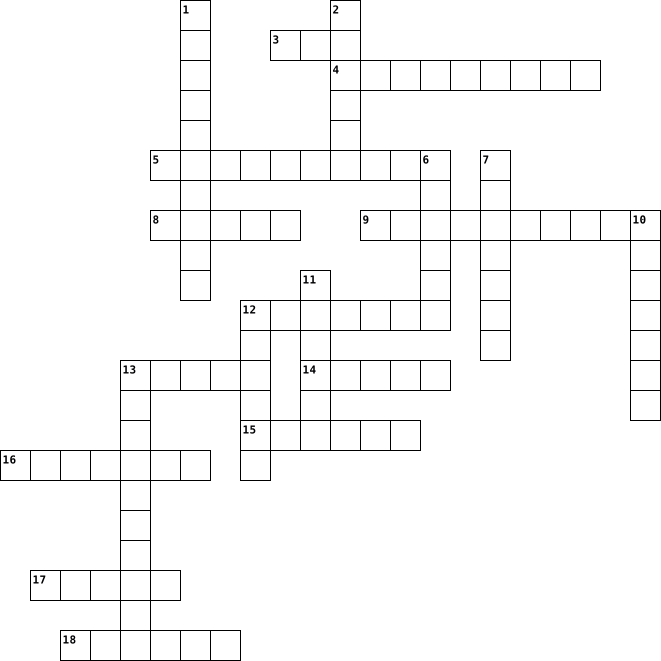
Across
- Below Canada
- Devils (NHL Team)
- Had Ronaldo on there soccer team
- Cherry Blossom Trees
- Seahawks (NFL Team)
- Alligators And Hot
- were most toys come from
- Cowboys
- Above The USA
- Had a war with Russia
- Home of The lobster
- Has Naymar Jr on their team
Down
- Next To Australia
- Chiefs (NFL Team)
- Had a war with Ukraine
- Bulls (NBA Team)
- Giants (NFL Team)
- Bruins (NHL Team)
- Eiffel Tower
- anaheim ducks (NHL Team)
20 Clues: Cowboys • Below Canada • Eiffel Tower • Above The USA • Bulls (NBA Team) • Next To Australia • Chiefs (NFL Team) • Devils (NHL Team) • Giants (NFL Team) • Bruins (NHL Team) • Alligators And Hot • Seahawks (NFL Team) • Home of The lobster • Cherry Blossom Trees • Had a war with Russia • Had a war with Ukraine • were most toys come from • anaheim ducks (NHL Team) • Has Naymar Jr on their team • ...
States of Matter and Chemical Reactions 2024-05-08

Across
- Transition from gas to solid without passing through the liquid state
- Transition from solid to gas without passing through the liquid state
- Transition from liquid to solid
- State of matter with charged particles
- A type of chemical reaction that involves burning
- State in which the forward and reverse reactions occur at the same rate
- A substance that speeds up a chemical reaction without being consumed
- Solid formed in a solution during a chemical reaction
- Transition from gas to liquid
- Rate Speed at which a chemical reaction occurs
- A substance that is produced in a chemical reaction
- Transition from solid to liquid
- State of matter with a definite volume but no definite shape
Down
- Type of chemical reaction that releases energy
- Transition from liquid to gas at a surface
- State of matter with no definite shape or volume
- A reaction between an acid and a base, forming water and a salt
- A substance that is consumed during a chemical reaction
- Type of chemical reaction that absorbs energy
- State of matter with a definite shape and volume
20 Clues: Transition from gas to liquid • Transition from liquid to solid • Transition from solid to liquid • State of matter with charged particles • Transition from liquid to gas at a surface • Type of chemical reaction that absorbs energy • Type of chemical reaction that releases energy • Rate Speed at which a chemical reaction occurs • ...
States And Countries - Landen O. B3 2024-01-24

Across
- Capital is Carson City
- Capital is Sacramento
- Capital is Boston
- Capital is Augusta
- Has 50 stars on the flag
- Second Largest Country in the world.
- Contains the Volga River
- Capital is Albany
- Capital is Tallahassee
- Capital is Phoenix
- the largest country in South America
Down
- Home to the kangaroo
- Largest Country in africa.
- Capital is Helena
- Capital is Seattle
- population of 1.4 billion
- Eighth Largest Country.
- National bird is a peacock.
- 9th largest Country.
- Capital is Concord
20 Clues: Capital is Helena • Capital is Boston • Capital is Albany • Capital is Seattle • Capital is Augusta • Capital is Phoenix • Capital is Concord • Home to the kangaroo • 9th largest Country. • Capital is Sacramento • Capital is Carson City • Capital is Tallahassee • Eighth Largest Country. • Has 50 stars on the flag • Contains the Volga River • population of 1.4 billion • Largest Country in africa. • ...
Mission: Matter — States and Particles Challenge! 2025-04-21

Across
- Amount of space an object or substance occupies.
- A tiny piece that makes up all matter.
- How much mass is packed into a given volume.
- Force that pulls particles together.
- Measure of how hot or cold something is.
- A hot, charged gas made of ions.
- Gas turning into a liquid.
- Energy of moving particles.
- Solid turning directly into a gas.
- Matter that spreads out to fill a space.
Down
- Matter with a fixed shape and volume.
- Matter that flows and takes the shape of its container.
- Liquid turning into gas from the surface.
- Shaking movement of particles, especially in solids.
- Force that particles apply when they hit container walls.
- Needed to make particles move faster.
- Process where a liquid becomes a solid.
- Gas turning directly into a solid.
- The gaps between particles.
- Process where a solid becomes a liquid.
- A scientific idea used to explain how particles behave.
21 Clues: Gas turning into a liquid. • The gaps between particles. • Energy of moving particles. • A hot, charged gas made of ions. • Gas turning directly into a solid. • Solid turning directly into a gas. • Force that pulls particles together. • Matter with a fixed shape and volume. • Needed to make particles move faster. • A tiny piece that makes up all matter. • ...
states of matter ( Lacey and Iris ) 2025-06-04

Across
- the tiny building blocks formed as one big one
- something that can be changed but can turn back
- tiny like little building blocks that make up everything around us
- oppisite of reversible
- the process of water turning into water vapor
- expands as much as it can and you can't see it
- when something changes the look of its self (2 words)
- take the shpe of the container its in
- what we breath in
- toxic air that we breath out ( 2 words)
Down
- the point that something freezes at( 2 words)
- when super coled atoms become one big one (2-3 words)
- the oppisite of freezing
- the oppisite of heating
- over heated gas full of energy
- water that has turned to gas(2 words)
- the oppisite of cool
- something the stays the same shape
- the weight of something
- the point when something melts or boils(2 words)
20 Clues: what we breath in • the oppisite of cool • oppisite of reversible • the oppisite of heating • the weight of something • the oppisite of freezing • over heated gas full of energy • something the stays the same shape • water that has turned to gas(2 words) • take the shpe of the container its in • toxic air that we breath out ( 2 words) • ...
States of Matter and Atomic Structure 2022-09-22

Across
- positively charged mass located in the center of the atom
- a temperature of Ok
- gas or vapor changes directly into a solid
- positively charged subatomic particle
- result of a force distributed over an area
- number of protons in an atom
- system releases energy into its surroundings
- atoms of the same element that have different numbers of neutrons and different mass numbers
- direct relationship between volume and temperature
- substance changes from a solid to a gas
- changes from liquid to a gas
- negatively charged subatomic particle
Down
- particle that has no charge
- collisions of the vapor and walls of the container
- absorbs energy from its surroundings
- substance changes from 1 state of matter to another
- water gains 2261 joules of energy per gram
- the amount of heat necessary to change 1g of a solid to a liquid with no temperature change
- substance changes from a gas to a liquid
- an inverse relationship between the volume of a gas and the pressure of the gas
- number sum of protons and neutrons in the nucleus
21 Clues: a temperature of Ok • particle that has no charge • number of protons in an atom • changes from liquid to a gas • absorbs energy from its surroundings • positively charged subatomic particle • negatively charged subatomic particle • substance changes from a solid to a gas • substance changes from a gas to a liquid • gas or vapor changes directly into a solid • ...
Mr. Justin and The United States 2023-02-09

Across
- Biggest state in the U.S.
- Branch of government (president)
- President before the current one
- Most populated state
- Ocean on the west coast
- The County we're in
- Name of the first president
- Mr. Justin's favorite character
- Country south of the U.S.
- Mr. Melville's wife is from here
- Capital of California
Down
- Last state to join the union
- Mr. Justin's favorite food
- Political party against Biden's
- Ocean on the east coast
- Longest river in the U.S.
- Name of Mr. Justin's daughter
- Joe Biden's political party
- The school Mr. Justin teaches at
- Country north of the U.S.
- Popular electric car
21 Clues: The County we're in • Most populated state • Popular electric car • Capital of California • Ocean on the east coast • Ocean on the west coast • Biggest state in the U.S. • Longest river in the U.S. • Country north of the U.S. • Country south of the U.S. • Mr. Justin's favorite food • Joe Biden's political party • Name of the first president • Last state to join the union • ...
Reconstruction Era 2022-10-15

Across
- an informal, unwritten deal that settled the disputed 1876 U.S. Presidential election
- restrictive laws designed to limit the freedom of African Americans
- a violent secret fraternal society founded in 1915 in Georgia to maintain white Protestant cultural and political power
- the belief that white people constitute a superior race and should therefore dominate society
- granted African American men the right to vote
- someone who repays, recovers, saves, or exchanges something for something else
- was vice president before he became the 17th president
- abolished slavery in the United States
- An Act to establish a Bureau for the Relief of Freedmen and Refugees
- a white Southerner acting in support of the reconstruction governments after the American Civil War often for private gain
Down
- affirmed the “equality of all men before the law” and prohibited racial discrimination in public places and facilities such as restaurants and public transportation
- the era previous to the Civil War
- required that 50% of all voters in the Confederate states, must pledge allegiance to the Union before reunification
- to refuse to admit or approve
- the right to vote in political elections
- a Northerner in the South after the American Civil Wat usually seeking private gain under the Reconstruction governments
- declared all persons born in the United States to be citizens, "without distinction of race or color, or previous condition of slavery or involuntary servitude
- granted citizenship to all persons born or naturalized in the United States
- 19th U.S. president
- a plan for the South pit toward by Abraham Lincoln in 1863
- first African American senator in 1870
21 Clues: 19th U.S. president • to refuse to admit or approve • the era previous to the Civil War • first African American senator in 1870 • abolished slavery in the United States • the right to vote in political elections • granted African American men the right to vote • was vice president before he became the 17th president • ...
The Constution Crossword 2021-11-19

Across
- the plan of government adopted at the constitutional convention that established a two house congress and is based on state population and equal numbers of senators
- a series of essays written by james madison alexander hamilton and john jay in support of the ratification of the constitution by the states
- a coutry governed by elected representatives
- decided how slaves would be counted for states populations
- a written plan that provides a basic framework for a government
- ften called the father of the constitution
- to approve something formally.
- the age of reason in 17 and 18 century europe
Down
- a law passed by congress in 1787 the specified how western lands would be governed
- the group establihed by the constitution to elect the president and vice president voters in each state choose their electors
- convention the meeting of delegates in which the articles of confederation were scrapped in favor of a new united states constitution
- the first written plan for goverment for the united states
- a region of the united states bounded by the ohio and mississippi rivers and the great lakes the region was given to the us by the treaty of paris in 1783
13 Clues: to approve something formally. • ften called the father of the constitution • a coutry governed by elected representatives • the age of reason in 17 and 18 century europe • decided how slaves would be counted for states populations • the first written plan for goverment for the united states • a written plan that provides a basic framework for a government • ...
South Africa 2013-09-01

Across
- a long horn blown by fans during the matches of the 2010 FIFA World Cup”
- South African writer and Nobel Prize-winner"
- a series of protests led by high school students in South Africa in 1976. Students from numerous schools began to protest in the streets in response to the introduction of Afrikaans as the medium of instruction in local schools.”
- South African social rights activist and retired Anglican bishop who rose to worldwide fame during the 1980s as an opponent of apartheid.
- anti-apartheid activist and leader of the Black Consciousness Movement"
- name of descendants of Dutch-speaking settlers in South Africa”
- the largest city in South Africa"
- this term refers to the multi-ethnic society of post-apartheid South Africa"
- the currency of South Africa"
- leader of the ANC and the first black president in post- Apartheid South Africa"
- a political regime in which people of different races are separated"
- an often underdeveloped urban area allotted to non-whites during the Apartheid years"
- animal you may encounter in the South African bushveld"
- one of South Africa's 11 official languages"
Down
- neighbour state to South Africa"
- South African and American supermodel and Hollywood actress"
- a flat-topped plateau forming a prominent landmark overlooking the city of Cape Town in South Africa"
- popular alcoholic product of South Africa"
- nickname of a very fast South African without legs"
- one of three capitals in South Africa"
- very precious and extremely hard mineral found and mined in South Africa"
21 Clues: the currency of South Africa" • neighbour state to South Africa" • the largest city in South Africa" • one of three capitals in South Africa" • popular alcoholic product of South Africa" • South African writer and Nobel Prize-winner" • one of South Africa's 11 official languages" • nickname of a very fast South African without legs" • ...
Sociology 201 Chapter 14 (Healthcare) 2016-11-12

Across
- This means assisting in the death of a person suffering from an incurable disease.
- ____ medicine is a medical care system in which the government owns and operates medical facilities and employs physicians.
- This type of medicine emphasizes the prevention of illness and takes into account a person's entire physical and social environment.
- ____ among African-Americans is almost three times the rate for whites, which explains why African-Americans have a shorter life expectancy.
- According to Social-Conflict Theory, social ____ is seen as a direct link to patterns of health and illness.
- This is the greatest preventable cause of death in the United States.
Down
- ____ insurance plans are the most common programs used to pay for medical care in the United States today.
- According to Talcott Parsons, this is a pattern of behavior defined as appropriate for people who are ill.
- This chronic illness is the second most common cause of death today in the United States.
- Eating disorders have a lot to do with how our society defines ____.
- Social ____ is the study of how health and disease are distributed throughout a society's population.
- Currently in the United States, there is a nursing ____.
- The medical establishment in the United States is oriented toward ____ medicine.
- ____ is defined as having a body mass index of 30 or higher.
14 Clues: Currently in the United States, there is a nursing ____. • ____ is defined as having a body mass index of 30 or higher. • Eating disorders have a lot to do with how our society defines ____. • This is the greatest preventable cause of death in the United States. • The medical establishment in the United States is oriented toward ____ medicine. • ...
Branches of Government Cross Word 2024-12-18

Across
- one where legalized force is restricted through delegated and enumerated authorities.
- a doctrine in political theory that government is created by and subject to the will of the people
- those specifically identified in the Constitution.
- an act of vesting the legislative, executive, and judicial powers of government in separate bodies.
- having the power to make laws.
- an assembly or council usually possessing high deliberative and legislative functions
- a governing body of a Nation, state, community
Down
- powers that are shared by both the federal government and state governments.
- gives the Supreme Court and federal courts the authority to interpret the constitition
- government actors must follow certain procedures before they may deprive a person of a protected life, liberty, or property interest.
- the process to become a U.S. citizen if you were born outside of the United States.
- political powers granted to the United States government that aren't explicitly stated in the Constitution.
- an organization which consists of a number of parties or groups united in an alliance or league.
- The powers not delegated to the United States by the Constitution, nor prohibited by it to the States, are reserved to the States respectively, or to the people
- a national legislative body, especially that of the US. The US Congress, which meets at the Capitol in Washington, D.C., was established by the Constitution of 1787 and is composed of the Senate and the House of Representatives.
15 Clues: having the power to make laws. • a governing body of a Nation, state, community • those specifically identified in the Constitution. • powers that are shared by both the federal government and state governments. • the process to become a U.S. citizen if you were born outside of the United States. • ...
European countries capitals 2022-02-08

Across
- it's capital is pristina
- it's capital is bucharest
- it's capital is tirana
- it's capitla is oslo
- it's capital is brussels
- it's capital is athens
- it's capital is budapest
- it's capitla is tallinn
Down
- it's capital is bratislava
- it's apital is valleta
- it's capital is paris
- it's capital is keiv
- it's capital is amsterdam
- it's capital is sofia
- it's capital is helsinki
15 Clues: it's capital is keiv • it's capitla is oslo • it's capital is paris • it's capital is sofia • it's apital is valleta • it's capital is tirana • it's capital is athens • it's capitla is tallinn • it's capital is pristina • it's capital is brussels • it's capital is helsinki • it's capital is budapest • it's capital is bucharest • it's capital is amsterdam • it's capital is bratislava
European countries capitals 2022-02-08

Across
- it's capital is pristina
- it's capital is bucharest
- it's capital is tirana
- it's capitla is oslo
- it's capital is brussels
- it's capital is athens
- it's capital is budapest
- it's capitla is tallinn
Down
- it's capital is bratislava
- it's apital is valleta
- it's capital is paris
- it's capital is keiv
- it's capital is amsterdam
- it's capital is sofia
- it's capital is helsinki
15 Clues: it's capital is keiv • it's capitla is oslo • it's capital is paris • it's capital is sofia • it's apital is valleta • it's capital is tirana • it's capital is athens • it's capitla is tallinn • it's capital is pristina • it's capital is brussels • it's capital is helsinki • it's capital is budapest • it's capital is bucharest • it's capital is amsterdam • it's capital is bratislava
European Countries Capitals 2022-02-08

Across
- The capital of Switzerland.
- The capital of Budapest.
- The capital of Poland.
- The capital of Belgium.
- The capital of Helsinki.
- The capital of Greece.
- The capital of Slovakia.
- The capital of UK.
Down
- The capital of Albania.
- The capital of Denmark.
- The capital of Kossovo.
- The capital of Italy.
- The capital of France.
- The capital of Estonia.
- The capital of Vilnius.
15 Clues: The capital of UK. • The capital of Italy. • The capital of Poland. • The capital of France. • The capital of Greece. • The capital of Albania. • The capital of Denmark. • The capital of Kossovo. • The capital of Belgium. • The capital of Estonia. • The capital of Vilnius. • The capital of Budapest. • The capital of Helsinki. • The capital of Slovakia. • The capital of Switzerland.
AP world history 2022-11-01

Across
- loyalty was seen as a needed trait to be a good person in the post-classical time period
- the first il-khan of persia
- was reunited
- an advanced (for its time) warfare in which a blockade of a place was formed and an assult on the place soon after the blockade
- huge plague that killed half of europe and many more millions of people
- the dynasty following the collapse of Mongol ruled China
- a period where
- third emperor of the Ming dynasty who sponsored a huge encylopedia
- Mongol ruled china was a huge and necessary component in the Eurasian trade network
Down
- a diplomacy throughout the mongol empire that ended up getting brought to europe and giving europe huge advancements
- a period of unrest and war in china during the han dynasty
- Europe took over the sea do to the mongols no longer being around
- a highly uneven and unfair impact for russia
- a man who has been castrated
- the incorparation of russia into the Mongolian empire
- instead of continuing destroying ghazan tried to build peace with and learn from the persians
- the aggressive rulers of moscow and the connection the russians biggest city had made with the mongols helped play a role in the end of Mongol rule
- pastoralism in which herds our lead towards fresh pastures to graze on
- one of the capitals of the mongol empire
- a rapid communication system
- literally searched strayer as well as the internet for a good 30 minutes and couldn't find anything about this.
- mongol led chinese dynasty
22 Clues: was reunited • a period where • mongol led chinese dynasty • the first il-khan of persia • a man who has been castrated • a rapid communication system • one of the capitals of the mongol empire • a highly uneven and unfair impact for russia • the incorparation of russia into the Mongolian empire • the dynasty following the collapse of Mongol ruled China • ...
Roaring 1920's! 2018-02-25

Across
- A style of dance music, popular especially in the 1920s.
- A saloon or nightclub selling alcoholic beverages illegally, especially during Prohibition.
- United States professional baseball player famous for hitting home runs.
- Informal. smuggled or illicitly distilled liquor, especially corn liquor asillicitly distilled chiefly in rural areas of the southern U.S.
- Filmmaker and actor who did most of his work in the United States.
- Alcoholic liquor unlawfully made, sold, or transported, without registration or payment of taxes.
- United States gangster who terrorized Chicago during prohibition.
Down
- Way of transmitting publicity, music, etc.
- A secret hate group in the southern U.S., active for several years after the Civil War, which aimed to suppress the newly acquired rights of black people and to oppose carpetbaggers from the North, and which was responsible for many lawless and violent proceedings.
- Famous entertainment in 1920.
- United States aviator who in 1927 made the first solo nonstop flight across the Atlantic Ocean.
- Man who revolutionized the automotive industry
- Drink banned in 1920
- Way to transmit advertising, movies, etc.
- A young woman in the 1920s who flaunted her unconventional conduct and dress.
15 Clues: Drink banned in 1920 • Famous entertainment in 1920. • Way to transmit advertising, movies, etc. • Way of transmitting publicity, music, etc. • Man who revolutionized the automotive industry • A style of dance music, popular especially in the 1920s. • United States gangster who terrorized Chicago during prohibition. • ...
Civil War Vocabulary 2022-11-17

Across
- Proclamation, 1862. Abraham issued it and said that on Janurary 1st, 1863 all enslaved people in the Confederate states currently engaged in rebellion against the Union were now free from slavery. This changes the reason from war from being united as one country to fighting for the end of slavery
- a formal and organized choice by vote of a person for political office or other position.
- Confederacy, the name of the South who supported slavery
- Consisted of Alabama, North Carolina, Arkansas, South Carolina, Florida, Tennessee, Georgia, Texas, Louisiana, Virginia, Mississippi.
- State, a state that did not allow enslaved people.
- condition in which one human being is owned by another.
- Union, the name of the North who opposed slavery.
Down
- Rights, political rights and powers that are granted to the states of the United States by the Constitution.
- the action or act of abolishing a system, practice, or institution
- Consisted of Delaware, Maryland, Kentucky, Missouri, California, New Hampshire, Connecticut, New Jersey, Illinois, New York, Indiana, Ohio, Iowa, Oregon, Kansas, Pennsylvania, Maine, Rhode Island, Massachusetts, Vermont, Michigan, Minnesota, Wisconsin
- the action of withdrawing formally from membership of a federation or body.
- a large section of land that had a house for the white family to live in and lots of farmland that the enslaved people were forced to work and take care of and small huts for the enslaved people to live in.
- a disagreement or problem amongst people, states, countries, etc.
- Railroad, a network of routes and safe houses throughout the states that helped enslaved people escape slavery.
- State, a state that allowed enslaved people.
15 Clues: State, a state that allowed enslaved people. • Union, the name of the North who opposed slavery. • State, a state that did not allow enslaved people. • condition in which one human being is owned by another. • Confederacy, the name of the South who supported slavery • a disagreement or problem amongst people, states, countries, etc. • ...
US History 2026-02-11

Across
- __ Glasses is the invention of one of the Founding Fathers.
- Jefferson One of the notable Founding Fathers who participated in drafting the U.S. Declaration of Independence. During his term, he sanctioned the Louisiana Purchase which doubled the size of the USA.
- City where the Constitutional Convention was held in 1787.
- of Paris An important document because it negotiated the end of the American Revolutionary War. The treaty recognized American independence from Britain and established borders for the United States.
- Hamilton one of the members of Washington’s cabinet and was given the position of the First United States Secretary of Treasury.
- Franklin A Founding Father of the U.S., inventor, and diplomat. He helped draft the Declaration of Independence and secured French support during the American Revolution.
- of Rights The first ten amendments to the Constitution.
Down
- Convention The process by which the Constitution was approved by the states.
- of Independence One of the founding and the most fundamental document of the United States of America.
- Jay The first Chief Justice of the Supreme Court and served for 34 years before he resigned. In 1795, he became New York's first governor.
- G. Harding The term Founding Father was first used in 1916 by this American president to describe these men.
- Federalist Papers A collection of essays that was written to encourage the approval of the Constitution of the United States.
- Washington The first president of the United States, taking office in 1789. He was unanimously elected and is often called the “Father of His Country.”
- Madison Known as the "Father of the Constitution".
14 Clues: Madison Known as the "Father of the Constitution". • of Rights The first ten amendments to the Constitution. • City where the Constitutional Convention was held in 1787. • __ Glasses is the invention of one of the Founding Fathers. • Convention The process by which the Constitution was approved by the states. • ...
WWll 2023-04-19

Across
- june 6 1944 storming of normady beach
- 32nd president
- a group of African American military pilots and airmen who fought in World War II. They formed the 332d Fighter Group and the 477th Bombardment Group of the United States Army Air Forces.
- normal working person
- being apart from alliances and affairs
- one of the most transformative events of the 20th century
- naval submarines operated by germans
Down
- skipping over heavily fortified islands in order to seize lightly defended locations that could support the next advance
- bombing on december 7 1941
- german leader during world war 2
- Passed on March 11, 1941, this act set up a system that would allow the United States to lend or lease war supplies to any nation deemed "vital to the defense of the United States.
- 33rd president
- political ideology
- created a code based on the complex, unwritten Navajo language
- an allegorical cultural icon in the United States who represents the women who worked in factories and shipyards during World War II, many of whom produced munitions and war supplies. These women sometimes took entirely new jobs replacing the male workers who joined the military
- bomb made of pluetonioum or uranium radioactive
16 Clues: 33rd president • 32nd president • political ideology • normal working person • bombing on december 7 1941 • german leader during world war 2 • naval submarines operated by germans • june 6 1944 storming of normady beach • being apart from alliances and affairs • bomb made of pluetonioum or uranium radioactive • one of the most transformative events of the 20th century • ...
Government Final 2021-06-03

Across
- a group of people appointed for a specific function
- a body of people representing the states of the US, who formally cast votes for the election of the president and vice president
- any association of individuals or organizations, usually formally organized, that, on the basis of one or more shared concerns
- founding document, originally comprising seven articles, delineates the national frame of government
- the elected head of a city or town
- a means of issuing federal directives in the United States, used by the President of the United States
Down
- the first ten amendments to the United States Constitution.
- a system of government in which the same territory is controlled by two levels of government
- a set of legal and constitutional protections designed to ensure the opportunity to vote in local, state, and federal elections
- made in to replace NCLB
- the highest court in the federal judiciary of the United States of America
- technology that is intended to reach a
- an organization that coordinates candidates to compete in a country's elections
- incumbent is the current holder of an office or position
- are groups of representatives who share similar interests or policy goals
15 Clues: made in to replace NCLB • the elected head of a city or town • technology that is intended to reach a • a group of people appointed for a specific function • incumbent is the current holder of an office or position • the first ten amendments to the United States Constitution. • are groups of representatives who share similar interests or policy goals • ...
Constitutional Underpinnings and Federalism 2017-04-10

Across
- State whose plan called representation based on population.
- Transferring of power to lower levels of government
- Provision stating Constitution, laws of Congress and treaties are the highest law of the land
- A group of citizens united around a common interest according to Madison
- Counted as three-fifths for the purposes of taxation
- Landmark case dealing with guns that limited the definition commerce to economic activity.
- Type of commercial activity regulated by the states
- States must return a person charged with a crime in another state to that state for punishment
- Restraints placed on the other two branches of governments so that no one branch becomes too powerful
- Amendment stating national government cannot usurp state powers
- Process to review constitutionality of laws
- Landmark case that strengthened national government's power and broadened the definition of commerce
Down
- Grants of a specific purpose
- Source of Congress' power to pass all laws necessary and proper to carrying out enumerated powers.
- Original constitution of America which gave national government limited powers
- Type of legislature with a Senate based on equal representation and a House based on population.
- Addition to the Constitution to convince Anti-Federalist to ratify
- A formal change to the Constitution, which can be done 4 ways
- Type of powers that are shared by the state and national government
- Tool to direct states and local governments to comply with federal law under threat of penalties or as a condition of receipt of a grant
- Type of federalism involving spending, taxing and providing grants in the federal system
- Grants that give states more discretion and cover a policy area
22 Clues: Grants of a specific purpose • Process to review constitutionality of laws • Transferring of power to lower levels of government • Type of commercial activity regulated by the states • Counted as three-fifths for the purposes of taxation • State whose plan called representation based on population. • A formal change to the Constitution, which can be done 4 ways • ...
Our Puzzling History Pt.2 2022-11-18

Across
- powers directly expressed or stated in the Constitution by the Founders
- powers that both the national government and the states have
- favors state and local action in dealing with problems
- course of action a government takes in response to some issue or problem
- enables the people of the territory interested in becoming a state to prepare a constitution
- require periodic checks of government agencies to see if they are still needed
- powers that the national government requires to carry out the powers that are expressly defined in the Constitution
- powers that the national government may exercise simply because it is a government
- laws relating to disputes between individuals
- organization of government administrators
- rights to pass through or live in any state; use the courts; make contracts; buy, sell, and hold property; and marry
- prohibited public officials from holding closed meetings.
Down
- the basis for the implied powers
- each state must recognize the laws and legal proceedings of the other states
- another name for Article VI, Section 2 of the Constitution
- a nationalist Chief Justice
- powers the Constitution grants or delegates to the national government
- principal way in which states settle their differences with one another without the use of force
- certain powers reserved strictly to the states
- another name for the necessary and proper clause
- forbid racial discrimination in public accommodations such as hotels and restaurants
- favors national action in dealing with these matters
- levied on individual earnings has become the major source of money for the national government
- Supreme Court held that in the instance of a conflict between the national government and a state government, the national government is supreme
- return to a state
25 Clues: return to a state • a nationalist Chief Justice • the basis for the implied powers • organization of government administrators • laws relating to disputes between individuals • certain powers reserved strictly to the states • another name for the necessary and proper clause • favors national action in dealing with these matters • ...
Creating The Constitution 2023-10-03

Across
- Power given to Congress to control trade
- Power given to Congress to collect taxes
- establish local governments, establish public schools, administer elections, establish licensing requirements
- "Large state" proposal for the new constitution, calling for proportional representation in both houses of a bicameral Congress. The plan favored larger states and thus prompted smaller states to come back with their own plan for apportioning representation.
- Branch of government responsible for enforcing laws
- Legislative Branch of the Constitution
- congress could tax imports but not exports
- the body of electors who formally elect the United States president and vice-president
- the lower house of Congress, consisting of a different number of representatives from each state, depending on population
- Declare war, regulate banks, negotiate treaties
Down
- Compromise made by Constitutional Convention in which states would have equal representation in one house of the legislature and representation based on population in the other house
- each slave would count for 3/5 of a person for taxation and representation purposes
- the upper house of Congress, consisting of two representatives from each state
- Branch of government responsible for making laws
- Executive Branch of the Constitution
- Principle that divides power between the state and national government
- Two house legislature
- Branch of government responsible for interpreting laws and settling disputes
- A constitutional proposal that would have given each state one vote in a new congress
- Legislative, Executive, and Judicial branches
- Requires majority vote of 50% plus one
- Judicial Branch of the Constitution
- Congress could not regulate or outlaw slavery or slave trade until 1808
- Power given to Congress to raise military forces
- Division of powers between state and national government
25 Clues: Two house legislature • Judicial Branch of the Constitution • Executive Branch of the Constitution • Requires majority vote of 50% plus one • Legislative Branch of the Constitution • Power given to Congress to control trade • Power given to Congress to collect taxes • congress could tax imports but not exports • Legislative, Executive, and Judicial branches • ...
NATIONAL FFA WEEK 2025-02-25

Across
- The ____________ is a symbol of labor and tillage of the soil.
- E.M. ____________ is the author of the FFA creed.
- The FFA National convention is held each year in Indianapolis, _____________.
- In 1917, the Smith-___________ National Vocational Education Act, establishes vocational agriculture courses.
- In 1968, Presidential candidate Richard M. ____________ spoke at the National FFA Convention. He was elected U.S. president the following month.
- The ___________ is a symbol of knowledge and wisdom.
- Public Law 740 (federal charter): states that the FFA is an _______________ , not an extracurricular, part of agricultural education programs.
- The ____________ is a symbol of our national scope and patriotism.
- Henry _________________ is known as the Father of FFA.
- There are 9,235 _____________ across the United States, Puerto Rico, and the U.S. Virgin Islands.
- The FFA Convention from Kansas City, Missouri, to Louisville, _____________, in 1999.
- The FFA __________ is "Learning to Do, Doing to Learn, Earning to Live, Living to Serve."
- The rising ___________ symbolizes progress and the future of agriculture.
Down
- The FFA “code of Ethics” states that FFA members should be courteous in _______________ and generous in defeat.
- The ___________ Statement of the FFA is "FFA makes a positive difference in the lives of students by developing their potential for premiere leadership, personal growth and career success through agricultural education.
- The 1st National Convention & every national convention until 1998 were held in Kansas City, __________.
- The official FFA colors are National __________ and Corn Gold.
- The Future _____________ of America was founded in 1928.
- As of August 2024, the National FFA Organization had 1,027,273 _________.
- FFA's official jacket is made of blue __________.
- Leslie ______________ was the first National FFA president.
- In 1930, the FFA _______________ was adopted.
- The FFA emblem is made of up a cross section of _______________, which symbolizes the common agricultural link between all states.
23 Clues: In 1930, the FFA _______________ was adopted. • E.M. ____________ is the author of the FFA creed. • FFA's official jacket is made of blue __________. • The ___________ is a symbol of knowledge and wisdom. • Henry _________________ is known as the Father of FFA. • The Future _____________ of America was founded in 1928. • ...
The American Civil War 2022-01-29

Across
- party which linclon joined in 1856
- a trade process followed by southern states with britain
- african nationals captured and used as labourers
- birthplace of abraham linclon
- proclamation issued by linclon for abolishing slavery
- place where abraham linclons famous speech was delivered
- The federal law making process through a legislature
- a territory which wanted to join the usa as a free state
Down
- president elected by confederate states of america
- forced agricultural and industrial labour during civil war
- abraham linclons profession
- book based on rev.josiah jenson
- people who wanted to abolish slavery
- extensively accepted profession in the northern states
- taxes on imported goods
- antonym for fugitive slaves
16 Clues: taxes on imported goods • abraham linclons profession • antonym for fugitive slaves • birthplace of abraham linclon • book based on rev.josiah jenson • party which linclon joined in 1856 • people who wanted to abolish slavery • african nationals captured and used as labourers • president elected by confederate states of america • ...
african city states 2024-05-06

Across
- The activity of buying and selling goods and services, especially on a large scale. Commerce was a fundamental aspect of African city-states, which often served as major trading hubs facilitating the exchange of goods across regions and civilizations.
- Defensive structures built to protect a city or settlement from external threats, such as attacks from rival states or invaders. Many African city-states constructed fortifications, such as walls, ramparts, and moats, to defend against hostile forces.
- A sovereign state consisting of a city and its surrounding territory. In the context of Africa, city-states were urban centers that served as political and economic hubs within their regions.
- The buying and selling of goods and services, often involving the exchange of commodities between different regions or civilizations. African city-states were often involved in extensive trade networks, both within the continent and with external regions such as the Mediterranean and Indian Ocean.
- A formal agreement or partnership between two or more parties for mutual benefit or protection. African city-states often formed alliances with neighboring states or foreign powers to bolster their military strength or secure trade routes.
Down
- The authority of a state to govern itself and make decisions independently, without interference from external forces. African city-states exercised varying degrees of sovereignty over their territories, often competing with neighboring states for power and resources.
- The customs, beliefs, social institutions, and achievements of a particular group of people. African city-states were centers of cultural exchange, where ideas, traditions, and technologies were shared among diverse populations.
- The process of population concentration in urban areas, typically associated with the growth of cities and towns. African city-states experienced significant urbanization as people migrated to these centers in search of economic opportunities and protection.
- A sequence of rulers from the same family or line of descent. Some African city-states were ruled by dynastic monarchies, where power was passed down through generations within a ruling family.
- A social and political system characterized by the exchange of land for loyalty and military service. While not as prevalent in Africa as in other regions, some African city-states exhibited feudalistic tendencies, with rulers granting land and privileges to vassals in exchange for their allegiance and support.
10 Clues: A sovereign state consisting of a city and its surrounding territory. In the context of Africa, city-states were urban centers that served as political and economic hubs within their regions. • ...
Vocab #3 2021-11-16

Across
- continuous railroad line constructed between 1863 and 1869 that connected the existing eastern U.S. rail network at Council Bluffs, Iowa with the Pacific coast
- leader of the Wal-lam-wat-kain band of Nez Perce, a Native American tribe of the interior Pacific Northwest region of the United States, in the latter half of the 19th century.
- the absorption and integration of people, ideas, or culture into a wider society or culture.
- Hunkpapa Lakota leader who led his people during years of resistance against United States government policies.
- the action or process of adapting or being adapted.
- rapid influx of fortune seekers in California that began after gold was found at Sutter’s Mill in early 1848 and reached its peak in 1852.
- an armed engagement between combined forces of the Lakota Sioux, Northern Cheyenne, and Arapaho tribes and the 7th Cavalry Regiment of the United States Army.
Down
- and reserved for and managed by a Native American tribe, its sovereignty limited by federal and state or local law
- a prominent leader and medicine man from the Bedonkohe band of the Apache people.
- the surface of the ground, with the grass growing on it.
- passed in 1887 under President Grover Cleveland, allowed the federal government to break up tribal lands
- 2,170-mile east-west, large-wheeled wagon route and emigrant trail in the United States
- a massacre of nearly three hundred Lakota people by soldiers of the United States Army.
- the action of inventing something, typically a process or device.
- in, relating to, or characteristic of the countryside rather than the town.
- densely population areas or cities
16 Clues: densely population areas or cities • the action or process of adapting or being adapted. • the surface of the ground, with the grass growing on it. • the action of inventing something, typically a process or device. • in, relating to, or characteristic of the countryside rather than the town. • ...
Algebra Crossword 2023-05-10

Across
- This property states that one side of an equation is equal to the other side (x=y is same as y=x)
- A type of expression with a relationship between two values, which means they are different, instead of equal.
- Numbers that can not be expressed as fractions (ex. Pi)
- The counting numbers and zero.
- This property means that if a number times a number equals zero, then one number has to equal 0. (xy=0)
- This property states that if x=y and y=z , then x=z.
- The counting numbers.
Down
- This property means that a number is equal to itself (x=x)
- This property states that the order in which numbers are added or multiplied doesn’t change the product ( (x+2) + y = y + (2+x) )
- ___ Value. The distance from zero on a number line which is always positive.
- The rule that tells us what sequence we should solve an expression in (abbr.)
- Numbers that can be expressed as fractions.
- The counting numbers including 0 and negative numbers
- This property states that any number can be multiplied by one and still equal itself (Yx1=Y)
- This property states that if you multiply a number by its reciprocal, it will always equal one. (x/y y/x = 1)
15 Clues: The counting numbers. • The counting numbers and zero. • Numbers that can be expressed as fractions. • This property states that if x=y and y=z , then x=z. • The counting numbers including 0 and negative numbers • Numbers that can not be expressed as fractions (ex. Pi) • This property means that a number is equal to itself (x=x) • ...
Causes of the Civil War 2025-04-07

Across
- – The act of freeing enslaved people
- – An agreement that attempts to settle a dispute
- – Movement to end slavery in the U.S.
- Tubman – Famous conductor on the Underground Railroad
- Douglas – Lincoln’s rival, supporter of popular sovereignty
- Soil – Belief that new territories should be slavery-free
- – Loyalty to one’s region over the country
- – Large Southern farms using slave labor
- Compromise – 1820 agreement limiting slavery’s expansion
- Beecher Stowe – Author of Uncle Tom’s Cabin
- Codes – Laws controlling enslaved people’s lives
- of 1860 – Event that triggered Southern secession
- North – Region with factories and free labor
- – The nation’s foundational legal document
- Tom’s Cabin – Influential anti-slavery novel published in 1852
- Lincoln – Elected president in 1860, opposed slavery’s spread
- Scott – Enslaved man who sued for his freedom
- Act – 1854 law allowing popular sovereignty in new territories
Down
- – Division of power between national and state governments
- Rights – Belief that states had authority over federal laws
- Debates – 1858 debates focused on slavery and state rights
- South – Region reliant on farming and slavery
- – System that kept millions of African Americans in bondage
- Ferry – Site of John Brown’s failed 1859 raid
- – Withdrawal of states from the Union
- – Idea that states could reject federal laws
- Brown – Radical abolitionist who led violent uprisings
- – The North during the Civil War
- Ruffians – Pro-slavery activists from Missouri who fought in Kansas
- Kansas – Violent clashes over slavery in a U.S. territory
- War – Conflict between North and South from 1861–1865
- Slave Act – Law requiring return of escaped slaves
- – Government formed by seceded Southern states
- Justice Taney – Delivered the Dred Scott decision
- Court – Ruled that slaves were property in 1857
- Railroad – Secret network that helped enslaved people escape
- Sovereignty – Letting settlers decide on slavery themselves
- Party – Political group formed to oppose slavery’s expansion
- – A person who dies for a cause
- – Taxes that favored Northern industries
40 Clues: – A person who dies for a cause • – The North during the Civil War • – The act of freeing enslaved people • – Movement to end slavery in the U.S. • – Withdrawal of states from the Union • – Large Southern farms using slave labor • – Taxes that favored Northern industries • – Loyalty to one’s region over the country • – The nation’s foundational legal document • ...
Unit 1 Vocab for Quantitative Analysis 2025-08-24

Across
- The process of transitioning a state toward a democratic political system.
- A system where laws are used as tools by the ruling authority to maintain control, often without fairness or equality.
- Factual, objective statements based on observable evidence.
- Subjective statements expressing opinions, values, or what ought to be.
- The system of rules or decision-making processes that determine how power is exercised within a state.
- A political system where power is derived from the people, typically through free elections.
- A system where laws are applied equally and fairly, and no one is above the law.
- A regime that seeks total control over all aspects of public and private life.
- A country’s authority over itself, free from foreign interference.
- A state where power rests with elected representatives and an elected leader, not a monarch.
- A group of people sharing commonalities, such as culture, history, or identity.
Down
- Governments led by military officials, often established through coups.
- States where decision-making authority is distributed to lower levels of government.
- The transfer of power from a central government to lower-level governments.
- Systems that claim to be democratic but function with only one dominant party, restricting genuine democratic processes.
- States where power is divided between a central government and regional entities (e.g., states or provinces).
- Governments ruled by religious leaders or based on religious law.
- The set of institutions or individuals legally empowered to make binding decisions for a state.
- States where power is concentrated in a central government with minimal regional autonomy.
- A set of fundamental principles or established precedents according to which a state is governed.
- States where decision-making authority is concentrated at the national level.
- A political organization combining a permanent population with governing institutions to exercise control over a defined territory with international recognition.
- A system where power is concentrated in the hands of a single leader or small group, with limited political freedoms.
23 Clues: Factual, objective statements based on observable evidence. • Governments ruled by religious leaders or based on religious law. • A country’s authority over itself, free from foreign interference. • Governments led by military officials, often established through coups. • Subjective statements expressing opinions, values, or what ought to be. • ...
Westward Expansion Crossword Puzzle 2026-05-12

Across
- Destiny, The 19th-century belief that the United States was destined by God to expand across the continent from the Atlantic to the Pacific.
- Trail, A major 2,000-mile wagon route that allowed thousands of settlers to travel to the West.
- People who flocked to California in 1849 in search of gold.
- The formal giving up of land, often through a treaty (e.g., Mexican Cession).
- Land that is under the jurisdiction of the United States but is not yet a state.
- Purchase, The 1803 purchase of vast land from France for $15 million, which doubled the size of the US.
- A person who is among the first to settle in a new area.
- A device that sent messages over long distances using electricity, which made communication faster.
- Wire, Sharp wire fencing that changed the West by allowing farmers to fence in land on the treeless plains.
- The extreme limit of settled land beyond which lies wilderness.
- Train, A large group of covered wagons traveling together for safety.
Down
- Land set aside by the United States government for Native Americans.
- A community that experiences sudden and rapid growth in business or population, usually near a mining site.
- Act, A law that allowed citizens to claim 160 acres of surveyed government land out West for a small fee.
- A long, organized journey made for a specific purpose, such as the Lewis and Clark expedition.
- Expansion, The movement of settlers and the United States government into the American West, particularly between 1787 and 1860.
- Railroad, A train system that connected the eastern and western coasts of the United States.
- A farmer on the Great Plains who had to break through thick sod to farm.
- To add or take over new land, such as the annexation of Texas.
- A hired hand who managed cattle, particularly on long drives.
20 Clues: A person who is among the first to settle in a new area. • People who flocked to California in 1849 in search of gold. • A hired hand who managed cattle, particularly on long drives. • To add or take over new land, such as the annexation of Texas. • The extreme limit of settled land beyond which lies wilderness. • ...
The Government of America Crossword 2026-05-13

Across
- America declared independence on __________ 4th, 1776.
- "We the __________"
- No quartering of soldiers is in this amendment to the Constitution.
- The first sentence to the Constitution.
- A rule or a law that covers the whole United States.
- A change to an official document is called an ____________.
- The 6th amendment gives you a right to a __________.
- During the American Revolution, the United States used this country's Navy.
- The ____________ amendment guarantees no cruel and unusual punishment.
- In this part of the Legislative Branch, there are 2 per state.
- No ____________ and seizure is in the 4th amendment.
- The __________ of Rights are the first 10 changes to the Constitution.
- Daniel __________ led a rebellion against the government.
- In the first government of America, they did not want a ______.
- The ___________ amendment gives you basic human rights.
- Another name for a member of the British military.
- The first president of the United States under the Constitution.
Down
- The branch of government that judges laws.
- The Great _______________ helped combine the New Jersey Plan and the Virginia Plan.
- The branch of government that makes the laws.
- The ___________ of Confederation was America's first government.
- Who America declared independence from.
- The branch of government that enforces laws.
- The name of the document that is the current government of the United States.
- The rights to freedom of speech, religion, the press, and more are all in the _________ amendment.
- James ____________ wrote much of the new Constitution.
- This person is head of the Executive Branch.
- When something is fair and doesn't favor one side.
- The right to bear arms is the _________ Amendment to the Constitution.
- In the ________ of Representatives, the number of people each state gets is based on population.
- This amendment to the Constitution gives states the power to make decisions about things.
31 Clues: "We the __________" • The first sentence to the Constitution. • Who America declared independence from. • The branch of government that judges laws. • The branch of government that enforces laws. • This person is head of the Executive Branch. • The branch of government that makes the laws. • When something is fair and doesn't favor one side. • ...
Civil War Crossword 2021-02-09

Across
- A formal document charging a public official with misconduct in office
- nickname for the South
- to practice ending slavery
- an exaggerated devotion to the interests of a region over those of a country as a whole.
- a nickname for Union soldiers and citizens
- the southern states that seceded from the United States in 1861
- led 300 slaves to freedom, because of her bravery she is the symbol of the Underground Railroad
- a nickname for Confederate soldiers and citizens
- separate from Union
- A person who wanted to end slavery
- Whitney, an American inventor, widely known for inventing the cotton gin
- Sumter, where the first shots of the Civil War were fired in South Carolina
Down
- citizens that are armed and together in emergencies.
- a word meaning before war. Used to describe the U.S. before Civil War.
- a cap worn by all soldiers
- the northern states that wanted to prevent the spread of slavery in the free states.
- Turning point of the War that made it clear the North would win. 50,000 people died, and the South lost its chance to invade the North.
- A sailor and later a Union naval captain, he was highly honored for his feats of bravery and heroism. He became a Congressman after the Civil War.
- A northerner who went to the South immediately after the Civil War
- Run, also known as the Battle of First Manassas, was the first major battle of the American Civil War.
- the state and the condition of being a slave, who is someone forbidden to quit their service for another person and is treated as property.
21 Clues: separate from Union • nickname for the South • a cap worn by all soldiers • to practice ending slavery • A person who wanted to end slavery • a nickname for Union soldiers and citizens • a nickname for Confederate soldiers and citizens • citizens that are armed and together in emergencies. • the southern states that seceded from the United States in 1861 • ...
US History Unit 4 Quiz 2025-10-23

Across
- an economic philosophy that advocates for minimal government involvement in the economy
- Amendment Granted citizenship to all citizens and guaranteed all citizens equal protection of the laws
- Supremacy The belief that white people and culture is superior to all other cultures.
- a set of restrictive laws passed by Southern states after the Civil War to control the labor and behavior of Black people.
- the process of Immigrants assimilating to American culture.
- Amendment Prohibits the federal and state governments from denying a citizen the right to vote based on "race, color, or previous condition of servitude"
- an "add-on" to the Constitution
- The transformation of rural areas into urban areas.
- the process of transforming from an agricultural economy to a manufacturing economy.
- the exclusive possession or control of the supply of or trade in a commodity or service.
Down
- was originally promised to freed slaves as reparations.
- a Protestant white-supremacist hate group founded in 1865.
- a type of building shared by multiple dwellings, typically with flats or apartments on each floor and with shared entrance stairway access.
- favoring the interests of native-born people over foreign-born people.
- The merging of companies that make similar products.
- Amendment Abolished slavery and involuntary servitude in the United States, except as punishment for a crime
- a railroad line linking the Atlantic and Pacific coasts of the United States, completed in 1869.
- The period during which the United States began to rebuild after the Civil War. It lasted from 1865 to 1877.
- is the public killing of an individual who has not received any due process.
- a popular immigration processing center in New York City
- an American investigative journalist, and one of the founders of the National Association for the Advancement of Colored People.
21 Clues: an "add-on" to the Constitution • The transformation of rural areas into urban areas. • The merging of companies that make similar products. • was originally promised to freed slaves as reparations. • a popular immigration processing center in New York City • a Protestant white-supremacist hate group founded in 1865. • ...
Constitution & Bill of Rights 2022-05-09

Across
- The right to bear arms
- Powers reserved to the states
- The men who founded our nation and our Constitution- George Washington, James Madison, and Benjamin Franklin.
- person who didn't support the Constitution because they felt that it didn't guarantee the rights of the people
- Their rebellion caused the Constitutional Convention.
- system of government in which power is shared between the central government and the states
- The first written-down plan of government for the United States.
- right to grand jury, indictment, no double jeopardy, freedom from self-incrimination, due process of law
- They were essays that answered the Antifederalist attacks
Down
- Freedom from unreasonable searches and seizures
- A convention of 55 delegates from 12 states where they discussed a new form of government, the Constitution, in Philadelphia in 1787
- freedom of speech, freedom of religion, freedom of assembly, freedom of the press, freedom to petition.
- The first 10 amendments to the Constitution. They protected the rights of the people
- person who supported a strong central government and the Constitution
- Right to a fair, speedy, public trial
- A type of government in which people choose representatives to govern them. Each state gets 1 vote.
16 Clues: The right to bear arms • Powers reserved to the states • Right to a fair, speedy, public trial • Freedom from unreasonable searches and seizures • Their rebellion caused the Constitutional Convention. • They were essays that answered the Antifederalist attacks • The first written-down plan of government for the United States. • ...
Constitutional Convention 2023-11-09

Across
- number of states needed to pass a law in AOC
- rebellion that led to a change in the Articles of Confederation
- created The Great Compromise
- two houses
- house of government that has equal representation
- branch that makes the laws
- one house
- what representation in the Virginia Plan was based on
- number of slaves that would counted towards a states' population
- branch that includes the president
Down
- house of government with proportional representation
- making sure no branch has power over the other
- plan favored by small states
- added new states with a population of over 60,000
- created the Virginia plan
- first government of the United States
- plan favorted by large states
- branch that interprets the laws
18 Clues: one house • two houses • created the Virginia plan • branch that makes the laws • plan favored by small states • created The Great Compromise • plan favorted by large states • branch that interprets the laws • branch that includes the president • first government of the United States • number of states needed to pass a law in AOC • making sure no branch has power over the other • ...
Alan 2023-05-11

Across
- scott devision, the United States Supreme Court upheld slavery in United States territories
- having or relating to a system of government in which several states form a unity
- lincoln, president during civil war
- an exaggerated devotion to the interests of a region over those of a country as a whole.
- a person who favors the institution
- a person from the northern states who went to the South after the Civil War to profit
- run,
- davis, the captain of the confederate
Down
- the battle that took control of the mississippi river
- the union
- states withdraw
- proclamation, freed the slaves
- a knife or dagger
- person who escaped
- led by jefferson davis
- states, the country that battled
- north
- confederacy
18 Clues: run, • north • the union • confederacy • states withdraw • a knife or dagger • person who escaped • led by jefferson davis • proclamation, freed the slaves • states, the country that battled • lincoln, president during civil war • a person who favors the institution • davis, the captain of the confederate • the battle that took control of the mississippi river • ...
Social Studies 2022-12-14

Across
- established the United States legislature as a bicameral, or two-house law-making body.
- a machine that revolutionized the production of cotton by greatly speeding up the process of removing seeds from cotton fiber themselves.
- was an ethnic cleansing and forced displacement of approximately 60,000 people of the "Five Civilized Tribes" between 1830 and 1850 by the United States government.
- sought their own sea routes to Asia via the northeast and the northwest.
- covers all of Florida, and eastern texas
- they were “sharecroppers.” They farmed the land for a share of the crop they harvested.
- Central government in a unitary state, or a country that does not give significant power to regional divisions.
- this region has red clay soil
- It followed the Treaty of Paris, which formally ended the Seven Years' War and transferred French territory in North America to Great Britain
- he won the Electoral College with less than 40 percent of the popular vote nationwide by carrying states above the Mason–Dixon line and north of the Ohio River, plus the states of California and Oregon in the Far West.
- was an agreement among the 13 Colonies of the United States of America that served as its first frame of government.
Down
- a small band of Lower Creeks revolted against white encroachment and started a war that gave Andrew Jackson an excuse to remove all the Creeks west of the Mississippi River.
- coastal landforms
- an imaginary line
- announced the separation of 13 North American British colonies from Great Britain.
- decides the constitutionality of federal laws and resolves other disputes about federal laws.
- physiographic province of the larger Appalachian Mountains range.
- was also commonly known as Tustunnuggee Hutke, was one of the most prominent chiefs of the Creek Nation between the turn of the nineteenth century and his execution in 1825.
- major river in the southeastern U.S shallow, 438,000-acre swamp
- was one of the Southern colonies in British America.
- an ideological and political revolution that occurred in British America between 1765 and 1791.
- in the 1530s they began exploring the southeastern and southwestern regions of North America in hopes of finding more treasure.
- panish explorer and conquistador who was involved in expeditions
- a machine that revolutionized the production of cotton by greatly speeding up the process of removing seeds from cotton fiber
24 Clues: coastal landforms • an imaginary line • this region has red clay soil • covers all of Florida, and eastern texas • was one of the Southern colonies in British America. • major river in the southeastern U.S shallow, 438,000-acre swamp • panish explorer and conquistador who was involved in expeditions • physiographic province of the larger Appalachian Mountains range. • ...
Lead up to the Civil War 2025-10-21

Across
- a conflict fought between the united states and mexico from 1846 to 1848
- a abolitionist and a women's rights activist
- required that slaves be returned to their owners, even if they were in a free state
- five laws passed in September of 1850 that dealt with the issue of slavery and territorial expansion
- an argicultrual product that increased the need for slavery
- improving the treatment of the mentally ill and her role as a civil war nurse
- the principal that the authority of a government is created and sustained by the consent of its people
- denied the legality of black citizenship in America
- the principle and movement aimed at ending slavery and achieving the emancipation of all enslaved people
- the withdrawal of eleven southern states from the Union in 1860, leading to the Civil war
- a legal theory that a state can invalidate any federal law it deems unconstitutional
- a leading abolitionist who founded the influential anti-slavery newspaper
- a period of violent conflict from 1854 to 1859 between proslavery and anti-slavery settlers in the Kansas Territory
Down
- a famous anti-slavery novel
- a brave abolitionist and conductor on the underground railroad
- a U.S policy from 1823 that told European powers to stay out of the western hemisphere
- one person has total ownership of another
- individuals employed to track down and return escaped slaves to their owners
- a 1820 United States federal law that temporarily resolved the national conflict over the expansion of slavery
- the equal numbers of states that allowed slavery and those that did not
- put slaves up for sale
- a U.S. law that organized the Kansas and Nebraska territories
- a social reform movement that advocated for the reduction or elimination of alcohol consumption
- the abolitionist who led the raid on Harpers Ferry in 1859
- several periods of religious revival in American History
- a machine for separating cotton from its seed
- a network of secret routes and safe houses used by enslaved African Americans to escape to free states and Canada
- former slave who became a prominent abolitionist
- the freeing of someone from slavery
- "the great compromiser"
30 Clues: put slaves up for sale • "the great compromiser" • a famous anti-slavery novel • the freeing of someone from slavery • one person has total ownership of another • a abolitionist and a women's rights activist • a machine for separating cotton from its seed • former slave who became a prominent abolitionist • denied the legality of black citizenship in America • ...
Notebook Test BIM 2019-03-27

Across
- A function that allows users to "ask the database a question" in order to find certain information in a database
- A single set of information in a database
- A database integrity concept that states the foreign key of a table has two states 1)the primary key of another table or 2)null
- The relationship type that states each record in both tables can relate to any number of records (or no records) in the other table
- A way to sort the database by bringing up specific records that match a term
- The relationship type that states that the only one record in table related to none,one, or may records in another table
- A way to sort the database by changing which records are displayed on screen
- A way to sort the database by changing the order in which records are displayed
Down
- The key that is a unique identifier for the information in a table
- The relationship type that states that each primary key values related to only one (or no)records in the related table
- A collection of organized data
- The database model that uses rows, columns, and tables to organize the information in a database
- The key that identifies the relationship between tables
- The pieces of information in a record
- The data integrity concept that states that each table must have a primary key that unique and not null
- The data integrity concept that states all entries in a column are of the same type or constrained to a certain format
16 Clues: A collection of organized data • The pieces of information in a record • A single set of information in a database • The key that identifies the relationship between tables • The key that is a unique identifier for the information in a table • A way to sort the database by bringing up specific records that match a term • ...
World War I 2024-11-06

Across
- This was the most deadly weapon used during World War I
- Required men to register with the government to be selected for military service
- muddy land with shell craters and barbed wire
- A nickname for German Soldiers during WWI
- The United States used this to overcome the threat of German U-Boats
- Heir to the Austrian throne
- The development of armed forces
Down
- A devotion to the interests and cultures of one's own nation
- President of the United States during WWI
- This contained a suggestion of an alliance between Mexico and Germany
- stronger nations extending control over weaker nations
- Germany, Austria-Hungary, and Ottoman Empire
- This type of warfare included airplanes and tanks
- This form of warfare was used to protect against the machine gun
- The policy that kept the United States out of war
- The sinking of this ship began to sway American sentiment towards entering the war
- Russia, France, and Britain
17 Clues: Heir to the Austrian throne • Russia, France, and Britain • The development of armed forces • President of the United States during WWI • A nickname for German Soldiers during WWI • Germany, Austria-Hungary, and Ottoman Empire • muddy land with shell craters and barbed wire • This type of warfare included airplanes and tanks • ...
History of Agriculture 2025-08-15

Across
- American Free Trade Agreement (NAFTA)
- of searching out and publicizing scandalous information about famous people in an underhanded way
- region of southwestern Asia in present-day Iraq, lying between the Tigris and Euphrates rivers
- of Oklahoma, New Mexico, Kansas, Colorado and Texas affected by severe soil erosion, caused by drought and relentless windstorms, in the 1930s
- Plow
- Destiny
- doctrine or belief stating the expansion of the U.S. throughout the American continents was both justified and inevitable
- garden, especially a home garden, planted to increase food production during a war
- civilian organization created during World War II so women could work in agriculture
- implement consisting of a strong blade at the end of a beam, usually hitched to a draft team or motor vehicle and used for breaking up soil and cutting furrows in preparation for sowing
- increase in crop production in developing countries achieved by the use of fertilizers, pesticides and high-yield crop varieties
- Gardens
Down
- law which makes it illegal to adulterate or misbrand meat and meat products being sold as food; ensures meat and meat products are slaughtered and processed under strictly regulated sanitary conditions
- volatile and flammable liquid which is produced by the natural fermentation of sugars
- Revolution
- Land Army
- or means of sealing off a place to prevent foods or people from entering or leaving
- Bowl
- States Mexico Canada Agreement (USMCA)
- Inspection Act of 1906
- Act of 1862
- trade agreement between the United States, Canada and Mexico
- between Canada, Mexico and the United States which eliminated most tariffs between the counties
- especially of a biased or misleading nature, used to promote or publicize a particular political cause or point of view
- on which crops such as coffee, sugar and tobacco were cultivated by resident labor
- grants of land to states to finance the establishment of colleges specializing in “agriculture and the mechanic arts”
26 Clues: Bowl • Plow • Destiny • Gardens • Land Army • Revolution • Act of 1862 • Inspection Act of 1906 • American Free Trade Agreement (NAFTA) • States Mexico Canada Agreement (USMCA) • trade agreement between the United States, Canada and Mexico • garden, especially a home garden, planted to increase food production during a war • ...
Unit 4 Academic Vocabulary Crossword 2026-02-05

Across
- A style of music with a steady beat and syncopated rhythms, popular in the late 1800s and early 1900s.
- The main idea or meaning of a song.
- War: A war fought in the United States from 1861–1865 between the North and South, largely over slavery.
- Music that tells stories about sadness, struggle, and everyday life.
- Proclamation: An 1863 order by President Abraham Lincoln that declared enslaved people in Confederate states free.
- Music with strong rhythms and improvisation, where musicians often make up music as they play.
- A group of people connected by shared experiences or values.
- The feelings music expresses or causes.
- Codes: Laws passed in Southern states after the Civil War to limit the rights and freedoms of African Americans.
- A system in which people are owned by others and forced to work without freedom or pay.
- Crow: State and local laws that enforced racial segregation and discrimination against African Americans in the South.
Down
- Railroad: A secret network that helped enslaved people escape to freedom.
- Religious songs that express faith, hope, and the desire for freedom.
- Using music to share thoughts and feelings.
- (of Music): The reason music is made, such as entertainment, worship, or protest.
- Using music to stand up against injustice or unfair treatment.
- How a person or group sees and expresses who they are.
- vs. Ferguson: An 1896 Supreme Court case that allowed racial segregation under the idea of “separate but equal.”
- The traditions, beliefs, and ways of life shared by a group of people.
- Entertainment that used racist stereotypes to mock African Americans through music and comedy.
- Great Migration: The movement of African Americans from the South to Northern cities for better opportunities and less discrimination.
- War I: A global war fought from 1914–1918 that involved many countries, including the United States.
- songs: Songs sung while working to keep rhythm and express feelings.
- Rights Music: Songs used to support equality and inspire people during the Civil Rights Movement.
24 Clues: The main idea or meaning of a song. • The feelings music expresses or causes. • Using music to share thoughts and feelings. • How a person or group sees and expresses who they are. • A group of people connected by shared experiences or values. • Using music to stand up against injustice or unfair treatment. • ...
S.S. Crossword 2012-11-05

Across
- Plan that was favored by large states and South Carolina
- A document ratified after a compromise on who would get the western lands
- This is the written framework of a government
- Makes the laws
Down
- Power is balanced between the government and the states
- A system where each branch of government has its own jobs and duties
- Equal representation in senate/ population based in House of Representatives
- Group of people from each state based on population
- Standing for something
- A system of government that prevents one branch of government from becoming too powerful
- Equal representation of states/ favored by small states
- Man who wanted a stronger national government
12 Clues: Makes the laws • Standing for something • This is the written framework of a government • Man who wanted a stronger national government • Group of people from each state based on population • Power is balanced between the government and the states • Equal representation of states/ favored by small states • Plan that was favored by large states and South Carolina • ...
Civil War 2022-04-27

Across
- When the southern states chose to leave the United States and to no longer be a part of the country.
- south
- A large farm in the southern United States.
- 1861
- A long blade or knife attached to the end of a musket
- North
Down
- Putting the local interests and customs ahead of the entire country
- A long gun with a smooth bore that soldiers shot from the shoulder.
- A law passed by Congress in 1850 that said escaped slaves in free states had to be returned to their owners.
- soldiers that fight and travel by foot
- A nickname for the South
- someone who wanted to end slavery
12 Clues: 1861 • south • North • A nickname for the South • someone who wanted to end slavery • soldiers that fight and travel by foot • A large farm in the southern United States. • A long blade or knife attached to the end of a musket • Putting the local interests and customs ahead of the entire country • A long gun with a smooth bore that soldiers shot from the shoulder. • ...
CONTRIES AND CAPITALS 2024-11-08

Across
- Known for its tulips, windmills, and canals, this country has Amsterdam as its vibrant capital city.
- This European country is famous for its rich history, chocolate, and waffles, with Brussels as its capital.
- This Asian country has New Delhi as its capital and is known for the Taj Mahal, one of the Seven Wonders of the World.
Down
- The capital of this Mediterranean country is Athens, famous for its ancient ruins and being the cradle of Western civilization.
- This North American country has Ottawa as its capital and is known for its maple syrup and stunning natural landscapes.
- Located in Europe, this country’s capital is Vienna, known for classical music, palaces, and its beautiful alpine landscapes.
6 Clues: Known for its tulips, windmills, and canals, this country has Amsterdam as its vibrant capital city. • This European country is famous for its rich history, chocolate, and waffles, with Brussels as its capital. • This Asian country has New Delhi as its capital and is known for the Taj Mahal, one of the Seven Wonders of the World. • ...
Revolution and the Constitution 2014-03-11

Across
- the country that helped The United States in The Revolution
- where Washington and his men spent the winter of 1777 (308)
- the branch of government that is made up of the courts
- the place where the Constitutional Convention met. (343)
- another word for "representative" (345)
- wrote the constitution
- the rapid rise in prices(340)
- the branch of government that is known as Congress.
- a plan that gave all states equal representation (346)
- the treaty that ended The American Revolution (319)
Down
- the branch of government that includes the President
- a plan that benefited larger states (346)
- first plan of goverment after The Revolution (338)
- how many branches of government in the United States (338)
- when the President votes "no" on a bill
- when each side gives up something to reach an agreement
- the introduction to the constitution
- place where Cornwallis surrendered
18 Clues: wrote the constitution • the rapid rise in prices(340) • place where Cornwallis surrendered • the introduction to the constitution • another word for "representative" (345) • when the President votes "no" on a bill • a plan that benefited larger states (346) • first plan of goverment after The Revolution (338) • the branch of government that is known as Congress. • ...
"We the People" Lessons 8-12 2022-11-03

Across
- Accept of the Constitution
- The plan accepted at the Philadelphia Convention that called for Congress to have two houses. The Senate would have two senators from each state. The House of Representatives would have representatives from each state based on the population.
- Parts of the government
- As used in the preamble to the constitution, this phrase means a peaceful situation without or within our country.
- One of two houses of Congress. The number of representatives from each state is based on its population.
- The meeting held in Philadelphia in 1787 at which the U.S Constitution was written
- The delegates to the Philadelphia Convention were called farmers because they "framed" the Constitution.
- The gift of being free
- The good of all the people
- Highest court in the United States
Down
- The farmer's compromise about slavery that became part of the Constitution. It counted each slave as three-fifths of a person to determine how many representatives a state should have in Congress.
- The authority to settle disagreements about laws. This applies the laws and settles disputes.
- The authority to make laws and rules
- The division of powers among the different branches of government. In the United States powers are divided among the legislative, executive and judicial branches.
- The authority to carry out and enforce the laws
- fairness; rightfulness
- Balancing the powers of government mean that no one Branch is given so much power that it can completely control thterm-17e other branches
- The business of taking people from their homes in Africa and selling them in the colonies.
- The introduction to the Constitution. It states that the people establish the government and lists the purposes of the government
- One house of Congress. Each state has two members in the Senate
- To put an end to
- Limiting power
- Protection of the people from enemies
- The was between the Northern and Southern States. It took place from 1861 to 1865 and ended slavery in the United States.
- Give official approval
25 Clues: Limiting power • To put an end to • fairness; rightfulness • The gift of being free • Give official approval • Parts of the government • Accept of the Constitution • The good of all the people • Highest court in the United States • The authority to make laws and rules • Protection of the people from enemies • The authority to carry out and enforce the laws • ...
Foundations of Government 2021-09-08

Across
- In this system of government, the people elect office holders to make laws and conduct government on their behalf.
- This gave freedom of religious beliefs and opinions.
- one purpose of government is to secure the blessings of -
- Established rule of law and gave Englishmen basic rights and freedoms.
- to amend the US Constitution, proposal is by Congress or Convention of the states, ratification is by the -
- This established the first form of national government for the independent states. Gave major powers to the states, created a weak central government.
- The people rule in this system of government.
- This document stated grievances against the King of England, declared the colonies’ independence from England.
- These “rules” define and shape American constitutional government.
- Government is not all powerful and may do only those things the people have given it the power to do.
Down
- This served as a model for the Bill of Rights.
- Our Constitution is founded on ideas found in?
- Which principle states that citizens give authority to the government in exchange for the protection of rights?
- this document, including the Bill of Rights, established the structure of the US government, guaranteed equality under the law, affirmed individual worth of all people, protected freedoms of religion, speech, press, assembly, and petition.
- These guaranteed the rights of Englishmen to the colonists.
- to amend the Virginia Constitution, proposal is action by the General Assembly or constitutional Convention, ratification is by the who of Virginia?
- Everyone including government officials must follow the law.
- one purpose of the government is to provide for the common -
- one purpose of the government is to form a more -
- one purpose of the government is to establish -
- one purpose of the government is to ensure -
- welfare one purpose of government is to promote the -
- the preamble begins with these three words.
- how many amendments are there?
- this part of the Constitution sets forth the goals and purposes to be served by the government. (introduction)
25 Clues: how many amendments are there? • the preamble begins with these three words. • one purpose of the government is to ensure - • The people rule in this system of government. • This served as a model for the Bill of Rights. • Our Constitution is founded on ideas found in? • one purpose of the government is to establish - • one purpose of the government is to form a more - • ...
Foundations of Government 2021-09-09

Across
- to amend the US Constitution, proposal is by Congress or Convention of the states, ratification is by the -
- These guaranteed the rights of Englishmen to the colonists.
- This gave freedom of religious beliefs and opinions.
- This served as a model for the Bill of Rights.
- this document, including the Bill of Rights, established the structure of the US government, guaranteed equality under the law, affirmed individual worth of all people, protected freedoms of religion, speech, press, assembly, and petition.
- one purpose of the government is to establish -
- this part of the Constitution sets forth the goals and purposes to be served by the government. (introduction)
- This document stated grievances against the King of England, declared the colonies’ independence from England.
- one purpose of government is to secure the blessings of -
- The people rule in this system of government.
- how many amendments are there?
- the preamble begins with these three words.
- Which principle states that citizens give authority to the government in exchange for the protection of rights?
Down
- In this system of government, the people elect office holders to make laws and conduct government on their behalf.
- These “rules” define and shape American constitutional government.
- to amend the Virginia Constitution, proposal is action by the General Assembly or constitutional Convention, ratification is by the who of Virginia?
- This established the first form of national government for the independent states. Gave major powers to the states, created a weak central government.
- Government is not all powerful and may do only those things the people have given it the power to do.
- one purpose of the government is to form a more -
- Established rule of law and gave Englishmen basic rights and freedoms.
- Our Constitution is founded on ideas found in?
- one purpose of the government is to ensure -
- one purpose of the government is to provide for the common -
- one purpose of government is to promote the general -
- Everyone including government officials must follow the law.
25 Clues: how many amendments are there? • the preamble begins with these three words. • one purpose of the government is to ensure - • The people rule in this system of government. • This served as a model for the Bill of Rights. • Our Constitution is founded on ideas found in? • one purpose of the government is to establish - • one purpose of the government is to form a more - • ...