
states Crossword Puzzles
Cival war crossward puzzle 2021-02-18

Across
- Southern states who wanted to keep slavery
- Bloodiest battle in the Civil War
- The confederates best general
- Northern states that wanted to abolish slavery
- 18th president of the united state and general in the Civil war
- President of the Confederate states of America
Down
- A women who worked on the underground railroad
- 1st battle of the civil war
- A large piece of land that grows crops
- A writer and former slave
- Inventor of the Cotton Gin
- 16th president of the United States
12 Clues: A writer and former slave • Inventor of the Cotton Gin • 1st battle of the civil war • The confederates best general • Bloodiest battle in the Civil War • 16th president of the United States • A large piece of land that grows crops • Southern states who wanted to keep slavery • A women who worked on the underground railroad • Northern states that wanted to abolish slavery • ...
The Early Republic 2021-04-27

Across
- gave the Supreme Court the right to declare a law unconstitutional
- economic system which states people can own businesses and private property with little interference from the government
- George Washington's foreign policy; "do not get involved in the affairs of other nations."
- suffrage expansion which permitted the "common man" to vote enabled this person to be elected president
- court case that determined the Supreme Court could declare the constitutionality of a law
- a group of people who tries to achieve common goals through gaining political power
- the first president of the United States
Down
- the person that had a plan to enhance the nation's economy by collecting taxes and establishing a national bank
- "steer clear of "permanent alliances" comes from what speech?
- desired a strong economy with the establishment of a national bank
- occurring outside of the United States
- provided a system of adding states to the Union in the Northwest territory
- time period of increased nationalism after the War of 1812
- desired strong state governments; a Bill of Rights, and a weak federal government
- occurring within the United States
- occurred due to the impressment of U.S. sailors
16 Clues: occurring within the United States • occurring outside of the United States • the first president of the United States • occurred due to the impressment of U.S. sailors • time period of increased nationalism after the War of 1812 • "steer clear of "permanent alliances" comes from what speech? • desired a strong economy with the establishment of a national bank • ...
M.R. Ap concepts 5.1. to 5.3 2021-05-05

Across
- R_________ was the time period after the civil war where the U.S. sought to rebuild the south without slavery and unify the country
- Slave owners in the south defended slavery by saying it was a P_______ good and the states right to continue slavery was given by the constitution
- P______ Ocean, the border of the U.S. and their goal of manifest destiny
- The U____ states were the Northern states that fought to free slaves
- the __th amendment protected the voting rights of African Americans
- O_____ Treaty, ended a dispute between Britain and the U.S. over borders, that gave the U.S. land in Northwestern U.S. and removed Britain from that area
- The S_____ Party System fell apart after the election of Republican Lincoln which started a system of Republicans and Democrats, Republicans supported abolition and Democrats supported Slavery
- B_______ Kansas was an event with violence and where people bleed into Kansas to vote on whether they were a slave state or not after the Kansas-Nebraska Act was passed which admitted both as states into the U.S. but gave people the power to decide if they were a free or slave state
- I____ Immigrants made up a majority of immigrants from Europe that came to the U.S. for jobs
- F___ labor was the main part of the Northern states economy
- N______M rose in the 1840s due to an increase of migration to the West and North of the U.S., hate for immigrants rose
- The __th amendment abolished slavery after the civil war
Down
- The Mexican C_______ was a product of the Treaty of Hidalgo Guadalupe and gave the U.S. over 50% of Mexico's land, which intensified the division between South and North
- the E_______ of 1860 saw Abraham Lincoln become president without any souther votes, which lead to the majority of slave states voting to secede from the nation, which began to warm up the civil war
- M______- American war, started because of Texas annexation in 1845 and issues with were its border was between the U.S. and Mexico
- S_____ were still an important part of the economies workforce and economy
- The C_________e states were the souther states who were fighting to keep slavery and become their own sovereign nation
- G______ Purchase was a 10 million dollar deal between Mexico and the U.S. that gave the U.S. land that would later be part of Arizona and New Mexico and important for the transcontinental railroad system
- C______ immigrants were more present in California during the Gold Rush, but were also overworked in railroad creation
- The __th amendment gave African Americans citizenship and also protected their rights as citizens
20 Clues: The __th amendment abolished slavery after the civil war • F___ labor was the main part of the Northern states economy • the __th amendment protected the voting rights of African Americans • The U____ states were the Northern states that fought to free slaves • P______ Ocean, the border of the U.S. and their goal of manifest destiny • ...
Early Cold War 2021-03-16

Across
- 34th President of the United States
- The operation in which the U.S. and British planes flew food and supplies into West Berlin
- The war fought between North Korea, aided by Communist China, and South Korea, supported by the US and other members of the UN
- Rivalry that developed after World War II between the United States and the Soviet Union and their respective allies
- A campaign or practice that endorses the use of unfair allegations and investigations
- A political boundary dividing Europe into two separate areas
- Was a Cuban revolutionary and politician who served as Prime Minister of Cuba from 1959 to 1976
- A collective defence treaty established by the Soviet Union and seven other Soviet satellite states in Central and Eastern Europe
- Foreign policy to give money and weapons to enemies of the USSR
- All Americans have health insurance, that the minimum wage (the lowest amount of money per hour that someone can be paid) be increased, and that, by law, all Americans be guaranteed equal rights.
- The organization that provided collective security against the threat posed by the Soviet Union.
- The spread of nuclear weapons, nuclear weapons technology, or fissile material to countries that do not already possess them
- The program designed to improve U.S. relations with Latin America
- A Georgian revolutionary and Soviet politician who ruled the Soviet Union from 1927 until 1953
Down
- Competition for supremacy in between the United States, the Soviet Union, and their respective allies during the Cold War
- Are those Eastern European nations that were allied with and under the control of the Soviet Union during the Cold War
- List of media workers ineligible for employment because of alleged communist or subversive ties
- a direct and dangerous standoff between the United States and the Soviet Union during the Cold War and was the moment when the two superpowers came closest to nuclear conflict.
- A failed landing operation on the southwestern coast of Cuba in 1961 by Cuban exiles who opposed Fidel Castro's Cuban Revolution
- A United States policy using numerous strategies to prevent the spread of communism abroad
- Prohibits anyone who has been elected president twice from being elected again
- A guarded concrete barrier that physically and ideologically divided Berlin from 1961 to 1989
- The World War II meeting of the heads of government of the United States, the United Kingdom, and the Soviet Union
- The first major international crises of the Cold War. Soviet Union limited the ability of the United States, Great Britain and France to travel to their sectors of Berlin
- The first artificial Earth satellite
25 Clues: 34th President of the United States • The first artificial Earth satellite • A political boundary dividing Europe into two separate areas • Foreign policy to give money and weapons to enemies of the USSR • The program designed to improve U.S. relations with Latin America • Prohibits anyone who has been elected president twice from being elected again • ...
Standard 2 2023-05-04

Across
- conflict between the United States and Mexico from 1846 to 1848.
- blank Destiney, the idea that the United States is destined—by God, its advocates believed—to expand its dominion and spread democracy and capitalism across the entire North American continent.
- The Reconstruction Amendments, or the blank, are the Thirteenth, Fourteenth, and Fifteenth amendments to the United States Constitution, adopted between 1865 and 1870.
- acquisition of the territory of Louisiana
- blank of 1850, The acts called for the admission of California as a "free state," provided for a territorial government for Utah and New Mexico, established a boundary between Texas and the United States, called for the abolition of slave trade in Washington, DC, and amended the Fugitive Slave Act.
- The Ku Klux Klan, commonly shortened to the KKK or the Klan in recent decades, is an American white supremacist, right-wing terrorist, and hate group whose primary targets are African Americans.
- blank convention was the first women's rights convention. It advertised itself as "a convention to discuss the social, civil, and religious condition and rights of woman".
- blank revolution In the 1820s and 1830s, a market revolution was transforming American business and global trade. Factories and mass production increasingly displaced independent artisans.
- Blank Rebellion, was historically known as the Southampton Insurrection, was a rebellion of enslaved Virginians that took place in Southampton County, Virginia, in August 1831.
- Act of 1854 was a territorial organic act that created the territories of Kansas and Nebraska. It was drafted by Democratic Senator Stephen A. Douglas, passed by the 33rd United States Congress, and signed into law by President Franklin Pierce.
- Jacksonian blank was a 19th century political philosophy in the United States that expanded suffrage to most white men over the age of 21, and restructured a number of federal institutions.
Down
- phrase frequently used by Southern politicians and authors prior to the American Civil War, indicating the economic and political importance of cotton production
- United States foreign policy position
- forced displacement of tribes
- the resistance to enslavement through escape and flight
- blank system of manufacturing that began in the 18th century and is based on the concentration of industry into specialized—and often large—establishments
- restricted black people's right to own property
- vetoed legislation that Congress passed to protect the rights of those who had been freed from slavery. This clash culminated in the House of Representatives voting, on February 24, 1868, to impeach the president.
- bank war was the political struggle that ensued over the fate of the Second Bank of the United States during the presidency of Andrew Jackson.
- required that slaves be returned to their owners, even if they were in a free state
20 Clues: forced displacement of tribes • United States foreign policy position • acquisition of the territory of Louisiana • restricted black people's right to own property • the resistance to enslavement through escape and flight • conflict between the United States and Mexico from 1846 to 1848. • ...
APUSH crossword 2023-05-11

Across
- The act of a state or region formally withdrawing from a larger political entity, most notably referring to the secession of Southern states and the formation of the Confederacy leading to the American Civil War
- The movement to end slavery, which gained momentum in the 19th century and played a significant role in the lead-up to the Civil War
- The nationwide constitutional ban on the production, sale, and transportation of alcoholic beverages, enforced from 1920 to 1933 through the 18th Amendment
- A federal law passed in 1887 that aimed to assimilate Native Americans into mainstream American society by dividing tribal lands into individual allotments for Native American families
- A political movement in the late 19th century that championed the rights and interests of the common people against the elite
- A person who acquired and settled on public land under the Homestead Act, typically involved in farming and agricultural activities
- The economic policies implemented by President Ronald Reagan, which emphasized tax cuts, deregulation, and reduced government spending
- A foreign policy stance that advocates for a nation to avoid involvement in international affairs and conflicts
- Refers to the late 19th century, characterized by rapid industrialization, economic growth, and stark social inequality
Down
- An economic philosophy advocating for minimal government intervention in the economy, allowing market forces to determine prices, wages, and production
- The period after the Civil War when the United States attempted to rebuild and reintegrate the South into the Union
- The belief that it was the destiny of the United States to expand its territory from coast to coast
- The process of transforming an economy from primarily agrarian and manual labor-based to one focused on manufacturing and mechanized production, as occurred in the United States during the late 19th century
- Goals of improving social problems, reforming local governments, improving labor conditions, and regulating big business
- The theory that states have the right to invalidate federal laws they consider unconstitutional, a concept that was debated during the early years of the United States
- The policy of extending a nation's power and influence through diplomacy or military force, often involving the acquisition of new territories or the establishment of economic dominance over other regions
- The period of geopolitical tension and rivalry between the United States and the Soviet Union after World War II, characterized by ideological, political, and military conflicts
- The railroad system connecting the eastern and western coasts of the United States, completed in 1869, which facilitated transportation, trade, and settlement across the country
- The process of ending racial segregation, particularly in schools, housing, and public facilities
- The practice of making accusations without proper evidence, particularly associated with Senator Joseph McCarthy's anticommunist campaigns in the 1950s
20 Clues: The process of ending racial segregation, particularly in schools, housing, and public facilities • The belief that it was the destiny of the United States to expand its territory from coast to coast • A foreign policy stance that advocates for a nation to avoid involvement in international affairs and conflicts • ...
Civics Word Puzzle 2024-12-06

Across
- a form of work organization
- executive officer of the city
- substitutes the punishment imposed by a federal court for a less severe punishmen
- those specifically identified in the Constitution
- the temporary suspension of a prison sentence to release an offender under conditions which, if violated, permit his re-imprisonment
- a figurehead, a person who represents the country during his or her term in office
- those powers granted to the national government under the United States Constitution
- the procedure of how Presidents and Vice Presidents are elected.
- the elected head of a republic.
- an agency that has been delegated authority by Congress to issue rules or regulations
- the leader of a government or a company.
- the highest-ranking diplomatic officer, designated by the government as its resident representative in a foreign state or before an international organization.
- Branch This branch is responsible for enforcing the laws of the land.
Down
- the chief executive of a county having a system of government similar to the council-manager planchief
- negotiate with foreign governments and appoint ambassadors.
- the President finds themselves ultimately responsible for the safety and security of the United States and its citizens
- the process by which the United States elects the president and vice president.
- the killing of legislation by a chief executive through a failure to act within a specified period following the adjournment of the legislature.
- the power of one department or branch of a government to forbid an action of another department or branch.
- official documents … through which the President of the United States manages the operations of the Federal Government
- an official or executive ranking below and deputizing for a president.
- A cabinet in governing is a group of people with the constitutional or legal task to rule a country or state, or advise a head of state, usually from the executive branch.
- One who represents the view of a party as a whole, helping to get members of the party elected and to represent their party in a positive light.
- political powers granted to the United States government that aren't explicitly stated in the Constitution.
- he President can grant a pardon to a person who was convicted in a United States District Court
- a person qualified to vote in an election.
- No person shall be elected to the office of the President more than twice,
- agency of the executive branch of the Federal Government
- serve as the chief executive officers of the fifty-five states, commonwealths, and territories of the United States
- Diplomacy is the art, the science, and the means by which nations, groups, or individuals conduct their affairs
30 Clues: a form of work organization • executive officer of the city • the elected head of a republic. • the leader of a government or a company. • a person qualified to vote in an election. • those specifically identified in the Constitution • agency of the executive branch of the Federal Government • negotiate with foreign governments and appoint ambassadors. • ...
2nd Semester Test Bonus Review Puzzle 2026-05-20

Across
- Southern side in the Civil War
- Organized group sharing similar beliefs about government
- Current number of Supreme Court justices
- Agreement that maintained the balance between free and slave states in 1820
- Group of officials who advise the President
- Idea that citizens should decide important political issues through voting
- Method used to officially elect the President of the United States
- Number of years in a presidential term
- War fought between the Union and Confederacy from 1861–1865
- Jefferson-era law that stopped American trade with foreign nations
- Length of a Supreme Court justice’s term
- To make sure laws are carried out
- Inventor whose machine revolutionized cotton farming
- Conflict between the United States and Great Britain sometimes called the “Second War for Independence”
- Supreme Court case that ruled Congress could not ban slavery in territories
- Policy of avoiding alliances and involvement in foreign conflicts
- Agreement negotiated with Britain that angered many Americans who supported France
- First major federally funded highway in the United States
- Method by which Supreme Court justices are chosen by the President
- Waterway connecting the Great Lakes region to the Atlantic coast
- Law requiring escaped enslaved people to be returned to enslavers
- Early political party that supported a powerful central government
- Congressional chamber where every state has two members
Down
- Belief that Americans were meant to spread across the continent from coast to coast
- Forced march of the Cherokee to lands west of the Mississippi River
- Presidential election that led several Southern states to secede
- Describes a legislature with two separate chambers
- Congressional chamber with representation based on population
- Jefferson’s political party that favored states’ rights
- Harriet Beecher Stowe novel that increased anti-slavery feelings in the North
- Highest court in the United States judicial system
- Fraction of Congress needed to override a veto
- Lincoln’s order freeing enslaved people in Confederate states
- Large Southern farm that often relied on enslaved labor
- Branch of government responsible for the nation’s courts
- Principle that prevents one branch of government from becoming too powerful
- Northern side in the Civil War
- Constitutional system that shares power between national and state governments
- Machine that greatly increased cotton production in the South
- Nickname for the violent conflict over slavery in Kansas Territory
- Diplomatic incident involving French demands for bribes from American representatives
- Power allowing courts to determine whether laws are constitutional
- Pennsylvania battle considered the turning point of the Civil War
- Abolitionist who attacked a federal arsenal at Harper’s Ferry
44 Clues: Southern side in the Civil War • Northern side in the Civil War • To make sure laws are carried out • Number of years in a presidential term • Current number of Supreme Court justices • Length of a Supreme Court justice’s term • Group of officials who advise the President • Fraction of Congress needed to override a veto • Describes a legislature with two separate chambers • ...
Civil War 2025-06-17

Across
- The amendment that abolished slavery
- President of the Confederate States
- The general of the Union Army
- The first state to secede from the Union
- The general of the Confederate Army
Down
- The war between the North and the South
- Famous speech given by Lincoln after a major battle
- The president of the United States during the Civil War
- An escaped slave who became a famous abolitionist speaker
- The practice of owning people as property
- When the Southern States left the United States and joined together to make the Confederate States of America
11 Clues: The general of the Union Army • President of the Confederate States • The general of the Confederate Army • The amendment that abolished slavery • The war between the North and the South • The first state to secede from the Union • The practice of owning people as property • Famous speech given by Lincoln after a major battle • ...
Unit 4A review 2022-02-03

Across
- an agreement where both sides get a little of what they want
- person that fights in wars
- a state that had slavery, but stayed in the United States during the Civil War
- only caring about in what benefits you or your beliefs
- name of the country formed by southern states
Down
- to leave a group
- main cause of the Civil War
- source made by somebody that lived through an event
- question that has a correct answer
- president during the Civil War
- name for the United states during the Civil War
- source made many years after an event
- ___ war was fought between northern and southern states
- big picture question
14 Clues: to leave a group • big picture question • person that fights in wars • main cause of the Civil War • president during the Civil War • question that has a correct answer • source made many years after an event • name of the country formed by southern states • name for the United states during the Civil War • source made by somebody that lived through an event • ...
U.S. Constitution 2024-01-11

Across
- An argument made at the constitutional convention stating that enslaved people would be counted as three fifths of person when determining a state's population for representation in the house of representatives.
- A written plan that provides the basic framework of a government.
- The power of Indigenous tribes to govern themselves.
- This is a series of essays written by James Madison, Alexander Hamilton, and John Jay in support of the ratification of the United States.
- Interprets the law.
- Enforces laws or executes the law.
- The group established by the constitution to elect the president and vice president. Voters in each state choose their electors when they vote for president.
- Opponents of ratifying the U.S. constitution. They flavored the loose association of states established under the articles of confederation.
- The plan of government adopted at the constitutional convention that established a two-house congress in the house of representatives, representation from each state is based on state population, in the senate, each state is represented by two senators.
Down
- The idea that the government’s authority comes from the people.
- The first written plan of government for the United States of america, confederation in an association of states that cooperate for a common purpose.
- A meeting held in Philadelphia in 1787 at which delegates from the states wrote the U.S. constitution.
- Makes the laws. “The lawmaking branch”
- A formal listing of the basic rights of people in the United States; the first ten amendments.
- Supporters of ratifying the U.S. constitution. They favored the creation of a string federal government that shared power with the states.
15 Clues: Interprets the law. • Enforces laws or executes the law. • Makes the laws. “The lawmaking branch” • The power of Indigenous tribes to govern themselves. • The idea that the government’s authority comes from the people. • A written plan that provides the basic framework of a government. • ...
Geometry 4-1 and 4-2 Vocabulary 2013-11-11

Across
- A triangle with two congruent sides
- The theorem 4-2-4 states that an exterior angle is equal to the sum of the __________.
- A triangle with three congruent sides
- A triangle with one obtuse angle
- An angle inside a triangle
Down
- All the points outside a figure
- A triangle with one right angle
- The theorem 4-2-2 states that the acute angles of a right triangle are __________.
- A triangle with three congruent angles
- An interior angle that is not adjacent to the exterior angle
- All the points inside a figure
- A theorem that states that the sum of the angles in a triangle is 180 degrees
- A triangle with three acute angles
- A triangle with no congruent sides
- An angle formed by a side of a triangle and an extended adjacent side
- The theorem 4-2-3 states that the __________ of each angle in an equiangular triangle is 60 degrees
16 Clues: An angle inside a triangle • All the points inside a figure • All the points outside a figure • A triangle with one right angle • A triangle with one obtuse angle • A triangle with three acute angles • A triangle with no congruent sides • A triangle with two congruent sides • A triangle with three congruent sides • A triangle with three congruent angles • ...
Geometry 4-1 and 4-2 Vocabulary 2013-11-11

Across
- All the points outside a figure
- An angle inside a triangle
- A triangle with three acute angles
- The theorem 4-2-2 states that the acute angles of a right triangle are __________.
- A triangle with three congruent angles
- A theorem that states that the sum of the angles in a triangle is 180 degrees
- A triangle with one right angle
- The theorem 4-2-4 states that an exterior angle is equal to the sum of the __________.
- A triangle with one obtuse angle
- An angle formed by a side of a triangle and an extended adjacent side
- A triangle with no congruent sides
Down
- A triangle with three congruent sides
- An interior angle that is not adjacent to the exterior angle
- The theorem 4-2-3 states that the __________ of each angle in an equiangular triangle is 60 degrees
- A triangle with two congruent sides
- All the points inside a figure
16 Clues: An angle inside a triangle • All the points inside a figure • All the points outside a figure • A triangle with one right angle • A triangle with one obtuse angle • A triangle with three acute angles • A triangle with no congruent sides • A triangle with two congruent sides • A triangle with three congruent sides • A triangle with three congruent angles • ...
Civics Test 2023-10-13

Across
- what territory did the United States buy from France in 1803?
- what is the highest court in the United States?
- what group of people were taken to America and sold as slaves?
- in what month do we vote for President?
- who lived in America before the Europeans arrived?
- what is the name of the national anthem?
- during the Cold War, what was the main concern of the United States?
- who is the “Father of Our Country”?
Down
- we elect a President for how many years?
- who wrote the Declaration of Independence?
- who is in charge of the executive branch?
- what is the economic system in the United States?
- who makes federal laws?
- we elect a U.S. Representative for how many years?
- we elect a U.S? Senator for how many years?
- what is the supreme law of the land?
16 Clues: who makes federal laws? • who is the “Father of Our Country”? • what is the supreme law of the land? • in what month do we vote for President? • we elect a President for how many years? • what is the name of the national anthem? • who is in charge of the executive branch? • who wrote the Declaration of Independence? • we elect a U.S? Senator for how many years? • ...
Constitution Era Vocabulary Crossword Puzzle 2019-03-28

Across
- First government before the Constitution, no Executive Branch
- two thirds of both houses of Congressf and three fourths of States legislatures must approve the amendment
- citizens must serve on juries to determine verdict
- against the Constitution without a Bill of Rights
Down
- established a procedure for admitting new states to the United States
- freedom from cruel and unusual punishment
- agreement that decided how many representatives large and small states should send to Congress
- no unreasonable search and seizure
- strong central government
- each branch of government has some power of the other two branches, helps prevent anyone branch from becoming too powerful
- rights not given to the federal government are rights of the states, federalism
- RAPPS
12 Clues: RAPPS • strong central government • no unreasonable search and seizure • freedom from cruel and unusual punishment • against the Constitution without a Bill of Rights • citizens must serve on juries to determine verdict • First government before the Constitution, no Executive Branch • established a procedure for admitting new states to the United States • ...
13th, 14th, and 15th Amendments to the Constitution 2022-05-10

Across
- It was a set of laws that governed African Americans' behavior.
- The war fought between Americans from 1861-1865
- Author of the 14th Amendment
- The rebuilding of the South after the Civil War.
- They were state and local laws that enforced racial segregation in the southern united states.
- It is the condition in which one human being was owned by another.
- Discussed rights that arise from national citizenship
- The amendment in which guaranteed African-American men the right to vote
- The amendment in which Citizens of the United States and the state in which they reside are all persons born or naturalized in the United States and subject to its authority.
Down
- First ten amendments to the constitution
- The thing that enables Hayes to take office in return for the end of Reconstruction. freedmenbureau Government set up schools and hospitals for former slaves.
- a U.S. secret group made up of white people who are opposed to people of other races
- The state in which everyone gets treated the same.
- Author of the 13th Amendment
- president that assumed after Lincoln's death.
- It is a relationship between a person and a government to which the person owes loyalty and is so entitled to protection.
- Parts of the Bill of Rights have been made applicable to states using this doctrine.
- The right to vote in public
- The amendment that abolished slavery in the United States
19 Clues: The right to vote in public • Author of the 13th Amendment • Author of the 14th Amendment • First ten amendments to the constitution • president that assumed after Lincoln's death. • The war fought between Americans from 1861-1865 • The rebuilding of the South after the Civil War. • The state in which everyone gets treated the same. • ...
Constitution 2019-10-14

Across
- a country governed by elected representatives.
- Ordinance a law passed by Congress that stated how western lands would be governed.
- Sovereignty the idea that the government's authority comes from the people.
- of Rights a formal listing of the basic rights of U.S.citizens.
- Shays a hero of the Battle of Bunker Hill.
- fifty five men from 12 states who attended the Constitutional Convention.
- Convention a meeting held in Philadelphia in 1787 at which delegates from the states wrote the Constitution.
- Madison known as the "Father of the Constitution".
Down
- College the group established by the Constitution to elect the president and vice president.
- the number of delegates that left the convention before it ended and did not sign the Constitution.
- the "Age of Reason".
- of Confederation articles created a firm league of friendship.
- of Secrecy is when delegates wanted to feel free to speak their minds without causing alarm among the general public.
- of Friendship a loose union of 13 states cooperated for a common purposes.
- designed Congress to balance the rights of large and small states.
- Branch the president is the head of this branch.
- Branch the part of government, consisting of the Supreme Court and lower federal courts, that interprets the laws.
- people who could not earn enough to pay their debts or taxes.
- Federalist Papers a series of essays written by James Madison, Alexander Hamilton and John Jay in support of the ratification of the Constitution by the states.
19 Clues: the "Age of Reason". • Shays a hero of the Battle of Bunker Hill. • a country governed by elected representatives. • Branch the president is the head of this branch. • Madison known as the "Father of the Constitution". • people who could not earn enough to pay their debts or taxes. • of Confederation articles created a firm league of friendship. • ...
Pre Civil War Vocabulary 2024-04-02

Across
- Political party formed in 1854 by opponents of slavery.
- Supreme Court chief justice who wrote the majority opinion in the case of Dred Scott v. Sandford.
- Compromise introduced in 1861 that might have prevented secession.
- A system in which issues are decided by the citizenry or voters.
- Abolitionist; author of Uncle Tom’s Cabin.
- Series of laws intended to settle the major disagreements between free states and slave states.
- law that established the territories of Kansas and Nebraska and gave their residents the right to decide whether to allow slavery.
- Confederation formed in 1861 by the Southern states after their secession from the Union.
- 1856 Supreme Court case in which a slave, Dred Scott sued for his freedom; The court ruled against Scott.
- Illinois Republican who ran against Stephen Douglas in 1858 for the Senate.
Down
- 1846 proposal that outlawed slavery in any territory gained by the War with Mexico.
- John Brown led the raid on the Federal arsenal in Virginia, in hopes of starting a slave revolt, captured in 1859 during an antislavery revolt.
- law meant to help slaveholders recapture runaway slaves.
- First President of the Confederate States of America.
- Novel published by Harriet Beecher Stowe in 1852 that showed slavery as brutal and immoral.
- To withdraw.
- Idea that the states have certain rights that the federal government cannot override.
- Political party dedicated to stopping the expansion of slavery.
- Illinois senator who backed the Compromise of 1850
19 Clues: To withdraw. • Abolitionist; author of Uncle Tom’s Cabin. • Illinois senator who backed the Compromise of 1850 • First President of the Confederate States of America. • Political party formed in 1854 by opponents of slavery. • law meant to help slaveholders recapture runaway slaves. • Political party dedicated to stopping the expansion of slavery. • ...
Constitution 2025-03-04

Across
- happened in Philadelphia, PA 1787 to discuss the failure of the articles of confederation
- the number of state representatives in this house is based on population
- a set of rules that establish the fundamental principles of a government
- wanted equal votes among states regardless of size
- the introduction to the constitution that explains its purpose
Down
- branch of government led by President of the United States and their job is to enforce the laws
- branch of government led by the supreme court and their job is to interpret the Constitution
- two houses were created one by population and one with equal number to establish a balance between NJ and VA Plan
- It gave the power to the states, preventing a strong central government
- all states get two representative in this house
- branch of government led by House of Representatives and the Senate and their job is to create the laws
- wanted different number of votes depending on size of state
- main body of the constitution
- the first ten amendments of the constitution
- Felt that the Constitution was taking rights away from the people
- For every 5 slaves, 3 of them would be counted in the population
- Allows the three branches to check on each other and make sure that no branch is gaining too much power
- Nine out of thirteen states needed to ? the Constitution in order for it to replace the Articles of Confederation
- Wanted a strong national government
19 Clues: main body of the constitution • Wanted a strong national government • the first ten amendments of the constitution • all states get two representative in this house • wanted equal votes among states regardless of size • wanted different number of votes depending on size of state • the introduction to the constitution that explains its purpose • ...
United States and Canada 2020-05-04

Across
- a body of surface water serving as a route of transport for goods and/or passengers by means of ships
- an annual national holiday marked by religious observances and a traditional meal including turkey in fall
- grassland region of North America, between the Rocky Mountains and the Mississippi River
- the most frequently spoken language in North America
- rocky ocean features made up of millions of coral skeletons
- area of land that receives no more than 25 centimeters (10 inches) of precipitation a year
- the art and science of cultivating marine or freshwater life for food and industry
- an administrative subdivision of a larger state
- a concentration of people with a similar way of life-based on job type, cultural preferences, political views, and lifestyle
Down
- a formal and organized choice by vote of a person for a political office or other position.
- cold, treeless region in Arctic and Antarctic climates
- public or private road on land
- the smaller upper assembly in the US Congress
- the nation's gross domestic product. That measures everything produced in the United States
- the movement and connections between people, goods and information on the Earth's surface
- the elected head of a republican state
- the lower house of the United States Congress
- chain of mountain ranges
- the amount by which the cost of a country's imports exceeds the value of its exports.
19 Clues: chain of mountain ranges • public or private road on land • the elected head of a republican state • the smaller upper assembly in the US Congress • the lower house of the United States Congress • an administrative subdivision of a larger state • the most frequently spoken language in North America • cold, treeless region in Arctic and Antarctic climates • ...
United States Geographic Inquiry 2020-05-06

Across
- Reserve System America's central bank. Most powerful single actor in the U.S. economy and thus the world.
- A political ideology centered on citizenship in a state organized as a republic.
- Flat, sweeping landmass that generally does not change much in elevation.
- Any large, extremely dry area of land with sparse vegetation. One of Earth’s major types of ecosystems.
- Highway System Consists of roadways important to the nation’s economy, defense, and mobility.
- Washington American political leader, military general, statesman, and founding father who served as the first president of the United States.
- One of a system of expressways covering the 48 contiguous states.
- A formal meeting or series of meetings for discussion between delegates, especially those from a political party or labor union.
- A national holiday celebrated in the United States to give thanks at the close of the harvest season.
Down
- Vertical, or nearly vertical, rock exposure. They are usually formed by rock that is resistant to weathering and erosion.
- features Naturally-created features of the earth. Consist of landforms and ecosystems.
- Large landform that rises above the surrounding land in a limited area, usually in the form of a peak.
- Mode of political organization that unites separate states in a way that allows each to maintain its own integrity.
- economy A system that combines characteristics of market, command and traditional economies.
- freedom The right of an individual or community, in public or private, to manifest religion or belief in teaching, practice, worship, and observance.
- Country or area under the full or partial political control of another country.
- Natural or artificial feature of the solid surface of the Earth or other planetary body.
- Geological process in which earthen materials are worn away and transported by natural forces such as wind or water.
- grass Natural vegetation of interior plains and cactus.
19 Clues: grass Natural vegetation of interior plains and cactus. • One of a system of expressways covering the 48 contiguous states. • Flat, sweeping landmass that generally does not change much in elevation. • Country or area under the full or partial political control of another country. • ...
United States Crossword Puzzle 2020-05-08

Across
- rain, snow, sleet, or hail that falls to the ground.
- The angular distance of a place north or south of the earth's equator,
- Narrow strip of land with sea on either side, forming a link between two larger areas of land.
- The science or practice of farming, including cultivating products.
- The weather conditions prevailing in an area in general or over a long period.
- A group of houses and associated buildings, larger than a hamlet and smaller than a town, situated in a rural area.
- of the action or process of reconstructing or being reconstructed.
- a country or area under the full or partial political control of another country.
- a formal and organized choice by a vote of a person for a political office or other position.
Down
- a small branch of an artery leading into capillaries.
- the belief in and worship of superhuman controlling power, especially a personal God or gods.
- the part of the land near the sea; the edge of the land.
- A river, canal, or other routes for travel by water.
- The action of coming to live permanently in a foreign country.
- a gate of a town or castle opening on to a lake, river, or sea.
- the part of the land adjoining or near the sea.
- a simple slow-growing plant that typically forms a low crusty, leaflike, or branching growth on rocks, walls, and trees.
- careful management of available resources.
- A state of the eastern United States in 1788.
19 Clues: careful management of available resources. • A state of the eastern United States in 1788. • the part of the land adjoining or near the sea. • rain, snow, sleet, or hail that falls to the ground. • A river, canal, or other routes for travel by water. • a small branch of an artery leading into capillaries. • the part of the land near the sea; the edge of the land. • ...
United States Crossword Puzzle 2020-05-08

Across
- a formal and organized choice by a vote of a person for a political office or other position.
- a gate of a town or castle opening on to a lake, river, or sea.
- careful management of available resources.
- A state of the eastern United States in 1788.
- a country or area under the full or partial political control of another country.
- rain, snow, sleet, or hail that falls to the ground.
- The angular distance of a place north or south of the earth's equator,
- The weather conditions prevailing in an area in general or over a long period.
- the belief in and worship of superhuman controlling power, especially a personal God or gods.
- a small branch of an artery leading into capillaries.
- A river, canal, or other routes for travel by water.
- the part of the land near the sea; the edge of the land.
Down
- the part of the land adjoining or near the sea.
- of the action or process of reconstructing or being reconstructed.
- A group of houses and associated buildings, larger than a hamlet and smaller than a town, situated in a rural area.
- a simple slow-growing plant that typically forms a low crusty, leaflike, or branching growth on rocks, walls, and trees.
- The action of coming to live permanently in a foreign country.
- The science or practice of farming, including cultivating products.
- Narrow strip of land with sea on either side, forming a link between two larger areas of land.
19 Clues: careful management of available resources. • A state of the eastern United States in 1788. • the part of the land adjoining or near the sea. • rain, snow, sleet, or hail that falls to the ground. • A river, canal, or other routes for travel by water. • a small branch of an artery leading into capillaries. • the part of the land near the sea; the edge of the land. • ...
States and Postal Codes 2012-07-24

Across
- AZ
- CO
- AK
- CA
- ID
- IL
- AL
- CT
Down
- KY
- DE
- FL
- LA
- AR
- DC
- IA
- IN
- HI
- KS
- GA
19 Clues: KY • DE • FL • AZ • LA • CO • AK • AR • DC • CA • IA • ID • IN • IL • HI • KS • AL • GA • CT
Contributions of Smaller States 2014-10-29

Across
- gave Canaan or Palestine to the Hebrews about 1800 B.C.
- messengers God sent to reveal his will to the Hebrews
- these people added symbols for vowel sounds to Phoenician alphabet
- conquered Israel and exiled thousands of Hebrews to distant corners of their empire
- set of religious and moral laws
- carriers of civilization
- a system of set prices based on money rather than barter
- - believed like the Hebrews that individuals had to make a choice between good and evil
- freed the Hebrews from captivity
- Testament Hebrews preserved their early history in a sacred text
Down
- - belief in one God
- color of dye made from tiny sea snails
- migrated into the Jordan River valley of Palestine after 2000 B.C.
- one of the the Hebrews most important leaders an chief law giver
- name of the Hebrews five books of the Old Testament
- seized Judah in 587 B>C> and destroyed the temple in Jerusalem
- Phoenicians 22 symbols that represented a single consonant
- introduced coined money as a medium of exchange in trade
- transformed the city of Jerusalem into a magnificent capital
19 Clues: - belief in one God • carriers of civilization • set of religious and moral laws • freed the Hebrews from captivity • color of dye made from tiny sea snails • name of the Hebrews five books of the Old Testament • messengers God sent to reveal his will to the Hebrews • gave Canaan or Palestine to the Hebrews about 1800 B.C. • ...
States and Countries - LH 2023-11-20

Across
- Disneyworld
- Acropolis Of Athens
- Leaning Tower of Pisa
- Honolulu
- St.Basil's Cathedral
- Space Needle
- Tokyo Tower
- The Great Pyramid Of Giza
- The White House
- Rock & Roll Hall of Fame
Down
- Amazon Theater
- Acadia National Park
- Paris
- Home of peaches
- Dallas Cowboys
- Niagara Falls
- Great Wall of China
- Statue of Liberty
- Golden Gate Bridge
19 Clues: Paris • Honolulu • Disneyworld • Tokyo Tower • Space Needle • Niagara Falls • Amazon Theater • Dallas Cowboys • Home of peaches • The White House • Statue of Liberty • Golden Gate Bridge • Acropolis Of Athens • Great Wall of China • Acadia National Park • St.Basil's Cathedral • Leaning Tower of Pisa • Rock & Roll Hall of Fame • The Great Pyramid Of Giza
States and Countries - LH 2023-11-20

Across
- Disneyworld
- Acropolis Of Athens
- Leaning Tower of Pisa
- Honolulu
- St.Basil's Cathedral
- Space Needle
- Tokyo Tower
- The Great Pyramid Of Giza
- The White House
- Rock & Roll Hall of Fame
Down
- Amazon Theater
- Acadia National Park
- Paris
- Home of peaches
- Dallas Cowboys
- Niagara Falls
- Great Wall of China
- Statue of Liberty
- Golden Gate Bridge
19 Clues: Paris • Honolulu • Disneyworld • Tokyo Tower • Space Needle • Niagara Falls • Amazon Theater • Dallas Cowboys • Home of peaches • The White House • Statue of Liberty • Golden Gate Bridge • Acropolis Of Athens • Great Wall of China • Acadia National Park • St.Basil's Cathedral • Leaning Tower of Pisa • Rock & Roll Hall of Fame • The Great Pyramid Of Giza
50 States and Capitals 2023-09-26

Across
- Kansas
- LittleRock
- BatonRouge
- Illinois
- Sacramento
- Juneau
- Colorado
- Maine
Down
- Kentucky
- Indiana
- Arizona
- Florida
- Connecticut
- Delaware
- DesMoines
- Georgia
- Alabama
- Idaho
- Honolulu
19 Clues: Idaho • Maine • Kansas • Juneau • Indiana • Arizona • Florida • Georgia • Alabama • Kentucky • Delaware • Illinois • Colorado • Honolulu • DesMoines • LittleRock • BatonRouge • Sacramento • Connecticut
capital of india's states 2025-11-21

Across
- capital of Kerala
- capital of Telangana
- capital of Goa
- capital of Uttar Pradesh
- capital of Bihar
- capital of Punjab
- capital of Nagaland
- capital of Manipur
- capital of Gujarat
Down
- capital of Tripura
- capital of Tamil Nadu
- capital of Odisha
- capital of Jharkhand
- capital of Rajasthan
- capital of Assam
- capital of West Bengal
- capital of Haryana
- capital of Uttarakhand
- capital of Sikkim
- capital of Mizoram
20 Clues: capital of Goa • capital of Assam • capital of Bihar • capital of Kerala • capital of Odisha • capital of Punjab • capital of Sikkim • capital of Tripura • capital of Haryana • capital of Manipur • capital of Mizoram • capital of Gujarat • capital of Nagaland • capital of Telangana • capital of Jharkhand • capital of Rajasthan • capital of Tamil Nadu • capital of West Bengal • capital of Uttarakhand • ...
50 States of America 2026-06-29

Across
- Paul Revere
- Frontier State
- Chicago Bears
- Bluebonnet
- Aloha
- Meharry Medical College
- Bradley Cooper
- Gov. DeSantis
- Little Rock
- Nat King Cole
Down
- Muhammad Ali
- Wizard of Oz
- Green Bay Packers
- Tougaloo College
- Sacramento
- Pelican State
- Motown
- Sen. Bernie Sanders
- Buckeye State
19 Clues: Aloha • Motown • Sacramento • Bluebonnet • Paul Revere • Little Rock • Muhammad Ali • Wizard of Oz • Pelican State • Chicago Bears • Buckeye State • Gov. DeSantis • Nat King Cole • Frontier State • Bradley Cooper • Tougaloo College • Green Bay Packers • Sen. Bernie Sanders • Meharry Medical College
Reconstruction 2016-01-31

Across
- Segregation laws enacted in the South after reconstruction.
- Accusation against a public official of wrong doing in office.
- American politician who was U.S. representative and senator from Mississippi.
- Political agreement that allowed california to be admitted as a free state by allowing popular soverengity in the territories and enacting a stricter fugitive slave law.
- Amendment adresses citizenship rights and equal protection of laws.
- Government of 11 southern states tht eceded from the united states and fought against the union in the civil war.
- Machine invented in 1793 to seperate the cottom fiber from the seeds.
- Segregation imposed by law.
- Organization that promotes hatred and descrimintion against specific ethnic and religious groups.
Down
- Reformer who sought to end slavery.
- Amendment prohibits the federal and state governments from denying a citizen the right to vote.
- Supreme court ruling stating that slaves were not citizens, congress had no jurisdiction over slavery.
- Principle in which the people are the only source of government power.
- Congressman who advocate full citizenship rights for African American along with harsh reconstruction policy toward the south.
- 16th president of the United States.
- Federal agency designed to aid freed slaves and poor white farmers.
- 17th president of the United states.
- Abolished slavery in the United States and provides "Neither slavery nor involuntary servitude".
- Program Implented by the federal government between 1865 and 1877 to repair damage to the south caused by the civil war.
19 Clues: Segregation imposed by law. • Reformer who sought to end slavery. • 16th president of the United States. • 17th president of the United states. • Segregation laws enacted in the South after reconstruction. • Accusation against a public official of wrong doing in office. • Amendment adresses citizenship rights and equal protection of laws. • ...
Reconstruction 2016-01-31

Across
- 16th president of the United States.
- Segregation imposed by law.
- Supreme court ruling stating that slaves were not citizens, congress had no jurisdiction over slavery.
- Federal agency designed to aid freed slaves and poor white farmers.
- Principle in which the people are the only source of government power.
- Amendment adresses citizenship rights and equal protection of laws.
- Congressman who advocate full citizenship rights for African American along with harsh reconstruction policy toward the south.
- Political agreement that allowed california to be admitted as a free state by allowing popular soverengity in the territories and enacting a stricter fugitive slave law.
- Reformer who sought to end slavery.
Down
- Organization that promotes hatred and descrimintion against specific ethnic and religious groups.
- Abolished slavery in the United States and provides "Neither slavery nor involuntary servitude".
- Government of 11 southern states tht eceded from the united states and fought against the union in the civil war.
- 17th president of the United states.
- American politician who was U.S. representative and senator from Mississippi.
- Segregation laws enacted in the South after reconstruction.
- Program Implented by the federal government between 1865 and 1877 to repair damage to the south caused by the civil war.
- Machine invented in 1793 to seperate the cottom fiber from the seeds.
- Amendment prohibits the federal and state governments from denying a citizen the right to vote.
- Accusation against a public official of wrong doing in office.
19 Clues: Segregation imposed by law. • Reformer who sought to end slavery. • 16th president of the United States. • 17th president of the United states. • Segregation laws enacted in the South after reconstruction. • Accusation against a public official of wrong doing in office. • Federal agency designed to aid freed slaves and poor white farmers. • ...
The Civil War Review 2020-12-04

Across
- those states in "rebellion"
- __ southern states left the Union in 1860.
- The Emancipation allowed __ to join the Union Army
- an action taken to win a war in your favor
- Saving the Union means to bring the states __
Down
- __ was president during the Civil War
- a war measure that freed slaves in Confederacy
- This is another name for the Union is __.
- Lincoln's goal was to __ the Union
- the __ States were Southern States that didn't leave the Union
- This was the only Border State the chose to stay in the Union
11 Clues: those states in "rebellion" • Lincoln's goal was to __ the Union • __ was president during the Civil War • This is another name for the Union is __. • __ southern states left the Union in 1860. • an action taken to win a war in your favor • Saving the Union means to bring the states __ • a war measure that freed slaves in Confederacy • ...
Ancient Chinese Warfare CROSSWORD 2021-05-10

Across
- What metal did they use for Lamellar amour
- What weapon did the Chinese invent that uses arrows
- What things did they use before Lamellar amour
- What is Sun Tzu's The art of war regarded by people as?
- How old was Sun Tzu
Down
- What dynasty did Did the states declare independence from?
- What did the states fight for?
- When did the warring states period begin
- When did the warring states period end
- What was Chinese armor originally?
- What State did all the other states reunite under?
11 Clues: How old was Sun Tzu • What did the states fight for? • What was Chinese armor originally? • When did the warring states period end • When did the warring states period begin • What metal did they use for Lamellar amour • What things did they use before Lamellar amour • What State did all the other states reunite under? • What weapon did the Chinese invent that uses arrows • ...
Civil War 2023-05-08

Across
- Battle of ____ turned the war in favor of the Union.
- ______ Proclamation freed all slaves in the Confederate States
- The Northern states that stayed loyal to the U.S.
- The North and South disagreed about...
- A word that means "separated" from the United States.
Down
- What the separated Southern states called themselves.
- General ____ captured Confederate forts near Tenessee.
- The Kansas-Nebraska Act made ____ angry.
- The ______ Compromise let one state join as a slave state and Maine as a free state.
- The states that separated themselves from the nation.
- Lincoln belonged to the ____ party.
11 Clues: Lincoln belonged to the ____ party. • The North and South disagreed about... • The Kansas-Nebraska Act made ____ angry. • The Northern states that stayed loyal to the U.S. • Battle of ____ turned the war in favor of the Union. • What the separated Southern states called themselves. • The states that separated themselves from the nation. • ...
Creating the Constitution 2014-02-05

Across
- This compromise reduced African slaves to something less than a person
- Constitutional goal: To Secure the _______ of Liberty to Ourselves and Our Posterity
- The Constitution neither gives these to Congress, nor denies them to the states
- The opponents of the Constitution
- This system gives each branch of government ways to limit the powers of the other two
- A group that supported the Constitution and a strong national government
- Approval of a compact (Article 7 deals with this)
- A plan proposed by James Madison that favored large states
- Proposed by William Paterson, favored small states
- Constitutional Goal: To Ensure Domestic _______
- Constitutional goal: To _______ Justice
- Changes to the Constitution
Down
- Plan proposed by Roger Sherman that forced each side to give up some of what they wanted in the Constitution
- The absence of this in the original Constitution troubled the Anti-Federalists
- Article 4 deals with these
- _______ Hamilton, one of the authors of the Federalist Papers
- Patrick _____, most outspoken member of the Anti-Federalists
- Powers that are shared by the federal and state governments
- Article 1 forms this branch of government
- Two-house legislature
- To accuse
21 Clues: To accuse • Two-house legislature • Article 4 deals with these • Changes to the Constitution • The opponents of the Constitution • Constitutional goal: To _______ Justice • Article 1 forms this branch of government • Constitutional Goal: To Ensure Domestic _______ • Approval of a compact (Article 7 deals with this) • Proposed by William Paterson, favored small states • ...
Social Studies Final 2015-05-26

Across
- government with a command economy
- date JFK was assassinated
- D. Roosevelt president that established the New Deal
- territory purchased from Russia
- of Paris treaty signed between the Uniteds States and Spain
- M. Nixon President got the United States out of Vietnam
- belief in one god
- Till person was murdered for supposedly flirting with a white woman
- McCarthy started a campaign against alleged Communists in the United States Government
- amendment repealed prohibition
- when the Little Rock Nine attended High School
- President that made the decision to drop the Atomic Bomb
- amendment amendment that gave women the right to vote
- emancipated young women who embraced urban attitudes and fashion and in the 1920's
Down
- believe god can neither be proven nor disproven
- opposite of segregation
- Solution Hitler's ultimate plan to annihilate all European Jews
- Where the Second Atomic Bomb was dropped
- known for some bad quality or deed
- country with the open door policy
- lying under oath
- most practiced religion in the world / Christianity
- President got the United States out of the Korean War
- amendment amendment that prohibits the sale and consumption of alcohol
- Act allowed Hitler to enact and enforce laws without government involvement
25 Clues: lying under oath • belief in one god • opposite of segregation • date JFK was assassinated • territory purchased from Russia • government with a command economy • country with the open door policy • amendment repealed prohibition • known for some bad quality or deed • Where the Second Atomic Bomb was dropped • when the Little Rock Nine attended High School • ...
Federalism 2015-09-29

Across
- what ensures that a political power is not in control over all governments?
- what is the basic principles stated in the constitution called?
- father of the constitution?
- this states the constitution is the supreme law of the land?
- who creates the laws?
- this power grants both implied and enumerated powers in the constitution?
- what is the division of power between a central and local governments?
Down
- this plan was known for favoring lager states?
- the branch that clarifies the laws?
- powers that belong to the states?
- which group supported the ratification of the constitution?
- was the compromise between the federalist and anti-Federalist?
- what is authority of the government that was created and sustained by the consent of its people?
- which group did not support the constitution till after the bill of rights was added?
- powers not expressed in the constitution?
- which article states the ratification process?
- which branch enforces the laws?
- what was the major issue of the constitutional convection?
- when national and state governments share the same power, what is this called?
- what kind of power prohibits state and nation governments?
20 Clues: who creates the laws? • father of the constitution? • which branch enforces the laws? • powers that belong to the states? • the branch that clarifies the laws? • powers not expressed in the constitution? • this plan was known for favoring lager states? • which article states the ratification process? • what was the major issue of the constitutional convection? • ...
Civil War 2016-04-26

Across
- brought about or set up or accepted
- a war measure isolating an area of importance to the enemy
- of or relating to production and management of wealth
- Civil War civil war in the United States between the North and the South; 1861-1865
- the act of governing; exercising authority
- allowing slavery
- the region of the United States lying to the north of the Mason-Dixon line
- the orientation of those who favor government by the people
- freedom of choice
Down
- the region of the United States lying to the south of the Mason-Dixon line
- of or occurring between or among citizens of the state
- of a government with central and regional authorities
- a statement that is emphatic and explicit
- withdraw from an organization or communion
- the state of being allied
- Soldier a member of the Union Army during the American Civil War
- a region where a battle is being (or has been) fought
- an authoritative direction or instruction to do something
- someone who wanted to end slavery, especially in the United States before the Civil War — when owning slaves was common practice.
- an offensive against an enemy
20 Clues: allowing slavery • freedom of choice • the state of being allied • an offensive against an enemy • brought about or set up or accepted • a statement that is emphatic and explicit • withdraw from an organization or communion • the act of governing; exercising authority • of a government with central and regional authorities • ...
Government REVIEW, U.S. History 2017-04-28

Across
- sharing powers between the state and national governments
- The deal that combined two plans regarding representatives for each state.
- Against ratifying the constitution
- The father of the constitution
- How we elect a president, based on representatives/population
- Approve
- Each state gets representatives according to their population. (Large states favored this.)
Down
- Employee of the judicial branch
- In favor of ratifying the constitution
- Rebellion of farmers that were angered by their debt and taxes.
- The introduction to the U.S. Constitution
- Amendment that give right to NOT self incriminate, due process
- Amendment that grants the right to bear arms (weapons for your protection)
- Power comes from the people. Popular _________.
- Amendment that says powers not given to the national government belong to the states.
- first constitution for the 13 colonies/states.
- Employee of the executive branch
- Change
- process by which a president is removed from office
- Each state gets two representatives no matter what it's population. (Small states favored this.)
- People exercise their power by voting for representatives that reflect their wishes
- Amendment that guarantees freedom of speech, religion, assembly
- Employee of the legislative branch
23 Clues: Change • Approve • The father of the constitution • Employee of the judicial branch • Employee of the executive branch • Against ratifying the constitution • Employee of the legislative branch • In favor of ratifying the constitution • The introduction to the U.S. Constitution • first constitution for the 13 colonies/states. • Power comes from the people. Popular _________. • ...
Histort 2020-10-08

Across
- abstinence from alcoholic drink.
- United States constitutional history
- political powers granted to the United States government
- American social reformer, abolitionist, orator, writer, and statesman.
- series of forced relocations of approximately 60,000 Native Americans
- not of practical relevance; of only theoretical interest.
- an individual article or unit
- C. Calhoun American statesman and political theorist
- Congress shall make no law respecting an
- the action of withdrawing
- association of workers in a trade
- Protestant religious revival
- the practice of a successful political party
Down
- Convention was the first women's rights convention
- procedure by which a court can review an administrative action by a public body
- was the movement to end slavery
- Midwestern United States.
- the freeing of someone from slavery.
- Congress are listed in Article I
- meeting at which local members of a political party register their preference
- federal legislation that admitted Maine to the United States as a free state
- leader of the women's rights movement
- a cupboard with shelves or drawers for storing or displaying articles.
- American colonist who supported the American Revolution.
- the policy of protecting the interests of native-born or established inhabitants against those of immigrants.
25 Clues: Midwestern United States. • the action of withdrawing • Protestant religious revival • an individual article or unit • was the movement to end slavery • abstinence from alcoholic drink. • Congress are listed in Article I • association of workers in a trade • the freeing of someone from slavery. • United States constitutional history • leader of the women's rights movement • ...
U.S Constitution 2018-12-19

Across
- No double jeopardy - cannot get tried for the same crime twice
- Right to trial with a jury and attorney
- Were supporters of the Constitution
- Powers not given to federal government go to people and states
- Interprets laws, settles arguments between states,declares laws unconstitutional
- Power is shared between states and national government
- No unreasonable searches and seizures
- Right to a fair and speedy trial
- Writes laws, and both houses much vote "yes". Creates an annual budget for the government. Can override presidential vetoes (no's)
- First 10 amendments to protect citizens rights
- Protection of rights not specifically listed in the Constitution
- The power to take personal property to benefit the public
Down
- To approve something to be legally binding
- Freedom of Religion, Speech, Press, Assembly, and Petition
- Carries out the law, can veto laws, can declare war - Commander in Chief of the Armed Forces
- No cruel or unusual punishment
- To persuade people to support the Constitution and get it ratified
- The type of government the United States has
- Were those who opposed the Constitution. Only ratified it after the Bill of Rights was promised
- Protection from housing soldiers
- Right to bare arms (own guns)
21 Clues: Right to bare arms (own guns) • No cruel or unusual punishment • Right to a fair and speedy trial • Protection from housing soldiers • Were supporters of the Constitution • No unreasonable searches and seizures • Right to trial with a jury and attorney • To approve something to be legally binding • The type of government the United States has • ...
Countries 2021-04-26
Across
- This Country is known for its dangerous wildlife and interesting accent
- This country is right between the ocean and Spain
- Country where a majority of the Eastern colonists came from
- The major country that opposed Britain in the Seven Years war.
- First country to fall to Germany in WW2
- Country to the south of North Korea that has a thriving democracy
- This country was formerly the biggest part of the Soviet Union
- This country is partly responsible for both World Wars
- Country that has the second-largest economy in the world
- country with the largest population in the world
- Neutral country that Germany invaded in both World Wars
Down
- Country to the North of the United States
- Country with the largest economy in the world
- Country to the South of the United States
- Was the center of a proxy war between the United States and the Soviet Union. The US eventually pulled out of this country.
- Island country that was defeated in WW2 by the United States
- closest country to Antarctica in the world
- Country run by the brutal dictator Kim Jung Un
- Mexico was a colony under this country
- Biggest country in South America
20 Clues: Biggest country in South America • Mexico was a colony under this country • First country to fall to Germany in WW2 • Country to the North of the United States • Country to the South of the United States • closest country to Antarctica in the world • Country with the largest economy in the world • Country run by the brutal dictator Kim Jung Un • ...
Cold War 2024-04-26

Across
- A guarded concert barrier that encircled West Berlin
- struggle for power with the Soviet Union and the United States that lasted from the end of WW2
- An economic system characterized by private ownership of the means of production
- National Aeronautics and Space Administration
- A 13-day confrontation between the governments of the United States and the Soviet Union
- North Atlantic Treaty Organization
- is "rule by the people"; a system of government
- An economic system dealing with wealth
- The first major international crisis of the Cold war.
- House Un-American Activities Committees
Down
- Churchill's term to describe the growing divide between western democracies
- United Nations
- a massive military build, especially in nuclear weapons by both the Soviet Union and the United states in an effort to gain military access
- War with active military hostilities
- A bomb that rapidly releases nuclear energy
- A competition between the Soviet Union and the United States to prove their superior technology
- A political and economic theory
- Union of Soviet Socialist Republics
- purposely escalating a dangerous situation to a limit
- A political repression and persecution of left-wing individuals and a campaign spreading fear
20 Clues: United Nations • A political and economic theory • North Atlantic Treaty Organization • Union of Soviet Socialist Republics • War with active military hostilities • An economic system dealing with wealth • House Un-American Activities Committees • A bomb that rapidly releases nuclear energy • National Aeronautics and Space Administration • ...
Cold war Crossword 2024-04-28

Across
- Political principle which claims that people should have the right to decide their own political system
- North Atlantic Treaty Organization
- Most powerful weapon at the time
- What people called the Soviet Union’s separation of Germany
- Period of anti-communist hysteria in the United States
- Movement of supplies into soviet controlled Germany
- Founder of the People's Republic of China
- An international peace-keeping agency created after WWII
- Race between USA and USSR to become the first country to put a man on the moon
- The largest western superpower involved in the cold war
Down
- A "war" with no actual physical fighting
- Primary enemy of the united states during the cold war
- First spacecraft to land on the moon
- Major event that took place in Cuba
- Name given to the European recovery plan
- War between north and south ______ with US involvment
- Race between US and USSR to acquire the most nuclear weapons
- proxy war in southeast Aisa
- A guerrilla force that fought against South Vietnam and the United States during the Vietnam War
- System of government the United States tried to control the expansion of
20 Clues: proxy war in southeast Aisa • Most powerful weapon at the time • North Atlantic Treaty Organization • Major event that took place in Cuba • First spacecraft to land on the moon • A "war" with no actual physical fighting • Name given to the European recovery plan • Founder of the People's Republic of China • Movement of supplies into soviet controlled Germany • ...
Logan R Articles X-Word 2024-02-08

Across
- To pass a new law in the Confederation Congress, you needed what?
- Congress didn't have enough money to pay for the supplies that the ______ needed to fight off the British.
- What was the date that the constitution was published?
- Who are the people that oppose the constitution?
- 3 papers founded our country the Bill of Rights, the Constitution, and the _________ __ ______
- What state did Shay's rebelion protest taxes on?
- The famous phrase "We are the _____"
- What power was held exclusively by the national government
- Noah Webster wrote a _____ called American/English
- The Articles of Confederation was the countries first ______
- What was the east boundary that the Americans had won?
Down
- What did Charles Wilson Peal offer to the public
- What did congress write in plan to scrap the articles of confederation?
- Alexander Hamiltion hated _____ the world and himself
- How many states are required to ratify the constitution
- The states acted in their own _________ by taxing goods from other states.
- Who drafted the Bill of Rights?
- The states even minted their own _________!
- In 1776, what was established by the Declaration of Independence
- Shays Rebellion ______ taxes from Massachutsetts
20 Clues: Who drafted the Bill of Rights? • The famous phrase "We are the _____" • The states even minted their own _________! • What did Charles Wilson Peal offer to the public • Who are the people that oppose the constitution? • What state did Shay's rebelion protest taxes on? • Shays Rebellion ______ taxes from Massachutsetts • ...
U.S. Government 2023-02-14

Across
- the idea that you give up certain rights in exchange for protection (two words)
- how we really elect the President (two words)
- the president's role to the military (three words)
- this document made the colonies free from England
- the president's power with regards to legislation
- the amendment that protects your right to bear arms (two words)
- the current Governor of Texas
- the number of judges on the Texas Supreme Court
- the current President of the United States
Down
- this was the first governing document of the United States
- the political party that doesn't like the government
- the amendment that protects your right to not self-incriminate (two words)
- the amendment that protects your free speech (two words)
- the political party that is heavily involved in the economy
- the political party that is heavily involved in social issues
- the first colony in the United States
- this group was in favor of the Constitution
- this is the current governing document of the United States
- the amendment that protects your right to a fair trial (two words)
- he believed in life, liberty, and property
20 Clues: the current Governor of Texas • the first colony in the United States • he believed in life, liberty, and property • the current President of the United States • this group was in favor of the Constitution • how we really elect the President (two words) • the number of judges on the Texas Supreme Court • this document made the colonies free from England • ...
Module 9 Vocab 2023-03-01

Across
- Money and debt
- the worst economic downturn in the history of the industrialized world
- getting a loan from your brokerage and using the money from the loan to invest in more securities
- Decline in prices in good
- 31st president of the United States
- a line of needy persons. assembled to receive food given as charity
- cash payments or “the dole”
- a place where people who cannot afford, or do not have the means to feed themselves
- the United States stock market crashed
- enacted to protect U.S. farmers from foreign competition
Down
- an agency authorized by the U.S. government to loan money to assist the nation's ailing banks after the stock market crash
- the highest concrete arch dam in the United States
- American statesman who was elected Governor of New York
- measures the daily price movements of 30 large American companies
- agricultural price support
- intended to lower the cost of home ownership by creating a network of government-sponsored banks
- the drought-affected south central United States
- to review something idly or casually and often inconclusively
- A group of almost
- Homeless Americans began to build their own camps on the edges of citiesSoup kitchen
20 Clues: Money and debt • A group of almost • Decline in prices in good • agricultural price support • cash payments or “the dole” • 31st president of the United States • the United States stock market crashed • the drought-affected south central United States • the highest concrete arch dam in the United States • American statesman who was elected Governor of New York • ...
participation in government 2023-05-18

Across
- a system of laws
- is the county executive of westchester county
- The united states follows this way to govern
- the way you appoint your leaders
- makes all laws
- united states senator
- court court with people under the ages of 18
- a lawsuit brought by the state
- is the senior united states senator from new york
- the intentional or unintentional act of providing information that will suggest your involvement in a crime
- this party believes in small government conservatism
- a plan you write down to decide how you will spend your money
- they enforce the laws of the land
- the right to free speech
- the mayor of peekskill
Down
- the united states senator
- an arrangement between the prosecutor and defendant
- regulations for pieces of land divided
- a body of representing the state of the US
- vice president of the united states
- the process to become a U.S citizen
- this party believes in equality of opportunity
- when private citizens sue each other
- the second amendment
- the rights to bear arms
- provides each branch of government with individual powers to check the other branches and prevent any one branch from becoming too powerful.
26 Clues: makes all laws • a system of laws • the second amendment • united states senator • the mayor of peekskill • the rights to bear arms • the right to free speech • the united states senator • a lawsuit brought by the state • the way you appoint your leaders • they enforce the laws of the land • vice president of the united states • the process to become a U.S citizen • ...
Civil War Crossword 2022-05-25

Across
- Political party that wanted to stop the expansion of slavery to the territories
- Slave who sued for their freedom and it went all the way up to the Supreme Court
- President of the United States during The Civil War
- Actor who shot Abraham Lincoln
- Phrase to describe the time in Kansas when over 200 Americans were killed
- Bloodiest three day battle in the Civil War
- Leader in charge of the Union forces at the end of the war
- Military commander of the Confederate forces
- Abolitionist novel written by Harriet Beecher Stowe
- Single bloodiest day in American History
- The leader of the Southern States
Down
- Issued by Lincoln, this freed the slaves in rebelling states
- Term for a war between citizens of the same country
- The southern group who broke away from the United States
- Act that required any citizen to help catch runaway slaves
- The era after the Civil War is known as
- Battle that started the war
- Name of the Ironclad ship from the North
- To withdraw from
- Lincoln's political party
- Term to describe the North in the Civil War
- First state to leave the Union
22 Clues: To withdraw from • Lincoln's political party • Battle that started the war • Actor who shot Abraham Lincoln • First state to leave the Union • The leader of the Southern States • The era after the Civil War is known as • Name of the Ironclad ship from the North • Single bloodiest day in American History • Bloodiest three day battle in the Civil War • ...
First Gen: A Memior Crossword Puzzle 2023-12-15

Across
- Elected official for the US Senate
- Capital of the United States
- A person whois job is to display products
- What you think will happen
- A degree that takes around 6 years to attain
- A resort town on California's southern coast
- A system of governance
- First family member to attain citizenship in a foreign country
- A prestigious university based in Massachusetts
- Where people go for higher education after high school
- Where the executive branch of the United States resides
- Country south of the United States
- A word to describe people originating or descended from Latin America
- Famous for Hollywood
- An international men's magazine
- version verison of the word actor
- Alejandra Campoverdi's grandfather
Down
- The author and main character of First Gen: A Memoir
- A 4-year degree
- Mutation in the cells
- Government position which works under the executive director
- An organized effort to achieve a goal
- What you take to help pay for college
- Most populated city in Illinois
- A private university based in southern California
- The 44th President of the United States
- What Alejandra Campoverdi was called as a kid
27 Clues: A 4-year degree • Famous for Hollywood • Mutation in the cells • A system of governance • What you think will happen • Capital of the United States • Most populated city in Illinois • An international men's magazine • version verison of the word actor • Elected official for the US Senate • Country south of the United States • Alejandra Campoverdi's grandfather • ...
Unit 2 Review 2024-03-05

Across
- party system in the United States
- closely associated with a particular party
- favoring one idea, person, or group over another
- members of the electoral college
- the middle of the political spectrum
- a candidate must receive this from their party to be on the ballot
- the center right of the political spectrum
- how 48 states are decided in the electoral college
- requires both parties or not relating to either one
- third parties that are created by part of the party leaving
- third parties with a complete platform
Down
- how people develop their political views
- not belonging to either party
- the policies that the parties promote
- far left, willing to use violence
- what public official and the public find important to discuss
- the role of the media where they decide what is important
- a way to measure public opinion
- types of media ex. newspaper, television, website
- party system with many parties represented
- a particular part of the population
- _____ States: States that could go either way in an election
- Role of the media where the media sit and waits to report
23 Clues: not belonging to either party • a way to measure public opinion • members of the electoral college • party system in the United States • far left, willing to use violence • a particular part of the population • the middle of the political spectrum • the policies that the parties promote • third parties with a complete platform • how people develop their political views • ...
Civil War 2024-04-11

Across
- main union general
- the main confederate general
- the states that stayed neutral in the war, they kept slaves but did not secede
- a battle that took place on the Mississippi river
- the act of sealing off a place to prevent people or goods from entering or leaving
- someone who fights to stop slavery
- the battle which led to a union win and gave them a base for the rest of the war
- the first official battle of the civil war
- the president at the time of the civil war
- a military strategy proposed by the union where they blocked off the entire south
- the bloodiest battle
- the southern states that seceded because they wanted to keep slavery
Down
- issued by lincoln, freed all slaves that were in seceded states
- regiment that led the assault on fort wagner
- the first engagement of ironclad warships
- when a states leaves the country
- the battle where the union stopped the confederacy from advancing to maryland
- the war fought between the Confederacy and the Union
- the northern side of the war that was against slavery
- where a battle takes place
- the union fort that was attacked by confederacy
21 Clues: main union general • the bloodiest battle • where a battle takes place • the main confederate general • when a states leaves the country • someone who fights to stop slavery • the first engagement of ironclad warships • the first official battle of the civil war • the president at the time of the civil war • regiment that led the assault on fort wagner • ...
U.S Constitution Crossword 2025-06-15

Across
- popular election of senators
- Specifying the ratification process for all nine states
- Establishes the Judicial branc
- suits against states
- guarantee to a jury trial
- Cruel and unusual punishment
- right to vote not denied by race
- The law makers blue print
- Two term limit on presidency
- women’s right to vote
- Quartering of soldiers
- protecting individuals from self incrimination
- income tax
- abolition of slavery
- search and seizure
- repeal of prohibition
Down
- election of president and vice president
- establishes The executive branch of the national government
- Freedom of religion/speech
- congressional compensation
- Non-Enumerated rights retained by people
- Establishes the relationships between states and the federal government
- citizenship rights , war debt , equal protection
- The process for amending the constitution
- addresses 3 topics ensuring the government will assume responsibility in debts, assert federal law over state laws , and Oaths/affirmations will take place for representatives
- Rights reserved to states or people
- prohibition of liquor
- abolition of poll taxes
- presidential vote for D.C
- Right to speedy trial
- presidential disability and succession
- Assembly of congress
- right to vote at age 18
- the right to bear arms
34 Clues: income tax • search and seizure • suits against states • Assembly of congress • abolition of slavery • prohibition of liquor • Right to speedy trial • women’s right to vote • repeal of prohibition • the right to bear arms • Quartering of soldiers • abolition of poll taxes • right to vote at age 18 • presidential vote for D.C • guarantee to a jury trial • The law makers blue print • ...
The Sumerians 2025-09-17

Across
- the earliest form of written language
- an invention later used for farming equipment and army chariots
- each city-state has one of its own
- used to develop the 12 month lunar calendar
- the class of slaves, prisoners of war, criminals, and debtors
- the cause of war between some city-states
- a material created from copper and tin used for tools, weapons, and jewelry
- a tiered structure built to honor the gods and worship them
- invented by the Sumerians for river transport
- the belief in multiple gods who controlled nature and human activity
Down
- located in the city center
- an individual city and some of its surrounding land
- the class of merchants, farmers, fishermen, and artisans
- an epic tale documented in cuneiform
- the number of chief gods each city-state had
- the gender roles city-states operated with
- the formal government structure of city-states
- sharpened into a wedge shape and used to write cuneiform
- a subject we study today that Sumerians made great discoveries in
- one purpose(along with farming) for the 12 month calendar
- the original rulers of city-states
- the class of kings, priests, warriors, and officials
22 Clues: located in the city center • each city-state has one of its own • the original rulers of city-states • an epic tale documented in cuneiform • the earliest form of written language • the cause of war between some city-states • the gender roles city-states operated with • used to develop the 12 month lunar calendar • the number of chief gods each city-state had • ...
Unit 2, Part 1 Review 2021-10-18

Across
- those at the Constitutional Convention were mainly rich & older and all were white & men; tru or fal
- changes to a document; took all 13 states to approve these in the Articles of Confederation
- a plan or playbook for the government
- was chosen as the leader of the Constitutional Convention
- a power the national government had to create; means a form of money
- out of the 13 states, it took __ to approve amendments, a weakness of the Articles of Confederation
- what happened at the Constitutional Convention was kept ___
- the growth of the United States was a positive thing for all; tru or fal
- did they decide to improve the Articles of Confederation at the Constitutional Convention; ya or no
- the amount of power the national government had under the Articles of Confederation
Down
- the first constitution of the United States
- the way the states were under the Articles of Confederation
- the national government had no power to collect __ under the Articles of Confederation
- the # of votes each state got at the Constitutional Convention
- the location of the Constitutional Convention to address the weaknesses of the Articles of Confederation
- the only branch of government that existed under the Articles of Confederation
16 Clues: a plan or playbook for the government • the first constitution of the United States • was chosen as the leader of the Constitutional Convention • the way the states were under the Articles of Confederation • what happened at the Constitutional Convention was kept ___ • the # of votes each state got at the Constitutional Convention • ...
Crossword Puzzle 2015-04-15

Across
- also called Beat Generation
- The election where Lincoln defeated Southern Democrat John C. Breckenridge
- a state of political hostility between countries characterized by threats, propaganda, and other measures short of open warfare, in particular
- class structure that is determined by birth Most prominent is India but was the basis of the encomienda system used by the Spanish
- Americans put the japanese in prison and other kind of detention during WWII.
- a town undergoing rapid growth due to sudden prosperity
- type of music of black American origin characterized by improvisation, and syncopation
- American marine biologist and conservationist whose book Silent Spring and other writings are credited with advancing the global environmental movement
- Protestant revival movement during the early 19th century in the United States
- the first ten amendments to the US Constitution, ratified in 1791 and guaranteeing such rights as the freedoms of speech, assembly, and worship
- book that “started” the women's movement and 1960s feminism in the United States
- fundamental document establishing the United States as a nation, adopted on July 4, 1776
- A federal law that authorized federal action against segregation in public accommodations, public facilities, and employment
- also called the Korean conflict, fought in the early 1950s between the United Nations, supported by the United States, and the communist Democratic People's Republic of Korea
- intergovernmental organisation founded on 10 January 1920 as a result of the Paris Peace Conference that ended the First World War
- provided a broad statement of US and British war aims Joint declaration released FDR and Churchill
- 32nd President of the United States; elected four times; instituted New Deal to counter the Great Depression and led country during World War II (1882-1945)
- landmark United States Supreme Court case in which the Court declared state laws establishing separate public schools for black and white students to be unconstitutional
- created the territories of Kansas and Nebraska, opening new lands for settlement, and had the effect of repealing the Missouri Compromise of 1820 by allowing white male settlers in those territories to determine through popular sovereignty whether they would allow slavery
- the action or an act of abolishing a system, practice, or institution
- series of domestic programs enacted in the United States between 1933 and 1938, and a few that came later. They included both laws passed by Congress as well as presidential executive orders during the first term (1933–37) of President Franklin D. Roosevelt.
- a multilateral system of trading in which a country pays for its imports from one country by its exports to another.
- 20th-century term for an attitude toward women's roles present in the emerging United States before, during, and after the American Revolution
- Germany, Italy, and Japan, which were allied before and during World War II
- sectional crisis during the presidency of Andrew Jackson created by South Carolina's 1832 Ordinance of Nullification
- the action or policy of preventing the expansion of a hostile country or influence
Down
- Purchase by Thomas Jefferson to expand the territory of the United States
- law passed in 1787 to regulate the settlement of the Northwest Territory, which eventually was divided into several states of the Middle West
- An amendment passed by the US Congress in 1914 that provides further clarification and substance to the Sherman Antitrust Act of 1890
- a policy or attitude of letting things take their own course, without interfering; free enterprise
- a commercial bank that is chartered under the federal government and is a member of the Federal Reserve System.
- a member or adherent of a political party seeking to represent the interests of ordinary people
- A set of laws, passed in the midst of fierce wrangling between groups favoring slavery and groups opposing it, that attempted to give something to both sides
- a body of fundamental principles or established precedents according to which a state or other organization is acknowledged to be governed.
- Consisted of United States Armed Forces sent to Europe under the command of General John J Pershing
- executive order issued on January 1, 1863, by President Lincoln freeing slaves in all portions of the United States not then under Union control\
- era of rapid economic growth, especially in the North and West. American wages
- one of the most significant restrictions on free immigration in US history, prohibiting all immigration of Chinese laborers
- war between Spain and the United States, fought in 1898. The war began as an intervention by the United States on behalf of Cuba
- Treaties between two or more countries to establish a free trade area where commerce in goods and services can be conducted across their common borders
- a member of a militant political organization set up in the US in 1966 to fight for black rights
- an opponent of imperialism
- major United States naval base in Hawaii that was attacked without warning by the Japanese air force on December 7, 1941, with great loss of American lives and ships
- first written constitution of the United States
- an advocate or supporter of federalism
- the easing of hostility or strained relations, especially between countries.
- also known as the “New Negro Movement”
- a bomb that derives its destructive power dropped on Hiroshima and Nagasaki
- 36th President of the United States; was elected vice president and succeeded Kennedy when Kennedy was assassinated (1908-1973)
- the policy of promoting industry in the US by adoption of a high protective tariff and of developing internal improvements by the federal government (as advocated by Henry Clay from 1816 to 1828)
- Darwinism theory that individuals, groups, and peoples are subject to the same Darwinian laws of natural selection as plants and animals
51 Clues: an opponent of imperialism • also called Beat Generation • an advocate or supporter of federalism • also known as the “New Negro Movement” • first written constitution of the United States • a town undergoing rapid growth due to sudden prosperity • the action or an act of abolishing a system, practice, or institution • ...
Crossword Puzzle 2015-04-14

Across
- landmark United States Supreme Court case in which the Court declared state laws establishing separate public schools for black and white students to be unconstitutional
- Darwinism theory that individuals, groups, and peoples are subject to the same Darwinian laws of natural selection as plants and animals
- the action or policy of preventing the expansion of a hostile country or influence
- a state of political hostility between countries characterized by threats, propaganda, and other measures short of open warfare, in particular
- an advocate or supporter of federalism
- American marine biologist and conservationist whose book Silent Spring and other writings are credited with advancing the global environmental movement
- a body of fundamental principles or established precedents according to which a state or other organization is acknowledged to be governed.
- class structure that is determined by birth Most prominent is India but was the basis of the encomienda system used by the Spanish
- an opponent of imperialism
- a member of a militant political organization set up in the US in 1966 to fight for black rights
- executive order issued on January 1, 1863, by President Lincoln freeing slaves in all portions of the United States not then under Union control\
- The election where Lincoln defeated Southern Democrat John C. Breckenridge
- series of domestic programs enacted in the United States between 1933 and 1938, and a few that came later. They included both laws passed by Congress as well as presidential executive orders during the first term (1933–37) of President Franklin D. Roosevelt.
- a policy or attitude of letting things take their own course, without interfering; free enterprise
- a bomb that derives its destructive power dropped on Hiroshima and Nagasaki
- war between Spain and the United States, fought in 1898. The war began as an intervention by the United States on behalf of Cuba
- a member or adherent of a political party seeking to represent the interests of ordinary people
- a multilateral system of trading in which a country pays for its imports from one country by its exports to another.
- era of rapid economic growth, especially in the North and West. American wages
- A federal law that authorized federal action against segregation in public accommodations, public facilities, and employment
- first written constitution of the United States
- Germany, Italy, and Japan, which were allied before and during World War II
- 20th-century term for an attitude toward women's roles present in the emerging United States before, during, and after the American Revolution
- fundamental document establishing the United States as a nation, adopted on July 4, 1776
- 32nd President of the United States; elected four times; instituted New Deal to counter the Great Depression and led country during World War II (1882-1945)
- Americans put the japanese in prison and other kind of detention during WWII.
- also known as the “New Negro Movement”
- created the territories of Kansas and Nebraska, opening new lands for settlement, and had the effect of repealing the Missouri Compromise of 1820 by allowing white male settlers in those territories to determine through popular sovereignty whether they would allow slavery
- a commercial bank that is chartered under the federal government and is a member of the Federal Reserve System.
- one of the most significant restrictions on free immigration in US history, prohibiting all immigration of Chinese laborers
Down
- a town undergoing rapid growth due to sudden prosperity
- the first ten amendments to the US Constitution, ratified in 1791 and guaranteeing such rights as the freedoms of speech, assembly, and worship
- also called Beat Generation
- the easing of hostility or strained relations, especially between countries.
- the policy of promoting industry in the US by adoption of a high protective tariff and of developing internal improvements by the federal government (as advocated by Henry Clay from 1816 to 1828)
- Purchase by Thomas Jefferson to expand the territory of the United States
- book that “started” the women's movement and 1960s feminism in the United States
- An amendment passed by the US Congress in 1914 that provides further clarification and substance to the Sherman Antitrust Act of 1890
- Consisted of United States Armed Forces sent to Europe under the command of General John J Pershing
- the action or an act of abolishing a system, practice, or institution
- sectional crisis during the presidency of Andrew Jackson created by South Carolina's 1832 Ordinance of Nullification
- law passed in 1787 to regulate the settlement of the Northwest Territory, which eventually was divided into several states of the Middle West
- Treaties between two or more countries to establish a free trade area where commerce in goods and services can be conducted across their common borders
- also called the Korean conflict, fought in the early 1950s between the United Nations, supported by the United States, and the communist Democratic People's Republic of Korea
- intergovernmental organisation founded on 10 January 1920 as a result of the Paris Peace Conference that ended the First World War
- A set of laws, passed in the midst of fierce wrangling between groups favoring slavery and groups opposing it, that attempted to give something to both sides
- provided a broad statement of US and British war aims Joint declaration released FDR and Churchill
- Protestant revival movement during the early 19th century in the United States
- type of music of black American origin characterized by improvisation, and syncopation
- 36th President of the United States; was elected vice president and succeeded Kennedy when Kennedy was assassinated (1908-1973)
- major United States naval base in Hawaii that was attacked without warning by the Japanese air force on December 7, 1941, with great loss of American lives and ships
51 Clues: an opponent of imperialism • also called Beat Generation • an advocate or supporter of federalism • also known as the “New Negro Movement” • first written constitution of the United States • a town undergoing rapid growth due to sudden prosperity • the action or an act of abolishing a system, practice, or institution • ...
towards the Civil war 2025-08-17

Across
- these two states became states at the same timeunder the Missouri Compromise
- a states right to make its own laws is called
- this place helped slaves to a free territory
- The compromise of 1850 involved what state
- this man was a senator responsible for the 5 part dealing with slavery
- were the states mostly free or were they all free moststates or allstates
Down
- These states were a part of a popular sovereignty aggrement
- this was raided by John Brown
- this man was a famous abolist
- He was an escaped slave
- this was a violent skirmish involving voting for or against slavery
- these people were forced to work but they do not get paid
12 Clues: He was an escaped slave • this was raided by John Brown • this man was a famous abolist • The compromise of 1850 involved what state • this place helped slaves to a free territory • a states right to make its own laws is called • these people were forced to work but they do not get paid • These states were a part of a popular sovereignty aggrement • ...
review project 2020-10-01

Across
- fought in Appomattox County, Virginia, was one of the last battles of the American Civil War
- belief that the expansion of the US throughout the American continents was both justified and inevitable.
- contiguous railroad trackage that crosses a continental land mass
- conflict fought between the United States and its allies, and the United Kingdom of Great Britain and Ireland and its allies
- the first ten amendments to the US Constitution guaranteeing such rights as the freedoms of speech, assembly, and worship
- document that was approved by the Continental Congress and announced the separation of 13 North American British colonies from Great Britain
- political and mercantile protest by the Sons of Liberty
- form of government operating on principles adopted from a republic and a democracy
- was an armed conflict between the United States and Mexico
- form of democracy in which people decide on policy initiatives directly
- declaration that all lands west of the Appalachian Divide were off-limits to colonial settlers
- The Trail of Tears was a series of forced relocations of approximately 60,000 Native Americans by the united states government
- a U.S. government agency after the Civil War, to direct "provisions, clothing, and fuel ... for the immediate and temporary shelter and supply of destitute and suffering refugees and freedmen and their wives and children
Down
- the war in America in which France and its Indian allies opposed England 1754–60
- American stage actor who assassinated President Abraham Lincoln at Ford's Theatre in Washington, D.C.
- the subdividing of Native American tribal communal landholdings into allotments for Native American heads of families and individuals
- state and local laws that enforced racial segregation in the Southern United States
- first British parliamentary attempt to raise revenue through direct taxation of all colonial commercial and legal papers, newspapers, pamphlets, cards, almanacs, and dice
- a proposal to the United States for the creation of a supreme national government with three branches and a bicameral legislature
- prohibits the federal government and each state from denying a citizen the right to vote based on that citizen's "race, color, or previous condition of servitude"
- grant citizenship to “All persons born or naturalized in the United States,” thereby granting citizenship to former slaves
- the acquisition of the territory of Louisiana by the United States from France
- large farms in the colonies that used the enforced labor of slaves to harvest produce for trade and export
- abolished slavery and involuntary servitude, except as punishment for a crime
- a 2,170-mile east-west, large-wheeled wagon route and emigrant trail in the United States that connected the Missouri River to valleys in Oregon
- unfair taxing of goods like sugar, coffee, and cloth etc. to make revenue
- a series of laws passed by the British Parliament that imposed restrictions on colonial trade
- a proposal for the structure of the United States Government which called for two houses of Congress, both elected with apportionment according to population
- provided Federal government support for the building of the first transcontinental railroad
- economic system of trade that generates wealth
30 Clues: economic system of trade that generates wealth • political and mercantile protest by the Sons of Liberty • was an armed conflict between the United States and Mexico • contiguous railroad trackage that crosses a continental land mass • form of democracy in which people decide on policy initiatives directly • ...
Unit 4:AOC & The Constitution - Part I 2025-02-11

Across
- The crime of betraying one's country, defined in the U.S. Constitution as levying war against the United States or aiding its enemies
- The agreement at the Constitutional Convention that created a two-house Congress: the Senate, with equal representation for each state, and the House of Representatives, based on population
- To formally approve or confirm a decision, such as the ratification of amendments or treaties
- A 1786-1787 uprising by farmers in Massachusetts protesting high taxes and economic hardship. The rebellion highlighted the weaknesses of the Articles of Confederation and the need for a stronger national government
- A law passed by Congress that set up a system for dividing and selling land in the western territories to raise money and organize new settlements
- Clause A clause in the U.S. Constitution (Article IV, Section 1) requiring each state to recognize and respect the laws, records, and judicial decisions of other states
- A proposal made at the Constitutional Convention that suggested each state should have equal representation in Congress, regardless of population, to protect smaller states
- The first written plan of government for the United States, created in 1777. It gave most powers to the states and had a weak national government, which caused problems like an inability to collect taxes
- The first ten amendments to the U.S. Constitution, added in 1791, which protect individual freedoms like speech, religion, and the right to a fair trial
- A union of independent states where the central government has limited power, and the states keep most of the authority
- An agreement at the Constitutional Convention that counted each enslaved person as three-fifths of a person when determining a state’s population for representation and taxes
- 1787 A law that organized the Northwest Territory and established a process for admitting new states. It also banned slavery in the region and protected civil liberties
- A clause in the U.S. Constitution (Article VI, Clause 2) stating that federal law is the supreme law of the land and takes precedence over state laws
Down
- Opponents of the U.S. Constitution who feared that a strong national government would take away individual and state rights, and demanded the addition of a Bill of Rights
- The introduction to the U.S. Constitution, stating the goals and purposes of the government
- A proposal made at the Constitutional Convention that suggested a strong national government with three branches and representation in Congress based on state population
- A meeting in 1787 in Philadelphia where delegates from the states came together to write the U.S. Constitution, replacing the Articles of Confederation with a stronger federal government
- Compromise An agreement at the Constitutional Convention that allowed the importation of enslaved people to continue until 1808, after which Congress could ban it
- The process of returning a person accused or convicted of a crime to the state where the crime was committed for trial or punishment
- Supporters of the U.S. Constitution who believed in a strong central government and argued that the Constitution would provide stability and protect individual rights
20 Clues: The introduction to the U.S. Constitution, stating the goals and purposes of the government • To formally approve or confirm a decision, such as the ratification of amendments or treaties • A union of independent states where the central government has limited power, and the states keep most of the authority • ...
United States' Physical Features 2020-05-06

Across
- the part of a bridge or railroad used by traffic.
- a serious disagreement or argument, typically a protracted one.
- persistent annoyance or harassment.
- a day to honor those who died in the military
- these highways provide access between major intermodal facilities and the other subsystems making up the National Highway System.
- a large open area of country covered with grass, specially one used for grazing.
- system of highways that retains it's separate identity with the National Highway System
Down
- the cutting down of trees for the use of companies and production.
- the action of traveling in or through an unfamiliar area in order to learn about it.
- a climate that is warm to hot and moist year-round.
- a large area covered chiefly with trees.
- the coldest season of the year, in the northern hemisphere from December to February and in the southern hemisphere from June to August.
- giant trees with thick fibrous bark, native to California and Oregon, usually dark red.
- a financial institution where customers can save or borrow money.
- a group of people of one nationality or ethnic group living in a foreign city or country.
- a holiday that commemorates a harvest festival celebrated by the Pilgrims in 1621.
- a main road, especially one connecting major towns or cities
- a person who is the legal property of another and is forced to obey them.
- a regular gathering of people for the purchase and sale of provisions, livestock, and other
19 Clues: persistent annoyance or harassment. • a large area covered chiefly with trees. • a day to honor those who died in the military • the part of a bridge or railroad used by traffic. • a climate that is warm to hot and moist year-round. • a main road, especially one connecting major towns or cities • a serious disagreement or argument, typically a protracted one. • ...
States of Consciousness Vocab 2017-11-27

Across
- Mental Stage where you are at peace.
- Sleep Start or Sleep twitch.
- (Non-Rapid Eye Movement Stage of Sleep in which the eyes do not move rapidly.
- Theory that explains why we dream.
- A frightening or unpleasant dream.
- Therapy in which someone uses hypnosis to cure problems or habits.
- (Rapid Eye Movement) Stage of Sleep in which the eyes move rapidly under the eyelids.
- A cycle of bodily rhythm that occurs over a 24 hour period.
- Walking around or moving around half awake at night.
- A person’s awareness of everything that is going on around them.
Down
- Subject matter of a dream. (Freudian)
- Human sleep Pattern.
- Inability to fall asleep.
- Underlying meaning of symbols in dreams. (Freudian)
- Long Slow brainwaves that indicate the deepest stage of sleep.
- State where person is especially susceptible to suggestion.
- A burst of oscillating brain activity that is visible on an EGG that occurs during Stage 2 of Sleep.
- Feeling of great fear when waking during the night.
- Falling into REM Sleep during the day without warning.
19 Clues: Human sleep Pattern. • Inability to fall asleep. • Sleep Start or Sleep twitch. • Theory that explains why we dream. • A frightening or unpleasant dream. • Mental Stage where you are at peace. • Subject matter of a dream. (Freudian) • Feeling of great fear when waking during the night. • Underlying meaning of symbols in dreams. (Freudian) • ...
States of Consciousness Vocab 2017-11-27

Across
- Subject matter of a dream. (Freudian)
- Walking around or moving around half awake at night.
- Theory that explains why we dream.
- A person’s awareness of everything that is going on around them.
- (Rapid Eye Movement) Stage of Sleep in which the eyes move rapidly under the eyelids.
- A frightening or unpleasant dream.
- A burst of oscillating brain activity that is visible on an EGG that occurs during Stage 2 of Sleep.
- A cycle of bodily rhythm that occurs over a 24 hour period.
Down
- Mental Stage where you are at peace.
- Human sleep Pattern.
- State where person is especially susceptible to suggestion.
- Falling into REM Sleep during the day without warning.
- Long Slow brainwaves that indicate the deepest stage of sleep.
- Sleep Start or Sleep twitch.
- Underlying meaning of symbols in dreams. (Freudian)
- Inability to fall asleep.
- Therapy in which someone uses hypnosis to cure problems or habits.
- (Non-Rapid Eye Movement Stage of Sleep in which the eyes do not move rapidly.
- Feeling of great fear when waking during the night.
19 Clues: Human sleep Pattern. • Inability to fall asleep. • Sleep Start or Sleep twitch. • Theory that explains why we dream. • A frightening or unpleasant dream. • Mental Stage where you are at peace. • Subject matter of a dream. (Freudian) • Feeling of great fear when waking during the night. • Underlying meaning of symbols in dreams. (Freudian) • ...
States and Countries - LH 2023-11-20

Across
- Disneyworld
- Acropolis Of Athens
- Leaning Tower of Pisa
- Honolulu
- St.Basil's Cathedral
- Space Needle
- Tokyo Tower
- The Great Pyramid Of Giza
- The White House
- Rock & Roll Hall of Fame
Down
- Amazon Theater
- Acadia National Park
- Paris
- Home of peaches
- Dallas Cowboys
- Niagara Falls
- Great Wall of China
- Statue of Liberty
- Golden Gate Bridge
19 Clues: Paris • Honolulu • Disneyworld • Tokyo Tower • Space Needle • Niagara Falls • Amazon Theater • Dallas Cowboys • Home of peaches • The White House • Statue of Liberty • Golden Gate Bridge • Acropolis Of Athens • Great Wall of China • Acadia National Park • St.Basil's Cathedral • Leaning Tower of Pisa • Rock & Roll Hall of Fame • The Great Pyramid Of Giza
States and Countries - LH 2023-11-20

Across
- Disneyworld
- Acropolis Of Athens
- Leaning Tower of Pisa
- Honolulu
- St.Basil's Cathedral
- Space Needle
- Tokyo Tower
- The Great Pyramid Of Giza
- The White House
- Rock & Roll Hall of Fame
Down
- Amazon Theater
- Acadia National Park
- Paris
- Home of peaches
- Dallas Cowboys
- Niagara Falls
- Great Wall of China
- Statue of Liberty
- Golden Gate Bridge
19 Clues: Paris • Honolulu • Disneyworld • Tokyo Tower • Space Needle • Niagara Falls • Amazon Theater • Dallas Cowboys • Home of peaches • The White House • Statue of Liberty • Golden Gate Bridge • Acropolis Of Athens • Great Wall of China • Acadia National Park • St.Basil's Cathedral • Leaning Tower of Pisa • Rock & Roll Hall of Fame • The Great Pyramid Of Giza
Reconstruction 2016-01-31

Across
- Abolished slavery in the United States and provides "Neither slavery nor involuntary servitude".
- Principle in which the people are the only source of government power.
- Accusation against a public official of wrong doing in office.
- Amendment prohibits the federal and state governments from denying a citizen the right to vote.
- of America Government of 11 southern states tht eceded from the united states and fought against the union in the civil war.
- 16th president of the United States.
- Congressman who advocate full citizenship rights for African American along with harsh reconstruction policy toward the south.
- 17th president of the United states.
- Organization that promotes hatred and descrimintion against specific ethnic and religious groups.
Down
- Segregation laws enacted in the South after reconstruction.
- Segregation imposed by law.
- Machine invented in 1793 to seperate the cottom fiber from the seeds.
- Supreme court ruling stating that slaves were not citizens, congress had no jurisdiction over slavery.
- Program Implented by the federal government between 1865 and 1877 to repair damage to the south caused by the civil war.
- American politician who was U.S. representative and senator from Mississippi.
- Amendment adresses citizenship rights and equal protection of laws.
- Political agreement that allowed california to be admitted as a free state by allowing popular soverengity in the territories and enacting a stricter fugitive slave law.
- Federal agency designed to aid freed slaves and poor white farmers.
- Reformer who sought to end slavery.
19 Clues: Segregation imposed by law. • Reformer who sought to end slavery. • 16th president of the United States. • 17th president of the United states. • Segregation laws enacted in the South after reconstruction. • Accusation against a public official of wrong doing in office. • Amendment adresses citizenship rights and equal protection of laws. • ...
Constitution 2025-03-04

Across
- branch of government led by President of the United States and their job is to enforce the laws
- of Representatives the number of state representatives in this house is based on population
- a set of rules that establish the fundamental principles of a government
- Wanted a strong national government
- Felt that the Constitution was taking rights away from the people
- It gave the power to the states, preventing a strong central government
- the introduction to the constitution that explains its purpose
- Compromise, two houses were created one by population and one with equal number to establish a balance between NJ and VA Plan
- wanted equal votes among states regardless of size
- the first ten amendments of the constitution
- convention happened in Philadelphia, PA 1787 to discuss the failure of the articles of confederation
Down
- all states get two representative in this house
- Allows the three branches to check on each other and make sure that no branch is gaining too much power
- wanted different number of votes depending on size of state
- Nine out of thirteen states needed to ? the Constitution in order for it to replace the Articles of Confederation
- branch of government led by House of Representatives and the Senate and their job is to create the laws
- For every 5 slaves 3 of them would be counted in the population
- articles main body of the constitution
- branch of government led by the supreme court and their job is to interpret the Constitution
19 Clues: Wanted a strong national government • articles main body of the constitution • the first ten amendments of the constitution • all states get two representative in this house • wanted equal votes among states regardless of size • wanted different number of votes depending on size of state • the introduction to the constitution that explains its purpose • ...
Unit 3: The Early Republic & The First Five Presidents Vocabulary 2024-09-26

Across
- of 1812: A conflict between the United States and Britain (1812-1815), caused by issues like impressment and trade restrictions.
- Act of 1789: A law that established the federal judiciary system, including the Supreme Court and lower courts.
- The British practice of capturing American sailors and forcing them into the British navy, which was one of the causes of the War of 1812.
- Purchase: The 1803 acquisition by the United States of France's Louisiana Territory, which doubled the size of the U.S. and provided access to land west of the Mississippi River.
- Government: A principle where governmental power is restricted by law, usually in a written constitution, to prevent tyranny.
- A system of government in which power is divided between a national (federal) government and various regional (state) governments.
- Hamilton: The first Secretary of the Treasury who established the national bank and supported a strong federal government.
- of Confederation: The first constitution of the United States, in effect from 1781 to 1789, which established a weak central government and gave most powers to the states.
- Adams: was the second President of the United States (1797-1801) and a Founding Father. He played a major role in the American Revolution and was a strong advocate for independence. During his presidency, he faced challenges like conflicts with France and the controversial Alien and Sedition Acts.
- Ordinance of 1785: A law passed to regulate the sale and settlement of land in the western territories. It divided the land into townships to be sold to raise money for the federal government.
- of Powers: The division of government responsibilities into distinct branches (executive, legislative, judicial) to prevent any one branch from gaining too much power.
- Rebellion: A 1786-1787 uprising led by farmers in Massachusetts, protesting high taxes and debt. It highlighted the weaknesses of the Articles of Confederation and led to calls for a stronger federal government.
- An example or standard set by an earlier event or decision. George Washington set many important precedents during his presidency.
- A person who supported the ratification of the U.S. Constitution in the late 1780s, favoring a strong central government.
- Doctrine: A U.S. policy, declared in 1823, that warned European nations not to interfere in the Western Hemisphere, asserting U.S. influence in the region.
- Monroe: The fifth President of the United States (1817-1825) who is known for the Monroe Doctrine, which opposed European colonialism in the Americas.
Down
- and Balances: A system that allows each branch of government to limit the powers of the other branches to prevent abuse of power.
- Officially approved or confirmed. For example, the U.S. Constitution was ratified by the states in 1788.
- government and threatened states' rights and individual liberties.
- A person who opposed the ratification of the U.S. Constitution, fearing it gave too much power to the
- A group of advisors to the president, including the heads of the executive departments.
- Ordinance of 1787: A policy that established the process for admitting new states from the Northwest Territory and prohibited slavery in the region.
- Virginia and Kentucky Resolutions: Written in 1798 and 1799 by Thomas Jefferson and James Madison, these documents were responses to the Alien and Sedition Acts. They argued that states had the right to nullify (or cancel) federal laws they believed were unconstitutional, setting the stage for future debates about states' rights.
- Rebellion: A 1794 uprising by farmers in Pennsylvania protesting a federal tax on whiskey. It was one of the first major tests of the new U.S. government’s authority.
- Act: Also passed in 1798, it illegal to criticize the government, Congress, or the president in writing or speech. This law was highly controversial because it was seen as a violation of free speech, and many believed it was aimed at silencing political opposition.
- Washington: The first President of the United States (1789-1797) and a key leader in the American Revolution. He set many important precedents as the first president, such as the creation of a cabinet.
- and Clark Expedition: A journey led by Meriwether Lewis and William Clark (1804-1806) to explore the newly acquired Louisiana Territory and find a route to the Pacific Ocean.
- Madison: The fourth President of the United States (1809-1817), known as the "Father of the Constitution" for his role in drafting it. He led the country through the War of 1812, which was fought between the U.S. and Britain over issues like impressment and trade restrictions.
- Acts: Passed in 1798 under President John Adams, were laws that allowed the president to deport foreigners considered dangerous to the U.S. and made it harder for new immigrants to become citizens. These acts were passed during a time of fear about foreign influence and conflict with France.
- Hawks: A group of young congressmen, mostly from the South and West, who pushed for war against Britain in the lead-up to the War of 1812.
- Jefferson: The third President of the United States (1801-1809) and the main author of the Declaration of Independence. He made the Louisiana Purchase in 1803, which doubled the size of the United States by acquiring territory from France.
31 Clues: government and threatened states' rights and individual liberties. • A group of advisors to the president, including the heads of the executive departments. • A person who opposed the ratification of the U.S. Constitution, fearing it gave too much power to the • ...
Civil War 2021-02-06

Across
- Union nurse known for establishing the American Red Cross organization.
- The states who had slaves although they were not apart of the Confederacy.
- The fort where the first shots of the Civil War were fired.
- Lesser fortunate, women who sewed uniforms for Confederate soldiers.
- A person paid by a Confederate draftee to enlist in their place in the military.
- A law that exempted one white plantation owner from military service for every
- The site of a Union attack led by African American soldiers from Massachusetts.
- northern states whom opposed the institution of slavery.
- wife of an Confederate soldier who wrote a diary about what she witnessed during the Civil War.
- Davis President of the Confederate States of America.
- A war between opposing groups of citizens of the same country
- Southern states who were determined to defend their homeland and perverse their way of life.
- The youngest military solider of the Civil War.
Down
- A abolitionist who wrote about his meeting with Lincoln discussing the Emancipation Proclamation almost 20 years later.
- Slave pilot who surrendered a Confederate ship in the hands Union authorities.
- Confederate submarine that was the first to successfully sink an enemy ship.
- An officer in the Union Army who left a loving letter to his wife and family before dying of an leg amputation.
- Union general who devised the Anaconda Plan.
- President of the United States during the Civil War
- Union General who was famous for leading the March to Sea on South Carolina.
20 Clues: Union general who devised the Anaconda Plan. • The youngest military solider of the Civil War. • President of the United States during the Civil War • Davis President of the Confederate States of America. • northern states whom opposed the institution of slavery. • The fort where the first shots of the Civil War were fired. • ...
20th Word Puzzle (Imperialism) 2021-12-03

Across
- an attitude of aggressive nationalism
- was popular idea in Britain and the United States
- The growing American involvement in foreign affairs caused Roosevelt to expand his “big stick” diplomacy
- has a story called World
- had an order to take a naval expedition to Japan to negotiate a trade treaty
- The idea that the United States and Latin America should work together
- powerful senator
- an officer in the U.S. Navy who taught at the Naval War College
- constitution for cuba
- area where a foreign nation controlled economic development such as railroad construction
- the imperial power allowed the local rulers to stay in control and pro- tected them against rebellions and invasion
- 1897 president of the united states
- machinery and equipment developed from the application of scientific knowledge
Down
- Assistant Secretary of the Navy
- writers often exaggerated or even made up stories to attract readers
- countries should be allowed to trade with China
- prepare and issue into a book journal piece of music
- has a story called The Journal
- ascended the Hawaiian throne
- group wipeout “foreign devils” and their Christian converts, whom they believed were corrupting Chinese society
- is the economic and political domination of a strong nation over other weaker nations
- gave the United States the exclusive right to build and control any proposed canal through Central America
- 16 battleships of the new United States Navy
- Taft’s policy
- a writer and poet who was passionately committed to the cause of Cuban independence
25 Clues: Taft’s policy • powerful senator • constitution for cuba • has a story called World • ascended the Hawaiian throne • has a story called The Journal • Assistant Secretary of the Navy • 1897 president of the united states • an attitude of aggressive nationalism • 16 battleships of the new United States Navy • countries should be allowed to trade with China • ...
nationalism/unification 2018-02-27

Across
- a senior state or legal official.
- a speech made by Otto von Bismarck about the unification of the German territories.
- Prince of Bismarck & Duke of Lauenburg,
- a system of politics based on practical ideas
- a historical German state
- fought between the Russian Empire and the Empire of Japan over rival imperial ambitions in Manchuria and Korea.
- between the United States and Japan, opened the ports of Kanagawa and other Japanese cities to trade.
- a Commodore of the United States Navy
- a German or austrian emperor, or ruler of roman empire
- the period when Japan was ruled by Meiji Tenno, modernization and westernization took place
Down
- King of Prussia and the first German Emperor
- Italian general, politician and nationalist who helped unify Italy. one of Italy's "fathers of the fatherland"
- patriotic feeling, principles, or efforts.
- a conflict between the Second French Empire and the German states of the North German Confederation
- name given to people who followed Giuseppe Garibaldi during his Mille expedition to southern Italy.
- an Italian politician and journalist who helped unify Italy
- fought between the Qing Empire and the Empire of Japan, over influence of Korea.
- an agreement between the United States and the Empire of Japan TreatyOfKanagawa the first treaty between the United States and the Tokugawa shogunate.
- a war fought in 1866 between the German Confederation and the Kingdom of Prussia.
- King of Sardinia from 1849 until 1861. He was the first king of united Italy since the 6th century, until 1878.
- Italian statesman and helped unify Italy
21 Clues: a historical German state • a senior state or legal official. • a Commodore of the United States Navy • Prince of Bismarck & Duke of Lauenburg, • Italian statesman and helped unify Italy • patriotic feeling, principles, or efforts. • King of Prussia and the first German Emperor • a system of politics based on practical ideas • ...
Unit 2 Review 2023-10-15

Across
- This step in the amendment process always happens at the national level
- Powers that are shared by both the national and state levels of government
- Powers of the national government that exists because all countries have these powers
- System that allows the branches to restrain the powers of other branches
- Change to the written words of the Constitution
- This branch interprets and applies laws
- Powers of the national government that are actually written in the Constitution
- Another name for the Connecticut Compromise
- government No government is all powerful
- First capital of the United States
- Anti-federalists wanted this added to the Constitution
- This was replaced by the Constitution
- This step in the amendment process always happens at the state level
- This branch enforces the laws
Down
- The Constitution is divided into seven _____
- People are the source of any and all government power
- System in which government powers are divided between state and central government
- Author of the Virginia Plan
- This Constitutional plan called for equal representation of states in Congress
- Number of states needed to ratify the Constitution
- The power of the court to determine the Constitutionality of a government action
- Powers of the national government that are reasonably suggested by the Constitution
- The 3/5 Compromise handled how slaves would be counted toward _____
- Powers that are not given to the national government and not denied to the states
- This branch makes the laws
- Group that supported the ratification of the new Constitution
- States the purpose of the Constitution
27 Clues: This branch makes the laws • Author of the Virginia Plan • This branch enforces the laws • First capital of the United States • This was replaced by the Constitution • States the purpose of the Constitution • This branch interprets and applies laws • government No government is all powerful • Another name for the Connecticut Compromise • ...
Civil War Crossword 2023-02-22

Across
- The idea that the South had the authority to nullify tariffs placed on goods.
- The south had to fight a _________ war to win.
- Who won the election of 1860?
- Mainly the northern states, fighting to keep the Union together and to make slavery illegal.
- Strategy used by the Union to try and take over the South; take control of mississippi river and split the South in two.
- Abraham Lincoln said that he would stop the ______ of slavery.
- The speach preformed by Abraham Lincoln stating that in order to end the war, slavery must be abolished.
- Used to blockade and stop union ships from entering or leaving.
- A person who flees or tries to escape.
- The __________ __________ states that all slaves would be free as of January 1, 1863.
- The man who created a march that burned and demolished many southern towns and cities.
Down
- The compromise that banned slavery north of the 36° 30' line.
- When starting the war the Union already had an ____ and a ____.
- The act that allowed Kansas and Nebraska to choose if they wanted to be a free or slave state.
- The decision to consider slaves as "property" and they would not be free, even in states that didn't allow slavery.
- Most people died because of ________ during the Civil War.
- The bloodiest battle in American history.
- To formally break away in a political state.
- Mainly the southern states, fighting for the right to keep slavery legal.
- The states that allowed slavery but refused to leave the Union.
20 Clues: Who won the election of 1860? • A person who flees or tries to escape. • The bloodiest battle in American history. • To formally break away in a political state. • The south had to fight a _________ war to win. • Most people died because of ________ during the Civil War. • The compromise that banned slavery north of the 36° 30' line. • ...
unit 4 APHUG crossword 2024-04-17

Across
- A state whose territory is nearly circular
- Transfer of powers from central to local government
- Foreign territory enclave within state, outside its jurisdiction
- State with disjointed, isolated territory parts
- Describing a state that lacks a sea coast
- Boundary based on coordinates, not natural features
- State's forceful expansion to spread culture, governance
- State with autonomous provinces, like United States model
- Country controls, occupies, and exploits another territory economically
- Region with autonomy, free from external control
- Coordinate-based boundary, not reliant on natural features
- Redrawing districts for electoral advantage, impacting democratic representation
- economic, social forces attract businesses to city centers
- State's self-governance right recognized by other states
- A state whose territory is long and narrow.
- Culturally distinctive group unified by shared ethnicity, beliefs
- Economic, social forces drive suburban migration from cities
- Strategic waterway where states can block rival shipping
Down
- Boundary set before area became densely populated
- Exclusive zone extends 200 nautical miles from coastal state
- Geographical study of election organization and district design
- Unity, loyalty, identification with state and its goals
- Dissident minority seeks independence from existing state
- Global hubs of economic power, wealth, innovation, technology
- nation A nation that stretches across borders and across states
- Recognized right to self-governance as sovereign state
- Boundary aligns with cultural division, like religion or language
- Border disagreement between neighboring states over policy application
- Region of potential conflict between major powers
- Analysis of spatial relations shaping political activities
30 Clues: Describing a state that lacks a sea coast • A state whose territory is nearly circular • A state whose territory is long and narrow. • State with disjointed, isolated territory parts • Region with autonomy, free from external control • Boundary set before area became densely populated • Region of potential conflict between major powers • ...
Nicholas Fasullo Sec #3 X-Word 2024-03-21

Across
- Only the federal government had the power to regulate _____________ or trade between different states
- With the end of the war of 1812, British goods again poured into the _________
- Monroe declared that the ______________ would not interfere in the affairs of European nations or existing colonies of the European nations
- _______ Webster, of New Hampshire was perhaps the most skillful public speaker of his time
- ________ was allowed to continue
- In the case of the Court ruled that states had no right to interfere with federal institutions within their boarders
- ________ industry grew quickly until 1815
- _______ hoped to create a new sense of national unity
- On several occasions, the United States successfully challenged European __________ our direct involvement, in Latin America
Down
- By _________, however, many Republicans believed that a bank was needed
- Henry________, spoke for the West who pushed for War against Britain in eighteen-twelve
- America In ___________ too, a series of revolutions freed colonies from Spanish rule
- In another case, ___________, the Supreme Court upheld the power of the federal government to regulate trade between states
- The bitter dispute over tariffs reflected the growth of _________
- Doctrine Monroe decided to act independently of Britain. In a message to Congress in 1823, he made a bold foreign policy statement known as the ___________
- _____ American System never fully went into effect
- Spain's former ________ modeled their contitutions on that of the United States
- America In 1821, the people of ________ declared independence from Spain
- Monroe was the last ____________________ officer to become President
- John ________, of The South, was a Sectional Leader, supported slavery
- The _________ Treaty took effect in 1821
- In Latin America, the term ________ described people born to Spanish parents there
- The ______ plan caused dozens of New England businesses to fail
23 Clues: ________ was allowed to continue • The _________ Treaty took effect in 1821 • ________ industry grew quickly until 1815 • _____ American System never fully went into effect • _______ hoped to create a new sense of national unity • The ______ plan caused dozens of New England businesses to fail • The bitter dispute over tariffs reflected the growth of _________ • ...
Lincoln and the Civil War 2023-04-14

Across
- abolitionist; author of Uncle Tom’s Cabin
- 1854 law that established the territories of Kansas and Nebraska and gave their residents the right to decide whether to allow slavery
- idea that the states have certain rights that the federal government cannot overrule
- to withdraw
- 1846 proposal that outlawed slavery in any territory gained from the War with Mexico
- Series of laws intended to settle the major disagreements between free states and slave states
- Supreme Court chief justice who wrote the majority opinion in the case of Dred Scott v. Sandford
- statement of beliefs
- federal arsenal in Virginia; captured in 1859 during an anti-slavery revolt
- novel published by Harriet Beecher Stowe
- Democratic presidential candidate in 1856
- 1850 law meant to help slaveholders recapture runaway slaves
Down
- political party organized in 1834 to oppose the policies of Andrew Jackson
- petty quarreling
- confederation formed in 1861 by the Southern states after their secession from the Union
- compromise introduced in 1861 tht might have prevented secession
- Illinois Senator who backed the Compromise of 1850
- Illinois Republican who ran against Stephen A. Douglas in 1858
- anti-immigrant party formed in the 1850’s
- political party formed in 1854 by opponents of slavery
- Political party dedicated to stopping the expansion of slavery
- 1856 Supreme Court case in which a slave, Dred Scott, sued for his freedom; the court ruled against scott
- a system in which issues are decided by the citizenry or voters
- first president of the Confederate States of America
- Republican presidential candidate in 1856
25 Clues: to withdraw • petty quarreling • statement of beliefs • novel published by Harriet Beecher Stowe • anti-immigrant party formed in the 1850’s • Republican presidential candidate in 1856 • Democratic presidential candidate in 1856 • abolitionist; author of Uncle Tom’s Cabin • Illinois Senator who backed the Compromise of 1850 • ...
chapter 4 puzzle 2022-11-18

Across
- another name for elastic clause
- Powers that the government requires to carry out the expressed constitutional powers
- A law that requires periodic checks of government agencies to see if they are still needed
- Powers the Constitution grants or delegates to the national government
- The tax levied on individual and corporate earnings
- Powers that the national government may exercise simply because it is a government
- the power to locate its own seat in government…
- Powers that both the national government and the states have
- A position that favors national action in dealing with problems
- Powers directly stated in the Constitution
- To return a criminal or fugitive who flees across state lines back to the original state
- Government administrators
Down
- A law prohibiting public officials from holding meetings not open to the public
- RightsPosition A position that favors state and local action in dealing with problems
- Powers that belong strictly to the states
- A written agreement between two or more states
- Statement in Article VI of the Constitution establishing that the Constitution, laws passed by Congress, and treaties of the United States "shall be the supreme Law of the Land"
- relating to disputes among two or more individuals or between individuals and the government
- Clause in Article I, Section 8 of the Constitution that gives Congress the right to make all laws "necessary and proper" to carry out the powers expressed in the other clauses of Article I
- The first step in the state admission procedure which enables the people of a territory to prepare a constitution
20 Clues: Government administrators • another name for elastic clause • Powers that belong strictly to the states • Powers directly stated in the Constitution • A written agreement between two or more states • the power to locate its own seat in government… • The tax levied on individual and corporate earnings • Powers that both the national government and the states have • ...
Civil war terms 2022-05-17

Across
- The effort by the North to keep ships from entering or leaving Southern ports
- The cruel killing of a number of helpless or unresisting people
- Actively attacking someone
- Manufacturing goods from raw materials, such as cloth from cotton or machine parts from iron
- Someone who wishes to abolish or get rid of slavery
- said that the people of each territory should be able to decide for themselves if slavery should be allowed in their territory
- A smoothbore firearm fired from the shoulder
- A place where weapons and other military supplies are stored
- A state of bondage in which African Americans (and some Native Americans) were owned by other people
Down
- Also Southern or Rebel
- The major political party in America and opposed a strong Federal government
- Loyal to the Confederate States and also Southern or Confederate
- To lie in wait for an unexpected attack
- The largest organizational group of soldiers, made up of one or more corps
- Also called the Confederacy, the Confederate States of America, or (by Northerners) the Rebel states
- The standard infantry bullet of the Civil War
- A Northerner; someone loyal to the Federal government of the United States
- A metal blade, like a long knife or short sword, that could be attached to the end of a musket or rifle-musket
- A soldier who was wounded, killed, or missing in action
- the part of the country that remained loyal to the Federal government during the Civil War
- Also called the North or the United States
21 Clues: Also Southern or Rebel • Actively attacking someone • To lie in wait for an unexpected attack • Also called the North or the United States • A smoothbore firearm fired from the shoulder • The standard infantry bullet of the Civil War • Someone who wishes to abolish or get rid of slavery • A soldier who was wounded, killed, or missing in action • ...
Juneteenth Trivia 2023-06-01

Across
- In what year did Texas begin to celebrate Juneteenth?
- In which Texas city was the announcement of the end of slavery?
- Approximately how many millions of slaves were estimated to be in the U.S. in the early 1860s prior to the abolishment of slavery?
- A revised red, white and blue flag honoring Juneteenth was introduced in 2000. What symbol is at the center of the flag
- What year did Juneteenth officially become a Federal holiday?
- Grandmother of Juneteenth?
- What was the name of the Texas state representative who put forth the bill to make Juneteenth an official state holiday?
- Another name for Juneteenth?
- Lincoln’s executive order outlawed slavery in rebel states, but not Union states. Which 1 of 2 Union border states continued to practice slavery up until the constitutional abolition of slavery in 1865?
- Which US president wrote and signed the Emancipation Proclamation?
- The first legislation to recognize Juneteenth Independence Day was introduced in the U.S House of Representatives by who?
Down
- What famous executive order abolished slavery?
- Juneteenth is observed on what day?
- Which Constitutional Amendment officially abolished slavery across the United States?
- In what year did Juneteenth officially become a Texas state holiday?
- Juneteenth is commemorated in how many states?
- Which state was the first to recognize Juneteenth as a state holiday?
- Who delivered General Order No. 3, which announced the emancipation proclamation to Texas?
- Which color symbolizes the rich history behind the holiday?
- Which war prompted the end of slavery in the U.S.?
20 Clues: Grandmother of Juneteenth? • Another name for Juneteenth? • Juneteenth is observed on what day? • What famous executive order abolished slavery? • Juneteenth is commemorated in how many states? • Which war prompted the end of slavery in the U.S.? • In what year did Texas begin to celebrate Juneteenth? • Which color symbolizes the rich history behind the holiday? • ...
Midterm Review- US History The Early Nation 2026-01-27

Across
- This president was the first Democratic Republican president
- This political party pretty much ended after the War of 1812
- This was given more power from Marbury v Madison
- This branch is responsible for creating laws
- The group (NOT necessarily political party) that promoted a strong federal/central government and did not want a large government
- The group that wanted a Bill of Rights and protection of the people/states over a powerful central government
- Freedom of speech, freedom of religion, freedom of the press, freedom to assemble, freedom to petition
- What was written during the bombing of Fort McHenry
- This was promoted in Washington's Farewell Address
- Right to own guns
Down
- The Louisiana Purchase was an example of _____ interpretation
- This branch is made up of the president and vice president
- Right to remain silent
- The nation we fought in the War of 1812
- _______ review allows the courts to determine if laws are constitutional, making the judicial branch equally powerful to the other branches
- The Shawnee leader who was organizing indigenous nations against American expansion before and during the War of 1812
- The last name of the third president of the United States
- What was a requirement in most states for white males to vote?
- The last name of the fourth president of the United States
- The last name of the second president of the United States
- This act banned speaking against the president and his party
- This branch is responsible for evaluating if laws are constitutional
- The last name of the first president of the United States
- The Democratic Republican Party believed in this form of Constitutional interpretation
- This president was the first elected Federalist
25 Clues: Right to own guns • Right to remain silent • The nation we fought in the War of 1812 • This branch is responsible for creating laws • This president was the first elected Federalist • This was given more power from Marbury v Madison • This was promoted in Washington's Farewell Address • What was written during the bombing of Fort McHenry • ...
harrison's crossword 2025-04-16

Across
- what is the most eastern state of the United states
- the governing body of a nation, state or community
- what is the longest river of the united state
- He was the president during the civil war
- how many original colonies are there
- change or add a law
- what is the country that borders the south of the United states
Down
- the first ten amendments to the US constitution
- a national legislative body
- the status of being a member of a particular country
- a formal organized choice bu vote of a person for a political office or other position
- the first president
- what is the country that borders the north of the United states
- how many senators serve in the united states
- how many terms can a president serve
15 Clues: the first president • change or add a law • a national legislative body • how many original colonies are there • how many terms can a president serve • He was the president during the civil war • how many senators serve in the united states • what is the longest river of the united state • the first ten amendments to the US constitution • ...
Social Studies 2021-09-07

Across
- Texas is on this continent
- these worn down older mountains are in the east
- This ocean is to the west of the United States
- This ocean is to the east of the United States
- Two of the continents on Earth are North and South ___
- This large continent is south of Europe
- How many continents are there?
Down
- The hemisphere of the globe where North America is
- One of the two states that is not in the 48 Continental States
- The weather of an area over time
- One of the two states that is not in the 48 Continental States
- A great wave sometimes caused by an earthquake
- these cold high mountains are in the west
- The island continent located in the pacific ocean
- The ___ ___ Plains lie between the two mountain systems in North America
- This small continent is connected to Asia
16 Clues: Texas is on this continent • How many continents are there? • The weather of an area over time • This large continent is south of Europe • these cold high mountains are in the west • This small continent is connected to Asia • A great wave sometimes caused by an earthquake • This ocean is to the west of the United States • This ocean is to the east of the United States • ...
American Civil Way by Xen 2023-01-08

Across
- The first battle during the Civil War.
- America's 16th president.
- This man was the Confederate general.
- President of the Confederate States.
- They were needed to farm cotton.
- American states that were against the Confederacy.
- The election that caused the Southern states to secede.
- The American soldier that burnt down the towns in Georgia.
Down
- This proclamation freed the slaves.
- The crop that the South relied on.
- The man who led the raid on Harper's Ferry.
- The idea of the North, South, and West having their own set of cultural, economic, and geographic realities.
- The town which general Sherman was ordered to burn.
- This man led the Union Armies to victory over the Confederacy in the American Civil War.
- The country made out of Southern states.
15 Clues: America's 16th president. • They were needed to farm cotton. • The crop that the South relied on. • This proclamation freed the slaves. • President of the Confederate States. • This man was the Confederate general. • The first battle during the Civil War. • The country made out of Southern states. • The man who led the raid on Harper's Ferry. • ...
Chapter 3 Westward We Go! Vocab. Review 2014-01-13

Across
- Native American tribe that endured the Trail of Tears
- was a military conflict fought between the forces of the United States and those of the British Empire. The United States declared war in 1812 for several reasons, including trade restrictions brought about by Britain's ongoing war with France, the impressment of American merchant sailors into the Royal Navy, British support of American Indian tribes against American expansion
- huge land purchase by the United States (Thomas Jefferson) in 1803 which effectively doubled the size of the young nation
- Wrote the Start Spangled Banner at the Battle of Fort McHenry
- an expedition sent by Thomas Jefferson to explore the northwestern territories of the United States; led by Meriwether Lewis
- buying or obtaining something, like land
- a social movement against the use of alcoholic beverages
- add/claim territory, with or without the original owner’s permission
- The practice of a successful political party giving public office to its supporters
- A thing that causes disgust or hatred
Down
- forced relocation and movement of Native American nations from southeastern parts of the United States
- US’ National Anthem
- is loyalty to the interests of one's own region or section of the country, rather than to the country as a whole
- tax on imports
- was the belief widely held by Americans in the 19th century that the United States was destined to expand across the continent
- the formal giving up of rights, property, or territory
- The action or an act of abolishing a system, practice, or institution. Normally refers to slavery
17 Clues: tax on imports • US’ National Anthem • A thing that causes disgust or hatred • buying or obtaining something, like land • Native American tribe that endured the Trail of Tears • the formal giving up of rights, property, or territory • a social movement against the use of alcoholic beverages • Wrote the Start Spangled Banner at the Battle of Fort McHenry • ...
HISTORY 2016-04-19

Across
- the elected executive head of a state of the United States
- a note or guarantee issued by the government
- one of the constituent states of the newly established United Mexican States under its 1824 Constitution
- the term for the fact that the powers of government are divided into three different branches
- an addition to a formal document such as a constitution
- the judicial authorities of a country; judges collectively
- any of various legislative or governing bodies
Down
- in comparative federalism and comparative constitutionalism reserved powers
- a series of laws in a constitution that protect specific rights of citizens
- the lower house of the United States
- system is regulated, typically those ensuring that political power is not concentrated in the hands of individuals or groups.
- a type of government in witch powers and duties between the states and the national government are shared
- a document that outlines fundamental laws and principals of law
- the highs court of the United State
- the legislative body of a country or state
- having the power to put plans, powers, actions, or laws into affect
16 Clues: the highs court of the United State • the lower house of the United States • the legislative body of a country or state • a note or guarantee issued by the government • any of various legislative or governing bodies • an addition to a formal document such as a constitution • the elected executive head of a state of the United States • ...
Government 2020-12-02

Across
- Links people and government.
- A structure within a society.
- Factions are bad, but a necessary evil.
- Interest groups causing political chaos.
- Powers to the National Gov and States.
- Grants of federal money to the states.
- Powers exercised by the National Gov’t alone.
- Manages party affairs on daily basis.
- Belong only because the U.S. is sovereign.
- Voting for candidates from multiple parties.
Down
- Influence government policy.
- Most interest groups do not have.
- Agreements among States.
- A criticism of interest groups.
- Found directly within the Constitution.
- Powers that National and State Gov’t have.
- Support all candidates for one party.
- Drive or effort put forth.
- Writes the laws.
- People who share common interest.
- Interprets the constitution.
- Proposes laws.
- Not expressly stated in the Constitution.
- Presidential pop. effects congress elections.
- American Association of Retired People
25 Clues: Proposes laws. • Writes the laws. • Agreements among States. • Drive or effort put forth. • Influence government policy. • Links people and government. • Interprets the constitution. • A structure within a society. • A criticism of interest groups. • Most interest groups do not have. • People who share common interest. • Support all candidates for one party. • ...
Times top 100 influential people Crossword 2021-10-27

Across
- Chief Executive Officer of Apple
- A Puertorican rapper
- An American actor who stared in the show "Ted Lasso"
- An american actor who is in the show "Fire Island"
- French Actor who played in the show Lupin
- American Singer who sang the song Jolene
- Project manager of NASA's Jet Propulsion Laboratory
- White house chief of staff
- A Chinese filmaker who directed the show "Eternals"
- A Brizilian Buisness person
- Connecticut State Representive
Down
- A singer who sang the song "Lovely" featuring Khalid
- The 46th President of the United States
- A rapper who released the song Industry Baby
- The 45th President of the United states
- Kuma Japanese Architect
- CEO of Gro intelligence
- United States Senator
- Chief Executive officer of General Motors
- An Actress who stared in the movie "The Reader"
20 Clues: A Puertorican rapper • United States Senator • Kuma Japanese Architect • CEO of Gro intelligence • White house chief of staff • A Brizilian Buisness person • Connecticut State Representive • Chief Executive Officer of Apple • The 46th President of the United States • The 45th President of the United states • American Singer who sang the song Jolene • ...
Chapter 5 Review 2021-12-03

Across
- Are appointed by the president and serve for life
- Loyalty
- form of government in which the people rule
- The United States lacked ___ under the Articles
- National govt and state govts share power
- According to popular sovereignty __ hold the power
- Were afraid of the new constitution
- Didn't attend the Constitutional Convention
- No matter the population, each state has ___ senators
Down
- The Constitutional Convention was held in _
- Called for equal representation in Congress
- HAD to be added to the new constitution
- Bicameral legislature of the United States
- A loosely joined group of states
- Farmer from Massachusetts who led a rebellion
- The only branch of government in the Articles
- To change
- How many votes each state got under the Articles
- The head of the executive branch
- To approve
20 Clues: Loyalty • To change • To approve • A loosely joined group of states • The head of the executive branch • Were afraid of the new constitution • HAD to be added to the new constitution • National govt and state govts share power • Bicameral legislature of the United States • The Constitutional Convention was held in _ • Called for equal representation in Congress • ...
Jose Sandoval 1 2017-11-30

Across
- calendar systems
- gods controlled everything that happened on earth
- and priests: assisted kings in governing the city-states
- below them were
- maya rules
- fields of corn and other crops and built cities under government direction
- the maya set up more than 50 independent
- an area where the soil has collapsed into a hollow or depression
- and streams: sinkholes gave the maya access to a network of underground
- major calendars
- at least two women served as ruling
Down
- projects: people of this paid taxes and worked on large
- system: the maya city-states had a strict
- when the maya
- ceremonies to please the gods
- sometimes included human sacrifice
- who built the city
- for advice: maya rulers turned to
- each maya city-state was ruled by
- forested areas clear together
20 Clues: maya rules • when the maya • below them were • major calendars • calendar systems • who built the city • ceremonies to please the gods • forested areas clear together • for advice: maya rulers turned to • each maya city-state was ruled by • sometimes included human sacrifice • at least two women served as ruling • the maya set up more than 50 independent • ...
Gov Review- Sara Stock, Hailie Laker, Hayli Carter, Harley Copas 2017-05-16

Across
- The position or status of being a citizen
- supporters of the federalist papers
- All property publicly owned, people paid on their skills and abilities
- small group of people have control
- legislative, executive, judicial
- Right to silence when being arrested
- permanent, meets regularly
- political powers reserved for the states
- Govt system with several states forming unity but independent in affairs
- stated specifically in the constitution
Down
- system of government with a king or queen at the head
- review by supreme court on validity of leg act
- An agreement between countries
- logical but not stated
- 3 law making bodies: supreme court is highest
- states govern themselves
- reason for pressing charges/searching
- forming a single or uniform entity
- do not align themselves with a political party
- first 10 minutes: James Madison
20 Clues: logical but not stated • states govern themselves • permanent, meets regularly • An agreement between countries • first 10 minutes: James Madison • legislative, executive, judicial • small group of people have control • forming a single or uniform entity • supporters of the federalist papers • Right to silence when being arrested • reason for pressing charges/searching • ...
The Constitution 2024-06-18

Across
- Amendment process
- Judicial branch
- Executive branch
- States' rights
- Election of senators
- Presidential elections
- Equal protection under the law
- Federal income tax
- No cruel and unusual punishment
- Freedom of speech
- Rights of the accused
- Right to vote at age 18
- Legislative branch
- Rights retained by the people
- Right to a fair trial
- Abolition of slavery
- Right to bear arms
Down
- States' powers
- Federal power
- Trial by jury
- Repeal of Prohibition
- Presidential succession
- Women's suffrage
- Prohibition of alcohol
- Two-term limit for President
- Search and seizure
- Right to vote
- Terms of President and Congress
- Ratification
- Congressional pay raises
- Lawsuits against states
- Washington D.C. electoral votes
- No quartering of soldiers
- Abolition of poll taxes
34 Clues: Ratification • Federal power • Trial by jury • Right to vote • States' powers • States' rights • Judicial branch • Executive branch • Women's suffrage • Amendment process • Freedom of speech • Search and seizure • Federal income tax • Legislative branch • Right to bear arms • Election of senators • Abolition of slavery • Repeal of Prohibition • Rights of the accused • Right to a fair trial • ...
Facts and Terms 2026-01-08

Across
- Government censorship before publication
- Advertising speech with limited protection
- Protections against government interference in personal freedoms
- Government must follow fair procedures
- Protection against being forced to testify against oneself
- Agreement to plead guilty for a lesser sentence
- First ten amendments to the Constitution
- Punishment considered barbaric or excessive
- 1925 case that began selective incorporation
- Requires states to treat people equally
Down
- Prevents government from creating an official religion
- Protects the right to practice any religion
- Extends due process and equal protection to the states
- Nonverbal expression protected by the First Amendment
- Guarantees freedom of speech, religion, press, assembly, and petition
- Applies the Bill of Rights to the states
- Implied right protecting personal autonomy
- Written defamation
- Illegally obtained evidence cannot be used
- Offensive material lacking serious value
20 Clues: Written defamation • Government must follow fair procedures • Requires states to treat people equally • Government censorship before publication • Applies the Bill of Rights to the states • First ten amendments to the Constitution • Offensive material lacking serious value • Advertising speech with limited protection • Implied right protecting personal autonomy • ...
12-2 Review 2022-02-07
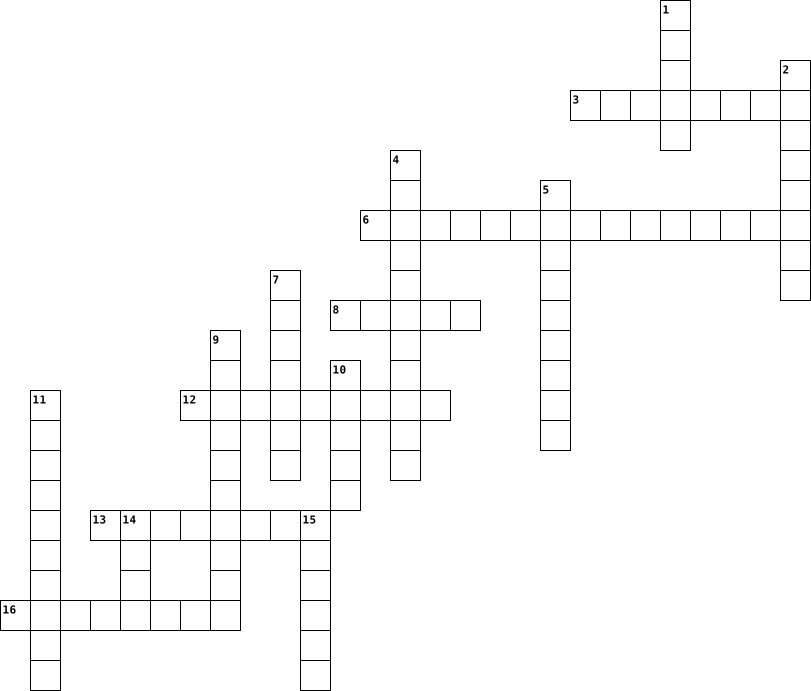
Across
- Which nationalists were angered by the Spain/United States treaty and felt betrayed because the United States now controlled their land?
- The nickname of the 9th & 10th African American cavalries that played a major role in winning the Battle of San Juan Hill
- Where was the peace treaty between Spain and the United States signed in 1898?
- Type of journalist that made the public aware of issues and tried to push for reform/change.
- The last name of the President who signed the declaration of war against Spain in 1898.
- In the Spanish-American War, what caused the most American deaths (5000+)
Down
- Which country still controlled Cuba in the late 1800s?
- It was not until 19_____ that the United States allowed the Filipinos to govern themselves.
- Name of Roosevelt's volunteer cavalry regiment that fought in Cuba
- Resigned his position as Assistant Secretary of the Navy to fight in the Spanish-American War
- Which act gave Puerto Rico limited say in their own affairs?
- How long did the Spanish-American war last?
- Name of the US ship that exploded; yellow journalists pinned the blame on Spain
- The _____________ - American war was the first, all-out Asian war in which the United States fought for years.
- Which country gained its independence as a result of the treaty between Spain and the United States in 1989?
- Type of journalism that relies on sensational stories and reporting to sell newspapers; stories told were often biased and untrue
16 Clues: How long did the Spanish-American war last? • Which country still controlled Cuba in the late 1800s? • Which act gave Puerto Rico limited say in their own affairs? • Name of Roosevelt's volunteer cavalry regiment that fought in Cuba • In the Spanish-American War, what caused the most American deaths (5000+) • ...
Patriotic Symbols 2023-06-16

Across
- - The national bird and symbol of the United States
- - A patriotic oath recited by Americans
- - Representing the original 13 colonies
- - A famous monument representing freedom and democracy
- - Symbolizing valor and bravery
Down
- - The national anthem of the United States
- - Representing purity and innocence
- - Symbolizing the 50 states of the United States
- - A famous bell that symbolizes freedom
- - Representing the unity of the states
10 Clues: - Symbolizing valor and bravery • - Representing purity and innocence • - Representing the unity of the states • - A patriotic oath recited by Americans • - A famous bell that symbolizes freedom • - Representing the original 13 colonies • - The national anthem of the United States • - Symbolizing the 50 states of the United States • ...
Geographical Position of the USA 2025-12-13

Across
- — the process of people coming from other countries to live permanently in the United States.
- — the movement of people from rural areas to cities.
- — one of the longest rivers in North America, flowing through the central part of the United States.
- — the large ocean located on the eastern side of the United States, separating North America from Europe and Africa.
Down
- — the country located to the north of the United States.
- — describing a country that has people from many different cultural backgrounds.
- — the continent from which many early immigrants moved to the United States.
- — the largest ocean in the world, bordering the western coast of the United States.
- — the country situated to the south of the United States.
- — the main language used in government, education, and daily communication in the United States.
10 Clues: — the movement of people from rural areas to cities. • — the country located to the north of the United States. • — the country situated to the south of the United States. • — the continent from which many early immigrants moved to the United States. • — describing a country that has people from many different cultural backgrounds. • ...
Geographical Position of the USA 2025-12-13

Across
- — the process of people coming from other countries to live permanently in the United States.
- — the movement of people from rural areas to cities.
- — one of the longest rivers in North America, flowing through the central part of the United States.
- — the large ocean located on the eastern side of the United States, separating North America from Europe and Africa.
Down
- — the country located to the north of the United States.
- — describing a country that has people from many different cultural backgrounds.
- — the continent from which many early immigrants moved to the United States.
- — the largest ocean in the world, bordering the western coast of the United States.
- — the country situated to the south of the United States.
- — the main language used in government, education, and daily communication in the United States.
10 Clues: — the movement of people from rural areas to cities. • — the country located to the north of the United States. • — the country situated to the south of the United States. • — the continent from which many early immigrants moved to the United States. • — describing a country that has people from many different cultural backgrounds. • ...
Geometry 11.4-11.6 2014-05-12

Across
- The measurement of the _____________ a circle is half the measure of its intercepted arc
- The theorem that states that the measure of an inscribed angle is half the measure of its intercepted arc
- The arc created by an inscribed angle
- The ___________ Product Theorem states that when two secants intersect, the whole x outside = whole x outside
- The measurement of the _____________ the circle is half the sum of the measure of its intercepted arc
- The measurement of the _____________ the circle is half the difference of the measure of its intercepted arcs
Down
- Theorem 11-4-3 states that if an intercepted arc is a semicircle, then the angle is ____________
- Corollary 11-4-2 states that if two angles intercept the same arc, then the angles are _____________
- The ___________ Produce Theorem states that when the secant and tangent intersect, whole x outside = tangent squared
- An angle whose vertex is on a circle
- The __________ Product Theorem states that the product of the lengths of the segments of the chords are equal
- Theorem 11-4-4 states that if a quadrilateral is inscribed in a circle, then opposite angles are ____________
12 Clues: An angle whose vertex is on a circle • The arc created by an inscribed angle • The measurement of the _____________ a circle is half the measure of its intercepted arc • Theorem 11-4-3 states that if an intercepted arc is a semicircle, then the angle is ____________ • ...
U.S. History 2021-01-03

Across
- a state in the southeastern region in the U.S.
- a peaceful agreement made between two parties
- states, the 13 states that permitted slavery between 1820 and 1860
- Purchase, a land deal that was made between the United States and France in the year 1803
- annexation
- American War, an armed conflict between the United States and Mexico
- and Clark expedition, an expedition used to find a waterway from the US to the Pacific Ocean
Down
- Hidalgo, a peace treaty that ended the war between the United States and Mexico
- compromise, an agreement passed by the U.S. Congress in 1820
- York City, the most populous city in the United States
- the ability to move things from one place to another by boat
- Canal, a waterway that was built to create a navigable water route from New York City and the Atlantic Ocean to the Great Lakes
12 Clues: annexation • a peaceful agreement made between two parties • a state in the southeastern region in the U.S. • York City, the most populous city in the United States • compromise, an agreement passed by the U.S. Congress in 1820 • the ability to move things from one place to another by boat • states, the 13 states that permitted slavery between 1820 and 1860 • ...
Manifest Destiny 2021-01-13

Across
- the northwest ordinance set the precedent on how new _____ would be created
- ______ was annexed into the United States in 1845
- the U.S.-Mexican war occurred as a result of _____ threatening to take back Texas
- the final two countries to claim a piece of Oregon were the United States and Great _____
Down
- during Manifest Destiny, settlers were seeking a new way of life by heading _____.
- in 1803, the United States _____ its size
- the _____ cession was acquired as a result of the Treaty of Guadalupe-Hidalgo
- in 1819, the United States purchased Florida from _____
- when the United States acquired _____, settlers were able to reach the West Coast for the first time.
- manifest destiny was made an official U.S. policy be democratic president James K. _____
- Mormons were able to escape persecution by following Joseph _____ down the Mormon Trail.
- the Gadsden Purchase allowed settlers to bypass the _____ mountains while on their way to California.
12 Clues: in 1803, the United States _____ its size • ______ was annexed into the United States in 1845 • in 1819, the United States purchased Florida from _____ • the northwest ordinance set the precedent on how new _____ would be created • the _____ cession was acquired as a result of the Treaty of Guadalupe-Hidalgo • ...