
states Crossword Puzzles
Pre Civil War 2026-08-20

Across
- of 1850
- Southern states feared slavery’s end.
- denied jury trial to alleged fugitive
- temporary solution to balance free states and slave states
- Series of debates for Illinois Senate race.
- supported by Stephen A. Dongles
- Attracted many former Whigs and Free-Soilers.
Down
- Jefferson Davis elected President of Confederacy.
- Proposed by Stephen A. Douglas.
- Violence between proslavery and antislavery settlers in Kansas.
- Increased sectional tensions.
- Planned to start a slave revolt
- first state to secede from union
- exposed the cruelty of slavery
- First shots of the Civil War.
- led raid on Harper's Ferry
16 Clues: of 1850 • led raid on Harper's Ferry • Increased sectional tensions. • First shots of the Civil War. • exposed the cruelty of slavery • Proposed by Stephen A. Douglas. • Planned to start a slave revolt • supported by Stephen A. Dongles • first state to secede from union • Southern states feared slavery’s end. • denied jury trial to alleged fugitive • ...
Our Puzzling goverment 2021-12-08

Across
- Allows the powers of congress to stretch
- The constitution makes the acts and treaties of the United States supreme
- Laws relating to disputes between individuals, groups, or states
- Powers the constitution grants or delegates to the national government.
- Powers directly expressed or stated in the constitution by the founders
- The power the national government may exercise simply because it is a government
Down
- The principal way in which states may do this to negotiate
- What expressed powers might also be known as
- clause The basis of implied powers
- he powers that the national government requires to carry out the powers that are expressly defined in the constitution
- The procedure for admission begins when a congress passes
- Are the powers that both the national government and the states have
- Certain powers reserved strictly for the states
13 Clues: clause The basis of implied powers • Allows the powers of congress to stretch • What expressed powers might also be known as • Certain powers reserved strictly for the states • The procedure for admission begins when a congress passes • The principal way in which states may do this to negotiate • Laws relating to disputes between individuals, groups, or states • ...
History 2023-05-04

Across
- (Northern and Western states that fought against the Confederacy)
- Slave Laws (punishments related to the return of escaped slaves to their owners)
- Kansas (violent confrontation in 1856 between proslavery and antislavery)
- state (states in which slavery was legal)
- sovereignty (belief that the political power comes from the consent of the people)
- of Abominations (taxed things from other countries)
- clay (served in Congress for more than 30 years)
Down
- Act (resolve the issue of whether slavery would be legal in certain areas)
- Party (one of the two major political parties in the United States)
- gin (Thing to separate seeds)
- Scott (African American man whose status as free or enslaved was decided by the Supreme Court)
- Compromise (enter the United States as a free state or slave state)
- state (states that did not allow slavery)
13 Clues: gin (Thing to separate seeds) • state (states in which slavery was legal) • state (states that did not allow slavery) • clay (served in Congress for more than 30 years) • of Abominations (taxed things from other countries) • (Northern and Western states that fought against the Confederacy) • Party (one of the two major political parties in the United States) • ...
Crossword Puzzle 2015-04-14

Across
- an opponent of imperialism
- series of domestic programs enacted in the United States between 1933 and 1938, and a few that came later. They included both laws passed by Congress as well as presidential executive orders during the first term (1933–37) of President Franklin D. Roosevelt.
- also called Beat Generation
- also known as the “New Negro Movement”
- book that “started” the women's movement and 1960s feminism in the United States
- sectional crisis during the presidency of Andrew Jackson created by South Carolina's 1832 Ordinance of Nullification
- 32nd President of the United States; elected four times; instituted New Deal to counter the Great Depression and led country during World War II (1882-1945)
- a member of a militant political organization set up in the US in 1966 to fight for black rights
- war between Spain and the United States, fought in 1898. The war began as an intervention by the United States on behalf of Cuba
- executive order issued on January 1, 1863, by President Lincoln freeing slaves in all portions of the United States not then under Union control\
- landmark United States Supreme Court case in which the Court declared state laws establishing separate public schools for black and white students to be unconstitutional
- type of music of black American origin characterized by improvisation, and syncopation
- Germany, Italy, and Japan, which were allied before and during World War II
- a state of political hostility between countries characterized by threats, propaganda, and other measures short of open warfare, in particular
- era of rapid economic growth, especially in the North and West. American wages
- fundamental document establishing the United States as a nation, adopted on July 4, 1776
- the action or an act of abolishing a system, practice, or institution
- Purchase by Thomas Jefferson to expand the territory of the United States
- provided a broad statement of US and British war aims Joint declaration released FDR and Churchill
- major United States naval base in Hawaii that was attacked without warning by the Japanese air force on December 7, 1941, with great loss of American lives and ships
- law passed in 1787 to regulate the settlement of the Northwest Territory, which eventually was divided into several states of the Middle West
- the action or policy of preventing the expansion of a hostile country or influence
- a town undergoing rapid growth due to sudden prosperity
- a commercial bank that is chartered under the federal government and is a member of the Federal Reserve System.
- the easing of hostility or strained relations, especially between countries.
Down
- created the territories of Kansas and Nebraska, opening new lands for settlement, and had the effect of repealing the Missouri Compromise of 1820 by allowing white male settlers in those territories to determine through popular sovereignty whether they would allow slavery
- a policy or attitude of letting things take their own course, without interfering; free enterprise
- intergovernmental organisation founded on 10 January 1920 as a result of the Paris Peace Conference that ended the First World War
- the first ten amendments to the US Constitution, ratified in 1791 and guaranteeing such rights as the freedoms of speech, assembly, and worship
- Treaties between two or more countries to establish a free trade area where commerce in goods and services can be conducted across their common borders
- Consisted of United States Armed Forces sent to Europe under the command of General John J Pershing
- first written constitution of the United States
- a member or adherent of a political party seeking to represent the interests of ordinary people
- An amendment passed by the US Congress in 1914 that provides further clarification and substance to the Sherman Antitrust Act of 1890
- A federal law that authorized federal action against segregation in public accommodations, public facilities, and employment
- a multilateral system of trading in which a country pays for its imports from one country by its exports to another.
- a body of fundamental principles or established precedents according to which a state or other organization is acknowledged to be governed.
- Protestant revival movement during the early 19th century in the United States
- 20th-century term for an attitude toward women's roles present in the emerging United States before, during, and after the American Revolution
- The election where Lincoln defeated Southern Democrat John C. Breckenridge
- one of the most significant restrictions on free immigration in US history, prohibiting all immigration of Chinese laborers
- the policy of promoting industry in the US by adoption of a high protective tariff and of developing internal improvements by the federal government (as advocated by Henry Clay from 1816 to 1828)
- A set of laws, passed in the midst of fierce wrangling between groups favoring slavery and groups opposing it, that attempted to give something to both sides
- class structure that is determined by birth Most prominent is India but was the basis of the encomienda system used by the Spanish
- Americans put the japanese in prison and other kind of detention during WWII.
- a bomb that derives its destructive power dropped on Hiroshima and Nagasaki
- American marine biologist and conservationist whose book Silent Spring and other writings are credited with advancing the global environmental movement
- also called the Korean conflict, fought in the early 1950s between the United Nations, supported by the United States, and the communist Democratic People's Republic of Korea
- an advocate or supporter of federalism
- Darwinism theory that individuals, groups, and peoples are subject to the same Darwinian laws of natural selection as plants and animals
- 36th President of the United States; was elected vice president and succeeded Kennedy when Kennedy was assassinated (1908-1973)
51 Clues: an opponent of imperialism • also called Beat Generation • also known as the “New Negro Movement” • an advocate or supporter of federalism • first written constitution of the United States • a town undergoing rapid growth due to sudden prosperity • the action or an act of abolishing a system, practice, or institution • ...
Roaring 20s Vocabulary 2017-05-02

Across
- A totalitarian system of government in which a single authoritarian party controls state-owned means of production
- A particular market where stocks and bonds are traded; stock exchange.
- Italian-born American anarchists who were convicted of murdering a guard and a paymaster
- A bribery incident that took place in the United States from 1921 to 1922,
- Borrowing money from a broker to purchase stock.
- Gangster who terrorized Chicago during prohibition until arrested for tax evasion
- A generation of young Western women in the 1920s who wore short skirts, bobbed their hair, listened to jazz, and flaunted their disdain for what was then considered acceptable behavior.
- 29th President of the United States, serving from March 4, 1921, until his death in 1923
- A person who rebels against any authority, established order, or ruling power.
- The 30th President of the United States
- The movement of 6 million African-Americans out of the rural Southern United States to the urban Northeast, Midwest, and West that occurred between 1916 and 1970.
- Tennessee highschool teacher who violated a state law by teaching evolution;
- High school teacher John Thomas Scopes was charged with violating Tennessee's law against teaching evolution instead of the divine creation of man.
- An illicit liquor store or nightclub.
- An American aviator who in 1927 made the first solo nonstop flight across the Atlantic Ocean
- A condition in which securities prices fall and widespread pessimism causes the stock market's downward spiral to be self-sustaining.
- To make, sell, or transport (alcoholic liquor) for sale illegally.
- Believe that the statements in the Bible are literally true.
- A Jamaican black-rights activist and loyal leader of the Black Nationalism and Pan-Africanism movements.
Down
- The natural rise and fall of economic growth that occurs over time.
- a law restricting the number of new immigrants to the United States.
- A system for paying for goods by installments. installment plan, time plan · regular payment - a payment made at regular times.
- A twentieth-century American author known for his short stories and for his novels, including The Great Gatsby and This Side of Paradise.
- The rounding up and deportation of several hundred immigrants of radical political views by the federal government in 1919 and 1920.
- The United States Constitution repealed the Eighteenth Amendment to the United States Constitution, which had mandated nationwide Prohibition on alcohol
- A cultural, social, and artistic explosion that took place in Harlem, New York, spanning the 1920s.
- The way of life before World War I, was United States presidential candidate Warren G. Harding's campaign promise in the election of 1920.
- An American politician who served as the 31st President of the United States from 1929 to 1933 during the Great Depression.
- A financial market of a group of securities in which prices are rising or are expected to rise.
- An American poet, social activist, novelist, playwright, and columnist from Joplin, Missouri.
30 Clues: An illicit liquor store or nightclub. • The 30th President of the United States • Borrowing money from a broker to purchase stock. • Believe that the statements in the Bible are literally true. • To make, sell, or transport (alcoholic liquor) for sale illegally. • The natural rise and fall of economic growth that occurs over time. • ...
The Cold War 2023-03-16

Across
- The belief that communist countries would spread their influence to other countries in the same region.
- A capitalist democracy formed in 1776.
- A war that erupted in 1950 between the Communist North Korean forces and the Democratic South Korean forces, and eventually involved Chinese and United Nations forces.
- The North Atlantic Treaty Organization, which was formed in 1949 as a military alliance between the United States and its allies in Western Europe.
- The military alliance between the Soviet Union and its satellites in Eastern Europe, created in 1955 in response to NATO.
- A system of government where a ruler or a small group of rulers holds absolute political power.
- A meeting of leaders from the United States, Britain, and the Soviet Union in 1945 to discuss the post-war reorganization of Europe.
- Weak countries that are economically dependent on and politically faithful to another more powerful country.
- The leader of the Soviet Union from 1924-1953 and one of the key architects of the Cold War.
Down
- Different ideas and values held by two powerful countries or groups (in this case, the United States and the Soviet Union) that lead to conflict.
- The dissolution of the USSR in 1991 and the end of the Cold War.
- The competition between the United States and the Soviet Union to develop and stockpile nuclear weapons.
- A policy of relaxed tensions between countries.
- A military conflict fought between North Vietnam and South Vietnam and their allies from 1959 to 1975.
- The term used to describe the physical and ideological barrier separating the Soviet Union and its allied countries from the Western world.
- A system of government where the state owns all of the means of production and the people have equal rights and opportunities.
- A global war fought from 1939 to 1945 primarily between the Axis Powers (Germany, Italy, and Japan) and the Allied Powers (Great Britain, France, the United States, the Soviet Union, and many others).
- Information, ideas, and opinions that are spread deliberately by an individual or a group to further their own interests.
- The use of one country's military resources to fight another country's battles.
- An economic system based on private ownership of the means of production and driven by the forces of competition and the profit motive.
- A series of airlifts conducted by the United States, Great Britain, France, and others to provide food, fuel, and other supplies to the people of West Berlin after the Soviet Union imposed a blockade on the city in 1948.
- Also known as the Union of Soviet Socialist Republics (USSR). It was a communist country that was formed out of the Soviet Republics after the Russian Revolution of 1917.
- McCarthy: A United States Senator who conducted a high-profile witch-hunt against communists in the United States in the 1950s.
- The 33rd president of the United States from 1945 to 1953, succeeding President Franklin Roosevelt.
- Attempts to limit or stop the building and stockpiling of weapons, and to reduce the nuclear stockpiles of countries.
25 Clues: A capitalist democracy formed in 1776. • A policy of relaxed tensions between countries. • The dissolution of the USSR in 1991 and the end of the Cold War. • The use of one country's military resources to fight another country's battles. • The leader of the Soviet Union from 1924-1953 and one of the key architects of the Cold War. • ...
Internationalism 2017-12-06

Across
- a program that allows the United States to give financial aid to countries struggling from the effects of World War II
- maintaining peace in a country
- an organization that promotes economic stability in the Arctic and safeguards the Arctic’s fragile environment
- Criminal Court (ICC) an organization that punishes individuals for crimes of genocide, crimes against humanity and war crimes
- an international monetary system that occurred in 1944 that led to the creation of the World Bank and IMF
- the policy of a country responding to issues on it’s own without the support of other nations
- an agency of the United Nations that promotes programs in science, education and the arts.
- a term that describes the United Kingdom’s withdrawal from the European Union
- an agreement between two countries for the resolution of issues
- Council an organ of the United Nations that responds to international crises
- (NATO) an organization made up of 29 member states that safeguards the freedom and security of its member states
- an organ of the United Nations that allows all member states to have equal representation
- the countries of the world linked together because of advances in technology
- an international organization that represents countries where French is the mother tongue. It’s goal is to promote French culture
Down
- a quick spread of a disease throughout the world
- an international organization that works to promote peace and security
- like minded people separating into groups that oppose people whose values differ from their own
- an international organization that provides relief for victims of war, victims of natural disasters and provides aid for soldiers
- the action of bringing peace to a nation in distress
- an organization shared between the United States and Canada that deals with missions of aerospace warning and control for North America.
- an association of 28 European member states that work to promote peace and economic stability among its associates
- the doctrine of several nation-states jointly meeting obstacles and dealing with problems
- an international non-profit medical relief institution that provides aid for populations in distress or facing armed conflict
- (NGO) non-profit organizations that send help to countries that have been affected by a massive disaster
- (WTO) an international organization that promotes trade between nations.
- the concept of all members of the global community accepting collective responsibility for the adversities that go on in the world. As well as remembering to respect nation-states during the resolution of issues
- an organization that aids countries suffering from financial instability and promotes promotes international trade
- an international institution that provides loans to countries in need of financial aid to help reduce poverty
- a form of foreign policy where a country provides aid (with strings attached!!) to another country experiencing economic, political or social distress
- a global organization that teaches less fortunate children with various educational games
- the doctrine of a country to control one’s affairs without the help of any nation-states, resulting in the isolation of one’s self from any international affairs.
31 Clues: maintaining peace in a country • a quick spread of a disease throughout the world • the action of bringing peace to a nation in distress • an agreement between two countries for the resolution of issues • an international organization that works to promote peace and security • (WTO) an international organization that promotes trade between nations. • ...
Citizenship questions 2024-02-11

Across
- The idea of self-government in in the first three words of the constitution. What are these words?
- What is the name of the Speaker of the House of Representatives now?
- What did the Declaration of Independence do?
- The house of representatives has how many voting members?
- We elect a president for how many years?
- What is the name of the Vice President of the United States now?
- What are two parts of the U.S Congress?
- What is an amendment?
- What is one responsibility that is only for United States citizens?
- What is the name of the President of the United States now?
- When is the last day you can send in federal income tax forms?
- What is the political party of the President now?
- What is one promise you make when you become a United States citizen?
- What is the highest court in the United States?
- Who vetoes laws?
- What does the judicial branch do?
- If both the President and the Vice President can no longer serve, who becomes President?
- What is the capital of your state now?
- group What are two ways that American can participate in their democracy?
- What does the President's cabinet do?
Down
- What are the two major political parties in the United States?
- What are two Cabinet-level positions?
- How many amendments does the Constitution have?
- What is one right or freedom from the First Amendment?
- Who is in charge of the executive branch?
- How old do citizens have to be to vote for President?
- What are two rights in the Declaration of Independence?
- What are two right from everyone living in the United States?
- How many U.S. senators are there?
- If the President can no longer serve, who becomes President?
- Who is the Commander in Chief of the military?
- In what month do we vote for president?
- Who signs bills to become laws?
- What do we show loyalty to when we say the Pledge of Allegiance?
- Name one branch or part of the government.
- There are four amendments to the Constitution about who can vote. Describe one of them.
- How many justices are on the Supreme Court?
- Under our Constitution, some powers belong to the federal government. What is one power of the federal government?
- Who is the governor of your state now?
- You can practice any religion, or not practice a religion.
- what stops one branch of government from becoming too powerful?
- What does the Congress, Senate of House of Representatives, and U.S legislature do?
42 Clues: Who vetoes laws? • What is an amendment? • Who signs bills to become laws? • How many U.S. senators are there? • What does the judicial branch do? • What are two Cabinet-level positions? • What does the President's cabinet do? • Who is the governor of your state now? • What is the capital of your state now? • What are two parts of the U.S Congress? • ...
Impacts of the Civil War 2020-12-16

Across
- A campaign made by the North's General Sherman in order to capture Atlanta.
- A blockade made by the Union to stop the southern states from trading with foreign countries.
- One of the reasons for the Civil War. To leave.
- This battle's objective was to capture the city of Chattanooga. Known as the 2nd bloodiest battle of the Civil War.
- Invetion that help for communication using morse code.
- Means for transportation back then.
- One of the reasons for the Civil War. To own another human.
- One of the three reasons for the Civil War. States have the right to control their own state.
- General of the confederacy. Led the Battle of Gettysburg.
- president at the time of the civil war and issued the emancipation proclamation.
- A plan made by the Union to hurt the south.
Down
- The development of industries in a country or region on a wide scale.
- Major crop grown in the south.
- The battle that ultimately lost the war for the confederacy. Lasted July 1 - July 3, 1863.
- General Sherman marched from Atlanta to Savannah and destroy anything believed would give the confederacy an advantage against them.
- Prison that housed thousands of Northern soldiers and was notorious for mistreating prisoners and being overcrowded.
- An ultimatum made by President Lincoln towards the "rebellious" states.
- Southern a fort demolished via cannon by the Union. It located on Tybee Island.
- General of Union Army, led a march to siege Savannah.
- The succeeding states' nation army.
- The northern states' army.
21 Clues: The northern states' army. • Major crop grown in the south. • Means for transportation back then. • The succeeding states' nation army. • A plan made by the Union to hurt the south. • One of the reasons for the Civil War. To leave. • General of Union Army, led a march to siege Savannah. • Invetion that help for communication using morse code. • ...
Second Semester Texas History Crossword Puzzle 2021-05-18

Across
- This was transported to northern markets along cattle trails.
- These helped on cattle drives/ trails and had a very difficult job.
- Major cash crop in Texas
- The US _______ War led to the US acquiring the Mexican Cession
- One of the two major political parties in the United States that favors less government involvement and spending.
- Another name for North during the Civil War
- Equal rights organization for African Americans that was established during the Civil Rights Era.
- During the Civil War, Texas sided with the _______ states of America.
- Also called The Great War.
- _________ was the era after the Civil War where southern states were readmitted to the Union.
- Country that existed from 1836-1845.
- Oil was discovered here in 1901.
Down
- Equal rights organization for Hispanic Americans that was established during the Civil Rights Era.
- President of Texas who established the Texas Navy
- First president of Texas.
- Established the Texas Railroad Commission
- The ______ of Texas was a major cause of the US Mexican War.
- The ____________was a conflict between the Northern and Southern States in the US.
- One of the two major political parties in the United States that favors more government involvement and spending.
- The ________ of 1850 finalized the borders of Texas.
- Major conflict between the Allied and Axis powers.
- Transported cattle and were helped regulated by James Hogg.
- Major industry in Texas that experiences a boom and bust cycle.
- Leader of Germany during World War II.
- Immigrant group to Texas that experienced discrimination during the World Wars.
25 Clues: Major cash crop in Texas • First president of Texas. • Also called The Great War. • Oil was discovered here in 1901. • Country that existed from 1836-1845. • Leader of Germany during World War II. • Established the Texas Railroad Commission • Another name for North during the Civil War • President of Texas who established the Texas Navy • ...
Vocab 5 2022-02-10

Across
- formally cooperating with another for a military or other purpose
- States that the United States would intervene as a last resort to ensure that other nations in the Western Hemisphere fulfilled their obligations to international creditors
- It stated that North and South America were no longer open to colonization
- Policy of carefully mediated negotiation
- identification with one's own nation and support for its interests
- A policy of extending a country's power and influence through diplomacy or military force.
- secret diplomatic communication issued from the German Foreign Office
- British ocean liner that was sunk
- naturalist, historian, and writer who served as the 26th president of the United States
- exaggerated journalism which usually made no sense
Down
- The belief or desire of a government or people that a country should maintain a strong military capability
- An American politician and academic who served as the 28th president of the United States
- Not helping or supporting either side in a conflict
- artificial 82 km waterway in Panama that connects the Atlantic Ocean with the Pacific Ocean
- A proposal made by U.S. President Woodrow Wilson, outlining his vision for ending World War 1
- Sunk Battleship in Havana Harbor
- An African-American infantry unit in WW1
- an international organization for peace at the end of ww1
- a country that has significant influence in international affairs.
- General objectives that guide the activities and relationships of one state in its interactions with other states
- One of the two main coalitions that fought World War I
- A union or association formed for mutual benefit
22 Clues: Sunk Battleship in Havana Harbor • British ocean liner that was sunk • Policy of carefully mediated negotiation • An African-American infantry unit in WW1 • A union or association formed for mutual benefit • exaggerated journalism which usually made no sense • Not helping or supporting either side in a conflict • One of the two main coalitions that fought World War I • ...
Ch. 18: Reconstruction 2021-05-04

Across
- A system in which one person owned another person.
- To approve a law by voting for it.
- The number of people in a place such as a city, state, or country.
- A person who rented land from a plantation owner and gave some of the crops to the owner as rent.
- The rebuilding of the South after the Civil War.
- A very large farm where only one crop is grown.
- What were the southern states called during the Civil War?
- After the Civil War the slaves were __________.
- To go through hard times and come out alive.
- What were the northern states called during the Civil War?
- Under __________, black children had to go to different schools from the ones that white children went to.
- A person who does brave things and is admired by other people.
Down
- Unfairness.
- To pick or gather crops.
- To abolish, or do a way with, a law.
- There were four ________ in the presidential election of 1860.
- To pay money in order to live in a house or use land or property owned by someone else.
- A tax on goods made in other countries and then sold in the United States.
- Not the same (in size or treatment, for example).
- This amendment ended slavery in the United States.
- Having little or no money.
- To join together.
- The 14th Amendment said that all Americans, black or white, had the same _______.
- When Lincoln was elected president, eleven southern states decided to __________.
24 Clues: Unfairness. • To join together. • To pick or gather crops. • Having little or no money. • To approve a law by voting for it. • To abolish, or do a way with, a law. • To go through hard times and come out alive. • A very large farm where only one crop is grown. • After the Civil War the slaves were __________. • The rebuilding of the South after the Civil War. • ...
Ch. 3 What is Your watershed Address 2019-11-12

Across
- the 11th-longest river in the United States at 1,280 miles.
- the 18th longest river in the United States and the longest river with both its source and its mouth within Texas.
- River that runs from Lake Houston in Harris County, Texas, to Galveston Bay.
- the process of settling or being deposited as a sediment.
- stream or river that has continuous flow in parts of its stream bed all year round during years of normal rainfall.
- Forms the border between Texas and neighboring states to the North.
- single identifiable source of air, water, thermal, noise or light pollution.
- lasting for a very short time.
- an area or ridge of land that separates waters flowing to different rivers, basins, or seas.
- a power plant cooling reservoir in Brazos County.
Down
- the area of land drained by a river and its branches.
- occurring at irregular intervals; not continuous or steady.
- one of the principal rivers in the southwest United States and northern Mexico.
- the process of eroding or being eroded by wind, water, or other natural agents.
- This is the high ground where precipitation first collects or it can be a spring from which a stream originates.
- begins in Van Zandt County west of Rhine Lake and flows for 416 miles through east Texas to its mouth on Sabine Lake near the Rainbow Bridge.
- a river in east Texas, United States. It is about 125 miles long.
- the upper tributaries of a river.
- pollution resulting from many diffuse sources.
- a stream that flows to a larger stream or other body of water.
20 Clues: lasting for a very short time. • the upper tributaries of a river. • pollution resulting from many diffuse sources. • a power plant cooling reservoir in Brazos County. • the area of land drained by a river and its branches. • the process of settling or being deposited as a sediment. • the 11th-longest river in the United States at 1,280 miles. • ...
unit 2 2023-08-29

Across
- limited power to king
- Showed the weakness of the Articles; armed rebellion regarding taxes.
- Division of power among different levels of government
- The first democratically elected legislative body in the U.S
- States slaves were to be counted as ⅗ of a person
- War between Britain and France over territory in the Ohio River Valley
- Each branch has their individual roles and responsibilities
- Met between May and September of 1787 to address the problems of the weak central government that existed under the Articles of Confederation.
- Established direct democracy, first form of self government in the U.S
- Government that only has those powers delegated to it by law, often through a written constitution.
- Rule by the people, consent of the governed
- Where we got some of our BOR from, gave us the idea of representative government
- Supported the constitution as is; no need for additional protections
- The nation’s first constitution; it failed due to giving the states too much power.
Down
- Ensures one branch does not become too powerful.
- Avoid tyranny; the majority can't be allowed to dictate or violate the rights of the minorities.
- A compromise that stated the HOR= based off population and Senate= equal in proportion.
- States no one is above the law
- People directly vote for what they want
- Written in 1776, declared us independent of GB.
- The supreme law of the United States of America.
- The governing body that declared us independent of GB.
- Wanted additional protections for people and states.
- The power of the judicial branch to declare laws unconstitutional.
24 Clues: limited power to king • States no one is above the law • People directly vote for what they want • Rule by the people, consent of the governed • Written in 1776, declared us independent of GB. • Ensures one branch does not become too powerful. • The supreme law of the United States of America. • States slaves were to be counted as ⅗ of a person • ...
World War 2 Crossword by Brady Meade 2025-01-31

Across
- what was the last name of the British prime minister before Churchill
- which city did the United States drop their second bomb in
- a submarine used by the Germans during World War ll
- where did Hitler invade which is known as the start of World War ll
- what was the name of the German city where the last major battle took place
- what was the name of the treaty that ended ww1 that set the stage for World War 2
- what was the United States project to creat the atomic bomb
- which city did the United States drop their first atomic bomb in
- the leader responseable for 6 million deaths of Jews alone
- the mass murdering of the Jews during World War ll
- Who was the commander of the Allied forces in europe
- what was the name of Germany's secret police
Down
- a leader responsable for more deaths then Hitler and the leader of the soviet union
- what was the italian dictators last name
- Known as the night of the broken glass with 90 deaths and 30,000 jews arrested.
- antisemetic laws made by Hitler prohibiting Jews from doing things like Marrying Germanys
- who was the president when for the United Sates when they dropped the atomic bombs
- the event that brought the United States into war
- the most sophisticated, propeller to fly during World War ll
- what was the name of the battle that marked the turning point in the Pacific
- who was the president of the UNited States for the majority of World War 2
21 Clues: what was the italian dictators last name • what was the name of Germany's secret police • the event that brought the United States into war • the mass murdering of the Jews during World War ll • a submarine used by the Germans during World War ll • Who was the commander of the Allied forces in europe • which city did the United States drop their second bomb in • ...
Civil War Crossword 2018-12-18

Across
- Southern plan to use cotton production to get Britain to ally with them during the war.
- General Lee surrendered to General Grant here, ending the Civil War.
- An overwhelming force that seems to crush everything in its path.
- Destroying both civilian and military resources.
- Vice-President of the Confederate States of America.
- Destroy southern economy by naval blockade and control Mississippi River
- To enroll in the army.
- Be offensive and destroy Washington.
- Best commanding general of the Union army.
- 1862 bill encouraging Western migration by offering free land if five years of residence happened before receiving ownership of the land.
- The man who made the Anaconda war strategy.
- General of the Confederate army.
- The first shots of the civil war which made Lincoln ask for 75000 volunteers.
Down
- Constitutional protection against going to jail without evidence or trial.
- Term used to describe the United States before the outbreak of the Civil War.
- Term used when the people of a territory is able to decide for themselves if slavery should be allowed in their territory when it becomes a state.
- Bullet used during the Civil War to inflict more damage.
- Confederate charge during Gettysburg against the Union that was basically a suicide mission.
- An Escaped slave.
- 3-5% tax to pay for the costs of the war.
- Creator of the Red Cross.
- The actor who assassinated Abraham Lincoln
- President of the Confederate States of America.
- President of the Union (United States)
- slave states that did not secede
25 Clues: An Escaped slave. • To enroll in the army. • Creator of the Red Cross. • slave states that did not secede • General of the Confederate army. • Be offensive and destroy Washington. • President of the Union (United States) • 3-5% tax to pay for the costs of the war. • The actor who assassinated Abraham Lincoln • Best commanding general of the Union army. • ...
George Washington's Presidency 2014-03-13

Across
- Head of the Supreme Court is called the _________ Justice.
- Alexander Hamilton wanted to create a national _________.
- This Act, passed in 1789, created the Federal Court System.
- Native American tribes joined together and formed the Western __________.
- Pinckney's Treaty gave the US free navigation of this major river.
- Act or decision that sets an example for others to follow.
- Debt owed to private citizens and American businesses.
- The farmers of western Pennsylvania were angry about a government tax on __________.
- Blue Jacket was defeated at this battle by Major General Anthony Wayne. (no space)
- Tax on a good brought into the country.
- The __________ General serves as the chief lawyer of the United States.
- Hamilton wanted to pay off all of the __________ debts along with the National debt.
Down
- The Secretary of War advises the President on __________ affairs.
- The Secretary of state advises the President on _________ affairs.
- Thomas Jefferson believed the National Bank was __________.
- A settlement in which each side gives up some of its demands to reach an agreement.
- Southern states would support Hamilton's plan if Northern States supported a plan to locate the nations __________ in the south.
- Pinckney's Treaty was made between the US and __________.
- Another word for money.
- Cabinet members give the President __________.
- The biggest economic problem faced by the United States is the __________ debt.
- The Secretary of the __________ enforces tax laws.
- 1st President of the United States. (last name)
- Pinckney's treaty allowed the US to trade through this port. (No space)
- The US signed Jay's treaty with what country?
25 Clues: Another word for money. • Tax on a good brought into the country. • The US signed Jay's treaty with what country? • Cabinet members give the President __________. • 1st President of the United States. (last name) • The Secretary of the __________ enforces tax laws. • Debt owed to private citizens and American businesses. • ...
George Washington's Presidency 2014-03-13

Across
- The Secretary of War advises the President on __________ affairs.
- This Act, passed in 1789, created the Federal Court System.
- The Secretary of the __________ enforces tax laws.
- Thomas Jefferson believed the National Bank was __________.
- Hamilton wanted to pay off all of the __________ debts along with the National debt.
- Head of the Supreme Court is called the _________ Justice.
- Pinckney's treaty allowed the US to trade through this port. (No space)
- Act or decision that sets an example for others to follow.
- Cabinet members give the President __________.
- 1st President of the United States. (last name)
- Pinckney's Treaty was made between the US and __________.
- Debt owed to private citizens and American businesses.
Down
- The biggest economic problem faced by the United States is the __________ debt.
- Pinckney's Treaty gave the US free navigation of this major river.
- The Secretary of state advises the President on _________ affairs.
- Southern states would support Hamilton's plan if Northern States supported a plan to locate the nations __________ in the south.
- The __________ General serves as the chief lawyer of the United States.
- Another word for money.
- Blue Jacket was defeated at this battle by Major General Anthony Wayne. (no space)
- Native American tribes joined together and formed the Western __________.
- Tax on a good brought into the country.
- The US signed Jay's treaty with what country?
- The farmers of western Pennsylvania were angry about a government tax on __________.
- A settlement in which each side gives up some of its demands to reach an agreement.
- Alexander Hamilton wanted to create a national _________.
25 Clues: Another word for money. • Tax on a good brought into the country. • The US signed Jay's treaty with what country? • Cabinet members give the President __________. • 1st President of the United States. (last name) • The Secretary of the __________ enforces tax laws. • Debt owed to private citizens and American businesses. • ...
Civil War Crossword 2023-02-22

Across
- The idea that the South had the authority to nullify tariffs placed on goods.
- The south had to fight a _________ war to win.
- Who won the election of 1860?
- Mainly the northern states, fighting to keep the Union together and to make slavery illegal.
- Strategy used by the Union to try and take over the South; take control of mississippi river and split the South in two.
- Abraham Lincoln said that he would stop the ______ of slavery.
- The speach preformed by Abraham Lincoln stating that in order to end the war, slavery must be abolished.
- Used to blockade and stop union ships from entering or leaving.
- A person who flees or tries to escape.
- The __________ __________ states that all slaves would be free as of January 1, 1863.
- The man who created a march that burned and demolished many southern towns and cities.
Down
- The compromise that banned slavery north of the 36° 30' line.
- When starting the war the Union already had an ____ and a ____.
- The act that allowed Kansas and Nebraska to choose if they wanted to be a free or slave state.
- The decision to consider slaves as "property" and they would not be free, even in states that didn't allow slavery.
- Most people died because of ________ during the Civil War.
- The bloodiest battle in American history.
- To formally break away in a political state.
- Mainly the southern states, fighting for the right to keep slavery legal.
- The states that allowed slavery but refused to leave the Union.
20 Clues: Who won the election of 1860? • A person who flees or tries to escape. • The bloodiest battle in American history. • To formally break away in a political state. • The south had to fight a _________ war to win. • Most people died because of ________ during the Civil War. • The compromise that banned slavery north of the 36° 30' line. • ...
Crossword For Paris Peace Conference 2017-03-13

Across
- The country whose response forced the Conference to modify the terms of Treaty
- The kind of person who is practical(like Lloyd George)
- one of the new states established because of the broken-up of Austria-Hungary(starts with a C)
- One of the states that became independent because of the Treaty of Versailles(starts with Li)
- One of the states that became independent because of the Treaty of Versailles(starts with an E)
- most obstinate one of the Big Three, who wanted us to suffer harshly!
- Where the archduke of Austria-Hungaria was assassinated
- It was 6600 million pounds for us! How could we pay such a bill!
- The country which gained land from Hungary
- What did we lose overseas?
Down
- The country Treaty of Neuilly dealt with
- An ancient country which gained land from Bulgaria
- One of the states that became independent because of the Treaty of Versailles(starts with La)
- The country that once had a genocide
- one of the new states established because of the broken-up of Austria-Hungary(starts with a Y)
- The organization considering itself as an international police force, which did not involve us!
- Compulsory enrollment of persons
- It became demilitarized because of the Treaty of Versailles
- The kind of person who makes decision depending on his ideals(like the president of the US)
- The country that Treaty of Trianon dealt with
- The country that Treaty of St. Germain dealt with
- Land taken from this country was returned because of Treaty of Versailles
22 Clues: What did we lose overseas? • Compulsory enrollment of persons • The country that once had a genocide • The country Treaty of Neuilly dealt with • The country which gained land from Hungary • The country that Treaty of Trianon dealt with • The country that Treaty of St. Germain dealt with • An ancient country which gained land from Bulgaria • ...
chapter 2 History 2021-09-30

Across
- groups of workers who press for better working conditions and member benefits
- most famous conductor
- taking their states out of the Union
- a decree freeing all enslaved persons in states
- withdraw, from the Union
- moderation in the consumption of alcohol
- jackson’s decision formed a new political party
- began following his troops seeking food and shelter
- the Confederate States of America
- the first 10 amendments to the Constitution
- On the journey, known to the Cherokee as the the
- was the idea that the nation was meant to spread to the Pacific
- the wearing down of one side by the other through exhaustion of soldiers and resources
Down
- one of the best senior officers in the United States Army
- banning slavery in the United States
- a Missouri slave who had been taken north to work in free territory for several years
- A key to many African Americans’ escape from the South was the
- the practice of appointing people to government jobs based on party loyalty and support
- became one of the best-known orations in American history
- clear sign from the voters, to end slavery permanently by amending the Constitution
- utting off its food and supplies and bombarding the city until its defenders gave up
- powers not explicitly listed in the Constitution but necessary for the government to do its job
- system to select presidential candidates
- who had escaped from slavery in Maryland
- the individuals who would head Thomas Jefferson and others favored less government interference in the economy
25 Clues: most famous conductor • withdraw, from the Union • the Confederate States of America • banning slavery in the United States • taking their states out of the Union • system to select presidential candidates • who had escaped from slavery in Maryland • moderation in the consumption of alcohol • the first 10 amendments to the Constitution • ...
Ch. 3 What is Your watershed Address 2019-11-12

Across
- the area of land drained by a river and its branches.
- lasting for a very short time.
- pollution resulting from many diffuse sources.
- the 11th-longest river in the United States at 1,280 miles.
- one of the principal rivers in the southwest United States and northern Mexico.
- This is the high ground where precipitation first collects or it can be a spring from which a stream originates.
- a stream that flows to a larger stream or other body of water.
- single identifiable source of air, water, thermal, noise or light pollution.
- the 18th longest river in the United States and the longest river with both its source and its mouth within Texas.
- Forms the border between Texas and neighboring states to the North.
Down
- the process of settling or being deposited as a sediment.
- River that runs from Lake Houston in Harris County, Texas, to Galveston Bay.
- the upper tributaries of a river.
- begins in Van Zandt County west of Rhine Lake and flows for 416 miles through east Texas to its mouth on Sabine Lake near the Rainbow Bridge.
- stream or river that has continuous flow in parts of its stream bed all year round during years of normal rainfall.
- occurring at irregular intervals; not continuous or steady.
- a power plant cooling reservoir in Brazos County.
- a river in east Texas, United States. It is about 125 miles long.
- an area or ridge of land that separates waters flowing to different rivers, basins, or seas.
- the process of eroding or being eroded by wind, water, or other natural agents.
20 Clues: lasting for a very short time. • the upper tributaries of a river. • pollution resulting from many diffuse sources. • a power plant cooling reservoir in Brazos County. • the area of land drained by a river and its branches. • the process of settling or being deposited as a sediment. • occurring at irregular intervals; not continuous or steady. • ...
KINE P215 Assignment 3 2024-04-02

Across
- A set of attributes or characteristics that people have or achieve that relates to the ability to perform physical activity.
- A type of stretching when the muscle is slowly and gently stretched and then held in the stretched position.
- A self-rated scale to rate exercise intensity.
- This resistance training adaptation primarily occurs at 85% or more of 1 rep max.
- A type of stretching that uses reflexes initiated by both muscle and joint nerves to achieve greater training effects.
- This principle states, "in order to see improvements, the stimulus must be increased over time."
- The one foot stand test is an example of a _____ test.
- This principle states, "everybody is different and responds differently to the same training."
- Instrument used to measure an angle at a joint.
- The _____ model describes behavior change across 5 stages.
- A type of exercise involving motor skills, proprioceptive exercise training and multifaceted activities to improve physical function.
Down
- _____ interviewing is a client-centered approach for facilitating behavior change.
- This principle states, "training effects are specific to exercise being performed."
- The time required to initiate a response to a given stimulus.
- The functional capacity of the joints to move through a full range of motion.
- one’s belief in their ability to execute behavior.
- The _____ theory states, an individual will be more likely to engage in a behavior if it satisfies their basic psychological needs.
- This principle states, "if you don’t use it, you lose it."
- The vertical jump test measures _____.
- The 6-12 rep range (strength training) primarily targets this training adaptation.
20 Clues: The vertical jump test measures _____. • A self-rated scale to rate exercise intensity. • Instrument used to measure an angle at a joint. • one’s belief in their ability to execute behavior. • The one foot stand test is an example of a _____ test. • This principle states, "if you don’t use it, you lose it." • ...
1.7 - Comparing State Formation in Era 1 2025-09-15

Across
- – Persistence of long-standing practices, such as patriarchy or religious authority in governance.
- – Pastoral peoples like the Mongols whose conquests reshaped political structures.
- – Administrative system that centralized states used to govern large territories.
- – Rise of political units in regions once controlled by earlier empires, like the Delhi Sultanate.
- – Reestablishment of earlier political traditions, such as the Byzantine Empire’s continuity with Rome.
- – Growth of states into larger territories or influence, often through conquest or trade.
- – Form of political authority where power is concentrated under one ruler or government.
- – Male-dominated authority system that persisted in political and social structures.
- – Organized political structure with authority over a defined territory.
- – Islamic form of state leadership that continued under successors to Muhammad.
- – Economic activity that supported state wealth and growth, especially along the Silk Roads or Indian Ocean.
- – Breakup of larger states into smaller competing polities, as in post-classical Europe.
Down
- – Blending of cultural or religious practices in governance, like Neo-Confucianism.
- – Political power based on sea trade networks, such as Srivijaya or Venice.
- – Process of weakening or collapse experienced by empires such as the Abbasids or Byzantines.
- – Diplomatic arrangement where surrounding states recognized Chinese authority in exchange for trade benefits.
- – Source of political legitimacy, as seen with Christian monarchs or Muslim rulers.
- – Political system with power distributed among local rulers, such as in feudal Europe.
- – New political or military practices that helped rulers strengthen their states.
- – Independent political unit, common in places like the Swahili Coast or Italian peninsula.
20 Clues: – Organized political structure with authority over a defined territory. • – Political power based on sea trade networks, such as Srivijaya or Venice. • – Islamic form of state leadership that continued under successors to Muhammad. • – Administrative system that centralized states used to govern large territories. • ...
Load up to the civil war 2025-10-20

Across
- the movement to end slavery
- system where enslaved people are treated as personal property
- a law that created the Kansas and Nebraska territories
- a simple machine that separates seeds from cotton fiber,
- an American statesman and a key figure in creating compromises
- the theory that a state has the right to declare a federal law unconstitutional
- a series of laws passed in the United States to settle disputes over slavery between free and slave states
- A war in the United States from 1861 to 1865 between the Union and the Confederacy, fought over the issue of slavery and states' rights.
- an escaped slave, abolitionist, and reformer who became a powerful voice against slavery
Down
- a secret network of abolitionists, both Black and white, who helped enslaved people escape to freedom
- a conflict between the United States and Mexico from 1846 to 1848
- a series of laws that required the return of escaped slaves
- a period of violent conflict between pro-slavery and anti-slavery settlers in the Kansas Territory
- the idea that the government's authority comes from its people
- 1857 Supreme Court ruling that denied citizenship to Black people
- a radical abolitionist who believed in using violence to end slavery
- the act of being freed from another's control or authority
- the formal act of a state withdrawing from a larger political union
- the belief that the Southern economy and political power were so dependent on cotton
- admitted Missouri as a slave state and Maine as a free state
20 Clues: the movement to end slavery • a law that created the Kansas and Nebraska territories • a simple machine that separates seeds from cotton fiber, • the act of being freed from another's control or authority • a series of laws that required the return of escaped slaves • admitted Missouri as a slave state and Maine as a free state • ...
Civil War Crossword Puzzle 2021-10-15

Across
- capital of the United States of America
- slave states that did not secede from the Union
- a presidential proclamation and executive order issued by United States President Abraham Lincoln on September 22, 1862
- compulsory service in the federal military services
- the diplomatic methods employed by the Confederacy during the American Civil War to coerce the Great Britain and France to support the Confederate war effort
- a Confederate general who led the South's attempt at secession during the Civil War
- an American politician and military leader who served as the 18th president of the United States
Down
- a league or alliance, especially of confederate states.
- the first major battle of the American Civil War
- capital of Virginia
- what the north was referred to during the Civil War
- military strategy that called for a naval blockade of the Confederate littoral, a thrust down the Mississippi, and the strangulation of the South by Union land and naval forces
- president during the Civil War
- an American Civil War general and a major architect of modern warfare
- fought July 1–3, 1863, in and around the town of Gettysburg, Pennsylvania
15 Clues: capital of Virginia • president during the Civil War • capital of the United States of America • slave states that did not secede from the Union • the first major battle of the American Civil War • what the north was referred to during the Civil War • compulsory service in the federal military services • a league or alliance, especially of confederate states. • ...
Civil War Crossword 2021-11-12

Across
- Slave states that bordered between the Union and Confederacy and did not secede from the Union
- “All persons held as slaves within the rebellious states are, and henceforward shall be free”
- The period before the Civil War characterized by the polarization between abolitionists and supporters of slavery
- People who organized to end the practice of slavery
- The government of the 11 southern slave states that seceded from the Union
- The remaining part of the US government who fought against the confederacy
- A loyalty to one’s own region instead of the country as a whole
Down
- The border separating free states from slave states before the war
- A term by southerners to describe the people of the Union during the war
- A soldier who fought for the South during the war
- A very dense cracker that was used to feed soldiers during the war
- Withdraw from the country
- The Union naval strategy to prevent the Confederacy from trading
- A large estate that specializes on growing cash crops
- A steam-powered warship protected by iron armor, which replaced the weaker wooden ships before it
15 Clues: Withdraw from the country • A soldier who fought for the South during the war • People who organized to end the practice of slavery • A large estate that specializes on growing cash crops • A loyalty to one’s own region instead of the country as a whole • The Union naval strategy to prevent the Confederacy from trading • ...
Alana Riddell: Our Puzzling Government #2 | Federalism 2022-11-18

Across
- act An act that allows a territory wishing to become a state to prepare a constitution
- a type of tax which is put on the money that you make
- Clause which states that the constitution is the supreme law of the land
- state and local governments making their own policies
- to return criminals from other states to their state of origin after committing a crime
- Powers are not directly stated but can be inferred from other expressed powers
Down
- powers held by both the national and state governments
- a type of compact made between two different states
- Powers given to the states if not given specifically to the government
- Powers directly stated in the Constitution by the founders
- a position taken on how federalism should run which leans towards national action
- One of the last two states admitted to the USA
- refers to documents such as mortgages, birth certificates, leases, and deeds
- Clause which allows the powers of Congress to stretch if need be
- Powers the Constitution grants to the national government
15 Clues: One of the last two states admitted to the USA • a type of compact made between two different states • a type of tax which is put on the money that you make • state and local governments making their own policies • powers held by both the national and state governments • Powers the Constitution grants to the national government • ...
ANATOMY OF THE CONSTITUTION 2021-12-10

Across
- Describes the job of the executive branch.
- people believed this branch was the most important
- what article decides that the states should interact with each other.
- what is it when states request that the criminal has to be returned to face charges.
- is the idea that the national government shares power with the state governments.
- creates the nations government
- branch that interprets laws
- when a state thinks that a criminal should be returned to face charges.
- introduces the Constitution
- The article explaining that the Constitution could not take effect until at least nine out of the thirteen states approved it.
- creates the judicial branch.
Down
- longest part of the article
- the article that describes how the constitution can be changed
- branch that carries out laws
- A change or addition to the Constitution
- the article that explains that states that the laws and treaties of the U.S. government are “the supreme law of the land.”
- defines many of the rights guaranteed to U.S. citizens.
17 Clues: longest part of the article • branch that interprets laws • introduces the Constitution • branch that carries out laws • creates the judicial branch. • creates the nations government • A change or addition to the Constitution • Describes the job of the executive branch. • people believed this branch was the most important • ...
US CULTURE 2024-09-02

Across
- name of the first black president of the U.S.A
- public holiday and celebration on the fourth Thursday of November
- the American president who abolished slavery
- event celebrated on 4th of July
- last name of the running democrat candidate for 2024 presidential Elections
- : complex which was hit by a terrorist attack on September 2001
- number of stripes on the American Flag
Down
- American coffee chain
- emblematic non violent figure of fight against racism
- The overturn of roe vs wade in June 2022 enabled a number of states to make it illegal
- national emblem of the U.S.A
- house official residence and workplace of the president of the United States and his family
- seat of the United States congress
- Movement that became viral with the accusations of sexual abuse against a famous film director
- what does the stars stand for on the flag ?
- the city that never sleeps
- victim of an assassination attempt this summer, he was shot in the right ear
17 Clues: American coffee chain • the city that never sleeps • national emblem of the U.S.A • event celebrated on 4th of July • seat of the United States congress • number of stripes on the American Flag • what does the stars stand for on the flag ? • the American president who abolished slavery • name of the first black president of the U.S.A • ...
The End of the Revolutionary War 2024-11-04

Across
- Peninsula that Cornwallis surrendered at
- Last name of General that wanted to turn over West Point
- Citizens in the Southern Colonies were more likely to be loyalists or patriots?
- Person who betrays his or her country or cause to fight for another side
- Last name of General who split his forces in two at the Battle of Cowpens
- George Washington winter camp that had poor conditions
- United States new northern border
- United States new western border
- Which country came to the aide of Washington at Yorktown?
- Starting city of the Southern Campaign
Down
- Fighters who work in small bands and make hit and run attacks
- Commander of the naval vessel Bonhomme Richard
- United States new southern border
- United States new eastern border
- What other nation used the American Revolution as an example of how to rebel against a tyrant.
- Who won the Battle of Cowpens? (Americans/British)
- General that Cornwallis surrendered to
17 Clues: United States new eastern border • United States new western border • United States new southern border • United States new northern border • General that Cornwallis surrendered to • Starting city of the Southern Campaign • Peninsula that Cornwallis surrendered at • Commander of the naval vessel Bonhomme Richard • Who won the Battle of Cowpens? (Americans/British) • ...
the cold war 2023-12-30

Across
- conflict between communist and non communist forces that began in vietnam the united states was heavily involved in the war. In 1973 the united states oylled its forces from the southeast asian country. Afterward the nation became united under a communist government.
- Dwight David Eisenhower, nicknamed Ike, was an American military officer and statesman who served as the 34th president of the United States from 1953 to 1961.
- Joseph Vissarionovich Stalin was a Soviet revolutionary and politician who was the leader of the Soviet Union from 1924 until his death in 1953.
- George Catlett Marshall Jr. GCB was an American army officer and statesman.
- the name given to the physical division between communist countries and democratic countries during the cold war. This name represented the idea that communist countries were isolated from democratic countries.
- the name given to the physical division between communist countries and democratic countries during the cold war. This name represented the idea that communist countries were isolated from democratic countries.
- Mikhail Sergeyevich Gorbachev was a Soviet and Russian politician who served as the last leader of the Soviet Union from 1985 to the country's dissolution in 1991.
- the military operation led by the united states after world war 2. The residents of west berlin germany were blockaded by the soviet union. Led by the united states weather nation delivered food and supplies to them by airplane.
Down
- a dispute during the cold war between the united states and the soviet union. The soviet union had built missile sites in cuba. President John F Kennedy set up a naval blockade of the island until soviet leader Nikita Khruschev ordered the missiles to be removed.
- an alliance of western democratic nations formed after world war 2 to defend themselves against communist aggression.
- U.S. senator who believed some other congressmen and senators were secret communists. In the early 1950s, he led the investigation of his colleagues as well as many military and civilian officials.
- The Warsaw Pact, formally the Treaty of Friendship
- Ronald Wilson Reagan was an American politician and actor who served as the 40th president of the United States from 1981 to 1989.
- A conflict between communist north korea hoping to unity the country under a communist government and democratic souther north korea was allied with UN forces led by the united states
- The domino theory is a geopolitical theory which posits that increases or decreases in democracy in one country tend to spread to neighboring countries in a domino effect.
- the battle of internation influence that arose between communist and democratic nation following the end of world war 2.
- Nikita Sergeyevich Khrushchev was the first secretary of the Communist Party of the Soviet Union from 1953 to 1964
- encircled West Berlin of the Federal Republic of Germany from 1961 to 1989
- a U.S.-sponsored program that was implemented following the end of World War II
- Harry S. Truman was the 33rd president of the United States, serving from 1945 to 1953.
20 Clues: The Warsaw Pact, formally the Treaty of Friendship • encircled West Berlin of the Federal Republic of Germany from 1961 to 1989 • George Catlett Marshall Jr. GCB was an American army officer and statesman. • a U.S.-sponsored program that was implemented following the end of World War II • ...
Metaphysics of Mind 2021-01-13

Across
- Relating to or deriving from experience
- Cannot be reduced
- Properties a thing has in and of itself
- intrinsic/non-Intentional phenomenal properties
- The science of the brain
- The "aboutness" property of mental states
- A mapping from each of the possible inputs to some state to its output
- Country in thought experiment by Block
- Theory that the only substance is matter
Down
- A modern form of materialism
- A difference or contrast between things
- An either/or claim
- The study of what exists or being
- Mental states are functional states
- Capable of being imagined
- The reducing of one thing to another
- To do with being or real existence
- A test to see if a computer can think
- The theory that only one kind of substance exists
- A proposition asserted to be true
20 Clues: Cannot be reduced • An either/or claim • The science of the brain • Capable of being imagined • A modern form of materialism • The study of what exists or being • A proposition asserted to be true • To do with being or real existence • Mental states are functional states • The reducing of one thing to another • A test to see if a computer can think • ...
crossword creation 2021-05-26

Across
- the 38th president
- a sport that requires you to pounch others with gloves
- the chiefs are a _____ team
- the 35th president
- the 34th president of the united states
- belfast is the capital.
- you play this sport with a bat and a ball
- Edinburgh is the capital city.
- hitler led them
- he was the leader of the nazis
Down
- made up of england scotland wales and Northern Ireland.
- the plane that dropped the atomic bomb
- the 33rd president of the united states.
- the mass murder of the jewish people
- was an American five-star general and Field Marshal of the Philippine Army.
- cardiff is the capital city.
- the leader of france in ww2
- London is in what.
- led the soviet union through post war reconstruction
- the 32nd president of the united states
20 Clues: hitler led them • the 38th president • the 35th president • London is in what. • belfast is the capital. • the chiefs are a _____ team • the leader of france in ww2 • cardiff is the capital city. • Edinburgh is the capital city. • he was the leader of the nazis • the mass murder of the jewish people • the plane that dropped the atomic bomb • the 34th president of the united states • ...
Verbs 2025-04-11

Across
- Combination of Main Verb and Preposition or Adverb
- Expresses an action.
- States a Command
- Subject performs the action.
- Form of Be and Present Participle of Main Verb
- Action Passes from Doer to Reciever
- Modifies the Noun.
- Expresses a state of being.
- States a Fact or Question
- Renames the Subject.
Down
- Two or more verbs that work together as a unit.
- Present, Past, and Future Tense
- Verbs that often cause usage problems.
- Receives the Direct Object
- Action has a Doer and no Reciever.
- States an action or stater of being.
- What the Action Happens to.
- Used in forming tenses, moods, and voices of other verbs.
- Uses Form of Do to give Special Force to the Main Verb.
- Subject receives the action.
- Form of Have and the Past Participle of Main Verb
21 Clues: States a Command • Modifies the Noun. • Expresses an action. • Renames the Subject. • States a Fact or Question • Receives the Direct Object • What the Action Happens to. • Expresses a state of being. • Subject performs the action. • Subject receives the action. • Present, Past, and Future Tense • Action has a Doer and no Reciever. • Action Passes from Doer to Reciever • ...
Constitution 2026-08-14

Across
- - A nation with its own land and government.
- - People who helped create the United States.
- - Treating people fairly and equally.
- - The freedom to live and make choices.
- - Human beings who live in a country.
- - A change made to the Constitution.
- - A country where people choose their leaders.
- - A person who guides or leads others.
- - The highest set of laws in the United States.
- - A symbol that represents a country.
- - Freedoms and protections people have.
Down
- - A person who belongs to a country.
- - The introduction to the Constitution.
- - Fair treatment for everyone.
- - The right to make your own choices.
- - A group that leads and makes laws.
- - To choose a leader or make a choice.
- - Another name for the United States.
- - Rules that people must follow.
- - Events and stories from the past.
20 Clues: - Fair treatment for everyone. • - Rules that people must follow. • - Events and stories from the past. • - A person who belongs to a country. • - A group that leads and makes laws. • - A change made to the Constitution. • - The right to make your own choices. • - Treating people fairly and equally. • - Human beings who live in a country. • ...
Civil War 2022-04-01

Across
- president of the Union
- do away with something
- Battle ended the civil war
- when you are forced to come into the military at a specific age
- first battle of the civil war
- General of the confederate army
- Freedom of the states to make their own rules
- A tax on imported or exported goods
- The north, all free states
- president of the Confederacy
- putting loyalty to one section of the area you are in
Down
- The period of rebuilding after the Civil war
- Kept free and slave states balanced
- No exporting or transporting things in or out
- someone running or in hiding from something
- A slave state that is still apart of the Union
- Someone fighting against slavery
- Freedom from slavery
- To separate
- General of the Union army
20 Clues: To separate • Freedom from slavery • president of the Union • do away with something • General of the Union army • Battle ended the civil war • The north, all free states • president of the Confederacy • first battle of the civil war • General of the confederate army • Someone fighting against slavery • Kept free and slave states balanced • A tax on imported or exported goods • ...
Unit 5 vocab 2023-12-04

Across
- wanting a strong central government
- agreed on
- passes laws
- enforces laws
- voting for people to represent us
- equal representation
- the power to govern yourself
- the first U.S. constitution it was weak
- judges laws
- compromise for every 5 slaves 3 votes count
- no one branch would become too powerful
- porpotional representation where larger states have more votes
- rule book for what the government can and can’t do
Down
- want a weak central government
- each state should have one vote
- larger states should get more votes
- changes on the constitution
- the first ten amendments
- Representatives from each state that meet in Philadelphia
- a loose friendship of states
- make sure that one branch is not two powerful
- both groups pass laws
- a ruler with total power
23 Clues: agreed on • passes laws • judges laws • enforces laws • equal representation • both groups pass laws • the first ten amendments • a ruler with total power • changes on the constitution • a loose friendship of states • the power to govern yourself • want a weak central government • each state should have one vote • voting for people to represent us • wanting a strong central government • ...
Civil War Crossword 2024-05-15

Across
- States like Maryland and Kentucky, slave states that remained in the Union during the Civil War
- Technological innovation in naval warfare.
- Abolitionist's failed rebellion, attempted slave uprising at Harpers Ferry.
- Law enforcing the return of escaped slaves to their owners.
- Volunteer soldiers, often called upon during times of war.
- Pennsylvania battlefield.
- Naval tactic to cut off Southern ports.
Down
- Lincoln's proclamation to end slavery.
- Lincoln's speech at a cemetery.
- Union's military strategy.
- Where soldiers fought.
- Northern Democrats who opposed the Civil War, anti-war faction.
- Southern states' action before the Civil War.
- Courthouse where the Civil War ended.
- Maryland battle, bloodiest single-day battle of the Civil War.
- Opposing side to the Union.
- South Carolina fort.
- Opposite of Confederate.
- Virginia battle, the first major battle of the Civil War.
- Opponent of slavery.
20 Clues: South Carolina fort. • Opponent of slavery. • Where soldiers fought. • Opposite of Confederate. • Pennsylvania battlefield. • Union's military strategy. • Opposing side to the Union. • Lincoln's speech at a cemetery. • Courthouse where the Civil War ended. • Lincoln's proclamation to end slavery. • Naval tactic to cut off Southern ports. • ...
Unit #5 Physical + Chemical Changes 2024-03-12

Across
- a gas law that states when volume increases pressure decreases
- a change in appearance
- liquid to gas (fast)
- a change at a molucular level
- liquid to gas (with bubbles)
- solid to gas
- solid to liquid
- liquid to gas (slowly)
- liquid to solid
- gas to solid
- a gas law that states when temperature increases pressure increases
- opposite of strong
Down
- total energy of all molecules
- group of bonded atoms
- bonds between molecules
- a state of matter that can be compressed
- a state of matter that flows
- transfer of energy
- energy of motion
- gas to liquid
- a state of matter that has a fixed volume
- changing from one state of matter to another
- a gas law that states when temperature increases volume increases
- average thermal energy of molecules
24 Clues: solid to gas • gas to solid • gas to liquid • solid to liquid • liquid to solid • energy of motion • transfer of energy • opposite of strong • liquid to gas (fast) • group of bonded atoms • a change in appearance • liquid to gas (slowly) • bonds between molecules • a state of matter that flows • liquid to gas (with bubbles) • total energy of all molecules • a change at a molucular level • ...
Current Event crossword puzzle 2026-01-07

Across
- Capital of Ukraine
- The major world superpower in Asia
- Capital of Russia
- The red party of the United States
- Fixing problems through peace talk
- The region where Hamas and Israel are fighting
- Another word for dictator
- Taking over a country
- Act of violence against people
- Military Force fighting Israel
- President of Russia
- The country fighting Russia
- Supplies for country
- President of Venezuela
Down
- Stopping war temporarily
- Blue party in the United States
- The authority to rule in a country
- Economic system where ownership is owned privately
- Political ideology that promotes government control
- Natural resource
- Economic Punishment
- Blocking a country with ships
- Organization of countries for global defense
- The country who is at war with Gaza
- The country who invaded Ukraine
- President of United States
26 Clues: Natural resource • Capital of Russia • Capital of Ukraine • Economic Punishment • President of Russia • Supplies for country • Taking over a country • President of Venezuela • Stopping war temporarily • Another word for dictator • President of United States • The country fighting Russia • Blocking a country with ships • Act of violence against people • Military Force fighting Israel • ...
MSTEP Review 2026-05-15

Across
- Movement of people from one place to another
- Practice of spreading ideas from one culture to another
- Document that protects freedoms like speech and religion
- Trade route connecting China to Europe
- Civilization located between the Tigris and Euphrates Rivers
- River important to Egyptian civilization
- Goods sold to another country
- First president of the United States
- Roman structures used to carry water
- Expansion of the United States westward
Down
- Branch of government that interprets laws
- Chinese philosopher who taught respect and order
- Writing system used in Mesopotamia
- The supreme law of the United States
- System in which people elect leaders
- Greek city-state known for military strength
- War fought between the North and South
- Greek city-state known for democracy
- Economic system based on private ownership
- Goods brought into a country
20 Clues: Goods brought into a country • Goods sold to another country • Writing system used in Mesopotamia • The supreme law of the United States • System in which people elect leaders • Greek city-state known for democracy • First president of the United States • Roman structures used to carry water • Trade route connecting China to Europe • War fought between the North and South • ...
United States Constitution 2021-09-21

Across
- Supreme Court justice nominee rejected by the senate in 1987.
- Power being shared between central government and the 50 states of America.
- Describes the difficult nature of the United States Constitution to change
- A power vested in Congress by the United States Constitution to 'check' the power of the President.
Down
- Section of the United States Constitution that outlines the rights of citizens.
- Process of changing the United States Constitution
- A power vested in the judiciary by the United States Constitution to 'check' the power of the President and Congress.
- Word used to describe the powers outlined in the first three articles of the United States Constitution.
- A power vested in President by the United States Constitution to 'check' the power of Congress.
- French political philosopher who wrote about the separation of powers.
10 Clues: Process of changing the United States Constitution • Supreme Court justice nominee rejected by the senate in 1987. • French political philosopher who wrote about the separation of powers. • Describes the difficult nature of the United States Constitution to change • Power being shared between central government and the 50 states of America. • ...
The geographical position of USA 2025-12-13

Across
- — the process of people coming from other countries to live permanently in the United States.
- — the movement of people from rural areas to cities.
- — one of the longest rivers in North America, flowing through the central part of the United States.
- — the large ocean located on the eastern side of the United States, separating North America from Europe and Africa.
Down
- — the country located to the north of the United States.
- — describing a country that has people from many different cultural backgrounds.
- — the continent from which many early immigrants moved to the United States.
- — the largest ocean in the world, bordering the western coast of the United States.
- — the country situated to the south of the United States.
- — the main language used in government, education, and daily communication in the United States.
10 Clues: — the movement of people from rural areas to cities. • — the country located to the north of the United States. • — the country situated to the south of the United States. • — the continent from which many early immigrants moved to the United States. • — describing a country that has people from many different cultural backgrounds. • ...
Immigration Shaping America 2012-05-09

Across
- The first serious prohibition of free immigration in all of American history, this legislation bans Chinese migration to the United States for ten years
- Significant Chinese migration to the United States begins to ares such as San Francisco
- applies to the period of time during the 1630's when Massachusetts's population sky rocketed with the migration of approximately 21,000 immigrants to New EnglandEraofRegulation beginning the long history of immigrant pioneers in the fertile field of the mass culture in the United States.
- 1910 sends thousands of Mexicans to the United States. Over the next twenty years, nearly a million enter the United States, seeking work.
- brings immigration to a complete halt as hostilities prevent transport across the ocean.
- The first arrive in California as political refugees. Racial tensions grow between Asians and other Californians.
- interrupts mass immigration to the United States
Down
- Mexican residents of the newly acquired territory are allowed to remain. They are subjected to serious discrimination but become the heart of labor for the American Southwest.
- 1565 First permanent European settlement in the United States is established at St. Augustine, Florida, by the Spanish.1598 Spanish immigrants settle in what is now Texas and New Mexico.1619 First shipment of African slaves arrives in Virginia.
- limiting American citizenship to "white persons and persons of African descent," thereby discriminating against Asian immigrants.
- many Americans panic, believing that the nation is threatened by a communist menace.
- 1776 The Declaration of Independence charges the king of England with obstructing migration to British North America, thereby indirectly indicating that the colonies were greatly interested in recruiting new settlers. In fact, most colonies are in active competition with other colonies for these prospective settlers.
- The treaty pledges to China the right of unrestricted immigration of Chinese citizens to the United States.
- considered by Congess to restrict the flow of immigrants and potential terrorists into the U.S.
- A literacy test for incoming immigrants finally becomes law
- President Eisenhower's border control program. Cut illegal immigration at the cost of anti-Latino discrimination.
16 Clues: interrupts mass immigration to the United States • A literacy test for incoming immigrants finally becomes law • many Americans panic, believing that the nation is threatened by a communist menace. • Significant Chinese migration to the United States begins to ares such as San Francisco • ...
Immigration Shaping America 2012-05-09

Across
- many Americans panic, believing that the nation is threatened by a communist menace.
- limiting American citizenship to "white persons and persons of African descent," thereby discriminating against Asian immigrants.
- President Eisenhower's border control program. Cut illegal immigration at the cost of anti-Latino discrimination.
- considered by Congess to restrict the flow of immigrants and potential terrorists into the U.S.
- brings immigration to a complete halt as hostilities prevent transport across the ocean.
- 1910 sends thousands of Mexicans to the United States. Over the next twenty years, nearly a million enter the United States, seeking work.
- The first serious prohibition of free immigration in all of American history, this legislation bans Chinese migration to the United States for ten years
- The first arrive in California as political refugees. Racial tensions grow between Asians and other Californians.
- Significant Chinese migration to the United States begins to ares such as San Francisco
Down
- Mexican residents of the newly acquired territory are allowed to remain. They are subjected to serious discrimination but become the heart of labor for the American Southwest.
- The treaty pledges to China the right of unrestricted immigration of Chinese citizens to the United States.
- interrupts mass immigration to the United States
- applies to the period of time during the 1630's when Massachusetts's population sky rocketed with the migration of approximately 21,000 immigrants to New EnglandEraofRegulation beginning the long history of immigrant pioneers in the fertile field of the mass culture in the United States.
- 1776 The Declaration of Independence charges the king of England with obstructing migration to British North America, thereby indirectly indicating that the colonies were greatly interested in recruiting new settlers. In fact, most colonies are in active competition with other colonies for these prospective settlers.
- 1565 First permanent European settlement in the United States is established at St. Augustine, Florida, by the Spanish.1598 Spanish immigrants settle in what is now Texas and New Mexico.1619 First shipment of African slaves arrives in Virginia.
- A literacy test for incoming immigrants finally becomes law
16 Clues: interrupts mass immigration to the United States • A literacy test for incoming immigrants finally becomes law • many Americans panic, believing that the nation is threatened by a communist menace. • Significant Chinese migration to the United States begins to ares such as San Francisco • ...
Immigration Shaping America 2012-05-09

Across
- 1776 The Declaration of Independence charges the king of England with obstructing migration to British North America, thereby indirectly indicating that the colonies were greatly interested in recruiting new settlers. In fact, most colonies are in active competition with other colonies for these prospective settlers.
- Mexican residents of the newly acquired territory are allowed to remain. They are subjected to serious discrimination but become the heart of labor for the American Southwest.
- The first arrive in California as political refugees. Racial tensions grow between Asians and other Californians.
- considered by Congess to restrict the flow of immigrants and potential terrorists into the U.S.
- 1565 First permanent European settlement in the United States is established at St. Augustine, Florida, by the Spanish.1598 Spanish immigrants settle in what is now Texas and New Mexico.1619 First shipment of African slaves arrives in Virginia.
- interrupts mass immigration to the United States
- President Eisenhower's border control program. Cut illegal immigration at the cost of anti-Latino discrimination.
Down
- The treaty pledges to China the right of unrestricted immigration of Chinese citizens to the United States.
- Significant Chinese migration to the United States begins to ares such as San Francisco
- The first serious prohibition of free immigration in all of American history, this legislation bans Chinese migration to the United States for ten years
- many Americans panic, believing that the nation is threatened by a communist menace.
- limiting American citizenship to "white persons and persons of African descent," thereby discriminating against Asian immigrants.
- 1910 sends thousands of Mexicans to the United States. Over the next twenty years, nearly a million enter the United States, seeking work.
- A literacy test for incoming immigrants finally becomes law
- applies to the period of time during the 1630's when Massachusetts's population sky rocketed with the migration of approximately 21,000 immigrants to New EnglandEraofRegulation beginning the long history of immigrant pioneers in the fertile field of the mass culture in the United States.
- brings immigration to a complete halt as hostilities prevent transport across the ocean.
16 Clues: interrupts mass immigration to the United States • A literacy test for incoming immigrants finally becomes law • many Americans panic, believing that the nation is threatened by a communist menace. • Significant Chinese migration to the United States begins to ares such as San Francisco • ...
Government Crossword 2021-11-09

Across
- a provision of the U.S. Constitution that states that the Constitution, federal law, and treaties of the United States are the "supreme Law of the Land"
- group of persons chosen in each State and the District of Columbia every four years who make a formal selection of the President and Vice President
- congressional act admitting a new State to the Union
- those powers, expressed, implied, or inherent, granted to the National Government by the Constitution
- those powers that the Constitution does not grant to the National Government and does not deny to the states
- those delegated powers of the National Government that are spelled out, expressly, in the Constitution; also called the "enumerated powers"
- A change in, or addition to a constitution or law
- those delegated powers of the National Government that are suggested by the expressed powers set out in the Constitution; those "necessary and proper" to carry out the expressed powers
- formal agreement entered into with the consent of Congress, between or among States, or between a State and a foreign state
- the legal process by which a fugitive from justice in one State is returned to that State
Down
- a pact made by the President directly with the head of a foreign state; a binding international agreement with the force of law but which (unlike a treaty) does not require Senate consent
- The first ten amendments to the Constitution
- those powers that both the National Government and the States possess and exercise
- those powers which can be exercised by the National Government alone
- a formal agreement between two or more sovereign states
- powers the constitution is presumed to have delegated to the National Government because it is the government of a sovereign state within the world community
- a congressional act directing the people of a United States territory to frame a proposed State constitution as a step toward admission to the Union
- formal approval or final consent to the effectiveness of a constitution, constitutional amendment, or treaty
18 Clues: The first ten amendments to the Constitution • A change in, or addition to a constitution or law • congressional act admitting a new State to the Union • a formal agreement between two or more sovereign states • those powers which can be exercised by the National Government alone • those powers that both the National Government and the States possess and exercise • ...
People 2015-01-22
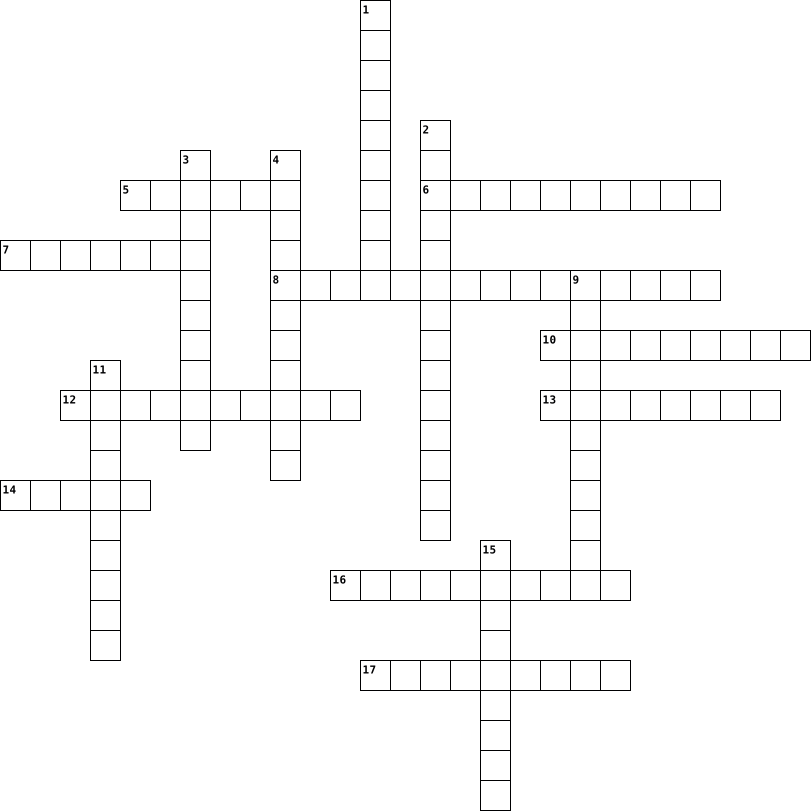
Across
- First; King of Great Britain
- Full; Spy
- Last; General during War of 1812, later President
- Full; Composed the Star Spangled Banner
- Full; Second President of the United States, Federalist
- Last; leader of the Continental Army
- Last; Federalist, led the Treasury
- Last; "Give me liberty, or give me death!"
- Last; Prussian drill instructor
- Last; wrote Declaration of Independence
Down
- Last; First President of the United States, Federalist
- Full; Traitor
- Last; Defeated British General
- Last; Frenchman who joined Revolution on side of Washington
- Full; wrote Common Sense
- Full; Warned of British assault
- Last; Third President of the United States, Anti-Federalist
17 Clues: Full; Spy • Full; Traitor • Full; wrote Common Sense • First; King of Great Britain • Last; Defeated British General • Full; Warned of British assault • Last; Prussian drill instructor • Last; Federalist, led the Treasury • Last; leader of the Continental Army • Full; Composed the Star Spangled Banner • Last; wrote Declaration of Independence • ...
Decode the Hidden States – HMM Criss-Cross Puzzle 2025-10-27

Across
- Probabilities of observed symbols given a state
- Algorithm used for re-estimating HMM parameters
- The visible sequence generated by the states
- Probability of data given model parameters
Down
- Algorithm used to decode hidden states
- A series of observations or outputs
- Probabilities between states
- Representation of the system with states and transitions
- The hidden components in a Hidden Markov Model
- Process used to estimate model parameters
10 Clues: Probabilities between states • A series of observations or outputs • Algorithm used to decode hidden states • Process used to estimate model parameters • Probability of data given model parameters • The visible sequence generated by the states • The hidden components in a Hidden Markov Model • Probabilities of observed symbols given a state • ...
AP Government Unit 2 Constitution Vocabulary 2022-12-13

Across
- Each state must recognize the validity of the laws, public records, and court decisions of all other states
- Court order which requires a person who is charged (must have substantial evidence) with a crime in order to be held in jail
- holds guidelines for the Judicial branch
- Designed to shield the United States against “corrupting foreign influence” by not allowing the federal government from receiving gifts, emoluments, offices, or titles from foreign states without consent of the United States Congress
- The process of proposing, approving, and applying an Amendment
- Gives the president the power to pardon and reprieve federal crimes. There are 4 parts: pardons, amnesty, reprieve, and commutation
- the Senate ___ (⅔ majority)
- bills concern the public
- Bills bills affect individuals or certain organizations
- a way to override a filibuster with a ⅗ majority vote
- The source of Congress’ impliedpowers Gives Congress to increase powers to things that are not listed specifically in the constitution
- holds guidelines for Congress
- begins in the SCOTUS
- Congress can regulate trade with foreign nations and among several states
- Passed by both Houses of Congress and has force of law
- If Congress goes out of session before a bill is read, it can be dismissed
- Reduces punishment
- Eliminates criminal punishment
- originate in lower courts
Down
- The House ___ (or charges with a simple majority)
- holds guidelines for the President
- an international agreement made by the executive branch in order to bypass Congress.
- Makes something that was done legally in past times illegal and punished in the present. This is NOT allowed in the United States
- States cannot discriminate between its citizens and other citizens
- Expresses the opinion of both Houses of Congress but does not have the force of law
- SCOTUS members serve life terms unless impeached or deemed unable
- are international agreements that have ⅔ majority consent of the Senate
- The Constitution and the laws of the United States is the supreme law of the land. No one is above the law
- Expresses the opinion of a House of Congress but does not have the force of law
- All revenue bills must start in the house
- An outline of how the executive branch will enforce a law by Congress. More recently, presidents use it to pass laws that go over Congress
- Except in cases of treason, a felony, or breach of peace, members of congress can not be arrested while congress is in session. Members are also not liable for anything they say on the Congress floor
- Punishing a suspect without a conviction. This is NOT allowed in the United States
- Eliminates criminal punishment and expunges the offense from an individual's record
- Redistribution of the seats in the House of Representatives every 10 years based on change in population
- Postpones carrying out a sentence
- The process of returning criminals
- when a senator says they do not give consent to debate a bill in order to postpone the debate of a bill
- President’s ability to object to a bill
39 Clues: Reduces punishment • begins in the SCOTUS • bills concern the public • originate in lower courts • the Senate ___ (⅔ majority) • holds guidelines for Congress • Eliminates criminal punishment • Postpones carrying out a sentence • holds guidelines for the President • The process of returning criminals • President’s ability to object to a bill • ...
American History 2020-10-01

Across
- The War of 1812 was a conflict fought between the United States and its allies, and the United Kingdom of Great Britain
- Freedmen and Abandoned Lands, was established in 1865 by Congress to help millions of former black slaves
- belief in the benefits of profitable trading; commercialism
- The Navigation Acts were a series of laws passed by the British Parliament that imposed restrictions on colonial trade
- founding father who served as the third president
- The United States Bill of Rights comprises the first ten amendments to the United States Constitution
- was a proposal for the structure of the United States Government presented by William Paterson at the Constitutional Convention on June 15, 1787
- was an American social reformer and abolitionist
- war ended with the treaty of paris in 1763
- an act of the British Parliament in 1765 to get revenue from America by imposing a stamp duty
- On November 29, 1864, peaceful Southern Cheyenne and Arapahoe Indians are massacred by a band of Colonel John Chivington's Colorado volunteers at Sand Creek, Colorado
- was a proposal to the United States Constitutional Convention for the creation of a supreme national government with three branches and a bicameral legislature
- a person that is anti slavery
- This act, passed on July 1, 1862, provided Federal subsidies in land and loans for the construction of a transcontinental railroad across the United States
- a series of forced relocations of approximately 60,ooo Native Americans
- he was one of the founding fathers of the uninted states
- was a small but pivotal for America on Christmas day
Down
- was a former slave that tried to sue for freedom but was rejected because he was told he was property
- The United States Declaration of Independence is the pronouncement adopted by the Second Continental Congress meeting in Philadelphia, Pennsylvania, on July 4, 1776
- It was the first peaceful protest by the sons of liberty
- founding father who was the first president
- an estate on which crops such as coffee,sugar,and tobacco
- was an American stage actor who assassinated President Lincoln
- The Louisiana Purchase was the acquisition of the territory of Louisiana by the United States from France in 1803
- fought in Appomattox County, Virginia, on the morning of April 9, 1865, was one of the last battles of the American Civil War
- aimed at ending the smuggling trade in sugar and molasses
- The Battle of the Little Bighorn, fought on June 25, 1876, near the Little Bighorn River in Montana Territory
- In 1862, the Pacific Railroad Act chartered the Central Pacific and the Union Pacific Railroad
- A democratic republic is a form of government operating on principles adopted from a republic and a democracy
- the 19th-century doctrine or belief that the expansion of the US throughout the American continents was both justified and inevitable
- In response to Pontiac's Rebellion, a revolt of Native Americans led by Pontiac, an Ottawa chief
31 Clues: a person that is anti slavery • war ended with the treaty of paris in 1763 • founding father who was the first president • was an American social reformer and abolitionist • founding father who served as the third president • was a small but pivotal for America on Christmas day • It was the first peaceful protest by the sons of liberty • ...
History Ch.7 2025-12-01

Across
- The 11 states that withdrew from the union to form their own country.
- The 15th President; was the last President before the Civil War.
- The battle that gave the union Army control of the Mississippi River, cutting the Confederacy and half.
- The 14th President; signed the Kansas-Nebraska Act.
- The year of lease surrender to Grant that ended the Civil War.
- The 12th U.S. President; nicknamed “Old Rough and Ready,” Was a general in the Mexican-American War.
- the turning point in the Civil War.
- The union ironclad ship
- A person who believes slavery should be abolished or ended.
- President of the Confederate states of America
- A political party founded on the belief that slavery should not be allowed in the U.S. territories.
- An agreement that attempted to balance power in the Senate between free and slave states.
- The first major Civil War battle one by the South.
- The 16th president of the United States, the first Republican president, president during the Civil War.
- The Union general, whose marched to the sea destroyed southern towns and led to the end of the Civil War.
- Commander of the confederate army.
- Means to withdraw or to leave from.
- This divided a section of western land into Kansas, a slave state, and Nebraska, a free state.
- The final capital of the Confederate states of America.
Down
- A document that declared that all slaves are free and states that had left the Union.
- Early commander of the union army of the Potomac.
- Secret roots leading to free northern states and Canada.
- The location of the assassination of President Lincoln.
- The war fought between the union and the confederate states of America.
- The constitutional amendment that outlawed slavery in the U.S.
- The actor who shot President Lincoln.
- The four in Charleston, South Carolina were the first shots of the Civil War were fired.
- A law requiring people in free northern states to return runaway slave slaves to the South.
- A law that put a stop to bringing enslaved people to America to be sold.
- Commander of all union armies, known as “Unconditional Surrender.”
- the deadliest Battle of the Civil War.
- The location of the surrender of Robert E Lee and the Confederate army to Ulysses S. Grant.
- An abolitionist who escaped from slavery; wrote a book about his life as a slave.
- The Supreme Court decision that allowed slavery in the U.S. territories.
- The Confederate ironclad ship.
- The author of Uncle Tom’s Cabin
- The 13th President; became President after Taylor; Signed into law the Compromise of 1850.
- A former slave who led over 70 slaves to freedom by way of the Underground Railroad.
- The three minute speech by President Lincoln, that honored both the Union and Confederate fallen soldiers.
- The year the American Civil Warbegan.
- A Confederate general and most remembered soldier of the First Battle of Bull Run.
41 Clues: The union ironclad ship • The Confederate ironclad ship. • The author of Uncle Tom’s Cabin • Commander of the confederate army. • the turning point in the Civil War. • Means to withdraw or to leave from. • The actor who shot President Lincoln. • The year the American Civil Warbegan. • the deadliest Battle of the Civil War. • President of the Confederate states of America • ...
the civil war 2023-03-02

Across
- a period before war
- someone who wanted to end slavery
- the south's way of producing goods. they often used slaves for the labor
- corn,wheat,grain,ect.
- when a person is murdered for political reasons
- boundary or border that split free states from slave states. it passed through the north,Virginia,Pennsylvania, Maryland,Delaware, and then through the south
- 18th president of the union
- the name for the south after they ______(7 down) from the north
- meaning to break apart or split from one another
Down
- the name for those who supported the south
- name for the north after the south _____(7 down) from them
- when usually african-americans and sometimes native americans are owned by people (usually whites) and forced to do labor for them and sometimes sold/bidded for money to other people
- a large farm in the southern united states. before the war many of the people who worked on the land were enslaved
- president of the union during the civil war
- men who traveled and fought on the ground
- an attempt to stop people and/or supplies from coming and/or leaving a port
- manufacturing goods from raw materials used by the northern people to produce goods. there was no need for slavery for this type of production
- large caliber firearms such as cannons and mortars
- when a soldier is wounded or killed in battle
- states that left the union to form their own country after Abraham Lincoln was elected as the president of the united states
- men who fight on horseback
- loyal to the north
22 Clues: loyal to the north • a period before war • corn,wheat,grain,ect. • men who fight on horseback • 18th president of the union • someone who wanted to end slavery • men who traveled and fought on the ground • the name for those who supported the south • president of the union during the civil war • when a soldier is wounded or killed in battle • ...
Civil War Crossword 2023-02-22

Across
- The idea that the South had the authority to nullify tariffs placed on goods.
- The south had to fight a _________ war to win.
- Who won the election of 1860?
- Mainly the northern states, fighting to keep the Union together and to make slavery illegal.
- Strategy used by the Union to try and take over the South; take control of mississippi river and split the South in two.
- Abraham Lincoln said that he would stop the ______ of slavery.
- The speach preformed by Abraham Lincoln stating that in order to end the war, slavery must be abolished.
- Used to blockade and stop union ships from entering or leaving.
- A person who flees or tries to escape.
- The __________ __________ states that all slaves would be free as of January 1, 1863.
- The man who created a march that burned and demolished many southern towns and cities.
Down
- The compromise that banned slavery north of the 36° 30' line.
- When starting the war the Union already had an ____ and a ____.
- The act that allowed Kansas and Nebraska to choose if they wanted to be a free or slave state.
- The decision to consider slaves as "property" and they would not be free, even in states that didn't allow slavery.
- Most people died because of ________ during the Civil War.
- The bloodiest battle in American history.
- To formally break away in a political state.
- Mainly the southern states, fighting for the right to keep slavery legal.
- The states that allowed slavery but refused to leave the Union.
20 Clues: Who won the election of 1860? • A person who flees or tries to escape. • The bloodiest battle in American history. • To formally break away in a political state. • The south had to fight a _________ war to win. • Most people died because of ________ during the Civil War. • The compromise that banned slavery north of the 36° 30' line. • ...
Civil War Crossword 2023-02-22

Across
- The idea that the South had the authority to nullify tariffs placed on goods.
- The south had to fight a _________ war to win.
- Who won the election of 1860?
- Mainly the northern states, fighting to keep the Union together and to make slavery illegal.
- Strategy used by the Union to try and take over the South; take control of mississippi river and split the South in two.
- Abraham Lincoln said that he would stop the ______ of slavery.
- The speach preformed by Abraham Lincoln stating that in order to end the war, slavery must be abolished.
- Used to blockade and stop union ships from entering or leaving.
- A person who flees or tries to escape.
- The __________ __________ states that all slaves would be free as of January 1, 1863.
- The man who created a march that burned and demolished many southern towns and cities.
Down
- The compromise that banned slavery north of the 36° 30' line.
- When starting the war the Union already had an ____ and a ____.
- The act that allowed Kansas and Nebraska to choose if they wanted to be a free or slave state.
- The decision to consider slaves as "property" and they would not be free, even in states that didn't allow slavery.
- Most people died because of ________ during the Civil War.
- The bloodiest battle in American history.
- To formally break away in a political state.
- Mainly the southern states, fighting for the right to keep slavery legal.
- The states that allowed slavery but refused to leave the Union.
20 Clues: Who won the election of 1860? • A person who flees or tries to escape. • The bloodiest battle in American history. • To formally break away in a political state. • The south had to fight a _________ war to win. • Most people died because of ________ during the Civil War. • The compromise that banned slavery north of the 36° 30' line. • ...
George Washington's Presidency 2014-03-13

Across
- Southern states would support Hamilton's plan if Northern States supported a plan to locate the nations __________ in the south.
- Another word for money.
- The Secretary of War advises the President on __________ affairs.
- The __________ General serves as the chief lawyer of the United States.
- The US signed Jay's treaty with what country?
- Pinckney's treaty allowed the US to trade through this port. (No space)
- Thomas Jefferson believed the National Bank was __________.
- Pinckney's Treaty gave the US free navigation of this major river.
- This Act, passed in 1789, created the Federal Court System.
- Head of the Supreme Court is called the _________ Justice.
- The Secretary of state advises the President on _________ affairs.
- Tax on a good brought into the country.
Down
- The farmers of western Pennsylvania were angry about a government tax on __________.
- The biggest economic problem faced by the United States is the __________ debt.
- Debt owed to private citizens and American businesses.
- Pinckney's Treaty was made between the US and __________.
- A settlement in which each side gives up some of its demands to reach an agreement.
- Native American tribes joined together and formed the Western __________.
- 1st President of the United States. (last name)
- Alexander Hamilton wanted to create a national _________.
- Blue Jacket was defeated at this battle by Major General Anthony Wayne. (no space)
- The Secretary of the __________ enforces tax laws.
- Hamilton wanted to pay off all of the __________ debts along with the National debt.
- Act or decision that sets an example for others to follow.
- Cabinet members give the President __________.
25 Clues: Another word for money. • Tax on a good brought into the country. • The US signed Jay's treaty with what country? • Cabinet members give the President __________. • 1st President of the United States. (last name) • The Secretary of the __________ enforces tax laws. • Debt owed to private citizens and American businesses. • ...
Chapter 10 An Age of Democracy and Progress 9th 2024-01-26

Across
- issue of a French army officer being accused of being a traitor because he was Jewish
- unofficial military seeking independence that attacked British officials in Ireland
- people native to New Zealand
- belief that the United States would rule from the Atlantic Ocean to the Pacific Ocean
- process where a product is moved from one worker to another with each worker completing a single job
- when states choose to leave the United States and form their own country
- nation in British Empire allowed to make all laws concerning its own affairs
- war fought between the US and the Confederacy over slavery
- movement in England to give the right to vote and other rights to more people
- idea that all life on earth developed from simpler life forms over millions of years
- president of the United States during the Civil War
- leader of Great Britain during the democratic changes
- occurred in 1890s; goal was a separate homeland for the Jewish people in Palestine
Down
- nomadic people native to Australia
- study of the human mind
- art and entertainment appealing to a large audience
- convicted criminals are sent here to serve their sentences instead of prison
- scientist that developed the Theory of Evolution
- discovered by Marie & Pierre Curie; energy released as atoms decay
- local control to govern internal affairs
- the right to vote
- issued by Lincoln; declared people enslaved in the Confederate states were free
- separation by race
- government formed in France after Napoleon III was exiled
- prejudice against Jewish people
25 Clues: the right to vote • separation by race • study of the human mind • people native to New Zealand • prejudice against Jewish people • nomadic people native to Australia • local control to govern internal affairs • scientist that developed the Theory of Evolution • art and entertainment appealing to a large audience • president of the United States during the Civil War • ...
Cold War Crossword 2024-05-06

Across
- Dictator of Cuba during the Cuban Missile Crisis
- Assassinated John F. Kennedy in Houston
- President that negoiated a peace deal between Israel and Egypt
- Trials that would convict German war criminals for their actions during WW2
- U.S. senator that accused scores of government officials of being communists
- Country that collapsed in 1991
- First major proxy war fought between the Soviet Union and the United States
- Was president when WW2 ended
- President that got impeached because of Watergate Scandal
- Financial plan that would aim at rebuilding Western Europe
- Was president when Mikhail Gorbachev took over the Soviet Union
- Soviet satelite that triggered the Space Race
- Proxy war fought between the Soviet Union and United States in Southeast Asia
- Japanese Emperor that was hanged after WW2
Down
- First president to acknowledge the arms race
- Structure that came to symbolize the Cold War
- Was assassinated and the youngest US president
- Gave veterans financial aid for a higher level of education
- President that banned the use of nuclear weapons in Earth's orbit
- President that pardoned Nixon after taking office
- Soviet Union put nuclear missiles within range of the United States
- Became president at the beginning of the end of the Cold War
- International organization designed to prevent another major conflict
- North Vietnamese attempt at winning the war that caused U.S. opinion of the war to decline
- Term for the exponential growth of United States population after WW2
- Established the voting age at 18 years old
- United States attempt at overthrowing Fidel Castro
27 Clues: Was president when WW2 ended • Country that collapsed in 1991 • Assassinated John F. Kennedy in Houston • Established the voting age at 18 years old • Japanese Emperor that was hanged after WW2 • First president to acknowledge the arms race • Structure that came to symbolize the Cold War • Soviet satelite that triggered the Space Race • ...
Earth Day 2026-06-22

Across
- The steepest cliff on Earth.
- The largest cave in the United States.
- The biggest country by land area in the world.
- The deepest canyon on Earth.
- The longest river on Earth (traditional name).
- The city that receives the most snowfall on Earth.
- The deepest known point on Earth’s surface.
- The Earth’s largest ocean.
- The largest peninsula on Earth.
- The largest mesa on Earth.
- The largest active volcano in the world.
- The largest freshwater lake by volume on Earth.
- The lowest point on Earth.
- The largest plain on Earth.
- The driest region on Earth outside Antarctica.
- The tallest waterfall on Earth.
Down
- The highest point on Earth.
- The ecosystems that produce more than half of all the oxygen on Earth.
- The longest river in the United States.
- The longest mountain range in the United States.
- The largest isthmus on Earth.
- The largest sand dune on Earth.
- The largest cave on Earth.
- The highest point in the United States.
- The largest living organism on Earth.
- The widest alpine valley on Earth.
- The biggest mountain range in South America.
- The largest rainforest jungle on Earth.
- The largest glacier on Earth.
- The widest waterfall on Earth.
- The layer of the Earth’s atmosphere that is closest to the surface and contains most of the weather phenomena.
- The largest oasis on Earth.
- The largest bay on Earth.
- The city that gets the most rainfall on Earth.
- The largest island on Earth.
- The hottest desert on Earth.
- The most earthquake prone state in the United States.
37 Clues: The largest bay on Earth. • The largest cave on Earth. • The Earth’s largest ocean. • The largest mesa on Earth. • The lowest point on Earth. • The highest point on Earth. • The largest oasis on Earth. • The largest plain on Earth. • The steepest cliff on Earth. • The deepest canyon on Earth. • The largest island on Earth. • The hottest desert on Earth. • ...
The expanding Nation 2014-05-11

Across
- American sailors into the Royal Navy was the most important for many Americans. The British practice of manning naval ships with "pressed" men, who were forcibly placed into service
- American statesman, political theorist and the fourth President of the United States
- an order of a government prohibiting the movement of merchant ships into or out of its ports.
- the act of Congress (1809) prohibiting all shipping and trade between the United States and British- or French-controlled ports.
- any of the congressmen from the South and West, led by Henry Clay and John Calhoun, who wanted war against Britain in the period leading up to the War of 1812
Down
- fourth Chief Justice of the United States. His court opinions helped lay the basis for United States constitutional law and made the Supreme Court of the United States
- was a landmark United States Supreme Court case in which the Court formed the basis for the exercise of judicial review in the United States under Article III of the Constitution.
- set out in May 1804 to explore and map the American West.
- the power of a court to adjudicate the constitutionality of the laws of a government or the acts of a government official.
- signed on December 24, 1814- was the peace treaty that ended the War of 1812 between the United States of America and the United Kingdom of Great Britain and Ireland.
- Native American leader of the Shawnee and a large tribal confederacy which opposed the United States during the War of 1812.
- Lemhi Shoshone woman, who accompanied the Lewis and Clark Expedition, acting as an interpreter and guide, in their exploration of the Western United States
12 Clues: set out in May 1804 to explore and map the American West. • American statesman, political theorist and the fourth President of the United States • an order of a government prohibiting the movement of merchant ships into or out of its ports. • ...
The expanding Nation 2014-05-11

Across
- Native American leader of the Shawnee and a large tribal confederacy which opposed the United States during the War of 1812.
- American statesman, political theorist and the fourth President of the United States
- the act of Congress (1809) prohibiting all shipping and trade between the United States and British- or French-controlled ports.
- fourth Chief Justice of the United States. His court opinions helped lay the basis for United States constitutional law and made the Supreme Court of the United States
- an order of a government prohibiting the movement of merchant ships into or out of its ports.
Down
- was a landmark United States Supreme Court case in which the Court formed the basis for the exercise of judicial review in the United States under Article III of the Constitution.
- any of the congressmen from the South and West, led by Henry Clay and John Calhoun, who wanted war against Britain in the period leading up to the War of 1812
- the power of a court to adjudicate the constitutionality of the laws of a government or the acts of a government official.
- set out in May 1804 to explore and map the American West.
- American sailors into the Royal Navy was the most important for many Americans. The British practice of manning naval ships with "pressed" men, who were forcibly placed into service
- Lemhi Shoshone woman, who accompanied the Lewis and Clark Expedition, acting as an interpreter and guide, in their exploration of the Western United States
- signed on December 24, 1814- was the peace treaty that ended the War of 1812 between the United States of America and the United Kingdom of Great Britain and Ireland.
12 Clues: set out in May 1804 to explore and map the American West. • American statesman, political theorist and the fourth President of the United States • an order of a government prohibiting the movement of merchant ships into or out of its ports. • ...
Attack on Pearl Harbor 2025-12-04

Across
- the United States became upset after Japan invaded and conquered it in 1931
- Japan thought they shouldn't be ruled by white imperialist
- Japan launched an attack on the United States ___
- where did the United States move their Navy from San Diego
- what year did Pearl Harbor happen
- United States were able to send 31,095 troops in
Down
- the Japan placed on the torpedoes to prevent from hitting the bottom of Pearl Harbor
- Japan invaded the country and interrupted United States trade
- 12 times lost in the past six months
- who cut off the trade of oil and metal after Japan conquered French Indochina
- No chance of an surprise attack being there
- The United Staes wanted to stay _____ to stay out of the war
- who was angry with the US rejecting the racial equality proposal
13 Clues: what year did Pearl Harbor happen • 12 times lost in the past six months • No chance of an surprise attack being there • United States were able to send 31,095 troops in • Japan launched an attack on the United States ___ • Japan thought they shouldn't be ruled by white imperialist • where did the United States move their Navy from San Diego • ...
CHAPTER 16-3 SECESSION AND WAR 2021-02-11

Across
- "The ________ Established" 446
- Confederates demand what of the fort? 449
- Virginian concerned about the future 446
- withdraw from the Union 446
- used to justify secession 446
- Captain who witnessed the attack 449
- state that separated from Virginia in 1861 447
- what was attacked to start the Civil War 449
- "No human power can save the _____" 446
Down
- harbor location of attack on the fort 449
- "The Union of these states is _______" 448
- first state to secede from the Union 447
- Lincoln contacts what Governor after attack 449
- what states talked of secession 446
- issue that split the Democratic party 445
- Confederate guns open fire "___ 12, 1861 449
- Most northerners believed the Union should be ______447
- President of the Confederate states? 446
- Northern democrats supported what? 445
- "______ Lincoln" 445
20 Clues: "______ Lincoln" 445 • withdraw from the Union 446 • used to justify secession 446 • "The ________ Established" 446 • what states talked of secession 446 • Captain who witnessed the attack 449 • Northern democrats supported what? 445 • "No human power can save the _____" 446 • first state to secede from the Union 447 • President of the Confederate states? 446 • ...
USII.2 and 3 Review 2023-09-29

Across
- _____ Bureau aided former slaves in the South.
- Adaptation on the Great Plains for shelter
- Granted citizenship to all born in the US
- Textile industry hub
- Number of regions in the United States
- Meatpacking industry hub
- Invention used to pump water on the Great Plains
- Cosmetics industry hub
- Banned Slavery in the United States
Down
- Gives the right to vote to all citizens
- Fought for Civil Rights for all. (Last Name)
- Example of a political region
- Natural resources were sent here.
- Urged Southerns to stop fighting at the end of the Civil war (last Name)
- Capital City of the United States
- Automobile indstry hub
- Laws that segragated the South after Reconstruction
- Limited new freedoms for freed slaves during Reconstruction
- Steel inudstry hub
- Invention used to mark property and keep in livestock (cows)
20 Clues: Steel inudstry hub • Textile industry hub • Automobile indstry hub • Cosmetics industry hub • Meatpacking industry hub • Example of a political region • Natural resources were sent here. • Capital City of the United States • Banned Slavery in the United States • Number of regions in the United States • Gives the right to vote to all citizens • ...
Government Acronyms 2024-10-23

Across
- health, education, welfare
- Fannie Mae
- environmental protection agency
- Freddie Mae
- federal deposit insurance corporation
- federal communication commission
- housing urban development
- American Track
- Food drug administration
- United States department of agriculture
- national institute of standards and tech
- National Aeronautics and Space Administration
- Health human sources
- bill of rights
- Bridge investment program
- Transportation security administration
- Department of homeland security
Down
- Federal emergency management agency
- national oreanic atmospheric administration
- securities and exchange
- federal bureau of investigation
- department of defense
- Central Intelligence Agency
- federal aviation administration
- United States of America
- Record of decision
- department of transportation
- social security administration
- attorney general
- Veteren Assistance
- National institutes of health
- Secret service
- Supreme Court of the United States
- Small business association
- Department of justice
35 Clues: Fannie Mae • Freddie Mae • American Track • Secret service • bill of rights • attorney general • Record of decision • Veteren Assistance • Health human sources • department of defense • Department of justice • securities and exchange • United States of America • Food drug administration • housing urban development • Bridge investment program • health, education, welfare • Small business association • ...
Immigration Shaping America 2012-05-09

Across
- many Americans panic, believing that the nation is threatened by a communist menace.
- brings immigration to a complete halt as hostilities prevent transport across the ocean.
- Mexican residents of the newly acquired territory are allowed to remain. They are subjected to serious discrimination but become the heart of labor for the American Southwest.
- A literacy test for incoming immigrants finally becomes law
- limiting American citizenship to "white persons and persons of African descent," thereby discriminating against Asian immigrants.
Down
- 1910 sends thousands of Mexicans to the United States. Over the next twenty years, nearly a million enter the United States, seeking work.
- 1565 First permanent European settlement in the United States is established at St. Augustine, Florida, by the Spanish.1598 Spanish immigrants settle in what is now Texas and New Mexico.1619 First shipment of African slaves arrives in Virginia.
- 1776 The Declaration of Independence charges the king of England with obstructing migration to British North America, thereby indirectly indicating that the colonies were greatly interested in recruiting new settlers. In fact, most colonies are in active competition with other colonies for these prospective settlers.
- The first serious prohibition of free immigration in all of American history, this legislation bans Chinese migration to the United States for ten years
- interrupts mass immigration to the United States
- considered by Congess to restrict the flow of immigrants and potential terrorists into the U.S.
- applies to the period of time during the 1630's when Massachusetts's population sky rocketed with the migration of approximately 21,000 immigrants to New EnglandEraofRegulation beginning the long history of immigrant pioneers in the fertile field of the mass culture in the United States.
- The first arrive in California as political refugees. Racial tensions grow between Asians and other Californians.
- The treaty pledges to China the right of unrestricted immigration of Chinese citizens to the United States.
- President Eisenhower's border control program. Cut illegal immigration at the cost of anti-Latino discrimination.
- Significant Chinese migration to the United States begins to ares such as San Francisco
16 Clues: interrupts mass immigration to the United States • A literacy test for incoming immigrants finally becomes law • many Americans panic, believing that the nation is threatened by a communist menace. • Significant Chinese migration to the United States begins to ares such as San Francisco • ...
The Civil War Crossword 2026-04-17

Across
- The Start of The War
- United States
- Massachusetts
- lost
- President
- Union Leader
- Soldiers forced to fight
Down
- Confederate Slaves freed
- The Year The War Ended
- Battle In the North
- The states who left the Union
- Confederate Leader
- Famous battle
- to leave the Union
- benefited
- The month the war started
- Method The South Used
- Confederate President
18 Clues: lost • benefited • President • Union Leader • Famous battle • United States • Massachusetts • Confederate Leader • to leave the Union • Battle In the North • The Start of The War • Method The South Used • Confederate President • The Year The War Ended • Confederate Slaves freed • Soldiers forced to fight • The month the war started • The states who left the Union
Cival war crossward puzzle 2021-02-18

Across
- Inventor of the Cotton Gin
- A large piece of land that grows crops
- A women who worked on the underground railroad
- President of the Confederate states of America
- 18th president of the united state and general in the Civil war
- The confederates best general
Down
- 1st battle of the civilwar
- 16th president of the United States
- Bloodiest battle in the Civil War
- A writer and former slave
- Southern states who wanted to keep slavery
- Northern states that wanted to abolish slavery
12 Clues: A writer and former slave • 1st battle of the civilwar • Inventor of the Cotton Gin • The confederates best general • Bloodiest battle in the Civil War • 16th president of the United States • A large piece of land that grows crops • Southern states who wanted to keep slavery • A women who worked on the underground railroad • President of the Confederate states of America • ...
Cival war crossward puzzle 2021-02-18

Across
- Southern states who wanted to keep slavery
- Bloodiest battle in the Civil War
- The confederates best general
- Northern states that wanted to abolish slavery
- 18th president of the united state and general in the Civil war
- President of the Confederate states of America
Down
- A women who worked on the underground railroad
- 1st battle of the civil war
- A large piece of land that grows crops
- A writer and former slave
- Inventor of the Cotton Gin
- 16th president of the United States
12 Clues: A writer and former slave • Inventor of the Cotton Gin • 1st battle of the civil war • The confederates best general • Bloodiest battle in the Civil War • 16th president of the United States • A large piece of land that grows crops • Southern states who wanted to keep slavery • A women who worked on the underground railroad • Northern states that wanted to abolish slavery • ...
President's Day 2025-10-22

Across
- freed the slaves in the Confederate States
- the first president of the United States.
- month Presidents’ Day is celebrated
- honesty, integrity, and service are all qualities of this
- In 1971, the American government moved some holidays to this day
- Linconln's birthday
- Leaders of the United States Executive Branch
Down
- Another word for declaration
- 16th president during the Civil War
- War that George Washington helped win
- 1863-1865 time when the United States was divided.
- February 22 is George Washington's
12 Clues: Linconln's birthday • Another word for declaration • February 22 is George Washington's • 16th president during the Civil War • month Presidents’ Day is celebrated • War that George Washington helped win • the first president of the United States. • freed the slaves in the Confederate States • Leaders of the United States Executive Branch • ...
Social Studies Enrichment 2016-02-07

Across
- an established precedents according to which a state or other organization is acknowledged to be governed
- a French military and political leader
- the first ten amendments to the US Constitution
- small national government
- chief staff aide to General George Washington, one of the most influential interpreters and promoters of the U.S. Constitution
- the formal statement written by Thomas Jefferson declaring the freedom of the thirteen American colonies from Great Britain
- two people that explored the American Northwest
- young Native American woman who guided Lewis and Clark on their expedition
- the acquisition of the Louisiana territory by the United States from France in 1803
- the third Vice President of the United States
Down
- served as the second President of the United States, the first Vice President
- a tax protest in the United States beginning in 1791
- a body of advisers to the president, composed of the heads of the executive departments of the government
- a convention of delegates called together from the Thirteen Colonies
- the United States Constitution provides the procedure for electing the President and Vice President
15 Clues: small national government • a French military and political leader • the third Vice President of the United States • the first ten amendments to the US Constitution • two people that explored the American Northwest • a tax protest in the United States beginning in 1791 • a convention of delegates called together from the Thirteen Colonies • ...
Constitutional Crossword 2022-04-18

Across
- this branch was made to carry out the laws
- The first president of the united states was _______
- This man was the fourth president of the united states
- Because the Founding Fathers did not want any branch to be able to abuse its powers they created a system of _________________
- as a result they prevented one branch from gaining to much power finally they included a_________
- he was the second president of the united states
- There are this many amendments to the constitution today
- the federal government had no power to _____
Down
- the judicial branch. Its job was to determine if the laws passed by Congress were constitutional. The main part of this branch was the __________
- he was the third president of the united states
- formal plan of government
- There are 3 ________ to keep the government in order
- the chief executive for the united states would be called the _____
- this branch allows laws to be made
- because of the ____ of the government under the Articles of Confederation the Founding Fathers met in Philadelphia in 1787 to write a new plan of government
15 Clues: formal plan of government • this branch allows laws to be made • this branch was made to carry out the laws • the federal government had no power to _____ • he was the third president of the united states • he was the second president of the united states • The first president of the united states was _______ • There are 3 ________ to keep the government in order • ...
Unit 1 Federalism 2022-04-19

Across
- distinguished the two governing spheres, delegated powers, reserved powers, and concurrent powers
- one who believes the Constitution should be interpreted literally
- powers the Constitution delegates to the federal government
- Jefferson's belief that 13 sovereign states could judge its overstepping its jurisdiction
- powers given to states to create and enforce laws on health, safety, and morals
- burdened distillers protest against a federal whiskey tax
Down
- giving some of the federal responsibilities assumed by the federal government back to the states
- made public sector buildings an transportation systems accessible for disabled individuals
- a state's right to declare null and void any federal law that is thought to violate the Constitution
- expands Congress's reach of regulation
- powers held by authorities at state and federal levels
- a doctrine asserting that only Congress may regulate when the commodity requires a national uniform rule
- type of government with a single governing authority in the central capital with uniform law throughout the land
- require states to comply with a federal directive
- Congress collects federal tax revenue to distribute the funds to states
15 Clues: expands Congress's reach of regulation • require states to comply with a federal directive • powers held by authorities at state and federal levels • burdened distillers protest against a federal whiskey tax • powers the Constitution delegates to the federal government • one who believes the Constitution should be interpreted literally • ...
Studies Weekly Week 12 Vocabulary 2023-11-01

Across
- In the ____________, each of state would have two senators, giving both large states and small states equal power.
- this plan gave Congress more power over the states.
- established the money system that we still use today
- known as the "Father of Our Country"
- In the House of ________________, the number of representatives would be determined by population.
- known as the "Father of the Constitution"
- people who wanted a strong central government with more power than the people or states
Down
- three out of every five, or three-fifths, of the enslaved people would be counted in the population
- mighty
- a series of essays that supported the new government
- those who favored a weaker federal government that gave more power to the states and people
- Wrote the Virginia Declaration of Rights which influenced the content of the Declaration of Independence.
- friendship
- this plan said that each state, no matter the size, would have the same number of representatives in Congress
- during his presidency, the US more than doubled in size through the Louisiana Purchase
15 Clues: mighty • friendship • known as the "Father of Our Country" • known as the "Father of the Constitution" • this plan gave Congress more power over the states. • a series of essays that supported the new government • established the money system that we still use today • during his presidency, the US more than doubled in size through the Louisiana Purchase • ...
Crossword 2020-02-04

Across
- is feelings of pride and loyalty to a nation
- was the first road built by the federal government
- In 1819 the two countries signed the ... which settled all border disputes between Spain and the United States
- set the border between the United States and Canada at 49°N latitude as far west as the Rocky Mountains
- from 1815 to 1825 the United States enjoyed the... an era of peace, pride, and progress
- which settled the conflict that had arisen from Missouri's application for statehood
- president
Down
- a series of measures intended to make the United States economically self-sufficient
- was an exclusive statement of American policy warning European powers not to interfere with the Americas
- a strong supporter in U.S. Representative from Kentucky
- which naval power on the Great Lakes for both the United States and British Canada
- disagreements between the different region
- elected in 1816, had sent U.S. troops to secure the U.S.Florida border
- which ran from Albany to Buffalo, New York
- called the Liberator, led many of these struggles for independence.
15 Clues: president • disagreements between the different region • which ran from Albany to Buffalo, New York • is feelings of pride and loyalty to a nation • was the first road built by the federal government • a strong supporter in U.S. Representative from Kentucky • called the Liberator, led many of these struggles for independence. • ...
Final Exam Review - 7th 2024-05-14

Across
- The constitutional amendment which gave suffrage to African American men.
- Texas settlers of Spanish descent.
- New, mostly white settlers from the United States
- The final battle of the Texas Revolution which gave Texas its independence.
- People living in New Spain that were born in Spain.
- The constitutional amendment which ensured that African Americans were citizens and had equal rights.
- The process of reuniting the nation and rebuilding the southern states.
- What was the last battle of the Civil War?
Down
- Elected to the governorship in 1853, he paid off the state’s debt.
- One of two men chosen by the delegates of the Convention of 1832 to present resolutions to state and federal governments. President of the Convention of 1833.
- The constitutional amendment which abolished slavery in the United States.
- Who led the main Mexican force into Texas?
- Man who followed up on his father’s colony and started four of his own; known as the “Father of Texas.”
- Businesspeople who promoted settlement in Mexican states.
- The belief that the United States was meant to expand all the way across North American to the Pacific.
15 Clues: Texas settlers of Spanish descent. • Who led the main Mexican force into Texas? • What was the last battle of the Civil War? • New, mostly white settlers from the United States • People living in New Spain that were born in Spain. • Businesspeople who promoted settlement in Mexican states. • Elected to the governorship in 1853, he paid off the state’s debt. • ...
Lesson 4.1-4.2 Vocabulary 2025-02-21

Across
- The first ten amendments of the United States constitution
- A solution to which each side gives up some of its demands to reach an agreement
- A plan that called for a strong national government with three branches and two houses
- The first American constitution, passes in 1777, which created a loose alliance of 13 independent states
- A 1787 law that set up a government for the Northwest territory
- An agreement that three fifths of the enslaved people would count in a states population
Down
- A document that sets out the laws, principles, organization, and process of government
- A 1786 revolt in Massachusetts led by farmers in reaction to high taxes
- A plan at the Constitutional Convention that settled the differences between large and small states.
- To put private individuals or companies charge of something
- A meeting of representatives from all states (Except Rhode Island) to revise the Articles of Confederation
- A period when business activity is slow, prices and wages fall, and unemployment rises.
- Money
- A plan that called for a strong national government with three branches and one house
- To give up.
15 Clues: Money • To give up. • The first ten amendments of the United States constitution • To put private individuals or companies charge of something • A 1787 law that set up a government for the Northwest territory • A 1786 revolt in Massachusetts led by farmers in reaction to high taxes • A solution to which each side gives up some of its demands to reach an agreement • ...
America and the Law: Trying to Abolish Slavery 2026-01-20

Across
- The Northern states that stayed together and fought to keep the United States united.
- The branch of government that makes the laws, known as Congress.
- ______of Independence, the 1776 document that announced America’s independence from Britain.
- A system where people are owned, controlled, and forced to work without pay.
- To completely end or get rid of something, such as slavery.
- A situation where neither side can win, and nothing moves forward.
- The branch of government that leads the country and enforces laws, including the President.
Down
- _____ Fathers, the group of leaders who helped create the United States and wrote important early documents like the Constitution.
- The national government that makes laws for the whole country.
- Describes an economy based on farming and growing crops.
- The Southern states that broke away from the United States.
- A gap or weakness in a law that allows people to avoid following it fully.
- The branch of government that interprets laws and runs the court system.
- Describes an economy based on factories, machines, and manufacturing.
- A level of government that controls individual territories, such as Texas or New York.
15 Clues: Describes an economy based on farming and growing crops. • The Southern states that broke away from the United States. • To completely end or get rid of something, such as slavery. • The national government that makes laws for the whole country. • The branch of government that makes the laws, known as Congress. • ...
Government Review 2017-02-03

Across
- Missouri has _____ United States Representatives.
- A ______ starts out as a bill.
- Eric ________ is the governor of Missouri.
- The Vice President of the United States is ___________.
- The __________ can vet laws, make treaties and is head of the armed forces.
- The ________ is head of the executive branch for the state government.
- The senate is one of the two houses that make up congress. The other is called ____.
- The _______ Branch interprets or evaluates the laws.
- ______ means to remove from office.
Down
- This court is the highest court in the United States.
- Congress can override the President's veto by a _______ vote.
- The _______ is part of the executive branch and includes 15 secretaries.
- The ____ Branch carries out or enforces the laws.
- The _______ Branch creates or makes the laws.
- Missouri has ____ United States Senators in Washington DC.
- The house of Representatives and the Senate make up ________ and work in the legislative branch.
- A _____ is an idea that may become a law.
17 Clues: A ______ starts out as a bill. • ______ means to remove from office. • A _____ is an idea that may become a law. • Eric ________ is the governor of Missouri. • The _______ Branch creates or makes the laws. • Missouri has _____ United States Representatives. • The ____ Branch carries out or enforces the laws. • The _______ Branch interprets or evaluates the laws. • ...
The Start of the Civil War 2022-04-25

Across
- The capital of the Confederacy based in Virginia.
- It's not talking about a New York baseball team.
- One of the countrys that relied on Southern Cotton
- One of the four border states and had the Union Capital located in it.
- To free someone from slavery.
- one of the Generals of the Confederacy Army.
- one of the four border states and controlled parts of the Ohio River.
- The Bloodiest single-day of fighting in the civil war.
Down
- A type of ship that was coated in iron.
- One of the four border states and controlled parts of the Mississippi River.
- The first official battle of the Civil War.
- One of the Generals of the Union Army, with an interesting first name.
- One of the countrys that relied on Southern Cotton
- President of the Union.
- President of the Confederacy.
- The attack plan of the Union and named after a snake.
- It's not talking about the group that fought against the Empire in Star Wars.
- One of the four border states and close to the Union city Philadelphia.
18 Clues: President of the Union. • President of the Confederacy. • To free someone from slavery. • A type of ship that was coated in iron. • The first official battle of the Civil War. • one of the Generals of the Confederacy Army. • It's not talking about a New York baseball team. • The capital of the Confederacy based in Virginia. • ...
U.S. Wars 2022-02-04

Across
- This was the main type of warfare during World War One
- the North was called The ______
- This word means freedom
- This world war was fought from 1914-1918
- The United States fought against the _____ Powers during World War Two
- Event in which over 6 million Jews were killed
- President of the U.S. for the majority of World War Two
- Leader of Germany during World War Two
Down
- The United States fought against the ______ Powers during World War One
- The South was known as the ______States of America
- This event caused the U.S. to join World War Two
- President during the Civil War
- The United States dropped an ______ bomb on two Japanese cities to force an end to World War Two
- War fought from 1861-1865
- Main issue fought over during the Civil War
- The United States fought with this group during World War One and World War Two
- This world war was fought from 1939-1945
17 Clues: This word means freedom • War fought from 1861-1865 • President during the Civil War • the North was called The ______ • Leader of Germany during World War Two • This world war was fought from 1914-1918 • This world war was fought from 1939-1945 • Main issue fought over during the Civil War • Event in which over 6 million Jews were killed • ...
Articles Of Confederation 2021-12-02

Across
- A good government doesn't give anyone too ________ power
- A good government protects individual ____________
- Under the Articles of confederation there was no ___________
- Under the Articles of confederation Congress had no way to ____________ their laws
- Under the Articles of confederation Congress could not collect ___________
- The Articles could only be ______________ if ALL the states agreed
- Congress had the power to create a __________ to protect all the states
- A good government lets people have a _____________
- Under the Articles of confederation each state had their own _____________
- A good government has enough _________ to do its job
Down
- ______________ was the only central government
- Under the Articles of confederation each state was ____________
- Under the Articles of the confederation each state would send ________________ to the "congress of the confederation"
- A ______________ is a group of individuals united together for a purpose
- Under the Articles of confederation each state got ___________ vote in Congress
- Under the Articles of Confederation Congress did not have the __________ to tell the states what to do
- A good government considers the needs of all ____________
17 Clues: ______________ was the only central government • A good government protects individual ____________ • A good government lets people have a _____________ • A good government has enough _________ to do its job • A good government doesn't give anyone too ________ power • A good government considers the needs of all ____________ • ...
Social Studies Vocabulary Review 2026-04-21

Across
- citizen soldiers who could be ready to fight at a minutes notice
- a person who wanted to end slavery
- a person who supported the British during the American Revolution
- a tax on imported goods
- the freeing of slaves
- the forced removal of Cherokees and their transportation to Oklahoma
- treaty that ended the Spanish American War
- the channeling of a nation's entire resources in a war effor
- document that declared the United States a free country
- territory in western United States purchased from France in 1803
Down
- 1800s belief that Americans had the right to spread across the continent
- balanced free and slave states to keep peace in America
- the first constitution of the United States
- a law that allowed voters in Kansas and Nebraska to choose whether to allow slavery or not
- law that taxed printed goods like playing cards, documents, and newspapers
- to leave or withdraw from a country
- act passed by the British that allowed British troops to live in the homes of colonists
17 Clues: the freeing of slaves • a tax on imported goods • a person who wanted to end slavery • to leave or withdraw from a country • treaty that ended the Spanish American War • the first constitution of the United States • balanced free and slave states to keep peace in America • document that declared the United States a free country • ...
Leadership and Navigation Terms (Competencies) 2023-11-16

Across
- approach in which the leader invites followers to collaborate and commits to acting by consensus.
- Leadership approach in which the leader creates strong relationships with and inside the team; team members are motivated by loyalty.
- Power that is created when the leader can punish those who do not follow.
- :Leadership approach in which the leader focuses on developing team members’ skills, believing that success comes from aligning the organization’s goals with employees’ personal and professional goals.
- theory: states that motivation is based on an employee’s sense of fairness.
- Theory: Motivation theory that states that individuals are motivated by a desire to satisfy certain needs and that understanding these needs allows leaders to offer the right incentives and create the most motivational external environments; includes self-determination and theories of Maslow, Herzberg, and McClelland.
- power: Power that is created when the leader can offer followers something they value in exchange for their commitment. (reward=exchange)
- Y: motivation is absolutely critical.
- theory ; states that the way a person interprets the causes for past success or failure is related to the present level of motivation; (Heider and Weiner.)
- Theory: Leadership theory that states that leaders are not appointed but emerge from the group, which chooses the leader based on interactions.
- Thery: Leadership theory that states that leaders possess certain innate characteristics that followers do not possess (and probably cannot acquire), such as physical characteristics and personality traits.
- Factors that initiate, direct, and sustain human behavior over time.
- theory: Theory that states that motivation can be increased by providing employees with goals against which they can assess their achievement.
- Leadership theory that emphasizes a leader’s preference for order and structure; focuses on control and short-term planning.
Down
- Leadership approach in which the leader imposes a vision or solution on the team and demands that the team follow this directive.
- theory: states that effort increases in relation to one’s confidence that the behavior will result in a positive outcome and reward.
- Power that is created by the force of the leader’s personality.
- X: motivation is absolutely irrelevant.
- approach in which the leader proposes a bold vision or solution and invites the team to join this challenge.
- power: Power that is created when a leader is recognized as possessing great intelligence, insight, or experience. (EXpert=EXperience)
- Power that is created formally, through a title or position in the hierarchy that is associated with the rights of leadership. (Think kings and queens- hierarchy).
- Theories: includes Hersey-Blanchard situational leadership, Fiedler’s contingency theory, and path-goal theory.
- Leadership approach in which the leader sets a model for high performance standards and challenges followers to meet these expectations.
- theories: Category of leadership theories that states that leaders influence group members through certain behaviors. (Blake-Mouton theory.)
24 Clues: Y: motivation is absolutely critical. • X: motivation is absolutely irrelevant. • Power that is created by the force of the leader’s personality. • Factors that initiate, direct, and sustain human behavior over time. • Power that is created when the leader can punish those who do not follow. • ...
AP US GOV Semester 1 Review Crossword 2024-12-05

Across
- an individual’s coherent set of beliefs about govern ment and politics.
- the idea that the government’s right to rule comes from the people.
- a governing document that created a union of thirteen sovereign states in which the states, not the union, were supreme
- people allow their governments to rule over them to ensure an orderly and functioning society
- the sharing of power between the national government and the states.
- a federal program that provides health care for the poo
- Outlines Executive branch & powers
- prohibits Congress and the states from imposing poll taxes as a condition for voting in federal elections.
- a federal program that provides health insurance to seniors and the disabled.
- a theory of democracy that emphasizes the role of groups in the policymaking process.
- Outlines balance of state & federal powers
- a design of government in which each branch has powers that can prevent the other branches from making policy.
- the theory that widespread political participation is essential for democratic government
- the total value of goods and services produced by an economy.
- allows those eighteen years old and older to vote.
- Women's suffrage
Down
- the experiences and factors that shape our political values, attitudes, and behaviors.
- Outlines Legislative branch & powers
- Outlines Judicial branch & powers
- Outlines the amendment process
- an economic system in which govern ment intrudes as little as possible in the transactions among citizens and businesses.
- constitutional amendment asserting that persons born in the United States are citizens and prohibits states from denying persons due process or equal protection under the law
- theory of democracy that the elites have a disproportionate amount of influence in the policymaking process.
- Includes the supremacy clause
- an ideology favoring less government control over social behavior and greater regulation of the economy.
- economic policy in which government dictates much of a nation’s economic activity, including the amount of production and prices for goods.
- a twohouse legislature.
- constitutional amendment that gave African Americans the right to vote.
- powers not given to the national government, which are retained by the states and the people.
- the increasing interconnectedness of people, businesses, and countries throughout the worl
- an ideology favoring very little government intervention beyond protecting private property and individual liberty.
- an ideology favoring more regulation of social behavior and less government interference in the economy
- rights the government cannot take away.
- powers granted to both states and the federal government in the Constitution.
- established Senate election via popular vote
- constitutional amendment that outlaws slavery.
36 Clues: Women's suffrage • a twohouse legislature. • Includes the supremacy clause • Outlines the amendment process • Outlines Judicial branch & powers • Outlines Executive branch & powers • Outlines Legislative branch & powers • rights the government cannot take away. • Outlines balance of state & federal powers • established Senate election via popular vote • ...
Civil War 2025-10-24

Across
- States The four slave states (Delaware, Maryland, Kentucky, and Missouri) that remained in the Union during the Civil War.
- of 1850 Five separate bills that admitted California as a free state, created Utah and New Mexico territories with popular sovereignty, and included the Fugitive Slave Act.
- Proviso A proposal by Representative David Wilmot of Pennsylvania in 1846 to completely ban slavery in any new territories acquired from Mexico.
- Rights The political principle that individual states should have significant power and authority, often used to defend slavery.
- Turner’s Rebellion A violent uprising of slaves in Virginia being led by Nat Turner. This led to an increase in tensions and fear surrounding the issue of slavery.
- Slave Act A law requiring law enforcement throughout the US to arrest runaway slaves and return them to their owners, with harsh penalties for those who refused to help.
- Law The temporary rule by military authorities over civilian populations, used by Lincoln in Maryland to keep it in the Union.
- The growing division and loyalty to one's own region (North or South) rather than to the nation as a whole.
- Railroad An organized network of individuals who helped hide and move runaway slaves north to freedom in Canada.
- Debates (1858) A series of public debates between Abraham Lincoln and Stephen Douglas during the Illinois Senate race, focused on the slavery issue.
Down
- A person who advocated for the immediate end of slavery throughout the United States.
- Kansas" The period of violent conflict between pro-slavery and anti-slavery settlers in Kansas Territory during the 1850s.
- States of America The independent nation declared by the secessionist Southern states in February 1861, with Jefferson Davis as president.
- Soil Party A political party formed in 1848 by anti-slavery Whigs and Democrats who opposed expanding slavery to western territories.
- Act (1854) Legislation that created Kansas and Nebraska territories and repealed the Missouri Compromise, allowing popular sovereignty on slavery.
- The act of formally withdrawing from the Union, first done by South Carolina on December 20, 1860.
- Brown's Raid An 1859 attack on the federal armory at Harpers Ferry, Virginia, led by abolitionist John Brown in an attempt to start a slave rebellion.
- Compromise An agreement that admitted Missouri as a slave state and Maine as a free state, while banning slavery in future states north of Missouri's southern border.
- Sumter The federal fort in Charleston Harbor where the Civil War officially began when Confederate forces bombarded it in April 1861.
- Scott Decision (1857) A Supreme Court ruling that declared African Americans were not US citizens and could not sue in federal courts, and that Congress could not ban slavery in territories.
20 Clues: A person who advocated for the immediate end of slavery throughout the United States. • The act of formally withdrawing from the Union, first done by South Carolina on December 20, 1860. • The growing division and loyalty to one's own region (North or South) rather than to the nation as a whole. • ...
Amendments Of Bill Of Rights 2015-12-15

Across
- Rights retained by the People
- Right to a fair trial
- Rights in civil cases
- Right to bear arms
- Terms of office
- Quartering of soldiers
- Black suffrage
- Abolition of slavery
- States' rights
- Income taxes
- Freedoms, Petitions, Assembly
- Prohibition of liquor
Down
- Bail, fines, punishment
- Search and arrest
- Senatorial elections
- Civil rights
- Lawsuits against states
- Presidential elections
- Repeal of Prohibition
- Women's suffrage
- Rights in criminal cases
21 Clues: Civil rights • Income taxes • Black suffrage • States' rights • Terms of office • Women's suffrage • Search and arrest • Right to bear arms • Senatorial elections • Abolition of slavery • Right to a fair trial • Rights in civil cases • Repeal of Prohibition • Prohibition of liquor • Quartering of soldiers • Presidential elections • Bail, fines, punishment • Lawsuits against states • ...
Unit 7 2024-10-24

Across
- housing and urban development
- health education and welfare
- United States postal services
- department of energy or education
- airporT security
- food and drug administration
- national aeronautics and space administration
- DOL
- justice department
- federal deposit insurance corporation
Down
- DOD
- health and human services
- homeland security
- United States department of agriculture
- veterans affairs
- institute of health
- department of transportation
- Federal emergency management agency
- Internal Revenue Service
- Central Intelligence Agency
20 Clues: DOD • DOL • airporT security • veterans affairs • homeland security • justice department • institute of health • Internal Revenue Service • health and human services • Central Intelligence Agency • health education and welfare • food and drug administration • department of transportation • housing and urban development • United States postal services • department of energy or education • ...
Civil War 2021-12-06

Across
- missouri slave who sued for his freedom
- cause of atlanta being destroyed
- states interest priority over national govern
- south rebuilt
- georgias conditional acceptance of 1850 compr.
- destructive path of war start from atl.
- abraham lincoln elected as president
Down
- largest defeat in western theater of civil war
- california as free state
- all slaves in rebel states are freed
- southern states to leave the union
- strategy in civil war
- federal reconstruction agency; provided food
- state has right to cancel unconstitutional law
- notorios prisoner of war camp during civil war
15 Clues: south rebuilt • strategy in civil war • california as free state • cause of atlanta being destroyed • southern states to leave the union • all slaves in rebel states are freed • abraham lincoln elected as president • missouri slave who sued for his freedom • destructive path of war start from atl. • federal reconstruction agency; provided food • ...
Spelling list 2014-05-06

Across
- not special
- stuff you can use
- means temperature
- mild temperatures
- states The place with 50 states
- a either funny or not name that is not the real name
Down
- the _______ on the Texas flag is a star
- people who tour
- something that describes something
- how many people there are
- weather over several years,days,etc
- places they might show on a website of the town,country or state
- what states are in the US
- has grass,trees,flowers
- Austin is the _________ of texas
15 Clues: not special • people who tour • stuff you can use • means temperature • mild temperatures • has grass,trees,flowers • how many people there are • what states are in the US • states The place with 50 states • Austin is the _________ of texas • something that describes something • weather over several years,days,etc • the _______ on the Texas flag is a star • ...
Revolutionary War - Patti Burns 2022-04-25

Across
- goes into a gun to get shot out
- the American's rivals
- the home of George Washington
- the number of colonies there were
- didn't join at first
- goes with Concord
- war on a hill
Down
- another way to say a win
- the leader of the Continental Army
- the term for continuos fighting between groups
- poured into Boston Harbor
- the united states of...
- a disliked man who lead a country
- what states were called before they were called states
- a distinct outfit a group wears
15 Clues: war on a hill • goes with Concord • didn't join at first • the American's rivals • the united states of... • another way to say a win • poured into Boston Harbor • the home of George Washington • goes into a gun to get shot out • a distinct outfit a group wears • a disliked man who lead a country • the number of colonies there were • the leader of the Continental Army • ...
Civil War Crossword Puzzle 2023-05-11

Across
- Bloodiest battle of the war
- To withdraw or leave
- Union uniform color
- Battle that gave the Union control of the Mississippi River
- Location of Confederate surrender to the Union
- President of the United States during the war
Down
- Commanding general of the Union army
- New type of bullet introduced
- Proclamation that declared all slaves in Confederate states to be free
- Commanding general of the Confederate army
- Seal off to prevent goods or people from entering or exiting
- Confederate capital
- Confederate president
- Capital of the United States
- Confederate uniform color
15 Clues: Confederate capital • Union uniform color • To withdraw or leave • Confederate president • Confederate uniform color • Bloodiest battle of the war • Capital of the United States • New type of bullet introduced • Commanding general of the Union army • Commanding general of the Confederate army • President of the United States during the war • ...
American Cit Crossword Puzzle 2024-01-07

Across
- basic support structures that serve a geographic area
- Court trial level court
- states law makers
- legislature is made up of two chambers
- "Their own units"
- lets citizens vote on a law already passed
- money designated for giving health care to low income households
Down
- states lawmaking body
- A type of local government
- "President of a state"
- allows citizens to draft laws they'd like to see
- Constitution "law of the land"
- A states judicial branch is made up of these
- contains same number of citizens
- making rules
15 Clues: making rules • states law makers • "Their own units" • states lawmaking body • "President of a state" • Court trial level court • A type of local government • Constitution "law of the land" • contains same number of citizens • legislature is made up of two chambers • lets citizens vote on a law already passed • A states judicial branch is made up of these • ...
Fact Tracker Abe Lincoln Ch 6 Pages 79-87 2022-11-08

Across
- The North had more cities and _________ than the South. P. 85
- Most people in the South were farmers who grew rice, tobacco, _________, and cotton. P. 85-86
- Tad and Willie often burst into cabinet meetings to tell their Dad “___________” things. P. 83 (Cabinet meetings are private, closed-door sessions with the president, vice president and every other executive officer in the line of presidential succession are found in the same room).
- Along the railroad tracks, people lined the tracks to wave and _______ the new president well. P. 80
- A ________ is a huge farm whose owners depended on slave labor. P. 86
- Southern states were called the ____________. P. 87
- Southern states began to vote to ________ from, or leave, the United States and become a separate nation. P. 87
- The Southerners felt that the government was too powerful and taxed them _________. P. 87
- Tad and Willie kept the White House in an _________, racing through the halls and up and down the stairs. P. 83
Down
- These seven southern states named their new nation the Confederate States of America and named ________ Davis as their president. P. 87
- The halls of the White House were filled with people there to ask the president for ________ jobs. P. 80-81
- Northern states were called the __________. P. 87
- The Washington ____________ was only half finished when President Lincoln lived in the White House. Built to honor George Washington, the United States' first president, the 555-foot marble obelisk towers over Washington, D.C. P. 82
- This river of the eastern U.S. rises in the Appalachian Mountains in West Virginia and flows about 285 miles through Washington, D.C. into Chesapeake Bay. P. 82
- This word means “full of constant or frantic activity.” P. 80
- Lincoln’s oldest son, __________, was with him, as he headed to Washington, D.C. P. 79
- After South Carolina seceded, Mississippi, Florida, Alabama, Georgia, ____________ and Texas seceded as well. P. 87
- This word means “ill-feelings, or friction; a feeling of fear or anger between two groups of people who do not trust each other.” P. 85
18 Clues: Northern states were called the __________. P. 87 • Southern states were called the ____________. P. 87 • The North had more cities and _________ than the South. P. 85 • This word means “full of constant or frantic activity.” P. 80 • A ________ is a huge farm whose owners depended on slave labor. P. 86 • ...
Fact Tracker Abe Lincoln Ch 6 Pages 79-87 2022-11-08

Across
- Southern states began to vote to ________ from, or leave, the United States and become a separate nation. P. 87
- Tad and Willie often burst into cabinet meetings to tell their Dad “___________” things. P. 83 (Cabinet meetings are private, closed-door sessions with the president, vice president and every other executive officer in the line of presidential succession are found in the same room).
- Northern states were called the __________. P. 87
- This word means “ill-feelings, or friction; a feeling of fear or anger between two groups of people who do not trust each other.” P. 85
- The Washington ____________ was only half finished when President Lincoln lived in the White House. Built to honor George Washington, the United States' first president, the 555-foot marble obelisk towers over Washington, D.C. P. 82
- This word means “full of constant or frantic activity.” P. 80
- Tad and Willie kept the White House in an _________, racing through the halls and up and down the stairs. P. 83
- A ________ is a huge farm whose owners depended on slave labor. P. 86
- These seven southern states named their new nation the Confederate States of America and named ________ Davis as their president. P. 87
Down
- The halls of the White House were filled with people there to ask the president for ________ jobs. P. 80-81
- The North had more cities and _________ than the South. P. 85
- After South Carolina seceded, Mississippi, Florida, Alabama, Georgia, ____________ and Texas seceded as well. P. 87
- Southern states were called the ____________. P. 87
- This river of the eastern U.S. rises in the Appalachian Mountains in West Virginia and flows about 285 miles through Washington, D.C. into Chesapeake Bay. P. 82
- The Southerners felt that the government was too powerful and taxed them _________. P. 87
- Most people in the South were farmers who grew rice, tobacco, _________, and cotton. P. 85-86
- President Lincoln’s oldest son, __________, was with him, as he headed to Washington, D.C. P. 79
- Along the railroad tracks, people lined the tracks to wave and _______ the new president well. P. 80
18 Clues: Northern states were called the __________. P. 87 • Southern states were called the ____________. P. 87 • The North had more cities and _________ than the South. P. 85 • This word means “full of constant or frantic activity.” P. 80 • A ________ is a huge farm whose owners depended on slave labor. P. 86 • ...
Gov't crossword Tuesday and Wednesday 2021-11-11

Across
- those powers that both the National Government and the States possess and exercise.
- powers the Constitution is presumed to have delegated to the National Government because it is the government of a sovereign state within the world community.
- the first ten amendments to the Constitution
- those delegated powers of the National Government that are spelled out, expressly, in the Constitution. Also known as the "enumerated powers"
- those powers which can be exercised by the National Government alone.
- a congressional act directing the people of a United States territory to frame a proposed State constitution as a step towards admission into the Union.
- those powers that the Constitution donse not grant to the National Government and does not deny the States.
- those powers, expressed, implied, or inherent, granted to the National Government by the Constitution.
- the legal process by which a fugitive from justice in one State is returned to that State.
Down
- a pact made by the President directly with the head of a foreign state; a binding international agreement with the force of law but which (unlike a treaty) does not require Senate consent
- formal agreement entered into with the consent of Congress, between or among States, or between a State and a foreign state.
- a formal agreement between two or more sovereign states
- congressional act admitting a new State to the Union.
- a provision of the U.S Constitution that states the Constitution, federal law, and treaties of the United States are the "supreme Law of the Land".
- group of persons chosen in each State and the District of Colombia every four years who make a formal selection of the President and the Vice President.
- those delegated powers of the National Government that are suggested by the expressed powers set out in the Constitution; those "necessary and proper" to carry out the expressed powers.
- formal approval or final consent to the effectiveness of a constitution, constitutional amendment, or treaty
- a change in, or addition to a constitution or law
18 Clues: the first ten amendments to the Constitution • a change in, or addition to a constitution or law • congressional act admitting a new State to the Union. • a formal agreement between two or more sovereign states • those powers which can be exercised by the National Government alone. • ...
Unit 6 2013-03-27

Across
- corps:volunteer program run by the United States government
- States health program for certain people and families with low incomes and resources
- of direct action that involves one or more people nonviolently occupying an area for a protest, often to promote political, social, or economic change
- frontier:used by liberal Democratic presidential candidate John F. Kennedy in his acceptance speech in the 1960 United States presidential election to the Democratic National Convention
- for progress:nitiated by U.S. President John F. Kennedy in 1961 aimed to establish economic cooperation between the U.S. and Latin America
- wall:was a barrier constructed by the German Democratic Republic, that completely cut off West Berlin from surrounding East Germany and from East Berlin
- baines johnson: 36th President of the United States
- act of 1965:abolished the National Origins Formula that had been in place in the United States since the Emergency Quota Act
- F Kennedy: 35th President of the United States
- test ban:prohibits nuclear weapons tests "or any other nuclear explosion" in the atmosphere, in outer space, and under water
- line: point-to-point communications link in which a call is automatically directed to the preselected destination without any additional action by the user when the end instrument goes off-hook
- commission: a group that investigated the assassination of United States President John F. Kennedy that had taken place on November 22, 1963
Down
- opportunity act:authorized the formation of local Community Action Agencies as part of the War on Poverty
- social insurance program, administered by the U.S. federal government since 1965, that guarantees access to health insurance for Americans ages 65 and older and younger people with disabilities as well as people with end stage renal disease
- castro:a Cuban communist revolutionary and politician who was Prime Minister of Cuba from 1959 to 1976, and President from 1976 to 2008.
- response:was realistic in that nuclear weapons couldn't be used
- society:speech and program by Lyndon B. Johnson
- authority act that an elected official receives from the voters who elected him or her
18 Clues: F Kennedy: 35th President of the United States • society:speech and program by Lyndon B. Johnson • baines johnson: 36th President of the United States • corps:volunteer program run by the United States government • response:was realistic in that nuclear weapons couldn't be used • States health program for certain people and families with low incomes and resources • ...
Reconstruction Crossword 2023-04-21

Across
- First african american senator
- Laws made to restrict the rights of african americans
- government group made to distribute necessary supplies to any displaced southerners, including now freed african americans
- To formally charge a president with misconduct while in office
- 17th president of the united states
- A white southerner who supported the northern republicans during reconstruction
- This states that; "The right of citizens of the United States to vote shall not be denied or abridged by the United States or by any State on account of race, color, or previous condition of servitude"
Down
- This states that; "No State shall make or enforce any law which shall abridge the privileges or immunities of citizens of the United States"
- A legal arrangement in which a land owner of a farm would split up some of their property to give to tenants, who would harvest the crop on their land and give the land owner a share of the crop.
- Northerners who moved the south after the civil war
- A group of politicians who formed a faction within the republican party, led by Thaddeus Stevens
- Rebuilding period after the civil war
- Set conditions for states that desired to re-enter the union
13 Clues: First african american senator • 17th president of the united states • Rebuilding period after the civil war • Northerners who moved the south after the civil war • Laws made to restrict the rights of african americans • Set conditions for states that desired to re-enter the union • To formally charge a president with misconduct while in office • ...
civil war crossword 2021-11-20

Across
- widely held cultural belief in the 19th-century United States that American settlers were destined to expand across North America.
- American author and abolitionist.
- package of five separate bills passed by the United States Congress in September 1850 that defused a political confrontation between slave and free states
- Law was passed by the United States Congress on September 18, 1850, as part of the Compromise of 1850 between Southern interests in slavery and Northern Free-Soilers.
- enslaved African-American man in the United States who unsuccessfully sued for his freedom
- 11th president of the usa
- widely held cultural belief in the 19th-century United States that American settlers were destined to expand across North America.
- territorial organic act that created the territories of Kansas and Nebraska.
Down
- was a United States federal legislation that stopped northern attempts to forever prohibit slavery's expansion by admitting Missouri as a slave state
- American attorney and statesman who represented Kentucky in both the U.S. Senate and House of Representatives.
- In the Treaty, Mexico agreed to surrender all claims to Texas and accept the Rio Grande as the boundary of that state.
- loyalty to ones own region or section of the country rather than to the country as a whole.
- mini civil war between pro- and anti-slavery forces that occurred in Kansas from 1856 to 1865.
- 16th president of the united states
14 Clues: 11th president of the usa • American author and abolitionist. • 16th president of the united states • territorial organic act that created the territories of Kansas and Nebraska. • enslaved African-American man in the United States who unsuccessfully sued for his freedom • loyalty to ones own region or section of the country rather than to the country as a whole. • ...