
states Crossword Puzzles
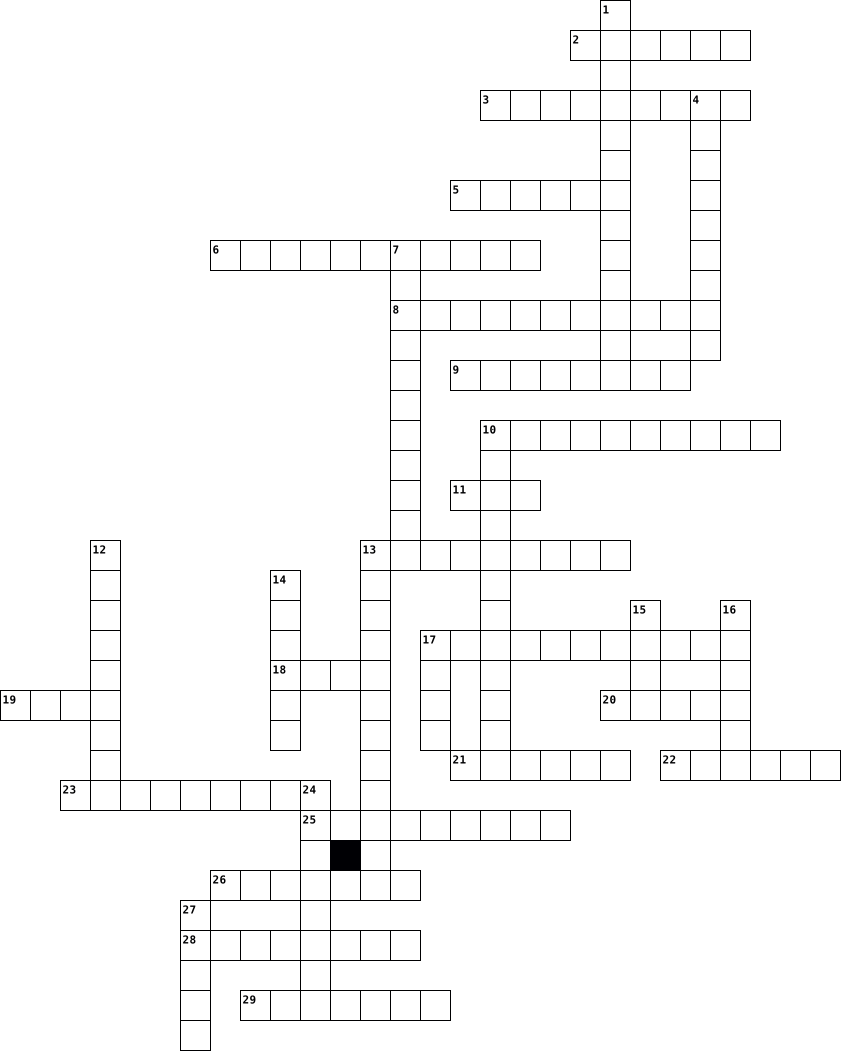
WORLD'S FAMOUS RIVERS - CROSSWORD PUZZLE 2023-01-07

Across
- Peru, Bolivia, Colombia, Ecuador, Venezuela, Guyana
- Russia
- Brazil, Argentina, Paraguay, Bolivia, Uruguay
- Myanmar
- Turkey, Iraq, Syria
- Ethiopia, Eritrea, Sudan, Uganda, Tanzania, Kenya, Rwanda, Burundi, Egypt, Democratic Republic of the Congo, South Sudan
- India, Bangladesh, Nepal, China
- Romania, Hungary, Austria, Serbia, Germany, Slovakia, Bulgaria, Croatia
- Russia, Mongolia
Down
- Venezuela, Colombia, Guyana
- Brazil
- China, Myanmar, Thailand
- Colombia
- United States, Canada
- China
- United States, Mexico
- China, Myanmar, Laos, Thailand, Cambodia, Vietnam
17 Clues: China • Brazil • Russia • Myanmar • Colombia • Russia, Mongolia • Turkey, Iraq, Syria • United States, Canada • United States, Mexico • China, Myanmar, Thailand • Venezuela, Colombia, Guyana • India, Bangladesh, Nepal, China • Brazil, Argentina, Paraguay, Bolivia, Uruguay • China, Myanmar, Laos, Thailand, Cambodia, Vietnam • Peru, Bolivia, Colombia, Ecuador, Venezuela, Guyana • ...
unit 5 vocab 2016-11-08

Across
- Estimate of ability to fulfill Financial commitments
- having a personal preference
- Was a Scottish American Military leader during Revolutionary War
- a member of a former political party in the United States that favored a strong centralized federal government
- A document that embodies the fundamental laws and principles by which the United States is governed
- was in the American Military leader
- Action of Armed Force that sounds fortified place
- a compromise adopted at the Constitutional Convention, providing the states with equal representation in the Senate and proportional representation in the House of Representatives.
- a body of people representing the states of the US, who formally cast votes for the election of the president and vice president
Down
- the original constitution of the US, ratified in 1781, which was replaced by the US Constitution in 1789.
- the first ten amendments to the US Constitution, ratified in 1791 and guaranteeing such rights as the freedoms of speech, assembly, and worship
- was a Connecticut born and raised minister, Patriot, American politician, and Founding Father
- heroine of the American Revolutionary War noted for her exploits against Loyalists in the Georgia backcountry.
- Resistant to change
- Far beyond the normal
- also known as Hoboi-Hili-Miko was a principal chief of the Upper Creek towns from 1782. Before that he had created an alliance between the Creek and the British during the American Revolution.
- a regimental commander in the American Revolution (1775-83) who was killed by loyalists to the British crown in his own home, following the restoration of the Colonial Assembly and the enforcement of the Disqualifying Act
- Was a slave who fought against the British in the Revolutionary War
- a dissenting clique
- Fee paid for instruction especially higher education
- Was a politician, a farmer, a businessman, and one of the founding fathers of the United States
- Composed of one legislative body
- withdraw from an organization or polity
23 Clues: Resistant to change • a dissenting clique • Far beyond the normal • having a personal preference • Composed of one legislative body • was in the American Military leader • withdraw from an organization or polity • Action of Armed Force that sounds fortified place • Fee paid for instruction especially higher education • Estimate of ability to fulfill Financial commitments • ...
perfect union 2018-11-20

Across
- Washington; president of the constitutional convention.
- branch; branch of government that makes law
- Convection; The meeting of delegates in which the articles of Confederation were scrapped in favor of a new United States Constitution.
- plan; Constitutional Convention on May 29, 1787, the Virginia Plan proposed a strong central government composed of three branches: legislative, executive, and judicial
- branch ; the branch of government that is a system of courts set up to interpret the laws
- a legislative body) having a single legislative chamber.
- orders ; Framer of the constitution from Connecticut who believed common people could not be an integral part of the government decision making.
- a change or addition to a document
- to approve something formally.
- and which later opposed the ratification of the 1787 Constitution.
- rebellion; The Massachusetts farmers uprising that made it clear to many that the central government was too weak to protect states from popular unrest.
Down
- A document stating the rules under which a government will operate
- A person who officially represents their state
- branch; the branch of government that enforces laws.
- the idea that each branch has specific ways to limit the power of the other branches.
- Ordinance ; set up the three step process for admitting new states.
- Madison; often called the father of the Constitution.
- Dickinson; Framer of the constitution from Pennsylvania who believed common people were cornerstone of the democratic process.
- is a system of government in which entities such as states or provinces share power with a national government
- Ratio;refers to a settlement set forth by congress to deal with the issue of counting slaves towards population in regards to representation in the House of Representatives.
- Federalism;refers to a movement that opposed the creation of a stronger U.S. federal
- of Confederation; the United States first written plan for government.
22 Clues: to approve something formally. • a change or addition to a document • branch; branch of government that makes law • A person who officially represents their state • branch; the branch of government that enforces laws. • Madison; often called the father of the Constitution. • Washington; president of the constitutional convention. • ...
U.S. History 2012-11-28

Across
- a harbor near Honolulu, on S Oahu, in Hawaii
- the United States Navy's second commissioned battleship and the first U.S. Navy ship to be named after the state of Maine
- notes Submitted by U.S. Secretary of State, John Hay, September 6, 1899
- an amendment to a joint resolution of the United States Congress, replacing the earlier Teller Amendment
- a corollary to the Monroe Doctrine that was articulated by President Theodore Roosevelt in his State of the Union Address in 1904
- Cuban patriot and writer.
- Secretary of State 1861–69.
- was a leading figure in the Mexican Revolution, which broke out in 1910
- president of Republic of Hawaii 1894–98
- was an eminent writer in the period after the American Revolution as a diplomat negotiated a number of treaties that include his name
Down
- signed on September 3, 1783, ended the American Revolutionary War
- connects the Atlantic Ocean (via the Caribbean Sea) to the Pacific Ocean
- the name bestowed on the 1st United States Volunteer Cavalry
- was an admiral of the United States Navy.
- better known by his pseudonym Francisco Villa
- ) was a Filipino general, politician, and independence leader
- a decisive battle of the Spanish-American War
- use of financial power in diplomacy: the use of financial resources to facilitate foreign relations
- a proto- nationalist movement by the Righteous Harmony Society in China
- A Spanish general who was a Captain General of Cuba
- the type of journalism that relies on sensationalism and lurid exaggeration to attract readers
- officially known as the Organic Act of 1900
- the relation of a strong state toward a weaker state or territory that it protects and partly controls.
- U.S. naval officer and writer on naval history
- the policy of extending the rule or authority of an empire or nation over foreign countries
- was a general officer in the United States Army who led the American Expeditionary Forces in World War I.
26 Clues: Cuban patriot and writer. • Secretary of State 1861–69. • president of Republic of Hawaii 1894–98 • was an admiral of the United States Navy. • officially known as the Organic Act of 1900 • a harbor near Honolulu, on S Oahu, in Hawaii • better known by his pseudonym Francisco Villa • a decisive battle of the Spanish-American War • ...
Government Crossword 2014-09-29

Across
- this branch of power decides the law
- a ban or denial
- Everything they like is unconstitutional
- Agreements between the states and foreign powers are Interstate ______
- The first 10 amendments
- a clause in a document or agreement
- an advisory body to the president
- grants made for specific purposes
- to become law
- government must conduct itself according to the constitution
- Powers given to the national government by the Constitution
- sending criminals to another state to stand trial there
- Exclusive powers includes most of the ________ powers
- powers held by both the states and the Government
- people are the only source of governmental power
- Division of power between federal government and the states
- if Congress likes this it passes the _______ Act
- V this gives us two ways to propose and two ways to ratify
- reject
- Privileges and Immunities Clause is reinforced in this Amendment
- The last "War" America fought
- loyalty to a particular political party
Down
- this amendment abolish slavery
- Tradition
- to declare illegal
- Powers held to the states
- Privileges and _______ Clause means that no state can draw unreasonable distinctions between its residents and those persons who happen to live in another state
- process for changing Constitution without changing the Government
- this branch of power makes the law
- Changing the constitution happens in ___ ways
- grants of federal money or other resources to the states and their local units
- Legal agreements in one state are binding in another
- government must be conducted according to constitutional principles
- can only do things the people give it power to do
- this branch of power enforces the law
- Powers that can only be exercised by the Government
- power to decide the constitutionality of a governmental action
- Powers written by the Constitution
- creation of federal marriage laws are ______ to the Government
- this Amendment gives you protection from cruel punishments
40 Clues: reject • Tradition • to become law • a ban or denial • to declare illegal • The first 10 amendments • Powers held to the states • The last "War" America fought • this amendment abolish slavery • an advisory body to the president • grants made for specific purposes • this branch of power makes the law • Powers written by the Constitution • a clause in a document or agreement • ...
Forming a government 2021-01-13

Across
- the plan for goverment proposed at the Constitutional Convention.
- the first 10 amendments to the constitution.
- the documents that created the first central government for the United States.
- official change, correction, or addition to a law or Constitution.
- a period of low economic activity and rising unemployment.
- the division of the federal government that is made up of the national courts; interprets laws, punishes criminals, and settles disputes between states.
- voting rights
- a system established by the constitution that prevents any branch of government from becoming too powerful.
- trade between two or more states.
- led a rebellion about 1,000 Massachusetts farmers.
- "Father of the constitution"
- the division of the government that proposes bills and passes them into laws.
Down
- an agreement worked out at the Constitutional convention establishing that a state's population would determine representation in the lower house of the legislature, while each state would have equal representation in the upper house of the legislature.
- people who opposed the ratification of the Constitution.
- the idea that political authority belongs to the people.
- taxes on imported goods.
- A set of basic principles that determines the powers and duties of a government.
- a proposal to create a unicamerl legislature with equal representation rather than representation by population.
- an official approval.
- a charter of liberties agreed to by King John of England, it made the king obey the same laws as citizens.
- U.S system of government in which power is distributed between a central government and individual states.
- a meting held in Philadelphia at which delegates from the states wrote the Constitution.
- people who supported the ratification of the Constitution.
- a general and progressive increase in prices.
- the division of the federal government that includes the president and the administrative departments.
25 Clues: voting rights • an official approval. • taxes on imported goods. • "Father of the constitution" • trade between two or more states. • the first 10 amendments to the constitution. • a general and progressive increase in prices. • led a rebellion about 1,000 Massachusetts farmers. • people who opposed the ratification of the Constitution. • ...
Reconstruction Crossword Puzzle 2021-09-02

Across
- Allowed men of all races to vote, but not women.
- A period of time when the Government wanted to re-build the damage from the Civil War in the South.
- Allowed anyone born in the United States to automatically be considered a citizen and have equal rights as a citizen.
- A former slave who felt that learning a trade or skill would help African Americans improve their lives and eventually gain equal rights.
- Lincoln's Reconstruction Plan which required 10 percent of Southern state voters to pledge loyalty to the Union.
- State laws that forced segregation and discrimination of the African American race in public places.
- A secret organization in the South that used violence towards African Americans.
- An organization created to help freed slaves with food, education, and medical care.
- Local laws passed in the south that controlled freedmens rights such as poll taxes or literacy tests.
- A test given to African Americans as they attempted to vote.
Down
- Attitudes towards other races, opinions, and beliefs different than your own.
- Banned slavery in the United States.
- The President of the United States whose Reconstruction Plan was similar to Lincoln's but needed more requirements from Southern States.
- The 16th President of the United States who did not live to see the Reconstruction or Reunification of the Union.
- learning a skill or trade (working with your hands).
- An african american who helped found the NAACP
- A group of politicians in Congress who wanted to punish the South for the war.
- A former slave, he supported banning slavery and voting rights for African Americans.
- A Northerner who moved to the South and try and benefit from the Southerners.
- A court case that allowed for different facilities for different races, as long as they were "separate but equal."
20 Clues: Banned slavery in the United States. • An african american who helped found the NAACP • Allowed men of all races to vote, but not women. • learning a skill or trade (working with your hands). • A test given to African Americans as they attempted to vote. • Attitudes towards other races, opinions, and beliefs different than your own. • ...
Chapter 3 vocab 2022-01-07

Across
- A written plan of government
- delegates agreed that every five enslaved persons would count as three free persons.
- Supporters of the Constitution were led by Alexander Hamilton and John Adams. They firmly believed the national government should be strong. They didn't want the Bill of Rights because they felt citizens' rights were already well protected by the Constitution.
- A change to the Constitution
- the branch of government that makes the laws
- a form of government in which power is divided between the federal, or national, government and the states
- powers held jointly by the national and state governments.
- an introduction that states the goals and purposes of the government in the Constitution.
- powers that the Constitution does not give to the national government that are kept by the states
- Under this system, each branch of government is able to check, or limit, the power of the others
- A legislature consisting of two parts, or houses
Down
- A meeting in Philadelphia in 1787 that produced a new constitution
- Approved
- Opponents of the American Constitution at the time when the states were contemplating its adoption.
- a group of people who would be named by each state legislature to elect the president and vice president
- the division of power among the legislative, executive, and judicial branches of government
- the branch of government that interprets laws
- Compromise, The compromise made by the ConstitutionalConvention in which states would have equal representation in one house of the legislature and representation based on population in the other house
- the idea that the government's authority comes from the people
- powers that congress has that are specifically listed in the constitution
- the branch of government that carries out laws
- a group of individual state governments that band together for a common purpose
- principle that the law applies to everyone, even those who govern
23 Clues: Approved • A written plan of government • A change to the Constitution • the branch of government that makes the laws • the branch of government that interprets laws • the branch of government that carries out laws • A legislature consisting of two parts, or houses • powers held jointly by the national and state governments. • ...
Chapter 3 vocab 2022-01-07

Across
- A meeting in Philadelphia in 1787 that produced a new constitution
- Approved
- a form of government in which power is divided between the federal, or national, government and the states
- a group of individual state governments that band together for a common purpose
- Supporters of the Constitution were led by Alexander Hamilton and John Adams. They firmly believed the national government should be strong. They didn't want the Bill of Rights because they felt citizens' rights were already well protected by the Constitution.
- the division of power among the legislative, executive, and judicial branches of government
- powers that the Constitution does not give to the national government that are kept by the states
- principle that the law applies to everyone, even those who govern
- the idea that the government's authority comes from the people
- the branch of government that interprets laws
- A written plan of government
Down
- The compromise made by the constitutional convention in which states would have equal representation in one house of the legislature and representation based on population in the other house
- powers held jointly by the national and state governments.
- delegates agreed that every five enslaved persons would count as three free persons.
- Under this system, each branch of government is able to check, or limit, the power of the others
- A change to the Constitution
- the branch of government that carries out laws
- Opponents of the American Constitution at the time when the states were contemplating its adoption.
- A legislature consisting of two parts, or houses
- an introduction that states the goals and purposes of the government in the Constitution.
- a group of people who would be named by each state legislature to elect the president and vice president
- the branch of government that makes the laws
- powers that congress has that are specifically listed in the constitution
23 Clues: Approved • A change to the Constitution • A written plan of government • the branch of government that makes the laws • the branch of government that interprets laws • the branch of government that carries out laws • A legislature consisting of two parts, or houses • powers held jointly by the national and state governments. • ...
Constitution Vocabulary 2023-12-19

Across
- The supreme power or authority to govern oneself or make decisions.
- The branch of government responsible for enforcing laws, headed by the President.
- A change or addition made to the Constitution after its original ratification.
- The branch of government responsible for making laws, consisting of Congress (the Senate and the House of Representatives).
- To approve or officially accept a document or agreement.
- The branch of government responsible for interpreting laws and carrying out justice, consisting of the Supreme Court and other federal courts.
- The first ten amendments to the United States Constitution, which guarantee individual rights and freedoms.
- A form of government in which power resides in the people and is exercised through elected representatives.
- To make changes or additions to a document, especially a constitution.
- A system of government where power is shared between a national government and individual states.
- The division of governmental responsibilities among different branches, such as the executive, legislative, and judicial branches.
- The body of electors appointed by each state to elect the President and Vice President of the United States.
Down
- A clause in the Constitution that gives Congress the power to regulate interstate and foreign trade.
- A meeting held in 1787 where delegates from the thirteen original colonies gathered to revise the Articles of Confederation and create a new constitution.
- Referring to a legislature with only one chamber or house.
- Specific powers granted to the federal government by the Constitution.
- A system of government where power is divided between a central authority (national government) and individual states.
- The legal principle that every individual is entitled to fair treatment by the judicial system and that their rights cannot be violated without proper legal procedures.
- The introduction to the United States Constitution that outlines the goals and purposes of the government.
- A system that ensures one branch of government does not become too powerful by allowing each branch to limit the actions of the other branches.
- of Confederation
21 Clues: of Confederation • To approve or officially accept a document or agreement. • Referring to a legislature with only one chamber or house. • The supreme power or authority to govern oneself or make decisions. • Specific powers granted to the federal government by the Constitution. • To make changes or additions to a document, especially a constitution. • ...
Unit 1-3 Terms 2016-04-07

Across
- What are back country farmers called?
- Which plan supported the larger states' idea of bicameral legislature and equal representation?
- Small adobe villages
- When South Carolina passed an "Ordinance of Nullification."
- What act allowed states to utilize popular sovereignty?
- Who was the philosopher that believed all men were equal?
- Favoritism toward native-born Americans.
- Codes that were passed in Southern States to prevent blacks from their rights.
- Workers who were contracted to work for a period of time to pay back debt.
- The 1st Constitution of the United States.
- What were the Native Americans most valued crop?
- A person whose mixed with black and white ancestry.
- Who was the key African American abolitionist who escaped slavery?
- Nationwide railroad strike in the United States in 1894.
- A situation or event that creates a sudden increase in wealth.
- A farmer who farms land that's owned by someone else.
- Wealthy Spanish built these large estates.
Down
- Which rebellion was led by angry Massachusetts farmers?
- Which Native Americans built mounds?
- A conflict between colonists and Indians under the leadership of Chief Metacomet.
- Which compromise entered Maine as a free state and Missouri as a slave state?
- What did settlers in New England call themselves?
- Trade route between Africa, the West Indies, and Colonial New England.
- Ben Franklin created this to discuss the threats on the western frontiers made by the French.
- What was the forced removal of Native Americans from the South to Oklahoma called?
- What act stated that neither slavery nor indentured servitude shall exist in territories gained from Mexico?
- What famous book did Harriet Beecher Stowe write?
- What rebellion started when whiskey was taxed?
- Frontiersmen who formed a vigilante group to retaliate against local peaceful Native Americans.
- Disagreements about water rights and property lines in the West.
30 Clues: Small adobe villages • Which Native Americans built mounds? • What are back country farmers called? • Favoritism toward native-born Americans. • The 1st Constitution of the United States. • Wealthy Spanish built these large estates. • What rebellion started when whiskey was taxed? • What were the Native Americans most valued crop? • ...
Aisha Daftani Sec #3 X-Word 2024-03-23

Across
- The British had a head start in industrializing, they could make and sell goods more cheaply than __________?
- The Negro Fort was built along the Apalachicola River, in the _______ territory of Florida.
- After the War of _______ twelve, leaders like Calhou, Webster, and Clay had to deal with serious economic issues.
- Henry Clay a leader of the War Hawks spoke for the ________?
- In the year of 1821, the United States gained _________? (which state)
- Webster’s view on slavery was ________?
- Spain agreed to give Florida to the United States in exchange for $5 _________?
- The northerners, westerners, and southerners were _________ that Americans felt loyal to?
- Since 1700s, Spanish officals had protected slaves who fled from plantation in ________ and South Carolina.
- Monroe hoped to create a new sense of national unity, One new paper that was written was called “era of good ___________?”
- The Republican candidate for President, James Monroe, easily defeated the Federalist, Senator Rufus King of ________?
- John __________, of The South was a Sectional leader, who supported slavery.
Down
- _______ would play key roles in Congress for more than 30 years, as well as serving in other offices. (a number)
- The policy that President James Monroe declare in 1823 was called Monroe ________?
- In 1821, the people of Central American declared independence from Spain, which then they formed the United ________ of Central America?
- In the case of McCulloch v. ____________ (1819), the Court rules that states had no right to interfere with federal institutions.
- Only the federal government had the power to regulate ________) commerce, or trade between different states.
- While tariffs remained high, Conngress spent little on ____________ improvements for roads, bridges, and canals.
- ___________ McCulloch, the bank cashier, who refused to pay tax.
- Spain lost another one of its colonies, Florida - not to ________________ but to the US.
- Purpose of a protective ___________ is to protect country’s industries from foreign competition.
- In the early of 1800s, the ________ Act and then the War of 1812 kept most British good outs of the United States.
22 Clues: Webster’s view on slavery was ________? • Henry Clay a leader of the War Hawks spoke for the ________? • ___________ McCulloch, the bank cashier, who refused to pay tax. • In the year of 1821, the United States gained _________? (which state) • John __________, of The South was a Sectional leader, who supported slavery. • ...
US History WW2 2023-03-10

Across
- Where did Germany first invade that OFFICIALLY started the war?
- Production Board The job of organizing the wartime economy fell to the
- Japans attack on the United States
- Why did the Office of Price Administrant (OPA) institute price controls during World War II?
- All the day long, Whether rain or shine, She's part of the assembly line. She's making history,Working for victory,
- Under the terms of France’s surrender to Germany, southeastern France became a _______ known as Vichy France
- “By this "me next year we shall know whether the policy of appeasement has appeased, or whether it has only simulated a more ferocious appetite.”—Winston Churchill What “policy of appeasement” was Winston Churchill referring to?
- Germany, Austria-Hungary, Bulgaria, Ottoman Empire
- Great Britain, United States, Soviet Union
- The quotation below comes from a 1944 Supreme Court decision. Justice Black's opinion was issued in which of theseSupreme Court cases? “It should be noted... that all legal restrictions which curtail the civil rights of a single racial group are immediately suspect.That is not to say that all such restrictions are unconstitutional. It is to say that courts must subject them to the most rigid scrutiny.Pressing public necessity may sometimes justify the existence of such restriction.”
Down
- In the 1930s, what legislation signaled the United States policy of isolationism?
- piece of legislation made it very difficult for Jews to flee to the United States following Kristallnacht
- allowed the United States to send "all aid short of war" to Britain despite its status as a neutral nation early in World War II?
- term GI refer to?
- A group that was targeted by white mobs in the Zoot Suit Riots
- The Atomic Bomb was dropped on which two cities?
- Who was the first country to stop Germany in their tracks?
- Who was FDR's successor when he died?
- The Double V Campaign sought to fight against fascism and
- Where were Japanese Americans sent to during the war?
20 Clues: term GI refer to? • Japans attack on the United States • Who was FDR's successor when he died? • Great Britain, United States, Soviet Union • The Atomic Bomb was dropped on which two cities? • Germany, Austria-Hungary, Bulgaria, Ottoman Empire • Where were Japanese Americans sent to during the war? • The Double V Campaign sought to fight against fascism and • ...
Civil war 2025-04-16

Across
- a knife, dagger, sword, or spike-shaped melee weapon designed to be mounted on the end of the barrel of a rifle
- F. Davis, an American politician who served as the only president of the Confederate States from 1861 to 1865
- S. Grant, the 18th president of the United States
- ball, the Minie ball, is a type of rifle bullet designed by Claude-Étienne Minié in the 1840s.
- Proclamation, a document issued by President Abraham Lincoln on January 1, 1863, declared that all persons held as slaves within the rebellious states during the Civil War were to be free
- a compass direction, opposite of South
- a small town in S Pennsylvania, southwest of Harrisburg
- Plan, a military strategy proposed by Union General Winfield Scott during the early stages of the American Civil War
- known as Peace Democrats
- Amendment, ratified in 1865, abolished slavery and involuntary servitude, except as punishment for a crime.
Down
- Address, a speech delivered by Abraham Lincoln, the 16th U.S. president, following the Battle of Gettysburg during the American Civil War.
- a large-caliber gun, typically part of artillery, that uses explosive force to launch a projectile
- Run, the First Battle of Manassas, was the first major land battle of the American Civil War.
- a muzzle-loaded long gun that appeared as a smoothbore weapon
- the Northern part of the United States of America, especially during the American Civil War (1861-1865)
- a compass direction, opposite of North
- the single deadliest one-day battle in American history, with nearly 23,000 casualties.
- Sumter, a fort that is historically significant for being the site where the first shots of the Civil War were fired on April 12, 1861.
- the Southern part of the United States of America, especially during the American Civil War (1861-1865)
- Court House, the site of Robert E. Lee's surrender to Ulysses S. Grant on April 9, 1865
20 Clues: known as Peace Democrats • a compass direction, opposite of North • a compass direction, opposite of South • S. Grant, the 18th president of the United States • a small town in S Pennsylvania, southwest of Harrisburg • a muzzle-loaded long gun that appeared as a smoothbore weapon • ...
Geography 2023-05-07
Across
- The ocean north of Europe
- The largest river that empties into the Pacific Ocean
- The place where a river begins
- The mountain range that runs through the eastern United States
- The longest river in the United States
- The four main points on a compass are called the ________points
- The river that runs northeast from Lake Ontario into the Atlantic Ocean
- A large body of salt water that is smaller than an ocean
- the study of natural surroundings and how we interact with them
- The large flatland between the Rocky Mountains and the Mississippi River
- The river just west of the Appalachian Mountains that runs into the Mississippi
- The largest continent
- Soil deposited at the mouth of a river
- A low area between ranges of mountains or hills
- The ocean that lies to the south of Asia
- Land with water on three sides
- A river or stream that flows into a main river
- the line at 0 degrees latitude
- lines on a map that circle the Earth from east to west
- The ocean that lies off the west coast of the United States
Down
- the line at 0 degrees longitude
- The smallest continent
- The symbol on a map that shows directions
- The high mountains in the western US with a Spanish name
- The river that forms part of the border between Mexico and the United States
- The body of water between Texas and Florida
- The continent north of Africa
- A point or extension of land jutting into the water that is skinnier than a peninsula
- A body of land that is smaller than a continent and surrounded by water
- The name given to a large area of sea or ocean that is partially enclosed and is larger than a bay
- The ocean off the East coast of the United States
- the most accurate map of Earth
32 Clues: The largest continent • The smallest continent • The ocean north of Europe • The continent north of Africa • The place where a river begins • Land with water on three sides • the line at 0 degrees latitude • the most accurate map of Earth • the line at 0 degrees longitude • The longest river in the United States • Soil deposited at the mouth of a river • ...
Civil War 2024-12-02

Across
- The political party of Abraham Lincoln, which opposed slavery.
- The states that stayed with the U.S. during the Civil War
- Slave states that stayed loyal to the Union during the Civil War
- The general who led the Confederate army during the Civil War
- A new way to take pictures, used to show Civil War battles and people.
- A nurse who helped soldiers and founded the American Red Cross.
- A state that broke away from Virginia during the Civil War to join the Union
- Ships covered in iron used in battle during the Civil War
- The first major battle of the Civil War, where the Confederates won.
- A way to send messages over long distances using wires, used in the Civil War.
- The group of Southern states that fought against the Union in the Civil War
- Riots in New York City in 1863 against the government's forced military draft.
- The location where the first shots of the Civil War were fired.
- When Southern states left the United States to form their own country.
Down
- A nurse who helped soldiers during the Civil War and later founded the Red Cross.
- The first state to leave the Union before the Civil War started
- The Union general who won the Civil War and later became president
- The president who led the U.S. during the Civil War and ended slavery
- The place where General Lee surrendered to General Grant, ending the Civil War.
- Abraham Lincoln's speech about freedom and equality after the Battle of Gettysburg
- The practice of forcing people to work without pay and treating them as property.
- An escaped slave who became a famous abolitionist and fought for equal rights
- A key battle in 1863 that the Union won, turning the war in their favor.
- People in the North who wanted to end the Civil War and make peace with the South.
24 Clues: The states that stayed with the U.S. during the Civil War • Ships covered in iron used in battle during the Civil War • The general who led the Confederate army during the Civil War • The political party of Abraham Lincoln, which opposed slavery. • The first state to leave the Union before the Civil War started • ...
Civil War Level 1/ Blue Projects 2026-04-28

Across
- Troops trained to fight and move while on horseback
- A 19th-century warship protected by iron plating
- A common soldier's phrase for experiencing actual combat for the first time
- A Northerner who moved South during Reconstruction to seek financial or political gain
- The alliance of 11 Southern states that seceded to form the Confederate States of America
- Soldiers who traveled and fought primarily on foot
- A Northern Democrat who opposed the war and wanted immediate peace
- The period of rebuilding the country after the war (1865–1877)
- The end or side of a military line or formation
- A small group of soldiers who cooked and ate their meals together
- Paper currency issued by the Union that was not backed 100% by gold
- Ankle-high leather shoes typically worn by Civil War soldiers
- A traveling merchant who followed the army to sell goods like tobacco and extra food
Down
- A presidential decree issued by Abraham Lincoln in 1863 freeing enslaved people in Confederate states
- The branch of the army that operated large-caliber weapons like cannons and mortars
- A sentry or soldier placed on guard duty ahead of the main army
- A hard, cracker-like flour biscuit that was a staple food for soldiers
- A slang term for an army surgeon
- A person who believed that slavery should be ended or abolished
- A slang term used by soldiers for lice
- Temporary, breast-high fortifications made of earth or logs to protect soldiers
- Slave states that did not secede from the Union: Delaware, Kentucky, Maryland, and Missouri
- A Southern white person who supported Reconstruction and the Republican Party
- A type of expanding bullet used in rifled muskets that significantly increased lethality
- The Northern states that remained loyal to the federal government
25 Clues: A slang term for an army surgeon • A slang term used by soldiers for lice • The end or side of a military line or formation • A 19th-century warship protected by iron plating • Soldiers who traveled and fought primarily on foot • Troops trained to fight and move while on horseback • Ankle-high leather shoes typically worn by Civil War soldiers • ...
Westward Expansion Crossword Puzzle 2026-05-12

Across
- formal giving up of land, often through a treaty (e.g., Mexican Cession).
- set aside by the United States government for Native Americans.
- A large group of covered wagons traveling together for safety.
- farmer on the Great Plains who had to break through thick sod to farm.
- person who is among the first to settle in a new area.
- that is under the jurisdiction of the United States but is not yet a state.
- extreme limit of settled land beyond which lies wilderness.
- law that allowed citizens to claim 160 acres of surveyed government land out West for a small fee.
- 1803 purchase of vast land from France for $15 million, which doubled the size of the US.
- 19th-century belief that the United States was destined by God to expand across the continent from the Atlantic to the Pacific.
- long, organized journey made for a specific purpose, such as the Lewis and Clark expedition.
- train system that connected the eastern and western coasts of the United States.
Down
- who flocked to California in 1849 in search of gold.
- wire fencing that changed the West by allowing farmers to fence in land on the treeless plains.
- movement of settlers and the United States government into the American West, particularly between 1787 and 1860.
- hired hand who managed cattle, particularly on long drives.
- device that sent messages over long distances using electricity, which made communication faster.
- A major 2,000-mile wagon route that allowed thousands of settlers to travel to the West.
- community that experiences sudden and rapid growth in business or population, usually near a mining site.
- add or take over new land, such as the annexation of Texas.
20 Clues: who flocked to California in 1849 in search of gold. • person who is among the first to settle in a new area. • hired hand who managed cattle, particularly on long drives. • add or take over new land, such as the annexation of Texas. • extreme limit of settled land beyond which lies wilderness. • A large group of covered wagons traveling together for safety. • ...
Fourth Grade History Test #10 2026-03-20

Across
- founder of the Moral Majority
- St. Paul
- Pierre
- President Carter was not successful in resolving this
- president during the Persian Gulf War
- led the terrorist group al-Qaeda
- Lincoln
- Chairman of the Joint Chiefs of Staff during the Persian Gulf War
- invented by Dr. Robert Jarvik
- made the first personal computer
- he and President Nixon insisted on a policy called detente
- many former Soviet states joined together to form this
- withdrew the United States from the 1980 Olympics
- Des Moines
- the first female astronaut in the United States
- made Martin Luther King, Jr., Day a federal holiday
- sent to the surface of Mars to gather data and send photos back to Earth
Down
- resigned after the Watergate Affair
- led troops during Persian Gulf War
- this hitting a coral reef resulted in a massive oil spill
- made to transport oil from Alaska
- known as the "Great Communicator"
- designed to be a defensive system to destroy missiles before they reached the United States
- Reagan's critics called his financial plan this
- a law signed by President George H.W. Bush, set new requirements for the way ships were built
- became president of the Russian Republic after the collapse of the Soviet Union
- Lansing
- Austin
- Columbus
- the North American Free Trade Agreement (NAFTA) was a free trade agreement between Mexico, the United States, and ?
- Phoenix
- attacked the USS Cole
- some ? of the Exxon Valdez disaster include: eleven millions gallons of oil spilled into Alaska's Prince William Sound, over 1,000 miles of shoreline affected, thousands of ocean animals and birds killed, Congress passed Oil Pollution Act, stricter requirements for shipbuilders, increased fines for not meeting standards
- first woman to serve as a Supreme Court justice
- the first space shuttle
- the first internet browser
- a result of domestic terrorism
37 Clues: Pierre • Austin • Lincoln • Lansing • Phoenix • St. Paul • Columbus • Des Moines • attacked the USS Cole • the first space shuttle • the first internet browser • founder of the Moral Majority • invented by Dr. Robert Jarvik • a result of domestic terrorism • led the terrorist group al-Qaeda • made the first personal computer • made to transport oil from Alaska • known as the "Great Communicator" • ...
Ryan Zheng Constitution Crossword 2026-03-23

Across
- The Constitutional Convention started in May of _______.
- Amendment ensuring the right to own a firearm to protect yourself
- The opening to the Constitution that starts with the words “We the people...”.
- ____________ is a system where states share power with a strong national government.
- Amendment ensuring your privacy and that government agents can’t search or seize your stuff without good reason
- Plan proposed by people of smaller states, led by William Patterson, that gave new powers to Congress and included 3 branches of government.
- Our First Constitution was the _______________ of ______________.
- Any law that conflicts with the Constitution is considered ______________.
- The delegate chosen to be president of the convention
- Amendment that bans “cruel and unusual punishments” and excessive fines
- Branch of government that’s headed by the Supreme Court and its nine justices
Down
- Branch of government that writes the laws
- Total number of seats in the House of Representatives
- Things came to a head in 1785. Farmers revolted against the government in this revolt.
- Amendment that ensures your freedom of speech, press, religion, assembly, and petition
- The rebellion caused by Shays couldn’t be stopped by the ______ government at the time.
- A ____________ is a type of government where the citizens lend their power to the representatives.
- Additions to the original document are known as _______________.
- How many votes did a bill need from the 13 states to become a law? usconstitution
- The group of advisors that helps the president make decisions is known as the ___________.
- A section featuring the first ten amendments that ensured the protection of individual rights.
- Author of the Constitution and Bill of Rights
- The document that lays out how the government of the United States works.
- Plan proposed by James Madison that scrapped the Articles of Confederation, had a government composed of 3 branches, and handled anything the states couldn’t handle themselves
- Branch of government that enforces and approves laws, and also directs national defense and foreign policy
25 Clues: Branch of government that writes the laws • Author of the Constitution and Bill of Rights • Total number of seats in the House of Representatives • The delegate chosen to be president of the convention • The Constitutional Convention started in May of _______. • Additions to the original document are known as _______________. • ...
1-30-2017 2017-01-30

Across
- having an effect or impact on the actions, behavior, opinions, etc., of another or others
- and balances a principle of the federal government, according to the U.S. Constitution, that allows each branch of government to limit the power of the other branches
- government the governing body of a municipality or county
- government the government of an individual state
- liberty a person’s ability to be free and independent
- powers powers that are not granted to the federal government that belong to (are reserved for) the states and the people
- a period in European history when many educated people stressed the importance of learning and reasoning; education was considered the key to understanding and solving society’s problems
- rights the belief that individuals are born with basic rights that cannot be taken away by governments; life, liberty, and property
Down
- of the governed an agreement made by the people to establish a government and abide by its laws
- powers powers not written in the U.S. Constitution but are necessary and proper in order for the federal government to carry out the expressed powers
- powers powers not listed in the U.S. Constitution but are necessary for the federal government to function
- powers the powers specifically given to the federal government, also known as delegated powers; they may not be used by state governments
- contract noun an implied agreement among the people of an organized society that defines the rights, duties, and limitations of the governed and the government
- of powers the structure of the federal government, according to the U.S. Constitution, that sets up three branches with their own distinct powers and responsibilities
- a system of government in which power is divided and shared between national, state, and local government
- powers powers shared by the national, state, and/or local government
- Amendment the final amendment in the Bill of Rights, it states: ”The powers not delegated to the United States by the Constitution, nor prohibited by it to the States, are reserved to the States respectively, or to the people.”
- government the national level of government; the government of the United States
18 Clues: government the government of an individual state • liberty a person’s ability to be free and independent • government the governing body of a municipality or county • powers powers shared by the national, state, and/or local government • government the national level of government; the government of the United States • ...
Vocabulary Word Puzzle 2019-03-27

Across
- October 29, 1929, share prices on the New York Stock Exchange completely collapsed, becoming a pivotal factor in the emergence of the Great Depression
- Began in 1914 after the assassination of Archduke Franz Ferdinand until 1918, the Central Powers fought against the Allied Powers. 16 million people died.
- The third US Navy's Nimitz-class supercarrier
- An economic depression that took place in the 1930s that started in the United States
- A public work relief program that operated from 1933 to 1942 in the United States for unemployed, unmarried men.
- An act that established a system of old-age benefits for workers, benefits for victims of industrial accidents, unemployment insurance, aid for dependent mothers and children, the blind, and the physically handicapped
- was an American program to defeat Germany, Japan, and Italy by distributing food, oil, and material between 1941 and August 1945
- Served as the governor of Georgia and opposed many of the New Deal programs
- An act that provided federal loans for the installation of electrical distribution systems to serve isolated rural areas of the United States
- An aircraft manufacturer of the United States, a builder of several types of fighter aircraft for World War II
- A series of programs, public work projects, financial reforms, and regulations enacted by President Franklin D. Roosevelt in the United States between 1933 and 1936
Down
- A United States federal law of the New Deal era designed to boost agricultural prices by reducing surpluses
- President of the US in 1932, introduced a plan called the "New Deal" to get the country out of the Great Depression
- A beetle that eats cotton and other crops
- a major stock market crash that occurred in late October 1929 and sparked the Great Depression
- A US naval base that was surprise attacked by the Imperial Japanese Navy Air Service
- A time period where there is little rainfall and a shortage in the water supply
- Served as the Governor of Georgia from 1931 to 1933 and the Us Senate from 1933 to 1971
18 Clues: A beetle that eats cotton and other crops • The third US Navy's Nimitz-class supercarrier • Served as the governor of Georgia and opposed many of the New Deal programs • A time period where there is little rainfall and a shortage in the water supply • A US naval base that was surprise attacked by the Imperial Japanese Navy Air Service • ...
Vocabulary Word Puzzle 2019-03-27

Across
- An aircraft manufacturer of the United States, a builder of several types of fighter aircraft for World War II
- A US naval base that was surprise attacked by the Imperial Japanese Navy Air Service
- An economic depression that took place in the 1930s that started in the United States
- President of the US in 1932, introduced a plan called the "New Deal" to get the country out of the Great Depression
- Began in 1914 after the assassination of Archduke Franz Ferdinand until 1918, the Central Powers fought against the Allied Powers. 16 million people died.
- Served as the governor of Georgia and opposed many of the New Deal programs
- October 29, 1929, share prices on the New York Stock Exchange completely collapsed, becoming a pivotal factor in the emergence of the Great Depression
- An act that provided federal loans for the installation of electrical distribution systems to serve isolated rural areas of the United States
- a major stock market crash that occurred in late October 1929 and sparked the Great Depression
- An act that established a system of old-age benefits for workers, benefits for victims of industrial accidents, unemployment insurance, aid for dependent mothers and children, the blind, and the physically handicapped
Down
- A public work relief program that operated from 1933 to 1942 in the United States for unemployed, unmarried men.
- A time period where there is little rainfall and a shortage in the water supply
- A beetle that eats cotton and other crops
- A series of programs, public work projects, financial reforms, and regulations enacted by President Franklin D. Roosevelt in the United States between 1933 and 1936
- Served as the Governor of Georgia from 1931 to 1933 and the Us Senate from 1933 to 1971
- A United States federal law of the New Deal era designed to boost agricultural prices by reducing surpluses
- was an American program to defeat Germany, Japan, and Italy by distributing food, oil, and material between 1941 and August 1945
- The third US Navy's Nimitz-class supercarrier
18 Clues: A beetle that eats cotton and other crops • The third US Navy's Nimitz-class supercarrier • Served as the governor of Georgia and opposed many of the New Deal programs • A time period where there is little rainfall and a shortage in the water supply • A US naval base that was surprise attacked by the Imperial Japanese Navy Air Service • ...
Cold War - Vocabulary 2024-04-02

Across
- A Wall built by East Germany (Soviet Union) to divide the city of Berlin into a east and west side controlled by the Soviet Union.
- A 327-day operation in which the U.S. and British planes flew food and supplies into West Berlin after the Soviets blockaded
- The worlds first artificial satellite is created by the Soviet Union & launched in to space.
- Imaginary boundary dividing Europe into two separate areas from the end of World War II in 1945 until the end of the Cold War
- A period in 1962 in which the Soviet Union had placed nuclear missiles in Cuba to annoy and scare the United States.
- The conflict between Communist North Korea and Non-Communist South Korea.
- It was a policy which stated that the US would give aid to any country threatened by communism.
- An ongoing political rivalry between the United States and the Soviet Union and their respective allies that developed after
Down
- An unsuccessful attempted invasion by armed Cuban exiles in southwest Cuba, planned and funded by the United States.
- This man became the leader of the Chinese Communist Party and remained its leader until his death.
- Soviet statesman whose foreign policy brought an end to the Cold War and whose domestic policy introduced major reforms.
- A war (1954-1975) between the communist armies of North Vietnam who were supported by the Soviet Union and the armies of South Vietnam who were supported by the United States and Australia.
- The United States tried to stop the spread of communism by creating alliances and helping weak countries to resist Soviet Control.
- These were nations that were aligned with, but also under the influence and pressure of, the Soviet Union.
- A competition of space exploration between the United States and Soviet Union.
- A pattern of competitive acquisition of military capability between two or more countries.
- A military alliance between Communist countries in East Europe to counter the threat of Capitalism in Europe.
- A U.S. program providing aid to Western Europe following the devastation of World War II.
18 Clues: The conflict between Communist North Korea and Non-Communist South Korea. • A competition of space exploration between the United States and Soviet Union. • A U.S. program providing aid to Western Europe following the devastation of World War II. • A pattern of competitive acquisition of military capability between two or more countries. • ...
Review Chapter 4 2013-11-12

Across
- a northener who moved to the south after the civil war
- a white southerner who joined the republican party after the civil war
- the period of rebuilding that followed the civil war, during which the defeated confederate states were readmitted on the union
- proclamation an executive order issued by abraham lincoln on january 1, 1863, freeing the slaves in all regions behind confederate lines
- a system in which the residents vote to decide an issue
- town near appomatox, virginia, where lee surrendered to grant on april 9,1865
- a 26 year old actor and southern sympathizer then leaped down from the presidential box to the stage and escaped
- one of the two remaining confederate strongholds on the mississippi river
Down
- a famous speech delivered by abraham lincoln in november 1863, at the dedication of a national cemetery on the site of the battle of gettysburg
- a federal agency set up to help former slaves after the civil war
- union nurse
- an amendment to the US constitution, adopted in 1865, that has abolished slavery and involuntary servitude
- a system in which landowners give farm workers land, seed, and tools in return for a part of the crops they raise
- a tax on earnings
- an amendment to the US constitution, adopted in 1870, that prohibits the denial of voting rights to people because of their race or color or because they have previously been slaves
- the formal withdrawal of a state from the union
- the drafting of citizens for military service
- a system of routes along which runaway slaves were helped to escape to canada or to safe areas in the free states
- the confederate states of america, a confederation formed in 1861 by the southern states after their secession from the union
- a secret organization that used terrorist tactics in an attempt to restore white supremacy in southern states after the civil war
20 Clues: union nurse • a tax on earnings • the drafting of citizens for military service • the formal withdrawal of a state from the union • a northener who moved to the south after the civil war • a system in which the residents vote to decide an issue • a federal agency set up to help former slaves after the civil war • ...
Chapter 4 Terms 2014-02-23

Across
- Powers the constitution is presumed to have delegated to the National Government because it is the government of a sovereign state within the world community
- One type of federal grants-in-aid made for specific projects to States, localities, and private agencies who apply for them
- Constitution's requirement that each state accept the public acts, records, and judicial proceedings of every other state
- Delegated powers of the National Government that are spelled out. Also called "Enumerated Powers"
- Those powers that can be exercised by the National Government alone
- Powers granted to the National Government by the constitution
- Grants of federal money or other resources to States, cities, countries, and other local units
- Basic principle of federalism; governmental powers are divided on a geographic basis
- Congressional act directing the people of a United Sates territory to frame a proposed State constitution
- One type of federal grants-in-aid made for some specific purpose
- Congressional act admitting a new State to the Union
- Those powers that the Constitution does not grant to the National Government and does not deny to the state
Down
- Formal agreement entered into with the consent of Congress, between or among States and foreign state
- All citizens are entitled to certain "privileges and immunities," regardless of their state of residence
- A system of goverment in which a written constitution divides the powers of government on a territorial basis
- Form of federal monetary aid under which congress gave share of federal tax revenue, with no restrictions to the States, cities, counties, and townships
- One type of federal grants-in-aid for some particular but broadly defined public policy
- The legal process by which a fugitive from justice in one state is returned to that state
- Those powers that both the National Government and the States posses and exercise
- Those delegated powers of theNational Government that are suggested by the expressed powers set out in the Constitution
20 Clues: Congressional act admitting a new State to the Union • Powers granted to the National Government by the constitution • One type of federal grants-in-aid made for some specific purpose • Those powers that can be exercised by the National Government alone • Those powers that both the National Government and the States posses and exercise • ...
diplomacy 2022-12-06

Across
- Rules of diplomatic procedure used to regulate the proper treatment of accredited state officials and diplomatic officers.
- In general usage, the ability to stop a proposal or a piece of legislation from being accepted
- A formal, mutually binding contract or agreement between two or more states.
- The engagement of individual citizens in private sector programs and activities that increase cross-cultural understanding and knowledge between people from different countries, leading to greater mutual understanding and respect and contributing to international relationships between countries
- A party sent to represent a state or other large entity at an international conference or gathering.
- Classical term for diplomat
- Building accommodating offices, and sometimes a residence, for a diplomatic mission headed by an ambassador.
- A diplomatic representative ranked at the highest level, accredited to a foreign state
- Conducting formal relations between sovereign states through the use of permanent embassies or legations in a receiving state
- Privileged legal status accorded to diplomatic representatives by the states that receive them
- A diplomatic office, subordinate to an embassy
Down
- Principle in which state action is contingent on the previous action of other states
- The use of foreign services or other branches of government to promote trade or investment.
- the process of discussing something with someone in order to reach an agreement
- Diplomatic meetings between heads of state or heads of government; can be either ad hoc or regularly occurring.
- Achieving the agreement of all participants without calling for a vote.
- Closed communication system between members of a diplomatic mission and their home government (usually the ministry of foreign affairs); includes both routine and confidential information.
- Code of international law on consular posts and officers, particularly regarding facilities, immunities, and privileges. Established through a 1963 conference in Vienna.
- Interaction involving two parties.
- A formal coalition of two or more states that agree to collaborate on mutual security interests, usually codified through a treaty
20 Clues: Classical term for diplomat • Interaction involving two parties. • A diplomatic office, subordinate to an embassy • Achieving the agreement of all participants without calling for a vote. • A formal, mutually binding contract or agreement between two or more states. • the process of discussing something with someone in order to reach an agreement • ...
Chapter 7 Vocabulary 2020-12-03

Across
- agreement at the Constituional Convention that three fifths of the slaves in any state be counted in his population
- principle by which the powers of government are divided among separate branches
- law setting up a system for settling the Northwest Territory
- first American constitution, passed in 1777, which created a loose alliance of 13 independent states
- plan at the Constitutional Convention, favored by larger states, that called for a strong national goverenment with three branches and a two-chamber legislature
- branch of government that carries out laws
- a 1786 revolt in Massachusetts led by farmers in reaction to high taxes
- plan at the Constitutional Convention that settled the differences between large and small states
- a document that sets out the laws, principles, organization, and processes of a government
- James Madison, Thomas Jefferson, and other leaders who laid the groundwork for the United States
- supporter of the Constitution, who favored a strong federal, or national, government
- branch of government that decides if laws are carried out fairly
- signed in 1215, a British document that contains two basic ideas: Monarchs themselves have to obey the laws, and citizens have basic rights
Down
- plan at the Constitutional Convention, favored by smaller states, that clled for three branches of government with a single-chamber legislature
- gathering of state representatives on May, 25 1787, to revise the Articles of Confederation
- series of essays by Federalists James Madison, Alexander Hamilton, and John Jay in support of ratifying the Constitution
- branch of government that passes laws
- people who opposed the Constitution and a strong national government
- written list of freedoms that a government promises to protect
- a 1787 article that set up a government for the Northwest Territory, guaranteed basic rights to settlers,and outlawed slavery there
- first ten amendments to the United States Constitution
- the right that no person can be held in prison without first being charges with a specific crime
22 Clues: branch of government that passes laws • branch of government that carries out laws • first ten amendments to the United States Constitution • law setting up a system for settling the Northwest Territory • written list of freedoms that a government promises to protect • branch of government that decides if laws are carried out fairly • ...
Government 2021-10-13

Across
- When a president rejects a bill
- both houses must have a _____________ majority to override a veto
- branch that makes laws
- Lead Shays rebellion
- Political party lead by John Adams
- branch that interprets laws
- The commander-in-cheif
- has 100 members and 6 year terms
- firm allegiance to party and can cause gridlock
- who does the power rest with in a democracy
- all laws must start as a ________
- a body of people living in a designated area
- A president must be how old
- another word for patronage
- Power of Congress that is stated in the Constitution
- this president was elected 4 times
- Americas parties are _______________ -oriented
- solved the debate between the virginia plan and the AJ plan
- Political party lead by Thomas Jefferson
- Political party represented by the donkey
- major function of a party is to recruit, select, and present candidates for _________________
- plan for constitution that favored large states
Down
- Someone who works in administrative capacity for the government
- replaced patronage
- year of the Philadelphia convention
- how long must a president be a resident on the country for
- The president of the Senate
- who chooses the canadates for office
- Rebellion, Event that showed the articles of confederation were weak
- In 1812 __________________ signed a bill allowing redistricting
- a group of people who seek to control government by winning elections and holding office
- number of states that attended Annapolis
- Political party represented by the elephant
- branch that enforces laws
- how much money did the U.S. owe to foreign countries during the time the art. of confederation
- plan for constitution that favored small states
- what year did all the states meet in Annapolis
- redrawing the congressional districts in order to give your party the advantage
- the articles of confederation gave each state how many votes in congress (regardless of size)
- presidents are a part of the _______________ branch
- What kind of government we have in the United States
41 Clues: replaced patronage • Lead Shays rebellion • branch that makes laws • The commander-in-cheif • branch that enforces laws • another word for patronage • The president of the Senate • branch that interprets laws • A president must be how old • When a president rejects a bill • has 100 members and 6 year terms • all laws must start as a ________ • Political party lead by John Adams • ...
Alana Riddell: Our Puzzling Government #2 | Federalism 2022-11-18

Across
- Powers directly stated in the Constitution by the founders
- act An act that allows a territory wishing to become a state to prepare a constitution
- country which is unincorporated but still part of the US
- One of the last two states admitted to the USA
- court case which ruled that between a state and national government, the national one is superior
- a type of compact made between two different states
- a position taken on how federalism should run which leans toward national action
- Powers given to the states if not given specifically to the government
- laws relating to disputes between people, groups, or the state itself (not criminal)
- powers which are refused to all forms of government
- powers held by both the national and state governments
- refers to documents such as mortgages, birth certificates, leases, and deeds
Down
- Clause which states that the constitution is the supreme law of the land
- Powers the Constitution grants to the national government
- an organization of government administrators
- organization made up of all of the USA's governors
- state and local governments making their own policies
- Powers are not directly stated but can be inferred from other expressed powers
- law which prohibits public officials from holding closed/secret meetings
- to return criminals from other states to their state of origin after committing a crime
- a law that requires checking government agencies from time to time to see if they are still needed
- a type of tax that is put on the money that you make
- Clause which allows the powers of Congress to stretch if need be
- a government system that divides power between the state and national governments
- court case that declared Congress overstepped boundaries by banning guns in or near schools
25 Clues: an organization of government administrators • One of the last two states admitted to the USA • organization made up of all of the USA's governors • a type of compact made between two different states • powers which are refused to all forms of government • a type of tax that is put on the money that you make • state and local governments making their own policies • ...
Chapter 4 Our puzzling gov 2022-11-18

Across
- that is return to a state criminals and fugitives who flee across state lines to escape justice.
- the Court often supported states rights against powers of the national government.
- tax imposed on individuals or entities in respect of the income or profits earned by them.
- or laws relating to disputes between individuals, groups, or with the state.
- favors state and local
- The main way the national government provides money to the states is through
- is a requirement set by Congress that prohibits a local or state government from exercising a certain power
- shall be given in each state to the public acts, records, and judicial proceeding of every other state
- are those powers that both the national government and the states have
- of the Constitution makes the acts and treaties of the United States supreme.For this reason it is called the
- require periodic checks of government agencies to see if they are still needed.
- Those powers that the national government requires to carry out the powers that are expressly defined in the Constitution are called
- is a federal order requiring states to provide a service
- powers the Constitution grants or delegates to the national government.
- prohibiting public officials from holding closed meetings
Down
- forbidding racial discrimination in public accommodations such as hotels and restaurants.
- or organization of government administrators to carry out legislation
- Those powers that the national government may exercise simply because it is a government are its
- the Supreme Court ruled on a conflict between a state government and the national
- favors national action in dealing with these matters.
- The course of action a government takes in response to some issue or problem is called
- in dealing with problems
- The basis for the implied powers is the necessary and proper clause
- or the power to assume responsibility for a state government function
- are those powers directly expressed or stated in the Constitution by the Founders.
25 Clues: favors state and local • in dealing with problems • favors national action in dealing with these matters. • is a federal order requiring states to provide a service • prohibiting public officials from holding closed meetings • The basis for the implied powers is the necessary and proper clause • or organization of government administrators to carry out legislation • ...
US History Exam Review 2023-05-17

Across
- The period post-civil war where the focus was on rebuilding the nation
- Union soldiers were called this
- Southern General Thomas Jackson became known as this after the First Bull Run battle
- How the enslaved avoided work
- This battle ended the confederacy's hope of gaining British and French allies
- These southern congressmen were led by Henry Clay and they were one of the causes of the war of 1812
- These laws required people in the confederacy to serve in the army for at least 3 years
- This type of resistance is not secretly done such as running away
- Lincoln's famous speech honoring soldiers that died in battle and giving his vision for the country
- This land purchase under President Jefferson doubled the size of the United States
- This controversial book about slavery motivated abolitionists
- Ended slavery in the United States even though it did not happen immediately
- States choose for themselves
Down
- This is where the women's rights convention was held.
- This act made the Missouri compromise invalid
- This compromise helped keep the balance between free and slave states.
- Confederate soldiers were called this
- These states remained in the the Union and still supported slavery
- The official ending of slavery in Galveston Texas more than 2 years after the Emancipation Proclomation
- The Unions plan to end the war
- This president was known as the people's president.
- This was a result of the Indian Removal Act and many Natives died during it.
- This small Virginia town his where the Civil War officially ended
- This type of resistance is secretly done such as pretending to be sick
- This Union General marched his troops south across Georgia burning cities and crops
- This Massachusetts army was a brave African American group that served during the Civil War
26 Clues: States choose for themselves • How the enslaved avoided work • The Unions plan to end the war • Union soldiers were called this • Confederate soldiers were called this • This act made the Missouri compromise invalid • This president was known as the people's president. • This is where the women's rights convention was held. • ...
Civil War Crossword 2023-10-23

Across
- - The side of an army or military unit.
- - A cap worn by Civil War soldiers.
- - A nickname for United States paper money that was first used in 1862. It got its name from the green ink used in printing.
- theater - The fighting during the Civil War that took place west of the Appalachian Mountains. It eventually included the fighting in Georgia and the Carolinas as well.
- - A soldier that is wounded or killed during battle.
- - A warship that is fully covered and protected by iron cladding.
- - An ankle high shoe worn by soldiers during the Civil War
- - A nickname for northerners who were against the Civil War.
- - A person who wanted to eliminate or "abolish" slavery
- - An attempt to stop people and supplies from going in or out of a port.
- - Putting the local interests and customs ahead of the entire country.
- - A northerner who moved to the South during the reconstruction in order to become rich.
Down
- - A commutation was when a person could pay a fee rather than be drafted into the army. This angered poorer people who could not pay the fee and had no choice but to fight.
- - A canvas bag that many Civil War soldiers used to carry their food.
- - Large caliber firearms like cannons and mortars.
- Line - A boundary or border that split the free states from the slave states. It went between Pennsylvania to the north and Virginia, Maryland, and Delaware to the south.
- - The rebuilding of war torn southern states so they could be readmitted into the Union after the Civil War.
- - A nickname for southern whites who supported the Republican Party.
- - A term meaning "before war". It was often used to describe the United States before the Civil War.
- - A nickname for people from the North as well as Union soldiers.
20 Clues: - A cap worn by Civil War soldiers. • - The side of an army or military unit. • - Large caliber firearms like cannons and mortars. • - A soldier that is wounded or killed during battle. • - A person who wanted to eliminate or "abolish" slavery • - An ankle high shoe worn by soldiers during the Civil War • - A nickname for northerners who were against the Civil War. • ...
Civil War 2024-04-24

Across
- The first shots of the Civil War were fired here; Charleston, SC.
- The compulsory enlistment or drafting of individuals into military service.
- Related to the production, distribution, and consumption of goods and services in a society.
- adding a territory or region into the country, often by force or agreement.
- A bloody battle in Tennessee that marked a turning point in the war
- This battle's first major conflict ended with a Confederate victory; Virginia
- A system of government where power is shared between a central authority (federal government) and individual states.
- The act of declaring a law or action of the government invalid and unconstitutional.
- A decisive battle in Pennsylvania often referred to as the turning point of the Civil War
- A strong sense of loyalty, pride, or devotion to one's own nation or country.
- The act of setting someone free from slavery
- The site where Confederate General Robert E. Lee surrendered, effectively ending the Civil War.
- This Confederate stronghold surrendered after a long siege, giving the Union control of the Mississippi River.
Down
- The loyalty or support for one's own region or section of a country; North vs. South.
- A situation where a single company or entity has exclusive control or ownership over a particular product, service, or industry.
- The principle that the federal government has ultimate power and authority over the states in the United States.
- This refers to the period of time before a war, specifically in the context of the United States, the period before the Civil War.
- A group or alliance of states that have joined together for a common purpose or goal.
- The bloodiest single-day battle in American history; Maryland
- March: A devastating military campaign through Georgia and the Carolinas led by Union General William Tecumseh Sherman.
- The act of using naval forces to prevent goods or people from entering or leaving a specific area
- The movement to end or abolish the institution of slavery.
22 Clues: The act of setting someone free from slavery • The movement to end or abolish the institution of slavery. • The bloodiest single-day battle in American history; Maryland • The first shots of the Civil War were fired here; Charleston, SC. • A bloody battle in Tennessee that marked a turning point in the war • ...
module 8 topic 4 2025-12-09

Across
- The trade agreement between the United States, Mexico, and Canada.
- A ______ economy is the economic system that where the government controls production and distribution.
- Most economists believe that ______ (increasing/decreasing) international trade is in the better interest of the United States.
- An agreement that eliminates trading barriers, signed by two or more nations that agree to increase investment and promote fair competition between them.
- The action of exchanging goods or services between two entities.
- Many manufacturing jobs have been moved to other countries in the hopes that they can find cheaper ______.
- Trade within the United States is ______ trade.
- Adam ______ was an economist that believed the free market system was the best way to govern, and wrote a book on how important it is for people to have economic freedom.
- Economic system that the United States uses, one which blends free market and command economy elements.
Down
- A nation chooses its system based on how it answers three basic ______ questions.
- Economic ______ is defined by an individual’s right to answer the three basic economic questions without interference from the government.
- Economic system based on customs and history, focusing on family and community and typically keeping the same economy for generations.
- Economic system that is controlled by supply and demand
- The Fed adjusts these rates to influence the economy, loans become cheaper or more expensive when these move.
- Karl ______ was an economist that supported equality and a strong central government.
- Trade between the United States and another nation.
- The Federal ______ serves as the nation’s central bank.
- ______ is used as a tool by the government to raise revenue.
- ______ goods and services funded by taxpayers and provided by the government for the people.
- ______ on free trade set in place by some governments because it could potentially harm workers in the nation.
20 Clues: Trade within the United States is ______ trade. • Trade between the United States and another nation. • Economic system that is controlled by supply and demand • The Federal ______ serves as the nation’s central bank. • ______ is used as a tool by the government to raise revenue. • The action of exchanging goods or services between two entities. • ...
Westward Expansion Crossword Puzzle 2026-05-12

Across
- Destiny, The 19th-century belief that the United States was destined by God to expand across the continent from the Atlantic to the Pacific.
- Trail, A major 2,000-mile wagon route that allowed thousands of settlers to travel to the West.
- People who flocked to California in 1849 in search of gold.
- The formal giving up of land, often through a treaty (e.g., Mexican Cession).
- Land that is under the jurisdiction of the United States but is not yet a state.
- Purchase, The 1803 purchase of vast land from France for $15 million, which doubled the size of the US.
- A person who is among the first to settle in a new area.
- A device that sent messages over long distances using electricity, which made communication faster.
- Wire, Sharp wire fencing that changed the West by allowing farmers to fence in land on the treeless plains.
- The extreme limit of settled land beyond which lies wilderness.
- Train, A large group of covered wagons traveling together for safety.
Down
- Land set aside by the United States government for Native Americans.
- A community that experiences sudden and rapid growth in business or population, usually near a mining site.
- Act, A law that allowed citizens to claim 160 acres of surveyed government land out West for a small fee.
- A long, organized journey made for a specific purpose, such as the Lewis and Clark expedition.
- Expansion, The movement of settlers and the United States government into the American West, particularly between 1787 and 1860.
- Railroad, A train system that connected the eastern and western coasts of the United States.
- A farmer on the Great Plains who had to break through thick sod to farm.
- To add or take over new land, such as the annexation of Texas.
- A hired hand who managed cattle, particularly on long drives.
20 Clues: A person who is among the first to settle in a new area. • People who flocked to California in 1849 in search of gold. • A hired hand who managed cattle, particularly on long drives. • To add or take over new land, such as the annexation of Texas. • The extreme limit of settled land beyond which lies wilderness. • ...
Westward Expansion Crossword Puzzle 2026-05-01

Across
- A device that sent messages over long distances using electricity, which made communication faster.
- that is under the jurisdiction of the United States but is not yet a state.
- A major 2,000-mile wagon route that allowed thousands of settlers to travel to the West.
- A law that allowed citizens to claim 160 acres of surveyed government land out West for a small fee.
- The 1803 purchase of vast land from France for $15 million, which doubled the size of the US.
- A hired hand who managed cattle, particularly on long drives.
- People who flocked to California in 1849 in search of gold.
- The 19th-century belief that the United States was destined by God to expand across the continent from the Atlantic to the Pacific.
- To add or take over new land, such as the annexation of Texas.
- A community that experiences sudden and rapid growth in business or population, usually near a mining site.
- A train system that connected the eastern and western coasts of the United States.
Down
- The movement of settlers and the United States government into the American West, particularly between 1787 and 1860.
- The extreme limit of settled land beyond which lies wilderness.
- A person who is among the first to settle in a new area.
- Land set aside by the United States government for Native Americans.
- A long, organized journey made for a specific purpose, such as the Lewis and Clark expedition.
- The formal giving up of land, often through a treaty (e.g., Mexican Cession).
- A large group of covered wagons traveling together for safety.
- Sharp wire fencing that changed the West by allowing farmers to fence in land on the treeless plains.
- A farmer on the Great Plains who had to break through thick sod to farm.
20 Clues: A person who is among the first to settle in a new area. • People who flocked to California in 1849 in search of gold. • A hired hand who managed cattle, particularly on long drives. • A large group of covered wagons traveling together for safety. • To add or take over new land, such as the annexation of Texas. • ...
Principles of Government 2022-09-02

Across
- The principle of government that states the people vote for their government representatives
- The principle of government that states the federal government and the state government share powers
- The principle that states the government is limited on what it can do by the constitution and laws
Down
- The principle of government that states that people have the power to control the government
- The principle that states individuals have the liberty to pursue life and goals without others or the government interfering
- The principle that states each branch of the government can check the other two. This helps the government stay balanced.
- The document that makes this a Limited Government by restricting what it can do
- The principle that states the government's powers are divided between the three branches and are limited so each branch is equal
- The document that has the first 10 Amendments which are part of Individual Rights
- The way citizens put the people they want in the government using Republicanism
10 Clues: The document that makes this a Limited Government by restricting what it can do • The way citizens put the people they want in the government using Republicanism • The document that has the first 10 Amendments which are part of Individual Rights • The principle of government that states that people have the power to control the government • ...
American West Vocab Words 2022-10-25

Across
- group of wagons traveling together
- an animal herder who tends cattle on ranches in North America, traditionally on horseback, and often performs a multitude of other ranch-related tasks
- The law authorized the president to negotiate with southern Native American tribes for their removal to federal territory west of the Mississippi River in exchange for white settlement of their ancestral lands
- a 29,670-square-mile region of present-day southern Arizona and southwestern New Mexico that the United States acquired from Mexico by the Treaty of Mesilla, which took effect on June 8, 1854
- a series of forced displacements of approximately 60,000 American Indians of the "Five Civilized Tribes" between 1830 and 1850 by the United States government
- the first land run into the Unassigned Lands of former Indian Territory, which had earlier been assigned to the Creek and Seminole peoples
Down
- signed on April 29, 1868, between the U.S. Government and the Sioux Nation, the United States recognized the Black Hills as part of the Great Sioux Reservation, set aside for exclusive use by the Sioux people.
- the process of moving a herd of cattle from one place to another
- the given name of many cemeteries, chiefly in the Western United States
- several laws in the United States by which an applicant could acquire ownership of government land or the public domain
- an African American cavalry soldier
- regulated land rights on tribal territories within the United States
- the 19th-century doctrine or belief that the expansion of the US throughout the American continents was both justified and inevitable
- American express mail service that used relays of horse-mounted riders
- the process of taking in and fully understanding information or ideas
15 Clues: group of wagons traveling together • an African American cavalry soldier • the process of moving a herd of cattle from one place to another • regulated land rights on tribal territories within the United States • the process of taking in and fully understanding information or ideas • American express mail service that used relays of horse-mounted riders • ...
Andrew Jackson 2025-09-29

Across
- was a very high protective "tax" that became law in the United States in May 1828.
- A battle fought on the 8th of Janurary 8th, 1815, fought between the British army and the United States army.
- Is the power of a court to assess the constitutionality of legislative acts and executive actions.
- Was the forced displacement of about 60,000 people of the "Five Civilized Tribes" between 1830 and 1850.
Down
- Was a landmark case in which the United States Supreme Court vacated the conviction of Samuel Worcester and held that the Georgia criminal statute that prohibited non-Native Americans from being present on Native American lands without a license.
- A political movement in the United States that championed the "common man" and expanded democracy during the presidency of Andrew Jackson.
- A nickname for Andrew Jackson which was earned for his toughness, endurance, and strength during the war of 1812.
- Was a result of southern states resistance to imposed, protective tariffs on foreign goods to guard emerging industries.
- A U.S. federal law that authorized the President to negotiate removal treaties to forcibly relocate Native American tribes from their ancestral lands.
- Was a transformative U.S. presidential contest in which Andrew Jackson defeated incumbent John Quincy Adams.
- A constitutional right to reject a decision or proposal made by a law-making body.
- A commercial Bank that is chartered under federal government.
- The right to vote in political elections.
- The practice of a successful political party giving public office to its supporters.
- He was an American statesman, jurist, and Founding Father who served as the fourth chief justice of the United States.
15 Clues: The right to vote in political elections. • A commercial Bank that is chartered under federal government. • A constitutional right to reject a decision or proposal made by a law-making body. • was a very high protective "tax" that became law in the United States in May 1828. • The practice of a successful political party giving public office to its supporters. • ...
Unit 8 Review 2026-05-04

Across
- A phase of Reconstruction where Southern states were governed by military authorities to enforce federal laws and protect African American rights.
- The 1868 amendment granting citizenship and equal protection under the law to all people born in the U.S., including former slaves.
- The period when Congress took control of Reconstruction, enforcing civil rights and military rule in the South.
- A system where farmers rented land and paid with cash or crops, usually leading to economic struggle and debt.
- The 1865 amendment that abolished slavery in the United States.
- The 1870 amendment granting African American men the right to vote, prohibiting racial discrimination in voting.
- President Abraham Lincoln's plan for Reconstruction, which allowed Southern states to rejoin the Union once 10% of voters pledged loyalty.
- A system where Southern states leased prisoners, mostly African Americans, to private companies for forced labor.
Down
- A law in 1867 dividing the South into military districts and requiring new constitutions to grant rights to freedmen for readmission to the Union.
- A booming industry in the post-Civil War South that relied on cheap labor, including former slaves, in mills and factories.
- President Andrew Johnson’s lenient approach to Reconstruction that did not prioritize protecting the rights of freedmen.
- The process by which citizens register to vote, which became a tool for disenfranchisement of African Americans in the South during Reconstruction.
- The process by which Southern states had to meet certain conditions, like abolishing slavery, to rejoin the United States after the Civil War.
- A system where freedmen and poor whites rented land from landowners in exchange for a share of the crops, often trapping them in poverty.
- Laws in the South aimed at limiting the rights and freedoms of newly freed African Americans after the Civil War.
15 Clues: The 1865 amendment that abolished slavery in the United States. • A system where farmers rented land and paid with cash or crops, usually leading to economic struggle and debt. • The period when Congress took control of Reconstruction, enforcing civil rights and military rule in the South. • ...
Road to The Civil War 2026-01-07

Across
- A decision made by the Supreme Court that said Congress could not outlaw slavery and that people of African descent were not necessarily U.S. citizens.
- Name given to a person from a seceded state.
- a person who actively and passionately worked to end the institution of slavery in the United States.
- the Confederate States of America, a government formed by Southern states during the American Civil War (1861-1865). The Confederacy was established in response to secessionist sentiments and the desire to preserve the institution of slavery.
- slang term given to a Northern person.
Down
- the Northern and western states that remained loyal to the federal government during the Civil War.
- The border states were Missouri, Kentucky, Delaware and Maryland. They were states that allowed slavery but never joined the Confederacy.
- A nickname for southern whites who supported the Republican Party.
- pro-slavery activists from the slave-holding state of Missouri who crossed the border into the Kansas Territory during the mid-19th century.
- the act of formally withdrawing or breaking away from a larger political or social entity, such as a country or union.
- strong loyalty or allegiance that people in a specific region or section of a country feel toward their own region.
- a military strategy used by one side to prevent the movement of goods, supplies, and reinforcements to the other side.
- refers to a period of violent conflict that took place in the Kansas Territory during the mid-1850s. It was a result of the intense debate over whether Kansas would enter the Union as a free state or a slave state.
- the period before the Civil War.
- Strategy by the north to keep south from transporting goods; including taking over the Mississippi River.
15 Clues: the period before the Civil War. • slang term given to a Northern person. • Name given to a person from a seceded state. • A nickname for southern whites who supported the Republican Party. • the Northern and western states that remained loyal to the federal government during the Civil War. • ...
Civil War Crossword 2022-03-02

Across
- The act of leaving a larger unit than oneself
- the states that did not secede from the US
- The states that seceded from the union
- a tax on imported goods
- Large farms in which slaves were used
- A vote to choose the leader of a country, state, or county
- Confederate General
- A cash crop that produced the majority of the South's wealth
Down
- Union General known to be one of the best
- The 16th president
- The confederate side of the US
- battle that turned the tide of the war
- General who left a 60 mile wide path of destruction
- being free within a society
- The act of forcing a human to work for free
- The states with a more industrial economy
- a large piece of artillery used in the war
17 Clues: The 16th president • Confederate General • a tax on imported goods • being free within a society • The confederate side of the US • Large farms in which slaves were used • battle that turned the tide of the war • The states that seceded from the union • Union General known to be one of the best • The states with a more industrial economy • ...
Zack Ford- chapter 4 key ids 2020-12-01

Across
- ensures that extradition can take place
- powers not listed in the constitution
- categorical grants combined
- returning all powers to the states
- powers held by state and national government
- money the national government uses to pay for state activities
- powers that naturally belong to a government
- solving national problems
- when state and national government work together to solve a problem
Down
- a system of spending,taxing, and providing aid
- grants that can only be used for certain purposes in a state
- powers granted to the national government
- the idea that nullification is not new
- returning authority to state governments
- powers that states have that aren't in the constitution
- state and national governments have own powers but stay in their own area
- states have the right to separate from the union
17 Clues: solving national problems • categorical grants combined • returning all powers to the states • powers not listed in the constitution • the idea that nullification is not new • ensures that extradition can take place • returning authority to state governments • powers granted to the national government • powers held by state and national government • ...
Questions About Countries 2025-04-17

Across
- How many time zones does Canada have?
- Which language is spoken the most in Central America?
- How many time zones are in Africa?
- How many countries are in South America?
- Where is Los Angeles located at?
- Which country has over 900 Mayan temples?
- What is the largest country in Central America?
- Which rainforest is the largest in South America?
- This river is the largest river in the world and is in Africa.
Down
- What is the largest country in Africa by land?
- How many time zones are in the United States?
- How many countries are in Africa?
- Canada is the third largest country by land (True or False)
- How many world wonders does South America have?
- How many countries are in Central America?
- Which language is the most popular in South America?
- How many states are in the United States?
- What does Canada produce 70% of?
- What is the biggest state in the United States?
- What is Canadas national animal?
20 Clues: What does Canada produce 70% of? • Where is Los Angeles located at? • What is Canadas national animal? • How many countries are in Africa? • How many time zones are in Africa? • How many time zones does Canada have? • How many countries are in South America? • How many states are in the United States? • Which country has over 900 Mayan temples? • ...
Ch 12 Review 2025-10-01

Across
- unequal forces that cause change in motion
- change of speed in a moving object
- force that resists motion in objects that touch
- a noncontact force that draws objects towards the earth
- amount of matter in an object
- a supportive force of a surface
- a push or pull on an object
- Newton's law that states for every action there is an equal and opposite reaction
- Newton's law that states objects in motion will stay in motion
- the strength of a moving object
Down
- uses motion and magnetism to create electricity
- when electric currents pass through a wire
- uses electric energy and magnetism to created motion
- Newton's law that states acceleration of an object depends on mass and force
- a pulling force in opposite directions
- the opposite poles in a magnet will:
- equal to distance over time
17 Clues: a push or pull on an object • equal to distance over time • amount of matter in an object • a supportive force of a surface • the strength of a moving object • change of speed in a moving object • the opposite poles in a magnet will: • a pulling force in opposite directions • unequal forces that cause change in motion • when electric currents pass through a wire • ...
american west crossword 2022-11-01

Across
- a ceremony incorporated into numerous Native American belief systems
- several laws in the United States by which an applicant could acquire ownership of government land or the public domain
- a trail used in the post-Civil War era to drive cattle overland from ranches in Texas to Kansas railheads
- originally were members of the 10th Cavalry Regiment of the United States Army
- A historical event in which previously restricted land of the United States was opened for homesteading on a first-come-first-served basis.
- the process of moving a herd of cattle from one place to another, usually moved and herded by cowboys on horses
Down
- American express mail service that used relays of horse-mounted riders
- created to keep Native Americans off of lands that European Americans wished to settle
- regulated land rights on tribal territories within the United States
- an animal herder who tends cattle on ranches in North America, traditionally on horseback, and often performs a multitude of other ranch-related tasks
- a series of forced displacements of approximately 60,000 American Indians of the "Five Civilized Tribes" between 1830 and 1850
- the process in which a minority group or culture comes to resemble a society's majority group or assume the values, behaviors, and beliefs of another group whether fully or partially
- a convoy or train of covered horse-drawn wagons, as used by pioneers or settlers in North America.
- a private security guard and detective agency established around 1850 in the United States by Scottish-born cooper Allan Pinkerton and Chicago attorney Edward Rucker as the North-Western Police Agency
- the given name of many cemeteries, chiefly in the Western United States. During the 19th and early 20th century it was a common name for the burial grounds of gunfighters'
15 Clues: regulated land rights on tribal territories within the United States • a ceremony incorporated into numerous Native American belief systems • American express mail service that used relays of horse-mounted riders • originally were members of the 10th Cavalry Regiment of the United States Army • ...
Jackson Era 2025-03-13

Across
- In 1840 the Whigs united against the weakened Van Buren to stand behind one candidate, ___, an army general
- Shortly after Van Buren took office, the country experienced the ___, a severe economic depression
- this period of expanding democracy, its ideas, and influence, in the 1820s and 1830s later became known as ___
- In the landmark case ___, the Court decision was that the national bank was constitutional
- Calhoun used the Protest to advance the states’ rights doctrine, which said that since the states had formed the national government, state power should be greater than federal power
- the practice of giving government jobs to political backers—comes from the saying “to the victor belong the spoils [valued goods] of the enemy”
- Where party members choose the party’s candidates instead of the party leaders
- Jackson chose ___ as his vice presidential running mate
Down
- Calhoun’s theory was controversial, and it drew some fierce challengers. Many of them were from the northern states that had benefited from increased tariffs. These opponents believed that the American people, not the individual states, made up the Union. Conflict between the supporters and the opponents of nullification deepened. The dispute became known as the nullification crisis
- The ___ favored the idea of a weak president and a strong Congress
- ___ of Massachusetts argued that the United States was one nation, not a pact among independent states
- They formed the ___ to support Jackson’s candidacy
- Congress placed a high tariff on imports. Angry southerners called it
- an informal group of trusted advisers who some-times met in the White House kitchen.
- Secretary of State ___ was one of Jackson’s strongest allies in his official cabinet
15 Clues: They formed the ___ to support Jackson’s candidacy • Jackson chose ___ as his vice presidential running mate • The ___ favored the idea of a weak president and a strong Congress • Congress placed a high tariff on imports. Angry southerners called it • Where party members choose the party’s candidates instead of the party leaders • ...
Texas History Crossword 2022-04-22

Across
- Southern states during the Civil War
- First ten amendments to the constitution: The Bill of ______
- The ______ amendment gave all African Americans equal rights and citizenship
- Country that Pineda is from
- First battle of the Texas Revolution: Battle of ______
- The side the US was on during WW2
- What someone who brought people to settle in Texas was called
- Country that Texas fought against in the Texas Revolution
- Northern states during the Civil War
- 16th president of the United States
Down
- A tax on imported goods
- Father of Texas
- The ______ amendment abolished slavery
- The process of cities growing and the number of people living in a city increasing
- To leave or withdraw from a place
- Leader of the Executive branch of the Texas government
- First president of The Republic of Texas
17 Clues: Father of Texas • A tax on imported goods • Country that Pineda is from • To leave or withdraw from a place • The side the US was on during WW2 • 16th president of the United States • Southern states during the Civil War • Northern states during the Civil War • The ______ amendment abolished slavery • First president of The Republic of Texas • ...
Ashrita Gandhari 2019-10-18

Across
- used to give the rocket thrust
- where all the weight in an object is
- built world's first liquid fueled rocket
- a flow in a not so smooth path
- thrust*duration
- how high something is or goes
- Newton's ______ law of motion states that F=ma
Down
- a flow in a smooth path
- device used for launching
- leading figure in development of rocket technology
- where all the pressure is, this causes force to act at this point
- Newton's ______ law of motion states that an object in motion will stay in motion unless acted upon by another force
- a substance that propels something
- a force or push
- air resistance
- Newton's ______ law of motion states that an object at rest will stay at rest unless acted on by another force
- an upright takeoff
17 Clues: air resistance • a force or push • thrust*duration • an upright takeoff • a flow in a smooth path • device used for launching • how high something is or goes • used to give the rocket thrust • a flow in a not so smooth path • a substance that propels something • where all the weight in an object is • built world's first liquid fueled rocket • ...
Cold War - Vocabulary 2024-04-02

Across
- A Wall built by East Germany (Soviet Union) to divide the city of Berlin into a east and west side controlled by the Soviet Union.
- A 327-day operation in which the U.S. and British planes flew food and supplies into West Berlin after the Soviets blockaded
- The worlds first artificial satellite is created by the Soviet Union & launched in to space.
- Imaginary boundary dividing Europe into two separate areas from the end of World War II in 1945 until the end of the Cold War
- A period in 1962 in which the Soviet Union had placed nuclear missiles in Cuba to annoy and scare the United States.
- The conflict between Communist North Korea and Non-Communist South Korea.
- It was a policy which stated that the US would give aid to any country threatened by communism.
- An ongoing political rivalry between the United States and the Soviet Union and their respective allies that developed after
Down
- An unsuccessful attempted invasion by armed Cuban exiles in southwest Cuba, planned and funded by the United States.
- This man became the leader of the Chinese Communist Party and remained its leader until his death.
- Soviet statesman whose foreign policy brought an end to the Cold War and whose domestic policy introduced major reforms.
- A war (1954-1975) between the communist armies of North Vietnam who were supported by the Soviet Union and the armies of South Vietnam who were supported by the United States and Australia.
- The United States tried to stop the spread of communism by creating alliances and helping weak countries to resist Soviet Control.
- These were nations that were aligned with, but also under the influence and pressure of, the Soviet Union.
- A competition of space exploration between the United States and Soviet Union.
- A pattern of competitive acquisition of military capability between two or more countries.
- A military alliance between Communist countries in East Europe to counter the threat of Capitalism in Europe.
- A U.S. program providing aid to Western Europe following the devastation of World War II.
18 Clues: The conflict between Communist North Korea and Non-Communist South Korea. • A competition of space exploration between the United States and Soviet Union. • A U.S. program providing aid to Western Europe following the devastation of World War II. • A pattern of competitive acquisition of military capability between two or more countries. • ...
Chapter 4 Our puzzling gov-Morris Spears 2022-11-18

Across
- the Court often supported states rights against powers of the national government.
- Those powers that the national government may exercise simply because it is a government are its
- of the Constitution makes the acts and treaties of the United States supreme.For this reason it is called the
- is a federal order requiring states to provide a service
- The main way the national government provides money to the states is through
- powers the Constitution grants or delegates to the national government.
- forbidding racial discrimination in public accommodations such as hotels and restaurants.
- or the power to assume responsibility for a state government function
- or laws relating to disputes between individuals, groups, or with the state.
- or organization of government administrators to carry out legislation
- favors national action in dealing with these matters.
- Those powers that the national government requires to carry out the powers that are expressly defined in the Constitution are called
- in dealing with problems
Down
- prohibiting public officials from holding closed meetings
- tax imposed on individuals or entities in respect of the income or profits earned by them.
- favors state and local
- require periodic checks of government agencies to see if they are still needed.
- shall be given in each state to the public acts, records, and judicial proceeding of every other state
- are those powers that both the national government and the states have
- are those powers directly expressed or stated in the Constitution by the Founders.
- The basis for the implied powers is the necessary and proper clause
- that is return to a state criminals and fugitives who flee across state lines to escape justice.
- is a requirement set by Congress that prohibits a local or state government from exercising a certain power
- The course of action a government takes in response to some issue or problem is called
- the Supreme Court ruled on a conflict between a state government and the national
25 Clues: favors state and local • in dealing with problems • favors national action in dealing with these matters. • is a federal order requiring states to provide a service • prohibiting public officials from holding closed meetings • The basis for the implied powers is the necessary and proper clause • or the power to assume responsibility for a state government function • ...
Articles of Confederation & Constitution 2021-10-21

Across
- amendment gives states reserved powers
- Powers that are kept for the states
- Branch that enforces the law
- Powers that aren't written in Constitution but necessary to carry out the expressed powers
- Branch that interprets the law
- Congress promised not to interfere with this institution in the south for 20 years
- Introduction to the Constitution
- amendment no quartering of soldiers
- amendment right to publish ideas without censorship
- State representatives that cast the final votes for President
- amendment no unreasonable searches & seizures
- Another name for Necessary & Proper Clause
- amendment prohibits cruel & unusual punishment
- This plan for govt. favored small states with both equal & proportional representation
- amendment right to bear arms
- Minimum age for senators
- Number of votes needed in each house to override the President's veto
- The right for a judge to tell charges against you
- amendment right to a civil jury trial in cases over $20
Down
- All these bills involving money must begin in the House of Representatives
- Fraction of states that are needed to ratify an amendment to the Constitution
- Minimum age for a representative in the House
- amendment speedy public impartial jury trial
- This clause ensures Congress doesn't create an established church
- Minimum age for the President
- President can reject a Congressional bill
- Punishment without a jury trial
- _______ of powers means each branch has their own responsibilities & jobs
- Sharing power with multiple levels of government
- This plan for govt. favored big states with unicameral proportional representation
- amendment petition the government
- amendment can't be deprived of rights without due process
- This colony refused to send a representative to the Continental Congress
- Branch that commands the armed forces
- Powers that are held by multiple levels of govt.
- Powers that are written down in the Constitution for the federal government
- amendment rights not listed retained by the people
37 Clues: Minimum age for senators • Branch that enforces the law • amendment right to bear arms • Minimum age for the President • Branch that interprets the law • Punishment without a jury trial • Introduction to the Constitution • amendment petition the government • Powers that are kept for the states • amendment no quartering of soldiers • Branch that commands the armed forces • ...
ERA OF NEW REPUBLIC CROSSWORD 2023-02-11

Across
- WHAT SUPREME COURT CASE RULED THAT ONLY THE FEDERAL GOVERNMENT HAS POWER OF INTERSTATE TRADE
- IN WHAT WAR DID THE WHITE HOUSE GET BURNED DOWN
- WHAT PRECEDENT DID GEORGE WASHGINTON SET ABOUT GOING TO WAR WITH OTHER COUNTRIES
- WHAT LAND DID THE US GAIN WITH THE ADAMS - ONIS TREATY
- WRITTEN BY JOHN QUINCY ADAMS AND TOLD EUROPE TO NOT COLONIZE THE WEST HEMISPHERE
- WHAT POEM WAS WRITTEN AT THE BATTLE OF FORT MCHENRY AND IS NOW THE NATIONAL ANTHEM
- WHO EXPLORED THE LOUISIANA TERRITORY AND WAS HELPED BY SACAGAWEA
- WHAT SUPREME COURT CASE ESTABLISHED JUDICIAL REVIEW
- FATHER OF THE CONSTITUTION AND BILL OF RIGHTS
- WHAT PRESIDENT ESTABLISHED THE NEUTRALITY PROCLAMATION
- WHAT DID HAMILTON SUPPORT TO HELP WITH DEBT AND TO STORE TAX MONEY
- WHAT MADE NORTHERN STATES SLAVE FREE STATES EXCEPT FOR MISSOURI AND SOUTHERN STATES SLAVE STATES
- WHAT TAX MADE IMPORTS MORE EXPENISVE
- WHAT GROUP SUPPORTED A NATIONAL BANK
- WHAT LAW MADE IT HARDER TO BECOME A CITIZEN
- WHAT PRESIDENT WAS ACCOUNTABLE FOR THE LOUISIANA PURCHASE
Down
- GAVE MORE POWER TO THE JUDICIAL BRANCH
- WHAT ACT MADE IT ILLEGAL TO CRITICIZE THE GOVERNMENT
- ADDRESS WHAT WARNED THE U.S. TO REMAIN NEUTRAL IN FOREIGN PROBLEMS
- THE USA IS SPLIT INTO NORTH WEST AND SOUTH
- BLOCKS ANOTHER COUNTRY FROM GOODS GETTING IN OR OUT
- DOUBLED THE SIZE OF THE USA
- WHICH PRESIDENT CREATED THE ALIEN AND SEDITION ACTS
- PRESIDENT DURING THE ERA OF GOOD FEELINGS
- DEALS WITH COUNTRIES OUTSIDE OF THE USA
- WHAT GROUP OF PEOPLE OPPOSED A NATIONAL BANK
- WHAT SUPREME COURT CASE SAID THAT FEDERAL BUILDINGS COULD NOT BE TAXED BY STATES
- WHO DEFEATED THE BRITISH AT NEW ORLEANS AND LATER BECAME PRESIDENT
- HAPPENS INSIDE THE BORDER OF A COUNTRY
- WHAT ACT DID THOMAS JEFFERSON PASS THAT STOPPED TRADE WITH OTHER COUNTRIES
30 Clues: DOUBLED THE SIZE OF THE USA • WHAT TAX MADE IMPORTS MORE EXPENISVE • WHAT GROUP SUPPORTED A NATIONAL BANK • GAVE MORE POWER TO THE JUDICIAL BRANCH • HAPPENS INSIDE THE BORDER OF A COUNTRY • DEALS WITH COUNTRIES OUTSIDE OF THE USA • PRESIDENT DURING THE ERA OF GOOD FEELINGS • THE USA IS SPLIT INTO NORTH WEST AND SOUTH • WHAT LAW MADE IT HARDER TO BECOME A CITIZEN • ...
sports 2 2023-02-10

Across
- - What is a multi-sport event held every four years with athletes from around the world competing in various sports?
- - What is a combat sport where two opponents try to pin each other's shoulders to the mat?
- - What is Major League Baseball, the highest level of professional baseball in the United States and Canada?
- - What is the term for a full-contact combat sport that incorporates techniques from multiple martial arts disciplines?
- - What is the National Basketball Association, the premier professional basketball league in the United States and Canada?
- - What is the North American professional ice hockey league?
- - What is a sport where participants glide down snow-covered slopes using skis?
- - Who is a Portuguese professional soccer player and considered one of the greatest players of all time?
- - What is an annual multiple stage bicycle race primarily held in France, considered the most famous road cycling race?
- - What is a sport similar to American football, played with an oval-shaped ball?
- - What is the one of the four Grand Slam tournaments in tennis, held annually in the United States?
- - Who is an Argentine professional soccer player widely regarded as one of the greatest players of all time?
Down
- - What is the Ultimate Fighting Championship, a mixed martial arts promotion company?
- - What is a long-distance running race with a distance of 42.195 kilometers?
- - What is a tournament held by the International Baseball Federation, featuring teams from countries around the world?
- - What is the main professional golf tour in the United States, organized by the PGA of America?
- - What is a class of auto racing that uses only electric-powered cars?
- - What is an English Premier League soccer team that has won several league titles in recent years?
- - What is an international cricket tournament held every four years, featuring teams from multiple countries?
- - What is the championship game of the National Football League, played annually in the United States?
20 Clues: - What is the North American professional ice hockey league? • - What is a class of auto racing that uses only electric-powered cars? • - What is a long-distance running race with a distance of 42.195 kilometers? • - What is a sport where participants glide down snow-covered slopes using skis? • ...
Civil War Era 2023-05-16

Across
- the first and only president of the Confederate States of America, was a Southern planter, Democratic politician and hero of the Mexican-American War who represented Mississippi in the U.S. House of Representatives and Senate
- a Confederate general who led the South’s attempt at secession
- 60,000 soldiers on a 285-mile march from Atlanta to Savannah, Georgia,to frighten Georgia’s civilian population into abandoning the Confederate cause
- Lincoln would be speaking not only as the new president but also as the leader of a nation in crisis.
- the first battle of the civil war
- a speech that U.S. President Abraham Lincoln delivered during the American Civil War at the dedication of the Soldiers' National Cemetery
- a Union general,an American soldier,served as a general in the Union Army
- a territorial organic act that created the territories of Kansas and Nebraska
- one of two major political parties in the United States
- an American abolitionist and social activist.
- day lincoln was shot by John Wilkes Booth
- a decade-long fight for freedom by a Black enslaved man
- one of the South’s most successful generals
- Union captured Mississippi River dividing the Confederacy in half
- 16th president of the United States
Down
- the bloodiest battle ever fought on American soil
- Confederacy surrenders to Union,ending civil war
- the first major opposed river crossing,one of the largest and deadliest battle
- an American lawyer, planter, general, and statesman who served as the seventh president of the United States
- the man who assassinated President Abraham Lincoln
- more factories = more weapons
- Lincoln freed slaves in Confederacy
- author of the Declaration of Independence and the 3rd U.S. president
- the 18th president of the United States
- the deadliest one-day battle in all of American military history.
25 Clues: more factories = more weapons • the first battle of the civil war • Lincoln freed slaves in Confederacy • 16th president of the United States • the 18th president of the United States • day lincoln was shot by John Wilkes Booth • one of the South’s most successful generals • an American abolitionist and social activist. • Confederacy surrenders to Union,ending civil war • ...
Cold war vocab 2015-03-17

Across
- The House Un-American Activities Committee
- The term symbolized efforts by the Soviet Union to block itself and its satellite states from open contact with the west and non-Soviet-controlled areas
- a Chinese Communist revolutionary and the founding father of the People's Republic of China
- a speech by President Dwight David Eisenhower on 5 January 1957, within a "Special Message to the Congress on the Situation in the Middle East"
- the promotion of fear of a potential rise of communism or radical leftism, used by anti-leftist proponents
- a United States policy to stop Soviet expansion during the Cold War
- one of the first major international crises of the Cold War
- transfer from private to state ownership or control
- a Russian politician who led the Soviet Union during part of the Cold War
- a collective defense treaty among eight communist states of Central and Eastern Europe in existence during the Cold War
- The National Aeronautics and Space Administration is the United States government agency responsible for the civilian space program as well as aeronautics and aerospace research
- a conflict in which the belligerents participating in the war do not expend all of each of the participants' available resources at their disposal
Down
- a United States policy to prevent the spread of communism abroad
- a military doctrine and nuclear strategy in which a state commits itself to retaliate in much greater force in the event of an attack
- Central Intelligence Agency
- state of political and military tension after World War II between powers in the Western Bloc and powers in the Eastern Bloc
- a competition between two or more parties to have the best armed forces
- the practice of making accusations of subversion or treason without proper regard for evidence
- The Alien Registration Act of 1940
- The North Atlantic Treaty Organization
20 Clues: Central Intelligence Agency • The Alien Registration Act of 1940 • The North Atlantic Treaty Organization • The House Un-American Activities Committee • transfer from private to state ownership or control • one of the first major international crises of the Cold War • a United States policy to prevent the spread of communism abroad • ...
unit 5 vocab 2016-11-08

Across
- was in the American Military leader
- Resistant to change
- a body of people representing the states of the US, who formally cast votes for the election of the president and vice president
- Was a slave who fought against the British in the Revolutionary War
- Far beyond the normal
- having a personal preference
- a regimental commander in the American Revolution (1775-83) who was killed by loyalists to the British crown in his own home, following the restoration of the Colonial Assembly and the enforcement of the Disqualifying Act
- Action of Armed Force that sounds fortified place
- was a Connecticut born and raised minister, Patriot, American politician, and Founding Father
- A document that embodies the fundamental laws and principles by which the United States is governed
- a dissenting clique
- a compromise adopted at the Constitutional Convention, providing the states with equal representation in the Senate and proportional representation in the House of Representatives.
Down
- the original constitution of the US, ratified in 1781, which was replaced by the US Constitution in 1789.
- also known as Hoboi-Hili-Miko was a principal chief of the Upper Creek towns from 1782. Before that he had created an alliance between the Creek and the British during the American Revolution.
- withdraw from an organization or polity
- Composed of one legislative body
- the first ten amendments to the US Constitution, ratified in 1791 and guaranteeing such rights as the freedoms of speech, assembly, and worship
- Estimate of ability to fulfill Financial commitments
- heroine of the American Revolutionary War noted for her exploits against Loyalists in the Georgia backcountry.
- Was a Scottish American Military leader during Revolutionary War
- Fee paid for instruction especially higher education
- Was a politician, a farmer, a businessman, and one of the founding fathers of the United States
- a member of a former political party in the United States that favored a strong centralized federal government
23 Clues: Resistant to change • a dissenting clique • Far beyond the normal • having a personal preference • Composed of one legislative body • was in the American Military leader • withdraw from an organization or polity • Action of Armed Force that sounds fortified place • Fee paid for instruction especially higher education • Estimate of ability to fulfill Financial commitments • ...
CIVICS 2025-02-18

Across
- in 1787 this allowed for slaves to be counted as 3/5 of a person
- America's system but older (think Greece)
- this states that the governments power over the people is limited
- this the political philosophy that the people must consent to be governed
- in 1787 this layed out what powers the state would have outside of the central government
- there is an elected leader and everyone has some form of power in this system
- no government at all
- the philosopher that made a majority of the ideas of the basis of America's systems
- separates the powers of the central government into branches
- the idea that people give up a portion of their power so that they can be lead
- this divides the state and national government
- this states that no one is above the law and all must follow it even if you are in a position of power
- this makes it so no branch of government has absolute power
- this BILL very clearly states what RIGHTS the people have that cannot be changed by the government
Down
- the authority to govern ones self or to have supreme power
- think America
- a system of government with one person with absolute power (German word for car)
- a system of government where there is one person with absolute power passed through usually bloodlines
- a government that separates the powers of central and regional governments
- a system of government where the majority are ruled by the few
- A union between states that all have own systems
- this states that the governments power comes from the people
- a system of government where there is one leader with supreme power that is usually placed in that position because they are believed to be sent, descended, or a god
23 Clues: think America • no government at all • America's system but older (think Greece) • this divides the state and national government • A union between states that all have own systems • the authority to govern ones self or to have supreme power • this makes it so no branch of government has absolute power • this states that the governments power comes from the people • ...
The Civil War 2026-03-06

Across
- A member of the Confederate States of America, which seceded from the Union during the Civil War.
- The bloodiest single-day battle in American history,
- An agreement passed in 1820 that allowed Missouri to enter the Union as a slave state and Maine as a free state, maintaining the balance.
- Tom's Cabin A novel by Harriett Beecher Stowe
- The production of goods and services in factories,
- The system in which people were owned as property and forced to work without pay, a central issue leading to the Civil War.
- A tax imposed on imported goods, often a point of contention between the North and South during the Civil War era.
- A significant battle fought in July 1863, considered a turning point in the Civil War, resulting in a Union victory.
- The northern states that remained loyal to the United States government during the Civil War.
- The location where General Robert E. Lee surrendered to General Ulysses S. Grant effectively ending the Civil War.
- of 1860 The presidential election in which Abraham Lincoln was elected, leading to the secession of several southern states.
- General of the Union Army
Down
- An executive order issued by Abraham Lincoln declaring the freedom of all slaves in Confederate-held territory.
- The idea that states have certain rights and political powers independent of the federal government, often used to justify slavery.
- E. Lee Commander of the Confederate Army
- The site in South Carolina where the first shots of the Civil War were fired on April 12, 1861.
- President of the Confederacy
- Loyalty to a specific region or section of the country, which contributed to tensions between the North and South.
- A famous speech delivered by Abraham Lincoln in November 1863, emphasizing the principles of liberty and equality.
- President during Civil War
20 Clues: General of the Union Army • President during Civil War • President of the Confederacy • Tom's Cabin A novel by Harriett Beecher Stowe • The production of goods and services in factories, • E. Lee Commander of the Confederate Army • The bloodiest single-day battle in American history, • ...
History Quiz 17 Due May 20th 2024-05-16

Across
- – founder of Moral Majority
- – first space shuttle
- – inventor of the first artificial heart
- of 1989- the second major earthquake to hit San Fransisco in U.S. History
- – space shuttle that exploded after its launch in 1986
- – first female to serve as a Supreme Court Justice
- – bill that set stricter requirements for ship building
- – dictator of Panama who was involved in smuggling illegal drugs into the United States
- – financial crisis that occurred on Oct. 19, 1987 when the value of American stocks dropped by $500 billion
- – defensive system created to destroy missiles before reaching the United States; also called Star Wars
Down
- – 41st President of the United States sent troops to Panama to capture Noriega
- first woman to be part of a major party’s presidential nomination
- (MX) Missle- powerful, self-guided long range missile produced by the United States
- – active volcano in the state of Washington that erupted in 1980
- – the first female to become a U.S. astronaut
- – Christian organization that promotes strong families
- (International Business Mashines) – technology company that developed the first personal computer
- – Caribbean island nation invaded by Cuba during President Reagan’s administration
- political group that promoted conservative values
- radar resistant plane that became part of the U.S. air force in the early 1980’s
- – the final president of the Soviet Union
- – oil tanker that caused an eleven million gallon oil spill into Alaska’s Prince William Sound
- – military aircraft built to avoid enemy radar detection by flying at a low altitude
- – term critics used for Reagan’s financial plan for America
- Day – Federal Holiday recognizing Dr. King's accomplishments and contributions to civil rights
- – Founder of Focus on the Family
- Belief that a strong military could stop Communist takeover
- – 40th president of the United States called the Great Communicator
- a time when the economy of a country becomes less active
- – founder of Microsoft
- – a founder of Apple Computers
31 Clues: – first space shuttle • – founder of Microsoft • – founder of Moral Majority • – a founder of Apple Computers • – Founder of Focus on the Family • – inventor of the first artificial heart • – the final president of the Soviet Union • – the first female to become a U.S. astronaut • political group that promoted conservative values • ...
AP GOVERNMENT WILL WARGO CROSSWORD VOCAB 2024-05-09

Across
- This case established Judaical Review. Also wrote the constitution
- Due ______; Government cannot deprive someone of freedom without going to court
- Government telling the states to do something, can be funded or unfunded
- Intentional use of redistricting to benefit a specific interest or group of voting
- These types of groups are voluntary associations of people who come together to influence political leaders on issues
- Acronym for the list of grievances against King George
- This Supreme Court case was about selective incorporation of the Second Amendment to the states
- This amendment has the equal protections and due process clause
- Whether current laws are actively attending results
- Ability to do something
- Checks and ______ limit one branch of government from becoming tyrannical
- ______ Plan said one vote per state
- Money owed
- This article of the Constitution is about the Executive Branch
- This case established in 1819 established Congress' Necessary and Proper Clause and Supremacy Clause
- Running for an election while holding the office
- Money going to the states, can be in block or categorical form
Down
- Transfer of power from Federal Gov. to States
- This amendment abolished Slavery
- _____ Plan said the bigger states should get more votes
- Political ________ are structures of government including Executive, Legislative, and Judaical
- Two House type of Legislature
- When Congress is not moving due to partisanship
- System of government where power is held by the people
- _______ System where National, State, and Local governments work together
- Federalist ___ Pits Factions against each other
- Rights that cannot be denied
- This amendment guarantees the freedom of Speech and others
- Rules and intuitions that make up the system of policy making
- War _____ Resolution limited the President's authority to commit troops overseas without congressional approval
- This article of the Constitution is about the Legislative Branch
- Collects information on individual members and how they will vote
32 Clues: Money owed • Ability to do something • Rights that cannot be denied • Two House type of Legislature • This amendment abolished Slavery • ______ Plan said one vote per state • Transfer of power from Federal Gov. to States • When Congress is not moving due to partisanship • Federalist ___ Pits Factions against each other • Running for an election while holding the office • ...
Causes of the Civil War 2025-04-07

Across
- – The act of freeing enslaved people
- – An agreement that attempts to settle a dispute
- – Movement to end slavery in the U.S.
- Tubman – Famous conductor on the Underground Railroad
- Douglas – Lincoln’s rival, supporter of popular sovereignty
- Soil – Belief that new territories should be slavery-free
- – Loyalty to one’s region over the country
- – Large Southern farms using slave labor
- Compromise – 1820 agreement limiting slavery’s expansion
- Beecher Stowe – Author of Uncle Tom’s Cabin
- Codes – Laws controlling enslaved people’s lives
- of 1860 – Event that triggered Southern secession
- North – Region with factories and free labor
- – The nation’s foundational legal document
- Tom’s Cabin – Influential anti-slavery novel published in 1852
- Lincoln – Elected president in 1860, opposed slavery’s spread
- Scott – Enslaved man who sued for his freedom
- Act – 1854 law allowing popular sovereignty in new territories
Down
- – Division of power between national and state governments
- Rights – Belief that states had authority over federal laws
- Debates – 1858 debates focused on slavery and state rights
- South – Region reliant on farming and slavery
- – System that kept millions of African Americans in bondage
- Ferry – Site of John Brown’s failed 1859 raid
- – Withdrawal of states from the Union
- – Idea that states could reject federal laws
- Brown – Radical abolitionist who led violent uprisings
- – The North during the Civil War
- Ruffians – Pro-slavery activists from Missouri who fought in Kansas
- Kansas – Violent clashes over slavery in a U.S. territory
- War – Conflict between North and South from 1861–1865
- Slave Act – Law requiring return of escaped slaves
- – Government formed by seceded Southern states
- Justice Taney – Delivered the Dred Scott decision
- Court – Ruled that slaves were property in 1857
- Railroad – Secret network that helped enslaved people escape
- Sovereignty – Letting settlers decide on slavery themselves
- Party – Political group formed to oppose slavery’s expansion
- – A person who dies for a cause
- – Taxes that favored Northern industries
40 Clues: – A person who dies for a cause • – The North during the Civil War • – The act of freeing enslaved people • – Movement to end slavery in the U.S. • – Withdrawal of states from the Union • – Large Southern farms using slave labor • – Taxes that favored Northern industries • – Loyalty to one’s region over the country • – The nation’s foundational legal document • ...
Chapter 15 Terms Crossword Puzzle 2024-10-30

Across
- state :free states and slave states share borders.
- the period before civil war
- idea of voiding and not following national laws
- loyalty given to particulate region in the belief that their ideas must be protected from other regions
- setting a fire
- farm centered
- state:allowed slavery
- state:did not allow slavery
Down
- railroad :a series of houses, river crossings, roads and people that helped the slaves escape to the north
- of 1850:legislation passed by congress by which cali entered the union as a free state slave trading was ended in the district of columbia texas gave up its claim to new mexico and utah would determine whether they wanted slavery and a stronger fugitive slave act was enacted
- one who wants to do away with something particularly slavery in the 1800s
- :to add on such as adding territory to an existing town city or state
- an older slave owner thought was loyal and watched other slaves
- city centered
- sovereignty: the ability of the people of an area to decide upon an issue such as whether they would allow slavery
- rights: the belief that all powers not specifically given to the national government in the U.S. constitution or specifically denied to the states remain with the states
- compromise;legislation passed congress in 1820 by which maine entered the union
- platform: a document issues by a state convention in 1850 that accepted the compromise of 1850 but agreed to resist if the north didn't live up to its obligation or if it hindered slavery
- nebraska act:1854 legislation that created the territories of kansas and nebraska and contained a clause on popular sovereignty that negated the compromise of 1850
- soil:the idea that slavery should not be interfered with where it already existed and that the national government had the right to keep it from spreading into new territories
- destiny:the belief that the U.S. was denied to expand from the atlantic to the pacific ocean
21 Clues: city centered • farm centered • setting a fire • state:allowed slavery • the period before civil war • state:did not allow slavery • idea of voiding and not following national laws • state :free states and slave states share borders. • an older slave owner thought was loyal and watched other slaves • :to add on such as adding territory to an existing town city or state • ...
Unit 1 Vocab for Quantitative Analysis 2025-08-24

Across
- The process of transitioning a state toward a democratic political system.
- A system where laws are used as tools by the ruling authority to maintain control, often without fairness or equality.
- Factual, objective statements based on observable evidence.
- Subjective statements expressing opinions, values, or what ought to be.
- The system of rules or decision-making processes that determine how power is exercised within a state.
- A political system where power is derived from the people, typically through free elections.
- A system where laws are applied equally and fairly, and no one is above the law.
- A regime that seeks total control over all aspects of public and private life.
- A country’s authority over itself, free from foreign interference.
- A state where power rests with elected representatives and an elected leader, not a monarch.
- A group of people sharing commonalities, such as culture, history, or identity.
Down
- Governments led by military officials, often established through coups.
- States where decision-making authority is distributed to lower levels of government.
- The transfer of power from a central government to lower-level governments.
- Systems that claim to be democratic but function with only one dominant party, restricting genuine democratic processes.
- States where power is divided between a central government and regional entities (e.g., states or provinces).
- Governments ruled by religious leaders or based on religious law.
- The set of institutions or individuals legally empowered to make binding decisions for a state.
- States where power is concentrated in a central government with minimal regional autonomy.
- A set of fundamental principles or established precedents according to which a state is governed.
- States where decision-making authority is concentrated at the national level.
- A political organization combining a permanent population with governing institutions to exercise control over a defined territory with international recognition.
- A system where power is concentrated in the hands of a single leader or small group, with limited political freedoms.
23 Clues: Factual, objective statements based on observable evidence. • Governments ruled by religious leaders or based on religious law. • A country’s authority over itself, free from foreign interference. • Governments led by military officials, often established through coups. • Subjective statements expressing opinions, values, or what ought to be. • ...
Westward Expansion Crossword Puzzle 2026-05-12

Across
- Destiny, The 19th-century belief that the United States was destined by God to expand across the continent from the Atlantic to the Pacific.
- Trail, A major 2,000-mile wagon route that allowed thousands of settlers to travel to the West.
- People who flocked to California in 1849 in search of gold.
- The formal giving up of land, often through a treaty (e.g., Mexican Cession).
- Land that is under the jurisdiction of the United States but is not yet a state.
- Purchase, The 1803 purchase of vast land from France for $15 million, which doubled the size of the US.
- A person who is among the first to settle in a new area.
- A device that sent messages over long distances using electricity, which made communication faster.
- Wire, Sharp wire fencing that changed the West by allowing farmers to fence in land on the treeless plains.
- The extreme limit of settled land beyond which lies wilderness.
- Train, A large group of covered wagons traveling together for safety.
Down
- Land set aside by the United States government for Native Americans.
- A community that experiences sudden and rapid growth in business or population, usually near a mining site.
- Act, A law that allowed citizens to claim 160 acres of surveyed government land out West for a small fee.
- A long, organized journey made for a specific purpose, such as the Lewis and Clark expedition.
- Expansion, The movement of settlers and the United States government into the American West, particularly between 1787 and 1860.
- Railroad, A train system that connected the eastern and western coasts of the United States.
- A farmer on the Great Plains who had to break through thick sod to farm.
- To add or take over new land, such as the annexation of Texas.
- A hired hand who managed cattle, particularly on long drives.
20 Clues: A person who is among the first to settle in a new area. • People who flocked to California in 1849 in search of gold. • A hired hand who managed cattle, particularly on long drives. • To add or take over new land, such as the annexation of Texas. • The extreme limit of settled land beyond which lies wilderness. • ...
The Government of America Crossword 2026-05-13

Across
- America declared independence on __________ 4th, 1776.
- "We the __________"
- No quartering of soldiers is in this amendment to the Constitution.
- The first sentence to the Constitution.
- A rule or a law that covers the whole United States.
- A change to an official document is called an ____________.
- The 6th amendment gives you a right to a __________.
- During the American Revolution, the United States used this country's Navy.
- The ____________ amendment guarantees no cruel and unusual punishment.
- In this part of the Legislative Branch, there are 2 per state.
- No ____________ and seizure is in the 4th amendment.
- The __________ of Rights are the first 10 changes to the Constitution.
- Daniel __________ led a rebellion against the government.
- In the first government of America, they did not want a ______.
- The ___________ amendment gives you basic human rights.
- Another name for a member of the British military.
- The first president of the United States under the Constitution.
Down
- The branch of government that judges laws.
- The Great _______________ helped combine the New Jersey Plan and the Virginia Plan.
- The branch of government that makes the laws.
- The ___________ of Confederation was America's first government.
- Who America declared independence from.
- The branch of government that enforces laws.
- The name of the document that is the current government of the United States.
- The rights to freedom of speech, religion, the press, and more are all in the _________ amendment.
- James ____________ wrote much of the new Constitution.
- This person is head of the Executive Branch.
- When something is fair and doesn't favor one side.
- The right to bear arms is the _________ Amendment to the Constitution.
- In the ________ of Representatives, the number of people each state gets is based on population.
- This amendment to the Constitution gives states the power to make decisions about things.
31 Clues: "We the __________" • The first sentence to the Constitution. • Who America declared independence from. • The branch of government that judges laws. • The branch of government that enforces laws. • This person is head of the Executive Branch. • The branch of government that makes the laws. • When something is fair and doesn't favor one side. • ...
What Causes Crime? 2025-01-17

Across
- theory that states underprivileged folks more likely to be labeled criminal
- this theory states we "learn" from others about committing crime
- Famous deterrence theorist
- theory about place, not people (acronym of theory)
- RAT theory states that a an offender must be....
- type of theory that bridge the difference between social structure and social process theories
- 3 elements must be present for crime to occur (acronym of theory)
Down
- Life Course Theory states these are important
- Harshness isn't the goal, punishment should be swift and certain
- Father of positivism
- "school" of thought Crime is a result of “rational” decision making
- theory that is all about negative emotions (acronym for theory)
- Crimes aren't committed because of fear of punishment
13 Clues: Father of positivism • Famous deterrence theorist • Life Course Theory states these are important • RAT theory states that a an offender must be.... • theory about place, not people (acronym of theory) • Crimes aren't committed because of fear of punishment • theory that is all about negative emotions (acronym for theory) • ...
Three Branches of Government - Test your Knowledge! 2020-12-26

Across
- What is the website where you can look up your Representative?
- The _____ is in the judicial branch
- How many Senators are there in the Senate (total number)?
- Who was the first President of the United States?
- The legislative branch is also called _____
- How many Senators are there for each state?
- We vote for Senator for every _____ years
- The _____ branch explains the laws.
- The President is in charge of the _____ branch
Down
- Where is the capital of the United States?
- In what month do we vote for President?
- The _____ branch makes the laws
- One of the New York Senators is from Brooklyn! What is his last name?
- The House of _____ is part of the legislative branch
- We vote for President every _____ years
- Where does the President work?
- The _____ is a count of all the people living in the United States
- How many people are in the Supreme Court?
18 Clues: Where does the President work? • The _____ branch makes the laws • The _____ is in the judicial branch • The _____ branch explains the laws. • In what month do we vote for President? • We vote for President every _____ years • We vote for Senator for every _____ years • How many people are in the Supreme Court? • Where is the capital of the United States? • ...
ss civil war 2023-02-15

Across
- Who argued that secession away was the only answer, with or without other states?
- How many women served incognito during the Civil War?
- What did the Union use to cut off the confederate's imports and exports?
- What states did the Union want to gain support of?
- What color was the Union Soldiers uniforms?
- Who had more railroads?
- who argued that secession was too dangerous?
- What support did the Confederates need?
- Who was the most famous Civil War Nurse?
- Who had more disadvantages?
- Who was anti-slavery?
Down
- Who argued that the need to secede only if other slaveholding states cooperated?
- What rank were most soldiers considered?
- How did the Confederates get past the Union's blockade?
- Who assassinated President Lincoln?
- Where was the battel that was considered to be the "turning point in the war"?
- Who liked slavery?
- What type of war was the south fighting?
- What plan did the Union use?
- What was Grant's punishment towards Lee's army?
20 Clues: Who liked slavery? • Who was anti-slavery? • Who had more railroads? • Who had more disadvantages? • What plan did the Union use? • Who assassinated President Lincoln? • What support did the Confederates need? • What rank were most soldiers considered? • What type of war was the south fighting? • Who was the most famous Civil War Nurse? • ...
American Civil War 2025-02-25

Across
- gotten rid of
- a crop grown for sale to others
- having to do with farming
- the owning of a person by another person
- northern states that stayed under a single government
- simple, or not developed
- truth
- to affect directly
- having to do with the southern states that separated from the United States, or Union
- material that is created by someone who did not witness an event in history but learned information about the event
Down
- to break away
- to do hard work
- having to do with farming
- having to do with the activities of people who are members of a country
- the process of getting someone to join a group
- to join; to sign up to serve in the military
- material that is created by someone who witnessed an event in history
- one's general manner of viewing things; their attitude towards something
- the system of making money and producing items
19 Clues: truth • to break away • gotten rid of • to do hard work • to affect directly • simple, or not developed • having to do with farming • having to do with farming • a crop grown for sale to others • the owning of a person by another person • to join; to sign up to serve in the military • the process of getting someone to join a group • the system of making money and producing items • ...
Civil War 2025-09-08

Across
- The states have the ability to make their own laws
- What was Lincoln's main goal as President
- President of the Confederacy
- What was the first state to secede from the Union
- What was the main crop grown in the south before the Civil War
- Did slaves have any rights
- What did the Southern States call themselves
- A person that wanted slavery to end
- Who won the first battle of the Civil War
- What state did the battle of Bull Run take place in
Down
- What was the first battle of the Civil War
- What was the economy of the North based on
- Was Lincoln for or against slavery
- What did the Confederacy create
- Who won the election of 1860
- What were large farms in the south called
- What book influenced the election of 1860
- How many states broke away from the Union
18 Clues: Did slaves have any rights • President of the Confederacy • Who won the election of 1860 • What did the Confederacy create • Was Lincoln for or against slavery • A person that wanted slavery to end • What was Lincoln's main goal as President • What were large farms in the south called • What book influenced the election of 1860 • How many states broke away from the Union • ...
Civil War and Reconstruction Part 1 2025-01-21

Across
- – The way people and businesses make, buy, and sell goods and services in a country or region.
- States of America – A group of Southern states that broke away from the United States in 1861 to form their own country, leading to the Civil War.
- – Loyalty to your region or state instead of the whole country, often causing conflict.
- – People who wanted to end slavery in the United States.
Down
- – A political party formed in the 1850s that opposed the expansion of slavery into new territories.
- Rights – The idea that states should have more power to make their own decisions, rather than the federal government controlling everything.
- – A political party that, during the Civil War era, was often supportive of slavery and states' rights.
- – An invention that sent messages using electric signals over long distances, making communication much faster in the 1800s.
- Agriculture – A type of farming where large farms grow crops like cotton or tobacco, often using enslaved labor.
- – Split into different groups with opposing opinions, beliefs, or goals.
10 Clues: – People who wanted to end slavery in the United States. • – Split into different groups with opposing opinions, beliefs, or goals. • – Loyalty to your region or state instead of the whole country, often causing conflict. • – The way people and businesses make, buy, and sell goods and services in a country or region. • ...
alyson sokira chapter 4 key words 2020-12-01

Across
- ensures that extradition can take place
- are not specifically listed in the Constitution, but they are logical extensions of expressed powers.
- Congress combined many categorical grants into nine
- Central to the Contract with America was the idea of returning power to states
- power held by the national government and the state governments at the same time.
- include money and other resources that the national government provides to pay for state and local activities. This money is used to fund a range of services.
- powers that historically have been recognized as naturally belonging to all governments that conduct the business of a sovereign nation
- Johnson called his approach to solving national problems this
- federalism under the New Deal was known as
Down
- a system of spending, taxing, and providing aid in the federal system
- These grants can only be used for a specific purpose, or category, of state and local spending.
- the Constitution lists powers granted to the national government
- believed that states had the right to nullify national laws that they believed contradicted or clashed with state interests
- beginning in the 1980s, many political leaders worked to reverse this trend by returning authority to state governments. This era is known as
- not specifically mentioned in the Constitution, but they belong to the states because the Constitution neither delegates these powers to the national government nor prohibits them to the states.
- both state and national governments were equal authorities operating within their own spheres of influence
- the idea that states had the right to separate themselves from the Union
17 Clues: ensures that extradition can take place • federalism under the New Deal was known as • Congress combined many categorical grants into nine • Johnson called his approach to solving national problems this • the Constitution lists powers granted to the national government • a system of spending, taxing, and providing aid in the federal system • ...
Sudanic states of Africa 2017-10-24

Across
- The kingdom of Ghana became wealthy and traded goods through the _______.
- In Mali, what would traders travel on?
- What were the main traded products throughout the sudanic state empires?
- What type of trade did women control?
- Established the Songhai government.
- capital of Ghana.
- prosperous centers of Mali.
- leader of the Malian empire.
Down
- Much like todays bureaucrats the towns of songhai are represented by an _____.
- location of the kings palace.
- Most famous king of Songhai empire.
- The capital of Songhai.
- Askia Muhammed made a connection with the _______ .
- Emperor of Mali empire.
- what religion was brought to west Africa, causing the higher classes to convert during the Songhai empire.
- Majority of Ghanas economy came from ________.
16 Clues: capital of Ghana. • The capital of Songhai. • Emperor of Mali empire. • prosperous centers of Mali. • leader of the Malian empire. • location of the kings palace. • Most famous king of Songhai empire. • Established the Songhai government. • What type of trade did women control? • In Mali, what would traders travel on? • Majority of Ghanas economy came from ________. • ...
Lewis and Clark Expedition 2016-01-23

Across
- Mandan winter home of the Lewis and Clark expedition
- of Discovery official name of the Lewis and Clark Expedition
- Native American who traveled with Lewis and Clark on their expedition
- Purchase an agreement that roughly doubled the size of the United States
- farming
- boat large flat-bottom boat used for hauling cargo
- person who is not in the army
- Louis a city in Missouri
Down
- Jefferson third president of the united states
- Lewis explored the Louisiana territory with William Clark
- a person who makes and shapes things from iron
- River largest river in the United States
- journey
- Clark explored the Louisiana territory with Meriwether Lewis
- Newfoundland dog that belonged to Meriwether Lewis
15 Clues: farming • journey • Louis a city in Missouri • person who is not in the army • River largest river in the United States • Jefferson third president of the united states • a person who makes and shapes things from iron • boat large flat-bottom boat used for hauling cargo • Newfoundland dog that belonged to Meriwether Lewis • ...
4.1 American History Crossword Puzzle 2019-11-22

Across
- first written plan for the government of the united states
- land that became the northwestern states
- a major slowdown in economy
- another name for money
- good relationship between two countries or people
- organization of several groups joined together
- a tax thats placed on imported goods
Down
- collection of weapons or a place to store weapons
- one of several federal laws that addressed the northwest territory
- written document that describes the laws and powers of the united states
- taking posession of a property
- can refer to any geographical region
- written list of peoples rights
- the leader of the rebellion against the articles of confederation
- related to laws and legal issues
15 Clues: another name for money • a major slowdown in economy • taking posession of a property • written list of peoples rights • related to laws and legal issues • can refer to any geographical region • a tax thats placed on imported goods • land that became the northwestern states • organization of several groups joined together • collection of weapons or a place to store weapons • ...
Constitutional Amendments Puzzle 2024-05-08

Across
- freedom of speech,religion,press,assemble
- granted citizenship to all persons "born or naturalized in the United States"
- power not given to the federal government is reserved to the states
- abolished slavery
- granted African American men the right to vote
- right to a fair and speed trial
Down
- protects rights that are not listed in the constitution
- protects from cruel and unusual punishment
- prohibits the federal courts from hearing certain lawsuits against states
- specifies the separate election of the president and vice president by the electothirteenthge
- innocent until proven guilty
- right to a trial by jury
- no quartering of troops
- freedom from unreasonable search and seizure
- right to bear arms
15 Clues: abolished slavery • right to bear arms • no quartering of troops • right to a trial by jury • innocent until proven guilty • right to a fair and speed trial • freedom of speech,religion,press,assemble • protects from cruel and unusual punishment • freedom from unreasonable search and seizure • granted African American men the right to vote • ...
Texas History Crossword puzzle 2021-05-03

Across
- A war between countries that lasted 6 years from 1939 to 1945
- Depression Economic depression in 1929
- First European to map the coast of Texas
- The first battle of Civil War
- Moving from Small farm to urban city
- People aligning themselves more with the region of the country they live in rather than the nation as a whole
- Northern states during the Civil War
- The leader of Mexico
Down
- Comanche chief
- Farming technology that helped Texas farmers by providing water for their farms.
- The commander of the Texas army
- The state we learned about this year
- Period of economic loss
- Southern states that left the United States in 1861
- Period of great prosperity
15 Clues: Comanche chief • The leader of Mexico • Period of economic loss • Period of great prosperity • The first battle of Civil War • The commander of the Texas army • The state we learned about this year • Moving from Small farm to urban city • Northern states during the Civil War • Depression Economic depression in 1929 • First European to map the coast of Texas • ...
North America 2024-09-23

Across
- D.C, The capital of the United states
- known as meridians
- city, The capital of the Mexico
- A territory of Denmark
- By far the most populated country in central America
- line that divides Earth into Northern & Southern hemispheres
- meridian, vertical line that runs from the North Pole to South Pole
Down
- The capital city of the Canada
- America, 3rd largest continent
- states of America, Largest country by population in north America
- known as parallels
- Bahamas, A group of islands southeast of the tip of Florida.
- A country located south the United States
- Largest Country by area in north America
- location, position of a place in relation to another place
15 Clues: known as meridians • known as parallels • A territory of Denmark • The capital city of the Canada • America, 3rd largest continent • city, The capital of the Mexico • D.C, The capital of the United states • Largest Country by area in north America • A country located south the United States • By far the most populated country in central America • ...
Reconstruction 2022-11-07

Across
- a league or alliance, especially of confederate states.
- President of the confederate states
- Northerner who came to the south to make money
- Where Abraham Lincoln was shot
- Racist organization targeting black people.
- Tax put on taxing booths to stop black men from voting
- the freeing of someone from slavery.
- 16th president of the united states
Down
- test forced on black people from stopping them from voting
- first battle of the civil war
- Southerner who supports the union
- Republicans who wanted harder punishments for the confederacy
- first state to secede from the union
- goods that have been imported or exported illegally.
- the state of being a slave.
15 Clues: the state of being a slave. • first battle of the civil war • Where Abraham Lincoln was shot • Southerner who supports the union • President of the confederate states • 16th president of the united states • first state to secede from the union • the freeing of someone from slavery. • Racist organization targeting black people. • Northerner who came to the south to make money • ...
Patriotic Crossword 2015-09-18

Across
- / right of choice
- / " We the People" document
- Washington / the first president
- / original states
- of liberty / statue that was given to the United States by England
- / the amount of stars on the current American flag
Down
- / loyal to ones country
- / citizen of the United States
- / bursts in the air
- / the amount of stripes on the American flag
- / nations birthday month
11 Clues: / right of choice • / original states • / bursts in the air • / loyal to ones country • / nations birthday month • / " We the People" document • / citizen of the United States • Washington / the first president • / the amount of stripes on the American flag • / the amount of stars on the current American flag • of liberty / statue that was given to the United States by England
Unit II Crossword 2021-10-02

Across
- Federalist; founding son of the new government. Fought in Revolutionary War as Washington's 'right hand man'. Secretary of the Treasury who advocated a National Bank.
- The most important Chief Justice of the Supreme Court and Federalist office holder.
- Treaty between the US and Spain in 1819 that ceded Florida to the United States and defined the boundary between the United States and Spanish Mexico.
- Federalist Justice; only Supreme to ever be impeached; showed too much bias.
- Constitution proposed at the Philadelphia convention that favored big states and created a strong central government.
- New Capital to the US; relocated to the south, from NYC in order to appease the adoption of the bank of the US which was not written explicitly in the Constitution.
- Father of Constitution; wrote it down and helped mediate issues between Federalists and Anti-Federalists. Bill of Rights was needed to order to put a check on the government when dealing with its citizens. This was needed to appease the Anti-Federalists who wanted a strict interpretation of the Constitution.
- Compromise made by Constitutional Convention in which states would have equal representation in one house of the legislature and representation based on population in the other house.
- Sets a precedent for future Presidents; warned of entangling alliances and staying neutral in European wars of issues.
- A system defined by private property, competition, profit motive, and voluntary exchange.
- The first Secretory of State & creator of the Democratic-Republican Party.
- Pro-constitution propaganda written by Hamilton, Madison, and Jay.
Down
- Federalists attempt to curb opposition to their policies by the Democratic Republicans.
- President James Monroe's declaration to Congress that the American continents would be thenceforth closed to European colonization, and that the United States would not interfere in European affairs.
- Farmers harvested many crops; most valued crop was tobacco which was heavily produced in the South.
- Corps of Discovery: First Americans to explore past the Mississippi River into the newly acquired Louisiana Purchase.
- Most power held in the states; 1 branch of government (legislative branch had few powers); no checks and balances; money problems (inflation, printing too much money); foreign power with Britain and Spain with importing (closed borders, high tariffs).
- Skilled manual workers, craftspeople, organized outwork manufacturing system with merchants.
- Attempt by Massachusetts farmer Daniel Shays and 1,200 compatriots, seeking debt relief through issurance of paper currency and lower taxes, to prevent counts from seizing property from indebted farmers.
- Another tool to get the point across about different political views; especially prevalent during Adams/Jefferson. administration.
- 9 out of 13 states approval; 2/3rds of Congress must approve proposing an amendment to the Constitution; 3/4ths of states voting in either special elections or state conventions must vote to approve an amendment to the Constitution.
- First frame of government for the United States; in effect from 1781 to 1788, it provided for a weak central authority and was soon replaced by the Constitution.
- Ended the War of 1812, did not address grievances that led to the war (stalemate for both sides).
- Defeat of Little Turtle's forces; leads to Treaty of Greenville which gives most of Ohio and Indiana to the new nation.
- Settlement made at the constitutional convention to resolve the problem of how to count slaves for taxation and representational purposes.
- Hated the bank, thought it was against the Constitution and that only the wealthy would have money, not small farmers.
- Andrew Jackson major victory that actually occurred after the treaty ending the War of 1812 had already been signed.
- Meeting of New England Federalists to protest the War of 1812; proposed seven constitutional amendments, but the war ended before Congress could respond.
- Between United States and Great Britian; did not stop impressment; leads to the War of 1812; greaty angered Thomas Jefferson
- A period in the political history that reflected a sense of national purpose and a desire for unity among Americans in the aftermath of the War of 1812.
- US attempt to disrupt English and French trade by not allowing US products to be sold there.
31 Clues: Pro-constitution propaganda written by Hamilton, Madison, and Jay. • The first Secretory of State & creator of the Democratic-Republican Party. • Federalist Justice; only Supreme to ever be impeached; showed too much bias. • The most important Chief Justice of the Supreme Court and Federalist office holder. • ...
I/s Crossword 2023-01-18

Across
- Prison camp
- project anaconda
- slave sues for freedom
- slaves are free
- second bloodiest battle
- States trying to ignore laws
- states ignoring taxes
Down
- sherman burns everything
- sherman burns ATL
- Georgia secedes?
- Used in plantations
- conditions to accept comp of 1850
- California a free state declared
- Abraham lincoln elected
14 Clues: Prison camp • slaves are free • Georgia secedes? • project anaconda • sherman burns ATL • Used in plantations • states ignoring taxes • slave sues for freedom • second bloodiest battle • Abraham lincoln elected • sherman burns everything • States trying to ignore laws • California a free state declared • conditions to accept comp of 1850
Bill of Rigths 2025-11-12

Across
- Rights retained by the People
- Search and arrest
- Abolition of slavery
- Rights in criminal cases
- Freedoms, Petitions, Assembly
- Right to a fair trial
- Black suffrage
Down
- Bail, fines, punishment
- Rights in civil cases
- States' rightsAmendment 11 Lawsuits against states
- Right to bear arms
- Presidential elections
- Civil rights
- Quartering of soldiers
14 Clues: Civil rights • Black suffrage • Search and arrest • Right to bear arms • Abolition of slavery • Rights in civil cases • Right to a fair trial • Presidential elections • Quartering of soldiers • Bail, fines, punishment • Rights in criminal cases • Rights retained by the People • Freedoms, Petitions, Assembly • States' rightsAmendment 11 Lawsuits against states
s8 crossword puzzle SS 2023-05-01

Across
- the idea that political authority belongs to the people
- the forced separation of people of different races in public places
- the constitutional protection against unlawful imprisonment
- slave states that didn't join any side during the war and were in between the 2 opposing halves of the US
- a political party formed to stop the spread of slavery in the west
- a special tax that a person had to pay in order to vote
- an escaped slave who joined the union army in the civil war
- a law that enforced segregation in southern states
Down
- a law that allowed voters in kansas and nebraska to choose whether or not to allow slavery
- the period following the civil war where the us attempted to reunite the states and rebuild the southern states
- to formally withdraw from the union
- the process used by a legislative body to bring charges against the wrongdoing of a public official
- a system used after the civil war in which farmers worked on land owned by someone else in return for a small portion of the crops
- a type of war which an army destroys its opponents ability to fight by targeting civilian, economic, and military resources
- a federal outpost in charleston, california that was attacked by the confederates in 1861 which sparked the civil war
- law passed in the southern states during reconstruction that greatly limited the freedom and rights of African Americans
16 Clues: to formally withdraw from the union • a law that enforced segregation in southern states • the idea that political authority belongs to the people • a special tax that a person had to pay in order to vote • the constitutional protection against unlawful imprisonment • an escaped slave who joined the union army in the civil war • ...
Hunt for Lincoln 2024-02-12

Across
- targets and kills people
- something you know
- to own someone and make them work for you
- hunt for criminal
- Plan to do
- protective
- give up
- it will make a strong memory
- to agree with someone and help them
Down
- struggle
- ruler who is mean to their people
- War between the North and South
- revenge
- try
- 11 southern states trying to make their own country
- to do something that is hard
- to be okay with something
- the Northern states
- deep sadness
19 Clues: try • revenge • give up • struggle • Plan to do • protective • deep sadness • hunt for criminal • something you know • the Northern states • targets and kills people • to be okay with something • to do something that is hard • it will make a strong memory • War between the North and South • ruler who is mean to their people • to agree with someone and help them • ...
Unit 4 Week 1 2021-02-11

Across
- there are 24 months in two________.
- people have favorite super________
- two identical people.
- not states but a little smaller.
- a group of something.
- creatures as small as fleas
- orange and white animals.
- a type of flower.
- we eat these at 1:00 PM.
- sparks that come out of a fire.
Down
- bowling_________
- not a fork or knife.
- there are countries, cities, and_______.
- kind of like a plate.
- not donkeys or horses
- shake but in the past.
- small red foods.
- there are 12________ in a foot.
- not one library but two.
- hints.
20 Clues: hints. • bowling_________ • small red foods. • a type of flower. • not a fork or knife. • two identical people. • kind of like a plate. • not donkeys or horses • a group of something. • shake but in the past. • we eat these at 1:00 PM. • not one library but two. • orange and white animals. • creatures as small as fleas • there are 12________ in a foot. • sparks that come out of a fire. • ...
puzzle 2023-12-15

Across
- last name of paul
- joined togrther
- place in massachusetts
- a tax on many items
- a turning point in the Revolutionary War
- belonged to the land at first
- leader of a nation
- one of the most important people in revolutionary war
- declaring our own country
- a country in north america
- like states
Down
- overthrow of the government
- he wrote decleration of independence
- representing someone/something
- places in a country
- armed conflict between multiple nations
- written by Thomas Paine
- a paid fee whenever you buy something
- the opposing nation
- party
20 Clues: party • like states • joined togrther • last name of paul • leader of a nation • places in a country • a tax on many items • the opposing nation • place in massachusetts • written by Thomas Paine • declaring our own country • a country in north america • overthrow of the government • belonged to the land at first • representing someone/something • he wrote decleration of independence • ...
Nations, States & Nation States 2022-10-25

Across
- what is it?
- How can it be?
- can it be?
- not such thing
Down
- what is in the bird
- When is it?
6 Clues: can it be? • what is it? • When is it? • How can it be? • not such thing • what is in the bird
The Declaration Of Independence 2024-01-22

Across
- All parts of the world
- Truth about men
- Free independent States
- Their creator
- Natural rights are
Down
- Complete power to levy war
- United states of America
- People choose to make laws
- It is there responsibility, to get rid of such government
- Without our consent
10 Clues: Their creator • Truth about men • Natural rights are • Without our consent • All parts of the world • Free independent States • United states of America • Complete power to levy war • People choose to make laws • It is there responsibility, to get rid of such government
civil war 2021-09-28

Across
- shut down all southern trade routes
- was the turning point
- first major battle
- southern states
- won the 1860 election
Down
- people owned as property
- where the civil war was started
- union states still in slavery
- major economic product in the south
- northern states
10 Clues: northern states • southern states • first major battle • was the turning point • won the 1860 election • people owned as property • union states still in slavery • where the civil war was started • shut down all southern trade routes • major economic product in the south
25-26 Civil War Test Review 2026-03-05

Across
- 1st Civil War battle
- Utah, New Mexico, Kansas, and Nebraska used _________________ to decide whether to be a slave state or free
- term given to states that remained in the Union during the Civil War, but also continued to allow enslaved labor
- a stretch of land, especially with regard to its physical features
- bloodiest Civil War battle; Union victory gave Lincoln the opening to issue the Emancipation Proclamation
- ____________________ v. Sandford was the Supreme Court case that decided the Missouri Compromise was unconstitutional, and that enslaved persons were not entitled to the rights in court as they were property (not citizens)
- the states of Virginia, North Carolina, Tennessee, and Arkansas; many of their enslaved persons were moved closer to the Gulf of Mexico once cotton became more profitable
- Sherman’s March through Georgia was considered a ____________________ approach; destroying both civilian and military targets on his path on his way en route to the Atlantic
- The ______________ Compromise temporarily solved the problem of balancing the number of free and enslaved states in 1820.
- the use of a country’s ships to stop another country from trading, usually during a war
- Civil War battle that was the turning point in the South/West; Union victory that split the Confederacy in half and gave them control of the Mississippi River
- formal separation of a state from the Union
- Confederate Army General who surrendered General Lee’s surrender
- the states of Texas, Louisiana, Mississippi, Alabama, Florida, Georgia, and South Carolina; these states' enslaved populations grew tremendously after the invention of the cotton gin
- both freedmen and escaped enslaved persons faced ________________ in the United States in the Antebellum Era
- term used to describe the era leading up to the American Civil War
- The __________________ of 1860, won by Lincoln, quickly contributed to South Carolina’s secession from the Union.
- abolitionist responsible for deaths in Kansas and raid at arsenal at Harpers Ferry, VA
- loyalty to one’s own region or section of the country, rather than to the country as a whole
- free state added to the Union as a result of the Compromise of 1850
- issued by Lincoln, this document freed the enslaved people only in rebelling states
- enslaved labor was _______________ above 36°30′ as a part of the Missouri Compromise
Down
- Lincoln’s __________________ Address detailed the “real” cause of the Civil War (slavery) and the goal of bringing the Union back together again
- Lincoln’s _______________ Inaugural Address detailed his hope for preserving the union, the intolerance of secession, and not trying to interfere with enslaved labor in the South
- Many of the compromises in the Antebellum Era dealt with the expansion of __________________ into new western territories.
- location of Lee’s surrender to Grant
- term used to describe the North relying on the South for cotton, and the South relying on the North for manufactured goods
- President of the Confederate States of American; leader of the Confederacy
- Union Army General who accepted General Lee’s surrender
- area where slavery was expanding to in the Antebellum Era
- President of the United States; leader of the Union
- location of the majority of the factories in the Antebellum Era
- as a part of the Compromise of 1850, a tougher ____________ Slave Act was passed, making it a crime for people in the North to help enslaved persons escape to freedom
- location of majority of the plantations in the Antebellum Era
- free state added to the Union as a result of the Missouri Compromise
- Civil War battle that was the turning point in the North/East; Union victory prevented future Confederate advances north
- rights and powers held by individual US states rather than by the federal government - protected by the 10th Amendment (federalism)
- primary cash crop of the South during the Antebellum Era
- compromise that allowed Kansas and Nebraska to determine if they wanted to enter as a slave or free state using popular sovereignty; led to Bleeding Kansas
- The ______________________ of 1850 included many provisions, including popular sovereignty being used to decide in Utah and New Mexico, a tougher Fugitive Slave Act, abolishing the Washington DC slave trade, finalizing the border of Texas, and admitting California as a free state.
40 Clues: 1st Civil War battle • location of Lee’s surrender to Grant • formal separation of a state from the Union • President of the United States; leader of the Union • Union Army General who accepted General Lee’s surrender • primary cash crop of the South during the Antebellum Era • area where slavery was expanding to in the Antebellum Era • ...
Period 8 review 2025-04-02

Across
- Hawaii Harbor bombed 12,7,1941
- - a period of geopolitical tension between the United States and the Soviet Union that lasted from 1947 to 1991
- A propaganda character designed to increase production of female workers in the factories. It became a rallying symbol for women to do their part.
- Location of first successful atomic bomb testing
- - the first artificial satellite into Earth's orbit by Russia
- - a conflict fought between North Korea and South Korea, and their allies, from 1950 to 1953
- - a congressional joint resolution passed in 1964 that gave President Lyndon B. Johnson the authority to increase U.S. involvement in the Vietnam War
- any spaces are marked by a _ the answer to this line is blank
- May 8, 1945; victory in Europe day when the Germans surrendered
- - was the 34th president of the United States, serving from 1953 to 1961, also leader of the Pacific Theater
- - refers to the political repression and persecution of left-wing individuals during the Second Red Scare, characterized by fear of communism and the Soviet Union
- the act of assembling and preparing a nation's military forces, including reserves, as well as harnessing its industrial and economic resources, to actively engage in war
- Decisive battle, was the turning point in the Pacific
- - also known as RFK, was an American politician and lawyer, brother of JFK, assassinated while running for president
- one of the first battles of the European Theater during WWII. Soviets lost 81,116 men and Germans lost 458,080. One of bloodiest battles in history.
- code name for the secret United States project set up in 1942 to develop atomic bombs for use in World War II
- - a series of attacks by North Vietnamese and Viet Cong forces on South Vietnam in 1968
- - a US program that provided economic aid to Western and Southern European countries after World War II
- Two Japanese cities on which the U.S. dropped the atomic bombs to end World War II.
Down
- established the interstate highway system in the United States
- - American labor leader and civil rights activist, co-founded the National Farm Workers Association
- a fixed allowance of provisions or food, especially for soldiers or sailors or for civilians during a shortage
- - a landmark 1954 Supreme Court case that ruled that racially segregating children in public schools was unconstitutional
- the state of being confined as a prisoner, especially for political or military reasons
- - also known as JFK, was the 35th president of the United States, serving from 1961 until his assassination in 1963. He was the youngest person elected president
- selectively attacking Japanese islands
- - a series of domestic programs enacted by President Lyndon B. Johnson in the United States from 1964 to 1968, with the stated goals of totally eliminating poverty and racial injustice in the country
- - 36th president of the United States, serving from 1963 to 1969. He became president after the assassination of John F. Kennedy
- 33rd President of the United States. Led the U.S. to victory in WWII making the ultimate decision to use atomic weapons for the first time. Shaped U.S. foreign policy regarding the Soviet Union after the war.
- Invasion led Dwight D. Eisenhower, started in Normandy, on June 6th 1944, was a success, turning point of WWII, first time allied forces successfully set foot in Europe
- War fought between 1939 and 1945 (global)
- - a foreign policy that pledged the United States to support democratic nations threatened by authoritarian forces
- Fighting that took place on the continent of Europe against Hitler and Mussolini.
- War in Pacific, largely involved islands
- - foreign policy strategy used by the United States during the Cold War to stop the spread of communism and the expansion of the Soviet Union
- (1941) The program under which the US supplied the United Kingdom, the Soviet Union, China, France and other Allied nations with vast amounts of war material between 1941 and 1945.
- - a Baptist minister, activist, and political philosopher, was a prominent leader in the civil rights movement until his assassination in 1968
37 Clues: Hawaii Harbor bombed 12,7,1941 • selectively attacking Japanese islands • War in Pacific, largely involved islands • War fought between 1939 and 1945 (global) • Location of first successful atomic bomb testing • Decisive battle, was the turning point in the Pacific • - the first artificial satellite into Earth's orbit by Russia • ...
Constitution Crossword 2021-11-20

Across
- Article of the Supreme Law of the Land
- States the purpose of the Constitution
- How many amendments are there
- Article about amending the constitution
- of rights The first 10 amendments are called
- How many article are there
- Which branch does article 3 deal with
Down
- Article about ratifying the Constitution
- Which branch does article 1 deal with
- Article states how senators are elected
- Which branch does article 2 deal with
- Article about relationships between states
12 Clues: How many article are there • How many amendments are there • Which branch does article 1 deal with • Which branch does article 2 deal with • Which branch does article 3 deal with • Article of the Supreme Law of the Land • States the purpose of the Constitution • Article states how senators are elected • Article about amending the constitution • ...
Constitution Crossword 2021-11-20

Across
- Article about relationships between states
- Article states how senators are elected
- States the purpose of the Constitution
- How many amendments are there
- Article about amending the constitution
Down
- Which branch does article 3 deal with
- Article of the Supreme Law of the Land
- Which branch does article 1 deal with
- Article about ratifying the Constitution
- How many article are there
- The first 10 amendments are called
- Which branch does article 2 deal with
12 Clues: How many article are there • How many amendments are there • The first 10 amendments are called • Which branch does article 3 deal with • Which branch does article 1 deal with • Which branch does article 2 deal with • Article of the Supreme Law of the Land • States the purpose of the Constitution • Article states how senators are elected • ...
Civil War 2026-03-25

Across
- President of the US
- Legislation declared slaves free in rebel states
- Railroad, The system secretly helped slaves escape
- Turning point of the war
- General of the Confederate Army
- The name given to the southern states that seceded from the union.
Down
- the capital of the Confederate States
- Clara, who created the Red Cross
- The battle where general Robert Lee surrendered
- President of the Confederacy
- the place where the Civil War began
- General of the Union Army
12 Clues: President of the US • Turning point of the war • General of the Union Army • President of the Confederacy • General of the Confederate Army • Clara, who created the Red Cross • the place where the Civil War began • the capital of the Confederate States • The battle where general Robert Lee surrendered • Legislation declared slaves free in rebel states • ...
unit 8 - lydia 2024-05-15

Across
- the freeing of slaves
- battle in Maryland that resulted in Lee’s retreat to Virginia
- the northern states who fought against slavery
- the southern states who fought for slavery
- three-day key battle that confederates lost
- battle in which Union troops gained greater control of the Mississippi River valley
Down
- states four slave states—Delaware, Kentucky, Maryland, and Missouri—that bordered the North and did not join the Confederacy
- freed slaves
- ships that were heavily armored with iron
- war strategy in which both civilian and military supplies are stored
- run battle near Manassas Junction, Virginia, in 1861
11 Clues: freed slaves • the freeing of slaves • ships that were heavily armored with iron • the southern states who fought for slavery • three-day key battle that confederates lost • the northern states who fought against slavery • run battle near Manassas Junction, Virginia, in 1861 • battle in Maryland that resulted in Lee’s retreat to Virginia • ...
The Great Depression 2021-01-29

Across
- An american physician.
- An american author.
- Investment in stocks, property, or other ventures in the hope of gain but with the risk of loss.
- A shanty town built during the Great Depression by the homeless in the United States.
- A government corporation administered by the United States Federal Government between 1932 and 1957.
- A period of severe dust storms that greatly damaged the ecology and agriculture of American and Canadian prairies during the 1930s.
- The act of borrowing money to buy securities.
- Amendment Repealed the Eighteenth Amendment to the United States Constitution, which had mandated nationwide prohibition on alcohol.
Down
- An American documentary photographer and photojournalist.
- Tariff A law that implemented protectionist trade policies in the United States.
- A collective action taken during the auction of a foreclosed property to force the sale of the property at a low price, with the intent of then returning the property to its previous owner.
- A 1928 international agreement in which signatory states promised not to use war to resolve “ Dispute or Conflicts of whatever nature or of whatever origin they may be”.
- A bank or other financial institution.
- An American Politician.
- A form of far-right, authoritarian ultranationalism characterized by dictatorial power, forcible suppression of opposition and strong regimentation of society and of the economy which came to prominence in early 20th- century Europe.
- A group of 43,000 demonstrators made up of 17,000 U.S World War I veterans.
16 Clues: An american author. • An american physician. • An American Politician. • A bank or other financial institution. • The act of borrowing money to buy securities. • An American documentary photographer and photojournalist. • A group of 43,000 demonstrators made up of 17,000 U.S World War I veterans. • ...
THE ANTEBELLUM PERIOD By: Olivia Tonpea 2017-02-02

Across
- Stated territories had the right of popular sovereignty
- North supported the Fugitive Slave Act and didn't ban slavery in new states; state succeeded from Union
- state interest overruled national government interest
- Instituted the Fugitive Slave Act and made California a free state
Down
- Supreme Court ruled that slaves were property of master and couldn't sue
- stated that all new northern states would be free and all southern states would be slave states
- forced labor most common in the South
- States had right to not follow any law they believed unconstitutional
- word means before the war
- Abraham Lincoln became the first president; republican party formed
10 Clues: word means before the war • forced labor most common in the South • state interest overruled national government interest • Stated territories had the right of popular sovereignty • Instituted the Fugitive Slave Act and made California a free state • Abraham Lincoln became the first president; republican party formed • ...