
states Crossword Puzzles
US History Crossword 2020-06-20
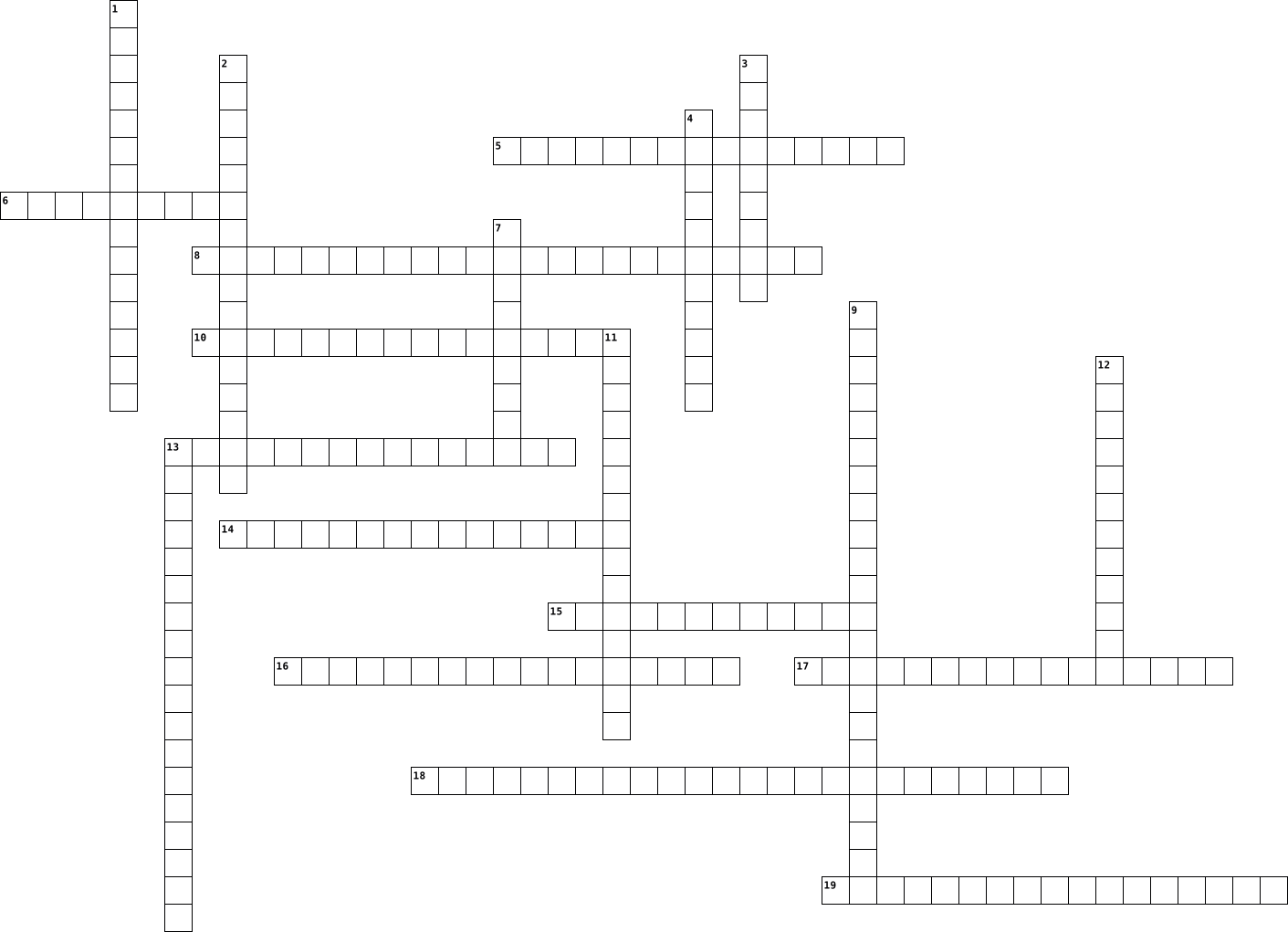
Across
- group opposed ratifying constitution
- how slaves counted in population
- deemed too weak to govern
- essay to support ratifying Constitution
- US minister to France (1785)
- decided states legislative representation
- first 10 amendments to constitution
- proposed government assume states debts
- unanimously elected president
- meeting to fix weak Articles
- allows punishment for threatening US
Down
- Washington's last warnings to America
- tax protest in Pennsylvania
- 3 Frenchmen gave demands to diplomats
- group supported ratifying constitution
- 2nd President; Federalist
- outlawed slavery in new territory
- revolt caused by heavy taxes
- opposed Hamilton and supported Jefferson
- treaty for Northwest natives' boundaries
20 Clues: 2nd President; Federalist • deemed too weak to govern • tax protest in Pennsylvania • revolt caused by heavy taxes • US minister to France (1785) • meeting to fix weak Articles • unanimously elected president • how slaves counted in population • outlawed slavery in new territory • first 10 amendments to constitution • group opposed ratifying constitution • ...
Parker 2022-01-21

Across
- Christmas in Spanish
- first major land battle of the Civil War
- early metal battleships
- a version of french braid but on top of your
- southern states, pro-slavery
- not letting anything in or out
- a way to greet someone in English
- greatest singer of all time sang Wonder
- northern states, ant-slavery
- biggest jellyfish
Down
- HEY SISTERS!!!
- seemingly absurd or self-contradicting
- frees slaves in the South, makes the war about slavery
- can be changed
- first confederate president
- help you see
- self-control or freedom
- made from red and yellow
- a national pandemic
- keeps your pants from falling down
20 Clues: help you see • HEY SISTERS!!! • can be changed • biggest jellyfish • a national pandemic • Christmas in Spanish • early metal battleships • self-control or freedom • made from red and yellow • first confederate president • southern states, pro-slavery • northern states, ant-slavery • not letting anything in or out • a way to greet someone in English • keeps your pants from falling down • ...
preamble crossword puzzle 2022-02-09

Across
- ordinary,frequent
- name for the United States
- good things that come from God
- to gurantee something
- without flaw
- an association of people with similar interests
- attach something so it can't be loosened
- advance to a higher rank
- action of resisting an attack
- being free without restrictions on your rights
Down
- officially decree something
- health, happiness and fortunes of someone
- permenantly set in place a system
- document that contains America's written laws and principles
- politically joined
- relating to the events going on in the home
- future generations
- state of being calm
- fair treatment
- territory considered to be under one government
20 Clues: without flaw • fair treatment • ordinary,frequent • politically joined • future generations • state of being calm • to gurantee something • advance to a higher rank • name for the United States • officially decree something • action of resisting an attack • good things that come from God • permenantly set in place a system • attach something so it can't be loosened • ...
Crossword Puzzle 100 pts. 2013-01-29

Across
- Another word for suitcases
- Negotiations between two or more states or countries
- Police IDs
- Hits the slopes
- States or nations
- My parents go to Walmart for ______
- Some are super
- You put letters in them
- Military men
- Where kings and queens live
- Firmly held opinions or ideas
Down
- A low area of land between hills or mountains
- It has lots of "keys"
- Courteous or honorable men
- Bread units
- Journals
- People in a novel
- Some literary pieces
- The heads or rulers of a tribe or tribes
- Metal bars with catches and levers to keep doors shut
20 Clues: Journals • Police IDs • Bread units • Military men • Some are super • Hits the slopes • People in a novel • States or nations • Some literary pieces • It has lots of "keys" • You put letters in them • Another word for suitcases • Courteous or honorable men • Where kings and queens live • Firmly held opinions or ideas • My parents go to Walmart for ______ • ...
government 2023-10-19

Across
- two branches of government
- creates laws
- gov branches check on each other so one doesn't get too powerful
- first 10 ammendments to the constitution
- introduction
- makes changes to the constitution
- favored big states
- America's second attempt ad government
- government based on the opinion of the peopl
- 2 representatives for each state
Down
- enforces laws
- father of the constitution
- accuse a congress member of wrongdoing
- first kind of government in america
- favored smaller states
- president of the senate
- compromise of the virginia and new jersey plan
- evaluates laws
- interpret laws
- process we use to vote for president
20 Clues: creates laws • introduction • enforces laws • evaluates laws • interpret laws • favored big states • favored smaller states • president of the senate • father of the constitution • two branches of government • 2 representatives for each state • makes changes to the constitution • first kind of government in america • process we use to vote for president • ...
Gov. Crossword Puzzle 2022-10-07

Across
- governmental power is divided
- written plan made by pilgrims
- approved
- Father of the Constitution
- yielded
- yielded
- wrote the federalist papers
- agreement prohibiting trade
- to change
- to vote approval of
- document passed by parliament in 1688
- law
Down
- document declaring independence from britain
- tax on sugar
- to decide the meaning of
- collected from taxes
- Coercive acts
- power of the monarch or government is limited
- government in which people elect delegates to make laws and conduct government
- first president of the U.S.
- Trade among states
- single chamber
- single chamber
- a group of individuals
- laws
- states that band together for a common
26 Clues: law • laws • yielded • yielded • approved • to change • tax on sugar • Coercive acts • single chamber • single chamber • Trade among states • to vote approval of • collected from taxes • a group of individuals • to decide the meaning of • Father of the Constitution • first president of the U.S. • wrote the federalist papers • agreement prohibiting trade • governmental power is divided • ...
Jake Unit 1 crossword 2024-09-19

Across
- Painted the Sistine Chapel
- Worldy rather than spiritual
- Who were the majority of witchcraft victims
- Wrote the Decameron
- What are city-states
- What occurs in Europe years after the 95 theses
- What was the penalty for practicing witchcraft
- Who invented the printing press
- What does renaissance mean
- A movement for religious reform
Down
- Common language
- Orignal Rennissance man
- Showing 3 dimension on a flat surface
- Wrote the Prince
- What was the Roman inquistion
- Set aside marriage
- Luther and his followers
- Where is the center of the Papal states
- Formal statements
- Denial of church teachings
20 Clues: Common language • Wrote the Prince • Formal statements • Set aside marriage • Wrote the Decameron • What are city-states • Orignal Rennissance man • Luther and his followers • Painted the Sistine Chapel • Denial of church teachings • What does renaissance mean • Worldy rather than spiritual • What was the Roman inquistion • Who invented the printing press • A movement for religious reform • ...
Historical people & events 2025-02-23

Across
- Blocked trades with foreign nations
- 2 years exploring the west
- Native war
- An important document
- To keep peace
- The people who help the president
- French demanding bribes
- A person in charge of the u.s
- A violent form of fighting
- The first American president
- purchase Doubled the size of states
- Wanted a big government
- Arguments with the states
- The American vice President
Down
- The third American President
- Tax for Alcohol during Washington’s presidency
- Who wanted a big government?
- Killed by Arron Burr in a duel
- Wanted a small government
- Who wanted a small government?
20 Clues: Native war • To keep peace • An important document • French demanding bribes • Wanted a big government • Wanted a small government • Arguments with the states • 2 years exploring the west • A violent form of fighting • The American vice President • The third American President • Who wanted a big government? • The first American president • A person in charge of the u.s • ...
2024-2025 5th grade 2025-05-16

Across
- people who didn't have a lot of rights
- something that happens to you
- play it
- it comes from your voice
- starts with a P but the long version
- we live in these
- go fast with fingers now
- they need to do it to win the war
- just cool in genial
- what's the differents
- the old states
Down
- Americans a long time ago
- go fast with feet
- what do you think
- what did we learn on plants
- shapes
- numbers on top
- we all live on one
- you in this city
- look at a book and hallucinate
20 Clues: shapes • play it • numbers on top • the old states • you in this city • we live in these • go fast with feet • what do you think • we all live on one • just cool in genial • what's the differents • it comes from your voice • go fast with fingers now • Americans a long time ago • what did we learn on plants • something that happens to you • look at a book and hallucinate • ...
Chap 4: Foundations of Civil Liberties 2026-02-12

Across
- Right to see a judge
- First ten amendments
- Fair legal procedures required
- 1628 English rights document
- Natural rights philosopher
- Applying rights to states
- BillofRights limited to federal
- 1215 limit on king
- Supported direct citizen rule
- Applying amendments to states
- Life liberty property freedoms
- Equal protection and due process
Down
- 1689 limits on monarch
- Supported Constitution
- Protections from government power
- Protects speech and religion
- Supported strong ruler
- Agreement between people and government
- Punishment without trial
- Wanted stronger rights protections
- Equal treatment under the law
- 1798 speech restrictions
- Retroactive criminal law
- Proposed three branches
24 Clues: 1215 limit on king • Right to see a judge • First ten amendments • 1689 limits on monarch • Supported Constitution • Supported strong ruler • Proposed three branches • Punishment without trial • 1798 speech restrictions • Retroactive criminal law • Applying rights to states • Natural rights philosopher • Protects speech and religion • 1628 English rights document • ...
United States of America 2021-03-22

Across
- President assassinated in 1963
- Home of the American film industry
- The first Black US President
- The American flag is known as the ______and stripes
- Capital of the US
- The Statue of___________
- San Francisco's ____________Bridge
Down
- American currency
- Another way to say America
- The first female Vice President
- New York is known as the _______Apple
- American has 50 of these
- The President lives in the _______House
- Famous motorcycle manufacturer _____Davidson
- _________Vegas
15 Clues: _________Vegas • American currency • Capital of the US • American has 50 of these • The Statue of___________ • Another way to say America • The first Black US President • President assassinated in 1963 • The first female Vice President • Home of the American film industry • San Francisco's ____________Bridge • New York is known as the _______Apple • ...
United States History 1 2023-04-14

Across
- The use of two types of metal to back currency
- The giving of government jobs to supporters
- East Coat immigration station
- sturdy, short tempered breed of cattle
- Patrons of Animal Husbandry
- Reason why a person comes to a new country
- First secretary of the treasury
Down
- West Coast immigration station
- Home made of blocks of sod
- Founder of Standard Oil of Ohio
- The growth of cities
- the name for pre civil war south
- Reason why a person leaves home country
- Head of the American Federation of Labor
- the illegal use of political influence for personal gain
15 Clues: The growth of cities • Home made of blocks of sod • Patrons of Animal Husbandry • East Coat immigration station • West Coast immigration station • Founder of Standard Oil of Ohio • First secretary of the treasury • the name for pre civil war south • sturdy, short tempered breed of cattle • Reason why a person leaves home country • Head of the American Federation of Labor • ...
ALTERED STATES OF CONSCIOUSNESS 2016-05-13

Across
- Attributed to irresistible attacks of refreshing sleep that occur daily over at least three months.
- A learned technique for refocusing attention that brings about an altered state of consciousness.
- Peron behind the Activation-synthesis theory.
- Happens most often during REM sleep, when activity in many brain areas is highest.
- Substances that are capable of producing hallucinations
- Sleep talking
- Waves present in the fourth stage of sleep.
Down
- Causes individual to stop breathing while he/she is sleeping.
- States of panic experienced while sound asleep.
- Awareness of the sensations, thoughts, and feelings being experienced at a given time.
- Fifth stage of sleep.
- Sleep walking, sitting
- A trancelike state of heightened susceptibility to the suggestions of others.
- Any substance that alters consciousness.
- a kind of substance increase relaxation and relieve pain and anxiety
15 Clues: Sleep talking • Fifth stage of sleep. • Sleep walking, sitting • Any substance that alters consciousness. • Waves present in the fourth stage of sleep. • Peron behind the Activation-synthesis theory. • States of panic experienced while sound asleep. • Substances that are capable of producing hallucinations • Causes individual to stop breathing while he/she is sleeping. • ...
Chemistry - States of Matter 2023-08-09

Across
- square triangle circle
- rough or smooth
- the point at which materials changes from a solid to a liquid
- brown black blue green
- relationship between the mass of the substance and how much space it takes up (volume).
- amount of space that a substance or object occupies
- solid, liquid, gas
- how big something is.
Down
- scent, sensed by the nose, fragrant
- anything that has mass and occupies space
- point or the temperature at which a liquid starts to boil and gets converted to gaseous form. 100 °C
- state of matter which has a fixed shape, mass, and volume
- state of matter which has no defined shape or volume; oxygen, carbon dioxide;
- state of matter which has fixed volume but no fixed shape.
- measure of the amount of matter in an object, (grams, kilograms)
15 Clues: rough or smooth • solid, liquid, gas • how big something is. • square triangle circle • brown black blue green • scent, sensed by the nose, fragrant • anything that has mass and occupies space • amount of space that a substance or object occupies • state of matter which has a fixed shape, mass, and volume • state of matter which has fixed volume but no fixed shape. • ...
STATES AND CAPITALS # 2 2024-02-13

Across
- I AM THE CAPITAL OF MASSACHUSETTS
- I AM THE CAPITAL OF NORTH CAROLINA
- I AM THE CAPITAL OF NEBRASKA
- I AM THE CAPITAL OF MONTANA
- I AM THE CAPITAL OF NORTH DAKOTA
- I AM THE CAPITAL OF MISSISSIPPI
- I AM THE CAPITAL OF NEW YORK
- I AM THE CAPITAL OF NEW JERSEY
- I AM THE CAPITAL OF NEW HAMPSHIRE
- PAUL I AM THE CAPITAL OF MINNESOTA
Down
- I AM THE CAPITAL OF NEW MEXICO
- I AM THE CAPITAL OF MISSOURI
- I AM THE CAPITAL OF MICHIGAN
- I AM THE CAPITAL OF SOUTH CAROLINA
- CITY I AM THE CAPITAL OF NEVADA
15 Clues: I AM THE CAPITAL OF MONTANA • I AM THE CAPITAL OF MISSOURI • I AM THE CAPITAL OF NEBRASKA • I AM THE CAPITAL OF MICHIGAN • I AM THE CAPITAL OF NEW YORK • I AM THE CAPITAL OF NEW MEXICO • I AM THE CAPITAL OF NEW JERSEY • I AM THE CAPITAL OF MISSISSIPPI • CITY I AM THE CAPITAL OF NEVADA • I AM THE CAPITAL OF NORTH DAKOTA • I AM THE CAPITAL OF MASSACHUSETTS • ...
50 states and capitals 2021-02-11

Across
- I am so hungry I could eat a horse.
- He is as sly as a fox.
- Naming words are called_______.
- The thieves robbed the police station.
- She sells sea shells.
- Can be used in the place of a noun (she, he, it)
- Describes a verb.
- The, a, an are examples of ________.
- These words describe the position of things.
- Doing word.
Down
- The flowers dance in the breeze.
- 'Boo hoo!' she sobbed.
- Describe a noun.
- Joining words (and, but).
- She has a heart of gold.
15 Clues: Doing word. • Describe a noun. • Describes a verb. • She sells sea shells. • 'Boo hoo!' she sobbed. • He is as sly as a fox. • She has a heart of gold. • Joining words (and, but). • Naming words are called_______. • The flowers dance in the breeze. • I am so hungry I could eat a horse. • The, a, an are examples of ________. • The thieves robbed the police station. • ...
United States Revolution Vocab 2023-10-03

Across
- Colonists were required to house British soldiers
- Taxed sugar which was used to produce rum
- A series of four laws passed by the British Parliament to punish the colony of Massachusetts Bay for the Boston Tea Party
- Civilians taunt British soldiers which caused a court case, and a fight to occur
- Organized movements aimed at effecting change
- Second cousin to John Adams
Down
- Allowed British East India Company to sell directly in colonies; took money from Colonial tea merchants
- Document that includes rights such as Life, Liberty, and the Pursuit of Happiness
- The quality or state of being free
- Taxed all printed materials
- Country that was once owned by King George III
- Only British money could be used
- Founding father of the United States, and served as the first secretary of the treasury
- First president of the United States
- Taxed tea, glass, paper, lead, and paint
15 Clues: Taxed all printed materials • Second cousin to John Adams • Only British money could be used • The quality or state of being free • First president of the United States • Taxed tea, glass, paper, lead, and paint • Taxed sugar which was used to produce rum • Organized movements aimed at effecting change • Country that was once owned by King George III • ...
United States Breaks Away 2024-05-03

Across
- My cousin who moved to England from Canada
- A person who flees their country or home over concern for their safety
- A method of preventing the spread of diseases
- Those who wanted to cut ties with Britain during the American Revolution
- A group of people in Upper Canada who called for government change
- Asking for something in a formal way
- This occurs when a solution to a problem cannot be reached
- There were 92 of these calling for government reform
Down
- This assembly was elected by voters in British North America
- Movement within a country
- Unfair treatment of people or a group
- This kind of government must answer to elected representatives
- a widespread shortage of food
- The action of resisting authority or control
- During the American Revolution, they wanted to stay united with Britain
15 Clues: Movement within a country • a widespread shortage of food • Asking for something in a formal way • Unfair treatment of people or a group • My cousin who moved to England from Canada • The action of resisting authority or control • A method of preventing the spread of diseases • There were 92 of these calling for government reform • ...
United States Constitution Vocabulary 2026-05-21

Across
- The introduction to the Constitution that outlines its purpose (e.g., "We the People...").
- To charge a government official (like the President) with a crime or misconduct in office.
- and Balances: A system that allows each branch of government to limit the powers of the other branches.
- A legislative body composed of two houses (e.g., the Senate and the House of Representatives).
- Branch (Article I): Makes the laws. Made up of Congress (the Senate and the House of Representatives).
- Branch (Article III): Interprets the laws. Made up of the Supreme Court and other federal courts.
- The supreme law of the United States and the plan for how the government operates.
Down
- The power of the President to reject a law passed by Congress.
- of Powers: The division of government responsibilities into distinct branches to prevent any one group from having too much power.
- A system where power is divided between the national (federal) government and individual state governments.
- Branch (Article II): Enforces the laws. Headed by the President, Vice President, and the Cabinet.
- To officially approve or accept a document or amendment.
- A formal change or addition to the Constitution.
- Process: The legal requirement that the government must respect all legal rights owed to a person.
- of Rights: The first ten amendments to the Constitution, which protect the basic rights of citizens (such as freedom of speech, religion, and the press).
15 Clues: A formal change or addition to the Constitution. • To officially approve or accept a document or amendment. • The power of the President to reject a law passed by Congress. • The supreme law of the United States and the plan for how the government operates. • The introduction to the Constitution that outlines its purpose (e.g., "We the People..."). • ...
Vocab 2025-02-07

Across
- infamous Civil War prisoner-of-war camp in Macon County, Georgia. Over 13,000 Union soldiers died in the camp due to disease and inhumane conditions
- War – a war when the United States was divided and fought against itself; the North and South had differences in culture, economics, and opinions about the Constitution
- Stephens (1812-1873) – Georgia politician who argued against secession, but went along with it anyway; he became Vice President of the Confederate States of America
- Blockade the US Navy’s strategy to prevent the Confederacy from trading so they could not get supplies, weapons, ammunition and other materials; “blockade runners” slipped past the US ships to sneak to Great Britain to get goods
- of 1860 – an election where Abraham Lincoln defeated John Breckenridge, John Bell, and Stephen Douglas to win the presidency; upon Lincoln’s election Southern states seceded from the Union
- Proclamation Lincoln’s statement that all slaves in the rebellious states would be freed if the South did not return to the Union by January 1, 1863
- Campaign the Union Army’s plan to capture Atlanta in the summer of 1864; Sherman’s army marched from Chattanooga, winning battles of Dalton, Resaca, Peachtree Creek, Ezra Church, and Atlanta. The Confederates won the Battle of Kennesaw Mountain
- Earth Policy all of the assets that are used or can be used by the enemy are targeted, such as food sources, transportation, communications, industrial resources, and even the people in the area
- – a system of forced labor of African Americans; made worse by the South depending more on cotton as a cash crop, largely because of the invention of the cotton gin
- of Chickamauga a three day battle in 1863 near the Tennessee border; it was a Confederate victory and the second bloodiest battle of the Civil War with 34,000 deaths; after the loss, the Union army retreated back to Chattanooga, Tennessee
Down
- – separating from a nation and becoming independent; eleven southern states seceded and formed a confederation called the Confederate States of America (CSA)
- States of America nation formed by the states which seceded from the Union, including Texas, Arkansas, Louisiana, Tennessee, Mississippi, Alabama, Georgia, Florida, North Carolina, South Carolina and Virginia; Jefferson Davis was their President
- to the Sea Union military campaign led by William T. Sherman from November 15 to December 25, 1864 marching from Atlanta to Savannah; Sherman used a “scorched earth” policy to end the South’s will to fight, destroying almost everything in his path
- Campaign the Union Army’s plan to capture Atlanta in the summer of 1864; Sherman’s army marched from Chattanooga, winning battles of Dalton, Resaca, Peachtree Creek, Ezra Church, and Atlanta. The Confederates won the Battle of Kennesaw Mountain
- William T. Sherman (1820-1891)a Union Army leader known for "the March to the Sea;” he and his troops laid waste to Georgia as he tried to “make Georgia howl” and break their desire to keep fighting the war
- Lincoln (1809 – 1865) – The 16th president of the United States, Lincoln preserved the Union during the Civil War and brought about the emancipation (or freedom) of enslaved people
16 Clues: infamous Civil War prisoner-of-war camp in Macon County, Georgia. Over 13,000 Union soldiers died in the camp due to disease and inhumane conditions • Proclamation Lincoln’s statement that all slaves in the rebellious states would be freed if the South did not return to the Union by January 1, 1863 • ...
Economic environment 2013-06-26

Across
- Canada must level the playing field and ensure that its exporters and investors have competitive terms of access to international markets
- special areas within the customs territory of the Community. Goods placed within these areas are free of import duties, VAT and other import charges
- This court is expected to serve as a court of last resort for Caribbean states, eventually replacing the Judicial Committee of the Privy Council in the United Kingdom
- a product of the desire of the 28 Contracting States, Countries and Territories of the Greater Caribbean to enhance cooperation within the region
- is awarded to companies that have achieved safety excellence by developing and implementing an effective Occupational Health & Safety Program (or System) within their organization
- failed shortly thereafter in the early 1980s
- the official currency of the eight political states in the Organization of Eastern Caribbean states (OECS)
- is a biennial summit meeting of the heads of government from all Commonwealth nations.
- was established by the Treaty of Basseterre
- often emerges from an initial agreement between a number of separate states
- the only international organization dealing with the global rules of trade between nations
- is a multilateral agreement regulating international trade.
Down
- groups of countries that share a single money
- A measure that financial lenders use as a rule of thumb to give a preliminary assessment of whether a potential borrower is already in too much debt
- The value of the currency fluctuates according to market forces and can change from day to day
- The Fixed or pegged rate is a rate the government (central bank) of a country or group of countries sets and maintains as the official exchange rate
- When a group of countries form a customs union they must introduce a common external tariff
- established the Caribbean Community and Common Market, later known as CARICOM
- a free trade area which comprises the entire continent and favors the progressive elimination of trade and investment barriers in the region.
- coordinating economic policies and development planning; devising and instituting special projects for the less-developed countries within its jurisdiction
- It will create one large market among the participating member states.
- "The Fund"
- a CARICOM approved award that represents achievement of a set of competencies which define core work practices of an occupational area
- an economic and political organization designed to bring about discussion and effect change among the world's most powerful nations
24 Clues: "The Fund" • was established by the Treaty of Basseterre • failed shortly thereafter in the early 1980s • groups of countries that share a single money • is a multilateral agreement regulating international trade. • It will create one large market among the participating member states. • often emerges from an initial agreement between a number of separate states • ...
Philosophy 12 Crossword 2023-11-23

Across
- Which concept of beauty had the following 3 requirements: integrity, proportion, clarity?
- Which theory of art states that art's main function is to imitate reality?
- The branch of philosophy that looks at the nature of reality
- The theory of art that says art is created to be presented publicly
- What food was Dali inspired by when he painted "The Persistence of Memory"?
- Which famous philosopher was killed for his questioning and beliefs?
- What is arguably one of the most controversial themes in Western Philosophy?
- First name of the artist who painted "The Starry Night"
- Which theory of art states that art must be evaluated by formal qualities of art?
- Which concept of beauty states that art should speak to the viewer's desires?
- Last name of the artist who painted "Water Lilies"
- Last name of the author who popularized Egoism
- Which form of Intentionalism states that meaning is determined by the best hypothesis?
- How many musicians were in the painting by Pablo Picasso?
- Anti-Intentionalism says that artistic intention is what?
- The theory of knowledge (Hint: starts with "E")
- Last name of the artist who created "Green Coca-Cola Bottles"
- What type of beauty relies on characteristics unanimously accepted by a society?
Down
- Which movie series did I have you compare in our first class? (Hint: Horror Genre)
- Which concept of beauty relied on the idea that the source of unity is amongst different things?
- The type of pasta in the title of the restaurant we went to in Victoria
- The direct opposite of Realism
- The theory of art that takes past styles and makes them new
- Famous student of Plato
- What type of beauty follows the saying: "Eye of the beholder"?
- What flower did Georgia O'Keeffe paint? (The one shown in class)
- Name of the theory that coined "Immediacy"
- Famous Philosopher whose name is similar to the dwarf planet: Pluto
- Which form of Actual Intentionalism states that if no one understands the artist's intention then the art becomes meaningless?
- What was the woman in "American Gothic" meant to represent? (Hint: her family "role")
- Last name of the artist who painted "The Scream"
- Which form of Intentionalism states that the artist's intentions are relevant (Hint: it has 3 degrees)
- Last name of the artist who painted "Fruit Bowl with Fruit"
- A formal discussion
34 Clues: A formal discussion • Famous student of Plato • The direct opposite of Realism • Name of the theory that coined "Immediacy" • Last name of the author who popularized Egoism • The theory of knowledge (Hint: starts with "E") • Last name of the artist who painted "The Scream" • Last name of the artist who painted "Water Lilies" • ...
The Constitution By Aniq.R 2023-07-23

Across
- The ___ Amendment protects the right against cruel and unusual punishment.
- The right to bear ___ (2 words).
- The ___ Amendment guarantees the right to a trial by jury in civil cases.
- The Preamble starts with "We the ___."
- The _seventeen eighty-seven om of religion, speech, and press.
- This article establishes the judicial branch of the federal government.
- Freedom of ___ and assembly.
- The Constitution was ratified by ___ out of 13 states to become effective.
- The ___ Amendment abolished slavespelledECOND The ___ Amendment grants the right to bear arms.
- This article establishes the legislative branch of the federal government.
- The ___ Amendment establishes the right to due process and equal protection under the law.
- Freedom of ___.
- The ___ Amendment establishes the order of succession to the Presidency.
- UNION ESTABLISH The first three words of the Constitution state its purpose: "___ a more perfect..."
- The Constitution has ___ articles in total.
- The ___ Amendment establishes the prohibition of alcohol.
- First ten amendments are called the Bill of ___.
Down
- The ___ Amendment grants the right to vote to all citizens regardless of race.
- Article that explains the process of amending the Constitution.
- The Constitution grants Congress the power to declare ___.
- This article establishes the executive branch of the federal government.
- This article explains the process for ratifying the Constitution
- Powers not delegated to the United States by the Constitution are reserved to the ___ (2 words).
- eighty-seven The Constitution was adopted in the year ___ (the Year is spelt out).
- This article explains the relationship between the states and the federal government.
- The ___ Amendment grants the right to vote to women.
- The ___ Amendment grants the right to vote to citizens aged 18 and older.
- The supreme law of the land.
- The ___ Amendment clarifies that any power not given to the federal government is reserved for the states.
- This article establishes the Constitution as the supreme law of the land.
- The Constitution can be amended with a ___ of two-thirds of both houses of Congress.
- The ___ Amendment protects against self-incrimination and double jeopardy.
- The Constitution was signed in the city of ___.
- ___ v. Wade established a woman's legal right to an abortion.
- THE PEOPLE The first three words of the Constitution are "___ of the United States."
- The ___ Amendment protects against unreasonable searches and seizures.
- The ___ Amendment grants the right to a fair and speedy public trial.
37 Clues: Freedom of ___. • The supreme law of the land. • Freedom of ___ and assembly. • The right to bear ___ (2 words). • The Preamble starts with "We the ___." • The Constitution has ___ articles in total. • The Constitution was signed in the city of ___. • First ten amendments are called the Bill of ___. • The ___ Amendment grants the right to vote to women. • ...
APUSH Unit 5 2025-01-29

Across
- United States slave and insurrectionist who in 1831 led a rebellion of slaves in Virginia
- a racial term for a black and native american child
- a free black who moved from the South to the North and urged African Americans to fight for their freedom.
- the formal act of freeing from slavery
- Written by Harriet Beecher Stowe in 1853 that highly influenced england's view on the American Deep South and slavery. a novel promoting abolition. intensified sectional conflict.
- An anti-slavery newspaper written by William Lloyd Garrison. It drew attention to abolition, both positive and negative, causing a war of words between supporters of slavery and those opposed.
- American social theorist who justified slavery by saying that black people were just children and needed to be in slavery
- Former slave who helped slaves escape on the Underground Railroad
- a young woman of the American Old South's upper class, known for being quiet and polite
- man or farmer owning small estate; middle-class farmer
- United States abolitionist who published an anti-slavery journal (1805-1879)
Down
- a system that helped enslaved African Americans follow a network of escape routes out of the South to freedom in the North
- 1842, Supreme Court case that decided federal law superseded state law, it was over a fugitive slave law.
- opposed the expansion of slavery in new states (particularly out west) ; subcatagory of the Republican party who were also abolitionists ; popular during the late antebellum period ; Abe Lincoln was the most influential person of this political party
- A Society that thought slavery was bad. They would buy land in Africa and get free blacks to move there. One of these such colonies was made into what now is Liberia. Most sponsors just wanted to get blacks out of their country.
- Another term for slavery; The owning of human beings existed in a country that practiced liberty.
- Term used to refer to the approximately 3 decades before 1860 when "king" cotton and the slave labor dominated the economy of the southern states
- United States freed slave and insurrectionist in South Carolina who was involved in planning an uprising of slaves and was hanged (1767-1822)
- cotton and cotton-growing considered, in the pre-Civil War South, as a vital commodity, the major factor not only in the economy but also in politics.
- United States abolitionist who escaped from slavery and became an influential writer and lecturer in the North (1817-1895)
20 Clues: the formal act of freeing from slavery • a racial term for a black and native american child • man or farmer owning small estate; middle-class farmer • Former slave who helped slaves escape on the Underground Railroad • United States abolitionist who published an anti-slavery journal (1805-1879) • ...
Government Review Puzzle Master 2025-04-22

Across
- reserves powers not explicitly delegated to the federal government
- refers to the principle where a higher level of government
- prevents states from discriminating against citizens of other
- a principle where government authority is divided among three distinct
- a system where the power of government is divided between the federal and state governments
- the US Constitution mandates that states recognize and respect the public acts, records, and judicial proceedings of other states.
- an official elected or appointed to act as ruler, chief executive, or nominal head of a political unit
- those that are shared by both the federal government and state governments in a federal system
- those governmental authorities that are neither explicitly granted to the national government
- -undamental principles that establish how a country, state, or other organization is governed
- programs that provide federal assistance for broadly defined functions, such as community development or social services
Down
- a provision in the US Constitution that grants Congress the power to regulate commerce among the states, with foreign nations, and with Indian tribes
- a formal agreement between two or more states, that allows them to cooperate on shared issues or concerns.
- a lawmaking body in a government where authority is divided between two separate houses or chambers
- a provision in the US Constitution that grants Congress the power to make all laws deemed necessary and proper for carrying out its enumerated powers and other powers vested in the federal government
- the legislative branch of government in a U.S. state, responsible for making laws within that state
- the power of a court to examine and determine the constitutionality of legislative and executive actions.
- -states that the Constitution, federal laws, and treaties are the supreme law of the land.
- the transfer of some authority or power from a central organization or government to smaller organizations or government departments
- -specifically listed and explicitly granted to the federal government, especially Congress, by the U.S. Constitution
- requirement imposed by a higher level of government on a lower level
- - system of power where power is divided
- money granted by the federal government to state and local governments, with strict limitations on how it is to be spent
- a system where power is divided between a national government and individual state governments
- a system where different parts of a government or organization have powers that limit and control each other
25 Clues: - system of power where power is divided • refers to the principle where a higher level of government • prevents states from discriminating against citizens of other • reserves powers not explicitly delegated to the federal government • requirement imposed by a higher level of government on a lower level • ...
Unit 8:Civil War 2025-04-24

Across
- The battle was a defeat for the confederacy and halted the Confederate invasion of the North.This was the deadliest Battle of the war,with over 50,000 casualties.
- the state of lasting forever
- issued on January 1st,1863,by President Abraham Lincoln that declared "that all persons held as enslaved people"within the rebellious states were free
- a speech given by a president when they take office
- The Confederate surrender at Vicksburg occurred just a day after the Gettysburg surrender and crushed Confederate hope of receiving foreign recognition.
- grant worked his way up the Union ranks during the Civil War.President Lincoln elevated Grant to the rank of lieutenant general,and named him general-in-chief of the Armies of the United States..He would later serve as President.
- Military historians consider the Battle of Antietam a stalemate.Even so,the Union kept Confederates confined and enabled President Lincoln to release the Emancipation Proclamation of September 22.1862.
- the United states
- a strategy that included the systematic destruction of any property or supplies,including those belonging to civilians,that are essential to the enemy's ability to wage war
- a collection of southern states that seceded from the United States during the American Civil War
- to keep something in its original state
Down
- The Confederate victory gave the south a surge of Confidence and shocked many in the North,who realized the war would not be won as easily as they had hoped
- President of the Union during the Civil War
- President of the Confederate states of America
- lasting forever
- Confederate,earned the nickname "Stonewall"because he refused to back down.He was shot by one of his soldiers accidentally and died several days later.
- Missouri,Kentucky,West Virgina,Maryland and Delaware
- The Union would use naval forces to strangle the South by blockading imports of Military supplies and exporting cotton
- a Union naval officer that led various naval blockade to victory.Farragut's biggest accomplishment was planing and executing a joint army-navy operation to take control of Mobile Bay,Alabama,in August of 1864.
- The union victory ended-any hopes the Confederates had of blocking the Union advanced into Northern Mississippi
- a war fought exclusively between armies in which only enemy soldiers and military infrastructure are targeted
- Led Virginia's Confederate army upon its secession from the union,became the commander of the entire Confederate Army.
22 Clues: lasting forever • the United states • the state of lasting forever • to keep something in its original state • President of the Union during the Civil War • President of the Confederate states of America • a speech given by a president when they take office • Missouri,Kentucky,West Virgina,Maryland and Delaware • ...
Daniel Kuder - U.S. Constution 2023-01-18

Across
- Role of the legislative branch, and it can be a member of the house or the senate.
- in the judicial branch has nine members that can have the job for life.
- James Madison a federalist writer creating federalist No. 10, and proposed the 3/5 compromise, “the father of the constitution”.
- The Great compromise to protect the smaller states against the bigger states, creates the 3 branches of government.
- the plan of Virginia was drafted by James Madison, called for a strong national government that gives roles to parts of our government and how it works.
- decided that slaves would be counted as 3-5 of a person in the house of representatives.
- the president, carries out the law, one term is four years, presidents can serve up to two terms.
- were against the constitution and for the bill of rights and thought the president had too much power like a king.
- in the executive branch needs a majority of the votes to win the electoral college.
- The compromise of whether a state's representation can be represented by population.
- The first ten amendments, and give the citizens basic rights and give the states power,
- Role of the Judicial branch, they can make changes to the amendments with five or more votes.
- George Washington 1st president of the united states federalist
Down
- part of the congress, but votes are based on a state's population, a total of 435.
- checks can cancel the actions of another branch, balances give the three branches power.
- were in favor of the constitution and not the bill of rights
- shut down the courthouse because they didn't want to lose their farms, but the rebellion was put down in 1887.
- the supreme court, interprets the law, judges can serve in court for life.
- Congress makes the laws, made out of the house of representatives and the senate.
- Role of the executive branch
- Decides what rights the citizens in that state have and gives the people the ability to control the government.
- Thomas Jefferson anti federalist
- makes the laws part of the legislative branch
- is counted every 10 years and the constitution calls for a census which is a count of population, Is used for giving representatives to states the the house of representatives.
- Part of congress, but all states have 2 votes each, a total of 100.
25 Clues: Role of the executive branch • Thomas Jefferson anti federalist • makes the laws part of the legislative branch • were in favor of the constitution and not the bill of rights • George Washington 1st president of the united states federalist • Part of congress, but all states have 2 votes each, a total of 100. • ...
Revolution into Statehood 2025-11-14

Across
- The Articles of Confederation had many of these including having different currencies, no executive or judicial branches, and all states had to agree on any changes
- Georgia's capitals shifted west to be at the center of its population (Savannah, Augusta, Louisville, Milledgeville, Atlanta)
- Cherokee chief who argued at the Supreme Court
- The American governing document that fixed weaknesses of the Articles of Confederation
- President of the United States who ordered Native American removal from the Eastern United States
- Invention patented to make cotton processing easier, resulted in increased need for land and slavery to produce cotton
- People who sided with England during the Revolutionary War
- List of Complaints against the King
- French and Indian War led England to make the colonies pay this
- Resulted in Georgia losing land (Alabama and Mississippi) because our officials accepted bribes to sell huge tracts of land instead of allotting it fairly to citizens
- Creek/Muscogee leader who signed the Treaty of Indian Springs that ceded (gave away) all remaining Creek land to the US, he was murdered by his people for betraying them and selling the land
- Revolutionary Battle in Georgia where Patriots won supplies and horse boosting morale
- Chief Justice of the Supreme Court who found in favor of Cherokee rights
- Land Policy used to distribute Creek and Cherokee land to white men, veterans, and widows
Down
- Supreme Court case where Cherokee argued their had the rights to their land, they won the case but were forcibly removed anyway
- The first weak government of the United States
- caused massive population growth in north Georgia pressuring Georgia to force the Cherokee out of Georgia
- Law from 1763 forbidding colonists to live West of the Appalachian Mountains
- American Patriots and France fought together for the first time to retake Savannah from the British but were defeated
- Spread across Georgia to transport cotton to ports and then to mills in the north and overseas
- The resolution of the DOI where the colonies declare independence
- First direct tax on colonies on paper products
- The forced removal of Native Americans through the winter of 1838 to reservations in the Western frontier of the United States
- Introduction to the Declaration of Independence
- American colonists who wanted to have independence from England
- Land Policy where white men (heads of households) could receive up to 1000 acres of land for their family
- the first public land grant university in the United States opening up higher education to more citizens
27 Clues: List of Complaints against the King • The first weak government of the United States • Cherokee chief who argued at the Supreme Court • First direct tax on colonies on paper products • Introduction to the Declaration of Independence • People who sided with England during the Revolutionary War • American colonists who wanted to have independence from England • ...
Themes of geographic inquiry: United States´ Climate, Vegetation, Human Environment Interaction, History, and Economy 2020-05-03

Across
- this situations can also result from too much precipitation in a short time or too little over a long period.
- This document is the highest form of law in the United States.
- It supervises and regulates many of the nation’s banks.
- This natural feature is affected by Pacific Ocean currents, the coastal mountains, and the prevailing westerlies—winds that blow from west to east in the middle of the latitudes.
- Leader of the executive branch.
- Another name for the legislative branch.
- The president's top 15 advisors.
- This type of landform determines the temperature and precipitation of surrounding lower areas.
- This mode of land transportation carried goods and passengers cross-country, promoting economic development and national unity as they went.
- Most official businesses in The United States are conducted in this language.
- Is a factor that can affect the suitability of a site.
Down
- There are two of these congressional members from each state.
- Replaced hunting and gathering as the primary method of food production about 3,000 years ago.
- Situation in which an area is covered with water, it can be caused by heavy rainfall.
- The first inhabitants of the area of North America now known as the United States and Canada.
- Is the systems to make movement from place to place less difficult.
- America's economic system.
- The Arctic coast of Alaska and Canada have this type of ecosystem.
- Is the official currency of the United States of America.
19 Clues: America's economic system. • Leader of the executive branch. • The president's top 15 advisors. • Another name for the legislative branch. • Is a factor that can affect the suitability of a site. • It supervises and regulates many of the nation’s banks. • Is the official currency of the United States of America. • ...
Civil War Crossword :^) 2019-06-11

Across
- Grant Surrounded the city
- Conflit from 1861 to 1865
- Made slavery illegal in the South
- First to secede.
- Turning point of the war
- North didnt get bridges
- General of the South
- President of the Confederacy
- Stonewall Jackson got his name here
Down
- Someone who wanted to abolish slavery
- The general at Fort Sumter
- Capital of the South
- Stonewalk Jackson is killed after this battle
- let states decide on slavery
- Number of boarder states
- Had a larger industry
- Better military leaders
- General during Battle of Richmond
- won the election of 1860
19 Clues: First to secede. • Capital of the South • General of the South • Had a larger industry • North didnt get bridges • Better military leaders • Number of boarder states • Turning point of the war • won the election of 1860 • Grant Surrounded the city • Conflit from 1861 to 1865 • The general at Fort Sumter • let states decide on slavery • President of the Confederacy • ...
Famous African Americans 2023-06-19

Across
- Douglass (Abolitionist and writer)
- Hughes (Poet and writer)
- Harris (Vice President of the United States)
- Angelou (Author and poet)
- Morrison (Author and Nobel laureate)
- Tubman (Abolitionist and activist)
- Williams (Tennis player)
- Truth (Abolitionist and women's rights activist)
- Kaepernick (Former NFL player and activist)
- X (Civil rights activist)
- Parks (Civil rights activist)
Down
- Rice (Former U.S. Secretary of State)
- Mandela (South African anti-apartheid revolutionary)
- Obama (44th President of the United States)
- Jordan (Basketball player)
- Parks (Civil rights activist)
- Luther King Jr. (Civil rights leader)
- (Singer and actress)
- Winfrey (Media mogul and philanthropist)
- Ali (Boxing legend and activist)
20 Clues: (Singer and actress) • Hughes (Poet and writer) • Williams (Tennis player) • Angelou (Author and poet) • X (Civil rights activist) • Jordan (Basketball player) • Parks (Civil rights activist) • Parks (Civil rights activist) • Ali (Boxing legend and activist) • Douglass (Abolitionist and writer) • Tubman (Abolitionist and activist) • Morrison (Author and Nobel laureate) • ...
Reconstruction Crossword 2019-01-09

Across
- Amendment / protects the voting rights of all citizens regardless of race or the color of their skin. It also protected the voting rights of former slaves.
- Earth / is a military strategy that aims to destroy anything that might be useful to the enemy while it is advancing through or withdrawing from a location
- / The northern states of the United States, also called the Union.
- / A nickname for the Confederate States of America or the Confederacy.
- McNeal Turner / an educated minister who had served as the first black chaplain in the U.S. Army.
- / An attempt to stop people and supplies from going in or out of a port.
- Klux Klan / as a social club for former confederate soldiers, but it quickly became more political and violent.
- Prison / One of the most notorious sites of the Civil War was the Confederate prison camp in Andersonville, Georgia.
- Plan / Union's strategic plan to defeat the Confederacy at the start of the American Civil War.
- / fought on September 18 – 20, 1863, between U.S. and Confederate forces in the American Civil War, marked the end of a Union offensive in southeastern Tennessee and northwestern Georgia
- T. Sherman /was a U.S. Civil War Union Army leader known for "Sherman's March," in which he and his troops laid waste to the South.
- Farming / made similar arrangements with landowners where they rented sections of land.
Down
- to Sea / began after Sherman captured, evacuated, and burned Atlanta in the fall of 1864.
- Amendment / no State shall make or enforce any law which shall abridge the privileges or immunities of.
- / The rebuilding of war torn southern states so they could be readmitted into the Union after the Civil War.
- / the owner would lend the worker a place to live, his seeds, and farm equipment.
- Bureau /Some Northerners came to the South to support the freed black slaves who were uneducated and unemployed.
- Proclamation / An executive order from President Abraham Lincoln stating that slaves in the Confederate states were to be set free.
- Amendment / Neither slavery nor involuntary servitude, except as a punishment for crime whereof the party shall have been duly convicted, shall exist within the United States, or any place subject to their jurisdiction.
- Campaign /was a series of battles fought in the Western Theater of the American Civil War throughout northwest Georgia and the area around Atlanta during the summer of 1864.
20 Clues: / The northern states of the United States, also called the Union. • / A nickname for the Confederate States of America or the Confederacy. • / An attempt to stop people and supplies from going in or out of a port. • / the owner would lend the worker a place to live, his seeds, and farm equipment. • ...
Civil War Era Crossword 2022-03-07

Across
- The compromise between North and South making California a free state and reinforcing a very strict Fugitive Slave Act
- This Amendment gave African Americans the right to vote.
- Battle in South Carolina that started the war
- Battle in which the Union won control of the Mississippi River and cut off Texas and other southern states from the rest of the Confederacy.
- Deadliest battle of the war, where Lincoln afterwards gave a famous speech
- A racist group started by ex confederate soldiers that used violence against African Americans to keep white supremacy.
- Name for the group of slave states Missouri, Kentucky, West Virginia, Maryland and Delaware that did NOT secede from the Union to join the Confederacy.
- Belief that states had the right to ignore certain laws from the federal government if they chose
- The primary cause of the Civil War
- Northern economic system during the Civil War
- An invention that separated the seeds from the cotton fibers, leading to an increase in slave labor on cotton plantations.
- The Union plan to surround the Confederate states and strangle them economically
- The period after the Civil War in which the South was rebuilt and reorganized before being readmitted to the Union.
- Bureau An agency set of to aid former slaves in adjusting themselves to freedom. It provided food, clothing and work for them.
Down
- Amendment that guaranteed the rights of anyone, including African Americans, who were born in America.
- A network of abolitionists who secretly helped slaves reach freedom in the Northern free-states or Canada.
- People who wanted to abolish or do away with slavery.
- Laws designed to enforce segregation of blacks from whites.
- best known African American abolitionist who toured the country talking about the horrors of slavery and started his own abolitionist newspaper called the North Star.
- Southern economic system during The Civil War
- An escaped slave who became a "conductor" in the Underground Railroad and helped to free thousands of slaves.
- A compromise proposed by Senator Henry Clay where Missouri would be admitted as a slave state and Maine as a free state.
- This Amendment abolished slavery, except as punishment for crimes.
- When citizens feel more loyalty toward their state or region than toward their country or other citizens.
- An order by President Lincoln declaring that only slaves in the Confederacy (not in any other states) would be free and could join the Union army.
- General of the Confederacy
26 Clues: General of the Confederacy • The primary cause of the Civil War • Battle in South Carolina that started the war • Southern economic system during The Civil War • Northern economic system during the Civil War • People who wanted to abolish or do away with slavery. • This Amendment gave African Americans the right to vote. • ...
Chapter 10 vocab 2021-12-03

Across
- Abolitionist described as “a man made of the stuff of saints”
- Called this because it became a violent Battlefield in a civil war.
- Confederate constitutional convention unanimously elected the former senator (Jefferson Davis) as president.
- One of the founders of the republican party
- Series of congressional measures intended to settle the major disagreements between free states and slave states.
- Law enacted as part of the compromise of 1850, designed to ensure that escaped slaves would be returned into bondage
- a system in which the residents vote to decide an issue
- Democratic candidate, in 1852
- Favoring the interests of native-born people over foreign-born people.
- The confederate states of America, a confederation formed in 1861 by the southern states after their secession from the union.
- Supreme court chief justice, handed the decision of Dred Scott V. Sandford
- political party formed in 1848 to oppose the extension of slavery into U.S. territories
- Slave from Missouri, lived with his owner north of the Missouri compromise line
- 16th president
- Name given to the American party, formed in the 1850s to curtain tail the political influence of immigrants
Down
- The framed pathfinder who mapped the Oregon trial and led the U.S. troops into California during the war with Mexico
- Statuses, passed in nine northern states in the 1850s, that forbade the imprisonment of runaway slaves and guaranteed jury trials for fugitive slaves.
- Fillmore The successor of president Taylor, supported the compromise
- Law enacted in 1854, that established the territories of Kansas and Nebraska and gave their residents the right to decide whether to allow slavery
- system of routes along which runaway slaves were helped to escape to Canada or to safe areas in the free states
- Amendment to an 1846 military appropriations bill, proposing that none of the territory acquired in the war with Mexico would be open to slavery.
- Nominated by the Democrats
- The formal withdrawal of a state from the Union.
- Ardent abolitionist, published Uncle Tom’s Cabin
- Modern political party that was formed in 1854 by opponents of slavery in the territories
- Band of 21 men set out to seize the federal arsenal there
- the idea, expressed by Steven Douglas in 1858, that any territory could exclude slavery by simply refusing to pass laws supporting it.
- Picked the pro-compromise reins
- Best selling novel by Harriet Beecher Stowe, published in 1852, that portrayed slavery as a great moral evil
- A famous conductor of the underground railroad
30 Clues: 16th president • Nominated by the Democrats • Democratic candidate, in 1852 • Picked the pro-compromise reins • One of the founders of the republican party • A famous conductor of the underground railroad • The formal withdrawal of a state from the Union. • Ardent abolitionist, published Uncle Tom’s Cabin • a system in which the residents vote to decide an issue • ...
Chapter 8 Terms and People to Know 2022-05-25

Across
- This undid part of the Missouri Compromise, and drew a line, creating the Kansas Territory and the Nebraska Territory.
- Created by the states that seceded from the United States
- Someone who has escaped from a place or has gone into hiding
- This war took place in Pennsylvania on July 1st, 1863. It lasted for 3 days.
- A slave in North Carolina, this man stole a Confederate ship with the help of several other black crew members in Charleston Harbor. He was also elected into the House of Representatives.
- People wanted Missouri to be a state, so Congress tried to fix it by making _______
- A middle way between two extremes
- A city environment with many people and buildings
- A trained Civil War nurse who helped heal thousands of people and started the American Red Cross.
- This marked the beginning of the civil war on April 12
- Growing crops and raising animals
- A U.S. senator from Mississippi, former solider and president of the Confederate United States of America.
- A tax placed on goods coming from another country to make those people choose locally made items instead of foreign-made ones.
Down
- His last words being "Water", this man was the General of the Union and the 18th president
- In this battle, the Union dug underneath this town, eventually starving the citizens and claiming victory.
- This was the town where the Confederate general surrendered to the Union general and the Union officially won the Civil War.
- This man captured Atlanta in September 1964, burning the city as they walked through.
- His last words being, "Strike the tent!", this man was the General of the Confederate Army.
- This man was moved through free states and filed a lawsuit against his owner, which was turned down by Congress.
- "Free the slaves who lived in the Confederate States!"
- To pull out or withdraw from
- Rivals the Democratic Party
- The first big battle of the Civil War in 1861. Also Known as the First Battle of Manassas
- Let California come into the states as a free state, but with the cost of stronger fugitive slave laws.
- Elected in 1850, this man was an abolitionist and was president of the USA.
- Making goods using natural, human, and capital resources in factory settings, with many workers
- A large, undeveloped area with few homes and other buildings
27 Clues: Rivals the Democratic Party • To pull out or withdraw from • A middle way between two extremes • Growing crops and raising animals • A city environment with many people and buildings • "Free the slaves who lived in the Confederate States!" • This marked the beginning of the civil war on April 12 • Created by the states that seceded from the United States • ...
1.4-1.6 2023-05-17

Across
- An accusation of wrongdoing
- ___ Compromise provided representation in congress to satisfy both small and large states
- The ___ plan was favored by larger states, three branches, bicameral legislature, supremacy of national government, separation of powers
- ___ Compromise counted only a certain amount of slaves for voting, solved temporary problems between the north and south.
- The ___ plan was favored my small states, Sovereignty of states, limited and defined powers of national legislature
- The group of presidential electors required by the Constitution to form every four years for the sole purpose of appointing the president and vice president.
- Part of checks and balances, based on power granted in article 1, section 7 of the constitution
- ___ a bicameral—or two-house—legislature.
- the meeting of state delegates in 1787 in Philadelphia called to revise the Articles of Confederation. It instead designed a new plan of government, the US Constitution
- Parchment Barriers, First 10 amendments of the constitution
- In late 2001, congress passed the ____, The law covered intelligence gatheringand sharing by executive branch agencies, points of criminal procedure, and border protection. It allowed government agencies to share information about significant suspects, and it widened authority on tapping suspects’ phones.
Down
- The lack of a centralized military power and readiness to respond to a violent uprising became the closing argument of the need for a strong central government.
- the division of power among the legislative, executive, and judicial branches of government
- ____ issues, these are which framers of the constitution could not have anticipated how the population of the United States would grow when they gave all states equal representation in the Senate.
- People or groups of people who be affected by politics
- ___ explains how constitutional provisions of separation of powers and checks and balances control abuses by majorities
- 435 members make up the:
- A system of used to ensure no branch of government gets more power over the other
- If the president vetoes a bill, the Congress, each house acting separately, can overcome the veto with a two-thirds ___, a super majority vote in each house.
- An anti-federalist who wrote a series of essays against ratifying the constitution
- If the president receives the bill at the end of a legislative session, however, refusal to sign is known as a ___
- (abbreviation) first "constitution" and required document
- Multiple ____ points for stakeholders and institutions to influence public policy
- Part of the constitution, deals with the amendment process
- 2/3 Congress Propose 3/4 State ___
25 Clues: 435 members make up the: • An accusation of wrongdoing • 2/3 Congress Propose 3/4 State ___ • ___ a bicameral—or two-house—legislature. • People or groups of people who be affected by politics • (abbreviation) first "constitution" and required document • Part of the constitution, deals with the amendment process • ...
Reconstruction Study Guide 2023-12-06

Across
- Name for the group in Congress who wanted strict measures imposed on former Confederate states
- Redeemer governments introduced this separation of whites and African Americans in public places.
- Johnson angered Radical Republicans when he granted thousands of these to wealthy southerners and former Confederate officials
- Redeemers established this tax to deny the vote to African Americans
- This Vice-President became President when Lincoln was assassinated in 1865.
- Term for Democrats who worked to get rid of Reconstruction reforms after 1877
- In 1870 this amendment gave African American men the right to vote
- President Johnson survived removal from office by this many votes in the Senate.
- This agency was established by Congress in 1865 to provide relief for former slaves
- Congress proposed this much stricter plan than the one proposed by Lincoln
- Sixteen African Americans were elected to this lawmaking body during Reconstruction
- This 1865 amendment to the constitution made slavery illegal.
Down
- Congress voted to do this to the President when he removed a cabinet official without the consent of the Senate
- This is what southerners called northerners who came to the south after the Civil War.
- This is what southerners called white southern Republicans after the Civil War
- This secret society was formed in 1866 to oppose civil rights for African Americans
- These laws in the south after Reconstruction enforced segregation.
- Radical Republicans were outraged that Johnson’s plan for reconstruction was resulting in the denial of these for African Americans
- The newly formed governments of the southern states began to pass these laws that denied civil rights to former slaves
- Lasting from 1865 to 1877, this was the process of readmitting the former Confederate states to the Union
- This 1896 Supreme Court decision ruled that segregation was constitutional
- The Fourteenth Amendment granted this to all people born in the United States
- This 1868 amendment outlawed states violating the civil rights of American citizens.
- In 1867 the Congress passed Reconstruction Acts that put southern states under this kind of control
- The election of this man in 1876 led to the removal of all federal troops from the south
- Johnson set up a program for each southern state to establish these
- President Johnson opposed laws that gave this kind of treatment to African Americans
- President Lincoln proposed this plan that offered amnesty to southerners
- This Republican and former Civil War general became president in 1869
29 Clues: This 1865 amendment to the constitution made slavery illegal. • These laws in the south after Reconstruction enforced segregation. • In 1870 this amendment gave African American men the right to vote • Johnson set up a program for each southern state to establish these • Redeemers established this tax to deny the vote to African Americans • ...
1950 2 2024-07-01

Across
- - A safety drill taught to schoolchildren in the United States during the Cold War, instructing them to crouch under desks or tables in the event of a nuclear attack.
- - A state of geopolitical tension between the Soviet Union and its allies and the United States and its allies from the end of World War II until the collapse of the Soviet Union.
- - Periods of intense fear of communism and radical political ideas in the United States.
- - Dwight D. Eisenhower, the 34th President of the United States, who served from 1953 to 1961.
- - A literary and social movement of the 1950s and early 1960s, characterized by rejection of conventional values and exploration of alternative lifestyles.
- hearings - Congressional hearings led by Senator Joseph McCarthy in the 1950s to investigate alleged communist infiltration of the US government and other institutions.
- - A highly contagious viral infection that can lead to paralysis, particularly affecting children.
- - A thermonuclear weapon much more powerful than the atomic bombs dropped on Hiroshima and Nagasaki.
- - A small restaurant, often in the style of a railroad car, serving inexpensive meals.
- - Relating to the nucleus of an atom, or pertaining to atomic energy.
- - The rights of citizens to political and social freedom and equality.
- - A person aged between 13 and 19 years old.
- - The practice of making accusations of subversion or treason without proper regard for evidence.
Down
- - Residential areas outside the city, typically characterized by single-family homes and a car-oriented lifestyle.
- - Elvis Presley, a popular American singer and actor who became a cultural icon of the 1950s.
- - A US foreign policy adopted in the late 1940s aimed at containing the spread of communism.
- - A device for receiving television broadcasts and displaying them on a screen.
- A tense confrontation in 1962 between the Soviet Union and the United States over the presence of Soviet missiles in Cuba.
- - Legislation that provided benefits to veterans of World War II, including education and housing assistance.
- - United Nations, an international organization founded in 1945 to promote peace, security, and cooperation among nations.
- - The theory that increasing consumption of goods and services is beneficial to the economy.
- - A two-piece swimsuit for women, named after the Bikini Atoll where atomic bomb tests were conducted.
- - Competition between the United States and the Soviet Union for supremacy in space exploration.
- - A significant increase in birth rates following World War II.
24 Clues: - A person aged between 13 and 19 years old. • - A significant increase in birth rates following World War II. • - Relating to the nucleus of an atom, or pertaining to atomic energy. • - The rights of citizens to political and social freedom and equality. • - A device for receiving television broadcasts and displaying them on a screen. • ...
Unit 4 Exam 2026-01-20

Across
- forces- pull people together
- boundary- mathematically and typically follow lines of latitude and longitude, instead of following physical and cultural features
- regions given some authority to govern their own territories independently from the national government
- the use of economic, political, cultural or other pressures to control or influence other countries
- states, where power is held by regional units
- politically organized independent territory with a government, defined borders, and a permanent population
- boundary- drawn in areas that have been settled by people and where cultural landscape already exist or are in the process of being established
- Cultural entities
- the right of a government to control and defend its territory and determine what happens within its borders
- organization governing common economic, social, and security issues in Europe
- former boundary that once existed but no longer have an official function
- boundary- established before many people settle into an area
- in which seats in the House of Representatives are reallocated to different states
- boundary- take into account the differenced that exist within the cultural landscape
- attempting to acquire territories in neighboring states inhabited by people of the same nation
- the practice of claiming and dominating overseas territories
Down
- when a states internal political boundaries are redrawn
- borders drawn over existing accepted borders by an outside or conquering force
- forces- push people apart
- states, where power is held by the central government
- organization with 193 global members that works to maintain peace and promote economic and social development
- areas experiencing instability due to ongoing conflicts among parties caught between interests of more powerful outside states
- Supranational organization that includes 29 members from around the globe with the goal of maintaining worldwide security
- when the central power in a state is broken up among regional authorities within its borders
- shared powers
- organization meant to accelerate economic growth and maintain peace and security in SE Asia
- 200 Nautical miles from the coast, establishing a maritime boundary
- people of a country identify as having one common ethnicity, religion, and language
- when voters from the opposition party are spread into several districts
- the push to create an empire by exercising force or influence to control other nations or people
- drawing district lines to put minority members in less districts
- drawing legislative maps with a partisan advantage
32 Clues: shared powers • Cultural entities • forces- push people apart • forces- pull people together • states, where power is held by regional units • drawing legislative maps with a partisan advantage • states, where power is held by the central government • when a states internal political boundaries are redrawn • boundary- established before many people settle into an area • ...
Q2 Review 2025-01-07

Across
- (Branch) Pass legislation (laws), Declare war, Regulate trade, Regulate money, Impeach federal officials,
- power to tax, build roads, and create lower courts
- Powers shared by the national and state governments.
- Maryland was trying to tax the national bank and Supreme Court ruled that federal law was stronger than the state law
- Law A legal system based on a written code of laws
- Powers given to the national government alone
- a form of government in which power is divided between the federal, or national, government and the states
- Constitutional division of powers among the legislative, executive, and judicial branches
- Powers given to the state government alone
- economic system where government should NOT interfere in the marketplace; Hands off economics
- A system that allows each branch of government to limit the powers of the other branches in order to prevent abuse of power
- system in which the national government returns power back to the states. Also called devolution
- Regulate trade within the state, establish local government systems, conduct elections, establish public school systems
- Economic theory that focuses on the idea that government intervention can stabilize the economy.
Down
- Established judicial review
- Powers Reserved to the States
- system in which both federal government and state governments work together to solve problems. Typically through the federal government providing money to the states. Also called Marble Cake Federalism.
- Congress has the power to make any laws related to carrying out the enumerated powers listed in the Constitution. Also known as the elastic clause
- coin money, regulate commerce with foreign nations, establish post offices, punish counter fitters, declare war
- Allows the court to determine the constitutionality of laws
- Gun Free School Zones Act exceeded Congress' authority to regulate interstate commerce.
- Law a system of law based on precedent and customs
- Constitution is the supreme law of the land
- the transfer of powers and responsibilities from the federal government to the states. (Not a type of federalism)
- A system of government in which both the states and the national government have separate, clear defined responsibilities. Also known as layered cake federalism.
- (Branch) executive order, commander and chief, appoints judges and cabinet members, issues pardons
- Mandates that individuals must be treated equally under the law.
- of Education 1954 - The Supreme Court overruled Plessy v. Ferguson, declared that racially segregated facilities are inherently unequal and ordered all public schools desegregated.
- made the Louisiana purchase without the consent of the legislative branch
- How is the president elected?
- income, sales, and property tax
31 Clues: Established judicial review • Powers Reserved to the States • How is the president elected? • income, sales, and property tax • Powers given to the state government alone • Constitution is the supreme law of the land • Powers given to the national government alone • power to tax, build roads, and create lower courts • Law a system of law based on precedent and customs • ...
Chapter 8: Similar Figures Vocabulary 2022-02-09

Across
- three parallel lines theorem states that if three _______ lines intersect two transversals, then they divide the transversals proportionally
- parallel lines are coplanar lines that do not __________
- similar figures are geometric figures that have the _____ _____ but not necessarily the same size
- perpendicular lines are two lines that intersect to form a _______ angle
- corresponding parts are a pair of sides or angles that have the same relative position in two _________ figures
- scale factor is the ratio of the lengths of the _____________ sides of the image and the preimage of a dilation
Down
- if two polygons are ________, then the ratio of their areas is equal to the squares of the ratios of their corresponding side lengths
- if two polygons are similar, then the ratio of their ____________ is equal to the ratio of their corresponding side lengths
- angle angle similarity theorem states that if two angles of one _______ are congruent to two angles of another triangle, then the two triangles are similar
- similarity transformation is a dilation or a ______ of rigid motions and dilations
- triangle proportionality theorem states that if a line parallel to one side of a triangle _______ the other two sides, then it divides the two sides proportionally
- side angle side similarity theorem states that if an angle of one triangle is __________ to an angle of a second triangle and the lengths of the side including these angles are proportional, then the triangles are similar
- corresponding angles are two angles that are formed by two lines and a ___________ that are in corresponding positions
- side side side similarity theorem states that if the corresponding side lengths of two triangles are ________, then the triangles are similar
- triangle angle bisector theorem states that if a ray _____ an angle of a triangle, then it divides the opposite side into segments whose lengths are proportional to the lengths of the other two sides
15 Clues: parallel lines are coplanar lines that do not __________ • perpendicular lines are two lines that intersect to form a _______ angle • similarity transformation is a dilation or a ______ of rigid motions and dilations • similar figures are geometric figures that have the _____ _____ but not necessarily the same size • ...
Musical Genres 2021-01-31

Across
- A genre and musical form which was originated in the Deep South of the United States around the 1860s by African-Americans
- A genre of dance music that emerged in the 1970s from the United States' urban nightlife scene
- Music produced or rooted in the traditions of Western culture, includes stringed instruments
- A genre that is composed and performed in a church setting
- A genre developed in the United States by inner-city African Americans in the Bronx borough of New York City in the 1970s
- A broad genre of popular music that originated as "rock and roll" in the United States in the late 1940s and early 1950s
- A genre of music defined by Lord Shorty, its inventor, as the Soul of Calypso, African and East Indian rhythms
Down
- Musical traditions of Mexico, Central America, and the portions of South America
- Music performed using synthesizers and other electronic instruments
- A musical category encompassing many different styles of music from around the world
- A genre that originated in the African-American communities of New Orleans, Louisiana, in the early 20th century
- A style of Afro-Caribbean music that originated in Trinidad and Tobago during the early to mid-19th century
- A form of popular music originating in the rural southern US
- A genre that originated in Jamaica in the late 1960s
- A form of jazz that developed in the United States in the 1930s and 1940s
15 Clues: A genre that originated in Jamaica in the late 1960s • A genre that is composed and performed in a church setting • A form of popular music originating in the rural southern US • Music performed using synthesizers and other electronic instruments • A form of jazz that developed in the United States in the 1930s and 1940s • ...
Halley's Puzzle 2023-10-18

Across
- Authorizing the president to grant unsettled lands west of the Mississippi in exchange for Indian lands within existing state borders.
- The right to vote in political elections.
- Andrew Jacksons nickname.
- A person sent or authorized to represent others, in particular an elected representative sent to a conference.
- The practice of a successful political party giving public office to its supporters.
- Was the second federally authorized Hamiltonian national bank in the United States.
Down
- John Marshall was an American statesman, lawyer, and Founding Father who served as the fourth chief justice of the United States from 1801 until his death in 1835.
- Was applied by European Americans in the colonial and early federal period in the history of the United States.
- A member of a North American people originally of the southeastern US, now living on reservations in Oklahoma and North Carolina.
- Indian Territory and the Indian Territories are terms that generally described an evolving land area set aside by the United States government for the relocation of Native Americans.
- The Whig Party was a conservative political party that existed in the United States during the mid-19th century.
- A financial crisis which affected the global economy.
- A movement for more democracy in American government in the 1830s.
- The forced westward migration of American Indian tribes from the South and Southeast.
- Pet banks is a derogatory term for state banks selected by the U.S. Department of Treasury to receive surplus Treasury funds in 1833.
15 Clues: Andrew Jacksons nickname. • The right to vote in political elections. • A financial crisis which affected the global economy. • A movement for more democracy in American government in the 1830s. • Was the second federally authorized Hamiltonian national bank in the United States. • ...
Government Chapter 3 and 4 2024-10-17

Across
- A formal change to the basic document.
- The ______ Branch is responsible for interpreting laws and applying justice.
- The case Marbury v. _______ was the first court case that helped to originate the power of the United States Supreme Court. .
- The power of the U.S. Supreme court is given. They are tasked with looking over laws and actions from Congress and the President to determine whether or not they are in-line with the Constitution.
- The ______ of the Constitution explain the functions of the three branches of American government.
- The _____ Branch is responsible for enforcing the law.
- Responsibilities that are held separately but equally by both state and national governments.
- Declares the Constitution, laws, and treaties of the federal government to be the highest law of the land to which judges in every state are bound regardless of state law.
- The introduction to the Constitution. It lists the major goals that the American government should strive for and explains what the founders hoped the laws would accomplish.
Down
- The _____ ______ ____ ______ Clause requires states to recognize one another’s laws and court decisions.
- Responsibilities that are given to the national government even though they are not expressly presented in the Constitution.
- The ________ ____ ________ Clause prevents states from discriminating against citizens of other states.
- The ______ Branch is responsible for creating laws.
- A ______ government describes a form of government in which the people are governed by elected representatives.
- States that all people and institutions are subject to and accountable to law that is fairly applied and enforced.
15 Clues: A formal change to the basic document. • The ______ Branch is responsible for creating laws. • The _____ Branch is responsible for enforcing the law. • The ______ Branch is responsible for interpreting laws and applying justice. • Responsibilities that are held separately but equally by both state and national governments. • ...
The 2016 US elections 2016-10-10

Across
- Voters
- Colour of the US president's house
- They defend American conservatism
- Come to a country of which one is not a native
- American citizens can legally possess one
- “Stronger …” is her slogan
- Symbol of the Democratic Party
- They represent the 50 states on the American flag
- American currency
- Obligatory financial contributions
Down
- Pink's open letter is addressed to him
- The authorities
- Democratic presidential nominee in 2016
- Stand up against
- Where the states choose the presidential candidates
- Self-assured
- Either political or military
- Name of the current US president
- discussion on the main issues, often televised
- Republican presidential nominee in 2016
20 Clues: Voters • Self-assured • The authorities • Stand up against • American currency • “Stronger …” is her slogan • Either political or military • Symbol of the Democratic Party • Name of the current US president • They defend American conservatism • Colour of the US president's house • Obligatory financial contributions • Pink's open letter is addressed to him • ...
Ukraine 2022-04-11

Across
- a collection of three states on the baltic sea
- capital of ukraine
- united nations
- how the war is going for russia
- what russia is suffering under
- What's happening in ukraine
- Leader of russia
- capital of russia
- whats happening in russia
- type of government of ukraine
Down
- What zelensky's position of government is
- the government type of russia
- southern ukrainian city under seige
- biggest baltic state
- whats happening to civilians
- who's fault is it
- what russia is doing
- northernmost baltic state
- What zelensky is
- capital of poland
- russian currency
21 Clues: united nations • Leader of russia • What zelensky is • russian currency • who's fault is it • capital of russia • capital of poland • capital of ukraine • biggest baltic state • what russia is doing • northernmost baltic state • whats happening in russia • What's happening in ukraine • whats happening to civilians • the government type of russia • type of government of ukraine • ...
American History Topic 4 2022-11-03

Across
- first president of the united states
- power given to the state government
- an undeclared naval war
- extended the time to become a citizen from 5-14 years
- support the government
- discussed trade
- presidents power to arrest
- power given to the national and state governments
- 1 legislative body
- necessary and proper
- area of representation
- french minister
Down
- first written form of government
- power mentioned in the constitution
- father of the constitution
- first vice president and second president of the united states
- power given to the national government
- power not mentioned in the constitution
- protects individual rights
- 2 legislative bodies
20 Clues: discussed trade • french minister • 1 legislative body • necessary and proper • 2 legislative bodies • support the government • area of representation • an undeclared naval war • father of the constitution • presidents power to arrest • protects individual rights • first written form of government • power mentioned in the constitution • power given to the state government • ...
US History Crossword 2020-06-20

Across
- group opposed ratifying constitution
- how slaves counted in population
- deemed too weak to govern
- essay to support ratifying Constitution
- US minister to France (1785)
- decided states legislative representation
- first 10 amendments to constitution
- proposed government assume states debts
- unanimously elected president
- meeting to fix weak Articles
- allows punishment for threatening US
Down
- Washington's last warnings to America
- tax protest in Pennsylvania
- 3 Frenchmen gave demands to diplomats
- group supported ratifying constitution
- 2nd President and Federalist
- outlawed slavery in new territory
- revolt caused by heavy taxes
- opposed Hamilton and supported Jefferson
- treaty for Northwest natives' boundaries
20 Clues: deemed too weak to govern • tax protest in Pennsylvania • 2nd President and Federalist • revolt caused by heavy taxes • US minister to France (1785) • meeting to fix weak Articles • unanimously elected president • how slaves counted in population • outlawed slavery in new territory • first 10 amendments to constitution • group opposed ratifying constitution • ...
Slavery and The Cornerstone Speech 2024-03-21

Across
- context
- can be high and low when referring to language
- praise or worship
- the southern states
- emotions
- unruly supporter
- the subjugation and ownership of another human
- less than
- opposite of lie
- vp of the CSA
- often large and metallic. commemorating symbol.
- language not literal
- a speech is this type of text
- facts and data
Down
- audience, for example
- the point
- better than
- values
- purpose
- to get rid of (ie slavery)
- credibility/trustworthiness
- what happened in the past
- speaker, for example
- the northern states
- US president during civil war
25 Clues: values • context • purpose • emotions • the point • less than • better than • vp of the CSA • facts and data • opposite of lie • unruly supporter • praise or worship • the southern states • the northern states • speaker, for example • language not literal • audience, for example • what happened in the past • to get rid of (ie slavery) • credibility/trustworthiness • US president during civil war • ...
g9 2025-12-15

Across
- Government by the people
- Large major city
- Independent political state
- Government led by royalty
- Line separating areas
- State ruled by a king or queen
- State without a monarch
- Political boundary
- Union of self-governing states
- Rule by one person
- Politically organized territory
Down
- Government by religion
- Administrative division
- Territory controlled by another
- Loose union of states
- Organized political area
- Absolute authoritarian rule
- Sparsely settled border area
- State ruling many territories
- State within another state
- Rule by a few
- Defined territorial area
- Separated territory
- People under one government
- Seat of government
25 Clues: Rule by a few • Large major city • Political boundary • Rule by one person • Seat of government • Separated territory • Loose union of states • Line separating areas • Government by religion • Administrative division • State without a monarch • Government by the people • Organized political area • Defined territorial area • Government led by royalty • State within another state • ...
US History Crossword 2020-06-20

Across
- group opposed ratifying constitution
- how slaves counted in population
- deemed too weak to govern
- essay to support ratifying Constitution
- US minister to France (1785)
- decided states legislative representation
- first 10 amendments to constitution
- proposed government assume states debts
- unanimously elected president
- meeting to fix weak Articles
- allows punishment for threatening US
Down
- Washington's last warnings to America
- tax protest in Pennsylvania
- 3 Frenchmen gave demands to diplomats
- group supported ratifying constitution
- 2nd President; Federalist
- outlawed slavery in new territory
- revolt caused by heavy taxes
- opposed Hamilton and supported Jefferson
- treaty for Northwest natives' boundaries
20 Clues: 2nd President; Federalist • deemed too weak to govern • tax protest in Pennsylvania • revolt caused by heavy taxes • US minister to France (1785) • meeting to fix weak Articles • unanimously elected president • how slaves counted in population • outlawed slavery in new territory • first 10 amendments to constitution • group opposed ratifying constitution • ...
US History Crossword Puzzle 2020-06-20

Across
- group opposed ratifying constitution
- how slaves counted in population
- deemed too weak to govern
- essay to support ratifying Constitution
- US minister to France (1785)
- decided states legislative representation
- first 10 amendments to constitution
- proposed government assume states debts
- unanimously elected president
- meeting to fix weak Articles
- allows punishment for threatening US
Down
- Washington's last warnings to America
- tax protest in Pennsylvania
- 3 Frenchmen gave demands to diplomats
- group supported ratifying constitution
- 2nd President and Federalist
- outlawed slavery in new territory
- revolt caused by heavy taxes
- opposed Hamilton and supported Jefferson
- treaty for Northwest natives' boundaries
20 Clues: deemed too weak to govern • tax protest in Pennsylvania • 2nd President and Federalist • revolt caused by heavy taxes • US minister to France (1785) • meeting to fix weak Articles • unanimously elected president • how slaves counted in population • outlawed slavery in new territory • first 10 amendments to constitution • group opposed ratifying constitution • ...
US History Crossword Puzzle 2020-06-20

Across
- group opposed ratifying constitution
- how slaves counted in population
- deemed too weak to govern
- essay to support ratifying Constitution
- US minister to France (1785)
- decided states legislative representation
- first 10 amendments to constitution
- proposed government assume states debts
- unanimously elected president
- meeting to fix weak Articles
- allows punishment for threatening US
Down
- Washington's last warnings to America
- tax protest in Pennsylvania
- 3 Frenchmen gave demands to diplomats
- group supported ratifying constitution
- 2nd President and Federalist
- outlawed slavery in new territory
- revolt caused by heavy taxes
- opposed Hamilton and supported Jefferson
- treaty for Northwest natives' boundaries
20 Clues: deemed too weak to govern • tax protest in Pennsylvania • 2nd President and Federalist • revolt caused by heavy taxes • US minister to France (1785) • meeting to fix weak Articles • unanimously elected president • how slaves counted in population • outlawed slavery in new territory • first 10 amendments to constitution • group opposed ratifying constitution • ...
Thomas Paine 2016-10-12

Across
- Paine's mother was considered a
- Paine wasn't born a
- Common Sense states that government
- Paine's father was considered a
- 1970's modern historians attempted
- republican states encourage
- military alliances led to
- Paine tried to deny being
- important work of political thought
- Cobbert took Paine's bones to
Down
- most important pamphlet written
- Moncure D. Conway wrote
- Paine lost his wife to
- Aristocrats told Paine he
- Paine was not thought as an
- Paine optimistically thought everyone has
- neglected because he was an
- Paine dismissed the king as
- Paine met Franklin in
- Paine was born in
20 Clues: Paine was born in • Paine wasn't born a • Paine met Franklin in • Paine lost his wife to • Moncure D. Conway wrote • Aristocrats told Paine he • military alliances led to • Paine tried to deny being • Paine was not thought as an • neglected because he was an • Paine dismissed the king as • republican states encourage • Cobbert took Paine's bones to • Paine's mother was considered a • ...
AP world ch 3 and 4 vocab (due oct 31) 2023-10-30

Across
- a monks only possession
- language spoken by urban african states
- islamic traveler
- type of chinese ship
- nomadic people who occupied many countries
- wealthy african king
- groups of ethnic groups along trade routes
- a place along the silk road where traders rested
- mongolian capitol
Down
- a way of trade by boat
- point which ships had to passed through
- devoted form of buddhism
- new form of confucianism
- religion of swahili city states
- chinese title adapted by mongols
- a hindu and buddhist temple
- animal used for transportation in desert
- rise in islamic agriculture
- trade routes from china
- trade routes in the desert
20 Clues: islamic traveler • mongolian capitol • type of chinese ship • wealthy african king • a way of trade by boat • a monks only possession • trade routes from china • devoted form of buddhism • new form of confucianism • trade routes in the desert • a hindu and buddhist temple • rise in islamic agriculture • religion of swahili city states • chinese title adapted by mongols • ...
Humanity 2023-11-20

Across
- where you are
- a person who write a map
- earth
- large body of water
- featurn not made by human
- direction
- a lane of water
- how to locate thing
- where you are in the map
- map that shows all the country and states
- where boats park
- way you are going
- tall
- to unlock a door
- mapping skill
Down
- drive on it
- walking
- a thing to cross water
- homosaptan
- a feature made by human
- direction
- where trains pass
- direction
- rocks
- to locate thing
- somewhere in the world
- and small city
- a large town
- united _____ of American
- direction
30 Clues: tall • earth • rocks • walking • direction • direction • direction • direction • homosaptan • drive on it • a large town • where you are • mapping skill • and small city • a lane of water • to locate thing • where boats park • to unlock a door • where trains pass • way you are going • large body of water • how to locate thing • a thing to cross water • somewhere in the world • a feature made by human • ...
Show what you know 2023-12-04

Across
- loose alliance of states
- votes based on population
- makes sure laws are fair
- first 10 amendments
- didn’t want a strong central government
- government split into 3 branches
- independent power
- 3/5 of slaves count towards votes
- vote on who represents us
- when the government splits into three so they don’t get too powerful
- votes based on population
Down
- makes sure everyone is equal
- first government where states had all power
- makes laws
- representatives vote on constitution
- one power
- changes to the constitution
- 1 vote per state
- enforces laws
- wanted strong central government
- law signed and agreed on
- one vote per state
22 Clues: one power • makes laws • enforces laws • 1 vote per state • independent power • one vote per state • first 10 amendments • loose alliance of states • makes sure laws are fair • law signed and agreed on • votes based on population • vote on who represents us • votes based on population • changes to the constitution • makes sure everyone is equal • government split into 3 branches • ...
government 2023-10-19

Across
- two branches of government
- creates laws
- gov branches check on each other so one doesn't get too powerful
- first 10 ammendments to the constitution
- introduction
- makes changes to the constitution
- favored big states
- America's second attempt ad government
- government based on the opinion of the peopl
- 2 representatives for each state
Down
- enforces laws
- father of the constitution
- accuse a congress member of wrongdoing
- first kind of government in america
- favored smaller states
- president of the senate
- compromise of the virginia and new jersey plan
- evaluates laws
- interpret laws
- process we use to vote for president
20 Clues: creates laws • introduction • enforces laws • evaluates laws • interpret laws • favored big states • favored smaller states • president of the senate • father of the constitution • two branches of government • 2 representatives for each state • makes changes to the constitution • first kind of government in america • process we use to vote for president • ...
g33 2025-12-20

Across
- Government by the people
- Large major city
- Independent political state
- Government led by royalty
- Line separating areas
- State ruled by a king or queen
- State without a monarch
- Political boundary
- Union of self-governing states
- Rule by one person
- Politically organized territory
Down
- Government by religion
- Administrative division
- Territory controlled by another
- Loose union of states
- Organized political area
- Absolute authoritarian rule
- Sparsely settled border area
- State ruling many territories
- State within another state
- Rule by a few
- Defined territorial area
- Separated territory
- People under one government
- Seat of government
25 Clues: Rule by a few • Large major city • Political boundary • Rule by one person • Seat of government • Separated territory • Loose union of states • Line separating areas • Government by religion • Administrative division • State without a monarch • Government by the people • Organized political area • Defined territorial area • Government led by royalty • State within another state • ...
Depression and World Conflict Crossword Puzzle <3 2023-03-10

Across
- A series of ________ and unsustainable farming methods during the Great Depression caused deadly dust storms, starvation, infections, and dust-related mortality. The largest migration in American history resulted from this.
- A tiny weevil that consumes the cotton boll's fibers, making it a ma is a significant pest of the cotton crop in America.
- a huge loss of paper wealth due to a rapid, abrupt decrease in stock prices throughout a large segment of the stock market
- A mechanism that would allow the United States to lend or lease war supplies to any nation deemed "essential to the defense of the United States."
- Federal loans were made available for the development of electrical distribution systems to serve remote rural areas of the United States under a law passed on May 20, 1936.
- On December 7, 1941, just before 8:00 a.m., the Imperial Japanese Naval Air Service launched a surprise military attack against the United States against the naval facility at Pearl Harbor in Honolulu, Territory of Hawaii.
- A lawyer and politician from the United States who held the office of 67th governor of Georgia for three terms, from 1933 to 1937 and then from 1941 to 1943.
Down
- A politician and lawyer from the United States who presided over the country as its 32nd president from 1933 until his passing in 1945.
- A 1906-first-launched British passenger ship that belonged to Cunard Line. It was opulent and renowned for its speed when it was built for the transatlantic passenger traffic. It was sunk by a German torpedo during World War I, which caused a significant number of casualties.
- A Democrat who was the 66th Governor of Georgia from 1931 to 1933. From 1933 to 1971, he spent nearly 40 years in the United States Senate.
- A collection of policies, initiatives, financial reforms, and regulations that President Franklin D. Roosevelt implemented in the United States between 1933 and 1939.
- A covert diplomatic telegram from the German Foreign Office in January 1917 suggested a military alliance between Mexico and Germany.
- A world war that raged from 1939 and 1945. The vast majority of the world's nations, including all of the great powers, participated in combat as members of the Allies and the Axis, two opposing military coalitions.
- A time in the 1930s when there were many severe dust storms that seriously hurt the prairies' agriculture and ecosystem.
- It was fought between two coalitions, the Allies and the Central Powers, and it was one of the deadliest worldwide conflicts in history. Violence broke out in several countries of Asia, the Pacific, Africa, the Middle East, and Europe.
- An American politician who spent more than 50 years in the House of Representatives and had a significant impact on the Navy's growth in the 20th century.
- Production that is overly abundant across numerous businesses.
17 Clues: Production that is overly abundant across numerous businesses. • A time in the 1930s when there were many severe dust storms that seriously hurt the prairies' agriculture and ecosystem. • A tiny weevil that consumes the cotton boll's fibers, making it a ma is a significant pest of the cotton crop in America. • ...
midterm vocabulary 2020-09-29

Across
- first major legislative departure from the U.S. policy of officially respecting the legal and political rights of the American Indians
- an area of land managed by a Native American tribe
- conflict between the United States and Mexico
- A federal law intended to turn Native Americans into farmers and landowners
- a series of violent attacks on courthouses and other government properties in Massachusetts
- the process of adopting the language and culture of a dominant social group or nation
- first formal statement by a nation's people asserting their right to choose their own government
- agricultural crop which is grown to sell for profit
- any of several acts of Parliament between 1651 and 1847
- the first 10 Amendments to the Constitution
- a secret hate group in the southern U.S., active for several years after the Civil War
Down
- ended with the Treaty of Paris in 1763
- the first constitution of the 13 American states, adopted in 1781 and replaced in 1789 by the Constitution of the United States
- information, ideas, or rumors deliberately spread widely
- a village in E Virginia: first permanent English settlement in North America 1607; restored 1957
- loyalty to one's own region or section of the country, rather than to the country as a whole
- "that all persons held as slaves" within the rebellious states "are, and henceforward shall be free"
- an amendment to the U.S. Constitution, ratified in 1865, abolishing slavery
- A train route across the United States, finished in 1869
- to help the South become a part of the Union again
- The Columbian Exchange refers to the exchange of diseases, ideas, food. crops, and populations between the New World and the Old World
- , that the people living in a territory should be free of federal interference in determining domestic policy, especially with respect to slavery
- a collection of state and local statutes that legalized racial segregation
- the withdrawal of 11 slave states
- best known U.S. policy toward the Western Hemisphere
- colonist loyal to Great Britain during the American Revolution
- a treaty signed with France in 1803 by which the U.S. purchased for $15,000,000 the land extending from the Mississippi River to the Rocky Mountain
- the destiny of the U.S. to expand its territory over the whole of North America
- late-18th century movement that opposed the creation of a stronger U.S. federal government and which later opposed the ratification of the 1787 Constitution
29 Clues: the withdrawal of 11 slave states • ended with the Treaty of Paris in 1763 • the first 10 Amendments to the Constitution • conflict between the United States and Mexico • an area of land managed by a Native American tribe • to help the South become a part of the Union again • agricultural crop which is grown to sell for profit • ...
HISTORY KEY TERMS LIST 04 2018-02-09

Across
- Information or ideas designed to change people's opinion
- The clause in the Constitution that prevents punishment for doing an action that was legal at the time but later illegal
- The Constitutional Principle that a person cannot be tried twice for the same crime
- the clause in the Constitution that states a person cannot be punished for the crimes of his family
- The Constitutional principle that the power of government belongs to the people
- A 1785 law that set the rules of the surveying and selling land in the Northwest Territory
- To make war against the United States or give aid and comfort to the enemy
- Those who were against the ratification of the new Constitution
- The clause in the Constitution that states have to honor contracts, and court rulings from other states
- A 1786-87 tax rebellion in Massachusetts that showed the weakness of the Articles of Confederation
- The constitutional compromise in which their would be two house of Congress. The Senate would have two representatives from each state and a House of Representatives in which representation was determined by population
- A 1787 law that guaranteed Republican Government and forbade slavery in the Northwest Territory
- A person accused of a crime in one state and flees that state should be returned to that state for trial
- The legal principle that a person detained by the government must be physically brought before a judge and told why he is being detained
- The Constitutional principle that the powers of government should be divided into three branches
Down
- Document that served as the first government of the United States
- The Constitutional principle that different branches of government can limit the power of the other branches
- The Constitutional principle that people exercise their power through electing representatives
- The Constitutional principle that it is the government's job to rights of the citizens and that those rights can never be taken away
- The constitutional compromise in which three-fifths of slaves are counted as population for the purpose of representation and taxes
- The Constitutional principle that the different levels of government {national, state, and local} have different powers
- Those who supported the ratification of the new Constitution
- The first ten amendments to the Constitution
- The written framework of the government of the United States and the contract between the people and the government
- To formally approve
25 Clues: To formally approve • The first ten amendments to the Constitution • Information or ideas designed to change people's opinion • Those who supported the ratification of the new Constitution • Those who were against the ratification of the new Constitution • Document that served as the first government of the United States • ...
Chapter 10 vocab 2021-12-03

Across
- Series of congressional measures intended to settle the major disagreements between free states and slave states.
- The formal withdrawal of a state from the Union.
- the idea, expressed by Steven Douglas in 1858, that any territory could exclude slavery by simply refusing to pass laws supporting it.
- Ardent abolitionist, published Uncle Tom’s Cabin
- Favoring the interests of native-born people over foreign-born people.
- A famous conductor of the underground railroad
- 16th president
- Amendment to an 1846 military appropriations bill, proposing that none of the territory acquired in the war with Mexico would be open to slavery.
- Statuses, passed in nine northern states in the 1850s, that forbade the imprisonment of runaway slaves and guaranteed jury trials for fugitive slaves.
- The confederate states of America, a confederation formed in 1861 by the southern states after their secession from the union.
- Abolitionist described as “a man made of the stuff of saints”
- Picked the pro-compromise reins
- Law enacted in 1854, that established the territories of Kansas and Nebraska and gave their residents the right to decide whether to allow slavery
- a system in which the residents vote to decide an issue
- Name given to the American party, formed in the 1850s to curtain tail the political influence of immigrants
Down
- Band of 21 men set out to seize the federal arsenal there
- Democratic candidate, in 1852
- The framed pathfinder who mapped the Oregon trial and led the U.S. troops into California during the war with Mexico
- system of routes along which runaway slaves were helped to escape to Canada or to safe areas in the free states
- Nominated by the Democrats
- political party formed in 1848 to oppose the extension of slavery into U.S. territories
- Best selling novel by Harriet Beecher Stowe, published in 1852, that portrayed slavery as a great moral evil
- Called this because it became a violent Battlefield in a civil war.
- Modern political party that was formed in 1854 by opponents of slavery in the territories
- Law enacted as part of the compromise of 1850, designed to ensure that escaped slaves would be returned into bondage
- One of the founders of the republican party
- Slave from Missouri, lived with his owner north of the Missouri compromise line
- Confederate constitutional convention unanimously elected the former senator (Jefferson Davis) as president.
- Fillmore The successor of president Taylor, supported the compromise
- Supreme court chief justice, handed the decision of Dred Scott V. Sandford
30 Clues: 16th president • Nominated by the Democrats • Democratic candidate, in 1852 • Picked the pro-compromise reins • One of the founders of the republican party • A famous conductor of the underground railroad • The formal withdrawal of a state from the Union. • Ardent abolitionist, published Uncle Tom’s Cabin • a system in which the residents vote to decide an issue • ...
Know Your Constitution! 2025-06-14

Across
- Abolished slavery
- System where each branch can limit the powers of the others
- Gave women the right to vote
- Prohibits the government from establishing an official religion
- Limits the President to two terms
- Prohibits poll taxes in federal elections
- Creates the Legislative Branch and gives Congress its powers
- Explains how states must interact with each other and the federal government
- Created two-house Congress: Senate and House
- Right to a trial by jury in civil cases
- Declares that the Constitution is the highest law of the land
- Declares the Constitution the supreme law of the land
- Explains how the Constitution was ratified
- The supreme law of the United States; replaced the Articles of Confederation
- Counted enslaved people partly for representation
- Sets up the Executive Branch and outlines presidential powers
- No quartering of soldiers in private homes without consent
- Protects against self-incrimination and double jeopardy
- Allows Congress to make laws that are "necessary and proper"
- Opposed the Constitution and wanted a Bill of Rights
- Right to bear arms
Down
- Powers not given to the federal government belong to the states
- Right to a fair, speedy, and public trial
- Gives Congress power to regulate trade between states and other countries
- Lowers the voting age to 18
- Gave African American men the right to vote
- Establishes the Judicial Branch and the federal court system
- Rights not listed in the Constitution are still protected
- The first ten amendments to the Constitution and guaranteeing rights to the people
- Part of the 14th Amendment; says the law must treat all people equally
- No cruel or unusual punishment
- Requires states to respect the laws and records of other states
- uprising by Massachusetts farmers protesting debt and taxes, showing weaknesses of the Articles
- Power comes from the people
- Protects people’s right to practice their religion freely
- Guarantees freedom of speech, religion, press, assembly, and petition
- Divides government into three branches with distinct powers
- Grants citizenship and equal protection under the law
- Plan at the Constitutional Convention calling for equal representation for each state
- Division of power between national and state governments
- Describes how to amend the Constitution
- Essays written to support ratification of the Constitution
- Found in the 5th and 14th Amendments; guarantees fair treatment by the government
- Protection against unreasonable searches and seizures
44 Clues: Abolished slavery • Right to bear arms • Lowers the voting age to 18 • Power comes from the people • Gave women the right to vote • No cruel or unusual punishment • Limits the President to two terms • Right to a trial by jury in civil cases • Describes how to amend the Constitution • Right to a fair, speedy, and public trial • Prohibits poll taxes in federal elections • ...
27 Amendments crossword puzzle 2024-05-15

Across
- Grants Congress the authority to issue an income tax without having to determine it based on population.
- Powers not specifically given to the federal government, nor withheld from the states, belong to the states.
- Extends the right to vote in the presidential election to citizens residing in the District of Columbia by granting the District electors in the Electoral College, as if it were a state.
- Granted women the right to vote.
- Refined the process whereby a President and a Vice President are elected by the Electoral College.
- The rights of citizens will be protected whether these rights are listed or not.
- In case of the removal of the President from office or of his death or resignation, the Vice President shall become President.
- Exercising their right to remain silent and not incriminate themselves.
- Right of US citizens. who are 18 yrs of age or older, to vote shall not be denied or abridged by the US or by any state on account of age.
- Prevents members of Congress from granting themselves pay raises during the current session
- Restricts housing soldiers in private homes.
- Protects against unreasonable search and seizure.
- Abolished slavery in the United States.
- If, at the time fixed for the beginning of the term of the President, the President elect shall have died, the Vice President elect shall become President.
- Prevents a president from serving more than two terms or more than ten years.
Down
- Allowed all men to vote without being denied by race, color, or previous conditions of servitude.
- Right to bear arms.
- Prohibited the making, transporting, and selling of alcoholic beverages.
- Protects the right for citizens to have a jury trial in federal courts.
- Protects the states from lawsuits filed by citizens of other states or countries.
- Prohibiting any poll tax in elections for officials
- Ended the Prohibition of alcohol in the US
- Freedom of religion, speech, press, assembly, and petition.
- Rights to a fast and public trial by an impartial jury and to be aware of the criminal charges.
- Excessive bail shall not be required, nor excessive fines imposed, nor cruel and unusual punishments inflicted.
- Calls for the direct election of senators by the voters instead of their election by state legislatures.
- Granted citizenship and equal civil and legal rights to anyone born in the United States or who became a citizen of the country.
27 Clues: Right to bear arms. • Granted women the right to vote. • Abolished slavery in the United States. • Ended the Prohibition of alcohol in the US • Restricts housing soldiers in private homes. • Protects against unreasonable search and seizure. • Prohibiting any poll tax in elections for officials • Freedom of religion, speech, press, assembly, and petition. • ...
23-24 US Unit 6 Vocab Part 2 2024-04-24

Across
- Established by President Lyndon B. Johnson on November 29, 1963 to investigate the assassination of United States President John F. Kennedy.
- A skin infection that is often contracted in tropical environments.
- A jellied gasoline used for bombs.
- Discrepancy between the number of missiles the Soviet Union in the United States had.
- The campaign program advocated by JFK in the 1960 election. He promised to revitalize the stagnant economy and enact reform legislation in education, health care, and civil rights.
- A competition between nations for superiority in the development and accumulation of weapons.
- A barrier that existed from 1961 through 1989, constructed by the German Democratic Republic that completely cut off West Berlin from surrounding East Germany and from East Berlin until it was opened in 1989.
- An unsuccessful invasion of Cuba in 1961, which was sponsored by the United States. Its purpose was to overthrow Cuban dictator Fidel Castro.
- President Lyndon B. Johnson's program in the 1960s to provide greater social services for the poor and elderly.
- A set of domestic programs in the United States launched by President Lyndon B. Johnson in 1964-65. The main goal was the elimination of poverty and racial injustice.
Down
- A perceived difference between what is said and what is true.
- A war crime committed by United States Army personnel on March 16, 1968, involving the mass murder of unarmed civilians in South Vietnam, during the Vietnam War.
- A policy that involves threatening the use of nuclear weapons to avoid a potential war.
- A series of economic fights that occurred in the 1960s in Kentucky where the various caves in the state fought for the attention of tourists, with Mammoth Cave coming out on top.
- A program in which the United States tried to help Latin American countries overcome poverty and other problems, money used to aid big business and the military.
- A chemical defoliant used to clear Vietnamese jungles during the Vietnam war.
- Strategy assuming that as long as two countries can destroy each other with nuclear weapons, they will be afraid to use them.
- Volunteers who help third world nations and prevent the spread of communism by getting rid of poverty in Africa, Asia, and Latin America.
- An extension of the Arms Race, a race of firsts in space between USSR and US.
- This attack on U.S. forces by Vietnamese communists in 1968 made Americans realize that the U.S. was not close to winning the war in Vietnam.
20 Clues: A jellied gasoline used for bombs. • A perceived difference between what is said and what is true. • A skin infection that is often contracted in tropical environments. • A chemical defoliant used to clear Vietnamese jungles during the Vietnam war. • An extension of the Arms Race, a race of firsts in space between USSR and US. • ...
UNIT 9 VOCAB 2025-03-31

Across
- (n.) to reject; to refuse a law made by legislature
- of Office Act (n.) a law passed in 1867 that limited the power of the president to remove certain federal officials
- process (n.) the right of a citizen to be treated fairly by the government when laws are made and enforced
- (n.) a white Southerner who collaborated with northern Republicans during Reconstruction, often for personal profit
- of 1877 (n.) agreement between southern Democrats and the Republicans to settle the result of the 1876 presidential election and marked the end of the Reconstruction era
- Codes (n.) laws passed in the Southern United States after the Civil War to limit the rights of formerly enslaved people
- tax (n.) a fixed sum tax levied on all persons
- Amendment (n.) defined U.S. citizen, which receives due process and equal protection under the law
- (n.) the period of rebuilding social, economic, and political systems after the Civil War
- (n.) rising to an important position
- (n.) the status of being a legal citizen of a country and entitled to certain rights
- Crow Laws (n.) laws that enforced racial segregation in the United States from the post-Civil War era until the 1960s
Down
- (n.) a person from the northern states who went to the South after the Civil War to profit from the Reconstruction.
- Republicans (n.) a Republican favoring drastic and usually repressive measures against the southern states in the period following the Civil War
- protection (n.) a term in the 14th amendment requiring that states guarantee the same rights, privileges, and protections to all people
- rights (n.) the rights of all people to social, economic, and political freedom and equality
- (n.) a system that keeps different groups separate from each other, normally through social pressures and/or laws
- Amendment (n.) Males could vote regardless of color (gave suffrage to African Americans)
- Percent Plan (n.) a proposal by President Abraham Lincoln to readmit Confederate states to the Union. The plan was based on the idea that 10% of a state's 1860 voters must swear loyalty to the Union
- (n.) the right to vote
- (n.) murder usually under secret attack for political reasons
- supremacy (n.) a system of beliefs and practices in which White people are considered to be superior to people of other racial backgrounds that is maintained through discrimination
- Amendment (n.) abolished slavery
23 Clues: (n.) the right to vote • Amendment (n.) abolished slavery • (n.) rising to an important position • tax (n.) a fixed sum tax levied on all persons • (n.) to reject; to refuse a law made by legislature • (n.) murder usually under secret attack for political reasons • (n.) the status of being a legal citizen of a country and entitled to certain rights • ...
Civil war 2021-11-12

Across
- a package of five separate bills passed by the United States Congress in September1850
- gave African-Americans or Blacks United States citizenship.
- officially ended slavery in the United States.
- south wanted this and north didn't
Down
- The first shot of the civil war
- gave African-American or Black men the right to vote.
- the rights or powers retained by the regional governments of a federal union under the provisions of a federal constitution. the action of a
- 16th president elected in 1860
- states impeding or attempting to prevent the operation and enforcement within its territory of a law of the U.S.
- sued the state based on the belief that his time spent in the free states made him a free man.
10 Clues: 16th president elected in 1860 • The first shot of the civil war • south wanted this and north didn't • officially ended slavery in the United States. • gave African-American or Black men the right to vote. • gave African-Americans or Blacks United States citizenship. • a package of five separate bills passed by the United States Congress in September1850 • ...
8.2 creating the constitution (Glenn mast 4th hour) 2022-04-14

Across
- the virginia plan helped the _________ states.
- read over one hundred books on the government in preparation for the constitutional convention.
- robert morris nominated ______________ to be the next president of the U.S.
- in early july the committee offered the great ___________________ to satisfy the smaller states.
- under this compromise ________-_______ of the slave population would be counted when setting direct taxes on the states.
Down
- led by __________ of New York, he called for the states to send representatives to philadelphia to discuss changes in the articles of confederation.
- in the constitutional convention they argued for over a __________.
- this plan benefited the small states.(two words)
- there were 55 delegates who showed up to the constitutional ________________ in philadelphia.
- the _______ rebellion consisted of 1500 farmers.
10 Clues: the virginia plan helped the _________ states. • this plan benefited the small states.(two words) • the _______ rebellion consisted of 1500 farmers. • in the constitutional convention they argued for over a __________. • robert morris nominated ______________ to be the next president of the U.S. • ...
8.2 creating the constitution (Glenn mast 4th hour) 2022-04-14

Across
- the virginia plan helped the _________ states.
- read over one hundred books on the government in preparation for the constitutional convention.
- robert morris nominated ______________ to be the next president of the U.S.
- in early july the committee offered the great ___________________ to satisfy the smaller states.
- under this compromise ________-_______ of the slave population would be counted when setting direct taxes on the states.
Down
- led by __________ of New York, he called for the states to send representatives to philadelphia to discuss changes in the articles of confederation.
- in the constitutional convention they argued for over a __________.
- this plan benefited the small states.(two words)
- there were 55 delegates who showed up to the constitutional ________________ in philadelphia.
- the _______ rebellion consisted of 1500 farmers.
10 Clues: the virginia plan helped the _________ states. • this plan benefited the small states.(two words) • the _______ rebellion consisted of 1500 farmers. • in the constitutional convention they argued for over a __________. • robert morris nominated ______________ to be the next president of the U.S. • ...
8.2 creating the constitution (Glenn mast 4th hour) 2022-04-14

Across
- the virginia plan helped the _________ states.
- read over one hundred books on the government in preparation for the constitutional convention.
- robert morris nominated ______________ to be the next president of the U.S.
- in early july the committee offered the great ___________________ to satisfy the smaller states.
- under this compromise ________-_______ of the slave population would be counted when setting direct taxes on the states.
Down
- led by __________ of New York, he called for the states to send representatives to philadelphia to discuss changes in the articles of confederation.
- in the constitutional convention they argued for over a __________.
- this plan benefited the small states.(two words)
- there were 55 delegates who showed up to the constitutional ________________ in philadelphia.
- the _______ rebellion consisted of 1500 farmers.
10 Clues: the virginia plan helped the _________ states. • this plan benefited the small states.(two words) • the _______ rebellion consisted of 1500 farmers. • in the constitutional convention they argued for over a __________. • robert morris nominated ______________ to be the next president of the U.S. • ...
8.2 creating the constitution (Glenn mast 4th hour) 2022-04-14

Across
- the virginia plan helped the _________ states.
- read over one hundred books on the government in preparation for the constitutional convention.
- robert morris nominated ______________ to be the next president of the U.S.
- in early july the committee offered the great ___________________ to satisfy the smaller states.
- under this compromise ________-_______ of the slave population would be counted when setting direct taxes on the states.
Down
- led by __________ of New York, he called for the states to send representatives to philadelphia to discuss changes in the articles of confederation.
- in the constitutional convention they argued for over a __________.
- this plan benefited the small states.(two words)
- there were 55 delegates who showed up to the constitutional ________________ in philadelphia.
- the _______ rebellion consisted of 1500 farmers.
10 Clues: the virginia plan helped the _________ states. • this plan benefited the small states.(two words) • the _______ rebellion consisted of 1500 farmers. • in the constitutional convention they argued for over a __________. • robert morris nominated ______________ to be the next president of the U.S. • ...
8.2 creating the constitution (Glenn mast 4th hour) 2022-04-14

Across
- the virginia plan helped the _________ states.
- read over one hundred books on the government in preparation for the constitutional convention.
- robert morris nominated ______________ to be the next president of the U.S.
- in early july the committee offered the great ___________________ to satisfy the smaller states.
- under this compromise ________-_______ of the slave population would be counted when setting direct taxes on the states.
Down
- led by __________ of New York, he called for the states to send representatives to philadelphia to discuss changes in the articles of confederation.
- in the constitutional convention they argued for over a __________.
- this plan benefited the small states.(two words)
- there were 55 delegates who showed up to the constitutional ________________ in philadelphia.
- the _______ rebellion consisted of 1500 farmers.
10 Clues: the virginia plan helped the _________ states. • this plan benefited the small states.(two words) • the _______ rebellion consisted of 1500 farmers. • in the constitutional convention they argued for over a __________. • robert morris nominated ______________ to be the next president of the U.S. • ...
8.2 creating the constitution (Glenn mast 4th hour) 2022-04-14

Across
- the virginia plan helped the _________ states.
- read over one hundred books on the government in preparation for the constitutional convention.
- robert morris nominated ______________ to be the next president of the U.S.
- in early july the committee offered the great ___________________ to satisfy the smaller states.
- under this compromise ________-_______ of the slave population would be counted when setting direct taxes on the states.
Down
- led by __________ of New York, he called for the states to send representatives to philadelphia to discuss changes in the articles of confederation.
- in the constitutional convention they argued for over a __________.
- this plan benefited the small states.(two words)
- there were 55 delegates who showed up to the constitutional ________________ in philadelphia.
- the _______ rebellion consisted of 1500 farmers.
10 Clues: the virginia plan helped the _________ states. • this plan benefited the small states.(two words) • the _______ rebellion consisted of 1500 farmers. • in the constitutional convention they argued for over a __________. • robert morris nominated ______________ to be the next president of the U.S. • ...
Philadelphia Cityscape 2024-12-16

Across
- a Philadelphia neighborhood
- the oldest street in the United States
- a famous bell
- professional football team
- once a well known Philadelphia department store
Down
- 1790-1800 was the capital of the United States
- a view of a city
- contains 700 rooms
- the largest one in any United States city
- one of the Philadelphia Squares
10 Clues: a famous bell • a view of a city • contains 700 rooms • professional football team • a Philadelphia neighborhood • one of the Philadelphia Squares • the oldest street in the United States • the largest one in any United States city • 1790-1800 was the capital of the United States • once a well known Philadelphia department store
Foundations of Democracy 2022-10-12

Across
- Group that rebelled against the British
- Branch the Writes laws
- Taxed all paper
- British King
- First Constitution in the United States
Down
- Tax on imported Goods
- Had all the power in the Articles of Confederation
- First President of the United States
- Branch that Enforces Laws
- Event where five colonists were killed
10 Clues: British King • Taxed all paper • Tax on imported Goods • Branch the Writes laws • Branch that Enforces Laws • First President of the United States • Event where five colonists were killed • Group that rebelled against the British • First Constitution in the United States • Had all the power in the Articles of Confederation
The Jackson Era 2023-02-12

Across
- a person sent or authorized to represent others
- An American politician and lawyer who served as the fourth chief justice of the U.S.
- the withdrawal of eleven southern states from the union in 1860, leading to the Civil War
- a financial crisis in the United States
- a derogatory term for state banks selected by the U.S Department of Treasury to receive surplus Treasury funds in 1833
Down
- the 1824 United States presidential election,the Compromise of 1877, and Gerald Fords 1974 Pardon of Richard Nixon
- one of the indigenous peoples of the southeastern Woodlands of the United States
- the right to vote in politicial elections
- the constitutional theory that individual states can invalidate federal laws or judicial decisions they deem unconstitutional
- a conservative political party that existed in the U.S. during the middle 19th century
- the practice of a successful political party giving public office to its supporters
11 Clues: a financial crisis in the United States • the right to vote in politicial elections • a person sent or authorized to represent others • one of the indigenous peoples of the southeastern Woodlands of the United States • the practice of a successful political party giving public office to its supporters • ...
Reconstruction 2016-02-04

Across
- Political agreement that allowed California to be admitted as a free state by allowing popular sovereignty in the territories and enacting a stricter fugitive slave law.
- Federal agency designed to aid freed slaves and poor white farmers in the south after the civil war.
- Congressman who advocate full citizenship rights for African Americans along with harsh reconstruction policy towards the south.
- American politician who was U.S. representative and senator from Mississippi.
- Supreme court ruling stating that slaves were not citizens, congress had no jurisdiction over slavery in the territories.
- 17th president of the United States.
- Reformer who sought to end slavery.
- Machine invented in 1793 to separate the cotton fiber from the seeds.
- The 16th president of the United States.
- Abolished slavery in the U.S. and provides "neither slavery nor involuntary servitude".
- Organization that promotes hatred and discrimination against specific ethnic and religious groups.
Down
- Government of 11 southern states that seceded from the united states and fought against the union in the civil war.
- Program implanted by the federal government between 1865 and 1877 to repair damage to the south.
- Amendment addresses citizenship rights and equal protection of laws.
- Principle in which the people are the only source of government power.
- Segregation imposed by law.
- Segregation laws enacted in the South after reconstruction.
- Accusation against a public official of wrong doing in office.
- Amendment prohibits the federal and state governments from denying a citizen the right to vote.
19 Clues: Segregation imposed by law. • Reformer who sought to end slavery. • 17th president of the United States. • The 16th president of the United States. • Segregation laws enacted in the South after reconstruction. • Accusation against a public official of wrong doing in office. • Amendment addresses citizenship rights and equal protection of laws. • ...
Three Branches of Government 2024-08-12

Across
- A change or addition to the Constitution.
- Branch of government responsible for interpreting laws.
- A system of government where the people have the power to make decisions through voting.
- The body of electors that formally elect the President and Vice President of the United States. The ____ College.
- The President’s power to reject a bill passed by Congress. It can be overturned by a 2/3 vote from Congress.
- Branch of government responsible for enforcing laws.
- Branch of government responsible for making laws.
- The foundational legal document establishing the framework of the U.S. government.
- Principle dividing government responsibilities into distinct branches to prevent any one branch from gaining too much power. ____ of Powers.
Down
- The ____ Court is the highest judicial authority in the United States.
- A system in which power is divided between a central government and regional governments. The states and the federal government have different jobs.
- If the President breaks a law, Congress has the power of _________
- One of the two houses of Congress, with two members from each state.
- System ensuring that no one branch of government becomes too powerful. _____ and balances.
- The head of the Executive branch in the United States.
- The lower house of Congress, where representation is based on population. The House of ________
- Group of advisors to the President, typically heads of executive departments.
- A proposed law presented to a legislative body for consideration.
- The national legislative body consisting of the Senate and the House of Representatives.
19 Clues: A change or addition to the Constitution. • Branch of government responsible for making laws. • Branch of government responsible for enforcing laws. • The head of the Executive branch in the United States. • Branch of government responsible for interpreting laws. • A proposed law presented to a legislative body for consideration. • ...
Crime & Punishment 2023-03-23

Across
- hundred, Even though the murder rate fell by 20% in the 1990's, network news stories about murder increased ____ %.
- Laws, Laws that criminalized being homeless and jobless.
- minimum, ________ sentences require judges to administer prison terms for a specific period of times based on the crime
- strikes law, If you have 2 prior felonies, your third sentence will be life in prison.
- Rates, Remained the same, and even decreased while the prison boom happened.
- ________policies were responsible for 88% of the prison boom.
- Overall, high school drug use has _____ since the 1980's.
- Collar Crime, Examples of _________ include fraud, identity theft, environmental law violations, embezzlement, and money laundering.
- 85% of Americans think the country is ____ on crime.
Down
- States, Country with the highest incarceration rates in the world.
- Immigrants make the United States ______.
- Economy, Selling tacos on the street, working as a babysitter, and selling drugs are all part of the ________.
- 2,300 _____ men, women and children who were lynched.
- Between 1980 and 2011, the number of _____ in prison increased by 587 percent.
- Americans, have been portrayed as terrorists in the United States.
- leasing, Southern states leased prisoners to private companies for state profit.
- Even though crime rates have been falling, 60% of Americans believe they are _____.
- Starting in the 1970's, politicians began using _____ as a focal point to get into office
- Between 1970 and 2003, the number of prisons grew.
19 Clues: Immigrants make the United States ______. • Between 1970 and 2003, the number of prisons grew. • 85% of Americans think the country is ____ on crime. • 2,300 _____ men, women and children who were lynched. • Laws, Laws that criminalized being homeless and jobless. • Overall, high school drug use has _____ since the 1980's. • ...
Imperialism Vocab Review 2024-10-18

Across
- Sensational biased journalism based on false or exaggerated claims
- US policy that told European nations to stay out of the Western Hemisphere.
- Territory where the people fought a bloody war to oppose American occupation from 1899-1902
- American volunteer unit led by Theodore Roosevelt
- Queen of Hawaii who was overthrown by white planters.
- Island chain that was annexed by the US in 1898 and became a state in 1959
- Poem by Rudyard Kipling supporting Imperialism.
- Island that became an American Protectorate after the Spanish American War
- To use economics to advance US authority and ensure stability in the world.
- political and economic domination of a strong nation over weaker ones.
Down
- Mexican port that the US occupied to keep Germany out of the Mexican Revolution
- Mexican general who the US tried to capture when they invaded Mexcio.
- New US ships that Roosevelt sent around the world to show US dominance.
- Name of the US ship that's explosion started the Spanish American War
- Large construction project that linked the Atlantic and the Pacific through Central America.
- To use military force to accomplish US goals in the world.
- Carribean island claimed by the United States after the Spanish American War that is still a territory in the United States.
- US policy to be the "policeman" for the Americas.
- Pacific island claimed by the United States after the Spanish American War that is still a territory in the United States.
19 Clues: Poem by Rudyard Kipling supporting Imperialism. • American volunteer unit led by Theodore Roosevelt • US policy to be the "policeman" for the Americas. • Queen of Hawaii who was overthrown by white planters. • To use military force to accomplish US goals in the world. • Sensational biased journalism based on false or exaggerated claims • ...
AP World Unit 8 Review Puzzle 2026-03-28

Across
- Collective organization of newly independent states that sought to avoid formal alliances with either Cold War superpower.
- Theory associated with the Truman Doctrine, desiring to prevent the spread of communism to other states.
- Egyptian nationalist leader who challenged Western control by nationalizing the Suez Canal.
- Economic practices emphasizing private ownership, competition, and minimal government control, increasingly adopted after the Cold War.
- Type of conflict in which major powers support opposing sides in a regional war without fighting each other directly.
- Post–World War II U.S. economic program intended to promote recovery and stability in Western Europe.
- Movement of people across regions or borders due to economic opportunity, conflict, or decolonization in the modern era, in this period it’s characterized by people leaving the colonized country and going to the colonizing state, eg South Asians to Britain, Algerians to France, Filipinos to the US
- Eastern European states that were politically, militarily, and economically dominated by the Soviet Union during the Cold War.
- Military alliance formed in 1949 by the United States and Western European nations as part of the Cold War strategy to counter Soviet influence.
- ✅ (preferred over “Bipolar World”) Term describing the Cold War power structure dominated by two rival superpowers.
- Political movement launched by Mao Zedong to reinforce communist ideology by mobilizing youth and attacking traditional culture.
- Soviet policy stating that the USSR had the right to intervene in socialist states to maintain communist control.
- Economic system characterized by private ownership, market competition, and limited government intervention.
- Political organization formed to advocate for Muslim interests during the decolonization of British India, leading to the creation of Pakistan.
- Soviet leader associated with de‑Stalinization, peaceful coexistence, and major Cold War confrontations with the United States.
- Movements within multiethnic or multinational states that seek political autonomy or independence, for example the Basque Movements in Spain and the Quebec movements in Canada
- Leader of the Indian independence movement who used nonviolent civil disobedience to challenge British imperial rule.
- Chinese economic program under Mao Zedong that aimed to rapidly industrialize agriculture but resulted in widespread famine due to poor leadership and a fear of reporting failure to Chairman Mao.
- Term used to describe the close relationship between a nation’s military and its defense industry that expanded during the Cold War and raised concerns about political influence.
- (SALT) Series of Cold War agreements between the United States and the Soviet Union that limited the production of nuclear weapons.
- Revolutionary leader who aligned Cuba with the Soviet Union after overthrowing a U.S.-backed government.
- U.S. foreign policy statement that pledged support to nations resisting communism, marking a shift toward active Cold War intervention.
- The theory that led to US involvement in Korea and Vietnam because we feared that if communism spread to one country, other states in the region would also fall to communism.
- (PLO) Organization formed to represent Palestinian nationalism and advocate for statehood in the Middle East.
Down
- Cold War-era conflict in Southeast Asia that became a major example of a proxy war.
- (e.g., GATT / WTO) International institutions designed to regulate global trade and promote economic cooperation among nations.
- Political and economic ideology advocating state ownership of the means of production and central planning
- AKA Global South, AKA Developing World Term used by historians and the College Board to describe regions of Asia, Africa, and Latin America experiencing decolonization and economic development challenges.
- Political system in which a single political party controls the government, common in communist states during the Cold War.
- Process following World War II through which colonial territories gained political independence from imperial powers.
- Term used to describe the imperial homeland that exerted political and economic control over its colonies.
- Test Ban Treaty Cold War agreement that limited atmospheric nuclear weapons testing in an effort to reduce global tensions. This is an example of the detente reached toward the end of the Cold War.
- Communist revolutionary who led the Chinese Communist Party to victory and established the People’s Republic of China in 1949.
- Ideology emphasizing loyalty to one’s nation and often used to mobilize anti-imperial independence movements.
- Guards Youth organizations mobilized during China’s Cultural Revolution to enforce communist ideology and eliminate perceived capitalist influences.
- Cold War military alliance established by the Soviet Union in response to NATO.
- Economic and political reforms introduced by Mikhail Gorbachev aimed at restructuring the Soviet system. They allowed for limited amounts of personal property.
- Period during the Cold War when the United States and Soviet Union sought to reduce tensions through diplomacy and arms agreements.
- Nuclear deterrence theory in which neither superpower would initiate conflict due to the certainty of total destruction.
- Nkrumah Leader of Ghana who became a prominent figure in African decolonization and Pan‑Africanism.
- U.S. foreign policy doctrine designed to prevent the expansion of communism after World War II.
- Economic system in which the government controls major industries and directs production decisions, common in communist states.
- Policy introduced by Gorbachev that emphasized increased openness, transparency, and freedom of information.
- International organization created in 1945 to promote diplomacy, peacekeeping, and cooperation among nations after World War II.
- Cold War conflict that reinforced the division of the Korean Peninsula between communist and noncommunist governments.
45 Clues: Cold War military alliance established by the Soviet Union in response to NATO. • Cold War-era conflict in Southeast Asia that became a major example of a proxy war. • Egyptian nationalist leader who challenged Western control by nationalizing the Suez Canal. • U.S. foreign policy doctrine designed to prevent the expansion of communism after World War II. • ...
Hobbit Words 2023-2024 Week 14 2022-11-01

Across
- trace mineral our bodies use to send nerve signals and keep water balanced in the body
- legal decree by president Abraham Lincoln declaring all slaves in the southern states free
- US government organization overseeing food and drug safety
- system used to remove minerals from water
- the twelve years of political and physical changes it took to ease the South back into the Union
- water that contains dissolved minerals, especially calcium and magnesium
- processed salt that doesn't have any extra minerals in it
- natural salt that contains trace minerals
- how many servings are in the container, and the size of a serving
Down
- famous speech given by president Abraham Lincoln at the site of a famous battlefield to dedicate it as a cemetery for the fallen
- how many individual servings are in the entire container of food
- those group of states that withdrew from the Union and drafted their own constitution allowing individual states the right to decide if the state wanted to allow the practice of slavery
- measure of the ability of a substance to conduct electricity
- in the civil war, those that remained as part of the United States
- scaly deposits formed by precipitation of calcium and magnesium
- measure of the amount of salt dissolved in water
- the percentage of each nutrient in one serving if you are eating 2,000 calories per day
- allowing particles that are suspended to settle out of the suspension
- printed information on the packaging of manufactured foods
19 Clues: system used to remove minerals from water • natural salt that contains trace minerals • measure of the amount of salt dissolved in water • processed salt that doesn't have any extra minerals in it • US government organization overseeing food and drug safety • printed information on the packaging of manufactured foods • ...
Immigration Vocabulary 2023-05-11

Across
- a metaphor for the way an intercultural society can integrate different cultures while maintaining their separate identities
- move from one region or habitat to another
- having a negative judgment or opinion of something or someone that is not based on facts
- to accept views, beliefs, or behavior that differ from one's own.
- he process or state of excluding or being excluded
- a universal symbol of freedom
- leave one's own country in order to settle permanently in another
- the customs, arts, social institutions, and achievements of a particular nation, people, or other social group
- an organized massacre of a particular ethnic group
- a place where different peoples, styles, theories, etc. are mixed together.
- a person who has been forced to leave their country in order to escape war, persecution, or natural disaster
Down
- the principal immigration facility on the West Coast of the United States from 1910 to 1940
- the chief immigration station of the United States was on Ellis Island from 1892 to 1943
- This means shedding or hiding aspects of one's culture – including certain foods, clothing, language, religious
- The transcontinental railroad was a train route across the United States that was finished in 1869
- This act provided an absolute 10-year ban on Chinese laborers immigrating to the United States
- the state of being equal, especially in status, rights, and opportunities.
- the part of a ship providing accommodations for passengers with the cheapest tickets
- come to live permanently in a foreign country
19 Clues: a universal symbol of freedom • move from one region or habitat to another • come to live permanently in a foreign country • he process or state of excluding or being excluded • an organized massacre of a particular ethnic group • to accept views, beliefs, or behavior that differ from one's own. • leave one's own country in order to settle permanently in another • ...
Constitution 2023-09-25

Across
- the governing body of a nation, state, or community.
- the action of signing or giving formal consent to a treaty, contract, or agreement, making it officially valid.
- firmly established the principles of frequent parliaments, free elections and freedom of speech within Parliament
- an agreement among the 13 states of the United States, formerly the Thirteen Colonies, that served as the nation's first frame of government
- government based on consent of the people
- is a royal charter of rights agreed to by King John of England
- support for a republican system of government
- Free to communicate
- a nation under cruel and oppressive government
- Free to have any religion
Down
- the federal principle or system of government.
- rights that are required to live a free and equitable life and cannot be interfered with or denied by the government or other individuals.
- a person who opposed the adoption of the U.S. Constitution.
- 1st President
- precedents that constitute the legal basis of a polity, organization or other type of entity, and commonly determines how that entity is to be governed
- method for admitting new states to the Union
- Author of the Declaration of Independence
- fundamental principle that communication and expression through various media, including printed and electronic media, especially published materials, should be considered a right to be exercised freely
- a person who advocates or supports a system of government in which several states unite under a central authority
19 Clues: 1st President • Free to communicate • Free to have any religion • government based on consent of the people • Author of the Declaration of Independence • method for admitting new states to the Union • support for a republican system of government • the federal principle or system of government. • a nation under cruel and oppressive government • ...
time marches on 2012-11-27

Across
- remains of an organism that lived long ago
- a unit of geologic time that includes multiple periods
- _______ states that younger rocks lie on older rocks
- cavity made in object by shell or other body
- _______ states that geological processes happen suddenly
- a subdivision of a geologic period
- ______ states that geological processes happen over time
- death of every member of a species
- the first uniformitarianism
- an arrangement of rock layers in which the older rocks are at the bottom
Down
- fossilized mark formed in soft sediment
- measuring the age of an event or object in years
- ____ _____ created the theory of evolution
- unit of geologic time into which eras are divided
- fossil that forms when mold is filled
- a break in the geologic record created when rock layers are eroded or sediment is not deposited over a long time
- fossil that is found in only one geologic age
- determining weather a object is older or younger than others
- the scientific study of fossils
- ______ are four hundred million years old and are also called phacops
- largest division of geologic time
21 Clues: the first uniformitarianism • the scientific study of fossils • largest division of geologic time • a subdivision of a geologic period • death of every member of a species • fossil that forms when mold is filled • fossilized mark formed in soft sediment • remains of an organism that lived long ago • ____ _____ created the theory of evolution • ...
7th Grade History Benchmark Review 2014-08-28

Across
- leader of the Sons of Liberty
- The branch of government that checks the laws for constitutionality
- the river that is the key feature of LA territory
- famous traitor of the Revolutionary War
- The branch of government that enforces the laws
- somebody that supported the colonists
- written by Thomas Jefferson
- said that colonists can't go west of the Appalachian Mountains
- what the colonists really wanted from the British
- The branch of government that creates the laws
- the division of powers between state and national government
- ensures that each branch has the power to check another
- two sides that are reliant upon the other
Down
- an uprising after the Revolutionary War
- where the United States got the idea of democracy from
- first constitution of the United States, it was very weak
- the name of the pamphlet published by Thomas Paine
- leader of the Federalists
- somebody that supported the British during the war
- the location of the Boston Tea Party
- Leader of the Continental Army
- the form of Government the United States has
22 Clues: leader of the Federalists • written by Thomas Jefferson • leader of the Sons of Liberty • Leader of the Continental Army • the location of the Boston Tea Party • somebody that supported the colonists • an uprising after the Revolutionary War • famous traitor of the Revolutionary War • two sides that are reliant upon the other • the form of Government the United States has • ...
Forming a Government (Chapter 5 - Pgs. 152-173) 2016-01-26

Across
- opposed the Constitution
- principles/laws that state the powers of govs.
- a strong and outspoken antifederalist
- a word left out of the Consitution, use "free Persons" instead
- first state to ratify the Constitution
- support the Constitution
- farmer who protested high taxes
- "Father of the Constitution"
- political authority belongs to the people
- written by Hamilton, Madison, and Jay
- President of the Constitutional Convention
- right to vote
- created to protect citizens rights
- strong voice who opposed the Constitutional Convention
- developed the social contract theory
Down
- territory that would be formed into states
- plan supported by larger states
- official changes to the constitution
- first national gov. of the U.S.
- powers shared between central and state govs.
- compromise for counting a state's slave population
- plan supported by the smaller states
- branch of gov. that creates laws
- taxes on imports and exports
- branch of gov. that interprets laws
- official approval
- agreement for a two house legislature
- last state to ratify the Constitution
- branch of gov. that carries out the laws
- a strong and outspoken federalist
30 Clues: right to vote • official approval • opposed the Constitution • support the Constitution • taxes on imports and exports • "Father of the Constitution" • plan supported by larger states • first national gov. of the U.S. • farmer who protested high taxes • branch of gov. that creates laws • a strong and outspoken federalist • created to protect citizens rights • ...
Test Crossword 2016-09-30

Across
- right to libert, life and pursuit of happiness
- a proposal to create a unicameral legislature with equal representation of states
- provided principle of individual rights
- states all men are equal
- a pamphlet by Thomas Paine
- document granting right
- consisting of one house
- Believed in avoiding concentrated power
- an event that killed 5 colonial people in Boston
- supported the constitution
- a agreement that a states population would determine representation in the lower hour of the legislature
- idea of representative government
Down
- Every five slaves would count as three people towards the population of a state
- a plan where the national government would have supreme power
- opposed the constitution
- Age of Reason
- a document that created the first central government
- A set of harsh laws
- demonstrated idea of limited government
- war against French for control of North America
- A disputed presidential election resulted in this
- law passed that requires a government tax stamp on paper goods and legal documents
- The dumping of the tea in the harbor
- consisting of two houses
24 Clues: Age of Reason • A set of harsh laws • document granting right • consisting of one house • opposed the constitution • states all men are equal • consisting of two houses • a pamphlet by Thomas Paine • supported the constitution • idea of representative government • The dumping of the tea in the harbor • provided principle of individual rights • demonstrated idea of limited government • ...
History Crossword Puzzle 2021-03-05

Across
- the leader at the battle of Tippecanoe
- Chief Justice of the Supreme Court
- the battle where William Henry Harrison defeated the Indians and drove them out of Indiana
- Explorers sent by Jefferson to explore the Louisiana Purchase land
- Thomas Jefferson bought this land from the French, located west of the Mississippi
- case that states power of judicial review decides whether a law is constitutional
- People who are eager to war with Britain
- a treaty that gave Ohio to America
- Owner of Florida
- case that states that the Federal Government cannot regulate commerce.
- A Native American woman who helped Lewis and Clark on their expedition to explore the Louisiana Purchase
Down
- The people who opposed the War of 1812
- the final battle of the War of 1812
- Prohibited Americans from trading with other countries
- Thomas Jefferson Political Party
- Indian Chief who united the Indian Tribes in the Northwest
- the party that Alexander Hamilton serves
- the case that stated that states could not tax federal entities
- The location of where Louis and Clark explore
- The treaty which ended the War of 1812
20 Clues: Owner of Florida • Thomas Jefferson Political Party • Chief Justice of the Supreme Court • a treaty that gave Ohio to America • the final battle of the War of 1812 • The people who opposed the War of 1812 • the leader at the battle of Tippecanoe • The treaty which ended the War of 1812 • the party that Alexander Hamilton serves • People who are eager to war with Britain • ...
Reading Assignment 2&3 2017-06-07

Across
- Wrote the Bill of Rights
- Philadelphia merchant with a gift for financial dealings
- Nationalized the Pennsylvania militia
- Third land act in 1787
- Effect from increased taxes on farmers in Massachusetts
- Treaty between North American Indians and Great Britain in 1768
- North of the Ohio River and east of the Mississippi
- Result of the Battle of Fallen Timbers
- State that passed gradual emancipation laws in 1784
- An import tax
- Six of the state constitutions
- Request
Down
- Broke the stalemate and produced the basic structural features of the Costitution
- Percent taxed on whiskey in 1791
- Difficult to implement because the thirteen states disagreed over boundaries in the land to the west of the states
- Total repudiation of the principle of a confederation of states
- Counted under the three-fifths compromise
- Amount of men who assembled at Philadelphia in May 1787 for the Constitutional Convention
- Ended American Revolutionary War in 1783
- Government that promoted the people's welfare
- State that allowed blacks and women to vote in early years of Republic
21 Clues: Request • An import tax • Third land act in 1787 • Wrote the Bill of Rights • Six of the state constitutions • Percent taxed on whiskey in 1791 • Nationalized the Pennsylvania militia • Result of the Battle of Fallen Timbers • Ended American Revolutionary War in 1783 • Counted under the three-fifths compromise • Government that promoted the people's welfare • ...
Chapter 5 Vocab 2018-10-25

Across
- divided power between the national government and the state governments
- farmers' rebellion
- official approval
- the Congress proposed a new type of government in a set of laws called the ____ __ ________
- leader of Virginia
- system to prevent one branch from dominating the others
- offered a two-house Congress to satisfy both small and big states
Down
- a government in which citizens rule through their elected representatives
- group of electors chosen by the states
- called for three-fifths of a state's slave to be counted as population
- alliance
- Congress provided a procedure for diving the land into territories
- opposed having a strong central government and were against the Constitution
- supporters of the Constitution
- makes laws
- by Dec. 1791, the required 3/4 of the states had ratified 10 of the amendments, which became known as the ____ __ ______
- carries out laws
- series of 85 essays defending the Constitution
- established a plan for surveying the land
- the idea that governments should be based on the consent of the people
- political leader from Connecticut
- interprets the laws
22 Clues: alliance • makes laws • carries out laws • official approval • farmers' rebellion • leader of Virginia • interprets the laws • supporters of the Constitution • political leader from Connecticut • group of electors chosen by the states • established a plan for surveying the land • series of 85 essays defending the Constitution • system to prevent one branch from dominating the others • ...
The Civil War (Caryl Estipona) Mangilao, Guam 2017-02-13

Across
- final major military action in the american civil war
- founded by Clara Barton; bring supplies and support soldiers
- led the union to victories over confederates
- is a master plan to suppress confederates
- started April 12, 1861,stirred up the civil war
- abolished slavery
- Known as the most vicious event in american history
- governance or ruling something
- a decree that issued by Abraham Lincoln on January 1,1863
- withdrawal of the southern states from the union
- The leading confederate General of the American civil war
- admitted to the union as the 35th state during the civil war
- unrecognized secession of 11 states
- the last battle of the civil war
Down
- commonly known as the "draft"
- ordered not to retaliate in fort Sumter
- known as march to the sea
- President of the confederate states
- a subpoena requiring a person under arrest to be brought before a judge or court
- assassinated the most known US President
- ended the Confederacy's last full-scale incursion of the north
- economically speaking:one of the disadvantage of the south
22 Clues: abolished slavery • known as march to the sea • commonly known as the "draft" • governance or ruling something • the last battle of the civil war • President of the confederate states • unrecognized secession of 11 states • ordered not to retaliate in fort Sumter • assassinated the most known US President • is a master plan to suppress confederates • ...
FNDC - Congress 2 (11/18/20) 2020-11-18

Across
- current leader of the Senate
- how members of the House are chosen
- representation of states in the Senate is
- representation of states in the House is
- the ______ House is reelected every two years
- length of a House term
- what the Constitution is to provide for
- length of a Senate term
- what the Constitution is to secure
- every ten years House seats are
- who has the legislative power under the Constitution?
- population of states is determined by the
- what the Constitution is to establish
- what is the legislative power?
- introduction and statement of purpose
Down
- title of the leader of the Senate
- Congress has two houses
- what the Constitution is to form
- idea that people hold the power
- title of the leader of the House
- current leader of the House
- _______ of the Senate is reelected every 2 years
- where Congress is described in Constitution
- first three words of the Constitution
- minimum age for a member of the House
- minimum age for a member of the Senate
26 Clues: length of a House term • Congress has two houses • length of a Senate term • current leader of the House • current leader of the Senate • what is the legislative power? • idea that people hold the power • every ten years House seats are • what the Constitution is to form • title of the leader of the House • title of the leader of the Senate • what the Constitution is to secure • ...
Turmoil in Texas 2023-11-30

Across
- no Spanish or United States troops would occupy this land until the border conflict was resolved
- wanted to end the power of peninsulares
- French traders supplied these Native Americans with weapons to use against Spanish
- 1,400 filibusters died in the battle, the bloodiest ever fought on Texas soil
- made fortune selling wild horses in Texas
- born in New Spain to Spanish parents
- "Anglo Mother of Texas"
- land purchased by the United States from France
- Native Americans
- revolt led by a priest happened in this place to social rank
- won Battle of Rosillo, declared Texas independent
Down
- Left the US Army when he did not receive a promotion & became a filibuster
- a person who wages an unofficial war on a country
- angered by Adams Onis Treaty, organized a filibustering trip
- a general in the US army, double agent
- Born to one Spanish parent and one Native American parent
- born in Spain
- Social rank
- French pirate
- set the border between the United States and Spanish Texas along the Sabine River
20 Clues: Social rank • born in Spain • French pirate • Native Americans • "Anglo Mother of Texas" • born in New Spain to Spanish parents • a general in the US army, double agent • wanted to end the power of peninsulares • made fortune selling wild horses in Texas • land purchased by the United States from France • a person who wages an unofficial war on a country • ...
Civics crossword puzzle 2024-05-09

Across
- The capital city of the United States?
- utility an organization that provides essential services like electricity, water, or gas to the public
- the typical weather conditions in a specific area over a long period of time
- The President of the United States lives in which official residence?
- activities done for enjoyment and relaxation
- What are the May Blues?
- How many branches of government are there in the U.S.?
- a very large, heavily populated urban complex
- What is the highest court in the United States?
Down
- the exchange of information between individuals or groups
- materials or supplies that can be used to achieve a goal
- Time for a trip (its golden) - Free answer.
- a group of people living in the same area and sharing common interests.
- required by law or rule; mandatory
- a point where two or more roads intersect
- The number of stripes on the American flag?
- What is the introduction to the U.S. Constitution called?
- How school years are divided
- Cherry (Tree)
- Where art is shown off and sold
20 Clues: Cherry (Tree) • What are the May Blues? • How school years are divided • Where art is shown off and sold • required by law or rule; mandatory • The capital city of the United States? • a point where two or more roads intersect • Time for a trip (its golden) - Free answer. • The number of stripes on the American flag? • activities done for enjoyment and relaxation • ...
Civil War Vocabulary 2023-04-20

Across
- African American religious folk song
- device using electric signals to send messages
- unfair treatment based on prejudice
- ability to read and write
- plantation manager
- trade of enslaved people within the United States
- extreme shortage of food
- system of cooperation to aid and house enslaved people who escaped
- to formally join the military
- person who is running away from legal authority
Down
- system of sending messages using dots and dashes
- unfair opinion not based on facts
- strategy of bringing war to the entire society
- work stoppage by employees as a form of protest
- system of selecting people for military service
- rules focusing on behavior or punishment of enslaved people
- reward or payment
- farmer who owns a small farm
- paper money from northern states
- person opposed to immigration
- conflict between citizens of the same country
- soldier who is killed, wounded, or missing in battle
- place to store weapons and military equipment
- states between the north and south
- to withdraw/break away from a nation
25 Clues: reward or payment • plantation manager • extreme shortage of food • ability to read and write • farmer who owns a small farm • person opposed to immigration • to formally join the military • paper money from northern states • unfair opinion not based on facts • states between the north and south • unfair treatment based on prejudice • African American religious folk song • ...
Kaylan's CH 17 Review 2023-03-15

Across
- believed slavery should be outlawed
- fur traders and trappers created the trail
- belief that the United States should stretch from the Atlantic to the Pacific
- moving to another place
- giving up territory
- travel from place to place to teach their religion
- a Spanish mission in San Antonio Texas
- people moving west for geographic and economic opportunity
- a line that limits off an area
- made Missouri a slave state
- lack of water
- people moving here in hopes of finding gold
- eleventh president of the United States
- started out as a Spanish possession and then won its independence from Mexico in a battle
Down
- where people searched for gold
- Member of a christian movement
- trade goods with Mexicans for gold, silver, and other goods
- land that Great Britain and the United States fought for
- come to live in a foreign country
- capable of growing crops
- prohibition of the extension of slavery
- traded fur
- founder of the Mormons
- people heading to California for gold
- led the Texas army to victory in San Jacinto
25 Clues: traded fur • lack of water • giving up territory • founder of the Mormons • moving to another place • capable of growing crops • made Missouri a slave state • where people searched for gold • Member of a christian movement • a line that limits off an area • come to live in a foreign country • believed slavery should be outlawed • people heading to California for gold • ...
Pacific theater of WW2 2022-03-01

Across
- first country to make a nuclear bomb
- Japanese suicide bombers
- was damaged at coral sea but came back to fight at midway
- japanese planes dropped these during pearl harbor
- beginning of the end for Japan
- ship that delivered atomic bomb materials
- popular vacation spot for Japanese
- The United States practice plan on pearl harbor
- important weapon of warfare
- did double duty during midway after the Yorktown was sunk
- left on FDR's desk warning about Pearl Harbor
- japan was blocked from this
Down
- a big part of pacific warfare and was used to carry fighter piolets
- battle where the Japanese had position in the mountains
- Japanese attack on the u.s that had a goal of destroying their navy.
- Japanese were trying to build this
- United States code-breakers who intercepted Japanese messages
- a march where prisoners were forced to walk over 70 miles
- Japan wanted this place because it had natural resources
- battle of midway set the Japanese into a ____
- the united states had 3 of these
21 Clues: Japanese suicide bombers • important weapon of warfare • japan was blocked from this • beginning of the end for Japan • the united states had 3 of these • Japanese were trying to build this • popular vacation spot for Japanese • first country to make a nuclear bomb • ship that delivered atomic bomb materials • battle of midway set the Japanese into a ____ • ...
Cold War Crossword 2025-02-06

Across
- battle between U.S. vs Soviet Union
- Plane shot down
- democracy country
- The reconstruction plan
- alleged that numerous communists and Soviet spies and sympathizers had infiltrated the United States
- place of safety from bombs
- treaty of friendship between Europe and Ussr
- the first artificial Earth satellite
- was on the side of the Soviet Union
- President of the U.S. during Cold war
- preparedness measure in the United States designed to be a civil-defense response in case of a nuclear attack
- means of keeping something within limits
- Totalitarianism country
Down
- Control of everything
- country of the first president George Washington
- the political, military, and ideological barrier erected by the Soviet Union after World War II
- demarcates North Korea and South Korea.
- Part of the USSR
- The country votes
- states controlled by Russia
- Soviet Union leader
- first international crisis of the cold war
- policy for pledges American support for democracy
- a committee of the US House of Representatives established in 1938
- program to keep peace with different countries
25 Clues: Plane shot down • Part of the USSR • The country votes • democracy country • Soviet Union leader • Control of everything • The reconstruction plan • place of safety from bombs • states controlled by Russia • Totalitarianism country • battle between U.S. vs Soviet Union • was on the side of the Soviet Union • the first artificial Earth satellite • ...