
the earth Crossword Puzzles
Plate Tectonic, Volcano, and Earthquakes 2024-04-10

Across
- all of the crust as well as the upper, rigid part of the mantle.
- third layer of earth
- a place where sea-floor spreading takes place.
- the process of new oceanic crust forming as magma rises toward the surface and solidifies.
- second layer of earth
Down
- center of the earth
- the boundary between two tectonic plates that are moving away from each other.
- thin layer of gas surrounding earth
- first layer of the earth
- the boundary formed by the collision of two tectonic plates
- occurs when two tectonic plates collide, and one plate moves under the other and sinks into the mantle.
- a block of lithosphere that consists of the crust and the rigid, outermost part of the mantle.
- the hypothesis that the continents once formed a single land mass, broke up, and drifted to their present locations.
- the landmass that existed when all continents were joined.
- places where tectonic plates meet.
15 Clues: center of the earth • third layer of earth • second layer of earth • first layer of the earth • places where tectonic plates meet. • thin layer of gas surrounding earth • a place where sea-floor spreading takes place. • the landmass that existed when all continents were joined. • the boundary formed by the collision of two tectonic plates • ...
2.1 Vocabulary 2025-09-04

Across
- a person who draws or produces maps
- a map that shows theme or patterns as climate natural resources or population
- four main points of a compass north south east west
- half of the earth
- the lines on the map that run east to west
- study of Earth, its people,places and environments
- the lines of a map that runs north to south
Down
- height above or below sea level
- area with similar characteristics that make it distinct from otherareas
- the starting point for measuring longitude
- a map that shows land and water features
- a line of latitude that runs around the middle of the earth
- a map that shows the names and borders of countries
- a way of showing the round earth on a flat map
- the relationship between distances on the map and on earth
15 Clues: half of the earth • height above or below sea level • a person who draws or produces maps • a map that shows land and water features • the starting point for measuring longitude • the lines on the map that run east to west • the lines of a map that runs north to south • a way of showing the round earth on a flat map • study of Earth, its people,places and environments • ...
A2.1 Origins of Cells 2026-01-19

Across
- membrane bound structure formed from fatty acids
- capable of maintaining internal conditions and metabolism
- experiment showing organic molecules can form under early Earth conditions
- gas present in early Earth atmosphere
- conditions on Earth with no oxygen and high temperatures
- non living entity that requires a host cell to replicate
- hypothesis that RNA was the first genetic material
- chemical formation of organic molecules before life existed
Down
- amphipathic molecules that form bilayers
- deep sea environments providing energy and minerals for early life
- separation of internal chemistry from the external environment
- method using mutation rates to estimate evolutionary time
- theory stating that cells arise from pre existing cells
- gas contributing to early Earth greenhouse conditions
- high energy radiation reaching Earth without an ozone layer
- idea that life arose from non living matter
- catalytic RNA molecules
- organism from which all life evolved
- last universal common ancestor
19 Clues: catalytic RNA molecules • last universal common ancestor • organism from which all life evolved • gas present in early Earth atmosphere • amphipathic molecules that form bilayers • idea that life arose from non living matter • membrane bound structure formed from fatty acids • hypothesis that RNA was the first genetic material • ...
Earth And Space Systems 2023-02-12

Across
- Planet located in the habitable zone of the solar system, with conditions that allow for the presence of large amounts of liquid water. This planet has one moon, luna.
- of Revolution The time it takes for an object (such as a planet) to go around another object (such as the sun).
- A system of millions or billions of stars, together with gas and dust, held together by gravitational attraction.
- Eclipse This type of eclipse occurs at a full moon when Earth is directly between the moon and the sun. Light that normally would illuminate the moon is blocked by the earth casting a shadow on the moon.
- Each of the four divisions of the year (spring, summer, autumn, and winter) marked by particular weather patterns and daylight hours, resulting from the earth's changing position and tilt with regard to the sun.
- Icy gas giant that rotates on its side.
- Phase of the moon where more than half is illuminated, but the moon is not quite full.
- tide The time at which the tide reaches its lowest level (occurs when the sun and moon are not aligned)
- Cold, blue gas giant with a prominent dark spot.
- Year (LY) The distance that light travels in one year. Used to measure HUGE distances in space.
- A ball of hot gas, primarily hydrogen and helium, that undergoes nuclear fusion. The closes one of these to Earth is our Sun.
- Satellite An object that orbits a planet and is not man made - the moon is an example of one on earth.
- Eclipse This type of eclipse occurs when the moon passes directly between the Sun and Earth and casts a shadow over part of Earth.
- The smallest terrestrial planet and the planet closest to the sun. Scorching temperatures here by day, extremely cold temperatures here by night due to the almost non-existent atmosphere.
- Becoming more full.
Down
- of Rotation The time it takes for an object (such as a planet or a moon) to spin a full 360° on its axis.
- tide The time at which the tide reaches its highest level (occurs when the sun and/or moon are in line with the earth)
- Earth's "twin" planet with a runaway greenhouse gas effect. The atmosphere here is always hot and filled with clouds of sulfuric acid. This planet rotates backwards and a day here is longer than a year.
- Tide The tide with the greatest difference between consecutive low and high tides. Caused by the alignment of the sun and the moon, so gravitational pull on the earth's oceans is amplified.
- Unit (AU) The average distance between Earth and the sun, about 150 million km. A unit used for measuring distances between planets in our solar system.
- The path of an object as it revolves around another object in space
- Gas giant with the strongest magnetosphere in the solar system, the most moons and a giant red spot- a megastorm, that is twice the size of earth.
- Red planet that shows evidence of flowing water at one point in its history. Home to Olympus Mons, the largest volcano in the solar system.
- Tide the tide with the least difference between consecutive low and high tides. Occurs when sun and moon are at right angles to each other, canceling out some of the effects of gravity on the earth's oceans.
- The alternate rising and falling of the sea, usually twice in each lunar day at a particular place, due to the gravitational attraction of the moon and sun.
- Gas giant with the most prominent ring system.
- Becoming less full.
27 Clues: Becoming more full. • Becoming less full. • Icy gas giant that rotates on its side. • Gas giant with the most prominent ring system. • Cold, blue gas giant with a prominent dark spot. • The path of an object as it revolves around another object in space • Phase of the moon where more than half is illuminated, but the moon is not quite full. • ...
Astronomy crossword puzzle 2024-01-21

Across
- - the first successful attempt to determine the size of the arth was made by him by applying geometric principles;
- - a huge planet, is shrouded in thick clouds that its surface cannot be seen Its volume is about 1,300 times that of earth, but its mass is only 300 times as great.
- - Its famous rings, though it is much like Jupiter, characterize Saturn. The rings - two bright ones and a fainter inner one - surround the planet in the plane of its equator. The rings appear to be composed of many small bodies, which revolve around Saturn like miniature satellites.
- - very first Greek to profess the heliocentric views
- - the shape of the earth.
- - appears only when the moon is on the side of the earth most directly in line with the sun. There is no illumination on the earth's side, so it is also sometimes called the dark moon.
- - the figure of the moon that appears as a curve with pointy ends
- - was ableto explain what causes the phases of the moon, To him, the moon shone only by reflected sunlight.
- - Half the side of the moon facing the earth appears illuminated. It rises about noon, reaches its high point for the day at sundown, and sets near midnight.
- - shrinking; describes the moon when the illuminated is decreasing
- - gave the most accurate size during their time.
- - believed that the Earth was the center of the universe.
- - an obscuring of the light from one celestial body by the passage of another one between it
- -was believed to be at fixed position in the sky, however when the Greeks traveled,to places nearer the equator, like• Egypt, they noticed that it is closer to the horizon
- -a type of eclipse that occurs when the Moon passes between the Sun and Earth, and the Moon fully or partially
- - the figure of the moon that is more than half full, looking swollen on one side.
Down
- -A natural object that orbits a larger object.
- - the smallest and the fastest of our neighbors, is somewhat larger than the moon and similar in appearance.
- - Like the first quarter, it is seen illuminated on half the side facing the earth. The third quarter moon rises about midnight, is highest at dawn and sets about noon. In the morning it is in the western sky.
- - The whole side of the moon is now illuminated to viewers from the earth. The full moon rises in the east as the sun sets in the west. It stays up all night long, reaching its highest point about midnight. In summer, it is as low in the sky as the sun is at noon in midwinter.
- - is considered as the greatest of the early Greek astronomers who compared and observed the brightness of the 850 stars and arranged them into order of brightness or magnitude.
- - planets moves in the opposite* direction for some time, after which it resume its eastward motion
- - in the solar system is a large round object that orbits the sun and has cleared out most of the other objects in its orbit.
- - the reddish planet, is the only other known body whose surface conditions seemed suitable for life of some kind. The Martian days and nights are about the same lengths as ours
- - Earth is assumed to the center of all
- - either of the two times in the year: the summer solstice and winte solstice
- - was a studentor Plato. For him, the earth is spherical in shape since it always casts a curved shadow when it eclipses the moon.
- - growing ; describes the moon when the illuminated portion is increasing
- - is the second planet from the sun. It is brighter than Mercury in the sky and is easily seen near the sun at either sunup or sunset.
- - astronomical model in which the Earth and planets revolve around the sun
- - the sun and all of the planets, comets, etc. that revolve around it.
- - proposed a system of fixed spheres. He believed that the sun, moon and the five known planets and the stars were attached to these spheres which carried the heavenly bodies while they revolved around the stationary Earth.
32 Clues: - the shape of the earth. • - Earth is assumed to the center of all • -A natural object that orbits a larger object. • - gave the most accurate size during their time. • - very first Greek to profess the heliocentric views • - believed that the Earth was the center of the universe. • - the figure of the moon that appears as a curve with pointy ends • ...
Vocab Words For Unit 5 2023-03-03

Across
- The low area between two or more mountains/hills.
- The second seismic wave to reach the seismograph during an earthquake.
- Fertile soil with clay, sand, and humus.
- The outermost layer of rock on the Earth.
- The upper layer of the mantle below the lithosphere; convection is believed to occur.
- The organic component in the soil is made by decomposed leaves and other plants.
- Wave A type of seismic wave that moves parallel with the crust; causes the ground to move in unusual ways such as moving up and down.
- The movement of tectonic plates in which two move away from each other leading to earthquakes and magma rising and cooling to create more oceanic floor; happens in the ocean.
- Breaking of or the causing of something breaking off.
- The act of applying force to all sides of an object.
- The solid outer part of Earth.
- A layer of molten metal surrounding the inner core.
- About 300-200 million years ago when North America, Africa, South America, and Europe were all one continent they were called______.
- Two tectonics come together and create either a mountain or a deep sea trench.
- An elastic like wave that goes through the Earth during an earthwuake.
- A path along the pacific where earthquakes are common and there are many active volcanos.
- The gradual movement of continents throughout history and time.
Down
- Fracture(s) between pieces of rock which allow them to move relative to each other.
- Two tectonic plates slide past each other; lithosphere is neither created nor destroyed.
- The layers in the Earth between the crust and core; are believed to be made out of extremely hot rock.
- A force across the length of a medium.
- The crust of Earth; mostly contains rocks, minerals, and dirt.
- Stiff/firm-grained part of Earth.
- The sideways and downward movement of a tectonic plate going under another and into the magma beneath.
- Magma pooling to the top of the oceanic crust causing more/new areas of oceanic crust.
- A type of heat transfer in which liquids or gases circle eachother with the hotter fluid rising and the cooler fluid falling.
- Huge pieces of crust which make up the outer layer of Earth.
- A very long, narrow, and usually deep ditch.
- A mountain with vents allowing lava from the inner parts of Earth to erupt or come out.
- Sudden violent shaking of the Earth's crust caused by the movement of tectonic plates.
- A natural landform; caused by the collision and moving of tectonic plates.
- An unusually massive wave caused by tremendous movement or vibrations on/in the ocean floor.
- A dense ball of extremely hot solid metal at the center of the Earth.
- The primary wave or first wave of an earthquake.
34 Clues: The solid outer part of Earth. • Stiff/firm-grained part of Earth. • A force across the length of a medium. • Fertile soil with clay, sand, and humus. • The outermost layer of rock on the Earth. • A very long, narrow, and usually deep ditch. • The primary wave or first wave of an earthquake. • The low area between two or more mountains/hills. • ...
dehart 2 DH 2025-02-04

Across
- two passages of the sun over the meridian
- depends on earths seasons
- what the planets do around the sun
- coordinate
- escaping gravity's pull
- half of earth
- round and round
Down
- coordinate
- top layer of earth body of water
- outside layer of earth
- makes up 84% of earths volume
- main element in core
- the point in the orbit of the planet
- gravity earth pull
14 Clues: coordinate • coordinate • half of earth • round and round • gravity earth pull • main element in core • outside layer of earth • escaping gravity's pull • depends on earths seasons • makes up 84% of earths volume • top layer of earth body of water • what the planets do around the sun • the point in the orbit of the planet • two passages of the sun over the meridian
Space 2019-03-24

Across
- the body of rock rotating Earth
- the red planet
- the force on which keeps us on Earth
- allows humans to explore space
- the planet on which we live on
- the zone we live in
- what floats around Earth (words mixed together)
Down
- space ships
- what twinkles at night in the sky
- a rock that hits Earth
- suck things up in space
- exploded star
12 Clues: space ships • exploded star • the red planet • the zone we live in • a rock that hits Earth • suck things up in space • allows humans to explore space • the planet on which we live on • the body of rock rotating Earth • what twinkles at night in the sky • the force on which keeps us on Earth • what floats around Earth (words mixed together)
Moon 2023-05-09

Across
- The first planet
- The biggest planet
- The coldest planet
- The planet with rings
- The moon has eight of these
- Getting bigger
Down
- The moon does this around Earth
- The seventh planet
- The red planet
- The planet we live on
- Earth has one
- All planets orbit this
- The hottest planet
- Getting smaller
14 Clues: Earth has one • The red planet • Getting bigger • Getting smaller • The first planet • The seventh planet • The hottest planet • The biggest planet • The coldest planet • The planet we live on • The planet with rings • All planets orbit this • The moon has eight of these • The moon does this around Earth
Earth, Moon , Earth 2024-02-20

Across
- a very large star in the middle on the solar system
- a plant that supports life.
- when a plant leans to one side.
- when a plant spins on its axis.
- the time it takes a plant to orbit anther plant.
Down
- Earth natural satellite
- A force that pushes you down.
- something that orbits something.
- layers of gases that surround earth.
- when something orbits something.
10 Clues: Earth natural satellite • a plant that supports life. • A force that pushes you down. • when a plant leans to one side. • when a plant spins on its axis. • something that orbits something. • when something orbits something. • layers of gases that surround earth. • the time it takes a plant to orbit anther plant. • a very large star in the middle on the solar system
Seasons and Tides 2026-04-10

Across
- hottest season of the year
- has the strongest high and low tides
- path around the Sun
- the imaginary line Earth spins on
- a half of the Earth
- relating to the moon
- the _____ of Earth causes day and night
- season when leaves change color (not fall)
- affects tides but less than the moon
- the line that divides Earth into Western and Eastern halves
- recurring pattern of moon phases
- Earth would not have seasons without this
- Earth's yearlong journey around the Sun
- coldest season of the year
- tidal _____ occurs when water is pulled towards the moon
- tidal cycle when the water reaches its minimum height
Down
- moon phase where you would expect to experience a Spring tide
- two days of the year when the sun is farthest north or south
- type of tide with the highest tidal range
- atmospheric conditions that change with the seasons
- the northern and southern hemispheres always have opposite _______
- tidal cycle when the water reaches its maximum height
- slightly deforms the moon
- moon phase occurring during neap tides
- low tide is higher than low tide during spring tide
- difference between high and low tide
- season when flowers bloom
- moon phase where you would expect to experience a Spring tide
- happens when there are equal hours of daylight and darkness or one day
- influenced by the gravitational pull of the moon
- experience the least change in the number of hours per daylight per year
31 Clues: path around the Sun • a half of the Earth • relating to the moon • slightly deforms the moon • season when flowers bloom • hottest season of the year • coldest season of the year • recurring pattern of moon phases • the imaginary line Earth spins on • has the strongest high and low tides • difference between high and low tide • affects tides but less than the moon • ...
Clara´s Space Crossword 2022-04-28

Across
- shooting stars
- small objects between Mars and Jupiter
- having to do with the moon
- a imaginary line that a planet rotates on
- a measure of distance in space
- the turning of Earth
- occurs when light from the sun is cut off
- able to see far way
- having to do with the sun
- like a meteor or asteroid
Down
- a kind of star formation
- a man-made object that orbits Earth
- the path a planet travels around the sun
- a synonym for movement
- a space ship that is no longer made
- the study of space
- relating to the heavens or skies
- a single turn
- Earth space and all things in it
- the milky way is this
20 Clues: a single turn • shooting stars • the study of space • able to see far way • the turning of Earth • the milky way is this • a synonym for movement • a kind of star formation • having to do with the sun • like a meteor or asteroid • having to do with the moon • a measure of distance in space • relating to the heavens or skies • Earth space and all things in it • ...
Our Warming Planet 2021-04-19

Across
- a rare chemical
- envelope of gases surrounding the earth
- Petroleum
- a black brownish sedimentary rock
- absorb and emit infrared radiation in the wavelength range emitted
- changes made by global warming and green house gasses
- something that was release
- the state of atmosphere at a place
- a type of gas
- power plant
- gaseous phase of water
Down
- known as laughing gas
- long term heating of the earth
- intensity of heat
- the layer of gas covering the earth
- another un common type of gas
- a layer of ice
- the simplest carbon dioxide
- a colorless, odorless gas produced by a colorless, odorless gas produced by burning carbon
- the fall of rain
- the movement of air
21 Clues: Petroleum • power plant • a type of gas • a layer of ice • a rare chemical • the fall of rain • intensity of heat • the movement of air • known as laughing gas • gaseous phase of water • something that was release • the simplest carbon dioxide • another un common type of gas • long term heating of the earth • a black brownish sedimentary rock • the state of atmosphere at a place • ...
The Scientific Revolution, Absolutism, and Enlightenment Crossword (Zachary's) 2026-05-13

Across
- Ruler possessing all power
- Used to see small things
- Father of Biology
- Mutual Agreement
- The idea that the Sun moves around the Earth
- Developed laws of planetary motion
- Believer separation of power
- Belief in God as a clockmaker
- Universal force attracting things to the Earth
- Discovered gravity
Down
- Thinkers of the Enlightenment
- Mathematical system that calculates change
- The idea that the Earth moves around the Sun
- Philosopher of rights, freedom, and speech
- Astronomer and Priest that first came up discovered Heliocentrism
- Believer of natural rights: life, liberty, property
- The opinion and view that everything that happens is good
- Astronomer that supported Heliocentrism
- Believer of general will and democracy
- Used in improving society
20 Clues: Mutual Agreement • Father of Biology • Discovered gravity • Used to see small things • Used in improving society • Ruler possessing all power • Believer separation of power • Thinkers of the Enlightenment • Belief in God as a clockmaker • Developed laws of planetary motion • Believer of general will and democracy • Astronomer that supported Heliocentrism • ...
Astronomy crossword puzzle 2024-01-21

Across
- - an obscuring of the light from one celestial body by the passage of another one between it
- - the first successful attempt to determine the size of the arth was made by him by applying geometric principles;
- - astronomical model in which the Earth and planets revolve around the sun
- - growing ; describes the moon when the illuminated portion is increasing
- - Like the first quarter, it is seen illuminated on half the side facing the earth. The third quarter moon rises about midnight, is highest at dawn and sets about noon. In the morning it is in the western sky.
- -A natural object that orbits a larger object.
- - is the second planet from the sun. It is brighter than Mercury in the sky and is easily seen near the sun at either sunup or sunset.
- - planets moves in the opposite* direction for some time, after which it resume its eastward motion
- - either of the two times in the year: the summer solstice and winte solstice
- - appears only when the moon is on the side of the earth most directly in line with the sun. There is no illumination on the earth's side, so it is also sometimes called the dark moon.
- - was a studentor Plato. For him, the earth is spherical in shape since it always casts a curved shadow when it eclipses the moon.
- - Half the side of the moon facing the earth appears illuminated. It rises about noon, reaches its high point for the day at sundown, and sets near midnight.
- - the smallest and the fastest of our neighbors, is somewhat larger than the moon and similar in appearance.
- - Its famous rings, though it is much like Jupiter, characterize Saturn. The rings - two bright ones and a fainter inner one - surround the planet in the plane of its equator. The rings appear to be composed of many small bodies, which revolve around Saturn like miniature satellites.
- - a huge planet, is shrouded in thick clouds that its surface cannot be seen Its volume is about 1,300 times that of earth, but its mass is only 300 times as great.
- - is considered as the greatest of the early Greek astronomers who compared and observed the brightness of the 850 stars and arranged them into order of brightness or magnitude.
- - gave the most accurate size during their time.
Down
- - believed that the Earth was the center of the universe.
- -was believed to be at fixed position in the sky, however when the Greeks traveled,to places nearer the equator, like• Egypt, they noticed that it is closer to the horizon
- - the figure of the moon that is more than half full, looking swollen on one side.
- - the figure of the moon that appears as a curve with pointy ends
- -a type of eclipse that occurs when the Moon passes between the Sun and Earth, and the Moon fully or partially blocks the light from the Sun.
- - Earth is assumed to the center of all
- - was ableto explain what causes the phases of the moon, To him, the moon shone only by reflected sunlight.
- - one of the cyclically recurring apparent forms of the moon
- - very first Greek to profess the heliocentric views
- - the reddish planet, is the only other known body whose surface conditions seemed suitable for life of some kind. The Martian days and nights are about the same lengths as ours
- - proposed a system of fixed spheres. He believed that the sun, moon and the five known planets and the stars were attached to these spheres which carried the heavenly bodies while they revolved around the stationary Earth.
- - in the solar system is a large round object that orbits the sun and has cleared out most of the other objects in its orbit.
- - the shape of the earth.
- - the sun and all of the planets, comets, etc. that revolve around it.
- - shrinking; describes the moon when the illuminated is decreasing
- - The whole side of the moon is now illuminated to viewers from the earth. The full moon rises in the east as the sun sets in the west. It stays up all night long, reaching its highest point about midnight. In summer, it is as low in the sky as the sun is at noon in midwinter.
33 Clues: - the shape of the earth. • - Earth is assumed to the center of all • -A natural object that orbits a larger object. • - gave the most accurate size during their time. • - very first Greek to profess the heliocentric views • - believed that the Earth was the center of the universe. • - one of the cyclically recurring apparent forms of the moon • ...
Study Guide Unit 1 Ocean World 2019-10-17

Across
- name of the deep sea submersile
- ocean circles ant arctica
- Discovering why oceans move
- geological oceanogropher
- studies marine organisms
- most modern sea vessels have these
- Study of how we impact oceans
- Part of William and mary
- This hemisphere is mostly land
- covers 1/3 of earth
Down
- the earth is made up of 76%
- study of earth at seas edge
- in the shape of an S
- composition of seawater studies
- promotes research
- Would help to design chesepeak bay tunnle
- collect water
- Pioneered unaided deep sea diving
- only the northern tip is located north
19 Clues: collect water • promotes research • covers 1/3 of earth • in the shape of an S • geological oceanogropher • studies marine organisms • Part of William and mary • ocean circles ant arctica • the earth is made up of 76% • study of earth at seas edge • Discovering why oceans move • Study of how we impact oceans • This hemisphere is mostly land • name of the deep sea submersile • ...
stem tristan 2021-10-07

Across
- active young galaxies with black holes in the center
- the closets planet to the sun
- instruments scientist use to spread light into different wave lengths
- sun centered
- 3rd planet from the sun
- when the moon is between the earth and the sun
- round or flattened balls, old stars
Down
- must orbit the sun
- no regular shapes and bright young stars
- made of mainley ice and gas
- earth centered
- the range of wave lengths that stars
- has bulge in the middle and arms that spiral outward
- made of mainly rock material
- when the earth or moon casts a shadow on the other
15 Clues: sun centered • earth centered • must orbit the sun • 3rd planet from the sun • made of mainley ice and gas • made of mainly rock material • the closets planet to the sun • round or flattened balls, old stars • the range of wave lengths that stars • no regular shapes and bright young stars • when the moon is between the earth and the sun • ...
Rocks 2017-06-28

Across
- molter rock, found on the surface of the earth
- hotter that the crust of the earth
- the broken rocks are transported from one play to another
- process that breaks rocks down into smaller pieces
- the sediment becomes packed together and then chemically bonded
- formed with particles of other rocks
- lava cools down and becomes hard as rock
- contain one or more minerals
Down
- malted rock, found under the earths crust
- the settling of broken rock
- the study of rocks
- changed by heat and pressure
- the processs within earth and on its surface
- small particles of weathered rock
- the outermost solid layer of the earth
15 Clues: the study of rocks • the settling of broken rock • changed by heat and pressure • contain one or more minerals • small particles of weathered rock • hotter that the crust of the earth • formed with particles of other rocks • the outermost solid layer of the earth • lava cools down and becomes hard as rock • malted rock, found under the earths crust • ...
Moons 2018-11-29

Across
- Phobos and Deimos are moons of this planet.
- eclipse the moon comes between Earth and the sun and the shadow of the moon falls on part of Earth.
- The sunlit portion of the moon is getting larger.
- Impact ejection and this final phase describe how the moon was created.
- The only large moon of Neptune.
- During this type of eclipse the moon is farther from the Earth than at other times.
- The only known moon of Pluto.
- Natural or artificial bodies that revolve around larger bodies such as planets.
- Ganymede Callisto, Io, and, Europa are known as?
- The last name of the person who discovered the largest moon of Saturn.
- During this type of solar eclipse the moon completely covers the sun.
- eclipse the Earth comes between the sun and the moon and the shadow of the Earth falls on the moon.
Down
- Mercury and Venus are the only two planets that do not have these.
- The color of Titan's atmosphere.
- The color the moon may appear during a lunar eclipse.
- The four largest moons of this planet are Ganymede, Callisto, Io, and Europa.
- The largest moon of Saturn.
- A small moon which is considered the most unusual moon of Uranus.
- The surface of bodies that do not have this show a record of all the impacts that the bodies have had.
- The sunlit portion of the moon is getting smaller.
- The most volcanically active body in the solar system.
- Current theory states that this part of the Earth was blasted into space to form the Earth's moon.
- NASA launched this spacecraft in 1997 to study Saturn and its moons.
- Different appearances of the moon due to its changing position.
- When the shadow of one celestial body falls on another.
- Another word for Earth's moon.
- This mission brought back rock samples from the moon
- Large dark areas which are lava plains.
28 Clues: The largest moon of Saturn. • The only known moon of Pluto. • Another word for Earth's moon. • The only large moon of Neptune. • The color of Titan's atmosphere. • Large dark areas which are lava plains. • Phobos and Deimos are moons of this planet. • The sunlit portion of the moon is getting larger. • Ganymede Callisto, Io, and, Europa are known as? • ...
Science extra credit 2022-01-31

Across
- part of a map that explains the symbols
- small pieces of soil and rock
- A unit of measure on a map used to represent distance on the earth.
- The change in elevation between adjacent lines on a topographic map.
- collection of landforms in an area
- the movement of sediment from one place to another by water, wind or ice
- Lines on a topo map that connect places of equal elevation.
- processes that build up earth materials
- An area along a river that forms from sediments deposited when the river overflows its banks, usually having rich soil
Down
- A landform made of sediment that is deposited where a river flows into an ocean or lake
- Pieces of rock are dropped by a stream, lake, ocean, melting glaciers, wind
- an earth process that breaks down rocks into smaller pieces
- any process that breaks down earth material
- the main path/course of the river
- processes actions that happen on the earth's surface
- Low-lying wet land with grassy vegetation.
- showing how much landforms have changed over a long time
- a map that uses a series of lines to show three-dimensional shapes on the earth's surface
- An ecosystem in which water either covers the soil or is present at or near the surface for at least part of the year.
- Any characteristic physical shape of the earth's surface.
20 Clues: small pieces of soil and rock • the main path/course of the river • collection of landforms in an area • part of a map that explains the symbols • processes that build up earth materials • Low-lying wet land with grassy vegetation. • any process that breaks down earth material • processes actions that happen on the earth's surface • ...
Earth Science 2023-08-28

Across
- the earth is mostly made up of
- all the planets are called the
- the earth and moon orbits around me
- another way to say spin
- water is a
Down
- another way to say go around
- earth is surrounded by and atmosphere of
- a satellite of earth
- the sun is also a
- the moon rotates around me
- air is a
- your desk is a
12 Clues: air is a • water is a • your desk is a • the sun is also a • a satellite of earth • another way to say spin • the moon rotates around me • another way to say go around • the earth is mostly made up of • all the planets are called the • the earth and moon orbits around me • earth is surrounded by and atmosphere of
Science extra credit 2022-01-31

Across
- part of a map that explains the symbols
- small pieces of soil and rock
- A unit of measure on a map used to represent distance on the earth.
- The change in elevation between adjacent lines on a topographic map.
- collection of landforms in an area
- the movement of sediment from one place to another by water, wind or ice
- Lines on a topo map that connect places of equal elevation.
- processes that build up earth materials
- An area along a river that forms from sediments deposited when the river overflows its banks, usually having rich soil
Down
- A landform made of sediment that is deposited where a river flows into an ocean or lake
- Pieces of rock are dropped by a stream, lake, ocean, melting glaciers, wind
- an earth process that breaks down rocks into smaller pieces
- any process that breaks down earth material
- the main path/course of the river
- processes actions that happen on the earth's surface
- Low-lying wet land with grassy vegetation.
- showing how much landforms have changed over a long time
- a map that uses a series of lines to show three-dimensional shapes on the earth's surface
- An ecosystem in which water either covers the soil or is present at or near the surface for at least part of the year.
- Any characteristic physical shape of the earth's surface.
20 Clues: small pieces of soil and rock • the main path/course of the river • collection of landforms in an area • part of a map that explains the symbols • processes that build up earth materials • Low-lying wet land with grassy vegetation. • any process that breaks down earth material • processes actions that happen on the earth's surface • ...
Elements of Earth 2 2023-09-29

Across
- the smallest unit of an element
- which element is needed for strong teeth and bones
- a metalloid found in abundance in the lithosphere
- is 21% of the atmosphere
- the gasses surrounding Earth held in place by gravity
- these are on the periodic table
- two or more different types of atoms chemically combined
- the fresh water and salt water of Earth
- the solid part of Earth
- this element makes up about 21% of the atmosphere
Down
- the living parts of the Earth system
- light reflects off of the surface of a material
- this element is found in all four parts of Earth's systems
- breaks easily when put under pressure
- is a poisonous gas that is fatal if inhaled
- dull, poor conductor, brittle
- the most abundant element of the atmosphere
- the number that tells how many protons are in the atom
- shiny, malleable, good conductor
19 Clues: the solid part of Earth • is 21% of the atmosphere • dull, poor conductor, brittle • the smallest unit of an element • these are on the periodic table • shiny, malleable, good conductor • the living parts of the Earth system • breaks easily when put under pressure • the fresh water and salt water of Earth • is a poisonous gas that is fatal if inhaled • ...
Science 2024-12-09

Across
- Living
- The sphere of the Earth that includes all living organisms.
- The gaseous layer that surrounds the Earth.
- Amount of something
- The process by which plants take in carbon dioxide and release oxygen.
- The process by which carbon is exchanged between the atmosphere, oceans, and living organisms.
- A community of living organisms interacting with each other and their environment.
Down
- The variety and variability of lifeforms on Earth
- The solid core of the Earth, mostly made of iron and nickel.
- Layer of the Earth that consists of molten rock beneath the crust.
- Not living
- Certain amount of species in a certain area
- The relative size, extent, or level of measurement of something
- The Earth's outermost layer, made of solid rock.
14 Clues: Living • Not living • Amount of something • Certain amount of species in a certain area • The gaseous layer that surrounds the Earth. • The Earth's outermost layer, made of solid rock. • The variety and variability of lifeforms on Earth • The sphere of the Earth that includes all living organisms. • The solid core of the Earth, mostly made of iron and nickel. • ...
Earth Sun Moon 2015-05-14

Across
- The sun appears farthest north of the equator once each year and farthest south once each year
- Push or pull
- Large, round pits
- Earth's path
- The amount of matter in an object
- Neither hemisphere is tilted toward the sun
- States that every object in the universe attracts every other object
- Attracts all objects toward each other
- A system of organizing time that defines the beginning, length, and divisions of war
- Dark, flat areas
- The different shapes of the moon you see from earth
- The larger part of the moon’s shadow
Down
- The imaginary line that passes through earth’s center and the north
- The measure of the force of gravity on an object
- says that an object at rest will stay at rest and an object in motion will stay in motion with a constant speed and direction unless acted on by a force
- Occurs when the moon passes directly between earth and the sun, blocking sunlight from earth
- The tendency of an object to resist a change in motion
- Chunks of rock or dust in space
- Occurs at a full moon when earth is directly between the moon and the sun
- The very darkest part of the moon’s shadow
- The movement of one object around another
- The spinning of earth on it’s axis
- When an object in spaces comes between the sun and a third object it casts a shadow on that object
23 Clues: Push or pull • Earth's path • Dark, flat areas • Large, round pits • Chunks of rock or dust in space • The amount of matter in an object • The spinning of earth on it’s axis • The larger part of the moon’s shadow • Attracts all objects toward each other • The movement of one object around another • The very darkest part of the moon’s shadow • ...
The Four Elements 2019-03-20

Across
- These are the smallest part of matter?
- Every visible thing is made up of earth, water, air, and ____.
- Elements are changed by being pushed together and apart by forces of attraction and ______.
- Like fire, our bodies use this chemical reaction called______.
- A glass is never _____.
- Formula H2O is the formula for ____.
- If we didn’t have air inside of us we would ____ from the air.
- Silica is more commonly known as ______.
- Metal ores a pretty ______.
- elements The ancient Greeks believed that everything was made up of ____ ____.
- There is none to little change in temperature near _____.
Down
- When matter is colder the atoms will be _____.
- Air on earth is all made up of _____.
- Plants give off oxygen during ______.
- This type of atom can be spilt into smaller pieces.
- When water travels through the body it carries chemicals,_____, and nutrients with it.
- Water in oceans has absorbed about half of _____ making it into vegetation.
- hundred and thirty five. nine The highest temperature on earth.(ex. number and number . number no dashes)
- Oxygen and ____ are the most common elements in the crust of the earth.
- outer core This layer was melted into a liquid from the heat of the earth.
- In order to create a fire, it needs ___things.
- Rocks, wood, metal, and ice are an example of what type of atom?
22 Clues: A glass is never _____. • Metal ores a pretty ______. • Formula H2O is the formula for ____. • Air on earth is all made up of _____. • Plants give off oxygen during ______. • These are the smallest part of matter? • Silica is more commonly known as ______. • When matter is colder the atoms will be _____. • In order to create a fire, it needs ___things. • ...
4AB Vocab 2022-11-18

Across
- scientific tool used to measure wind speed
- directional movement of ocean water; surface currents result from steady winds over the ocean surface; deep currents result from density variations due to temperature and salinity differences.
- a form of energy that is the total kinetic energy (motion) of atoms and molecules in matter. (The faster the atoms move, the warmer the matter.)
- a natural movement of air from an area of high density and pressure to an area of low density and pressure
- the outer atmosphere of the sun; visible from Earth during a total solar eclipse
- substance that can flow. This _____ liquids and gases.
- the force exerted by the atmosphere on Earth’s surface by the weight of the air above the surface
- directional movement of ocean water; surface currents result from steady winds over the ocean surface; deep currents result from density variations due to _____ and salinity differences.
Down
- transfer of thermal energy that requires contact between the atoms or molecules
- the star nearest to Earth and the _____ of our solar system; the source of almost all energy on Earth
- the whole mass of air surrounding Earth
- the outer atmosphere of the sun; visible from Earth _____ a total solar eclipse
- transfer of thermal energy through circular motion caused by heating and cooling in fluids (liquids and gases)
- the whole mass of air _____ Earth
- the apparent deflection (curving) of moving air, as seen by an _____ on Earth. It is a result of Earth's rotation.
- a form of energy that is the total kinetic energy (motion) of atoms and molecules in matter. (The faster the atoms move, the _____ the matter.)
- any substance that can flow. This includes liquids and gases.
- short-lived dark spots on the surface of the sun, caused by magnetic activity and slightly cooler than the surrounding area
18 Clues: the whole mass of air _____ Earth • the whole mass of air surrounding Earth • scientific tool used to measure wind speed • substance that can flow. This _____ liquids and gases. • any substance that can flow. This includes liquids and gases. • transfer of thermal energy that requires contact between the atoms or molecules • ...
Clara´s Space Crossword 2022-04-28

Across
- able to see far way
- the turning of Earth
- a space ship that is no longer made
- the path a planet travels around the sun
- a man-made object that orbits Earth
- having to do with the sun
- a synonym for movement
- a imaginary line that a planet rotates on
- the milky way is this
- having to do with the moon
Down
- relating to the heavens or skies
- shooting stars
- a single turn
- a kind of star formation
- like a meteor or asteroid
- Earth space and all things in it
- occurs when light from the sun is cut off
- the study of space
- small objects between Mars and Jupiter
- a measure of distance in space
20 Clues: a single turn • shooting stars • the study of space • able to see far way • the turning of Earth • the milky way is this • a synonym for movement • a kind of star formation • like a meteor or asteroid • having to do with the sun • having to do with the moon • a measure of distance in space • relating to the heavens or skies • Earth space and all things in it • ...
Clara´s Space Crossword 2022-04-28

Across
- shooting stars
- small objects between Mars and Jupiter
- having to do with the moon
- a imaginary line that a planet rotates on
- a measure of distance in space
- the turning of Earth
- occurs when light from the sun is cut off
- able to see far way
- having to do with the sun
- like a meteor or asteroid
Down
- a kind of star formation
- a man-made object that orbits Earth
- the path a planet travels around the sun
- a synonym for movement
- a space ship that is no longer made
- the study of space
- relating to the heavens or skies
- a single turn
- Earth space and all things in it
- the milky way is this
20 Clues: a single turn • shooting stars • the study of space • able to see far way • the turning of Earth • the milky way is this • a synonym for movement • a kind of star formation • having to do with the sun • like a meteor or asteroid • having to do with the moon • a measure of distance in space • relating to the heavens or skies • Earth space and all things in it • ...
Science and Medical Discoveries: Astronomy 2022-03-01

Across
- Man who proved Einstein right
- Second person on the Moon
- A NASA project that includes two probes
- Invented the telescope
- One of the best physicists of all time
- A famous government agency that deals with astronomy
- The branch of science to do with space
- Two trillion are known in the observable universe
- Our planet
Down
- The distance of the universe we can see
- Our galaxy
- Revolves around the Earth
- What the Earth spins on
- A famous telescope launched in 1990
- The theory of how the universe was made
- Person who made the first sun-centered model
- Man who made the laws of motion
- Someone who studies astronomy
- What keeps people on the ground
- First man on the Moon
- Fourth planet from the Sun
21 Clues: Our galaxy • Our planet • First man on the Moon • Invented the telescope • What the Earth spins on • Revolves around the Earth • Second person on the Moon • Fourth planet from the Sun • Man who proved Einstein right • Someone who studies astronomy • Man who made the laws of motion • What keeps people on the ground • A famous telescope launched in 1990 • ...
Earth, the Moon, and the Stars Crossword Puzzle 2024-03-01

Across
- A force of attraction that pulls objects without them touching. Earth’s gravity pulls objects near its surface toward Earth’s center
- A curved path that an object makes around another object.
- A unit of measurement used to describe distances between stars in space. One light-year is the distance that light travels in one year.
- The streak of light that a chunk of rock falling from space toward Earth produces
- Getting smaller. The lit part of the moon is waning for about two weeks after a full moon.
- brightness A measurement describing how bright a star looks from Earth.
- To spin. Earth rotates around its axis.
- The imaginary line that Earth rotates around. Earth’s axis goes through the middle of Earth from the North Pole to the South Pole.
- new moonThe moon when it cannot be seen. The moon is a new moon at the beginning of its cycle of phases.
- A telescope that uses lenses to collect and focus light.
- A telescope that works in space, beyond Earth’s atmosphere.
- A section of the sky that has a recognizable star pattern. Some star patterns, such as the Big Dipper, are part of larger constellations.
Down
- Growing slowly. The lit part of the moon is w axing for about two weeks after a new moon.
- A part of the world where the same standard time is used. There are 24 time zones in the world, one for each hour in the day.
- An area of darkness that forms when light from any source is blocked. Shadows caused by the sun change in regular patterns.
- A telescope that uses a curved mirror to collect and focus light.
- A scientist who studies objects and energy in space.
- The different shapes of the lit part of the moon seen from Earth. The pattern of changing moon phases is caused by the moon revolving around Earth.
- A telescope that uses an antenna to collect radio waves.
- A complete spin. Earth makes one rotation every 24 hours.
- The moon when it appears as a full circle. The moon is a full moon halfway through its cycle of phases.
- A tool that uses the shadow cast by an object in sunlight to keep track of time during the day.
- A clear object that refracts light. Some lenses refract light so that light rays focus. Other lenses refract light so that light rays spread apart.
23 Clues: To spin. Earth rotates around its axis. • A scientist who studies objects and energy in space. • A telescope that uses an antenna to collect radio waves. • A telescope that uses lenses to collect and focus light. • A curved path that an object makes around another object. • A complete spin. Earth makes one rotation every 24 hours. • ...
Science 2015-08-30

Across
- the difference in elevation between the highest and lowest parts of an area
- experiment an experiment in which only one variable is manipulated at a time
- the ability to do work or cause change
- variable the one factor that a scientist changes during an experiment; also called independent variable
- law a statement that describes what scientists expect to happen every time under a particular set of conditions
- a scientist who studies Earth's oceans
- the shape of land determined by elevation, relief, and landforms
- a landform with high elevation and high relief
- the process of making an inference; an interpretation based on observations and prior knowledge
- a landform made up of flat or gently rolling land with low relief
- facts, figures and other information gathered through observations
Down
- theory a well tested theory concept that explains of wide range of observations
- height above sea level
- a scientist who studies the causes of weather and tries to predict it
- a group of related parts that work together
- science the science that focuses on planet Earth and its place in the universe
- force a force that slowly wears away mountains and other features on the surface of Earth
- force a force that builds up mountains and landmasses on Earth's surface
- a scientist who studies the universe beyond Earth
- a scientist who studies the forces that make and shape planet Earth
20 Clues: height above sea level • the ability to do work or cause change • a scientist who studies Earth's oceans • a group of related parts that work together • a landform with high elevation and high relief • a scientist who studies the universe beyond Earth • the shape of land determined by elevation, relief, and landforms • ...
Earth, Moon , And Sun Glossary 2025-03-11

Across
- The Moon _______ around the Earth.
- Border between the light and dark on the moon.
- The moon is completely dark when there is a...
- This phase of the moon is not visible from Earth.
- A plant that is usually visible from Earth when it is night.
- Half circle of the moon is seen from the Earth is...
- The planets that orbit around each other is included in our...
- It takes a _______ for a planet to complete an orbit around the star/s.
Down
- A moon phase that looks like a croissant.
- A moon phase that is a bit more than half of a circle.
- The size of something.
- An object or example that would help your understanding of something.
- A moon that is outside our solar system.
- To make an object visible by shining light on it is to...
- A moon phase that is "complete".
- A huge star.
- Observation that occurs frequently.
- A crescent moon is a...
- A plant outside our solar system.
19 Clues: A huge star. • The size of something. • A crescent moon is a... • A moon phase that is "complete". • A plant outside our solar system. • The Moon _______ around the Earth. • Observation that occurs frequently. • A moon that is outside our solar system. • A moon phase that looks like a croissant. • Border between the light and dark on the moon. • ...
Astronomy crossword puzzle 2024-01-21

Across
- - planets moves in the opposite* direction for some time, after which it resume its eastward motion
- - The whole side of the moon is now illuminated to viewers from the earth. The full moon rises in the east as the sun sets in the west. It stays up all night long, reaching its highest point about midnight. In summer, it is as low in the sky as the sun is at noon in midwinter.
- - Its famous rings, though it is much like Jupiter, characterize Saturn. The rings - two bright ones and a fainter inner one - surround the planet in the plane of its equator. The rings appear to be composed of many small bodies, which revolve around Saturn like miniature satellites.
- - in the solar system is a large round object that orbits the sun and has cleared out most of the other objects in its orbit.
- -a type of eclipse that occurs when the Moon passes between the Sun and Earth, and the Moon fully or partially blocks the light from the Sun.
- - believed that the Earth was the center of the universe.
- - the figure of the moon that appears as a curve with pointy ends
- - either of the two times in the year: the summer solstice and winte solstice
- - the figure of the moon that is more than half full, looking swollen on one side.
- - was a studentor Plato. For him, the earth is spherical in shape since it always casts a curved shadow when it eclipses the moon.
- - was ableto explain what causes the phases of the moon, To him, the moon shone only by reflected sunlight.
- - the reddish planet, is the only other known body whose surface conditions seemed suitable for life of some kind. The Martian days and nights are about the same lengths as ours
- - appears only when the moon is on the side of the earth most directly in line with the sun. There is no illumination on the earth's side, so it is also sometimes called the dark moon.
- - Like the first quarter, it is seen illuminated on half the side facing the earth. The third quarter moon rises about midnight, is highest at dawn and sets about noon. In the morning it is in the western sky.
- - a huge planet, is shrouded in thick clouds that its surface cannot be seen Its volume is about 1,300 times that of earth, but its mass is only 300 times as great.
- - shrinking; describes the moon when the illuminated is decreasing
- - one of the cyclically recurring apparent forms of the moon
Down
- -A natural object that orbits a larger object.
- - the sun and all of the planets, comets, etc. that revolve around it.
- - the shape of the earth.
- - gave the most accurate size during their time.
- - the smallest and the fastest of our neighbors, is somewhat larger than the moon and similar in appearance.
- - an obscuring of the light from one celestial body by the passage of another one between it
- - proposed a system of fixed spheres. He believed that the sun, moon and the five known planets and the stars were attached to these spheres which carried the heavenly bodies while they revolved around the stationary Earth.
- - astronomical model in which the Earth and planets revolve around the sun
- - the first successful attempt to determine the size of the arth was made by him by applying geometric principles;
- -was believed to be at fixed position in the sky, however when the Greeks traveled,to places nearer the equator, like• Egypt, they noticed that it is closer to the horizon
- - Half the side of the moon facing the earth appears illuminated. It rises about noon, reaches its high point for the day at sundown, and sets near midnight.
- - very first Greek to profess the heliocentric views
- - Earth is assumed to the center of all
- - is the second planet from the sun. It is brighter than Mercury in the sky and is easily seen near the sun at either sunup or sunset.
- - growing ; describes the moon when the illuminated portion is increasing
- - is considered as the greatest of the early Greek astronomers who compared and observed the brightness of the 850 stars and arranged them into order of brightness or magnitude.
33 Clues: - the shape of the earth. • - Earth is assumed to the center of all • -A natural object that orbits a larger object. • - gave the most accurate size during their time. • - very first Greek to profess the heliocentric views • - believed that the Earth was the center of the universe. • - one of the cyclically recurring apparent forms of the moon • ...
Physics Review Chapter 9 & 10 2022-04-12

Across
- The type of tides that happen when the pull of the moon and sun cancel each other out.
- An object that falls around the Earth
- These types of tides happen when the Sun, Earth and Moon are aligned. The tides are higher than average.
- Gravitational constant was used to calculate the mass of this the ___________ in the 18th century which made the newspapers everywhere.
- Degree that is optimal to launch something for maximal range when air drag is negligible.
- This law holds for all phenomena for which the effect from a localized source spreads uniformly throughout the surrounding space
- An object that is propelled by some other means and continues in motion by its own inertia
- Scientist who reasoned that source of the force between the earth and an apple can explain the force between moons and planets and everything else in our universe
Down
- What would happen if a star the size of the sun collapsed to a small radius
- Universal Gravitational _____________ "G"
- Who is the created laws of planetary motion
- This gravitational feature surrounds massive bodies such that bodies in this region experience a force
- The law of _______________ gravitation relates the force of two objects with regard to their masses and distance they are apart
- Satellite motion is dependent on this property of energy
- Type of orbit that is not circular
- interplanetary forces that cause wobblings in planetary paths
- Pressing against Earth is called this sensation
- Leaving Earth's gravitation field requires reaching this.
- What falls around the Earth in the sense that it falls away from the straight line that it would travel if there was no force acting on it
19 Clues: Type of orbit that is not circular • An object that falls around the Earth • Universal Gravitational _____________ "G" • Who is the created laws of planetary motion • Pressing against Earth is called this sensation • Satellite motion is dependent on this property of energy • Leaving Earth's gravitation field requires reaching this. • ...
Year 7 - Space 2021-01-21

Across
- The different shapes the Moon appears to be are call the ................. of the Moon
- The number of stars in our Solar System
- When the Moon is fully lit we call this a .......... .............
- When the Moon is becoming less lit up night after night, we say that it is ..............
- The season with longest hours of daylight
- The path of the Earth around the Sun
- When the moon passes between the Earth and the Sun there is a .............. eclipse
- When the Moon is becoming more lit up night after night, we say that it is ..............
- When it is winter in Australia the southern hemisphere is tilted ..............from the sun
- Lasts 365.25 days on Earth
- We can see the Moon because it reflects light from the .................
Down
- When an object blocks light, a ............... is made
- These orbit stars other than our Sun. We are finding more all the time.
- When we cannot see any part of the moon lit up we call it a ........ ..........
- When the Earth casts a shadow on the Moon there is a ............. eclipse
- Eighth planet in our solar system
- Imaginary line dividing the Earth into two hemispheres
- When it is Summer in England, the Northern hemisphere is tilted .............the Sun
18 Clues: Lasts 365.25 days on Earth • Eighth planet in our solar system • The path of the Earth around the Sun • The number of stars in our Solar System • The season with longest hours of daylight • When an object blocks light, a ............... is made • Imaginary line dividing the Earth into two hemispheres • When the Moon is fully lit we call this a .......... ............. • ...
Crossword 1 2024-08-08

Across
- planet currently near venus in the early evening sky
- common fruit grows on trees
- a planet currently seen in the west in the early evening
- a company that makes pencils and paints
- The most important point on the compass
- a five fingered appendage on the end of your arms
- a wall mounted device for telling the time
- the longest break from lessons in the school day
- Maori for land of the long white cloud
- a red planet visible from earth
- a place where children gather to learn
Down
- liquid which makes up lakes rivers and even the sea
- A colour, combination of blue and red
- a meal made from any variety of ingredients served hot in a bowl
- large surface for the teacher to use chalk on
- a ringed planet visible from earth
- generally two slices of bread with filling
- Current Main Lesson
- standard unit of measurement in NZ for distance
- the largest planet visible from earth
- A satellite of earth which orbits once per month
21 Clues: Current Main Lesson • common fruit grows on trees • a red planet visible from earth • a ringed planet visible from earth • A colour, combination of blue and red • the largest planet visible from earth • Maori for land of the long white cloud • a place where children gather to learn • a company that makes pencils and paints • The most important point on the compass • ...
Water Cycle 2026-04-08

Across
- Common example of condensation you can see in the sky.
- Water that is stored in soil and rocks.
- Water on the surface of the earth seeps into the soil or rocks.
- Large mass of slow moving ice.
- Water that flows on the surface of the earth.
- Water vapor changes to a liquid when it is cooled.
- Where water is stored.
- Water changing from a liquid to a gas due to heat from the sun.
Down
- Glaciers are typically found near the poles or at high _________________.
- Water running over the land eventually into streams or rivers.
- Largest pool of water on earth. Enormous bodies of salt water.
- Plants give off water vapor through cellular respiration.
- Repeated movement of water between the earth and at the atmosphere.
- Water falling to the surface of the earth from the atmosphere as rain, snow, sleet, or hail.
- How water moves between pools.
- Bodies of water that are surrounded by land.
16 Clues: Where water is stored. • How water moves between pools. • Large mass of slow moving ice. • Water that is stored in soil and rocks. • Bodies of water that are surrounded by land. • Water that flows on the surface of the earth. • Water vapor changes to a liquid when it is cooled. • Common example of condensation you can see in the sky. • ...
Hazards Timo 2019-03-13

Across
- Current Movement caused by heating and cooling.
- A super continent.
- Molten rock under the crust.
- This produces heat when 2 plates rub together.
- Melted material.
- A natural disaster caused by shock waves.
- The center of the Earth
Down
- Where 2 plates meet.
- An underwater mountain range where new crust is formed.
- The group of volcanoes found around the edge of the Pacific Ocean.
- A layer of the Earth that is liquid rock.
- A moving piece of the crust.
- This layer of the Earth is 1,300 km thick.
- Thailand is located on this plate.
- The solid outer layer of the Earth.
15 Clues: Melted material. • A super continent. • Where 2 plates meet. • The center of the Earth • Molten rock under the crust. • A moving piece of the crust. • Thailand is located on this plate. • The solid outer layer of the Earth. • A layer of the Earth that is liquid rock. • A natural disaster caused by shock waves. • This layer of the Earth is 1,300 km thick. • ...
Plate Motion Crossword 2025-11-04

Across
- A natural disaster where lava erupts
- A super continent that existed millions of years ago
- A sudden shaking of earths surface
- Center layer of earth
- A natural spring that sends hot water and steam suddenly into the air from a hole in the ground
- Something we observe to be similar over and over again
- Moving toward the same place
- Multiple things that make up on big function
- Moving apart in direction directions
- Hot liquid rock on the surface of earth
Down
- Hot liquid rock below the surface of earth
- The geologist that created the Pangea theory
- A geologist that proved Pangea was a real thing
- how often or fast something happens
- An extinct reptile that lived about 300 million years ago
- Outer layer of earth
- A long, deep indentation in the ocean floor when two plates move together
- The layer of soft, solid rock underneath earths plates
18 Clues: Outer layer of earth • Center layer of earth • Moving toward the same place • A sudden shaking of earths surface • how often or fast something happens • A natural disaster where lava erupts • Moving apart in direction directions • Hot liquid rock on the surface of earth • Hot liquid rock below the surface of earth • The geologist that created the Pangea theory • ...
Plate Motion Crossword 2025-11-04

Across
- A natural disaster where lava erupts
- A super continent that existed millions of years ago
- A sudden shaking of earths surface
- Center layer of earth
- A natural spring that sends hot water and steam suddenly into the air from a hole in the ground
- Something we observe to be similar over and over again
- Moving toward the same place
- Multiple things that make up on big function
- Moving apart in direction directions
- Hot liquid rock on the surface of earth
Down
- Hot liquid rock below the surface of earth
- The geologist that created the Pangea theory
- A geologist that proved Pangea was a real thing
- how often or fast something happens
- An extinct reptile that lived about 300 million years ago
- Outer layer of earth
- A long, deep indentation in the ocean floor when two plates move together
- The layer of soft, solid rock underneath earths plates
18 Clues: Outer layer of earth • Center layer of earth • Moving toward the same place • A sudden shaking of earths surface • how often or fast something happens • A natural disaster where lava erupts • Moving apart in direction directions • Hot liquid rock on the surface of earth • Hot liquid rock below the surface of earth • The geologist that created the Pangea theory • ...
Plate Motion Crossword 2025-11-04

Across
- A natural disaster where lava erupts
- A super continent that existed millions of years ago
- A sudden shaking of earths surface
- Center layer of earth
- A natural spring that sends hot water and steam suddenly into the air from a hole in the ground
- Something we observe to be similar over and over again
- Moving toward the same place
- Multiple things that make up on big function
- Moving apart in direction directions
- Hot liquid rock on the surface of earth
Down
- Hot liquid rock below the surface of earth
- The geologist that created the Pangea theory
- A geologist that proved Pangea was a real thing
- how often or fast something happens
- An extinct reptile that lived about 300 million years ago
- Outer layer of earth
- A long, deep indentation in the ocean floor when two plates move together
- The layer of soft, solid rock underneath earths plates
18 Clues: Outer layer of earth • Center layer of earth • Moving toward the same place • A sudden shaking of earths surface • how often or fast something happens • A natural disaster where lava erupts • Moving apart in direction directions • Hot liquid rock on the surface of earth • Hot liquid rock below the surface of earth • The geologist that created the Pangea theory • ...
Plate Motion Crossword 2025-11-04

Across
- A natural disaster where lava erupts
- A super continent that existed millions of years ago
- A sudden shaking of earths surface
- Center layer of earth
- A natural spring that sends hot water and steam suddenly into the air from a hole in the ground
- Something we observe to be similar over and over again
- Moving toward the same place
- Multiple things that make up on big function
- Moving apart in direction directions
- Hot liquid rock on the surface of earth
Down
- Hot liquid rock below the surface of earth
- The geologist that created the Pangea theory
- A geologist that proved Pangea was a real thing
- how often or fast something happens
- An extinct reptile that lived about 300 million years ago
- Outer layer of earth
- A long, deep indentation in the ocean floor when two plates move together
- The layer of soft, solid rock underneath earths plates
18 Clues: Outer layer of earth • Center layer of earth • Moving toward the same place • A sudden shaking of earths surface • how often or fast something happens • A natural disaster where lava erupts • Moving apart in direction directions • Hot liquid rock on the surface of earth • Hot liquid rock below the surface of earth • The geologist that created the Pangea theory • ...
All About the Four Seasons 2024-02-27

Across
- the imaginary line that divides the Earth in half
- known as the most northerly circle of latitude
- the southernmost latitude where the sun can be seen directly overhead
- the measure of hot or cold something is
- the measure of the intensity of light hitting the earth's surface
- the most southerly of the five major circles of latitude that marks maps of Earth
- earth spins on it's axis, which is tilted
Down
- the Earth divides into two equal parts called
- light is most intense where it strikes Earth
- when the northern hemisphere is pointed toward the sun
- how long it takes the sun to orbit the Earth
- instrument used to measure temperature
- the state of the atmosphere at any given time
- one of the two polar circles, and the most northerly of the five major circles of latitude
14 Clues: instrument used to measure temperature • the measure of hot or cold something is • earth spins on it's axis, which is tilted • light is most intense where it strikes Earth • how long it takes the sun to orbit the Earth • the Earth divides into two equal parts called • the state of the atmosphere at any given time • known as the most northerly circle of latitude • ...
The Riches of the Whole Earth 2025-06-22

Across
- What children must be taught not to do (D&C 68:25)
- What the Lord challenged the elders to produce, if they questioned Joseph’s words
- “Equal in all ______”
- Who desired to bear testimony of the truth of the revelations
- These leaders’ words, spoken by the Spirit, are considered scripture
- Principle from D&C 70:14 stewardships and what?
- This divine being appears to some, but not to natural man
- Parents must teach children to obey this
Down
- D&C 70 teaches that those who labor full-time in the work should be this
- The revelations were to be printed in this place
- A bishop must be called with this (D&C 68:19)
- The calling given to John Whitmer in this section
- Who is appointed to oversee the publication of revelations
- What is required to behold God
- He was commanded to carry the revelations to Missouri
15 Clues: “Equal in all ______” • What is required to behold God • Parents must teach children to obey this • A bishop must be called with this (D&C 68:19) • Principle from D&C 70:14 stewardships and what? • The revelations were to be printed in this place • The calling given to John Whitmer in this section • What children must be taught not to do (D&C 68:25) • ...
Patterns of the Earth and Sky Review Crossword 2024-10-30

Across
- - Celestial bodies that shine in the night sky, like the Sun.
- - The space between objects, such as stars and planets.
- - The path Earth follows as it revolves around the Sun.
- - The distance light travels in one year, used to measure space distances.
- - The force that pulls objects toward the center of the Earth.
- - The movement of Earth around the Sun, taking one year.
Down
- - A recognizable pattern of stars in the night sky.
- - The Sun Sets in the _____
- - The closest star to Earth, providing heat and light.
- - A investigation is this whenever it is organized, clear and fair. Not Random
- - The Sun rises in the_____
- - The spinning of Earth on its axis, causing day and night.
- - The planet we live on, which rotates and revolves in space.
13 Clues: - The Sun Sets in the _____ • - The Sun rises in the_____ • - A recognizable pattern of stars in the night sky. • - The closest star to Earth, providing heat and light. • - The space between objects, such as stars and planets. • - The path Earth follows as it revolves around the Sun. • - The movement of Earth around the Sun, taking one year. • ...
Honors Biology Unit Two Reveiw 2025-09-30

Across
- Second step of anaerobic respiration,two types includes alcoholic and luctic acid
- Type of organism that can make it's own food, base of food chain
- Adenosine triphosphate, charged energy storage molecule with three phosphates
- First step of aerobic respiration breaks down glucose into pyruvate makes some NADH
- Sphere of Earth, all soil and rocks on Earth
- Sphere of Earth, all living things
- Sphere of Earth, all the gases surounding Earth
- Organelle, stie of photosynthesis
- Type of organism that must eat other organisms to obtain energy
- process of using light energy to make glucose, starts with CO2 and H2O and ends with C6H12O6 from CO2
Down
- Type of organism that breaks down biotic organisms into abiotic compounds, recyclers
- Third step of aerobic respiration makes 32 ATP which is the most of all the steps
- Nutrient, used in proteins must be fixed for living things to use often limited
- pigment in chloroplasts, used to trap light energy during photosynthesis
- Anything that has mass and takes up space, makes up everything
- Adenosine diphosphate, uncharged energy storage molecule with two phosphates
- Describes a situation in which oxygen is present
- Describes a situation in which oxygen is not present
- Organelle, site of steps two and three of aerobic respiration
- Sphere of Earth, all of Earth's water
20 Clues: Organelle, stie of photosynthesis • Sphere of Earth, all living things • Sphere of Earth, all of Earth's water • Sphere of Earth, all soil and rocks on Earth • Sphere of Earth, all the gases surounding Earth • Describes a situation in which oxygen is present • Describes a situation in which oxygen is not present • ...
ESM Crossword (Advanced) 2026-01-20

Across
- The moon does not make its own light, it ___________ the light from the sun
- the path a body travels in space around another body.
- the phase of the moon that shows a completely light circle
- during the summer the hemisphere that faces the sun receives __________ sunlight.
- an eclipse when the moon blocks the sun during the daytime
- a small spherical body that orbits a planet
- when your side of the earth is facing the sun.
- the half of the earth you live on, divided into northern and southern.
- the moon orbits earth every 27.3 days, which is basically this
- the largest planet
- When the moon is directly above you, or on the exact opposite side of the earth from you, you will experience this. (no space)
- Eclipses are more __________ due to the moons orbital tilt.
- changes in climate due to earths tilt
- The scientific term for "light up"
- to spin on ones axis
- The galaxy that we live in (no space)
Down
- The phase of the moon that we see when the moon is between us and the sun.
- to move around a central point
- a characteristic that changes the strength of gravity that an object produces
- when your side of the moon is facing the sun.
- summer days are on average _____________.
- The third planet from the sun
- at any moment this much of the moon is illuminated
- a large mass of plasma that does nuclear fusion to create heavier elements
- Solar or Lunar
- the current number of confirmed planets in our solar system
- an eclipse where the earths shadow blocks the moon during nighttime
- The largest object in our solar system.
- All planets in our solar system orbit this object
- In a solar eclipse, the earth, sun, and moon are this
- the moon uses this force to pull on our oceans causing tides
- 23.5 degrees from the perpendicular
32 Clues: Solar or Lunar • the largest planet • to spin on ones axis • The third planet from the sun • to move around a central point • The scientific term for "light up" • 23.5 degrees from the perpendicular • changes in climate due to earths tilt • The galaxy that we live in (no space) • The largest object in our solar system. • summer days are on average _____________. • ...
Structure of the Earth 2013-12-05

Across
- iron is a type of m_______
- where the insides of the Earth explode through the crust
- the solid outer layer of the Earth
- there is an outer core and an _________ core
- the crust is the only s______ layer of the Earth
- this layer is between the crust an the outer core
Down
- this surrounds the Earth caused by the iron core.
- there are _______ layers to the Earth
- the inner core of the Earth is the H________
- the centre of the Earth
- the inner core is made from this metal
11 Clues: the centre of the Earth • iron is a type of m_______ • the solid outer layer of the Earth • there are _______ layers to the Earth • the inner core is made from this metal • the inner core of the Earth is the H________ • there is an outer core and an _________ core • the crust is the only s______ layer of the Earth • this surrounds the Earth caused by the iron core. • ...
Unit 3: Earth in Space Crossword 2025-12-05

Across
- Is known as the "ice planet"
- There are ______ inner planets that are spheres of rock.
- The planet that is the biggest of the four inner planets and the only one with liquid water on its surface.
- The fourth planet from the Sun, known for its reddish color due to iron oxide on its surface.
- This inner planet has a rotation period (day) that is longer than its revolution period (year).
- The astronomical term for a celestial body that orbits a star and is large enough to be rounded by its own gravity, having cleared its orbital neighborhood.
- The type of tide that occurs during the new moon and full moon when the Sun, Moon, and Earth are lined up, causing the highest high tides.
- side, making its axial tilt extreme.
- The number of Earth days it takes for Mercury to complete one year (its revolution).
Down
- The smallest and innermost planet, which has the most eccentric orbit.
- The event that occurs when Earth comes directly between the Sun and Moon during the full moon phase, blocking sunlight from reaching the Moon.
- The planet famous for its distinct, extensive ring system, primarily composed of ice particles.
- The period when the Moon is completely blocking the Sun during a total solar eclipse, lasting about 7.5 minutes.
- The type of tide that occurs during the First and Last Quarter moon phases, resulting in the least difference between high and low tide.
- The planet that rotates on its axis virtually on
- The largest planet in the Solar System.
- The path an object follows around another body in space.
- The phase of the Moon when the Sun, Moon, and Earth are lined up, and the side facing Earth is completely in shadow.
- The name of our galaxy, which contains the Sun and billions of other stars.
- The force that causes the ocean waters to be pulled toward the Moon, resulting in tides.
20 Clues: Is known as the "ice planet" • side, making its axial tilt extreme. • The largest planet in the Solar System. • The planet that rotates on its axis virtually on • There are ______ inner planets that are spheres of rock. • The path an object follows around another body in space. • The smallest and innermost planet, which has the most eccentric orbit. • ...
Vocabulary Crossword 2021-10-20

Across
- orbiting the sun
- one hemisphere leans towards the sun
- Can be categorized in Terrestrial and Jovian
- Moon between Earth and Sun
- space rock hits earthly ground
- Earth between the Moon and Sun
- to increase
- Earth in its axis
- space rock in Earth's atmosphere
Down
- balls of dust ice
- Equinox after winter
- space rock outside of Earth's atmosphere
- to decrease
- space rock not big enough to be a planet
- less than half of the moon seen
- a piece of rock orbiting a planet
- one hemisphere leans away from the sun
- Equinox after Summer Solstice
- more than half of the moon seen
19 Clues: to decrease • to increase • orbiting the sun • balls of dust ice • Earth in its axis • Equinox after winter • Moon between Earth and Sun • Equinox after Summer Solstice • space rock hits earthly ground • Earth between the Moon and Sun • less than half of the moon seen • more than half of the moon seen • space rock in Earth's atmosphere • a piece of rock orbiting a planet • ...
Earth´s Systems 2023-04-05

Across
- move side to side through only solids, moves slower than p waves
- boundary where tectonic plates collide
- the innermost layer of earth, divided into 2 parts, liquid outer and solid inner, made of iron and nickel
- still in existence; surviving
- the layer that lies between earth´s crust and core, the majority of earth´s mass is in this layer
- water held underground in soil of deep reservoirs
- group of animals that occupy an area
- the movement caused within a fluid when the hotter, less dense material rises, and colder, denser material sinks
- petroleum, natural gas,coal. made from remains of plants
- the study of earth
- compress of squeeze through solids and liquids, travels faster than s waves
- a tool that measures/records details of earthquakes
- the solid, outermost layer of earth, lying above the mantle
- when heat, pressure, cooling, melting, and weathering cause rocks to change from one type to another over time
- forms from pre-existing rock and fossils, appears layered
- the supercontinent that existed before continents separated
- large pieces of lithosphere that the ocean and continents rest on
- occurs when divergent plates seperate, convection currents cause less dense material to rise, creates new ocean floor
Down
- boundary where tectonic plates slide past eachother
- boundary where tectonic plates divide
- forms under extreme heat and pressure, appears twisted
- the study of earthquakes and related phenomena
- when a sudden release of energy in the lithosphere creates seismic waves
- no longer in existence
- forms when molten rock crystallizes and solidifies over time, appears glassy
- when magma flows through a crack in the middle of a tectonic plate, and not a plate boundary, hawaiian islands were formed this way
- the lower part of earth´s mantle, below the asthenosphere
- form at convergent boundaries where one plate subducts under another, and magma underground is pushed upward
- the outer part of earth, includes the crust and upper mantle
- below the lithosphere, hotter and more fluid part of the mantle
- solid inorganic material in nature
31 Clues: the study of earth • no longer in existence • still in existence; surviving • solid inorganic material in nature • group of animals that occupy an area • boundary where tectonic plates divide • boundary where tectonic plates collide • the study of earthquakes and related phenomena • water held underground in soil of deep reservoirs • ...
scince space crossword 2023-10-19

Across
- Sunlight that hits the Earth's surface at a low angle
- An imaginary line through an object around which it spins
- sunlight Sunlight that hits the Earth's surface at a high angle
- axis
- An object that orbits a planet or star and is human-made
- An attractive force between any two objects that have mass on earth
- model A model of the Solar System in which Earth is at the centre
- An imaginary line halfway between the North and South Poles
- The phase when the Moon is waxing and half of the sunlit side
- A group of millions or billions of stars
- phase when less than half of the sunlit side of the Moon can be seen
Down
- Any phase when more than half of the sunlit side of the Moon can be seen
- The time it takes a planet to rotate once
- A large space rock that orbits the Sun
- A half of the Earth, either north or south of the Equator
- A planet made up mostly of gases, such as hydrogen and helium
- model A model of the Solar System in which the Sun is at the centre A half of the Earth, either north or south of the Equator
- A planet made up mostly of icy materials
- The phase when the sunlit side of the Moon is facing towards Earth
- An event where one object in space blocks another from view
20 Clues: axis • A large space rock that orbits the Sun • A planet made up mostly of icy materials • A group of millions or billions of stars • The time it takes a planet to rotate once • Sunlight that hits the Earth's surface at a low angle • An object that orbits a planet or star and is human-made • An imaginary line through an object around which it spins • ...
Weather Unit Review Crossword 2023-11-09

Across
- The area between two latitude lines
- This type of map looks at temperatures
- Winds that blow in a single direction over a latitude area on Earth
- This weather instrument measure air pressure
- This weather instrument measures temperature
- This big body of water makes places on the coast warmer in the winter and cooler in the summer
- This type of air sinks and is more dense
- This warms the Earth and helps cycles like the Water Cycle happen.
- This is happy weather that has sunny, clear skies and brings in cool dry air
- The amount of water vapor in the air
- This type of air rises and is less dense
Down
- These are the horizontal lines on a map
- This weather instrument measures humidity
- Areas in the atmosphere where warm air rises and cool air sinks
- Layers of air around the Earth that trap in warmth from the sun
- This type of map looks at air pressure
- Water that falls from the sky like rain, snow, sleet, or hail
- This component of weather refers to the weight of air molecules that press down on the Earth
- This is the lousy weather that brings precipitation and warm, wet air
- This is the latitude line in the center of the Earth. The closer you get to it, the warmer the temperature.
- This weather instrument measures the amount of precipitation (rain)
- This blows from high to low pressure and has the power to move weather
22 Clues: The area between two latitude lines • The amount of water vapor in the air • This type of map looks at air pressure • This type of map looks at temperatures • These are the horizontal lines on a map • This type of air sinks and is more dense • This type of air rises and is less dense • This weather instrument measures humidity • ...
Vocabulary Puzzle for Plate Tectonics 2022-05-19

Across
- being deformed without losing toughness
- a change in shape from stress or strain
- having two opposite tendencies
- the continent in pangaea
- hold back
- crash together with violent impact
- the center of earth
- a fold of a rock that goes upwards
- an anticlinal rock structure
- a sudden , violent shaking of the ground
- break or crack in the earth
Down
- one plate moves under another
- layer of earth that is closest to humans
- the region below the lithosphere
- becoming separated
- the reduction in volume
- pull or push forcibly at something
- when an intense force is on something
- rock cluster that shows above the crust
- all of the continents together as one
20 Clues: hold back • becoming separated • the center of earth • the reduction in volume • the continent in pangaea • break or crack in the earth • an anticlinal rock structure • one plate moves under another • having two opposite tendencies • the region below the lithosphere • pull or push forcibly at something • crash together with violent impact • a fold of a rock that goes upwards • ...
Vocabulary Puzzle for Plate Tectonics 2022-05-19

Across
- being deformed without losing toughness
- a change in shape from stress or strain
- having two opposite tendencies
- the continent in pangaea
- hold back
- crash together with violent impact
- the center of earth
- a fold of a rock that goes upwards
- an anticlinal rock structure
- a sudden , violent shaking of the ground
- break or crack in the earth
Down
- one plate moves under another
- layer of earth that is closest to humans
- the region below the lithosphere
- becoming separated
- the reduction in volume
- pull or push forcibly at something
- when an intense force is on something
- rock cluster that shows above the crust
- all of the continents together as one
20 Clues: hold back • becoming separated • the center of earth • the reduction in volume • the continent in pangaea • break or crack in the earth • an anticlinal rock structure • one plate moves under another • having two opposite tendencies • the region below the lithosphere • pull or push forcibly at something • crash together with violent impact • a fold of a rock that goes upwards • ...
The Water Cycle! 2022-01-27

Across
- water running off the land
- when liquid turns into gas
- a substance that has no fixed shape
- odorless liquid
- rain that does not reach the soil
- a place to hold water
- water or oil
- water coming back as vapor
- the movement into the ground
Down
- when a gas turns into a liquid
- a series of events that happens in order
- a substance suspended in the air
- the force that attracts a body toward earth
- studying the physical and natural world
- when it rains
- movement of water through the soil
- toward to bottom of a slope
- moisture that falls and drops
- the upper layer of earth
- salt water that covers earth
20 Clues: water or oil • when it rains • odorless liquid • a place to hold water • the upper layer of earth • water running off the land • when liquid turns into gas • water coming back as vapor • toward to bottom of a slope • salt water that covers earth • the movement into the ground • moisture that falls and drops • when a gas turns into a liquid • a substance suspended in the air • ...
Clara´s Space Crossword 2022-04-28

Across
- shooting stars
- small objects between Mars and Jupiter
- having to do with the moon
- a imaginary line that a planet rotates on
- a measure of distance in space
- the turning of Earth
- occurs when light from the sun is cut off
- able to see far way
- having to do with the sun
- like a meteor or asteroid
Down
- a kind of star formation
- a man-made object that orbits Earth
- the path a planet travels around the sun
- a synonym for movement
- a space ship that is no longer made
- the study of space
- relating to the heavens or skies
- a single turn
- Earth space and all things in it
- the milky way is this
20 Clues: a single turn • shooting stars • the study of space • able to see far way • the turning of Earth • the milky way is this • a synonym for movement • a kind of star formation • having to do with the sun • like a meteor or asteroid • having to do with the moon • a measure of distance in space • relating to the heavens or skies • Earth space and all things in it • ...
Clara´s Space Crossword 2022-04-28

Across
- able to see far way
- the turning of Earth
- a space ship that is no longer made
- the path a planet travels around the sun
- a man-made object that orbits Earth
- having to do with the sun
- a synonym for movement
- a imaginary line that a planet rotates on
- the milky way is this
- having to do with the moon
Down
- relating to the heavens or skies
- shooting stars
- a single turn
- a kind of star formation
- like a meteor or asteroid
- Earth space and all things in it
- occurs when light from the sun is cut off
- the study of space
- small objects between Mars and Jupiter
- a measure of distance in space
20 Clues: a single turn • shooting stars • the study of space • able to see far way • the turning of Earth • the milky way is this • a synonym for movement • a kind of star formation • like a meteor or asteroid • having to do with the sun • having to do with the moon • a measure of distance in space • relating to the heavens or skies • Earth space and all things in it • ...
ECOSYSTEMS CROSSWORD 2022-06-19

Across
- All the different populations in an area.
- To maintain stable ecological conditions.
- Large group of individuals of the same species that live in a close area.
- When one species preys on another. Often due to other environmental factors.
- Environmental factor that is living.
- Organisms that break down other dead organisms.
- The part of earth that is made up of water in its liquid form. For example lakes or oceans.
- Middle layer below the crust.
- When two species benefit from one another.
- An animal that only eats meat.
- The number and variety of species in an ecosystem.
- Made up of all the frozen water on earth, such as glaciers.
- The earth's main source of energy.
- The transition area between two ecosystems. Particularly biodiverse.
Down
- Anything that is alive.
- Environmental factor that is non-living.
- All ecosystems on Earth.
- Animals that only eats plants.
- Solid, rocky part of the Earth.
- Ecosystems adapted to their abiotic environments.
- Organism that cannot product its own energy.
- An organism that creates its own energy.
- Mixture of gases that surround the earth and protect it.
- An animal that eats both plants and meat.
- Living, biotic factors interacting with abiotic factors in a large area.
- Relatively thin outermost layer of the geosphere.
- Earth's central part, below both the crust and mantle.
27 Clues: Anything that is alive. • All ecosystems on Earth. • Middle layer below the crust. • Animals that only eats plants. • An animal that only eats meat. • Solid, rocky part of the Earth. • The earth's main source of energy. • Environmental factor that is living. • Environmental factor that is non-living. • An organism that creates its own energy. • ...
Crossword_Lec4_Boling 2024-09-29

Across
- || What type of solar eclipse occurs when the Moon completely covers the Sun, blocking its light entirely?
- || By how many degrees is the Moon’s orbit tilted relative to the ecliptic plane?
- || What eclipse can occur only at full moon, when the Moon passes into Earth's shadow?
- || What do both the Earth and Moon cast, that results in eclipses when one passes through the others?
- rotation || What term describes the Moon rotating exactly once for each orbit around Earth?
- || What is the plane called that the Moon's orbit is tilted 5° relative to?
- month || What is the term for the Moon's orbit around Earth taking 27.3 days?
- || What is the term for the apparent wobble of the Moon, caused by its tilt and orbit shape?
- || What type of solar eclipse occurs when only part of the Sun is obscured by the Moon?
- || During a lunar eclipse, what is the darkest part of Earth's shadow that the Moon passes through?
- || What type of light refracted through Earth's atmosphere causes the Moon to appear red during a total lunar eclipse?
Down
- || What is the name of the phenomenon where light from the nearly full Earth shines on the Moon?
- seasons || What is the term for the times when the Moon is at a 'node' and solar or lunar eclipses can occur?
- month || What term describes the Moon's phase cycle, which lasts 29.5 days?
- || What eclipse can occur only at new moon, when the Moon passes in front of the Sun?
- locked || What is the term for the gravitational effect that keeps the Earth and Moon always facing each other on the same sides?
- || What type of solar eclipse occurs when the Moon is too far from Earth to completely cover the Sun, leaving a ring of light?
- || What is the side of the Moon that is always visible from Earth?
- || What is the point in the Moon’s orbit where it crosses the ecliptic plane and can cause an eclipse?
19 Clues: || What is the side of the Moon that is always visible from Earth? • month || What term describes the Moon's phase cycle, which lasts 29.5 days? • || What is the plane called that the Moon's orbit is tilted 5° relative to? • month || What is the term for the Moon's orbit around Earth taking 27.3 days? • ...
The Universe Crossword 2024-11-07

Across
- the type of force that keeps the Earth and all the planets intact
- the half of a celestial sphere
- the path travelled by the planets and the moon
- the star at the centre of the solar system
- the largest planet in the solar system
- when day and night length are equal
- the alternate rising and falling of the sea
- type of eclipse when the moon passes between the Earth and the Sun
Down
- our home planet
- a technology used to make discoveries about the universe
- Earth's natural satellite
- the planet closest to the Sun
- the planet famous for its rings
- what earth spins on
- the type of moon when you cannot see it in the sky
- an Italian physicist and astronomer
16 Clues: our home planet • what earth spins on • Earth's natural satellite • the planet closest to the Sun • the half of a celestial sphere • the planet famous for its rings • when day and night length are equal • an Italian physicist and astronomer • the largest planet in the solar system • the star at the centre of the solar system • the alternate rising and falling of the sea • ...
Ms. Wagner-Texley's Science Class 2025-05-20

Across
- Large spatial body in the far distance
- Study of the Earth's environment
- Study physical and natural world
- To use something over and over
- Study of the forces and motion of Earth
- Large spatial body in our solar system
- To convert into a usable material
Down
- A push or pull
- The movement of objects
- Everything outside of Earth
- Earth's Satelite
- To use less
- 3rd Rock from the sun
- A way to live lightly on Earth
14 Clues: To use less • A push or pull • Earth's Satelite • 3rd Rock from the sun • The movement of objects • Everything outside of Earth • To use something over and over • A way to live lightly on Earth • Study of the Earth's environment • Study physical and natural world • To convert into a usable material • Large spatial body in the far distance • Large spatial body in our solar system • ...
Plate Tectonics 2022-09-28

Across
- the layer of the earth made mostly of iron and contains small amounts of nickel
- type of stress that occurs when an object is squeezed
- tectonic plates fit together like pieces of this type of puzzle
- theory that the Earth's lithosphere is divided in tectonic plates that move around
- boundary between two plates moving horizontally past each other
- pieces of the lithosphere that move around
- made up of solid rock that flows very slowly
- the rising of regions of the Earth's crust due to high elevations
- process by which rock changes because of stress
- boundary formed by two plates moving away from each other
Down
- stress when forces act to stretch an object
- boundary formed by the collision of two plates
- Greek for "all earth"
- Spreading where the new ocean floor is formed by magam rising towards the surface and solidifies
- the theory that suggests the continents at one point were all one big land mass
- strong, lower part of the mantle
- layer of the earth that conists of the crust and upper part of the mantle
- the surface along where rocks break and slide past each other
- Sinking of the Earth's crust in lower elevations
- the outermost layer of the earth
- the types of waves that are produced by an earthquake
- the layer of the earth that contains most of the earth's mass
- bending of rock layers due to stress
23 Clues: Greek for "all earth" • strong, lower part of the mantle • the outermost layer of the earth • bending of rock layers due to stress • pieces of the lithosphere that move around • stress when forces act to stretch an object • made up of solid rock that flows very slowly • boundary formed by the collision of two plates • process by which rock changes because of stress • ...
Astronomy Crossword 2023-05-17

Across
- A phenomenon we see from Earth when one celestial body casts it shadow over another.
- A celestial body that is in orbit around the Sun.
- Known as a red planet
- A period of 24 hours time when SUN is up.
- Result of the Moon's gravitational pull on Earth's water.
- Planet with a lot of water and people on it.
- eclipse An eclipse that occurs when the moon enters the cone of shadow from the earth.
- Parts that are allocated in the annual cycle.
- One of the four seasons, between winter and summer
- One of the four seasons, between summer and winter
- Massive self-luminous celestial bodies, consisting of gas and plasma.
- One of the four seasons, between autumn and spring
Down
- eclipse Occurs when the moon passes between the Earth and the Sun.
- One of the stars in our galaxy and the only star in the solar system.
- Fifth in distance from the Sun, a gas giant.
- An imaginary line passing through the Earth pole.
- One of the four seasons, between spring and autumn
- A relatively small celestial body in the solar system that orbits around the sun.
- A period of 24 hours time when MOON is up.
- A gravitationally bound system of stars, star clusters.
- Relatively empty areas of the universe that lie outside the boundaries of the atmospheres of celestial bodies.
- Earth's only natural satellite.
22 Clues: Known as a red planet • Earth's only natural satellite. • A period of 24 hours time when SUN is up. • A period of 24 hours time when MOON is up. • Fifth in distance from the Sun, a gas giant. • Planet with a lot of water and people on it. • Parts that are allocated in the annual cycle. • A celestial body that is in orbit around the Sun. • ...
Science Review Crossword Due: 3/12 2026-03-09

Across
- The phase when the entire Moon appears bright.
- To use an item again instead of throwing it away.
- Vapor Water in the form of an invisible gas in the air.
- Using natural resources wisely so they last longer.
- Resource A natural resource that can be replaced in a short amount of time.
- The phase when the Moon cannot be seen from Earth.
- A prediction about what the weather will be like.
- Water changing from liquid to water vapor because of heat from the Sun.
- The usual weather of a place over a long period of time.
- Water that falls from clouds to Earth as rain, snow, sleet, or hail.
Down
- Water gathering in rivers, lakes, oceans, or on the ground.
- To use less of something.
- The coldest season with the shortest days.
- The warmest season with the longest days.
- A scientist who studies weather.
- Resource A natural resource that takes millions of years to form and cannot be replaced quickly.
- The spinning of Earth on its axis.
- The time when your side of Earth faces the Sun.
- The condition of the air outside at a certain time and place.
- The time when your side of Earth faces away from the Sun.
- The four times of year caused by Earth’s tilt and movement around the Sun.
- Water vapor cooling and turning into tiny liquid drops that form clouds.
- To process used materials so they can be used again.
23 Clues: To use less of something. • A scientist who studies weather. • The spinning of Earth on its axis. • The warmest season with the longest days. • The coldest season with the shortest days. • The phase when the entire Moon appears bright. • The time when your side of Earth faces the Sun. • To use an item again instead of throwing it away. • ...
Earth's Changing Surface 2022-10-24

Across
- process in which sediment is laid down in new locations.
- A huge destructive wave (especially one caused by an earthquake)
- weathering that breaks rocks down into smaller pieces by physical force
- A break in the earth's crust
- vibrations that travel through Earth carrying the energy released during an earthquake
- the process by which wind, water, ice, or gravity transports soil and sediment from one location to another
- Molten rock that reaches Earth's surface
- A dense sphere of solid iron and nickel at the center of Earth
- A layer of liquid molten iron and nickel that surrounds the inner core of Earth
Down
- process by which, in a fluid being heated, the warmer part of the mass will rise and the cooler portions will sink.
- the layer of the earth between the crust and the core
- Sections of the Earth's crust that move due to convection currents.
- a natural feature of the earth's surface.
- a sudden and violent shaking of the ground due to movements within the earth's crust or volcanic action.
- the breaking down of rocks and other materials on the Earth's surface.
- Molten rock beneath the earth's surface
- The thin and solid outermost layer of the Earth above the mantle
- A vent or fissure in the Earth's surface through which magma and gases are expelled
- weathering that breaks rocks down as a result of chemical reactions
- small, solid pieces of material that come from rocks or living things
20 Clues: A break in the earth's crust • Molten rock beneath the earth's surface • Molten rock that reaches Earth's surface • a natural feature of the earth's surface. • the layer of the earth between the crust and the core • process in which sediment is laid down in new locations. • A dense sphere of solid iron and nickel at the center of Earth • ...
Miraculous Supernatural 2022-07-02
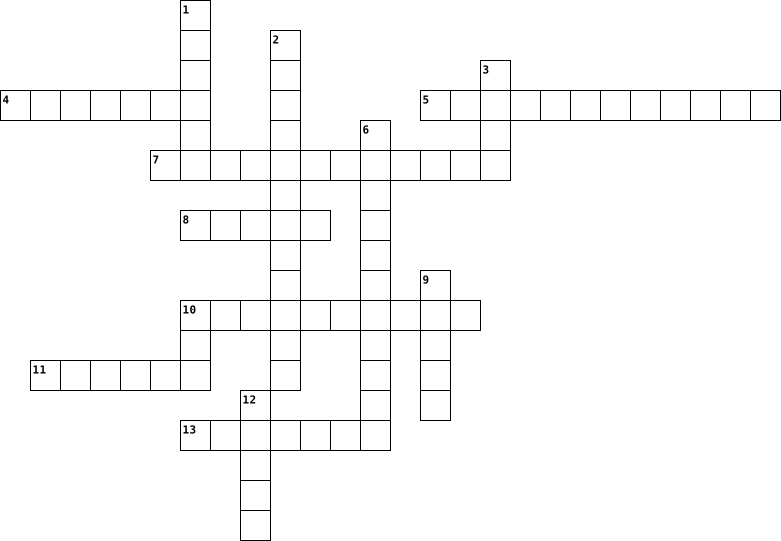
Across
- City Where EARTH WIND & FIRE FORMED
- ORIGINAL FOUNDER & LEADER of EARTH WIND & Fire
- EARTH WIND & FIRE LEAD SINGER
- Finish The Lyrics "LET THIS GROOVE SET IN YOUR..."
- Carlos's restaurant named after which of his own song
- First instrument Carlos learned to play
- "Black Magic Woman" is on which album?
Down
- 2000 Grammy's Song of the Year
- Earth Wind & Fire bassist known for his long hair
- Carlos's Birthday Month
- Which Astrological sign inspired EARTH WIND & FIRE's name
- Finish The Lyrics "OYE COMO VA MI..."
- Finish The Lyrics "MIDNIGHT CREEPS SO SLOWLY INTo HEARTS OF..."
- Instrument Carlos's wife primarily plays
14 Clues: Carlos's Birthday Month • EARTH WIND & FIRE LEAD SINGER • 2000 Grammy's Song of the Year • City Where EARTH WIND & FIRE FORMED • Finish The Lyrics "OYE COMO VA MI..." • "Black Magic Woman" is on which album? • First instrument Carlos learned to play • Instrument Carlos's wife primarily plays • ORIGINAL FOUNDER & LEADER of EARTH WIND & Fire • ...
THE SOLAR SYSTEM 2021-01-21

Across
- The Earth is heavier that the moon. The moon is________ than the Earth.
- The earth is___________ than the moon.
- The ________ is the biggest thing in the solar system.
- The Nile River is the ________ river on the earth.
- Neil Amstrong was the first man to land on the ______.
- Captain Yang Liwei became the _________ Chinese man in space.
- Yuri Gagarin was the first man in _________
Down
- The moon is lighter that the Earth. The Earth is __________ than the moon.
- The second planet is the ________ planet.
- The sun is the ________ thing in the solar system.
- The sun is________ than other stars.
- There are eight________in the solar system.
12 Clues: The sun is________ than other stars. • The earth is___________ than the moon. • The second planet is the ________ planet. • There are eight________in the solar system. • Yuri Gagarin was the first man in _________ • The sun is the ________ thing in the solar system. • The Nile River is the ________ river on the earth. • ...
Squire b3 2021-11-01

Across
- Tower A popular landmark that takes place in paris
- the capital of france
- Largest mountain in maine
- the capital of england
- the maine state bird
- the largest continent on earth
- largest kind of forest
- a school in somerset county
- the middle of the earth and the warmest part of the earth
- it took place in the dust bowl
- It sank in 1912
- a mountain that stretches all the way from new mexico to canada
Down
- it is dry and sandy and has cactuses
- capital of china
- the best crew teacher
- queen of egypt is called a
- the ocean that borders india
- It is the state with the most lobster
- the capital of maine
- A war that the whole world is involved in
20 Clues: It sank in 1912 • capital of china • the maine state bird • the capital of maine • the best crew teacher • the capital of france • the capital of england • largest kind of forest • Largest mountain in maine • queen of egypt is called a • a school in somerset county • the ocean that borders india • the largest continent on earth • it took place in the dust bowl • ...
Squire b3 2021-11-01

Across
- Tower A popular landmark that takes place in paris
- the capital of france
- Largest mountain in maine
- the capital of england
- the maine state bird
- the largest continent on earth
- largest kind of forest
- a school in somerset county
- the middle of the earth and the warmest part of the earth
- it took place in the dust bowl
- It sank in 1912
- a mountain that stretches all the way from new mexico to canada
Down
- it is dry and sandy and has cactuses
- capital of china
- the best crew teacher
- queen of egypt is called a
- the ocean that borders india
- It is the state with the most lobster
- the capital of maine
- A war that the whole world is involved in
20 Clues: It sank in 1912 • capital of china • the maine state bird • the capital of maine • the best crew teacher • the capital of france • the capital of england • largest kind of forest • Largest mountain in maine • queen of egypt is called a • a school in somerset county • the ocean that borders india • the largest continent on earth • it took place in the dust bowl • ...
Space 2021-06-15
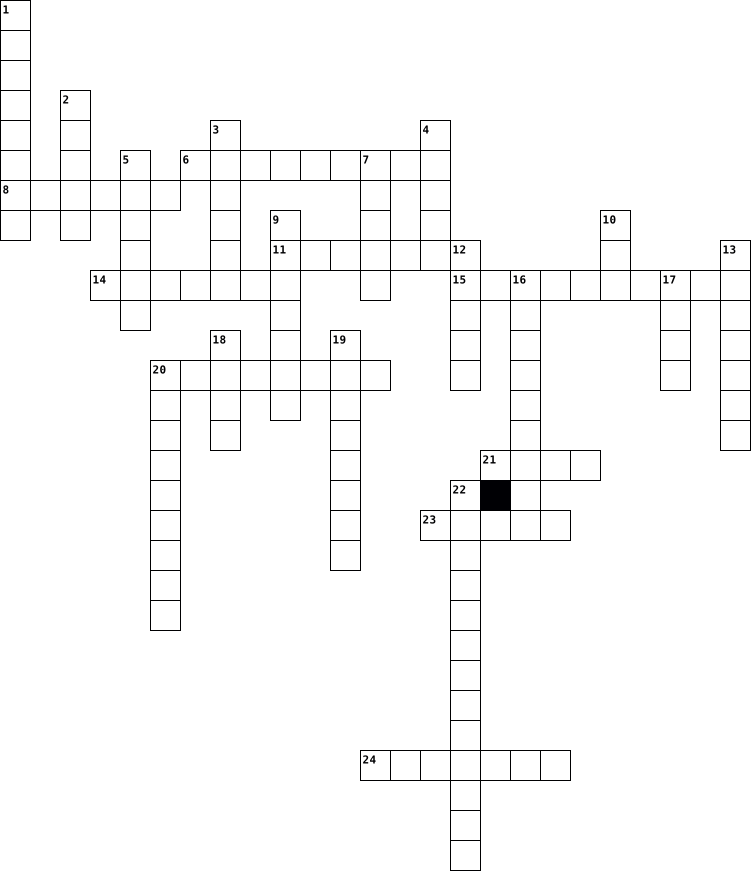
Across
- Remnant of a dead star.
- 6th planet from the sun.
- When the moon covers the sun.
- 5th planet from the sun.
- Person that studies space.
- Big flying rocks.
- The big rock orbiting earth.
- icy frozen balls flying in the sky.
- 8th planet from the sun.
Down
- Holds everything in space.
- Well known dwarf planet.
- What the earth is.
- 2nd planet from the sun.
- 7th planet from the sun.
- Going around something.
- 1st planet from the sun.
- The biggest star that warms us.
- Our home planet.
- Getting pulled towards something.
- invented to see planets better.
- 4th planet from the sun.
- Glowing plasma in the sky.
- Earths galactic home.
- The study of space.
- Stars in the sky making up images.
25 Clues: Our home planet. • Big flying rocks. • What the earth is. • The study of space. • Earths galactic home. • Remnant of a dead star. • Going around something. • Well known dwarf planet. • 2nd planet from the sun. • 7th planet from the sun. • 6th planet from the sun. • 1st planet from the sun. • 5th planet from the sun. • 4th planet from the sun. • 8th planet from the sun. • ...
Mr. G's World Geography Crossword Puzzle 2023-04-10

Across
- One half of a sphere
- The line of latitude that circles the Earth exactly midway between the North and South poles
- Taxes on goods imported from another country
- people who move to another country
- The height of the land above sea level
- The spinning motion of Earth on its axis
- The study of Earth and it's people
- the development, of worldwide, society in which people, money, information, and goods flow fairly and freely across national borders
- people who leave a country
- The 7 largest areas of land on Earth
Down
- Moisture that falls from the sky
- Imaginary lines between the North and South poles that crosses the Equator at right angles
- Imaginary lines around Earth that run parallel to the Equator
- A change in the shape, size, or position of a place when it is shown on a map
- a factor that encourages people to move to a new place
- a factor that encourages people to leave a place
16 Clues: One half of a sphere • people who leave a country • Moisture that falls from the sky • people who move to another country • The study of Earth and it's people • The 7 largest areas of land on Earth • The height of the land above sea level • The spinning motion of Earth on its axis • Taxes on goods imported from another country • ...
Science Review Crossword 2026-02-19

Across
- Greek word for 'Air'
- Greek word for 'Life'
- Stronger tides that occur when the sun, Earth, and moon are in a straight line
- Sphere of the Earth that contains all water
- When the Earth is tilted towards the sun it gets this kind of sunlight
- Greek word for 'Earth'
Down
- Sphere of Earth that contains all living things
- All of the gases that surround the Earth are part of this sphere
- Season that occurs when Earth is tilted away from the sun
- A weaker tide that occurs during a 1st or 3rd quarter moon
- Mountains, rocks, and soil are part of this sphere
- Greek word for 'Water'
12 Clues: Greek word for 'Air' • Greek word for 'Life' • Greek word for 'Water' • Greek word for 'Earth' • Sphere of the Earth that contains all water • Sphere of Earth that contains all living things • Mountains, rocks, and soil are part of this sphere • Season that occurs when Earth is tilted away from the sun • A weaker tide that occurs during a 1st or 3rd quarter moon • ...
Lennon's Science Words! 2023-05-17

Across
- the layer of Earth we live on
- water that comes from plants
- the Earth has ____ like the continental one
- not liquid or gas but ____
- the layer of Earth closest to the crust
- when your cold can of soda starts to "sweat"
- the hot solid center of Earth
- metamorphic, igneous, ______
Down
- liquid that falls from the clouds is called
- if it's 32 degrees or lower it's ______
- the hot liquid that comes out of a volcano is _____
- the layer of the atmosphere we live in
- what water vapor turns into
- water that doesn't soak into the ground
- it's like lava but under ground
15 Clues: not liquid or gas but ____ • what water vapor turns into • water that comes from plants • metamorphic, igneous, ______ • the layer of Earth we live on • the hot solid center of Earth • it's like lava but under ground • the layer of the atmosphere we live in • if it's 32 degrees or lower it's ______ • the layer of Earth closest to the crust • ...
Science 2020-12-16

Across
- learning about volcanoes
- learning about how weather affects the planet
- learning about things that are not on the planet Earth
- learning about the part of your body that helps stop sickness
- learning about the part of Earth where plants and animals live how it works with the rock on the Earth’s surface
- learning about reptiles and amphibians
- learning about the oceans
- learning about birds
- learning about the main types of weather in a certain area
Down
- learning about what animals and plants are made of and how they stay alive
- learning about all living things that are like plants and animals
- learning about things that were alive a long, long time ago
- learning about insects, or bugs
- learning about climate and weather
- learning about animals
- learning about what all things are made of
- science, learning about what the planet Earth is made of
- learning about how things move
18 Clues: learning about birds • learning about animals • learning about volcanoes • learning about the oceans • learning about how things move • learning about insects, or bugs • learning about climate and weather • learning about reptiles and amphibians • learning about what all things are made of • learning about how weather affects the planet • ...
Plate Motion Crossword 2025-11-04

Across
- Hot liquid rock below the surface of earth
- The geologist that created the Pangea theory
- A long, deep indentation in the ocean floor when two plates move together
- Moving toward the same place
- A geologist that proved Pangea was a real thing
- how often or fast something happens
- Center layer of earth
- A natural spring that sends hot water and steam suddenly into the air from a hole in the ground
Down
- A super continent that existed millions of years ago
- A natural disaster where lava erupts
- The layer of soft, solid rock underneath earths plates
- Something we observe to be similar over and over again
- Outer layer of earth
- A sudden shaking of earths surface
- Multiple things that make up on big function
- An extinct reptile that lived about 300 million years ago
- Hot liquid rock on the surface of earth
- Moving apart in direction directions
18 Clues: Outer layer of earth • Center layer of earth • Moving toward the same place • A sudden shaking of earths surface • how often or fast something happens • A natural disaster where lava erupts • Moving apart in direction directions • Hot liquid rock on the surface of earth • Hot liquid rock below the surface of earth • The geologist that created the Pangea theory • ...
Plate Motion Crossword 2025-11-04

Across
- A natural disaster where lava erupts
- A super continent that existed millions of years ago
- A sudden shaking of earths surface
- Center layer of earth
- A natural spring that sends hot water and steam suddenly into the air from a hole in the ground
- Something we observe to be similar over and over again
- Moving toward the same place
- Multiple things that make up on big function
- Moving apart in direction directions
- Hot liquid rock on the surface of earth
Down
- Hot liquid rock below the surface of earth
- The geologist that created the Pangea theory
- A geologist that proved Pangea was a real thing
- how often or fast something happens
- An extinct reptile that lived about 300 million years ago
- Outer layer of earth
- A long, deep indentation in the ocean floor when two plates move together
- The layer of soft, solid rock underneath earths plates
18 Clues: Outer layer of earth • Center layer of earth • Moving toward the same place • A sudden shaking of earths surface • how often or fast something happens • A natural disaster where lava erupts • Moving apart in direction directions • Hot liquid rock on the surface of earth • Hot liquid rock below the surface of earth • The geologist that created the Pangea theory • ...
Habitable Planets and Where to Find Them 2021-02-19

Across
- earth, mars for example are _______
- there is supposedly ____ on habitable planets
- our home
- milky way, for example
- a exoplanet in the habitable zone of proxima centauri
- Orion, the big dipper, the small dipper
- closest star system to earth
Down
- earth, mars, mercury, venus, jupiter,saturn,neptune, uranus is one
- Tess,Hubble,
- life-forms that are not from earth,from outer space
- solar system with possible habitable planets, google made a doodle about it...
- how we're going to space
- telescope that discovered between 1-12 habitable planets
- all space, basically
14 Clues: our home • Tess,Hubble, • all space, basically • milky way, for example • how we're going to space • closest star system to earth • earth, mars for example are _______ • Orion, the big dipper, the small dipper • there is supposedly ____ on habitable planets • life-forms that are not from earth,from outer space • a exoplanet in the habitable zone of proxima centauri • ...
3rd Period Review 2024-05-15

Across
- formation of clouds happen when ___________ condenses at the dew point
- scale used to measure Earthquakes
- initial explanation for a problem that was observed
- ocean zone that contains the most marine life
- area that is mostly between mars and Jupiter
- largest salt flat
- largest moon in the solar system
- this tides happen with a new or full moon
- closest planet to the sun
- bigger planets are classified as
- pieces of the Earth crust
- plate boundaries that cause Earthquakes
- deep trenches in the abyssal zone
Down
- chain of underwater mountains
- layer of the earth that is completely liquid
- only planet suitable for life
- ocean zone that is very dense and has salty water
- variable that is changed by the scientist
- planet with the strongest gravitational field
- thin layer of gas that is found in the stratosphere
- who is the best student
- planet with over 60 moons
- largest layer of the earth
- minerals that are made of atoms with one element
- most tides are
- element essential for life
26 Clues: most tides are • largest salt flat • who is the best student • planet with over 60 moons • closest planet to the sun • pieces of the Earth crust • largest layer of the earth • element essential for life • chain of underwater mountains • only planet suitable for life • largest moon in the solar system • bigger planets are classified as • scale used to measure Earthquakes • ...
Heather Space Crossword 2023-04-21

Across
- probe that explores beyond out solar system
- elon musks is the owner of the star link which is a train of ____ orbiting the earth
- greek princess constellation
- said to represent a "cup bearer" or "water bearer
- our planet is part of a ____ along with several others
- what is earth?
- where all the astronauts live when in space
- a large telescope in space
- objects resistance to change in motion
- solar systems beyond orbit
- keeps us on the ground
- twinkle, twinkle, little _____
- our source of heat and light
- its a candy bar
- our home planet
- an amount of matter in an object
Down
- the ISS orbits the earth in this amount of time
- buzz
- a pole star
- the first element on the periodic table
- space dust
- depicted as a centaur holding a bow and arrow
- represents both the goddess of justice and the goddess of the harvest
- closest star system to us
- going around and around a planet
- stars that make a picture
- planet eater
- constellation that represents a bull
28 Clues: buzz • space dust • a pole star • planet eater • what is earth? • its a candy bar • our home planet • keeps us on the ground • closest star system to us • stars that make a picture • a large telescope in space • solar systems beyond orbit • greek princess constellation • our source of heat and light • twinkle, twinkle, little _____ • going around and around a planet • ...
P5 Exercise 2024-12-17

Across
- type of mixture which has the largest particle
- process which causes rain fall
- earth movement that causes change in seasons
- this gas is required in food making process on plant
- energy that utilize heat from inside of the earth
- the direction of your shadow after 12 PM
- reaction when water and oil could mix
- one revolution of the moon around the earth is called a....
- one of the simple machines
- heat transfer using flow of liquid
- this greenhouse gas is the result of fermentation of cow's dung
Down
- the most abundant gas in the atmosphere
- one of separation method to separate solid over liquid
- the hottest planet on the solar system
- water is one of universal ....., because it can dissolve many substances
- if a material allow heat to easily get through, it is a good...
- separation funnel is used to separate liquid with different ....
- CO2 is an example of .... gases
- separation method that utilize the difference in boiling point
- earth movement that causes day and night
20 Clues: one of the simple machines • process which causes rain fall • CO2 is an example of .... gases • heat transfer using flow of liquid • reaction when water and oil could mix • the hottest planet on the solar system • the most abundant gas in the atmosphere • the direction of your shadow after 12 PM • earth movement that causes day and night • ...
Kylie's Star Crossword 2025-05-16

Across
- This is a space station everyone knows about
- Something in the sky
- A unit of distance, common in space
- You can get sucked into a
- There is none of this in space
- Newton's first law is also known as the law of _______
- The planet we live on
- There are _____ photos on google earth
- a giant cloud of dust and space
- This is the north stars name
- what is Mercury?
- The international space station only takes _________ to orbit around the sun
- This is a space based observatory observing earth
Down
- You can see these at night time. The big dipper is apart of one
- we live in the milkyway _______?
- This is an element in water
- This is a triple star system located 4.37 Lightyears away
- She is the daughter of king Cepheus
- A region behind Neptune in our solar system
- Every planet have diffrent ____
- It is a NASA space probe, launched on september 5th,1977
- This is the galaxy we live in
- The earth _______ the sun
23 Clues: what is Mercury? • Something in the sky • The planet we live on • You can get sucked into a • The earth _______ the sun • This is an element in water • This is the north stars name • This is the galaxy we live in • There is none of this in space • Every planet have diffrent ____ • a giant cloud of dust and space • we live in the milkyway _______? • A unit of distance, common in space • ...
Choice board 2022-09-15

Across
- that the outer layer has big plates
- north and south poles switch perioddily
- the boundary between two plates that our colliding
- the boundary between two tectonic plates
- strong lower part of mantle
- center of earth
- volcano making new land forms
- Rebound the sudden return of elastically deformed rock
- soft layer of mantle
- sudden return of elastically deformed Rock
- earths surface of the point were the earth quake starts
Down
- the boundy between two plates that are sliding past each other
- the lithosphere moves
- large land mass brake up to be smaller
- were the first motion of an earth quake starts
- a movement trembling of the ground
- a brake in a body of rock
- solid outer layer
- a block of lithosphere
- a chain of events that you do and it will make it right
- the bending or braking of crust
- between crust and core
- a movement of matter that changes density
- The Edge between two or more plates classified as divergent, convergent
- thin solid layer of earth
25 Clues: center of earth • solid outer layer • soft layer of mantle • the lithosphere moves • a block of lithosphere • between crust and core • a brake in a body of rock • thin solid layer of earth • strong lower part of mantle • volcano making new land forms • the bending or braking of crust • a movement trembling of the ground • that the outer layer has big plates • ...
Te Whenua 2025-08-20

Across
- Fine powdery material ejected from volcanoes.
- The process where one tectonic plate sinks under another.
- Natural hot spring that shoots water and steam, common in Rotorua.
- Chain of volcanoes and earthquakes around the Pacific Ocean.
- The thick middle layer of the Earth beneath the crust.
- The huge slabs of Earth’s crust that move and cause earthquakes and volcanoes.
- Māori word for land or earth.
- Vibrations that travel through the Earth during earthquakes.
- Rock that flows onto Earth’s surface during an eruption.
- Molten rock stored beneath the surface.
Down
- Giant cracks in the Earth’s surface where earthquakes occur.
- Māori god of earthquakes and volcanoes.
- Large volcanic lake in NZ, site of one of the world’s biggest eruptions.
- Layer at the Earth’s centre made of iron and nickel.
- Huge supercontinent that broke apart millions of years ago.
- Movements of tectonic plates over time, shifting continents.
- Explosive mountain in NZ’s central plateau, still active today.
- Solid outer layer of the Earth where we live.
- Māori word for fire, often linked with volcanic eruptions.
- Large offshore trench east of NZ formed by subduction.
20 Clues: Māori word for land or earth. • Māori god of earthquakes and volcanoes. • Molten rock stored beneath the surface. • Fine powdery material ejected from volcanoes. • Solid outer layer of the Earth where we live. • Layer at the Earth’s centre made of iron and nickel. • The thick middle layer of the Earth beneath the crust. • ...
Investigation 1 2012-10-14

Across
- the part of the earth system that encompasses (includes) the crust, mantle, inner and outer core.
- a process in which molten rock becomes solid rock
- molten rock that has erupted and exposed to the surface of the earth.
- a process in which igneous rocks cool and crystal formation takes place
- the process of eroded materials being moved and deposited (dropped) in another place
- the process during which rocks are broken up into smaller particles or sediments by the action of water, the atmosphere, and organisms
- the process by which wind, water, ice, or gravity transports soil and sediment from one location to another.
- the part of the the earth system that includes the gases.
Down
- the part of the earth system that includes living things, such as plants, animals and human beings.
- molten rock material beneath (under) the surface of the earth.
- a process when layers of small sediments are compressed (pressed or smashed) together
- the part of the earth system that includes water bodies, such as the ocean and the seas.
- a process in which large sediments are held together like by evaporated mud
- a rock type that is layered is comes from cementation and compaction of sediments.
- a rock type made from hardened magma
- a process in which solid rock becomes molten rock
16 Clues: a rock type made from hardened magma • a process in which molten rock becomes solid rock • a process in which solid rock becomes molten rock • the part of the the earth system that includes the gases. • molten rock material beneath (under) the surface of the earth. • molten rock that has erupted and exposed to the surface of the earth. • ...
Volcanoes 2021-02-08

Across
- layer of the earth under the crust
- area in the pacific ocean with lots of volcanic activity
- crack in the earth's crust where volcanic material escapes
- top layer of the earth
- fine particles of rock dust from an erupting volcano
- Roman god for whom volcanoes are named
- planet with the largest known volcano
Down
- melted rock inside of the earth
- passage followed by magma
- side of a volcano
- tall column of water and steam erupting from the earth's surface
- ejection of solid, liquid and gas from a volcano
- volcano that is currently inactive but may erupt in the future
- the earth's crust is divided into __ plates
- melted rock that comes out of a volcano
- center of the earth
16 Clues: side of a volcano • center of the earth • top layer of the earth • passage followed by magma • melted rock inside of the earth • layer of the earth under the crust • planet with the largest known volcano • Roman god for whom volcanoes are named • melted rock that comes out of a volcano • the earth's crust is divided into __ plates • ...
Structure of the Earth 2013-12-05

Across
- the inner core of the Earth is the H________
- the centre of the Earth
- the inner core is made from this metal
- where the insides of the Earth explode through the crust
Down
- this surrounds the Earth caused by the iron core.
- this layer is between the crust an the outer core
- the crust is the only s______ layer of the Earth
- iron is a type of metal
- there are _______ layers to the Earth
- there is an outer core and an _________ core
- the solid outer layer of the Earth
11 Clues: iron is a type of metal • the centre of the Earth • the solid outer layer of the Earth • there are _______ layers to the Earth • the inner core is made from this metal • the inner core of the Earth is the H________ • there is an outer core and an _________ core • the crust is the only s______ layer of the Earth • this surrounds the Earth caused by the iron core. • ...
Earth's Systems, Energy and Feedback 2026-02-18

Across
- The movement of sediment from one place to another.
- System All of Earth’s spheres working together and interacting through matter and energy.
- All living organisms on Earth.
- Anything that has mass and takes up space.
- All frozen water on Earth, including glaciers, ice caps, sea ice, and permafrost.
- The ability to do work or cause change.
- The breaking down of rocks into smaller pieces.
Down
- A change that slows down or stabilizes a process.
- Flow The movement of energy through Earth’s systems. Most energy comes from the Sun.
- All water on Earth, including oceans, rivers, lakes, groundwater, and water vapor.
- The solid part of Earth, including rocks, soil, landforms, and Earth’s interior.
- The continuous movement of water through evaporation, condensation, precipitation, and collection.
- The layer of gases surrounding Earth.
- The continuous process that forms, breaks down, and reforms rocks through weathering, erosion, deposition, compaction, heat, and melting.
- A group of interacting parts that work together as a whole.
- A change that increases or speeds up a process.
16 Clues: All living organisms on Earth. • The layer of gases surrounding Earth. • The ability to do work or cause change. • Anything that has mass and takes up space. • A change that increases or speeds up a process. • The breaking down of rocks into smaller pieces. • A change that slows down or stabilizes a process. • The movement of sediment from one place to another. • ...
vocabulary 2021-12-03

Across
- the visible satellite of the earth
- the light from the sun
- the action of rotating around an axis or center
- the time of darkness
- the amount of time it takes for the earth to revolve around the sun
- the half of the earth
- the four divisions of the year
Down
- the curved path of a celestial object or spacecraft
- the natural light of day
- the amount of level or extent
- the time or date
- the angular distance of a place north or south of the earths equator
- the amount of space in between two objects
- the lines that stream from the sun
- the planet we live on
15 Clues: the time or date • the time of darkness • the planet we live on • the half of the earth • the light from the sun • the natural light of day • the amount of level or extent • the four divisions of the year • the visible satellite of the earth • the lines that stream from the sun • the amount of space in between two objects • the action of rotating around an axis or center • ...
Astronomy 2024-04-25

Across
- Why do we have seasons?
- The two days of the year on which neither hemisphere is tilted toward or away from the sun
- A region of complete shadow resulting from total obstruction of light
- The scientific law that states that every object in the universe attracts every other object
- The moon blocks sunlight from Earth, when the new moon passes directly between the sun and Earth.
- A tide with the least difference between low and high tide; occurs when the sun and moon pull at right angles: at the first and third quarter moons.
- The different shapes of the moon you see from Earth.
- The periodic rise and fall of ocean water caused by the gravitational pull of the moon
- An imaginary line that passes through Earth's center and the North and South Poles, about which Earth rotates
- The cause of day and night
- The path of an object as it revolves around another object in space
Down
- A tide with the greatest difference between high and low tide; occurs when the sun and the moon are in a line: at a new moon and a full moon.
- The movement of an object around another object, Earth's = 365 1/4 days
- this planets tilt is 23.5 degrees
- The larger part of the shadow surrounding the darkest part.
- Earth blocks sunlight from reaching the moon
- the two days of the year on which the sun reaches its greatest distance north or south of the equator
- a push or pull exerted on an object
- an object at rest tends to stay at rest, and an object in motion tends to stay in motion
- The spinning motion of a planet on its axis Earths = 24 hours
- The tendency of an object to resist a change in motion
- Earths revolution is 356 and1/4 _______ long
- the study of the universe beyond Earth, including the sun, moon, planets, and stars
23 Clues: Why do we have seasons? • The cause of day and night • this planets tilt is 23.5 degrees • a push or pull exerted on an object • Earth blocks sunlight from reaching the moon • Earths revolution is 356 and1/4 _______ long • The different shapes of the moon you see from Earth. • The tendency of an object to resist a change in motion • ...
The Universe 2020-09-22

Across
- the movement of one object around another, Earth around the sun, year; 365 1/4 days
- the amount of matter in an object
- the Big Bang is a THEORY about the creation of the UNIVERSE
- any consolidated, large object which orbits a star
- having or relating to the earth as center
- the force that pulls an apple to the ground, pulls the moon toward Earth, keeps the planets in orbit and attract objects towards each other
- a ball of ice and dust who orbits around the sun in a long,narrow ellipse
- the theory that the solar system evolved from a mass of nebular matter
- a chunk of rock or dust in space that comes from comets or asteroids
- when a meteoroid burns in the atmosphere and hits the ground
Down
- streams of charged particles constantly given off by the Sun
- the galaxy to which Earth and other components of our Solar System belong
- is a scientific activity the aim of which is to make a particular part or feature of the world easier to understand, define, quantify, visualize, or simulate
- having or relating to the sun as center
- the outer atmosphere of the Sun made up of thin gases and can only be seen during a solar eclipse without telescopes its temperature is 1 - 2,000,000°C
- objects revolving around the sun that are too small and too numerous to be considered planets
- giant spinning dome that the Greeks thought surrounded the Earth
- the lower level of the solar atmosphere between the photosphere and the corona
- a theory that says that the universe will stop expanding outward, reverse direction, and pull back on itself to the single point
- the spinning of the Earth on its axis, day and night (24 hours)
- the measure of the force of gravity on an object
- the streak of light in the sky produced by the burning of a meteoroid in Earth's atmosphere
22 Clues: the amount of matter in an object • having or relating to the sun as center • having or relating to the earth as center • the measure of the force of gravity on an object • any consolidated, large object which orbits a star • the Big Bang is a THEORY about the creation of the UNIVERSE • streams of charged particles constantly given off by the Sun • ...
Space Vocab Crossword 1 2025-05-05

Across
- The moon is starting to shrink. "Waning" means shrinking. The light is on the left side now.
- Half of the moon is lit up on the right side. It looks like a half-moon.
- Half of the moon is lit up again, but now it’s the left side.
- A tool that shows the time by the shadow of a pointer cast by the Sun on to a plate marked with hours in a day.
- An imaginary line that goes through the north pole and the south pole.
- To spin or turn around a central point like the Earth and it’s axis.
- Just a tiny sliver of light is left on the left side before the moon becomes new again.
- The entire face of the moon is lit up and visible from Earth.
Down
- The part of the Moon that we can see on a particular night.
- The tilt of the Earth is when the Earth tilts toward the Sun (Summer) and away from the Sun (Winter).
- More than half of the moon is lit, but it’s not full yet. The light is biggest on the right side.
- A time of the year with specific weather that repeats every year.
- A long exposure picture that shows the movement of stars in the night sky
- The distance around a circle.
- An informative representation of an object, person or system.
- A regular repeating path that one planet takes around another.
- A small sliver of the moon begins to appear on the right side. "Waxing" means growing.
- The moon is between the Earth and the Sun. We can’t see it from Earth because the sunlit side is facing away from us.
- A group of stars that looks like a particular shape in the sky and has been given a name.
- Set of events that repeats in the same order over and over.
20 Clues: The distance around a circle. • The part of the Moon that we can see on a particular night. • Set of events that repeats in the same order over and over. • An informative representation of an object, person or system. • Half of the moon is lit up again, but now it’s the left side. • The entire face of the moon is lit up and visible from Earth. • ...
Final Exam Science 2024-02-22

Across
- Rock formed from pieces of other rock and remains of living things that have been pressed together
- Rock that has been changed by intense heart, pressure, and chemical reactions
- Area that has the same clock time
- A circuit in which there is more than one path for current
- Imaginary line that defies the start of a day
- Layer of soil directly below the topsoil
- Spinning of the Earth
- Line of 0 degree longitude
- Point farthest south on the Earth
- Top layer of soil, rich with oxygen and decayed organic matter
- To push apart
- An object that attracts certain kinds of metals, such as iron
- Angle that describes the distance east or west of the prime meridian
- Element or compound found in the Earth
- Rock formed from melted minerals that have cooled and hardened
- A temporary magnet made by passing a current through a wire wrapped around an iron core
- Mixture of tiny pieces of weathered rock and the remains of plants and animals
- Natural, solid material made of one or more minerals
Down
- Half of the Earth
- Breaking apart of rocks without changing their mineral composition
- How a mineral reflects light
- Color of the mark a mineral makes on a white tile
- Breaking apart of rocks caused by a change in their chemical makeup
- Line of 0 degrees latitude halfway between the poles
- A source of voltage that changes chemical energy into electrical energy
- Point farthest north on the Earth
- Series of natural changes that cause one type of rock to become another type of rock
- Movement of one object in its orbit around another object in space
- Angle that describes the distance north or south of the equator
- A device that converts electrical energy to mechanical energy
- Thick mass of ice that covers a large area
- Breaking down of rocks on the Earth's surface
- Igneous rock that forms underground from cooled magma
- Hot, liquid rock inside the earth
- One of the 7 major land areas of the Earth
- Line of latitude
36 Clues: To push apart • Line of latitude • Half of the Earth • Spinning of the Earth • Line of 0 degree longitude • How a mineral reflects light • Area that has the same clock time • Point farthest north on the Earth • Point farthest south on the Earth • Hot, liquid rock inside the earth • Element or compound found in the Earth • Layer of soil directly below the topsoil • ...
Plate Tectonics 2022-01-18

Across
- pieces of Earth crust tha fit together into puzzle pieces
- Name of ocean that is surrounded by the Ring of Fire
- Rigid layer of Earth crust where all the plates are located
- In what country can you walk through a crack in the earth
- Breaks in earth's crust that are a result of plates
- Name of the original land mass before all the continents broke up
- Name of planet that has 7 continents
- Name of fault located on the west coast of the United States of America - no spaces
- The theory of Earth plates and plate movements
- Name of type of boundary that is between the Indo-Australian and Antarctic plate
Down
- Plates meet at what type of boundary
- What do scientists use to measure plate motions
- Name of plate that is adjacent to the North American plate and the San Andres Fault - no spaces
- Name of mountains that formed when the Indo-Australian Plate hit the Eurasian plate
- Plates move apart from each other at
- A deep valley where pieces of crust diverge on land - no spaces
- Plates slip past each other at?
- What type of boundary did the Andes mountain form at?
- Name of plates that includes all of Asia and Europe
19 Clues: Plates slip past each other at? • Plates meet at what type of boundary • Plates move apart from each other at • Name of planet that has 7 continents • The theory of Earth plates and plate movements • What do scientists use to measure plate motions • Breaks in earth's crust that are a result of plates • Name of plates that includes all of Asia and Europe • ...
U-Pick Project 2025-05-06

Across
- Plate boundaries slide past each other in two opposite horizontal directions
- Innermost layer of the Earth
- The breaking down of rocks and other materials on the Earth's surface by wind, rain, and other forces
- Heat is transferred in waves through the air
- A volcanically active area
- Molten rock at or above Earth's surface
- Type of rock that forms from sediments
- Area of volcanic and seismic activity that surrounds the Pacific plate
- Shaking or trembling of the Earth's crust
- Blocks near the fault move horizontally past one another
- Type of rock that forms from magma or lava
- Not from a living thing
Down
- Force that pulls on the ends of rock causing it to get thinner in the middle
- Type of rock that forms from great heat and pressure
- Process by which weathered rock and soil are moved from one place to another
- A series of processes on the surface and inside Earth that slowly changes rocks from one kind to another
- When plate boundaries move towards each other
- All water on Earth
- The Earth itself
- Lava moving across Earth's surface
- Molten rock below Earth's surface
- Plate boundaries move away from each other
- Process in which sediment is laid down in new locations
- Occurs where one plate moves under another plate
- Outermost layer of the Earth
25 Clues: The Earth itself • All water on Earth • Not from a living thing • A volcanically active area • Innermost layer of the Earth • Outermost layer of the Earth • Molten rock below Earth's surface • Lava moving across Earth's surface • Type of rock that forms from sediments • Molten rock at or above Earth's surface • Shaking or trembling of the Earth's crust • ...
Solar days and years 2017-06-05

Across
- The direction of the highest point during the day
- The imaginary line around the centre of the Earth
- The hemisphere Australia is located in
- The spin of the Earth on its axis
- The direction the sun rises in
- Also known as midday
- The centre of our solar system
Down
- The direction the sun sets in
- The hemisphere Russia is located in
- An imaginary line from north to south that passes through the highest point in the sky
- year The time (365 days) taken for Earth to rotate once around the sun
- The planet we live on
- The tilt of the Earth
13 Clues: Also known as midday • The planet we live on • The tilt of the Earth • The direction the sun sets in • The direction the sun rises in • The centre of our solar system • The spin of the Earth on its axis • The hemisphere Russia is located in • The hemisphere Australia is located in • The direction of the highest point during the day • ...
Unit 2 Choice Board 2024-09-22

Across
- Adenosine diphosphate, uncharged energy storage molecule with 2 phosphates
- Second step of anaerobic respiration, 2 types include alcoholic and lactic acid
- First step of photosynthesis, uses sunlight to slit H2O & make ATP & NADPH, O2 is released
- Sphere of earth, all gases surrounding earth
- Anything that has mass and takes up space, makes up everything
- Type of organism that breaks down biotic compounds into abiotic compounds, recyclers
- process of breaking down glucose to make ATP, starts with glucose and oxygen and ends with carbon dioxide and water
- Type of organism that must eat other organisms to obtain energy
- organelle - site of photosynthesis
- Describes a situation which oxygen is not present
- Sphere of earth, all living things on earth
Down
- Shere of earth, all water on earth
- pigment in chloroplasts, used to trap light energy during photosynthesis
- Sphere of earth, all soil and rocks on earth
- Describes a situation which oxygen is present
- Type of organism that is able to make its own food, base of the food chain
- Adenosine Triphosphate, charged energy storage molecule with 3 phosphorus groups
- Organelle, site of steps 2 and 3 of aerobic cellular respiration
- Second step of photosynthesis, uses energy in ATP & NADPH to make glucose from co2
- Nutrient, forms backbone for all macromolecules in living things
20 Clues: Shere of earth, all water on earth • organelle - site of photosynthesis • Sphere of earth, all living things on earth • Sphere of earth, all soil and rocks on earth • Sphere of earth, all gases surrounding earth • Describes a situation which oxygen is present • Describes a situation which oxygen is not present • ...
Astronomy and General Science 2020-12-07

Across
- Gases surrounding the Earth
- How the sun creates energy
- Energy transfer where heat rises, cold sinks
- the number of stars in our solar system
- Energy transfer through space
- Contains planets revolving around a star
- Category that describes all water on Earth
- the amount of time it takes for the Earth to revolve one time around the sun (no spaces)
- To move around another object
Down
- Really high high tides (full and new moon)
- Energy transfer by touching
- Category that describes all living things
- time it takes for Earth to rotate once (no spaces)
- The electromagnetic spectrum is all types of
- Category that describes Earth's land/ crust
- to spin on an axis
16 Clues: to spin on an axis • How the sun creates energy • Gases surrounding the Earth • Energy transfer by touching • Energy transfer through space • To move around another object • the number of stars in our solar system • Contains planets revolving around a star • Category that describes all living things • Really high high tides (full and new moon) • ...
Water Cycle-Abigail Althoff 2022-11-29

Across
- what is needed for water to evaporate
- when water comes off landscapes
- water that is near higher land
- when water is heated up
- what rises and becomes steam
- when water moves underground and finds an opening to the surface
- water coming down onto earth from a cloud
- what moves water all over the earth
- the biggest area in the water
Down
- brings water down to earth
- what is the main part of the cycle
- when water seeps down into the earth
- force of gravity making water come out of plants
- what happens in a river
- they urinate it out
- when six months have passed after snowfall
16 Clues: they urinate it out • when water is heated up • what happens in a river • brings water down to earth • what rises and becomes steam • the biggest area in the water • water that is near higher land • when water comes off landscapes • what is the main part of the cycle • what moves water all over the earth • when water seeps down into the earth • ...