
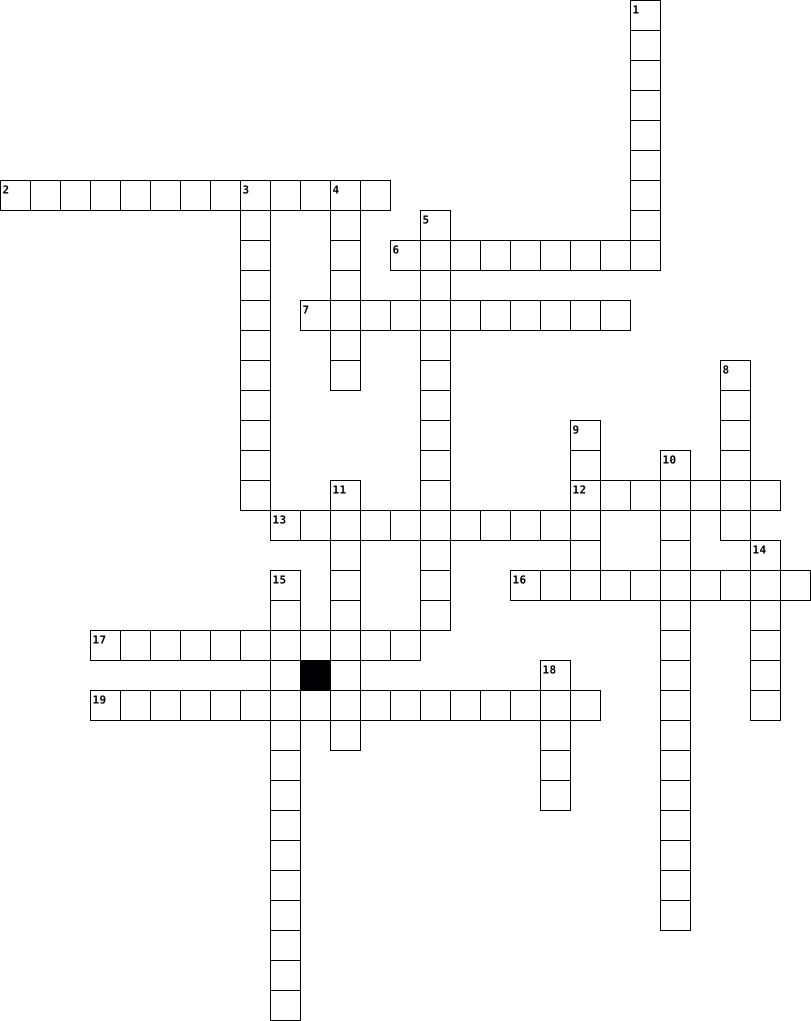
bill of rights Crossword Puzzles
Tri 1 Review 2020-11-12

Across
- According to the Declaration of Independence, the ______ have the responsibility to change our government if it becomes oppressive and won’t protect our natural rights
- The _______ Branch makes the laws
- This European country began creating colonies along the Atlantic Ocean in North America in the early 1600s
- One of our three “unalienable” rights listed in the Declaration of Independence
- The biggest problem with the articles of Confederation was that it didn’t give enough _____ to the central government
- By crying “No _____with Representation,” they meant that Britain shouldn’t be allowed to tax the colonists unless they have a voice in Parliament through representatives
- One of the three colonial regions - Georgia was part of this one
- This is the sharing of power between the state governments and the national government
- According to the Declaration of Independence, governments are “instituted” to make sure that everyone’s _____ are protected
- One of the three colonial regions - Massachusetts was part of this one (2)
- Daniel _____ led a rebellion of Massachusetts farmers that signaled a big problem with the Articles of Confederation
- The _______ is in charge of the Executive Branch
- The Bill of Rights make up the first ___ amendments to the Constitution (spell the number)
- The ______ Branch carries out, or executes, the laws
- The ________ Compromise determined how slaves would be counted for the purposes of representation in Congress and taxation (2)
- One of our three “unalienable” rights listed in the Declaration of Independence
- The American ______ was a war between the United States and Britain
- The ______ Branch interprets the laws
- A _________ is a government in which citizens rule through elected representatives
- One of the three colonial regions - Pennsylvania was part of this one
- This short book of propaganda convinced many colonists that independence from Britain was the right move (2)
- Our new Constitution created a central government that was much ______ than it was previously under the Articles of Confederation (stronger or weaker?)
Down
- He published the influential book Common Sense in 1776 (last name only)
- The biggest criticism of the new Constitution was that it did not include a _____ (3)
- The First Amendment guarantees freedom of _______ - meaning that people can criticize our government and our leaders
- James Madison, Alexander Hamilton, and John Jay wrote a series of essays to persuade the American people to support the ratification of the new Constitution (2)
- One of our three “unalienable” rights listed in the Declaration of Independence (3)
- This system allows each branch to limit and control the power of the other two branches of government (3)
- Britain accumulated a lot of debt from 1754-1763 protecting its colonists in which war? (3)
- Britain ultimately created this many colonies along the Atlantic Coast of North America (spell the number)
- The ___________ was the law that established that slavery would not be allowed anywhere in the Northwest Territory (2)
- The First Amendment guarantees freedom of _______ - meaning that people can gather peacefully to protest
- The president has a group of advisors known as the _____
- The First Amendment guarantees freedom of the ______ - meaning that journalists can freely publish scandalous news about our leaders as long as it’s true
- Congress is _____, meaning that it is made up of two houses
- James _____ is known as the “Father of the Constitution” because of his many contributions to it
- The Supreme Court has ______, or the power to declare laws unconstitutional (2)
- The Constitutional Convention happened in the summer of 17__ (spell the last part) (2)
- The ________ process allows public officials (like the president) to be charged with wrongdoing and possibly removed from office
- The First Amendment guarantees freedom of ________ - meaning that people can believe however choose about a higher power
- The First Amendment guarantees freedom of ______ - meaning that we can openly express ourselves
41 Clues: The _______ Branch makes the laws • The ______ Branch interprets the laws • The _______ is in charge of the Executive Branch • The ______ Branch carries out, or executes, the laws • The president has a group of advisors known as the _____ • Congress is _____, meaning that it is made up of two houses • One of the three colonial regions - Georgia was part of this one • ...
Rebellution Losses Bill/ Upper and Lower Canada 2015-12-12

Across
- Losses Bill/A bill was to compensate people in Canada East/Lower Canada whose property had been damaged by the rebellions.
- Clique/It was a group of wealthy people in the government of Upper and Lower Canada.
- got responsible government.
- Lafontaine/He was the other person who created the bill.
- Baldwin/ A person who created the bill because his father wanted a responsible government.
Down
- Government/A government that is responsible to the people.
- member or supporter of the Conservative Party in the UK.
- Elgin/The person who signed the bill.
- group of people who have money and power.
9 Clues: got responsible government. • Elgin/The person who signed the bill. • group of people who have money and power. • member or supporter of the Conservative Party in the UK. • Lafontaine/He was the other person who created the bill. • Government/A government that is responsible to the people. • ...
Tri 1 Review 2020-11-12

Across
- The ________ process allows public officials (like the president) to be charged with wrongdoing and possibly removed from office
- James _____ is known as the “Father of the Constitution” because of his many contributions to it
- One of the three colonial regions - Georgia was part of this one
- By crying “No _____with Representation,” they meant that Britain shouldn’t be allowed to tax the colonists unless they have a voice in Parliament through representatives
- One of our three “unalienable” rights listed in the Declaration of Independence
- One of our three “unalienable” rights listed in the Declaration of Independence (3)
- Daniel _____ led a rebellion of Massachusetts farmers that signaled a big problem with the Articles of Confederation
- The ________ Compromise determined how slaves would be counted for the purposes of representation in Congress and taxation (2)
- Britain accumulated a lot of debt from 1754-1763 protecting its colonists in which war? (3)
- According to the Declaration of Independence, the ______ have the responsibility to change our government if it becomes oppressive and won’t protect our natural rights
- The Bill of Rights make up the first ___ amendments to the Constitution (spell the number)
- The American ______ was a war between the United States and Britain
- The First Amendment guarantees freedom of ________ - meaning that people can believe however choose about a higher power
- The biggest problem with the articles of Confederation was that it didn’t give enough _____ to the central government
- The biggest criticism of the new Constitution was that it did not include a _____ (3)
- The Supreme Court has ______, or the power to declare laws unconstitutional (2)
- This system allows each branch to limit and control the power of the other two branches of government (3)
- The Constitutional Convention happened in the summer of 17__ (spell the last part) (2)
- One of our three “unalienable” rights listed in the Declaration of Independence
- The First Amendment guarantees freedom of ______ - meaning that we can openly express ourselves
Down
- One of the three colonial regions - Massachusetts was part of this one (2)
- He published the influential book Common Sense in 1776 (last name only)
- The ______ Branch interprets the laws
- This short book of propaganda convinced many colonists that independence from Britain was the right move (2)
- The _______ Branch makes the laws
- Congress is _____, meaning that it is made up of two houses
- One of the three colonial regions - Pennsylvania was part of this one
- The First Amendment guarantees freedom of the ______ - meaning that journalists can freely publish scandalous news about our leaders as long as it’s true
- Our new Constitution created a central government that was much ______ than it was previously under the Articles of Confederation (stronger or weaker?)
- James Madison, Alexander Hamilton, and John Jay wrote a series of essays to persuade the American people to support the ratification of the new Constitution (2)
- The ______ Branch carries out, or executes, the laws
- The president has a group of advisors known as the _____
- The First Amendment guarantees freedom of _______ - meaning that people can gather peacefully to protest
- The ___________ was the law that established that slavery would not be allowed anywhere in the Northwest Territory (2)
- The First Amendment guarantees freedom of _______ - meaning that people can criticize our government and our leaders
- The _______ is in charge of the Executive Branch
- A _________ is a government in which citizens rule through elected representatives
- This is the sharing of power between the state governments and the national government
- This European country began creating colonies along the Atlantic Ocean in North America in the early 1600s
- According to the Declaration of Independence, governments are “instituted” to make sure that everyone’s _____ are protected
- Britain ultimately created this many colonies along the Atlantic Coast of North America (spell the number)
41 Clues: The _______ Branch makes the laws • The ______ Branch interprets the laws • The _______ is in charge of the Executive Branch • The ______ Branch carries out, or executes, the laws • The president has a group of advisors known as the _____ • Congress is _____, meaning that it is made up of two houses • One of the three colonial regions - Georgia was part of this one • ...
Moises's Crossword puzzle - Unit 2 2022-09-28

Across
- sovereignty the principle that the authority of a state and its government are created and sustained by the consent of its people, through their elected representatives, who are the source of all political power.
- a philosophical movement of the 18th century, characterized by belief in the power of human reason and by innovations in political, religious, and educational doctrine.
- the rational investigation of the truths and principles of being, knowledge, or conduct.
Down
- an implicit agreement among the members of a society to cooperate for social benefits, for example by sacrificing some individual freedom for state protection
- government by the people; a form of government in which the supreme power is vested in the people and exercised directly by them or by their elected agents under a free electoral system.
- of rights Comprises the first ten amendments to the United States Constitution. The first 10 amendments to the Constitution make up the Bill of Rights. James Madison wrote the amendments, which list specific prohibitions on governmental power, in response to calls from several states for greater constitutional protection for individual liberties.
6 Clues: the rational investigation of the truths and principles of being, knowledge, or conduct. • an implicit agreement among the members of a society to cooperate for social benefits, for example by sacrificing some individual freedom for state protection • ...
Moises's Crossword puzzle - Unit 2 2022-09-28

Across
- sovereignty the principle that the authority of a state and its government are created and sustained by the consent of its people, through their elected representatives, who are the source of all political power.
- a philosophical movement of the 18th century, characterized by belief in the power of human reason and by innovations in political, religious, and educational doctrine.
- the rational investigation of the truths and principles of being, knowledge, or conduct.
Down
- an implicit agreement among the members of a society to cooperate for social benefits, for example by sacrificing some individual freedom for state protection
- government by the people; a form of government in which the supreme power is vested in the people and exercised directly by them or by their elected agents under a free electoral system.
- of rights Comprises the first ten amendments to the United States Constitution. The first 10 amendments to the Constitution make up the Bill of Rights. James Madison wrote the amendments, which list specific prohibitions on governmental power, in response to calls from several states for greater constitutional protection for individual liberties.
6 Clues: the rational investigation of the truths and principles of being, knowledge, or conduct. • an implicit agreement among the members of a society to cooperate for social benefits, for example by sacrificing some individual freedom for state protection • ...
Constitution Vocabulary 2016-03-10

Across
- supreme law of the land
- Branch creates the laws
- change or modify
- group that advise the President
- way to remove official from office
- cannot be arrested after the fact
- introduction to the Constitution
- an idea that can become a law
- when the President says No to a Bill from Congress
Down
- Branch interprets the laws
- process to become a US citizen
- accept or approve
- Branch enforces the law
- two-house legislature
- of Powers splitting of the jobs between branches
15 Clues: change or modify • accept or approve • two-house legislature • supreme law of the land • Branch creates the laws • Branch enforces the law • Branch interprets the laws • an idea that can become a law • process to become a US citizen • group that advise the President • introduction to the Constitution • cannot be arrested after the fact • way to remove official from office • ...
Moises's Crossword puzzle - Unit 2 2022-09-28

Across
- sovereignty the principle that the authority of a state and its government are created and sustained by the consent of its people, through their elected representatives, who are the source of all political power.
- a philosophical movement of the 18th century, characterized by belief in the power of human reason and by innovations in political, religious, and educational doctrine.
- the rational investigation of the truths and principles of being, knowledge, or conduct.
Down
- an implicit agreement among the members of a society to cooperate for social benefits, for example by sacrificing some individual freedom for state protection
- government by the people; a form of government in which the supreme power is vested in the people and exercised directly by them or by their elected agents under a free electoral system.
- of rights Comprises the first ten amendments to the United States Constitution. The first 10 amendments to the Constitution make up the Bill of Rights. James Madison wrote the amendments, which list specific prohibitions on governmental power, in response to calls from several states for greater constitutional protection for individual liberties.
6 Clues: the rational investigation of the truths and principles of being, knowledge, or conduct. • an implicit agreement among the members of a society to cooperate for social benefits, for example by sacrificing some individual freedom for state protection • ...
Moises's Crossword puzzle - Unit 2 2022-09-28

Across
- sovereignty the principle that the authority of a state and its government are created and sustained by the consent of its people, through their elected representatives, who are the source of all political power.
- a philosophical movement of the 18th century, characterized by belief in the power of human reason and by innovations in political, religious, and educational doctrine.
- the rational investigation of the truths and principles of being, knowledge, or conduct.
Down
- an implicit agreement among the members of a society to cooperate for social benefits, for example by sacrificing some individual freedom for state protection
- government by the people; a form of government in which the supreme power is vested in the people and exercised directly by them or by their elected agents under a free electoral system.
- of rights Comprises the first ten amendments to the United States Constitution. The first 10 amendments to the Constitution make up the Bill of Rights. James Madison wrote the amendments, which list specific prohibitions on governmental power, in response to calls from several states for greater constitutional protection for individual liberties.
6 Clues: the rational investigation of the truths and principles of being, knowledge, or conduct. • an implicit agreement among the members of a society to cooperate for social benefits, for example by sacrificing some individual freedom for state protection • ...
Moises's Crossword puzzle - Unit 2 2022-09-28

Across
- sovereignty the principle that the authority of a state and its government are created and sustained by the consent of its people, through their elected representatives, who are the source of all political power.
- a philosophical movement of the 18th century, characterized by belief in the power of human reason and by innovations in political, religious, and educational doctrine.
- the rational investigation of the truths and principles of being, knowledge, or conduct.
Down
- an implicit agreement among the members of a society to cooperate for social benefits, for example by sacrificing some individual freedom for state protection
- government by the people; a form of government in which the supreme power is vested in the people and exercised directly by them or by their elected agents under a free electoral system.
- of rights Comprises the first ten amendments to the United States Constitution. The first 10 amendments to the Constitution make up the Bill of Rights. James Madison wrote the amendments, which list specific prohibitions on governmental power, in response to calls from several states for greater constitutional protection for individual liberties.
6 Clues: the rational investigation of the truths and principles of being, knowledge, or conduct. • an implicit agreement among the members of a society to cooperate for social benefits, for example by sacrificing some individual freedom for state protection • ...
Moises's Crossword puzzle - Unit 2 2022-09-28

Across
- sovereignty the principle that the authority of a state and its government are created and sustained by the consent of its people, through their elected representatives, who are the source of all political power.
- a philosophical movement of the 18th century, characterized by belief in the power of human reason and by innovations in political, religious, and educational doctrine.
- the rational investigation of the truths and principles of being, knowledge, or conduct.
Down
- an implicit agreement among the members of a society to cooperate for social benefits, for example by sacrificing some individual freedom for state protection
- government by the people; a form of government in which the supreme power is vested in the people and exercised directly by them or by their elected agents under a free electoral system.
- of rights Comprises the first ten amendments to the United States Constitution. The first 10 amendments to the Constitution make up the Bill of Rights. James Madison wrote the amendments, which list specific prohibitions on governmental power, in response to calls from several states for greater constitutional protection for individual liberties.
6 Clues: the rational investigation of the truths and principles of being, knowledge, or conduct. • an implicit agreement among the members of a society to cooperate for social benefits, for example by sacrificing some individual freedom for state protection • ...
Moises's Crossword puzzle - Unit 2 2022-09-28

Across
- sovereignty the principle that the authority of a state and its government are created and sustained by the consent of its people, through their elected representatives, who are the source of all political power.
- a philosophical movement of the 18th century, characterized by belief in the power of human reason and by innovations in political, religious, and educational doctrine.
- the rational investigation of the truths and principles of being, knowledge, or conduct.
Down
- an implicit agreement among the members of a society to cooperate for social benefits, for example by sacrificing some individual freedom for state protection
- government by the people; a form of government in which the supreme power is vested in the people and exercised directly by them or by their elected agents under a free electoral system.
- of rights Comprises the first ten amendments to the United States Constitution. The first 10 amendments to the Constitution make up the Bill of Rights. James Madison wrote the amendments, which list specific prohibitions on governmental power, in response to calls from several states for greater constitutional protection for individual liberties.
6 Clues: the rational investigation of the truths and principles of being, knowledge, or conduct. • an implicit agreement among the members of a society to cooperate for social benefits, for example by sacrificing some individual freedom for state protection • ...
Constitutional words 2023-05-03

Across
- a territory where all the people are led by the same government
- a range of government programs that provide financial or other aid to individuals or groups who cannot support themselves
- relating to ordinary citizens and their concerns, as distinct from military or ecclesiastical matters.
- levying war against it, adhering to its enemies, or giving them aid and comfort
- If a federal official commits a crime or otherwise acts improperly
- a promise made by an individual they will uphold and fulfill certain requirements and obligations of a position that they were either elected or appointed to
- the head of state and head of government of the United States of America, and Commander-in-Chief of the armed forces
- a term for when a taxing authority, usually a government, levies or imposes a financial obligation on its citizens or residents
- having or relating to a system of government in which several states form a unity but remain independent in internal affairs.
- A bill is the form used for most legislation, whether permanent or temporary, general or special, public or private.
- Law
- the smaller upper assembly in the US Congress, most US states, France, and other countries
- a person who, by place of birth, nationality of one or both parents, or naturalization is granted full rights and responsibilities as a member of a nation or political community.
- violent conflict between states or nations
Down
- the governing body of a nation, state, or community.
- the authority to render dispositive judgments
- a process of voting, in writing and typically in secret
- having the power to make laws.
- a formal and organized choice by vote of a person for a political office or other position.
- a method by which a group, such as a meeting or an electorate, convenes together for the purpose of making a collective decision or expressing an opinion usually following discussions, debates or election campaigns.
- an organized military force equipped for fighting on land.
- The power of the President to refuse to approve a bill or joint resolution and thus prevent its enactment into law
- a national legislative body, especially that of the US
- an order issued by a legal authority with administrative or judicial powers, typically a court
- the political stability of the government and the government's ability to protect and encourage peaceful demonstrations and assemblies
- an organization which consists of a number of parties or groups united in an alliance or league.
- a special duty, charge, or position conferred by governmental authority and for a public purpose
- a way of governing which depends on the will of the people.
- giving oneself their own laws
- freedom from arbitrary and unreasonable restraint upon an individual
30 Clues: Law • giving oneself their own laws • having the power to make laws. • violent conflict between states or nations • the authority to render dispositive judgments • the governing body of a nation, state, or community. • a national legislative body, especially that of the US • a process of voting, in writing and typically in secret • ...
Conflict 2014-11-11

Across
- A person who intervenes between a conflict to help reconcile.
- Conflict arising from a lack of resources.
- Dispute over control of a group.
- Places very high value on both personal goals and the relationship, confronting behaviour.
- Exercise their own rights and respect the rights of others.
- Exercise their own rights but fail to respect the rights of others.
- Critiquing ideas while supporting people.
- An interpersonal dispute between or among members of a group.
- Places low value on personal goals and high value on the relationship, smoothing behaviour.
Down
- A person in conflict with another.
- Fail to exercise their own rights.
- Conflict rooted in differing personality traits.
- Places low value on both personal goals and the relationship, withdrawing behaviour.
- Competition for recognition within a group.
- Places moderately high value on both personal goals and the relationship, compromising behaviour.
15 Clues: Dispute over control of a group. • A person in conflict with another. • Fail to exercise their own rights. • Critiquing ideas while supporting people. • Conflict arising from a lack of resources. • Competition for recognition within a group. • Conflict rooted in differing personality traits. • Exercise their own rights and respect the rights of others. • ...
Legislative Branch 2024-03-05

Across
- government must spend
- two house legislative system
- spending more money than what we have
- unlimited debate in the senate
- type of joint committee to resolve identical versions of a bill
- requested assistance provided by members of congress
- involves members from house and senate
- drawing congressional districts to favor one political party or group over another
- represented based on state population
- ______ of the house
Down
- committee that deals with reoccurring issues
- individual who can provide policy information, intelligence, and financial aid
- each state represented equally
- temporary committee
- informal groups formed by members of Congress who share a common purpose or set of goals
- open minded democrat
- proposed legislation
- individuals who already hold office
- conservative mindset
- national legislative body
20 Clues: temporary committee • ______ of the house • open minded democrat • proposed legislation • conservative mindset • government must spend • national legislative body • two house legislative system • each state represented equally • unlimited debate in the senate • individuals who already hold office • spending more money than what we have • represented based on state population • ...
AP Government Vocab 2024-05-09

Across
- The election for a parties candidate in the upcoming general election
- Clause in US v. Lopez
- House of Congress with equal representation
- Bringing charges against a government official
- Powers held by the federal and state governments
- A set of beliefs and ideals
- The current holder of an office or position that is up for election
- Unlimited debate in the Senate
- A system of government where power is shared between state and national governments
- A declaration from the president that has the force of law
- Powers explicitly given to the Federal Gov. in the Constitution
- Clause in McCulloch v. Maryland
- First 10 Amendments in the US Constitution
- Every 10 years to count the population
- Established in Marbury v. Madison
Down
- House of Congress with representation based on population
- A system of organizations in the executive branch
- The redistribution of seats in the House based on the Census
- The process of drawing electoral district boundaries
- Consists of the House of Representatives and the Senate
- Opposed the US. Constitution
- Trading support for one piece of legislation in exchange for another politicians support
- The power to reject a decision or proposal made by a law-making body
- Manipulating the boundaries of an electoral constituency in order to favor a certain group
- Seek to influence a politician on an issue
25 Clues: Clause in US v. Lopez • A set of beliefs and ideals • Opposed the US. Constitution • Unlimited debate in the Senate • Clause in McCulloch v. Maryland • Established in Marbury v. Madison • Every 10 years to count the population • Seek to influence a politician on an issue • First 10 Amendments in the US Constitution • House of Congress with equal representation • ...
Crossword Puzzle On Politics And Governance 2024-09-06

Across
- it refers to a set of activities associated with the governance of w country or an area.
- Lower chamber of the U.S. Congress
- Public vote on a particular issue
- To charge a public official with misconduct
- The national assembly that holds executive powers.
- Group with similar political goals
- COURT The highest court in the Philippines.
- Tax on imports or exports
- and Republican according to the 1987 constitution, what kind of state is the Philippines?
- Upper chamber of the U.S. Congress
- A group of advisers to the President.
- CODE A Filipino law that protects the rights of workers.
- The process of changing or amending the Constitution.
- A term for laws passed by the legislative branch.
- Branch of government responsible for interpreting laws
- Legislative body in some countries
- The official document that outlines the rights of citizens in the Philippines.
- Presidential power to reject legislation
Down
- Chief executive of a U.S. state
- The legislative branch of the Philippine government.
- this approach is concerned with the process, legal bodies or institutions, justice and independence of judiciary
- Fundamental principles or established precedents
- The process by which a law is enacted.
- Elections to select party candidates
- A formal accusation against a public official.
- Position held by the highest official in the Philippines.
- Process of choosing representatives
- The basic framework of laws and principles for governance.
- Ceremony marking the start of a president's term
- Proposed legislation
30 Clues: Proposed legislation • Tax on imports or exports • Chief executive of a U.S. state • Public vote on a particular issue • Lower chamber of the U.S. Congress • Group with similar political goals • Upper chamber of the U.S. Congress • Legislative body in some countries • Process of choosing representatives • Elections to select party candidates • ...
CRM 2025-03-21

Across
- MLK also lead this march
- put an x after his name for people who did not have a name
- broaden civil rights' goals to address economic inequality in America.
- boy who start of the civil rights act
- banned discrimination in housing
- organized a peaceful protest for civil rights
- closing the economic gap between blacks and whites.
- militant group advocating armed
Down
- seat of the "march against fear"
- to protest segregation
- symbol of young militant african americans
- MLK led this march and gave his speech
- its goal was to create a grass-roots movement that involved all classes of African Americans in the struggle to defeat white racism and to obtain equality
- banned the poll tax
- advocation separation for races
- American Civil Liberties Union was to Defend the rights of all people nationwide
- ban racial segregation and discrimination
- banned segregation in public
18 Clues: banned the poll tax • to protest segregation • MLK also lead this march • banned segregation in public • advocation separation for races • militant group advocating armed • seat of the "march against fear" • banned discrimination in housing • boy who start of the civil rights act • MLK led this march and gave his speech • ban racial segregation and discrimination • ...
Coinage and Currency Peeps 2025-02-25

Across
- $50 Bill
- $100 Bill
- Dime
- $20 Bill
- Half-Dollar
Down
- Quarter and $1 Bill
- Penny and $5 Bill
- $10 Bill
- Nickel
9 Clues: Dime • Nickel • $50 Bill • $10 Bill • $20 Bill • $100 Bill • Half-Dollar • Penny and $5 Bill • Quarter and $1 Bill
How To Pass a Bill 2017-09-13

Across
- House of ____
- National capital.
- This group is unelected.
- Group of ministers
- How members are chosen.
- Person in charge of House is called the____
- Senators provide a ____ second thought.
Down
- Upper chamber is called?
- It goes for a third reading and ___
- It goes to the Governor General to receive Royal ___
- Prime _____
- general He's the Queen's representative.
- When other member's introduce a bill,it's call a ___bill.
- When it's proposed law.
14 Clues: Prime _____ • House of ____ • National capital. • Group of ministers • How members are chosen. • When it's proposed law. • Upper chamber is called? • This group is unelected. • It goes for a third reading and ___ • Senators provide a ____ second thought. • general He's the Queen's representative. • Person in charge of House is called the____ • ...
Chapter 17 Crossword Puzzle 2016-11-02

Across
- promoted the protection of endangered plants and animals
- lawyer who began to investigate whether flawed car designs led to increased car accidents and deaths
- combated water pollution
- poisonous byproduct of human activity
- tried to change awareness through mass media
- implemented a workers strike
- protected entire ecological chain
- theory of political, social, and economic equality for men and women
- day givin to earth
- author of The Fiminine Mystique
- protected Japanese Americans civil rights
Down
- most influential Latino activist
- English rock band
- author of Rights Revolution
- combated air pollution
- small communities
- "true equality for all women"
- addressed all civil rights issues
- conservative political activist
- amendment to constitution that would guarantee gender equality under law
20 Clues: English rock band • small communities • day givin to earth • combated air pollution • combated water pollution • author of Rights Revolution • implemented a workers strike • "true equality for all women" • conservative political activist • author of The Fiminine Mystique • most influential Latino activist • protected entire ecological chain • addressed all civil rights issues • ...
Enlightenment Review 2023-02-15
Across
- its opposite is community (sort of); personal freedom
- church/ state
- no one can take your rights away from you
- got influenced by France
- mostly a new idea!
- incompatible with democracies
- writes about the rights of man
- one of the positive (?) outcomes of the Enlightenment
Down
- acceptance of dissenting religious ideas
- from the 17th-19th century
- applying thought and reason to the natural world
- a "deal" between society and the individual that unlocks personal happiness
- one of the epicenters of the Age of Enlightenment
- the opposite of faith?
- when the enlightenment goes wrong
- a reasonable approach to the world
- got an apple dropped on his head
- sheds new light on the world
- everyone gets rights but these guys!
19 Clues: church/ state • mostly a new idea! • the opposite of faith? • got influenced by France • from the 17th-19th century • sheds new light on the world • incompatible with democracies • writes about the rights of man • got an apple dropped on his head • when the enlightenment goes wrong • a reasonable approach to the world • everyone gets rights but these guys! • ...
Enlightenment era 2025-03-21

Across
- – Government by the people
- - a social contract theorist
- – Political upheaval inspired by Enlightenment ideas
- - referred to a system of ideas and beliefs about society, government, and human nature that was based on reason, progress, and individual rights.
- - meant freedom from oppression, self-governance, and the right of people to rule themselves based on reason and natural rights.
- - referred to the idea that individuals are born with natural, inherent freedoms that should be protected by governments.
- – Acceptance of different views and beliefs
- - referred to established beliefs or doctrines, often associated with religious or authoritarian institutions, that were accepted without question or evidence.
- – John Locke, a key Enlightenment thinker
- – Freedom from oppressive restrictions
- - The Enlightenment principle advocating fairness in laws and government
Down
- – Study of fundamental questions about existence and knowledge
- – an advocate of direct democracy
- -refers to the use of reason, logic, and critical thinking to understand the world, rather than relying on tradition, superstition, or religious dogma
- – Questioning of traditional beliefs
- - His ideas were based on reason, justice, and human rights.
- - referred to an intellectual and cultural movement in the 17th and 18th centuries that emphasized reason, science, individual rights, and progress
- – Central to Enlightenment thinking
- - referred to the accepted standards, behaviors, and social conventions that were traditionally followed in society.
- – French writer who championed free speech and religious tolerance
20 Clues: – Government by the people • - a social contract theorist • – an advocate of direct democracy • – Central to Enlightenment thinking • – Questioning of traditional beliefs • – Freedom from oppressive restrictions • – John Locke, a key Enlightenment thinker • – Acceptance of different views and beliefs • – Political upheaval inspired by Enlightenment ideas • ...
S.S crossword (25) 2015-10-12

Across
- The government's plan for how it will collect and spend money each year.
- Another name for house of commons.
- The person in charge of a meeting.
- One of three parts of government.
- A discussion in which the arguments for and against a subject.
- Queen Elizabeth II, the Queen of Canada, is our ____ __ _____.
- The political party that forms the Government.
- Another name for question period.
- The leader of the party in power and the Head of Government.
- A step in the passage of a bill.
- A proposal for a law to be considered by Parliament.
- A king or queen of a country.
Down
- Bills that are passed by Parliament.
- A rule for all Canadian citizens.
- A person who speaks for you.
- The government of Canada that acts and speaks of the whole country.
- To pick one person from a group of several people by voting.
- All political parties and independent members who do not belong to the governing party.
- A member of the senate or House of Commons who is not in a political party.
- Another name for a backbencher.
- The bringing to an end of a Parliament.
- The process of choosing a representative by vote.
- A formal event that follows rules or traditions.
- A change that is made to a bill.
24 Clues: A person who speaks for you. • A king or queen of a country. • Another name for a backbencher. • A step in the passage of a bill. • A change that is made to a bill. • A rule for all Canadian citizens. • One of three parts of government. • Another name for question period. • Another name for house of commons. • The person in charge of a meeting. • ...
Key Government Terms 2021-12-09

Across
- an economic and political system in which a country's trade and industry are controlled by private owners for profit, rather than by the state.socialism
- The two main political parties are _____ and Democrat.
- what kind of government did the founding fathers put together?
- process by which a legislative body or other legally constituted tribunal initiates charges against a public official for misconduct.
- the smaller upper assembly in the US Congress
- to be subject to a vote in an election
- what court holds the highest power?
- showing devoted love and support for America.
Down
- a system of government
- a form of government demonstrated in the US.
- the supreme law created in 1787.
- we have 3 of these in our government.
- an addition or alteration made to a constitution, statute, or legislative bill or resolution.
- freedom of ______ is part of the first amendment.
- the right to vote.
- includes the senate and House of Representatives
- After Congress passes a bill, it must go to the president to sign before it can become a law. If he doesn't then that means the president ____ it.
- a statute in draft before it becomes law
- another word for a legislature.
- what is usually the issue in election?
- approve and express assent, responsibility, or obligation.
21 Clues: the right to vote. • a system of government • another word for a legislature. • the supreme law created in 1787. • what court holds the highest power? • we have 3 of these in our government. • to be subject to a vote in an election • what is usually the issue in election? • a statute in draft before it becomes law • a form of government demonstrated in the US. • ...
hi 2025-05-21

Across
- – The branch of government that makes laws.
- Rates – Controlled by the Fed to influence the economy.
- – The name of the U.S. legislative branch.
- Hamilton – A leading Federalist.
- General Assembly – The legislative branch of Ohio's government.
- – Opposed the Constitution fearing loss of state power.
- Clause – States that the U.S. Constitution is the highest law of the land.
- – A system where power is divided between the national and state governments.
- Reserve – The central banking system of the United States.
- Policy – The process by which the Fed controls money supply and interest rates.
- of Rights – Added to the Constitution to satisfy Anti-Federalist concerns.
- – The branch of government that interprets laws.
Down
- – A formal change to the Constitution.
- Review – The power of courts to declare laws unconstitutional.
- – The head of the executive branch.
- – A general increase in prices that the Fed tries to control.
- and Balances – A system that allows each branch of government to limit the powers of the others.
- – The branch of government that enforces laws.
- Powell – Current Chair of the Federal Reserve.
- of Rights – The first ten amendments to the U.S. Constitution.
- – Supported a strong central government and the U.S. Constitution.
- Central Government – Preferred by Federalists.
- of Powers – Division of government roles into legislative, executive, and judicial branches.
- – The introduction to both constitutions, stating goals.
- Sovereignty – The idea that the people are the source of government power.
25 Clues: Hamilton – A leading Federalist. • – The head of the executive branch. • – A formal change to the Constitution. • – The name of the U.S. legislative branch. • – The branch of government that makes laws. • – The branch of government that enforces laws. • Powell – Current Chair of the Federal Reserve. • Central Government – Preferred by Federalists. • ...
U.S. Third Parties 2021-02-10

Across
- Third party formed in 1990 that believes that America should be shaped around the Constitution, Declaration of Independence, the Bill of Rights, and the Bible.
- Third party that lasted from 1789 to 1834 that appealed to businesses and to conservatives who favor banks, national over state government, and manufacturing an army and navy.
- Third party that lasted from 1833 to 1856 that favored the American system which called for a protective tariff, support of the national bank, and federal subsidies for the construction of infrastructure.
- Third party formed in 2001 that believes in green politics, nonviolence, social justice, gender equality, LGBT+ rights, and anti-racism.
Down
- Third party formed in 2015 that believes in equal representation in politics and business, equal representation in education, equal pay, equal treatment by and in the media, equal parenting rights, and an end to violence against women.
- Third party formed in 1971 that believes in economic affairs, free trade, and migration.
- A political party that challenges the main two political parties in a two-party system.
- Third party that lasted from 1860 to 1861 that wanted to recognize no political principle other than the Constitution of the country, the Union of the States, and the Enforcement of Laws
8 Clues: A political party that challenges the main two political parties in a two-party system. • Third party formed in 1971 that believes in economic affairs, free trade, and migration. • Third party formed in 2001 that believes in green politics, nonviolence, social justice, gender equality, LGBT+ rights, and anti-racism. • ...
Bill crossword puzzle 2021-02-08

Across
- The number of senators needed to pass a bill
- The 5th step
- The final step
- The 4th step
- The 3rd step
Down
- The 2nd step
- The number of people in the house to pass a bill
- The 1st step
- The tie breaker for the senate
- What the president does to make a bill a law
10 Clues: The 2nd step • The 5th step • The 1st step • The 4th step • The 3rd step • The final step • The tie breaker for the senate • The number of senators needed to pass a bill • What the president does to make a bill a law • The number of people in the house to pass a bill
Counterfeit Crossword 2024-03-21

Across
- Patterns that are hard to replicate
- who's on the 50 dollar bill
- Fake money
- long number on the bill that could be off if counterfeit
Down
- The common practice coinage
- What was Alexander the Barber
- A piece of money
- Light on the spectrum that makes special ink visible
- 45th president of the united states
- Region from 600 BC
10 Clues: Fake money • A piece of money • Region from 600 BC • The common practice coinage • who's on the 50 dollar bill • What was Alexander the Barber • Patterns that are hard to replicate • 45th president of the united states • Light on the spectrum that makes special ink visible • long number on the bill that could be off if counterfeit
Constitution Test Review 2021-11-08

Across
- Branch of government that has the power to declare war
- A person who is voting is exercising their _____ rights
- Madison, Hamilton and Jay wrote the ______ papers
- Daniel ________ led a rebellion of farmers
- Heads of Executive Branch departments who advise the President
- James Madison - "Father of our _______"
- Only state to not attend Constitutional Convention
- The President is required to deliver a State of the _____ Address to Congress
- This is who leads meetings of the House of Reps
- This was prohibited by the 18th Amendment
- All states are represented equally in the _____
- Fair and equal treatment under the law (two words)
- Chairman of the Constitutional Convention
- This was abolished by the 13th Amendment
- This amendment protects us from unreasonable searches
Down
- Judicial _______ gives the Court the power to declare laws unconstitutional
- City where the Constitutional Convention was held.
- This amendment allows us to remain silent under questioning
- This branch of government interprets laws and settles disputes
- Our President is chosen in December by the _____ college
- Number of years in a Senator's term of office
- Our Bill of Righs is found in the first _____ amendments
- The Elastic Clause lets Congress make all laws "necessary and _______"
- The President heads this branch of government
- This branch of government has the power to declare war
- The 19th Amendment granted suffrage to ________
- Number of year's in a Representative's term of office
27 Clues: James Madison - "Father of our _______" • This was abolished by the 13th Amendment • This was prohibited by the 18th Amendment • Chairman of the Constitutional Convention • Daniel ________ led a rebellion of farmers • Number of years in a Senator's term of office • The President heads this branch of government • This is who leads meetings of the House of Reps • ...
constitution crossword 2025-01-08

Across
- Imposed when a state is unable to function well according to the constitution
- Fair and equitable treatment for all.
- The Governor has special responsibility under article 371 A
- states that a person who is in custody has to be informed as to why he has been arrested
- Guidelines for the state to strive for.
- Writ to prevent unlawful detention
- Legal membership of a country.
- Brotherhood and unity among citizens.
- Can legally solve problems associated with party symbols.
- Basic human rights guaranteed to citizens.
- Introduces the Constitution's ideals.
- 1/10th of the total membership of each house.
- Head of state.
Down
- the government does not favor any religion and all religions are treated equally
- Upper house of Parliament.
- Money bill can only originate here.
- Head of government.
- Interprets and upholds the Constitution.
- Law-making body of India.
- list of subjects where federal law prevails in case of conflict.
- Government by the people.
- Power shared between the Union and states.
- Equality before the law.
- Decentralization of power.
- Freedom of speech, expression, and belief.
- governed by article 169
- Aims for equitable distribution of wealth.
- Moral obligations of citizens.
- All individuals are equal before the law.
- Process of changing the Constitution.
- Supreme law of the land.
- Article promoting welfare through justice.
- Highest court in India.
33 Clues: Head of state. • Head of government. • governed by article 169 • Highest court in India. • Equality before the law. • Supreme law of the land. • Law-making body of India. • Government by the people. • Upper house of Parliament. • Decentralization of power. • Legal membership of a country. • Moral obligations of citizens. • Writ to prevent unlawful detention • ...
Philippine Constitution 1899,1935,1987 2025-10-27

Across
- – A formal change or addition to the Constitution.
- – Individuals who owe allegiance to the Philippines.
- – In whom sovereignty resides under the 1987 Constitution.
- – The length of the President's term of office.
- – The war ongoing when the 1899 Constitution was adopted.
- – The city where the Malolos Constitution was drafted.
- – States the purpose and ideals of the Filipino people.
- – The highest judicial body in the Philippines.
- – The body that drafted the 1935 Constitution.
- – The first President under the 1935 Constitution.
- – Refers to one of the branches of the 1899 Constitution, led by the Supreme Court.
- – A fundamental principle ensuring independence of the government from religious influence.
Down
- – The legislative body of the Philippine government.
- – The legislative body under the 1935 Constitution.
- – One of the branches of the 1899 Constitution, headed by the President.
- – The President under the 1899 Constitution.
- – The number of branches of government established by the 1935 Constitution.
- – The city where the 1935 Constitutional Convention was held.
- – The legislative body under a specific constitution, possessing supreme power.
- – The individual who exercises executive power under the 1987 Constitution.
- – The type of government the 1935 Constitution established.
- – The highest court established by the 1935 Constitution.
- – Acknowledged in the Preamble of the 1987 Constitution as the source of all authority and blessings.
- – Guaranteed to every citizen under the Bill of Rights.
24 Clues: – The President under the 1899 Constitution. • – The body that drafted the 1935 Constitution. • – The length of the President's term of office. • – The highest judicial body in the Philippines. • – A formal change or addition to the Constitution. • – The first President under the 1935 Constitution. • – The legislative body under the 1935 Constitution. • ...
Philippine Constitution 1899,1935,1987 2025-10-27

Across
- – The legislative body under a specific constitution, possessing supreme power.
- – One of the branches of the 1899 Constitution, headed by the President.
- – The length of the President's term of office.
- – The highest judicial body in the Philippines.
- – The city where the Malolos Constitution was drafted.
- – The body that drafted the 1935 Constitution.
- – The individual who exercises executive power under the 1987 Constitution.
- – The legislative body of the Philippine government.
- – A fundamental principle ensuring independence of the government from religious influence.
- – Acknowledged in the Preamble of the 1987 Constitution as the source of all authority and blessings.
- – The legislative body under the 1935 Constitution.
Down
- – The first President under the 1935 Constitution.
- – In whom sovereignty resides under the 1987 Constitution.
- – Refers to one of the branches of the 1899 Constitution, led by the Supreme Court.
- – The type of government the 1935 Constitution established.
- – Guaranteed to every citizen under the Bill of Rights.
- – States the purpose and ideals of the Filipino people.
- – The city where the 1935 Constitutional Convention was held.
- – Individuals who owe allegiance to the Philippines.
- – The war ongoing when the 1899 Constitution was adopted.
- – The President under the 1899 Constitution.
- – The highest court established by the 1935 Constitution.
- – A formal change or addition to the Constitution.
- – The number of branches of government established by the 1935 Constitution.
24 Clues: – The President under the 1899 Constitution. • – The body that drafted the 1935 Constitution. • – The length of the President's term of office. • – The highest judicial body in the Philippines. • – The first President under the 1935 Constitution. • – A formal change or addition to the Constitution. • – The legislative body under the 1935 Constitution. • ...
Liberalism 2025-05-05

Across
- Ideal type of state for a modern liberal, one that steps in to manage the economy
- Type of individualism that suggests individuals should have the opportunity to grow and achieve their potential
- Type of equality that believes that humans are born with equal moral worth
- This economist believed in the free market's invisible hand
- Key thinker who discussed the Veil of Ignorance
- This freedom is the absence of restraint
- Ideal type of state for a classical liberal; only focus is defence and rights protection
- Type of society that liberals want
- Type of rights bestowed by the government
- Locke believed that government should be by...
- The belief that people should be left to pursue their self-interest
- This freedom is the ability to develop and fulfil goals
Down
- Type of individualism that believes individuals owe little to society and should be left alone
- Type of equality that believes all people should have the same legal and political rights in law
- Key thinker who said "the mind has no gender"
- The belief the state is like a machine, created by humans to protect the rights of individuals
- Type of rights Locke believed people were born with
- Key thinker who wrote the Feminine Mystique
- Key thinker who discussed the social contract
- The belief that opinions and actions should be based on reason not emotion
- Key thinker who discussed the Harm Principle
21 Clues: Type of society that liberals want • This freedom is the absence of restraint • Type of rights bestowed by the government • Key thinker who wrote the Feminine Mystique • Key thinker who discussed the Harm Principle • Key thinker who said "the mind has no gender" • Key thinker who discussed the social contract • Locke believed that government should be by... • ...
Enrollment 2021-09-07

Across
- the ___ of bill pay is determined by the FI
- sub profile moved from prior bill pay provider
- Login type with two sets of login credentials
- Sign On login type that PSR can't unlock
- PSRs don't assist with online _____
Down
- Longest timeframe for bill pay approval, ___ Business days
- three-letter domain required for sub's
- Abbreviation for Financial Institutions
- Primary name listed on bill pay
9 Clues: Primary name listed on bill pay • PSRs don't assist with online _____ • three-letter domain required for sub's • Abbreviation for Financial Institutions • Sign On login type that PSR can't unlock • the ___ of bill pay is determined by the FI • Login type with two sets of login credentials • sub profile moved from prior bill pay provider • ...
Martin Luther King Jr Day / Civil Rights Day 2024-01-12

Across
- The American state in which Martin Luther King Jr began his campaign.
- A famous speech from Martin Luther King Jr. (4 words)
- First and last name of the "mother" of the civil rights movement.
- The movement for equality between men and women.
- A person engaged in a movement.
- The state of being equal, especially in status, rights, or opportunities.
Down
- Forced separation of one social group from another.
- She was an activist jazz, blues and folk singer (First and last name)
- First and last name of the singer activist in civil rights who sang Hit The Road Jack
- First and last name of the first Black president.
- Legislation passed in 1964 after the movement. (3 wordS)
- American organization for the Civil Rights.
- Songs sung by participants in the civil rights movement.
- Exploitation and ownership of a person. Officially abolished in 1865.
- Matisyahu song focused on equality for all. (2 words)
15 Clues: A person engaged in a movement. • American organization for the Civil Rights. • The movement for equality between men and women. • First and last name of the first Black president. • Forced separation of one social group from another. • A famous speech from Martin Luther King Jr. (4 words) • Matisyahu song focused on equality for all. (2 words) • ...
Unit 3 Vocabulary 2023-03-11

Across
- powers not specifically given to Congress
- drawing district lines that favor a particular political party
- legal protection
- a way to kill a bill
- an elected official must give up his or her seat in Congress
- a bill approving the spending of money
Down
- a way to delay a vote on a bill
- of the House of Representative
- a formal disapproval of an official's actions
- the leader of the Senate
10 Clues: legal protection • a way to kill a bill • the leader of the Senate • of the House of Representative • a way to delay a vote on a bill • a bill approving the spending of money • powers not specifically given to Congress • a formal disapproval of an official's actions • an elected official must give up his or her seat in Congress • ...
Killers in The Silence of the Lambs 2019-05-10

Across
- Thing that helped find Buffalo Bill
- Last name of Buffalo Bill
- Object Gumb used to make himself feel like a women
- Aspect of Clarice
- Name of the Doctor at Lecter's hospital
- A thing Hannibal Lecter really wants
Down
- The way Hannibal escaped the courthouse
- Main issue of James Gumb life
- Name of the FBI agent looking for Buffalo Bill
- Killer who bragged about eating a census taker's liver
10 Clues: Aspect of Clarice • Last name of Buffalo Bill • Main issue of James Gumb life • Thing that helped find Buffalo Bill • A thing Hannibal Lecter really wants • The way Hannibal escaped the courthouse • Name of the Doctor at Lecter's hospital • Name of the FBI agent looking for Buffalo Bill • Object Gumb used to make himself feel like a women • ...
Unit 3 - Civil Rights Movements USA and South Africa 2025-04-28

Across
- State of not being equal, especially in rights or opportunities.
- Rights that protect individuals' freedom and ensure equality.
- State of being equal, especially in rights and opportunities.
- Refusal to buy or use goods and services as a protest.
- The action of leading a group of people or an organization.
- Refusal to accept or comply with something.
- An organised public demonstration to express opposition.
- Unjust treatment based on differences like race or gender.
Down
- Use of peaceful means, not force, to bring about political change.
- Something handed down from an ancestor or the past.
- Separation of people based on racial, ethnic, or other differences.
- Prolonged cruel or unjust treatment or control.
- The right to act, speak, or think without hindrance.
- A former system of racial segregation in South Africa.
- RIGHTS Basic rights and freedoms that belong to every person.
15 Clues: Refusal to accept or comply with something. • Prolonged cruel or unjust treatment or control. • Something handed down from an ancestor or the past. • The right to act, speak, or think without hindrance. • Refusal to buy or use goods and services as a protest. • A former system of racial segregation in South Africa. • ...
Suffragist To Know 2024-12-18

Across
- An American orator, abolitionist, and suffragist who became the first woman in Massachussetes to earn a college degree.
- In 1866 she became the first president of the Americans Equal Rights Association.
- A formerly enslaved abolitionist, suffragist, publisher, and author who became the first African American to be nominated for Vice President in the United States.
- A suffragist, peace activist, and co-founder of the League of Women Voters.
- A physician, women's suffrage advocate, Civil War veteran, and the only woman to receive a US Medal of Honor.
- President of the National American Women’s Suffrage Association.
- A writer, political activist, teacher, and musician who fought for Native American suffrage.
- A suffragist who became the first woman elected to US Congress.
- The leading activist of the 19th century movement that demanded women’s rights.
Down
- Sisters who were the first nationally known white American female advocates of women’s rights and abolitionism.
- Delivered one of the most famous abolitionists / women’s rights speeches, “Ain’t I a Woman?”
- She helped organize the National Woman's Rights Convention in 1850 and was a key organizer of the New England Women's Suffrage Association in 1868.
- The first Chinese person in the United States to vote in a Democratic election.
- He was called “The Abolitionist’s Golden Trumpet.”
- Founder of the Alpha Suffrage Club in Chicago.
- Wrote the words to “Battle Hymn of the Republic” and “Mother’s Day Proclamation.”
- She supported a woman’s rights to divorce and reproductive autonomy while serving as president of the National Woman Suffrage Association (NWSA) from 1875 - 1876.
- They co-founded the National Woman Suffrage Association in 1869.
18 Clues: Founder of the Alpha Suffrage Club in Chicago. • He was called “The Abolitionist’s Golden Trumpet.” • A suffragist who became the first woman elected to US Congress. • President of the National American Women’s Suffrage Association. • They co-founded the National Woman Suffrage Association in 1869. • ...
human rights 2017-04-02

Across
- one of the three major violations
- one of the two unions that joined in the human rights
- one of the two violations that people used to have freedom to it
- one of the three countries that joined in the human rights
- the basic guarantees that every on is the same
- one of the two violations by China
Down
- the third one to join in the human rights
- the second one to join in the human rights
- one of the three major effects
- the people didn't get alot of this of major effects
- the second union that joined in the human rights
- the other violation that was by China
- the second major effect
- the other one violation that people used to have freedom to
14 Clues: the second major effect • one of the three major effects • one of the three major violations • one of the two violations by China • the other violation that was by China • the third one to join in the human rights • the second one to join in the human rights • the basic guarantees that every on is the same • the second union that joined in the human rights • ...
Unit 5 vocab 2022-10-27

Across
- resolution adopted by legislative
- manipulate the boundaries
- the action of taking something for use
- time period of holding office
- allows congress to pass laws
- a national legislative body
- ending debate and taking a vote
- responsible for bills of house of reps
- law that automatically terminates an agency
- minimum number of gov bodies
- head of majority party is legislative body
- review and evaluation of activites
- two legislative chambers
- bringing a bill out of committee
- a safe seat in an electoral district
- legal restriction of how many terms someone can serve
- meeting of members of specific politicalparty
- committee with members from different sides
- establishes a ranking
- temporary panel of house and senate
- serves as parliamentary head
- chief spokesperson of party
- an unofficial alliance
Down
- current floor leaders
- offers any amendment
- ability to send mail by ones signature
- provides financial analysis
- prolonged speech that obstructs progress
- eliminates chance to to consider amendments
- small legislative committee
- act of authorizing
- speaker who maintains order
- service that members of congress provide
- a permanent committee
- high ranking senator
- any bill except the budget bill
- an official of a political party
- deposit a document
- system where one group has more significance
- passes appropriation bills
40 Clues: act of authorizing • deposit a document • offers any amendment • high ranking senator • current floor leaders • a permanent committee • establishes a ranking • an unofficial alliance • two legislative chambers • manipulate the boundaries • passes appropriation bills • provides financial analysis • small legislative committee • a national legislative body • speaker who maintains order • ...
Unit 5 vocab 2022-10-27

Across
- resolution adopted by legislative
- manipulate the boundaries
- the action of taking something for use
- time period of holding office
- allows congress to pass laws
- a national legislative body
- ending debate and taking a vote
- responsible for bills of house of reps
- law that automatically terminates an agency
- minimum number of gov bodies
- head of majority party is legislative body
- review and evaluation of activites
- two legislative chambers
- bringing a bill out of committee
- a safe seat in an electoral district
- legal restriction of how many terms someone can serve
- meeting of members of specific politicalparty
- committee with members from different sides
- establishes a ranking
- temporary panel of house and senate
- serves as parliamentary head
- chief spokesperson of party
- an unofficial alliance
Down
- current floor leaders
- offers any amendment
- ability to send mail by ones signature
- provides financial analysis
- prolonged speech that obstructs progress
- eliminates chance to to consider amendments
- small legislative committee
- act of authorizing
- speaker who maintains order
- service that members of congress provide
- a permanent committee
- high ranking senator
- any bill except the budget bill
- an official of a political party
- deposit a document
- system where one group has more significance
- passes appropriation bills
40 Clues: act of authorizing • deposit a document • offers any amendment • high ranking senator • current floor leaders • a permanent committee • establishes a ranking • an unofficial alliance • two legislative chambers • manipulate the boundaries • passes appropriation bills • provides financial analysis • small legislative committee • a national legislative body • speaker who maintains order • ...
Law and Politics 2021-03-11

Across
- government
- of power
- reading
- reading
- Bill
- of Parliament
- reading
- & balances
Down
- democracy
- in detail
- member's bill
- government
12 Clues: Bill • reading • reading • reading • of power • democracy • in detail • government • government • & balances • member's bill • of Parliament
Federal Reserve Note Portraits 2015-09-09

Across
- President of the United States on $20 bill
- President of Pensylvania on $100 bill
- First President of the United States on $1 bill
- Sixteenth President of the United States on $5 bill
Down
- Third President of the United States on $2 bill
- President of the United States on $50 bill
- First Secretary of the Treasury on $10 bill
7 Clues: President of Pensylvania on $100 bill • President of the United States on $20 bill • President of the United States on $50 bill • First Secretary of the Treasury on $10 bill • Third President of the United States on $2 bill • First President of the United States on $1 bill • Sixteenth President of the United States on $5 bill
Branches of Government 2019-02-06

Across
- the number of branches in the government
- person who interprets the laws in Judicial branch
- government should be more involved in people's lives
- head of executive branch
- to choose;select a person
- the lawmaking branch of government
- 435 of these people are in Congress
- the number of supreme court justices
- the House and the Senate
- branch of government that punishes offenders
- the national government
Down
- to reject a proposed bill
- 100 of these people are in Congress
- fraction of vote needed from both chambers of Congress to override a veto
- to remove a person from office
- the document that is considered "supreme law" of the land
- the highest court
- a proposed law
- how long supreme court justices can serve
- the branch of government that enforces laws
- survival of the fittest mentality
21 Clues: a proposed law • the highest court • the national government • head of executive branch • the House and the Senate • to reject a proposed bill • to choose;select a person • to remove a person from office • survival of the fittest mentality • the lawmaking branch of government • 100 of these people are in Congress • 435 of these people are in Congress • ...
Ernest Hemingway: The Sun Also Rises 2014-05-12

Across
- Jake's true best friend
- Where Jake goes to vacation
- Robert Cohn's overbearing fiance
- Setting of the bullfights
- Main character, ashamed of his impotence
- What keeps Jake and Brett from being together
- Broke fiance of Brett Ashley
- award won for the Old Man and the Sea in 1953
- Hemingway had _____ wives
- Jake Barne's love, feminine presence
Down
- Hemingway tried to enlist in _______ in 1917
- One of Hemingway's favorite pasttimes
- Prestigous award won by Hemingway in 1954
- Unwanted presence, boxer, Jew
- Hemingway took the epigraph for TSAR from _______ (book of the bible)
- Young and popular bullfighter
- Author of The Sun Also Rises
- Where Jake lives
- What Jake and Bill do to relax
- Where Bill and Jake go to fish
20 Clues: Where Jake lives • Jake's true best friend • Setting of the bullfights • Hemingway had _____ wives • Where Jake goes to vacation • Author of The Sun Also Rises • Broke fiance of Brett Ashley • Unwanted presence, boxer, Jew • Young and popular bullfighter • What Jake and Bill do to relax • Where Bill and Jake go to fish • Robert Cohn's overbearing fiance • ...
Civil Rights in songs 2019-04-17

Across
- the state of being equal, especially in status, rights, or opportunities.
- civil rights activist in the United States
- American state where the first activist movements for the civil rights of blacks people are developed
- she is an activist jazz singer
- She is a famous singer afro-american in the seventies
- a person who defends his or her opinions and his or her rights
Down
- forced separation of one social group from another
- singer activist in civil rights who sung hit the road Jack
- 1964
- first black president
- songs sung by participants in the civil rights movement.
- american organisation for The civils rights
12 Clues: 1964 • first black president • she is an activist jazz singer • civil rights activist in the United States • american organisation for The civils rights • forced separation of one social group from another • She is a famous singer afro-american in the seventies • songs sung by participants in the civil rights movement. • ...
Congress Vocab 2023-01-30

Across
- employees who provide administrative, research, or other support services to members of a legislative body or committee.
- the practice of trading favors or support for a bill in exchange for support for another bill.
- a committee in the U.S. Congress that is responsible for allocating funds for government programs and agencies.
- a system of government in which the legislative branch is divided into two separate chambers, such as the U.S. Congress.
- a resolution passed by both houses of Congress that does not have the force of law but is used to express the sentiments of Congress.
- the process of redrawing the boundaries of electoral districts to reflect changes in population.
- a vote in which members physically divide themselves into separate groups to indicate their vote.
- provisions or amendments attached to a piece of legislation that are unrelated to the main topic of the bill.
- committees formed to resolve differences between the House and Senate versions of a bill.
- electoral districts in which a specific political party or candidate is expected to win with a significant margin.
- the leaders of the various committees in Congress.
- a tactic used in the Senate to delay or prevent a vote on a bill by speaking for an extended period of time.
- the process by which Congress monitors and investigates the actions of the executive branch.
- a committee in the U.S. House of Representatives responsible for oversight of the justice system and impeachment proceedings.
- committees in Congress that include members from both the House and Senate.
- a rule in the U.S. Senate that allows a supermajority of senators to end a filibuster and bring a bill to a vote.
- the process by which the Senate gives its consent to presidential appointments and treaties.
- the practice of considering multiple bills at the same time in order to speed up the legislative process.
- a 1993 U.S. Supreme Court case that established the standard for evaluating the constitutionality of redistricting plans based on race.
- the minimum number of members required to be present for a legislative body to conduct official business.
- the process of revising and amending a piece of legislation.
- the process of referring a piece of legislation to multiple committees for review and potential amendment.
- a resolution passed by both houses of Congress that has the force of law but is used less frequently than bills.
- a U.S. federal law passed in 1973 that limits the President's ability to commit the U.S. military to armed conflict without the consent of Congress.
- the second-highest officer in the executive branch of the U.S. government, who serves as the President of the Senate and assumes the presidency in the event of the President's death, resignation, or removal from office.
- the powers specifically listed in the Constitution for the federal government.
- a committee responsible for setting the rules and procedures for the conduct of legislative business.
- a bill that has many different provisions or riders attached to it, often unrelated to the main bill.
- the act of setting aside or shelving a piece of legislation without further action.
Down
- committees established for a specific purpose or to consider a specific issue, usually for a limited period of time.
- the authority of a legislative body to control government spending through its budgeting and appropriations processes.
- a model of representation in which elected officials prioritize the interests of the country or their constituents over the interests of their political party.
- leaders of the minority party in a legislative body.
- an agreement by all members of a legislative body to proceed with a specific action without a formal vote.
- electoral districts in which the political party affiliation of the winning candidate is in flux and can change from election to election.
- a non-partisan agency that provides budget and economic analysis for Congress.
- a situation where the government is unable to pass legislation due to political disagreement or stalemate.
- relevant or pertinent to the topic being discussed.
- the process of referring a piece of legislation to multiple committees in a specific order.
- a tactic used by a senator to delay or prevent a vote on a bill or nominee.
- a vote in which each member of a legislative body verbally states their vote, usually recorded in a written record.
- a landmark U.S. Supreme Court case that established the principle of "one person, one vote" in redistricting cases.
- the leaders of the majority party in the House and Senate.
- a provision in a bill that allocates funds for a specific project or purpose.
- committees that are established on a permanent basis and are responsible for considering specific areas of policy or legislation.
- seats in Congress that are considered competitive or likely to change party control.
- powers that are inferred or implied by the Constitution but not specifically listed.
- the practice of using government funding for projects or programs that primarily benefit a specific locality or group of constituents.
- a meeting of members of a political party or group to select candidates or make decisions.
49 Clues: the leaders of the various committees in Congress. • relevant or pertinent to the topic being discussed. • leaders of the minority party in a legislative body. • the leaders of the majority party in the House and Senate. • the process of revising and amending a piece of legislation. • a tactic used by a senator to delay or prevent a vote on a bill or nominee. • ...
Unit 8 Vocabulary 2024-04-04

Across
- Abbreviation an organization founded by MLK Jr. to coordinate civil rights efforts.
- Activists who rode buses into the South to challenge segregation on public transportation.
- Form of protest where participants occupy a place and refuse to leave.
- Civil rights activist known for his advocacy of black nationalism and self-defense.
- Bringing together people of different races or ethnicities into a unified whole.
- Peaceful refusal to obey certain laws as a form of protest.
- Abbreviation for a key organization in the civil rights movement.
- FBI program aimed at surveilling, infiltrating, and disrupting domestic political organizations.
- Refusal to buy or use certain products or services as a form of protest.
- Rights guaranteed to all citizens, especially those belonging to minority groups.
- Segregation mandated by law.
- Taking action to express opposition or disapproval.
Down
- Unfair treatment based on race, gender, or other factors.
- Acting in opposition to established authority or system, often for the purpose of overthrowing or undermining it.
- Segregation that exists by practice and custom.
- State and local laws that enforced racial segregation in the Southern United States.
- Principle of achieving social or political change without the use of violence.
- Leader of the civil rights movement known for his advocacy of nonviolent protest.
- Policy of separating people based on race or ethnicity.
- Landmark Supreme Court case that declared segregation in public schools unconstitutional.
- Social construct used to categorize people based on physical characteristics.
21 Clues: Segregation mandated by law. • Segregation that exists by practice and custom. • Taking action to express opposition or disapproval. • Policy of separating people based on race or ethnicity. • Unfair treatment based on race, gender, or other factors. • Peaceful refusal to obey certain laws as a form of protest. • ...
Moises's Crossword puzzle - Unit 2 2022-09-28

Across
- sovereignty the principle that the authority of a state and its government are created and sustained by the consent of its people, through their elected representatives, who are the source of all political power.
- a philosophical movement of the 18th century, characterized by belief in the power of human reason and by innovations in political, religious, and educational doctrine.
- the rational investigation of the truths and principles of being, knowledge, or conduct.
Down
- an implicit agreement among the members of a society to cooperate for social benefits, for example by sacrificing some individual freedom for state protection
- government by the people; a form of government in which the supreme power is vested in the people and exercised directly by them or by their elected agents under a free electoral system.
- of rights Comprises the first ten amendments to the United States Constitution. The first 10 amendments to the Constitution make up the Bill of Rights. James Madison wrote the amendments, which list specific prohibitions on governmental power, in response to calls from several states for greater constitutional protection for individual liberties.
6 Clues: the rational investigation of the truths and principles of being, knowledge, or conduct. • an implicit agreement among the members of a society to cooperate for social benefits, for example by sacrificing some individual freedom for state protection • ...
Moises's Crossword puzzle - Unit 2 2022-09-28

Across
- sovereignty the principle that the authority of a state and its government are created and sustained by the consent of its people, through their elected representatives, who are the source of all political power.
- a philosophical movement of the 18th century, characterized by belief in the power of human reason and by innovations in political, religious, and educational doctrine.
- the rational investigation of the truths and principles of being, knowledge, or conduct.
Down
- an implicit agreement among the members of a society to cooperate for social benefits, for example by sacrificing some individual freedom for state protection
- government by the people; a form of government in which the supreme power is vested in the people and exercised directly by them or by their elected agents under a free electoral system.
- of rights Comprises the first ten amendments to the United States Constitution. The first 10 amendments to the Constitution make up the Bill of Rights. James Madison wrote the amendments, which list specific prohibitions on governmental power, in response to calls from several states for greater constitutional protection for individual liberties.
6 Clues: the rational investigation of the truths and principles of being, knowledge, or conduct. • an implicit agreement among the members of a society to cooperate for social benefits, for example by sacrificing some individual freedom for state protection • ...
Moises's Crossword puzzle - Unit 2 2022-09-28

Across
- sovereignty the principle that the authority of a state and its government are created and sustained by the consent of its people, through their elected representatives, who are the source of all political power.
- a philosophical movement of the 18th century, characterized by belief in the power of human reason and by innovations in political, religious, and educational doctrine.
- the rational investigation of the truths and principles of being, knowledge, or conduct.
Down
- an implicit agreement among the members of a society to cooperate for social benefits, for example by sacrificing some individual freedom for state protection
- government by the people; a form of government in which the supreme power is vested in the people and exercised directly by them or by their elected agents under a free electoral system.
- of rights Comprises the first ten amendments to the United States Constitution. The first 10 amendments to the Constitution make up the Bill of Rights. James Madison wrote the amendments, which list specific prohibitions on governmental power, in response to calls from several states for greater constitutional protection for individual liberties.
6 Clues: the rational investigation of the truths and principles of being, knowledge, or conduct. • an implicit agreement among the members of a society to cooperate for social benefits, for example by sacrificing some individual freedom for state protection • ...
Moises's Crossword puzzle - Unit 2 2022-09-28

Across
- sovereignty the principle that the authority of a state and its government are created and sustained by the consent of its people, through their elected representatives, who are the source of all political power.
- a philosophical movement of the 18th century, characterized by belief in the power of human reason and by innovations in political, religious, and educational doctrine.
- the rational investigation of the truths and principles of being, knowledge, or conduct.
Down
- an implicit agreement among the members of a society to cooperate for social benefits, for example by sacrificing some individual freedom for state protection
- government by the people; a form of government in which the supreme power is vested in the people and exercised directly by them or by their elected agents under a free electoral system.
- of rights Comprises the first ten amendments to the United States Constitution. The first 10 amendments to the Constitution make up the Bill of Rights. James Madison wrote the amendments, which list specific prohibitions on governmental power, in response to calls from several states for greater constitutional protection for individual liberties.
6 Clues: the rational investigation of the truths and principles of being, knowledge, or conduct. • an implicit agreement among the members of a society to cooperate for social benefits, for example by sacrificing some individual freedom for state protection • ...
Moises's Crossword puzzle - Unit 2 2022-09-28

Across
- sovereignty the principle that the authority of a state and its government are created and sustained by the consent of its people, through their elected representatives, who are the source of all political power.
- a philosophical movement of the 18th century, characterized by belief in the power of human reason and by innovations in political, religious, and educational doctrine.
- the rational investigation of the truths and principles of being, knowledge, or conduct.
Down
- an implicit agreement among the members of a society to cooperate for social benefits, for example by sacrificing some individual freedom for state protection
- government by the people; a form of government in which the supreme power is vested in the people and exercised directly by them or by their elected agents under a free electoral system.
- of rights Comprises the first ten amendments to the United States Constitution. The first 10 amendments to the Constitution make up the Bill of Rights. James Madison wrote the amendments, which list specific prohibitions on governmental power, in response to calls from several states for greater constitutional protection for individual liberties.
6 Clues: the rational investigation of the truths and principles of being, knowledge, or conduct. • an implicit agreement among the members of a society to cooperate for social benefits, for example by sacrificing some individual freedom for state protection • ...
Moises's Crossword puzzle - Unit 2 2022-09-28

Across
- sovereignty the principle that the authority of a state and its government are created and sustained by the consent of its people, through their elected representatives, who are the source of all political power.
- a philosophical movement of the 18th century, characterized by belief in the power of human reason and by innovations in political, religious, and educational doctrine.
- the rational investigation of the truths and principles of being, knowledge, or conduct.
Down
- an implicit agreement among the members of a society to cooperate for social benefits, for example by sacrificing some individual freedom for state protection
- government by the people; a form of government in which the supreme power is vested in the people and exercised directly by them or by their elected agents under a free electoral system.
- of rights Comprises the first ten amendments to the United States Constitution. The first 10 amendments to the Constitution make up the Bill of Rights. James Madison wrote the amendments, which list specific prohibitions on governmental power, in response to calls from several states for greater constitutional protection for individual liberties.
6 Clues: the rational investigation of the truths and principles of being, knowledge, or conduct. • an implicit agreement among the members of a society to cooperate for social benefits, for example by sacrificing some individual freedom for state protection • ...
Moises's Crossword puzzle - Unit 2 2022-09-28

Across
- sovereignty the principle that the authority of a state and its government are created and sustained by the consent of its people, through their elected representatives, who are the source of all political power.
- a philosophical movement of the 18th century, characterized by belief in the power of human reason and by innovations in political, religious, and educational doctrine.
- the rational investigation of the truths and principles of being, knowledge, or conduct.
Down
- an implicit agreement among the members of a society to cooperate for social benefits, for example by sacrificing some individual freedom for state protection
- government by the people; a form of government in which the supreme power is vested in the people and exercised directly by them or by their elected agents under a free electoral system.
- of rights Comprises the first ten amendments to the United States Constitution. The first 10 amendments to the Constitution make up the Bill of Rights. James Madison wrote the amendments, which list specific prohibitions on governmental power, in response to calls from several states for greater constitutional protection for individual liberties.
6 Clues: the rational investigation of the truths and principles of being, knowledge, or conduct. • an implicit agreement among the members of a society to cooperate for social benefits, for example by sacrificing some individual freedom for state protection • ...
Units 1-3 Crossword Review 2024-12-03

Across
- The beginning of the U.S. Constitution, which describes its purposes (Unit 3)
- A _____ democracy is a type of government in which the people elect representatives to carry on the work of government for them (Unit 2).
- The state of _____ is a hypothetical condition where people exist without a government, rules, or politics (Unit 2).
- A social _____ is a theory that describes an agreement between people and their government, or between individuals forming a society (Unit 2).
- A subdivision of state government formed to carry out state laws, collect taxes, and supervise elections (Unit 1)
- The Constitution created a system in which the powers of government are balanced among different branches so that each branch can _____, or limit, the power of the other branches (Unit 3)
- The chief executive of a city government (Unit 1)
- A system in which government powers are carefully spelled out to prevent government from becoming too powerful is a _____ government (Unit 3).
- _____ of the governed refers to the idea that a government is only legitimate as long as the people agree to it (Unit 2).
- Approval by a formal vote (Unit 2)
- A legal process by which aliens become citizens (Unit 1)
- People who come to a country to settle as permanent residents (Unit 1)
- Form of government in which one person has all the power (Unit 2)
- The branch of government that carries out the laws (Unit 3)
- The right to vote (Unit 3)
- A legal member of a country (Unit 1)
- Type of government in which a king or queen rules the country (Unit 2)
- A unit of local government that is incorporated by the state and has a large degree of self-government (Unit 1)
- _____ of powers is the distribution of political power among the branches of government, giving each branch a particular set of responsibilities (Unit 3)
- Type of government that recognizes God or a divine being as the ultimate authority (Unit 2).
Down
- The lawmaking branch of government (Unit 3)
- People who are trying to escape dangers in their home countries (Unit 1)
- _____ rule is a system in which the decision of more than half the people is accepted by all (Unit 2).
- The idea that the government is bound to follow the laws just like everyone else is called _____ of law (Unit 2).
- A basic plan of government granted by state legislatures to local governments (Unit 1)
- Government by consent of the governed (Unit 3)
- A _____ democracy is a type of government in which all the people meet together at one place to make laws and decide what actions to take (Unit 2).
- A written plan of government (Unit 2)
- Form of government in which citizens hold the political power (Unit 2)
- People who live in a nation but are not citizens of that nation (Unit 1)
- The _____ of Rights are the first ten amendments to the U.S. Constitution, which set forth basic rights guaranteed to all Americans (Unit 3).
- The largest type of municipality (Unit 1)
- A written change to the Constitution (Unit 3)
- The branch of government that interprets the laws and punishes lawbreakers (Unit 3)
- Type of government where one leader has complete and absolute control over citizens' lives (Unit 2)
- The study of what it means to be a U.S. citizen (Unit 1)
- Regulations that govern a local governmental unit (Unit 1)
- Organizations, institutions, and individuals that exercise political authority on behalf of a group of people (Unit 1)
- Form of government in which a small group of people has all the power (Unit 2)
- _____ rights are those inherent to all humans and cannot be taken away by a government (Unit 2).
- Rights guaranteed to all U.S. citizens are called _____ rights (Unit 3).
41 Clues: The right to vote (Unit 3) • Approval by a formal vote (Unit 2) • A legal member of a country (Unit 1) • A written plan of government (Unit 2) • The largest type of municipality (Unit 1) • The lawmaking branch of government (Unit 3) • A written change to the Constitution (Unit 3) • Government by consent of the governed (Unit 3) • ...
Chapter 3 2024-03-19

Across
- refers to a two-house legislature.
- year A budgetary spending year, Georgia's fiscal year begins july1 and ends June 30.
- of the house Chosen by members of their chamber, and the duties of speaker are in addition to his or her role as representative.
- The official count of the population.
- Income from taxes and fees.
- A person in a legislator district.
- of the senate The Georgia constitution gives lieutenant governor the title president of senate, because the lieutenant governor is elected by Georgia's voters across the state.
- The process of determining how many constituents are represented in each voting district.
Down
- The number of members who must be present in order to conduct business.
- A proposed law.
- item veto Allows the governor to veto specific spending proposals that he or she considers to be wasteful without vetoing the entire appropriations bill.
- To change or make an addition to.
- To refuse or reject to sign a bill.
- A plan for receiving and spending money.
- To set aside for a specific purpose.
- To redraw the boundaries of voting districts to account for population changes.
- A formal agreement between two or more nations.
- A group of political party members.
- The exclusive ownership or control of a product or an industry by one company or group.
19 Clues: A proposed law. • Income from taxes and fees. • To change or make an addition to. • refers to a two-house legislature. • A person in a legislator district. • To refuse or reject to sign a bill. • A group of political party members. • To set aside for a specific purpose. • The official count of the population. • A plan for receiving and spending money. • ...
Black History Month 2024-03-04

Across
- critical for the first crewed space missions
- assassinated by Byron De La Beckwith.
- became a professional boxer and activist
- an american civil rights lawyer
- an american memoirist and poet
- First black president in the United States
- civil rights politician
- Political activist for civil rights and gay rights
- Famous for his civil rights movements
Down
- first black American to be elected to the house of representatives
- Famous for not giving her seat up for a white man
- became an author after escaping slavery
- voting and civil rights activist
- Led black slaves to freedom
14 Clues: civil rights politician • Led black slaves to freedom • an american memoirist and poet • an american civil rights lawyer • voting and civil rights activist • assassinated by Byron De La Beckwith. • Famous for his civil rights movements • became an author after escaping slavery • became a professional boxer and activist • First black president in the United States • ...
TSAR Crossword 2025-03-06

Across
- Narrator
- Young and Popular bullfighter
- Green alcoholic beverage, very strong
- Broke fiance of Brett Ashley
- Where Jake and Bill go to do the activity they enjoy
- What Jake and Bill enjoy doing
- ____ Mippipopolous
Down
- Unwanted presence, boxer, jew
- Where the bullfights take place
- "Oh _____, I'm so miserable"
- Setting in book 1
- "Isn't it _____ to think so?" (last line of novel)
- ____ Hemingway (author)
- Name of the sport Jake, Mike, Robert, and Brett so to watch
- Jake's best friend, joker
15 Clues: Narrator • Setting in book 1 • ____ Mippipopolous • ____ Hemingway (author) • Jake's best friend, joker • "Oh _____, I'm so miserable" • Broke fiance of Brett Ashley • Unwanted presence, boxer, jew • Young and Popular bullfighter • What Jake and Bill enjoy doing • Where the bullfights take place • Green alcoholic beverage, very strong • ...
Bill Gates 2017-10-23

Across
- Allen What's Bill Gates partner's name?
- Lakeside What's the school Bill went to?
- What did Bill and Allen make in 1975?
- Out What happened two years later?
- What made Paul Allen leave the company?
- and Science What was he good at in school?
Down
- Lab What happen at school making him start working with computers?
- and Melinda Gates Foundation What is Bill's charity name?
- University Where did he attend for college?
- What did they make in 1970?
- What was the company's name?
- When did Bill Gates leave the company?
12 Clues: What did they make in 1970? • What was the company's name? • Out What happened two years later? • What did Bill and Allen make in 1975? • When did Bill Gates leave the company? • Allen What's Bill Gates partner's name? • What made Paul Allen leave the company? • Lakeside What's the school Bill went to? • and Science What was he good at in school? • ...
legislative branch 2025-01-26

Across
- the leader of the house of representatives
- the process of redrawing district boundaries
- the branch of government that enacts laws
- the process of formally approving a bill
- the lower house of Congress
Down
- a committee that resolves disagreements between the house and senate versions of a bill
- the lawmaking body of the United States Government
- a formal request made to congress
- the power to veto a bill
- the upper house of congress
10 Clues: the power to veto a bill • the upper house of congress • the lower house of Congress • a formal request made to congress • the process of formally approving a bill • the branch of government that enacts laws • the leader of the house of representatives • the process of redrawing district boundaries • the lawmaking body of the United States Government • ...
U.S. Constitution - Josh K 2023-01-17

Across
- Branch of government that enforces the law
- Main job of the legislative branch / congress
- Main job of the executive branch
- Main body of the legislative branch
- A compromise that counted enslaved people as ⅗ of a person (when determining a state’s population).
- Main body of the judicial branch
- of Rights Spells out the rights of the people of the United States in relation to their government.
- Jersey Idea for only one house of congress came from. Idea for equal representation also came from here.
- Opponents of the constitution.
- He believed that liberty and equality came from natural law—the law established by the God who created the world. Was an Anti-Federalist.
- Branch of government that interprets the law
Down
- put in place to keep one branch of the government from getting more powerful than the others
- “Father of the Constitution”. Believed that a stronger national government was the best option.
- Defines the fundamental law of the U.S. federal government, setting forth the three principal branches of the federal government and outlining their jurisdictions.
- Was elected first president because people respected him. Could have had the power of almost a king. Decided afterwards to reside in Virginia as a normal citizen. Was a federalist.
- House that has representatives based on equal representation
- All the inhabitants of a particular town, area, or country. People were not sure how to count enslaved people because the Southern states wanted more seats in the house of representatives.
- House that has representatives based on the population of the state.
- Main person of the executive branch
- Branch of government that writes the laws
- Main job of the judicial branch / supreme court
- Where the idea for having two houses of congress originated. Also where the idea for population based representation came from.
- Compromise To have 2 houses for representatives (Senate and H.O.R.)
- Supporters of the constitution.
- A rebellion from farmers so that they didn’t lose their land. Led by Daniel Shays.
25 Clues: Opponents of the constitution. • Supporters of the constitution. • Main job of the executive branch • Main body of the judicial branch • Main person of the executive branch • Main body of the legislative branch • Branch of government that writes the laws • Branch of government that enforces the law • Branch of government that interprets the law • ...
Georgia Legislative Branch Crossword Matthew Provence 2016-05-06

Across
- What is the title of the person who presides over the Senate?
- Who can suggest an idea for a law?
- What committee is created for a special purpose
- What is the name of the Georgia Legislative Branch?
- Which committee is permanent and handles any bill dealing with taxes?
- To be a state legislator, how long must you have lived in the district you will represent?
- What is the vocabulary term for the money paid out by the state government?
- What is the title of the person who presides over the House of Representatives?
- How many days is the session in which the Legislative Branch meets?
- To override a veto, what fraction of people in each house must vote in favor of the bill?
- How many years old are you required to be if you want to become a member of the House of Representatives?
Down
- What does the government spend most of its money on?
- What is the vocabulary term for the money taken in by the state government?
- Which committee has the House of Representatives and the Senate working together on an assigned issue?
- Which committee is formed when the House of Representatives and the Senate pass different wordings or versions of a bill, and creates a compromise?
- How many members are in the House of Representatives?
- What month is the election held for the Legislative Branch?
- How many years old are you required to be if you want to become a Senator?
- How many counties are there in Georgia?
- How long is a term for a legislator?
- Which committee works between legislative sessions?
- In 1778, was the legislature unicameral or bicameral (hint: When was the Constitution signed?)
- What is the vocabulary term for the spending bill in the legislature?
- How many members are in the Senate?
24 Clues: Who can suggest an idea for a law? • How many members are in the Senate? • How long is a term for a legislator? • How many counties are there in Georgia? • What committee is created for a special purpose • What is the name of the Georgia Legislative Branch? • Which committee works between legislative sessions? • What does the government spend most of its money on? • ...
How To Pass a Bill 2017-09-13

Across
- House of ____
- National capital.
- This group is unelected.
- Group of ministers
- How members are chosen.
- Person in charge of House is called the____
- Senators provide a ____ second thought.
Down
- Upper chamber is called?
- It goes for a third reading and ___
- It goes to the Governor General to receive Royal ___
- Prime _____
- general He's the Queen's representative.
- When other member's introduce a bill,it's call a ___bill.
- When it's proposed law.
14 Clues: Prime _____ • House of ____ • National capital. • Group of ministers • How members are chosen. • When it's proposed law. • Upper chamber is called? • This group is unelected. • It goes for a third reading and ___ • Senators provide a ____ second thought. • general He's the Queen's representative. • Person in charge of House is called the____ • ...
Turning Point Term 1 2019-10-15

Across
- Witch trials / Massachusetts claimed to be possessed by the devil and accused several local women of witchcraft,1692
- / This ship arrives at the new world in 1620
- / Dredd Scott, a freed slave fought against this school because it was discriminating blacks, 1857
- / This is purchased in 1803 by Jefferson from Napoleon
- / A battle led by George Washington decisively defeating a British army in what place? 1781
- / John C. Calhoun begins this crisis in 1828
- Falls / Many women gathered in this place to talk about woman's rights, 1848
- / Fill in the blank, "___ Heard around the world."Minuteman at Lexington and Concord, 1775
- / The first state to ratify the constitution, 1781
- / Connected Lake ____ and the Great Lakes system to the Hudson River in 1814
- / Andrew Jackson removed all federal funds from this in 1832 saying that they didn't need a second one
Down
- / This element was discovered in California in 1848
- / The court decides it's ______ with Marbury vs. Madison, 1803
- / British invasion to burn _____ in 1814
- and Indian / George Washington started this war in 1754
- Massacre / Also known to the British as the Incident on King Street, 1770
- of Rights / An addition to the constitution was first drafted in 1789
- / Samuel Morse created this machine in 1844
- / This act was set out by Andrew Jackson in 1830 to remove these people to gain federal land
- / This person helps the Pilgrims communicate with the Native-Americans, 1621
- / After this place was founded in 1607 the colonists resulted in cannibalism
- / A document written by Thomas Paine that gave reasons why the colonists should become _______ from Great Britain, 1776
- Phillips / This was one of the bloodiest wars in U.S. history, 1675. Settler vs. Native
- World / Columbus called America this when he thought he was going to Japan, 1492
- slaves / In 1619 a Dutch Man-of-War ship came to Jamestown colony. The earliest record of what event?
25 Clues: / British invasion to burn _____ in 1814 • / Samuel Morse created this machine in 1844 • / This ship arrives at the new world in 1620 • / John C. Calhoun begins this crisis in 1828 • / The first state to ratify the constitution, 1781 • / This element was discovered in California in 1848 • / This is purchased in 1803 by Jefferson from Napoleon • ...
Gideon vs. Wainwright-sc 2024-01-31

Across
- What amendment did the U.S supreme court rule Florida violated in Gideon v. Wainwright?
- Every state now has to pay for a ____________ office.
- When Gideon got his new trial, he was found _________.
- While in jail, Gidion ________ the U.S supreme court to look at his case.
- Gideon was charged with breaking into a __________
Down
- The U.S supreme court made its ruling in nineteen _____
- Gideons FIRST lawyer was _____________
- As a result of the Supreme Court Case Gideon v Wainwirght, _______ who is a accused of a crime has a right to a lawyer.
- Gideon was denied the right to ________ that he said was guarenteed in the bill of rights.
- The state of Florida denied counsel because Gideon wasn't charged with a crime that could result in the _______.
- "Even the intelligent and educated layman lacks both the skill and ______ to prepare his defense".
- In which state did the case originally start?
12 Clues: Gideons FIRST lawyer was _____________ • In which state did the case originally start? • Gideon was charged with breaking into a __________ • Every state now has to pay for a ____________ office. • When Gideon got his new trial, he was found _________. • The U.S supreme court made its ruling in nineteen _____ • ...
Legal Terms 2014-06-03

Across
- Person brought to court and charged with a criminal offense.
- application to a higher court to review a decision of a lower court or tribunal.
- By committing the act you are guilty of the offense.
- The release of an accused from custody pending the trial or conclusion of their case.
- Material that tends to prove or disprove a particular fact or facts.
- Law passed by parliament, known as a 'bill' before assent by governor or governor general.
- Laws concerned with both the rights of the individual and of society as a whole.
Down
- The killing of one person by another.
- A civil officer who administers the law.
- A document issued by a court directing a person to appear before it.
- A crime.
- The extent of legal authority or power of the Court to apply the law.
- A public officer appointed to decide cases in a law court.
- regulating the behaviour of individuals; a form of private law.
- lawyer who presents cases in higher courts.
- The crime of killing a human being without malice aforethought, or in circumstances not amounting to murder.
- Judicial examination and determination of issues between parties with or without a jury.
- That part of a proceeding where the parties present evidence and submissions to the Court.
- A rule established by authority, society, or custom.
- A person who is charged with a crime.
20 Clues: A crime. • The killing of one person by another. • A person who is charged with a crime. • A civil officer who administers the law. • lawyer who presents cases in higher courts. • By committing the act you are guilty of the offense. • A rule established by authority, society, or custom. • A public officer appointed to decide cases in a law court. • ...
Unit 2: Key Vocab Crossword 2023-01-31

Across
- political activist, philosopher, political theorist, and revolutionary
- established “a firm league of friendship” among the States
- impose a tax
- founding father and appears on $100 bill
- formal approval
- established the critical idea that the monarchy’s power was not absolute
- oppose ratification
- a joining of several groups for a common purpose
- prohibited a standing army in peace-time, except with the consent of Parliament and required that all parliamentary election be free
Down
- a government that exists only with the consent of the governed, limited government, civil rights and liberties, separation of powers, and checks and balances
- the creation of an annual congress of delegates from each of the 13 colonies
- the supreme law of the United States of America
- a ceremonial induction into office
- a majority
- favored ratification
- first British parliamentary attempt to raise revenue through direct taxation to the colonies
- a refusal to buy or sell certain goods
- American statesman, attorney, diplomat, writer, and Founding Father who served as the second president of the United States from 1797 to 1801
- many outstanding delegates
- idea that the government should serve the will of the people
- to cancel
- representative
- a written grant of authority from the king
- Founding Father who served as the third president of the United States from 1801 to 1809
24 Clues: to cancel • a majority • impose a tax • representative • formal approval • oppose ratification • favored ratification • many outstanding delegates • a ceremonial induction into office • a refusal to buy or sell certain goods • founding father and appears on $100 bill • a written grant of authority from the king • the supreme law of the United States of America • ...
War of 1812 2026-01-19

Across
- Trekked 32-kilometers through American territory during the war of 1812
- Place of a battle in 1811 that weakened the Native Americans.
- Famous 38-gun US navy frigate with importance in the year 1807
- Capital of Upper Canada in 1812, now known as toronto
- Shawnee war chief and visionary
- French military general and statesmen who conquered much of Europe.
- Government imposed restriction on trade with Britain
- Ninth president of the US who died of sickness and had the longest speech.
Down
- Forcibly conscripting sailors into the Royal Navy
- 19th century belief that the US was divinely ordained to expand across North America
- Fourth US president who introduced the Bill of Rights and Federalist papers.
- Road in Niagara falls and setting for bloodiest engagement in the war of 1812.
- British army officer who is known as “The Hero of Upper Canada”
- National hero in the battle of New Orleans.
- Group of nationalist US congressmen who pushed for war with the British.
- Peace treaty that formally ended the war of 1812
- Surrendered Fort Detroit to the British without a fight.
- Site of the first major battle of 1812, and made General Isaac Brock a national hero.
- American Naval Officer and national hero known for Lake Erie
- Wrote the poem that became the lyrics for “The Star-Spangled Banner”
20 Clues: Shawnee war chief and visionary • National hero in the battle of New Orleans. • Peace treaty that formally ended the war of 1812 • Forcibly conscripting sailors into the Royal Navy • Government imposed restriction on trade with Britain • Capital of Upper Canada in 1812, now known as toronto • Surrendered Fort Detroit to the British without a fight. • ...
Enlightenment era 2025-03-21

Across
- – Government by the people
- - a social contract theorist
- – Political upheaval inspired by Enlightenment ideas
- - referred to a system of ideas and beliefs about society, government, and human nature that was based on reason, progress, and individual rights.
- - meant freedom from oppression, self-governance, and the right of people to rule themselves based on reason and natural rights.
- - referred to the idea that individuals are born with natural, inherent freedoms that should be protected by governments.
- – Acceptance of different views and beliefs
- - referred to established beliefs or doctrines, often associated with religious or authoritarian institutions, that were accepted without question or evidence.
- – John Locke, a key Enlightenment thinker
- – Freedom from oppressive restrictions
- - The Enlightenment principle advocating fairness in laws and government
Down
- – Study of fundamental questions about existence and knowledge
- – an advocate of direct democracy
- -refers to the use of reason, logic, and critical thinking to understand the world, rather than relying on tradition, superstition, or religious dogma
- – Questioning of traditional beliefs
- - His ideas were based on reason, justice, and human rights.
- - referred to an intellectual and cultural movement in the 17th and 18th centuries that emphasized reason, science, individual rights, and progress
- – Central to Enlightenment thinking
- - referred to the accepted standards, behaviors, and social conventions that were traditionally followed in society.
- – French writer who championed free speech and religious tolerance
20 Clues: – Government by the people • - a social contract theorist • – an advocate of direct democracy • – Central to Enlightenment thinking • – Questioning of traditional beliefs • – Freedom from oppressive restrictions • – John Locke, a key Enlightenment thinker • – Acceptance of different views and beliefs • – Political upheaval inspired by Enlightenment ideas • ...
Enlightenment era 2025-03-21

Across
- referred to a system of ideas and beliefs about society, government, and human nature that was based on reason, progress, and individual rights.
- referred to established beliefs or doctrines, often associated with religious or authoritarian institutions, that were accepted without question or evidence.
- referred to an intellectual and cultural movement in the 17th and 18th centuries that emphasized reason, science, individual rights, and progress
- Acceptance of different views and beliefs
- Freedom from oppressive restrictions
- Political upheaval inspired by Enlightenment ideas
- an advocate of direct democracy
- His ideas were based on reason, justice, and human rights.
- The Enlightenment principle advocating fairness in laws and government
- Study of fundamental questions about existence and knowledge
- a social contract theorist
- referred to the idea that individuals are born with natural, inherent freedoms that should be protected by governments.
Down
- referred to the accepted standards, behaviors, and social conventions that were traditionally followed in society.
- meant freedom from oppression, self-governance, and the right of people to rule themselves based on reason and natural rights.
- refers to the use of reason, logic, and critical thinking to understand the world, rather than relying on tradition, superstition, or religious dogma
- Questioning of traditional beliefs
- Central to Enlightenment thinking
- John Locke, a key Enlightenment thinker
- French writer who championed free speech and religious tolerance
- Government by the people
20 Clues: Government by the people • a social contract theorist • an advocate of direct democracy • Central to Enlightenment thinking • Questioning of traditional beliefs • Freedom from oppressive restrictions • John Locke, a key Enlightenment thinker • Acceptance of different views and beliefs • Political upheaval inspired by Enlightenment ideas • ...
History famous woman crossword puzzle 2026-05-04

Across
- a leader of the women's rights movement
- was the first woman to be ordained as clergy with the consent of her denomination.
- creating a different image of what a woman could be
- an American Quaker, abolitionist, women's rights activist
- was a former enslaved woman from Virginia and Kentucky
- she connecting ideas between different countries to create a movement for women's rights across the globe
- First Lady and advocate for military support
- one of the first slaves to file and win a freedom suit in Massachusetts
- was an American abolitionist, suffragist, poet, temperance activist
- an American nurse, midwife, real estate entrepreneur, and philanthropist
- an American abolitionist and activist for African-American civil rights
- was an American orator, abolitionist and suffragist
- she persisted through the challenges that missionaries faced and finding new opportunities to spread her faith.
- was an American exhibition/trick shooter and folk heroine who starred in Buffalo Bill's Wild West.
Down
- was an American social reformer and women's rights activist
- she shows that even if a woman has been married, she can carve her own path instead of being stuck in the mercy of the hands of her husband
- the "Chinese Mary"
- she proved that women didn’t have to lose their identity once they married.
- a Northern Cheyenne woman who saved her wounded warrior brother
- was a California Gold Rush entrepreneur.
20 Clues: the "Chinese Mary" • a leader of the women's rights movement • was a California Gold Rush entrepreneur. • First Lady and advocate for military support • creating a different image of what a woman could be • was an American orator, abolitionist and suffragist • was a former enslaved woman from Virginia and Kentucky • ...
Rights 2022-04-28

Across
- Receive treatment in a safe, respectful, and the least restrictive _________ setting, Be free from seclusion or restraint unless your behavior is a danger to yourself or others.
- Appropriate _________ and management of your pain.
- Wear your own clothes, receive and send _____ , have visitors, and make and receive phone calls.
- Have your rights and _______ explained to you.
- Contact any ______ groups or complaint organizations from outside API (see list below).
- Know about your __________ and potential side effects, and you have the right to refuse medications unless it is an emergency or ordered by a Judge
Down
- Have your records and treatment be ________, and shared only with your authorization.
- Request your preference for the _________ of staff providing your intimate care.
- At your own ______, have a mental health worker from outside API come see you.
- File a complaint without _______ you more problems.
- Have your _________ and cultural beliefs respected.
- Actively participate in your _______ & discharge plans and have your family or loved ones participate.
12 Clues: Have your rights and _______ explained to you. • Appropriate _________ and management of your pain. • File a complaint without _______ you more problems. • Have your _________ and cultural beliefs respected. • At your own ______, have a mental health worker from outside API come see you. • ...
Unit 3 Study Guide 2025-02-18

Across
- Henry Clay's plan to boost economy with tariffs, roads, and a national bank.
- To end slavery.
- What politician proposed the American System?
- This man led the most violent slave revolt in US History.
- Religious movement that encouraged social reforms.
- What South Carolina Senator was involved in the Nullification Crisis?
- To cancel or void.
- This president commissioned Louis and Clark to explore the territory he purchased despite believing it was unconstitutional.
- Purpose of the American System was to connect U.S. regions.
- This president only served one term due to his involvement and support of an act that limited the 1st amendment rights.
- Jacksonian Democracy eliminated property requirements for this right.
- Movement aimed to reduce alcohol consumption.
- What two adventurers explored the Louisiana Purchase?
- This president built a foreign policy designed to limit European influence in the Western Hemisphere.
- South Carolina opposed tariffs because they believed it hurt this region.
- Result of the Nullification Crisis, increasing division.
Down
- where a state tried to void federal tariffs.
- Jackson expanded voting rights for these individuals.
- What president was involved in the nullification crisis?
- What is another term for voting rights?
- The leader of the Women's Rights Movement that began at Seneca Falls Conference.
- This president established a precedent for a peaceful transfer of power by limiting how many terms a president can serve.
- Forced Native Americans west of the Mississippi.
- This president encouraged an increase in Nationalism by defending the rights of Americans suffering impressment by the British Navy.
- Advocates who fought to end slavery.
- Conference that fought for women's voting rights.
26 Clues: To end slavery. • To cancel or void. • Advocates who fought to end slavery. • What is another term for voting rights? • where a state tried to void federal tariffs. • What politician proposed the American System? • Movement aimed to reduce alcohol consumption. • Forced Native Americans west of the Mississippi. • Conference that fought for women's voting rights. • ...
Ashlyn Gonda 2023-01-10

Across
- this department develops farming policies
- the department of ___ manages the united states energy grids
- right to free ___
- a system of government lead by one person
- ___ the right that people may peacefully gather
- a proposed law that is not official is called a __
- promotion of student education
- the rights for U.S citizens are stated in the ___
- a system of government where different states,countries, etc. form a unity
- to add to or change an existing law would be to make an ___
- checks and ___
- this states unusual or cruel punishments shall not be inflicted on U.S prisoners
- Britain's government is a
Down
- freedom of ___ is the right for the media not to be silenced by the government
- when a group of people come together in an alliance
- the department of ___ enforces safety laws within jobs
- freedom to practice your___
- the department of ___ promotes job creation and economic growth
- the department of ___ seeks punishment for the guilty
- a cop can't search your house without a ___
- the department of ___ manages natural land and native lands
- the department of ___ makes coins
- a form of government that works by electing its representatives
- the division of shared power between national and state governments
- the department of ___ offers veterans rehabilitation and payment for disabled or the family of soldiers
25 Clues: checks and ___ • right to free ___ • Britain's government is a • freedom to practice your___ • promotion of student education • the department of ___ makes coins • this department develops farming policies • a system of government lead by one person • a cop can't search your house without a ___ • ___ the right that people may peacefully gather • ...
EXPERT Crossword for the Canadian Charter of Rights 2026-04-02

Across
- Another word for 'Freedom' (Hint: the statue of _____)
- ________ Rights allow citizens to vote
- When government temporarily ignores rights
- A long word meaning "Basic"
- Police examination that must be reasonable
- First Peoples with protected treaty rights
- Being held by authorities
- A legal process to decide guilt or innocence
Down
- The act of applying the law
- Someone who translates in legal settings
- The “law of laws” that limits government power
- Being taken into police custody
- Legal authority to make decisions
- Respect for many cultures in Canada
- The clause allowing rights to be ignored
15 Clues: Being held by authorities • The act of applying the law • A long word meaning "Basic" • Being taken into police custody • Legal authority to make decisions • Respect for many cultures in Canada • ________ Rights allow citizens to vote • Someone who translates in legal settings • The clause allowing rights to be ignored • When government temporarily ignores rights • ...
GST Training 2019-12-08

Across
- Turnover Limit in Lakhs for GST Registration(Rest of India)
- Tax to be collected by Ecommerce sites relating to GST
- time limit in months to make payment of bill or else reverse GST ITC
- Percentage of GST applicable on any product not specified in any other schedule
- Term used for GST paid on certain expenses like food, cab, welfare
- Maximum payment cycle(Days) allowed to MSME vendors
- ..Aadhar Memorandum issued to a MSME vendor as proof of registration
- Monthly GST return to make tax payment
- Additional tax applicable on certain items like cars
- Document issued by Supplier to adjust tax invoice value
- Term usef for 'Bill of ...' related to exports
- Term used for taxable event under VAT Law
- Type of GST applicable on inter-state sales
- Type of GST registration where tax charged on invoice
- Type of supplies not naturally bundled together(Eg Car+Soap)
Down
- GST .....to be done when goods are lost damagaed etc
- Type of GST registration where tax is paid directly to government but not charged in invoice
- Turnover limit in Lakhs for GST Registration(NE Region)
- Global system of customs code to be printed on invoice
- Process where input credit is linked to supplier output credit
- Document to be issued when goods are sent other than sale
- Term used for taxable event under Excise Law
- Term used for 'Bill of ....' related to import bill
- Type of supplies naturally bundled together in GST
- Term used for export transactions where GST not needed to pay
- Sales to this army canteen organization eligible for special rate of tax
- GST process where goods are sent to a third party
- Term used for the taxable event in GST Law
- ...Numbering which the invoice must follow
- Monthly GST return to file taxes
- Type of GST Registration to apportion credit in HO from branch
- Abbreviation for GST Input Credit allowed
32 Clues: Monthly GST return to file taxes • Monthly GST return to make tax payment • Term used for taxable event under VAT Law • Abbreviation for GST Input Credit allowed • Term used for the taxable event in GST Law • ...Numbering which the invoice must follow • Type of GST applicable on inter-state sales • Term used for taxable event under Excise Law • ...
Congress & the President Crossword 2024-02-20

Across
- An order to delay a person’s punishment until a higher court can hear the case
- The notion that power lies with the people
- To accuse government officials of misconduct in office
- Government project grant that primarily benefits the home district or state
- Powers that Congress has that are specifically listed in the Constitution
- A pardon to a group of people
- Powers that Congress has that are not stated explicitly in the Constitution
- Federal board or commission that is not part of any cabinet department
- A tactic for defeating a bill in the Senate by talking until the bill’s sponsor withdraws it
- Refusal to sign a bill or resolution
- President’s power to kill a bill, if Congress is not in session, by not signing it for 10 days
- A business owned and operated by the Federal Government (USPS)
- A procedure used in the Senate to limit debate on a bill
Down
- An oddly shaped election district designed to increase the voting strength of a particular group
- Order A rule or command that has the force of law
- An effort to punish another nation by imposing trade barriers
- Powers that the Constitution does not give to the national government that are kept by the states
- Rewarding people with government jobs on the basis of their political support
- An agreement between the president and the leader of another country
- An official representative of a country’s government
- Policy A nation’s overall plan for dealing with other nations
- A group of advisers to the president that includes the heads of 15 top-level executive departments
- A formal agreement between the governments or two or more countries
- An agreement among a group of nations that prohibits them all from trading with a target nation
- Hiring people into government jobs on the basis of their qualifications
- A declaration of forgiveness and freedom from punishment
26 Clues: A pardon to a group of people • Refusal to sign a bill or resolution • The notion that power lies with the people • Order A rule or command that has the force of law • An official representative of a country’s government • To accuse government officials of misconduct in office • A declaration of forgiveness and freedom from punishment • ...
Civ8: Unit3 Vocab Review 2025-10-28

Across
- A refusal by the President to sign a bill
- The official who presides over the Senate in the absence of the Vice President
- Article I, Section 8 of the Constitution that says Congress can do what is necessary and proper; it extends (or stretches) their delegated powers
- The power of Congress to charge a government official with misconduct
- The time Congress meets from January to November
- The process of drawing Congressional districts in shapes that favor a political party
Down
- The official who presides over the House of Representatives
- To be distributed, as in seats/votes given to states in the House of Representatives
- Two houses of Congress
- Legal protection of Congress members so they cannot be arrested on their way to vote
- The method of delaying action on a bill in the Senate by making long speeches
- The removal of a person from Congress for serious misconduct
- A bill approving the spending of money
- A law
- Formal disapproval of the actions of a member of Congress
15 Clues: A law • Two houses of Congress • A bill approving the spending of money • A refusal by the President to sign a bill • The time Congress meets from January to November • Formal disapproval of the actions of a member of Congress • The official who presides over the House of Representatives • The removal of a person from Congress for serious misconduct • ...
Georgia Government Crossword 2023-01-12

Across
- The legislative branch of Georgia.
- The ____ of powers is the splitting of the government into three branches.
- A serious crime punishable by imprisonment or even death.
- A group of people appointed to discuss, vote on and report about legal issues and bills.
- The branch of Georgia's government that has the power to punish felons, as well as determine the constitutionality of a law.
- The Bill of _____ is a list of liberties granted to the people that exists in both the Georgia constitution and the national constitution.
- The branch of Georgia's government that is responsible for enforcing laws.
Down
- The highest court in Georgia's government.
- A minor crime punishable by a short period of imprisonment or a fine.
- Ratified in 1982, this document is Georgia's body of law.
- A _____ election is a regular election that consists of two or more parties running against one another.
- The branch of Georgia's government that puts together laws and manage the taxes they collect.
- The _____ of the house is the presiding officer of the House of Representatives.
- The _____ governor is the second highest state official that presides over the Senate.
14 Clues: The legislative branch of Georgia. • The highest court in Georgia's government. • Ratified in 1982, this document is Georgia's body of law. • A serious crime punishable by imprisonment or even death. • A minor crime punishable by a short period of imprisonment or a fine. • The ____ of powers is the splitting of the government into three branches. • ...
The Persons Case 2023-11-20

Across
- Last name of member of group protesting womens rights; Emily
- Last name of first woman senator
- First province where women entered provincial cabinets other than Alberta
- Name for group protesting the right for women to serve in the Senate
- The right to vote in public elections
- First year that women could vote in federal elections; nineteen ___
- Only woman in House of Commons from 1921-1935
- Last name of member of group protesting womens rights; Irene
- What was the first province to give women the vote?
- Wilson was chosen for the senate because, unlike Emily Murphey and company, she was a ___
Down
- The Supreme Court ruled that women were not ____
- Last name of member of group protesting womens rights; Nellie
- The women brought the case to this higher court
- Last name of member of group protesting womens rights; Louise
- First female police magistrate in the British Empire
- Prime Minister who appointed first women senator
- Wilson was called the ___ ___ of the senate
- Hometown of first woman appointed to Senate
- Last name of member of group protesting womens rights; Henrietta Muir
- The province the women appealing to the Supreme Court were all from
20 Clues: Last name of first woman senator • The right to vote in public elections • Wilson was called the ___ ___ of the senate • Hometown of first woman appointed to Senate • Only woman in House of Commons from 1921-1935 • The women brought the case to this higher court • The Supreme Court ruled that women were not ____ • Prime Minister who appointed first women senator • ...
MBOS Crossword 2024-04-22

Across
- Your medical bill that is sent to an insurance company for payment.
- A doctor who is skilled in treating certain parts of the body or specific medical conditions. For example, a cardiologist only treats patients with heart problems.
- The dollar amount removed from your bill
- Drugs that do not require a prescription.
- A printed summary of your medical bill.
- The number assigned by your provider (hospital, physician, home care service, etc.) when medical services were provided.
- The portion of your bill that your provider has agreed to write off.
- A process by which you, your doctor or your hospital, can object to your health plan when you disagree with the health plan’s decision to deny payment for your care.
- A group of doctors, hospitals and other healthcare providers preferred and contracted with your insurance company.
- An agreement you sign that gives you permission to receive medical services from doctors or hospitals.
Down
- Drugs made and sold by a major drug company.
- A determination of whether or not a person meets the requirements to participate in the plan.
- The group that offers inpatient, outpatient and home healthcare for terminally ill patients.
- Drugs with proven benefits that cost less because they are not made by major drug companies
- The doctor who orders your treatment and who is responsible for your care.
- Approval needed for care beyond that provided by your primary care doctor or hospital.
- A predetermined, fixed fee that you pay at the time of service.
- A doctor, hospital or other healthcare provider who is not part of an insurance plan, doctor or hospital network.
- A person who is covered by health insurance.
19 Clues: A printed summary of your medical bill. • The dollar amount removed from your bill • Drugs that do not require a prescription. • Drugs made and sold by a major drug company. • A person who is covered by health insurance. • A predetermined, fixed fee that you pay at the time of service. • Your medical bill that is sent to an insurance company for payment. • ...
Rights 2022-04-28

Across
- Actively participate in your _______ & discharge plans and have your family or loved ones participate.
- Appropriate _________ and management of your pain.
- Request your preference for the _________ of staff providing your intimate care.
- Have your _________ and cultural beliefs respected.
- File a complaint without _______ you more problems.
- Contact any ______ groups or complaint organizations from outside API (see list below).
- At your own ______, have a mental health worker from outside API come see you.
Down
- Receive treatment in a safe, respectful, and the least restrictive _________ setting, Be free from seclusion or restraint unless your behavior is a danger to yourself or others.
- Know about your __________ and potential side effects, and you have the right to refuse medications unless it is an emergency or ordered by a Judge
- Have your rights and _______ explained to you.
- Have your records and treatment be ________, and shared only with your authorization.
- Wear your own clothes, receive and send _____ , have visitors, and make and receive phone calls.
12 Clues: Have your rights and _______ explained to you. • Appropriate _________ and management of your pain. • Have your _________ and cultural beliefs respected. • File a complaint without _______ you more problems. • At your own ______, have a mental health worker from outside API come see you. • ...
Reconstruction Recap 2023-01-20

Across
- After Congress took over Reconstruction, they sent the ___ into the southern states to enforce Reconstruction rules.
- Lincoln expected ___ percent of the population in each state to take an oath of loyalty.
- This was an organization that would provide assistance to Southerners that was created by Congress but not signed into law by the President.
- This amendment gave US citizenship to African Americans.
- A presidential power to block a bill from becoming a law.
- violating the Tenure of Office Act.
Down
- The rebuilding and readmittance of the Southern states into the US again after the Civil War.
- President Johnson was eventually ___ by Congress
- ___ Republicans in Congress were unhappy with the Reconstruction plans that had been created by the President's because they were too lenient.
- This President had a very lenient plan for Reconstruction until his assassination.
- These were laws southern states created to take rights away from newly freed blacks.
- This amendment abolished slavery.
- The right to vote.
- Last name of the man who became President after the assassination of Abraham Lincoln.
- To forgive
15 Clues: To forgive • The right to vote. • This amendment abolished slavery. • violating the Tenure of Office Act. • President Johnson was eventually ___ by Congress • This amendment gave US citizenship to African Americans. • A presidential power to block a bill from becoming a law. • This President had a very lenient plan for Reconstruction until his assassination. • ...
Constitution Unit Crossword 2021-01-08

Across
- government can’t take property without pay
- amendment one, freedom of
- a jury, normally of twenty-three jurors, selected to examine the validity of an accusation before trial.
- sets the number of state ratifications necessary in order for the Constitution to take effect and prescribes the method through which the states may ratify it.
- amendment two, the right to
- A group of people selected from each of the states to cast votes in presidential electionsfederalism U.s. system of government in which power is distributed betweena central government and individual states.
- stating that all laws made furthering the Constitution and all treaties made under the authority of the United States are the
- enforce laws
- printed lies
- Checks and B_____es a system established by the constitution that prevents any branch of government from becoming too powerful.
Down
- provides framework for government in united states states
- official changes, corrections, or addition to law or constitution
- laws apply to all
- Congress can only make laws that the constitution gives them direct authority over
- makes laws
- bill of ___ the first 10 amendments to the constitution
- first ten amendments
- A set of basic principles that determines the powers and duties of a government.
- the belief in and worship of a superhuman controlling power, especially a personal God or gods
- the action or crime of making a false spoken statement damaging to a person's reputation
20 Clues: makes laws • enforce laws • printed lies • laws apply to all • first ten amendments • amendment one, freedom of • amendment two, the right to • government can’t take property without pay • bill of ___ the first 10 amendments to the constitution • provides framework for government in united states states • official changes, corrections, or addition to law or constitution • ...
Civil Rights Reading 2024-05-15

Across
- X then leader of the Nation of Islam who advocated for Black self-reliance
- then college students who volunteered for Freedom Summer
- ANDREW, MICHAEL then three civil rights workers murdered in Mississippi during Freedom Summer (First names only, separated by commas)
- V. BOARD then Supreme Court case that declared racial segregation in schools unconstitutional
- SUNDAY then brutal state trooper violence against voting rights marchers in Alabama
- RIGHTS then crucial step towards gaining political power for Black Americans
- LAWS then segregation laws enforcing racial separation
- RIGHTS then landmark legislation that outlawed discrimination in public accommodations
- RIDES then interstate bus journeys challenging segregation
- then nonviolent protest tactic where Black people occupied segregated spaces
Down
- then founder of Tuskegee Institute who believed in economic empowerment
- then location of a pivotal sit-in protest in 1960
- then period after the Civil War that attempted to establish rights for Black Americans
- then philosophy of Dr. Martin Luther King Jr. emphasizing peaceful protest
- ROCK then Mississippi town where students faced angry mobs during school integration
- then another term for grassroots organizing
- then legal advocacy group co-founded by W.E.B. DuBois
- then group that organized the Freedom Rides
- CROW then system of racial oppression in the South
19 Clues: then another term for grassroots organizing • then group that organized the Freedom Rides • then location of a pivotal sit-in protest in 1960 • CROW then system of racial oppression in the South • then legal advocacy group co-founded by W.E.B. DuBois • LAWS then segregation laws enforcing racial separation • then college students who volunteered for Freedom Summer • ...
Executive branch review caden croft 2023-03-15

Across
- parts of the executive branch that helps in different govt aspects
- presidents jet
- nations plan for dealing with other countries
- address on the state of the us
- home and office of the president
- tie breaking vote in the senate
- wife of president
- branch of the legislative branch
- born in the us
- convicting an official of breaking the law
- president gives a position to someone
- agreement between countries
Down
- forgiving an error
- presidents office
- order that the president gives that is like a law
- presidents personal guards
- president is this of the military
- agree with a bill
- method of electing president
- the line of president inheritance
- judges on the supreme court
- void a bill
- amount of years that a president serves
- committees in the elective branch
24 Clues: void a bill • presidents jet • born in the us • presidents office • agree with a bill • wife of president • forgiving an error • presidents personal guards • judges on the supreme court • agreement between countries • method of electing president • address on the state of the us • tie breaking vote in the senate • home and office of the president • branch of the legislative branch • ...
Section two Crossword 2012-11-07

Across
- Only amendment to be repealed
- Denial of voting rights
- migration/ Movement of a large number of African Americans during the 1920's
- National association for the advancement of colored people
- A drastic decline to economy
- National america woman suffrage association
- The official end of slavery
- A company
- cattle drive from Texas to Kansas
- Laws enacted to restrict freedom of blacks
- Allowing women to vote
- Process of which the public can remove someone from an office
- Legal abolition of slavery
- Policy of favoring american born people over immigrants
Down
- The act of freeing slaves
- A bold person who establishes a new buisness
- Rights garunteed to all citizens
- forcible leave of immigrants
- Central bank of america
- Allows congress to tax income of workers
- Giving rights to freed slaves
- Growth of big cities
- Teddy Roosevelts approach to foreign affairs
- country deveopling
- Giving right to vote to freed slaves
- children being used for manual laborers
- A person forced, for safety, to live outside home country
27 Clues: A company • country deveopling • Growth of big cities • Allowing women to vote • Central bank of america • Denial of voting rights • The act of freeing slaves • Legal abolition of slavery • The official end of slavery • forcible leave of immigrants • A drastic decline to economy • Only amendment to be repealed • Giving rights to freed slaves • Rights garunteed to all citizens • ...
US Constitution Crossword Puzzle 2021-08-31

Across
- This document was the Continental Congress’ second attempt at organizing the United States Government
- Each branch of government “checks” the other branches, so no branch has more power over another
- This allowed Congress to regulate commerce and prohibited it from interfere with the slave trade for 20 years
- This branch of government includes the Supreme Court
- This branch of government consists of Congress
- This compromise created the Senate and the House of Representatives
- The principle that no government is all powerful and is limited by the people
- This document had numerous weaknesses, and was later replaced by the US Constitution
Down
- This group wanted a weak central government and a Bill of Rights
- The government and its officers must obey the law
- This compromise resolved a debate over slaves being counted towards the population for representation in Congress
- This group wanted a strong central government
- The people hold the majority of the political power
- The distributive of power between the national government and the local government
- Each of the three branches of government have separate powers and responsibilities
- This branch of government consists of the President
16 Clues: This group wanted a strong central government • This branch of government consists of Congress • The government and its officers must obey the law • The people hold the majority of the political power • This branch of government consists of the President • This branch of government includes the Supreme Court • ...
Reconstruction 2015-02-12

Across
- Stevens- Representative of senator Charles Sumner of Pennsylvania.
- Revels- He was one of the first African American Senator.
- One of the congressional Republicans.
- An Amendment to the U.S Constitution adopted in 1870, the prohibits the rights to vote for the race or color you are.
- The period during which the U.S began to rebuild after the Civil War.
- A secret organization that used terrorist tactics in an attempt to restore white supremacy in the South.
- Bill- A "Ten percent Plan".
Down
- A system in which people live in make shift shacks.
- A young man who succeeded, Abraham Lincoln as president.
- A system in which farm workers supply their own tools and rent farmland for cash.
- A federal agency set up to help former slaves.
- An amendment that didn't keep from a person's race, or previous as being a slave being able to vote.
- A northerner who moved to the south after the Civil War.
- Codes- The Discriminatory laws passed throughout the post Civil War.
- A process of accusing a public official of wrong doing.
15 Clues: Bill- A "Ten percent Plan". • One of the congressional Republicans. • A federal agency set up to help former slaves. • A system in which people live in make shift shacks. • A process of accusing a public official of wrong doing. • A young man who succeeded, Abraham Lincoln as president. • A northerner who moved to the south after the Civil War. • ...
CHAPTER 2 2016-03-23

Across
- FIXTURE ARTICLE INSTALLED BY A TENANT UNDER THE TERMS OF A LEASE AND REMOVABLE BY THE TENANT BEFORE THE LEASE EXPIRES.
- RIGHT OF OPEN SPACE ABOVE PROPERTY
- FRUITS OF NATURE; TREES AND PERENNIAL SHRUBBERY AND GRASS
- THE EARTHS SURFACE, EXTENDING DOWNWARD TO THE CENTER OF THE EARTH AND UPWARD INFINTELY
- ANY STRUCTURE ERRECTED ON A SITE TO ENCHANCE THE VALUE OF THE BUILDINGS
- CHANGNG A REAL ESTATE ITEM TO PERSONAL PROPERTY BY DETACHING IT FROM THE LAND - CUTTING DOWN A TREE
- PERSONAL PROPERTY CHATTEL
- PERSONAL PROPERTY
Down
- MOVABLE OBJECTS
- OWNERSHIP OF ALL LEGAL RIGHTS, POSSESSION, CONTROL, ENHOYMENT RATHER THAN OWNERHSIP OF THE LAND ITSELF
- ANNUAL PLANTINGS OR CROPS CONDSIDERED PERSONAL PROPERTY
- PERSONAL PROPERTY THAT IS CONVERTED TO REAL PROPERTY BY BEING PERMANENTLY AFFIXED TO THE REALTY
- OWNERSHIP RIGHTS LIMITED TO THE SURFACE OF THE PROPERTY NOT INCLUDING AIR, MINERAL, OR BELOW SURFACE RIGHTS
- DOWNWARD TO THE CENTER, UPWARD INTO SPACE, PERMANENTLY ATTACHED ITEMS, INTERESTS, FENEFITS, AND RIGHTS
- ANNUALLY PRODUCED GROWING OF CROPS; DEEMED PERSONAL PROPERTY
- TAKING A PERSONS PROPERTY INTO LEGAL CUSTODY BY WRIT OR JUDGEMENT
- RETAINED BY THE SELLER I.E MINERAL RIGHTS, ACCESS EASEMENT
- EARHS SURFACE EXTENDING DOWNWARD TO THE CENTER UPWARD INOT SPACE ALL THING PERMANENTLY ATTACHED BY PERSON OR NATURE
- EXCLUSION OF SOME PART OF THE PROPERTY CONVEYED; CONTRAST W RESERVATION
19 Clues: MOVABLE OBJECTS • PERSONAL PROPERTY • PERSONAL PROPERTY CHATTEL • RIGHT OF OPEN SPACE ABOVE PROPERTY • ANNUAL PLANTINGS OR CROPS CONDSIDERED PERSONAL PROPERTY • FRUITS OF NATURE; TREES AND PERENNIAL SHRUBBERY AND GRASS • RETAINED BY THE SELLER I.E MINERAL RIGHTS, ACCESS EASEMENT • ANNUALLY PRODUCED GROWING OF CROPS; DEEMED PERSONAL PROPERTY • ...
Recovery 2 2025-01-21

Across
- They needed to be cleaned, now rarely seen.
- The parent group to AA, based in New York
- The ultimate authority of AA is the...
- 50% of AA's annual income comes from distributing and selling...
- Originally, how many steps were there?
- The 12 Traditions was first published in the ___ in 1946.
- This popular variant of the Grapevine is published in which language?
- Which Christian denomination held weekly meetings to help treat Alcoholism in the 18th century?
- In a 2014 study, 38% of AA's are...
- AA's first secretary, a non-alcoholic, who popularize the Serenity prayer in AA.
- The modern tradition of handing out chips to mark milestones originated in...
Down
- What level is above the district level in the AA service structure?
- The fifth concept protects the rights of the...
- Experience, strength and...
- Our primary purpose is to stay...
- This digital platform helped keep AA's sober during COVID19.
- This type of meeting withholds an invitation from any nonalcoholic.
- In which state will the centennial anniversary of the program be held?
- This tradition describes AA's collective opinion on outside issues
- Principle of Step 3
- Principle of Step 5
- Our recovery is based on sharing our...
- Principle of Step 6
- The first name of Bill W.'s first sponsor
- Which borough of New York is Dr. Silkworth from?
- Principle of Step 11
26 Clues: Principle of Step 3 • Principle of Step 5 • Principle of Step 6 • Principle of Step 11 • Experience, strength and... • Our primary purpose is to stay... • In a 2014 study, 38% of AA's are... • The ultimate authority of AA is the... • Originally, how many steps were there? • Our recovery is based on sharing our... • The parent group to AA, based in New York • ...
From AmE to BrE 2020-01-24

Across
- trash, garbage
- potato chips
- sweater
- purse
- flashlight
- candy
- truck
- line
- traffic circle
- sidewalk
- intersection
- garbage can
- apartment
- corn
- movie theater
- bill
Down
- cab
- eraser
- check
- vacation
- elevator
- gas
- cookie
- crazy
- subway
- trunk
- railroad
- fall
- French fries
- can
- round-trip (ticket)
32 Clues: cab • gas • can • mail • line • fall • corn • bill • check • purse • candy • truck • crazy • trunk • eraser • cookie • subway • sweater • vacation • elevator • sidewalk • railroad • apartment • flashlight • garbage can • potato chips • intersection • French fries • movie theater • trash, garbage • traffic circle • round-trip (ticket)
extreme crossword puzzle of women 2023-03-14

Across
- fought for civil American rights, wife of famous president
- her cancer cells created the source of HeLa cells
- co-star on friends, WE WERE ON A BREAK !!
- first women to fly across the Atlantic
- American settlement activist, sociologist
- made the American flag
- famous poet and civil rights activist
Down
- guided slaves to the north, an abolitionist
- famous Latina actress
- famous actress, civil and women rights advocate
- guided lewis and clark on their expedition
- famous actress, civil rights activist
- civil rights boycotter, refusal to give up seat
- first blind and deaf women to earn a degree
14 Clues: famous Latina actress • made the American flag • famous actress, civil rights activist • famous poet and civil rights activist • first women to fly across the Atlantic • co-star on friends, WE WERE ON A BREAK !! • American settlement activist, sociologist • guided lewis and clark on their expedition • guided slaves to the north, an abolitionist • ...
Legislative Branch 2019-02-04

Across
- The Supreme Court decision in this case upheld the supremacy of the national government overs state governments
- The number of Senators from each state
- Another name for the elastic clause
- Members of the Legislature are chosen through an
- Head of the Senate
- Head of the Legislative Branch of Harford County
- When the President does not sign a bill
- Redrawing legislative district boundaries to reflect population changes following a population count
- An official population count
- Person in an elected position who is running for re-election
- Leader of the House of Representatives
- An attempt to provide funds and projects for a members home district or state
- People who try to influence a bill
Down
- This committee irons out differences between a House and Senate version of a bill
- A person represented by an elected official
- Powers Expressly stated in the Constitution in Article I Section 8
- When districts are drawn to benefit a specific political party
- This group makes laws for Harford County
- This group makes laws for the state of Maryland
- Another Name for the House and Senate
- One of the two chambers of Congress with 100 members
- The Maryland Legislative branch meets in this city
- Two Chambers
- This branch of government makes the laws
- Powers directly stated in the Constitution
25 Clues: Two Chambers • Head of the Senate • An official population count • People who try to influence a bill • Another name for the elastic clause • Another Name for the House and Senate • The number of Senators from each state • Leader of the House of Representatives • When the President does not sign a bill • This group makes laws for Harford County • ...
Citizenship - Government and Politics key words 2015-01-08

Across
- the transfer of powers from central government to regions or areas
- when two parties work together as a government
- a suggested change to a bill
- leader of the Conservatives and Prime Minister
- held every five years to decide who the next government will be
- when there is no clear winner of a General Election
- made up of three parts, including the Monarch & the House of Lords
- the House of ________ - where 650 MPs debate
- the House of ______ - the unelected part of Parliament
- a vote to see who will run the country
Down
- when a party has more MPs than the others combined
- the suggestion that each law starts its life as
- leader of the Labour party
- 'blue' political party
- what the Scottish National Party wanted for Scotland
- 'yellow' political party
- where the UK Government is based
- a power that has been devolved to the Scottish Parliament
- when a government does not have most of the MPs in parliament
- the Queen
- the final stage before a bill becomes a law
- the Scottish National Party
- means "rule by the people"
- 'red' political party
- the type of government in Wales
- what Westminster devolved to the Welsh assembly
- leader of the Liberal Democrats
- what each person over the age of 18 casts in a general election
28 Clues: the Queen • 'red' political party • 'blue' political party • 'yellow' political party • leader of the Labour party • means "rule by the people" • the Scottish National Party • a suggested change to a bill • the type of government in Wales • leader of the Liberal Democrats • where the UK Government is based • a vote to see who will run the country • ...
Section two Crossword 2012-11-07

Across
- A company
- Laws enacted to restrict freedom of blacks
- Allows congress to tax income of workers
- The act of freeing slaves
- Central bank of america
- A person forced, for safety, to live outside home country
- The official end of slavery
- Legal abolition of slavery
- A bold person who establishes a new buisness
- Growth of big cities
- Rights garunteed to all citizens
- National association for the advancement of colored people
Down
- Only amendment to be repealed
- A drastic decline to economy
- country deveopling
- cattle drive from Texas to Kansas
- Giving right to vote to freed slaves
- Teddy Roosevelts approach to foreign affairs
- Policy of favoring american born people over immigrants
- Allowing women to vote
- migration Movement of a large number of African Americans during the 1920's
- Process of which the public can remove someone from an office
- Giving rights to freed slaves
- Denial of voting rights
- forcible leave of immigrants
- children being used for manual laborers
- National america woman suffrage association
27 Clues: A company • country deveopling • Growth of big cities • Allowing women to vote • Central bank of america • Denial of voting rights • The act of freeing slaves • Legal abolition of slavery • The official end of slavery • A drastic decline to economy • forcible leave of immigrants • Only amendment to be repealed • Giving rights to freed slaves • Rights garunteed to all citizens • ...
The Early Republic 2021-04-27

Across
- gave the Supreme Court the right to declare a law unconstitutional
- economic system which states people can own businesses and private property with little interference from the government
- George Washington's foreign policy; "do not get involved in the affairs of other nations."
- suffrage expansion which permitted the "common man" to vote enabled this person to be elected president
- court case that determined the Supreme Court could declare the constitutionality of a law
- a group of people who tries to achieve common goals through gaining political power
- the first president of the United States
Down
- the person that had a plan to enhance the nation's economy by collecting taxes and establishing a national bank
- "steer clear of "permanent alliances" comes from what speech?
- desired a strong economy with the establishment of a national bank
- occurring outside of the United States
- provided a system of adding states to the Union in the Northwest territory
- time period of increased nationalism after the War of 1812
- desired strong state governments; a Bill of Rights, and a weak federal government
- occurring within the United States
- occurred due to the impressment of U.S. sailors
16 Clues: occurring within the United States • occurring outside of the United States • the first president of the United States • occurred due to the impressment of U.S. sailors • time period of increased nationalism after the War of 1812 • "steer clear of "permanent alliances" comes from what speech? • desired a strong economy with the establishment of a national bank • ...
Judicial Branch - By: Sean Duyvejonck 2017-05-07

Across
- A court's list of cases to be heard
- Case involving noncriminal matter
- The first 10 Amendments of the Constitution
- Case in which a defendant is tried for committing a crime as defined by the law
- Part of the 14th Amendment which guarantees that no state deny basic rights to its people
- The lower federal courts beneath the supreme court
- Method of putting a case before the supreme court
- The party who brings a suit or another legal action against a defendant in civil law
- Foreign born residents or non-citizens
- Including most of the guarantees in the Bill of Rights into the 14th Amendment
- In civil law it is the person against who court action is brought or by the plaintiff or in criminal case it is the person who is charged with a crime
- Order by a night court directing a lower court to send up the record in a given case for review
- Court decision that stands as an example to be followed in future similar cases
- Opinion of the courts
- Positive acts of governments make constitutional guarantees a reality
- The crime of attempting to overthrow the government by force or violence
Down
- Church related, as in Parochial School
- Power of federal courts alone to hear certain cases
- Power shared by federal and state courts to hear certain cases
- The authority of a court to review decisions of lower courts
- The power of a court to hear a case first, before any other court
- Guarantees of safety from acts of government
- Authority of a court to hear a case
- Seperates church and state
- False and malicious use of spoken words
- To gather with one another in order to express views on public matters
- Written explanation of the views of one or more judges who support an opinion, but wish to add something to it.
- Writtan explanation of judge's views who disagree with a decision of the court
- Patrolling of a business site by workers who are on strike
- False and malicious use of printed words
30 Clues: Opinion of the courts • Seperates church and state • Case involving noncriminal matter • Authority of a court to hear a case • A court's list of cases to be heard • Church related, as in Parochial School • Foreign born residents or non-citizens • False and malicious use of spoken words • False and malicious use of printed words • The first 10 Amendments of the Constitution • ...
Previous Page 100 of 100